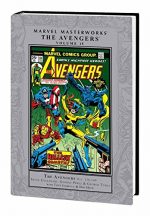
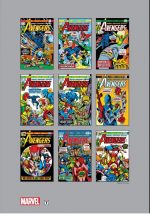
Avengers Marvel Masterworks volume 15


By Steve Englehart, Tony Isabella, Scott Edelman, George Tuska, George Pérez, Don Heck, Keith Pollard & various (Marvel)
ISBN: 978-0-7851-9196-4 (HB)

The Avengers have always proved that putting all one’s star eggs in a single basket pays off big-time: even when all Marvel’s classic all-stars such as Thor, Captain America and Iron Man are absent, it merely allows the team’s lesser lights to shine more brightly.

Of course, all the founding stars were regularly featured due to the rotating, open door policy which means that every issue includes somebody’s fave-rave – and the boldly grand-scale impressive stories and artwork are no hindrance either.

As explained in Steve Englehart’s Introduction – which also includes everything you need to know about the pre-superhero Patsy Walker – a new era was supposed to begin in Avengers #136 but a deadline was missed and instead ‘Iron Man: DOA’ by Englehart, Tom Sutton & Mike Ploog was reprinted from Amazing Adventures #12, wherein the newly-mutated and furry Hank McCoy AKA the Beast had attacked the Armoured Avenger whilst mind-controlled by evil mutants. You can find the story here.

But in this book – available in hardback and digital formats and collecting Avengers # 136-149 and spanning June 1975 through July 1976 – all you’ll enjoy is the spiffy cover by Gil Kane, Joe Sinnott & John Romita sr.

Although an excellent story in its own right, it rather gave the game away for the next issue after the painfully depleted team declared ‘We Do Seek Out New Avengers!!’ Illustrated by George Tuska & Vince Colletta, #137 depicted an eclectic mix of applicants – comprising Moondragon, Yellowjacket and the Wasp – and included an athletic, enigmatic guy bundled up in a raincoat…

No sooner had the introductions begun than a cosmic interloper attacks, hunting for the honeymooning Scarlet Witch and Vision, but at far from his expected level of puissance. Easily escaping imminent doom, our heroes smell a rat – but unfortunately not before the Wasp is gravely injured, resulting in a blazing battle with a ‘Stranger in a Strange Man!’ who proved to be far from what he claimed in the next issue…

After all the intergalactic hyper-cosmic extravaganzas and extended epic-ing, Avengers #139’s ‘Prescription: Violence!’and #140’s ‘A Journey to the Center of the Ant’ resort to mayhem on a comfortingly down-to-Earth scale as the malevolent Whirlwind tries to murder the bed-ridden Wasp even as her devoted defender Yellowjacket succumbs to a growing affliction which dooms him to exponentially expand to his death… but only until the refreshed, returned Vision and the bludgeoning Beast save the day in an extraordinary riff on classic Avengers history (you can see Avengers #93 for that, if you want)…

A new extended saga began in #141 which welcomed George Pérez & Vince Colletta as new art team. ‘The Phantom Empire!’ (scripted by Englehart,) heralded another complex, multi-layered epic combining superheroic Sturm und Drang with searing – for 1975, at least – political commentary. It all starts when Beast is ambushed by mercenaries from corporate behemoth Roxxon Oil.

He’s saved by ex-Avenger Captain America who had been investigating the company on a related case and, after comparing notes, realises something very big and very bad is going on…

Linking up with Thor, Iron Man, trainee Moondragon and the newly-returned newlyweds Vision and Scarlet Witch, the pair learn of another crisis after Hawkeye goes missing: probably captured by time-tyrant Kang the Conqueror…

Just as the Assemblage are agreeing to split into teams, former child model Patsy Walker-Baxter (star of a bunch of Marvel’s girl’s market comics such as Patsy Walker and Patsy & Hedy) bursts in, threatening to expose Beast’s secret identity…

When he had first further mutated, Hank McCoy had attempted to mask his anthropoid form and Patsy helped him in return for his promise to make her a superhero. Now she resurfaces, prepared to blackmail him into honouring his pledge. She is dragged along as one squad (Cap, Iron Man, Scarlet Witch and Vision) join Beast in returning to his old lab at Brand/Roxxon… where they are ambushed by alternate-Earth heroes Squadron Supreme…

Meanwhile, Moondragon and Thor co-opt sometime ally Immortus and follow Hawkeye back to 1873. Bushwhacked, they are soon battling Kang beside a coterie of cowboy legends (Kid Colt, Night Rider, Ringo Kid, Rawhide Kid and Two-Gun Kid) in ‘Go West, Young Gods!’, even as the present-day team learn their perilous plight involves a threat to two different dimensions, because Roxxon have joined with the corporations which rule the Squadron Supreme’s America – thanks to the malignly mesmeric Serpent Crown of Set…

Inked by Sam Grainger, Avengers #143 sees the Wild West showdown culminate with the apparent death of a deity in ‘Right Between the Eons!’

Elsewhen, the 20th century heroes are beginning their counterattack in the esoteric weaponry factory at Brand, and during all that running wild, liberate the technologically-advanced, ability-enhancing uniform of short-lived adventurer The Catin a storeroom. When Patsy dons it, the hero-groupie neophyte dubs herself Hellcat in ‘Claws!’ (Mike Esposito inks)…

Soon after, the Avengers are cornered by the Squadron and as battle recommences Roxxon president Hugh Jones plays his trump card and transports all the combatants to the other Earth…

The dreaded deadline doom hit just at this crucial juncture and issues #145-146 were taken up with a 2-part fill-in by Tony Isabella, Don Heck & John Tartaglione, with additional pencils by Keith Pollard for the concluding chapter.

‘The Taking of the Avengers!’ reveals how a criminal combine takes out a colossal contract on the World’s Mightiest Superheroes, but even though ‘The Assassin Never Fails!’, the killer is thwarted and Captain America, Thor, Iron Man, Hawkeye, Beast, Vision and Scarlet Witch – plus Wasp, Yellowjacket and the Falcon – are all safely returned to their various cases untroubled by the vagaries of continuity or chronology… which makes this rather impressive and thrilling yarn such an annoyance in this specific instance…

The trans-dimensional traumas resume in Avengers #147, describing a ‘Crisis on Other-Earth!’ courtesy of Englehart, Pérez & Colletta). With the corporate takeover of other-America revealed to have been facilitated by use of the mind-bending serpent crown, the Scarlet Witch takes possession of the sinister helm whilst her teammates try desperately to keep the overwhelming Squadron Supreme from regaining it.

On our Earth, Hawkeye brings Two-Gun Kid to the modern world but chooses to go walkabout rather than rejoin his comrades, even as Thor and Moondragon start searching for their missing colleagues…

‘20,000 Leagues Under Justice!’ (Grainger inks) features the final showdown and the Avengers’ victory over a wiser and repentant Squadron Supreme, and as the heroes return to their home dimension ‘The Gods and the Gang!’ reunites them with Moondragon and the Thunder God to clean up Brand/Roxxon. The Corporate cabal has one trick left to play however: a colossal, biologically augmented Atlantean dubbed Orka, the Human Killer Whale…

The next issue would see a drastic changing of the guard, but this epic tome now concludes with splendid as-standard extras including the covers – by Jack Kirby & Frank Giacoia – and contents page of tabloid Marvel Treasury Edition #7, house ads and pages of original art by Tuska & Colletta.

This type of timeless heroic adventure set the tone for fantastic Fights ‘n’ Tights dramas for decades to come and can still boggle the mind and take the breath away, even here in the sleek, cool and permanently perilous 21st century…

No lovers of Costumed Dramas can afford to ignore this superbly bombastic book and fans who think themselves above superhero stories might also be pleasantly surprised…
© 1974, 1975 2017 Marvel Characters, Inc. All rights reserved.
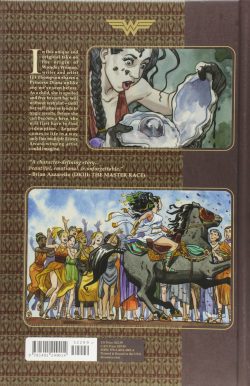
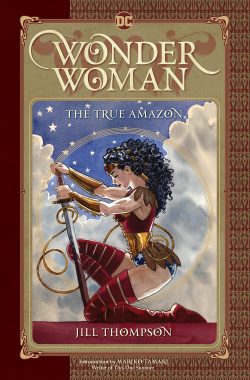
Wonder Woman: The True Amazon


By Jill Thompson, lettered by Jason Arthur (DC)
ISBN: 978-1-4012-4901-4 (HB) 978-1-4012-7450-4 (TPB)

Iconic global role model Wonder Woman was conceived by polygraph pioneer William Moulton Marston and illustrated by Harry G. Peter in an attempt to offer girls a positive and forceful role model. She debuted as a special feature in All Star Comics #8 (December 1941), before springing into her own series and the cover-spot of new anthology title Sensation Comics a month later. An instant hit, the Amazing Amazon quickly won her own eponymous supplemental title in late Spring of that year (cover-dated Summer 1942).

Once upon a time in the traditional history, on a hidden island of immortal super-women, American aviator Steve Trevor of US Army Intelligence crashed to Earth. Near death, he was nursed back to health by young and impressionable Princess Diana.

Fearing her daughter’s growing obsession with the creature from a long-forgotten and madly violent world, Queen Hippolyte revealed the hidden history of the Amazons: how they were seduced and betrayed by men but rescued by the goddess Aphrodite on condition that they henceforward isolate themselves from the rest of the world and devote their eternal lives to becoming ideal, perfect creatures.

However, when goddesses Athena and Aphrodite subsequently instructed Hippolyte to send an Amazon back with the American to fight for global freedom and liberty, Diana overcame all other candidates in a vast sporting and combat competition and became their emissary – Wonder Woman.

On arriving in America, she purchased the identity and credentials of lovelorn Army nurse Diana Prince, elegantly allowing the Amazon to be close to Steve whilst enabling the heartsick medic to join her own fiancé in South America. Soon after, Diana also gained a position with Army Intelligence, ensuring she would always be able to watch over her beloved.

Now this modern alternate version requests that you forget most of that as Jill Thompson offers another take on the formative years of the Princess Diana in an epic retelling painted in the manner of a picture book but with the no-holds barred punch you’d expect from Earth’s premiere Warrior Woman (Diana, not Jill).

Following an ‘Introduction’ by novelist and comics creator Mariko Tamaki (Skim; Saving Montgomery Sole; This One Summer), the subtly reconfigured saga opens on idyllic Themyscira: an island paradise inhabited by immortal warrior women. As before, their fate is the result of iniquities inflicted upon them by male “heroes” such as Herakles – secretly abetted by lustful Zeus – before stern Hera intervened to allow the Amazons to escape and build a bastion of culture in isolation.

However, their triumphant leader Queen Hippolyta was discontented. She craved a child more than life itself, and one special night her sadness and yearning touched the gods, who turned a shape drawn in sand into a real baby…

The child was beloved of all the Amazons, growing in an atmosphere of adoration and constant, uncritical approval. As well as smart, fast, brave and strong, baby Diana subsequently became insufferably spoiled, incurably vain and revoltingly selfish.

How that privileged brat became the humble, driven, noble protector of the weak is a tale of love, valour, repentance and redemption to delight and shock as the young wonder warrior endures a ghastly transformational motivating incident that traumatically reshapes her life in one shocking moment…

Embracing and channelling Classical Greek motifs while offering a most believable and human childhood for the little princess, this dark fairy tale is a powerful revision of Wonder Woman’s creation myth for a world marginally more inclusive than the patronising era of WWII, and provides a far more potent and logical reason for her exile to the world of Men than simple infatuation…

Augmented by a ‘Sketchbook’ section detailing page-roughs, scene-designs, fashions; the creation of the book cover; the process From Pencils to Color and a feature on ‘Designing the Wonder Woman Statue’, this is a brilliant reassessment of the iconic Diana and one well worth seeking out in either hardback or trade format, or even nature-nurturing eBook editions.
© 2016 DC Comics. All Rights Reserved.

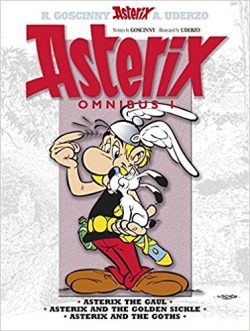
Asterix Omnibus volume 1: Asterix the Gaul; Asterix and the Golden Sickle; Asterix and the Goths


By René Goscinny & Albert Uderzo, translated by Anthea Bell & Derek Hockridge (Orion)
ISBN: 978-0-75289-154-5(HB) 978-1-44400-423-6(TPB)

I’ve just heard the sad news about Albert Uderzo, who has just passed away after 92 amazing, gloriously productive and fun-filled years. In the current climate of horrific global crisis, it’s ultimately just one more death, no more or less important than any other, but I’m compelled to mark his end with sadness, inexpressible gratitude and this rerun of a review for his greatest work.

In a career absolutely packed with joyous invention, Uderzo brought happiness and inspiration to generations of readers across the world through Asterix and his many other creations, so I can only say “thank you” to him and urge you to revisit his works if you’re already au fait. If you have never seen his genius in action – especially in conjunction with his perfect partner René Goscinny – this collection is the ideal place to start, and you won’t be sorry…

Asterix the Gaul is probably France’s greatest literary export. The feisty, wily little warrior who fought the iniquities and viewed the myriad wonders of Julius Caesar‘s Roman Empire with brains, bravery and – whenever necessary – a magical potion imbuing the imbiber with incredible strength, speed and vitality, is the go-to reference all us non-Gallic gallants when we think of France.

The diminutive, doughty darling was created at the close of the 1950s by two of our artform’s greatest masters…

René Goscinny is arguably the most prolific and remains one of the most-read writers of comic strips the world has ever known. Born in Paris in 1926, he grew up in Argentina where his father taught mathematics. From an early age René showed artistic promise. He studied fine arts and graduated in 1942. Three years later, while working as junior illustrator at an ad agency, his uncle invited him to stay in America, where he worked as a translator.

After National Service in France, he returned to the States and settled in Brooklyn, pursuing an artistic career and becoming, in 1948, an assistant for a small studio which included Harvey Kurtzman, Will Elder, Jack Davis and John Severin, as well as European giants-in-waiting Maurice de Bévère (Morris, with whom from 1955-1977 Goscinny produced Lucky Luke) and Joseph Gillain (Jijé).

Goscinny also met Georges Troisfontaines, head of the World Press Agency, the company that provided comics for the French magazine Le Journal de Spirou.

After contributing scripts to Belles Histoires de l’Oncle Paul and Jerry Spring, Goscinny was promoted to head of World Press’ Paris office where he met his ultimate creative collaborator Albert Uderzo. In his spare time, Rene also created Sylvie and Alain et Christine with Martial Durand (Martial) and Fanfan et Polo, drawn by Dino Attanasio.

In 1955, Goscinny, Uderzo, Charlier and Jean Hébrard formed the independent syndicate Édipress/Édifrance, creating magazines for business and general industry (Clairon for the factory union and Pistolin for a chocolate factory). With Uderzo, René spawned Bill Blanchart, Pistolet and Benjamin et Benjamine, whilst illustrated his own scripts for Le Capitaine Bibobu.

Under nom-de-plume Agostini he wrote Le Petit Nicholas (drawn by Jean-Jacques Sempé), and in 1956 began an association with revolutionary periodical Le Journal de Tintin, writing for various illustrators including Attanasio(Signor Spagetti), Bob De Moor (Monsieur Tric), Maréchal (Prudence Petitpas), Berck (Strapontin), Globule le Martienand Alphonse for Tibet; as well as Modeste et Pompon for André Franquin, and – with Uderzo – the fabulously funny adventures of inimitable Indian brave Oumpah-Pah. He also wrote for the magazines Paris-Flirt and Vaillant.

In 1959, Édipress/Édifrance launched Pilote, and Goscinny went into overdrive. The first issue featured re-launched versions of Le Petit Nicolas, Jehan Pistolet/Jehan Soupolet, new serials Jacquot le Mousse and Tromblon et Bottaclou(drawn by Godard), plus a little something called Astérix le gaulois: inarguably the greatest achievement of his partnership with Uderzo.

When Georges Dargaud bought Pilote in 1960, Goscinny became Editor-in-Chief, but still found time to add new series Les Divagations de Monsieur Sait-Tout (with Martial), La Potachologie Illustrée (Cabu), Les Dingodossiers (Gotlib) and La Forêt de Chênebeau (Mic Delinx).

He also wrote frequently for television, but never stopped creating strips such Les Aventures du Calife Haroun el Poussahfor Record and illustrated by Swedish artist Jean Tabary. A minor success, it was re-tooled as Iznogoud when it transferred to Pilote. Goscinny died far too young, in November 1977.

Alberto Aleandro Uderzo was born on April 25th 1927, in Fismes, on the Marne, a child of Italian immigrants. As a boy reading Mickey Mouse in Le Pétit Parisien, he showed artistic flair from an early age. Alberto became a French citizen when he was seven and dreamed of becoming an aircraft mechanic, but at 13 he became an apprentice of the Paris Publishing Society, learning design, typography, calligraphy and photo retouching.

When WWII broke out, he spent time with farming relatives in Brittany, joining his father’s furniture-making business. Brittany beguiled Uderzo: when a location for Asterix’s idyllic village was being decided upon the region was the only choice…

In the post-war rebuilding of France, Uderzo returned to Paris to become a successful illustrator in the country’s burgeoning comics industry. His first published work – a pastiche of Aesop’s Fables – appeared in Junior and, in 1945, he was introduced to industry giant Edmond-François Calvo (whose masterpiece The Beast is Dead is long overdue for the world’s closer attention…).

Young Uderzo’s subsequent creations included indomitable eccentric Clopinard, Belloy, l’Invulnérable, Prince Rollin and Arys Buck. He illustrated Em-Ré-Vil’s novel Flamberge, worked in animation, as a journalist, as an illustrator for France Dimanche and created vertical comic strip ‘Le Crime ne Paie pas’ for France-Soir.

In 1950, he drew a few episodes of the franchised European version of Fawcett’s Captain Marvel Jr. for Bravo!

Another inveterate traveller, the young artist met Goscinny in 1951. Soon fast friends, they decided to work together at the new Paris office of Belgian Publishing giant World Press. Their first collaboration was in November of that year; a feature piece on savoir vivre (how to live right or gracious living) for women’s weekly Bonnes Soirée, after which an avalanche of splendid strips and serials poured forth.

Jehan Pistolet and Luc Junior were created for La Libre Junior and they produced a comedy Western starring a very Red (but not so American) Indian who evolved into Oumpah-Pah. In 1955, with the formation of Édifrance/Édipresse, Uderzo drew Bill Blanchart for La Libre Junior, replacing Christian Godard on Benjamin et Benjamine before, in 1957 adding Charlier’s Clairette to his bulging portfolio.

The following year, he made his Tintin debut, as Oumpah-Pah finally found a home and rapturous audience. Uderzo also illuminated Poussin et Poussif, La Famille Moutonet and La Famille Cokalane

When Pilote launched in 1959, Uderzo was the major creative force for the new magazine, limning Charlier’s Tanguy et Laverdure and a humorous historical strip about Romans…

Although Asterix was a massive hit from the start, Uderzo continued working with Charlier on Michel Tanguy, (subsequently Les Aventures de Tanguy et Laverdure), but soon after the first serial was collected in a single volume as Astérix le gaulois (in 1961), it became clear that the series would demand most of his time – especially as the incredible Goscinny never seemed to require rest or run out of ideas (after the writer’s death, the publication rate of Asterix tales dropped from two per year to one volume every three-to-five).

By 1967, Asterix occupied all Uderzo’s time and attention. In 1974 the partners formed Idéfix Studios to fully exploit their inimitable creation, and when Goscinny passed away three years later, Uderzo had to be convinced to continue the adventures as writer and artist. Happily, he gave in and produced a further ten volumes before retiring in 2009.

According to UNESCO’s Index Translationum, Uderzo is the 10th most-often translated French-language author in the world and 3rd most-translated French language comics author – right behind his old mate René and the grand master Hergé.

So what’s it all about?

Like all entertainments the premise works on two levels: as an action-packed comedic romp of sneaky and bullying baddies coming a-cropper for younger readers and as a pun-filled, sly and witty satire for older, wiser heads, transformed here by the brilliantly light touch of master translators Anthea Bell & Derek Hockridge (who played no small part in making the indomitable little Gaul so very palatable to the English tongue).

Originally published in Pilote #1-38 (29th October 1959-4th July 1960, with the first page appearing a week earlier in a promotional issue #0, distributed on June 1st 1959), the story is set on the tip of Uderzo’s beloved Brittany coast in the year 50BC.

Here a small village of redoubtable warriors and their families frustrate every effort of the immense but not so irresistible Roman Empire to complete their conquest of Gaul. Unable to defeat these Horatian hold-outs, the Empire resorts to a policy of containment leaving the little seaside hamlet hemmed in by the heavily fortified permanent garrisons of Totorum, Aquarium, Laudanum and Compendium.

The Gauls don’t care: they daily defy the world’s greatest military machine by just going about their everyday affairs, protected by a magic potion provided by the resident druid and the shrewd wits of a rather diminutive dynamo and his simplistic best friend…

In Asterix the Gaul this immaculate comedy-drama scenario is hilariously demonstrated when Centurion Crismus Bonus– fed up with his soldiers being casually beaten up by the fiercely free Frenchmen – sends reluctant spy Caligula Minus to ferret out the secret of their incredible strength.

The affable insurgents take the infiltrator in and, soon dosed up with potion, the perfidious Roman escapes with the answer – if not the formula itself…

Soon after, wise Druid Getafix is captured by the invaders and the village seems doomed, but wily Asterix is on the case. Breaking into Compendium and determined to teach the Romans a lesson, he drives them crazy for ages by resisting all efforts at bribery and coercion, until abruptly wizard and warrior seemingly capitulate and make the Romans a magic potion – but not the one the rapacious oppressors were hoping for…

Although comparatively raw and unpolished, the good-natured, adventurous humour and sheer energy of the yarn barrels along, delivering barrages of puns, oodles of insane situations and loads of low-trauma slapstick action, all marvellously rendered in Uderzo’s seductively stylish bigfoot art-style.

From the second saga on the unique and expanding cast would encroach on events, especially the unique and expanded, show-stealing sidekick Obelix – who had fallen into a vat of potion as a baby – and became a genial, permanently superhuman, eternally hungry foil to our little wise guy…

Asterix and the Golden Sickle was originally serialised in Pilote #42-74 and recounts the disastrous consequences of Getafix losing his ceremonial gold sickle just before the grand Annual Conference of Gaulish Druids. Since time is passing and no ordinary replacement will suffice to cut ingredients for magic potion, Asterix offers to go all the way to Lutetia (you can call it Paris if you want) to find another.

As Obelix has a cousin there – Metallurgix the Smith – he also volunteers for the trip and the punning pair are swiftly off, barely stopping to teach assorted bandits the errors of their pilfering ways but still finding a little time to visit many roadside inns and taverns serving traditional roast boar…

There is concurrently a crisis in Lutetia: a mysterious gang is stealing all the Golden Sickles and forcing prices up. The druid community is deeply distressed and, more worrying still, master sickle-maker Metallurgix has gone missing. Asterix and Obelix investigate the dastardly doings in their own bombastic manner and discover a nefarious plot that seems to go all the way to the office of the local Roman Prefect…

The early creative experiment was quickly crystallizing into a supremely winning format of ongoing weekly episodes slowly building into complete and readily divisible adventures. The next epic cemented the strip’s status as a popular icon of Gallic excellence.

Asterix and the Goths ran from 1962-1963 and followed the dangling plot-thread of the Druid Conference as Getafix, brand new sickle in hand, sets off for the Forest of the Carnutes to compete. However, on the Gaul’s Eastern border savage Goths – barbarians who remained unconquered by the might of the empire – crossed into pacified Roman territory. The barbarians are intent on capturing the mightiest Druid and turning his magic against the rule of Julius Caesar…

Although non-Druids aren’t allowed into the forest, Asterix and Obelix had accompanied Getafix to its edge, and as the competition round of the Conference ends in victory for him and his power-potion, the Goths strike, abducting him in his moment of triumph…

Alerted by fellow Druid Prefix, our heroic duo track the kidnappers, but are mistaken for Visigoths by Roman patrols, allowing the Goths to cross the border into Germania. Although Romans are no threat, they can be a time-wasting hindrance, so Asterix and Obelix disguise themselves as Romans to invade the Barbarian lands…

Well-used to being held prisoner by now, Getafix is making himself a nuisance to his bellicose captors and a genuine threat to the wellbeing of his long-suffering translator. When Asterix and Obelix are captured dressed as Goths, the wily Gauls conceive a cunning plan to end the ever-present threat of Gothic invasion – a scheme that continues successfully for almost two thousand years…

Asterix is one of the most popular comics in the world, translated into 111 languages; with a host of animated and live-action movies, assorted games and even his own theme park (Parc Astérix, near Paris). More than 380 million copies of 38 Asterix books have been sold worldwide, making Goscinny & Uderzo France’s bestselling international authors.

This is sublime comics storytelling and you’d be as Crazy as the Romans not to increase that statistic by finally getting around to acquiring your own copies of this fabulous, frolicsome French Folly.
© 1961-1963 Goscinny/Uderzo. Revised English translation © 2004 Hachette. All rights reserved.

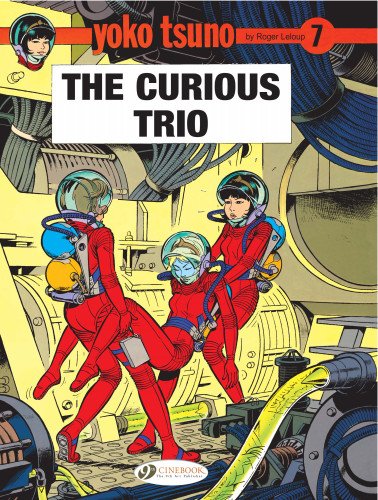
Yoko Tsuno volume 7 – The Curious Trio


By Roger Leloup (Cinebook)
ISBN: 978-1-84918-127-3 (PB Album)

The edgy yet uncannily accessible European exploits of Japanese scientific adventurer Yoko Tsuno began gracing the pages of Le Journal de Spirou from the September 24th issue in 1970 and are still going strong, with 29 albums at the last count. The mind-blowing, eye-popping, extremely expansive multi-award-winning series was created by Belgian author, artist and novelist Roger Leloup, who was born in 1933 and worked as one of Hergé’s meticulous background assistants on the iconic Adventures of Tintin strip before striking out on his own.

Compellingly told and superbly imaginative, whilst always framed in hyper-realistic settings and sporting utterly authentic and unshakably believable technology, these illustrated epics were at the forefront of a wave of strips featuring competent, brave and immensely successful female protagonists which began revolutionising European comics in the 1970s and 1980s and are as potently empowering now as they ever were.

The series has a complex history in English. Comcat previously released a few adventures – albeit poorly translated and adapted – before British-based Cinebook acquired the franchise and opened a comprehensive and entrancing sequence in 2007 with the seventh collected exploit (1976’s La frontière de la vie– AKA On the Edge of Life).

Moreover, in French and Dutch the first Spirou stories ‘Hold-up en hi-fi’, ‘La belle et la bête’ and ‘Cap 351’ were all brief, introductory vignettes testing the waters. Miss Tsuno truly hit her stride with premier full-length epic Le trio de l’étrange, which started serialisation with the May 13th 1971 issue. Translated as The Curious Trio, it was actually the 7th chronicle released by Cinebook and is still not available digitally…

The story opens in a busy TV studio at midnight (back when actual humans pushed, pulled and focussed the clunky paraphernalia) as young Director Vic Van Steen loses his rag with best pal Pol Paris for falling asleep on his camera. Later, still smarting from another fractious tiff, the pair walk home past a deserted construction site and espy what looks like an elegantly brilliant burglary…

The quietly flamboyant break-in is, in fact, a pre-arranged test by a sleekly capable freelance Japanese electrical engineer named Yoko Tsuno. She has been hired by the owners of a major company to test their new security. After apologising for nearly ruining her trial with their well-intentioned interference, the lads invite the enigmatic tech-bod to join their film crew as sound engineer on a proposed outside shoot.

The gig is to explore a region of flooded caves for a documentary and before the week ends the new friends are hauling equipment to a spectacular cavern, ready to work out the technical details. No sooner do they begin, however, than something goes terribly wrong when the trio are dragged deep underground by irresistible, swirling waters…

From here the achingly realistic and rationalist strip takes a huge leap into the uncanny as their subterranean submersion dumps them into a huge metal-shod vault where they are seized by blue-skinned humanoids.

The colossal complex is of incredible size and, as the captives are bundled into a fantastic vessel which runs on rails via magnetic levitation and driven even deeper underground, a handy translation helmet enables the only friendly-seeming stranger to explain. Her name is Khany and her race, the Vineans, have been sleeping deep beneath the Earth for almost half a million years…

However, since recently awakening, internecine strife has entered the lives of the colonists. Ambitious militaristic brute Karpan now constantly manoeuvres to seize power from the vast electronic complex known as The Centre, which regulates the lives of the colonists.

The humans’ first meeting with the blustering bully does not go well. When he attempts to beat Khany, martial artist Yoko gives him a humiliating and well-deserved thrashing…

Infuriated, Karpan tries to disintegrate them but is pulled away by security forces. As the newcomers resume their trip to the Centre, he secretly follows their magnetocarrier, resolved to destroy them…

As the maglev ship hurtles to unimaginable depths, Khany introduces the humans to a stowaway – her young daughter Poky – while relating the astounding tale of the Vineans’ escape from planetary doom and two-million-light-year voyage to Earth. Accustomed to subterranean living, on arrival the Vineans hollowed out a mountain and dug down even further.

The history lesson is interrupted by Karpan’s murderous attack, which is only thwarted by Yoko’s quick thinking and her companions’ near-insane bravery…

Eventually, after another, far more subtle murder attempt, the badly damaged magnetocarrier reaches its destination and the astonished visitors are brought before a stupendous computer to plead their case and expose Karpan’s indiscretions. The vast calculator dubbed The Centre controls every aspect of the colony’s life and will deliver judgement on the human invaders’ ultimate fate. After mind-scanning Yoko its pronouncement is dire: the strangers are to be placed in eternal hibernation…

When Pol plays his long-hidden trump card and threatens to destroy the machine with a stolen disintegrator, diplomatic Khany proposes a solution; suggesting simply waiting until they can all confront the still-absent Karpan. Yoko is still deeply suspicious and not convinced that Karpan is responsible for every attempt on their lives. That “night”, while Yoko’s resting, Poky sneaks into her habitation chamber and takes her on an illicit tour of the underside and innards of the impossibly huge complex. The jaunt verifies the engineer’s suspicions with a ghastly revelation. What they expose is a horrific threat not just to the Vineans – Karpan included – but to every human on the surface of Earth…

The eerie mystery then explodes into spectacular action and a third act finale worthy of a James Bond movie as Tsuno’s dramatic duel with an incredible malign menace settles the fate of two species…

Absorbing, rocket-paced and blending tense suspense with bombastic thrills, spills and chills, this is a terrific introduction to a world of rationalist mystery and humanist imagination with one of the most unsung of all female action heroes and one you’ve waited far too long to meet…
Original edition © Dupuis, 1979 by Roger Leloup. All rights reserved. English translation 2012 © Cinebook Ltd.

Arena – A Marvel Graphic Novel


By Bruce Jones (Marvel)
ISBN: 978-0-87135-557-7

In  the early 1980s Marvel led the publishing pack in the development of high quality original graphic novels: mixing out-of-the-ordinary Marvel Universe tales, new in-continuity series launches, creator-owned properties, licensed assets, movie adaptations and even the occasional creator-owned property in extravagantly expansive packages (a square-ish standard page of 285 x 220mm rather than the now customary elongated 258 x 168mm) that felt and looked instantly superior to the average comicbook no matter how good, bad or incomprehensible (my way of saying outside your average Marvel customer’s comfort zone) the contents might be.

By 1990 Marvel’s ambitious line of outré all-area epics had begun to stall and some less-than-stellar tales were squeaking into the line-up. Moreover, the company was increasingly relying on hastily turned out cinema adaptations with built-in fan appeal and safe in-continuity stories offering established and company copyrighted characters rather than creator-owned properties and original concepts. The once-unmissable line began to have the appearance of an over-sized, over-priced clearing house for leftover stories.

So this stunning suspense saga counts as one of the last – and very best – indie/mainstream fiction experiments from before the rot set in; a creepy, clever, sexy thriller from screenwriter,  novelist, artistic Everyman and ardent EC fan Bruce Jones which sets up shop in Stephen King and Ray Bradbury territory to deliver an overwhelmingly impressive rollercoaster of shocks and twists.

Sharon and her 12 year old daughter Lisa are driving through the majestic rural backwoods of America. It’s a pretty acrimonious journey and when the opportunity presents itself Mom takes a break and goes for a refreshing dip in a mountain pool whilst daughter stays in the car sulkily playing with her toy planes.

Sharon’s idyllic moment is shattered when she sees a jet crash scant yards away. However she can’t find any wreckage or even the slightest sign of it. Lisa saw and heard nothing and neither did the sinister voyeur who had been spying on them…

Rushing back to his shack simpleminded Lem tells his demented Granny about the strange woman. The old crone smells opportunity: if they can capture her and if she’s fertile they can sell her babies in the Big City… and even if she’s not big brother Rut will have a new plaything for awhile…

Lost in the deep woods Lt. Roberts, USAF crawls out of her crashed plane and hears voices. Sharon and the downed pilot start talking and realise that although they can’t see each other they are standing side by side. They’re invisible because they’re separated by two decades…

Somehow the mountain and forest are one huge time-warp… and increasingly, various eras are overlapping. Even though Sharon can only talk to Roberts, dinosaurs and cavemen are chaotically roaming over the hills, endangering both women in their own time-zones…

At that moment Lem and Rut strike, snatching Sharon. locking her up ready to make some money-spinning young ‘uns. From the car little Lisa sees her mother taken and twenty years in the future pilot Lisa Roberts suddenly remembers the horrifying moment her mother was killed by Hillbilly rapist psychopaths…

The time-shifts briefly stabilise and the two Lisas meet…

With beasts and worse roaming the woods the elder Lisa realises she has a chance to unmake the worst day of her life, but there are complications she could never have imagined in store for her and the girl she used to be…

Sultry, sinister and devilishly cunning, this chronal conundrum is beautifully illustrated by Jones and his corkscrew plot is packed full of genuine surprises. Don’t think you’ve guessed the ending because you most likely haven’t…

A perfect sci fi movie-in-waiting, this terse and evocative yarn follows all the rules for a great screen shocker without ever having to “dumb-down” the temporal mechanics in deference to the Great Un-read in the popcorn seats.

Smart, seductive storytelling for sharp-witted punters, this is book long overdue for re-release, but until that happy future materialises, this remains a time-lost gem you should track down however long it takes…
© 1989 Bruce Jones. All Rights Reserved.

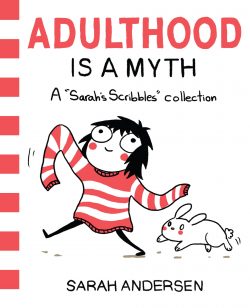
Adulthood is a Myth – A “Sarah’s Scribbles” Collection


By Sarah Andersen (Andrews McMeel)
ISBN: 978-1-44947-419-5 (PB)

Scary times need radical solutions, but in lieu of that and considering how helpless we all are, all I can suggest is burying yourself in a book (gallows pun not intended). Here’s one that both funny and incisive and is available online either in physical form or digitally. Moreover, as it’s about – and by – a millennial, all us old sods who lived through a few crises can chortle and feel smugly superior in the knowledge that problems such as these in here are transitory and shall also pass. That one was deliberate…

Sarah’s Scribbles started in 2013 as a webcomic (first on Tumblr, and latterly Facebook, Instagram and Line Webtoon) before going legit in 2016 in book from Andrews McMeel. Adulthood is a Myth was followed by Big Mushy Happy Lump in 2017 and Herding Cats in 2018. Each collection won that year’s Goodreads Choice Award. That’s because the strips and lead character are accessible, personable, relatable and fetchingly funny.

Autobiographical to a degree I’m unqualified to assess and distressed to acknowledge, what you get are pithy observational comedy gag strips with a semi-surreal undertone about the thoughts and (mostly) inactions of an arty student who lives with an exceptionally critical but ultimately supportive rabbit. Think of it as pictorial inner monologue from a very nervous and unconfident teen, roaring and giddy with hormones and expectations she can’t possibly hope to meet and indoctrinated with standards she can’t let go of…

As well as casual interactions with her peers, major causes of cartoon comment include projections of her eventual senility and decrepitude (‘Me in the Future’), social anxiety, body issues, relationships, housework, fashion, awkwardness, bingeing and attraction through episodes with such enticing titles as ‘Nightmares for Introverts’, ‘When to Change/Wash’, ‘Things I Know’, ‘Habits of the Common Bookworm’, ‘Getting Drunk (For Beginners)’, ‘Social Media in Real Life’, ‘What I Eat on a Typical Day’, ‘5 Phrases that make My Blood Run Colder than Ice’, ‘Watching Stuff’, ‘Things that make me Feel Safe’ and ‘Benefits of Stealing Boys’ Hoodies’.

On less excoriating days you’ll share her views on ‘Normal People’ versus ‘Me’, ‘How Graduating Feels’, ‘Internet Comment Threads’, ‘Folding Laundry’, ‘The Introvert’s Brain’, ‘How to know Your Partner is Serious about the Future’, and the potential of ‘The Future’, so that’s pretty much a view on everything to deal with…

Brooklyn-based Sarah Andersen was a student at the Maryland Institute College of Art before this took over her life so she knows the value of Extra Credits. That’s why this tome includes lots of strips created specifically for the collection so if you’ve been following her on the interwebs, you’ll still miss some good stuff if you don’t get this delirious delight.
© 2016 by Sarah Andersen. All rights reserved.

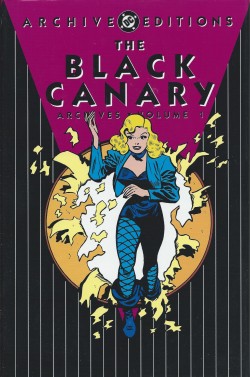
Black Canary Archives volume 1


By Bob Kanigher, Gardner Fox, Denny O’Neil, Carmine Infantino & Joe Giella, Murphy Anderson, Alex Toth & various (DC Comics)
ISBN: 978-1-56389-734-4 (HB)

Black Canary was one of the first of relatively few female furies to hold a star spot in the DC universe, following Wonder Woman, Liberty Belle and Red Tornado (who actually masqueraded as a man to comedically crush crime – with a couple of kids in tow, too!). She predated Merry, the Gimmick Girl (remember her?) and disappeared with most of other superheroes at the end of the Golden Age, to be revived with the Justice Society of America in 1963.

She was created by Bob Kanigher & Carmine Infantino in 1947, echoing the worldly, dangerous women cropping up in the burgeoning wave of crime novels and on the silver screen in film noir tales better suited to the wiser, more cynical Americans who had just endured a World War and were even then gearing up for a paranoiac Cold one…

Clad in a revealing bolero jacket, shorts, fishnet stockings and high-heeled pirate boots, the devastating shady lady who looked like Veronica Lake even began life as a thief…

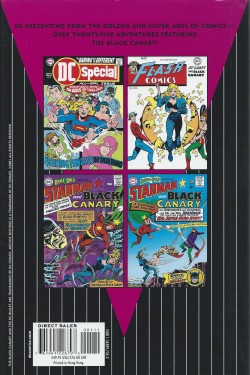
This superb full-colour hardback collection was released in 2001 to capitalise on the character’s small screen debut in the first Birds of Prey TV series. It gathers her admittedly short run of tales in Flash Comics (#86-104, August 1947 – February 1949), Comics Cavalcade #25 (February/March 1948), plus two adventures that went unused when the comicbook folded: one of the earliest casualties in the wave of changing tastes which decimated the superhero genre until the late 1950s. Those last only resurfaced at the end of the Second Great Superhero Winnowing and were subsequently published in DC Special #3 and Adventure Comics #399 (June 1969 & November 1970 respectively).

Also intriguingly included are two stellar appearances in Brave and the Bold #61-62 (September & November 1965), therein teamed up with JSA team-mate Starman as part of a concerted but ultimately vain editorial effort by Julius Schwartz to revive the Golden Age squad of champions situated on parallel world Earth-2.

Best of all is the re-presentation of a 2-part solo thriller from Adventure Comics #418-419 (April – May 1972) after she successfully migrated to “our” world and replaced Wonder Woman in the Justice League of America.

Regrettably, all these treasures can only be found here. Incomprehensibly, DC have allowed this entire imprint of reading gold lie fallow for years, both in print and digital formats. Hopefully, events in their cinematic analogues will entice them into reviving the Archive line… and adding to it…

In the heady, desperate days of post-war uncertainty, continuity was meagre and nobody cared much about origins. All that mattered was pace, plot, action and spectacle. As we’ll see, even when the Black Bird got her own strip, where she came from was never as important as who she faced…

Flash Comics #86 was just another superhero anthology publication, suffering a slow downturn in sales, and perennial back-up feature Johnny Thunder had long since passed its sell-by date. Although a member of the JSA, Johnny was an idiot; a genuine simpleton who just happened to control a genie-like Thunderbolt.

His affable good-hearted bumbling had carried him through the war, but changing fashions had no room for a hapless (adult) hero anymore. When he encountered a masked female Robin Hood who stole from crooks, the writing was on the wall. In this introductory yarn, ‘The Black Canary’ tricks him and T-Bolt into acquiring an invitation to a crime-lord’s party, lifts the ill-gotten loot and leaves Johnny to mop up the hoods. It was lust at first sight…

Nothing much was expected from these complete-in-one-episode filler strips. Hawkman and The Flash still hogged all the covers and glory, and although young artists Carmine Infantino & Joe Giella gave it their all as they learned their craft on the job, writer/editor Robert Kanigher was often clearly making it up as he went along…

The next Johnny Thunder instalment in #87 featured the immediate return of the Blonde Bombshell as she again makes the big goof her patsy, leaving ‘The Package of Peril’ in his inept hands. When mobsters retrieve the purloined parcel and secret documents it contains, Johnny follows and, more by luck than design, rescues the Canary from a deadly trap.

She returned in #88 – sans domino-mask now – using trained black canaries to deliver messages as she again finds herself in over her head and is forced to use the big sap and his magic pal to extricate herself before retrieving ‘The Map that Wasn’t There’ from a pack of human jackals.

Flash Comics #89 held the last Johnny Thunder solo tale as ‘Produce the Crime!’ sees the cheerful chump accidentally busting a gem-smuggling scheme without any help from the Girl Gladiator – but she did return in full force for #90 as ‘Johnny Thunder and the Black Canary’ officially team up to thwart a photographic frame-up and blackmail plot in ‘Triple Exposure!’

They resumed the partnership in #91 as gangsters used rockets and ‘The Tumbling Trees!’ in their efforts to trap the svelte nemesis of evil – and just to be clear: that’s her, not Johnny…

The strip became Black Canary with the next issue. She even got to appear on the Lee Elias cover with Flash and Hawkman. Johnny simply vanished without trace or mention and his name was peremptorily applied elsewhere to a new cowboy hero as the rise of traditional genre material such westerns relentlessly rolled on…

In ‘The Huntress of the Highway!’, feisty florist Dinah Drake is being pestered by arrogant, obnoxious but so-very-manly private eye Larry Lance, only to realise that the wreath she is working on is for him. Doffing her dowdy duds to investigate, the Blonde Bombshell is just in time to save him from a wily gang of truck hijackers.

And that’s all the set-up we got. The new status quo was established and a pattern for fast-paced but inconsequential rollercoaster action romps took off…

To celebrate her arrival, the Canary also appeared in catch-all anthology Comics Cavalcade – specifically #25 cover-dated February/March 1948 where she flamboyantly finishes a ‘Tune of Terror!’ inflicted on a rural hick trying to claim an inheritance, but encountering nothing but music-themed menace…

A word of warning: Kanigher was a superbly gifted and wildly imaginative writer, but he never let sense come between him and a memorable visual. The manic Deus ex Machina moment where a carpet of black canaries snatches the eponymous avenger and victim out of a death-plunge is, indeed, utter idiocy, but in those days, anything went…

Back in a more rational milieu and mood for Flash Comics #93, the ‘Mystery of the Crimson Crystal!’ has the Canary tracking down a conman who bamboozled many gullible women into parting with their fortunes for spurious immortality. On the home front, the utterly oblivious Larry had pressured shy Dinah into letting him use her shop as his detective office. Of course, the oaf had no idea his mousy landlady was the lethal object of his crime-busting desires…

The rather pedestrian ‘Corsage of Death!’ in #94 sees them save a scientist’s ultimate weapon from canny crooks, whilst ‘An Orchid for the Deceased!’ spectacularly finds the Avian Avenger framed for murder in an extremely classy Noir murder mystery before #96 combines equestrian robbery with aerial combat as gem thieves risk innocent lives to solve ‘The Riddle of the Topaz Brooch!’

Finally finding a formula that worked, Kanigher had Larry and the Canary investigate textile thieving thugs involved in ‘The Mystery of the Stolen Cloth!’ and murdering stamp-stealers in #98’s ‘The Byzantine Black’, as Infantino’s art grew ever more efficient and boldly effective.

‘Time Runs Out!’ in #99 ups the drama as ruthless radium-stealing gangsters trap the duo in a giant hourglass, and #100 again utilises baroque props and plots as they track down a model-making gang of burglars and are unexpectedly caught in ‘The Circle of Terror!’

Just as the stories were building momentum and finding a unique voice, the curtains were beginning to draw closed. ‘The Day that Wouldn’t End!’ in #101 sees Canary and gumshoe uncover a sinister scheme to drive a rich man mad, Dinah’s shop becomes an unsuspected tool of crafty crooks in ‘The Riddle of the Roses!’, and ‘Mystery on Ice!’ finds the capable crime-crushers suckered by a pack of thieves determined to steal a formula vital to America’s security.

Flash Comics disappeared with #104, making way for new titles and less fantastic thrills. ‘Crime on Her Hands’ ended the Canary’s crusade on a high, however, with an absorbing murder-mystery involving a college class of criminologists. She wouldn’t be seen again until the return of the Justice Society as part of the Silver Age revival of costumed mystery men, when awestruck readers learned that there were infinite Earths and untold wonders to see…

Nevertheless, the sudden cancellation meant two months’ worth of material was in various stages of preparation when the axe fell. The “All-Girl Issue” of reprint series DC Special (#3) subsequently printed one of the Canary yarns in 1969, with Bernard Sachs inking Infantino as ‘Special Delivery Death!’ finds Lance framed for murder and both Dinah and Black Canary using their particular gifts to clear him. Adventure Comics #399 printed the last story as ‘Television Told the Tale!’, revealing how a live broadcast tips off the Blonde Bombshell to a crime in the making…

Once the Silver Age revival took hold, superheroes were everywhere and response to Earth-2 appearances prompted DC to try-out a number of impressive permutations designed to bring back the World’s first team of costumed adventurers.

Try-out comic The Brave and the Bold #61 offered a brace of truly titanic tales by Gardner Fox & Murphy Anderson, pairing the Canary with Ted Knight, the Sentinel of Super-Science known as Starman. The deliriously cool cases began with ‘Mastermind of Menaces’, as vile techno-wizard The Mist returned, using doctored flowers to hypnotise his victims into voluntarily surrendering their wealth.

When he utilised Dinah’s flower shop to source his souped-up blooms, she, husband Larry and visiting pal Ted were soon on the villain’s trail…

Mystery and intrigue gave way to all-out action in #62’s ‘The Great Superhero Hunt!’ as husband-and-wife criminals Sportsmaster and Huntress began stalking superheroes for kicks and profit. By the time Feline Fury Wildcat became their first victim Ted and Dinah were on the case and ready for anything…

These latter classic tales alone are worth the price of purchase, but this splendid tome still has the very best to come as Adventure Comics #418 & 419 provide a scintillating 2-part graphic extravaganza by Dennis O’Neil & the legendary Alex Toth.

Originally an Earth-2 crime-fighter, Dinah was transplanted to our world by the wonders of trans-dimensional vibration after husband Larry was killed (see Justice League of America #73-75 or many assorted JLA compilations). Beginning a possibly rebound romance with Green Arrow, Dinah struggled to find her feet on a strangely different yet eerily familiar world. In ‘The Canary and the Cat! Parts 1 & 2’ she accepts a job teaching self-defence to women. The bereaved Blonde Bombshell has no idea her pupils are hirelings of vicious criminal Catwoman and the martial arts moves she shares will lead to her death and the liberation of a deadly menace…

Augmented by a fond remembrance from co-creator Carmine Infantino in his Foreword and detailed biographies of the many people who worked on the character, this admittedly erratic collection starts slow but builds in quality until it ranks amongst the very best examples of Fights ‘n’ Tights fantasy. I hope you get a chance to see it…
© 1947-1949, 1965, 1969, 1970, 1972, 2001 DC Comics. All Rights Reserved.

A City Inside


By Tillie Walden (Avery Hill)
ISBN: 978-1-91039-541-7 (HB) 978-1-91039-520-2 (TPB)

Transitions are important. In fact, they are literally life changing. Here’s another one captured and shared by the amazing Tillie Walden…

We usually attribute wisdom and maturity in the creative arts to having lived a bit of life and getting some emotional grit in our wheels and sand in our faces, but maybe that’s not the case for Texas-raised Tillie, whose incredible string of releases include I Love this Part, Spinning, On a Sunbeam, and Are You Listening? and award-winning debut graphic novel The End of Summer.

A City Inside is another seamlessly constructed marriage of imagination and experience to unflinching self-exploration, constructing a perfect blend of autobiography and fantasy into a vehicle both youthfully exuberant and literary timeless.

Opening in a therapy session, the story delves intimately into a woman’s past, from isolated southern days to bold moments of escape – or is that simply drifting away? – in search of peace and a place to settle. We all leave home and then grow up, and here that transition is seen through the tentative alliance with an ideal first love. That fumbles and fails, thanks to the dull oppression of the Happy Ever After part that no fairy tale ever warns you about…

Eventually life builds you into the being you are – hence the symbolism of a vast internal metropolis – and life goes on, or back, or away, or just somewhere else. That’s pretty much the point…

Supremely engaging, enticingly disturbing and ultimately utterly uplifting, this shared solo voyage to another county is a visual delight no lover of comics can possibly resist. Apart from the graceful honesty on show, the most engaging factor is the author’s inspired rearrangement of visual reality. These dictate mood and tone in a way a million words can’t, supplying a sense of grace and wistful whimsy to the affair.

You’d have to be bereft of vision and afflicted with a heart of stone to reject this comic masterpiece – available in hardback, softcover and digital formats – which no one should miss.
© Tillie Walden 2016. All rights reserved.

A Portrait in Poems: The Storied Life of Gertrude Stein & Alice B. Toklas


By Evie Robillard & Rachel Katstaller (Kids Can Press)
ISBN: 978-1-5253-0056-1 (HB)

We don’t cover nearly enough kids’ books here, nor those with an Arts or educational underpinning, and that’s because I lazily prefer to read stuff that’s entertaining, worthwhile and well-produced. And yes, I know they’re not necessarily mutually exclusive but somehow, so often…

Happily, this gloriously inclusive biographical primer into one of the world’s most interesting and accomplished women and her life partner is all of that and more.

Delivered as a delicious and enthralling picture book for 6 to 9-year-olds, A Portrait in Poems précis’ and shares some notable Parisian moments in the life of author Gertrude Stein and her muse Alice B. Toklas. This unconventional couple led the upcoming arts glitterati of Europe and collected one of the most astounding art collections in history prior to one World War and before another. The book is drafted in episodic free verse by librarian, teacher and writer Evie Robillard and painted with idyllic verve by El Salvadoran illustrator Rachel Katstaller in a superbly subtle manner guaranteed to get youngsters addicted to learning more.

In short order you’ll visit the protagonists’ first home at ’27 Rue de Fleurus’, observe as ‘Picasso Paints a Portrait’, share ‘Saturday Evenings’ and enjoy ‘The Room with All the Paintings’ before meeting ‘Gertrude Stein, the Genius’…

The couple shared their exalted existence with ‘A Dog Named Basket’ (two actually) and we see more of them all in ‘Gertrude & Alice & Basket in a Book’ before wrapping up the history with what happened ‘After’…

Adding learning and lustre a ‘Time Line’ supplies dates and hard facts, while glimpses of character shine in a trio of epigrammatic ‘Snapshots’, whilst ‘Sources’ offers some of Gertrude’s best works to check out and a bibliography reveals more books about her, before a final ‘Author’s Note’ deals with the contentious period when the couple abided under Nazi occupation in Vichy France.

It’s never too early to give children a hunger to know stuff, and this bright, inclusive foray into the mind and life of one of our most remarkable thinkers is a welcome addition to any junior library or kids’ book stash because it simply cries out for readers to go absorb more…
Text © 2020 Evie Robillard. © 2020 Rachel Katstaller. All rights reserved.

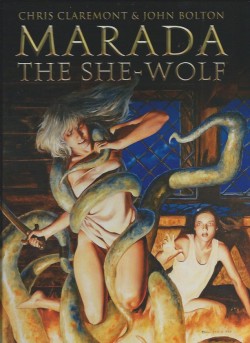
Marada the She-Wolf


By Chris Claremont & John Bolton (Titan Books)
ISBN: 987-0-85768-632-9 (HB) (TPB)

Scantily clad hot chicks swinging swords have been a staple of fantasy comics from their very inception. It’s a meme that has endured even as we (some of us anyway) grew up a bit and discovered it’s just as prevalent in the movies and on TV. If it going to be a thing, at least let’s see it done properly and probably nobody has done it better – certainly visually – than Chris Claremont and John Bolton.

This recycled yet supremely satisfying, luxuriously oversized (302 x 226 mm) hardback compilation of their collaborative fantasy saga will satisfy all aficionados of wild adventure and stirring sagas – especially in a world where faux historical dramas like Game of Thrones and The Witcher are still garnering interest in “Things Old, Things Forgotten”…

As detailed in Jo Duffy’s Introduction and collection Editor Steve Cook’s background essays ‘Birth of a Warrior’, ‘The Art of War’, ‘Epic Tales’ and ‘Legacy’, these stories – set in the cosmopolitan days of Imperial Rome – originated in Epic Illustrated (Marvel’s 1980’s response to Heavy Metal magazine) beginning with #10, February 1982.

Originally the strip appeared in beautiful monochrome wash-&-line, and although I would have preferred them to have been left that way for this collection, Bolton’s sensitive conversion of the art to painted colour is lush, lovely and stunningly effective.

By the way, that possibly waspish crack about recycling doesn’t just refer to the art, superb though it is. The original story started life as a Red Sonja yarn for monochrome anthology Bizarre Adventures, before Claremont & Bolton reworked the thing and, by inserting the whole kit and caboodle into the “real” world of the Ancient Roman – albeit embroidered with Celtic myth and legend – and added a satisfying layer of dramatic authenticity to the mix which still leaves it head-and-shoulders above all other Sword and Sorcery “Bad Girls” tales, as well as most fantasy fiction…

The literary pre-game warm-up also includes an effusive memo from the author as ‘Claremont on Bolton’ offers more creative insight on why these seldom-seen stories are just so darn good before the wonderment unfolds in the initial tale ‘Marada the She-Wolf: The Shattered Sword’.

The ferociously independent warrior woman is a wandering mercenary whose grandfather was Julius Caesar. When her parents fell into political disfavour, she was whisked from the Eternal City to live free and grow wild. Now, years later in the deserts near Damascus she is rescued from slavers by charismatic Warrior-Magician Donal MacLlyanllwyr. Strangely, the indomitable Marada he remembers is gone and all he liberates is a broken doll, traumatised by some unspoken horror and utterly devoid of will and spirit…

Mystically transporting her to the arboreal citadel of Ashandriar, amidst the misty hills of distant Britain, the baffled soldier seeks the aid of patron sorceress Rhiannon to diagnose, if not cure, her malady.

As Marada gradually recovers, she forms a bond with Donal’s daughter Arianrhod; a girl of vast, if unschooled, magical power. Before long, the ghastly secret of Marada’s malaise is revealed when a demonic creature invades the mystic keep, killing Donal and abducting Arianrhod.

Enraged and desperate, Marada braves Hell itself and slashes her way through an army of devils to rescue the child she now considers as much daughter as friend from a wizard and demon conclave. They initially broke the warrior woman as part of a convoluted scheme to reign on Earth…

The re-galvanised She-Wolf is ultimately victorious, but the horrific confrontation leaves her and Arianrhod stranded in East Africa. With no other option, the triumphant duo begin the long exhausting walk home to Albion…

From Epic #12, ‘Royal Hunt’ is a shorter, self-contained tale wherein Marada and Arianrhod, after escaping the Infernal Realm, are taken by Ashake, barbaric Empress of Amazonian nation of Meroë. The Battle Queen offers her captives the dubious distinction of being the quarry in a hunt (a competent if cheekily uninspired variation of Richard Connell’s landmark 1924 short story – and equally influential 1932 movie – The Most Dangerous Game).

Sadly, both predator and prey are unaware malign male mercenaries are lurking about, with the worst of all intentions for the unsuspecting women. Hard-fought combat and the sudden intervention of the sneaking male scum makes allies of Ashake and Marada, leading to the voyagers’ final tale, ‘Wizard’s Masque’ (Epic Illustrated #23-24, April & June 1984) which finds the long-lost Europeans aboard merchant ship Raven, bound for Roman port Massilia. However, impetuous Arianrhod gets bored with their slow progress and tries a transportation spell, opening a portal to nether realms and letting something really ghastly out of hell…

Beating the beast back, Marada falls though the gap in reality to materialise on an Arabic pirate ship currently engaged in a life-and-death clash with soldiers of an Eastern Kaydif. Her sudden presence turns the tide and soon she is partner to flamboyant corsair Taric Redhand, who swears to get her back to her home and lost “daughter”…

Typically, Marada has also been noticed by sinisterly seductive sorcerer Jaffar Ibn Haroun Al-Rashid. Although he purports to be a friend – and potential lover – able to reunite her with The Raven, he conceals a connection to the same demonic alliance that originally targeted the She-Wolf in faraway Rome. He is also, in all things, a creature of passion and self-serving convictions, capable of absolutely anything to achieve his own ends…

Ultimately however, the wanderer knows she can only depend upon herself to find her way back to Arianrhod and home…

Moody, passionate and powerfully evocative, this is a classic work of comics fantasy that will certainly all delight fans of the genre.
© & ™ 2013 John Bolton and Christ Claremont. All rights reserved.