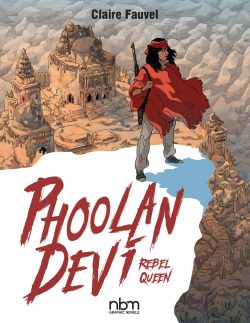
Phoolan Devi: Rebel Queen


By Claire Fauvel, translated by Montana Kane (DC Comics)
ISBN: 978-1-68112-251-9 (HB)

Born in 1988, award-winning graphic novelist Claire Fauvel (À la recherche d’Alvaro Dolor; Sur les pas de Teresa, la religieuse de Calcutta [w/Marie-Noëlle Pichard]; Une Saison en Égypte; Catherine’s War [w/Julia Billet]) studied illustration at Paris’ l’école Estienne and animation at l’école des Gobelins before beginning an illustrious career in bande dessinée. She’s particularly adroit and adept with female historical figures and her latest tome gives her plenty to work with…

Phoolan Devi: Rebel Queen is that rare event, a history that has all the energy and impetus of a great action adventure and pioneering, political tract. Despite being a factual graphic biography, this is the stuff of legend and grand drama, detailing the astounding, appalling, tragic and triumphant life of a woman who bucked India’s ancient, all-pervasive caste system. Victim from birth of poverty and inequality, she sought change through bloody deeds and ultimately political action in a country where prejudice is institutionalised: expressed via cultural violence, and which fostered for millennia a tyrannical social system of inherent, inbuilt corruption where gods and birth status forever dictate one’s position in life…

Phoolan suffered a double blow at birth: born both poor and female. Never educated, she remained illiterate all her life. A life of being shunned and grinding poverty was exacerbated when she was married off at age 11, starting a harrowing pattern of slavery and sexual abuse lasting until she was rescued by a troop of the legendary bandits infesting Uttar Pradesh at the time. They were actually more decent – and heroic – than most respectable citizens (men), civil authorities and police officers of the region. Becoming lover to one of the gang, she suffered even greater abuse when he was murdered by a rival from a different caste.

Surviving these assaults, Phoolan organised an infamous vengeance massacre at the village of Behmai. That slaughter was picked up by the press, who recast her as a rebel queen and her lover a martyr. The public began using the honorific “Devi” for her and, after a mythic career, she surrendered to authorities in 1983. Over eleven years of imprisonment, 48 capital charges including murder, plunder, arson and kidnapping were incrementally dropped before a trial that never came. In 1994, the state government led by Mulayam Singh Yadav of the Samajwadi Party withdrew all charges and she walked free. Joining the party, she was elected to national office twice, becoming a strong advocate for radical change, in the caste system and the patriarchal treatment of women. Regarded as the “voice of the oppressed”, on 26th July 2001 her past caught up with her when she was assassinated by relatives of the bandits killed at Behmai.

Fauvel took her inspiration from acclaimed 1996 autobiography Moi, Phoolan Devi, reine des bandits by Phoolan Devi & Marie-Thérèse Cuny, and although not all of those events are included in this stunning and uncompromising account, the supremely enticing and engaging art manages to mix in a few moments of hopeful aspiration, happy romance and family unity to offset the revolting iniquities Phoolan and other women had to survive on a daily basis.

Nevertheless, this brilliant tale is grim and unflinching in the portrayal of the constant assaults and abuses she endured, so you’d better gird yourself for plenty of righteous indignation and outright anger at the catalogue of venality and casual intolerance civilised folk still seem capable of…

Potent, unmissable, and primed to continue the fight, this is a book you must read.
© 2018 Casterman. © 2020 NBM for the English translation.

Phoolan Devi: Rebel Queen will be published on March 19th 2020 and is available for pre-order. NBM books are also available in digital formats. For more information and other great reads go to NBM Publishing at nbmpub.com

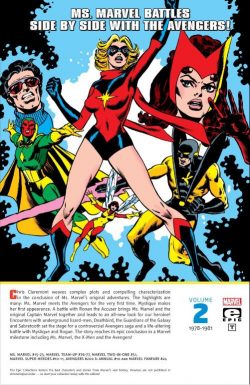
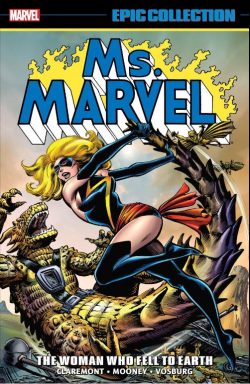
Ms. Marvel Epic collection volume 2 1978-1981: The Woman Who Fell to Earth


By Chris Claremont, Peter B. Gillis, David Michelinie, Jim Shooter, George Pérez, Bob Layton, Simon Furman, Jim Mooney, Mike Vosburg, Dave Cockrum, Michael Golden, Carmine Infantino, Frank Miller, Howard Chaykin,Jeff Aclin, Mike Gustovich, Dave Ross & various (Marvel)
ISBN: 978-1-3029-1802-6 (TPB)

For a very long time, American comics and especially Marvel had very little in the way of positive female role models and almost no viable solo stars. Although there was a woman starring in the very first comic of the Marvel Age, Invisible Girl Susan Storm took years to become a potent and independent character in her own right. It was more than 30 years before she became Invisible Woman…

We’ve come a long way since then…

Ms. Marvel launched in her own title, cover-dated January 1977. She was followed by the similarly copyright-protecting Spider-Woman in Marvel Spotlight #32 (February 1977, and securing her own title 15 months later) and Savage She-Hulk (#1, February 1980). Then came the music-biz sponsored Dazzler who premiered in Uncanny X-Men #130 the same month, before inevitably graduating to her own book.

Once upon a time Ms. Marvel was United States Air Force security officer Carol Danvers. She was first seen in Marvel Super-Heroes #13 (March 1968): the second episode of the saga of Kree warrior Mar-Vell – AKA Captain Marvel – who had been dispatched to Earth as a spy after the Fantastic Four repulsed the alien Kree twice in two months…

That series was written by Roy Thomas and illustrated by Gene Colan with the immensely competent Carol perpetually investigating Mar-Vell’s assumed and tenuous cover-identity of Walter Lawson for many months.

This was until Danvers was collateral damage in a devastating battle between the now-defecting alien and his nemesis Yon-Rogg in Captain Marvel #18 (November 1969).

Caught in a climactic explosion of alien technology, she pretty much vanished from sight until revived as and in Ms. Marvel #1 (January 1977), heralding a new chapter for the company and the industry…

This sturdy trade paperback volume (or enthralling eBook if you prefer), brings a close to the first career of Carol Danvers, via Ms. Marvel #1-23, and includes guest appearances from Marvel Team-Up #76-77, Marvel Two-in-One#51, Marvel Super-Heroes #10-11, material from Avengers #197-200, Avengers Annual #19 and Marvel Fanfare #24, cumulatively cover-dated from March 1978 to January 1986, and dives straight in to the ongoing mystery and drama…

Never having fully recovered from her near-death experience, Danvers had left the military and drifted into writing, slowly growing in confidence before relocating to New York City to work for publisher J. Jonah Jameson on his new project Woman Magazine.

During this time Carol learned that she had gained Kree-based abilities, psychic powers and partial amnesia: creating the role of Ms. Marvel without her own knowledge. Eventually her personality split was healed and she became a fully conscious and ferociously competent costumed champion…

With Chris Claremont scripting and Jim Mooney & Tony DeZuñiga providing the art, ‘The Shark is a Very Deadly Beast!’ opens this edition as the two-fisted titan clashes with undersea villain Tiger Shark. The action begins after Carol stumbles over him abducting the Sub-Mariner‘s teenaged cousin Namorita. Despite a brief side trip to Avengers Mansion, only Ms. Marvel is on hand to provide succour in cataclysmic concluding ‘The Deep Deadly Silence!’ (inked by Frank Springer).

‘Shadow of the Gun!’ (Mooney & DeZuñiga) then enhances the X-Men connection by introducing shape-shifting mutant Mystique in a raid on S.H.I.E.L.D. to purloin a new super-weapon which then sees impressive service in #18’s ‘The St. Valentine’s Day/Avengers Massacre!’ (inked by Ricardo Villamonte): a blockbuster battle featuring the beginnings of a deadly plot originating at the heart of the distant Kree Imperium…

The scheme culminates in ‘Mirror, Mirror!’ (illustrated by Carmine Infantino & Bob McLeod) as the Kree Supreme Intelligence attempts to reinvigorate his race’s stalled evolutionary path by kidnapping Earth/Kree hybrid Carol Danvers. However, with both her and Kree warrior Captain Marvel hitting hard against his emissary Ronan the Accuser, eventually the Supremor and his plotters take the hint and go home empty-handed…

Ms. Marvel #20 highlights a huge and abrupt makeover as Danvers dumps her Mar-Vell-inspired uniform and finally finds her own look and identity in ‘The All-New Ms. Marvel’, courtesy of Claremont, Dave Cockrum & Bob Wiacek. Here our utterly re-purposed hero tackles a hidden kingdom of predatory, intelligent, post-atomic dinosaurs infesting the American deserts, leading to a catastrophic clash with ‘The Devil in the Dark!’ (inked by Al Milgrom) in the following issue.

Danvers was a key component in an extended adventure in in Marvel Team-Up #76-77 (December 1978 and January 1979). Crafted by Claremont, Howard Chaykin, Jeff Aclin & Juan Ortiz ‘If Not for Love…’  sees Doctor Strangeattacked by old enemy Silver Dagger: a grudge rematch that draws in Ms. Marvel and Spider-Man as well as deadly Marie Laveau. The “Witch-Queen of New Orleans” naturally has her own agenda which comes into play as ‘If I’m to Live… My Love Must Die!’, finds the non-magical comrades battling the deranged exorcist, whilst Strange struggles with his own demonically-altered paramour Clea…

Now one of the most hands-on, bombastic battlers in the Marvel pantheon, Ms. M is more than ready for a return match with Death-Bird in her own comic book. Issue #22 offers a ‘Second Chance!’ (art by Mikes Vosburg & Zeck) but sees Danvers thrown for a total loop in her personal life after being fired from Woman Magazine. All these bold changes came too late as the series’ dwindling sales had earmarked it for cancellation.

Inked by Bruce D. Patterson, ‘The Woman Who Fell to Earth’ resolves a long-running plot thread involving the disappearance of old friend Salia Petrie in a tale guest-starring the time-travelling Guardians of the Galaxy, just in time for the end of the road.

The series stopped there but two more stories were in various stages of preparation. They eventually saw print in 1992 (the Summer and Fall issues of oversized anthology publication Marvel Super-Heroes Magazine #10-11). Before them, though, comes a minor classic from Marvel Two-in-One #51.

Scripted by Peter B. Gillis, up-&-coming artist Frank Miller & Bob McLeod, ‘Full House… Dragons High!’ details how a weekly poker session at Avengers Mansion is interrupted by rogue US General Pollock, who again tries to conquer America with stolen technology. Happily, Ben “the Thing” Grimm and Nick Fury round up Ms. Marvel, Wonder Man and the Beast, who prove to be better combat comrades than poker opponents…

Complete with the cover of unreleased Ms. Marvel #24, Marvel Super-Heroes Magazine #10 presents originally untitled yarn ‘Sabretooth Stalks the Subway’: a ferocious fight against the feral mutant maniac by Claremont & Vosburg. It’s followed by ‘Cry, Vengeance!’ (Claremont, Simon Furman, Vosburg & Mike Gustovich) as Ms. Marvel, now a card-carrying Avenger, faces off against Mystique and her Brotherhood of Evil Mutants.

This tale incorporates an additional section explaining how Carol is later attacked by young mutant Rogue, permanently loses her powers and memory and is eventually reborn as the cosmic-powered adventurer Binary: which is all well and good but somewhat takes the punch out of the later tales in this collection…

Relegated to an ensemble role in the World’s Mightiest Heroes, Danvers’ life took a strange and disturbing turn in Avengers 197-199 (July to September 1980 and represented here by pertinent extracts from those issues). Written by David Michelinie with art from Infantino & Brett Breeding and George Pérez & Dan Green, the snippets follow a strange and terrifyingly rapid transformation as Carol finds herself impossibly pregnant and bringing an unknown baby to term in a matter of days…

The mystery is solved in ‘The Child is Father To…?’ (Avengers #200, October 1980 by plotters, Jim Shooter, Pérez & Bob Layton and scripter Michelinie, illustrated by Pérez & Green). The mystery baby is born and hyper-rapidly matures as time goes wild, with different eras overwriting the present. The unearthly boy begins building a machine to stabilise the chaos but the heroes misunderstand his motives.

“Marcus” claims to be the son of time-master Immortus, trying to escape eternal isolation in other-dimensional Limbo by implanting his essence in a mortal tough enough to survive the energy required for the transfer. Literally reborn on Earth, his attempts to complete the process are foiled by the World’s Most Confused Heroes and he is drawn back to his timeless realm. Carol, declaring her love for Marcus, unexpectedly goes with him…

Ms. Marvel only plays a peripheral role in ‘By Friends… Betrayed!’ (Avengers Annual #10 (1981, by Claremont, Michael Golden & Armando Gil), as powerless, amnesiac Carol is rescued from drowning by Spider-Woman, prior to Mystique launching an all-out attack on the Avengers whilst attempting to free her Brotherhood from custody. In the melee, Danvers’ mind and abilities were taken by power-leaching Rogue, seemingly ending her adventuring life, and in the aftermath, the Avengers learn the horrific truth of her relationship with Marcus and their part in his doom…

One final sentimental moment comes with Claremont, David Ross & Wiacek’s ‘Elegy’ (Marvel Fanfare #24, January 1986) as Carol – now stellar-energy warrior Binary – returns to Earth to catch up with old friends and learns of the tragic death of Captain Mar-Vell…

Extras in this stellar compendium include a full cover gallery, a Ross alternative cover; ‘The RE-Making of Ms. Marvel’promo article from F.O.O.M. #22, house ads for her 1978 makeover relaunch and original art.

Always entertaining, often groundbreaking and painfully patronising (occasionally at the same time), the early Ms. Marvel, against all odds, grew into the modern Marvel icon of affirmative womanhood we see today.

In both comics and on-screen, Carol Danvers is Marvel’s paramount female symbol. These adventures are a valuable grounding of the contemporary champion but also still stand on their own as intriguing examples of the inevitable fall of even the staunchest of male bastions – superhero sagas…
© 2019 MARVEL.


The Strange Case of Leonardo’s Bicycle – a Graphic Investigation


By John Stuart Clark AKA Brick (A BrickWorks Limited Edition Monograph)
No ISBN

Do you love a mystery? How about conspiracy theories? What about science, truth and common sense, all overwhelmed and overturned by venality, self-seeking scholarly self-aggrandizement and national pride? All that and more are on show in the witty, incisive and superbly engaging exposé of not just Fake News but actual Fake History from Nottingham-based investigative, political cartoonist and campaigning educator Brick.

The name might not be familiar but if you’re politically aware, socially active and can remember the real cost of Thatcherism, you will probably have seen John Stuart Clark’s excoriating artwork for decades-worth of trade unions, NGOs and pressure groups. You might also have seen his masterful graphic novel Depresso.

That’s still available online and digitally, whereas the subject of today’s lesson is not. A forensic deconstruction of the unethical nature of special interests (no matter how minor) and the sheer gullibility of humans in groups of more than one, The Strange Case of Leonardo’s Bicycle is a hefty paperback tome packed with detail, deliberations and deliciously confirmable data that you can – and should – only get direct from the publisher. Fret not: I’ll tell you how at the end…

Using humour as his scalpel, Brick peels back decades of nonsense generated by assorted factions with something to gain and corrects a bizarre blip in the history of knowledge which can be broken down thusly. Around 1820, minor German noble and inveterate inventor Karl Friedrich Christian Ludwig Freiherr Drais von Sauerbronn created the world’s first recognisable bicycle. In 1974, minor Italian historian Professor Augusto Marinoni discovered drawings by intellectual paragon Leonardo Da Vinci that “proved” the old master had perfected all the necessary mechanical principles – and provided a blueprint for the bicycle – 324 years previously. Cue global frenzy, intrigue in the highest levels of the Catholic Church, nationalist upsurges in Italy and a massively profitable boost in the ever-expanding Leonardo Industry…

Broken down into diligently researched, easily digested portions, the wide-ranging story unfolds after meeting our affable, scene-setting host on tour in the Vinci region for ‘The Introduction’. We observe the politically dangerous von Drais at the start of the 18th century as he unleashes ‘The Invention’ and, in 1974 Italy, ‘The Lecture’ by Marinoni that launched the miasma of misinformation…

Connecting dots far and wide, Brick explores the provenance of ‘The Notebooks’ Da Vinci’s bike was “found” in, as well as the parlous time of political unrest in 1960s Italy which led to ‘The Terror’ and a need for a patriotic distraction, before moving on to recount how ‘The Sceptics’ and ‘The Fakes’ thrown up by a prejudicial scan of history muddied the tracks even further…

Some cartoon time travel introduces us to ‘The Maestro’ in his heyday while ‘The Crazies’ he inspired and ‘The Industry’built around him in the 20th century show us how such preposterous notions can take on an unstoppable life of their own (can you say “Anti-Vaxxer”?) after which ‘The Godforsaken Years’ takes us back to 1815 and shows how geological catastrophe sparked the need for the German genius to devise a manpowered substitute for horses in the first place…

‘The Democrat’ Von Drais then gets his time in the sun before ‘The Reveal’ finally investigates who might actually have created Leonardo’s drawing – and why – before ‘The Epilogue’ engages outrage overload with a fresh revelation. Apparently 500 years before the birth of Christ, mythical Chinese artisan Lu Ban built a wooden velocipede. There are even photos…

Like all proper theses, this magnificent filleting of populist nonsense comes fully loaded with ‘The Appendix’: a weighty tract of annotations and acknowledgements adding even more punch to the arguments.

Sharp, smart and truly compelling, The Strange Case of Leonardo’s Bicycle is a rationalist triumph, comprehensively applying Occam’s Razor to the tyres of runaway fabulism and delivering a shockingly unforgettable joy ride along the way.
© John Stuart Clark (AKA Brick) 2019. All rights reserved.

Accepting cheques, BACS bank transfers or Paypal, the book is available from www.brickbats.co.uk/bookshop. You could also enquire about the Signed and Numbered limited edition, if you have a bike fanatic in your life you need to impress or mollify…

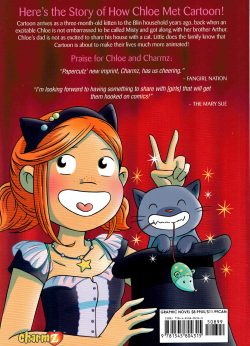
Chloe & Cartoon volume 1: When Chloe First Met Her Cat, Cartoon


By Greg Tessier & Amandine, translated by Joe Johnson (/Charmz/Papercutz)
ISBN: 978-1-5458-0430-8 (HB) 978-1-5458-0431-5 (TPB)

Let’s close cat week (not an actual thing… yet) with another superbly inclusive and entertaining European import, debuting under Papercutz’s new Charmz imprint aimed at a Pre and Early Teen female readership (let’s go with 9-13, but I don’t register on any of those metrics and still enjoyed it immensely).

Chloe & Cartoon is actually a prequel, set before Charmz’s splendid, school series Chloe which originally began in 2017 and 2018 as French series Mistinguette & Cartoon. When Chloe First Met Her Cat, Cartoon compile first two Euro-tomes Chat Arrive! and Deuxieme Chat Pitre into a bold and charming collation of consecutive vignettes detailing how the ever-so-tense Blin family take possession of a 3-month old kitten. Chloe is still in elementary school and her brother Arthur is just a toddler, it’s nearly Christmas and tetchy Mr. Blin is about to reluctantly capitulate to a sustained campaign by his wife and first-born to get a cat. He is NOT KEEN.

Knowing when to give in, he scopes out three likely candidates and make the rookie mistake of picking the chubby, lazy sleeping one, on the absurd assumption that it will cause the least mess and trouble…

Dad learns his lesson over the following months as the little tyke settles in with the exact opposite of the minimum of fuss and destruction. Nevertheless, Cartoon changes Chloe’s life and the family dynamic forever. Days pass in a flurry of little adventures as the girl learns responsibility, how to let go, and patience while dad becomes more and more of an ogre before admitting his own affection for the fuzzy brute….

These short strips are not only fun and supremely entertaining but also subtly reinforce ideas of proper pet care and are augmented by ‘Tips from Chloe’: illustrated text features ‘Welcoming a Kitten to Your Home’ and behavioural hints in ‘Understanding a Kitten’.

Available in Hardback, Softcover and digital editions, When Chloe First Met Her Cat, Cartoon is the brainchild of author Greg Tessier, a relative newcomer who spent much of his career as a cultural and historical development specialist, overseeing public reading projects in France, and veteran illustrator Amandine. She’s been active in the business since 2006, with alternative projects as part of the Nekomix collective; mainstream illustration work for Disney, Hachette Presse, Playbac, Fleurus Presse; children’s series Valentin, and since 2011 Mistinguette.

As well as being a delightful comic for readers of all ages, Chloe & Cartoon is a wonderful argument for the proposition that every kid should grow up a with a pet. If that’s a quandary currently vexing you, consider this as definite tick in the “pro” column…
Mistinguette [CHLOE] & Cartoon volume 1 “Chat Arrive!” © Jungle! 2017 and Mistinguette [CHLOE] & Cartoon volume 1 “Deuxieme Chat Pitre” © Jungle! 2018. All rights reserved. User license. English translation and all other material © 2020 by Papercutz. All rights reserved.

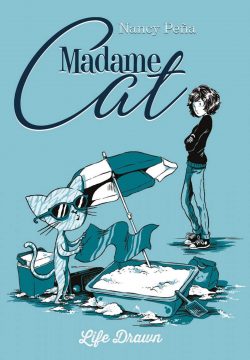
Madame Cat


By Nancy Peña, translated by Mark Bence (Life Drawn/Humanoids)
ISBN: 978-1-59465- 813-6 (PB Album)

Churlish men have joked about women with cats for eternity. Here’s a superbly irrepressible cartoon collection BY a woman about her own cat. It’s hilarious, extremely addictive and among the top five strips about feline companions ever. Laugh that off, guys…

Toulouse-born Nancy Peña probably caught the comics bug off her father: a dedicated comics collector. She studied Applied Arts and became a teacher while carving out a sideline as a prolific creator of magazine strips and graphic novels such as her Medea series, Le Cabinet Chinois, Mamohtobo and many more.

Hectic as all that sounds, she still found time to invite a companion animal to share her life…

Madame is a cute little kitty who shares her house and converses with her. The bewhiskered treasure (Madame, right) has a vivid interior life – probably swiped from a number of deranged mad scientists and would-be world conquerors – and is the mischievous stuff of nightmares all those legally responsible for a pet know and dread. There is nothing the tiny tyke won’t attempt, from drinking artists ink to exorcising the artist’s long-suffering and utterly unwelcome boyfriend.

Madame knows what she is and what she wants and will baulk at nothing – not even the laws of physics – to achieve her aims…

The engaging bombshell bursts of manic mirth are rendered in engaging duotone (black and blue, but I’m sure that’s not symbolic of anything) with titles such as ‘Madame flirts’, ‘Madame suggests’, ‘Madame insists’, and ‘Madame smells’ as the wee beast moves in, makes allies of the other felines in the area and promptly takes charge: wrecking the life and house of her carer and only giving in return permission to be adored. Every cat person alive will identify with that…

Available in paperback and digital editions, Madame Cat is a sparking example of domestic comedy. Mixing recognisably real events with potent imagination and debilitating whimsy, Peña has introduced a classic cartoon character who is charming, appalling and laugh-out-loud funny. If you’ve been thinking of getting a cat, along with all the medical and pet-care books, get this too. You won’t be sorry. Well, not with the book, at least…
“Madame” © 2015-2016 La Boîte à Bulles & Nancy Peña. All rights reserved.

A Man & His Cat volume 1


By Umi Sakurai, translated by Taylor Engel (Square Enix Manga & Books)
ISBN: 978-64609-026-6 (PB)

The relationship between human and pet is endlessly fascinating. Animal lovers always want to know what other people’s non bill-paying companions get up to and they’re also always looking for points of similarity. How many times have we all heard “Yeah, my fuzzball also piddles on electrical points” or “no, Jolly Mister Creampants has never dug up a corpse… as far as I’m aware…”?

That shared compulsion has produced a lot of funny and so-so books and comics, but few have matched the astounding success of cartoonist Umi Sakurai (The Vampire Called God) with her strip Ojisama to Neko. It’s even more remarkable because the humour is gentle and almost all on the side of the rather ugly, pitifully self-deprecating moggy in his narrative asides. The rest of reading experience is more heartwarming than funny. This is a series about honest sentiment and the human rewards of animal companionship.

Ojisama to Neko began life as a self-published weekly webcomic on Twitter and Pixiv before being picked up for strip serialisation in print magazines Monthly Shōnen Gangan and Gangan Pixiv. To date the emotive vignettes have filled four tankōbon tomes and had well over 560 million views. It is astoundingly popular, garnering awards and recommendations wherever it appeared. Now its available in English and I’m beginning to see why…

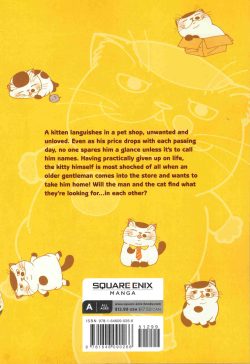
This slim but well-stuffed volume sets the ball rolling in ‘A Man and a Cat’ as a humble, homely, slightly huge and rather old cat ponders his life in the pet shop. He’s been there an awfully long time, gathering dust but no admirers as younger, prettier cats and kittens come and quite rapidly go…

As his price tag is regularly lowered, he understands and accepts his fate, but everything changes the day a distinguished gentleman comes in and without hesitation picks the flabbergasted veteran. The answer comes in ‘All Alone’ when the gentleman is revealed as a recent widower. He had discussed with his wife getting a cat just before…

The short moments of bonding continue when the new family unit decide on ‘The Cat’s Name’ and stock up on “essential supplies” when ‘The Man Goes Shopping’. Rejoicing in the name Fukumaru, the cat plays that old “I’m hungry” tactic in ‘Super-Mewracle Crunchies’ and the freshness of the learning curve for both is proved when ‘I Have a Cat Now’ sees the Man try to bath The Cat…

Both man and beast are visited by unwelcome memories in ‘Good Night, Fukumaru’, but their co-dependent bond is clearly solidifying. When Fukumaru remembers those distant days of kittenhood in ‘Good Night, Mister’, it leads to an explosive triptych about litter boxes, discreetly dubbed ‘The Noble Feline in the Bathroom’ Parts 1, 2 and ‘Afterward’before ‘Kneady-Kneady Fukumaru’ shares his first human bed…

When ‘The Man Wakes Up’ they discover the wonder of taking cat photos, but when the adoring human leaves for work (he’s a silver fox music teacher, utterly oblivious to his affect upon the younger educators at school), his devoted and grateful new companion experiences abandonment issues in ‘Fukumaru Minds the House’ and responds just as you’d expect at day’s end in ‘Welcome Home’…

‘Loyal Kitty Fukumaru’ settles in and they learn the joys of selfies, with only the odd moment of discord when a dog-loving pal asks about the “ugly cat” only to learn ‘My Pet is Number One’.

A household Rubicon is crossed in ‘Fukumaru and the Black Thing’ when a locked room is opened and a magnificent piano is revealed, whilst the trauma of carry cases and collars is confronted in ‘Safe, Worry-free Design’ before the household standing of the black thing vis a vis scratchable items is explored in ‘Attack from the Purriphery’.

‘The View Beyond the Invisible Wall’ is Fukumaru’s first taste of modern gardening, followed by a return outing for the dog-lover who has learned his lesson in ‘Your Precious Cat’, after which ‘I Promise You’ sees the Man – AKA Mr. Fuyuki Kanda – further impress the youthful school staff as ‘Hellos and Good-byes’ flashes back to that pet shop, revealing how lonely Miss Sato almost took the lonely straggler on the day Kanda walked in and proved love at first sight…

Peppered throughout one-page gag moments, this initial outing ends on a low-key yet warm note sharing further revelations about sad Kanda and wife before he chose to share his life ‘With Fukumaru’…

Forthright, painfully honest and packing hidden tear-jerking episodes the way a fluffy kitten packs sheathed claws and razor-sharp teeth, A Man & His Cat is a compelling buddy story no pet-carer or comics aficionado should miss.
© 2018 Umi Sakurai/SQUARE ENIX CO., LTD. English translation © 2020 SQUARE ENIX CO., LTD.

The Unadulterated Cat


By Terry Pratchett & Gray Jolliffe (Orion)
ISBN: 978-0-75285-369-7 (HB) 978-0-57506-104-0 (PB)
For the early part of the history of cartooning dogs ruled. For every Felix or Krazy Kat there were dozens of Dog Stars like Bonzo or Marmaduke, Snoopy, Odie or Fred Bassett. That’s because dogs are man’s best friends. They even share oxytocin responses with us. The poor saps are bound to us by their own treacherous body chemistry and millennia of shared evolution.

Towards the end of the last century, sly, cynical cats like Heathcliff and Garfield prowled onto the scene and rather took over. And that’s because they’re Real, Unadulterated cats.

Dogs have owners, Cats have staff. Or stooges. Cats run the house and rule the world, and no amount of cosmetic behaviour or slick PR can hide the ugly facts.

This hilarious book (uncannily out of print and unavailable in digital formats: how’s that for a feline example of “soft power”?) will strike a chilling chord with every cat owner, as much-missed author Terry Pratchett explains the ethos behind “The Campaign for Real Cats” who seek to reveal the sordid truth behind the fuzzy little darlings.

Cats are greedy, lazy, vicious, voracious, and need all nine lives because they take every slight opportunity to spectacularly end the one they’re living – you’re reading a review by a man who’s been regularly concussed by books dislodged from top shelves and had to saw his own drawing board in half to extricate an extremely ungrateful tabby from the parallel bar wiring. And don’t get me started on window blinds, either.

Brilliantly funny, this slim tome reveals the unvarnished truth about Felis Domesticus – and they’ll drink varnish too if you don’t watch ’em like hawks… and then try to eat the hawks – written by a unparalleled comedy mastermind and brilliantly illustrated by the cartoonist who first exposed the wickedness of willies lo, so long ago – although I’m reassured that length has never been important…

This is a thoroughly British kind of humour soundly affirming the fears of cat-haters – and cat-lovers – everywhere, whilst making them all laugh loud enough not to care. The internet is your friend. Hunt for a copy of this and don’t be distracted by kitten pics of cat toy boutiques…
Text © 1989, 1996 Terry & Lyn Pratchett. Illustrations © 1989, 1996 Gray Jolliffe. All Rights Reserved.

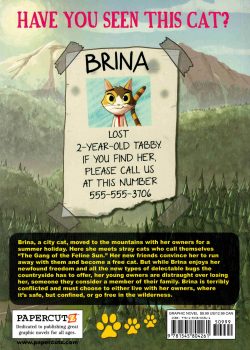
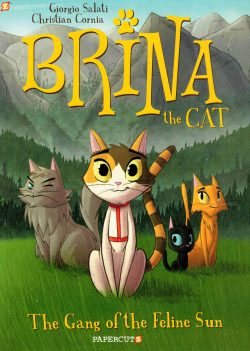
Brina the Cat volume 1: The Gang of the Feline Sun


By Giorgio Salati & Christian Cornia, with Erika Turbati, translated by Olivia Rose Doni (Papercutz)
ISBN: 978-1-5458-0425-4 (HB) 978-1-5458-0426-1 (TPB)

As I believe I’ve already mentioned, there’s an awful lot of cat comics around these days. As owning the internet is clearly not enough for the hairy little blighters, here’s the gen on another one I think might be worth your time and money…

Originally published in 2017 as Brina e la Banda del Sole Felino and another newly-translated all-ages gem from the astute folk at Papercutz, the first volume of Brina the Cat is an engaging tale of ownership versus liberty in the grand Walt Disney manner. That’s not surprising as it’s scripted by Italian Disney Academy veteran and professor Giorgio Salati (Topolino, Disney Hamlet; Il lato obscure della legge) and painted by his college colleague Professor Christian Cornia (Yogi Bear, Scooby Doo, When Unicorns Poop) – assisted by co-colourist Erika Turbati.

The story is delicious and bittersweet, and preceded by a delightful comics Foreword from Frédéric Brrémaud & Federico Bertolucci before the main feature begins, revealing how pampered city housecat Brina accompanies the young human couple she lives with on a summer vacation to the mountains. Once there, she has the run of their chalet and the gardens and discovers her inner apex predator, as well as how annoying dogs can be…

All too soon however, she meets the seductively free cats of The Gang of the Feline Sun, and strange stirrings are provoked within her…

Pack leader Vespucci is particularly convincing and before long Brina has broken her ties with her beloved humans and reclaimed her heritage. Running free with the gang, she leaves her heartbroken humans to go through all the motions necessary to retrieve a lost cat…

Although not without qualms, Brina quickly adapts to her life of liberty, but as the summer passes the unity of the gang is slowly eroded and Brina comes to a shocking conclusion about Vespucci and is forced to reassess her decision…

But can she decide before the humans dejectedly return to the city…

Available in hardcover, paperback and digitally and augmented by illustrated poem ‘Brina’s Tale’ this is a superb yarn blending charm and wit with plenty of fun and imagination and like all the best kids’ stories is not afraid to mix a bit of terror and heartbreak into the mix. It can also be readily enjoyed by cat-loving adults… as long as they have tissues handy…
© 2020 TUNUÉ (Tunué s.r.l.) – Giorgio Salati & Christian Cornia. All other material © 2020 Papercutz. All rights reserved.

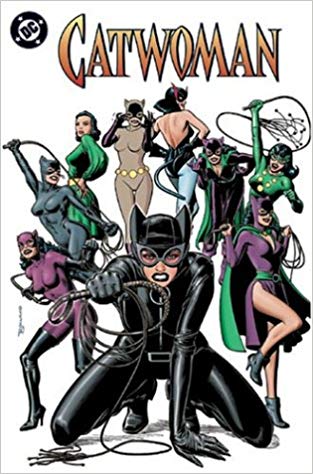
Catwoman: Nine Lives of a Feline Fatale


By Bill Finger, Bob Kane, Edmond Hamilton, Leo Dorfman, Gardner Fox, Frank Robbins, Doug Moench, Ed Brubaker, Frank Springer, Lew Sayer Schwartz, Kurt Schaffenberger, Irv Novick, Tom Mandrake, Michael Avon Oeming (DC Comics)
ISBN: 978-1-4012-0213-2 (TPB)

It feels odd to plug a book that is so obviously a quick and cheap cash-cow tie-in to a movie (and a bad movie, at that), but this Catwoman volume from 2004 has a great deal to recommend it. For a start it is quaintly cheap ‘n’ cheerful. The references to the film are kept to an absolute minimum. The selection of reprints, purporting to signify nine distinct takes on the venerable femme fatale are well considered in terms of what the reader hasn’t seen as opposed to what they have. There are also some rare and stunning art pieces selected as chapter heads, too, from the likes of George Perez, Dave Stevens, Alan Davis and Bruce Timm.

The stories themselves vary in quality by modern standards, but serve as an intriguing indicator of taste in the manner of a time capsule or introductory Primer. Track the feline fury from her first appearance as mysterious thief ‘The Cat’ (by Bill Finger, Bob Kane & Jerry Robinson: Batman #1 1940), through ‘The Crimes of the Catwoman’ (Edmond Hamilton, Kane/Lew Sayer Schwartz & Charles Paris: Detective #203 1954), to the wonderfully absurdist cat fight with Superman’s Girl Friend Lois Lane (#70-71: 1966), as described by Leo Dorfman & Kurt Schaffenberger in ‘The Catwoman’s Black Magic’ and ‘Bad Luck for a Black Super-Cat!’

A victim of 1960’s TV “Batmania”, ‘Catwoman Sets Her Claws for Batman’ sees her battle Batgirl in a cringingly painful outing from Batman #197, by 1967 by Gardner Fox, Frank Springer & Sid Greene) but at least it can be regarded as the nadir of her decline from sexy object of pursuit to imbecilic Twinkie. From here it’s onwards and upwards again…

In the nonsensical ‘The Case of the Purr-Loined Pearl’ (Batman #210, 1969), Frank Robbins, Irv Novick & Joe Giella slowly (and oh, so terribly gradually) begin her return to major villain status, after which Doug Moench, Tom Mandrake & Jan Duursema devise ‘A Town on the Night’ (Batman #392, 1986), showing one of her innumerable romantic excursions onto the right side of the law before ‘Object Relations’ (Catwoman #54 1998), shows us a ghastly but brief “Bad-Grrrl” version of the glamorous super-thief.

Mercifully, we then get to the absolutely enthralling ‘Claws’ (Batman: Gotham Adventures #4 1998, by Ty Templeton, Rich Burchett& Terry Beatty), produced in the spin-off comic based on the television cartoon but probably the best piece of pure comic book escapism in the whole package. The volume closes with another revision of her origin ‘The Many Lives of Selina Kyle’ (Catwoman Secret Files#1 2002), by Ed Brubaker, Michael Avon Oeming & Mike Manley.

Catwoman is a timeless icon and one of the few female comic characters that the entire real world has actually heard of, so it’s great that the whole deal is such a light, frothy outing, as well as having some rarity appeal for dedicated fans. Go get her, Tiger!
© 1940-1955, 1956-2002, 2004 DC Comics. All Rights Reserved.

Luba


By Gilbert Hernandez (Fantagraphics Books)
ISBN: 978-1-56097-960-9 (HB)

In the 1980s a qualitative revolution forever destroyed the clichéd, stereotypical ways different genres of comic strips were regarded. Most prominent in destroying these comfy pigeonholes we’d built for ourselves were three guys from Oxnard, California; Jaime, Mario (occasionally) and Gilberto Hernandez.

Love and Rockets was an anthology comics magazine featuring the intriguing, sci-fi-ish larks of punky young things Maggie and Hopeylas Locas – and heart-warming, terrifying, gut-wrenching soap-opera fantasy of the town of Palomar. These gifted synthesists captivated us all with incredible stories that sampled a thousand influences conceptual and actual – everything from Archie Comics and alternative music to German Expressionism and masked wrestlers. The result was pictorial and narrative dynamite.

Palomar was the playground of Gilberto, created for the extended serial Heartbreak Soup: a poor Latin-American village with a vibrant, funny and fantastically quotidian cast. Everything from life, death, adultery, magic, serial killing and especially gossip could happen in Palomar’s meta-fictional environs – and did – as Beto mined his own post-punk influences, comics, music, drugs, comics, strong women, gangs, sex, family and comics, in a style that seemed informed by everything from the Magical Realism of writers like Carlos Fuentes and Gabriel García Márquez to Saturday morning cartoons and The Lucy Show.

He returned to the well of Palomar constantly, usually tales centred around formidable matriarch – or perhaps Earth Mother figure – Luba, who ran the village’s bath house, acted as Mayor – and sometimes police chief – as well as adding regularly and copiously to the general population. Her children, brought up with no acknowledged fathers in sight, are Maricela, Guadalupe, Doralis, Casimira, Socorro, Joselito and Concepcion. A passionate, fiery woman who speaks her mind and generally gets her own way, her truest, constant life-long companion is a small claw-hammer…

Luba defies easy description and I don’t actually want to: As one of the most complex women in literature, let alone comics, she’s somebody you want to experience, not learn of second-hand. You will probably notice that she has absolutely enormous breasts. Deal with it. These stories are casually, graphically, sexually explicit. Luba’s story is about Life, and sex happens, constantly and often with the wrong people at the wrong time. If harsh language and cartoon nudity (male and female) are an insurmountable problem for you, don’t read these tales. It is genuinely your loss.

After a run of spectacular stories (all of which have been collected in a variety of formats and editions which I really must get around to systematically reviewing) like An American in Palomar, Human Diastrophism and Poison River, the magazine ended. Luba and her extended family then graduated to a succession of mini-series concentrating on her moving to the USA and reuniting with half-sisters Rosalba (“Fritz”) and Petra, taken when her mother Maria fled from Palomar decades previously.

Which brings us to this delightfully massive and priceless tome (sadly, not available in any digital formats yet). Luba collects in one monumental volume her later life as a proud immigrant refusing to learn English (or is she?): more than 80 stories covering 596 monochrome pages ranging from lengthy sagas to sparkling single page skits taken from Luba, Luba’s Comics and Stories, Luba in America, Luba: the Book of Ofelia and Luba: Three Daughters. The tone and content range from surreal to sad to funny to thrilling. The entire world can be found in these pages, and you really should go looking…

Although in an ideal world you would read the older material first, there’s absolutely no need to. Reminiscence and memory are as much a part of this brilliant passion-play as family feeling, music, infidelity, survival, punk rock philosophy, and laughter – lots and lots of laughter.

Brilliantly illustrated, these are human tales as coarse and earthy any as any of Chaucer’s Pilgrims could tell, as varied and appetising as any of Boccaccio’s Decameron and as universally human as the best of that bloke Shakespeare.

I’m probably more obtuse – just plain dense or blinkered – than most, but for years I thought this stuff was about the power of Family Ties, but it’s not: at least not fundamentally. Luba is about love. Not the sappy one-sided happy-ever after stuff, but LOVE, that mighty, hungry beast that makes you always protect the child that betrays you, that has you look for a better partner whilst you’re in the arms of your one true love, and hate the place you wanted to live in all your life. The love of cars and hair-cuts and biscuits and paper-cuts and stray cats that bite you: selfish, self-sacrificing, dutiful, urgent, patient, uncomprehending, a feeling beyond words.

Just like the love of a great comic…
© 2009 Gilbert Hernandez. All Rights Reserved.