Hellblazer: Rake at the Gates of Hell

Hellblazer: Rake at the Gates of Hell

By Garth Ennis & Steve Dillon (Vertigo)
ISBN 1-84023-255-2

Garth Ennis and Steve Dillon bowed out as chroniclers of the urban wizard and all-around nasty-piece-of-work John Constantine in grand manner by wrapping up all his loose ends and pretty much eradicating everything built during the writer’s tenure. They also showed a resurgent anti-hero pull the greatest bait-and-switch in comics history whilst beating the Devil at his own game.

On two separate occasions The Prince of Darkness has been defeated by the mocking Magician. But finally driven far beyond fury Satan has a plan to finally crush Constantine. Amidst the hell-on-Earth of a London race-riot he makes his move, destroying all the Magician’s friends and allies. Heaven, Hell, and the Earth between are at risk when the trap is sprung. But who is actually ensnared?

I’m once again avoiding specific details as this is a masterful display of storytelling and should be enjoyed without any dilution – but only if and after first reading the previous volumes leading up to this bravura climax. So track down Hellblazer: Dangerous Habits ISBN: 1-56389-150-6, Bloodlines ISBN: 978-1-84576-650-4, Fear and Loathing ISBN: 978-1-56389-202-8, Tainted Love ISBN: 978-1-56389-456-5 and Damnation’s Flame ISBN: 978-1-84023-096-3, before you even think about tackling this incredible book.

Collecting issues #78-83 of the monthly comicbook and including the tough and touching Heartland one-shot which followed Constantine’s lost love Kit as she returned home to Belfast; this is an excellent example of grown-up comics and a treat that any horror fan would love.

© 2001 DC Comics. All Rights Reserved.
Superman/Gen Thirteen

Superman/Gen 13

By Adam Hughes, Lee Bermejo & John Nyberg (WildStorm/DC Comics)
ISBN: 978-1-84023-328-5

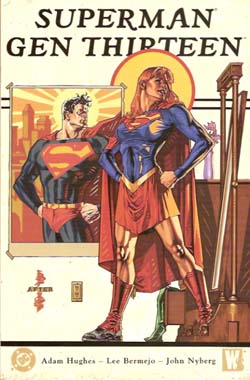
The hoary old amnesia/mistaken identity plot gets a wonderfully tongue-in-cheek dusting off in this far, far above-average cross-company team-up when the highly proper Man of Steel meets the wild and wooly super-powered drop-outs of Gen 13.

Freefall, Burnout, Rainmaker and Grunge are pretty typical Generation X teens – apart from their superpowers – and they’re pretty bummed that the stiff and prissy Fairchild gets to choose their next vacation destination. But they’re frankly appalled when she decides to take them to Metropolis, home of the biggest boy-scout in the universe.

When the team stumbles upon a super-battle and the “nearly” invulnerable Fairchild gets a formidable shot to the head from a gigantic robot Gorilla, their troubles really begin. Confused, the pneumatic leader wanders off, and deducing that she’s actually Supergirl, causes swathes of destruction whilst trying to remember how to use her “other superpowers.” And then her friends realize with horror that she was holding all the spending money!

Unable to find her and getting pretty peckish, the team has to swallow their collective scorn and actually ask the Stiff of Steel for help, and the World’s Most Perfect Hero comes to realise that even he isn’t invulnerable to the mockery of the “Cool Kids” in this brilliantly funny generation gap comedy from scripter Adam Hughes and artists Bermejo and Nyberg.

Fast, funny, action-packed and loaded with brilliant one-liners that hark back to the glory-days of the Giffen/DeMatteis/Maguire Justice League International this slim tale is as fresh and delightful a confection as any jaded, angst-laden fan could wish for. Track it down and cleanse your palate before the next braided-mega-epic rumbles along.

© 2000, 2001 DC Comics. All Rights Reserved.
Superwest Comics

Superwest Comics

By Massimo Mattioli (Catalan Communications)
ISBN: 0-87416-035-9

Writer/artist Massimo Mattioli was born in 1943 and grew up in an Italy rapidly rebuilding after cataclysmic social and military upheaval. He started his comic career in 1965 with the strips Il Ragnato Gigi, Ipo, Rita e Pino and Vermetto Sigh in Italy’s Il Vittorioso magazine. Before the end of the decade he was in “swinging London” working primarily for men’s magazines such as Mayfair, Penthouse and Plexus.

He moved to Paris and created M. le Magicien for Pif and worked on Le Canard Sauvage before settling again in Italy. For the newspaper Paese Sera he created Pasquino and was a regular in Il Gionaliono for more than two decades. But his work wasn’t only safe and mainstream. He co-founded the alternative magazine Il Cannibale and created Lucertola, Gatto Gattino and the impressive SF strip Joe Galaxy, which migrated to his own magazine Frigidaire alongside his Friske the Frog and the infamous Squeak the Mouse.

One day I’d like to review some of those series if they ever make it to an English edition, but until then let’s content ourselves with another contentious and controversial Frigidaire alumni: Superwest Comics.

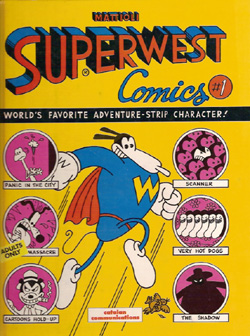
Released to America at the end of the 1980s, Superwest is a broad but incisive parody of superheroes and anti-capitalist treatise from an insightful and bold stylist with a highly subversive, wickedly funny point to make. Looking like a blend of Disney villains and the gentle Disney superhero parody SuperGoof, but rendered in thirties animation style, our rat-like hero swallows a power-pill and gains incredible abilities to defend the masses.

Boldly experimental, iconoclastic with scant regard for scary copyright lawyers and strictly for adults, this volume translates and presents ‘Panic in the City’, ‘Porno Massacre’, ‘Cartoons Hold-Up’, ‘Scanner’, ‘The Shadow’ and the wildly experimental ‘Very Hot Dogs/100 Werewolves/The Wild Night’, with faux covers and feature pages tossed in for free. It is ironic, brash and wickedly funny.

I want more and so I suspect will you…

© 1987 Massimo Mattioli. All Rights Reserved. English language edition © 1987 Catalan Communications.

Superman: Time and Time Again

Superman: Time and Time Again

By various (DC Comics)
ISBN: 978-1-56389-129-8

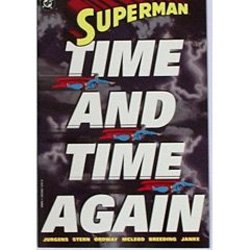
When Superman was re-imagined after Crisis on Infinite Earths, many of his more omnipotent abilities were discarded. He was a limited hero, more in touch with humanity because he wasn’t so far above it. One thing that was abandoned was his casual ability to travel through time.

Indeed, rather than being able to navigate the chronal corridors with ease, in this splendid epic from 1991 (originally published as Action Comics #663-665, Adventures of Superman #476-478, and Superman volume 2 #54-55 plus epilogues from #61 and 73) he is trapped in a cataclysmic temporal warp, bounced around from era to era and unable to return to his home and loved ones.

When a rogue Linear Man, (self appointed guardians of the Time Stream) tries to return the hero Booster Gold to the 25th century he originated from, Superman intervenes, but a tremendous explosion sends him careening through time. Each “landing” leaves him in a significant period of Earth’s history and only gigantic explosions can launch him back into the time stream.

As well as the mandatory “walking with dinosaurs” the Man of Steel also meets the World War II Justice Society of America, fights Nazis in the Warsaw Ghetto, tussles with a mammoth, fights The Demon during the fall of Camelot and encounters the Legion of Super Heroes at three critical points of their career.

This hugely enjoyable epic is by Dan Jurgens, Jerry Ordway, Roger Stern, Bob McLeod, Brett Breeding, Dennis Janke, Tom Grummett, and Jose Marzan and is both highly readable and cheerfully accessible for both returning and first time fans.

© 1991, 1992, 1994 DC Comics. All Rights Reserved.
Superman: Exile

Superman: Exile

By various (DC Comics)
ISBN: 978-1-56389-438-1

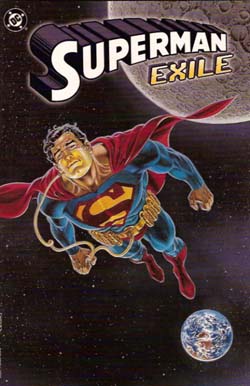
When Superman was re-imagined after the epic Crisis on Infinite Earths, one of the major aims was to add drama and tension by reducing his god-like abilities. As well as making him more vulnerable, many of the more charming, but just plain daft stand-bys of the Man of Steel were abandoned. So goodbye flying off to the next galaxy and being back by lunch-time, and no more drop-kicking planets; Superman was now tough but still had the capacity to be shocked and awed by the very concept of deep space. He was also more human and flawed in his personality.

This collection is a superb slice of pure comic wonderment for fans of action and adventure and collects stories from a period when DC was trying to reach new readers with their oldest icon, so the material here can be enjoyed by anyone, and there’s no need for a vast and specific knowledge of the character.

Collecting Superman (volume 2) #28-30, #32-33, Adventures of Superman #451-456, Action Comics Annual #2, and Action Comics #643 written and illustrated by Dan Jurgens, George Pérez, Jerry Ordway, Roger Stern, Kerry Gammill, Mike Mignola, Curt Swan, Brett Breeding, Dennis Janke, John Statema and Art Thibert, it sees a traumatized Man of Steel forced to abandon Earth as a result of a psychotic break.

When trapped in a pocket dimension he had been forced to execute three super-criminals who had killed every living thing on their Earth and were determined to do the same to ours. Although given no choice, Superman’s actions plagued him, and on his return his subconscious caused him to stalk the streets in a fugue-state dealing out brutal justice to criminals in the guise of Gangbuster. When he finally made aware of his schizophrenic condition Superman banished himself before he could do any lasting harm to Earth.

And thus the door to a fabulous saga of action and adventure opens. In the more than 300 pages here we see an endearingly human hero rediscover his purpose, revel in his sense of cosmic wonder and even discover some dark secrets about the lost planet Krypton. The epic concludes with a rapidly weakening hero (deprived of Sol’s rays his powers quickly fade) battling as a gladiator and overthrowing the monstrous Mongul and the hordes of the giant battle-planet Warworld, before returning to Earth with the most powerful device in Kryptonian history.

If he had only known how much trouble The Eradicator would cause he would have left it where it was, but since he didn’t we get to enjoy even more thrills and chills in subsequent collections as brilliant and engrossing as this one…

© 1988, 1989 DC Comics. All Rights Reserved.
Tell Me, Dark

Tell Me, Dark (Vertigo)

By Karl Edward Wagner, Kent Williams & John Ney Reiber (EP Board Books 2003)
ISBN13: 978-2-70247-888-2
Also ISBN: 1-56389-032-1 (DC hardcover) ISBN 1-56389-088-7 (Vertigo softcover)

Originally released as a DC original graphic novel, this slight but effective urban horror thriller had something of a troubled genesis with Wagner apparently leaving the project before completion, giving John Ney Reiber his “big break” by completing the script for Kent Williams. I don’t know – or care, really – as the real import of this book is the role it played in the separation of the mature imprint Vertigo from the greater DC universe.

At the time of release the company was preparing for its boldest venture in five decades, hiving off its supernatural heroes and embarking on a series of projects targeting an audience that had moved away from, or beyond, mainstream comics. The success of this dark tale of sex ‘n’ drugs ‘n’ rock ‘n’ roll ‘n’ demons would prove the astuteness of the decision to separate.

Tell Me, Dark

Minor rock star Michael Sands is recovered and back in London. He’s looking for answers and maybe payback. He especially wants to reconnect with Barbara Flick, to relive that frantic, deadly, all-consuming love they shared. He wants to know if he jumped off that bridge into the Thames, or if she tried to kill him?

Following a dark and debauched trail he finds an overpowering satanic evil thriving in the city’s bowels and in the souls of far too many people. He doesn’t know what it wants. He doesn’t know what he wants. He doesn’t know how it’s all going to end.

Badly, he suspects…

Tell Me, Dark (Board book)

The bleak and despondent story is a vehicle for the controversial art of Kent Williams, whose fans and detractors are equally passionate, and his painterly efforts here will certainly astound or annoy depending on your stance. Indisputably though, he’s at his most typical here, so if you’re not a fan don’t waste your time.

Re-released in 2003 this graphic horror breakthrough is apparently still available and offers something a little different for the discerning adult fan.

© 1992 Karl Edward Wagner, Kent Williams. All Rights Reserved.

History of the DC Universe

History of the DC Universe

By Marv Wolfman, George Perez, Karl Kesel & various (DC Comics/Graphitti Designs)
ISBN: 0-930289-26-9

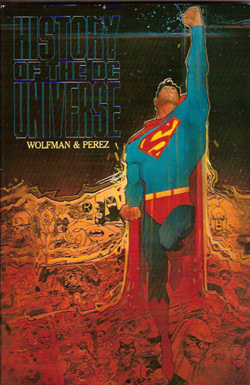
It’s not often that I review a specific package. After all, as long as they’re not bowdlerised or mucked about with, comics are all about the story and art, and graphic novels and collections even more so. This is one of the rare exceptions however.

History of the DC Universe is a fan’s book. The material it contains was originally a two-part prestige format miniseries designed to compliment the landmark Crisis on Infinite Earths crossover. In it the Monitor’s assistant Harbinger sets down the new chronicle of events after the history and reality-altering events of the Crisis have finally settled. It was a way of telling the fans just what was and wasn’t canonical; “real and true” if you like, in the DC Universe.

It was ambitious, concise, informative, very pretty and creators being what they are, pretty much redundant almost before the ink had dried. As a tool it was useless, but as a tale it still looks and reads very well. So why review it?

This Graphitti Designs hardcover has a few extras that dedicated fans would love and browsers might find of interest too. In what we’d now call the “added value section” are a number of essays and testimonials from Wolfman, Neal Adams, Julius Schwartz, Jerry Siegel, Bob Kane, Joe Kubert, Roy Thomas, Paul Levitz, Len Wein, Jack Kirby, Ramona Fradon, George Perez and Frank Miller.

Each has illustrations of the creators’ signature characters with lavish illustrations from Neal Adams, Joe Shuster, Dick Sprang, Joe and Adam Kubert, Kurt Schaffenberger, Steve Lightle, Steve Bissette & John Totleben, Jack Kirby & Steve Rude, Fradon, Perez and Miller, whilst the Julius Schwartz piece is studded with a dozen pictures by DC’s finest artists.

The real prize though is a four page gate-fold fold-out poster crafted by 56 separate artists and featuring 53 of the company’s greatest characters from the first five decades, nestled behind new illustrations of Sugar and Spike by Sheldon Mayer and Cryll by Art Adams. And if that’s not tantalising enough the Watchmen aficionados and completists should be aware that the poster contains the only DCU appearance of Rorschach by Dave Gibbons! Cor! Blimey!

Seriously though, as so much of comics’ magic is physical and visceral, the feel-good factor from this little gem is difficult to quantify, but impossible to deny. If you get the chance you really should experience it yourself.

© 1988 DC Comics. All Rights Reserved.
Amazing Spider-Man: Hooky

A MARVEL GRAPHIC NOVEL

Amazing Spider-Man: Hooky

By Susan K Putney & Berni Wrightson (Marvel)
ISBN: 0- 87135-154-4

Marvel’s experiment with graphic novel publishing in the 1980s produced some classy results that the company has seldom come close to repeating since. Both original concepts and their own properties were represented in that initial run and many of the stories still stand out today – or would if they were still in print.

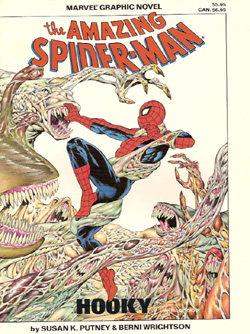
One such is this charming fantasy fable written by Susan K. Putney and painted by comic-book legend Berni Wrightson. Marandi Sjörokker is not the twelve year girl she appears to be. For a start she’s been twelve for over two hundred years, and when she introduces herself by calling Spider-Man “Petey” she reveals how she knew him when he was a toddler and she delivered his Uncle Ben’s newspapers.

And so begins a wild and gently charming other-dimensional romp, full of action and spectacle, as the web-slinger takes a break from his grim and grimy reality to help the permanently adolescent sorceress against the demonic and unstoppable TordenKakerlakk (which I’m reliably informed is Norwegian for Thunder Cockroach). Moreover, this witty, whimsical coming-of-age tale is beautifully and imaginatively illustrated by a master craftsman. A wonderful change-of-pace tale that perfectly displays the versatility of everybody’s favourite wall-crawler – and one long overdue for re-release.

© 1986 Marvel Entertainment Group/Marvel Characters, Inc. All Rights Reserved.

1941 – The Illustrated Story

1941 - The Illustrated Story

By Stephen Bissette, Rick Veitch & Allan Asherman (Heavy Metal/Arrow Books)
ISBN: 0- 09922-720-7

It’s not often that I get to review a graphic adaptation that surpasses the source material, but this odd little item certainly does that. I’ll leave it to your personal tastes to determine if that’s because of the comic creators or simply because the movie under fire here wasn’t all that great to begin with…

Written by Robert Zemeckis, Bob Gale and John Milius, 1941 was a big budget screwball comedy starring some of the greatest comedy talents of the day and Steven Spielberg’s blockbuster follow-up to Jaws and Close Encounters of the Third Kind. It did not receive the same accolades and approbation.

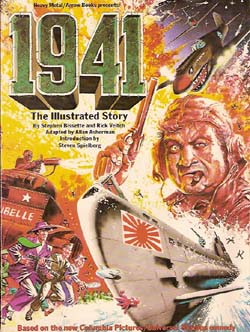
The plot, adapted by Allan Asherman, concerns one night in December of that year when Hollywood was panicked by sightings of Japanese planes and submarines. One week after the devastation of Pearl Harbor, much of America, and particularly the West Coast, was terrified of an invasion by the Imperial Forces of Emperor Hirohito.

In this tale one lone sub, borrowed from the Nazis, actually fetches up on the balmy shores of La-La land, but is largely ignored by the populace. The panic actually starts when gormless Zoot-Suiters Wally and Denny use an air-raid siren to distract store patrons and staff so that they can shop-lift new outfits, and peaks later when the feckless wastrels start a fist-fight at a USO (United Services Organisation) Dance. From there chaos and commotion carry this tale to its conclusion.

For the film that isn’t too successful, burdened as it is by leaden direction and a dire lack of spontaneity, but the frenetic energy and mania that was absent on screen is present in overwhelming abundance in the comic art of Steve Bissette and Rick Veitch. Taking their cue from the classic Mad Magazine work of the 1950s, they produced a riot of colour pages for the tie-in album reminiscent of Underground Comix and brimming with extra sight-gags, dripping bad-taste and irony, and combining raw, exciting painted art with collage and found imagery.

It’s not often that I say the story isn’t important in a graphic package, but this is one of those times. 1941 – The Illustrated Story is a visual treat and a fine example of two major creators’ earlier – and certainly more experimental – days. If you get the chance, it’s a wild ride you should take.

© 1979 Universal City Studios, Inc. and Columbia Pictures Industries, Inc.

The Great Walls of Samaris

The Great Walls of Samaris

By Benoit Peeters & Francois Schuiten (NBM)
ISBN: 0-918348-36-6 (1987) ISBN: 978-0-918348-36-4 (2001)

The European manner of graphic storytelling places great emphasis on mood and style, with a much larger range of interests and themes than the English language mainstream. It is also, perforce, staggeringly accomplished in its artistic visions.

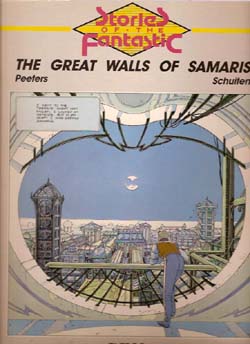
This brief (48 pages) album, the first in an occasional series entitled Cities of the Fantastic, tells the bleak, fantastic tale of Franz, a young civic official of the city state Xhystos, who accepts a mission to assess the condition of sister city Samaris.

Located far, far away, there has been no communication with the walled metropolis for a decade and all agents dispatched there have vanished with trace. The grim, arduous journey, however, is as nothing compared to the beguiling mystery Franz uncovers when he finally reaches the incredible and seductive city…

Eerie and paranoid, with architecture and design the most important characters in the tale, The Great Walls of Samaris presents a wholly believable world of familiarity and alienation, underscored with an almost Kafkaesque perversity. The aura of menace is palpable, but with only the merest hint of danger. Minds and souls are at risk here, not mere flesh and blood.

The astonishing artwork of Schuiten is entrancing, perfectly capturing – if not actually inventing – the creative anachronism of Steam-punk, but with the glistening veneer of fin de siècle pomp and the foredoomed glitter of the Belle Époque concealing the bitter content with a sheen of fragile beauty.

This is an incredibly stylish, unforgettable visual experience and a damned fine classical horror story, too. Don’t miss out on this glorious delicacy.

©1984 Casterman, Paris-Tournai. All Rights Reserved. English translation ©1987 NBM.