The Best of Battle


By Pat Mills, John Wagner, Tom Tully, Steve McManus, Eric & Alan Hebden, Mark Andrew, Gerry Finley-Day, Mike Western, Joe Colquhoun, Eric Bradbury, Carlos Ezquerra, Geoff Campion, Cam Kennedy, Colin Page, Pat Wright, Giralt, Jim Watson, Mike Dorey, John Cooper & various (Titan Books)
ISBN: 978-1-84856-025-3 (PB)

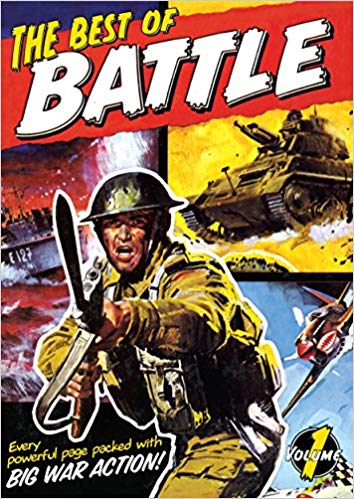
For most of the medium’s history, British comics have been renowned for the ability to tell a big story in satisfying little instalments and this, coupled with superior creators and the anthological nature of our publications, has ensured hundreds of memorable characters and series have seared themselves into the little boy’s psyche inside most British adult males.

One of the last great weekly anthology comics was the all-combat Battle, which started service as Battle Picture Weekly – launched on 8th March 1975.

Through absorption, merger and re-branding (becoming in swift succession Battle Picture Weekly & Valiant, Battle Action, Battle, Battle Action Force and Battle Storm Force) it was eventually subsumed into the revived, faltering but too-prestigious-to-fail Eagle on January 23rd 1988. For 673 blood-soaked, testosterone-drenched issues, it had fought its way into the bloodthirsty hearts of a generation, consequently producing some of the best and most influential war stories ever told.

This action-packed compendium features the opening salvos of some of the very best from those 13-odd years produced by a winning blend of Young Turk writers – Pat Mills, John Wagner, Steve McManus, Mark Andrew and Gerry Finley-Day – and stalwarts of the old guard – Tom Tully, Eric and Alan Hebden. The art comes from Colin Page, Pat Wright, Giralt, Carlos Ezquerra, Geoff Campion, Jim Watson, Mike Western, Joe Colquhoun, Eric Bradbury, Mike Dorey, John Cooper and Cam Kennedy.

The strips featured are D-Day Dawson (a sergeant with only a year to live and nothing to lose) by Gerry Finley-Day, Ron Carpenter & Colin Page, spy serial Day of the Eagle (by ex-SOE agent Eric Hebden and artist Pat Wright), The Bootneck Boy (a little lad who lives his dream by becoming a Marine), by Finley-Day, Ian McDonald & Giralt, and the legendary Dirty Dozen-inspired Rat Pack, by Finley-Day and featuring some of the much-missed Carlos Ezquerra’s earliest UK artwork.

Ezquerra also shone on Alan Hebden’s anti-establishment masterpiece Major Eazy, whilst Fighter from the Sky is the first of the comic’s groundbreaking serials telling World War II stories from a German viewpoint. Written by Finley-Day and drawn by the superb Geoff Campion, it tells of a disgraced paratrooper fighting for his country, even if they hated him for it…

Hold Hill 109 by Steve McManus & Jim Watson was a bold experiment: basically a limited series as a group of Eighth Army soldiers have to hold back the Afrika Korps for seven days, with each day comprising one weekly episode. Unbelievably, only the first three days are collected here, though, as apparently there wasn’t room for the complete saga!

Darkie’s Mob (John Wagner & Mike Western) is another phenomenally well-regarded classic wherein a mysterious British (?) maniac takes over a lost and demoralised squad of soldiers in the Burma jungles, intent on using them to punish the Japanese in ways no man could imagine.

Then Finley-Day & Campion’s Panzer G-Man tells of a German tank commander demoted and forced to endure all the dirty jobs foisted on the infantry that follow behind the steel monsters, before Johnny Red – by Tom Tully and the great Joe Colquhoun – follows a discharged RAF pilot who joins the Russian air force to fight in the bloody skies over the Soviet Union.

Joe Two Beans by Wagner & Eric Bradbury traces an inscrutable Blackfoot Indian through the Hellish US Pacific campaign, The Sarge (Finley-Day& Mike Western) reveals the trials of a WWI veteran as he leads Dunkirk stragglers back to England and then on to North Africa, and Hellman of Hammer Force (Finley-Day, Western, Mike Dorey & Jim Watson) follows a charismatic and decent German tank commander as he fights Germany’s enemies and the SS who want him dead.

Alan Hebden and Eric Bradbury’s Crazy Keller is an US Army maverick who steals, cheats and breaks all the rules. He was also the most effective Nazi-killer in the invasion of Italy, whilst The General Dies at Dawn sees Finley-Day and John Cooper repeat the miniseries experiment of Hold Hill 109 (this time in 11 instalments, each representing one hour – pre-dating Jack Bauer by two decades) as Nazi General and war hero Otto von Margen tells his jailor how he came to be sentenced to the firing squad by his own comrades even as Berlin falls to the allied forces.

I don’t really approve of Charley’s War being in this book. Despite it being the very best war story ever written or drawn, uncompromising and powerfully haunting, as well as Pat Mills & Joe Colquhoun’s best-ever work, it’s already available in beautiful hardback collector volumes and economical paperback editions so the 15 pages here could have been better used to complete Hold Hill 109 or even reprint some of the wonderful complete-in-one-part war tales the comic often carried.

Enough barracking: Fighting Mann, by Alan Hebden & Cam Kennedy, was the first British strip set in Viet Nam, and follows the hunt of retired US Marine Walter Mann who goes “in-country” in 1967 to track down his son, a navy pilot listed as a deserter. This terrific tome (still unavailable in any digital format, as far as I can tell) then concludes with Death Squad!: A kind of German Rat Pack full of Wehrmacht criminals sent as a punishment squad to die for the Fatherland in the icy hell of the Eastern Front. Written by Mark Andrew and illustrated by the incomparable Eric Bradbury, this is one of the grittiest and most darkly comedic of Battle‘s martial pantheon.

This spectacular blend of action, tension and drama, with a heaping helping of sardonic grim wit from both sides of World War II – and beyond – offers a unique take on the profession of soldier, and hasn’t paled in the intervening years. These black-&-white gems are as powerful and engrossing now as they’ve ever been.

Fair warning though: Many of the tales here do not conclude. For that you’ll have to campaign for a second volume…
© 2009 Egmont UK Ltd. All rights reserved.

Justice League of America: The Silver Age volume 4


By Gardner Fox, Mike Sekowsky, Bernard Sachs & various (DC Comics)
ISBN: 978-1-4012-8061-1 (PB)

Win’s Christmas Gift Recommendation: Wholesome, Wholehearted Super-Action… 8/10

The day the Justice League of America was published marks the moment when superheroes truly made comicbooks their own particular preserve. Even though the popularity of masked champions has waxed and waned many times since 1960 and other genres have re-won their places on published pages, in the minds of America and the world, Comics Means Superheroes.

The JLA signalled that men – and even a few women – in capes and masks were back for good…

When Julius Schwartz began reviving and revitalising the nigh-defunct superhero genre in 1956, his Rubicon move came a few years later with the uniting of these reconfigured mystery men into a team…

The JLA debuted in The Brave and the Bold #28 (cover-dated March 1960) and cemented the growth and validity of the revived sub-genre, consequently triggering an explosion of new characters at every company producing comicbooks and spreading to the rest of the world as the decade progressed.

Spanning June 1963 to September 1964, this latest full-colour paperback compendium of classics (also available digitally) re-presents issues #31-41 of the epochal first series with scripter Gardner Fox and illustrators Mike Sekowsky & Bernard Sachs seemingly able to do no wrong…

And while we’re showing our gratitude, lets also salute stalwart letterer Gaspar Saladino for his herculean but unsung efforts to make the uncanny clear to us all…

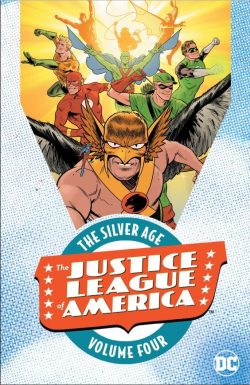
The adventures here focus on the collective exploits of Superman, Batman, Flash, Green Lantern, Wonder Woman, Aquaman, J’onn J’onzz – Manhunter from Mars, Green Arrow, The Atom, hip and plucky mascot Snapper Carr and latest inductee Hawkman as the team consolidate their hold on young hearts and minds whilst further transforming the entire nature of the American comicbook experience…

JLA #31 finally saw the induction of the Winged Wonder into ‘The World’s Greatest Superheroes’ – and not before time. However, in this ancient world of Boy’s Clubs and willing segregation, his dutiful wife and partner Shayera would have to wait for more than a decade before she herself was invited to join as Hawkgirl. Hawkman would be the last successful inductee until Black Canary joined the team in #75.

‘Riddle of the Runaway Room’ sees an alien wish-granting machine fall into the hands of second-rate thug Joe Parry, who nonetheless makes life pretty tough for the team before their eventual victory over his bizarre amalgamized multi-powered villain Super-Duper (no, really!).

The visually impressive Hawkman must have been popular with the creators, if not the fans, as he was prominently featured in all but one of next half-dozen adventures. Issue #32’s ‘Attack of the Star-Bolt Warrior!’ introduces the uncanny villain Brain Storm who attacks the League to avenge his brother who had been “murdered” by one of their number!

The entire universe was once again at stake in time-travelling thriller ‘Enemy from the Timeless World’ as the team strive to counter a chronal monster dubbed the Endless One, after which a persistent old foe had yet another go in #34’s ‘The Deadly Dreams of Doctor Destiny!’: a thriller packed with an army of guest-villains.

The team are attacked by their own clothes in issue #35’s supernatural adventure ‘Battle Against the Bodiless Uniforms’, a devilish fall-back plan concocted by the antediluvian demons Abnegazar, Rath and Ghast, which had been slowly percolating since the end of JLA #11.

Issue #36’s ‘The Case of the Disabled Justice League’ sees the team raise the morale of despondent kids with disabilities by overcoming their own recently-inflicted physical handicaps to defeat the returning Brain Storm. This tale was in fact inspired by ‘A Place in the World’, a Justice Society of America adventure from 1945’s All Star Comics #27. That yarn was produced at a time when returning servicemen, maimed and disfigured in combat, were becoming an increasingly common sight on the streets of America…

The third annual JLA/JSA team-up follows, a largely forgotten and rather experimental tale wherein the Johnny Thunder of Earth-1 wrests control of the genie-like Thunderbolt from his Justice Society counterpart and uses its magic to alter the events that led to the creation of all Earth-1’s superheroes.

Then it’s JSA to the rescue in a gripping battle of wits in #37’s ‘Earth – Without a Justice League’ and the concluding ‘Crisis on Earth-A!’

Issue #39 was an Eighty-Page Giant reprinting Brave and the Bold #28 and #30 and Justice League of America #5 (represented here by its evocative cover), so we jump to #40 and the ‘Indestructible Creatures of Nightmare Island’: a challenging mystery wherein an astral scientist’s machine to suppress Man’s basest instincts almost causes the end of humanity. The result is an action-packed psycho-thriller stuffed with villainous guest-stars and oodles of action before this compendium concludes with JLA #41 which introduces a modern version of an old Justice Society villain.

The Earth-1 mastermind called The Key is a diabolical scientist who employs mild-altering psycho-chemicals to control the behaviour of our heroes in ‘The Key – Master of the World!’

With iconic covers by Sekowsky & Murphy Anderson, these tales are a perfect example of all that was best about the Silver Age of comics, combining optimism and ingenuity with bonhomie and adventure. This slice of better times also has the benefit of cherishing wonderment whilst actually being historically valid for any fan of our medium. And best of all the stories here are still captivating and enthralling transports of delight.

These classical compendia are a dedicated fan’s delight: an absolute gift for modern readers who desperately need to catch up without going bankrupt. They are also perfect to give to youngsters as an introduction into a fabulous world of adventure and magic…
© 1964, 1965, 2018 DC Comics. All Rights Reserved.

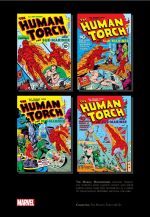
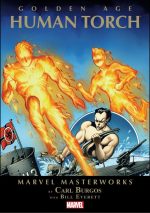
Golden Age Human Torch Marvel Masterworks: volume 1 #2-5A


By Carl Burgos, Bill Everett, Paul Reinman, Joe Simon, Al Gabriele, Harry Sahle, George Mandel, Stan Lee, Sid Greene & others (Marvel)
ISBN: 978-0-7851-1623-3 (HB)                    978-0785167778 (TPB)

Win’s Christmas Gift Recommendation: A little fireside fun and frolic… 8/10

During the early Golden Age, a novel idea and sheer exuberance could take you far, and since the alternative means of entertainment escapism for most kids were severely limited, it just wasn’t that hard to make a go of it as a comic book publisher.

Combine that once in a life-time moment with a creative work-force which kept being drafted, and it’s clear to see why declining standards of story and art didn’t greatly affect month-to-month sales during World War II, but promptly started a cascade-decline in super-hero strips almost as soon as GI boots hit US soil again.

In 1940 the comicbook industry was in frantic expansion mode and every publisher was trying to make and own the Next Big Thing. The Goodman pulp fiction outfit leapt into the new industry and scored big through debut anthology Marvel Comics in the Fall of 1939 (becoming Marvel Mystery with its second issue), with both the Human Torch and Sub-Mariner finding huge favour amongst the burgeoning, fickle readership. Two out of seven was pretty good: Action and Detective Comics only had the one super-star apiece…

An editorial policy of rapid expansion was in play: release a new book filled with whatever the art and script-monkeys of the comics “shop” had dreamed up and not yet sold. Shops – freelance creative studios who packaged material on spec for publishing houses – were the big facilitators of the early days, and Martin Goodman bought all his product from Lloyd Jacquet’s Funnies Inc.) Like every other money-man, he kept the popular hits and disregarded everything else as soon as sales reports came in.

In quick succession Daring Mystery Comics #1 (January. 1940) and Mystic Comics #1 (March 1940) followed, with limited success and a rapid turnover of concepts and features. Timely Comics – or occasionally Red Circle – as the company then called itself, had a huge turnover of characters who only made one or two appearances before vanishing, never to be seen again until various modern revivals or recreations produced new, improved versions of heroes like Black Widow, Thin Man, the original Angel, Citizen V or Red Raven.

That last one is especially relevant here. Although fresh characters were plentiful, physical resources were not and when the company’s fourth title Red Raven #1 was released with an August 1940 cover-date it failed to ignite any substantial attention with either title character or B-features Comet Pierce, Mercury, Human Top, Eternal Brain and Magar the Mystic, despite being crammed with the stunning early work of young Jack Kirby.

The magazine and its entire cast was killed and the publishing slot and numbering handed over to a proven seller. Thus, Human Torch launched with #2 (Fall 1940) – the first issue to solo star the flammable android hero, and one which introduced his own fiery side-kick.

Just so’s you know; the next two releases fared a little better: Captain America Comics #1 (March 1941) and inevitably, a singular title for Sub-Mariner (Fall 1941)…

Although the material in this collection is of variable quality and probably not to the tastes of modern fans, for devotees of super-heroes, aficionados of historical works and true Marvel Zombies there’s still lots to offer here. It’s probably best to also remind readers that these stories were created in far less enlightened times and racial depictions and treatments leave a lot to be desired. But that’s history, and we need to see it, warts – not to mention slurs and gross misconceptions – and all…

After a knowledgeable and informative introduction by Roy Thomas, the hot-dogging begins with ‘Introducing Toro – the Flaming Torch Kid’ by Carl Burgos wherein the blazing star discovers a circus boy possessing all his own incendiary abilities, before fighting a criminal strongman with a ray-gun.

The misnamed elder Torch was actually a miraculous android and not at all human, but here he acquires a plucky, excitable teen assistant who would become his faithful comrade for (almost all) the remainder of his career…

This is followed by Bill Everett’s ‘Sub-Mariner Crashes New York Again!!!’ as sub-sea stalwart Prince Namor once more attacks America, after which ‘Carl Burgos’ Hot Idea’ and ‘Bill Everett’s Hurricane’ provide text features supposedly detailing how the respective creators came up with their tempestuous brain-children…

The remaining stories are pretty pedestrian. ‘The Falcon’ by Paul Reinman features a young District Attorney who corrects legal shortcomings and miscarriages of justice as a masked vigilante, ‘Microman’ (Harold Delay & Paul Quinn) stars a young boy exploring his own garden at insect-size before Mandrake knock-off ‘Mantor the Magician’ (by Al Gabriele) saw a fez-topped modern wizard battle crooks posing as ghosts.

Joe Simon’s Fiery Mask actually debuted in Daring Mystery #1 and ended his career here with ‘The Strange Case of the Bloodless Corpses’, with the multi-powered physician hunting a remorseless mad doctor terrorising the city…

Issue #3 is actually pretty impressive, with an ambitious and spectacular untitled 40-page Torch epic which reveals Toro seduced by Nazism, before seeing the patriotic light and burning off Hitler’s moustache, whilst John H. Compton’s text piece ‘Hot and Wet’ has the two elemental stars debate whose creator is best before a 20-page Sub-Mariner crossover (anticipating Marvel’s successful policy of the 1960s onward) finds Namor and the Torch teaming up to trash Nazi vessels sinking Allied convoys, and latterly scuttling a full invasion together.

By Human Torch #4 much of the work is clearly being ghosted to a greater or lesser degree. The Torch takes far too long solving the ever-so-simple ‘Mystery of the Disappearing Criminals’, after which Ray Gill introduces star-spangled hero The Patriot in a 2-page text piece.

At least Everett is still very much in evidence and on top form when the Sub-Mariner takes ten beautiful pages to save an Alaskan village from plague, blizzards, an onrushing glacier and incendiary bombs in a genuine forgotten classic, before lacklustre Captain America knock-off The Patriot shambles through a proper comic-strip tale of Bundist (that’s German/American Nazi sympathizers to you, kid) saboteurs to close the issue.

That line-up continued in the last issue reprinted here (Human Torch #5A, Summer 1941, and the “A” is because the series did a little lock-step to catch up with itself: the next issue would also be a #5). Here, however, the fiery star and his Flaming Kid clash in a two-part epic with a mad scientist named Doc Smart in ‘The March of Death’, then join forces again with Namor in a Stan Lee scripted prose vignette entitled ‘The Human Torch and Sub-Mariner Battle the Nazi Super Shell of Death!’

Sub-Mariner and guest-star the Angel followed, fighting Nazi zombies in ‘Blitzkrieg of the Living Dead’ (attributed to Bill Everett, but clearly overwhelmed by lesser hands in the inking and perhaps even pencilling stages) after which The Patriot wraps thing up in a bold and experimental job from future art great Sid Greene. Here the Red, White and Blue Home-front Hero tracks down a Nazi who kills by playing the violin…

I’m happy to have this book (available in premium hardback, trade paperback and digital formats), even with all the quibbles and qualifications, but I’m a funnybook addict and can understand why anyone other than a life-long Marvel fan would baulk at a rather steep price-tag, with a wealth of better-quality and more highly regarded Golden Age material available. Still, value is one thing and worth another, so in the end it’s up to you…
© 1940, 1941, 2018 Marvel Characters, Inc. All rights reserved.

My War


By Szegedi Szüts (Dover)
ISBN: 978-0-486-79925-4 (PB)

Win’s Christmas Gift Recommendation: Profound and Compelling Commemoration… 9/10

From its earliest inception, cartooning and graphic narrative has been used to inform. In newspapers, magazines and especially comicbooks the sheer power of pictorial storytelling – with its ability to distil technical recreations of time, place and personage whilst creating deep emotional affinities to past or imagined events – has been used to forge unforgettable images and characters within us. When those stories affect the lives of generations of readers, the force that they can apply in a commercial, social, political or especially educational arena is almost irresistible…

Thus, the compelling power of graphic narrative to efficiently, potently and evocatively disseminate vast amounts of information and seductively advocate complex issues with great conviction through layered levels has always been most effectively used in works with a political, social or historical component.

Comics have brought the past to life since they began but they were never the only means of pictorial narrative and emotional communication.

Here is another superb and welcome re-release from Dover Comics & Graphic Novels – available in paperback and digital formats – reviving a lost masterpiece of the art form, first published in in 1932 by William Morrow & Company, New York.

The 206 stark and stunning images rendered by István Szegedi Szüts were his way of processing his participation in the Great War, but they were a narrative designed as a gallery show: telling a personal story much in the manor of a Catholic church’s Stations of the Cross.

The show debuted at London’s Gieves Gallery in 1929, and was only collected into book form in 1931, after being seen by a perspicacious publisher. These compelling sequences were perfect material for the brief Depression-era flowering of silent art narratives known as woodcut novels or linocut books.

Other memorable proto-graphic novels of that era include Frans Masereel’s 25 Images of a Man’s Passion, Lynd Ward’s God’s Man and White Collar by Giacomo Patri.

Szegedi Szüts was born in Budapest on December 7th 1893, a Hungarian painter and illustrator who naturally served when his country went to war in 1914. His experiences are rendered here into potent examination of patriotism and folly that are more akin to visual poetry than anything else: sparse, spartan, debilitatingly expressionistic and summed up by a precision-point epigram/title for each single image page.

The seven chapters reel from evocative triggers such as ‘The Little Hussar wakes up’, ‘Expectance’, ‘Approaching storm’, ‘Hide your face, mother!’ and ‘…who command us to kill?’ and the end result is a wave of shocking revelation and inescapable regret…

After the London show, Szegedi Szüts moved to Caunce Head, Cornwall, married artist Gwynedd Jones Parry and lived as part of the creative colony there until his death in 1959.

This splendid and moving monochrome reconstruction includes ‘Our War: a Foreword by Peter Kuper’ (Third World War, Spy vs Spy), the original Introduction by R.H. Mottram and clipped reviews of ‘Szegedi Szüts as an artist’ from The Times, The Daily Mail and PG Konody in The Observer…

It’s not often we comics folk can 100% guarantee that we’ve produced capital A Art and it’s really not that relevant. What you should take away here is that My War is a timeless, resonant testimony to the War to End All Wars from someone who was there, came back and said something about his experiences that all successive generations should take heed of.
Foreword © 2015, Peter Kuper. All rights reserved.

Sandman Mystery Theatre: Book One


By Matt Wagner, Guy Davis, John Watkiss, R.G. Taylor, David Hornung & John Costanza (Vertigo)
ISBN: 978-1-4012-6327-0

Win’s Christmas Gift Recommendation: Eerie Mystery-Mood Masterpiece… 8/10

Created by Gardner Fox and first depicted by Bert Christman, The Sandman premiered in either Adventure Comics #40 July 1939 (two months after Batman debuted in Detective Comics #27) or two weeks earlier in New York World’s Fair Comics 1939, depending on whether some rather spotty distribution records can be believed.

Head and face utterly obscured by a gasmask and slouch hat; caped, business-suited millionaire adventurer Wesley Dodds was cut from the iconic masked mystery-man mould that had made pulp fictioneers The Lone Ranger, Green Hornet, The Shadow, Phantom Detective, Black Bat, The Spider and so many more such household names. Those dark red-handed heroes were also astonishing commercial successes in the early days of mass periodical publication…

Wielding a sleeping-gas gun and haunting the night to battle a string of killers, crooks and spies, he was accompanied in the earliest comicbooks by his plucky paramour Dian Belmont, before gradually losing the readers’ interest and slipping from cover-spot to last feature in Adventure Comics, just as the cloaked pulp-hero avengers he emulated slipped from popularity in favour of more flamboyant fictional fare.

Possessing a certain indefinable style and charm but definitely no especial pizzazz, the feature was on the verge of being dropped when the Sandman abruptly switched to a skin-tight yellow-&-purple costume and gained a boy-sidekick, Sandy the Golden Boy (in Adventure Comics #69, December 1941, courtesy of Mort Weisinger & Paul Norris). All this, presumably to emulate the overwhelmingly successful Batman and Captain America models then reaping such big dividends on the newsstands.

It didn’t help much, but when Joe Simon & Jack Kirby came aboard with #72 that all spectacularly changed. A semi-supernatural element and fascination with the world of dreams (revisited by S&K a decade later in their short-lived experimental suspense series The Strange World of Your Dreams) added a moody conceptual punch to equal the kinetic fury of their art, as Sandman and Sandy became literally the stuff of nightmares to the bizarre bandits and murderous mugs they stalked…

For what happened next you can check out the superb Simon & Kirby Sandman hardback collection…

Time passed and in the late 1980s Neil Gaiman, Sam Keith & Mike Dringenberg took the property in a revolutionary new direction, eventually linking all the previous decades’ elements into an overarching connective continuity under DC’s new “sophisticated suspense” imprint Vertigo.

Within a few years the astounding success of the new Sandman prompted the editorial powers-that-be to revisit the stylishly retro original character and look at him through more mature eyes. Iconoclastic creator Matt Wagner (Mage, Grendel) teamed with artistic adept Guy Davis (Baker Street, B.P.R.D.) and colourist David Hornung to create a grittier, grimier, far more viscerally authentic 1930s, where the haunted mystery man pursued his lonely crusade with chilling verisimilitude.

The tone was darkly modernistic, with the crime-busting playing out in the dissolute dog-days of the Jazz Age and addressed controversial themes such as abuse, sexual depravity, corruption and racism; all confronted against the rising tide of fascism that was sweeping the world then.

This is a warning: Sandman Mystery Theatre is not for kids…

This compendium collections the redefining first three story-arcs from issues #1-12 (April 1993 to March 1994) and commences after an absorbing introduction from veteran journalist, critic and pop culture historian Dave Marsh.

Each chapter preceded by its original evocative faux pulp photo cover created by Gavin Wilson and Hornung, the dark drama opens with The Tarantula, taking us back to New York in 1938 where District Attorney Larry Belmont is having the Devil’s own time keeping his wild-child daughter out of trouble and out of the newspapers.

She’s gallivanting all over town every night with her spoiled rich friends; drinking, partying and associating with all the wrong sorts of people, but the prominent public servant has far larger problems too. One is a mysterious gas-masked figure he finds rifling his safe soon after Dian departs…

The intruder easily overpowers the DA with some kind of sleeping gas – which also makes you want to blurt every inconvenient truth – before disappearing, leaving Belmont to awake with a headache and wondering if it was all a dream…

Dian, after a rowdy night of carousing with scandalous BFF Catherine Van Der Meer and her latest (gangster) lover, awakes with a similar hangover but still agrees to attend one of her father’s dreary public functions that evening. The elder Belmont is particularly keen that she meet a studious young man named Wesley Dodds, recently returned from years in the Orient to take over his deceased dad’s many business interests.

Dodds seems genteel and effete, yet Dian finds there’s something oddly compelling about him. Moreover, he too seems to feel a connection…

The Gala breaks up early when the DA is informed of a sensational crime. Catherine Van Der Meer has been kidnapped by someone identifying himself as The Tarantula…

Across town, mob boss Albert Goldman is meeting with fellow gangsters from the West Coast and, as usual, his useless son Roger and drunken wife Miriam embarrass him. Daughter Celia is the only one he can depend on these days, but even her unwavering devotion seems increasingly divided. After another stormy scene the conference ends early, and the visiting crime-lords are appalled to find their usually diligent bodyguards all soundly asleep in their limousines…

Even with Catherine kidnapped, Dian is determined to go out that night, but when Wesley arrives unexpectedly she changes her mind, much to her father’s relief. That feeling doesn’t last long however, after the police inform him that the Tarantula has taken another woman…

When a hideously mutilated body is found Dian inveigles herself into accompanying dear old Dad to Headquarters but is promptly excluded from the grisly “Man’s Business”. Left on her own, she begins snooping in the offices and encounters a bizarre gas-masked figure poring through files. Before she can react, he dashes past her and escapes, leaving her to explain to the assorted useless lawmen cluttering up the place.

Furious and humiliated, Dian then insists that she officially identifies Catherine and nobody can dissuade her.

Shockingly, the savagely ruined body is not her best friend but yet another victim…

Somewhere dark and hidden, Van Der Meer is being tortured but the perpetrator has far more than macabre gratification in mind…

In the Goldman house Celia is daily extending her control over darling devoted daddy. They still share a very special secret, but these days she’s the one dictating where and when they indulge themselves…

With all the trauma in her life Dian increasingly finds Wesley a comforting rock, but perhaps that view would change if she knew how he spends his nights. Dodds is plagued and tormented by bad dreams. Not his own nightmares, but rather the somnolent screams of nameless victims and their cruel oppressors haunt his troubled sleep. Worst of all these dreams are somehow prophetic and unrelenting. What else could a decent man do then, but act to end such suffering?

In a seedy dive, uncompromising Police Lieutenant Burke comes off worst when he discovers the gas-mask lunatic grilling a suspect in “his” kidnapping case and again later when this “Sandman” is found at a factory where the vehicle used to transport victims is hidden.

Even so, the net is inexorably tightening on both Tarantula and the insane vigilante interfering in the investigation but Burke doesn’t know who he most wants in a nice, dark interrogation room…

As the labyrinthine web of mystery and monstrosity slowly unravels, tension mounts and the death toll climbs, but can The Sandman stop the torrent of depraved terror before the determined Dian finds herself swept up in all the blood and death?

Of course, he does but not without appalling consequences…

Scene and scenario suitably set, John Watkiss steps in to illuminate second saga The Face (issues #5-8). Attention switches to Chinatown in February of 1938, where Dian and her gal-pals scandalously dine and dish dirt until Miss Belmont meets again an old lover.

Jimmy Shan once worked in her father’s office but now serves as lawyer and fixer for his own people amongst the teeming restaurants, gambling dens and bordellos of the oriental district…

Dian would be horrified to see Jimmy – or Zhang Chai Lao as his Tong masters know him – consorting with unsavoury criminals, and would certainly not be considering reviving her scandalous out-of-hours relationship with him. All frivolous thoughts vanish, however, when the diners vacate the restaurant and stumble upon a severed head: a warning that the ruling factions are about to go to war again in Chinatown. As usual, white police are utterly ineffectual against the closed ranks of the enclave…

Later at a swanky charity soiree to raise money for a school, Dian meets Jimmy again and agrees to a later meeting. At the same shindig she later sees Wesley, and in the course of their small talk, Dodds reveals that he recognises Shan from somewhere…

And in Chinatown, another beheading leads to greater tension between the Lee Feng and Hou Yibai Societies. When an enigmatic gas-masked stranger starts asking unavoidable questions, he finds that both Tongs deny all knowledge of the killings…

As the grisly murder-toll mounts, The Sandman’s investigations lead to one inescapable conclusion: a third party is responsible. But who, and why…

Before the drama closes, Dian will learn more hard truths about the world and the money-men who secretly run it…

Issues #9-12 (December 1993-March 1994) are illustrated by R.G. Taylor and plumb the darkest depths of human depravity in the tale of ‘The Brute’.

The friendship of Dian and Wesley slowly deepens and life seems less fraught in the city, but that soon ends as hulking degenerate stalks the back-alleys, killing and brutalising prostitutes and their clients…

Dodds is also on the mind of boxing promoter and businessman Arthur Reisling who’s looking for a fresh financial partner in his global exploitations. The effete-seeming scholar is hard to convince, though, unlike Eddie Ramsey. He’s a poverty-stricken pugilist and single parent desperate to make enough money to pay for his daughter Emily‘s TB medicine. Riesling’s offer to him is just as scurrilous but the broken-down pug doesn’t have the luxury of saying “no”…

Eventually, with Dian in tow, Wesley accepts a party invitation from the speculator and meets his dynasty of worthless, over-privileged children. None of them seem right or well-adjusted…

Later, when Eddie tries to come clean by informing the authorities of Riesling’s illegal fight events, he’s attacked by the promoter’s thugs and saved by the Sandman – at least until the colossal mystery killer attacks them both and they’re forced to flee for their lives…

As Dodds returns home to recuperate, the punishing dreams escalate to mind-rending intensity.

Eddie, meanwhile, is left with no safe option and takes to the streets with Emily. His decision will lead to revolting horror, total tragedy and utter heartbreak…

The Sandman returns to his covert surveillance, silently unearthing the depths of Reisling’s underworld activities and coincidentally exposing a turbulent and dysfunctional atmosphere in the magnate’s home life to match his criminal activities. In this house corruption of every type runs deep and wide, and the masked avenger decides it’s time to bring his findings to Dian’s father. This time, District Attorney Belmont is prepared to listen and to act…

And as the murders mount and Dodds’ dreams escalate in intensity, the strands of a bloody tapestry begin to knot together and the appalling secret of the bestial killer’s connection to Reisling is exposed, only a detonation of expiating violence can restore order…

Stark, compelling and ferociously absorbing, the bleak thrillers depict a cruel but incisive assessment of good and evil no devotee of dark drama should miss, and the period perils come accompanied by a gallery of the series’ original, groundbreaking comicbook photo-covers and posters by Gavin Wilson plus later collection covers and related art from Matt Wagner, Alex Toth and Kent Wilson
© 1993, 1994, 1995, 2016 DC Comics. All Rights Reserved.

Doctor Who: The Tenth Doctor volume 2: The Weeping Angels of Mons


By Robbie Morrison, Daniel Indro, Eleonora Carlini, Slamet Mujiono, Hi-Fi & Comicraft (Titan Comics)
ISBN: 978-1-78276-175-4 (HC)                    978-1-78276-657-5 (PB)

Win’s Christmas Gift Recommendation: Timeless Wonders… 8/10

Doctor Who first materialised through our black-&-white television screens on November 23rd 1963 in the first episode of ‘An Unearthly Child’. Less than a year later his decades-long run in TV Comic began with issue #674 and the premier instalment of ‘The Klepton Parasites’.

Throughout the later Sixties and early 1970’s strips appeared in Countdown (later retitled TV Action) before shuttling back to TV Comic.

On 11th October 1979 (although adhering to the US off-sale cover-dating system so it says 17th) Marvel’s UK subsidiary launched Doctor Who Weekly, which became a monthly magazine in September 1980 (#44) and has been with us under various names ever since.

All of which only goes to prove that the Time Lord is a comic hero with an impressive pedigree…

In recent years the strip portion of the Whovian mega-franchise has roamed far and wide and currently rests with British publisher Titan Comics who have sagely opted to run parallel series starring the Ninth, Tenth, and later incarnations of the tricky and tumultuous Time Lord.

This volume collects Doctor Who: The Tenth Doctor issues #6-10 of the monthly comicbook, set between the conclusion of the Fourth Season starring David Tennant and the start of the Fifth, spanning November 2014 through May 2015.

Scripted by the ever-excellent Robbie Morrison (White Death, assorted 2000 AD series, Batman, Spider-Man and more) this second volume leads with a moving and memorable centenary tribute to a landmark moment from the Great War.

Illustrated by Daniel Indro and coloured by Slamet Mujiono (with letters from Richards Starkings & Jimmy Betancourt), ‘The Weeping Angels of Mons’ finds the Doctor and new companion Gabby Gonzalez confronting a pack of time-devouring Weeping Angels haunting the muddy trenches and blossoming graveyards of the shattered Belgian countryside in August 1914.

In case you’re not au fait, Angels are chronovores, living off the energy of stolen lifespans. Their victims are exiled from their true place in time to live out their lives in some distant past. Angels look like statues and can only move when you’re not looking…

This is a deeply moving tale packed with solid supporting characters all drawn from decent Scots volunteers from Paisley and put through all kinds of hell in both 1916 and the many final destinations of the victims. The saga bubbles over with loss and tragedy to balance the breakneck action and stunning examples of do-or-die valour of the ordinary heroes. That’s all the exposition you get: I’m not going to spoil it for you.

Suffice to say the Doctor is at his trenchantly wily best, observing Man’s continued follies and glorious better nature, dealing with the horrendous ETs in suitably flashy manner, and coming up with snappy solutions in the blink of an eye…

An utter change of pace comes next with ‘Echo’ (art by Eleonora Carlini and colours from Hi-Fi).

Gabby arrives back home in picturesque Sunset Park, Brooklyn, just in time for the arrival of the sonic life form known as Echoes. The poor persecuted star-wandering creatures are being hunted to extinction by the thoroughly nasty Shreekers and the resultant cacophony is shattering even New Yorker ears.

The Shreekers might have Galactic Law on their side but the Doctor and Gabby know when something needs to be done for a greater good…

This wonderfully worthy package – available in hard cover, paperback and digital editions – also offers another vast gallery of Gallifreyan alternate and variant covers (photographic, digitally manipulated, painted and/or drawn) by the likes of Tommy Lee Edwards, AJ, Verity Glass, Mariano Laclaustra, Boo Cook and more, making this a splendid and timely serving of comics magic starring an incontestable bulwark of British Fantasy.

If you’re a fan of only one form, this book might make you an addict to both. It’s a fabulous treat for casual readers, a fine shelf addition for devotees of the TV show and a perfect opportunity to cross-promote our particular art-form to anyone minded to give comics a proper go…
BBC, Doctor Who (word marks, logos and devices) and Tardis are trade marks of the British Broadcasting Corporation and are used under licence. BBC logo © BBC 1996. Doctor Who logo © BBC 2009. Tardis image © BBC 1963. First edition August 2015.

Avengers Marvel Masterworks volume 11


By Roy Thomas, Steve Englehart, Harlan Ellison, Chris Claremont, Stan Lee, Steve Gerber, Rich Buckler, Don Heck, John Buscema, George Tuska, Jim Starlin, Dave Cockrum, Sam Kweskin & various (Marvel)
ISBN: 978-0-7851-5038-1 (HB)

Win’s Christmas Gift Recommendation: Pure Blockbuster Entertainment… 8/10

One of the most momentous events in Marvel Comics history occurred in 1963 when a disparate array of individual heroes banded together to stop the Incredible Hulk.

The Avengers combined most of the company’s fledgling superhero line in one bright, shiny and highly commercial package. Over the decades the roster has unceasingly changed, and now almost every character in their universe has at some time numbered amongst their colourful ranks…

The Avengers always proved that putting all one’s star eggs in on single basket paid off big-time; even when all Marvel’s all-stars such as Thor, Captain America and Iron Man were absent, it merely allowed the lesser lights of the team to shine more brightly.

Of course, all the founding stars regularly featured due to a rotating, open door policy which meant that most issues included one of any reader’s favourites. The increasingly bold and impressively ambitious stories and artwork were no hindrance either even though at this particular time, creators were passing through at an even faster rate than the masked marvels…

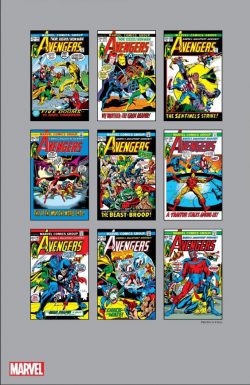
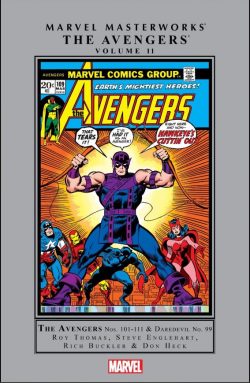
Graced with a scene-setting Preface from outgoing scripter Roy Thomas and context-creating Introduction from new kid Steve Englehart, this sturdy hardcover and eBook compilation gathers the astounding contents of Avengers #89-100 (collectively spanning July 1972 – May 1973) and includes a cross-over moment from Daredevil and the Black Widow #99.

Now scripter extraordinaire Thomas was about to hand over the reins to an even more imaginative and groundbreaking author who took the team to dizzying new imaginative and dramatic heights, but before that he and debuting penciller Rich Buckler – doing his best Neal Adams impersonation – shone on a Harlan Ellison tale inked by Dan Adkins.

‘Five Dooms to Save Tomorrow!’ was based on an Ellison novella from 1964 and found the Avengers battling Leonard Tippit, an ordinary man granted incredible power so that he could murder five innocent human beings. To be fair though, those innocuous targets’ continued existence threatened Earth’s entire future…

Determined to stop him whatever the ultimate consequences, the Avengers eschewed the murky moral quandary and were tested to their utmost, before the crisis was averted…

The heroes were on firmer, more familiar ground in #102 when the Grim Reaper returned, offering to place the Vision’s consciousness in a human body in return for the android’s allegiance in ‘What to Do Till the Sentinels Come!’ (Thomas, Buckler & Joe Sinnott). Meanwhile, the mutant-hunting robots kidnapped the Scarlet Witch and started another scheme to eradicate the threat of Homo Superior forever…

A budding romance between the Witch and the Vision revealed tensions and bigotries in the most unexpected places as the cataclysmic tale continued with ‘The Sentinels are Alive and Well!’ as the team search the globe for the monstrous mechanical marauders before being captured themselves whilst invading their Australian Outback hive.

The tale concludes ‘With a Bang… and a Whimper!’ as the assembled heroes thwart the robots’ project to sterilise humanity – but only at the cost of two heroes’ lives…

The grieving Scarlet Witch takes centre stage in #105 as ‘In the Beginning was… the World Within!’ (by new scripter Steve Englehart and veteran artists John Buscema & Jim Mooney) as the team travel to South America and encounter cavemen mutants from the lost world known as the Savage Land, after which the Avengers discover ‘A Traitor Stalks Among Us!’ (illustrated by Buckler, George Tuska & Dave Cockrum) with the revelation that perennial sidekick Rick Jones has become atomically bonded to alien hero Captain Marvel: a revelation that triggers a painful flashback in memory-blocked Captain America, and just as an old foe turns the team against itself.

Avengers #107 reveals ‘The Master Plan of the Space Phantom!’ (with art by Jim Starlin, Tuska & Cockrum) and his complex and sinister alliance with the Grim Reaper even as the love-sick Vision finally accepts the Faustian offer of a human body.

Unfortunately, the corpus on offer is the Star-Spangled Avenger’s…

‘Check… and Mate!’ – illustrated by veteran Avenger artist Don Heck and inkers Cockrum & Sinnott – wraps up the intriguing saga in spectacular fashion as an army of Avengers thrash Phantom, Reaper and assorted hordes of Hydra hoods. However, the true climax is the Vision and Witch’s final acknowledgement of their love for each other.

The announcement provokes a storm of trouble…

In #109 Hawkeye, who’s always carried a torch for the beautiful Wanda, quits the team in a dudgeon and ‘The Measure of a Man!’ (Heck & Frank McLaughlin) find the heartsick archer duped by billionaire businessman Champion and almost responsible for causing the complete destruction of California before wising up and saving the day…

Next the depleted team of Captain America, Thor, Iron Man, Scarlet Witch, Vision and Black Panther investigate the disappearance of mutant heroes the X-Men and are thoroughly beaten by an old enemy with a new power.

‘… And Now Magneto!’ (Englehart, Heck, Frank Giacoia & Mike Esposito) ends with half the team brainwashed captives of the master villain with the remaining crusaders desperately searching for new allies. We then pop over to San Francisco and a crossover from Daredevil and the Black Widow #99 (May 1973, by Steve Gerber, Sam Kweskin & Syd Shores). ‘The Mark of Hawkeye!’ sees Natasha Romanoff‘s old boyfriend fetch up on the Widow’s doorstep, determined to reclaim her. The caveman stunt culminates in the Archer’s sound and well-deserved thrashing, and when the last Avengers arrive, asking him to return and assist, he refuses. DD and the Widow don’t, though…

The saga resumes and concludes in Avengers #111 as, ‘With Two Beside Them!’ (Englehart, Heck & Esposito) the returned heroes and West Coast vigilantes successfully rescue the X-Men and Avengers enslaved by the malevolent Magneto. With the action over, Daredevil returns to California but the Black Widow elects to stay with the World’s Mightiest Heroes…

This titanic tome also offers extra treats: namely an unused page of Buckler’s beautiful pencil art and his Sinnott-inked cover for Avengers #104.

Roy Thomas and his artistic collaborators were always at the forefront of Marvel’s second generation of creators: brilliantly building on and consolidating Lee, Kirby and Ditko’s initial burst of comics creativity whilst spearheading and constructing a logical, fully functioning wonder- machine of places and events that so many others could add to.

These terrific tales are ideal examples of superheroes done exactly right and also act as pivotal points as the underdog company evolved into a corporate entertainment colossus. There are also some of the best superhero stories you’ll ever read and Englehart’s forthcoming concoctions would turn the Marvel Universe on its head and pave the way for a new peak of cosmic adventure…
© 1972, 1973, 2016 Marvel Characters, Inc. All rights reserved.

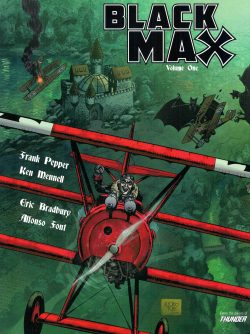
Black Max volume 1


By Frank S. Pepper, Ken Mennell, Eric Bradbury, Alfonso Font & various (Rebellion Studios)
ISBN: 978-1-78108-655-1

Win’s Christmas Gift Recommendation: Astounding Air Ace Action… 9/10

It’s time for another sortie down memory lane for us oldsters and, hopefully a new, untrodden path for fans of the fantastic in search of a typically quirky British comics experience.

This stunning paperback (and eBook) package is another stunning nostalgia-punch from Rebellion’s superb and ever-expanding Treasury of British Comics, collecting all episodes of seminal shocker Black Max.

The strip debuted in the first issue of Thunder and ran the distance – spanning October 17th 1970 – 13th March 1971. It then survived cancelation and merger, continuing in Lion & Thunder until that magazine finally died.

This book carries those stories, beginning with March 20th up to May 8th 1971 and the period perils are rounded out with a brace of longer yarns taken from Lion & Thunder Holiday Special 1971 and Thunder Annual 1972. These eerie enthralments are preceded by a warmly reminiscent Introduction from Font that adds a very human dimension to the freaky flying thrills.

The series is typical of the manner in which weekly periodicals functioned back then: devised by screenwriter, veteran Editor and ubiquitous scripter Ken Mennell (Cursitor Doom, Steel Claw, The Spider and so many more) with the first episode limned by the company’s star turn for mood and mystery Eric Bradbury (Invasion, The Black Crow, Cursitor Doom, Hookjaw, House of Dolman and dozens more). Then the whole kit and kaboodle was handed off to another team to sink or swim with, which they did until 1974: a most respectable run for a British comic

The attrition rate of British comic strips bore remarkable similarities to casualty figures…

This particular serial was well-starred: the developing writer was the legendary Frank S. Pepper. He’d begun his professional comics career in 1926 and by 1970 had clocked up a few major successes such as Dan Dare, Rockfist Rogan, Captain Condor, Jet-Ace Logan and Roy of the Rovers to name but a very, very few.

Even the series illustrator Alfonso Font – a relative newcomer – was a ten-year veteran, albeit mostly for European publications. Based in Spain, he worked not just for Odhams/Fleetway but on strips for US outfits Warren and Skywald and on continental classics such as Historias Negras (Dark Stories), Jon Rohner, Carmen Bond, Bri D’Alban, Tex Willer, Dylan Dog and more…

Because of the episodic nature of the material, generally delivered in sharp, spartan 3-page bursts, I’m foregoing my usual self-indulgent and laborious waffle and leaving you with a précis of the theme… and what a cracker it is…

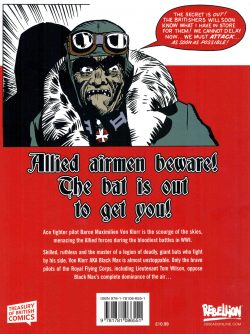
In 1917 the Great War is slowly being lost by Germany and her allies and in the Bavarian schloss of Baron Maximilien von Klorr, the grotesque but brilliant scientist and fighter ace has devised a horrific way to tip the scales back in favour of his homeland…

His ancient family have long had an affinity with bats and the mad man has bred a giant version that will fly beside him to terrify and slaughter the hated English…

The only problem is that his beloved monsters are vulnerable to gunfire so he must keep that as a most secret weapon…

That scheme is imperilled on a weekly basis by thoroughly decent young Brit Tim Wilson. A former performer in a peacetime flying circus, the doughty lad is possibly the best acrobatic flyer on the Western Front and narrowly escapes his encounter with the colossal chiropteran…

Of course, he cannot convince his superiors of the fearsome bio-weapon’s existence, but the Baron knows he’s out there and devotes an astonishing amount of time and effort to killing the lad – when not butchering Allied fliers and ground troops in vast numbers.

As the cat-&-mouse game escalates, both men suffer losses and achieve victories but the odds seem to shift after von Klorr finally manages to mass-produce his monsters, supplemented by ever more incredible inventions like his flying castle…

Most strikingly, some of Tim’s most fervent support comes from the ordinary German soldiers enslaved to the Baron’s vile program…

As previously stated, this initial collection also includes two longer, complete stories from seasonal specials. The first comes from Lion & Thunder Holiday Special 1971: an extra-sized summer treat which revealed how crashed English aviator Captain Johnny Craig experienced a night of extreme terror in the bio-horror filled home of Black Max, whilst Thunder Annual 1972 revealed how Captain Rick Newland of the Royal Flying Corps sought bloody revenge for the brutal bat-winged butchery of his comrades…

These strip shockers are amongst the most memorable and enjoyable exploits in British comics: smart, scary and beautifully rendered. This a superb example of war horror that deserves to be revived and revered.
© 1970, 1971, 1972, 1973 & 2018 Rebellion Publishing Ltd. Black Max and all related characters, their distinctive likenesses and related elements are ™ Rebellion Publishing Ltd. All Rights Reserved.
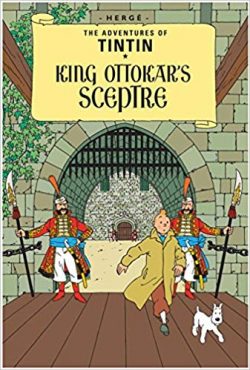
Adventures of Tintin: King Ottokar’s Sceptre


By Hergé & various; translated by Leslie Lonsdale-Cooper & Michael Turner (Egmont)
ISBN: 978-1-40520-619-8 (HB)                    : 978-0-31613-383-8 (PB)

Georges Prosper Remi – AKA Hergé – created a true masterpiece of graphic literature with his many tales of a plucky boy reporter and his entourage of iconic associates. Singly, and later with assistants including Edgar P. Jacobs, Bob de Moor and the Hergé Studio, Remi completed 23 splendid volumes (originally produced in brief instalments for a variety of periodicals) that have grown beyond their popular culture roots and attained the status of High Art.

Like Dickens with The Mystery of Edwin Drood, Hergé died in the throes of creation, and final outing Tintin and Alph-Art remains a volume without a conclusion, but still a fascinating examination and a pictorial memorial of how the artist worked.

It’s only fair, though, to ascribe a substantial proportion of credit to the many translators whose diligent contributions have enabled the series to be understood and beloved in 38 languages. The subtle, canny, witty and slyly funny English versions are the work of Leslie Lonsdale-Cooper & Michael Turner.

On leaving school in 1925, Remi worked for Catholic newspaper Le Vingtiéme Siécle where he fell under the influence of its Svengali-like editor Abbot Norbert Wallez. The following year, the young artist – a passionate and dedicated boy scout – produced his first strip series: The Adventures of Totor for the monthly Boy Scouts of Belgium magazine.

By 1928 he was in charge of producing the contents of Le XXe Siécles children’s weekly supplement Le Petit Vingtiéme and unhappily illustrating The Adventures of Flup, Nénesse, Poussette and Cochonette when Abbot Wallez urged Remi to create a new adventure series. Perhaps a young reporter who would travel the world, doing good whilst displaying solid Catholic values and virtues?

And also, perhaps, highlight and expose some the Faith’s greatest enemies and threats…?

Having recently discovered the word balloon in imported newspaper strips, Remi decided to incorporate this simple yet effective innovation into his own work.

He would produce a strip that was modern and action-packed. Beginning January 10th 1929, Tintin in the Land of the Soviets appeared in weekly instalments, running until May 8th 1930.

Accompanied by his dog Milou (Snowy to us Brits), the clean-cut, no-nonsense boy-hero – a combination of Ideal Good Scout and Remi’s own brother Paul (a soldier in the Belgian Army) – would report back all the inequities from the “Godless Russias”.

The strip’s prime conceit was that Tintin was an actual foreign correspondent for Le Petit Vingtiéme…

The odyssey was a huge success, assuring further – albeit less politically charged and controversial – exploits to follow. At least that was the plan…

Originally published as a weekly monochrome strip Le Sceptre d’Ottokar ran from August 4th 1938 to August 10th 1939. The rousing Ruritanian saga of plot and counter-plot was designed as a satirical critique of Nazi Germany’s nefarious expansionist policies, but in a remarkably short course of time real life terrifyingly caught up with fictional hijinks. Another commercial winner, the tale was promptly released in collected book form upon conclusion and Herge’s team moved straight on to new serial Land of Black Gold. That tale was curtailed by the fall of Belgium in 1940 and the closure of Le Vingtiéme Siécle. We’ll talk more about that later…

When the war ended and Tintin led a resurgence of European comics, Le Sceptre d’Ottokar, was revived, reformatted, reconditioned and rereleased in a full-colour album. It was the first book to make the jump to English editions – in 1956 – and was adapted for the small screen by Belvision Studios. Twice in fact, as Canada’s Ellipse/Nelvana crafted their own animated version in 1991.

Older British readers might have another reason to recall this tale. Many of them had an early introduction to Tintin and his dog (then called Milou, as in the French editions) when fabled comic The Eagle began running King Ottokar’s Sceptre in translated instalments on their prestigious full-colour centre section in 1951.

During the Occupation, Hergé continued producing comic strips for Le Soir and in the period following Belgium’s liberation was accused of being a collaborator and even a Nazi sympathiser.

It took the intervention of Resistance hero Raymond Leblanc to dispel the cloud over Hergé, which he did by simply vouching for the cartoonist and by providing the cash to create the magazine – Le Journal de Tintin – which he published. The anthology comic swiftly achieved a weekly circulation in the hundreds of thousands.

The story itself is pure escapist magic as a chance encounter via a park bench leads our youthful hero on a mission of utmost diplomatic importance to the European kingdom of Syldavia. This picturesque principality stood for a number of countries such as Czechoslovakia that were in the process of being subverted by Nazi insurrectionists at time of writing.

Tintin becomes a surveillance target for enemy agents and, after a number of life-threatening near misses, flies to Syldavia with his new friend. The sigillographer Professor Alembick is an expert on Seals of Office and his research trip coincides with a sacred ceremony wherein the Ruler must annually display the fabled sceptre of King Ottokar to the populace or lose his throne.

When the sceptre is stolen it takes all of Tintin’s luck and cunning to prevent an insurrection and the overthrow of the country by enemy provocateurs…

Full of dash, as breathtaking as a rollercoaster ride and as compelling as any Bond movie, this is classic adventure story-telling to match the best of the cinema’s swashbucklers and as suspenseful as a Hitchcock thriller, balancing insane laughs with moments of genuine tension.

Clearly just as the world headed into a new Dark Age, Hergé was entering a Golden one…

These ripping yarns for all ages are an unparalleled highpoint in the history of graphic narrative. Their constant popularity proves them to be a worthy addition to the list of world classics of literature.
King Ottokar’s Sceptre: artwork © 1947, 1975 Editions Casterman, Paris & Tournai. Text © 1958 Egmont UK Limited. All Rights Reserved.
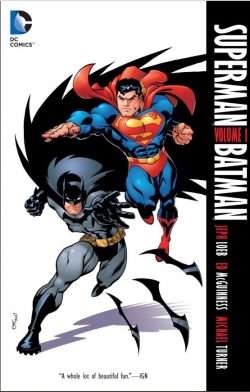
Superman/Batman volume 1 (New edition)


By Jeph Loeb, Ed McGuinness & Dexter Vines, Pat Lee & Dreamwave Productions, Michael Turner & Peter Steigerwald & various (DC Comics)ISBN: 978-1-4012-4818-5 (TPB)

Win’s Christmas Gift Recommendation: Compelling Comics Cavortings… 8/10

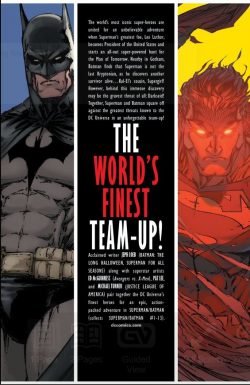
For many years Superman and Batman worked together as the “World’s Finest” team. They were best friends and the pairing made perfect financial sense as National/DC’s most popular heroes could cross-sell their combined readerships.

When the characters were redefined for the post-Crisis 1980s, they were remade as suspiciously respectful co-workers who did the same job but deplored each other’s methods and preferred to avoid contact whenever possible – except when they were in the Justice League (but for the sake of your sanity don’t fret that right now!).

After a few years of this new status quo the irresistible lure of Cape & Cowl Capers inexorably brought them together again with modern emotional intensity derived from their incontestably differing methods and characters.

In this rocket-paced, post-modern take on the relationship, they have reformed as firm friends for the style-over-content 21st century, and this is the story of their first outing together. Outlawed and hunted by their fellow heroes, Superman finds himself accused of directing a continent-sized chunk of Kryptonite to crash into Earth, with Batman accused of aiding and abetting…

To save Superman, the world and their own reputations they are forced to attempt the overthrow of the United States President himself. Of course, said President is the unspeakably evil Lex Luthor. Back in 2003 he was considered the least likely leader America could ever elect…

I deeply disliked this tale when I first read it: Plot is reduced to an absolute minimum in favour of showy set-pieces, previously established characterisation often hostage to whatever seems the easiest way to short-cut to action (mortal foes Captain Atom and Major Force work together to capture our heroes because President Luthor tells them to?) but after all these years it’s worthy of another look and I’m not ashamed to say that I’ve changed my opinion somewhat…

This paperback (and eBook) compilation collects issues #1-13 of the hip turn of the century reboot Superman/Batman (and includes a vignette from Superman/Batman Secret Files 2003) collectively spanning October 2003 to October 2004)

The action – written by Jeph Loeb and illustrated by Ed McGuiness & Dexter Vines – opens with ‘World’s Finest’ as the Dark and Light Knights follow telling leads in separate cases back to shape-shifting cyborg John (Metallo) Corben, discovering evidence to suggest that the ruthless cyborg might have been the at-large-for-decades shooter in the still unsolved double murder of Thomas and Martha Wayne…

Even that bombshell seems inconsequential after the mechanoid monster shoots Superman in the chest with a kryptonite bullet before burying the stunned duo under tons of Earth in a Gotham graveyard…

Meanwhile at the Pentagon, President Lex is informed that a toxically radioactive lump of Krypton the size of Australia is on a collision course with Earth. Implausibly adopting (and foreshadowing) the “Fake News” disinformational line that Superman has summoned it, the Federal Government issues an arrest warrant for the Man of Steel and convenes a metahuman taskforce to bring him in…

Escaping certain doom thanks to Batman’s skill and unflappable nerve, the blithely unaware heroes reach medical help in the Batcave in ‘Early Warning’, only to be attacked by an older version of Superman, determined to prevent them making a mistake that will end life on Earth…

After a massive nuclear strike (somehow augmented by embargoed Boom Tube technology from hell-world Apokolips), Luthor overrules Captain Atom’s qualms about the mission and orders his anti-Superman squad to apprehend their target wherever he might be hiding.

The President then goes on television to blame the alien for the impending meteor strike and announces a billion-dollar Federal bounty on the Action Ace…

Man of Tomorrow and Man of Darknight Detective respond by direct assault in ‘Running Wild’, hurtling towards Washington DC only to be ambushed en route by a greed-crazed army of super-villains and mind-controlled heroes before Atom’s group – Green Lantern John Stewart, Black Lightning, Katana, Starfire, Power Girl and certified quantum psychopath Major Force – join the attack…

As the combatants ‘Battle On’, in the Oval Office even fanatical civil servant Amanda Waller – commander of covert Penal Battalion the Suicide Squad – begins to realise something is wrong with the President.

For a start, his behaviour is increasingly erratic, but the real clue is that he is juicing himself with a kryptonite-modified version of super-steroid venom…

The blistering battle between the outlawed heroes and Atom’s unit extends as far as Japan, (where the Cape & Cowl Crusaders are secretly organising a last-ditch solution to the imminent Kryptonite continent crash) before Major Force begins to smell a rat and realises some of his team are actually working with Superman and Batman.

Military martinet Captain Atom is not one of them, but eventually even he is made to see reason – only moments before the deranged Major goes ballistic and nearly turns Tokyo to ashes…

Using his energy-absorbing powers, Atom prevents the holocaust, but the monumental radiation release triggers his “temporal safety-valve” and the silver-skinned soldier materialises in a future where Earth is a barren cinder and only an aged, tragic, broken Superman resides…

Meanwhile in the present, the Presidential Pandemonium has prompted the venerable Justice Society of America to step in; despatching Captain Marvel and Hawkman to apprehend the fugitive Superman and Batman.

Apparently successful, the operation triggers a back-up team (Supergirl, Nightwing, Steel, Superboy, Natasha Irons, Robin, Huntress, Batgirl and even Krypto) who invade the White House only to be defeated by Luthor himself, high on K-Venom and utilising Apokolyptian technology in ‘State of Siege’…

With extinction only moments away and a deranged President Luthor on the loose, Superman and Batman prepare to employ their eleventh-hour suicidal salvation machine but are caught off-guard when a most unexpected substitute ambushes them to pilot the crucial mission in ‘Final Countdown’…

In so many ways this yarn is everything I hate about modern comics. The story length is artificially extended to accommodate lots of guest stars and superfluous fighting, whilst large amounts of narrative occur off-camera or between issues, presumably to facilitate a faster, smoother read.

On the plus side, however, is the fact that I’m an old fart. There is clearly a market for such snazzy, souped-up, stripped down, practically deconstructed comic fare. And if I’m being completely honest, there is a certain fizz and frisson to non-stop, superficial all-out action – especially when it’s so dynamically illustrated.

Public Enemies looks very good indeed and, if much of the scenario is obvious and predictable, it is big and immediate and glossy like a summer blockbuster movie is supposed to be.

The epic is followed by a stand-alone tale starring Robin – the Tim Drake version – and semi-Kryptonian clone Conner Kent.

‘Protégé’ sees the assistants – don’t call them sidekicks – despatched to Japan to end the threat of a new Toyman. This particular giggling genius is a lethally brilliant kid and their off-the-wall solution to his antics is both smart and effective…

Next follows a tale and situation that only comics could conceive.

For decades DC really couldn’t make up their minds over Supergirl. I’ve actually lost count of the number of different versions that have cropped up over the years, and I’ve never been able to shake the queasy feeling that above all else she’s a concept that was cynically shifted from being a way to get girls reading comics to one calculated to ease young male readers over that bumpy patch between sporadic chin-hair outbreaks, voice-breaking and that nervous period of hiding things under your mattress where your mum never, never ever looks…

After a few intriguing test-runs the first true Girl of Steel debuted as a future star of the ever-expanding Superman pocket universe in Action Comics #252 (May 1959). Superman’s cousin Kara Zor-El had been born on a city-sized fragment of Krypton, hurled intact into space when the planet exploded. Eventually Argo City turned to Kryptonite like the rest of the detonated world’s debris and her dying parents, observing Earth through their vision-scopes, sent their daughter to safety as they apparently perished.

Landing on Earth, she fortuitously met Superman who created the identity of Linda Lee and hid her in an orphanage whilst she learned of her new world and powers in secrecy and safety.

Her popularity waxed and waned over the years until she was earmarked for destruction as one of the attention-grabbing deaths during Crisis on Infinite Earths.

However, after John Byrne successfully rebooted the Man of Steel, non-Kryptonian iterations began to appear – each with her own fans – until early in the 21st century the company Powers-that-Be decided the real Girl of Steel should come back… sort of…

Thus, this visually intoxicating version (from Superman/Batman #8-13) resets to the original concept and has a naked blonde chick arrive on a colossal Kryptonite meteor, claiming to be Superman’s cousin…

Written by Loeb with captivating art by Michael Turner & Peter Steigerwald, the action commences in ‘Alone’, as a quarantined Superman chafes at enforced detention, the Dark Knight explores a section of the meteor submerged in Gotham Bay.

The JLA have all been active, clearing away the deadly fragments, but this last one is most disturbing. As Batman quickly grasps, it’s a ship, but its single passenger is now missing…

Soon the Gotham Guardian is tracking a wave of destruction caused by a seemingly confused teenaged girl with incredible powers and only Superman’s unwise early intervention stops the mounting carnage.

Their subsequent investigations reveal the comely captive to have all the Man of Tomorrow’s abilities and she claims – in fluent Kryptonian – to be the daughter of his long-dead uncle Zor-El…

The mystery further unfolds in ‘Visitor’ as a deeply suspicious Batman and ecstatic Superman continue their researches, arguing their corners as the most powerful girl on Earth becomes increasingly impatient. Fuelling the Dark Knight’s concern is superdog Krypto’s clear and savage hostility to the newcomer and Kara’s convenient claim that she has amnesia…

Then as Clark Kent endeavours to acclimatise his cousin to life on Earth, on the hellish world of Apokolips vile Granny Goodness and her Female Furies are ordered by ultimate evil space-god Darkseid to acquire the pliable naive newcomer…

Before they can strike, however, an attack comes from an unexpected source, as former ally Harbinger, ruthless hunter Artemis and beloved ally Wonder Woman ambush the Kryptonians. …

Princess Diana has acted arbitrarily but from absolute necessity: kidnapping Kara and bringing her to the island home of the Amazons to be trained in the use of her powers as a ‘Warrior’.

Superman’s growing obsession has rendered him unable to see her potential for destruction, despite a cryptic message on her space ship from Zor-El, and Wonder Woman chose to strike first and ask later…

With tempers barely cooled, Dark Knight and Action Ace are invited to observe Kara’s progress weeks later, just as the tropical paradise is assaulted by an army of artificial Doomsdays manufactured on Apokolips…

The wave of slaughter is a feint, but by the time the rampaging horrors are all destroyed, the Furies have done their work, slaughtering Kara’s only friend and stealing away the Kryptonian kid…

In ‘Prisoner’, DC’s superheroic high trinity enlist the aid of Apokolyptian émigré Big Barda and stage a devastating rescue mission to Darkseid’s homeworld, but not before the Lord of Evil apparently twists the innocent Girl of Steel into his tool: making her a ‘Traitor’ to the living…

The Master of Apokolips has never faced a foe as adamant as Batman and the quartet are unexpectedly victorious, but after returning Kara to Earth and announcing her as the new Supergirl, the heroes discover that they are not safe or secure, and in ‘Hero’ Darkseid horrifyingly returns to exact his ultimate revenge…

For me, the most intriguing aspect of this sometimes overly-sentimental tale is Batman’s utter distrust and suspicion of Kara as she is hidden from the world while she assimilates, but there’s plenty of beautifully rendered action – plus oodles of lovingly rendered girl-flesh and titillating fetish outfits jostling for attention amidst the lavish fight-scenes and interminable guest-cameos, should that be to your tastes – and enough sheer spectacle to satisfy any Fights ‘n’ Tights fans.

Even now the goods things have not been exhausted as Superman/Batman Secret Files 2003 provides a charming peek into the past with ‘When Clark met Bruce’ (“A tale from the days of Smallville”) in which bucolic 2-page snippet, Loeb & Tim Sale effectively tease us with the question of what might have been, had the go happy-go-lucky Kent boy actually got to have a play-date with that morose, recently orphaned rich kid from Gotham City…

Filling out the experience are pictorial fact-file on Superman, Batman,

President Lex Luthor, Talia and Metallo, plus a full cover gallery by McGuiness & Vines, Turner & Steigerwald and Jim Lee & Scott Williams and studies and design sketches for Supergirl.

Full of flash and dazzle this mighty tome might well be the kind of Fights ‘n’ Tights thrill you’re looking for this yule season.
© 2003, 2004, 2014 DC Comics. All Rights Reserved.