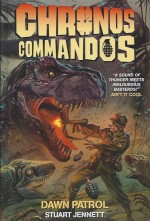
Chronos Commandos: Dawn Patrol


By Stuart Jennett (Titan Comics)
ISBN: 978-1-78276-006-1

In a marketplace stuffed to bursting point with books and stories that are only parts of a greater whole, it’s a merciful delight to see that some publishers and creators are still sticking to the perfect basics and delivering complete, enthralling and fundamentally cool packages for kids of all ages (at least if you’re a bit liberal/traditional in your views of parenting and accept the intrinsically bloodthirsty nature of children)…

If you’re British a reader of a certain vintage – and more or less male – you never really grew out of the fundamental and sheerly gratuitous entertainment of seeing soldiers, explosions, chases, big guns and dinosaurs, and this spectacularly backwards-looking romp from Stuart Jennett (Warheads, 2000AD) punches all those buttons in a riotous time-travel war story which originally appeared in 2013 as a 5-issue miniseries.

The idea of honking big lizards against honking big guns is venerable, unceasingly cool and simply too good a concept to resist. I believe it all kicked off with Sir Arthur Conan Doyle’s Lost World and was refined by Edgar Rice Burroughs’ Caprona stories (known alternatively as the Caspak Trilogy or “the Land That Time Forgot”, although many of his other novel sequences contained saurian co-stars) providing everything imaginative boys could wish for: giant lizards, humongous insects, fantastic adventures, hot cave girls and two-fisted heroes with lots of guns…

The most successful comics instance of this must surely be Robert Kanigher’s The War that Time Forgot (which debuted in Star Spangled War Stories #90, April-May 1960). The stories of US troops fighting Germans, Japanese and hungry monsters ran until #137 (May 1968) skipping only three issues: #91, 93 and #126 – the last of which starred the United States Marine Corps simian Sergeant Gorilla…

Whereas this fine new iteration, given a quirkily British spin, boasts no busty babes in either torn but oddly obfuscating scraps of lab coat or fetching muskrat-pelt bikinis (though maybe there’s room in the sequel), it does contain fast-paced, gory antediluvian slaughter and a twisty-turny, time-bending plot to heighten the gruelling, gripping duel between the world’s first full time chronal combatants…

Following Jennett’s Introduction the non-stop action begins deep in dinosaur times and climes as a veteran US Army Sergeant leads his squad in another raid to stop Nazi time-troopers from mucking up history in the Fuhrer’s favour.

Temporal travel is still a new arena for combat and nobody really knows the rules, but the Professor back in 1944 is pretty adamant that visitors to the past should harm or kill as little as possible.

Of course that’s easy for him to say from his nice safe lab…

Time-Landings are haphazard at best and the G.I.s have to cut through miles of swamp to reach their current objective, so before too long only Grease and the Sarge are left to sneak up on the Nazi Time-Bell, doing God knows what to win the war for Uncle Adolf…

In charge is old enemy Kapitan Dieter Richter, Germany’s top Chrono-Kriegsmann, and the wily fox again manages to escape even though the Sarge succeeds in blowing up his base…

Exhausted and wounded, the Sarge treks back alone and triggers his Chronosphere’s return, only to emerge into another blazing firefight. Nazi agents have successfully infiltrated the Allied time lab of Project: Watchmaker and stolen the Professor’s Chronos Core – the invention which powers the trips and enables US time-teams to return home…

A traitor has jumped back to the Cretaceous, intent on handing the core over to a Kraut team and giving them an unbeatable edge in time tech, leaving the Americans with only 30-minutes Relative to prevent the end of Allied Chronal Operations forever.

Frantically, Sarge assembles a 4-man team from the lab’s surviving soldiery to give chase and recover the device, utterly unaware that he has left the Prof unprotected with another insidious Nazi infiltrator…

The grizzled Non-Com would be no happier knowing that he’s bringing one back to the age of reptiles with him too…

What follows is a desperate and ghastly race against time with hungry saurians, deadly giant bugs and murderous bushwhacking Nazis all adding to the body count, whilst in the Age of Man lethal paradoxes multiply and the fragile stability of all time and space begin to fracture…

Riotous and spectacular, explosively gung-ho but still smart enough to pile on the temporal pressures and leavened with sly, knowing black humour, Dawn Patrol offers a bullet-ridden rollercoaster of blockbuster thrills no big kid could possibly resist.

Also included here is a large section of added features from the ‘Chronos Commandos Supplemental Briefing Pack’ which includes such text background as ‘Official Papers Transferring Sgt. XXXX to Project: Watchmaker…’, ‘Black Star Initiative Operational Parameters’, ‘Chronos Commandos Search and Destroy Mission Briefing’, ‘Dr. Herla’s Autopsy Report: including Discussion of His Various Fatal Mutations, and Informed Speculation on the Perils of Time Travel’ and ‘Know Your Enemy Dinosaur Comparison Charts’.

Also included are the tragic fragments of a lost hero’s life in ‘Peabody’s ‘Letters from Home’ and his ‘Vintage Crash Jordan Serial Poster’ as well as Blueprints for both the Allied and Nazi Time Pods, original comics ‘Series Covers’ and extensive excerpts from ‘The Chronos Commandos Sketchbook’.

Chronos Commandos™ and © 2014 Stuart Jennett. All rights reserved.


Chronos Commandos: Dawn Patrol is published on March 11th. For details of how to meet the author and get a copy signed, check out our Noticeboard section.

Perfect Nonsense: the Chaotic Comics and Goofy Games of George Carlson


By George Carlson, edited by Daniel F. Yezbick & Rick Marschall (Fantagraphics Books)
ISBN: 978-1-60699-508-2

The art and calling of mesmerising children is a rare one, but the masters of such an imaginative discipline – whether through words or pictures – have generally become household names.

Lewis Carroll (although that’s really two people, Charles Lutwidge Dodgson & Sir John Tenniel), Edward Lear, J.M. Barrie, L. Frank Baum, Enid Blyton, Maurice Sendak, Kenneth Graham, Arthur Rackham and their ilk, or cartoon-oriented craftsmen such as Winsor McCay, Sheldon Mayer, Theodor “Dr. Seuss” Geisel, George Herriman, Elzie Segar, S.J. Perelman, Alfred Bestall, Crockett Tubbs, Milt Gross, Carl Barks, Bill Holman and others have all garnered some measure of undying fame for their sublime cannons of entertainment, but apparently these days, nobody knows George Carlson.

Carlson was both a unique and prolific, surreally absurdist, sublimely stylised magician of children’s entertainments and a diligent commercial artist, tireless, dedicated educator and print illustrator and designer.

He absolutely loved games and puzzles and was besotted with all aspects of print media.

A son of Swedish immigrants, he plied his trade(s) from New York and Connecticut between 1903 to 1962, producing everything from editorial cartoons, book jackets (including famously the iconic first edition of Margaret Mitchell’s Gone with the Wind), magazine illustration, typographical design, games, sheet-music, utterly unique advertising materials, books, pamphlets and so much more.

And comics: some of the most original, eccentric and captivating comics for youngsters America or the world has ever seen…

This superb and colossal compendium, the brainchild and magnum opus of extreme fan Daniel Yezbick, is the result of 15 years toil and superbly details every aspect of the lost master’s life, stuffed to overflowing with intimate photos, wonderful anecdotes and page after page of glorious, enchanting stories, poems, puzzles and pictures that still have the power to take your breath away, no matter how old you are.

This calculated resurrection of a lost giant begins with ‘Preface: Great Gran’pa Gookel’ by Carlson’s descendent Allison Currie, and an effulgent Introduction’ by author, critic, historian and cartoonist R.C. Harvey who kindles the lost days in ‘A Very Admiring and Well-Plumbed Apostrophe to George Carlson, Cartooning Genius’, whilst Yezbick’s fulsome Foreword declares ‘At Long Last, the Carnival’s Come Back’…

Firstly Yezbick takes us through the great man’s multi-faceted career, beginning with ‘The Jolly Books of the Puzzling Private’ describing early works and the artist’s two decades writing, illustrating, designing and creating engaging and educational games and puzzles for iconic and influential children’s pulp magazine John Martin’s Book. Also heavily featured is Carlson’s first great creation Peter Puzzlemaker, whose visual and verbal conundrums fascinated and expanded the minds of generations of kids.

The tireless scribbler also ghosted Gene Ahern’s classic newspaper strip Reg’lar Fellers for years and was engaged during WWI as an army cartographer.

‘The Whimsical Wizard of Fairfield, Connecticut: Family Life and Commercial Art in the 1920s and 1930s’ details his most productive period, not just as a consummate long-distance entertainer of kids, but in local and publishing national arenas.

Whilst addressing Carlson’s lifelong fascination with transport – especially his astounding illustrations of ships and trains – ‘Gone With the Wiggily: Flirting with Fame in the 1930s and 1940s’ covers the Mitchell cover creation and other book jackets as well as Carlson’s far more lasting and influential contributions to children’s literature.

Most important of these are his superb illustrations for Howard R. Garis’ ubiquitous and bucolic tales of venerable rabbit grandfather figure Uncle Wiggily and the artist’s wholly originated series of Puzzles, Fun Things to Do, Play and Colouring books, as well as a succession of “How to” books  revealing the secrets of drawing and creating your own cartoons.

The origin of his short but incredible funnybook career is covered in ‘The Road to Pretzleburg: George Carlson and Self-Destructing Comic Book Narrative’ and the latter disappointing years of changing public tastes in ‘Slouching Towards Fumbleland: The Restoration of the Whifflesnort’ which prompted his just-too-soon abortive creation of graphic novels (in 1962) with the never published Alec in Fumbleland and the artist’s immortalisation as the creator of a series of images locked in a time capsule that won’t be opened until 8113AD…

The major portion of this sturdy compendium is taken up with hundreds of astounding reproductions of Carlson’s vast and varied output, beginning with ‘Early Works and Illustrations’ including scenes from many classical stories such as Icarus, Neptune and Amphitrite, Aesop’s Fables, The Legend of Sleepy Hollow, Tom Sawyer and full colour cover and plates for such books as The Magic Stone, Uncle Wiggily, The Prince Without a Country and more…

Also included are examples of ‘Adult and Genre Works’ such as Broncho Apache, Death on the Prairie and Scouting on the Mystery Trail…

‘Pulps, Poems and Pixies: John Martin’s Books’ offers a wealth of images and designs from Carlson’s 20 year tenure as contributing editor on America’s premiere pulp publication for children.

A master of what we now call paper and print technologies with the budget and freedom to go wild, he concocted covers, frontispieces, book plates, Holiday editions, graphically integrated poem pages, astounding layouts, games pages, riddles, nonsense word glossaries, animal alphabets and so many other ways to educationally enthral, engage and stretch growing minds…

The artist was also a brilliant composer of clever, witty limericks, odes, riddles, gags and brainteasers: a advocate and devotee of whacky word play in the manner of Lear and Carroll, and ‘Carlson’s School of Nonsense’ catalogues many of his most impressive cartoon-garnished confections whilst ‘Jolly Books’ displays his creations and tales for premium pamphlets (a forerunner of comicbooks) commissioned as give-aways by department stores, cxall dutifully crafted and packaged by the John Martin team.

As the magazine refused to carry straight advertising – feeling it was an abuse and betrayal of their young readers’ trust – Carlson and brilliant co-editor Helen Waldo devised a sponsorship method which name-checked at one remove selected backers and commercial interests through ingenious story puzzle pages, rebuses, acronyms and acrostics…

Once upon a time paper and printing were the internet: a nigh-inexhaustible, readily available resource which could provide stories, games and puzzles, information and diversions which only required a creator’s imagination and ingenuity.

There was nobody more skilled, adept or inspired than Carlson, whose life-long fascination with language, crosswords, puns, riddles, rebuses, maths, wordplay and graphic invention seemingly occupied every non-working, waking moment.

He also knew music (his wife Gertrude was a professional pianist and gave lessons from their home) and here ‘Songs, Games and Other Pastimes’ displays his charming amalgamations of graphics and terpsichorean instruction as well as his science-based features, articles and books, whilst ‘Tutorial Cartooning and Art Instruction’ offers concrete examples of the artist’s many years of publishing tracts and tomes intended to teach young and old alike the fundamentals of narrative art.

‘Trains and Transportation’ reveals in spectacular detail Carlson’s fascination with engineering, locomotives and all aspects of shipping – including the revolutionary and mindboggling book Queen Mary Comparisons – after which ‘Portraits, Presidents and Personalities’ displays a selection of his superb commemorative images, whilst ‘Adventures in Advertising’ reveals his unbelievable versatility in putting across ideas and selling, including many examples of the aforementioned John Martin stealth ads plus a plethora of delightful make-them-yourself Premiums he designed for youngsters.

‘Original Art, Lost Works, and Forgotten Frolics’ explore tantalising might-have-beens and unearthed treasures before the groundbreaking kids comics are highlighted in ‘Laughter, Puns, and Speed’.

Subtitled ‘The Whifflesnorting Thrills of George Carlson’s Eastern Color Comics’, a brief essay reveals the history of the illustrator’s short foray into comicbooks and the creation of anthology Jingle-Jangle Comics, which launched in February 1942 (running until 1949) and which headlined two features exclusively written and drawn by Carlson.

‘The Pie-Faced Prince of Old Pretzleburg’ was a manic, pun-filled procession of insane and wholesome nonsense which related the fast and frantic screwball adventures of royal mooncalf Prince Dimwitri and his inamorata Princess Panetella Murphy, and the too short collection of complete capers commences here with the fast, frenetic debut from #1, in which he saved the King’s breakfast pretzel from the insidious Green Witch.

Also included are escapades from issues #11, #15, #16, #20, #35, #36 and #41, absurdist adventures in rumbling tumbling happily tumultuous word and picture tales involving jet-powered kites, assorted bandits, scurrilous scarecrows, stolen violins, fabulous beasts, living jet-mobiles, talking animals, baking, belligerent unicorns and more.

Carlson brought a deliciously skewed viewpoint to the still-evolving syllabary of comics: there are hilariously punny labels and signs everywhere and in some shots weary birds rest on free-floating word balloons…

Without doubt, however, Carlson reserved his greatest flights of fancy for the inventive fractured fairy stories that comprised the eponymous ‘Jingle Jangle Tales’ – one-off fables starring peculiarly reinvented standbys like princesses and knights, interacting with astonishing animals and far-from-inanimate objects all imbued with a bravura lust for life and laughs.

Included here are ‘The Moon-Struck Unicorn and the Worn-Out Shadow’ from #13, ‘The Straight-Shooting Princess and the Filigree Pond-Lily’ (#22), ‘The Musical Whifflesnort and the Red-Hot Music Roll’ (#23), ‘The Rocketeering Doodlebug and the Self-Winding Horsefly’ (#25), extraordinarily mirthful mystical melanges augmented by a brace of outrageously wry spoofs of American classics ‘Skip van Wrinkle, the High-Hatted Hunter’ from #28 and the impossibly raucous and breathtaking lunacy of ‘Sleepy Yollow, the Bedless Norseman’ (#31).

Harlan Ellison correctly dubbed Carlson’s sublimely inviting whimsy for the very young as “Comics of the Absurd” and these cartoon capers are urgently in need of their own complete and comprehensive collection – preferably in a lush and lavish full colour hardback archive edition…’

If you have an abiding love of creative fantasy and access to beginning reading-age children (boy, that came out creepier than I imagined!), you simply must get this terrific tome and open their eyes to wonderment, enlightenment, entertainment and education in this timelessly addictively accessible chronicle.

Buy it now, and it will be this year’s best Christmas present ever…
Perfect Nonsense © 2013 Fantagraphics Books. All images and articles © their respective creators or owners. All rights reserved.

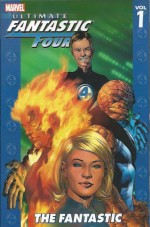
Ultimate Fantastic Four volume 1: The Fantastic


By Brian Michael Bendis, Mark Millar, Adam Kubert, Danny Miki, John Dell & various (Marvel)
ISBN: 978-0-7851-1393-5

After Marvel’s financial – and indeed creative – problems in the late 1990s, the company came back swinging. A key new concept was the remodelling and modernising of their core characters for the new youth culture. The Ultimate imprint abandoned monumental continuity – which had always been Marvel’s greatest asset – to re-imagine major characters in their own self-sufficient universe, offering varying degrees of radical makeover to appeal to the supposed contemporary 21st century audience and a chance to get in on the ground floor.

Peter Parker was once again a nerdy high-school geek, brilliant but bullied by his physical superiors, and mutants were a dangerous, oppressed ethic minority scaring the pants off the ordinary Americans they hid amongst. There were also fresh and fashionable, modernistic, scientifically feasible rationales for all those insane super-abilities manifesting everywhere…

The experiment began in 2000 with a post-modern take on Ultimate Spider-Man with Ultimate X-Men following in 2001 and Avengers retread The Ultimates in 2002.

The stories, design and even tone of the heroes were retooled for the perceived-as-different tastes of a new readership: those tired of or unwilling to stick with precepts originated by inspirational founding fathers Jack Kirby, Steve Ditko and Stan Lee, or (hopefully) new consumers unprepared or unwilling to deal with five decades (seven if you include Golden Age Timely tales retroactively co-opted into the mix) of continuity baggage.

The new universe prospered and soon filled up with more reinterpreted, morally ambiguous heroes and villains and eventually even this darkly nihilistic new universe became as continuity-constricted as its ancestor. In 2008 the cleansing event “Ultimatum” culminated in a reign of terror which excised dozens of superhumans and millions of lesser mortals in a devastating tsunami which inundated Manhattan, courtesy of mutant menace Magneto.

This volume collects Ultimate Fantastic Four #1-6 (February to July 2004), the fourth pillar of Marvel’s radical new edifice; more tweaked than reconceived by writers Brian Michael Bendis & Mark Millar, and illustrated in a lush, painterly manner by artists Adam Kubert, Danny Miki, John Dell and digital-colourist Dave Stewart.

The biggest change to the concept was a rather telling one: all four heroes were far younger than their mainstream antecedents…

Whereas in the original, middle-aged maverick genius Reed Richards, trusty friend Ben Grimm, sort-of girlfriend Sue Storm and her younger brother Johnny survived a privately-funded space-shot which foundered when Cosmic Rays penetrated their vessel’s inadequate shielding and mutated the quartet into quirky freaks, here events transpired rather differently…

The saga opens with telling snapshots from the unpleasant life of infant prodigy Reed: a lonely super-genius increasingly despised by his abusive blue-collar dad, bullied at school and obsessed with other dimensions. His only friend is classmate sports star Ben Grimm, who has unaccountably appointed himself the uber-nerd’s protector…

Reed’s life changes on the day his High School science project – teleportation – catches the eye of a clandestine government talent scout from a high powered think tank. He’s offered a place at a New York facility for budding geniuses and Reed’s dad couldn’t be happier to be rid of him – especially as the school pays parents for the privilege of educating their odd, smart kids…

The Baxter Building was a wonderland of top-flight resources, intellectual challenges and guarded support, but it was still a school and the kids were expected to produce results…

The ideas factory is run by brilliant Professor Storm and, although the administrator’s son Johnny was there mostly as a courtesy, Storm’s daughter Sue is one of the biggest young brains on Earth… and pretty too…

Reed’s teleportation researches were only a necessary preliminary to his greater goal. The boy had long posited – and now proved – the existence of a strange sub-dimension – a place the Baxter scientists call the Negative Zone – and with their aid the next five years were largely spent in trying to fully access it.

Regular studies continued too, with a few casualties. Some burn out like young Phineas Mason but creepy, arrogant, insular Victor Van Damme, after a particularly galling incident with Reed, somehow manages to swallow his animosity. Soon they are working together to crack the dimension calculations…

The tutors also walk psychologically fine lines. One such is creepy aberrant Dr. Arthur Molekevic, whose constant barracking of the not-overachieving-enough young boffins leads to a breakdown, unsanctioned experiments with artificial life and eventual expulsion by the military brass who actually run the establishment…

Jumping to now, 21-year-old Reed and his fractious lab partner Victor are in Nevada for the first full test of the N-Zone teleport system, with the Storms along for the ride. As the army technicians count down, Van Damme is still kvetching about the final hotly-contested calculations, but Richards is doubly distracted.

Firstly, young backpacker Ben Grimm has just wandered into camp to see his old sidekick after more than a decade apart, but most importantly snotty teen Johnny has just revealed that sister Sue has the hots for the obsessed and diffident Reed…

The test firing is a literal catastrophe.

The site is devastated in a shattering release of energy and Reed awakens some distance away as an amorphous blob of eerily boneless flesh, mistaken by the soldiers for an extra-dimensional invader.

In Mexico, Ben awakens to find he’s become a huge rocky orange monster, and Johnny eventually calls in from a hospital bed in France. He keeps catching on fire without ever burning himself…

Sue has just vanished without a trace…

Eventually gaining control of his limbs and the acceptance of the grown-ups, Reed discovers Victor had changed the settings just before the test, but now he can’t be found either…

Susan regains consciousness in a strange place with a familiar and unwelcome companion. Arthur Molekevic has become an actual Mole Man, re-populating ancient, previously inhabited colossal caverns 1.4 miles beneath New York with a selection of his dish-grown monsters and homunculi. Somehow she had materialised right at his scurvy, sweaty feet…

The rapidly reunited Reed and Johnny are joined by the tragically incredulous Ben at the BaxterBuilding and begin to learn how to control their incredibly altered states, even as the unctuous, unpleasantly foetid Mole Man is exploring his unwilling guest’s newfound and unwanted ability to bend light rays.

The unsavoury savant postulates that somehow the quartet had been projected through N-Space, utterly unprotected from whatever transformative energies and unknown physical laws might apply there, and their new gifts and appearances are the result.

The madman’s knowledge of current affairs above ground is easily explained. Ever since his ignominious dismissal – after which he had retreated to these mysterious subterranean vaults – he has kept an unceasing eye on his former pupils by tapping into every camera and computer feed in the BaxterBuilding…

He also reveals that he loves Sue and that she actually rematerialised three miles from Vegas, but his faithful creatures carried her all the way back to him. Moreover, as a gesture of his sincere affection, he has despatched one of his most gargantuan creatures due up to fetch her beloved brother…

On the surface when the monster erupts out of the ground, Johnny’s biggest worry is that it might be Sue, but soon he, Reed and Ben have soundly defeated it, despite being complete neophytes with their powers. Instead of receiving grateful thanks they are summarily attacked by the Army who accuse them of being rogue mutants…

Whilst Dr. Storm tries to placate the terrified soldiery, Reed talks his new comrades into jumping into the mile deep hole and finding out where the beast came from… straight into a cataclysmic clash with their old teacher and his apparently unlimited legions…

With a cover gallery by Bryan Hitch and Kubert plus design sketches by Hitch, this smart, fast, action-packed and brimful of teen-oriented humour for the era of the acceptable nerd and go-getting geek offers a solid alternate view of Marvel’s most important title that will impress open-minded old fans of the medium just as much as the newcomers they were ostensibly aiming for.
© 2004 Marvel Characters, Inc. All Rights Reserved.

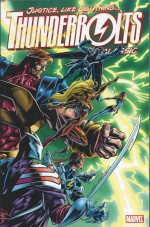
Thunderbolts Classic volume 1


By Kurt Busiek, Peter David, Mark Bagley, Sal Buscema & various (Marvel)
ISBN: 978-0-7851-5309-2

At the end of 1996 the “Onslaught” publishing event removed the Fantastic Four, Captain America, Iron Man and Avengers from the Marvel Universe and shared continuity, ceding creative control to Rob Liefeld and Jim Lee for a year. At first the “Image style” comics got all the attention, but a new title created to fill the gap in the “old” universe quickly proved to be the true star sensation of the period.

Thunderbolts was initially promoted as a replacement team book: brand new and untried heroes pitching in because the beloved big guns were dead and gone. Chronologically the team debuted in Incredible Hulk # 449 (cover-dated January 1997), a fairly standard game of “heroes-stomp-monster”, but that seemingly mediocre tale is perhaps excusable in retrospect…

With judicious teaser guest-shots abounding, Thunderbolts #1 premiered in April and was an instant mega-hit, with a second print and a rapid-reprint collection of the first two issues also selling out in days.

This classic compendium gathers all the early appearances of the neophyte team from January to July 1997: the Hulk tale, Thunderbolts #1-5, the Minus -1 special and 1997 Annual, plus their portion of Tales of the Marvel Universe one-shot and Spider-Man Team-Up Featuring… #7.

Sadly although the stories are still immensely enjoyable this book simply can’t recapture the furore the series caused in its early periodical days, because Thunderbolts was a sneakily high-concept series with a big twist: one which – almost impossibly for comics – didn’t get spilled before the “big reveal.”

The action here starts with issue #1 and ‘Justice… Like Lightning’ as Kurt Busiek, Mark Bagley & Vince Russell introduce a new team who begin to clear the devastated, post-Onslaught streets of New York of resurgent super-villains and thugs making the most of the hero-free environment. Amongst the Thunderbolts’ efforts is a resounding defeat of scavenger gang the Rat Pack, but although they rout and round up the looters, the leader escapes with his real prize: homeless children…

Captain America tribute/knock off Citizen V leads the valiant newcomers who comprise size-shifting Atlas, super- armoured Mach-1, beam-throwing amazon Meteorite, sonic siren Songbird and human toybox Techno, and the terrified, traumatised citizenry instantly take them to their hearts.

But these heroes share a huge secret…

They’re all super-villains from the sinister Masters of Evil in disguise, and Citizen V – or Baron Helmut Zemo as he truly prefers – has major Machiavellian long-term plans…

When unsuspecting readers got to the end of that first story the reaction was instantaneous shock and jubilation.

The aforementioned, untitled Hulk tale anachronistically appears next, as Peter David, Mike Deodato Jr. & Tom Wegrzyn pit the neophytes against the Jade Juggernaut in their campaign to win the hearts and minds of the World, promptly followed by the Tales of the Marvel Universe tale ‘The Dawn of a New Age of Heroes!’ as the group continue to do good deeds for bad reasons, readily winning the approval of cynical New Yorkers.

Thunderbolts #2 ‘Deceiving Appearances’ (Busiek, Bagley & Russell) finds them garnering official recognition and their first tangible reward. After defeating the Mad Thinker at a memorial service for the Fantastic Four and Avengers and rescuing “orphan” Franklin Richards, the Mayor hands over the departed FF’s Baxter Building HQ for the team’s new base of operations…

Spider-Man Team-Up Featuring… #7 ‘Old Scores’ by Busiek, Sal Buscema & Dick Giordano sees them even fool the spider-senses of everybody’s favourite wall-crawler whilst clearing him of a clever frame-up and taking down the super-scientific Enclave. However the first cracks in the plan begin to appear as Mach -1 and Songbird (AKA the Beetle and Screaming Mimi) begin to fall for each other and dream of a better life, whilst Atlas/Goliath starts to enjoy the delights and rewards of actually doing good deeds.

And whilst Techno (The Fixer) is content to follow orders for the moment, Meteorite – or Moonstone – is laying plans to further her own personal agenda…

Thunderbolts #3 finds the team facing ‘Too Many Masters’ (illustrated by Bagley & Russell) as dissension begins to creep into the ranks. The action comes from rounding up old allies and potential rivals Klaw, Flying Tiger, Cyclone, Man-Killer and Tiger-Shark who were arrogant enough to trade on the un-earned reputation as new Masters of Evil.

One of the stolen kids from issue #1 then resurfaces in ‘A Shock to the System’. Hallie Takahama was one of the prizes taken by the Rat Pack and her new owner has since subjected her to assorted procedures which have resulted in her gaining superpowers.

Her subsequent escape leads to her joining the Thunderbolts as they invade Dr. Doom‘s apparently vacant castle to save the other captives from the monstrous creations and scientific depredations of rogue geneticist Arnim Zola.

However, the highly publicised victory forces Citizen V to grudgingly accept the utterly oblivious and innocent Hallie to the team as trainee recruit Jolt

Thunderbolts Annual 1997 follows: a massive revelatory jam session written by Busiek with art from Bagley, Bob McLeod, Tom Grummett, Ron Randall, Gene Colan, Darick Robertson, George Pérez, Chris Marrinan, Al Milgrom, Will Blyberg, Scott Koblish, Jim Sanders, Tom Palmer, Bruce Patterson, Karl Kesel & Andrew Pepoy, which could only be called ‘The Origin of the Thunderbolts!’

In brief instalments Jolt asks ‘Awkward Questions’ of V and Zemo offers a tissue of lies regarding the member’s individual origins…

Beginning with V’s ostensible intentions in ‘The Search Begins’, gaining ‘Technical Support’ from Fixer, examining Songbird’s past in ‘Screams of Anguish’, obscuring the Beetle’s ‘Shell-Shocked!’ transformation and how ‘Onslaught’ brought them all together, the fabrications continue as ‘To Defy a Kosmos’ reveals to everyone but Jolt how ionic colossus Goliath was snatched from incarceration in another dimension before ‘Showdown at the Vault’ brought Moonstone into the mix with men she had previously betrayed…

Thunderbolts #5 then introduced more ‘Growing Pains’ as the team took a personal day in civvies in Manhattan, only to be targeted and attacked by Baron Strucker of Hydra, using one of Kang the Conqueror‘s Growing Man automatons…

The comics content of this collection concludes with Thunderbolts Minus #1; part of a company-wide event detailing the lives of heroes and villains before they started their costumed careers.

‘Distant Rumblings!’, illustrated by Steve Epting & Bob Wiacek, examined key events in the lives of two Baron Zemos, mercenary Erik (Atlas) Josten, unscrupulous psychiatrist Karla (Moonstone) Sofen, trailer-trash kid and future Songbird Melissa Gold, frustrated engineer Abner Jenkins AKA the Beetle and gadgeteering psychopath P. Norbert Ebersol who parleyed a clash with an amnesiac Sub-Mariner into a thrilling life as Hydra’s prime technician and Fixer…

Also offering a promotional page from Marvel Vision #13, a ‘Thunderbolts Fact-File’, a golden Age ad for the original Citizen V, covers-&-variants by Bagley, Deodato Jr. and Carlos Pacheco, Busiek’s introduction from the 1998 and 2001 collected editions, and 12 pages of character designs describing the metamorphosis of second-strung villains into first rung heroes, this is a solid superhero romp that managed to briefly revitalise a lot of jaded old fan-boys, but more importantly it is a strong set of tales that still pushes all the buttons it’s meant to nearly 20 years after all the hoopla has faded.

Well worth a moment of your time and a bit of your hard-earned cash.
© 1997, 2011 Marvel Characters, Inc. All rights reserved.

Starling


By Sage Stossel (Penguin/InkLit)
ISBN: 978-0-42526-631-1

Once upon a time only little boys (of any age from 3 to 90) liked superheroes.

That’s all different now.

Just like always, girls eventually steal boy’s stuff and break it or point out how stupid it is and ruin it or decorate and fancy it up so that it makes proper sense and is generally better, but it was still ours first though…

Let’s start again.

Sage Stossel is a children’s book author (On the Loose in Boston, On the Loose in Washington DC, We’re Off to Harvard Square), editorial cartoonist (Sage, Ink.) and Editor at The Atlantic, whose smart, wry, ostensibly innocuous efforts have also appeared in The Boston Globe, CNN Headline News, New York Times Week in Review and scads of other extremely prominent and worthily impressive places.

A native Bostonian, she majored in English and American Literature and Languages at Harvard where she permanently succumbed to the cartooning bug, producing student-life strip Jody for The Harvard Crimson. She was instrumental in creating The Atlantic‘s online iteration.

Starling is her first graphic novel and superbly takes a knowing sideswipe at the world’s newest fiction archetype, cleverly delving deep into the psyche of the kind of person who might actually fight crime if they had superpowers and how such a “career” might actually impact upon a sensible person.

Stossel also manages to tell a winning story about overcoming adversity, finding oneself and even having a shot at achieving true love, all lovingly ladled out in a savvy, self-deprecating, droll, artfully humorous manner…

Amy Sturgess has a secret. Up until now she’s only shared it all with her therapist, but balancing her job in the back-stabbing world of Marketing with the constant demands of the Vigilante Justice Association (who perpetually text her about occurring crimes she’s expected to foil immediately, no matter what she’s doing) is taking its toll.

At the Agency, a conniving male co-worker is actively stealing her work and sabotaging her career. Her cat-hoarder mom lives in a world of her own. Her brother Noah is a druggie lowlife – but at least he’s trying to get his life together, whilst her own (especially as regards dating) is a stalled and floundering disaster…

No wonder she relies so heavily on prescription meds and is plagued by bouts of crippling procrastination…

Things take a tortured upturn when her college sweetheart resurfaces. Russell is married to a wonderful woman (who actually becomes one of Amy’s best friends) but is clearly trying to rekindle those heady student passions with Amy and the situation soon begins to affect both sides of Amy’s work.

B-list costumed crusader Starling even begins to let certain offenders go: robbers stealing from banks who repossessed their homes, a homeless man trying to free his dog from the Animal Control impound…

A crisis point is reached when rival gangs begin a turf war and a modern Artwork is stolen. It doesn’t take much investigation to link Noah to both crimes, but when he disappears and Starling frantically hunts for him, she is incessantly stymied and interrupted by the hunky rogue and illicit gambling organiser Matt McRae.

The enigmatic hustler seems to have connected Amy to Starling and says he only wants to help, but he’s a crook.

A really, really good-looking, apparently unattached crook…

Amy isn’t Wonder Woman or Ms. Marvel. She’s just a well-intentioned young woman who found she was different and got pushed into a second (full time, secret and unpaid) career when she couldn’t even decide on how to make her first one work.

Now she has a really serious crime to solve, a brother to save, a romantic triangle to square and an unsuitable suitor to sort out…

Moe RomCom than Summer Blockbuster, Starling is a slow-paced, lovingly crafted, laconic, ironic and purely humorous tonic for lovers of the medium reared on adolescent wish-fulfilling, juvenile male power-fantasies who now yearn for something a little different, and even deliciously points out all the reasons why superheroes are dumb before wittily showing how that’s not necessarily bad and showing one way of making them better…
© 2013 Sage Stossel.

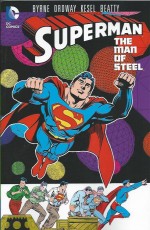
Superman: the Man of Steel volume 7


By John Byrne, Jerry Ordway, Karl Kesel, John Beatty, Keith Williams & Leonard Starr (DC Comics)
ISBN: 978-1-4012- 3820-9

Although largely out of favour these days as the myriad decades of Superman mythology are relentlessly assimilated into one overarching, all-inclusive multi-media DC franchise, the stripped-down, gritty, post-Crisis on Infinite Earths Action Ace as re-imagined by John Byrne and marvellously built upon by a stunning succession of gifted comics craftsmen produced some genuine comics classics.

Controversial at the start, Byrne’s reboot of the world’s first superhero was rapidly acknowledged as a solid hit and the collaborative teams who complemented and followed him maintained the high quality, ensuring continued success.

That vast, interlocking saga has been collected – far too slowly – over recent years in a more-or-less chronologically combined format as the fabulously economical trade paperback series Superman: The Man of Steel and this seventh volume (revisiting Superman #13-15, Action Comics #596-597 and Adventures of Superman #436-438 from January – March 1988) features the Kryptonian corner of DC’s third annual inter-company mega-crossover event.

After Crisis on Infinite Earths and Legends came Millennium, which saw writer Steve Englehart expand on an iconic tale from his  Justice League of America run (#140-141) as well as his tenure on the Green Lantern Corps.

Billions of years ago the robotic peacekeepers known as Manhunters had rebelled against their creators. The Guardians of the Universe were immortal and desired a rational, emotionless cosmos – a view not shared by their own women. The Zamarons abandoned the Guardians on Oa at the inception of their grand scheme but recently, after billions of years, the two factions had reconciled and left our Reality together.

Now they had returned with a plan to midwife a new race of immortals on Earth, but the Manhunters – who had since infiltrated all aspects of every society throughout the universe – were determined to thwart the plan, whether by seduction, connivance or just plain brute force.

The heroes of Earth were summoned by the reunited immortals and subsequently gathered to see the project to completion but were continually confronted by Manhunters in their own private lives… and their own comics.

DC Comics third braided mega-series was a bold effort intended to touch all corners of their universe, introduce new characters, tie-in many titles and moreover to do so on a weekly, not monthly, schedule. In addition to the 8 weekly issues of the miniseries itself, Millennium spread across 21 titles for two months – another 37 issues – for a grand total of 44 comicbooks, and those Superman-related episodes make up the majority of this titanic tome.

The crossover craziness begins here with ‘Toys in the Attic!’ from Superman #13, courtesy of Byrne & Karl Kesel, wherein elderly British craftsman Winslow Percival Schott opens a campaign of murder and wanton destruction targeting billionaire Lex Luthor, the Yank who ruined his little company and forced him to become the murderous Toyman.

No sooner had the Man of Tomorrow intervened in that fracas than he was drawn back to sleepy hometown Smallville in ‘Junk’ (Adventures of Superman #436, scripted by Byrne, illustrated by Jerry Ordway & John Beatty) to discover trusted confidant Lana Lang was an agent of the Manhunters.

In truth the insidious mechanoids had been watching the Last Son of Krypton since before that world had died, but botched capturing the baby when he first arrived on Earth. As a back-up plan, the Manhunters then replaced local practitioner Doc Whitney who subsequently turned every child born since into a mind-controlled sleeper agent.

Now with ClarkKent a key factor in the Millennium, Whitney rallied his forces to capture Superman but utterly underestimated the power and resourcefulness of the Man of Steel…

Although victorious, Superman’s triumph was tainted by tragedy. In defeat all Whitney’s unwitting agents – two generations of Smallville’s young folk – keeled over dead…

The story continued in ‘Hell is Where the Heart Is…’ (Byrne & Keith Williams from Action Comics #596) as Ghostly Guardian The Spectre is drawn to the catastrophe and facilitates Superman’s odyssey to the Spiritual Realms to rescue all the recently deceased…

Superman #14 features an action-packed team-up with Green Lantern Hal Jordan wherein Emerald Gladiator and Man of Tomorrow chase colossal super-Manhunter Highmaster through uncanny dimensions as the mechanical maniac seeks to attack the sequestered and enervated Guardians and Zamarons in ‘Last Stand!’ by Byrne & Kesel, after which events take a far more moody turn in Adventures of Superman #437, a twinned tale by Byrne, Ordway & Beatty.

‘Point of View’ simultaneously reveals how Luthor attempts to seduce one of the Millennium candidates to his evil side even as Lois Lane helplessly watches the brutally crippling struggle of merely mortal vigilante Jose “Gangbuster” Delgado against Lex’s hyper-augmented cyborg warrior Combattor…

The repercussions of that clash are examined in ‘Visitor’Action Comics #597- wherein Byrne, Leonard Starr & Williams impishly referenced the Silver Age catfights between Lois Lane and Lana Lang, whilst the story itself established the false premise that Superman had been raised as Clark’s adopted brother to throw off Lois’ growing suspicions…

With the Millennium complete, Superman #15 returned to regular wonderment and Superman was asked to find Metropolis Police Captain Maggie Sawyer‘s missing daughter Jamie just as the city was hit with a rash of flying bandit children. ‘Wings’ (by Byrne & Kesel) introduced repulsive monster Skyhook – a horrific bat-winged Fagin who beguiled and mutated runaways whilst concealing even greater ghastly secrets…

This stunning selection of Fights ‘n’ Tights fun concludes with Adventures of Superman #438 and Byrne, Ordway & Beatty’s re-imagination of ‘…The Amazing Brainiac’.

A trip to the circus disastrously coincides with drunken mentalist Milton Fine developing uncanny psionic abilities and going wild. Despite the mental assaults being particularly effective against the Man of Steel, Superman eventually overcomes the furiously frantic performer, but was the beaten man simply deranged by his own latent abilities, or are his ravings about being possessed by an alien named Vril Dox of Colu somehow impossibly true…?

The back-to-basics approach lured many readers to – and crucially back to – the Superman franchise at a time when interest in the character had slumped to perilous levels, but it was the sheer quality of the stories and art which convinced them to stay.

Such cracking superhero tales are a high point in the Man of Tomorrow’s nearly eight decades of existence and these astoundingly readable collections are certainly the easiest way to enjoy a stand-out reinvention of the ultimate comic-book icon.
© 1988, 2013 DC Comics. All Rights Reserved.

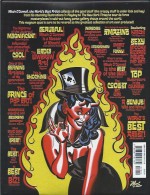
Mitch O’Connell: World’s Best Artist

Mitch O'Connell ft
By Mitch O’Connell (Last Gasp)
ISBN: 978-0-86719-773-0

Some artists can be said to epitomise an era, their works forever evoking the time and style and flavour of a discreet age, whilst others have the equally impressive gift of being able to recapitulate and reinvent uniquely iconic times in a way that makes them new and fresh again.

Mitch O’Connell is the very best of the latter: a commercial illustrator and canny cultural scavenger whose slick blend of caricature, pop iconography and surreal whimsy samples the Rock & Roll’s 1950s, sexily Swinging Sixties, surreal Seventies, Expressive, obsessive Eighties and anything beyond or between with amazing panache and witty self-absorption.

His slick, inviting style elevates all his works – whether commissioned graphics, narrative expression or “Capital A” art – into unmissable events, and proves that he’s a creator who can readily navigate between unfailing paintslinger-for-hire and hoity-toity, fancy-shmancy gallery godling.

He has been called the “Prince of Pop Art”…

All his works are characterised by unprecedented heights of verve and dash, saucy opportunism, mordant grim wit and acres of cruelly wry, good-natured humour.

He has created stylish comics and graphic novels, compelling illustration, package design, RPG boxes, album, book and magazine covers, posters, tattoo art and even highly personal pieces for gallery shows – and now a superb selection of his 30-plus year career has been herded into an attractive, peculiarly idiosyncratic and extremely funny biography and retrospective art book (so funny, in fact that the publishers thought it wise to cover the book in what feels disturbingly like a wash-&-wear polymer prophylactic, presumably  in case of any spit-take incidents…).

Simply bulging with astounding photos, drawings and full-colour paintings of monsters, sexy devils, naked men and women, cute kitties, famous stars, comics and mercilessly spoofed licensed properties from the Flintstones to Batman, Atom Ant to Elvis, the hysterical historical hagiography opens with ‘Born This Way – On the Right Track Baby’ and a selective glimpse at Li’l Mitchell’s early days of drawing dinosaurs and superheroes…

Some semblance of discipline descends in ‘Draw “Winky” – Art Instruction School’, a trawl through academia including a telling catalogue of grateful acknowledgments listed as ‘You’re the Inspiration’ (an eclectic assemblage which comprises Bernie Wrightson, J.C. Leyendecker, Ivan Albright and Franz Fruzyna amongst others) before venturing out into the harsh and competitive arena of freelance commercial art…

‘Hey!! Kids – Comics’ follows the path from fanzine-maker to participant in the Eighties independent comics publishing boom, depicting his stunning painted covers for such titles as Johnny Dynamite, The Terminator, Speed Racer, The World of Ginger Fox and so many more, plus selected interior pages from Heavy Metal and his own later self-penned works plus early self-advertising successes and his numerous clip art contributions, whilst ‘Fit to Print – Publications’ catalogues a host of glorious efforts for magazines as varied as The Village Voice, Playboy, Chicago Tribune, The Quill, Saturday Evening Post, Seventeen, Rolling Stone and Newsweek as well as a selection of clever contributions to the adult magazine market.

O’Connell has created hundreds of unforgettable posters and album/single covers for musical acts and ‘Rock Icons – Music’ reprints many of the very best from bands like Less Than Jake, Supersuckers, The Ramones and more, after which more bedroom wall-covering wonderment is revealed in ‘Hang-Ups – Posters’ and ‘As Seen on TV – Advertising’ which charts his vast canon of stylish product art: everything from holiday brochures for Las Vegas to fascinating and shocking re-branding exercises for beloved Hanna Barbera and Warner Brothers cartoon icons…

In a surprisingly candid manner, O’Connell relates the familial crisis which overtook him and altered the tone and context of his long and varied career as a Gallery artist in ‘Exhibitionist – Wall Accessories’ whilst ‘Skin Deep – “Flash” Tattoo Art’ delineates his forays into skin-as-canvas before everything wraps up with a beguiling peek at the creator’s home and studio in ‘Magical Mystery Tour – Home Sweet Home’: a wonderland of toys, found objects, old magazines and the world’s largest collection of really scary shop dummies and mannequins…

Beautiful, shocking, funny and engagingly intimate, this huge compendium of glossy, sparkling painting and storytelling is a truly inspirational glimpse at a true creative wunderkind and no lover of pop, kitsch, nostalgia and/or graphic excellence should be deprived of it.
All text and illustrations © 2012 Mitch O’Connell except where otherwise noted. All rights reserved.

Uncanny X-Men: Breaking Point


By Kieron Gillen, Terry & Rachel Dodson, Carlos Pacheco, Ibraim Roberson, Cam Smith, Dan Green & Nathan Lee (Marvel)
ISBN: 978-0-7851-5226-2

Most people who read comics have a passing familiarity with Marvel’s fluidly fluctuating X-Men franchise so even newcomers or occasional consumers won’t have too much trouble following this particularly well-crafted jumping-on tome.

At this juncture, the evolutionary offshoot dubbed Homo Superior was at its lowest ebb. This followed the House of M and Decimation storylines wherein Wanda Maximoff (former Avenger Scarlet Witch, ravaged by madness and wracked by her own chaotic reality-warping power) reduced the world’s entire mutant population to a couple of hundred individuals with three simple words…

Whilst the majority of Earth’s mutants were rendered human, the freakish few remaining accepted an earnest offer to relocate to San Francisco: reconciled to self-imposed exile on Utopia Island in the Bay. Gathered in a defensive enclave and led and defended by the X-Men, they still found that trouble was always happy to follow them…

Although they were invited by the forward-thinking Mayor and generally welcomed by most of the easygoing residents of the city, tensions grew as leader Cyclops ran the colony in an ever more draconian and militaristic manner.

His relationship with war-weary second-in-command Wolverine was slowly, inexorably deteriorating as they squabbled over methods and ideology for the imperilled X-nation, each interpreting the idealistic, Cooperative Co-existence dream of Professor Charles Xavier in increasingly different ways…

This sleek, slim compilation – written throughout by Kieron Gillen – re-presents Uncanny X-Men #534.1 and Uncanny X-Men #535-539 (cover-dated June to August 2011) and details the fate of young veteran Kitty Pryde who, at the time of this tome, was trapped in an intangible state and unable to communicate or interact with her fellows.

This was especially painful for her as she had just rekindled an intimate relationship with her childhood sweetheart Piotr Rasputin, the steely giant known as Colossus.

First, however, PR guru and supreme spin doctor Kate Kildare has a new, almost impossible brief.

Infamous outlaw mutant terrorist Magneto is now an X-Man living on Utopia and she has the unenviable task of “selling” him as a reformed and benevolent character to the watching, distrustful world…

Fortunately for everybody concerned, a splinter group of Advanced Idea Mechanics has picked this very moment to blackmail San Francisco’s business community with an “Earthquake machine”, so the Mayor asks the mutant refugees for a big favour…

Illustrated by Carlos Pacheco, Cam Smith, Dan Green & Nathan Lee, this bright and breezy caper offers plenty of thrills and a few clever surprises whilst restating the mutant paradigm for new and old fans alike.

The main body of this compelling compilation concerns the 4-part ‘Breaking Point‘ – limned by Terry & Rachel Dodson – which sees the war-loving aliens from The Breakworld come to Earth.

Their last clash with the X-Men resulted in Kitty’s present impermanent state and only concluded after Colossus crushed their brutal leader Powerlord Kruun in personal combat. Now months later, a vast colony ship warps into human space, claiming to carry refugees fleeing the collapse of their unique social order and meekly seeking sanctuary…

Their planetary civil war occurred because Piotr, after maiming Kruun, refused to stay and rule over Breakworld…

With the sarcastic assistance of Abigail Brand, Director of the Sentient World Observation & Response Department, the asylum-seeking newcomers are transferred from The Peak (Earth’s orbital defence outpost) to Utopia and seem to be genuinely attempting to assimilate.

Unfortunately, proud, shamed Kruun soon surrenders to a momentary weakness of will and attacks his despised benefactors. Within minutes the supreme soldier has overcome the X-Men, gravely wounded Colossus and even found a way to harm Pryde in her untouchable state…

Watching Rasputin bleed out, Kitty flees seeking aid and, while the ever-vigilant Wolverine tackles the resurgent Powerlord, strikes a shocking deal with Kruun’s adored and tragic paramour Haleena…

Despite all the grim portents, this gripping thriller surprises with a relatively happy ending all round, before artist Ibraim Roberson closes out the collection with the gritty fable ‘Losing Hope’.

The X-enclave was ecstatic when Cyclops’ daughter Hope was born. As the first new mutant since Decimation she was heralded as a Messiah – before being snatched away and reared in the far future by her half-brother Nathan Summers AKA doomsday warrior Cable.

She returned soon after as a rather rebellious teenager to lead a small gang of other Homo Superior newborns. She also had a dangerously valuable gift: she could kickstart mutant powers…

Here the dour, dutiful, fun-loathing lass is convinced by BFFs Transonic and Oya to go shopping on the mainland, only to be abducted by former X-foe Crimson Commando. When the brutal WWII super-soldier lost his mutant abilities during Decimation, his long years and numerous surgical augmentations began to agonisingly catch up to him. He expects Hope to reactivate his X-Gene and won’t take no for an answer…

Although he was prepared for Wolverine to track and fight him, the Commando utterly underestimated Hope’s stubborn resistance to torture and ruthless manner in dealing with threats…

Graced with a beautiful covers-&-variants gallery by Pacheco, the Dodsons, Simone Bianchi, Humberto Ramos, Edgar Delgardo & Dave Johnson, Breaking Point is exciting, enthralling and exceptionally entertaining: a stirring, supremely sensuous sublimely illustrated slice of mutant mayhem that is another stunning example of Fights ‘n’ Tights fantasy for fans and dabblers to marvel at.
© 2011 Marvel Characters In. All rights reserved.

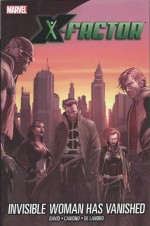
X-Factor volume 9: Invisible Woman Has Vanished


By Peter David, Bing Cansino & Valentine De Landro (Marvel)
ISBN: 978-0-7851-4656-8

Since its debut in 1982, X-Factor has been the irresistibly cool and inarguably perfect umbrella title for all manner of Marvel mutant teams. One of the most engaging was created by writer Peter David in 2006; always blending stark action, cool mystery, laugh-out-loud comedy and even social issues into a regular riot of smart and clever Fights ‘n’ Tights fiction.

The core premise saw Jamie Madrox, the Multiple Man – a former member of the government-controlled iteration of the team – appropriating the name for his specialist metahuman private detective agency: X-Factor Investigations. Setting up shop in the wake of “The Decimation” he and his constantly fluctuating team began by trying to discover why most of the world’s mutants had become normal humans overnight…

Marvel crossover event House of M saw reality overwritten when mutant Avenger Scarlet Witch had a mental breakdown, changing history so that “Homo Superior” out-competed base-line humans and drove the “sapiens” to the brink of extinction. It took every hero on Earth and a huge helping of luck to correct the situation, but in the aftermath, less than 200 super-powered mutants remained on Earth.

Originally debuting as X-Factor volume 3, the series was renumbered after 50 issues -magically becoming #200 of volume 1 with the next issue – and this sterling compilation gathers that issue and #201-203 (spanning December 2009 to March 2010), finding Madrox and most of his team relocated from Detroit to New York and about to walk into a world of trouble…

Illustrated by Bing Cansino, Marco Santucci & Patrick Piazzalunga, the story begins after a very grave prologue (that’s a pun, son) as up past bedtime little kids Franklin and Valeria Richards turn up at X-Factor Investigations in need of adults who will listen…

Even scarily brilliant and cosmically powered children have trouble getting grown-ups to take them seriously, so when the offspring of Mr. Fantastic and Invisible Woman can’t get The Thing or the Human Torch to listen to their concerns they go looking elsewhere…

The team (consisting of Guido “Strong Guy” Carosella, shapeshifter Darwin, extra-dimensional warrior Shatterstar, de-powered mutant Rictor, lucky star Longshot and multi-powered mutant super-woman Monet St. Croix AKA M) are working through some issues of their own, but Madrox sagely offers to take the kids back and check things out…

Former X-Factor stalwart Siryn is gone. She’s still coming to terms with carrying – and horrifically losing – Madrox’ baby and doesn’t want to see him, especially as he’s completely obsessed with enigmatic missing teammate Layla Miller.

Not only is “Butterfly” another unwise romantic complication, but she is also morally mutable, annoyingly secretive, immensely powerful and working to a ruthless agenda of her own – and Jamie just can’t get over her…

At the Baxter Building Madrox doesn’t buy Reed Richards‘ off-hand story that he and the wife had a spat so she just stormed off.

Whilst Guido and Shatterstar get into a pointless, devastating brawl with Ben (the Thing) Grimm, distracting the attention of the Smartest Man in the World, Jamie and Rictor take the opportunity to check out a few nooks and crannies and realise the kids were right: the leader of the FF is either an impostor or homicidally crazy…

As Shatterstar astonishingly humiliates Grimm in battle, Madrox arranges to meet with Valeria later. Elsewhere, State Department official Valerie Cooper regretfully informs Monet that her Ambassador father has been kidnapped by terrorists…

Having obtained an object owned by the missing mother, Longshot’s psychometric abilities are called upon to read the past and see what truly happened to Sue Richards. However, his vision is co-opted by the long-missing Layla who somehow speaks to him in real time and tells him to bring the team to Latveria – kingdom of terrifying dictator Doctor Doom…

However, just as Shatterstar opens a space-warp to the Balkan graveyard Layla indicated, an infuriated and vengeful Thing attacks, disrupting the teleportation and marooning half the investigators in the most dangerous country on Earth. Back in New York, Guido gets a call from little Franklin and Valeria. They are running for their lives from Daddy who is intent on killing them both…

After Monet, Madrox and the furious Thing follow through the warp, Grimm calms down enough to join M and Shatterstar in broaching Doom’s castle whilst Jamie’s lads open up a grave and find a missing member of the FF… but not the one they were looking expecting…

The solution to the mystery is sharp, shocking and fabulously entertaining, revealing both Doom’s improbable part in the drama and one of the many secrets of Layla Miller…

That’s followed by the untitled tale from #203 (illustrated by Valentine De Landro & Pat Davidson) wherein Monet and Guido, fed up with the State Department’s stalling over her father’s kidnap, impatiently invade a sovereign South American nation to save him.

When their plane is shot down Monet goes missing so Strong Guy smashes into a local drug cartel HQ and learns just who’s taken her.

His blockbusting rescue mission almost falters when he’s confronted by magical monsters and one of the oldest villains in the Marvel Universe, using the indomitable Wonder Girl as his personal buffet and first aid kit…

To Be Continued…

Even though the main event ends on a cliffhanger, there’s one more narrative treat left here as ‘Matters of Faith’ (with art by Karl Moline & Rick Magyar and originally seen as a back up feature in X-Factor #200) details what Siryn had been doing whilst the team was been busy battling.

Months previously her father Sean Cassidy – X-Man Banshee – died. Already traumatised through losing the baby she had conceived one stupid drunken night with Madrox, Theresa travelled to her “Da’s” grave in Ireland. The last thing she needed to see was one of Madrox’ duplicates…

This one however was created years ago and, like so many others, never rejoined the prime Jamie. In fact he’s become a priest and has some unique insights to offer her troubled mutant soul…

Bold, beguiling and mature in a way most adult comics just aren’t, this is a wonderful Costumed Drama experience for everybody who loves superhero soap operas and comes with a covers-&-variants gallery by Esad Ribic, Morry Hollowell, David Yardin, Kevin Maguire & Nathan Fairbairn and Tom Raney & Gina Going.
© 2009, 2010 Marvel Characters, Inc. All Rights Reserved.

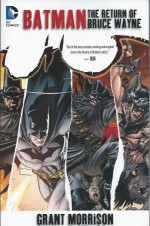
Batman: the Return of Bruce Wayne


By Grant Morrison, Chris Sprouse, Frazer Irving, Yanick Paquette, Georges Jeanty, Ryan Sook, Lee Garbett & various (DC Comics)
ISBN: 978-1-4012-3382-2

At the climax of a harrowing and sustained campaign of terror by insidious cabal The Black Hand, immediately followed by an all-out invasion of Earth by the hordes of Apokolips, the Batman was apparently killed – slain by Darkseid‘s lethal, time-rending Omega beams.

Although the larger world was unaware of the tragedy, the superhero community secretly mourned and a small, dedicated army of assistants, protégés and allies – trained over years by the contingency-obsessed Dark Knight – formed a “Network” to police GothamCity in the days which followed: marking time until a successor could be found or the original returned…

Most of the Bat-schooled battalion refused to believe their inspirational mentor dead. On the understanding that he was merely lost, they eventually accepted Dick Grayson – the first Robin and latterly Nightwing – as a stand-in until Bruce Wayne could find his way back to them…

That fantastic voyage was detailed in the 6-issue miniseries Batman: the Return of Bruce Wayne (July-December 2010), scripted by Grant Morrison and following the indeed alive Wayne as he leaped through the eons, gradually getting closer and closer to his home, each chapter a different era illustrated by all-star creators…

It begins with ‘Shadow on Stone’ (limned by Chris Sprouse & Karl Story) as a hunting party of the Deer tribe discover a gleaming fallen “sky-cart”. The object is in fact a time capsule from our time and nearby Bruce Wayne is slowly adapting to being marooned in Palaeolithic times. His gradual acceptance by the awestruck cavemen is interrupted by the attack of marauders from the Blood tribe, led by the immortal killer the future calls Vandal Savage.

Despite valiant resistance the Deer warriors die, until only the bat-draped stranger and a lone cave boy remain. Badly wounded and taken for sacrifice, Batman is later rescued by the lad who brings trinkets from the time capsule and the time-lost hero’s utility belt. As an eclipse covers the sun, Man of Bats routs the Blood Mob and defeats Savage, before plunging into a pool and vanishing…

Only the boy remains and he is met by gods. Superman, Green Lantern, Booster Gold and Rip Hunter are tracking Batman through time and arrive just as he vanishes. They are determined to stop him returning to the 21st century at all costs…

Even as the amazed boy begins to record the stories of the mysterious Bat warrior, Wayne resurfaces in Puritan New England, saving a woman from a hideous tentacled demon…

Illustrated by Frazer Irving ‘Until the End of Time’ relates how, even with his memory failing, Wayne impersonates a witch-hunter and befriends shunned spinster Goodwife Annie Tyler in the failing colony of Gotham. As Brother Mordecai he is a most unconventional witch finder, ignoring obvious signs of Satan and solving a murder with unseemly observational tricks…

Vanishing Point is a fortress-university at the End of Time and here, as Reality counts down its final minutes, a quartet of costumed time-travellers quiz the Biorganic Archivist AI, hoping to track Batman’s erratic course through the time-stream. They’re all painfully aware that cruel, subtle Darkseid has turned their friend into a weapon to destroy Earth if the Dark Knight ever reaches his home time…

Superman meets and almost stops him at Vanishing Point, but Wayne has already slipped back into the time-stream, having instituted his own ingenious survival plan…

Tragically the paranoia of 16th century Gotham and Mordecai’s waning influence won’t spare Annie, especially as the time-monster Batman initially drove off is still haunting the woods around the settlement and chief inquisitor Nathaniel Wayne is sworn to eradicate all vestiges of the unholy.

The pious Puritan earns Annie’s dying curse for his entire line as he hangs her, but his roving descendent cannot hear. He has fallen centuries ahead and – more memories eradicated – landed at the feet of legendary reiver Blackbeard Thatch…

‘The Bones of Bristol Bay’ (art by Yanick Paquette & Michel Lacombe) finds the amnesiac mistaken for heroic third-generation buccaneer the Black Pirate and forced to lead the murdering corsair Thatch through the winding, yet strangely familiar cave system beneath Gotham County.

In search of buried gold the murderers encounter instead the deadly traps of the unspeakably ancient Miagani: troglodytic native tribesmen known as the Bat-People…

In the 21st century, the Justice League hold a war council, heatedly debating how to stop their indomitable comrade from returning and setting off Darkseid’s ultimate booby trap. Tim Drake has searched old records and interpreted 40,000 years of myths and legends following his mentor’s trail through history, but Red Robin is only there as an advisor and cannot make the adults listen to him…

With Blackbeard beaten, the memory-challenged wanderer examines the sacred relics of the Bat People – a battered cape, trinkets, a fragile yellow belt of many pockets – and something stirs in his clouded mind…

Georges Jeanty & Walden Wong then illustrate a violent stopover in 1870s Gotham as ‘Dark Knight, Dark Rider’ initially shifts focus to the hereditary guardians of the records and artefacts left by grateful folk who have encountered the Bat over unceasing centuries.

One such family is slaughtered by outlaws working for undying but cancer-ridden Monsieur Sauvage, and their surviving daughter taken to explain the secret of the box with a bat-shaped lock…

Katie‘s abductors have been remorselessly stalked by a bat-garbed stranger who doesn’t carry a gun. The silent avenger has tracked them back to boomtown Gotham, mercilessly depleting their numbers, but the immortal Frenchman is confidant that his tame medicine man Midnight Horse and debased Barbatos-worshipping doctor Thomas Wayne can make the girl talk before the hunter finds them.

Even if he does, his newly hired gunfighter Jonah Hex should even the odds…

The stranger rescues the girl and foils the villains but not before the bounty hunter gut shoots him…

He wakes in a Gotham of recent vintage, a place of glitz and glamour but one morally broken and irredeemably corrupt.  ‘Masquerade’ – with art by Ryan Sook, Pere Perez & Mick Gray – sees the memory-wiped hero hired from a hospital bed by Martha Wayne‘s best friend to prove that the tragic socialite was murdered by her husband Thomas, who faked his own death and abandoned their young son Bruce…

Illustrated by Lee Garbett, Perez, Alejandro Sicat & Wong, the intricate machinations of Darkseid grow closer to fruition as the hero, stripped of everything but innate deductive instinct, uncovers a sinister, bloodthirsty plot by new criminal organisation the Black Hand. His instinctive struggle against the schemers won, the time-nomad makes the final short hop to the now where his arrival will instantly trigger ‘The All-Over’ …

Batman, of course, is the most brilliant escape artist of all time and even whilst being struck down by the New God of Evil had devised an impossibly complex and grandly far-reaching scheme to beat the devil and save the world…

With a covers-&-variants gallery by Adam Kubert, Sprouse, Irving, Paquette, Cameron Stewart, Sook, Garbett & Bill Sienkiewicz, this grandiose, gripping and astonishingly complex epic odyssey is a devious delight that will delight modern fans and casual visitors alike and this sterling compilation also includes the revelatory 15-page art feature ‘Back in Time: The Return of Bruce Wayne Sketchbook’ by Morrison, Kubert, Sprouse, Irving, Paquette & Sook.
© 2010, 2011 DC Comics. All Rights Reserved.