Mighty Marvel Masterworks Doctor Strange volume 1: The World Beyond 


By Stan Lee & Steve Ditko, with Don Rico, George Roussos & various (Marvel) 
ISBN: 978-1-3029-3438-5 (PB/Digital edition) 

When the budding House of Ideas introduced a warrior wizard to their burgeoning pantheon in the summer of 1963 it was a bold and curious move. Bizarre adventures and menacing monsters were still incredibly popular, but most mature mention of magic or the supernatural (especially vampires, werewolves and their eldritch ilk) were harshly proscribed by a censorship panel which dictated almost all aspects of story content. Almost a decade after a public witchhunt led to Senate hearings on the malign influences of words and pictures in sequence, comics were ferociously monitored and adjudicated by the draconian Comics Code Authority. Even though some of the small company’s strongest sellers were still mystery and monster mags, their underlying themes and premises were almost universally mad science and alien wonders, not necromantic or thaumaturgic horrors. 

Companies like ACG, Charlton and DC – and Atlas/Marvel – got around the edicts against mystic thrills and chills by making all reference to magic benign or even humorous… the same tone adopted by massively popular TV series Bewitched about a year after Doctor Strange debuted. That eldritch embargo probably explains writer/editor Stan Lee’s low key introduction of Steve Ditko’s mystic adventurer: an exotic, twilight troubleshooter inhabiting the shadowy outer fringes of society. 

Capitalising on of the runaway success of The Fantastic Four, Lee had quickly spun off the youngest, most colourful member of the team into his own series, hoping to recapture the glory of the 1940s when The Human Torch was one of the company’s untouchable “Big Three” superstars. Within a year of FF #1, long-lived anthology title Strange Tales became home for the blazing boy-hero (from #101, cover-dated October 1962), launching Johnny Storm on a creatively productive but commercially unsuccessful solo career. 

Soon after, in Tales of Suspense #41 (May 196), latest sensation Iron Man battled a crazed scientific wizard dubbed Doctor Strange, and with the name successfully and legally in copyrightable print (a long-established Lee technique: Thorr, The Thing, Magneto, The Hulk and others had been disposable Atlas “furry underpants monsters” long before they became in-continuity Marvel characters), preparations began for a truly different kind of hero. 

The company had already published a quasi-mystic precursor: balding, trench-coated savant Doctor Droom – later rechristened (or is that re-pagan-ed?) Dr. Druid – had an inconspicuous short run in Amazing Adventures (volume 1 #1-4 & #6: June-November 1961).  

He was a psychiatrist, sage and paranormal investigator tackling everything from alien invaders to Atlanteans (albeit not the ones Sub-Mariner ruled). Droom was subsequently retro-written into Marvel continuity as an alternative candidate and precursor for Stephen Strange‘s ultimate role as Sorcerer Supreme… 

After a shaky start, the Master of the Mystic Arts became an unmissable icon of the cool counter-culture kids who saw, in Ditko’s increasingly psychedelic art, echoes and overtones of their own trippy explorations of other worlds… 

That might not have been the authors’ intention but it certainly helped keep the mage at the forefront of Lee’s efforts to break comics out of the “kids-stuff” ghetto… 

This enchanting full colour paperback compilation – also available as a digital download – gathers the spectral sections of Strange Tales #110, 111 and 114-129: spanning cover-dates July 1963 to February 1965. Moreover, although the Good Doctor didn’t rate a cover blurb until #117 or banner insert visual until #118 and was barely cover-featured until issue #130, it also magnanimously includes every issue’s stunning frontage: thus offering an incredible array of superbly eye-catching Marvel masterpieces from the upstart outfit’s formative heyday by Jack Kirby, Dick Ayers, Chic Stone and George Roussos, John Severin and others. In case you were wondering: Strange’s first shared split-cover came with Strange Tales #121 (June 1964)… 

Our first meeting with the man of mystery comes courtesy of a quiet little chiller which has never been surpassed for sheer mood and imagination. ‘Doctor Strange Master of Black Magic!’ by Lee & Ditko debuted at the back of Strange Tales #110 and saw a terrified man troubled by his dreams approach an exceptional consultant in his search for a cure… 

That perfect 5-page fright-fest introduces whole new realms and features deceit, desperation, double dealing and the introduction of both a mysterious and aged oriental mentor and devilish dream demon Nightmare in an unforgettable yarn that might well be Ditko’s finest moment… 

A month later in #111 he was back, ‘Face-to-Face with the Magic of Baron Mordo!’ which introduced a player on the other side. The esoteric duel with such an obviously formidable foe established Strange as a tragic solitary guardian tasked with defending the world from supernatural terrors and uncanny encroachment whilst introducing his most implacable enemy, a fellow sorcerer with vaulting ambition and absolutely no morals. In the astounding battle that ensued, it was also firmly confirmed that Strange was the smarter man… 

Then things went quiet for a short while until the letters started coming in… 

Strange Tales #114 (November 1963) was one of the most important issues of the era. Not only did it highlight the return of another Golden Age hero – Captain America – but it contained the fabulously moody resurrection of Doctor Strange: permanently installed in an eccentric and baroque little corner of the growing unified universe where Ditko let his imagination run wild… 

With #114, the Master of the Mystic Arts took up monthly residence behind the Torch as ‘The Return of the Omnipotent Baron Mordo!’ (uncredited inks by George Roussos) finds the Doctor lured to London and into a trap, only to be saved by unlikely adept Victoria Bentley: an abortive stab at a romantic interest who would periodically turn up in years to come. 

The forbidding man of mystery is at last revealed in all his frail mortality as Strange Tales #115 offered ‘The Origin of Dr. Strange’: disclosing how Strange was once America’s greatest surgeon. A brilliant man, yet greedy, vain and arrogant, he cared nothing for the sick except as a means to wealth and glory. When a self-inflicted, drunken car-crash ended his career, Strange hit the skids. 

Then, fallen as low as man ever could, the debased doctor overheard a barroom tale which led him on a delirious odyssey or, perhaps more accurately, pilgrimage to Tibet, where a frail and aged mage changed his life forever. It also showed his first clash with the Ancient One‘s other pupil Mordo: thwarting a seditious scheme and earning the Baron’s undying envious enmity… 

Eventual enlightenment through daily redemption transformed Stephen the derelict into a solitary, dedicated watchdog at the fringes of humanity, challenging every hidden danger of the dark on behalf of a world better off not knowing what dangers lurk in the shadows… 

‘Return to the Nightmare World!’ sees the insidious dream predator trapping earthly sleepers in perpetual slumber until the doubtful authorities ask Strange to investigate. The subsequent invasion of his oneiric enemy’s stronghold is a masterpiece of moody suspense, followed by ‘The Many Traps of Baron Mordo!’: showing the malign mage devising an inescapable doom, which once more founders after Strange applies a little logic to it… 

The wild and infinite variety of Strange’s universe offered Ditko tremendous opportunities to stretch himself visually and as plotter of the stories. In ST #118 the Master of Magic travels to Bavaria to combat ‘The Possessed!’; finding humans succumbing to extra-dimensional invaders neither fully mystic nor mundane, whilst ‘Beyond the Purple Veil’ has Strange rescue, from ray-gun wielding slaver-tyrants, the burglars who stole one of his arcane curios… 

Strange Tales #120 plays with the conventions of ghost stories as a reporter vanishes during a live broadcast from ‘The House of Shadows!’ before the Doctor diagnoses something unworldly but certainly not dead… 

Mordo springs yet another deadly trap in ‘Witchcraft in the Wax Museum!’ but is once more outsmarted and humiliated after stealing his rival’s body whilst Strange wanders the world in astral form, after which Roussos returned as an uncredited inker for #122’s ‘The World Beyond’ as Nightmare nearly scores his greatest victory after the exhausted Strange falls asleep before uttering the nightly charm shielding him from attack through his own dreams. 

Strange hosts his first Marvel guest star in #123 whilst meeting ‘The Challenge of Loki!’ (August 1964 by Lee, Ditko & George Roussos as George Bell) as the god of Mischief tricks the earthly mage into briefly stealing Thor’s hammer before deducing where the emanations of evil he senses really come from… 

Strange battles a sorcerer out of ancient Egypt to save ‘The Lady from Nowhere!’ from time-bending banishment and imprisonment, and performs similar service to rescue the Ancient One after the aged sage is kidnapped in ‘Mordo Must Not Catch Me!’, after which Roussos/Bell moved on whilst Lee & Ditko geared up for even more esoteric action. 

Strange Tales #126 brings the Master of the Mystic arts to ‘The Domain of the Dread Dormammu!’ as an extra-dimensional god seeks to subjugate Earth. In a fantastic realm, Strange meets an enigmatic, exotic woman who reveals the Dread One operates by his own implacable code: giving the overmatched Earthling the edge in the concluding ‘Duel with of the Dread Dormammu!’ which saw Earth saved, the Ancient One freed of a long-standing curse and Strange given a new look and mystic weapons upgrade… 

Restored to his homeworld and Sanctum Sanctorum in Greenwich Village, Strange solves ‘The Dilemma of… the Demon’s Disciple!’ by saving a luckless truth-seeker from an abusive minor magician and – after a stunning pin-up by Ditko - wraps up this initial volume with one more done-in-one delight. 

Scripted by Golden Age Great Don Rico (Bulletman; Human Torch, Captain America; Jann of the Jungle and more), #129’s ‘Beware… Tiborro! The Tyrant of the Sixth Dimension!’ sees Strange tackling a demonic deity of decadence stealing TV guests and execs from a show debunking magic and mysticism… 

But wait, there’s still more: a page of original art from ST #125 and that rarest of all artefacts, un-inked Ditko pencils in the form of a preliminary sketch for an unused Strange/Ancient One pin-up. 

These stories are timeless and have been gathered many times before, but let’s for a moment focus on format. The Mighty Marvel Masterworks line launched with economy in mind: classic tales of Marvel’s key creators and characters re-presented in chronological order. It’s been a staple since the 1990s, but always before in lavish, hardback collectors editions. These modern editions are cheaper, on lower quality paper and – crucially – smaller (about the dimensions of a paperback book). Your eyesight might be failing and your hands too big and shaky, but at 152 x 227mm, they’re perfect for kids. If you opt for the digital editions, that’s no issue at all… 

Doctor Strange has always been the coolest of outsiders and most accessible fringe star of the Marvel firmament. This glorious grimoire is a magical method for old fans to enjoy his world once more and the perfect introduction for recent acolytes or converts created by the movie iteration to enjoy the groundbreaking work of two thirds of the Marvel Empire’s founding triumvirate at their most imaginative. 
© 2022 MARVEL  

Batman: Illustrated by Neal Adams volume 1 


By Neal Adams with Bob Haney, Leo Dorfman, Cary Bates & various (DDC Comics)
ISBN: 978-1-4012-0041-1 (HC): 978-1-4012-3537-6 (2003 PB) 978-1-4012-7782-6 (2018 TPB edition)   

I’m doing this far too frequently, these days, but here’s a swiftly modified reprinted review to mark the sudden passing of one of our industry and art form’s last true titans. Neal Adams died on the 28th of April. As well as a creator and innovator who changed the entire direction of comics and sequential narrative, he was a tireless activist and advocate whose efforts secured rights for workers and creators long victimised by an unfair, stacked, system. A fuller appreciation and more comprehensive review will follow as soon as I can sort it… 

Neal Adams was born on Governors Island, New York City, on June 15th 1941. His family were career military and he grew up on bases across the world. In the late 1950s he studied at the High School of Industrial Art in Manhattan, graduating in 1959. 

As the turbulent, revolutionary 1960s began, Adams was a young illustrator who had worked in advertising and ghosted some newspaper strips whilst trying to break into comics. As he pursued a career in advertising and “real art”, he did a few comics pages for Joe Simon at Archie Comics (The Fly and that red-headed kid too) before subsequently becoming one of the youngest artists to co-create and illustrate a major licensed newspaper strip – Ben Casey (based on a popular TV medical drama series). His first attempts to find work at DC were not successful… 

That comic book fascination never faded however, and as the decade progressed, Adams drifted back to National/DC doing a few covers as inker or penciller. After “breaking in” via anthological war comics he eventually found himself at the vanguard of a revolution in pictorial storytelling… 

He made such a mark that DC chose celebrate his contributions by reprinting every piece of work Adams ever did for them in a series of commemorative collections. We’re still waiting for a definitive collection of his horror comics stories and covers, but will probably never see his sterling efforts on licensed titles such as Hot Wheels, The Adventures of Bob Hope and The Adventures of Jerry Lewis. That’s a real shame too: the display a wry facility for gag staging and small drama… 

Batman: Illustrated by Neal Adams was the first of 3 tomes available in  variety of formats and editions featuring the “Darknight Detective” – as he was dubbed back then – and featuring every cover, story and issue in original publication order. 

Here then, ‘From Me to You: An Introduction’ gives you the history of his early triumphs in the writer/artist’s own words, after which covers from Detective Comics #370 (December 1967, inking Carmine Infantino) and the all-Adams Brave and the Bold #75 (January 1968), Detective #372 (February), B&B #76 (February/March), Batman #200 and World’s Finest Comics #174 (both March) serve as tasters for the first full-length narrative… 

The iconoclastic penciller first started seriously making waves with a couple of enthralling Cape & Cowl capers beginning with World’s Finest Comics #175 (April 1968): ‘The Superman-Batman Revenge Squads!’ Scripted by Leo Dorfman and inked by long-term collaborator Dick Giordano, the story detailed how an annual – and friendly – battle of wits between the crimebusters is infiltrated by alien and Earthly criminal groups intent on killing their foes whilst they are off-guard… 

WFC #176 (June) featured a beguiling enigma in ‘The Superman-Batman Split!’ – written by fellow newcomer Cary Bates. Ostensibly just another alien mystery yarn, this twisty little gem conceals a surprise ending for all, plus guest stars Robin, Jimmy Olsen, Supergirl and Batgirl, with Adams’ hyper-dynamic realism lending an aura of solid credibility to even the most fanciful situations. 

It also ushered in an era of gritty veracity to replace previously anodyne and frequently frivolous Costumed Dramas… 

More Dynamite Covers follow: Batman #203 (July/August) leads to Brave and the Bold #79 (August/September); heralding Adams’ assumption of interior art chores and launching a groundbreaking run that rewrote the rulebook for strip illustration… 

‘The Track of the Hook’ – written by Bob Haney and inked Giordano – paired the Gotham Guardian with justice-obsessed ghost Deadman: formerly trapeze artist Boston Brand who was hunting his own killer, and whose earthy, human tragedy elevated the series’ costume theatrics into deeper, more mature realms of drama and action. At this period Adams was writing and illustrating Brand’s solo stories in Strange Adventures…  

The B&B stories matured overnight, instantly became every discerning fan’s favourite read.  

Covers for World’s Finest Comics #178-180 (September through November) segue sweetly into Brave and the Bold #80 (October/November 1968) where ‘And Hellgrammite is his Name’ finds Batman and The Creeper clashing with a monstrous, insect-themed super-hitman, again courtesy of Haney, Adams & Giordano, whilst #81 saw The Flash aid Batman against an unbeatable thug in ‘But Bork Can Hurt You!’ (inked by Giordano & Vince Colletta) before Aquaman became ‘The Sleepwalker from the Sea’ in an eerie tale of mind-control and sibling rivalry. 

Interwoven through those thrillers are the covers for World’s Finest #182 (February 1969, inking Curt Swan’s pencils), #183 (March, inking over Infantino), Batman #210 and Detective #385 (both March and all Adams). 

B&B # 83 took a radical turn (and is the only story herein without a cover since that one was limned by Irv Novick) as The Teen Titans try to save Bruce Wayne‘s latest foster-son from his own inner demons in ‘Punish Not my Evil Son!’ (Haney & Giordano) but the next team-up was one that got many fans in a real tizzy in 1969. 

First though comes the fabulous frontage for World’s Finest #185 (June 1969) after which ‘The Angel, the Rock and the Cowl’ recounts a World War II exploit where Batman and Sgt. Rock of Easy Company hunt Nazi gold together, only closing that case 25 years later. 

Try to ignore kvetching about relative ages and which Earth we’re on: you should really focus on the fact that this is a startlingly gripping tale of great intensity, beautifully realised, and one which has been criminally discounted for decades as “non-canonical”. 

Detective Comics #389 (July), and World’s Finest #186 (August and pencilled by Infantino) precede Brave and the Bold #85. Here, behind a stunning cover, is arguably the best of an incredible run of action adventures… 

‘The Senator’s Been Shot!’ unites Batman and Green Arrow in a superb multi-layered thriller of politics, corruption and cast-iron integrity, with Bruce Wayne being appointed as a stand-in for a law-maker whilst the Emerald Archer receives a radical make-over that turned him into a fiery liberal gadfly and champion of the relevancy generation: a remake that still informs his character today, both in funnybooks and on TV screens… 

Wrapping up this initial artistic extravaganza come covers for Detective Comics #391 and 392 (September & October 196), completing a delirious run of comics masterpieces no ardent art lover or fanatical Fights ‘n’ Tights aficionado can do without and confirming the unique and indisputable contribution Adams made to comics.s.
© 1967, 1968, 1969, 2003, 2018 DC Comics. All Rights Reserved. 

Adam Strange Archives volume 3 


By Gardner F. Fox, Carmine Infantino, Murphy Anderson, John Giunta, Sid Greene, Joe Giella & various (DC Comics) 
ISBN: 978-1-4012-1661-0 (HB) 

For me and so many more aging Baby-Boomer brats, Adam Strange, more than any other character, epitomises the Silver Age of Comics. An Earth archaeologist who, whilst fleeing from enraged “ jungle natives” in Peru, jumped a 25 foot chasm, only to be hit by a stray teleport beam from a planet orbiting Alpha Centauri. He materialised on another world, filled with monsters, fabulous marvels and non-stop peril for which brains, not brawn, were the only solution. 

Witty, sophisticated, gloriously illustrated and fantastically imaginative: and there was always the woman named Alanna, beautiful, brilliant and not so much unattainable as frequently out-of-reach. The star-parted lovers happy-ever-after was always just in reach, but only after one more adventure… 

Pristine paragon of the latter age of “thinking man’s heroes”, Strange was an interplanetary ambassador who was very much of his era. However, as his elegant adventures gave way to a superhero avalanche, the creative dream team of Gardner F. Fox, Carmine Infantino, Murphy Anderson, (latterly aided and abetted by Sid Greene, and Joe Giella) were called away for more urgent creations elsewhere. From Mystery in Space #92 (June 1964) Editor Jack Schiff supervised Adam’s exploits until his final appearance in #102 (September 1965). Space Ranger had joined the book’s line-up with Adam and Allana’s last forays crafted by Dave Wood, Fox, Jerry Siegel, Lee Elias and Dick Dillin, until they were ousted by incoming experiment Ultra, the Multi-Alien… 

This third and final hardback outing gathers the last vestiges of that Silver Age excellence – comprising Mystery in Space #81-91, plus a team-up from Hawkman #18 and a pertinent short story from Strange Adventures #157. 

Jim Starlin’s introduction ‘Adam Strange: The Coolest Dude Around’ is followed by a barrage of delights from Fox, Infantino & Anderson, beginning with MIS #81 and testing our hero to his limits as the dictator who caused Rann’s nuclear armageddon returns after 1000 years to threaten both Adam’s homeworlds in ‘The Cloud-Creature that Menaced Two Worlds!’  

Then a terrestrial criminal’s scheme to conquer Earth is thwarted as a result of Adam ending a ‘World War on Earth – and Rann!’ whilst #83 pits the Star man  against a desperate ‘Emotion Master of Space!’ before relentless Dust-Devil Jakarta returns, shrugging off ‘The Powerless Weapons of Adam Strange!’ (inked by Joe Giella). Triumphing anyway, strange and Alanna are almost annihilated by the ‘Riddle of the Runaway Rockets!’ which sees a revived primordial robot rampage under the vivid veridian skies before ‘Attack of the Underworld Giants!’ (inked by John Giunta) foreshadows big changes to come via a fantastic vision… 

An intriguing diversion from sci fi sister publication Strange Adventures #157 follows. ‘Rescue by Moonlight!’ (Fox, Infantino Giunta & Anderson) is a Space Museum yarn (anthological done-in-one tales centred around Earth’s official interstellar knowledge repository) wherein 25th century descendent Alan Strange foils the theft of exotic mineral “parastil”. 

Mystery in Space had starred Strange since #53, but with #87 (November 1963) Schwartz capitulated to and capitalized on the growing superhero boom: adding Hawkman (and Hawkgirl!) in a back-up slot that included full cover-privileges. Not included here, initial yarn ‘The Amazing Thefts of the I.Q. Gang! subtly impacted our hero’s lead tale as ‘The Super-Brain of Adam Strange!’ (with Sid Greene as final regular inker) sees the Earthman hyper-evolved by Zeta-radiation and an unlikely menace to all… 

An ethereal do-gooder goes astray as ‘The Robot-Wraith of Rann!’ and Adam proves irresistible to the ‘Siren of the Space Ark!’ before Infantino & Anderson reunited for Fox’s extra-length length End-of the-World(s) epic ‘Planets in Peril!’ in #90 but after teaming Adam and the Hawks to save two worlds, the glory days concluded quietly with ‘Puzzle of the Perilous Prisons!’ (MIS #91, May 1964), offering a return engagement with archfoe Mortan and a nasty case of evil duplicate girlfriend…  

Strange’s later divergent direction was ignored by Fox & Anderson in early 1967 when Hawkman #18 saw the Winged Wonder join Strange against malevolent Manhawks to locate the ‘World That Vanished!’ The planet in question was Thanagar and when it went, it took Hawkman’s beloved wife  Shayera with it… 

This volume concludes with biographies of the creators, but not sadly the conclusion of that fable as Adam wasn’t in it. If you hate to be kept hanging you’ll need to find a different reprint edition carrying that… 

Available in a monumental omnibus edition, but not in any format ordinary earthlings can lift or afford, these tales are desperately in need of a digital age refit. 
© 1963, 1964, 1967, 2008 DC Comics. All Rights Reserved. 

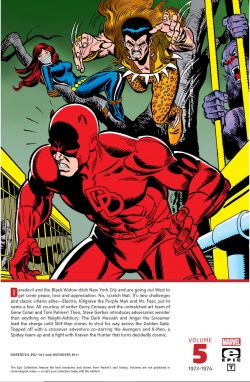
Daredevil Marvel Masterworks volume 13 


By Marv Wolfman, Bill Mantlo, Jim Shooter, Chris Claremont, Bob Brown, John Buscema, John Byrne, Sal Buscema, Gil Kane, George Tuska, Frank Robbins, Al Milgrom & various (MARVEL) 
ISBN: 978-1-3029-1634-3 (HB/Digital edition) 

Matt Murdock is a blind lawyer whose remaining senses hyper-compensate, making him an astonishing acrobat, formidable fighter and living lie-detector. A second-string hero for much of his early career, Daredevil was nonetheless a striking and popular one, due mostly to the captivatingly humanistic art of Gene Colan. DD fought gangsters, super-villains and even the occasional monster or alien invasion, quipping and wisecracking his way through life and life-threatening combat, utterly unlike the grim, moody, quasi-religious metaphor he became.  

After a disastrous on-again, off-again relationship with his secretary Karen Page, Murdock took up with Russian émigré Natasha Romanoff, infamous and notorious ex-spy Black Widow. She was framed for murder and prosecuted by Matt’s best friend and law partner Foggy Nelson before the blind lawman cleared her. Leaving New York with her for the West Coast, Matt joined a prestigious San Francisco law firm but adventure, disaster and intrigue sought out the Sightless Sentinel and ultimately drew him back to the festering Big Apple… 

Spanning May 1976 to May 1977, the 13th compilation re-presents Daredevil #133-143, Annual #4, a crossover from Ghost Rider #19-20, and a spin-off from Marvel Premiere #39-40, cover-dated December 1977 and January 1978.  

We kick off with an Introduction from Marv Wolfman, recalling the strange days of his tenure as writer/editor before arguably the best proof possible of that opinion follows… 

Marvel was always keenly aware that any real-world attention was beneficial. Daredevil #133 begins laying groundwork for an unfolding epic about fake news and disinformation in public office (and remember this set just after Watergate and long before Trumpism!) before digressing with a fanciful fluff piece co-starring real-world stage trickster and headline-seeker Uri Geller. Concocted by Wolfman, Bob Brown & Jim Mooney, ‘Introducing: Mind-Wave and his Fearsome Think Tank!’ is a happily forgettable yarn about a maniac in a super-tank attacking Manhattan. Thankfully, Mind-Wave‘s arch enemy (Geller, claiming to have psychic powers granted him by aliens) is there to aid the Scarlet Swashbuckler… 

More sinister secrets of the perception-shaping masterplan of The Jester are revealed in #134’s ‘There’s Trouble In New York City…’ as disgruntled former football star/insurance salesman Brock Jones returns. Previously, he had stumbled into a plot to control Earth and took possession of a rocket-powered super-suit coveted by enemy agents. DD had almost been killed by the suit’s original owner, leading to the usual superhero misunderstanding and a savage clash. Now, as TV news showed Daredevil killing cops and with the shapeshifting Chameleon robbing at will, Brock again dons the suit to help the common man as The Torpedo, innocently adding to the chaos and confusion before the Chameleon is caught … 

The Jester’s grand scheme is revealed in ‘What Is Happening?’ The Manic Mountebank has exploited a computer pioneer to create a wave of stories making the public mistrust the authorities by manipulating the media. (I’m not commenting, I’m not commenting…) 

Seeing newspaper reports, photos and even news tapes of John and Robert Kennedy alive, superheroes killing cops and “proof” that Viet Nam never happened, but secret wars in Chile and Saudi Arabia did, much of the public readily accepts the villain was framed, resulting in DD being arrested and subsequently handed over to an army of thugs and gangsters. 

John Buscema assumed pencilling with #136 as the Jester’s endgame is exposed. When President Gerald Ford announces that New York City’ s police and all its superheroes have gone insane, citizens are urged to defend themselves at all costs. The entire scheme has been devised to leave the city open to plunder by the Jester’s hastily-united army of mobsters… 

Unable to keep away, DD takes action but is quickly captured and subjected to ‘A Hanging for a Hero!’ As a lynch mob of panicked citizens and enraged criminals almost execute the Man without Fear he flamboyantly escapes but is forced back into action for concluding episode 137 ‘The Murder Maze Strikes Twice!’ as “President Ford’s” broadcasts demand citizens take up arms and “take back Wall Street” from the thugs that now control it… 

Deducing the Jester’s location, DD storms in, dismantles all the villain’s traps – and minions – and restores order and justice, only to discover personal crises boiling over… 

Throughout the media reality war, Daredevil has been seeking to prove the innocence of Heather Glenn‘s father. Matt Murdock’s current girlfriend knows her dad isn’t a ruthless, murdering slumlord but that someone must have framed him. All evidence says otherwise. 

Now, as Matt and Foggy return to the case, word comes (for readers, as two excerpted pages from Ghost Rider #19 – August 1976 by Tony Isabella, Frank Robbins & Vince Colletta) depicting Karen Page being kidnapped by friend and ally Stuntman… 

It leads directly into Daredevil #138 where Wolfman, John Byrne & Mooney ask ‘Where is Karen Page?’ as the Man Without Fear drops everything for his one true love: heading for Los Angeles where Page is a Hollywood star with a complex convoluted life. However her relationship with hell-tainted Johnny Blaze is not why she was targeted, but rather from her father’s inventions and career as super-maniac Death’s Head …and the impostor now using the name to further his own insane plans… 

The saga concludes in Ghost Rider #20 (Wolfman, Byrne & Don Perlin) as ‘Two Against Death!’ exposes who is truly pulling all the strings with Satan-spawn and Scarlet Swashbuckler pairing to save Karen. Meanwhile in Manhattan, Foggy continues investigating Glenn Industries and is shot… 

The plot thread expands in Daredevil Annual #4’s ‘The Name of the Game is Death!’ Plotted by Wolfman, scripted by Chris Claremont, drawn by George Tuska and inked by Frank Chiaramonte, it finds The Black Panther aiding an industrialist whose son is abducted. 

Thanks to friendship with King T’Challa and judicious use of Vibranium, Robert Mallory has built the world’s first Tidal Power Station. Someone thinks holding his son will win them the plans but hasn’t counted on T’Challa paying his friend a visit at this inopportune moment… 

Daredevil, meanwhile, fights for his life, having stumbled into a furiously rampaging Sub-Mariner. Prince Namor has returned to the vile surface world because of a man named Mallory and a power station that while providing cheap clean energy for mankind will overheat the seas and divert the tides…  

Concluding chapter ‘And Who Shall Save the Panther?’ begins with the Great Cat prowling Manhattan, having tracked the crime to ambitious mobster Ruffio Costa. Sadly, he is unable to defeat the gangsters alone and eventually DD steps in to deliver a ransom, accidentally brining Sub-Mariner along for the ride… 

When the superbeings converge and clash, Costa is caught in the carnage and a lab explosion transforms him into something far worse that gradual climate crisis and the factions must all temporarily unite to defeat the threat of Mind-Master…  

The editorial story behind Wolfman, Sal Buscema & Mooney’s ‘A Night in the Life’ (Daredevil #139) is a true insight to comics at their best, but for readers it’s simply a chance to enjoy enhanced drama, suspense and action as the search for a missing haemophiliac boy overlaps a police manhunt for a mad bomber demanding the return of his drug-addicted wife. Wolfman was unsurpassed at interleaving soap opera melodrama with costumed cavorting, and the fraught tone carried over to in #140 as Bill Mantlo, Sal B & Klaus Janson detailed ‘Death Times Two!’ when a runaway bus dumped Daredevil into a hunt for accidentally united old enemies The Gladiator and The Beetle who then aimed a runaway train at Grand Central Station and attempted to settle old scores with the hero amidst the dead and dying… 

An even bigger change in tone began in #141. ‘Target: Death!’ was plotted by Wolfman, and scripted by Jim Shooter, with pencils divided between Gil Kane and Bob Brown, and Jim Mooney inking. It is very much a forerunner of what Roger McKenzie and Frank Miller would conceive of in months to come, opening with another murder attempt on Foggy and fresh insights into the abduction of his fiancée Debbie. More secrets of Glenn Industries are teased out, a killer dies and DD’s ultimate arch-nemesis returns for another killing spree before abruptly changing his mind and tying defeated Daredevil to a giant arrow and firing him at the New Jersey Palisades… 

Pulling out all the stops for his final forays, Wolfman – with Brown & Mooney – resurrected more classic villains for #142. Escaping one doom, DD meets new hero Nova, even as Mr. Hyde and The Cobra reunite, targeting the Scarlet Swashbuckler as he passes the rooftop rainforest garden of a young millionaire – ‘The Concrete Jungle’…  

This transitional selection concludes for now with ‘“Hyde and Go Seek” Sayeth the Cobra!’ (Wolfman, Brown & Keith Pollard) wherein the villains leave our hero to the carnivores populating the skyscraper Eden while they plunder the penthouse below. The goal is not wealth but ancient books and formulas to enhances their powers, but as ever, they grievously underestimate the boldness and ingenuity of the Man Without Fear… 

Also included in my dynamic digital edition is the two-issue try-out tale starring hero/villain The Torpedo who first accidentally battled DD in Daredevil #126-127. After the brief reprise recounted above he was given his big shot at fame Marvel Premiere #39-40 (from December 1977-January 1978) before ultimately dying in Rom: Spaceknight and being replaced by a teenaged female.  

‘Ride a Wild Rocket!’ and ‘…Battle with the Big Man!’ was a rushed-seeming collaboration of Wolfman, Mantlo, Brown, Al Milgrom, Josef Rubinstein, Bob Wiacek and Alan Weiss showing Brock hunting the rocketeer gang who originally owned his turbo-suit, but all his efforts to reclaim the acclaim of his quarterbacking days seem pointless. Harassed at home and bored at work, his American Dream is dying.  

After almost triggering a nuclear meltdown he is considered a menace, even though he saved the state from atomic catastrophe, and a critical change comes after the hidden mastermind behind all his woes and superhero aspirations decides enough is enough.  

As seen Captain America, Machine Man, and The Incredible Hulk, long-time villain Senator Eugene “Kligger” Stivak is a leader of criminal capitalists The Corporation and decides he will take care of Brock personally, but he has seriously underestimated the over-the-hill hero’s stubbornness and desperate need to regain his self-esteem… 

Supplementing all the amazing comics adventures, the extras sections include Wolfman’s editorial from #133 detailing the circumstances of Geller/Marvel’s publicity stunt, followed by original art pages all inked by Jim Mooney, a cover and splash page from John Buscema plus a splash each for Byrne and Brown, and an extensive biography section.  

As the social upheaval of the 1970s receded, these fabulous fantasy tales strongly indicated that the true potential of Daredevil was finally in reach. Their narrative energy and exuberant excitement are dashing delights no action fan will care to miss. 

…And the next volume heads into darker shadows, the grimmest of territory and the breaking of many boundaries… 
© 2019 MARVEL  

Manhunter – The Deluxe Edition 


By Archie Goodwin & Walter Simonson & various John Workman (DC Comics) 
ISBN: 978-1-77950-751-8 (HB/Digital edition) 

One of the most celebrated superhero series in comics history, Manhunter catapulted young Walt Simonson to the front ranks of creators, revolutionised the way dramatic adventures were told and still remains the most lauded back-up strip ever produced. Concocted by genial genius Archie Goodwin as a supporting back-up strip in Detective Comics (#437-443, October-November 1973 to October-November 1974) the seven episodes – a mere 68 pages – garnered six Academy of Comic Book Arts Awards during its far too brief run. 

In case you’re wondering they were: Best Writer of the Year 1973 – Archie Goodwin; Best Short Story of the Year 1973 for ‘The Himalayan Incident’; Outstanding New Talent of the Year 1973 – Walter Simonson; Best Short Story of the Year 1974 for ‘Cathedral Perilous’; Best Feature Length Story of the Year 1974 for the conclusion ‘Götterdämmerung’ and Best Writer of the Year 1974 – Archie Goodwin. 

Paul Kirk was a big game hunter and part-time costumed mystery man before and during World War II. Becoming a dirty jobs specialist for the Allies, he lost all love of life and died in a hunting accident in 1946. Decades later, he seemingly resurfaced, coming to the attention of Interpol agent Christine St. Clair. Thinking him no more than an identity thief, she soon uncovered an incredible plot by a cadre of the World’s greatest scientists who had combined over decades into an organisation to assume control of the planet once they realised that man now had the means to destroy it. 

Since the end of the WWII The Council had infiltrated all corridors of power, making huge technological advances (such as stealing the hero’s individuality by cloning him into an army of superior, rapid-healing soldiers), slowly achieving their goals with no-one the wiser. The returned Paul Kirk, however, had upset their plans and was intent on thwarting their ultimate goals… 

This slim tome reprints the much-missed Mr. Goodwin’s foreword from the 1979 black-&-white album Manhunter: the Complete Saga before gathering in one sublime collection Kirk’s entire tragic quest to regain his humanity and dignity.  

Coloured by Klaus Janson and lettered by Ben Oda, Joe Letterese, Alan Kupperberg & Annette Kawecki, it tells of St. Clair and Kirk’s first meeting in ‘The Himalayan Incident’, her realisation that all is not as it seems in ‘The Manhunter File’ and their revelatory alliance beginning with ‘The Resurrection of Paul Kirk.’ 

Now fully a part of Kirk’s crusade Christine discovered just how wide and deep the Council’s influence ran in ‘Rebellion!’ before beginning the end-game in the incredible ‘Cathedral Perilous’ and gathering one last ally in ‘To Duel the Master’… 

With all the pieces in play for a cataclysmic confrontation, events take a strange misstep as Batman stumbles into the plot, inadvertently threatening to hand the Council ultimate victory. ‘Götterdämmerung’ fully lived up to its title and wrapped up the saga of Paul Kirk with consummate flair and high emotion. It was a superb triumph and perplexing conundrum for decades to come… 

In an industry notorious for putting profit before aesthetics, the pressure to revive such a well-beloved character was enormous, but Goodwin & Simonson were adamant that unless they could come up with an idea that remained true to the spirit and conclusion of the original, Manhunter would not be seen again. 

Although the creators were as good as their word DC did weaken a few times. Kirk clones featured in the Secret Society of Super-Villains and The Power Company, but they were mere shabby exploitations of the original. Eventually, however, an idea occurred and the old conspirators concocted something feasible and didn’t debase the original conclusion. Archie provided a plot, and Walter began to prepare the strip. 

After years of valiant struggle the master plotter finally succumbed to the cancer that had been killing him. Anybody who had ever met Archie Goodwin will understand the void his death created. He was irreplaceable. 

Without a script the project seemed doomed until Simonson’s wife Louise suggested that it be drawn and run without words: a silent tribute and last hurrah for a true hero. Manhunter: the Final Chapter reunites the characters and brings the masterpiece to a solid, sound resolution. Now it really is all over… 

This Deluxe Edition offers a touching afterword – with some extremely early character sketches – by Walter and a gallery of further art treats: the cover and a pin-up from Detective Comics #443; covers from reprint editions Manhunter Special #1 (May 1984), Manhunter: The Special Edition (1999), Tales of The Batman: Archie Goodwin (2013), Manhunter: the Complete Saga (1979) and the Manhunter entry from Who’s Who #14. 

This book represents a perfect moment of creative brilliance and an undisputed zenith in comics storytelling. This is a tale no comic fan can afford to be without. 
© 1973, 1974, 1999, 2013, 2020 DC Comics. All Rights Reserved. 

Ant-Man/Giant-Man Epic Collection volume 1 1962-1964: The Man in the Ant-Hill


Stan Lee, Larry Lieber, Ernie Hart, Jack Kirby, Don Heck, Dick Ayers, Sol Brodsky, Steve Ditko, Paul Reinman, Chic Stone, & various (Marvel)
ISBN: 978-0-7851-9850-5 (TPB/Digital edition) 

Dates and debuts are big deals to comics fans, and this year is a major one for Marvel Anniversaries, if not always first appearances. Here’s a classic case-in-point… 

If you’re of a particularly picky nature – and what true fan isn’t? – you could consider The Astonishing Ant-Man to be the second superhero of the Marvel Age. He first popped up in Tales to Astonish #27 (cover-dated January 1962 but on sale from the end of September 1961), in one of the splendidly addictive men-vs-monsters anthology titles that dominated in those heady days of Science Fiction Double-Feature B-Movies. 

This eclectic episodic, entomologically edifying and endearing compendium gathers pertinent portions of Tales to Astonish #27 and a majority of the succeeding series (which ran from #35-69: September 1962 to July 1965). Sadly the little dramas herein terminate with #59 (September 1964). 

These itty-bitty sagas reveal scintillating solo outings of a brilliant but troubled scientist who became an unlikely, uncomfortable and ultimately mentally unstable champion, and begin with what was just supposed to be another throwaway filler thriller… 

A cover-featured 7-page short introduced Dr Henry Pym, a maverick scientist who discovers a shrinking potion and became ‘The Man in the Anthill!’, discovering peril, wonder and even a kind of companionship amongst the lowliest creatures on Earth and under it… 

Plotted by Stan Lee, scripted by his brother Larry Lieber and stunningly illustrated by Jack Kirby & Dick Ayers, the engaging piece of fluff owed more than a little to classic B-movie The Incredible Shrinking Man… 

Obviously, Pym struck a chord with someone since, as the DC Comics-inspired superhero boom flourished, he was rapidly retooled as a full-fledged costumed do-gooder, debuting again mid-year (#35, cover-date September 1962) in ‘The Return of the Ant-Man’ by Lee, Lieber, Kirby & Ayers. The plot concerned a raid by Soviet agents (this was during the height of Marvel’s ‘Commie-Buster’ period when every other villain was a Red somebody or other and rampaging socialism was a cultural bête noir) with Pym imprisoned in his own lab. 

Forced to return to the abandoned shrinking gases and cybernetic devices he’d built to communicate with ants, Dr. Pym soundly trounced the spies and resolved to use his gifts for the good of Mankind. 

The same creative team produced the next four adventures, starting with ‘The Challenge of Comrade X!’ (TTA #36) as an infallible Soviet superspy was dispatched to destroy the Tiny Terror, after which Ant-Man was temporarily ‘Trapped by the Protector!’ – a cunning jewel-thief and extortionist who ultimately proved no match for the little wonder. 

‘Betrayed by the Ants!’ featured the debut of intellectual archfoe Egghead: a maverick and mercenary research scientist who attempted to usurp the hero’s control of insects whilst ‘The Vengeance of the Scarlet Beetle!’ saw a return to scary monster stories as a radioactively mutated, super-smart bug sought to eradicate humanity, with only Pym able to stop him… 

Sol Brodsky replaced Ayers as inker on ‘The Day that Ant-Man Failed!’ (TTA #40), with a deadly Hijacker robbing trucks and pushing the inventor to new heights of ingenuity, after which Kirby too moved on: his lavishly experimental perspectival flamboyance replaced by the comforting realism and enticing human scale of Don Heck who limned a classy alien invasion yarn in ‘Prisoner of the Slave World!’ before depicting a mesmerising menace who could control people with ‘The Voice of Doom’ (TTA #42). 

The following issue H. E. Huntley (AKA veteran writer/artist Ernie Hart) replaced Lieber as scripter with ‘Versus the Mad Master of Time’: a run-of-the-mill mad – or rather disgruntled and misguided – scientist yarn. The next issue (#44) saw Kirby return to pencil a significant change to the series…. 

‘The Creature from Kosmos’ (inked by Heck) introduced The Wasp – Pym’s bon vivant crime-fighting partner Janet Van Dyne – in a double-length tale featuring a murderous alien marauder who killed her father. There was even a fresh secret origin for Ant-Man: a rare and uncharacteristic display of depth revealing Pym was a widower. When his Hungarian wife Maria was murdered by Communist agents, it irrevocably changed a young scientist from a sedentary scholar into a driven man of action…. 

Ant-Man used his discoveries to endow Janet with the power to shrink and fly and she became his crime-fighting partner. Together they overcome ‘The Terrible Traps of Egghead’ (Lee, Huntley & Heck) before travelling to Greece to thwart another alien invasion ‘When Cyclops Walks the Earth!’ 

Back in the USA, the Diminutive Duo battle mystic trumpeter Trago in ‘Music to Scream By’ and defeat an avaricious weapons designer who builds himself a unique warsuit to become super-thief ‘The Porcupine!’: all serving as placeholders before the next big change came with Tales to Astonish #49’s ‘The Birth of Giant-Man!’. 

Lee scripted and Kirby pencilled how Pym learned to enlarge as well as reduce his size, just in time to tackle trans-dimensional kidnapper The Eraser. In the next issue Steve Ditko inked The King in ‘The Human Top’: first chapter of a continued tale which showed our hero struggling to adapt to his new strength and abilities. 

Concluding episode ‘Showdown with the Human Top!’ was inked by Ayers who would draw the bulk of the succeeding stories until the series’ demise. Also with this issue (TTA #51) back-up feature The Wonderful Wasp Tells a Tale began; blending sci-fi vignettes narrated by the heroine, fact-features and solo adventures. The first is space thriller ‘Somewhere Waits a Wobbow!’ by Lee, Lieber & George Roussos in Marvel mode as “George Bell”. 

The super-hero adventures settled into a predictable pattern from then on: individually effective enough but uninspired when read in quick succession. First up is a straight super-villain clash as ‘The Black Knight Strikes!’ (Lee & Ayers: TTA #52), supplemented by Wasp’s homily ‘Not What They Seem!’. Issue #53 led with another spectacular battle-bout ‘Trapped by the Porcupine!’ and finished with Wasp yarn ‘When Wakes the Colossus!’ (Lee, Lieber & Heck) before #54 found Heck briefly reinstated to illustrate the Crusading Couple’s catastrophic trip to South of the Border Santo Rico but finding ‘No Place to Hide!’ The taut tale of being trapped and powerless in a banana republic run by brutal commie agent El Toro was neatly counterbalanced by Wasp’s sci fi saga ‘Conquest!’ (Lee, Lieber & Brodsky). 

An implacable former foe defeated himself in ‘On the Trail of the Human Top!’ when the psychotic killer stole Giant-Man’s size changing pills in #55, following which Lee, Lieber & Bell produced Wasp’s tale of ‘The Gypsy’s Secret!’ 

A criminal stage conjuror was far more trouble than you’d suspect in ‘The Coming of The Magician!’: even successfully abducting the Wasp before his defeat, which she celebrated by regaling readers with tall tale ‘Beware the Bog Beast!’ (Lee, Lieber & Paul Reinman) after which #57 featured a major guest-star as the size-changing sweethearts set out ‘On the Trail of the Amazing Spider-Man!’ courtesy of Lee, Ayers & Reinman, with Egghead waiting in the wings and pulling strings, before the Wasp actually enjoyed a complete solo adventure with ‘A Voice in the Dark!’ by Lee, Lieber & Chic Stone. 

These were not only signs of the increasing interconnectivity Lee was developing but also indicated the strip was losing impetus. In a market rapidly drowning in superheroes, Giant Man was not selling as well as he used to or should… 

Captain America cameo-ed in #58’s epic Africa-based battle with a giant alien in ‘The Coming of Colossus!’, supplemented by Wasp’s lone hand played against an old foe in ‘The Magician and the Maiden!’ 

The last tale in this collection and beginning of the end for Giant-Man came in Tales to Astonish #59 and ‘Enter: the Hulk!’ with the Avengers inadvertently prompting the Master of Many Sizes to hunt down the Green Goliath. Although Human Top orchestrated a blockbusting battle, Lee was the real mastermind since, with the next issue, The Hulk would co-star in his own series and on the covers whilst Giant-Man’s adventures shrank back to a dozen or so pages. Ten issues later Hank and Jan would retire, making way for amphibian antihero Namor, the Sub-Mariner… 

(Gi)-Ant-Man and the Wasp did not die, but instead joined a vast cast of characters Marvel kept in relatively constant play through team books, via guest shots and in occasional re-launches and mini-series. 

Despite variable quality and treatment, the eclectic, eccentric and always fun exploits of Marvel’s premier “odd couple” remain an intriguing and engaging reminder that the House of Ideas didn’t always get it right, but generally gave their all to entertaining their fans. 

Marvel Comics initially built its fervent fan base through strong and contemporarily relevant stories and striking art, but most importantly by creating a shared continuity that closely followed the characters through not just their own titles but also through the many guest appearances in other comics. Such an interweaving meant that even today completists and fans seek out extraneous stories to get a fuller picture of their favourite’s adventures. 

In such an environment, series like these Epic Collections are an economical and valuable commodity approaching the status of a public service for collectors.  

By turns superb, stupid, exciting and appalling, this Epic encounter epitomises the best and worst of Early Marvel (with the delightful far outweighing the duff). It certainly won’t appeal to everybody, but if you’re a Fights ‘n’ Tights fan with a forgiving nature or a movie-goer looking for extra input, the good stuff here will charm, amaze and enthral you whilst the rest could just be considered as a garish garnish providing added flavour…
© 1962, 1963, 1964, 2015 Marvel Characters, Inc. All rights reserved. 

Jonah Hex volume 3: Origins


By Jimmy Palmiotti, Justin Gray, Jordi Bernet, and others (DC Comics) 

ISBN: 978-1-84576-629-0 (TPB/Digital edition) 

The Western is an odd genre that can be sub-divided into two discrete halves: the sparkly, shiny version that dominated kids’ books, comics and television for decades, exemplified by Zane Grey stories and heroes like Roy Rogers and Gene Autry. Then there’s the other half… 

That kind of cowboy grimy, gritty, excessively dark and nihilisticwas done best for decades by Europeans in such strips as Jean-Michel Charlier’s Lieutenant Blueberry or Bonelli & Galleppini’s Tex Willer and made their way into US culture through the films of Sam Peckinpah and Sergio Leone.  

Jonah Hex is very best of this latter sort. 

DC opened a stable of clean-cut gun-slingers as the super-hero genre imploded in 1949, with dashing and highly readable luminaries like Johnny Thunder, Nighthawk, The Trigger Twins, Matt Savage and dozens of others in a marketplace that seemed limitless in its voracious hunger for chaps in chaps.  

However, all things end and by the early sixties the sagebrush brigade had dwindled to a few venerable properties. A flurry of superheroes hogged the newsstands during the Silver Age from 1956, but as the 1960s closed, they were waning again and thematic changes in the cinematic Cowboy filtered through to a comics industry suffering its second super-hero retreat in twenty years.  

All-Star Western #1 was released with an August/September 1970 cover date, filled with Pow-Wow Smith reprints, and became an all-new anthology with its second issue. It featured numerous creative all-stars, including Robert Kanigher, Neal Adams, Gray Morrow, Al Williamson, Gil Kane, Angelo Torres, & Dick Giordano, working on Outlaw!, Billy the Kid and cult sleeper-hit El Diablo: combining shoot-em-up shenanigans with supernatural chills, in deference to the real hit genre-type that saved comics in those dark days – horror stories. 

Issue #10 introduced a disfigured, irascible, shockingly lethal bounty hunter created by writer John Albano & Tony DeZuñiga and DC finally found its greatest and most enduring Western Warrior…  

Hex is the very model of a modern anti-hero. Coarse, callous, proudly uneducated, the relentless manhunter is clad in battered Confederate Grey, half his face lost to a hideous past injury. He offers the aspect of a brutal thug little better than the scum he hunts  and is a man to avoid – or so you’d think on first appearances…  

Hex is arguably the most memorable western comic character ever created. He’s certainly the darkest and most grippingly realised, as is the brutal and uncompromising world he inhabits. His 21st century revival portrayed him as a ruthless demon with gun or knife, hunting men for the price on their heads in the years following the American civil war.  

This collection (reprinting issues #13-18 of the 2006 monthly series) revisits his origin and offers fascinating insights not only in gripping lead tale ‘Retribution’ – illustrated by the utterly superb Jordi Bernet – but also in haunting, nihilistically evocative cautionary tale ‘The Ballad of Tallulah Black’ (beguiling painted by Phil Noto), and blackly comedic ‘I Walk Alone’, drawn with unsuspected subtlety by Val Semeiks. 

Jonah Hex was always the “Western for people who didn’t like Westerns” and cliché aside, it’s still true. This is a perfect book for any adult beginning or returning to comics. 
© 2007 DC Comics. All Rights Reserved. 

Yakari and Nanabozho


By Derib & Job, coloured by Dominque and translated by Jerome Saincantin (Cinebook)
ISBN: 978-1849181778 (Album PB/Digital edition)

Children’s magazine Le Crapaud à lunettes was founded in 1964 by Swiss journalist André Jobin who began writing stories for it under the pseudonym Job. Three years later he hired fellow French-Swiss artist Claude de Ribaupierre who had begun his own career as an assistant at Studio Peyo (home of Les Schtroumpfs), working on Smurfs strips for venerable weekly Spirou. Together they created the well-received Adventures of the Owl Pythagore and two years later struck pure gold with their next collaboration.

Debuting in 1969, Yakari delightfully detailed the life of a young Sioux boy on the Great Plains; sometime after the introduction of horses by the Conquistadores and before the coming of the modern White Man.

Overflowing with gentle whimsy, the beguiling saga celebrates a bucolic existence in tune with nature and free from strife, punctuated with the odd crisis generally resolved without fame or fanfare by a little lad who is smart, compassionate, brave… and can converse with all animals…

As “Derib”, de Ribaupierre – equally excellent in both enticing, comically dynamic “Marcinelle” cartoon style and a devastatingly compelling realistic action illustration form – became one of the Continent’s most prolific, celebrated and beloved creators through such groundbreaking strips as Celui-qui-est-né-deux-fois, Jo (the first comic on AIDS ever published), Pour toi, Sandra and La Grande Saga Indienne).

Over decades, many of his masterworks feature beloved Western themes, magnificent geographical backdrops and epic landscapes, with Yakari regarded by most fans and critics to be the feature which catapulted him to deserved mega-stardom.

First serialised in 1978, Yakari et Nanabozho was the fourth European album – released just as the strip transferred to prestigious Le Journal de Tintin – but was only translated by Cinebook in 2013, making it officially the 11th English-language album. That’s not going to be a problem for chronology or continuity addicts, since – as ever – the tale is both stunningly simple and effectively timeless…

It all begins one bright sunny day as the little wonder wanders out to the Rock of the Bear to meet his friend Rainbow. On arrival there’s no sign of her but he does meet a gigantic and extremely voluble desert hare claiming to be Trickster Spirit Nanabozho – a statement proven by making some astounding adjustments to the dubious little lad’s height.

The Great Rabbit claims to be Rainbow’s totem animal, much like Great Eagle watches over and protects Yakari, and the loopy lepine wants the boy to accompany him on a quest. Ever since a travelling tale-teller arrived in camp, sharing shocking stories of the far north, where it’s so cold the bears are snowy white, headstrong Rainbow has wanted to see the amazing creatures for herself. Eager to please his protégé, the Brobdingnagian bunny agrees to help her, even supplying magic walking moccasins to reduce the hardships of the journey. Unfortunately the impatient, excited child wouldn’t wait for the Trickster and Yakari to join her and has put them on unsupervised. Unable to resist the enchanted slippers, Rainbow has started her trek, not knowing where she’s going or how to stop…

Now with boy and bunny transforming into giants and tiny mites as circumstances demand, they hare off after their impetuous friend, following the path of a magic talisman dubbed ‘the Straight Arrow’ and assisted by such beneficial creatures as a night moose.

…And when they at last find Rainbow, the travellers decide that as they’ve come so far, they might as well complete the journey to the Land of the White Bears, aided by a fabulous flying canoe…

Always visually spectacular, seductively smart and happily heart-warming, Job’s sparse plot here affords Derib unmissable opportunities to go wild with the illustrations; creating a lush, lavish and eye-popping fantasy wonderland breathtaking to behold.

This is Really Big Sky storytelling with a delicious twist in its colossal fluffy tail…

The exploits of the valiant little voyager who speaks to animals and enjoys a unique place in an exotic world is a decades-long celebration of joyously gentle, marvellously moving and enticingly entertaining adventure, honouring and eulogising an iconic culture with grace, wit, wonder and especially humour. These gentle sagas are true landmarks of comics literature and Yakari is a strip no fan of graphic entertainment should ignore.
Original edition © 1978 Le Lombard/Dargaud by Derib & Job. English translation 2013 © Cinebook Ltd.

Moon Knight


By Gregg Hurwitz & Jerome Opeña & various (Marvel)
ISBN: 978-0-7851-4106-8 (TPB/Digital editions)

Moon Knight is probably one of the most complex and convoluted heroes in comics. There’s also a lot of evidence to support the in-world contention that he’s a certifiable loon…

He first appeared during the 1970s horror boom: a mercenary Batman knockoff hired by corporate villains to capture lycanthropic Jack Russell (AKA Werewolf by Night). Catching the readers’ attention, he then spun off into two trial issues of Marvel Spotlight and an exceedingly mature (for the times) back-up slot in TV-inspired Hulk Magazine before graduating to a number of solo series.

His byzantine origin eventually revealed how multiple-personality afflicted CIA spook-turned-mercenary Marc Spector was murdered by his best-pal and comrade Raoul Bushman, and apparently restored to life by Egyptian deity Khonshu: god of the Moon and Justice, or perhaps simply Vengeance…

Over many years the solitary avenger and a select band of hand-picked helpers battled darker threats more flamboyant superheroes neglected or avoided, ever-vacillating between pristine white knight and bloodthirsty killer-with-a-good-excuse…

At the time of this rocket-paced riot of action and suspense, resurgent villain and American Security Czar Norman Osborn was de facto ruler of America, using Federal clout to wage war on heroes who refused to sign The Superhuman Registration Act. Those he couldn’t coerce or crush, he smeared…

As Moon Knight became more obviously frenzied and manic, Osborn framed the outlaw hero for murder and numerous ferocious atrocities and – in response to seemingly overwhelming opposition – the “out-of-control” hero faked his own death, moved to Mexico and went about cleansing his ravaged mind and troubled soul.

The first and hardest part of the remedy was eradicating every vestige of Marc Spector from his wardrobe of personalities…

Re-presenting Vengeance of the Moon Knight #1-6 (November 2009-May 2010), this spectacular breakneck thriller opens with the return of ‘The White Knight’ to New York City; (mostly) clear-headed and determined to reclaim his name and sullied reputation. That begins with an extremely public foiling of a brutally violent bank robbery, where, despite utmost provocation and the watching citizenry’s fervent expectations, the silent Avenger kills absolutely no one…

Astonished observers – including the hero’s former lover and confidante Marlene Alraune – would have been even more astonished to learn that throughout the shocking struggle, a little godling had been whispering in Moon Knight’s ear…
Khonshu is displeased. He wants his chosen agent exacting full and final vengeance and grows increasingly impatient over this sacrilegious “no killing” peccadillo…

Nights pass and Moon Knight, hunted by cops and Osborn’s agents alike, prowls the streets, quietly thinning out predators feeding on society’s weakest members. His diligent pruning is interrupted when the most powerful of Osborn’s super-operatives appears…

‘The Sentry’s Curse’ is that he is nigh-omnipotent, truly crazy and utterly unpredictable. As an old comrade, the golden giant grants Moon Knight a measure of leeway and one last chance, but Osborn is less sanguine about being defied: ordering mystic minion The Hood and telepathic snoop Profile to find and decisively deal with the returned rebel.

Now favouring his Jake Lockley and Steven Grant personas, the repentant paladin is visiting old associates and comrades whilst using vast financial resources to upgrade Moon Knight’s armoury. Moreover, as an outlaw, he has no problem employing the best criminal scientists money can buy…

The first felonious monster to fall to his renewed crusade is grotesque sin-peddler The Slug, and once again the cataclysmic clash is punctuated by his divine passenger screaming in his ear for blood. That distraction might be why the hero doesn’t notice Profile taking a reading and extracting the one secret that could end his ceaseless war on crime…

After tolerating years of appalling atrocities, Moon Knight eventually killed his greatest enemy and, in a fit of madness, cut off his fright-mask of a face. Now, thanks to the psychic’s reading and The Hood’s dark magic, the one foe Spector could never handle is dragged howling from his grave to pick up where he left off in ‘The Bushman Cometh’…

The resurrected psychotic hits the ground scheming and whilst Moon Knight wastes time trying to convince Spider-Man that’s he’s back – but is also better – Raoul orchestrates a bloody raid on horrific psychiatric sin-bin Ravencroft Asylum.

With fellow maniac Scarecrow, Bushman turns an institution full of criminal madmen into murderous slaves: even augmenting his army of the living damned with autonomous, atrocious menaces such as Herman the German and The Great Wall…

Never reticent, Bushman then unleashes his foul forces on sleeping Manhattan in the sure and certain knowledge that unremitting carnage and slaughter is bound to bring Moon Knight running…

With the city under siege even Spector’s oldest – and most betrayed – friend sees the need for action, and with “Frenchie” Du Champ once again piloting the awe-inspiring Moon Copter, the resurgent Knight takes on the entire legion of loons with devastating if non-lethal force under an unforgiving ‘Full Moon’…

The battle enters overwhelming overdrive in ‘Past is Prologue’ as Bushman at last confronts his ultimate antithesis. Chaos escalates and the screaming of Khonshu for his chosen one to cross back over the line and fulfil his blood-letting destiny is almost too much for any mortal to resist.

…And even after resoundingly defeating his physical foes and restoring some semblance of sense to the city the gory god still calls and, at last, ‘Knight Falls’…

With covers by Leinil Francis Yu and 8 stunning variants by Alex Ross, David Finch, Yu and Francesco Mattina, this explosive all-out psycho-thriller is compellingly scripted by Gregg Hurwitz and captivatingly illustrated by Jerome Opeña, Jay Leisten & Paul Mounts who collaboratively create one of the most memorable and enjoyable reboots ever.

Fast, dark and savagely entertaining, Shock and Awe is pure electric entertainment for testosterone junkies and Fights ‘n’ Tights fanatics – and a relatively uncomplicated introduction to the character currently bewildering TV streaming service viewers…
© 2009, 2010 Marvel Characters, Inc. All rights reserved.

Doctor Solar, Man of the Atom Dark Horse Archives volume Three


By Paul S. Newman, Dave Wood, Frank Bolle, Al McWilliams, George Wilson & various (Dark Horse Books)
ISBN: 978-1-59307-374-9 (HB) 978-1-61655-354-8 (TPB)

The comics colossus known as Dell/Gold Key/Whitman had one of the most complicated publishing set-ups in history, but that didn’t matter one iota to the kids of all ages who consumed their vastly varied product. Based in Racine, Wisconsin, Whitman had been a crucial part of the monolithic Western Publishing and Lithography Company since 1915, drawing upon commercial resources and industry connections that came with editorial offices on both coasts (and even a subsidiary printing plant in Poughkeepsie, New York).

Another connection was with fellow Western subsidiary K.K. Publications (named for licensing legend Kay Kamen who facilitated extremely lucrative “license to print money” merchandising deals for Walt Disney Studios between 1933 and 1949).

From 1938, Western’s comicbook output was released under a partnership deal with a “pulps” periodical publisher under the umbrella imprint Dell Comics – and again those creative staff and commercial contacts fed into the line-up of the Big Little, Little Golden and Golden Press books for children. This partnership ended in 1962 and Western had to swiftly reinvent its comics division as Gold Key.

As previously stated, Western Publishing had been a major player since comics’ earliest days, blending a huge tranche of licensed titles such as newspaper strip, TV and Disney titles (like Nancy and Sluggo, Tarzan, or The Lone Ranger) with home-grown hits like Turok, Son of Stone and Space Family Robinson.

In the 1960s, during the camp/superhero boom the original adventure titles expanded to include Brain Boy, M.A.R.S. Patrol, Total War (created by Wally Wood), Magnus, Robot Fighter (by the incredible Russ Manning) and – in deference to the atomic age of heroes – Nukla and another brilliantly cool and understated thermonuclear white knight…

Despite supremely high quality and passionate fan-bases, Western’s pantheon never really captured the media spotlight of DC or Marvel’s costumed cut-ups, and eventually – in 1984 – the West Coast crew closed their comics division, having lost or ceded their licenses to DC, Marvel and Charlton.

As a publisher, Gold Key never really “got” the melodramatic, breast-beating, often-mock-heroic Sturm und Drang of superheroes – although for a sadly-dwindling number of us, the understated functionality of Silver Age classics like Magnus, Robot Fighter or remarkably radical concepts of atomic crusader Nukla and even the crime-fighting iterations of classic movie monsters Dracula, Frankenstein and Werewolf were utterly irresistible.

The sheer off-the-wall lunacy of features like Neutro or Dr. Spektor I will save for a future occasion…

The company’s most recognisable and significant stab at a superheroes was an understated Atomic era paladin with the rather unwieldy codename of Doctor Solar, Man of the Atom. He debuted in an eponymous title cover-dated October 1962 – Happy Anniversary! – sporting a captivating painted cover by Richard M. Powers which made it feel like a grown up book rather than a simple comic. With #3, George Wilson took over the iconic painted covers: a glorious feature that made the hero unique amongst his costumed contemporaries…

By the time of this third collection – also available in hardback, but tragically not in any digital editions I know of – originator Paul S. Newman (A Date With Judy; The Lone Ranger; Turok, Son of Stone; I Love Lucy and countless more) had all but moved on – despite what the credits here say. The issues included here are Doctor Solar, Man of the Atom #15-22 and span December 1965 to January 1968 and he only wrote one of them.

Golden Age all-star Dick Wood (Sky Masters of the Space Force; Crime Does Not Pay; The Phantom; Mandrake the Magician; Flash Gordon and countless others) was primarily tapping the keys for this period, but Frank Bolle (The Twilight Zone; Boris Karloff’s Tales of Mystery; Flash Gordon; The Heart of Juliet Jones) was still providing slick understated visuals for one of the most technically innovative and conceptually spectacular series on the stands. That changed with #20, when Alden “Al” McWilliams (Danny Raven/Dateline: Danger; Star Trek, Flash Gordon; Twilight Zone; Buck Rogers; Justice Inc.; Star Wars and so much more) took over, drawing and inking to the end of this volume (and the first tale in the next one).

The Supreme Science Hero was born when a campaign of sabotage at research base Atom Valley culminated in the death of Dr. Bentley and accidental transmutation of his lab partner Doctor Solar into a (no longer quite) human atomic pile with incredible, impossible and apparently unlimited powers and abilities. Of course, his mere presence is lethal to all around him until scientific ingenuity devises – with dutiful confidantes girlfriend Gail Sanders and mentor Dr. Clarkson – a few brilliant work-arounds…

Following a Foreword from Mike Baron detailing those faraway times and concentrating on real world nuclear near-things, the atomic adventuring resumes with the latest ploy by evil mastermind Nuro, who wants the monopoly on atomic science and global decision making.

Written by Wood and limned by Bolle, ‘Doomsday Minus One Minute Parts I & II’ comes from the end of 1965 and finds Atom Valley boffin Dr. Lamson cracked under the Cold War pressure. He devises a doomsday trigger to fire every thermonuclear weapon at once… just to end the appalling anticipation…

After failing at every stage to avert armageddon, Solar secures a unique method of time-travel to save the day and all the rest to come…

Cover-dated June 1966 and on newsstands from March onwards thanks to Gold Key’s byzantine publishing schedules, ‘The War of the Suns Pts I & II’ was #16’s main feature and actually by Newman & Bolle. Here Nuro’s espionage delivers the deadly methodology of building miniature suns, and enables him to unleash hell on Earth from close orbit. The solution? Build another sun and have Solar use it to destroy the hellish invader. What could go wrong?

Wood & Bolle reunited in #17 (September 1966) for some traditional monster marauding as Nuro combines weird science and Alaskan volcanoes to build ‘The Fatal Foe.’ Elemental colossus Primo rampages towards Atom Valley and an eventual but titanic ‘Duel to Disintegration’.

Although a diabolical master of mayhem, Nuro’s continued failures clearly began to grate with his lieutenant Uzbek, who increasingly squabbled and gaslit the mastermind’s faceless android protégé Orun. In #18 (December 1966) with open warfare brewing between flunky and automaton, their fiendish overlord returned to brainwashing, targeting all Atom Valley techs and boffins with mind-control scorpions in ‘The Mind Master Parts I & II’. He sought the secret identity of the Man of the Atom but almost brought about his own destruction, further strengthening Uzbek’s thoughts of rebellion…

Bolle bowed out with #19 (April 1967) as Nuro modified his metal minion to resemble the Atomic Adventurer and attempted to blacken his enemy’s name and reputation in ‘Solar vs Solar’ and its action-packed conclusion ‘Only One Shall Survive’. The tale ended on a cliffhanger with Solar defeated, trapped and wired into the villain’s secret HQ, providing atomic energy to fuel Nuro’s next vile venture…

Cover dated July, #20 saw Al McWilliams join Wood as ‘Atomic Nightmares Parts I & II’ revealed how the hero brilliantly engineers his escape, but only by inadvertently creating a menace as great as Nuro. Almost as portentous is the debut of Gail’s nephew Hamilton Mansfield Lamont: a teen super-genius with as many secrets as ideas…

As he settles in at Atom Valley, #21 (October 1967) aliens considering an invasion of Earth offer a ‘Challenge from Outer Space Parts I & II’ which needs all Solar’s power plus a helping hand from the kid to foil, before the volume closes with an epic clash and monumental upgrade in menace.

Cover-dated January 1968, Wood & McWilliams reveal ‘The Two Lives of Nuro’ as Uzbek sells out, delivering the mastermind’s location to Interpol. With Solar leading the charge in a blazing battle, the villain finally falls. Dell/Gold Key infamously never joined the Comics Code Authority, and consequently their titles always had a perfectly understandable body count in situations where equivalent Marvel or DC characters would generate the odd skinned knee or sprained ankle in already empty and “condemned” buildings…

Here, however, as carnage mounts and justice closes in, Uzbek is brutally killed before the would-be world-conqueror “commits suicide” while transferring his malevolent personality into his robot for ‘The Strange Death of Nuro’. The countless casualties climb even further when Solar brings the body and the android back to Atom Valley and the dormant motionless mandroid revives…

The epics end for now with ‘Biographies’ of Newman, Bolle and cover artist Wilson, as this charismatic collection offers potently underplayed and scientifically astute (as far as the facts of the day were known) adventures blending the best of contemporary film tropes with the still fresh but burgeoning mythology of the Silver Age superhero boom. Enticingly restrained and understated, these Atom Age action comics offered a compelling counterpoint to the hyperbole of DC and Marvel and remain some of the most readable thrillers of the era.

These tales are lost gems from a time when fun was paramount and entertainment a mandatory requirement. This is comics the way they were and really should be again…
DOCTOR SOLAR®, MAN OF THE ATOM ARCHIVES Volume 3 ® and © 2014 Random House, Inc. Under license to Classic Media, LLC. All rights reserved.