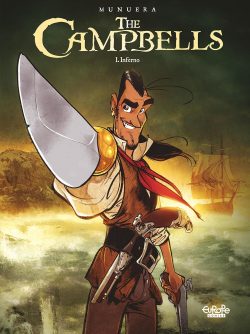
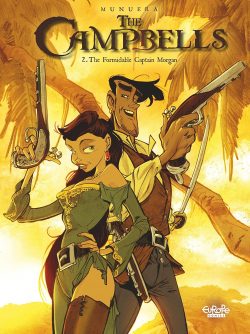
The Campbells volume 1: Inferno & volume 2: The Formidable Captain Morgan


By José Luis Munuera, coloured by Sedyas translated by Emma Wilson (Europe Comics)
Digital Editions – No ISBNs:

Arrr an’ Wot Ho! It be anuvver International Talk Like a Pirate Day once morrrre, me Hearties! That gives me license to act like a complete berk whilst plugging a suitably themed graphic yarn. This ‘un be a real cracker, too…

As heavily influenced by a certain Disney movie franchise as continental Europe’s long-standing affection for the genre, and exhibiting a deft hand with the traditions and history of light-hearted freebooting romps, Inferno is the introductory salvo in a convoluted yet engaging family saga about a most unconventional bunch of buccaneers.

Crafted by Andalusian comics veteran José Luis Munuera (No Hay Domingos en el Infierno, Merlin, Walter le Loup, Spirou et Fantasio, P’tit Boule et Bill) who has been delighting readers since his debut in 1996, the epic voyage of discovery commences here with smart, snappy episodes introducing an extremely large cast of roguish characters. First up are devious rapscallion “Captain” Carapepino and his trusty dogsbody Haggins. A very minor player with huge aspirations, this smooth talker is off burying his first chest of treasure on a sun-kissed tropical island when he is ambushed and hijacked by the infamous – and long-missing – Captain Campbell.

Through a most cunning ploy, the pirate’s pirate (with two young daughters at his side) appropriates the gem-strewn chest and smugly paddles away to another paradisiacal atoll…

The next vignette sees the wonder family man at ease in his luxurious haven on Garden Island, patiently watching teenaged Itaca explode again as her obnoxiously bratty sister Genova reads excerpts from someone’s secret – stolen – diary…

Despite always acting out and indulging in outrageous feats of derring-do, the well-educated, ultra-fit kids love each other and desperately miss their mother.

Out in the briny depths, formidably ferocious Captain Inferno terrorises victims and his own men. A man of dark moods and soaring ambition, he is haunted by visions of a dead woman who comes to him often, repeating three horrifying predictions that he cannot escape. His night terrors are suppressed but not abated by the arrival of unctuous Carapepino who shares that encounter with the sea terror’s most despised enemy… and husband of the ghost who plagues him!

The Campbells might be sea-wolves but they are most unconventional ones. Amongst those who love them most are the inhabitants of the Isle of Bakaloo: a leper colony the family regularly visit with supplies of food, books and other life-easing essentials. On this latest jaunt, the canny corsairs bring along the latest chest of valuables: after all, what normal, superstitious rogues would risk their scurvy skins amongst the unclean and diseased?

Some days later, the family visit fiercely neutral township Bahia Cambalanche, Port Franc. Here all hawks of the seas can meet to trade, carouse and fence their stolen booty. Here and now, Itaca and Genova reluctantly attend lessons arranged by their father.

Right here, right now, Carapepino and a press gang provided by Inferno attempt to abduct the girls only to be beaten back by their unbridled fury and the late intervention of gorgeous teenager Blond Luca. Itaca is instantly smitten by the glorious hero, blithely unaware that her saviour is a pawn in a dastardly long con…

The deception blossoms soon after as Garden Island is invaded by Carapepino’s borrowed forces. Nevertheless, the trio of Campbells fight free, humiliate the craven dogs and make a bold escape to a new sanctuary. In the interim, Inferno has not been idle. By ruthless manipulation and scurrilous deals, he has ingratiated himself with English nobility – and Campbell’s oldest enemies – in order to have himself admitted to the top flight of the corrupt aristocracy. Invested as Baron of England, with a warrant to hunt all shipping but British vessels, Inferno moves quickly to consolidate power and replace the crown’s agents with his own people…

The Campbells have relocated to Bakeloo Island where Itaca broods over Luca’s betrayal as her father worries about her unexplained distress. Father is also blithely oblivious to passionate and sustained adoration of indigenous lovely Nutel-La, but the practical islander finally makes a big impression by suggesting that the devoted dad needs to have “the talk” with his manifestly-maturing older daughter…

Having lost yet another ship, Carapepino and his surviving crew at last link up with former employer Baron Inferno, just in time to become his first detainees as the freshly ennobled provincial ruler moves into his new Governor’s Palace.

The interloper eases gracefully to the head of the aristocratic pack, gleaming in fine clothes, sparkling with newfound power and respectability. After all, aren’t these rich privileged fools just another gang of self-proclaimed predators? Especially shockingly blunt and ruthlessly amoral Lady Helvetia, who becomes his boon companion and more…

When the revels end, the Baron’s mind races back decades to the docks of London where he and his bold, inventive, loyal brother picked pockets and sought to escape their monster of a father. How far they have come since then. How far they have drifted apart…

To Be Continued…

Volume 2: The Formidable Captain Morgan

The seagoing saga resumes with more revelations as 2017’s Les Campbell – 2. Le redoutable pirate Morgan arrives to further the fun-filled furore. As Itaca and Genova find fresh ways to perk up their sisterly rivalry, the younger girl asks about the mother she doesn’t remember. That tricky conversation sparks a flashback to when the bold Campbell brothers first tried to recruit a band of cutthroats to serve under them…

Elsewhere, Dad is having similar reveries of the mere slip of girl he met one day and how Nancy was the most capable streetfighter he had ever seen. Sadly, his reminiscences are interrupted by increasingly forward Nutel-La who can also handle herself when not concentrating on him…

Beneath the grandiose and byzantine Piranese Palace, new governor Inferno entertains former allies in his dungeons until impressionable Lady Sophia of Hollowside brings Carapepino what should be his last meal. She’s actually there to spring her wicked lover, but that was before his flunky Haggins ate the key to the cell…

Another flashback sees the brothers prospering as pirates until again encountering premiere privateer “The Formidable Captain Morgan”. That masked worthy has been regularly poaching their prizes and the older Campbell has had enough…

Back in their present, the girls’ father warms to his willing island girl and discovers a lost connection, whilst at the Piranese Palace, Lady Sophia sparks a frantic chase after finally springing Carapepino and Haggins…

Then he recalls how they all first met scurrilous Carapepino who promised them Captain Morgan, and how his brother reacted to seeing Nancy. That was the moment siblings became rivals, and then competitors. Nevertheless, still resolved to destroy mysterious masked marauder Morgan, the Campbell brothers laid a trap…

Today on the Bakeloo, Nutel-La and Itaca trade unhappy stories about the disappointing men in their lives as Baron Governor Inferno starts emptying dungeons and filling gibbets even as Carapepino’s cohort make a most incredible getaway.

Soon after, the Campbell clan cautiously go shopping. As Itaca returns to her beloved bookshop, treacherous guilt-ridden Luca resurfaces and in the resulting confrontation loses something truly precious…

Meanwhile, father Campbell meets an old friend and is ambushed. Despite valiant resistance down he goes, unleashing another memory: how the trap for Captain Morgan proved successful, what he learned and how his life forever changed…

To Be Continued…

Only currently available in English in digital editions, The Campbells is a fabulously engaging rollercoaster of whimsical but ferocious thrills and fun, as good as the first Pirates of the Caribbean film and far more entertaining and satisfying than the rest of that franchise… or most other cinematic corsair fare.

Combining smart and constant laughs with bombastic action, an enticing generational war, murder mystery and heartbreakingly winning characters – goodies and baddies! – the series goes from strength to strength. These first two volumes are captivating from the outset, with hyper-kinetic Marcinelle School-derived art grabbing the attention and dragging readers along as though caught in a bow wave. The raffish gags subtly counterbalance a strong, complex family-based conflict and just the merest hint of supernatural menace lurks in the shadows.

Don’t wait for a print release, scour the electric oceans and salvage these books and the rest of the series…
© DUPUIS – MUNUERA 2017. All rights reserved.
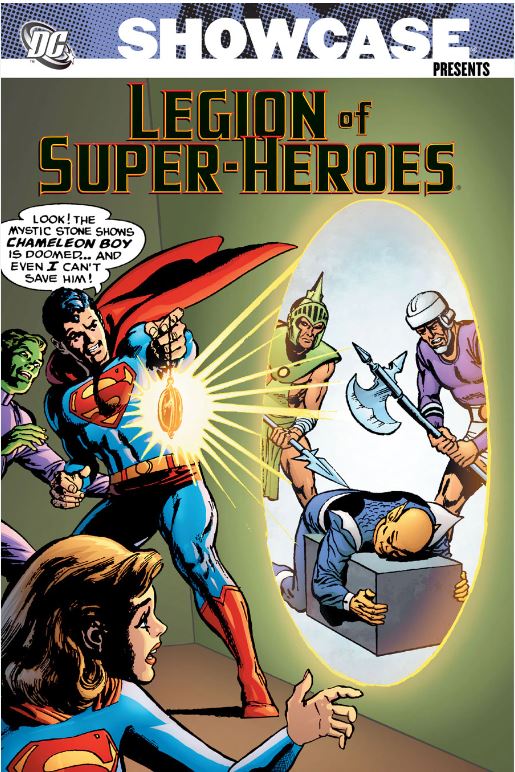
Showcase Presents Legion of Super-Heroes volume 4


By James Shooter, E. Nelson Bridwell, Cary Bates, Curt Swan, George Papp, J. Winslow Mortimer, George Tuska, Dave Cockrum, Murphy Anderson, Mike Esposito, Vince Colletta & various (DC Comics)
ISBN: 978-1-4012-2185-0 (TPB)

Once upon a time, a thousand years from now, a band of super-powered kids from a multitude of worlds took inspiration from the greatest legend of all time and formed a club of heroes. One day those Children of Tomorrow came back in time and invited their inspiration to join them…

Thus began the vast and epic saga of the Legion of Super-Heroes, as initially envisioned by writer Otto Binder & artist Al Plastino when the many-handed mob of juvenile universe-savers debuted in Adventure Comics #247 (April 1958) just as the revived superhero genre was gathering an inexorable head of steam in America. Since that time the fortunes and popularity of the Legion have perpetually waxed and waned, with their future history tweaked and rebooted, retconned and overwritten over and over again to comply with editorial diktat and popular fashion.

This drama-drenched fourth monochrome compendium gathers a chronological parade of futuristic delights from June 1968 to September 1970, originally seen in Adventure Comics #369-380 and the reprint issue #403, plus back-up tales from Action Comics #378-392 – a time when the superhero genre again dipped in popularity. Also included in this enchanting tome are the tentative first forays of the team’s slow revival as an alternating back-up feature in Superboy, via game-changing exploits from #172-173, 176, 183-184, 188 190 and 191, collectively covering March 1971 to October 1972.

During this period the youthful, generally fun-loving and carefree Club of Champions peaked; having only just evolved into a dedicated and driven dramatic action series starring a grittily realistic combat force in constant, galaxy-threatening peril. Although now an overwhelming force of valiant warriors ready and willing to pay the ultimate price for their courage and dedication, science itself, science fiction and costumed crusaders all increasingly struggled against a global resurgence in spiritual questioning and supernatural fiction…

The main architect of the transformation was teenaged sensation Jim Shooter, whose scripts and layouts (generally finished and pencilled by the astoundingly talented and understated Curt Swan) made the series accessible to a generation of fans growing up with their heads in the Future but as the fashions shifted, the series was unceremoniously ousted from its ancestral home and full-length adventures to become a truncated back-up feature in Action Comics. Typically, that shift occurred just as the stories were getting really, really good and truly mature…

Crafted by Shooter, Swan & Jack Abel, tense suspense blooms with ‘Mordru the Merciless!’ (Adventure Comics #369) when the Legion is attacked by their most powerful enemy: a nigh-omnipotent sorcerer the entire assemblage had only narrowly defeated once before.

A sneak attack shatters the whole team and only four escape, using a time-bubble to flee to the remote, archaic era where Superboy lived. With him come Mon-El, Shadow Lass and Duo Damsel, last remnants of a once-unbeatable force.

Mordru’s magic is stronger though and even the time-barrier cannot daunt him. Disguised as mere mortals, the fugitive Legionnaires’ courage shines through in exile as petty gangsters take over Smallville. The teens quashed the parochial plunderers and then opt to return to the 30th century and confront Mordru, only to discover he’s found them first…

The saga concluded in #370’s The Devil’s Jury!’ wherein the band again break free to hide in plain sight by temporarily wiping their own memories to thwart the Dark Lord’s probes. Against appalling odds and with only Clark Kent’s best friend Pete Ross and Insect Queen Lana Lang to aid them, the heroes’ doomed last stand implausibly succeeds when Mordru’s overbearing arrogance causes his own downfall.

Then when the exhausted fugitives get back to the future they joyously discover that Dream Girl and benign sorceress White Witch had undone the deluded Dark Lord’s worst…

Extortion and espionage were the order of the day in #371’s ‘The Colossal Failure!’ as a Legionnaire’s parents are abducted and the hero is forced to botch missions. Ordered to retrain at the high security Legion Academy, Colossal Boy is subsequently caught selling the team’s training secrets and cashiered from the organisation…

This issue also offered the George Papp illustrated ‘When Superboy Walked Out on the Legion!’, wherein hyper-advanced super snobbish aliens threaten Smallville unless Superboy leaves Earth to join their band of press-ganged heroes. It requires ingenuity, a faux civil war and massive destruction to finally convince the alien autocrats to let the assembled champions return to their own home-worlds…

Colossal Boy’s tale of woe concluded in Adventure #372 when his concerned former comrades uncover the cause of the expelled giant’s dilemma, tracking him to a ‘School for Super-Villains!’ (Shooter, Swan & Abel), where the fallen hero is compelled to teach meta-powered man rogues all the LSH’s secrets.

Luckily – and thanks to the expedited induction of apprentice and ergo unknown heroes Timber Wolf and Chemical King – the good guys infiltrate and shut down this first incarnation of the Legion of Super-Villains.

From #373 onwards Golden Age veteran J. Winslow Mortimer replaced Swan as penciller and ‘The Tornado Twins!’ Don and Dawn Allen run rings around and generally humiliate the assembled heroes… but all for a very good cause, before ‘Mission: Diabolical!’ in #374 focusses on the future equivalent of organised crime after most Legionnaires are ambushed and held hostage by the insidious Scorpius gang.

Hard-pressed by rival outfit Taurus, the mobsters decided to “recruit” a team of heroes to equal their enemies’ squad of hyper-powered goons; Rogarth, Mystelor, Shagrek, Quanto and Black Mace. Of course, after infiltrating and defeating their foes, the compromised kids – Supergirl, Element Lad, Dream Girl, Ultra Boy and Matter-Eater Lad – are double-crossed by Scorpius and might have died if not for fortuitous intervention by the Legion of Substitute Heroes

Next (#375-376) comes a powerful and devious 2-part thriller introducing galaxy-roving heroes The Wanderers, with that temporarily-insane-and-evil group battling the United Planets’ champions. They are far more concerned with determining who will be crowned ‘The King of the Legion!’

The matter is only relevant because a trans-dimensional challenger has demanded a duel with the “mightiest Legionnaire”, but when the dust settles the only hero left standing is chubby comic relief Bouncing Boy. When the triumphant winner is spirited away to another cosmos he lands in a feudal wonderland – complete with beautiful princess – menaced by a terrifying invader.

Sadly the hero is soon exposed as shape-shifting Durlan Legionnaire Reep Daggle and not the at-least-human Chuck Taine, but manfully overcomes his abductors’ initial prejudice and defeats usurper threat Kodar. He wins the heart and hand of Princess Elwinda, but is tragically rescued and whisked back across a permanently sealed dimensional barrier by his legion buddies who mistake a Royal Wedding for ‘The Execution of Chameleon Boy!’

A welcome edge of dark and bitter cynicism was creeping into Shooter’s stories, and ‘Heroes for Hire!’ (pencilled by Mortimer & inked by Jack Abel) sees the team charging for their unique services, but it’s only a brilliant ploy to derail the criminal career of Modulus: avatar of sentient living planet Modo who has turned his world into an unassailable haven for the worst villains of the galaxy…

Adventure #378 opens another tense and moving 2-parter as Superboy, Duo Damsel, Karate Kid, Princess Projectra and Brainiac 5 are poisoned and face only ‘Twelve Hours to Live!’

With no cure possible, the quintet separate to spend their last day in the most personally satisfying ways they can – from sharing precious moments with soon-to-be bereaved family to K-Kid’s one-man assault on the Fatal Five – only to reunite for their final moments and die together…

The incredible conclusion sees hyper-advanced being Seeron freeze time and offer to cure the practically dead victims if late arrivals Ultra Boy, Phantom Girl, Chameleon Boy, Timber Wolf, Star Boy, Lightning Lad and Chemical King return to his universe and defeat an invasion by brutes invulnerable to the mighty mental powers of the intellectual overlords…

However, even as the abducted Legionnaires triumph and return, their comrades – having been had been found again – are afforded the honour of ‘Burial in Space!’

Happily, a brilliant last-minute solution enables the dead to rise just in time to lose their long-held position in Adventure Comics as changing tastes and shrinking sales prompted an abrupt change of venue.

‘The Legion’s Space Odyssey!’ (# 380 cover-dated May 1969, by Shooter, Mortimer & Abel) sees a select band of Legionnaires teleported to the barren ends of the universe and forced to laboriously battle their way home against impossible odds. This argosy includes the “death” of Superboy and persistent sabotage by the Legion of Super-Pets. There’s a perfectly rational and reasonable excuse for the devious scheme of course, with the tale best remembered by fans as the mission on which Duo Damsel and Bouncing Boy first got together…

From #381 onwards Adventure Comics was filled with the 20th century exploits of Supergirl and the LSH took over her back-up spot in Action Comics, beginning with a reprint in #377 which is not included here.

Original, shorter Tales of the Legion of Super-Heroes began in #378 (July 1969) with ‘The Forbidden Fruit!’ by Shooter, Mortimer & Mike Esposito with Timber Wolf deliberately addicted by criminals to a hyper-narcotic lotus in a bold scheme to turn the entire team into pliable junkies. Fortunately, the hero’s love for Light Lass allows him to overcome his awful burden, before #379’s ‘One of us is an Impostor’ (E. Nelson Bridwell, Mortimer & Murphy Anderson) offers a clever mystery to baffle Mon-El, Dream Girl, Element Lad, Shadow Lass and Lightning Lad as thermal thug Sunburst and a clever infiltrator threaten to tear the team apart from within.

Duo Damsel declares war on herself in #380 when one body falls under the sway of an alien Superboy. As half of her turns to crime, only Bouncing Boy can clean up the psychological mess of ‘Half a Legionnaire?’ (Shooter, Mortimer & Abel), after which Matter-Eater Lad reveals lowly origins and a dysfunctional family to lonely Shrinking Violet in #381: ending up ‘The Hapless Hero!’ battling her absurdly jealous absentee boyfriend Duplicate Boy -mightiest hero in the universe…

In #382 a covert team comprising Ultra Boy, Karate Kid, Light Lass, Violet and Timber Wolf attempt to end a potential super-robot arms-race and find that to succeed they have to ‘Kill a Friend to Save a World!’, before still-heartbroken Durlan Reep discovers an Earthly double of lost love Elwinda. However, on morphing into her ideal man he quickly sees the folly of ‘Chameleon Boy’s Secret Identity!’ – a tear-jerker with a hint of happy ending from Bridwell, Mortimer & Abel.

Shooter left his perfect job with #384, but signed off in style with his landmark ‘Lament for a Legionnaire!’ With art misattributed to Mortimer but in fact a welcome fill-in by Curt Swan & Abel, it tells how Dream Girl’s infallible prophecy of Mon-El’s demise comes true whilst his shocking resurrection introduces a whole new thrilling strand to the Lore of the Legion.

Bridwell, Mortimer & Abel show how a vengeance-crazed killer’s quest for retribution fails in ‘The Fallen Starboy!’ before crafting ‘Zap Goes the Legion!’ (Action #386) wherein female foe Uli Algor believes she has outthought and outfought the juvenile agents of justice. She forgot one crucial detail, however…

Then in #387 the creators delightfully added a touch of wry social commentary when the organisation had to downsize and lay off a Legionnaire for tax purposes after the government declares the team has ‘One Hero Too Many!’

Action #388 was an all-reprint Supergirl giant, but the now revenue-compliant Club of Heroes returned in #389 with ‘The Mystery Legionnaire!’ (by Cary Bates, Mortimer & Abel), explaining how robot dictator Klim is defeated by a hero who doesn’t exist, and Bridwell’s ‘The Tyrant and the Traitor’ (#390) reflects political turmoil of the 1970’s in a tale of guerrilla atrocity, destabilising civil war and covert regime change. The Legion Espionage Squad is tasked with doing dirty work, but even Chameleon Boy, Timber Wolf, Karate Kid, Brainiac 5 and Saturn Girl are out of their depth and only ‘The Ordeal of Element Lad!’ in the next issue saves the undercover unit from ignominious failure and certain death.

Action #392 (September 1970) temporarily ended the feature’s unbroken run with a low-key but gripping yarn from Bates, Mortimer & Abel including alternate dimensions and preposterous testing of ‘The Legionnaires that Never Were!’

The Frantic Futurists weren’t gone too long. In 1971 a concerted push to revive them began with March-dated Superboy # 172 and ‘Brotherly Hate!’ by Bridwell & George Tuska. The sharp, smart yarn details the convoluted origins of twins Garth and Ayla Ranzz AKA Lightning Lad & Light Lass and their troubled relationship with older brother Mekt – the deadly outlaw Lightning Lord.

At the same time Adventure Comics #403 (April 1971) was released: an all-Legion reprint special which included new ‘Fashions from Fans’ by Bridwell, Ross Andru & Esposito as well as a comprehensive ‘Diagram of Legion Headquarters Complex’, included here for your delight and delectation…

Some of those fan-costumes – generally the skimpier ones designed by boys for the girl heroes – were adopted for ongoing backups appearing in Superboy. They continued the comeback with ‘Trust Me or Kill Me!’ (#173 by Bates & Tuska). Here, Superboy must devise a way to determine which Cosmic Boy is his true friend and which a magical duplicate made by malefic Mordru.

The origin of Invisible Kid and secrets of his powers are examined in #176 when a crook duplicates the boy genius’ fadeaway gifts in ‘Invisible Invader!’, whilst Bates, Tuska & Vince Colletta report on the ‘War of the Wraith-Mates!’ (#183) with energy entities renewing an eons-old war of the sexes after possessing Mon-El, Shadow Lass, Karate Kid and Princess Projectra.

In a tale by Bates. Superboy #184 hinted at days of greatness to come with ‘One Legionnaire Must Go!’ Here Matter-Eater Lad is framed and replaced by his own little brother, but the big advance was the inking of LSH fanatic Dave Cockrum over Murphy Anderson’s pencils. The neophyte artist would gradually transform the look, feel and fortunes of the Legion before moving to Marvel and doing exactly the same with an almost forgotten series entitled X-Men

With Superboy #188’s Bates-scripted ‘Curse of the Blood-Crystals!’ (July 1972), Anderson began inking Cockrum, in the sixth stunning back-up tale of a now unstoppable Legion revival that would eventually lead to them taking over the entire comic book. This clever yarn of cross-&-double-cross finds a Legionnaire possessed by a magical booby-trap and forced to murder Superboy… but which of the two dozen heroes is actually the prospective killer?

Superboy #190 featured ‘Murder the Leader!’ as the Fatal Five attack during the election of a new Legion Commander. Rival candidates Saturn Girl and Mon-El must work together if either is to take the top job, after which this volume concludes with stunning thriller ‘Attack of the Sun-Scavenger!’ (Bates & Cockrum from #191). In a staggering burst of comics brilliance, manic solar scoundrel Dr. Regulus again attacks Sun Boy and his Legion comrades, using his own apparent death as key to ultimate victory…

The Legion of Super-Heroes is unquestionably one of the most beloved and bewildering creations in funnybook history and largely responsible for the growth of groundswell movements that became American Comics Fandom. Moreover, these scintillating and seductively addictive stories – as much as Julie Schwartz’s Justice League or Marvel’s Fantastic Four – fired the interest and imaginations of generations of and underpinned the industry we all know today.

If you love comics and haven’t read this stuff, you are the poorer for it and need to enrich your future days as soon as possible.
© 1968-1972, 2010 DC Comics. All Rights Reserved.

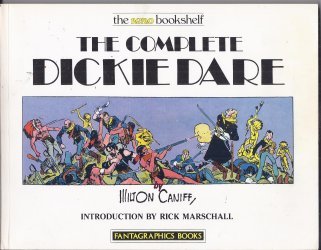
The Complete Dickie Dare


By Milton Caniff (Fantagraphics Books)
ISBN: 0-93019-322-9 (HB)  978-0-93019-321-8 (PB)

Despite being one of the greatest and most influential cartoonists in world history, Milton Caniff wasn’t an overnight sensation. He worked long and hard before he achieved stellar status in the comic strip firmament, before Terry and the Pirates brought him fame, and Steve Canyon secured his fortune.

The strip which brought him to the attention of legendary Press Baron “Captain” Joseph Patterson – in many ways co-creator of Terry – was an unassuming daily fantasy feature about a little boy who was hungry for adventure…

Caniff was working for The Associated Press as a jobbing cartoonist when a gap opened in their strips department. AP was an organisation that devised and syndicated features for the thousands of regional and small-town newspapers which couldn’t afford to produce cartoons, puzzles, recipes and other fillers that ran between the local headlines and regional sports.

Over a weekend, Caniff came up with Dickie, a studious lad who would read a book and then fantasize himself into the story, taking faithful little dog Wags with him. The editors went for it and Dickie Dare premiered on July 31st, 1933.

Caniff wrote and drew the feature for less than 18 months before moving on, although his excellent but unappreciated replacement Coulton Waugh steered the series until its conclusion two decades later.

The first day-dream was with Robin Hood, followed by a frantic, action-packed visit with Robinson Crusoe and Friday, battling hordes of howling savages and scurvy pirates. Rugged combat gave way to fantastic mystery when the tyke perused Aladdin, resulting in a lavish and exotic trip to a very fabled Far East. This segment closed near Christmas, and when his father read Dickie the story of the Nativity, Caniff began his long personal tradition of creating seasonally topical strips.

A visit to Bethlehem ended on Christmas morning, and one of Dickie’s Christmas presents then triggers his next excursion, when he starts reading of General George Armstrong Custer

King Arthur next, followed by Captain Kidd the Pirate, but by then Caniff was chafing under the self-imposed limitations of his creation. He believed the strip had become formulaic and there was no real tension or drama in mere dreams. In a creative masterstroke, he revised the strip’s parameters, and by so doing produced the prototype for a masterpiece.

On May 11th, 1934, Dickie met a new uncle: globe-trotting author and two-fisted man-of-action Dan Flynn, and one week later the pair embarked on a Round-the-World trip. Caniff had moved swiftly, crafting a template that would become Terry and the Pirates.

The wide-eyed, nervy All-American Kid with adult pal ultra-capable adventurer, whilst a subject of much controversy and even ill-advised and outright scurrilous modern disparagement, was a literary archetype since before Treasure Island. Adapting that relationship to comic strips was commercially sound: a decision that hit a peak of popularity with the horde of sidekicks/partners who followed in the wake of Robin the Boy Wonder six years later.

No sooner have Dickie & Dan taken ship for Africa than the drama begins, when the restless kid uncovers a hidden cargo of smuggled guns. Aided by feisty Debutante Kim Sheridan and sailor Algy Sparrow, our heroes foil the scheme, but not before Dickie is captured by Kuvo, the Arab chieftain awaiting those weapons.

Pursued by French authorities, Kuvo retreats to a desert fortress where Kim, disguised as a slave-girl, rescues the lad, only to be caught herself. The full-tilt action peaks to a splendid conclusion before the boys, with Algy in tow as their butler, head for Tunis only to stumble across a plot to use a World War I U-Boat for ocean-going piracy…

This long adventure (beginning September 13th) is a thoroughly gripping yarn encompassing much of the Mediterranean and Atlantic, as the boys escape pirates and aid the Navy in hunting them down. There’s buckets of action and an astonishing amount of tension, but the tale ends a tad abruptly when Caniff, lured away by Patterson, simply drops the feature and Coulton Waugh takes over the storyline from the next Monday (3rd December).

With no break in the tale Waugh rapidly (in 14 episodes) wraps up the saga. He even has Dickie home by Christmas.

From the New Year the strip would chart new waters with Waugh at the helm, aided (and briefly replaced whilst he wrote his seminal book on Comics and also when he was producing the strip Hank for the New York magazine PM) by assistant and spouse Odin Burvik.

Dickie Dare eventually ended its run in October 1957 with the now adult adventurer beginning a new career as a US Navy Cadet.

Although usually dismissed as a mere stage on the road to his later mastery – and certainly long before Caniff and sometime studio partner Noel Sickles made their chiaroscurist breakthroughs in line-art that revolutionised the form – these early tales delighted and enthralled readers. Full of easy whimsy and charm, the strip evolved into a rip-roaring, all-ages thriller, full of wit and derring-do, in many ways an American answer to Hergé’s Tintin.

They deserve to be appreciated on their own merits and are long overdue for reappraisal in new collections.

At least this edition is still readily available but Dickie Dare is long overdue for rediscovery by the mass-market – and streaming services! – so while we’re at it, let’s see some of the work that the criminally under-valued Waugh originated too.
Artwork originally © 1933-1934 The Associated Press. Other contents this edition © Richard Marschall All rights reserved.

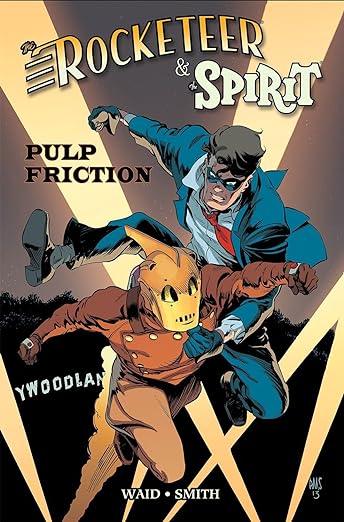
The Rocketeer & The Spirit: Pulp Friction


By Mark Waid, Paul Smith, Loston Wallace, J Bone, Bob Wiacek & various (IDW)
ISBN: 978-1-61377-881-4 (HB/Digital edition)

The American comics industry has generated its fair share of immortal heroes. However, whilst everyone is familiar with household names such as Flash Gordon, Superman, Dick Tracy or Popeye, there are also timeless champions who pretty much remain hallowed names only to the in-crowd and cognoscenti: characters who had their shot at global mega-stardom but for some reason never caught on with the masses. Guys like The Spirit and The Rocketeer

Will Eisner was a pivotal creative force who helped shaped the entire medium of comics. From 1936 to 1938 he worked as a jobbing cartoonist in the studio-stable known as the “Eisner-Eiger Shop”, creating strips for both domestic and foreign markets.

As Willis B. Rensie he created and drew the opening instalments of a huge variety of characters ranging from funny animal to historical sagas, Westerns, Detectives, aviation action thrillers… and superheroes… lots of superheroes.

In 1940, Everett “Busy” Arnold, of Quality Comics, invited Eisner to take on a new challenge. The Register-Tribune newspaper syndicate wanted a 16-page weekly comicbook insert to be given away with the Sunday editions. Eisner created three strips which would initially be handled by him before two were handed off to his talented assistants.

Bob Powell inherited Mr. Mystic whilst distaff detective Lady Luck first fell into the capable hands of Nick Cardy (nee Nicholas Viscardi) and later the inimitable Klaus Nordling.

Eisner kept the lead for himself, and over the next dozen years masked detective The Spirit grew into the most impressive, innovative, imitated and talked-about strip in the business. In 1952, the venture folded and Eisner moved into commercial, instructional and educational comics, working extensively for the US military in manuals and magazines like P*S, the Preventative Maintenance Monthly, and generally left comics books behind.

In the wake of “Batmania” and the 1960s superhero craze, Harvey Comics released two giant-sized reprint editions with some new material from Eisner. These led to a brace of underground compilations and a slow but inexorable rediscovery and revival of the Spirit’s fame and fortune, via black-&-white newsstand reprint magazines.

Warren Publishing collected old stories, occasionally adding painted colour from contemporary luminaries like Rich Corben, but from #17 the title reverted to Kitchen Sink, who had produced those first two underground collections.

Eisner found himself re-enamoured with graphic narrative and discerned that there now existed a willing audience eager for new works. From producing new Spirit covers for the magazine – something the original newspaper insert had never needed – he became increasingly inspired. American comics were evolving into an art-form and the restless creator finally saw a place for the kind of stories he had always wanted to tell.

Eisner subsequently began crafting some of the most telling and impressive work the industry had ever seen: first in limited collector portfolios and, in 1978, with groundbreaking sequential narrative A Contract With God: thereby jumpstarting our modern comics phenomenon of graphic novels…

Although his output was far smaller and life far shorter, Dave Stevens had an equally revolutionary effect on the industry: his lush and lavish illustration style influencing a generation of artists as his signature retro-futurist character The Rocketeer became the first breakout star of the Independent Comics movement that stemmed from the creation of the comic book Direct Sales Market.

Due to Stevens’s legendarily uncompromising artistic vision – and consequent slow page rate – very few of The Rocketeer’s period exploits appeared before the artist’s death from Hairy Cell Leukaemia in 2008. Since then, diverse hands have added to the canon, as with the miniseries collected in this slim but stunning edition.

Just in case these vintage adventurers are new to you, The Spirit used to be Denny Colt: Central City’s greatest detective and criminologist. After apparently dying in battle with a vile master-villain, Colt opted to remain officially dearly departed to battle evil in a semi-official capacity. The masked enigma was covertly aided by girlfriend Ellen Dolan and her father, the Police Commissioner of that crime-ridden metropolis.

Cliff Secord is an itinerant West Coast pilot who – circa 1938 – found a fantastic jetpack outfit and stumbled into a succession of criminal plots and capers. With the eventual permission of the flight engine’s inventor – one of the greatest heroes of that or any other era – Cliff still finds himself regularly battling bad guys as The Rocketeer. When that’s not occupying his time, he’s busy looking for work or being given the run-around by his star-struck, fame-obsessed, trouble-magnet girl Betty

Team-ups are part-and-parcel of comics and both heroes have had their share of cataclysmic and catastrophic clashes with the valiant giants of the period and the industry. This yarn however – a 4-issue miniseries by Mark Waid originally spanning July to December 2013 – concentrates as much on humour as bombastic action. It begins on the East Coast in February 1941 as business executives and government men meet to decide the future of the Next Big Thing…

Alderman Cunningham is stridently opposed to letting business cartels control the new medium and argues that, just like with radio, public airwaves must not be owned by any individual or corporation seeking to monopolise recently invented Television…

Mere hours later an early morning fashion shoot on a California beach is ruined when beautiful Betty finds the idealistic politician’s mangled corpse. When the stiff is identified as Cunningham, Commissioner Dolan and Spirit are baffled. How could the victim have travelled more than 3000 miles in one night? Determined to investigate, they book passage on a transcontinental plane, having reluctantly crumbled before the forceful Ellen who demands to join them and see Hollywood…

In Los Angeles, Cliff Secord is still ignored by traumatised Betty. He mopes dejectedly until grizzled old mechanic Peevy points out that whoever killed the Alderman might also want to silence the girl who found the body…

Nearby, a very wealthy entrepreneur places a coast-to-coast call to The Spirit’s greatest enemy to discuss his incredible new invention, the pursuance of their plans and how to stop a certain masked interloper from interfering…

Said hero – still wearing his mask – is stiffly staggering off a plane at Chaplin Field with his equally exhausted cross-country companions. In a weary, unguarded moment he mentions Betty. Learning of the “slip”, an already paranoid Cliff panics and, assuming a masked killer has come for his girl, dons his rocket-man suit to attack…

After a spectacular battle, Ellen finally manages to convince both testosterone-soaked mutton heads they are on the same side, and a tentative alliance forms …at least until Spirit interviews Betty and the flighty starlet finds she’s in love – or thereabouts – with the hunky masked cop.

Illustrator Paul Smith gives way to Loston Wallace & Bob Wiacek as chapter two opens with the fractious, clueless allies heading for the LA Morgue and Cunningham’s cadaver. Elsewhere, television wizard Benedict Trask and The Octopus debate how best to get Betty out of the picture and deal with interlopers meddling in their affairs. Their solution is unique and everything would have worked out swell if not for inveterate tinkerer Peevy who has built his own prototype TV receiver and intercepted something he shouldn’t have…

The villains respond in typical manner but their big mistake is believing planes sent to strafe Peevy’s hangar are enough to stop Rocketeer and The Spirit…

With J Bone stepping in for the final two chapters, the high-octane tale ramps up to top gear as Cliff travels to Central City with The Spirit and the Dolans. All they have to do is find Betty, expose Trask and the Octopus’ sinister scheme, uncover their treacherous connections to a certain Fascist foreign power, prevent America’s airwaves being subverted and save President Roosevelt from assassination by television in a rocket-paced, breathtaking rollercoaster ride that delivers non-stop thrills and chills…

Accompanied with an Introduction from Denis Kitchen, filling in all necessary back-story on the characters, and visually embellished by sketches and a large cover gallery by Darwyn Cooke, Smith, Jordie Bellaire, Bone and Chris Samnee, Pulp Friction is a no-nonsense fun-filled frolic to delight lovers of the good old days of Thud and Blunder…
© 2014 The Rocketeer Trust and Will Eisner Studios, Inc. The Rocketeer is a registered trademark of, and all related characters, their distinctive likenesses and indicia are trademarks of The Rocketeer Trust. All Rights Reserved. The Spirit © 2014 Will Eisner Studios, Inc. The Spirit and Will Eisner ™ & © Will Eisner Studios, Inc. ® in the US Patent and Trademark Office. All Rights Reserved.

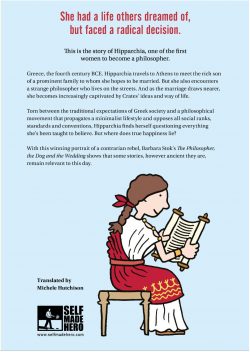
The Philosopher, The Dog and the Wedding


By Barbara Stok, design & colours by Ricky van Duuren: translated by Michele Hutchison (SelfMadeHero)
ISBN: (978-1-914224-09-6 (TPB/Digital edition)

It’s long been a truism of the creative arts that the most effective, efficient and economical method of instruction and informational training is the comic strip. If you simply consider the medium’s value as a historical recording and narrative system, the process encompasses cave paintings, hieroglyphs, pictograms, oriental prints, Stations of the Cross, the Bayeux Tapestry and so much more: and pretty succinctly covers the history of humanity…

For well over a century and a half, advertising mavens exploited the easy impact of words wedded to evocative pictures, whilst public information materials frequently used sequential narrative to get hard messages over quickly and simply. In a surprisingly short time, the internet and social media restored and enhanced the full universal might of image narratives to transcend language. Who doesn’t “speak” emoji?

Since World War II, strips have been used as training materials for every aspect of adult life from school careers advice to various disciplines of military service – utilising the talents of comics giants as varied as Milton Caniff, Will Eisner (who spent decades producing reams of comic manuals for the US army and other government departments), Kurt Schaffenberger and Neil Adams. The educational value and merit of comics is a given.

The magnificent Larry Gonick in particular uses the strip medium to stuff learning and entertainment in equal amounts into weary brains of jaded students with his webcomic Raw Materials and such seasoned tomes as The Cartoon History of the Universe, The Cartoon History of the United States and The Cartoon Guide to… series (Genetics, Sex, The Environment et al). That’s not even including his crusading satirical strip Commoners for Common Ground, and educational features Science Classics, Kokopelli & Company and pioneering cartoon work with the National Science Foundation. He never stops: his most recent books are Hypercapitalism: The Modern Economy, Its Values, and How to Change Them and The Cartoon Guide to Biology. Gotta Get ‘Em All…

Japan has employed manga textbooks in schools and universities for decades and even releases government reports, documents and business prospectuses in comics formats to get around the public’s apathy towards reading large dreary volumes of information. So do we and everybody else. I’ve even produced the occasional multi-panel teaching-tract myself. The method has also been frequently used to sublimely and elegantly tackle the greatest and most all-consuming preoccupation and creation of the mind of Man…

Like organised religion, the conceptual discipline dubbed Philosophy has had a tough time relating to modern folk and – just like innumerable vicars in pulpits everywhere – advocates and followers have sought fresh ways to make eternal questions and subjective verities understandable and palatable to us hoi-polloi and average simpletons.

In 2021 award-winning Dutch artist Barbara Stok (Barbaraal Tot Op Het Bot, De Omslag, Vincent) translated her interest in the discipline, history and one particular groundbreaking, revolutionary deep thinker to produce De filosoof, dehond en debruiloft and it was published by Nijgh &Van Ditmas, Amsterdam).

Born in Groningen in 1970, Stok was a journalist who studied at The Hague’s Fotoacademie School of Photography before moving into editorial cartooning and illustration in the 1990s. With Maaike Hartjes and Gerrie Hondius she pioneered a generation of female cartoonists using the art form to speak about their lives. Most of her personal work was amusingly autobiographical, working out her life’s big questions via strips. Inevitably, pondering life & death and right &wrong led her to other older investigators and after taking some formal philosophy courses – five years’ worth – she created a history of the astounding and incredibly bold and brave Hipparchia. Since 2020 Stok has taken on a regular gig: creating the strip Jan, Jans en de Kinderen for women’s weekly Libelle.

Delivered in her sublimely accessible child-like primitivist/Niavist style and preferred anecdotal episodic narrative format, The Philosopher, The Dog and the Wedding explores the life and status of women in 4th century (BCE) Greece through the thoughts and experiences of Hipparchia, daughter of a wealthy lumber-merchant in Maroneia, and long overdue to be profitably married off.

As seen in ‘eudaimonia/happiness’, she is given far too much liberty: being able to read, allowed full access to her father’s large library and indulged in her habit of eavesdropping on the philosophical debates of men. Naturally, this leads to her developing a keen mind and opinions of her own, but she can only share them with the house dogs…

After only a few embarrassments, she is bundled off to Athens where her brother Metrocles studies Philosophy with all the greatest thinkers of the Age of Alexander the Great. Wealthy silver mine owner Leandros has a son Kallios who needs a wife, and if she behaves herself and acts like a decent daughter should, she can bind the two families together…

In ‘paracharassein/deface the currency’ her education truly begins. A thrilling and revelatory mental readjustment comes from her apparent resignation to stay in her place, but only after after encountering a homeless tramp who is sublimely content and intellectually brilliant. Crates is the chief proponent of a radical offshoot of the Cynical movement: called by those who don’t mock him and rubbish his teachings as “the new Socrates”…

Distracted but still devout, Hipparchia endures: trying her best to follow family interests and convince Kallios’ family that she is worthy, but the gorgeous glittering prize – an Olympic javelin contender – doesn’t own a single book.

Always accompanied by a male slave, she goes through the traditional motions, buying clothes, learning the secrets of cosmetics and making herself as valuable as she can, but constantly encounters Crates, living his perfect life of poverty and thought. Her distraction proves advantageous, however, when Metrocles almost quits school and she begs Crates to talk him round…

The vagabond is respected by many: a student of the great Diogenes. Its why the Cynic school philosophers are called “Dogs”…

Successfully negotiating Leandros’ conditions, Hipparchia becomes the official fiancée in ‘physis/nature’ and begins learning her expected duties, but chafes at the utter lack of intellectual stimulation. When her brother buys Crates’ book of thoughts, she cannot stop herself reading it. Soon she’s listening in on the students debating in the men-only areas of the house and craving more…

Philosophers at that time could expound anywhere, and men would gather to listen, debate, contend and contribute. On her way to another fitting spree, Hipparchia joins a heated debate despite her social standing (“seen but never heard in public”) and it’s all her slave can do to extricate her from a dangerous situation. It’s worth it though, to hear Crates speak…

Frustrated and guilty as her brother bawls out the negligent slave, a crux moment occurs as she looks over Metrocles’ library and finds a scroll written by a woman. Perictione was Plato’s mother and her thoughts were clearly worth preserving…

Soon she embarks on a dangerous plan, and finds a way to join the male crowds and even openly debate with Crates…

As the marriage proceedings roll on, Hipparchia’s social sins and personal transgressions mount in ‘autarkeia/self-sufficiency’ before culminating in a ‘parrhèsia/freedom of speech’ crisis, the landmark resolution of ‘askêsis/training’ and a new beginning in ‘ataraxia/inner peace’

This story of a powerful woman defining female empowerment and the fight for personal truth is delivered in a potent and accessible manner that beguiles fully as much as Hipparchia and Cratus’ logic and example convinced and challenged the literally patriarchal system of ancient Greece. Augmented by an impassioned ‘Afterword’ and detailed, copious and comprehensive ‘Notes’ to aid comprehension and provide context, this is a visual delight and telling hammer-blow of reasoned debate which should be compulsory reading for all.
© 2021 Barbara Stok. English translation © 2022 by Michelle Hutchison. All rights reserved.

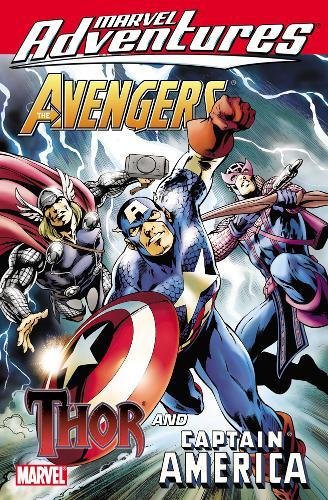
Marvel Adventures Avengers: Thor and Captain America


By Paul Tobin, Scott Gray, Todd DeZago, Ronan Cliquet, Ron Lim, Lou Kang & various (Marvel)
ISBN: 978-0-7851-5584-3 (Digest PB)

In 2003 the House of Ideas instituted a Marvel Age line: an imprint updating classic original tales and characters for a newer, younger readership. The enterprise was modified in 2005, with core titles reduced to Marvel Adventures: Fantastic Four and Marvel Adventures: Spider-Man. The tone was very much that of the company’s burgeoning TV cartoon franchises, in delivery if not name.

Supplemental series including Super Heroes, The Avengers, Hulk and Iron Man chuntered along merrily until 2010 when they were cancelled. In their place came new volumes of Marvel Adventures: Super Heroes and Marvel Adventures: Spider-Man.

Most of the re-imagined tales were collected in gleefully inviting digest-sized compilations and digitised; this – except for a electric version – was the case with this engaging ensemble featuring fabulous  forays starring the God of Thunder or Sentinel of Liberty and their Avenging allies: a quartet of all-ages tales from the second volume of Marvel Adventures Super Heroes (#13-16, spanning June-September 2011).

The action opens with a mythological masterpiece by Paul Tobin, Ronan Cliquet & Amilton Santos wherein plucky novice hero Nova is invited by Avenging comrades Thor and Valkyrie to accompany them on an annual errand for All-Father Odin.

In the distant past when Asgardians warred with Trolls, godling messenger Glane failed in his mission and was banished to the ghastly Fields of the Fallen to pay penance by continually battling the Golden Realm’s vilest enemies. Periodically, Thor has been sent to add new tasks to the sinning failure’s heavy burden, and this year – as the Thunderer and Valkyrie ready themselves for the trip – they invite starstruck neophyte Nova along.

However, as the trio war their way through horrific monsters and overwhelming odds, Nova finds himself increasingly uncomfortable with the sentence meted out to Glane. He even begins doubting the motives of his immortal mentors. All that changes once he meets and battles beside the convicted penitent…

Originating in MASH #14, ‘Out of Time!’ is by Todd DeZago, Ron Lim & Scott Koblish (inspired by Gerry Conway & Ross Andru’s tale from the original Marvel Team-Up #7). Here, the Lord of Storm intercepts Spider-Man after the wallcrawler is blasted high into the sky whilst battling raving maniac the Looter.

That happy coincidence occurs just a bizarre force freezes time around them. When the heroes discover that only they have escaped a devastating weapon deployed by Trollish tyrant Kryllk the Conqueror to paralyze and overwhelm both Asgard and the mortal plane, they must divide their strength to simultaneously smash the conqueror in Manhattan and Asgard if they are to set time running free again…

Captain America takes the spotlight in #15 as ‘Back in Time’ (Tobin, Cliquet & Santos) finds him battling Neanderthals with ray-guns in a National Forest after tracking down rogue geneticists who have stolen a huge amount of plutonium.

A mere mile away, Peter Parker’s girlfriend Sophia Sanduval is getting back to nature and chilling with her furry, scaly and feathered friends. As Chat, the mutant teen’s power to communicate with animals makes her a crucial component of the mystery-solving Blonde Phantom Detective Agency, but even she has never seen anything like the wave of extinct creatures which appear after Cap begins battling the tooled-up cavemen.

Soon Chat has been briefed on the deadly experiments of rogue technologist Jerrick Brogg. The villain’s ambition is to build an army out of revived extinct creatures, but she and helps The Star-Spangled Avenger frustrate those save all the beasts he has re-created from short painful lives of terror and brutal exploitation, before putting the maniac away for good.

Wrapping up the action comes ‘Stars, Stripes and Spiders!’ by DeZago, Lou Kang & Pat Davidson (based on Len Wein & Gil Kane’s tale from Marvel Team-Up #13). When a certain wallcrawling high-school student/occasional masked hero stumbles into Captain America tackling an AIM cadre stealing super-soldier serum, the nervous lad learns a few things about the hero game from the legendary guy who wrote the book. Sadly, not making that lesson any easier is petrifying supervillain Grey Gargoyle, whose deadly touch almost ends Spidey’s homework worries – and continued existence – forever…

Fast, furious, funny and enthralling, these riotous mini-epics are extremely enjoyable yarns, although parents should note that some of the themes and certainly the level of violence might not be what everybody considers “All-Ages Super Hero Action”…
© 2011 Marvel Characters, Inc. All rights reserved.

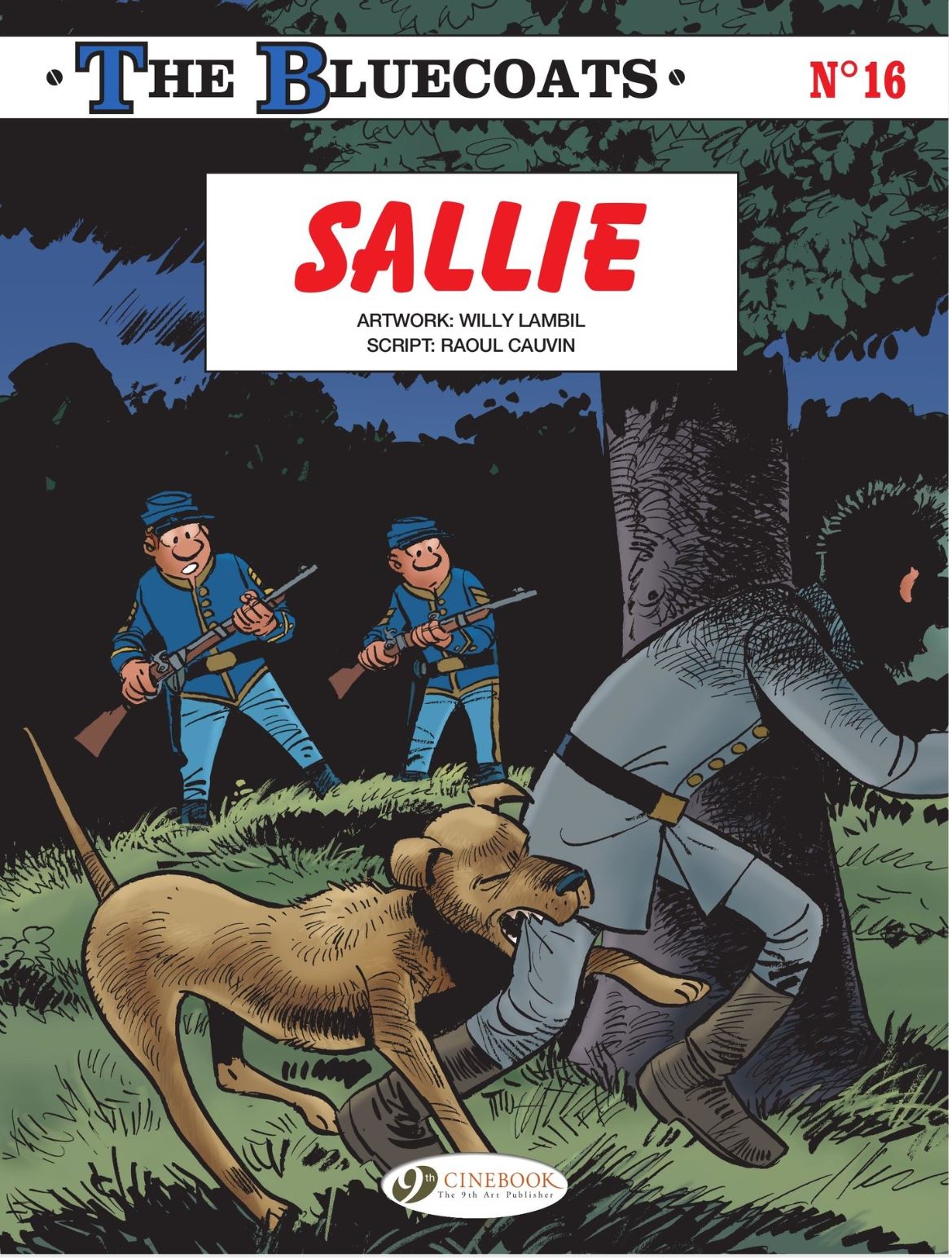
The Bluecoats volume 16: Sallie


By Willy Lambil & Raoul Cauvin, translated by Jerome Saincantin (Cinebook).
ISBN: 978-1-80044-089-0 (Album PB/Digital edition)

Devised by Louis “Salvé” Salvérius & Raoul Cauvin – who scripted the first 64 volumes until his retirement in 2020 – Les Tuniques Bleues (Dutch-language iteration De Blauwbloezen) debuted at the end of the 1960s: created to supplant the irreplaceable Lucky Luke when that laconic maverick defected from weekly anthology Le Journal de Spirou to rival publication Pilote.

From the start, the substitute strip was hugely popular: swiftly becoming one of the most popular bande dessinée series in Europe. It is now scribed by Jose-Luis Munuera and the BeKa writing partnership and up to 66 tomes…

Salvé was a cartoonist in the Gallic big-foot/big-nose humour manner, and after his sudden death in 1972, successor Willy “Lambil” Lambillotte gradually moved towards a more realistic – but still overtly comedic – tone and look. Lambil is Belgian, born in 1936 and, after studying Fine Art in college, joined publishing giant Dupuis in 1952 as a letterer.

Born in 1938, scripter Cauvin was also Belgian and – before entering Dupuis’ animation department in 1960 – studied Lithography. He soon discovered his true calling was comedy and began a glittering, prolific writing career at Le Journal de Spirou. In addition, he scripted dozens of long-running, award winning series including Cédric, Les Femmes en Blanc and Agent 212: totalling more than 240 separate albums. Les Tuniques Bleues alone has sold over 15 million copies… and counting.

Cauvin died on August 19th 2021, but his vast legacy of barbed laughter remains.

Here, designated The Bluecoats, our long-suffering protagonists are Sergeant Cornelius Chesterfield and Corporal Blutch: worthy, honest fools in the manner of Laurel & Hardy; hapless, ill-starred US cavalrymen defending America during the War Between the States.

The original format offered single-page gags set around an Indian-plagued Wild West fort, but from second volume Du Nord au Sud, the sad-sack soldiers were situated back East, perpetually fighting in the American Civil War.

All subsequent adventures – despite often ranging far beyond the traditional environs of the sundered USA and taking in a lot of genuine and thoroughly researched history – are set within the timeframe of the Secession conflict.

Blutch is your run-of-the-mill, whinging little-man-in-the street: work-shy, mouthy, devious and ferociously critical of the army and its inept orchestrators and commanders. Ducking, diving, deserting whenever he can, he’s you or me – except at his core he’s smart, principled and even heroic… if no easier option is available.

Chesterfield is big and burly, a professional fighting man and proud career soldier of the 22nd Cavalry who devoutly believes in patriotism and the esprit-de-corps of the Military. He’s brave, never shirking his duty and hungry to be a medal-wearing hero. He also loves his cynical little pal so naturally, they quarrel like a married couple, fight like brothers yet simply cannot agree on the point and purpose of the horrendous war they are trapped in. That situation again stretches their friendship to breaking point in this cunningly conceived instalment. Coloured by Vittorio Leonardo, Les Tuniques Bleues – Sallie was released continentally in 2018 as the 62nd book, and became Cinebook’s 16th translated Bluecoats album. It is not like the majority of these tales, which tread a fine line between comedy and righteous anger, and if you share these books with younger kids, read it first on your own. Preferably with tissues and your comfort-amplifying food or beverage of choice. Sallie is another incident based on a true story of the war, but if you can refrain from looking up Sallie Ann Jarrett until you finish, it will be to your benefit.

It begins with our protagonists again arguing about the war and their part in it. The little man is grooming his wily steed Polka, a horse so smart it has managed to survive the entire conflict and many manic cavalry charges commanded by a callous high command and led by deranged, seemingly bulletproof Captain Stark. It quickly becomes clear that Chesterfield sees the horses and mules – all animals in fact – as nothing more than equipment: expendable, disposable and replaceable…

The northerners are gearing up for another major battle and as they bicker reinforcements arrive, Pennsylvanians of the 11th Infantry Division despatched by General Ulysses Grant himself. They are battle-hardened veterans who proudly march into camp accompanied a dog. It transpires that Sallie has been with them from the start; fighting beside them on many bloody battlefields. She quickly takes a liking to Polka and, as the soldiers all swap stories around campfires, slowly the ice around Chesterfield’s heart begins to thaw…

The Brass have no time for comradeship: they are cloistered in luxury trying to divine Confederate strategy, outguess their tactics and work out exactly where the enemy is. Ultimately, baffled as always, they resort to an old tactic and order a trustworthy man to go out and capture someone from the other side…

Chesterfield heads out at dusk towards the rebel lines, unaware until far too late that his one-man suicide mission is being covertly augmented by Sallie and – far more reluctantly – by Blutch on Polka. Astoundingly, the job is a success and thanks to the intrepid mutt, they capture Southern spy and old acquaintance Cockroach. Dragged back to camp, the enemy combatant is soon made to talk…

The next day, a flurry of activity sees Union armies confidently moving on the unsuspecting opposition and into the jaws of a disinformation-fuelled trap built from their Generals’ own arrogance and inability to improvise. With no other answer than to throw more bodies into the meat grinder, the battle devolves into a massacre and not just human casualties mount…

In the end all our heroes can do is pick themselves up, honour their fallen and reaffirm what they always knew…

Packed with true but daft anecdotes – like the story of Robert E. Lee’s chicken – and pointedly seditious polemic with moving moments, Sallie shows what war truly costs, weaponizing charm and humour, making occasional moments of shocking verity doubly powerful and hard-hitting. Funny, thrilling, beautifully realised and eminently readable, Bluecoats is the best kind of war-story and Western: appealing to the best, not worst, of the human spirit. And this one is really, really sad…
© Dupuis 2018 by Lambil & Cauvin. All rights reserved. English translation © 2022 Cinebook Ltd.

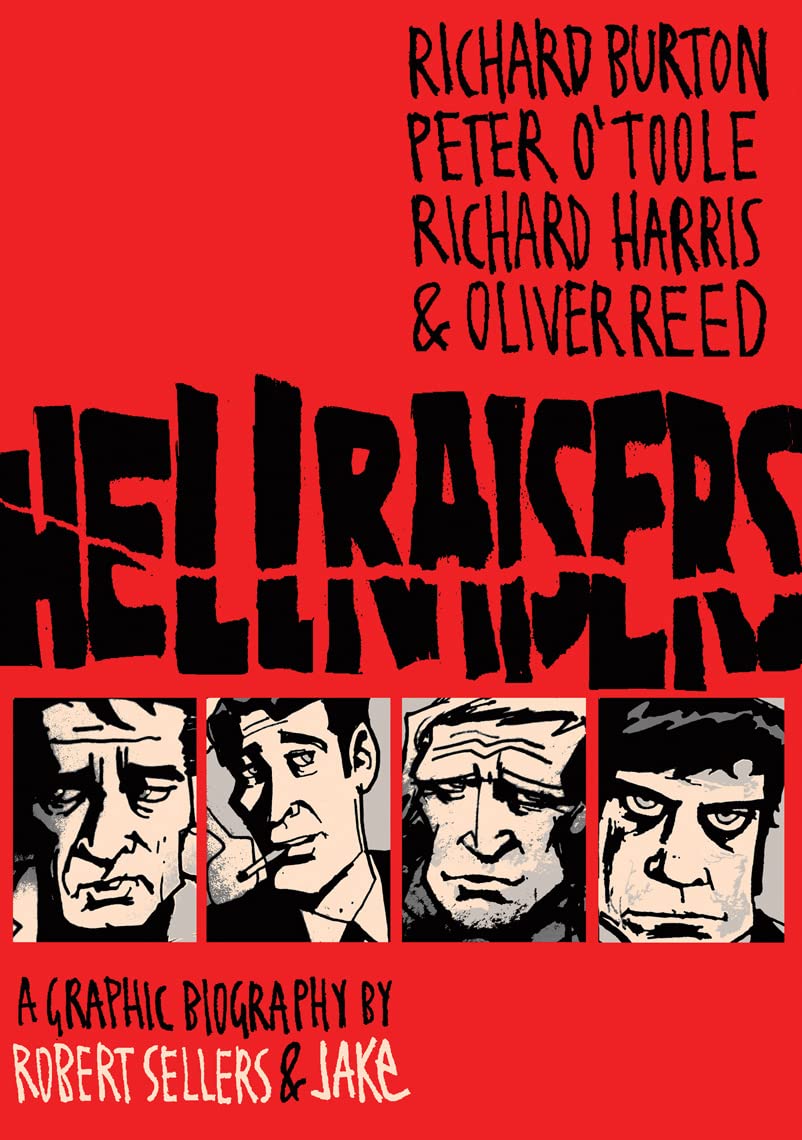
Hellraisers


By Robert Sellers & JAKe (SelfMadeHero)
ISBN: 978-1-906838-36-2 (TPB/Digital edition)

Here’s a quandary for you. Why are we blessed with and so obsessed by the capacity for self-destruction? Answers on a beermat to…

Robert Sellers used to be a stand-up comedian – so he has his own perspective – before settling as an author and film journalist with prose biographies including Sting, Tom Cruise, Sean Connery and the Monty Python phenomenon to his name. He’s also contributed to periodicals and magazines like The Independent, Total Film, Empire, SFX and Cinema Retro. And he’s also been seen on TV quite a bit.

In 2009 he published a magnificent history of theatrical excellence and brilliant excess in his Life and Inebriated Times of Burton, Harris, O’Toole and Reed. Two years later, he revisited and reformatted the material in collaboration with prestigious illustrator, designer and animator JAKe (How to Speak Wookiee, cartoon series Geekboy, Mighty Book of Boosh, The Prodigy’s Fat of the Land and so much more, both singly and with the studio Detonator which he co-founded). The artist keeps himself to himself and lets his superb artistry do all the talking.

Self-adapted from his prose history of the iconic barnstorming British film and theatre legends Richard Burton, Richard Harris, Oliver Reed and Peter O’Toole, Sellers transformed Hellraisers into a pictorial feast of “why did he do THAT?!” These tales of lurid limelight reveal the unique and incredible lives of a quartet of new wave, working class thespian heroes; each more famed for boozing and brawling than for acting. The result is a masterful parable and celebration of the vital, vibrant creative force of rebellion.

The histories are diligently interpreted with savage, witty style – and with a heaping helping of barely-suppressed admiration – in ferociously addictive and expressive monochrome cartoon and caricature novelettes by the enigmatic JAKe.

Working on the principle that a Hellraiser is “a person who causes trouble by violent, drunken or outrageous behaviour” and cloaked in the guise of Charles Dickens’ A Christmas Carol, the salutary fables open as another drunken reprobate is thrown out of another pub. It’s Christmas Eve at the Rose & Crown of Broken Dreams and Martin should be home with his wife and son.

After again disgracing himself, and still shaking with DT’s and unexpunged rage, the pathetic drunk staggers back to his loving but scared family, only to pass out. He is awoken by his hellraising father who drank and smoked himself to death seven years previously.

Told that he has one last chance to save himself, Martin is warned that he will be visited by four spirits (no, sadly not that sort) who will regale him with the stories of their lives and fates and failures and triumphs…

What follows is a beguiling journey of bitter self-discovery as Burton, Harris, Reed and O’Toole (still alive at that juncture, but part of the visitation of “spooky buggers” as it’s just a matter of time, my dear boy…) recount their own soused-and-sodden histories, experiences and considerations in an attempt to turn around the piddling lightweight. They’re certainly not that repentant, however, and even proud of the excesses and sheer exuberant manly mythology they’ve made of their lives…

Managing the masterful magic trick of perfectly capturing the sheer charismatic force and personality of these giants of their craft and willing (or helpless?) accomplices in their own downfalls, this superb saga even ends on an upbeat note. However, that’s only after cataloguing the incredible achievements, starry careers, broken relationships, impossibly impressive and frequently hilarious exploits of debauchery, intoxication and affray perpetrated singly and in unison by the departed, unquiet sozzled soul…

Jam-packed with legendary exploits and barroom legends of four astoundingly gifted men who couldn’t stop breaking rules and hearts (especially their own), and blessed/cursed with infinitely unquenchable thirsts for the hard stuff and the aforementioned appetites for self-destruction, this intoxicating, so very tasty tome venerates the myths these unforgettable icons promulgated and built around themselves, but never descends into pious recrimination or laudatory gratification.

It’s just how they were…

Sellers has the gift of forensic language, perfectly channelling the voices and idiom of each star even as JAKe perfectly blends shocking historical reportage with evocative surreal metafiction in this wonderful example of the power of sequential narrative.

Clever, witty and unmissable; isn’t it time you took a little nip to fortify yourself?
© 2010 Robert Sellers and JAKe. All rights reserved.

Superman: Infinite City


By Mike Kennedy & Carlos Meglia (DC Comics)
ISBN: 978-1401200664 (DC US TPB) 978-1845760731 (Titan Books UK HB)

This original graphic novel is a lightweight but lovely piece of fluff that sees investigative reporters Mr and Mrs Kent-Lane tracking down the source of a devastating super-gun, only to be sucked into a strange time-warped dimension. There they are embroiled in a civil war between greedy, slimy, power hungry industrialist Jesden Tyme and the robotic Mayor, who turns out to be a download of the consciousness of Superman’s long dead biological father Jor-El

Lavishly illustrated in the manner of an animated feature film, the European-flavoured stylizations of Argentinean Carlos Meglia (December 11 1957-August 15 2008: Irish Coffee, Bet Your Life, Star Wars) may not be to everyone’s taste but maybe you should just persist and be open to the new…

The plot from Mike Kennedy (Lone Wolf 2100, Star Wars: Underworld and the deeply under-appreciated Ghost/Batgirl, among others) lacks any real punch or originality of its own, relying on clichéd and oft-rehashed tropes, but there’s still bunches of wit and wonder to find over this particular rainbow. Moreover, the dialogue is sharp and effective, and some of the interplay between Lois and Clark is simply delightful. If you want a “done-in-one” delight starring comic books’ oldest power couple, this could be what you’re looking for.

There’s also a hardback British edition available should you want your reading unbending as well as pretty…
© 2005 DC Comics. All Rights Reserved.

Mac Raboy’s Flash Gordon volume 2


By Don Moore & Mac Raboy (Dark Horse)
ISBN: 978-1-56971-911-4 (TPB)

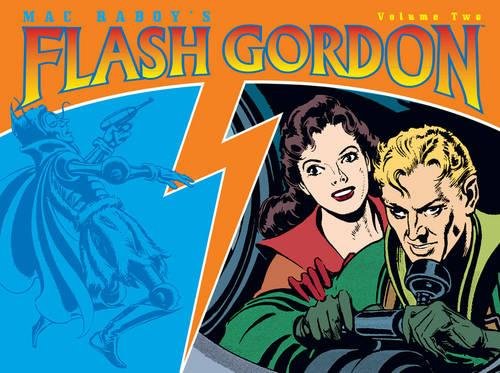
By almost every metric, Flash Gordon is the most influential comic strip in the world. When the hero debuted on Sunday January 7th 1934 (with the equally superb Jungle Jim running as a supplementary “topper” strip). It was a slick, sophisticated answer to Philip Nolan & Dick Calkins’ revolutionary, ideas-packed, inspirational, but quirkily clunky Buck Rogers (which had also launched on January 7th – albeit in 1929), two fresh elements were added to the wonderment: Classical Lyricism and Poetic Dynamism. The newcomer became a weekly invitation to stunningly exotic glamour and astonishing beauty.

Where Buck merged traditional adventure with groundbreaking science concepts, Flash reinterpreted fairy tales, hero epics and mythology, draping them in the spectacular trappings of contemporary futurism, with the varying “rays”, “engines” and “motors” of modern pulp sci fi substituting for trusty swords and lances. There were also plenty of those too – and exotic craft and contraptions stood in for galleons, chariots and magic carpets. The narrative trick made the far-fetched satisfactorily familiar – and it was initially continued by Mac Raboy and Don Moore in their run of Sunday strips.

Look closely, though, and you’ll see cowboys, gangsters and of course, flying saucer fetishes adding contemporary flourish to the fanciful fables in this second superb volume which is long overdue for a fresh edition.

Most important of all, the sheer artistic talent of Alex Raymond, his compositional skills, fine linework, eye for clean, concise detail and just plain genius for drawing beautiful people and things, swiftly made this the strip that all young artists swiped from. When original material comic books began a few years later, literally dozens of talented kids used Gordon as their model and ticket to future success in the field of adventure strips. Almost all the others went with Milton Caniff’s expressionist masterpiece Terry and the Pirates (and to see one of his better disciples check out Beyond Mars, limned by wonderful Lee Elias).

Flash Gordon began on present-day Earth (which was 1934, remember?) with a wandering world about to smash into our planet. As global panic ensued, polo player Flash and fellow passenger Dale Arden narrowly escaped disaster when a meteor fragment downed their airliner. They landed on the estate of tormented genius Dr. Hans Zarkov, who imprisoned them in the rocket-ship he had built. His plan? To fly the ship directly at the astral invader and deflect it from Earth by crashing into it!

Thus began a decade of sheer escapist magic in a Ruritanian Neverland: a blend of Camelot, Oz and a hundred other fantasy realms promising paradise yet concealing vipers, ogres and demons, all cloaked in a glimmering sheen of sleek scientific speculation. Worthy adversaries such as utterly evil yet magnetic Ming, emperor of the fantastic wandering planet; myriad exotic races and shattering conflicts offered a fantastic alternative to drab and dangerous reality for millions of avid readers around the world.

With Moore doing the bulk of the scripting, Alex Raymond’s ‘On the Planet Mongo’ ran every Sunday until 1944, when the artist joined the Marines. On his return, he forsook wild imaginings for sober reality: creating gentleman-detective Rip Kirby. The public’s unmissable weekly appointment with wonderment perforce continued under the artistic auspices of Austin Briggs – who had drawn the monochrome daily instalments since 1940.

In 1948, eight years after beginning his career drawing for the Harry A. Chesler production “shop” comic book artist Emmanuel “Mac” Raboy took over illustrating the Sunday page. Moore remained as scripter and began co-writing with the new artist.

Raboy’s sleek, fine-line brush style – heavily influenced by his idol Raymond – had made his work on Captain Marvel Jr., Kid Eternity and especially Green Lama a pinnacle of artistic quality in the early days of the proliferating superhero genre. His seemingly inevitable assumption of Flash Gordon’s extraordinary exploits led to a renaissance of the strip and in a rapidly evolving post-war world, it became once more a benchmark of timeless, hyper-realistic quality escapism which only Hal Foster’s Prince Valiant could match.

This second 260-page paperback volume, produced in landscape format and printed in stark black-&-white (although one or two strips appear to have been scanned from printed colour copies) covers May 17th 1953 to February 23rd 1958, and opens with a scholarly Introduction on ‘Comic Strip Godfathers’ from Bruce Jones before the previous volume’s cliffhanger is addressed…

With a new spaceship, far-flung travellers Flash, Dale and Zarkov set off for Earth but are forced to land on the Moon where a secret human base had been established. For unknown reasons Dr. Stella and her thuggish aide Marc detain and delay them, but after an increasing number of close shaves and mysterious accidents, a little digging by our heroes reveals that they are the unwitting guests of ruthless space pirates…

After expediently dealing with the planetary privateers, our heroes head for Earth, and are promptly seconded to spearhead an urgent exploratory expedition to a newly discovered satellite body. Suitably dutiful, they hurtle off into the void again…

‘(Life on) Titanran from 14th June to September 20th 1953: detailing how the little world is populated by giants. However, after capturing one of the hulking inhabitants, Zarkov concludes that the truth is far stranger than the Earthmen could have imagined…

The tireless boffin then builds a single-seater spaceship and requires Flash to take a test run out to Jupiter’s moon ‘Callisto’ (27th September 1953 to 17th January 1954). A sudden illness causes a crash and Flash awakens in care of elderly hermit Phylo, who cunningly embroils the dauntless troubleshooter in his own struggle against invisible psychic dictator The Mind

After overthrowing the hidden tyrant, the indomitable Earthman heads home and actually enjoys a little rest before an ancient mystery unfolds in ‘Flash Gordon and the Thanatos’ (17th January-2nd May).

After archaeologist Dr. Sark finds incontrovertible evidence of a prehistoric atomic blast in the Libyan desert, our ever-inquisitive action man uncovers an alien in a bottle but is too late to save Dale from being abducted by the mind-bending survivor of an antediluvian starship crash…

Dashing in pursuit as his beguiled beloved heads off-world, Flash is drawn into the parallel dimension of Cortinus where god-like beings dwell. They welcome intruders from fondly-remembered Earth, but are sadly unaware that one of the visitors carries the malevolent spirit of their outcast brother Loki. Once freed, the villain proudly boasts how he influenced and dominated many bellicose humans such as Alexander, Julius Caesar and Genghis Khan, and now intends ruling two realms for his own benefit and amusement. Sadly, nigh-omnipotent Loki vastly underestimates the ingenuity and resolve of his mortal opponents…

In a ship donated by head deity Zustra, Flash and Dale re-cross the dimensional divide, arriving in deep space to encounter a scene of horrific barbarity at an Observatory Station. When the ‘Outlaw of the Asteroids (9th May-25th July) took the outpost’s oxygen, the crew almost died in hibernation. After reviving the deep-frozen scientists, our adventurers set off after the ruthless bandit and discover the reason for his heinous theft was both noble and desperate. The bandit perishes for his sins, but not before leaving young space orphan Pebbles with the only humans he can trust…

By the time Flash, Dale and Pebbles reach Earth the next exploit is already well underway as a seed of ‘The Star Tree (1st August-17th October) survives a meteor crash in the Amazon and immediately propagates itself in fertile soil. By the time our bold wanderers accidentally land in the region, it has transformed into an arctic wilderness where a gigantic plant voraciously consumes every living thing its grasping branches can seize…

The vegetable invasion is no accident, and as Flash leads the frozen rain forest’s indigenous inhabitants in spirited resistance, cold-blooded aliens appear. They lived on Earth when it was a giant ice ball and after eons on Pluto want their original world back! They would have succeeded too, had not one of the invaders found his heart warming to the plight of the disputed world’s current tenants…

With that threat ended normality returns, but soon after packing Pebbles off to boarding school Flash, Zarkov and many other unsuspecting Earth folk are shanghaied by eerie metal globes and transported to ‘The Lonely Planet!’ (24th October 1954 to 9th January 1955)…

Here, Herculean extraterrestrial barbarians and wily midgets conspire and compete to find fresh fodder for gladiatorial contests, before, with the aid of a usurped king, Flash upsets the unlikely alliance and overthrows the twisted regime. However, just as the liberated Earthlings enter home orbit, their always-embattled birthworld is attacked by insectoid Antomni who require a fresh colony to exploit. The bug beings expect little resistance as they possess the power of Time Migration…

The invaders travel millions of years ‘Into the Past(16th January-27th March) to prevent the evolution of humanity but accidentally catch Flash and Zarkov in their temporal backwash, allowing our heroes to inspire a band of Nearly humans to exterminate the insectoids before returning to their proper time and place…

Restless Zarkov then organises an exploratory expedition to ‘Venus(3rd April -19th June) where Flash and Dale find a feudal civilisation in turmoil beneath the planet’s impenetrable cloud layers. Before long, they are assisting scientific prodigy Viko and his fellow exiled “Mistiks” in overturning oppressive, superstition-ruled authorities and introducing rational enlightenment to the Second Planet from the Sun…

Next, Africa is beset by a strange sleeping plague. Investigations reveal the source is escaped gasses from an unsuspected ‘City Within the Earth(26th June – 28th August). The accident causes toxic oxygen to contaminate the subterranean metropolis of Centra, and when its bravest warriors surface to investigate, a concatenation of misfortunes compel them to take Flash captive. Imprisoned and soon to become the treasured possession of flamboyant Princess Amara, Gordon is rescued by indomitable Dale who braves the depths and deadly air to save her man and seal off the underworld forever…

‘The Dark Planet(4th September – 6th November) has lurked undetected at the edge of the solar system for all of humanity’s history, but that occlusion ends when murderers Stragg, Rust and Tula are exiled from their advanced culture on the distant world of Ur and dumped on the frigid world. When Flash, Dale and Zarkov’s planetary mapping mission brings them to the bleak outpost, they are ambushed by the killers who then steal their ship. The aliens have never encountered human cunning though, and are soon back where they started and engaged in a lethal duel for control of the ship and their liberty…

Human trafficking underpins ‘Station Crossroads(13th November 1955 – 15th January 1956) as our heroes stumble upon a scheme to kidnap and sell human technicians to scientifically backward aliens. The vile human mastermind behind the plot operates out of Earth’s most popular orbital rest-stop, but before the slavers are crushed Flash discovers a close friend is deeply involved in the abductions…

When Gordon discovers a hidden base at Earth’s North Pole is being used by aquatic aliens, he is embroiled in an ‘Arctic Adventure(22nd January-March 25th) where unscrupulous Earthmen use the freezing waters as a cost-free fish-farm to grow giant monsters for mysterious offworlders to consume…

After a far-distant world experiences an atomic accident, the aftermath produces a voracious ‘Radioactive Man (1st April – 3rd June) who can only exist by absorbing deadly fallout. The authorities’ solution is to blast the mutant into the void where, after years of lonely travel, atomic exile Djonn Toth lands on planet Rota just as Flash and Dale pay a visit.

Before long the humans’ vast troubleshooting experience is employed to frustrate Toth’s efforts to enslave the population and consume all their radium.

When the fantastic wonder planet’s eccentric orbit again intersects with Earth, Flash, Dale and Zarkov ‘Return to Mongo(10th June 1956- 13th January 1957) after six years. However, their proposed sightseeing trip inevitably involves them in an icily arctic cold war between Wolf Men and Walrus Men, a face-off with would-be supreme tyrant Gant, and clashes with leather-winged Dactyl Men. This leads to capture by arrogant cloud dwellers of Paxora where robot duplicates intent on conquest end Mongo’s most secretive sub-culture.

Upsetting the artificial men’s plan eliminates all but one of the inimical automatons, but ‘Rok(13th January – 10th March) is like no android the Earthlings have ever encountered before: patronising protector and unstable enemy in one. Despite safeguarding them through Mongo’s wildest regions, the mechanoid’s ultimate aims remain unclear and his manner of demise most unexpected…

Brought to the edge of civilisation Flash, Dale and Zarkov enter a spaceship race, intent on winning a craft able to take them home to Earth, but the ‘Suicide Run(17th March-19th May) almost proves their undoing, as most other competitors indulge in sabotage and subterfuge of every sort to secure the glittering prize…

Eventually victorious, our heroes ‘Escape from Mongoonly to be lured into ‘The Space Tomb(26th May – 14th July) of the Gatherer: a nebula-dwelling desperado who wants to imprison them beside a legion of other valiant explorers in his vast Sargasso of Space.

After outwitting the deranged collector, the humans resume their homeward flight but are again diverted, this time by ‘The Space Genie(21st July-1st September): a fearsome yet affable, lethally literal-minded being who brings them to planetary paradise Superba. The inhabitants are not pleased: they only just survived the Genie’s last visit and used all their ingenuity and wish-making ability to get rid of the interstellar pest…

The odyssey home is then interrupted by a string of short interconnected adventures (‘Space Voyage/Strange World/The Wheel Men: spanning 8th September to 24th November) detailing clashes with space moths, elastic primitives and woman-stealing whirling dervishes engaged in all-out war with sky-residing Gyromen. After brokering a lasting peace between these eccentric extraterrestrials, the humans finally reach Earth in a borrowed flying saucer only to fall prey to ‘The Mystery of the Lonely Crowds!’ (1st December 1957 through January 12th 1958). A telepathic plague of depression and rapidly-spreading isolation has an otherworldly cause but is not intended to be a menace. It still culminates in tragedy, however…

This non-stop rollercoaster ride concludes with the merest start of ‘Missiles from Neptune’ (19th January 1958 to the cliffhanging last page of February 23rd) as the Tyrant of Neptune decides to impress the captive populace. This he does by testing his latest Weapons of Interplanetary Destruction against the Earth, prompting Flash to go and discourage him…

Every week that he toiled on the strip, Mac Raboy produced ever-more expansive artwork filled with distressed damsels, deadly monsters and all sorts of outrageous adventure that continued until the illustrator’s untimely death in 1967.

Perhaps that was a kindness. Raboy was the last great Golden Age romanticist illustrator: his lushly lavish, freely flowing adoration of the perfect human form was beginning to stale in popular taste (the Daily feature had already switched to the solid, chunky, He-Manly burly, realism of Dan Barry and Frank Frazetta) but here at least the last outpost of ethereally beautiful heroism and pretty perils prevailed, and you can visit as easily and often as Flash and Dale popped between planets, just by tracking down this book and the ones which followed…
© 2003 King Features Syndicate Inc. ™ & © Hearst Holdings, Inc. All rights reserved.