Lola’s Super Club: “My Dad is a Super Secret Agent”


By Christine Beigel & Pierre Foiullet, translated by Jeff Whitman (Papercutz)
ISBN: 978-1-5458-0563-3 (HB) 978-1-5458-0564-0 (TPB)

Win’s Christmas Gift Recommendation: Fantastic Fantasy Fun… 8/10

Once upon a time, stories designed to enthral and entertain young girls were a prolific staple of comics output. However, by the end of the 20th century the sector had all but faded from the English-speaking world, but enjoyed a splendid resurgence – particularly in America – as the graphic novel market expanded to its current prominence.

Based in New York, Papercutz are committed to publishing comics material for younger readers – especially girls – and combine licensed properties such as The Smurfs, Gumby and Nancy Drew with compelling new concepts such as The Wendy Project and intriguing European imports like Brina the Cat and Chloe. They’ve recently taken on the challenge of finally introducing Asterix to poor, culture-deprived New Worlders. I must check that out on your behalf of course…

An eagerly anticipated transatlantic transplant soon to be yours, Lola’s Super Club is the brainchild of prolific children’s novelist Christine Beigel & comics veteran Pierre Fouillet (co-creators of Le Chat Pelote: Adoptez Moi!) detailing the manically frenetic exploits of a little lass blessed with a superabundance of imagination.

Lola is able to animate her cat Hot Dog and selected favourite toys – such as the size-changing lizard Super James (in undies) – to accompany her on adventures across all Time and Space as the irrepressible Super-Lola…

This initial outing offers two complete adventures in one sleek volume (available in hardback, paperback and in digital editions) as Lola and her crew come to the rescue of her father Robert Darkhair (AKA superspy James Blond – an Agent so Top Secret, even he doesn’t know he’s licensed to thrill…) in eponymous romp ‘My Dad is a Super Secret Agent’.

To save him from arrogant Arch Fiend/shabby supervillain Max Imum, his sinister talking hounds Zero and Zero and his diabolical witch mother Mini Mum, Super Lola engages in a frantic chase from home in Friendly Falls, USA through sordid sewers and dank dungeons, into the stratosphere and through terrifying jungles, encountering and defeating or befriending skeletons, monsters, jungle men and pirates before she can declare her mission accomplished and her dad and missing mother reunited safely at home…

Further helter-skelter Imagineering ensues in second adventure ‘My Mom is Lost in Time’ after Lola and her gang – sorry, “Club” – are sucked into a TV show and end up battling bears at the frozen pole, fleeing dinosaurs in the Jurassic, and clashing with Egyptian crocodile god Sobek, while making history in all the wrong places…

However, with every stopover in significant moments the Super Club is getting closer to home and to Lola’s absent mum…

Fun, fast-paced and furiously inventive, these fanciful feasts combine imagination and discovery with a solidly positive message of family solidarity and free expression every child desperately needs to experience and absorb. Make sure this book is in your young’uns’ stocking this year and that the subtext becomes part of their life story, no matter how far-fetched or extraordinary…
© Christine Beigel + Pierre Fouillet, 2010. © Bang. Ediciones, 2011, 2013 All rights reserved. English translation and all other material © 2020 by Papercutz. All rights reserved.

Lola’s Super Club: “My Dad is a Super Secret Agent” is scheduled for release on December 8th 2020 and is available for pre-order in both print and digital editions.

Scooby-Doo! Team-Up volume 1


By Sholly Fisch, Dario Brizuela & various (DC Comics)
ISBN: 978-1401249465 (TPB)

Win’s Christmas Gift Recommendation: All-Ages Fun and Frolic… 8/10

It’s been bad year for everybody, but from my selfish and blinkered perspective, the graphic arts have been particularly diminished by the loss of many giants. Here’s an offhand tribute to two more…

The links between kids’ animated features and comicbooks are long established and, I suspect, for young consumers, indistinguishable. After all, it’s just adventure entertainment in the end…

Although never actual comics workers, animation titans and series writers Joe Ruby (March 30th 1933-August 26th 2020) and Ken Spears (March 12th 1938-November 6th 2020) co-originated dozens of cartoon shows which ultimately translated into multi-million comic book sales, joy and glee for generations and a subtle reshaping of the World’s cultural landscape. They also popularised the superhero concept on TV, through shows such as Superman, The Plastic Man Comedy/Adventure Show and Thundarr the Barbarian, consequently employing former funnybook creators such as Doug Wildey, Alex Toth, Steve Gerber, Jack Kirby and other comics giants. For all this, they are most renowned for devising mega-franchise Scooby-Doo, Where Are You!

Over decades of screen material, Scooby-Doo and his sidekicks Shaggy, Velma, Daphne and Freddy became global icons, and amidst the mountain of merchandise and derivatives generated by the franchise was a succession of comic book series from Gold Key (30 issues beginning December 1969 and ending in 1974), through Charlton (11 issues 1975-1976), Marvel (9 issues 1977-1979), Harvey (1993-1994) and Archie (21 issues, 1995-1997). The creative cast included Phil DeLara, Jack Manning, Warren Tufts, Mark Evanier, Dan Spiegle, Bill Williams, and many others.

In 1997, DC Comics acquired all the Hanna Barbera properties for its Cartoon Network imprint, which was for a very long time the last bastion of children’s comics in America. It produced some truly magical homespun material (such asTiny Titans, Batman: Brave and the Bold or Billy Batson and the Magic of Shazam!) as well as stunning interpretations of such television landmarks as Powerpuff Girls, Dexter’s Laboratory, Ben 10 and vintage gems such as The Flintstones and Scooby Doo…

In 2013, the mystery-solving pesky kids fully integrated with the DCU via a digital series of team ups that inevitably manifested as comics books and graphic novels. Compiling material from Scooby-Doo! Team-Up #1-6 (January-November 2014) this first fabulous trade paperback – or eBook – features a wild parade of joint ventures from writer Sholly Fisch illustrator Dario Brizuela, colourists Franco Riesco & Heroic Age and letterers Saida Temofonte & Deron Bennett.

It all begins with Mystery Inc. aiding Dynamic Duo Batman and Robin in a hunt for mutated scientist Kirk Langstrombefore being diverted by a gang of fake flyers in ‘Man-Bat and Robbin’!’ after which issue #2 asks ‘Who’s Scared?’ As the Caped Crusader and Ace, the Bat-Hound enjoy seeing the original Scooby gang admitted to the legendary Mystery Analysts of Gotham City, the terror-inducing Scarecrow strikes, and only the canine contingent can resist his latest fear chemicals…

Still visiting Gotham City, the gang discover ‘Two Mites Make It Wrong’ as impulsive imp Bat-Mite starts his reality-altering pranks again and normality is only possible through the intervention of unforeseen antithesis Scooby-Mite…

Channelling a contemporary surreal TV hit, ‘Teen Titans – Ghost!’ then brings the Mystery Machine to Jump City for a spot of haunting at Titans Tower, before Daphne and Velma visit Wonder Woman on Themyscira and indulge in a Kanga rodeo whilst the boys mess about in the invisible jet before reuniting to solve a mythological monster mystery causing ‘Trouble in Paradise’…

This initial outing concludes with a mass masked hero marathon when a visit to the Super Friends‘ Hall of Justice leads to a ghost hunt. Mystery soon solved, the gang, Wonder Twins Zan and Jayna, the Justice League of America and Supergirl then must all battle the notorious Legion of Doom in ‘A (Super) Friend in Need’…

Despite being ostensibly aimed at TV kids, this fast-paced, funny and superbly inclusive parcel of thrills skilfully revisits the charm of early DC in stand-alone mini-sagas no self-respecting fun-fan should miss: accessible, entertaining, well-rendered yarns for the broadest range of excitement-seeking readers. This is a terrific tome offering perfect, old fashioned delight. What more do you need to know?
© 2014, 2015 Hanna-Barbera and DC Comics. All Rights Reserved. Batman, Robin, Superman, Wonder Woman and all related characters and elements are ™ DC Comics. Scooby-Doo and all related characters and elements are ™ and © Hanna-Barbera.

Wallace & Gromit in A Grand Day Out


By Nick Park, illustrated by David Lopez (Egmont)
ISBN: 978-1-40524-532-6 (HB) 978-0-56338-008-5 (PB)

No matter how old you get, there are always new experiences to enjoy and endure. Here I am, in my personal end of days, gearing up for my first ever digital Yule season. With that in mind, I’ll be thinking of appropriate reading matter that we should all start sorting out now...

Hard though it is to believe, Wallace and Gromit have been delighting us for over thirty years and this delightful commemorative edition celebrated the fact in fine style by coming full circle. According to Nick Park’s informative Foreword the ingenious, quintessentially English cheese-loving duo were originally conceived as an art school graphic novel, before the Plasticene lure of movement and sound diverted the concept to the world of animation.

David Lopez sensitively adapts with a soft, water-coloured grace the classic tale of an ingenious man and his dog on an epic hunt for cheese that leads them to the moon and a unique confrontation with the dreamy robot that guards its edible treasures.

Lovingly rendered, perfectly timed, the skilful blend of low comedy and whimsy is just as memorable in two dimensions as four, and this book is going to make a lot of kids – of all ages – wonderfully happy.

Is it ever too soon to start recommending what to buy for Christmas? If not then consider this a “must have”…
© and ™ Aardman Animations Ltd. 2009

Ken Reid – World Wide Weirdies volume 1


By Ken Reid (Rebellion)
ISBN: 978-1-78108-692-6 (HB)

Win’s Christmas Gift Recommendation: Hopelessly Hilarious Horrendousness… 10/10

If you know British Comics, you’ll know Ken Reid.

He was one of a select and singular pantheon of rebellious, youthful artistic prodigies who – largely unsung – went about transforming British Comics, entertaining millions and inspiring hundreds of those readers to become cartoonists too.

Reid was born in Manchester in 1919 and apparently drew from the moment he could hold an implement. Aged nine, he was confined to bed for six months with a tubercular hip, and occupied himself by constantly scribbling and sketching. He left school before his fourteenth birthday and won a scholarship to Salford Art School, but never graduated.

He was, by all accounts, expelled for cutting classes and hanging about in cafes. Undaunted, he set up as a commercial artist, but floundered until his dad began acting as his agent.

Ken’s big break was a blagger’s triumph. Accompanied by his unbelievably supportive and astute father, Ken talked his way into an interview with the Art Editor of the Manchester Evening News and came away with a commission for a strip for its new Children’s Section.

The Adventures of Fudge the Elf debuted in 1938 and ran until 1963, with only a single, albeit lengthy, hiatus from 1941 to 1946 when Reid served in the armed forces.

From the late 1940s onwards, Reid dallied with comics periodicals: with work (Super Sam, Billy Boffin, Foxy) published in Comic Cuts and submissions to The Eagle, before a fortuitous family connection – Dandy illustrator Bill Holroyd was Reid’s brother-in-law – brought DC Thomson managing editor R.D. Low to his door with a cast-iron offer of work.

On April 18th 1953 Roger the Dodger debuted in The Beano. Reid drew the feature until 1959 and created numerous others, including the fabulously mordant doomed mariner Jonah, Ali Ha-Ha and the 40 Thieves, Grandpa and Jinxamongst many more.

In 1964, Reid and fellow under-appreciated superstar Leo Baxendale jumped ship to work for DCT’s arch rival Odhams Press. This gave Ken greater license to explore his ghoulish side: concentrating on comic horror yarns and grotesque situations in strips like Frankie Stein, and The Nervs in Wham! and Smash! as well as more visually wholesome but still strikingly surreal fare as Queen of the Seas and Dare-a-Day Davy.

In 1971 Reid devised Faceache – arguably his career masterpiece – for new title Jet. The hilariously horrific strip was popular enough to survive the comic’s demise – after a paltry 22 weeks – and was carried over in a merger with stalwart periodical Buster where it thrived until 1987. Ken Reid died that year from the complications of a stroke he’d suffered on February 2nd at his drawing board, putting the finishing touches to a Faceache strip. On his passing, the strip was taken over by Frank Diarmid who it until cancelation in October 1988.

All his working life, Reid innovated; devising a horde of new strips such as Harry Hammertoe the Soccer Spook, Wanted Posters, Martha’s Monster Makeup, Tom’s Horror World, Creepy Creations and a dozen others. One of those – and the worthy subject of this splendid luxury hardback (and eBook) – is World-Wide Weirdies.

A full colour back page every week found Ken crafting a batty and bizarre image – usually suggested by a lucky reader – depicting a pun-ishingly strained groaner gag elevated to a manic masterpiece. Most were locations but just plain crazy stuff like ‘the Aussie Doomerang’, ‘The Gruesome Gondola’ and the staggering visual ‘Jumbo Jet’ also got in. Where was first in Whooppee! and then Shiver and Shake with this first titanic hardback tome – also available digitalis-ly (see what I did there?) – covering 12th October 1974 to 6th November 1976, but you don’t care about that, what you want is ‘orrible, pictures right?

Preceding 108 of them is text feature ‘The Weirdies Years of Ken Reid – 1974-1978’ by his son Antony J. Reid which precedes a unique map indicating where in the weird wide world the 108 ghastly holiday destinations from hell are located…

The atlas of the unknowable then commences with ‘The Petrifying Pyramid’ with subsequent shocking submissions such as the ‘Trifle Tower’, ‘Vampire State Building’, ‘Bone Henge’, ‘Mucky-Hand Palace’ and the still horrifically relevant ‘Houses of Horrorment’…

We aren’t just restricted to UK unpleasantries such as ‘The Fright Cliffs of Dover’ or ‘The Cheddar Gorger’ but also an assemblage of international oddities such as ‘The Sahara Dessert’, ‘Shock Rock of Gibraltar’, ‘Gruesome Grand Canyon’, ‘The Not So N-Iceberg’, ‘The Coloscream’ and – so pertinent today, apparently – ‘The Statue of Stupidity’…

This astoundingly absorbing comedy classic is another perfect example of resolutely British humorous sensibilities – absurdist, anarchic and gleefully grotesque – and these cartoon capers are amongst the most memorable and re-readable exploits in all of British comics history: painfully funny, beautifully rendered and ridiculously unforgettable. This a treasure-trove of laughs to span generations which demands to be in every family bookcase. Part of Rebellion’s ever-expanding Treasury of British Comics, this is a superb tribute to the man and a brilliant reminder of what it means to be brutish…
© 1974, 1975, 1976, & 2019 Rebellion Publishing Ltd. All Rights Reserved.

Papyrus volume 5: The Anger of the Great Sphinx


By Lucien De Geiter: colours by Georges Vloeberghs & translated by Erica Jeffrey (Cinebook)
ISBN: 978-1-84918-115-0 (Album PB)

Papyrus is the rapturously beguiling masterwork of Belgian cartoonist Lucien de Gieter. It premiered in 1974 in legendary weekly Le Journal de Spirou, running to 35 albums and consequently spawned a wealth of merchandise, a television cartoon show and a video game.

De Gieter was born in 1932 and studied at Saint-Luc Art Institute in Brussels before going into industrial design and interior decorating. He made the jump into sequential narrative in 1961, first through ‘mini-récits’ (fold-in, half-sized booklets) inserts for Spirou, starring his jovial cowboy Pony, and later by writing for art-star regulars such as Kiko, Jem, Eddy Ryssack and Francis.

He later joined Peyo’s studio as inker on Les Schtroumpfs (The Smurfs) and took over the long-running newspaper strip Poussy.

In the 1960s, De Gieter launched mermaid fantasy Tôôôt et Puit whilst Pony was promoted to the full-sized pages of Spirou, thereafter deep-sixing the Smurfs to expand his horizons by going to work for Le Journal de Tintin and Le Journal de Mickey.

From 1972-1974 he assisted cartooning legend Berck on Mischa for Germany’s Primo, whilst he perfected his newest project: a historical confection which would occupy his full attention and delight millions of fervent fans for the following four decades.

The annals of Papyrus encompass a huge range of themes and milieux, mixing Boy’s Own adventure with historical fiction, fantastic fantasy and interventionist mythology: the epic yarns gradually evolving from traditional “Bigfoot” cartoon style and content towards a more realistic, dramatic and authentic iteration. Moreover, each tale readily blends light fantasy escapades with the latest historical theories and discoveries.

Papyrus is a fearlessly forthright young fisherman favoured by the gods who quickly rises to become a hero of Egypt and friend to Pharaohs. As a youngster the plucky Fellah was singled out and given a magic sword courtesy of the daughter of crocodile-headed Sobek.

The youthful champion’s first task was to free supreme deity Horus from imprisonment in the Black Pyramid of Ombos, thereby restoring peace to the Double Kingdom, but his most difficult and seemingly never-ending duty is to protect Pharaoh’s wilful, high-handed and insanely danger-seeking daughter Theti-Cheri – a princess with an astounding knack for finding trouble…

Avaliable in paperback and digital editions, The Anger of the Great Sphinx is the fifth Cinebook translation (20th album of the series and originally released in 1997 as La Colère du grand Sphinx); a spooky testing of faith through vile supernatural villainy, all eventually thwarted by unflinching daring and honest devotion…

The eerie escapade opens when restless Papyrus discovers the princess sleepwalking in the corridors of Pharaoh’s great Palace in Memphis. Cautiously following, he trips over court jester Puin. By the time he recovers his feet, Theti-Cheri has seized a waiting chariot and hurtled into the dark desert beyond the gates. Extremely alarmed, the lad leaps astride Puin’s phenomenally intelligent donkey Khamelot and rushes after her…

In the bleak wastes, Papyrus is attacked by a living sandstorm threatening to end the line of Pharaohs, but successfully drives it off with his magic sword, just as terrified Puin catches up. As the sun rises, they see they’re near the venerable complex of pyramids and Re Harmakhis, Guardian of the Horizon. The mighty monuments and the Great Sphinx are all but buried under the eternally shifting sands…

Nervous Puin wants to return to the city, leaving such great concerns to Pharaoh and the gods, but Papyrus refuses to abandon the mesmerised princess who can be seen between the paws of the great statue. As he approaches, the stone beast roars that Theti-Cheri now belongs to him because her father has broken an ancient pact to keep the sands from covering him and his temples.

As assign of his dissatisfaction, the princess will die at sunset…

Desperate for a solution, our hero agrees to give the insidious sandstorm his magic sword if it will save the princess and the swirling devil advises the lad to find Anty, the Divine Ferryman and seek passage to the Island of the Gods where he can petition the Divinities for merciful intervention…

Dashing to the Nile with Puin and Khamelot in hot pursuit, Papyrus matches wits with the duplicitous Ferryman – a conniving talking crocodile boat with a grudge against the boy from previous encounters.

Once again, the rogue vessel tries to cheat and bamboozle the boy. Whilst ostensibly taking the trio to the gods’ home, Anty plies the humans with a hallucinogenic drink – resulting in a stunning and baroque display of the author’s spectacular imagination and artistic virtuosity – before leaving them unconscious in a bed of reeds.

Here they are discovered by trio of sibling dotards – dubbed Pepi I, Pepi II and Pepi III – who minister to them. They are in turn saved by Papyrus when bullying brigands try to rob their hovel. The elders are fishermen now, but once they were paid by Pharaoh to keep the Sphinx and pyramids clear of sand. In recent years though they appear to have been forgotten…

With horror the boy realises they have been left back near the Sphinx and the day is fast fading. With ho hope left of gaining the gods’ aid, he rushes off to find Anty and teach the conniving Ferryman the error of his wicked ways before returning to hand his wonderful sword over to the smugly triumphant sandstorm…

At his most despondent moment, through the roaring sand Papyrus sees the Pepis. The elderly janitors have organised the entire village: young and old alike are toiling amid the storm to clear the Sphinx for the sake of their beloved princess.

When Khamelot inadvertently reminds the frantically labouring peasants of a tried-and-true – albeit noxious – way to dampen down the swirling grains and make them more manageable, the furiously screaming storm devil is at last beaten and blows away…

In the quiet still morning, the Sphinx is again free from obstruction and obscurity, but Papyrus is heartbroken to see that it is all too late.

Carrying the corpse of Theti-Cheri into the desert he denies his faith, screaming at the gods who have been so unfair… and they answer, revealing the foolish mistake the passionate, impatient lad has made…

With the princess joyously restored and Re Harmakhis gleaming in all his golden glory, Pharaoh at last arrives in a blare of trumpets to reaffirm his dynasty’s obligations and devotion to the gods, elevating the three Pepis to the exalted station of Eternal Guardians of the Sphinx. The newly appointed opponents of the shifting sands have recently taken possession of a certain magic sword and gratefully return it to the boy who restored their family fortunes…

Epic, chilling, funny, enthralling and masterfully engaging, this is another amazing adventure to thrill and beguile lovers of wonder from nine to ninety-nine, again proving Papyrus to be a sublime addition to the family-friendly pantheon of continental champions who wed heroism and humour with wit and charm, and anybody who has worn out those Tintinand Asterix albums would be wise beyond their years to add these classic chronicles to their dusty, well-beloved bookshelves. Let’s hope Cinebook will soon resume translating the rest for our eager eyes…
© Dupuis, 1997 by De Gieter. All rights reserved. English translation © 2012 Cinebook Ltd.

The Kurdles


By Robert Goodin (Fantagraphics Books)
ISBN: 978-1-60699-832-8 (HB)

The power of strip and picture books is that they can jump right through your eyes, bombarding but bypassing your brain and lodging straight into your heart. If you don’t believe me, just read Sock Monkey: Into the Deep Woods, A Wish for Wings That Work, Usagi Yojimbo, The Moomins and the Great Flood, Bone, Copper, The Squickerwonkers, Pogo or The Velveteen Rabbit.

In fact, read them anyway. You can never read enough.

You should also add to that list this splendidly eerie, all-ages cartoon tale from illustrator and animator Rob Goodin (Duckman, The Wild Thornberries, American Dad!) which blends – in the best tradition of the genre – crippling loneliness, astounding wonder and the finding of a new family; all delivered in a gloriously illustrated, magnificently oversized (305 x 222 mm) full-colour hardback tome that will take your breath away. It just as much a menace to respiration if you consume digitally, so you might do that too…

When little Ellie starts acting up again, poor Sally Bear gets flung out the car window on a cold, rainy night and left in the wilds to rot.

The trenchant little toy is made of far sterner stuff, however and, picking herself up, gamely wanders the terrifying great outdoors, narrowly avoiding doom and destruction from assorted beasts and natural hazards.

Battered and bedraggled, Sally eventually finds her way deep into a swamp where a bizarre conurbation exists. More accurately, one of the denizens of Kurdleton finds her, dragging the bedraggled bear back to a band of little weirdoes who extend jolly hands of friendship the damaged bear is too proud and standoffish to accept with any grace at all…

Claiming all she needs are directions back to the road, Sally is nevertheless soon embroiled in the jovial strangers’ ongoing crisis: their magnificent dwelling has contracted a strange malady and is growing hair and eyes…

Soon a case of Casa Pilosa – an infamous “Disease of the American Home” – is diagnosed. This house is coming alive…

That’s all the plot you get, and you’ll thank me for that when you see for yourselves this fabulously moving, suspensefully thrilling and wryly funny fractured fable of outcasts banding together into a potently different modern family.

Bold, beguiling and beautiful, The Kurdles is the kind of book you will remember forever.
The Kurdles © 2015 Robert Goodin. This edition © 2015 Fantagraphics Books, Inc.

Jaimie Smart’s Bunny vs Monkey volume 1


By Jaimie Smart, with Laura Bentley & Sammy Borras (David Fickling Books)
ISBN: 978-1-78845-177-2 (PB)

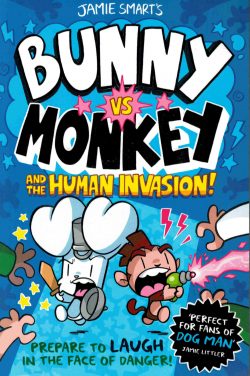
Concocted with gleefully gentle mania by cartoonist, comics artist and novelist Jamie Smart (Fish Head Steve!; Looshkin; Flember), Bunny vs. Monkey has been a fixture of British periodical sensation The Phoenix from the very first issue: a madcap duel of animal arch rivals set amidst the idyllic arcadia of a more-or-less ordinary English Wood. Those trend-setting, mind-bending antics were rapidly retooled as graphic albums and are now being re-released in remastered, double-length digest editions. In case you’re wondering, the fabulous fun found here originally inhabited volumes 1 & 2, entitled Let the Mayhem Begin and Journey to the Centre of the Eurg-th…

With precious little unnecessary build-up, the manic happy returns commence with a ‘Prologue!’ introducing placid, wise, helpful Bunny and not-so-smart pals Pig and Weenie Squirrel. The foolish innocents and lifelong residents of idyllic Crinkle Woods have found a hibernating bear which Bunny really wants them to stop trying to wake up…

Meanwhile, over the hill and not so far away, a bunch of boffins are attempting to launch a really annoying monkey into space…

This prompts a barrage of seasonal silliness in ‘Bunny vs. Monkey’, as the proposed launch goes hideously awry and the loud, stroppy, obnoxious simian lands in the snow-covered glade and instantly declares himself king of this strange alien world…

Monkey loves noise, strife, chaos and trouble and incessantly needs to raise a rumpus – everything genteel, contemplative Bunny abhors – so when our apish astronaut introduces techno music in ‘Keep it Down!’, the lines of battle are irrevocably drawn…

Thing escalate in ‘When Monkey Met Skunky’. This latter is a brilliant inventor with a bombastic line in animal-inspired terror weapons such as the Cluck Cluck Zeppelin used to bomb the woods with 10-year-old rotten eggs or the giant metal robot hands which give the destructive Monkey ‘Fists of Fury’…

Winter draws on with ‘Soggy ‘n’ Froggy’ wherein a monstrous Frog-O-Saurus becomes the wicked duo’s latest Weapon of Meadow Destruction, after which poor Pig is transformed into cyborg sensation Pig-O-Tron 5000 in ‘Robo-Chop’ as a simple change of pace sees Weenie and Pig put on a circus show to counter all the nasty animosity before getting painfully caught ‘Clowning Around’…

Up until now Monkey has been risking his own pelt road-testing all Skunky’s inventions, but when a bewildered former stuntman turns up, the sneaky simian is happy to leave all the dangerous stuff to ‘Action Beaver’…

March leads to a profusion of beautiful buds and blossoms which delight the soul of nature-loving Bunny.

Tragically they utterly disgust Monkey, who tries to eradicate all that flora in ‘Down with Spring!’ until he comes a-cropper thanks to a sack of spiky “Hodgehegs”, whilst in ‘Bonjour, Le Fox’, the spacy invader finally goes too far, forcing Bunny to align with a rather radical environmentalist possessed of a big, bushy tail and an outrrrrrageous French accent…

Some of Bunny’s friends are their own worst enemies. ‘Race to the Moon!’ sees Weenie and Pig build their own spaceship – out of natural materials like moss and mushrooms – only to have Monkey disastrously commandeer it, after which Skunky builds a terrifying cyber crocodile dubbed ‘Metal Steve!’ which ignores its perfidious programming to spend the day swimming. Such shameful failures thus compel Monkey to steal a steamroller to personally get rid of all that hateful, ugly cherry blossom infesting the trees in ‘Rollin’ Rollin’ Rollin’!’…

The war against nature intensifies as ‘Eat Your Greens!’ sees Skunky’s Caterpillar-Zilla devouring forest foliage until an authentic creepy-crawly steps in, whilst ‘The Whuppabaloo!’ shows the niffy tinkerer’s softer side as he drags Monkey on a wilderness trek to track down the most amazing thing in nature…

‘Hide and Squark!’ depicts the rabbit’s fightback, thanks to the double-dealing help of a certain giant parrot, after which a momentary détente for a spot of angling inevitably turns into another heated duel in ‘Fish Off!’ after which a brief falling out of the axis of evil in May ends as ‘Invisi-Monkey’ sees the strident simian squabbling with Skunky to possess a sneaky stealth suit. The status quo sees the villains reuniting to spoil a joyous game of Cake-Ball with their monolithic, monstrous ‘Mole-a-Rolla!’…

‘Black Gold’ finds Monkey attempting to turn the Wood into an oil field, before spoiling Bunny’s dream of a ‘Quiet Day!’with a giant Robot Cockroach…

Blazing June opens with ‘Bring Him Back!’ as Action Beaver attempts to retrieve watery wanderer Metal Steve whilst simple souls Weenie and Pig accidentally kick off an invention Armageddon which only intensifies after that long-slumbering ursine finally wakes up in ‘Who’s Afraid of the Big Bad Bear?’

‘The Bat!’ apparently introduces a nasty new faction to the ongoing conflict (but all is not as it seems!), and there’s no confusing the stakes when Bunny agrees to a winner-take-all fight in ‘Wrestlepocalypse!’ and Monkey learns that cheats never prosper…

Just when things seem likely to settle down, fresh chaos ensues when a violent piratical rabbit – with an eye-patch – storms in to cause stir up trouble in ‘Bunny B!’…

With battle reports spanning July to December, hostilities reach new heights and depths as Monkey and Skunky fail to make proper use of ‘The Wish Cannon!’ This reality-warping gun could change the world, but also makes really good cakes…

A far better terror-tool is colossally ravening robot ‘Octo-blivion!’, which ruins Bunny’s boating afternoon, but sadly the tentacled doom-toy becomes an irresistible object of amorous intent for irrepressible cyber crocodile Metal Steve before it can complete its nefarious machinations…

A hot day inspires Monkey to demand his bonkers boffin whip up some volcanoes, but their ‘Journey to the Centre of the Eurg-th!’ only unearths chilly regions and crazily cool creatures before the scene shifts to those not-so-smart but astonishingly innocent bystanders Pig and Weenie.

An afternoon playing with crayons results in a lovely drawing of a crown, and soon everyone is bowing down and obeying ‘King Pig’, after which surly radical environmentalist ‘Fantastique Le Fox!’ finds time to share his incredible origin stories with the dumbfounded woodland denizens. Yes, that’s right: stories, plural…

Hyperkinetic carnage is the order of the day when a cute little dickens turns up inside spiffy running-toy ‘Hamsterball 3000!’, providing Skunky with the perfect power source for his latest devastating mechanical marauder: the horrendous Hamster Mobile…

Puns, peril and a stinging hidden moral then inform proceedings when all the animals celebrate ‘Bee-Day!’ whilst a certain happily brain-battered, bewildered former stuntman turns into a tormented super-genius when he accidentally falls under the influence of Skunky’s Smarty Helmet in ‘Action Beever2.

Happily for everyone, before it wears off the increased cognition – in conjunction with a handy lemon puff – demolishes an unleashed Doomsday Device which might just have ended everything…

From September onwards the stories drop to four pages a pop as ‘Gone with the Wind!’ finds Pig and Weenie making trouble with their windsurfing cart after which ‘I, Robot Crocodile!’ sees Metal Steve on a destructive rampage until Bunny and Monkey team up to show the steel berserker the simple joys of dance…

‘There’s a Moose Loose!’ depicts Skunky back on bad form and trying to fool his enemies with a vast Trojan Elk before Monkey spoils everyone’s September by going big after being introduced to a sweet childhood game in ‘Conkers Bonkers!’ after which – with the Beaver temporarily bedridden – the perfidious pair of animal evildoers employ the rather dim ‘Action Pig!’ to test pilot their devilish Dragonfly 5000. Such a bad idea…

Tidy-minded Bunny has no hope of sweeping up all autumn’s golden detritus in ‘Leaf it Alone!’ once friends and enemies start helping out, and an extended sub-plot opens in ‘Duck Race!’ as impetuous Monkey pries into Skunky’s most deadly and diabolical secrets all stashed behind a locked door. In a frantic attempt to deflect attention, the smelly scientist then unleashes the colossal Lord Quack-Quack!

The saga sequels in a surprisingly downbeat follow-up as Bunny, Pig and Weenie dare the fiend’s lair to check out ‘Door B’ before scheduled insanity resumes as ‘Hypno-Monkey!’ finds the hirsute horror misusing a memory ray and briefly assuming godlike power…

Who doesn’t like igniting marshmallows and telling scary stories around a campfire? Not Bunny, Pig and Weenie after hearing the tale of ‘Monster Pants!’ leading to the local idiots deciding to join Monkey’s gang in ‘Bad Influence!’

The monkey is no one idea of a role model – except perhaps for painful ineptitude – as seen in ‘Lost in the Snow!’, but the winter fun expands to encompass everyone when Skunky’s ‘Chemical X!’ unleashes a chilled tidal wave of blancmange leading to seasonal silliness as ‘The Small Matter of the End of the World!’ exposes time-travelling madness as the true story of the demise of the Doomsday Device is finally exposed in an extra-length yarn…

Everything changes when ‘Merry Christmas Mr. Monkey!’ sees peace and goodwill grip the woods – or perhaps it’s just that the simian seditionist has gone missing? When the innocent inhabitants go looking for Monkey, they find him far beyond the forest associating with strange two-legged beings, singing carols and swiping mince pies, but nobody realises just how dangerous ‘Hyooomanz!’ can be as the year ends with plans found proclaiming the demolition of Crinkle Wood and the coming of a new motorway…

To Be Continued…

Adding lustre and fun, this superb treat includes detailed instructions on ‘How to Draw Bunny’ and ‘How to Draw Monkey’, so, as well as beguiling your littl’uns with stories, you can use this book to teach them a trade…

Endlessly inventive, sublimely funny and outrageously addictive, Bunny vs. Monkey is the kind of comic parents beg kids to read to them. Why isn’t that you, yet?
Text and illustrations © Jamie Smart 2020. All rights reserved.

Papyrus volume 4: The Evil Mummies


By Lucien De Geiter, coloured by Georges Vloeberghs & translated by Luke Spear (Cinebook)
ISBN: 978-1-84918-027-6 (Album PB)

Papyrus is the masterfully evocative magnum opus of Belgian cartoonist Lucien de Gieter. It premiered in 1974 in legendary weekly Le Journal de Spirou, running to 35 collected albums, and consequently spawning a wealth of merchandise, including an animated television show and a video game.

De Gieter was born in 1932 and studied at Saint-Luc Art Institute in Brussels before going into industrial design and interior decorating. He made the jump into sequential narrative in 1961, first through “mini-récits” (fold-in, half-sized booklets) inserted into LJdS, starring his jovial little cowboy Pony, and later by writing for art-star regulars such as Kiko, Jem, Eddy Ryssack and Francis. After that he joined Peyo’s studio as inker on Les Schtroumpfs (The Smurfs) and took over the long-running newspaper strip Poussy.

In the 1960s, De Gieter launched South Seas mermaid fantasy Tôôôt et Puit whilst Pony was promoted to the full-sized pages of Spirou, deep-sixing the Smurfs gig to expand his horizons working for Le Journal de Tintin and Le Journal de Mickey.

From 1972-1974, De Gieter assisted cartooning legend Berck on Mischa for Germany’s Primo, whilst applying the finishing touches to his latest project: a historical confection which would occupy his full attention and delight millions of fervent fans for the next forty years…

The annals of Papyrus encompass a huge range of themes and milieux, blending Boy’s Own adventure with historical fiction and interventionist mythology: the epic yarns gradually evolving from traditionally appealing “Bigfoot” cartoon style and content towards a more realistic, dramatic and authentic iteration, through means of light fantasy romps always leavened and flavoured with the latest historical theories and discoveries.

The named star is a fearlessly forthright peasant lad (specifically, a fisherman by trade) favoured by the gods who rises to become a hero of Egypt and friend to Pharaohs.

As a youngster the plucky Fellah was blessed by the divine powers and given a magic sword, courtesy of a daughter of crocodile-headed Sobek. The lad’s first task was to free supreme god Horus from imprisonment in the Black Pyramid of Ombos, thereby restoring peace to the Double Kingdom. However, his most difficult and seemingly never-ending duty is protecting Pharaoh’s wilful, high-handed and insanely danger-seeking daughter Theti-Cheri – a princess with an unparalleled gift for seeking out trouble…

The Evil Mummies is the fourth Cinebook tome (of, inexplicably, only six thus far). Available in paperback and in eBook formats, it translates the 19th European album in the run, which was originally released in 1996 as Les Momies maléfiques: a riotous rollercoaster of all-out action and fearsome fantasy which begins in the rocky fastnesses of the deep sands. Here Pharaoh’s headstrong daughter impatiently leads an expedition to retrieve the revered mummies of the fabled Ten Archers of Sekenenre Taa from the lost Hammamat mines, who legendarily fell defending the nation from the invading Hyksos.

The bodies are to be returned in honour and interred in Thebes, but first they have to find them…

Cheekily joining Theti-Cheri, her protector Papyrus and all the assorted, hurrying specialists is sometime court jester Puin, charged with caring for the precious pack animals – although it would be more accurate to say that his phenomenally intelligent donkey Khamelot is actually guiding all those reins…

In their haste to finish the mission, the party are shamefully negligent and forget to make proper obeisance to divine Seth, Master of the Desert Wastes, and soon a furious cloud image warns of the dark overlord’s wrath. Nervously shrugging it off, the expedition prepares for sleep but is suddenly devastated by a terrifying flash-flood manifesting from nowhere and brutally scattering the impious intruders.

Papyrus awakes battered and bruised above a lofty precipice. He has been saved from crushing doom by a great silver falcon, favoured beast of mighty Horus…

In trying to retrieve his magic sword the boy-hero triggers a flaming omen which points him a certain direction. Setting off into the scorching desert, he slowly follows a treacherous trail and with the falcon’s timely aid uncovers a deep crevice and shaft into a deep, long-forgotten mine. In a chamber far within the abandoned workings is a golden statue of Seth and ten roughly hewn coffins in a makeshift temple…

Curiosity overcoming caution, Papyrus uncovers a ghastly, poorly-preserved mummy in one but the second – already opened – casque holds Theti-Cheri herself: alive, but bound and gagged. When he cuts the princess loose, she descends into utter panic, frantically warning that she had been captured by walking corpses: the angry archers of Sekenenre Taa…

The boy warrior is saved from a lethal arrow by the ever-present falcon, but in his panicked flight is separated from his rattled companion, before plunging into open air and landing in the mine’s ancient water-filled well.

Recovering his wits, he trails Theti and finds her and the bird on a rooftop. She claims to have been saved by Horus himself.

Sadly, the aroused mummies are determined and unstoppable. With his magic sword useless against the already dead, Papyrus is about to be crushed by the restless revenants and is only rescued when the princess plunges one of the monsters’ own arrows into a dusty body…

Before long though, the buried temple is crawling with revived and raging mummy murderers and the terrified youths are again racing in panic. Spotting a trickle of water on a stony rock face, Papyrus smites the wall with his sword and a watery tumult catapults them to relative safety in the well.

With the water flooding away, however, the pair can see two huge golden statues of Horus at the bottom and realise that they must restore them to the temple to quiet the still-marauding mummies…

Seth unleashes more magical mischief to deter the already overwhelmed children, but Papyrus’ defiance and the fortuitous appearance of Khamelot quickly turn the tables after the unthinking dead things mistake the donkey for their own ghastly long-eared, long-nosed dark lord and rapidly retreat…

With aid from the faithfully following pack animals, the Horus statues are quickly restored to their rightful stations but Theti insists that the now-dormant archer mummies must be respectfully gathered up and transported to their proper resting place in Thebes as per her father’s plans…

As the bizarre entourage makes its laborious way back across the burning sands, more strange encounters plunge both princess and protector into another hidden tomb. This one holds the real, righteous, sacredly-interred Ten Archers of Sekenenre Taa. But if that’s the case, who or what have they been shipping back at such tremendous, exhausting effort?

Solving that enigma, the pair still have to defeat an army of bandits and pillagers even as the battle leads them to the impossible plain where the lost members of the original expedition have been enduring the slow punishment of Seth…

Epic, funny, enthralling and frenetically paced, this amazing adventure will thrill and beguile lovers of wonder from nine to ninety-nine, again proving Papyrus to be a sublime addition to the family-friendly pantheon of continental champions wedding heroism and humour with wit and charm. Anybody who has worn out those Tintin and Asterix albums would be wise beyond their years to unearth and acquire all these classic chronicles.
© Dupuis, 1996 by De Gieter. All rights reserved. English translation © 2010 Cinebook Ltd.

A Carrot for Iznogoud (Iznogoud volume 5)


By Goscinny & Tabary, translated by Anthea Bell & Derek Hockridge (Cinebook)
ISBN: 978-1-84918-021-4 (Album PB)

For the greater part of his too-short life, René Goscinny (1926-1977) was one of the most prolific and most-read writers of comic strips the world has ever seen. Incredibly, he still is.

Among his most popular comic collaborations are Lucky Luke, Le Petit Nicolas and of course Asterix the Gaul, but there were so many others, such as the dazzling, dark deeds of a dastardly usurper whose dreams of diabolical skulduggery all proved to be ultimately no more than castles in the sand…

Scant years after the Suez crisis, the French returned to the hotly contested deserts when Goscinny teamed with sublimely gifted Swedish émigré Jean Tabary (1930-2011) – who numbered Richard et Charlie, Grabadu et Gabaliouchtou, Totoche, Corinne et Jeannot and Valentin le Vagabond amongst his other hit strips – to concoct the innocuous history of imbecilic Arabian (im)potentate Haroun el-Poussah.

However it was the strip’s villainous foil, power-hungry vizier Iznogoud, who stole the show – possibly the conniving little imp’s only successful coup.

Les Aventures du Calife Haroun el Poussah was created for Record; the first episode appearing in the January 15th issue in 1962. A minor hit, it subsequently jumped ship to Pilote – a comics magazine created and edited by Goscinny – where it was refashioned into a starring vehicle for the devious little rat-bag who had increasingly been hogging all the laughs and limelight.

Like all the best storytelling, Iznogoud works on two levels: as a comedic romp with sneaky baddies invariably hoisted on their own petards and coming a cropper for younger readers, whilst older, wiser heads revelled in the pun-filled, witty satire: the same magic formula which made its more famous cousin Asterix such a global success.

…And just like the saga of the indomitable little Gaul, this irresistibly addictive Arabian nonsense is adapted here by master translators Anthea Bell & Derek Hockridge who made those Roman Follies so very palatable to the English tongue.

Moreover the deliciously malicious whimsy is always heavily laden with manic absurdity and brilliantly applied creative anachronism to keep the plots bizarrely fresh and inventive.

Insidious anti-hero Iznogoud is Grand Vizier to affable, easy-going Haroun Al Plassid, Caliph of Ancient Baghdad, but the sneaky little toad has loftier ambitions, or as he is always shouting “I want to be Caliph instead of the Caliph!”

The revamped series launched in Pilote in 1968, quickly becoming a massive European hit, with 30 albums to date (carried on by Tabary’s children Stéphane, Muriel and Nicolas), his own solo comic, a computer game, animated film, TV cartoon show and even a live action movie.

When Goscinny died in 1977 Tabary added the scripting to his sublimely stylish illustration (from the 13th album onwards), moving to book-length complete tales, rather than the compilations of short punchy stories that typified the collaborations.

This fifth Cinebook English language edition was actually the seventh French album (released in 1971 as Une carotte pour Iznogoud) with the lead tale an exceptional, extended epic comprising half the book, bolstered by a triumvirate of shorter yarns and prefaced as ever with a handy catch-up profile page of the usual suspects…

The eponymous A Carrot for Iznogoud’, is a rare bird indeed as the verminous Vizier is all but absent from proceedings which commence when gentle, isolated and very dim Haroun Al Plassid finally gets an inkling of what his trusted deputy is truly like…

Stealing out into Baghdad disguised as an insurance salesman, the Caliph finally gets the message that his beloved people fear, despise and revile his precious Iznogoud. Shocked and dismayed, he ponders what to do before – politely – accidentally aiding an ancient wizard (or perhaps crazy old coot…).

In gratitude the dotard tells him of a fabled vegetable that makes people nice. Desperately keen to redeem and “cure” his advisor, the Caliph instantly dashes off on a monumental solo voyage of discovery to secure some of the legendary “Carrot”.

The logic is simple: if eating carrots makes you nice all he has to do is find a place where people are pleasant, kind, honest and generous. The deed is nowhere near as simple as the thought – or indeed, the Caliph…

After exhausting and enraging the grocers and market sellers of his own lands, the search takes the determined Haroun Al Plassid to neighbouring kingdoms, across deserts and even oceans (where he encounters a certain band of pirates moonlighting from their damp and dangerous day jobs in Asterix), but everywhere all he finds are conmen, chancers, rude brutes and impatient surly types just like the ones at home in Baghdad.

He is almost ready to give up when he is sold as a slave to lordly Rhu’Barbfoul in distant Lastyearatmarienbad and sent to the kitchens to grate carrots for soup.

Excited beyond belief he begs his master to give him a carrot and release him, which after hearing the tale of woe and (perhaps) thanks to the steady diet of nice-making veg, the nervous lord does…

The journey home is no less dramatic or magical, though fraught with painful ironies, but even after the Caliph reclaims his vacated throne, the ameliorating herb he fought so hard to secure does not at the last find its way to its intended target…

Wry and deliciously surreal, the epic is an especial change of pace as the evil architect of all woes only appears in two panels over the 19 hilarious pages…

He is completely present for the three venal vignettes which follow, beginning with an outrageously bizarre close encounter in the desert entitled ‘Magic-Fiction’.

When Iznogoud and bumbling, long-suffering crony Wa’at Alahf are taking a break from the sorcery-besotted city of Baghdad they stumble across a couple of Martian explorers. The curious, affable alien explorers want facts and data for their records but, after seeing the power of their Spatial-Temporaliser ray-guns, all the Vizier can envisage is the effect the weapons would have on the royal simpleton he wants to replace: an indolent oaf who couldn’t answer a straight question if his dinner depended on it…

Sadly, after sneaking the E.T.’s back to the palace, Iznogoud’s intemperate temperament gets the better of him before his plan can succeed…

Baghdad is a city that suffers with an excess of heat but in ‘Iznogoud on Thin Ice’the vile vizier hears tell of a drinks seller whose wares are always freezing cold. Ever inquisitive and always looking for an angle he investigates and discovers that the unfortunate lady in charge is so unseemly that anyone who glimpses her face is frozen solid with shock. She just stacks the chilled out victims in her cellar and stores her drinks beside them…

The infernal imp’s heart soars! All he has to do is get the Caliph to peek under the appalling and enigmatic Gehtorehd‘s ever-present veil and the throne is his…

Sadly, her gift doesn’t work on anyone with an elevated temperature, so even after getting the gorgon into the palace Iznogoud has to wait for the doctors to cure the Caliph who has a touch of fever. All he has to do is wait a while, but Iznogoud is a very impatient potentate-in-waiting…

There’s more direct skulduggery afoot in ‘Tried and Tsetsed’ which closes this compilation of crazy criminality. When bribe-taking Iznogoud officially greets an embassage from Africa he is given the most dangerous beast they know as a placating present by the chief ambassador who came ill-prepared to grease palms.

He is less than impressed until he is advised that the dread Tsetse Fly can put victims into a permanent slumber with one little bite. Now seeing his dreams falling into place at last, the Vizier lays his plans to introduce the bug to his boss, but is distracted by his idiot servant Wa’at Alahf and releases the flying terror in the wrong room…

Snappy, fast-paced hi-jinks and abundantly stocked with gloriously agonising pun-ishments (see what I did there?), this mirthfully infectious series is a household name in Europe, and especially in France where “Iznogoud” is common parlance for a certain type of politician: over-ambitious, unscrupulous – and frequently not that tall.

Still a cartoon barometer for chicanery and inanity, Iznogoud is a masterpiece of savvy commentary in a world where realpolitik has finally caught up and – inconceivably – surpassed the fertile imaginations of comics’ premiere wits.
© 1971 Dargaud Editeur Paris by Goscinny & Tabary. All rights reserved.

The Beano and the Dandy: Favourites from the Forties


By many & various (DC Thomson & Co)
ISBN: 978-0-85116-821-0 (HB)

I couldn’t let the occasion pass unremarked, so here’s a suggestion of better times and more carefree entertainments to celebrate Britain’s longest running comic. On July 30th 1938, The Beano was unleashed upon the Great British Public…

Released in 2003 as part of the DC Thomson’s Sixtieth Anniversary celebrations for their children’s periodicals division – which has more than any other shaped the psyche of generations of kids – this splendidly oversized (296 x 204mm) 144 page hardback compilation rightly glories in the incredible wealth of ebullient creativity that paraded through the flimsy colourful pages of The Beano and The Dandy during a particularly bleak and fraught period in British history. Tragically, neither it nor its companion volumes are available digitally yet, but hope springs ever eternal…

Admittedly the book goes through some rather elaborate editing and paste-up additions whilst editorially explaining for modern readers the vast changes to the once-commonplace that have occurred over eight decades, and naturally the editors have expurgated a few of the more egregious terms that wouldn’t sit well with 21st century sensibilities (Mussolini lampoon Musso the Wop becomes the far-less ethnically unsound “Musso”, for instance) but otherwise this is a superb cartoon commemoration of one of the greatest morale-building initiatives this nation ever enjoyed.

They’re also superbly timeless examples of cartoon storytelling at its best…

Until it folded and was reborn as a digital publication on 4th December 2012, The Dandy was the third-longest running comic in the world (behind Italy’s Il Giornalino – launched in 1924 – and America’s Detective Comics in March 1937).

Premiering on December 4th 1937, The Dandy broke the mould of traditional British predecessors by using word balloons and captions rather than narrative blocks of text under the sequential picture frames.

A huge success, it was followed eight months later by The Beano – which launched on July 30th 1938 – and together they utterly revolutionised the way children’s publications looked and, most importantly, how they were read.

Over the decades the “terrible twins” spawned a bevy of unforgettable and beloved household names who delighted countless avid and devoted readers, and the unmissable end of year celebrations were graced with bumper bonanzas of the comics’ weekly stars in extended stories in magnificent bumper hardback annuals.

As WWII progressed, rationing of paper and ink forced the “children’s papers” into an alternating fortnightly schedule: on September 6th 1941, only The Dandy was published. A week later just The Beano appeared. The rascally rapscallions only returned to normal weekly editions on 30th July 1949.

This superb tribute of Celtic creativity is packed literally cover-to-cover with brilliant strips and the mirth starts on the inside front with a wonderful Biffo the Bear exploit, illustrated by indisputable key man Dudley D. Watkins, followed by a sharp Korky the Cat gag-page by James Crichton and a listing of ‘Forty from the 40’s’, before the vintage fun properly proceeds, sensibly sub-divided into themed chapters.

Sadly, none of the writers are named and precious few of the artists, but I’ve offered a best guess as to whom we should thank, and of course I would be so very happy if anybody could confirm or deny my suppositions…

Then and Now offers a smart selection of comparisons to life in the past measured against 21st century existence, with hilarious examples and contributions from Lord Snooty – by the incredibly prolific Watkins – cowboy superman Desperate Dan at the doctor’s, ostrich antics with Big Eggo (by Crichton or perhaps Reg Carter), Wild West woman sheriff Ding-Dong Belle – from Bill Holroyd – and a glimpse at primitive fast-food courtesy of Dandy‘s Bamboo Town duo Bongo and Pongo as limned by Charlie Gordon.

There’s medical mirth with Desperate Dan, wash day blues with Mickey’s Magic Book (Crichton?) and a prose yarn pinpointing the funnier points of the class war in The Slapdash Circus – with a stirring illustration by Toby Baines – before Charlie Chutney the Comical Cook (Allan Morley) plays pie-man, whilst Watkins produces another Biffo blast.

Next comes The Horse That Jack Built, a rousing medieval adventure yarn starring a clockwork charger by Holroyd, and the chapter concludes in another Desperate Dan fable about messing around growing vegetables…

Entertainment explores how fun was had in the war years – i.e. before television – beginning with a phonographic Korky yarn and the first fine example of licensed film feature Our Gang illustrated by that man Watkins.

In case you were wondering… Our Gang (later known as Li’l Rascals) movie shorts were one of the most popular series in Film history. Beginning in 1922, they featured the fun and folksy humour of a bunch of “typical kids” (atypically, though, there was full racial equality and mingling – but the little girls were still always smarter than the boys) having idealised adventures in times both safer and simpler. The rotating cast of characters and slapstick shenanigans were the brainchild of film genius Hal Roach (who directed and worked with Harold Lloyd, Charley Chase and Laurel and Hardy amongst many others) and these brief cinematic paeans to a mythic childhood entered the “household name” category of popular Americana in amazingly swift order.

As times and tastes changed Roach was forced to sell up to the celluloid butcher’s shop of MGM in 1938, and the features suffered the same interference and loss of control that marred the later careers of the Marx Brothers, Laurel and Hardy and Buster Keaton.

In 1942, Dell Comics in the USA released an Our Gang comicbook written and drawn by Walt Kelly who, consummate craftsman that he was, restored the wit, verve and charm of the cinematic glory days with a progression of short tales that elevated the lower-class American childhood to the mythic peaks of Dorothy Gale in Oz or Huckleberry Finn.

Long before then, however (1937 and in The Dandy #1, in fact), DC Thomson had secured the British rights to produce their own uniquely home-grown weekly escapades of Alfalfa Switzer, Scotty Becket, Spanky McFarland, Darla Hood,Buckwheat Thomas and the rest, such as the quirky keep-fit frolic included here…

Desperate Dan then endures some cool radio fun with Aunt Aggie whilst Keyhole Kate (Allan Morley) has trouble with a Magic Lantern show, and Biffo’s juggling act brings nothing but pain and strife.

As depicted by the wonderful Eric Roberts, Podge find drumming is unwelcome around the village and the not-so-wild animals of Bamboo Town strike up – and out – the band, after which both Biffo and Korky suffer terribly for their R-and-R.

Posh poseur Swanky Lanky Liz (Charles Holt) comes a-cropper in a brace of telling tales after which the aforementioned dictator of Italy is mercilessly lambasted in a cruel quartet of Musso strips from Sam Fair, even as Charlie Chutney bakes to excess, Our Gang take vengeance on a bullying boxer and Podge foils a bunch of schoolboy cheats.

How the daily travails of conflict were relieved is examined in Wartime 1 with Jimmy and his Magic Patch (Watkins) accidentally visiting bellicose Lilliput, whilst Lord Snooty’s pals battle a Nazi spy and his pigeons and barmy barber Hair Oil Hal (by John Brown) cuts up in a clever quartet.

Sam Fair was in excoriating top form with the superbly manic Addie and Hermy slapstick assaults on Adolf Hitler and Hermann Wilhelm Göring/Goering, Meddlesome Matty (Fair or Malcolm Judge?) becomes a different sort of siren and Mickey’s Magic Book proves more hindrance than help during an air raid…

The complex world of Fashion begins with a plethora of Korky on parade, Beano’s Ding-Dong Belle offers some six-gun hints on good manners, Doubting Thomas (by Roberts) is overwhelmed by a shop dummy and Meddlesome Matty went shoe shopping… for a horse…

Hugh McNeil’s Pansy Potter, the Strongman’s Daughter was legendary for her unique looks – as seen in three strips here – but Swanky Lanky Liz, Charlie Chutney, Musso, Hair Oil Hal and Biffo all offer their own stylistic visions to round out this section before the un-PC past is more fully and shamefacedly explored in Out of Fashion. Here Biffo, Desperate Dan, Tin-Can Tommy, the Clockwork Boy (by the Torelli Brothers), Meddlesome Matty, Korky, Doubting Thomas, Bamboo Town and Mickey’s Magic Book all exhibit behaviours we just don’t condone nowadays…

Strips depicting Transport follow with Multy the Millionaire (Richard Cox), Korky and Biffo all experiencing some distress and delay after which Watkins displays his superb dramatic style for 1946 fantasy adventure Tom Thumb.

There are also more travel travails for Korky, Ding-Dong Belle, Doubting Thomas, Podge, Swanky Lanky Liz and Desperate Dan before a prose chapter from an epic Black Bob serial (a Lassie-like wonder dog illustrated by Jack Prout) precedes a Big Eggo pantomime romp and a 1944 Watkins spectacular starring Jimmy and his Magic Patch as a slave on a Roman ship.

Our trip down memory lane concludes with another bout of combat fever in Wartime 2, offering stunning contributions from Bamboo Town and Desperate Dan plus a treat for Pansy Potter fans: four fill-in strips illustrated by different artists who might or might not be McNeil, Basil Blackaller, Sam Fair, James Clark and/or Charles Grigg.

The campaign continues with a 1942 Tin-Can Tommy tale plus more Podge, Keyhole Kate, Doubting Thomas, Desperate Dan, and Korky strips as well as more Jimmy and his Magic Patch and a lovely Lord Snooty and his Pals yarn – with the kids helping the Home Guard – before Biffo ushers us out just as he had invited us in…

A marvel of nostalgia and timeless comics wonder, the true magic of this collection is the brilliant art and stories by a host of talents that have literally made Britons who they are today, and bravo to DC Thomson for letting them out for a half-day to run amok once again.
© 2003 DC Thomson & Co. Ltd. All rights reserved.