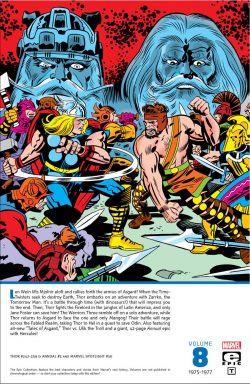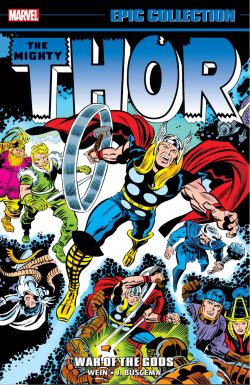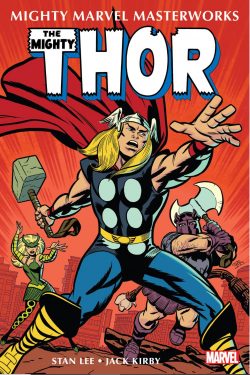
The Mighty Thor Epic Collection volume 7: Ulik Unchained 1973-1975


By Gerry Conway, Bill Mantlo, Roy Thomas, John Buscema, Rich Buckler, Sal Buscema, Arvell Jones & Keith Pollard, George Tuska & various (Marvel)
ISBN: 978-1-3029-2949-7 (TPB/Digital edition)

Disabled doctor Donald Blake took a vacation in Norway only to stumble into an alien invasion. Trapped in a cave, he found an ancient walking stick which, when struck against the ground, turned him into the Norse God of Thunder! Within moments he was defending the weak and smiting the wicked.

Months swiftly passed with the Lord of Storms tackling rapacious extraterrestrials, Commie dictators, costumed crazies and cheap thugs, but these soon gave way to a vast kaleidoscope of fantastic worlds and incredible, mythic menaces, usually tackled with an ever-changing cast of stalwart immortal warriors at his side…

As this bombastic compendium (reprinting Mighty Thor #217-241 and Marvel Premier #26 – spanning November 1973 through November 1975) opens, our cosmic cast returns to long-abandoned Asgard after interstellar escapades and bravely endured exile.

Thor #217 sees the triumphant return of Thor with recently rescued from alien enslavement All-Father Odin. He and his fellow heroes Sif, Fandral, Volstagg, Hogun, Hildegarde (plus Rigellian Tana Nile and planetary exile Silas Grant) discover a mysteriously rebuilt Eternal Realm filled with their fellow Asgardians who brandish ‘All Swords Against Them!’

Scripted by Gerry Conway with art by John & Sal Buscema, the saga sees them confronting impossible doppelgangers of Odin, Thor and the rest, all offering murderous hostility…

Whilst the Thunderer furiously struggles to unravel this latest mystery and defeat the invading fakes, in another sector of the universe the all-conquering Colonizers of Rigel are put to flight; abandoning their worlds to an all-consuming force of sheer destruction…

Issue #218 proves there’s no rest for the weary as the again-victorious true Asgardians once more take ship to the stars to prevent the Rigellians’ doom affecting Earth. ‘Where Pass the Black Stars There Also Passes… Death!’ (illustrated by J. Buscema & Jim Mooney) finds the hard-travelling heroes facing a nomadic race of colossal, decadent starfarers who fuel their unending flight by converting thriving civilisations into food and power.

In distant Asgard, war woman Hildegarde’s young sister Krista is slowly falling under the sway of sinister seductive evil, even as her hereditary protectors are a cosmos away, daringly infiltrating one of the Black Stars’ cosmic scoops and encountering a race of mechanical slaves in ‘A Galaxy Consumed!’ (Mike Esposito inks) before they and their charismatic messiah Avalon are at last freed – and untold galaxies subsequently saved – from callous consumption in ‘Behold! The Land of Doom!’

With scripter Conway firmly in the driving seat and legendary illustrator John Buscema (aided by inker Esposito) delivering the art, the mythic mayhem intensifies with ‘Hercules Enraged!’ as Thor savagely attacks Olympus, in search of the Grecian Prince of Power.

After Asgardian maiden’s Krista abduction, the All-Father had a vision of her chained in Hades with the Thunder God’s trusted ally gloating over her beside vile Grecian netherlord Pluto

By the time lordly Zeus stops the shattering clash that follows, half of the celestial city is in ruins, but in that breathing space he proves Hercules innocent of the atrocious act and the abashed comrades duly turn their attentions to the true culprit…

Inked by Joe Sinnott, Thor #222 finds the earnest comrades in search of Hercules’ insidious impersonator and taking advice from a scary sorceress even as war-god Ares receives an eldritch summons to meet his co-conspirator ‘Before the Gates of Hell!’

Sadly for him, the war god is intercepted by our heroes before he gets there and receives the sound thrashing he deserves prior to the enraged companions storming the netherworld itself. At the moment of their triumph, however, Pluto snatches up his hostage and vanishes. The infernal trail leads straight to Earth where one final confrontation results in ‘Hellfire Across the World!’ (Esposito inks) leaving kidnapped Krista wounded unto death…

After a lengthy hiatus, #224 finds Thor resuming his mortal alter ego as surgeon Don Blake is needed to operate on the dying Asgardian, even as elsewhere in Manhattan, a rash scientist accidentally reactivates Odin’s unstoppable battle construct and discovers ‘No One Can Stop… the Destroyer!’

With Krista saved, Thor joins sorely-pressed Hercules and – although outmatched by the Asgardian killing machine – devises a way to stop its human power source, only to then face ‘The Coming of Firelord!’ (inked by Sinnott). The tempestuous, short-tempered herald of planet-consuming Galactus has been sent to fetch Thor and will brook no refusals…

Issue #226 sees the voracious space god on Earth again, personally beseeching the Thunder God’s aid in ‘The Battle Beyond!’ (Esposito) against living planet Ego, who has seemingly gone mad and now poses a threat to the entire universe…

Deftly channelling Jack Kirby, penciller Rich Buckler (aided by his pals Arvell Jones & Keith Pollard) joined Conway & Sinnott in #227 as the Storm Lord, Hercules and Firelord go ‘In Search of… Ego!’

Penetrating deep within the sentient-but-raving planet and defeating incredible biological horrors acting as planetary antibodies, the trio reach his malfunctioning brain and experience the incredible origin of the “bioverse” in ‘Ego: Beginning and End!’, before contriving an earth-shaking solution to the wild world’s rampages. In a final act of unlikely diplomacy, the Thunderer then finds a replacement herald and secures Firelord’s freedom from Galactus…

Joined by veteran inker Chic Stone, Buckler depicts the godly prince safely back on Earth and facing a new kind of terror in Thor #229 as ‘Where Darkness Dwells, Dwell I!’ finds fellow Avenger Hercules investigating an uncanny string of suicides amongst the mortals of Manhattan. After consulting the Storm Lord and recently returned Sif, the Prince of Power is ambushed by a shadowy figure and himself succumbs to dark despondency…

Plucked from psychological catatonia by Iron Man and recuperating Krista, the severely shaken Hercules recovers enough to lead Thor deep beneath the city where they jointly confront and conquer a horrific lord of fear in #230’s climactic ‘The Sky Above… the Pits Below!’ (inked by Sinnott).

Of greater moment is the revelation in hallowed Asgard that almighty Odin is mysteriously missing again…

John Buscema returned in #231, inked by Dick Giordano to limn ‘A Spectre from the Past!’, wherein Thor learns that former true love Jane Foster is dying: another victim of the recently defeated fear lord. Whilst doting current paramour Sif fruitlessly returns to Asgard seeking a cure, the grieving Thunderer is momentarily distracted when Hercules is attacked by an unbelievably powerful anthropoidal throwback. Disembodied spirit Armak the First Man has somehow possessed the body of an unwary séance attendee and now runs savagely amok in the streets…

Since gaining his liberty, former herald Firelord had been aimlessly travelling the globe. Lured by Asgardian magic he now becomes wicked Loki’s vassal in ‘Lo, the Raging Battle!’…

Heartsick Thor will not leave Jane’s hospital bedside, prompting Sif and Hercules to travel alone to the ends of the universe to retrieve the mystic and fabled Runestaff of Kamo Tharnn. No sooner do they depart than ensorcelled Firelord attacks and whilst incensed, impatient Thor is knocking sense back into him, his evil half-brother leads an Asgardian army in a sneak attack on America…

With ‘Midgard Aflame’ (J. Buscema & Stone) Thor furiously leads the human resistance and learns for the first time that his father is missing. Odin’s faithful vizier reveals the All-Father has deliberately divested himself of his memory and chosen to reside somewhere on Earth as a hapless mortal, the better to learn humility…

With humanity preparing to unleash their atomic arsenal against the occupying Asgardians, the invasion abruptly ends after a savage duel between Thor and Loki in ‘O, Bitter Victory!’ (inked by Sinnott) after which the Thunderer returns to Jane’s side, unaware that he is being stalked by a merciless old enemy. Simultaneously but far, far away Sif and Hercules have clashed with the one ‘Who Lurks Beyond the Labyrinth!’ and secured a remedy for Thor’s mortal beloved…

Thor #236 opens as the Thunder God revels in furious combat with The Absorbing Man. Unknown to the blockbusting battlers, at that very moment Sif is expressing her own love for her wayward prince by using the Runestaff to fix Jane in ‘One Life to Give!’

…And somewhere in California, an imposing old man called Orrin ponders his strangely selective amnesia and wonders how he can possibly possess such incredible strength and vitality…

With combat concluded, Thor hastens back to Jane and finds her completely cured. His joy is short-lived, however, as he realises that Sif is gone, seemingly forever…

Issue #237 finds reunited lovers Don Blake and Jane Foster cautiously getting reacquainted and pondering Sif’s incredible sacrifice when an army of Asgardian Trolls led by ‘Ulik Unchained’ attack New York. Before long, they have made off with Jane under cover of the blockbusting melee that inevitably ensues…

Conway concluded his tenure with Thor #238 as the Thunderer capitulates to his hostage-taking foe and is taken below the worlds of Earth and Asgard on the ‘Night of the Troll!’ Ulik wants to overthrow his king Geirrodur and is confident his hold over his mighty archenemy will accomplish the act for him. He is utterly unprepared for the new martial spirit which now infuses his formerly frail mortal hostage…

…And in California old man Orrin decides to use his power to help the poor, arousing the ire of big business, brutal strike-breakers and the local authorities…

Writer/Editor Roy Thomas and artist Sal Buscema join Sinnott in Thor #239 as the Thunder God brutally ends his association with the trolls even as Orrin’s rabble-rousing civil unrest is cut short when a colossal pyramid containing Egyptian gods erupts from the Californian ground in ‘Time-Quake!’

Thor knows nothing of the latest upheaval. He has returned to Asgard, uncovering a mysterious force draining his people of power and vitality. Warned by duplicitous seer Mimir, the anguished godling rushes back to Earth to clash with puissant Horus ‘When the Gods Make War!’ (Thomas, Bill Mantlo, Sal B & Klaus Janson).

The depleted Egyptian pantheon have desperate need of an All-Father and have conditioned Odin/Orrin to believe that he is their long-lost patron Atum-Re

Go-getting, proactively take-charge Jane is already waiting in California when Thor arrives and is present when the elder deity devastatingly assaults his astounded son. Happily, her cool head prevails and soon the warring deities are talking. An uneasy alliance forms and the truth comes out. Horus, Isis and Osiris are at war with vile Death God Seth and need the power of a supreme over-god to assure victory for the forces of Life. Sadly, that energy is being siphoned from Asgard…

The cosmic conflict concludes in #241 as ‘The Death-Ship Sails the Stars!’ (Mantlo, John B & Sinnott) with ghastly Seth and his demonic servants ultimately repulsed and Jane again playing a major role: even triumphally shaking Odin out of his compliant, mind-wiped state…

To Be Continued…

Adding lustre next is the cover to all-reprint Giant-Size Thor #1, followed by a compelling contemporaneous solo tale of Hercules (November 1975), taken from Marvel Premiere #26. Used to set up his major role in forthcoming team title The Champions, it was crafted by Mantlo, George Tuska & Vince Colletta. Sporting a new Kirby cover, ‘The Game of Raging Gods’ has the legendary hero relocate to California on the college lecture circuit and targeted by old enemies Typhon the Titan and spurned priestess Cylla the Witch of Delphos

With covers by John Romita, Buckler, Sinnott, John Buscema, Gil Kane, Esposito, Frank Giacoia, Marie Severin, Tom Palmer, Giordano, Dan Adkins, Klaus Janson and Jack Kirby & Vince Colletta, this collection also includes assorted House ads; covers created by Romita, a John Buscema double page pin-up of the Asgardian cast and a frontispiece by Marie Severin from the Thor-starring reprint edition Marvel Treasury Edition #3.

Thor is one of modern comics’ greatest attractions and a cornerstone of the Marvel Universe. Always a high-point in graphic fantasy, his longevity is all the more impressive for the sheer imagination and timeless readability of the tales crafted by an army of creators. This chronicle is an absolute must for all fans of the medium and far-flung fantasy thrills.
© 2021 MARVEL

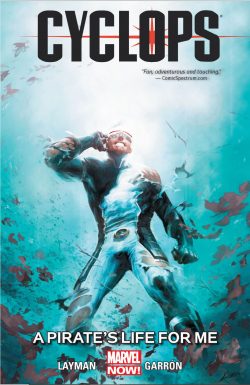
Cyclops volume 1: Starstruck


By Greg Rucka, Russell Dauterman, Carmen Carnero, Terry Pallot & various (Marvel)
ISBN: 978-0-7851-9075-2 (TPB/Digital edition)

When mutant genius Henry McCoy learned he was dying, he used time-travel tech in a last-ditch attempt to give his life meaning. Seeking to prevent an inter-species war, he brought the young, naive X-Men of his own youth into the future to reason with his radicalised former comrade Scott Summers, praying the still idealistic and hopeful teens could divert Mutant Enemy Terrorist No. 1 from his path of doctrinaire madness…

The gamble paid off in all the wrong ways. Rather than shocking modern day Cyclops back to his senses, the confrontation hardened the renegade’s heart and strengthened his resolve. Moreover, after McCoy the younger somehow cured his older self, he and the rest of the X-Kids were trapped in their own future and began gradually defecting to the fundamentalist team…

Eventually, the temporally misplaced First Class all ended up living with the elder Cyclops’ crew, but everything changed after Gladiator of the Shi’ar realised that Jean Grey AKA Marvel Girl – and future host of the cosmic force known as the Phoenix – was back. The alien overlord rashly attempted to abduct and execute her for the crimes of her older self…

The insane pre-emptive punishment plan was foiled by an assembly of X-Men, Guardians of the Galaxy and intergalactic buccaneers Hepzibah, Ch’odRaza Longknife and insectoid medical wizard Sikorsky – collectively known as The Starjammers.

During that cosmic conflict, 16-year-old Scott met his believed-dead dad Christopher Summers, now called Corsair and undisputed leader of the cosmic privateers. When the mutant heroes returned to Earth, Scott chose to remain in space with the father he had spent most of his brief life assuming killed in a plane crash…

Scripted by Greg Rucka and illustrated by Russell Dauterman, Carmen Carnero & Terry Pallot, stellar saga Starstruck collects issues #1-5 of Cyclops: (July-November 2014), following the chronal castaway to the ends of the universe and even further into uncharted emotional territory…

The story begins as the still shell-shocked teen spends some time in hard vacuum with his dad’s exotic paramour Hepzibah. Together they are testing his new spacesuit, which allows him to fire his fearsome optic blasts safely through his helmet. That and reminiscing about how he got here and revelling in the sheer majesty of the intergalactic firmament, of course…

For most of his career Scott Summers has been capable and competent but also dour, grim, despondent and simply no fun at all. Here, however, we get to see the true hero he always was, whilst also following a nervous, unsure kid hungry for affirmation and still capable of ingenuous wide-eyed wonder.

That’s never more ably demonstrated than when his attempts to write a letter to Jean (the girl everybody in the future tells him he will marry and lose) are interrupted by an attack on the ship. The Starjammers are wanted by almost every empire and ruling authority in the universe, but this ambush by the scurrilous Brotherhood of Badoon is easily repulsed and only results in the freebooters capturing their attackers’ vessel primarily intact…

Not so easily handled is the growing gulf between Scott and Corsair. The boy simply cannot accept why his father would allow him – and indeed his future self – to believe he was dead for decades…

The grizzled star-pirate thinks he has a solution. Giving Scott a sword liberated from the vessel (apparently a crucial piece of kit for any space-farer regularly indulging in close combat) Corsair suggests a father-and-son vacation: a few months tooling around the galaxies in their newest prize, just getting to know each other…

At first the grand tour is all mind-bending exploration and eye-popping alien encounters, but eventually Scott starts seeing a disturbing pattern to Corsair’s actions and arrives at a ghastly conclusion. His dad is a drug addict and their numerous stopovers in quirky cosmic bazaars and seamy sidereal marketplaces are just opportunities to restock his personal pharmacopoeia…

One such jaunt introduces the kid to unlikely barkeeper/crimelord Baroque and leads Scott into a potentially life-changing VR encounter with a svelte and sexy alien temptress named Vass. Sadly, anything he might have learned is promptly forgotten when a merciless multi-species band of bounty hunters corners the father-&-son team.

These wily thief-takers are utterly unprepared for Cyclops’ optic blasts, however, and the humans get away relatively unscathed… except for Corsair’s latest “stash”…

The next crisis occurs soon after as the Badoon ship catastrophically malfunctions, stranding them on an isolated planetoid. Painfully scouring through crash wreckage later, Scott discovers a tracking device – now destroyed – and finally confronts his father about his addiction.

He is doubly appalled when Corsair shamefully reveals that rather than buying narcotics, he’s been visiting every criminal dive in creation to score universally-proscribed nanite tech: the only thing currently keeping him alive…

Stranded on a primitive mudball filled with predators becoming increasingly less cautious and more hungrily curious, Scott at last learns of his unsuspected brother Vulcan: a mutant who seized control of the Shi’ar Empire, sparked intergalactic wars and killed their father…

Of course, his devoted comrades refused to leave Corsair dead, and petitioned enigmatic cult the Shrouded to restore him. The cloaked wonders succeeded, but their cure required constant and illicit maintenance…

Days pass and the last dregs of the contraband chemicals are used, whilst fading father and estranged son grow closer: to the point where they unite to deal with the voracious bird-things stalking them. As Corsair impatiently strives to teach his son everything he’ll need to survive the decades he might be alone on the planetoid, the boy enacts a desperate scheme to save them both. The first step is repairing that fractured tracking device and luring the bounty hunters to their current location…

Everything goes according to plan and the hunters become the hunted, but at a critical moment Scott, seemingly swayed by the blandishments of the mercenaries’ female slave, sells his own dad out.

What happens next proves the boy hero’s astonishing tactical genius and saves everyone’s lives – if not necessarily their honour…

Heart-warming, thrilling, funny and astoundingly action-packed, Cyclops: Starstruck combines cosmic intrigue and dashing derring-do with solid characterisation and wild blue yonder wonderment, and will delight any fan of cosmically light-hearted Marvel Movies like Guardians of the Galaxy or Thor: Ragnarok.

What more could any wide-eyed, entertainment-starved child of the wondering stars want?
© 2014 Marvel Characters, Inc. All rights reserved.

Spider-Man: Blue


By Jeph Loeb & Tim Sale with lettering by Richard Starkings & Comicraft’s Wes Abbot and colours by Steve Buccellato & various (MARVEL)
ISBN: 978-0785134466 (HB/Digital edition)

The creative team of Jeph Loeb & Tim Sale have tackled many iconic characters in a number of landmark expansions/reworkings. In Spider-Man: Blue Loeb & Sale set their nostalgia-soaked sights on the beginnings of Peter Parker’s tragically brief romance with Gwen Stacy and ever-maturing relationship with eventual wife Mary Jane Watson. It encompasses that transitional period when Steve Ditko’s creepy, plucky outsider grew into a wholesome, straight-shooting, hard-luck hero as re-designed by John Romita Senior – who also provides the Introduction (first seen in the 2004 release) for this 2019 remastered collected edition. Also included are a full cover gallery by Sale and many of his preparatory sketches, plus a sketchbook section at the book’s end, featuring commentary from writer and artist revealing their process, in crafting ‘Cover Concepts’, ‘The Girls’, ‘French Posters’ (focussing on European editions) and a prodigious ‘Sketch Gallery’.

Part of a colour-themed project based on Marvel Super-hero beginnings, Spider-Man: Blue gathers the 6-issue miniseries from 2002: a slight but extremely readable tale reconstituted from and built upon pertinent snippets from Amazing Spider-Man #39-49 – plus a smidgeon of #63.

It opens on one gloomy February 14th, as happily married but momentarily melancholy Peter records a message to a former girlfriend he hasn’t really gotten over…

Successive tapes to murdered Gwen follow issue by issue, taking the form of a reminiscence of the days when he first emerged from his solitary shell. Parker recalls how he found – and lost – a few friends while inadvertently growing closer to MJ, all whilst pursuing a pure, innocent and unlikely love for a seemingly unattainable dream girl.

‘My Funny Valentine’ begins in modern days of muted blue, before memories of Parker’s first showdown with Green Goblin Norman Osborn erupt in vibrant full colour, with the epochal moments concluding as – whilst visiting the now amnesiac villain in hospital – “Gorgeous Gwen” first notices something special about staid, standoffish Peter…

‘Let’s Fall in Love’ sees that relationship grow whilst adding a major complication with the long-anticipated, oft-delayed first meeting with flirtatious Mary Jane, before ‘Anything Goes’ sees her “wild-child” vivacity steering our shy boy’s social life, making him almost popular with fellow students and even more intriguing to Gwen even as MJ (innocently?) aids and abets his secret life and career…

‘Autumn in New York’ follows Parker leaving Aunt May’s home to share an apartment with Harry Osborn (troubled son of the Goblin, and his eventual successor) with MJ inviting herself along as Harry’s official girlfriend, after which ‘If I Had You’ sees Parker’s youthful associates growing up a bit before concluding reverie ‘All of Me’ shows how a climactic clash with a lurking stalker on another St. Valentine’s night led to the birth of a love for the ages…

Along the way – and as formerly depicted in the Lee & Romita classics – Spider-Man fights a formidable array of super-foes, including The Rhino, Lizard, two separate Vultures and ultimately Kraven the Hunter (rather uncomfortably and implausibly re-imagined here as the kind of sinisterly patient, brooding mastermind that he simply could never have been). Loeb & Sale in-fill, expand and often radically rework those battles with the advantage of revelations culled from stories by others over the intervening decades.

Regrettably but crucially, the end result is clever and pretty but offers no real sense of tension, because even the newest readers already know the inevitable romantic outcomes whilst the attempt to weave a number of isolated super-baddie clashes into a vast master-plan over and above what Lee & Romita envisioned feels clumsy and ill-considered. Don’t take my word for it: the original tales are readily available for your perusal and delectation in numerous collections as assorted Marvel Masterworks and Epic Collections, should you feel the need to contrast and compare…

Loeb & Sale rightly enjoy a prodigious track record for retrofitting, rationalising and restating pivotal moments of comic book icons: especially distilling turning points of iconic characters and careers into material palatable to modern readers, but here it’s simply a waste of their time and talents. The originals are simply still better than the rehashing here. This is not one of their better efforts, and often comes perilously close to being maudlin far too often for comfort.

Although Sale’s art is always a joy to behold, and Loeb’s gift for dialogue is undiminished, Spider-Man: Blue falls short of their best. A solid, casual affair but, sadly, not a patch on the real thing …
© 2019 MARVEL.

Thor God of Thunder by Jason Aaron volume 1


By Jason Aaron, Esad Ribic, Butch Guice, Tom Palmer & various (MARVEL)
ISBN: 978-0785191131 (HB/Digital edition)

In the wake of the game-changing Avengers versus X-Men publishing event, the company’s entire continuity was reconfigured. From that point on, the proud banner MarvelNOW! indicated a radical repositioning and recasting of all the characters in an undertaking designed to keep the more than 50-year old universe interesting to readers old and new alike.

This involved a varying degree of drastic rethink for beloved icons, concepts and brands, always, I’m sure, with one wary eye on how the material would look on a movie screen…

Well the fourth Thor feature film is upon us and this collection will offer the print origins of its major villain, so buckle up for a rocky rowdy ride…

Collecting Thor, God of Thunder #1-11 (cover-dated January-October 2013), this big, bold blockbuster saga simultaneously unfolds over three separate eras, offering a spectacular clash as the bellicose Lord of Lightning faces his ultimate adversary…

It begins in 893AD where a young god revels amongst his Viking worshippers in Iceland, slaying monsters and bedding mortal maids in the days before he proved worthy enough to wield mystic mallet Mjolnir.

During his revels a dismembered corpse washes up, terrifying the valiant Norsemen. They have never seen the like, but Thor recognises it as a god from another pantheon, slaughtered and dismembered like meat…

In the now, Thor is summoned into deep space and the parched planet Indigarr. The Storm Lord has mystically heard the desperate prayer of a little girl and on his arrival brings rain and salvation to her dying world. Celebrated as a saviour, the Thunderer wonders aloud why the people did not pray to their own gods – across the entire universe, all civilisations and peoples have deities – and learns they are dead.

Investigating further, he locates Indigarr’s god-palace and discovers the entire pantheon was tortured to death eons ago and as a monstrous black beast ambushes him, he remembers a horrific experience more than a millennium past and knows fear…

In the furthest future, an aged Thor sits in a shattered Great Hall of Asgard. He has only one arm and one eye and is the last god – perhaps the last being – in existence …except for the uncountable hordes of savage black beasts that surround him…

The cosmic conundrum continues in ‘A World without Gods’ as, in Iceland, Thor leads a bold band of worshipful reivers on a quest into what will one day be Russia and encounters a being who has killed all the gods of the Slavs.

Appropriating one of the perished pantheon’s flying horses, Thor soars aloft to challenge the mysterious God Butcher and, amidst a welter of ‘Blood in the Clouds’, eventually defeats the maniacal alien Gorr

In the present, an enraged Thunder God, having honourably disposed of the celestial corpses, sets off to discover the truth of the situation…

Arriving at the pan-cosmic metropolis of Omnipotence City, where gods of every world and time have met since the universe began, the Thunderer discovers that, over the ages many divinities have gradually ceased visiting.

After consulting the infinitude of scrolls in ‘The Hall of the Lost’, Thor journeys to many of the worlds and finds the same thing over and again: dismembered, desecrated corpses and planets bereft of godly life. Each of them does however, harbour a brutal black beast…

In ancient Russia, the Thunder godling recovers after seven days in a coma, tended by his faithful Vikings. Seeking to confirm his victory, Thor subsequently searches the icy wastes and finds the last of the Slavic Celestials, left as a swiftly expiring signpost to a rematch with the diabolical divinity-slayer…

In our time Thor and Avenger ally Iron Man visit the same region, scouting the cave where Thor remembers ending the menace of Gorr, the God Butcher in the 9th century. After all he has seen in space, however, the Thunderer is questioning his memory and conclusions. Wiser and warier than his youthful incarnation, the Prince of Asgard dispatches the Golden Avenger to warn Earth’s other pantheons of their imminent peril before entering the cave he’d last visited more than a thousand years ago…

At the very end of days the dotard Thunder God continues to slay black beasts, hungry for the honourable death they will not allow him…

And in the 21st century, the Lord of Storms finds not his foe, but a pathetically broken alien god the Butcher has left with a personal message – “It’s all your fault, Thor…”

At the end of time, ‘The Last God in Asgard’ is left to fight again but never die, whilst in the now, Thor and broken alien deity Shadrak return to Omnipotence City following a slipped reference to something called “Chronux” and stumble upon a raid by the beast creatures determined to erase all reference to it from the infinite library of the eternal Omnopolis.

In 893AD, the awful truth of what occurred in Gorr’s cavern is revealed, as present-day Thor follows a faint hope to the planet of the Time Gods and learns the impossibly grandiose, history-shredding scheme of the Butcher.

Gorr meanwhile has uncovered the true origin-story of universal life and invades the corridors of time to achieve his ‘Dream of a Godless Age’

The Celestial Slaughterman is even more elated when his 21st century nemesis is catapulted to Asgard at the end of eternity. Now the chronal marauder has two Thors to play with – for as long as he wishes…

The saga pauses for a brief digression as ‘What the Gods Have Wrought’ (illustrated by Butch Guice & Tom Palmer) reveals the brutal ancient origins of the primitive Gorr on a hellish world where all his children died long, slow deaths. Discarding the gods who had abandoned him, the enraged apostate stumbled into a duel between two cosmic beings and killed them both after the battle left them spent and helpless.

One of the celestial beings had employed a black energy force, and that eerie weapon transferred its power and allegiance to Gorr. Revelling in revenge achieved, the barbarian reshaped the dark force into armour before flying into space, seeking more gods to kill. By time’s end he had eradicated almost all of them – apart from a captive population he kept to torture and fuel his ultimate weapon…

Ribic returns to illustrate 5-part epic ‘Godbomb’ which opens ‘Where Gods Go to Die’. In the final future, the mature and ancient Thors gird themselves for battle as, in 893AD, young Thor is attacked by Gorr’s minions and becomes the latest captive of the God Butcher’s slaughter camp…

In the now at the Library of Omnipotence City, Shadrak reveals his hidden nature and what Gorr made him build. The Librarian is appalled at what the “God of Bombs and Explosions” has wrought…

Brought forward to be broken at the end of eternity, the juvenile Thunderer meets the last deities in creation – including his own eventual granddaughters Atli, Ellisiv and Frigg – before learning the meaning of sacrifice and humility as a ‘God in Chains’. His unending torment is only leavened by meeting the son of Gorr – a kind and decent boy who worships his own red-handed sire as divine…

The ultimate bomb is fed by the deaths of gods and when ready it will detonate, sending killing energies throughout time to destroy all gods everywhere. The captive deities are intent on sabotaging it, but before they can find a volunteer, Atli realises her boy-grandfather has already gone…

The attempt fails completely, leaving the Godbomb utterly unscathed. There is no sign of young Thor. Unknown to all, the boy has been blasted into space to be fortuitously rescued by a flying dragon boat carrying two older versions of himself. Set on war, ready to die and uniquely sharing ‘Thunder in the Blood’, the Boy, Man and Dotard turn towards what will be a fateful Final Battle…

From here on the story becomes a magnificent spectacle of heroic sacrifice and glorious action as the trinity of Thors defeats the ultimate enemy, setting Reality to rights in a tale of blistering action and exultant adventure that cleverly capitalises on the Thunder God’s key conceptual strengths, producing a saga to shake the heavens and delight fans of both the comics and the movies.

Also included is a cover-and-variants gallery by Ribic, Gabriele Dell’Otto, Julian Totino Tedesco, Skottie Young, Daniel Acuña, Joe Quesada, Olivier Coipel & Rajko Milosevic Guera, and an Esad Ribic Sketchbook section sharing character designs and 20 uncoloured pencil pages.
© 2019 MARVEL

Captain America: Man Out of Time


By Mark Waid, Jorge Molina, Karl Kesel & Scott Hanna (MARVEL)
ISBN: 978-0-7851-5128-9 (HB/Digital edition) 978-1-84653-487-4 (UK TPB)

One of the pivotal moments in Marvel Comics history occurred when the Mighty Avengers recovered a tattered body floating in a block of ice (#4, March 1964) and resurrected World War II hero Captain America. This act followed the return of the Sub-Mariner in Fantastic Four #4 and completed a bridge back to the years of Timely and Atlas Comics. With it, newly-minted Marvel Comics Group confirmed and consolidated a solid, concrete, potential-packed history: evoking an enticing sense of mythic continuance for the fledgling company and instantly granting it the same cachet and enduring grandeur of market leader National/DC.

In 2010, after years of conflicting continuity (and with a movie coming) Marvel tasked fan-favourite writer Mark Waid with updating those pivotal events and early future-shocked days for the contemporary world. Of course, that modern milieu was the year 2000, not 1964…

This captivating re-interpretation and updating collects 5 issue miniseries Captain America: Man Out of Time (November 2010-April 2011) and opens in the dying days of the war as Steve Rogers and Bucky Barnes are officially removed from the European frontline. Their destination is England and an appointment with doom-laden destiny…

After the world goes fiery red and then black, the Sentinel of Liberty is stunned to awaken in tomorrow’s world before reacting automatically and uncompromisingly to meeting this World’s Mightiest Heroes…
Waid, perfectly complimented by artists Jorge Molina, Karl Kesel & Scott Hanna, wisely leaves the classic adventures largely unchanged, to concentrate on the missing, contemplative moments and personal crises confronting the uncomprehending Steve Rogers, which means readers completely unaware of the character’s comic book history and exploits could experience some confusion in places. However, the narrative, although superficially disjointed, is clear-cut enough to counter this and those interested in the fuller picture can easily fill in the gaps by perusing one of so many available reprint collections to cover the entire period featured here…

In chapter 2, the reeling hero meets former Hulk sidekick Rick Jones (an absurdly close double for the departed Bucky), gets a rapid reality check on his new home and finally accepts that there’s no way home for this Old Soldier.

Except, that’s not strictly true…
Among the many technological miracles his new allies introduce him to the embryonic science of time-travel, and even while battling threats like the Lava Men and Masters of Evil, the unhappy warrior only thinks of returning to his proper place and saving his best friend…

The old adage “be careful what you wish for” never proves more true than when time-reiver Kang the Conqueror attacks: utterly overwhelming the 21st century heroes and casually dispatching Captain America back to 1945. However, the Sentinel of Liberty’s sense of duty, threat to his new allies and the unpalatable things he had forgotten about “the Good Old Days” prompt Cap into brilliantly escaping his honeyed time-trap and returning to the place and moment where he is most needed to once again save the day…

Resolute and resolved to tackle his Brave New World, Captain America is now ready to carve out a whole new legend…
I’m generally less than sanguine about updates and reboots of classic comics material, but I will admit that such things are a necessary evil as years go by, so when the deed is done with sensitivity and imagination (not to mention dynamic, bravura flamboyance) I can only applaud and commend the effort.

Balancing the reinterpretation is the classic inspiration as the book ends with Stan Lee, Jack Kirby & George Roussos’ reprinted epic ‘Captain America joins… The Avengers!’ cover-dated March 1964, and proving magic can be retooled but never replaced…

Thrilling, superbly entertaining, compelling and genuinely moving, Captain America: Man out of Time is a wonderful confection to delight and enthral old aficionados, impress new readers and should serve to make many fresh fans for the immortal Star-Spangled Avenger.
© 2010 Marvel Characters, Inc. All rights reserved.

Incredible Hulk: Hulk Vs. The Marvel Universe


By Stan Lee, Jack Kirby, Roger McKenzie, Bill Mantlo, Peter David, Howard Mackie, Marie Severin, Frank Miller, Sal Buscema, Todd McFarlane, John Romita Jr., Jorge Lucas & various (MARVEL)
ISBN: 978-0-7851-3129-8 (TPB/Digital edition)

The Incredible Hulk #1 hit newsstands and magazine spinners on March 1st 1962. The comic book was cover-dated May. He was technically (excluding once-&-future Ant-Man Henry Pym) the second superhero star of the dawning Marvel Age. A few more debuted that year – so Happy Anniversary all – before the true Annus Mirabilis Atomicus (stop sniggering: it hopefully means Year of Atomic Miracles) that was 1963…

This 2008 collection was unleashed on readers due to the World War Hulk event. Reprinted here are Fantastic Four #25-26, Journey into Mystery #112, Tales to Astonish #92-93, Daredevil #163, Incredible Hulk #300 & 340, Peter Parker: Spider-Man #14 and Hulk Vs. Fin Fang Foom cumulatively spanning cover-dates April 1964 to February 2008.

With the Big Green Galoot and his chartreuse cousin both making new screen appearances this year, it seems sensible to take another look at the original Marvel antihero’s irascible interactions with his fellow power-packed pals. First, though…

Bruce Banner was a military scientist caught in a gamma bomb detonation of his own devising. As a result of ongoing mutation, stress and other factors caused him to transform into a giant green monster of unstoppable strength and fury.

After an initially troubled few years the irradiated idol finally found his size-700 feet and a format that worked, becoming one of young Marvel’s most popular features. After his first solo-title folded, Hulk shambled around the slowly-coalescing Marvel Universe as guest star and misunderstood miscreant of the moment, until a new home was found for him in “split-book” Tales to Astonish: sharing space with fellow maligned misanthrope Namor the Sub-Mariner, who proved an ideal thematic companion from his induction in #70.

This book is for every fan (isn’t that all of us?) that asked eternal question “who would win if…?” and we open without preamble on an early landmark as Fantastic Four #25 (April 1964) sees a cataclysmic clash that had young heads spinning then and ever since.

The Hulk’s own title had folded after six issues, and he joined debuting solo star assemblage The Avengers, before explosively quitting in #2: joining Namor’s assault on them in #3. That globe-trotting romp delivered high energy thrills and one of the best battle scenes in comics history but you’ll need to go elsewhere to see it.

Here and now, it’s 3 months later and Stan Lee, Jack Kirby & George Roussos use FF #25 to establish an evergreen tradition – the first of many instances of ‘The Hulk Vs The Thing’.

Accompanied by FF #26’s concluding episode ‘The Avengers Take Over!’, the is an all-out Battle Royale as the disgruntled man-monster searches Manhattan for former sidekick Rick Jones, with only an injury-wracked Fantastic Four to curtail his destructive rampage.

A definitive moment in the character development of The Thing, the action ramps up when a rather stiff-necked and officious Avengers team horns in, claiming jurisdictional rights on “Bob” Banner – this tale is plagued with pesky continuity errors that haunted Lee for decades – and his Jaded alter ego. Notwithstanding bloopers, this is one of Marvel’s key moments and still a visceral, vital read.

The second chapter of the Hulk’s career began in Tales to Astonish #59 (September 1964) as his became co-star to fading property Giant-Man – soon to be replaced by Marvel’s Man from Atlantis – whilst the Green Goliath’s guest star career continued unabated. Next up is a perfect example of that pulling power: the lead story in Journey into Mystery #112 (January 1965) where ‘The Mighty Thor Battles the Incredible Hulk!’

The Hulk and Mighty Thor share their 60th anniversary and whether in print, in animations or in blockbuster movies, that eternal question has been asked but never answered to anyone’s satisfaction whenever applied to the modern iteration of the age-old mythic war between gods and monsters. This tale is the first of many return engagements: a glorious gift to every fight fan and arguably Kirby & Chic Stone’s finest artistic moment, detailing a private duel between the two super-humans that occurred during that free-for-all between Earth’s Mightiest, Sub-Mariner and Ol’ Greenskin back in Avengers #3. The raw power of that tale is a perfect exemplar of what makes the Hulk work as a returning foe and yardstick of heroism and determination of those unlucky enough to battle him.

Technical aside: I’m reviewing the digital release and here that blistering bout is followed by JIM #112’s Tales of Asgard back-up ‘The Coming of Loki!’ by Lee, Kirby & Vince Colletta. I suspect you won’t find it in the physical copies of this book…

In Tales to Astonish #92 (June 1967) Lee, superb Marie Severin & Frank Giacoia promised a ‘Turning Point!’, depicting Banner hunted through a terrified New York City as prelude to his alter ego clashing with an incredible opponent in the next issue. Back then, Hulk didn’t really team-up with visiting stars, he just got mad and smashed them. Such was certainly the case as he became ‘He Who Strikes the Silver Surfer’: ironically driving off a fellow outcast who held the power to cure him of his atomic affliction.

There’s a big leap to March 1979 next as Daredevil #163 sees Matt Murdock offer the fugitive Banner sanctuary before the tormented scientist again loses his eternal struggle to suppress the monster inside. Inevitably, the forgone conclusion is the Man without Fear outclassed and punching up before getting creamed to save New York from the Hulk in ‘Blind Alley’ by Roger McKenzie, Frank Miller & Josef Rubinstein, after which we hurtle to Incredible Hulk #300 (cover-dated October 1984) and the end of an epic run by scripter Bill Mantlo and illustrator Sal Buscema. The Hulk had gone from monster outcast to global hero and Banner’s intellect had overridden the brute’s simplistic nature, but now, thanks to the insidious acts of dream demon Nightmare, banner was gone leaving only a murderous, mindless engine of gamma fuelled destruction to ravage New York City.

Inked by Gerry Talaoc, extended epic ‘Days of Rage!’ saw the unstoppable monster easily defeat every superhero in town before being exiled to another universe…

Of course, he came back and was mostly restored, but radical change remained a constant. October 1984’s Incredible Hulk #340 was highpoint in a game-changing run by Peter David and sensation-in-waiting Todd McFarlane. The Hulk was notionally de-powered and returned to the grey-skinned cunning brute of his first appearances just in time for a savage rematch with Wolverine in ‘Vicious Circle’. That inconclusive bout segues here to another battle with another shared-birthday boy.

The wondrous crawler was wracked with agonising ‘Denial’ (Peter Parker: Spider-Man #14, February 2000, by in Howard Mackie, John Romita Jr. & Scott Hanna) in a mismatched clash that occurred with Peter Parker reeling in shock and grief, believing his wife Mary Jane and baby daughter had died in a plane crash. All he had left was great responsibility and something to hit…

We end on a raucously rowdy light-heartedly cathartic note with a modern take on the classic monster battles motif. One-shot Hulk vs Fin Fang Foom #1 (February 2008) was by Peter David, Jorge Lucas & Robert Campanella, revealing an “untold tale” of the early Kirby-era with the gamma goliath headed to the far north in time to see a dragon decanted from the ice.

Parody pastiche ‘The Fin from Outer Space’ is a furious flurry of fisticuffs and fantastic force unleashed with the sole intent of making pulses pound…

With covers from Kirby – with Roussos and Stone, Marie Severin & Giacoia, Miller & Rubinstein, Bret Blevins, McFarlane & Bob Wiacek, Romita Jr. and Jim Cheung, John Dell & Justin Ponsor, this is a straightforward, no-nonsense, all-battle bill of fare no Fights ‘n’ Tights fan could have the strength to resist. Grab it if you can!
© 2020 MARVEL.

Doctor Strange Marvel Masterworks volume 3


By Roy Thomas, Gene Colan, Dan Adkins, Tom Palmer, John Buscema, George Klein & various (Marvel)
ISBN: 978-0-7851- (HB/Digital Edition)

When the budding House of Ideas introduced a warrior wizard to their burgeoning pantheon in the summer of 1963, it was a bold and curious move. Anthologically, bizarre adventures and menacing aliens were still incredibly popular, but most dramatic mentions of magic or the supernatural (especially vampires, werewolves and their equally eldritch ilk) were harshly proscribed by a censorship panel which dictated almost all aspects of story content.

Almost a decade after a public witchhunt led to Senate hearings on the malign influences of words and pictures in sequence, comic books were ferociously monitored and adjudicated by the draconian Comics Code Authority. Even though some of the small company’s strongest sellers were still mystery and monster mags, their underlying themes and premises were almost universally mad science and alien wonders, not necromantic or thaumaturgic horrors.

Companies like ACG, Charlton and DC – and the remnants of Atlas/pre-Marvel – got around the edicts against thaumaturgical thrills and chills by making all reference to magic benign or even humorous… the same tone adopted by massively popular TV series Bewitched a year after Doctor Strange debuted.

That eldritch embargo probably explains writer/editor Stan Lee’s low key introduction of Steve Ditko’s mystic adventurer: an exotic, twilight troubleshooter inhabiting the shadowy outer fringes of society.

Capitalising on of the runaway success of The Fantastic Four, Lee had quickly spun off the youngest, most colourful member of the team into his own series, hoping to recapture the glory of the 1940s when The Human Torch was one of the company’s untouchable “Big Three” superstars. Within a year of FF #1, long-lived anthology title Strange Tales became home for the blazing boy-hero (from #101, cover-dated October 1962), launching Johnny Storm on a creatively productive but commercially unsuccessful solo career.

Soon after, in Tales of Suspense #41 (May 196), latest sensation Iron Man battled a crazed scientific wizard dubbed Doctor Strange, and with the name successfully and legally in copyrightable print (a long-established Lee technique: Thorr, The Thing, Magneto, The Hulk and others had been disposable Atlas “furry underpants monsters” long before they became in-continuity Marvel characters), preparations began for a truly different kind of hero.

The company had already devised a quasi-mystic troubleshooter for an short run in Amazing Adventures (volume 1 #1-4 & #6 spanning June-November 1961).

The precursor was balding, trench-coated savant Doctor Droom – later retooled as Doctor Druid when his exploits were reprinted in the 1970s. He was a psychiatrist, sage and paranormal investigator tackling everything from alien invaders to Atlanteans (albeit not the ones Sub-Mariner ruled). He was subsequently retro-written into Marvel continuity as an alternative candidate for Stephen Strange‘s ultimate role as Sorcerer Supreme…

After a shaky start, the Master of the Mystic Arts became an unmissable icon of the cool counter-culture kids who saw, in Ditko’s increasingly psychedelic art, echoes and overtones of their own trippy explorations of other worlds. It might not have been the authors’ intention but certainly helped keep the mage at the forefront of Lee’s efforts to break comics out of the “kids-stuff” ghetto…

After the originator abruptly left the company at the height of his fame and success in early 1967, the feature went through a string of creators before Marvel’s 1968 expansion allowed a measure of creative stability as the mystic master won his own monthly solo title in neat moment of sleight of hand by assuming the numbering of Strange Tales. Thus, this enchanting full colour compilation gathers Doctor Strange #169-179 plus a crossover from Avengers #61, spanning cover-dates June 1968 to April 1969. It also sagely includes every issue’s stunning cover – a gallery of wonders from Dan Adkins, Gene Colan, John Buscema and Barry (not yet Windsor) Smith.

Previously, Dr. Stephen Strange had entered and escaped the terrifying dimension of imagination; defeated Scientist Supreme Yandroth; learned the origin of the his mentor The Ancient One and lost his extradimensional lover Clea to the outer infinities. Now a new era dawned for the mystic master just as Big Things were happening at Marvel…

In 1968, after more than a decade under a restrictive and limiting retail contract, The House of Ideas secured a new distributor and explosively expanded with a tidal wave of titles. Twin-featured “Split-Books” such as Strange Tales were divided: replaced by full-length solo series for the cohabiting stars. For the Master of the Mystic Arts, that meant a bit of rapid resetting…

Following an Introduction from sole scripter Roy Thomas, sorcerous super-shenanigans resume with a reworking of the Mage’s origins.

Extrapolating and building upon the Ditko masterpiece from Strange Tales #115, ‘The Coming of Dr. Strange’ by Thomas & Dan Adkins details how he was once America’s greatest surgeon. A brilliant man, yet greedy, vain and arrogant, he cared nothing for the sick except as a means to wealth and glory. When a self-inflicted, drunken car-crash ended his career, Strange hit the skids.

Fallen as low as man ever could, the debased doctor overheard a barroom tale leading him on a delirious odyssey – or, perhaps more accurately, pilgrimage – to Tibet, where a frail, aged mage changed his life forever. Eventual enlightenment through daily redemption transformed Stephen the derelict into a solitary, dedicated watchdog at the fringes of humanity, challenging every hidden danger of the dark on behalf of a world better off not knowing what dangers lurk in the shadows.

The saga also featured his first clash with the Ancient One’s other pupil Mordo revealing how Strange thwarted a seditious scheme, earning the Baron’s undying envious enmity…

The expanded exploration of the transformation from elitist, dissolute surgeon into penitent scholar and dutiful mystic guardian of humanity neatly segues into another clash with a lethally persistent foe as ‘To Dream… Perchance to Die!’ (#170) finds the Ancient One trapped in a coma thanks to the malevolent lord of dreams. To wake his master, Strange impetuously enters the astral realms and defeats Nightmare on his own terms and turf after which #171 introduces someone who will become a key creator in the mystic’s career.

Pencilled by eventual inker supreme Tom Palmer, with Adkins supplying finishes, ‘In the Shadow of… Death!’ sees Strange lured away from Earth by news of long-lost Clea. To facilitate a rescue mission, the sorcerer unthinkingly calls on English associate and sometimes arcane ally Victoria Bentley, unaware or uncaring of her romantic feelings for him.

Their trek through the outer deeps of The Realm Unknown is fraught with deadly traps and peril, but does locate missing Clea… after Bentley is captured and Strange ambushed by his most powerful and hate-filled foe…

A magical creative team formed for Doctor Strange #171 as Gene Colan signed on for an astoundingly experimental run with Palmer handling inks. Humanity is endangered by ‘…I, Dormammu!’ as the Dark God reveals he has orchestrated many recent attacks designed to weary and de-power Earth’s magical champion. The gloating fiend shares how his apparent destruction battling conceptual being Eternity in fact resulted in transdimensional exile and the subjugation of a demonic race dubbed Dykkors: now his eager and willing foot-soldiers ready to ravage the realms of Mankind. The Dark Despot has even suborned his hated sister and former foe Umar the Unspeakable to his scheme…

As always, Dormammu has underestimated the valour and ingenuity of Stephen Strange. ‘…While a World Awaits!’ the monstrous conqueror leads a demonic army through the Doorway of Dimensions, leaving the human mage time to liberate Clea and Victoria, and engage the fearsome forces in a mystic delaying tactic that once again allows Dormammu to defeat himself…

As former associate Dr. Benton seeks to convince Strange to abandon his crazy charlatanry for a life of respectable medical consultancy, #174 sees the Master of the Mystic Arts helping magical Clea adapt to mundane life on Earth. However, ‘The Power and the Pendulum’ finds him accompanying secretly despondent Victoria home to England, before being diverted to a foreboding castle where weirdly flamboyant Lord Nekron has laid a devilish trap.

The crazed noble has made a bargain with hellborn Supreme Satannish, offering his soul for fame and immortality. Instead, the Lord of Lies devised a counter-offer, calling for the substitution of another mystic at the end of one year. With time running out and Strange fitted up for the switch, doom seemed inevitable, but Earth’s champion had one timely trick left to play…

The late sixties were an incredibly creative period and comics greatly benefitted from the atmosphere of experimentation. Colan used page layouts in wildly imaginative ways that stunned many readers of the time, but that same expanded vision has often been cited as the reason for the title’s poor sales. I suspect the feature’s early cancellation was as much the result of increasingly sophisticated and scary stories from Thomas, who early on tapped into the growing global fascination for supernatural horror, and urban conspiracy such as seen in #175’s ‘Unto Us… the Sons of Satannish!’ – coincidentally, the last issue to carry his original title logo.

Just like Ira Levin’s 1967 book and hit 1968 movie Rosemary’s Baby, Strange’s next case involved devil-worship in safely mundane Manhattan, working in secret to achieve diabolical aims. Deprived access to the film’s simmering sexuality and mature themes, Thomas, Colan & Palmer stuck to comic book strengths as Clea’s immigrant experience abruptly encompasses ostracization, isolation, suspicious reactions and even assault by ordinary New Yorkers. This leads her into the hands of hidden cult The Sons of Satannish, whose charismatic leader Asmodeus deals with the devil, and attempts to gain ultimate power by eradicating Strange and replacing him in #176’s ‘O Grave Where is Thy Victory?’, with a new, eerie and  abbreviated masthead.

Those aforementioned sales problems were not going away and #177’s concluding chapter ‘The Cult and the Curse’ addressed the issue in a tried and true manner. Exiled from his own existence and persona, Strange rescued Clea but could only strike back and reclaim his life by magically reinventing himself and devising a brand new look. The mask and tights of a traditional superhero were apparently the only way to outmanoeuvre Asmodeus, but sadly, not in time to stop him activating a deathbed curse to destroy the world…

The super-suited and booted modern mage needed information to proceed, and Dr. Strange #178 finds him seeking to question the other Satannish worshippers Asmodeus had callously banished. Once again hoping to exploit poor Victoria Bentley, Strange recognises her new neighbour Dane Whitman as part-time Avenger The Black Knight and his plea for aid results in an assault on  the dimension of decay-god Tiborro ‘…With One Beside Him!’

The saga finally concluded in Avengers #61 with ‘Some Say the World Will End in Fire… Some Say in Ice!’ by Thomas, John Buscema & George Klein. After Asmodeus’ recued minions reveal that the satanic cult’s failsafe spell unleashed Norse demons Surtur and Ymir to destroy the planet, Strange and Black Knight recruited The Vision, Black Panther and Hawkeye to help them save the world on two fronts…

Although the comics spellbinding ends here, also on offer is the cover of Dr. Strange #179: a Barry Smith treat from 1969 that fronted an emergency reprint of Lee & Ditko’s ‘The Wondrous World of Dr. Strange’ from Amazing Spider-Man Annual #2. It joins a House ad for the 1968 relaunch, a half dozen original art pages by Adkins, Colan & Palmer plus the cover art to #174 and 175.

The Wizard of Greenwich Village has always been an acquired taste for mainstream superhero fans, but the pioneering graphic bravura of these tales and the ones to come in the next volume left an indelible mark on the Marvel Universe and readily fall into the sublime category of works done “ahead of their time”. Many of us prefer to believe that Doctor Strange has always been the coolest of outsiders and most accessible fringe star of the Marvel firmament. This glorious grimoire is a miraculous means for old fans to enjoy his world once more and the perfect introduction for recent acolytes or converts created by the movie iteration.
© 2016 Marvel Characters, Inc. All rights reserved.

Captain Britain: Legacy of a Hero


By Chris Claremont, Steve Parkhouse, David Thorpe, Alan More, Jamie Delano, Herb Trimpe, John Byrne, John Stokes, Alan Davis, Fred Kida, Dave Hunt, Mark Farmer & various (Marvel)
ISBN: 978-1-3029-0668-9 (TPB/Digital Edition)

Marvel UK set up shop in 1972, reprinting the House of Ideas’ earliest hits in our traditional weekly papers format, and swiftly carving out a substantial corner of the market. It wasn’t the first time American glitz and glamour turned staid heads here: the works of Lee, Kirby, Ditko, et al had appeared in British comics Smash!, Wham!, Pow!, The Eagle, Fantastic! and Terrific! since the early 1960s and, in the case of Alan Class Publications’ anthologies, since before they actually became Marvel Comics…

In 1976, Marvel UK augmented their recycled output with an all-new British superhero. The eponymous weekly offered original material, with the majority of the page count reprinting fan favourites Fantastic Four and Nick Fury, Agent of S.H.I.E.L.D. One bold departure was full colour printing for the debutante champion to supplement standard monochrome reproduction in the titles remaining pages.

This compilation/primer gathers #1-2 of Captain Britain; US Marvel Team-Up #65-66 and select material from #1, 3-5 and 57-59 of the 1979 UK Hulk Comic/Hulk Weekly; Marvel Super-Heroes #377-384 & 386; The Daredevils #3-4, The Mighty World of Marvel #8-12 and Captain Britain volume 2 #14, collectively spanning October 1976 to May 1986, and also includes a fondly reminiscing Introduction from scripter Dave Thorpe.

Extras include cover roughs, concept and costume sketches by Herb Trimpe plus Alan Davis’ revamp designs and character studies for Slaymaster, The Fury and Crazy Gang. Sadly, not every pertinent cover is included, but those that are come from Larry Lieber & Frank Giacoia, George Pérez & Joe Sinnott, John Byrne, and Alan Davis.

Captain Britain’s earliest adventures read quite well in the hyper-tense 21st century. There is a matter-of-fact charm and simplicity to them that is sorely missing in these multi-part, multi-issue crossover days, and the necessity to keep reader-attention riveted and hungry for more in eight page instalments sweeps the willing consumer along.

Chris Claremont was given the original writing assignment – apparently due to his being born here – and Trimpe the pencilling chores because he was actually resident here for a while. Gary Friedrich eventually replaced Claremont, but the artist, inked by golden age legend Fred Kida (Airboy, The Heap, Black Knight) provided rip-roaring art for much of the initial run. Later artists included John Buscema, Larry Lieber, Ron Wilson and Bob Budiansky, before the feature folded. It was later revived by British creators Steve Parkhouse, John Stokes, Dave Thorpe, and ultimately, Alan Moore and Alan Davis…

Cover-dated Week-Ending October 13th 1976, Captain Britain #1 began his origin, told in ‘Captain Britain!’ and completed in #2 with ‘From the Holocaust… A Hero!’. Together, they reveal how physics student Brian Braddock was in just the wrong place when raiders attacked the Atomic research centre on Darkmoor. Fleeing imminent death, he stumbled onto a source of fantastic power and inescapable destiny. Chosen by the legendary Merlin himself, the teen Braddock was transformed into the symbolic paragon of our Island Nation, destined to battle incredible threats as its valiant and indomitable champion…

The weekly Captain Britain closed with #39 and in tried-&-true tradition was merged with a more successful title. Braddock’s exploits continued in Super Spider-Man & Captain Britain Weekly (#231-253). Except for covers, the book reverted to black-&-white and featured reprints for the last months. Before too long though, he resurfaced in America…

Crafted by Claremont and British-born, Canada-bred John Byrne, ‘Introducing Captain Britain’ in Marvel Team-Up #65, was the first half of a riotous romp. It depicted Brian Braddock on a student transfer to Manhattan and as the unsuspecting house-guest of Peter Parker. Before long the heroes had met, fought and then teamed-up to defeat flamboyant, games-obsessed hit-man Arcade. The transatlantic tale concluded in #66 as the abducted antagonists systematically dismantled the maniac’s ‘Murderworld’.

And then the Lion of Albion disappeared on both sides of the pond… until March 1979, when British weekly Hulk Comic debuted with an eclectic mix of Marvel reprints that veteran editor Dez Skinn felt better suited the British market.

There were also all-new strips featuring Marvel characters tailored – like the reprints – to appeal to UK kids. The Hulk was there because of his TV show, Nick Fury (by babe-in-arms Steve Dillon) – because we love spies here, and noir-tinged pulp/gangster thriller Night Raven came courtesy of David Lloyd, John Bolton & Steve Parkhouse.

…And then there was The Black Knight.

This feature appeared in issues #1, 3-30, 42-55 and 57-63 – the comic’s last issue. The paladin was a former member of the Avengers, but for this engrossing epic, costumed shenanigans gave way to classical fantasy set in modern Britain, but with Tolkienesque/Alan Garner overtones and Celtic roots interwoven into Arthurian myths.

Dispatched on a mission by Merlin (sometimes Merlyn here) to the wilds of Cornwall, the Knight and his winged horse Valinor are tasked with saving the Heart and Soul of England from Modred and a host of goblins and monsters. The selection here sees the quest spring into high gear with the reluctant/openly hostile aid of a broken, amnesiac Captain Britain.

Delivered in 3-page, monochrome episodes by writer Parkhouse & John Stokes (joined from #6 by penciller Paul Neary) this fantastical pot-boiler captured the imagination of the readership, became the longest running original material strip in the comic (even The Hulk lead feature reverted to reprints by #28) and often stole the cover spot from the lead feature.

It’s still a captivating read, beautifully realized, and the only real quibble I have is that the whole thing isn’t included here. If you’re wondering, the sword-and-sorcery action ends on a cliffhanger with our heroic Captain swearing fealty to a newly arisen King Arthur…

When the weekly ended in 1979, Captain Britain began a period of renewal plagued by peripatetic wanderings through numerous UK titles: starting with monthly reprint anthology Marvel Super Heroes #377-389 and continuing in The Daredevils #1-11. Eventually, he got another short-lived solo title…

Here we resume in colour (a fringe benefit of later reprint editions) with Captain Britain reimagined and redesigned by editor/plotter Neary and a new creative team, writer Dave Thorpe and artist Alan Davis. Their serial debuted in MSH #377 (September 1981).

Lost in the gaps between alternate worlds the hero and elf sidekick Jackdaw are drawn back to Earth, but upon arrival they discover it is a hideous parody of Britain, bleak, distressed, hopeless and depressed – a potent vision of the country that would exist after real-world tyrannical fanatic Margaret Thatcher had finished with it.

Thorpe’s desire was to inject some subversive social realism into the feature – and he encountered plenty of resistance – but the resultant analogies and allegories didn’t diminish the strip’s wildly escapist, potently dynamic, fabulously entertaining injection of fresh air. Coupled with Davis’ strikingly purist superhero art, the feature at last delivered a truly British-flavoured adventure. In short order the confused Captain met anarchic bandits The Crazy Gang, reality-warping mutant Mad Jim Jaspers, electorally-sanctioned British Nazis and a truly distressed population in ‘Outcasts’ (MSH #378).

The Good Captain then tackled animated rubbish monster ‘The Junkheap that Walked Like a Man’ (#379), and was introduced to the pan-Reality colossus The Dimensional Development Court and its sultry, ruthless operative Opal Luna Saturnyne, who intended to compulsorily evolve the whole dimension, beginning with ‘In Support of Darwin!’, ‘Re-Birth!’, ‘Against the Realm’ and ‘Faces of Britain!’ in #380-383).

‘Friends and Enemies’ is a pretty-looking but thoroughly de-clawed examination of sectarianism and racism, after which – now deeply involved in Saturnyne’s plan to force humanity to evolve – Captain Britain was trapped in a clash between the underclasses and the government in Thorpe’s final story ‘If the Push Should Fail…’

His departure heralded the beginning of Alan Moore’s landmark tenure on the character but most of that is also absent here. The feature migrated from Marvel Super-Heroes #389 to The Daredevils, beginning with #1. During that passage, Braddock and Jackdaw were destroyed and rebuilt with reality-warping Jim Jaspers crossing over to a new Earth, intent on destroying all superbeings. Also surviving a catastrophic dimensional collapse was an artificial killer which would evolve itself into an unstoppable Fury…

Here, however, The Daredevils #3 reveals how Brian Braddock’s sister Betsy reappeared in ‘Thicker than Water’. Alans Moore & Davis detail a purple-haired telepath hunted by an assassin taking out esper-agents recruited by British covert agency S.T.R.I.K.E – and yes she is the girl who became Psylocke in The X-Men.

The battle against the killer Slaymaster concluded in a spectacular in-joke clash among the shelves of the Denmark Street Forbidden Planet store – in 1982, arguably the country’s best fantasy/comic book store – so any old fans might want to try identifying the real staff members who “guest-star” – in ‘Killing Ground.’

There’s a whole book’s worth of material omitted before we return to Braddock’s Britain – interdimensional imbroglios; cosmic clashes; multidimensional mercenaries, metamorphic love interest Meggan’s debut, alternate universe superheroes; the multiversal Captain Britain Corps, shock, awe, intrigue, and the aforementioned assassin artifact’s relentless advance – but here we resume with the shattering conclusion of all those intersecting plot points…

Mighty World of Marvel #8 sets up a cataclysmic confrontation in ‘The Twisted World (Reprise)’ as the Fury continues its hunting, even though Jaspers has reshaped this world into his own twisted version of a totalitarian paradise. As Jaspers consolidates his psychotic hold on the nation, Captain Britain, Betsy, Omniversal fugitives Saturnyne and Captain UK – sole survivor of her murdered dimension – lead the last few rebels against the New Reality. The fugitives’ consensus choice is “fight or die”…

Meanwhile in the higher realms, Merlin and his daughter Roma move their human pieces in the great game to save existence. In ‘Among These Dark Satanic Mills’, Braddock struggles on despite telling losses, confronting Jaspers as the madman begins an ascent to literal godhood in ‘Anarchy in the UK’.

Even so, the cause seems hopeless until the Fury enters the fray on nobody’s side, but intent on taking out the greatest threat first. ‘Fool’s Mate’ is only the beginning of an unbelievably intense and imaginative battle with Jaspers across the multiverse, using the building blocks of reality as ammunition. The chaotic clash continues in ‘Endgame’ with shocks and surprises aplenty, leading to unexpected victory, the death of a major player in Mighty World of Marvel #12. Moore left after the next chapter – not included here – leaving artist Davis in charge of the strip. The great responsibility came with a new home…

Captain Britain volume 2 ran for 14 issues (January 1985 to February 1986) and is represented here by closing story ‘Should Auld Acquaintance…’ from the last issue. An all-Davis affair, it shows the hero and Meggan reunited after more incredible trials: a far from happy family experiencing one last hurrah by rescuing a mutant-powered “Warpy” from a exploitation at the hands of a Glasgow vigilante, in an expansive display of Happy Ever After…

Captain Britain took a long time and a very twisted road to becoming a key component of the Marvel Universe. Most of that material is astounding and groundbreaking and deserving of a far more comprehensive home than this book. Although a solid introduction to the character, Legacy of a Hero merely skims some cream from a powerful and rewarding comics confection that fed decades of stories and still underpins much of modern continuity. Consider it a teaser for old-timers and lure or newer readers and a promise of more to come. If that fails you can always hunt down the 5-volume complete Captain Britain library published by Marvel UK/Panini between 2007-2011. Trust me, you won’t be sorry
© 2016 Marvel Characters, Inc. All rights reserved.

Thor: For Asgard


By Robert Rodi, Simone Bianchi & various (MARVEL)
ISBN: 978-0-7851-4445-8 (HB/Digital edition) 978-1-84653-482-9 (TPB Marvel/Panini UK)

In his anniversary year and with another motion picture interpretation of Marvel’s Thor eagerly anticipated, it appropriate to remember his roots and that there’s plenty for established fans and freshly-interested parties to grapple with in book form. Here’s one that might tickle the fancy of older readers…

In an effective and beautiful re-imagining by Robert Rodi, illustrated with astounding imagination and beauty by Simone Bianchi (assisted by Andrea Silvestri and colourist Simone Peruzzi), the long dreaded Twilight of the Gods has begun and cracks are beginning to show in the heroic façade of the noble and mighty Asgardians…

Reprinting a six-issue miniseries published in 2010 under the Marvel Knights imprint, our saga opens in the second icy year of the dread Fimbulwinter, with shining god Balder long dead, all-father Odin long missing and Thor as long-suffering Regent.

A better warrior than ruler, the Thunderer leads an embattled, increasingly contentious and disgruntled populace in punitive forays against old enemies such as the Frost Giants. All around them, former vassal states are stretching long unused muscles and airing old grievances whilst the unhappy ruler’s two closest advisors are at constant odds with each other…

With the snowy streets of Asgard awash with resentment, if not outright sedition, Idunn informs the out-of-his-depth Storm Lord that the Golden Apples – source of Asgardian immortality – are almost gone and with Spring and Summer banished, no more will grow.

Asgard’s enemies are gathering, led by a secret mastermind, Odin’s mysterious mission has gone awry and, in the gleaming city, mutterings have become desperate, traitorous acts. With even Valhalla – glorious Hall of the Dead – threatened, and now murder in the streets, Thor needs all his powers to help him, but even his faithful magic mallet has betrayed him: it has been long indeed since the Prince of Asgard was worthy enough to wield the Hammer of the Gods…

With chaos and destruction from every faction and direction, can hard-pressed Thor hold things together, or is the truly heroic action letting Ragnarok come and starting afresh amid the ruins…?

Bleak, subtly allegorical and utterly enchanting, this moody epic of endings and new beginnings is a powerful tale of a deftly different pantheon that will delight newcomers to the character but possibly irritate long-term Marvelites. Moreover, by ending on a foreboding note – completists should take heed – the tale is not completely done yet and more may follow…

The moody, sexy, and uncompromisingly violent tale is augmented in this 2019 re-release by a ‘Spotlight’ addendum, featuring stills from the movies and heavily-illustrated background feature ‘For Asgard!’ by historian Mike Conroy, covering author Rodi’s other Thor sagas (The Deviant Saga, Thor & Loki: Blood Brothers and Astonishing Thor). This volume is also still readily available in a British released edition from Marvel/Panini UK.
© 2019 MARVEL.

Thor Marvel Masterworks volume 16


By Len Wein, Roger Stern, John Buscema, Walter Simonson, Tony DeZuñiga, Sal Buscema & various (MARVEL)
ISBN: 978-1-3029-0358-9 (HB/Digital edition)

Once upon a time, disabled physician Donald Blake took a vacation in Norway, only to stumble into an alien invasion. Trapped in a cave, he found an ancient walking stick which, when struck against the ground, turned him into the Norse God of Thunder! Within moments, he was defending the weak and smiting the wicked.

Months swiftly passed, with the Lord of Storms tackling rapacious extraterrestrials, Commie dictators, costumed crazies and cheap thugs, but these soon gave way to a vast kaleidoscope of fantastic worlds and incredible, mythic menaces, usually tackled with an ever-changing cast of stalwart immortal warriors at his side…

Whilst the ever-expanding Marvel Universe had grown ever-more interconnected as it matured through its first decade, with characters literally tripping over each other in New York City, the Asgardian heritage of Thor and the soaring imagination of Jack Kirby had most often drawn the Thunder God away from mortal realms into stunning, unique landscapes and scenarios.

However, by the time of this power-packed compendium, the King was long gone and in fact enacting his Second Coming – technically third, but definitely Second Return to the House of (mostly his) Ideas – and only echoes of his groundbreaking presence remained. John Buscema had visually made the Thunder God his own over the interceding years, whilst a succession of scripters had struggled with varying success to recapture the epic scope of Kirby’s vision and Stan Lee’s off-kilter but comfortingly compelling faux-Shakespearean verbiage…

Spanning January-December 1977, this power-packed compilation re-presents The Mighty Thor #255-266 and Annual #6, and leads with ‘Over the Rainbow Bridge’: an engaging Introduction intriguingly illustrated  from involved illustrator and eventual redeemer of the Thor franchise – Walter Simonson.

The action opens behind the Kirby cover for Thor #255, as Len Wein & Tony DeZuñiga launch a new epic interstellar adventure in ‘Lo, the Quest Begins!’ Previously, embattled Asgard survived invasion only to learn their divine Liege Lord Odin had gone missing. Now, having exhausted every avenue of location available, Thor is compelled to search the galaxies, prompted by vague hints from all-knowing spirit Mimir of a distant destination – the Doomsday Star…

Boarding spacefaring dragonship Starjammer, Thor, Lady Sif, and Warriors Three Fandral, Hogun and Volstagg set (solar) sail, leaving a beleaguered Eternal Realm under the stewardship of Balder the Brave and his dark inamorata Karnilla the Norn Queen. However, before they even leave local space, the seekers encounter – and battle – malign aliens marooned ever since they initially fought the Storm Lord in his debut adventure…

A classic case of Marvel Misunderstanding occurs in #256 as the voyagers encounter an ancient and colossal colony ship populated by the last survivors of a civilisation that died from over-exploiting their environment. As the Asgardians are joined by Rigellian Recorder Memorax, the slowly-fading Levianons reveal how their poverty and resource-blighted existence has been further threatened by an invasive beast who takes the elderly like a ‘Lurker in the Dark!’ (Wein, John Buscema & DeZuñiga).

When the hideous Sporr also abducts recently wounded Sif, enraged Thor leads a savage counter-assault that sparks incomprehensible tragedy in concluding chapter ‘Death, Thou Shalt Die!’

Another mineral-based miscreant resurfaces in #258. ‘If the Stars be Made of Stone!’ sees the Starjammer attacked by space pirates inexplicably led by human super-villain – and early Thor foe – the Grey Gargoyle. The job is not one he wants, but as the unwilling captain conspires with the beaten-&-enslaved Asgardians for a chance to see again the Green Hills of Earth, their plot is exposed by fanatical second-in command Fee-Lon.

The brutal usurper is a truly ferocious brigand, but ultimately fights in vain to end the gods’ ‘Escape into Oblivion!’

Meanwhile in Asgard, Balder and Karnilla have been resisting an invasion helmed by arch-traitors Enchantress and Executioner. As Walter Simonson signs on beside Wein & DeZuñiga from #260, that subplot expands and intensifies even as ‘The Vicious and the Valiant’ sees the interstellar questors finally locate the Doomsday Star and falter before ‘The Wall Around the World!’ (inked by Ernie Chan).

The terrifying global construct is comprised of the power-drained husks of dead gods, but determinedly pushing on, the seekers discover Odin has been captured and slowly diminished by the energy-leeching Soul-Survivors whose civilisation subsists on stolen divine power. As they valiantly strive to save their sovereign, the Asgardians learn to their cost that ‘Even an Immortal Can Die!’ (#262, illustrated by Simonson & DeZuñiga).

Thankfully, ‘Holocaust and Homecoming!’ proves Odin is both wily and mighty as the heroes’ ferocious clash and inevitable victory results in a weary and wounded pantheon returning to Asgard to find it taken over by Loki and his cohort of treacherous allies.

With Odin in a coma – and ultimately abducted again – a covert civil war erupts between the returned champions and the city Loki has subverted. ‘Thou Shalt Have No Other Gods Before Me!’ sees a sinister scheme exposed, but not before Loki unleashes ultimate weapon The Destroyer against his step-brother in #265’s ‘When Falls the God of Thunder…!’ (inked by Joe Sinnott). As before, it’s not long before Loki loses control of his ultimate sanction…

Once again, everything hinges on the power and determination of Thor and his valiant resistance to chaos. In #266’s ‘…So Falls the Realm Eternal!’, Wein, Simonson & DeZuñiga show the Thunderer at his indomitable best, keeping Loki at bay and off kilter until the Warriors Three rescue and revive an extremely unhappy All-Father…

This saga presaged a change of focus that we’ll cover in the next volume but before then the epic entertainment concludes with ‘Thunder in the 31st Century!’ by Roger Stern, Sal Buscema & Klaus Janson from Thor Annual #6 (December 1977).

A riot of time-busting mayhem, it commences with Mighty Thor plucked from contemporary Manhattan: accidentally summoned to the time period of the original/future (time travel tenses suck!) Guardians of the Galaxy by a cyborg maniac named Korvac.

The legendary god-warrior briefly joins Vance Astro, Charlie 27, Yondu, Nikki, Martinex and Starhawk to bombastically battle super-powered aliens and thwart the sinister cyborg’s scheme to become master of the universe. At the conclusion, Thor returns to his own place and time, unaware how Korvac will reshape the destiny of reality itself in coming months…

To Be Continued…

Augmenting this volume is a blockbusting original art gallery, offering 21 pages of sketches, layouts, pencils and fully inked covers, splash and story-pages by Kirby & John Verpoorten, Buscema, DeZuñiga, Simonson, Joe Sinnott &Ernie Chan: a true treat for every art lover.

The tales gathered here may lack the sheer punch and verve of the early years but fans of ferocious Fights ‘n’ Tights fantasy will find this tome still stuffed with intrigue and action, magnificently rendered by artists who, whilst not possessing Kirby’s vaulting visionary passion, were every inch his equal in craft and dedication. In Thor’s anniversary year, this a definite and decidedly engaging must-read for all fans of the character and the genre.
© 2017 Marvel Characters, Inc. All rights reserved.