Flash Gordon on the Planet Mongo volume 1: Sundays 1934-1937 (The Complete Flash Gordon Library


By Alex Raymond & Don Moore, with restorations by Peter Maresca (Titan Books)
ISBN: 978-0-85768-154-6 (HB)

By any metric, Flash Gordon is the most influential comic strip in the world. When the hero debuted on Sunday January 7th 1934 (with the superb but cruelly dated Jungle Jim running as its supplementary “topper” strip) as response to revolutionary, inspirational, but clunky Buck Rogers (by Philip Nolan & Dick Calkins and which had also began on January 7th but in 1929), a new element was added to the realm of fantasy wonderment: Classical Lyricism.

Where Rogers offered traditional adventures laced with blue sky science concepts, its new competitor reinterpreted Fairy Tales, Heroic Epics and Mythology. It did so by spectacularly draping them in trappings of a contemporary future, varying ‘Rays’, ‘Engines’ and ‘Motors’ substituting for trusty swords and lances (although there were also plenty of those) and exotic flying craft and contraptions standing in for Galleons, Chariots and Magic Carpets.

Most important of all, the sheer artistic talent of Raymond, his compositional skills, fine line-work, eye for concise, elegant detail and just plain genius for drawing beautiful people and things, swiftly made this the strip all young artists swiped from. When all-original comic books began some few years later, literally dozens of talented kids used the clean lined Romanticism of Gordon as their model and ticket to future success in the field of adventure strips. Most of the others went with Milton Caniff’s expressionistic masterpiece Terry and the Pirates (which also began in 1934 – and who will get his go another day).

Thankfully in this 90th anniversary year there are still many collections knocking about, and I’m plumping here for 2012’s hardcover archive from British publisher and keeper of traditions Titan Books, who boldly began a Complete Library of the stellar crusader’s exploits that year. We’re still waiting for its conclusion…

Augmenting the epic entertainment is a brace of photo and illustration-packed introductory essays, beginning with uber-artist/fan Alex Ross’ exploration of ‘The Flash Gordon Legacy’ and continuing with ‘Birth of a Legend’ by comics writer and historical publisher Doug Murray, detailing the fantasy milieu into which the dauntless hero was born…

The immortal saga begins with a rogue planet about to smash into Earth. As panic grips the planet, polo player Flash and fellow airline passenger Dale Arden narrowly escape disaster when a meteor fragment downs the plane they’re traveling on. Parachuting out, they land on the estate of tormented genius Dr. Hans Zarkov – who imprisons them on a rocket-ship he has built. His plan? To fly directly at the astral invader and deflect it from Earth by crashing into it!

…And that’s just the first 13-panel episode. ‘On the Planet Mongo’ ran every Sunday until April 15th 1934 when, according to this wonderful full-colour book, second adventure ‘Monsters of Mongo’ (22nd April – 18th November 1934) began, promptly followed by ‘Tournaments of Mongo’ (25th November 1934 to 24th February 1935).

To readers back then, of course, there were no such artificial divisions. There was just one continuous, unmissable Sunday appointment with utter wonderment. The machinations of the impossibly evil but magnetic Ming, emperor of the fantastic wandering planet, Flash’s battles and alliances with myriad exotic races subject to the Emperor’s will and the Earthman’s gradual victory over oppression captivated America and the World in tales that seemed a direct and welcome contrast to an increasingly darker reality in the days before World War II.

In short order the Earthlings become firm friends – and in the case of Flash & Dale, much more – as they encounter, battle and frequently ally with beautiful, cruel Princess Aura, the Red Monkey Men, Lion Men, Shark Men, Dwarf Men, and crucially King Vultan and the winged Hawkmen. The epic rebellion against seemingly unbeatable Ming really started with the awesome ‘Tournaments…’ sequence wherein Raymond seemed to simply explode with confidence. It was here that true magic blossomed, with every episode more spectacular than the last. Without breaking step, Raymond moved on to his next mini-epic, as our hero entered ‘The Caverns of Mongo’ on March 3rd until 14th April 1935.

Veteran editor Don Moore was only 30 when he was convinced to “assist” Raymond with the writing, starting soon after the strip first gained momentum and popularity. Moore remained until 1953, long after Raymond had gone. The artist had joined the Marines in February 1944, with the last page he worked on published on April 30th of that year. On demobilisation, Raymond moved to fresh strip fields with detective strip Rip Kirby. Mercifully, that still leaves a decade’s worth of spectacular, majestic adventure for us to enjoy…

Without pausing for breath, the collaborators introduced a host of new races and places for their perfect hero to win over in the war against Ming’s timeless evil. On increasingly epic Sunday comics pages, Flash and his entourage confronted the ‘Witch Queen of Mongo’ (April 21st – 13th October 1935), found themselves ‘At War with Ming’ (20th October 1935 – April 5th 1936) and discovered ‘The Undersea Kingdom of Mongo’ (12th April – 11th October 1936). The sheer glorious beauty and drama of the globally-syndicated serial captivated readers all over the world, resulting in not only some of the medium’s most glorious comic art, but also novels, 3 movie serials, radio and TV shows, a monochrome daily strip (by Raymond’s former assistant Austin Briggs), comic books, merchandise and so much more.

The Ruritanian flavour of the series was enhanced continuously, as Raymond’s slick, sleek futurism endlessly accessed and refined a picture-perfect Romanticism of idyllic Kingdoms, populated by idealised heroes, stylised villains and women of staggering beauty. In these episodes Azura, Witch Queen of Mongo wages brutal, bloody war against Flash and his friends for control of the underworld, eventually leading to all-out conflict with Ming the Merciless – a sequence of such memorable power that artists and movie-men would be swiping from it for decades to come.

When the war ends our heroes are forced to flee, only to become refugees and captives of the seductive Queen Undina in her undersea Coral City. The never-ending parade of hairsbreadth escapes, fights and/or chases continues as Flash, Dale & Zarkov crash into the huge jungle of Mongo. As this initial tome ends the refugees enter ‘The Forest Kingdom of Mongo’ (October 18th 1936 to January 31st 1937): barely surviving its wild creatures before weathering horrific tunnels of ‘The Tusk-Men of Mongo’ (February 7th to June 5th 1938). Here, struggling through desperate hardship and overcoming both monsters and the esoteric semi-humans they finally reach Arboria, the Tree kingdom of Prince Barin, Ming’s son-in-law. He is not what he seems…

And so the book ends, but not the adventure. Even stripped down to bare plot-facts, the drama is captivating. Once you factor in the by-play, jealousies and intrigues – all rendered with spectacular and lush visualisation by the master of classical realism – you can begin to grasp why this strip captured the world’s imagination and holds it still. To garnish all this enchantment, there’s even ‘The Alex Raymond Flash Gordon Checklist’ and biographies of both creators and this astounding tome’s key contributors

Along with Hal Foster (Prince Valiant) and Milton Caniff (Terry and the Pirates and Steve Canyon), Raymond’s work on Flash Gordon is considered pivotal to the development of American – if not world – comic art. These works overwhelmingly influenced everyone who followed until the emergence of manga and the advancement of computer technology. If you’ve only heard how good this strip is, you owe it to yourself to experience the magic up close and personal.

I never fail to be impressed by the quality of Alex Raymond’s Flash Gordon. Yes, plots are formulaic and some gender and social attitudes need to be embraced on their own historical terms but what commercial narrative medium of any vintage is free of that? What is never dull or repetitive is the sheer artistry and bravura staging of the tales. Every episode is the most beautiful thing you’ve ever seen, but the next episode still tops it. You are a fool to yourself if you don’t try this wonderful strip out.

Flash Gordon © 2012 King Features Syndicate Inc., ™ & © Hearst Holdings, Inc. All rights reserved.

Showcase Presents World’s Finest volume 3


By Edmond Hamilton, Cary Bates, Jim Shooter, Leo Dorfman, Bill Finger, Curt Swan, George Klein, Sheldon Moldoff, Al Plastino & various (DC Comics)
ISBN: 978-1-84856-585-2 (TPB)

For decades Superman and Batman were quintessential superhero partners: the “World’s Finest” team. Friends as well as colleagues, their pairing made sound financial sense since DC’s top heroes could cross-pollinate and cross-sell their combined readerships. This third magnificent monochrome compendium gathers their cataclysmic collaborations from the glory days of the mid-1960’s: specifically World’s Finest Comics #146-173 – with the exception of reprint 80-Page Giant issues #161 &170 – and cumulatively covering cover-dates December 1964 through February 1968). This was a time when the entire Free World went superhero gaga in response to Batman’s live action and Superman’s animated TV shows…

A new era had begun in World’s Finest Comics #141 when author Edmond Hamilton and artists Curt Swan & George Klein (who illustrate the bulk of tales in this collection) ushered in a more dramatic, realistic and far less whimsical tone. That titanic creative trio continue their rationalist run in this volume starting with #146’s Batman, Son of Krypton!’ wherein uncovered evidence from the Bottle City of Kandor and bizarre recovered memories seemed to indicate the Caped Crusader is in fact an amnesiac, de-powered, Kryptonian. Moreover, as our heroes dig deeper, Superman thinks he’s found the Earthman responsible for Krypton’s destruction and becomes crazed with a hunger for vengeance…

WFC #147’s saw the sidekicks step up in a stirring blend of science fiction thriller and crime caper, all masquerading as an engaging drama of youth-in-revolt when ‘The New Terrific Team!’ (February 1965 Hamilton, Swan & Klein) saw Jimmy Olsen and Robin quit their underappreciated assistant roles to strike out on their disgruntled own. Naturally there was a perfectly rational, if incredible, reason. In #148 ‘Superman and Batman – Outlaws!’ (with Sheldon Moldoff temporarily replacing Klein) saw the Cape & Cowl Crimebusters sent to another dimension where arch-villains Lex Luthor and Clayface were heroes and the Dark Knight and Action Ace ruthless hunted criminals, after which World’s Finest Comics #149 (May 1965 and also inked by Moldoff) dealt out ‘The Game of Secret Identities!’ with Superman locked into an increasingly obsessive battle of wits with Batman that seemed likely to break up the partnership and even lead to violent disaster…

‘The Super-Gamble with Doom!’ (#150) introduced manipulative aliens Rokk and Sorban, whose addictive and staggeringly spectacular wagering almost gets Batman killed and Earth destroyed, before ‘The Infinite Evolutions of Batman and Superman!’ in #151 introduces junior writer Cary Bates, pairing with Hamilton to produce a beguiling sci fi thriller as the Gotham Guardian transforms into a callous future-man and the Metropolis Marvel is reduced to a brutish Neanderthal…

Hamilton solo-scripted #152’s ‘The Colossal Kids!’ wherein a brace of incomprehensibly super-powered brats outmatch, outdo but never outwit Batman or Superman (and of course there are old antagonists behind the challenging campaign of humiliation) after which Bates rejoins his writing mentor for a taut and dramatic “Imaginary Story” in #153.

When Editor Mort Weisinger was expanding Superman continuity and building the legend, he knew that each new tale was an event adding to a nigh-sacred canon and that what was written and drawn mattered to readers. But as an ideas man he wasn’t going to let that aggregated “consensus history” stifle a good idea, nor would he allow his eager yet sophisticated audience to endure clichéd deus ex machina cop-outs to mar the sheer enjoyment of a captivating concept. The mantra known to every baby-boomer fan was “Not a Dream! Not a Hoax! Not a Robot!” boldly emblazoned covers depicting scenes that couldn’t possibly be true… even if it was only a comic book.

Imaginary Stories were conceived as a way of exploring non-continuity plots and scenarios devised at a time when editors believed entertainment trumped consistency and knew that every comic read was somebody’s first – or potentially last. Illustrated by as ever by Swan & Klein, ‘The Clash of Cape and Cowl!’ posited a situation where brilliant young Bruce Wayne grew up believing Superboy had murdered his father, thereafter dedicating his life to crushing all criminals as a Bat Man awaiting the day when he could expose Superman as a killer and sanctimonious fraud…

WFC #154’s ‘The Sons of Superman and Batman’ (by Hamilton) opened doors to a far less tragic Imaginary world: one where the crime fighters finally found time to marry Lois Lane and Kathy Kane and have kids. Unfortunately, their lads proved to be both a trial and initially a huge disappointment…

‘Exit Batman – Enter Nightman!’ is a canny psychological thriller with the World’s Finest Team on the cusp of their 1,000th successful shared case when a new costumed crusader threatens to break up the partnership and replace burned out Batman, after which ‘The Federation of Bizarro Idiots!’ in #156 sees well-meaning but imbecilic imperfect duplicates of Superman and Batman set up shop on Earth. They end up as pawns of the duplicitous Joker, and it does not end well…

In #157’s ‘The Abominable Brats’ – drawn with inevitable brilliance by Swan and inked by both Klein & Moldoff – featured an Imaginary Story sequel as the wayward sons of heroes return to cause even more mischief, although once more there are other insidious influences in play…

‘The Invulnerable Super-Enemy!’ (#158 by Hamilton, Swan & Klein), has the Olsen-Robin Team stumble upon three Bottled Cities and inadvertently draw their mentors into a terrifying odyssey of evil. At first it appears to be the work of Brainiac but is in fact far from it, and is followed by ‘The Cape and Cowl Crooks!’ (WFC #159), dealing with foes possessing far mightier powers than our heroes – apparently a major concern for readers of those times.

To this day whenever fans gather a cry soon echoes out, “Who’s the strongest/fastest/better dressed…?” but this canny conundrum took the theme to superbly suspenseful heights as Anti-Superman and Anti-Batman continually outwit and outmanoeuvre the heroes, seemingly possessed of impossible knowledge of their antagonists…

Leo Dorfman debuted as scripter in#160 as the heroes struggled to discredit ‘The Fatal Forecasts of Dr. Zodiac’, a scurrilous Swami who appears to control fate itself. World’s Finest Comics #161 was an 80-Page Giant reprinting past tales and not included in this collection, so we jump to #162’s ‘Pawns of the Jousting Master!’: by another fresh scripting face. Teenager Jim Shooter produced an engaging time travel romp wherein Superman and Batman are defeated in combat and compelled to travel back to Camelot in a beguiling tale of King Arthur, super-powered knights and invading aliens…

‘The Duel of the Super-Duo!’ (#163, by Shooter, Swan & Klein) pits Superman against a brainwashed Batman on a world where his mighty powers are negated and other heroes of the galaxy are imprisoned by a master manipulator, after which Dorfman delivers an engaging thriller wherein a girl who is more powerful than Superman and smarter than Batman proves to be ‘Brainiac’s Super Brain-Child!’ Bill Finger & Al Plastino step in to craft WFC #165’s ‘The Crown of Crime’ (March 1967), depicting the last days of dying mega-gangster King Wolff. His plan to go out with a bang sets the underworld ablaze and almost stymies both heroes, after which Shooter, Swan & Klein depict ‘The Danger of the Deadly Duo!’ in which the 20th generation of Batman and Superman unite to battle The Joker of 2967 and his uncanny ally Muto: a superb flight of fantasy that was sequel to a brief series of stories starring Superman’s heroic descendent in a fantastic far future world.

WFC #167 saw Bates solo script ‘The New Superman and Batman Team!’: an Imaginary Story wherein boy scientist Lex Luthor gives himself super-powers and a Kal-El who had landed on Earth without Kryptonian abilities trains himself to become an avenging Batman after his foster-father Jonathan Kent was murdered. The Smallville Stalwarts briefly united in a crime-fighting partnership, but destiny has other plans for the fore-doomed friends…

In World’s Finest #142 a lowly, embittered janitor suddenly gained all the powers of the Legion of Super-Heroes and attacked Caped Crusader and Action Ace out of frustration and jealousy. Revived by Bates for #168’s ‘The Return of the Composite Superman!’ he is actually the pawn of a truly evil villain but gloriously triumphs over his own venal nature, after which #169 hosts ‘The Supergirl-Batgirl Plot’: a whimsical fantasy feast from Bates, Swan & Klein wherein the uppity lasses apparently toil tirelessly to supplant and replace Batman and Superman before it’s revealed that the Dynamic Damsels are mere pawns of an extremely duplicitous team of female felons and a brace of old WF antagonists are actually behind the Byzantine scheme…

Issue #170 is another unincluded mammoth reprint edition, after which #171 reveals ‘The Executioner’s List!’ (script by Dorfman): an intriguing, tense murder-mystery with a mysterious sniper seemingly targeting friends of Superman and Batman, before stirring, hard-hitting Imaginary Story ‘Superman and Batman… Brothers!’ (#172, December 1967) posits a grim scenario wherein orphaned Bruce Wayne is adopted by the Kents, but cannot escape a destiny of tragedy and darkness. Written by Shooter and brilliantly interpreted by Swan & Klein, this moody thriller in many ways signalled the end of angst-free days and beginning of a darker, edgier and more cohesive DC universe for a less casual readership, thereby surrendering the mythology to an increasingly devout fan-based audience.

This stunning compendium closes with World’s Finest Comics #173 and ‘The Jekyll-Hyde Heroes!’ (Shooter, Swan & Klein) as a criminal scientist devises a way to literally transform the Cape & Cowl Crusaders into their own worst enemies…

These are gloriously clever yet uncomplicated tales whose timeless style has returned to inform if not dictate the form for much of DC’s modern television animation. The stories here are a veritable feast of witty, gritty thrillers packing as much punch and wonder now as they always have: unmissable adventure for fans of all ages!
© 1964-1968, 2010 DC Comics. All Rights Reserved.

Neroy Sphinx: Playing to Lose


By Daniel Whiston, Dave Thomson & various (Markosia)
ISBN: 978-1-916968-30-1 (TPB/Digital edition)

If you grew up British in the last 50 years reading home-produced action/adventure comics, you were primarily consuming either war or science fiction tales – preferably both. 2000AD launched in February 1977 and rapidly reshaped the minds of generations of readers. It has done so ever since, affecting and inspiring hundreds of creators.

Very much in the mould of that anarchic, subversive and wickedly cynical weekly came a small press fanzine phenomenon which spawned its own home-grown stars. This titanic tome happily revisits one of the most appallingly appealing and inexplicably endearing of those players: a devious, irredeemably self-serving chancer (like so many traditional British comics rogues ranging from Charlie Peace and Grimly Feendish to The Spider) who finds the fate of humanity unhappily and inappropriately piled on his shifty, unwilling and mostly uncaring shoulders…

Neroy Sphinx first began intermittently appearing in Indie comics icon FutureQuake – specifically and sporadically between #4-20 from 2005 to 2012. In his previous compilation (Neroy Sphinx: Back in the Game and still readily available through back issue venues and internet retailers large and small) the criminal trickster was dragooned into becoming the saviour of Humanity and unlikely nemesis of encroaching dark cosmic gods: a fate even he could not weasel out of.

Sphinx is a born rogue failed politician and inveterate manipulator, whom readers of a certain age might liken to Minder’s Arthur Daley in space. However, the imaginatively inventive rapscallion is graced with a steely inner core allowing him to scheme ruthlessly and casually expend strangers, bystanders, friends and acquaintances like confetti. Many cosmic buses have had Sphinx’s associates cheerily thrown under them, but at least now he’s doing his nefarious thing for a good cause….

Written throughout by Daniel Whiston, and illustrated by Dave Thomson, the culmination of his quixotic escapades are gathered in this bombastic monochrome tome, set long after the collapse of EarthFed and reopening of an Arterial Wormhole that once connected Human space systems to a wider intergalactic civilisation. Sadly it also allowed access to predatory alien gods from Space Hell…

Recruited by ultra-psionic former ally Clarence Griffin as the lynchpin of a decades-long survival plan, Sphinx (his memories selectively edited) resumes his unwanted burden after ‘Down Among the Damned Men’, where Griffin sacrifices another innocent to the great vision he’s seen. As monstrous horrors ravage creation and creep closer to total domination, Griffin and artificial lifeform/hired muscle Fenris track down the AWOL schemer for ‘The Train Job’ and the “recovery” of a certain cosmic artefact Neroy stashed away years previously. He says all he needs now is their help in securing the billions in bullion on board to buy a spaceship…

A clash with surviving members of old enemies the Dubblz clan heaps even higher the pile of collateral casualties when the would-be saviours go ‘Junkyard Shopping’ but at least finally get them off-world, but as their eventual destination is recently invaded Cassiopia System and the much-diminished Dubblz are still on their tails, the ‘Misguided Pursuits’ they indulge in only succeeds in obtaining the artefact by lumbering them with another useless hanger-on. Ensign Eudora Carver is the sole survivor of a human ship caught by the invaders, and has a potent connection to the arcane star sceptre they were hunting…

Now ‘Keep it Clean’ finds her and her extremely disturbing rescuers landing on the “ancient sublime citadel of the Gr’tk” and attacked by a legion of greedy alien hangers-on occupying a celestial shanty town and keen to keep these new rivals away from the cast-off gifts of the primal beings…

As the voyagers explore the cosmic citadel and unpick the sordid truths of eons of cosmic history and legend, their mission to repel invasion and damnation goes from bad to worse in succeeding chapters ‘Cat and Mouse and Cheddar Too’ and ‘The Fiddle Game’. Here they try ‘Pushing the Limits’ of inter-species relations while seeking a way to end Hell-being encroachment, but progress stalls after they raid a vault in ‘Good Thing, Small Package’.

Another friend is sacrificed in ‘Temptation Game’ before their last chance to ‘Bring it All Down’ delivers victory of a kind and a new start in epilogue ‘Ice Baby’

With an Introduction by comics writer/novelist Michael Carroll, and a handy potted chronology of human development and our rogue’s rap sheet courtesy of ‘The Story So Far…’ (spanning 2344 when Griffin dragooned the con man into public service up until 2360 when the saga at last commences to conclude) this much-anticipated sequel is another ambitious, gloriously engaging and exceedingly well-executed space-opera romp with a broad scope and a deft touch to delight lovers of edgily light-hearted fantastic fiction.
™ & © 2024 Daniel Whiston, Dave Thomson & Markosia Enterprises, Ltd. All Rights Reserved.

Asterix Omnibus volume 1: Asterix the Gaul, Asterix and the Golden Sickle, Asterix and the Goths


By René Goscinny & Albert Uderzo, translated by Anthea Bell & Derek Hockridge (Orion)
ISBN: 978-0-75289-154-5(HB) 978-1-44400-423-6(TPB)

Asterix the Gaul is probably France’s greatest literary export. The feisty, wily little warrior who fought the iniquities and viewed the myriad wonders of Julius Caesar’s Roman Empire with brains, bravery and – whenever necessary – a magical potion imbuing the imbiber with incredible strength, speed and vitality, is the go-to reference all us non-Gallic gallants when we think of France.

The diminutive, doughty darling was created at the close of the 1950s by two of our artform’s greatest masters, with his first official appearance being October 29th in Pilote #1, even though he had actually debuted in a pre-release teaser – or “pilot” – some weeks earlier. Bon Anniversaire mon petit brave!

René Goscinny was arguably the most prolific – and remains one of the most read – writers of comic strips the world has ever known. Born in Paris in 1926, he grew up in Argentina where his father taught mathematics. From an early age René showed artistic promise. He studied fine arts and graduated in 1942. Three years later, while working as junior illustrator at an ad agency, his uncle invited him to stay in America, where he worked as a translator.

After National Service in France, he returned to the States and settled in Brooklyn, pursuing an artistic career and becoming, in 1948, an assistant in a small studio which included Harvey Kurtzman, Will Elder, Jack Davis & John Severin, as well as European giants-in-waiting Maurice de Bévère (Morris, with whom from 1955-1977 Goscinny produced Lucky Luke) and Joseph Gillain (Jijé).

Goscinny also met Georges Troisfontaines, head of World Press Agency, the company that provided comics for the French magazine Le Journal de Spirou. After contributing scripts to Belles Histoires de l’Oncle Paul and Jerry Spring, Goscinny was promoted to head of World Press’ Paris office. Here he met his ultimate creative collaborator Albert Uderzo. In his spare time, René also created Sylvie and Alain et Christine with Martial Durand (“Martial”) and Fanfan et Polo, drawn by Dino Attanasio. In 1955, Goscinny, Uderzo, Charlier & Jean Hébrad formed independent syndicate Édifrance/Édipresse, creating magazines for business and general industry like Clairon for the factory union and Pistolin for a chocolate factory. With Uderzo, René spawned Bill Blanchart, Pistolet and Benjamin et Benjamine, whilst illustrated his own scripts for Le Capitaine Bibobu.

Under nom-de-plume Agostini, he wrote Le Petit Nicholas (drawn by Jean-Jacques Sempé), and in 1956 began an association with revolutionary periodical Le Journal de Tintin, writing for various illustrators including Attanasio (Signor Spagetti), Bob De Moor (Monsieur Tric), Maréchal (Prudence Petitpas), Berck (Strapontin), Globule le Martien and Alphonse for Tibet; as well as Modeste et Pompon for André Franquin, and with Uderzo fabulously funny adventures of inimitable Indian brave Oumpah-Pah. Goscinny also wrote for the magazines Paris-Flirt and Vaillant.

In 1959, Édifrance/Édipresse launched Pilote, and René went into overdrive. The first issue featured re-launched versions of Le Petit Nicolas, Jehan Pistolet/Jehan Soupolet, new serials Jacquot le Mousse and Tromblon et Bottaclou (drawn by Godard), plus a little something called Astérix le gaulois: inarguably the greatest achievement of his partnership with Uderzo.

When Georges Dargaud bought Pilote in 1960, Goscinny became Editor-in-Chief, still making time to add new series Les Divagations de Monsieur Sait-Tout (with Martial), La Potachologie Illustré (Cabu), Les Dingodossiers (Gotlib) and La Forêt de Chênebeau (Mic Delinx). He also wrote frequently for television, but never stopped creating strips like Les Aventures du Calife Haroun el Poussah for Record – illustrated by Swedish artist Jean Tabary. A minor success, it was re-tooled as Iznogoud when it transferred to Pilote. Goscinny died far too young, in November 1977.

Alberto Aleandro Uderzo was born on April 25th 1927, in Fismes on the Marne, a child of Italian immigrants. As a boy reading Mickey Mouse in Le Pétit Parisien, he showed artistic flair from an early age. Alberto became a French citizen at age seven and dreamed of being an aircraft mechanic, but at 13 became an apprentice of the Paris Publishing Society, learning design, typography, calligraphy and photo retouching. When WWII came, he spent time with farming relatives in Brittany, joining his father’s furniture-making business. Brittany beguiled Uderzo: when a location for Asterix’s idyllic village was being decided upon, the region was the only choice…

In France’s post-war rebuilding, Uderzo returned to Paris to become a successful illustrator in the country’s burgeoning comics industry. His first published work – a pastiche of Aesop’s Fables – appeared in Junior and, in 1945, he was introduced to industry giant Edmond- Françoise Calvo (The Beast is Dead). Young Uderzo’s subsequent creations included indomitable eccentric Clopinard, Belloy, l’Invulnérable, Prince Rollin and Arys Buck. He illustrated novels, worked in animation, as a journalist, as illustrator for France Dimanche and created vertical comic strip ‘Le Crime ne Paie pas’ for France-Soir. In 1950, he drew a few episodes of the franchised European version of Fawcett’s Captain Marvel Jr. for Bravo!

Another inveterate traveller, the young artist met Goscinny in 1951. Soon fast friends, they decided to work together at the new Paris office of Belgian Publishing giant World Press. Their first collaboration was in November of that year; a feature piece on savoir vivre (how to live right or gracious living) for women’s weekly Bonnes Soirée, after which an avalanche of splendid strips and serials poured forth.

Jehan Pistolet and Luc Junior were devised for La Libre Junior and they produced a comedy Western starring a very Red (but not so American) Indian who evolved into Oumpah-Pah. In 1955, with the formation of Édifrance/Édipresse, Uderzo drew Bill Blanchart for La Libre Junior, replacing Christian Godard on Benjamin et Benjamine before, in 1957 adding Charlier’s Clairette to his bulging portfolio. The following year, he made his Tintin debut, as Oumpah-Pah finally found a home and rapturous audience. Uderzo also illuminated Poussin et Poussif, La Famille Moutonet and La Famille Cokalane.

When Pilote launched in October 1959, Uderzo was its major creative force, limning Charlier’s Tanguy et Laverdure and a humorous historical strip about Romans…

Although Asterix was a massive hit from the start, Uderzo continued working with Charlier on Michel Tanguy, (subsequently Les Aventures de Tanguy et Laverdure), but soon after the first historical serial was collected in a single volume as Astérix le gaulois in 1961, it was clear the series would demand most of his time – especially as the incredible Goscinny never seemed to require rest or run out of ideas (after the writer’s death, the publication rate of Asterix tales dropped from two per year to one volume every 3-to-5).

By 1967, Asterix occupied all Uderzo’s time and attention. In 1974 the partners formed Idéfix Studios to fully exploit their inimitable creation, and when Goscinny passed away three years later, Uderzo had to be convinced to continue the adventures as writer and artist. Happily, he gave in and produced a further ten volumes before retiring in 2009. According to UNESCO’s Index Translationum, Uderzo is the 10th most-often translated French-language author in the world and 3rd most-translated French language comics author – right behind his old mate René and the grand master Hergé.

So what’s it all about?

Like all the best entertainments the premise works on two levels: as an action-packed comedic romp of sneaky and bullying baddies coming a-cropper for younger readers and as a pun-filled, sly and witty satire for older, wiser heads, transformed here by the brilliantly light touch of master translators Anthea Bell & Derek Hockridge (who played no small part in making the indomitable little Gaul so very palatable to the English tongue).

Originally serialised in Pilote #1-38 (29th October 1959 – 4th July 1960, with the first page appearing a week earlier in a promotional issue #0 distributed from June 1st 1959), the story is set in the year 50 BC (not BCE!) on the outermost tip of Uderzo’s beloved Brittany coast. Here a small village of redoubtable warriors and their families frustrate every effort of the immense but not so irresistible Roman Empire to complete the conquest of Gaul.

Unable to defeat these Horatian hold-outs, the Empire resorts to a policy of containment, leaving the little seaside hamlet hemmed in by heavily fortified permanent garrisons – Totorum, Aquarium, Laudanum and Compendium. The Gauls don’t care: they daily defy the world’s greatest military machine by just going about their everyday affairs, protected by a magic potion provided by the resident druid and the shrewd wits of a rather diminutive dynamo and his simplistic best friend…

In Asterix the Gaul, this immaculate comedy-drama scenario is hilariously demonstrated when Centurion Crismus Bonus – fed up with his soldiers being casually beaten up by the fiercely free pre-Frenchmen – sends reluctant spy Caligula Minus to ferret out the secret of their incredible strength. The affable insurgents take the infiltrator in and, soon dosed up with potion, the perfidious Roman escapes with the answer – if not the formula itself…

Soon after, wise and wily Druid Getafix is captured by the invaders and the village seems doomed, but crafty Asterix is on the case. Breaking into Compendium and resolved to teach the Romans a lesson, he drives them crazy for ages by resisting all efforts at bribery and coercion, until abruptly wizard and warrior seemingly capitulate. They make the Romans a magic potion… but not the one the rapacious oppressors were hoping for…

Although comparatively raw and unpolished, the good-natured, adventurous humour and sheer energy of the yarn barrels along, delivering barrages of puns, oodles of insane situations and loads of low-trauma slapstick action, all marvellously rendered in Uderzo’s seductively stylish bigfoot art-style. From the second saga on, the unique and expanding cast would encroach on events, especially the unique and expanded, show-stealing sidekick Obelix – who had fallen into a vat of potion as a baby – and became a genial, permanently superhuman, eternally hungry foil to our little wise guy…

Asterix and the Golden Sickle originally unfolded in Pilote #42-74, recounting disastrous consequences after Getafix loses his ceremonial gold sickle just before the grand Annual Conference of Gaulish Druids. Since time is passing and no ordinary replacement will suffice to cut ingredients for magic potion, Asterix offers to go all the way to Lutetia (you can call it Paris if you want) to find another.

Since Obelix has a cousin there – Metallurgix the Smith – he volunteers for the trip too and the punning pair are swiftly away, barely stopping to teach assorted bandits the errors of their pilfering ways, but still finding a little time to visit many roadside inns and taverns serving traditional roast boar. There is concurrently a crisis in Lutetia: a mysterious gang is stealing all the Golden Sickles and forcing prices up. The Druid community is deeply distressed and, more worrying still, master sickle-maker Metallurgix has gone missing too.

When Asterix and Obelix investigate the dastardly doings in their own bombastic manner they discover a nefarious plot that seems to go all the way to the office of the local Roman Prefect…

The early creative experiment was quickly crystallizing into a supremely winning format of ongoing weekly episodes slowly building into complete readily divisible adventures. The next epic cemented the strip’s status as a popular icon of Gallic excellence.

Asterix and the Goths ran from 1962-1963 and followed a dangling plot-thread of the Druid Conference as Getafix, brand new sickle in hand, sets off for the Forest of the Carnutes to compete. However, on Gaul’s Eastern border savage Goths – barbarians who remained unconquered despite the might of the Empire – have crossed into pacified Roman territory. These barbarians are intent on capturing the mightiest Druid and turning his magic against the rule of Julius Caesar

Although non-Druids aren’t allowed into the forest, Asterix & Obelix had accompanied Getafix to its edge, and as the Conference competition round ends in victory for him and his power-potion, the Goths strike, abducting him in his moment of triumph. Alerted by fellow Druid Prefix, our heroic duo track the kidnappers, but are mistaken for Visigoths by Roman patrols, allowing the Goths to cross the border into Germania. Although Romans are no threat, they can be a time-wasting hindrance, so Asterix & Obelix disguise themselves as Romans to invade the Barbarian lands…

By now well-used to being held prisoner, Getafix is making himself a real nuisance to his bellicose captors and a genuine threat to the wellbeing of his long-suffering appointed translator. When Asterix & Obelix are captured dressed as Goths, they concoct a cunning plan to end the ever-present threat of Gothic invasion – a scheme that continues successfully for almost two thousand years…

Astérix is one of the most popular comics in the world, translated into 111 languages, with a host of animated and live-action movies, games and even his own theme park (Parc Astérix, near Paris). Approaching 400 million copies of 40 Asterix books and a handful of spin-off volumes have been sold worldwide, making Goscinny & Uderzo France’s bestselling international authors. This is sublime comics storytelling and you’d be as Crazy as the Romans not to increase those statistics by finally getting around to acquiring your own copies of this fabulous, frolicsome French Folly.
© 1961-1963 Goscinny/Uderzo. Revised English translation © 2004 Hachette. All rights reserved.

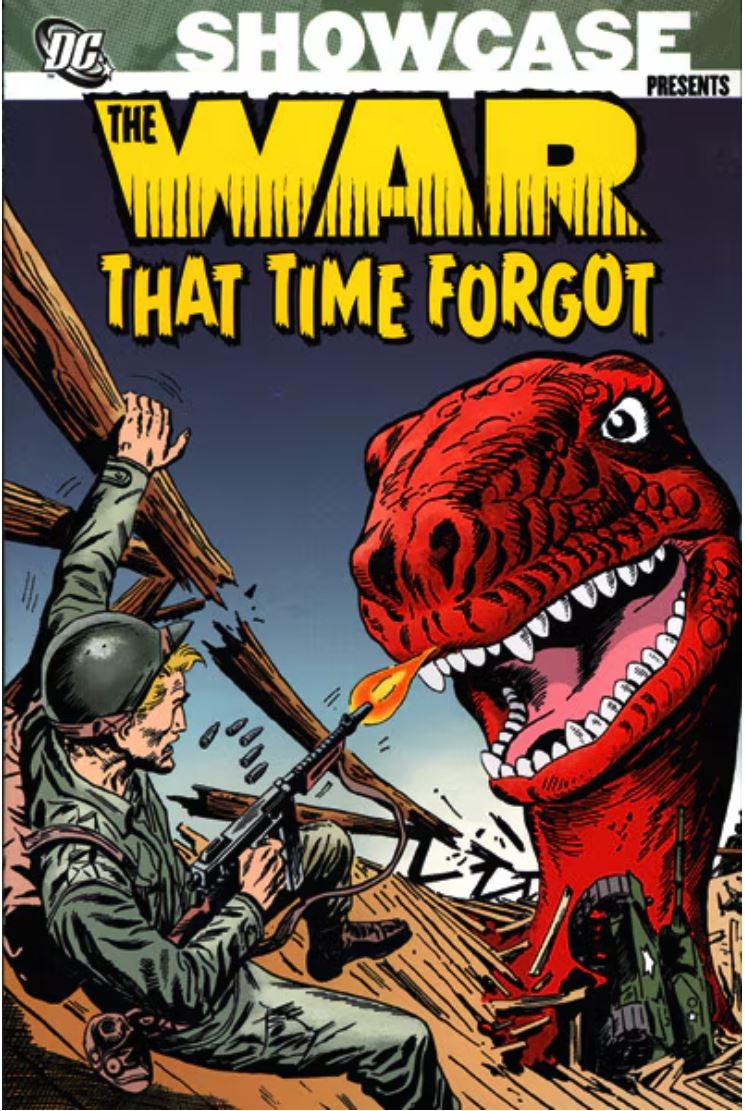
Showcase Presents The War That Time Forgot


By Robert Kanigher, Ross Andru & Mike Esposito, Russ Heath, Gene Colan, Joe Kubert & various (DC Comics)
ISBN: 978-1-4012-1253-7 (TPB)

Unbelievably, STILL not a Major Motion Picture, The War That Time Forgot debuted in Star Spangled War Stories #90 and ran wild there until #137 (May 1968). It skipped only three issues: #91, 93 & 126, the last of which starred the United States Marine Corps simian Sergeant Gorilla. Look it up: I’m neither kidding nor being metaphorical…

At present this stunningly bizarre black-&-white compendium is the only comprehensive collection: gathering together most but not all of the monstrously madcap material from SSWS #90, 92, 94-125 and 127-128, cumulatively spanning April/May 1960 to August 1966. Simply too good a concept to leave alone, this seamless, shameless blend of Sir Arthur Conan Doyle’s Lost World and Edgar Rice Burroughs’ Caprona stories (known alternatively as the Caspak Trilogy or The Land That Time Forgot) provided everything baby-boomer boys – and surely many girls too, if truth be told – could dream of with giant lizards, humongous insects, fantastic adventures and two-fisted heroes employing lots of guns and gear and explodey stuff…

Robert Kanigher (1915-2002) was one of the most distinctive authorial voices in American comics, blending rugged realism with fantastic fantasy in his signature War comics, Horror stories, Romance, superhero titles such as Wonder Woman, Teen Titans, Hawkman, Metal Men, Iron Man, Lois Lane, Steel Sterling, Batman and other genres and stars too numerous to cover here. He scripted ‘Mystery of the Human Thunderbolt’ – the first story of the Silver Age which introduced Barry Allen as The Flash to the superhero-hungry kids of the World in 1956.

Kanigher sold his first stories and poetry in 1932, wrote for the theatre, film and radio, and joined the Fox Features shop where he created The Bouncer, Steel Sterling and The Web, whilst providing scripts for Blue Beetle and the original (Shazam!-fuelled) Captain Marvel. In 1945 he settled at All-American Comics as both writer and editor, staying on when the company amalgamated with National Comics to become the forerunner of today’s DC. He scripted Golden Age iterations of Flash and Hawkman, created Black Canary, Dr. Pat and Lady Cop, plus memorable female foes Harlequin and Rose and Thorn. This last he reconstructed during the relevancy era of the early 1970s into a schizophrenic crime-busting superhero.

When mystery-men faded out at the end of the 1940s, Kanigher moved into westerns and war stories, and in 1952 became writer/editor of the company’s combat titles All-American War Stories, Star Spangled War Stories and Our Amy at War. He launched Our Fighting Forces in 1954 and added G.I. Combat to his burgeoning portfolio when Quality Comics sold their line of titles to DC in 1956, all the while working on Wonder Woman, cowboy Johnny Thunder, Rex the Wonder Dog, Silent Knight, Sea Devils, The Viking Prince and a host of others.

Among his many epochal war series were Sgt. Rock, Enemy Ace, The Haunted Tank and The Losers as well as the visually addictive, irresistibly astonishing “Dogfaces vs Dinosaurs” dramas depicted here. Kanigher was a restlessly creative writer and I suspect he used this uncanny but formulaic adventure arena as a personal try-out venue for his many series concepts. The Flying Boots, G.I. Robot, Suicide Squad and many other teams and characters initially appeared in this lush Pacific hellhole with wall-to-wall danger. Indisputably, the big beasts were the stars, but occasionally ordinary G.I. Joes made enough of an impression to secure return engagements, too…

The wonderment commenced in Star Spangled War Stories #90 as paratroopers and tanks of the “Question Mark Patrol” are dropped on Mystery Island – from whence no American soldiers have ever returned. The crack warriors discover why when the operation is assaulted by pterosaurs, tyrannosaurs and worse on the ‘Island of Armoured Giants!’ Each yarn is superbly rendered by veteran art team Ross Andru & Mike Esposito.

Larry and Charlie, sole survivors of that first foray, returned to the lost world in #92’s ‘Last Battle of the Dinosaur Age!’ when aquatic beasts attack their rescue submarine forcing them back to the lethal landmass. ‘The Frogman and the Dinosaur!’ takes up most of SSWS #94 as a squad of second-rate Underwater Demolitions Team divers are trapped on the island, encountering the usual bevy of blockbuster brutes and a colossal crab as well.

What starts out as paratroopers versus pterodactyls in #95 turns into a deadly turf-war in ‘Guinea Pig Patrol!’ before ‘Mission X!’ introduces the Task Force X/Suicide Squad in a terse infiltration story with the increasing eager US military striving to set up a base on the strategically crucial monster island. The Navy took the lead in #97’s ‘The Sub-Crusher!’ with equally dire results as a giant gorilla joins the regular roster of horrors, after which a frustrated palaeontologist is blown off course and into his wildest nightmare in ‘The Island of Thunder’. The rest of his airborne platoon aren’t nearly as excited at the discovery…

The Flying Franks were a trapeze family before the war, but as “The Flying Boots” Henny, Tommy & Steve won fame as paratroopers. For #99’s ‘The Circus of Monsters!’ they face the greatest challenge of their lives after washing up on Mystery Island and narrowly escaping death by dinosaur. They aren’t too happy on being sent back next issue to track down a Japanese secret weapon in ‘The Volcano of Monsters!’

In #101 ‘The Robot and the Dinosaur!’ ramp up the fantasy quotient as reluctant Ranger Mac is dispatched to the primordial preserve to field-test the Army’s latest weapon: a fully automatic, artificial G.I. Joe, who promptly saves the day and returned to fight a ‘Punchboard War!’ in the next issue: tackling immense killer fish, assorted saurians and a giant Japanese war-robot that dwarfs the dinosaurs. The mecha-epic carried over and concluded in #103’s ‘Doom at Dinosaur Island!’, after which the Flying Boots encored in Star Spangled #104’s ‘The Tree of Terror!’ when a far-ranging pterodactyl drags the brothers back to the isle of no return for another explosive engagement. ‘The War on Dinosaur Island!’ sees the circus boys leading a small-scale invasion, but even tanks and the latest ordnance prove little use against pernicious, eternally hungry reptiles, after which ‘The Nightmare War!’ sees a dino-phobic museum janitor trapped in his worst nightmare. At least he has his best buddies and a goodly supply of bullets and bombs with him…

The action shifts to the oceans surrounding the island for sub-sea shocker ‘Battle of the Dinosaur Aquarium!’ with plesiosaurs, titanic turtles, colossal crabs and crocodilians on the menu, before hitting the beaches in #108 for ‘Dinosaur D-Day!’ when the monsters take up residence in the Navy’s landing craft. ‘The Last Soldiers’ then pits determined tank-men against a string of scaly perils on land, sea and air, after which a new Suicide Squad debuts in #110 to investigate a ‘Tunnel of Terror’ into the lost land of giant monsters. This time, though, there’s a giant gorilla on their side…

That huge hairy beast is the star of ‘Return of the Dinosaur Killer!’ as the harried unit leader and a wily boffin (visually based on Kanigher’s office associate Julie Schwartz) struggle to survive on the tropically reptilian atoll, whilst ‘Dinosaur Sub-Catcher!’ shifts locale to ice floes as a pack of lost sea dinosaurs attack a polar submarine and US weather station.

Star Spangled War Stories #113 returned to the blue Pacific for ‘Dinosaur Bait!’ and a pilot tasked with hunting down the cause for so many lost subs after which ‘Doom Came at Noon!’ revisits snowy climes as dinosaurs inexplicably rampage through alpine territory, making temporary allies of old enemies dispatched to destroy hidden Nazi submarine pens.

Issue #115’s ‘Battle Dinner for Dinosaurs!’ sees a helicopter pilot marooned on Mystery Island drawn into a spectacular aerial dogfight, before a duo of dedicated soldiers faced ice-bound beasts in ‘The Suicide Squad!’ The big difference being that here Morgan and Mace are more determined to kill each other than accomplish their mission…

‘Medal for a Dinosaur!’ bowed to the inevitable and introduced a (relatively) friendly baby pterodactyl to balance out Mace & Morgan’s barely-suppressed animosity, and ‘The Plane-Eater!’ finds the army odd couple adrift in the Pacific and in deep danger until our leather-winged little guy turns up once more…

The Suicide Squad were getting equal billing by the time of #119’s ‘Gun Duel on Dinosaur Hill!’, as yet another group of men-without-hope battle saurian horrors and each other to the death, after which the apparently un-killable Morgan & Mace pop back with Dino, the flying baby dinosaur. They also make a new ally and companion in handy hominid Caveboy, before the whole unlikely ensemble struggle to survive increasingly outlandish creatures in ‘The Tank Eater!’ Star Spangled War Stories #121 then presented another diving drama as a UDT frogman gains a Suicide Squad berth, proving to be a formidable fighter and ultimately ‘The Killer of Dinosaur Alley!’ Increasingly, G.I. hardware and ordnance began to gain the upper hand over bulk, fang and claw and much-missed representational maestro Russ Heath added an edge of hyper-realism to #122’s ‘The Divers of Death’ wherein two Frogman siblings battle incredible underwater insects but still can’t win the respect of their landlubber older brothers, and Gene Colan illustrated aquatic adventure ‘The Dinosaur who Ate Torpedoes!’, before Andru & Esposito reenlisted to depict ‘Terror in a Bottle!’. This was the second short saurian saga to grace issue #123 and another outing for that giant ape who loved to pummel pterosaurs and larrup lizards.

Undisputed master of gritty fantasy art Joe Kubert added his pencil-and-brush magic to tense and manic thriller ‘My Buddy the Dinosaur!’ in #124, and stuck around to illumine the return of G.I. Robot in stunning battle bonanza ‘Titbit For a Tyrannosaurus!’ (#125), after which Andru & Esposito limned Suicide Squad sea saga ‘The Monster Who Sank a Navy!’ in #127. The last tale here (#128) sees Colan resurface to illuminate a masterfully moving human drama actually improved by the inclusion of ravening reptiles in ‘The Million Dollar Medal!’.

Throughout this eclectic collection of dark dilemmas, light-hearted romps and spectacular battle blockbusters the emphasis is always on human fallibility; with soldiers unable to put aside long-held grudges, swallow pride or forgive trespasses even amidst the strangest and most terrifying moments of their lives, and this edgy humanity informs and elevates even the daftest of these wonderfully imaginative adventure yarns.

Classy, intense, insanely addictive and Just Plain Big Fun, The War that Time Forgot is a deliciously guilty pleasure and I for one hope the remaining stories from Star Spangled War Stories, Weird War Tales, G. I. Combat and especially the magnificent Tim Truman Guns of the Dragon miniseries all end up in sequel compilations before many more eons pass.

Now Read This book and you will too…
© 1960-1966, 2007 DC Comics. All Rights Reserved.

Tarzan and the Lost Tribes (Complete Burne Hogarth Comic Strip Library volume 4)


By Burne Hogarth & Rob Thompson (Titan Books)
ISBN: 978-1-78116-320-7 (Album HB)

The 1930 and 1940s was an era of astounding pictorial periodical adventure. In the years before television, newspaper strips (and later comicbooks) were the only visually-based home entertainment for millions of citizens young and old and consequently shaped the culture of many nations. Relatively few strips attained near-universal approval and acclaim. Flash Gordon, Terry and the Pirates and Prince Valiant were in that rarefied pantheon but arguably the most famous was Tarzan.

The full-blown dramatic adventure serial started on January 7th 1929 with Buck Rogers and Tarzan debuting that day. Both were adaptations of pre-existing prose properties and their influence changed the shape of the medium forever. The 1930s saw an explosion of similar fare, launched with astounding rapidity and success. Not just strips but actual genres were created in that decade, still impacting on today’s comic-books and, in truth, all our popular fiction forms.

In terms of art quality, the adaptations of Edgar Rice Burroughs’ immensely successful novels starring jungle-bred John Clayton, Lord Greystoke by Canadian commercial artist Harold “Hal” Foster were unsurpassed. These strips soon became a firm favourite of the masses, supplementing movies, books, a radio show and ubiquitous advertising appearances.

As detailed in previous volumes of this sublime oversized (330 x 254 mm), full-colour hardback series, Foster initially quit the strip at the end of a 10-week adaptation of first novel Tarzan of the Apes and was replaced by Rex Maxon. At the insistent urging of author ER Burroughs, Foster returned when the black-&-white daily expanded to include a lush, full colour Sunday page featuring original adventures.

Maxon was left to capably handle the weekday book adaptations, and Foster crafted the epic and lavish Sunday page until 1936 (233 consecutive weeks). He then left again, for good: moving to King Features Syndicate and his own landmark weekend masterpiece Prince Valiant in the Days of King Arthur – debuting in February 1937. Once the 4-month backlog of material he built up was gone, Foster was succeeded by precociously brilliant 25-year old Burne Hogarth: a graphic visionary whose superb anatomical skill, cinematic design flair and compelling page composition revolutionised the entire field of action/adventure narrative illustration. The galvanic modern dynamism of the idealised human figure in today’s comicbooks can be directly attributed to Hogarth’s pioneering drawing and, in later years, educational efforts. Burroughs cannily used the increasingly popular comic strip to cross-market his own prose efforts with great effect.

This fantastic fourth tome begins with the spectacularly illustrated ‘Jusko on Hogarth: An Education in Form and Movement’ with the fantasy painter harking back to his childhood comics experiences and influences after which the astounding action/adventure epic recommences. At this time, Hogarth was sharing the scripting chores veteran collaborator Rob Thompson, having only recently returned to the feature after a dispute with the owners. He had moved to the Robert Hall Syndicate for whom he produced seminal adventure classic Drago, and then United Features to create comedy strip Miracle Jones. During the time away from Tarzan, Hogarth – with Silas Rhodes – opened the Cartoonists and Illustrators School, which later evolved into the School of Visual Arts.

‘Tarzan and N’Ani’ (episodes #875-896, 14th December to 1948 – 9th May 1948) offers more raw drama as Tarzan visits old friend Pangola only to find the chief dead and his Wakamba warriors under the thumb of apparent spirit soldiers and their White Queen. A little spirited resistance and dedicated investigation by the Ape-Man soon reveals crooked circus performers exploiting and enslaving the natives, but before he can confront the villains they take his wife Jane hostage. N’Ani’s big mistake is thinking her captive is a weak and feeble civilised woman…

When the bad guys and their trained big cats are dealt with, the excitement briefly subsides, but all too soon the Jungle Lord is duped into boarding a scientist’s reconditioned atomic submarine and whisked away against his will to uncanny uncharted regions in year-long saga ‘Tarzan on the Island of Mua-Ao’ (pages #897-947 and running from 16th May 1948 to 1st May 1949). After some Nemo-like subsea escapades (the mad scientist not the cartoon fish) Tarzan and his unwelcome companions fetch up on a Polynesian (minor) lost continent only to be captured by the scientifically advanced but morally barbarous Lahtian people. This slave-owning totalitarian kingdom is ripe for revolution and after our hero – with worthy warriors Soros and Timaru – escapes a gladiatorial arena they go about arranging one. Of course, that necessitates traversing the savage jungle hinterlands, surviving its ubiquitous feline predators and making peace with the dominant Ornag-Rimba and Thalian tribes…

A little complication crops up when local witchdoctor Totama feels threatened and repeatedly seeks to assassinate Tarzan, but the Ape-Man counters every plot and foray in his own unstintingly decisive manner…

Eventually, Tarzan has his coalition in place and leads an unstoppable assault against the Lahtians which inevitably leads to regime-change and his return to Africa…

The titanic tome concludes in a macabre yarn and a radical overhaul of the strip. During ‘Tarzan and the Ononoes’ (#948-972) which ran from May 8th to 23rd October 1949, the venerated traditional full-page vertical format was controversially downgraded to episodes printed in landscape format, allowing a certain liberalisation of layouts but making pages seem cramped and claustrophobic…

Narratively, the tone is full-on fantasy as Tarzan swears to expiring explorer Philip Ransome that he will rescue his lost daughter from mysterious creatures holding her beyond the impassable Ashangola Mountains.

That mission brings him into conflict with Waloks – intelligent missing-link anthropoids – and their bitter enemies, a race of depraved monsters called Ononoes. These carnivorous horrors are giant heads with arms but no legs or torsos with a penchant for human sacrifice. Their next victim is to be an outworlder girl named Barbara Ransome

Grim, grotesque and genuinely scary, Tarzan’s struggle against the rotund terrors is a high point of the strip and anticipates even greater thrills in the forthcoming final collection.

To Be Concluded…

Tarzan is a fictive creation who has attained an immortal reality in a number of different creative arenas, but none offer the breathtaking visceral immediacy of Burne Hogarth’s comic strips.

These vivid visual masterworks are all coiled-spring tension or vital, violent explosive motion, stretching, running, fighting: a surging rush of power and glory. It’s a dream come true that these majestic exploits are back in print for ours and future generations of dedicated fantasists to enjoy.
Trademarks Tarzan® and Edgar Rice Burroughs® owned by Edgar Rice Burroughs, Inc. and Used by Permission. Copyright © 2017 Edgar Rice Burroughs, Inc. All Rights Reserved.

Guardians of the Galaxy Epic Collection volume 1: Earth Shall Overcome 1969-1977


By Arnold Drake & Gene Colan, Steve Gerber, Roger Stern, Gerry Conway, Roger Slifer, Len Wein, Chris Claremont, Scott Edelman, Stan Lee, Sal Buscema, Don Heck, Al Milgrom, John Buscema & various (MARVEL)
ISBN: 978-1-3029-5043-9 (TPB/Digital edition)

With the final GoTG Marvel Cinematic interpretation done and dusted, there’s little to look forward too other than the past, but at least in this anniversary year – 55 and counting! – there’s this timely collection ideal for boning up on some of the lesser-known original stars

There are two distinct and separate iterations of the Guardians of the Galaxy. The films concentrated on the second, but with inescapable connections between them and the stellar stalwarts here so pay close attention. The original comic book team were freedom fighters united to defeat an invasion a thousand years from the present. The other were a later conception: springing out of contemporary crises seen in The Annihilation publishing event.

This treasury of torrid tales gathers landmark moments of the former as seen in Marvel Super-Heroes #18, Marvel Two-In-One #4-5, Giant-Size Defenders #5, Defenders #26-29, the time-busting team’s first solo series as originally seen in Marvel Presents #3-12 and Thor Annual #6: collaboratively and monumentally spanning cover-dates January 1969 to December 1977. It features a radically different set-up than that of the silver screen stars, but is grand comic book sci fi fare all the same. One thing to recall at all times, though, is that there are two teams. Never the twain shall meet …until they one day did…

Despite its key mission to make superheroes more realistic, Marvel also always kept a close connection with its fantasy roots and outlandish cosmic chaos – as typified in the pre-Sixties “monsters-in-underpants” mini-sagas. Thus, this pantheon of much-travelled space stalwarts maintains that wild “Anything Goes” attitude in all of their many and varied iterations.

A blistering battle-fest opens with ‘Guardians of the Galaxy: Earth Shall Overcome!’ as first seen in new-concept try-out/Golden Age reprint vehicle Marvel Super-Heroes #18. Cover-dated January 1969, it went on sale mid-October 1968, just as the Summer of Love was dying.

This terse, grittily engaging episode introduced disparate freedom fighters reluctantly rallying and united to save Earth from occupation and humanity from extinction at the scaly claws of the sinister, reptilian Brotherhood of Badoon. It began when Jovian militia-man Charlie-27 returned home from a 6-month tour of scout duty to find his entire colony subjugated by invading aliens. Fighting free, Charlie jumped into a randomly-programmed teleporter and emerged on Pluto, just in time to accidentally scupper the escape of crystalline scientist and resistance fighter Martinex.

Both survivors are examples of radical human genetic engineering: manufactured subspecies carefully designed to populate and colonise Sol system’s outer planets, but now possibly the last individuals of their respective kinds. After helping the mineral man complete his mission of sabotage – by blowing up potentially useful material before the Badoon can get their hands on it – the odd couple set the teleporter for Earth and jump into the unknown. Unfortunately, the invaders have already taken the homeworld…

The Supreme Badoon Elite are there, busily mocking the oldest Earthman alive. Major Vance Astro had been humanity’s first interstellar astronaut; solo flying in cold sleep to Alpha Centauri at a plodding fraction of the speed of light. When he got there a millennium later, humanity was waiting for him, having cracked trans-luminal speeds a mere two centuries after he took off. Now Astro and Centauri aborigine Yondu are a comedy exhibit for the cruel conquerors actively eradicating both of their species.

The smug invaders are utterly overwhelmed when Astro breaks free, utilising psionic powers he developed during hibernation, before Yondu butchers them with the sound-controlled energy arrows he carries. In their pell-mell flight, the escaping pair stumble across incoming Martinex and Charlie-27 and a new legend of valiant resistance is born…

As envisioned by Arnold Drake, Gene Colan & Mike Esposito, the eccentric team were presented to an audience undergoing immense social change, with dissent in the air, riot in the streets and the ongoing Vietnam War being visibly lost on their TV screens every night.

Perhaps the jingoistic militaristic overtones were off-putting, or maybe the tenor of the times were against The Guardians, since costumed hero titles were entering a temporary downturn at that juncture, but whatever the reason the feature was a rare “Miss” for the Early Marvel Hit Factory. The futuristic freedom fighters were not seen again for years.

They drifted in limbo until 1974 when Steve Gerber incorporated them into some of his assigned titles (specifically Marvel Two-In-One and The Defenders), wherein assorted 20th century champions travelled into the future to ensure humanity’s survival…

In MTIO #4, ‘Doomsday 3014!’ (Gerber, Sal Buscema & Frank Giacoia) sees Ben Grimm – AKA The Thing – and Captain America catapulted into the 31st century to free enslaved humanity from the Badoon, concluding an issue later as a transformed and reconfigured Guardians of the Galaxy climb aboard the Freedom Rocket to help the time-lost champions liberate occupied New York before returning home.

The fabulous Future Force returned that visit in Giant Sized Defenders #5: a diverse-handed production with the story ‘Eelar Moves in Mysterious Ways’ credited to Gerber, Gerry Conway, Roger Slifer, Len Wein, Chris Claremont & Scott Edelman. Dependable Don Heck & Mike Esposito drew the (surprisingly) satisfying and cohesive results, revealing how the Defenders met with future heroes Guardians of the Galaxy in a time-twisting disaster yarn where their very presence seemed to cause nature to run wild. It was simply an introduction, setting up a continued epic arc for the monthly comic book…

Beginning with ‘Savage Time’ (Defenders #26 by Gerber, Sal Buscema & Colletta) it depicts The Hulk, Doctor Strange, Nighthawk and Valkyrie accompanying the Guardians back to 3015 AD in a bold bid to liberate the last survivors of mankind from the all-conquering and genocidal Badoon. The mission continued with ‘Three Worlds to Conquer!’, becoming infinitely more complicated when ‘My Mother, The Badoon!’ reveals sex-based divisions that so compellingly motivate the marauding lizard-men to roam and tyrannise, before climaxing triumphantly in rousingly impassioned conclusion ‘Let My Planet Go!’

Along the way the Guardians picked up – or been unwillingly allied with – an enigmatic stellar powerhouse dubbed Starhawk. Also answering to Stakar, he was a glib, unfriendly type who referred to himself as “one who knows” and infuriatingly usually did, even if he never shared any useful intel…

That portion of the saga is interspersed with the covers of latterday compilations Guardians of the Galaxy: Earth Shall Overcome Premiere Hardcover (by Gil Kane & Chris Sotomayor and Ron Wilson & Matt Milla), before the next giant leap…

Rejuvenated by exposure, the squad rededicated themselves to liberating star-scattered Humanity and having astral adventures, in a short-lived series in Marvel Presents (#3-12, February 1976-August 1977) before cancellation left them roaming the MU as perennial guest-stars in cosmically-tinged titles like Thor and The Avengers. That first solo run began with ‘Just Another Planet Story!’ by Gerber, Al Milgrom & Pablo Marcos – with all Badoon removed from an exultant Earth and our now purposeless Guardians realising peace and freedom were not for them. Unable to adapt to civilian life, they reassembled, stole their old starship “The Captain America and rocketed off into the void…

More compilation covers – Guardians of the Galaxy: Tomorrow’s Heroes Omnibus (by John Romita Sr & Veronica Gandini) and Guardians of the Galaxy: The Power of Starhawk Premiere HC by Milgrom & Tom Chu – interleave the unfolding saga, but the original text feature ‘Readers Space’ (episodically delineating future history of Marvel Universe Mankind using various deceased company sci fi series as mile markers, way stations and signposts) is bundled to the bonus section at the back of the book. At the time the roadmap firmly established a timeline which would endure for decades…

Back to comics and in MP #4, Gerber & Milgrom descended ‘Into the Maw of Madness!’ as the noble nomads pick up feisty teenage Nikki: a Mercurian survivor of the Badoon genocide, and noted first inklings that something vast, alien and inimical was coming from “out there” to consume the galaxy. The warriors also met cosmic enigma Starhawk’s better half Aleta: a glamorous woman and mother of his three children sharing his/their body at that time…

When the star-farers and their ship are swallowed by star-system-sized monster Karanada, they discover a universe inside the undead beast and end up stranded on the ‘Planet of the Absurd’ (Gerber, Milgrom & Howard Chaykin), allowing the author to indulge his gift for political and social satire as our heroes seek to escape a society comprising a vast variety of species which somehow mimics 20th century Earth…

Escape achieved, the fantastic fantasy accelerates to top gear when they crash into the heart of the invading force on a galaxy-sized planet in humanoid form. ‘The Topographical Man’ (inked by Terry Austin) holds all answers they seek in a strange sidereal nunnery where Nikki is expected to make a supreme sacrifice: one that changes Vance’s life forever in ways he never imagined.

This all transpires as they spiritually unite to ‘Embrace the Void!’ (Bob Wiacek inks) in a metaphysical rollercoaster which ends the menace of the soul-sucking galactic devourer. At this time deadlines were a critical problem and Marvel Presents #8 adapted a story from Silver Surfer #2 (1968) as the team find an old Badoon data-log and learn ‘Once Upon a Time… the Silver Surfer!’ had saved Earth from the alien predators in a two-layered yarn attributed to Gerber, Milgrom, Wiacek, Stan Lee, John Buscema & Joe Sinnott…

Back on track for MP #9, Gerber & Milgrom revealed ‘Breaking Up is Death to Do!’ as the Guardians’ ship is ambushed by predatory Reivers of Arcturus, leading into the long-awaited shocking origins of Starhawk and Aleta. It also set the assembled heroes on a doomed quest to save the bonded couple’s children from brainwashing, mutation and murder by their own grandfather in ‘Death-Bird Rising!’ before concluding ‘At War with Arcturus!’ (both inked by Wiacek).

The series abruptly concluded just as new scripter Roger Stern signed on with ‘The Shipyard of Deep Space!’, as the beleaguered and battered team escape Arcturus and stumble onto a lost Earth vessel missing since the beginning of the Badoon invasion. “Drydock is a mobile space station the size of a small moon, built to maintain and repair Terran starships. However, what initially seems to be a moving reunion with lost comrades and actual survivors of many gene-gineered human subspecies eradicated by the saurian supremacists is revealed to be just one more deadly snare for the Guardians to overcome or escape…

The time-busting mayhem concludes for now with ‘Thunder in the 31st Century!’ (from Thor Annual #6, December 1977) by Stern, Sal Buscema & Klaus Janson,in which the mighty Thunderer is accidentally deposited in the Guardians’ era by a cyborg maniac named Korvac. The god warrior eagerly joins them in battling a gang of superpowered aliens to thwart Korvac’s scheme to make himself master of the universe before returning to his own place and time…

The aforementioned bonus bounty ending this titanic temporal tome also includes the cover of Astonishing Tales #29 (April 1975 and reprinting Marvel Super-Heroes #18), articles on Guardians of the Galaxy by Gerber and Stern from F.O.O.M. #21 (Spring 1978), original art pages and covers by Sal Buscema, Colletta, Milgrom, Rich Buckler, Wiacek & Janson and one last past collection cover – from Guardians of the Galaxy: Tomorrow’s Avengers vol. 2 TPB by John Buscema, Joe Sinnott & Thomas Mason.

This rousing record of riotous star-roving derring-do is a non-stop feast of tense suspense, surreal fun, swingeing satire and blockbuster action tightly tailored and on-target to turn curious moviegoers into fans of the comic incarnation, and beguile even the most jaded interstellar Fights ‘n’ Tights fanatic into dreaming again with eyes wide open.
© 2023 MARVEL.

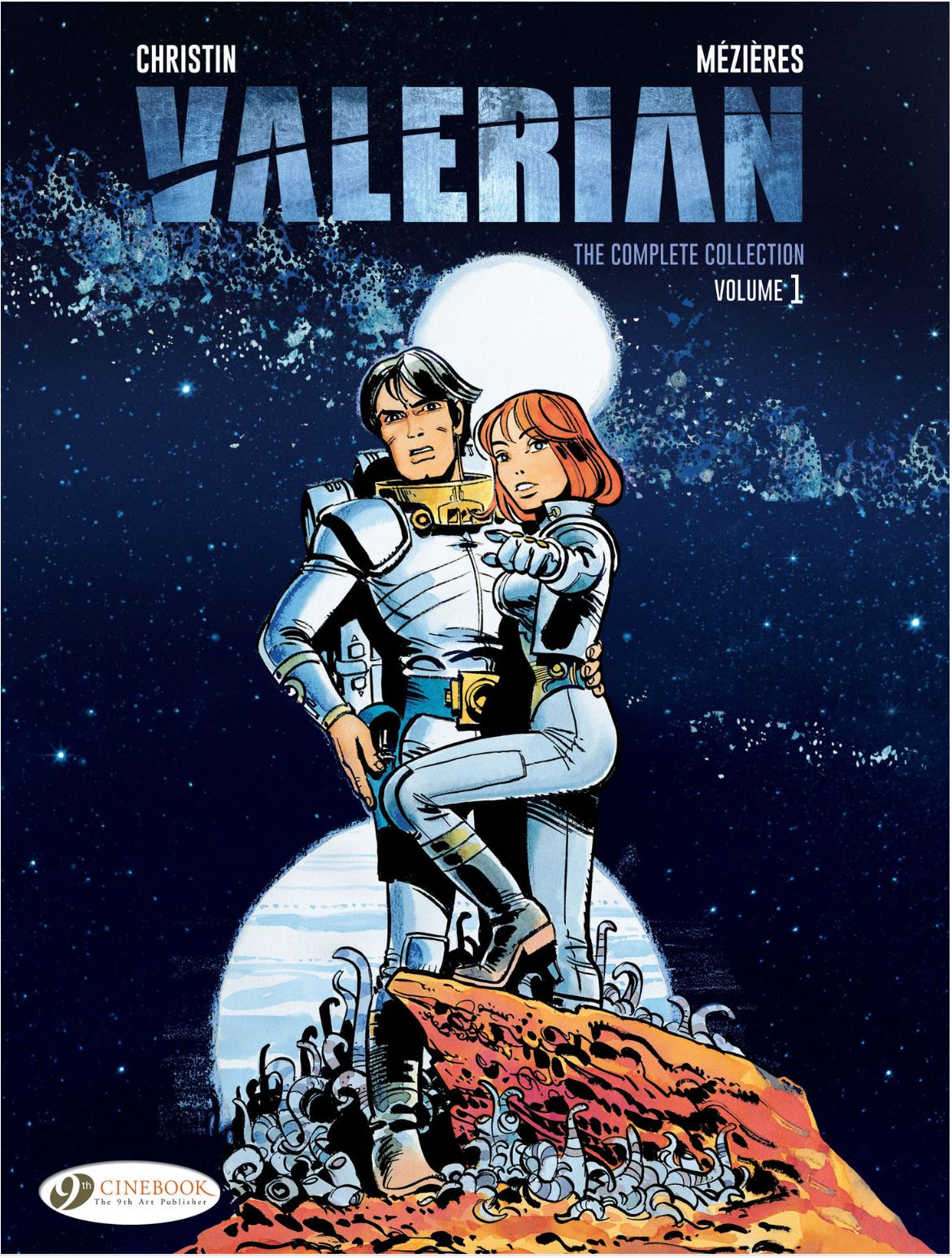
Valerian: The Complete Collection volume 1


By J.-C. Mézières & P. Christin with colours by E. Tranlê: translated by Jerome Saincantin (Cinebook)
ISBN: 978-1-84918-352-9 (HB/Digital edition)

Although I still marginally plump for Flash Gordon, another strong contender for the most influential science fiction series ever drawn – and yes, I am including Buck Rogers in this tautological turmoil – is Valérian. Although to a large extent those venerable newspaper strips actually formed the genre itself, anybody who has seen a Star Wars movie (or indeed any sci fi flic from the 1980s onwards) has seen some of Jean-Claude Mézières & Pierre Christin’s brilliant imaginings which the film industry has shamelessly plundered for decades: everything from the Millennium Falcon’s look to Leia’s Slave Girl outfit…

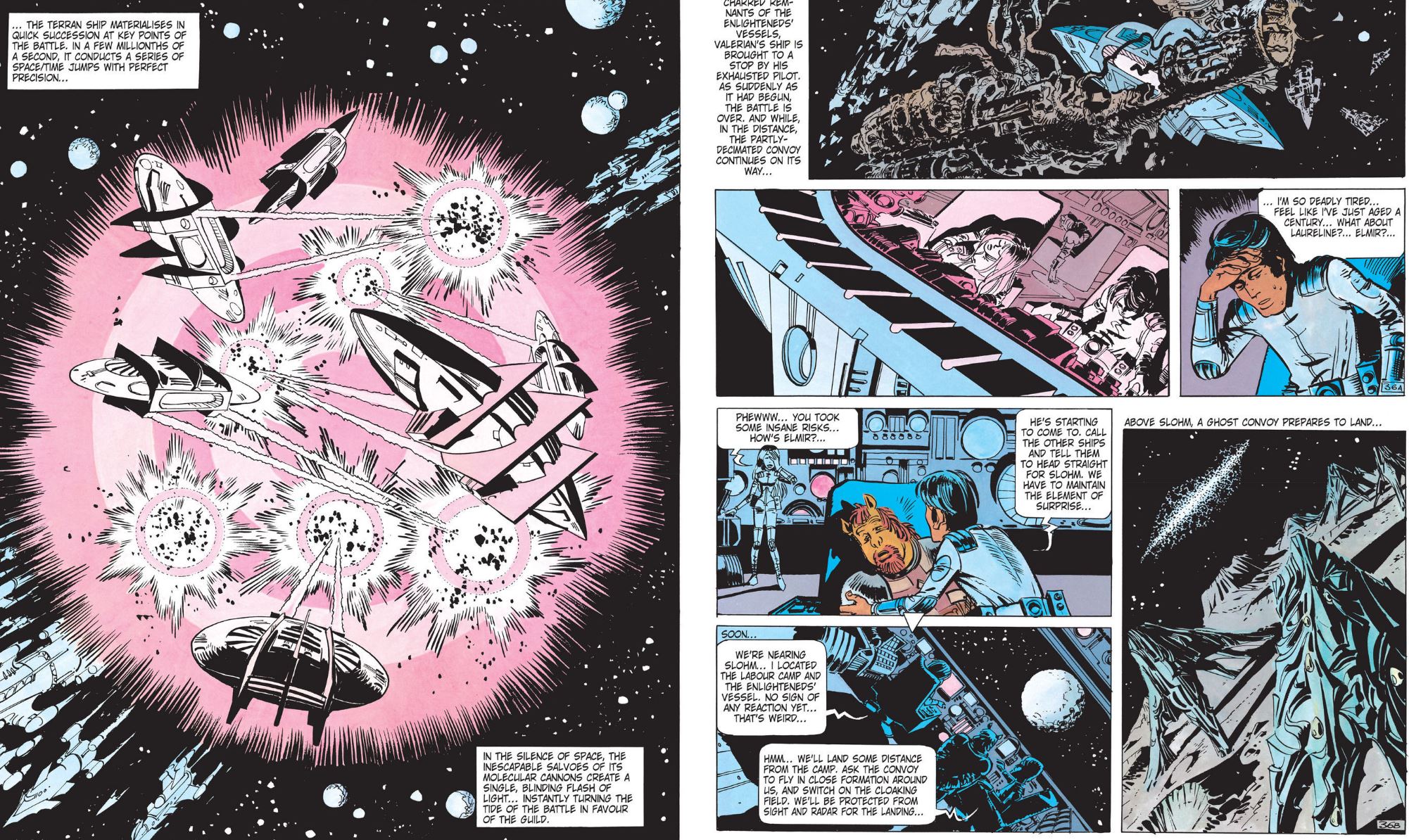
Please don’t take my word for it: this splendid oversized hardback compendium – originally released to cash in on the epic Luc Besson movie – has a copious and good-natured text feature entitled ‘Image Creators’ confirming and comparing panels to film stills.

In case you’re curious, additional features include photo & design art-packed ‘Interview Luc Besson, Jean-Claude Mézières and Pierre Christin (Part I)’ plus bullet-point historical briefings ‘How it All Began…’, ‘Go West Young Men!’, ‘Colliding Worlds’, ‘Explore Anything’ and ‘Hello!’ This is Laureline…’. Simply put, more carbon-based lifeforms have marvelled at the uniquely innovative, grungy, lived-in tech realism and light-hearted swashbuckling roller-coasting of Mézières & Christin than any other cartoon spacer ever imagined possible.

Valérian: Spatio-Temporal Agent launched in the November 9th 1967 edition of Pilote (#420, running until February 15th 1968). It was an instant hit. However, album compilations only began with second tale The City of Shifting Waters, as all creatives concerned considered their first yarn as a work-in-progress, not quite up to their preferred standard. You can judge for yourself, as that prototype – Bad Dreams – kicks off this volume, in its first English-language translation…

The groundbreaking series was boosted by a Franco-Belgian mini-boom in science fiction triggered by Jean-Claude Forest’s 1962 creation Barbarella. Other notable successes of the era include Greg & Eddy Paape’s Luc Orient and Philippe Druillet’s Lone Sloane tales (our reviews are coming soon!), which all – with Valérian – stimulated mass public reception to science fiction and led to the creation of dedicated fantasy periodical Métal Hurlant in 1977.

Valérian and Laureline (as it became) is a light-hearted, wildly imaginative time-travel adventure-romp (a bit like Doctor Who, but not really at all), drenched in wry, satirical, humanist, political commentary, starring (at least in the beginning) an affably capable but unimaginative, by-the-book cop tasked with protecting universal time-lines and counteracting paradoxes caused by reckless casual time-travellers…

The fabulous fun commences with the aforementioned Bad Dreams – which began life as Les Mauvais Réves – a blend of comedy and action as dry dullard Valérian voyages to 11th century France in pursuit of a demented dream-scientist: a maverick seeking magical secrets to remake the universe to his liking. Sadly, our hero is a little out of his depth until rescued from a tricky situation by a fiery, capable young woman/temporal native called Laureline.

After handily dealing with the dissident Xombul and his stolen sorceries, Valerian brings Laureline back with him to the 28th century super-citadel and administrative wonderland of Galaxity, capital of the vast and mighty Terran Empire.

The indomitable girl trains as a Spatio-Temporal operative and is soon an apprentice Spatio-Temporal Agent accompanying Val on his missions throughout time and space…

Every subsequent Valérian adventure until the 13th was first serialised in weekly Pilote until the conclusion of The Rage of Hypsis (January 1st – September 1st 1985) after which the mind-wrenching sagas were simply launched as all-new complete graphic novels, until the magnificent opus concluded in 2010.

One clarifying note: in the canon, “Hypsis” is counted as the 12th tale, due to collected albums being numbered from The City of Shifting Waters. When Les Mauvais Réves was finally released in a collected edition in 1983 it was given the number #0. The City of Shifting Waters was originally published in two tranches; La Cité des Eaux Mouvantes (#455-468, 25th July – 24th October 1968) followed by Terre en Flammes (Earth in Flames, #492-505, 10th April – 10th July 1969).

Both are included here and the action opens with the odd couple dispatched to 1986 – when civilisation on Earth was destroyed due to ecological negligence, political chicanery and atomic holocaust. Their orders are to recapture Xombul, still hellbent on undermining Galaxity and establishing himself as Dictator of the Universe. To attain this goal the renegade travelled to New York after the nuclear accident melted the ice caps and flooded the city – and almost everywhere else. He’s hunting lost scientific secrets that would allow him to conquer the devastated planet and prevent the Terran Empire ever forming… at least that’s what his Galaxity pursuers assume…

Plunged back into an apocalyptic nightmare where Broadway and Wall Street are submerged, jungle vines connect deserted skyscrapers, tsunamis are an hourly hazard and bold looters snatch up the last golden treasures of a lost civilisation, the S-T agents find unique allies to preserve the proper past, but are constantly thwarted by Xombul who has constructed deadly robotic slaves to ensure his schemes.

Visually spectacular, mind-bogglingly ingenious and steeped in delicious in-jokes (the utterly-mad-yet-brilliant boffin who helps them is a hilarious dead ringer for Jerry Lewis in 1963 film The Nutty Professor) this is a timelessly witty Science Fiction delight which climaxes in a moody cliffhanger…

Immediately following, Earth in Flames concludes the saga as our heroes head inland, encountering hardy survivors of the holocaust. Enduring more hardships, they escape even greater catastrophes such as the eruption of a super-volcano under Yellowstone Park before finally frustrating the plans of the most ambitious mass-killer in all of history… and as Spatio-Temporal Agents they should know…

Concluding this first fantastic festive celebration is The Empire of a Thousand Planets (originally seen in Pilote #520-541, October 23rd 1969 – March 19th 1970) as veteran and rookie are despatched to fabled planet Syrte the Magnificent. It is the capital of a vast system-wide civilisation and a world in inexplicable and rapid technological and social decline. The mission is threat-assessment: staying in their base time-period (October 2720) the pair must examine the first galactic civilisation ever discovered which has never experienced any form of human contact or contamination. As usual, events don’t go according to plan…

Despite easily blending into a culture with a thousand separate sentient species, Valerian & Laureline find themselves plunged into intrigue and dire danger when the cheekily acquisitive girl buys an old watch in the market. Nobody on Syrte knows what it is since all the creatures of this civilisation have an innate, infallible time-sense, but the gaudy bauble quickly attracts the attention of one of the Enlightened – a sinister cult of masked mystics who have the ear of the Emperor and a stranglehold on all technologies.

The Enlightened are responsible for the stagnation within this once-vital interplanetary colossus and they quickly move to eradicate the Spatio-Temporal agents. Narrowly escaping doom, the pair reluctantly experience the staggering natural wonders and perils of the wilds beyond the capital city before dutifully returning to retrieve their docked spaceship. Sadly, our dauntless duo are distracted, embroiled in a deadly rebellion fomented by the Commercial Traders Guild. Infiltrating the awesome palace of the puppet-Emperor and visiting the mysterious outer planets, Valerian & Laureline discover a long-fomenting plot to destroy Earth – a world supposedly unknown to anyone in this Millennial Empire…

All-out war looms and the Enlightened’s incredible connection to post-Atomic disaster Earth is revealed just as interstellar conflict erupts between rebels and Imperial forces, with our heroes forced to fully abandon their neutrality and take up arms to save two civilisations a universe apart yet inextricably linked…

Comfortingly familiar and always innovative, this savvy space-opera is fun-filled, action-packed, spectacular, visually breathtaking and mind-bogglingly ingenious. Drenched in wide-eyed fantasy wonderment, science fiction adventures have never been better than this.
© Dargaud Paris, 2016 by Christin, Mézières & Tranlê. All rights reserved. English translation © 2016 Cinebook Ltd.

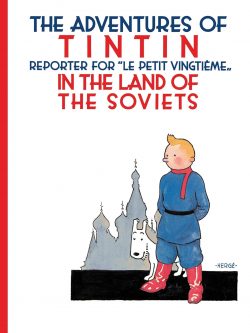
Tintin in the Land of the Soviets – The Official Classic Children’s Illustrated Mystery Adventure Series


By Hergé translated by Leslie Lonsdale-Cooper & Michael Turner (Farshore)
ISBN: 978-1-40521-477-3 (HB)

Georges Prosper Remi, known all over the world as Hergé, created a true masterpiece of graphic literature with his tales of a plucky boy reporter and entourage of iconic associates. Singly, and later with assistants including Edgar P. Jacobs, Bob de Moor and the Hergé Studio, Remi completed 23 splendid volumes (originally produced in brief instalments for a variety of periodicals) which have grown beyond their popular culture roots and attained the status of High Art.

Like Dickens with the Mystery of Edwin Drood, Hergé died while working, so final outing Tintin and Alph-Art remains a volume without an official conclusion, but still a fascinating examination – and a pictorial memorial of how the artist worked. It’s only fair though, to ascribe a substantial proportion of credit to the many translators whose diligent contributions have enabled the series to be understood and beloved in 70 languages. The subtle, canny, witty and slyly funny English versions are the work of Leslie Lonsdale-Cooper & Michael Turner.

On leaving school in 1925, Remi worked for Catholic newspaper Le XXe Siècle where he apparently fell under the influence of its Svengali-like editor Abbot Norbert Wallez. The following year, the young artist (himself a dedicated boy scout) produced his first strip series – The Adventures of Totor – for monthly Boy Scouts of Belgium magazine. By 1928 he was in charge of producing the contents of Le XXe Siècle’s children’s weekly supplement Le Petit Vingtiéme. He was unhappily illustrating The Adventures of Flup, Nènesse and Poussette and Cochonette (written by a staff sports reporter) when Wallez urged Remi to create a new adventure series. Perhaps a young reporter who would travel the world, doing good whilst displaying solid Catholic values and virtues? Also, perhaps he might also highlight and expose some the Faith’s greatest enemies and threats?

Having recently discovered word balloons in imported newspaper strips, Remi opted to incorporate this simple yet effective innovation into his own work, producing a strip that was modern and action-packed. Beginning on January 10th 1929, Tintin au pays des Soviets AKA Tintin in the Land of the Soviets appeared in weekly instalments in Le Petit Vingtiéme, eventually running until May 8th 1930: meaning that as well as celebrating 95 years of existence Tintin remains one of the very first globally successful strip characters, barely preceded by Tarzan and Buck Rogers (both January 17th 1929) and Popeye on January 17th of that year…

The boy-hero – a combination of Ideal Good Scout and Remi’s own brother Paul (a soldier in the Belgian Army) – would be accompanied by his dog Milou (Snowy to us English speakers) and report back all the inequities from the “Godless Russias”. The strip’s prime conceit was that Tintin was an actual foreign correspondent for Le Petit Vingtiéme and opens with the pair arriving in Russia. The dog and his boy are constantly subjected to a series of attacks and tricks in a vain scheme by “the Soviets” to prevent the truth of their failed economic progress, specious popular support and wicked global aspirations being revealed to the Free World.

In a manic, breathless progression of fights, chases, slapstick accidents and futile attempts to bribe and corrupt him – or worse – a hint of Tintin as a capable, decent and resourceful hero can be seen cohering on every progressive page as he thwarts the plots of the Bolsheviks and Moscow’s ubiquitous Secret Police…

Week by week, page by page, Tintin “gets away clean” in all manner of fast, flashy machines – all lovingly rendered in a stylised, meta-realistic manner not yet used for the human characters: a clear forerunner of Hergé’s Ligne Claire drawing style which develops rapidly as the plucky lad makes his way back across Europe to a rapturous welcome in Belgium, and with every kilometre covered, the personalities of the characters move beyond action-ciphers towards the more fully realised universal boy-hero we all know today.

The strip itself appears very much a work-in-progress, primitive both in narrative and artistic execution. But amidst the simplified line, hairsbreadth chases and grossly simplistic anti-communistic polemic there is something; an intriguing hint of glories to come. Rendered in sleek monochrome, Tintin in the Land of the Soviets, was one of the last adventures to be published in English and is still available in a range of hardback and paperback editions.

Although possibly still a little controversial (and probably not ideal for an official target market of 8-years old and up), Tintin in the Land of the Soviets is a highly readable, joyously thrilling, exuberant and deeply informative romp for any fan of the comic strip medium.
Tintin in the Land of the Soviets: artwork © 1999 Editions Casterman, Paris & Tournai. Text ©1999, 2007 Casterman/Moulinsart. All Rights Reserved.

Doctor Who Graphic Novel #26: Land Of the Blind (Collected Comic Strips from the pages of Doctor Who Magazine)


By Scott Gray/Warwick Gray, Dan Abnett, Gareth Roberts, Nick Briggs, Kate Orman, Colin Andrew, Martin Geraghty, Barrie Mitchell, Lee Sullivan & various (Panini Books)
ISBN: 978-1-84653-886-5 (TPB)

The British love comic strips, adore “characters” and are addicted to celebrity. The history of our homegrown graphic narratives includes an astounding number of comedians, Theatre Variety stars and television actors: such disparate legends as Charlie Chaplin, Arthur Askey, Charlie Drake and so many more I’ve long forgotten and you’ve likely never heard of.

As much adored and adapted were actual shows and properties like Whacko!, Supercar, Thunderbirds, Pinky and Perky, The Clangers and literally hundreds of others. If folk watched or listened, an enterprising publisher made printed spectacles of them. Hugely popular anthology comics including Radio Fun, Film Fun, TV Fun, Look-In, TV Comic, TV Tornado, and Countdown readily and regularly translated our light entertainment favourites into pictorial joy every week, and it was a pretty poor star or show that couldn’t parley the day job into a licensed strip property…

Doctor Who premiered on black-&-white televisions across Britain on November 23rd 1963 with the premiere episode of ‘An Unearthly Child’. In 1964, a decades-long association with TV Comic began: issue #674 heralding the initial instalment of ‘The Klepton Parasites’.

On 11th October 1979 (although adhering to the US off-sale cover-dating system so it says 17th), Marvel’s UK subsidiary launched Doctor Who Weekly. Turning monthly magazine in September 1980 (#44) it’s been with us – in various names and iterations – ever since. All of which proves the Time Lord is a comic star of impressive pedigree and not to be trifled with.

Panini’s UK division further ensured the immortality of the picture feature by collecting all strips of every Time Lord body/personality Regeneration in a uniform series of graphic albums, with each book concentrating on a particular incarnation of the deathless wanderer.

These yarns feature untold tales of the first five Doctors culled from the nigh-infinite files of Doctor Who Magazine, crafted in the fallow period when the show was cancelled (in 1989 before eventually relaunching in 2005). To plug a massive gap the magazine editors – Gary Russell and Gary Gillatt – commissioned comics stories featuring whatever Timelord they fancied, rather than what TV demanded. The era also allowed a wide degree of choice in creators and led to some truly astoundingly illumined adventures…

Spanning August 1994 to June 1995, this all-monochrome compendium kicks off with ‘Victims’ #212-214 by Dan Abnett & Colin Andrew with letters from “Enid (Elitta Fell) Orc”. Here the Fourth Doctor (portrayed by Tom Baker) & barbarian companion Leela arrive on trendy, ultra-wealthy fashion planet Kolpasha just as a fabulous new beauty treatment starts literally eating the rich. Soon the canny chrononauts are caught in a storm of capitalist self-denial and bloody recrimination, but things as always aren’t quite what they seem…

Gareth Roberts, Martin Geraghty & Fell used Doctor Who Magazine #215-217 to introduce ‘The Lunar Strangers’ to the Fifth Doctor (Peter Davidson) and his aides Tegan & Turlough as the wanderers arrived on Earth’s moon just as seemingly benign aliens fetched up in need of rescue. Their hilariously telegenic appearance concealed a wicked secret agenda and almost costs humanity its first off-world base… until the Time Lord sorts it all out.

When the Original Doctor (William Hartnell) brought travelling companions Polly & Ben to Apresar 4, he intended showing them a grand time in a triumph of scientific and industrial achievement. However, the rebellious infrastructure, rabid human business wonks and assorted slug monsters that had taken over the ultra-metropolis considered them ‘Food for Thought’ (DWM #218-220 by Nick Briggs, Colin Andrew, Fell & Warwick Gray) and got what they all deserved before the nomads vworped off again…

Third Doctor (Jon Pertwee) & hugely underrated and undervalued Dr. Liz Shaw appeared from the period when the Time Lord was stranded on Earth – 1971 – and acted as weird science advisor to military division UNIT. Kate Orman, Barrie Mitchell & Gray here expose a ‘Change of Mind’ (DWM #221-223) when a high-profile college psionics researcher goes off the rails and turns his discoveries to getting rid of his competitors…

‘Land of the Blind’ (#224-226 by W./Warwick Scott Gray, Lee Sullivan & Fell) then warps in the Second Doctor (Patrick Troughton) and faithful but excitable allies Jamie and Zoe as the TARDIS is drawn to a time-space anomaly that has left Denossus Spaceport adrift from reality and its population enslaved to the lethally benevolent but dogmatic whims of intractable Vortexians. It takes all the wily trickster’s Gallifreyan logic to defuse the self-appointed guardians’ program and return to port inreal space, but comes at a cost.

Wrapping up the visual treats is a prequel yarn starring this Doctor, Jaime and lost companion Victoria Waterfield, first seen in Doctor Who Magazine Summer Special 1993. In ‘Bringer of Darkness’ Gray & Geraghty dip into Vicky’s diary to reveal how a close clash with stranded Daleks exposed the ruthless core hidden by the Time Lord’s seeming foppery and accelerated her intentions to leave the time traveller’s orbit…

Supplemented with a copious section of creator commentaries liberally supplemented by layouts, character designs and original art, this is a grand book for casual readers, a fine shelf addition for fans of the show and a perfect opportunity to cross-promote our particular art-form to anyone minded to give comics one more go…
All Doctor Who material © BBCtv. Doctor Who, the Tardis and all logos are trademarks of the British broadcasting corporation and are used under licence. Published 2018. All commentaries © their respective authors 2018. All rights reserved.