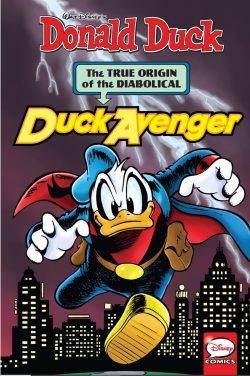
Walt Disney’s Donald Duck Volume 2: The Diabolical Duck Avenger


By Elisa Penna & Guido Martina, Don Christensen, Daan Jippes, Dick Moores, Rodolfo Cimino, Giovan Battista Carpi, Mau Heymans & Kirsten de Graaff, Romano Scarpa, Sandro Del Conte, Paul Murray, Harry Gladstone, Wilfred Haughton & various: translated by Gary Leach, Byron Erickson, Thad Komorowski, & Joe Torcivia (Disney Comics/IDW)
ISBN: 978-1-63140-480-1 (TPB/Digital edition)

The animated wonders of the Walt Disney studios quickly travelled around the world, but much of their popularity and longevity was due to syndicated newspaper strips and comic book stories that expanded and enhanced character and adventure between cinematic releases. These ancillary exploits were particularly loved and venerated in Europe where Italy, Germany, France, The Low Countries (that’s the Benelux region of Belgium, Luxembourg and the Netherlands), Britain and especially the Scandinavian countries all made them their own, with supplemental new adventures and frolics that often surpassed the efforts of all but Carl Barks and Floyd Gottfredson themselves.

During the latter part of the 20th century Disney US downsized their own comics output, and Barks and latter-day American giants like Don Rosa graduated to producing new material for the monumental continental Disney Comics publishing machines such as the Gutenberghus Group and Disney Italia.

Eventually, someone in charge in the US saw sense; okaying a revival of Disney’s English-language comics and enabling years of that Continental canon to be seen stateside in comic books and collected albums such as this one celebrating the peculiar peregrinations of the Angriest Duck in the World…

Bold, brash, lightning-paced, visually spectacular and hilariously funny, this compilation re-presents IDW’s Donald Duck #4-6 (which equates in the original number sequence to issues #371-373) released in 2014.

Unless you count their 1950s live action Zorro TV show and it’s superb comic book spin-off, Disney had embraced supervillains like the Phantom Blot long before it started dabbling with such unbelievable characters as costumed heroes (such as The Incredibles or those Avengers types). When they did dabble, it did all started in a circuitous manner with the 1965 debut of Super Goof (of whom, more another time) and a bizarre publishing blip starting in and founded on European tradition…

It’s on review today primarily because it fits our strange brief of the week “Un-American Superheroes”: featuring the premiere and origin of a costumed vigilante who took Italy by storm on his first appearance in June 1969: Paperinik Aka PK – the Duck Avenger. He was a surprise hit and returned many times across the continent, alternatively known as Superduck (UK), Phantomias (Germany), Phantom Duck (Greece), Stålanden (Denmark), Stål-Kalle (Sweden), Taikaviitta (Finland) and Fantonald (Norway)…

Crafted by editor Elisa Penna and scripter Guido Martina with art from Giovan Battista Carpi, the saga appeared as two extended chapters in Topolino #706 -707 (June 8th & 15th 1969) entitled ‘Paperinik il diabolico vendicatore’ (“Paperinik the diabolical avenger”). It opens this collection as ‘The Diabolical Duck Avenger’, detailing how Donald’s daily woes and misfortunes finally get the better of him, just as his luck turns.

Through highly suspicious means and after gulling arch rival Gladstone Gander, Donald takes possession of dilapidated mansion Villa Rose, and soon discovers it was the hideout of legendary turn-of-the century gentleman thief, super criminal and social justice warrior Fantomallard (based on French literary character Fantômas created by Marcel Allain & Pierre Souvestre in 1911).

Beguiled by the master bandit’s diary and left over gadgets, and provoked beyond endurance by Gladstone, whining nephews Huey, Dewey and Louie and especially constantly grasping Uncle Scrooge, Donald snaps. Supplementing his ancient arsenal with gadgets innocently built by inventor Gyro Gearloose, the deranged duck prowls the night clad as the vintage villain, inflicting well-deserved punishment on all those who have wronged him in the chilling guise of the Duck Avenger…

The saga pauses here for a comedic change of pace palette-cleanser as Don Christensen & Paul Murray detail a case for Ludwig Von Drake: hired by Grandma Duck to cure practically somnolent and sleepy Gus Goose in ‘Chore Chump’. Tragically, the doctor’s sound psychological theory is utterly wasted on the dozy oaf and more drastic methods have to be employed…

‘The Diabolical Duck Avenger Part Two’ explores and explodes the vigilante’s reign of terror, as Donald in Disguise swipes Scrooge’s money-stuffed mattress, perplexes the police and frames Gladstone before smugly retiring to anonymity. However, the Avenger would return over and again, always slightly askew of general Disney Comics continuity, and ultimately begin his own sidebar career as a Duck Knight of Justice in a dark Disney world via the stand-alone title PK – Paperinik New Adventures which launched in 1996…

We might be a bit baffled, but Italian readers would have instantly grasped that “Paperinik” was a devilish spoof of vastly popular cultural antihero Diabolik as created in 1962 by Angela & Luciana Giussani. The ruthless super-thief is one of the most successful characters in Italian comics with over 800 volumes to his canon…

Here and now, though, Daan Jippes delivers a ‘Banquet Behind Bars’ as Donald and the Nephews dine out on the cash culled from a lost wallet and too late discover who the original owner is, after which Dick Moores describes a golf gulf on ‘Donald’s Off Day’ prior to Harry Gladstone revealing the Nephews’ ‘Birthday Bugaboo’ as they try to hint just how much they want a puppy. The result – as always – is spectacularly unlucky for their grouchy guardian…

‘What’s Opera, Duck?’ by Mau Heymans & Kirsten de Graaff explores the unwise idea of wearing a hat wired for sound and the big sporting fixture whilst attending the Met with Daisy Duck, and leads into another extended saga with Donald again in the role of uncanny-powered iconoclast in ‘The Perfect Calm! or Are We There, Yeti?’ by Rodolfo Cimino, Romano Scarpa & Sandro Del Conte.

It reveals how the ever-enraged Donald meets a swami who teaches him the calming power of transcendental thought and sets him off in search of further ultimate enlightenment. Transformed, the formerly irascible reprobate becomes a globe-trotting nomad whose travels take him to Tibet and an unlikely alliance with not-so-abominable snow persons and ski-horned goats.

Typically, when he returns home Donald is suckered into becoming a cash cow for Scrooge who devises a means to monetise peace and contentment for maximum returns, only to trigger global economic chaos and a heap of bad karma…

The cartoon capers conclude with a delicious treat from 1937 courtesy of the British franchise wherein Wilfred Haughton perfectly preserves the cosy chaos of screen stars Donald, Goofy, Mickey and his nephews in a picnic packed with problems entitled ‘Hampered!’

Graced with a superb art-gallery of covers & variants by Dave Alvarez, Ronda Pattison, Amy Mebberson, & Derek Charm, this is an exciting, exotic and eye-popping riot of raucous romps blending wit, madcap invention, plucky bravado and sheer wide-eyed wonder into a rollicking rollercoaster ride for readers of every age and vintage.
© 2015 Disney Enterprises, Inc. All rights reserved.
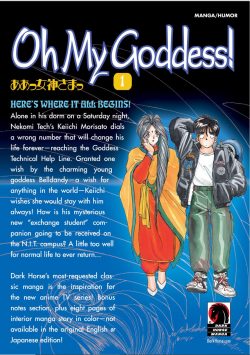

Oh My Goddess! volume 1


By K?suke Fujishima, original translation by Dana Lewis, Alan Gleason & Toren Smith (Dark Horse Manga)
ISBN: 978-1-59307-387-9 (tank?bon TPB) eISBN: 978-1-62115-755-7

Talking of school – as we were the other day – college days also offer plenty of opportunities for comics creativity and, as is usually the case, manga has been there first and explored avenues you never even realised existed.

Fujishima K?suke was born in Chiba, Japan on July 7th 1964, and after completing High School, got a job as an editor. His plans to be a draughtsman had foundered after failing to secure a requisite apprenticeship, and he instead joined Puff magazine in that backroom role. Life began looking up after he became assistant to manga artist Tatsuya Egawa (Be Free, Golden Boy, Magical Taluluto)

Fujishima graduated to his first solo feature in 1986: writing and illustrating police series You’re Under Arrest until 1992. In 1988, he began a consecutive second series: a fantasy comedy that would reshape his life forever. Although he would work on other manga like Paradise Residence and Toppu GP over the decades, Aa! Megami-sama – alternatively translated as Ah! My Goddess and Oh My Goddess! became his signature work and one that has made him a household name in Japan.

The series began in the September 1988 issue of Kodansha’s seinen (“young males”) manga periodical Monthly Afternoon. The strip ran until April 2014, generating enough stories for 48 tank?bon volumes, a spin-off series and spawning anime, special editions, numerous TV series, musical albums, games and all the attendant spin-offs and merchandise such popular success brings.

In 2020 there were 25 million physical copies of the editions in circulation and an unguessable number of digital sales. OMG! has won awards, been translated across the globe in print and on screens and has a confirmed place in comics history…

Oh My Goddess! is a particularly fine example of a peculiarly Japanese genre of storytelling combining fantasy with loss of conformity and embarrassment. In this case, and as seen in opening chapter ‘The Number You Have Dialled is Incorrect’ nerdy engineering sophomore Keiichi Morisato dials a wrong number one night and inadvertently connects to the Goddess Technical Help Line.

When the captivatingly beautiful and cosmically powerful minor deity Belldandy materialises in his room offering him one wish, he mockingly asks that she never leave him. This rash response effectively traps her on Earth, unable even to move very far beyond his physical proximity. Her powers are mighty but also come with a bucketload of provisos and restrictions. The most immediate and terrible repercussion manifests quickly as he is ejected from his student residence for having a girl in his room…

Belldandy’s profligate use of her divine powers, utter naivety and tendency to attract chaos and calamity make their search for a new home a fraught exercise, but finally second chapter ‘Lair of the Anime Mania’ finds Keiichi trying the apartment of old friend Sada. He was not a preferred choice because he is addicted to anime: a living zombie of fannishness who welcomes the refugees in without even noticing them …or letting go of the TV and video remotes…

All too soon however, and again thanks to the Goddess’ gifts, Sada notices Belldandy’s similarities to his cartoon fantasies and they have to move again…

After a night on the freezing streets, providence smiles on them when a Buddhist priest welcomes them into his dwelling. An individual prone to conclusion-jumping, the holy man’s eventual deduction of her true nature prompts him to undertake a pilgrimage of rediscovery, bequeathing them custody of his earthy abode in ‘A Man’s Home is His… Temple?’

With accommodation secured, the hapless student needs to get back to his education, and in a structured society like Japan there’s plenty of scope for comedy when a powerful and beautiful female seemingly dotes on a barely average male, especially as Keiichi’s new girlfriend seems unwilling to even leave his side…

The solution is to use her powers to “enrol” at his school – the Nekomi Institute of Technology. However, when the clearly “European” newcomer becomes a ‘College Exchange Goddess’ she can’t help but draw unwelcome attention, particularly from Keiichi’s macho, petrolhead fellow students and creepy lecturer Dr. Ozawa. The lifelong rival of Morisato’s favourite teacher “Doc” Kakuta has his suspicions aroused when all his students switch to the classes Belldandy audits and he begins a covert campaign to get rid of her…

More trouble materialises in ‘Those Whom Goddess Hath Joined Together, Let No Woman Put Asunder’ as thoroughly unlikeable campus queen and predatory Mean Girl Sayoko Mishima realises the new kid is a threat to her social supremacy and sets her destructive sights and wealth on Belldandy’s hapless chump. The goddess is more aware of the interlopers inadvertent mystical bad mojo and takes kind, gentle but firm retaliatory action…

College is a series of crucial interconnections and – other than Belldandy – Morisato is closest to his colleagues in the Nekomi Institute of Technology Motor Club: a gang of overbearing, bullying gear-head maniacs, always spending his money, eating his food and getting him into trouble…

However, the earthbound divinity’s role is to aid those in need and when she detects chief brute Otaki is enduring unrequited love she plays matchmaker in ‘Single Lens Psychic: The Prayer Answered’ and sets off a chain of domestic shock and awe…

This mainly monochrome compendium is peppered with brief full colour sections and one such opens ‘Lullaby of Love’ as Morisato finally summons the nerve to move beyond the painfully platonic life sentence he’s been locked into. Sadly, books like Going Steady for Dummies can get him no closer to even kissing his goddess and their first stab at an intimate dinner date turns into a disaster further compounded in ‘The Blossom in Bloom’ as financial shortfalls presage the introduction of Morisato’s little sister Megumi: a gossip spreader and imaginative tale teller. What family furore she will make of him living with a gorgeous exotic foreigner cannot be allowed…

She causes chaos from the start: bearing enough cash to tide them over but only if Keiichi boards her for a week while she takes some important entrance exams. There’s no way the kid won’t expose Belldandy’s supernatural nature to the world…

What big brother should have fretted over was the actual tests, as Megumi aces he exams and is admitted to Nekomi Tech. Now Morisato is plagued with ‘Apartment Hunting Blues’ as he hunts for a decent place to house her. It’s a good thing that Belldandy accompanies the siblings as – once they find the perfect place – the goddess has to exorcise and transform the evil spirit haunting it …the true reason it was so cheap in the first place…

Following the comics comes a text feature by editor Carl Gustav Horn. ‘Letters to the Enchantress’ details the strip’s history and evolution to an English language series, and is supplemented by ‘Editor’s Commentary on Vol. 1’: an expansive collection of footnotes clarifying everything from explaining untranslated background kanji and graphics to detailing significant cultural clues that might bypass most readers.

Oh My Goddess! is a beguiling, engaging and eminently re-readable confection, at once frothy fun and entrancing drama. Think of it as a Eastern take on Bewitched or I Dream of Genie, especially as the romance develops: one that both mortal and immortal protagonists are incapable of admitting to. Throw in the required supporting cast of friends, rivals, insane teachers and interfering entities and there’s plenty of light-hearted fun to be found in this bright and breezy manga classic.
© 2005 by Kosuke Fujishima. All Rights Reserved. This English language edition © 2005 Dark Horse Comics.

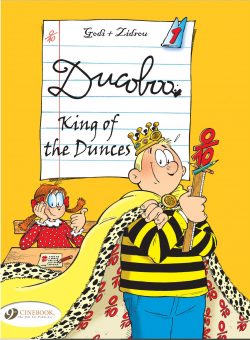
Ducoboo volume 1 – King of the Dunces


By Godi & Zidrou, coloured by Véronique Grobet & translated by Luke Spear (Cinebook)
ISBN: 978-1-905460-15-1 (Album PB/Digital edition)

School stories and strips of every tone about juvenile fools, devils and rebels are a lynchpin of modern western entertainment and an even larger staple of Japanese comics – where the scenario has spawned its own wild and vibrant subgenres. However, would Dennis the Menace (ours and theirs), Komi Can’t Communicate, Winker Watson, Don’t Toy with Me, Miss Nagatoro, Power Pack, Cédric or any of the rest be improved or just different if they were created by former teachers rather than ex-kids or current parents?

It’s no surprise the form is so evergreen: school life takes up a huge amount of children’s attention no matter how impoverished or privileged they are, and their fictions will naturally address their issues and interests. It’s fascinating to see just how much school stories revolve around humour, but always with huge helpings of drama, terror romance and an occasional dash of action…

One of the most popular European strips employing the eternal basic themes and methodology began in the last fraction of the 20th century, courtesy of scripter Zidrou (Benoît Drousie) and illustrator Godi.

Drousie is Belgian, born in 1962 and for six years a school teacher prior to changing careers in 1990 to write comics like those he probably used to confiscate in class. Other mainstream successes in a range of genres include Petit Dagobert, Scott Zombi, La Ribambelle, Le Montreur d’histoires, African Trilogy, Shi, Léonardo, a revival of Ric Hochet, and many more. However, his most celebrated and beloved stories are the Les Beaux Étés sequence (digitally available in English as Glorious Summers) and 2010’s Lydie, both illustrated by Spanish artist Jordi Lafebre.

Zidrou began his comics career with what he knew best: stories about and for kids, including Crannibales, Tamara, Margot et Oscar Pluche and, most significantly, a feature about a (and please forgive the charged term) school dunce: L’Elève Ducobu

Godi is a Belgian National Treasure, born Bernard Godisiabois in Etterbeek in December 1951. After studying Plastic Arts at the Institut Saint-Luc in Brussels he became an assistant to comics legend Eddy Paape in 1970, working on the strip Tommy Banco for Le Journal de Tintin whilst freelancing as an illustrator for numerous comics and magazines. He became a Tintin regular three years later, primarily limning C. Blareau’s Comte Lombardi, but also working on gag strip Red Rétro by Vicq, with whom he also produced Cap’tain Anblus McManus and Le Triangle des Bermudes for Le Journal de Spirou in the early 1980s. He soloed on Diogène Terrier (1981-1983) for Casterman.

He then moved into advertising cartoons and television, cocreating with Nic Broca the animated TV series Ovide. He only returned to comics in 1991, collaborating with newcomer Zidrou on L’Elève Ducobu for magazine Tremplin. The strip launched in September 1992 before transferring to Le Journal de Mickey, and collected albums began in 1997 – 25 so far in French and Dutch, 8 for Turkish readers, and 6 for Indonesia.

When not immortalising modern school days for future generations, Godi latterly diversified, co-creating (1995 with Zidrou) comedy feature Suivez le Guide and game page Démon du Jeu with scripter Janssens.

The series has spawned a live action movie franchise, a dozen pocket books plus all the usual attendant merchandise paraphernalia. and we English-speakers’ introduction to the series (5 volumes thus far) came courtesy of Cinebook with 2006’s initial release King of the Dunces which was in fact the 5th European collection L’élève Ducobu – Le roi des cancres.

The format is loads of short – most often single page – gag strips starring a revolving cast who are all well established by this point, but also fairly one-sided and easy to get a handle on.

Our star is a well-meaning, good natured young oaf who doesn’t get on with school. He’s sharp, inventive, imaginative, inquisitive, personable and just not academical at all. We might today put him on a spectrum or diagnose a disorder like ADHD, but at heart he’s just not interested and has better things to do…

Dad is a civil servant and Mum left home when Ducoboo was a baby, but then there’s a lot of that about. Leonie Gratin – from whom he constantly copies answers – only has a mum.

The boy and his class colleagues attend Saint Potache School and are mostly taught by draconian Mr Latouche who’s something of humourless martinet. Thanks to him, Ducoboo has spent so much time in the corner with a dunce cap on his head that he’s struck up a friendship with the biology skeleton. He calls himself Neness and is always ready with a theory or suggestion for fun and frolics…

In this volume, after being caught cheating again, Latouche applies what he calls “truth serum” to the squabbling kids. The wild kid fakes taking it, but Leonie is an obedient child and soon can’t help blurting out her hidden feelings for the class outlaw – thereby ensuring he voluntarily tries keeping his distance for some time after …or at least until the next test or exercise…

On view are fresh riffs on being late and missing class; roll calls and registers; new and old class furniture; novel ways to copy answers; writing lines and how to hack the system; the power of art; collecting educational stickers; yawning in class; grammar and grandmas, punctuation, warring student radio stations; the restorative blessings of short naps whilst working; the ultimate futility of bad boys actually working and still being called a cheat and always, always cheating, copying and guessing answers…

Also encountered are jaunts to a circus, educational psychologists, Teachers’ changing pay and conditions, new ways to learn, the origins of his skeletal comrade, Nativity plays and mistletoe mischief, classical poetry – like ‘The Nitwit and the Trickster’ by bony scribe Nessy de la Fontanelle, dress codes for kids from other cultures (especially fascinating new girl Fatima and her lovely chador), new romantic fancies and classroom exoticism, outrageous example test papers and – as a main event – the educational crucible of April Fool’s Day and its cumulative effect on Latouche…

Wry, witty and whimsical whilst rehashing evergreen childhood themes, Ducuboo is an up-tempo, upbeat addition to the genre that any parent or pupil can appreciate and enjoy. If your kids aren’t back at school quite yet, why not keep them occupied a little longer with the King of the Dunces – whilst thanking your lucky stars that he’s not yours?
© Les Editions du Lombard (Dargaud- Lombard) 2000 by Godi & Zidrou. English translation © 2006 Cinebook Ltd.

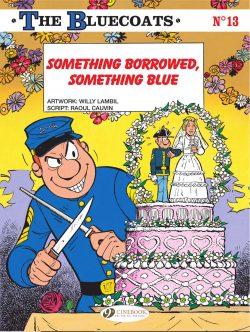
Bluecoats volume 13: Something Borrowed, Something Blue


By Willy Lambil & Raoul Cauvin, translated by Jerome Saincantin (Cinebook)
ISBN: 978-1-84918-531-8 (Album PB/Digital edition)

Devised by Louis “Salvé” Salvérius & Raoul Cauvin – who scripted the first 64 volumes until retirement in 2020 – Les Tuniques Bleues (or Dutch co-incarnation De Blauwbloezen) debuted at the end of the 1960s: created to replace Lucky Luke when that laconic maverick defected from weekly anthology Le Journal de Spirou to rival publication Pilote.

From its first sallies, the substitute strip swiftly became hugely popular: one of the most popular bande dessinée series in Europe. In case you were wondering, it is now scribed by Jose-Luis Munuera and the BeKa writing partnership…

Salvé was a cartoonist of the Gallic big-foot/big-nose humour school, and after his sudden death in 1972, successor Willy “Lambil” Lambillotte gradually adopted a more realistic – but still overtly comedic – tone and manner. Lambil is Belgian, born in 1936 and, after studying Fine Art in college, joined publishing giant Dupuis in 1952 as a letterer.

Born in 1938, scripter Cauvin was also Belgian and – before entering Dupuis’ animation department in 1960 – studied Lithography. He soon discovered his true calling – comedy – and began a glittering, prolific writing career at Le Journal de Spirou. In addition, he scripted dozens of long-running, award winning series including Cédric, Les Femmes en Blanc and Agent 212: more than 240 separate albums. Les Tuniques Bleues alone has sold more than 15 million copies of its 66 (and counting) album sequence. Cauvin died on August 19th 2021, but his vast legacy of laughter remains.

Here, as The Bluecoats, our long-suffering protagonists are Sergeant Cornelius Chesterfield and Corporal Blutch; worthy fools in the manner of Laurel & Hardy: hapless, ill-starred US cavalrymen defending America during the War Between the States.

The original format offered single-page gags set around an Indian-plagued Wild West fort, but from the second volume – Du Nord au Sud – the sad-sack soldiers were situated back East, fighting in the American Civil War. All subsequent adventures – despite ranging far beyond the traditional environs of America and taking in a lot of genuine and thoroughly researched history – are set within the timeframe of the Secession conflict.

Blutch is your run-of-the-mill, whinging little-man-in-the street: work-shy, mouthy, devious and ferociously critical of the army and its inept commanders. Ducking, diving, or deserting whenever he can, he’s you or me – except at his core he’s smart, principled and even heroic …if no easier option is available.

Chesterfield is a big, burly professional fighting man; a proud career soldier of the 22nd Cavalry who passionately believes in the patriotism and esprit-de-corps of the Military. He is brave, never shirks his duty and hungers to be a medal-wearing hero. He also loves his cynical little troll of a pal. They quarrel like a married couple, fight like brothers and simply cannot agree on the point and purpose of the horrendous war they are trapped in: a situation that once more stretches their friendship to breaking point in this cunningly conceived instalment.

Des bleus et des dentelles was originally serialised in 1983 in Le Journal de Spirou (#2384-2387) before collection into another mega-selling album in 1985. It was the 22nd European release and in 2020 became Cinebook’s 13th translated volume. As Something Borrowed, Something Blue it offers a lighter touch and tone than many, with the underlying horror salved by a kind-of romance and ridiculously surreal black comedy.

Once again Union forces are stalemated with no advance possible. Even the cavalry – under the leadership of utterly deranged, apparently invulnerable maniac Captain Stark – are stuck in dugouts, dodging enemy artillery fire beside ordinary foot soldiers. The zealot’s constant, costly, pointless charges at Confederate gun emplacements have left them short of riders and out of horses…

Sergeant Chesterfield is furious, but Blutch is perfectly happy keeping his head down and playing cards… until a shell lands on his position. By some miracle, he survives, but as Chesterfield brings him to the casualty-packed field hospital, it becomes clear that the odds of remaining so are against him.

Only the sarge’s armed intimidation can get a doctor to even look at his pal, and when they try to hack off Blutch’s leg, only the little man’s hidden gun stops them from completing the unnecessary surgery…

Suddenly, the entire camp’s attention is switched to the hospital, as the General’s latest morale-boosting scheme arrives: volunteer medical assistants – all women…

Suddenly, the entire army is stricken with some malady or other. Even Stark abandons the joy of slaughter to secure some female attention, and a top level secret plan is enacted to retore order. It involves scrupulous triage before any soldier can be admitted for treatment and to make doubly sure of weeding out malingerers, the formidable Miss Bertha will examine every man claiming injury.

The most secret part is that she is actually the hugely unhappy Private Burke in drag. His greatest fear is dying in a dress, but at least he won’t have to explain his new “uniform” to the wife and kids…

Meanwhile, actually injured Blutch is slowly recovering, thanks in great part to the diligent ministrations of nurse Jenny. Angel and patient are always together now, and Chesterfield finds himself increasingly lonely and jealous …but not as much as Blutch’s incredibly smart horse Polka

As the shirker heals, the military situation is worsening. The unassailable artillery is grinding the Union stronghold to rubble and ruin, but things start changing after another futile Stark sortie leads to the enemy troops learning there are women in their enemies’ camp. Soon, Rebel wounded are demanding that they be treated in the Union hospital too…

The situation is untenable and Chesterfield is going crazy, but the biggest bombshell comes not from enemy guns but little Blutch, as he hobbles around on crutches. The little guy is going to marry Jenny…

Initially horrified, the General unexpectedly agrees to the match, but as preparations take the men’s minds off the perpetual bombardment another shock lands after Stark requests he be allowed to wed “Bertha”…

Moreover, as Mr and Mrs Blutch ride a buggy back to safety and civilisation, Chesterfield discovers the truth about Bertha and is ordered to take his place as a female-presenting triage nurse. When “Miss Cornelia” then discovers how Blutch and Jenny have fooled everybody and escaped the war, he goes ballistic and sets off after the delinquents. He finds them frantically coming towards him scant yards ahead of a Confederate sneak attack approaching the Union camp from the rear.

Suddenly, it’s time for everyone to get back to the real business of war, with the Bluecoats survival dependant on Stark’s insane tactics…

Combining searing satire with stunning slapstick, Something Borrowed, Something Blue deftly delivers a beguiling message about the sheer stupidity of war equally clear  to younger, less world-weary audiences and old lags who have seen it all.

These stories weaponise humour, making occasional moments of shocking verity doubly powerful and hard-hitting. Funny, thrilling, beautifully realised and eminently readable, Bluecoats is the kind of war-story and Western, appealing to the best, not worst, of the human spirit.
© Dupuis 1985 by Lambil & Cauvin. All rights reserved. English translation © 2020 Cinebook Ltd.

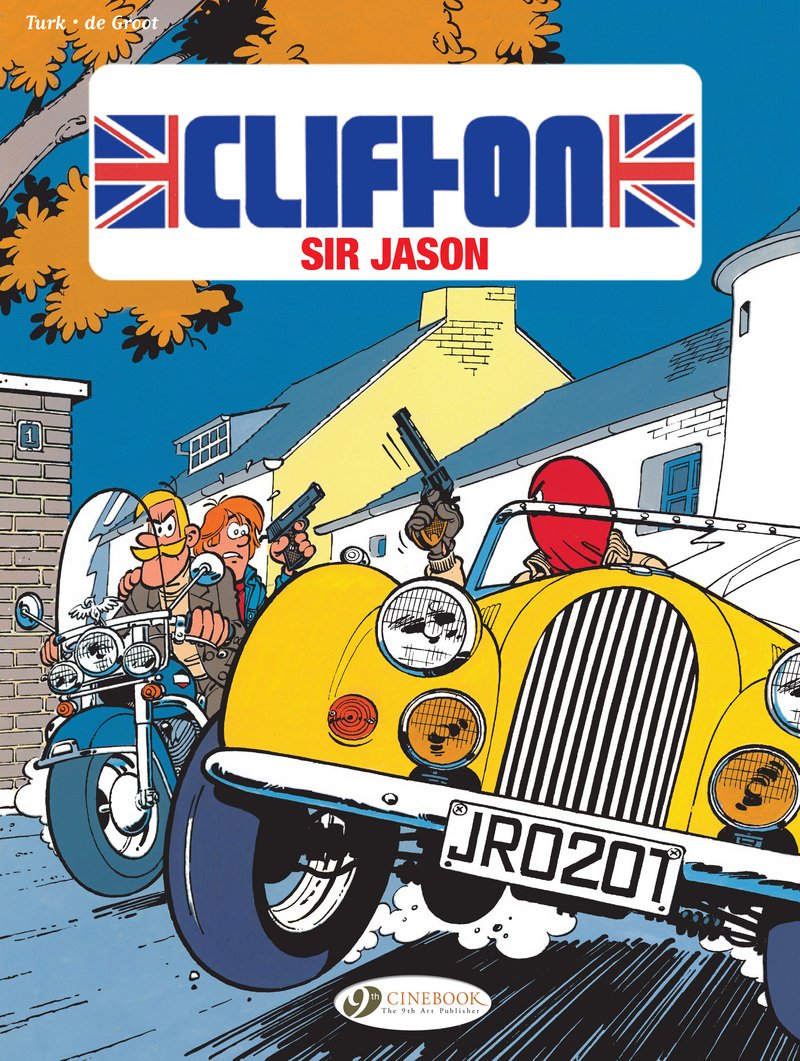
Clifton volume 8: Sir Jason


By De Groot & Turk, translated by Mark Bence (Cinebook)
ISBN: 978-1-84918-407-6 (Album PB/digital edition)

For some inexplicable reason and despite our recent obnoxiously ungrateful behaviour, most of Europe’s comics cognoscenti – most especially French and Belgians – seem fascinated with us Brits. Maybe it’s our shared heritage of Empires lost and cultures in transition? An earlier age might well have claimed it’s simply a case of “Know your Enemy”…

Whether we look at urban guttersnipes Basil and Victoria, indomitable adventurers Blake and Mortimer, the Machiavellian machinations of Green Manor or even the further travails of Long John Silver, so many serried stalwarts of our Scepter’d Isles cut a dashing swathe through the pages of the Continent’s assorted magazines and albums, it’s like Europe is our second home.

…And then there’s Clifton

As originally devised for iconic comic Le Journal de Tintin by strip genius Raymond Macherot (Chaminou, Les croquillards, Chlorophylle, Sibylline), this doughty True Brit troubleshooter first appeared in December 1959. After three albums worth of material – compiled and released in 1959 and 1960 – Macherot quit Tintin for arch-rival Le Journal de Spirou, leaving the eccentric crime-fighter to flounder until LJdT revived him at the height of the Swinging London scene. This was courtesy of Jo-El Azaza & Greg (Michel Régnier), and those strips were subsequently collected as Les lutins diaboliques in French and De duivelse dwergen for Dutch-speakers in 1969.

It was back to retirement for a few years until the early 1970s saw writer Bob De Groot & artist Philippe “Turk” Liégeois revive Clifton for the long haul: producing 10 tales of which this – Sir Jason (from 1976) – was their seventh collaboration.

Son of a cabinet maker, Turk was born in Durbuy, Belgium on July 8th 1947. His wonderful mother ran a boarding house and didn’t seem to mind that her dreamy, lazy lad spent his days taking things apart or redrawing (“improving”) his favourite comics – usually ones by Peyo and Franquin.

In fact, in 1963, when Phillipe was just 16, she sent a bunch of those upgrades to Le Journal de Spirou where editor Yvan Delporte promptly arranged for the kid to become an office apprentice, learning the profession under celebrated cartoonist Maurice Rosy (Jerry Spring; Spirou et Fantasio; Tif et Tondu; Max the Explorer; Boule et Bill/Billy & Buddy).

Young Liégeois worked for two years at Dupuis’ Brussels studio, and his first professional sale – to LJdS – came in 1967. It was the year he first met Bob De Groot as they collaborated as artists on a strip scripted by “Fred” (AKA Frédéric Othon Théodore Aristidès) to appear in Pilote. The casual alliance became a life-long association in such series as Archimède; Robin Dubois; Léonard and more. The price of success is increased workload and they were convinced to add Macherot’s moribund spy saga to their schedules…

Those comic escapades all ran in parallel with Turk’s other projects such as Les Club des “Peur-de-rien”; La Plus Grande Image du Monde; Docteur Bonheur and more.

Bob de Groot was born in Brussels in 1941, to French and Dutch parents. He was art assistant to Maurice Tillieux on Félix before creating his own short works for Pilote. A rising star in the 1960s, he was drawing 4 × 8 = 32 L’Agent Caméléon when he met Philippe Liégeois. They hit it off and as established a team with De Groot beginning a slow transition from artist to writer on Clifton and 1989’s Digitaline – devised with Jacques Landrain and a strong contender for the first comic created entirely on a computer. He kept busy, working with legendary creator Morris on both Lucky Luke and its canine comedy spin-off Rantanplan whilst co-creating Des villes et des femmes with Philippe Francq; Doggyguard with Michel Rodrigue, Pére Noël & Fils (Bercovici art) and Le Bar des acariens (with Godi) and so much more.

The association with Clifton is perennial however and even after their first tour of duty ended they stayed in touch. From 1984 on, artist Bernard Dumont – AKA Bédu – limned De Groot’s scripts: eventually assuming the writing role as well, persevering until the series ended in 1995. In keeping with its rather haphazard nature and typically undying nature, the Clifton experience resumed once again in 2003, crafted by De Groot & Rodrigue for four further adventures: a grand total of twenty album length tales and as many shorter exploits.

In 2016 the old comrades even co-operated on more Clifton cases with Zidrou scripting…. and one day we’ll see English editions of Clifton et les gauchers contraries (Clifton and the Upset Left-Handers???) and 2017’s Just Married

So what’s the Sit Rep?

The scenario is deliciously simple: pompous and irascible Colonel Sir Harold Wilberforce Clifton, ex-RAF, former Metropolitan Police Constabulary and recently retired from MI5, has a great deal of difficulty dealing with being put out to pasture in rurally bucolic Puddington. He thus takes every opportunity to get back in the saddle, occasionally assisting the Government or needy individuals as an amateur sleuth.

Sadly for Clifton – as with that other underappreciated national treasure Captain George Mainwaring in TV landmark Dad’s Army – he is convinced that he is the only truly competent man in a world full of blithering idiots. Of course, he’s generally proved correct in that assumption…

In this translated album from 2018, the Gentleman Detective is again enduring the mixed blessing of a holiday in England when he is outrageously dragged out of his permanent dudgeon and unwanted retirement by his old spymaster handlers who need him to attend to a tricky problem only someone of his vast experience and discretion could handle…

It begins in the sleepy hamlet of Dormhouse, where the vacationing surly sod livens up his day by furiously debating the correct surface temperature of toast, annoying village “bobby” Constable Walrus and failing to fish in idyllic streams. That changes in an absurdly fraught instant when old associate Captain Twincam ambushes him…

The government operative is in a bit of a pickle and needs the old Clifton finesse…

Twincam’s partner is Sir Jason: a strapping Adonis of a young man with generations of pedigree and privilege behind him. His family – the highly-entitled clan Macassock -have always produced sons who became spies or clergymen, and despite this lad’s heartfelt desire to be a jazz musician, he will do his duty and follow family tradition…

The minor noble has finished training and is – on paper at least – a superbly-schooled, hyper-fit, lethally capable super-agent in waiting. There’s only one small snag: this aristocratic boy wonder freezes at the merest hint of actual action…

With the future of the whole hidebound spycraft system under threat, the Secret Service need someone to teach the lad how to use what he knows for the good of the nation. No expense spared, carte blanche in methods used and the promise of some much-missed excitement finally induce old warhorse Clifton to agree, and no sooner does he accept the mission than fate smiles on them as mentor and apprentice stumble into an armed robbery and indulge in a spectacular high speed chase through the verdant countryside…

It’s an utter disaster and the Colonel realises he has his work cut out for him if he’s to unleash the tiger buried deep, deep, deep inside the spy scion…

After a short stopover in his own house in bucolic Puddington  and a fractious reunion with Housekeeper Miss Partridge, it’s off to London for Clifton and his protégé. Unbeknownst to Sir Jason (as most things seem to be), the wily old spy has hired some of his seedier acquaintances to jump the lad as a kind of live fire test. Confidant that in the crunch, superb training, heroic heritage and elevated lineage will kick in, the old soldier lets himself get beaten up and witnesses some truly shameful acts of cowardice before giving up…

They are down by the Embankment cleaning up when Clifton sees two frogmen riding a minisub emerge from the waters. He knows true evil in play when he sees it but is barely able to stop these really capable villains killing them both to keep whatever they’re up to secret…

Now mentor and terrified apprentice are on the run with relentless, ruthless hunters chasing them all over the landscape. Jason gains plenty of on-the-job experience but no appreciable increase in confidence, gumption or backbone. Cut off from all possible assistance, the veteran warrior has no choice but to go after the killers’ boss himself, using his partner’s failings to his advantage and hoping they all make it out alive and relatively unscathed…

Visually spoofing 1970’s London and eternally staid and stuffy English Manners with wicked effect, these comfy thrillers are big on laughs but also pack loads of consequence-free action into their eclectic mix. Delightfully surreal, instantly accessible and doused with daft slapstick in the manner of Jacques Tati and humoresque intrigue like Margaret Rutherford as Miss Marple, this wild ride rattles along in the grand comedic manner of Will Hay, Terry-Thomas and Alistair Sim (maybe Wallace and Gromit or Johnny English if you’re of a later generation) by channelling classic crime series like The Sweeney or The Professionals – offering splendid fun and timeless laughs for all.
Original edition © Les Editions du Lombard (Dargaud-Lombard S. A.) 2001 by Turk & De Groot. English translation © 2018 Cinebook Ltd.

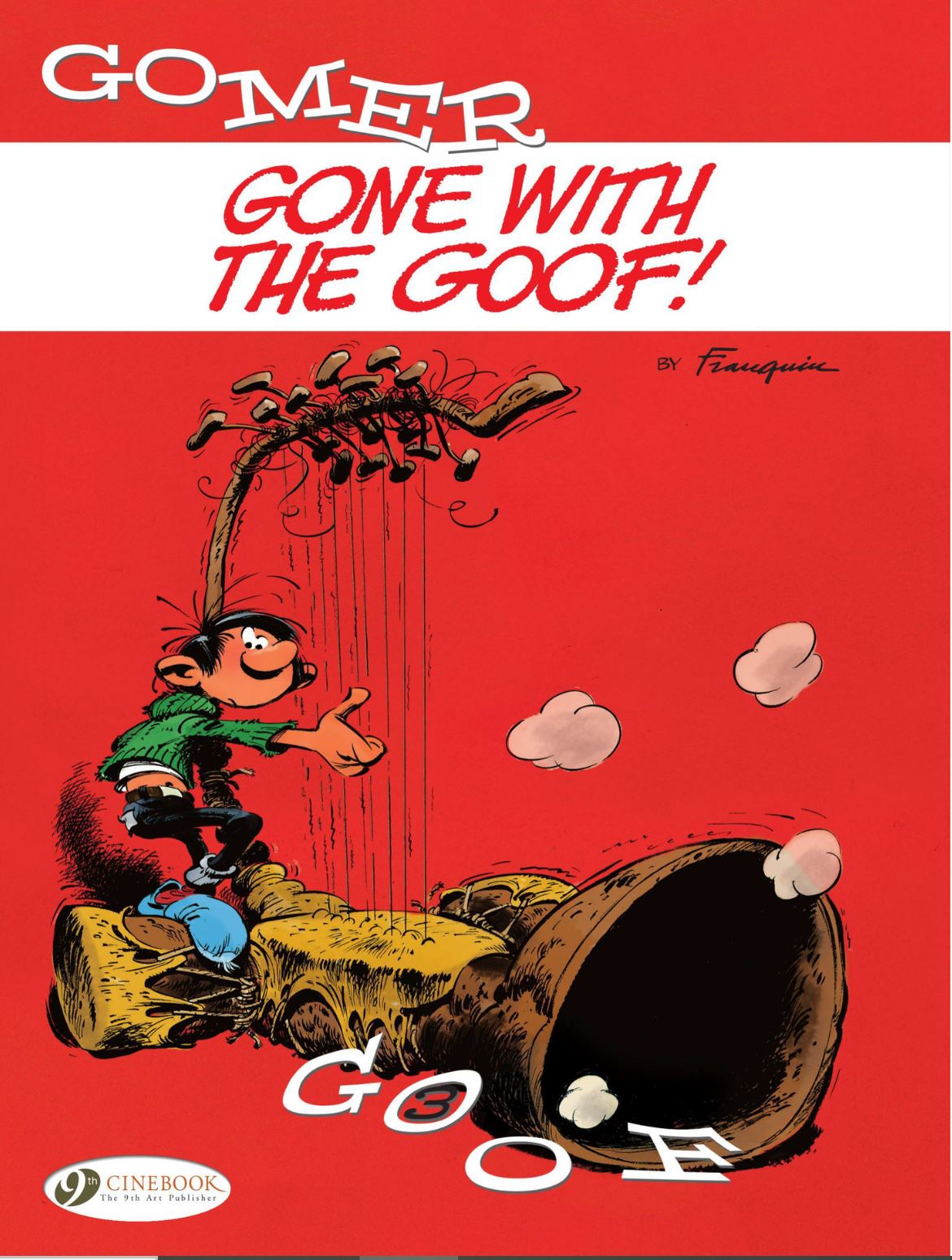
Gone With the Goof – Gomer Goof volume 3


By Franquin, Jidéhem & Delporte, translated by Jerome Saincantin (Cinebook)
ISBN: 978-1-84918-409-0 (PB Album/Digital edition)

Like so much in Franco-Belgian comics, it started with Le Journal de Spirou. The magazine had debuted on April 2nd 1938, with its engaging lead strip created by Rob-Vel (François Robert Velter). In 1943, publishing house Dupuis purchased all rights to the comic and its titular star, after which comic-strip prodigy Joseph Gillain (Jijé) took the helm for the redheaded kid’s exploits.

In 1946 Jijé’s assistant André Franquin was handed creative control. He gradually abandoned short gag vignettes in favour of extended adventure serials. Franquin introduced a broad, engaging cast of regulars and created phenomenally popular magical beast the Marsupilami. Debuting in 1952 (Spirou et les héritiers) the critter eventually became a spin-off star of screen, plush toy stores, console games and albums in his own right. Franquin continued crafting increasingly fantastic tales and absorbing Spirou sagas until his resignation in 1969.

Franquin was born in Etterbeek, Belgium on January 3rd 1924. Drawing from an early age, the lad only began formal art training at École Saint-Luc in 1943. When the war forced the school’s closure a year later, he found work at Compagnie Belge d’Animation in Brussels and met Maurice de Bévére (AKA Lucky Luke creator “Morris”), Pierre Culliford (Peyo, creator of The Smurfs and Benny Breakiron) and Eddy Paape (Valhardi, Luc Orient).

In 1945 all but Peyo signed on with Dupuis, and Franquin began his career as a jobbing cartoonist and illustrator, producing covers for Le Moustique and scouting magazine Plein Jeu. During those early days, Franquin and Morris were being tutored by Jijé, who was the main illustrator at LJdS. He turned the youngsters – and fellow neophyte Willy Maltaite (AKA “Will” – Tif et Tondu, Isabelle, Le jardin des désirs) – into a smoothly functioning creative bullpen known as La bande des quatre or “Gang of Four”. They would ultimately reshape and revolutionise Belgian comics with their prolific and engaging “Marcinelle school” style of graphic storytelling…

Jijé handed Franquin all responsibilities for the flagship strip part-way through Spirou et la maison préfabriqué (#427, June 20th 1946). He ran with it for two decades; enlarging the scope and horizons of the feature until it became purely his own. Almost every week fans would meet startling new characters such as comrade/rival Fantasio or crackpot inventor and Merlin of mushroom mechanics the Count of Champignac.

Spirou &Fantasio became globetrotting journalists, visiting exotic places, exposing crimes, exploring the fantastic and clashing with a coterie of bizarre and exotic arch-enemies. Throughout it all, Fantasio was still a full-fledged reporter for Le Journal de Spirou and had to pop into the office all the time. Sadly, lurking there was an accident-prone, smugly big-headed junior in charge of minor jobs and dogs-bodying. He was called Gaston Lagaffe

There’s a long history of fictitiously personalising the mysterious creatives and all those arcane processes they indulge in to make our favourite comics, whether its Stan Lee’s Marvel Bullpen or DC Thomson’s lugubrious Editor and underlings at The Beano and Dandy. Let me assure you that it’s a truly international practise and the occasional asides on text pages featuring well-meaning foul-up/office gofer Gaston – who debuted in #985, February 28th 1957 – grew to be one of the most popular and perennial components of the comic, whether as short illustrated strips or in faux editorial reports in text form.

On a strictly personal note, I still think current designation Gomer Goof (this name comes from an earlier, abortive attempt to introduce the character to American audiences) is unwarranted. The quintessentially Franco-Belgian tone and humour doesn’t translate particularly well (la gaffe translates as “blunder” not “idiot”) and the connotation contributes nothing here. When he surprisingly appeared in a 1970s UK Thunderbirds annual as part of an earlier syndication attempt, Gaston was rechristened Cranky Franky. Perhaps they should have kept that one or even his original designation…

In terms of actual schtick and delivery, older readers will recognise favourite beats of Benny Hill and Jacques Tati timeless elements of well-meaning self-delusion, whilst Britons will recognise recurring situations from Some Mothers Do Have ‘Em or Mr Bean. It’s slapstick, paralysing puns, infernal ingenuity and invention, pomposity lampooned and no good deed going noticed, rewarded or unpunished…

As previously stated, Gomer is employed (let’s not dignify or mis-categorise what he does as “work”) at the Spirou editorial offices: reporting to go-getting journalist Fantasio and generally ignoring the minor design jobs like paste-up he’s paid to handle. There’s also editing readers’ letters… the official reason why fans requests and suggestions are never answered…

Gomer is lazy, peckish, opinionated, ever-ravenous, impetuous, underfed, forgetful and eternally hungry, with his most manic moments all stemming from cutting work corners and stashing or illicitly consuming contraband food in the office…

This leads to constant clashes with police officer Longsnoot and fireman Captain Morwater, yet the office oaf remains eternally easy-going and incorrigible. Only two questions are really important here: why does Fantasio keep giving him one last chance, and what can gentle, lovelorn Miss Jeanne possible see in the self-opinionated idiot?

Originally released in 1987 as Gaston – Rafales de gaffes, this third compilation eschews longer cartoon tales and comedic text “reports” from the comic’s editorial page to deliver non-stop all-Franquin comics gags in single-page bursts. Here the office hindrance – as ever – invents stuff that makes life harder for everyone; sets driving records no one can believe; breaks laws physicists consider sacrosanct, upsets cops, firemen and clients and always, in all ways, lets down his colleagues and employers…

Many strips involve his manic efforts to modify the motorised atrocity he calls his car: an appallingly decrepit and dilapidated Fiat 509 auto(barely)mobile desperately in need of his many well-meant attempts to counter its lethal road pollution…

The remainder of the volume’s picture strip pandemonium encapsulates the imbecile’s attempts at getting rid of minor illnesses, ailments and new office innovations. Much is made of his latest  musical invention in the recurrent saga of his truly terrifying Brontosaurophone/ Goofophone as well the woes of automotive engineering Good Samaritanism; a distinctly novel approach to babysitting and work crèches; new lows in animal husbandry; an approach to cookery bordering on criminal perversity and fresh – if somewhat illegal – methods of advertising the magazine…

Far better enjoyed than précised or described, these strips allowed Franquin and occasional co-scenarists Yvan Delporte & Jidéhem (in reality, Jean De Mesmaeker: his analogue is a regular in the strips as an explosively irate and unfortunate foil for the Goof) to flex their whimsical muscles and even subversively sneak in some satirical support for their beliefs in pacifism and environmentalism. However, at their core the gags remain supreme examples of all-ages comedy: wholesome, barbed, daft and incrementally funnier with every re-reading.

Why aren’t you Goofing off yet?
© Dupuis, Dargaud-Lombard s.a. 2009 by Franquin. All rights reserved. English translation © 2018 Cinebook Ltd.

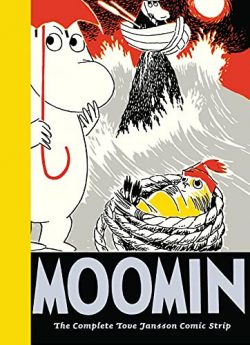
Moomin: The complete Tove Jansson Comic Strip volume 4


By Tove and Lars Jansson (Drawn & Quarterly)
ISBN: 978-1-897299-78-4 (HB) eISBN: 978-1-77046-551-0

If Tove Jansson was alive today she’d still be amazing and fascinating and also 108 years old. Sadly, she isn’t, but her immortal menagerie of bizarre and introspective characters are still going strong and all her best material is readily available for anyone wanting to politely, respectfully and belatedly join in all the dreamy fun…

Tove Jansson was one of the greatest literary innovators and narrative pioneers of the 20th century: equally adept at shaping words and images to create worlds of wonder. She was especially expressive with basic components like pen and ink, manipulating slim economical lines and patterns to realise sublime realms of fascination, whilst her dexterity made simple forms into incredibly expressive and potent symbols.

Tove Marika Jansson was born into an artistic, intellectual and practically bohemian Swedish family in Helsinki, Finland on August 9th 1914. Father Viktor was a sculptor, her mother Signe Hammarsten-Jansson a successful illustrator, graphic designer and commercial artist. Tove’s brothers Lars and Per Olov became a cartoonist/writer and photographer respectively. The family and its close intellectual, eccentric circle of friends seems to have been cast rather than born, with a witty play or challenging sitcom as the piece they were all destined to act in.

After intensive study from 1930-1938 (at the University College of Arts, Crafts and Design, Stockholm, the Graphic School of the Finnish Academy of Fine Arts and L’Ecole d’Adrien Holy and L’Ecole des Beaux-Arts, Paris), shebecame a successful exhibiting artist through the troubled period of the Second World War.

Intensely creative across many fields, she published the first fantastic Moomins adventure in 1945: Småtrollen och den stora översvämningen (The Little Trolls and the Great Flood or latterly and more euphoniously The Moomins and the Great Flood): a whimsical epic of gentle, inclusive, accepting, understanding, bohemian, misfit trolls and their strange friends…

A youthful over-achiever, from 1930-1953 Tove worked as an illustrator and cartoonist for the Swedish satirical magazine Garm, achieving some measure of notoriety with an infamous political sketch of Hitler in nappies that lampooned the Appeasement policies of Chamberlain and other European leaders in the build-up to World War II. She was also an in-demand illustrator for many magazines and children’s books, and had started selling comic strips as early as 1929.

Moomintroll was her signature character. Literally.

The lumpy, gently adventurous big-eyed romantic goof began life as a spindly sigil next to her name in her political works. She called him “Snork” and claimed she had designed him in a fit of pique as a child – the ugliest thing a precocious little girl could imagine – as a response to losing an argument about Immanuel Kant with her brother.

The term “Moomin” came from her maternal uncle Einar Hammarsten who attempted to stop her pilfering food when she visited, warning her that a Moomintroll guarded the kitchen, creeping up on trespassers and breathing cold air down their necks. Snork/Moomin filled out, became timidly nicer – if a little clingy and insecure – acting as a placid therapy-tool to counteract the grimness of the post-war world.

The Moomins and the Great Flood didn’t make much of an initial impact but Jansson persisted, probably as much for her own edification as any other reason, and in 1946 the second book Kometjakten (Comet in Moominland) was published. Many commentators have reckoned the terrifying tale a skilfully compelling allegory of Nuclear Armageddon.

When it and her third illustrated novel Trollkarlens hatt (1948, Finn Family Moomintroll or occasionally The Happy Moomins) were translated into English in 1952 to great acclaim, it prompted British publishing giant Associated Press to commission a newspaper strip about her seductively sweet and sensibly surreal creations.

Jansson had no misgivings or prejudices about strip cartoons and had already adapted Comet in Moominland for Swedish/Finnish paper Ny Tid. Mumintrollet och jordens undergängMoomintrolls and the End of the World – was a popular feature so Jansson readily accepted the chance to extend her eclectic family across the world.

In 1953, The London Evening News began the first of 21 Moomin strip sagas which promptly captivated readers of all ages. Jansson’s involvement in the cartoon feature ended in 1959, a casualty of its own success and a punishing publication schedule. So great was the strain that towards the end she recruited brother Lars to help. He took over, continuing the feature until its end in 1975. His official tenure as writer will begin in the next volume: stay tuned…

Liberated from the strip, she returned to painting, writing and other creative pursuits, generating plays, murals, public art, stage designs, costumes for dramas and ballets, a Moomin opera and 9 more Moomin-related picture-books and novels, as well as 13 books and short-story collections strictly for grown-ups.

Tove Jansson died on June 27th 2001. Her awards are too numerous to mention, but consider this: how many modern artists – let alone comics creators – get their faces on the national currency?

Her Moomin comic strips have long been available in Scandinavian volumes and the discerning folk at Drawn & Quarterly have translated her and Lars’ efforts into English for our sheer delight and delectation.

Moomintrolls are easy-going free spirits, bohemians untroubled by hidebound domestic mores and most societal pressures. Moominmama is warm and capable but overly concerned with propriety and appearances whilst Moominpappa spends most of his time trying to rekindle his adventurous youth or dreaming of fantastic journeys. Their son Moomin is a meek, dreamy boy who adores their permanent houseguest the Snorkmaiden – although that impressionable, flighty gamin prefers to play things slowly whilst waiting for somebody potentially better…

The forth oversized (312 x 222mm) monochrome hardback compilation gathers the 14-18th strip sagas and is a particular favourite, comprising a range of fanciful exploits and a rather bleak and a scary reworking of Comet in Moominland that must have had kids and their parents stocking the bomb-shelters back when it was released as a daily chapter play…

Fantasy fills the page in ‘Moomin Goes Wild West’ after Moominpapa’s annoying tinkering ruin a perfectly good clock and Moominmama’s sewing machine, whilst his attempt at repair accidentally results in a time machine. Following a distressing episode wherein Moomintroll meddles and the family meet their rather upset future selves, it is suggested that everyone go on a small holiday. The women’s rather staid suggestions are naturally overruled by the adventurous males and the machine summarily deposits them all in the land of cowboys.

It is nothing like they imagined and a very good thing that were armed with water pistols and not regulation firearms…

Sadder but no wiser after their extended tribulations in the Big Country, the assembled and not at all rested Moomins submit to suggestions of a little historical romance and travel back to 18th century France in ‘Snorkmaiden Goes Rococo’. Once again, lack of diligent research and an overdependence on popular fiction leads to misunderstanding and mischance as “the Age of Reason” proves to be anything but, and Snorkmaiden’s dreams of passionate folly are continually thwarted.

She does however score an invitation to the King’s Dinner, only to learn how badly the odds are stacked against the poor, and is promptly impelled to experiment with revolution…

Back where they all belong at last, the return of self-sufficient drop-out Snufkin heralds a visit from a representative of the League of Conscience and Duty exhorting the easy-going, but dutiful nonconformists (some unpleasant modern people say “workshy”) to dedicate their lives to personal industry and privation in service of a greater good.

‘The Conscientious Moomins’ certainly try their hardest – pursuing jobs they’re no good at, indulging in entrepreneurialism and seeking to improve character through self-help books and courses – but are just not suited to such new-fangled ideas. Ultimately, nature and good sense lead them back to their bohemian true selves just in time for one of the scariest adventures of their lives…

Comet in Moominland was first translated into English in 1951, and was a familiar text for many children and parents. Here in ‘Moomin and the Comet’ the allegory of nuclear armageddon is subtly reshaped over 86 daily instalments: modernised with the emphasis shifted from narrow escape to inescapable destruction leading to unexpected rebirth.

When a light gradually grows in the sky, the Moomins and their friends can only observe the world’s peoples’ increasing turmoil and riot. As the planet slowly alters in advance of imminent catastrophe and growing heat evaporates the oceans, spiteful Little My acts as Greek Chorus and commentator as everything makes it peace with oblivion. She’s also on hand to witness and announce the miracle that saves them all…

A parable of pride and caution closes this volume as ‘Moomin and the Golden Tail’ reveals how Moomintroll’s fear of premature baldness in this nether appendage prompts unwise exploration of remedial quackery, quasi-science and old family sorcery.

The result is a lush, luxuriant tail of gold, that makes him the world’s most fashionable person and pointless celebrity. All too soon that chic lustre fades and the sad lad is hunting ways to stop being famous and go back to his old look, negligent of how his beloved Snork maiden has reshaped herself to match his gleaming fame…

Especially excoriating are the lawyers and managers who hound him seeking to lock down the marketing rights to his golden fleece, but in the end a way is found to return him to his normal, anxious, insecure, anonymous self…

These are truly magical tales for the young laced with the devastating observation and razor-sharp mature wit which enhances and elevates only the greatest kids’ stories into classics of literature. These volumes are an international treasure and no fan of the medium – or carbon-based lifeform with even a hint of heart and soul – can afford to be without them.
© 2009, 2021 Solo/Bulls. All other material © its creators. All rights reserved.

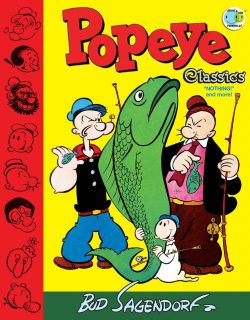
Popeye Classics volume 7: “Nothing” and More


By Bud Sagendorf, edited and designed by Craig Yoe (Yoe Books/IDW)
ISBN: 978-1-63140-447-4 (HB) eISBN: 978-1-62302-786-5

How many cartoon classics can you think of still going after a century? Here’s one…

There are a few fictional personages to enter communal world consciousness – and fewer still from comics – but a grizzled, bluff, uneducated, visually impaired old sailor with a speech impediment is possibly the most well-known of that select bunch.

Elzie Crisler Segar was born in Chester, Illinois on 8th December 1894. His father was a general handyman, and the boy’s early life was filled with the solid, dependable blue-collar jobs that typified the formative years of his generation of cartoonists. Segar worked as a decorator, house-painter and also played drums; accompanying vaudeville acts at the local theatre.

When the town got a movie-house, Elzie played silent films, absorbing all the staging, timing and narrative tricks from keen observation of the screen. Those lessons would become his greatest assets as a cartoonist. It was while working as the film projectionist, at age 18, that he decided to become a cartoonist and tell his own stories.

Like so many others in those hard times, he studied art via mail, specifically W.L. Evans’ cartooning correspondence course out of Cleveland, Ohio, before gravitating to Chicago where he was “discovered” by Richard F. Outcault – regarded by most in the know today as the inventor of modern newspaper comic strips with The Yellow Kid and Buster Brown.

The celebrated pioneer introduced Segar around at the prestigious Chicago Herald. Still wet behind the ears, the kid’s first strip, Charley Chaplin’s Comedy Capers, debuted on 12th March 1916.

In 1918, Segar married Myrtle Johnson and moved to William Randolph Hearst’s Chicago Evening American to create Looping the Loop, where Managing Editor William Curley foresaw a big future for Segar and promptly packed the newlyweds off to New York: HQ of the mighty King Features Syndicate. Within a year Segar was producing Thimble Theatre, (launching December 19th 1919) in the New York Journal: a smart pastiche of cinema and knock-off of movie-inspired features like Hairbreadth Harry and Midget Movies, with a repertory of stock players acting out comedies, melodramas, comedies, crime-stories, chases and especially comedies for vast daily audiences. It didn’t stay that way for long…

The core cartoon cast included parental pillars Nana and Cole Oyl; their lanky, highly-strung daughter Olive; diminutive-but-pushy son Castor; and the homely ingenue’s plain and (very) simple occasional boyfriend Horace Hamgravy (latterly, just Ham Gravy). Thimble Theatre had successfully run for a decade when, on January 17th 1929, a brusque, vulgar “sailor man” shambled into the daily ongoing saga of hapless halfwits. Nobody dreamed the giddy heights that stubborn cantankerous walk-on would reach…

In 1924 Segar created a second daily strip. The 5:15 was a surreal domestic comedy featuring weedy commuter and would-be inventor John Sappo and his formidable wife Myrtle. This one endured – in one form or another – as a topper/footer-feature accompanying the main Sunday page throughout the author’s career, and even survived his untimely death, eventually becoming the trainee-playground of Popeye’s second great humour stylist: Bud Sagendorf.

After Segar’s premature passing in 1938, Doc Winner, Tom Sims, Ralph Stein and Bela Zambouly all took on the strip, as the Fleischer Studio’s animated features brought Popeye to the entire world, albeit a slightly variant vision of the old salt of the funny pages. Sadly, none had the eccentric flair and raw inventiveness that had put Thimble Theatre at the forefront of cartoon entertainments. And then, finally, Bud arrived…

Born in 1915, Forrest “Bud” Sagendorf was barely 17 when his sister – who worked in the Santa Monica art store where Segar bought his drawing supplies – introduced the kid to the master cartoonist who became his teacher and employer as well as a father-figure. In 1958, after years on the periphery, Sagendorf finally took over the strip and all the merchandise design, becoming Popeye’s prime originator…

With Sagendorf as main man, his loose, rangy style and breezy scripts brought the strip itself back to the forefront of popularity and made reading it cool and fun all over again. Bud wrote and drew Popeye in every graphic arena for 24 years. When he died in 1994, his successor was controversial “Underground” cartoonist Bobby London.

Young Bud had been Segar’s assistant and apprentice, and in 1948 became exclusive writer and artist of Popeye’s comic book exploits. The series launched in February of that year in a regular title published by America’s unassailable king of periodical licensing, Dell Comics.

On debut, Popeye was a rude, crude brawler: a gambling, cheating, uncivilised ne’er-do-well. He was soon exposed as the ultimate working-class hero: raw and rough-hewn, practical, but with an innate, unshakable sense of what’s fair and what’s not; a joker who wanted kids to be themselves – but not necessarily “good” – and someone who took no guff from anyone…

Naturally, as his popularity grew, Popeye mellowed somewhat. He was still ready to defend the weak and had absolutely no pretensions or aspirations to rise above his fellows, but the shocking sense of dangerous unpredictability and comedic anarchy he initially provided was sorely missed… except not in Sagendorf’s yarns…

Collected in this superb full-colour hardback/digital edition are Popeye #30-34, crafted by irrepressible “Bud”: collectively spanning September/November 1954 to October/December 1955. Stunning, nigh stream-of-consciousness slapstick sagas are preceded by an effusively appreciative ‘Society of Sagendorks’ briefing by inspired aficionado, historian and publisher Craig Yoe, offering a mirthful mission statement.

Augmenting that is another tantalising display of ephemera and merchandise in ‘A Bud Sagendorf Scrapbook’ presenting Coca-Cola Company-funded comic strip themed postcards distributed to WWII servicemen; original art, tin toys; a Popeye Chalkboard; Get Well Soon and Birthday card art plus images on cups and mugs.

We rejoin the ceaseless parade of laughs, surreal imagination and thrills with quarterly comic book #30, opening with text tale ‘The Bigger They Are -’ detailing, across the inside front-&-back covers, the story of Throckmorton …biggest tomcat in the world!

Another wild ride in begins in ‘Desert Pirates (a story of Evil Haggery)’ as Popeye’s ruthless nemesis The Sea Hag uses witchcraft, seduction, brainwashing and principally hamburgers to turn Wimpy into her weapon against the old sea salt. Naturally, when the hero blunders into her arid ambush, the scurvy faithless traitor then betrays her to Popeye – it’s just his nature…

An engaging Micawber-like coward, cad and conman, the insatiably ravenous J. Wellington Wimpy debuted in the newspaper strip on May 3rd 1931: an unnamed, decidedly partisan referee in one of Popeye’s pugilistic bouts.

Scurrilous, aggressively humble and scrupulously polite, the devious oaf struck a chord and Segar gradually made him a fixture. Preternaturally hungry, ever-keen to solicit bribes and a cunning coiner of many immortal catchphrases – such as “I would gladly pay you Tuesday for a hamburger today” and “Let’s you and him fight” – Wimpy was the perfect foil for our simple action hero and increasingly stole the entire show… and anything else unless it was very heavy or extremely well nailed down…

Follow-up yarn ‘Popeye An’ Swee’Pea in “Danger, Lunch!”’ resorts to tireless domestic themes as a quiet meal with Olive becomes an assault course after the anarchic and precocious “infink” gets bored and amuses himself with a hammer and chemistry set…

Smartly acknowledging a contemporary trend for sci fi fun, Sagendorf had introduced ‘Axle and Cam on the Planet Meco’ in #26: a robotic father and son indulging in wild romps on other worlds. Here they observe Earth television shows and the lads decides what his world needs is beanie hats, sidewalk refreshment stands and fun with dragons…

Cover-dated January/March 1955, #31 also opens and closes with a prose yarn adorning inside front and back. ‘Apple Vote!’ exposes the shocking behaviour of a retired racehorse with a sweet tooth after which ‘Thimble Theatre Presents Popeye An’ Swee’Pea in “Mud!”’ finds unconventional family unit Popeye, Swee’Pea and villainous reprobate Poopdeck Pappy deemed dysfunctional by Olive. Her eccentric efforts to save the kid and make him a gentleman are resisted by all involved with extreme vigour…

Just as the sailor man idly daydreams of being a monarch, the wacky ruler of Spinachovia returns in ‘Popeye and King Blozo in “Exile!” or “Bein’ King is Fer de Boids!!!”’ with the maritime marvel unwisely trading cap for crown  and learning a salutary lesson about people in general and being careful of what you wish for, after which ‘Axle and Cam on the Planet Meco’ sees the mechanical moppet pay a fraught and frightening visit to Earth…

The issue concludes with a back cover strip starring ‘Popeye and Swee’Pea’ inspired by baby pictures…

Popeye #32 (April/June) opens with epic thrill-fest ‘Alone! or Hey! Where is Everybody? or Peoples is All Gone!’ as humans are abducted from all over the coast, leading the sailor man into another ferocious battle with evil machines and his most persistent enemy, after which our stars swap sea-voyages for western climes in “a tale of gold and cactus” entitled ‘Lorst!’

Set some years previously, the story reveals how Popeye made his fortune prospecting – despite and ultimately because of a little trouble with his newly adopted kid…

Sagendorf was a smart guy in tune with popular trends and fashions as well as understanding how kids’ minds worked. His tales are timeless in approach and delivery. As television exponential expanded, cowboys were king, with westerns dominating both large and small screens and plenty of comics. Thus, many episodes saw Popeye as a horse-riding sagebrush wanderer who ran a desert railroad when he wasn’t prospecting or exploring. I don’t think he ever carried a gun though…

The changing times dictated a shift in back-up features and the final ‘Axle and Cam on the Planet Meco’ exploit saw their world in chaos after Cam tried to transplant the human fashion for lawns to his own planet. Text tale ‘Catfish! detailed a meeting between fish feline and mutt and a wordless desert inspired back cover strip starring ‘Popeye and Swee’Pea’ wrapped thigs up.

The next issue (#33 July/September) offered a monochrome ‘Popeye and Swee’Pea’ house-wrecking short before main feature ‘Trouble-Shooter’ sees the tireless “hoomanitarian” set up as a helping hand for folk with troubles. Sadly, the gesture attracts some real nuts like cowardly King Hinkle of Moola who needs a patsy to fight rival ruler the King of Boola…

Returning to western deserts, Popeye and Swee’Pea swap sea-voyages for arid plains in ‘Monskers!’ and encounter a gigantic dinosaur which is not what it seems…

The replacement back-up feature was actually a return of Segar-spawned old favourites. Sappo was now hapless landlord to world’s worst lodger Professor O.G. Wotasnozzle, who callously inflicts the brunt of his genius on the poor schmuck. In ‘I’m the Smartest Man in the World!’, the lunatic fringe scientist decides to end late payment harassment by uninventing money…

A prose vignette reveals the fate of cowboy pony George who has ‘A Long Tail!’, before the fun pauses with a back-cover baseball gag starring Popeye An’ Swee’Pea.

The year and this archive close with #34, starting with more ‘Popeye An’ Swee’Pea’ baseball exploits on the monochrome inside front cover before Thimble Theatre Presents sailor man, Olive, Wimpy and the kid who endure a nautical nightmare storm that leaves our cast castaway on an island of irascible, invisible folk in eponymous saga ‘Nothing!’

Next, Popeye An’ Swee’Pea revisit western deserts to dig in the dirt and face ‘Uprising! or The Red Man Strikes Back! or Birds of a Feather!’ as the kid contends with and eventually befriends Indian infant Big Chief Thunder Eagle Jr. Sadly their play war on the white man is misunderstood by Wimpy who calls in not the cavalry but the US Army…

The manic mirth multiplies exponentially when Professor O.G. Wotasnozzle proves his insane ingenuity and dangerous lack of perspective in ‘Stop Thief!! or Please Halt! or Burglarproof House!’ before the fun concludes with one last text treat in transformative tale ‘Fish Fly!’ and a back cover gag proving why adults like Popeye should listen to kids like Swee’Pea…

Outrageous and side-splitting, these all-ages yarns are evergreen examples of narrative cartooning at its most surreal and inspirational. Over the last nine decades Thimble Theatre’s most successful son has unfailingly delighted readers and viewers around the world. This book is simply one of many, but each is sure-fire, top-tier entertainment for all those who love lunacy, laughter, frantic fantasy and rollicking adventure. If that’s you, add this compendium of wonder to your collection.
Popeye Classics volume 7 © 2015 Gussoni-Yoe Studio, Inc. All Rights Reserved. Popeye © 2015 King Features Syndicate. ™ Heart Holdings Inc.

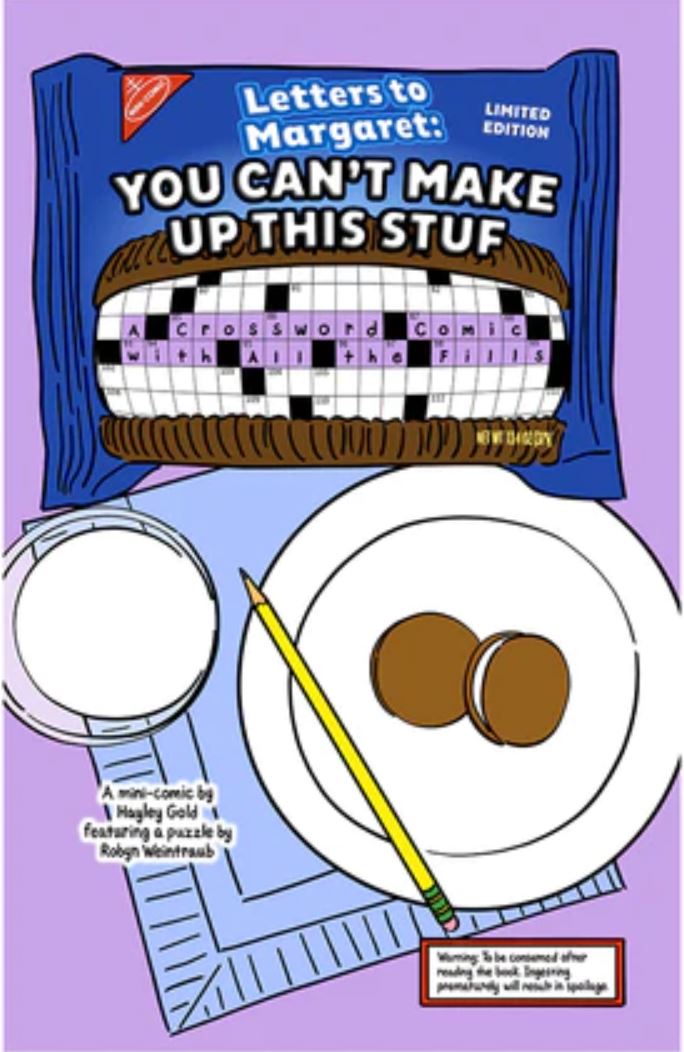
Letters to Margaret


By Hayley Gold, with Andy Kravis, Mike Selinker & various (Lone Shark Games)
ISBN: 978-1-7356380-2-7 (TPB/Digital edition)

If you read a lot of comics, you’re probably quite used to being puzzled, but probably not in the deliberate, cunningly conceived way cartoonist Hayley Gold (Across and Down) would like you to be…

Once upon a distant time, crossword puzzles were a scandalous obsession, then a passionate compulsion before ultimately becoming part of everyday life – far more so for some than for others. There are many variations, but we’re all big boys, girls and other here, so please assume that henceforward I’m talking about brain-busting cryptic crosswords, unless I say otherwise…

In the USA and other, lesser dominions, a whole subset/tribe of locution-loving smart people – call them “cruciverbalists” and “etymologists” if you like labels – are positively compelled to solve periodical conundra of varying vigour and varieties, with many skilled wordsmiths (amateur or otherwise) making The New York Times legendary crossword their paragon of play.

Every self-identifying tribe – be they comics addicts, cosplayers, petrol heads, film freaks, crossword fans or whatever, are subject to polarising issues specific to their particular passion, and such localised critical controversies underpin the hijinks here as our cast address issues crucial to those billions as they enact the narrative that will change their lives…

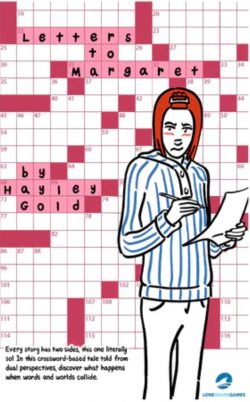
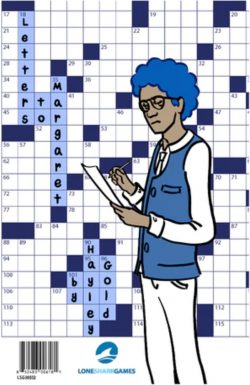
All of that is mere background context but is supremely, subtly interwoven into an extremely engaging, handily hands-on interactive rom-com graphic novel devised by Gold: delivered as a digital and/or paper-printed split-book in the manner of the 1960s publishing trend for dual-release paperbacks.

Those bad boys offered a double-bill of individual tales in one package, but here and now that pattern’s evolved into a twin-pronged delivery of a single story, presented back-to-back, drenched in fourth-wall ruptures and augmented by seditious puns, crafty jibes and actual crosswords for each chapter.

These lexicon-busting brain-benders are devised by pro quiz compilers Andy Kravis (The New Yorker) and Mike Selinker (Game theory in the Age of Chaos), and “others” such as Phil Zoffle, John Dough, Beau Kaye, Margie Rynn, Annie Boddy & Hugh Wynne. By solving them, readers can glean upcoming story-hints of the pages that follow.

You never really needed that physics degree to enjoy Star Trek, so please don’t fret if you won’t or can’t complete the grids here: the artwork and story are delightfully sufficient unto themselves, thanks especially to a wickedly judgemental hilarious running commentary. This comes via a contemporary Greek Chorus of graphic symbolism: arrow symbols Ebony and Irony are omnipresent, sassy, smart-assed, pun-obsessed ambulatory footnotes who take no prisoners when exposing the secret subtext of our protagonists and their associates.

The actual narrative consists of a love story wrapped in a mystery, developing between two young people of unflinching ideals and expanded vocabularies but both direly in need of a good shaking…

Our tale primarily offers two widely differing perspectives on the same story and events, as experienced by crossword aficionado/blogger/student Margaret A. “Maggie” Cross and her Teaching Assistant Derry Down: a rival cruciverbalist/scholarly hipster/raconteur and unlikely romantic lead. In pursuit of the perfect puzzle (difficult, innovative, ethically pure, free from bias and not just catering to old white men) they cross swords as much as words over one verbally eventful semester at Columbia University School of Journalism…

Their journey is mirrored, marred and misunderstood by friends, colleagues, and mentors; most crucially Derry’s boss – journalism professor Lewis Dodgson – and Maggie’s force-of-human-nature, investigative junk-food blogging pal Amanda Zucker, both of whom secretly steer the eventual lovers’ courses whilst enhancing their intellectual and ethical advancement and rapprochement…

I won’t say too much more about the relationship as that tale is best savoured by enjoying it first hand, but I will add one last tantalising teaser titbit. A social media war erupts after harsh words in assorted anonymous blog spats, but although feisty, uncompromising Maggie verbally gives as good as she gets, her dream is to turn her coursework into successful submissions to the NYT crossword department.

Happily, her efforts are rewarded with a string of suggestions and comments from the editor. Incredibly, however, that editor is Margaret Petherbridge Farrar, the woman credited with formalising and eventually popularising the crossword during WWII, and who has been dead since 1987…

How that time-bending confusion is ultimately cleared up makes for compelling and deliriously compulsive reading and the whimsical enigmas and pointed wars of words are supported on both sides of the book by a wealth of extras including How it came A. Cross: The Crossword, How it all went Down A. Cross: The Crossword, Solutions, Puzzles, People, Jargon and Resources.

Affiliated Add-ons available include an 8-page minicomic by Gold and crossword legend Robyn Weintraub and even a code-busting Solver’s Bundle pencil set to supplement the tale as you fill in the clues. For those unwilling to mar their pages or leave marks on a screen, copies come with PDF in .puz format for printing off the puzzles…

If you love words, puckish wordplay, playful romance, and especially words skilfully wedded to engaging picture to tell unforgettable stories and are tempted by an interactive comic you can solve, Letters to Margaret should be on your “must-do” list…
© 2021 Hayley Gold, Andrew Kravis and Mike Selinker on behalf of Lone Shark Games, Inc..

Letters to Margaret can be purchased in digital or physical editions direct from Lone Shark Games, at Letters to Margaret – Lone Shark Games

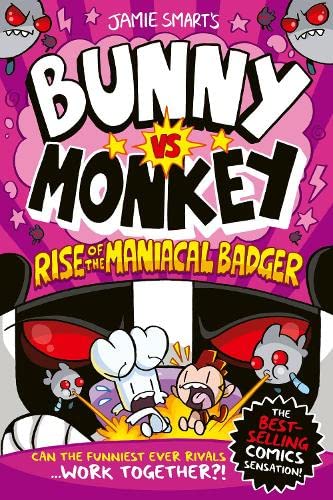
Jaimie Smart’s Bunny Vs Monkey: Rise of the Maniacal Badger


By Jaimie Smart, with Sammy Borras (David Fickling Books)
ISBN: 978-1-78845-280-9 (TPB) 978-1-78845-118-5 (Waterstones Exclusive Edition)

Bunny vs. Monkey has been a staple of comics phenomenon The Phoenix since the very first issue in 2012: recounting a madcap vendetta gripping animal arch-enemies set amidst an idyllic arcadia masquerading as more-or-less mundane but critically endangered English woodlands.

Concocted with gleefully gentle mania by cartoonist, comics artist and novelist Jamie Smart (Fish Head Steve!; Looshkin; Flember), the trendsetting, mindbending yarns have been wisely retooled as graphic albums available in remastered, double-length digest editions such as this one.

All the tail-biting tension and animal argy-bargy began yonks ago after an obnoxious little beast popped up in the wake of a disastrous British space shot. After crashlanding in Crinkle Woods – scant miles from his launch site – lab animal Monkey believed himself the rightful owner of a strange new world, despite all efforts from reasonable, sensible, genteel, contemplative forest resident Bunny to dissuade him. For all his patience, propriety and good breeding, the laid-back lepine just could not contain the incorrigible idiot ape, who was – and is – a rude, noise-loving, chaos-creating loutish troublemaker…

Problems are exacerbated by the other unconventional Crinkle creatures, particularly a skunk called Skunky who has a mad scientist’s attitude to life and a propensity to build extremely dangerous robots and super-weapons…

Here – with artistic assistance from Sammy Borras – the war of nerves and mega-ordnances resumes and intensifies. The unruly assortment of odd critters loitering around and cluttering up the bucolic paradise have finally picked sides: shifting and twisting into bipartisan factionalism. They all seem to have forgotten that rapidly encroaching Hyoomanz as they respond to another personal crisis and the rise to power of an unsuspected third force in woodland politics…

As ever divided into seasonal outbursts, the saga starts slowly with a chilly teaser tale as Winter ends in the ‘Thaw of the Snow-Bots’…

The assorted animals have been in stasis in a giant freezer, and once fire-breathing snowmen attack, they decide it’s best to have a little more kip… or do they?

The story actually resumes in Spring and the far future where time-traveller Ai – a superfast Ai-Ai not naturally indigenous to our sylvan glades and endangered shores – learns of a disaster that’s history here but her tomorrow. A good person, she undertakes ‘The Journey Home’ but arrives too late as ‘A Rather Maniacal Badger’ details how the woods have been conquered at last…

Previously, a catastrophic rivalry erupted when rival evil genius Maniacal Badger vied with Skunky for the title of “The Most Brilliant Animal in the Woods”. Now, while everyone was hibernating, the black-&-white bounder has occupied the region and established a base in a 50-foot (15-24 meters) high statue of himself as the first step in building his dream of Badgertopia.

The shock of defeat particularly affects Skunky, who descends into a spiral of depression and lowering esteem…

Universal innocents Weenie squirrel and Pig have their own way of de-stressing and not even roving robot drones can upset ‘A Quiet, Uneventful Day’ on the lake. Old animosities are paused and enemies become temporary allies planning to resist through ‘Distraction’ and strategic deployment of brain-battered, bewildered suicide bomber/former stuntman Action Beaver, but when that scheme flops we instead focus on ‘A Sad Skunk’ as the original mad scientist undergoes an existential crisis and needs Bunny to share it with…

The relative inactivity soon triggers his robot back-up to mischief mode, but even ‘Mecha Skunky!’ is not immune to the doldrums and there’s nothing ‘Action Beaver!’ can do to rectify the situation, especially after the badger activates a gross flying terror who swallows everybody in ‘The Whale!’

Having retreated to the tunnels built by long-gone but not forgotten local legend Fantastic Le Fox, the uneasy animal animals hide from the tyrant’s tantrums in ‘Too Noisy!’: unexpectedly discovering a hidden, weapon-stocked lair that will be the base for their fight back… once they have safely reassembled ‘All the Toys in the Toyshop!’

Although initial giant robot ‘Battle Bat!’ spectacularly fails, resistance efforts continue, but Monkey is easily distracted and soon moves to make his own empire in ‘Monkeyopia Rises!’ and as Summer begins ‘Divisions!’ proliferate. Before long the war with Bunny flares up again and instantly moves into the province of war crimes as the simian unleashes his flatulence-powered ‘Rofl-Copter!’

Weenie and Pig go on a ‘Treasure Hunt!’ in the mouldering pile of toxic rubbish kindly left by the Hyoomanz, but find no shield from the badger’s latest infamy: mind controlling everyone and turning the Woods into his digital plaything in ‘Game Over!’

A brief diversion follows in an exclusive Bunny vs Monkey Detective Story, but ‘The Curious Case of the Pig in the Night-Time’ is less baffling than Bunny’s failure to join mystic brotherhood ‘The Order of the Moose’…

When young Hyoomanz find themselves ‘(Not) Alone in the Woods’ during a class trip one little girl renews her old acquaintance with Metal Steve after he saves them from Maniac Badger attacks, whilst elsewhere ‘Monst-Ughs!’ run wild after improper use of Skunky’s old monster ray, leading to a glimpse at the tyrant’s origins and family issues in ‘The Making of a Maniacal Badger!’

Incorrigible Monkey then loses control of marauding robot ‘Doom Fists!’ after he is attacked by his wicked doppelganger Evil Monkey and partner in crimes Evil Monkey Wife, whilst elsewhere Skunky recovers some of life’s zest after helping Weenie and Pig repair one of the badger’s ‘Evil Drones!’

Three part saga ‘The Saving of Skunky!’ sees order restored after the badger’s plan to kidnap Skunky and steal what’s left of his evil genius goes awry. Trapped together in the Dark Woods, the skunk experiences a ghastly visitation and by the time the Maniacal one gets back to his conquered kingdom, there’s a restored archenemy waiting to deliver ‘A Sharp Shock’ with electrified clouds and a Zeus costume…

Badger’s retaliation is ancient thought monster ‘Ragnaggtrix!’ but there’s an inherent flaw in something dependent on belief that the evil genius didn’t consider. Thankfully, Skunky is preoccupied ‘Distracting the Monkey!’ from cadging more superweapons to misuse…

Bunny becomes guinea pig when Skunky and Monkey test emotion-warping Mind Mines in ‘Highly Strung!’ and as Autumn begins The Rise of an Empire!’ finds expansionist Monkeytopia devasted by its ruler’s idiocy, even as the badger traps the woodland creatures inside his new phone app in ‘Game On!’ It’s a huge, costly mistake…

‘Balloonacy!’ breaks out when Weenie and Pig try to attend Ai’s birthday party, before a new character debuts. ‘Lucky!’ is a red panda who escaped a lab doing weird experiments. It might not have been in time though, since the three-way war for supremacy in the woods triggers an odd reaction…

The action and drama ramp up for a big finish as Badger is made to clean his room and employs the ‘Doomsday Device!’ that opens portals to Hell. Shame about his mum and dad…

Skunky makes a silly mistake and gives the wrong animal some atomic powered ‘Explosive Sweets!’ which makes Halloween’s ‘Fright Night!’ Scare-Off pretty anticlimactic war, before another peek at the future reveals the legend of ‘Jetpack Beaver!’

A distant relative tries to make one woodland weirdo ‘Pigging Rich!’ with little success, after which a bad tooth and unwise consultation with Skunky results in Monkey taking a big bite out of everything in ‘Chomp!’

The cataclysmic end begins when the Maniacal one pressgangs ‘The Badger Army’ to do his bidding but forgets the species’ tendency to unionise even as Skunky creates a ‘Terraforming Orb!!’ to purpose-build a new world. It’s a shame Monkey dropped it on his own head while it was switched on…

Winter begins with 3-chapter epic ‘A Very Badger Christmas’ that delivers shocking big reveals, pulls all the plot threads of the past year together, ends the world and still leaves rueful survivors wondering what comes next in ‘Aftermath’. Whatever you think happened you’re wrong, so you just have to buy this book to see how…

The animal anarchy might end for now there’s one more secret to share with detailed instructions on ‘How to Draw Maniacal Badger’ so, as well as beguiling your young ‘uns with stories, you can use this book to teach them a trade…

The zany zenith of absurdist adventure, Bunny vs Monkey is weird wit, brilliant invention, potent sentiment and superb cartooning crammed into one eccentrically excellent package: never failing to deliver jubilant joy for grown-ups of every vintage, even those who claim they only get it for their kids. This is the kind of comic parents beg kids to read to them. Is that you yet?

Text and illustrations © Jamie Smart 2022. All rights reserved.
Bunny vs Monkey: Rise of the Maniacal Badger is published on July 7th 2022 and is available for pre-order now.