
Stinz: Horsebrush and Other Tails


By Donna Barr(Eclipse Books)
ISBN: 1-56060-069-1

Donna Barr is one of the comic world’s most unique talents. She has constructed a fully realised fantasyscape to tell her stories and tells them through a style and voice that are definitely one-of-a-kind. Her most well known creations are The Desert Peach, which features the poignantly humorous adventures of Field Marshal Erwin Rommell’s homosexual brother in the deserts of World War II Africa, and the star of this particular show, the Half-Horse Steinheld “Stinz” Löwhard.

Using an idealised Bavarian agricultural landscape as her starting point, Barr has been taking good-natured pot-shots at humanity with an affable centaur soldier-turned-farmer and his family since 1986 when she adapted characters from her own book into the lead strip in Eclipse Comics’ fantasy anthology The Dreamery. The contents of this out of print but happily easy-to-find online collection gathers the equine bits of issues #1, 3 and 5-13 of that much-missed fantasy anthology and includes four new Stinz sagas to sweeten the graphic narrative pot.

The stunning black and white comic tales are set in the idyllic Geisel Valley, a rustic, idealised 19th century Germanic state that includes ingredients from grim reality and fantastic mythical creatures. Stinz’s world is a full-blown tapestry of drama, politics, war and wild adventure, redolent with mythic old-world charm and brilliantly engaging, earthily accommodating characters and settings.

After an effusive introduction from Kim Thompson, the charm offensive begins with Chapter One: Young Stinz and a quartet of intriguing glimpses into the young colt’s formative years beginning with ‘The Last Horselaugh’ wherein the rambunctious teen centaur and his equally obnoxious cronies try to play a trick on a bad-tempered old farmer and quickly rue the consequences, after which ‘A Breathing Spill’ agonisingly describes the lad’s first attempts at impressing a fair maid…

‘Animal Attraction’ hilariously recounts the problems of being a young colt in love for a species that can’t wear trousers and addresses the tensions between the rural half-horse people and the ubiquitous human “two-leggers” before the early adventures end with ‘The Proving Ground’ as the disgraced but hot-tempered Stinz finds true love and parental approval when the deep snows bring wolves to harry the valley’s herds and flocks…

Safely married to Brüna Dämmling and returned from a human war, the troublesome teen grew into a pillar of the community and a parent himself so Chapter Two: Stinz & Son, concentrates on Löwhard’s relationship with his own lad, beginning with the delightful ‘Andri’s Christmas Shoes’ wherein the little guy applies pester-power to the problem of getting his first set of big-boy iron hoof-coverings and almost pays a fatal price, whilst father and son’s disastrous attempts to catch ‘The Carp of Easter’ shows that the old man’s talent for finding – and dealing with – trouble had not faded…

When a band of dissolute, de-mobbed two-legger soldiers start picking on little Andri they discover that sad fact to their painful cost in ‘Nothing Like Gone’ whilst the spooky bed-time legend of ‘Sprunghack Hans’ proves as frightening to the teller as the listener when told under a cold, pale outdoors moon and ‘Blooming Affections’ reveals little Andri is every bit his father’s colt when it comes to the eligible young ladies of the valley…

Chapter Three: Stinz opens with another folktale as Löwhard and his farrier friend share the cautionary tale of a satanic rooster in ‘Chicken’ whilst the luckless human mercenaries return to again incur Stinz’s wrath by poaching in ‘Not My Problem’ after which the centaur meets his match in the form of a rampant equine whole-horse in ‘Horsebrush’…

The last section Chapter Four: the Wolves begins with ‘Smoked Out’ as Stinz’s uncle Rauchl Schorsche supplements his charcoal-burning business with a spot of moonshine-making and inadvertently makes the ever-hungry and never too far away wolf-pack his bosom buddies: a hilarious situation exacerbated in ‘Hair of the Wolf’ when the tipsy canines invite a werewolf to play and this fabulous bestiary ends on a high note with ‘Pack Ice’ as part-time Lupine Ulli learns to deal with his human and centaur neighbours under the full moon and his pack-mates during daylight hours…

The warmth and surreptitious venom of Barr’s sallies against contemporary society are still in evidence here, but, as always the sly commentary is stiletto tip not battle axe. Barr’s work is clever, warm, distinctive and honest but oddly not to everybody’s taste, which is a shame as she has lots to say and a truly astounding way of saying it.

Illustrated in her fluidly seductive wood-cut and loose-line style, this book is a must-have for any wonder-loving, devotee of wit, slapstick, period romance and belly-laughs. This is a tome no whole-hearted fantasist should be without.

Story and art © 1986, 1988, 1990 Donna Barr. All rights reserved.

The Desert Peach book 3: Foreign Relations


By Donna Barr (Aeon)
ISBN: 1-883847-04-4

The Desert Peach is the supremely self-assured and eminently accomplished gay brother of the legendary “Desert Fox” and one of the most perfectly realised characters in comics.

Set in World War II Africa and effortlessly combining hilarity, absurdity, profound sensitivity and glittering spontaneity, the stories describe the daily grind of Oberst Manfred Pfirsich Marie Rommel; a dutiful if unwilling cog in the German War Machine and his efforts to remain a perfect gentleman under the most adverse and unkind conditions.

As formidable as his beloved elder sibling Field Marshal Erwin Rommel, the gracious and genteel Peach is a man of breeding who loathes causing harm or giving offence and thus spends his dry and dusty days commanding the ever-so-motley crew of the 469th Halftrack, Gravedigging & Support Unit of the Afrika Korps, trying to remain stylish, elegant, civil and gracious to the men under his command, the enemy forces opposite him and all the unfortunate natives whose countries both Allied and Axis powers are currently running riot within.

It’s a lot of work: the 469th houses the worst dregs of the Wehrmacht, from malingerers and malcontents to useless wounded, sharpers, screw-ups and outright maniacs.

Pfirsich applies the same genteel courtesies and rule of well-manicured thumb to the sundry indigenes populating the area surrounding the camp and the rather tiresome British – not all of whom are party to a clandestine non-aggression pact Pfirsich has agreed with his opposite number in the opposing British Forces.

The romantic fool is passionately in love with and engaged to Rosen Kavalier: handsome Aryan warrior and outrageously manly Luftwaffe Ace: in fact the only people the Peach really has no time for are boors, bigots and card-carrying Blackshirts…

Arguably the real star of these fabulous frothy epics is the Peach’s long-suffering, unkempt, crafty, ill-mannered, bilious and lazily scrofulous orderly Udo Schmidt, a man of many secrets and non-existent morals whose one redeeming virtue is his uncompromising loyalty and devotion to the only decent man and tolerable officer in the entire German army.

This hard to find but supremely superb third monochrome compendium reprints issues #7-9 and includes an all-new tale too.

Battle commences with ‘The Spoiled Fruit’ as the mild mannered and utterly urbane Peach is accidentally dosed with shell-shocked veteran Corporal Doberman‘s anti-psychotic medication. The ghastly experimental brew acts like Angel Dust on the sweet lad and turns Pfirsich into a raging warmongering lunatic, who goes on a three day battle-jag, dragging the 469th with by sheer rampaging willpower and almost winning the desert war single-handed… until the drugs stop working.

Even more embarrassing than the death and bloodshed he caused and certainly more painful than the bullet wound in his posterior is brother Erwin awarding him a medal…

This is followed by international adventure and intrigue in ‘Dressing Down’ as an old-fashioned army concert-party leads to one of the most ludicrous espionage missions of the war.

In an attempt to raise morale Udo organises a show where he and a few other ranks dress up in drag. Although a little unhappy at the sordid and distasteful turn of events, Pfirsich lets it go but is horrified when an intelligence officer from his brother’s staff claims that Udo-as-a girl looks just like Hannah Mardi, a German agent currently missing in England.

She and her sister were the only hope of recovering the stolen plans for Rommel’s latest tank but for such a mission to succeed Hannah should be accompanied by her usual partner. What a happy coincidence that Pfirsich looks so much like the equally absent “Portia Sophi”: the Peach could pass for her with almost no make-up at all…

Arriving at the last known address of the missing spies in London, the terrified and mutinously reluctant Pfirsich and Udo are horrified to discover something very peculiar is going on in the agents’ old lodgings and things become surreal, hilarious and quite, quite tricky when the Peach realises that the landlady’s son Willie is the same delightful boy who befriended him in those carefree days before the war..

The reprints end with ‘Scourge of Love’ as the ever-horny Udo unwittingly turns a bargaining session for fresh rations with Tuareg traders into an accidentally proposal to the Chieftain’s beautiful daughter Falila.

He thought he was getting a “quickie” from a easy trollop but too soon Udo realises he was not only betrothed to the proud princess of a people who have turned avenging insults into an art-form and spectator blood-sport, but that to prove himself worthy he would have to steal a herd of camels from the Arabs’ greatest and most ancient enemies.

With a tribal revolt threatening to interfere with the smooth course of the war, Udo’s tenderest and most cherished organs at risk and, most importantly, the honour and happiness of a lady at stake, the Desert Peach has no choice but to step in and settle matters in his own uniquely sensitive and refined manner…

The new epilogue ‘Home is Where…’ is set in the Peach’s declining years, wherein Pfirsich and his adult son Mani play host to a reunion of the 469th few survivors: a bittersweet vignette which delights and fearfully foreshadows tragedies yet to come. This moving vignette also appears in Book 4 Baby Games.

Referencing the same vast story potential as Sgt. Bilko, Hogan’s Heroes, Oh, What a Lovely War! and Catch 22, as well as such tangential films as Priscilla, Queen of the Desert and The Birdcage, the Desert Peach is bawdy, raucous, clever, authentically madcap and immensely engaging.

These fabulously weird war stories were some of the very best comics of the 1990s and still pack the comedic kick of a floral-scented howitzer, liberally leavened with situational jocularity, accent humour and lots of footnoted Deutsche cuss-words for the kids to learn.

Pfirsich’s further exploits continue as part of the Modern Tales webcomics collective…

Illustrated in Barr’s fluidly seductive wood-cut and loose-line style, this book is a must-have for any history-loving, war-hating lover of wit, slapstick, romance and belly-laughs. All the Desert Peach books are pretty hard to find these days but if you have a Kindle, Robot Comics have just begun to release individual comicbook issues for anybody who can make their way around Das Ferslugginer Internetten …
© 1990-1994 Donna Barr. All rights reserved. The Desert Peach is ™ Donna Barr.
The Fabulous Furry Freak Brothers in The Idiots Abroad


By Gilbert Shelton & Paul Mavrides, colour by Guy Colwell (Knockabout)
ISBN: 0-86166-053-6

The Fabulous Furry Freak Brothers shambled out of the Underground Commix counter-culture wave in 1968; initially appearing in Berkeley Print Mint’s Feds ‘n’ Heads, and in Underground newspapers before creator Gilbert Shelton and a few friends founded their own San Francisco based Rip Off Press in 1969.

That effective collective continued to maximise the reefer madness and the hilarious antics of the “Freaks” (contemporary term for lazy, dirty, drug-taking hippy folk) quickly captured the imaginations of the more open-minded portions of America and the world (not to mention their kids)…

In 1971 they published the first compilation: The Collected Adventures of the Fabulous Furry Freak Brothers – which has been in print all around the planet ever since – and soon assorted underground magazines and college papers were joined by the heady likes of Rip Off Comix, High Times and Playboy (and numerous foreign periodicals) in featuring the addictive adventures of Freewheelin’ Franklin, Phineas T. Freakears and Fat Freddy Freekowtski (and his cat): siblings in sybaritic self-indulgence.

Always written by Shelton and, from 1974 illustrated by Dave Sheridan (until his death in 1982) and Paul Mavrides, the disjointed strips (sorry; bad puns are my opiate of choice) combined canny satire, worldly cynicism, surreal situations, drug-based scatological sauciness and an astounding grasp of human nature in brilliantly comedic episodes that cannot fail to amuse anyone with a mature sense of humour.

All the strips have been collected in various formats (in Britain by the fabulous folks of Knockabout Comics) and have been happily absorbed by vast generations of fans – most of whom wouldn’t read any other comic.

Despite the hippy-dippy antecedents and stoner presentiments, Shelton is irrefutably a consummate professional. His ideas are always enchantingly fresh, the dialogue is permanently spot-on and his pacing perfect. The stories, whether half-page fillers, short vignettes or full blown sagas, start strong and relentlessly build to spectacular – and often wildly outrageous, hallucinogenic yet narrative-appropriate – climaxes.

Franklin is the tough, street-savvy one who can pull the chicks best, Phineas is a wildly romantic, educated and dangerous (to himself) intellectual whilst Fat Freddy is us; weak-willed, greedy, not so smart, vastly put upon by an uncaring universe but oddly charming (you wish…)

One last point: despite the vast panoply of drugs ingested, imbibed and otherwise absorbed, both real and invented, the Freaks don’t ever do heroin – which should tell you something…

‘The Idiots Abroad’ was first published in issues #8-10 of The Fabulous Furry Freak Brothers comicbook, beginning in 1982, by Shelton & Paul Mavrides with colour separations by fellow controversial Underground cartoonist Guy Colwell (see Doll). This compilation first appeared in 1988.

The alternative anarchy and high-strung hilarity opens with a cunning monochrome introduction set in the high-tech Bastion of Commerce which is the Rip Off Press High-rise after which the scene switches Oz-like to full-colour as the beardy boys, just chilling in their latest crash-pad, realise that they’re paying too much for their drugs. If they just holidayed in Colombia they could buy the stuff at source and make a killing…

Keen and eager the trio set off for the airport, expecting an easy flight to their Promised Land. Fat Freddy falls in with a drunken bunch of Scottish football fans, Phineas accidentally boards a jet for the Middle East and only Franklin actually gets on a plane for South America: of course it is a package tour of survivalists…

Ever vigilant, the US government quickly dispatches dedicated super-cop Norbert the Nark to follow the Brothers…

As Franklin finds himself in bed with freedom-fighting, drug-dealing Indio eco-warriors and quite sensibly runs for his life, in Scotland Fat Freddy has been mistaken for nuclear terrorist Andre the Hyena and similarly bolts.

Making his way across Europe the corpulent clown unwittingly takes with him a soccer-ball shaped thermonuclear device and stumbles into a global military conspiracy conceived by the Colonels of every nation to seize control of human civilisation…

Phineas meanwhile has landed in Mecca and through his usual incredible good fortune has become a valued member of the government and a major player in OPEC.

Whilst Franklin joins a cruise ship full of millionaires and ends up sold into slavery when the vessel is attacked by pirates, Fat Freddy rampages across Spain and meets the utterly “out there” Anarchist genius Pablos Pegaso before invading the Warsaw Pact countries at the artist’s suggestion, ending up in Moscow at just the wrong moment…

The stupendous saga of outrageous Unrealpolitik ramps up even more when the assembled Colonels take over the world and in a Saudi dungeon Franklin and the now thin Freddy are sold at auction to all-powerful Father Phineas, the Honest Hierophant who has converted his immense wealth into real money by inventing “Fundaligionism” which is now the hottest Faith around and has made him the richest person on the planet…

And that’s when the cartoon craziness really starts to motor…

And they’re so very, very funny.

Without Shelton and the Freaks the whole sub-genre of slacker/stoner movies, from Cheech and Chong‘s assorted escapades to Dude, Where’s My Car? and all the rest – good, bad or indifferent – wouldn’t exist. Whether or not that’s a good thing is up to you.

Chaotically satirical, poisonously cynical and addictively ludicrous, the madcap slapstick of the Freak Brothers is always an unbelievably potent tonic for the blues and this epic escapade of inspired insanity is among their very best exploits. However, if you’re still worried about the content, which is definitely habit-forming, simply read but don’t inhale…
© 1987 Rip Off Press, Inc., and Gilbert Shelton. All rights reserved.

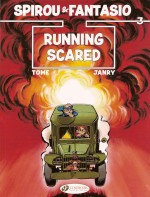
Spirou & Fantasio volume 3: Running Scared


By Tome & Janry, translated by Jerome Saincantin (Cinebook)
ISBN: 978-1-84918-116-7

Spirou (whose name translates as both “squirrel” and “mischievous” in the Walloon language) was created by French cartoonist François Robert Velter AKA Rob-Vel for Belgian publisher Éditions Dupuis in response to the phenomenal success of Hergé’s Tintin for rival outfit Casterman.

An eponymous magazine was launched on April 21st 1938 with the other red-headed lad as the lead in an anthology weekly comic which bears his name to this day.

He began as a plucky Bellboy/lift operator employed by the Moustique Hotel (a reference to publisher’s premier periodical Le Moustique) whose improbable adventures with his pet squirrel Spip eventually evolved into high-flying surreal comedy dramas.

Spirou and his pals have spearheaded the magazine for most of its life, where a phalanx of truly impressive creators have carried on Velter’s work, beginning with his wife Blanche “Davine” Dumoulin who took over the strip when her husband enlisted in 1939.

She was aided by Belgian artist Luc Lafnet until 1943 when Dupuis purchased all rights to the feature, after which comic-strip prodigy Joseph Gillain (“Jijé”) took over, adding current co-star Fantasio to the mix. Along the way Spirou and Fantasio became globe-trotting journalists, continuing their weekly exploits in unbroken four-colour glory.

In 1946 Jijé‘s  assistant André Franquin assumed the reins, adding a spectacular popular magic animal dubbed Marsupilami to the cast (first seen in Spirou et les héritiers in 1952 and now a spin-off star of screen, plush toy store, console games and albums all his own), crafting increasingly fantastic tales until he resigned in 1969.

He was succeeded by Jean-Claude Fournier who updated the feature over the course of nine stirring adventures that tapped into the rebellious, relevant zeitgeist of the times with tales of environmental concern, nuclear energy, drug cartels and repressive regimes.

By the 1980s the series seemed outdated and without direction: three different creative teams alternated on the serial, until it was at last revitalised by the authors of the adventure under review here: Philippe Vandevelde writing as Tome and artist Jean-Richard Geurts best known as Janry.

These last adapted and referenced the beloved Franquin era, consequently reviving the feature’s fortunes and resulting in fourteen wonderful albums between 1984 and 1998. This one from 1988, originally entitled ‘La frousse aux trousses’ or ‘Fear on the Trail’, was their eighth and the 40th collection of the evergreen adventurers.

Harking back to the Fournier years, it comprises the first of an excellent extended two-part thriller which will conclude in Cinebook’s forthcoming ‘Valley of the Exiles’ (originally released as ‘La vallée des bannis’ or ‘Valley of the Banished’ in 1989).

Since Tome & Janry’s departure both Lewis Trondheim and the team of Jean-Davide Morvan & Jose-Luis Munuera have brought the official album count to fifty (there also are a bunch of specials, spin-offs and one-shots, official and otherwise)…

Running Scared opens with a frantic chase scene as Spirou races across the city in splendid breakneck tribute to the silent movies chases of Harold Lloyd and Buster Keaton. He’s late for a conference where he will recount his many harrowing career-related escapes and show films of his numerous close shaves…

Barely making it, he’s disappointed by the reaction of the audience: those that don’t faint dead away from fear flee the theatre in horror…

It’s a huge disappointment: the daring reporter was hoping to use the profits from his lecture tour to fund his upcoming expedition to discover the fate of two explorers who vanished in 1938 whilst attempting to climb a mountain and discover the legendary “Valley of Exiles” in the mysterious Himalayan nation of Yurmaheesun-shan…

Since 1950 the tiny country has been the subject of numerous invasions by rival super-powers and is a hotbed of rebellion, insurgency and civil war, but ever-undaunted Spirou and Fantasio were utterly determined to solve the ancient mystery.

Their plans are only temporarily derailed however. One of the fainters at the conference was the timid but esteemed Dr. Placebo: renowned authority on the medical condition Spasmodia Maligna and a man convinced that the only cure for the condition – prolonged, sustained and life-threatening synchronous diaphragmatic flutters (or hiccups to you and me) – is to be scared out of one’s wits.

Having seen Spirou in action Placebo wants the reporters to take his most chronic patients with them on this assignment and offers to fund the entire expedition to the war-torn jell-hole…

Over Fantasio’s cynical but sensible objection’s a deal is struck and soon the lads, Spip and five disparate, desperate hiccupping victims are sneaking across the Nepalese border where the diligent Captain Yi is tasked with keeping all foreigners – and especially western journalists – out of the country as it undergoes its pacification and re-education…

However, thanks to native translator Gorpah (a wily veteran guide who once proved invaluable to another red-headed reporter, his little white dog and a foul mouthed-sea captain) the daring band are soon deep in-country, but the invaders are quickly hot on the trail in tanks, armoured cars and attack helicopters, providing plenty of opportunities for the annoyingly obnoxious singultus flutterers to be terrified – but with little evidence of a cure…

And then just as they find their first real clue as to the location of the lost Valley of Exiles the explorers are captured by native partisans and rebels…

Even this doesn’t scare off any hiccups, nor does the daring later escape attempt masterminded by Spirou and Fantasio. As the liberated captives all pile into a lorry a huge storm breaks and the rebels give chase.

When one of their pursuer’s vehicles plunges over a cliff, the valiant fugitives frantically form a human chain to rescue the driver and in the horrendous conditions Spirou is washed away and lost in the raging torrent.

…And that’s when all the hiccupping finally stopped…

To Be Continued…

Starting in superb slapstick comedy mode and with gallons of gags throughout, Running Scared nevertheless quickly evolves into a dark-edged and cunningly shaded satirical critique of then current geo-political scandals like the Soviet invasion of Afghanistan and systematic eradication of Tibetan culture by the Chinese – which both of course still resonate in today’s world – as it unfolds an epic and utterly compelling rollercoaster of fun and thrills.

This kind of lightly-barbed, real-world adventure comedy-thriller is a sheer joy in an arena far too full of adults-only carnage, testosterone-fuelled breast-beating, teen-romance monsters or sickly sweet fantasy. Easily accessible to readers of all ages and drawn with all the beguiling style and seductive but wholesome élan which makes Asterix, Lucky Luke, The Bluecoats and Iznogoud so compelling, this is another cracking read from a long line of superb exploits, certain to be as much a household name as those series – and even that other kid with the white dog…

Original edition © Dupuis, 1988 by Tome & Janry. All rights reserved. English translation 2012 © Cinebook Ltd.

The Desert Peach book 5: Belief Systems


By Donna Barr (Aeon)
ISBN: 1-883847-07-9

The Desert Peach is the supremely self-assured and eminently capable gay brother of the legendary German soldier hailed as “the Desert Fox” and one of the most perfectly realised characters in comics.

Set in World War II Africa and effortlessly combining hilarity, absurdity, profound sensitivity and glittering spontaneity, the stories describe the daily grind of Oberst Manfred Pfirsich Marie Rommel; a dutiful if unwilling cog in the German War Machine and his efforts to remain a civilised gentleman under the most adverse and unkind conditions.

However, although as formidable as his beloved elder sibling Field Marshal Erwin Rommel, the gracious and genteel Peach is a man who loathes causing harm or giving offence and thus spends his dry and dusty days with the ever-so-motley crew of the 469th Halftrack, Gravedigging & Support Unit of the Afrika Korps, trying to remain stylish, elegant, civil and gracious to the men under his command and the enemy forces around him.

It’s a lot of work: the 469th houses the worst dregs of the Wehrmacht, from malingerers and malcontents to useless wounded, sharpers, screw-ups and outright maniacs.

Pfirsich unilaterally applies the same decorous courtesies to the sundry natives inhabiting the area and the rather tiresome British – not all of whom are party to a clandestine non-aggression pact Pfirsich has agreed with his opposite numbers in the amassed Allied Forces. The only people the Peach really has no time for are boors, bigots, bullies and card-carrying Blackshirts…

The romantic fool is also passionately in love with and engaged to Rosen Kavalier: handsome Aryan warrior and wildly manly Luftwaffe Ace…

Arguably the real star of these fabulous frothy epics is the Peach’s long-suffering, unkempt, crafty, ill-mannered, bilious and lazily scrofulous orderly Udo Schmidt, a man of many secrets whose one redeeming virtue is his uncompromising loyalty and devotion to the only decent man and tolerable officer in the entire German army.

This tragically rare fifth softcover collection reprints issues #13-15 and starts with an enchanting comic introduction from the captivatingly clever Roberta Gregory after which the sagacious star yields focus to the tragically bewildered Doberman in ‘Nobody’ wherein the pitifully shell-shocked Corporal finally blows himself up with his pet landmine and is evacuated home.

Dobi unexpectedly returns some time later with tales of his nightmarish detour to the hidden Jewish concentration camps where all the undesirables are being dealt with: systematically and efficiently eradicating Jews and other “sub-humans”…

Pfirsich is appalled and refuses to believe the stories: surely no sane human beings could perpetrate such atrocities? Udo however, has also heard stories of how Hitler and his hierarchy are dealing with Jews and shares them with his commander. In a rage the Peach rushes off to tell his brother, knowing the Field Marshal can do something about it.

The noble Desert Fox also explodes in fury and determines to return to Berlin to stop the program. His plan is simple – since Hitler is a good man and cannot possibly know of these atrocities, all Erwin has to do is inform Adolf and the Fuhrer will put a stop to the horrors…

Pfirsich, knowing Hitler’s hierarchy far better than that, is faced with an impossible choice: allow his brother to sign his own death warrant or withdraw the allegations and become complicit in genocide…

This bleakly chilling and tortured black comedy is followed by ‘Surprise, Surprise’ with Udo griping and trying to weasel his way out of his impending, unwanted but necessarily pragmatic wedding to Bedouin princess Falila. The swarthy little scoundrel wants sex not commitment, but as Pfirsich urges his subordinate to honour his word and live up to his responsibilities another secret slips out.

Udo Schmidt used to have another name: the only card-carry Nazi Party member in the entire 469th was born Isador Gülphstein…

“Udo” is the scion of a venerable line of soldiers who have served the Fatherland and the long-suffering son of a proud German Jewish veteran of the Great War who changed the family name so that his sons could join the army too… whether they wanted to or not.

Now, with The Peach fully aware of the fate Jews are facing, how can he risk Schmidt’s secret getting out? Moreover how can he risk antagonising the desert tribes or disappointing the clearly addled girl who wants to marry Udo? After all, fanatic camp political officer Kjars Winzig already suspects something isn’t – or rather is – Kosher about Udo…

The troubles only really begin when eavesdropping boyfriend Rosen Kavalier takes charge and offers a drastic and outrageous solution…

This darker-than-usual volume concludes with ‘The Triangle Trade’ (from a suggestion by cartoonist Steve Gallacci) as The Peach encounters by-the-book soldier Oberst Quark, herding a supply column directly towards an Allied tank unit.

Keen to avoid any bloodshed Pfirsich intercepts the column and lends the commander his spotter plane, determined to keep the Germans out of trouble whilst their war-mongering commander is safely up in the air.

Deprived of glorious battle Quark conceives a subtle vengeance and transfers the two biggest troublemakers in his command to the 469th.

Sadly the younger Rommel has never encountered the average fighting man and sorely overestimates his ability to control the greedy, vicious and cunningly duplicitous thugs Leutnants Hecht and Horowitz…

With the camp quickly dissolving into a hotbed of criminality and black marketeering harsh measures are called and this time even Rosen has met his match. Seizing the nettle Pfirsich is forced to fall back upon his own unique strengths to solve this thorny dilemma effectively and with unmistakable style…

Fabulously following the same anti-war path as Sgt. Bilko, Hogan’s Heroes, Oh, What a Lovely War! and Catch 22, as well as such tangential films as Priscilla, Queen of the Desert and The Birdcage, these Desert Peach adventures are always bawdy, raucous, clever, authentically madcap and immensely engaging.

These gloriously baroque yarns were some of the very best comics of the 1990s and still pack the comedic kick of a silken howitzer or chartreuse flamethrower, liberally leavened with situational jocularity, accent humour and lots of footnoted Deutsche cuss-words for the kids to learn. Moreover, with this volume the dark bitter edges and cold iron underlying these fabulous characters and their horrific, doomed situation become ever more poignant and powerful.

The Desert Peach ran for 32 intermittent issues via a number of publishers and was subsequently collected as eight graphic novel collections (1988-2005). A prose novel, Bread and Swans, a musical and an invitational collection by other artists entitled Ersatz Peach were also created during the strip’s heyday. A larger compendium, Seven Peaches, collected issues #1-7 and Pfirsich’s further exploits continue as part of the Modern Tales webcomics collective…

Illustrated in Barr’s fluidly seductive wood-cut and loose-line style, this book is a must-have for any lover of wit, slapstick, high drama and belly-laughs and grown-up comics in general. All the collections are pretty hard to find these days but if you have a Kindle, Robot Comics have started releasing individual comicbook issues for anybody with internet access and mature tastes…
© 1991-1994 Donna Barr. Introduction © 1994 Roberta Gregory. All rights reserved. The Desert Peach is ™ Donna Barr.

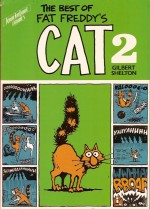
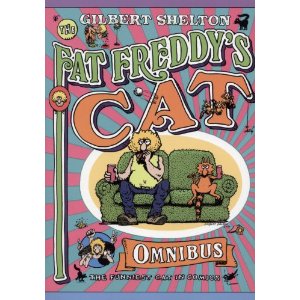
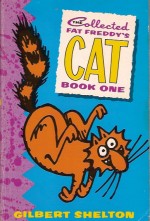
The Best of Fat Freddy’s CAT books 1 & 2


By Gilbert Shelton with Dave Sheridan, Paul Mavrides & Lieuen Adkins (Knockabout)
ISBN: 0-86166-009-9 & 0-86166-014-5   Omnibus 978-0-86166-161-9

The Fabulous Furry Freak Brothers shambled out of the Underground Commix counter-culture wave in 1968; initially appearing in Berkeley Print Mint’s Feds ‘n’ Heads, and in Underground newspapers before creator Gilbert Shelton and a few friends founded their own San Francisco based Rip Off Press in 1969. This effective collective continued to maximise the madness as the hilarious antics of the “Freaks” (contemporary term for lazy, dirty, drug-taking hippy folk) captured the imagination of the more open-minded portions of America and the world (not to mention their kids)…

In 1971 Rip Off published the first compilation: The Collected Adventures of the Fabulous Furry Freak Brothers – which has been in print all around the planet ever since – and soon assorted underground magazines and college papers were joined by the heady likes of Rip Off Comix, High Times, Playboy and numerous foreign periodicals in featuring the addictive adventures of Freewheelin’ Franklin, Phineas T. Freakears and Fat Freddy Freekowtski (with his cat): simpatico metaphorical siblings in sybaritic self-indulgence.

Fat Freddy’s Cat quickly became a star in his own right: tiny “topper” strips (separate mini adventures which accompanied the main story) in the newspapers that supplemented the Freaks’ antics became single page gags and eventually bloomed during the 1970s into full-blown extended exploits of the canny, cynical feline reprobate in his own series of digest-sized comicbooks The Adventures of Fat Freddy’s CAT…

Much of the material consisted of untitled quickies and short strips concocted by Shelton (with assistance from Dave Sheridan, Paul Mavrides and Lieuen Adkins) and eventually the little yarns were collected by UK Publisher Knockabout as a brace of oversized – 297x212mm – black and white comic albums and as mass-market b-format paperbacks in their Crack Editions imprint. In 2009 the entire canon was collected as The Fat Freddy’s CAT Omnibus.

These tales are wicked, degenerate, scatologically vulgar, sublimely smutty and brilliantly funny in any format but perhaps their raw anarchic, sly hysteria is best enjoyed in the giant tomes I’m highlighting here.

Book one opens with a dozen or so six panel strips and a single pager produced between 1971 and 1978, before the hilariously whacky epic ‘Chariot of the Globs’ (written by Adkins with art by Shelton & Sheridan) reveals how the imperturbable puss saved alien explorers from a hideous fate, followed by another fifty shorts covering every topic from mating to feeding, talking to humans and especially how cats inflict revenge…

Shelton and Sheridan then disclose the horrors of ‘Animal Camp’ wherein the irrepressible feline was dumped by Fat Freddy in a Boarding Kennel run by Nazi war criminals where pets were converted into clothing and pet food or else used in arcane genetic experiments!

Naturally the brainy beast had to lead a rebellion and break-out…

Amidst the remaining sixty-plus shorts comprising talking cockroaches, drug-fuelled excess, toilet training and drinking, fighting, mating and outsmarting humans, lurks one last lengthy treat from 1980, ‘The Sacred Sands of Pootweet… or the Mayor’s Meower’, a splendidly raucous political satire based on the tale of Dick Whittington.

When a religious hard-liner overthrows the oil-rich nation and former US satellite of Pootweet, Fat Freddy attempts to scam the Supreme Hoochy-Coochy by using the cat to clean up kingdom’s rodent problem. Only trouble is that the pious and poor Pootweet populace have no vermin problem (even after Freddy callously tries to manufacture one), only sacred, unblemished, undesecrated sands which the cat – in dire need of a potty-break – heads straight for…

The second volume is blessed with another seventy-odd scurrilous, scandalous and supremely hilarious short gags ranging from half to two pages, intoxicatingly interlaced with longer comedic classics such as the untitled tirade against modern newspaper strips which “guest-stars” such luminaries as Mary Worth, Doonesbury, Kronk, Andy Capp, Peanuts and a heavenly host of cartoon cats from Garfield to Fritz to Felix…

Also included are the devious and satirical 1973 spy-spoof ‘I Led Nine Lives!’ recounting the days when the fabulous feline worked for the FBI, ‘Fat Freddy’s CAT in the Burning of Hollywood’ from 1978 wherein the sublimely smug and sanguine survivor of a million hairy moments regales his ever-burgeoning brood of impressionable kittens with how he and his imbecilic human spectacularly flamed out in the movie biz and a truly salutary tale for all fans and readers…

Following the innocent – but so enjoyable – shredding of Fat Freddy’s comic collection and the expiration of his ninth life, ‘Paradise Revisited’ (1983 and illustrated by Paul Mavrides) finds the Marvellous Moggy in heaven again: but even though the place is packed with famous felines it’s not all catnip and celebration…

Despite the hippy-dippy antecedents and stoner presentiments, Shelton is always a consummate professional. His ideas are enchantingly fresh yet timeless, the dialogue is permanently spot-on and his pacing perfect. The stories, whether half-page quickies, short vignettes or full blown sagas, start strong and relentlessly build to spectacular – and often wildly outrageous, hallucinogenic yet story-appropriate – climaxes.

Anarchically sardonic and splendidly ludicrous, the madcap slapstick and sly satire of Gilbert Shelton is always an irresistible, riotously innocent tonic for the blues and these tales should be a compulsory experience for any fan of the comics medium.
© 1983, 1984, 2009 Gilbert Shelton. All rights reserved.

New British Comics volume 3


By various (NBC)
No ISBN:

Here’s a terrific little anthology tome (the third in a very impressive series) for older readers which delivers a tremendous amount of cartoon wonder and literary entertainment. This lovely B5 format compilation gathers a selection of contemporary graphic tales and vignettes by very talented, imaginative and keen creators who aren’t quite household names yet, beginning with the delightful ‘Cindy & Biscuit Save the World (again)’ by Dan White, wherein a plucky lass and her faithful mutt tackle an alien invasion, after which Lawrence Elwick & Paul O’Connell reveal an unsuspected side of ‘Alfred Hitchcock: Master of Suspense’.

‘Ink vs Paper’ by John Miers is an edgy, multi-layered silent foray into high design and “Hai! Karate!” followed by ‘Animal Magnetism’, the first of two equally speechless jazzy adventures by Elwick & O’Connell starring ‘Charlie Parker “Handyman”…

Scathing social satire is the order of the day in the futuristic unreality show ‘Here Comes the Neighbourhood’ by Matthew Craig & Richard Johnson, whilst more traditional sci fi fare informs the excellent ‘Better Living Through Distance’ by Dave Johnson, and genuine spooky nihilism makes Craig Collins & Iain Laurie’s ‘The Quiet Burden’ the very last thing you want to read at bedtime…

‘Luvvable Lex: Dirty ‘N’ Down’ by Rob Miller offers the unique Celtic insights of a very with-it “Glesga Gangster” before ‘Wonderland’ by Wilbur Dawbarn finally confirms what you’d always feared about the fauns and that Wardrobe to Narnia… After ‘Charlie Parker “Handyman”: Skyscraper Lunch’, Van Nim breaks hearts and shatters illusions of fairytale romance in‘(crack)’.

The thrills and chills come thick and fast in the macabre western ‘Von Trapp’ by WJC and this superb sojourn in strange lands ends with ‘A Complex Machine’ wherein David Ziggy Greene exposes the ghastly, fantastic, impossible truth about reflexology, Chinese medicine and those serene but wizened old gentlemen…

Most of the most popular and impressive creators of the last thirty years broke into the paying end of the business via the Independent, Small Press or Self Publishing routes and as each of the contributors here has a website you can see more at, courtesy of the biographies section at the back, you can get in on the crest of the next wave simply by picking up the luscious little black and white book…
All work © 2011 the individual creators. All rights reserved

To obtain New British Comics check this out, or contact Rob Miller.

Explorer – The Mystery Boxes


By various, edited by Kazu Kibuishi (Amulet)
ISBNs: HB 978-1-4197-0010-1   PB 978-1-4197-0009-5

Here’s another superb entry into the burgeoning Young Adults graphic novel market that offers a wonderful alternative to Fights ‘n’ Tights furores and interminable extended storylines that will appeal to fans of the art form and fantasy freaks alike.

Edited by Kazu Kibuishi who created the impressive sorcerous saga Amulet, this captivating anthology collection offers seven thought-provoking and decidedly different tales by a coterie of animators and comics-creators all turning their fertile imaginations and illustrative talents to expanding and elucidating upon the core concept of an enigmatic container…

The wonderment begins with a spooky fable by Emily Carroll wherein a solitary and much put-upon girl discovers a very special doll and far more than she bargained for ‘Under the Floorboards’…

‘Spring Cleaning’ by Dave Roman & Raina Telgemeier is a wry and jolly escapade with lazy Oliver finally picking up his toys and discovering a puzzle box he didn’t know he owned. When he tries to sell the thing online all manner of very strange and insistent people start making outrageous and impossible offers…

Jason Caffoe follows a more tradition route as his young warrior overcomes all manner of fantastic odds to win ‘The Keeper’s Treasure’. Of course not everybody agrees on what constitutes fabulous wealth…

‘The Butter Thief’ by Rad Sechrist sees a little girl discover her grandmother’s ineffable wisdom and magical practicality after freeing a thieving spirit from a kitchen trap and undergoing a startling metamorphosis whilst ‘The Soldier’s Daughter’ (by Stuart Livingston with Stephanie Ramirez) reveals the true cost of vengeance as young Clara picks up her murdered father’s sword and mission. Mercifully a mysterious stranger shows her another path in his enthralling cask of wonders…

Johane Matte & Saymone Phanekham display stunning comic timing and astounding fast-paced imagination in the wicked tale of ‘Deet’; a much-maligned junior intergalactic shipping clerk dealing with workplace bullying in the most effective manner conceivable after which editor Kazu Kibuishi brings the perplexing odyssey of a spectacular close with ‘The Escape Option’ as a troubled boy finds an incredible artefact and is presented with an impossible, life-changing, world altering choice…

These dark, beguiling, funny and enticing adventures blend traditional story elements with an inspired eye for the contemporary kid’s broad spectrum of fascinations: warriors, aliens, robots, cartoon animals, rocket-ships, monsters, isolation, alienation, magical quests and glorious battles; all delivered with sly wit and breathtaking exuberance to create a splendid portmanteau rollercoaster ride of laughter, tears, terrors and triumphs.

This a perfect introduction or reintroduction to comics for kids of all ages looking for something beyond the ordinary and hopefully the start of a long line of thematic sequels…

Explorers is scheduled for a March 2012 release in the UK but available for pre-order now in both hardback and paperback editions.

Cover and The Escape Option © 2012 Kazu Kibuishi. Under the Floorboards © 2012 Emily Carroll. Spring Cleaning © 2012 Dave Roman & Raina Telgemeier. The Keeper’s Treasure © 2012 Jason Caffoe. The Butter Thief © 2012 Rad Sechrist. The Soldier’s Daughter © 2012 Stuart Livingston. Whatzit © 2012 Johane Matte. Published by Amulet Books, an imprint of Abrams. All rights reserved.

Earthling!


By Mark Fearing, with Tim Rummel; coloured by Ken Min (Chronicle Books)
ISBNs: HB 978-0-81187-106-8   PB 978-1-45210-906-0

In the past I’ve banged on about the dearth of good comics for kids – as opposed to the vibrant and thriving children’s prose book markets or the slavish and impenetrable dead-end niche-genres and daunting cross-marketing of contemporary comicbooks – and at last, some interesting developments in strip-book publishing look like setting that imbalance to rights…

Earthling! is the first graphic novel by animator Mark Fearing (with some initial creative input from TV producer Tim Rummel) and tells the tale of solitary, nerdy lad Bud, dragged by his astronomer dad to the literal middle of nowhere to take up residence at the vast Von Lunar Radio Telescope Array in the dry wilds of New Mexico.

The place is weird and a little spooky, but with his Mum gone and his father preoccupied with work Bud’s getting used to coping on his own…

The real trouble starts the next morning when he dashes for the school bus. Late and in the middle of a storm Bud inadvertently stumbles into the wrong vehicle and finds himself stuck on a malfunctioning intergalactic shuttle taking a bunch of alien students to Cosmos Academy where all the kids in the Galactic Alliance are educated.

Being the new kid in school is always bad news, but when you’re the only one of your species…

Luckily geeky pariah Gort GortGort McGortGort takes Bud under his wing and steers him through the worst of the culture shock, but the human’s urgent desire to go home is countered by one overwhelming fact: Earth is the most feared planet in the Galaxy, its inhabitants are despised and reviled by every sentient race in creation and its spatial coordinates are a closely guarded secret…

Thinly disguised as a sporty, athletic Tenarian, Bud tries desperately to fit in and luckily fellow outcast Gort is determined to help him return home, but the Academy is almost as dangerous as an Earth school.

There are jocks and bullies and cliques everywhere, the cool sapients run everything and snarky sarcasm is a deadly threat at all times. Although there are some decent and friendly teachers, the robots, rogue or escaped science experiments and especially the cafeteria make daily life an incredible and potentially lethal prospect.

Moreover, Principal Lepton and his administration are brutal bureaucrats with an excessive punishment regime (this is one deep-space satellite school you do not want to be “expelled” from) who have a pretty cavalier attitude to student safety – or even survival – and a hidden agenda which involves using Academy resources to build super-weapons for use against Bud’s lost or hidden home-world…

Gradually though, the boy adjusts, even finding an unexpected flair for the terrifying null-gravity sport of ZeroBall, which is lucky as Gort has deduced that the immensely prestigious championship Tournament is being held tantalisingly close to the diabolical Planet Earth – close enough that a stolen space-pod could reach it, if by some miracle Bud’s team qualified for the finals…

Funny, thrilling, wildly imaginative and utterly engrossing, Earthling! blends elements of Tom Brown’s Schooldays with Joe Dante’s Explorers and Harry Potter’s best bits with the anarchic wit of Rocko’s Modern Life or Camp Lazlo to produce a delightfully compelling adventure yarn with endearing characters and a big, big payoff.

This is a book any sharp, fun-loving kid can – and should – read… and so should the rest of you…

Earthling! is scheduled for release in the UK February 2012 but available for pre-order right now in both hardback and paperback editions.

© 2012 by Mark Fearing. All rights reserved.

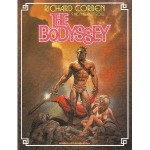
The Bodyssey


By Richard Corben & Simon Revelstroke (Catalan Communications/Fantagor Press)
ISBNs: Signed/numbered Limited Edition 0-8741 603-2-4, softcover 978-0-8741 603-2-1
1993 Fantagor edition 978-0-96238-418-9

Richard Corben is one of America’s greatest proponents of graphic narrative: an animator, illustrator, publisher and cartoonist, springing from the tumultuous wave of independent counterculture commix of the 1960s and 1970s to become a major force in comics storytelling with his own unmistakable style and vision. He is renowned for his mastery of airbrush and captivatingly excessive anatomical stylisation and infamous for delightfully wicked, darkly comedic horror and beguiling eroticism in his fantasy and science fiction tales.

Always garnering huge support and acclaim in Europe, he was regularly collected in luxurious albums even as he fell out of favour – and print – in his own country. This particular hilarious adult saga developed in response to a stunning 8-plate art portfolio ‘Scenes from the Magic Planet’ from 1979. After serialisation in Heavy Metal #97-102 in 1985, the complete scandalous graphic novel epic was first released in December 1986 and re-published by the artist’s own Fantagor Press company in 1993.

The necromancer Hunghoul has run off (flown actually in a fantastic cloud machine) with Pilgor the Barbarian’s faithless wife Smegmella and the obliviously cuckolded hero is hunting them through the skies but their inevitable death duel doesn’t go well and the hero is dumped into the oceans far below.

Washed ashore in a strange country the massively-thewed champion becomes an object of imminent affection for an undulating Pudenda Beast until rescued by a reptile man named Ytgna – a scurrilous creature with plans of his own which sorely need a mighty muscled dupe and puissant fighter…

The wily lizard enlists the lovelorn hero in his own a quest to locate and liberate the amply pulchritudinous Ammora, and soon their search brings them to the fleshpot quarter of cesspit city Foulmouth where Pilgor catches the eye and steamier regions of androgynous Succulus Agripper, the Brothel Queen of the degenerate metropolis. Being a healthy upstanding chap Pilgor violently refuses the unwholesome unwelcome advances, effecting a spectacular escape and making another implacable, powerful and unforgiving enemy…

Eventually Ytgna and Pilgor locate their quarry – or so they think – but she proves to be far more than they bargained for and the searchers find themselves unwelcome guests of the formidable Amazons of Tumeschia and about to lose their he-man standings until a giant comatose goddess awakes and an extremely phallic giant titan invades. And that’s when the still most-piqued Agripper and his army turn up…

Meanwhile at Castle Bilious the first bloom of love is fading for Hunghoul and Smegmella so the wizard is happy to turn his attention back to Pilgor – who is still keen on exercising bloody vengeance upon them.

With the Amazons and Agripper hard on his heels and the nasty necromancer waiting for him the witless warrior is heading inexorably for a spectacular, eye-popping climax…

I’ve only got the signed and numbered limited edition so the remaining pages might not be in either of the softcover editions, but if you can, ensure you find a copy which ends the saucy fantasy extravaganza with the original portfolio plates from 1979.

In magnificent textured monochrome grey-tones and washes ‘Pilgor Discusses Politics with his Friends’, ‘Hunghoul’s Guards’, ‘Ytgna and his Faithful Ammora’, ‘Machola Seeks a Remembrance’, ‘Uncle Hunghoul Collects a Titbit’, ‘Pilgor Works his Work’, ‘Pilgor drops in at Dinnertime’ and ‘Pilgor’s and Ammora’s Happy Ending’ cap off the wry and whimsically debauched fantasy in a wave of sheer artistic excellence.

Like the cross between the World’s smuttiest Conan story and “Carry On, Barbarian!” this tale perfectly epitomises Corben’s unique visual style, love of the dark and scathingly sharp sense of humour. Combine that with humanity’s apparently insatiable hunger for sex, nudity, monsters and magic and this book becomes another utterly unmissable indulgence…
© 1986, 1993 Richard Corben. All rights reserved.