Modesty Blaise: The Grim Joker


By Peter O’Donnell & Enric Badia Romero (Titan Books)
ISBN: 978-1-78116-711-3

Win’s Christmas Gift Recommendation: unmissable comics for fans of classic blockbusting adventure… 9/10

Modesty Blaise and her lethally adept, compulsively platonic partner Willie Garvin gained their fearsome reputations as top-flight super-criminals before retiring young, rich and healthy. With their honour intact and their hands relatively clean, they cut themselves off completely from a career where they made all the money they would ever need and far too many enemies.

When devious British Spymaster Sir Gerald Tarrant sought them out they were slowly dying of boredom in England. The wily old bird offered them a chance to have fun, get back into harness and do a bit of good in the world. They jumped at his offer and have been cleaning up the world in their own unique way ever since …

From that tenuous beginning in ‘La Machine’ (see Modesty Blaise: the Gabriel Set-Up) the dynamic duo went on to crush the world’s vilest villains and most macabre monsters in a perpetual storm of tense suspense and inspirational action for nearly forty years…

The inseparable associates first appeared in The Evening Standard on May 13th 1963 and over the decades went on to star in some of the world’s most memorable crime fiction, all in three panels a day.

Creators Peter O’Donnell & Jim Holdaway (who had previously collaborated on Romeo Brown) produced a timeless treasure trove of brilliant graphic escapades until the illustrator’s tragic early death in 1970, whereupon Spanish artist Enric Badia Romero (and, occasionally, others) assumed the art reins, taking the partners in peril to even greater heights.

The series has been syndicated world-wide and Modesty Blaise has also starred in 13 prose novels and short-story collections, several films, a TV pilot, a radio play, an American graphic novel and nearly one hundred comic strip adventures until the strip’s conclusion in 2002.

The tales are a broad blend of hip and cool capers combining espionage, crime, straight adventure and even – now and again – plausibly intriguing sci fi and supernaturally tinged horror genre fare, with ever-competent Modesty and Willie canny, deadly, yet all-too-fallible human defenders of the helpless and avengers of the wronged…

Reproduced in stark and stunning black & white – and quite right too – Titan Books’ superb and scrupulous serial re-presentations of the ultimate newspaper troubleshooters continue here with O’Donnell and Romero offering a chilling trio of tales spanning November 1992 to February 1994, each prefaced with informative prose introductions from devotee and historian Simon Ward.

The rollercoaster ride begins with eerie thriller ‘A Present for the Princess’ (originally seen in The Evening Standard from November 3rd 1992 to April 8th 1993) with Garvin deep in the emerald mining region of Montelero, near Colombia.

He is in search of raw materials to create another of his outrageously over-the-top gifts for Modesty and is prepared for trouble from the thugs and bandits who inhabit the region, but not his own partner and guide Ramon who is, after all, a former pal from their long-defunct crime combine The Network…

In England Modesty takes it easy whilst entertaining psychic researchers Steve and Dinah Collier – truly gifted individuals Tarrant wants to employ – who are happily on hand when Blaise has a nightmare premonition that Willie is in trouble.

As usual Garvin has told no one of his plans or destination and when Ramon attacked him had no hope of ever being found. However, the indomitable survivor escaped the ambush – barely – only to be washed up more dead than alive miles downriver. He was then nursed back to health by poor peon Rima: a young woman who looks astonishingly like Modesty.

Willie doesn’t recognise the fact though. The brutalised, battered Englishman has lost his memory…

Although his history is denied him Garvin’s deadly skills are intact and he jumps to the obvious conclusion that he is some kind of criminal. His actions disprove this notion, efficiently saving Rima from an abusive landowner and his thugs.

Although she has fallen for him the native girl knows his clouded mind is obsessed with another woman and she treks with him to the capital city Toccopina to obtain papers and possibly passage back to Britain…

At home, with Willie long overdue, Modesty has employed the Colliers and another psychic to search for him. Their endeavours have narrowed the search to the selfsame South American city. They have also resulted in an enigmatic prophecy…

Willie’s gift for card-playing has meanwhile won the wanderers a nice nest-egg but dropped him clueless amongst the city’s criminal element, most of whom have good reason to despise him.

After an old enemy recognises him, Willie is befriended by the wily conman and unknowingly “sold” to local mob boss Senor Strobel, who cunningly convinces the lethally talented amnesiac that he is an evil man wanted for murder who would only be safe if he rejoins the gang as a hit-man…

By the time Modesty arrives, Willie is safely tucked away in a fortress-like nest of bandits, where his inner self rebels from the acts he’s expected to perform. Naturally she has a plan to save her brother-in-arms and make all the guilty parties very sorry indeed…

Following that spectacular and explosive resolution, the tables are turned somewhat for ‘Black Queen’s Pawn’, a riotous African adventure yarn (April 13th – September 10th) which begins in 1834 when Ranavalona, autocratic and utterly insane queen of Madagascar, obtains a treasure guaranteed to make her immortal. She then hides it away from the eyes of mankind and, just to be sure, has every person who knew of it slaughtered…

Now one hundred and sixty years later hard times have befallen the island, as is clearly observed by veterinary surgeon Greg Lawton who has been commissioned by government officials to find a giant fossil egg.

He’s brought old chum Modesty with him, but when they reach the poverty-stricken village of Mandofo they find the place has been taken over by ruthless thugs on a treasure hunt.

The leader Koch has crossed swords with her before and convinces his murderous underlings not to kill the westerners out of hand. If she dies, nothing could stop the absent Willie Garvin hunting them down. Far better to keep her alive and on her best behaviour by holding innocent villagers hostage…

Forced into unwilling neutrality, Modesty and Greg befriend local missionary Father Brienne and discover the savage invaders are seeking Ranavalona’s legendary lost hoard for mysterious millionaire paymaster Salim. As the cleric is also Koch’s unwilling translator of ancient documents, he provides clues which enable Modesty to deduce where the treasure actually is…

The suspenseful standoff continues until Willie – acting on his own uncanny instincts – surprisingly joins the party, but with Garvin now here in front of them instead of lurking unsuspected at their heels, Koch and Salim decide to arrange a little accident.

However with the deadly détente effectively negated their targets know full well all bets are off and, after brilliantly locating the treasure for the gangsters, go on to prove just a bit smarter and more efficient in settling scores…

The addictive action concludes in a classic murder mystery which sees Modesty take a rare personal interest in a news sensation as Britain is gripped by a series of bizarre, baroque and flamboyant murders by a macabre psychopath signing himself ‘The Grim Joker’ (September 13th 1993 – February 9th 1994)…

The killer apparently devises convoluted, extremely public executions for sheer amusement but such callous slaughter for pleasure disgusts reluctant professionals such as Blaise and Garvin.

Soon they have made themselves prime targets for the maniac, unaware that the Grim Joker is not what he seems. The insanely Machiavellian exploits are in fact a cunning blind concocted by a trio of greedy brats eager to expedite an eventual inheritance.

Brothers Matthew and Mark Goodchild, along with their shared girlfriend Prudence, originally set up the crimes to divert suspicion after they decided to bump off their rich uncle, but as they carried out the string of publicity seeking murders, the thrill of achievement affected them.

Prudence especially has become intoxicated with the undertaking, and begs for more before topping their true target and retiring. Her wish is granted after Willie publicly ridicules the Grim Joker on television and arouses the righteous indignation of the brothers.

It’s all a cunning plan by the ex-Network leaders. After consulting old friend Police Inspector Brook, Modesty and Willie have correctly deduced that the crimes are the work of a team not a lone maniac, and Garvin has offered himself as a too-tempting follow-up target.

Relocating to an isolated Scottish island “for a holiday”, Willie makes himself available for his unknown foes, with Modesty concealed waiting to spring their trap.

Unfortunately they’re keeping watch for a couple of strong men, not the frail helpless girl who first washes up on the desolate death trap…

What follows is smart, chaotic and shatteringly thrill-a-minute excitement, before the dust finally settles and the final tally is taken…

These are incomparable capers crafted by brilliant creators at the peak of their powers; revelling in the sheer perfection of an iconic creation. Unforgettable romps packed with sleek sex appeal, dry wit, terrific tension and explosive action and, these stories grow more appealing with every rereading and never fail to deliver maximum impact and total enjoyment.

Modesty Blaise © 2014 Associated Newspapers/Solo Syndication.

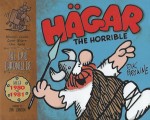
Hägar the Horrible: The Epic Chronicles – Dailies 1980-1981


By Dik Browne (Titan Books)
ISBN: 978-1-78116-715-1

Win’s Christmas Gift Recommendation: a perfect package of traditional fun… 9/10

Although very much in decline these days, for nearly 200 years cartoon strips and gag-panels were the universal medium of wit, satire mirth and cultural exchange. Latterly we purveyors of primarily sequential narrative have exhibited an unhappy tendency to become protective and parochial about our own particular specialism within the greater art form.

How many times have we heard an artist or writer working on a hot new comicbook property revelling in sales of sixty-to-seventy thousand monthly copies, almost simultaneously disparage strips such as Dilbert, Dick Tracy or Garfield whose daily readership can be numbered in millions, if not billions?

Let’s all just try to remember that tastes differ, and that we’re all just making lines on a surface here, and most especially that TV and Computer Games are the real enemy of our industry, shall we?

OK, rant over.

Mainstream cartooning is a huge daily joy to a vast and often global readership whose needs are quite different from those of hard-core, dedicated comic fans, or even that ever-growing base of intrigued browsers dipping their toes in the sequential narrative pool. Even those stuck-up stickybeaks who have pointedly “never read a comic” have read and enjoyed strips or panels, and in this arena Britain has seen not only a golden bounty of home produced material but also imported some of the very best the rest of the world has to offer.

Dik (AKA Richard Arthur Allan) Browne was a native New Yorker born in 1917 who studied at Cooper Union and apprenticed as a copy boy and art-bod for the New York Journal America before joining the US Army.

His wartime duties in the Engineering Corps included strategic map-making, but whilst in service he also created the comic strip Jinny Jeep about the Women’s Army Corps, which set the tone for his peacetime career.

A professional cartoonist and illustrator, he worked for Newsweek and in advertising after mustering out, gaining a reputation as a superb logo designer (The Campbell Soup Kids, Chiquita Banana and the Birdseye Bird number amongst his most memorable creations).

He also dabbled with comicbooks – a few Classics Illustrated Junior issues – and produced some children’s books, before teaming up with Beetle Bailey creator Mort Walker to draw the hugely successful spin-off strip Hi and Lois in 1954.

Whilst illustrating that family comedy – and deviously training his sons Chance and Chris to take eventually over his cartooning duties – Dik devised another strip that he would write as well as render.

Hägar the Horrible debuted through the King Features Syndicate on February 4th 1973 and quickly became a world-wide hit. The strip is still a fixture in 1900 newspapers in 58 countries in thirteen languages and the iconic characters have migrated to books, comic albums, games, animated movies, toys and more…

Dik Browne retired from cartooning in 1988 and tragically died from cancer on June 4th 1989. Chance now continues Hi and Lois whilst Chris continues to wield pen, wave sword and wear the chief’s horned helmet on Hägar…

A certified classic of World Cartooning, Hägar the Horrible is the ongoing subject of a comprehensive collectors series and this latest (sixth) monolithic hardback compendium covers 7th July 1980 to January 2nd 1982, with the hard-drinking, voracious sea-roving Viking and his scurvy crew constantly trekking out to far climes before perennially staggering home to their quirky families in a never-ending stream of sight gags, painful puns and surreal situations.

This volume opens with a passionate reverie from a close associate and fellow star cartoonist in the Foreword by Lynn Johnston before Chris Browne shares memories of one his dad’s most imaginative and appealing children’s books (The Land of Lost Things co-created with Mort Walker) in ‘The Lost World of Dik Browne’.

Then, before the cavalcade of comic calamity commences, readers old and new are regaled with a handy chart of the Hägar Family Tree, reintroducing the great man and his doughty dependents: Helga the long-suffering wife, studious son Hamlet and troublesome teenaged daughter Honi.

Also making an appearance are faithful canine Snert, stroppy house-duck Kvack and the hero’s faithful if intellectually challenged sidekick Lucky Eddie…

The magic of these daily strips is the constant stream of japes and capers constantly revisiting established themes and hot-button topics. Over the hundreds of pages that follow you can see Hägar’s perpetual struggle to bring home the bacon (and wine and gold and textiles and…), spar with Helga as she fruitlessly struggles to civilise her barbaric oaf of a man, and Honi’s torment as she pines equally for seedy musician Lute and noble knight Sir Philip Courtright whilst testing out other matrimonial options and alternatively considers a career as a axe-swinging Valkyrie…

Bookish Hamlet is always there to disappoint and delight his gregarious, bellicose dad; Snert and Kvack frequently outwit and appal the humans who share their home whilst Lucky Eddie and the mismatched crew of incompetent sea-reavers follow the red-bearded rascal into battle against foreign armies, daunting dragons, a coterie of assorted clergy and the unwelcoming elements, content in the knowledge that somehow, somewhere they will find more booze…

Enticing, irrepressible, hilarious and deeply satisfying, Hägar the Horrible is a masterpiece of the strip cartoonists’ unique art form and one guaranteed to deliver delight over and over again to young and old alike.

Hägar the Horrible is © 2014 King Features Syndicate and ™ Hearst Holdings, Inc. All rights reserved. All strips © 1980 & 1981 King Features Syndicate. All rights reserved. All other material © 2014 their respective authors.

Modesty Blaise: The Young Mistress


By Peter O’Donnell & Enric Badia Romero (Titan Books)
ISBN: 978-1-78116-709-0

Win’s Christmas Gift Recommendation: unmissable comics for fans of classic blockbusting adventure… 9/10

Modesty Blaise and her lethally adept platonic partner Willie Garvin were superior criminals who retired young, rich and healthy – without ever getting too dirty – from a career where they made far too many enemies.

They were slowly dying of boredom in England when British Spymaster Sir Gerald Tarrant offered them a chance to have fun, get back into harness and do a bit of good in the world. They jumped at his offer of excitement and a chance to get some really evil sods.

With that tenuous beginning in ‘La Machine’ (see Modesty Blaise: the Gabriel Set-Up) the pair embarked upon a non-stop helter-skelter thrill-ride that has pitted them against the World’s vilest villains and maddest maniacs…

The legendary femme fatale first appeared in The Evening Standard on May 13th 1963 and over the following decades went on to star in some of the world’s most memorable crime fiction, all in three panels a day.

Creators Peter O’Donnell & Jim Holdaway (who had previously collaborated on Romeo Brown – a light-hearted adventure strip from the 1950’s itself long overdue for revival and compilation) produced a treasure trove of brilliant graphic escapades until the illustrator’s tragic early death in 1970, whereupon Spanish artist Enric Badia Romero and others assumed the art reins, taking the daredevil duo to even greater heights.

Modesty has been syndicated world-wide and the partners in peril have also starred in 13 prose novels and short-story collections, several films, a TV pilot, a radio play and nearly one hundred comic strip adventures between 1963 and the strip’s conclusion in 2002.

The tales are always stylish and engaging spy/crime/thriller fare in the vein of Ian Fleming’s Bond stories (as opposed to the super-spy’s sometimes over-the-top cinema exploits) although Modesty and Willie are competent, canny, deadly, yet all-too-fallibly human.

Reproduced in stark and stunning black & white – as they should be – Titan Books’ superb and scrupulous serial re-presentations of the ultimate newspaper troubleshooter continue here with O’Donnell and perennial collaborator Romero at the top of their game in a trio of tales spanning August 5th 1991 to November 2nd 1992, each prefaced with informative prose introductions from devotee and historian Lawrence Blackmore.

The rollercoaster ride begins with eponymous thriller ‘The Young Mistress’ (originally seen in The London Evening Standard from August 5th 1991 – January 6th 1992) which delves into the thorny subject of domestic abuse and the high-stakes world of art forgery.

When Modesty and current paramour Dr. Giles Pennyfeather aid a young woman thrashed with a riding crop they are astounded when the terrified Marian Hall refuses to press charges against shady art dealer Bruce Lacey.

Not only does the sadistic bully have unsubstantiated links to the underworld but he clearly enjoys inflicting pain. However when he surprises Marian’s rescuers, his attempts to teach Modesty “a lesson” rebound on him painfully and humiliatingly. They even take his toy girlfriend away…

Safely ensconced with Modesty and Willie, Marian explains that it’s not love but fear and guilt that keep her with Lacey. The young commercial artist is a brilliant copyist and when she first began seeing the astoundingly well-connected gallery owner, he convinced her to counterfeit a valuable painting before selling it on to an unsuspecting collector.

As a participant (albeit innocently) in fraud, she is in the monster’s pocket. Moreover Lacey was intending to use Marian to forge a borrowed Rembrandt and subsequently kidnaps her and her understanding old boyfriend to ensure the talented lass’ compliance in his nefarious multi-million-dollar scheme.

Determined to end the beast’s predations and thoroughly aware that Lacey will never rest until he has subjected Modesty to the brutal tortures that push his sick buttons, Willie and Modesty undertake a convoluted sting to break his power base, but are unaware of just how vicious and violent Lacey can be.

He, of course, has completely underestimated the lengths to which Modesty will go to defend the helpless…

‘Ivory Dancer’ (January 7th – June 5th 1992) changes tack as Modesty and Willie take their feisty, horse-mad prodigy Samantha to Kentucky for a vacation with billionaire John Dall.

The equine enthusiast is an old lover of Modesty’s as well as owner of the world’s most successful and valuable race horse, but the dream holiday unfortunately coincides with a cruel attempt to kidnap the four-legged superstar by ruthless gangster Gallo.

Sadly for the murderous thugs little Sam has an almost preternatural connection with the horse and once the steed goes missing she’s hot on his trail.

…And Willie and Modesty are hard on her heels; in no mood to be gentle with thugs who steal horses and threaten children…

The addictive action concludes in a classic espionage extravaganza as ‘Our Friend Maud’ (June 8th – November 2nd 1992) reintroduces Sir Gerald’s top agent in a clever tale of brainwashing, contract killing and international intrigue.

Maud Tiller is a top operative and when occasional dalliance Willie Garvin is blanked by her in a French restaurant he simply assumes she’s undercover on a mission. However his danger-honed senses are troubled and a little quiet checking reveals that the agent has gone AWOL.

Liaising with Modesty and Tarrant, Willie soon discovers that Maud has been kidnapped by fixer-for-hire the High Contractor and deduces she is being slowly programmed to assassinate somebody important and generally untouchable…

Linking up with Modesty, the outraged Garvin tracks Maud down and with the aid of unconventional Gallic operative Code-Name: Henri proceeds to infiltrate the upper echelons of grand society to rescue his English Rose, consequently dismantling one of the most dangerous international terror rings ever to threaten world peace…

These are unforgettable stories from brilliant creators at the peak of their powers; revelling in the majesty of an iconic creation. As timeless adventure romps packed with sex appeal, dry wit and devastating tension, the stories here are more enthralling now than ever and never fail to deliver maximum impact and total enjoyment.

Modesty Blaise © 2014 All rights reserved.

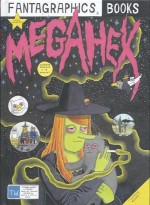
Megahex


By Simon Hanselmann (Fantagraphics Books)
ISBN: 978-1-60699-743-7

Win’s Christmas Gift Recommendation: laugh-out-loud, falling-down-daft, crying from the heart … 8/10

Simon Hanselmann is a well-travelled cartoonist of Tasmanian origin who has been, since 2009, producing one of the best cartoon strips of all time.

Although mostly found on his girlmountain.tumblr site, other episodes of his engagingly deceptive, inappropriately pigeon-holed “stoner comedy” Megg, Mogg & Owl have appeared in places as varied as Kus, Smoke Signal, Gangbang Bong and assorted minicomics, but can now all be found in a sturdy, full colour hardback compilation which also boasts a further 69 pages of new and previously unseen material.

Hanselmann’s signature characters – loosely based on childhood memories of a series of British children’s books, filtered through a druggy haze and a desperate deadline – are Megg, a depression-afflicted druggie witch who lives with her mean-spirited feline familiar Mogg and sensitive, insecure, affection-starved Owl.

When not confronting or testing each other or hanging with the wrong crowd, they spend most of their time in a post-modern haze of self-inflicted ennui or on dope-fuelled junk-food binges in the apartment or in front of the TV…

They probably don’t like each or themselves much but dwell in a fug of dangerous co-dependency and their strange adventures have finally been collected into a sturdy and most improper tribute to a life lived more wryly through chemistry and sarcasm.

This book is packed with drug references, violent sexual imagery and outrageous situations intended to make adults laugh and think.

If the copy above hasn’t clued you in, please be warned that this book uses potentially disturbing images of abuse, sexual intimacy, excess and language commonly used in the privacy of the bedroom, drunken street brawls – and probably school playgrounds whenever supervising adults aren’t present – to make its artistic and narrative points.

If the mere thought of all that appals and offends you, read no further and don’t buy it. The rest of us will just have to enjoy some of the most astounding cartoon experiences ever created without you.

Lethargically anarchic and cruelly hilarious, the escapades of insecure Megg, malicious, experience-craving Mogg and their poor, pitiful companion open with ‘Fire’ as the pharmacologically paralysed Owl tries to dissuade his flatmates from testing his potential flammability after which ‘Beach’ finds Megg & Mogg defeated by the tantalising ever-expanding expanse between sand and surf…

‘Kate Bush’ reveals the embarrassment arising from catching someone in the act of singing along to something naff whilst ‘Horrible Party’ introduces wizard Mike and manic hedonist Werewolf Jones who will clearly go to obscene lengths to get noticed after which ‘Found Pills’ portrays some distressing transformations.

A first hint of darker intent is seen in ‘Drive Through’ when Owl passes out and his “friends” treat his body with an extreme lack of consideration and affection, whilst ‘Water’ goes straight to the gross-out core of slapstick before witch and familiar try to gatecrash a childrens’ show audition in ‘Theatre’ and Owl daydreams whilst passing through ‘Ham Parade’…

Things get cattily scatological with an unattended plate of ‘Spaghetti’ and escalate when caught-short Owl is barred from the toilet and remanded to the ‘Yard’ after which Megg wires up her cat for an evocative rendition of ‘Mogg’s Noise Show’.

More casual cruelty ensues in ‘Taut Psychological Thriller’ when the flatmates palm off Owl with bogus drugs after which a rendezvous at the ‘Mall’ allows cat and conjuress to ruin the long-suffering dupe’s latest sexual conquest. This petty meanness is capped by the thrilling showboating of ‘Werewolf Jones’ Excitebike’ extravaganza…

‘Owl’s Birthday’ is as bad as the poor sap fears and his party ends with shocking abuse and assault, but even after he has moved on – without the intervention or apology of his buddies – a meeting with girl of his dreams ‘Peyote’ again leads to a situation of personal shame and legal terror…

Even fetching a ‘Sandwich’ can lead to unthinking humiliation for the avian also-ran, whilst for ‘Werewolf Jones & Friends’ every night is a party – but not one you’d want to attend…

After losing an appreciable amount of their lives to an iCarly marathon, Megg & Mogg head for the ‘Video Store’, utterly ignoring Owl’s cry for help regarding his AA meetings, and subsequently spike his health smoothie.

Owl is unfortunately a belligerent drunk and can’t understand why he’s abusing the other store patrons…

When “the munchies” hit, food crazed Megg & Mogg burgle a kebab shop but the guilt and fear engendered by the ‘Heist’ soon drives them to near madness, whilst ‘Scene Politics’ scares the crap out of everybody as Werewolf lays down his law.

‘Silver Sequin Mini-Skirt’ exposes Megg’s vulnerability after she receives some bad news, leading to an extended and keenly focused exploration of mental illness beginning with ‘Megg’s Depression’, ricocheting manically into ‘Megg’s Good Mood’, an interlude with her concerned house-sharers in ‘Bad Brains’ and a swingeing attack on mental health professions in ‘Megg’s Therapy’…

After an odd encounter passing a ‘Graveyard’ Megg’s obsession with ‘Pregnancy’ kicks in again, but not in time to stop her friends tampering with her testing kits and, whilst reeling with indecision, she capitulates to her cat’s bizarre predilections in ‘Rimming’.

Seeking change she doses Mogg with ginger ‘Hair Dye’ which alters his look but sadly not his temperament after which a possible visit by the landlords provoke a hearty bout of ‘Paranoia’ that lasts until Werewolf arrives with a huge quantity of ‘Acid’ which takes everyone on the trip of their lives…

Change is in the air and when Owl tries to sort out his life with a real job Mogg & Megg have no choice but to tamper with the ‘Alarm Clock’ and other accoutrements of his longed-for normal life. As the shamed jobseeker simmers, Mogg returns to his own dark desires and ruins the concept of ‘Cinnamon’ for everybody else…

Events come to a life-changing head in ‘Cocktails’ when all the neurosis, blasé fronting, passive-aggression, negative feelings, overwhelming love, depression, drugs, sexual profligacy and cycles of dependency boil over and the gang break up forever…

Despite its similarity to some kind of no-harm, no-foul adult situation comedy – and believe me there are outrageous laughs by the bucketful – there is a strong, often overwhelming narrative progression to these quirky beguiling stories and Megahex navigates with easy confidence the tightrope between sordid and surreal, hilarity and horror, survival and sinking away.

Dark, affecting and unforgettable, this is a book no lover of truly mature fiction will be able to ignore.
Megahex © 2014 Simon Hanselmann. This edition © 2014 Fantagraphics Books, Inc.

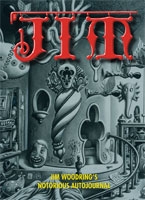
Jim – Jim Woodring’s Notorious Autojournal


By Jim Woodring (Fantagraphics Books)
ISBN: 978-1-60699-752-9

Win’s Christmas Gift Recommendation: A beguiling glimpse into the early thoughts of a narrative master … 9/10

There are a few uniquely gifted and driven comics creators who simply defy categorisation or even description. There’s a pantheon of artisans: Kirby, Ditko, Hergé, Eisner, Clowes, Meskin, Millionaire and a few others who bring something utterly personal and universally effective to their work just beyond the reviewer’s skills (mine certainly) to elucidate, encapsulate or convey. They are perfect in their own way and so emphatically wonderful that no collection of praise and analysis can do them justice.

You just have to read the stuff yourself.

At the top of that distinguished heap of graphic glitterati is Jim Woodring. It’s a position he has maintained for years and clearly appears capable of holding for generations to come.

Woodring’s work has always been challenging, spiritual, grotesque, philosophical, heartbreaking, funny, beautiful and extremely scary. Moreover, even after reading that sentence you will still be absolutely unprepared for what awaits the first time you encounter any of his books – and even more so if you’ve already seen everything he’s created.

Cartoonist, fine artist, toy-maker and artistic Renaissance man, Woodring’s eccentric output has delighted far too small and select an audience since his first mini-comics forays in 1980. Even though the reader may have avidly adored his groundbreaking oneirically autobiographical Fantagraphics magazine Jim (1986 and cherry-picked for this collection), its notional spin-off series Frank (of which the volume Weathercraft won The Stranger 2010 Genius Award for Literature), maybe Tantalizing Stories, Seeing Things or more mainstream features such as his Star Wars and Aliens tales for Dark Horse Comics, there is still never anything but surprise waiting when his next story appears…

An accomplished storytelling technician these days, Woodring grows rather than constructs solidly surreal, abstractly authentic, wildly rational, primal cartoon universes, wherein his meticulous, clean-lined, sturdily ethereal, mannered blend of woodblock prints, R. Crumb landscapes, expressionist Dreamscapes, religious art and monstrous phantasmagoria all live and play and often eat each other.

His stories follow a logical, progressional narrative – often a surging, non-stop chase from one insane invention to the next – layered with multiple levels of meaning but totally devoid of speech or words, boldly assuming the intense involvement of the reader will participate and complete the creative circuit.

Such was not always the case and this superb and sumptuous oversized (292 x 228mm) hardcover compilation – which gathers his earlier formative and breakthrough efforts in colour and monochrome – offers the very best of his strips, paintings, poems and stories from breakthrough autobiographical magazine JIM and other (sadly unnamed) sources between 1980 and 1996.

This compulsive collection also includes a new 24-page strip starring the artist’s hulking, bewhiskered, aggressively paranoid, dream-plagued family man/cartoonist alter ego, and certainly cements his reputation as a master of subconscious exploration, surreal self-expression and slyly ironic comedic excoriation – and it’s still almost impossible to describe.

You really, really, really have to dive in and discover for yourself…

Packed with hallucinatory spot-images and cover illustrations from JIM, the furtive fruits of Woodring’s ever-present dream-recording “autojournal” are prefaced by a beguiling and informative ‘Author’s Note’ before the wonderment begins with ‘Jim #1 in its entirety’: the complete contents of his very first self-published fanzine from 1980.

A master of silent expressive cartooning, Woodring’s playfully inventively fascination with and love of words and tale-making shines through in such laboriously hand-lettered, illustrated epigrammatic vignettes as ‘Lozenge’ and ‘Jim Today’ as well as witty iconographic concoctions like ‘Tales of Bears’ and ‘Troutcapper Hats’ before the first strip saga details a doomed fishing trip in ‘Seafood Platter from Hell’ and a moment of early silent psychedelia reveals how ‘Two Children Inadvertently Kill an Agent of the Devil Through an Excess of Youthful High Spirits’…

Another personal true story and painful brush with disability and imperfection is disclosed in ‘Invisible Hinge’ whilst ‘The Hour of the Kitten’ returns to distressed, disturbed prose before the first of many outrageous faux-ads offers those indispensable conscience-pets ‘Niffers’, preceding another text-trek in ‘A Walk in the Foothills’.

Cats play a large part in these early strips and ‘Big Red’ is probably the cutest bloody-clawed, conscienceless killer you’ll ever meet whilst ‘Enough is Enough’ offers graphic pause before an ad for the home ‘Dreamcorder’ segues into a disturbing poster of rural excess in ‘A Lousy Show’.

‘Particular Mind’ provides a strip encapsulating life-drawing, relationships and hallucinations after which the tempting services provided by ‘Jim’s Discipline Camp’ are counterbalanced by a paean to pharmacopoeia in ‘Good Medicine’.

More savage exploits of ‘Big Red’ lead to a commercial presentation in ‘This is the Meat (…That Changed Me, Dad!)’, whilst ‘Horse Sinister’ describes in prose and pictures another disturbing dream dilemma and ‘At the Old Estate’ introduces a sophisticated loving couple whose wilderness paradise is forever altered by an unwelcome visitor’s incredible revelation. Thereafter a worried young child describes how life changed after he found his parents’ ‘Dinosaur Cage’…

The truly eccentric tale of ‘Li’l Rat’ (from a 1965 story by John Dorman) is followed by a visual feast of images from ‘Jim Book of the Dead’ and a surreal flyer for ‘Rolling Cabine’, after which ‘What the Left Hand Did’ captures in strip form the horrors of mutilation and malformation before the macabre tone-painting ‘Almost Home’ leads to an epic strip of father and son fun beginning with ‘Let’s Play!’…

Jim’s jaunt soon transports him to ‘Powerland’ where dad meets himself, whilst ‘Nidrian Gardner’ revisits a couple of suave swells whilst ‘Looty’ offers consumers a toy they just shouldn’t own…

‘The Hindu Marriage Game’ leads our unhappy bearded fool to a place where his lack of judgement can truly embarrass him whilst ‘Quarry Story’ explores a debilitating recurring dream about the nature of artistic endeavour and ‘This House’ explains how you can live life without ever going outside again…

The first inklings of the mature creator emerge in absurdist romp ‘The Birthday Party’ after which prose shaggy-dog story ‘The Reform of the Apple’ leads to a dark and distressing cartoon confrontation with doom on ‘The Stairs’ before the largely monochrome meanderings give way to stunning full-colour surreal reveries in ‘Screechy Peachy’.

The radiant hues remain for galvanic image ‘Vher Umst Pknipfer?’ and pantomimic rollercoaster romp ‘Trosper’ before bold black & white introspection resumes with a naked lady and a garrulous frog in ‘Dive Deep’.

A ghostly Hispanic condition of drunkenness haunts a bunch of cruelly playful kids in ‘Pulque’ after which young Max asks dad a leading question in ‘Echo’ and radio rebels Chip and Monk meet some girls and risk the wrath of civic authority with illegal broadcasting in ‘A Hometown Tale’, after which an ideal wife has a bad-tempered off-day in ‘Obviously Not’.

As the years progressed many of Woodring’s later spiritual and graphic signature creatures had slowly begun to appear in his strips. Old met new in ‘His Father Was a Great Machine’ wherein strident Jim has an encounter with a phantasmagorical thing, after which little Susan and a determined slug shaped up for an inevitable collision in the prose fable ‘When the Lobster Whistles on the Hill’.

Sheer whimsy informs ‘Cheap Work/Our Hero is a Bastard’ and the bizarre offerings of ‘Jimland Novelties’ whilst ‘The Smudge-Pot’ shows what all magazine letters pages should be like, after which ‘Pulque’ – in full colour strip mode – returns with a message for the dying before ‘Boyfriend of the Weather’ wraps up the surreal voyages with a homey homily and reproductions of Jim #1, volume 2 back cover and Jim #2, volume 2 cover bring this festival of freakish fun to the finale with style, aplomb and oodles of frosting…

Woodring’s work is not to everyone’s taste or sensibilities – otherwise why would I need to plug his work so earnestly – and, as ever, these astounding drawings have the perilous propensity of repeating like cucumber and making one jump long after the book has been put away, but the artist is an undisputed master of graphic narrative and an affirmed innovator always making new art to challenge us and himself.

He makes us love it and leaves us hungry for more and these early offerings provide the perfect starter course for a full bodied feast of fantasy…

Are you feeling peckish yet…?
© 2014 Jim Woodring. All rights reserved.

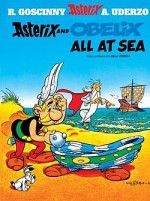
Asterix and Obelix All at Sea


By Uderzo, translated by Anthea Bell & Derek Hockridge (Orion Books)
ISBN: 978-0-75284-778-8

A son of Italian immigrants, Alberto Aleandro Uderzo was born on April 25th 1927 in Fismes on the Marne. As a child reading Mickey Mouse in Le Pétit Parisien he showed artistic flair from an early age and dreamed of becoming an aircraft mechanic. Albert became a French citizen when he was seven and found employment at thirteen, apprenticed to the Paris Publishing Society, where he learned design, typography, calligraphy and photo retouching.

When World War II broke out he spent time with farming relatives in Brittany and joined his father’s furniture-making business. Brittany beguiled and fascinated Uderzo: when a location for Asterix‘s idyllic village was being mooted, the region was the only choice.

In the post-war rebuilding of France, Uderzo returned to Paris and became a successful artist in the recovering nation’s burgeoning comics industry.

His first published work, a pastiche of Aesop’s Fables, appeared in Junior and in 1945 he was introduced to industry giant Edmond-François Calvo (whose own masterpiece The Beast is Dead is far too long overdue for a commemorative reissue…).

The tireless Uderzo’s subsequent creations included the indomitable eccentric Clopinard, Belloy, l’Invulnérable, Prince Rollin and Arys Buck. He illustrated Em-Ré-Vil’s novel Flamberge, worked in animation, as a journalist and illustrator for France Dimanche, and created the vertical comicstrip ‘Le Crime ne Paie pas’ for France-Soir.

In 1950 he illustrated a few episodes of the franchised European version of Fawcett’s Captain Marvel Jr. for Bravo!

An inveterate traveller, the artistic prodigy met Rene Goscinny in 1951. Soon becoming fast friends, they resolved to work together at the new Paris office of Belgian Publishing giant World Press. Their first collaboration was in November of that year; a feature piece on savoir vivre (how to live right or gracious living) for women’s weekly Bonnes Soirée, following which an avalanche of splendid strips and serials poured forth.

Jehan Pistolet and Luc Junior were created for La Libre Junior and they resulted in a western starring a “Red Indian” who eventually evolved into the delightfully infamous Oumpah-Pah. In 1955, with the formation of Édifrance/Édipresse, Uderzo drew Bill Blanchart for La Libre Junior, replaced Christian Godard on Benjamin et Benjamine and in 1957 added Charlier’s Clairette to his portfolio.

The following year, he made his debut in Tintin, as Oumpah-Pah finally found a home and a rapturous audience. Uderzo also drew Poussin et Poussif, La Famille Moutonet and La Famille Cokalane.

When Pilote launched in 1959 Uderzo was a major creative force for the new magazine, collaborating with Charlier on Tanguy et Laverdure and launching – with Goscinny – a little something called Asterix…

Although the gallant Gaul was a massive hit from the start, Uderzo continued working on Les Aventures de Tanguy et Laverdure, but once the first hilarious historical romp was collected in an album as Astérix le gaulois in 1961 it became clear that the series would demand most of his time – especially since the incredible Goscinny never seemed to require rest or run out of ideas.

By 1967 Asterix occupied all Uderzo’s time and attention, so in 1974 the partners formed Idéfix Studios to fully exploit their inimitable creation. When Goscinny passed away three years later, Uderzo had to be convinced to continue the adventures as writer and artist, producing a further ten volumes until 2010 when he retired.

After nearly 15 years as a weekly comic serial subsequently collected into book-length compilations, in 1974 the 21st (Asterix and Caesar’s Gift) was the first published as a complete original album before serialisation. Thereafter each new release was an eagerly anticipated, impatiently awaited treat for the strip’s millions of fans…

More than 325 million copies of 35 Asterix books have sold worldwide, making his joint creators France’s best-selling international authors, and now that torch has been passed and new sagas of the indomitable are being created by Jean-Yves Ferri and Didier Conrad…

One of the most popular comics on Earth, the collected chronicles of Asterix the Gaul have been translated into more than 100 languages since his debut, with twelve animated and live-action movies, TV series, assorted games, toys, merchandise and even a theme park outside Paris (Parc Astérix, naturellement)…

Like all the best stories the narrative premise works on more than one level: read it as an action-packed comedic romp of sneaky and bullying baddies coming a-cropper if you want or as a punfully sly and witty satire for older, wiser heads. We Brits are further blessed by the brilliantly light touch of master translators Anthea Bell & Derek Hockridge who played no small part in making the indomitable little Gaul so very palatable to English tongues.

Many of the intoxicating epics are set in various exotic locales throughout the Ancient World, with the Garrulous Gallic Gentlemen reduced to quizzical tourists and bemused commentators in every fantastic land and corner of the civilisations that proliferated in that fabled era. The rest – more than half of the canon – take place in Uderzo’s beloved Brittany, where, circa 50 B.C., a little hamlet of cantankerous, proudly defiant warriors and their families resisted every effort of the mighty Roman Empire to complete the conquest of Gaul.

The land is divided by the notional conquerors into provinces of Celtica, Aquitania and Amorica, but the very tip of the last just refuses to be pacified…

Whenever the heroes were playing at home, the Romans, unable to defeat the last bastion of Gallic insouciance, futilely resorted to a policy of absolute containment. Thus the little seaside hamlet was permanently hemmed in by the heavily fortified garrisons of Totorum, Aquarium, Laudanum and Compendium.

The Gauls couldn’t care less, daily defying and frustrating the world’s greatest military machine simply by going about their everyday affairs, protected by the miraculous magic potion of resident druid Getafix and the shrewd wits of the diminutive dynamo and his simplistic, supercharged best friend Obelix…

Firmly established as a global brand and premium French export from the mid-1960s onwards, Asterix the Gaul continues to grow in quality as new creators toil ever onward, crafting further fabulous sagas and building a stunning legacy of graphic excellence and storytelling gold…

Uderzo’s sixth session as sole creator was Asterix and Obelix All at Sea (originally entitled La Galère d’Obélix): released in 1996 and the 30th volume of the ever-unfolding saga. It began in the cruel and callous capital of civilisation wherein the Master of the World was having a bit of a bad day. Not as bad however as his Grand Admiral Crustacius, who has just allowed a bunch of galley slaves to mutiny and steal Julius Caesar‘s personal galley…

As the severely tongue-lashed mariner and his browbeaten aide Vice-Admiral Nautilus scurry away to pursue the fugitives, aboard the magnificent vessel magnificent Greek rebel Spartakis – bearing a striking resemblance to the magnificent Kirk Douglas in all his glory – debates with his recently-liberated comrades from many nations on where in the Rome-ruled world they can go to remain free…

A British oarsman then suggests a certain Gaulish village on the coast of Armorica which the empire has never conquered…

Meanwhile in the faraway subject of their discussions, Asterix and Obelix are in an argumentative mood too, but their clash is put aside when word comes that the entire complement of all four encircling garrisons are massing on the far side of the forest.

Always eager for a little martial recreation the villagers dose up on Getafix the Druid’s strength-boosting magic potion. Once again Obelix is frustrated in his attempt to get a share of the tantalising elixir and stumbles off in high dudgeon.

The generally genial giant had fallen into a vat of potion as a baby and grown up a permanently superhuman, eternally hungry hulk who hated being told no and didn’t believe more of the mouth-watering miracle mixture could harm him…

The Romans are utterly unaware of the danger insouciantly sauntering towards them, engaged as they are in drill to celebrate the imminent arrival of Admiral Crustacius. Thoroughly thrashing the amassed legions, the victorious Gauls wonder why Roman-bashing addict Obelix is absent and Getafix, dreading the worst, dashes back to discover his greatest fears realised.

The intransigent idiot has imbibed deeply from the potion and been turned to stone…

Nothing the Druid can conceive seems able to cure the calcified colossus and it’s during this time of trouble that Spartakis and his freed slaves arrive, requesting sanctuary. As the welcoming villagers carry the huge ornate galley into the village, the Obelix ordeal takes a strange turn as his stony spell wears off and the former fighting fool returns to flesh and blood – albeit as the puny helpless little boy he was before ever falling into the potion pot. The little wimp can’t even eat roast boar anymore…

The little lad is the darling of the town but cannot abide his weak ineffectual status. The situation becomes truly intolerable after the boy is captured by Crustacius and shipped off to Rome. After suitably castigating the soldiery, Asterix, Getafix and faithful mutt Dogmatix give chase in Caesar’s ship, manned by Spartakis and his valiant crew.

Powered by potion, the pursuers easily overtake the Romans, who have been hampered by the obnoxious antics of Obelix and the predations of the perennially, phenomenally unlucky pirates to whom – after a period of traditional chastisement – Asterix gives Caesar’s stolen galley.

Crucially, however, in his haste the little warrior leaves behind a barrel of potion when his comrades and little Obelix all transfer to a new, less noticeable vessel.

As the Gauls sail off in the pirate’s ship, Getafix has an inspired idea and suggests to Spartakis that they make for the last remnant of Atlantis, explaining that the idyllic Canary Islands survived the inundation of the magic continent and the people living there now are reclusive beings of great power and knowledge who might be able to restore Obelix to his natural state…

When they finally arrive in that beautiful land of miracles they are greeted by old man Absolutlifabulos and hordes of beautiful, happy children riding dolphins, centaurs, swans and winged cattle. The jolly dotard explains that the Atlanteans have reverted themselves to carefree immortal childhood, but their powers cannot do anything to cure Obelix.

As the downhearted Gauls make their way home, Spartakis and his men opt to stay and become forever kids too…

Meanwhile on Caesar’s galley Crustacius has discovered Getafix’s stashed potion and powered up, dreaming of ousting his foul-tempered boss and making himself Emperor, even as leagues away a Roman boarding party invades the pirate galley and menaces the powerless Gauls.

With Asterix about to be killed, little Obelix goes berserk and the emotional overload restores him to his corpulent, hyper-charged self, much to the distress of the terrified soldiers…

By the time Crustacius reaches Rome he has made the same mistake Obelix did and his rapid overdosing on potion only provides Julius Caesar with another statue for the Circus Maximus…

In Gaul however, Obelix, with a lot of frustration to work through, debarks at recently repaired Aquarium for a spot of cathartic violence before he accompanies his faithful chums back to the village for a celebratory feast…

Packed with thrilling action, good-natured joshing, raucous, bombastic, bellicose hi-jinks and a torrent of punishing puns to astound and bemuse youngsters of all ages, this rollicking fantasy and paean to true friendship cements Uderzo’s reputation as a storyteller whilst his stunning illustrative ability affords glimpses of sheer magic to lovers of cartoon art. Asterix and Obelix All at Sea proves that the potion-powered paragons of Gallic Pride will never lose their potent punch. © 1996 Les Editions Albert René, Goscinny/Uderzo. Revised English translations © 1998, 2002 Les Editions Albert René, Goscinny/Uderzo. All rights reserved.

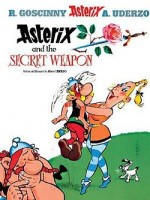
Asterix and the Secret Weapon


By Uderzo, translated by Anthea Bell & Derek Hockridge (Orion Books)
ISBN: 978-0-75284-716-0

The son of Italian immigrants, Alberto Aleandro Uderzo was born on April 25th 1927, in Fismes, on the Marne. As a child reading Mickey Mouse in Le Pétit Parisien he showed artistic flair from an early age but dreamed of becoming an aircraft mechanic. Albert became a French citizen when he was seven and found employment at 13, apprenticed to the Paris Publishing Society, where he learned design, typography, calligraphy and photo retouching.

When World War II broke out he spent time with farming relatives in Brittany and joined his father’s furniture-making business. Brittany beguiled and fascinated Uderzo: when a location for Asterix‘s idyllic village was being mooted, the region was the only choice.

In the post-war rebuilding of France, Uderzo returned to Paris and became a successful artist in the recovering nation’s burgeoning comics industry.

His first published work, a pastiche of Aesop’s Fables, appeared in Junior and in 1945 he was introduced to industry giant Edmond-François Calvo (whose own masterpiece The Beast is Dead is far too long overdue for a commemorative reissue…).

The tireless Uderzo’s subsequent creations included the indomitable eccentric Clopinard, Belloy, l’Invulnérable, Prince Rollin and Arys Buck. He illustrated Em-Ré-Vil’s novel Flamberge, worked in animation, as a journalist and illustrator for France Dimanche, and created the vertical comicstrip ‘Le Crime ne Paie pas’ for France-Soir.

In 1950 he illustrated a few episodes of the franchised European version of Fawcett’s Captain Marvel Jr. for Bravo!

An inveterate traveller, the artistic prodigy met Rene Goscinny in 1951. Soon becoming fast friends, they decided to work together at the new Paris office of Belgian Publishing giant World Press. Their first collaboration was in November of that year; a feature piece on savoir vivre (how to live right or gracious living) for women’s weekly Bonnes Soirée, following which an avalanche of splendid strips and serials poured forth.

Jehan Pistolet and Luc Junior were created for La Libre Junior and they resulted in a western starring a “Red Indian” who eventually evolved into the delightfully infamous Oumpah-Pah. In 1955, with the formation of Édifrance/Édipresse, Uderzo drew Bill Blanchart for La Libre Junior, replaced Christian Godard on Benjamin et Benjamine and in 1957 added Charlier’s Clairette to his portfolio.

The following year, he made his debut in Tintin, as Oumpah-Pah finally found a home and a rapturous audience. Uderzo also drew Poussin et Poussif, La Famille Moutonet and La Famille Cokalane.

When Pilote launched in 1959 Uderzo was a major creative force for the new magazine collaborating with Charlier on Tanguy et Laverdure and launching – with Goscinny – a little something called Asterix…

Although the gallant Gaul was a massive hit from the start, Uderzo continued working on Les Aventures de Tanguy et Laverdure, but once the first hilarious historical romp was collected in an album as Astérix le gaulois in 1961 it became clear that the series would demand most of his time – especially since the incredible Goscinny never seemed to require rest or run out of ideas.

By 1967 Asterix occupied all Uderzo’s time and attention, so in 1974 the partners formed Idéfix Studios to fully exploit their inimitable creation. When Goscinny passed away three years later, Uderzo had to be convinced to continue the adventures as writer and artist, producing a further ten volumes until 2010 when he retired.

After nearly 15 years as a weekly comic serial subsequently collected into book-length compilations, in 1974 the 21st (Asterix and Caesar’s Gift) was the first to be published as a complete original album before serialisation. Thereafter each new release was an eagerly anticipated, impatiently awaited treat for the strip’s millions of fans…

More than 325 million copies of 35 Asterix books have sold worldwide, making his joint creators France’s best-selling international authors, and now that torch has been passed and new sagas of the indomitable are being created by Jean-Yves Ferri and Didier Conrad…

One of the most popular comics features on Earth, the collected chronicles of Asterix the Gaul have been translated into more than 100 languages since his debut, with twelve animated and live-action movies, TV series, assorted games, toys, merchandise and even a theme park outside Paris (Parc Astérix, naturellement)…

Like all the best stories the narrative premise works on more than one level: read it as an action-packed comedic romp of sneaky and bullying baddies coming a-cropper if you want or as a punfully sly and witty satire for older, wiser heads. We Brits are further blessed by the brilliantly light touch of master translators Anthea Bell & Derek Hockridge who played no small part in making the indomitable little Gaul so very palatable to English tongues.

Many of the intoxicating epics are set in various exotic locales throughout the Ancient World, with the Garrulous Gallic Gentlemen reduced to quizzical tourists and bemused commentators in every fantastic land and corner of the civilisations that proliferated in that fabled era. The rest – more than half of the canon – take place in Uderzo’s beloved Brittany, where, circa 50 B.C., a little hamlet of cantankerous, proudly defiant warriors and their families resisted every effort of the mighty Roman Empire to complete the conquest of Gaul.

The land is divided by the notional conquerors into provinces of Celtica, Aquitania and Amorica, but the very tip of the last just refuses to be pacified…

Whenever the heroes were playing at home, the Romans, unable to defeat the last bastion of Gallic insouciance, futilely resorted to a policy of absolute containment. Thus the little seaside hamlet was permanently hemmed in by the heavily fortified garrisons of Totorum, Aquarium, Laudanum and Compendium.

The Gauls couldn’t care less, daily defying and frustrating the world’s greatest military machine simply by going about their everyday affairs, protected by the miraculous magic potion of resident druid Getafix and the shrewd wits of the diminutive dynamo and his simplistic, supercharged best friend Obelix…

Firmly established as a global brand and premium French export by the mid-1960s, Asterix the Gaul continued to grow in quality as Goscinny and latterly Uderzo toiled ever onward, crafting further fabulous sagas and building a stunning legacy of graphic excellence and storytelling gold.

The 29th volume was Asterix and the Secret Weapon (originally titled Astérix: La Rose et le Glaive); released in 1991 and Uderzo’s fifth as a solo creator. It began in the boisterous and far from idyllic little hamlet with a multi-generational battle of the sexes in full swing…

The perpetual jockeying for position between males and females comes to a head when Chief’s wife Impedimenta and the village matrons fire the Bard Cacofonix from his role as teacher of the children and bring in a new educator more to their liking.

The Bard Bravura is a woman – and someone who knows how to get things done properly. With the village men reluctant to get involved Cacofonix has no choice but to resign in high dudgeon and go live in the forest…

The situation worsens when the mothers demand a party to welcome their new Bard and Chief Vitalstatistix is bullied into arranging it. At the feast Bravura sings and is discovered to be just slightly less awful than Cacofonix ever was. At least her bellowing doesn’t result in instant thunderstorms…

Meanwhile in Rome Julius Caesar is listening to another bright spark with an idea to defeat and destroy the Gallic Gadflies who won’t admit they are part of his empire. Wily Manlius Claphamomnibus however is convinced he has discovered a fatal chink in the rebels’ indomitable armour…

Bravura is rapidly becoming unwelcome to at least half the village: enflaming the women with her talk of “masculine tyranny”, and aggravating the men by singing every morning before the sun comes up. She even manages to offend easygoing Obelix by refusing to let him bring canine wonder Dogmatix to the kindergarten class he attends every day…

Most shocking of all, the Bard has convinced the women to wear trousers rather than skirts and Impedimenta has taken to being carried around on a shield just like a proper Chief…

With the situation rapidly becoming intolerable, outraged Vitalstatistix orders his top troubleshooter to sort it out but Bravura won’t listen to the diminutive warrior. She thinks Asterix is an adorable little man and bamboozles him into giving her his hut.

… And at sea a band of phenomenally unlucky pirates attack a Roman ship filled with Claphamomnibus’ secret weapons and quickly wish it had been the Gauls who usually thrash and sink them instead of these monsters sending them to the bottom of the sea…

Relations have completely broken down in the village. The Bard’s suggestion that Impedimenta should be chief has resulted in a massive spat and Vitalstatistix too has repaired to the forest for the foreseeable future. It’s not long before every man in town has joined him…

In an effort to calm the seething waters Druid Getafix had organised a referendum to decide who should rule, but whilst all the women naturally voted for Impedimenta, no men except Asterix and Obelix dared to vote for Vitalstatistix. After all, they weren’t married…

When the little warrior confronts Bravura she again belittles him and even suggests that if they get together they could rule the village jointly. Incensed beyond endurance the furious hero slaps her when she kisses him and immediately crumbles in shock and horror.

He has committed the unpardonable sin. The Gaulish Code utterly forbids warriors to harm women or maltreat guests and in his rage he has betrayed his most sacred principles…

He’s still in shock when Getafix defends him at a trial where Bravura even angers the wise old sage to the point that he also storms off to join Cacofonix and Vitalstatistix…

Before day’s end the entire male contingent – overcome by a wave of masculine solidarity and “Sod This-ery” – is living a life of carefree joy under the stars and Impedimenta is rightly concerned with how they village can be defended without the Druid’s magic potions.

Bravura has an answer to that too: an infallible peace plan to present to the besieging Romans…

Meanwhile on the dock at Aquarium, the Secret Weapons are disembarking to the amusement and – quite quickly – sheer terror and consternation of the weary garrison. From the safety of some bushes Asterix and Obelix watch in astonishment as an army of ferocious women – a female Legion of lethal warriors – take over the running of the fort and prepare for total war….

Extremely worried the spies quickly report back to the men in the trees. The situation is truly dire for no honourable Gaul could possibly fight a woman. Despite the ongoing domestic situation Vitalstatistix decides the women of the village must be warned and despatches the horrified Asterix and still-bewildered Obelix to carry the message.

Worried and nervous at their potential reception the unlikely lads wander into a rather embarrassing fashion show and are greeted with a wave of questions from the women who are missing their men more that they realised…

Bravura arrogantly refuses the offer to provide the women with their own magic potion, confident in her peace plan, but when she meets with Claphamomnibus she is beaten, abused and humiliated by the cocky Roman but finds a sympathetic ear and keen collaborator in Asterix who has a scheme to take vengeance and send the notionally irresistible female furies packing…

It will, of course, mean the men and women of the village working closely together…

Although quite heavy-handed by today’s standards, this is at its core a superb topical lampooning of the endlessly entertaining “Battle of the Sexes”, combining swingeing satire, broad slapstick and surreal comedy in a delicious confection of sexual frisson and eternally evergreen “The Wife…” jokes.

Bravura is one of Uderzo’s most enigmatic caricatures, bearing resemblances to a number of high profile female public figures of the time, including then French Prime Minister Edith Cresson, Belgian tele-journalist Christine Ockrent and even German operatic star Diana Damrau, but the grievances of both male and female combatants are as unchanging and perennial as the characters here who enact and – for a short time at least – embody them…

Stuffed with light-hearted action, good-natured joshing, raucous, bombastic, bellicose hi-jinks and a torrent of punishing puns to astound and bemuse youngsters of all ages, this tale again celebrates the spectacular illustrative ability of Uderzo and proves that the potion-powered paragon of Gallic Pride will never lose its potent punch.
© 1991 Les Editions Albert René, Goscinny/Uderzo. Revised English translations © 1991, 2002 Les Editions Albert René, Goscinny/Uderzo. All rights reserved.

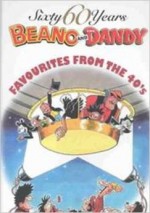
The Beano and The Dandy: Favourites from the Forties


By many & various (DC Thomson & Co)
ISBN: 978-0-85116-821-0

As we’re all feeling a wee bit Caledonian at present, I thought I’d take a look at some of Scotland’s greatest achievements whilst simultaneously revelling in the Good Old Days of comics…

Released in 2003 as part of the DC Thomson’s Sixtieth Anniversary celebrations for their children’s periodicals division – which has more than any other shaped the psyche of generations of kids – this splendid oversized (296 x 204mm) 144 page hardback compilation rightly glories in the incredible wealth of ebullient creativity that paraded through the flimsy colourful pages of The Beano and The Dandy during a particularly bleak and fraught period in British history.

Admittedly the book goes through some rather elaborate editing and paste-up additions whilst editorially explaining for younger readers the vast changes to the commonplace that have occurred over more than half a century, and naturally the editors have expurgated a few of the more egregious terms that wouldn’t sit well with 21st century sensibilities (Mussolini lampoon Musso the Wop becomes the far-less ethnically unsound “Musso” for instance) but otherwise this is a superb cartoon commemoration of one of the greatest morale-building initiatives this nation ever enjoyed.

They’re also superbly timeless examples of cartoon storytelling at its best…

Until it folded and was reborn as a digital publication on 4th December 2012, The Dandy was the third longest running comic in the world (behind Italy’s Il Giornalino – launched in 1924 – and America’s Detective Comics in March 1937).

Premiering on December 4th 1937 The Dandy broke the mould of traditional British predecessors by using word balloons and captions rather than narrative blocks of text under the sequential picture frames.

A huge success, it was followed eight months later by The Beano – which launched on July 30th 1938 – and together they completely revolutionised the way children’s publications looked and, most importantly, how they were read.

Over the decades the “terrible twins” spawned a bevy of unforgettable and beloved household names who delighted generations of avid and devoted readers, and the end of year celebrations were graced with bumper bonanzas of the comics’ weekly stars in extended stories in magnificent bumper hardback annuals.

As WWII progressed rationing of paper and ink forced the “children’s papers” into an alternating fortnightly schedule: on September 6th 1941 only The Dandy was published. A week later just The Beano appeared. They only returned to normal weekly editions on 30th July 1949…

This superb celebration of Celtic creativity is packed literally cover-to-cover with brilliant strips. The fun starts on the inside front with a wonderful Biffo the Bear exploit, illustrated by indisputable key man Dudley D. Watkins, followed by Korky the Cat by James Crichton and a listing of ‘Forty from the 40’s’ before the vintage fun properly proceeds, sensibly sub-divided into themed chapters.

Sadly none of the writers are named and precious few of the artists, but as always I’ve offered a best guess as to whom we should thank, and of course I would be so very happy if anybody could confirm or deny my suppositions…

Then and Now offers a smart selection of comparisons to life in the past compared to the 21st century with hilarious examples and contributions from Lord Snooty – by the incredibly prolific Watkins – cowboy superman Desperate Dan at the doctor’s, ostrich antics with Big Eggo by Crichton (or perhaps Reg Carter), lady Wild West sheriff Ding-Dong Belle from Bill Holroyd and a glimpse at primitive fast-food courtesy of Dandy‘s Bamboo Town duo Bongo and Pongo limned by Charlie Gordon.

There’s more medical mirth with Desperate Dan, wash day blues with Mickey’s Magic Book (Crichton?) and a prose yarn pinpointing the funnier points of the class war in The Slapdash Circus – with a stirring illustration by Toby Baines – before Charlie Chutney the Comical Cook (Allan Morley) plays pie-man and Watkins produces another Biffo blast.

Next comes The Horse That Jack Built, a rousing medieval adventure yarn starring a clockwork charger by Holroyd, before the chapter concludes in another Desperate Dan fable about messing around growing vegetables…

Entertainment then explores how fun was had in the war years – i.e. before television – beginning with a phonographic Korky yarn and the first fine example of licensed film feature Our Gang illustrated by that man Watkins.

The Our Gang (later known as Li’l Rascals) movie shorts were one of the most popular series in American Film history. Beginning in 1922 they featured the fun and folksy humour of a bunch of “typical kids” (atypically, though, there was full racial equality and mingling – but the little girls were still always smarter than the boys) having idealised adventures in a time both safer and more simple. The rotating cast of characters and slapstick shenanigans were the brainchild of film genius Hal Roach (he directed and worked with Harold Lloyd, Charley Chase and Laurel and Hardy amongst many others) and these brief cinematic paeans to a mythic childhood entered the “household name” category of popular Americana in amazingly swift order.

As times and tastes changed Roach was forced to sell up to the celluloid butcher’s shop of MGM in 1938, and the features suffered the same interference and loss of control that marred the later careers of the Marx Brothers, Laurel and Hardy and Buster Keaton.

In 1942 Dell Comics in the USA released an Our Gang comicbook written and drawn by Walt Kelly who, consummate craftsman that he was, restored the wit, verve and charm of the cinematic glory days with a progression of short tales that elevated the lower-class American childhood to the mythic peaks of Dorothy in Oz or Huckleberry Finn.

Long before then, however (1937 and The Dandy #1, in fact), DC Thomson secured the British rights and produced their own uniquely home-grown weekly escapades of Alfalfa Switzer, Scotty Becket, Spanky McFarland, Darla Hood, Buckwheat Thomas and the rest, such as the quirky keep-fit frolic here…

Desperate Dan then endured some cool radio fun with Aunt Aggie, Keyhole Kate (Allan Morley) had trouble with a magic Lantern show, and Biffo’s juggling act brought nothing but pain and strife.

As depicted by the wonderful Eric Roberts, Podge found drumming was unwelcome around the village and the not-so-wild animals of Bamboo Town struck up – and out – the band, after which both Biffo and Korky suffered terribly for their R-and-R.

Posh poseur Swanky Lanky Liz (Charles Holt) comes a-cropper in a brace of telling tales after which the aforementioned dictator of Italy is mercilessly lambasted in a cruel quartet of Musso strips by Sam Fair, Charlie Chutney bakes to excess, Our Gang take vengeance on a bullying boxer and Podge foils a bunch of schoolboy cheats.

How the daily travails of conflict were relieved is examined in Wartime 1 with Jimmy and his Magic Patch (Watkins) accidentally visiting bellicose Lilliput, Lord Snooty’s pals battling a Nazi spy and his pigeons whilst barmy barber Hair Oil Hal (by John Brown) cuts up in a clever quartet.

Sam Fair was in excoriating top form with the superbly manic Addie and Hermy slapstick assaults on Adolf Hitler and HermannWilhelm Göring/Goering, Meddlesome Matty (Fair or Malcolm Judge?) becomes a different sort of siren and Mickey’s Magic Book proves more hindrance than help during an air raid…

The complex world of Fashion begins with a plethoraof Korky on parade, Beano’s Ding-Dong Belle offered some six-gun hints on good manners, Doubting Thomas by Roberts was overwhelmed by a shop dummy and Meddlesome Matty went shoe shopping… for a horse…

Pansy Potter, the Strongman’s Daughter by Hugh McNeil was legendary for her unique looks – as seen in three strips here – but Swanky Lanky Liz, Charlie Chutney, Musso, Hair Oil Hal and Biffo all offer their own stylistic visions to round out this section before the un-PC past is more fully and shamefacedly explored in Out of Fashion withBiffo, Desperate Dan, Tin-Can Tommy, the Clockwork Boy (by the Torelli Brothers), Meddlesome Matty, Korky, Doubting Thomas, Bamboo Town and Mickey’s Magic Book all exhibiting behaviours we just don’t condone nowadays…

Strips depicting Transport follow with Multy the Millionaire (Richard Cox), Korky and Biffo all experiencing some distress and delay after which Watkins displays his superb dramatic style for 1946 fantasy adventure Tom Thumb.

There are also more travel travails for Korky, Ding-Dong Belle, Doubting Thomas, Podge, Swanky Lanky Liz and Desperate Dan before a prose chapter from an epic Black Bob serial (a Lassie-like wonder dog illustrated by Jack Prout) precedes a Big Eggo pantomime romp and a 1944 Watkins spectacular starring Jimmy and his Magic Patch as a slave on Roman ship.

The trip down memory lane ends with another bout of combat fever in Wartime 2, containing stunning contributions from Bamboo Town and Desperate Dan and a treat for Pansy Potter fans: four fill-in strips from those tenuous days illustrated by different artists who might or might not be McNeil, Basil Blackaller, Sam Fair, James Clark and/or Charles Grigg.

The campaign continues with a 1942 Tin-Can Tommy tale plus more Podge, Keyhole Kate, Doubting Thomas, Desperate Dan, Korky strips as well as more Jimmy and his Magic Patch and a lovely Lord Snooty and his Pals yarn with the kids helping the Home Guard before Biffo ushers us out just as he had invited us in…

A marvel of nostalgia and timeless comics wonder, the true magic of this collection is the brilliant art and stories by a host of talents that have literally made Britons who they are today, and bravo to DC Thomson for letting them out for a half-day to run amok once again.

© 2003 DC Thomson & Co. Ltd. All rights reserved.

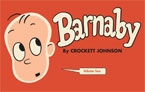
Barnaby volume 2


By Crockett Johnson (Fantagraphics Books)
ISBN: 978-1-60699-709-3

This is one of those rare books worthy of two reviews. So, if you’re in a hurry…

Buy Barnaby volume 2 now – it’s one of the five best comic strips of all time and this superb hardcover compilation has lots of fascinating extras. If you harbour any yearnings for the lost joys of childish wonder and the suspicious glee in catching out adults trying to pull a fast one, you would be crazy to miss this book…

However, if you’re still here and need a little more time to decide…

Today’s newspapers have precious few continuity drama or adventure strips. Indeed, if a paper has any strips – as opposed to single panel editorial cartoons – chances are they will be of the episodic variety typified by Jim Davis’ Garfield or Scott Adams’ Dilbert.

You might describe these as single-idea pieces with a set-up, delivery and punch-line, all rendered in a sparse, pared-down-to-basics drawing style. In that they’re nothing new and there’s nothing wrong any of that ilk on their own terms.

Narrative impetus comes from the unchanging characters themselves, and a building of gag-upon-gag in extended themes. The advantage to the newspaper is obvious. If you like a strip it encourages you to buy the paper. If you miss a day or two, you can return fresh at any time having, in real terms, missed nothing.

Such was not always the case, especially in America. Once upon a time the daily “funny” – comedic or otherwise – was a crucial circulation builder and preserver, with lush, lavish and magnificently rendered fantasies or romances rubbing shoulders with thrilling, moody masterpieces of crime, war, sci-fi and everyday melodrama. Even the legion of humour strips actively strived to maintain an avid, devoted following.

And eventually there was Barnaby, which in so many ways bridged the gap between then and now.

On April 20th 1942, with America at war for the second time in 25 years, the liberal New York tabloid PM began running a new, sweet little kid’s strip which was also the most whimsically addicting, socially seditious and ferociously smart satire since the creation of Al Capp’s Li’l Abner – another utter innocent left to the mercy of scurrilous worldly influences…

The outlandish 4-panel daily, by Crockett Johnson, was the product of a perfectionist who didn’t particularly care for comics, but who – according to celebrated strip historian Ron Goulart – just wanted steady employment…

David Johnson Leisk (October 20th 1906-July 11th 1975) was an ardent socialist, passionate anti-fascist, gifted artisan and brilliant designer who had spent much of his working life as a commercial artist, Editor and Art Director.

Born in New York City and raised in the outer wilds of Queens when it was still semi-rural – very near the slag heaps which would eventually house two New York World’s Fairs in Flushing Meadows – “Dave” studied art at Cooper Union (for the Advancement of Science and Art) and New York University before leaving early to support his widowed mother. This entailed embarking upon a hand-to-mouth career drawing and constructing department-store advertising.

He supplemented his income with occasional cartoons to magazines such as Collier’s before becoming an Art Editor at magazine publisher McGraw-Hill. He also began producing a moderately successful, “silent” strip called The Little Man with the Eyes.

Johnson had divorced his first wife in 1939 and moved out of the city to Connecticut, sharing an ocean-side home with student (and eventual bride) Ruth Krauss, always looking to create that steady something when, almost by accident, he devised a masterpiece of comics narrative…

However, if his friend Charles Martin hadn’t seen a prototype Barnaby half-page lying around the house, the series might never have existed. Happily Martin hijacked the sample and parlayed it into a regular feature in prestigious highbrow leftist tabloid PM simply by showing the scrap to the paper’s Comics Editor Hannah Baker.

Among her other finds was a strip by a cartoonist dubbed Dr. Seuss which would run contiguously in the same publication. Despite Johnson’s initial reticence, within a year Barnaby had become the new darling of the intelligentsia…

Soon there were book collections, talk of a Radio show (in 1946 it was adapted as a stage play), a quarterly magazine and rave reviews in Time, Newsweek and Life. The small but rabid fan-base ranged from politicians and the smart set such as President and First Lady Roosevelt, Vice-President Henry Wallace, Rockwell Kent, William Rose Benet and Lois Untermeyer to cool celebrities such as Duke Ellington, Dorothy Parker, W. C. Fields and even legendary New York Mayor Fiorello La Guardia.

Of course the last two might only have checking the paper because the undisputed, unsavoury star of the strip was a scurrilous if fanciful amalgam of them both…

Not since George Herriman’s Krazy Kat had a piece of popular culture so infiltrated the halls of the mighty, whilst largely passing way over the heads of the masses and without troubling the Funnies sections of big circulation papers.

Over its 10-year run (April 1942 to February 1952), Barnaby was only syndicated to 64 papers nationally, with a combined circulation of just over five and a half million, but it kept Crockett (a childhood nickname) and Ruth in relative comfort whilst America’s Great and Good constantly agitated on the kid’s behalf.

What more do you need to know?

One dark night a little boy wished for a Fairy Godmother and something strange and disreputable fell in through his window…

Barnaby Baxter is a smart, ingenuous and scrupulously honest pre-schooler (four years old to you) and his ardent wish was to be an Air Raid Warden like his dad. Instead he was “adopted” by a short, portly, pompous, mildly unsavoury and wholly discreditable windbag with pink pixie wings.

Jackeen J. O’Malley, card carrying-member of the Elves, Gnomes, Leprechauns and Little Men’s Chowder and Marching Society – although he hadn’t paid his dues in years – unceremoniously installed himself as the lad’s Fairy Godfather. A lazier, more self-aggrandizing, mooching old glutton and probable soak (he certainly frequented taverns but only ever raided the Baxter’s icebox, pantry and humidor, never their drinks cabinet…) could not be found anywhere.

Due more to intransigence than evidence – there’s always plenty of physical proof, debris and fallout whenever O’Malley has been around – Barnaby’s mum and dad adamantly refuse to believe in the ungainly, insalubrious sprite, whose continued presence hopelessly complicated the sweet boy’s life.

The poor parents’ greatest abiding fear was that Barnaby was cursed with Too Much Imagination…

At the end of the previous volume O’Malley became implausibly – and almost overnight – an unseen and reclusive public Man of the Hour, preposterously translating that cachet into a political career by accidentally becoming a patsy for a corrupt political machine. In even more unlikely circumstances O’Malley was elected to Congress…

This strand gave staunchly socialist cynic Johnson ample opportunity to ferociously lampoon the electoral system, the pundits and even the public. As usual Barnaby’s parents had to perpetually put down their boy: assertively assuring him that the O’Malley the grown-ups had elected was not a fat little man with pink wings…

Despite looking like a fraud – he’s almost never seen using his magic and always has one of Dad’s stolen panatela cigars as a substitute wand – J. J. O’Malley is the real deal: he’s just incredibly lazy, greedy, arrogant and inept. He does sort of grant Barnaby’s wishes though… but never in ways that might be wished for…

Once O’Malley had got his foot in the door – or rather through the bedroom window – a succession of bizarre characters began to regularly turn up to baffle and bewilder Barnaby and Jane Shultz, the sensible little girl next door.

Even the boy’ new dog Gorgon was an oddity. The pooch could talk – but never when adults were around, and only then with such overwhelming dullness that everybody listening wished him as mute as every other mutt…

The mythical oddballs and irregulars included timid ghost Gus, Atlas the Giant (a two foot tall, pint sized colossus who was not that impressive until he got out his slide-rule to demonstrate that he was, in truth, a mental Giant) and Launcelot McSnoyd, an invisible Leprechaun who was O’Malley’s personal gadfly: always offering harsh, ribald counterpoints and home truths to the Godfather’s self-laudatory pronouncements…

Johnson continually expanded his gently bizarre cast of gremlins, ogres, ghosts, policemen, Bankers, crooks, financiers and stranger personages – all of whom could see O’Malley – but the unyieldingly faithful little lad’s parents were always too busy and too certain that the Fairy Godfather and all his ilk were unhealthy, unwanted, juvenile fabrications.

This second stupendous collection opens with a hearty appreciation from Jules Feiffer in the Foreword before cartoonist, biographer and historian R. C. Harvey provides a critical appraisal in ‘Appreciating Barnaby and the Power of Imagination’ after which the captivating yarn-spinning takes us from January 1st 1944 to December 31st 1945.

There’s even more elucidatory content at the back after all those magic-filled pictures too, as education scholar and Professor of English Philip Nel provides another fact-filled, scene-setting, picture-packed ‘Afterword: O’Malley Takes Flight’ and Max Lerner’s 1943 PM feature ‘Barnaby’s Progress’ is reprinted in full.

Nel also supplies strip-by-strip commentary and background in ‘The Elves, Leprechauns, Gnomes, and Little Men’s Chowder & Marching Society: a Handy Pocket Guide’…

However what we all love is comics so let’s jump right in as the obese elf gets caught up in exhibiting his miniscule expertise in ‘The Manly Art of Self-Defense’ (which ran from 28th December 1943 to 19th January 1944), and follows Mr. Baxter’s purchase of a few items of exercise equipment.

Always with an eye to a fast buck, O’Malley organises a prize fight between poor gentle Gus and the obstreperous Brooklyn Leprechaun, all whilst delaying his long overdue return to the Capitol.

The godfather is expert in delay and obfuscation but eventually, in a concatenation of curious circumstances, the Congressman buckles under pressure from both his human and fairy-folk constituents to push through a new hydroelectric project – in actuality two vastly different ones – and wings off to begin the process of funding ‘The O’Malley Dam’ (20th January – 22nd April)…

As the political bandwagon gets rolling, further hindered by Mr. Baxter and Barnaby visiting the Congressman’s never-occupied office in Washington DC, the flighty, easily distracted O’Malley takes it upon himself to enscribe the natural history of his people in ‘Pixie Anthropology’ (24th April-18th May), even as back home the Big Fight gets nearer and poor Gus continues to flap under his punishing training regimen…

‘Mr. O’Malley, Efficiency Expert’, which ran from 19th May to 8th June, then saw the Fairy Fool step in when overwork and worry laid Mr. Baxter low. The factory manager was pilloried by concerns over production targets, but whilst he was remanded to his sickbed, the flying figment was busy “fixing” the crisis for him…

During that riotous sequence another oddball was introduced in the diminutive form of Gridley the Salamander: a “Fire Pixey” who couldn’t raise a spark even if supplied with matches and gasoline…

The under-worked winged windbag was a master of manipulation and ‘O’Malley and the Buried Treasure’ (9th June – 7th September) saw the airborne oaf inveigle invitations for the Baxters to the beachside cottage owned by Jane’s aunt. Once there it wasn’t long before avaricious imagination and a couple of old coins spawned a rabid gold rush amongst the adults who really should have known better.

The extended vacation also saw the first appearance of moisture-averse sovereign of the seas Davy Jones…

Whilst the Congressman was busily avoiding work, his seat vanished during boundary reorganisation, but ever-undaunted the pixilated political animal soldiered on, outrageously campaigning in the then-ongoing Presidential Election throughout the cruelly hilarious ‘O’Malley for Dewey’ (8th September – 8th November 1944)…

Newspaper strips always celebrated seasonal events and, after the wry satire of the race for power, whacky whimsy was highlighted with the advent of ‘Cousin Myles O’Malley’ (9th – 24th November). The puny Puritan pixie had come over on the Mayflower and was still trying to catch a turkey for his very first Thanksgiving Dinner.

Naturally his take-charge, thoroughly modern relative was a huge (dis)advantage to his ongoing quest…

With Christmas fast approaching, an injudicious expression from Ma Baxter regarding a fur wrap sets Barnaby and his Fairy guardian on the trail of the fabled and fabulous, ferocious ermine beast and sees the introduction of ‘The O’Malley Fur Trading Post’ (25th November 1944 to 27th January 1945).

Although legendary and mythical gnomish huntsman J. P. Orion fails to deliver, an unlucky band of fur thieves fall into the hunters’ traps and soon find their latest haul missing. Before long poor Mr. Baxter is looking at the chilling prospect of jail time for receiving stolen property…

With the global conflict clearly drawing to a close, Johnson threw himself into the debate of what the post-War world would be like in a swingeing attack on the financial system and the greedy gullibility of professional money men. Barnaby and most especially his conniving godfather almost shatter the American commercial world in a cunning fable entitled ‘J.J. O’Malley, Wizard of Wall Street’ (29th January – 26th May)…

With America still reeling, the ever-unfolding hilarity took an arcane turn and saw Mr. Baxter suffer more than the usual degree of personal humiliation and confusion when he took Barnaby, Gorgon and Jane for a short walk and lost them in the littlest woods in America.

They had of course been led astray by O’Malley who accidentally dumped them on ‘Emmylou Schwartz, Licensed Witchcraft Practitioner’ (28th May – 3rd July). She had been in a bad mood since the Salem Witch Trials…

As a result of this latest unhappy encounter and a shameful incident with a black cat, the dogmatic dog was hexed and became ‘Tongue-Tied Gorgon’ (4th – 10th July)… not that most people could tell…

When Barnaby’s Aunt Minerva wrote a bestseller, O’Malley felt constrained to guide her budding career in ‘Belles Lettres’ (11th July – 17th August). The obnoxious elf was a little less keen when he discovered it was only a cookbook, but perked up when it led to Minerva being offered a newspaper column.

Being an expert in this field too, O’Malley continued his behind-the-scenes support amidst ‘The Fourth Estate’ (18th August-8th September), renewing his old acquaintance with an impishly literal Printers Devil named Shrdlu…

Despite O’Malley’s best efforts Minerva remained a success and was soon looking for her own place. In ‘Real Estate’ (10th September – 10th October), Barnaby was helpless to prevent poor Gus being used by the godfather as a ghostly goad to convince a spiritualist-obsessed landlady to let to his aunt rather than a brace of conmen…

A perfect indication of the wry humour that peppered the feature can be seen in ‘Party Invitations’ which ran from 11th – 20th October as O’Malley attempts to supersede the usual turkey-and-fixin’s feast with a fashionable venison banquet – even though he can’t catch a deer and won’t be cooking it once it’s been butchered…

Congruent with that was the introduction of erudite aborigine ‘Howard the Sigahstaw Indian‘ (22nd October-23rd November) – who was just as inept in the hunting traditions of his forefathers – after which the festive preparations continued with ‘O’Malley’s Christmas List’ (24th November-15th December) wherein the always-generous godfather discovers the miracle of store credit and goes shopping for presents for everybody.

Never one to concentrate for long, he is briefly distracted by a guessing competition in ‘Bean-Counting’ (8th – 15th December) – the prize of a home movie camera being the ideal gift for young Barnaby – and this parade of monochrome cartoon marvels concludes with the dryly hilarious saga of ‘The Hangue Dogfood Telephone Quiz Program’ (17th December 1945-1st January 1946) wherein Gorgon’s reluctant answers to an advertising promotion again threaten to hurl the entire American business world into chaos…

Intellectually raucous, riotous, sublimely surreal and adorably absurd, the untrammelled, razor-sharp whimsy of the strip is always instantly captivating, and the laconic charm of the writing is well-nigh irresistible, but the lasting legacy of this ground-breaking strip is the clean sparse line-work that reduces images to almost technical drawings, unwavering line-weights and solid swathes of black that define space and depth by practically eliminating it, without ever obscuring the fluid warmth and humanity of the characters.

Almost every modern strip cartoon follows the principles laid down here by a man who purportedly disliked the medium…

The major difference between then and now should also be noted, however.

Johnson despised doing shoddy work, or short-changing his audience. On average each of his daily encounters – always self-contained – built on the previous episode without needing to re-reference it, and contained three to four times as much text as its contemporaries. It’s a sign of the author’s ability that the extra wordage was never unnecessary, and often uniquely readable, blending storybook clarity, the snappy pace of “Screwball” comedy films and the contemporary rhythms and idiom of authors such as Damon Runyan and Dashiel Hammett.

He managed this miracle by type-setting the dialogue and pasting up the strips himself – primarily in Futura Medium Italic but with effective forays into other fonts for dramatic and comedic effect.

No sticky-beaked educational vigilante could claim Barnaby harmed children’s reading abilities by confusing the tykes with non-standard letter-forms (a charge levelled at comics as late as the turn of this century), and the device also allowed him to maintain an easy, elegant, effective balance of black and white which makes the deliciously diagrammatic art light, airy and implausibly fresh and accessible.

During 1946-1947, Johnson surrendered the strip to friends as he pursued a career illustrating children’s book such as Constance J. Foster’s This Rich World: The Story of Money, but eventually he returned, crafting more magic until he retired Barnaby in 1952 to concentrate on books.

When Ruth graduated she became a successful children’s writer and they collaborated on four tomes, The Carrot Seed (1945), How to Make an Earthquake, Is This You? and The Happy Egg, but these days Crockett Johnson is best known for his seven “Harold” books which began in 1955 with the captivating Harold and the Purple Crayon.

During a global war with heroes and villains aplenty, where no comic page could top the daily headlines for thrills, drama and heartbreak, Barnaby was an absolute panacea to the horrors without ever ignoring or escaping them.

The entire glorious confection that is Barnaby is all about our relationship with imagination. This is not a strip about childhood fantasy. The theme here, beloved by both parents and children alike, is that grown-ups don’t listen to kids enough, and that they certainly don’t know everything.

For far too long Barnaby was a lost masterpiece. It is influential, ground-breaking and a shining classic of the form. You are all the poorer for not knowing it, and should move mountains to change that situation. I’m not kidding.

Liberally illustrated throughout with sketches, roughs, photos and advertising materials as well as Credits, Thank Yous and a brief biography of Johnson, this big hardback book of joy is a long-overdue and very welcome addition to 21st century bookshelves – most especially yours…

Barnaby vol. 2 and all Barnaby images © 2014 the Estate of Ruth Krauss. Supplemental material © 2014 its respective creators and owners.

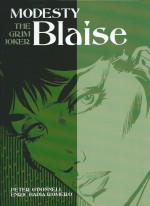
Superman Chronicles volume 9


By Jerry Siegel & Joe Shuster, John Sikela, Leo Nowak, Ed Dobrotka & Fred Ray (DC Comics)
ISBN: 978-1-4012-3122-4

I sometimes think – like many others I know – that superhero comics were never more apt or effective than when they were whole-heartedly combating global fascism with explosive, improbable excitement courtesy of a myriad of mysterious, masked marvel men.

All the most evocatively visceral moments of the genre seem to come when gaudy gladiators soundly thrashed – and I hope you’ll please forgive the offensive contemporary colloquialism – “Nips and Nazis”.  However, even in those long-ago dark days, comics creators were wise enough to offset their tales of espionage and imminent invasion with a barrage of home-grown threats and gentler or even more whimsical four-colour fare…

This ninth astounding Superman compendium – collecting #16-17 of his solo title, his adventures from flagship anthology Action Comics #48-52 and an episode from World’s Finest Comics #6 (encompassing May to September 1942) – sees the World’s Premier Superhero predominant at the height of those war years: an indomitable Man of Tomorrow who was always a thrilling, vibrant, vital role-model and whose sensational exploits spawned a host of imitators, a genre and an industry.

Behind the stunning covers by Fred Ray – depicting Superman trouncing scurrilous Axis War-mongers and reminding readers what we were all fighting for – scripter Jerry Siegel was producing some of the best stories of his career, showing the Action Ace in all his morale-boosting glory; thrashing thugs, spies and masters of bad science whilst America kicked the Axis fascists in the pants…

Co-creator Joe Shuster, although plagued by punishing deadlines for the Superman newspaper strip and his rapidly failing eyesight, was still fully involved in the process, overseeing the stories and drawing character faces whenever possible, but as the months passed the talent pool of the “Superman Studio” increasingly took the lead in the comicbooks as the demands of the media superstar grew and grew.

Thus most of the stories in this volume were drawn by John Sikela with occasional support from others…

The magic begins with ‘The Merchant of Murder!’ from Action Comics #48 which saw the hero toppling an insidious gang of killers led by The Top who used wartime restrictions to sell used cars with deadly faults and defects until reporter Lois Lane – and her titanic leg-man – got involved…

Sikela also flew solo on all of Superman #16, beginning with ‘The World’s Meanest Man’ as the Caped Kryptonian crushed a mobster attempting to plunder a social program to give deprived slum-kids a holiday in the countryside, before moving on to battle an astrologer prepared to murder his clients to prove his predictions in ‘Terror from the Stars’.

‘The Case of the Runaway Skyscrapers’ pitted the Metropolis Marvel against Mister Sinister, a trans-dimensional tyrant who could make buildings vanish, after which the power-packed perilous periodical concluded with a deeply satisfying and classic campaign against organised crime as Superman crushed the ‘Racket on Delivery’.

Action Comics #49 then introduced The Puzzler;a despicable, deadly and obsessive criminal maniac who was hated losing and never played fair in ‘The Wizard of Chance’ (inked by Ed Dobrotka).

The debut of Superman had propelled National Comics to the forefront of their fledgling industry and in 1939 the company collaborated with the organisers of the New York World’s Fair: producing a commemorative comicbook celebrating the opening. The Man of Tomorrow prominently featured on the appropriately titled New York World’s Fair Comics beside such four-colour stars as Zatara, Gingersnap and The Sandman.

He starred again a year later in the second issue with the newly launched Batman and Robin team in another epochal mass-market premium – Worlds Fair 1940. The spectacular card-cover 96 page anthologies were a huge hit and convinced National’s owner and editors that such an over-sized package of their pantheon of characters, with Superman and Batman prominently featured, would be a worthwhile proposition.

The bountiful format was retained for a wholly company-owned quarterly which retailed for the then-hefty price of 15¢. Launching as World’s Best Comics #1 (Spring 1941), the book transformed into World’s Finest Comics from #2, beginning a stellar 45 year run which only ended as part of the massive decluttering exercise that was Crisis on Infinite Earths.

From issue #6 (Summer 1942) ‘The Man of Steel vs. the Man of Metal’ by Siegel, Leo Nowak & Sikela pits our hero and newsboy Jimmy Olsen against Metalo, a mad scientist whose discoveries made him every inch Superman’s physical match…

Back in Action Comics #50, Clark Kent and Lois were despatched to Florida to scope out sporting skulduggery in ‘Play Ball!’ a light-hearted baseball tale illustrated by Nowak & Ed Dobrotka.

Superman #17 asked ‘Man or Superman?’ (illustrated by Shuster & Sikela), wherein Loisfirst began to put snippets of evidence together, at last sensing that klutzy Clark Kent might be hiding a Super-secret even as the subject of her researches tangled with sinister saboteur The Talon. Following that, ‘The Human Bomb’ (art by Nowak) saw a criminal hypnotist turn innocent citizens into walking landmines until the tireless Action Ace scotched his wicked racket.

Sikela handled the last two tales in the issue beginning with ‘Muscles for Sale!’ in which Superman’s Fortress of Solitude and Trophy Room debuted and the Man of Steel battled another mad mesmerist who turned ordinary men into dangerously overconfident louts, bullies and thieves, whilst ‘When Titans Clash!‘ offered a frantic and spectacular duel of wits and incredible super-strength when Luthor regained the mystic Power Stone and became Superman’s physical – but never intellectual – master …

Action Comics #51 then introduced the canny faux-madness of practical-joking homicidal bandit The Prankster in the rollercoaster romp ‘The Case of the Crimeless Crimes’ and this cavalcade of comics creativity and glorious indulgence concludes with the ‘The Emperor of America!’ from Action Comics #52, wherein an invading army were welcomed with open arms by all Americans except the indignantly suspicious Man of Steel who single-handedly liberated the nation in a blistering, rousing call-to-arms classic…

As the war progressed the raw passion and sly wit of Siegel’s stories and the rip-roaring energy of Shuster and his team were galvanised by the parlous state of the planet and Superman simply became better and more flamboyant to deal with it all.

His startling abilities and take-charge, can-do attitude won the hearts of the public at home and he was embraced as a patriotic tonic for the troops across the war-torn world.

The rise was meteoric, inexorable and unprecedented. He was the indisputable star of Action, World’s Finest Comics and his own dedicated title whilst a daily newspaper strip (begun on 16th January 1939, with a separate Sunday strip following from 5th November of that year) garnered millions of new fans.

A thrice-weekly radio serial had been running since February 12th 1940 and, with a movie cartoon series, games, toys, apparel and a growing international media presence, Superman was swiftly becoming the entire Earth’s hero…

Although the gaudy burlesque of evil aliens, marauding monsters and slick super-villains still lay years ahead of our hero, these captivating tales of villainy, criminality, corruption and disaster are just as engrossing and speak powerfully of the tenor of the times, and are all dealt with in a direct and captivating manner by our relentlessly entertaining champion in summarily swift and decisive fashion.

No “To Be Continueds” here!

As fresh, thrilling and compelling now as they ever were, these endlessly re-readable epics are perfectly presented in these glorious paperback collections where the graphic magic defined what being a Super Hero means and concocted the basic iconography of the genre for all others to follow.

Such Golden Age tales are priceless enjoyment at an absurdly affordable price and in a durable, comfortingly approachable format. What dedicated comics fan could possibly resist them?
© 1942, 2011 DC Comics. All Rights Reserved.