Fall Guy for Murder and Other Stories


By Johnny Craig, with Ray Bradbury, Bill Gaines & Al Feldstein (Fantagraphics Books)
ISBN: 978-1-60699-658-4

From 1950-1954 EC was the most innovative and influential comicbook publisher in America, dominating the genres of crime, horror, adventure, war and science fiction. They even originated an entirely new beast – the satirical comicbook.

After a shaky start, following the death of his father (who actually created Comicbooks in 1933), new head honcho William Gaines and his trusty master-of-all-comics trades Al Feldstein turned a slavishly derivative minor venture into a pioneering, groundbreaking enterprise which completely altered the perception of the industry and art form.

As they began co-plotting the bulk of EC’s output together, intent on creating a “New Trend” of stories aimed at older and more discerning readers – and not the mythical 8-year-old comicbooks ostensibly targeted – they shifted the emphasis of the ailing company towards dark, funny, socially aware and more adult fare.

Their publishing strategy also included hiring some the most gifted writers and artists in the field. One of the very best and most undervalued today was Johnny Craig…

This lavish monochrome hardcover volume, part of Fantagraphics’ EC Library, gathers a chilling collection of Craig’s supernatural suspense and especially his superbly Noir-drenched crime stories in a wonderful primer of peril packed with supplementary interviews, features and dissertations, beginning with the informative and picture-packed ‘Brilliant Good Guys, Even More Brilliant Bad Guys’ by lecturer Bill Mason, after which the succession of classic genre tales begins with  ‘One Last Fling!’ from Vault of Horror #21 October/November 1951. Craig was an absolute master of pen-and-ink illustration, but his scripting was just as slick and deceptively, hilariously seductive.

In his initial yarn here, a circus knife-thrower refused to let the mere fact that his beloved assistant had become a vampire drive them apart, whilst ‘Out of the Frying Pan…’ (from Crime SuspenStories #8, December 1951/January 1952) is a wry gem of misdirection, as a temporarily blind killer lets the wrong little old man plan his escape from hospital for him…

From Vault of Horror #22 (December 1951/January 1952), ‘Fountains of Youth!’ was straightforward supernatural thriller about a vitality-leeching monster, but ‘Understudy to a Corpse!’ (Crime SuspenStories #9, February/March 1952) was a brilliantly twisty murder-plot involving a penniless actor who murdered his uncle and diverted police attention by impersonating the victim post mortem. It did not go according to plan…

‘A Stitch in Time!’ (Vault of Horror #23 February/March 1952) is a grotesque classic in which a tyrannical sweatshop boss pays a ghastly price for abusing the desperate seamstresses in his employ, before ‘…Rocks in His Head!’ from Crime SuspenStories #10 (April/May 1952) sees a harassed hard-pressed surgeon with a greedy young wife making a disastrous choice when faced with a jewel-bedecked corpse to autopsy, and ‘A Bloody Undertaking!’ (Vault of Horror #24, April/May 1952) takes the same theme into supernatural territory as a pretty young thing turns the head of an old country doctor who really should know better…

Regarded as one of the company’s slowest creators, Craig nevertheless found time to illustrate scripts by Gaines & Feldstein such as ‘…On a Dead Man’s Chest!’ (Haunt of Fear #12 March/April 1952) wherein, after a sordid affair and brutal murder, retribution from beyond the grave sought out the victim’s wife and philandering brother…

‘Stiff Punishment!’ from Crime SuspenStories #11 June/July 1952 was all Craig, however, and again dealt with the pressures of greedy young things who wed staid old doctors. This time when the medical lecturer finally snapped he thought he had the perfect way to hide the body – but, ironically, he hadn’t…

In ‘Séance!’ (Vault of Horror #25 June/July 1952) a couple of conmen kill a mark who learns too much but are undone when the widow consults their own spiritualist for answers, after which Gaines & Feldstein scripted a shocking tale of gluttony and a vengeful sword-swallower in the gloriously macabre ‘Fed Up!’ from Haunt of Fear #13 May/June 1952.

The genuine tension of ‘The Execution!’ (Crime SuspenStories #12 August/September 1952), wherein a death row inmate waited for the witness who could save him from the chair, came from one simple shocking fact. In Craig’s stories the good guys didn’t always win, and justice was frequently derailed and even cheated…

‘Two of a Kind!’ (Vault of Horror #26 August/September 1952) offered a sexually charged love story of the most extreme kind of sacrifice, whilst in ‘Silver Threads Among the Mold!’ (Vault of Horror #27 October/November 1952) an avaricious model regrets making a fool of the sculptor who adores and supports her, and ‘Sweet Dreams!’ (Crime SuspenStories #14 December 1952/January 1953) reveals the dire lengths an insomniac will stoop to in search of a little rest.

‘Till Death…’from Vault of Horror #28, December 1952/January 1953 – is, for many fans, the ultimate zombie story as a besotted plantation owner loses his new bride to disease and soon learns to regret using voodoo to restore her to his side.

‘When the Cat’s Away…’ (Crime SuspenStories #15 February/March 1953) is pure Crime Noir as a cuckolded husband deals with his wife and best friend with finesse and grim finality, whilst ‘The Mausoleum!’ from Vault of Horror #29, February/March 1953, sees an English landowner sell his family castle to a ghost-crazy American, lock, stock and damning evidence of the murder he committed to inherit everything…

‘Rendezvous!’ (Crime SuspenStories #16 April/May 1953) brilliantly outlines the sheer dumb luck that scotched the perfect murder/insurance scam, after which ‘Split Personality!’ (Vault of Horror #30 April/May 1953) details the incredible lengths to which a con artist went to deprive identical twin sisters of their fortunes…

‘Touch and Go!’ from Crime SuspenStories #17 June/July 1953 is Craig’s sublimely paranoiac and compulsive adaptation of the Ray Bradbury vignette about a killer who left damning fingerprints, whilst romantic obsession underpins the tragic tale of an artist-turned-mugger who only stole to pay for true love’s medical bills in ‘Easel Kill Ya!’ from Vault of Horror #31 June/July 1953.

This addictive compilation concludes with a devilishly convoluted tale of a Private Eye set up to take the blame for a perfect crime. Written by Gaines & Feldstein, ‘Fall Guy for Murder!’ (Crime SuspenStories #18 August/September 1953) is the quintessential 1950s crime story: smart, scary, devious and morally utterly ambiguous…

The comics classics are then followed by more background revelations via S.C. Ringgenberg’s in-depth personal history in ‘Johnny Craig’ – complete with a stunning selection of Craig’s most eye-catching and controversial covers – and a general heads-up on the short-lived but world-shaking  phenomenon in ‘The Ups and Downs of EC Comics: A Short History’ by author, editor, critic and comics fan Ted White and the comprehensively illuminating ‘Behind the Panels: Creator Biographies’ by Mason, Tom Spurgeon and Janice Lee.

The short, sweet but severely limited output of EC has been reprinted ad infinitum in the decades since the company died. These titanic comics tales revolutionised not just our industry but also impacted the whole world through film and television and via the millions of dedicated devotees still addicted to New Trend tales.

Fall Guy for Murder is the fifth Fantagraphics compendium highlighting the contributions of individual creators, adding a new dimension to aficionados’ enjoyment whilst providing a sound introduction for those lucky souls encountering the material for the very first time.

Whether an aged EC Fan-Addict or the merest neophyte convert, this is a book no comics lover or crime- caper victim should miss…

Fall Guy for Murder and Other Stories © 2013 Fantagraphics Books, Inc. All comics stories © 2013 William M. Gaines Agent, Inc., reprinted with permission. All other material © 2013 the respective creators and owners.
Win’s Christmas Gift Recommendation: Brooding menace and stunning drama leavened with black humour… 10/10

A Treasury of Murder Set (Famous Players, The Lindbergh Child & The Case of Madeleine Smith)


By Rick Geary (NBM/ComicsLit)
ISBN: 978-1-56163-730-0

Master cartoonist Rick Geary is a unique presence in both comics and true crime literature. His compelling dissections of some of the most infamous and groundbreaking murder mysteries since policing began – as graphic novel reconstructions – never fail to darkly beguile or entertain, and now, with Christmas (always a time of drawn knives and frayed tempers) fast approaching, three of his very best have been re-released in an economical set that will delight fans of the genre and certainly make new converts out of dubious scoffers…

Combining a superlative talent for laconic prose, incisive observation and detailed pictorial extrapolation with his fascination for the darker aspects of human history, Geary’s forensic eye scoured the last hundred years or so for his ongoing Treasury of XXth Century Murder series, and this second volume here re-examined a landmark homicide that changed early Hollywood and led in large part to the punishing self-censorship of the Hays Commission Production Code.

Famous Players: The Mysterious Death of William Desmond Taylor opens in 1911 when the first moving picture studio set up in the sunny orange groves of rural Hollywood. Within a decade the wasteland was a burgeoning boomtown of production companies and back lots, where newly beatified movie stars were earning vast sums of money.

As usual in such situations the new industrial community swiftly accumulated a ubiquitous underbelly, becoming a hotbed of vice, excess and debauchery.

William Desmond Taylor was a man with a clouded past and a huge reputation as a movie director and ladies man. On the morning of Thursday February 2nd, 1922 he was found dead in his palatial home by his valet, thus initiating one of the most celebrated (still unsolved) murder cases in Los Angeles’ extremely chequered history.

Uncovering a background of drugs, sex, booze, celebrity and even false identity, this crime was the template for every tale of “Hollywood Babylon” and, even more than the notorious and tragic Fatty Arbuckle sex scandal, drove the movers and shakers of Tinsel-Town to clean up their act – or at least to keep it fully concealed from the prudish, hypocritical public gaze.

Geary is meticulous and logical as he dissects the crime, examines the suspects – major and minor – and dutifully pursues all the players to their recorded ends. Especially intriguing are snippets of historical minutiae and beautifully rendered maps and plans which bring all the varied locations to life (the author should seriously consider turning this book into a Cluedo special edition) and gives us all a fair crack at solving this glamorous cold case…


The first volume in the series was every bit as compelling: a brilliant example of how graphic narrative can be so much more than simple fantasy and entertainment.

The Lindbergh Child: America’s Hero and the Crime of the Century reveals how, after crossing the Atlantic in the monoplane Spirit of St. Louis in May 1927, Charles Lindbergh became the most famous man in the world.

Six years later his son Charles Augustus Lindbergh Jr. was kidnapped from the family home at Hopewell, New Jersey. The boy disappeared on the night of February 29th 1932.

An intense, increasingly hysterical search went on for months as many bogus kidnappers, chancers, grifters and venal intermediaries tried to cash in. The toddler’s decomposed body was eventually discovered in desolate woodlands on Thursday 12th May. The 3-year-old had been dead for months, possibly even killed on the night he was taken…

What followed was one of the most appalling catalogues of police misconduct, legal malfeasance and sordid exploitation (from conmen trying to profit from tragedy) in history as, over the next few years, one suspect was caught, convicted and executed in such slapdash fashion that as late as 1981 and 1986 the conviction was appealed. A large number of individuals have claimed over the decades to actually be the real Lindbergh heir…


Before combining his unique talents for laconic prose, incisive observation and detailed cartooning with an obvious passion for the darker side of modern history, Geary had previously exercised his forensic eye in the gripping Treasury of Victorian Murder sequence.

From that series of graphic inquiries the eighth volume The Case of Madeleine Smith focused on the true and scandalous secret affair between Emile L’Anglier, a low-born French clerk and prim, proper and eminently respectable Miss Madeleine Smith, daughter of a wealthy Scottish merchant.

The slow poisoning of the Gallic Romeo led to a notorious trial in the 19th century and the eventual verdict shocked everyone and satisfied nobody….

The author is a unique talent in the comic industry not simply because of his manner of drawing but because of his subject matter and methodology in telling tales. Geary always presents both facts and the theories – both contemporary and modern – with chilling graphic precision, captivating clarity and devastating dry wit, examining criminology’s greatest unsolved mysteries with a force and power that Oliver Stone would envy.

These compelling cases are a perfect example of how graphic narrative can be so much more than simple fantasy entertainment, and all such merrily morbid murder masterpieces should be mandatory reading for every mystery addict and crime collector.

Seductive storytelling, erudite argument and audacious drawing give these tales an irresistible dash and verve which makes for unforgettable reading.

© 2006, 2008, 2009, 2013 Rick Geary. All Rights Reserved.

TEOTFW


By Charles Forsman (Fantagraphics Books)
ISBN: 978-1-60699-667-6

What follows is perhaps the best graphic novel I’ve read this year. However it utilises the kind of uncompromising language almost every young person is familiar with and uses daily but which can still offend many others.

Although I believe you’ll be missing out on a supremely rewarding and exciting comics experience, if four letter Anglo-Saxon terms upset you, please stop reading here.

Each generation has its icons of rebellion with unique touchstones of self-expression. The stunning minicomics and creations of Charles Forsman (check out his wares at oilyboutique.bigcartel.com/artist/charles-forsman‎ or type Oily Comics into your preferred search turbine) are inarguably at the forefront of the 21st Centurians’ societally-challenging artistic outbursts…

In The End of the Fucking World Forsman has depicted a situation as old as the species but as fresh as this year’s daisies – tragically tinged with the savage nihilism and hopelessness that afflicts America’s – and the World’s – youngsters…

Forsman is a multi-award-winning gradate of Vermont’s celebrated Center for Cartoon Studies (founded at White River Junction by James Sturm and Michelle Ollie in 2004), and this darkly beguiling monochrome pocket paperback (166 x 128mm) collects a tale first serialised in the author’s self-published 8-page mini-comic Snake Oil between September 2011 and February 2013.

Delivered in a devastatingly subdued and underplayed cartoon primitivist manner, the tale for our times opens in ‘Hard to be Around’ with James relating when and why he realised how different he was as child: his behaviour, the things that interested him, the shocking way he self-harmed…

At sixteen he met Alyssa and established a relationship. It didn’t seem much like love but she wanted to be with him and tried hard. Then he violently left home with her in his dad’s car…

Alyssa’s internal monologue in ‘Fire on the Outside’ describes her burgeoning emotions after they crash the car and keep going on foot. They’re both searching for something intangible, but settle for another stolen vehicle…

James then takes back the narrative, matter-of-factly describing how they break into a professor’s house and set up ‘Home’. He recounts with equal detachment the horrific things he finds there…

Alyssa thinks they’re ‘Safe and Sound’ and begins to dream of finding her long-gone dad. She disastrously introduces James to booze and dances for him, but he still can’t connect with her physically…

Switching point of view with every chapter, the tale proceeds. When the owner at last arrives home Alyssa has no idea how much danger she’s in until James casually kills him in ‘Fast Friends’. She doesn’t react much when the boy performs a strange ritual in ‘Worse Probably’ and only when a policewoman shows up does James come truly alive.

For the love-sick girl, as she desperately flees with her man, realisation slowly dawns …

The hitchhiking fugitives are picked up by a creepy old man who soon learns how dangerous kids can be in ‘Mother’ after which Alyssa makes them change their appearance in ‘Tulsa Goodbye’.

James then takes on the wrong opponent in ‘Protector’ and learns a strange truth about his connection to Alyssa…

‘Forever’ finds the kids separated and Alyssa caught shoplifting before they implausibly reunite, after which ‘Drowned Deeper’ reveals the fate of James’ mother so long ago, but it doesn’t stop them searching for the isolated young girl’s ‘Dad, Father’…

That quest successfully accomplished, the three strangers cautiously settle in together, unaware that the policewoman is hard on their meandering trail. She had her own unique connection to James’ first kill and the manhunt is obscenely personal to her…

Despite every misgiving James is oddly satisfied ‘Living with Dad’ and Alyssa’s damaged old man tentatively accepts the boy, but then it all goes wrong in ‘Father Fucker’ and James is compelled to make an impossible gesture before fleeing the cops and the fanatical policewoman.

It ends as it always had to in ‘Forced Feelings’ but a kind of resolution is achieved in the untitled epilogue that closes the tale in unsettling anticipation of the future…

This is a magnificently dark, degraded and hopeless exploration of young love and the searching struggle of youngsters for their place in The Now, so often painfully gleaned through illicit glimpses of the experiences and actions of their progenitors.

Isn’t every kid hungry to understand the parents who made them, yet so often disappointed and even betrayed by them?

Not every kid does it like Alyssa and James…

Brooding, compelling and appallingly plausible, this is a book you and every 13-year old should read – even if it is the most adult graphic novel released this year and preachers, teachers, nuns and politicians tell you not to…
The End of the Fucking World © 2013 Charles Forsman. This edition © 2013 Fantagraphics. All rights reserved.

Lost Cat


By Jason, translated by Kim Thompson (Fantagraphics Books)
ISBN: 978-1-60699-642-3

Jason is secretly John Arne Saeterrøy: born in Molde, Norway in 1965 and an overnight international cartoon superstar since 1995 when his first graphic novel Lomma full ay regn (Pocket Full of Rain) won that year’s Sproing Award (Norway’s biggest comics prize). He won another Sproing in 2001 for the series Mjau Mjau and in 2002 turned almost exclusively to producing graphic novels. He is a global star among the cognoscenti and has won many major awards from all over the planet.

The stylised artwork is delivered in formalised page layouts rendered in a minimalist evolution of Hergé’s Claire Ligne style, solid blacks, thick outlines and settings of seductive simplicity – augmented here by mesmerising hints in earth-tones which enhance the hard, moody, suspenseful and utterly engrossing world of the France of Cinema Verité.  Jason’s work always jumps directly into the reader’s brain and heart, using beastly and unnatural players to gently pose eternal questions about basic human needs in a soft but relentless quest for answers.

That you don’t ever notice the deep stuff because of clever gags and safe, familiar “funny-animal” characters should indicate just how good a cartoonist and storyteller he is. This would be a terrific yarn even without Jason’s superbly understated art, but in combination with his dead-on, deadpan pastiche of The Big Sleep and other movies, the result is narrative dynamite.

This latest hardback gem sees the artist’s return to full length tales (160 pages) after a few years producing shorter album-style pieces, and in Lost Cat Jason lends his uniquely laconic anthropomorphic art-stylings to a surprisingly edgy, delicious tale of lost loves, scurrilous misdeeds and uncanny sinister secrets.

This a scarily evocative romantic puzzle with its roots in Raymond Chandler mysteries, tipping a slouched hat to Hollywood Noir, B-Movie sci-fi and psychologically underpinned melodramas, with Jason’s traditionally wordless primal art supplemented by sparse and spartan “Private Eye” dialogue and enhanced to a macabre degree by solid cartooning and skilled use of silence and moment.

This sly and beguiling detective story opens as seedy shamus Dan Delon, a specialist in tawdry divorce cases, sees a poster about a lost cat and, after accidentally finding the missing moggy, returns it to the solitary, sombre yet oddly alluring bookshop proprietor Charlotte.

The two lonely people enjoy a coffee and stilted conversation before Dan departs, but in his head his calm, pleasant night with the quiet lady continues to unfold…

Life goes on, but even after taking on a big case – tracking the lost nude painting of a rich man’s long-gone inamorata – Delon just cannot get Charlotte out of his mind. Despite knowing better, the detective inserts himself into the staid, sedate woman’s life and slowly realises that their pleasant evening together was a complete tissue of lies.

Moreover, his grail-like quest for the truth leads the dowdy gumshoe into deadly danger and shocking revelations of Earth-shaking consequences…

Utilising with devastating effect that self-same quality of cold, bleak yet perfectly harnessed stillness which makes those Scandinavian crime dramas such compelling, addictive fare, Lost Cat resonates with the artist’s favourite themes and shines with his visual dexterity, disclosing a decidedly different slant on secrets and obsessions, in a tale strictly for adults which nonetheless allows us to look at the world through wide-open young eyes.
All characters, stories and artwork © 2013 Jason. All rights reserved.

Misery City


By K. I. Zachopoulos & Vassilis Gogtzilas (Markosia)
ISBN: 978-1-905692-81-1

For purists every literary genre is sacrosanct – unless you can come up with a way to mix or blend them with such style, verve and panache that something new is born which feels like it’s always been one if the gang…

Misery City is a dark, bleak and ferociously introspective comic that relates the cases of Max Murray, a dowdy, down-at-heel shamus walking the meanest streets imaginable, in a vast and ever-changing metropolis situated on the outskirts of Hell – and, no, that’s not poetic license or flowery prose, it’s a geography lesson…

Following an effusive Foreword from arch-stylist Sam Keith and an Introduction from big-league writer J. M. de Matteis, the first five issues of the comics series unfold in this pocket novel package: a stark, unrelenting procession of grimly trenchant case-files starring a shabby private eye just trying to get by uncovering other people’s secrets and make some sense of the most pitiless town in creation.

Of course he has a few secrets of his own…

The black parade begins on the ‘Night of the Corpse’ when the world-weary Max is attacked by a giant skeleton and has to use his beloved and handy handgun Fat Betty to end the undead animate. Times are both tough and weird so he doesn’t give it much thought before retiring to his dingy office to await a new client and case…

When the phone rings it’s that sexy waitress Pakita from the Bar. Max has had the serious hots for her forever, but his rising hopes take a dive when the mercurial Mexican only hires him to check up on her cheating boyfriend.

With heavy heart and azure cojones the gumshoe goes looking, utterly unaware that an old enemy has returned seeking vengeance. Professor Ego was penned in unimaginable torment because of Murray, and now that he’s out he’s wasting no time in sending a plague of devils to get some payback…

As a host of demonic clowns hunt the private detective, Max has found Pakita’s man. Seeing the faithless dog with another woman drives him crazy though and the shamus goes ballistic, beating the cheating Dick to a pulp. Appalled and repentant, Max then heads over to Pakita’s place to apologise and finds her gone, snatched by his long-forgotten foe.

Answering the ‘Call of Ego’ Max heads for the horror’s Tower hideout and a brutal showdown…

Despite his shoddy appearance, this PI is no dumb palooka. His secret vice is reading and his internal monologue is peppered with quotes and allusions from poets like Dante and Tennyson. They’re the only thing comforting him as ‘A Wooden Coffin for Max Murray part I’ finds him taking the Hell train to the worst part of MiseryCity for a surveillance job.

Horny as usual, Max is disappointed to discover what the owner of that sexy French voice on the phone looks like, but still agrees to check out the old abandoned timber-framed family house the tearful widow fears property developers want.

Maybe he should have been more suspicious, but the client’s stunning daughter Josephine had turned his head and all points south…

When he enters the ramshackle old pile a colossal zombie fiend attacks Max and, before he can react, the entire house explodes out of the ground and rockets into orbit…

Lost in space and out of options, the gumshoe reveals a few of his own incredible survival secrets destroying the monster (said client’s vengeful and very angry husband) in ‘A Wooden Coffin for Max Murray part II’ before escaping the timber trap and settling scores with the murderous she-devils.

It appears Max is on a first name basis with the Big Boss of the Inferno, and the head man is keen on renewing a satanic acquaintance with the understandably reluctant detective…

The malign mystery yarns conclude with a stunning surprise in ‘The Last Drag of a Pocket God’ as Max tracks down a puissant phantom with astounding delusions of grandeur. However, after sending Marty “The Voice” Coronado to his final rest, an uncomfortable conversation with Pakita forces him to confront his own long-suppressed thoughts and examine the illusions that keep him going on the pitiless streets of Misery City…

Potent targeted vulgarity and a brusque, verbally confrontational narrative style gives Kostas Zachopoulos’ manic scripts a supremely savage edge, whilst the freakish, surreal Horror-Noir milieu is perfectly captured by illustrator Vassilis Gogtzilas’ astoundingly frenetic art, delivered in a melange of assorted styles. This mean, moody and menacing chronicle is topped off with a host of powerful pin-ups and a cover art gallery to further disquiet and beguile the unwary reader.
Misery City ™ & © 2013 Kostas Zachopoulos, Vassilis Gogtzilas and Markosia Enterprises, Ltd. All rights reserved.

Mesmo Delivery


By Rafael Grampá with Marcus Penna, translated by Júlio Mairena (Dark Horse Books)
ISBN: 978-1-59582-465-3

In an industry and art form that has become so very dependent on vast interlocking storylines, an encyclopaedic knowledge of a million other yarns and the tacit consent to sign up for another million episodes before reaching any kind of narrative payoff, the occasional short, sharp, intensely stand-alone tale is as welcome and vital as a cold beer in the noon-day desert.

Just such a salutary singleton was Mesmo Delivery, first solo English-language release of singularly gifted writer/artist Rafael Grampá who originally devised the macabre and gritty thriller in his native Brazil in 2008.

Picked up and translated by Dark Horse two years later, this stark and spookily effective grindhouse/trucker movie amalgam offers dark chills, gritty black humour and eerie, compulsive mystery in equal, intoxicating amounts. And it all starts, unfolds and ends here. No muss, no fuss, no busload of tie-ins.

Aging, raddled Elvis impersonator Sangrecco is a very odd deliveryman working for a rather unique haulage business. For a start he can’t drive, which is why hulking, gentle cash-starved ex-boxer Rufo has been temporarily hired by the boss to operate the truck on a run through very bleak bad country.

Rufo doesn’t ask questions. He just drives the big container rig with its mysterious, unspecified cargo that he’s not allowed to see to God knows where, listening to the obnoxious, pompous Sangrecco mouth off about his many, unappreciated talents.

Things take a bad turn when they break at the isolated Standart Truck Stop. The Elvis freak is too lazy to even fetch his own beer, and when Rufo takes care of business and grudgingly tries to pay, a sleazy pack of locals trick him into an impromptu street fight on a cash-bet.

The ploy is a set-up and when Rufo proves unexpectedly tough the prize-fight gets too serious and results in a fatality – possibly two…

Street-fighting head tough Forceps then convinces his “townie” cronies and the other onlookers that they need to get rid of all the witnesses.

…Which is when old Sangrecco reveals what his speciality is…

Stark, brutal, rollercoaster-paced and rendered with savage, exhilarating bravura, this thundering, down-and-dirty fable grips like a vice and hits like a juggernaut, providing the kind of excitement every jaded thriller fan dreams of.

Also included in this slim, scary and mesmerising tome is an effusive Introduction from Brian Azzarello, pin-ups by Mike Allred, Eduardo Risso, Craig Thompson and Fábio Moon and a stunning 16-page sketch, design and commentary section ‘Making of Mesmo Delivery’.

Since Mesmo Delivery, Grampá has gone on to shine with his deliciously eccentric Furry Water as well as on such established titles as Hellblazer, American Vampire, Strange Tales and Uncanny X-Force amongst others, but this superbly visceral, raw storm of sheer visual dexterity and narrative guile is an ideal example of pared back, stripped down, pure comics creativity that no mature lover of the medium can afford to miss.

Mesmo Delivery ™ and © 2008, 2010 Rafael Grampá. All rights reserved.

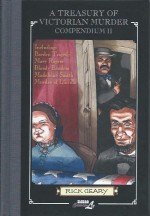
A Treasury of Victorian Murder Compendium


By Rick Geary (NBM/Comics Lit)
ISBN: 978-1-56163-704-1

Master cartoon criminologist Rick Geary has been sifting through humanity’s dark drives for years: researching and presenting a compelling cavalcade of corruption with his series of graphic novel/true-murder mystery reconstructions, each beguilingly combining a superlative talent for laconic prose, incisive observation and forensically detailed pictorial extrapolation with his formidable fascination for the darker aspects of human history.

Geary’s unblinking eye has of late been examining the last hundred years or so in his Treasury of XXth Century Murder series, but first began his graphic assignations with Mankind’s darker aspects in a delicious anthologised tome entitled A Treasury of Victorian Murder in 1987. Now that initial volume and three of the eight that succeeded it (Jack the Ripper from 1995, The Fatal Bullet from1999, and 2003’s The Beast of Chicago) have all been re-issued in a splendid morbidly monochrome deluxe hardback – because, after all, bloody murder is always a black and white affair…

Geary’s fascination with his subject is irresistibly infectious and his unique cartooning style a perfect medium to convey the starkly factual narrative in a memorable, mordant and undeniably enjoyable manner.

The basic premise is simple. The feel and folklore of Queen Victoria’s evocative era is irredeemably ingrained in the psyche of the contemporary world, and that first flourishing of social modernity invested crime and especially murder with a whole new style and morbid appeal to the general public. Each of the cases the author adapts was big news at a time when burgeoning technologies, rising literacy levels and crass populism first began to stoke the fires of an insatiable hunger for gory news. Moreover, many of the cases still resonate with today’s catalogue of atrocities and will stir familiar feelings in readers of a later century – especially the unsolved ones.

The eponymous first volume begins with a stunning background feature depicting ‘Celebrated Events of the Victorian Age’, ‘Illustrious Personages’, ‘Statesmen, Explorers and Innovators’, stars of ‘Literature and the Arts’ and naturally many of the most notorious ‘Murders and Murderesses’ before setting the scene and tone with compelling illustrations of ‘Picadilly Circus, London 1887’ and a dissertation on the Victorians’ obsession with death.

Following the text page ‘Introductory Remarks to the First Three Murders and Bibliography’ the still-unsolved case known as ‘The Ryan Mystery’ is diligently laid out, wherein a brother and sister were brutally slain in Lower Manhattan in 1873, after which ‘The Crimes of Dr. E.W. Pritchard’ outlines the deadly narcissism and fraudulent career and just deserts (the last man to be publicly executed in Scotland) of a very nasty physician who outraged sensibilities with a campaign of genteel slaughter in 1865 Glasgow, before concluding with an early fully-documented account of that now-common miscreant, the child-killer in the salutary tale of ‘The Abominable Mrs. Pearcy’, whose atrocities in Hampstead, Hertfordshire dumbfounded the Empire in 1890…

Geary chose a novel methodology for the next, book-length saga – presumably because the case has been the subject of so much investigation and bowdlerisation over the years.

Jack the Ripper – a Journal of the Whitechapel Murders 1888 -1889 is “compiled from the journals of an unknown British Gentleman… who closely followed the increasingly savage killings” and wittily narrates a day by day account of the horror that stalked Whitechapel and gripped the world as it became the first media-led, press-fed cause célèbre.

Following a comprehensive map of ‘Whitechapel and the Crimes of Jack the Ripper, 1888‘, Geary – producing some of the most moodily inspired art of his prodigious career – unravels, reworks and remixes all the myths, facts and exploitative stunts of assorted participants. Also included are some potential early murders missed by the police and possible copy-cat crimes from that frenzied period of London life, in a truly captivating take on the most famous murder-mystery in history.

With an Introduction and full Bibliography this graphic exposé is still one of most engaging of expeditions into the legend of Saucy Jack…

If the Ripper has moved far beyond the realm of cold, hard plain facts, the next tale is its very antithesis: a phenomenally well-documented and demystified political assassination that allows the wryly witty Geary to fully exploit his ironically charged talents…

The Fatal Bullet – a True Account of the Assassination, Lingering Pain, Death and Burial of James A. Garfield, Twentieth President of the United States begins with a simple comparison of ‘The Two Roads’ which led the politician and his killer Charles J. Guiteau to their respective fates, before ‘The Journey Home’ begins the sorry tale with the interment of the nation’s lost leader.

From there the story harks back and simultaneously examines both participants’ oddly ‘Parallel Lives’, tracing their different responses to their nation’s call during the War Between the States whilst in ‘A Deadly Campaign’ as Garfield is literally called by duty to public office, his increasingly delusion stalker Guiteau insinuates himself into the politician’s orbit before at last shooting the great man on Saturday, July 2nd 1881.

‘The Long Summer’ then describes the nightmarishly bizarre and appallingly prolonged death throes of the President – including many of the positively baroque remedies and solutions prescribed by a phalanx of eminent physicians and inventors, all desperately seeking to find and extract the shell lost somewhere in the fallen leader’s body…

When Garfield finally passed on September 9th all that was left was the trial of his clearly deranged killer, as remarkably recorded in ‘Conclusion: At the Bar of Justice’…

This stunning compilation then concludes with a genuinely terrifying tale of modern murder with The Beast of Chicago – an Account of the Life and Crimes of Herman W. Mudgett, known to the world as H.H. Holmes, H.M. Howard, D.T. Pratt, Harry Gordon, J.A. Judson, Edward Hatch, A.C. Hayes et al. – a jolly catalogue of criminality and carnage describing the astounding killing career of a bogus doctor and mesmerising psychopath whose official body count was twenty-seven souls, but may well have topped two hundred.

Attributed as America’s first documented serial killer, Mudgett/Holmes seemingly did it all first: a serial bigamist and conman, he hunted and slaughtered for fun and profit, lured victims to a purpose-built killing ground in the placid heart of a quiet suburb, seduced women, abducted children, corrupted and controlled entire families – making them his accomplices and even proxy killers – and, when finally caught, cultivated notoriety with an aplomb that guaranteed him a place in history…

His worst recorded atrocities took place during the 1893 World’s Columbian Exposition; a vast trade fair in Chicago where he had constructed a unique hotel and guest house dubbed “The Holmes Castle”…

Following maps of the sites, floor plans of his Castle and the 1894 escape route that revealed ‘The Desperate Journey of H.H. Holmes’, Geary treats us to a elucidatory Prologue ‘This is Chicago!’ to set the stage , before beginning the horrific tale of woe in ‘Dr. Holmes Comes to Town’ wherein the dapper, personable medical charlatan and insurance fraudster’s early life is disclosed before he inveigles himself into a position of respectability in suburban Englewood and commences to build his dream palace…

‘The Castle’ was an incredible, insane machine designed to lure in travellers and generate missing persons, and although its unique amenities were never fully understood or its death toll confirmed, Holmes’ secondary business – selling display skeletons to medical institutions – did extremely well in the four years that it was open for business, after which time Holmes took his incredible seduction and slaughter show on the road, or rather rails, during ‘The Desperate Journey’.

With events and disappearances spiralling, Holmes made a rare mistake and was briefly imprisoned for fraud. Unable to help himself, he then cheated his cellmate – a professional train-robber – who exacted vengeance by telling the authorities the truth about his boastful bunk mate…

With only a hint of the true extent of the bogus doctor’s crimes disclosed in ‘The Castle Revealed’, Holmes remained ‘The Prisoner’ for the rest of his short life, but even incarcerated with every day bringing fresh revelations of his horrific crimes, the first American Psycho succeeded in taking hold of his story and skilfully manipulating his own legend and myth…

As ever, Geary presents facts and theories with chilling pictorial precision, captivating clarity and devastating wit, and this still broadly unresolved mystery is every bit as compelling as his other homicidal forays: a perfect example of how graphic narrative can be so much more than simple fantasy entertainment.

With the inclusion of highly informative pictorial background essays and maps throughout, this big book of death is a sublimely readable successor to that era’s “Penny-Dreadfuls”: a startling yet accessible read that will engross fans of graphic narrative and similarly entice followers of True Crime thrillers. This merrily morbid murder masterpiece should be mandatory reading for all comic lovers, mystery-addicts and crime-collectors.
© 1987-2003, 2012 Rick Geary. All Rights Reserved.

Sandman Mystery Theatre: The Tarantula


By Matt Wagner & Guy Davis (Vertigo)
ISBN: 978-1-56389-195-6

Created by Gardner Fox and first illustrated by Bert Christman, the Sandman premiered in either Adventure Comics #40 July 1939 (two months after Batman debuted in Detective Comics #27) or two weeks earlier in New York World’s Fair Comics 1939, depending on whether some rather spotty distribution records can be believed.

Face and head utterly obscured by a gasmask and slouch hat; caped, business-suited millionaire adventurer Wesley Dodds was cut from the pulp masked mystery-man mould that had made The Lone Ranger, Green Hornet, The Shadow, Phantom Detective, Black Bat, The Spider and so many more such household names and astonishing commercial successes in the early days of mass periodical publication.

Wielding a sleeping-gas gun and haunting the night to battle a string of killers, crooks and spies, he was accompanied in the earliest comicbooks by his plucky paramour Dian Belmont, before gradually losing the readers’ interest and slipping from cover-spot to last feature in Adventure Comics, just as the cloaked pulp-hero avengers he emulated slipped from popularity in favour of more flamboyant fictional fare.

Possessing a certain indefinable style and charm but definitely no more pizzazz, the feature was on the verge of being dropped when the Sandman abruptly switched to a skin-tight yellow-and-purple costume – complete with billowing cape – and gained a boy-sidekick, Sandy the Golden Boy (in Adventure Comics #69, December 1941, courtesy of Mort Weisinger & Paul Norris), presumably to emulate the overwhelmingly successful Batman and Captain America models currently reaping such big dividends.

It didn’t help much but when Joe Simon & Jack Kirby came aboard with #72 that all spectacularly changed. A semi-supernatural element and fascination with the world of dreams (revisited by S&K a decade later in their short-lived experimental suspense series The Strange World of Your Dreams) added a moody conceptual punch to equal the kinetic fury of their art, as Sandman and Sandy became literally the stuff of nightmares to the bizarre bandits and murderous mugs they stalked…

For what happened next you can check out the superb Sandman hardback collection…

Time passed and in the late 1980s Neil Gaiman, Sam Keith & Mike Dringenberg took the property in a revolutionary new direction, eventually linking all the previous decades’ elements into an overarching connective continuity under DC’s new sophisticated suspense imprint Vertigo.

Within a few years the astounding success of the new Sandman prompted the editorial powers-that-be to revisit the stylishly retro original character and look at him through more mature eyes. Iconoclastic creator Matt Wagner (Mage, Grendel, Batman) teamed with artistic maverick Guy Davis (Baker Street, B.P.R.D.) and colourist David Hornung to create a grittier, grimier, far more viscerally authentic 1930s where the mystery man pursued his lonely crusade with chilling verisimilitude.

The tone was darkly modernistic, with the crime-busting playing out in the dissolute dog-days of the Jazz Age and controversial themes such as abuse, sexual depravity, corruption and racism were confronted as well as the rising tide of fascism that swept the world then. This is a warning: Sandman Mystery Theatre is not a kid’s comic…

This first collection reprints the redefining first story-arc from issues #1-4 (April-July 1993) and commences after an absorbing introduction from veteran journalist and music critic Dave Marsh, accompanied by a gallery of the series’ original, groundbreaking photo-covers.

The Tarantula takes us to New York in 1938 where District Attorney Larry Belmont is having the Devil’s own time keeping his wild-child daughter out of trouble and out of the newspapers. She’s out all night, every night with her spoiled friends; drinking, partying and associating with all the wrong sorts of people, but the prominent public official has far bigger problems too. One is the mysterious gas-masked figure he finds rifling his safe soon after Dian departs…

The intruder easily overpowers the DA with some kind of sleeping gas – that also makes you want to blurt out the truth – and disappears, leavingBelmontto awake with a headache and wonder if it was all a dream…

Dian, after her rowdy night of carousing with scandalous BFF Catherine Van Der Meer and her gangster lover, awakes with a similar hangover but still agrees to attend one of her father’s dreary public functions that evening. He is particularly keen that she meet a studious young man named Wesley Dodds, recently returned from years in the Orient to take over his deceased dad’s many business interests.

Dodds is genteel and effete but Dian finds that there’s something oddly compelling about him. Moreover he too seems to feel a connection…

The Gala breaks up early when the DA is informed of a sensational crime. Catherine Van Der Meer has been kidnapped by someone identifying himself as The Tarantula…

Across town, mob boss Albert Goldman is having a meeting with fellow gangsters from the West Coast and as usual his useless son Roger and drunken wife Miriam embarrass him. Daughter Celia is the only one he can depend on these days but even her unwavering devotion seems increasingly divided. After another stormy scene the conference ends early, and the visiting crime-lords are appalled to find all their usually diligent bodyguards asleep in their limousines…

Even with Catherine kidnapped Dian is determined to go out that night, but when Wesley arrives unexpectedly she changes her mind, much to her father’s relief. That feeling doesn’t last long however after the police inform him that the Tarantula has taken another woman…

When a woman’s hideously mutilated body is found Dian inveigles herself into accompanying her father to Headquarters but is soon excluded from the grisly “Man’s Business”. Left on her own she begins snooping in the offices and encounters a bizarre gas-masked figure poring through files. Before she can react he dashes past her and escapes, leaving her to explain to the assorted useless lawmen cluttering up the place.

Furious and humiliated, Dian then insists that she officially identifies Catherine and nobody can dissuade her.

Shockingly the savagely ruined body is not her best friend but yet another victim…

Somewhere dark and hidden Van Der Meer is being tortured but the perpetrator has far more than macabre gratification in mind…

In the Goldman house Celia is daily extending her control over dear old daddy. They still share a very special secret, but these days she’s the one dictating where and when they indulge themselves…

With all the trauma in her life Dian increasingly finds Wesley a comforting rock, but perhaps that view would change if she knew how he spends his nights. Dodds is plagued by bad dreams. Not his own nightmares, but rather the somnolent screams of victims and their cruel oppressors haunt his troubled sleep. What else could a decent man do then, but act to end such suffering?

In a seedy dive, uncompromising Police Lieutenant Burke comes off worst when he discovers the gas-masked lunatic grilling a suspect in “his” kidnapping case and again when this “Sandman” is found at a factory where the vehicle used to transport victims is hidden. Even so, the net is inexorably tightening on both Tarantula and the insane vigilante interfering in the investigation and Burke doesn’t know who he most wants in a nice, dark interrogation room…

As the labyrinthine web of mystery and monstrosity slowly unravels, tension mounts and the death toll climbs but can The Sandman stop the torrent of terror before the determined Dian finds herself swept up in all the blood and death?

Moody, dark and superbly engrossing, these revisionist “anti-superhero” tales offer an impressively human and realistic spin on the genre; one that should delight all those grown-ups who think masks and tights are silly.
© 1993, 1995, 2004 DC Comics. All Rights Reserved.

Whiteout volume 1 – Definitive Edition


By Greg Rucka & Steve Lieber (Oni Press)
ISBN: 978-1-932664-70-6

When done right there’s no artistic medium which can better depict the myriad intricacies of a murder-mystery than the comic strip.

The superb and seminal piece of crime fiction under review today was the 2D debut of novelist Greg Rucka and saw mid-ranking artist Steve Lieber achieve his full illustrative potential in a gripping chiller set in a world where, despite appearances, nothing is simply black and white…

Originally released as a 4-part miniseries from Oni Press in 1998, Whiteout introduces disgraced Deputy U.S. Marshal Carrie Stetko, banished to the ends of the Earth – generally known as McMurdo Station,Antarctica – following a tremendous and unforgivable screw-up during her stateside duties.

Seamlessly filling in crucial background detail as it swiftly progresses, we soon learn that Antarctica is a bizarre “Neutral Zone” co-managed by the USA, Britain, Russia, Argentina, Chile, Australia, and other nations where mineral exploitation is forbidden by treaty, military weapons are proscribed and there are 400 guys to every girl.Antarcticais a place where all Man’s basest instincts are curtailed by official accord – or at least that’s the international party line…

In the cold and isolated outpost Stetko hadn’t gone out of her way to adapt, settle in or make friends in a place where few people stay for more than a few months whether they’re involved with the military, explorers, scientists or even dubious business types.

It’s dull drudgery all the way but that ends when Carrie is called out to examine a body on the ice…

The face has been horrendously removed from the brittle corpse but the remote area is a mess, with multiple deep core-samples removed from the frozen wastes and Stetko wouldn’t even be involved if the body wasn’t clad in a parka with American flags on it. Even after prying the cadaver loose from the ice, Carrie has to wait days for it to thaw enough before the camp doctor everyone calls Furry can begin his autopsy.

More worryingly, further investigation reveals that the international research expedition was supposed to comprise five men – two Americans, a Briton, an Argentinean and an Austrian. Where and who are the other four …?

Sole friendly face Furry is having little luck with the body. Somebody used an ice hammer to make sure identification was impossible, but the diligent doc gets enough from the remains of the feet to fax off prints to the U.S. Eventually the details return and Carrie begins to search for the killer of Alexander Keller, American citizen – and not one of the research team at all…

Interviewing the pilot who ferried the team produces no leads and days are wasted checking the other bases by radio. Moreover, time is running out. With true Winter coming most camps are preparing to shut down: ferrying all but the most essential staff back to civilisation until the slightly more hospitable Spring makes life on the ice survivable. Once “Winter-over” begins, the killer will be impossible to find…

When she gets a call back from British-administered Victoria Station that two of the missing team are there, she catches a break by hitching on a flight ferrying Australian pilot John Haden to his next gig. Despite his easy charm and manner Carrie knows there’s something not right about him…

Rendezvousing with officious administrator Lily Sharpe, Carrie refuses to wait out another impending storm and both women venture out onto the ice to find the outlying cabin of the missing men. As they enter they are attacked by an axe-wielding masked man who has just killed both of her suspects in the same way that Keller was dispatched…

Giving chase into the storm Carrie is overpowered and her vital guide-wire cut. Lost in a binding whiteout with the temperature drastically dropping by the second, she is going to die mere feet from safety and might not be found for months…

As Sharpe recovers and follows, Stetko has, with Herculean determination and a deal of sheer luck, found a sanctuary where she is temporary safe if no longer sound. She never will be again…

Lost in delirium and suppressed memories, Carrie almost fights her way free from her last-minute rescuer but is at last taken to the Station’s infirmary. When she’s fit enough to travel the mysterious Lily ferries the Marshal back to McMurdo and reveals that the two remaining suspects have been spotted on the ice at Amundsen-Scott base.

As much through anger and resentment as her boss’ insistence Carrie, with Sharpe in tow, heads after them and on reaching the distant station receives an astounding surprise when she spots dead man Keller in the canteen…

Sharpe meanwhile has got the last two suspects. Or at least, their bloody, battered remains…

Keller eludes the Marshal and lies hidden in Sharpe’s plane where he finds her gun. Of course according to the Antarctica Treaty all weapons are banned on the jointly-administered continent, but that is far from being the British woman’s biggest secret…

The drama kicks into high octane high gear as Keller and his hidden allies mercilessly strike back before the mystery and motives are revealed and the stunning conclusion reveals just how dangerous trust can be in a land which scours the heart and soul every minute of every day…

Smart, cynical and intoxicatingly devious, this superb fair-play murder mystery is one of the best comics crime capes of the last fifty years, spawning one sequel so far and offering the tantalising prospect of a third…

Cool, cruel and so, so good, this is a book for all mature comics readers and fiction fans alike…
™ & © 1998, 1999 2007 Greg Rucka. All rights reserved.

Came the Dawn and Other Stories illustrated by Wallace Wood


By Wallace Wood, Al Feldstein, Harry Harrison, Gardner Fox & various (Fantagraphics Books)
ISBN: 978-1-60699-546-4

Win’s Christmas Gift Recommendation: Sheer, seductive dark pictorial poetry in emotion… 10/10

EC began in 1944 when comicbook pioneer Max Gaines sold the successful superhero properties of his All-American Comics company – including Wonder Woman, Flash, Green Lantern and Hawkman – to half-sister National/DC, retaining only Picture Stories from the Bible. His plan was to produce a line of Educational Comics with schools and church groups as the major target market. He then augmented his core title with three more in similar vein: Picture Stories from American History, Science and World History. The worthwhile but unsustainable project was already struggling when he died in a boating accident in 1947.

His son William was eventually convinced to assume control of the family business and, with much support and encouragement from unsung hero Sol Cohen and multi-talented associate Al Feldstein, transformed the ailing enterprise into Entertaining Comics, consequently triggering the greatest qualitative leap forward in comicbook history…

After a few tentative false starts and abortive experiments, Gaines settled into a bold and impressive publishing strategy, utilising the most gifted illustrators in the field to tell a “New Trend” of stories aimed at an older, more discriminating audience.

From 1950 to 1954 EC was the most innovative and influential publisher in America, dominating the genres of science fiction, war, horror and crime. The company even added a new type of title and another genre with the creation of parody magazine Mad …

This second volume of the Fantagraphics EC Library compiles a magical and groundbreaking omnibus of horrific tales and human dramas featuring the astounding artistic expertise of Wallace Allan Wood: one of the greatest draughtsmen our art form has ever produced.

Wood was actually a master of every aspect of the business. He began his career lettering Will Eisner’s Spirit strip, quickly moved into pencilling and inking and, latterly, publishing. After years working all over the comics and syndicated strip industries, as well as in legitimate illustration, package-design and other areas of commercial art, he devised the legendary T.H.U.N.D.E.R. Agents franchise and even created one of the first adult independent comics with Witzend in the late 1960s.

The troubled genius carried the seeds of his own destruction, however. Woody’s life was one of addiction (booze and cigarettes), traumatic relationships, tantalisingly close but always frustrated financial security, illness and eventually suicide. It was as if all the joy and beauty in his existence stayed on the pages and there was none left for real life.

Although during his time with EC Wood became the acknowledged and undisputed Master of Science Fiction art in America, he was equally adept, driven and accomplished in the production of all genres.

This powerfully effective collection concentrates on some of his best early horror, crime and suspense tales and includes all the evocative, emotionally-charged, controversial “Preachies” which Feldstein and Bill Gaines had devised to address hot-button issues and challenge the smugly hierarchical social status quo of post-war, triumphalist America.

These strident and still truly shocking morality plays viciously jabbed at the nation’s dark underbelly; attacking prejudice, police corruption, drug abuse, sexual attitudes, racism, institutionalised intolerance and all manners of hypocrisy. It’s no stretch to consider that these tales, more than any other childhood influence, probably shaped the resurgent liberal attitudes which blossomed as the future “Flower Power” generation reached their majority a decade later…

As with the previous Kurtzman volume, the stories are re-presented here in a lavish monochrome hardcover edition, with supplementary interviews, features and dissertations, beginning with ‘Come the Stories’ by Bill Mason, which appraises the yarns included with forensic discipline. Then the pictorial parade kicks off with a rather pedestrian scam caper which sees an innocent man convinced that he’s a ravening monster in ‘The Werewolf Legend’ scripted by the prolific and ubiquitous Gardner Fox, one of Gaines senior’s greatest assets and discovery.

The illustration is by Harry Harrison & inked by Wood from Vault of Horror #12 (April/May 1950). Although Harrison found his greatest fame as a prose author in later years, he was a major player in the comics biz during the 1950s and had worked with Wood as a jobbing production team since they’d met at the Cartoonists and Illustrators school in 1948.

For Haunt of Fear #15 the trio concocted a tale of lethal legerdemain in ‘The Mad Magician’, whilst the anonymously-authored enigma of ‘The Living Corpse’ (Crypt of Terror #18) moved closer to truly supernatural shenanigans as another illusionist took things too far in pursuit of his craft.

Harrison probably scripted and certainly inked ‘The Curse of Harkley Heath’ from Vault of Horror #13, wherein a gothic triangle of greedy heirs came to unpleasant, untimely ends after a will was read, after which Wood began handling all the art chores with ‘Horror-Ahead!’ (Haunt of Fear #16, July/August 1950) when rival curio collectors’ jungle jaunt in search of shrunken skulls ended in the only way it possibly could…

The Noir-ish new era began when Al Feldstein began scripting for Woody. ‘Death’s Double-Cross’ from the sublimely mature Crime SuspenStories #1 (October/November 1951) offers the twisted tale of a woman cheating on her husband with his twin brother in a moody masterpiece reminiscent of James M. Cain. Naturally it quickly turned into a nightmare that couldn’t end pretty…

Fox offered one last hurrah in ‘The Man from the Grave’ from Haunt of Fear #4, which saw a dissolute artist commit gruesome murder for his art and lived to regret it in desperate luxury and a relentless, compulsive paroxysm of over-work, whilst Feldstein’s

‘Terror Ride!’ (Tales From the Crypt #21) found two young lovers who soon regretted being the last couple to ride the decrepit Amusement Park’s Old Mill boat attraction… Feldstein’s epic run of stories fill most of this tome and next appeared in Haunt of Fear #5, where Wood’s dark imagination and ability to render grotesques was expertly exploited in ‘Horror in the Freak Tent!’ wherein a cruel carnival owner who mercilessly mistreated his exotic employees eventually received a macabre measure of justice…

Crime SuspenStories #3 then provided a fearsome farrago of betrayal and vengeance when two fugitive bandits were ‘Faced With Horror!’ after picking the wrong plastic surgeon to sort out their public notoriety problems, whilst ‘So They Finally Pinned You Down!’ from Haunt of Fear #6 followed a troubled soul who couldn’t understand why he was always stumbling over dead women…

The macabre mayhem concluded with two tales from Tales From the Crypt #24 and 25, beginning with a classic philandering-murderer-gets-his-come-uppance tale in ‘Scared to Death!’ after which a baroque body-switching melodrama featuring a cunning crone and a lovely young thing forced a bewildered husband to conclude ‘Judy, You’re Not Yourself Today!’ …

The rest of this volume is comprised of those controversial polemical passion-plays and conscience-rending human dilemmas that Gaines dubbed Preachies, opening with ‘The Guilty!’ (from Shock SuspenStories #3, June/July 1952), which saw a typical small town enflamed by the murder of a young white girl. The Sheriff knew the black kid in his jail was guilty and was as keen as the mob to spare the state the cost of a trial. He took steps to ensure it too.

…And that’s when the girl’s white boyfriend confessed…

Although stridently moralising and perhaps heavy handed by contemporary standards, these stories are the very bedrock of EC’s well-deserved reputation as the crusading creators of America’s very first adult comics for mature readers. Moreover these ugly truths were gloriously draped in so very beautiful clothes, as Wood’s incredible illustration, inspired by the fiercely impassioned scripts, soared to unparallelled heights of sensitivity and gut-wrenching impact.

Shock SuspenStories #4 took the cultural campaign further in a sordid tale of the innocent witness relentlessly beaten into a ‘Confession’ by cops determined to capture a hit-and-run driver who’d killed their Lieutenant’s wife. So why then, was the grieving officer’s car all banged up and covered in blood…?

Old-fashioned anti-Semitism fuelled the ‘Hate!’ of a quiet little town and led to the death of a family too stubborn to be warned. Imagine instigator John Smith’s surprise when his appalled mother told the entire town that he was adopted… and what his true origins were…

‘Under Cover!’ in Shock SuspenStories #6 combined a campaign of punishment-floggings for miscegenation by the local Klan chapter with the end of a crusading reporter who tried to expose the scandal but tragically forgot that there might be almost anybody under those pointy hoods, whilst ‘The Bribe’ in #7 revealed how even the most honest and dedicated of civil servants could be pushed into abandoning his principles – especially with a loving daughter, her upcoming wedding and crushing society pressure hitting him so hard…

By today’s standards ‘The Assault!’ is potentially the most contentious tale here, revealing how a small town girl with salacious appetites callously protected her reputation by framing an old man for her “rape”. In typical tone for those times, her lie ultimately caused two deaths…

‘Came the Dawn!’ from Shock SuspenStories #9 is a marvellous example of Greek tragedy in modern dress, as a lonely backwoods hermit finds a beautiful naked woman in his cabin and, after a night of mutual passion with the girl of his dreams, discovers that an inmate has escaped from the nearby asylum. Only after he’s locked her out does he discover that she’s not the only mysterious blonde lost in the forest…

Far less emotionally loaded but equally devastating is the darkly introspective ‘…So Shall Ye Reap!’ (Shock SuspenStories #10) which finds a penitent, angry young man contemplating every hypocritical act of his pompously pious parents before reaching his own moment of judgement after which ‘In Gratitude’ launches a simply breathtaking attack on the nation’s double standards when a wounded soldier comes home to a hero’s welcome and turns on his friends and family when he finds out what they’ve done to the coloured man who saved his life…

More quirky crime-caper than social commentary, ‘Fall Guy’ (Shock SuspenStories #12) follows the doomed decade that saw decent guy Danny Jansen steal a fortune to please a greedy girl far out of his league and spend ten years in jail paying for it. Surprisingly she waited all that time for him, but wasn’t best pleased when he couldn’t remember how to retrieve his ill-gotten gains…

A campaign of hate to drive out a man who foolishly admitted to being part-Negro ended in suicide and a sense of smug satisfaction when the bigot-in-charge boasted of his success to the local doctor in ‘Blood-Brothers’ (Shock SuspenStories #13). Imagine the vile cross-burner’s surprise when the aged medic revealed the source of the transfusion which had long-ago saved the happy hate-monger’s life…

‘The Whipping’ (scripted by Feldstein or Jack Oleck from Shock SuspenStories #14) returned to scandal-mongering territory, when a dutiful daughter defied her racist father and started “dating” an Hispanic boy. The dad certainly didn’t call it that, and the outrageous steps he and his pure-white buddies took to end the affair horrifically backfired…

The last tale reprinted here is ‘The Confidant’ (Feldstein or Oleck again from Shock SuspenStories #15, June/July 1954) from a time when the public outcry against comics was just reaching its fevered peak. The story deals with mob-justice and sees an entire town baying for the blood of a newcomer who had murdered a young girl.

Then, when a dark stranger arrives searching for one of his children, the unofficial posse immediately jump to the wrong conclusion with tragic and irreparably consequences…

Please forgive any deliberate vagueness on my part here: the point is to make you want to read these still poignant and shocking stories and I don’t want to devalue their impact or spoil your otherwise assured enjoyment…

A detailed history of the flawed genius is then provided by historian S.C. Ringgenberg in the prose piece ‘Wallace Wood’ after which this truly beautiful book is closed by another set of ‘Behind the Panels: Creator Biographies’ by Arthur Lortie & and Bill Mason and Ted White’s ‘Crime, Horror, Terror, Gore, Depravity, Disrespect for Established Authority – and Science Fiction Too!: ‘The Ups and Downs of EC Comics: A Short History’ once more offers a comprehensive run-down of the entire EC phenomenon.

The short, sweet, cruelly limited EC back-catalogue has been revisited ad infinitum in the decades since its demise. Those amazing yarns changed not just comics but also infected the larger world through film and television to convert millions into dedicated devotees still addicted to New Trend tales.

Whether you are an aged EC Fan-Addict, just a nervous newbie, or simply a mere fan of brilliant stories and sublime art, Came the Dawn is a book no sane and sensible reader can afford to be without.

This edition © 2012 Fantagraphics Books, Inc. All comics stories © 2012 William M. Gaines Agent, Inc., reprinted with permission. All other material © 2012 the respective creators.