Mandrake the Magician®: The Complete King Years volume 2


By Fred Fredericks, Gary Poole, Ray Bailey, Giovanni Fiorentini, Salvatore Stizza, Domenico Mirabella, Paul S. Newman & Stan Campbell & various (Hermes Press)
ISBN: 978-1613451021 (HB/Digital edition)

Win’s Christmas Gift Recommendation: Magical unrealism at its Finest… 9/10

Regarded by many as comics’ first superhero, Mandrake the Magician debuted as a daily newspaper strip on 11th June 1934 – although creator Lee Falk had first tried to sell the strip a decade previously. Initially drawing it too, Falk rapidly replaced himself, allowing the early wonderment to materialise through the effective understatement of sublime draughtsman Phil Davis. An instant hit, it was soon supplemented by a full-colour Sunday companion page from February 3rd 1935.

Falk – as a 19-year old college student – had sold Mandrake to King Features Syndicate years earlier, but asked the monolithic company to let him finish his studies before dedicating himself to it full time. Schooling done, the 23-year-old master raconteur settled into his life’s work: entertaining millions with astounding tales.

Falk – who also created the first costumed superhero in moodily magnificent generational manhunter The Phantom – spawned an entire comic book subgenre with his first creation. Most Golden Age publishers boasted at least one (but usually many) nattily attired wizards in their gaudily-garbed pantheons: all roaming the world(s) making miracles and crushing injustice with varying degrees of stage legerdemain or actual sorcery.

Characters such as Mr. Mystic, Ibis the Invincible, Sargon the Sorcerer, and an assortment of “…the Magician” ’s like Zatara, Zanzibar, Kardak ad infinitum all borrowed heavily and shamelessly from the uncanny exploits of the elegant, enigmatic man of mystery gracing the world’s newspapers and magazines.

In the Antipodes, Mandrake was a suave stalwart regular of Australian Women’s Weekly and became a cherished icon of adventure in the UK, Australia, Italy, Brazil, Germany, Spain, France, Turkey and across Scandinavia: a major star of page and screen, pervading every aspect of global consciousness.

As seen and described in Tim Lasiuta’s epically informative biographical and treat-packed ‘Introduction: Mandrake – a Magician for the Ages’, over the decades he’s manifested for radio, movies, chapter-serials, a theatrical play, television animation (as part of the cartoon series Defenders of the Earth) and so much more. With all that came a merchandising bonanza of games, toys (including magic trick kits), books, comics and the rest, much of it tantalizingly pictured here in posters, candid photos, book and comics covers plus a wealth of original art…

Falk worked on Mandrake and “The Ghost who Walks” until his death in 1999 (on his deathbed he was laying out one last story), but also found a few quiet moments to become a renowned playwright, theatre producer and impresario, as well as an inveterate world-traveller. However, he couldn’t keep up with the burgeoning demand, and depended a great deal on his later collaborator Fred Fredericks, who became an increasingly vital component of the process and ultimately Falk’s successor… which is where this collection comes in…

Between 1966 and 1967, King Features Syndicate dabbled with a comic book line of their biggest stars – Popeye, Flash Gordon, The Phantom and Mandrake – developed after the characters had enjoyed newsstand stardom under the broad and effective aegis of veteran licensed properties publisher Gold Key Comics. No stranger to funnybooks, Mandrake was featured in the David McKay Company’s Magic Comics (1939 to 1949 as reformatted strip reprints) and in new material in November 1956 he starred in Dell’s Four Color #752 and was also a major player for child-friendly Big Little Books.

This concluding full-colour archival volume gathers the pertinent parts of Mandrake the Magician #6-10, spanning September 1966 to May 1967, and includes in its entirety that historical bonus from FC #752 (November 1956). The wonder and mystery resume with a two-chapter saga from #6, cover-dated July 1967.

Scripted by Gary Poole and illustrated by Ray Bailey (the American one who worked on The Gumps, Terry and the Pirates, Steve Canyon, Turok, Son of Stone, Boris Karloff Tales of Mystery, U.N.D.E.R.S.E.A. Agent and more: not the British doyen of children’s comics who limned such juvenile delights as Milly and Billy and Kitty Hawke), ‘The Incredible Space Menace’ sees the master of mesmerism targeted by ousted and exiled alien tyrants who ride flying saucers hidden inside hurricanes.

One has been Mandrake’s close friend for 15 years, learning to counter his magic and turn it against the hero as a prelude to world conquest. Luckily, the mage has lifelong companion Lothar and beloved Princess Narda to save him before he can save humanity itself…

Those in the know are well aware that Mandrake was educated at the fabled College of Magic in Tibet, thereafter becoming a famous, globetrotting troubleshooter: always accompanied by his mighty African partner and loving companion (eventually – in 1997 – wife) Narda of Cockaigne. Together forever, they faced the uncanny, solved crimes and crushed evil.

His African associate took centre stage in #7 as ‘Jungle Drums’ provided the herculean warrior prince with a backstory and renewed purpose. In Mandrake’s American home Xanadu, Lothar is plagued by eerie, ethereal tom-tom beats calling him back to the “Dark Continent”. The episode gives Mandrake opportunity to explain that his friend is King of the Wambesi in voluntary exile, and how the magician had helped him expose the witchdoctor who poisoned the previous monarch to seize the throne. The case ended with Lothar choosing comradely adventure over luxury and comfort. Now a new menace threatens his people and demands ‘The Return of King Lothar’

Both interlinked tales were by Poole & Bailey and conclude with the heroes back in Africa where the people have utterly forgotten their liege lord. After numerous lethally close shaves the culprits are exposed as western “doctors” whose inoculation program is designed to make the entire nation docile and compliant while the whites plunder the nation wholesale. Cue a little Mandrake magic and monarchical muscle…

Leaving another regent in charge, Lothar rejoins his world-travelling friend just in time to enjoy a little crime action that exploited some global franchising successes. In the 1960s and 1970s, Italian publisher Fratelli Spada produced their own original stories to augment the Falk material and King’s US Mandrake the Magician #8 (September 1967) was a translated version of ‘The Telltale Doll’, scripted by Giovanni Fiorentini and drawn by Salvatore Stizza. Here, the trio visit Mexico and become embroiled in a callous smuggling operation using children and their drug-stuffed toys as unsuspected, inadvertent couriers…

A month later another Italian tale by Fiorentini – illustrated by Domenico Mirabella and modified by script-doctor Poole – delivers cosmic horror as a body-possessing alien mutant runs amok on Earth. The Terror From Outer Space’ is ruthlessly hunting a super-mineral able to eradicate the world and which is currently considered by ever-inquisitive Mandrake as a simple curio. He has no conception of the peril to him and the planet…

Poole & Bailey reunited for the final issue as #10 (November 1967) foreshadowed the coming horror story revival with a serious ghost story in ‘The Haunting of Hawk Inn’ as Narda takes a hard-earned vacation from action. Sadly, the rustic coastal hideaway she’s chosen comes with an arcane history and it’s not long before she’s begging Mandrake and Lothar to investigate a spectral raptor with a grudge and no mercy…

Behind an evocatively beautiful, sadly anonymous painted cover, the comics contents of November 1956’s Four Color #752 as published by Dell Comics add lasting lustre to this archive. The frontispiece ‘Mandrake’s Magic’ – explaining how his powers work – is part of the Introduction already described, so here are two full-colour complete exploits plotted by Falk and scripted by Paul S. Newman (The Lone Ranger, Turok, Dr. Solar, Man of the Atom) and Marshall McClintock, with art from veteran storyteller Stan Campbell (Lash LaRue, Tex Ritter, King of the Royal Mounted).

In ‘The Magic Maker’, our urbane Prince of Prestidigitation meets a gifted “player on the other side” as stage hypnotist Dr. Phantasmo is hired by a crooked candidate to wreck a crusading Mayor’s re-election campaign. With the troubleshooting trio strenuously objecting, the plot is bizarre and spectacular, but doomed to failure…

Then ‘Tide of Treachery’ sees a boating holiday in Canada draw the heroes into a dastardly scheme to sabotage and evict an entire fishing village. With murder and more in play, detective work reveals the truth about bucolic Bundy Bay and why property speculators Shain and Carven wants it so badly, but it’s Mandrake magic that settles the issue…

Ending the show is a fascinating look at the strip and comic book career of an artistic legend as Spike Barkin conducts a copiously illustrated and informative ‘Focus: Interview with Fred Fredericks’: exploring his incredible career, paying particular attention to the role of Lothar and how the Civil Rights movement of this period affected the look and actions of one of the most long-lived black characters in comics…

This thrilling tome offers exotic locales, thrilling action, spooky chills and pure fun in equal measure. The stories have lost none of their impact and only need you reading them. This a delicious, nostalgia-drenched triumph perfect for the Halloween season: straightforward, captivating action-adventure that has always been the staple of comics fiction. If that sounds like a good time to you, that’s Magic!
Mandrake the Magician® © 1956, 1966-1967 and 2016 King Features Syndicate, Inc.; Hearst Holdings, Inc. Reprinted with Permission. All rights reserved.

Showcase Presents Superman volume 3


By Otto Binder, Jerry Siegel, Robert Bernstein, Bill Finger, Jerry Coleman, Edmond Hamilton, Leo Dorfman, Jack Schiff, Wayne Boring, Al Plastino, Curt Swan, Kurt Schaffenberger, Jim Mooney, George Papp, Sheldon Moldoff & various (DC Comics)
ISBN: 978-1-4012-1271-1 (TPB)

Superman has proven to be all things to all fans over his decades of existence, and with the character currently undergoing another radical overhaul, these timeless tales of charm, joy and wholesome wit are more necessary than ever: not just as a reminder of great tales of the past but as an all-ages primer of the wonders still to come…

At the time these tales were published The Metropolis Marvel was enjoying revived interest. Television cartoons, a rampant merchandising wave thanks to the Batman-led boom in “camp” Superheroes generally, highly efficient global licensing and even a Broadway musical: all worked to keep the Last Son of Krypton a vibrant icon of Space-Age America.

Although we think of Jerry Siegel & Joe Shuster’s iconic invention as the epitome of comic book creation, in truth soon after his launch in Action Comics #1 he became a multimedia star and far more people have enjoyed the Man of Steel than have ever read him. By the time his 20th anniversary rolled around, Superman was a regular on radio, astounding animated cartoons, two movie chapter-plays and a feature film, and had just ended his first smash-hit live-action television serial. In his future were many more; a stage musical; a franchise of cinematic blockbusters and a seamless succession of TV cartoons, starting with The New Adventures of Superman in 1966. Even Krypto got in on the small-screen act…

It’s no wonder then that tales from this Silver Age period should be so draped in wholesome trappings of “Tinseltown” – even more so than most of celebrity-obsessed America. It didn’t hurt that editor Whitney Ellsworth was a part-time screenwriter, script editor and producer as well as National/DC’s Hollywood point man. His publishing assistant Mort Weisinger – a key factor in the vast expansion of the Kryptonian mythos – also had strong ties to the cinema and television industries, beginning in 1955 when he became story-editor for the blockbusting Adventures of Superman TV show.

This third magnificent monochrome chronicle collects the contents of Action Comics #276-292, Superman #146-156 and excerpts from Superman Annuals #3-5, spanning May 1961 to October 1962; taking its content from the early 1960’s canon (when the book’s target audience would have been actual little kids) yet showcasing a rather more sophisticated set of tales than you might expect…

Wide-eyed wonderment commences with Action Comics #276’s ‘The War Between Supergirl and the Superman Emergency Squad’ by Robert Bernstein, Wayne Boring & Stan Kaye. Here, Superman is conned into revealing his secret identity and resorts to incredible measures to make a swindler disbelieve his eyes, after which #277 presented ‘The Conquest of Superman!’ (Bill Finger, Curt Swan & John Forte): another brilliantly brutal duel against super-scientist Lex Luthor.

Superman #146 (July 1961) offered ‘The Story of Superman’s Life’ relating more secrets by recapitulating Clark Kent’s early days in a captivating resumé. Covering all the basics, Otto Binder & Al Plastino share the death of Krypton, rocket-ride to Earth, early life as Superboy, death of the Kents and moving to Metropolis. Closing, ‘Superman’s Greatest Feats’ (Jerry Siegel & Plastino) sees the Man of Tomorrow travel into Earth’s past and seemingly succeed in preventing such tragedies as the sinking of Atlantis, slaughter of Christians in Imperial Rome, deaths of Nathan Hale, Abraham Lincoln and Custer and even the death of Krypton’s population. Of course it is too good to be true…

Action #278 featured ‘The Super Powers of Perry White!’ (Jerry Coleman, Swan & Kaye) with the senescent editor suddenly gaining superpowers and an inexplicable urge to conquer the world. In Superman #147 ‘The Great Mento!’ – Bernstein & Plastino – a mystery mind-reader threatens to expose the hero’s secret identity. ‘Krypto Battles Titano’ (Siegel & Plastino) finds the wandering Dog of Steel voyaging back to the Age of Dinosaurs to play before inadvertently saving humanity from alien invasion alongside the Kryptonite-mutated giant ape. The issue closed with ‘The Legion of Super Villains’ (Siegel, Swan & Sheldon Moldoff): a landmark adventure and stand-out thriller featuring Lex Luthor and the adult Legion of Super-Heroes overcoming certain death with valour and ingenuity.

This was followed by Swan’s iconic cover for Superman Annual #3 (August 1961); the uncredited picture-feature Secrets of the Fortress of Solitude and a superb back-cover pin-up.

The author of Action #279’s Imaginary Story ‘The Super Rivals’ is regrettably unknown but John Forte’s sleekly comfortable art happily limns the wild occurrence of legendary heroes Samson and Hercules brought to the 20th century by Superman to marry Lois Lane and Lana Lang, to keep them out of his hair! In #280 Brainiac’s Super Revenge’ (Siegel, Swan & Kaye) returns that time-lost villain to our era and attacking the Man of Steel’s friends, only to be foiled by guest-star Congorilla (veteran Action Comics hero Congo Bill, who traded consciousness with a giant Golden Gorilla). Imaginary Stories were conceived as a way of exploring non-continuity plots and scenarios devised at a time when editors believed that entertainment trumped consistency and knew that every comic read was somebody’s first…

When Editor Weisinger was expanding Superman continuity and building a legend, he knew each new tale was an event adding to a nigh-sacred canon: that what was written and drawn mattered to readers. However, the ideas man wasn’t going to let aggregated “history” stifle a good plot situation, nor would he allow his eager yet sophisticated audience to endure clichéd deus ex machina cop-outs to mar the sheer enjoyment of captivating concepts. The mantra known to every fan was “Not a Dream! Not a Hoax! Not a Robot!”: emblazoned on covers depicting scenes that couldn’t possibly be true – even if it was only a comic book.

Superman #148 opened with Edmond Hamilton, Swan & Moldoff’s  ‘The 20th Century Achilles’, wherein a cunning crook makes himself immune to harm, after which ‘Mr. Mxyzptlk’s Super Mischief’ (Siegel, Swan & Moldoff) again finds the 5th dimensional pest using magic to cause irritation after legally changing his name to something even easier to pronounce, whilst the delightfully devilish ‘Superman Owes a Billion Dollars!’ written by Bernstein – depicts the Caped Kryptonian’s greatest foe: a Revenue agent who diligently discovers that the hero has never paid a penny of tax in his life…

Action Comics #281 features ‘The Man Who Saved Kal-El’s Life!’ (Bernstein & Plastino), relating how a humble Earth scientist visited Krypton and cured baby Superman, all wrapped up in a gripping duel with a modern crook able to avoid Superman’s every effort to hold him, whilst in Superman #149, ‘Lex Luthor, Hero!’, ‘Luthor’s Super-Bodyguard’ and ‘The Death of Superman’ (Siegel, Swan & Moldoff) form a brilliant extended Imaginary saga describing the insidious inventor’s ultimate victory over the Man of Steel.

In “real” continuity, Action #282 shares ‘Superman’s Toughest Day’ (Finger & Plastino) as Clark Kent’s vacation only reveals how his alter ego never really takes it easy, before #283’s ‘The Red Kryptonite Menace’ (Bernstein, Swan & Kaye) follows Chameleon Men from the 30th century afflicting the Action Ace with incredible new powers and disabilities after exposing him to a variety of Crimson K chunks.

Superman #150 opened with ‘The One Minute of Doom’ – Siegel & Plastino – disclosing how all survivors of Krypton – even Superdog – commemorate the planet’s destruction, before Bernstein & Kurt Schaffenberger’s ‘The Duel over Superman’ finally sees Lois and Lana Lang teach the patronising Man of Tomorrow a deserved lesson about his smug masculine complacency.

Siegel, Swan & Kaye then baffle readers and Action Ace alike ‘When the World Forgot Superman’, in a clever and beguiling mystery yarn, followed here by extracts from Superman Annual #4 (January 1962): the stunning cover and featurette The Origin and Powers of the Legion of Super-Heroes by Swan & George Klein.

Action #284 featured ‘The Babe of Steel’ (Bernstein, Swan & Klein) wherein Superman endures humiliation and frustration after deliberately turning himself into a toddler – but there’s a deadly serious purpose to the temporary transformation…

Superman #151 opens with Siegel & Plastino’s salutary story ‘The Three Tough Teen-Agers!’ wherein the hero sets a trio of delinquents back on the right path, after which Bernstein, Swan & Klein’s ‘The Man Who Trained Supermen’ sees Clark expose a crooked sports trainer. ‘Superman’s Greatest Secret!’ is almost revealed after battling a fire-breathing dragon which survived Krypton’s doom in a stirring tale by Siegel, Swan & Klein: probably one of the best secret-identity-saving stories of the period…

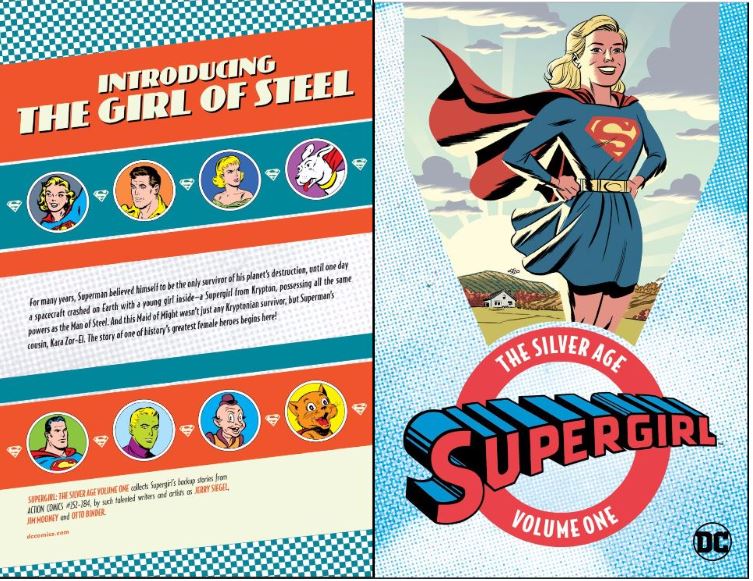
Since landing on Earth, Supergirl’s existence had been a closely guarded secret, allowing her time to master her formidable abilities. These tales were presented to the readership monthly as a back-up feature in Action Comics. However with #285, ‘The World’s Greatest Heroine!’ finally goes public in the Superman lead spot, after which the Girl of Steel defeats ‘The Infinite Monster’ in her own strip. Supergirl became the darling of the universe: openly saving the planet and finally getting credit for it in stirring tales by Siegel & Jim Mooney.

Action #286 offered mini-epic ‘The Jury of Super-Enemies’ (Bernstein, Swan & Klein) as the Superman Revenge Squad inflicts Red K hallucinations on the Man of Steel: tormenting him with visions of Luthor, Brainiac, the Legion of Super-Villains and other evil adversaries. The saga continued in the next issue, but before that Superman #152 appeared, with a surprising battle against ‘The Robot Master’ (Siegel, Swan & Klein), charmingly outrageous romp ‘Superbaby Captures the Pumpkin Gang!’ (Leo Dorfman & George Papp) and ‘The TV Trap for Superman!’, a devious crime caper by Finger & Plastino with the hero unwittingly wired for sound and vision by a sneaky conman…

The Revenge Squad thriller concluded in #287’s ‘Perry White’s Manhunt for Superman!’ (Bernstein, Swan & Klein) as an increasingly deluded Man of Tomorrow battles his worst nightmares and struggles to save Earth from a genuine alien invasion.

Finger & Plastino’s ‘The Day Superman Broke the Law!’ opened Superman #153, as a wily embezzler entangles the Metropolis Marvel in small-town red tape before ‘The Secret of the Superman Stamp’ (Edmond Hamilton, Swan & Klein) sees a proposed honour for good works turned into a serious threat to the hero’s secret identity…

‘The Town of Supermen’ by Siegel & Forte, then finds the Man of Tomorrow in a western ghost town in a deadly showdown against ten Kryptonian criminals freshly escaped from the Phantom Zone…

The growing power of the silver screen informed ‘The Man Who Exposed Superman’ (Action #288 by writer unknown and Swan & Klein) as a vengeful convict originally imprisoned by Superboy attempts to expose the hero’s identity by blackmailing him on live television. The Super-Practical Joker!’ (#289 by Dorfman & Plastino) sees Perry White forced to hire obnoxious trust-fund brat Dexter Willis: a spoiled kid whose obsessive stunts almost expose Superman’s day job.

Opening Superman #154, Hamilton, Swan & Klein’s ‘The Underwater Pranks of Mr. Mxyzptlk’ see the insane sprite return, resolved to cause grief and stay for good by only working his jests whilst submerged, after which ‘Krypton’s First Superman’ (Siegel, Swan & Klein) tells a lost tale of baby Kal-El on there that has unsuspected psychological effects on the full-grown hero. Next comes an example of the many public service announcements running in all DC’s 1960’s titles. ‘Superman Says be a Good Citizen’ was probably written by Jack Schiff and definitely illustrated by Sheldon Moldoff.

Exposure to a Red Kryptonite comet in Action #290 sees him become ‘Half a Superman!’ in another sadly uncredited story illustrated by Swan & Klein, after which Superman Annual #5 (July 1962) offers another stunning cover and displays the planetary Flag of Krypton, whilst Superman #155 featured  2-chapter ‘Superman Under the Green Sun’ and ‘The Blind Superman’ by Finger, Wayne Boring & Kaye, as the Man of Steel is trapped on a totalitarian world where his powers don’t work. Blinded as part of the dictator’s policy to keep the populace helpless, even sightless, nothing stops the hero from leading the people to victory. As if that wasn’t enough Siegel, Swan & Klein then debut showbiz thriller ‘The Downfall of Superman!’ with a famous wrestler seemingly able to defeat the Action Ace – albeit with a little help from some astounding guest-stars…

‘The New Superman!’ (Bernstein & Plastino, Action #291) sees the Metropolis Marvel lose his deadly susceptibility to Kryptonite, only to have it replaced by aversions to far more commonplace minerals, whilst #292 reveals ‘When Superman Defended his Arch Enemy!’ – an anonymous thriller illustrated by Plastino – which has the hero save Luthor from his just deserts after “murdering” alien robots…

The grand excursion into comics nostalgia ends with one of the greatest Superman stories of the decade. Issue #156, October 1962, featured Hamilton, Swan & Klein’s novel-length saga ‘The Last Days of Superman’ which began with ‘Superman’s Death Sentence’ as the hero contracts deadly Kryptonian Virus X and goes into a swift and painful decline. Confined to an isolation booth, he’s visited by ‘The Super-Comrades of All Times!’ who attempt cures and swear to carry on his works… until a last-minute solution is disclosed on ‘Superman’s Last Day of Life!’ This tense and terrifying thriller employed the entire vast and extended supporting cast that had evolved around the most popular comic book character in the world and still enthrals and excites in a way few stories ever have…

As well as containing some of the most delightful episodes of pre angst-drenched, cosmically catastrophic DC, these fun, thrilling, mind-boggling and yes, occasionally deeply moving all-ages stories also perfectly depict the changing mores and tastes which reshaped comics between the safely anodyne 1950s to the seditious, rebellious 1970s, all the while keeping to the prime directive of the industry: “keep them entertained and keep them wanting more”.

I know I certainly do.
© 1961, 1962, 2007 DC Comics. All Rights Reserved.

X-Men: The Hidden Years volume 1 (of 2)


By John Byrne, Tom Palmer, Joe Sinnott & various (Marvel)
ISBN: 978-0-7851-9048-6 (TPB/Digital edition)

During its initial 1960s run, X-Men was never one of young Marvel’s top titles, but it did secure a devout and dedicated following. Launching with moody, manic creative energy, dripping with Jack Kirby’s inspired heroic dynamism, the series comfortably transited into the slick, sleek illumination of Werner Roth, even as the blunt tension of alienated outsider-kids settled into a pastiche of college and school scenarios familiar to the students who were the series’ main audience.

The core team comprised tragic Scott Summers/Cyclops, ebullient Bobby Drake/Iceman, golden rich boy Warren Worthington/Angel and erudite, brutish genius Henry McCoy/Beast, in constant heart- and back- breaking training with Professor Charles Xavier. The wheelchair-bound (and even temporarily deceased) telepath was dedicated to brokering peace and fostering integration between the masses of humanity and emergent mutant race Homo Superior.

After a brief time trying to fit in the normal world, Jean Grey/Marvel Girl returned to the team, which was also occasionally supplemented by Scott’s brother Alex – a cosmic ray fuelled powerhouse codenamed Havok – and mysterious magnetic minx eventually dubbed Polaris, although she was usually referred to as Lorna Dane.

Nobody knew it at the time – and sales certainly didn’t reflect it – but with X-Men #56 superhero comics changed forever. A few years previously Neal Adams had stunned the comics-buying public with his horror anthology work and revolutionary superhero stylings on Green Lantern/Green Arrow and Batman. Now, on this relatively minor title – aided and abetted by writer Thomas in iconoclastic form and inker Tom Palmer producing some of the finest work of his career – the artist expanded the horizons of graphic narrative through boldly innovative, intensely paranoid dramas pitting mutants against an increasingly hostile world.

Subtly – and bravely – pitched at an older audience, the succession of gripping, addictively beautiful epics captivated and enchanted a small band of amazed readers – and completely escaped the attention of the greater mass of the buying public. Without those tales the modern X-phenomenon could not have existed, but back then they couldn’t save the series from cancellation. The cruellest phrase in comics is “ahead of its time…”

The series died despite every radical innovation devised by a succession of supremely talented creators. The last published original tale saw the mutants hunting The Hulk – or rather Bruce Banner – in an attempt to save Professor X from a coma induced by his psychic war against merciless, marauding extraterrestrials the Z’nox.

Adams ended his artistic tenure in grand style in that astounding alien invasion epic, but had moved on by the final outing (X-Men #66, cover-dated March 1970).

Although gone, the mutants were far from forgotten. Standard policy at that time to revive defunct characters was to pile on guest-shots and release reprints. Cover-dated December 1970, X-Men #67 saw them return, reliving early classics whilst a campaign of cameos carried them until the “All-New” team debuted in 1975.

One of the many kids utterly beguiled by the series’ transformation under Thomas & Adams was John Byrne. In 1999 he created a retroactive series in-filling untold events and exploits in the days between cancellation and the birth of the modern team. Pencilling in a passable blend of Adams and his own unique style, with Palmer triumphantly back on inks, Byrne took up where Thomas had left off, detailing untold secret adventures crafted with the advantage of 20-20 hindsight in respect to the decades of continuity that had since passed…

This first of two compilations collects X-Men: The Hidden Years #1-12 (originally published between December 1999- November 2000), and opens with a short teaser/prologue used to promote the series in other Marvel releases.

Featuring a younger, headstrong team far more fractious, aggressive and uncertain than ever seen in contemporary times, the uncanny action sees ‘Test to Destruction’ find the weary mutant heroes seemingly battling an ambush of old foes, only to discover that their peril is a cruel workplace assessment by their surprisingly militant and harsh “resurrected” tutor.

Continuity completists should note this mini-saga occurs between panels of X-Men: The Hidden Years #1, which launched a month later and – whilst recapping all those 1960s classics – dictated that the team revisit ‘Once More the Savage Land’’. This they do without Iceman, who had hot-headedly quit over Xavier’s callous tests and patronising attitude. If he was honest, though, the fact Alex was monopolising Drake’s dream girl Lorna didn’t help…

The team’s voyage south is to confirm the death of archenemy Magneto, but the disgruntled disenchanted heroes quickly fall foul of the steadfast principle dictating that somehow no modern vehicle reaches the primordial preserve without crashing. Narrowly surviving disaster, Angel, Beast and Cyclops are ministering to comatose Jean when they are ambushed by savages, and upon awakening learn Marvel Girl is dead and has been despatched to the Land of the Dead…

The shock is somewhat ameliorated in #2’s ‘The Ghost and the Darkness’ when erudite scholar Henry McCoy deduces exactly what that means here, before saving despondent Scott from suicide-by-T-Rex, and leading his chums in search of her.

Meanwhile in America, Bobby learns of the mission’s failure and that Xavier has sent X-novices Alex and Lorna after them, even as a continent away, Angel’s ultra-wealthy girlfriend Candace Southern buys herself into the crisis…

In a hidden city of freaks at the bottom of the world, the apparent corpse of Marvel Girl has been harvested by eerie priests of an exploitative cult able to raise the dead and rejuvenate the aged and decrepit. The Keepers of the Way have been exploiting the outer tribes’ practice of abandoning their old and sick for centuries, covertly building a monumental forced-labour camp of grateful slaves in an artificially extended underclass. Now, however, that dark paradise and the unstable radioactive volcano it’s built on is nearing its end.

Moreover – as quietly recovering Marvel Girl overhears – the secret rulers have recently started taking survival advice from what appears to be the ghost of Magneto…

Breaking into the citadel, the male X-Men dispel one ancient myth when Cyclops is killed and spontaneously resurrects without the actions of Keepers, leading to the exposure of another factor sustaining the priest-caste’s autonomy…

With enemies all around, Warren is separated from his teammates in ‘On Wings of Angels’ meeting another avian outcast even as Alex and Lorna beat the odds and land mostly in one piece. Even greater fortune blesses them when jungle wonders Ka-Zar and his sabretooth Zabu spot them and take charge of the rescue mission…

In the Keeper city, as Jean is overcome by Magneto, the truth of its imminent explosive doom is uncovered by her fellow X-Men. Angel and mute ally Avia reunite with the other guys in the hangar of a truly unique survival vehicle designed by the Keepers, just as the kingdom is engulfed in boiling lava. Their rush to escape latterly extends to and includes a fully alive master of magnetism in #4’s ‘Escape to Oblivion’

As the reunited mutants are carried every way the wind blows, Iceman has made his own way to the Savage Land and Candy Southern breaks into the X-Mansion for a ferocious confrontation with Professor X. Unaware that Ka-Zar, Alex and Lorna are still trekking through the green hell of the Savage Land, the X-Men and Magneto’s mob of mutant minions are helpless ‘Riders of the Storm’, with the escape vehicle disintegrating around them. When the maelstrom intensifies and the fragmenting vessel is blown thousands of miles adrift, McCoy falls overboard…

Some of that aforementioned hindsight then manifests in issue #6 as ‘Behold a Goddess Rising…!’ reveals how The Beast’s plummet to earth lands him in rural Kenya at the feet of a young weather goddess called Ororo

As Professor X and Candy come to an “arrangement” in Westchester County, on the outskirts of the dinosaur-infested Savage Land, Iceman – battered, bruised and briefly amnesiac – is saved from Pteranodons by energy-leach Karl Lykos. In Africa, McCoy is in earnest conference with the weather-warper. She had created a storm to serve her followers, but somehow the event was usurped by some mystery force, expanding to lethal, continent-spanning dimensions.

Having landed but separated but safely, Jean searches for her teammates, unaware Scott is helpless before the culprit, another mutant who has learned to predate on other Homo Superior…

When the other X-Men – past and future – converge on monstrous Deluge, they are easily overcome whilst back in the Savage Land, Ka-Zar, Alex and Lorna aid the survivors of the resurrection volcano, whilst hundred of miles distant, under that now-diminishing storm in the South Atlantic, the trawler “Sigurd Jarlson” pulls a couple of winged freaks out of its nets…

‘Power Play’ in #7 finds the defeated Kenyan contingent rally, escape certain death and apply all their wits, strength and a venerable old tactic to defeat Deluge, whilst under Antarctica, Lykos and Drake bond with the hero utterly oblivious to who Lykos is and what he did to Iceman when they first met. At sea, Angel and Avia learn that their saviours plan to sell them to a unique freak show just as the main X-team reach home in time to be pressured into another manic mission.

With additional inking by Joe Sinnott, #8 reveals a ‘Shadow on the Stars’ as the Fantastic Four of that era (Mr. Fantastic, The Thing, Human Torch and Inhuman princess Crystal) accompany Xavier and the X-Men after the Z’Nox. Although his epic psionic endeavours saved Earth from the marauding space parasites, it only served to unleash them upon other civilisations and now the Professor and Reed Richards intend to rectify that callous dereliction of duty. However, as the star trek unfolds something ancient, cosmic and fiery waits in anticipation for Jean Grey…

And in the Savage Land, the last remnants of the scattered X-Men reunite when Ka-Zar leads Alex and Lorna to Iceman… and Lykos…

X-Men: The Hidden Years #9 anticipates calamities and tragedies to come as ‘Dark Destiny’ finds Marvel Girl test-driven by the Phoenix Force, before being driven off, leading to a spectacular final confrontation with the Z’Nox.

Back on Earth, another plot thread is attached as in suburban Illinois, a little girl discovers a new trick she can play with her dolls…

As Xavier and McCoy investigate a potential New Mutant and learn that ‘Home is Where the Hurt is…’. the remaining team hunt for missing Warren and walk into a trap laid by the Brotherhood of Evil Mutants (Mastermind, Unus the Untouchable, The Blob and evil Professor X analogue Kreuger).

Happily, in ‘Destroy All Mutants’, Candy provides a very human X-factor to tip the scales, but nothing can help the Illinois embassage as little Ashley Martin is corrupted by her power and loses control of the Sentinel she’s “befriended”, forcing Xavier into a pragmatic but cruel sanction…

In the Savage Land, the illusory period of peace ends for the heroes when Magneto and his Mutates attack, sparking the return of Bobby’s memories and triggering the transformation of repentant Lykos into rapacious monster Sauron. ‘And Death Alone Shall Know My Name’ wraps up the first year of untold tales as the scattered mutants reunite to rescue Iceman, Havoc and Lorna, bombastically battling Magneto’s minions and closing with a cameo by Sub-Mariner that segues neatly into the classic saga told decades ago in Fantastic Four #101-104 (That’s not included here. You’ll need another collection for that slice of magnificence.).

Closing this fan-friendly compilation is a cover and variant gallery sans text for all art lovers.

Fast and furious, but ridiculously convoluted, this is a huge thrill for anyone drenched in X-lore and superbly illustrated in prime Fights ‘n’ Tights mode, but I fear might be a stretch for casual readers or newcomers to the many worlds of X.
© 2017 Marvel Characters, Inc. All rights reserved.

Frankenstein: The Mad Science of Dick Briefer


By Dick Briefer with Bruce Elliott & various (Dark Horse Comics)
ISBN: 978-1-61655-688-4 eISBN: 978-1-63008-186-7

The Golden Age of American comic books is usually associated with the blockbusting birth and proliferation of the Superhero, but even at the headiest heights of costumed crusader craziness other fantastic fantasy fashions held their own. Some of the very best – like Jack Cole’s Plastic Man and the unlikely weird warrior under discussion here – managed to merge genres and surmount their origins through astounding graphic craft, a healthy helping of comedic legerdemain and a deft dose of satire…

Richard Briefer was born in Washington Heights, Manhattan on January 9th 1915. He was a pre-Med student who also studied at the Art Student League in New York City and got into the fledgling funnybook business in 1936, working for the Will Eisner/Jerry Iger shop after selling early work to Wow, What a Magazine! and others.

He adapted literary classics like the Hunchback of Notre Dame and – as Dick Hamilton – created early super-team Target and the Targeteers for Novelty Press. Briefer wrote and drew Rex Dexter of Mars, Dynamo, Biff Bannon, Storm Curtis, Crash Parker and more for a range of publishers. For Timely he co-created The Human Top and, as Dick Flood, produced anti-Nazi strip Pinky Rankin for The Daily Worker – the newspaper of the American Communist Party.

Another criminally near-forgotten master craftsman, Briefer is best remembered amongst we fading comics cognoscenti for Frankenstein; a suspense strip that debuted in Prize Comics #7 (cover-dated December 1940) before gradually evolving into a satirical comedy-horror masterpiece offering thrills and chills whilst ferociously sending up post-war America.

A truly unique vision, Briefer’s Frankenstein ran intermittently until 1954 when the toxic paranoiac atmosphere of the anti-communist, anti-comics witch hunt killed it. The author moved into advertising and latterly portraiture and, despite numerous attempts to revive the strip, never published any more of his absurd and acerbic antic…

Dick Briefer died in December 1980.

Here, however, as part of the wonderful and much missed Dark Horse Archives series (please bring ‘em back guys!), you can enjoy the superbly surreal strip in all its manic glory from the horrible heydays…

Re-presented for your delectation are the contents of Frankenstein #1-7 (January 1945-May 1947) with Briefer at the peak of his powers, writing and drawing deliciously demented delights that made him a legend amongst comics creators if not the general public.

After gleaning a few salient facts from appreciative devotee John Arcudi in his Foreword, and relishing some ultra-rare original art from Briefer and Alex Toth, the merry madness begins with #1 as we reveal ‘Frankenstein’s Creation

After a bored mad scientist reads an old book, he decides to create his own version of the infamous creature. Sadly, despite scrupulously following the recipe, the malevolent modern Prometheus’ secret formula only manifests a loving, protective nature in his super-strong homunculus, and the hulking “Frankenstein monster” soon becomes a boon to his community and embarrassment to his malignant maker.

Left to his own devices, our artificial Adam is then drawn to the quiet little everytown of Mippyville where the populace are fighting off a supernatural invasion of atrocious arcane predators. ‘Frankenstein and the Ghouls and Vampiressees the creature – originally mistaken for a “Bobbysox” pop singer by the town’s screaming teenagers – hilariously clean up the infernal infestation before setting up home in a ramshackle abandoned mansion.

Only one thing is missing to complete his dreams of domestic bliss until a brief dalliance with the local spider saleswoman results in her becoming ‘Frankenstein’s Wife. The mild man-monster soon learns why a hasty marriage often leads to repentance at leisure…

Mippyville is a place that just attracts weirdness, and the first issue concludes with another mad doctor, as deranged surgeon Professor Hugo von Hoogenblotzen kidnaps Frankie and attempts to graft him to an elephant in ‘Frankenstein and the Manimals’

The second issue begins with ‘Frankenstein!– a quick recap of past events – before our unlikely star tracks down a mad mass-murderer who wants others to suffer for his art in ‘Frankenstein and the Statue Maker, after which the animal-loving oaf is accidentally mistaken for a mere beast and purchased by a moody millionairess.

She puts him on a leash to one-up her pals in the Exotic Pets Club but ‘Frankenstein’s Jobsoon teaches all and sundry the true value of animal companionship…

Eventually restored to his own home, ‘Frankenstein’s Arkfinds the towering twit re-enacting the building of the fabled lifeboat to save his animal chums, but still ending up clashing with a hoarding hermit and his mutant allies…

Issue #3 (July/August 1946 and with scripting assistance from Bruce Elliott) introduced ‘Frankenstein’s Familyas the big guy secures gainful employment as a junk man, whilst his new boss tinkers with salvaged machines from a devil doctor’s lab. This results in an army of molecularly-unstable juvenile duplicates of Frankie and a great deal of gross chaos…

A legion of escaped horrors attack Mippyville in ‘Frankenstein and the Monsters’, only to find the town’s ghastly defender too much to handle before ‘Frankenstein and the Mummiesaffords a quick jaunt to Egypt where the monster befriends a quartet of ancient, entombed pharaohs…

‘Frankenstein and the Time Machineapparently sends the credulous colossus into the furious future and perilous past, but all is not as it seems…

The regular cast expanded in the next issue (September/October 1946) as ‘Frankenstein and Awful Anniefinds the mellow fellow aiding the local purveyor of potions and charms to the city’s supernatural community when her long-lost son wants to come home for a visit. After that debacle, he then makes another odd acquaintance in ‘Frankenstein Meets the (Terrible) Werewolfwhich debuts the gentlest magical man-eater on earth…

Another whirlwind romance goes awry after ‘Frankenstein Sees the Effect of the Youth Restorerand makes an amorously ill-advised move on a once-elderly neighbour, before his mystic mates throw the monster a birthday party in ‘Frankenstein and the Sorcererand start a magic war that only subsides after the gentle giant accidentally lands a job as a photographic model…

Briefer was an inveterate tinkerer, always looking for innovative new ways to present mirthful material, and Frankenstein #5 (November/December 1946) trialled a new format of interlinked yarns beginning with ‘Act 1: How I Rehabilitated Maladjusted Ghostsas the creature becomes troubleshooter for the restless dead and unmasks a murderer.

In ‘Act 2: How I Had (and Lost) a Pet Dinosaur’, he accidentally hatches an antediluvian egg and manages to switch it with a parade-balloon doppelganger, whilst ‘Act 3: How I Became a Genii in a Magic Bottle, sees the monster mysteriously abducted by a street-corner hustler before escaping to save the town from a malicious malady in concluding ‘Act 4: How I Conquered a Terrible Plague. The experiment was dropped for a more traditional anthological format in the sixth (March/April 1947) issue…

Here the madcap merriment opens with ‘The Last Smileas Frankie is mistaken for a fugitive murderer and placed on death row, after which he hunts down ‘The Ghostnapper who abducts spirits and steals their big white sheets…

The rising cost of funerals informed the riotous case of ‘One Small Bieras the monster tries a new career as a mortician before heading into the country to investigate accursed, self-propagating automobiles going on an uncanny ‘Joyride

The final issue comes from May/June 1947 #7, opening with ‘Silas Grunch Gets His– co-written with Ed Goggin – as a conniving miser tortures kids by building a funfair children can’t get into… until the Big Guy steps in…

The monster plays cupid and brings two bizarre, lonely people together in ‘The Strange Love of Shirley Shmool’ with romance also informing Frankenstein’s laying of ‘The Curse of the Flying Dutchman’ Here the giant goof opens a Lonely Hearts Agency and matches the immortal wandering mariner with the girl of his nightmares! This leads to a clash with atom-age seductress ‘The Lorelei’ and a frankly hideous trading of jobs and gender roles before politics rears its ugly (multiple) heads as Frankenstein is convinced to run for President of the Magician’s Guild and endures the voodoo ‘Pins and Needles’ of a frustrated rival…

A truly unique treat from a singular and utterly eccentric creative force, Dick Briefer’s Frankenstein is remarkable work by a one-of-a-kind creator. If you groove on the grotesque, love to be scared, love to laugh and love comics, this is a book for you…
Frankenstein: The Mad Science of Dick Briefer. Dark Horse Books ® and logos are registered trademarks of Dark Horse Comics, Inc. All rights reserved.

Devil Dinosaur by Jack Kirby: The Complete Collection


By Jack Kirby, Mike Royer & various (Marvel)
ISBN: 978-0-7851-9037-0 (TPB/Digital edition)

Jack Kirby remains the most important single influence in the history of American comics. There are millions of words about what the man has done and meant, and you should read those if you are at all interested in our medium.

I could point out what you probably already know: Kirby was a man of vast imagination who translated big concepts into astoundingly potent and accessible symbols for generations of fantasy fans. If you were exposed to Kirby as an impressionable kid you were his for life. To be honest, the same probably applies whatever age you jump aboard the “Kirby Express”…

For those of us who grew up with Jack, his are the images which furnish and clutter our interior mindsets. Close your eyes and think “robot” and the first thing that pops up is a Kirby creation. Every fantastic, futuristic city in our heads is crammed with his chunky, towering spires. Because of Jack we all know what the bodies beneath those stony-head statues on Easter Island look like, we are all viscerally aware that you can never trust great big aliens parading around in their underpants and, most importantly, we know how cavemen dressed and carnosaurs clashed…

In the late 1930s it took a remarkably short time for Kirby and his creative partner Joe Simon to become the wonder-kid dream-team of the new-born comic book industry. Together they produced a year’s worth of the influential monthly Blue Bolt, rushed out Captain Marvel Adventures (#1) for overstretched Fawcett and – when Martin Goodman appointed Simon editor at Timely Comics – co-created a host of iconic characters such as Red Raven, the original Marvel Boy, Mercury, Hurricane, The Vision, Young Allies and million-selling mega-hit Captain America.

When Goodman failed to make good on his financial obligations, Simon & Kirby were snapped up by National/DC, who welcomed them with open arms and a balanced chequebook. Bursting with ideas the staid company were never really comfortable with, the duo were initially an uneasy fit, and given two moribund strips to play with until they found their creative feet: Sandman and Manhunter.

They turned both around virtually overnight and, once established and left to their own devices, switched to the “Kid Gang” genre they had pioneered at Timely. Joe & Jack launched wartime sales sensation Boy Commandos and a Homefront iteration dubbed the Newsboy Legion before being called up to serve in the war they had been fighting on comic book pages since 1940.

Once safely demobbed, they returned to a very different funnybook business and soon left National to create their own little empire…

Simon & Kirby heralded and manufactured the first American age of mature comics – not just by inventing the Romance genre, but with all manner of challenging modern material about real people in extraordinary situations – before seeing it all disappear again in less than eight years.

Their small stable of magazines – generated for the association of companies known as Prize, Crestwood, Pines, Essenkay and/or Mainline Comics – blossomed and as quickly wilted when the industry abruptly contracted throughout the 1950s thanks to public scare-campaigns and the growth of television

After years of working for others, Simon & Kirby had finally established their own publishing house, producing comics for a far more sophisticated audience, only to find themselves in a sales downturn and awash in hysteria generated by an anti-comic book pogrom.

Hysterical censorship-fever spearheaded by US Senator Estes Kefauver and opportunistic pop psychologist Dr. Frederic Wertham led to witch-hunting Senate hearings. Caving in, publishers adopted a castrating straitjacket of draconian self-regulatory rules. Horror titles produced under the aegis and emblem of the Comics Code Authority were sanitised and anodyne affairs in terms of shock and gore, even though the market’s appetite for suspense and the uncanny was still high. Crime comics vanished and mature themes challenging an increasingly stratified and oppressive society were simply suppressed…

Simon quit the business for advertising, but Jack soldiered on, taking his skills and ideas to a number of safer, if less experimental, companies. As the panic abated, Kirby returned briefly to DC Comics where he worked on mystery tales and Green Arrow (at that time only a back-up page-filler in Adventure Comics and World’s Finest Comics) whilst concentrating on his long-dreamed-of newspaper strip Sky Masters of the Space Force.

During that period Kirby also re-packaged an original super-team concept that had been kicking around in his head since he and Joe Simon had closed their innovative, ill-timed ventures. At the end of 1956 Showcase #6 premiered the Challengers of the Unknown

After three further test issues they won their own title with Kirby in command for the first eight. Then a legal dispute with Editor Jack Schiff exploded and the King was gone…

He found fresh fields and an equally hungry new partner in Stan Lee at ailing Atlas Comics (which had once been mighty Timely). There he created a revolution in superhero comics storytelling…

After a decade of never-ending innovation and crowd-pleasing wonderment, Kirby felt increasingly stifled. His efforts had transformed the little publisher into industry-pioneer Marvel but now felt trapped in a rut. Thus he moved back to DC for another burst of sheer imagination and pure invention.

Kirby instinctively understood the fundamentals of pleasing his audience and strived diligently to combat the appalling state of prejudice about the comics medium – especially from industry insiders and professionals who despised the “kiddies world” they felt trapped in. After his controversial, grandiose Fourth World titles were cancelled, Jack looked for other concepts which would stimulate his own vast creativity yet still appeal to a market growing ever more fickle. His follow-ups included dystopian science fiction themed heroes Kamandi and OMAC; supernatural stalwart The Demon; a run of war stories starring The Losers, and even a new Sandman -co-created with old Joe Simon – but although ideas kept coming (Atlas, Kobra, Dingbats of Danger Street), yet again editorial disputes ended up with him leaving for promises of more creative freedom elsewhere…

Kirby’s return to Marvel in 1976 was much hyped at the time but again turned out to be controversial. His new works and creations (2001: A Space Odyssey, The Eternals, Machine Man, Devil Dinosaur) found friends rapidly, but his return to earlier creations Captain America and Black Panther divided the fanbase.

Kirby was never slavishly wedded to tight continuity, and preferred, in many ways, to treat his stints on titles as another “Day One”: a policy increasing at odds with the close-continuity demanded by a strident faction of the readership and many younger editorial staff…

Until his?/her? recent rehabilitation, Devil Dinosaur was possibly his most divisive creation: sheer anathema to those fans who scrupulously policed the Marvel Universe, perpetually seeking out infractions to the holy writ and demanding “does this fit in?” They were apparently blind to the unfettered, joyous freedom of imagination run wild, the majesty of pulse-pounding thrills and electrifyingly galvanising BIG ART!

For 25 years I taught comics-creation skills and techniques to pre-schoolers through to college graduates and let me tell you, nothing caused more heated debate amongst the adults and generated greater sheer, open-eyed, awestruck glee from the kids.

It’s a monkey man, riding a big red dinosaur, fighting monsters and aliens, for Pete’s sake!

And that is the reason this collection is so enthralling. Jack’s commitment to wholesome adventure, breakneck action and breathless wonderment combined with his absolute mastery of the comic page and unceasing quest for the Next Big Thrill makes for a captivating read. His comics should be on every School Curriculum if we want youngsters to get into Graphic Narrative…

Collecting the entire 9-issue run cover-dated April-December 1978, this sleek chronicle opens with ‘Devil Dinosaur and Moon-Boyas we go back to an unspecified time in prehistory where various emergent species of hominids eke out a perilous existence beside the last of the great lizards and other primordial giants…

In that perilous world, a wide-eyed innocent of the timid but clever Small Folk rescues a baby tyrannosaur from humanoid hunters known as the Killer-Folk. These hairy thugs have already slaughtered its mother and siblings with cunning snares, and now torture the little lizard with blazing firebrands which turn its scorched hide a livid, blazing scarlet…

Under the roaring light of a blazing volcano, Moon Boy and Devil bond; becoming inseparable companions wandering the vast lush valley which is their home.

The scarlet saurian is no ordinary beast. Blessed with uncanny intelligence and unmatchable ferocity, it soon becomes an equal partner in a relationship never before seen in the world. That does not, however, prevent the duo being targets for the Killer-Folk’s ambitious new chief.

Arrogant Seven-Scars wants to be undisputed master of the valley and has devised a lethal scheme with deadly traps to destroy the red terror and its feeble pet…

Sadly, the Killer-Folks’ schemes ensnare trusting Moon Boy but his scaly brother is not fooled and ‘Devil’s War!soon proves who truly rules the dawn age…

DD #3 concentrates on the sheer variety of humanoid life as ‘Giantpits our heroes against a monumental man-thing frenziedly hunting for his missing offspring, after which terror descends upon all when bizarre, merciless strangers erupt out of an ‘Object from the Sky

We’d call them robotic aliens but the only certainty the assorted Earth creatures know is that these monsters are coldly hostile butchers. When the newcomers snatch up Moon Boy amongst many specimens, the wily crimson colossus strikes up a tenuous alliance with Hill Folk survivors Stone-Hand and his aging mentor White Hairs before leading them in a terrifying ‘Journey to the Center of the Ants!

Intent on using giant termites to invade the alien ship, our strange bedfellows encounter yet another frantic fugitive in the form of furious female ‘Eev!; allowing Kirby to set up a telling biblical pastiche of the Garden of Eden…

After a termite-wave eradicates the invading ship, all that remains is a semi-autonomous computer system the natives deem a ‘Demon-Tree!The fancy-speaking thing seduces Stone-Hand, White Hairs and Eev into an idyllic preserve where it grants their every wish, but its increasingly harsh mandates soon make the hominids realise they are prisoners, not guests. Happily, Devil and freshly-liberated Moon Boy are on hand to offer some assertive assistance…

Having gone back to their inquisitive wanderings, mammal and reptile soon find more peril when Devil is targeted by anthropoid ‘Dino-Riders!who want the looming lizard for their greatest beast of burden. This time it’s Moon doing the saving, but only after convincing his meek Small Folk kin to unite against their mutual beast-piloting oppressors…

The last issue is certainly the most intriguing as ‘The Witch and the Warpsees Devil fall into a naturally-occurring space-time fault seemingly controlled by a peculiar hag and her quirky disciple.

It takes all Moon Boy’s persuasiveness to get her to bring Devil home again, and even after the friends are reunited the voyager has no means of relating the details of his shocking adventure in Nevada, circa 1978 AD…

With extras including a complete cover gallery by Kirby and inkers Royer, Frank Giacoia, Dan Green, Joe Sinnott, Steve Leialoha, Walter Simonson and John Byrne, plus house ads, editorials by Kirby and ‘Dinosaur Dispatchesletters columns of the period (the late 1970s not the Jurassic), this compilation is a dose of bombastic, uncomplicated comics magic: bold, brash and utterly compelling. How can you possibly resist the clarion call of this astounding,  eccentric escapism?
© 1978, 2014 Marvel Characters, Inc. All rights reserved.

Avengers by Brian Michael Bendis volume 1


By Brian Michael Bendis, John Romita Jr., Klaus Janson, Tom Palmer& various (MARVEL)
ISBN: 978-0-7851-4500-4 (HB/Digital Edition) 978-0-7851-4501-1 (TPB/ Digital Edition)

Probably Marvel’s biggest global franchising success, The Avengers celebrate their 60th anniversary in September 2023, so let’s again acknowledge and anticipate that landmark event with another glorious past triumph…

Once upon a time Norman Osborn was America’s Security Czar: an untouchable “top-cop” in sole charge of a beleaguered nation’s defence and freedom, especially in regard to the USA’s costumed and metahuman community.

When the former-but-still-deranged Green Goblin at last but inevitably overplayed his hand, a coalition of outlawed champions united to defeat him, and his fall from grace was staggering and total.

The chaos and carnage led to a new Age of Heroes, and as part of that resurgence, original Captain America Steve Rogers was appointed Supreme Commander of US metahuman resources. He promptly set about redefining the what, who and how of the World’s Mightiest Heroes which launched a flotilla of new teams and titles, with Avengers volume 4 being the official spine of the comic book franchise.

Available in a number of formats, this initial collection gathers issues #1-6 as written by Brian Michael Bendis and illustrated by John Romita Jr. with inkers Klaus Janson & Tom Palmer colourist Dean White and letterer (VC’s) Cory Petit adding to the spectacle and wonderment. The book spans cover-dates July to December 2010) and opens with a peek at a terrifying future before skipping back to Now where a triumphant, reunited army of heroes is trying to democratically decide just who goes where and does what…

Those deliberations are rudely interrupted in ‘Next Avengers Part One’ when time-tyrant Kang the Conqueror beams in with a frantic warning. He barely opens his mouth before he’s blasted across the city by the wary, twice-shy heroes, but as they converge to press their attack the Conqueror stops all hostilities by brandishing an ultimate weapon.

Iron Man Tony Stark prevents his comrades from finishing off Kang as he recognises the Dark Matter Accelerator. It’s something he thought up and swore never to build. The only way the future Fuhrer can have it is if Stark made it and gave it to him…

In the cautious ceasefire that follows, Kang explains he’s come to beg the aid of the Avengers. In his current future he is one of a team that includes the children of the Avengers, united to stop life-loathing Artificial Intelligence Ultron from exterminating humanity.

They have at last succeeded in destroying the mechanoid marauder but the children are now an even greater menace. Moreover, Kang’s attempts to stop them have resulted in time itself shredding… and all of reality is now collapsing…

The arrogant time-terrorist expects the Avengers to stop their errant offspring, but as Rogers heads off all debate to arbitrarily assemble teams, back in the future Kang and his hidden allies make preparations to carry out their true scheme…

Not every past Avenger is keen to answer the call to reassemble. Simon Williams has come to believe the team has done more harm than good and threatens to stop them if they start up again. ‘Wonder Man Attacks?!!’ sees him make good on his warning whilst a small squad locate Kree outcast Noh-Varr The Protector to request his expertise in time travel.

As the alien and Stark’s efforts finally bear fruit, Wonder Man brutally engages the entire team. In the resultant blockbusting battle, something goes terribly wrong, and an alternate Apocalypse and his horrendous Horsemen materialise, intent on ending mankind.

As the embattled titans swiftly mobilise to tackle the next crisis, a ‘Menace from Beyond Time’ manifests as various time-streams and realities begin to coalesce and overlap in New York City. With All of Everything endangered, a unit of heroes heads into the unhappy future leaving their harried comrades to hold back a tidal wave of time-tossed menaces – and the occasional misplaced hero such as Killraven and Devil Dinosaur

Far away from now, Iron Man, Wolverine, replacement Captain America James “Bucky” Barnes and Noh-Varr witness first-hand the cataclysmic war against Ultron before being ambushed by the next generation in ‘Only the Good Die Young’.

Back in their home era, a multitude of past menaces – from cavemen to cowboys to cosmic devourer Galactus – are keeping the majority of Avengers busy, whilst in the foredoomed tomorrow the questing quartet are painfully discovering they’ve been played by Kang yet again…

Full explanations are promised by an incredibly aged Tony Stark and the architect of the chronal rescue plan: Bruce Banner in his gamma-charged arch-villain persona of ‘The Maestro’

With two Starks, an incredibly sagacious and experienced Banner and new element Noh-Varr all intent on fixing the problem, the sorry story soon comes out. All of creation’s future is stuck in a temporal loop: a cosmic “Groundhog Day” with Kang interminably trapped battling Ultron. Now, with the odds altered by the historical Avengers, there’s a real chance to make things right in one final ‘Battle for the Future’

Tragically, as Thor’s clash with Galactus escalates and the assembled Avengers resolutely resist Apocalypse and his minions in the now, there may not be a past to return to…

Layers of murderous duplicity are peeled back in ‘Next Avengers Part 6: Conclusion’ as a cunning solution to the Ultron-Kang impasse is conceived. However, even as reality reasserts itself and four weary heroes return home, old man Stark takes the risky chance of giving his younger self a deadly device and a portentous warning from the future…

Epic in scale, vast in scope and overflowing with action, this a magnificently rendered tale that might bewilder new readers looking for a post-movie fix, but will delight dyed-in-the-wool Fights ‘n’ Tights fanatics. It comes with a gallery of covers-&-variants by Romita Jr., Janson & Dean White, John Romita Sr., Greg Land & Morry Hollowell, Jim Cheung & Justin Ponsor, Alan Aldridge, Phil Jimenez & D’Armata, plus a massive combined variant cover by Marko Djurdjevic.
© 2018 MARVEL.

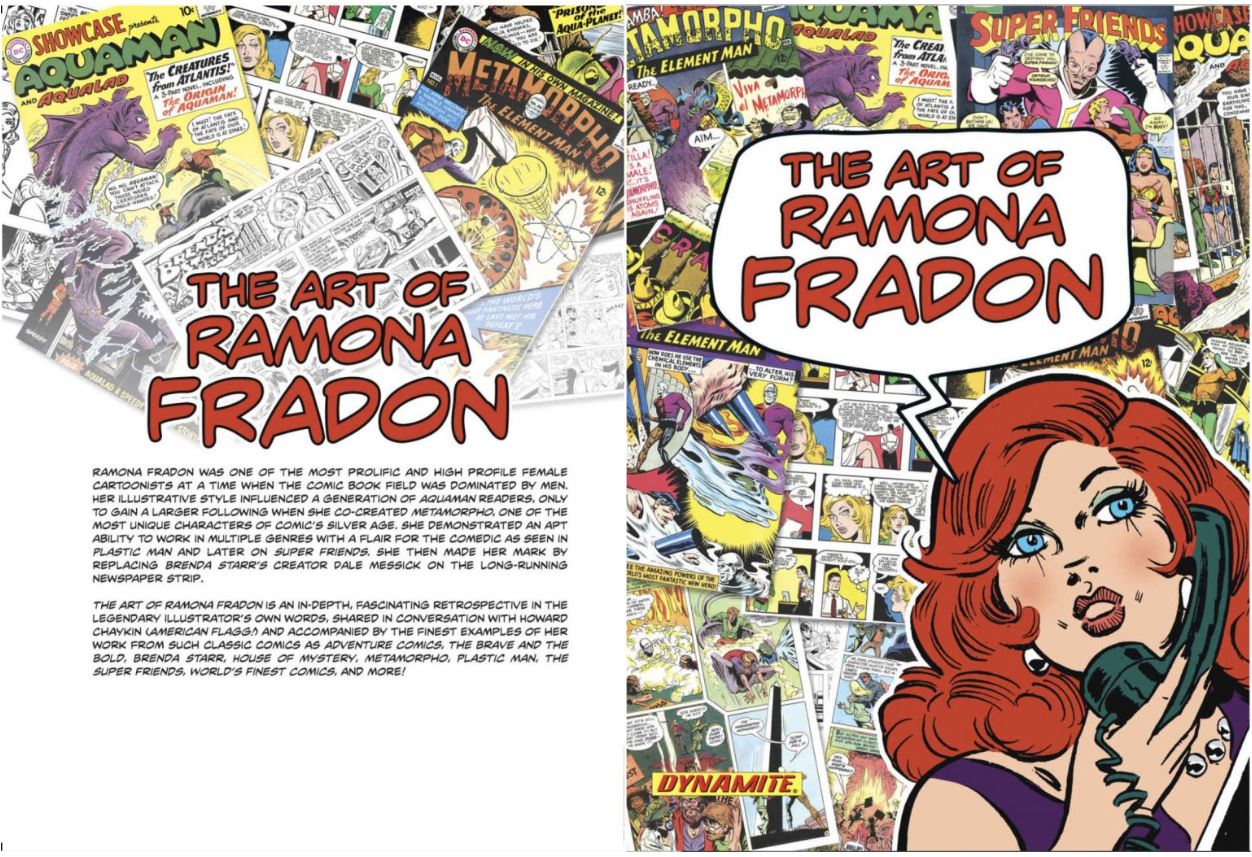
The Art of Ramona Fradon


By Ramona Fradon; interviewed by Howard Chaykin (Dynamite Entertainment)
ISBN: 978-1-60690-140-3 (HB/Digital edition)

Although present in comic books from the start, women – like so many other non-white male “minorities” – have been largely written out of history. One of the very few to have weathered that exclusion is Ramona Fradon. This excellent commemorative art collection celebrates not only her life and contribution, but thanks to its format – a free and unexpurgated extended interview with iconoclastic creator Howard Chaykin – offers the artist’s frank and forthright views on everything from work practise to the power of fans…

It all begins with an Introduction from Walt Simonson who proclaims ‘Meet your Idol… and discover They’re even Cooler than you Thought!’, before the early days are revealed in ‘Part One: Setting the Scene’ and ‘Part Two: In the Beginning’

Ramona Dom was born on October 2nd 1926 to an affluent Chicago family with many ties to commercial creative arts. Her father was a respected artisan, letterer and calligrapher who had designed the logos for Camel cigarettes, Elizabeth Arden and other major brands, and also formulated the fonts Dom Casual and Dom Bold. He had plans for his daughter, urging her to become a fashion designer…

The family moved to (outer) New York when Ramona was five., Ramona initially attended The Parsons School of Design, where she discovered she had absolutely no interest in creating clothes. Although she had never read comic books, she had been a voracious reader of illustrated books like the Raggedy Anne and Andy series by John Barton Gruelle, and a devoted fan of newspaper strips. Her favourites included Dick Tracy, Bringing Up Father, The Phantom, Alley Oop, Flash Gordon, Terry and the Pirates and Li’l Abner (all represented here by examples from the 1930s) and she transferred to the New York Art Students League, a hotbed of cartooning…

There she met and married Arthur Dana Fradon, who would become a prolific illustrator, author and cartoonist and a regular contributor to The New Yorker between 1948-1992. They wed in 1948 and he actively encouraged her to seek work in the still young funnybook biz.

‘Part Three: Gingerly Breaking into Comics’ reveals how her first forays at Timely Comics led to DC/National Comics and a Shining Knight story published in Adventure Comics #165 (cover-dated June 1951), ten months later taking over the long-running Aquaman feature in #167. Fradon was one of the first women to conspicuously and regularly illustrate comic books, drawing the strip throughout the 1950s and shepherding the sea king from B-lister to solo star and Saturday morning TV pioneer.

In the first of a series of incisive and informative mini biographies, ‘Sidebar: Murray Boltinoff’ reveals the influence of the much-neglected and under-appreciated editor. ‘Part Four: Queen of the Seven Seas’ and ‘Part Five: Man of 1000 Elements’ show how occasional stints on The Brave and the Bold team-ups led to her co-creation of Sixties sensation Metamorpho, the Element Man. However in 1965 – at the pinnacle of success – she abruptly retired to raise a daughter, only returning to the fold in 1972 for another stellar run of landmark work.

‘Sidebar: George Kashdan’ tells all about the multi-talented scripter before ‘Part Six: Ramona Returns to Comics… At Marvel???’ details how the House of Ideas lured the artist back to her board and highlights her difficulties working “Marvel-style” on assorted horror shorts, The Claws of the Cat and Fantastic Four, all presaging a return to DC…

‘Sidebar: Joseph Patterson’ looks into the astounding strip Svengali who green lit Dick Tracy, Little Orphan Annie, Gasoline Alley and more before ‘Part Seven: Back Home at DC Comics’ where she was busier than ever. As well as horror and humour shorts, Fradon drew a new Metamorpho try-out, superhero spinoff Freedom Fighters and her twin magnum opuses: revived comedy superhero Plastic Man and TV tie-in Super Friends. The revelations are bolstered by ‘Sidebar: E. Nelson Bridwell’, exploring the life of the man who knew everything about everything…

In 1980, Fradon took over Dale Messick’s long-running Brenda Starr newspaper strip, drawing it for 15 years. ‘Part Eight: Leaping From Books to Strips’ explores the painful and unpleasant chore in sharp detail, supplemented by ‘Sidebar: Brenda Starr’ outlining the feature’s history and reprinting those episodes when the ageless reporter met a certain cop, allowing Fradon to finally draw childhood idol Dick Tracy

The most fascinating stuff is left until last as ‘Part Nine: Ramona the Author’ discusses her career post-Brenda: drawing for Bart Simpson and Spongebob Squarepants comics, returning to higher education and writing a philosophical historical mystery novel – The Gnostic Faustus: The Secret Teachings Behind the Classic Text – as well as illustrated kids book The Dinosaur That Got Tired of Being Extinct.

Packed throughout with candid photos, and stunning pencil sketches, painted pictures and privately commissioned works of her stable of past assignments – like Aquaman, assorted Super Friends, Superman, Batman, Wonder Woman, Robin; the Metal Men, Aqualad, Brenda Starr, Black Canary, Shazam/Captain Marvel, Shining Knight, The Atom, The Spirit, Metamorpho and cast, Marvel Girl, Miss America, Power Girl, Catwoman, Hawkman, numerous illustrations from The Story of Superman book, and convention sketches, this celebration concludes with even more fabulous sleek super art images in ‘Part Nine: Ramona Today’ and ‘Part Eleven: Bibliography’

This is an amazing confirmation of an incredible career and any nostalgiac’s dream package. Amongst the gems unearthed here are complete Aquaman stories ‘The Kid from Atlantis!’ (Adventure Comics #269, 1960), ‘A World Without Water’ (Adventure Comics #251, 1958) and ‘How Aquaman Got his Powers!’ (Adventure Comics #260, 1959), plus tales from Star Spangled War Stories (#184, 1975) and ‘The Invisible Bank Robbers!’ from Gangbusters (#30, 1952).

Also on show are unpublished sample strips by Dana & Ramona Fradon and a monumental cover gallery depicting unforgettable images from Super Friends #3, 5-8, 10, 11, 13, 17, 19, 21, 22, 24-27, 31, 33, 36-39 & 41; Plastic Man #16-20; The Brave and the Bold #55, 57, 58, Showcase #30 & 33, Metamorpho, the Element Man #1-5, Namora #1 (2010), Fantastic Four #133 and Freedom Fighters #3.

These are supported by selected interior pages in full colour or monochrome from Star Spangled War Stories #8; Adventure Comics #190; Metamorpho, the Element Man #1; 1st Issue Special #3; Fantastic Four #133; The Brave and the Bold #57; House of Secrets #116 & 136; Secrets of Haunted House #3 & 14; House of Mystery #232 & 273; Plop! #5; Freedom Fighters #3 & 5; Plastic Man #14; Super Friends #6-8, 10, 13, 16, 19, 21, 23 & 25 and the Super DC Calendar 1977.

A truly definitive appreciation of the Comic Book Hall of Fame inductee 2006, this oversized (229 x 305 mm) hardback reproduces hundreds of pages and covers, plus a wealth of out-industry artwork and commissioned wonders, as accompaniment to an astonishingly forthright testament and career retrospective of a phenomenal and groundbreaking talent.

The Art of Ramona Fradon will delight everyone who wants to see a master in their element showing everybody how it should be done….

Marvel Characters © and ™ 1941-2013 Marvel Characters, Inc. DC Comics Characters © and ™ DC Comics. Brenda Starr™ © 2013 Tribune Media Services. All Rights Reserved

Supergirl: Woman of Tomorrow


By Tom King, Bilquis Evely, Matheus Lopes, Clayton Cowles & various (DC Comics)
ISBN: 978-1-7795-1568-1 (TPB/Digital edition)

As a rule, superhero comics don’t generally do whimsically thrilling anymore. They especially don’t do short or self-contained. Modern narrative momentum concentrates on continuous extended spectacle, major devastation and relentless terror and trauma. It also helps if you’ve come back from the dead once or twice and wear combat thongs and thigh boots…

Although there’s nothing intrinsically wrong with that – other than a certain inappropriateness in striving to adjust wedgies during a life-or-death struggle – sometimes the palate just craves a different flavour…

Once upon a time, angsty in-continuity cataclysm was the rule, not the exception, but ever since DC readmitted all its past epochs into one vastly welcoming expansion multiverse via the Dark Night: Death Metal, Future State and Infinite Frontier mega-events, a spirit of joyous experimentation has resulted in some truly memorable storytelling.

This decidedly backward-looking modern fable harks back to simpler days of clearly defined plots, solid, imaginative characterisation and suspensefully dramatic adventure, by way of an almost alternative take on redoubtable Kara Zor-El, late of Krypton’s Argo City and another illegal alien immigrant on Earth.

Supergirl first gained popularity as a back-up feature in Action Comics: a tag-along (and trademark protection device) to her more illustrious cousin. After years of faithful service, in 1985 she was killed as a sales gimmick in the groundbreaking Crisis on Infinite Earths. Since then, a number of characters have used the name – but none with the class or durability of the original.

This latest incarnation cunningly references much of the original’s trappings, but combines stellar whimsy, dark modern attitudes and an edgier twist, as befits today’s readership. Written by Tom King (Mister Miracle, The Vision, The Sheriff of Babylon, Omega Men, Strange Adventures, Batman) and delightfully illustrated by Brazilian artist Bilquis Evely (Wonder Woman, The Dreaming, Detective Comics, Shaft: a Complicated Man) in a deliriously addictive, retro-futurist pulp style, it examines the concepts of justice and power of reputation through the wide eyes of a worshipful child who is both outraged orphan and lonely sidekick/secret weapon in waiting…

After a few intriguing concept-tweaking test-runs, the first true Girl of Steel debuted as a future star of the ever-expanding Superman pocket universe in Action Comics #252 (cover-dated May 1959). Superman’s cousin had been born on a city-sized fragment of Krypton, hurled intact into space when the planet exploded. Eventually, Argo turned to Kryptonite like the rest of the detonated world’s debris, and Kara’s dying parents, observing Earth through their viewer scopes, sent their daughter to safety even as they apparently perished.

Crashlanding, she immediately and fortuitously met the Metropolis Marvel, who created a cover-identity: hiding “Linda Lee in an orphanage in bucolic Midvale so that she could adjust to and learn about her new world whilst mastering her powers in secrecy and safety.

…And isolation. At no stage did anyone consider moving the recent orphaned newcomer in with her only surviving family. Kara reached her maturity without the closeness Clark Kent’s human parents provided …although she was eventually adopted by Earth couple Fred and Edna to become Linda Lee Danvers

Supergirl experienced her own secret double life in the rear of Action Comics: gradually moving from Superman’s covert secret weapon to an independent star turn, and from minor player to acclaimed public celebrity. From the back of the book to the front of the house is always a reason to celebrate, right?

For decades, DC couldn’t make up their minds over Supergirl. I’ve actually lost count of the number of different versions to have cropped up over the years, and never been able to shake a queasy feeling that above all else she’s a concept that was cynically shifted from being a way to get girls to reading comic books to one calculated to ease young male readers over the bumpy patch between sporadic chin-hair outbreaks, voice-breaking and that nervous period of hiding things under your mattress where your mum never, never ever looks…

Her popularity waxed and waned until her attention-grabbing death during Crisis on Infinite Earths. However, in the aftermath – once John Byrne had successfully rebooted the Man of Steel and negated her existence along with all other elements of doomed Krypton – non-Kryptonian iterations began to appear: each accumulating a legion of steadfast fans. Ultimately, early in the 21st century, DC’s Powers-That-Be decided the real Girl of Steel should come back… sort of…

The New 52 company-wide reboot recast her as an angry, obnoxious distrustful teen fresh from Argo, before the 2016 DC: Rebirth event unwrote most of those changes: bringing back much of that original origin material whilst aligning the comic book iteration with the popular TV series broadcast from October 2015 to November 2021. Then under the aegis of the Infinite Frontier revolution, King, Evely, colourist Mat Lopes & letterer Clayton Cowles crafted 8-issue limited series Supergirl: Woman of Tomorrow (cover-dated August 2021-April 2022).

This focussed on a major moment in the hero’s life and how it changed everything…

King was inspired by Charles Portis’ 1968 novel True Grit – and both movie adaptations – to cast Supergirl as mentor to a vengeance-obsessed child: tracing how a united quest/journey reshaped both of them. Employing the latitude afforded by IF’s umbrella premise, he incorporated iconic characters and trappings from various iterations of Kara’s many super-lives. The result is pure magic, made real by Bilquis and her visual collaborators.

Wordy and wondrous, colours and calligraphy are key components of this space opera, which opens with youthful narrator Ruthye Marye Knoll disclosing how she first met an alien voyager after merciless bandit Krem of the Yellow Hills butchered her father…

Intent on rightful retribution, little Ruthye tracks the killer to a tavern in ‘Men, Women, and Dogs’, encountering a violent drunken woman from another world. Supergirl was on this unnamed backwater red sun world with frivolous intent: it was her 21st birthday and she wanted to get really, really drunk…

Things go bad when Supergirl tries to help her get justice. The intergalactic warrior seriously underestimates Krem, and nearly dies when he puts three arrows through her chest, before apparently killing her dog Krypto and stealing her spaceship…

Barely alive, Kara agrees to let Ruthye help her hunt Krem down: travelling so very slowly by commercial starship and encountering the full annoying range of sentient lifeforms – and a deadly space dragon – in ‘Wounded, Stranded, and Impotent’, before finally reaching a region of space where yellow suns can recharge her…

Stranded on tourist trap Coronn for weeks, they jointly expose appalling racist atrocity in ‘Modest, Calm, and Quiet’ and learn the quarry has joined Barbond’s Brigands: a marauding fleet of space plunderers who become Supergirl’s greatest concern after their latest raid exterminates an entire species in ‘Restraint, Endurance, and Passion’.

Repeated close encounters with them result in furious frustration as Krem has mastered a mystic banishment spell that deposits his pursuers all over the cosmos. Slowly, steadily, Supergirl and Ruthye close in, with the latter honing her skills in eager anticipation of bloody revenge, despite anything Kara can say to dissuade her. Repeatedly fighting a succession of colossal lizard beasts, and enduring a slow painful death and resurrection, does nothing to help their moods either in ‘The Lake, the Trees, and the Monsters’

Finally – reinforced by magical superhorse Comet – the seekers capture Krem and spectacularly engage the brigands in ‘Home Family, and Refuge’ and ‘Hope, Help, and Compassion.’, but the outcome is shockingly unexpected …and tragic.

Final chapter ‘Ruthye, Supergirl, and Krem of the Yellow Hills’ delivers major emotional and conceptual payoffs as antagonists and protagonists take their vendetta to its foregone conclusion. The vengeful child fulfils her quest, but learns some adult truths…

Supplemented by a covers-&-variants gallery by Evely, Lopes, Gary Frank & Alex Sinclair, Lee Weeks, David Mack, Rose Besch, Amy Reeder, Steve Rude, Nicola Scott & Annette Kwok and Janaina Medeiros, this book includes a stunning swathe of character and costume designs, to augment a tale profoundly and consciously mythic in scope and execution.

The apparent maiming and deaths of beloved characters – and animals at that! – and epic transitions and evolutions of the twin leads are potently and evocatively depicted against a universe of inspirational wonders and casual horrors, allowing us to see how heroes are forged, and the device of using a childlike Boswell to define Supergirl’s humanity is both compelling and revelatory.

A cosmic odyssey in the grandly poetic idiom of Jack Vance and Samuel R. Delaney, realised via retro-futuristic visuals reminiscent of Roy G. Krenkel, Jack Katz and Michael William Kaluta, Supergirl: Woman of Tomorrow is a mesmerising mix of space opera and superhero drama exploring the mechanics of myths and power of storytelling on a multitude of levels.

It’s also a sublime rollercoaster ride of vivid, cathartic joy for old fans and newcomers alike: one every fantasy and adventure lover must see.
© 2022 DC Comics. All Rights Reserved.

E-Man – The Early Years


By Nicola Cuti & Joe Staton & various (First Comics Inc.)
ISBN: 978-1-61855-000-2 (TPB/Digital edition)

In 1973, superheroes were in a severe decline and the few surviving publishers in the industry were making most of their money from genre fare like war, westerns, kids cartoon and licensed titles (if they could secure them) and particularly horror stories. Such was certainly the case at Charlton Comics: a self-confessed “little company” which nevertheless always punched above its weight.

That was particularly true in terms of talent discovery, with the likes of Dick Giordano, Sam Glanzman, Steve Ditko, Roy Thomas, Denny O’Neil, Jim Aparo, Sam Grainger, Sanho Kim, Wayne Howard, Tom Sutton, Don Newton, Mike Zeck, Roger Stern, Roger Slifer, Bob Layton and John Byrne making a mark there before moving onwards and upwards.

Another major discovery was ultra-versatile cartoonist Joe Staton. He was quickly becoming a fan favourite and shared an off-kilter sense of humour with a Charlton sub-editor who moonlighted as a writer of horror and fantasy for the company’s anthologies…

Nicola “Nick” Cuti (Moonchild, Cannon, Sally Forth, Creepy, Moonie the Starbabe, The Creeper, Spanner’s Galaxy, Captain Cosmos, Starflake the Cosmic Sprite) was born on October 29th 1944. Since then, he’s been an “Underground Comix” cartoonist, animator, film maker, magazine illustrator, movie backdrop designer, novelist, editor and comics scripter.

Between 1972 and 1976 he was assistant to award-winning cartoonist – and Charlton’s general editor – George Wildman (Popeye) who wanted to test the murky waters with a new superhero. He tapped Cuti to write something a bit different and used the experimental vehicle to try-out a succession of features at the back: crafted by creators like Sutton (The Knight), Ditko (Killjoy, Liberty Belle) and Byrne (Rog-2000). Cuti wrote many of them too…

Born January 19th 1948, Joe Staton (Primus, Wheelie and the Chopper Bunch, The Six Million Dollar Man, Space 1999, The Avengers, The Incredible Hulk, Deadly Hands of Kung Fu, Silver Surfer, Green Lantern Corps, Guy Gardner, Legion of Super-Heroes, Millennium, All Star Comics, Power Girl, Metal Men, Doom Patrol, Plastic Man, Mike Danger and more) is a writer and incredibly versatile artist/inker who has been an integral part of American comic books since the early 1970s.

He has worked for dozens of companies, co-creating The Huntress, Killowog, The New Guardians and The Omega Men and in later years made kids comics his metier. During a spectacular run on licensed classic Scooby Doo, he and series scripter Mike Curtis (Casper the Friendly Ghost, Richie Rich, Shanda the Panda) discovered a mutual love for Dick Tracy and – mostly for their own amusement – created tribute strip Major Crime Squad.

That led to them being invited to handle the prestigious Dick Tracy strip (from 2011 to October 2021) but throughout that epic and varied career, Staton regularly re-partnered with Cuti on further adventures of his first triumph…

A pioneering masterpiece of superhero whimsy, E-Man tells the convoluted love story of a alien lifeform and a wonderfully capable and smart earth girl, and the weird life they make for themselves. It all began in 1973 (Happy Golden Anniversary!) in a 10-issue run that was barely noticed by the readership but which affected how many future comics creators remade the medium.

This cheerful and charming collection gathers the E-Man moments from that initial run and includes technically unpublished tales from said run, plus covers and other material from the hero’s revival as part of the Independents Publishing revolution of the 1980s.

We begin with a brace of Introductions as ‘Finding the Right Words for Joe, Nick and Alec Tronn’ by Jon B. Cooke and ‘E-Man: His Beginnings’ by Cuti contextually set the scene for an extraordinary meeting…

Cover-dated October 1973, “Collector’s Item! First Edition!!” E-Man #1 starts at ‘The Beginning’ revealing how, millions of years ago, a star exploded and released a packet of energy that had spontaneous sentience, immense curiosity and no knowledge at all. The bundle of wonder floated across the galaxies seeking intelligence but encountering none until arriving near our world just as a star-ship from Sirius attempts to attain orbit around Pluto.

Infiltrating the vessel, the energy being converts into matter, duplicating one of the robots serving the giant Brain commanding the mission and overhears how the warlike cyborg is here to test an experimental ultra-weapon on the frozen target. Sadly, curiosity proves fatal and the sudden weight increase sends the ship careening out of control and ultimately into the atmosphere of the blue-green planet third out from the sun…

Some time later, college student Katrinka Colchnzski is just finishing her evening job. She is a tough, brilliant, capable and proudly independent: paying for her degree as burlesque dancer Nova Kane when one of the lightbulbs in her dressing room begs her for help.

Freeing the energy creature and quickly striking up a friendship with the naïve, affably clueless being – who has unselfconsciously turned into a real stud-muffin by human standards – she is abruptly drawn into a world of insane danger when her landlord tries to kill her. It transpires that in ‘The Brain and the Bomb’ the super cerebral invader has also survived the crash and is vengefully testing hate-gas on the inhabitants…

Without hesitation Nova and the stranger seek out and stop the plot…

These tales were originally quite quirkily coloured by Wendy Fiore and are reconstructed here by Matt Webb, who also shades the cover to Original E-Man #1: a reprint series released by First Comics in October 1985 to supplement their revival of the hero. That book also revisited the second escapade of guileless alien visitor Alec Tronn as first seen in E-Man #2’s ‘The Entropy Twins’ (December 1973). Here, the Brain from Sirius unleashes a second super-weapon against E-Man and Nova: an artificially-bred loving couple who can casually manipulate the forces of order and chaos.

Stalking and befriending the childlike hero and his charming cohabitator, Michael and Juno cause catastrophic accidents which almost kill Nova, only to learn that her special friend Alec is as vengeful as any child when the things he loves are threatened…

An unused cover from 1974 accompanies article ‘The Energy and Paper Crisis’, explaining how a global power shortage both inspired and derailed a comic response. The upshot was that the story intended for the fourth issue ended up in #3, and the third followed after. The chronological anomaly is corrected here with E-Man #4 going first.

Cover-dated August 1974, ‘City in the Sand’ sees the odd couple in Egypt with exotic dancer Nova showing belly dancers how it’s done at night and pursuing her archaeological studies during the day. With Alec in tow, she unearths an ancient mystery and – thanks to E-Man – functional time machine: propelling them back millennia to uncover a link between the pharaohs and a lost colony of aliens afflicted with mad militarism and a sinister plague…

December 1985’s cover of Original E-Man and Michael Mauser #3 precedes June 1974’s E-Man #3, wherein ‘The Energy Crisis!’ blacking out America and the world leads oil baron Samuel Boar to unleash a robotic Battery to kidnap useless, over-abundant humans and turn them into a new fuel source.

When Nova vanishes, E-Man stops powering up hospitals to go looking for her. He is unaware that Nova had already engaged seedy private eye Michael – “don’t call me Mickey” – Mauser to find her fellow dancer Rosie Rhedd after she was sucked into a brick wall…

The sordid shamus became a fixture and even won his own series in Vengeance Squad….

The invasion of Boar’s citadel and clash with ‘The Battery’ is fast and furious and leads to the villain’s capture but would have shocking consequences in the fullness of time…

The tale ends with a direct plea to readers to protect the environment and “save the Earth!”. It’s a shame more kids didn’t buy this comic back then and avoid the mess we’re all in now…

Staton had been growing in skill and confidence and by this story had taken to adding what we now call easter eggs to his art. Backgrounds, minor characters and especially posters and newspapers provided a rich source of added whimsy, commentary and fun. They are a sheer delight to this day…

The Original E-Man #2 cover from October 1985 leads into November 1974’s #5 as ‘The City Swallower’ sees a day at the beach devolve into a transdimensional excursion. When Alec follows a hippy mermaid (based on contemporary and legendary fandom icon Heidi Saha) back to her realm he’s just in time to spearhead a war against a beast that consumed helpless conurbations, after which January 1986’s Original E-Man and Michael Mauser #4 cover leads to monster madness in E-Man #6.

‘Wunder-world’ – cover-dated January 1975 – sees an old enemy resurface when Alec and Nova visit a theme park, using robots, movie horrors, war machines and psychological warfare to attack the unlikely couple…

A full, illustrated list of ‘E-Man and Nova – Other Appearances’ is followed by #7’s ‘TV Man’ (March 1975) as another old enemy uses the airwaves and super-science to turn the energy- man into Nova’s worst nightmares and Mauser reappears to save the day. It’s followed by Original E-Man and Michael Mauser #5’s cover (February 1986) and heralds a really big change…

With #8’s full-length epic ‘The Inner Sun’ (May 1975) the creators brilliantly exploit the capricious, functionally implausible nature of comics books to deliver a superb slice of nonsense that begins when a giant jungle girl attacks New York. When she then busts into Mauser’s office…

Her trail leads to Samuel Boar and a primeval world under the North Pole…

Unless I’ve already convinced you to seek this book out, be warned that there’s a major spoiler ahead. Stop here if you’re going to read the actual stories. Or not. It’s your choice.

By the time E-Man gets there though, the villain has kidnapped Nova and triggered a disaster that kills her. It’s not anything to worry about as – through typically miraculous circumstances – she reconstitutes herself with the same powers as boyfriend Alec and begins her own crime crushing career…

March 1986’s cover to Original E-Man and Michael Mauser #6 is accompanied by text feature ‘Other Appearances by Michael Mauser’ before E-Man #9 (July 1975) unleashes ‘The Genius Plant’ which is foreshadow by brief ‘Prologue! History of E-Man and Nova’

Accompanied by new cast member Teddy – a reformed evil koala – the hot couple stumble into a plot by a cabal of scientists to hyper-enhance their intellects and rule the world. After they foil that, one final cover – Original E-Man and Michael Mauser #7 (April 1986) – segues into E-Man #10 (September 1975) as Nova meets the first girl Alec met when he landed on Earth. Although initially jealous, after meeting Maisy-June Bragg, she’s with her beau all the way when what appear to be unnatural forces reduce the gentle rural bombshell into ‘The Witch of Hog Hollow’ who really needs her old “genie” to save her…

E-Man was simultaneously Charlton’s worst selling retail title but its best via direct subscription, which kept it going long after Wildman should have killed it, but at last the axe fell. When it died, there were a couple of tales still in the pipeline which eventually saw print in the company’s in-house fanzine – which was edited by Bob Layton.

Coloured by Webb, Staton’s cover for Charlton Bullseye #2 (1975) and Charlton Bullseye #4 (March/April 1976) here precede ‘…And Why the Sea is Boiling Hot’ (colour by Webb & Michael Watkins) wherein the energy-beings investigate missing shipping and discover that a ghost galleon is actually an alien artefact.

One final story – starring Nova Kane – details a stunning truth. When that exploding sun detonated way back when, it spawned more than one sentient energy-being – and courtesy of FIRST COMICS INC. – Alec’s opposite number ‘Vamfire’ finally arrives on Earth in a scary yarn coloured by Alex Wald. This frenzied female aspect is a ravenous power leech but Nova and E-Man soon find a way to dispel her “hanger-pangs”…

Biographies of Nicola Cuti and Joe Staton close this archive of sheer escapist delight: capping a glorious revisitation of sharper, smarter, funnier days in comics. However it’s not too late to tune in and get turned on to E-Man and Nova.
© 1973-1974 Charlton Comics, reprinted in Original E-Man and Mauser #1-7 © 1985-1986, First Comics, Inc. All new material © 2011, Joe Staton/First Comics, Inc.). All Rights Reserved.

Von Hoffman’s Invasion Book One


By Tom Tully & Eric Bradbury (Rebellion Studios)
ISBN: 978-1-78108-626-1 (TPB/Digital edition)

In the sixties and seventies the British liked their comics characters weird, wild, utterly amoral, flagrantly inept and invariably corrupt to the core. These days it’s a requirement we only demand from and venerate in our politicians and public servants.

One thing we have adored above all other things is a great, properly flamboyant villain…

British comics have always enjoyed a strange, extended love affair with what can only be described as “unconventional” (for which feel free to substitute “weird” or “creepy”) heroes. So many stars and putative role models of our serials and strips have been outrageous or just plain “off”: self-righteous voyeurs-vigilantes like Jason Hyde, deranged vigilante geniuses like Eric Dolmann, self-absorbed outsiders like Robot Archie, arrogant, morally ambivalent former criminals like The Spider or outright racist supermen such as Captain Hurricane

We also made much of (barely) reformed criminals like Charlie Peace and sinister masterminds in the manner of The Dwarf, Black Max, Dr. Mesmer, Grimly Feendish, The Snake and this particular Menace to Society…

Until the 1980s, UK periodicals exclusively employed an anthological model: offering variety of genre, theme and character on a weekly – or sometimes fortnightly – basis. Humour comics were leavened by action-heroes, whilst adventure papers always carried some palate-cleansing gag-strips and stars. Buster offered the best of all worlds.

Running 1902 issues from May 28th 1960 to 4th January 2000, it delicately balanced drama, mystery, action and comedy, with its earliest days – thanks to absorbing Radio Fun and Film Fun – heavily dosed with celebrity-licensed material starring media mavens like Charlie Drake, Bruce Forsyth and Benny Hill backing up the eponymous cover star billed as “the son of (newspaper strip icon) Andy Capp”.

Buster became the final resting place of many, many companion papers in its lifetime, including The Big One, Giggle, Cor!, Monster Fun, Jackpot, School Fun, Nipper, Oink!,

Whizzer & Chips and Jet, so its cumulative content was wide, wild and usually wacky…

Jet debuted in 1971 but only lasted 22 weeks at a time when our indigenous periodicals industry struggled to cope with spiralling costs and mass importation of brash, flashy, full-colour comics from America.

A product of the editorial policy described as “Hatch, Match and Dispatch”, similar to US try-out comics, it involved launching whole titles with new features to catch reader attention and mercilessly culling them and harvesting the most popular features into established, proven sellers like Lion, Tiger, Valiant or Buster.

Jet was dedicated to adventure features but also carried humour strips. Only three (out of 14 contenders) survived amalgamation, but for The Kids of Stalag 41 the reprieve was a short one. Long-term, only Ken Reid’s immortal Face Ache and a mad masterpiece of weird science called Von Hoffman’s Invasion proved worthy of our attention. The arcane antagonist and enemy of the people even scored the cover spot of issue #1…

British comics in the 1960s and 1970s were a phantasmagorical playground of bizarre wonders. Recognisably heroic protagonists appeared in war, western and gradually declining crime serials, whilst the most memorable momentum devolved to a hybrid, bastardized mixture of fantasy, horror and science fiction themes to spawn unique stars of a graphic pantheon unlike any other…

Another stunning salvo of baby boomer nostalgia courtesy of Rebellion’s Treasury of British Comics strand, this initial collection of Von Hoffman’s Invasion gathers all the material from Jet, spanning May 1st to September 25th 1971 and its continuation in Buster running from October 2nd to February 5th 1972. The home front weird war eventually concluded on October 21st of that year, thanks I’m sure to the sheer quality of its creators, who were undoubtedly drawn away for newer – and potentially more successful – escapades…

I’m sure I don’t need to remind you that this was the mid-Sixties, so racial depictions like the half-sized sumo wrestler-bot last cited were perpetrated “in fun”, and not fairness or good taste…

Von Hoffman’s Invasion was a classic example of the many-stranded uncanny menace genre young Brits thrived upon, blending elements of war stories with super science, seeing evil geniuses thwarted by bold kids and plucky Everymen. It all seemed so incredibly credible thanks to the efforts of two of our industry’s greatest talents…

This inexplicably compelling blend of marauding monster, unjustifiable revenge and scary invasion was scripted by impossibly prolific Glasgow-born Tom Tully. His astoundingly broad output of classic delights included Roy of the Rovers, Heros the Spartan, Dan Dare, Master of the Marsh, The Leopard from Lime Street, Janus Stark, Mytek the Mighty, The Wild Wonders, Nipper, Adam Eterno, The Mind of Wolfie Smith, Johnny Red, Harlem Heroes, Mean Arena, Inferno, The Robo Machines, Football Family Robinson, Buster’s Ghost and many more.

His collaborative co-creator here worked on many of those sagas. The incredibly gripping moody comic art of Eric Bradbury had begun gracing newsagents’ shelves in 1949 in Knockout. Frequently working with studio mate Mike Western, Bradbury drew strips like Our Ernie, Blossom, Lucky Logan, Buffalo Bill, No Hiding Place, The Black Crow and Biggles. He was an “in-demand” illustrator who worked into the 1990s on landmark strips like The Avenger, Cursitor Doom, Phantom Force 5, Maxwell Hawke, Joe Two Beans, Mytek the Mighty, Death Squad, Doomlord, Darkie’s Mob, Crazy Keller, Hook Jaw, The Sarge, Invasion, Invasion 1984, The Mean Arena, The Fists of Jimmy Chang, The Dracula Files, Rogue Trooper, Future Shocks, Tharg the Mighty and so much more…

From the start, Tully & Bradbury delivered intense, claustrophobic tension-drenched, action-packed episodic adventures, opening here with the release after 25 years of a war criminal who was still a fanatical Nazi and faithful servant of the Third Reich.

Doktor von Hoffman had been constructing mechanised moister terror-weapons as WWII ended, and the destruction of his robot centipede tipped him over the edge.

He went to jail sworn to destroy the British, but the only thing he had learned upon his release in 1970 was that biology was more effective than engineering…

In his old lab on the outskirts of Berlin, he created an enlarging chemical that also made those subjected to it slaves to his commands. On reaching the French coast he used it to turn an eel into a colossal animal torpedo and rode it to England, dallying only to sink a cross channel ferry. On beaching in Cornwall, he started his petty campaign of revenge by using the growth gas (concealed in the battered umbrella all evil geniuses carry) to magnify a crab to the size of a house and destroy a fishing village, reinforcing the walking tank with a deadly giant wasp. With local police fearfully outmatched the RAF finally get involved, scoring a rather pyrrhic victory at the cost of an attack helicopter…

Still at large, utterly unsuspected but also deeply paranoid, Von Hoffman continues randomly unleashing destructive colossi – such as giant toads, pigeons, roving dogs and assorted insects – culled from English country gardens until he encounters Barry and Joey Drake. When they are attacked by monsters in the cottage at Little Upton, the young brothers discover one of the serums their scientist dad is working on reverses the effects of the mad doctor’s gas…

It happens when the madman briefly transforms their good dog Major into a marauding beast and an old bottle in the shed saves them and their faithful four-legged friend…

Armed with a solution and plenty of X2FO4, the lads go after the maniac and clash just as Herr Doktor unleashes a massive mole on (or rather under) a British army base. Interrupting a top secret tank test, Von Hoffman ups the ante with a horde of rampaging woodlice that results in a blistering battle between ancient armour and modern ordnance.

It all goes very badly for mankind until Barry and Joey find a way to deploy their dad’s solution…

Thwarted but undaunted, the crazed war criminal then invades a monkey sanctuary where things get really hairy when bad-tempered, behaviourally-challenged chimp Charlie gets a dose of growth gas and goes on a very cinematic rampage…

When that all goes wrong, the boys actually capture the villain, but his umbrella and some rapidly enhanced woodworm serve to extricate Von Hoffman for another assault on Albion: this time augmented by a rampaging rabbit that thumps the army hard. Meanwhile in London, the government is finding it harder and harder to keep a lid on the chaos happening out in the provinces…

The cover-up gets its biggest bashing when aided by a super stag beetle, the Doktor plans to strike a shattering blow to British morale; attacking the nation’s soul by disrupting football’s “Global Cup Final”: a grudge match between England and Germany…

Cue enhanced ants, budgerigars, rats, hedgehogs and spiders, the abduction of England’s captain and the debut of absolutely indescribable pedigreed dog breeder/footy fan Cynthia Fulbright whose help – along with the boys’ serum-filled water pistols – saves the day and cinch the cup for England….

Foiled again and almost out of growth gas, Von Hoffman is on the back foot now, but strikes again with an enlarged coypu that enables to restock his chemical larder by attacking Weldale Research Laboratories whilst building up his forces via the facilities stock of squid and octopi, sparking another battle with the army. Although driven off, the madman is not disheartened: after all, now he has fresh hope, fresh resources and best of all a small army of giant birds and mechanical dinosaurs!

To Be Continued…

Closing this titanic tome is a tempting teaser extract for similarly themed star Black Max so enjoy that too….

Completely bonkers but utterly engaging, this brilliantly wry romp is sheer addictive nostalgia for my generation, but the stories also hold up against anything made for today’s marketplace. Buy it for the kids and read it too. This is a big, bold glorious tale, and brace yourself for even better yet to come…
© 1971, 1972, 2018 Rebellion Publishing Ltd. All rights reserved.