
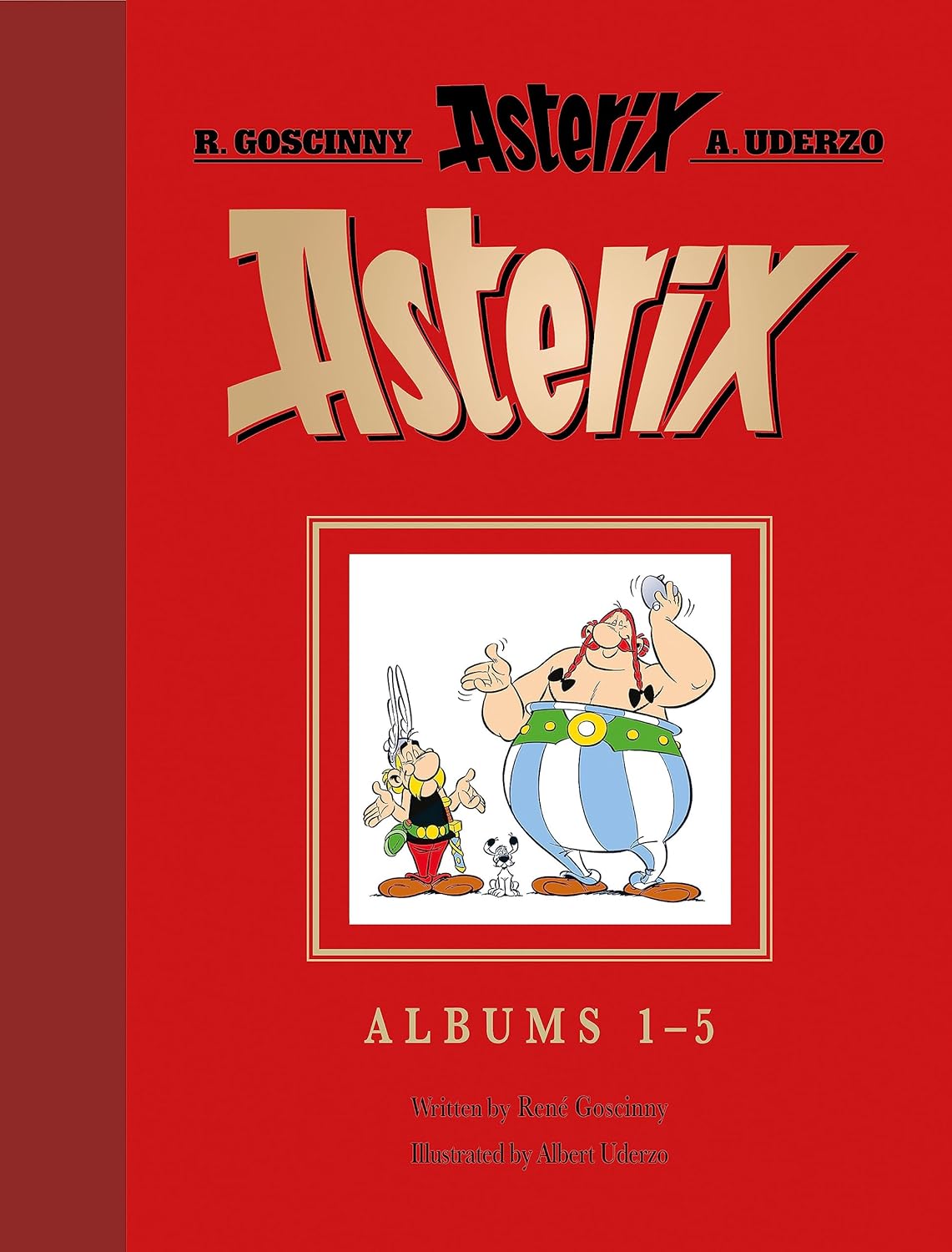
By René Goscinny & Albert Uderzo. translated by Anthea Bell & Derek Hockridge (Sphere)
ISBN: 978-1-40872-831-4 (HB)
This book includes Discriminatory Content produced in less enlightened times. This book includes Discriminatory Content included for comedic effect.
Asterix the Gaul is probably France’s greatest literary export. The feisty, wily little warrior who fought the iniquities and viewed the myriad wonders of Julius Caesar’s Roman Empire with brains, bravery and (whenever necessary) a magical potion imbuing the imbiber with incredible strength, speed and vitality, is the go-to reference all we non-Gallic gallants resort to when we think of France.
The diminutive, doughty, daring darling was created at the close of the 1950s by two of our artform’s greatest masters, with his first official appearance being on October 29th in Pilote #1, even though he had actually debuted in a pre-release teaser – or “pilot” – weeks earlier. On this date in fact. Joyeux anniversaire, mon petit brave!
René Goscinny was arguably the most prolific – and remains one of the most read – writers of comic strips the world has ever known. Born in Paris in 1926, he grew up in Argentina where his father taught mathematics. From an early age René showed artistic promise. He studied fine arts and graduated in 1942. Three years later, while working as junior illustrator at an ad agency, his uncle invited him to stay in America, where he worked as a translator. After National Service in France, he returned to the States and settled in Brooklyn, pursuing an artistic career and becoming, in 1948, an assistant in a small studio which included Harvey Kurtzman, Will Elder, Jack Davis & John Severin, as well as European giants-in-waiting Joseph Gillain (Jijé) and Maurice de Bévère (Morris) with whom from 1955-1977 Goscinny produced 46 volumes of Lucky Luke.
Goscinny also met Georges Troisfontaines, head of World Press Agency, the company that provided comics for Le Journal de Spirou. After contributing scripts to Belles Histoires de l’Oncle Paul and Jerry Spring, Goscinny was promoted to head of World Press’ Paris office. Here he met his ultimate creative collaborator Albert Uderzo. In his spare time (!), René also created Sylvie and Alain et Christine with Martial Durand (“Martial”) and Fanfan et Polo, drawn by Dino Attanasio. In 1955, Goscinny, Uderzo, Charlier & Jean Hébrad formed independent syndicate Édifrance/Édipresse, creating magazines for business and general industry like Clairon for the factory union and Pistolin for a chocolate factory. With Uderzo, René spawned Bill Blanchart, Pistolet and Benjamin et Benjamine, whilst illustrating his own scripts for Le Capitaine Bibobu.
Under nom-de-plume Agostini, he wrote Le Petit Nicholas (drawn by Jean-Jacques Sempé), and in 1956 began an association with revolutionary periodical Le Journal de Tintin, writing for various illustrators including Attanasio (Signor Spagetti); Bob De Moor (Monsieur Tric); Maréchal (Prudence Petitpas); Berck (Strapontin); Globule le Martien and Alphonse with Tibet; as well as Modeste et Pompon for André Franquin, and with Uderzo the fabulously funny adventures of inimitable Indian brave Oumpah-Pah. Goscinny also wrote for magazines Paris-Flirt and Vaillant. In 1959, Édifrance/Édipresse launched Pilote and René went into overdrive. The first issue featured re-launched versions of Le Petit Nicolas, Jehan Pistolet/Jehan Soupolet, original serials Jacquot le Mousse and Tromblon et Bottaclou (drawn by Godard), plus a little something called Astérix le gaulois: incontrovertibly the greatest achievement of his partnership with Uderzo.
When Georges Dargaud bought Pilote in 1960, Goscinny became Editor-in-Chief, still making time to add new series Les Divagations de Monsieur Sait-Tout (with Martial); La Potachologie Illustré (Cabu); Les Dingodossiers (Gotlib) and La Forêt de Chênebeau (Mic Delinx). He also wrote frequently for television, but never stopped creating strips like Les Aventures du Calife Haroun el Poussah (for Record and illustrated by Swedish artist Jean Tabary). A minor success, it was re-tooled as Iznogoud when it transferred to Pilote. Goscinny died far too young, in November 1977.
Alberto Aleandro Uderzo was born on April 25th 1927, in Fismes on the Marne, a child of Italian immigrants. As a boy reading Mickey Mouse in Le Pétit Parisien, he showed artistic flair from an early age. Alberto became a French citizen at age seven and dreamed of being an aircraft mechanic, but at 13 became an apprentice of the Paris Publishing Society, learning design, typography, calligraphy and photo retouching. When WWII came, he spent time with farming relatives in Brittany, joining his father’s furniture-making business. Brittany beguiled Uderzo: when a location for Asterix’s idyllic village was being decided upon, the region was the only choice…
In France’s post-war rebuilding, Uderzo returned to Paris to become a successful illustrator in the country’s burgeoning comics industry. His first published work – a pastiche of Aesop’s Fables – appeared in Junior and, in 1945, he was introduced to industry giant Edmond- Françoise Calvo (The Beast is Dead). Young Uderzo’s subsequent creations included indomitable eccentric Clopinard, Belloy, l’Invulnérable, Prince Rollin and Arys Buck. He illustrated novels, worked in animation, as a journalist, as illustrator for France Dimanche and devised vertical comic strip ‘Le Crime ne Paie pas’ for France-Soir. In 1950, he drew a few episodes of the franchised European version of Fawcett’s Captain Marvel Jr. in Bravo!
Another inveterate traveller, he met Goscinny in 1951. Soon fast friends, they decided to work together at the new Paris office of Belgian Publishing giant World Press. Their first collaboration was in November of that year; a feature piece on savoir vivre (how to live right or “gracious living”) for women’s weekly Bonnes Soirée, after which an avalanche of strips and serials poured forth.
Jehan Pistolet and Luc Junior were devised for La Libre Junior and they produced a comedy Western starring a very Red (but not so American) Indian who evolved into Oumpah-Pah. In 1955, with the birth of Édifrance/Édipresse, Uderzo drew Bill Blanchart for La Libre Junior, replacing Christian Godard on Benjamin et Benjamine before, in 1957 adding Charlier’s Clairette to his bulging portfolio. The following year, he made his Tintin debut, as Oumpah-Pah finally found a home and rapturous audience. Uderzo also drew Poussin et Poussif, La Famille Moutonet and La Famille Cokalane. When Pilote launched in October 1959, Uderzo was its major creative force, limning Charlier’s Tanguy et Laverdure and a comedy historical strip about Romans…
Although Asterix was a massive hit from the start, Uderzo continued with Charlier on Michel Tanguy, (subsequently Les Aventures de Tanguy et Laverdure), but soon after that first comedy history was collected in a single volume as Astérix le gaulois in 1961, it was clear the series would demand most of his time – especially as the incredible Goscinny never seemed to require rest or run out of ideas (after the writer’s death, the publication rate of Asterix tales dropped from two per year to one volume every 3-to-5).
By 1967, Asterix occupied all Uderzo’s time and attention. In 1974 the partners formed Idéfix Studios to fully exploit their inimitable creation, and when Goscinny passed away three years later, Uderzo had to be convinced to continue the adventures as writer and artist. Happily, he gave in and produced a further 10 tomes before retiring in 2009. According to UNESCO’s Index Translationum, Uderzo is the 10th most-often translated French-language author in the world and 3rd most-translated French language comics author – right behind his old mate René and the grand master Hergé.
So what’s it all about?
Like all the best entertainments the premise works on two levels: as action-packed comedic romps of sneaky and bullying baddies coming a-cropper for younger readers and as pun-filled, sly and witty satire for older, wiser heads, transformed here by the brilliantly light touch of master translators Anthea Bell & Derek Hockridge (who played no small part in making the indomitable little Gaul so very palatable to the English tongue).
Originally seen in Pilote #1-38 (29th October 1959 – 4th July 1960, with the first page appearing a week earlier in a promotional issue #0 distributed from June 1st 1959), the story is set in the year 50 BC (never BCE!) on the outermost tip of Uderzo’s beloved Brittany coast. Here a small village of redoubtable warriors and their families frustrate every effort of the immense but not so irresistible Roman Empire to complete the conquest of Gaul.
Unable to defeat these Horatian hold-outs, the Empire resorts to a policy of containment, leaving the little seaside hamlet hemmed in by heavily fortified permanent garrisons – Totorum, Aquarium, Laudanum and Compendium. The Gauls don’t care: they daily defy the world’s greatest military machine by just going about their everyday affairs, protected by a magic potion provided by the resident druid and the shrewd wits of a rather diminutive dynamo and his simplistic best friend…
In Asterix the Gaul, this immaculate comedy-drama scenario is hilariously demonstrated when Centurion Crismus Bonus – fed up with his soldiers being casually beaten up by the fiercely free pre-Frenchmen – sends reluctant spy Caligula Minus to ferret out the secret of their incredible strength. The affable insurgents take the infiltrator in and, soon dosed up with potion, the perfidious Roman escapes with the answer – if not the formula itself…
Soon after, wise, wily Druid Getafix is captured by the invaders and the village seems doomed, but crafty Asterix is on the case. Breaking into Compendium and resolved to teach the Romans a lesson, he drives them crazy for ages by resisting all efforts at bribery and coercion, until abruptly wizard and warrior seemingly capitulate. They make the Romans a magic potion – but not the one the rapacious oppressors were hoping for…
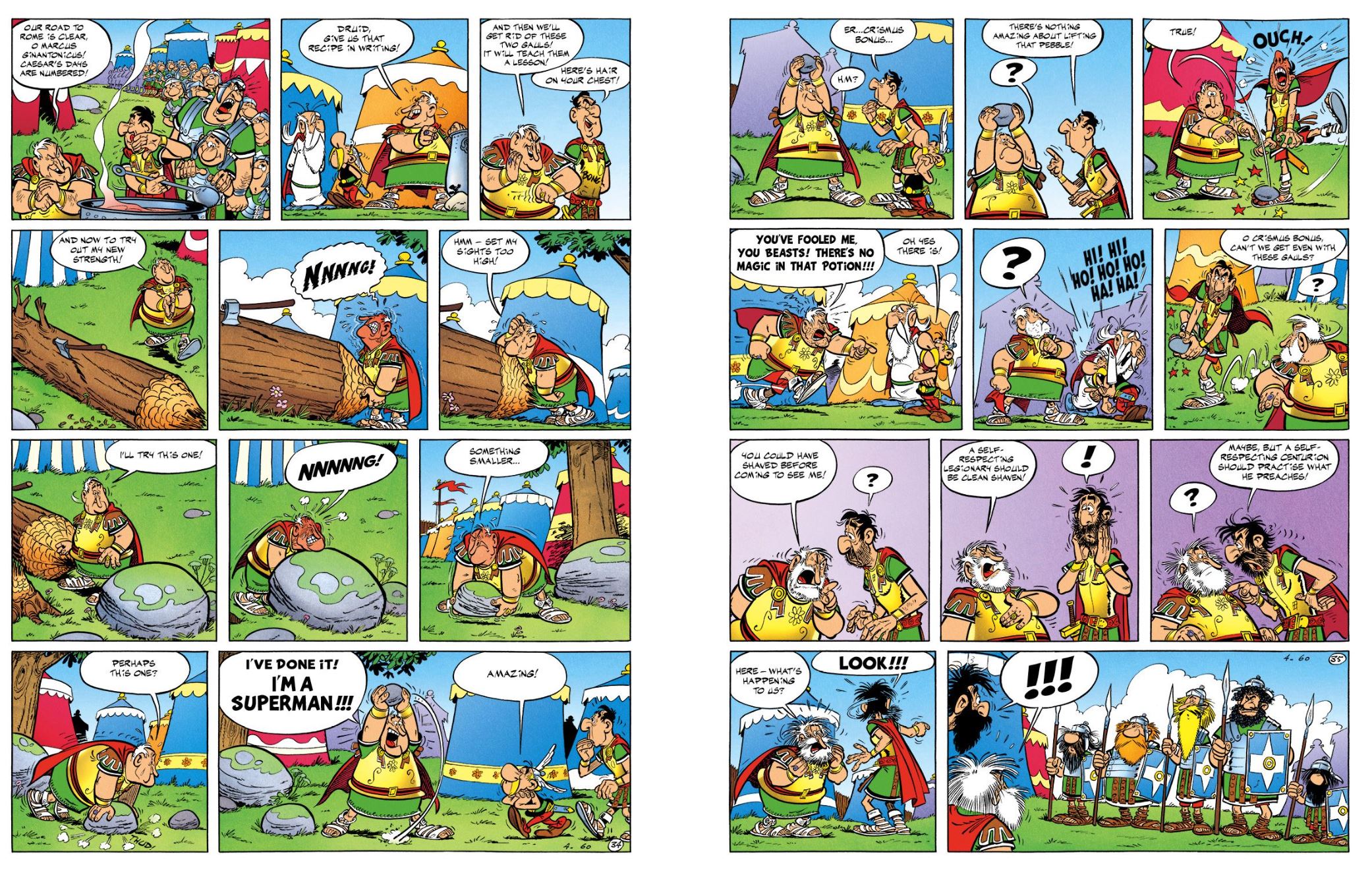
Although comparatively raw and unpolished, the good-natured, adventurous humour and sheer energy of the yarn barrels along, delivering barrages of puns, oodles of insane situations and loads of low-trauma slapstick action, all marvellously rendered in Uderzo’s seductively stylish bigfoot art-style. From the second saga on, the unique and expanding cast would encroach on events, especially the unique and expanded, show-stealing sidekick Obelix – who had fallen into a vat of potion as a baby – and became a genial, permanently superhuman, eternally hungry foil to our little wise guy…
Asterix and the Golden Sickle originally unfolded in Pilote #42-74, recounting disastrous consequences after Getafix loses his ceremonial precious metal blade just as the grand Annual Conference of Gaulish Druids is beginning. Since time is passing and no ordinary replacement will suffice to cut ingredients for magic potion, Asterix offers to go all the way to Lutetia (you can call it Paris if you want) to find another one.
Since Obelix has a cousin there – Metallurgix the Smith – he volunteers for the trip too and the punning pair are swiftly away, barely stopping to teach assorted bandits the errors of their pilfering ways, but still finding a little time to visit many roadside inns and taverns serving traditional roast boar. There is concurrently a crisis in Lutetia: a mysterious gang is stealing all the Golden Sickles and forcing prices up. The Druid community is deeply distressed and, more worrying still, master sickle-maker Metallurgix has gone missing too. When Asterix and Obelix investigate the dastardly doings in their own bombastic manner they discover a nefarious plot that seems to go all the way to the office of the local Roman Prefect…
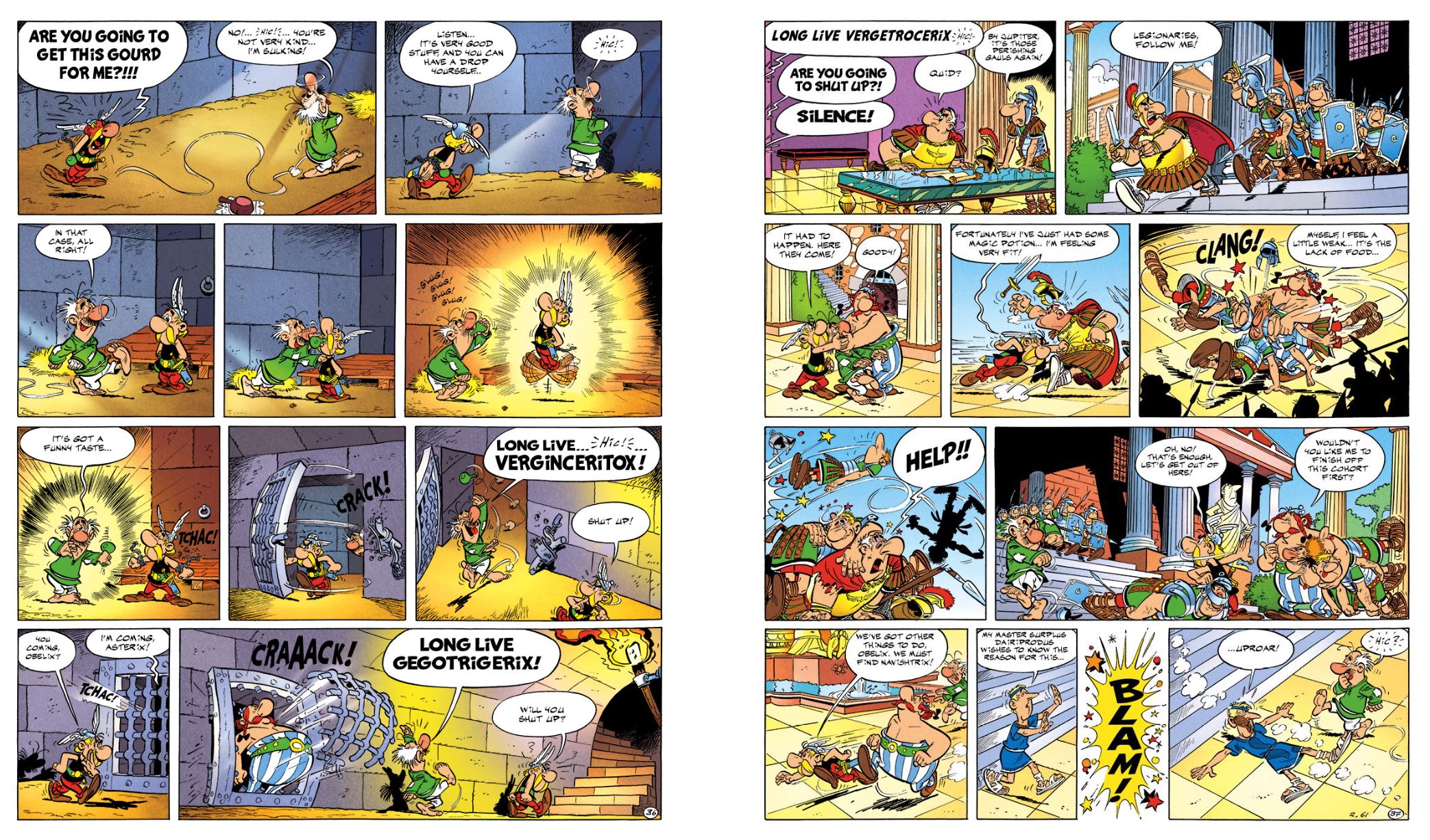
The early creative experiment was quickly crystallizing into a supremely winning format of ongoing weekly episodes slowly building into complete readily divisible adventures. The next epic cemented the strip’s status as a popular icon of Gallic excellence.
Asterix and the Goths ran from 1962-1963 and followed a dangling plot-thread of the Druid Conference as Getafix, brand new sickle in hand, sets off for the Forest of the Carnutes to compete. However, on Gaul’s Eastern border savage Goths – fierce barbarians who remain unconquered despite the might of the Empire – have crossed into pacified Roman territory. These hairy louts are intent on capturing the mightiest Druid and turning his magic against the rule of Julius Caesar…
Although non-Druids aren’t barred from the forest, Asterix & Obelix had accompanied Getafix to its edge, and as the Conference competition round ends in victory for him and his power-potion, the Goths strike, abducting the old boy in his moment of triumph. Alerted by fellow Druid Prefix, our heroic duo track the kidnappers, but are mistaken for Visigoths by Roman patrols, allowing the Goths to cross the border into Germania. Although Romans are no threat, they can be a time-wasting hindrance, so Asterix & Obelix disguise themselves as Romans to invade the Barbarian lands…
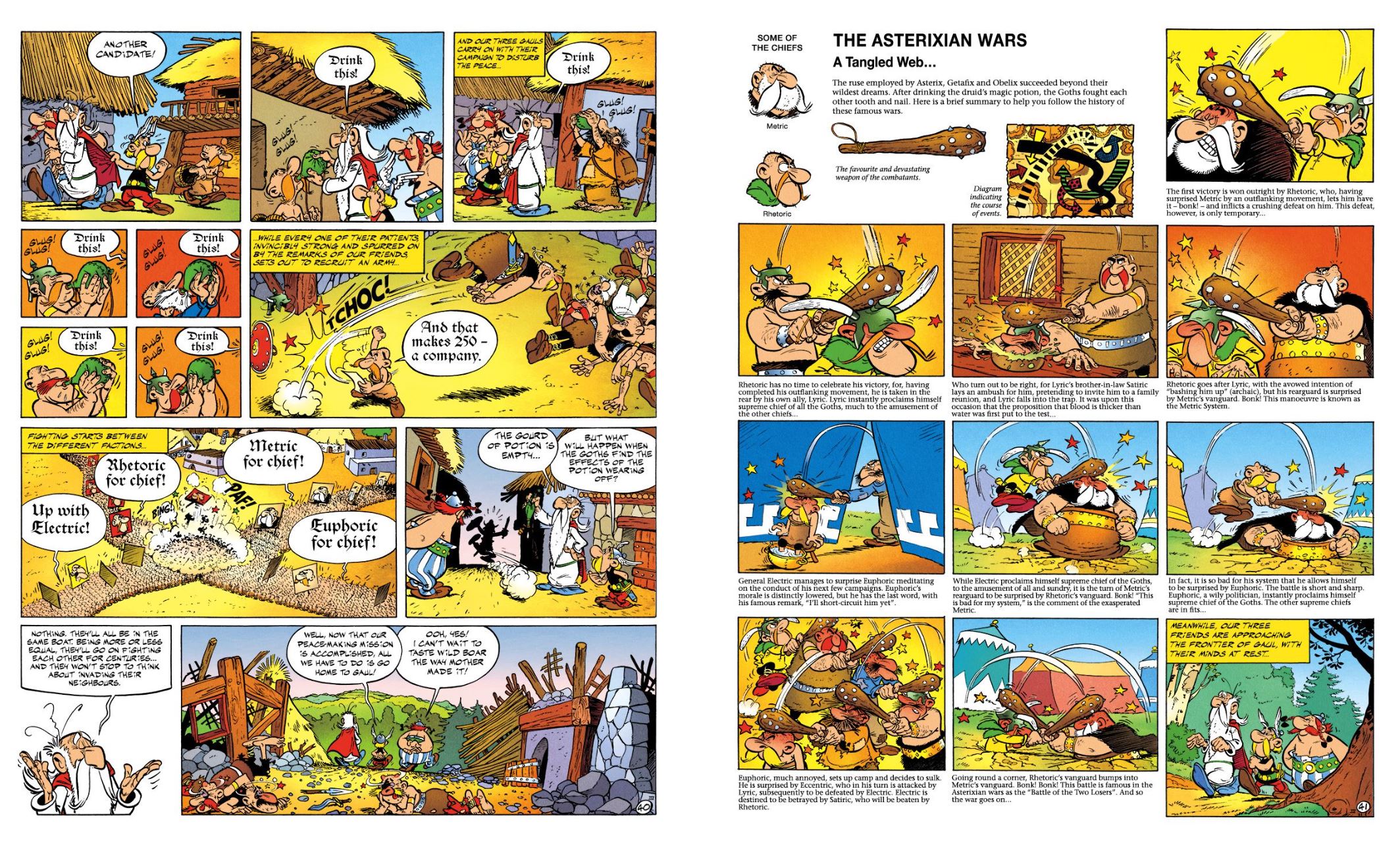
By now well-used to being held prisoner, Getafix is making himself a real nuisance to his bellicose captors and a genuine threat to the wellbeing of his long-suffering Goth-appointed translator. Thus when Asterix & Obelix are captured dressed as Goths, they concoct a cunning plan to end the ever-present threat of Gothic invasion – a scheme that continues successfully for almost two thousand years…
Asterix the Gladiator ran across Pilote #126 to 168 (1963) with the canny rebel and increasingly show-stealing pal despatched to the heart of the Roman Empire on an ill-conceived mission of mercy. When Prefect Odius Asparagus seeks to give Julius Caesar a unique gift, he decides upon one of the indomitable Gauls giving his occupying forces such a hard time. Thus, he has village Bard Cacofonix abducted and bundled off to Rome. Although in two minds about losing the raucous harpist, pride wins out and the villagers mount a rescue attempt, but after thrashing the Romans again they discover that their lost comrade is already en route for the Eternal City…
Assigned to retrieve the missing musician, Asterix & Obelix hitch a ride on a Phoenician galley operated under a bold new business plan by captain/general manager Ekonomikrisis. On the way to Italy the boys first encounter a band of pirates who would become frequent guest-stars and perennial gadflies. The pirates were a creative in-joke between the close-knit comics community: Barbe-Rouge/Redbeard was a buccaneering strip created by Charlier & Victor Hubinon also appearing in Pilote at the time.
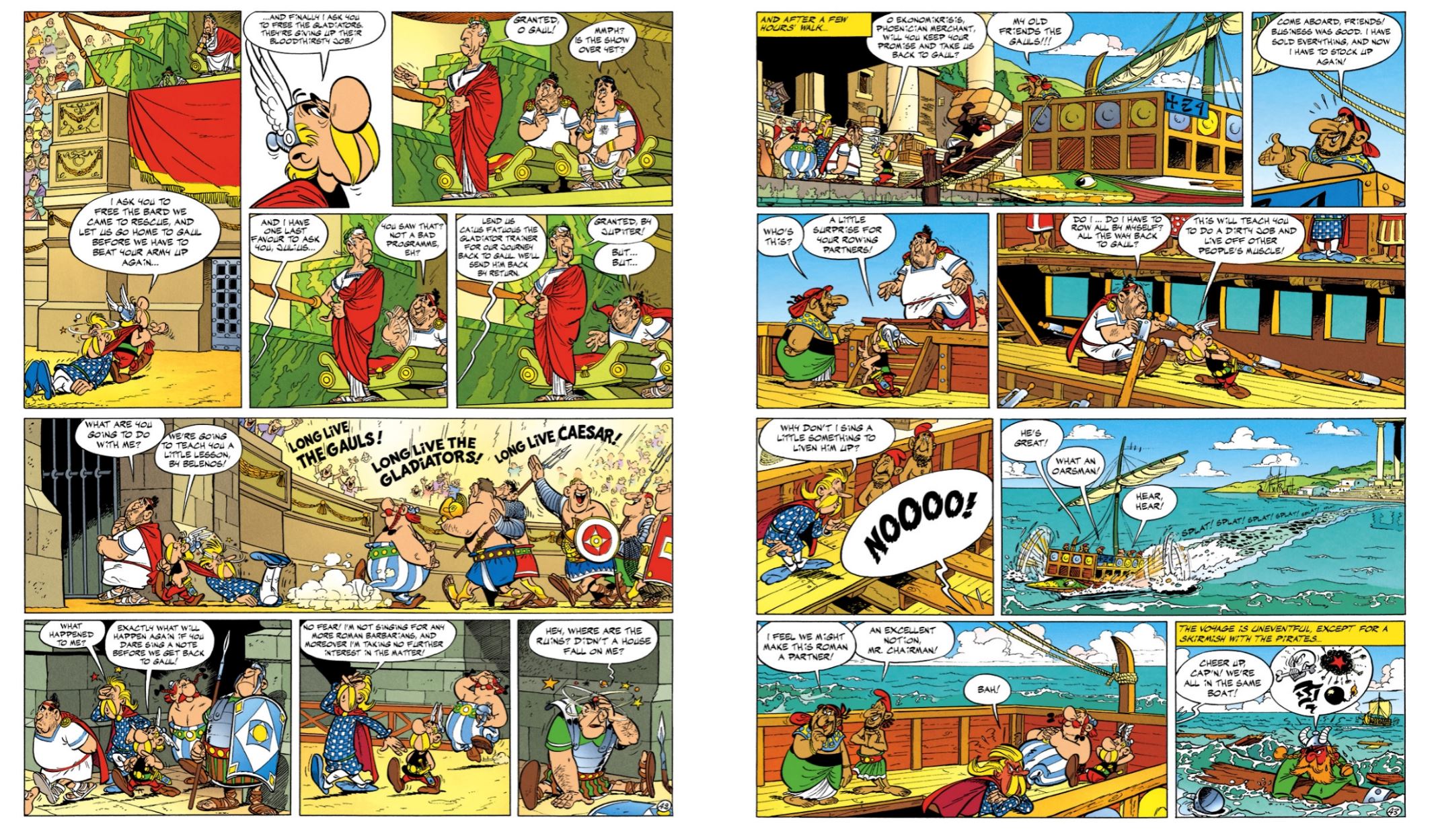
As Asterix & Obelix make friends among the cosmopolitan Roman crowds, Caesar has already received his latest present. Underwhelmed by his new Bard, the Emperor re-gifts Cacofonix to the Circus Maximus, to be thrown to the lions just as his chief of Gladiators Caius Fatuous is “talent-spotting” two incredibly tough strangers who would make ideal arena fighters…
Since it’s the best way to get to Cacofonix, our heroes join the Imperial Gladiatorial school; promptly introducing a little Gallic intransigence to the tightly disciplined proceedings. When the great day arrives, the lions get the shock of their lives and the entertainment-starved citizens of Rome experience a show they will never forget…
As always, the good-natured, comedic situations and sheer finesse of the yarn rattles along, delivering barrages of puns, oodles of insane situations and loads of low-trauma slapstick action, marvellously rendered in Uderzo’s expansive, authentic and continually improving big-foot art-style.
Asterix and the Banquet comes from Pilote #172-213 (also 1963), inspired by the Tour de France cycle race. After being continually humiliated by the intractable Gauls coming and going as they please, Roman Inspector General Overanxius instigates a policy of exclusion, building a colossal wall around the little village, determined to shut them off from their country and the world. Modern world leaders might get a clue from this book, here – if they read books. Even books with pictures…
Incensed, Asterix bets the smug Prefect that Gauls can go as and wherever they please and to prove it invites the Romans to a magnificent feast where they can sample fresh culinary delights from various regions. Breaking out of the stockade and through the barricades, A & O gather produce from as far afield as Rotomagus (Rouen); Lutetia (Paris, where they also picked up a determined little mutt who would eventually become a star cast-member); Camaracum (Cambrai) and Durocortorum (Rheims), whilst easily evading or overcoming the assembled patrols and legions of man-hunting soldiers. However, the heroes don’t reckon on the corrupting power of the huge – and growing – bounty on their heads and some Gauls are apparently more greedy than patriotic…
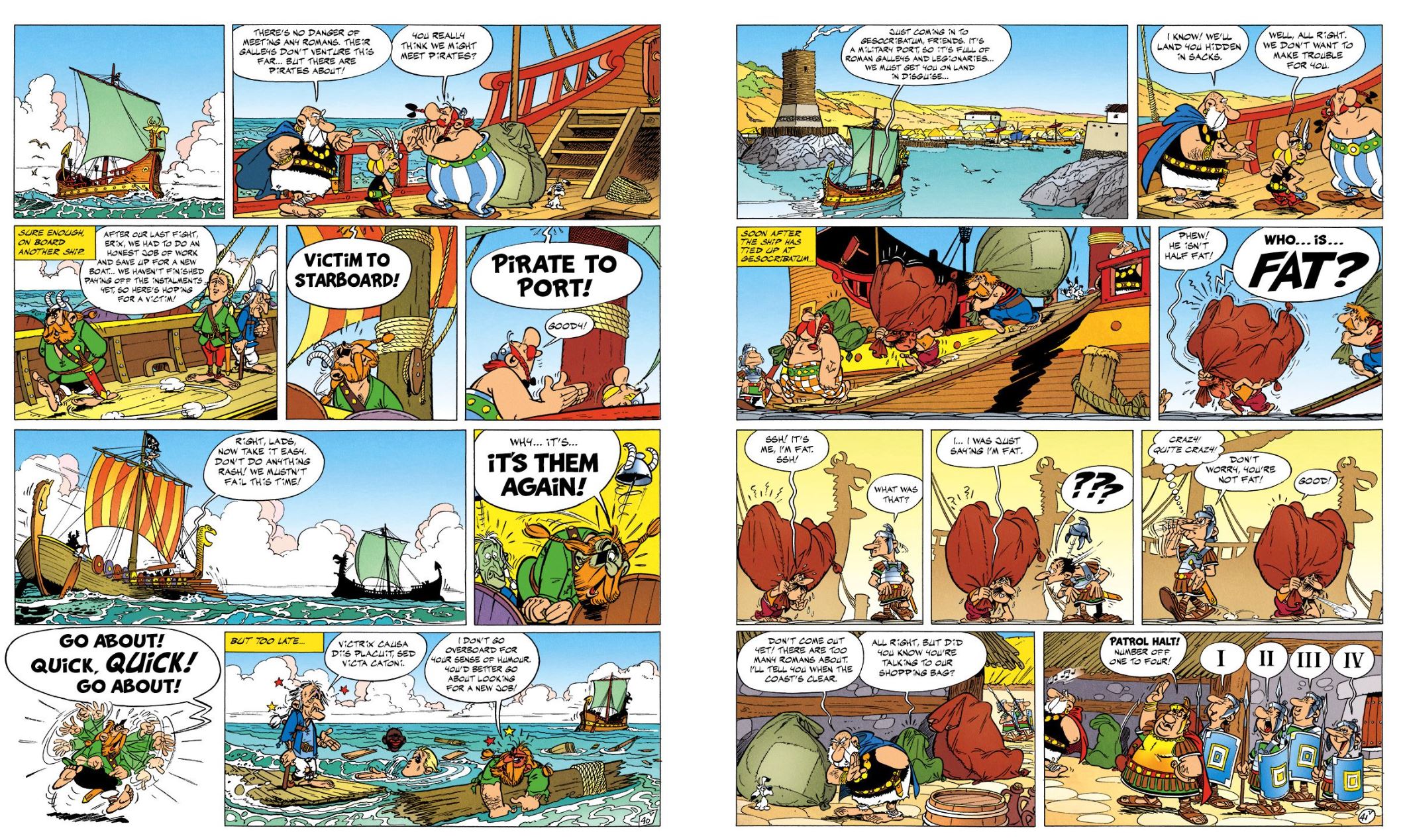
Even with Asterix held captive and all the might of the Empire ranged against them, Gaulish honour is upheld and Overanxius, after some spectacular fights, chases and close calls, is made to eat his words (and a few choice Gallic morsels) in this delightful, bombastic and exceedingly clever celebration of pride and whimsy.
Astérix is one of the most popular comics in the world, translated into 111 languages, with a host of animated and live-action movies, games and even his own theme park (Parc Astérix, near Paris). Approaching 400 million copies of 41 Asterix books and spin-off volumes have been sold worldwide, making Goscinny & Uderzo France’s bestselling international authors. This is sublime, supremely enjoyable comics storytelling and you’d be as Crazy as the Romans not to increase those statistics by finally getting around to acquiring your own copies of this fabulous, frolicsome French Folly. This collection is a great way to enjoy that legacy of legends but be aware that – weighing over a kilo – you might want to top up on magic potion before picking it up…
© 1961-1965 Goscinny/Uderzo. Revised English translation © 2004 Hachette. All rights reserved.
Today in 1907, Disney animator/Gold Key artist & scripter George Waiss (Uncle Scrooge, Donald Duck, Junior Woodchucks, Looney Tunes, Porky Pig) was born, followed in 1919 by Argentinean Golden Age artist Arturo Cazeneuve (Seven Soldiers of Victory, Newsboy Legion, Blue Beetle).
Despite ushering in the age of Immortal Asterix this day in 1959, we lost cartoonist/writer/artist and creator of Millie the Model Ruth Atkinson in 1997 and pioneering strip cartoonist Martha B. “Marty” Links (Emmy Lou, Bobby Sox) in 2008.