
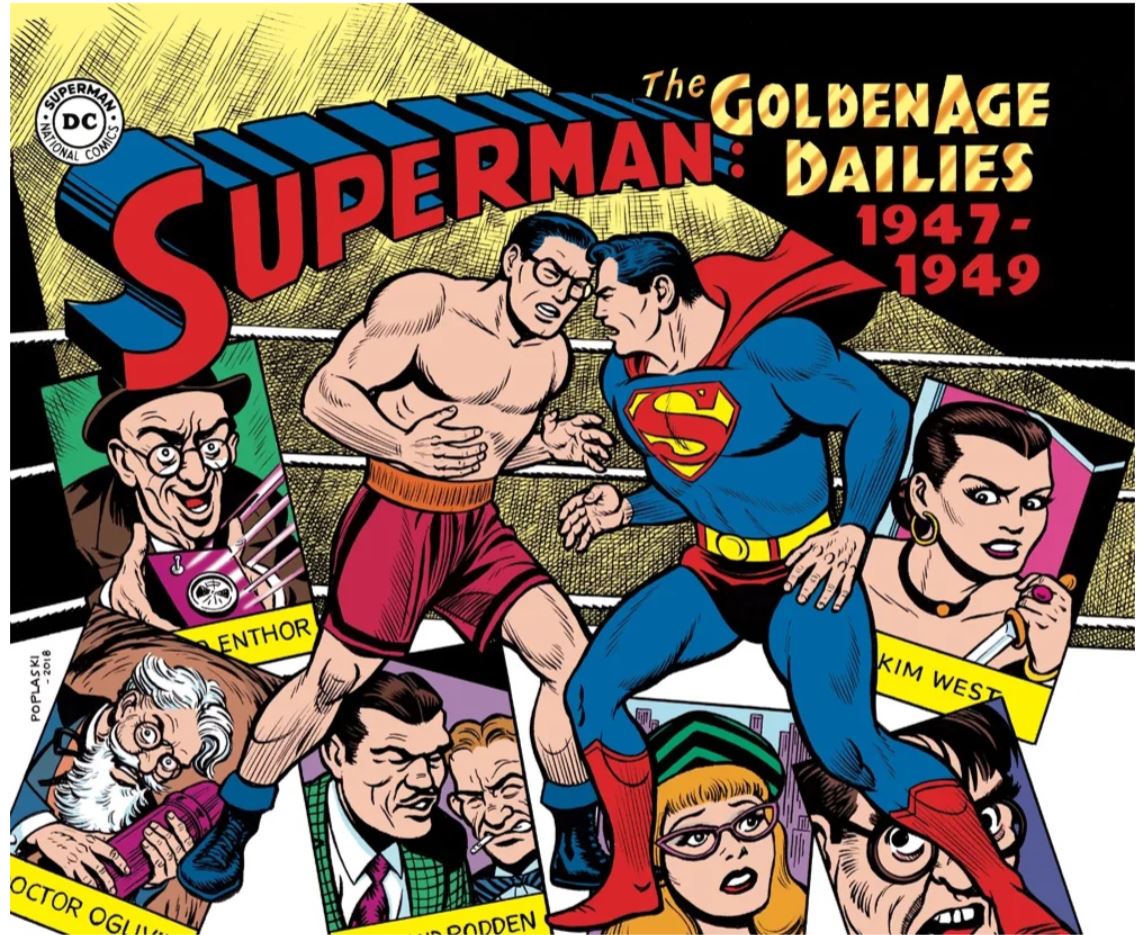
By Alvin Schwartz, Wayne Boring, Jack Schiff, Win Mortimer & various (IDW/Library of American Comics)
ISBN: 978-1-68405- (HB)
This book includes Discriminatory Content produced in less enlightened times.
The American comic book industry – if it still existed at all – would be utterly unrecognisable without Superman. Jerry Siegel & Joe Shuster’s unprecedented invention was first fervidly adopted by a desperate and joy-starved generation, and gave birth to a genre if not an actual art form. Spawning an army of imitators and variations within three years of his 1938 debut, the intoxicating blend of breakneck, breathtaking action and wish-fulfilment epitomising the early Man of Steel grew to encompass cops-&-robbers crimebusting, socially reforming dramas, sci fi fantasy, whimsical comedy and, once the war in Europe and the East sucked in America, patriotic relevance for a host of gods, heroes and monsters, all dedicated to profit through exuberant, eye-popping excess and vigorous, dashing derring-do.
From the outset, in comic book terms Superman was master of the world. Moreover, whilst transforming the shape of the fledgling funnybook biz, the Man of Tomorrow irresistibly expanded into all areas of the entertainment media. Although we all think of the Cleveland boys’ iconic invention as epitome and acme of comics creation, the truth is that very soon after his springtime debut in Action Comics #1 the Man of Steel was a fictional multimedia monolith in the same league as Popeye, Tarzan, Sherlock Holmes and Mickey Mouse. We parochial and possessive comics fans too often regard our purest and most powerful icons in purely graphic narrative terms, but the likes of Batman, Spider-Man, Avengers and their hyperkinetic kind long ago outgrew four-colour origins to become fully mythologized modern media creatures familiar in mass markets, across all platforms and age ranges…
In the last century and even more so in this one, far more people have seen and heard the Man of Steel than have ever read his comic books. These globally syndicated newspaper strips alone were enjoyed by countless millions, and by the time his 20th anniversary rolled around, at the very start of what we call the Silver Age of Comics, he had been a thrice-weekly radio serial star, headlined 17 astounding animated cartoons, become a novel attraction (written by George Lowther) and – by the time of the last stories in this tome – had helmed two feature films. He had then seamlessly segued into the next Big Thing: television. Soon his first (of 8) smash-hit live-action tv seasons would start his next great media conquest, making Superman a perennial sure-fire success for toys, games, food, and puzzle and apparel manufacturers all over the planet.
Although pretty much a spent force these days, for the majority of the last century the newspaper comic strip was the Holy Grail all American cartoonists and graphic narrative storytellers hungered for. Syndicated across the country (and frequently the world) a strip feature could be seen by millions if not billions of readers and was generally accepted as a more mature and sophisticated form of literature than comic books. It also – at the start! – paid better, and rightly so. Some of the most enduring, entertaining characters and concepts of all time were devised to lure readers from one particular paper to another and many of the best became cornerstones of a shared global culture. People across the Earth had a communal context thanks to thrilling to the same comics; and Mutt and Jeff, Buck Rogers, Dick Tracy, Flash Gordon, Charlie Brown and so many more escaped humble, tawdry newsprint origins to become meta-real: existing in the minds of earthlings from Albuquerque to Zanzibar. Most still do…
The daily Superman newspaper strip launched on 16th January 1939, swiftly augmented by a full-colour Sunday page from November 5th of that year. Originally crafted by Siegel & Shuster and their studio (Paul Cassidy, Leo Nowak, Dennis Neville, John Sikela, Ed Dobrotka, Paul J. Lauretta & crucially Wayne Boring), the mammoth task soon required additional talents like strip veteran Jack Burnley and writers including Whitney Ellsworth, Jack Schiff & Alvin Schwartz. The McClure Syndicate feature ran continuously until May 1966, appearing, at its peak, in over 300 daily and 90 Sunday newspapers: a combined average readership of more than 20 million. Eventually, Win Mortimer & Curt Swan joined the unflagging Boring & Stan Kaye, whilst Bill Finger and Siegel also provided stories, telling serial tales largely divorced from comic book continuity throughout years when superheroes were scarcely seen.
This third volume of the Library of American Comics collection continues the prodigious and formidable reprint program begun in the Sterling/Kitchen Sink softcover editions which ceased production in 1999. All of that material – and these books too – are long overdue for re-release and digital editions. Here, however, WWII is well and truly over and the decidedly different demands of peacetime and reconstruction have given way to an era of hectic prosperity, but still see our hero and his regular cast tested and beset by domestically endangering perils and conundrums only a Man of Steel could handle…
We open with another Introduction by Sidney Friefertig, discussing the changes from conflict to reconstruction and detailing why and how poet-turned-thriller writer Alvin Schwartz (1916-2011) became the key writer of the feature as well as sharing contextual, behind-the-scenes moments before our cosy but never-ending battle resumes.
These sequences came six days a week, comprising episodes #47-61, pages #2595 through 3338, and publication dates April 28 1947 to September 3rd 1949. With the material credited to Schwartz (Batman, Wonder Woman, Aquaman, Tomahawk, Newsboy Legion, Slam Bradley, House of Mystery, A Date With Judy, Buzzy, Bizarro) and the sole pictorial province of illustrator Wayne Boring, the compilation kicks off with and a bizarre “manhunt” to solve the dilemma of ‘Who is Miss Whisper?
Running in strips #2595-2654 as seen between April 28th to July 5th 1947, the story depicts mounting frenzy in Metropolis after lonely millionaire at sea Jonathan Dexter experiences a crossed radio line and catches a brief snippet of conversation with a distant voice. Instantly falling inescapably in love with a person he cannot and probably will never see, he is despondent until he remembers how rich he is…
Thus when, Cinderella-style, the heartsore plutocrat uses the Daily Planet to publicise his plight and swears to endow the mystery maid with all his worldly goods, the entire female population goes crazy. Everybody loves a doomed romance but some seek to con him, some attempt to bamboozle or even supplant his absent inamorata and some – gangsters led by cunning rogue Wishbone – seek to replace Miss Whisper with a voice impersonating ringer. Clark Kent and Lois Lane are drawn to the story and Superman promises to help after the rich guy promises to pay a million to deserving charities but even after finding her, the Man of Tomorrow can’t make the quiet quarry want to marry the spoiled rich, groom-to-be…
Nevertheless, because it’s a fairy tale writ large, love does find a way…
Crafted for daily doses, these Superman snippets are torturous, convoluted and often seemingly divert in tangents to indulge in seemingly pointless but epically spectacular super-feats (such as razing an entire forest to make a really, Really big billboard). These are to pad out increasingly formulaic plots and emphasise the “Super” in the hero but also counterpoint the ongoing social commentary and essentially domestic tribulations of familiar and warmly appreciated entertainment characters being constantly put through their paces. That’s clearly seen as greed and venality abound in the next arc as Superman reels under the manic idiocies generated by ordinary people in mounting frenzy once news leaks out that the Man of Steel has agreed to safeguard humanity’s greatest desire made manifest.
Running from July 7th to September 27th, the sorry tale of ‘The Youth Serum’ (strips #2665-2732) sees chemist Dr. Ogilvie unwisely entrust his age-defeating miracle mixture to shady promoter Willie Poster who triggers a literal stampede of the vain, vainglorious and outright villainous who will do anything to roll back a few years… including bribery, fraud, theft and kidnapping Daily Planet staff to compel the Man of Steel to hand over the rejuvenation juice…
With the multi-million daily readership reckoned to be at least 50% female, encroaching domesticity was a regular plot standby but Alvin Schwartz proved able to tweak the situation in unusual ways. For ‘The Marriage Gamble’ (#2733- 2768; September 29th to November 8th) he enfolds Lois & Clark in a criminal caper wherein crooked – and ultimately near-murderous – loan sharks seek vengeance on a professional gambler by rigging a bet that one of their on-the-hook client/victims can be made to marry the first women he sees. Thanks to poor timing and fate the intended marriage material is inadvertently delayed by Lois, and helpless desperate sap Joe Deems’ unsuspecting bride-to-be becomes a certain feisty journalist…
There’s no escaping his fate – it’s death or Lois – but the mobsters have utterly underestimated Lane’s instincts and the determination of Joe’s actual fiancée Dotty… as well as Superman’s covert intervention…
Who’s chasing who is the key to next serial saga ‘The Perfect Woman’ (#2769-2828, November 10th1947 – January 17th 1948) as super-rich, supremely smart, ultra-fit and staggeringly beautiful heiress Olivia Hill finally reaches marrying age and decrees that the Man of Tomorrow is the only one worthy of her. Of course, Lois has other ideas and also senses a huge scoop as the terrified Superman struggles to escape a girl prepared to risk her own life and reputation to get her way…
Backed by money and privilege, wilful scheming rich kid Olivia seems unstoppable. All our hero’s efforts to avoid her cunning matrimonial traps come to naught as she employs fair means and foul to land the most eligible bachelor on Earth, but events take truly dark turn when master of media manipulation Hill meets ruthless gangsters who don’t play games by her rules…
Evil and mystery dominate in next exploit ’The Crime Mentalist’ (#2829-2936, January 19th – March 20th) as a shy, lonely, mild mannered bank teller survives a street incident and develops the power to psychically tune in on thieves and killers about to commit heinous acts. The cops are instantly suspicious of poor Edgar Jenkins and Clark is concerned for his safety, as Edgar apparently can’t stop himself uncovering crimes. He even exposes the venality of the learned doctors examining him and eventually Superman is forced to act as permanent bodyguard. Events come to ahead when the nation’s top crime bosses engage ruthless femme fatale Dotty Storm to vamp, distract and eliminate the nervous ninny. It works too, despite Jenkins’ gifts. He knows she’s evil but she’s also so very pretty and attentive and perhaps he can convert her from her wicked ways…
Pure whimsy and trenchant social satire manifest with ‘The Return of the Ogies’ (#2883-2936, March 22nd – May 22nd 1948) as the invisible fairy pranksters again bedevil Clark and Superman. However their escalating campaign to annoy the Metropolis Marvel – such as seeking to tell everyone his secret identity – goes weirdly awry after they lose that invisibility and become extremely popular figures perpetually pestered by the public. It looks like even Superman cannot solve this problem, but then…
After being denied a journalism award because everybody knows that the Man of Steel does all the heavy lifting in her stories, the City’s top reporter swears off male interference and undertakes a canny campaign of crimebusting and scandal-exposing in ‘Lois Lane’s Solo Adventures’. Spanning May 24th to July 3rd, strips #2937-2972 reveal just how brave and competent Lois can be on her own, especially after one piece makes a furious enemy of spoiled debutante Kim West. The brat’s idea of redress involves having two mob bosses vying for her exclusive attentions taking out contracts on the “Lane Dame”, but she’s less sanguine about her own devoted butler also trying to murder the journalist. This time Superman does not come to her assistance as the drama expands into murder and both mobs of rank-&-file thugs rebel, seeking to kill West and Lois to avoid a gang war and return to business…
With Lane back at the top of her game and even notional friends with Kim, focus switches to her rival for ‘The Millionaire Ex-Reporter Clark Kent’ (July 5th – August 14th, strips #2973-3008).
After suddenly and unwelcomely winning a fortune, Kent must act like a normal guy and quit his job just to preserve his secret identity. Moreover, all efforts to lose the wealth by acting like a rich idiot only increase it and make him the target of enterprising heiress Kim who has blown through all her own money and needs a pliable husband with plenty…
She doesn’t see Lois as serious competition but still ends up unsatisfied and unwed, before Clark goes broke, gets back to the Planet and almost meets his doom from ‘Enthor’s Paralyzing Ray’ (August 16th – October 16th; strips #3009-3062). Long before Luthor, Metropolis was terrorised by a criminal scientist who immediately quit when Superman appeared. Now having served his time, doddery figure of fun Enthor renews his malevolent career after discovering a gadget that makes the Man of Tomorrow comatose. With a beguiling romantic subplot and conclusion channelling the movie White Heat the shorter action yarn segued into a straightforward mystery as the aftereffects of Enthor’s weapon triggered ‘Clark’s Memory Lapse’ (October 18th – December 25th; #3063-3122). With bizarre reports coming, Superman is forced to reconstruct a fugue moment when the reporter apparently assaulted, abducted and held hostage an innocent man. Diligent investigation and the odd super stunt soon prove bank official Fred Camper is anything but, and that Clark was just being a hero…
It’s back to more traditional fare when Clark’s old pal Ed invents ‘The Super Elixir’ (#3123-3176; December 27th 1948 – February 26th; 1949) and gets Kent to drink it. Now publicly and officially superpowered, Clark is pursued by wannabees and crooks alike as he seeks ways to keep his friend’s family safe amidst a storm of attention and stunts that somehow incredibly peak with the reporter seemingly wresting Superman for charity and begging for a solution that will allow him to return to his quiet anonymous life…
Running from February 28th to April 23rd ‘Superman, Jailbird’ (strips #3177 – 3224) saw Canadian James Winslow “Win” Mortimer take over the illustration ushering in an era of greater whimsy and accessible comedy underpinnings. The initial outing found Superman breaking speeding laws in rural Amosville and arrested by an overly officious police constable. His thirty day jail sentence turns into a unique form of community service when gamblers try to make the hamlet the next Las Vegas, after which ‘Lois ’s Secret Identity’ (April 25th – June 25th, #3225-3278) sees her lose her Planet position and become a radio personality. Unable to abandon print, she dons a disguise and replaces herself as new ace reporter Lily Loring, competing with Kent and both her selves even as she’s targeted by murderous mobster Johnny Braxton seeking to silence one and all of her…
After accidentally injuring a bystander, Clark Kent pinch-hits for the wounded man, taking on his (then) rather-rare job in ‘Superman, Male Escort’ (June 27th – August 13th; #3279-3320. With my own super power working full out to resist that straight line (sooo mmmany jokes!) but blandly state that this sequence finds the Man of Steel soon helping lonely ladies, provoking yet another Metropolis mob of matrons and maidens demanding their moment with the miracle man, unaware that an actual mobster’s moll has plans to secure his exclusive services. Thankfully, Lois is there to make sure that doesn’t happen…
The collection and – more or less – the Golden Age era ends here with short sequence ‘Reenacting Superman’s Greatest Feats’ from August 15th to September 3rd 1949 (#3321-3238) as the Action Ace reconstructs his last month of rescues and stunts in the hopes of jogging the addled memories of literal absent-minded Professor Flagg and enabling him to recover sections of a misremembered formula. Of course, word associations and recall don’t always work according to plan…
These yarns offer timeless wonders and mesmerising excitement for lovers of action and fantasy. The raw-boned early Superman is beyond compare and if you can handle the warts of the era or just crave simpler stories from less angst-wracked times, the adventures gathered here are ideal comics reading, and this a book you simply must see.
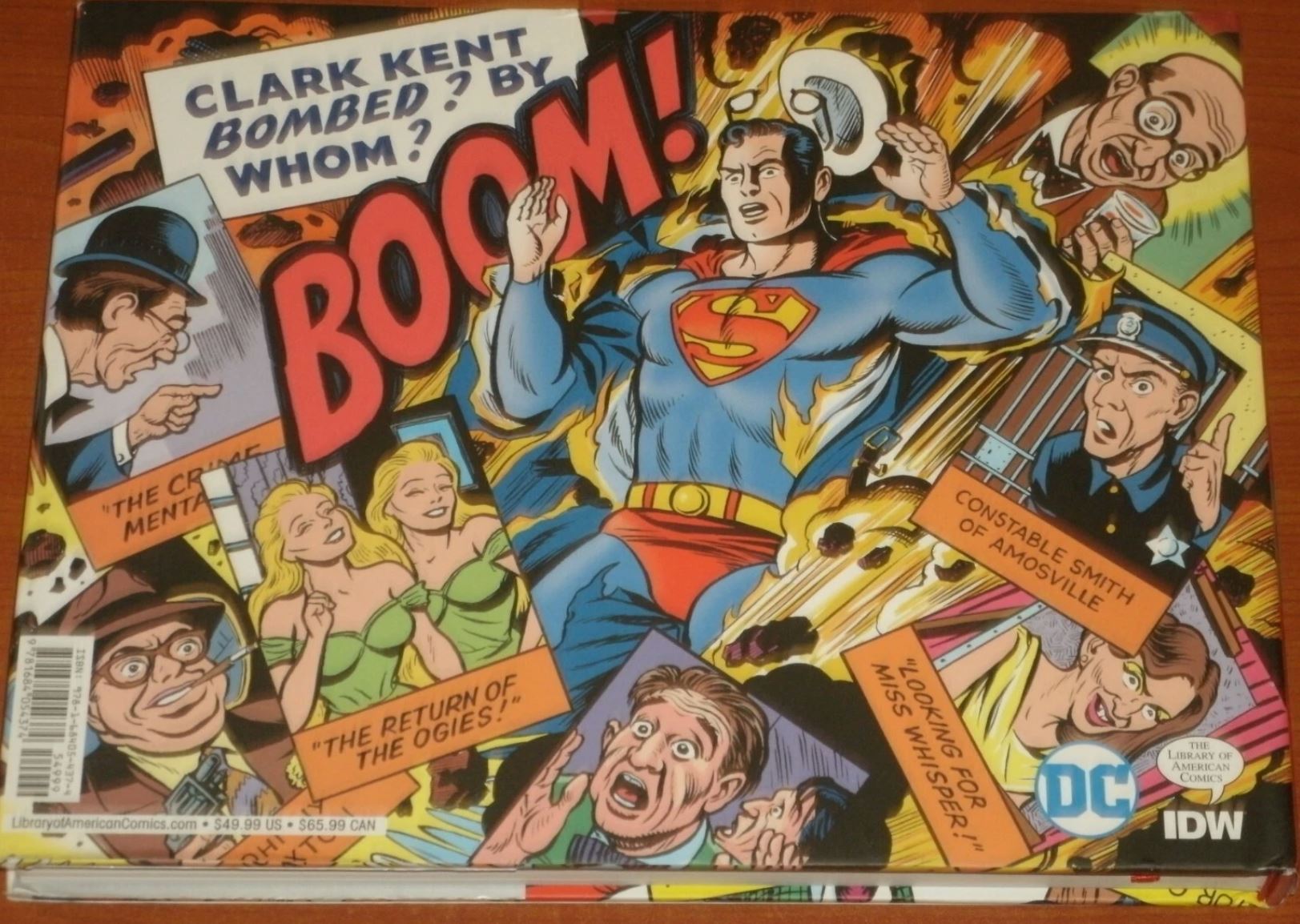
© 2019 DC Comics. All rights reserved. Superman and all related names, characters and elements are ™ DC Comics.
Today in 1872, English cartoonist and genteelly warped brainbox W. Heath Robinson was born, with Allen Bert Christman (The Sandman, Scorchy Smith) arriving in 1915 and Dutch comics master Cees van de Weert (Ben Busy, Marco Polo) turning up in 1917.
Underground commix legend Gilbert Shelton was born in 1940, and scripter, journalist , critic & historian David Anthony Kraft came along in 1952. Artist/playwright Dean Haspiel (Billy Dogma, The Quitter)was born in 1967 and graphic auteur Adrian Tomine (Optic Nerve, Sleepwalk and Other Stories, Killing and Dying).