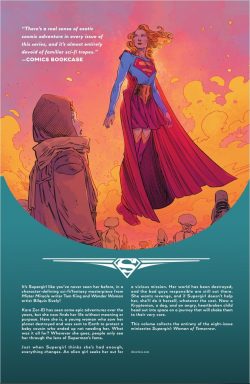
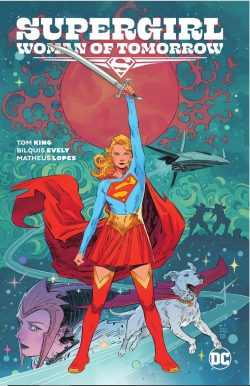
Supergirl: Woman of Tomorrow


By Tom King, Bilquis Evely, Matheus Lopes, Clayton Cowles & various (DC Comics)
ISBN: 978-1-7795-1568-1 (TPB/Digital edition)

As a rule, superhero comics don’t generally do whimsically thrilling anymore. They especially don’t do short or self-contained. Modern narrative momentum concentrates on continuous extended spectacle, major devastation and relentless terror and trauma. It also helps if you’ve come back from the dead once or twice and wear combat thongs and thigh boots…

Although there’s nothing intrinsically wrong with that – other than a certain inappropriateness in striving to adjust wedgies during a life-or-death struggle – sometimes the palate just craves a different flavour…

Once upon a time, angsty in-continuity cataclysm was the rule, not the exception, but ever since DC readmitted all its past epochs into one vastly welcoming expansion multiverse via the Dark Night: Death Metal, Future State and Infinite Frontier mega-events, a spirit of joyous experimentation has resulted in some truly memorable storytelling.

This decidedly backward-looking modern fable harks back to simpler days of clearly defined plots, solid, imaginative characterisation and suspensefully dramatic adventure, by way of an almost alternative take on redoubtable Kara Zor-El, late of Krypton’s Argo City and another illegal alien immigrant on Earth.

Supergirl first gained popularity as a back-up feature in Action Comics: a tag-along (and trademark protection device) to her more illustrious cousin. After years of faithful service, in 1985 she was killed as a sales gimmick in the groundbreaking Crisis on Infinite Earths. Since then, a number of characters have used the name – but none with the class or durability of the original.

This latest incarnation cunningly references much of the original’s trappings, but combines stellar whimsy, dark modern attitudes and an edgier twist, as befits today’s readership. Written by Tom King (Mister Miracle, The Vision, The Sheriff of Babylon, Omega Men, Strange Adventures, Batman) and delightfully illustrated by Brazilian artist Bilquis Evely (Wonder Woman, The Dreaming, Detective Comics, Shaft: a Complicated Man) in a deliriously addictive, retro-futurist pulp style, it examines the concepts of justice and power of reputation through the wide eyes of a worshipful child who is both outraged orphan and lonely sidekick/secret weapon in waiting…

After a few intriguing concept-tweaking test-runs, the first true Girl of Steel debuted as a future star of the ever-expanding Superman pocket universe in Action Comics #252 (cover-dated May 1959). Superman’s cousin had been born on a city-sized fragment of Krypton, hurled intact into space when the planet exploded. Eventually, Argo turned to Kryptonite like the rest of the detonated world’s debris, and Kara’s dying parents, observing Earth through their viewer scopes, sent their daughter to safety even as they apparently perished.

Crashlanding, she immediately and fortuitously met the Metropolis Marvel, who created a cover-identity: hiding “Linda Lee in an orphanage in bucolic Midvale so that she could adjust to and learn about her new world whilst mastering her powers in secrecy and safety.

…And isolation. At no stage did anyone consider moving the recent orphaned newcomer in with her only surviving family. Kara reached her maturity without the closeness Clark Kent’s human parents provided …although she was eventually adopted by Earth couple Fred and Edna to become Linda Lee Danvers

Supergirl experienced her own secret double life in the rear of Action Comics: gradually moving from Superman’s covert secret weapon to an independent star turn, and from minor player to acclaimed public celebrity. From the back of the book to the front of the house is always a reason to celebrate, right?

For decades, DC couldn’t make up their minds over Supergirl. I’ve actually lost count of the number of different versions to have cropped up over the years, and never been able to shake a queasy feeling that above all else she’s a concept that was cynically shifted from being a way to get girls to reading comic books to one calculated to ease young male readers over the bumpy patch between sporadic chin-hair outbreaks, voice-breaking and that nervous period of hiding things under your mattress where your mum never, never ever looks…

Her popularity waxed and waned until her attention-grabbing death during Crisis on Infinite Earths. However, in the aftermath – once John Byrne had successfully rebooted the Man of Steel and negated her existence along with all other elements of doomed Krypton – non-Kryptonian iterations began to appear: each accumulating a legion of steadfast fans. Ultimately, early in the 21st century, DC’s Powers-That-Be decided the real Girl of Steel should come back… sort of…

The New 52 company-wide reboot recast her as an angry, obnoxious distrustful teen fresh from Argo, before the 2016 DC: Rebirth event unwrote most of those changes: bringing back much of that original origin material whilst aligning the comic book iteration with the popular TV series broadcast from October 2015 to November 2021. Then under the aegis of the Infinite Frontier revolution, King, Evely, colourist Mat Lopes & letterer Clayton Cowles crafted 8-issue limited series Supergirl: Woman of Tomorrow (cover-dated August 2021-April 2022).

This focussed on a major moment in the hero’s life and how it changed everything…

King was inspired by Charles Portis’ 1968 novel True Grit – and both movie adaptations – to cast Supergirl as mentor to a vengeance-obsessed child: tracing how a united quest/journey reshaped both of them. Employing the latitude afforded by IF’s umbrella premise, he incorporated iconic characters and trappings from various iterations of Kara’s many super-lives. The result is pure magic, made real by Bilquis and her visual collaborators.

Wordy and wondrous, colours and calligraphy are key components of this space opera, which opens with youthful narrator Ruthye Marye Knoll disclosing how she first met an alien voyager after merciless bandit Krem of the Yellow Hills butchered her father…

Intent on rightful retribution, little Ruthye tracks the killer to a tavern in ‘Men, Women, and Dogs’, encountering a violent drunken woman from another world. Supergirl was on this unnamed backwater red sun world with frivolous intent: it was her 21st birthday and she wanted to get really, really drunk…

Things go bad when Supergirl tries to help her get justice. The intergalactic warrior seriously underestimates Krem, and nearly dies when he puts three arrows through her chest, before apparently killing her dog Krypto and stealing her spaceship…

Barely alive, Kara agrees to let Ruthye help her hunt Krem down: travelling so very slowly by commercial starship and encountering the full annoying range of sentient lifeforms – and a deadly space dragon – in ‘Wounded, Stranded, and Impotent’, before finally reaching a region of space where yellow suns can recharge her…

Stranded on tourist trap Coronn for weeks, they jointly expose appalling racist atrocity in ‘Modest, Calm, and Quiet’ and learn the quarry has joined Barbond’s Brigands: a marauding fleet of space plunderers who become Supergirl’s greatest concern after their latest raid exterminates an entire species in ‘Restraint, Endurance, and Passion’.

Repeated close encounters with them result in furious frustration as Krem has mastered a mystic banishment spell that deposits his pursuers all over the cosmos. Slowly, steadily, Supergirl and Ruthye close in, with the latter honing her skills in eager anticipation of bloody revenge, despite anything Kara can say to dissuade her. Repeatedly fighting a succession of colossal lizard beasts, and enduring a slow painful death and resurrection, does nothing to help their moods either in ‘The Lake, the Trees, and the Monsters’

Finally – reinforced by magical superhorse Comet – the seekers capture Krem and spectacularly engage the brigands in ‘Home Family, and Refuge’ and ‘Hope, Help, and Compassion.’, but the outcome is shockingly unexpected …and tragic.

Final chapter ‘Ruthye, Supergirl, and Krem of the Yellow Hills’ delivers major emotional and conceptual payoffs as antagonists and protagonists take their vendetta to its foregone conclusion. The vengeful child fulfils her quest, but learns some adult truths…

Supplemented by a covers-&-variants gallery by Evely, Lopes, Gary Frank & Alex Sinclair, Lee Weeks, David Mack, Rose Besch, Amy Reeder, Steve Rude, Nicola Scott & Annette Kwok and Janaina Medeiros, this book includes a stunning swathe of character and costume designs, to augment a tale profoundly and consciously mythic in scope and execution.

The apparent maiming and deaths of beloved characters – and animals at that! – and epic transitions and evolutions of the twin leads are potently and evocatively depicted against a universe of inspirational wonders and casual horrors, allowing us to see how heroes are forged, and the device of using a childlike Boswell to define Supergirl’s humanity is both compelling and revelatory.

A cosmic odyssey in the grandly poetic idiom of Jack Vance and Samuel R. Delaney, realised via retro-futuristic visuals reminiscent of Roy G. Krenkel, Jack Katz and Michael William Kaluta, Supergirl: Woman of Tomorrow is a mesmerising mix of space opera and superhero drama exploring the mechanics of myths and power of storytelling on a multitude of levels.

It’s also a sublime rollercoaster ride of vivid, cathartic joy for old fans and newcomers alike: one every fantasy and adventure lover must see.
© 2022 DC Comics. All Rights Reserved.
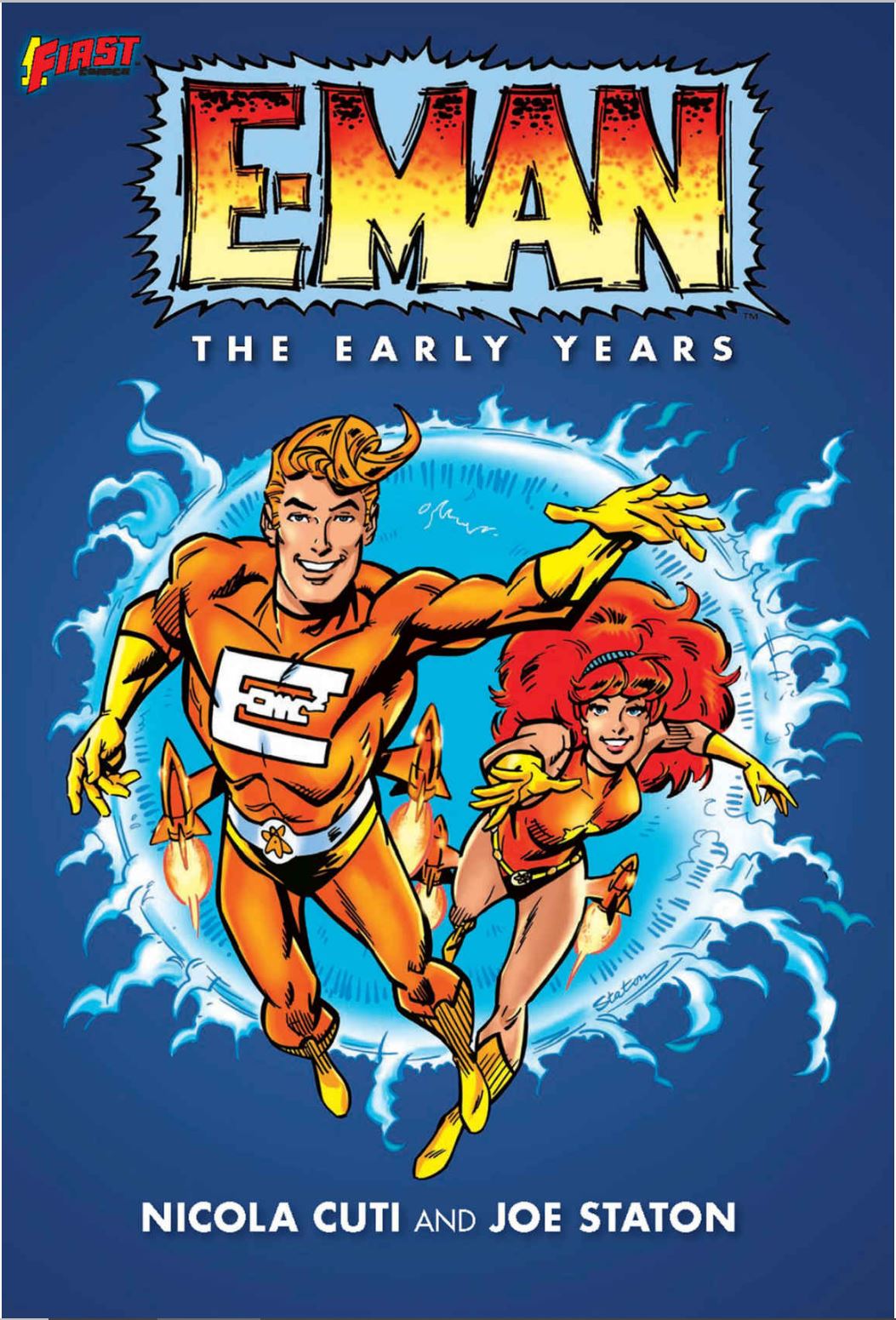
E-Man – The Early Years


By Nicola Cuti & Joe Staton & various (First Comics Inc.)
ISBN: 978-1-61855-000-2 (TPB/Digital edition)

In 1973, superheroes were in a severe decline and the few surviving publishers in the industry were making most of their money from genre fare like war, westerns, kids cartoon and licensed titles (if they could secure them) and particularly horror stories. Such was certainly the case at Charlton Comics: a self-confessed “little company” which nevertheless always punched above its weight.

That was particularly true in terms of talent discovery, with the likes of Dick Giordano, Sam Glanzman, Steve Ditko, Roy Thomas, Denny O’Neil, Jim Aparo, Sam Grainger, Sanho Kim, Wayne Howard, Tom Sutton, Don Newton, Mike Zeck, Roger Stern, Roger Slifer, Bob Layton and John Byrne making a mark there before moving onwards and upwards.

Another major discovery was ultra-versatile cartoonist Joe Staton. He was quickly becoming a fan favourite and shared an off-kilter sense of humour with a Charlton sub-editor who moonlighted as a writer of horror and fantasy for the company’s anthologies…

Nicola “Nick” Cuti (Moonchild, Cannon, Sally Forth, Creepy, Moonie the Starbabe, The Creeper, Spanner’s Galaxy, Captain Cosmos, Starflake the Cosmic Sprite) was born on October 29th 1944. Since then, he’s been an “Underground Comix” cartoonist, animator, film maker, magazine illustrator, movie backdrop designer, novelist, editor and comics scripter.

Between 1972 and 1976 he was assistant to award-winning cartoonist – and Charlton’s general editor – George Wildman (Popeye) who wanted to test the murky waters with a new superhero. He tapped Cuti to write something a bit different and used the experimental vehicle to try-out a succession of features at the back: crafted by creators like Sutton (The Knight), Ditko (Killjoy, Liberty Belle) and Byrne (Rog-2000). Cuti wrote many of them too…

Born January 19th 1948, Joe Staton (Primus, Wheelie and the Chopper Bunch, The Six Million Dollar Man, Space 1999, The Avengers, The Incredible Hulk, Deadly Hands of Kung Fu, Silver Surfer, Green Lantern Corps, Guy Gardner, Legion of Super-Heroes, Millennium, All Star Comics, Power Girl, Metal Men, Doom Patrol, Plastic Man, Mike Danger and more) is a writer and incredibly versatile artist/inker who has been an integral part of American comic books since the early 1970s.

He has worked for dozens of companies, co-creating The Huntress, Killowog, The New Guardians and The Omega Men and in later years made kids comics his metier. During a spectacular run on licensed classic Scooby Doo, he and series scripter Mike Curtis (Casper the Friendly Ghost, Richie Rich, Shanda the Panda) discovered a mutual love for Dick Tracy and – mostly for their own amusement – created tribute strip Major Crime Squad.

That led to them being invited to handle the prestigious Dick Tracy strip (from 2011 to October 2021) but throughout that epic and varied career, Staton regularly re-partnered with Cuti on further adventures of his first triumph…

A pioneering masterpiece of superhero whimsy, E-Man tells the convoluted love story of a alien lifeform and a wonderfully capable and smart earth girl, and the weird life they make for themselves. It all began in 1973 (Happy Golden Anniversary!) in a 10-issue run that was barely noticed by the readership but which affected how many future comics creators remade the medium.

This cheerful and charming collection gathers the E-Man moments from that initial run and includes technically unpublished tales from said run, plus covers and other material from the hero’s revival as part of the Independents Publishing revolution of the 1980s.

We begin with a brace of Introductions as ‘Finding the Right Words for Joe, Nick and Alec Tronn’ by Jon B. Cooke and ‘E-Man: His Beginnings’ by Cuti contextually set the scene for an extraordinary meeting…

Cover-dated October 1973, “Collector’s Item! First Edition!!” E-Man #1 starts at ‘The Beginning’ revealing how, millions of years ago, a star exploded and released a packet of energy that had spontaneous sentience, immense curiosity and no knowledge at all. The bundle of wonder floated across the galaxies seeking intelligence but encountering none until arriving near our world just as a star-ship from Sirius attempts to attain orbit around Pluto.

Infiltrating the vessel, the energy being converts into matter, duplicating one of the robots serving the giant Brain commanding the mission and overhears how the warlike cyborg is here to test an experimental ultra-weapon on the frozen target. Sadly, curiosity proves fatal and the sudden weight increase sends the ship careening out of control and ultimately into the atmosphere of the blue-green planet third out from the sun…

Some time later, college student Katrinka Colchnzski is just finishing her evening job. She is a tough, brilliant, capable and proudly independent: paying for her degree as burlesque dancer Nova Kane when one of the lightbulbs in her dressing room begs her for help.

Freeing the energy creature and quickly striking up a friendship with the naïve, affably clueless being – who has unselfconsciously turned into a real stud-muffin by human standards – she is abruptly drawn into a world of insane danger when her landlord tries to kill her. It transpires that in ‘The Brain and the Bomb’ the super cerebral invader has also survived the crash and is vengefully testing hate-gas on the inhabitants…

Without hesitation Nova and the stranger seek out and stop the plot…

These tales were originally quite quirkily coloured by Wendy Fiore and are reconstructed here by Matt Webb, who also shades the cover to Original E-Man #1: a reprint series released by First Comics in October 1985 to supplement their revival of the hero. That book also revisited the second escapade of guileless alien visitor Alec Tronn as first seen in E-Man #2’s ‘The Entropy Twins’ (December 1973). Here, the Brain from Sirius unleashes a second super-weapon against E-Man and Nova: an artificially-bred loving couple who can casually manipulate the forces of order and chaos.

Stalking and befriending the childlike hero and his charming cohabitator, Michael and Juno cause catastrophic accidents which almost kill Nova, only to learn that her special friend Alec is as vengeful as any child when the things he loves are threatened…

An unused cover from 1974 accompanies article ‘The Energy and Paper Crisis’, explaining how a global power shortage both inspired and derailed a comic response. The upshot was that the story intended for the fourth issue ended up in #3, and the third followed after. The chronological anomaly is corrected here with E-Man #4 going first.

Cover-dated August 1974, ‘City in the Sand’ sees the odd couple in Egypt with exotic dancer Nova showing belly dancers how it’s done at night and pursuing her archaeological studies during the day. With Alec in tow, she unearths an ancient mystery and – thanks to E-Man – functional time machine: propelling them back millennia to uncover a link between the pharaohs and a lost colony of aliens afflicted with mad militarism and a sinister plague…

December 1985’s cover of Original E-Man and Michael Mauser #3 precedes June 1974’s E-Man #3, wherein ‘The Energy Crisis!’ blacking out America and the world leads oil baron Samuel Boar to unleash a robotic Battery to kidnap useless, over-abundant humans and turn them into a new fuel source.

When Nova vanishes, E-Man stops powering up hospitals to go looking for her. He is unaware that Nova had already engaged seedy private eye Michael – “don’t call me Mickey” – Mauser to find her fellow dancer Rosie Rhedd after she was sucked into a brick wall…

The sordid shamus became a fixture and even won his own series in Vengeance Squad….

The invasion of Boar’s citadel and clash with ‘The Battery’ is fast and furious and leads to the villain’s capture but would have shocking consequences in the fullness of time…

The tale ends with a direct plea to readers to protect the environment and “save the Earth!”. It’s a shame more kids didn’t buy this comic back then and avoid the mess we’re all in now…

Staton had been growing in skill and confidence and by this story had taken to adding what we now call easter eggs to his art. Backgrounds, minor characters and especially posters and newspapers provided a rich source of added whimsy, commentary and fun. They are a sheer delight to this day…

The Original E-Man #2 cover from October 1985 leads into November 1974’s #5 as ‘The City Swallower’ sees a day at the beach devolve into a transdimensional excursion. When Alec follows a hippy mermaid (based on contemporary and legendary fandom icon Heidi Saha) back to her realm he’s just in time to spearhead a war against a beast that consumed helpless conurbations, after which January 1986’s Original E-Man and Michael Mauser #4 cover leads to monster madness in E-Man #6.

‘Wunder-world’ – cover-dated January 1975 – sees an old enemy resurface when Alec and Nova visit a theme park, using robots, movie horrors, war machines and psychological warfare to attack the unlikely couple…

A full, illustrated list of ‘E-Man and Nova – Other Appearances’ is followed by #7’s ‘TV Man’ (March 1975) as another old enemy uses the airwaves and super-science to turn the energy- man into Nova’s worst nightmares and Mauser reappears to save the day. It’s followed by Original E-Man and Michael Mauser #5’s cover (February 1986) and heralds a really big change…

With #8’s full-length epic ‘The Inner Sun’ (May 1975) the creators brilliantly exploit the capricious, functionally implausible nature of comics books to deliver a superb slice of nonsense that begins when a giant jungle girl attacks New York. When she then busts into Mauser’s office…

Her trail leads to Samuel Boar and a primeval world under the North Pole…

Unless I’ve already convinced you to seek this book out, be warned that there’s a major spoiler ahead. Stop here if you’re going to read the actual stories. Or not. It’s your choice.

By the time E-Man gets there though, the villain has kidnapped Nova and triggered a disaster that kills her. It’s not anything to worry about as – through typically miraculous circumstances – she reconstitutes herself with the same powers as boyfriend Alec and begins her own crime crushing career…

March 1986’s cover to Original E-Man and Michael Mauser #6 is accompanied by text feature ‘Other Appearances by Michael Mauser’ before E-Man #9 (July 1975) unleashes ‘The Genius Plant’ which is foreshadow by brief ‘Prologue! History of E-Man and Nova’

Accompanied by new cast member Teddy – a reformed evil koala – the hot couple stumble into a plot by a cabal of scientists to hyper-enhance their intellects and rule the world. After they foil that, one final cover – Original E-Man and Michael Mauser #7 (April 1986) – segues into E-Man #10 (September 1975) as Nova meets the first girl Alec met when he landed on Earth. Although initially jealous, after meeting Maisy-June Bragg, she’s with her beau all the way when what appear to be unnatural forces reduce the gentle rural bombshell into ‘The Witch of Hog Hollow’ who really needs her old “genie” to save her…

E-Man was simultaneously Charlton’s worst selling retail title but its best via direct subscription, which kept it going long after Wildman should have killed it, but at last the axe fell. When it died, there were a couple of tales still in the pipeline which eventually saw print in the company’s in-house fanzine – which was edited by Bob Layton.

Coloured by Webb, Staton’s cover for Charlton Bullseye #2 (1975) and Charlton Bullseye #4 (March/April 1976) here precede ‘…And Why the Sea is Boiling Hot’ (colour by Webb & Michael Watkins) wherein the energy-beings investigate missing shipping and discover that a ghost galleon is actually an alien artefact.

One final story – starring Nova Kane – details a stunning truth. When that exploding sun detonated way back when, it spawned more than one sentient energy-being – and courtesy of FIRST COMICS INC. – Alec’s opposite number ‘Vamfire’ finally arrives on Earth in a scary yarn coloured by Alex Wald. This frenzied female aspect is a ravenous power leech but Nova and E-Man soon find a way to dispel her “hanger-pangs”…

Biographies of Nicola Cuti and Joe Staton close this archive of sheer escapist delight: capping a glorious revisitation of sharper, smarter, funnier days in comics. However it’s not too late to tune in and get turned on to E-Man and Nova.
© 1973-1974 Charlton Comics, reprinted in Original E-Man and Mauser #1-7 © 1985-1986, First Comics, Inc. All new material © 2011, Joe Staton/First Comics, Inc.). All Rights Reserved.

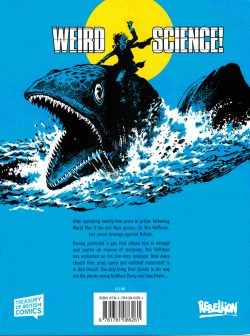
Von Hoffman’s Invasion Book One


By Tom Tully & Eric Bradbury (Rebellion Studios)
ISBN: 978-1-78108-626-1 (TPB/Digital edition)

In the sixties and seventies the British liked their comics characters weird, wild, utterly amoral, flagrantly inept and invariably corrupt to the core. These days it’s a requirement we only demand from and venerate in our politicians and public servants.

One thing we have adored above all other things is a great, properly flamboyant villain…

British comics have always enjoyed a strange, extended love affair with what can only be described as “unconventional” (for which feel free to substitute “weird” or “creepy”) heroes. So many stars and putative role models of our serials and strips have been outrageous or just plain “off”: self-righteous voyeurs-vigilantes like Jason Hyde, deranged vigilante geniuses like Eric Dolmann, self-absorbed outsiders like Robot Archie, arrogant, morally ambivalent former criminals like The Spider or outright racist supermen such as Captain Hurricane

We also made much of (barely) reformed criminals like Charlie Peace and sinister masterminds in the manner of The Dwarf, Black Max, Dr. Mesmer, Grimly Feendish, The Snake and this particular Menace to Society…

Until the 1980s, UK periodicals exclusively employed an anthological model: offering variety of genre, theme and character on a weekly – or sometimes fortnightly – basis. Humour comics were leavened by action-heroes, whilst adventure papers always carried some palate-cleansing gag-strips and stars. Buster offered the best of all worlds.

Running 1902 issues from May 28th 1960 to 4th January 2000, it delicately balanced drama, mystery, action and comedy, with its earliest days – thanks to absorbing Radio Fun and Film Fun – heavily dosed with celebrity-licensed material starring media mavens like Charlie Drake, Bruce Forsyth and Benny Hill backing up the eponymous cover star billed as “the son of (newspaper strip icon) Andy Capp”.

Buster became the final resting place of many, many companion papers in its lifetime, including The Big One, Giggle, Cor!, Monster Fun, Jackpot, School Fun, Nipper, Oink!,

Whizzer & Chips and Jet, so its cumulative content was wide, wild and usually wacky…

Jet debuted in 1971 but only lasted 22 weeks at a time when our indigenous periodicals industry struggled to cope with spiralling costs and mass importation of brash, flashy, full-colour comics from America.

A product of the editorial policy described as “Hatch, Match and Dispatch”, similar to US try-out comics, it involved launching whole titles with new features to catch reader attention and mercilessly culling them and harvesting the most popular features into established, proven sellers like Lion, Tiger, Valiant or Buster.

Jet was dedicated to adventure features but also carried humour strips. Only three (out of 14 contenders) survived amalgamation, but for The Kids of Stalag 41 the reprieve was a short one. Long-term, only Ken Reid’s immortal Face Ache and a mad masterpiece of weird science called Von Hoffman’s Invasion proved worthy of our attention. The arcane antagonist and enemy of the people even scored the cover spot of issue #1…

British comics in the 1960s and 1970s were a phantasmagorical playground of bizarre wonders. Recognisably heroic protagonists appeared in war, western and gradually declining crime serials, whilst the most memorable momentum devolved to a hybrid, bastardized mixture of fantasy, horror and science fiction themes to spawn unique stars of a graphic pantheon unlike any other…

Another stunning salvo of baby boomer nostalgia courtesy of Rebellion’s Treasury of British Comics strand, this initial collection of Von Hoffman’s Invasion gathers all the material from Jet, spanning May 1st to September 25th 1971 and its continuation in Buster running from October 2nd to February 5th 1972. The home front weird war eventually concluded on October 21st of that year, thanks I’m sure to the sheer quality of its creators, who were undoubtedly drawn away for newer – and potentially more successful – escapades…

I’m sure I don’t need to remind you that this was the mid-Sixties, so racial depictions like the half-sized sumo wrestler-bot last cited were perpetrated “in fun”, and not fairness or good taste…

Von Hoffman’s Invasion was a classic example of the many-stranded uncanny menace genre young Brits thrived upon, blending elements of war stories with super science, seeing evil geniuses thwarted by bold kids and plucky Everymen. It all seemed so incredibly credible thanks to the efforts of two of our industry’s greatest talents…

This inexplicably compelling blend of marauding monster, unjustifiable revenge and scary invasion was scripted by impossibly prolific Glasgow-born Tom Tully. His astoundingly broad output of classic delights included Roy of the Rovers, Heros the Spartan, Dan Dare, Master of the Marsh, The Leopard from Lime Street, Janus Stark, Mytek the Mighty, The Wild Wonders, Nipper, Adam Eterno, The Mind of Wolfie Smith, Johnny Red, Harlem Heroes, Mean Arena, Inferno, The Robo Machines, Football Family Robinson, Buster’s Ghost and many more.

His collaborative co-creator here worked on many of those sagas. The incredibly gripping moody comic art of Eric Bradbury had begun gracing newsagents’ shelves in 1949 in Knockout. Frequently working with studio mate Mike Western, Bradbury drew strips like Our Ernie, Blossom, Lucky Logan, Buffalo Bill, No Hiding Place, The Black Crow and Biggles. He was an “in-demand” illustrator who worked into the 1990s on landmark strips like The Avenger, Cursitor Doom, Phantom Force 5, Maxwell Hawke, Joe Two Beans, Mytek the Mighty, Death Squad, Doomlord, Darkie’s Mob, Crazy Keller, Hook Jaw, The Sarge, Invasion, Invasion 1984, The Mean Arena, The Fists of Jimmy Chang, The Dracula Files, Rogue Trooper, Future Shocks, Tharg the Mighty and so much more…

From the start, Tully & Bradbury delivered intense, claustrophobic tension-drenched, action-packed episodic adventures, opening here with the release after 25 years of a war criminal who was still a fanatical Nazi and faithful servant of the Third Reich.

Doktor von Hoffman had been constructing mechanised moister terror-weapons as WWII ended, and the destruction of his robot centipede tipped him over the edge.

He went to jail sworn to destroy the British, but the only thing he had learned upon his release in 1970 was that biology was more effective than engineering…

In his old lab on the outskirts of Berlin, he created an enlarging chemical that also made those subjected to it slaves to his commands. On reaching the French coast he used it to turn an eel into a colossal animal torpedo and rode it to England, dallying only to sink a cross channel ferry. On beaching in Cornwall, he started his petty campaign of revenge by using the growth gas (concealed in the battered umbrella all evil geniuses carry) to magnify a crab to the size of a house and destroy a fishing village, reinforcing the walking tank with a deadly giant wasp. With local police fearfully outmatched the RAF finally get involved, scoring a rather pyrrhic victory at the cost of an attack helicopter…

Still at large, utterly unsuspected but also deeply paranoid, Von Hoffman continues randomly unleashing destructive colossi – such as giant toads, pigeons, roving dogs and assorted insects – culled from English country gardens until he encounters Barry and Joey Drake. When they are attacked by monsters in the cottage at Little Upton, the young brothers discover one of the serums their scientist dad is working on reverses the effects of the mad doctor’s gas…

It happens when the madman briefly transforms their good dog Major into a marauding beast and an old bottle in the shed saves them and their faithful four-legged friend…

Armed with a solution and plenty of X2FO4, the lads go after the maniac and clash just as Herr Doktor unleashes a massive mole on (or rather under) a British army base. Interrupting a top secret tank test, Von Hoffman ups the ante with a horde of rampaging woodlice that results in a blistering battle between ancient armour and modern ordnance.

It all goes very badly for mankind until Barry and Joey find a way to deploy their dad’s solution…

Thwarted but undaunted, the crazed war criminal then invades a monkey sanctuary where things get really hairy when bad-tempered, behaviourally-challenged chimp Charlie gets a dose of growth gas and goes on a very cinematic rampage…

When that all goes wrong, the boys actually capture the villain, but his umbrella and some rapidly enhanced woodworm serve to extricate Von Hoffman for another assault on Albion: this time augmented by a rampaging rabbit that thumps the army hard. Meanwhile in London, the government is finding it harder and harder to keep a lid on the chaos happening out in the provinces…

The cover-up gets its biggest bashing when aided by a super stag beetle, the Doktor plans to strike a shattering blow to British morale; attacking the nation’s soul by disrupting football’s “Global Cup Final”: a grudge match between England and Germany…

Cue enhanced ants, budgerigars, rats, hedgehogs and spiders, the abduction of England’s captain and the debut of absolutely indescribable pedigreed dog breeder/footy fan Cynthia Fulbright whose help – along with the boys’ serum-filled water pistols – saves the day and cinch the cup for England….

Foiled again and almost out of growth gas, Von Hoffman is on the back foot now, but strikes again with an enlarged coypu that enables to restock his chemical larder by attacking Weldale Research Laboratories whilst building up his forces via the facilities stock of squid and octopi, sparking another battle with the army. Although driven off, the madman is not disheartened: after all, now he has fresh hope, fresh resources and best of all a small army of giant birds and mechanical dinosaurs!

To Be Continued…

Closing this titanic tome is a tempting teaser extract for similarly themed star Black Max so enjoy that too….

Completely bonkers but utterly engaging, this brilliantly wry romp is sheer addictive nostalgia for my generation, but the stories also hold up against anything made for today’s marketplace. Buy it for the kids and read it too. This is a big, bold glorious tale, and brace yourself for even better yet to come…
© 1971, 1972, 2018 Rebellion Publishing Ltd. All rights reserved.

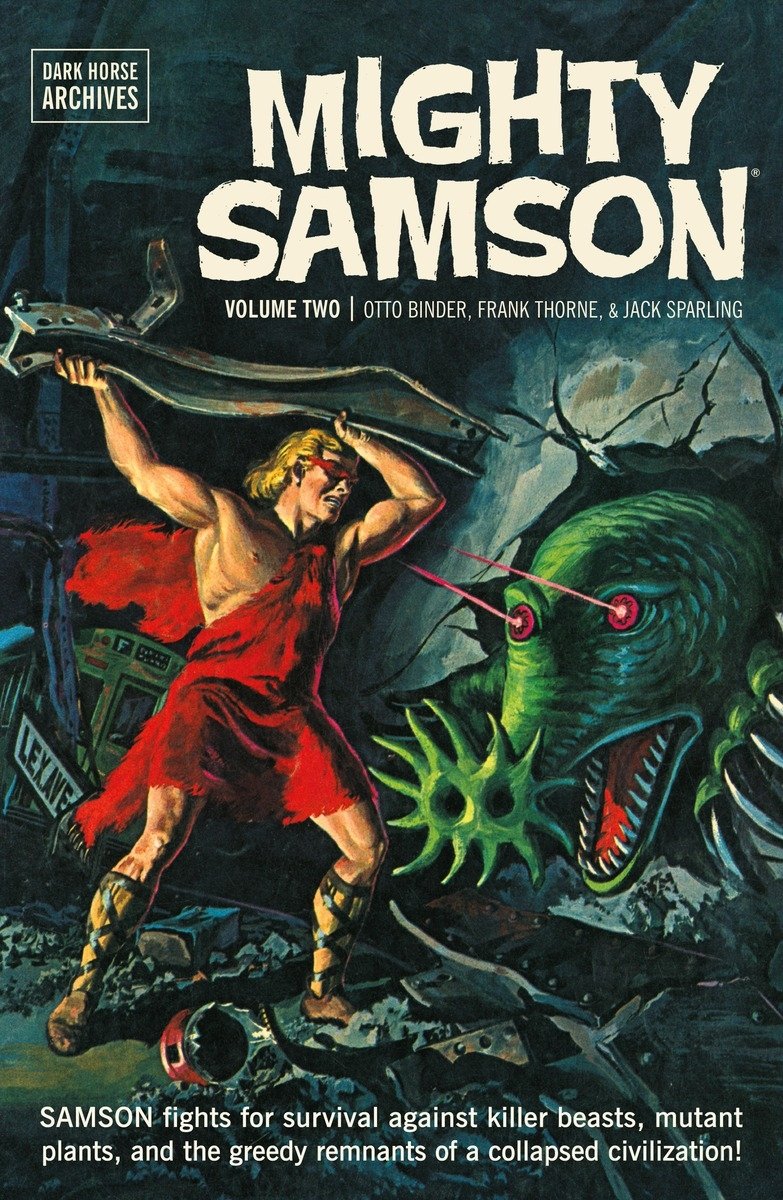
Mighty Samson Archives volume 2


By Otto Binder, Frank Thorne, Jack Sparling, Morris Gollub, George Wilson, Joe Certa, Mike Sekowsky, George Roussos & various (Dark Horse Comics)
ISBN: 978-1-59582-659-6 (HB)

These days all the attention in comics circles goes to big-hitters and headline-grabbing ground-breakers, but once upon a time, when funnybooks were cheap as well as plentiful, a kid (whatever their age) could afford to follow the pack and still find time and room to enjoy quirky outliers: B through Z listers, oddly off-kilter concepts and champions falling far short of the accepted parameters of standard super-types…

A classic example of that exuberant freedom of expression was the relatively angst-free dystopian tomorrow of Mighty Samson, who had a sporadic yet extended comics career of 32 issues spanning 1964 to 1982.

Although set in the aftermath of an atomic Armageddon, the story of the survivors was a blend of updated myth, pioneer adventure and superhero shtick, liberally leavened with variations of those incredible creatures and sci fi monsters the industry thrived on back then.

Comics colossus Dell/Gold Key/Whitman had one of the most complicated publishing set-ups in history, but that didn’t matter one iota to kids of all ages who consumed their vastly varied product. Based in Racine, Wisconsin, Whitman had been a crucial component of monolithic Western Publishing and Lithography Company since 1915: drawing upon huge commercial resources and industry connections that came with editorial offices on both coasts. They even boasted a subsidiary printing plant in Poughkeepsie, New York.

Another connection was with fellow Western subsidiary K.K. Publications (named for licensing legend Kay Kamen who facilitated extremely lucrative “license to print money” merchandising deals for Walt Disney Studios between 1933 and 1949). From 1938, the affiliated companies’ comic book output was released under a partnership deal with a “pulps” periodical publisher under the umbrella imprint Dell Comics – and again those creative staff and commercial contacts fed into the line-up of the Big Little, Little Golden and Golden Press books for younger children. This partnership ended in 1962 and Western had to swiftly reinvent its comics division as Gold Key.

Western had been a major player since comics’ earliest days, blending a vast tranche of licensed titles – including newspaper strips (like Nancy and Sluggo, Tarzan and The Lone Ranger), TV tie-in and Disney titles with in-house originations such as Turok, Son of Stone, Brain Boy and Kona: Monarch of Monster Isle.

Dell and Western split just as a comic book resurgence triggered a host of new titles and companies, and a superhero boom. Independent of Dell, new outfit Gold Key launched original adventure titles including Dr. Solar, Man of the Atom; Magnus – Robot Fighter; M.A.R.S. Patrol Total War; Space Family Robinson and many more.

As a publisher, Gold Key never really “got” the melodramatic, frequently mock-heroic Sturm und Drang of the Silver Age superhero boom – although for many of us, the understated functionality of classics like Magnus and Doctor Solar or crime-fighting iterations of classic movie monsters Dracula, Frankenstein and Werewolf were utterly irresistible. The sheer off-the-wall lunacy of features like Neutro or Dr. Spektor I will reserve for a future occasion…

This second splendid full-colour hardback compilation – printed on a reassuringly sturdy and comforting grainy old-school pulp stock rather than glossy paper – gathers Mighty Samson #7-14 spanning September 1966 to May 1968, and begins with a heady appreciation by Paul Tobin (Plants vs Zombies, The Witcher, Angry Birds, Spider-Man, Bandette) in his reminiscent Foreword…

The post-dystopian wonder warrior had been anonymously created by industry giants Otto Binder & Frank Thorne in 1964. Binder was the quintessential jobbing writer. He and his brother Earl were early fans of science fiction, making their first professional sale to Amazing Stories in 1930. As “Eando Binder” their pulp-fiction and novels output continued well into the 1970s, with Otto rightly famed for his creation of primal robotic hero Adam Link.

From 1939 onwards, Otto was also a prolific comic book scripter, most beloved and revered for the invention and perfection of a humorous blend of spectacular action, self-deprecating humour and gentle whimsy as characterised by the Fawcett Captain Marvel line of titles (and later in DC’s Superman’s Pal Jimmy Olsen). Binder was also constantly employed by many other publishers and amongst his most memorable inventions and innovations are Timely’s Young Allies, Mr. Mind, Brainiac, Krypto the Super Dog and the Legion of Super-Heroes.

In his later life, he moved into editing, producing factual science books and writing for NASA.

Frank Thorne (June 16th 1930 – March 7th 2021) was one of the most individualistic talents in American comics and the series co-creator’s last issue opens this volume. He began his comics career drawing romance stories for Standard Comics beside legendary draughtsman Alex Toth before graduating to better-paid newspaper strips like Perry Mason for King Features Syndicate. For Dell/Gold Key he drew Flash Gordon, Jungle Jim and The Green Hornet, as well as the first few years of this seminal sci-fi classic.

A DC he did compelling work on Tomahawk and Son of Tomahawk before being hired by Roy Thomas at Marvel to illustrate his belated breakthrough strip Red Sonja. Forever-after connected with feisty, earthy, highly sexualised women, in 1978 Thorne created outrageously bawdy (some say vulgar) swordswoman Ghita of Alizarr for Warren’s adult science fantasy anthology 1984/1994 as well as such adult satirical strips as Moonshine McJugs for Playboy and Danger Rangerette for National Lampoon.

Thorne won a National Cartoonists Award for comic books, an Inkpot Award and a Playboy Editorial Award, but was still a fairly by-the-book illustrator at the time of this collection’s content. In fact, it was on Mighty Samson that he opened up and found his own unique artistic vision: one which would carry him to the forefront of stylists with the satirical and erotic works of his later years.

That’s meat for other reviews, but here he and replacement artist Jack Sparling translate Binder’s imaginings into a beguiling otherworld of action, adventure and drama suitable for most kids of all ages and a milieu perfectly in tune with any Kids TV channel today…

Mighty Samson #1 (July 1964) introduced the bombed-out metropolis of N’Yark: a dismal dangerous region where human primitives clung to the ruins, scattered into rival tribes all striving daily against mutated plants and monsters as well as less easily identified blends somewhere in between…

One day when a toddler was grabbed by a predatory plant he casually tore the terror apart with his podgy little hands. Years passed and the child grew tall and clean-limbed, and it was clear that he too was a mutant: immensely strong, incredibly fast and improbably durable…

Impassioned by his mother’s dying words – “protect the weak from the powerful, the good from the evil” – Samson became the champion of his people; battling beasts and monsters imperilling the city. Sadly, those struggles were not without cost, and when he killed an immense Liobear, it cost the young hero his right eye…

The clash proved a turning point for Samson since his wounds were dressed by a stranger named Sharmaine. She and her father Mindor were voluntary outcasts in the city: shunning contact with superstitious tribes whilst gathering lost secrets of science…

They toiled constantly to bring humanity out of its second stone age and, fired with inspiration, Samson joined their self-appointed mission: defending them from all threats as they carry out their work.

Every issue was augmented by mesmerising painted covers by master illustrators Morris Gollub or George Wilson. These covers were initially reproduced text-free on the back of each issue and probably graced many a kid’s bedroom wall way back when. You get those too, but I’d suggest scanners rather than scissors this time around…

The comics were ad free and inner side of those covers generally held monochrome single-page features supplementing the story with historical context, and the factoids. Sadly many are uncredited but when I know who, so will you…

The Altered World odyssey resumes with #7, cover-dated September 1966. ‘World of Darkness’ saw Thorne off in fine style as shattered skyscrapers in N’Yark began sinking into the ground. Investigating the trackless regions under the city, Samson and his allies encounter many horrific beings before mistakenly accusing the subsurface Undermen of waging war on the light-loving Uppermen like themselves. Before long, however, ‘The Enemy Below’ (with artistic assistance from Mike Sekowsky & George Roussos) is identified as being a threat of a wholly bestial and relentless nature, forcing an alliance and only ended by Mindor’s knowledge of pre-disaster atomic weapons…

The inner covers detail ‘The Underground World’ of 1960s subways, escalators and tunnels and hidden service structures ‘Beneath the City’ before #8 signalled a change of vision.

Drawn by Joe Certa, factual-teaser ‘The Magnetic Pole’ led and fed into Binder’s ‘The Migration Mystery’ and concluding chapter ‘The Mental Battle’ as our heroes – and every other human in N’Yark – are seized by a telepathic force pulling them northwards. Aware but unable to resist, Samson and his friends spend months gravitating towards a mineral formation (a “mental North Pole”) in the arctic: helping many others of the thousands of humans caught in the grip, before at last devising a solution that will allow them all to return home.

This tale signalled the debut of another veteran illustrator who would make the title his own.

John Edmond “Jack” Sparling (June 21st 1916-February 15th 1997) was born in Winnipeg, Manitoba but migrated young to the USA. After studying in New Orleans and at the Corcoran School of Art, he left a cartooning gig at the New Orleans Item-Tribune to create the Hap Hopper, Washington Correspondent strip for United Features Syndicate (1940) superseded in 1943 by Claire Voyant.

That strip ended in 1948 and thereafter Sparling concentrated on comic books, becoming a wandering regular whose work appeared in Classics Illustrated, Dell/Gold Key, Marvel, DC, Charlton and others on strips like Robin Hood, Captain America, Tiger Girl, Space Man, Neuro, Secret Six, Eclipso, The Day after Doomsday, Challengers of The Unknown, Unknown Soldier and more.

Ideally suited for short story and humorous fare, he worked continuously for Gold Key’s horror anthologies and was a key player when DC revived its House of Secrets and House of Mystery titles (co-creating with Bob Haney undying horror-host Cain in HoM #175).

Sparling was particularly adept on licensed properties, illustrating Bomba, Family Affair, Six Million Dollar Man, Bionic Woman, Welcome Back, Kotter, Adam-12, Microbots, The Outer Limits ad nauseum…

With monsters so popular, the company also debuted the Gold Key Club Comic Monster Art page: inviting readers to create their own creepy critters and send them in for publication. The first examples were dreamed up in-house but for later issues, the beasts and bogles came courtesy of the kids. A scattering of them add loony lustre to this book at intermittent moments…

Another new feature began in the following issue. Illustrated by Sparling, ‘Mighty Samson Mutant Monsters’ offered an ongoing bestiary of horrors as seen in Mindor’s notes, beginning with ‘Stone-Throwing Cactus’ and ‘Lightning Beast’

Bracketed by fact-features ‘Guide Tour of Washington D.C.’ and ‘Washington D.C.’, #9 (cover-dated March 1967) sees the valiant trio back home long enough to discover a fully automated, still-operational bullet train connected to the nation’s former Capital. Sadly, the astounding delights of pre-collapse culture and technology leads to war with ‘The Renegade Robot’, once they debark in DC…

That’s just in time for old enemy Queen Terra of Jerz to suborn an atom-powered Secret Service mechanical bodyguard…

Ordering ‘The Metal Hercules’ to crush and enslave Samson, Terra finds the robot too much for her but still not tough enough to stop the mutant: a dilemma that drives the automaton totally off the rails…

The issue ends with another Mighty Samson Mutant Monsters moment sharing the unnatural history profile of the ‘Net-Casting Spider’

Mighty Samson #10 opens with more of the same – the ‘Heavy-Matter Eagle’ – before a wave of desperate refugees disrupting N’Yark sends the scientific investigators off exploring formerly isolated Staten Island. The lost colony has become a bizarre dichotomy: with humans living in relative luxury in fully automated skyscrapers but unwilling to go below the first three storeys which has become a vast morass on interlinked monster-filled jungle. It was a paradise until Samson’s enemy Kull invaded, driving the soft tribes-folk away, but the ‘Terror in Tallplace Town’ ends as soon as Samson puts his foot down to oust the treacherous ‘King for a Day’

More readers’ creations segue into #11, where Mighty Samson Mutant Monster ‘Lightning-Bolt Eel’ leads into a tale of unchecked capitalism as new trader Hulko the Swapper begins price gouging both farmers in the hinterlands and N’Yark’s scavengers who until recently, bartered amicably and honestly their edible produce for the city’s salvaged raw materials like scrap iron and reclaimed tinned luxury goods. The process involved shipping goods through wild territory of the Bronx and Long Island: terra incognita festooned with terrifying carnivorous forests infested with ‘The Swamp Rats’ and even worse perils.

When the profiteer pushes too hard, Samson takes action, reclaiming the concrete pathways of the ancients and providing a smooth “Broadway” for entrepreneurs and small businesses. Hulko and his shipping protectionists are understandably unhappy with the new arrangement, but their sabotage attempts to invoke ‘Terror on the Tradeway’ have no effect on giant hero’s policy of free enterprise…

Queen Terra returns in #12 operating a reclaimed, restored and fully-armed US Coast Guard cutter, leading ‘The River Raiders’ bombarding the shore-dwelling tribes of Manhattan island and demanding to be made their empress. Happily, Samson Sharmaine and Mindor are also au fait with naval salvage and ‘The Battle of N’Yark Bay’ swiftly sinks the queen’s schemes… despite the intervention of a few aroused sea beasts formerly asleep in the deep…

The quest for security is synonymous with the search for food and power sources. In #13 Mindor meets another historical detective skilled in the ways of pre-collapse technologists, but ‘The Prophet of Zomzu’ exploits his knowledge of electricity for another kind of power. Thanks to our brawny hero, cruel science despot Merlyn the Magic Maker is the loser in ‘The Wizard’s Showdown’: liberating a tribe of gullible pawns from a ruthless master…

This second sojourn in a broken tomorrow ends with Mighty Samson #14 (May 1968) as a Mighty Samson Mutant Monster briefing on ‘Rooted Sea Serpents’ segues into a chilling and contemporary fable as fisherfolk on the island of N’Yark are threatened by the ‘Menace from Nowhere’. This is a toxic gooey mass carried by the river, polluting their waters and killing the birds and fish they hunt, as well as infuriating all the monsters in the bay.

When Mindor determines the threat is millions of tons of crude oil being forced upriver, the trio voyage south to Florida and find an abandoned automated drilling rig has recently malfunctioned, constantly pouring black poison into the Gulf Stream.

The atomically-powered station is a danger to everything but when Samson shuts it down, he finds himself trapped ‘Between Beasts and Machines’ and joins post-apocalypse Tuaregs of the trackless Miami desert to destroy the unchecked depredations of automated city Technopolis: a robot metropolis of unimaginable treasures guarded by dinosaurs!

Closing with more Gold Key Club Readers Page monsters and full creator biographies, this mighty tome might be short on logic but absolutely revels in fabulous imagination and non-stop action. These sublime yarns typify a lost era’s devotion to fantastic fun: no-nonsense, brain-boggling yarns at once self-contained, episodic, exciting, enticing and deceptively witty.

Bizarre, brilliantly off-kilter and outrageously bombastic, Binder’s myth of a rationalist Hercules battling atom-spawned Titans and devils offers stunning spectacle and thrill-a-minute wonderment from start to finish. Captivatingly limned by Thorne and Sparling, these lost gems from an era when fun was paramount and entertainment a mandatory requirement are comics the way they were and perhaps might be again…
Mighty Samson ® Volume Two ™ & © 2010 Random House, Inc. Under license to Classic Media LCC. All rights reserved. All other material, unless otherwise specified, © 2010 Dark Horse Comics, Inc. All rights reserved.

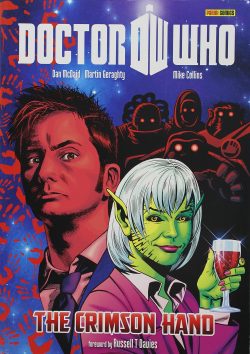
Doctor Who Graphic Novels volume 13: The Crimson Hand


By Dan McDaid, Martin Geraghty, Jonathan Morris, Mike Collins, David A. Roach, Sean Longcroft, Rob Davis, Paul Grist, Ian Culbard, Roger Langridge & various (Panini Books)
ISBN: 978-1-84653-451-5 (TPB)

Doctor Who launched on television with the first episode of ‘An Unearthly Child’ on November 23rd 1963. Happy 60th, Time Lord!

Within a year, his decades-long run in TV Comic began with issue #674 and the premier instalment of ‘The Klepton Parasites’.

On 11th October 1979 (although adhering to the US off-sale cover-dating system so it says 17th) Marvel’s UK subsidiary launched Doctor Who Weekly, which became a monthly magazine in September 1980 (#44) and has been with us under various names ever since.

All of which only goes to prove that the Time Lord is a comic hero with an impressive pedigree…

Marvel/Panini spent a lot of effort – and time! – collecting every strip from its archive in a uniform series of over-sized graphic albums, each concentrating on a particular incarnation of the deathless wanderer.

This one gathers stories from Doctor Who Magazine (AKA DWM) issues #394 & 400-420 plus The Doctor Who Storybook 2010 (originally published between 2008 and 2010): all featuring the escapades of the recently re-enlisted David Tennant incarnation of the Galloping Gallifreyan.

This is actually the third and final collection of strips featuring “the Tenth Doctor” and whether that statement made any sense to you largely depends on whether you are an old fan, a new convert or a complete beginner.

None of which is relevant if all you want is a darn good read. All the creators involved have managed the ultimate “Ask” of any strip creator – to produce engaging, thrilling, fun yarns that can be equally enjoyed by the merest beginner and the most slavishly addicted fan.

After an effusive introduction from Russell T. Davies, the full-colour graphic grandeur begins with a one-off romp from 2008 entitled ‘Hotel Historia’ by writer/artist Dan McDaid, wherein the Good Doctor fetches up in a spectacular resort for time-travellers.

Here he first encounters pushily obnoxious corporate raider Majenta Pryce and uses her shoddy and slipshod time-technology to counter a threat from the chronal brigands known as the Graxnix.

This is riotously followed by a delightful clash with ‘Space Vikings’ (by Jonathan Morris, Rob Davis & Ian Culbard, taken from the 2010 Christmas Doctor Who Storybook) wherein slave-taking star-rovers prove to be far less than they appear…

The main body of stories here formed something of an experiment as DWM #400-420 were designed as an extended story-arc leading up to the big change on television wherein Matt Smith would replace Tennant as “The Eleventh Doctor”.

Therefore McDaid was tasked with scripting the entire 21-issue run and began by reintroducing scurrilous money-mad chancer Majenta Pryce in ‘Thinktwice’ (#400-402, illustrated by Martin Geraghty & David A. Roach); an intergalactic penal institution with some decidedly off-kilter ideas on reforming prisoners.

Pryce is a prisoner but has amnesia. So does her cellmate Zed and – in fact – most of the convicts aboard. The supposedly cushy debtor’s prison is actually a horror-house of psychological abuse where suicide is endemic, cunningly maintained by creepy Warden Gripton who is messing with inmates’ memories to satisfy the hungers of something he calls “memeovax

Luckily, new prison doctor “John Smith” is a dab hand with a Sonic screwdriver…

With her memory far from restored, wickedly entrepreneurial Majenta becomes the unlikeliest of Companions, demanding that the “legally liable” Doctor makes restitution for all the trouble he’s caused by ferrying her to planet Panacea where she can be properly cured.

As we all know however, the Tardis goes where She wants and at Her own pace…

‘The Stockbridge Child’ (#403-405 and illustrated by Mike Collins & Roach) deposits the unhappy partners to that peaceful English village where three different incarnations of the Time Lord have encountered incredible alien incursions.

When the Doctor is reunited with outcast skywatcher Maxwell Edison they uncover at last the ancient horror beneath the hamlet which has made the place such a magnet for madness and monsters, before finally despatching the brooding anti-dimensional threat of the Lokhus

Meanwhile Majenta’s big secret hasn’t forgotten her, and is rapidly closing in…

DWM #406-407 featured ‘Mortal Beloved’ limned by Sean Longcroft – wherein the Doctor and “Madge” arrive at a decrepit asteroid mansion on the edge of the biggest storm in creation.

Amidst the flotsam and jetsam lurk poignant clues to Pryce’s past, as tantalisingly revealed by the robots and holograms left to run the place after a far younger Majenta jilted brilliant playboy industrialist Wesley Sparks. Of course, after such an immense length of time, even the most devoted of loves and programs can falter, doubt and even hate…

‘The Age of Ice’ (#408-411, by McDaid, Geraghty & Roach) brings the Last Time Lord and Lost Executive to Sydney Harbour for a fond reunion with Earth Defence Force UNIT, just as time-distortions begin dumping dinosaurs in the sunny streets, and crystalline knowledge stealers The Skith once more attempt to assimilate all the Doctor’s vast and varied experiences. Majenta too finds an old friend in the shape of her long-lost junior associate Fanson, who admits to wiping her memory. When he becomes part of the huge body-count before revealing why, Madge thinks she would lose what was left of her mind…

‘The Deep Hereafter’ (#412, by Rob Davis with above-and-beyond calligraphy from letterer Roger Langridge) is a scintillating space detective story, pastiching classic Will Eisner Spirit Sunday sections, but still succeeds in advancing the overarching plot as Madge and the Doctor complete the last case of piscine P.I. Johnny Seaview and chase down the threat of the reality warping World Bomb…

DWM #413 (Collins & Roach) exhibits ‘Onomatopoeia’ and pits the reluctant pair against space-rats and out-of-control pest prevention systems in a clever and heart-warming fable told almost exclusively without dialogue.

The superb ‘Ghosts of the Northern Line’ (#414-415) follows with Paul Grist working his compositional magic in a chilling yarn of murderous phantoms slaughtering tube passengers in present day London. Obviously they can’t be spirits, so what is the true cause of the apparitions?

This yarn leads directly into the big payoff as the assembled forces of galactic Law and Order suddenly show up to arrest Majenta, plunging the voyagers into a spectacular epic ending as the stroppy impresario at last regains her memory and acquires the power to reshape all of reality. It’s all the fault of the cosmic consortium known and feared as ‘The Crimson Hand’ (DWM #416-420, by McDaid, Geraghty & Roach)…

This blockbuster rollercoaster epic perfectly ends the saga of Majenta Pryce and signs off the Tenth Doctor in suitable style, but dedicated fans still have a wealth of added value bonuses in the posterior text section, which includes a commentary from editor Tom Spilsbury, the origins of the saga from McDaid, Doctor Who Story Notes, the Majenta Pryce “Pitch” and an annotated story background section: copiously illustrated with behind-the-scenes photos, sketches and production art.

We’ve all got our little joys and hidden passions. Sometimes they overlap and magic is made. This is a superb sequence of strips, starring an undeniable bulwark of British Fantasy. If you’re a fan of only one, this book might make you an addict to both. The Crimson Hand is a fabulous book for casual readers, a fine shelf addition for devotees of the show and a perfect opportunity to cross-promote our particular art-form to anyone minded to give comics another go.

If only someone would get around to getting these tales digitised…
All Doctor Who material © BBCtv. Doctor Who logo © BBC 2009. Tardis image © BBC 1963. Doctor Who, the Tardis and all logos are trademarks of the British Broadcasting Corporation and are used under licence. © Marvel. Published 2012 by Panini Publishing, Ltd. All rights reserved.

Flash Gordon Annual 1967


By anonymous staff of the Mick Anglo Studio, Dick Wood, Al Williamson, Don Heck & various (World Distributor’s [Manchester] Ltd.)
No ISBN – ASIN B000ZOP1GY

By most lights, Flash Gordon is the most influential comic strip in the world. When the hero debuted on Sunday January 7th 1934 (with the superb but rather dated Jungle Jim running as a supplementary “topper”) as response to revolutionary, inspirational, but clunky Buck Rogers (by Philip Nolan & Dick Calkins and which had also began on January 7th but in 1929), a new element was added to the realm of fantasy wonderment: Classical Lyricism.

Where Rogers had traditional adventures and high science concepts, this new feature reinterpreted Fairy Tales, Heroic Epics and Mythology. It did so by spectacularly draping them in the trappings of the contemporary future, with varying esoteric “Rays”, “Engine” and “Motors” substituting for trusty swords and lances – although there were also plenty of those – and exotic flying craft and contraptions standing in for Galleons, Chariots and Magic Carpets.

Most important of all, the sheer artistic talent of Raymond, his compositional skills, fine line-work, eye for concise, elegant detail and just plain genius for drawing beautiful people and things, swiftly made this the strip all young artists swiped from.

When all-original comic books began a few years later, literally dozens of talented kids used the clean lined Romanticism of Gordon as their model and ticket to future success in the field of adventure strips. Most of the others went with Milton Caniff’s expressionistic masterpiece Terry and the Pirates (which also began in 1934 – and he’ll get his go another day).

At the time of this annual a bunch of Gold Key and King Features Syndicate licenses were held by Mick Anglo, who provide strip and prose material for UK weekly TV Tornado. It combined British generated material with US comic book reprints in an era when the television influence of shows like Tarzan and Batman, and venerable features like Flash Gordon – who also had a small screen presence thanks to frequent re-runs of his cinema chapter plays. The project was extremely popular, even though not always of the highest quality…

In 1966, newspaper monolith King Features Syndicate briefly got into comic book publishing again: releasing a wave of titles based on their biggest stars. These were an ideal source of material for British publishers, whose regular audiences were profoundly addicted to TV and movie properties. Moreover, thematically they fitted with World Distributors’ other licensed properties, which repackaged Western’s comics material like Star Trek, Beverly Hillbillies or Voyage to the Bottom of the Sea with domestically generated material – usually crafted by Mick Anglo’s packaging company Gower Studios.

This Anglo-American (tee-hee!) partnership filled our Christmas needs for a generation, producing a range of UK Annuals – and the occasional Special – mixing full-colour US reprints with prose stories, puzzles, games and fact-features on related themes.

Flash Gordon Annuals appeared sporadically over the next few decades beginning with this release from 1967 which leaned heavily on generic prose space opera adventure leavened with some truly stunning comics tales.

In opening yarn, ‘The Tanks of Triton’ Flash, Dale Arden and Dr. Zarkov are recast as general space explorers and their voyage to unknown world Athene sees them saving an advanced and cultured pacifist species from barbaric underseas invaders, after which the explorers pop back to Mongo and visit the Unexplored Continent just in time to scotch the conquest plans on tyrants in waiting ‘The Doom Men’ .

Thus far the fictive text had been augmented by full-colour painted illustrations (and inset epigrammatic facts about Space) but the first full photo feature of rocket science takes centre stage in ‘Britain’s Contribution to Europe’s Satellite’ comes next, counterpointed by maze puzzle ‘Earth in Danger’ before vertical take-off jets are reviewed in ‘Look – No Runway!’

Natural history feature ‘It All Depends!’ discusses relative lifespans before prose yarn in two tone line art ‘Undersea Peril’ sees Flash, Dale and Zarkov discover yet another hidden aquatic kingdom and depose another crazed would-be world conqueror before we enjoy board game ‘Space Flight to Mongo’ and themed crossword ‘Space Fill-In’.

Full-colour comics wonderment begins with the eponymous lead strip from King Comics’ Flash Gordon #1, cover-dated September 1966. Possibly scripted by Archie Goodwin (or Larry Ivie?) ‘Flash Gordon’ was latterly credited to majestic illustrator Al Williamson. While we’re being detailed, the last page is supposedly inked by Gray Morrow…

The strip sees our terrific trio returned to Mongo, in search of desperately needed Radium to stave off a crisis on Earth. Packed with all the vast cast of the series it depicts how the visitors arrive just in time to thwart a coup d’état in frozen kingdom Frigia…

Williamson was one of the greatest draughtsmen to ever grace the pages of comic books and newspaper strip sections. He was born in 1931 in New York City, after which his family relocated to Columbia just as the Golden Age of syndicated adventure strips began.

The lad’s passion for “the Comics” – especially Raymond’s Flash Gordon and Jungle Jim – broadened as he devoured imported and translated US material and the best that Europe and Latin America could provide in anthology magazines as Paquin and Pif Paf. When he was twelve the Williamsons returned to America where, after finishing school, the prodigy found work in the industry that had always obsessed him.

In the early 1950s he became a star of E.C. Comics’ science fiction titles beside kindred spirits Joe Orlando, Wally Wood, Roy G. Krenkel, Frank Frazetta & Angelo Torres. He drew Westerns Kid Colt and Ringo Kid for Atlas/Marvel and during the industry’s darkest days found new fame and fans in newspaper strips, firstly by assisting John Prentice on Rip Kirby – another Raymond masterpiece – and, from 1967, on Secret Agent Corrigan.

Williamson drew Flash Gordon for King Comics and worked on mystery tales and westerns for DC whilst drawing Corrigan; eventually becoming go-to guy for blockbuster sci-fi film adaptations with his stunning interpretations of Blade Runner and Star Wars.

His poetic realism, sophisticated compositions, classicist design and fantastic naturalism graced many varied tales, but in later years he was almost exclusively an inker over pencillers as varied as John Romita Jr., Larry Stroman, Rick Leonardi, Mark Bright, José Delbo and a host of others on everything from Transformers to Spider-Man 2099, Daredevil to Spider-Girl. His magical brushes and pens also embellished many of Marvel’s Graphic Novel productions – such as The Inhumans and Cloak and Dagger: Predator and Prey.

Williamson died in June 2010.

In this Annual, it’s back to prose & painted illos for ‘The Green Horde’ as our heroes discover a new planet just in time to foil a secret invasion of Earth, after which ‘The Black Beasts of Prey’ takes the wanderers to planet Zeus in time to save a dying race of humanoids from fluing dinosaurs and set evolution back on its destined track…

US comic book Flash Gordon #1 also had a back-up starring fellow legendary stalwart Mandrake the Magician and it appears here: crafted by Dave Wood, Don Heck & Andre LeBlanc. ‘Midnight with Mandrake’ sees a gang of thieves unleash sleeping gas on a city crowd, only to have Mandrake change it from soporific to an hallucinogen that sends everyone on the trip of their lives…

It’s back to 2-tone and peerless prose as our heroes find ‘Ming the Merciless’ loose on Earth and stealing weapons tech to reconquer Mongo, after which gag page ‘Laughs in Space’ segues into a text told war of liberation for marsh dwelling primitives in ‘The Last of the Claymen’ and a ‘True or False ’ brain teaser page before we spectacularly end with the last strip from Flash Gordon #1, as the Terran Trio test Zarkov’s new mole machine and discover a lost civilisation deep under the crust of Mongo. Sadly, the locale of Krenkellium might be fresh and new but power, politics and peril seem to play out in a universal manner in ‘Flash Gordon and the Mole Machine’ (by Archie Goodwin & Williamson).

This kind of uncomplicated done-in-one media-tasty package was the basic unit of Christmas entertainment for millions of British kids at one time and still holds plenty of rewarding fun for those looking for a simple and straightforward nostalgic escape.
© MCMLXVI, MCMLXVII by King Features Syndicate, Inc. The Amalgamated Press.

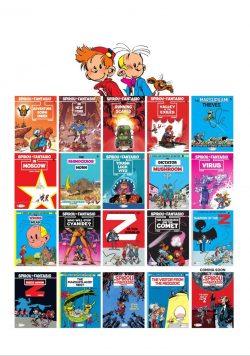
A Spirou & Fantasio Adventure: Volume 19 – The Visitor from the Mesozoic


By André Franquin with Greg & Jidéhem, translated by Jerome Saincantin (Cinebook)
ISBN: 978-1-80044-066-1 (Album PB/Digital edition)

Win’s Christmas Gift Recommendation: Marvellous Monster Madness… 9/10

Spirou (whose name translates as “squirrel”, “mischievous” and “lively kid” in the language of Walloons) was created by French cartoonist François Robert Velter – AKA Rob-Vel – for Belgian publisher Éditions Dupuis. He was a measured response to the success of Hergé’s Tintin at rival outfit Casterman. At first, Spirou (with his pet squirrel Spip) was a plucky bellboy/lift operator employed by the Moustique Hotel (an in-joke reference to Dupuis’ premier periodical Le Moustique) whose improbable adventures gradually evolved into astounding and often surreal comedy dramas.

The other red-headed lad debuted on April 21st 1938 in an 8-page, French-language tabloid magazine that bears his name to this day. Fronting a roster of new and licensed foreign strips – Fernand Dineur’s Les Aventures de Tif (latterly Tif et Tondu) and US newspaper imports Red Ryder, Brick Bradford and SupermanLe Journal de Spirou grew exponentially: adding Flemish edition Robbedoes on October 27th 1938, bumping up the page count and adding compelling action, fantasy and comedy features until it was an unassailable, unmissable necessity for Continental kids.

Spirou and chums spearheaded the magazine for most of its life, with many impressive creators building on Velter’s work, beginning with his wife Blanche “Davine” Dumoulin, who took over the strip when her husband enlisted in 1939. She was aided by Belgian artist Luc Lafnet until 1943, when Dupuis purchased the feature, after which comic-strip prodigy Joseph Gillain (“Jijé”) took over.

In 1946, Jijé’s assistant André Franquin inherited the strip. Gradually, he retired traditional short gag-like vignettes in favour of longer adventure serials; introducing a wide and engaging cast of regulars. He ultimately devised a phenomenally popular nigh-magical animal dubbed Marsupilami, who debuted in 1952’s Spirou et les héritiers.

Jean-Claude Fournier succeeded Franquin in 1969 and working for a decade: beginning a succession of reinventions by creator teams that included Raoul Cauvin & Nic Broca; Yves Chaland; and Philippe Vandevelde – writing as Tome” & artist Jean-Richard Geurts – AKA Janry.

These last reverently referenced the beloved, revered Franquin era: reviving the feature’s fortunes in 14 albums between 1984-1998. After their departure the strip diversified into parallel strands: Spirou’s Childhood/Little Spirou and guest-creator specials A Spirou Story By… before Lewis Trondheim and the teams of Jean-Davide Morvan/Jose-Luis Munuera and Fabien Vehlmann/Yoann stepped up.

By my count – which includes specials, spin-offs series and one-shots – they cumulatively bring the album count to upwards of 90, but for many of us the Franquin sagas are the epitome and acme of the Spirou experience…

Cinebook have been publishing Spirou & Fantasio’s exploits since October 2009, initially concentrating on translating Tome & Janry’s superb pastiche/homages of Franquin, but for this manic marvel (available in paperback and digitally) they reached back all the way to 1960 for some true Franquin-formulated furore.

Belgian superstar André Franquin was born in Etterbeek on January 3rd 1924. Drawing from an early age, he began formal art training at École Saint-Luc in 1943 but when the war forced the school’s closure a year later, Franquin found animation work at Compagnie Belge d’Animation in Brussels. Here he met Maurice de Bevere (Lucky Luke-creator “Morris”), Pierre Culliford (AKA The Smurfs creator Peyo), and Eddy Paape (Valhardi, Luc Orient).

In 1945 all but Culliford signed on with Dupuis, and Franquin began his career as a jobbing cartoonist/illustrator, crafting covers for Le Moustique and scouting magazine Plein Jeu. Throughout those days, Franquin and Morris were being trained by Jijé – at that time main illustrator at Le Journal de Spirou. He turned the youngsters and fellow neophyte Willy Maltaite – AKA Will (Tif et Tondu, Isabelle, Le jardin des désirs) – into a perfect creative bullpen known as the La bande des quatre or “Gang of Four”. They would revolutionise Belgian comics with their prolific and engaging “Marcinelle school” style of graphic storytelling.

Jijé handed Franquin all responsibilities for the flagship strip part-way through Spirou et la maison préfabriquée, (LJdS #427, June 20th 1946. He ran with it for two decades, enlarging the scope and horizons until it became purely his own. Almost every week fans would meet startling new characters like comrade/rival Fantasio and crackpot inventor the Count of Champignac. Along the way Spirou & Fantasio became globe-trotting journalists, endlessly expanding their weekly exploits in unbroken four-colour glory.

The heroes travelled to exotic places, uncovering crimes, finding the fantastic and clashing with a coterie of exotic arch-enemies like Zorglub and Zantafio, as well as one of the first strong female characters in European comics, rival journalist Seccotine (renamed Cellophine in the current English translation).

In a splendid example of good practise, Franquin mentored his own band of apprentice cartoonists during the 1950s. These included Jean Roba (La Ribambelle, Boule et Bill), Jidéhem (Sophie, Ginger, Starter, Uhu-Man, Gaston Lagaffe) and Greg author of Luc Orient, Bruno Brazil, Bernard Prince, Achille Talon, and Zig et Puce who all worked with him on Spirou et Fantasio.

In 1955, a contractual spat with Dupuis saw Franquin sign with rivals Casterman on Le Journal de Tintin, collaborating with René Goscinny and Peyo whilst creating the raucous gag strip Modeste et Pompon. Within weeks Franquin patched things up with Dupuis and returned to Spirou, subsequently co-creating Gaston Lagaffe (known in Britain as Gomer Goof), but was obliged to carry on his Casterman commitments too…

From 1959, writer Greg and background artist Jidéhem assisted Franquin, but by 1969 the artist had reached his Spirou limit. He quit, taking his mystic yellow monkey with him…

His later creations include fantasy series Isabelle, illustration sequence Monsters and bleak adult conceptual series Idées Noires, but his greatest creation – and one he retained all rights to on his departure – is Marsupilami, which, in addition to comics tales, has become a star of screen, plush toy store, console and albums.

Plagued in later life by bouts of depression, Franquin passed away on January 5th 1997, but his legacy remains: a vast body of work that reshaped the landscape of European comics.

Originally entitled Le voyageur du Mésozoïque and brought to you here as The Visitor from the Mesozoic this album combines a long tail (sorry couldn’t resist!) plus another, shorter adventure by the master crafted in collaboration with co-writer Greg (alias Michel Régnier) and artist Jidéhem – AKA Jean De Mesmaeker. The lead romp comes from 1957 having originated as a serial in Le Journal de Spirou #992-1018 and clearly and cleverly channelling that time’s penchant for rampaging, city-stomping giant monsters…

It begins in the Antarctic as the mushroom-mad Count de Champignac is rescued – much against his will – from his own experiments and frozen doom and brought back to France. He has with him a dinosaur egg that has been frozen for millions of years…

Getting the fragile, precious miracle back to his lab in bucolic Champignac-on-the-Sticks takes all the ingenuity and determination his pals Spirou and Fantasio can muster, but after much fuss and fluster the primordial ovum is stashed in the genius’ workshop and slowly thawing under the gimlet eyes of a handpicked team of fellow mad scientists including Doctors Nero, Schwartz, atomic pariah Sprtschk and Alexandre Specimen – “the Biologist”…

Their bumbling patience is tested to its limits when the mischievous Marsupilami becomes obsessed with the new ball toy and perhaps it’s his terrifying antics that finally force it to hatch…

Everyone is delighted when the mega-million-year-old herbivore pops out, but science is never patient and the bonkers boffins imprudently goose along its development with a little growth formula and aging extracts. Sadly, so does the Marsupilami and when everybody wakes up in the morning they’re greeted by a genial skyscraper saurian with a huge empty belly and a very bad cold…

Soon the big daft brute is shambling through the hamlet looking for browse and causing quite a commotion. The villagers might be used to weird happenings but the government respond with predictable hostility: sending in a tank column and a flight of warplanes…

They prove inefficient and quite ineffective, but the story also generates a wave of controversy. Stridently vocal, violently different pressure groups form: some wanting to save the poor endangered creature and others seeking to preserve the precious landmarks and monuments the beast is trampling. There’s even one guy who wants to make the dinosaur the latest taste sensation in his canned meat factory…

With chaos rampant Spirou looks for a solution to help the creature and finds one, but it depends on manoeuvring the monster to a certain isolated promontory. Thankfully, the Marsupilami has lost patience with his old toy and is ready to step in and step up…

Manic and wildly slapstick in tone and delivery, the story of the big beast is both charming and wickedly satirical and offers a happy ending films like Godzilla, Konga and Gorgo could never have imagined…

The rampaging silliness is counterbalanced by an equally funny but far more sinister pastiche also set in the wild world of the Merlin of Mushrooms. Back-up yarn ‘Fear on the Line’ stems from 1959, serialised as ‘La Peur au bout du fil’ in LJS #1086-1092. Notable for the first crossover appearance of comedy sluggard Gaston Lagaffe, the story details how Champignac distils the chemical essence of evil and accidentally drinks it instead of his coffee. Warned too late, Spirou and Fantasio must chase the now wicked prankster as he wreaks havoc in the village and plants bombs filled with his chemical concoctions. Happily, The Biologist is on hand to offer advice as the clock counts down to doom and our heroes give chase, but in the end it’s the Marsupilami who solves the crisis in his own bombastic manner…

The Visitor from the Mesozoic is the kind of lightly-barbed comedy-thriller that delights readers fed up with a marketplace far too full of adults-only carnage, testosterone-fuelled breast-beating, teen-romance monsters or sickly-sweet fantasy.

Easily accessible to readers of all ages and drawn with all the beguiling style and seductive yet wholesome élan which makes Asterix, Lucky Luke, and Iznogoud so compelling, this is a truly enduring landmark tale from a long line of superb exploits, and deserves to be a household name as much as those series – and even that other kid with the white dog…
Original edition © Dupuis, 1960 by Franquin. All rights reserved. English translation © 2022 Cinebook Ltd.

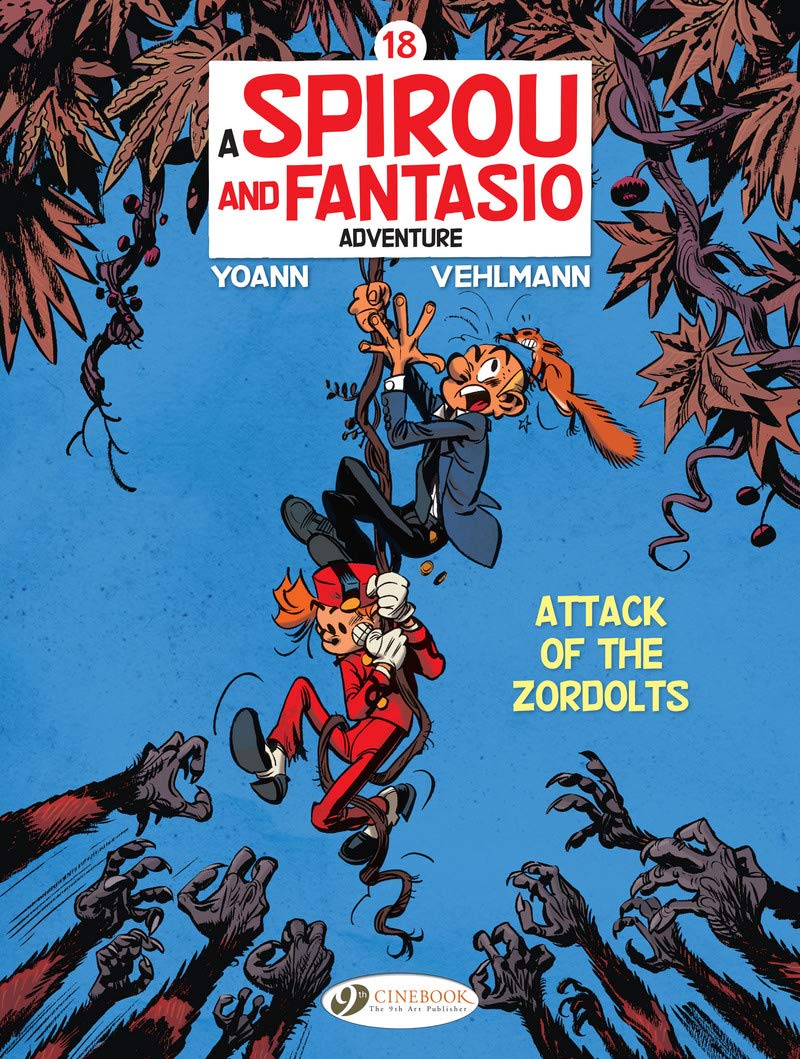
Spirou & Fantasio volume 18: Attack of the Zordolts


By Yoann & Vehlmann, designed by Fred Blanchard, colored by Hubert & translated by Jerome Saincantin (Cinebook)
ISBN: 978-1-80044-022-7 (Album PB/Digital edition)

Win’s Christmas Gift Recommendation: Manic Mirth and Mad Melodrama… 9/10

Spirou (which translates as both “squirrel” and “mischievous” in the Walloon language) was created by French cartoonist Françoise Robert Velter AKA Rob-Vel for Belgian publisher Éditions Dupuis in response to the phenomenal success of Hergé’s Tintin at rival outfit Casterman.

Soon-to-be legendary weekly comic Le Journal de Spirou launched on April 21st 1938 with a rival red-headed lad as lead feature in an anthology which bears his name to this day. The eponymous hero was a plucky bellboy/lift operator employed in the Moustique Hotel – a sly reference to the publisher’s premier periodical Le Moustique. His improbable adventures with pet squirrel Spip gradually evolved into far-reaching, surreal comedy dramas.

Spirou and his chums have spearheaded the magazine for most of its life, with a phalanx of truly impressive creators carrying on Velter’s work, beginning with his wife Blanche “Davine” Dumoulin who took over the strip when her husband enlisted in 1939. She was assisted by Belgian artist Luc Lafnet until 1943, when Dupuis purchased all rights to the property, after which comic-strip prodigy Joseph Gillain (Jijé) took the helm.

In 1946, his assistant André Franquin assumed the creative reins, gradually ditching the well-seasoned short gag vignettes in favour of epic adventure serials. He also expanded the cast, introducing a broad band of engaging regulars and eventually creating phenomenally popular magic animal Marsupilami.

Franquin was followed by Jean-Claude Fournier who updated the feature over nine stirring adventures tapping into the rebellious, relevant zeitgeist of the times: offering tales of environmental concern, nuclear energy, drug cartels and repressive regimes.

By the 1980s the series seemed outdated and lacked direction. Three different creative teams alternated on the feature, until it was overhauled and revitalised by Philippe Vandevelde (writing as Tome) and artist Jean-Richard Geurts AKA Janry. They adapted, referenced and in many ways returned to the beloved Franquin era.

Their sterling efforts revived the floundering feature’s fortunes, generating 14 wonderful albums between 1984 and1998. As the strip diversified into parallel strands (Spirou’s Childhood/Little Spirou and guest-creator specials A Spirou Story By…), the team on the core feature were succeeded by Jean-David Morvan & José-Luis Munuera. Then Yoann & Vehlmann took over the never-ending procession of amazing adventures…

Multi-award-winning French comics author Fabien Vehlman was born in 1972, began his comics career in 1996 and has been favourably likened to René Goscinny. He’s best known for Green Manor (illustrated by Denis Bodart), Seven Psychopaths with Sean Phillips, Seuls (drawn by Bruno Gazzotti and available in English as Alone), Wondertown with Benoit Feroumont and Isle of 1000,000 Graves with Jason.

He assumed the writing reins on Spirou and Fantasio in collaboration with Yoann. beginning with the book on review here – 2010’s Spirou et Fantasio – Alerte aux Zorkons.

Yoann Chivard was born in October 1971 and was drawing non-stop by the age of five. With qualifications in Plastic Arts and a degree in Communication from the Academy of Fine Arts in Angers, he became a poster and advertising artist whilst dabbling in comics. His creations include Phil Kaos and Dark Boris for British Indie publications Deadline and Inkling, Toto l’Ornithorynque, Nini Rezergoude, La Voleuse de Pere-Fauteuil, Ether Glister and Bob Marone and he has contributed to Trondheim & Sfar’s Donjon. In 2006, Yoann was the first artist to produce a Spirou et Fantasio one shot Special. It was scripted by Vehlmann…

Cinebook have been publishing Spirou & Fantasio’s exploits since 2009, alternating between the various superb reinterpretations of Franquin and earlier efforts from the great man himself. When Jijé handed Franquin all responsibilities for the strip part-way through Spirou et la maison préfabriqué (LJdS #427, June 20th 1946), the new guy ran with it for two decades; enlarging the scope and horizons until it became purely his own. Almost every week fans would meet startling new characters such as staunch comrade and rival Fantasio or crackpot inventor and Merlin of mushroom mechanics Pacôme Hégésippe Adélard Ladislas de ChampignacThe Count of Champignac

Spirou and Fantasio became globe-trotting journalists, travelling to dangerously exotic places, uncovering crimes, exploring the fantastic and clashing with a coterie of exotic arch-enemies such as Fantasio’s deranged and wicked cousin Zantafio and that maddest of scientists, Zorglub.

This old school chum and implacable rival of Champignac is an outrageous Bond movie-flavoured villain who constantly targets the Count. A brilliant engineer, his incredible machines are far less dangerous than his mesmerising mind-controlling “Zorglwave” and an apparently unshakable desire to conquer Earth and dominate the solar system from a base on the Moon…

This tale opens with the seemingly reformed plotter stealing some of Champignac’s most incredible mushroom-based miracles and triggering a massive mutational event in and around the bucolic generally placid hamlet of Champignac-in-the-Sticks.

The first Spirou and Fantasio hear of it is a desperate cell phone call from Pacôme, who has just reappeared after weeks amnesiac and missing. Driving back from a promotional tour, our heroes race across country only to find the placid region is now an armed camp, with soldiers in biohazard gear brutally decontaminating villagers.

The little valley has become a monstrous alien jungle dominated and transformed by weird and incredible plant/animal/fungus creatures, but neither they nor the military – who are keen on immediately nuking the geographical atrocity – can stop our dedicated reporters sneaking in to find their friends.

On locating the Count and his two new chums – hot Swedish science students Astrid and Lena – the lads learn that the brave new world is an accident and hideous side effect of Zorglub’s latest scheme, and that he’s sorrier than anyone at the state of the local environment.

He’s certainly keen enough on fixing the problem…

Other than the fact that everything wants to eat everything else, and that many of the human locals seem comfortable and accustomed to the changes, the main problem seems to be a rapidly proliferating and aggressive form of beast man. The jungle is now a superfast evolutionary Petri dish with everything in it part of an arms race to out-compete all rivals. These brutish bipeds have for some reason evolved immunity to Zorglub’s Zorglwave by having oodles of aggression and not enough intellect. They are ravening, unstoppable Zordolts…

Not sure what’s happening, but resolved to stop the Army bombing the village before foiling Zorglub, everybody works frantically together and succeeds in part one of the plan, but when the jests are repelled and the Zordolts stopped by Champignac’s newly-liberated dinosaur they find the villain vanished.

By the time Champignac has worked his mushroom magic in reverse and restored most of the status quo, the Master of the Z ray is long gone. If our heroes could look up high enough, they might see him well on his way to the moon with Astrid in Lena in tow and about to set his Great Masterwork in motion…

To be Continued…

Rocket-paced, action-packed, compellingly convoluted and with just the right blend of perfectly blending helter-skelter excitement and sheer daftness, Attack of the Zordolts is a terrific romp to delight devotees of easy-going adventure.

Stuffed with an astounding array of astonishing hi-tech spoofery, riotous chases and gazillions of sight gags and verbal ripostes, this exultant escapade is a fabulous fiesta of angst-free action and thrills. Readily accessible to readers of all ages and drawn with beguiling style and seductive energy and wit, this is pure cartoon gold, truly deserving of reaching the widest audience possible.

Buy it for you, get another for the kids and give copies to all your friends…
Original edition © Dupuis, 2010 by Vehlmann, Yoann, Blanchard & Hubert. All rights reserved. English translation 2021 © Cinebook Ltd.

The Creature Commandos


By J.M. DeMatteis, Robert Kanigher, Mike W. Barr, Fred Carrillo, Pat Broderick, John Celardo, Bob Hall, Jerry Ordway, Dan Spiegle, & various (DC Comics)
ISBN: 978-1-4012-4382-1 (TPB/Digital edition)

American comic books just idled along rather meekly until the 1938 invention of Superman provided a flamboyant new genre for heroes: subsequently and bombastically unleashing a torrent of creative imitation for a suddenly thriving and voracious new entertainment model that would enthral future generations.

Implacably vested in World War II, gaudily-garbed mystery men swept all before them until the troops came home, but as the decade closed traditional themes and heroes resurfaced to gradually supplant the Fights ‘n’ Tights crowd.

Even as a new crop of kids began buying and collecting, many of the first fans who had retained a four-colour habit sought more mature themes in their pictorial reading matter. Recent conflict and post-war paranoia irrevocably altered the psychological landscape of the readership as a more world-weary, cynical public slowly realised that all the fighting and dying hadn’t changed anything. The period’s established forms of entertainment – film, radio, theatre and prose, as well as comics – increasingly reflected this.

To balance the return of Western, War, Crime and imminent Atomic Armageddon-fuelled Science Fiction, comics created fresh fields. Celebrity tie-ins, escapist teen-oriented comedy and anthropomorphic animal features thrived, and gradually another of the cyclical revivals of spiritualism and increased public fascination with the arcane led to a wave of impressive, evocative and shockingly addictive horror comics.

DC Comics bowed to the inevitable by launching a comparatively straight-laced anthology which nevertheless became one of their longest-running and most influential titles with December 1951/January 1952 cover-dated The House of Mystery.

After the hysterical censorship debate which led to witch-hunting Senate hearings in the early 1950s was curtailed by the industry adopting a castrating straitjacket of self-regulation, titles produced under the aegis of the Comics Code Authority were sanitised, anodyne affairs in terms of Shock and Gore, but the audience’s appetite for suspense was still high and in 1956 National introduced sister titles Tales of the Unexpected and House of Secrets.

Stories were dialled back from uncanny yarns to (always) marvellously rendered, rationalistic fantasy-adventures and, ultimately, straight monster-busting Sci Fi tales which dominated the market into the 1960s. That’s when superheroes – enjoying their own visionary revival after Julius Schwartz reintroduced The Flash in Showcase #4 – finally overtook them.

Such was never the case with war comics. Tales of ordinary guys in combat began with the industry itself and although mostly sidelined during the capes-&-cowls war years, quickly began to assert themselves again once the actual fighting stopped.

National/DC were one of the last to get in on the combat trend: converting superhero/fantasy adventure anthology Star Spangled Comics into Star Spangled War Stories the same month Our Army at War launched (both cover-dated August 1952). Also repurposed, All-American Comics became All-American Men of War a month later as the “police action” in Korea escalated.

National grew the division slowly but steadily, adding Our Fighting Forces #1 (November 1954) – just as EC’s groundbreaking combat comics were vanishing – and in 1957 added GI Combat to their portfolio when Quality Comics got out of the funnybook business.

As the decade closed, the anthologies all began incorporating recurring characters to the mix. Gunner and Sarge – and latterly Pooch – launched in Our Fighting Forces #45 (May 1959). They were followed a month later by Sgt Rock in Our Army at War #83 and – addressing mystery as well as mayhem – The War that Time Forgot debuted in Star Spangled War Stories #99 (May 1960) and The Haunted Tank took off in G.I. Combat #87 (April/May 1961). Soon every DC war book had a lead star or feature to hold the fickle readers’ attention.

The drive to produce superior material never wavered, however, hugely aided by the diligent and meticulous ministrations of writer/editor Robert Kanigher. As the Vietnam War escalated, 1960s America increasingly endured a Home Front death-struggle pitting deeply-ingrained Establishment attitudes against a young generation with a radical new social sensibility. In response, military-themed comic books from National Periodical Publishing became even more boldly innovative…

However, another sudden superheroes dieback led to serious rethinking and although war titles maintained and even increased sales, the editors beefed up both supernatural and anthological elements. Thus in 1971 (cover-dated October), a title merging horror scenarios with battle yarns seemed a forgone conclusion: a sure thing for both publishers and readers alike. The notion proved correct and Weird War Tales ran for 124 issues: a DC mainstay for 12 years and experimental forge for many young creators to learn the craft and business.

Eventually, history again repeated itself and character vehicles began to replace stand-alone stories: primarily revivals of earlier features such as The War That Time Forgot and G.I. Robot, but also the uncanny undercover unit that is the star of this turbulent tome.

Compiling stories and even some comedy sidebars first seen in Weird War Tales #93, 97, 100, 102, 105, 108-112, 114-119, 121 and 124 (spanning cover-dates November 1980 to June 1983), this vintage tome offers a broad blend of genre mash-ups for armchair combat fans with a taste for the dark and uncanny to relish.

It begins without flourish in WWT #93 as J.M. DeMatteis, Pat Broderick & John Celardo introduce The Creature Commandos!’ Spring 1942 and America’s Project M (for Monster) and US Army Intelligence officer Matthew Shrieve want to create a specialist team for rapid strike missions using mankind’s primordial terrors as a psychological weapon.

Their prime candidates are three originally ordinary soldiers altered by science into analogues of Hollywood horrors. After stepping on a landmine and surviving experimental surgery Marine private Elliot “Lucky” Taylor is now a mute Frankensteinian colossus, whilst cashiered sergeant Vincent Velcro chose a course of bat blood serum treatments over 30 years in the brig: and is now a shapeshifting bloodsucking vampire. Unable to enlist because he suffered from “blood disorder” lycanthropy, Warren Griffiths was “treated” until he became an impermanently manifested werewolf. The proposed team would be completed by Shrieve himself: a human problem solver (for which read “callous psychopath”) in command of a relentless ruthless squad designed to strike fear into the hearts of the foe…

Allied Command are disgusted and never want to see the squad again, but as it’s wartime, that translates as dumping them in occupied France with orders to do as much damage as possible…

The first mission drops them on Castle Conquest, where Nazi robotic experiments prove no match for their savagery, but success is somewhat spoiled after Shrieve is shown to consider them utterly expendable freaks…

Fred Carrillo limns DeMatteis’ sequel in #97 (March 1981) as The Creature Commandos vs. the Faceless Enemy!’  sees the monster squad enduring bitter winter weather and Nazi attacks whilst rescuing sexy scientist Dr. Frederique who turns out to be not what she seems, after which anniversary issue #100 (June 1981) highlights Mike W. Barr, Bob Hall & Jerry Ordway’s mighty team-up ‘Dinosaur Convoy!’

Here the eerie expendables are in the South Pacific to verify repeated reports of dinosaurs, only to clash with a Japanese task force on a similar mission. As Shrieve grows evermore bestial and brutal, his subordinates increasingly embrace their lost humanity even while slaughtering the foe and in the end “convince” their commander to keep the saurian secret and out of the war effort…

By now the terror team was assured of continued service and returned in #102 (August) as DeMatteis & Carrillo detailed ‘The Children’s Crusade!’ Here Adolf Hitler personally indoctrinates little German orphans to form a cadre of perfect, chemically-enhanced killers. To stop them, who better than Liberty’s own monsters, but in the end can even these dread agents do their duty?

A mirth break comes in a single-page gag by Dave Manak (WWT #104), as the squad star in patriotic movie ‘The Monster Marines’ before DeMatteis & Carrillo use #105 (November) to explore ‘The War at Home!’ Ordered back to upstate New York, the unit invades and eradicates the town of Freedom: routing out a nest of Nazi sympathisers where once again Shrieve proves just how much he belongs on a team of monsters…

Manak cartoonishly strikes again in #107 with an encore performance of ‘The Monster Marines’, after which DeMatteis, Hall & Celardo dump the squad ‘In the Kingdom of the Damned’ (#108 February 1982). It begins with Lucky attempting to end his abominable existence and triggers a flashback to the Creature Commandos’ last mission. Whilst destroying a Nazi death camp the team were captured and tortured, but the true horror for the patchwork man was making – and losing – a friend who truly understood him…

Weird war maestro Robert Kanigher signed up as writer with #109 and – with brilliant but underappreciated artist Dan Spiegle – contrived a continued tale that concluded in the next issue.

Velcro had been increasingly plagued by his uncontrollable blood thirst for months and ‘Roses are Red – But Blood is Redder, part 1: The Beast Within Us!’ saw him reject the bottled sustenance for fresher sources. Stopped by the recovered Lucky, the vampire swore off French maids (for now) even as the squad deployed to a fogged-in tank battlefield to halt a German counterattack by blowing up a dam.

The job was disaster-prone but still successful. ‘Roses are Red – But Blood is Redder, part 2: A Mirror for Monsters!’ found the almost drowned quartet stranded. Shrieve – whose bullying of “his freaks” had become incessant and obsessive was seriously injured and the monsters had to decide whether it was worth saving him. Valorous as ever, they carried him across enemy lines and a mountain of enemy bodies to a medical base where army plastic surgeon Myrna Rhodes saved the sadistic psycho. Tragically, their emotional overreaction cause a chemical accident bathing Rhodes in unknown chemicals and mutating her into a doppelganger of the mythical Medusa – albeit without the petrifying gaze…

With no other place to go, the medic becomes the latest addition to the Creature Commandos…

Cover-dated May, WWT #111 crossed over with comic book stablemate G.I. Robot as J.A.K.E. (Jungle Automatic Killer Experimental) #1 loses his human handler Sgt. Coker and goes AW/OL just as Shrieve’s team are returned to the Pacific Theatre to solve a mystery.

Allied shipping is being sunk and cannot relieve marines stranded on Tattu Island so the exotic expendables are dropped in by parachute only to encounter more dinosaurs.

Happily J.A.K.E. is on hand to save them from big hungry lizards, ancient “Atlantides” and ‘The Doomsday Robots!’

Spiegle’s singular run ends with #112 as the unit is seconded to North Africa and Dr. Rhodes discovers an ancient analogue of her condition in an unearthed pyramid. With her comrades shockingly transformed by ‘The Medusa Sting!’, she is forced to carry them over the burning desert sands and foil Rommel’s advance until the spell wears off.

Carrillo joined Kanigher in #114 (August), remaining for the rest of the run. His first job was illustrating the monster squad’s infiltration of Berlin as a ‘Circus of Madness’ and raid on a concentration camp to rescue a nuclear scientist, before meeting J.A.K.E. II as he recuperates from injuries (damage?). As the mechanoid discovers love with blind blonde British princess Dana (just don’t, okay! It’s comics!) the weird heroes learn that ‘You Can’t Pin a Medal on a Robot’

By this stage the writing was on the wall for genre comics, and internal logic and consistency was under mounting pressure. Weird War Tales #116 opened a ‘Doorway to Hell’ as ancient and heartless volcano goddess Inferna awakes just in time to interfere in the Commandos’ invasion of Sicily and abduct Shrieve to be her toyboy. Despite themselves, the terrors rescue their tormentor and head to Paris for R&R. After suitably upsetting the locals the horrors are recalled for another mission, but with Shrieve declared unfit for duty cannot find a commander to lead them. Bored, desperate and ever more unpopular, the team even take a pilgrimage to Holy Shrine of Lourdes before making ‘A Miracle for Monsters!’ to get back into the war.

Cover-dated December 1982, another team-up with the G.I. Robot in #118 proves ‘Heroes Come in Small Sizes’ as escaping German POWs take French children hostage to facilitate their escape but underestimate the ingenuity and determination of the beast warriors, before the scene shifts to London in #119 where unthinking prejudice drives the horror heroes back to the Front. Entering Italy, they battle Nazi execution squads covering atrocities and shut down rocket factories, but always meet rejection from those they aid…

When a sympathetic scientist offers to send them to a kinder future era, the monsters jump at the chance, but soon find that tomorrow’s ‘World Under Glass’ is even worse…

Returning to the devils they know, the squad resurfaces in #121 (March 1983) where ‘Death Smiles Thrice!’ and Hitler’s top brass unleash a psychological onslaught to destroy them. Of course, the unit have faced robot doubles before and know exactly how to respond.

The era of unbridled imagination unceremoniously ended with a single page sign-off in Weird War Tales #124 (June 1983) as Shrieve commits the Creature Commandos to one final mission… ‘Destination Unknown!’

With covers by Joe Kubert, Ross Andru, Romeo Tanghal, Rich Buckler, Dick Giordano, Frank Giacoia, Jim Aparo, Mike DeCarlo, Joe Staton & Bruce Patterson, Gil Kane & Trevor von Eeden, this manic menagerie of military monster madness celebrates a long-gone and much missed time of variety where “what if” was king and logic played second fiddle to moments of wide-eyed wonder.

By turns chilling, thrilling, daft, emotionally intense, and utterly outrageous – but always superbly illustrated, insanely addictive and Just Plain Fun – this is a deliciously guilty pleasure to astound and delight any lover of fantasy fiction and comics that work on plot invention rather than character compulsion. The Creature Commandos is a tome for all lovers of dark delight and one no arcane aficionada can afford to be without.
© 1980, 1981, 1982, 1983, 2014 DC Comics. All Rights Reserved.
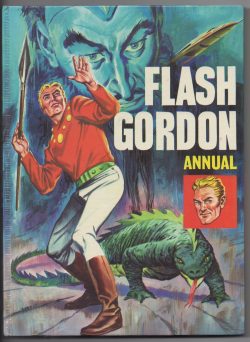
Kill All Monsters!™ Omnibus


By Michael May & Jason Copland & various (Dark Horse Books)
ISBN: 978-1-61655-827-7 (HB) eISBN: 978-1-613008-400-4

Somebody once said “In comics, Less Is More”.*

Sometimes all we want is a primal experience with intrigue and character pared down to basics. Maybe a little mystery and treachery but fundamentally heroes, villains and an overwhelming menace to rail valiantly against.

There’s all that and so much more in Kill All Monsters!: a vibrant and vivid monochrome monster-fest which started life as an online tribute to Japan’s greatest cultural export – spectacular Kaiju versus Mecha mega-duels.

Crafted by writer Michael May (Hunt the Winterlands) and illustrator Jason Copland (The Perhapsnauts: Molly’s Story; Murder Book; Poutine) – with early idea contributions by Alex Ness – the 2013 webcomic was picked up by Dark Horse two years later, reprinting the epic and delivering a sequel…

The hugely hulking omnibus edition arrived in 2017, gathering Kill All Monsters! volume 1: Ruins of Paris and Kill All Monsters!: The Ministry of Robots which ran in Dark Horse Presents (volume 3) #12-24. It includes another 100 pages of story, notionally concluding the tale in a welter of edgy grey-toned “Amerimanga” action and suspense. Critical tech support throughout is provided by letterers Ed Brisson, Ryan Ferrier & Micah Myers.

Shell-pocked, gritty and executed at breakneck pace, with captivating atmosphere and a do-or-die sense of duty, it opens in ‘The Ruins of Paris’ as a squad of human warriors explore the devasted city in their singular giant robot war-suits.

Like everywhere else in the world, the City of Lights was razed to rubble by waves of monster attacks which began in Japan in 1954 and which have steadily pushed humanity to the edge of extinction.

Dressen, Spencer Djamel and Akemi are part of the African Defense Force conceived and commanded by visionary General Abbud Rashad as a last-ditch deterrent to colossal horrors that started harassing humanity in the wake of the atomic bomb’s first detonations. The Mecha-riders are champions of human technology and ingenuity, forever shaking the earth in constant clashes with relentless, merciless killer kaiju.

Here and now, the pilots barely survive an assault by an octet of titanic terrors and are stuck nervously awaiting repair services, when they discover barbarous Parisians who have taken a different path in adapting to the monster depredations…

Second chapter ‘Attack of the Killer Robot’ takes us to Kenya, where latest recruit Archer despatches a brutal bug beast menacing a village. He is the General’s latest innovation and last hope…

In Paris, the stranded pilots seek shelter until Archer can rescue them, encountering a pack of feral, human-sized beasts. They survive, but doubt their impending recovery will be in time. Moreover, they are far from happy that the General is putting so much faith in a Mecha that is fully artificial. Nobody human trusts AIs like Archer…

‘Pigs in the Sky’ reveals the machine saviour is equally uncertain of his role and capabilities, although base technician, repairman and passenger-to-Paris Angus assures him he’s being foolish. In the meantime, the subjects of their rescue mission have linked up with the locals after being ambushed by rampaging warthog horrors. Relocating to the catacombs beneath the city after the first attack in 1959, the French tribe have become true savages ‘Down in the Underground’: scavenging at the borders of daily horror. However, the better educated pilots quickly realise that the subterranean sanctuary they occupy is a technological treasure trove…

The primitives have been skulking amidst resources that could have turned the tables on their tormentors, and Spencer finds mystery to compound the irony. The modern machinery in the tunnels had to have been installed long after the city fell – possibly less than a decade ago – but how, why and by whom?

Seeking answers, the uneasy allies return to the stalled Mecha to access the hard drive they have recovered, but are ambushed by another mega-monster. That’s when Archer explosively arrives to save them all, even as Akemi and Parisian ally Cosa decipher the data and discover a human conspiracy – ‘Pax Monstrorum’ – is behind the monsters…

With an enemy to hunt comes knowledge of an imminent endgame. The villains have scheduled an ultimate monster to eradicate what remains of humankind, and the allies ready themselves for the final battle…

Heading ‘Into the Trees’ to a hidden base in the Black Forest of what used to be Germany, their assault on ‘The Castle of Doom’ forestalls humanity’s end – for a little while – but comes at a huge cost, and exposing a traitor in the squad working for the Pax in ‘Akemi’s Secret’

There’s a tragic and cruel backstory beneath all the brutal Brobdingnagian battles, but revelation takes a big step to the side as ‘Time Bomb’ sees the ascendant Pax Monstrorum trying to clean house but foiled and punished by the last ADF warriors in ‘Death in the Deep’ before ultimately triumphing over the worst beasts of all in ‘Revenge of the Robots’ and ‘The Serpent Strikes’

Under Dark Horse’s aegis the war of survival resumed with ‘The Ministry of Robots’, beginning with a review of how humanity fell and the course of global military resistance to the massive marauders. A glimpse of the early days of Rashad’s Mecha project sees embittered Captain Vivian Matthews ordered to assess his radical project to fight monsters with giant robots. Her evaluation will determine if Canada joins the scheme, but almost founders at the start…

When her plane is brought down by a big beast, she is saved by Colonel Spencer Djamel and his prototype Lion-bot. She then sees the work first hand when invited to pilot the incredible war-suit . Of course, her dry run becomes serious wetwork when she is ambushed by a giant bug and becomes the first human in history to kill rather than repulse a monster…

She is blithely unaware that her closest aide belongs to a secret society promoting the rise of the horrors…

This classy combat compendium closes with all-new, past-set tale ‘Island of Giants’ with focus shifting to the start of  the fightback – and home of the genre – in the last days of lost Tokyo. When experimental Mecha warriors Shogun and Bushi-1 are directed to reconnoitre a solitary isle that surveillance has determined is the origin point of the killer colossi shattering Japan, they discover not only the infinitely variable creature legions’ home, but also that these ravagers are being carefully farmed…

And that is when the real trouble starts…

This manic, mostly monochrome tome is the acme of artistic thrills and chills, perfectly capturing the addictive wonderment of all Heroes vs. Monster yarns. As such, it also supplies a stunning Pin-up Gallery by guest aficionados Brian Level, Frankie B. Washington, Jeff McComsey, Johnnie Christmas and Otis Frampton.

This starkly compelling collection delivers dark chills, compulsive mystery, cunning conspiracy, deeply flawed human heroes and villains, but above all constant cathartic combat carnage in intoxicating amounts… and it all starts, unfolds and ends right here. No muss, no fuss, no busload of tie-ins.

Less is More. Ride the rocket robot. Save the world.
© 2013, 2015, 2017 Michael May & Jason Copland All rights reserved.

* It was me, yesterday! Less Is still More, but Bigger is Better. Get this Book too.