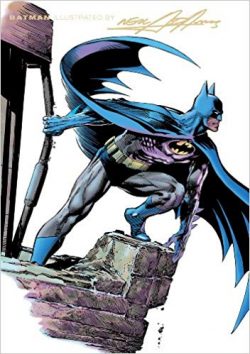
Batman: Illustrated by Neal Adams volume 3


By Neal Adams with Dennis O’Neil, Frank Robbins, Len Wein, Dick Giordano & various (DC Comics)
ISBN: 978-1-4012-4075-2 (TPB)

It’s Batman’s anniversary year. What are you reading?

As the 1960s began Neal Adams was a young illustrator who had worked in advertising and ghosted some newspaper strips whilst trying to break into comics. Whilst pursuing a career in advertising and “real art” he did a few comics pages for Archie Comics and subsequently became one of the youngest artists to co-create and illustrate major licensed newspaper strip Ben Casey (based on a popular TV medical drama series).

That comics fascination never faded, however, and Adams drifted back to National/DC, doing a few covers as inker or penciller before eventually finding himself at the vanguard of a revolution in pictorial storytelling…

He made such a mark that DC recently chose to reprint every piece of work Adams ever did for them into a series of commemorative collections. This is the last of three superb tomes (available in a variety of formats including last minute delivery eBook) starring the “Darknight Detective” as he was dubbed back then, and featuring every cover, story and issue in original publication order.

This particular package celebrates the covers and pertinent contents of Batman #232, 234-241, 243-246, 251, 255, Batman Annual #14, Batman Black & White # 4, The Brave and the Bold #99, Detective Comics #412-422, 439, 600, Heroes Against Hunger, Limited Collectors’ Edition C-25, C-51, C-59, Robin #1, Saga of Ra’s Al Ghul #4, World’s Finest Comics # 211, 244-246, 258; cumulatively embracing June 1971 to September 1996.

Following Adams’ liberally illustrated Foreword and key collaborator Denny O’Neil’s recollections describing their work process in his Introduction, the comics gold begins.

Throughout this period Adams remained one of the industry’s top cover artists, generating a stunning succession of mesmerising images on most Bat-related titles (and plenty of other comics). Those are listed here in chronological release order…

Behind a macabre eye catcher, Batman #232 (June 1971) took the hero to new heights as former kidnap victim Talia returns and we learn more of her as O’Neil & Adams – with inking as usual from Dick Giordano – introduce her father: immortal eco-terrorist Râ’s Al GhÅ«l.

A whirlwind adventure which became one of the signature highpoints of the entire Batman canon, ‘Daughter of the Demon’ is a timeless globe-girdling mystery yarn drawing the increasingly grim hero from Gotham’s concrete canyons to the Himalayas in search of hostages Robin and Talia, purportedly captured by forces inimical to both Batman and the mysterious figure who claims to be working in secret to save the world…

Ra’s was a contemporary, more acceptable visual embodiment of the classic inscrutable ultimate foreign devil (as typified in a less forgiving age as the “Yellow Peril” or Dr. Fu Manchu). This kind of alien archetype permeates popular fiction and is still an astonishingly powerful villain-symbol, although the character’s Arabian origins – neutral at the time – seem to uncomfortably embody a different kind of ethnic bogeyman in today’s post 9/11, ISIS-infested world.

The concept of a villain who has the best interests of the planet at heart is not a new one, but Ra’s Al Ghul, whose avowed intent is to reduce teeming humanity to viable levels and save the world from our poison, hit a chord in the 1970s – a period where ecological issues first came to the attention of the young. It was a rare kid who didn’t find a note of sense in what “the Demon’s Head” planned. The spectacular tale ended with a shocking pronouncement of what Ra’s intended for Gotham’s Guardian…

The chilling covers for Detective Comics #412 and 413 (this was the peak of the revival in supernatural comics, after all), leads to Batman #234 which featured the stellar return of one of the hero’s most tragic foes.

As comics became increasingly more anodyne in the 1950s, psychologically warped, physically actualised schizophrenic Two-Face was quietly retired from Batman’s roster of rogues, but with ‘Half an Evil’ (O’Neil, Adams & Giordano), he resurfaced at the forefront of grimmer, grittier stories.

When a string of bizarre and brutal robberies afflicts the city, the baffled Batman has to use all his ingenuity to discern the reasoning and discover the identity of a ruthless hidden mastermind in time to thwart a diabolical scheme…

Covers for Detective #414-417 Batman #235-236 lead into another much-reprinted classic. ‘Night of the Reaper!’ – by the usual suspect from Batman #237 – is one of the most revered tales of the era: a harrowing Halloween epic which finds Robin working with his old mentor to solve a string of barbarous killings, only to uncover a pitifully deranged perpetrator as much sinned-against as sinner…

The fronts for Detective# 418-422, The Brave and the Bold #99, Batman #238-241 and World’s Finest Comics # 211 bring us to Batman #243 (August) as the long-brewing war between Batman and Ra’s Al Ghul reaches Def Con 3: a single extended saga taken out of normal DC continuity and depicting the final confrontation between two opposing ideals.

Not included here are the non-Adams episodes from Batman #240 and 242 (although they are available in many other collections). In them, the Darknight Detective abandoned his civilian identity by faking Bruce Wayne’s death and gathered a small team of specialist allies – comprising criminal alternate-identity Matches Malone, scientific advisor Dr. Harris Blaine and Ra’s’ top assassin Ling – suborned to the side of the angels by his own superstitious code of honour and sworn to destroy the Demon forever.

O’Neil, Adams & Giordano reunited for Batman #243 which sees the team – plus latecomer Molly Post – invade the Demon’s Swiss citadel moments after their intended target dies. Nobody suspects the ageless villain’s resources include ‘The Lazarus Pit’ which can revive the dead…

The fateful finale came in #244, wherein ‘The Demon Lives Again!’ Sadly, despite all his supernal gifts and forces, Ra’s cannot escape the climactic vengeance of his implacable foe in dream-team O’Neil, Adams & Giordano’s compulsive climax. With the job done, a short addendum in #245 resolves ‘The Bruce Wayne Murder Case!’, restoring the billionaire to his rightful place in Gotham’s social whirl…

The all-Adams cover to Batman #246 (October 1972) leads to another graphic landmark. ‘The Joker’s Five-Way Revenge’ comes from Batman #251 (September 1973 by Dennis O’Neil & Neal Adams) and finally ended forever the zany, “camp” taint of the TV show by re-branding the characters and returning to the original 1930s concept of a grim and driven Dark Avenger chasing an insane avatar of pure evil.

Such a hero needs truly deadly villains and – by reinstating the psychotically unpredictable Killer Clown who scared the short pants off readers in the Golden Age – this single-issue yarn set the bar very, very high. A true milestone that utterly redefined the Joker for the modern age: the story sees the Mirthful Maniac stalking his old gang, determined to eradicate them all with the hard-pressed Gotham Guardian desperately playing catch-up. As the crooks die in all manner of Byzantine and bizarre ways, Batman realises his arch-foe has gone irrevocably off the deep end….

Terrifying and beautiful, for many fans this is the definitive Batman/Joker story, but signalled Adam’s graduation to other jobs and away from regular bat-missions. Before that departure, however, the cover to Detective #439 (February/March 1974) and one last thriller awaited.

Scripted by Len Wein and inked by Giordano, ‘Moon of the Wolf’ from Batman #255 (March/April 1974) pits the ultimate human hero against a tragic former sportsman mutated into a truly supernatural lupine killer and enslaved by old enemy Professor Milo…

From Limited Collectors’ Edition C-25 comes a pin-up before a rare example of the artist’s commercial comics work appears. Adams produced art for a series of comics adventures starring various Marvel and DC heroes – as well as screen icons such as Star Trek and Planet of the Apes – for Power Records’ line of Book and Records sets. These offered a vinyl recording of a story accompanied by a fully illustrated comic tale. The Batman offerings began with ‘Trumping the Joker’ in Stacked Cards (PR-27, 1975 and written & illustrated by Adams) was followed a year later, by PR-30 (Adams, Frank Robbins and Giordano) wherein ‘Robin Meets Man-Bat’. The all-ages tales are accompanied by a house ad for the DC stars available in Power Records’ unique packages.

Still a huge draw as a cover artist, between 1977-1996 Adams generated Bat-related frontages for World’s Finest Comics # 244-246 & 258, Limited Collectors’ Edition C-51 (a wraparound reprinting the “Bride of the Demon” saga) and C-59 (‘Batman’s Strangest Cases’), the Heroes Against Hunger benefit comic, a pin-up in Detective Comics #600, covers for Saga of Ra’s Al Ghul #4 (another wraparound), Batman Annual #14, and pin-ups for Robin #1 and Batman Black & White # 4.

The history of Batman is inescapably linked to and shaped by Neal Adams’ efforts, and captivating secrets of creation are revealed in the stunning Neal Adams Sketchbook section (featuring comic art, ads, storyboards and conceptualisations for a Batman amusement park) which closes this compelling and irresistible tome (still readily available in trade paperback and digital editions).

With the game-changing classics in this volume, Batman finally returned to the commercial and critical top flight he had enjoyed in the 1940s reviving and expanding upon his original conception as a remorseless, relentless avenger of injustice. The next few years would see the hero rise to unparalleled heights of quality so stay tuned: the very best is just around the corner… that dark, dark corner…
© 1971, 1972, 1973, 1974, 1975, 1976, 1977, 1978, 1979, 1986, 1988, 1989, 1990, 1991, 2005, 2015 DC Comics. All Rights Reserved.
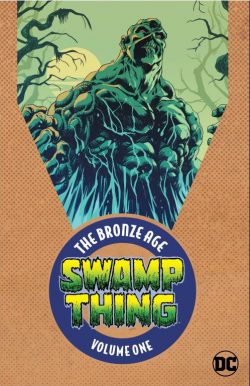
Swamp Thing: The Bronze Age Volume One


By Len Wein & Bernie Wrightson, Nestor Redondo; with Michael Wm. Kaluta & various (DC Comics)
ISBN: 978-1-4012-8440-4 (TPB)

The first fan-sensation of the modern age – now officially enshrined as the Bronze Age – of American comicbooks – Swamp Thing has powerful popular fiction antecedents and in 1972 was seemingly a concept whose time had come again. Prime evidence was the fact that Marvel were also working on a man-into-mucky, muddy mess character at the very same time.

Both Swampy and the Man-Thing were thematic revisions of Theodore Sturgeon’s classic novella It and bore strong resemblances to an immensely popular Hillman Comics character dubbed The Heap. He/it slurped through the back of Airboy Comics (née Air Fighters Comics) from1943. My fan-boy radar suspects Roy Thomas’ marsh-monster the Glob (debuting in Incredible Hulk #121 from November 1969 and promptly returning in #129, June 1970) either inspired both DC and Marvel’s creative teams, or was part of that same zeitgeist. It should also be remembered that Skywald (a very minor player with big aspirations) released a black-&-white magazine in their Warren Comics knock-off line entitled The Heap in the Autumn of 1971.

For whatever reason, by the end of the 1960s superhero comics had started another steep sales decline, once again succumbing to a genre boom and horror/mystery resurgence: a sea-change augmented by a swift rewriting of the specific terms of the Comics Code Authority. At DC, With EC veteran Joe Orlando as editor, House of Mystery and sister title House of Secrets returned to short story anthology formats and gothic mystery scenarios, taking a lead from such TV successes as Twilight Zone and Rod Serling’s Night Gallery.

Referencing the sardonic narrator/storyteller format of EC horror titles, Orlando created Cain and Abel to shepherd readers through brief, sting-in-the-tail yarns produced by the best creators, new and old, that the company could hire. Artists Neal Adams, Mike Kaluta, and especially Bernie Wrightson produced their best work for these titles, and the vast range of successors the horror boom generated at DC.

The twelfth anthology issue of the resurrected House of Secrets cemented the genre into place as the industry leader. There writer Len Wein & Wrightson produced a throwaway gothic thriller set at the turn of the 19th century, wherein gentleman scientist Alex Olsen is murdered by his best friend and his body dumped in a swamp. Years later, his beloved bride – now the unsuspecting wife of the murderer – is stalked by a shambling, disgusting beast that seems to be composed of mud and muck…

This epic trade paperback and digital compilation gathers material from House of Secrets #92, and the contents of Swamp Thing #1-13 (cumulatively covering June/July 1971 to November/December 1974) and perfectly encapsulates the changing face and taste of the times, opening here with that so-pivotal gothic vignette…

‘Swamp Thing’ cover-featured in HoS #92 (June-July 1971), and struck an immediate chord with the buying public. The issue was the best-selling DC comic of that month, and reader response was fervent and persistent.

By all accounts, the only reason there wasn’t an immediate sequel or spin-off was that the creative team didn’t want to produce one. Eventually however, bowing to interminable pressure, and with the sensible idea of transplanting the concept to contemporary America, the first issue of Swamp Thing appeared on newsstands in the Spring of 1972. It was an unqualified hit and an instant classic.

Wein and Wrightson produced ten issues together, crafting an extended, multi-chaptered tale of justice/vengeance and a quest for answers that was at once philosophically typical of the time and a prototype for the story-arc and mini-series formats that dominate today’s comics production. They also used each issue/chapter to pay tribute to a specific sub-genre of timeless horror story whilst advancing the major plot…

Here, the saga resumes with a fresh origin as ‘Dark Genesis’ finds Alec and Linda Holland deep in the Louisiana Bayou, working on a bio-restorative formula that will revolutionise global farming. Working in isolation, they are protected by Secret Service agent Matt Cable, when representatives of an organisation called the Conclave demand that they sell their research to them – or else.

Obviously, the patriotic pair refuse, and the die is cast. The lab is bombed and Linda dies instantly but Alec, showered with his own formula and blazing like a torch, hurtles to a watery grave in the swamp. He does not die…

Transformed by the formula (and remember, please, that this is prior to Alan Moore’s landmark re-imagining of the character) Holland is transformed into a gigantic man-shaped monster, immensely strong, unable to speak, and seemingly composed of living plant matter. Holland’s brain still functions however, and he vacillates between finding his wife’s killers and curing his own monstrous condition. Cable, misinterpreting the evidence, also wants revenge, but he thinks that the monster is the cause of death of his two charges…

Over the next nine issues, Swamp Thing travelled the world, encountering the darkest outbreaks of classic supernature and the insatiable greed of human monsters.

The first was black sorcerer Anton Arcane and his artificial homunculi The Un-Men (eventually the grotesque stars of their own Vertigo series), in ‘The Man Who Wanted Forever.’ The wizard transported Holland to his Balkan castle and sought to mystically trade places with the stupendous swamp beast. The temptation proved too great, but when the restored scientist realised the cost, he violently recanted…

The next issue introduced Abigail Arcane and her tragic Frankenstein-influenced father ‘The Patchwork Man’ in a classic case of monster misunderstanding, which results in her joining free agent Cable in stalking the mossy misanthrope. As Holland makes his torturous way back to the USA, hunters and hunted are waylaid and encounter a Scottish werewolf in ‘Monster on the Moors!’ before at last returning to America and finding ‘The Last of the Ravenwind Witches!’ as well as even more mob-handed human intolerance…

In the wilds of Vermont, he encounters Paradise on Earth, courtesy of an old clockmaker but when the idyll is turned into ‘A Clockwork Horror’ by the voracious Conclave, his torment is transformed into sheer rage, leading to one of the most evocative and revered team-ups of the 1970s.

Swamp Thing #7’s ‘Night of the Bat’ featured the final showdown with the remorseless robber-barons of The Conclave in their Gotham City HQ: a landmark collaboration with the resurgent Batman, himself finally recovering from the hyper-exploitation of the “Campy” TV show era.

Wrightson’s rendering of the superhero through the lens of a horror artist inspired a whole generation of aspiring comics professionals and firmly set the Caped Crusader to rest, replaced with a grim and moody Dark Knight.

Somewhat at a loss after the end of his quest (Swamp Thing came out bi-monthly, so the tale had taken well over a year to tell – unprecedented at a time when most comics still had two or more complete stories per issue), the Moss Monster shambled aimlessly through America’s hinterlands encountering a Lovecraftian horror in the New England town of Perdition. ‘The Lurker in Tunnel 13!’ After dealing with eldritch cancer god M’Naagalah, Holland (as well as Abigail and Cable) were drawn into a US military cover-up involving a marooned and benevolent alien in ‘The Stalker from Beyond!’ which benefitted from supplemental inking by Michael Kaluta before the classic run concluded with #10’s ‘The Man Who Would Not Die!’: a tale of ghostly retribution amidst the graves of unquiet plantation slaves with unliving atrocity Anton Arcane making his first of many demonic returns…

The issue was plotted by Wrightson and marked his swansong on the title: the next chapter in the Swamp Thing saga was still dictated by Wein but the miraculously gifted hands of Nestor Redondo: possible the only artist who could have matched the visual intensity of the feature’s visual originator.

Nestor Redondo was born in 1928 at Candon, Ilocas Sur in the American Territory of the Philippines. Like so many others he was influenced by US comic-strips such as Tarzan, Superman, Buck Rogers and Flash Gordon which were immensely popular in the entertainment-starved Pacific Archipelago.

Drawing from an early age Nestor emulated his brother Virgilio – who already worked as a comics artist for the cheap magazines of the young country. The Philippines became a commonwealth in 1935, and achieved full-independence from the USA in 1946, but maintained close cultural links to America.

His parents pushed him into architecture but within a year Nestor had returned to comics. A superb artist, he far outshone Virgilio – and everybody else – in the cottage industry. His brother switched to writing and the brothers teamed up to produce some of the best strips the Islands had ever seen, the most notable and best regarded being Mars Ravelo’s ‘Darna’.

Capable of astounding quality at an incredible rate of speed, by the early 1950s Nestor was drawing for many comics simultaneously. Titles such as Pilipino Komiks, Tagalog Klasiks, Hiwaga Komiks and Espesial Komiks were fortnightly and he usually worked on two or three series simultaneously, pencils and inks. He also produced many of the covers.

In 1953 he crafted an adaptation of MGM film Quo Vadis for Ace Publications’ Tagalong Klasiks #91-92. Written by Clodualdo Del Mundo, it was serialized to promote the movie in country, but MGM were so impressed by the art-job they offered 24-year old Nestor a US job and residency. He declined, thinking himself too young to leave home yet.

If you’re interested, you can see the surviving artwork by Googling “Nestor Redondo’s Quo Vadis”, and you should because it’s frankly incredible.

Ace was the country’s biggest comics publisher, but by the early 1960s they were in dire financial straits. In 1963 Nestor, Tony Caravana, Alfredo Alcala, Jim Fernandez, Amado Castrillo and brother Virgilio set up their own company CRAF Publications, Inc., but the times were against them (and publishers everywhere). About this time, America came calling again, but in the form of DC and Marvel Comics. By 1972, US based Tony DeZuñiga had introduced a wave of Filipino artists to US editors, and Nestor produced short horror tales for House of Mystery, House of Secrets, Phantom Stranger, Secrets of Sinister House, Witching Hour, The Unexpected, Weird War Tales, fill-ins for Marvel’s Man-Thing, an astonishingly beautiful run on Rima the Jungle Girl (a loose adaptation of W H Hudson’s seminal 1904 novel Green Mansions) before being tapped to take over as illustrator on Swamp Thing. He also worked on Lois Lane and Tarzan and in 1973 produced adaptations including Dracula and Dr. Jekyll and Mr. Hyde for Vincent Fago’s Pendulum Press Illustrated Classics: later reprinted as Marvel Classics Comics.

In later years he moved to Marvel where he inked and eventually fully illustrated Savage Sword of Conan.

During that DC period he was tapped to draw an adaptation of King Arthur which DC killed before it was completed (once again some pages survive and the internet is your friend if you want to see them) and illustrated issue C-36 of the tabloid sized Limited Collectors’ Edition: The Bible. (please link)

Sporting a Luis Dominguez cover, Swamp Thing #11 was cover-dated July/August 1974 and sees the monster back at last in his Bayou home, with Cable and Abigail close on his root-riddled heels. When mutant beasts and ‘The Conqueror Worms!’ attack his human pursuers, Holland rushes to the rescue and the relationship between hunters and prey alters forever…

The carnivorous Worms have suborned crazed survivalist Professor Zachary Nail and taken captives and when their secret plans are exposed war breaks out for possession of Earth…

In the aftermath, Swamp Thing is sucked into an arcane time-loop locked on constantly-killed and perpetually-resurrecting Milo Mobius …until Holland finds a way to break the circle of ‘The Eternity Man’

This initial collection then concludes with Cable, Abigail and new recruit Bolt instigating ‘The Leviathan Conspiracy’ to liberate the Federally imprisoned Swamp Thing and put him beyond the reach of government scientists forever…

A genuine landmark of the art form, these stories are also superb examples of old-fashioned comics wonderment, from a less cynical and sophisticated age, but with a passion and intensity that cannot be matched. And, ooh, that artwork…

If you love comics you must have his buried treasure.
© 1971, 1972, 1973, 1974, 2018 DC Comics. All Rights Reserved.
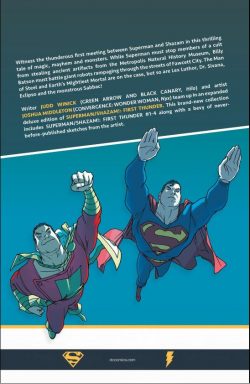
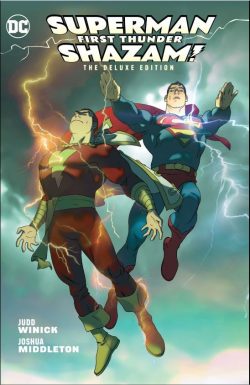
Superman/Shazam!: First Thunder


By Judd Winick, Joshua Middleton & various (DC Comics)
ISBN: 978-1-4012-0923-0 (TPB)

At their most impressive, superhero comics combine all the gravitas of mythology with all the sheer child-like fun and exuberance of a first rollercoaster ride. A perfect example of this is a 4-issue miniseries from November – February of 2006 collected as Superman/Shazam!: First Thunder.

One of the most venerated and loved characters in American comics, (the original) Captain Marvel was created by Bill Parker and Charles Clarence Beck as part of the wave of opportunistic creativity that followed the successful launch of Superman in 1938. Although there were many similarities in the early years, the Fawcett character moved solidly and steadily into the area of light entertainment and even comedy, whilst as the 1940s progressed the Man of Steel increasingly left whimsy behind in favour of action and drama.

At the height of his popularity the World’s Mightiest Mortal outsold the Man of Steel by a wide margin (even published twice monthly), but as the Furious Forties closed tastes changed, sales slowed and Fawcett saw the way the wind was blowing. They settled a long-running copyright infringement case instigated by DC/National in 1940 and the Big Red Cheese vanished – as did so many superheroes – becoming little more than a fond memory for older fans.

As America lived through another superhero boom-and-bust from 1956-1968, the 1970s dawned with a shrinking industry and a wide variety of comics genres servicing a base that was increasingly founded on collector/fans and not casual or impulse buys. DC Comics needed sales and were prepared to look for them in unusual places.

After the settlement with Fawcett in 1953 they had secured the rights to Captain Marvel and Family, and even though the name itself had been taken up by Marvel Comics (via a circuitous and quirky robotic character published by Carl Burgos and M.F. Publications in 1967) decided to tap into that discriminating older, nostalgia-fuelled fan-base, even as the entire entertainment world began looking back in time for fresh entertainments such as The Waltons, Little House on the Prairie (or even Bonnie and Clyde)…

In 1973, riding that burgeoning wave of nostalgia, DC brought back the entire beloved cast of the Captain Marvel strips: restored to their own kinder, weirder universe. To circumvent an intellectual property clash, they entitled the new comic book Shazam!; the trigger phrase used by a huge family of Marvels to transform to and from mortal form and a word that had already entered the American language due to the success of the franchise the first time around.

You know what comics fans are like: they had been arguing for decades – and still do – over who was best (for which read “who would win if they fought?”) out of Superman or Captain Marvel. Thus, though excised from the regular DCU and stuck on a parallel universe, the old commercial rivals met and clashed a number of times, but until the landmark Crisis on Infinite Earths subsumed all those myriad worlds into one overarching continuity, the most powerful heroes in existence maintained the status of “equal but separate”.

In that new reality everything happened in one cosmos and Captain Marvel was fully rebooted and integrated. The basics remained untouched: homeless orphan and good kid Billy Batson is selected by an ancient wizard to be given the powers of six gods and heroes to battle injustice. Bestowed with the ability to transform from scrawny precocious kid to brawny (adult) hero by speaking aloud the wizard’s acronymic name – invoking the powers of legendary patrons Solomon, Hercules, Atlas, Zeus, Achilles and Mercury, the idealistic lad can now right all wrongs as “the World’s Mightiest Mortal!”

After twenty years in this iteration, Captain Marvel’s early days were re-explored in this canny, big-hearted thriller which reveals the details of the first shared case of paragons of power.

Written by Judd Winick and illustrated by Joshua Middleton in a painterly style gloriously reminiscent of the old Fleischer Studio Superman cartoons, this magical treat is chronologically set just after Superman: Man of Steel volume 1 and The Power of Shazam! original graphic novel, and opens with ‘A Face in the Crowd’ as a new hero begins saving lives in West Coast metropolitan colossus Fawcett City, whilst a continent eastwards in Metropolis, Superman stumbles onto a museum robbery and is surprisingly beaten by thieves employing magic. The robbers belong to a cult – the Temple of Bagdan – and are on a nationwide spree to collect ancient Russian relics for some sinister master-plan…

In Fawcett, Marvel destroys giant robots attacking a new solar powered construction site designed by Doctor Bruce Gordon, unexpectedly inspiring the enmity of billionaire industrialist Thaddeus Sivana. Although the owner of the Solar Center project, Sivana has huge petrochemical interests and only intended his eco-friendly enterprise as a tax shelter. He certainly has no intention of supplying cheap, clean energy to the proles of “his” city…

In a makeshift shelter, homeless Billy Batson talks his day over with Scoot Cooper, another hard-luck kid and the only person who knows his secret, even as Sivana “negotiates” with his hated East Coast rival Lex Luthor. The arrogant Metropolis financier has experience with super-powered meddlers and resources to combat their interference. It’s time to make a deal with a devil…

Later when the Bagdan cultists raid Fawcett’s McKeon History Museum, Marvel is waiting for them but is also overmatched by the magical Mallus Trolls employed by the thieves. At least until Superman shows up…

The team-up explodes into action in ‘Odd Couples’ with the heroes battling together, discovering their similarities and major differences even as, in Metropolis, Luthor sells Sivana the answer to all his superhero problems: an exemplary operative dubbed Spec…

The cultists have again escaped however, and are in the final stage of their plan. Having secured the mystic paraphernalia to summon consummate evil they then force disturbed kidnap victim Timothy Barnes to become host to six infernal fiends. Sabbac is the antithesis of Shazam’s agent: a supernatural super-being sponsored by devil-lords Satan, Aym, Belial, Beeelzebub, Asmodeus and Createis in the way the ancient gods and heroes empower Captain Marvel, and now he is free to wreak havoc and destruction upon the world…

To make matters worse, at that very moment Bruce Gordon succumbs to his own twilight curse at the Solar Centre as a lunar eclipse allows the diabolical Spirit of Vengeance to escape from his fleshy prison…

‘Titans’ finds Captain Marvel furious battling his dark counterpart as Superman struggles against not only evil spirit Eclipso but also his possessed army of innocents enslaved by the dark destroyer’s black diamond. When Sivana secretly funded the cultists, he intended their tool to simply destroy Gordon and his power plant, but now events have spiralled beyond anyone’s control. Even as the hated heroes inadvertently fix both of Sivana’s awry schemes, Spec is hunting through Fawcett. Soon his astounding abilities have ferreted out Billy Batson’s secret and arranged a permanent solution…

The drama roars to a terrific conclusion in ‘Men and Boys! Gods and Thunder!’ as a paramilitary hit squad attempts to gun down the merely human Billy but only hits his best friend instead, leaving Sivana to face the wrath of a lonely, bitter 10-year old boy, amok and enraged with righteous fury in the body of one of the most powerful creatures in the universe…

In the awesome aftermath, Superman decides to deal with the shell-shocked Marvel in a way that will change both of their lives forever…

Still readily available in trade paperback and digital form – and sporting such extras as a roughs and sketches, cover process guide and cover gallery – this is a big, bold, old fashioned comicbook romp full of big fights, dastardly villains, giant monsters, big robots and lasting camaraderie that will delight all lovers of Fights ‘n’ Tights fiction, and whilst not a breakthrough classic like Watchmen or The Dark Knight Returns, is an equally mythic retelling of superhero mythology which ranks amongst the very best of the genre.

They should make a movie out of it…
© 2006 DC Comics. All Rights Reserved.
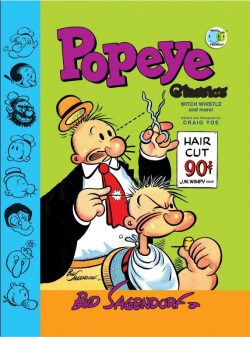
Popeye Classics volume 3


By Bud Sagendorf, edited and designed by Craig Yoe (Yoe Books/IDW)
ISBN: 978-1-61377-779-4 (HB) eISBN: 978-1-62302-492-5

There are a few fictional personages to enter communal world consciousness – and fewer still from comics – but a grizzled, bluff, uneducated, visually impaired old sailor with a speech impediment is possibly the most well-known of that select bunch.

Elzie Segar had been producing Thimble Theatre for a decade (since December 19th 1919) when he introduced a coarse, brusque “sailor man” into the everyday ongoing saga of hapless halfwits Ham Gravy and Castor Oyl on January 29th 1929. Nobody suspected the giddy heights that stubborn cantankerous walk-on would reach…

In 1924 Segar created a second daily strip The 5:15: a surreal domestic comedy featuring weedy commuter and would-be inventor John Sappo and his formidable wife Myrtle which endured – in one form or another – as a topper/footer-feature accompanying the main Sunday page throughout the author’s career. The feature even survived his untimely death, eventually becoming the trainee-playground of Popeye’s second great humour stylist: Bud Sagendorf.

After Segar’s far-too-premature death in 1938, Doc Winner, Tom Sims, Ralph Stein and Bela Zambouly all worked on the strip, even as the Fleischer Studios animated features brought Popeye to the entire world, albeit a slightly different vision of the old salt.

Sadly, none of them had the eccentric flair and raw inventiveness that had put Thimble Theatre at the forefront of cartoon entertainments…

Born in 1915, Forrest “Bud” Sagendorf was barely 17 when his sister – who worked in the Santa Monica art store where Segar bought his drawing supplies – introduced the kid to the master cartoonist who became his teacher and employer as well as a father-figure. In 1958, after years on the periphery Sagendorf, finally took over the strip and all the merchandise design, becoming Popeye’s prime originator…

When Sagendorf became the main man, his loose, rangy style and breezy scripts brought the strip itself back to the forefront of popularity and made reading it cool and fun all over again. Bud wrote and drew Popeye in every graphic arena for 24 years and when he died in 1994, he was succeeded by controversial “Underground” cartoonist Bobby London.

Bud had been Segar’s assistant and apprentice, and – from 1948 onwards – exclusive writer and illustrator of Popeye’s comicbook adventures in a regular monthly title published by America’s king of licensed periodicals, Dell Comics.

When Popeye first appeared, he was a rude, crude brawler: a gambling, cheating, uncivilised ne’er-do-well. He was soon exposed as the ultimate working-class hero: raw and rough-hewn, practical, but with an innate, unshakable sense of what’s fair and what’s not; a joker who wanted kids to be themselves – but not necessarily “good” – and someone who took no guff from anyone…

Naturally, as his popularity grew, Popeye mellowed somewhat. He was still ready to defend the weak and had absolutely no pretensions or aspirations to rise above his fellows but the shocking sense of dangerous unpredictability and comedic anarchy he initially provided was sorely missed… but not in Sagendorf’s comicbook yarns…

Collected in their entirety in this beguiling full-colour hardback (also available in a digital edition) are issues #10-14 of Popeye‘s comicbook series, produced by the irrepressible Sagendorf and collectively spanning December 1949/January to October/December1950.

The stunning, seemingly stream-of-consciousness stories are preceded by an effusively appreciative Foreword‘Society of Sagendorks’ – by inspired aficionado, historian and publisher Craig Yoe, offering a fabulous collation of candid photos and assorted gems of merchandise – such as actual Wimpy burgers, a set of Popeye-themed Old Maid cards, Lunchbox illustrations, an anti-bullying campaign posters and foreign edition covers – in another ‘Bud Sagendorf Scrapbook’.

Popeye‘s fantastic first issue launched in February 1948, and we rejoin the parade of laughs and thrills nearly two year later with #10 and a single-page monochrome duel of wits between Popeye and his “infink” protégé Swee’ Pea before the four-colour fun takes off with ‘Rockabye Berries! – A Lethargic Tale of Slumbering Horror amid the Snoozing Sleepers of a Drowsy Island’ as old King Blozo of Spinachovia pleads for aid to overcome a bizarre plague of sleeping sickness. The old salt soon stumbles onto – and deals with – the cause… the island’s long-forgotten and rather aggrieved original inhabitants…

‘Ouch! or Don’t Hit Him… He’s a Human!!’ sees master moocher Wellington J. Wimpy attempt to teach fiery prize-fighter Popeye how to lose a fight after which ‘Pirate! or The Fist mus’ be Mightier ‘an the Sword! or The Seven Seas ain’t Big Enough to hold Both of Us!’ introduces nautical bully Typhoon Thomas who relentlessly pursues the sailor-man to force a duel and prove his own toughness. Big mistake…

Short prose stories were a staple of these comics (and a legal necessity to gain favourable postal rates) and here ‘Swee’ Pea and the Wonderful Bait!‘ details a fishing competition between the kid and grizzled “grandparent” Poopdeck Pappy before Wimpy and Swee’ Pea clash wills in a story of the chase entitled ‘Apple Snack!’

The issue ends with a bang in a black & white interior half-page Popeye gag about pesky mosquitoes and issue #11 (February/March 1950) opens with a monochrome single-pager gag as the incredible infink builds a burglar trap and Olive Oyl proves it works…

Four-colour fun resumes with ‘Swell Day’, pitting Popeye against bullying adult sadist The Duke, who loves to make kids cry, forcing out hero to adopt infantile camouflage to teach him a lesson. Instantly following is ‘The Guest! or Was This Visit Necessary? or Good-Bye! Good-Bye! or Next Time Call B’fore you come, so I can Leave B’fore you Arrive!!’ as a translunar Moon Goon imposes on Popeye’s hospitality and literally eats him out of house and home…

The old salt almost endures his first defeat when playing ‘Golf!’ against Wimpy and Rough-House until he dumps the clubs for a more versatile striking implement, after which prose yarn ‘Swee’ Pea and the Tossing Island!’ spins a bittersweet yarn about a lonely beast on a distant atoll. Wimpy then stars in ‘Easy to Find!’: another duel with the baby sailor before the issue ends on another half-page monochrome Popeye gag.

Moved to quarterly release, # Popeye #12 (April-June) opens with a monochrome single-pager and Popeye “explaining” in his unique brisk manner why no one calls him a sissy, after which the magnificent Witch Whistle’ sees the sailor revisit embattled Spinachovia where King Blozo is plagued by a rash of vanishing farmers. The cause is sinister old nemesis the Sea Witch whose army of giant vultures seem unbeatable… until Popeye intervenes…

‘Drip! Drip!’ finds the nautical champion still in Spinachovia as a vile villain tampers with the water supply and the sailor-man is forced to dig deep to achieve his purpose…

All sailors and kids love the prospect of buried treasure so when Popeye unearths ‘The Map!’ in his own garden he soon sparks a storm of interest and unwelcome attention, before text vignette Swee’ Pea’s Sea Kite!’ reveals a close shave aboard ship and cartoon classic ‘The Double Mooch!’ sees wily Wimpy defeated by the machinations of Poopdeck Pappy and tricked into a day’s hard labour…

A monochrome gag reveals the limits of Popeye’s courage after his sweetie Olive asks him to critique her new hat, ending the issue and segueing neatly into #13 (June-August) and another with the infernal infink plundering a new fishpond, before the main event unfolds in ‘Shipwreck!’ Here the unusual suspects set off in search of an island of solid gold, unaware that they are also carrying two “ghost” stowaways…

Safely returned to shore, our cast heads west once more in ‘Adrift! or Here’s Dirt in your Face!’ Their desert trek soon uncovers evidence of ancient gopher people: they’re quite mean and rather rude…

Swee’ Pea then has fun with pets in prose piece ‘A New Port!’ before Pappy and the ultimate moocher renew their simmering rivalry in ‘Wimpy and the Big Bite!’, after which another monochrome closer details the joys and wonders of random fruit fling tossing (I threw an apple in the air… where it landed, I don’t care…).

Popeye #14 (October-December) celebrates the magic of the Iron Horse with a stunning cover (but aren’t they all?) and a B&W rebus crossword puzzle before ‘Western Railroading!’ finds the sailor-man setting up his own wild west train line. Sadly, with Olive as his sole passenger, business gets pretty tough, pretty quick…

Staying in cactus country but switching modes of transport, ‘Horse Race!’ sees the crafty cove adapt maritime techniques to cowboy pursuits before the cast are bedazzled and beguiled by the acquisition of a ‘Ghost Mine!’…

Prose tale ‘Pappy Severs a Partnership’ sees the old reprobate rebel against Popeye’s galley fare with heart-rending consequences before cartoon madness resumes with J. Wellington Wimpy lured into excessive effort – and mortal combat with a cow – in a western ‘Gold Rush!’ before this captivating chronicle concludes with one last rebus crossword puzzle.

There is more than one Popeye. Most of them are pretty good, and some are truly excellent. This book is definitely top tier and for those who love lunacy, laughter, frantic fantasy and rollicking adventure. If that’s you, add this terrific treasure trove of wonder to your collection.
Popeye Classics volume 3 © 2014 Gussoni-Yoe Studio, Inc. All Rights Reserved. Popeye © 2014 King Features Syndicate. ™ Heart Holdings Inc.

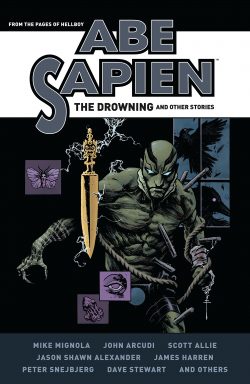
Abe Sapien: The Drowning and Other Stories


By Mike Mignola, John Arcudi, Scott Allie, Jason Shawn Alexander, Guy Davis, Patric Reynolds, Michael Avon Oeming, Santiago Caruso, Peter Snejbjerg, James Harren, Kevin Nowlan, Mark Nelson, Juan Ferreyra, Alise Gluškova & various (Dark Horse)
ISBN: 978-1-50670-488-3 (HB)

Hellboy is a creature of vast depth and innate mystery; a demonic baby summoned to Earth by Nazi occultists at the end of World War II but subsequently raised, educated and trained by democracy-loving parapsychologist Professor Trevor “Broom” Bruttenholm to destroy unnatural threats and supernatural monsters as the chief agent for the Bureau for Paranormal Research and Defense.

This book is not about him, but one of his equally engaging co-stars, whose occult and occluded back-story has been gradually and tantalising unfolding for more than 25 years in the potently cohesive and compelling universe built by Mike Mignola and his creative collaborators…

A brilliant intellect in a piscine (more likely piscoid?) body, he was discovered in a glass tank by B.P.R.D. agents in 1978: a bizarre fish-human hybrid with no memory of his past languishing in a secret chamber of St. Trinian’s Hospital in Washington D.C. He narrowly escaped being dissected before gradually emerging as a top investigator – in the Enhanced Talents Task Force – and scientific research asset, using the name Abraham Sapien.

Over the intervening decades he learned that once he was human. Early cryptozoologist and psychical researcher Dr. Langdon Everett Caul was a minor light in social and scientific circles who vanished after falling in with a group of like-minded men fascinated with arcane secrets. In 1859 certain events regarding this Oannes Society led to his transformation…

This omnibus collection relates through chronologically arranged comics tales (not necessarily publishing release date) the history of the fabulous fishman, supplemented by clarifying and contextualising Introduction and Interstitial Notes from editor and sometime writer Scott Allie.

The aquatic archive launches with neophyte Abe’s first official solo exploit: originally released as a 5-part miniseries from February to June, 2008.

Scripted by creative head honcho Mignola and moodily realised by Jason Shawn Alexander (who liberally contributes to a fabulous and informative Abe Sapien Sketchbook at the back of this full-colour walk – or is that swim? – on the weird and wild side), The Drowning is lettered by Clem Robins with benefits from the magical colours of Dave Stewart.

The action opens with a glimpse into demonic deeds of the past as, in 1884, occult detective Edward Grey boldly and bombastically defeats mighty warlock Epke Vrooman before sinking his hellish ship 60 miles off the French coast near the former leper-colony of Isle Saint-Sébastien.

In 1981 Hellboy is gone from the B.P.R.D. and Chief Bruttenholm pushes reticent trainee Abe into leading a milk-run mission to retrieve the fabulous, lore-laden Lipu Dagger Queen Victoria’s Most Special Agent used to end the malevolent mage almost a century before.

With experienced operatives already in place, all the merman has to do is dive deep and fetch back the prize artefact. Sadly, with the supernatural, nothing is ever easy…

As the on-site proceedings get underway none of the B.P.R.D. team are aware that unquiet spirits are already undertaking their own recovery mission and whilst horrific monsters intercept Abe at the sunken wreck, back on land an ancient crone puts into motion the ceremony she has waited her entire life to complete…

By the time the battered aquatic investigator struggles ashore almost everyone on Saint-Sébastien is dead and a pack of wizened devils are attempting to resurrect their diabolical master. Cut off from the outside world and unable to pass this mess on to somebody more qualified, Abe is flailing until the old woman takes charge, instructing him in some deeper truths about the Isle, the replacement god the benighted inhabitants chose to worship and what truly moved and motivated Vrooman on the last night of his former life…

Armed with appalling information and the knowledge that there’s no one to save the day, the reluctant troubleshooter turns to face his greatest challenge and worst nightmares…

‘B.P.R.D.: Casualties’ comes from the Dark Horse Digital Retailer Exclusive program and saw general release in the trade paperback B.P.R.D.: Being Human. Written by Mignola & Allie with art by Guy Davis, the vignette is set in the aftermath of The Drowning as Abe and pyrokinetic Liz Sherman investigate werewolf sightings in Minnesota. When Sapien makes a rookie mistake that endangers his team, all his self-doubt comes flooding back…

Mignola, John Arcudi & Patric Reynolds produce ‘The Haunted Boy’ as an Abe Sapien one-shot in 2009, detailing the submersible star’s investigation of a child drowning and ghostly phenomena in Vermont. On investigating the “simple” case, the cautious agent discovers a terrifying truth far worse than any expectation…

A master planner, Mignola has orchestrated a magnificent interconnected saga in his assorted tales and spin-off sagas. Another one shot (from 2013) ‘The Land of the Dead’ cowritten by Allie and illustrated by Michael Avon Oeming references stories from his Hellboy in Mexico sequence as in January 1983 Abe travels south of the border to Campeche in search of lost cave divers and discovers the basis for Mayan Hell Xibalba as well as a bizarre variant vampire…

‘Witchcraft & Demonology’ – by Mignola, Allie & Santiago Caruso – comes from Abe Sapien #30 (January 2016) and provides a potted history of Western Satanism and magic as Abe in full-research mode encounters arcane heavy-hitter Gustav Strobl: another man who cannot stay dead, but really should…

Set in 1984 and courtesy of Mignola, Arcudi & Peter Snejbjerg, ‘The Abyssal Plain’ was originally a 2-issue miniseries released in June and July 2010 detailing how ancient magic, Nazi experimentation and Cold War tensions collide. Here Abe and a team of agents are required to salvage a magical artefact in a Russian sub at the bottom of the Norwegian Atlantic. Everybody wants the magical helmet looted from the Vatican during WWII: the Soviets have sent a destroyer, the Americans have the B.P.R.D. and the unquiet dead have the fearsomely mutated zombie who has guarded Melchiorre’s Burgonet since the vessel went down with all hands in 1948…

‘The Devil Does Not Jest’ was another Mignola & Arcudi 2-issue miniseries; this time from September and October 2011. Eerily illustrated by James Harren, it reveals how in 1985 Sapien accompanies the descendant of a celebrated demonologist to the family manse in Maine, uncovering generational secrets and incalculable terror and tragedy…

A one-shot from 2015, ‘The Ogopogo’ is by Mignola, Allie & Kevin Nowlan, beguilingly recounting the far more professional fishman’s off-kilter 1992 encounter with a mythical beast venerated by the First Nations tribes of British Columbia. As he and Hellboy soon discover, it’s not always the monster who’s the bad guy…

‘Subconscious’ by Mignola, Arcudi & Mark Nelson originated in Dark Horse Presents #11 (June 2015) and is set in the aftermath of Professor Bruttenholm’s death with Abe revealing a bizarre and overwhelming dream encounter with subsea ghosts, after which ‘Lost Lives’ (Mignola, Allie & Juan Ferreyra from Abe Sapien #25, August 2015) jumps to 2005 where senior Agent Sapien squabbles with fellow specialist Roger the Homunculus. Abe is still reeling from the revelation that he used to be human when a recently-impounded artefact starts to possess him…

The drama-drenched suspense concludes with flashback tale ‘Icthyo Sapien’ (Mignola, Allie & Alise GluÅ¡kova, from Abe Sapien #27, October 2015) as, mourning the death of so many of his friends and comrades, Abe relives his time as Langdon Everett Caul, the Oannes Society’s war with rival sect the Heliopic Brotherhood and his fall from grace with all he previously believed in…

Closing out this mammoth maritime log is the aforementioned ‘Sketchbook’, with commentary and visual contributions from Mignola, Jason Shawn Alexander, Patric Reynolds, Peter Snejbjerg, James Harren, Michael Avon Oeming, Santiago Caruso, Kevin Nowlan, Juan Ferreyra & Alise GluÅ¡kova, a full cover gallery by Max & Sebastián Fiumara, Dave Johnson, Francesco Franca villa and others plus bonus story The Calm before the Storm: a Caul flashback story originally created by Alise GluÅ¡kova as a piece of fan fiction.

Mignola has an incredible knack for creating powerfully welcoming mythologies and this colossal hardback (or digital) compilation successfully salvages Abe Sapien from the overwhelming shadow of satanic superstar Hellboy and the B.P.R.D. to set him on his way as a celebrated solo star.

Potent, powerful and utterly sodden with uncanny atmosphere, this terrific tome is an irresistible siren calling to haunt your dreams.
ABE SAPIEN © 2008, 2009, 2010, 2011, 2012, 2013, 2014, 2015, 2017, 2018 Mike Mignola. All key and prominently featured characters ™ Mike Mignola. All rights reserved.

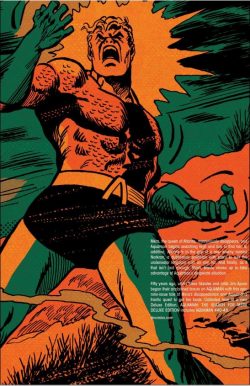
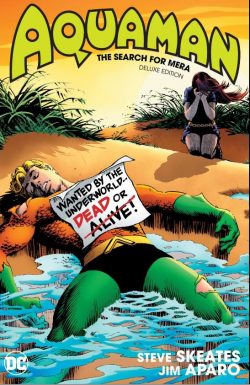
Aquaman: The Search for Mera Deluxe Edition


By Steve Skeates, Jim Aparo & various (DC Comics)
ISBN: 978-1-4012-8522-7 (HB)

Aquaman was one of a handful of costumed adventurers to survive the superhero collapse at the end of the Golden Age: a rather nondescript and genial guy who solved maritime crimes and mysteries when not rescuing fish and people from sub-sea disasters. He was created by Mort Weisinger & Paul Norris in the wake of and in response to Timely Comics’ Sub-Mariner, debuting in More Fun Comics #73 (November 1941).

Strictly a second stringer for most of his career, he nevertheless continued on beyond many stronger features; illustrated by Norris, Louis Cazaneuve, Charles Paris, and latterly Ramona Fradon who drew every adventure until 1960.

When Showcase #4 rekindled the public’s taste for costumed crimefighters with the advent of a new Flash in 1956, National/DC updated its small band of superhero survivors, especially Green Arrow and the Sea King. As the sixties unfolded, Aquaman was appearing as a back-up feature in Detective and World’s Finest Comics. Following a team up with Hawkman in Brave and the Bold # 51 and a try-out run in Showcase #30-33, Aquaman made his big jump. After two decades of continuous adventuring, the marine marvel finally got his own comicbook (cover-dated January/February 1962).

Now with his own title and soon a to be featured in the popular, groundbreaking cartoon show Superman/Aquaman Hour of Adventure, the Finned Fury seemed destined for super-stardom, but despite increasingly bold and innovative tales his title was cancelled as the decade closed. Towards the end, outrageously outlandish yarns gave way to grittily hard-edged epics steered by revolutionary editor Dick Giordano and hot new talents Steve Skeates and Jim Aparo …

This compelling compilation – collecting material from Aquaman volume 1 #40-48 (July/August 1968 to November/December 1969) – is available in hardback and digital formats, offering a potent and timeless drama that changed perceptions of the amiable aquatic avenger forever…

In Aquaman #18, (December 1964 and not included here) the King of Atlantis met extradimensional princess Mera, who became ‘The Wife of Aquaman’ in one of the first superhero weddings of the Silver Age. Talk about instant responsibilities…

A few years later scripter Steve Skeates and new illustrator Jim Aparo began an epic extended tale as the Sea Lord abandoned all kingly duties to hunt for his beloved after she is abducted from his very arms.

The quest began in ‘Sorcerers of the Sea’ with her being brutally whisked away, leaving Aquaman and Aqualad to voyage to strange, distant undersea realms in search of her. In the interim, royal heir Aquababy is left in the care of loyal comrade Aquagirl (her actual name was Tula) while the kingdom devolves to the ministrations of top advisor Narkran. Their first encounter is with a village of mystics whose queen is a doppelganger of missing Mera. Barely escaping, Aquaman’s resources are further taxed when his faithful sidekick is gravely wounded, but, raging and impatient, the Sea King cannot wait for him to heal…

His only clue is the distinctive jewellery one of his assailants wore and ‘The Trail of the Ring’ eventually leads to a deep-sea realm of barbarians known as Maarzons. To reach them, though, Aquaman has to traverse unexplored depths, facing monsters with telepathic powers similar to his own and escape a super civilised micro-culture with some repellent ideas on the price of survival…

On finally reaching Maarzon country, Aquaman savagely confronts warlike primitives who somehow worship his greatest enemy and is forced to ask ‘Is This My Foe?’, before realising he is being played for a fool. Meanwhile, in Atlantis Aqualad has taken a turn for the worst and Tula gets the first inkling that Narkran might not be completely stable. It’s a situation that will soon be reflected throughout the domed city-state…

Despite physical injuries and mental confusion, Aqualad absconds from hospital in Atlantis to aid his friend’s search, only to be captured and forcibly turned into a monster-slayer by a dying subsea race in ‘To Win is to Lose!’ Aquaman has since encountered another bizarre race and a helpful surface-man Phil Darson. The explorer provides a powerful clue that changes everything and sends the Sea King swimming for the sunlight lands above…

And in Atlantis, shattering quakes presage a different kind of instability as the drowned realm begins shifting upwards too…

The mystery begins to resolve in ‘Underworld Reward!’ as Aquaman exposes American gangsters planning a big coup that somehow involves him and Mera. Sadly, that only leads to a bounty landing squarely on his head and every rat in the city gunning for him, before ‘Underworld Reward! Part 2’ sees a partial resolution and fraught reunion when the king and queen explosively meet up and crush the thugs.

Embellished by Frank Giacoia (as “An Inker”) ‘The Explanation!’ fills in the blanks on a bizarre and complex scheme that highlights high level treachery in Atlantis and collusion between the subsea corridors of power and the back alleys of American crimelords…

Dash back home, Aquaman and Mera fortuitously save embattled Aqualad en route as ‘Come the Revolution’ finds Aquagirl and the city’s youth taking on the usurpers until the Royal Family return in climactic earth-shaking conclusion ‘A Kingdom to Re-Build!’

Also boasting a telling Foreword from latterday scripter Dan Abnett and a full cover gallery from Nick Cardy – some of his best ever work – this bombastic thriller forever ended the genteel, anodyne days of the B-lister Aquaman: reforging the hero into a passionate, questioning, forceful champion far more in keeping with the turbulent times.

What this collection proves is that his past adventures are all worthy of far more attention than they’ve received of late, and even though it’s probably just the commercial fallout of his movie incarnation, comics readers get to benefit from the renewed exposure and unearthed gems of aquatic adventure.

It is a total joy to find just how readable they still are. With tumultuous sea-changes always in store for Aquaman, the comics industry and America itself, this tasty testament to the inestimable value of a good bad-guy is a true delight for fans of all ages and vintage.
© 1968, 1969, 2018 DC Comics. All Rights Reserved.
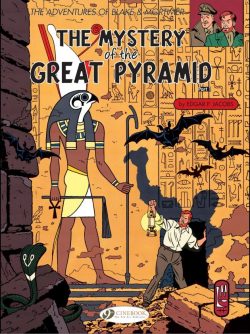
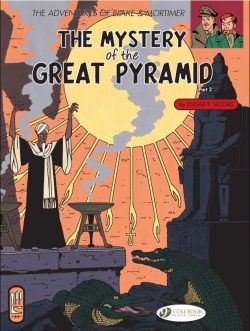
The Adventures of Blake & Mortimer: The Mystery of the Great Pyramid parts 1 & 2 – The Papyrus of Manethon & The Chamber of Horus


By Edgar P. Jacobs, translated by Clarence E. Holland & Erica Jeffrey (Cinebook)
ISBN: 978-1-905460-37-3 (Manethon TPB) 978-1-905460-38-0 (Horus TPB)

Master storyteller Edgar P. Jacobs pitted his distinguished duo of Scientific Adventurers Captain Francis Blake and Professor Philip Mortimer against a wide variety of perils and menaces in stunning action thrillers which merged science fiction, detective mysteries and supernatural thrillers in the same timeless Ligne Claire style which had done so much to make intrepid boy reporter Tintin a global sensation.

The strip debuted in Le Journal de Tintin #1 (26th September 1946): an anthology comic with editions in Belgium, France and Holland. The new weekly was edited by Hergé, with his eponymous star ably supplemented by a host of new heroes and features…

Brussels-born Edgar P. Jacobs was a prodigy who drew from an early age and was besotted by music and the performing arts – especially opera. Upon graduation from commercial school in 1919, he promptly rejected safe, steady office work and instead avidly pursued his artistic passions…

His dream of operatic glory was crushed by the Great Depression, and when arts funding dried up following the global stock-market crash he was forced to pick up whatever dramatic work was going, although this did include more singing and performing. He moved into illustration in 1940, with regular work for Bravo magazine and some jobs for short stories and novels and, when the occupying Nazi authorities in Belgium banned Alex Raymond’s quintessentially All-American Hero Flash Gordon, Jacobs famously took over the syndicated strip to complete the saga.

His Stormer Gordon lasted less than a month before being similarly embargoed by the Occupation dictators, after which the man of many talents simply created his own epic science-fantasy feature in the legendary Le Rayon U, a milestone in both Belgian comics and science fiction adventure.

At this time, Jacobs and Tintin creator Hergé got together, and whilst creating the weekly U Ray strip the younger man began assisting on Tintin, colouring original monochrome strips from The Shooting Star (originally run in newspaper Le Soir) for an upcoming album collection.

By 1944 Jacobs was performing similar duties on Tintin in the Congo, Tintin in America, King Ottokar’s Sceptre and The Blue Lotus. He was contributing to the drawing too, working on extended epic The Seven Crystal Balls/Prisoners of the Sun.

Following the Liberation, publisher Raymond Leblanc convinced Hergé, Jacobs and a few other comics masters to work for his bold new venture: publishing house Le Lombard, and Le Journal de Tintin. Beside Hergé, Jacobs and writer Jacques van Melkebeke, the weekly featured Paul Cuvelier’s Corentin and Jacques Laudy’s The Legend of the Four Aymon Brothers.

Laudy had been a friend of Jacobs’ since their time together on Bravo, and ‘Le secret de l’Espadon’ starred English Military Intelligence officer Blake, closely modelled on him. The debonair spy was to be partnered with a bluff, gruff, excitable British boffin…

The serial ran from issue #1 for three years, cementing Jacobs’ status as a star in his own right. In 1950, with the first 18 pages slightly redrawn, The Secret of the Swordfish became Le Lombard’s first album release with the concluding part published in 1953. The volumes were reprinted nine more times between 1955 and 1982, supplemented in 1964 by a single omnibus edition.

Chronologically, the next epic was this eerily exotic thriller which originally ran in Le Journal de Tintin as Le Mystère de la Grande Pyramide from March 23rd 1950 to February 21st 1951.

The ongoing adventures resume in the months following the defeat of Tibetan warlord Basam-Damdu and liberation of the planet from his monomaniacal tyranny…

Available in paperback album form and in digital editions and subtitled ‘The Papyrus of Manethon’The Mystery of the Great Pyramid Part 1 opens with the author’s fascinating and pertinent illustrated Foreword on everything Anciently Egyptian – complete with extremely handy maps and plans – before the story proper begins with fretful Professor Mortimer taking some time off to pursue his occasional hobby.

A keen amateur archaeologist, the war-weary big brain has flown to Cairo with devoted assistant Ahmed Nasir for a holiday …and to help Egyptologist Ahmed Rassim Bey translate an astounding new find.

However, as they debark at the airport, the vigilant Indian thinks he spots an old enemy…

When no sign can be found the travellers move on, and the following morning Mortimer is examining some fragile scraps of papyrus attributed to legendary contemporary archivist Manethon. The ancient priest’s writings indicate that a secret treasure is hidden beneath a certain pyramid in a “Chamber of Horus”…

Cautious of the effect of such a sensationalistic discovery, the historians decide to proceed carefully, blithely unaware that trusted assistant Abdul Ben Zaim is in the employ of a cruel and dangerous enemy…

Even after an evening of socialising, the learned men are keen to get to work. Returning late to the laboratory of the Egyptian Museum, they discover Abdul furtively loitering and Mortimer’s suspicions are aroused. When nobody is watching, the physicist craftily secures a portion of the papyrus and talks Ahmed into conducting a clandestine test…

Abdul is indeed playing a double game and his mysterious master is a man both subtle and exceedingly dangerous. That night the hidden leader tries to steal the documents, but is surprised by Mortimer who has anticipated such a move. The canny scientist is just as surprised when the villain is exposed as treacherous Colonel Olrik.

The wily war criminal has been missing since the fall of Basam-Damdu, but has lost none of his lethal skills. Overpowering Mortimer, the rogue escapes, taking with him the last shred of papyrus the Professor had been holding…

Safe in his lair, Olrik presses Abdul, who hastily translates the assembled fragments and declares the Chamber of Horus must be in the Great Sphinx on the Giza Plateau…

Under constant surveillance by Olrik’s gang, Mortimer and Nasir warily go about their business, hoping to lure the mastermind out of hiding. Meanwhile Abdul, believing himself undiscovered, returns to work at the museum, where flashy German Egyptologist Herr Doktor Grossgrabenstein is loudly informing all and sundry of his latest search for the tomb of Tanitkara.

The bombastic treasure-hunter invites Mortimer to visit him and view his unique collection but the boffin is too absorbed with shadowing Abdul – a task made far harder by the inept assistance of the local police.

When a lucky clue leads the resolute researcher to an antique store, Olrik’s scurrilous henchman Basendjas ambushes and imprisons Mortimer in the basement, but after a tremendous, extended battle the doughty doctor breaks free and calls in the cops.

Sadly, even on the defensive, Olrik is formidable and fights free of the encroaching authorities before vanishing into the warrens of the city. After Abdul is killed in a hit-and-run incident, effusive Grossgrabenstein is present when Mortimer admits defeat and calls in a seasoned professional…

In London, Captain Francis Blake receives a cablegram and takes a leave from desk duty at I.S. Scotland Yard’s international security division is already investigating a surge of criminal activity in Northeast Africa and is happy to have their top man take a personal interest.

Blake heads out to Egypt by devious and complex means but, despite his circuitous route and customary caution, does not make it. Mortimer becomes increasingly impatient as he awaits the espionage expert’s arrival and to kill time finally accedes to his German colleague’s repeated requests to visit his dig at Giza.

When he arrives, Mortimer finds bullying foreman Sharkey whipping native workers and is just in time to thrash the brute as he tries to attack an old Holy Man who has objected…

The enraged thug pulls a gun, but is admonished by Grossgrabenstein, who then reluctantly allows the Professor to inspect the recently-cleared chambers below the pyramid.

As Mortimer climbs back to the surface, a hasty, anonymous cry alerts him and he narrowly dodges a huge rock which crashes into the space where he stood. The area it fell from is empty and nobody recognises the voice which called out…

Making his way back to his hotel, the weary scientist is then metaphorically crushed to receive news that his best friend has been shot to death in a phone booth at Athens airport…

Bitter and enraged, Mortimer swears to make Olrik pay…

To Be Concluded…

The Chamber of Horus’ concludes Le Mystère de la Grande Pyramide after a brief summary of past events.

With his great friend murdered, Mortimer is resolved to finish the case himself and begins by visiting decidedly odd and off-kilter Doktor Grossgrabenstein in his mansion. He hasn’t made up his mind about the German, but the archaeologist’s staff – especially thuggish foreman Sharkey – are definitely playing some deeper game…

The visit almost ends in disaster, but once again a mysterious warning – in Egyptian – tips Mortimer off and he leaves before the gang can grab him. Later that night, he meets again the aged holy man Sheik Abdel Razek which results in the enigmatic cleric giving him a strange talisman and a warning of the arcane forces he faces. Rationalist sceptic though he is, the physicist keeps the artefact near and that night, when another vicious attempt is made on his life, the charm proves its worth…

Instructing Nasir to make discreet inquiries, Mortimer returns to the Giza excavation, unaware that he has picked up a silent shadow. A commotion then brings him to Razek’s dwelling where Sharkey is threatening the old man. Before the Professor can intervene, the bully is sent scurrying by a shocking display of spooky pyrotechnics…

The house is incredibly ancient, built from reclaimed materials, and as he chats with the sheik, Mortimer sees glyphs and symbols etched into the walls which can only have come from the original pyramids. Razek is charmingly evasive however, and Mortimer eventually leaves, but on his way back sees figures lurking around Grossgrabenstein’s work site.

Although he loses them, the subsequent chase gives him an opportunity to inspect the tunnels under the tomb. Further investigation is cut short when he clashes with native worker Abbas whom he suspects has been following him…

Things take a dangerous turn the next night when he returns to the German’s grand home. A sudden slip by Grossgrabenstein tips off Mortimer that the boisterous historian has at some stage been replaced by gifted mimic Olrik. After a mighty struggle, the Professor is captured and before long Nasir too is bundled into the opulent cell the Prof has been dumped in…

Their bacon is saved by the unexpected arrival of the police, who storm the mansion with guns blazing. In the confusion a beloved old comrade resurfaces as Francis Blake sheds his own disguise to rescue his beleaguered friends.

When the gunfire subsides, the triumphant police attempt to arrest the real Grossgrabenstein. As they blunder around, slippery Olrik again escapes…

With all nefarious opposition seemingly routed, Blake and Mortimer are free to concentrate on solving the mystery of the Chamber of Horus and why ultra-modern super-criminal Olrik was so obsessed by it. Soon they are carefully exploring the claustrophobic tunnels beneath the Great Pyramid and eventually discover not only the incredible treasures of the pharaohs but their old arch-foe plundering the sacrosanct horde.

Olrik is as hard-headed and no-nonsense as his British adversaries and puts no faith in curses, talismans or magic, but the sudden arrival of Razek teaches all of the western sceptics and heretics a lesson they will never forget… before carefully erasing their memories to protect the secrets his line has spent millennia protecting…

Suspenseful and fantastic in the grandest tradition of epic intrigue, Blake & Mortimer are the very epitome of dogged heroic determination and graphic personifications of the Bulldog Spirit: worthy successors to Sherlock Holmes, Allan Quatermain, Professor Challenger, Richard Hannay and all the other valiant stalwarts of lost Albion …and decent chaps proudly participating in the grand international alliance against insular ignorance and wickedness.

This saga delivers splendid Blood-&-Thunder thrills and spills in timeless fashion and with breathtaking visual punch. Every kid of any age able to suspend modern mores and cultural disbelief can’t help but revel in the adventure of their lives… and so will you.
Original editions © Editions Blake & Mortimer/Studio Jacobs (Dargaud – Lombard s.a.). © 1986, 1987 by E.P. Jacobs. All rights reserved. English translation © 2007, 2008 Cinebook

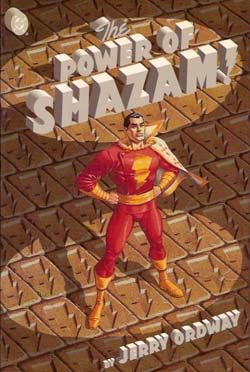
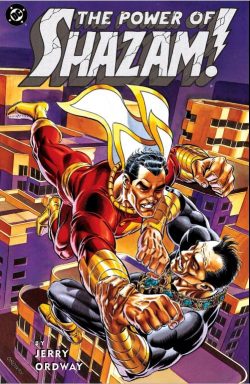
The Power of SHAZAM!


By Jerry Ordway (DC Comics)
ISBN: 978-1-56389-085-7 (HB) 978-1-56389-153-3 (TPB)

Since DC acquired the rights to the Golden Age Captain Marvel (as published by Fawcett from 1940-1953) there have been many enjoyable and effective treatments of the characters. One of the very best which succeeded in to capturing the exuberance and charm of the originals – albeit layered with a potent veneer of modern menace – was Jerry Ordway’s 1994 re-imagining of the concept, based as much on the strengths of the 1940s movie serial as the forceful fun comics of Bill Parker, Otto Binder, C.C. Beck and their close cohort of creative stalwarts…

In Egypt, archaeologists Charles Batson and his wife Marilyn lead the prestigious Sivana Expedition in a search for knowledge and antiquities. That doesn’t fit with the instructions given to the sponsor’s ruthless fixer and overseer Theo Adam, who has his own instructions regarding certain treasures. When they uncover an unknown tomb belonging to an utterly unknown dignitary named “Shazam”, tensions boil over and murder occurs.

The historians had left their son in America with Charles’ brother, but taken their toddler Mary with them. After the bloodshed ends, both she and Adam have vanished without trace…

Some Years Later…

Billy Batson is a little boy living on the streets of ultra-modern art deco Fawcett City, USA. His parents had left him with his uncle Ebenezer when they went away. They never returned and he was thrown out as his uncle stole his inheritance. No one knows where his baby sister is…

Sleeping in a storm drain, selling newspapers for cash, the indomitable kid is pretty street-savvy, but when a mysterious shadowy stranger who seems comfortingly familiar bids him follow into an eerie subway, Billy just somehow knows it’s okay to comply.

When he meets the wizard Shazam and gains the powers of the ancient Gods and Heroes he knows he has the opportunity to make things right at last. But he isn’t aware of just what depths of evil corporate vulture Thaddeus Sivana is capable, nor the role that Black Adam played in the fate of his parents…

This superb and mesmerising retelling was an original graphic novel (available now in Hardback, Trade Paperback and in digital editions) that led to the most successful comic-book revival the original Captain Marvel has yet experienced. The characters refitted in that series are potently realistic but the stories offer a young voice and sensibility.

Moreover, the pulp adventure atmosphere conjured up by Ordway in conjunction with his sumptuous art and spectacular design make for a captivating experience, and the artist’s writing has never been more approachable and beguiling. This is a wonderful book for fans of adventure as well as “costumed drama” addicts and well worth pursuing in light of the movie release.
© 1994 DC Comics. All Rights Reserved.
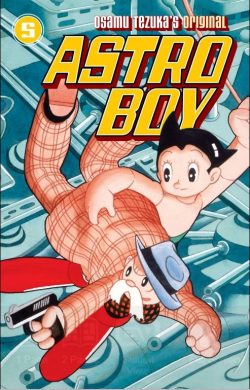
Astro Boy volume 5

c
By Osamu Tezuka, translated by Frederik L. Schodt (Dark Horse Manga)
ISBN: 978-1-56971-680-9 (TPB)

From beginning his professional career in the late 1940s until his death in 1989, Osamu Tezuka generated an incomprehensible volume of quality work which transformed the world of manga and how it was perceived in his own country and, ultimately, across the globe. Devoted to Walt Disney’s creations, he performed similar sterling service with Japan’s fledgling animation industry.

The earliest stories were intended for children but right from the start Tezuka’s expansive fairy tale stylisations harboured more mature themes and held hidden pleasures for older readers and the legion of fans growing up with his manga masterpieces…

“The God of Comics” was born in Osaka Prefecture on November 3rd 1928, and as a child suffered from a severe illness. The doctor who cured him inspired the lad to study medicine, and although Osamu began drawing professionally whilst at university in 1946, he persevered with college and qualified as a medical practitioner too. Then, as he faced a career crossroads, his mother advised him to do the thing which made him happiest.

He never practiced as a healer but the world was gifted with such masterpieces as Kimba the White Lion, Buddha, Black Jack and so many other graphic narratives.

Working ceaselessly over decades, Tezuka and his creations inevitably matured, but he was always able to speak to the hearts and minds of young and old equally. His creations ranged from the childishly charming to the distinctly disturbing such as The Book of Human Insects.

Tezuka died on February 9th 1989, having produced more than 150,000 pages of timeless comics, created the Japanese anime industry and popularised uniquely Japanese graphic narrative which became a fixture of world culture.

This fifth monochrome digest volume (173 x 113 mm in the physical world and any size you like if you get the eBook edition) continues to present – in non-linear order – early exploits of his signature character, with the emphasis firmly on fantastic fun and family entertainment…

Tetsuwan Atomu (literally “Mighty Atom” but known universally as Astro Boy due to its dissemination around the world as an animated TV cartoon and one of post-war Japan’s better exports) is a spectacular, riotous, rollicking sci fi action-adventure starring a young boy who also happens to be one of the mightiest robots on Earth.

The series began in 1952 in Shōnen Kobunsha and ran until March 12th 1968 – although Tezuka often returned to add to the canon in later years. Over that period, Astro spawned the aforementioned global TV cartoon boom, starred in comicbook specials and featured in games, toys, collectibles, movies and the undying devotion of generations of ardent fans.

Tezuka frequently drew himself into his tales as a commentator, and in his later revisions and introductions often mentioned how he found the restrictions of Shōnen comics stifling; specifically, having to periodically pause a plot to placate the demands of his audience by providing a blockbusting fight every episode. That’s his prerogative: most of us avid aficionados have no complaints…

Tezuka and his production team were never as wedded to close continuity as fans are. They constantly revised both stories and artwork in later collections, so if you’re a purist you are just plain out of luck. Such tweaking and modifying is the reason this series seems to skip up and down the publishing chronology. The intent is to entertain at all times so stories aren’t treated as gospel and order is not immutable or inviolate.

It’s just comics, guys…

And in case you came in late, here’s a little background to set you up…

In a world where robots are ubiquitous and have won (limited) human rights, brilliant Dr. Tenma lost his son Tobio in a traffic accident. Grief-stricken, the tormented genius used his position as head of Japan’s Ministry of Science to build a replacement. The android his team created was one of the most ground-breaking constructs in history, and for a while Tenma was content.

However, as his mind re-stabilised, Tenma realised the unchanging humanoid was not Tobio and, with cruel clarity, summarily rejected the replacement. Ultimately, the savant removed the insult to his real boy by selling the robot to a shady dealer…

One day, independent researcher Professor Ochanomizu was in the audience at a robot circus and realised diminutive performer “Astro” was unlike the other acts – or indeed, any artificial being he had ever encountered. Convincing the circus owners to part with the little robot, the Prof closely studied the unique creation and realised just what a miracle had come into his hands…

Part of Ochanomizu’s socialization process for Astro included placing him in a family environment and having him attend school just like a real boy. As well as providing friends and admirers the familiar environment turned up another foil and occasional assistant in the bellicose form of Elementary School teacher Higeoyaji (AKA Mr. Mustachio)…

The wiry wonder’s astonishing exploits resume after the now traditional ‘A Note to Readers’ – explaining why one thing that hasn’t been altered is the depictions of various racial types in the stories.

‘Crucifix Island’ originally ran January through April, 1957 in Shōnen Magazine and begins with an explanation of why most robots are generally humanoid before concentrating on obsessive Doctor Tozawa who channelled his ancient ninja lineage to create an ultimate shape-changing mechanoid. He was interrupted and arrested before he could complete his masterpiece but that was then and this is now where our story properly begins…

Following a manic prison break, Tozawa and his new crooked cronies wash up on and take over a desolate island housing one hundred thousand robots operating the deepest and most sophisticated uranium mine on Earth. The merest by-product is a daily fortune in other precious ores and gems…

Meanwhile, at the Isle’s Robot School Astro is having problems with another young automaton. Pook is troubled because he’s incomplete: his “father” was arrested and imprisoned before he could make his boy perfect…

When Pook and Tozawa are reunited, the mad scientist ambushes Astro, harvesting his body for the parts needed to complete his dream robot. The troubled mechanoid finally gains the power to change shape…

Sadly, one thing that never changes is human greed and Tozawa’s fellow fugitives turn on him when he ignores their pleas to plunder the discarded mountain of gems. Inviting their army of criminal comrades to take over the island, they try to kill the now repentant technologist. With his breath fading, the Doctor repairs Astro to tackle the thieves, but nobody anticipated Pook’s reaction to gaining his full powers or how that would affect the multitude of lethal digging robots…

After a tremendous battle order is eventually restored but not everybody makes it out alive…

Running in Shōnen Magazine from February to April 1960, ‘Space Snow Leopard’ details how frosty precipitation across Earth steals energy from robots and machines. Seemingly unaffected, Astro is challenged by a space wizard and his six-legged killer feline Lupe, but barely escapes as they continue softening up the planet for an alien takeover.

On the run, Astro consults his school friends hoping organic humanity can prevail against the bizarre duo. Ultimately however it takes humans and robots working together and the invention of a giant amalgamated mecha comprised of many smaller automatons working in unison to save the world…

‘The Artificial Sun’ first ran between December 1959 and February 1960 and concludes this compilation in glorious style as a ship at sea reports a deadly floating fireball causing weather disruptions. Fearing the worst, the International Council of Police Organizations consult super-cop Sherlock Holmspun to tackle the crisis. His pride in in a swift breakthrough is soon scotched, however, when the council insist he take along some competent backup/additional firepower in the form of a robot codenamed Mighty Atom …

With the game afoot, the odd couple track down prime suspect Professor Hirata and his deadly monster, but will Holmspun’s prejudice jeopardise the mission… or will his dreadful secret shame leave them all unable to fight off the deadly fireball beast and the real culprit behind it?

Breathtaking pace, outrageous invention, slapstick comedy, heart-wrenching sentiment and frenetic action are the hallmarks of these captivating comics constructions: perfect examples of Tezuka’s uncanny storytelling gifts, which can still deliver a potent punch and instil wide-eyed wonder on a variety of intellectual levels.
Tetsuwan Atom by Osama Tezuka © 2002 by Tezuka Productions. All rights reserved. Astro Boy is a registered trademark of Tezuka Productions Co., Ltd., Tokyo Japan. Unedited translation © 2002 Frederik L. Schodt.

Batman: The Man Who Laughs


By Ed Brubaker, Doug Mahnke, Patrick Zircher & various (DC Comics)
ISBN: 978-1-4012-1622-1 (HB) 978-1-4012-1626-9 (TMB)

This March saw the 80th anniversary of the Bat-Man’s debut in Detective Comics #27. About one year later his inescapable primal nemesis debuted in Batman #1 (cover-dated “Spring” and released on April 25th, 1940. Thus, I’m selfishly pleasing myself and getting my patronising geek on by indulging in a few fond looks back and sharing some books you might like to try for yourselves. Here’s one featuring a superb brace of creative collaborations revelling in the sheer power the Dark Knight has exerted over the decades, and one that’s happily now available in digital formats as well as in a good old-fashioned Hardcover and Trade Paperback tomes…

Grittily devious writer Ed Brubaker teamed with artist Doug Mahnke, colourist David Baron and letterer Rob Leigh treated us to a rather gripping treatment based on the original 1940s debut tales (with a tip of the hat to the Steve Englehart/Marshall Rogers tales of the early seventies), in the form of an impressive prestige one-shot released in February 2005.

The title – and apparently the original inspiration for the Clown Prince of Crime himself – comes from Paul Leni’s seminal 1928 film classic starring Conrad Veidt in the title role. The plot concerns the actions of innocent Gwynplaine who had a permanent smile carved into his face by the King as a punishment for his father’s crimes…

Set not long after the events of Batman: Year One, The Man Who Laughs sees Police Captain Jim Gordon recognise that Gotham City has been changed forever when an outlandish and macabre serial killer goes on a very public, attention-seeking murder spree. Even his secret ally and vigilante outlaw The Batman is daunted by the sheer scale and audacity of the chalk-faced lunatic who seems utterly unstoppable and capable of anything…

The initial ghastly, gore-drenched clash of wills is a trip into hell for all concerned, but even with the Joker behind bars, the prognosis for the future seems grim beyond all reckoning…

The remainder of this book collects a 3-part adventure from Detective Comics #784-786 (September-November 2003). Here Brubaker scripts a generational serial-killer mystery steeped in the continuity of DC’s Golden Age guest-starring the original Green Lantern. Radio tycoon Alan Scott was Gotham City’s superhero-in-residence in the 1940s and early 1950s before mysteriously dropping out of sight as the “Red-baiting”, “Commie-hunting” decade unfolded…

Illustrated by Patrick Zircher, Aaron Sowd & Steve Bird, with hues by Jason Wright & letters by Todd Klein, ‘Made of Wood’ skips to contemporary times as Batman hunts a prolific serial killer who originally terrorised the populace in 1948. This maniac left a nasty signature message carved into his victims way back when and even assassinated the then-Mayor before simply disappearing. Now he’s apparently back to add to his tally

Matters are further complicated when a guilt-plagued and exceedingly short-tempered Green Lantern returns to action, determined to finally close the case he fumbled nearly 50 years previously…

Brubaker is an excellent writer at the peak of his abilities here providing tension and catharsis in equal measure and the art on both stories is effective and compelling. This is one of the better collections in the canon of the Dark Knight and a great treat for any fan or casual browser.
© 2003, 2005, 2008 DC Comics. All Rights Reserved.