Jonah Hex volume 9: Counting Corpses


By Justin Gray, Jimmy Palmiotti, Paul Gulacy, Darwyn Cooke, Dick Giordano, Jordi Bernet, Billy Tucci, Dave Stewart, Rob Schwager & Rob Leigh (DC Comics)
ISBN: 978-1-4012-2899-6

When Justin Grey & Jimmy Palmiotti revived DC’s western wild-man Jonah Hex, they cunningly incorporated an even more mordant, blackly ironic streak of wit than that pioneered by the lone gunman’s originators John Albano & Tony DeZuñiga to amplify the already sanguine view of morality and justice that permeates the feature. The gritty – often outright chilling – narratives thus result in some of the most accessible and enjoyable comics fiction ever.

The writers also had the services of extremely talented people like colourists Dave Stewart, Paul Mounts and Rob Schwager and letterer Rob Leigh plus a virtual Who’s Who of top artists to lend veracity, authenticity and sheer style to the always uncompromising tales such as those populating this ninth trade paperback (or eBook) compilation from 2010.

The contents comprise issues #43 and 50-54 of this much-missed iteration of the greatest gunman of all time: a perambulation passel of potent one-shot yarns to entice and bedazzle one and all…

The suspense-drenched action opens with ‘The Hyde House Massacre’ with art by Paul Gulacy & Schwager from issue #43 (July 2009). Hired to rescue a kidnapped hotelier and his daughter from an army of bandits, the bounty killer is only half successful, and makes the painful and foolish error of trying to negotiate with the clients about how much of his fee he actually deserves…

‘The Great Silence’ crafted by Darwyn Cooke & Stewart for anniversary issue #50 (February 2010) is a milestone of action and tragedy as Hex contracts to hunt down fifty outlaws even as old hunting ally and sometime dalliance Tallulah Black moves into a quiet little town to secretly bring her baby to term.

Of course, villains and mad killers can be found everywhere and when Hex’s surviving quarry lay a trap, grim fate intervenes to destroy his last hope for happiness before he even knows it exists…

Dick Giordano & Schwager then offer up a lush and sultry tale of grifters and men of faith when Hex is hired to track down bandits who murdered a prominent citizen of a frontier town. More importantly, those road agents also stole the ‘Divining Rod’ the victim used to ferret out gold, silver and water for the newly established boom town-to-be, and his decent god-fearing widow, the creepy preacher and the shocked citizens all seem more concerned with the theft than the killing.

Hex soon smells a rat but he’s underestimated quite how many…

A double bill for illustrator Jordi Bernet & Schwager opens with ‘Too Mean to Die’ (#52, April) as a gravely-wounded Jonah stumbles upon a cabin in the swamp and a mother nursing her infant. When she offers assistance and he accepts neither realise the family bonds of blood and vengeance they’re breaking… until the shooting (and stabbing and punching and drowning and…) starts…

Never one to make big plans, Hex plays against type and concocts a cunning trap to drawn in a gang of train robbers, before learning again that you can’t trust anybody – especially gorgeous, crafty saloon girls and actresses – before the dust settles in ‘“You’ll Never Dance Again”’, as limned by Billy Tucci & Mounts.

Bernet then shuts down the show in ‘Shooting Stars’ (#54, June) as Hex links up again with the one outlaw he won’t hunt to confront a lawman and his deputies who are far worse than any bandit, owlhoot or renegade…

With covers and variants by Gulacy, Cooke, Giordano, Bernet and Tucci, these smart, fast-paced, deliciously convoluted and compellingly gritty stand-alone sagas provide maximum bang for your buck and a front row seat as the darkest knight of the Wild West proves over and again why he’s the greatest antihero in comics.
© 2009, 2010 DC Comics. All Rights Reserved.

Fantastic Four Marvel Masterworks volume 7


By Stan Lee, Jack Kirby & Joe Sinnott, with Frank Giacoia & various (Marvel)
ISBN: 978-0-7851-5062-6 (PB)                     : 978-0-7851-1585-4 (HB)

The FF was the indisputable central title and most consistently groundbreaking series of Marvel’s ever-unfolding web of cosmic creation: a forge for new concepts and characters at a time when Jack Kirby was in his conceptual prime and continually unleashing his vast imagination on plot after spectacular plot as Stan Lee scripted some of the most passionate superhero sagas that Marvel – or any publisher, for that matter – has ever seen.

Both were on an unstoppable roll, at the height of their creative powers, and full of the confidence that only success brings, with The King particularly eager to see how far the genre and the medium could be pushed.

This full-colour compendium – available in hardcover, trade paperback and digital editions – re-presents Fantastic Four #61-71 and includes the fifth giant-sized Annual: issues of progressive and increasingly impressive landmarks spanning April 1967 through February 1968 with Stan & Jack cannily leading from the front as an ever-expanding and cohesive shared universe grew around the fruits of their labours.

As seen in the landmark premier issue, maverick scientist Reed Richards, his fiancé Sue Storm, their close friend Ben Grimm – with Sue’s tag-along teenaged brother Johnny – survived an ill-starred private space-shot after Cosmic Rays penetrated their ship’s inadequate shielding and mutated them all.

Richards’ body became elastic, Sue gained the power to turn invisible and the kid could turn into living flame, but poor, tragic Ben horrifically devolved into a shambling, rocky freak…

Following a vivid reminiscence from star inker Joe Sinnott in his Introduction, the magic resumes with Fantastic Four #61.

Even though the team had just defeated a cosmically-empowered Doctor Doom and returned to the Silver Surfer his purloined life-energies there was never a dull moment: no sooner had the heroes relaxed than a new and improved foe attacked once more in ‘Where Stalks the Sandman?’.

This began another explosive multi-part tale wherein Johnny and his imprisoned beloved Crystal were reunited even as Reed is defeated in battle and lost to the anti-matter hell of the Negative Zone’s sub-space corridor…

It was Crystal to the rescue in ‘…And One Shall Save Him!’ as guest-star Triton (of the newly liberated Inhuman Royal Family) plucked the doomed genius from the jaws of disaster and inadvertently introduced another unique enemy who followed Reed back from the anti-matter dimension and straight into partnership with the still-seething Sandman. The resulting battle against ‘Blastaar, the Living Bomb-Burst!’ (FF #63, June 1967) wrecked half the city before some modicum of security was restored…

Looking for a little peace and quiet the exhausted team then tackled ‘The Sentry Sinister’: a frenetic south seas adventure romp pitting the vacationing heroes against a super-scientific robot buried for millennia by an ancient star-faring race.

This tropical treat expanded the burgeoning interlocking landscape to an infinite degree by introducing the ancient, imperial and alien Kree who would grow into one of the fundamental pillars supporting the continuity of the Marvel Universe.

Although regarded as a long-dead race, the Kree themselves resurface in the very next issue as the team is targeted by an alien emissary of vengeance ‘…From Beyond this Planet Earth!’ The formidable Ronan the Accuser has come looking to see what could possibly have destroyed an invincible Sentry and finds out to his great regret but whilst the fight ensues Bens’s blind girlfriend Alicia is abducted by a super scientific stranger…

The mystery of her disappearance is revealed in #66 in ‘What Lurks Behind the Beehive?’ as the outraged team trail the seemingly helpless artisan to a man-made technological wonderland where a band of rogue geniuses have genetically engineered the next phase in evolution, only to lose control of it even before it can be properly born…

‘When Opens the Cocoon!’ exposes the secret of the creature known as Him and only Alicia’s gentle nature is able to placate the nigh-omnipotent creature (who would eventually evolve into tragic cosmic voyager Adam Warlock), after which the tight continuity pauses to allow the Inhumans (a time-lost race of paranormal beings long secluded from mortal men) and old FF ally the Black Panther to share the stage in that year’s Fantastic Four Annual wherein the sinister invader Psycho-Man attempts to ‘Divide… and Conquer!’ the Earth.

Frank Giacoia inked this yarn, with the emotion-bending micro-marauder holding both the King of Wakanda and the Royal Family of hidden Attilan at bay until the FF can pitch in, delayed as they were by the news that the Sue Richards is pregnant… and soon to confined in the most appallingly sexist manner until the birth…

The Annual also includes another comedy insight into the creation of Marvel Epics as Stan, Jack and Frank ask ‘This is a Plot?’ and – after the now customary Kirby pin-ups (Inhumans Black Bolt, Gorgon, Medusa, Karnak, Triton, Crystal and Maximus, a colossal group shot of Galactus, the Silver Surfer and others plus a double-page spread of the quirky quartet) – a rapidly rising star-in-the-making got his first solo appearance in ‘The Peerless Power of the Silver Surfer’: a pithy fable of cruel ingratitude reintroducing and upgrading the threat-level of the Mad Thinker‘s lethal Artificial Intelligence murder-machine Quasimodo…

In FF #68 (inked as ever by the remarkable Joe Sinnott), the Thinker resurfaces to enact his latest scheme, ‘His Mission: Destroy the Fantastic Four!’ beginning with the cogitating criminal replacing a famous doctor to subvert a potential cure for The Thing’s rocky condition.

Phase two involves a mind-warping scheme to turn the rocky stalwart against his comrades, progressing in ‘By Ben Betrayed!’ as the newly malevolent Grimm tries to mercilessly murder his comrades only to be driven temporarily away.

Desperately searching for their brainwashed friend, the FF quickly capture the Thinker and free Ben’s shackled mind in ‘When Fall the Mighty!’, but the victory leaves the heroes unconscious with only Sue conscious to tackle the villain’s last-ditch killer android in ‘…And So It Ends…’

Art lovers can also enjoy a boundless hidden bounty at the end of this volume as the titanic tome wraps up with a selection of Kirby pencil pages, including alternative covers to FF #64 and #71, plus a gallery of Sinnott-inked covers and pages from #61, 63, 65 and 66.

Epic, revolutionary and unutterably astounding, these are the stories which made Marvel the unassailable leaders in fantasy entertainment and remain the most unmissable superhero comics ever crafted.
© 1967, 1968, 2017 Marvel Characters, Inc. All rights reserved.

DC’s Greatest Imaginary Stories


By Otto Binder, Bill Finger, Jerry Siegel, John Broome, Leo Dorfman, Edmond Hamilton, Jim Shooter, C.C. Beck, Dick Sprang, Kurt Schaffenberger, Curt Swan, Carmine Infantino, Bob Kane & various (DC Comics)
ISBN: 978-1-4012-0534-8

Alan Moore’s infamous epigram notwithstanding, not all comics tales are “Imaginary Stories.”

When DC Editor Mort Weisinger was expanding the Superman continuity and building the legend, he realised that each new tale was an event that added to a nigh-sacred canon: that what was written and drawn mattered to the readers. But as a big concept guy he wasn’t going to let that aggregated “history” stifle a good idea, nor would he allow his eager yet sophisticated audience to endure clichéd deus ex machina cop-outs to mar the sheer enjoyment of a captivating concept.

The mantra known to every baby-boomer fan was “Not a Dream! Not a Hoax! Not a Robot!” boldly emblazoned on covers depicting scenes that couldn’t possibly be true… even if it was only a comicbook.

Imaginary Stories were conceived as a way of exploring non-continuity plots and scenarios devised at a time when editors believed entertainment trumped consistency and knew that every comic read was somebody’s first …or potentially last.

This jolly little compilation celebrates that period when whimsy and imagination were king and stretches the point by leading with a fanciful tale of the World’s Mightiest Mortal as ‘Captain Marvel and the Atomic War’ (Captain Marvel Adventures #66, October 1946) actually hoaxes the public with a demonstration of how the world could end in the new era of Nuclear Proliferation, courtesy of Otto Binder & CC Beck.

‘The Second Life of Batman’ (Batman #127 October 1959) by Bill Finger, Dick Sprang & Charles Paris doesn’t really fit the strict definition either, but the tale of a device that predicts how Bruce Wayne‘s life would have run if his parents had not been killed is superb and engaging all the same.

‘Mr. and Mrs. Clark (Superman) Kent!’ by Binder and the brilliant Kurt Schaffenberger, was the first tale of an occasional series that began in Superman’s Girlfriend Lois Lane #9 (August 1960); depicting the laughter and tears that might result if the plucky news-hen secretly married the Man of Steel. From an era uncomfortably parochial and patronizing to women, there’s actually plenty of genuine heart and understanding in this tale and a minimum of snide sniping about “silly, empty-headed girls”…

Eventually the concepts became so bold that Imaginary Stories could command book-length status. ‘Lex Luthor, Hero!’ (Superman #149, November 1961) by Jerry Siegel, Curt Swan & Sheldon Moldoff details the mad scientist’s greatest master-plan and ultimate victory in a tale as powerful now as it ever was. In many ways this is what the whole concept was made for…

No prizes for guessing what ‘Jimmy Olsen Marries Supergirl!’ (Superman’s Pal Jimmy Olsen, #57, December 1961) is about, but the story is truly a charming delight, beautifully realized by Siegel, Swan & Stan Kaye.

Once more stretching the point ‘The Origin of Flash’s Masked Identity!’ (The Flash# 128, May 1962) by John Broome, Carmine Infantino & Joe Giella, although highly entertaining, is more an enthusiastic day-dream than alternate reality, and, I suspect, added to bring variety to the mix – as is the intriguing ‘Batman’s New Secret Identity’ (Batman #151, November 1961, by Finger, Bob Kane & Paris).

‘The Amazing Story of Superman-Red and Superman-Blue!’ (Superman #162, July 1963) is possibly the most influential tale of this entire sub-genre. Written by Leo Dorfman, with art from Swan & George Klein, this startling utopian classic was so well-received that decades later it influenced and flavoured the post-Crisis on Infinite Earths Superman continuity for years. The plot involves the Action Ace being divided into two equal wonder men who promptly solve all universal problems and even the love rivalry between Lois Lane and Lana Lang!

The writer of ‘The Three Wives of Superman!’ is currently unknown to us but the ever-excellent Schaffenberger can at least be congratulated for this enchanting tragedy of missed chances that originally saw print in Superman’s Girlfriend Lois Lane #51, from August 1964.

‘The Fantastic Story of Superman’s Sons’ (Superman #166, November 1964) by Edmond Hamilton, Swan & Klein is a solid thriller built on a tragic premise (what if only one of Superman’s children inherited his powers?), and this bright and breezy book closes with the stirring and hard-hitting ‘Superman and Batman… Brothers!’, wherein orphaned Bruce Wayne is adopted by the Kents, but cannot escape a destiny of tragedy and darkness.

Written by Jim Shooter, with art from Swan & Klein for World’s Finest Comics # 172 (cover-dated December 1967) this moody thriller in many ways signalled the end of the carefree days and the beginning of a grittier, more cohesive DC universe for a less whimsical, fan-based audience.

This collection is a glorious slice of fancy, augmented by an informative introduction from columnist Craig Shutt, and bolstered with mini-cover reproductions of many tales that tragically never made it into the collection, but I do have one minor quibble: No other type of tale was more dependent on an eye-catching, conceptually intriguing cover, so why couldn’t those belonging to these collected classics have been included here, too?

Surely, it’s time for a re-issue in either print or eBook format with all those arresting covers included. Yes, it is… and don’t call me Shirley…
© 1946, 1959-1964, 1967, 2005 DC Comics. All Rights Reserved.
Aquaman: A Celebration of 75 Years


By Mort Weisinger, Joe Samachson, Jack Miller, George Kashdan, Robert Bernstein, Steve Skeates, Gerry Conway, Paul Levitz, Peter David, David Michelinie, Rick Veitch, Geoff Johns, Cullen Bunn, Paul Norris, Louis Cazeneuve, Ramona Fradon, Nick Cardy, Jim Aparo, Dick Giordano, Martin Egeland, Jim Calafiore, Yvel Guichet, Ivan Reis, Trevor McCarthy & others (DC Comics)
ISBN: 978-1-4012-6446-8

Aquaman is that oddest of comicbook phenomena: a timeless survivor. One of the few superheroes to carry on in unbroken exploits since the Golden Age, the King of the Seas has endured endless cancellations, reboots and makeovers in the name of trendy relevance and fickle fashion but somehow has always rapidly recovered to come back fresher, stronger and more reinvigorated.

He’s also one of the earliest cartoon champions to make the jump to television…

Where many stronger features foundered – and although strictly a second stringer for most of his career – Aquaman nevertheless soldiered on long after the Golden Age ended: a rather nondescript and generally bland looking chap who solved maritime crimes, rescuing fish and people from sub-sea disaster.

This stunning compilation – part of a dedicated series introducing and exploiting the comics pedigree of veteran DC icons and concepts is available in hardback and digital formats, offering an all-too-brief but astoundingly enticing sequence of tantalising snapshots detailing how Aquaman has changed like the tides yet remains as constant as the endless seas.

Collecting material from More Fun Comics #73, 89, Adventure Comics #120, 174, 220, 260, 266, 269, 444, 452, 475, Aquaman volume 1 #1, 18, 40, Justice League of America Annual #2, Aquaman volume 2 #3, Aquaman volume 4 #2, 34, Aquaman volume 5 #4, 17, Aquaman volume 6 #1, 43, cumulatively covering April 1941 to October 2015.

These groundbreaking appearances are divided into specific eras, each preceded by brief critical analyses of the significant stages in his development, beginning with Part I 1941-1961: Making a Splash…

As previously stated, Aquaman was one of the handful of costumed adventurers to survive the superhero collapse at the end of the Golden Age. He was created by Mort Weisinger and Paul Norris in the wake of and in response to Timely Comics’ Sub-Mariner, debuting in More Fun Comics #73 (November 1941) with an untitled tale latterly designated ‘The Submarine Strikes’ for this edition.

This salty sea saga sees survivors in lifeboats being rescued – and the brutal U-Boat commander responsible for their plight swiftly brought to justice – by a mysterious stranger who converses with porpoises. The golden saviour then reveals that he was made into a subsea superman by his scientist father; an explorer who had discovered all the secrets of lost, long-dead Atlantis…

Records are incomplete, sadly, so often we don’t know who wrote what, but for More Fun Comics #89 (March 1943), Louis Cazeneuve limns the marine marvel’s heated and ruthless battle against modern pirate Black Jack and ‘The Streamlined Buccaneers’, with Aquaman now commanding an army of varied sea creatures whilst ‘Aquaman Goes to College’ (Adventure Comics #120, September 1947 by Joe Samachson & Cazeneuve) sees the sea king sagaciously seeking to expand his knowledge of marine life only to become embroiled in collegiate sporting scandals…

By 1954 young Ramona Fradon (Metamorpho; Brenda Starr) had assumed the art chores, by which time Aquaman was settled like a barnacle in a regular Adventure Comics back-up slot offering slick, smart and extremely genteel aquatic action. She was to draw every single adventure until 1960, making the feature one of the best looking if only mildly thrilling hero strips of the era.

A fine example is ‘The Whale That Was Wanted for Murder’ (Adventure Comics #174, March 1952, and scripted by George Kashdan) wherein the hunt for a seemingly rogue cetacean leads our hero to a conniving smuggler…

Cover-dated January 1956, Adventure Comics #220, revealed how Aquaman saved the reputation of a disgraced naval aviator in ‘The Coward and the Hero’ (Jack Miller & Fradon) after which the Silver Age revival of superheroes caught up to the Sea King and led to a canny reboot in issue #260 (May 1959).

In 1956, Showcase #4 rekindled the public’s imagination and zest for costumed crime-fighters with a new iteration of the Flash. Enjoying a heated fan response, the editors sanctioned other re-imaginings of many departed Golden Age stalwarts, and also updated and remastered its isolated survivors, especially Wonder Woman, Green Arrow and Aquaman.

Thus, ‘How Aquaman Got His Powers’ by Robert Bernstein & Fradon, which retconned previous origins for a new tale of the offspring of a lighthouse keeper and exiled refugee from the undersea (and fully populated) city of Atlantis. Eventually all the trappings of the modern superhero followed: Themed hideout, sidekick, super-villains and even a civilian name – Arthur Curry!

Moreover, greater attention was paid to continuity and the concept of a shared universe…

In Adventure Comics #266, (November 1959) Bernstein & Fradon detailed how ‘Aquaman Meets Aquagirl!’: giving a little more information about fabled modern Atlantis whilst testing the waters (sorry!) for a possible sidekick – after all, the Sea King spent most of his time expositorially dialoguing with an octopus!

With #269, Adventure Comics #269, (February 1960) Bernstein & Fradon completed the formula by introducing permanent sidekick Aqualad. ‘The Kid from Atlantis!’ was a young, purple-eyed outcast from the mysterious city possessing the same powers as Aquaman but terrified of fish… at least until the Sea King applies a little firm but kindly psychology.

By the end of the tale the little guy has happily adapted and would help patrol the endless oceans – and add a child’s awestruck perspective to the mix – for nearly a decade thereafter.

The Sea King’s rise is charted in Part II 1962-19: The Sovereign of the Sea.

As the sixties unfolded, Aquaman was appearing as a back-up feature in Detective and World’s Finest Comics (until 1964); teamed up with Hawkman in Brave and the Bold # 51 and – following a try-out season in Showcase#30-33 – made the big jump. After two decades of continuous adventuring the marine marvel finally got his own comicbook.

Cover-dated January-February 1962, Aquaman #1 is a 25-page fantasy thriller introducing one of the most controversial supporting characters in comics lore. Pixie-like Water-Sprite Quisp was part of a strange trend for cute imps and elves that attached themselves to far too many heroes of the time, but his contributions in ‘The Invasion of the Fire-Trolls’ (by Miller & Nick Cardy) and succeeding issues were numerous and obviously calculated.

Now with his own title and soon a to be featured in the popular, groundbreaking cartoon show Superman/Aquaman Hour of Adventure, the Finned Fury seemed destined for super-stardom. Moreover, the writers and editors were happy to embrace evolution and change…

Mere months after Aquaman met extradimensional princess Mera, she became ‘The Wife of Aquaman’ (by Miller & Cardy in Aquaman #18, December 1964): one of the first superhero weddings of the Silver Age and only possible after our hero defeats her obsessive, super-powered stalker Oceanus and frees Atlantis from his despotic grip. Talk about instant responsibilities…

A few years later scripter Steve Skeates and new illustrator Jim Aparo began an epic extended tale as the Sea Lord abandoned all kingly duties to hunt for Mera after she was abducted. The lengthy quest began with her being whisked away, leaving Aquaman and Aqualad to voyage to strange, distant undersea realms and here encountering ‘Sorcerers of the Sea’ (Aquaman #40, August 1968). The saga was a compelling one but frustratingly does not continue or conclude here…

As the decade closed superhero sales tanked in favour of other genres. The Sea King was again reduced to back-up duties in other titles, but the quality of his stories remained high.

‘And Death Before Dishonor’ by Paul Levitz, Gerry Conway & Aparo comes from Adventure Comics #444 (April 1976): the first chapter in another multi-part blockbuster with Aquaman forced to abdicate the rulership of Atlantis due to a conspiracy hatched by his half-brother Orm, the Ocean Master and a mysterious political player named Karshon who replaced him as King of Atlantis. The newcomer naturally had a horrific secret to conceal, but you won’t learn it here as we skip (following a brief feature on ‘The Aquafamily’) straight to Adventure Comics #452, (August 1977) where David Michelinie & Aparo orchestrate the darkest day in Aquaman’s life as ‘Dark Destiny, Deadly Dreams’ finds him fighting both his friends and greatest foe Black Manta. Tragically, despite his greatest efforts, he fails to save the one life that means most to him…

Time and tides passed before Adventure Comics #475 (September 1980) found J.M. DeMatteis & Dick Giordano detail how the newly-reconciled Aquaman and Mera forcibly separated yet again in ‘Scavenger Hunt!’ after a subsea tech and treasure hunter attacks…

Like many good superheroes, Aquaman always maintained a strong presence in a super-team throughout all his troubles, and when they went through their own sales and popularity crisis, stepped in to guide them to calmer waters…

‘…The End of the Justice League’ (Justice League of America Annual #2, October 1984; by Conway, Chuck Patton & Dave Hunt) reveals how an attack by Martian invaders almost wrecked the World because the big gun superheroes were all occupied elsewhere. Vowing never to let it happen again, Arthur disbands the old league and goes about recruiting a new, dedicated and ever-ready team.

With the king in command, established heroes J’onn J’onzz, Zatanna, Vixen and Elongated Man relocate to Detroit picking up trainee titans Steel, Vibe and Gypsy to fill out a street-level roster short on power but packed with potential…

Part III 1986-2010: The Return of the King covers a period of almost constant change and revision with the backstory of Atlantis and the Sea King regularly tweaked in search of a winning formula. In truth, the creators frequently succeeded but could never maintain the high sales each reboot started with, even after Crisis on Infinite Earths cleared away much of the five decades of accumulated backstory…

Aquaman volume 2 was a 4-issue miniseries redefining the relationship of Arthur and his half-brother Orm, as well as solidly embedding magic as a key component of previously super-rationalist Atlantis. Sporting a new costume, Aquaman endured a revised origin in #3, (April 1986 by Neal Pozner, Craig Hamilton & Steve Montana) whilst trying to stop Ocean Master subjugating Earth with lost Atlantean necromancy…

In Aquaman volume 4 #2, (September 1994) Peter David, Martin Egeland & Brad Vancata took drastic steps to make readers notice the Sea Lord and his new paramour Dolphin, as ‘Single Wet Female’ revealed the hero’s defeat of super-psychos Scylla and Charybdis and the awful cost… his left hand…

Soldiering on with a fancy multi-purpose prosthetic against ever-more incredible adversaries, Arthur faces next ‘One on One’ (by David, Jim Calafiore & Peter Palmiotti from Aquaman volume 4 #34, July 1997) jealous junior sea god Triton who learns not to take out his daddy issues against the superhero…

A new millennium and another spin as Rick Veitch, Yvel Guichet, Josh Hood, Mark Propst & Sean Parsons indulge the exiled Sea King’s mythical side as the legendary Lady of the Lake replaces that prosthetic hand with an appendage grown from magic water and tasks this King Arthur with protecting the life-sustaining Secret Sea from human exploitation and demonic contamination in ‘The Sorcerer’s Apprentice’ (Aquaman volume 5 #4, May 2003).

Still looking for a solid subsea scenario for the unflinching hero, Will Pfeifer, Patrick Gleason & Christian Alamy then return to strict scientific methodology for Aquaman volume 5 #17 (June 2004) as ‘American Tidal Part Three’ finds Arthur helping the citizens of a Californian city suddenly turned into water-breathers by a mystery maniac who also explosively submerged their homes to create Sub Diego. Helping him solve the mystery whilst adapting to her own status as the newly-minted Aquagirl is feisty millennial teen Lorena…

Wrapping up the superhero salvage voyage is Part IV 2011-2015: Twenty-First Century Aquaman concentrating on a back-to-basics Sea Sovereign and Atlantean Overlord created in the wake of the Flashpoint publishing event and DC’s company-wide reboot The New 52.

Crafted by Geoff Johns, Ivan Reis & Joe Prado, Aquaman volume 6 #1 (November 2011) saw Aquaman and Mera attempting to reconcile their status as second-string heroes on the surface world and unwelcome rulers of a belligerent Atlantis eager to wipe out air-breathing humanity. However, those petty tensions were about to be sidelined as unknown deep-sea horrors attack above and below the waves; consuming everything in their path in ‘The Trench Part One’…

As the New 52 reboot staggered to an ignominious early close, the fresh, amped-up Aquaman underwent another retrofit and re-imagining, emerging with a new costume to oppose an invasion from another reality even as his beloved Mera turned on him. Leading an army of fantastic monsters, the Sea King battled to thwart a ‘Gospel of Destruction’ (Aquaman volume 6 #43, October 2015 by Cullen Bunn, Trevor McCarthy & Jesus Merino) with the only certainty being another company wide root-&-branch retrenchment. DC Rebirth was in the offing…

Supplemented with a cover gallery by Cardy, Aparo, Brian Bolland, Craig Hamilton & P. Craig Russell, Martin Egeland & Brad Vancata, Jim Calafiore & Mark McKenna, Yvel Guichet & Mark Propst, Alan Davis & Mark Farmer, Ivan Reis & Joe Prado and Trevor McCarthy, this peek at the perpetually renewable Marine Monarch is a book of many flavours and textures.

DC has a long, comforting history of genteel, innocuous yarn-spinning delivered with quality artwork. The pre-Crisis Aquaman was a trusty champion and family friendly average guy, who became an earnest, unsure and strident wanderer in the latter part of the 20th century. In recent years he operated as a bombastic, bludgeoning brute with a chip on his shoulder and plenty to prove: proving that the Sea King is certainly a man for all generations, eras and seasons.

What is most clear however, is that his past adventures are all worthy of far more attention than they’ve received of late. It is a total pleasure to find just how readable they still are. With tumultuous sea-changes always in store for Aquaman, the comics industry and America itself, this monolithic testament to the inestimable value of a good bad-guy is a true delight for fans of all ages and vintage.
© 1941, 1943, 1947, 1952, 1956, 1959, 1960, 1962, 1964, 1968, 1976, 1977, 1980, 1984, 1986, 1994, 1997, 2003, 2004, 2011, 2015, 2016 DC Comics. All Rights Reserved.
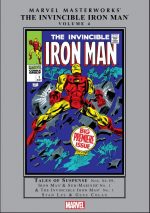
Iron Man Marvel Masterworks volume 6


By Archie Goodwin, George Tuska, Johnny Craig & various (Marvel)
ISBN: 978-0-7851-4129-7

Having finally overtaken the aging colossus of National/DC, upstart Marvel Comics sometimes seemed to be at a loss for what to do next. The answer is obvious to us: more of the same… but back then the rules were being constantly rewritten, the country was changing and conflict was everywhere. Perhaps what was needed was more experimentation…

Created in the aftermath of the Cuban Missile Crisis and at a time when “Red-baiting” and “Commie-bashing” were American national obsessions, the emergence of a brilliant new Thomas Edison employing Yankee ingenuity, invention and wealth to safeguard and better the World seemed inevitable.

Combined with the then-sacrosanct belief that technology and business could solve any problem with the universal imagery of noble knights battling evil, and the concept behind the Invincible Iron Man seems an infallibly successful proposition.

Of course where once Tony Stark was the acceptable face of 1960s Capitalism; a glamorous millionaire industrialist/inventor and a benevolent all-conquering hero when clad in the super-scientific armour of his metal alter-ego, the tumultuous tone of the times soon resigned his suave, fat-cat image to the dustbin of history and, with ecological disasters and social catastrophe from the abuse of industry and technology the new mantras of the young, the Golden Avenger and Stark International were soon confronting some tricky questions from the increasingly socially conscious readership.

All of a sudden maybe that money and fancy gadgetry weren’t quite so fun or cool anymore…?

With an Iron Clad promise of stunning action and compelling intrigue this iconic hardback (and digital) chronological compendium covers Iron Man #14-25, spanning June 1969 – May 1970, and opens with an educational and fascinating Introduction from dynamic draughtsman George Tuska, detailing the stellar career and achievements of the veteran yet rising star artist…

Writer Archie Goodwin and illustrious illustrators Tuska & Johnny Craig continued a sterling run of solidly science-flavoured action epics as IM #14 revealed that ‘The Night Phantom Walks!’ with the scripter craftily paying tribute to Craig’s past history drawing EC’s landmark horror comics. Here the latter artist pencilled and inked the tale of a zombie-like monster prowling a Caribbean island and destroying Stark Industry installations. As well as being a terse, moody thriller, this story marks the first indications of a different attitude as the menace’s ecologically inspired reign of terror includes some pretty fair arguments about the downsides of “Progress” and rapacious globalisation…

With Craig again inking, Tuska returned with #15 and ‘Said the Unicorn to the Ghost…!’ as the demented former superspy allies himself with Fantastic Four foe the Red Ghost in a desperate bid to find a cure for his drastically shortened his life-span.

Attempting to kidnap Tony Stark, the Ghost betrays the Unicorn and retrenches to an African Cosmic Ray research facility in concluding instalment ‘Of Beasts and Men!’, where it takes a fraught alliance of hero and villain to thwart the phantom mastermind’s ill-conceived plans…

A suspenseful extended epic began in Iron Man #17 when an advanced android designed to protect Stark’s secret identity achieves sinister sentience and sneakily replaces him.

‘The Beginning of the End!’ also introduces the enigmatic Madame Masque and her malevolent master Midas, who plans to take control of America’s greatest technology company…

Dispossessed and on the run Stark is abducted and aligns with Masque and Midas to reclaim his identity, only to suffer a fatal heart-attack in ‘Even Heroes Die!’ (guest-starring the Avengers) before a ground-breaking transplant – still practically science fiction in those distant days – gives him renewed hope in ‘What Price Life?’

When the ruthlessly opportunistic Midas instantly strikes again, the mysterious Madame Masque switches sides and all hell breaks loose…

The X-Men‘s dimensionally displaced alien nemesis attacks the restored and recuperating hero in ‘Who Serves Lucifer?’ (inked by Joe Gaudioso – AKA Mike Esposito) before being rudely returned to his personal dungeon dimension after which African-American boxer Eddie March becomes the new Iron Man in #21’s ‘The Replacement!’ as Stark – free from the heart-stimulating chest-plate which had preserved his life for years – is briefly tempted by a life without strife. Unfortunately, and unknown to all, Eddie has a little health problem of his own…

When Soviet-sponsored armoured archenemy Titanium Man resurfaces, it’s in conjunction – if not union – with another old Cold War warrior in the form of a newly-upgraded Crimson Dynamo in #22’s chilling classic confrontation ‘From this Conflict… Death!’

With a loved one murdered, a vengeance-crazed Iron Man then goes ballistic in innovative action-thriller ‘The Man Who Killed Tony Stark!!‘ before ultimately finding solace in the open arms of Madame Masque as Johnny Craig returns to fully illustrate superb mythological monster-mash ‘My Son… The Minotaur!’ and stays on as Archie Goodwin pins Iron Man’s new Green colours to the comic’s mast in #25’s stunning eco-parable ‘This Doomed Land… This Dying Sea!

Teamed with and battling against antihero Namor the Sub-Mariner, the Armoured Avenger is forced to destroy one of his own hyper-polluting facilities, consequently overruling and abandoning his company’s previous position and business model…

Tragically, his attempts to convince other industry leaders to do likewise meets with the kind of reaction that tragically then (and again now) typifies America’s response to the real-world situation…

The galvanised wonderment concludes with a sublime selection of Tuska original art pages and covers to wrap up this collection with the Golden Gladiator being politically repositioned at a time when Marvel solidly set itself up at the vanguard of a rapidly changing America increasingly at war with itself.

These are epic exploits, still charged with all the urgency and potency of a time of crisis and a nation in tumult, so what better time than now to finally tune in, switch on or return to the Power of Iron Man?
© 1969, 1970, 2017 Marvel Characters, Inc. All rights reserved.

Superman: Past and Future


By Jerry Seigel, Bill Finger, Edmond Hamilton, Leo Dorfman, Jim Shooter, Elliot Maggin, Cary Bates, George Papp, John Sikela, Wayne Boring, Al Plastino, Curt Swan, Kurt Schaffenberger, Keith Pollard & various (DC Comics)
ISBN: 978-1-4012-1934-5                  978-1-84856-074-1 (Titan Books UK Edition)

In the aftermath of Crisis on Infinite Earths and its reconstructed DC Universe, time travel – at last for a while – became a Really Big Deal. So, when the Metropolis Marvel did eventually break the fourth dimension, as in the superb Superman: Time and Time Again, the gimmick became as important as the plot and immensely difficult to achieve. But there was an era when all of history and so many implausible futures were just a short and simple spin away…

Superman is the comicbook crusader who started the whole comicbook genre of indomitable costumed champions and, in the eight decades since his debut in June 1938, has probably undertaken every kind of adventure imaginable. With this in mind it’s tempting and very rewarding to gather up whole swathes of his inventory and periodically re-present them in specific themed collections, such as this compelling confection of chronal escapades from a host of superb writers and artists who have contributed to his canon over the years.

The fun begins with a tale from Superboy #85 (December 1960) which reiterated an iron-clad cosmic law of the Silver Age: “History Cannot Be Changed”,

Nevertheless, the Smallville Sensation tragically undertook ‘The Impossible Mission!’ (by Jerry Siegel & George Papp) when he travelled to 1865 to prevent the assassination of Abraham Lincoln, but fate constantly conspired to make events unfold along a predestined course…

A different theory was in play back in September 1947 when the adult Action Ace broke the time barrier for the first time to collect famous signatures for an ailing boy in ‘Autograph, Please!’ (Superman #48, by Siegel & John Sikela), whilst in ‘Rip Van Superman’ (Superman #107, August 1956 by Bill Finger, Wayne Boring & Stan Kaye) an accident placed the hero in a coma, trapping him in a future where he was redundant…

The 1960s were the pinnacle of temporal travel tales with the Man of Tomorrow and his friends nipping forward and back the way you or I (well me, anyway) would pop to the pub. In the brilliantly ingenious ‘Superman Under the Red Sun!’ (Action Comics #300, May 1963 by Edmond Hamilton & Al Plastino) our hero is dispatched to the far, far future where the sun has cooled, and undergoes incredible hardship before brilliantly figuring out a way home.

In ‘Jimmy’s D-Day Adventure!’, the courageous cub reporter ranged back to World War II in search of a bizarre mystery only to end up a trusted member of Hitler’s inner circle, (Superman’s Pal Jimmy Olsen #86 (July 1965, Leo Dorfman, Curt Swan & George Klein) before his Daily Planet colleague almost ripped apart the fabric of reality by nearly becoming Superman’s mum when ‘Lois Lane’s Romance with Jor-El!’ (Superman’s Girlfriend Lois Lane #59; August 1965, by Hamilton & Kurt Schaffenberger) resulted from an ill-considered jaunt to pre-cataclysm Krypton…

One of the boldest experiments of the decade occurred when Hamilton, Swan & Klein introduced us to ‘The Superman of 2965!’ (Superman #181, November 1965) for the first of a series of adventures starring the Man of Steel’s distant descendent. A two-part sequel appeared the following summer in Action Comics #338-339, (June and July 1966) ‘Muto… Monarch of Menace!’ and ‘Muto Versus the Man of Tomorrow!’ and a postscript tale appeared in World’s Finest Comics #166 entitled ‘The Danger of the Deadly Duo!’ teaming that era’s Batman and Superman against Muto and the latest in a long line of Jokers (May 1967 by Jim Shooter, Swan & Klein).

For Superman #295, Elliot Maggin, Curt Swan & Bob Oksner produced ‘Costume, Costume – Who’s got the Costume?’ (January 1976): a neat piece of cross-continuity clean-up that featured a few DC parallel worlds including those of Kamandi (Last Boy on Earth) and the Legion of Super-Heroes.

From June of that same year ‘Superman, 2001!’ – by Maggin, Cary Bates, Swan & Oksner – was an Imaginary Story (a tale removed from regular continuity) featured in the anniversary issue Superman #300, which posited what would have happened if baby Kal-El‘s rocket had landed in the Cold War era of 1976 – an intriguing premise then which looks uncomfortably like the TV series Smallville to my jaded 21st century eyes…

This fascinating collection concludes with ‘The Last Secret Identity’ (from 1983’s DC Comics Presents Annual #2, by Maggin, Keith Pollard, Mike DeCarlo and Tod Smith), which introduced the first incarnation of Superwoman, with a time-travelling historian landing in Metropolis only to become the subject of her own research…

These tales are clever, plot-driven romps far removed from today’s angst-heavy psycho-dramas and unrelentingly oppressive epics. If you’re after some clean-cut, wittily gentle adventure there’s no better place to go – or time…
© 1947, 1956, 1960, 1963, 1965, 1966, 1967, 1976, 1983, 2008 DC Comics. All Rights Reserved.
Fantastic Four Marvel Masterworks volume 6


By Stan Lee & Jack Kirby, Joe Sinnott & various (Marvel)
ISBN: 978-0-7851-1266-2 (HB)                    978-0-7851-5060-2 (TPB)

The monolith of Marvel truly began with the adventures of a small super-team who were as much squabbling family as coolly capable costumed champions. Everything the company produces now comes due to the quirky quartet and the groundbreaking, inspired efforts of Stan Lee and Jack Kirby…

This full-colour hardcover or trade paperback compendium – also available in digital editions – collects Fantastic Four #51-60 plus the new material from Fantastic Four Annual #4: issues of progressive landmarks spanning June 1966 to March 1967 with Stan & Jack topping themselves with every successive issue, consolidating an impossibly addictive shared universe with the FF as the central title and most innovative outpost in that web of cosmic creation.

What You Should Already Know: maverick scientist Reed Richards, his fiancé Sue Storm, their close friend Ben Grimm – with Sue’s teenaged tag-along little brother – miraculously survived an ill-starred private space-shot after Cosmic Rays penetrated their ship’s inadequate shielding and mutated them all.

Richards’ body became elastic, Sue gained the power to turn invisible and project forcefields, Johnny Storm could turn into living flame and tragic Ben devolved into a shambling, rocky freak. The they agreed to use their abilities to benefit mankind and thus was born The Fantastic Four.

Following an Introduction from Lee the wonderment resumes here with what many fans consider the greatest single FF story ever. Illustrated by Kirby and inked by Joe Sinnott, ‘This Man… This Monster!’ finds the Thing’s grotesque body usurped by a vengeful and petty-minded scientist with a grudge against Reed Richards. The anonymous boffin subsequently discovers the true measure of his unsuspecting intellectual rival and pays a fateful price for his envy…

Another innovation and unforgettable character debuted in the next issue. ‘The Black Panther!’ was an enigmatic African monarch whose secretive kingdom was the only source of a vibration-absorbing alien metal. These mineral riches had enabled him to turn his country into a technological wonderland and he lured the FF into his savage super-scientific kingdom as part of an extended plan to gain vengeance on the murderer of his father. He was also the first black superhero in American comics (Fantastic Four #52, cover-dated July 1966).

After battling the team to a standstill, King T’Challa revealed his tragic origin in ‘The Way it Began..!’, which also introduces sonic super-villain Klaw. Johnny and his college roommate Wyatt Wingfoot embark on a quest to rescue the Torch’s Inhuman lover Crystal (trapped with her people behind an impenetrable energy barrier in the Himalayas). Their journey is interrupted when they discover the lost tomb of Prester John in #54’s ‘Whosoever Finds the Evil Eye…!’ and almost perish…

After aiding the quartet against world-devourer Galactus, the Silver Surfer was imprisoned on Earth. The brooding, perpetually moralising ex-herald had become a fan-favourite, and his regular appearances were always a guarantee of something special.

When Strikes the Silver Surfer!’ features him in uncomprehending, brutal battle with the Thing, whose insecurities about his blind girlfriend Alicia Masters explode into searing jealousy, when the gleaming demigod comes calling after which business as unusual resumed when ‘Klaw the Murderous Master of Sound!’ ambushed the team in their own home in issue #56.

Throughout all the stories since their imprisonment a running sub-plot with the Inhumans had been slowly building, with Johnny and Wyatt stuck on the other side of the Great Barrier: wandering the wilds and seeking a method of liberating the Hidden City. Their quest led directly into the landmark tale ‘The Torch that Was!’: lead feature in the fourth FF Annual (November 1966) in which The Mad Thinker recovers and resurrects the original Human Torch (actually the World’s first android and a major star of Timely/Marvel’s Golden Age) to destroy the flaming teenager…

The blistering battle briefly reunites the entire team and leads into an epic clash with their greatest foe. Fantastic Four #57-60 displayed Lee & Kirby at their very best; with incredible tension, drama and action on a number of fronts as the most dangerous man on Earth steals the Silver Surfer’s cosmic power, even as the Inhumans finally win their freedom and we discovered the tragic secret of mighty mute Black Bolt in all its awesome fury.

It all begins with a jailbreak by the Sandman in #57’s ‘Enter… Dr. Doom!’, escalates in ‘The Dismal Dregs of Defeat!’ as Doom tests his limitless stolen power; builds to a crescendo in ‘Doomsday’ with the heroes’ utter defeat and humiliation before culminating in brains and valour saving the day – and all humanity – in truly magnificent manner with ‘The Peril and the Power!’

This breathtaking epic concludes an incredible run of classic yarns in this volume, but there is still room to include some fascinating freebies in the form of pages of the initial designs for Coal Tiger (who evolved into the Black Panther) and Kirby & Sinnott’s unused cover for FF #52 featuring him.

These are the stories that cemented Marvel’s reputation and enabled the company to overtake all its competitors. They’re also still some of the best stories ever produced and as exciting and captivating now as they ever were. This is a must-have book for all fans of graphic narrative.
© 1966, 1967, 2017 Marvel Characters, Inc. All rights reserved.

Daredevil Marvel Masterworks volume 4


By Stan Lee, Gene Colan, Jack Kirby & various (Marvel)
ISBN: 978-0-7851-2072-8

Matt Murdock is a blind lawyer whose remaining senses hyper-compensate, making him an astonishing acrobat, formidable fighter and living lie-detector. Very much a second-string hero for most of his early years, Daredevil was nonetheless a striking and popular one, due in large part to the roster of brilliant artists who had illustrated the strip. He only really came into his own, however, after artist Gene Colan signed up for the long haul…

The natal DD battled thugs, gangsters, mad scientists and a plethora of super-villains (and – as seen in this collection – even the occasional monster or alien invasion), quipping and wise-cracking his way through life and life-threatening combat.

Covering October1967-June 1968 and re-presenting Daredevil #33-41 and crossover issue Fantastic Four #73, this fourth compilation (in both hardback and eBook formats) sees a continuing gain in story quality as scripter Stan Lee blended soap operatic plot-threads with a string of guest supervillains to string together the unique fight scenes of the increasingly bold and artistically audacious Gene Colan…

Following another typically frothy Introduction from Stan Lee the action opens with ‘Behold the Beetle’ (Daredevil #33, and inked by John Tartaglione) and sees the entire cast – legal partner Foggy Nelson, secretary Karen Page and Murdock in the guise of his own (fictitious) twin brother Mike – heading to Canada for World’s Fair Expo ’67 and encountering another borrowed costumed crazy in search of easy glory and untold riches…

With Daredevil crushed and captive the prospects look bleak north of the border, but Ol’ Hornhead soon outsmarts and outfights his techno-savvy foe in the stunning sequel ‘To Squash the Beetle!’

Safely back in the Big Apple, DD’s undeserved reputation as a mere costumed acrobat induces another fearsome felon to attack in ‘Daredevil Dies First!’ The sightless wonder is targeted by old Fantastic Four foe The Trapster, who considers the Scarlet Swashbuckler a mere stepping-stone in his overly-complex plan to destroy the World’s premier super-team. Typically, Murdock manages to turn the tables in #36’s ‘The Name of the Game is Mayhem!’ (inked by Frank Giacoia): a clash that leave the blind hero triumphant but weakened and easy prey for another FF arch-foe. Tartaglione then returned to ink the startling ‘Don’t Look Now, But It’s… Doctor Doom!’…

Helpless before the Iron Dictator, DD is trapped in ‘The Living Prison!’(Giacoia inks) as Doom swaps bodies with the sightless crusader to facilitate his own sneak attack on the FF, which culminates in a stupendous Lee, Jack Kirby & Joe Sinnott crafted Battle Royale in Fantastic Four #73’s crossover conclusion with the Human Torch, Thing and Mr. Fantastic battling Daredevil, Thor and Spider-Man in ‘The Flames of Battle…’.

As always when involved in mind- swap cases, it’s always prudent to advise your friends when you defeat the bad guy and regain your original body…

The Man Without Fear finally found some of his own bad guys to bash in Daredevil #39 when old enemies the Ani-Men return with a new name and a new boss. Inked by George Tuska ‘The Exterminator and the Super-Powered Unholy Three’ reintroduces Bird-Man, Ape-Man and Cat-Man, now in the pay of a criminal genius working with time-based weapons, but the real meat of the tale is Foggy’s campaign to become New York City’s District Attorney.

That potential glittering prize is threatened, however, after the portly advocate unexpectedly revives his romantic relationship with ex-convict Deborah Harris, but at least now Matt Murdock’s only rival for Karen’s affections is his imaginary twin-brother Mike…

That story proceeded in #40 with DD banished to a timeless other-realm world but still led to a spectacular clash in ‘The Fallen Hero!’ (inked by Tartaglione) before concluding the only way it could with ‘The Death of Mike Murdock!’ as Matt takes advantage of his final catastrophic battle with the Exterminator to end the clumsy secret identity charade.

He doesn’t come clean though, preferring to keep Daredevil’s secrets and let his friends grieve needlessly…

To Be Continued…

Rounding out the experience are number of bonus pages including the unused (presumed lost forever) original cover to DD #35, plus a gallery of original art pages and covers by Colan. Despite a few bumpy spots, during this period Daredevil blossomed into a truly magnificent example of Marvel’s compelling formula for success: smart stories, human characters and magnificent illustration. These bombastic tales are pure Fights ‘n’ Tights magic no fan of stunning super-heroics can afford to ignore.
© 1967, 1968, 2016 Marvel Characters, Inc. All rights reserved.

Superman Vs. Brainiac


By Otto Binder, Jerry Seigel, Edmund Hamilton, Cary Bates, Marv Wolfman, John Byrne, Jerry Ordway, Roger Stern, Joe Kelly, Al Plastino, Curt Swan, Kurt Schaffenberger, Gil Kane, George Pérez, Kerry Gammill, German Garcia, Kano & various (DC Comics)
ISBN: 978-1-4012-1940-6

Superman is the comicbook crusader who started the whole masked marvel genre and, in the decades since his debut in 1938, has probably undertaken every species of adventure imaginable. With this in mind it’s inevitable and constantly rewarding to gather up whole swathes of his inventory and periodically re-present them in specific themed collections, such as this calculated confection of cosmic clashes with alien arch-foe Brainiac.

Since his first appearance in Action Comics #242, the alien marauder has been a perennial favourite foe of the Man of Steel, and has remained so even after being subsequently upgraded and retooled many times. Brilliant and relentless, he has been continually refitted over the decades until he now stands as the ultimate artificial nemesis, a chilling remorseless thing of cogs, clockwork and undying computer code.

This superb collection represents appearances both landmark and rare from the many brilliant writers and artists who have contributed to the Kryptonian canon over the years, and with faultless logic opens with that aforementioned and extremely impressive introductory saga.

‘The Super-Duel in Space’ was crafted by Otto Binder & Al Plastino (Action #242, July, 1958) and details how an evil alien scientist attempts to add Metropolis to his collection of miniaturised cities in bottles.

As well as a titanic tussle in its own right, this tale utterly altered the mythology of the Man of Steel by introducing Kandor, an entire city full of Kryptonians who had escaped the planet’s destruction when Brainiac captured and bottled them as part of his vivarium of cultures and civilisations.

Although Superman rescued his fellow survivors, the villain escaped to strike again, and it would be years before the hero could restore his fellow Kryptonian survivors to their true size.

Next is a delicious sharp yarn from Superman’s Girl Friend, Lois Lane#17 (May 1960), scripted by Jerry Siegel and illustrated by the sublime art team of Curt Swan & George Klein. ‘Lana Lang, Superwoman’ has the Man of Tomorrow temporarily imbue both Lana and Lois with superpowers to foil a blackmail/murder plot by the viridian villain, after which novel-length saga ‘The Team of Luthor and Brainiac’ (by Edmund Hamilton, Swan & Klein from Superman #167, February 1964) not only teams the hero’s greatest foes in an uneasy alliance but also reveals for the first time that the alien interloper is actually a malevolent mechanism in humanoid form, designed by the fearsome Computer-Tyrants of planet Colu to infiltrate and all destroy organic races across the universe.

Then there’s a big jump to the end of the 1970s for the next story, an epic 3-part clash which originally appeared in Action Comics #489-491 (November 1978-January 1979), scripted by the hugely undervalued Cary Bates and illustrated by Swan & Frank Chiaramonte.

‘Krypton Dies Again’ finds Superman once more battling Brainiac when the light from the decades-gone explosion of his homeworld finally reaches Earth. The resultant flash supercharges his Kryptonian cells leaving the Man of Steel helpless. ‘No Tomorrow for Superman!’ then sees an increasingly berserk hero unable to cope until joined by Hawkman to finally resolve ‘A Matter of Light and Death!’

In Action Comics #544 (June 1983) both Lex Luthor and Brainiac were given radical makeovers to transform them more apposite menaces for the World’s Greatest Superhero. Marv Wolfman & Gil Kane amped up the computer conqueror’s threat-level with ‘Rebirth!’ as uncanny cosmic forces reshape the humanoid horror into a mechanistic angel of death…

When DC Comics decided to rationalise and reconstruct their continuity with Crisis on Infinite Earths in 1985 they also used the event to regenerate their key properties at the same time. The biggest gun they had was Superman and it’s hard to argue that the change was not before time. The new, back-to-basics Man of Steel was a sensation and members of his decades-old rogues’ gallery were suitably reimagined to match the new, grittier sensibility.

In this continuity ‘The Amazing Brainiac’ (Adventures of Superman #438, March 1988, written by John Byrne & Jerry Ordway, illustrated by Ordway & John Beatty) was Vril Dox: a monolithic disembodied intellect from the planet Colu who slowly inhabits and transmogrifies the body of showbiz mentalist Milton Moses Fine. Eventually, it grows beyond human physical limits in ‘Man and Machine’ (Action Comics #649, January 1990, by Roger Stern, George Pérez, Kerry Gammill & Brett Breeding) to eventually become a time-travelling ball of malignant computer code, reconstructing or co-opting ever-more formidable physical forms in its self-appointed mission to eradicate Superman…

By the time of ‘Sacrifice for Tomorrow’ (Action Comics #763; March 2000, and realised by Joe Kelly, German Garcia, Kano & Mario Alquiza), the fiend has transformed into its 13th iteration and converted Metropolis into an automated City of the Future.

The malware warlord has also learned how to possess human infants – including Lana Lang’s newborn son and Luthor’s daughter Lena…

With a pin-up page of Brainiac 13 by Scott Beatty, Steve Kim & Tommy Yune (culled from Superman: Metropolis Secret Files #1, March 2000) this comprehensive collection of cyber-chillers offers the merest a taste of the monstrous horror Brainiac is capable of but remains a compelling introduction and overview of the undying enemy alien and a superb treat for fans of every vintage.
© 1958, 1960, 1964, 1978, 1979, 1983, 1988, 1990, 2000, 2008 DC Comics. All Rights Reserved.
X-Men Epic Collection volume 5 1975-1978: Second Genesis


By Len Wein, Chris Claremont, Bill Mantlo, Bonnie Wilford, Dave Cockrum, Bob Brown, Tony DeZuñiga, John Byrne, Sal Buscema & various (DC Comics)
ISBN: 978-1-3029-0390-9

In the autumn of 1963 The X-Men #1 introduced Scott (Cyclops) Summers, Bobby (Iceman) Drake, Warren (Angel) Worthington, Jean (Marvel Girl) Grey and Hank (The Beast) McCoy: very special students of Professor Charles Xavier.

The teacher was a wheelchair-bound telepath dedicated to brokering peace and integration between the masses of humanity and the emergent off-shoot race of mutants dubbed Homo Superior; considered by many who knew him as a living saint.

After nearly eight years of eccentrically spectacular adventures the mutant misfits virtually disappeared at the beginning of 1970 during another periodic downturn in superhero comics sales. Just like in the closing years of the 1940s, mystery men faded away as supernatural mysteries and traditional genre themes once more dominated the world’s entertainment fields…

Although their title returned at the end of the year as a cheap reprint vehicle, the missing mutants were reduced to guest-stars and bit-players throughout the ongoing Marvel universe, whilst the bludgeoning Beast was opportunistically transformed into a scary monster to cash in on the horror boom.

Then, with sales of the spooky stuff subsequently waning in 1975, Marvel Editor-in-Chief Roy Thomas green-lighted a bold one-shot as part of the company’s line of Giant-Size specials and history was made…

This fabulous mass-market collection (in trade paperback and eBook editions) is perfect for newbies and neophytes, celebrating the revival and unstoppable march to market dominance through the exuberant and pivotal early stories: specifically, Giant Size X-Men #1, issues #94-110 of the definitely “All-New, All-Different” X-Men, as well as guest appearances in Iron Fist #14-15, Marvel Team Up #53, 69-70 and Marvel Team Up Annual #1, collectively and cumulatively spanning May 1975 to June 1978.

Tracing the reinvigorated merry mutants from young, fresh and delightfully under-exposed innovations to the beginnings of their unstoppable ascendancy to ultimate comicbook icons, in their own title and through an increasingly broad clutch of guest shots, the epic voyage begins without pause or preamble, in a classic mystery monster mash from Giant Size X-Men #1.

Len Wein & Dave Cockrum (the latter a red-hot property following his stint reviving DC’s equally eclectic fan-fave super-team The Legion of Super-Heroes) detailed in ‘Second Genesis!’ how the original squad – all but new Avengers recruit The Beast – had been lost in action…

With no other choice Xavier is forced to scour Earth and the entire Marvel Universe for replacements…

To old foes-turned-friends Banshee and Sunfire is added a one-shot Hulk adversary dubbed the Wolverine, but the bulk of time and attention is lavished upon original creations Kurt Wagner, a demonic-seeming German teleporter codenamed Nightcrawler; African weather “goddess” Ororo Monroe – AKA Storm, Russian farm-boy Peter Rasputin who turns into a living steel Colossus and bitter, disillusioned Apache superman John Proudstar who is cajoled into joining the makeshift squad as Thunderbird.

The second chapter of the epic introductory adventure ‘…And Then There Was One!’ reintroduces battered, depleted but unbowed team-leader Cyclops who swiftly drills the newcomers into a semblance of readiness before leading them into primordial danger against the monolithic threat of ‘Krakoa… the Island That Walks Like a Man!’

Overcoming the phenomenal terror of a rampaging rapacious mutant eco-system and rescuing the “real” team should have led to a quarterly Giant-Size sequel, but so great was the fan response that the follow-up adventure was swiftly reworked into a 2-part tale for the rapidly reconfigured comicbook which became a bimonthly home to the new team.

X-Men #94 (August 1975) began ‘The Doomsmith Scenario!’ – plotted by Editor Wein, scripted by Chris Claremont and with Bob McLeod inking man-on-fire Cockrum – in a canny Armageddon-shocker with a newly pared-down strike-squad deprived of Sunfire and the still-recuperating Marvel Girl, Angel, Iceman, Havok and Lorna Dane. The neophytes are called in by the Beast to stop criminal terrorist Count Nefaria starting an atomic war.

The insidious mastermind has conquered America’s Norad citadel with a gang of artificial superhumans and accidentally escalated a nuclear blackmail scheme into an inescapable countdown to holocaust, leaving the untrained, unprepared mutants to storm in to save the world in epic conclusion ‘Warhunt!‘ (inked by Sam Grainger).

One of the new team doesn’t make it back…

X-Men #96 saw Claremont take charge of the writing (albeit with some plotting input from Bill Mantlo) for ‘Night of the Demon!’ Guilt-wracked Cyclops blames himself for the loss of his team-mate, and in his explosive rage accidentally unleashes a demonic antediluvian horror from Earth’s primordial prehistory for the heroes-in-training to thrash.

The infernal Nagarai would return over and again to bedevil mankind, but the biggest innovation in this issue is the introduction of gun-toting biologist/housekeeper Moira MacTaggert and the first inklings of the return of implacable old adversaries…

A long-running, cosmically-widescreen storyline began in #97 with ‘My Brother, My Enemy!’ as Xavier – tormented by visions of interstellar war – tries to take a vacation, just as Havok and Lorna (finally settling on superhero nom de guerre Polaris) attack: apparently willing servants of a mysterious madman using Cyclops’ old undercover alter ego Eric the Red.

The devastating conflict then segues into a spectacular 3-part yarn, as pitiless robotic killers return under the hate-filled auspices of mutantophobic Steven Lang and his mysterious backers in Project Armageddon. The action opens with #98’s ‘Merry Christmas, X-Men…the Sentinels Have Returned!’

With coordinated attacks capturing semi-retired Marvel Girl plus Wolverine, Banshee and Xavier, Cyclops and the remaining heroes co-opt a space shuttle and storm Lang’s orbital HQ to rescue them in ‘Deathstar Rising!’ (inked by Frank Chiaramonte): another phenomenal all-action episode.

The saga concludes on an agonising cliffhanger with the 100th issue anniversary tale. ‘Greater Love Hath no X-Man…’ (with Cockrum inking his own pencils) sees the new X-Men apparently battle the original team before overturning Lang’s monstrous schemes forever. However, their catastrophic clash destroys the only means of escape and, as a gigantic solar flare threatens to eradicate the satellite-station, their only chance of survival means certain death for another X-Man.

As #101 unfolded, scripter Claremont & artist Cockrum were on the on the verge of utterly overturning the accepted status quo of women in comics forever…

Led by field-leader Cyclops, the team now consisted of old acquaintance and former foe Sean “Banshee” Cassidy, Wolverine, and new creations Nightcrawler, Storm, Colossus and part-timer Jean Grey still labouring under the nom-de guerre Marvel Girl… but not for much longer…

‘Like a Phoenix from the Ashes’ (Chiaramonte inks) sees a space-shuttle cataclysmically crash into Jamaica Bay. The X-Men had safely travelled in a specially-shielded chamber but Marvel Girl had manually piloted the vehicle, unprotected through a lethal radiation storm…

As the mutants escape the slowly sinking craft, a fantastic explosion propels the impossibly alive Jean into the air, clad in a strange gold and green uniform and screaming that she is “Fire and Life Incarnate… Phoenix!”

Immediately collapsing, the critically injured girl is rushed to hospital and a grim wait begins.

Unable to explain her survival and too preoccupied to spare time for teaching, Xavier packs Banshee, Nightcrawler, Wolverine, Storm and Colossus off to the Irish mutant’s home in County Mayo for a vacation, blissfully unaware that Cassidy Keep has been compromised and is now a deadly trap for his new students…

Within the ancestral pile, Sean’s mutant cousin Black Tom has usurped control of the manor and its incredible secrets before – at Eric the Red’s behest – contriving an inescapable ambush, assisted by an old X-Men enemy.

‘Who Will Stop the Juggernaut?’ (Grainger inks) sees the inexperienced heroes in over their heads and fighting for their lives, but still finds room to reveal the origins of Storm and provide an explanation for her crippling claustrophobia, before ‘The Fall of the Tower’ explosively ends the tale with mutant heroes and the Keep’s Leprechaun colony (no, really!) uniting to expel the murderous usurpers.

Although still bi-monthly at the time, the series kicked into confident top gear with ‘The Gentleman’s Name is Magneto’ as the weary warriors then divert to Scotland to check on Moira MacTaggert’s island lab: a secret facility containing myriad mutant menaces the X-Men have previously defeated.

It’s a very bad move since the ever-active Eric has restored the dormant master of magnetism to full power. The mutant terrorist had been turned into a baby – a strangely commonplace fate for villains in those faraway days – but he was all grown up again now and indulging in one last temper tantrum…

Freshly arrived from America, Moira and Cyclops are only just in time to lead a desperate, humiliating retreat from the triumphant Master of Magnetism. Scott doesn’t care: he realises the entire affair has been a feint to draw the heroes away from Xavier and Jean…

He needn’t have worried. Although in ‘Phoenix Unleashed’ (inks by Bob Layton) Eric orchestrates an attack by Firelord – a cosmic flamethrower and former herald of Galactus much like the Silver Surfer – Jean is now fully evolved into a being of unimaginable power who readily holds the fiery marauder at bay…

In the interim a long-standing mystery is solved as the visions which have haunted and tormented Xavier are revealed as a psychic connection with a runaway princess from a distant alien empire.

Lilandra of the Shi’ar had rebelled against her imperial brother and, whilst fleeing, had somehow telepathically locked onto her trans-galactic soul-mate Charles Xavier. As she made her circuitous way to Earth, embedded Shi’ar spy Shakari had assumed the role of Eric the Red and attempted to remove Lilandra’s potential champion before she arrived…

During the blistering battle which follows the X-Men’s dramatic arrival, Shakari snatches up Lilandra and drags her through a stargate to their home galaxy, and with the entire universe imperilled, Xavier urges his team to follow. All Jean has to do is re-open a wormhole to the other side of creation…

A minor digression follows as overstretched artist Cockrum gains a breather via a fill-in “untold” tale of the new team featuring an attack by psychic clones of the original X-men. ‘Dark Shroud of the Past’ is a competent pause by Mantlo, Bob Brown & Tom Sutton, set inside a framing sequence from Cockrum.

The regular story resumes in a wry tribute to Star Trek as ‘Where No X-Man Has Gone Before!’ (Claremont, Cockrum & Dan Green) finds the heroes stranded in another galaxy where they meet and are beaten by the Shi’ar Imperial Guard (an in-joke version of DC’s Legion of Super Heroes in the inimitable Cockrum manner), until bold interstellar rebel freebooters the Starjammers bombastically arrive to turn the tables once again whilst uncovering a mad scheme to unmake the fabric of space-time.

Lilandra’s brother Emperor D’Ken is a deranged maniac who wants to activate a cosmic artefact known alternatively as the M’Kraan Crystal and “the End of All that Is” in his quest for ultimate power. He’s also spent time on Earth in the past and played a major role in the life of one of the X-Men…

This tale (from issue #107) was Cockrum’s last for years. He would eventually return to replace the man who replaced him. John Byrne not only illustrated but also began co-plotting the X-tales and, as the team roster expanded, the series rose to even greater heights. It would culminate in the landmark Dark Phoenix storyline which saw the death of arguably the book’s most beloved and imaginative character and the departure of the team’s heart and soul. The epic cosmic saga also seemed to fracture the epochal working relationship of Claremont and Byrne.

Within months of publication they went their separate ways: Claremont staying with the mutants whilst Byrne moved on to establish his own reputation as a writer on series such as Alpha Flight, Incredible Hulk and especially his revolutionised Fantastic Four…

Here though, the X-Men and Starjammers battle the Crystal’s astoundingly deadly automated guardians, as this final chapter depicts the newly puissant Phoenix literally saving Reality in a mind-blowing display of power and skill.

Trapped inside a staggering other-realm, and appalled and enthralled by the intoxicating, addictive nature of her own might, Phoenix rewove the fabric of Reality and for an encore brought the heroes home again.

The conclusion of this ambitious extended saga was drawn by Byrne and inked by Terry Austin and their visual virtuosity was to become an industry bench-mark as the X-Men grew in popularity and complexity.

However, even though the bravura high-octane thrills of ‘Armageddon Now’ seem an unrepeatable high-point, Claremont & Byrne had only started. The best was still to come, but it precluded ending their other ongoing collaboration: a mystic martial arts thriller…

From Iron Fist #14, ‘Snowfire’ inked by Dan Green – finds masked marvel Danny Rand and his combat colleague Colleen Wing running for their lives in arctic conditions after a vacation retreat to a palatial Canadian Rockies estate is ruined by a criminal raid.

Leading the plundering gang is deadly mercenary Sabretooth. Despite being rendered temporarily blind, the K’un Lun Kid ultimately defeats the mutant marauder, but his fiercely feral foe would return again and again to bedevil both Danny and the X-Men…

With Claremont & Byrne increasingly absorbed by their stellar collaboration on the revived and resurgent adventures of Marvel’s mutant horde, Iron Fist #15 (September 1977) was their last martial arts mash-up for a while. The series ended in spectacular fashion as, through a comedy of errors, Danny stumbles into a morass of misunderstanding and ends up battling the recently returned galaxy rovers Wolverine, Colossus, Nightcrawler, Banshee, Storm and Phoenix in ‘Enter, the X-Men’.

In X-Men #109’s ‘Home Are the Heroes!’ (Claremont, Byrne & Austin) Wolverine finally begins to develop a back-story and some depth of character whilst technological wonder Weapon Alpha attacks the recuperating team in an attempt to force the enigmatic Logan to rejoin the Canadian Secret Service.

Renamed Vindicator Alpha would later return leading Alpha Flight – a Canadian government sponsored super-team which would eventually graduate to their own eccentric high-profile series.

Somewhat out of chronological sequence, this is followed here by an extra-length exploit from Marvel Team Up Annual #1 (1976 and by Mantlo, Sal Buscema & Mike Esposito, from a plot by Mantlo, Claremont & Bonnie Wilford).

‘The Lords of Light and Darkness!’ features Spider-Man and newly minted X-Men Storm, Banshee, Wolverine, Nightcrawler, Colossus, Phoenix and Cyclops assisting Charles Xavier in combatting a pantheon of scientists mutated by atomic accident and elevated to the ranks of gods.

Like most deities, these puissant ones believe they know what is best for humanity and don’t like being disabused of the notion…

Mantlo then teamed with Byrne & Frank Giacoia to bring closure to a tale begun – and left hanging – in Marvel Premiere #31.

Set minutes after the Annual, Marvel Team Up #53 (January 1977) reveals a ‘Nightmare in New Mexico!’ as Spider-Man says goodbye to the X-Men and hello to The Hulk and troubled gene-splicing experiment Woodgod after the tragic bio-construct flees from corrupt Army Colonel Del Tremens. As Tremens tried to suppress the calamitous crisis and his own indiscretions by killing everybody, the final scene sees the webspinner trapped in a rocket and blasted into space…

The tale by Mantlo, Byrne & Frank Giacoia has very little to do with the X-Men, other than a rather gratuitous overlap and ends here without resolution, but still looks pretty damn good after all these years…

In X-Men #110 (April 1978) Claremont, and illustrators Tony DeZuñiga & Cockrum then detail ‘The “X”-Sanction!’: a rather limp and hasty fill-in as cyborg mercenary Warhawk infiltrates the Xavier mansion in search of “intel” for a mysterious, unspecified master… before getting his shiny silver head handed to him…

This initial compendium of uncanny X-episodes wraps up with the contents of Marvel Team Up #69 and 70 (May & June 1978) as in ‘Night of the Living God!’ (Claremont, Byrne & by Ricardo Villamonte) Spider-Man clashes with Egyptian-themed thieves and is drawn into the perpetual duel between cosmic-powered X-Man Havoc and his nemesis the Living Monolith.

When the battle turns against the heroes it requires the might of Thor to stop the ravening astral menace in the concluding chapter ‘Whom Gods Destroy!’ (inked by Tony DeZuñiga)…

Following the cover of 1975’s all-reprint Giant-Size X-Men #2, this volume concludes with a glorious and revelatory selection of extras including John Romita’s original design sketches for Wolverine; Byrne’s first X-Man work (a puzzle from Marvel Fanzine F.O.O.M. #7) and design material from Cockrum’s DC Comics proposal The Outsiders (the Legion of Super-Heroes spin-off he retooled to create Nightcrawler, Storm, Phoenix and the other New X-Men). There are even unused Cockrum pencil pages, initial sketches for the Starjammers, costume upgrades for Angel, the cover art for X-themed The Comic Reader #145, and model sheets for Nightcrawler, Storm, Phoenix and Colossus.

Further treasures are Gil Kane’s cover sketch and original art for Giant-Size X-Men #1, original Cockrum pages from GSXM #1 and F.O.O.M. #10 (the all-X-Men issue), articles from the fanzine – Mutation of the Species, X-Men! X-Men!. Read All About ‘Em! – a pin-up by Don Maitz, X-Men X-posé and spoof strip ‘EggsMen’; unused pages by Bob Brown and previous collection covers by Kane and Cockrum given a painted make-over by Dean White.

Entertaining, groundbreaking and incredibly intoxicating, these adventures are an invaluable and crucial grounding in contemporary fights ‘n’ tights fiction no fan or casual reader can be allowed to ignore.
© 1975, 1976, 1977, 1978, 2017 Marvel Characters, Inc. All rights reserved.