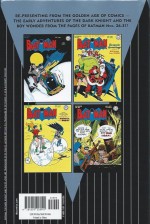
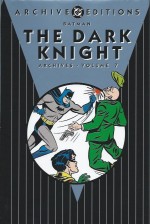
Batman: the Dark Knight Archives volume 7


By Bob Kane, Don Cameron, Bill Finger, Joe Samachson, Jack Schiff, Alvin Schwartz, Joe Greene, Dick Sprang, Jerry Robinson, Jack Burnley & various (DC Comics)
ISBN: 978-1-4012-2894-1

Win’s Christmas Recommendation: Classically Traditional, Timelessly Wonderful… 9/10

Launching in 1939, a year after Superman, “The Bat-Man” (and latterly Robin, the Boy Wonder) cemented DC/National Comics as the market frontrunner and conceptual leader of the burgeoning comicbook industry.

Having established the fantastic parameters of the metahuman with their Man of Tomorrow, the strictly mortal physical perfection and dashing derring-do of DC’s Dynamic Duo rapidly became the swashbuckling benchmark by which all other four-colour crimebusters were judged.

This seventh lavish hardback Archive Edition volume covers another bombastic bevy of Batman adventures (from #26-31 of his solo title, spanning December 1944/January 1945 to October/November 1945), abandoning wartime themes and exploits as the American Homefront anticipated a return to peacetime dangers, dooms and criminality….

These Golden Age tales are amongst the very finest in Batman’s decades-long canon as lead writers Bill Finger and Don Cameron, supplemented by Joe Samachson, Jack Schiff, Alvin Schwartz, Joseph Greene and other sadly unrecorded scripters, pushed the boundaries of the medium whilst graphic genius Dick Sprang veteran gradually superseded and surpassed originator Bob Kane (busy drawing the Batman daily newspaper strip); making the feature utterly his own whilst keeping the Dauntless Double-Act at the forefront of the legion of superhero stars.

The sheer creativity exhibited in these adventures saw an ever-expanding band of creators responsible for producing the stories of the Dark Knight were hitting an artistic peak which only stellar stable-mate Superman and Fawcett’s Captain Marvel could match.

Following a fascinatingly fact-filled and incisive Foreword from comics historian – and leading light of the magnificent Grand Comics Database – Gene Reed, the mesmerising flash and dazzle commences with Batman #26 and ‘The Twenty Ton Robbery!’

Delivered by Cameron & Sprang it described the return of Dashing Desperado The Cavalier, whose criminal cries for attention drove him to compete against the Caped Crusaders with ever-more spectacular and pointless plunderings after which Schiff & Robinson proffered another delightfully silly comedy-caper in ‘The Adventures of Alfred: Recipe for Revenge!’

This solo exploit of the wannabe detective found the fumbling footman shopping for fancy cuisine and inadvertently saving the life of a gourmet chef…

Crafted at the end of 1944, Greene & Sprang’s ‘The Year 3000!’ was a timely allegory of recent terrors and warning to tomorrow as the usual scenario boldly switched to an idyllic future despoiled when the Saturnian hordes of Fura invade Earth and nearly crush humanity. Happily, one brave man and his young friend find records of ancient heroes named Batman and Robin and, patterning themselves on the long-gone champions, lead a rebellion which overturns and eradicates those future fascists…

Although a touch heavy-handed in places, this first conception of the undying legacy of Batman is a stunning example of what comics do best: inspire whilst entertaining…

Cameron & Sprang close up the issue, back on solid ground and with an eye to contemporary trends as ‘Crime Comes to Lost Mesa!’ finds the Gotham Gangbusters way out west in pursuit of escaped convicts and stumbling into a lost land where pueblo Indians still live in blissful ignorance of the modern world.

Keeping it that way takes the aid of plucky native tyke Nachee, helping Batman and Robin by surreptitiously rounding up the fugitives…

Issue #27 sported a stunning Christmas cover by Jack Burnley (equally captivating other covers in this collection are provided by Robinson or Sprang) before the Masked Manhunters were introduced to ‘The Penguin’s Apprentice’ (Cameron, Burnley & Robinson). The lad was far from keen to continue the family’s illegal traditions or indulge in nefarious business and his dreams of being an author soon ensured Batman put the Bird Bandit back in a cage…

Jerry Robinson always had a deft touch with light comedy and excelled in illustrating the sadly uncredited butler yarns remaining in this tome. ‘The Adventures of Alfred: The Pearl of Peril!’ saw the hapless manservant suckered into an ancient con-game but still coming up trumps thanks to sheer dumb luck, after which Samachson, Burnley & Robinson took Batman and Robin on a ‘Voyage into Villainy’ when a murder at The Explorers Club leads to a deadly treasure hunt through scaled-down replicas of Earth’s most inhospitable environments with a hidden killer waiting to pounce at any moment…

Another of the annual “Christmas Batman” tales wraps up the issue (why on Earth DC has never released a paperback collection of this phenomenally rich seam of Festive gold I’ll never understand) as ‘A Christmas Peril!’ by Cameron & Robinson follows the downward progress and overnight redemption of appallingly callous boy-millionaire Scranton Loring, who learns – almost too late – the joy of giving and inadvisability of trusting bankers and financial advisers, thanks to the timely intervention of a couple of self-appointed (masked) Santa’s Helpers…

Batman #28 leads with ‘Shadow City!’ (Cameron & Robinson) wherein The Joker concocts a wild scheme involving a floating urban street where gamblers and other wealthy risk-takers can indulge their dark passions safe from legal oversight – until the Dynamite Detectives deduce the truth of his vanishing village…

Another anonymous Robinson-rendered romp follows as ‘The Adventures of Alfred: The Great Handcuff King!’ reveals how the bumbling butler’s attempts to familiarise himself with manacles accidentally ensnares an unwary thuggish miscreant, after which the mild-mannered manservant almost ends the career of ‘Shirley Holmes: Policewoman!’ by inadvertently exposing the undercover cop to criminals in a tense Batman thriller by Finger & Robinson.

This issue ends on a redemptive high note as ‘Batman Goes to Washington!’ (Alvin Schwartz & Robinson) finds the Dark Knight supporting a group of former criminals heading to the nation’s capital to argue the case for jobs for ex-offenders. Typically, some gang bosses react to the threat to their potential labour pool with murderous overkill…

Finger & Sprang opened #29 with the chilling ‘Enemy No. 1’ as a man obsessed by being first at everything turned his monomaniacal frustration to the commission of crime, after which the Unknown Writer joined Robinson returned in ‘The Adventures of Alfred: The Butler’s Apprentice!’ wherein our dapper Man Friday answers an ad to train a retainer and stumbles into another half-baked burglary plot…

Although credited here to Robinson, Don Cameron’s outrageous romp ‘Heroes by Proxy!’ is actually an all-Sprang affair, delightfully describing how down-on-their-luck private detectives Hawke and Wrenn try to save their failing business by masquerading as Batman and Robin.

Luckily their first case involves strangely embarrassed Bruce Wayne and Dick Grayson who are mortified – then amused – to be burgled by bandits unknown and then coached and cosseted by these helpful but blatantly shoddy impostors of their alter egos…

The delicious hilarity successfully concluded, grim normality returns courtesy of Finger, Sprang & Charles Paris as the diabolical Scuttler devises an infallible means of purloining secret plans and foiling the law’s attempts to catch him in ‘The Mails Go Through!’…

The pompous Penguin pops up again in Batman #30, undertaking a bird and umbrella themed banditry-blitz to ensure his status as emperor of crime until the determined duo send him ‘Back to the Big House!’ (Cameron & Sprang).

‘While the City Sleeps!’ (Finger & Sprang) is a revered classic of informative, socially-aware entertainment which finds the senior crime-smasher taking his ward on a nocturnal tour of the city, celebrating the people who keep a modern metropolis going. Along the way they encounter a repentant thief trying to return stolen cash and have to deal with the guilty man’s murderous compatriots who want to keep the loot…

‘The Adventures of Alfred: Alias the Baron!’ (? & Robinson) then brightens the tone as the butler is mistaken by gangsters for a British crook marked for assassination, after which Finger & Sprang introduce the most annoying character in Gotham in ‘Ally Babble and the Fourteen Peeves!’

The well-meaning, impulse-challenged blabbermouth never shuts up and when he agrees to sort out a list of petty grievances for a well-to-do, bedridden old gent, the resulting chaos allows crooks to make a killing. As events alarmingly escalate however, the Caped Crimebusters are hard pushed to decide who’s the greater menace…

The final issue in this titanic tome is an all Robinson art-affair, beginning with the debut of quarrelsome couple ‘Punch and Judy!’ (scripted by Finger and inked by George Roussos). The wily elderly performers’ violent relationship makes them prime suspects when Bruce and Dick investigate a crooked carnival but can they possibly be involved in murder too?

‘The Adventures of Alfred: Alfred, Armchair Detective!’ was possibly written by Cameron or Samachson and hilariously depicts how an idle night spent eavesdropping on crooks results in a big arrest of burglars, whilst ‘The Vanishing Village!’ (Samachson) finds Batman and Robin in Florida, infiltrating a seemingly mobile resort hideaway for crooks on the run before Joe Greene authors the final act.

Here Robinson & Roussos depict the heroes investigating ‘Trade Marks of Crime!’ when a succession of crimes seem to indicate that some new culprit is utilising the tricks and M.O.’s of other bandits. The truth is a far more cunning and dangerous solution…

Accompanied by a full creator ‘Biographies’ section, this sublime selection of classic comicbook action is a magnificent rollercoaster ride to a era of high drama, low cunning and breathtaking excitement and this timeless and evergreen treat is one no lover of graphic entertainments should ignore.
© 1944, 1945, 2010 DC Comics. All Rights Reserved.
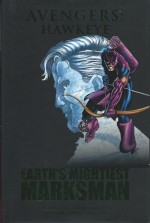
Avengers: Hawkeye – Earth’s Mightiest Marksman


By Chuck Dixon, Nelson Yomtov, Tom DeFalco, Scott Kolins, Jerry DeCaire, Jeff Johnson, Dave Ross, Mark Bagley & various (Marvel)
ISBN: 978-0-7851-5939-1

Clint Barton is probably the world’s greatest archer: swift, unerringly accurate and augmented by a fantastic selection of multi-purpose high-tech arrows. Following an early brush with the law and as a reluctant Iron Man villain, he reformed to join the Mighty Avengers where he served with honour, yet always felt overshadowed by his more glamorous, super-powered comrades.

Long a mainstay of Marvel continuity and probably the company’s most popular B-list hero, the Battling Bowman has risen to greater prominence in recent years, boosted no doubt by his filmic incarnation in the Thor and Avengers movies.

This brash and bombastic hardcover collection assembles some of his lesser known solo appearances: the second Hawkeye Limited Series (January-April 1994), a brief serial vignette from anthological Marvel Comics Presents #159 -161 (July-August 1994) and one-shot Hawkeye – Earth’s Mightiest Marksman (from October 1998).

The wild happenings begin with a miniseries released after the cancellation of Avengers: West Coast – an offshoot team the Abrasive Archer led until his wife Mockingbird was killed. In his absence, the squad was forcibly disbanded by the East Coast parent division…

Crafted by Chuck Dixon, Scott Kolins & Tim Dzon, ‘Shafted’ opens in the freezing Canadian Rockies where the justifiably disgruntled and grieving bowman has retreated to lick his emotional wounds. Reducing his life to a primal daily battle against hunger and the elements, Hawkeye is dragged out of his depressive funk when he stumbles across a hidden scientific complex run by the malevolent Secret Empire and rescues a strangely vulpine yet intelligent victim from their ghastly bio-labs…

Guarding the facility are old enemies/merciless mercenaries Trick Shot and Javelynn, but they aren’t enough to stop Clint wrecking the base and fleeing with the severely wounded little werewolf. Sadly, his heroic incursion didn’t take out the base commander: one of the most ruthless and wicked terrorists on Earth…

Dubbing his dying companion Rover, Hawkeye carries his new hirsute pal to snowbound hamlet Dunroman and convinces harassed Doctor Avery to operate. The beast has amazing recuperative powers and a day later the frantic mute creature has convinced the archer to invade the fortress a second time.

They are too late: the ‘Masters of the Game’ have shut down their genetic experiments and cleaned up by exterminating the cages full of similar creatures which must have been Rover’s family…

As the horrified hero and the heartbroken man-beast rip their way out of the charnel factory, Hawkeye sees smoke on the horizon and realises the Secret Empire’s drive for secrecy has led to the eradication of Dunroman…

Vowing unholy vengeance, the archer then contacts old comrade War Machine from the defunct West Coast squad. The former military specialist offers the services of his personal armourer to upgrade Hawkeye’s bag of tricks and, once renegade engineer Mack Mendelson outfits the outraged archer with a new costume, transport and heavier arrowhead-ordnance, both bowman and human tanks clear a path into the heart of the Empire’s island HQ in ‘Run of the Arrow’.

However, despite wiping out the fortress, Hawkeye’s ultimate targets elude him and, following a Colin MacNeil pin-up, the savage saga concludes in ‘Rage’ as the archer and Rover track down the monstrous mastermind in time to stop her unleashing a brutal pack of the wolf-beasts’ totally weaponised descendents onto the mercenary market as unstoppable “Biological Combat Units”…

There is one last blockbusting battle before the bloody dust settles which turns on a knife edge and an unexpected betrayal…

A sort-of sequel to the miniseries appeared in the middle of 1994 as Hawkeye starred in a three chapter epilogue by Nelson Yomtov & Jerry DeCaire originally seen in Marvel Comics Presents #159 though 161. It begins with the insubordinate U.S.Agent trying tough love and a ‘Rocky Reunion’ to drag the morose marksman back to civilisation and into the ranks of newly constituted Crisis Management team Force Works.

Now haunting the backwoods of Tennessee, the archer is ferociously resistant to the notion and, with both masked mavericks displaying lethal levels of testosterone and ‘Bellies Full of Fire’, the argument quickly descends into all-out war which encompasses even more savage beasts before the stupid spat inconclusively concludes in ‘The Hungry Wolf’…

By the time Hawkeye – Earth’s Mightiest Marksman was released in 1998 the Avengers – Hawkeye included – had all been apparently obliterated by mutant menace Onslaught, spent a year outsourced to Image Comics as part of the Heroes Reborn sub-universe and then been dramatically reintroduced to mainstream Marvel in Heroes Reborn: The Return.

The impetus of the reunification and the sheer quality of the restarted titles (The Avengers, Iron Man, Captain America and Thor) ignited a mini-renaissance in quality – especially in the monumentally hero-heavy Avengers volume 3 – and as Hawkeye battled again beside his former comrades Clint Barton assumed a mentor’s position; giving the newest costumed neophytes admitted to the prestigious team the benefit of his vast experience…

It was in this role, teaching ex New Warriors Firestar and Justice, that scripter Tom DeFalco devised a triptych of interconnected tales to test Hawkeye that began – after a handy prose-and-picture recap feature – when the Astounding Archer agreed to help computer programmer Augusta Seer retrieve a stolen virus of catastrophic potential.

Sadly the mission was a set-up and led into a trap where Hawkeye was ‘Battered by Batroc!’ (art by Jeff Johnson & Kolins) and his henchmen Zaran and Machete…

Having trashed the terrible trio and set out after the fictive Dr. Seer, the bowman is then ‘Assaulted by Oddball!’ (Dave Ross & Tom Wegrzyn) – despite the best efforts of Justice and Firestar, in attendance for the educational experience – before the true villain is exposed and ultimately overcome in ‘Trounced by Taskmaster!’ (by Mark Bagley & Al Milgrom), with a final-act appearance by stalwarts of both the Avengers and New Warriors to cap and contribute to the furious all-out action.

This is a compendium of short, sharp, uncomplicated action thrillers that will test no one’s deductive abilities but will certainly set pulses racing: a straightforward big bag of Fights ‘n’ Tights romps to delight the hearts of ten-year-olds of all ages.
© 1994, 1998, 2012 Marvel Characters, Inc. All rights reserved.

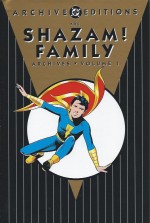
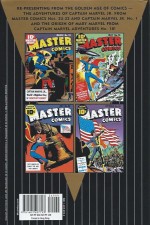
Shazam! Family Archives volume 1


By unknown authors, Mac Raboy, Al Carreno, Mark Swayze & various (DC Comics)
ISBN: 978-1-4012-0779-3

One of the most venerated and beloved characters of America’s Golden Age of comicbooks, Captain Marvel was created in 1940 as part of a wave of opportunistic creativity which followed the stunning success of Superman in 1938 and Batman one year later.

Although there were many similarities in the early years, the Fawcett champion quickly moved squarely into the area of light entertainment and even straight comedy, whilst as the years passed the Man of Steel increasingly left whimsy behind in favour of action, drama and suspense.

Homeless orphan and all-around decent kid Billy Batson was selected by an ancient wizard named Shazam to periodically employ the powers of six ancient gods and heroes to battle injustice. Thereafter he could transform from scrawny, precocious kid to brawny (adult) hero Captain Marvel by speaking aloud the wizard’s acronymic name – invoking the powers of legendary patrons Solomon, Hercules, Atlas, Zeus, Achilles and Mercury.

Publishing house Fawcett had first gained prominence through an immensely well-received magazine for WWI veterans entitled Captain Billy’s Whiz-Bang, before branching out into books and general interest magazines. Their most successful publication – at least until the Good Captain hit his stride – was the ubiquitous boy’s building bible Mechanix Illustrated and, as the comicbook decade unfolded, the scientific and engineering discipline and “can-do” demeanour underpinning MI suffused and informed both the art and plots of the Marvel Family titles.

Captain Marvel was the brainchild of writer/editor Bill Parker and brilliant illustrator Charles Clarence Beck who, with his assistant Pete Costanza, handled most of the art on the series throughout its stellar run. Before eventually evolving his own affable personality the Captain was a serious, bluff and rather characterless powerhouse whilst junior alter ego Billy was the true star: a Horatio Alger archetype of impoverished, boldly self-reliant and resourceful youth overcoming impossible odds through gumption, grit and sheer determination…

After homeless orphan newsboy Billy was granted access to the power of legendary gods and heroes, he won a job as a roaming radio reporter for Amalgamated Broadcasting and first defeated demonic Doctor Thaddeus Bodog Sivana, setting a pattern that would captivate readers for the next 14 years…

At the height of his popularity Captain Marvel – and many of his fellow Shazam!-powered pals – were published twice monthly and frequently outsold Superman, but as the Furious Forties closed, tastes changed, sales slowed and Fawcett saw the way the wind was blowing.

They settled an infamous, long-running copyright infringement suit begun by National Comics in 1940 and the “Big Red Cheese” vanished – like so many other superheroes – becoming no more than a fond memory for older fans…

Fawcett in full bloom, however, was a true publishing innovator and marketing dynamo – now regarded as the inventor of many established comicbook sales tactics we all take for granted today. This stunning and lavishly sturdy full-colour hardback compendium features magnificent examples of the most effective strategy: spin-off characters linked to the primary star…

Fawcett was the company responsible for creating crossover-events and in 1942 they devised a truly unforgettable villain and set him simultaneously loose on their stable of costumed champions whilst using his (temporary) defeat to introduce a new hero to their colourful pantheon.

The epic creation of Captain Marvel Jr. and his originating antithesis Captain Nazi was covered in Shazam! Archives volume 4 so this subsidiary collection gathers his subsequent appearances as brand new headliner in Master Comics #23-32 (February to November 4th 1942) plus the first issue of his own solo title ( 18th November 1942) and also includes the first appearance of mighty Miss Mary Marvel who debuted in Captain Marvel Adventures #18 (December 11th 1942)

Featuring a stunning array of breathtaking and evocative patriotic covers by Mac Raboy and Beck, this splendid compendium kicks off with an erudite and incisive Foreword by P.C. Hammerlinck (artist, editor, historian and former student of C.C. Beck) who reveals many secrets of the original comics’ production before the cartoon classics commence.

Sadly, although the artists involved are easily recognisable, the identities of these tales’ writers are lost to us but strong possibilities include primarily Rod Reed and Ed “France” Herron (both early editors of Fawcett’s comics line) as well as Bill Parker, Joe Millard, Manly Wade Wellman, Otto Binder and William Woolfolk.

Before the advent of the World’s Mightiest Boy, Bulletman – ably assisted by his companion Bulletgirl – was undoubtedly Fawcett’s runner-up star turn; hogging the cover spot in monthly Master Comics and carrying his own solo comicbook. However, that all changed with the twenty-first issue and the murderous arrival of Captain Nazi. Hitler’s Übermensch made manifest, the monstrous villain was despatched to America to spread terror and destruction and kill all its superheroes.

The Horrendous Hun stormed in, taking on Bulletman and Captain Marvel who united to stop the Fascist Fiend wrecking New York City. The battle ended inconclusively but restarted when the Nazi nemesis tried to wreck a hydroelectric dam. Foiled again, the monster sought to smash a new fighter plane prototype before Captain Marvel countered him, but was not quick enough to prevent the killer murdering an old man and brutally crushing a young boy.

Freddy Freeman seemed destined to follow his grandfather into eternity, but guilt-plagued Billy brought the dying lad to Shazam’s mystic citadel where the old wizard saved his life by granting him access to the power of the ancient gods and heroes. Physically cured – except for a permanently maimed leg – there was a secondary effect: whenever he uttered the phrase “Captain Marvel” Freeman transformed into a super-powered, invulnerable version of his mortal self…

The prototype crossover epic concluded in Master Comics #22 when the teen titan joined Bulletman and Bulletgirl in stopping a string of Captain Nazi-sponsored murders, victoriously concluding with a bold announcement that from the very next issue he would be starring in his own solo adventures…

The triumphant parade of epic adventures starts in this tome with ‘Captain Nazi’s Assassination Plot’ (Master Comics #22), immaculately rendered by the Alex Raymond-inspired Raboy who would produce some of the most iconic art of his illustrious career, albeit struggling all the time with punishing deadlines and his own impossibly harsh standards…

Earning a living selling newspapers on street corners, young Freddie spots Captain Nazi again and dogs his corpse-strewn trail as the fascist kills a British agent and attempts to murder President Roosevelt. Then ‘Death by Radio’ introduces sinister serial killer Mr. Macabre who brazenly broadcasts his intention to assassinate former business partners until the young Marvel confronts him…

Master Comics #22 sees Freddie investigate a little lad’s broken balloon in ‘The Case of the Face in the Dark!’ only to stumble upon a cunning plot by the Japanese to invade Alaska. Whereas his senior partner’s tales were always laced with whimsy, Junior’s beautifully depicted exploits were always drenched in angst, tension and explosive action. The climax, which involved the bombastic boy-warrior shredding wave after wave of bombers, is possibly one of the most staggering spectacles of the Golden Age…

On a smaller scale, the next issue featured ‘The Return of Mr. Macabre!’ as the killer, turned sickly green after a failed suicide attempt, kidnaps a US inventor ferrying vital plans to England. The plot goes well until Macabre’s rendezvous with Captain Nazi in mid-Atlantic is interrupted by Junior who saves the day by ripping their battleship apart with his bare hands…

In a rare display of close continuity, Freddie then carries on to London in MC #27 to counter ‘Captain Nazi and the Blackout Terror’, with the malign master of disguise setting out to neutralise the city’s anti-Blitz protocols. For his service Freddie is made a special agent for Winston Churchill…

Never captive for long, in the next issue the Hunnish Hauptman spearheads an Atlantic reign of terror and kidnaps America’s chief of War Production until Junior single-handedly invades ‘Hitler’s Headquarters of Horror’, linking up with the German Resistance movement to free the crucial captive.

After such smashing successes it was no surprise that in #29 British Intelligence tapped innocuous Freddie Freeman to infiltrate Hitler’s Fortress Europa and prepare the enslaved populations under ‘The Iron Heel of the Huns’ to rise when the inevitable Allied counterattack came…

Master #30 saw the wonder boy back in the USA to stop Captain Nazi’s plan to poison an entire military base in ‘Captain Marvel Jr. Saves the Doomed Army’ before malignant Mr. Macabre joins the Japanese to abduct a crucially-placed diplomat in ‘The Case of the Missing Ambassador’ inevitably tasting frustrating defeat and receiving the sound thrashing he so richly deserves…

With Master Comics #32, the title became a fortnightly publication but Freddie barely noticed since he was embroiled in a decidedly domestic atrocity where corrupt orphanage officials collected and abused disabled kids to turn a profit from ‘The Cripple Crimes’…

A blockbuster hit, “The Most Sensational Boy in the World” won his own title as 1942 drew to a close, but with Raboy already hard-pressed to draw 14 pages a month to his own exacting standards, Captain Marvel Jr. #1 was illustrated by reliable Al Carreno – a Fawcett regular who had covered almost every character in the company’s stable.

The bumper book began by briefly reprising ‘The Origin of Captain Marvel Jr.’ before depicting ‘Wings of Dazaggar!’ wherein Junior follows Captain Nazi to an occupied West African colony and uncovers a flight of secret super-planes intended to bomb America to dust…

After scotching that scheme Freddie is drawn into an eerie murder-mystery as a succession of gangsters and investigative reporters fall victim to ‘The Shadow that Walked!’, after which thugs snatching beggars off the street to fuel a fantastically callous insurance scam make their biggest mistake by grabbing lame Freddie Freeman as their next patsy in ‘The Case of the Cripple Kidnappers’…

The soaring sagas conclude on a redemptive note as Captain Marvel Jr. “encourages” ‘The Cracked Safecracker’ to renounce his criminal ways and look after his elderly, ailing and extremely gullible parents…

This superb graphic treat concludes with ‘Captain Marvel Introduces Mary Marvel’ capably rendered by Fawcett mainstay Mark Swayze from Captain Marvel Adventures #18. Preceded by a glorious painted cover from Beck of what would become known as “The Marvel Family”, the story saw boy broadcaster Billy Batson hosting a radio quiz show and finding himself drawn to sweet rich kid Mary Bromfield.

During the course of the show – which also includes Freddie Freeman amongst the contestants – Billy is made shockingly aware that Mary is in fact a long-lost twin sister he never knew he had (take that, Luke Skywalker!) but before he can share the knowledge with her, gangsters kidnap her for a hefty ransom.

Although Captain Marvel and Junior rescue her they foolishly fall under the sway of the crooks and are astounded when Mary idly mutters the word “Shazam!”, transforms into the World’s Mightiest Girl and rescues them all…

Crisis over, the trio then quiz the old wizard and learn the secret of Mary’s powers – gifts of a group of goddesses who have endowed the plucky lass with the grace of Selene, the strength of Hippolyta, the skill of Ariadne, the fleetness of Zephyrus, the beauty of Aurora and the wisdom of Minerva – before welcoming their new companion to a life of unending adventure…

Notwithstanding the acute implied sexism of Mary’s talents coming from goddesses rather the same source as the boys’, her creation was a landmark of progress which added a formidable and unbeatable female to the ranks of the almost universally male mystery-man population of comicbooks.

The original Captain Marvel is a true milestone of American comics history and a brilliantly conceived superhero for all ages. These enchanting, compelling tales show why “The Big Red Cheese” and his oddly extended family was such an icon of the industry and prove that such timeless, sublime graphic masterpieces are an ideal introduction to the world of superhero fiction: tales that cannot help but appeal to readers of every age and temperament…
© 1942, 2006 DC Comics. All Rights Reserved.
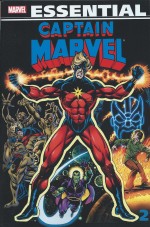
Essential Captain Marvel volume 2


By Gerry Conway, Marv Wolfman, Mike Friedrich, Jim Starlin, Steve Englehart, Chris Claremont, Wayne Boring, Al Milgrom, Alfredo Alcala & various (Marvel)
ISBN: 978-0-7851-4536-3

In 1968, upstart Marvel was in the ascendant. Their sales were rapidly overtaking industry leaders National/DC and Gold Key Comics and, having secured a new distributor which would allow them to expand their list of titles exponentially, the company was about to undertake a creative expansion of unparalleled proportions.

Once each individual star of “twin-books” Tales of Suspense, Tales to Astonish and Strange Tales was awarded their own title the House of Ideas just kept on going. In progress was a publishing plan which sought to take conceptual possession of the word “Marvel” through both reprint series like Marvel Tales, Marvel Collectors Items Classics and Marvel Super-Heroes. Eventually showcase titles such as Marvel Premiere, Marvel Spotlight and Marvel Feature also proudly trumpeted the name so another dead-cert idea was to publish an actual hero named for the company – and preferably one with some ready-made cachet and pedigree as well.

After the infamous DC/Fawcett copyright court case of the 1940s-1950s, the prestigious designation Captain Marvel disappeared from newsstands. In 1967, during the “Camp” craze superhero boom generated by the Batman TV series, publisher MLF secured rights to the name and produced a number of giant-sized comics featuring an intelligent robot who (which?) could divide his body into segments and shoot lasers from his eyes.

Quirky, charming and devised by the legendary Carl Burgos (creator of the Golden Age Human Torch), the series nevertheless failed to attract a large following in that flamboyantly flooded marketplace and on its demise the name was quickly snapped up by Marvel Comics Group.

Marvel Super-Heroes was a brand new title: it had been reconfigured from double-sized reprint title Fantasy Masterpieces, which comprised vintage monster-mystery tales and Golden Age Timely Comics classics, but with the twelfth issue it added a showcase section for characters without homes such as Medusa, Ka-Zar, Black Knight and Doctor Doom, plus new concepts like Guardians of the Galaxy and Phantom Eagle to try out in all-new stories.

To start the ball rolling, it featured an alien spy sent to Earth from the Kree Galaxy. He held a Captain’s rank and his name was Mar-Vell.

After two appearances Captain Marvel catapulted straight into his own title and began a rather hit-and-miss career, battling spies, aliens, costumed cut-ups such as Sub-Mariner, Mad Thinker and Iron Man but most especially elements of his own rapaciously colonialist race – such as imperial investigative powerhouse Ronan the Accuser – all the while slowly switching allegiances from the militaristic Kree to the noble, freedom-loving denizens of Earth.

Disguised as NASA scientist Walter Lawson he infiltrated a US airbase and grew closer to security chief Carol Danvers, gradually going native even as he was constantly scrutinised by his ominously orbiting commanding officer Colonel Yon-Rogg – Mar-Vell’s ruthless rival for the love of the teeming starship’s medical officer Una…

The impossible situation came to a head when Mar-Vell gave his life to save the empire from overthrow from within and colossal hive-mind Supreme Intelligence inextricably bonded the expiring warrior with voice-of-a-generation and professional side-kick Rick Jones who, just like Billy Batson (the naïve lad who turned into the original Fawcett Captain Marvel by shouting “Shazam!”), switched places with a mighty adult hero whenever danger loomed.

By striking a pair of ancient, wrist worn “Nega-bands” together they could temporarily trade atoms: one active in our universe whilst the other floated, a ghostly untouchable, ineffectual voyeur to events glimpsed from the ghastly anti-matter Negative Zone.

The Captain was an alien lost on Earth, a defector from the militaristic Kree who fought for humanity three hours at a time, atomically chained to Rick by mysterious wristbands which enabled them to share the same space in our universe, but whenever one was active here the other was trapped in a terrifying isolated antimatter hell…

The book was cancelled soon after that… only to return some more! A series which would not die, Captain Marvel returned again in the summer of 1972 for another shot at stardom and intellectual property rights security.

This second stellar monochrome Essential compilation (spanning September 1972 to September 1976 whilst gathering Captain Marvel #21-35, 37-46, plus key crossover appearances from Iron Man #55 and Marvel Feature #12) finds him at his best and worst as mediocre tales by veteran creators were brushed aside and the hero was transfigured overnight by the talents of a very talented newcomer, making the directionless Kree Warrior briefly the most popular and acclaimed title in Marvel’s firmament.

It all began rather inauspiciously in Captain Marvel #22 where scripter Gerry Conway with artists Wayne Boring & Frank Giacoia reintroduced the cosmic crusader in ‘To Live Again!’ Bonded to Rick by the uncanny Nega-bands, Mar-Vell had languished in the Negative Zone for a seeming eternity as Jones tried to carve out a rock star career and relationship with new love Lou-Ann, but eventually his own body betrayed him and the Kree Captain was expelled back into our reality…

Luckily Lou-Ann’s uncle Benjamin Savannah is a radical scientist on hand to help Rick’s transition, but as the returned Marvel unsteadily flies off, across town another boffin is rapidly mutating from atomic victim to nuclear threat and #23 (by Marv Wolfman, Boring & Frank McLaughlin) sees the Kree Warrior calamitously clash with the rampaging Megaton resulting in ‘Death at the End of the World!’.

Wolfman, Boring & Ernie Chan then deal ‘Death in High Places!’ as Rick is targeted by lethal Madame Synn and felonious cyborg Dr. Mynde who need Mar-Vell to help them plunder the Pentagon…

After seemingly running in place, perpetually one step ahead of cancellation (folding many times, but always quickly resurrected – presumably to secure that all important Trademark name), the Captain was handed to a newcomer named Jim Starlin who was left alone to get on with it.

With many of his fellow neophytes he began laying seeds (particularly in Iron Man and Daredevil) for a saga that would in many ways become as well regarded as the epochal Fourth World Trilogy by Jack Kirby which it emulated.

However the “Thanos War”, despite superficial similarities, soon developed into a uniquely modern experience. And what it lacked in grandeur it made up for with sheer energy and enthusiasm.

The first inkling came in Iron Man #55 (February 1973) where Mike Friedrich scripted Starlin’s opening gambit in a cosmic epic that would change the nature of Marvel itself. ‘Beware The… Blood Brothers!’ (inked by Mike Esposito) introduced haunted humanoid powerhouse Drax the Destroyer, trapped by extraterrestrial invader Thanos under the Nevada desert and in dire need of rescue. That came when the Armoured Avenger blazed in, answering a mysterious SOS…

As much as I’d love to claim Marvel’s fortunes are solely built on the works of Kirby and Steve Ditko, I’m just not able to. Whereas I do know that without them the modern monolith would not exist, it is also necessary to acknowledge the vital role played by a second generation creators who enlisted in the early 1970s. Marvel’s invitation to fresh, new, often untried talent paid huge dividends in creativity and – most importantly at a time of industry contraction – new sales.

Arguably the most successful of the newcomers was Starlin. As well as the landmark Master of Kung Fu, which he worked on with equally gifted confederates Steve Englehart and Al Milgrom, his earliest and most fondly regarded success was the ambitiously epic cosmic adventure which unfolded here.

A month later in Captain Marvel #25, Friedrich, Starlin, & Chic Stone unleashed ‘A Taste of Madness!’ and the alien outcast’s fortunes changed forever.

When Mar-Vell is ambushed by a pack of extraterrestrials he is forced to admit that his powers are in decline. Unaware that an unseen foe is counting on that, Rick manifests and checks in with Dr. Savannah only to find himself accused by his beloved Lou-Ann of the savant’s murder.

Hauled off to jail Rick brings in Mar-Vell who is confronted by a veritable legion of old foes before deducing who in fact his true enemies are…

Issue #26 sees Rick free of police custody and confronting Lou-Ann over her seeming ‘Betrayal!’ (Starlin, Friedrich & Dave Cockrum). Soon, however, he and Mar-Vell realise they are the targets of psychological warfare: the girl is being mind-controlled whilst Super Skrull and his hidden “Masterlord” are manipulating them and others in search of a lost secret…

When a subsequent scheme to have Mar-Vell kill The Thing spectacularly fails, Thanos takes personal charge. The Titan is hungry for conquest and wants Rick because his subconscious conceals the location of an irresistible ultimate weapon.

Rick awakes to find himself ‘Trapped on Titan!’ (Pablo Marcos inks) but does not realise the villain has already extracted the location of a reality-altering Cosmic Cube from him. Rescued by Thanos’ father Mentor and brother Eros, the horrified lad sees firsthand the extent of genocide the death-loving monster has inflicted upon his own birthworld and summons Captain Marvel to wreak vengeance…

Meanwhile on Earth, still-enslaved Lou-Ann has gone to warn the Mighty Avengers and summarily collapsed. By the time Mar-Vell arrives in #28 she lies near death. ‘When Titans Collide!’ (inks by Dan Green) reveals another plank of Thanos’ plan. As the heroes are picked off by psychic parasite The Controller, Mar-Vell is assaulted by bizarre visions of an incredible ancient being. Fatally distracted, he becomes the massive mind-leech’s final victim…

Al Milgrom inks ‘Metamorphosis!’ as the Kree captain’s connection to Rick is severed and he is transported to an otherworldly locale where an eight billion year old being named Eon reveals the origins of life whilst overseeing the abductee’s forced evolution into the ultimate warrior: a universal champion gifted with the subtly irresistible power of Cosmic Awareness…

Returned to Earth and reconnected to his frantic atomic counterpart, the newly-appointed “Protector of the Universe” goes after The Controller, thrashing the monumentally powerful parasite in a devastating display of skill countering super-strength in #30’s ‘…To Be Free from Control!’

Iron Man meanwhile has also recovered and headed for Marvel Feature #12 to join the Thing in ending a desert incursion by Thanos’ forces before enduring ‘The Bite of the Blood Brothers!’ (Friedrich, Starlin, & Joe Sinnott), after which the story continues in Captain Marvel #31 with ‘The Beginning of the End!’ (inked by Green & Milgrom) wherein the Avengers – in a gathering of last resort – are joined by psionic priestess Moondragon and Drax – one of the Titan’s many victims and resurrected by supernal forces to destroy Thanos…

The Titan has been revealed as a lover of the personification of Death who wants to give her Earth as a betrothal present. To that end he uses the Cosmic Cube to turn himself into ‘Thanos the Insane God!’ (Green) and with a thought captures all opposition to his reign. However his insane arrogance leaves the cosmically aware Mar-Vell with a chance to undo every change; brilliantly outmanoeuvring and defeating ‘The God Himself!’ (inks by Klaus Janson)…

With the universe saved and restored, Starlin’s run ended on a relatively weak note in CM #34 as ‘Blown Away!’ – inked by Jack Abel and dialogued by Englehart – explored the day after doomsday.

As Rick tries to revive his on-again, off-again musical career, secret organisation the Lunatic Legion despatches Nitro, the Exploding Man to acquire a canister of nerve gas from an Air Force base where Carol Danvers is head of Security…

Although the Protector of the Universe defeats Nitro, he succumbs to the deadly toxin. From this exposure he would eventually contract the cancer that killed him, as depicted in Marvel’s first Graphic Novel, The Death of Captain Marvel… but that’s a tale for a different review…

Issue #35 finds Mar-Vell all but lifeless in ‘Deadly Genesis’ (Englehart, Friedrich & Alfredo Alcala), while simultaneously showing Rick languishing in the Negative Zone and attacked by Annihilus until a barely-remembered three-hour time-limit automatically switches his body with the comatose Kree hero.

Later, as Rick’s manager Mordecai Boggs drives him to a gig, Rick’s consciousness slips into the N-Zone and animates Mar-Vell’s unresponsive body to escape Annihilus, and discerns this new power is merely one tactic in a cunning plan devised by the duplicitous Supreme Intelligence…

Meanwhile on Earth, Rick’s vacated body has been taken to hospital where old friends Ant-Man and the Wasp are fortuitously visiting when the Living Laser attacks. The villain has been artificially augmented by his new masters, but it’s not enough to stop the former Avengers or prevent Rick reclaiming his body and using the Nega-bands to restore his bonded soul mate to their particular brand of normality…

At this time deadline difficulties caught up with the Captain and #36 was reduced to running a reprint of his origin from Marvel Super-Heroes #12. This Essential edition only includes the foreboding 3-page bookend ‘Watching and Waiting’ by Englehart, Starlin, Alan Weiss & friends before the saga properly relaunches in #37 with ‘Lift-Off!’ by Englehart, Milgrom & Janson.

Although Mar-Vell quickly discerns that the Lunatic Legion’s attacks stem from the Moon, Rick insists on playing a gig before they set off. After bidding farewell to Mordecai and his sometimes stage partner Dandy, they wisely prepare for their trip to the satellite by outfitting the boy with an advanced spacesuit before Mar-Vell blasts off.

He only makes it as far as the outer atmosphere before being attacked by another Lunatic agent. The cyborg Nimrod is no match for Kree firepower however and in the Neg-Zone the implacable Annihilus endures a painful defeat when he again assaults Rick and discovers the sheer power packed into his EVA gear…

Crisis averted, the bored, naive kid swallows the “vitamin” Dandy slipped him before departure and is transported on a trip unlike any he has ever experienced. Tragically, as Mar-Vell reaches the air-filled lost city in the “Blue Area of the Moon” he too begins to experience bizarre hallucinations and is utterly unable to defend himself when the all-powerful Watcher ambushes him…

The austere, aloof cosmic voyeur Uatu the Watcher is part of an ancient, impossibly powerful race of immortal beings who observe all that occurs throughout the vast multiverse but never act on any of it. Non-interference is their fanatical doctrine but Uatu has continually bent – if not broken – the adamantine rule ever since he debuted in Fantastic Four #13…

Now somehow, the Legion have co-opted the legendarily neutral astral witness. Once Uatu defeats Mar-Vell, he despondently dumps his victim with the Lunatic Legion who are exposed as rebel Kree plotting to overthrow the Supremor. Fundamentalists of the original blue race which assimilated the millions of other species, these colonially aggressive and racially purist Blue Kree plan to execute their captive who seemingly has ‘…No Way Out!’ but are unprepared for the closer psychic link which the hallucinations have forged between Earth kid and Kree captain…

With the insurgents defeated, Mar-Vell and Rick follow the repentant Uatu as he returns to his own distant world in #39 to voluntarily undergo ‘The Trial of the Watcher’…

In the aftermath of that bizarre proceeding Rick and Mar-Vell are finally liberated from their comic bond. With both now co-existing in the positive-matter universe and able to return and leave the Negative Zone at will, their troubles seem over. They couldn’t be more wrong…

CM #40 shifts focus as ‘Rocky Mountain ‘Bye!’ (inked by Al McWilliams) reveals how the space-farers return to an Earth which has no real use for them. As Mar-Vell battles a deadly beast possessing the body of his first love Medic Una, Rick finds his music career and even his beliefs are considered irrelevant and of no value. Equally heart-sore and dispirited, the former cellmates reunite and decide to travel to the stars together…

The first stop is Hala, capital of the Kree Empire as #41 reveals ‘Havoc on Homeworld!’ (Englehart, Milgrom, Bernie Wrightson, P. Craig Russell, Bob McLeod & Terry Austin) with the populace swept up in a race war against “Pinks” (human flesh-toned Kree mulattos like Mar-Vell).

Determined to warn the Supremor of the conflict and the schemes of the Lunatic Legion, the heroes are appalled to learn the strife has been actively instigated by the colossal mind-collective…

From his earliest moments in military service Mar-Vell has been groomed by the Supremor to be its ultimate foe, As the amalgamation of minds seeks to jump-start the development of the evolutionarily-stalled Kree it desperately needs an enemy to contend against and grow strong…

Distracting his baffled, betrayed opponents with Ronan the Accuser, the Supreme Intelligence places one Nega-band on Rick and another on Mar-Vell and casually banishes them to the farthest reaches of the empire…

Issue #42 sees them deposited in an insane pastiche of Earth’s wild west mining towns and quickly embroiled in interstellar claim-jumping and a ‘Shoot-Out at the O.K. Space Station!’ (inks by Giacoia & Esposito). As the Kree with a star on his chest lays down the law and has a showdown with the cosmically-charged Stranger, close by Drax the Destroyer is ravaging worlds and planetoids, slowly going insane for lack of purpose even as Rick goes his own way and is almost fatally distracted by a beautiful girl nobody else can see…

Drax was created to kill Thanos but since the Titan’s defeat the devastating construct has wandered the universe and slowly gone crazy. CM #43 shows how – unaware that Thanos still lives – the purposeless nemesis takes the opportunity to assuage his frustrations by attacking the hero who stole his glory in ‘Destroy! Destroy!’ (Englehart & Milgrom).

The epic bout ends in #44 as ‘Death Throws!’ sees the pointless conflict escalate until Rick’s imaginary friend intervenes and opens the Destroyer’s eyes…

With sanity restored Mar-Vell then voyages to a Kree colony world ravaged by cyborgs and Null-Trons and discovers the Supremor has been subtly acting to merge him and Rick into one puissant being to further his evolutionary agenda in ‘The Bi-Centennial!’ Forewarned, and with a small band of the most unlikely allies, the cosmic conflict then wraps up in blockbusting fashion as Rick and Mar-Vell unite by not combining to defeat the Supremor in a battle ‘Only One Can Win!’ (Chris Claremont, Milgrom & Austin)…

This bombastic battle book of cosmic conflict and stellar spectacle also includes a wealth of bonus pages beginning with a comprehensive cutaway ‘Map of Titan’ from Captain Marvel #27, three pages of new artwork from 1980s reprint series The Life of Captain Marvel Special Edition‘, and a copious cover gallery and pinups by Starlin from that series.

Captain Marvel has never claimed to be the company’s most popular or successful character and some of the material collected here is frankly rather poor. However, the good stuff is amongst the very best that the company has produced in its entire history.

If you want to see how good superhero comics can be you’ll just have to take the rough with the smooth and who knows… you might see something that makes it all worthwhile…
© 1972, 1973, 1974, 1975, 1976, 2013 Marvel Characters, Inc. All rights reserved.

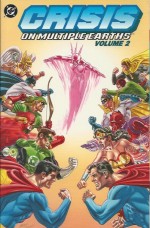
Crisis on Multiple Earths volume 2


By Gardner Fox, Dennis O’Neil, Mike Sekowsky, Dick Dillin & Sid Greene (DC Comics)
ISBN: 978-1-4012-0003-9

As I’ve frequently mentioned before, I was one of the Baby Boomers who grew up with Julie Schwartz, Gardner Fox and John Broome’s tantalisingly slow reintroduction of DC’s Golden Age superheroes during the halcyon, eternally summery days of the 1960s. To me those fascinating counterpart crusaders from Earth-Two weren’t vague and distant memories rubber-stamped by parents or older brothers – they were cool, fascinating and enigmatically new.

…And for some reason the “proper” heroes of Earth-One held them in high regard and treated them with marked deference…

It all began, naturally enough, in The Flash; pioneering trendsetter of the Silver Age Revolution. After successfully ushering in the triumphant return of the superhero concept, the Scarlet Speedster, with Fox & Broome at the writing reins, set an incomparably high standard for costumed adventurers in sharp, witty tales of science and imagination, always illustrated with captivating style and clean simplicity by Carmine Infantino.

The epochal epic that literally changed the scope of American comics forever was Fox’s ‘Flash of Two Worlds’ (Flash #123 September 1961, as seen in Showcase Presents the Flash volume 2) which introduced the theory of alternate Earths to the continuity and by extension resulted in the multiversal structure of the DCU – and all the succeeding cosmos-shaking yearly “Crisis” sagas that grew from it.

And of course, where DC led, others followed…

With the concept of Infinite Earths and multiple versions of costumed crusaders solidly established, public pressure began almost instantly to agitate for the return of the “Golden Age Greats” but Editorial powers-that-be were hesitant, fearing too many heroes would be silly and unmanageable, or worse yet, put readers off. If they could see us now…

A torturous trickle of innovative crossover yarns generated an avalanche of popular and critical approval (big sales figures, too) so inevitably the trans-dimensional tests led to the ultimate team-up in the summer of 1963. ‘Crisis on Earth-One’ and ‘Crisis on Earth-Two’ (Justice League of America #21-22, August and September) comprised one of the most important stories in DC history and arguably one of the most crucial tales in American comics.

Its success led to a sequel the following summer and by year three it had become an eagerly-awaited tradition that would last as long as the JLA comicbook did.

This second collected volume gathers the fifth through eighth summer collaborations (JLA #55-56, 64-65, 73-74 and 82-83), encompassing a period of editorial flux and change. The background is covered in Martin Pasko’s erudite Introduction ‘Crisis Behind the Scenes’ which details how the loss of stalwart originators Gardner Fox & Mike Sekowsky led to a new way of telling stories, offsetting in some respects the genuine dilemma of readers’ changing tastes…

These classics span a period in DC’s history which still makes many fans shudder with dread but I’m going to ask them to reconsider their aversion to the “Camp Craze” that saw America go superhero silly in the wake of the Batman TV show (and, to a lesser extent, the Green Hornet series that introduced Bruce Lee to the world). I should also mention that comics didn’t create the craze. Many popular media outlets felt the zeitgeist of a zanier, tongue-in-cheek, mock-heroic fashion: Just check out old episodes of Lost in Space or The Man from U.N.C.L.E if you doubt me…

A wise-cracking campy tone was fully in play for the first two-parter – ‘The Super-Crisis that Struck Earth-Two’ and ‘The Negative-Crisis on Earths One-Two!’ from JLA #55-56 (August and September 1967).

Opening on Earth-2, it boasted a radical change as the JSA now included an adult Robin instead of Batman, although Hourman, Wonder Woman, Hawkman, Wildcat, Johnny Thunder and Mr. Terrific still needed the help of Earth-1’s Superman, Flash, Green Lantern and Green Arrow to cope with an invasion of superpower-creating black spheres which gave mere mortals uncanny abilities enabling them to satisfy their darkest desires.

Things went from bad to worse after the harried heroes used the ebony invaders to augment their own abilities and turn half the combined team evil too…

Peppered with wisecracks and “hip” dialogue, it’s sometimes difficult to discern what a cracking yarn this actually is, but if you’re able to forgive or swallow the dated patter, this is one of the best plotted and illustrated stories in the entire JLA/JSA canon. Furthermore, with immensely talented Sid Greene’s inking adding expressive subtlety, mesmerising texture and whimsical humour to Sekowsky’s pencils, Fox’s bright, breezy comedic scripts simply shine.

By 1968 the second superhero boom looked to be dying just as its predecessor had at the end of the 1940s. Sales were down generally in the comics industry and costs were beginning to spiral. More importantly “free” entertainment, in the form of television, was by now ensconced in even the poorest household. If you were a kid in the sixties, think on just how many brilliant cartoon shows were created in that decade, when artists like Alex Toth and Doug Wildey were working in West Coast animation studios.

Moreover, comicbook stars were appearing on the small screen. Superman, Aquaman, Batman, the Marvel heroes and even the JLA were there every Saturday in your own living room…

It was a time of great political and social upheaval. Change was everywhere and unrest even reached the corridors of DC. When a number of creators agitated for increased work-benefits the request was not looked upon kindly. Many left the company for other outfits. Some quit the business altogether.

Fox ended his magnificent run on the Justice League with a stunning annual team-up of the League and Justice Society. Creative and perfectly professional to the very end, his last story was yet another of the Golden-Age revivals which had resurrected the superhero genre.

JLA #64 and 65 (August to September 1968) featured the ‘Stormy Return of the Red Tornado’ and ‘T.O. Morrow Kills the Justice League – Today!’ with a cyclonic super-android taking on the mantle of a 1940s spoof “Mystery Man” who appeared in the very first JSA adventure (if you’re interested, the original Red Tornado was a brawny washerwoman named Ma Hunkle).

The plot involved a cagy time thief creating an artificial hero to help him defeat the JLA and JSA, but realising too late he had built better than he knew…

Fox’s departing thriller was also the series’ artistic debut for former Blackhawk artist Dick Dillin, a prolific draughtsman who would draw every JLA issue for the next twelve years, as well as many other adventures of DC’s top characters like Superman and Batman. He was inked by Greene, a pairing that seemed vibrant and darkly realistic after the eccentrically stylish, nigh-abstract Sekowsky.

Next up from August and September 1969 is Denny O’Neil’s first shot at the yearly cross-dimensional crisis as #73 and 74 offered ‘Star Light, Star Bright… Death Star I See Tonight!’ and ‘Where Death Fears to Tread!’

The tense, brooding tale introduced Aquarius, a sentient but insane star, who magically destroys Earth-Two until our Earth-1 heroes (with their surviving Golden Age counterparts) manage to restore it, but not without some personal tragedy as Black Canary loses her husband and opts to emigrate to our world, handily becoming the JLA’s resident Girl Superhero and picking up a new if somewhat unreliable power in the process.

This splendid exercise in fantastic nostalgia ends with another grand get-together as alien property speculators from space seek to raze both Earths in ‘Peril of the Paired Planets’ (#82 August 1970 by O’Neil, Dillin & Joe Giella) and only the ultimate sacrifice by a true hero can avert trans-dimensional disaster in the concluding ‘Where Valor Fails… Will Magic Triumph?’ (#83 September, O’Neil, Dillin & Giella)

This volume also includes a few beguiling extras: the front and back covers of Limited Collectors Edition #C-46 (by Neal Adams from August/September 1976), a double-page pin-up of the JSA by Murphy Anderson from Justice League of America #76 (October 1969) and a JLA Mail Room comprised of found letters from many of the passionate fans like Gerry Conway, Alan Brennert and Martin Pasko who grew up to be somebody in comics…

These tales won’t suit everybody and I’m as aware as any that in terms of the “super-powered” genre the work here can be boiled down to two bunches of heroes formulaically getting together to deal with extra-extraordinary problems.

In mature hindsight, it’s obviously also about sales and the attempted revival of more sellable characters during a period of intense rivalry between DC Comics and Marvel.

But I don’t have to be mature in my off-hours and for those who love costume heroes, who crave these cunningly constructed modern mythologies and actually care about fun, this is simply a grand parade of straightforward action, great causes and momentous victories.

…And since I wouldn’t have it any other way, why should you?
© 1967, 1968, 1969, 1970, 2003 DC Comics. All Rights Reserved.
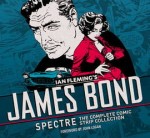
Ian Fleming’s James Bond: Spectre – the Complete Comic Strip Collection


By Henry Gammidge, Jim Lawrence, John McLusky & Yaroslav Horak (Titan Books)
ISBN: 987-1-78565-155-7

Win’s Christmas Gift Recommendation: A Truly Traditional Licence to Thrill… 9/10

There are sadly few British newspaper strips that can rival the influence and impact of the classic daily and Sunday “funnies” from America, especially in the field of adventure fiction. The 1930’s and 1940’s were particularly rich in popular, not to say iconic, creations and you’d be hard-pressed to come up with household names to rival Popeye, Dick Tracy or Flash Gordon, let alone Blondie, Li’l Abner, Little Orphan Annie or Popeye – and yes, I know I said him twice, but Elzie Segar’s Thimble Theatre was funny as well as thrilling, constantly innovative, and really, really good.

What can you recall for simple popularity let alone longevity or quality in Britain? Rupert Bear? Absolutely. Giles? Technically, yes. Nipper? Jane? Garth? I’d hope so, but I doubt it. The Empire didn’t quite get it until it wasn’t an empire any more. There were certainly many wonderful strips being produced: well-written and beautifully drawn, but that stubborn British reserve just didn’t seem to be in the business of creating household names.

Until the 1950’s…

Something happened in the Britain of the New Elizabethans – and I’m not going to waste any space here discussing it. It just did. Now we’re moving on.

In a new spirit that seemed to crave excitement and accept the previously disregarded, comics got carried along on the wave. Eagle, Lion, the regenerated Beano and girls’ comics in general all shifted into visually receptive high gear and so did newspapers.

Those facts and the canny repackaging of some classy classics which tie in to current Bond Blockbuster SPECTRE – just in time for the Christmas presents rush – means I can happily go on about one of British strip cartooning’s greatest triumphs as Titan Books release a splendidly lavish and sturdy oversized (294 x 277 mm) monochrome compilation of all the canonical adaptations of Fleming’s novels featuring the SPecial Executive for Counter-intelligence, Terrorism, Revenge and Extortion…

The first 007 novel – Casino Royale – was published in 1953 and diligently serialised in the Daily Express beginning in 1958, beginning a run of book adaptations (by Anthony Hern, Henry Gammidge, Peter O’Donnell and Kingsley Amis) before eventually Jim Lawrence, a jobbing writer who had scripted the aforementioned Buck Rogers, came aboard with The Man With the Golden Gun to complete the transfer of the Fleming canon to comics format, thereafter staying to create all new adventures, which he did until the strip’s demise in 1983.

The art was always of the highest standard. John McLusky provided the gripping illustrations until 1966 and the conclusion of You Only Live Twice. Although perhaps lacking in flash or verve, the workmanlike clarity and solidly rugged drive of his drawing easily handled an immense variety of locales, technical set-ups and sheer immensity of cast members, whilst accomplishing the then-novel conceit of advancing a plot and ending each episode on a cliff-hanging “hook” every day.

He was succeeded by Yaroslav Horak, who like Lawrence debuted on Man With the Golden Gun, bringing a looser, edgier style to proceedings, at once more cinematic and with a closer attention to camera angle and frenzied action which seemed to typify the high-octane, all-action 1960’s.

Horak illustrated 26 complete adventures until 1977 when The Daily Express ceased carrying Bond and the then-running case suddenly switched to The Sunday Express (from January 30th until conclusion on May 22nd).

None of which is relevant for this stand-alone edition which commences with fond memories and keen insights in the Introduction ‘The Threat of Spectre’ by playwright, film producer and current 007 screenwriter John Logan…

The strip ‘Thunderball’ (11th December 1961-10th February 1962) adapted the ninth novel and proved to be both calamitous and controversial at the time of publication. The plot involves the theft of nuclear bombs by millionaire treasure hunter Emilio Largo, fronting an unsuspected terrorist group called SPECTRE …

Inexplicably for the paper, the tale was censored and curtailed at the direct demand of the Daily Express‘ owner Lord Beaverbrook. Five days worth of strips were excised (and for the full story you’ll need to read the book or track down Titan’s 2007 paperback album edition which provided an ancillary text feature detailing what was cut).

Nevertheless, what remains by Henry Gammidge & McLusky is still pretty engrossing comics-fare and at least some effort was made to wrap up the storyline before the strip ended.

It was then dropped for almost a year before Bond triumphantly returned with an adaptation of eleventh novel On Her Majesty’s Secret Service…

Here however there’s latitude to print the strip adaptation in proper chronological order so next up is ‘The Spy Who Loved Me’ (which appeared from 18th December 1967 to 3rd October 1968).

The action goes into overdrive as the ongoing strip saga reaches the point where Fleming’s last work is adapted, promptly to be followed by all-new adventures. The story is also generously fleshed out (Fleming’s novel was written from the viewpoint of damsel in distress Vivienne Michel and Bond doesn’t show up until the last third of the text).

What we have here is a complex and intriguingly taut battle of wits as Bond and Vivienne combat a duo of deadly arsonists and hitmen with the super-agent’s foray against the revived SPECTRE mob in Canada providing a tense battle of wits and suitably gratuitous just deserts all around…

Arguably the two best novels were then adapted back-to-back. After the falling out with the Express‘ owner, the Bond strip was absent from the paper’s pages from February 1962 until June 1964. The gap was explained as Bond’s year-long search for arch villain Ernst Blofeld…

On Her Majesty’s Secret Service – by Gammidge & McLusky – ran from 29th June 1964 to 17th May 1965) and depicted how the hunter finally discovered his worst enemy and his own ideal woman in a coolly suspenseful and blistering action-drenched extravaganza set primarily in the Swiss Alps. Closely adhering to Fleming’s script – as did the George Lazenby film version – it all ends with the wedding day murder of Bond’s bride Tracy (Draco) di Vicenzo, an atypically downbeat conclusion that directly led into ‘You Only Live Twice’ (18th May 1965 – 8th June 1966, by Gammidge & McLusky) wherein the shattered hero degenerates to the point of almost being fired by M until despatched to Japan on a milk-run to assassinate Dr Guntram Shatterhand and realises his target is actually despised monster and wife-killer Blofeld…

These stories are a must for not only aficionados of 007 but for all thriller fans; stunning examples of terse, gripping adventure uncluttered by superficial razzamatazz, jam-packed with adventure, sex, intrigue and sudden death and starring the world’s greatest clandestine operative who never rests in his vital mission to keep us all free, safe, shaken, stirred and thoroughly entertained.

Get back to basics and remember that classic style is never out of fashion in this, the Greatest Bond Film You’ll Ever Read…
Thunderball © Ian Fleming Publications Ltd/Express Newspapers Ltd 1961. The Spy Who Loved Me © Ian Fleming Publications Ltd/Express Newspapers Ltd 1962. On Her Majesty’s Secret Service © Ian Fleming Publications Ltd/Express Newspapers Ltd 1963. You Only Live Twice © Ian Fleming Publications Ltd/Express Newspapers Ltd 1964. James Bond and 007 are â„¢ of Danjaq LLC used under licence by Ian Fleming Publications Ltd. All Rights Reserved.

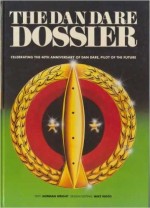
The Dan Dare Dossier


By Norman Wright, Mike Higgs & various (Hawk Books)
ISBN: 978-0-94824-812-2

Win’s Christmas Gift Recommendation: For everybody with Stars in their Eyes… 8/10

Launching on April 14th 1950 and running until 26th April 1969, Eagle was the most influential comic of post-war Britain, and possibly in our nation’s history.

It was the brainchild of a Southport vicar, the Reverend Marcus Morris, who was increasingly concerned about the detrimental effects of American comic-books on British children and wanted a good, solid, middle-class Christian antidote.

Seeking out like-minded creators he hoiked a dummy edition around British publishers for over a year with little success until he found an unlikely home at Hulton Press, a company that produced general interest magazines such as Lilliput and Picture Post.

The result was a huge hit which soon spawned age and gender-specific clones Swift, Robin and Girl which targeted the other key demographic sectors of the children’s market.

A huge number of soon-to-be prominent creative figures worked on the weekly, and although Dan Dare is deservedly revered as the star, many other strips were as popular at the time, and many even rivalled the lead in quality and entertainment value. Eagle‘s sensational pantheon – which included PC 49, Captain Pugwash, Jeff Arnold/Riders of the Range and the inimitable Harris Tweed – quickly became stars as well of radio series, books, toys, games and all other sorts of ancillary merchandising.

At its peak Eagle sold close to a million copies a week, but inevitably changing tastes and a game of “musical owners” killed the title. In 1960 Hulton sold out to Odhams, who became Longacre Press. A year later they were bought by The Daily Mirror Group who evolved into IPC. In cost-cutting exercises many later issues carried cheap Marvel Comics reprints rather than British originated material. It took time but those Yankee cultural Invaders won out in the end. With the April 26th 1969 issue Eagle was subsumed into Lion, eventually disappearing altogether. Successive generations have revived the title, but never the success.

There is precious little that I can say about Dan Dare that hasn’t been said before and better. What I will say is that everything you’ve heard is true. The vintage Dan Dare strips by Frank Hampson and his hand-picked team of dedicated artists are a high point in world, let alone British comics, ranking beside Tintin, Asterix, Tetsuwan Atomu, Lone Wolf & Cub and the best of Kirby, Adams, Toth, Noel Sickles, Milt Caniff, Elzie Segar and Carl Barks.

If you don’t like this stuff, there’s probably nothing any of us can do to change your mind, and all we can do is hope you never breed.

Accepting that there is a part of national culture which is Forever Dare, here’s a long overdue peek at an item which will delight all boys of a certain age which – despite its own vintage – is happily still readily available through internet vendors…

The colourful, magnificently oversized (333 x 242 mm), resolutely hard-backed Dan Dare Dossier was published in 1990 and offers everything any devotee could wish to know and see. It is absolutely packed with mouth-watering artwork and photos, tantalising examples of memorabilia, classic strips and even unseen/new material by a phalanx of the original creators.

Heavily illustrated throughout, it all begins with ‘The Rise of Dan Dare’, detailing the history of science fiction, development of comics – and especially Eagle – and offering a potted biography of Hampson, his team and Dan’s serried exploits.

Simultaneously those great big pages present unseen monochrome strip adventure ‘Dan & Donanza’ by the master himself, wherein our doughty heroes go haring across the solar system in pursuit of a fallen dictator who has turned the moon into a giant bomb…

Following that is an expansive itinerary of the major characters involved over the years in ‘Actors against a Solar Backdrop’ before ‘The Hardware File’ offers an eye-popping selection of plans, designs and extracted strip illustrations displaying the vast wealth of ships, kit and tech invented by the assembled strip-creators over the decades and paying especial attention to Space Transports and Dan and Digby’s venerable runabout Anastasia.

More bravura virtuosity is celebrated in ‘Aliens & Their Worlds’ as pertinent and beautiful clips and snippets highlight the amazing variety of extraterrestrial races and species.

Sharing a few pages with new black-&-white comedic strip ‘Digby – the Guinea Pig’ is a rundown of some of ‘The Artists’ who toiled collaboratively to produce the stunningly painted two pages per week (Hampson, Harold Johns, Eric Eden, Don Harley, Bruce Cornwell, Desmond Walduck, Frank Bellamy and Keith Watson); followed in turn by a fascinating trivia and memorabilia stuffed appreciation of the dauntless chaps’ five years on radio in ‘Dan Dare, Pilot of the Airwaves’…

Wisely taking a break from all that factual stuff, ‘Full Colour Adventure: Dan Dare in The Planulid’ reprints a rousing tale of a monstrous invasion of Earth (first seen in The Dan Dare Space Annual 1963) before the rousing envy-fest resumes with a grand examination of the breathtaking wealth of ‘Merchandise & Ephemera’ the strip generated.

On view is a procession of numerous ray guns and rocket pistols, games, puzzles, buttons, badges, stencil-kits, apparel, models, action-figures, home picture-film strips and projectors, walkie-talkies, all manner of books and print novelties and so much more…

Adjacent and in parallel with a full ‘Dan Dare Chronology’ is the immensely rare and sadly unappreciated Newspaper Strip ‘Mission to the Stars’ by William Patterson & Don Harley, which ran every Sunday in The People from April to October 1964, all capped off by the demise of the dream thanks to changing tastes and commercial mismanagement as detailed in ‘Changes – the Long Decline’…

Downhearted spirits are properly revived by another ‘Full Colour Adventure’ from The Dan Dare Space Annual 1963, specifically ‘The Planet of Shadows’ wherein our gallant lads uncover a lost civilisation on a new world after which ‘Dan Dare – to Date’ describes our hero’s 1977 resurrection in the pages of apocalyptic, dystopian 2000 AD. Reimagined as a bombastic rebel, the article tracks his slow rehabilitation and transition to the newly revived 1982 Eagle, before neatly segueing into a delightful reprint of one of those 80’s retro-exploits as ‘Dan Dare by Keith Watson’ depicts a hazardous mission by the Space Fleet stars to transport Earth’s radioactive waste stockpiles to the depths of space. It’s hard enough as is but things get particularly dicey when arch-nemesis The Mekon raises his giant green head…

Big, bold, beautiful and ruthlessly nostalgia-driven, this epic tome will utterly enchant veterans of the Baby-boomer years and sci fi fanatics in general, but it’s also packed with enough top flight comics material to beguile any kid or newcomer to our medium in search of a little simple, awestruck wonder…
This edition © 1990 Hawk Books Ltd. Dan Dare © 1990 Fleetway Publications.

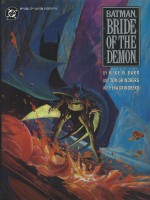
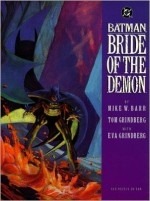
Batman: Bride of the Demon


By Mike W. Barr & Tom & Eva Grindberg (DC Comics)
ISBNs: 0-930289-79-X (original hardcover), 978-1-56389-060-4 (1992 trade paperback)

Debuting twelve months after Superman, “The Bat-Man” (joined within a year by Robin, the Boy Wonder) cemented DC/National Comics as the market and conceptual leader of the burgeoning comicbook industry.

Having established the scope and parameters of the metahuman with their Man of Tomorrow, the magnificently mortal physical perfection and dashing derring-do of the human-scaled adventures starring the Dynamic Duo rapidly became the swashbuckling benchmark by which all four-colour crimebusters were judged.

Batman is in many ways the ideal superhero: uniquely adaptable and able to work in any type or genre of story – as is clearly evident from the dazzling plethora of vintage tales collected in so many captivating volumes over the years vying equally with the most immediate and recent tales collected into albums scant moment after they go off-sale as comicbooks….

One the most well-mined periods is the moody 1970-1980s era when the Caped Crusader was re-tooled in the wake of Crisis on Infinite Earths, becoming a driven – but still level-headed – coldly rational Manhunter, rather than the dark, out-of-control paranoid of later days or the costumed boy-scout of the “Camp”-crazed Sixties.

There had been many “Most Important Batman” stories over the decades since his debut in 1939 but very few had the resounding impact of pioneering all-new 1987 experiment Batman: Son of the Demon which capped a period when DC were creatively on fire and could do no wrong commercially.

Not only did the story add new depth to the character, but the package itself – oversized (294 x 226 mm), on high-quality paper, available in both hardback and softcover editions – helped kickstart the fledgling graphic novel marketplace. In 1991 the story spawned an equally impressive sequel…

In the 1970s immortal mastermind and militant eco-activist Ra’s Al Ghul was a contemporary – and presumably thus more acceptable – embodiment of the venerably inscrutable Foreign Devil designated in a less forgiving age as the “Yellow Peril” and most famously embodied in Dr. Fu Manchu.

This kind of alien archetype had permeated fiction since the beginning of the 20th century and is still an overwhelmingly potent villain symbol even today, although the character’s Arabic origins, neutral at that time, seem to painfully embody a different kind of ethnic bogeyman in today’s terrorist-obsessed world.

Possessed of vast resources, an army of zealots and every inch Batman’s physical and mental match, Al Ghul featured in many of most memorable stories of the 1970s and early 1980s. He had easily deduced the Caped Crusader’s secret identity and wanted his masked adversary to become his ally…

Written by Mike W. Barr, this sequel – with illustration by Tom and colours from Eva Grindberg – once again highlights the deep connection between Batman and his undying antithesis. The convoluted drama opens with the murder of a group of climate scientists surveying Antarctica. As America swelters in a crippling heat-wave the world’s intelligentsia are increasingly becoming urgently aware of the destruction of the ozone-layer, thanks to crusading expert Dr. Carmody whom nobody yet realises has already struck a devil’s bargain with Ra’s.

The immortal warlord has been busy. Forced to move quicker than his usual patiently cautious rate by the atmosphere’s imminent decline, Ra’s has had his life-restoring Lazarus Pit revamped and even reconciled with daughter Talia, who has sworn to serve him faithfully again, now that she has moved beyond her love of Batman…

Talia doesn’t even blink when she learns The Demon’s Head has sent his top assassin Shard to pre-emptively remove the Dark Knight before he can involve himself in the latest scheme to save the world from humanity…

Bruce Wayne and new ward Tim Drake are at an awareness and fundraising event in Gotham when the subversive forces make their move. Called away by Bat-signal to consult on a ghastly execution, the Gotham Gangbuster sends Tim home (the boy is still in training and hasn’t been cleared to work the streets yet) before tracking the mystery murderer and stumbling into Shard’s ambush…

The Demon, meanwhile, has moved on to the next stage of his scheme and lured aging movie idol and sex goddess Evelyn Grace to his Antarctic fortress with promises of restored and eternal youth whilst Talia makes contact with Carmody and arranges his escape from his government bodyguards…

As he entertains his enigmatic and fascinating new bride, nobody is more surprised than Ra’s when Shard triumphantly returns but before long The Demon has exposed his lieutenant as a disguised Batman, who blasts his way out and dashes back to America in time to intercept Talia’s raid.

Tragically, as the fighting escalates, Carmody’s son Brant is caught in a crossfire and Batman is forced to bring them and captive Talia back to the Batcave where, despite every effort, the boy dies. Fully aware of Batman’s secrets, Ra’s then leads a raid against Wayne Manor and offers the conflicted scientist the most incredible gift: Brant’s resurrection…

Following a cataclysmic but futile pitched battle the siege ends with Ra’s victorious and Carmody and Batman carted away. Ensconced in the Antarctic fortress, Carmody’s knowledge is being used to hasten the destruction of the ozone layer and speedily eradicate most of humanity.

He doesn’t care and the imprisoned Batman’s pleas fall on deaf ears. All the technologist knows is that his boy is back from the dead… although not quite right yet…

Events spiral to a blistering blockbuster combat climax after Ra’s condemns Batman to death, but as loyalties are tested to the limit the Dark Knight makes his move and the explosive conclusion is one The Demon could never have anticipated…

Never quite hitting the highs of its predecessor, Bride of the Demon is still an emotionally intense, all-out action-packed spectacle and one of the most mature tales in Batman’s canon: intelligent, passionate, tragic and carrying a devious twist to delight and confound fans and casual readers alike.
© 1990 DC Comics, Inc. All Rights Reserved.

Crisis on Multiple Earths: the Team-Ups volume 2


By John Broome, Gardner Fox, Mike Friedrich, Neal Adams, Murphy Anderson, Gil Kane, Carmine Infantino & various (DC Comics)
ISBN: 978-1-4012-1228-5

Super-Editor Julius Schwartz ushered in the Silver Age of American Comics with his Showcase successes Flash, Adam Strange and Green Lantern, directly leading to the Justice League of America which in turn inspired Fantastic Four and the whole Marvel Empire and changed the way comics were made and read…

Whereas the 1940s were about magic and macho, the Silver Age polished everything with a thick veneer of SCIENCE and a wave of implausible rationalistic concepts quickly filtered into the dawning mass-consciousness of a generation of baby-boomer kids.

The most intriguing and rewarding was, of course, the notion of parallel worlds…

It all began, naturally enough, in The Flash, flagship title of the Silver Age Revolution. After ushering in the triumphant return of the costumed superhero concept, the Crimson Comet, with key writers Gardner Fox and John Broome at the reins, set an unbelievably high standard for superhero adventure in sharp, witty tales of technology and imagination, illustrated with captivating style and clean simplicity by Carmine Infantino.

Fox didn’t write many Flash scripts at this time, but those few he did were all dynamite; none more so than the full-length epic which literally changed the scope of American comics forever.

‘Flash of Two Worlds’ (Flash #123, September 1961) introduced the theory of alternate Earths to the continuity which grew by careful extension into a multiversal structure comprising Infinite Earths. Once established as a cornerstone of a newly integrated DCU through a wealth of team-ups and escalating succession of cosmos-shaking crossover sagas, a glorious pattern was set which would, after joyous decades, eventually culminate in a spectacular Crisis on Infinite Earths…

During a benefit gig Flash (police scientist Barry Allen) accidentally slips into another dimension where he finds the comic-book hero upon whom he based his own superhero identity actually exists. Every adventure he had absorbed as an eager child was grim reality to Jay Garrick and his comrades on the controversially designated “Earth-2”. Locating his idol, Barry convinced the elder to come out of retirement just as three Golden Age villains were making their own wicked comeback…

The floodgates were opened, as over the months that followed many Earth-1 stalwarts met their counterparts either in annual collaborations in the pages of Justice League of America or in their own series. Schwartz even had a game go at reviving a cadre of the older titans in their own titles. Public approval was decidedly vocal and he used DC’s try-out magazines to take the next step: stories set on Earth-2 exclusively featuring Golden Age characters.

Showcase #55 and 56 saw Doctor Fate and Hourman as a dynamic duo battling Solomon Grundy and the Psycho-Pirate and, still searching for an concept that would support its own series, Schwartz, Fox and Murphy Anderson debuted the team of Starman and Black Canary in The Brave and the Bold #61 (September-October 1965); the first of two stunning sagas which somehow led to nothing…

All those stories can be found in the previous edition (Crisis on Multiple Earths: the Team-Ups volume 1) whilst this second splendid collection – chronologically re-presenting The Atom #29 & 36, Flash #170 & 173, Green Lantern #45 & 52 and The Spectre #3 , cumulatively spanning October/November 1965 to April/May 1968 – opens with Brave & Bold #62 and a second Starman/Black Canary case wherein the resurgent champions ferociously face off against husband-and-wife criminals Huntress and Sportsmaster who had been stalking superheroes for kicks and profit. By the time Feline Fury Wildcat became their victim our heroes were on the case and ready for anything…

This compelling thriller was originally augmented by a text feature biography of the original Starman and that is reprinted here before Earth-2 Emerald Gladiator Alan Scott reunites with “our” Hal Jordan (Green Lantern #45, June 1966, by Broome, Gil Kane & Sid Greene) to thwart ‘Prince Peril’s Power Play’ as Scott’s comedy foil Doiby Dickles was romanced by an alien princess. The only fly in their ointment was a gigantic and ambitious space warrior who needed her to cement his own plans for conquest, but judicious use of green energies soon taught him that nobody likes a pushy tyrant…

Earth-2’s Tiny Titan was Al Pratt, a short man with super-strength, whilst we had size changing physicist Ray Palmer. When they met in Atom #27 (February/March 1967, by Fox, Kane & Greene) it was for an all-out cataclysmic clash between the Mighty Mites and one of the most dangerous villains of DC’s Golden Age in ‘The Thinker’s Earth-Shaking Robberies!’

With Green Lantern #52 (Broome & Kane, April 1967) Alan Scott and Doiby popped over from Earth-2 to aid Hal against the scurrilous return of his arch nemesis Sinestro in camp-crazed and frankly rather peculiar fight-frenzied fist-fest ‘Our Mastermind, the Car!’ after which a brace of Scarlet Speedsters at long last reunited in Flash #170 to face the ‘The See-Nothing Spells of Abra Kadabra!’ (May 1967 by Broome, Infantino & Greene) which found the Vizier of Velocity hexed by the cunning conjuror and rendered unable to detect the villain’s actions or presence.

Sadly for the sinister spellbinder, Jay Garrick was visiting and called on the services of JSA pals Doctors Fate and Mid-Nite to counteract the wicked wizard’s wiles…

Promptly following, Flash #173 (September 1967 by Broome, Infantino & Greene again) featured a titanic team-up as Barry, Wally “Kid Flash” West and Jay were sequentially shanghaied to another galaxy as putative prey for alien hunter Golden Man in ‘Doomward Flight of the Flashes!’

However, the sneaky script slowly revealed devilish layers of intrigue and his Andromedan super-safari concealed a far more arcane purpose for the three speedy pawns, before the wayward wanderers finally fought free and found their way home again…

Eventually Schwartz finally achieved the ambition of launching a Golden Age hero into his own title; sadly just as the superhero bubble was bursting and supernatural stories were again on the rise…

After three Showcase appearances and many guest-shots, The Spectre won his own book at the end of 1967. From #3 (March/April 1968) comes this all Earth-2 team-up by neophyte scripter Mike Friedrich and artistic iconoclast Neal Adams which exposed the ‘Menace of the Mystic Mastermind’ wherein pugilistic paragon Wildcat confronted head-on the inevitable prospect of age and infirmity even as an inconceivable force from another universe possessed petty thug Sad Jack Dold and turned him into a nigh-unstoppable force of cosmic chaos…

This fabulous peek into forgotten worlds and times concludes with one of the very best team-up tales of the Silver Age as the Earth-2 Atom returns in ‘Duel Between the Dual Atoms’ (April/May 1968, by Fox, Kane & Greene) wherein a radiation plague plays hob with victim’s ages on both worlds simultaneously. Sadly the deadly situation also turns normally hyper-rational Ray Palmer into an enraged maniac and almost more than his aging counterpart can handle…

Still irresistible and compellingly beautiful after all these years, the stories collected here shaped the American comics industry for decades and are still influencing not only today’s funnybooks but also the wave animated shows, movies and TV series which grew from them. These are tales and this is a book you simply must have.

© 1965-1968, 2007 DC Comics. All Rights Reserved.
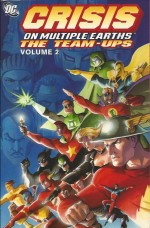
Secret Invasion: Captain Marvel


By Brian Reed, Paul Jenkins, Lee Weeks, Tom Raney & various (Marvel)
ISBN: 978-0-7851-2422-1

The Skrulls are shape-shifting aliens who’ve bedevilled Earth since Fantastic Four #2, and they have long been a pernicious cornerstone of the Marvel Universe. After decades of use, abuse and misuse the insidious invaders finally proved their villainous worth as the sinister stars of a colossal braided mega-crossover event beginning in April 2008 and running through all titles until Christmas.

The premise of Secret Invasion is simple: the would-be alien conquerors, having barely survived a devastating disaster which destroyed much of their empire, subsequently undergo a mass, fundamentalist religious conversion. The upshot is that the majority of the survivors believe now Earth is their new Promised Land and ultimate holy homeworld.

They are now utterly resolved and dedicated to take the planet at all costs.

To this end they have ever-so-gradually replaced a number of key Earth denizens – most notably superheroes and other metahumans. When their plot is at last uncovered no defender of the Earth truly knows who is on their side…

Moreover the cosmic charlatans have also unravelled the secrets of Earth magic and genetic superpowers, creating amped-up equivalents to Earth’s mightiest. They are now primed and able to destroy the world’s heroic defenders in face-to-face confrontations.

Rather than give too much away, let me just say that if you like this sort of thing you’ll love it and a detailed familiarity is not crucial to your understanding.

However, for a more complete experience, you will want to see the other 22 “Secret Invasion” volumes that accompany this one, although at a pinch you could get by with only the key collection Secret Invasion – which contains the 8-issue core miniseries, one-shot spin-off “Who Do You Trust?” and illustrated textbook “Skrulls” which claims to provide a listing and biography for every shape-shifter yet encountered in the Marvel Universe (but if they left any out, who could tell?).

Back in 1968 Captain Mar-Vell was a dutiful soldier of the alien Kree empire dispatched to Earth as a spy. However due to interaction with humans – especially American Security Agent Carol Danvers – he subsequently went native, becoming first a hero and then the cosmically “aware” protector of the universe, destined since life began to be its champion in its darkest hour.

In concert with the Avengers and other heroes he defeated death-worshipping Thanos, just as the mad Titan transformed into God, after which the good Captain went on to become a universal force for good.

In the early 1980s, due to the long-lasting effects of a skirmish with super-maniac Nitro, Mar-Vell died of cancer.

That event was one of the major tragedies of Marvel continuity and the company has had a fair few stabs since at reviving the beloved warrior, as well as passing his name around a legion of legacy heroes – as much to keep fans happy as to retain the all-important copyright…

Gathering relevant sections of Civil War: The Return (March 2007) and subsequent 5-issue miniseries Captain Marvel from January-Jun 2008) this slim, sleek tome again addresses that need to restore the original and begins with a short tale set during the Civil War between Earth’s heroes.

Scripted by Paul Jenkins and illustrated by Tom Raney & Scott Hanna, ‘Captains Courageous: the Return of Captain Marvel’ finds the dead warrior inexplicably back and in command of America’s Negative Zone-situated prison for metahuman malefactors. However, as the penitentiary suffers a massive assault by the ravenous creatures that infest the anti-matter universe, flashbacks reveal that the troubled Kree has only been in situ for days.

Prior to that he had been calmly meditating in the Neg Zone before being irresistibly sucked into a time-warp and washing up in his own future. An astute sort, he quickly deduced from shocked friends in the Avengers and Fantastic Four that he had returned after his own death, and meekly acquiesced when they all suggested he stay out of sight by taking charge of the fortress quickly filling up with resistors of the Government’s new Super-Human Registration Act…

The saga skips neatly to after the Civil War for Brian Reed & Lee Weeks’ 5-chapter epic (inked by Stefan Gaudiano, Jesse Delperdang, Rob Campanella, Butch Guice & Klaus Janson), which commences with ‘I Am Here’ as American Security Chief and Director of SHIELD Tony Stark assigns Agent Heather Sante to keep tabs on the Kree Warrior.

Since returning to Earth Mar-Vell has spent most of his time quietly brooding – especially about Alexander the Great, who also died at 33 years old – and has become obsessed with a certain painting in the Louvre.

However, after a brief clash with European super-criminal Cyclone calls him back into action, word of Captain Marvel’s resurrection spreads. The biggest repercussion is upon fringe whacko cult “The Brotherhood of Hala” who are suddenly galvanised into massive expansion and propelled towards the realms of a genuine religion…

World-weary journalist Nathan Jefferson has been on the trail of the strange sect for years: ever since heiress Julia Starr renamed herself Mother Starr and turned all her financial assets to promoting the gospel of Mar-Vell.

The hero himself seems unaware of the cult but his desire for anonymous reflection is frustrated when a colossal robot almost slaughters the Avengers and he is forced to spectacularly save the day…

‘Reconstruction’ opens with Mar-Vell a reluctant global sensation and apparently only Nathan Jefferson worried that the public is treating a masked man like the Messiah Reborn.

Mar-Vell, as befits a potential Saviour, is taking constant stock of himself and is deeply worried that he has gaps in his memories. Most disturbingly he has somehow lost his greatest ability: the “Cosmic Awareness” which puts him in touch with the entire universe.

He still cannot stop staring at that painting either…

Stark is also concerned. Mar-Vell is still a wanted outlaw to the Kree and all attempts at contacting the Empire are being blocked. With no other option he asks Carol Danvers – now known as Avengers team-leader Ms Marvel – to have a heart-to-heart with her old friend and almost-lover…

Typically their intimate conversation is cut short when supposedly-dead Cobalt Man inexplicably attacks…

Later whilst Nathan attempts to infiltrate the ascendant Church of Hala and is caught by some extremely unpleasant acolytes, Iron Man personally tries to interrogate Mar-Vell but is interrupted by a team of attacking Kree commandos…

The marauders are far from what they appear and ‘Deep Background’ reveals the first hints of a deadly cosmic conspiracy with the time-lost Captain Marvel as its target. The not-Kree intruders are soon subdued and as Stark begins the laborious task of getting useful intel out of the survivors, across the country Nathan is now a convert to the Church of Hala.

The organisation has spread like wildfire around the globe and is now one of the most powerful charities and most effective providers of war and famine relief on Earth…

Agent Sante has also infiltrated the new church and discovered something terrifying lurking at its heart. She is in fear of her life even as the transplanted Mar-Vell is made painfully aware that his oldest foes are somehow involved.

Troubled and turbulent, the prospective Kree messiah begins to see Skrulls everywhere and demands that Carol prove herself human…

When a prisoner challenges everything the foredoomed warrior believes, the result in ‘Alien Hated’ is hardly what the duplicitous, mind-muddling shapeshifter expected. Mar-Vell goes on a brutal rampage, abandoning his superhero friends before flying off to meet with pious Mother Starr and involving himself in her relief efforts in Sudan.

Unfortunately when militant rebels attack the Mission all his pent-up frustration comes out in another murderous display of Kree military training, before he apparently accepts his destiny as saviour and publicly demands Earth end all war…

In climactic finale ‘Orthodox’, with the international crisis now threatening to become a global catastrophe, Stark orders Ms Marvel to deal with the tormented Kree warrior but the duel in Negative Zone goes badly wrong and Mar-Vell emerges even stronger with his memories restored. With knowledge that a Secret Invasion by the Skrulls is already underway the time-traveller joins with Agent Sante and begins a clandestine war against the hidden infiltrators that will eventually change Earth forever…

To Be Continued Elsewhere…

Thoughtful, suspenseful and wickedly clever, this Byzantine prologue to the Main Event is a powerful examination of the nature and motivations of heroes: a quirky, moving, and winningly low-key epic which is supplemented here with a striking cover and variants gallery by Ed McGuiness, Dexter Vines and Terry and Rachel Dodson.

Oddly although part of a massive story-event this quirky yarn actually has legs of its own and stands up quite well when read in isolation but although impressive and entertaining, this great Fights ‘n’ Tights will truly benefit from you checking out the collections Secret Invasion: the Infiltration, Avengers Disassembled, as well as the rather pivotal New Avengers: Illuminati graphic novel.
© 2007, 2008, 2009 Marvel Characters, Inc. All rights reserved.