
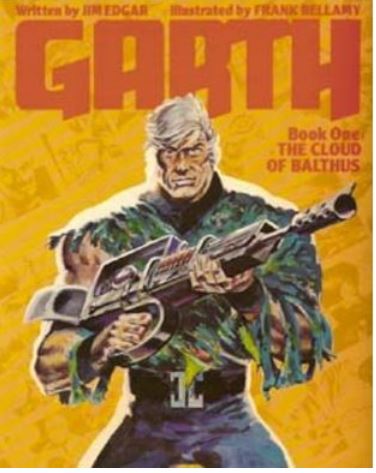
By Frank Bellamy & Jim Edgar, with John Allard (Titan Books)
ISBN: 978-0-90761-034-2 (Album TPB)
This book includes Discriminatory Content produced in less enlightened times.
Frank Alfred Bellamy (21st May 1917 – 5th July 1976) is one of British Comics’ greatest comics artists. In the all-too-brief years of his career he produced magnificent, unforgettable visuals for Eagle, TV21, Radio Times (Doctor Who) before taking over The Daily Mirror newspaper strip Garth in 1971. He turned that long-running yet meandering and occasionally lacklustre strip into a magnificent masterpiece of unmissable adventure fantasy, with eye-popping, mind-blowing monochrome art other artists were proud to boast they swiped from. However, after only 17 stories, Bellamy died suddenly in 1976; and it’s absolutely criminal that his work isn’t in galleries, let alone in permanent collected book editions.
Bellamy was born in 1917 but didn’t begin comic strip work until 1953: the Monty Carstairs strip for Mickey Mouse Weekly. From there he moved on to Hulton Press and drew features starring Swiss Family Robinson, Robin Hood and King Arthur for Swift, the “junior companion” to Eagle. In 1957, he moved on to the star title, producing standout, innovative work on a variety of strips, beginning with a biography/hagiography of Winston Churchill. ‘The Happy Warrior’ was followed by ‘Montgomery of Alamein’, ‘The Shepherd King – the story of David’ and ‘The Travels of Marco Polo’, from which Bellamy was promptly pulled only a few months in. As Peter Jackson took over the back page historical adventure, Bellamy was on his way to the front cover and The Near Future.
When Hulton were bought by Odhams Press there soon manifested irreconcilable differences between Frank Hampson and the new management. Dan Dare’s creator left his superstar baby and Bellamy was tapped as replacement – although both Don Harley & Keith Watson were retained as Frank’s assistants. For a year Bellamy produced “The Pilot of the Future”: redesigning the entire look of the strip at management’s request, before joyfully stepping down to fulfil a lifetime’s ambition.
For his entire life Frank Bellamy had been fascinated – almost obsessed – with Africa. When asked if he would like to draw a big game hunter strip he didn’t think twice and Fraser of Africa debuted in August 1960, a single page per week in the prestigious full-colour centre section. Fraser of Africa was an artistic landmark and Bellamy’s techniques of line and hatching, in conjunction with sensitive, atmospheric colours, and even his staging and layout of pages, led to majestic Heros the Spartan and eventually the bravura creativity displayed in Thunderbirds and Captain Scarlet strips for TV21, before he opted for the strictures of monochrome and a single tier of 3-4 panels a day…
British Superman Garth first appeared in The Daily Mirror on Saturday, July 24th 1943, the creation of professional cartoonist Steve Dowling and BBC radio producer Gordon Boshell, at the behest of the editor who wanted an adventure strip to complement their other comic strip features: Buck Ryan, Belinda Blue Eyes, Just Jake and immortal, demi-immoral, morale-boosting Jane.
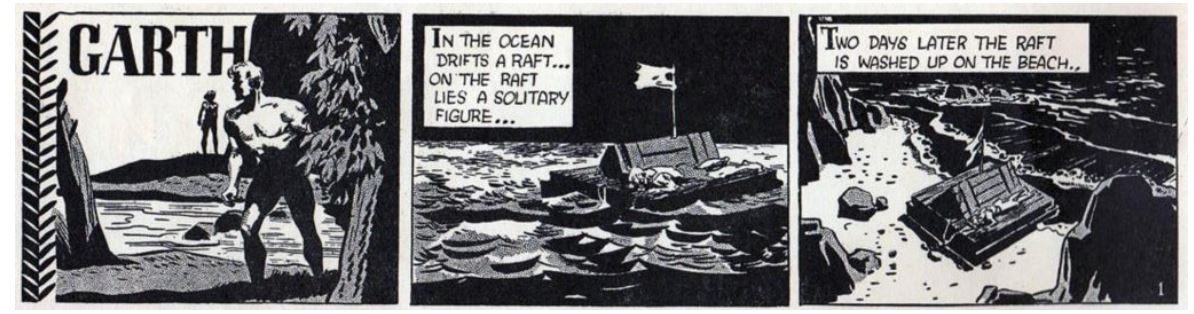
A blond giant and physical marvel with no memory of who he was, Garth washed up on an island shore and into the arms of a pretty girl… Gala. Nonetheless, he saved the entire populace from a brutal tyrant and a legend began. Boshell never had time to write the series, so Dowling – already producing successful family strip The Ruggles – scripted Garth until a new writer could be found. Don Freeman dumped the amnesia plot in ‘The Seven Ages of Garth’ (which ran from September 18th 1944 until January 20th 1946) by introducing imposing jack-of-all-sciences Professor Lumiere, whose subsequent psychological experiments regressed the burly hero back through some past lives.
In the next tale ‘The Saga of Garth’ (January 22nd 1946 – July 20th 1946) the origin was revealed. As an infant, “Garth” had been found floating in a coracle off the Shetlands and adopted by a kindly old couple. When full grown he became a Navy Captain until he was torpedoed off Tibet in 1943…
Freeman continued as writer until 1952 (‘Flight into the Future’ was his last tale), and was briefly replaced by script editor Hugh McClelland (who only wrote ‘Invasion From Space’) until Peter O’Donnell took over in February 1953 with ‘Warriors of Krull’. O’Donnell penned 28 adventures until resigning in 1966 to devote more time to his own strip: a little something called Modesty Blaise. His place was taken by Jim Edgar; a short-story writer who also scripted such prestigious newspaper strips as Matt Marriott, Wes Slade and Gun Law.
Dowling retired in 1968 and his long-time assistant John Allard took over the strip until a suitable permanent artist could be found. Allard completed ten complete tales until Frank Bellamy began a legendary run with the 13th instalment of ‘Sundance’ (which ran from 28th June to 1 October 11th 1971). Allard remained as background artist and assistant until Bellamy took full control during ‘The Orb of Trimandias’.
One thing Professor Lumiere had discovered and which gave this strip its distinctive appeal even before the fantastic artwork of Bellamy elevated it to dizzying heights of graphic brilliance, was Garth’s involuntary ability to travel through time and re-experience past and future lives. This simple concept lent the strip an unfailing potential for exotic storylines and fantastic exploits, pushing it beyond its humble beginning as a British response to Siegel & Shuster’s American phenomenon Superman.
The tales in this criminally out of print monochrome tome begin with the aforementioned ‘Sundance’ as mighty Garth is drawn back to 1876 to relive his life as an officer of George Custer’s 7th Cavalry on the eve of the Battle of the Little Big Horn.
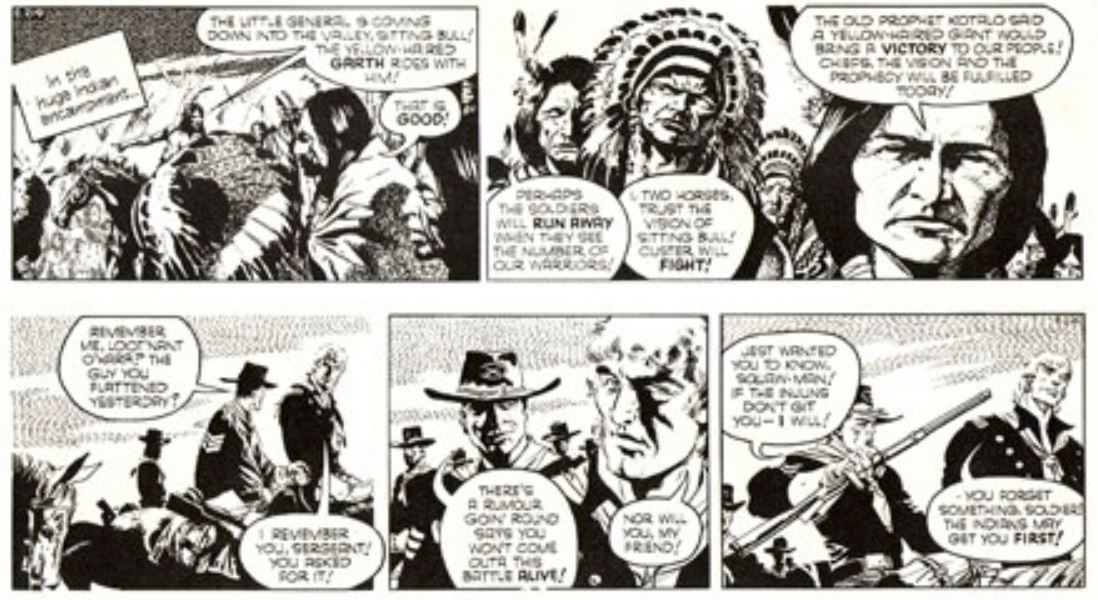
The time-tossed titan has a brief but passionate love affair with Indian maiden Falling Leaf before dying valiantly for his beliefs and their love. It is an evocative, powerful tale that totally captures the bigotry, arrogance and futility of the White Man and the tragic demise of the Indian way of life…
Then eponymous epic ‘The Cloud of Balthus’ shows the potent but simple elegance of the narrative concept sustaining Garth. Whilst vacationing in the Caribbean our hero becomes embroiled in an espionage plot involving freelance super-spies and a US space station, but even that is mere prelude to fantastic adventure and deadly terrors when he and delectable, double-dealing companion Lee Wan are abruptly abducted by nebulous energy beings in a taut, tension-fraught thriller.
‘The Orb of Trimandias’ plunges Garth back in time to Venice of the Borgias, when/where he becomes again English Soldier-of-Fortune Lord Carthewan: a decent man battling an insane and all-powerful madman for the secret of a supernaturally potent holy relic. This gripping, exotic yarn is replete with flamboyant action, historical celebrities, sexy men and women and magnificently stirring locales. It’s a timeless treasure of adventure that has the added fillip of briefly reuniting Garth with his star-crossed true love, ethereal Space Goddess Astra.
This lovely volume (long overdue for re-issue – at least in digital form if no other way is possible) concludes with a high-octane gothic horror story.
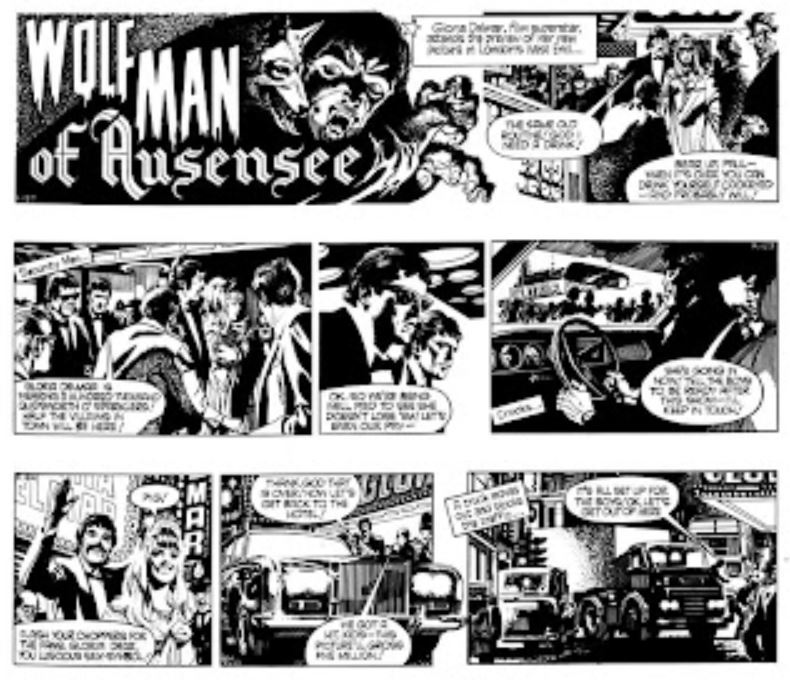
‘The Wolfman of Ausensee’ sees Garth as a rather reluctant companion of movie starlet Gloria Delmar on a shoot at the forbidding Austrian schloss (that’s a big ugly castle to you) of a playboy whose family was once cursed by witches. Despite the title giving some of the game away, this is still a sharp and savvy spook-fest comparing well to the best Hammer Horror films that no doubt inspired it, and just gets better with each rereading.
Garth is the quintessential British Action Hero: strong, smart, fast and good-looking with a big heart and nose for trouble. His back-story granted him all of eternity and every genre to play in, and the magnificent art of Frank Bellamy also made his too-brief tenure a stellar one.
Comic-strips seldom get this good, and even though this book and its sequel are still relatively easy (if not cheap) to come by, it is still a crime and an utter mystery that all these wonderful tales have been out of print for so long.
© 1984 Mirror Group Newspapers. All rights reserved.