Solar, Man of the Atom: Second Death


By Jim Shooter, Don Perlin, Barry Windsor-Smith, Bob Layton & Tom Ryder (Valiant)
No ISBN:

Quarterly title Doctor Solar, Man of the Atom #1 hit newsstands on June 28th1962 sporting an October cover-date. My arithmetic isn’t good enough to decipher Gold Key’s arcane system but is advanced enough to realise that’s another 60th Anniversary occurring right about now. Happy birthday, Doc!

During the market-led, gimmick-crazed frenzy of the 1990s, amongst the interminable spin-offs, fads, shiny multiple-cover events a new comics company revived some old characters and proved once more that good story-telling never goes out of fashion. As Editor-in-Chief, Jim Shooter had made Marvel the most profitable and high-profile they had ever been, and after his departure he used that writing skill and business acumen to transform some almost forgotten Silver-Age characters into contemporary gold.

Western Publishing had been a major player since comics’ earliest days, blending a huge tranche of licensed publications such as TV, movie and Disney titles; properties like Tarzan and The Lone Ranger with homegrown hits like Turok, Son of Stone and Space Family Robinson.

In the 1960s, during the second superhero boom, these original adventure titles expanded to include Brain Boy, M.A.R.S. Patrol Total War (created by Wally Wood), Magnus, Robot Fighter (by the incredible Russ Manning) and in deference to the atomic age of heroes, Nukla and the brilliantly lowkey but explosively high concept Dr. Solar, Man of the Atom. Despite supremely high quality and passionate fan-bases, they never captured the media spotlight of DC or Marvel’s costumed cut-ups. Western shut their comics division in 1984.

With an agreement to revive some, any or all of these four-colour veterans, Shooter and co-conspirator Bob Layton came to a bold decision and made those earlier adventures part-and-parcel of their refit: acutely aware that old fans don’t like having their childhood favourites bastardized, and that revivals need all the support they can get. Thus the old days were canonical: they “happened.”

Although the company launched with a classy reinterpretation of Magnus, the key title to the new universe they were building was the only broadly super-heroic character in the bunch, and they had big plans for him. Solar, Man of the Atom was launched with an eye to all the gimmicks of the era, but was cleverly realised and realistically drawn.

Second Death collects the first four issues of the revived Solar and follows brilliant nuclear physicist Phil Seleski, designer of the new Muskogee fusion reactor in the fraught days before it finally goes online. Faced with indifferent colleagues and inept superiors, pining for a woman who doesn’t seem to know he exists, Seleski is under a lot of pressure. So when he meets a god-like version of himself. he simply puts it down to stress-induced delusion…

Solar, the atomic god who was Seleski, is freshly arrived on Earth, and with his new sensibilities goes about meeting the kind of people and doing the kind of things his mortal self would never have dreamed of. As if godhood had made him finally appreciate humanity, Solar befriends bums, saves kids and fixes disasters like the heroes in the comic books he collected as a boy.

His energized matter and troubled soul even further divide into a hero and “villain”, but things take a truly bizarre turn when he falls foul of a genuine super-foe: discovering that the “normal” world is anything but, and that he is far from unique. The superhuman individuals employed and mentored in Toyo Harada’s Harbinger Foundation prove that the world has always been a fantastical place, and Solar’s belief that he has travelled back in time to prevent his own creation gives way to realisation that something even stranger has occurred…

This is a cool and knowing revision of the hallowed if not clichéd “atomic blast turns schmuck into hero” plot: brimming with sharp observation, plausible characters and frighteningly convincing pseudo-science. The understated but compelling art by hugely under-appreciated Don Perlin is a terrifying delight and adds even more shades of veracity to the mix, as do the colours of Kathryn Bolinger & Jorge Gonzãlez.

Moreover, the original comics had a special inserted component in the first 10 issues (by Shooter, Barry Windsor-Smith & Layton) revealing the epic events that made Seleski into a god. Designed to be best read only after the initial story arc had introduced readers to Seleski’s new world, these were collected as Solar, Man of the Atom: Alpha and Omega. Together they combine to form one of the most impressive and cohesive superhero origin sagas ever concocted and one desperately in need of reprinting …if whoever currently controls the licensing rights to the stories could only get their act together…

Until then you can try hunting these down via your usual internet and comic retailers, and trust me, you should…
© 1994 Voyager Communications Inc. and Western Publishing Company, Inc. All rights reserved.

Hawkeye Epic Collection volume 1: The Avenging Archer 1964-1988


By Stan Lee & Don Heck, Roy Thomas, Len Wein, Steven Grant,  Mark Gruenwald, David Michelinie, Mike Friedrich, J.M. DeMatteis, Scott Edelman, Roger Stern, Charlie Boatner, Jack Kirby, Gene Colan, Sal Buscema, John Byrne, Carmine Infantino, Greg LaRoque, George Evans, Jimmy Janes, Paul Neary, Joe Staton, Dick Ayers, Mike Netzer, Trevor Von Eeden, Eliot R. Brown & various (MARVEL)
ISBN: 978-0-7851-3723-8 (TPB/Digital edition)

Clint Barton is probably the world’s greatest archer: swift, bold, unerringly accurate and augmented by a fantastic selection of multi-purpose high-tech arrows. Other masked bow persons are available… including a young, female Hawkeye…

Following an early brush with the law and as a reluctant Iron Man villain, Barton reformed to join the Mighty Avengers, serving with honour and distinction, despite always feeling overshadowed by his more glamorous, super-powered comrades.

Long a mainstay of Marvel continuity and probably Marvel’s most popular B-list hero, the Battling Bowman has risen to great prominence in recent years, boosted by his film and television incarnation.

This brash and bombastic collection – available in paperback and digital formats – re-presents breakthrough miniseries Hawkeye #1-4, the major early appearances from Tales of Suspense #57, 60, 64 and momentous moments from The Avengers #16, 63-65, 189, 223: supplemented by outings in Marvel Team-Up #22, 92, 95; Captain America #317 and pertinent material from Marvel Tales #100; Marvel Fanfare #3, 39 and Marvel Super Action #1, all chronologically covering September 1964 to August 1988. It should be noted that some of these tales feature his occasional wife and partner Mockingbird

It naturally begins with a blockbusting debut from Tales of Suspense #57. In ‘Hawkeye, the Marksman!’ by Stan Lee & Don Heck – as the villainous Black Widow resurfaces to beguile an ambitious and frustrated former carnival performer-turned-neophyte-costumed vigilante. She convinces him to attack her archenemy Iron Man and, despite a clear power-imbalance, the amazing ingenious archer comes awfully close to beating the Golden Avenger…

Natasha Romanoff (sometimes Natalia Romanova) was a Soviet Russian spy who came in from the cold to become one of Marvel’s earliest female stars. She started life as a svelte, sultry honey-trap during Marvel’s early “Commie-busting” days, periodically targeting Tony Stark and battling Iron Man. She was subsequently redesigned as a torrid, tights-&-tech super-villain before defecting to the USA, falling for an assortment of Yankee superheroes – including Hawkeye, Daredevil and Hercules – and enlisted as an agent of S.H.I.E.L.D., setting up as a freelance do-gooder before joining (and occasionally leading) The Avengers.

Tales of Suspense #60 (December 1964, by Lee, Heck & Dick Ayers) featured an extended plotline with Stark’s “disappearance” leading to Iron Man being ‘Suspected of Murder!’. Capitalizing on the chaos, lovestruck Hawkeye and the Widow again attacked the Armoured Avenger, but another failure led to her being recaptured and re-educated by enemy agents…

Abruptly transformed from fur-draped seductress into gadget-laden costumed villain, she resurfaced in #64 (April 1965 by Lee, Heck & Chic Stone), again steering the bewitched bowman into attacking her enemy. Her final failure led to huge changes…

Most importantly, one month later, Avengers #16 saw the superstar team split up following climactic battles against Zemo and the Masters of Evil. Laid out by Jack Kirby & embellished by Ayers, ‘The Old Order Changeth!’ introduced a dramatic change of concept for the series. As Lee increasingly wrote to the Marvel’s unique strengths – tight continuity and strongly individualistic characterisation – he found juggling individual stars in their own titles in addition to a combined team episode every month was almost impossible…

As Captain America and substitute sidekick Rick Jones fight their way back to civilisation, the Avengers institute changes and seek out their own replacements. The big-name stars resigned making way for three erstwhile villains: Quicksilver, the Scarlet Witch and Hawkeye, all reformed, reenergised and hungry for redemption…

The Straightshooter became a mainstay and backbone of the team, but in Avengers #63, survived a battle epiphany that triggered a big change after returning from a mission in Wakanda.

Beginning a 3-part tale illustrated by Gene Colan & George Klein ‘And in this Corner… Goliath! saw Barton abandon the arrow schtick in favour of true super-powers as Roy Thomas finally gave the enigmatic Avenger an origin.

The first chapter was part of a broader tale: an early crossover experiment intersecting with the 14th issue of both Sub-Mariner and Captain Marvel, wherein a coterie of cerebral second-string villains combined to conquer the world by stealth…

Within the Avengers portion of proceedings, Hawkeye revealed his civilian identity for the first time. He was ex-circus performer Clint Barton and shared his origins before forsaking bow and trick-arrows to become a size-changing hero using Pym particles. He then adopted the now-vacant name Goliath to save the Black Widow.

In #64’s ‘Like a Death Ray from the Sky!he reluctantly reunited with his mobster brother Barney Barton and led the team against a terror satellite scheme cooked up by Egghead before #65 (inked by Sam Grainger) saw him attacked by his old enemy/mercenary mentor the Swordsman in ‘Mightier than the Sword?

Jumping to June 1974 – a time when the archer pursued a solo career – Marvel Team-Up #22 (by Len Wein, Sal Buscema & Frank Giacoia) unleashes ‘The Messiah Machine!’ as Battling Bowman and Amazing Spider-Man frustrate deranged computer Quasimodo’s ambitious if absurd mechanoid invasion of Earth.

Cover-dated February 1979, reprint title Marvel Tales #100 concealed ‘Killers of a Purple Rage!’: a new short tale by Scott Edelman, Michael Netzer & Terry Austin which finds time-displaced Two-Gun Kid and Hawkeye battling each other and then mind controlling menace Killgrave the Controller

Avengers #189 (November 1979, by Steven Grant, John Byrne & Dan Green) then reveals how official reservist Hawkeye get a day job at Cross Technological Enterprises in ‘Wings and Arrows!’ Before long, he’s earning every penny as the new security chief by battling alien avian interloper Deathbird

For Marvel Team-Up #92 (April 1980) Grant, Carmine Infantino & Pablo Marcos reunite Archer and Arachnid after a new iteration of Mr. Fear steals CTE technology and almost cripples the heroes with ‘Fear!’ after which vigilante activist El Águila raids the corporate citadel in a tight tale from Marvel Fanfare #3 (July 1982). Crafted by Charlie Boatner, Trevor Von Eeden & Josef Rubinstein, ‘Swashbucklers’ at last opens Hawk’s eyes to what his bosses are truly like and what they do with their discoveries…

Cover-dated September 1982, Avengers #223 talked ‘Of Robin Hoods and Roustabouts’. Devised by David Michelinie, Greg LaRocque, Brett Breeding & Crew, it saw reinstated Avenger Clint Barton join Ant-Man Scott Lang, when he and daughter Cassie attend a circus and stumble into a clash with skills-mimic Taskmaster to extricate an old friend from the maniac’s clutches and influence.

Hawkeye was always a team player and unlucky in love, but that was all about to change. In the interests of complete clarity, this collection pops briefly back to 1976 for some classy comics context and the first (costumed) appearance of occasional wife and frequent paramour Bobbi “Mockingbird” Morse as first seen in January 1976.

Preceded by a Howard Chaykin frontispiece from monochrome Marvel Super Action #1, former Ka-Zar romantic interest Dr. Barbera Morse was reinvented by Mike Friedrich, George Evans & Frank Springer in ‘Red-Eyed Jack is Wild!’ Adopting unwieldy nomme de guerre Huntress, skilled combat operative Morse devotes herself to cleaning up corruption inside S.H.I.E.L.D., no matter what the cost…

Huntress became Mockingbird in Marvel Team-Up #95 (July) in a smart thriller by Grant, Jimmy Janes & Bruce Patterson. ‘…And No Birds Sing!’ ended the long-extant S.H.I.E.L.D. corruption storyline as Morse invited Spider-Man to join forces and expose the true cancer at the heart of America’s top spy agency…

All this was laying the groundwork for something truly game-changing…

Written and drawn by the hugely underrated and much-missed Mark Gruenwald, assisted by inkers Brett Breeding & Danny Bulanadi and running from September-December 1983, Hawkeye #1-4 was one of Marvel’s earliest miniseries and remains one of the very best and most eventful adventures of the Ace Archer. Much like the character himself, this project was seriously underestimated when first released. Most industry pundits and the more voluble fans expected very little from a second-string hero drawn by a professional writer. Guess again, suckers!

 ‘Listen to the Mockingbird’ sees Clint still moonlighting as security chief for electronics corporation CTE when he captures a renegade S.H.I.E.L.D. agent. She reveals that his bosses are all crooks, secretly involved in shady mind-control experiments.

After some initial doubts, in ‘Point Blank’ Barton teams with the svelte and sexy super-agent to foil the plot, gaining in the process a new costume and an instant rogues’ gallery of archfoes such as Silence, Oddball and Bombshell by third chapter ‘Beating the Odds’

As the constant hunt and struggle wears on, Barton succumbs to – but is not defeated by – a life-changing physical injury leading to permanent disability. He also impetuously marries in explosive conclusion ‘Till Death us do Part…’ wherein the sinister mastermind behind everything is finally revealed and summarily dealt with.

In those faraway days both Gruenwald and Marvel Top Gun Jim Shooter maintained that a miniseries had to deal with significant events in a character’s life, and this bright and breezy, no-nonsense, compelling and immensely enjoyable yarn certainly kicked out the deadwood and re-launched Hawkeye’s career.

In short order from here the bowman went on to create and lead his own team: The West Coast Avengers, gained a regular series in Solo Avengers/Avengers Spotlight and his own titles, consequently becoming one of the most vibrant and popular characters of the period and today as well as a modern-day action movie icon…

However, there are still treats to share

Next here is fun foray from Captain America 317 (May 1986) by Gruenwald, Paul Neary & Dennis Janke. In ‘Death-Throws’ Hawkeye and Mockingbird hunt circus-themed villains and their boss Crossfire with the Sentinel of Liberty reduced almost to a spectator and proud dad watching the kids grow up…

The comics wonderment concludes with a little-seen story from Marvel Fanfare #39 (August 1988). Courtesy of J.M. DeMatteis, Joe Staton & Kim DeMulder, ‘The Cat’s Tale’ finds the Ace Archer seriously off his game until taken on a vision-quest by Navajo shaman Jesse Black Crow to confront the predatory feline spirit that is poisoning his existence…

Packed with terrific tales of old-fashioned romance, skulduggery and derring-do, this book comes with extras including the Gil Kane cover to Marvel Triple Action #10, text articles on the Hawkeye miniseries from Marvel Age #6; the event’s 1983 house ad by Gruenwald & Brett Breeding and the covers and introduction from the 1988 TPB collection (and three subsequent re-releases), plus text pieces from Archie Goodwin, & Gruenwald.

Also on view are contemporaneous info pages from the Official Handbook of the Marvel Universe, about Hawkeye, Mockingbird, Death-Throws, Ringleader, Oddball, Bombshell, Tenpin and KnickKnack, plus diagrammatic cutaways by Eliot R. Brown, detailing the secrets of ‘Hawkeye’s Skymobile’, ‘Hawkeye’s Quiver and Bows’ and ‘Mockingbird’s Battle-Staves’.

This is a no-nonsense example of the straightforward action-adventure yarns that cemented Marvel’s reputation and success and a collection to enhance any Fights ‘n’ Tights fans’ place of honour on the bookshelf.
© 2021 MARVEL.

Mighty Marvel Masterworks volume 2: The Invasion of Asgard


By Stan Lee & Jack Kirby, with Chic Stone, George Roussos, Vince Colletta, Paul Reinman, Don Heck & various (MARVEL)
ISBN: 978-1-3029-3442-2 (PB/Digital edition)

These stories are timeless and have been gathered many times before, but today I’m once again focussing on format. The Mighty Marvel Masterworks line launched with economy in mind: classic tales of Marvel’s key creators and characters re-presented in chronological publishing order. It’s been a staple since the 1990s, but always in lavish, hardback collectors editions. These editions are cheaper, on lower quality paper and – crucially – smaller, about the dimensions of a paperback book. Your eyesight might be failing and your hands too big and shaky, but at 152 x 227mm, they’re perfect for kids. If you opt for the digital editions, that’s no issue at all…

Even more than The Fantastic Four, The Mighty Thor was the arena in which Jack Kirby’s boundless fascination with all things Cosmic was honed and refined through his dazzling graphics and captivating concepts. The King’s plethora of power-packed signature pantheons began in a modest little fantasy/monster title called Journey into Mystery where – in the summer of 1962 – a tried-and-true comicbook concept (feeble mortal transformed into god-like hero) was revived by the rapidly resurgent company who were not yet Marvel Comics: adding a Superman analogue to their growing roster of costumed adventurers.

Cover-dated August 1962, Journey into Mystery #83 saw a bold costumed Adonis jostling aside the regular fare of monsters, aliens and sinister scientists in a brash, vivid explosion of verve and vigour. The initial exploit followed disabled American doctor Donald Blake who took a vacation in Norway and encountered the vanguard of an alien invasion. Fleeing, he was trapped in a cave where he found an old, gnarled walking stick. When, in frustration, he smashed the stick into the huge boulder blocking his escape, his puny frame was transformed into the Norse God of Thunder!

Plotted by Stan Lee, scripted by his brother Larry Lieber and illustrated by Kirby and inker Joe Sinnott (at this juncture a full illustrator, Sinnott would become Kirby’s primary inker for most of his Marvel career), that introduction was pure primal Marvel: bombastic, fast-paced, gloriously illogical and captivatingly action-packed. It was the start of a new kind of legend and style of comics’ storytelling…

Spanning February to October 1964, this gloriously economical full-colour paperback tome – also available in eFormats – revisits pioneering Asgardian exploits from JiM #101-109 in a blur of innovation and seat-of-the-pants myth-revising and universe-building…

Lee had taken over scripting with Journey into Mystery #97, the issue that launched a spectacular back-up series. Tales of Asgard – Home of the Mighty Norse Gods gave Kirby a vehicle to indulge his fascination with legends and began by adapting classic traditional tales before eventually switching to all-new material shaped for Marvel’s pantheon. Here, Kirby built his own cosmos and mythology, which would underpin the company’s entire continuity.

Journey into Mystery #101 featured ‘The Return of Zarrko, the Tomorrow Man!’ and sees Odin halve Thor’s powers for wilful disobedience, just as the futuristic felon abducts the Thunder God to help him conquer the 23rd century. A two-parter (with the first chapter inked by George Roussos), it was balanced by another exuberant tale of the boy Thor.

‘The Invasion of Asgard!’ sees the valiant lad fight a heroic rearguard action whilst introducing a host of future villainous mainstays such as the Rime Giants, King Geirrodur and Trolls.

‘Slave of Zarrko, the Tomorrow Man!’ is a tour de force epic conclusion most notable for the introduction of Chic Stone as inker. To many of us oldsters, his clean, full brush lines make him The King’s best embellisher ever. This triumphant futuristic thriller is counterbalanced by brooding short  from ancient history. ‘Death Comes to Thor!’ has the teen hero face his greatest challenge yet, with two women who would play huge roles in his life introduced in this brief 5-pager; young goddess Sif and Hela, Queen of the Dead.

On a creative roll, Lee, Kirby & Stone next introduced ‘The Enchantress and the Executioner’ ruthless renegade Asgardians determined to respectively seduce or destroy the warrior prince at the front of JiM #103 whilst the rear detailed ‘Thor’s Mission to Mirmir!’, disclosing how the gods created humanity. That led one month later to a revolutionary saga in the present day lead feature when ‘Giants Walk the Earth!’

For the first time, Kirby’s imagination was given full rein after Loki tricks Odin into visiting Earth, only to release in his absence, ancient elemental enemies Surtur and Skagg, the Storm Giant from eternal Asgardian bondage.

This cosmic clash depicted noble gods battling demonic evil in a new Heroic Age, and the greater role of the Norse supporting cast – especially noble warrior Balder – was reinforced by a new Tales of Asgard strand focussing on individual Gods and Heroes. Inked by Don Heck, ‘Heimdall: Guardian of the Mystic Rainbow Bridge!’ was first, highlighting the mighty sentinel’s uncanny senses and crucial role in defending the realm from its foes…

JiM #105-106 saw the teaming of two old foes in ‘The Cobra and Mr, Hyde!’ and ‘The Thunder God Strikes Back!’: another continued story packed with tension and spectacular action, and proving Thor was swiftly growing beyond the constraints of traditional single issue adventures. The respective back-ups ‘When Heimdall Failed!’ (Lee, Kirby & Roussos) and ‘Balder the Brave’ (inked by Vince Colletta) further fleshed out the back-story of an Asgardian pantheon deviating more and more from those classical Eddas and Sagas kids had to plough through in schools.

A petrifying villain premiered ‘When the Grey Gargoyle Strikes!’ in Journey into Mystery #107: a rare yarn highlighting the fortitude of Dr. Blake rather than the power of the Thunder God, who was increasingly reducing his own alter-ego to an inconsequentiality. Closing the issue, the Norn Queen debuted in a quirky reinterpretation of the classic myth in ‘Balder Must Die!’ illustrated by Kirby & Colletta.

After months of manipulation, the God of Evil once again attempted direct confrontation with his despised step-sibling in ‘At the Mercy of Loki, Prince of Evil!’ With Jane Foster a helpless victim of Asgardian magic, the willing assistance of new Marvel star Doctor Strange made this a captivating team-up read, whilst ‘Trapped by the Trolls!’ (Colletta inks) showed the power and promise of tales set solely on the other side of the Rainbow Bridge as Thor liberates enslaved Asgardians from subterranean bondage.

Bringing down the curtain on this increasingly cosmic carnival, Journey into Mystery #109 was another superb adventure masquerading as a plug for recent addition to the Marvel roster.

‘When Magneto Strikes!’ pits Thor against the X-Men’s archfoe in a cataclysmic clash of fundamental powers, although you could hardly call it a team-up since the heroic mutants are never actually seen. The tantalising hints and cropped glimpses are fascinating teasers now, but the kid I then was felt annoyed not to have seen these new heroes… oh, wait… maybe that was the point?

The Young Thor feature ‘Banished from Asgard’ is an uncharacteristically lacklustre effort to end on, with Odin and Thor enacting a devious plan to trap a traitor in Asgard’s ranks, but the vignette hinted at much greater thrills to follow…

Rounding off the increasingly spectacular shenanigans are a gallery of original art pages and a rousing landmark house ad for the entire Marvel Comics line.

These foundational tales of the God of Thunder show the development not only of one of Marvel’s core narrative concepts but, more importantly, the creative evolution of perhaps the greatest imagination in comics. Set your common sense on pause and simply wallow in the glorious imagery and power of these matchless adventures to discover the true secret of what makes comic book superheroes such a unique experience.
© 2022 MARVEL.

Morbius Epic Collection volume 1: The Living Vampire 1971-1975


By Roy Thomas, Steve Gerber, Don McGregor, Gerry Conway, Mike Friedrich, Doug Moench, Gil Kane, Pablo Marcos, Ross Andru, Paul Gulacy, P. Craig Russell, Tom Sutton, Rich Buckler, Luiz Dominguez, Virgil Redondo, Mike Vosburg, Frank Robbins & various (DC Comics)
ISBN: 978-1-3029-2835-3 (TPB/Digital edition)

One of the most crucial aspects defining classical horror archetypes and characters is tragedy in equal amount to fear and violence. Frankenstein’s monster and werewolves are more victims than villains and even true predators like Dracula wed desire to necessity to underpin their dark depredations. This factor was the prime driver of Marvel’s many misunderstood monster stars in the early 1970s, and none more so than doomed researcher Michael Morbius who surrendered his humanity in service of physical survival and paid the price in shame, regret and guilt every time his thirst resurged….

This century’s transition of Marvel’s print canon to every size of screen seems unstoppable and with their pioneering horror hero/villain now a film presence, the company released a wave of collections to support the release. The most comprehensive and contextually crucial are the Epic Collections revisiting his life in more or less chronological order.

This initial titanic tome re-presenting Amazing Spider-Man #101-102; Marvel Team-Up #3-4; Giant-Size Super-Heroes #1; (Adventure into) Fear #20-26; Giant-Size Werewolf by Night #4, and pertinent material from Vampire Tales #1-8, cumulatively comprising cover-dates October 1971 to April 1975. It traces the science-spawned nosferatu through debut, guest villain shots and ultimately to his time in the spotlight as a confirmed horror hero…

It all begins with The Amazing Spider-Man #101: the second chapter in an anniversary trilogy tale begun by Stan Lee, Gil Kane & Frank Giacoia which saw the wallcrawler accidentally mutate himself and gain four extra arms…

Roy Thomas takes over with ‘A Monster Called… Morbius!’ as our 8-limbed arachnid oddity desperately seeks a way to reverse his condition. Whilst hiding out in Dr. Curt Connors’ Long Island home/lab, Peter Parker stumbles across a costumed horror who drinks human blood. The newcomer has just reached shore fleeing from a ship that he left a charnel house. Making matters even worse is Connors’ sudden arrival in scaly savage form of The Lizard. Suddenly surprised and always enraged, the saurian attacks, set on killing all intruders…

Amongst the many things banned by the Comics Code Authority in 1954 were horror staples zombies, werewolves and vampires, but changing tastes and spiralling costs of the era were seeing superhero titles dropping like flies in a blizzard.

With interest in suspense and the supernatural growing globally , all publishers pushed for a return to scary comics, and the covert introduction of a “Living Vampire” in superhero staple Spider-Man led to another challenge to the CCA, the eventually revision of the Code’s horror section and a resurgent rise of supernatural heroes and titles.

For one month Marvel also experimented with double-sized comic books (DC’s switch to 52-page issues lasted almost a year: August 1971 to June 1972 cover-dates). Thus, Amazing Spider-Man #102 featured a bombastic 3-chapter blockbuster brawl beginning with ‘Vampire at Large!’ wherein the octo-webspinner and anthropoid reptile joined forces to hunt a science-spawned bloodsucker after discovering a factor in the bitey brute’s saliva could cure both part-time monsters’ respective conditions.

‘The Way it Began’ abruptly diverges from the main narrative to present the tragic tale of Nobel Prize winning biologist Michael Morbius and how be turned himself into a haunted night-horror in hopes of curing his fatal blood disease, before ‘The Curse and the Cure!’ brought a blistering conclusion: restoring the status quo and requisite appendage-count…

Gerry Conway assumed the writer’s role for the third appearance of the living (not dead; never ever undead but “Living”, okay?), breathing humanoid predator who drank blood to live, in Marvel Team-Up #3 (July 1972). Illustrated by Ross Andru & Giacoia) it saw Spidey and Human Torch Johnny Storm hunting a resurgent Morbius after he attacks student Jefferson Bolt and somehow passes on his plague of thirst.

The conflicted scientist still seeks a cure and tracks old colleague Hans Jorgenson to Parker’s college, but his now-vampiric servant Bolt wants just what all true bloodsuckers want in ‘The Power to Purge!’

The horror was still acting the villain in MTU #4, as the Torch was replaced by most of Marvel’s sole mutant team (The Beast having gone all hairy – and solo – in another science-based workaround to publish comic book monsters who were anything but supernatural) in ‘And Then… the X-Men!’

This enthralling thriller was magnificently illustrated by Kane at the top of his game and inked by Steve Mitchell, with the webslinger and X-Men at odds while both hunting the missing Jorgenson. After the unavoidable butting of heads, the heroes united to overcome Morbius and left him for Professor Charles Xavier to contain or cure…

Sadly, as we already know, his Nobel Prize-winning research only led to the death of his greatest friend and colleague, the abandonment of his true love and an unlife sentence as a rampaging killer…

Like Hawkeye, The Punisher, Wolverine and many others, Morbius followed the classic Marvel character arc and tradition of villain-turned-hero, but he fits far more in the mould of Doctor Doom, Magneto, The Hulk and Namor the Sub-Mariner: a driven protagonist whose needs and agendas generally set him apart from and in conflict with society and civilisation. Despite his every wish and effort, Morbius is repeatedly forced to feed on humanity: a victim of his own mutated body.

As the superhero decline continued and horror bloomed, Morbius found refuge in Marvel’s black-&-white magazines. Designated mature material, these titles skated around Comics Code rules, offering adult scenes and themes and an early home for numerous horror stars, barbarians like Conan and Kull, as well as more sophisticated superhero fare for The Punisher, Mockingbird, Moon Knight and others.

Vampire Tales #1 launched in August 1973 with ‘Morbius’ as lead feature. Following the painted cover by Esteban Maroto, contents page and vintage vamp movie still, a moody monochrome shocker by Steve Gerber & Pablo Marcos details the bloodsucker’s relocation to Los Angeles and immersion in its wild night life scene as he searches for former lover Martine… Instead he became entangled with sinister swinger Carolyn: a satanic cultist looking for recruits …and victims…

Lured to a séance with spiritualist Madame Laera, Morbius is intended to feed a demon but instead turns the tables on his attackers…

The bloody predator was a constant presence there, but in this instance story-sense overrules chronology and that first outing is followed by a return to four-colour publishing with a classic monster team-up from Giant-Size Super-Heroes #1 (June 1974).

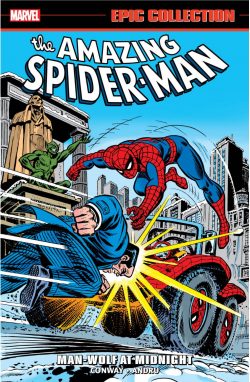
With the monster boom in full swing, Marvel during this period flooded newsstands with horror antiheroes. Morbius had already launched in his own newsstand, code-sanctioned series but is here cannily paired with another of  the Amazing Spider-Mans’s eeriest enemies in a double-length epic as ‘Man-Wolf at Midnight!’ (Conway, Kane & Mike Esposito) finds John Jameson again gripped by murderous moon-madness. Now, however, the tormented former astronaut was controlled by the Living Vampire and used to help the bloodsucker secure a possible cure for his appalling condition ‘When Strikes the Vampire!’

The saga then shifts to (Adventure into) Fear #20 (cover-dated February 1973). The title had previously hosted the macabre Man-Thing, and his/its promotion to a solo title gave Morbius opportunity to spread his own (glider) wings. Spawned by scripter Mike Friedrich and artists Paul Gulacy, Jack Abel & George Roussos, ‘Morbius the Living Vampire!’ revealed how the bloodsucker escaped X-Men captivity before moving to Los Angeles to live (whenever possible) off victims who deserved his voracious bite.

The initial tale also set up a bizarre relationship with Rabbi Krause and Reverend Daemond who sought to cure him, before one was exposed as a human devil, catapulting Morbius into intergalactic conflict that had shaped humanity over millennia.

That began in Fear #21 as ‘Project: Second Genesis!’ – by Gerber, Kane & Vince Colletta – sees Morbius ordered to consume a most remarkable little girl by Daemond. Despite his best intentions and all his moral compunctions, the vampire succumbs to temptation and attacks the child Tara only to face her super-powered future-self.

He is then reluctantly recruited by a cult of alien technologists who claim to have shepherded homo sapiens from barbarism to civilisation. These “Caretakers” are trying to create a race of supermen but are losing a secret war with Daemon.

By the time Morbius returns to the reverend’s fold however, the mage and his acolyte – Martine – have summoned cat demon Balkatar to destroy the Living Vampire…

Illustrated by Rich Buckler & Luis Dominguez ‘…This Vampire Must Die!’ finds Morbius easily overwhelmed before the victorious demon abruptly defies Daemond, bringing his foe to another realm – The Land Within – to become a very grim saviour. His kind breed but do not die and their king wants Morbius to cull the overcrowded herd by acting as an invited apex predator…

A little fan side note: this storyline fed into Gerber’s later arcs in The Defenders and Guardians of the Galaxy so continuity completists should pay close attention…

Instead the appalled vampire escapes and discovers he is on another planet, standing ‘Alone Against Arcturus!’ (Fear #23, by Gerber, P. Craig Russell & Colletta). The world has been devastated by genetic conflagration and is now populated by automatons, cyborgs and mutants who were once the same race as the Caretakers. They long only for death…

Realising the same unresolved conflict is currently unfolding on Earth, Morbius employs alien technology and volunteer “meals” to ‘Return to Terror!’ and his birthworld in #24 (October 1974, and inked by Jack Abel). Tragically the ship crash lands in front of Blade the Vampire Slayer

Morbius has still not met an actual vampire and thinks he’s fighting a crazy man whilst Blade believes he’s facing a blood sucker from space and the brutal clash ends inconclusively. In the aftermath Morbius treks back to LA to find the war between Daemond and the Caretakers has intensified…

We now travel back to October 1973 for a run of Vampire Tales appearances starting with #2 and ‘The Blood Sacrifice of Amanda Saint!’ with Don McGregor, Buckler & Marcos revealing how a potential snack becomes an unlikely and enduring ally after devil cult Demon-Fire targets her.

Forced into the role of rescuer and defender, Morbius endures mystery, monsters, the torture of a toxic family and his own taste of American Gothic as he unceasingly defends Amanda whilst tearing apart a mystic secret society entwined around a culture in decline and modern American mythology.

The fightback begins with ‘Demon Fire!’ (#3 February 1974 and inked by Klaus Janson), moves mercilessly on to Malevolence, Maine and the ‘Lighthouse of the Possessed’ (April 1974, illustrated by Tom Sutton) to repel more monstrosities and turn back a ‘Blood Tide!’ (#5 June, Buckler & Ernie Chua/Chan)…

Morbius took a break in #6 – represented here by the cover and ‘Frontispiece’ – before we resume in Malevolence, Maine with #7, asking ‘Where is Gallows Bend and What the Hell Am I Doing There?’ before events shamble to a chilling conclusion in #8 (December 1974, limned by Mike Vosburg & Frank Chiaramonte) at ‘High Midnight’ presenting a final clash with hidden manipulators Apocalypse and Death-Flame and a return to less complex exploits in the colour comics…

The monochrome madness was supported  throughout by painted covers from JAD, Boris, & Maroto and was all augmented by essays, photo-features and material from the magazines.

Also cover-dated December 1974, Fear #25 sported a Gerber plot and Doug Moench script  for Frank Robbins & Frank Giacoia to illustrate. After briskly recapitulating the Caretakers of Arcturus storyline ‘And What of a Vampire’s Blood?’ rapidly brings events to a conclusion as Morbius’ presence triggers a premature final battle between the ancient schemers, Daemond, Martine, Tara,  and the freshly-hatched Children of the Comet, resulting in ‘A Stillborn Genesis!’ (Moench, Robbins & Giacoia in #26, February 1975) and an abrupt change of direction…

That’s for the next volume however, whilst here we enjoy a crossover clash from April 1975’s Giant-Size Werewolf by Night #4 which brings the story portion of this pulse-pounding package to a close with a long-delayed and anticipated clash with fellow hostage to macabre fortune Jack Russell.

Cursed with uncontrolled lycanthropy under a full moon, and also a California kid, he endured ‘A Meeting of Blood’ (by Moench & Virgil Redondo) after the mutated biologist tracks Martine following Daemond’s destruction and discovers a possible cure for his own exsanguinary condition.

Unfortunately, the chase brings him into savage and inconclusive combat with a certain hairy hellion and the solution is forever lost…

This initial outing comes with a wealth of extras beginning with 9 house ads from 1973-1974; editorial page ‘Mail it to Morbius’ from Fear #21; un-inked original art pages by Kane; full art originals by Gulacy & Abel, Russell, Colletta & Abel; cover art by Kane, Giacoia, John Romita Sr., and Ron Wilson.

The compendium concludes with cover reproductions of Marvel Treasury Edition #14 (1977: front by Kane & Giacoia, back by Romita Sr., plus contents page by Dave Cockrum); #18 (1978: front & back by Bob Budiansky & Chan); cover galleries of Marvel Tales – #234 (Todd McFarlane), #252 (Marshal Rogers) and 253 (Moebius & Sylvain) – Spider-Man Megazine #3-4 (Ron Frenz/Stuart Immonen), Spider-Man Strange Adventures (Steve Lightle) and Marvel Selects: Spider-Man #2-3 4 (Mike Wieringo).

Compelling, complex, dark, often daft and always fretfully poised on the tightrope between superhero shenanigans and antihero angst, Morbius is one of Marvel’s most fluid and versatile characters, and can honestly promise something to please every type of fan or casual reader. Moreover, there’s even better to come that won’t work unless you take a big bite out of this tempting tome.
© 2021 MARVEL.

Batman in the Fifties


By Bill Finger, Don Cameron, Edmond Hamilton, France Herron, David Vern Reed, Dave Wood, Joe Samachson, Sheldon Moldoff, Dick Sprang, Lew Sayre Schwartz, Bob Kane, Win Mortimer, Charles Paris, Stan Kaye, George Roussos, Ray Burnley & various (DDC Comics)
ISBN: 978-1-7795-0950-5 (TPB/Digital edition)

In the early years of this century, DC launched a series of graphic archives intended to define DC’s top heroes through the decades: delivering magnificent past comic book magic from the Forties to the Seventies via a tantalisingly nostalgic taste of other – arguably better, but certainly different – times. The collections carried the cream of the creative crop, divided into subsections, partitioned by cover galleries, and supplemented by short commentaries; a thoroughly enjoyable introductory reading experience. I prayed for more but was frustrated… until now…

Part of a trade paperback trilogy – the others being Superman and Wonder Woman (thus far, but hopefully Aquaman, Green Arrow and Martian Manhunter are in contention too, as they have become such big shot screen stars these days) – the experiment is being re-run, with even more inviting wonders from the company’s amazing family-friendly canon.

Gathered here is an expanded menu of delights adding to that of the 2002 edition, rerunning Michael Uslan’s original context-stuffed Introduction and chapter text pieces. The stories originated in Detective Comics #156, 165, 168, 180, 185, 187, 215, 216, 233, 235, 236, 241, 244, 252, 267; 269, 1000; Batman #59, 62, 63, 81,92,105, 113, 114, 121, 122, 128; and World’s Finest Comics #68, 81, 89 which span the entire decade while laying the rather bonkers groundwork for the landmark television series of the next decade.

Supported by the first of a series of factual briefings, the comics open with Classic Tales, and ‘The Batmobile of 1950!’ Written by Joe Samachson and illustrated by visionary artist Dick Sprang and ideal inker Stan Kaye, the clever saga of reinvention originated in Detective Comics #156 (cover-dated February 1950 and on sale from December 19th 1949):  heralding new vistas as their reliable conveyance is destroyed by cunning crooks.

Badly injured, Batman uses the opportunity to rebuild his ride as moving fortress and crime lab and scores his first techno advance. There would soon be many more: a Batplane II, new boats and subs and even a flying Batcave…

David Vern Reed, Sprang & Charles Paris then set the Crime Crushers to recovering a vital lost tool assemblage before some villain could decipher ‘The Secret of Batman’s Utility Belt!’ (Detective #185 July 1952) and end their careers, after which ‘The True History of Superman and Batman’ (World’s Finest Comics #81, March/April 1956 by Edmond Hamilton, Sprang & Kaye) finds a future historian blackmailing the heroes into restaging their greatest exploits so that his erroneous treatise on them will be accurate…

Foreshadowing modern tastes and tropes, an unknown author & Sheldon Moldoff reveal ‘The New-Model Batman’ in Detective #236 (October 1956) as recently-released criminal genius Wallace Waley deploys counters to all the heroes’ techniques and tech, necessitating a change of M.O and new toys… like a Bat-tank…

In a classic case of misdirection, the Dark Knight briefly becomes ‘The Rainbow Batman! in Detective #241 (March 1957). As delivered by Hamilton, Moldoff & Kaye, a series of outlandish costumes keep the public – and reporters’ – gaze on the mighty masked peacock and well away from the biggest story of the decade…

Bill Finger, Moldoff & Paris detail a review of the hero’s most versatile weapon in ‘The 100 Batarangs of Batman!’ (Detective #244 June 1957) as criminals begin using old variants of the throwing tool against him and the Gotham gangbuster has to unleash an almost dangerous and untested prototype to defeat them…

In a most frustrating piece of poor editing, next up is the seminal sequel story to a most important and repercussion-packed yarn. Crafted by Hamilton, Sprang & Kaye, ‘The Club of Heroes’ first appeared in World’s Finest Comics #89 (July/August 1957) reprising an earlier meeting of Batmen from many nations. It became a key plank of Grant Morrison’s latterday epic Batman: the Black Glove as those valiant foreign copycats reconvened to add the Man of Steel to their roster only to find him suffering recurring amnesia and outshone by brand-new costumed champion Lightning Man

‘The Thousand Deaths of Batman!’ (Detective #269 July 1959) comes from another uncredited scripter, with Moldoff & Paris limning a bizarre tale of a criminal entertainment network offering staged deaths of their greatest enemies until the Caped Crusaders infiltrate and exterminate…

Just as the adventures always got bigger and bolder, so too did the character roster and internal history. The Bat-Family section homes in on the heroes’ constantly expanding supporting cast, and leads with something I just finished whining about.

Detective Comics #215 (January 1955) featured ‘The Batmen of All Nations!’ by Edmond Hamilton, Moldoff & Paris) and saw the World’s Greatest Crimefighters acknowledged as such by well-meaning champions from Italy, England, France, South America and Australia, who took the sincerest form of flattery a step too far by becoming nationally-themed imitations. That was fine until they all attend a convention in Gotham City doomed to disaster after a villain replaces one of them…

Why on Earth did this tale have to follow its own sequel?

Anyway, back to our usual nonsense and a question: Do you believe in coincidence? Superman was incredibly popular throughout the 1950s and many things that happened to him were tried in Batman stories. For a while the caped crusader even had a girl reporter – Vicki Vale – trying to ferret out hi secret identity. So when Adventure Comics #210 (March 1955) introduced a dog from Krypton, how surprising was it that Batman would soon join that rather exclusive kennel club?

For no reason I could possibly speculate upon, ‘Ace the Bat-Hound!’ debuted in Batman #92 (June 1955), created by Bill Finger, Sheldon Moldoff & Charles Paris. Ace was a distinctive German shepherd temporally adopted by Bruce Wayne when his actual owner John Wilker is abducted by crooks. A skilled tracker with distinctive facial markings, the pooch inserts himself into the case repeatedly, forcing the Dynamic Duo to mask him up as they hunt his master and foil a criminal plot. Like Krypto, Ace reappeared intermittently until Wayne stopped borrowing him and just adopted the amazing mutt.

Almost as necessary a Fifties adjunct, ‘The Batwoman!’ debuted in Detective #233 (July 1956) as Hamilton, Moldoff & Kaye added a female copy to the cannon…

Today fans are pretty used to a vast battalion of bat-themed champions haunting Gotham City and its troubled environs, but for the longest time it was just Bruce, Dick Grayson and an occasionally borrowed dog keeping crime on the run. However, three months before the debut of the Flash officially ushered in the Silver Age, editorial powers-that-be introduced valiant heiress Kathy Kane, who incessantly suited-up in chiropteran red and yellow over the next eight years. She was a former circus acrobat who burst into Batman’s life, challenging him to discover her secret identity at the risk of exposing his own…

Far more critical to the growing legend was Finger, Moldoff & Kaye’s ‘The First Batman!’

as originally seen in Detective Comics #235 (September 1956): a key story of this period which introduced a strong psychological component to Batman’s origins, disclosing how when Bruce was still a toddler, his father had clashed with gangsters whilst clad in a fancy dress bat costume…

In Batman #105, (February 1957) France Herron, Moldoff & Paris introduced ‘The Second Boy Wonder!’ as a stranger apparently infiltrates the Batcave by impersonating the kid crimebuster, but there’s more going on than would first appear, unlike Batman #114 (March 1958) wherein unknown writer, Moldoff & Paris reveal how circus gorilla Mogo joins the team to clear his framed keeper’s name in ‘The Bat-Ape!’

The grim gritty tone of the Dark Knight remains utterly absent in ‘The Marriage of Batman and Batwoman!’ (Batman #122, March 1959) as Finger, Moldoff & Ray Burnley manifest Robin’s bleakest nightmares should such a nuptial event ever occur, before Detective #267 (May 1959) details how ‘Batman Meets Bat-Mite!’ and Finger, Moldoff & Paris launch the Gotham Guardian’s most controversial “partner” – a pestiferous, extra-dimensional prank-playing elf who “helps” his hero by aiding his enemies to extend the duration of the fun… (World’s Finest Comics #68, January/February 1954).

In the 1950s costumed villains faded from view and preference for almost a decade – until the Batman TV show made them stars in their own right. Thus there’s not as big a pool to draw on here as you might expect, and what there is mostly the old favourites..

The Villains highlights our hero’s greatest recurring enemies, leading with The Secret Life of the Catwoman!’ from Batman #62 (December 1950/January 1951) by Finger, with Lew Sayre Schwartz ghosting for Bob Kane – who only pencilled a few faces and figures. It’s all inked by Paris.

Here the Felonious Feline reforms and retires after a head trauma cures all her larcenous tendencies… until Batman begs law-abiding Selina Kyle to suit up once more and go undercover to catch crime boss Mister X.

Kane had all but left his role to others by this time and his contributions remained minor in The Origin of Killer Moth!’ (Batman #62, February/March 1951) as Finger, Sayre Schwartz & Paris record how a recently-released convict steals Batman’s ideas and sets up as a paid costumed crusader for crooks…

Around that time Detective #168 (February 1951) began the long road to an origin for the Joker as Finger, Sayre Schwartz, Kane George Roussos and Win Mortimer exposed ‘The Man Behind the Red Hood!’ This reveals a partial origin as part of a brilliantly engrossing mystery which begins when the Caped Crusader regales eager college criminology students with the story of “the one who got away” – just before the fiend suddenly comes back…

Batman’s most tragic Golden Age foe resurfaced cured and fully functional in Detective #187 (September 1952), but Harvey Dent was soon on a spree committing ‘The Double Crimes of Two-Face!’ (by Don Cameron, Sprang & Paris). Although the Dynamic Duo knew from the start their foe was a fake, the situation was far different two years later when Reed, Sprang & Paris detailed how ‘Two-Face Strikes Again!’ in Batman #81 (February 1954). This time a freak accident restored Dent’s scarred bipolar state and the heroes were outmatched all the way to the stunning turnabout conclusion…

The bit about bad guys bows out with ‘The Ice Crimes of Mr. Zero’ (Batman #121, February 1959) as Dave Wood, Moldoff & Paris depict a scientist’s turn to crime after an experiment afflicts him with a condition that will kill him if his temperature rises above freezing point. Although cured in this yarn, that villain would return, taking the name Mr. Freeze

Final comics section Tales from Beyond highlights the increasingly strange adventures of the Dynamic Duo which – due to Comics Code embargoes on horror and the supernatural – meant a wealth of weird alien and startling science fiction themes. The wonders beginswith a rarely reprinted yarn from Finger, Sayre Schwartz, Kane & Paris originally seen in Batman #59 (June/July 1950). It begins as the heroes seek to use time travel to cure The Joker, before a mistake by chronal scientist Professor Carter Nichols dumps them in 2050 AD. ‘Batman in the Future!’ finds them aiding the Harlequin of Hate’s crimefighting descendant against space pirates before returning to their own era…

A solid gold classic follows as ‘The Batman of Tomorrow!’ (Detective #216, February 1955) visits the 20th century – from his home in 3054 – to save an injured Bruce Wayne from Vicki Vale’s latest exposé and catch a cunning crook in a fast paced and fantastical romp by Hamilton, Sprang & Paris.

Many of these bright-&-breezy high fantasy tales deeply affected modern writers and the overarching continuity, perhaps none more so than Herron, Sprang & Paris’ ‘Batman – The Superman of Planet X!’ from Batman #113 (February 1958): which formed a key thematic plank of Grant Morrison’s epic 2008 storyline Batman R.I.P. The story details how the Gotham Guardian is shanghaied to distant world Zur-En-Arrh by its version of Batman to fight an alien invasion: a task rendered relatively simple since the planet’s atmosphere and gravity gives Earthmen incredible superpowers…

In Detective #252 (February 1958) Wood, Moldoff & Paris channelled contemporary film fashion as a monster makes trouble on a movie location shoot, compelling the costumed champions to tackle ‘The Creature from the Green Lagoon!’ before the last tale in this section – and volume – reveals how our heroes mistakenly aid an alien pirate and are arrested and imprisoned offworld by interstellar lawmen. ‘The Interplanetary Batman!’ (Batman #128. December 1959) is a riotous rollercoaster rocket ride by Finger & Moldoff with Batman and Robin overcoming all odds to clear their names and get home and is a perfect place to pause this circus of ancient delights.

Also including a selection of breathtaking covers and a ‘Bonus Cover Gallery’ by Sprang, Mortimer, Moldoff, Curt Swan, Sayre Schwartz, Kaye & Paris, this is a splendidly refreshing, comfortingly compelling and utterly charming slice of comics history that any aged fan or newcomer will delight in: a primer into the ultimate icon of Justice and fair play.
© 1950, 1951, 1952, 1954, 1955, 1956, 1957, 1958, 1959, 2002, 2019, 2021 DC Comics. All Rights Reserved.

Captain Marvel volume 1: Nothing to Lose


By Peter David, ChrisCross, Ivan Reis, Paco Medina & various (Marvel Comics)
ISBN 978-0-7851-1104-7 (TPB/Digital edition)

Once upon a time, individuality was king and identity constantly – and litigiously – defended. These days, superhero comics are filled with spin-offs, legacies and alternates. Where once DC eradicated an entire multiverse to ensure readers would see there was only one Superman, Batman or Wonder Woman now there are dozens of iterations of every costumed character and fans couldn’t be happier.

However, there was always one title/character that bucked the trend…

One of the most venerated, beloved characters in American comics was created by Bill Parker & Charles Clarence Beck as part of the wave of opportunistic creativity following the successful launch of Superman in 1938. Although there were many similarities in the early years, the Fawcett Comics character moved swiftly and solidly into realms of light entertainment and even broad comedy, whilst throughout the 1940s the Man of Steel increasingly sidelined whimsy in favour of family-friendly action and drama.

Homeless orphan and thoroughly good kid Billy Batson was selected by an ancient wizard to battle injustice and subsequently granted the powers of six gods and mythical heroes. By speaking aloud the wizard’s name – an acronym for divine patrons Solomon, Hercules, Atlas, Zeus, Achilles and Mercury – he transformed from scrawny boy to brawny (adult) champion Captain Marvel.

At the height of his popularity, “the Big Red Cheese” was published twice monthly, hugely outselling Superman, and in 1941 DC/National Comics launched an infamous court case citing copyright infringement. However, as the decade progressed and tastes changed, sales slowed, and the case was settled just as many publishers started switching from costumed heroes to “Real Men” and monsters. Like many superheroes, Captain Marvel and his gods-powered kin disappeared, becoming a fond memory for older fans. A big syndication success, he was missed all over the world. In Britain, where an English reprint line had run for many years, creator/publisher Mick Anglo had an avid audience and no product, and so transformed the Captain and company into atomic age heroes Marvelman, Young Marvelman and Kid Marvelman continuing to thrill readers into the early 1960s, even if here there were no girls allowed.

Then, as America lived through another superhero boom-&-bust, the 1970s dawned with a shrinking industry and wide variety of comics genres servicing a base that was increasingly founded on collectors and fans rather than casual or impulse buyers. National/DC Comics needed sales and were prepared to look for them in unusual places.

After the court settlement with Fawcett in 1953 they had secured the rights to Captain Marvel, Captain Marvel Junior, Mary Marvel and all the spin-off Family. Now, even though the name itself had been taken up by Marvel Comics (via a circuitous and quirky robotic character published by Carl Burgos and M.F. Publications in 1967), the publishing monolith decided to tap into that discriminating if aging fanbase.

In 1973, riding a wave of national nostalgia on TV and in movies, DC brought back the entire beloved Marvel crew in their own kinder, weirder universe. To circumvent the intellectual property clash, they named the new title Shazam! (…With One Magic Word!) – the trigger phrase used by myriad Marvels to transform to and from mortal form, and a word that had entered the American language due to the success of the franchise the first time around.

Meanwhile, at the other place…

In 1968, upstart Marvel was in the ascendant. Their sales were rapidly overtaking industry leaders National/DC and Gold Key Comics and, having secured a new distributor allowing them to expand their list of titles exponentially, the company was about to undertake a creative expansion of unparalleled proportions.

Once individual stars of “split-books” Tales of Suspense, Tales to Astonish and Strange Tales were awarded their own titles, the House of Ideas just kept on going. In progress was a publishing plan seeking to take conceptual possession of the word “Marvel” through both reprint series such as Marvel Tales, Marvel Collector’s Items Classics and Marvel Super-Heroes. Eventually, showcase titles such as Marvel Premiere, Marvel Spotlight and Marvel Feature also proudly trumpeted the name, so another dead-cert idea was to have an actual hero named for the company – and preferably one with some ready-made cachet and pedigree as well.

After the infamous 1940s-1950s copyright case of the, the prestigious appellation Captain Marvel disappeared from newsstands. In 1967, during the “Camp” craze/superhero boom generated by the Batman TV series, publisher MLF produced a number of giant-sized comics featuring an intelligent robot able to divide his body into segments and shoot lasers from his eyes. Their legal right to have done so is still disputed…

Quirky, charming and devised by Carl Burgos (creator of the Golden Age Human Torch), the series failed to attract a large following in that flamboyantly flooded marketplace and on its demise the name was snapped up by Marvel Comics Group who properly secured rights to the name and have defended it ever since by publishing numerous characters who all seemed doomed to high quality runs and early cancelation…

In 1968, Marvel Super-Heroes was a brand new title: reconfigured from extended-length reprint vehicle Fantasy Masterpieces, which mixed vintage monster-mystery tales with Golden Age Timely Comics classics. With the 12th issue it added a try-out section for characters without homes. These included the Inhuman Medusa, Ka-Zar, Black Knight and Doctor Doom, plus new concepts Guardians of the Galaxy and Phantom Eagle, in all-new stories.

They kicked off with an alien spy sent to Earth from the Kree Galaxy. He held a Captain’s rank and his name was Mar-Vell. After two appearances, Captain Marvel catapulted straight into his own title for a rather hit-and-miss career combatting spies, aliens and costumed cut-ups like Sub-Mariner, Mad Thinker and Iron Man. Most frequently, however, he clashed with elements of his own rapaciously colonialist race – such as imperial investigative powerhouse Ronan the Accuser – all while slowly switching allegiances from the militaristic Kree to the noble, freedom-loving denizens of Earth.

This particular incarnation of the “trademark-that-must-not-die” features the son of that Kree warrior and long-time company supporting character/professional sidekick Rick Jones in a symbiotic relationship echoing the heyday of Mar-Vell’s flower-power glory days. Fair warning though, despite the excellent writing and great art, if you are not at least passingly familiar with Marvel’s close continuity, this is not a series of books you want to read without a little preparation.

Scripted by Peter David, with colours by Chris Sotomayor and letters from RS (Richard Starkings) & Comiccraft’s Albert!, Nothing to Lose collects Captain Marvel volume 2 #1-6 (cover-dates November 2002-April 2003, and I said it was confusing didn’t I?). It expands the saga of Genis, an artificially-matured test-tube baby son of Mar-Vell.

The Kree warrior turned Cosmic Protector saved Earth and Universe countless times before dying of cancer in the landmark Death of Captain Marvel (the company’s first official Graphic Novel), and here, after years trying to live up to and surpass his father’s achievements – he even debuted using the codename “Legacy” – the pressure starts to show.

Genis sought to emulate his father as a galaxy-spanning crusader, with mixed results, before hooking up with Rick Jones – his Dad’s original sidekick and, for a time, lifeline to reality. The human offered the promise of insider insights into what made him such a hero…

When Nothing to Lose opens with ‘Shards’ – illustrated by ChrisCross – he is, in fact, in just the same situation his father endured with the teen-aged Jones back in 1960’s. Their bodies are linked by “Nega-bands” – fantastically powerful alien wrist-bands which both wear, but only in turns, as they have the drawback of merging their molecular structure. This means only one body can inhabit the positive-matter universe at once, whilst the other is trapped in sub-atomic pocket-reality The Microverse. From there, the captive can observe and communicate, but not affect the “real” world.

The new Captain Marvel possesses his father’s greatest power, “Cosmic Awareness”: an ability to discern everything happening everywhere at once. Sadly, and inevitably, the gift is turning Genis into a raving madman. Just knowing something bad is happening doesn’t mean that the only solution you can offer is ultimately the right one for the universe. With so much to do, the captain has not allowed Rick to return to Earth for months…

This situation is tragically demonstrated when Marvel stops a suicide bomber from detonating on a crowded bus, only to see her murdered by one of her intended victims. His every action forces him to make immediate decisions and choose who to help for the greater good, but every choice seems to lead to unknowable cosmic consequences. This hopeless situation is repeated, magnified and drastically clarified after his intervention in an Badoon invasion and other missions.

As days pass Rick faces the fact that his partner’s omniscience and growing clairvoyance is more curse than blessing, and an increasing capriciousness is affecting Captain Marvel’s compulsion to “Do Good”. ‘Shock Absorber’ see Jones explore his options by going on an arduous pilgrimage and consulting (relatively) local god Shinga Doon, whilst the cosmic avenger starts taking advice and moral instruction from the Punisher

In ‘Pamavision’ Genis joins the militaristic Kree’s colonial space fleet as they invade and colonise strategic world Toped: meeting the man who trained his father, embracing the bellicose expansionist culture and rising fast in the ranks. In the Microverse, Rick is unexpectedly joined by another truth-seeker just as his guru meets a sudden and mysterious death…

The Toped campaign goes badly wrong for the Kree in ‘Uriah’ (rendered by Ivan Reis) as the Captain uncovers sedition, ambition and espionage run wild, whilst Rick learns his fellow stranded acolyte – Epiphany – is far more than she seems. When war with the Shi’ar looms and romantic intrigue runs riot, Marvel’s solution is to kill everybody and then himself…

ChrisCross returns for ‘Au Pere’ as a truly brutal father & son moment in the great beyond leads to Genis discovering that both he and Rick have been manipulated by trans-cosmic siblings Epiphany and Entropy with a view to ousting the current supervisor of reality.

They have done their work well and deranged Genis eagerly anticipates battling the universe’s most powerful conceptual entities, killing Supreme Being Eternity and ending painful reality well before its due date…

Happily for all, Rick hasn’t given up hope in the spectacular and awe-inspiring Paco Medina-limned closing chapter ‘Four Characters in Search of Creation’…

This slim tome includes covers and variants by Alex Ross, CrissCross, Joe Jusko, Kia Asamiya, Phil Noto, JG Jones and Andy Kubert as well as an ‘Alex Ross Captain Marvel Concept Artwork’ feature, sharing his design process and thoughts on the character’s powerful reworking.

Wry, sardonic, explosively action-packed and sublimely provocative, Peter David’s blackly tongue-in-cheek examination of power and perspective has some truly chilling moments, and has a lot to say on the nature of heroism, all leavened by his absurdist sensibilities and love of comedy word-play. His take on duty and honour is wickedly engaging, with the sumptuous art carrying the sneaky double-dealing and savage conflicts with ease.
© 2021 MARVEL.

JLA: Year One


By Mark Waid, Brian Augustyn & Barry Kitson with Michael Bair, John Stokes, Mark Propst, & various (DC Comics)
ISBN: 978-1-56389-512-8 (TPB)

If the chop-and-change continuity gymnastics DC have undergone in recent years gives you a headache, but you still love reading excellent superhero team stories, you could just take my word that this is one of the best of that breed and move on to the next review. If you’re okay with the confusion or still need convincing, though, please read on.

With then-partner All-American Publishing, in 1940 DC published the Justice Society of America in All-Star Comics from #3. Cover-dated “Winter Issue”, it spanned the year end and was on sale from November 22nd until January. The JSA were the first superhero team in comics.

In 1960 after a decade largely devoid of superheroes, the now fully-amalgamated publisher sagely revived the team concept as the Justice League of America, and gradually reintroduced the JSA ancestors as heroes of an alternative Earth to a fresh new caped and cowled world. By 1985, the continuity had become saturated and overcrowded with so many heroic multiples and close duplicates that DC’s editorial Powers-That-Be deemed it all too confusing and a deterrent to new readers, and decreed total change. It resulted in maxi-series Crisis on Infinite Earths and the events of the groundbreaking, earth-shattering saga led to a winnowing and restructuring of the DC universe…

With all the best bits from past stories (for which one could read “least charming or daft”) having now occurred on one Earth, and with many major heroes remade and re-launched (Superman, Wonder Woman, Flash et al.), one of the newest curses to readers – and writers – was keeping definitive track of what was now DC “History” and what had now never actually happened.

Thus 12-issue maxi-series JLA: Year One presented the absolute, definitive, real story of the formation and early days of the Justice League, the World’s Greatest – but no longer first – Superheroes…

Of course, since Zero Hour, Infinite Crisis and all the other subsequent publishing course-correcting extravaganzas (such as 52, Countdown, Dark Nights: Death Metal and so on) it’s not strictly true anymore. Still. Again…

None of which impacts upon the superb quality of the tale told here. Way back then – January to December 1998 and in the wake of Grant Morrison & Howard Porter’s spectacular re-reboot of the team – Mark Waid, Brian Augustyn & illustrator Barry Kitson (plus assorted assisting inkers) produced a superb version of that iteration’s earliest days. It’s still one of the best and most readable variations on the theme, even if DC have inexplicably let it slide out of print…

It begins “ten years ago” in ‘Justice League of America: Year One’ as a hidden observer gathers files on an emergent generation of new costumed heroes. When an alien invasion from Appellax brings inexperienced neophyte heroes Flash, Green Lantern, Black Canary, Aquaman and Martian Manhunter together to save Earth from colonisation, the media scents a news sensation, but the real story is the hidden forces hovering in the background of the event…

The Canary was reimagined as the rebellious daughter of the JSA original who had been active during WWII, and the others, like the Sea King and J’onn J’onzz, had undergone recent origin revisions too…

The main action begins after that initial victory, as the heroes – novices all, remember – opt to stick together as a team, only to be targeted by secret super-science society Locus, who begin snatching up alien invader corpses for genetic experimentation…

The second issue sees the new kids as media sensations overwhelmed and out of their depth, with everyone wanting a piece of them. Older outfits like the Blackhawks, Challengers of the Unknown and even officially-retired JSA veterans are watching with apprehension whilst Bruce Wayne wants them far away from Gotham City as they establish their ‘Group Dynamic’. Even trick archer Green Arrow is constantly hanging around, clearly angling for an invitation to join, but that’s never gonna happen…

Immortal villain Vandal Savage targets the inexperienced heroes with a squad of veteran supervillains – the Thorn, Solomon Grundy, Clayface and Eclipso – as everywhere, more new superheroes are emerging. Savage is resolved to stop this second Heroic Age before it begins…

In #3, Locus’ bio advancements lead to alliance with Savage, but their schemes are sidelined as the team struggle to work together. Every man there seems distracted by Black Canary, but their “chivalrous impulses” in combat are not only insulting but will get someone killed – if not by enemies, then by her…

The team is fully occupied playing ‘Guess Who?’ after accepting funding and resources from a mystery billionaire. The influx of cash results in a purpose-built secret mountain HQ, a covert personal communications network, live-in custodian/valet/tech support Snapper Carr and a security system designed by maverick teen genius Ted Kord.

At least the heroes are starting to bond, sharing jokes, origins and trade secrets, but tensions are still high and trust in each other is fragile…

Inker Michael Bair joins with #4 as ‘While You Were Out…’ sees Locus at last launch their campaign of conquest: picking off lone hero Dan Garrett, whose mystic Blue Beetle scarab proves no match for alien-enhanced bio-weaponry, even as the heroes are all singled out for close observation by mystery operatives…

The merciless Brotherhood of Evil unleash Locus-designed horrors on Manchester, Alabama in #5, leading to a tenuous team-up of Justice League and Doom Patrol that ends in disaster and defeat. Maimed and deprived of their abilities, they are ‘A League Divided’ until the DP’s resident genius Niles Caulder provides stopgap powers and weapons in ‘Sum of Their Parts’ (inked by Bair & John Stokes), enabling the heroes to rally and restore themselves…

In ‘The American Way’ the JLA suffer a shock after their greatest inspiration – Superman – declines an offer to join, even as Locus’ endgame begins.

The dispirited heroes barely notice, as ‘Loose Ends’ exposes treachery in the ranks, further distracting the heroes who discover a trusted ally has been spying on them in their private lives. They have no idea what’s really going on…

With unity shattered, the JLA turns on itself, missing Locus’ attempt to terraform Earth and literally ‘Change the World’

‘Heaven and Earth’ (inked by Bair & Mark Propst) finds all humanity’s helpless and all its many heroes subdued in a superpowered blitzkrieg that catches the planet napping. Crushed, defeated and interned in ‘Stalag Earth’ all hope is lost until the reunited Justice League lead a counter-offensive, turning tragedy into triumph and ensuring ‘Justice for All’

A brilliantly addictive plot, superbly sharp dialogue and wonderfully underplayed art suck the reader into an enthralling climax that makes you proud to be human… or at least terrestrially-based. This saga of our champions’ bonding and feuding under extended threat of rogue geneticists, planetary upheaval, and the mystery of who actually bankrolls the team, all added to continual, usual, everyday threats in a superhero’s life, is both enchanting and gripping.

When it’s done right there’s nothing wrong with being made – and allowed – to be feel ten years old again. In-the-know fans will delight at the clever incorporation of classic comics moments, in-jokes and guest-shots from beloved contemporaneous heroes and villains such as the Sea Devils, Metal Men, Atom and such, but the creators of this revised history never forget their new audience and nothing here is unclear for first-timers. The finale is a fan’s all-action dream with every hero on Earth united to combat all-out alien invasion! …And of course, the rookie JLA save the day again in glorious style.
© 1998 DC Comics. All Rights Reserved.

Marvel Graphic Novel vol 18: The Sensational She-Hulk


By John Byrne, Kim DeMulder, Petra Scotese, Janice Chiang & various (Marvel)
ISBN10: 0-87135-084-X (Album TPB/Digital edition)

A persistent story goes that in the faraway days when trademarks and copyrights were really, really important, comic publishers worried that rivals would be able to impinge on their sales an so produced distaff versions of their characters. Thus the House of Ideas launched Ms. Marvel, so that nobody else could.

Redundant bit player Carol Danvers was retooled as a superhero (now called Captain Marvel whilst Pakistani-American teen Kamala Khan has inherited her first codename). The Captain debuted in her own title (cover-dated January 1977) and was soon joined by rush-released Spider-Woman (in Marvel Spotlight #32 ,February 1977 – before securing her own title 15 months later) and She-Hulk. There was apparently a second and most specific reason…

At this time both the male Hulk and Spider-Man had successfully made the jump to live-action television, and the publishing powers were terrified because their licensing contracts had a potentially disastrous loophole: there was nothing to prevent those scurrilous TV types spinning off their own (sexy, televisual, not-owned-by-Marvel) characters, as had almost happened with Batgirl in the 1960s “Batmania” era…

To be fair, Marvel had been constantly seeking to expand their female character pool for years before intellectual property necessity forged a path for them. They found the right mix as the Seventies closed, and even added new concept stars at the right time. The music-biz-inspired and sponsored Dazzler premiered in February 1980’s Uncanny X-Men #130 – before getting her own title: the same month copyright-shielding Savage She-Hulk #1 came out…

Whereas that seems a bit convoluted and may be rather hard to believe, I must admit that the original 25-issue run of Bruce Banner’s tragedy-magnet cousin Jennifer Walters was by no means the company’s finest moment. Creators struggled for quite a while to get a handle on the Girly Green Goliath. After her series was cancelled, She-Hulk did the guest-star thing and served with distinction in both The Avengers and Fantastic Four, before John Byrne finally developed a suitably original niche and spin for her in the Marvel Universe.

Since then, constant experimentation and deft handling has made her one of Marvel’s most readable properties – and most entertaining screen stars – but that revolution all started with this thoroughly enjoyable, if clearly transitional tome…

At the time of its creation, the lady lawyer had replaced The Thing in the Fantastic Four and could change between her human and Gamma-enhanced forms at will, whilst retaining her intellect in both forms. All the fourth-world hi-jinks of her second comics series and television incarnation was yet to come…

Against the slow-building, horror-story backdrop of a sentient cockroach invasion and infiltration, the story involves the shady higher-ups who oversee high-tech espionage agency S.H.I.E.L.D. ordering the rendition of She-Hulk for unspecified “National Security” purposes. When tough but fair Nick Fury refuses to comply, the mission goes ahead without him, leading to a major battle in the streets of New York and the eventual capture of not only our heroine but also a large number of passers-by.

Trapped aboard the spooks’ flying helicarrier, She-Hulk is subjected to numerous indignities and abuses whilst her boyfriend Wyatt Wingfoot and the other civilians are treated as hostages for her good behaviour. Unfortunately, one of those ordinary mortals is a zombie vehicle for those cockroaches I mentioned earlier, and they want to drop the floating fortress on the city below as a declaration of war against humanity…

Inked by Kim DeMulder -with colours by Petra Scotese & lettering from Janice Chiang – Byrne’s writing and illustration deliver spectacular action, tinged with horror yarn overtones. The art deftly utilises the (European-style) expanded-page format of Marvel’s Original Graphic Novel line, and combines with sharp scripting to elevate an old plot to new heights. I personally find the coy prurience of some of the semi-nude scenes a little juvenile, but that’s not enough to spoil the fun in a what’s otherwise a highly effective disaster thriller: one which set the tone of She-Hulk adventures for years thereafter…
© 1985, 2018 Marvel Characters Inc. All Rights Reserved.

Warlock Marvel Masterworks volume 1


By Roy Thomas, Mike Friedrich, Gerry Conway, Ron Goulart, Tony Isabella, Gil Kane, Bob Brown, Herb Trimpe, John Buscema, Tom Sutton & various (Marvel)
ISBN: 978-0-7851-2411-5 (HB) 978-0-7851-8858-2 (TPB/Digital edition)

During the 1970s in America and Britain (the latter of which deemed newspaper cartoons and strips worthy of adult appreciation for centuries whilst fervently denying similar appreciation and potential for comics), the first inklings of wider public respect for the medium of graphic narratives began to blossom. This followed teen response to such pioneering series as Stan Lee & John Buscema’s biblically allegorical Silver Surfer and Roy Thomas’ ecologically strident antihero Sub-Mariner, a procession of thoughtfully-delivered attacks on drugs in many titles and constant use of positive racial role models everywhere on four-colour pages.

Comics were inexorably developing into a vibrant forum of debate (a situation also seen in Europe and Japan), engaging youngsters in real world issues relevant to them. As 1972 dawned, Thomas took the next logical step, transubstantiating an old Lee & Jack Kirby Fantastic Four throwaway foe into a potent political and religious metaphor.

Debuting in FF #66 (September 1967) dread mystery menace Him was re-imagined by Thomas and Gil Kane as a modern interpretation of the Christ myth: stationed on an alternate Earth far more like our own than that of Marvel’s unique universe.

Re-presenting Marvel Premiere #1-2, Warlock #1-8 and Incredible Hulk #176-178 – collectively spanning the tumultuous time between April 1972 and August 1974, this epic adventure also offers a context-soaked Introduction from originator Thomas.

It all began with April cover-dated Marvel Premiere #1, which boldly proclaimed on its cover The Power of… Warlock. Inside, the stunning fable – by Thomas, Kane & Dan Adkins – declared ‘And Men Shall Call Him… Warlock’: swiftly recapitulating the artificial man’s origins as a lab experiment concocted by rogue geneticists eager to create a superman they could control for conquest.

After facing the Fantastic Four, the manufactured man had subsequently escaped to the stars, later initiating a naive clash with Asgardian Thor over the rights to a mate before returning to an all-encompassing cosmic cocoon to evolve a little more…

Now the all-encompassing shell is plucked from the interplanetary void thanks to the moon-sized ship of self-created god The High Evolutionary. Having artificially ascended to godhood, he is wrapped up in a bold new experiment…

Establishing contact with Him as he basks in his cocoon, the Evolutionary explains that he is constructing from space rubble a duplicate planet Earth on the opposite side of the sun. Here he replays the development of life, intending that humanity on Counter Earth will evolve without the taint of cruelty and greed and deprived of the lust to kill…

It’s a magnificent scheme that might well have worked, but as the Evolutionary wearies, his greatest mistake intervenes. The Man-Beast was hyper-evolved from a wolf and gained mighty powers, but also ferocious savagery and ruthless wickedness. Now he invades the satellite, despoiling humanity’s rise and ensuring the new world’s development exactly mirror’s True-Earth’s. The only exception is the meticulous exclusion of enhanced individuals. This beleaguered planet has all mankind’s woes but no superheroes to save or inspire them.

A helpless witness to the desecration, the golden being furiously crashes free of his cocoon to save the High Evolutionary and rout the Man-Beast and his bestial cronies (all similarly evolved animal-humanoids called “New-Men”).

When the despondent and enraged science god recovers, he makes to erase his failed experiment but is stopped by his rescuer. As a powerless observer, Him saw the potential and value of embattled humanity. Despite all its flaws, he believes he can save them from the imminent doom caused by their own unthinking actions, wars and intolerance. His pleas at last convince the Evolutionary to give this mankind one last chance, and the wanderer is hurled down to Counter-Earth, equipped with a strange gem to focus his powers, a mission to find the best in the fallen and a name of his own… Adam Warlock

Marvel Premiere #2 (July) sees the golden man-god crash to Earth in America and immediately win over a small group of disciples: a quartet of disenchanted teen runaways fleeing The Man, The Establishment and their oppressive families. His nativity and transformation leave him briefly amnesiac, and as Warlock’s followers seek to help, all are unaware that Man-Beast has moved quickly, insinuating himself and his bestial servants into the USA’s political hierarchy and Military/Industrial complex.

This devil knows the High Evolutionary is watching and breaks cover to introduce unnatural forces on a world previously devoid of superbeings and aliens. The result is an all-out attack by rat mutate Rhodan, who pounces on his prey at the very moment Colonel Barney Roberts, uber-capitalist Josiah Grey and Senator Nathan Carter track their missing kids to the desolate Southern Californian farm where they have been nursing the golden angel…

Men of power and influence, they realise their world has changed forever after seeing Warlock destroy the monstrous beast and ‘The Hounds of Helios!’

Doctor Strange was revived to fill the space in MP #3, as the gleaming saviour catapulted into his own August cover-dated title. Inked by Tom Sutton, Warlock #1 decreed ‘The Day of the Prophet!’: recapping key events and seeing the High Evolutionary safeguard his failing project by masking Counter-Earth from the rest of the solar system behind a vibratory screen.

With his mistake securely isolated from further contamination, HE asks Adam if he’s had enough of this pointless mission, and is disappointed to see Warlock’s resolve is unshaken. That assessment is questioned when the disciples take the spaceman to his first human city. Senses reeling, Warlock is drawn to bombastic street preacher and his psychic sister Astrella who are seemingly targeted by the Man-Beast. Of course, all is not as it seems…

Thomas’s plot is scripted by Mike Friedrich and John Buscema joins Sutton in illuminating ‘Count-Down for Counter-Earth!’: taking the biblical allegory even further as Warlock is captured by his vile foes and tempted with power in partnership with evil, even as his erstwhile disciples are attacked and deny him. Counter-Earth has never been closer to damnation and doom, but once more the saviour’s determination overcomes the odds…

The epic continues with Friedrich in the hot seat and Kane & Sutton reunited to steer the redeemer’s path. ‘The Apollo Eclipse’ begins with Adam and his apostles harassed by the increasingly impatient High Evolutionary following a breaching of his vibratory barrier by the Incredible Hulk and the Rhino (in Hulk #158 and reprinted in many volumes …but not this one). That episode is soon forgotten after they are targeted by another Man-Beast crony, hiding his revolting origins and unstable psyche behind a pretty façade.

The brute attacks a rocket base where Adam seeks to reconcile his youthful followers with their parents, but the subsequent clash turns into tragedy in #4’s ‘Come Sing a Searing Song of Vengeance!’ as the exposed monster takes the children hostage. Astrella senses that visiting Presidential candidate Rex Carpenter holds the key to the stalemate, but when he intervenes at her urging, unbridled escalation, death and disaster follow…

Although super-beings were excised from the world’s evolution, extraordinary beings still exist. Warlock #5 (April 1973) sees Ron Goulart write the aftermath as the doubt-riddled redeemer emerges from another sojourn in a recuperative cocoon. In the intervening months Carpenter has become President and ordered an increase in weapons testing to combat the incredible new dangers he personally witness.

Tragically, he also ignores warnings from government scientist Victor Von Doom, and when one military manoeuvre sparks ‘The Day of the Death-Birds!’ Adam is there to help when a dam is wrecked. His might is sufficient to stop the automated launch of swarms of robotic drones programmed to strafe ground-based beings, but cannot stop the grateful citizenry turning on him when President Carter declares him a menace to society…

Friedrich scripts Goulart & Thomas’ plot and Bob Brown joins the team as penciller in #6 as Warlock battles the army and Doom contacts fellow genius Reed Richards for help. However, the Latverian is unaware of a shocking change in his oldest friend who is now ‘The Brute!’: a mutated cosmic horror enthralled by the malign thing running the White House and now ordered to ambush Warlock as Astrella brings him to truce talks…

It’s all a pack of lies and a trap. As the Golden Gladiator defeats Richards, enraged mobs egged on by the President move on Warlock’s growing band of supporters. Now, though, the alien’s very public life-saving heroics have swayed fickle opinion and Carter is compelled to reverse his stance and exonerate Warlock. Even this is a ploy, allowing him to set the energy-absorbing Brute on the redeemer in ‘Doom: at the Earth’s Core!’

Beyond all control, Richards’ rampage threatens to explode Counter-Earth, and only the supreme sacrifice of one of Adams’s constantly dwinling band of supporters saves the planet…

Warlock’s rocky road paused with the next issue. Cancelled with #8, Friedrich, Brown & Sutton dutifully detailed ‘Confrontation’ in Washington DC as the supposed saviour’s supporters clashed with incensed cops. Intent on stopping a riot, Warlock finds his work magnified when Man-Beast’s New-Men minions join the battle. The saga then ends on an eternal cliffhanger as Warlock finally exposes what Carpenter is… before vanishing from sight for 8 months…

The aforementioned Hulk #158 had seen the Jade Giant dispatched to the far side of the Sun to clash on Counter-Earth with the messiahs enemies. Although excluded here, the 3-issue sequel it spawned was concocted after the Golden Godling’s series ended.

When the feature returned the tone, like the times had comprehensively changed. All the hopeful positivity and naivety had, post-Vietnam and Watergate, turned to world-weary cynicism in the manner of Moorcock’s doomed hero Elric. Maybe that was a harbinger of things to come…?

The cosmic codicil closing this initial collection came after the Hulk’s typically short-tempered encounter with the Uncanny Inhumans and devastating duel with silent super-monarch Black Bolt. Following the usual collateral carnage, the bout ended with the Gamma Goliath hurtling in a rocket-ship to the far side of the sun for a date with allegory, if not destiny.

The troubled globe codified Counter-Earth had seen messianic Adam Warlock futilely battle Satan-analogue Man-Beast: a struggle the Jade Juggernaut learned of on his previous visit. Now he crashed there again to complete the cruelly truncated metaphorical epic, beginning in ‘Crisis on Counter-Earth!’ (Incredible Hulk #176, June 1974) by Gerry Conway, Herb Trimpe & Jack Abel.

Since the Hulk’s last visit Man-Beast and his animalistic flunkies had become America’s President and Cabinet. Moving deceptively but decisively, they had finally captured Warlock and led humanity to the brink of extinction, leaving the would-be messiah’s disciples in utter confusion.

With the nation reeling, Hulk’s shattering return gives Warlock’s faithful flock opportunity to save their saviour in ‘Peril of the Plural Planet!’ but the foray badly misfires and Adam is captured. Publicly crucified, humanity’s last hope perishes…

The quasi-religious experience concludes with ‘Triumph on Terra-Two’ (Conway, Tony Isabella, Trimpe & Abel, Incredible Hulk #178). Whilst Hulk furiously battles Man-Beast, the expired redeemer resurrects in time to deliver a karmic coup de grace before ascending from Counter-Earth to the beckoning stars…

Adding temptation at the end is a gallery of Kane pencil page layouts and a half dozen inked pages plus the Marvel Bullpen Bulletins page that first announced Warlock’s debut.

Ambitious and beautiful to behold, the early Warlock adventures are very much a product of their tempestuous, socially divisive times. For many, they proved how mature comics might become, but for others they were simply pretty pictures and epic fights with little lasting relevance. What they unquestionably remain is a series of crucial stepping stones to greater epics and unmissable appetisers to Marvel Magic at its finest.
© 2020 MARVEL

Spider-Man: India


By Jeevan J. Kang & Gotham Studios Asia, Suresh Seetharaman & Sharad Devarajan & various (MARVEL)
ISBN: 978-0-7851-1640-0 (TPB/Digital edition)

It’s a small world these days and petty hindrances like geography, culture and social preference are no longer a barrier to brand expansion for major properties. Sherlock Holmes and Mickey Mouse are universal, DC and Marvel heroes have long generated locally-sourced adventures on other continents and countless other fictional stars have been tailored to suit relatively closed markets.

That’s what happened in 2004 when Marvel’s most recognisable property was reinvented for the South East Asian region and its burgeoning comics industry. The instigator was Indian entrepreneur, film producer, educator, publisher and computer game impresario Sharad Devajaran whose subsequent experience includes digital entertainment platform Virgin Comics/Liquid Comics, and Graphic India. In 2013, he and Stan Lee co-created Indian superhero Chakra the Invincible

Before all that, Devajaran was co-founder, president and CEO of South East Asia’s leading comic book publisher Gotham Entertainment Group: spearheading the official introduction of Marvel, DC, Dark Horse, Cartoon Network and Warner Brothers properties like X-Men, The Hulk, Batman and Superman to a vast and vibrant new market. That naturally led to closer collaboration and in 2004 Marvel sanctioned a new iteration of the wondrous webspinner specifically tailored to the Indian market and broadly based on the first Toby Maguire Spider-Man movie from 2002. The result of South East meets West was dubbed the first comics “trans-creation”…

The idea was not new. Translated US comics had been syndicated across the world since before WWII and Japan especially had pioneered reworkings of top brands for conservative national readerships with the 1966-1967 “Battoman” – derived from the US Batman TV series, freely adapted by Jiro Kuwata – and Ryoichi Ikegami’s Spider-Man: The Manga (1970-1971) placing remastered wallcrawler Yu Komori in a Japanese setting s seen in Monthly Shonen Magazine.

Devised by Jeevan J. Kang, Suresh Seetharaman & Sharad Devarajan and illustrated by Kang & Gotham Studios Asia, it was released as a 4-issue miniseries for India: massaging the timeless legend in a way that eventually and inevitably became a part of the larger Marvel Multiverse…

This English language collection from 2005 was lettered by Virtual Calligraphy’s Dave Sharpe: a cross cultural collaboration that opens with a mysterious mystic foretelling in nightmares a shocking future for poor but brilliant teenager Pavitr Prabhakar. Recently moved to Mumbai with his guardians Uncle Bhim and Aunt Maya to take up a school scholarship, the boy has been marked for tragedy, loss and a great but dangerous life…

His low standing and status – he comes from a distant provincial village – make Pavitr a target for the rich kids in school, but for some reason the amazing and popular Meera Jain defends and befriends him…

Across the city, crime lord and sinister industrialist Nalin Oberoi is content. His Corporation thugs have razed an entire village, and the amulet he wants so badly is his. Now after an unholy ceremony he attains incredible power at an ungodly cost: transformed into a fire-spitting green devil. He does not yet realise that he is now a living gateway for an army of demons to invade the human plane…

Another bad at school ends with Pavitr again chased by vicious bullies. He’s saved by an old yogi who looks very familiar, and declares the boy has a great destiny. In a time when the gods have no avatars to set in humanity’s defence, the world must depend on a good person empowered by the forces of the intangible Web of Life. Filled with the Spider’s power clad in bold raiment, the boy is told to fulfil his karma…

Giddy with a sense of power, Spider-Man cavorts over the city and ignores the desperate cries of those in dire need, even as, far below, Uncle Bhim gives his life to save a woman from molesters. Pavitr is too late to save him but learns an immutable life lesson and thereafter dedicates himself to living with great responsibility…

Thus begins the saga of India’s Spider-Man, with a devil-driven analogues of Doctor Octopus and Venom also debuting as Oberoi kidnaps Maya and Meera Jain. The green rakshasa’s scheme to manifest Hell on Earth culminates in a monumental clash at a refinery as the boy hero deploys the divine magic amulet, and seeks to sever the debased villains’ connection to his demonic masters with courage, the power of the web of life and his innate purity…

Most Marvel US readers recognise Pavitr Prabhakar from assorted mainstream events like Secret Wars and Spider-Verse and their fallout spin-offs, where his uniqueness is rather lost and definitely downplayed. However, this initial outing offers a truly different spin on the webspinner and if you require a fresh taste or something a little different, this is well worth a visit.
© 2021 MARVEL.