The Golden Age Green Lantern Archives volumes 1 & 2


By Bill Finger, Martin Nodell, E.E. Hibbard, Irwin Hasen & various (DC Comics)
ISBN: 978-1-56389-507-4 (HB vol 1), 978-1-56389-794-8 (HB vol 2)

This book includes Discriminatory Content produced in less enlightened times.

Time for another Birthday briefing as we exploit the month of renewal and fresh starts by celebrating 85 glorious years for another Golden Age stalwart: someone who has gained a modern cachet as probably DC’s most venerably proud gay icon…

The ever-expanding array of companies that became DC published many iconic “Firsts” in the early years of the industry. Associated outfit All-American Publications (co-publishers until bought out by National/DC in 1946) originated the first comic book super-speedster as well as the monumentally groundbreaking Wonder Woman, The Atom, Hawkman, Johnny Thunder and so many others who became mainstays of DC’s pantheon of stars.

Thanks to comics genius and editorial wunderkind Sheldon Mayer, All-American Comics  published the first comic book super-speedster in Flash Comics. They followed up a few months later with another evergreen and immortal all-star.

Lighting up newsstands from May 17th 1940, The Green Lantern debuted in anthological All-American Comics #16 (cover-dated July of that auspicious year). It was the company’s flagship title just as superheroes began to truly dominate the market, supplanting newspaper strip reprints and stock genre characters in the still primarily anthology-based industry.

The Emerald Gladiator would be swiftly joined in A-AC by The Atom, Red Tornado, Sargon the Sorcerer and Doctor Mid-Nite, until eventually only gag strips such Mutt and Jeff and exceptional topical tough-guy military strips Hop Harrigan (Ace of the Airwaves) and Red, White and Blue remained to represent mere mortal heroes. And then, tastes shifted after the war and costumed crusaders faded away, to be replaced by cowboys, cops, clowns and private eyes…

Devised by up-and-coming cartoonist Martin Nodell (and fleshed out by Bill Finger in the same generally unsung way he had contributed to the success of Batman), GL soon became AA’s second smash sensation.

The arcane avenger gained his own solo-starring title little more than a year after his premiere and also appeared in other anthologies including Comics Cavalcade and All Star Comics for just over a decade before, like most first-generation superheroes, he faded away in the early1950s. However, GL first suffered the uniquely humiliating fate of being edged out of his own strip and comic book by his pet, Streak the Wonder Dog

However, that’s the stuff of other reviews. This spectacular, quirkily beguiling deluxe Archive edition (collecting the Sentinel of Justice’s appearances from All-American Comics #16-30 – covering July 1940 to September 1941 as well as the Fall 1941cover-dated Green Lantern#1) opens with a rousing reminiscence from Nodell in a Foreword discussing the origins of the character before the parade of raw enchantment starts with the incredible history of The Green Flame of Life

Ambitious young engineer Alan Scott only survives the sabotage and destruction of a passenger-packed train due to the occult intervention of a battered old railway lantern. Bathed in its eerie emerald light, he is regaled by a mysterious green voice with the legend of how a meteor once fell in ancient China. It spoke to the people, predicting Death, Life and Power.
The star-stone’s viridian glow brought doom to the savant who reshaped it into a lamp, sanity to a madman centuries later and now promised incredible power to bring justice to wronged innocents.

Instructing Scott to fashion a ring from its metal and draw a charge of power from the lantern every 24 hours, the ancient artefact urges the engineer to use his formidable willpower to end all evil: a mission Scott eagerly takes up by promptly crushing corrupt industrialist Dekker – who had callously caused wholesale death just to secure a lucrative rail contract…

The ring makes Scott immune to all minerals and metals, enables him to fly and pass through walls, but as he battles Dekker’s thugs the grim avenger painfully discovers that living – arguably “organic” – materials such as wood or rubber can penetrate his jade defences and cause him mortal harm. The saboteurs duly punished, Scott resolves to carry on the fight and devises a “bizarre costume” to conceal his identity and strike fear and awe into wrongdoers.

Most of the stories at this time were untitled, and A-AC #17 (August 1940) finds Scott in Metropolis (long before it became the fictional home of Superman) where his new employer is squeezed out of a building contract by a crooked City Commissioner in bed with racketeers. With lives at risk from shoddy construction, the Green Lantern moves to stop the gangsters but nearly loses his life to overconfidence before finally triumphing, after which #18 finds Scott visiting the 1940 New York World’s Fair. This yarn (which I suspect was devised for DC’s legendary comic book premium New York World’s Fair Comics #2 but shelved at the last moment) introduces feisty romantic interest Irene Miller as she attempts to shoot the gangster who framed her brother.

Naturally, gallant he-man Scott had to get involved, promptly discovering untouchable gang-boss Murdock owns his own Judge, by the simple expedient of holding the lawman’s daughter captive…

However, once Alan applies keen wits and ruthless mystic might to the problem, Murdock’s power – and life – are forfeit, after which, in #19, Scott saves a man from an attempted hit-&-run and finds himself ferreting out a deadly ring of insurance scammers collecting big pay-outs through inflicting “accidents” upon unsuspecting citizens.

All-American Comics #20 opened with a quick recap of GL’s origin before instituting a major change in the young engineer’s life. Following the gunning down of a roving radio announcer and assassination of that reporter’s wife, our hero investigates APEX Broadcasting System in Capitol City and again meets Irene Miller. She works at APEX and, with Alan’s help, uncovers a scheme whereby broadcasts are used to transmit coded instructions to smugglers. Once the Ring-wielder mops up the gang and their inside man, engineer Scott takes a job at the company and begins a hapless romantic pursuit of capable, valiant Irene.

Thanks to scripter Bill Finger, Green Lantern was initially a grim, mysterious and spookily implacable figure of vengeance, weeding out criminals and gangsterism but, just as with early Batman sagas, there was always a strong undercurrent of social issues, ballsy sentimentality and human drama. All-American #21 sees the hero expose a cruel con wherein a crooked lawyer presses young criminal Cub Brenner into posing as the long-lost son of a wealthy couple to steal their fortune. Of course, the kid has a change of heart and everything ends happily, but not before stupendous skulduggery and atrocious violence ensue…

In #22, when prize-fighter Kid McKay refuses to throw a bout, mobsters abduct his wife and even temporarily overcome the fighting-mad Emerald Guardian. Moreover, when one brutal thug puts on the magic ring, he swiftly suffers a ghastly punishment allowing GL to emerge victorious. Slick veteran Everett E. Hibbard provided the art for A-AC #23, and his famed light touch frames GL’s development into a less fearsome and more public spirited and approachable champion. As Irene continues to rebuff Alan’s advances – in vain hopes of landing his magnificent mystery man alter ego – the engineer accompanies her to interview movie star Delia Day and stumbles into a cruel blackmail racket. Despite their best efforts the net result is heartbreak, tragedy and many deaths.

Issue #24 then sees the Man of Light going undercover to expose philanthropist tycoon R.J. Karns, who maintains his vast fortune by trafficking unemployed Americans into slavery on a tropical Devil’s Island, and #25 finds Irene uncovering sabotage at a steel mill. With GL’s unsuspected help she then exposes purported enemy mastermind The Leader as no more than an unscrupulous American insider trader trying to force prices down for a simple Capitalist coup…

Celebrated strip cartoonist Irwin Hasen began his long association with Green Lantern in #26 when the hero aids swindled citizens whose lending agreements with a loan shark are being imperceptibly altered by a forger to keep them paying in perpetuity, after which the artist illustrated the debut appearance of overnight sensation Doiby Dickles in All-American #27 (June 1941). The rotund, middle-aged Brooklyn-born cab driver was simply intended as light foil and occasional sidekick for the poker-faced Emerald Avenger, but rapidly grew to be one of the most popular and beloved comedy stooges of the era; soon sharing covers and even by-lines with the star.

In this initial dramatic outing, he bravely defends fare Irene (sorry: irresistible – awful, but irresistible) from assailants as she carries plans for a new radio receiver device. For his noble efforts, Doiby is sought out and thanked by Green Lantern. After the verdant vigilante investigates further, he discovers enemy agents at the root of the problem, but when Irene is again targeted, the Emerald Avenger is apparently killed. This time, to save Miss Miller, Doiby disguises himself as “de Lantrin” and confronts the killers alone before the real deal turns up to end things. As a reward, the Brooklyn bravo is offered an unofficial partnership…

In #28 the convenient death of millionaire Cyrus Brand and a suspicious bequest to a wastrel nephew lead Irene, Doiby & Alan to sinister gangster The Spider, who manufactures deaths by natural causes, after which #29 finds GL and the corpulent cabbie hunting mobster Mitch Hogan, who forces pharmacies to buy his counterfeit drugs and products. The brute utilises strongarm tactics to ensure even the courts carry out his wishes – at least until the Lantern and his wrench-wielding buddy give him a dose of his own medicine…

The last All-American yarn here is from issue #30 (cover-dated September 1941) and again sees Irene sticking her nose into other peoples’ business. This time she exposes a brace of crooked bail bondsmen exploiting former criminals trying to go straight, before being again kidnapped. This high-energy compilation concludes with the rousing contents of Green Lantern #1 from Fall 1941, scripted by Finger and exclusively illustrated by Nodell, who had by this time dropped his potentially face-saving pseudonym Mart “Dellon”. The magic begins with a 2-page origin recap in ‘Green Lantern – His Personal History’, before ‘The Masquerading Mare!’ sees GL & Doiby smash the schemes of racketeer Scar Jorgis… who goes to quite extraordinary lengths to obtain a racehorse inherited by Irene.

Following an article by Dr. William Moulton Marston (an eminent psychologist familiar to us as the creator of Wonder Woman) discussing the topic of ‘Will Power’, comic thrills resume when a city official is accused of mishandling funds allocated to buy pneumonia serum in ‘Disease!!’ Although GL & Doiby spearhead a campaign raising money to prevent an epidemic, events take a dark turn when untouchable, unimpeachable Boss Filch experiences personal tragedy and exposes his grafting silent partners high in the city’s government hierarchy…

Blistering spectacle is the focus of ‘Arson in the Slums’, as Alan and Irene are entangled in a crusading publisher’s strident campaign to renovate a ghetto. Of course, philanthropic Barton and his real estate pal Murker have only altruistic reasons for their drive to re-house the city’s poorest citizens. Sure, they do…

Doiby is absent from that high octane thriller but guest-stars with the Emerald Ace in prose tale ‘Hop Harrigan in “Trailers of Treachery” – by an unknown scripter and probably illustrated by Sheldon Mayer: a ripping yarn starring AA’s aviation ace (and radio star) after which ‘Green Lantern’ & Doiby travel South of the Border to scenic Landavo to investigate tampering with APEX’s short-wave station and end up in a civil war. They soon discover the entire affair has been fomented by foreign agents intent on destroying democracy on the continent…

With the threat of involvement in the “European War” a constant subject of US headlines, this type of spy story was gradually superseding general gangster yarns, and as Green Lantern displayed his full bombastic might against tanks, fighter planes and invading armies, nobody realised that within mere months America and the entire comic book industry were to be refitted and reconfigured beyond all recognition. Soon mystery men would be patriotic morale boosters parading and sermonising ad infinitum in every corner of the industry’s output as the real world brutally intruded on the hearts and minds of the nation…

Including a breathtaking selection of stunning and powerfully evocative covers by Sheldon Moldoff, Hasen & Howard Purcell, this magnificent book is a sheer delight for lovers of the early Fights ‘n’ Tights genre: gripping, imaginative and exuberantly exciting – but yet again remains out of print and unavailable in digital formats. One day, though…


Golden Age Green Lantern Archives volume 2

This second engagingly impressive hardcover Archive edition spans October 1941 to May 1942, collecting the Viridian Vigilante’s appearances from Green Lantern Quarterly #2-3 (Winter & Spring 1942) and the leads tales from All-American Comics #31-38. It opens with rousing reminiscences, intriguing comparisons and tantalising trivia titbits, in a Foreword by godfather of American fandom Dr. Jerry Bails, prior to the procession of pictorial peril begins…

Ambitious young engineer Alan Scott survived the sabotage and destruction of a passenger-packed train due only to the intervention of a battered old railway lantern. Bathed in its eerie verdant glow, he was regaled by a mysterious “green voice” with the legend of how a meteor fell in ancient China and spoke to the people: predicting Death, Life and Power.

After bringing doom to the mystic who reshaped it into a lamp and, centuries later, sanity to a madman, it now promised incredible might to bestow justice to the innocent. Instructing the engineer to fashion a ring from its metal and draw a charge of power from the lantern every 24 hours, the ancient artefact urged the engineer to use his formidable willpower to end all evil – a mission Scott eagerly embraced. The ring made him immune to all minerals and metals, and enabled him to fly and pass through solid matter amongst many other miracles, but was powerless against certain organic materials such as wood or rubber which could penetrate his jade defences and cause him mortal harm…

After wandering the country for months, Scott eventually settled in Capitol City, taking a job as first engineer and eventually radio announcer at APEX Broadcasting System. He also fruitlessly pursued feisty reporter Irene Miller. Before long he had a trusted sidekick in the flabby form of Doiby Dickles, a rotund, middle-aged Brooklyn-born cab driver. Originally intended as a light foil for the grim, poker-faced Emerald Avenger, the bumbling buddy grew to be one of the most popular and beloved sidekicks of the era. Thanks to scripter Bill Finger – who wrote all the stories in this volume – GL was a grim, brooding, spookily mysterious figure of vengeance weeding out evil in tales strongly highlighting social realism, ballsy sentimentality and human drama.

Illustrated by Nodell, the comics action starts in All-American Comics #31’s ‘The Adventure of the Underfed Orphans!’ as Alan & Irene probe food poisoning at a municipal children’s home, and uncover a shocking web of abuse and graft leading to the upper echelons of City Hall and the grimiest gutters of the underworld…

Most of the All-American GL tales were untitled, such as Hasen’s effort in #32, revealing how a veteran beat cop’s son falls in with the wrong crowd. Framed by his boss and arrested by his own dad, vengeful Danny is only saved from ruining his life forever by the Emerald Avenger & Doiby who help him get the goods on Gardenia and reconcile with his grateful dad. The next story (limned by Nodell) strikes close to home as gangster Pug Deagan tries to take over the Taxicab Drivers’ union and Doiby calls on his Grim Green pal to clean up the racket and expose the real brain behind the operation, whilst in A-AC #34, the Dynamic Trio of Alan, Irene & Mr. Dickles investigate a collapsing building and are drawn into a colossal construction scandal involving the Mayor, and culminating in the horrific failure of Capitol City’s biggest and busiest bridge. Always one of the most powerful characters in comics, this tale especially demonstrates the sheer scope and scale of Green Lantern’s might.

All-American Comics #35 sees Doiby wracked by toothache and haplessly stumbling into a grisly murder at the dentist’s office. Once again racketeers are trying to take over a union and only GL & Dickles can stop them. The tale concludes with the cabbie having that tooth punched out and learning the secret of Alan Scott – an even bigger shock!

A huge hit from the off, the Emerald Crusader was fast-tracked into his own solo title, where creators were encouraged to experiment with format. Green Lantern Quarterly #2 (cover-dated Winter 1942) offered ‘The Tycoon’s Legacy’ by Finger & Nodell: a 4-chapter “novel-length story” seeing radio engineer Scott promoted to roving man-with-a-microphone, and promptly rushing to the assistance of a poor but honest lawyer and a porter swindled out of a $5,000,000 bequest. Both cases deliciously intertwine like a movie melodrama, and also see a framed man freed from the asylum to challenge the swindling estate executors who had trapped him there…

Events take a murderous turn just as Alan’s emerald alter ego gets involved, and before long Green Lantern is cracking heads and taking names in the hunt for the mastermind behind it all – a man known only as ‘Baldy’

Finger was a master of such socially redeeming mystery thrillers, and the unrepentant fan in me can’t help but wonder what he could have accomplished with such a prodigious page count on his other “Dark Avenger” assignment Batman and Robin

Hasen illustrated the remaining All-American yarns in this collection, beginning with #36 (March 1942), taking GL & Doiby to the motor racing circuit to foil the machinations of mobsters murdering drivers of a new kind of car. With no clue as to how the killings are accomplished, Doiby volunteers to drive the ill-fated Benson Comet, trusting in his pal “Da Lantrin” to save the day as usual…

A-AC #37 has the heroes helping a disgraced pilot whose crashed plane cost America its greatest scientific minds. Closer investigation reveals not only Fog Blake’s innocence but that the Brain Trust had actually been cunningly abducted by Nazi agents – but not for long, after which #38 pits the Emerald Avenger against a diminutive criminal strategist organising American gangs like ‘Another Napoleon’ before facing his own Waterloo in a blaze of verdant light…

With America freshly put on an all-encompassing war-footing, superheroes at last tackled the world’s latest monsters full-on, and with great verve and enthusiasm this stunning selection concludes with another novel-length epic from the third Green Lantern Quarterly and deliciously crafted by Finger & Nodell.

It begins with ‘The Living Graveyard of the Sea’ as Alan & Irene (plus stowaway Doiby) take ship for Australia, only to be torpedoed by a gigantic German super U-Boat. Although Green Lantern fights off the air and sea assault, the liner is lost. Survivors take to lifeboats and the one with Doiby, Irene & Alan is drawn into a vast impenetrable fog-bank. The vapours conceal an ancient wonder: a Sargasso Sea enclave of mariners from many eras who have, over centuries, evolved into a truly egalitarian, pacifist society. Sadly, the lifeboat contains a cross section of modern America, all horribly infected with greed, arrogance, prejudice and pride, so – although welcomed – the newcomers soon disrupt the idyllic microcosm.

Things take an even worse turn as another U-Boat surfaces within the sea city and fanatical Kapitan Schmidt attempts to annexe the realm and convert the ancients to ‘The Nazi Dream’. Stakes are raised even further when he finally gets a message through to Berlin and Hitler himself demands that the strategically crucial secret island be taken at all costs…

The fantastic finale comes as Irene & Doiby redeem their selfish fellow Americans and even convince the calmly neutral Sargasso citizens to fight for freedom and liberty in ‘Utopia vs. Totalitarianism’ whilst all Green Lantern has to do is sink an entire Nazi naval and aerial armada tasked with taking the hidden sea world…

I believe – like so many others – that superhero comics are never more apt or effective than when they wholeheartedly combat fascism with explosive, improbable excitement and mysterious masked marvel men. The most satisfyingly evocative and visceral moments of the genre all seem to come when gaudy gladiators soundly thrash bigots, supremacists and agents of organised intolerance, and the staggering denouement depicted here is one of the most expansive and breathtaking ever seen…

Complete with stellar covers by Nodell & Hasen, this riotous vintage assembly of classic Fights ‘n’ Tights fare is enthralling, engrossing and overwhelmingly addictive – even if not to every modern fan’s taste – and no lover of Costumed Dramas can afford to miss out on the fun…
© 1940, 1941, 1942, 1999, 2002 DC Comics. All Rights Reserved.

Good Night, Hem


By Jason (Fantagraphics Books)
ISBN: 978-1-68396-461-2 (HB/Digital edition)

This book includes Discriminatory Content produced for dramatic and comedic effect.

Happy Birthday Jason!

Born this day in 1965 in Molde, Norway, John Arne Sæterøy is known globally by his enigmatic, utilitarian nom de plume. The shy & retiring draughts-scribe started on the path to overnight international cartoon superstardom in 1995, once first graphic novel Lomma full ay regn (Pocket Full of Rain) won Norway’s biggest comics prize: the Sproing Award. Prior to that, he had contributed to alternate/indie magazine KonK whilst, from 1987, studying graphic design and illustration at Oslo’s Art Academy, before going on to Norway’s National School of Arts. After graduating in 1994, three years later he founded his own comic book Mjau Mjau, citing Lewis Trondheim, Jim Woodring and Tex Avery as his primary influences and constantly refining his style into a potent form of meaning-laden anthropomorphic minimalism.

Moving to Copenhagen Jason worked at Studio Gimle alongside Ole Comoll Christensen (Excreta, Mar Mysteriet Surn/Mayday Mysteries, Den Anden Praesident, Det Tredje Ojet) and Peter Snejbjerg (Den skjulte protocol/The Hidden Protocol, World War X, Tarzan, Books of Magic, Starman, Batman: Detective 27). His efforts were internationally noticed, making waves in France, The Netherlands, Slovenia, Spain, Germany and other Scandinavian countries as well as the Americas, and he won another Sproing in 2001 for self-published series Mjau Mjau. From 2002 he turned nigh-exclusively to producing graphic novels… and won a succession of major awards.

Jason’s breadth of interest is wide and deep: comics, movies, animated cartoons, music, high literature and pulp fiction all feature equally with no sense of rank or hierarchy. This puckish and egalitarian mixing and matching of inspirational sources always and inevitably produces picture-treatises well worth a reader’s time. Over successive tales Jason employed a repertory company of stock characters to explore deceptively simplistic milieux based on classic archetypes of movies, childhood entertainments and historical and literary favourites. These all role play in deliciously absurd and increasingly surreal sagas centred on his preferred themes of relationships and loneliness. In latter years, Jason returned to these “found” players as he built his own highly esoteric universe, and in Good Night, Hem, even has a whole bizarre bunch of them “team-up”…

As always, visual/verbal bon mots unfold in beguiling, sparse-dialogued, or even pantomimic progressions, with compellingly formal page layouts rendered in a stripped-down adaptation of Hergé’s Claire Ligne style: solid blacks, and thick outlines dominating settings of seductive monochrome simplicity.

Good Night, Hem is a deliciously wry triptych of novellas again harnessing and displaying all that signature arbitrary surreality, only marginally restrained by the overarching conceit that it is three snapshots of real life he-man author Ernest Hemingway. That gritty scribe was previously utilised in 2006’s The Left Bank Gang wherein he and fellow glitterati-in-waiting including Ezra Pound, James Joyce, F. Scott Fitzgerald and others struggle with a lack of success and decide to rob a bank.

Here, that situation is sidelined, as in 1925 the wastrel émigrés – now also including the likes of future screenwriter Donald Ogden Stewart and artist Max Ernst – meet Hem’s exact double in the form of a man dressed as a musketeer. They have no conception that the newcomer is the actual Athos of fiction: a tragic, love benighted-immortal who has outlived his time and has never found peace or love…

The time & space conquering hero was previously seen in 2008’s The Last Musketeer (please link to 14th July 2023) and 2011’s Athos in America and soon makes his indelible mark on the Americans. He is even dragged along as Hemingway cajoles/bullies them all into joining him at the bullfighting festival in Pamplona…

In the midst of all that blood, sand, jealousy and constant sexual tension, Hem – keen to exploit Athos’ innocence and their uncanny resemblance – then asks a monumentally stupid favour…

Abandoning literary speculation for baroque adventure, the second tale marches right into brutal he-man action territory as hero-in-waiting (and his own mind) Hem hatches a plan to end World War II at a stroke. It’s August 1944 in Paris, and war correspondent Ernest Hemingway uses his contacts to assemble a do-or-die squad to accompany him on a mission into embattled Berlin to punch out Adolf Hitler. First though, comes a period of intense secret training and more opportunities for bitter romance, betrayal and lethally unruly machismo before the mission – and all its appalling consequences – are realised…

The final chapter opens in 1959 and delves deep into contemplation as Hem seeks to write his memoirs. Trapped into reminiscing about his life and those he met, whilst resident in pre-revolutionary, Mafia-run Cuba, he recalls how Athos recently reappeared. He was utterly untouched by the weight of 30 more years and asked the author to pen an introduction for his own proposed autobiography: an encounter that set the writer on a spiral of painful self-examination…

These quirky episodes are populated with cinematic, darkly comic anthropomorphs and festooned with bewitching ruminations on love, loneliness, friendship, renown, expectation and life goals viewed – as ever – through a charmingly macabre cast of bestial archetypes and socially-lost modern chumps and people you think you know.

Blending literary pretention and modern fictive mythology with the iconography and ironic bombast of Reservoir Dogs and Inglourious Basterds is a stroke of genius no one else could pull off. Jason’s work always jumps directly into the reader’s brain and heart, incisively probing the nature of “human-ness” via the beastly and unnatural asking persistent and pertinent hard questions. Although smart sight-gags are less prominent here, his staff of “funny-animal” players still uncannily depict the subtlest emotions with devastating effect, proving again just how good a cartoonist he is. Effortlessly switching back and forth between genre, milieu and narrative pigeonholes, this grab-bag of graphic goodies again proves that Jason is a creative force in comics like no other: one totally deserving as much of your time, attention and disposable income as possible.
All characters, stories and artwork © 2021 Jason. All rights reserved. This edition © 2021 Fantagraphics books. All rights reserved.

Lucky Luke volume 48: Dick Digger’s Gold Mine


By Morris, translated by Jerome Saincantin (Cinebook)
ISBN: 978-1-84918-208-9 (Album PB/Digital edition)

This book includes Discriminatory Content produced in less enlightened times.

Lucky Luke was created in 1946 by Belgian animator, illustrator and cartoonist Maurice de Bévère (AKA “Morris”). For years we believed it was for Le Journal de Spirou Christmas Annual (L’Almanach Spirou 1947), before being launched into his first weekly adventure ‘Arizona 1880’ on December 7th 1946. However, eventually it came to light that the strip actually debuted in the multinational weekly comic mid-year, but sans a title banner and only in the French-language edition.

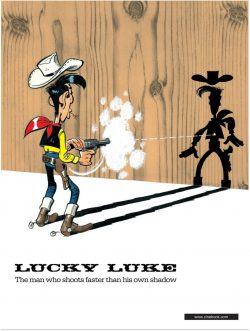
Doughty, rangy, and dashingly dependable, the cowboy is an implacably even-tempered do-gooder who can “draw faster than his own shadow”, amiably ambling around the mythic, cinematically realised Old West, enjoying light-hearted adventures on his petulant, stingingly sarcastic wonder-horse Jolly Jumper. Ever since that natal moment, his exploits in Le Journal de Spirou – and, from 1967, in rival periodical Pilote have made the sharpshooter a legend of stories across all media and monument of merchandising.

Working solo with occasional script assistance from his brother Louis, Morris produced 10 albums worth of affectionate and thrilling sagebrush parody before formally uniting with René Goscinny, who became regular wordslinger with Des rails sur la Prairie (Rails on the Prairie), which commenced in LJdS on August 25th 1955.

They literarily rode together on another 44 albums whilst Luke attained dizzying heights of superstardom. The partnership continued when the six-gun straight-shooter switched teams, transferring to Goscinny’s own magazine Pilote with La Diligence (The Stagecoach). When Goscinny died, Morris continued both singly and with fresh collaborators. The dream team’s last ride was 1986’s La Ballade des Dalton et autres histoires/The Ballad Of The Daltons and Other Stories.

Morris briefly went solo again before inviting an inspiring passel of legacy creators to step in: luminaries like Achdé & Laurent Gerra, Benacquista & Pennac, Xavier Fauche, Jean Léturgie, Jacques Pessis and more, who all took their own shots at the lovable lone rider. Morris died in 2001, having drawn fully 70 adventures, plus an assortment of sidebar and spin-off sagebrush sagas. Since 2016 Julien Berjeaut, AKA Jul (Silex and the City) has handled the tall tale telling…

Lucky is one of the top-ranked comic characters in the world, having generated 94 albums (if you count spin-off series like Kid Lucky and Ran-Tan-Plan, and artist’s specials) with sales well north of 300 million in 33 languages. That renown has translated into a mountain of merchandise, toys, games, animated cartoons, TV shows and live-action movies and even commemorative exhibitions. No theme park yet, but you never know…

Our taciturn trailblazer’s travails draw on western history as much as movie mythology and regularly interact with historical and legendary figures as well as even odder fictional folk as he re-explores and refines key themes of classic cowboy films – as well as some uniquely European notions and interpretations. As previously hinted, the happy wanderer is not averse to being a figure of political change and Weapon of Mass Satire… but not in this primal, heavily cartoon-short-influenced outing…

We Brits first encountered Lucky Luke in the late 1950s, syndicated to weekly comic Film Fun, and again in 1967 in Giggle, where he blazed trails as Buck Bingo. In all these venues – as well as in numerous attempts to capitalise on the English-language success of Tintin and Asterix albums from Brockhampton and Knight Books – Luke had his trademark cigarette hanging insouciantly from his lip, but in 1983 Morris – no doubt amidst both pained howls and muted mutterings of political correctness gone mad – substituted a piece of straw for the much-travelled dog-end, which garnered him an official tip of the hat from the World Health Organization. However, in this restored remastered but still prototypical collection, Lucky doesn’t smoke at all although violence and booze consumption are pretty constant. If that’s a problem, stop here and seek out another, later Lucky lark…

This collection re-presents the contents of the first album, released in 1949 as La Mine d’or de Dick Digger/Dick Digger’s Gold Mine. Gathering strips from Spirou #478-502) the serial unrolls in a riotous concatenation of fast-paced, rollercoaster rapid gag sequences like the screwball US animated features that inspired it, as Lucky helps recover the much-coveted map to a lost payload, causing great grief to the eponymous miner until our hero returns it to the true owner.

The album also includes a second serial romp. Le Journal de Spirou #505 (18th December 1947) began the third adventure, by which time the Lonesome Cowboy was clearly here to stay. Running until #527 (May 20th 1948) ‘Lucky Luke’s Double’ completed that landmark first compiled album: another riotous slapstick chase and comedy of errors as our hero is constantly mistaken for deadly desperado Mad Jim, much to the profit of minor crooks Stan Strand and Tiny Charley Chick. After much rowdy behaviour and larcenous hijinks, thanks to Jolly Jumper, justice and decency triumph in the end…

These youthful, prototypical and formative forays of an indomitable hero offer grand joys in the wry tradition of near-contemporary cinema classics like Destry Rides Again or Laurel & Hardy’s Way Out West – perfectly understandable as Morris was a devout fan of the immortal bumblers and their gentle but astonishingly imaginative action-slapstick capers. Superbly executed by a master storyteller these tales are a wonderful introduction to a unique genre for modern kids who might have missed the allure of a Wild West that never was…
© Dargaud Editeur Paris 1971 by Morris. © Lucky Comics. English translation © 2014 Cinebook Ltd.

Ginseng Roots


By Craig Thompson (Faber)
ISBN: 978-0-571-38661-1 (HB)

This is one of those reviews where I try quite hard not to say too much about the content, because it’s a sin and a form of theft to deprive readers of the joy of it unfolding just for them. You could and should just go buy this now and save time, but if I can’t convince you of that here, please read on and think again…

In no way a sequel to his landmark masterpiece Blankets but every inch and ounce as compelling, engaging and important, Ginseng Roots sees auteur Craig Thompson return to what you or I would deem an incredibly harsh – nigh-dystopian – childhood to craft another incredibly engaging paean of love and fond wonder to his home, his family and his extraordinary life.

In a book encompassing biographical revelation, philosophical rumination and religious re-exploration we see the auteur share incredibly candid events from his profession and career. Wrapped up in a most engaging, amusing and occasionally distressing tutorial on the history and global cultural significance of Ginseng, we see Thompson return to Wisconsin. The Thompson kids were raised in a fundamentalist Christian household, with the Rapture anticipated any day now, but it wasn’t all bad. They were loved, if ruled hard, and here we see how that panned out, as well as the transformative power of comics via a broad, deep and astonishingly informative yarn viewed through the ruminative lens of the Thompson family’s recollections of being child labourers for local farmers growing American Ginseng in the 1980s.

The way it all worked is unpicked with remarkable even-handedness, as the man who became a major force in his field of graphic narrative expression revisits those formative days before embarking on a quest to learn all he can of the How and Why of it all. This involves returning home before ultimately crisscrossing the world with little brother Phil to research a new graphic novel undertaken in the light of potentially losing all he could be to an inexorable physical decline: one destined to take away his self-defining ability to draw…

When first released in July 2003, Blankets started slowly before achieving monumental international fame and near-unanimous critical approval from comics’ Great & Good & Fabled. If you have a favourite author or artist they probably loved the book – and rightly so.

Taking 3½ years to create, Blankets won 3 Harvey Awards, 2 Eisners, 2 Ignatz Awards and a France’s Prix de la Critique. Translated into French, Italian, Spanish, Catalan, Portuguese, Greek, German, Norwegian, Danish, Dutch, Czech, Polish, Korean, Hungarian, Slovenian, Estonian, Serbian and Greek, it was latterly published in 17 foreign editions (so far) and kept on winning glittering prizes and acclaim. It’s also won a YALSA Popular Paperback for Young Adults prize: listed as one of Entertainment Weekly’s Top Ten Graphic Novels of All Time. You can expect Ginseng Roots to do as well or better, even if young love and tragic foredoomed passions have been downplayed in favour of the inexorable march of time, unsatisfied injustices, midlife crises and failing faculties.

Reading this, you will learn all about a wonder herb, global trade, Chinese medicine, Big Agriculture & pesticides, many flavours of immigrant workers, exploitation and corporate ruthlessness, the economic history of many nations, the narcotic tendencies of comic books of grade school kids, and so much about human nature, that you’ll probably laugh, cry and get angry quite a lot…

Originally released in serialised instalments by Uncivilized Book (between 2019 -2023, as Covid ravaged the US and the world) just as Craig Thompson was confronting presumed career burnout, impostor syndrome and the loss of his ability to draw, the fascinating pictorial discourse is divided into 12 chapters beginning with ‘Real Ginseng Runs’, as Craig, Phil and their sister Sarah reunite at the parental homestead and trade tales of the old days. The reminiscences blend with flashback and flashforwards in ‘Sister Species’ as the story of Ginseng from America expands, with ‘Broad Stripes’ covering the history of Wisconsin – especially the region around Marathon – and growth of Ginseng trading: its use by First Nations before colonisation, white/French and Christian exploitation after that, and eventually an unshakeable connection to Asian nations that bought it from Wisconsin’s farmers and entrenched rivalry with its clearly inferior Canadian competition…

Interviews with old friends and former employers begins in ‘Rock(s) & Roll(ie)’, augmented by modern convolutions in ‘MAGGA’ (Make American Ginseng Great Again!) and ‘Good Seed Sinks’, before Craig’s declining health is more extensively explored in ‘No More Cartoons’. This leads to a vast expansion of purpose that culminates in fact finding missions all over “the orient” and the undertaking of a major literary project as expanded upon in ‘Father Abraham’, ‘Dark Night of the Soil’ and ‘Insam Respects’, before all that global and historical interconnection is pulled together as one big ‘Red Thread’, and laid to bed in grand ‘Agricultural Appreciation’

So much better read than read about, this marvellously moving memoir and ruminatory treatise is backed up with full contextual ‘Notes’, genuinely evocative ‘Acknowledgments’ and bonus art from the little brother/willing accomplice and henchman on a ‘Phil(er) Page’ and closes with an extended cartoon ad for Craig’s other books – debut tome Good-bye Chunky Rice, Blankets, Carnet de voyage, Habibi and Space Dumplins. You should sample them too and Faber has them all in print for just that purpose.

Loving, informatively wistful and never angry or condemnatory, for such a weighty tome, Ginseng Roots is a remarkably quick and easy read, with Thompson’s imaginative and ingenious marriage of text and images carrying one along in the way only comics can. Expect his cartoon avatar of the root to be pinched and copied by ad men for some time to come…

Charming, engrossing and irresistible, this may well be Thompson’s best and most enduring book, but if fate and Ginseng will it, not his last as it is another perfect story in pictures.
This edition © 2025 by Craig Thompson. All rights reserved. Originally serialised by Uncivilized Books © 2019, 2021, 2021, 2022, 2023 by Craig Thompson.

Take That, Adolf! – The Fighting Comic Books of the Second World War


By Mark Fertig and many & various (Fantagraphics Books)
ISBN: 978-1-60699-987-5 (TPB/Digital edition)

This book includes Discriminatory Content produced in less enlightened times.

Long the bastion of the arcane, historic, esoteric and the just plain interesting arenas of the comics experience, Fantagraphics Books here celebrates the dawn age of Fights ‘n’ Tights funnybooks with a magnificent collection of (mostly) superhero covers culled from the fraught period which most truly defined the comics industry.

Comic book covers are a potent and evocative way of assessing the timbre of an era and a captivating shortcut into worlds far removed from our own. They are also half the sum total of fun generated by narrative art and arguably an art form all their own. In this torrid tome, educator, scholar and writer Mark Fertig (Chair of Art and Art History at Susquehanna University, Pennsylvania and revered film noir expert – check out his Where Danger Lives for more populist fun) offers an erudite, wide-reaching treatise comprehensively addressing every aspect of the four-colour Home Front’s graphic endeavours in support of America’s WWII war effort.

Detailing how Jewish émigré artists’ and writers’ creative influences advocated America surrender its isolationist stance in ‘Four Color Fantasies’ and ‘Building Towards War’, Fertig then traces the development of ‘Red, White, and Blue Heroes’ such as The Shield and Uncle Sam before ‘The Coming of Captain America’ sparks the invention of ‘An Army of Captains’.

After the USA finally enters the war ‘All-Out Assault: August & September 1941’  is followed by an examination of female masked fighters in ‘She Can Do It!’ and reveals how Wonder Woman became ‘An Amazon for the Ages’.

‘Kids Can Fight Too!’ reveals the impact of junior and underage crusaders as well as the sub-genre of Kid Gangs whilst ‘Attaboy, Steamboat!’ confronts head-on the depiction of ethnic characters – both vile foreign predators and monstrous conquerors and decent Pro-democracy non-white types…

From here in the distant future, some of the appalling jingoism and racism is even more disturbing than the tortures, torments and buckets of gore liberally scattered through the images of Evil Nazis and “Japs”…

Next ‘Into the Breach’ addresses the reasons omnipotent heroes such as Superman and Captain Marvel left the actual fighting in Europe and the Pacific to ordinary mortals before ‘Pulling Together’ details the promotion of Home Front solidarity munitions manufacture and the arming of the armies of Freedom. Then Hitler repeatedly gets his just deserts (in graphic effigy at least) ‘In Der Führer’s Face!’

‘Soldiers, Sailors, Airmen, and Marines!’ follows the development of more human fictional soldiers and heroes whilst ‘More Thrilling Than Fiction’ sees the beginnings of fact-based accounts of true champions such as President Roosevelt and General Eisenhower before ‘Pitch Men’ follows the numerous examples of masked warriors and kiddie-characters inciting readers to help pay for the war through selling war bonds and liberty stamps before ‘On to Victory’ celebrates the end of hostilities and the aftermath.

The fact-packed lecture is also supplemented at the back of the book by creator biographies of industry giants and iconic cover crafters Charles Clarence Beck, Jack Binder, Charles Biro, Hardin “Jack” Burnley, Reed Crandall, Will Eisner, Lou Fine, Irv Novick, Manuel “Mac” Raboy and Alex Schomburg (regarded as the most prolific cover illustrator of the period) but the true merit of this enchanting tome is the covers gathered for your perusal.

Designed to incite patriotic fervour and build morale, the awesome majority of this tome features a potent avalanche of stunning covers from almost every company, displaying not only how mystery men and superheroes dealt with the Axis of Evil in those tense times but also the valiant efforts of “ordinary fighting men” and even cartoon fantasy stars such as Bugs Bunny, Porky Pig and Walt Disney stars such as Mickey Mouse and Donald Duck

Shopping List Alert: Feel free to skip if you must…

This book celebrates an absolute torrent of spectacular, galvanising scenes of heroes legendary and obscure, costumed and uniformed, all crushing tanks, swatting planes, sinking U-Boats and decimating enemy ranks, and unleashed before your assuredly goggled eyes by artists long forgotten, and never known as well as more familiar names. This battalion of the worthy includes Joe Shuster, Joe Simon & Jack Kirby, Eisner, Harry G. Peter, Jack Burnley, Frank Harry, Irwin Hasen, Al Avison, Bob Powell, Edd Ashe, Harry Lucey, Paul Gustavson, Bill Everett, Jerry Robinson, Gus Ricca, Al Gabriele, Charles Sultan, Gene Fawcette, Louis & Arturo Cazeneuve, Gill Fox, Sam Cooper, Jim Mooney, Elmer Wexler, Fred Ray, Dan Zolnerowich, Don Rico, Max Plaisted, Howard Sherman, Everett E. Hibbard, Ramona Patenaude, Pierce Rice, Harry Anderson, Lin Streeter, Dan Gormley, Bernard Klein, Stephen Douglas, Martin Nodell, Charles Quinlan, Dan Noonan, Sheldon Moldoff, Henry Keifer, Marc Swayze, Carl Buettner, Charles A. Winter, Maurice, del Bourgo, Jack Warren, Bob Montana, Bob, Fujimori, Vernon Greene, George Papp, John Jordan, Syd Shores, John Sikela, Alex Blum, Ray Ramsey, R. Webster, Harry Sahle, Mort Leav, Alex Kotzky, Dan Barry, Al Camy, Stan Kaye, George Gregg, Art Saaf, George Tuska, Alexander Kostuk, Al Carreno, Fred Kida, Ruben Moreira, Sidney Hamburg, Rudy Palais, Joe Doolin, Al Plastino, Harvey K. Fuller, Louis Goodman Ferstadt, Matt Bailey, Ham Fisher, Walt Kelly, Wayne Boring, John Giunta, Creig Flessel, Harold Delay, Lee Elias, Henry Boltinoff, L.B. Cole and George Marcoux – plus oh so many more who did their bit by providing safe thrills, captivating joy and astounding excitement for millions.

These powerful, evocative, charming, funny, thrilling, occasionally daft and often horrific images are controversial these days. Many people consider them Art with a capital ‘A’ whereas close-minded, reactionary, unimaginative, bigoted die-hard poltroons don’t.

Why not Dig back in time (For Victory!) and make your own decision?
© 2017 Fantagraphics Books, Inc. Main text © 2017 Mark Fertig. All comics covers and illustrations herein © 2017 the respective copyright holders All rights reserved.

The Best of Eagle


By many & various including Frank Hampson, Alan Stranks & John Worsley, Harry Lindfield, John Ryan, Charles Chilton & Frank Humphris, Norman Thelwell, Edward Trice & E. Jennings, George Beardmore & Robert Ayton, Alan Jason & Norman Williams, Chad Varah, Frank Bellamy, Clifford Makin, Christopher Keyes, Peter Jackson, Peter Simpson & Pat Williams, George Cansdale, David Langdon, Ionicus/ Joshua Charles Armitage: edited by Marcus Morris (Michael Joseph Ltd./Mermaid Books)
ISBN: 978-0-71811-566-1 (tabloid HB) 978-0718122119 (tabloid TPB)

This book includes Discriminatory Content produced in less enlightened times.

Currently quite easily to find and well worth the effort is this upbeat pictorial memoir from the conceptual creator of arguably Britain’s greatest comic. Eagle was the most influential comic of post-war Britain, and launched on April 14th 1950, running until 26th April 1969. It was the brainchild of a Southport vicar, The Reverend Marcus Morris, who was worried about the detrimental effects of American comic-books on British children, and wanted a good, solid, Christian antidote. Seeking out like-minded creators he jobbed around a dummy to many British publishers for over a year with little success until he found an unlikely home at Hulton Press, a company that produced general interest magazines such as Lilliput and Picture Post.

The result was a huge hit that also spawned clones Swift, Robin and Girl – targeting other sectors of the children’s market – and generated radio series, books, toys and all other sorts of merchandising. The title and phenomenon also reshaped the industry, compelling UK comics colossus Alfred Harmsworth to release cheaper versions through his Amalgamated Press/ Odhams Fleetway/IPC in the far longer lived Lion (running from 23rd February 1952 to 18th May 1974) and its many companion titles such as Tiger and Valiant.

A huge number of soon-to-be prominent creative figures worked on Eagle, and although Dan Dare is deservedly revered as the star, many other strips were as popular at the time, and many even rivalled the lead in quality and entertainment value. At its peak the periodical sold close to a million copies a week, but eventually changing tastes and a game of “musical owners” killed Eagle. In 1960 Hulton sold out to Odhams, who became Longacre Press. A year later they were bought by The Daily Mirror Group who evolved into IPC. Due to multiple episodes of cost-cutting exercises, many later issues carried cheap Marvel Comics reprints rather than British originated material. It took time, but the Yankee cultural Invaders won out in the end.

In 1969 with the April 26th issue Eagle was merged into Lion, before eventually disappearing altogether. Successive generations have revived the title, but never the initial blockbuster success.

For this carefully crafted compilation Morris selected a wonderfully representative sampling of the comic strips that graced those pages of a Golden Age to accompany his recollection of events. Being a much cleverer time, with smarter kids than ours, the Eagle had a large proportion of scientific, historical and sporting articles as well as prose fiction.

Included here are 30+ pages reprinting short text stories, cut-away paintings (including the Eagle spaceship), hobby and event pages, sporting, science and general interest features – and it should be remembered that the company also produced six Eagle Novels and many and various sporting, science and history books as spin-offs between 1956 and 1960. Also on show here are many candid photographs of the times and the creators behind the pages.

Of course, the comic strips are the real gold here. Morris included 130 pages from his tenure on Eagle typifying the sheer quality of the enterprise. Alongside the inevitable but always welcome Hampson Dan Dare are selections from his The Great Adventurer and pioneering adfomercial Tommy Walls strips.

Other gems include The Adventures of P.C. 49 by Alan Stranks & John Worsley, Jeff Arnold in Riders of the Range by Charles Chilton & Frank Humphris, Chicko by Norman Thelwell, Professor Brittain Explains…’ Harris Tweed and Captain Pugwash by John Ryan, Cortez, Conqueror of Mexico by William Stobbs, Luck of the Legion by Geoffrey Bond & Martin Aitchison, Storm Nelson by Edward Trice & E. Jennings and Mark Question (The Boy with a Future – But No Past!) by Stranks & Harry Lindfield.

There are selections from some of the other glorious gravure strips that graced the title: Jack o’Lantern by George Beardmore & Robert Ayton, Lincoln of America by Alan Jason & Norman Williams, The Travels of Marco Polo by Chad Varah & Frank Bellamy, The Great Charlemagne and Alfred the Great (both by Varah & Williams).

Extracts from Bellamy & Clifford Makin’s legendary Happy Warrior and less well known The Shepherd King (King David), run beside The Great Sailor (Nelson) by Christopher Keyes, as well as The Baden Powell story (Jason & Williams) and even David Livingstone, the Great Explorer (Varah & Peter Jackson), and the monochrome They Showed the Way: The Conquest of Everest by Peter Simpson & Pat Williams makes an appearance.

The book is fabulously peppered with nostalgic memorabilia and such joys as George Cansdale’s beautiful nature pages and a host of cartoon shorts including the wonderful Professor Puff and his Dog Wuff by prolific Punch cartoonist David Langdon and Professor Meek and Professor Mild by Ionicus (illustrator Joshua Charles Armitage).

Also included is The Editor’s Christmas Nightmare by Hampson, a full colour strip featuring every Eagle character in a seasonal adventure that is still fondly remembered by all who ever saw (it and are still kicking)…

These may not all resonate with modern audiences but the sheer variety of this material should sound a warning note to contemporary publishers about the fearfully limited range of comics output they’re responsible for. But for most of us, it’s enough to see and wish that this book, like so many others, was back in print again.
Text © 1977 Marcus Morris. Illustrations © 1977 International Publishing Corporation. All Rights Reserved.

Neill Cameron’s Donut Squad: Take Over the World (Book 1)


By Neill Cameron & various (David Fickling Books)
ISBN: 978-1-78845-340-0 (Digest TPB)

Do You Like Donuts?

Only you can truly answer that question, but if you’re undecided, and dangerously unaware of the ramifications of indecision, rabid raconteur and art fiend Neill Cameron has many arguments you might want to consider before deciding, all jam-packed into a manic new compendium of strips, activities and artificially-sweetened exploits starring a bargain box of comics champions cherrypicked from modern British periodical treasure trove The Phoenix.

Since debuting in 2012 and just like The Beano, Dandy and other perennial childhood treasures, the wonderful weekly has masterfully mixed hilarious comedy with enthralling adventure serials… and frequently in the same scintillating strip. Everybody strapped in? Got your snacks? Then let’s go…

Crafted by Cameron (Mega Robo Bros, Freddy, Tamsin of the Deep, How to Make Awesome Comics, Pirates of Pangea), a unique team of toothsome adventurers convene here as ‘Meet the Squad!!’ cuts down confectionary crusaders dark horse Sprinkles, accident prone Jammyboi, Chalky (the ghost of a murdered Victorian Donut), violent vigilante Justice Donut, nerve-wracked Anxiety Donut, piratical Caramel Jack! (he’s a little bit salty!), Dadnut & Li’l Timmy, and utterly unknowable Spronky! who each individually regale us with short adventures liberally seasoned with lashings of ads for Donut Squad merch like T-shirts, mugs and orbital death-rays. Also probably not really available are fancy dress costumes, hats and giant pants, but you never know…

Although ruggedly individualistic, the assorted vignette stars all seem to work towards a communal conclusion as we explore many ‘Donut Mysteries’, examine ‘Rejected Donut Flavours’ and question the verities of existence in repeated ‘Ask your Father with Dadnut & Li’l Timmy’ episodes. Certainty of a greater world to come is verified via exploits of spectral phenomenon ‘The Cursed Donut’ whilst a reason for living is offered in ‘Meet the Donut Squad Babies! Basically the same but cuter!!’

Life is short and full of surprises so sometimes old friends simply don’t hang around. When Jammyboi shockingly makes his exit, the prospect of cleaner hands and unstained furnishings evaporates with the introduction of much messier messroom treat Choccy-plops – a revelation just crying out for more mirthful merch announcements. Oooh! Tea towels!

With the addition of ‘Sweetum! The Sweetest Donut of all!’ a narrative undercurrent starts carrying all later vignettes in the same direction, starting with ‘New Season! New Donut Flavours’ before Sprinkles details a tasty masterplan at the ‘Secret Donut Squad Meeting!’ outlining his efforts to enlist human converts and enrol them in the ‘Donut Squad Legion of Enthusiasm!’ The program is supplemented by all the latest ‘Conspiracy Theories!’ and the DSLoE ‘Code of Conduct’

Briefings on ‘Rare Donut Varieties’ are interrupted by an incursion by secret archfoes/sworn enemies the ‘Bagel Battalion’ (Private Plainbagel, Sergeant Sesameseed and Platoon Commander Poppyseed), but before everything gets too heavy we pause to peruse the wonders of ‘Donut Park’.

Sadly, such commercial distractions lead to more subversive assaults by the relentless foe, offering ‘New Bagel Flavours’ and prompting an arms race resulting in retaliatory experiments with ‘New Cheesier Donuts’

The carb-shot cold war hots up with a wave of ‘Bagel Battalion merchandise’ including ads for themed thermal vests, ties and protractor & compass sets garnishing counterintelligence sallies such as ‘Ask your Bagel father’. Initially wrongfooted, the sweet & sugary contingent can only resort to more theme park ads, even as ‘How to draw donuts’ features are swiftly counterbalanced by ‘How to draw bagels’ until all consumer confidence is shattered…

A public backlash begins, leading to a breaking of the doughy fourth law and some gutter crawling – and sniping – as ‘Anxiety Donut Has to Go on an Adventure!’, circumventing more mesmerising ads, and inadvertently spying on the Bagels before reporting back on their ‘Battle readiness’

Inevitably war boils over between the baked goods factions. The horrors culminate in the creation of an horrific ‘Bagel Battalion Metabomb’ and, after the deployment of all comestibles, tanks, skateboards and battle dinosaurs, the opposing forces calamitously clash. Cosmic destruction is only narrowly averted and when the powdered sugar settles we learn ‘Hooray! The Donut Squad is Victorious!’ and are not really surprised by a follow-up press release confirming ‘Hooray! The Donut Squad Have Taken Over the World!’

Smart, witty, laugh out loud weird and utterly bonkers, this seemingly piecemeal treat cunningly connects a whole bunch of stuff kids love without knowing why, but which totally bewilder us oldsters and keeps us in our place. Breezy eccentric and captivating, the sugar rush is counterpointed with a selection of Donut related artistic activities extracted from ‘The Phoenix Comic Club’, including drawing ‘Basic Shapes!’, adding ‘Flavour!’, ‘Personality!’, ‘Expression!’, ‘Poses’, ‘Extras!’, ‘Characters!’ and all aspects of ‘Storytelling!’

This manic missive then closes with a welcome extract from Cameron’s Mega Robo Bros just in case your kid is the only one who hasn’t read it yet. And don’t let anyone read it whilst eating…

Moreover, as all the best books and movies say: DONUT SQUAD WILL RETURN…
Text and illustrations © Neill Cameron 2025. All rights reserved.

Neill Cameron’s Donut Squad: Take Over the World! is scheduled for UK release on May 8th 2025 and is available for pre-order now.

Gorilla-Man


By Jeff Parker, Jason Aaron, Stan Lee, Larry Lieber, Giancarlo Caracuzzo, Jack Kirby, Bob Powell, Bob Q. Sale, Dick Ayers & various (MARVEL)
ISBN: 978-0-7851-4911-8 (TPB/Digital edition)

This book includes Discriminatory Content produced in less enlightened times.

Apes have long fascinated comics audiences, and although Marvel never reached the giddy heights of DC’s slavish and nigh ubiquitous exploitation of the Anthropoid X-factor, the House of Ideas also dabbled in monkey business over its many years of existence.

This slim mixed-bag of a tome gathers newer adventures of happily hirsute occasional hero Ken Hale – gregarious Gorilla-Man of resurrected 1950s super-group pioneers Agents of Atlas – culled from an eponymous 2010 3-issue miniseries and supplemented with pertinent material from Avengers vs. Atlas #4, X-Men First Class #8, plus a splendid grab bag of assorted earlier interpretations culled from the company’s back catalogue of anthology horror and mystery titles: specifically Men’s Adventures #26, Tales to Astonish #28 & 30 and Weird Wonder Tales #7.

What you need to know: the Agents of Atlas comprise rejuvenated 1950s super-spy Jimmy Woo and similarly vintaged superhuman crusaders Namora (Sub-Mariner’s cousin), spurious love-goddess Venus, a deeply disturbing, extremely unhuman Marvel Boy from Uranus, primitive wonder-robot M11 and the aforementioned anthropoid avenger. As the Atlas Foundation, these veterans surreptitiously fight for justice and a free world as the nominal leaders of a clandestine crime-cult which still thinks it’s being patiently guided towards the overthrow of all governments. The real power behind the organisation however is a terrible mystical dragon named Lao

The modern mainstream saga concentrates on ‘Ken Hale, the Gorilla-Man: The Serpent and the Hawk’ by Jeff Parker & Giancarlo Caracuzzo: exploring the anthropoid adventurer’s origins following a particularly bizarre battle against spidery cyborg Borgia Omega. In search of another action-packed mission, Hale spots a familiar face on an Atlas “wanted poster” and heads for Africa, flashbacking his past for us along the way.

It all began in Missouri in 1930 as a visiting big-shot spots something in a poor orphan kid holding his own against seven bigger boys who picked the wrong dirt-grubber to bully…

  1. Avery Wolward was a millionaire man-of-intrigue with interests all over the globe and for the next decade little Kenny became his companion and partner in a series of non-stop escapades that would make Indiana Jones green with envy. Ken learned a lot about life and loyalty, eventually discovering that Wolward owed much of his success to a mystical snake walking stick. Now that cane is in the hands of an African crime-lord calling himself Mustafa Kazun who’s well on the way to stealing an entire country and building an empire of blood…

Each miniseries issue was augmented by comedic faux email conversations between Hale and his social networking fans, and here delightfully act to buffer transitions between modern menace and reprinted monkey mystery vignettes. The first of these is ‘It Walks Erect!’, taken from 1974’s Weird Wonder Tales #7 which itself rescued the yarn from pre-Comics Code Mystery Tales #21 (cover-dated September 1954).

The story – by an unknown author but illustrated by the magnificent Bob Powell – concerns compulsive rogue surgeon Arthur Nagan whose obsession with brain transplants took a decidedly outré turn when his gorilla test subjects rebelled and wreaked a darkly ironic revenge upon him…

Slavish fanboys like me might remember Nagan as the eventual leader of arcane villain alliance The Headmen… but probably not…

Hale’s origin resumes as he and local agent Ji Banda are attacked by Kazun’s enslaved army, but that doesn’t stop the suave simian superman describing how a clash with Wolward’s arch rival Bastoc to recover an ancient bird talisman in Polynesia led the then-full-grown soldier-of-fortune to split with his mentor and enlist in the US military just before Pearl Harbor…

By the time the war ended Wolward was gone and the magnate’s daughter Lily had inherited both the family business and the walking stick…

After another message-board break, the classic ‘I Am the Gorilla Man’ (Tales to Astonish #28, February 1962, by Stan Lee, Larry Lieber, Jack Kirby & Dick Ayers) reveals how criminal genius Franz Radzik developed a mind-swapping process so that he could use a mighty ape body to commit robberies. Sadly the big brain forgot that, with its personality in a human body, the anthropoid might have its own agenda and unbridled opportunity…

The conclusion of ‘The Serpent and the Hawk’ sees Hale unite with a gorilla clan to overturn Kazun’s schemes and unlock the secret of the stick, even as his mind is firmly replaying his bad marriage to Lily, subsequent decline into drunken dissolution, recruitment by the arcane Mr. Lao, and eventual confrontation with a previous Immortal Gorilla-Man.

The role is an inherited one and a curse. To kill the undying Gorilla is to become him, and the previous victim had by this time had more than enough. Even after Hale refused to end the creature’s torment, it relentlessly followed him until it could trick the drunken mercenary into taking on the curse. However, after linking up with 1950s heroes such as Jimmy Woo and Venus, Hale found it truly liberating and grew to accept his new status…

Thus when Kazun’s true identity is revealed and the weary adventurer is offered a permanent if Faustian cure, Gorilla-Man makes the only choice a true champion can…

A final text presentation precedes Lee, Lieber, Kirby & Ayers’ ‘The Return of the Gorilla Man’ (Tales to Astonish #30, April 1962) wherein Radzik – still locked in a gorilla’s body – escapes captivity and frantically attempts to prove to scientists how smart he is.

Big mistake…

Fresh insight into Hale is provided by Jason Aaron & Caracuzzo’s ‘My Dinner with Gorilla-Man’ from Avengers vs. Atlas #4, wherein a desperate man with nothing to lose hunts down the ageless anthropoid, intent on fulfilling the ageless equation: “Kill the Gorilla and live forever”…

This is followed by a gleefully glorious romp from X-Men: First Class #8. ‘Treasure Hunters’ by Jeff Parker & Roger Cruz, finds the debut generation of Xavier’s mutants – Cyclops, Angel, Beast, Iceman & Marvel Girl – in the Congo and hunting for their missing teacher. Along the way they encounter a talking gorilla who becomes their guide, which inadvertently pulls reclusive hermit Hale out of a decades-long funk…

The collection concludes with the seminal supernatural suspense thriller that first introduced ‘Gorilla Man’ to the world. Again by an anonymous writer (possibly Hank Chapman) and limned by unique stylist Robert “Bob Q.” Sale, this evocative chiller from Men’s Adventures #26 (March 1954) offers a much grittier take on the origin, as a man terrified of dying and plagued by nightmares of fighting apes hears a crazy legend and heads for Kenya and an inescapable, horrific destiny…

Also included is a selection of 21st century covers by Dave Johnson, Leonard Kirk, Dave McCaig, Gabrielle Dell’Otto, Humberto Ramos, Edgar Delgado & Marko Djurdjevic, with the vintage frontages represented by Kirby, Lieber & Ayers.

Outrageous, over the top and never taking itself seriously, this is a riot of hairy scary fun-filled frolics and a perfect antidote to all those po-faced Costumed Dramas. I wonder if there’s a movie in this stuff?
© 1954, 2007, 2010 Marvel Characters, Inc. All rights reserved.

The Mighty Crusaders: Origin of a Super Team


By Jerry Siegel, Paul Reinman, Frank Giacoia, Joe Giella, Sam Rosen & various (Red Circle Productions/Archie Comics)
ISBN: 978-1-87979-414-6 (TPB)

This book includes Discriminatory Content produced in less enlightened times.

If you like your superheroes grim, gritty and ultra-serious you won’t like what follows, but honestly in the final analysis it’s not Chekhov or Shakespeare, just people in tights hitting each other, so why not lighten up and have a little fun?

In the early days of the US comic book biz, just after Superman & Batman ushered in a new genre of storytelling, a rash of publishers jumped onto the bandwagon and made their own bids for cash and glory. Many thrived and many more didn’t, relished only as trivia by sad old duffers like me. Some few made it to an amorphous middle-ground: not forgotten, but certainly not household names either…

MLJ were one of the quickest outfits to manufacture a mystery-man pantheon, following the spectacular successes of the Man of Tomorrow and Darknight Detective with their own small but inspirational pantheon of gaudily clad crusaders. Beginning in 1939 (one month after a little game-changer entitled Marvel Comics #1) with Blue Ribbon Comics #1 the MLJ content comprised a standard blend of two-fisted adventure strips, prose pieces and gag panels before, from #2 on, costumed heroes entered the mix. The company rapidly followed up with Top-Notch Pep Comics and many more. However, after only a few years Maurice Coyne, Louis Silberkleit and John Goldwater (hence MLJ) spotted a gap in the blossoming market and in December 1941 nudged aside their masked mystery men and action aces to make room for a far less imposing hero: an “average teen” who would have ordinary adventures like the readership, but with triumphs, romance and slapstick emphasised.

Cover dated December 1941, Pep #22 featured a gap-toothed, freckle-faced, red-headed goof who took his lead from the popular Andy Hardy movies starring Mickey Rooney. Goldwater developed the concept of a youthful everyman protagonist, tasking writer Vic Bloom and artist Bob Montana with the job of making it work. The 6-page tale introduced Archie Andrews, pretty girl-next-door Betty Cooper and his unconventional best friend and confidante Jughead Jones living in a small-town utopia called Riverdale. The feature was an instant hit and by the winter of 1942 had won its own title.

Archie Comics #1 was the company’s first solo-star magazine and with it began a gradual transformation of their entire output. With the introduction of rich, raven-haired Veronica Lodge, all the pieces were in play for the comic book industry’s second Genuine Phenomenon (as influential, if not so all-pervasive, as Superman). By 1946 the kids had taken over, and MLJ renamed itself Archie Comics: retiring its superheroic characters years before the end of the Golden Age to become, to all intents and purposes, a publisher of family comedies. Its success, like Superman’s, changed the content of every other publisher’s titles, spawning a multi-media empire generating TV shows, movies, apparel, and even a chain of restaurants. In the swinging sixties the pop hit Sugar, Sugar (a tune from their animated TV show) became a global smash and wholesome garage band The Archies has been a fixture of the comics ever since.

Nonetheless the company had by this stage blazed through a rather impressive legion of costumed champions – such as The Shield: America’s first patriotic superhero, predating Captain America by 13 months. A select core of these lost titans would communally form the backbone of numerous future superhero revivals, most notably during the “High-Camp”, “Marvel Explosion”, “Batmania” frenzied swinging Sixties…

Archie Comics had tentatively, and with a modicum of success, tried out new characters – Lancelot Strong: The Shield, The Fly and The Jaguar – when DC first began bringing back costumed champions in the late 1950’s and used the titles to cautiously revive some of their own Golden Age stable in the early 1960s. However, it wasn’t until superheroes became a global craze, fuelled as much by Marvel’s unstoppable rise as the Batman TV show, that the company committed to a full return of costumed craziness, albeit by what seemed to be mere slavish imitation…

The comedy specialists simply couldn’t take the venture seriously though and failed – or perhaps refused – to imbue the revitalised wonder people with drama and integrity to match the superficial zaniness. I suspect they just didn’t want to. As harmless adventures for the younger audience, the efforts of their “Radio Comics” imprint manifested a manic excitement and uniquely explosive charisma all their own, with hyperbolic scripting by Superman co-creator Jerry Siegel touching just the right note at exactly the key moment for a generation of kids…

It all began when The Fly (originally created by Joe Simon & Jack Kirby) was reborn as Fly-Man to milk the growing camp craze. He began incorporating mini-revivals of forgotten heroes such as The Shield, Comet and Black Hood in his highly imitative pages. With the addition of already-well established sidekick Fly-Girl, an oddly engaging, viable team was formed. Thus – for a couple of truly crazy years – Archie Comics rolled out their entire defunct pantheon for an exotic effusion of multicoloured mayhem before fading back into obscurity…

Here, then, is a deliciously indulgent slice of sheer backward-looking bluster and bravado from 2003 when the House of Wholesome Fun stuffed a selection of Silver Age appearances into a brace of slim – and still sadly overlooked – compilations. The Mighty Crusaders: Origin of a Super-Team collects the three tenuous team-ups from Fly-Man #31-33 (May – July 1965) plus the first issue of spin-off Mighty Crusaders (November 1965) which finally launched the extremely quarrelsome champions as an official squad of evil eliminators…

The wacky wonderment begins with a history lesson and loving appreciation in a ‘Foreword by Michael Uslan and Robert Klein’ before those first eccentric inklings of a new sensation are re-revealed in Fly-Man #31. As previously stated, Jerry Siegel provided baroquely bizarre, verbally florid scripts, deftly parodying contemporary storytelling memes of both Marvel and National/DC: plenty of pace, lots of fighting, a whirlwind torrent of characters and increasingly outrageous expository dialogue.

The artist was veteran illustrator Paul Reinman who had been drawing comics since the dawning moments of the Golden Age. His credits included Green Lantern, Sargon the Sorcerer, The Atom, Starman and Wildcat. He drew The Whizzer, Sub-Mariner and Human Torch at Timely and for MLJ produced strips in Blue Ribbon Comics, Hangman, Jackpot, Shield-Wizard, Top-Notch and Zip Comics involving such early stars as Black Hood, The Hangman and The Wizard. He even found time to illustrate the prestigious Tarzan syndicated newspaper comic strip. Reinman excelled at short genre tales for Atlas in the 1950s and became a key inker for Jack Kirby on the Hulk, Avengers and X-Men as the King irrevocably reshaped the nature of comics storytelling in the early 1960s…

Here he uses all that Fights ‘n’ Tights experience to depict ‘The Fly-Man’s Partners in Peril’ as criminal mastermind The Spider (nee Spider Spry) broke out of jail to attack his old enemy, only to have all his cunning traps spoiled by alien-equipped tech-master The Comet and, in second chapter ‘Battle of the Super-Heroes’, by The Shield and man of mystery Black Hood (whose irrepressible sidekick at this time was a miraculous robotic horse dubbed Nightmare)…

Caustically christening his foes The Mighty Crusaders, the villain attempts to ensnare them all in ‘The Wicked Web of the Wily Spider!’ but ultimately fails in his plot. The story ends with our heroes hotly debating whether they should formally amalgamate and swearing that whatever occurred they would never call themselves by the name The Spider had coined…

Two months later they were back in Fly-Man #32, battling an incredible psionic dictator from long-sunken Atlantis. With Fly-Girl “adding glamour” but unable to quell the boys’ fractious natures, the still un-designated team clash with many monstrous manifestations of ‘Eterno the Tyrant’ before confronting the time-lost terror and banishing him to trans-dimensional doom…

One final try-out appeared in Fly-Man #33 (September 1965) as boisterous bickering boils over into outright internecine warfare between ‘Fly-Man’s Treacherous Team-Mates’, all ably assisted by the evil efforts of vile villain The Destructor. The sort-of team had been recently joined by two more veterans climbing back into the superhero saddle, but both The Hangman and The Wizard subsequently succumbed to rapacious greed as the Fly Guys gathered billions in confiscated loot and tried to steal the ill-gotten gains for themselves…

Finally in November 1965 Mighty Crusaders #1 premiered (by Siegel & Reinman with a little inking assistance from Frank Giacoia & Joe Giella). ‘The Mighty Crusaders vs. the Brain Emperor’ sees the heroes bowing to the inevitable after incredible aliens attack at the bilious bidding of an extraterrestrial megamind who could enslave the most determined of individuals with the slightest wrinkling of his see-through brow. However, the mental myrmidon proves no match for the teamwork of Earth’s most experienced crime-crushers…

Also included in this captivating chronicle is a splendidly strange cover gallery by Reinman.

The heroes all but vanished in 1967, before impressively resurfacing in the 1980s (albeit as a straight dramatic iteration) under the company’s Red Circle imprint, but again failed to catch a big enough share of the reading public’s attention. Archie let them lie fallow – except for occasional revivals and intermittent guest-shots in regular Archie comedy titles – until 1991, when they licensed its entire cape-&-cowl cohort to superhero specialists DC Comics for a magically fun, all-ages iteration (and where are those star-studded curated collections, huh?!).

Impact Comics was a vibrant, engaging and fun all-ages rethink that really should have been a huge hit but was again incomprehensibly unsuccessful. When the line folded in 1993 the characters returned to limbo until called for one more collaborative crack at the big time in 2008, briefly incorporating Mighty Crusaders & Co into DC’s own maturely angst-ridden and stridently dark continuity – with the usual overwhelming lack of success.

In 2012 Archie began reinventing their superhero credentials with a series of online adventures under the aegis of a revived Red Circle subdivision, beginning with a second generation of The Mighty Crusaders (reinforced by traditional monthly print versions six months later) and latterly The Fox: new costumed capers emphasising fun and action which were equally welcoming to inveterate fanboys and eager newcomers alike, so there’s still hope for the crazy gang to make good…

Jerry Siegel’s irreverent, anarchic pastiche of Marvel Comics’ house-style utilising Archie’s aged pantheon of superheroes is one of the daftest yet most entertaining moments of superhero history, and the sentiment and style of these tales has become the basis of so much modern kids animation, everything from Powerpuff Girls to Batman: Brave and the Bold to Despicable Me. That tells me these yarns urgently need to be reissued because at last the world is finally ready for them…

Weird, wild and utterly over the top! This is the perfect book for jaded veterans or wide-eyed neophytes in love with the very concept of costumed heroes. C’mon, prove me wrong…
© 1965, 2003 Archie Comics Publications, Inc. All Rights Reserved.

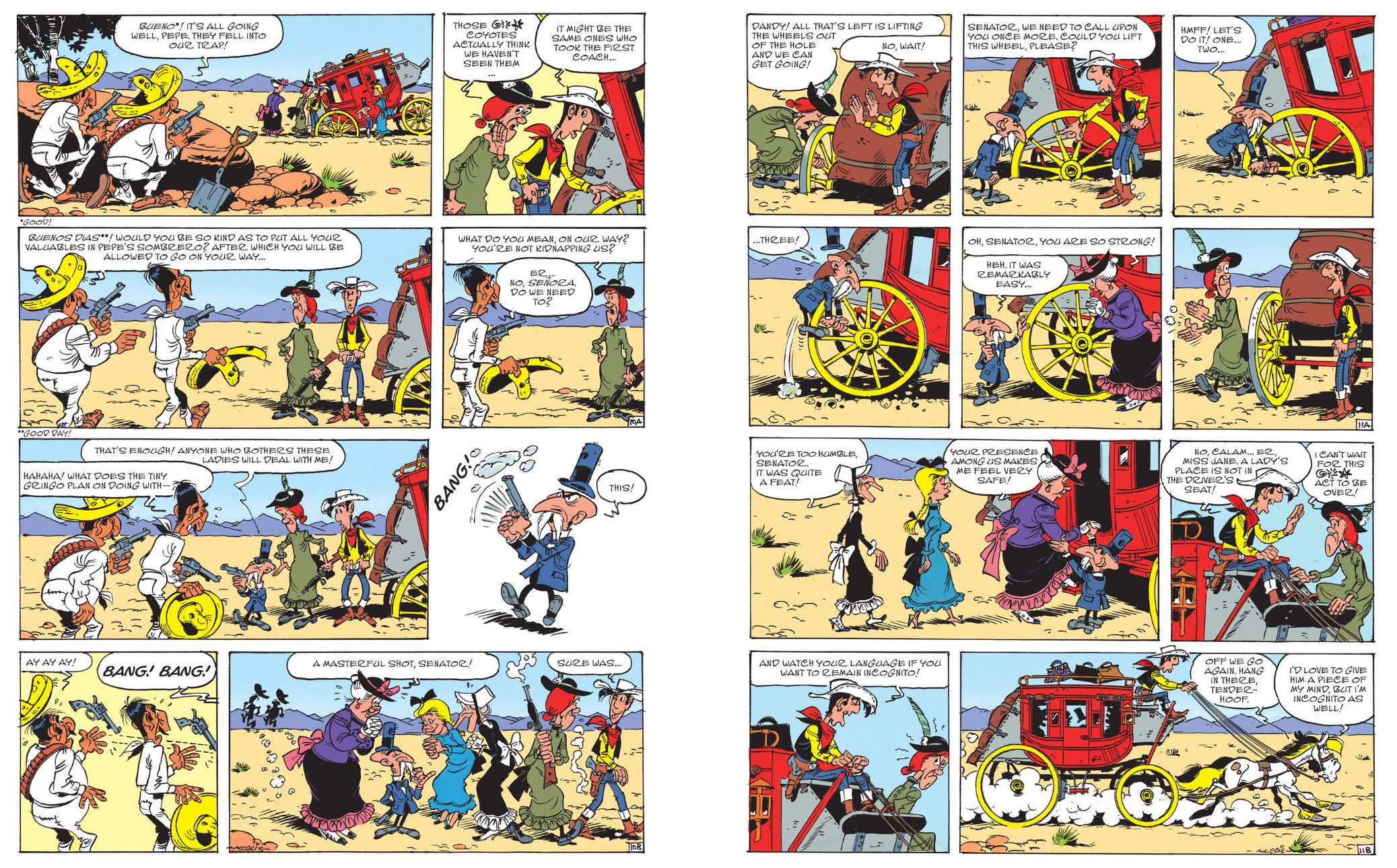
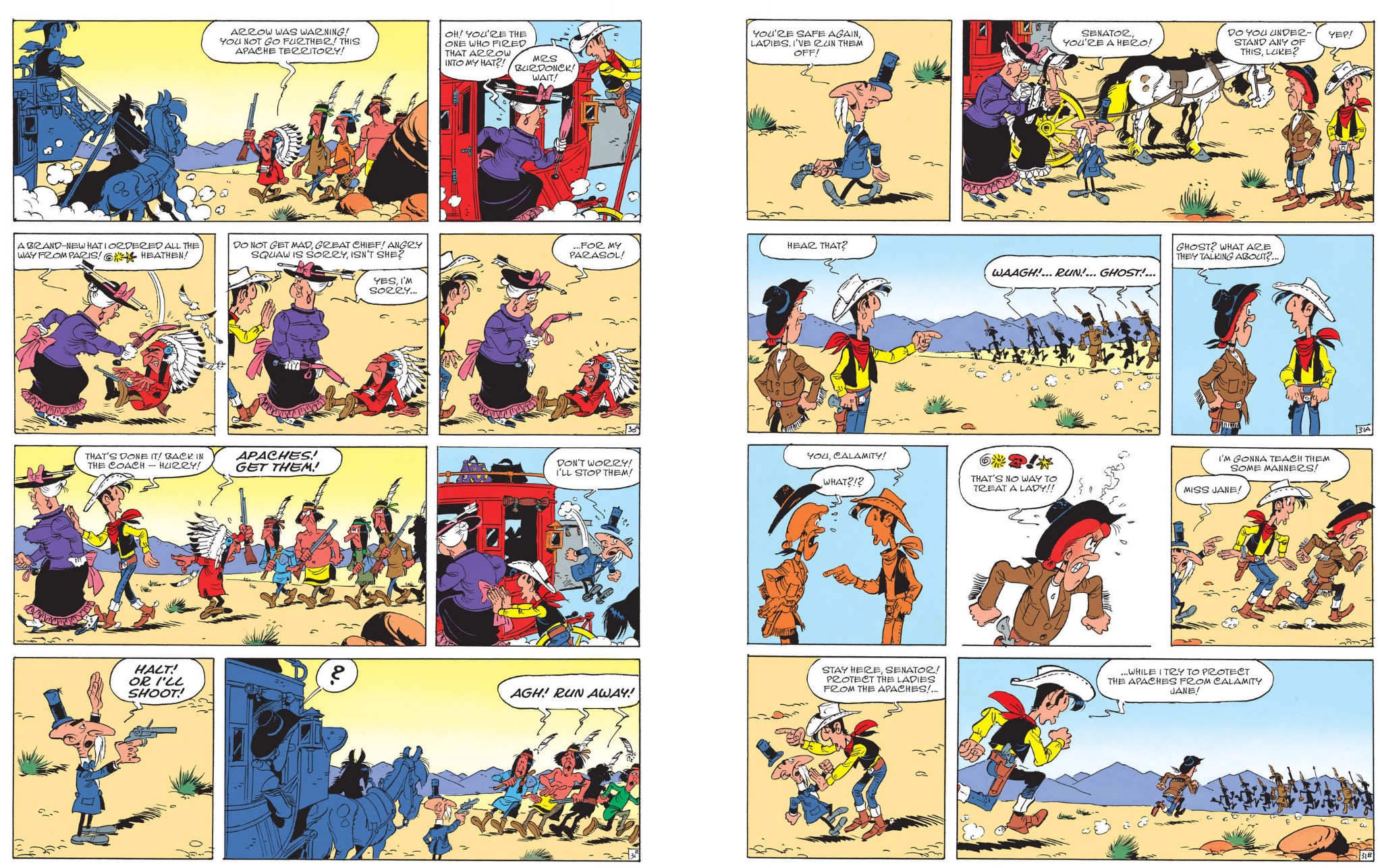
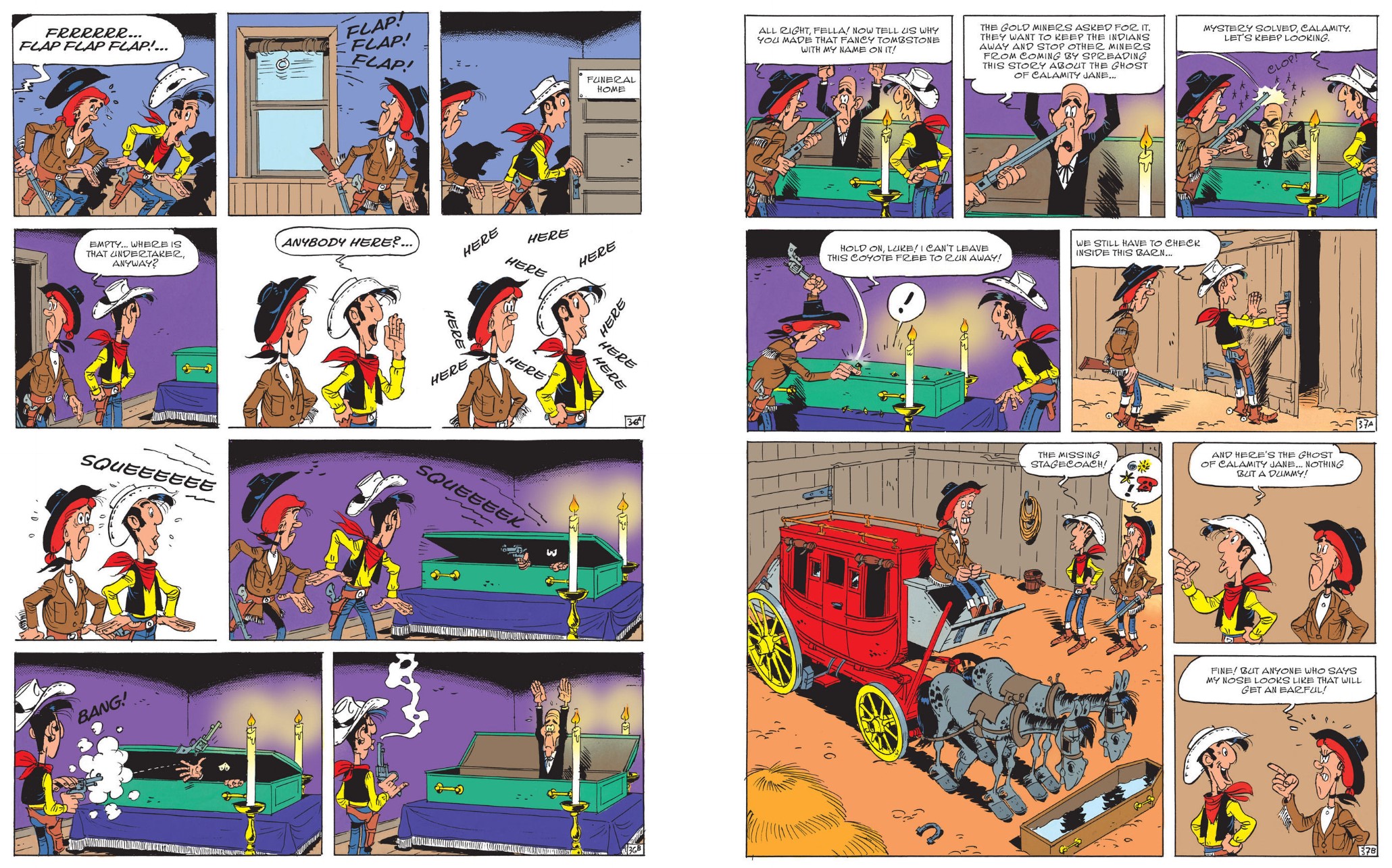
Lucky Luke volume 47: Outlaws


By Morris, translated by Jerome Saincantin (Cinebook)
ISBN: 978-1-84918-201-0 (Album PB/Digital edition)

This book includes Discriminatory Content produced in less enlightened times.

Doughty, rangy,and dashingly dependable cowboy Lucky Luke is an implacably even-tempered do-gooder who can “draw faster than his own shadow”. He amiably ambles around the mythic, cinematically realised Old West, having light-hearted adventures on his petulant and stingingly sarcastic wonder-horse Jolly Jumper. Over nine decades, his exploits in Le Journal de Spirou (and from 1967, in rival periodica Pilote) have made the sharp shooter a legend of stories across all media and monument of merchandising.

Working solo with occasional script assistance from his brother Louis, Morris – AKA Maurice de Bévère – produced 10 albums worth of affectionate and thrilling sagebrush parody before formally uniting with René Goscinny, who became regular wordslinger with Des rails sur la Prairie (Rails on the Prairie), which commenced in Le Journal de Spirou on August 25th 1955.

They literarily rode together on another 44 albums as Luke attained the dizzying heights of superstardom. The partnership continued when the six-gun straight-shooter switched teams, transferring to Goscinny’s own magazine Pilote with La Diligence (The Stagecoach). After Goscinny died, Morris continued both singly and with fresh collaborators. The dream team’s last ride was 1986’s La Ballade des Dalton et autres histoires/The Ballad Of The Daltons and Other Stories.

Morris worked alone again before inviting an inspiring passel of legacy creators to step in. These included Achdé & Laurent Gerra, Benacquista & Pennac, Xavier Fauche, Jean Léturgie, Jacques Pessis and others, who all took their own shots at the lovable lone rider. Morris died in 2001, having drawn fully 70 adventures, plus many sidebar and spin-off sagebrush sagas. Since 2016 Julien Berjeaut, AKA Jul (Silex and the City) has handled the tall tale telling…

Lucky is one of the top-ranked comic characters in the world, having generated 94 albums (if you count spin-off series like Kid Lucky and Ran-Tan-Plan, and artist’s specials) with sales totalling north of 300 million in 33 languages. That renown has translated into a mountain of merchandise, toys, games, animated cartoons, TV shows and live-action movies and even commemorative exhibitions. No theme park yet, but you never know…

Our taciturn trailblazer’s travails draw on western history as much as movie mythology and regularly interacts with historical and legendary figures as well as even odder fictional folk re-exploring and refining key themes of classic cowboy films – as well as some uniquely European notions and interpretations. As previously hinted, the happy wanderer is not averse to being a figure of political change and Weapon of Mass Satire… but not this time…

We Brits first encountered Lucky Luke in the late 1950s, syndicated to weekly comic Film Fun, and again in 1967 in Giggle where he blazed trails as Buck Bingo. In all these venues – as well as numerous attempts to capitalise on  the English-language success of Tintin and Asterix albums from Brockhampton and Knight Books – Luke had his trademark cigarette hanging insouciantly from his lip, but in 1983 Morris – no doubt amidst both pained howls and muted mutterings of political correctness gone mad – substituted a piece of straw for the much-travelled dog-end, which garnered him an official tip of the hat from the World Health Organization. In this restored remastered edition, the dogend is restored, so if that’s a problem, stop here and seek out another, later Lucky lark…

First published continentally in December 1954, Hors-la-loi was the 6th European album and an all Morris affaire comprising two short serials. Eponymous lead strip ‘Outlaws’ originally ran in LJdS #701-731 from September 20th 1951 to April 17th 1952, with our hero hired by the railroad companies to end the depredations of Emmett Bill, Grat and Bob Dalton: real life badmen who plagued the region during the 1890s, imported into the strip and given a comedic, but still vicious spin.

A cat & mouse chase across the wildest of wests sees Luke constantly frustrated by close calls and narrow escapes in superbly gripping movie set-pieces until, inevitably, justice claims the killers. At the close of this yarn, Morris had Lucky end the gang forever, but they and the story itself were insanely popular with fans. The villains were comedy gold and ideal foils for Lucky, so eventually they returned in the form of their own cousins, but we’ll tell that tale another time and place.

Actually, lets do some of it right now…

A certified Christmas must-have item, Lucky Luke album Outlaws also carried ‘Return of the Dalton Brothers’ – as first seen in LJdS #755-764 (October 2nd – December 4th 1952). Here, fraudster Bill Boney campaigns to become sheriff of a prosperous frontier town by claiming to be the killer of those infamous owlhoots. He is an absolute “wrong ‘un” but seems utterly unstoppable… until Lucky orchestrates a brief and equally fake resurrection of the bandit brothers. A little rampage and faux lynching and Boney learns a lesson that the townsfolk will never forget…

From the response to that tale eventually came the aforementioned revival, as Goscinny’s third collaboration introduced Les Cousins Dalton in issues #992-1013 (1957) of Le Journal de Spirou. When this iteration of the appalling Dalton BrothersAverell, Jack, William and devious, slyly psychotic, tyrannical diminutive brother Joe showed up, the course of the strip altered forever…

These youthful forays of an indomitable hero offer grand joys in the wry tradition of Destry Rides Again and Support Your Local Sheriff, superbly executed by a master storyteller: a wonderful introduction to a unique genre for modern kids who might well have missed the romantic allure of the Wild West that never was…
© Dargaud Editeur Paris 1971 by Morris. © Lucky Comics. English translation © 2014 Cinebook Ltd.