Super-Friends: Saturday Morning Comics volume 1


By E. Nelson Bridwell, Denny O’Neil, Ramona Fradon, Kurt Schaffenberger, Ric Estrada, Alex Toth, Joe Orlando, Bob Smith, Vince Colletta with Dick Giordano & various (DC Comics)
ISBN: 978-1-4012-9542-4 (HB/Digital edition)

Once upon a time comics were primarily created with kids in mind and, whilst I’d never advocate exclusively going back to those days, the modern industry has for the longest time sinned by not properly addressing the needs and tastes of younger fans these days. Happily, DC has latterly been rectifying the situation with a number of new and – most importantly for old geeks like me – remastered, repackaged age-appropriate gems from their vast back catalogue.

A superb case in point of all-ages comics done right is this massive (and frankly, rather expensive) tome. And don’t stress the title: it may celebrate the joys of past childhood shows but this book is definitely a great big Sunday “settle back and luxuriate” treat…

The Super Friends: Saturday Morning Comics volume 1 gathers the comic book tales which spun off from a popular Saturday Morning TV Cartoon show: one that, thanks to the canny craftsmanship and loving invention of lead scripter E. Nelson Bridwell, became an integral and unmissable component of the greater DC Universe.

It was also one of the most universally thrilling and satisfying superhero titles of the period for older fans: featuring the kind of smart and witty, straightforward adventures people my age grew up with, produced during a period when the entire industry was increasingly losing itself in colossal continued storylines and bombastic, convoluted, soap opera melodrama.

It’s something all creators should have tattooed on their foreheads: sometimes all you really want is a smart plot well illustrated, sinister villains well-smacked, a solid resolution and early bed…

The TV show Super Friends ran (under various iterations) from 1973 to 1986; starring primarily Superman, Batman and Robin, Wonder Woman, Aquaman and a brace of studio-originated kids as student crimebusters, supplemented by occasional guest stars from the DCU on a case by case basis. The animated series made the transition to print as part of the publisher’s 1976 foray into “boutiqued” comics which saw titles with a television connection cross-marketed as “DC TV Comics”.

Child-friendly Golden Age comicbook revival Shazam!- the Original Captain Marvel had been adapted into a successful live action series and its Saturday Morning silver screen stablemate The Secrets of Isis consequently reversed the process by becoming a comic book.

With the additions of hit comedy show Welcome Back Kotter and animated blockbuster Super Friends four-colour format, DC had a neat little outreach imprimatur tailor-made to draw viewers into the magic word of funnybooks.

At least that was the plan: with the exception of Super Friends none of the titles lasted more than ten issues beyond their launch…

This massive mega-extravaganza (part 1 of 2) collects Super Friends #1-26 (spanning November 1976 to November 1979), includes promo comic Aquateers Meet the Super Friends and reprints material from Limited Collectors’ Edition #C-41 and C-46. It also opens with a lovely and moving introduction from illustrator Ramona Fradon (Aquaman; Metamorpho the Element Man; Brenda Starr, Reporter).

The fun begins a crafty two-part caper by the wondrous E. Nelson Bridwell and illustrators Ric Estrada, Vince Colletta & Joe Orlando. ‘The Fury of the Super Foes’ finds heroes-in-training Wendy and Marvin – and their incredibly  astute mutt Wonderdog – studying at the palatial Hall of Justice, even as elsewhere, a confederation of villains prove that imitation is the sincerest form of flattery… if not outright intellectual theft.

Having auditioned a host of young criminals, The Penguin, Cheetah, Flying Fish, Poison Ivy and Toyman are creating a squad of sidekicks and protégés to follow in their felonious footsteps. At last Chick, Kitten, Sardine, Honeysuckle and Toyboy are all ready and willing to carry out their first caper…

When the giant “Troubalert” screen informs our heroes of a three-pronged attack on S.T.A.R. Labs’ latest inventions, the champion team split up to tackle the crises, but are thoroughly trounced until Wendy and Marvin break curfew to help them. As a result of the clash, Chick and Kitten are brought back to the Hall of Justice, but their talk of repentance is a rascally ruse and they secretly sabotage vital equipment…

Thankfully, Wonderdog has seen everything and quickly finds a way to inform the still-oblivious good guys in issue #2, but too late to prevent the Super Friends being briefly ‘Trapped by the Super Foes’…

Aided and abetted by inker Bob Smith, the incomparable Fradon became penciller with #3, as ‘The Cosmic Hit Man?’ sees 50 intergalactic super-villains murdered by infernal Dr. Ihdrom, who blends their harvested essences to create an apparently unbeatable hyper-horror and utterly overwhelm Earth’s heroic defenders. However, he falls victim to his own arrogance and Wendy and Marvin’s logical deductions…

‘Riddles and Rockets!’ sees the Super Friends overmatched by new ne’er-do-well Skyrocket whilst simultaneously trying to cope with a rash of crimes contrived by King of Conundra The Riddler. Soon a pattern emerges and a criminal connection is confirmed…

Author Bridwell (Secret Six; Inferior Five; Batman; Superman; The Flash; Legion of Super-Heroes; Captain Marvel/Shazam!) was justly famed as DC’s Keeper of Lore and Continuity Cop thanks to an astoundingly encyclopaedic knowledge of its publishing minutiae and ability to instantly recall every damn thing! ‘Telethon Treachery!’ gave him plenty of scope to display it with a host of near-forgotten guest-stars joining the heroes as they host a televised charity event whilst money-mad menace Greenback lurks in the wings, awaiting his moment to grab the loot and kidnap the wealthiest donors…

The Atom (Ray Palmer) plays a crucial role in stopping the depredations of an animal trainer using beasts as bandits in ‘The Menace of the Menagerie Man!’ before a huge cast change is unveiled in #7 (October 1977) with ‘The Warning of the Wondertwins’…

You know TV is very different from comics. When a new season of Super Friends aired, Wendy, Marvin and Wonderdog were abruptly gone, replaced without explanation by aliens Zan and Jayna and elastic-tailed space monkey Gleek. With room to extrapolate – and in consideration of fans – Bridwell explained the sudden change via a battle to save Earth from annihilation whilst introducing the newest student heroes’ in memorable style…

At the Hall of Justice Wendy and Marvin spot a spaceship hurtling to Earth on the Troubalert monitor and dash off to intercept it. Aboard are two siblings from distant planet Exor: a girl able to transform into animals and a boy who can become any form of water from steam to ice. They have come carrying an urgent warning…

Superman’s alien enemy Grax has resolved to eradicate humanity and devised a dozen different super-bombs and attendant weird-science traps to ensure his victory. The weapons are scattered all over Earth and even the entire Justice League cannot stretch its resources to cover every angle and threat. To Wendy and Marvin the answer is obvious: call upon the help and knowledge of hyper-powered local heroes…

Soon Superman and Israel’s champion The Seraph are dismantling a black hole bomb whilst Elongated Man and titan-tressed Godiva perform similar service on a life-eradicator in England. Flash (Barry Allen) and mighty-leaping Impala dismantle uncatchable ordnance in South Africa. Hawkman and Hawkwoman join Native American avenger Owlwoman to crush darkness-breeding monsters in Oklahoma whilst from the Hall of Justice Wendy, Marvin and the Wonder Twins monitor the crisis with a modicum of mounting hope…

The cataclysmic epic continues in #8 with ‘The Mind Killers!’ as Atom and Rising Son tackle a device designed to decimate Japan, even as in Ireland Green Lantern Hal Jordan and Jack O’Lantern battle multi-hued monstrosities before switching off their technological terror.

In New Zealand, time-scanning Tuatara tips off Red Tornado to the position of a bomb cached in the distant past and Venezuela’s doom is diverted through a team-up between Batman and Robin and reptile-themed champion Bushmaster, whilst Taiwan benefits from a melding of sonic superpowers possessed by Black Canary and the astounding Thunderlord…

The saga soars to a classic climax with ‘Three Ways to Kill a World!’ in which the final phases of Grax’s scheme finally fail thanks to Green Arrow and Tasmanian Devil in Australia, Aquaman and Little Mermaid in the seas off Denmark and Wonder Woman and The Olympian in Greece.

Or at least, they would have if the Hellenic heroes had found the right foe. Sadly, their triumph against Wrong-Place, Right-Time terrorist Colonel Conquest almost upset everything. Thankfully, the quick thinking students send an army of defenders to Antarctica where Norwegian novice Icemaiden dismantles the final booby-trap bomb.

However, whilst the adult champions are thus engaged, Grax invades the Hall of Justice seeking revenge on the pesky whistleblowing Exorian kids. He is completely unprepared for and overwhelmed by Wendy, Marvin and Wonderdog, who categorically prove they’re ready to graduate to the big leagues…

With Zan and Jayna enrolled as the latest heroes-in-training, Super Friends #10 details their adoption by Batman’s old associate – and eccentric time travel theoretician – Professor Carter Nichols, just before a legion of alien horrors arrive on Earth to teach the kids that appearances can be lethally deceiving in ‘The Monster Menace!’

‘Kingslayer’ then pits the heroes against criminal mastermind Overlord who has contracted the world’s greatest hitman to murder more than one hundred leaders at one sitting…

Another deep dive into DC’s past resurrected Golden Age titans T.N.T and Dan, the Dyna-Mite in ‘The Atomic Twosome!’ The 1940s mystery men had been under government wraps ever since their radioactive powers began to melt down, but when an underground catastrophe ruptures their individual lead-lined vaults, the Super Friends are called in to prevent potential nuclear nightmare…

The subterranean reason for the near tragedy is tracked to a monstrous mole creature, and leads to the introduction of eternal mystic Doctor Mist, who reveals the secret history of civilisation and begs help to halt ‘The Mindless Immortal!’, before its random burrowing shatters mankind’s cities. Bridwell built a fascinating new team concept that would come to support decades of future continuity…

Super Friends #14 opens with ‘Elementary!’; introducing four ordinary mortals forever changed when they are possessed by ancient sprits and tasked by Overlord with plundering the world. When the heroes scotch the scheme, Undine, Salamander, Sylph and Gnome retain their powers and become a crime-fighting team – The Elementals…

The issue also contains a short back-up illustrated by Kurt Schaffenberger & Bob Smith. ‘The Origin of the Wondertwins’ at last reveals how the Exorian genetic throwbacks – despised outcasts on their homeworld – fled from a circus of freaks and uncovered Grax’s plot before taking that fateful voyage to Earth…

Big surprises come in ‘The Overlord Goes Under!’ (Fradon & Smith) as the Elementals begin battling evil by joining the Super Friends in crushing the crook. All the heroes are blithely unaware that they are merely clearing the way for a far more cunningly and subtle mastermind to take Overlord’s place…

‘The People Who Stole the Sky!’ in #16 is a grand, old-fashioned alien invasion yarn, foiled by the team and the increasingly adept Wonder Twins whilst ‘Trapped in Two Times!’ has Zan and Jayna used by the insidious Time Trapper (nee Time Master) to lure the adult heroes into deadly peril on planet Krypton in the days before it detonated, and future water world Neryla in the hours before it’s swallowed by its critically expanding red sun.

After rescuing the kids – thanks largely to Superman’s legendary lost love Lyla Ler-Rol – the Super Friends employ Tuatara’s chronal insight and Professor Nichol’s obscure chronal methodologies to hunt the Trapper in a riotous yet educational ‘Manhunt in Time!’ (art by Schaffenberger & Smith), by way of Atlantis before it sank, medieval Spain and Michigan in 1860CE, to thwart a triple-strength scheme to derail history and end Earth civilisation…

SF #19 sees the return of Menagerie Man in ‘The Mystery of the Missing Monkey!’ (Fradon & Smith) as the animal exploiter appropriates Gleek: intent on turning his elastic-tailed talents into a perfect pickpocketing tool, after which Denny O’Neil (writing as Sergius O’Shaugnessy) teams with Schaffenberger & Smith for a more jocular turn.

Chaos and comedy ensue when the team tackles vegetable monsters unleashed when self-obsessed shlock-movie director Frownin’ Fritz Frazzle uses Merlin’s actually magical Magic Lantern to make a “masterpiece” on the cheap in ‘Revenge of the Leafy Monsters!’…

Bridwell & Fradon return in #21 where ‘Battle Against the Super Fiends!’ has the heroes travelling to Exor to combat super-criminals who can duplicate their power-sets, after which ‘It’s Never Too Late!’ (#22, O’Shaugnessy, Fradon & Smith) reveals how time bandit Chronos subjects the Super Friends to a chronal-delay treatment rendering them perennially too late to stop him – until Batman and the Wonder Twins out-think him…

The Mirror Master divides and banishes teachers from students in #23 but is ultimately unable to prevent an ‘SOS from Nowhere!’ (Bridwell, Fradon & Smith) to the Flash. This episode also spends time fleshing out the Wonder Twins’ earthly secret identities as Gotham Central highschoolers John and Joanna Fleming…

With” O’Shaugnessy” scripting, ‘Past, Present and Danger!’ sees Zan and Jayna’s faces found engraved on a recently-unearthed Egyptian pyramid. Upon investigation inside the edifice, the heroes awaken two ancient exiles who resemble the kids, but who are in truth criminals who fled Exorian justice thousands of years previously. How lucky, then, that the kids are perfect doubles that the villains can send back with the robot cops surrounding the pyramid… once they’ve got rid of the Earthling heroes…

Enjoying promotion through treachery, the habitually harassed “Underling” has seized power at last in Bridwell’s ‘Puppets of the Overlord’, and uses forbidden technology to mind-control the adult and junior heroes. Happily, international champions Green Fury (later Fire), Wonder Woman’s sister Nubia, Tasmanian Devil and Seraph can join Green Lantern and Queen Mera of Atlantis in delivering a liberating solution, after which this splendid selection of super thrills pauses with #26 as Bridwell, Fradon & Smith bring back some old friends and enemies for ‘The Wondertwins’ Battle of Wits!’ as a scheming former Bat-foe enacts an infallibly murderous plot…

Rounding out the frenetic fun is a features section that includes the Alex Toth cover from Limited Collectors’ Edition #C-41,and new material from sequel C-46: a comic strip collaboration with Bridwell on introductory tale ‘Super Friends’ which was a star-studded framing sequence for a big reprint issue of Justice League classics.

The wonders are further augmented by Toth’s comprehensive pictorial essay on creating ‘TV Cartoons’ (with contributions from Bob Foster), plus his ‘The JLA on TV’ model sheets, and designs of The Hall of Justice’ by Terry Austin. Toth was the lead designer on the characters’ transition to TV animation.

The extras go on with mini-comic Aquateers Meet the Super Friends – a 1979 promotional giveaway included with every purchase of Super Friends Swim Goggles. An uncredited framing sequence (which looks like a Continuity Associates project that Dick Giordano & Frank McLoughlin had a hand in) segues into ‘The Greatest Show on Water’ – an Aquaman short originally published in Adventure Comics #219, December 1955.

That’s followed by ‘ “Super Fans Letters” Letters Pages’ from Super Friends #1-3, offering potted histories of DC heroes and villains, ‘The Super Friends Subscription’ house ad from #26 and Alex Ross’ painted cover from 2001 book Super Friends!

With covers by Fradon, Smith, Schaffenberger, Colletta, Ernie Chan and more, this initial compendium is superbly entertaining, masterfully crafted and utterly engaging. It offers stories of pure comics gold to delight children and adults in equal proportion. Truly generational in appeal, they are probably the closest thing to an American answer to the magic of Tintin or Asterix and no family home should be without this tome.
© 1976, 1977, 1978, 1979, 2001, 2020 DC Comics, Inc. All Rights Reserved.

Barnaby volume 3 


By Crockett Johnson with Ted Ferro & Jack Morley (Fantagraphics Books) 
ISBN: 978-1-60699-823-6 (HB/Digital editions) 

This is one of those rare books worthy of two reviews. So, if you’re in a hurry… 

Buy Barnaby volume 3 – and all the rest – right now. It’s one of the five best newspaper comic strips of all time and this lavish hardcover/digital compilation has lots of fascinating extras. If you harbour any yearnings for the lost joys of childish wonder and the suspicious glee in catching out adults trying to pull a fast one, you would be crazy to miss this book… 

However, if you’re still here and need a little more time to decide… 

The once-huge range and breadth of newspaper strips – continuity drama, adventure strips or informational/sports inspired – has all but faded away as the 21st century proceeds. Cartoon strips aren’t a dying art form though: merely moved on to less valuable property in cyber-space. Check out the magnificent and resurgent return of Berke Breathed’s Bloom County – as released whenever he wants on Facebook…  

Back in the tangible world of typesetting, if a paper actually still runs any strips – as opposed to editorial cartoons – chances are they will be of the episodic variety typified by reprints of Charles Shultz’s Peanuts or the latest hot movie/media spin-off rather than series like Doonesbury or Prince Valiant which demand a little conspicuous consistency and regular attendance from the readership.  

You can describe the most popular strips such as Garfield or Hagar the Horrible as single-idea pieces with a set-up, delivery and punch-line, all rendered in a sparse, pared-down-to-basics drawing style. In that they’re nothing new and there’s nothing wrong any of that ilk on their own terms. 

Narrative impetus comes from the unchanging characters themselves, and a building of gag-upon-gag in extended themes. The advantage to the newspaper was always obvious. If you like a strip it encourages you to buy the paper. If you miss a day or two, you can return fresh at any time having, in real terms, missed nothing. 

Such was not always the case. Once upon a time the daily “funny” – comedic or otherwise – was a crucial circulation preserver and builder, with lush, lavish and magnificently rendered fantasies or romances rubbing shoulders with thrilling, moody masterpieces of crime, war, sci-fi and everyday melodrama, and the always-unmissable delights of legion of humour strips which maintained and sustained an avid, devoted following. 

And eventually came Barnaby, which in many ways bridged the gap between then and now. 

On April 20th 1942, with America at war for the second time in 25 years, liberal New York tabloid PM began running a kids’ strip which was simultaneously the most whimsically addicting, socially seditious and ferociously smart satire since Al Capp’s Li’l Abner – another utter innocent left to the mercy of scurrilous worldly influences. 

Crockett Johnson’s outlandish 4-panel daily was the product of a perfectionist who didn’t particularly care for comics, but who – according to celebrated strip historian Ron Goulart – just wanted steady employment… 

David Johnson Leisk (October 20th 1906-July 11th 1975) was an ardent socialist, passionate anti-fascist, gifted artisan and brilliant designer who had spent much of his working life as a commercial artist, Editor and Art Director. Born in New York City and raised in the outer wilds of Queens when it was still semi-rural (in Flushing Meadows near the slag heaps which would eventually house two New York World’s Fairs), “Dave” studied art at Cooper Union (for the Advancement of Science and Art) and New York University before leaving early to support his widowed mother.  

This entailed embarking upon a hand-to-mouth career drawing and constructing department-store advertising. He supplemented his income with occasional cartoons to magazines like Collier’s before becoming an Art Editor for magazine publisher McGraw-Hill. He also started a moderately successful, “silent” strip called The Little Man with the Eyes. 

Johnson divorced his first wife in 1939 and moved out of the city to Connecticut, to share an ocean-side home with student (and eventual bride) Ruth Krauss. Ceaselessly looking to create that steady something, almost by accident he devised a masterpiece of comics narrative… 

However, if friend Charles Martin hadn’t seen a prototype Barnaby half-page lying around the house, it might never have existed. Thankfully, Martin hijacked the sample, parlaying it into a regular feature in prestigious highbrow leftist PM simply by showing the scrap to the paper’s Comics Editor Hannah Baker. Among her other notable finds was a strip by Theodor (“Dr.”) Seuss Geisel which would run contiguously in the same periodical. Despite Johnson’s initial reticence, within a year Barnaby was the new darling of the intelligentsia… 

Soon came book collections, talk of a Radio show (in 1946 it was adapted as a stage play), a quarterly magazine and rave reviews in Time, Newsweek and Life. A small but rabid fan-base ranged from politicians and smart set paragons like President and First Lady Roosevelt, Vice-President Henry Wallace, Rockwell Kent, William Rose Benet and Lois Untermeyer to ultra-cool celebrities such as Duke Ellington, Dorothy Parker, W. C. Fields and legendary New York Mayor Fiorello La Guardia. Of course, the last two might only have checking the paper because the undisputed, unsavoury star of the strip was a scurrilous if fanciful amalgam of them both… 

Not since George Herriman’s Krazy Kat had popular culture so infiltrated the halls of the mighty, whilst largely passing way over the heads of the masses or without troubling the Funnies sections of mass-circulation papers. Over its 10-year run (April 1942 to February 1952), Barnaby was only syndicated to 64 papers nationally – a combined circulation of just over five and a half million – but it kept Crockett (a childhood nickname) and Ruth in relative comfort whilst America’s Great & Good constantly agitated on the kid’s behalf. 

What more do you need to know?  

One dark night, during an air raid drill, a little boy wished for a Fairy Godmother and something strange and disreputable fell in through his window… 

Barnaby Baxter is a smart, ingenuous and scrupulously honest pre-schooler and his ardent wish was to be an Air Raid Warden like his dad. Instead he was “adopted” by a short, portly, pompous, distinctly unsavoury and wholly discreditable windbag with pink pixie wings. 

Installing himself as the lad’s “Fairy Godfather”, Jackeen J. O’Malley was a card carrying-member of the Elves, Gnomes, Leprechauns and Little Men’s Chowder and Marching Society – although he hadn’t paid dues in years. A lazier, more self-aggrandizing, mooching old glutton and probable soak could not be found anywhere. To be fair, although he certainly frequented taverns, he only ever raided the Baxter’s icebox, pantry and humidor, never their drinks cabinet…  

Due more to intransigence than evidence – there’s always plenty of physical proof, debris and fallout whenever O’Malley has been around – Barnaby’s parents adamantly refuse to believe in an ungainly, insalubrious sprite, whose continued presence hopelessly complicates the sweet boy’s life. Their abiding fear is that Barnaby was cursed with Too Much Imagination… 

In earlier episodes, O’Malley became implausibly – and almost overnight – an unseen and reclusive public Man of the Hour, preposterously translating that dubious cachet into a political career by accidentally becoming a patsy for a corrupt political machine. In even more unlikely circumstances O’Malley was elected to Congress… 

This strand gave staunchly socialist cynic Johnson ample opportunity to lampoon the electoral system, pundits and public. As usual, Barnaby’s folks perpetually overruled their boy: assertively assuring him the O’Malley grown-ups had elected was not a little man with pink wings… 

Despite looking like a fraud – he’s almost never seen using his magic and always has one of Dad’s stolen panatela cigars as a substitute wand – J. J. O’Malley is the real deal: he’s just incredibly lazy, greedy, arrogant and inept. He does – sort of – grant Barnaby’s wishes… but never in ways that might be anticipated… 

Once O’Malley got his foot in the door – or through the bedroom window – a succession of bizarre characters also turned up to baffle and bewilder poor Barnaby and Jane Shultz, the sensible little girl next door who was also privileged to perceive the pompous pixie.  

Even Barnaby’s new dog Gorgon was an oddity. The pooch could talk – but never when adults were around, and only with such staggering dullness that everyone listening wished him as mute as other mutts. More mythical oddballs and irregulars included timid ghost Gus; Atlas the Giant (a 2-foot tall, pint-sized colossus unimpressive until he got out his slide-rule to demonstrate that he was, in fact, a Mental Giant); Gridley the Salamander (a “Fire Pixey” who couldn’t raise a spark even if supplied with matches and gasoline); water hating sea god Davey Jones and puny Puritan pixie Cousin Myles O’Malley.  

The greatest of these wry creations was Launcelot McSnoyd: invisible Leprechaun and O’Malley’s personal gadfly, persistently proffering harsh, ribald counterpoints and home truths to the Godfather’s self-laudatory pronouncements… 

Johnson continually expanded his bizarre cast of gremlins, ogres, ghosts, policemen, bankers, crooks, financiers and stranger personages – all of whom could see O’Malley – while the unyieldingly faithful lad’s parents were always too busy and obdurately certain the Fairy and all his ilk were unhealthy, unwanted, juvenile fabrications. 

The officious elf’s schemes grew evermore fanciful. He was a boxing impresario, attempted to have constructed two utterly unnecessary hydroelectric dams, wrote the definitive text on Pixie Anthropology and usurped running the factory managed by Barnaby’s father. After that O’Malley campaigned in the then-ongoing Presidential Election, tried crime-busting and even took a turn as a most improbable Wall Street wizard and publishing mogul.  

This third tipsy-turvy treasury opens with hearty appreciation from award-winning cartoonist Jeff Smith in the Foreword before Nathalie op de Beeck’s ‘Notes on a Haunted Childhood’ details the relationship of the author to his signature character, after which the whimsical wonderment resumes with the strips spanning January 1st 1946 to December 31st 1947. The serialised silliness opens with a delicious and delirious assault on the growing phenomenon of radio quiz shows as ‘Our Next Contestant, Mr. O’Malley’ (January 2nd -February 2nd). Seeking finance for making his prospective movie masterpiece the overconfident oaf inveigles his way onto the “Detect and Collect Show” but things don’t go quite his way… 

His overall scheme remains becoming ‘J. Darryl O’Malley, Movie Mogul’ (February 4th – March 16th) but when a suitable text for his magnum opus cannot be found he opts to pen his own bestselling book first. However, since he’s such a busy magnate, he eventually gets Gus to ghost-write for him while he secures stars. A simple phone call to Hollywood creates a storm of chaos in the glitzy land where Dreams Come True, scripts are judged by weight and page count and a confidant lie is the ultimate weapon… 

As sparks fly in Hollywood, the elf has already moved on. Taking umbrage at the senior Baxter’s perpetual rubbishing of his very existence ‘Professor O’Malley’ (March 16th – April 4th) seeks to prove his bona fides through atomic age Science and arranges a lecture on mythological folk, inviting Gridley, McSnoyd, Atlas, Gus and more. Tragically, a mix-up in scheduling venues soon scuppers the plan… 

As a result of the confusion, the Baxter and Schultz pantries and iceboxes took particularly significant hits and the astounded, anxious parents call in the police to track down ‘The Refrigerator Bandit’ (April 5th – May 11th). Filled with civic outrage, O’Malley joins the hunt, even organising a unique posse of his comrades, but somehow that only leads to greater atrocities on already abused larders… and now extends to cigar humidors…  

Midsummer madness is sparked when Mr. Baxter is cajoled into joining the office baseball team and the ever-helpful Fairy Godfather decides to offer the benefits of his vast coaching experience in ‘O’Malley at the Bat’ (May 13th – June 22nd). Although dad is unaware, the pixey and his team are in there, pitching for him… 

When Gorgon begins feeling enclosed and claustrophobic, hungry for a place of his own, the sensible suggestion of a dog house rapidly escalates into another major human headache and the absolutely unnecessary solution of ‘The J. J. O’Malley Housing Project’ (June 24th – August 24th). At a time when America faced an accommodation crisis, the Pixie’s posturing and proposal of “the Baxter Plan” soon triggers a land rush and city scandal with a totally bewildered Pa Baxter suddenly seconded to the City School Board. What a surprise then, when the always unseen winged wonder decides to open ‘The O’Malley School’ (August 26th – November 2nd) and radically reform the way teaching works… 

If you’re of an historical mien, during this strip, Johnson’s assistants Ted Ferro and Jack Morley began signing strips even as the teaching tale migrated into a canny poke at progressive methodology and bean-counting civic administrators seeking to save cash and instigate cut-rate education… 

Trend-based commerce and rampant consumerism fell under the satirical spotlight next as, in the last days of post-war shortages and rationing, Mr. Baxter applied for a new car. His chances seem slim but O’Malley has a plan – involving raffle tickets – and soon ‘The New Packomobile’ (November 4th – December 14th) arrives, albeit as the result of skulduggery, subterfuge and venal opportunism on the part of an automobile manufacturer. Of course, it doesn’t actually reach the perplexed parent the way any human intended…  

With Christmas bearing down on everyone, a discussion of seasonal demands on limited finances neatly segues – via a chemistry set gift – into an exploration of ‘The Atomic Age’ (December 16th 1946 – March 1st 1947). It’s triggered  by the Pixie noticing a marked lack of that most modern element Uranium in the toy box. His subsequent search almost creates as much carnage and catastrophe as an actual thermonuclear detonation, particularly after he finds a mallet perfect for splitting atoms…. 

Th mayhem magnifies when – despite all the Fairy Godfather’s efforts to avoid him – his disreputable reprobate “black sheep” brother ‘Orville O’Malley’ (March 3rd – May 24th) hits town and pays a visit. He seems very interested in stock market investments and the family finances… 

‘Top Dog’ (May 26th – June 28th) then focusses on Gorgon’s aspirations as the mouthy mutt refuses to enter a local kids’ pet show after which the absentee O’Malley returns just in time for the Baxter’s annual seaside excursion, and a brush with nervous teen lovers Bob and Angelica who need the assistance of an unseen coach to confirm their passion. Happily there’s ‘The Mysterious Troubadour’ (June 30th – August 23rd) and his bizarre backing band of spooks, fairies and kibitzers. Romantic melodies carry, however, and soon the Godfather is engaged himself…   

On the group’s return the chastened, still single sprite delves into domesticity, remodelling the Baxter abode and descending inevitably to the disaster via ‘Mr. O’Malley’s Book of Household Management’ (August 25th – September 13th) before being drawn back onto the world stage as humans pollute the sacred dell that is the nation home of all the assorted creatures of fancy and provoking a declaration of war against mankind… 

Lacking a sense of reason or proportion the inexorable march to conflict is exacerbated by the little Peoples’ quest for ‘Sylvania’s Secret Weapon’ (September 15th – December 23rd) as the year closes, storm clouds gather and talks cease. It’s a cliffhanging pause to ponder as ‘Sylvania Vs The United Nations’ (December 24th – 31st) barely begins before the comics time runs out. Don’t fret though: everything will continue and conclude in the next book…  

More elucidatory content follows in education scholar and Professor of English Philip Nel’s fact-filled, scene-setting, picture-packed Afterword essay ‘Escape Artist?’ which explores how and why Johnson turned the feature over to Ferro and Morley whilst deconstructing the series included is Coulton Waugh’s contemporary treatise ‘In Every Sense a Major Creation’ excerpted from The Comics (1947) before Nel returns with strip commentary, context and background in ‘The Elves, Leprechauns, Gnomes, and Little Men’s Chowder & Marching Society: a Handy Pocket Guide’… 

Intellectually raucous, riotous, sublimely surreal and adorably absurd, the razor-sharp whimsy of the strip is instantly captivating, and the laconic charm of its writing is irresistible, but the lasting legacy of this ground-breaking strip is the sparse line-work that reduces images to near-technical drawings, unwavering line-weights and solid swathes of black that define space and depth by practically eliminating it, without ever obscuring the fluid warmth and humanity of the characters. Almost every modern strip cartoon follows the principles laid down here by a man who purportedly disliked the medium… 

The major difference between then and now should also be noted, however. Johnson despised doing shoddy work, or short-changing his audience. His strips – always self-contained – built on the previous episode without needing to re-reference it, and contained three to four times as much text as its contemporaries. It’s a sign of the author’s ability that the extra wordage was never unnecessary, and uniquely readable, blending storybook clarity, the snappy pace of “Screwball” comedy films and the contemporary rhythms and idiom of authors like Damon Runyan or Dashiel Hammett. 

Johnson managed this miracle by type-setting the dialogue and pasting up the strips himself – primarily in Futura Medium Italic but with effective forays into other fonts for dramatic or comedic effect. No educational vigilante could claim Barnaby harmed children’s reading abilities by confusing the tykes with non-standard letter-forms (a charge levelled at comics as late as the turn of this century), and the device also allowed him to maintain an easy, elegant, effective balance of black and white rendering the deliciously diagrammatic art light, airy, fresh and accessible. 

During 1946-1947, Johnson surrendered the strip to pursue a career illustrating children’s book such as Constance J. Foster’s This Rich World: The Story of Money, but eventually he returned, crafting more magic before permanently retiring Barnaby in 1952 to concentrate on his books. When Ruth graduated she became a successful children’s writer and they collaborated on four tomes, The Carrot Seed (1945), How to Make an Earthquake, Is This You? and The Happy Egg.  

These days Johnson is best known for his seven Harold books which began in 1955 with Harold and the Purple Crayon. 

During a global conflagration and the ideological Cold War that followed, with heroes and villains aplenty, where no comic page could top the daily headlines for thrills, drama and heartbreak, Barnaby was an absolute panacea to the horrors without ever ignoring or escaping them. The entire glorious confection that is Barnaby is all about our relationship with imagination. This is not a strip about childhood fantasy. The theme here, beloved by both parents and children alike, is that grown-ups don’t listen to kids enough, and that they certainly don’t know everything. 

For far too long Barnaby was a lost masterpiece. It is influential, ground-breaking and a shining classic of the form. You are all the poorer for not knowing it, and should move mountains to change that situation. I’m not kidding. 

Liberally illustrated throughout with sketches, roughs, photos and advertising materials as well as Credits, Thank Yous and more, this big hardback book of joy is a welcome addition to 21st century bookshelves – most especially yours… 
Barnaby volume 3 and all Barnaby images © 2016 the Estate of Ruth Krauss. The Foreword is © 2016 Jeff Smith. “Notes on a Haunted Childhood” © 2016 Nathalie op de Beeck. The Afterword and Handy Pocket Guide are © 2016 Philip Nel

Cedric volume 7: Isn’t It Past Your Bedtime?


By Laudec & Cauvin; colours by Leonardo, translated by Jerome Saincantin (Cinebook)
ISBN: 978-1-80044-025-8 (PB Album/Digital edition)

Raoul Cauvin is one of Europe’s most successful comics scripters. Born in Antoing, Belgium in 1938, by 1960 he was working in the animation department of publishing giant Dupuis after studying Lithography. Happily, he quickly discovered his true calling was writing funny stories and began a glittering, prolific career at Le Journal de Spirou.

With Salverius, he conceived the astounding successful Bluecoats, and dozens more award-winning series like Sammy, Cupidon, Les Femmes en Blanc, Pauvre, Lampil Boulouloum et Guiliguili, and Agent 212: cumulatively comprising well over 240 separate albums.

His collaborator on superbly witty kid-friendly family strip Cédric is Italian born, Belgium-raised Tony de Luca, who studied electro-mechanics and toiled as an industrial draughtsman before making his own break into bandes dessinée. Following some fanzine efforts in the late 1970s as “Laudec”, he landed soap-style strip Les Contes de Cure-la-Flute at Le Journal de Spirou in 1979. He traded that for a brace of war-time serials (L’an 40 in 1983 and March Noir et Bottes à Clous in 1985) whilst working his way around the comic’s other strips. In 1987, he joined Cauvin on the first Cédric shorts. From then on all was child’s play…

We have Dennis the Menace (the Americans have their own too, but he’s not the same) whilst the French-speaking world has Cédric: an adorable, lovesick rapscallion with a heart of gold and an irresistible penchant for mischief. He’s also afflicted with raging amour…

Collected albums – 34 so far – of variable-length strips ranging from a ½ page to half a dozen began appearing in 1989, and remain amongst the most popular and best-selling in Europe, as is the animated TV show spun off from the strip.

…A little Word to the Wise: this is not a strip afraid to suspend silly yoks in deference to a little suspense or even near-heartbreak. The bonny boy is crushingly smitten with Chen: a Chinese girl newly arrived in class and so very far out of his league, leading to frequent and painful confrontations and miscommunications. That gradually starts changing here…

Whilst the advice given by his lonely, widowed grandpa is seldom of any practical use, it often picks open scabs from the elder’s long, happy but now concluded marriage. These moments can reduce normal humans to tears…

This seventh Cinebook translation debuted in Europe in 1995 as Cédric – Parasite sur canapé and opens with a typically chaotic school event as ‘Look at the Birdie’ details why photographers hate kids and school photo day, after which Grandpa is shamed into a new coat by a brief park encounter in ‘Worn Out’…

When the old duffer comes down with a virus the well-meaning kid borrows a neighbour’s baby thermometer and makes the mistake of telling his ailing ancestor how it was most recently used in ‘Sick from Top to Bottom’, after which Cédric confronts the true emotional cost of donating old toys to charity in ‘The Christmas Present’.

‘Shocking’ takes a dive into drama as Cédric witnesses a car accident up close, but his parents can’t conceive of why the school psychologist can’t see him…

Body issues surprisingly arise when the kid the accidentally glimpses Grandpa in the bath and inadvertently shakes the elder’s formerly robust self-image in ‘A Critical Eye’ and ‘Blurp!’ reveals a close – and illicit – encounter with Asian cuisine resulting in an unforeseen gastric event before a romantic turning point arrives when Cédric and Chen eavesdrop on the adults recapturing their own youthful days in ‘Shall We Dance?’

Following a classmate’s funeral, the boy’s ‘Low Spirits…’ prompt an uplifting pep talk from dad that has the reverse effect upon the old guy (theoretically) nearest the grave, and a common nightmare comes true, sparking a near riot at school when Cédric becomes ‘Prisoner of the Toilet’…

A bone of domestic contention devolves into four-way chaos over what to watch on TV, with Grandpa eventually triumphing through guile and long-experience in ‘Whatever it Takes…’ after which birthday girl Chen proves a little less than perfect when her ‘Pastry Failure…’ incapacitates her devout admirer…

‘Grandpa Gets Some Air’, in which the old fossil responds to the gift of a free flight in a two-man plane with his typical cunning, and cowardice is followed by ‘Payment in Kind’ wherein the hapless lad dutifully tries fundraising by selling school raffle tickets but is instead introduced the concept of “barter”…

Cédric’s mediocre sporting achievements are again exposed in cross-country lark ‘Where Are the Others?’ and ‘Reluctant Volunteer’ shows why so many kids hate clowns – as well as a uniquely Cédric response to circus acts – before this show closes with the last bow of a veteran cast member. ‘Recline? Decline!’ sees Grandpa finally part with his beloved Him-shaped armchair. Typically, the high design replacement is not what anybody wants or is comfortable with…

Sharp, rapid-paced, warmly witty yet unafraid to explore life’s harshest moments, the exploits of this painfully keen, beguilingly besotted rapscallion are a charming example of how all little boys are just the same and infinitely unique. Cédric is a picture-perfect family portrait ideal for youngsters of every vintage…
© Dupuis 1995 by Cauvin & Laudec. All rights reserved. English translation © 2021 Cinebook Ltd.

Yakari and Nanabozho


By Derib & Job, coloured by Dominque and translated by Jerome Saincantin (Cinebook)
ISBN: 978-1849181778 (Album PB/Digital edition)

Children’s magazine Le Crapaud à lunettes was founded in 1964 by Swiss journalist André Jobin who began writing stories for it under the pseudonym Job. Three years later he hired fellow French-Swiss artist Claude de Ribaupierre who had begun his own career as an assistant at Studio Peyo (home of Les Schtroumpfs), working on Smurfs strips for venerable weekly Spirou. Together they created the well-received Adventures of the Owl Pythagore and two years later struck pure gold with their next collaboration.

Debuting in 1969, Yakari delightfully detailed the life of a young Sioux boy on the Great Plains; sometime after the introduction of horses by the Conquistadores and before the coming of the modern White Man.

Overflowing with gentle whimsy, the beguiling saga celebrates a bucolic existence in tune with nature and free from strife, punctuated with the odd crisis generally resolved without fame or fanfare by a little lad who is smart, compassionate, brave… and can converse with all animals…

As “Derib”, de Ribaupierre – equally excellent in both enticing, comically dynamic “Marcinelle” cartoon style and a devastatingly compelling realistic action illustration form – became one of the Continent’s most prolific, celebrated and beloved creators through such groundbreaking strips as Celui-qui-est-né-deux-fois, Jo (the first comic on AIDS ever published), Pour toi, Sandra and La Grande Saga Indienne).

Over decades, many of his masterworks feature beloved Western themes, magnificent geographical backdrops and epic landscapes, with Yakari regarded by most fans and critics to be the feature which catapulted him to deserved mega-stardom.

First serialised in 1978, Yakari et Nanabozho was the fourth European album – released just as the strip transferred to prestigious Le Journal de Tintin – but was only translated by Cinebook in 2013, making it officially the 11th English-language album. That’s not going to be a problem for chronology or continuity addicts, since – as ever – the tale is both stunningly simple and effectively timeless…

It all begins one bright sunny day as the little wonder wanders out to the Rock of the Bear to meet his friend Rainbow. On arrival there’s no sign of her but he does meet a gigantic and extremely voluble desert hare claiming to be Trickster Spirit Nanabozho – a statement proven by making some astounding adjustments to the dubious little lad’s height.

The Great Rabbit claims to be Rainbow’s totem animal, much like Great Eagle watches over and protects Yakari, and the loopy lepine wants the boy to accompany him on a quest. Ever since a travelling tale-teller arrived in camp, sharing shocking stories of the far north, where it’s so cold the bears are snowy white, headstrong Rainbow has wanted to see the amazing creatures for herself. Eager to please his protégé, the Brobdingnagian bunny agrees to help her, even supplying magic walking moccasins to reduce the hardships of the journey. Unfortunately the impatient, excited child wouldn’t wait for the Trickster and Yakari to join her and has put them on unsupervised. Unable to resist the enchanted slippers, Rainbow has started her trek, not knowing where she’s going or how to stop…

Now with boy and bunny transforming into giants and tiny mites as circumstances demand, they hare off after their impetuous friend, following the path of a magic talisman dubbed ‘the Straight Arrow’ and assisted by such beneficial creatures as a night moose.

…And when they at last find Rainbow, the travellers decide that as they’ve come so far, they might as well complete the journey to the Land of the White Bears, aided by a fabulous flying canoe…

Always visually spectacular, seductively smart and happily heart-warming, Job’s sparse plot here affords Derib unmissable opportunities to go wild with the illustrations; creating a lush, lavish and eye-popping fantasy wonderland breathtaking to behold.

This is Really Big Sky storytelling with a delicious twist in its colossal fluffy tail…

The exploits of the valiant little voyager who speaks to animals and enjoys a unique place in an exotic world is a decades-long celebration of joyously gentle, marvellously moving and enticingly entertaining adventure, honouring and eulogising an iconic culture with grace, wit, wonder and especially humour. These gentle sagas are true landmarks of comics literature and Yakari is a strip no fan of graphic entertainment should ignore.
Original edition © 1978 Le Lombard/Dargaud by Derib & Job. English translation 2013 © Cinebook Ltd.

Cedric volume 2: Dad’s Got Class


By Laudec & Cauvin with colours by Leonardo and translated by Erica Jeffrey (Cinebook)
ISBN: 978-1-84918-003-0 (Album PB & Digital edition)

Time for another rumination on romance, and this one has both kinds that afflict Young Boys of an Impressionable Age: older women and the unattainable classmate…

At least our continental cousins have discovered the secret of finding the funny side of the horrors of young love…

Raoul Cauvin was one of Europe’s most successful comics scripters. Born in Antoing, Belgium in 1938, he joined publishing giant Dupuis’ animation department in 1960 after studying Lithography. Happily, he soon discovered his true calling – comedy writing – and began a glittering, prolific career at Le Journal de Spirou where he devised (with Salvérius) the astoundingly successful Bluecoats amongst dozens of other long-running, award winning series. Those included Sammy, Les Femmes en Blanc, Boulouloum et Guiliguili, Cupidon, Pauvre Lampil and Agent 212: cumulatively shifting more than 240 separate albums topping 45 million books in total thus far. Bluecoats alone has sold in excess of 15 million copies thus far.

We lost him to cancer on 19th August 2021.

His collaborator on sharp, witty yet kid-friendly family strip Cédric is Italian born, Belgium-raised Tony de Luca who studied electro-mechanics and toiled as an industrial draughtsman until he could make his break into comics.

Following a few fanzine efforts in the late 1970s, Laudec landed soap-style series Les Contes de Curé-la-Fl’ûte at Spirou in 1979. He built it into a brace of extended war-time serials (L’an 40 in 1983 and Marché Noir et Bottes à Clous in 1985) whilst working his way around many of the title’s other strips. In 1987 Laudec united with Cauvin on the first Cédric shorts and the rest is history… and science and geography and PE and…

We have Dennis the Menace (the Americans have one too but he’s just not the same) and the French-speaking world has Cédric: an adorable lovesick rapscallion with a heart of gold and an irresistible streak of mischief dogging his heels. Collected albums of the variable-length strips – ranging from a ½ page to half a dozen – began appearing in 1989 (with 34 released so far) and are always amongst the most popular and best-selling on the Continent, as is the animated TV show spun off from the strip.

This second Cinebook translation – from 2009 and originally continentally released as Cédric 4: Papa a de la classe – hauls straight in to the love action as the little lout is invited to a party at the palatial home of posh-boy and romantic rival The Right Honourable Alphonse Andre Jones-Tarrington-Dupree…

Previously, overly-imaginative Cedric had been utterly enamoured of his teacher Miss Nelly, but once new girl Chenjoined the class his life changed forever. Chen is different: her skin isn’t the same colour as everyone else’s and she talks really funny. He just can’t stop thinking about her…

All’s fair in love and war as ‘Milady and the Geisha’ finds Dupree tricking Cedric into wearing the most embarrassing fancy dress costume imaginable, only to see his devilish scheme badly backfire, after which ‘There are Flakes, and then there are Flakes…’ reveals how not everything falling from the sky is snow, before ‘Cats, Cats, Cats…’ sees Cedric and best pal Christian try to extort extra New Year’s gifts from feline fancier Aunt Jean only to fall at the first hurdle…

A young man’s initial encounter with grooming products and cologne is always a heady experience and ‘The A-Scent of Man’ shows the result of Cedric’s lack of impulse control, whilst grown-ups take centre stage in ‘A Story That’ll Make Your Hair Stand Up Straight’ as Grandpa starts dangerously criticising his useless son-in-law’s visit to a tonsorial stylist, after which ‘To Each His Own’ renews the simmering war after each tries – and fails – to hang a picture on the living room wall…

When Chen falls ill, Cedric goes to extreme efforts to be with and be like her in ‘Love, Love, Love’ before ‘Tails of All Sorts’ finds Cedric and Grandpa checking out each other’s romantic fascinations…

Kicking and screaming, Cedric is forced into the local Cub Scout group, and even after yomping all over the countryside in ‘Valderee, Valderah’ uses every opportunity to sabotage the experience. Just as he’s being kicked out, however, the Girl Guides march past with little Chen happily with them in line.

When she becomes obsessed with her headphones, Cedric decides to record a message for his darling Chen, but his delivery is no match for his heartfelt enthusiasm in ‘Message Not Received’ and – after Mum and Dad have one of those blazing row over nothing – Grandpa has to explain a few painful facts of life about ‘The Big Scene’ to the appalled kid…

‘Hair Apparent’ deals with the 8-year-old’s first attempt at shaving whilst ‘A Tough Choice’ finds the cash-strapped kid having to choose between a present for Mum or Chen, before the episodic antics end on a slapstick high note with another Cubs camping trip disrupted when ‘A Man Misses His Calling’ finds Cedric seemingly lost in the woods…

Rapid-paced, warm and witty, the exploits of this painfully keen, adorably amorous scallywag are a superbly charming example of how all little boys are just the same and infinitely unique. Cedric is a splendid family-oriented strip perfect for enticing youngsters and old folk alike – but should not to be considered a “How-To” manual for romance…
© Dupuis 1991 by Cauvin & Laudec. All rights reserved. English translation © 2009 Cinebook Ltd.

Spider-Man: Secret Wars


By Paul Tobin, Patrick Scherberger, Clayton Henry & Terry Pallot, with Jim Shooter, Mike Zeck, John Beatty &various (Marvel)
ISBN: 978-0-7851-4449-6 (digest TPB)

Presented in the manner of the company’s all-ages Marvel Adventures format, this inviting tale offers cosmic thrills, chills and light drama by in-filling on one the House of Ideas’ biggest successes. Assiduously revisiting the epic “maxi-series”, writer Paul Tobin, penciller Patrick Scherberger and inkers Clayton Henry & Terry Pallot cannily crafted an engagingly expanded selection of Spider-sagas faithful to the original whilst adding contemporary complexity and depth to the iconic wall-crawler.

This delightful digest-sized paperback (and eBook) collection collects a 4-issue miniseries from February-May 2010, and also re-presents the original Secret Wars #1 (May 1984): specifically its opening chapter by James Shooter, Mike Zeck & John Beatty.

The premise of the original 1980s blockbuster was that an all-powerful alien calling itself The Beyonder briefly abducted an army of Earth heroes and villains to a purpose-built alien Battleworld created as an arena in which to prove which was mightier – Good or Evil.

Whilst by no means a new plot, it gave the entire company a massive commercial boost and allowed a number of major series to radically retool at a time when comic book sales were in a dire downturn. This canny slice of infilling explores some of the saga’s untold moments in an engaging and appealing way, adding contemporary sensibilities and a lighter take to a classic but straightforward Fights ‘n’ Tights yarn.

I would strongly suggest, however, that if you’ve never seen the original epic, you track it down before tackling Spider-Man: Secret Wars – it’s not actually necessary, but you will get the most out of the new material that way…

The drama opens at a most critical moment, seconds after the almighty Molecule Man has dropped an entire mountain on top of the embattled heroes. With the Incredible Hulk holding up millions of tons of rock, the entombed good guys perforce take a few moments to chill and reminisce.

Top of Spider-Man’s list is the many gaffes he’s made since arriving, particularly the way he’s treated Captain America and the monstrous Green Goliath currently holding all their lives in his big green hands…

Thanks to heroic teamwork, all the buried brigade eventually emerge safely, but the wall-crawler has learned a hard lesson in a most harrowing manner…

The second chapter also focuses strongly on damaging mis- and pre-conceptions as the residents of Denver, Colorado – simultaneously shanghaied by the Beyonder and dumped on his remodelled planet as some kind of control group – is assaulted by a horde of marauding aliens, and the heroes form a living barricade with the valiant but all-too-human civilian defenders to lives and property.

They are surprisingly assisted by arch-nemesis and ultimate evil Doctor Doom, but try as he might Spider-Man cannot fathom the Iron Dictator’s true purpose…

At one critical juncture, the world-devouring cosmic god Galactus decided to end the contest early by eating Battleworld, prompting a desperate alliance by the transplanted heroes and villains to stop him. Here, portions of their combined assault are examined in detail as Spider-Man experiences bizarre reality-warping episodes – a natural side effect of proximity to the perilous planetivore – and flashes back and forward through his personal past and futures, experiencing happiness and the darkest of imagined terrors…

The original miniseries culminated with Doom stealing the Beyonder’s power to become omnipotent. In this modern re-visitation, that conditional triumph is examined as the web-spinner is granted a taste of paradise by the troubled new god who is finding it hard to hang on to lust for conquest – or even personal ambition – after achieving all-consuming divinity…

The cleverly introspective human adventure is capped off by a re-presentation of the original saga’s first issue from 1984, wherein ‘The War Begins’ with the Avengers, X-Men and Fantastic Four; Magneto, the Hulk and an utterly out-of-his-depth Spider-Man all teleported into the deep unknown to see a galaxy destroyed and a world constructed purely so that a cosmic force can determine which of two philosophies is correct.

Arrayed against them were Doom, Galactus, Molecule Man, Ultron, the Lizard, Dr. Octopus, the Enchantress, Absorbing Man, Kang the Conqueror and the Wrecking Crew: all of whom have no problem with a disembodied voice telling them “Slay your enemies and all you desire shall be yours”…

Unceremoniously dumped on the brand new world, the sides split into factions and the War begins…

This blockbusting little box of delights also includes a full cover gallery by Scherberger, Christina Strain, Chris Sotomayor, Veronica Gandini, Jean-Francis Beaulieu, Zeck & Beatty as well as pages of Scherberger’s early character sketches.

Fast-paced and impressive, bright and breezy with lots of light-hearted action and some solid sly laughs, this book really sees the alternative web-spinner hitting his wall-crawling stride with the violence toned down and “cartooned-up” whilst the stories take great pains to keep the growing youth-oriented soap opera sub-plots pot-boiling on but as clear as possible.

In 2012 the Marvel Adventures line was superseded by specific titles tied to Disney XD TV shows designated as “Marvel Universe cartoons”, and these days there’s an entire TV and movie based Marvel Action line to play in, but these collected stories are still an intriguing and perhaps more culturally accessible means of introducing character and concepts to kids born often two generations or more away from those far-distant 1960s originating events. However even though these Spidey super stories are extremely enjoyable yarns, parents should note that some of the themes and certainly the violence might not be what everybody considers “All-Ages Super Hero Action” and might perhaps better suit older kids…
© 2018 MARVEL.

Iznogoud the Infamous


ISBN: 978-1-84918-074-0 (Album PB)

For the greater part of his too-short lifetime (1926-1977) René Goscinny was one of – if not the – most prolific and most-read writers of comic strips the world has ever seen. He still is.

Among his most popular comic collaborations are Lucky Luke, Le Petit Nicolas and, of course, Asterix the Gaul, but there were so many others, such as the dazzling, dark deeds of a dastardly usurper whose dreams of diabolical skulduggery perpetually proved to be ultimately no more than castles in the sand…

Scant years after the Suez crisis, the French returned to those hotly contested deserts when Goscinny teamed with sublimely gifted Swedish émigré Jean Tabary (1930-2011) – who numbered Richard et Charlie, Grabadu et Gabaliouchtou, Totoche, Corinne et Jeannot and Valentin le Vagabond amongst his other hit strips – to detail the innocuous history of imbecilic Arabian (im)potentate Haroun el-Poussah.

However, it was the strip’s villainous foil, power-hungry vizier Iznogoud who stole the show – possibly the conniving little imp’s only successful coup…

Les Aventures du Calife Haroun el Poussah was created for Record; with the first episode appearing in the January 15th1962 issue. A minor hit, it jumped ship to Pilote – a comics magazine created and edited by Goscinny – where it was artfully refashioned into a starring vehicle for the devious little ratbag who had increasingly been hogging all the laughs and limelight.

Like all great storytelling, Iznogoud works on two levels: for youngsters it’s a comedic romp with adorably wicked baddies invariably hoisted on their own petards and coming a-cropper, whilst older, wiser heads can revel in pun-filled, witty satires and marvellously accessible episodic comic capers. Just like our Parliament today.

This same magic formula made its more famous cousin Asterix a monolithic global success and, just like the saga of the indomitable Gaul, the irresistibly addictive Arabian Nit was originally adapted into English by master translators Anthea Bell & Derek Hockridge, who made those Roman Follies so very palatable to British tastes. As always the deliciously malicious whimsy is heavily dosed with manic absurdity, cleverly contemporary cultural critiques and brilliantly delivered creative anachronisms which serve to keep the assorted escapades bizarrely fresh and hilariously inventive.

Insidious anti-hero Iznogoud is Grand Vizier to affable, easy-going Caliph of Ancient Baghdad Haroun Al Plassid, but the sneaky little toad has loftier ambitions, or – as he is always declaiming – “I want to be Caliph instead of the Caliph!”…

The retooled series launched in Pilote in 1968, quickly growing into a massive European hit, with 31 albums to date (carried on by Tabary’s children Stéphane, Muriel and Nicolas), his own solo comic, a computer game, animated film, TV cartoon show and a live-action movie.

When Goscinny died in 1977, Tabary started scripting his own sublimely stylish tales (from the 13th album onwards), switching to book-length complete adventures, rather than the compilations of short, punchy vignettes which typified the collaborations.

Originally released in 1969, Iznogoud l’infâme was the fourth Dargaud collection, the second volume published by Methuen in 1977, and the seventh splendid Cinebook album; offering a wry and raucous quintet of short tales with the Vile Vizier on top form as he schemes to seize power from his oddly oblivious Lord and Master.

The eternal drama begins with ‘The Sinister Liquidator’, which finds Iznogoud and his bumbling, long-suffering henchman and strong-arm crony Wa’at Alahf making their way through a malodorous swamp in search of a Djinn with the power to reduce all he touches to unliving liquid. Enduring the evil Ifreet’s ghastly manners and painful punning, the devilish diplomat strikes a bargain which spells doom for the Caliph… but first he has to get the demon back to the palace.

Since the Djinn cannot completely leave his fetid fluid environment and glorious bustling Baghdad is beyond the Great Desert, Iznogoud and Wa’at Alahf must Djinngerly transport their secret weapon home. Moreover, as under no circumstances can they afford to be moistened by the monster themselves, a succession of buckets, bowls, bottles and vials inexorably diminish the watery wonder and the Vile Vizier’s chances of success until – as you’d expect – the inevitable occurs…

The pun-punctuated comedy of errors is followed by a sneaky dose of inspired iniquity dubbed ‘The Invisible Menace’wherein the dictator-in-waiting learns a magic spell which will banish his imperial impediment from the sight of man. Of course, he still has to find and keep his target still long enough for the magic to work…

Sheer broad slapstick-riddled farce is the secret ingredient of the next craftily convoluted saga. When Iznogoud deliberately accepts a cursed gem which brings catastrophic misfortune in the expectation that he can palm it off on his unsuspecting boss, he greatly underestimates the power of ‘The Unlucky Diamond’.

As soon the ghastly gem latches on to a truly deserving victim and unleashes a succession of punitive calamities, it determines to never let go…

A state visit by an African potentate allows the Vizier plenty of time to confer with his opposite number in ‘The Magic Doll’. Sadly, the bemused Witch Doctor has no idea that his numerous demonstrations of voodoo magic with a clay figurine are Iznogoud’s dry runs for a stab at the throne.

Of course, for the sorcery to work, the Vizier has to somehow obtain a lock of Haroun Al Plassid’s closely guarded and held-as-holy hair…

The manic mirth concludes by descending into sheer surreal absurdity (granting Tabary license to ascend to M.C. Escher-like heights of graphic invention) as an itinerant magician known as ‘The Mysterious Billposter’ crafts a magic advert which can transport people to an idealised paradisiacal holiday destination.

Iznogoud is far more interested in the fact that, once in, no-one can get out again…

Just for a change the plan succeeds perfectly and the blithely unaware Caliph is trapped in an inescapable, idealised extra-dimensional state. Then again – due to his extreme eagerness – so is his not-so-faithful Vizier…

Just such witty, fast-paced hi-jinks and craftily crafted comedy set pieces have made this addictive series a household name in France where “Iznogoud” is common term for a certain type of politician: over-ambitious, unscrupulous – and frequently a little lacking in height.

When first released in Britain during the late 1970s (and again in 1996 as a periodical comicbook) these tales made little impression, but certainly now these snappy, wonderfully beguiling strips have found an appreciative audience among today’s more internationally aware, politically jaded comics-and-cartoon savvy Kids Of All Ages…

And Hansard…
Original edition © Dargaud Editeur Paris, 1969 by Goscinny & Tabary. All rights reserved. This edition published 2011 by Cinebook Ltd.

Beano and Dandy Gift Book 2022- Arty Farty!


By Dudley D. Watkins, Allan Morley, Reg Carter, Davy Law, Bill Holroyd, Leo Baxendale, Ken Reid, Eric Roberts, James Crichton, Paddy Brennan, and many & various (DC Thomson & Co)
ISBN: 978-1-84535-856-3 (HB)

This splendidly oversized (225 x 300mm) 144 page hardback compilation rightly glories in the incredible wealth of ebullient creativity that paraded through the flimsy, colourful pages of The Beano and The Dandy during a particularly bleak and fraught period in British history… aren’t they all? Tragically, neither it nor its companion volumes are available digitally yet, but hope springs ever eternal…

Until it folded and was briefly reborn as a digital publication on 4th December 2012, The Dandy was the third-longest running comic in the world (behind Italy’s Il Giornalino – launched in 1924 – and America’s Detective Comics in March 1937).

Premiering on December 4th 1937, The Dandy broke the mould of its traditional British predecessors by using word balloons and captions rather than narrative blocks of text under sequential picture frames. A huge success, it was followed eight months – on July 30th 1938 – later by The Beano and together they utterly revolutionised the way children’s publications looked and, most importantly, how they were read.

Over decades the “terrible twins” spawned a bevy of unforgettable and beloved household names who delighted countless avid and devoted readers, and the unmissable end of year celebrations were graced with bumper bonanzas of the comics’ weekly stars in extended stories in magnificent hardback annuals.

This particularly tome is a collation of strips examining “Art” and a superb tribute to Celtic creativity, packed literally cover-to-cover with brilliant strips, with the mirth starting on the inside front with a rather psychedelic and fourth-wall rending confrontation between The Bash Street Kids and the ever-interventionist “Beano/Dandy artist” actually illustrated by David Sutherland, I suspect.

Sadly, as usual none of the writers are named and precious few of the artists, but I’ve offered a best guess as to whom we should thank, and of course would be so very happy if anybody could confirm or deny my suppositions…

When not in monochrome or full colour, DC Thomson titles were always extremely inventive in using their two-colour printing plate format. Way back when, most annuals and many comics were jazzed up by a wonderful “half-colour” process British publishers used to keep costs down. This was done by printing sections (“Signatures”) of the books with only two plates, such as Cyan (Blue) and Magenta (Red) or Yellow and Black. The sheer versatility and colour range provided was simply astounding…

This book shows that pagination skill over and over again in strips that exploit the print process and deftly subordinate it to the narratives. What splendid fellows their printers must have been to go to all that extra effort…

Here and now though, the picture-in-picture gag cover of Dandy Annual 1971 – a Korky the Cat visual pun by James Crichton or possibly Richard Nixon – segues into a monochrome Big Eggo strip from Reg Carter before indisputable key man Dudley D. Watkins shines in black, white and red with magical lad Peter Piper (from short-lived junior title The Magic Comic) animating pictures at an exhibition before Good King Coke (He’s Stoney Broke) seeks fame in a frame thanks to early art and orange tints from Eric Roberts.

Also from The Magic Comic comes Dolly Dimple – Not So Simple: a monochrome romp by Allan Morley that leads to an Orange section starting with Julius Sneezer the Sneezing Caesar (Morley); Lord Snooty, by the incredibly prolific Watkins, detailing an art heist from an early annual, after which Morley renders more magic with Sammy’s Super Rubberand posh poseur Swanky Lanky Liz – by Charles Holt – makes more enemies with a school painting competition…

Morley’s Old Ma Murphy the Strong-Arm School-Ma’rm gets away with what we’d deem child abuse in her art class before three Dennis the Menace strips from David Law prove that chaos is an art. They’re followed by a drawing lesson with Minnie the Minx (by Jim Petrie?) and a Law full colour Beryl the Peril strip he did for a Topper Annual with the girly menace trying her hand at photography before we enjoy some black, white and red poetry-appreciation piece from a Beano Book The Bash Street Kids extended episode by Sutherland. It precedes a classic Desperate Dan diversion where he paints the town – guess what hue? – and Korky’s Catty Dictionary by Robert Nixon.

A red-toned double bill of Roger the Dodger japes by Ken Reid neatly diverts to fantastic crime as an extended (orange-flavoured) Captain Woosh caper sees the wily jetpack bandit again outwitted by good-hearted errand boy Terry Ball in a stunning Dandy Annual exploit from Charles Grigg, after which Sutherland triumphs in a pan-toned (black, red, yellow and white) classic starring The Bash Steet Kids and Teacher…

Following colourful puzzle pages ‘Blank Looks’ and ‘You Can Draw Me!’, Law’s Dennis the Menace plays ‘Pranks with Paint!’ and shares ‘Drawings by Dennis’ before we all go green with Watkins’ Desperate Dan and enjoy ‘Arty-Crafty!’and ‘Crafty Arty!’ hijinks with perilous Beryl…

Winker Watson gets a fresh look – courtesy of Terry Bave, I believe – as the wily waif interrupts a school painting chore before Ken H. Harrison’s blue period sees Harry and his Hippo get the snapping bug before the Bash Street Dogs of Pup Parade (Nigel Parkinson?) get their portraits done and Bill Holroyd’s robot rascal Brassneck saves the school play – from surly teacher Mr. Snodgrass…

Minnie the Minx endures a multi-coloured assault from a mischievous Beano artist (Tom Paterson?) before Dennis regrets ‘Making his Mark’ as a prelude to more full colour fun from Bill Ritchie’s Baby Crockett and Gordon Bell’s Colonel Blink, before Pup Parade with the Bash Street Dogs resorts to orange tints for a kennel painting prank…

Advancing print technology finally catches up and the remainder of the collection is all full-colour, beginning with Neighbourhood Witch as a little sorceress gets too interested in the family tree, after which Ritchie’s love-starved Smittengoes to extraordinary lengths to find a girlfriend…

Harrison’s Lord Snooty makes no friends when he voluntarily takes up the trumpet, whilst Paterson’s Little Larry truly turns heads (away) with his candid snaps before Bully Beef and Chips (Wayne Thompson?) clash over painted portraits whilst Dennis decrees ‘It’s a Draw’ and The Bash Street Kids romp in extended mayhem looking for cash rewards in ‘A Load of Junk’…

Robot toy manipulator General Jumbo then gets some highly specialised new units to win a painting competition, before activity page ‘Be a Dandy Artist’ segues into a Korky curated museum visit before ‘Quick on the Draw with Ivy the Terrible’ (by Lew Stringer?) ends the tour with a far more accessible lesson learned.

As you leave the volume please be sure to enjoy Sutherland’s classic Beano Book 1971 cover and denouement of the frontispiece saga that opened this extravaganza, and don’t forget to tip your reviewer…

A marvel of nostalgia and timeless comics wonder, the true magic of this collection is the brilliant art and stories by a host of talents that have literally made Britons who they are today, and bravo to DC Thomson for letting them out to run amok once again.
© DCT Consumer Products (UK) 2021 Ltd.

Bunny vs Monkey and the Supersonic Aye-Aye


By Jaimie Smart, with Sammy Borras (David Fickling Books)
ISBN: 978-1-78845-243-4 (TPB)

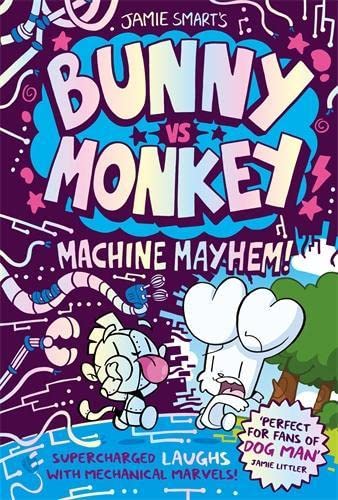
Bunny vs. Monkey has been a fixture of British comics phenomenon The Phoenix since the very first issue in 2012: recounting a madcap vendetta gripping animal arch-enemies set amidst an idyllic arcadia masquerading as more-or-less mundane English woodlands.

Concocted with gleefully gentle mania by cartoonist, comics artist and novelist Jamie Smart (Fish Head Steve!; Looshkin; Flember), his trend-setting, mind-bending yarns have been wisely retooled as graphic albums available in remastered, double-length digest editions such as this one. In this case, however, here we’ve caught up and the fabulous recycled fun of The Floating Cow Catastrophe is plumped up with new stuff…

All the tail-biting tension and animal argy-bargy began yonks ago after an obnoxious little beast popped up in the wake of a disastrous British space shot. Having crash-landed in Crinkle Woods – scant miles from his launch site – lab animal Monkey believed himself the rightful owner of a strange new world, despite all efforts from reasonable, sensible, genteel, contemplative forest resident Bunny to dissuade him. For all his patience, propriety and good breeding, the laid-back lepine just could not contain the incorrigible idiot ape, who was – and is – a rude, noise-loving, chaos-creating loutish troublemaker…

Problems are exacerbated by the other unconventional Crinkle creatures, particularly a skunk called Skunky who has a mad scientist’s attitude to life and a propensity to build very dangerous robots and super-weapons…

Here – with artistic assistance from Sammy Borras – the war of nerves and mega-ordnances resumes and intensifies. The unruly assortment of odd critters littering and loitering around the bucolic paradise have finally picked a side (sort of): shifting and twisting into bipartisan factionalism. They all seem to have forgotten that rapidly encroaching Hyoomanz are now well underway in building something called a “motorway” right through the sylvan glades and (apparently) unprotected parks… but they are quite interested in new resident Ai – the supersonic Ai-Ai – and where her allegiances fall…

It all resumes with ‘Insomnia!’ as new girl Ai proves to (a) nocturnal, (b) excitable and (c) a bit of a party animal just as Bunny seeks an early night, after which Monkey makes the mistake of stamping on her new house in his modular ‘Mega Mecha!’ and doesn’t get away with all his mechanical body parts intact and ‘Take to the Skies!’ finds Weenie squirrel and Pig optimistically building an aircraft, despite a blessed lack of knowledge and requisite skills. That doesn’t explain why Monkey insists on being the first to test pilot it…

A rare moment of tranquillity in ‘Time to Get Along!’ finds all the woodland weirdoes sharing a natural hot spring, until acrimony returns when somebody makes a whirlpool and someone else activates a robot shark…

‘Spring’ comes round again, finding the forest full of greenery-gobbling ‘Worms!’ until Monkey accidentally saves the day, before ‘A Great Big Snotty Cold!’ afflicts everyone. The cure is too weaponize the germs into a giant bogie-beast… but it doesn’t end there…

Skunky’s latest “greatest invention” generates ‘Bubble Trouble!’ before he builds his snarky simian sidekick’s dream device – an enormous ‘Metal Monkey!’ – that bears no relationship to the enigmatic and apparently unattended ‘Giant Egg!’ Ai and Bunny stumble across. Was that the reason for her throwing a dinner party for all her new friends and urgently urge them to ‘Eat Up!’ while revealing some culinary secrets nobody wanted to know?

‘Spaaaace!’ finds Skunky trying – but failing – to send Monkey back where he came from, after which ‘Storytime!’ shows Bunny’s literary leanings whilst Weenie and Pig enjoy ‘Mud, Glorious Mud!’ and aliens are erroneously blamed for all the fuss on ‘The Night They Floated Our Cows Away!’

Everyone’s recovered by time soapbox cart fever intoxicates the little critters, resulting in a shock ending for the ‘Screwball 4000!’, after which a different – Ai-sponsored – comic reality results in baffling grudge-match ‘Weenie vs Monkey’ before she races off, oblivious to the attentions of brain-battered, bewildered and besotted former stuntmanAction Beaver in ‘♥’…

Skunky’s ploy of creating robot duplicates of his opponents goes just like you’d expect in ‘Double Trouble!’, leaving a certain robot in a tizzy safeguarding rare floral gem ‘The Purple Popplewhatsit!’, just as we ease effortlessly into the middle of the year, with ‘Summer’ heralding the first sighting of Skunky’s latest giant sensation ‘The Walrus!’

Undaunted, the black-&-white bounder almost incinerates the woods with a homemade star making ‘Sun Kinda Trouble!’before building colossal fantasy constructs in ‘The Midnight Dragon’ and spoiling a party whilst the stroppy simian is trapped in a timeloop in ‘Monkeyfloop!’

Catastrophic rivalry erupts as alternate evil genius Maniacal Badger competes with Skunky for a science prize and the title of ‘The Most Brilliant Animal in the Woods!’ whilst a blow to the bonce creates ‘Evil Bunny!’ and Weenie consults the Skunk to achieve the dream of being ‘The Bravest Squirrel in the Woods!’

Monkey triggers road rage by building a motorway around Bunny’s cottage in ‘Beep! Beep!’, yet still find time to completely miss the united animals war against a human invader in ‘Persuasion!’ whilst Weenie’s awesome weaponization of sugary treats in ‘Doughnuts!’ brings us stickily to the ‘Autumn’ segment where ‘A Moment of Solace!’for Skunky still ends in chaos and carnage.

Laziness exacerbates the shameful antics and utter rout of the ‘Monkey Army!’, which leads the valiantly victorious Bunny team to pursue supernatural phenomena in ‘Will-o-de-Wisp!’ Strangely, the glowing phantasm that scarily greets them bears a disturbing resemblance to long-gone local legend Fantastic Le Fox…

‘What a Brave Little Squirrel (Part One)!’ begins a strange excursion to a subterranean realm with terror and abandonment on the cards for Weenie, but hope and escape materialise in ‘What a Brave Little Squirrel (Part Two)!’before being driven away again by the secret power source of Skunky’s new hover board in ‘The Flipping Point!’

That so-familiar spectre returns prophesying ‘Grave Danger!’ and in the resultant ‘Panic!’ Bunny becomes a maddened doomsday-prepper, but Weenie is more concerned with culinary success and new kitchen gadget the Multi-Kitchen Buddy in ‘The Other Side!’

At last the doom arrives, but declaring ‘Battle Stations!’ and gathering everybody together and marshalling extraordinary defences amount to nothing and soon distracted Randolph the Raccoon and Ai are pointlessly competing in ‘Runnnn!’ …with Action Beaver and the timestream itself regretting their actions…

‘The Worst Idea You’ve Ever Had!’ finds Monkey yet again ruining Skunky’s plans as the boffin attempts to imprison a ghost before the madness pauses – for now – with ‘The Woodland Devil!’ as the dreaded, doom-laden grave danger arrives and all the animals are caught napping!

The animal anarchy is augmented here with detailed instructions on How to Draw Ai’ and ‘How to Draw Weenie’ so, as well as beguiling your young ‘uns with stories, you can use this book to teach them a trade…

The absolute acme of absurdist adventure, Bunny vs Monkey is weird wit, brilliant invention, potent sentiment and superb cartooning all in one eccentrically excellent package: providing jubilant joy for grown-ups of every vintage, even those who claim they only get it for their kids. This is the kind of comic parents beg kids to read to them. Is that you yet?
Text and illustrations © Jamie Smart 2022. All rights reserved.

Bunny vs Monkey and the Supersonic Aye-Aye is published on January 6th 2022 and is available for pre-order now.

Yakari volume 19: The Devil in the Woods


By Derib & Job, coloured by Dominique and translated by Jerome Saincantin (Cinebook)
ISBN: 978-1-80044-037-1 (Album PB)

Le Crapaud à lunettes was founded in 1964 by Swiss journalist André Jobin who wrote for it under the pseudonym Job. Three years later he hired fellow French-Swiss artist Claude de Ribaupierre AKA “Derib”. The illustrator had launched his own career as an assistant at Studio Peyo, working on The Smurfs strips for venerable weekly Le Journal de Spirou.

Derib – equally au fait with enticing, comically dynamic “Marcinelle” cartoon style yarns and devastatingly compelling meta-realistic illustrated action epics – went on to become one of the Continent’s most prolific and revered creators.

Many of Derib’s stunning works feature his cherished Western themes; magnificent geographical backdrops and epic landscapes, with Yakari considered by fans and critics to be the strip which first led him to deserved mega-stardom. Debuting in 1969, it details the life of a young Oglala Lakota boy on the Great Plains: set sometime after the introduction of horses by the Conquistadores but before the coming of modern Europeans.

The content and set-up are both stunningly simple and effectively timeless, affording new readers total enjoyment with a minimum of required familiarity or foreknowledge. The series – which has generated two separate animated TV series and a movie release last year – has achieved 40 albums thus far: a testament to the strip’s evergreen vitality and the brilliance of its creators, even though originator Job has moved on and Frenchman Joris Chamblain assumed the writer’s role in 2016.

Overflowing with gentle whimsy and heady compassion, young Yakari enjoys a largely bucolic existence: at one with nature and generally free from privation or strife. For the sake of our delectation, however, the ever-changing seasons are punctuated with the odd crisis. Generally they are resolved without fuss, fame or fanfare by a little lad who is smart, brave and can – thanks to a boon of his totem guide the Great Eagle – chat with all animals. This time, however, the conclusion is far from cheery or cosy and presages dark times ahead for some…

It begins in the depths of winter, with deep snow covering the plains and provender scarce for all. As the youngsters Rainbow, Buffalo Seed and Yakari amuse themselves with his pony Little Thunder, the talkative boy’s father Bold Gazeand hunter Taut Bow urgently seek food. Luck turns their way when a large hehaka (wapiti) rushes right into their arrows. By nightfall the entire tribe has eaten well and the leftovers are preserved and dressed to provide more food in the days to come.

The adults cannot shake the impression that their welcome repast was fleeing from something worse than their arrows, and that apprehension is confirmed in the morning when the tribe discover all the remaining food has gone. The fresh snow carries no trace of the thief…

Ever-inquisitive Yakari wants an explanation and sets out to ask his animal pals, eventually finding strange tracks that might belong to some sort of bear. Incautiously following, he sees the footprints peter out just as beaver chieftain Double-Tooth pops up.

The jolly rodent is disturbed by the news and helps in searching, but as Yakari and Double-Tooth follow tracks that constantly seem to vanish into thin air, Bold Gaze and Taut Bow are trailing the thief with the camp dogs. It’s  a horrific mistake as something unseen kills and eats the valiant hounds!

Dread haunts the humans huddled in their tents that night, but in the morning Yakari and Little Thunder check out and eliminate all the local bears – even the notoriously grumpy and insomniac Grizzly who’s having difficulty hibernating – from the suspect list, unaware that something sinister and malign is tracking them…

Baffled and scared that one of their ursine pals has gone mad, Yakari and the beaver clan build a wonderful trap to catch the mysterious thief, but again the stalker outwits them all: even diverting their suspicions to the most unlikely culprit whilst retaliating by destroying the beavers’ precious dam and home…

With all creatures equally endangered by the “devil”, Yakari and his allies convince the mighty and increasingly irate Grizzly to help them hunt, and before long the arrogant quarry rises to the challenge. It confronts its pursuers but the resultant battle is swift, terrible and sadly inconclusive as their brutal clash triggers an avalanche…

In the eerie aftermath, the Great Eagle arrives and shares some disturbing thoughts that may have terrible implications in days to come…

Originally released in 1994, Le diable des bois was the 20th European album, and although its suspenseful, ominous tone feels like a dark departure from the cheery norm, there’s still plenty of humour and slapstick hijinks to balance the grim proceedings, and – in deference to the younger readers – everything is carried out with sensitivity and wit.

As ever, Derib & Job display astounding and compelling narrative virtuosity in this glorious graphic tour de force highlighting the appealing courage of our diminutive heroes, in a visually stunning, seductively smart saga to delight young and old alike.

Yakari is one of the most unfailingly absorbing all-ages strips ever conceived and should be in every home, right beside Tintin, Uncle Scrooge, Asterix and The Moomins.

Original edition © Derib + Job – Editions du Lombard (Dargaud- Lombard s. a.) 2000. All rights reserved. English translation 2021 © Cinebook Ltd.