
Black Panther Adventures


By Jeff Parker, Marc Sumerak, Christopher Yost, Elliot Kalan, Roy Thomas, Manuel Garcia, Ig Guara, Scott Wegener, Christopher Jones, Chris Giarusso, John Buscema & various (Marvel)
ISBN: 978-1-3029-1034-1 (Digest PB/Digital edition)

From its earliest days, Marvel always courted and accommodated young comic book consumers, often through separates titles and imprints. In 2003, the company instituted the Marvel Age line to reframe classic original tales by Stan Lee, Jack Kirby, Steve Ditko and others for a fresh-faced 21st century readership.

The experiment was tweaked in 2005, becoming Marvel Adventures. The tone of all the tales was very much that of the company’s burgeoning TV animation franchises, in execution if not name. Titles bearing the Marvel Adventures brand included Spider-Man, Fantastic Four and The Avengers and ran until 2010 when they were all cancelled and replaced by new volumes of Marvel Adventures: Super Heroes and Marvel Adventures: Spider-Man.

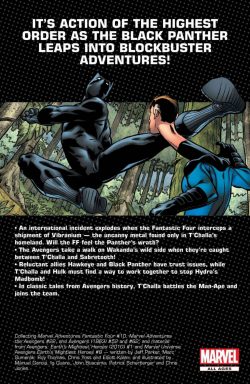
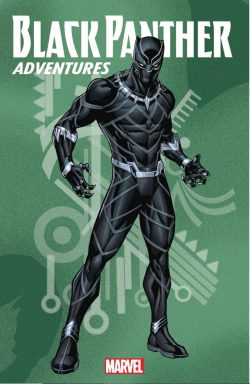
Most of those comic book yarns have since been collected in digest-sized compilations such as this one, gathering a quartet of all-ages Black Panther tales but also including a brace of early1960s episodes from his first stint in mainstream MU series The Avengers.

Acclaimed as the first black superhero in American comics and one of the first to carry his own series, the Black Panther’s popularity and fortunes have waxed and waned since he first debuted as a character in Fantastic Four #52.

In that 1966 landmark the cat king attacked Marvel’s First Family as part of his extended scheme to gain vengeance on the murderer of his father, before eventually teaming up with them to defeat malign master of sound Klaw.

This eclectic compilation – comprising Marvel Adventures Fantastic Four #10, Marvel Adventures The Avengers #22, Avengers: Earth’s Mightiest Heroes #1, Marvel Universe Avengers Earth’s Mightiest Heroes #8, plus Silver Age epics from Avengers #52 and 62 – begins by broadly reimagining that initial FF encounter in ‘Law of the Jungleby Jeff Parker, Manuel Garcia & Scott Koblish (from Marvel Adventures Fantastic Four #10; May 2006) wherein the quixotic quartet are suckered into buying smuggled Vibranium.

The miracle mineral is Wakanda’s only export and the illegal sale quickly brings the duped heroes into savage conflict with a mysterious cat-garbed super-warrior. Tracking the Black Panther back to his super-scientific jungle kingdom, the team  eventually convince the king of their innocence and good intentions before teaming up to tackle the true villains…

Two years later Marvel Adventures The Avengers #22 (May 2008 and by Marc Sumerak, Ig Guara & Jay Leisten) revealed the ‘Wakanda Wild Side as sightings of murderous mutant Sabretooth in Africa draws Wolverine, Storm, Captain America, Spider-Man, Giant-Girl and the Hulk into an uncharted kingdom. They needn’t have bothered: Wakanda’s Panther chieftain is more than equal to the task of taking down the savage invader…

Following a page of comedic Marvel Mini Classics by Chris Giarusso, a short vignette from Avengers: Earth’s Mightiest Heroes #1 (November 2010) as Christopher Yost & Scott Wegener reveal how rival heroes T’Challa and Hawkeye work out their ‘Trustissues whilst battling crazed villain Whiplash.

Never the success the company hoped, the Marvel Adventures project was superseded in 2012 by specific comics tied to those Disney XD television shows designated as “Marvel Universe cartoons”, but these collected stories are still an amazingly entertaining and superbly accessible means of introducing characters and concepts to kids born sometimes three generations or more away from the originating events. They’re also pretty good fun for us old lags too…

Another short tale – this time from Marvel Universe Avengers Earth’s Mightiest Heroes #8 (November 2012) – unites the Panther with the Hulk. Crafted by Elliott Kalan, Christopher Jones & Pond Scum, ‘Mayhem of the Madbomb!finds Green Goliath and Cat King furiously fighting Hydra to prevent he detonation of an insanity-inducing WMD stashed in the Empire State Building…

Wrapping up the action are a brace of classic exploits from Roy Thomas & John Buscema.

On Captain America’s recommendation the Black Panther joined the Avengers in #52’s ‘Death Calls for the Arch-Heroes!’ (May 1968, inked by Vince Colletta): a fast-paced murder mystery which also saw the advent of obsessive super-psycho The Grim Reaper who tried to frame the freshly-arrived-in-America T’Challa for the murder of Goliath, The Wasp and Hawkeye.

Then ‘The Monarch and the Man-Ape!(Avengers #62, March 1969, and inked by George Klein) offered Marvel fans the first real view of hidden Wakanda – and a brutal exploration of T’Challa’s history and rivals – as his trusted regent seeks to usurp the kingdom and overturn the state religion after declaring himself to be ‘M’Baku the Man-Ape!’

Augmented by a cover gallery from Carlo Pagulayan & Chris Sotomayor, Leonard Kirk & Val Staples, Scott Wegener & Jean- François Beaulieu, Khoi Pham & Edgar Delgado and John Buscema, these ferociously enthralling riotous mini-epics are extremely enjoyable and engaging, but parents should note that some of the themes and certainly the level of violence might not be what everybody considers “All-Ages Super Hero Action”…
© 2017 Marvel Characters, Inc. All rights reserved.

Moon Girl and Devil Dinosaur volume one: BFF


By Brandon Montclare, Amy Reeder, Natacha Bustos, Tamra Bonvillain & various (Marvel)
ISBN: 978-1-3029-0005-2 (TPB/Digital edition)

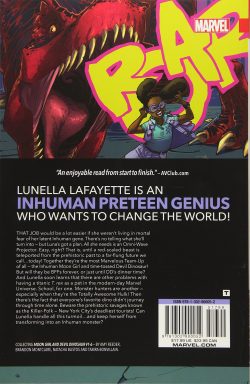
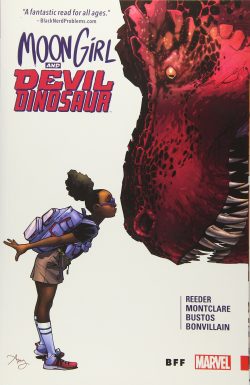
The Marvel Universe is absolutely stuffed with astounding young geniuses but Lunella Lafayette is probably the most memorable you’ll ever meet. Very young, very gifted and proudly black, she lives with her parents on Manhattan’s Lower East Side when not attending Public School 20 Anna Silver on Essex Street.

Thanks to her obsessive interest in astronomy and alien races the other kids mockingly call her “Moon Girl” whilst the brilliant, bored 4th grader’s teachers universally despair because she already knows so much more than they do…

It’s a hassle, but Lunella actually has bigger problems. Time is running out and her numerous applications to specialist schools such as the Fantastic Four’s Future Foundation have all gone unanswered. The situation needs resolving as it’s pretty important and urgent. Lunella has – correctly – deduced that she carries dormant Inhuman genes, and the constantly moving mutagenic Terrigen Cloud recently released into Earth’s atmosphere (see both the Infinity and Inhumanity events) could transform her into a monster at any windswept moment…

Thanks to her investigations, she’s an expert in advanced and extraterrestrial technology, and her quest for a cure or Terrigen-deterrence procedure sees her perpetually sneaking out past bedtime in search of gadgets and detritus left behind after frequent superhero clashes around town…

That impetus reaches its hope-filled climax when her handmade detectors locate a discarded Kree Omni-Wave Projector in opening chapter ‘Repeat After Me’…

At some unspecified time in Earth’s distant prehistory, various emergent species of hominids eked out a perilous existence beside the last of the great lizards and other primordial giants. At one particular key moment, a wide-eyed innocent of the timid yet clever Small Folk saved a baby tyrannosaur from ruthless pre-human hunters the Killer Folk.

They had already slaughtered its mother and siblings with cunning snares and were merrily torturing the little lizard with blazing firebrands – which turned its scorched hide a livid, blazing red – before Moon Boy intervened…

Under the roaring light of a blazing volcano, boy and beast bonded, becoming inseparable companions. It was soon apparent the scarlet saurian was no ordinary reptile: blessed with uncanny intelligence and unmatchable ferocity, Devil became an equal partner in a relationship never before seen in the world. It did not, however, prevent the duo becoming targets for ruthless Killer Folk leader Thorn-Teeth who now slaughters and sacrifices beasts and Small Folk to a mystic “Nightstone”. A more advanced observer might remark on how much it resembles a Kree Omni-Wave Projector…

When Moon-Boy steals the dread talisman, he is savagely beaten near to death even as – in a gym class on Essex Street – Coach Hrbek confiscates and accidentally activates a fancy doodad Lunella’s been playing with instead of paying attention to getting fit.

Lights flash, time shreds and universes collide. A hole opens in space and a pack of bizarre monkey men shamble into modern New York. Arriving too late in the antediluvian valley, Devil Dinosaur thunders straight through the portal, intent on avenging his dying comrade…

Arriving in an impossibly confusing new world, Devil understandably panics. After causing much chaos and carnage, the bombastic beast sniffs little Lunella and snatches her up…

A mad chase ensues in ‘Old Dogs and New Tricks’ as deeply confused Devil marauds through Manhattan with outraged Lunella unable to escape or control the ferocious thunder lizard.

Meanwhile, the Killer Folk rapidly adapt to the new environment. Hiding out and observing everything occurring in the Yancy Street Subway Station, they soon prove the old adage about primitive not meaning stupid. Within days they have grasped the fundamentals of English and new concepts like money and clothes, as well as the  trickier notions of “gangs” and “protection rackets”…

Most importantly, Thorn-Teeth remembers that when they arrived, one of the hairless Small Folk was holding his Nightstone…

In ‘Out of the Frying Pan’, Moon Girl is having little luck ditching the overly-attentive, attention-attracting Torrid T-Rex. Tragically, when she finally does, the Killer Folk grab her and the Omni-Wave…

Their triumph is short-lived, since the lizard’s superior sense of smell summons Devil to the rescue, although, in the resulting melee, the precious device is lost. Growing grudgingly fond of the colossal critter, Lunella stashes Devil in her super-secret lab underneath PS 20, but when a spot of student arson sets the school ablaze, her hideaway is exposed and Devil bursts up through the ground to rescue kids trapped on an upper floor…

The fracas also unfortunately attracts the kind of superhero response Lunella has been dreading. ‘Hulk + Devil Dinosaur – ‘Nuff Said’ sees smug, teenaged Gamma-powered Avenger Amadeus Cho butt in with his bulging muscles and inability to listen to reason…

Poor Devil is no match for the Totally Awesome Hulk, forcing Moon Girl to intervene with some her own inventions. Across town, the Killer Folk – proudly carrying the Nightstone – deal with the last obstacle to their supremacy in the Yancy Street criminal underworld…

The Battle of PS 20 reaches its inevitable conclusion and Cho confiscates Devil Dinosaur, leaving Lunella thoroughly grounded and (apparently) behaving like a normal little girl in ‘Know How’.

Of course, it’s all a trick and as soon as everybody is lulled into complacency Moon Girl kits herself out with more devious gadgetry and busts Devil out of the Top Secret Wing of the Natural History Museum. She’s on a tight deadline now: her weather-monitoring gear confirms the Terrigen Cloud is rolling back towards Manhattan…

The spectacular jailbreak results in a ‘Eureka!’ moment coinciding with the Killer Folk consolidating their grip on the streets and using the Omni-Wave to capture Moon Girl. It also results in Lunella’s mother discovering who broke a dinosaur out of jail, and she furiously heads to the school for a reckoning with her wayward child…

The final conflict sees our little warrior at last victorious over the Killer Folk, albeit too late. As Moon Girl and Devil Dinosaur roar in triumph on the rooftops, Lunella realises she is trapped outside with the Terrigen cloud descending. Her time and opportunity to create a cure has come and gone…

To Be Continued…

Collecting Moon Girl and Devil Dinosaur #1-6 from January to June 2016, this compelling, immensely entertaining romp is crafted by writers Brandon Montclare & Amy Reeder, with art from Natacha Bustos, colours by Tamra Bonvillain and letters from Travis Lanham. With a cover and variants gallery from Trevor Von Eeden, Pascal Campton, Paul Pope, Jeffrey Veregge & Pia Guerra, this addictively engaging yarn affords non-stop fun: a wonderful all-ages Marvel saga that is as fresh, thrilling, moving and hilariously funny now as it ever was.

Moon Girl and Devil Dinosaur: BFF is the kind of tale to lure youngsters into the comics habit and a perfect tool to seduce jaded older fans back into the fold…
© 2016 Marvel Characters, Inc. All rights reserved.

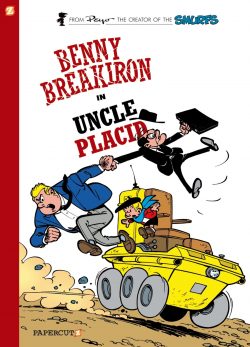
Benny Breakiron volume 4: Uncle Placid


By Peyo & Gos with backgrounds by François Walthéry: translated by Joe Johnson (Papercutz/NBM)
ISBN: 978-1-59707-717-0 (HB Album/Digital edition)

Let’s just clear up something here. Although they are both magnificent producers of comics past and present – and either singly or in collaboration – Belgium and France are not “the same”. Shared cultural mores and language, interlinked history and adjacent geographies have may have generated superficial similarities but the inventors of international icons Tintin and Asterix have always been as much defined by their unique views as mutual visions. All of which is my blathering brain-fodder to introduce a Belgian “superhero” today and a very different French one tomorrow…

In 1928, Pierre Culliford was born in Belgium to a family of British origin dwelling in the Schaerbeek district of Brussels. An admirer of the works of Hergé and the American comics licensed to Le Journal de Mickey, Robinson and Hurrah!, the lad honed his own artistic skills but the war and family bereavement forced him to forgo further education and get a job…

After working as a cinema projectionist, in 1945 Culliford joined C.B.A. animation studios, where he met future comics megastars André Franquin, Maurice De Bevere – who would become Morris – and Eddy Paape. When the studio closed, Pierre briefly studied at the Brussels Academy of Fine Arts before moving full-time into graphic advertising. In his spare time, he began submitting strips to the burgeoning post-war comics publishers.

His first sale was in April 1946. Pied-Tendre was a tale of American Indians that landed in Riquet, the comics supplement to the daily L’Occident newspaper. Further sales to other venues followed and in 1952 his knight Johan found a permanent spot in Le Journal de Spirou. Retitled Johan et Pirlout, the strip prospered and in 1958 introduced a strange bunch of blue woodland gnomes into the ongoing tale. They were called Les Schtroumpfs.

Culliford – by now using the nom de plume Peyo – would gradually turn those adorable little mites (known to most of the world as The Smurfs) into an all-encompassing global empire, but before being sucked onto that relentless treadmill, he found time to create a few other noteworthy strips such as the titanic tyke on view here today.

In December 1960, Benoît Brisefer – AKA Benedict Ironbreaker and/or (in Dutch) Steven Sterk – debuted in Le Journal de Spirou #1183. With some sly tips of the hat to Siegel & Shuster’s Superman – and Superboy – these wryly bucolic adventures celebrated a small boy with superhuman strength, speed, durability and vitality living in a generally quiet and unassuming little Belgian town.

Quiet, well-mannered, gentle and a bit lonely, Benny just happens to be the mightiest boy on Earth: able to crush steel or stone in his tiny hands, leap huge distances and run faster than a racing car. He is also generally immune to all physical harm, but his fatal and peculiarly ubiquitous weakness is that his astounding strength deserts him whenever he catches the slightest hint of a cold…

Most kids avoid him. It’s hard to make friends or play games when the merest kick pops a football like a balloon or a shrug can topple trees…

Benny seldom seeks to conceal his abilities – in fact he informs anyone who will listen – but other than startled crooks and bad guys, somehow no adults ever believe or catch on. They usually think he’s telling fibs or boasting and whenever he attempts to prove his claims, the unlucky lad gets another dose of galloping sniffles…

Well-past-it Brits of my vintage might remember him from weekly comics in the 1960’s. As Tammy Tuff – The Strongest Boy on Earth – and latterly as Benny Breakiron or Steven Strong, our beret-wearing champion appeared in Giggle and other periodicals from 1967 onwards.

With Peyo’s little blue cash-cows taking up ever larger amounts of his concentration and time, other members of his studio assumed greater responsibilities for Benoît/Benny. Years passed and Will (Willy Maltaite), Gos (Roland Goossens), Yvan Delporte, François Walthéry and Albert Blesteau all pitched in, with Jean Roba crafting many eye-catching Spirou covers, but by 1978 the demands of the Smurfs were all-consuming and all the studio’s other strips were retired.

You can’t keep a good super-junior down, though, and after Peyo’s death in 1992, his son Thierry Culliford and cartoonist Pascal Garray revived the strip, adding six more volumes to the eight generated by Peyo and his team between 1960 and 1978.

Thanks to the efforts of US publisher Papercutz, the first four (promised fifth release Bodoni Circus still languishes in limbo, but we can always hope…) gloriously genteel, outrageously engaging power fantasies are available to English-language readers. This yarn was originally collected in 1968 as 4th album Tonton Placide, with Peyo, co-writer Walthéry & co-artist Gos tapping into the global spy trend with marvellous aplomb.

It begins in sedate Vivejoie-la-Grande, where the sweet kid goes about his well-meaning, somewhat solitary life: doing good deeds in secret (like quietly popping a piano up to the fifth floor of an apartment block whilst weary delivery men are having a refreshing bevvy in a bar), respecting his elders and being as good a boy as he can…

At school, Prize Day closes and we learn that Benny’s true weakness is maths, although he did win a Good Conduct award and came top in Gym. The happily liberated kids trade tales of the holidays ahead of them and the titanic tyke reveals he’s spending his vacation with his uncle who works for P.O.O.T. Benny explains that his temporary guardian is a civil servant at the Department of “Protection Of Officials Travelling”… an actual armed bodyguard…

Disembarking later at a rural train station, the boy is greeted a by boisterous hulking blonde Adonis and quickly settles into a perfect country idyl, but the rest is ruined the next morning – initially by Uncle Placid’s workout and machine gun practise – but soon after by an urgent visit from the operative’s boss. The colonel needs a capable escort for the Finance Minister of the Principality of Fürengrootsbadenschtein when he collects his nation’s currency printing plates.

It’s such a simple, risk-free job that the Colonel even suggests the bodyguard could bring his current “babysitting assignment” along for the ride. Nobody has any inkling that a ruthless gang know of the potentially lucrative transfer and has begun a complex operation to secure the means of printing their own money…

Dutiful Placid reluctantly agrees, bringing the eager lad along to his Central Bank rendezvous with prickly, obnoxious Minister Mr. Chnik and straight into a complex ambush! With the adults all gassed by a disguised cleaning lady, Benny is completely unobserved when he foils the robbery by plucking her and an observation helicopter out of the sky and wrecking her sportscar-driving backup team.

Listening in from his secret lair, the sinister mastermind behind the plot cannot understand what he’s hearing…

By the time Benny brings the plates back to the bank, everybody is blearily regaining consciousness. As usual, nobody believes his story – or his polite claims that he’s really strong for his size – but the job is reassessed as highly risky. A police convoy is despatched, but the immediacy of the crisis means the little boy has to stay with Placid – which is fine with Benny…

As the plates, Mr. Chnik, Placid and Benny set out on a fraught drive to the Principality, they are dogged by cautious observers: career criminals who are having their own problems acclimatising to modern innovations like guns and shoes that double as radio communicators and tracking devices. Their reticence and ineptitude does nothing for the Boss’ manners or patience…

The covert reconnaissance leads to a massive, spectacular multi-vehicle highway ambush, and Placid cannot understand how they all survive the barrage of bullets and car crash. He does not believe it was Benny’s incredible intervention or that the kid subsequently clobbered a small army of thugs and armoured ATVs…

Now on high alert, Placid opts for subterfuge, taking his charges undercover and getting ever closer to Fürengrootsbadenschtein by commercial plane, trains and automobiles. At every stage, progress is stymied by the Boss and his ubiquitous operatives, with the villains winnowed down by the incredible – unseen – actions of the weird kid in the black beret…

Ultimately, however, the mastermind succeeds in capturing his targets, only to meet his match at his moment of triumph when Benny at last loses his temper…

A masterpiece of timing and breakneck pace, and deliciously informed by the 1960s pop culture espionage fad, Uncle Placid delivers daft delights via bombastic bouts of uproarious slapstick comedy action. A superbly stirring spoof with echoes of classic comedies such as Carry on Spying, The Intelligence Men or The Spy with a Cold Nose, it displays the wonder boy’s resolute dynamism, helpful nature and need to be a good citizen: blending deft wit with hilarious stunts. Here is another fabulously winning fantasy of childhood agency and validation, offering a distinctly Old-World spin to the notion of superheroes by providing adventure and chortles for all.
© Peyo™ 2014 – licensed through Lafig Belgium. English translation © 2014 by Papercutz All rights reserved.

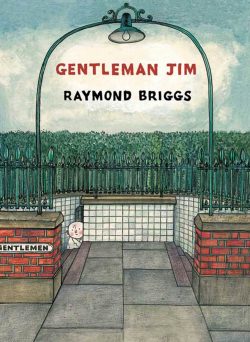
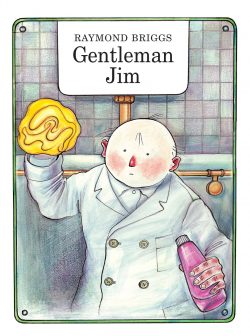
Gentleman Jim


By Raymond Briggs (Jonathan Cape/Drawn & Quarterly)
ISBN: 978-0-22408-524-3 (HB, Jonathan Cape) 978-1-8972-9936-4 (PB, D&Q edition)

Once again a master of comics art has been taken from us, and this time it’s one of the greatest in our medium’s history: a hugely gifted maverick who worked largely outside the established industry, but whose decades of work truly turned sequential graphic narrative into an art form.

Cartoonist, political satirist, philosopher, social commentator and delighter of children of all ages, Raymond Redvers Briggs CBE (18th January 1934 – 9th August 2022) never forgot that kids aren’t fools. Many of his books – ostensibly targeting the young – revel in the target audience’s fascination with all things gross and disgusting and the artist never underestimated an “unformed” mind’s capacity for empathy and understanding. Moreover, unlike so many working in the children’s book industry, he wasn’t afraid to be morose or even sad…

The comic book industry always wilfully neglected and sidelined Briggs’s graphic narratives – which nevertheless reached more hearts and minds than Spider-Man or Dennis the Menace ever will. Briggs’ books remain among the most powerful and important in the entire field.

Deservedly famous works such as Father Christmas, The Snowman, When the Wind Blows, Fungus the Bogeyman, The Bear, Ethel and Earnest, Ug: Boy Genius of the Stone Age and Time for Lights Out are but the tip of an astoundingly impressive, remarkably wide-ranging and quintessentially British iceberg of dry, mordant wit, cheeky sarcasm and poignant fellow-feeling for even the most ghastly and graceless of his unlikely protagonists…

After studying at Wimbledon School of Art, Central and The Slade – and completing a stint of National Service in Catterick – Briggs started working as an illustrator in 1958. He produced dozens of books, ranging from illuminating other creators’ poetry and stories to crafting his own dingily fabulous yarns such as this slyly seditious treatise on self-betterment that first appeared in 1980.

One of his most charmingly bittersweet and contemplative efforts, Gentleman Jim is a mesmerising affectionate portrait of one of life’s always-dreaming no-hoper’s, published just as Thatcherite dogma began to bite and tear into Britain’s already reeling social structures.

Jim Bloggs is a middle-aged bloke who mans a Council-run public toilet or “Gentleman’s Convenience” in Birmingham: diligently and uncomplainingly cleaning and maintaining his subterranean office whilst constantly dreaming of bigger, better, bolder things.

There’s nothing wrong with the job; it’s just that Jim feels he was meant for greater challenges…

At every quiet moment, Jim scans the job section of the newspaper, imagining himself a hero of the Royal Marines or a tail-gunner in a fighter-bomber or an artist or even a doorman in a fancy uniform. It’s never too late…

Jim’s problem is education: he hasn’t any and all these vacant situations want people with “The Levels”… O’s and A’s and whatnot…

At home with his wife Hilda, Jim discusses a change of direction. Inspired by a late film on television, he decides to become a cowboy, maybe even a sheriff. A quick bit of research convinces him that the start-up costs for cowboying are beyond his means and the paperwork would be a nightmare, but after popping into the second-hand bookshop Jim realises that what he really wants to be is a Highwayman…

Even here though, money is a problem. Great black chargers or even plain old valiant steeds cost thousands of pounds. However, when the local Donkey Sanctuary lets him have one of their older ones for free, Jim’s off and running in his new career and living his dream…

Sublimely low key and gentle, the fall into arrant criminality of this ambitious dreamer is a sheer, understated masterpiece of sardonic whimsy to enthral and delight older kids as well as all us adults who never quite made it. Yet…

Raymond Briggs was the human turning point in the evolution of comics from tawdry waste of time to esteemed art form and his books will live forever. If you’re not a fan yet, you inevitably will be …once you start reading them.
© 1980, 2008 Raymond Briggs. All Rights Reserved.

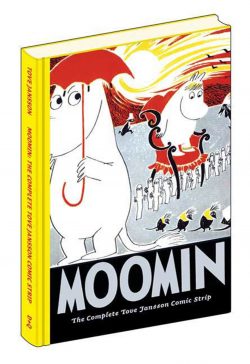
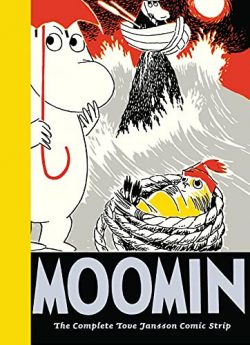
Moomin: The complete Tove Jansson Comic Strip volume 4


By Tove and Lars Jansson (Drawn & Quarterly)
ISBN: 978-1-897299-78-4 (HB) eISBN: 978-1-77046-551-0

If Tove Jansson was alive today she’d still be amazing and fascinating and also 108 years old. Sadly, she isn’t, but her immortal menagerie of bizarre and introspective characters are still going strong and all her best material is readily available for anyone wanting to politely, respectfully and belatedly join in all the dreamy fun…

Tove Jansson was one of the greatest literary innovators and narrative pioneers of the 20th century: equally adept at shaping words and images to create worlds of wonder. She was especially expressive with basic components like pen and ink, manipulating slim economical lines and patterns to realise sublime realms of fascination, whilst her dexterity made simple forms into incredibly expressive and potent symbols.

Tove Marika Jansson was born into an artistic, intellectual and practically bohemian Swedish family in Helsinki, Finland on August 9th 1914. Father Viktor was a sculptor, her mother Signe Hammarsten-Jansson a successful illustrator, graphic designer and commercial artist. Tove’s brothers Lars and Per Olov became a cartoonist/writer and photographer respectively. The family and its close intellectual, eccentric circle of friends seems to have been cast rather than born, with a witty play or challenging sitcom as the piece they were all destined to act in.

After intensive study from 1930-1938 (at the University College of Arts, Crafts and Design, Stockholm, the Graphic School of the Finnish Academy of Fine Arts and L’Ecole d’Adrien Holy and L’Ecole des Beaux-Arts, Paris), shebecame a successful exhibiting artist through the troubled period of the Second World War.

Intensely creative across many fields, she published the first fantastic Moomins adventure in 1945: Småtrollen och den stora översvämningen (The Little Trolls and the Great Flood or latterly and more euphoniously The Moomins and the Great Flood): a whimsical epic of gentle, inclusive, accepting, understanding, bohemian, misfit trolls and their strange friends…

A youthful over-achiever, from 1930-1953 Tove worked as an illustrator and cartoonist for the Swedish satirical magazine Garm, achieving some measure of notoriety with an infamous political sketch of Hitler in nappies that lampooned the Appeasement policies of Chamberlain and other European leaders in the build-up to World War II. She was also an in-demand illustrator for many magazines and children’s books, and had started selling comic strips as early as 1929.

Moomintroll was her signature character. Literally.

The lumpy, gently adventurous big-eyed romantic goof began life as a spindly sigil next to her name in her political works. She called him “Snork” and claimed she had designed him in a fit of pique as a child – the ugliest thing a precocious little girl could imagine – as a response to losing an argument about Immanuel Kant with her brother.

The term “Moomin” came from her maternal uncle Einar Hammarsten who attempted to stop her pilfering food when she visited, warning her that a Moomintroll guarded the kitchen, creeping up on trespassers and breathing cold air down their necks. Snork/Moomin filled out, became timidly nicer – if a little clingy and insecure – acting as a placid therapy-tool to counteract the grimness of the post-war world.

The Moomins and the Great Flood didn’t make much of an initial impact but Jansson persisted, probably as much for her own edification as any other reason, and in 1946 the second book Kometjakten (Comet in Moominland) was published. Many commentators have reckoned the terrifying tale a skilfully compelling allegory of Nuclear Armageddon.

When it and her third illustrated novel Trollkarlens hatt (1948, Finn Family Moomintroll or occasionally The Happy Moomins) were translated into English in 1952 to great acclaim, it prompted British publishing giant Associated Press to commission a newspaper strip about her seductively sweet and sensibly surreal creations.

Jansson had no misgivings or prejudices about strip cartoons and had already adapted Comet in Moominland for Swedish/Finnish paper Ny Tid. Mumintrollet och jordens undergängMoomintrolls and the End of the World – was a popular feature so Jansson readily accepted the chance to extend her eclectic family across the world.

In 1953, The London Evening News began the first of 21 Moomin strip sagas which promptly captivated readers of all ages. Jansson’s involvement in the cartoon feature ended in 1959, a casualty of its own success and a punishing publication schedule. So great was the strain that towards the end she recruited brother Lars to help. He took over, continuing the feature until its end in 1975. His official tenure as writer will begin in the next volume: stay tuned…

Liberated from the strip, she returned to painting, writing and other creative pursuits, generating plays, murals, public art, stage designs, costumes for dramas and ballets, a Moomin opera and 9 more Moomin-related picture-books and novels, as well as 13 books and short-story collections strictly for grown-ups.

Tove Jansson died on June 27th 2001. Her awards are too numerous to mention, but consider this: how many modern artists – let alone comics creators – get their faces on the national currency?

Her Moomin comic strips have long been available in Scandinavian volumes and the discerning folk at Drawn & Quarterly have translated her and Lars’ efforts into English for our sheer delight and delectation.

Moomintrolls are easy-going free spirits, bohemians untroubled by hidebound domestic mores and most societal pressures. Moominmama is warm and capable but overly concerned with propriety and appearances whilst Moominpappa spends most of his time trying to rekindle his adventurous youth or dreaming of fantastic journeys. Their son Moomin is a meek, dreamy boy who adores their permanent houseguest the Snorkmaiden – although that impressionable, flighty gamin prefers to play things slowly whilst waiting for somebody potentially better…

The forth oversized (312 x 222mm) monochrome hardback compilation gathers the 14-18th strip sagas and is a particular favourite, comprising a range of fanciful exploits and a rather bleak and a scary reworking of Comet in Moominland that must have had kids and their parents stocking the bomb-shelters back when it was released as a daily chapter play…

Fantasy fills the page in ‘Moomin Goes Wild West’ after Moominpapa’s annoying tinkering ruin a perfectly good clock and Moominmama’s sewing machine, whilst his attempt at repair accidentally results in a time machine. Following a distressing episode wherein Moomintroll meddles and the family meet their rather upset future selves, it is suggested that everyone go on a small holiday. The women’s rather staid suggestions are naturally overruled by the adventurous males and the machine summarily deposits them all in the land of cowboys.

It is nothing like they imagined and a very good thing that were armed with water pistols and not regulation firearms…

Sadder but no wiser after their extended tribulations in the Big Country, the assembled and not at all rested Moomins submit to suggestions of a little historical romance and travel back to 18th century France in ‘Snorkmaiden Goes Rococo’. Once again, lack of diligent research and an overdependence on popular fiction leads to misunderstanding and mischance as “the Age of Reason” proves to be anything but, and Snorkmaiden’s dreams of passionate folly are continually thwarted.

She does however score an invitation to the King’s Dinner, only to learn how badly the odds are stacked against the poor, and is promptly impelled to experiment with revolution…

Back where they all belong at last, the return of self-sufficient drop-out Snufkin heralds a visit from a representative of the League of Conscience and Duty exhorting the easy-going, but dutiful nonconformists (some unpleasant modern people say “workshy”) to dedicate their lives to personal industry and privation in service of a greater good.

‘The Conscientious Moomins’ certainly try their hardest – pursuing jobs they’re no good at, indulging in entrepreneurialism and seeking to improve character through self-help books and courses – but are just not suited to such new-fangled ideas. Ultimately, nature and good sense lead them back to their bohemian true selves just in time for one of the scariest adventures of their lives…

Comet in Moominland was first translated into English in 1951, and was a familiar text for many children and parents. Here in ‘Moomin and the Comet’ the allegory of nuclear armageddon is subtly reshaped over 86 daily instalments: modernised with the emphasis shifted from narrow escape to inescapable destruction leading to unexpected rebirth.

When a light gradually grows in the sky, the Moomins and their friends can only observe the world’s peoples’ increasing turmoil and riot. As the planet slowly alters in advance of imminent catastrophe and growing heat evaporates the oceans, spiteful Little My acts as Greek Chorus and commentator as everything makes it peace with oblivion. She’s also on hand to witness and announce the miracle that saves them all…

A parable of pride and caution closes this volume as ‘Moomin and the Golden Tail’ reveals how Moomintroll’s fear of premature baldness in this nether appendage prompts unwise exploration of remedial quackery, quasi-science and old family sorcery.

The result is a lush, luxuriant tail of gold, that makes him the world’s most fashionable person and pointless celebrity. All too soon that chic lustre fades and the sad lad is hunting ways to stop being famous and go back to his old look, negligent of how his beloved Snork maiden has reshaped herself to match his gleaming fame…

Especially excoriating are the lawyers and managers who hound him seeking to lock down the marketing rights to his golden fleece, but in the end a way is found to return him to his normal, anxious, insecure, anonymous self…

These are truly magical tales for the young laced with the devastating observation and razor-sharp mature wit which enhances and elevates only the greatest kids’ stories into classics of literature. These volumes are an international treasure and no fan of the medium – or carbon-based lifeform with even a hint of heart and soul – can afford to be without them.
© 2009, 2021 Solo/Bulls. All other material © its creators. All rights reserved.

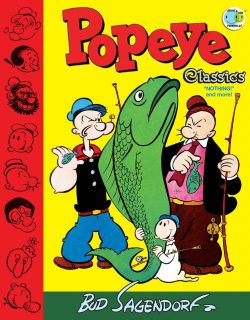
Popeye Classics volume 7: “Nothing” and More


By Bud Sagendorf, edited and designed by Craig Yoe (Yoe Books/IDW)
ISBN: 978-1-63140-447-4 (HB) eISBN: 978-1-62302-786-5

How many cartoon classics can you think of still going after a century? Here’s one…

There are a few fictional personages to enter communal world consciousness – and fewer still from comics – but a grizzled, bluff, uneducated, visually impaired old sailor with a speech impediment is possibly the most well-known of that select bunch.

Elzie Crisler Segar was born in Chester, Illinois on 8th December 1894. His father was a general handyman, and the boy’s early life was filled with the solid, dependable blue-collar jobs that typified the formative years of his generation of cartoonists. Segar worked as a decorator, house-painter and also played drums; accompanying vaudeville acts at the local theatre.

When the town got a movie-house, Elzie played silent films, absorbing all the staging, timing and narrative tricks from keen observation of the screen. Those lessons would become his greatest assets as a cartoonist. It was while working as the film projectionist, at age 18, that he decided to become a cartoonist and tell his own stories.

Like so many others in those hard times, he studied art via mail, specifically W.L. Evans’ cartooning correspondence course out of Cleveland, Ohio, before gravitating to Chicago where he was “discovered” by Richard F. Outcault – regarded by most in the know today as the inventor of modern newspaper comic strips with The Yellow Kid and Buster Brown.

The celebrated pioneer introduced Segar around at the prestigious Chicago Herald. Still wet behind the ears, the kid’s first strip, Charley Chaplin’s Comedy Capers, debuted on 12th March 1916.

In 1918, Segar married Myrtle Johnson and moved to William Randolph Hearst’s Chicago Evening American to create Looping the Loop, where Managing Editor William Curley foresaw a big future for Segar and promptly packed the newlyweds off to New York: HQ of the mighty King Features Syndicate. Within a year Segar was producing Thimble Theatre, (launching December 19th 1919) in the New York Journal: a smart pastiche of cinema and knock-off of movie-inspired features like Hairbreadth Harry and Midget Movies, with a repertory of stock players acting out comedies, melodramas, comedies, crime-stories, chases and especially comedies for vast daily audiences. It didn’t stay that way for long…

The core cartoon cast included parental pillars Nana and Cole Oyl; their lanky, highly-strung daughter Olive; diminutive-but-pushy son Castor; and the homely ingenue’s plain and (very) simple occasional boyfriend Horace Hamgravy (latterly, just Ham Gravy). Thimble Theatre had successfully run for a decade when, on January 17th 1929, a brusque, vulgar “sailor man” shambled into the daily ongoing saga of hapless halfwits. Nobody dreamed the giddy heights that stubborn cantankerous walk-on would reach…

In 1924 Segar created a second daily strip. The 5:15 was a surreal domestic comedy featuring weedy commuter and would-be inventor John Sappo and his formidable wife Myrtle. This one endured – in one form or another – as a topper/footer-feature accompanying the main Sunday page throughout the author’s career, and even survived his untimely death, eventually becoming the trainee-playground of Popeye’s second great humour stylist: Bud Sagendorf.

After Segar’s premature passing in 1938, Doc Winner, Tom Sims, Ralph Stein and Bela Zambouly all took on the strip, as the Fleischer Studio’s animated features brought Popeye to the entire world, albeit a slightly variant vision of the old salt of the funny pages. Sadly, none had the eccentric flair and raw inventiveness that had put Thimble Theatre at the forefront of cartoon entertainments. And then, finally, Bud arrived…

Born in 1915, Forrest “Bud” Sagendorf was barely 17 when his sister – who worked in the Santa Monica art store where Segar bought his drawing supplies – introduced the kid to the master cartoonist who became his teacher and employer as well as a father-figure. In 1958, after years on the periphery, Sagendorf finally took over the strip and all the merchandise design, becoming Popeye’s prime originator…

With Sagendorf as main man, his loose, rangy style and breezy scripts brought the strip itself back to the forefront of popularity and made reading it cool and fun all over again. Bud wrote and drew Popeye in every graphic arena for 24 years. When he died in 1994, his successor was controversial “Underground” cartoonist Bobby London.

Young Bud had been Segar’s assistant and apprentice, and in 1948 became exclusive writer and artist of Popeye’s comic book exploits. The series launched in February of that year in a regular title published by America’s unassailable king of periodical licensing, Dell Comics.

On debut, Popeye was a rude, crude brawler: a gambling, cheating, uncivilised ne’er-do-well. He was soon exposed as the ultimate working-class hero: raw and rough-hewn, practical, but with an innate, unshakable sense of what’s fair and what’s not; a joker who wanted kids to be themselves – but not necessarily “good” – and someone who took no guff from anyone…

Naturally, as his popularity grew, Popeye mellowed somewhat. He was still ready to defend the weak and had absolutely no pretensions or aspirations to rise above his fellows, but the shocking sense of dangerous unpredictability and comedic anarchy he initially provided was sorely missed… except not in Sagendorf’s yarns…

Collected in this superb full-colour hardback/digital edition are Popeye #30-34, crafted by irrepressible “Bud”: collectively spanning September/November 1954 to October/December 1955. Stunning, nigh stream-of-consciousness slapstick sagas are preceded by an effusively appreciative ‘Society of Sagendorks’ briefing by inspired aficionado, historian and publisher Craig Yoe, offering a mirthful mission statement.

Augmenting that is another tantalising display of ephemera and merchandise in ‘A Bud Sagendorf Scrapbook’ presenting Coca-Cola Company-funded comic strip themed postcards distributed to WWII servicemen; original art, tin toys; a Popeye Chalkboard; Get Well Soon and Birthday card art plus images on cups and mugs.

We rejoin the ceaseless parade of laughs, surreal imagination and thrills with quarterly comic book #30, opening with text tale ‘The Bigger They Are -’ detailing, across the inside front-&-back covers, the story of Throckmorton …biggest tomcat in the world!

Another wild ride in begins in ‘Desert Pirates (a story of Evil Haggery)’ as Popeye’s ruthless nemesis The Sea Hag uses witchcraft, seduction, brainwashing and principally hamburgers to turn Wimpy into her weapon against the old sea salt. Naturally, when the hero blunders into her arid ambush, the scurvy faithless traitor then betrays her to Popeye – it’s just his nature…

An engaging Micawber-like coward, cad and conman, the insatiably ravenous J. Wellington Wimpy debuted in the newspaper strip on May 3rd 1931: an unnamed, decidedly partisan referee in one of Popeye’s pugilistic bouts.

Scurrilous, aggressively humble and scrupulously polite, the devious oaf struck a chord and Segar gradually made him a fixture. Preternaturally hungry, ever-keen to solicit bribes and a cunning coiner of many immortal catchphrases – such as “I would gladly pay you Tuesday for a hamburger today” and “Let’s you and him fight” – Wimpy was the perfect foil for our simple action hero and increasingly stole the entire show… and anything else unless it was very heavy or extremely well nailed down…

Follow-up yarn ‘Popeye An’ Swee’Pea in “Danger, Lunch!”’ resorts to tireless domestic themes as a quiet meal with Olive becomes an assault course after the anarchic and precocious “infink” gets bored and amuses himself with a hammer and chemistry set…

Smartly acknowledging a contemporary trend for sci fi fun, Sagendorf had introduced ‘Axle and Cam on the Planet Meco’ in #26: a robotic father and son indulging in wild romps on other worlds. Here they observe Earth television shows and the lads decides what his world needs is beanie hats, sidewalk refreshment stands and fun with dragons…

Cover-dated January/March 1955, #31 also opens and closes with a prose yarn adorning inside front and back. ‘Apple Vote!’ exposes the shocking behaviour of a retired racehorse with a sweet tooth after which ‘Thimble Theatre Presents Popeye An’ Swee’Pea in “Mud!”’ finds unconventional family unit Popeye, Swee’Pea and villainous reprobate Poopdeck Pappy deemed dysfunctional by Olive. Her eccentric efforts to save the kid and make him a gentleman are resisted by all involved with extreme vigour…

Just as the sailor man idly daydreams of being a monarch, the wacky ruler of Spinachovia returns in ‘Popeye and King Blozo in “Exile!” or “Bein’ King is Fer de Boids!!!”’ with the maritime marvel unwisely trading cap for crown  and learning a salutary lesson about people in general and being careful of what you wish for, after which ‘Axle and Cam on the Planet Meco’ sees the mechanical moppet pay a fraught and frightening visit to Earth…

The issue concludes with a back cover strip starring ‘Popeye and Swee’Pea’ inspired by baby pictures…

Popeye #32 (April/June) opens with epic thrill-fest ‘Alone! or Hey! Where is Everybody? or Peoples is All Gone!’ as humans are abducted from all over the coast, leading the sailor man into another ferocious battle with evil machines and his most persistent enemy, after which our stars swap sea-voyages for western climes in “a tale of gold and cactus” entitled ‘Lorst!’

Set some years previously, the story reveals how Popeye made his fortune prospecting – despite and ultimately because of a little trouble with his newly adopted kid…

Sagendorf was a smart guy in tune with popular trends and fashions as well as understanding how kids’ minds worked. His tales are timeless in approach and delivery. As television exponential expanded, cowboys were king, with westerns dominating both large and small screens and plenty of comics. Thus, many episodes saw Popeye as a horse-riding sagebrush wanderer who ran a desert railroad when he wasn’t prospecting or exploring. I don’t think he ever carried a gun though…

The changing times dictated a shift in back-up features and the final ‘Axle and Cam on the Planet Meco’ exploit saw their world in chaos after Cam tried to transplant the human fashion for lawns to his own planet. Text tale ‘Catfish! detailed a meeting between fish feline and mutt and a wordless desert inspired back cover strip starring ‘Popeye and Swee’Pea’ wrapped thigs up.

The next issue (#33 July/September) offered a monochrome ‘Popeye and Swee’Pea’ house-wrecking short before main feature ‘Trouble-Shooter’ sees the tireless “hoomanitarian” set up as a helping hand for folk with troubles. Sadly, the gesture attracts some real nuts like cowardly King Hinkle of Moola who needs a patsy to fight rival ruler the King of Boola…

Returning to western deserts, Popeye and Swee’Pea swap sea-voyages for arid plains in ‘Monskers!’ and encounter a gigantic dinosaur which is not what it seems…

The replacement back-up feature was actually a return of Segar-spawned old favourites. Sappo was now hapless landlord to world’s worst lodger Professor O.G. Wotasnozzle, who callously inflicts the brunt of his genius on the poor schmuck. In ‘I’m the Smartest Man in the World!’, the lunatic fringe scientist decides to end late payment harassment by uninventing money…

A prose vignette reveals the fate of cowboy pony George who has ‘A Long Tail!’, before the fun pauses with a back-cover baseball gag starring Popeye An’ Swee’Pea.

The year and this archive close with #34, starting with more ‘Popeye An’ Swee’Pea’ baseball exploits on the monochrome inside front cover before Thimble Theatre Presents sailor man, Olive, Wimpy and the kid who endure a nautical nightmare storm that leaves our cast castaway on an island of irascible, invisible folk in eponymous saga ‘Nothing!’

Next, Popeye An’ Swee’Pea revisit western deserts to dig in the dirt and face ‘Uprising! or The Red Man Strikes Back! or Birds of a Feather!’ as the kid contends with and eventually befriends Indian infant Big Chief Thunder Eagle Jr. Sadly their play war on the white man is misunderstood by Wimpy who calls in not the cavalry but the US Army…

The manic mirth multiplies exponentially when Professor O.G. Wotasnozzle proves his insane ingenuity and dangerous lack of perspective in ‘Stop Thief!! or Please Halt! or Burglarproof House!’ before the fun concludes with one last text treat in transformative tale ‘Fish Fly!’ and a back cover gag proving why adults like Popeye should listen to kids like Swee’Pea…

Outrageous and side-splitting, these all-ages yarns are evergreen examples of narrative cartooning at its most surreal and inspirational. Over the last nine decades Thimble Theatre’s most successful son has unfailingly delighted readers and viewers around the world. This book is simply one of many, but each is sure-fire, top-tier entertainment for all those who love lunacy, laughter, frantic fantasy and rollicking adventure. If that’s you, add this compendium of wonder to your collection.
Popeye Classics volume 7 © 2015 Gussoni-Yoe Studio, Inc. All Rights Reserved. Popeye © 2015 King Features Syndicate. ™ Heart Holdings Inc.

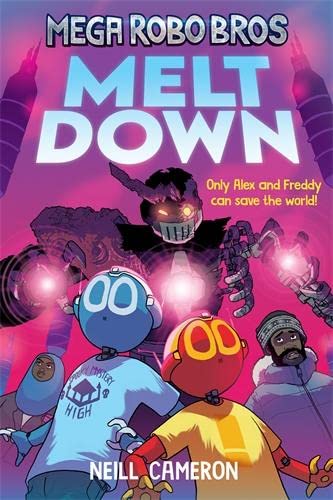
Mega Robo Bros: Meltdown


By Neill Cameron with Abby Bulmer & Lisa Murphy (David Fickling Books)
ISBN: 978-1-78845-281-6 (TPB)

Just in time to keep the kids occupied for the summer break, here’s another sterling all-ages outing for Neill (Tamsin of the Deep, How to Make Awesome Comics, Pirates of Pangea) Cameron’s marvellous purpose-built paladins. This time the rambunctious Mega Robo Bros share more of their awesome adventures and growing pains – and even some Secret Origins – in a far darker and more violent tale than their previous fun fare…

It’s the Future!

In a London far cooler than ours, Alex and his younger brother Freddie are (sort of) typical kids: boisterous, fractious, eternally argumentative yet devoted to each other, and not too bothered that they’re adopted. It’s really no big deal for them that they were constructed by the mysterious Dr. Roboticus before he vanished, and are considered by those in the know as the most powerful – and only SENTIENT – robots on Earth.

Dad may be just your average old guy who makes lunch and does a bit of writing, but it’s recently become apparent that when not being a housewife Mum is a also a bit extraordinary. As surprisingly famous and renowned robotics boffin, Dr. Nita Sharma harbours some surprising secrets of her own…

All the same, life in the Sharma household is pretty normal. Freddie is insufferably exuberant and over-confident whilst Alex is at the age when self-doubt and anxiety begin to manifest. Of course, their parents’ other robot rescues can also be a bit of a trial. Programmed as a dog, baby triceratops Trikey is ok, but French-speaking deranged ape Monsieur Gorilla can be mighty confusing, whilst gloomily annoying, existentialist aquatic fowl Stupid Philosophy Penguin constantly quotes dead philosophers and makes most people rapidly consider self-harm or manic mayhem.

The boys have part-time jobs as super-secret agents, but aren’t very good at the clandestine part and now almost the entire world knows of them. Generally, however, it’s enough for the digital duo that their parents love them, even though they are a bit more of a handful than most kids. They live as normal a life as possible: going to human school, playing with human friends and hating homework. It’s all part of their “Mega Robo Routine”, combining dull lessons, actual fun, games-playing, watching TV and training in the covert combat caverns under R.A.I.D. HQ.

Usually, when a situation demands, the lads carry out missions for bossy Baroness Farooq: head of government agency Robotics Analysis Intelligence and Defence. They still believe it’s because they are infinitely smarter and more powerful than the Destroyer Mechs and other man-made minions she usually utilises. Of course, they’re on suspension from R.A.I.D. at the moment, due to the fallout and collateral damage of their last case…

Originally published in UK weekly comic The Phoenix, this revised, retooled and remastered saga opens as the bored, curfewed boys sneak into Mum’s workshop. Whilst defeating a reject robot rebellion sparked by artificial life activist the Caretaker, the Bros met monstrous, cruelly damaged droid Wolfram and learned that he might be their older brother…

Now they’re trying to break into Mum’s locked datafiles to learn the truth, and her part in their creation, as this saga opens with ‘Part 1: Fifteen Years Ago’. When Dr. Sharma catches the little perishers in the act, instead of punishment, she gives them full access.

What unfolds is a shocking story of when their mother was a young, pretty and brilliant roboticist who landed her dream job working beside incomparable (but weird) pioneering genius Dr. Leon Robertus. His astounding advances had earned him the unwelcome nickname Dr. Roboticus. Maybe that was what started pushing him away from humanity…

Over months, Nita grew into her job and eventually convinced Robertus to let her repurpose his individually superpowered prototypes into a rapid-response team for global emergencies. Mum used to be a superhero, leading manmade Rapid Response team the Super Robo Six! While saving lives with them she first met future husband Michael Mokeme who proudly took her name when they eventually wed…

So Dad was also present at the moment everything changed!

Robertus was astoundingly devoid of human empathy but – intrigued by the team’s acclaim and global acceptance – was inspired to create a new kind of autonomous robot. Wolfram was more powerful than any other construct, and also possessed certain foundational directives that allowed him to make choices and develop his own systems. He could think, like Alex and Freddy! Only, as it transpired, not quite…

When Robertus demoted Nita and made his new “child” leader of new Super Robo Seven, the result was an even more effective unit, until the day Wolfram’s three Directives clashed during a time-critical mission. Millions of humans paid the price for his confusion and hesitation…

In the aftermath, RAID was formed and sought to shut down Robertus and decommission Wolfram. When the superbot rejected their judgement, the agency deployed jets and missiles. Following a terrific struggle, they believed him destroyed. They were wrong…

…And while RAID was occupied, Roboticus vanished…

Story told, the amazed Robo Bros realise why Mum called the recently-returned Wolfram their brother. They are all unaware that the damaged, deranged droid is observing and has made a decision that will affect all humanity…

‘Part 2: Meltdown’ opens with an increase in casual human-on-robot abuse. Perhaps this triggers Wolfram’s final solution as Dad heads to the North Pole to interview chief scientist Professor Mahfouz spearheading an attempt to restore the polar ice cap with a colossal freezing machine.

Jötunn Base covers many miles and is carefully rebalancing the world’s climate, but has no defence when Wolfram arrives to reverse the chilling process to burn the Earth and drown humanity…

Alex and Freddy are making the best of their house arrest, playing a game with classmates Mira and Taia when news comes of the attack. Ordered again by Baroness Farooq to stay put and not help, they enlist the girls in an escape plan that takes them through the secret basement lab and far below London, using the abandoned transport tunnels beneath the city.

By the time the Bros reach Jötunn Base, Wolfram has already ruthlessly crushed the RAID force led by their friend Agent Susie Nichols and all that’s possible is to stop their determined and utterly unreasonable brother by any means necessary…

That grim task falls to “older” bro Alex, whilst Freddy works with Dad and Professor Mahfouz to repair and reprogram the giant freezer machine and stop the planet becoming a water world…

With humanity safe again the boys are well rewarded by Farooq, but completely unaware that an old enemy has ensured that the threat of Wolfram is not ended…

Crafted by Cameron and colouring assistant Alice Leclert, this rather more grim adventure still offers exceedingly engaging excitement and hearty hilarity, roaring along like an anti-gravity rollercoaster, offering thrills, chills, warmth, wit and incredible verve. Alex and Freddy are utterly authentic kids, irrespective of their artificial origins, and their antics strike exactly the right balance of future shock, family fun and bombastic superhero action to capture readers’ hearts and minds. What movies these tales would make!
Text and illustrations © Neill Cameron 2022. All rights reserved.

Mega Robo Bros Meltdown will be released on August 4th 2022 and is available for pre-order now.

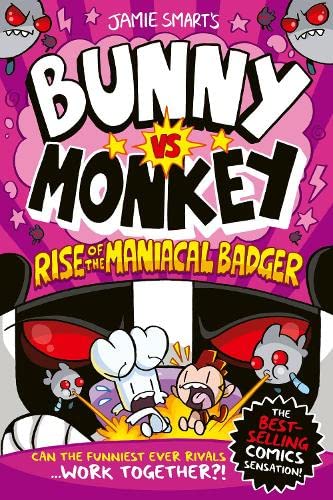
Jaimie Smart’s Bunny Vs Monkey: Rise of the Maniacal Badger


By Jaimie Smart, with Sammy Borras (David Fickling Books)
ISBN: 978-1-78845-280-9 (TPB) 978-1-78845-118-5 (Waterstones Exclusive Edition)

Bunny vs. Monkey has been a staple of comics phenomenon The Phoenix since the very first issue in 2012: recounting a madcap vendetta gripping animal arch-enemies set amidst an idyllic arcadia masquerading as more-or-less mundane but critically endangered English woodlands.

Concocted with gleefully gentle mania by cartoonist, comics artist and novelist Jamie Smart (Fish Head Steve!; Looshkin; Flember), the trendsetting, mindbending yarns have been wisely retooled as graphic albums available in remastered, double-length digest editions such as this one.

All the tail-biting tension and animal argy-bargy began yonks ago after an obnoxious little beast popped up in the wake of a disastrous British space shot. After crashlanding in Crinkle Woods – scant miles from his launch site – lab animal Monkey believed himself the rightful owner of a strange new world, despite all efforts from reasonable, sensible, genteel, contemplative forest resident Bunny to dissuade him. For all his patience, propriety and good breeding, the laid-back lepine just could not contain the incorrigible idiot ape, who was – and is – a rude, noise-loving, chaos-creating loutish troublemaker…

Problems are exacerbated by the other unconventional Crinkle creatures, particularly a skunk called Skunky who has a mad scientist’s attitude to life and a propensity to build extremely dangerous robots and super-weapons…

Here – with artistic assistance from Sammy Borras – the war of nerves and mega-ordnances resumes and intensifies. The unruly assortment of odd critters loitering around and cluttering up the bucolic paradise have finally picked sides: shifting and twisting into bipartisan factionalism. They all seem to have forgotten that rapidly encroaching Hyoomanz as they respond to another personal crisis and the rise to power of an unsuspected third force in woodland politics…

As ever divided into seasonal outbursts, the saga starts slowly with a chilly teaser tale as Winter ends in the ‘Thaw of the Snow-Bots’…

The assorted animals have been in stasis in a giant freezer, and once fire-breathing snowmen attack, they decide it’s best to have a little more kip… or do they?

The story actually resumes in Spring and the far future where time-traveller Ai – a superfast Ai-Ai not naturally indigenous to our sylvan glades and endangered shores – learns of a disaster that’s history here but her tomorrow. A good person, she undertakes ‘The Journey Home’ but arrives too late as ‘A Rather Maniacal Badger’ details how the woods have been conquered at last…

Previously, a catastrophic rivalry erupted when rival evil genius Maniacal Badger vied with Skunky for the title of “The Most Brilliant Animal in the Woods”. Now, while everyone was hibernating, the black-&-white bounder has occupied the region and established a base in a 50-foot (15-24 meters) high statue of himself as the first step in building his dream of Badgertopia.

The shock of defeat particularly affects Skunky, who descends into a spiral of depression and lowering esteem…

Universal innocents Weenie squirrel and Pig have their own way of de-stressing and not even roving robot drones can upset ‘A Quiet, Uneventful Day’ on the lake. Old animosities are paused and enemies become temporary allies planning to resist through ‘Distraction’ and strategic deployment of brain-battered, bewildered suicide bomber/former stuntman Action Beaver, but when that scheme flops we instead focus on ‘A Sad Skunk’ as the original mad scientist undergoes an existential crisis and needs Bunny to share it with…

The relative inactivity soon triggers his robot back-up to mischief mode, but even ‘Mecha Skunky!’ is not immune to the doldrums and there’s nothing ‘Action Beaver!’ can do to rectify the situation, especially after the badger activates a gross flying terror who swallows everybody in ‘The Whale!’

Having retreated to the tunnels built by long-gone but not forgotten local legend Fantastic Le Fox, the uneasy animal animals hide from the tyrant’s tantrums in ‘Too Noisy!’: unexpectedly discovering a hidden, weapon-stocked lair that will be the base for their fight back… once they have safely reassembled ‘All the Toys in the Toyshop!’

Although initial giant robot ‘Battle Bat!’ spectacularly fails, resistance efforts continue, but Monkey is easily distracted and soon moves to make his own empire in ‘Monkeyopia Rises!’ and as Summer begins ‘Divisions!’ proliferate. Before long the war with Bunny flares up again and instantly moves into the province of war crimes as the simian unleashes his flatulence-powered ‘Rofl-Copter!’

Weenie and Pig go on a ‘Treasure Hunt!’ in the mouldering pile of toxic rubbish kindly left by the Hyoomanz, but find no shield from the badger’s latest infamy: mind controlling everyone and turning the Woods into his digital plaything in ‘Game Over!’

A brief diversion follows in an exclusive Bunny vs Monkey Detective Story, but ‘The Curious Case of the Pig in the Night-Time’ is less baffling than Bunny’s failure to join mystic brotherhood ‘The Order of the Moose’…

When young Hyoomanz find themselves ‘(Not) Alone in the Woods’ during a class trip one little girl renews her old acquaintance with Metal Steve after he saves them from Maniac Badger attacks, whilst elsewhere ‘Monst-Ughs!’ run wild after improper use of Skunky’s old monster ray, leading to a glimpse at the tyrant’s origins and family issues in ‘The Making of a Maniacal Badger!’

Incorrigible Monkey then loses control of marauding robot ‘Doom Fists!’ after he is attacked by his wicked doppelganger Evil Monkey and partner in crimes Evil Monkey Wife, whilst elsewhere Skunky recovers some of life’s zest after helping Weenie and Pig repair one of the badger’s ‘Evil Drones!’

Three part saga ‘The Saving of Skunky!’ sees order restored after the badger’s plan to kidnap Skunky and steal what’s left of his evil genius goes awry. Trapped together in the Dark Woods, the skunk experiences a ghastly visitation and by the time the Maniacal one gets back to his conquered kingdom, there’s a restored archenemy waiting to deliver ‘A Sharp Shock’ with electrified clouds and a Zeus costume…

Badger’s retaliation is ancient thought monster ‘Ragnaggtrix!’ but there’s an inherent flaw in something dependent on belief that the evil genius didn’t consider. Thankfully, Skunky is preoccupied ‘Distracting the Monkey!’ from cadging more superweapons to misuse…

Bunny becomes guinea pig when Skunky and Monkey test emotion-warping Mind Mines in ‘Highly Strung!’ and as Autumn begins The Rise of an Empire!’ finds expansionist Monkeytopia devasted by its ruler’s idiocy, even as the badger traps the woodland creatures inside his new phone app in ‘Game On!’ It’s a huge, costly mistake…

‘Balloonacy!’ breaks out when Weenie and Pig try to attend Ai’s birthday party, before a new character debuts. ‘Lucky!’ is a red panda who escaped a lab doing weird experiments. It might not have been in time though, since the three-way war for supremacy in the woods triggers an odd reaction…

The action and drama ramp up for a big finish as Badger is made to clean his room and employs the ‘Doomsday Device!’ that opens portals to Hell. Shame about his mum and dad…

Skunky makes a silly mistake and gives the wrong animal some atomic powered ‘Explosive Sweets!’ which makes Halloween’s ‘Fright Night!’ Scare-Off pretty anticlimactic war, before another peek at the future reveals the legend of ‘Jetpack Beaver!’

A distant relative tries to make one woodland weirdo ‘Pigging Rich!’ with little success, after which a bad tooth and unwise consultation with Skunky results in Monkey taking a big bite out of everything in ‘Chomp!’

The cataclysmic end begins when the Maniacal one pressgangs ‘The Badger Army’ to do his bidding but forgets the species’ tendency to unionise even as Skunky creates a ‘Terraforming Orb!!’ to purpose-build a new world. It’s a shame Monkey dropped it on his own head while it was switched on…

Winter begins with 3-chapter epic ‘A Very Badger Christmas’ that delivers shocking big reveals, pulls all the plot threads of the past year together, ends the world and still leaves rueful survivors wondering what comes next in ‘Aftermath’. Whatever you think happened you’re wrong, so you just have to buy this book to see how…

The animal anarchy might end for now there’s one more secret to share with detailed instructions on ‘How to Draw Maniacal Badger’ so, as well as beguiling your young ‘uns with stories, you can use this book to teach them a trade…

The zany zenith of absurdist adventure, Bunny vs Monkey is weird wit, brilliant invention, potent sentiment and superb cartooning crammed into one eccentrically excellent package: never failing to deliver jubilant joy for grown-ups of every vintage, even those who claim they only get it for their kids. This is the kind of comic parents beg kids to read to them. Is that you yet?

Text and illustrations © Jamie Smart 2022. All rights reserved.
Bunny vs Monkey: Rise of the Maniacal Badger is published on July 7th 2022 and is available for pre-order now.

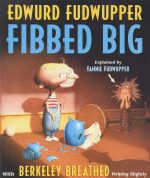
Edwurd Fudwupper FIBBED BIG – Explained by Fannie Fudwupper with Berkeley Breathed Helping Slightly


By Berkeley Breathed (Little, Brown & Co./Storyopolis)
ISBN: 978-0-316-14291-5 (HB) 978-0-316-14425-4 (Album PB)

I’ve been watching The News and getting upset by politicians’ obnoxiously blatant disregard for probity and dearth of ethical standards, not just in my own bankrupt-in-every-aspect Britain, but everywhere else too – except maybe New Zealand (Nice One, Jacinda).

As is always the case in such circumstances, I turned to comics and cartoons for solace and found this. Please read, enjoy and act according to the dictates of your conscience, if you have one…

Please Note: any similarity to other malign, malformed, bribe-fattened, emotionally stunted, eternally misbehaving overprivileged schoolboys currently serving at the Nation’s expense is just the way things are these days…

Throughout the 1980s and for half of the 1990s, Berke Breathed dominated the newspaper strip scene with agonisingly funny, edgy-yet-surreal political fantasy Bloom County and, latterly, Sunday-only spin-off Outland. They are all fully available digitally – so don’t wait for my reviews, just get them now!

At the top of his game and swamped with awards like Pulitzers, Breathed retired to concentrate on books like Red Ranger Came Calling, Mars Needs Moms! or Flawed Dogs: The Year End Leftovers at the Piddleton “Last-Chance” Dog Pound and sequel Flawed Dogs: The Shocking Raid on Westminster. They rank among the best America has ever produced. Get them too.

His first foray into the field was 1991’s A Wish for Wings That Work: a Christmas parable featuring his signature character, and the most charmingly human one. Between 2003 and 2008, Breathed revived Opus as a Sunday strip, before eventually capitulating to his career-long antipathy for the manic deadline pressures of newspaper production and often-insane, convoluted contradictions of editorial censorship.

It seemed his ludicrous yet appealing cast of misfits – all deadly exponents of irony and common sense residing in the heartland of American conservatism – were gone for good, until the internet provided a platform for Breathed to resume his role as a gadfly commentator on his own terms. Since 2015, Bloom County has mocked, exposed and shamed capitalism, celebrities, consumerism, popular culture, politicians, religious leaders and people who act like idiots. Donald Trump figures prominently and often, but that might just be coincidence…

These later efforts, unconstrained by syndicate pressures to not offend advertisers, are also available as book collections. You’ll want those too, and be delighted to learn that all Breathed’s Bloom County work is available in digital formats – fully annotated to address the history gap if you didn’t live through events such as Iran-Gate, Live-Aid, Star Wars (both cinematic and military versions), assorted cults and televangelists experiencing less than divine retribution and sundry other tea-cup storms that make us Baby Boomers so rude and defensive…

Not quite as renowned, but every inch as crucial to your enjoyment, is the lost gem on display today: a paean to the power of principles and effects of honesty, all wrapped up in a children’s book about a mean kid with no moral compass…

As previously stated, after the all-too-brief, glittering outing as a syndicated strip cartoonist and socio-political commentator (usually the very same hallowed function) Breathed left strips to create children’s picture books.

He lost none of his perception, wit or imagination, and actually got better as an artist. Even so, he never quite abandoned his entrancing cast of characters and always maintained the gently excoriating, crusading passion and inherent bittersweet invective which underscored those earlier narratives.

Moreover, he couldn’t ignore that morally uplifting component of his work that so upset hypocrites, liars, greedy people and others who let us all down while carping on about being unfairly judged and how we don’t really understand complex issues. Trust me, we – and Breathed – understand perfectly…

This crushingly captivating cartoon catechism ruminates on the cost and worth of family and idiocy of arrogant aggrandizement and self-congratulatory self-importance. It is lensed through the fabled truism of the Boy Who Cried Wolf, as little sister Fannie complains again about her idiot brother…

Edwurd Fudwupper tells lies because he wants to, because he can and because of the chaotic consequences his dissembling causes. The only thing he isn’t, is convincing. Always in trouble, he narrowly and perpetually weasels out of instant retribution due to his facility for fibs, but now Fannie recalls the day when that stopped working…

After a couple of whoppers lead to the disappearance of a neighbour and destruction of beloved family property, Edwurd’s automatic response of lying big and compounding nonsense with bigger balderdash sparks community calamity, mass military deployment and imminent alien invasion. As the Earth stands still in the moment before utter disaster, a small voice speaks out…

Delivered in sharp and lyrical rhyme like a weaponised Dr. Seuss story, and with lush lavish illustrations painted in the stunningly grotesque exaggeration beloved of Ralph Steadman and Terry Gilliam cartoons, this is a book to trigger personal reflection, audit consciences and promote better behaviour, but it will make grown citizens howl and children sit up and pay attention. It’s also deliciously funny. You’ll laugh, you’ll cry, you’ll think hard before calling in sick or blaming the dog – or opposition or asylum seekers – for eating your homework…
© 2000 Berkeley Breathed. All rights reserved.
Walt Disney’s Donald Duck by Carl Barks: volume 6 – The Old Castle’s Secret


By Carl Barks & various (Fantagraphics Books)
ISBN: 978-1-60699-653-9 (HB/Digital edition)

Donald Duck ranks among a number of fictional characters who have transcended the bounds of reality to become – like Sherlock Holmes, Tarzan, Popeye and James Bond -meta-real. As such, his origins are complex and convoluted. His official birthday is June 9th 1934: a dancing, nautically-themed bit-player in the Silly Symphony cartoon short The Wise Little Hen.

However, that date is based on the feature’s release, as announced by distributors United Artists and latterly acknowledged by the Walt Disney Company. Recent research reveals the piece was initially screened at Carthay Circle Theatre in Los Angeles on May 3rd, part of a Benefit show. The Wise Little Hen officially premiered on June 7th at the Radio City Music Hall in New York City, before the general release date was settled.

The animated cartoon was adapted by Ted Osborne & Al Taliaferro for the Silly Symphonies Sunday comic strip and thus classified by historians as Donald’s official debut in Disney comics. Controversially though, he was also reported to have originated in The Adventures of Mickey Mouse strip which began 1931. Thus the Duck has more “birthdays” than the Queen of England (plus the generally disUnited Kingdom and gradually diminishing Commonwealth) which probably explains why he’s such a bad-tempered old cuss.

Visually, Donald Fauntleroy Duck was largely the result of animator Dick Lundy’s efforts, and, with partner-in-fun Mickey Mouse, is one of TV Guide‘s 50 Greatest Cartoon Characters of All Time. The Duck has his own star on the Hollywood walk of fame and has appeared in more films than any other Disney player.

During the 1930s his screen career grew from background and supporting roles to a team act with Mickey and Goofy to a series of solo cartoons that began with 1937’s Don Donald, which also introduced love interest Daisy Duck and the nephews Huey, Louie and Dewey. By 1938 Donald was officially more popular than company icon Mickey Mouse, especially after his service as a propaganda warrior in a series of animated morale boosters and information features during WWII. The merely magnificent Der Fuehrer’s Face garnered the 1942 Academy Award (that’s an Oscar to you and me) for Animated Short Film…

Crucially for our purposes, Donald is also planet Earth’s most-published non-superhero comics character and has been blessed with some of the greatest writers and illustrators ever to punch a keyboard or pick up a pen or brush.

A publishing phenomenon and mega star across Europe – particularly Italy, Germany, the Netherlands, Greece, Sweden, Denmark, Norway, Finland and Iceland – Donald & Co have spawned countless original stories and characters. Sales are stratospheric there and in the more than 45 other countries they export to. Japanese manga publishers have their own iterations too…

The aforementioned Silly Symphonies adaptation and Mickey Mouse newspaper strip guest shots were trumped in 1937 when Italian publisher Mondadori launched an 18-page story by Federico Pedrocchi in comic book format. It was quickly followed by a regular serial in Britain’s Mickey Mouse Weekly. The comic was produced under license by Willbank Publications/Odhams Press and ran from 8th February 1936 to 28th December 1957.

In #67 (May 15th 1937) it launched Donald and Donna (a prototype Daisy Duck girlfriend), drawn by William A. Ward. Running for 15 weeks it was followed by Donald and Mac before ultimately settling on Donald Duck, and a fixture until the magazine folded. The comic inspired similar Disney-themed publication across Europe with Donald regularly appearing beside company mascot Mickey…

In the USA, a daily Donald Duck newspaper strip launched on February 2nd 1938, with a colour Sunday strip added in 1939. Writer Ted Karp joined Taliaferro in expanding the duck cast, adding a signature automobile, dog Bolivar, cousin Gus Goose, grandmother Elvira Coot and expanded the roles of both Donna and Daisy…

In 1942, his licensed comic books canon began with the October cover-dated Dell Four Color Comics Series II #9 as Donald Duck Finds Pirate Gold: conceived by Homer Brightman & Harry Reeves, scripted by Karp and illustrated by Disney Studios employees Carl Barks & Jack Hannah. It was the moment everything changed…

Carl Barks was born in Merrill, Oregon in 1901, and raised in rural areas of the West during some of the leanest times in American history. He tried his hand at many jobs before settling into the profession that chose him. His early life is well-documented elsewhere if you need detail, but briefly, Barks was an animator before quitting in 1942 to work in the new-fangled field of comic books.

With studio partner Jack Hannah (another future strip illustrator) Barks adapted Karp’s rejected script for an animated cartoon short into Donald Duck Finds Pirate Gold, and although not his first published comics work, it was the story that shaped the rest of his career.

From then until his official retirement in the mid-1960s, Barks operated in self-imposed seclusion: writing, drawing and devising a vast array of adventure comedies, gags, yarns and covers that gelled into a Duck Universe of memorable and highly bankable characters. These included Gladstone Gander (1948), Gyro Gearloose (1952), Magica De Spell (1961) and the nefarious Beagle Boys (1951) to supplement Disney’s stable of cartoon actors. His greatest creation was undoubtedly the crusty, energetic, paternalistic, money-mad giga-gazillionaire Scrooge McDuck: the World’s wealthiest winged nonagenarian.

Whilst producing all that landmark material Barks was also just a working guy, generating cover art, illustrating other people’s scripts when asked, and contributing stories to the burgeoning canon of Duck Lore. After Gladstone Publishing began re-packaging Barks material amongst other Disney strips in the 1980s, he discovered the well-earned appreciation he never imagined existed…

So potent were his creations that they inevitably fed back into Disney’s animation output itself, even though his brilliant comic work was done for Dell/Gold Key and not directly for the studio. The greatest tribute was undoubtedly the animated series Duck Tales: heavily based on his classic Uncle Scrooge tales.

Barks was a fan of wholesome action, unsolved mysteries and epics of exploration, and this led to him perfecting the art and technique of the blockbuster tale: blending wit, history, plucky bravado and sheer wide-eyed wonder into rollicking rollercoaster romps that utterly captivated readers of every age and vintage. Without the Barks expeditions there would never have been an Indiana Jones…

During his working life Barks was blissfully unaware that his work (uncredited by official policy, as was all Disney’s comics output) had been recognised by a rabid and discerning public as “the Good Duck Artist.” When some of his most dedicated fans finally tracked him down, a belated celebrity began.

In 2013, Fantagraphics Books began chronologically collecting Barks’ Duck stuff in wonderful, carefully curated archival volumes, tracing his output year-by-year in hardback tomes and digital editions that finally do justice to the quiet creator. These will eventually comprise the Complete Carl Barks Disney Library. The physical copies are sturdy and luxurious albums – 193 x 261 mm – that would grace any bookshelf, with volume 6 re-presenting works from 1948 – albeit not in strict release order. I should also note that all the Four Color issues come from Series II of that mighty anthological vehicle and all cover are by Barks.

It begins eponymously with The Old Castle’s Secret’ (FC #189, June 1948) as a crisis in the McDuck financial empire triggers a mission for Donald and the nephews: accompanying Scrooge to the ancestral pile in Scotland to search for millions in hidden treasure. Apparently the craggy citadel is haunted, but what they actually encounter is both more rationalistically dangerous and fantastically unbelievable…

Two single-page gags from the same issue follow, with ‘Bird Watching’ exposing the hidden perils of the hobby whilst superstition is painfully debunked in ‘Horseshoe Luck’ before ‘Wintertime Wager’ (Walt Disney’s Comics and Stories #88, January) introduces annoying cousin Gladstone Gander. Amidst chilling winter snows, the miraculously lucky, smugly irksome oik invites himself over for Christmas and soon he and Donald are involved in an escalating set of ordeals that might cost the Duck his house. Thankfully, Daisy and the boys are there to solve the problem…

Gainful employment was a regular dilemma for Donald and February’s ‘Watching the Watchman’ (WDC&S #89) finds him taking a midnight-to-daybreak job at the docks, but pitifully unable to alter his sleep patterns. Once again, Huey, Louie and Dewey offer outrageous assistance but this time it’s the Duck’s inability to stay awake that foils a million dollar heist….

They’re actually Donald’s rivals in ‘Wired’ (WDC&S #90, March) when all seek big bucks as telegram messengers. Sadly, millionaires are not generally friendly, welcoming or prone to giving giant gratuities…

A dedicated social climber, Donald plans a garden party in WDC&S #91 (April), but his notion of fancy dress and family solidarity utterly anger the boys, who retaliate with manic mesmerism in ‘Going Ape’, after which March of Comics #20 finds butterfly-hunter Donald at war with avaricious lepidopterist Professor Argus McFiendy across two continents.

Donald’s sharp and ruthless tactics inspire onlooker Sir Gnatbugg-Mothley to fund a safari to ‘Darkest Africa’ in search of the rarest butterfly on Earth. The daunting quest for the Almostus Extinctus is frenetically fraught, astoundingly action-packed and fabulously fun-filled but please be aware that despite Barks’ careful research and diligent, sensitive storytelling some modern folk could be upset by his depictions of indigenous peoples in terms of the accepted style of those decades-distant times.

Nevertheless, the bombastic war ends with a delicious sting in the tail.

In case you were wondering: March of Comics releases were prestigious promotional giveaways tied to retail products and commercial clients like Sears, combining licensed characters from across Whitman/KK/Dell’s joint catalogue. The often enjoyed print runs topping 5 million copies per issue. Being a headliner for them was a low key editorial acknowledgement of a creator’s capabilities and franchise’s pulling power…

Back in the regular world, Donald’s eternal war of nerves with the kids boiled over in FC #189 (June) as ‘Bean Taken’ saw his obsessive side dominant in a guessing game, a single-pager, preceding another exploring the downside of sandlot baseball in ‘Sorry to Be Safe’ (FC #199, October) and standard 10-page romp ‘Spoil the Rod’ (WDC&S #92, May). Here passing do-gooder Professor Pulpheart Clabberhead seeks to stop Donald’s apparent abuse of Huey, Louie and Dewey – but only until he gets to know them…

Although the science fiction boom and flying saucer mania was barely beginning in 1948, Barks was an early advocate and ‘Rocket Race to the Moon’ (WDC&S #93, June) sees newspaper seller Donald suckered into piloting an experimental lunar exploration ship. Tragically, Professors Cosmic and Gamma seem more concerned with a large cash-prize contest than advancing science and rival rocketman Baron De Sleezy is a ruthless schemer, but no one – not even the stowaway nephews – were prepared for what lived on the moon…

Patriotism inspires our bellicose birdbrain to enlist as ‘Donald of the Coast Patrol’ (WDC&S #94, July) but it’s his innate gullibility and bad temper that helps him bag a bunch of spies before true wickedness rears its downy head as ‘Gladstone Returns’ (WDC&S #95, August).

The ghastly Gander was designed as a foil for Donald, intended to be even more obnoxious than the irascible, excitable film fowl.

This originally untitled tale reintroduces him as a big noxious noise every inch as blustery a blowhard as Donald but still lacking his seemingly supernatural super-luck talent. Here, both furiously boast and feud, trying to one-up each other in a series of scams that does neither any good… especially once the nephews and Daisy join the battle…

Arguably Barks’ first masterpiece, ‘Sheriff of Bullet Valley’ was the lead tale from Dell Four Color Comics #199, drawing much of its unflagging energy and trenchant whimsy from Barks’ own love of cowboy fiction – albeit seductively tempered with his self-deprecatory sense of absurdist humour. For example, a wanted poster on the jailhouse wall portrays the artist himself, offering the princely sum of $1000 and 50¢ for his inevitable capture.

Donald is – of course – a self-declared expert on the Wild West (he’s seen all the movies) so when he and the boys drive through scenic Bullet Valley, a wanted poster catches his eye and his imagination. Soon he’s signed up and sworn in as a doughty deputy, determined to catch rustlers plaguing the locals. Unfortunately for him, the good old days never really existed and today’s bandits use radios, trucks, tommy guns and ray machines to achieve their nefarious ends. Can Donald’s impetuous boldness and the nephews’ collective brains and ingenuity defeat the ruthless high-tech raiders?

Of course they can…

That same issue first saw a brace of short gags, beginning with ‘Best Laid Plans’ as Donald’s feigned illness earns him extra hard labour rather than a malingering day in bed and closing with ‘The Genuine Article’ wherein suspicions of an antiques provenance leads to disaster…

The lads plans to go fishing are scuppered – but not for too long – when Donald demands their caddying services in ‘Links Hijinks’ (WDC&S #96, September). It all really goes south once Gladstone horns in and Donald’s competitive spirit overwhelms everybody…

That tendency to overreact informs ‘Pearls of Wisdom’ (WDC&S #97, October) when the nephews find a small pearl in a locally-sourced oyster and big-dreaming Donald goes overboard in exploiting the” hidden millions” probably peppering the ocean floor, before we close with another mission for Uncle Scrooge.

To close a deal with British toff Lord Tweeksdale, McDuck must prove his family pedigree by excelling in the most “asinine, stupid, crazy, useless sport in the world”: fox hunting. Designating Donald his champion, the Downy Dodecadillionaire of Duckburg is thankfully unaware Huey, Louie and Dewey also consider themselves ‘Foxy Relations’ (WDC&S #98, November), injecting themselves covertly into proceedings with catastrophic repercussions…

The visual verve over, we move on to validation as ‘Story Notes’ offers commentary for each Duck tale and Donald Ault relates ‘Carl Barks: Life Among the Ducks’, before ‘Biographies’ explain why he and commentators Alberto Beccatini, R, Fiore, Craig Fischer, Jared Gardner, Leonardo Gori, Rich Kreiner, Ken Parille, Stefano Priarone, Francesco (“Frank”) Stajano and Mattias Wivel are saying all those nice and informative things.

We close with an examination of provenance as ‘Where Did These Duck Stories First Appear?’ explains the somewhat byzantine publishing schedules of Dell Comics.

Carl Barks was one of the greatest exponents of comic art the world has ever seen, and almost all his work featured Disney’s Duck characters: reaching and affecting untold millions of readers across the world and he all too belatedly won far-reaching recognition. You might be late to the party but it’s never too soon to climb aboard the Barks Express.
Walt Disney’s Donald Duck “The Old Castle’s Secret” © 2013 Disney Enterprises, Inc. All contents © 2013 Disney Enterprises, Inc. unless otherwise noted. All rights reserved.