Cow Boy – a Boy and His Horse


By Nate Cosby & Chris Eliopoulos, with Roger Langridge, Brian Clevinger, Scott Wegener, Mitch Gerads, Colleen Coover, Mike Maihack & various (Archaia/Boom Entertainment)
ISBN: 978-1 936393-67-1 (HB Archaia) 978-1-60886-419-5 (PB Boom Entertainment)

The Wild West is a place of myth, mayhem, pure ideals, shining imagery and utter paradox. This superb all-ages yarn proves all that and still hides a surprise or two, so get it for your young ‘uns and read it too. It comes in hard and soft cover and even over the wireless telegraph of that there digital book stuff…

Boyd Linney is an honest bounty hunter with a unique specialty. He’s ten years old and only tracks his own kin: owlhoots, sharpers and scoundrels, every one of ’em…

Delivered with delicious irony and captivating cartoon visuals, this fistful of rootin’ tootin’ yarns comes courtesy of writer Nate Cosby (Pigs, Jim Henson’s The Storyteller) and illustrator/colourist/letterer Chris Eliopoulos (Franklin Richards, Misery Loves Sherman), kicking every trope and meme of the ancient west sharply in the ankles (Boyd’s smart, tough and ornery, but really, really short) as the kid on a mission busts his dad out of jail just to bring him to justice.

On the ride to the marshal’s office the hard-bitten kid learns his early life was even harder and more debased than he ever reckoned. It does not ease his temperament as he goes after double dealing, saloon owner Zeke Linney, but he never liked his oldest brother, anyway…

The hardest part was tracking down his Granpappy…

Augmenting the dry, witty whimsy and gritty daftness are a succession of short vignettes by invited artisans of similar mien, beginning with multi-talented Roger Langridge (The Muppet Show, Fred the Clown, Thor: the Mighty Avenger, Popeye) who briefly details the downfall of ‘The Man with No Underpants’, after which Brian Clevinger, Scott Wegener & Mitch Gerards (Atomic Robo), silently detail destructive progress in ‘The Wireless West’.

Colleen Coover (Small Favors, Banana Sunday, X-Men First Class, Jim Henson’s The Storyteller) outlines a portentous proposal in ‘Yellow Rose & Black Billy’ before Mike Maihack (Cleopatra in Space) reveals another day in the explosive life of one of the oddest pairings in gunfighting annals, concluding that ‘A Penguin Never Misses’ before the sagebrush homage halts with a terse prose epigram by Cosby – ‘Boyd’s Wagon: A Cow Boy Short Story’…

Hugely enjoyable and profoundly disrespectful, this western delight is a supreme treat for aficionados of the timeless genre and anybody deeply in need of a hearty horse laugh…
Cow Boy is ™ and © 2012 Nate Cosby and Chris Eliopoulos. All rights reserved.

Flember – the Secret Book (Advance galley proof copy)


By Jaimie Smart (David Fickling Books)
ISBN: 978-1-910989-46-3 (PB Illustrated novel)

There are precious few perks in the high stakes, cut & thrust world of writing about graphic novels and books, but one is getting to see great stories before you all do and then acting all smugly know-it-all and blasé about how good they are, as if I’m in with the In Crowd.

This review of Flember is based on a proof copy and I’ll probably review the proper book too when it comes out in Early October. It’s that good…

Unlike writer/artist Jamie Smart’s previous outings (Fish Head Steve!, Space Raoul, Bunny vs. Monkey, Looshkin – the Adventures of the Maddest Cat in the World!!, Corporate Skull and bunches of brilliant strips for The Beano, Dandy and others), this is an illustrated novel, not comics strips, but that only means he’s really good at the wordy stuff too, and even so his dynamic cartoons, diagrams and maps are lavished all over the text and act as an integral part of the storytelling.

Here’s a little digression that might assuage any confusions I’ve inadvertently caused…

The old demarcations – whether in format or content – between comics and books are all but gone these days but once the items of printing were reckoned as different as chalk and chuck wagons.

From the pre-print era of illustrated manuscripts, books always possessed a capacity (time, manpower and budgets permitting) to include images in the text. As the book trade evolved, pictures were generally phased out of cheaper, mass-market editions because they required costly, time-consuming extra effort by skilled technicians. Most artists and illustrators wanted payment for their efforts too, so volumes with pictures were regarded as extra special, most often crafted for children, students or aficionados of textbooks…

Comics strips grew out of cartoon images, beginning as static illustrations accompanied by blocks of printed text before gradually developing into pictorial sequences with narration, dialogue and sound effects incorporated into the actual design. Print procedures and physical strictures of manual typesetting often dictated that pictures (printed on the pages or added as separate plates) frequently appeared nowhere near the snippets of text they illumined).

These days digital print processes are speedy, efficient and flexible, and many creative bright sparks have realised that they can combine all these tangential disciplines into a potent synthesis.

Gosh, wasn’t that lecture dull?

What I’m saying is that these days, the immediacy of comics, the enchantment of illustrated images, the power of well-designed infographics and the mesmeric tone and mood of well-written prose can all be employed simultaneously to create tales of overwhelming entertainment. Flember – The Secret Book does it with aplomb, imagination, dexterity and sundry other fruit and veg you’ve never heard of. That’s an inside joke until you read the book…

But what’s it about, Win?

I’m giving little away but suffice to say that somewhere far away the island of Flember houses a rather rural and backwards facing community who live in a little walled village called Eden. The citizens are an odd bunch, set in the old traditional ways and they don’t particularly like inventors anymore.

Young Dev Everdew doesn’t really fit in. His brother is a snarky would-be leader of the local Guild and Mum doesn’t like to cause a fuss. Dad used to be Mayor but he’s gone now…

Life on the island depends on a seemingly-mystical force called Flember: an energising life force that animates the trees, living creatures and crops and even people. Did I mention that Dev’s addicted to inventing? He is, and all his contraptions always go wrong and cause the fuss previously mentioned.

The boy can’t stop himself, though, and just knows his devices can make life better for everybody. Despite the pleadings, help and advice of his young pals, Dev keeps making things and accidentally hurting people, but the situation gets completely out of hand after he builds a giant bear that absorbs all the Flember and comes shockingly alive. Sadly, that puts the little genius on the trail of a colossal secret underpinning everything and teaches him the consequences of rash actions…

Fast-paced, astoundingly inventive, raucously hilarious, deeply moving even while sagely exploring how carefree childishness grows into empathy and responsibility, this is a marvellous romp and an ideal example of words and pictures acting in harmony… almost like a well-oiled machine.

Just to be clear here though; never oil books or any digital reading device, ok? Just use them to acquaint yourself with tales as good as this one…
Text and illustrations © Jamie Smart 2019. All Rights Reserved.

Flember – The Secret Book is scheduled for release on October 3rd 2019 and is available for pre-order now. It’s a perfect item if you’re already stuck for options about Great Big Gift-Giving Season…

Quick & Flupke: Fasten Your Seatbelts


By Hergé, translated by David Radzinowicz (Egmont UK)
ISBN: 978-1-4052-4742-9 (PB Album)

Georges Prosper Remi – known to all as Hergé – created a genuine masterpiece of graphic literature with his tales of a plucky boy reporter and his entourage of iconic associates. Singly, and later with assistants including Edgar P. Jacobs, Bob de Moor and other supreme stylists of the select Hergé Studio, he crafted 23 splendid volumes (originally produced in brief instalments for newspaper periodicals) which have since grown beyond their popular culture roots and attained the status of High Art.

Globally renowned for these magnificent Tintin adventures, Hergé also did much to return comics to the arena of mass entertainment, a position largely lost after the advent of television, video-recording and computer games.

However, the bold boy and his opinionated dog were by no means his only creation. The author was a prodigious jobbing cartoonist in the years before the junior journalist finally assured him immortality and he generated a minor pantheon of other topical strips and features such as Tim the Squirrel in the Far West, The Amiable Mr. Mops, Tom and Millie and Popol Out West.

Among the best of the rest were the tales of Jo and Zette Legrand and their chimpanzee Jocko in much the same wholesome action vein as Tintinand the episodic, all-ages shenanigans of a pair of mischievous ragamuffins in pre-WWII Belgium.

In 2005 Egmont translated three escapades of Jo, Zette and Jocko into English (although there are more just sitting out there, all foreign and unreadable by potential fans too lazy to learn French or any of a dozen other civilised languages…) so in 2009 the publisher tried again with two collections of the Master’s second most successful creation: Quick et Flupke, gamins de Bruxelles.

These rambunctiously subversive, trouble-making working-class rapscallions and scallywags were precursors and thematic contemporaries of such beloved British boy acts as The Bash Street Kids, Winker Watson, Roger the Dodger et. al., and for more than a decade – January 1930 to May 1940 – rivalled the utterly irresistible Tintin in popularity and almost certainly acted as a rehearsal room for all the humorous graphic and slapstick elements which became so much a part of future Tintin tales.

Ten years ago Egmont had a brief stab at reviving the likely lads and it was only the general public’s deplorable lack of taste and good sense which stopped the kids from taking off again…

On leaving school in 1925, Hergé began working for Catholic newspaper Le XXe Siécle, falling under the influence of its Svengali-like editor Abbot Norbert Wallez. Remi produced his first strip series The Adventures of Totor for Boy Scouts of Belgium monthly magazine the following year, and by 1928 was in charge of producing the paper’s children’s weekly supplement Le Petit Vingtiéme.

He was unhappily illustrating The Adventures of Flup, Nénesse, Poussette and Cochonette, written by the staff sports reporter, when Abbot Wallez asked him to create a new adventure series. Perhaps a young reporter who would travel the world, doing good whilst displaying solid Catholic values and virtues?

Having recently discovered the word balloon in imported newspaper strips, Remi decided to incorporate the innovation into his own work. He created a strip both modern and action-packed – and heavily anti-communist. From January 10th 1929, weekly episodes of Tintin in the Land of the Soviets appeared in Le Petit Vingtiéme, running until May 8th 1930.

Around this time the cartoonist also began crafting weekly 2-page gag strips starring a pair of working-class rascals on the streets of Brussels. They played pranks, got into good-natured trouble and even ventured into the heady realms of slapstick and surrealism: the sort of antics any reader of Dennis the Menace (ours, not the Americans’) would find fascinatingly familiar.

Originally seen in black-&-white in Le Petit Vingtiéme, the lads larked about for over a decade until the war and mounting pressures of producing Tintin meant they had to go. They were only rediscovered in 1985 and their collected adventures ran to a dozen best-selling albums… so there’s still plenty left out there to be translated into English…

Fasten Your Seat Belts contains a superbly riotous celebration of boyish high spirits, beginning with hose-pipe pranks in ‘The Big Clean’, before a rare good deed leads to strife with ‘A Poor Defenceless Woman’ and a day ‘At the Seaside’ results in another round of boyish fisticuffs after which their arch-foe the policeman succumbs to the irresistible temptations of a handy catapult in ‘Everyone Gets a Turn’.

Quick – the tall one in the beret – then learns to his cost ‘How Music Calms the Nerves’ and discovers the drawback of ‘Pacifism’, whilst portly Flupke tries tennis and finds himself far from ‘Unbeatable’…

‘Advertising’ then proves to be a dangerous game and an annoying insect meets its end in ‘Instructions for Use’, before ‘Quick the Clock Repairer’, proves to be something of an overstatement and ‘Football’ becomes just another reason for the pals to fall out…

Although unwelcome ‘At the Car Showroom’, some Eskimos (you’re going to have to suspend some of your modern sensitivities every now and again, remember) seem happy to share in ‘A Weird Story’ whist Hergé himself turns up in ‘A Serious Turn of Events’, even as the kids are disastrously ‘At Odds’ over a funny smell in their proximity.

Then, ‘Quick the Music Lover’ cleverly deals with an annoying neighbour, Flupke goes Christmas skiing in ‘That’s How It Is’ and another good turn goes bad in ‘All Innocence’ before a sibling spat gets sorted through ‘Children’s Rights’ and Quick cocks up cuisine even with ‘The Recipe’…

A handy ‘Yo-yo’ causes traffic chaos and a milk run goes spectacularly awry in a buttery ‘Metamorphosis’ before this magical blast from the past concludes with cleverly appealing ‘Tale Without a Tail’.

Regrettably hard to find now (and past time for a digital edition if not paper reissue), this book and the simple, perfect gags it contains show another side to the supreme artistry of Hergé – and no lover of comics can consider life complete without a well-thumbed copy of their own…
© Hergé – Exclusivity Editions Casterman 1991. All Rights Reserved. English translation © 2009 Egmont UK Limited. All rights reserved.

Shazam! The World’s Mightiest Mortal volume 1


By Denny O’Neil, Elliot S. Maggin, E. Nelson Bridwell, C.C. Beck, Kurt Schaffenberger, Dave Cockrum, Bob Oksner, Dick Giordano & various (DC)
ISBN: 978-1-4012-8839-6 (HB)

One of the most venerated and loved characters in American comics was created by Bill Parker and Charles Clarence Beck as part of the wave of opportunistic creativity that followed the successful launch of Superman in 1938. Although there were many similarities in the early years, the Fawcett character moved swiftly and solidly into the area of light entertainment and even broad comedy, whilst as the 1940s progressed the Man of Steel increasingly left whimsy behind in favour of action and drama.

Homeless orphan and good kid Billy Batson is selected by an ancient wizard to battle injustice and subsequently granted the powers of six gods and mythical heroes. By speaking aloud the wizard’s name – itself an acronym for the six patrons Solomon, Hercules, Atlas, Zeus, Achilles and Mercury – he can transform from scrawny boy to brawny (adult) hero Captain Marvel.

At the height of his popularity Captain Marvel hugely outsold Superman and was even published twice a month, but as the decade progressed and tastes changed sales slowed, and an infamous court case begun in 1941 by National Comics citing copyright infringement was settled. Like many other superheroes the “Big Red Cheese” disappeared, becoming a fond memory for older fans. A big syndication success, he was missed all over the world…

In Britain, where an English reprint line had run for many years, creator/publisher Mick Anglo had an avid audience and no product, and transformed Captain Marvel into atomic age hero Marvelman, continuing to thrill readers into the early 1960s.

As America lived through another superhero boom-and-bust, the 1970s dawned with a shrinking industry and wide variety of comics genres servicing a base that was increasingly founded on collectors and fans rather than casual or impulse buyers. National – now DC – Comics needed sales and were prepared to look for them in unusual places.

After the court settlement with Fawcett in 1953 they had secured the rights to Captain Marvel and his spin-off Family. Now and though the name itself had been taken up by Marvel Comics (via a circuitous and quirky robotic character published by Carl Burgos and M.F. Publications in 1967), the publishing monolith decided to tap into that discriminating if aging fanbase.

In 1973, riding a wave of national nostalgia on TV and in the movies, DC brought back the entire beloved cast of the Captain Marvel crew in their own kinder, weirder universe. To circumvent the intellectual property clash, they named the new title Shazam! (‘With One Magic Word…’): the memorable trigger phrase used by myriad Marvels to transform to and from mortal form and a word that had already entered the American language due to the success of the franchise the first time around.

Now the latest star of film and TV is back in print in this stylish Hardback and digital compendium, collecting the first 18 issues (spanning February 1973 – May/June1975) of a glorious revival. It’s by rapturous and informative introduction With One Magic Word… by Jerry Ordway, writer and artist of latter day reinvention The Power of Shazam!

Back in 1972, the company tapped editor Julie Schwartz – instigator of the Silver Age of Comics and the go-to guy for hero revivals – to steer the project. He teamed top scripter Denny O’Neil with original artist C.C. Beck for the initial re-introductory story. ‘…In the Beginning…’

Delivered in grand old self-referential style, the engaging yarn reprised the classic origin after which ‘The World’s Wickedest Plan’ relates how the entire cast were trapped in a timeless “Suspendium” trap for twenty years after their arch-foes the Sivana family (Doctor Thaddeus Bodog Sivana and his vile but equally brilliant children Georgia and Thaddeus Jr.) attacked them all at a public awards ceremony.

Two decades later, they were all freed, baddies included, to restart their lives. That first issue also included a text-feature/score-card by devotee E. Nelson Bridwell to bring new and old readers up to speed, and ‘Shazam & Son: The Story of the World’s Mightiest Mortal’ is included here to again bring new readers up to super speed.

With issue #2, a format of two stories per issue was instigated. ‘The Astonishing Arch Enemy’ heralds the return of super-intelligent Venusian worm Mr. Mind and a running gag about how strange people in the 1970s are. Written by Elliot Maggin, the second tale introduces eerily irresistible, scrupulously honest Sunny Sparkle who lives awash in the generosity of others who can’t resist giving stuff to ‘The Nicest Guy in the World’. Once again, the fun is counterpointed by a Bridwell text feature listing the many heroes sharing the powers of the gods in ‘Shazam and Family’.

For #3, O’Neil wrote ‘A Switch in Time’ wherein scrofulous underage magician Shagg Nasté disrupts the puny-boy-to-super-adult gimmick for young Billy, whilst Maggin & Beck craft a wry spy tale of daffy inventors in ‘The Wizard of Phonograph Hill’. Next issue evil Captain Marvel analogue ‘Ibac the Cursed’ disastrously re-emerged, courtesy of O’Neil & Beck, with Maggin again opting for a human-interest yarn in ‘The Mirrors that Predicted the Future’.

In the ’70s economics dictated costs in comics be cut whenever possible so there was really no choice about filling pages with reprints, which had been an addition from the start. A huge benefit, however, was that those stories were unknown to the general readership and of a very high standard. Although not included in this volume, I mention them simply because they kept the page-count of most issues to around fifteen pages of new material per month (Shazam! was actually published eight times a year so the savings were even greater). Hopefully DC will get around to reprinting the Fawcett stories too – perhaps in the same format as their excellent Batman, Wonder Woman and Superman Golden Age collections…

Maggin took the lead slot with #5’s ‘The Man who Wasn’t’ (a potentially offensive tale of leprechauns with a rather heavy-handed racial stereotype as the magical foe) as well as a back-up which sees the return of Sunny Sparkle. Here, his obnoxious cousin Rowdy briefly becomes ‘The World’s Toughest Guy!’

O’Neil returned in #6, as did Sivana in time bending tale ‘Better Late than Never!’ whilst Maggin reintroduced a 1940’s boy-genius in the charming ‘Dexter Knox and his Electric Grandmother’. The following issue, loquacious science experiment Tawky Tawny took centre-stage in O’Neil’s ‘The Troubles of the Talking Tiger’ before uber-fan and wonderful guy E. Nelson Bridwell finally got to write a script with the delightfully zany and clever ‘What’s in a Name? Doomsday!

Shazam! #8 was the first of many 100-Page Spectaculars stuffed with great Golden Age reprints, but as such it’s only represented here by the C.C. Beck cover, whilst normal-sized #9 provides us with O’Neil’s ‘Worms of the World Unite’ – another clash with scurrilous dictator Mr. Mind – and the first solo adventure of Captain Marvel Jr. in over twenty years.

‘The Mystery of the Missing Newsstand! is an action-heavy romp and fine tribute to the works of early Fawcett mainstay (and Flash Gordon maestro Mac Raboy); written by Maggin and illustrated by young Dave Cockrum. It is truly lovely to look upon. A third original story completes the issue and Maggin & Beck clearly had heaps of fun on ‘The Day Captain Marvel Went Ape!’ when a mystic jewel deflects Shazam’s magic lightning into a chimpanzee.

Beck, notoriously opinionated, had been unhappy with the stories he was being asked to draw and left the series with #10. He was a supremely understated draughtsman with a canny eye for caricature and gag-timing, and his departure took away some of that indefinable charm. Many other gifted artists continued the strip but a certain kind of magic left the strip with him. He wasn’t even the lead or cover artist on the issue.

Bob Oksner & Vince Colletta illustrated Maggin’s mediocre flying saucer yarn ‘Invasion of the Salad Men’, but happily, Mary Marvel’s solo debut ‘The Thanksgiving Thieves’ is a much better effort with Bridwell’s script handled by Oksner alone (if ever an artist should ink himself it was this superb stylist). Beck bowed out with Bridwell’s ‘The Prize Catch of the Year’ which featured the reappearance of formidable octogenarian villainess Aunt Minerva – one of the most innovative rogues of the Golden Age and here again on the prowl for a new husband…

Issue #11 kicks off with ‘The World’s Mightiest Dessert!’ (Bridwell, Oksner & Colletta) wherein a new sweet treat goes berserk, but the real gem of this comic is ‘The Incredible Cape-Man’. Written by Maggin it saw the long-awaited return of Kurt Schaffenberger, a brilliant and highly accomplished artist who, by his own admission, considered drawing Captain Marvel the best of all possible jobs.

He began his career at Fawcett before moving to DC, ACG and others when the company folded. When the Big Red Cheese returned, his resumption of the art-chores was inevitable. In this tale of a mail man who becomes a Mystery Man, the art positively glows with joyous enthusiasm. This end-of-year issue then concludes with a good old-fashioned Yule yarn featuring the entire extended cast in Maggin & Schaffenberger’s ‘The Year Without a Christmas!’, with our heroes again clashing with the wicked Sivana clan to save the season.

The 12th issue was another 100-Page Spectacular but included 3 all-new stories: modern-day Midas menace ‘The Golden Plague’ (Bridwell & Oksner); another glorious Captain Marvel Jr. adventure ‘The Longest Block in the World!’ (Maggin & Dick Giordano), and cheerfully daft Kung Fu spoof ‘Mighty Master of the Martial Arts!’ by Maggin, Oksner & Colletta. Also included are clip-art features detailing the boy hero’s heroic heritage in ‘Billy Batson’s Family Album’ and his divine sponsors in ‘The Shazam Gods and Heroes’.

The next six issues retained this same format, combining around 20 pages of new material with a superb selection of Fawcett reprints, but once the character was picked up for a children’s TV show, the comic was again slimmed down to a cheaper standard format and increased publication frequency.

Maggin and Oksner led in #13 as ‘The Case of the Charming Crook!’ revealing how a felon manages to synthesise “essence of Sunny Sparkle” to make his crimes easier. This is followed by clip-art historical features ‘The Seven Deadly Enemies of Man!’, ‘Friends of the Shazam Family!’ and ‘Mary Marvel’s Fashion Parade!’ before Oksner returns to familiar ground as an illustrator of beautiful women in Bridwell’s Mary Marvel solo strip ‘The Haunted Clubhouse!’

The entire Marvel Family was needed in the next issue when O’Neil & Schaffenberger crafted ‘The Evil Return of the Monster Society’: a splendid action thriller serving to remind us that the Original Captain Marvel Shazam was never just about charm and comedy…

You know what fans are like: they had been arguing for decades – and still do – over who is best (for which read “who would win if they fought?”) out of Superman or Captain Marvel, so it’s amazing that a face off meeting took as long as it did to materialise.

However, despite the cover, the lead strip in #15 wasn’t it. Instead fans had to be content with a notoriously familiar guest villain when Mr. Mind and ‘Captain Marvel Meets… Lex Luthor!?!’: the work of O’Neil, Oksner and veteran inker (Phillip) Tex Blaisdell, who had worked un-credited on many DC strips over the decades, as well as drawing Little Orphan Annie, On Stage and many others.

Bridwell & Schaffenberger closed the issue with an excellent crime-caper in ‘The Man in the Paper Armor!’, preceded by clip features ‘Shazam’s Scientists and Inventors’ and ‘A Tour of American Cities with Captain Marvel!’

Schaffenberger kicked off #16 with Maggin’s ‘The Man who Stole Justice’; a taut thriller involving the incarnation of the one of the iconic Seven Deadly Enemies of Man (Sins to you and me) and a key part of the legend since the strip’s inception. Bridwell & Oksner utilised another Deadly Enemy in Mary Marvel solo story ‘The Green-Eyed Monster!’, but aliens and a Hippie musician were the antagonists in the feature-length tale leading off #17, the last 100-page issue. ‘The Pied Un-Piper’ is a tongue-in-cheek thriller from O’Neil & Schaffenberger, whereas a slightly more modern tone tinged the whimsy in #18’s ‘The Celebrated Talking Frog of Blackstone Forest!’ (Maggin & Oksner) and Bridwell & Schaffenberger’s CM Jr. clash with Sivana Jr. in ‘The Coin-Operated Caper’, albeit not enough to deaden the charm…

DC pulled out all the stops with their new baby. Production ace Jack Adler teamed with illustrators such as Nick Cardy, Murphy Anderson, Beck and Oksner to create a string of amazing photo/drawn art covers. The experiments ended with 7, but even so, it gave the title a unique presence on newsstands of the time and you can also enjoy them here.

Although controversial amongst older fans, the 1970’s incarnation of Captain Marvel has a tremendous amount going for it. Gloriously free of angst and agony, beautifully, simply illustrated, and wittily scripted, these are clever, funny, wholesome adventures that would appeal to any child and positively promote a love of graphic narrative. There’s a horrible dearth of exuberant fun superhero adventure these days so isn’t it great that there’s somewhere to go for a little light action again?
© 1973, 1974, 1975, 2019 DC Comics. All Rights Reserved.

Showcase Presents Challengers of the Unknown volume 2


By Arnold Drake, Ed Herron, Bob Brown & various (DC Comics)
ISBN13: 978-1-4012-1725-9 (TPB)

The Challengers of the Unknown was a bridging concept. As superheroes were being revived in 1956 here was a super-team – the first of the Silver Age – with no powers, the most basic and utilitarian of costumes and the most dubious of motives… Suicide by Mystery.

Yet they were a huge hit and struck a chord that lasted for more than a decade before they finally died… only to rise again and yet again. The idea of them was stirring enough, but their initial execution made their success all but inevitable. Springing from tireless and inspirational human hit-factory Jack Kirby – before his move across town to co-create the Marvel Universe – the solid adventure concept and perfect action heroes he left behind were ideal everyman characters for the tumultuous 1960s – an era before super-heroes obtained a virtual chokehold on the comic-book pages.

Kirby had developed a brilliantly feasible concept and heroically archetypical characters in cool pilot Ace Morgan, indomitable strongman Rocky Davis, intellectual aquanaut “Prof.” Haley and daredevil acrobat Red Ryan. The Challengers of the Unknown were four (extra)ordinary mortals; heroic adventurers and explorers who walked away unscathed from a terrible plane crash. Already obviously what we now call “adrenaline junkies”, they decided that since they were all living on borrowed time, they would dedicate what remained of their lives to testing themselves and fate. They would risk their lives for Knowledge and naturally, Justice. They were joined by an occasional fifth member, beautiful (of course) scientist June Robbins in their second appearance (‘Ultivac is Loose!’ in Showcase #7, March/April 1957), and she became a hardy perennial, always popping up to solve puzzles, catch criminals and generally deal with Aliens, Monsters and assorted supernatural threats.

A number of writers, many sadly lost to posterity, wrote these tales, including Bill Finger, Ed Herron, Jack Miller, Bob Haney and Arnold Drake, but one man handled the artwork: Bob Brown.

Brown was born August 22nd 1915 and he died in 1977 following a long illness. He studied at Hartford Art School and Rhode Island School of Design, and worked with his showbiz folks and sister in a song-&-dance act from 1927 onwards. He was drafted in 1940 – the year he also began working as a comics artist and scripter for Fox, timely/Atlas. As the war intensified, he was an aircraft radio operator, an aviation cadet and served in the Pacific as bombardier and navigator in B-29 bombers, earning six air medals and a Distinguished Flying Cross.

After jobbing around the industry during the late 1040s and 1950’s Brown settled at National Comics/DC, co-created the long-running Space Ranger, drawing Tomahawk, western hero Vigilante, Batman, Superboy, Doom Patrol, World’s Finest Comics and a host of other features and genre shorts. He moved to Marvel in the 1970s where he drew Warlock, Daredevil and the Avengers among others.

He was a consummate professional and drew every issue of the Challengers from #9 – 63: almost a decade of high-adventure ranged from ravaging aliens, cute-and-fuzzy space beasts to truly scary supernatural horrors.

The Challengers followed Kirby’s model until cancellation in 1970, but, due to a dispute with Editor Jack Schiff the writer/artist resigned at the height of his powers. The King’s exuberant magic was impossible to match, but as with all The King’s creations, every element was in place for the successors to run with.

Challengers of the Unknown #9 (September 1959) saw an increase in the monster-heavy fantasy elements favoured by Schiff, and perhaps an easing of the subtle tension and inter-group fractious bickering that marked previous issues (Comics Historians take note: the Challs were snapping and snarling at each other years before Marvel’s Cosmic Quartet ever boarded that fateful rocket-ship).

This second cheap-&-cheerful volume collects the contents of Challengers of the Unknown #18 – #37 – spanning February/March 1961 through May 1964 – and opens with ‘The Menace of Mystery Island’ which finds the team fighting crooks on a tropical island that contains a crashed alien probe. This accident has deposited a test animal with uncanny powers…

In the manner of the times, the tenacious troubleshooters adopt the fuzzy li’l space-tyke and name him Cosmo.

The second story of the issue offers darker fare, however, as the team are then shanghaied through time to save ‘The Doomed World of Tomorrow’.

In the ‘The Alien Who Stole a Planet’, the heroes aid refugees from a doomed world, but things turn sour after one of the survivors decides Earth would be suitable replacement home, whilst in ‘The Beasts from the Fabulous Gem’, a soldier-of-fortune uses a stolen mystic jewel liberate monsters imprisoned within it in ancient times. Their very own super-villain then resurfaces as ‘Multi-Man Strikes Again’ in issue #20, and June shows up for a spot of beastie-bashing in the hectic riddle of ‘The Cosmic-Powered Creature!’ In the next issue it’s apparently just the lads who are shanghaied to ‘The Weird World that Didn’t Exist’ but she plays a major role in the follow-up tale when Cosmo returns in ‘The Challengers’ Space-Pet Ally’.

‘The Curse of the Golden God’ proffers the usual action-packed crime-drama in the South American jungles, whereas #22’s second tale hits much closer to home as the squad’s secret base is compromised by ‘The Thing in Challenger Mountain’ and the team find that ‘Death Guarded the Doom Box’ in the form of ancient but still deadly mechanical devices, after which more aliens kidnap humans to ‘The Island in the Sky’.

In ‘The Challengers Die at Dawn’, the hunt for a swindler leads the team to a lost tribe of oriental pirates in the South China Seas, but the big story in #24 is ‘Multi-Man, Master of Earth’: a grand, old-fashioned battle for justice against a seemingly unstoppable foe. Although the stories were becoming a touch formulaic by this stage, the equation was a trusted one, and Brown’s art was constantly improving.

Challengers of the Unknown #25 (April/May 1962) was right on the cusp of the moment full-blown superhero mania hit the world and, although ‘Return of the Invincible Pharaoh’ is a story of ancient mystery and slumbering menaces, its plot of a lost secret bestowing superpowers was to become a recurring staple for “normal, human heroes” such as the Challs, Blackhawk – and even in the Batman titles.

The second tale, ‘Captives of the Alien Hunter’ features another thieving extra-terrestrial up to no good and once more both June and Cosmo are required to foil the fiend.

‘Death Crowns the Challenger King’ is a bizarre variation on the Prisoner of Zenda‘s plot: set in a hidden Mongol city with Prof. replacing the true ruler in a series of ceremonial ordeals, whilst the rest of the gang run interference against the scurvy villains, after which a flamboyant impresario is shown to have an out-of-this-world new act in ‘The Secret of the Space Spectaculars’.

Issue #27 led with ‘The 1,001 Impossible Inventions’, wherein two convicts bamboozle a wounded alien into using his advanced science for crime, whilst ‘Master of the Volcano Men’ (the first story for which we have a confirmed writer – Arnold Drake) introduces another perennial villain: rapacious marauding lava beings from the centre of the earth.

It was once more rebellious robots causing a destructive fuss in ‘The Revolt of the Terrible FX-1’, but the real show-stealer of #28 is a classic time-travel romp sending the team back to ancient Egypt to solve ‘The Riddle of the Faceless Man.’

The next issue brought ‘Four Roads to Doomsday (again by Drake) wherein satellite sabotage draws the team into a plot by alien criminals to conquer Earth, whilst the raucous, antagonistic nature of the team is highlighted in Ed “France” Herron’s ‘The War Between the Challenger Teams’, as Ace and Red battle Prof. and Rocky to end a war between two sub-sea races.

‘Multi-Man… Villain Turned Hero’ turned out to be just another evil ploy by the shape-changing charlatan, but #30’s real treat is the introduction of Gaylord Clayburn (Don’t. Just don’t. Grow up): a spoiled multimillionaire playboy who wants to become ‘The Fifth Challenger’ and is prepared to go to any lengths to achieve his ambition…

‘The Man Who Saved the Challengers’ Lives’ in #31 is the first full-length story since 1960; impressively retelling their dramatic origin, and revealing the debt they possibly owe to a shady industrialist, whilst #32 declares business as usual in Drake’s ‘One Challenger Must Die!’

Here the boys fiercely compete to learn who would sacrifice themselves to stop another rampaging Volcano Man, before rediscovering the power of teamwork, which was just as well since the second tale reveals how and why ‘Cosmo Turns Traitor.’

Each an expert in some field of human endeavour, in #33, the Challs are confronted by a superior individual in Drake’s ‘The Challengers Meet their Master’, but as with ‘The Threat of the Trojan Robot’, teamwork proves the solution to any problem. Ed Herron scripted terse thriller ‘Beachhead, USA’ which opens #34, as a U-Boat full of Nazis frozen since World War II tries to complete their last mission – blowing up the East Coast of America, with only the Chall’s in place to stop them.

Multi-Man then discovers that no matter how smart you are, building the perfect mate is a very bad (and tasteless) idea in ‘Multi-Woman, Queen of Disaster.’

‘The War Against the Moon Beast’ is a spectacular sci-fi yarn, balanced by the quirky prognostications of a carnival seer whose crystal ball predicts an adventure of the ‘Sons of the Challengers’.

One of the death-cheaters became a monster in #36’s ‘The Giant in Challenger Mountain’, but is recovered in time to join the others as ‘Bodyguards to a Star’ on the location of a dinosaur-infested movie-epic.

This splendidly daft second volume ends with #37 and ‘The Triple Terror of Mr. Dimension’ – a cheap thug who lucks into a reality-altering weapon, with Herron scripting the taut drama of ‘The Last Days of the Challengers’ wherein the team struggle to destroy giant robots and thwart an execution-list with their names on it…

Challengers of the Unknown is sheer escapist wonderment, and no fan of the medium should be deprived of the graphic exploits starring these ideal adventurer-heroes in the evocative setting of the recent now; a simpler, better world than ours. Reader-friendly to anyone with a love of wild thrills (or Saturday morning cartoons), these long-neglected tales would make the perfect animated kids show too…
© 1961, 1962, 1963, 1964, 2008 DC Comics. All Rights Reserved.

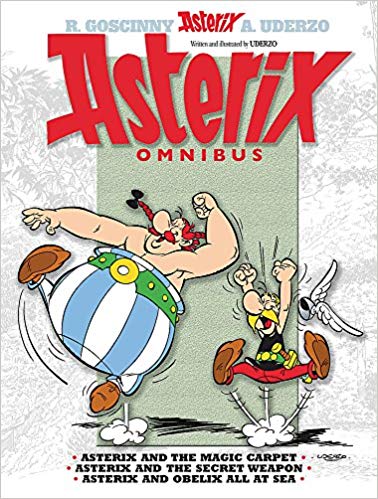
Asterix Omnibus volume 9: Asterix and the Great Divide; Asterix and the Black Gold; Asterix and Son


By Uderzo, translated by Anthea Bell & Derek Hockridge (Orion Childrens’ Books and others)
ISBNs: 978-1-44400-967-5 (HB), 978-1-44400-966-8 (PB)

Alberto Aleandro Uderzo was born on April 25th 1927 in Fismes, on the Marne, a son of Italian immigrants. Showing great artistic flair as a child reading Mickey Mouse in Le Pétit Parisien, he dreamed of becoming an aircraft mechanic one day. Albert became a French citizen when he was seven and found employment at 13, apprenticed to the Paris Publishing Society, where he learned design, typography, calligraphy and photo retouching.

When WWII broke out, he spent time with farming relatives in Brittany and joined his father’s furniture-making business. Brittany beguiled and fascinated Uderzo: when a location for Asterix’s idyllic village was being mooted the region was the only choice.

During the post-war rebuilding of France, Uderzo returned to Paris and became a successful artist in the country’s revitalised and burgeoning comics industry. His first published work, a pastiche of Aesop’s Fables, appeared in Junior, and in 1945 he was introduced to industry giant Edmond-François Calvo (whose own comics masterpiece The Beast is Dead is long overdue for a new edition…).

Indefatigable Uderzo’s subsequent creations included the indomitable eccentric Clopinard, Belloy, l’Invulnérable, Prince Rollin and Arys Buck. He illustrated Em-Ré-Vil’s novel Flamberge, worked in animation, as a journalist and illustrator for France Dimanche, and created vertical comic strip Le Crime ne Paie pas for France-Soir. In 1950, he illustrated a few episodes of the franchised European version of Fawcett’s Captain Marvel Jr. for Bravo!

An inveterate traveller, the prodigy met Rene Goscinny in 1951. Soon fast friends, they decided to work together at the new Paris office of Belgian Publishing giant World Press. Their first collaboration was in November of that year; a feature piece on savoir vivre (how to live right or perhaps gracious living) for women’s weekly Bonnes Soirée, after which an avalanche of splendid strips and serials poured forth.

Jehan Pistolet and Luc Junior were created for La Libre Junior and they devised a western starring a native hero who eventually evolved into the delightfully infamous Oumpah-Pah. In 1955 with the formation of Édifrance/Édipresse, Uderzo drew Bill Blanchart for La Libre Junior, replaced Christian Godard on Benjamin et Benjamine, before in 1957 adding Charlier’s Clairette to his portfolio.

The following year he made his debut in Le Journal de Tintin, as Oumpah-Pah finally found a home and a rapturous audience. Uderzo also drew Poussin et Poussif, La Famille Moutonet and La Famille Cokalane.

When Pilote launched in 1959, Uderzo was a major creative force for the new magazine, collaborating with Charlier on Tanguy et Laverdure and launching – with Goscinny – a little something called Astérix le gaulois…

Despite Asterix being a massive hit from the start, Uderzo continued working on Les Aventures de Tanguy et Laverdure, but once the first Roman romp was compiled and collected as Astérix le gaulois in 1961, it became clear that the series would demand most of his time – especially as the incredible Goscinny seemed to never require rest or run out of ideas.

By 1967 the strip occupied all Uderzo’s time and attention, so in 1974 the partners formed Idéfix Studios to fully exploit their inimitable creation. When Goscinny passed away three years later, Uderzo had to be convinced to continue the adventures as writer and artist, producing a further ten volumes until 2010 when he retired.

After nearly 15 years as a weekly comic strip subsequently collected into albums, in 1974 the 21st tale (Asterix and Caesar’s Gift) was the first to be published as a complete original album before being serialised. Thereafter each new release was a long-anticipated, eagerly-awaited treat for the strip’s millions of fans…

According to UNESCO’s Index Translationum, Uderzo is the tenth most-often translated French-language author in the world and the third most-translated French language comics author – right after his old mate René Goscinny and the grand master Hergé.

More than 370 million copies of 37 (soon to be 38) Asterix books have sold worldwide, making his joint creators – and their successors Jean-Yves Ferri and Didier Conrad – France’s best-selling international authors.

One of the most popular comics features on Earth, the collected chronicles of Asterix the Gaul have been translated into more than 100 languages since his debut, with a wealth of animated and live-action movies, TV series, assorted games, toys, merchandise and even a theme park outside Paris (Parc Astérix, naturellement)…

So what’s it all about?

Like all the best stories the premise works on more than one level: read it as an action-packed comedic saga of sneaky and bullying baddies coming a cropper if you want or as a punfully sly and witty satire for older, wiser heads. We Brits are further blessed by the brilliantly light touch of master translators Anthea Bell & Derek Hockridge who played no small part in making the indomitable little Gaul so very palatable to English tongues.

More than half of the canon is set on Uderzo’s beloved Brittany coast, where – circa 50 B.C. – a small village of cantankerous, proudly defiant warriors and their families resist every effort of the mighty Roman Empire to complete the conquest of Gaul. The land has been divided by the conquerors into compliant provinces Celtica, Aquitania and Amorica, but the very tip of the last cited just refuses to be pacified…

The remaining epics occur in various locales throughout the Ancient World, with the Garrulous Gallic Gentlemen visiting every fantastic land and corner of the myriad civilisations that proliferated in that fabled era…

When the heroes were playing at home, the Romans, unable to defeat the last bastion of Gallic insouciance, futilely resorted to a policy of absolute containment. Thus, the little seaside hamlet is permanently hemmed in by the heavily fortified garrisons of Totorum, Aquarium, Laudanum and Compendium.

The Gauls couldn’t care less: daily defying the world’s greatest military machine simply by going about their everyday affairs, protected by the magic potion of resident druid Getafix and the shrewd wits of the diminutive dynamo and his simplistic, supercharged best friend Obelix…

Firmly established as a global brand and premium French export by the mid-1960s, Asterix continued to grow in quality as Goscinny & Uderzo toiled ever onward, crafting further fabulous sagas; building a stunning legacy of graphic excellence and storytelling gold. Moreover, following the civil unrest and nigh-revolution in French society following the Paris riots of 1968, the tales took on an increasingly acerbic tang of trenchant satire and pithy socio-political commentary…

By the time of the first tale in this omnibus edition was released Goscinny had been gone for three years and Uderzo soldiered on alone…

Asterix and the Great Divide was the 25th volume, released in 1980 as Le Grand Fossé, and in many ways something of a departure and stylistic compromise.

In another Gaulish village, internecine strife is brewing. Political rivals Cleverdix and Majestix have split the sleepy hamlet down the middle, with an election for chief ending in a dead tie. They then make the figurative literal by having a huge trench dug through the centre of town, cutting the tribe in two, with the population resolved into uncompromising Leftists and stubborn Rightists…

It’s a tragedy in many ways, with friends and families split into feuding camps, but the most heartrending separation concerns dashing Histrionix, son of Leftist Cleverdix and his one true love Melodrama, daughter of Majestix. Their warring sires refuse to concede or compromise and that simmering Cold War has frustrated their children’s happiness forever…

The lover’s pleas cannot move either deadlocked party leader and the intolerable situation is further exacerbated by the insidious, coldly calculating advisor to Majestix who secretly eggs on the old warrior for his own purposes.

Wily toady Codfix‘s latest idea is to get their Roman overlords to intervene, installing Majestix as sole ruler by force. In return, Codfix would be given Melodrama in marriage. Of course, that would make him next in line for the ruler’s position. Codfix is both patient and ambitiously far-sighted…

When Melodrama learns of the plan, she immediately informs Histrionix and the prince tells Cleverdix – who knows full well he cannot resist the overwhelming might of the Romans. The former soldier then remembers an old war-buddy who still successfully resists the conquerors. His name was Vitalstatistix…

As Histrionix heroically dashes to the village of Indomitable Gauls – everything he does is heroic – Codfix has gone to the local garrison with his request. Centurion Umbrageous Cumulonimbus, however, has his own problems: discipline is lax and the soldiers are grumbling because of the menial chores they are forced to perform. Codfix has the perfect solution. If the Romans put Rightist Majestix in charge, they could take the pacified Leftists as slaves…

In the meantime, Histronix has returned with Vitalstatistix’ best men. Asterix, Obelix and Getafix the Druid are discussing the matter with Cleverdix when Roman soldiers arrive. Codfix however, has overstepped himself and underestimated the nobility of Majestix…

The doughty Rightist refuses to let any Gaul be enslaved – even political opponents – so the uncaring Romans grab him and his followers instead. Impressed with his rival’s integrity, Cleverdix accepts Asterix’ offer of assistance and our heroes infiltrate the garrison as volunteer slaves using an elixir that revitalises the body but causes a touch of amnesia…

Having fun by exploiting these new Romans’ ignorance of their true identities, the infilitrators feed the imprisoned Gauls soup fortified with the Druid’s strength potion before Asterix and Obelix lead a mass breakout which soon finds the prisoners back in their divided hamlet but no closer to an amicable resolution.

And both sides know that the Romans will soon come, eager for revenge…

Codfix has sensibly stayed with the garrison and found the last of Getafix’ elixir, left behind during the liberation. When he sneaks back into the village, he also discovers a fresh batch of power-potion whipped up in advance of the impending attack… and steals it.

The next day, the Gauls wake to find invaders marching upon them, fortified by the elixir which has erased the punishing memory of their recent defeat, and simultaneously super-charged by power potion.

Left with nothing but Obelix and Gaulish courage, the villagers unite to fight and fall with honour, but are astonished when a bizarre series of transformations wrack the empowered Romans. It takes a long time to become a Druid and apparently the first thing you learn is to never mix potions…

Codfix has used the distraction to kidnap Melodrama. Demanding ransom and safe passage, he has not reckoned on Histrionix’ determination, Asterix’s ingenuity or Obelix’ strength and – after a climactic confrontation involving our perennially luckless Pirates – gets what’s coming to him…

With the Romans routed and Codfix suitably punished, Cleverdix and Majestix settle their differences with a traditional Gaulish duel after which someone else becomes chief of the reunified village. The former divide is transformed into an appropriate symbol of their unity and life goes on happily…

Asterix and the Great Divide was devised by Uderzo as a critique on current affairs and metaphorical attack on the Berlin Wall which had, since 1961, split the city physically, Europe symbolically and the world ideologically. His earnest tale was more dramatic and action-oriented than previous Asterix fare, with the regulars frequently reduced to subordinate roles, but for all that there are still cunning laughs and wry buffoonery in welcome amounts.


Asterix and the Black Gold (L’Odyssée d’Astérix) debuted in 1981 and again saw Asterix and Obelix embarking on a long voyage into the unknown, rife with bold adventure and underpinned by topical lampooning and timeless swingeing satire.

The 26th saga begins with a brace of wild boar demonstrating that they are canny opponents for voracious Obelix. Whenever the gigantic Gaul encounters these particular pigs in his daily hunts, they escape by leading him to the nearest Roman patrol. The only thing Obelix loves more than eating pork is bashing Romans…

Back in Rome, Julius Caesar is livid. He’s just received news that the insufferable, indomitable Gauls are training wild boars to lead Roman patrols into Gaulish ambushes…

The raging ruler’s continued attempts to end the aggravating resistance always fail and in a fit of fury he charges his chief of the Roman Secret Service M.I.VI (geddit?) with ending his galling Gallic grief – or else…

M. Devius Surreptitius has just the man for the job. Dubbelosix is of Gaulish-Roman extraction and has, by persistence and deviousness, qualified as a Druid. He is wily, charming, debonair and comes with a host of cunning hidden gadgets – and he’s also the spitting image of Sean Connery…

Dispatched on a mission to stop the French resisting, Dubbelosix is secretly working with his boss M to supplant Caesar, and also harbours ambitions to rule Rome alone …but first he has to destroy the infernal Gauls. His chance comes almost as soon as he arrives in that little village…

Getafix is in a near-panic. The Druid has been eagerly awaiting the arrival of Phoenician merchant Ekonomikrisis who is bringing a vital ingredient for the magic potion that keeps the Romans at bay. When the ship at last arrives and the peddler apologises for forgetting the fabled rock oil, the highly strung Getafix has a fit and passes out.

Luckily a young Druid dubbed Dubbelosix is passing and, after a minor skirmish with a Roman patrol, accompanies Asterix and Obelix back to their comatose friend…

The spy might be a double agent, but he knows his stuff and soon cures the ailing Getafix, who explains that the generally useless black ooze from the Middle East is vital to the potion: without a fresh supply they are all doomed…

When Asterix and Obelix – and faithful hound Dogmatix, of course – volunteer to obtain some of the crucial rock oil, Dubbelosix insists on accompanying them. But as they commandeer the Phoenician’s ship for the emergency mission, Getafix clandestinely warns Asterix to watch the too-good-to-be-true young Druid…

Expediting matters by selling off Ekonomikrisis’ wares at prices nobody – even Pirates – dare refuse, our heroes make their way to Mesopotamia, unaware that Dubbelosix, using his unique messaging service, has briefed Caesar and M to stop the ship at all costs.

After a succession of military vessels are sent to the bottom of the Mediterranean by the joyfully belligerent Gauls, the Ruler of the World is forced to change tactics and blockade all ports to prevent Asterix and Obelix from disembarking.

With time running out, Ekonomikrisis eventually sneaks the Gauls and Dubbelosix ashore in distant Judea. The trio travel overland to Jerusalem where they are befriended by the locals who have no love for the Romans. The oppressors are always just one step behind the voyagers, though. It is as if someone is telling them every time the questers alter their plans…

After a memorable night in a village called Bethlehem, the Hebrews’ attempt to smuggle the Gauls into Jerusalem is sabotaged by Dubbelosix. However, the Middle Eastern garrisons have never seen fighters like Asterix and Obelix and the doughty heroes escape, leaving the scurrilous double agent behind.

With time running out at home and no word of the fate of their friends, the Gauls are hidden by friendly merchants, and learn that the Romans have seized and burned all the rock oil in the city – and probably the entire region. Their only chance to secure some of the previously worthless black goo is to get it from the source – in Babylon, where it just seeps out of the ground…

Assisted by brave, helpful guide Saul ben Ephishul (a loving visual tribute to Uderzo’s deeply-missed partner René Goscinny, who was Jewish) Asterix and Obelix undertake another perilous journey into the deep desert, frolicking in the Dead Sea and encountering a procession of fanatical tribes all warring on each other for long-forgotten reasons in a savage lampoon of modern Middle East strife…

Eventually, the Gauls become completely lost; waterless and without hope under the scorching sun. However when little Dogmatix starts digging in the sand, the resultant oil gusher provides more than enough to buoy up their hopes and they battle on to rendezvous with Ekonomikrisis for a frantic return to Gaul.

Unfortunately, Dubbelosix has tracked them down again and has one last trick to play…

This return to the style and format of classic collaborations features hilarious comedy set-pieces, thrilling drama and a bitingly gentle assault on the madness of keeping ancient feuds alive, intransigence of religious tensions and the madness of recurring oil crises; lampooning ideologies and dogmas whilst showing how great it is when people can just get along.

Fast, furious and funny-with-a-moral, this is one of the artist/author’s very best efforts and even manages a double-shock ending…


Asterix and Son was released in 1983, the 27th saga and another unconventional step off the well-worn path as it touches on a rather touchy subject…

One particularly fine morning in the Village of Indomitable Gauls, Asterix and Obelix awake to discover someone has left a baby in a basket on their doorstep. Nonplussed and bewildered, they try to care for the infant – much to the horror of the local cows who would be delighted to provide sustenance if milked in a normal manner – but human tongues in the village are beginning to wag…

Things only get worse after the feisty tyke develops a taste for magic potion and somehow keeps finding new supplies of it…

Determined to clear his name and find the real parents, Asterix begins his investigations at the four Roman Garrisons, even as Crismus Cactus, Prefect of Gaul begins a suspiciously sudden emergency census of the local villages…

Hyper-charged on potion, the baby keeps getting out and following Asterix and Obelix, who discover that the Romans seem to be looking for one child in particular…

After a painful encounter with our heroes, Crismus Cactus retires to his villa where a VIP from Rome is waiting. Marcus Junius Brutus is Caesar’s adopted son and is most insistent that the mystery baby is found and turned over to him – even if he has to raze all Gaul to achieve his aim…

The infant in question is still causing trouble for the villagers and Brutus marshals an army near the isolated hamlet, successfully confirming the child’s location with a rather inept spy. The kid’s treatment of the intruder prompts Asterix to seek out a nanny, but as the village women are still suspicious and condemnatory, he hires a rather unsavoury stranger named Aspidistra for the task…

This provokes even more vicious tongue-wagging amongst the women, who assume the worst of both her and Asterix. Inexplicably, nobody notices the ferocious childminder’s astonishing resemblance to the Prefect of Gaul…

Unfortunately, once Crismus has successfully infiltrated the village he can’t get out again, and spends a punishing time amusing the infant horror until his nerve breaks. Drained of patience, Brutus then attacks with the full might of Rome, torching the village and bombarding it with catapults.

As the men tank up on potion and counterattack, the village women head for the beach. Sadly, Brutus is willing to sacrifice his entire army, and is waiting to grab the baby…

Once the Roman Legions are crushed, Asterix and Obelix return and discover what has occurred. Filled with rage, they set off in deadly pursuit and save the child just in time for his real mother and father to arrive. Two of the most powerful people in the world, they are extremely angry with somebody…

Laced with a dark and savage core, this rollicking rollercoaster ride combines tragedy with outrageous slapstick, transforming historical facts into a compelling comedy-drama that is both delightful and genuinely scary in places…

Stuffed with sly pokes and good-natured joshing, featuring famous caricatures to tease older readers whilst the raucous, bombastic, bellicose hi-jinks and riotous action astounds and bemuses the younger set, these tales celebrate the illustrative ability of Uderzo, confirming his potion-powered paragon of Gallic Pride to be a true national and cultural treasure.

If you still haven’t experienced this sublime slice of French polish and graphic élan, it’s never too late…
© 1980-1983 Goscinny/Uderzo. Revised English translation © 2002 Hachette. All rights reserved.

Showcase Presents Challengers of the Unknown volume 1


By Jack Kirby, Bob Brown, Dave Wood, Ed Herron, Roz Kirby, Marvin Stein, Bruno Premiani, George Klein, Wally Wood & various (DC Comics)
ISBN: 978-1-4012-1087-8 (TPB)

In an era where comicbooks had slipped into an undirected and formless mass of genre-niches, the Challengers of the Unknown were a bridging concept between the fashionably all-American human trouble-shooters who monopolised comicbooks for most of the 1950s and the costumed mystery men who would soon return to take over the industry.

As superheroes were being gradually revived in 1956 under the cautious aegis of Julius Schwartz, here was a super-team – the first of the Silver Age – with no powers, the most basic and utilitarian of costumes and the most dubious of motives: Suicide by Mystery.

Despite all that they were a huge hit and struck a chord that lasted for more than a decade before they finally died… only to rise again and yet again. The idea of them was stirring enough, but their initial execution made their success all but inevitable.

Jack Kirby was – and remains – the most important single influence in the history of American comics. There are, quite rightly, millions of words written about what the man has done and meant, and you should read those if you are at all interested in our medium. I’m going to add even more words to that superabundance in this review of one of his best projects, which like so many others, he perfectly constructed before moving on as he always did, leaving highly competent but never quite as inspired talents to build upon his legacy.

When the comic industry suffered an economic collapse in the mid 1950’s, Kirby’s partnership with Joe Simon ended and he returned briefly to DC Comics. Here he worked on mystery tales and the minority-interest Green Arrow back-up strip whilst creating newspaper strip Sky Masters of the Space Force.

Never idle for a moment, he also re-packaged for Showcase (a try-out title that launched the careers of many DC mainstays) an original super-team concept that had been kicking around in his head since he and collaborator Simon had closed their innovative but unfortunate Mainline Comics.

After years of working for others, Simon and Kirby had finally established their own publishing company, producing comics for a much more sophisticated audience, only to find themselves in a sales downturn and awash in public hysteria generated by the anti-comic book witch-hunt of US Senator Estes Kefauver and psychologist Dr Fredric Wertham.

Simon moved into advertising, but Kirby soldiered on, taking his skills and ideas to a number of safer, if less experimental, companies.

The Challengers of the Unknown were four ordinary mortals; heroic adventurers and explorers who walked away unscathed from a terrible plane crash. Clearly what we now call “adrenaline junkies”, they decided that since they were all living on borrowed time, they would dedicate what remained of their lives to testing themselves and fate. They would risk their lives for Knowledge and, naturally, Justice.

The Kirby tales of the team have been thankfully immortalised in full-colour archival print and digital editions, but the team captivated readers for a decade beyond those glorious beginnings, and thus far those tales are only available in these monochrome tomes. Hope springs eternal, though…

The series launched with ‘The Secrets of the Sorcerer’s Box!’ (Showcase #6, cover-dated January/February 1957 – which meant it came out in time for Christmas 1956). Kirby and scripter Dave Wood, plus inkers Marvin Stein and Jack’s wife Roz, crafted a spectacular epic as the doom-chasers are hired by duplicitous magician Morelian to open an ancient container holding otherworldly secrets and powers.

This initial story roars along with all the tension and wonder of the B-movie thrillers it emulates and Kirby’s awesome drawing resonates with power and dynamism. That continues for the sequel, a science fiction drama sparked by an alliance of Nazi technologies and American criminality which unleashes a terrible robotic monster. ‘Ultivac is Loose!’ (Showcase #7, dated March/April 1957) introduces beautiful and capable boffin (aren’t they always?) Dr. June Robbins, who becomes the unofficial fifth Challenger at a time when most comic females (and living ones too) – had been banished back to subsidiary domestic status in that so-conservative era.

The team didn’t reappear until Showcase #11 (November/December 1957) as The Flash and Lois Lane got their shots at the big time. When the Challs did return, it was in alien invasion adventure ‘The Day the Earth Blew Up’, with unique realist Bruno Premiani inking a taut doomsday chiller pinning readers to the edges of their seats even today, and by the time of their last Showcase outing (#12, January /February 1958) they had won their own title.

‘The Menace of the Ancient Vials’ was defused by the usual blend of daredevil heroics and ingenuity (with the wonderful inking of George Klein adding subtle clarity to the tale of an international criminal who steals an ancient weapons cache that threatens the entire world if misused), but the biggest buzz came two months later with the debut of their own magazine.

Issue #1, written and drawn by Kirby, with Stein on inks, presented two complete stories plus an iconic introductory page that would become almost a signature second logo for the team.

‘The Man Who Tampered with Infinity’ pits the heroes against a renegade scientist whose cavalier dabbling liberates dreadful monsters from the beyond onto our defenceless planet, after which the team are abducted by aliens to become ‘The Human Pets’.

The same creators were responsible for a brace of thrillers in #2. ‘The Traitorous Challenger’ is a monster mystery, with June returning to sabotage a mission in the Australian Outback, whilst ‘The Monster Maker’ finds the team seemingly helpless against a super-criminal who can conjure up and animate solid objects out of his thoughts.

The third issue features ‘Secret of the Sorcerer’s Mirror’ with Roz Kirby & Marvin Stein again inking the mesmerising pencils, as the boys pursue a band of criminals whose magic looking glass can locate deadly ancient weapons, although the most intriguing tale for fans and historians is undoubtedly ‘The Menace of the Invincible Challenger’.

Here team strongman Rocky Davis is rocketed into space, only to crash back to Earth with strange, uncanny powers.

For years the obvious similarities of this group – and especially this adventure – to the origin of Marvel’s Fantastic Four (FF #1 came out in the autumn of 1961) have fuelled speculation. In all honesty, I simply don’t care. They’re both similar and different but equally enjoyable, so read both. In fact, read them all.

With #4 the series became artistically perfect as the sheer luminous brilliance of Wally Wood’s inking elevated the art to unparalleled heights. The scintillant sheen and limpid depth of Wood’s brushwork fostered an abiding authenticity in even the most outrageous of Kirby’s designs and the result is – even now – breathtaking.

‘The Wizard of Time’ is a full-length masterpiece wherein a series of bizarre robberies leads the team to a scientist with a time-machine. By visiting oracles of the past, he finds a path to the far future. When he gets there, he plans on robbing it blind, but the Challengers find a way to follow him…

‘The Riddle of the Star-Stone’ (#5) is a contemporary full-length thriller, wherein an archaeologist’s assistant uncovers an alien tablet bestowing various super-powers when different gems are inserted into it. The exotic locales and non-stop spectacular action are intoxicating, but the solid characterisation and ingenious writing are what make this such a compelling read.

Scripter Dave Wood returned for #6’s first story. ‘Captives of the Space Circus’ has the boys kidnapped from Earth to perform in a interplanetary show, but the evil ringmaster is promptly outfoxed and the team returns for Ed Herron’s mystic saga ‘The Sorceress of Forbidden Valley’, as June becomes an amnesiac puppet in a power struggle between a fugitive gangster and a ruthless feudal potentate.

There are also two stories in #7. Herron scripted both the relatively straightforward alien-safari tale ‘The Beasts from Planet 9’ and much more intriguing ‘Isle of No Return’ with the team confronting a scientific bandit before his shrinking ray leaves them permanently mouse-sized.

Issue #8 is a magnificent finale to a superb run, as Kirby & Wally Wood go out in style via two gripping spectaculars (both of which introduce menaces who would return to bedevil the team in future tales).

‘The Man Who Stole the Future’ by Dave Wood, Kirby and the (unrelated) Wally, introduces Drabny – a mastermind who steals mystic artefacts and conquers a small nation before the lads hand him his marching orders. This is a tale of blistering battles and uncharacteristic, if welcome, comedy, but the true gem is science fiction tour-de-force ‘Prisoners of the Robot Planet’, with art by Kirby & Wally, and most probably written by Kirby & Herron. Petitioned by a desperate alien, the Challs travel to his distant world to liberate the population from bondage to their own robotic servants, who have risen in revolt under the command of fearsome automaton Kra.

These are classic adventures, told in a classical manner. Kirby developed a brilliantly feasible concept with which to work and heroically archetypical characters in cool pilot Ace Morgan, indomitable strongman Rocky, intellectual aquanaut “Prof”. Haley and daredevil acrobat Red Ryan. He then manipulated, mixed and matched an astounding blend of genres to display their talents and courage in unforgettable exploits that informed every team comic that followed, and certainly influenced his successive and landmark triumphs with Stan Lee. But then he left.

The Challengers would follow the Kirby model until cancellation in 1970, but, due to a dispute with Editor Jack Schiff the writer/artist resigned at the height of his powers. The Kirby magic was impossible to match, but as with all The King’s creations, every element was in place for the successors to run with.

Challengers of the Unknown #9 (September 1959) saw an increase in the fantasy elements favoured by Schiff, and perhaps an easing of the subtle tension and inter-group fractious bickering that marked previous issues (Comics Historians take note: the Challs were snapping and snarling at each other years before Marvel’s Cosmic Quartet ever boarded that fateful rocket-ship).

A number of writers, many sadly lost to posterity, stepped in, including Bill Finger, Ed Herron and possibly Jack Miller, Bob Haney and Arnold Drake, but one man took over the illustrator’s role: Bob Brown.

Brown was born August 22nd 1915 and he died in 1977 following a long illness. He studied at Hartford Art School and Rhode Island School of Design, and worked with his showbiz folks and sister in a song-&-dance act from 1927 onwards. He was drafted in 1940 – the year he also began working as a comics artist and scripter for Fox, Timely/Atlas. As the war intensified, he was an aircraft radio operator, an aviation cadet and served in the Pacific as bombardier and navigator in B-29 bombers, earning six air medals and a Distinguished Flying Cross.

After jobbing around the industry during the late 1040s and 1950’s Brown settled at National Comics/DC, co-created the long-running Space Ranger, drawing Tomahawk, western hero Vigilante, Batman, Superboy, Doom Patrol, World’s Finest Comics and a host of other features and genre shorts. He moved to Marvel in the 1970s where he drew Warlock, Daredevil and the Avengers among others.

He was a consummate professional and drew every issue of the Challengers from #9-63: almost a decade of high adventure ranged from ravaging aliens, cute-and-fuzzy space beasts to truly scary supernatural horrors.

‘The Men who Lost their Memories’ finds the team fighting crooks with a thought-stealing machine, whereas ‘The Plot to Destroy Earth!’ is a full-on, end-of-humanity thriller with monsters bent on carving our world into chunks for their resource-hungry alien masters. Only the guts and ingenuity of our heroes can save the day…

A destructive giant with a deadly secret is the motivating premise of ‘The Cave-Man Beast’ and #10’s cover-featured second tale sets another time-travel conundrum as the boys discover their own likenesses on a submerged monolith in fanciful thriller ‘The Four Faces of Doom’.

Issue #11 is an action-packed full-length interdimensional romp subdivided into ‘The Creatures from the Forbidden World’, ‘Land beyond the Light’ and ‘The Achilles Heel’, after which the two-story format returns for the next issue, which boasts ‘The Challenger from Outer Space’ – with an alien superhero joining the team – and ‘Three Clues to Sorcery’ with our quarrelsome quartet again forced to endure exotic locales and extreme perils to acquire mystic artefacts for a criminal mastermind. Even so, this time there’s a unique and deadly twist in this oft-told tale…

‘The Prisoner of the Tiny Space Ball’ see the team rescuing the ruler of another world, before Rocky is possessed by the legendary Golden Fleece, making him a puppet of ‘The Creatures from the Past’.

Issue #14 opens with one of the few adventures with a credited scripter. Ed “France” Herron was a 30-year comics veteran and ‘The Man who Conquered the Challengers’ is one of his best tales, with crooked archaeologist Eric Pramble stealing an ancient formula for “liquid light” which makes him functionally immortal. Moreover, every time he’s killed, he reanimates with a different super-power!

As Multi-Man, Pramble became the closest thing to an arch-villain the series ever had, and even graduated to becoming a regular foe across the DCU. Once again, cool wits and sheer nerve find a way to victory that sheer firepower never could.

In second yarn ‘Captives of the Alien Beasts’, all five Challs are teleported to another world by animals who have invaded a scientist’s laboratory. It’s a relatively innocuous tale when compared to #15’s all-out fight-fest ‘The Return of Multi-Man’ and bizarre offering ‘The Lady Giant and the Beast’, wherein June is transformed into a 50-foot leviathan just as a scaly monster cuts a swathe of destruction through the locality.

Issue #16’s ‘Incredible Metal Creature’ sees an Earth thug join forces with an escaped alien criminal. No real Challenge there, but a back-up yarn finds the team in Arabia as ‘Prisoners of the Mirage World’ facing knights who have been trapped there since the time of the Crusades.

This thrill-stuffed then tome concludes with #17’s supernatural crime whimsy ‘The Genie who Feared June’, and interplanetary mission of mercy ‘The Secret of the Space Capsules’; both solid pieces of adventure fiction that, if not displaying the unique Kirby magic, are redolent with its flavours.

As well as being probably (certainly at this moment, anyway) my favourite comics series, Challengers of the Unknown is sheer escapist wonderment, and no fan of the medium should miss the graphic exploits of these perfect adventurers in the ideal setting of not so long ago in a simpler better world than ours. If only we could convince DC Comics to give them the archival home in print and digital editions they so richly deserve, to match the constant re-imaginings the team and title regularly enjoy…
© 1957, 1958, 1959, 1960, 1961, 2006 DC Comics. All Rights Reserved.

Pogo – The Complete Syndicated Comic Strips volume 3: Evidence to the Contrary


By Walt Kelly, edited by Carolyn Kelly & Eric Reynolds (Fantagraphics Books)
ISBN: 978-1-60699-694-2 (HB)

Books of this stature and calibre are worth buying and reading at every moment of every day, and rather than waste your valuable time with my purely extraneous blather, you could just hit the shops or online emporia and grab this terrific tome right now.

If you still need more though, and aren’t put off by me yet, I’m honoured to elucidate at some length…

Walter Crawford Kelly Jr. was born in 1913 and began his cartooning career whilst still in High School as artist and reporter for the Bridgeport Post. In 1935 he moved to California and joined the Disney Studio, working on animated short films and such features as Dumbo, Fantasia and Pinocchio.

His steady ascent was curtailed by the infamous animator’s strike in 1941. Refusing to take sides, Kelly quit, moving back East and into comicbooks – primarily for Dell who held the Disney rights license – amongst many other popular properties – at that time.

Despite his glorious work on major mass-market, people-based classics such as the Our Gang movie spin-off, Kelly preferred and particularly excelled with anthropomorphic animal and children’s fantasy material.

For the December 1942-released Animal Comics #1 he created Albert the Alligator and Pogo Possum, wisely retaining the copyrights to the ongoing saga of two affable Bayou critters and their young African-American pal Bumbazine. Although the black kid soon disappeared, the animal actors stayed on as stars until 1948 when Kelly moved into journalism, becoming art editor and cartoonist for hard hitting, left-leaning liberal newspaper The New York Star.

On October 4thth 1948, Pogo, Albert and an ever-expanding cast of gloriously addictive, ridiculously exuberant characters began their strip careers, appearing in the paper six days a week until the periodical folded in January 1949.

Although ostensibly a gently humorous kids feature, by the end of its New York Star run (reprinted in Pogo: The Complete Syndicated Comic Strips volume 1) the first glimmerings of an astoundingly barbed, boldly satirical masterpiece of velvet-pawed social commentary had begun to emerge…

When the paper folded Pogo was picked up for mass distribution by the Post-Hall Syndicate, debuting on May 16th 1949 in selected outlets across the nation. A colour Sunday page launched January 29th 1950 and both were produced simultaneously by Kelly until his death in 1973 and thereafter by his talented wife and family until the feature was at last laid to rest on July 20th 1975.

At its height the strip appeared in 500 papers in 14 countries and the book collections – which began in 1951 – eventually numbered nearly 50, collectively selling over 30 million copies… and all that before this Fantagraphics series even began…

In this third volume (available as a hardback and in eBook editions) of a proposed full dozen reprinting the entire Kelly canon of the Okefenokee Swamp critter citizenry, undoubtedly the main aspect of interest is the full-on comedic assault against possibly the greatest danger and vilest political demagogue America ever endured (at least in the 20th century…) but the counterattack against witch-hunter Senator Joe McCarthy is merely one of the many delights in this stunning mix of free expression and wild and woolly whimsy…

This colossal and comfortingly sturdy landscape compilation (boasting three-hundred-and-fifty-six 184 x 267mm pages) includes the monochrome ‘Daily Strips’ from January 1st 1953 to December 31st 1954, and the Sundays – in their own full-colour section – from January 4th to December 26th of the same years.

Supplemental features this time comprise a Foreword from award-winning cartoonist Mike Peters (Mother Goose & Grimm); a wealth of deliriously winning unpublished illustrations and working drawings by Kelly and utterly invaluable context and historical notes in R.C. Harvey’s ‘Swamp Talk’ . This last also compellingly, almost forensically, details the rise and fall of rabblerousing “red-baiter” Joe McCarthy and how Kelly courageously opened America’s fight back against the unscrupulous, bullying chancer (and the movement for which he was merely a publicity-hungry figurehead) with an unbeatable combination broadside of ridicule and cool disdain…

The closing biographical feature ‘About Walt Kelly’ by Mark Evanier is supplemented by a comprehensive ‘Index of the Strips’ and a gloriously inspired selection of ‘Noteworthy Quotes’ to fill out the academic needs of the readers, but of course the greatest boon here is the strips and characters themselves.

Kelly was a masterful inventor of engaging and endearing personalities, all of whom carried as many flaws as virtues. The regular roll call (some commentators reckon to be as many as 1000!) included gentle, perpetually put-upon and bemused possum Pogo, boisterous, happily ignorant alligator Albert, dolorous, sensitive Porkypine, obnoxious turtle Churchy La Femme, lugubrious hound Beauregard Bugleboy, carpet-bagging Seminole Sam Fox, pompously ignorant know-it-all Howland Owl, sveltely seductive skunk Miz Mam’selle Hepzibah, long suffering matron Miz Beaver, maternal Miz Groun’chuck and her incomprehensible, bitey baby Grundoon plus all the other bugs, beasts and young’uns of the swamp, but the author’s greatest strength lay in his uniquely Vaudevillian rogues, scoundrels and outright villains.

The likes of Tammanany Tiger, officious Deacon Mushrat, sinister, sycophantic beatnik communist Catbirds Compeer and Confrere, sepulchral Sarcophagus MacAbre, sloganeering P.T. Bridgeport and a trio of brilliantly scene-stealing bats named Bewitched, Bothered and Bemildred were perfect confections to illustrate all manner of pestilential pettifogging, mean manners and venal self-serving atrocities as they intermingled and interfered with the decent folk volubly enduring the vicissitudes of such day-to-day travails as love, marriage, comicbooks, weather, rival strips, fishing, the problem with kids, the innocent joys of sport, cadging food, making a living and why neighbours shouldn’t eat each other…

In this volume the topics of exotically extravagant conversation include the longevity and worth of New Year’s Resolutions, the scandalous behaviour of Porkeypine’s kissing-thief Uncle Baldwin, a get-rich scheme involving dirt and opening shots at the burgeoning phenomenon of commercial television. However, the gradual conversion of the Deacon’s Boy Bird Watchers society into a self-policing vigilante committee looking out for strangers and making sure all the citizens are right-thinking and proper-looking would quickly insinuate itself into every corner of the feature…

The anti-foreigner sentiments peak following the arrival of Deacon Mushrat’s old pal The Hon. Mole MacCarony; a blind, self-aggrandizing politico determined to root out all (undisclosed) threats, enforce conformity and stamp out the diseases obviously carried by strangers.

The xenophobic dirt-digger was based on Nevada Senator Patrick McCarran who briefly shaped paranoid public opinion on a platform of severely restricting immigration and implementing the speedy deportation of all communists and non-Americans. Clearly and sadly, his poisonous legacy and methodology remains a valuable asset to many politicos and opinion-shapers today…

Things got much darker – and therefore more effectively ludicrous – with the arrival of Mole’s malicious and ambitious associate Simple J. Malarkey – whose bullying tactics soon began to terrify his fellow bigots as much as the increasingly outraged, off-balance citizens…

Eventually the villains fall out and trigger their own downfall, with the mortified Deacon sheepishly denying his part in the fiasco. Peace and (in)sanity return and with sunny days ahead weather-prognosticating frog Picayune debuts, only to suffer a great loss when Albert accidentally ingests the amphibian’s pal Halpha – an amoeba who actually did all the meteorological messing about…

Voracious Albert generally swallowed a lot of things, but his biggest gaffe probably occurs after meeting Roogey Batoon, a pelican impresario who – briefly – managed Flim, Flam and Flo: a singing fish act billed as the Lou’siana Perches…

Many intriguing individuals shambled into view at this time: Ol’ Mouse and his tutorial pal Snavely (who taught worms how to be cobras and rattlers), cricket-crazed British bugs Reggie and Alf and family icons Bug Daddy and Chile, but the biggest mover and shaker to be introduced was undoubtedly a sporty Rhode Island Red chicken named Miss Sis Boombah.

The formidable biddy is a physically imposing and prodigiously capable sports enthusiast (and Albert’s old football coach), who wanders in as survey taker for “Dr. Whimsy‘s report on the Sectional Habits of U.S. Mail Men” (a brilliant spoof of the societally sensational Kinsey Report on sexual behaviour in America) but her arrival also generates a succession of romantic interludes and debacles which eventually lead to a bewildered Mushrat proposing marriage before leaving her in the lurch and disappearing into the deepest parts of the swamp…

Mole reared his unseeing head again, causing merely minor mischief, but when the marriage-averse Deacon encounters the terrifying Malarkey lurking in hiding with sinister acolyte Indian Charlie (who bears a remarkable resemblance to then-current US Vice-President Richard Milhouse Nixon) the scene is set for another savage and often genuinely scary confrontation…

That’s also exactly what Miss Boombah has in mind as she sets out – accompanied by Bewitched, Bothered and Bemildred – to hunt down the scoundrel who left her in the lurch at the church…

Other story strands and insane interludes include such epic mini sagas as the search for an abducted puppy – lampooning TV cop series Dragnet – and a long session on the keeping and proper sharing of secrets, much ado about gossip and the art of being a busybody.

Most memorable of all though, are Churchy’s sudden predilection for dressing up as a pretty little blonde girl, perpetually visiting Martians and poor Pogo’s oddly domestic recipe for A-Bombs…

In his time, satirical supremo Kelly unleashed his bestial spokes-cast upon many other innocent, innocuous celebrity sweethearts such as J. Edgar Hoover, the John Birch Society and the Ku Klux Clan, as well as lesser leading lights likes Hubert Humphrey, Lyndon B. Johnson and – with eerie perspicacity – George W. Romney (U.S. Secretary of Housing and Urban Development, Governor of Michigan and father of some guy named Mitt), but nothing ever compared to his delicious and devilish deconstruction of “Tailgunner Joe” in the two extended sequences reprinted here…

Kelly’s unmatched genius lay in his seemingly effortless ability to lyrically, if not vivaciously, portray through anthropomorphic affectation and apparently frivolous nonsense language comedic, tragic, pompous, infinitely sympathetic characters of any shape or breed, all whilst making them undeniably human.

He used that gift to readily blend hard-hitting observation of our crimes, foibles and peccadilloes with rampaging whimsy, poesy and sheer exuberant joie de vivre. However, he usually toned down the satirical scalpels for the magnificently imaginative ‘Sunday Funnies’: concentrating instead on fantastic and unfailingly hilarious serial fables and comedy romps.

Some of the best he ever conceived conclude this volume, beginning with the epic saga of little faun Melonbone whose search for the Fountain of Youth inadvertently causes Sam Duck to revert to an egg. The distraught drake’s wife is not best pleased at having to hatch her own husband out at her age (after all, she’s no spring chicken)…

Churchy and Albert endure the ire of sharp toothed tot Grundoon as the kid’s inability to converse leads the alligator to accidentally swallow his turtle pal, after which the animal crackpots all get very lost for a long time in their own swampy backyard…

Howlan Owl’s latest get-rich-quick scheme – digging to China – results in his and Albert’s reluctant consultation of an Atlas and the shocking conclusion that the Russians have taken over Georgia…

The panicked reaction of the chumps precipitates their accidentally awakening an oversleeping bear who opts to celebrate Christmas in the middle of August. Eventually, everybody catches up to him just in time for the true Yule event…

After the usual New Year’s shenanigans, 1954 truly takes hold as everyone’s favourite alligator tries to recount the amazing exploit of ‘King Albert and the 1001 Arabian Knights of the Round Table’ – despite each listener’s evident and express disinterest – before Howlan and Churchy became compulsively embroiled in a furious feud over pugilism.

Soon thereafter Albert is mistaken for a monster after getting his head stuck in a cauldron. Sadly, once he’s finally extricated from the calamitous cookpot, other unhappy folk become the infernal alembic’s unwilling method of locomotion…

No sooner does that culinary catastrophe conclude than the whole sorry fiasco promptly kicks off again with a lovesick octopus now playing transient chapeau to a succession of unfortunate and duly startled swamp critters …

The hairy, scaly, feathered, slimy folk of the surreal swamp lands are, of course, inescapably us, elevated by burlesque, slapstick, absurdism and all the glorious joys of wordplay from puns to malapropisms to raucous accent humour into a multi-layered hodgepodge of all-ages delight – and we’ve never looked or behaved better…

This stuff will certainly make you laugh; it will probably provoke a sentimental tear or ten and will certainly satisfy your every entertainment requirement. Timeless and ineffably magical, Pogo is a giant not simply of comics, but of world literature and this magnificent third tome should be the pride of every home’s bookshelf, right beside the others.

…Or, in the popular campaign parlance of the all politically astute critters – “I Go Pogo!” and so should you.

Pogo Vol. 3: Evidence to the Contrary and all POGO images, including Walt Kelly’s signature © 2014 Okefenokee Glee & Perloo Inc. All other material © 2014 the respective creator and owner. All rights reserved.

Tintin in Tibet


By Hergé, Bob De Moor, Roger Leloup and others, translated by Leslie Lonsdale-Cooper & Michael Turner (Egmont UK)
ISBN: 978-1-40520-819-2 (HB) 978-1-40520-631-0 (Album PB)

Georges Prosper Remi, known all over the world as Hergé, created a timeless masterpiece of graphic literature with his tales of a plucky boy reporter and entourage of iconic associates.

Singly, and later with assistants including Edgar P. Jacobs, Bob de Moor and other supreme stylists of the Hergé Studio, he created 23 timeless yarns (initially serialised in instalments for a variety of newspaper periodicals) which have grown beyond their pop culture roots to attain the status of High Art.

On leaving school in 1925, Remi began working for conservative Catholic newspaper Le Vingtiéme Siécle where he fell under the influence of its Svengali-esque editor Abbot Norbert Wallez. A devoted boy scout, one year later the artist was producing his first strip series – The Adventures of Totor – for monthly Boy Scouts of Belgium magazine. By 1928 Remi was in charge of producing the contents of the newspaper’s weekly children’s supplement Le Petit Vingtiéme.

While he was illustrating The Adventures of Flup, Nénesse, Poussette and Cochonette written by the staff sports reporter – Wallez asked his compliant cash-cow to create a new adventure series. Perhaps a young reporter who roamed the world, doing good whilst displaying solid Catholic values and virtues?

The rest is history…

Some of that history is quite dark: During the Nazi Occupation of Belgium, Le Vingtiéme Siécle was closed down and Hergé was compelled to move his supremely popular strip to daily newspaper Le Soir (Brussels’ most prominent French-language periodical, and thus appropriated and controlled by the Nazis).

He diligently toiled on for the duration, but following Belgium’s liberation was accused of collaboration and even being a Nazi sympathiser. It took the intervention of Belgian Resistance war-hero Raymond Leblanc to dispel the cloud over Hergé, which he did by simply vouching for the cartoonist.

Leblanc also provided cash to create a new magazine – Le Journal de Tintin – which he published and managed. The anthology comic swiftly achieved a weekly circulation in the hundreds of thousands, which allowed the artist and his growing studio team to remaster past tales: excising material dictated by the Fascist occupiers and unwillingly added to ideologically shade the wartime adventures. These modernising exercises generally improved and updated the great tales, just in time for Tintin to become a global phenomenon.

With World War II over and his reputation restored, Hergé entered the most successful period of his artistic career. He had mastered his storytelling craft, possessed a dedicated audience eager for his every effort and was finally able to say exactly what he wanted in his work, free from fear or censure. Sadly, Hergé’s personal life was less satisfactory, but although plagued by physical and mental health problems, the travails only seemed to enhance his storytelling abilities…
Tintin au Tibet began initial serialisation in Le Journal de Tintin #523, running from 17th September 1958 to #585: the November 25th 1959 issue. The inevitable book collection was released in 1960.

Tintin in Tibet is unlike any other story of the plucky, valiant boy reporter. At this time Hergé’s 25-year marriage was ending, and he was recovering from a series of nervous breakdowns whilst tormented by dreams of “unending white”. Rather than take a break or even retire, he began the most eerie, mystical and personal story of his long career.
This yarn is special in many ways and the Master’s personal favourite…

Tintin and Captain Haddock are vacationing in the mountains of Europe when the boy reporter is seized by a bizarre fit after reading of a plane crash in Nepal. Inexplicably, he screams the name of his old friend Chang (Chang Chong-Chen, left behind in China at the end of The Blue Lotus).

From that moment, his entire consciousness is preoccupied with his old friend. Frenzied inquires reveal that Chang was indeed, on the crashed airliner and is now believed dead. Despite all rational argument, Tintin knows somehow his friend has survived and immediately sets out to rescue him, with a protesting Captain Haddock reluctantly in tow.

Against all odds, the duo travel through India to the mountainous borderlands and into the Himalayas. Nothing can shake Tintin’s obsessive belief that Chang is alive and urgently needs him… Along the way they make another new comrade in the person of Sherpa guide Tharkey

How the attendant physical and mental hardships are overcome make for a grim and uncharacteristically bleak tale, whilst the examples of mysticism, paranoia and overtly supernatural phenomena are an uncomfortable fit in the fantastic but rational universe that Tintin inhabits. There isn’t even a villain du jour, but for all that, the story does work, and no other adventure so well depicts the heroic qualities of the lad and the deep emotional bond between him and his greatest friends, Chang and Haddock.

Of course, Hergé’s utter professionalism would not allow him to produce anything that was not eminently readable, captivatingly funny (where appropriate) and stirringly thrilling. Although perhaps the oddest tale, this might just be the author’s most revealing.
Tintin in Tibet: artwork © 1960, 1984 Editions Casterman, Paris & Tournai. Text © 1962 Egmont UK Limited. All rights reserved.

Henry Speaks for Himself


By John Liney, edited by David Tosh (Fantagraphics Books)
ISBN: 978-1-60699-733-8 (TPB)

Created by veteran cartoonist Carl Anderson as a silent, pantomimic gag-panel first seen on March 19th 1932, Henry was one of the most venerated and long-lived of American newspaper comics strips.  It was developed for The Saturday Evening Post before being picked up by legendary strip advocate and propounder William Randolph Hearst.  He brought it and the then-69 year old Anderson to his King Features Syndicate in 1934. The first comic strip appeared on December 17th with a full colour Sunday half-page following on March 10th 1935.

The Saturday Evening Post had to content itself with a new feature entitled Little Lulu by Marjorie Henderson Buell. I wonder how that worked out…?

Being a man of advanced years, Anderson employed Don Trachte to assist with the Sundays whilst John J. Liney performed the same role for the Monday to Saturday black and white iteration. This continued until 1942 when arthritis forced Anderson to retire. Trachte and Liney became de facto creators of the feature – although the originator’s name remained on the masthead for the next two decades.

Liney (1912-1982) had started as a staff cartoonist on the Philadelphia Evening Ledger and began selling gag ideas to Anderson in 1936 before landing the full-time assistant’s job. After assuming the illustrator’s role in 1942 he took over sole writing responsibilities for the daily in 1945, continuing Henry until 1979 when he finally retired.

His own name had been adorning the strip since 1970.

Liney was also a passionate teacher and educator on comics and cartooning, with a position at Temple University. Nevertheless, he still found time to write and draw a comicbook iteration of the mute and merry masterpiece from 1946 to 1961.

Major licensing monolith Western Publishing/Dell Comics had been successfully producing comicbooks starring animation characters, film icons and strip heroes since the mid 1930s, and when they launched Henry – first in Four Color Comics #122 and #155 (October 1946 and July 1947) and then in his own 65 issue title from January 1948 – they successfully argued for a radical change in the boy’s make-up.

The newspaper strip had always been a timeless, nostalgia-fuelled, happily humour-heavy panoply of gags and slapstick situations wherein the frankly weird-looking little bald kid romped and pranked in complete silence, with superb cartooning delivering all the communication nuance the vast international audience needed.

Now however, with children seen as the sole consumers, the powers-that-be felt that the little mutant should be able to speak and make himself understood. Liney easily rose to the challenge and produced a sublime run of jolly, wild, weird and often utterly surreal endlessly inventive adventures – some approaching “Stream-of-Consciousness” progressions that perfectly captured the ephemeral nature of kids’ concentration. He also introduced a captivating supporting cast to augment the boy, and his appealingly unattractive, forthright and two-fisted inamorata Henrietta.

This splendid softcover (and ebook) collection gathers some of the very best longer tales from the comicbook run in the resplendent flat primary colours that are so evocative of simpler – if not better – days and begins after a heartfelt reminiscence in the Foreword by Kim Deitch, after which Editor, compiler and devotee David Tosh outlines the history of the character and his creators in ‘Henry – the Funniest Living American’.

He then goes on to explain ‘The Dell Years’ before offering some informative ‘Notes on the Stories’.

The magical story portion of this collection is liberally interspersed with stunning cover reproductions; all impressively returning to the quiet lad’s silent comedy gag roots, a brace of which precede a beautiful double-page spread detailing the vast and varied cast Liney added to mix.

Then from issue #7 (June, 1949) we find ‘Henry is Thinking Out Loud!’ as the boy keeps his non-existent mouth shut and explores the medium of first person narrative, inner monologues and thought-balloons whilst getting into mischief looking for odd jobs to do…

October’s edition, Henry #9, introduced the good-natured, cool but increasingly put-upon Officer Yako in ‘You Can’t Beat the Man on the Beat!’ in an escalating succession of brushes with the law, bullies, prospective clients and darling Henrietta.

That bald boy still hadn’t actually uttered a sound, but by #14 (August 1950) he had found his voice, much to the amusement of his layabout Uncle (he never had a name) who eavesdropped on the assorted kids comparing their ‘Funny Dreams’.

After a quartet of covers Henry #16 (December 1950) found Liney playing with words as ‘Rhyme Without Reason’ found all the characters afflicted with doggerel, meter, couplets and all forms poetic with Liney even drawing himself into the madcap procession of japes and jests, whilst ‘A Slice of Ham’ from issue #22 (December 1951) cleverly riffed on Henry’s ambitions to impress Henrietta by becoming an actor. This yarn includes a wealth of Liney caricatures of screen immortals such as Chaplin, Gable, Sinatra and more, whilst introducing a potential rival for Henry’s affections in cousin Gilda…

In #24 (April 1952) Henry ‘Peeks into the Future’ by outrageously pondering on his possible careers as an adult, before plunging into Flintstone or Alley Oop territory – complete with cave city and dinosaurs – as a result of studying too hard for a history test in ‘The Stone Age Story’ from issues #29, February 1953.

After four more clever funny covers, growing up again featured heavily with ‘Choosing Your Career’ (#45, March 1956) as the little fool road-tested a job as a home-made cab driver and accidentally slipped into law enforcement by capturing a bandit.

In #48 (December 1956) Henry attended a fancy dress party and became ‘The Boy in the Iron Mask’, and this completely charming compilation closes by reprising that sojourn in the Stone Age with #49 (March 1957)’s ‘Rock and Roll’…

Concluding the comedy capers is fond personal reminiscence ‘Henry and Me’ by David Tosh; a man justifiably delighted to be able to share his passion with us and hopefully proud that this book gloriously recaptures some of the simple straightforward sheer joy that could be found in comicbooks of yore.

Henry Speaks for Himself is fun, frolicsome and fabulously captivating all-ages cartooning that will enthral anyone with kids or who has the soul of one.
Henry Speaks for Himself © 2014 Fantagraphics Books Inc. All comics and drawings © 2014 King Features, Inc. All other material © its respective creators. This book was produced in cooperation with Heritage Auctions.