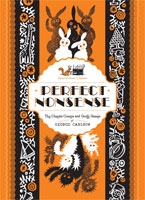
Perfect Nonsense: the Chaotic Comics and Goofy Games of George Carlson


By George Carlson, edited by Daniel F. Yezbick & Rick Marschall (Fantagraphics Books)
ISBN: 978-1-60699-508-2

The art and calling of mesmerising children is a rare one, but the masters of such an imaginative discipline – whether through words or pictures – have generally become household names.

Lewis Carroll (although that’s really two people, Charles Lutwidge Dodgson & Sir John Tenniel), Edward Lear, J.M. Barrie, L. Frank Baum, Enid Blyton, Maurice Sendak, Kenneth Graham, Arthur Rackham and their ilk, or cartoon-oriented craftsmen such as Winsor McCay, Sheldon Mayer, Theodor “Dr. Seuss” Geisel, George Herriman, Elzie Segar, S.J. Perelman, Alfred Bestall, Crockett Tubbs, Milt Gross, Carl Barks, Bill Holman and others have all garnered some measure of undying fame for their sublime cannons of entertainment, but apparently these days, nobody knows George Carlson.

Carlson was both a unique and prolific, surreally absurdist, sublimely stylised magician of children’s entertainments and a diligent commercial artist, tireless, dedicated educator and print illustrator and designer.

He absolutely loved games and puzzles and was besotted with all aspects of print media.

A son of Swedish immigrants, he plied his trade(s) from New York and Connecticut between 1903 to 1962, producing everything from editorial cartoons, book jackets (including famously the iconic first edition of Margaret Mitchell’s Gone with the Wind), magazine illustration, typographical design, games, sheet-music, utterly unique advertising materials, books, pamphlets and so much more.

And comics: some of the most original, eccentric and captivating comics for youngsters America or the world has ever seen…

This superb and colossal compendium, the brainchild and magnum opus of extreme fan Daniel Yezbick, is the result of 15 years toil and superbly details every aspect of the lost master’s life, stuffed to overflowing with intimate photos, wonderful anecdotes and page after page of glorious, enchanting stories, poems, puzzles and pictures that still have the power to take your breath away, no matter how old you are.

This calculated resurrection of a lost giant begins with ‘Preface: Great Gran’pa Gookel’ by Carlson’s descendent Allison Currie, and an effulgent Introduction’ by author, critic, historian and cartoonist R.C. Harvey who kindles the lost days in ‘A Very Admiring and Well-Plumbed Apostrophe to George Carlson, Cartooning Genius’, whilst Yezbick’s fulsome Foreword declares ‘At Long Last, the Carnival’s Come Back’…

Firstly Yezbick takes us through the great man’s multi-faceted career, beginning with ‘The Jolly Books of the Puzzling Private’ describing early works and the artist’s two decades writing, illustrating, designing and creating engaging and educational games and puzzles for iconic and influential children’s pulp magazine John Martin’s Book. Also heavily featured is Carlson’s first great creation Peter Puzzlemaker, whose visual and verbal conundrums fascinated and expanded the minds of generations of kids.

The tireless scribbler also ghosted Gene Ahern’s classic newspaper strip Reg’lar Fellers for years and was engaged during WWI as an army cartographer.

‘The Whimsical Wizard of Fairfield, Connecticut: Family Life and Commercial Art in the 1920s and 1930s’ details his most productive period, not just as a consummate long-distance entertainer of kids, but in local and publishing national arenas.

Whilst addressing Carlson’s lifelong fascination with transport – especially his astounding illustrations of ships and trains – ‘Gone With the Wiggily: Flirting with Fame in the 1930s and 1940s’ covers the Mitchell cover creation and other book jackets as well as Carlson’s far more lasting and influential contributions to children’s literature.

Most important of these are his superb illustrations for Howard R. Garis’ ubiquitous and bucolic tales of venerable rabbit grandfather figure Uncle Wiggily and the artist’s wholly originated series of Puzzles, Fun Things to Do, Play and Colouring books, as well as a succession of “How to” books  revealing the secrets of drawing and creating your own cartoons.

The origin of his short but incredible funnybook career is covered in ‘The Road to Pretzleburg: George Carlson and Self-Destructing Comic Book Narrative’ and the latter disappointing years of changing public tastes in ‘Slouching Towards Fumbleland: The Restoration of the Whifflesnort’ which prompted his just-too-soon abortive creation of graphic novels (in 1962) with the never published Alec in Fumbleland and the artist’s immortalisation as the creator of a series of images locked in a time capsule that won’t be opened until 8113AD…

The major portion of this sturdy compendium is taken up with hundreds of astounding reproductions of Carlson’s vast and varied output, beginning with ‘Early Works and Illustrations’ including scenes from many classical stories such as Icarus, Neptune and Amphitrite, Aesop’s Fables, The Legend of Sleepy Hollow, Tom Sawyer and full colour cover and plates for such books as The Magic Stone, Uncle Wiggily, The Prince Without a Country and more…

Also included are examples of ‘Adult and Genre Works’ such as Broncho Apache, Death on the Prairie and Scouting on the Mystery Trail…

‘Pulps, Poems and Pixies: John Martin’s Books’ offers a wealth of images and designs from Carlson’s 20 year tenure as contributing editor on America’s premiere pulp publication for children.

A master of what we now call paper and print technologies with the budget and freedom to go wild, he concocted covers, frontispieces, book plates, Holiday editions, graphically integrated poem pages, astounding layouts, games pages, riddles, nonsense word glossaries, animal alphabets and so many other ways to educationally enthral, engage and stretch growing minds…

The artist was also a brilliant composer of clever, witty limericks, odes, riddles, gags and brainteasers: a advocate and devotee of whacky word play in the manner of Lear and Carroll, and ‘Carlson’s School of Nonsense’ catalogues many of his most impressive cartoon-garnished confections whilst ‘Jolly Books’ displays his creations and tales for premium pamphlets (a forerunner of comicbooks) commissioned as give-aways by department stores, cxall dutifully crafted and packaged by the John Martin team.

As the magazine refused to carry straight advertising – feeling it was an abuse and betrayal of their young readers’ trust – Carlson and brilliant co-editor Helen Waldo devised a sponsorship method which name-checked at one remove selected backers and commercial interests through ingenious story puzzle pages, rebuses, acronyms and acrostics…

Once upon a time paper and printing were the internet: a nigh-inexhaustible, readily available resource which could provide stories, games and puzzles, information and diversions which only required a creator’s imagination and ingenuity.

There was nobody more skilled, adept or inspired than Carlson, whose life-long fascination with language, crosswords, puns, riddles, rebuses, maths, wordplay and graphic invention seemingly occupied every non-working, waking moment.

He also knew music (his wife Gertrude was a professional pianist and gave lessons from their home) and here ‘Songs, Games and Other Pastimes’ displays his charming amalgamations of graphics and terpsichorean instruction as well as his science-based features, articles and books, whilst ‘Tutorial Cartooning and Art Instruction’ offers concrete examples of the artist’s many years of publishing tracts and tomes intended to teach young and old alike the fundamentals of narrative art.

‘Trains and Transportation’ reveals in spectacular detail Carlson’s fascination with engineering, locomotives and all aspects of shipping – including the revolutionary and mindboggling book Queen Mary Comparisons – after which ‘Portraits, Presidents and Personalities’ displays a selection of his superb commemorative images, whilst ‘Adventures in Advertising’ reveals his unbelievable versatility in putting across ideas and selling, including many examples of the aforementioned John Martin stealth ads plus a plethora of delightful make-them-yourself Premiums he designed for youngsters.

‘Original Art, Lost Works, and Forgotten Frolics’ explore tantalising might-have-beens and unearthed treasures before the groundbreaking kids comics are highlighted in ‘Laughter, Puns, and Speed’.

Subtitled ‘The Whifflesnorting Thrills of George Carlson’s Eastern Color Comics’, a brief essay reveals the history of the illustrator’s short foray into comicbooks and the creation of anthology Jingle-Jangle Comics, which launched in February 1942 (running until 1949) and which headlined two features exclusively written and drawn by Carlson.

‘The Pie-Faced Prince of Old Pretzleburg’ was a manic, pun-filled procession of insane and wholesome nonsense which related the fast and frantic screwball adventures of royal mooncalf Prince Dimwitri and his inamorata Princess Panetella Murphy, and the too short collection of complete capers commences here with the fast, frenetic debut from #1, in which he saved the King’s breakfast pretzel from the insidious Green Witch.

Also included are escapades from issues #11, #15, #16, #20, #35, #36 and #41, absurdist adventures in rumbling tumbling happily tumultuous word and picture tales involving jet-powered kites, assorted bandits, scurrilous scarecrows, stolen violins, fabulous beasts, living jet-mobiles, talking animals, baking, belligerent unicorns and more.

Carlson brought a deliciously skewed viewpoint to the still-evolving syllabary of comics: there are hilariously punny labels and signs everywhere and in some shots weary birds rest on free-floating word balloons…

Without doubt, however, Carlson reserved his greatest flights of fancy for the inventive fractured fairy stories that comprised the eponymous ‘Jingle Jangle Tales’ – one-off fables starring peculiarly reinvented standbys like princesses and knights, interacting with astonishing animals and far-from-inanimate objects all imbued with a bravura lust for life and laughs.

Included here are ‘The Moon-Struck Unicorn and the Worn-Out Shadow’ from #13, ‘The Straight-Shooting Princess and the Filigree Pond-Lily’ (#22), ‘The Musical Whifflesnort and the Red-Hot Music Roll’ (#23), ‘The Rocketeering Doodlebug and the Self-Winding Horsefly’ (#25), extraordinarily mirthful mystical melanges augmented by a brace of outrageously wry spoofs of American classics ‘Skip van Wrinkle, the High-Hatted Hunter’ from #28 and the impossibly raucous and breathtaking lunacy of ‘Sleepy Yollow, the Bedless Norseman’ (#31).

Harlan Ellison correctly dubbed Carlson’s sublimely inviting whimsy for the very young as “Comics of the Absurd” and these cartoon capers are urgently in need of their own complete and comprehensive collection – preferably in a lush and lavish full colour hardback archive edition…’

If you have an abiding love of creative fantasy and access to beginning reading-age children (boy, that came out creepier than I imagined!), you simply must get this terrific tome and open their eyes to wonderment, enlightenment, entertainment and education in this timelessly addictively accessible chronicle.

Buy it now, and it will be this year’s best Christmas present ever…
Perfect Nonsense © 2013 Fantagraphics Books. All images and articles © their respective creators or owners. All rights reserved.
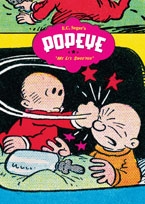
E.C. Segar’s Popeye volume 6: “Me Li’l Swee’Pea”


By Elzie Crisler Segar, with Doc Winner (Fantagraphics Books)
ISBN: 978-1-60699-483-2

Elzie Crisler Segar was born in Chester, Illinois on 8th December 1894. His father was a handyman, and the boy’s early life was filled with the kinds of solid, dependable blue-collar jobs that typified his generation of cartoonists. He worked as a decorator and house-painter and also played drums; accompanying vaudeville acts at the local theatre.

When the town got a movie-house he played for the silent films, absorbing all the staging, timing and narrative tricks from keen observation of the screen. Those lessons would become his greatest assets as a cartoonist. It was while working as the film projectionist, aged 18, that he decided to become a cartoonist and tell his own stories.

Like so many others he studied art via mail, in this case W.L. Evans’ cartooning correspondence course out of Cleveland, Ohio, before gravitating to Chicago where he was “discovered” by Richard F. Outcault – regarded by most as the inventor of newspaper comic strips with The Yellow Kid and, later, Buster Brown.

The celebrated cartoonist introduced him around at the prestigious Chicago Herald. Still wet behind the ears, Segar’s first strip, Charley Chaplin’s Comedy Capers, debuted on 12th March 1916. In 1918 he married Myrtle Johnson and moved to William Randolph Hearst’s Chicago Evening American to create Looping the Loop, but Managing Editor William Curley saw a big future for Segar and packed the newlyweds off to New York, HQ of the mighty King Features Syndicate.

Within a year Segar was producing Thimble Theatre, which launched December 19th 1919 in the New York Journal. It was a pastiche of movie-inspired features like Hairbreadth Harry and Midget Movies, with a repertory cast to act out comedies, melodramas, comedies, crime-stories, chases and especially comedies for vast daily audiences. The core cast included parental pillars Nana and Cole Oyl, their lanky highly-strung daughter Olive, diminutive-but-pushy son Castor and Olive’s plain and simple occasional boyfriend Horace Hamgravy (later known as just Ham Gravy).

In 1924 Segar created a second daily strip The 5:15: a surreal domestic comedy featuring weedy commuter and would-be inventor John Sappo and his formidable wife Myrtle (surely, no relation?) which endured – in one form or another – as a topper/footer-feature accompanying the main Sunday page throughout the author’s career, even surviving his untimely death, eventually becoming the trainee-playground of Popeye’s second great stylist Bud Sagendorf.

A born storyteller, Segar had from the start an advantage even his beloved cinema couldn’t match: a brilliant ear for dialogue and accent which boomed out from his admittedly average adventure plots, adding lustre and sheer sparkle to stories and gags he always felt he hadn’t drawn well enough. After a decade or so – and just as cinema caught up with the invention of “talkies” – he finally discovered a character whose unique sound and individual vocalisations blended with a fantastic, enthralling nature to create a literal superstar.

Popeye the sailor, brusque, incoherent, plug-ugly and stingingly sarcastic, lurched on stage midway through the protracted continuity ‘Dice Island’, (on January 17th 1929: see E.C. Segar’s Popeye volume 1: “I Yam What I Yam!”) and, once his part was played out, simply refused to leave.

Within a year he was a regular and, as the strip’s circulation skyrocketed, he gradually took his place as the star. The strip title was changed to reflect the fact and most of the tired old gang – except Olive – consigned to oblivion …

The Old Salt clearly inspired his creator. The near decade of thrilling mystery-comedies he crafted and the madcap and/or macabre new characters with which he furiously littered the strips revolutionised the industry, laid the groundwork for the entire superhero genre (sadly, usually without the leavening underpinnings of his wryly self-aware humour) and utterly captivated the whole wide world.

These superb oversized (375 x 268 mm) hardback collections are the ideal way of discovering or rediscovering Segar’s magical tales, and this sixth and final mammoth compendium augments the fun with another an insightful introductory essay from Richard Marschall exploring ‘The Continuity Style of E. C. Segar: Between “Meanwhile” & “To Be Continued”‘ and closes with an absorbing end-piece essay describing the globalisation of the character in ‘Licensing and Merchandising Move to Center Stage of the Thimble Theatre: Popeye Fisks his way into American Culture‘ plus a 1930 magazine feature graphically revealing the Sailor Man’s natal origins and boyhood in ‘Blow Me Down! Popeye Born at Age of 2, But Orphink from Start’ scripted by unknown King Features writers but gloriously and copiously illustrated by Segar himself.

As always the black-&-white Daily continuities are presented separately to the full-colour Sunday’s, and the monochrome mirth and mayhem – covering December 14th 1936 to August 29th 1938 12th – begins with an all new adventure ‘Mystery Melody’ wherein Popeye’s disreputable dad Poopdeck Pappy is haunted and hunted by the sinister Sea Hag whose ghastly Magic Flute is employed to lure the old goat back into the clutches of the woman he loved and abandoned years ago…

The tension and drama grows in the second chapter ‘Tea and Hamburgers’ when the Hag approaches another old flame – J. Wellington Wimpy – and uses the reprobate’s insatiable lust (for food) to help capture Poopdeck. The plan works, but not quite as the sinister sorceress intended…

In ‘Bolo vs Everyone!’ events escalate completely beyond control as the Hag’s primordial man-monster attacks and the grizzled mariner ends the fight in his own inimitable manner, whilst mystic marvel Eugene the Jeep (a fantastic 4th dimensional beast with incredible powers) uses his gifts to temporarily settle the Sea Hag’s hash…

A decided change of pace began with the next storyline. ‘A Sock for Susan’s Sake’ showcases Popeye’s big heart and sentimental nature as he takes a destitute and starving waif under his wing: buying her clothes, breaking her out of jail and going on the run with her.

His kind-hearted deeds arouse deep suspicions about his motives from friends and strangers alike…

It’s a tribute to Segar’s skills that the storyline perfectly balances social commentary and pathos with plenty of action (that sock in question is not footwear) and non-stop slapstick comedy. Their peregrinations again land Susan and the Old Salt in jail – for vagrancy – but the wonderfully sympathetic and easily amused Judge Penny really makes the prosecution work hilariously hard for a conviction in ‘Order in the Court!’…

Naturally, jealous Olive gets completely the wrong idea and uses the Jeep to track down her straying beau in ‘Who is That Girl?’ leading to the discovery of the ingénue’s origins and the restoration of her stolen fortune – a case calling for the return of ace detective and former strip star Castor Oyl…

The grateful child and her father burden Popeye with a huge reward but as he has his own adequate savings at home he gives it all – with some unexpected difficulty – away to “Widdies and Orphinks”…

In the next sequence the Sailor Man has reason to regret that generosity as, on returning to his house, he finds his hard-earned “Ten Thousing dollars” savings have been stolen…

Most annoyingly he knows Poopdeck has taken it but the old goat won’t admit it, even though he has a new diamond engagement ring which he uses to bribe various loose young (and not so young) women into going out gallivanting with him and sowing ‘Wild Oats’ …

When Popeye first appeared he was a rough, rude, crude and shocking anti-hero. The first Superman of comics was not a comfortable paragon to idolise but a barely human brute who thought with his fists and didn’t respect authority. Uneducated, opinionated, short-tempered, fickle (whenever hot tomatoes batted their eyelashes – or thereabouts – at him), a gambler and troublemaker, he wasn’t welcome in polite society…and he wouldn’t want to be.

He was soon exposed as the ultimate working class hero: raw and rough-hewn, practical, but with an innate and unshakable sense of what’s fair and what’s not, a joker who wanted kids to be themselves – but not necessarily “good” – and somebody who took no guff from anyone.

As his popularity grew he somewhat mellowed. He was always ready to defend the weak and had absolutely no pretensions or aspirations to rise above his fellows. He was and will always be “the best of us”… but the shocking sense of unpredictability, danger and comedic anarchy he initially provided was sorely missed. So in 1936 Segar brought it all back again in the form of Popeye’s 99-year old unrepentantly reprobate dad…

The elder mariner was a rough, hard-bitten, grumpy brute quite prepared and even happy to cheat, steal or smack a woman around if she stepped out of line, and once the old Billy goat (whose shady past possibly concealed an occasional bit of piracy) was firmly established, Segar set Popeye and Olive the Herculean and unfailingly funny task of civilising the old sod…

They returned to their odious chore here as Pappy’s wild carousing, fighting and womanising grow ever more embarrassing and lead to the cops trying – and repeatedly failing – to jail the senior seaman.

Poopdeck finally goes too far and pushes one of his fancy woman fiancées into the river. At last brought to trial, he pleads ‘Extenuvatin’ Circumsnances’…

The final full saga began on 15th November 1937 as ‘The Valley of the Goons (An Adventure)’ saw Popeye and Wimpy drugged and shanghaied. Even though he could fight his way back home, Popeye agrees to stay on for the voyage since he needs money to pay lawyers appealing Pappy’s prison sentence. He quickly changes tack, however, when he discovers the valuable cargo they’re hunting is Goon skins! The Cap’n and his scurvy crew are planning to slaughter the hapless hulking exotic primitives for a few measly dollars…

After brutally driving off the murderous thugs, Popeye – and the shirking Wimpy – are marooned on the Goons’ isolated island…

The barbaric land holds a few surprises: most notably the fact that the natives are ruled over by Popeye’s dour old pal King Blozo (formerly of Nazilia) who, with his idiot retainer Oscar, is calling all the shots. It’s a happy coincidence as Wimpy’s eternal hunger and relentless mooching have won him a death sentence and he’s in imminent danger of being hanged…

All this time Olive, guided by the mystical tracking gifts of the Jeep, has been sailing the seven seas in search of her man and she beaches her boat just as Popeye begins to get the situation under control. In doing so he unfairly earns the chagrin of the island’s unseen but highly voluble sea monster George…

Shock follows shock as the eerie voiced unseen creature is revealed as the horrendous Sea Hag who re-exerts her uncanny hold (some illusions but mostly the promise of unlimited hamburgers) upon Wimpy and tries to make him the ‘Bride of George’…

In the middle of this tale Segar fell seriously ill with Leukaemia and his assistant Doc Winner assumed responsibility for completing the story: probably from Segar’s notes if not at his actual direction.

Although Winner’s illustrations carry ‘Valley of the Goons’ to conclusion, this tome excludes the all-Winner adventure ‘Hamburger Sharks and Sea Spinach’ before resuming with the May 23rd instalment by the apparently recovered Segar.

‘King Swee’Pea’ saw the feisty baby – who had been left with Popeye – become the focus of political drama and family tension when he was revealed to be heir to the Kingdom of Demonia…

After a protracted tussle with that nation’s secret service and bombastic kingmaker F.G. Frogfuzz Esquire, the Sailor Man has himself appointed regent and chief advisor and, taking most of the cast with him, relocates to the harsh land where only Ka-babages grow.

Popeye soon finds that his mischievous little charge has started to speak: increasingly crossing and contradicting his gruff guardian and others, much to the annoyance of blustering bully King Cabooso of neighbouring (rival) nation Cuspidonia…

Before long another unique crisis manifests in ‘Rise of the De-Mings’ as smug and sassy subterranean critters begin devastating the Ka-babage crop even as Swee’Pea and Caboosa escalate their war of insults…

Sadly, although coming back strongly, within three months Segar had relapsed. The adventures end here with his last strip and a précis of Winner’s eventual conclusion…

Segar passed away six weeks after his final Daily strip was published.

The full-colour Sunday pages in this volume run from 20th September 1936 to October 2nd 1938, a combination of Star turn and intriguing footers.

After an interlude with a new wry and charming feature – Pete and Patsy: For Kids Only – the artist settled once again upon an old favourite to back up Popeye.

The bizarrely entertaining Sappo (and the scene-and show-stealing Professor O.G. Wotasnozzle) supplemental strip returned in a blaze of imaginative wonder, as Segar also benched the cartooning tricks section which allowed him to play graphic games with his readership and again pushed the boundaries of Weird Science as the Odd Couple – and long-suffering spouse Myrtle – spent months exploring other worlds.

The assorted Saps also dabbled with robot dogs, brain-switching machines and fell embarrassingly foul of such inventions as long-distance spy-rays, anti-gravity devices, limb extending “Stretcholene”, “Speak-no-Evil” pills, Atom-Counters and the deeply disturbing trouble magnet dubbed “Dream Solidifier” whilst Sappo’s less scientific but far more profitable gimmicks kept the cash rolling in and the arrogant Professor steaming with outrage…

Above these arcane antics Sunday’s star attraction remained fixedly exploring the comedy gold of Popeye’s interactions with Wimpy, Olive Oyl and the rest of Segar’s cast of thousands (of idiots).

The humorous antics – in sequences of one-off gag strips alternating with the occasional extended saga – saw the Sailor-Man fighting for every iota of attention whilst his mournful mooching co-star became increasingly more ingenious – not to say surreal – in his quest for free meals…

An engaging Micawber-like coward, cad and conman, the insatiable J. Wellington Wimpy debuted on May 3rd 1931 as an unnamed and decidedly partisan referee in one of Popeye’s frequent boxing matches. The scurrilous but polite oaf obviously struck a chord and Segar gradually made him a fixture. Always hungry, keen to take bribes and a cunning coiner of many immortal catchphrases – such as “I would gladly pay you Tuesday for a hamburger today” and ‘Let’s you and him fight’ – he was the perfect foil for a simple action hero and increasingly stole the entire show just like anything else unless it was nailed down…

There was also a long-suffering returning rival for Olive’s dubious and flighty affections: local charmer Curly…

When not beating the stuffing out of his opponents or kissing pretty girls, Popeye pursued his flighty, vacillating and irresolute Olive with exceptional verve, if little success, but his life was always made more complicated whenever the unflappable, so-corruptible and adorably contemptible Wimpy made an appearance.

Infinitely varying riffs on Olive’s peculiar romantic notions or Wimpy’s attempts to cadge food or money (for food) were irresistible to the adoring readership, but Segar wisely peppered the Sundays with longer episodic tales, such as the saga of ‘The Terrible Kid Mustard’ (which ran from December 27th 1936 to February 28th 1937) and pitted the prize-fighting Sea Salt against another boxer who was as ferociously fuelled by the incredible nourishing power of Spinach…

Another extended endeavour starred the smallest addition to the cast (and eponymous star of this volume). The rambunctious tyke Swee’Pea was never an angel and when he began stealing jam and framing Eugene the Jeep (March 7th through 28th) the search for a culprit proved he was also precociously smart too.

The impossible task of civilising Poopdeck Pappy also covered many months – with no appreciable or lasting effect – and incorporated an outrageous sequence wherein the dastardly dotard become scandalously, catastrophically entangled in Popeye’s mechanical diaper-changing machine…

On June 27th Wimpy found the closest thing to true love when he met Olive’s friend Waneeta: a meek, retiring soul whose father owned 50,000 cows. His devoted pursuit filled many pages over the following months, as did the latest scheme of his arch-nemesis George W. Geezil, who bought a café/diner with the sole intention of poisoning the constantly cadging conman…

Although starring the same characters the Sunday and Daily strips ran separate storylines, offering Segar opportunities to utilise the same good idea in different ways.

On September 19th 1937 he began a sequence wherein Swee’Pea’s mother returned, seeking to regain custody of the boy she gave away. The resultant tug-of-love tale ran until December 5th and displayed genuine warmth and angst amidst the wealth of hilarious antics by both parties to convince the feisty “infink” to pick his favourite parent…

On January 16th 1938 Popeye was approached by scientists who had stumbled upon an incipient Martian invasion. The invaders planned to pit their monster against a typical Earthman before committing to the assault and the Boffins believed that the grizzly old pug was the planet’s best bet…

Readers didn’t realise that the feature’s glory days were ending. Segar’s advancing illness was affecting his output – there are no pages reproduced here between February 6th and June 26th – and although when he resumed the gags were funnier than ever (especially a short sequence where Pappy shaves his beard and dyes his hair so he could impersonate Popeye and woo Olive) the long lead-in time necessary to create Sundays only left him time to finish more 15 pages.

The last Segar signed strip was published on October 2nd 1938. He died eleven days later.

There is more than one Popeye. If your first thought on hearing the name is an unintelligible, indomitable white-clad sailor always fighting a great big beardy-bloke and mainlining tinned spinach, that’s okay: the animated features have a brilliance and energy of their own (even the later, watered-down anodyne TV versions have some merit) and they are indeed based on the grizzled, crusty, foul-mouthed, bulletproof, golden-hearted old swab who shambled his way into Thimble Theatre and wouldn’t leave. But they are really only the tip of an incredible iceberg of satire, slapstick, virtue, vice and mind-boggling adventure…

Popeye and the bizarre, surreally quotidian cast that welcomed and grew up around him are true icons of international popular culture who have grown far beyond their newspaper strip origins. Nevertheless, in one very true sense, with this marvellous yet painfully tragic final volume, the most creative period in the saga of the true and only Sailor Man closes.

His last strips were often augmented or even fully ghosted by Doc Winner, but the intent is generally untrammelled, leaving an unparalleled testament to Segar’s incontestable timeless, manic brilliance for us all to enjoy over and over again.

There is more than one Popeye. Most of them are pretty good and some are truly excellent. However there was only ever one by Elzie Segar – and don’t you think it’s time you sampled the original and very best?
© 2012 Fantagraphics Books Inc. All comics and drawings © 2011 King Features Inc. All rights reserved.

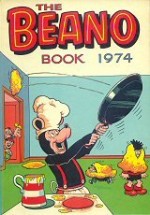
The Beano Book 1974


By various (DC Thomson & Co., Ltd.)
Retroactively awarded ISBN: 978-0-85116-077-1

For many British readers – whether comics fans or not – fans, the Holiday Season can only mean The Beano Book, so I’ve once more highlighted another of the venerable, beloved tomes as particularly representative of the time of year.

Way back when, many annuals were produced in a wonderful “half-colour” which British publishers used to keep costs down. This was done by printing sections or “Signatures” of the books with only two plates, such as Cyan (Blue) and Magenta (Red) or Yellow and Black.

The sheer versatility and colour range provided was simply astounding. Even now this technique inescapably screams “Holiday Extras” for me and my aging contemporaries and none more than in this spectacular example which would have hit shop shelves in September of 1963.

As is so often the case, my knowledge of the creators involved is appallingly sub-standard, but I’ll hazard my usual wild guesses in the hope that someone with more substantial information will correct me when I err …

This anarchically rousing compilation kicks off with a double-page splash of ‘Peculiar Pets’ Picture Gallery’ (by Robert Nixon, I think) displaying a number of comics stars and their companion animals of choice, after which Minnie the Minx (Jim Petrie) and a few chums and latterly Biffo the Bear with human pal Buster (by David Sutherland) introduce this year’s annual before Ron Spencer’s Baby-Face Finlayson (“The Cutest Bandit in the West”) imagines life as a giant and not a pipsqueak…

“Fastest Boy on Earth” Billy Whizz (drawn superbly as ever by Malcolm Judge) then learns to respect the power of traffic signs – in his house – before the crafty campaigns of ‘The Nibblers’ (John Sherwood) wins them a grand Christmas nosh-up and sanctuary from the seasonal snows.

Back then The Beano still had the odd adventure strip and perhaps the greatest of these was boy superhero Billy the Cat. Sutherland next proves his astounding visual versatility in The Bash Street Kids where the pupils plump for pop and resist the calming charms of classical music – leading to a camera-shattering pinup of ugly mug Plug – before switching to action mode as the acrobatic champion – now teamed with his cousin as Billie the Cat and Katie – jointly recapture an escaped convict and preserve their secret identities from curious school chums in a splendid rollercoaster romp.

Petrie’s Minnie the Minx then painfully learns that she’s not cut out for pony riding, after which Nixon panoramically maps out ‘A Funny Look at “Beano-Town”‘ whilst Bob McGrath details the sub-zero antics of The Three Bears as they try to find fuel to heat their chilly cave.

Also ably illustrated by the tireless Sutherland, Biffo and Buster return as rivals clashing in a man-powered flight competition, after his Pin-up Pup! of Dennis the Menace’s perilous pooch Gnasher leads into a custard-coloured clash between his master and simpering swot Walter.

Spencer’s Little Plum experiences a mysterious clean-up whilst sleepwalking before Nixon’s Lord Snooty and his snowballing pals at Bunkerton Castle get some startling help from the estate’s star stag Angus even as elsewhere – and keeping up the Hibernian humour – Haggis hunters The McTickles (by Vic Neill?) fall foul of their canny shaggy prey…

Pup Parade starring the Bash Street Pups (Gordon Bell) finds the mini-mutts (eventually) enjoying an old dinosaur bone before a dedicated and extended niche chapter from Nixon. Here in an expansive section of his own, Roger the Dodger’s Special Mini-Book offers the rollicking tale of the ‘Disappearing Dodger’, a pin-up, his hilarious, historically inaccurate ‘Family Tree’, ‘A Dodger’s Outfit’, and an informative peek at ‘A Dodger’s Den’ before closing with the final pin-up ‘Dreaming of Dodges’…

Biffo’s back – and points south – endure a battering due to the bear’s interest in buttercups (Sutherland) before Nixon reveals how the obstreperous Grandpa still catastrophically refuses to act his age and The Nibblers (Sherwood) again overcome malicious moggy Whiskers to fill their bellies with purloined goodies.

The riddle of Billy Whizz’ footwear replacement is solved in a quick-fire yarn by Judge before Bell’s Pup Parade starring the Bash Street Pups tale discloses the secret of their unlikely alliance with a very big cat…

Heading out West, The Three Bears (McGrath) find – and lose – a mountain of gold, The McTickles lose a skirmish with the wily Stilt-legged McHaggises, and Baby-Face Finlayson rewrites a few favourite nursery rhymes before Teacher and even Head have another go at civilising the Bash Street Kids with music – appended with a stomach-churning pin-up of Cuthbert Cringeworthy in Teacher’s Pet’s Picture Gallery…

Ron Spencer stretches his artistic muscles providing ghastly genealogical ‘Fun with the Finlayson Family’ and illustrating how Little Plum gets into big trouble trying to recapture girlfriend Little Peach‘s pet parrot, before Billy the Cat and Katie swing back into action, turning on the town’s Christmas lights and tracking down a hold-up gang (Sutherland).

Another gloriously funny Lord Snooty strip from Robert Nixon segues into Minnie the Minx’s hilarious crush on an American boy-band – and older readers will cringe with mirth at Jim Petrie’s hilarious spoof of then-sensation Donny Osmond – before Nixon strikes back with a Grandpa yarn involving the old codger’s inability to stay clean…

Beano star Dennis the Menace was only slightly involved in the Annuals of this period as he had his own Christmas Bumper book to run riot in, but he closes this tumultuous tome with an funny educational strip that’s a thinly disguised advert for his solo venture before the merriment closes here with another superb dose of Nixon’s ‘Peculiar Pets’ Picture Gallery’ …

This is supremely entertaining book, and even without legendary contributors Dudley Watkins, Leo Baxendale and Ken Reid there’s still an abundance of satisfyingly madcap, infectious insanity. With so much merriment on offer I can’t believe this 40-year old book is still sprightlier and more entertaining than most of my surviving friends and relatives. If ever anything needed to be issued as commemorative collections it’s these fabulous DC Thomson annuals…

Divorcing the sheer quality of this brilliant book from nostalgia may be a healthy exercise – perhaps impossible, but I’m quite happy to luxuriously wallow in the potent emotions this annual still stirs. It’s a fabulous laugh-and-thrill-packed read from a magical time, and turning those stiffened two-colour pages is always an unmatchable Christmas experience, happily still relatively easy to find these days.
© 1973 DC Thomson & Co., Ltd.

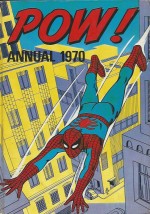
Pow! Annual 1970


By various (Odhams Books)
ASIN: B003VUO2SC

This splendidly intriguing item is one of my favourite childhood delights: addictively captivating at the time and these days a fascinating indicator of the perceived tastes of Britain’s kids. Most importantly it’s still a surprisingly qualitative read with its blend of American adventure strips playing well with a selection of steadfastly English and wickedly surreal comedy material.

With Scotland’s DC Thomson steadily overtaking their London-based competitors throughout the 1960s, the sheer variety of material the southerners unleashed to compete offered incredible vistas in adventure material and – thanks especially to the defection of Leo Baxendale and Ken Reid to monolithic comics publishing giant Amalgamated Press (created by Alfred Harmsworth at the beginning of the twentieth century) – had finally found a wealth of anarchic comedy material to challenge the likes of the Bash Street Kids, Dennis the Menace, Minnie the Minx and their unruly ilk.

During that latter end of the period the Batman TV show sent the entire world superhero crazy and Amalgamated had almost finished absorbing all its rivals such as Eagle‘s Hulton Press to form Fleetway/Odhams/IPC.

Formerly the biggest player in children’s comics, Amalgamated had stayed at the forefront of sales by latching onto every fad: keeping their material contemporary, if not fresh. The all-consuming company had been reprinting the early successes of Marvel comics for a few years; feeding on the growing fashion for US style adventure which had largely supplanted the rather tired True Blue Brit style of Dan Dare or DC Thompson’s Wolf of Kabul.

“Power Comics” was a sub-brand used by Odhams to differentiate those periodicals which contained reprinted American superhero material from the company’s regular blend of sports, war, western adventure and gag comics – such as Buster, Lion or Tiger. During the Swinging Sixties these ubiquitous weeklies did much to popularise the budding Marvel characters and universe in this country, which was still poorly served by distribution of the actual American imports. Fantastic and its sister paper Terrific were notable for not reformatting or resizing the original artwork whilst in Wham!, Pow! or Smash!, an entire 24-page yarn could be resized and squeezed into 10 or 11 pages over two weeks…

Pow! launched with a cover date of January 31st 1967, combining home-grown funnies such as Mike Higgs’ The Cloak, Baxendale’s The Dolls of St Dominic’s, Reid’s Dare-a-Day Davy, Wee Willie Haggis: The Spy from Skye and many others, British originated thrillers such as Jack Magic and The Python and resized US strips Spider-Man and Nick Fury, Agent of S.H.I.E.L.D.

After 53 weekly issues the title merged with Wham!, that combination running until #86 when it was absorbed into Smash! Nevertheless, the title generated a number of annuals, even though, by 1969 when this annual was released, the trend generated by TV Batmania was dying.

Interest in superheroes and fantasy in general were on the wane and British weeklies were diversifying. Some switched back to war, sports and adventure stories whilst with comedy strips on the rise again, others became largely humour outlets.

This was one of the last Odhams Christmas compendia to feature imported Marvel material: from then on the Americans would handle their own Seasonal books rather than franchise out their classics to mingle with the Empire’s motley, anarchic rabble.

The content is eclectic and amazingly broad, beginning with a complete but compacted retelling of Sgt. Fury and His Howling Commandos #5 by Stan Lee & Jack Kirby from January 1964.

The full-colour WWII tale found the doughty warrior ‘At the Mercy of Baron Strucker’; beaten and humiliated in a duel with an Aryan nobleman. Soon filmed footage was used as a Nazi propaganda tool and Fury hero was a broken man – until one of his men realised the nonplussed noncom had fallen for the oldest trick in Hollywood’s playbook. The riotous rematch went rather better…

This was followed by a welter of gag strips beginning with an outing for Graham Allen’s The Nervs (revolting creatures that lived inside and piloted unlovely schoolboy Fatty) after which The Swots and the Blots (probably drawn by Mike Lacey) ushered in the economical 2-colour section with another Darwinian example of schoolboy Good vs. Evil and an unnamed substitute for Mike Higgs rendered the comedy caper The Cloak vs. Cloakwoman…

Next up is a short Marvel sci fi thriller as ‘Escape into Space!’ (from Tales of Suspense #42 June 1963 by Lee, Larry Lieber & Matt Fox) sees a convict escape to freedom into the void – or does he…? – before Wee Willie Haggis – the Spy from Skye scotches a plot to nobble Scotland’s prime (in)edible export and Percy’s Pets finds the obsessed animal enthusiast in deep water after getting hold of a hyena and crocodile…

Sgt. Fury and His Howling Commandos #5 provides a factual page devoted to ‘Weapons of War: Light Machine Guns of World War II’ to restart the full colour fun, which continues with another Swots and the Blots romp ‘n’ riot after which idiot espionage continues with The Cloak vs. Blubberman…

Back then to red-&-black for the not-resized Amazing Spider-Man #36 (May 1966, by Lee and Steve Ditko) as the Wallcrawler faces deranged super strong thief the Looter in ‘When Falls the Meteor!’

The magnificently strange comic villain Grimly Feendish then fails in another bid to get rich nefariously before tiny terror Sammy Shrink restarts a final segment of full-colour wonders with more boyish pranks, after which the reformatted ‘Death of a Hero’ (Fantastic Four #32, November 1964, by Lee, Kirby & Chic Stone) uncovers the secret of Sue and Johnny Storm‘s father: a convict who gains incredible power as the rampaging Invincible Man…

This is a strange and beloved book for me and these are all great little adventures, even though I suspect it’s more nostalgia for a brilliant childhood rather than any intrinsic merit. Feel perfectly free to track this down and contradict me if you like though…
© 1969 The Hamlyn Publishing Group Limited.

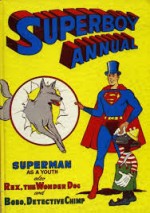
Superboy Annual 1964-1965


By various (Atlas Publishing/K.G. Murray)
No ISBN:

Before DC Comics and other American publishers began exporting directly into the UK in 1959 our exposure to their unique brand of fantasy fun came from licensed reprints. British publishers/printers like Len Miller, Alan Class and bought material  from the USA – and occasionally, Canada – to fill 68-page monochrome anthologies – many of which recycled the same stories for decades.

Less common were (strangely) coloured pamphlets produced by Australian outfit K.G. Murray and exported here in a rather sporadic manner. The company also produced sturdy and substantial Christmas Annuals which had a huge impact on my earliest years (I strongly suspect my adoration of black-&-white artwork stems from seeing supreme stylists like Curt Swan, Carmine Infantino, Gil Kane and Murphy Anderson uncluttered by flat colour).

This particular tome of was of the last licensed UK DC comics compilations before the Batman TV show turned the entire planet Camp-Crazed and Bat-Manic, and therefore offers a delightfully eclectic mix of material far more in keeping with the traditionally perceived interests of British boys than the suited-&-booted masked madness that was soon to follow in the Caped Crusader’s scalloped wake.

Of course this collection was still produced in the cheap and quirky mix of monochrome, dual-hued and weirdly full-coloured pages which made the Christmas books such a bizarrely beloved treat.

The sublime suspense and joyous adventuring begins with a rare treat as ‘The Origin of the Superman-Batman Team!’ (by Jerry Coleman & George Papp from Adventure Comics #275, August 1960) offers an alternate view of the Dark Knight.

Teenaged Bruce Wayne was sneaking out on his still-living parents to fight crime as the Flying Fox and the Boy of Steel undertook to give some pre-heroic training after seeing their future partnership in a time scanner.

The task was made simple after the Waynes moved to Smallville but soon an odd rivalry developed…

British books always preferred to alternate action with short gag strips and the Murray publications depended heavily on the amazing DC output of cartoonist Henry Boltinoff. Here a jungle jape starring explorer ‘Shorty’ and a court appearance for ‘Casey the Cop’ herald the start of the duo-colour section (blue and red) before ‘Superboy’s First Day at School’ (Otto Binder & Papp from Superboy #75, September 1959) reveals how another attempt by Lana Lang to prove Clark Kent was the Boy of Steel prompts the lads Super-Recall and reveals how, on their first day in primary school, he inadvertently displayed his powers to her several times…

A big hit during the 1950s, Rex the Wonder Dog featured a supremely capable German Shepherd – and his owners – experience a wide variety of incredible escapades. Here ‘The Valley of the Thunder King!’ by John Broome, Gil Kane & Bernard Sachs from The Adventures of Rex the Wonder Dog #14 March-April 1954, finds the dog and soldier Major Danny Dennis discover a lost tribe of Aztecs in Mexico just as a volcano erupts…

‘How Luthor Met Superboy!’ (by Jerry Siegel & Al Plastino from Adventure Comics #271, April 1960) revealed how young scientist Lex and Superboy became friends, and how the genius became deranged after a laboratory fire extinguished by the Teen Titan caused him to lose his hair. Enraged beyond limit, the boy inventor turned his talents to crime…

Boltinoff’s ET gag strip ‘On the Planet Og’ temporarily terminates the two-tone tales and leads into a black-&-white section wherein Rex’s support feature Detective Chimp takes over.

Bobo was the pet, partner and deputy of Sheriff Chase of Oscaloosa County, Florida: a chimpanzee who foiled crimes and here experienced ‘Death Walks the High Wire!’ (Broome, Irwin Hasen & Joe Giella from The Adventures of Rex the Wonder Dog #8 March-April 1953), solving the murder of a circus trapeze artist.

The amazing hound then became ‘Rex, Dinosaur Destroyer!’ (Robert Kanigher, Kane & Sy Barry, from The Adventures of Rex the Wonder Dog #11-September-October 1953) after an atomic test blast opened a subterranean rift packed with survivors from another age…

‘Little Pete’ and another ‘Casey the Cop’ by Boltinoff augur a return to red and blue tones and an epic 2-part Superboy tale as ‘The Mystery of Mighty Boy! and ‘Superboy’s Lost Friend!’ (Binder & Papp; Superboy #85, December 1960) see the Boy of Steel travel to distant planet Zumoor and a teen hero whose life closely mirrors his own. They quickly become firm friends, but Superboy soon finds good reason to abandon Mighty Boy forever…

Comedy courtesy of Boltinoff’s ‘Professor Eureka’ leads into ‘Superboy’s Nightmare Dream House’ (Superboy #70, January 1959 by Alvin Schwartz & John Sikela) which finds the Teen of Tomorrow teaching a swindler a life-changing lesson before ‘Peter Puptent’ and ‘Casey the Cop’, after which Detective Chimp uncovers ‘Monkey Business on the Briny Deep!’ (Broome, Hasen & Giella, The Adventures of Rex the Wonder Dog #10 July-August 1953) whilst Rex and Danny Dennis Jr. head out west to climb a mountain for charity and brave the perils of ‘The Eagle Hunter!’ (Kanigher, Kane & Barry from The Adventures of Rex the Wonder Dog #14 March-April 1954).

This thrilling collection returns to full-colour for one last Boltinoff ‘Doctor Rocket’ funny before ‘The Super Star of Hollywood’ (Siegel & Papp Adventure Comics #272, May 1960) reveals how super-dog Krypto becomes spoiled and big-headed after starring in a Hollywood movie – until Superboy applies a little clandestine reality check…
© National Periodical Publications, Inc. Published by arrangement with the K.G. Murray Publishing Company, Pty. Ltd., Sydney.

These Christmas Chronicles are lavish and laudatory celebrations of good times and great storytelling but at least they’re not lost or forgotten, and should you care to try them out the internet and a credit card are all you’ll need.

Merry Christmas, a fruitful New Year and Happy Reading from Everybody at Now Read This!

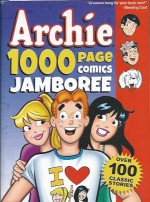
Archie 1000 Page Comics Jamboree


By many and various (Archie Comics)
ISBN: 978-1-936975-80-8

Win’s Christmas Gift Recommendation: the Holidays all wrapped up in one big  book… 10/10

Following the debut of Superman, MLJ were one of many publishers to jump on the “mystery-man” bandwagon, concocting their own small but inspired pantheon of gaudily clad crusaders. In November 1939 they launched Blue Ribbon Comics, promptly following up with Top-Notch and Pep Comics. The content was the standard mix of masked champions, two-fisted adventurers, prose pieces and gags.

Not long after, Maurice Coyne, Louis Silberkleit and John Goldwater (hence MLJ) saw a gap in the blossoming but crowded market and in December 1941 the Fights ‘n’ Tights, He-Man crowd were gently nudged aside by a far from imposing hero, an ordinary teenager who would have ordinary adventures just like the readers, but with the laughs, good times, romance and slapstick emphasised.

Goldwater developed the concept of a youthful everyman protagonist and tasked writer Vic Bloom & artist Bob Montana with the job of making it work and, inspired by the popular Andy Hardy movies, their new notion premiered in Pep Comics #22. The unlikely star was a gap-toothed, freckle-faced red-headed kid obsessed with impressing the pretty blonde next door.

A 6-page untitled tale introduced hapless boob Archie Andrews and wholesomely pretty Betty Cooper. The boy’s unconventional best friend and confidante Jughead Jones also debuted in the first story as did idyllic small-town utopia Riverdale. It was a huge hit and by the winter of 1942 the kid had won his own title. Archie Comics #1 was MLJ’s first non-anthology magazine and with it began a slow transformation of the entire company. With the introduction of ultra-rich, raven-haired Veronica Lodge, all the pieces were in play for the industry’s second Genuine Phenomenon…

By 1946 the kids were in charge, so MLJ became Archie Comics, retiring most of its costumed characters years before the end of the Golden Age and becoming, to all intents and purposes, a publisher of family-friendly comedies. The hometown settings and perpetually fruitful premise of an Eternal Romantic Triangle – with girl-hating best bud Jughead and scurrilous rival Reggie Mantle to test, duel and vex our boy in their own unique ways, the scenario was one that not only resonated with the readership but was infinitely fresh…

Archie’s success, like Superman’s, forced a change in content at every other publisher (except perhaps Gilberton’s Classics Illustrated) and led to a multi-media brand which encompassed TV, movies, newspaper strips, toys and merchandise, a chain of restaurants and, in the swinging sixties, a pop music sensation when Sugar, Sugar – from the animated TV cartoon – became a global smash.

Clean and decent garage band “The Archies” has been a fixture of the comics ever since…

Archie is good-hearted, impetuous and lacking common sense, Betty his sensible, pretty girl next door who loves the ginger goof, and Veronica is rich, exotic and glamorous: only settling for our boy if there’s nobody better around. She might actually love him too, though. Archie, of course, is utterly unable to choose who or what he wants…

The unconventional, food-crazy Jughead is Mercutio to Archie’s Romeo, providing rationality and a reader’s voice, as well as being a powerful catalyst of events in his own right. That charming triangle (and annexe) has been the rock-solid foundation for seven decades of funnybook magic. Moreover the concept is eternally self-renewing…

This perennial eternal triangle has generated thousands of charming, raucous, gentle, frenetic, chiding and even heart-rending humorous dramas ranging from surreal wit to frantic slapstick, with the kids and a constantly expanding cast of friends (boy genius Dilton Doily, genial giant jock Big Moose and aspiring comicbook cartoonist Chuck amongst many others), growing into an American institution and part of the American Cultural landscape.

The feature has thrived by constantly refreshing its core archetypes; seamlessly adapting to the changing world outside its bright, flimsy pages, shamelessly co-opting youth, pop culture and fashion trends into its infallible mix of slapstick and young romance.

Each and every social revolution has been painlessly assimilated into the mix and over the decades the company has confronted most social issues affecting youngsters in a manner both even-handed and tasteful.

Constant addition of new characters such as African-American Chuck and his girlfriend Nancy, fashion-diva Ginger, Hispanic couple Frankie and Maria and spoiled home-wrecker-in-waiting Cheryl Blossom contribute to a wide and refreshingly broad-minded scenario. In 2010 Archie jumped the final hurdle when openly gay Kevin Keller became an admirable advocate capably tackling and dismantling the last major taboo in mainstream kids comics.

As well as forward thinking in content, the company was always quick to embrace innovations in format and Archie 1000 Page Comics Jamboree is another awesome but enjoyable paper brick of comics: pocket-digest-sized (as long as your pockets are both deep and strong), containing over 100 full-colour stories starring all the cast and characters. So fun-filled is this titanic tome that I’m again compelled to compromise my principles with a rather truncated and abbreviated review…

With so much to read in this mammoth, meaty, mirth-filled monolith it might seem that by specifically mentioning a few I’m saying some are better than others. That’s simply not so. They’re uniformly fabulous but there are only 24 hours in a day and my hands are old and increasingly feeble…

This Jamboree is especially timely as a goodly portion of the tales included here are Christmas episodes culled from the company’s wonderful archive of Seasonal classics: stories such as the epic ‘A Tree Grows in Riverdale’ and ‘The Last Resort’ by George Gladir, Stan Goldberg & Mike Esposito, ‘Santa’s Helper’ (inked by John Lowe) and Jughead’s typically unconventional reaction to ‘The Holiday Season’, illustrated by Tim Kennedy & Jim Amash.

There are surprises galore in store with vintage 1950’s tales from “the Vault” (including much spectacular and formative material from Archie’s Pals n’ Gals #4 by George Frese, Terry Szenics and Bill Vigoda plus covers reproductions in a selection entitled Archie’s Christmas Stocking…

Amongst the other Christmas treats Dick Malmgren & Jon D’Agostino give us ‘Here Comes Santa Clause’ and ‘Past-Present and Future’, Fernando Ruiz & Al Nickerson uncover an ‘X-Mas Mix-Up’, Frank Doyle & Vigoda relate ‘Not Even a Moose’, whilst Goldberg & Rudy Lapick investigate ‘The Swinging Santa’, Betty & Veronica are ‘Treed’ by Sugar Plum the Christmas Fairy (Kathleen Webb, Jeff Shultz & Al Milgrom) and enjoy a ‘Label Lullaby’ thanks to Gladir, Dan DeCarlo & Lapick, after which Al Hartley & D’Agostino unleash the ‘Holiday Joy-Boy’…

It’s not just a cool Yule rule though, and amongst the torrent of long tales, short stories, spoofs, parodies, ½ and single page gags, fashion pages, games, puzzles and so much more are year-round comedies, fantasies and love stories plus genre tinted tales: sci fi shockers such as ‘The Teenage Bulk‘‘ and ‘Destination Riverdale’, spooky thrillers like ‘Chiller’, ‘Midnight Madness!’, ‘The Ghost of Spirit Lake’ and ‘Drawing on Experience’, captivating crime capers like ‘Monkey Seize’, ‘Four Wheels to Wickedness’ or ‘A Smashing Success’ and less-definable outrageous episodes such as ‘The Kissing Bandit’, ‘Flip-Flop’, ‘Culture Shock’, ‘Fame Game’, ‘Pie á la Mountain’ and ‘The Heavenly Body’…

Moreover the school faculty and families of our stars also feature heavily. Archie’s dad relives his own musically cool days in ‘Ol’ Sax’ (Gladir, Goldberg & Lapick), and you’d be amazed at the antics of the dubious dinner lady Miss Beazley in ‘The Pies Have It’ or the long-suffering Principal Mr. Weatherbee in ‘Flight of the Bumble!’ and ‘Just One of the Boys’…

There are also solo outings for Ginger Lopez in ‘Fit as a Fiddle’, Dilton in ‘Kiss and Tell’, Nancy in ‘A Cat’s Tale’ and even manic mutt Hot Dog in ‘Smart Pet Tricks’ and other stalwarts from the old gang.

With contributions from Bob Bolling, George Gladir, Bill Vigoda, Harry Lucey, Samm Schwartz, Bill Golliher, Stan Goldberg, Jim Ruth, Frank Doyle, Greg Ehrbar, Jon D’Agostino, Fernando Ruiz, Bob Smith, Joe Edwards, Bill Galvan, Angelo DeCesare, Susan Solomon, Al Milgrom, Henry Scarpelli, Al Hartley, Rich Margopoulos, Barbara Slate, Ed Berdej, Al Nickerson, Mike Esposito, Tim & Pat Kennedy, Holly G!, Greg Crosby, Chic Stone, Gene Colan, Hal Smith, Dan Parent, Jeff Shultz, Rudy Lapick, Kathleen Webb, Jim Amash, Mike Pellowski, Bob White, Doug Crane, Rich Koslowski, Craig Boldman, Rex Lindsey, Allison Flood, Dick Malmgren, a dynasty of DeCarlos and many more, this is a true gem of perfectly crafted all-ages fun.

This is another ideal book for you, your kids and grandparents to enjoy over and over again…
© 2013 Archie Comics Publications, Inc. All rights reserved.

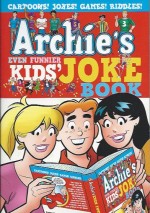
Archie’s Even Funnier Kid’s Joke Book


By various Archie Superstars (Archie Comics)
ISBN: 978-1-936975-67-9

Your Last-Minute Christmas Dilemmas Solved: the ideal keep-’em-quiet stocking stuffer.

As you probably know by now Archie Andrews has been around for more than seventy years: chasing both the gloriously attainable Betty Cooper and wildly out-of-his-league Veronica Lodge whilst best friend Jughead Jones alternately mocks and abets his romantic endeavours.

As crafted by the legion of writers and artists who’ve crafted the stories of teenage antics in and around the idyllic, utopian small town of Riverdale over the decades, these are timeless tales of the most wholesome Kids in America which have captivated successive generations of readers and entertained millions worldwide.

To keep all that accumulated attention riveted, the Company has often supplanted and expanded upon their storytelling brief with short gags, pin-ups and cartoons, jokes and puzzles and Archie’s Even Funnier Kid’s Joke Book has bundled scads of the very best of these brief diversions – starring the full capacious coterie of companions and hangers-on as well as few guest-stars – into a captivating compilation guaranteed to engross and amuse young and old alike.

Duty and sincere respect compel me to tell you that all the vignettes, cartoons, appalling puns, “guess the gag” games, crazy comebacks, silly riddles, visual extracts and “write your own caption” material re-presented in the 192 big, big pages here are the result of sheer hard work and inspiration from Bob Montana, Frank Doyle, Bill Vigoda, George Gladir, Al Hartley, Bill Golliher, Hy Eisman, Dick Malmgren, Bob Bolling, Samm Schwartz, Stan Goldberg, Dan Parent, Fernando Ruiz, Harry Lucey, Dan DeCarlo (Senior and Junior), Jeff Shultz, Joe Edwards, Rudy Lapick, Rich Koslowski, Bob Smith, Terry Austin, Barry Grossman, Tito Pena, Joe Morciglio, Jon D’Agostino, Bill Yoshida & Jack Morelli.

Common sense then informs me that you’ll have immeasurable fun inwardly digesting all the superbly silly stuff culled from more than seven masterful decades of madcap mirth…

Spoiled Sports gets us underway by providing 26 pages of iconic and hilarious gags and strips celebrating football, baseball, golf, skiing, hockey and all those other strenuous pastimes kids enjoy, after which What’s So Funny? abstracts 50 panels so amusing that they don’t need any context – or the rest of their stories they originally came from – and all liberally augmented with marginal riddles and brainteasers…

Ever-hungry Jughead plays a big part in chapter 3 as Food For Thought gathers 22 pages worth of nosh-themed material, whilst the accumulated and unsavoury staff of Riverdale High looms large in the 24 page Faculty Funnies chapter which uproariously follows, before Mixed Nuts offers 28 sides of crazy situations and mad laughter starring just about everybody and their friends…

Archie always played well at and pulled out all the stops for Christmas issues and here Holiday Hijinks repeats some the best festive moments in a bumper section which too soon swiftly segues into an appreciation of the eternal struggle for romantic bliss in Rabid Rivals or Love and War…

This stunning collection of gags and good times then ends with a tumult of audience participation as Say What? offers 23 pages of classic strips and pin-ups with all the word balloons emptied for you to fill in with your own brilliant bon mots and sassy comebacks…

Hilarious, absorbing and way more fun than a Christmas cracker, Archie’s Even Funnier Kid’s Joke Book is an addictively enticing treat no family should be without…
© 2013 Archie Comics Publications, Inc. All rights reserved.

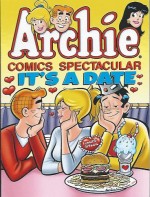
Archie Comics Spectacular – It’s a Date


By Archie Superstars (Archie Comics)
ISBN: 978-1-936975-70-9

Win’s Christmas Gift Recommendation: Another amazing example of pure comicbook magic… 9/10

Since comicbooks were invented in 1933, Superheroes have become the genre most closely associated with the four-colour format. Nevertheless other forms of sequentially illustrated fiction have held their own periodically and the one which has maintained a unique position over the years (although almost completely abandoned by most publishers and picked up by television) is the teen-comedy genre begun by and still synonymous with a ginger-headed freckled lad named Archie Andrews.

He began his rise to glory when second-string publisher MLJ added a strip based on the Andy Hardy matinee movies to the line-up of costumed mystery men they’d created after Superman debuted in Action Comics #1 in 1938.

In 1939 MLJ launched Blue Ribbon Comics, Top-Notch and Pep Comics filled with the now mandatory blend of masked heroes, two-fisted adventurers strips and one-off gags. Pep actually made a little history with its lead feature The Shield – the USA’s first superhero draped in the American flag – but generally MLJ were followers not innovators.

That changed at the end of 1941 when Maurice Coyne, Louis Silberkleit and John Goldwater (MLJ, geddit?) spotted a gap in their blossoming market. In December their Fights ‘n’ Tights pantheon was extended to include a wholesome, hometown hero: an “average teen” whose invitingly human-scaled adventures might happen to any of the readers, but with the laughs, good times, romance and slapstick heavily emphasised.

Pep Comics #22 introduced the gap-toothed, red-headed goof, already showing off to the pretty blonde next door. Goldwater had developed the concept of a boyish everyman, and left writer Vic Bloom & artist Bob Montana alone to fill in the details and make it all work it work.

And it did. So effective and all-pervasive was the impact and reassuring message which the new kid offered to the boys “over there” and those scared folk left behind on the Home Front that Archie and his familiar, beloved, secure milieu immortalised in Riverdale and its inhabitants gang represented, that one might consider them the most effective Patriotic Propaganda weapon in comics history…

It all started with an innocuous 6-pager introducing Archie, cute girl-next-door Betty Cooper, the boy’s quirky best friend and confidante Forsythe P. “Jughead” Jones and the small-town utopia they lived in.

The premise was an instant hit and in 1942 Archie graduated to his own title. Archie Comics #1 was MLJ’s first non-anthology magazine and began the inexorable transformation of the company. With the introduction of rich, raven-haired Veronica Lodge all the pieces were in play for the industry’s second Landmark Phenomenon (after Superman).

By May 1946 the kids had taken over. MLJ became Archie Comics, benching its costumed heroes years before the Golden Age ended and becoming to all intents and purposes a publisher of family comedies. This overwhelming success, just like the Man of Steel’s, compelled a change in the content of every other publisher’s titles and was the genesis of a multi-media industry which included toys, games, merchandise, newspaper strips, TV shows, movies, pop-songs and even a chain of restaurants.

Why does it work? Archie is a splendidly ordinary, good-hearted kid, not too smart, a bit impulsive and unthinking and generally lacking common sense – just like we were – whilst Betty – pretty, sensible, capable and devoted is the quintessential Girl Next Door, with everything that entails.

She loves the ridiculous redhead but is also best friends with her own great rival. Ronnie is spoiled, exotic, quixotic and glamorous but seemingly only settles for our boy if there’s nobody better around… except she might actually love him too…

Archie just can’t decide who or what he wants. Even with these two alluring archetypes always around he still gets distracted every time a pretty new girl sashays past…

This engaging and never-tawdry eternal triangle has been the solid basis of more than seventy years of charmingly raucous, gently preposterous, frenetic, chiding and even heart-rending comedy, encompassing everything from surreal wit to frantic slapstick, as the kids and an ever-increasing cast of friends grew into an American institution.

Adapting seamlessly to every trend and fad, perfectly in tone with and mirroring the growth of teen culture, the host of writers and artists who’ve crafted the stories over the decades have made the denizens of Riverdale a benchmark for youth and a visual barometer of growing up American.

The unconventional Jughead is Mercutio to Archie’s Romeo, generally providing rationality and a reader’s voice, as well as being a powerful and mischievous catalyst of events in his own right. There’s even a likeably reprehensible Tybalt analogue in the cocky crafty shape of Reggie Mantle – who first popped up to cause mischief in Jackpot Comics #5 (Spring 1942) – to act as spur, foil and rival and keep the tension ticking over.

This beguiling triangle (plus annexe and outhouse) has been the rock-solid foundation for decades of comics magic and even though the concept is perpetually self-renewing, Archie has thrived by constantly reinventing and refining these core characters, adapting them to the changing world outside the bright, flimsy pages and shamelessly co-opting youth, pop culture, sport, gadgets and fashion trends into its infallible mix of slapstick and young romance.

Each and every social revolution has been painlessly assimilated into the mix with the editors tastefully confronting a number of social issues affecting the young in a manner both even-handed and tasteful over the years.

Most importantly, the quotidian supporting cast – from affable jock Moose to plain Jane Big Ethel or boy genius Dilton Doily, School Principal Mr. Weatherbee or Ronnie’s irascible dad – is always expanding, with constant addition of new characters such as African-American aspiring cartoonist Chuck and his girlfriend Nancy, fashion-diva Ginger, Hispanic couple Frankie & Maria and a host of others.

There are frequent new additions in the opposition too, like spoiled home-wrecker-in-waiting Cheryl Blossom, all contributing to the wide and surprisingly broad-minded scenario.

In 2010 Archie even jumped the final social repressive hurdle when Kevin Keller, an openly gay young man and clear-headed advocate, joined the cast, capably tackling and dismantling the last major taboo in mainstream comics.

Of course the major component of the company’s success has always been the superbly enticing artwork and charming, funny stories by a small army of creative superstars, and this digest-sized spectacular gathers a treasure trove of their very best efforts into a romantically-themed collection which teasingly opens with ‘The Big Decision’ by Barbara Slate, Tim Kennedy & Jon D’Agostino, wherein the red-headed rascal finally chooses his eventual life-mate… for about three seconds…

Betty & Veronica then star in ‘Foot Sore’ (George Gladir, Dan DeCarlo Jr. & Jimmy DeCarlo) as the girlish slaves to fashion lose out to primitive male obduracy after which ‘Root of All Evil’ by Frank Doyle and the astounding Harry Lucey finds Archie desperate to prove Ronnie’s money means nothing to him…

In ‘Muscle Main Man’ (Jim Pellowski, Dan Parent &Jim Amash) the Lodges find that inept Archie is not the worst boyfriend Veronica might pick, whilst in ‘Suspicion’ (Jim Ruth, Chic Stone & D’Agostino) the green-eyed monster drives our hero to make an especially big fool of himself before ‘Inflation Elation’ (Gladir, Bob Bolling & Bob Smith) sees Betty turn the boy’s pennypinching ways to her advantage…

Betty & Veronica take the spotlight in ‘Three’s A Crowd’ (Kathleen Webb, Parent & Rich Koslowski) when one of them horns in on the other’s date night, whilst in ‘Match Play’ (Gladir, Jeff Shultz & Al Milgrom) a computer-dating service proves no help when faced with Ronnie’s picky criteria…

The Lodge lass’s callous nature deposits her at the base of ‘The Infernal Triangle’ (Frank Doyle, Dan DeCarlo & Vince DeCarlo) when she tries to meddle with Betty’s love-life after which Ronnie finds a new beau in ‘By George!’ (Dan DeCarlo & Rudy Lapick). although they soon make-up – sort of – enough to try the dubious tactic of a ‘Dress Down Date’ (Doyle, Dan DeCarlo & Lapick) on cash-poor Betty…

Webb, Bolling & Lapick then detail Ronnie’s very temporary bout of maturity (i.e. sharing) in ‘Growing Pains’, after which ‘Well Placed Point’ – a fifties classic by Bill Vigoda – sees Archie give in to a challenge from Reggie which inevitably draws the wrath of Ronnie down upon his dim ginger head and ‘Chivalrous Chumps’ (John Albano, Dan DeCarlo Jr. & James DeCarlo) finds both laddish rivals’ heads simultaneously turned by some new girls in town…

A formal event allows Reg an opportunity to palm Arch off with a Magician’s rigged tuxedo in ‘Borrowed Trouble’ by Pellowski, Bolling & Smith, after which ‘Fun Daze Together’ (Webb, Doug Crane & Lapick) provides a rare chance for Betty to get her guy, before a garbled phone message taken by Archie’s dad leads to a happy outcome for someone in ‘Dial a Date’ (by Gladir & Stone).

‘Happy Days’ (Ruth & Stone) finds Archie and Betty frantically trying to save their old trysting tree whilst 2-part saga ‘The Search!’ (Parent & Amash) has Ronnie’s parents foolishly attempting to find far more suitable boyfriends – and living to regret it…

Lesser lights Big Moose and Midge star in ‘Don’t Be a Sport’ (Pellowski & Kennedy), learning to their surprise just what really keeps them together, whilst Chuck and Nancy almost split up in ‘Bowl Brummel’ (Gladir, Bolling & Lapick) after his slovenly attires enflame her ire…

To their bemused sorrow, Archie & the entire gang become embroiled in boy genius Dilton‘s ‘Rate-a-Mate’ (Parent & Koslowski) romance program before arrogant self-proclaimed gift to women Reggie tries his slickest moves on the wrong woman in ‘The Lawbreaker’ (Dick Malmgren) and the whole amorous kit and caboodle then culminates and closes with a brace of half-page howlers as ‘Betty in Up to Dates!’ and ‘Archie in Auto Know Better’ both reveal the pervasive appeal of Riverdale’s richest debutante…

Mesmerising, breathtaking graphic wonderment, fun-fuelled family entertainment and enticing pop art masterpieces; these comic confections always capture the joyous spirit of intoxicating youthful vitality which changed the comic industry forever and comprise an essential example of artistic excellence no lover of narrative art should miss.

© 2013 Archie Comics Publications, Inc. All rights reserved.

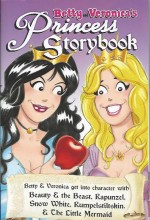
Betty and Veronica’s Princess Storybook – Archie and Friends All-Stars volume 21


By Dan Parent, Jeff Schultz, Rich Koslowski & various (Archie Comics)
ISBN: 978-1-936975-71-6

Win’s Christmas Gift Recommendation: Charming stories for kids of all ages… 8/10

Archie Andrews has been around for more than seventy years: a good-hearted lad lacking in common sense whilst Betty Cooper, the pretty, sensible girl next door – with all that entails – waits ardently nearby, loving the great ginger goof. Veronica Lodge is a rich, exotic and glamorous debutante who only settles for our boy if there’s nobody better around. She might actually love him too, though.

Despite their rivalry, Betty and Veronica are firm friends. Archie, of course, can’t decide who or what he wants…

Archie’s unconventional best friend Jughead Jones is Mercutio to Archie’s Romeo, providing rationality and a reader’s voice, as well as being a powerful catalyst of events in his own right. That charming triangle (+ one) has been the basis for decades of funnybook magic and the concept is eternally self-renewing…

Adapting seamlessly to every trend and fad of youth culture since before there even was such a thing, the host of writers and artists who’ve crafted the stories over the decades have made the “everyteen” characters of utopian Riverdale a benchmark for childhood development and a visual barometer of growing up.

In this collection, reprinting stories from 2013, the warring gal-pals and extended cast of the small-town American Follies are again plunged deep into whimsy and fable as writer Dan Parent tweaks and reinvents more classic fairytales like a New World Yonderland or venerable Christmas Panto (and boy, will those references bewilder the un-British and/or under thirties out there), providing sharp, smart and frequently uproarious spoofs on the eternal nature and magic of young love…

Augmented with informative, history-packed text features on the original prose stories, incisive creator commentary and a cover-&-variants gallery by Parent, Jill Thompson, Renee De Liz, Alitha Martinez, Gisele & Stephanie Buscema as well as a Foreword and Afterword by the scripter, this bright and breezy, full-colour chronicle begins with ‘The Story of the Rapunzels’ before ‘Bad Hair Daze’ takes the much-told tale into strange new territory.

Here a devoted childless couple is “blessed” with a happy event after promising a witch their firstborn, but the crone can only lay claim to one of the twins girls that result… Choosing blonde Betty and rejecting raven-tressed Veronica, the hag isolates the golden child in a tall tower for years, but completely underestimates the power of sibling love – and rivalry – when Ronnie finds her sister and Prince Archie finds them both…

Next is ‘Betty and the Beast’, wherein sorceress Veronica curses haughty Prince Archibald to a life of hideous isolation after he refuses to go steady with her. The lonely, angry, repentant monstrosity only begins to change without and within after dutiful daughter Betty moves in to save her doddery old dad from the monster’s ill-tempered predations…

The tale is further complicated when vain Lothario Reginald sets out to rescue poor Betty but finds the seductive sorceress more to his taste…

‘Snow White and the Riverdale Dwarves’ once more casts Ronnie as the villain (with potential home-wrecker Cheryl Blossom as her snippy magic mirror), jealous of Betty’s buxom beauty and determined to commit appalling deeds to remain the “hottest in the land”…

Thankfully a bizarre bunch of diminutive forest dwellers are ready to take the golden girl in and aid the rather ineffectual Prince Archibald in saving the day and getting the girl…

The next classic revision stars our girls as ‘The Little Mermaids’ who both sacrifice their tails and beautiful voices for a chance to spend three mute days in the surface world trying to win the love of a certain ginger royal scion.

The determined rivals hadn’t reckoned on Cheryl the Sea Witch cheating on the compact of course, but the surprise twist in this tale comes from Archie’s final choice and the girls’ prompt reaction…

Closing this enormously entertaining second showing of an irresistible idea is the outrageously amusing ‘Reggiestiltskin’ with Ronnie and Betty BFFs until that annoying Prince Archie sees and wants them both.

Sadly they both desire him too, which enchantress Princess Cheryl can’t allow. She wants the kingdom and will even marry the idiot Prince to get it and so employs wily gold-hungry goblin trickster Reggiestiltskin to get the girls out of the way.

However, even cunning witch-queens can underestimate the conniving nature of gold-grabbing goblins…

Co-starring all the adorable supporting characters we know and love (Jughead as Betty’s sharp-tongued fish-pal Forsythe is a sight once seen, never forgotten), these smartly beguiling skits are a marvellous example of just why Archie has been unsurpassed in this genre for generations: providing decades of family-friendly fun and wholesome teen entertainment…

And they were all read and re-read happily ever after…
© 2013 Archie Comics Publications, Inc. All rights reserved.

Quick and Flupke: Fasten Your Seat Belts


By Hergé, translated by David Radzinowicz (Egmont UK)
ISBN: 978-1-4052-4742-9

Georges Prosper Remi, known all over the world as Hergé, created a genuine masterpiece of graphic literature with his tales of a plucky boy reporter and his entourage of iconic associates. Singly, and later with assistants including Edgar P. Jacobs, Bob de Moor and other supreme stylists of the select Hergé Studio, he created 23 splendid volumes (originally produced in brief instalments for a variety of periodicals) which have since grown beyond their popular culture roots and attained the status of High Art.

Globally renowned for his magnificent Tintin adventures, Hergé also did much to return comics to the arena of mass entertainment, a position largely lost after the advent of television, video-recording and computer games.

However the bold boy and his opinionated dog were by no means his only creation. The author was a prodigious jobbing cartoonist in the years before Tintin finally assured him immortality and produced a minor pantheon of other topical strips and features such as Tim the Squirrel in the Far West, The Amiable Mr. Mops, Tom and Millie and Popol Out West.

Among the best of the rest were the tales of Jo and Zette Legrand and their chimpanzee Jocko – in much the same wholesome action vein as Tintin – and the episodic, all-ages shenanigans of a pair of mischievous ragamuffins in pre-WWII Belgium.

In 2005 Egmont translated three escapades of Jo, Zette and Jocko into English (although there are more just sitting out there, all foreign and unreadable by potential fans too lazy to learn French or any of a dozen other civilised languages…) and in 2009 tried again with two collections of the Master’s second most successful creation: the rambunctiously subversive, trouble-making working-class rapscallions Quick and Flupke.

The two scallywags (precursors and thematic contemporaries of such beloved British boy acts as The Bash Street Kids, Winker Watson, Roger the Dodger et. al.) had for more than a decade – January 1930 to May 1940 – rivalled the utterly irresistible Tintin in popularity and almost certainly acted as a rehearsal room for all the humorous graphic and slapstick elements which became so much a part of future Tintin tales.

In 2009 Egmont had a brief stab at reviving the likely lads and it was only the general public’s deplorable lack of taste and good sense which stopped the kids from taking off again…

On leaving school in 1925 Hergé began working for the Catholic newspaper Le XXe Siécle where fell under the influence of its Svengali-like editor Abbot Norbert Wallez. A dedicated boy-scout himself, Remi produced his first strip series The Adventures of Totor for Boy Scouts of Belgium monthly magazine the following year, and by 1928 he was in charge of producing the contents of Le XXe Siécle‘s children’s weekly supplement Le Petit Vingtiéme.

He was unhappily illustrating The Adventures of Flup, Nénesse, Poussette and Cochonette, written by the staff sports reporter, when Abbot Wallez asked him to create a new adventure series. Perhaps a young reporter who would travel the world, doing good whilst displaying solid Catholic values and virtues?

Having recently discovered the word balloon in imported newspaper strips, Remi decided to incorporate the innovation into his own work. He would produce a strip both modern and action-packed – and most importantly heavily anti-communist. Beginning January 10th 1929, Tintin in the Land of the Soviets appeared in weekly instalments in Le Petit Vingtiéme running until May 8th 1930.

At about this time the cartoonist also began crafting weekly 2-page gag strips starring a pair of working class rascals in Brussels who played pranks, got into good-natured trouble and even ventured into the heady realms of slapstick and surrealism: the sort of yarns any reader of Dennis the Menace (ours, not the Americans’) would find fascinatingly familiar.

Originally running in black and white in Le Petit Vingtiéme the lads larked about for over a decade until the war and mounting pressures of producing Tintin meant they had to go. They were rediscovered in 1985 and their collected adventures ran to a dozen best-selling albums.

Fasten Your Seat Belts contains a superbly riotous celebration of boyish high spirits beginning with hose-pipe pranks in ‘The Big Clean’, before a rare good deed leads to strife with ‘A Poor Defenceless Woman’ and a day ‘At the Seaside’ ends up in another round of boyish fisticuffs whilst their arch-foe the policeman succumbs to the irresistible temptations of a catapult in ‘Everyone Gets a Turn’.

Quick – the tall one in the beret – then learns to his cost ‘How Music Calms the Nerves’ and discovers the drawback of ‘Pacifism’, whilst portly Flupke tries tennis and finds himself far from ‘Unbeatable’.

‘Advertising’ then proves to be a dangerous game and an annoying insect meets its end in ‘Instructions for Use’ after which ‘Quick the Clock Repairer’, proves to be something of an overstatement and ‘Football’ just another reason for the pals to fall out…

Although unwelcome ‘At the Car Showroom’, some Eskimos seem happy to share in ‘A Weird Story’ whist Hergé himself turns up in ‘A Serious Turn of Events’, even as the kids are disastrously ‘At Odds’ over a funny smell.

Then ‘Quick the Music Lover’ cleverly deals with a annoying neighbour, Flupke goes Christmas Skiing in ‘That’s How It Is’ and another good turn goes bad in ‘All Innocence’ before a sibling spat gets sorted through ‘Children’s Rights’ and Quick cocks up cuisine with ‘The Recipe’…

A ‘Yo-yo’ causes traffic chaos and a milk run goes spectacularly awry in a buttery ‘Metamorphosis’ before this magical blast from the past concludes with cleverly appealing ‘Tale Without a Tail’.

Still happily available, this book and the simple, perfect gags it contains show another side to the supreme artistry and sheer addictiveness of Hergé – and no lover of comics should consider his life complete without a well-thumbed copy of their own…

Now we’ve got them, available for folk too lazy to learn French (or Dutch or German or…) in a glorious full-colour make-over and they are the perfect light read for kids of all ages.
© Hergé – Exclusivity Editions Casterman 1991. All Rights Reserved. English translation © 2009 Egmont UK Limited. All rights reserved.