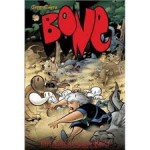
Bone book 2: Chase that Cow


By Jeff Smith (Cartoon Books)
ISBN: 978-0-96366-9-095-4

Jeff Smith burst out of relative obscurity in 1991 and changed the comics-reading landscape with his enchanting all-ages comic-book Bone. The compelling black and white saga captivated the market and prospered at a time when an endless procession of angst-ridden, steroid-breathed super-vigilantes and implausibly clad “Bad-Grrls” came and went with machine-gun rapidity.

Born in Pennsylvania and raised in Ohio, Smith avidly absorbed the works of Carl Barks, Charles Schultz and especially Walt Kelly from an early age, and purportedly first began producing the adventures of his Boneville creations at age ten.

Whilst attending Ohio State University he created a prototype strip for the College newspaper: ‘Thorn’ was another early incarnation of his personal universe and a valuable proving ground for many characters that would eventually appear in Bone. A high school classmate became a Disney animator and Smith subsequently gravitated to the field before striking out on his own, having mastered the graceful gentle slapstick timing and high finish style which typifies his art style.

He founded Cartoon Books to self-publish 55 delightful black and white issues: a fantasy-quest yarn that owed as much to Tex Avery as J.R.R. Tolkien, as well as his personal holy trinity, Barks, Schultz & Kelly. The thrilling and fantastically funny saga progressed at its own unique pace between 1991 and 2004 and since then has been collected into nine volumes from Cartoon Books (with two further collections of prequels and side tales), reissued in colour by Scholastic Books and even reprinted in Disney Adventures magazine.

At series’ end, Smith issued a monumental one volume compilation (more than 1300 black and white pages) which Time magazine dubbed “the best all-ages graphic novel yet published” and one of the “Top Ten Graphic Novels of All Time.”

Smith has won many awards including 11 Harveys and 10 Eisners. In 2011, a spectacular 20th anniversary full-colour edition of the Brobdingnagian single volume was released, stuffed with extras and premiums. If you’ve got the dough, that’s the book to shoot for…

As you can see there are plenty of versions to opt for but – purist that I am – I’ve plumped for the original Cartoon Books collection where the action commences in Out of Boneville, which re-presents the first six episodes.

Fone Bone is a strange, amorphous, yet affably decent little guy, a thematic blend of Mickey Mouse and Asterix who had been run out of the town of Boneville along with his tall and not-so-bright cousin Smiley Bone. Well to be exact they weren’t, but their dastardly, swindling cousin Phoncible P. “Phoney” Bone was, due to the sort of financial and political irregularities, misdemeanours and malfeasances that bring down presidents – and he only was running for Mayor at the time…

After an incredibly journey the trio were separated and ended up in Lost Valley: an oasis of pastoral beauty hidden from the rest of the world. Along the way Bone was adopted by a dragon he doesn’t believe in, stalked by ghastly rat monsters and befriended by a talking leaf-insect (like a stick insect but flat, not long – and very, very chatty) called Ted.

After a harsh winter living wild in the deep forest he met the beauteous and oddly compelling human girl Thorn. It was Crush-at-First-Sight and he happily accepted an offer to stay with her and grandmother Rose Ben until he could find his lost cousins. He soon came to regret it when Phoney finally turned up and started his old tricks again…

Phoney’s insatiable drive to steal, cheat and fake a buck made life pretty uncomfortable for the besotted Fone Bone, but real trouble was actually brewing in the deep woods where an ancient evil had awoken, driving the stupid, stupid rat creatures who infested the place into a frenzy.

An incredibly old, cold war was heating up again and for the humans of nearby Barrelhaven village the stakes couldn’t be higher. The dark creatures and night-haunts were waiting for the advent of their prophesied one – a small bald creature with a star on its chest – remarkably similar to the one on Phoney’s shirt…

When the assembled horror-hordes attacked the cottage their putative chosen one was long gone…

Phoney had scented money and moved to the hamlet in search of easy marks and, as Thorn and Fone raced to warn the villagers that the beasts had risen, Gran’ma stayed behind to battle the rat things. When Bone’s “imaginary” dragon rescued the fleeing pair, they retraced their frantic steps to find the feisty old biddy had survived and overcome her attackers. Moreover, Rosie and the Dragon were old acquaintances…

As the Dragon returned to the deep woods the humans (and Bone) leave the wrecked cottage and relocate to Barrelhaven, where they find Smiley has been all along, serving drinks in the local tavern. Phoney is there too – working off a tremendous bar-tab and looking to make some easy, preferably illicit cash…

This second stunning compilation collects issues #7-12 of the comicbook and also includes the contents  of premium special Wizard Presents Bone #13½; opening with Thorn and Fone enjoying the bucolic delights of ‘The Spring Fair’.

Our diminutive love-struck hero is in heaven as he strolls with the oblivious Thorn but when her attention is diverted by hunky young travelling honey-seller Tom, Bone gets into a fight with the peddler and the girl, before storming off to find his own sticky treat by raiding a wild bee’s nest in the forest – with calamitous and hilariously painful results.

Phoney meanwhile is planning to fleece the villagers with a betting scam. For years the uncannily robust and unbeatable Gran’Ma has won the annual Great Cow Race (which seemingly consists of stampeding a herd and outrunning them to a finish line) and the riotous event has become her very own yearly moment of glory.

Now the wily rogue and his gullible patsy Smiley are taking bets against her, whilst disseminating disinformation that she is ailing and past her prime. All the smart money – chickens, goats, sheep etc. – is on a dark horse “Mystery Cow”…

And with the entire village constantly asking about her health, old Rose begins to worry and doubt herself…

‘The Map’ finds Phoney’s betting booth doing a roaring trade with all bets on the as yet unseen Mystery Cow, when the battered, bruised and mightily stung Bone comes by. Appalled to see his cousin up to his old tricks, the honey-dipped hero confronts Phoney and discovers the whole plan: even though the entire village has put all their valuables on the outsider, Gran’Ma will easily win the Great Race since the enigmatic bovine challenger will be Smiley in a cow suit…

Thorn is dreaming, seeing again a time past when mysterious cloaked figures and dragons met in a cave and considered the inevitable return of a dark and deadly menace. Sharing the dream with Bone she remembers an old chart Bone found in the Great Desert and which first led him to safety in the valley … a map she drew whilst a toddler in that cave of dragons…

‘The Mystery Cow’ opens on the day of the race, and tension in Barrelhaven is at a sullen fever pitch. Rose’s confidence is still fragile though and tavern owner Lucius – who is sweet on her – finally accedes to Phoney’s constant haranguing and agrees to bet the entire business on the race. The rest of the punters are nervous though. They’ve wagered all their worldly goods against Gran’Ma on a critter no one has ever seen and Lucius suggests that maybe they should check on it…

Given a noon deadline to produce the unbeatable cow for the town’s perusal, duplicitous, greedy Phoney is starting to see some flaws in his infallible plan and Thorn too gets a moment of cold realisation when Tom blows her off for a more pliable companion…

Downhearted, Bone has retired to the woods to read Moby Dick, but after a heart-to-heart with Ted, determines to bare his soul to Thorn in a love poem.

His mood is soon lost though when a couple of Rat Creatures turn up, wondering aloud if he is fair game or the “Small Mammal” they aren’t allowed to eat as elsewhere, with noon approaching, Phoney pulls a bold stunt and again fools the oafish villagers with the crazed, unbeatable ferocity of his Mystery Cow…

‘The Great Cow Race’ is about to start and udder-draped Smiley has his instructions to finish behind Gran’Ma, but Phoney’s greed gets the better of him when he circles back to his booth to find Lucius at last ready to bet the bar. Unfortunately the doughty old buzzard wants to place it on Rose to win – and the odds are now 100 to 1…

With vivid memories of his last tar-and-feathering, the bovine bookmaker hurtles to intercept Smiley and tell him to win at all costs and as the herd thunders by with Rose in the lead, Bone appears, running his own desperate race. At his milky heels are the two starving and stupid, stupid Rat Creatures.

Sadly where there are a couple, inevitably the entire ravenous horde soon follows – and they do, perfectly and painfully intermingling with the frantic racers just as the finish line comes into sight…

‘Retribution’ opens with the victorious Gran’Ma, Lucius and Thorn riding a cartload of building supplies back to their devastated cottage. Hidden in the back are the Bone cousins, Phoney only gradually recovering from the rough-and-ready justice he has received from the incensed villagers.

With Smiley teasing Bone about the dragon only he has seen it’s a slow and anxious journey through the dark woods, since the Rat Creatures all vanished into the forest after the race melee ended. Indeed many ancient eyes, both friendly and inimically hostile, are following the party’s progress…

As the two starving rat things who started the debacle lay low and uproariously consider the upside of quiche as opposed to raw flesh, the repair squad arrives at the cottage and begins work, whilst in the background Lucius and Rose discuss the real importance of what’s been happening, especially for Thorn…

Following a delightful poetic frolic from Bone’s frisky friends the possum kids, the book ends on a funny if foreboding note as the bombastic Lucius and ham-fisted, half-witted Smiley learn a little more about each other whilst painfully rebuilding Gran’Ma’s house ‘Up on the Roof’…

I’ve talked a lot about the influences that informed this wonderful series and there’s one more that cannot be ignored: if you squint your eyes just right you can see the charm-adjacent convolutions of Bill Watterson’s Calvin (see The Essential Calvin and Hobbes. No, really. Do. It’s utterly wonderful and so are all the other collections) sneaking in to further flavour this astounding, raucous, beguiling, child-friendly extravaganza…

Bone is a truly perfect comic tale and one that appeals to kids and adults equally. Already it is in the rarefied rank starring Tintin, Pogo, Rupert Bear, Little Nemo and the aforementioned and cherished works of Schultz, Kelly and Barks. It is only a matter of time before it breaks out of the comic club completely and becomes kin to the likes of Wind in the Willows, Alice in Wonderland, the Moomins and Oz.

If you have kids or can still think and feel like one you must have these books…

© 1995, 1996 Jeff Smith. All rights reserved.

Star Comics All-Star Collection


By Lennie Herman, Sid Jacobson, Stan Kay, Bob Bolling, Warren Kremer, Howard Post & various (Marvel)
ISBN: 978-0-7851-4291-1

Once upon a time the American comicbook industry for younger readers was totally dominated by Gold Key with their TV and Disney licenses, and Harvey Comics who had switched from general genres to a wholesome, kid-friendly pantheon in the mid-1950s. They owned the pre-school sector until declining morals, television cartoon saturation and rising print costs finally forced them to bow out.

Gold Key suffered a slow erosion, gradually losing valuable major properties such as Popeye, Star Trek, assorted Hanna-Barbera and Warner Brothers cartoon stars and other treasures until parent company Western Publishing called it a day in 1984, whilst Harvey shut up shop in 1982 when company founder Alfred Harvey retired.

The latter’s vast archived artwork store was sold off and, with the properties and rights up for grabs, Marvel Comics (who had already secured those lost Star Trek and Hanna-Barbera rights) was frontrunner for licensing the family firm’s iconic characters, which included Richie Rich, Casper the Friendly Ghost, Sad Sack, Hot Stuff – the Little Devil, Wendy the Good Little Witch and many others.

When the bid failed, Editor-in-Chief Jim Shooter, knowing there was now a huge gap in the market, launched a cloned imprint of the Harvey stable (which would also encompass new TV and toy properties such as Jim Henson’s Muppet Babies and Fraggle Rock, Alf, Madballs, Care Bears, Thundercats, Ewoks and such like) to generate the next generation of worthy entry-level comics for entertainment-hungry young minds and concerned parents.

Marvel’s Star Comics line launched in 1985, edited by ex-Harvey head-honcho Sid Jacobson, with oddly familiar titles and an incontestably similar look and feel – achieved primarily by hiring unemployed Harvey stalwarts such as Jacobson, Lennie Herman, Warren Kremer, Howard Post and others. Millionaire prince and all-around good kid Royal Roy especially invoked the ire of the Harvey heirs who sued for copyright infringement of their astonishingly prolific Richie Rich who shone in more than 55 separate titles between his debut in 1953 and the bust of 1982.

Roy was cancelled after 6 issues – as were many Star series – in a brutal “Survival of the Funnest” publishing policy – and the suit was quietly dropped.

None of which affects the fact that those Eighties child stars were, in their own right, a superb agglomeration of all-ages fun, excitement and adventure happily recycled in this oversized digest collection from 2009.

This first volume collects that first wave of title introducing Planet Terry #1-2, Top Dog #1-3, Royal Roy #1-2 and Wally the Wizard #1-2 in a veritable nova of bubbly contagious thrills and frolics, opening with a star who was just a little lost boy in space…

Planet Terry was created by Lennie Herman (who passed away just before the big Star Comics launch) and the truly magnificent Warren Kremer – whose animation-based art style became the defining look of Harvey Comics during its happy heyday – and featured a young lad searching the universe for the parents he had never known.

Introduced in ‘The Search’ (Herman, Kremer & Vince Colletta), Planet Terry was something of a nuisance, periodically landing on alien worlds, pestering the inhabitants and asking “Has anyone seen my mother and father?” Found wandering in a life-pod which raised and educated him, the only clues Terry has to his past is a name bracelet and an empty picture frame…

However this time when he returns to the obnoxious planet Bznko Terry accidentally drives off a menace that bores folks to death with bad jokes and the inhabitants give him a junked lady robot as a reward. This proves to be a blessing in disguise as Robota inadvertently leads the lonely lad to ‘A Clue’ when they crash-land on a mining asteroid and meet aged Enoch Diggs who recognises the life-pod the infant Terry was found in…

‘Some Answers’ are forthcoming as the prospector reveals he once worked on a Confederation Cosmos Cruiser called the Space Warp where the captain’s wife was going to have a baby. Needing a sterile environment for the newborn infant, the crew placed him in the emergency life-boat, but his jubilant father accidentally triggered it whilst celebrating his son’s birth and the baby was rocketed into deep space.

Although they searched everywhere the heartbroken spacemen never located the pod and assumed Terry was lost forever…

Although Enoch can’t remember the names of Terry’s parents he suggests that another old crewman might and the re-energised searchers rush to another asteroid to find him, but instead encounter ‘The Malt Shop Menace’ and recruit another voyager when Robota saves the brutish monster Omnus who gratefully joins their decidedly odd family. Little do they know that a sinister conspiracy is at work to keep the whereabouts and secret of the Space Warp lost forever…

Issue #2 continues the quest as the family of outcasts encounter sabotage and opposition before landing their freshly repaired ship on the lost world of the Gorkels where the trio clumsily fulfil an ancient prophecy in ‘The Saga of Princess Ugly’ by Herman, Kremer & Jon D’Agostino.

In return for repairing Terry’s downed vessel, he, Robota and Omnus must rescue the kidnapped Princess battling hostile jungles, shape-shifting beasts, killer vines, a whirlpool and a volcano – all controlled by arch-villain Vermin the Vile in ‘Too Close (enough) for Comfort’ before saving the girl from ‘The Doom of the Domed City’ and discovering the final resting place of the elusive Space Warp…

Royal Roy debuted on his birthday in ‘The Mystery of the Missing Crown’ by Herman, Kremer & D’Agostino as the Prince of wealthy Ruritanian Cashalot discovers that the traditional, venerable Royal Highness Crown has gone missing on the day of his investiture. Whilst King Regal and Queen Regalia panic, super-cool bodyguard Ascot diligently investigates, and assorted resplendent relatives dither and interfere, Roy and his pet crocodile Gummy keep their heads by ‘Picking up the Scent’ and soon uncover a supernatural agency at work after ‘A Midnight Visit’ by ghostly ancestor William the Warhorse… Topping off the first issue was a snappy, snazzy short fun yarn starring the reptilian Gummy in ‘Crocadog’.

‘The Grand Ball’, scripted by Stan Kay, occupied most of Roy’s attention in the second issue as the underage but still eligible Prince took a fancy to simple commoner Crystal Clear whilst ambitious and mean social climber Lorna Loot spent all her time and considerable cash unsuccessfully attempting to beguile the boy by turning herself into a modern-day Cinderella in ‘A Strange Stranger’…

‘Maneuvers!’ saw Roy fulfil his hereditary duties by joining the Cashalot army on dawn exercises, but as ruler-in-waiting of a rich and peaceful nation, the plucky lad wasn’t too surprised to find that the entire armed forces consisted of one reluctant prince and a keen but aging general…

Top Dog featured a far more contemporary and normal situation, depicting the lives of average American boy Joey Jordan and the mutt he brought home one day. ‘The Dog-Gone Beginning’ by Herman, Kremer & Jacqueline Roettcher, revealed how, whilst looking for a lost baseball, the kid had accidentally observed a dog reading the newspaper and talking to himself.  Exposed, the canny canine begged the boy to keep his secret or all the four-footed wonder could expect was a short and painful life being poked, prodded and probed by scientists…

When the lad promises to keep his secret Top Dog agrees to come live with Joey in ‘House About a Dog, Mom?’, and whilst the boy tries to teach the pooch to bark – one of the few languages he can’t speak! – his accommodating family gradually get used to the seemingly normal dog and his boy.

However when Mervin Megabucks – the richest and meanest kid in town – overhears the pair playing and conversing, the spoiled brat refuses to believe Joey is a ventriloquist. When the junior Jordan refuses to sell, Mervin steals Top Dog as the perfect addition to his palatial high-tech house.

Even torture won’t make the purloined pooch speak again however, and when Joey stages ‘The Big Breakout’ Mervin’s mega-robots prove no match for dogged determination and the plutocrat brat is left baffled, bamboozled and dog-less…

Issue #2 exposed ‘Spies!’ when the restless dog of a thousand talents appeared to harbour a dark side. Going out on nightly jaunts, the marvellous mutt seemingly led a double life as a security guard in a Defence Plant, triple-crossing everybody by photographing military secrets for a foreign power. Of course it was really a diminutive enemy agent in a dog suit but Vladimir‘s handlers hadn’t reckoned on a real dog looking – and speaking – just like their hairy operative and they accidentally gave their purloined plans to the chatty all-American canine…

After spectacularly trapping the sinister spies without revealing his own incredible intelligence, Top Dog was framed in #3 by Joey’s best friend Larry who was feeling rejected and neglected since the Brilliant Bow-wow moved in.

With a feral hound dubbed ‘The Mad Biter’ on the prowl and attacking people it was simple to send the perspicacious pup to the Pound, where he encounters lots of bad dogs who probably deserve to be ‘Caged’, but faithful Joey hasn’t given up and after bailing his canine comrade out, the pair convince  the guilt-ridden perjurer to see the light by treating him to an impromptu midnight ‘Ghost Story’…

Even with Larry recanting his lies the neighbourhood families don’t trust Top Dog, but that all changes once the maligned mutt tracks down the real Biter and engages him in ‘A Fight to the Finish’…

The final initial entry was written and illustrated by veteran Archie Comics artist Bob Bolling (probably most famous for creating and producing the first eight years’ worth of the award-winning Little Archie spin-off series), who concocted a fabulous medieval wonderland for Wally the Wizard to play in.

In #1’s ‘A Plague of Locust’ Merlin’s older, smarter brother Marlin is having trouble with his stubbornly inquisitive apprentice. Wally wants to know everything now, has no discipline and is full of foolish ideas and misconceptions. As a scientist, Marlin has no time for silly superstitions and when the lad accidentally releases a time-travelling demon from an age-old prison the mage refuses to believe him.

Gorg however swears faithfully to repay the favour before disappearing…

Despatched to deliver a potion to King Kodger, Wally also helps a dragon save his hatchling from a deep well, only just reaches the sovereign in time and has a feed on the Royal Barge where he again fails to impress the beauteous Princess Penelope…

Meanwhile in distant Bloodmire Castle wicked plotters Vastar the Vile, his sister Sybilious the Bilious and wicked warlock Erasmo are conspiring to conquer the kingdom by unleashing a gigantic metal locust to consume all in its path…

Even the noble knights led by invincible Sir Flauntaroy are helpless before the brazen beast and Wally realises only Marlin can save them. Unfortunately the boy gets lost on route but happily for everybody the dragon and demon which the sorcerer doesn’t believe in are ready to pay their debts to the apprentice…

Sid Jacobson, Howard Post & Jon D’Agostino took over for the second issue as Wally enters the annual apprentice’s games with Marlin now suddenly transformed into a traditional magic-making mage. In fact Marlin, as a three-time champion of ‘The Magic-a-Thon!’ is secretly regretful that Wally is too inexperienced to compete, a fact his disciple discerns and tries to fix…

Desperately cramming for a week and eventually with the coaching of his proud master, Wally sets off to compete but a lovelorn barbarian accidentally cleaves the kid’s crib notes in twain, leaving the lad able to create only half-spells and materialise semi-monsters…

Undaunted Wally continues and – even after a huge storm deprives him of the demi-directions and his back-up pouch of herbs and potions – perseveres, determined to win using nothing but his wits, guts and unflagging optimism…

This clutch of classic children’s tales also includes the enchanting covers and the original house-ads that introduced the characters to the Kids in America and nearly three decades later is still a fabulous hit of intoxicating wonder and entertainment which readers of all ages cannot fail to love…

With contemporary children’s comics all but extinct these days, it’s lucky we have such timeless classics to draw upon and draw kids in with, and compilations like this one belong on the shelves of every funnybook-loving parent and even those lonely couples with only a confirmed twinkle in their eyes…
© 1985 and 2009 Marvel Characters, Inc. All rights reserved.

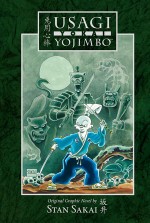
Usagi Yojimbo: Yokai


By Stan Sakai (Dark Horse)
ISBN: 978-1-59582-362-5

One of the very best and most adaptable survivors of the 1980s black and white comicbook explosion/implosion is a truly bizarre and wonderful synthesis of historical Japanese samurai fiction and anthropomorphic animal adventure, as well as a perfect example of the versatility and strengths of a creator-owned character.

Usagi Yojimbo (which translates as “rabbit bodyguard”) first appeared as a background character in multi-talented creator Stan Sakai’s anthropomorphic peripatetic comedy feature The Adventures of Nilson Groundthumper and Hermy, which launched in furry ‘n’ fuzzy folk anthology Albedo Anthropomorphics #1 (1984) subsequently appearing there on his own terms as well as in Critters, Amazing Heroes, Furrlough and the Munden’s Bar back-up in Grimjack.

Sakai was born in 1953 in Kyoto, Japan before the family emigrated to Hawaii in 1955. He attended University of Hawaii, graduating with a BA in Fine Arts, and pursued further studies at Pasadena’s Art Center College of Design after moving to California.

His first comics work was as a letterer, most famously for the incredible Groo the Wanderer, before his nimble pens and brushes, coupled with a love of Japanese history and legend and hearty interest in the filmic works of Akira Kurosawa and his peers, combined to turn a proposed story about a historical human hero into one of the most enticing and impressive – and astoundingly authentic – fantasy sagas of all time.

The deliciously rambling and expansive period fantasy series is nominally set in a world of sentient animals and specifically references the Edo Period of Feudal Japan (how did we cloth-eared Westerners ever get “Japan” from Nihon” anyway?) as well as classic cultural icons as varied as Lone Wolf and Cub, Zatoichi and even Godzilla whilst detailing the exploits of Miyamoto Usagi, a Ronin (masterless, wandering freelance Samurai) whose fate is to be drawn constantly into a plethora of incredible situations.

And yes, he’s a rabbit – a brave, sentimental, gentle, long-suffering, honourable, conscientious and heroic bunny who cannot turn down any request for help…

The Lepine Legend appeared in Albedo #2-4, The Doomsday Squad #3 and seven issues of Critters (1, 3, 6-7, 10-11 and 14) before leaping into his own series which, as usual, I haven’t got around to yet, but really, really will…

The Sublime Swordsbun has changed publishers a few times but has been in continuous publication since 1987 – with over 25 graphic novel collections to date – and has guest-starred in numerous other series, such as Teenage Mutant Ninja Turtles and its TV incarnation – he even almost made it into his own small-screen show but there’s still time yet and fashions can revive as quickly as they die out…

There are high-end collectibles, art prints, computer games and RPGs, a spin-off sci fi comics serial and lots of toys.

Sakai and his creation have won numerous awards both within the Comics community and amongst the greater reading public and in 2009 current publisher Dark Horse Comics commissioned an all-new, fully painted anniversary tale which allowed the creator to hone his considerable skills with watercolours.

Yokai is a generic term that translates (as required) as ghosts, phantoms, spirits or even strange, otherworldly apparitions, all of whom hold a peculiarly eclectic place in Japanese folklore, being simultaneously mischievous and helpful, malevolent and miraculously beneficial. Generally they have animal heads or are amalgams of diverse objects or body parts…

This scintillating scary story occurs over one night – an Oborozuki-Yo (“Night of the Hazy Moon”) – when the assorted Yokai are particularly restless, and this is a tale that grippingly explores the Japanese equivalent of our Halloween as the noble, gloom-shrouded Ronin wanders lonely roads in search of a bite to eat and a place to sleep.

Seeing a light in the nearby woods, Miyamoto leaves the path hoping to find a welcoming peasant hearth for the evening but is harassed by a taunting Kitsune (trickster-fox spirit) and becomes lost. Soon however he hears sobbing and is drawn to a weeping noblewoman…

The lovely distressed lady is Fujimoto Harumi whose pilgrimage to a temple was disrupted when a Kitsune stole her young daughter Hanako away. Pleading with the wisely reluctant Ronin, the lady convinces the wayfarer to plunge deeper into the wild woods to rescue the lost girl, leading to an epic series of contests against a horde of fantastic hostile creatures. The valiant warrior almost succumbs until he is unexpectedly saved by an old comrade, the mystic demon-queller Sasuke…

It seems that this very evening is the dreaded Hyakki Yako, “Night Parade of a Hundred Demons”, when the haunts and horrors of the netherworld form a procession into the world of people, seeking to subjugate all mortals. They simply need a living soul to lead them, a final sacrifice to light their way here…

Terrified for the stolen waif, the Ronin and the devil-slayer engage with an army of horrific, shape-shifting, fire-spitting, tentacle-wielding monstrosities to save an innocent and the entire world, but there are forces in play the rapidly-tiring Miyamoto is painfully unaware of and, without the luck of the gods and the tragedy of an old friend, all will be inescapably lost…

Fast-paced yet lyrical, funny, thrilling and stuffed with spooky, all-ages action and excitement, Yokai is a magical tribute to and celebration of the long-lived Lepus’ nigh-universal irresistible appeal that will delight devotees and make converts of the most hardened hater of “funny animal” stories. This petite but power-packed chronicle also contains a fascinating behind-the-scenes look at how the artist created the stunning visuals in ‘The Real Magic Behind Yokai: an interview with Stan Sakai’ that will further beguile any prospective creators and cartooning hopefuls in the audience.

Sheer comicbook poetry: the good kind, not mere doggerel…
Text and illustrations © 2009 Stan Sakai. All rights reserved.

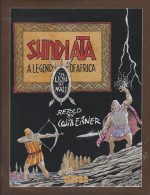
Sundiata, the Lion of Mali – A Legend of Africa


Retold by Will Eisner (NBM)
ISBN: 978-1-56163-332-6 (hb), 978-1-56163-340-2 (pb)

It is pretty much accepted today that Will Eisner was one of the pivotal creators who shaped the American comicbook industry, with most of his works more or less permanently in print – as they should be. Active and compellingly creative until his death in 2005, Eisner was the consummate storysmith and although his true legacy is making comics acceptable fare for adult Americans, his mastery and appeal spanned the range of human age and he was always as adept at beguiling the young as he was enchanting their elders…

William Erwin Eisner was born on March 6th 1906 in Brooklyn and grew up in the ghettos. They never left him. After time served inventing much of the visual semantics, semiotics and syllabary of the medium he dubbed “Sequential Art” in strips, comicbooks, newspaper premiums and instructional comics, he then invented the mainstream graphic novel, bringing maturity, acceptability and public recognition to English language comics.

From 1936 to 1938 he worked as a jobbing cartoonist in the comics production hothouse known as the Eisner-Eiger Shop, creating strips for both domestic US and foreign markets. Using the pen-name Willis B. Rensie he created and drew opening instalments for a huge variety of characters ranging from funny animal to historical sagas,

Westerns, Detectives, aviation action thrillers… and superheroes – lots of superheroes …

In 1940 Everett “Busy” Arnold, head honcho of the superbly impressive Quality Comics outfit, invited Eisner to take on a new challenge. The Register-Tribune newspaper syndicate wanted a 16-page weekly comicbook insert for the Sunday editions and Eisner jumped at the opportunity, creating three series which would initially be handled by him before two of them were delegated to supremely talented assistants. Bob Powell inherited Mr. Mystic and distaff detective Lady Luck fell into the capable hands of Nick Cardy (then still Nicholas Viscardi) and later the inimitable Klaus Nordling.

Eisner kept the lead feature for his own, and over the next twelve years The Spirit became the most impressive, innovative, imitated and talked-about strip in the business. However, by 1952 he had more or less abandoned it for more challenging and certainly more profitable commercial, instructional and educational strips, working extensively for the US military in manuals and magazines like Army Motors and  P*S, the Preventative Maintenance Monthly, generally leaving comicbooks behind.

After too long away from his natural story-telling arena Eisner creatively returned to the ghettos of Brooklyn where he was born and he capped a glittering career by inventing the mainstream graphic novel for America, bringing maturity, acceptability and public recognition to English language comics.

In 1978 a collection of four original short stories in strip form were released as a single book: A Contract With God and Other Tenement Stories. All the tales centred around 55 Dropsie Avenue, a 1930’s Bronx tenement, housing poor Jewish and immigrant families. It changed the American perception of cartoon strips forever. Eisner wrote and drew a further 20 further masterpieces, opening the door for all other comics creators to escape the funnybook and anodyne strip ghettos of superheroes, funny animals, juvenilia and “family-friendly” entertainment. At one stroke comics grew up.

Eisner was constantly pushing the boundaries of his craft, honing his skills not just on the Spirit but with years of educational and promotional material. In A Contract With God he moved into unexplored territory with truly sophisticated, mature themes worthy of Steinbeck and F. Scott Fitzgerald, using pictorial fiction as documentary exploration of social experience.

If Jack Kirby was the American comicbook’s most influential artist, Will Eisner remains undoubtedly its most venerated and exceptional storyteller. Contemporaries originating from strikingly similar Jewish backgrounds, each used comic arts to escape from their own tenements, achieving varying degrees of acclaim and success, and eventually settling upon a theme to colour all their later works. For Kirby it was the Cosmos, what Man would find there, and how humanity would transcend its origins in The Ultimate Outward Escape. Will Eisner went Home, went Inward and went Back, concentrating on Man as he was and still is…

Naturally that would make him a brilliant choice to illustrate primal folktales and creation myths from our collective past and this stunning, slim yet over-sized tome (288 x 224mm) again proves his uncanny skill in exhibiting the basic drives and passions of humanity as he lyrically recounts a key myth of West Africa.

The historical Sundiata Keita brought the Mandinka People out of bondage and founded the Mali Empire in the 13th century AD and is still celebrated as a staple of the oral tradition handed down by the tribal historians, bards and praise-singers known as “Griots”.

Rendered in a moody, brooding wash of sullen reds, misty greys and dried out earth-tones, the tale begins; narrated by the Great Gray Rock, foundation stone of the world.

Once only the beasts were masters of Africa, but when people came they sought to rule the land instead. The consulted the ghosts of Good and soon became the masters of the beasts and the land.

However Evil ghosts also lurked and once ambitious and greedy Sumanguru, King of Sasso had conquered all he could see yet still seethed with dissatisfaction, the Gray Rock of Evil accosted him…

Sasso was a poor, arid country and when the wicked stone offered the king dark magical powers to conquer all the surrounding lands, Sumanguru eagerly accepted. Soon all the neighbouring nations were smouldering ruins as the Sasso warriors and their mad lord’s control of the elements demolished all resistance.

Still Sumanguru was not content and, when a trader brought news of a rich, fertile land settled by peaceful gentle people, the king wanted to rule them too. The unctuous merchant also related how Nare Famakan, wise king of Mali, had recently passed away, leaving eight youthful healthy sons and a ninth who was weak and lame…

Ignoring the rock of Evil’s advice to beware the “frog Prince”, Sumanguru led his mighty armies against Mali, unaware that the double-dealing trader, denied a reward due to the mad king’s parsimony, had warned the nine princes that the warriors of Sasso were coming.

Lame little Sundiata also wished to defend his land, but his brothers laughed and told him to stay home, trusting to their superior tactics to repel the invasion. Indeed, their plans were effective and the battle seemed to go their way until Sumanguru summoned an eldritch wind to destroy the army of Mali and added the defeated land to his possessions.

Gloating, he mocked Sundiata but ignoring the advice of the Gray Rock of Evil allowed the frog prince to live…

As the unstoppable, insatiable Sumanguru ravaged every tribe and nation, an aged shaman showed Sundiata how to overcome his physical shortcomings. Years passed and the boy learned the ways of the forests and grew tall and mighty. Now a man, he prepared for vengeance and when Sumanguru heard and tried to have him killed he fled and rallied an army of liberation.

On the eve of battle an uncle revealed Sumanguru’s one mystic weakness to Sundiata and the stage was set for a spectacular and climactic final confrontation before, as will always happen, Evil inevitably betrayed itself…

Epic and intensely moving, this is a superb all-ages fable re-crafted by a master storyteller, well-versed in exploring the classic themes of literature and human endeavour, whilst always adding a sparkle and sheen of his own to the most ancient and familiar of tales.

A joy not just for Eisner aficionados but all lovers of mythic heroism.
© 2002 Will Eisner.All rights reserved.

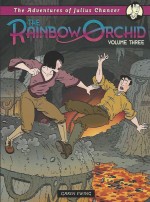
The Rainbow Orchid Volume 3 (the Adventures of Julius Chancer)


By Garen Ewing (Egmont UK)
ISBN: 978-1-4052-5599-8

Plucky True Brit Julius Chancer and his fellow daredevil travellers began popping up around 2003 in self-published mini-comics and small press publications  – I wish there was a less loaded or pejorative term for magazines produced by devoted, if unpaid, creators – before migrating online (see www.rainboworchid.co.uk) to rapturous praise from industry and public alike.

Tintin publisher Egmont sagaciously picked up the series and in 2009 released the first part of the rousing trilogy which fabulously referenced old world fantasy romances for this new yarn of gripping globe-girdling, treasure-seeking derring-do, which has quickly become a notable addition to the ranks of magnificent all-ages full-colour adventure albums.

Splendidly extending the appeal of period dramas and classic adventures tales such as Rider Haggard’s safari sagas and Conan Doyle’s Professor Challenger stories, and set in the fabled and fabulous Roaring Twenties, the first two books of the trilogy detailed how Chancer, young but capable assistant to renowned historical researcher and gentleman breeder of orchids Sir Alfred Catesby-Grey, undertook a mission to the wilds of the East in search of a legendary bloom mentioned in legends dating back to Alexander the Great.

Sir Alfred had been approached by Lord Reginald Lawrence, scion of an ancient and noble house, who was duped into an impossible wager by repellent entrepreneur Urkaz Grope. At stake was the “Trembling Sword of Tybalt Stone”; a priceless antique and the seat of the family’s honour since 1445, without which Lord Lawrence would have to surrender all his estates and titles…

To win the wager Lawrence needed an example of Iriode Orchino or the rainbow orchid, a mythical bloom last seen by Alexander over two thousand years ago. Although Catesby-Grey initially pooh-poohed the whole story, Julius was keen to investigate, perhaps as tempted by the prospect of adventure and a large fee as by the urgings of plucky Lady Lily, Lawrence’s daughter and a silent film actress recently returned from Hollywood to the heart of the Empire.

Grope had a highly secret agenda of his own and no principles at all, whilst the vulgarly intrusive journalist William Pickle had no scruples and definitely no fear as he sniffed out news and controversy like an obsessed bloodhound.

Moreover Lily’s Movie Publicity Agent Nathaniel Crumpole always seemed in the thick of whatever trouble was brewing – could even an American be that determinedly naive?

Chancer determined to risk all in tracking down the orchid and, despite a series of viciously calculated ploys by Grope and his gang of cutthroats, set off with Lily and Crumpole for Karachi and the fantastic flower’s last reported whereabouts…

Catesby-Grey once ran a very hush-hush government artefact-hunting department dubbed the Empire Survey Branch, but that ultra-discreet body had fallen upon hard times. When he pursued some enquires amongst his old clandestine colleagues, Sir Alfred found that lack of funding had placed them under the aegis of the military and twisted their working philosophy into a rabid hunt for ancient weapons of mass destruction…

After some deadly clashes with Grope’s murderous fixer Evelyn Crow and her hired thugs, Julius, Lily, Crumpole and pilot Benoit Tayaut reached India, narrowly escaping blazing doom as their aeroplane crashed. Rendezvousing with British Civil Servant Major Fraser-Tipping the explorers began the next stage of their trek with Crow and cronies in hot pursuit…

In England, Pickle, who had first broken the story of the orchid wager, was taken prisoner by an influential and affluent secret society, although his newshound colleague George Scrubbs diligently stayed on his trail whilst Grope’s plans to bully and buy his way into the upper echelons of English Society proceeded apace.

In India, after another brutal attack by Crow’s goons, the voyagers found an ally in Meru, manservant of incredibly aged missionary Father Pinkleton who claimed to have seen an actual rainbow orchid.

Heading into the wastes of Hasan Wahan, Julius and his enlarged party were unaware that they had a traitor in their group. After making one more incredibly lucky and fantastic discovery and nearing the end of their quest, Crow launched another murderous assault and one of our plucky heroes seemingly plunged to his death…

This final instalment opens with the survivors of Chancer’s party recuperating in a native village, when Crumpole – who hadn’t fallen far after hurtling over a cliff – wanders in, accompanied by Sir Alfred and Mr. Drubbin, an agent of the Empire Survey Branch. The pair have rushed to Asia in a desperate hope of finding something valuable enough to save the ESB from closure…

They are stalked by the remorseless Crow who, despite her wounds, is obsessively determined to complete her mission at all costs…

Following Pinkleton’s map the united expedition trudges off into the wilds and eventually reaches the mountainous region of Uskandagadri, from whence Meru originated years before. Drubbin then informs the explorers that they are being followed. Lying in wait, Chancer and Drubbin ambush and capture Crow as in England, Scrubbs – with the grudging assistance of Grope’s disgraced and discharged botanist Newton – infiltrates a meeting of the Black Lion secret society in a disastrous attempt to rescue Pickle and fellow prisoner Eloise Tayaut …

After seven days in the mountains, Chancer’s party find millennial clues left by Alexander and then stumble into a terrifying whirlpool before fortuitously washing up in a lost land of fantastic creatures and small levitating castles.

Unfortunately the warriors manning the flying fort recognise Meru and it’s clear that he is far from welcome…

Once the tragic hidden history of Meru and the incredibly ancient, super-scientific lost kingdom comes out, the explorers decide to escape but become embroiled in unrest caused by Meru’s return. Moreover, Evelyn is still trying to murder Julius. Drubbin, with an agenda of his own, takes the opportunity to pilfer knowledge and weapons from the city’s Great Library – secrets which caused the ultimate destruction of the magnificent civilisation eons ago…

As the explorers flee through subterranean caverns, Julius finally finds the rare bloom he’s been searching for and clashes with Crow one last time.

With the deadline for the wager fast-approaching and the Trembling Sword of Tybalt Stone seemingly lost to Lily and her father, the adventurers pile aboard a flying keep and head for Britain, unaware of the full scope of Grope’s plans.

Luckily Julius picked up a vital scrap of information in his climactic duel with Crow and after crashing to Earth at the British Empire Exhibition – and the moment of Grope’s ultimate triumph – delivers a nasty surprise which completely scuppers the monstrous usurper and resoundingly saves the day…

Enchanting, beguiling, astonishingly authentic and masterfully illustrated in the seductive Ligne Claire style, Garen Ewing’s stunning pastiche of the genre pioneered by Hergé and E.P. Jacobs places this magical yarn amongst the very best of graphic narratives, and in these books he has managed to synthesise something vibrant, vital, fresh and uniquely entertaining for modern readers of all ages.

Pure comics mastery – and where else could you get hot, fresh, thrill-a-minute nostalgia, just like your granddad used to love?

I can’t wait for more – and isn’t that the best test of a perfect book?
© 2012 Garen Ewing. All Rights Reserved.

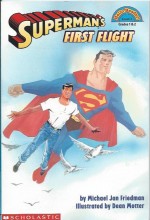
Superman’s First Flight


By Michael Jan Friedman & Dean Motter (Scholastic)
ISBN: 978-0-43909-550-1

We parochial and possessive comics fans too often regard our purest and most powerful icons in purely graphic narrative terms, but characters such as Batman, Spider-Man, the X-Men and Superman long ago outgrew their four-colour origins and are now fully mythologized modern media creatures instantly familiar in mass markets, platforms and age ranges.

Another captivating case in point is this beguilingly enthralling retelling of the Man of Steel’s formative journey to self-discovery retold for the very young as part of the Hello Reader early-learning program devised by Children’s publisher Scholastic.

Categorised as Level 3 (school years 1 and 2, with Level 2 being kindergarten and 1 as pre-schoolers) the story crosses that crucial divide wherein parents still read to their kids, but the little tykes are also beginning that wonderful, magical journey into literacy by themselves…

This clever, sensitive and age-appropriate retelling by Michael Jan Friedman encapsulates and addresses every maturing child’s growing feelings of potential alienation, sense of growth, self-discovery and independence by focussing on High School kid Clark Kent on the day that the solitary teen discovered why he had always felt somehow different from his classmates.

When Clark suddenly, impossibly, heard and saw a car crash from miles away, without thinking he found himself running and jumping over buildings. Arriving on the scene he tore metal doors off burning cars and outraced an explosion to save a trapped driver…

Terrified that he might be a monster he confided in his parents, who promptly shared a secret they’d been harbouring all Clark’s life. In the barn they showed the lad a tiny one-man spaceship which had crashed to Earth years ago, carrying an alien baby…

As Clark approached the capsule a hologram activated and the boy saw his birth-parents Jor-El and Lara who explained why he could perform feats no one else could…

Shocked and distraught, Clark ran away as fast as he could and before he knew it was flying high above the world. The glorious shock at last made him realise that different didn’t mean bad…

And soon the world was daily made better by a visitor from afar known as Superman…

This enthralling little adventure is a cleverly weighed introduction into the Man of Tomorrow’s past, magnificently complemented by 31 painted illustrations by gifted design guru and illustrator Dean Motter that will amaze kids and astound even their jaded, seen-it-all-before elders.

No Supermaniac could consider their collection complete without a copy of this wonderful little gem and Superman’s First Flight is the ideal introduction for youngsters to their – surely – life-long love affair with reading…
© 2000 DC Comics. All Rights Reserved. All Rights Reserved.

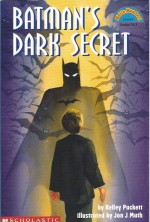
Batman’s Dark Secret


By Kelley Puckett & Jon J Muth (Cartwheel Books/Scholastic)
ISBN: 978-0-43909-551-8

We insular and possessive comics fans tend to think of our greatest assets in purely graphic narrative terms, but characters such as Superman, Spider-Man and Batman have long-since grown beyond their origins and are now fully mythologised modern media creatures instantly familiar in mass markets, platforms and age ranges.

A case in point is this beguilingly enthralling retelling of Batman’s origin intended for the very young as part of the Hello Reader early-learning program devised by Children’s publisher Scholastic.

Categorised as Level 3 (school years 1 and 2, with Level 2 being kindergarten and 1 as pre-school) the story crosses that crucial divide wherein parents still read to their kids, but the little tykes are also beginning that wonderful, magical journey into literacy by themselves…

This clever, sensitive and age-appropriate retelling by Kelly Puckett follows young Bruce Wayne as he enjoys a movie-night revival of the swashbuckling film Zorro and the life-altering encounter and tragic fate of his parents in that dank, enclosed, lightless alley behind the cinema. The loss and trauma led to the orphan becoming solitary, sad and afraid of the dark despite every effort of butler-turned-guardian Alfred until an unhappy accident turned the boy’s life around forever…

One day Bruce stayed out in the rolling grounds of Wayne Manor far too late until he suddenly realised that the sun was setting. Racing back to the bright, luminescent safety of the big house he abruptly fell through a weak patch of ground into a huge cave beneath the mansion and found himself in utter blackness.

Fighting blind panic he brushed past many tiny bats, but they didn’t scare him. However when a giant, red-eyed, leather-winged monster started towards him Bruce swung wildly at it and realised that the big bat was actually afraid of him. Something changed in him then and fear left his heart forever…

He knew that he could fight wicked things with fear and the dark as his weapons…

This enthralling little adventure is a perfectly balanced and well-gauged baptism into Batman’s world, magnificently complemented by thirty stunning painted illustrations by master of mood and mystery Jon J. Muth that will delight kids and astound even their jaded, seen-it-all-before elders.

No Batfan should consider their collection complete without a copy of this wonderful little gem and Batman’s Dark Secret is the ideal introduction for youngsters to their – hopefully – life-long love affair with reading…
© 1999 DC Comics. All Rights Reserved. All Rights Reserved.

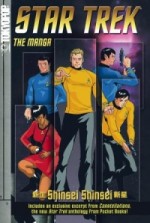
Star Trek the Manga volume 1: Shinsei Shinsei (“New Lives/New Stars”)


By Chris Dows, Joshua Ortega, Jim Alexander, Mike W. Barr, Rob Tokar, Makoto Nakatsuka, Gregory Giovanni Johnson, Michael Shelfer, Jeong Mo Yang & EJ Su (Tokyopop)
ISBN: 978-1-59816-744-3

Whilst the stellar Star Trek brand and franchise might not have actually reached any new worlds yet, it certainly has permeated every civilisation here on Earth, with daily live-action and animated screen appearances appearing somewhere on the planet almost every hour and comics iterations generated in a host of countries long lying fallow and unseen.

If only somebody could sort out the legal and logistical hassles so we could see again the stunning UK strips which appeared in Joe 90, TV21, TV Comic and Valiant from such fabulous creators as Angus Allan, Harry Lindfield, Mike Noble, Alan Willow, Ron Turner, Jim Baikie, Harold Johns, Carlos Pino, Vicente Alcázar, John Stokes and others, I could die a happy boy…

In 2006, to celebrate the 45th anniversary of the phenomenon, and capitalising on the global boom in Japanese styled comics, Tokyopop began releasing a series of all new manga adventures starring the indomitable crew of the Starship Enterprise as they boldly went all over the universe, courtesy of a serried band of international comics creators…

This initial monochrome masterpiece kicks off with ‘Side Effects’ by Chris Dows & Makoto Nakatsuka, and finds Captain Kirk, Science Officer Spock, Dr. McCoy and Ensign Pavel Chekov investigating a derelict ship which houses unsuspected horrors. Aboard the aged vessel are bodies from many species, displaying the hideous evidence of ruthless biological and mechanical augmentation…

When they release an exotic woman who appears to be the only survivor, she attacks them and infects Chekov with a virulent mutagenic virus whilst the other “corpses” revive and converge on them…

Although they beam back to the relative safety of the Enterprise, when a colossal vessel emerges from a wormhole, the derelict and Federation ship are swiftly snagged in a tractor beam and pulled into the time-dilation field of a Black Hole, seemingly harnessed to a ramshackle space-station.

Lost in space and time, Kirk beams a party over to the satellite in search of a cure for the disease ravaging Chekov, only to find the same unstoppable woman devastating the equally-infected remnants of an ancient civilisation who have sheltered aboard the station for centuries. Chief scientist Mynzek has been seeking a cure for untold ages, experimenting on volunteers and captives alike, but with success in his grasp at last, his latest subject has returned with vengeance in mind and her own all-assimilating agenda…

With resistance futile and the station rapidly self-destructing, Spock manages to secure a blood-sample to save Chekov, and the Enterprise quickly hurtles back through the wormhole and to the 23rd century, utterly unaware of the universal threat that will grow over the millennia from the last gasp of a desperate, dying civilisation and its first cyborg queen…

‘Anything But Alone’, by Joshua Ortega & Gregory Giovanni Johnson, sees the Enterprise orbiting an unknown world in response to a mysterious signal. Beaming down, Kirk, Spock and McCoy discover the thriving survivors of a long dead civilisation, maintained by miraculous nano-machines which can construct anything the people could possibly need. However the gracious, welcoming, childless citizens of Ximega II are concealing a tragic secret which only head scientist Prekraft seems willing to reveal. Moreover, he seems to going crazy with loneliness…

”Til Death’ (Mike W. Barr & Jeong Mo Yang) opens with Captain Kirk performing one of his more pleasant duties by officiating at the wedding of crewmembers Becky Randall and Tom Markham whilst the Enterprise scans a long-dead planet. However when dormant automated systems begin firing on the ship from separate locations, the survey mission switches to investigation mode and two landing parties beam down to find the shattered remnants of a civilisation which clearly self-destructed.

Retrieving twin sarcophagi which have somehow survived the holocaust, the explorers return to the Federation vessel, but soon inexplicable events begin to disrupt the ordered running of the ship and discipline of the crew…

The elaborate electronic coffins had each contained a withered husk and, momentarily forgotten as friends and lovers increasingly turn on each other, power is leeched from ship’s systems to rejuvenate the interred aliens. Soon the telepathic tyrants Faron and Nadira are fully restored and ready to finally end the hate-fuelled gender-war which pitted male against female and eradicated all life on their world. How lucky that there are so many men and women on the ship to act as their drones. But how unfortunate that one is a coldly dispassionate telepathic half-breed whose best friend is the most stubborn man in the galaxy…

A diplomatic mission to end an interplanetary conflict sees the Enterprise acting as a cargo courier, shuttling peace-making gifts between warring worlds. But whilst the entrancing emotion-reactive screen entitled The Weave by its Xoxxan craftsmen delights and beguiles all who regard it, the cutely appealing sacred animal ‘Oban’ genetically  recreated by the Xanvians conceals a monstrous and deadly secret which only becomes apparent when an unfortunate accident releases a mind-boggling, indestructible horror on the ship…

Faced with the prospect of renewed war, Kirk and Spock must determine if a maverick dissident, a duplicitous government or an impossible freak occurrence has endangered the tenuous peace process in a compelling political thriller by Jim Alexander & Michael Shelfer.

The manga action ends in classic style with ‘Orphans’, by Rob Tokar & E.J. Su, as the Enterprise performs escort duty for a peaceful space-faring race plagued by piracy. However the Lowarians and James T. Kirk have sadly underestimated the determination of the Haarkos, whose one-man raider-craft were shaped like humanoid robot-knights – complete with gigantic, lethal swords and shields…

When the battle-crazed mecha attack the starship, the lead pilot loses her life and another is captured before the Enterprise’s superior firepower drives off the rest of the pack, leaving Kirk with the impossible task of trying to reason with a merciless, ten-year old boy-soldier trained to kill from infancy.

If Kirk cannot find a way to reason with the honour-obsessed, battle-hardened warrior Xill he may have no choice but to exterminate all of these brutal, suicidal children who are as much victims as the race they now prey upon…

This particular edition (there are three counting a Diamond Distributor Exclusive and a Convention Special Exclusive) also includes the moving short-story ‘First, Do No Harm’ (by Dayton Ward & Kevin Dillmore from the prose Star Trek anthology Constellations) which details an unpleasant and unwelcome mission to extract rogue doctor Revati Jendra from the closed, primitive world of Grennai.

The fugitive medic’s actions contravene the Prime Directive and daily endanger the social development of the entire planet, even though she perfectly blends in with the natives and saves lives in a manner no patient would ever suspect as being beyond planetary norms…

However, as her close friend of twenty years, Leonard McCoy knows that there must be a damned good reason for her actions, whilst Kirk and Spock are more concerned by Starfleet’s suspicious wall of “classified” and “top security” roadblocks surrounding every aspect of her first expedition to Grennai decades ago…

Full of the verve, sparkle and wide-eyed enthusiasm of the original TV show, these continuing adventures are a real treat, and even if the manga visuals are a bit of a shock at first, you’ll soon adapt and surely settle in for another splendid ride on the timeless rollercoaster ride that is Star Trek…
™, ® & © 2006 CBS Studios Inc. All rights reserved.

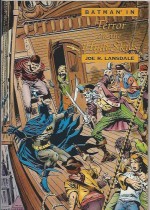
Batman: Terror of the High Skies


By Joe R. Lansdale, illustrated by Edward Hannigan & Dick Giordano (Little, Brown & Co.)
ISBN: 0-316-17765-2   ISBN-13: 978-0-316-17765-8

We parochial comics fans tend to think of our greatest assets in purely graphic narrative terms, but characters such as Superman, Spider-Man and especially Batman have long-since grown beyond their origins and are now fully modern mythological creatures who inhabit a mass of medias and even age ranges.

A case in point is this superbly rowdy, rollicking and rousing boy’s own adventure which was released in the early 1990s as part of the perennial drive to get kids reading…

Terror of the High Skies was written by the brilliant and prolific Texan Joe R. Lansdale, whose credits range from novels to screenplays and cartoons to comicbooks in genres as broad as horror, comedy, westerns, crime-thrillers, fantasy science fiction and all points in between, and he is as adept at challenging adult audiences as he is beguiling – far harder to impress – young readerships…

The tale begins as young Toby Tyler slowly adjusts to life in Gotham City after growing up in Mud Creek East Texas. One night as his parents play host to old friend – and Police Commissioner – Jim Gordon, Toby hears a cat in distress and climbs out of his bedroom window onto the roof of his building, only to find a flying galleon heaving-to and the infamous Joker capering about in the guise of a movie pirate.

Toby’s a big fan of films and keeps up to date on the news, so when the Mountebank of Mirth makes the kid walk the plank off the roof he hears some clues that will eventually lead to the Clown Prince’s defeat…

It’s also where he first meets the daring Dark Knight as Batman swoops out of the darkness to save him before confronting the Joker and his gang of plundering sky-pirates…

Already deeply involved in solving taunting card-clues to the villain’s future crimes, Batman comes close to ending the case right there, but the wily Harlequin of Hate hastily escapes and embarks on a campaign of pirate-themed plundering, unaware that the plucky Toby has deduced where and when he will strike next…

With the focus very much on the valiant boy – just as young Jim Hawkins is the narrative voice of “Treasure Island” – readers are treated to a splendid adventure as Toby is allowed to join Batman’s search for the Joker in a fantastic chase that encompasses a visit to the Batcave, meeting and rescuing his favourite horror-film actor, “stowing away” aboard the floating marauder, facing a (mechanical) sea monster and eventually foiling a spectacular scheme to unleash a wave of madness on the unsuspecting city…

Bold, fast-paced and engaging; delivered very much in the manner of Batman the Animated Series (for which Lansdale wrote a number of episodes), this delightful prose escapade is also graced with eight breathtaking full-page action-illustrations by Batman veterans Ed Hannigan & Dick Giordano and would make a perfect primer for younger fans to begin their – hopefully – life-long love affair with reading…
© 1992 DC Comics. All Rights Reserved. Published under license from DC Comics.

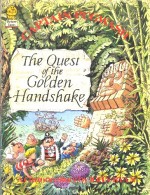
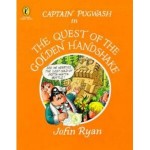
Captain Pugwash and the Quest of the Golden Handshake


By John Ryan (Fontana Picture Lions/Puffin)
ISBN: 0-00-662253-4 (Fontana 1985)   978-0-14055-486-1 (Puffin 1997)

Paperback: 32 pages

I recently reviewed an old John Ryan kid’s book and enjoyed it so much that I simply had to share another all-ages masterpiece with you…

John Ryan was an artist and storyteller who straddled three distinct disciplines of graphic narrative, with equal qualitative if not financial success.

The son of a diplomat, Ryan was born in Edinburgh on March 4th 1921, served in Burma and India and, after attending the Regent Street Polytechnic (1946-48), took up a post as assistant Art Master at Harrow School from 1948 to 1955. It was during this time that he began contributing strips to Fulton Press publications.

On April 14th 1950 Britain’s grey, post-war gloom was partially lifted with the first issue of a new comic that literally gleamed with light and colour with which avid children were soon understandably enraptured; blown away by the gloss and dazzle of Dan Dare, Pilot of the Future, a charismatic star-turn venerated to this day and a host of other spectacularly illustrated stories strips and features.

The Eagle was a tabloid-sized paper with full colour inserts alternating with text and a range of various other comic features. “Tabloid” is a big page and one can get a lot of material onto each one. Deep within, on the bottom third of a monochrome page was an eight panel strip entitled ‘Captain Pugwash – The story of a Bad Buccaneer and the many Sticky Ends which nearly befell him’ delivered with dash and aplomb by John Ryan.

The indefatigable artist’s quirky, spiky style also lent itself to the numerous spot illustrations required throughout the comic every week and he also regularly produced ‘Lettice Leefe, the Greenest Girl in School’ for Eagle’s distaff companion comic Girl.

Pugwash, his harridan of a wife and the useless, lazy crew of the Black Pig ran until issue #19 when the feature disappeared.

This was no real hardship as Ryan had been writing and illustrating the incomparable and brilliantly mordant ‘Harris Tweed – Extra Special Agent’ a full page (tabloid, remember, upwards of twenty crammed and meticulously detail stuffed panels a page, per week) from The Eagle #16 onwards.

Tweed ran for three years as a full page until 1953 when it dropped to a half page strip and was repositioned as a purely comedic venture.

In 1956 the indefatigable old sea-dog (I’m referring to Horatio Pugwash, but it could so easily be Ryan: an unceasing story-peddler with a big family, he still found time to be head cartoonist at the Catholic Herald for four decades) made the jump to children’s picture books and animated features for television.

A Pirate Story was the first Pugwash chronicle (originally published by Bodley Head before switching to the children’s publishing specialist Puffin) and the first of a huge run of children’s books on a number of different subjects. Pugwash himself starred in 21 tomes; there were a dozen books based on the animated series Ark Stories, as well as Sir Prancelot and a number of other creations. Ryan worked whenever he wanted to in the comic world and eventually the books and the strips began to cross-fertilise.

When A Pirate Story was released in 1957 the BBC pounced on the property, commissioning Ryan to produce five-minute episodes (86 in all from 1957 to 1968, which were reformatted in full colour and rebroadcast in 1976). In the budding 1950s arena of animated television cartoons, Ryan developed a new system for producing cheap, high-quality animations to a tight deadline. Naturally he began with Pugwash, keeping the adventure milieu, but replaced the shrewish wife with a tried-and-true boy assistant. Tom the Cabin Boy is the only capable member of a crew which included such visual archetypes as Willy, Pirate Baranabas and Master Mate (fat, thin and tall – all dim) instantly affirming to the rapt, young audience that grown-ups are fools and kids do, in fact, rule.

Ryan also drew a weekly Pugwash strip in the Radio Times for eight years, before going on to produce a number of other animated series including Mary, Mungo and Midge, The Friendly Giant and Sir Prancelot as well as adaptations of some of his many children’s books. In 1997 an all new CGI-based Pugwash animated TV series began.

John Ryan returned to pirate life in the 1980s, drawing three new Pugwash storybooks: The Secret of the San Fiasco, The Battle of Bunkum Bay and today’s riot of scurvy delights The Quest of the Golden Handshake…

There was even a thematic prequel in Admiral Fatso Fitzpugwash, in which it is revealed that the not-so-salty seadog had a medieval ancestor who became First Sea Lord, despite being terrified of water…

In the Golden Handshake the Querulous Captain finds a genuine treasure map at an auction but a bidding war with nefarious nemesis Cut-Throat Jake turns into a full-blown riot in which the coveted chart is torn in half.

Never knowingly daunted, Pugwash and company steal Jake’s half of the map that night but on returning to the safety of the Black Pig are horrified to discover that their rival has had the same idea…

Luckily the brilliant cabin boy had anticipated the move and has already copied their portion of the priceless document. Heartened and enraptured by thoughts of vast wealth, the crew hastily set sail for South America, determined to plunder the Lost Treasure of the Stinkas…

However Jake is a brilliant rogue and smuggles himself and two burly accomplices aboard, planning to let Pugwash do all the heavy lifting and await his moment to claim his revenge and the gold…

Packed with in-jokes, glorious tom-foolery and daring adventure, the voyage to the New World in a “haunted” ship culminates in a splendid battle of half-wits before Tom, as usual, saves the day in his quiet, competent and deucedly clever way…

The first Pugwash was very traditional in format with blocks of text and single illustrations that illuminated a particular moment. But by 1982 the entire affair became a lavishly painted comic strip, with as many as eight panels per page, with standard word balloons. A fitting circularity to his careers and a nice treat for us old-fashioned comic drones.

The most recent edition of A Pirate Story (2008 from Frances Lincoln Children’s Books) came with a free audio CD, and just in case I’ve tempted you beyond endurance here’s a full list (I think) of the good(?) Captain’s exploits: Captain Pugwash: A Pirate Story (1957), Pugwash Aloft (1960), Pugwash and the Ghost Ship (1962), Pugwash in the Pacific (1963), Pugwash and the Sea Monster (1976), Captain Pugwash and the Ruby (1976), Captain Pugwash and the Treasure Chest (1976), Captain Pugwash and the New Ship (1976), Captain Pugwash and the Elephant (1976), The Captain Pugwash Cartoon Book (1977), Pugwash and the Buried Treasure (1980), Pugwash the Smuggler (1982), Captain Pugwash and the Fancy Dress Party (1982), Captain Pugwash and the Mutiny (1982), Pugwash and the Wreckers (1984), Pugwash and the Midnight Feast (1984), The Battle of Bunkum Bay (1985), The Quest of the Golden Handshake (1985), The Secret of the San Fiasco (1985), Captain Pugwash and the Pigwig (1991) and Captain Pugwash and the Huge Reward (1991), but quite frankly read any Pugwash pirate publication and you’ll be we’ll and truly hooked…

This magical, wry and enchantingly smart yarn is one of Ryan’s very best and long overdue for re-issue – as are they all – and a sure winner with fans of all ages if you can find it (talk about real buried treasures…).

We don’t have that many multi-discipline successes in comics, so why don’t you go and find out why we should celebrate one who did it all, did it first and did it well? Your kids will thank you and if you’ve any life left in your old and weary adult fan’s soul, you will too…

© 1984, 1997, 2012 John Ryan and presumably the Estate of John Ryan. All rights reserved.