The Veil


By Greg Rucka & Toni Fejzula, with Aljoša Tomić & various (Dark Horse)
ISBN: 978-1-61655-492-7

It’s January and the nights are long and cold. Good thing there’s plenty of scary stories and coolly creepy graphic novels to while away the midnight hours…

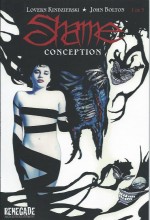
Written by Greg Rucka and chillingly illustrated by Toni Fejzula with additional colour work from Aljoša Tomić, Veil collects the introductory 5-issue miniseries (March to July 2014) which saw the debut of one of the more intriguing femme fatales in modern comics history…

It all begins in an abandoned, desolate subway station where a beautiful, naked and extremely confused young woman awakens on a bed of most surprised rats. Babbling incoherently but not at all scared, she makes her way above ground and finds herself in a modern Sodom and Gomorrah where her nubile helplessness soon attracts the attention of the pimps and other two-footed predators…

Big mean Vincent especially seems unable to resist his most basic urges but the victim-to-be is rescued by unlikely hero Dante who inexplicably – and unlike every other John on the street – seems compelled to shield rather than covet her…

Covering her nakedness, Dante takes her to his shabby apartment and tries to get some sense out of the girl who calls herself “Veil”. Vincent and his homies, however, are not the types to defer gratification and come looking for her with plenty of guns and bad attitudes…

It’s the last mistake of their short, violent lives but in the bloody aftermath Dante knows more than ever that, whatever she is, this girl must be protected. As they go on the run through the seedy backstreets and alleys of the city Veil seems to grow more clear-headed even as she displays ever-greater impossible abilities.

Elsewhere men wielding a different kind of irresistible power are discussing her. In the gory detritus of a satanic ritual, money-man Mr. Scarborough unwisely chides the black magician he and his consortium have hired – with apparently negligible return…

Despite apparent failure and the clear absence of the thing they paid for, insouciant Cormac remains aggravatingly untroubled. Just why is revealed after Scarborough’s thugs try to kill him for his presumed failure and the scheming wizard displays some of the other powers at his command…

The demands of ego satisfied on both sides, Cormac assures Scarborough that he will find the missing vessel of unfettered power he was hired to summon. He never actually specifies who will profit from it, though…

Back in the nasty part of town, cops have arrested Dante and Veil, but the girl’s uncanny allure compels one of them to force himself upon her as he has so many other street girls. His partner will never sleep easy again after seeing what she left of him…

With Veil vanished, the still-handcuffed Dante flees whilst in an empty, deconsecrated church Cormac works, summoning a rat familiar to scent out his target and draw it to him. If he knows that Scarborough and his billionaire business associates have sanctioned an assassination hit team to take him out, he doesn’t care…

The killer elite arrive soon after the mesmerised Veil and are on site when the mage binds her with a mystic chain, ordering her to change to her true form. The hit squad doesn’t stand a chance…

Dante meanwhile has hooked up with an old friend who has rid him of the handcuffs, if not his obsession to help the strangely compelling Veil. The poor sap isn’t that surprised when a rat bites Gabriel and something terrifying starts talking through his mouth. It seems the Devil wants his property back and is prepared to help Dante save her from the mad mortals who currently possess her…

Sharply scripted and superbly illustrated, this rocket-paced rollercoaster ride to Hell and back is a superb blend of corporate chicanery, sinister sorcery, grimy street crime, gory excess and unlikely heroism that delivers a bloodbath of spooky, sexy action even as it promises more revelations to come.

This classy full-colour hardback edition also includes a copious ‘Veil Sketchbook’ section depicting the evolution and intriguing multiple aspects of the enigmatic star to astound art lovers and all aficionados of the darkly exotic.
© 2014, 2015 Nervous Habit, Inc. All rights reserved.

Treasury of Mini Comics volume 2


By many and various, edited by Michael Dowers (Fantagraphics Books)
ISBN: 978-1-60699-807-6

The act of stringing pictures and/or words together is something almost everybody has done at some stage of their lives. It’s a key step in the cognitive path of children and, for an increasing number of us, that compulsive, absorbing euphoria never goes away.

Whilst many millions acquiesce to the crushing weight of a world which stifles the liberation of creativity, turning a preponderance of makers into consumers, a privileged, determined few carry on: drawing, exploring, and in some cases, with technology’s help, producing and sharing.

Michael Dowers, the force behind not only this compilation but also Brownfieldpress and Starhead Comix, adores the concept of crafting and disseminating mini comics and his books Newave!- The Underground Mini Comix of the 1980 and volume one of this series described and reproduced hundreds of examples: spotlighting with enticing, encouraging exuberance those incurably driven artisans who came out of the “anything goes” 1960s and 1970s Underground Commix movement still craving a vehicle of expressly personal expression.

Such creators aren’t really in it for the money – although a few have moved on to find a modicum of mainstream comics fame, at least – and, in an era before computers, they found time to write, draw and compile artwork (small press people are notoriously generous, contributing to projects at the drop of a hat) before laboriously photocopying, cutting, folding, stapling and then distributing the miniscule marvellous results.

Just by way of definition: most mini comics were and still are home-produced pamphlets using borrowed – or when necessary paid for – print processes. The most popular format was an 8½ x 11inch sheet, folded twice, and printed at local copy-shops (or clandestinely churned out on school/work repro systems like early Xerox, Photostat, Mimeo or Spirit Banda machines) on any paper one could lay hands on.

Because they weren’t big, they were called “mini commix”. Inspired, no?

Thanks to a seemingly inexhaustible modern appetite for such uniquely individualistic endeavours here’s a superb sequel tome – one more massive paper brick of fun (848 monochrome and colour pages, 178 x 127mm) – compiling and sharing many of the very best mini masterpieces from the 1970s to right here, right now…

Many key figures in the proliferation of this uniquely eloquent people’s medium are included here, not only through examples of their groundbreaking work, but also through statements, interviews and fond reminiscences.

If human beings have access to any kind of reproductive technology they seemingly cannot resist making copies of their own private parts or creating their own comics, and here content comes from all over the North American continent – and even beyond – covering everything from superhero spoofs, monster-mashes, robot rampages, animal antics, autobiography, recreational drugs, religious, spiritual and philosophical diatribes and polemics, surreal experimental design and just plain fun stories, chatter and gags: all as sexually explicit, violent, strident or personally intimate as their creators wanted them to be…

As usual I’ll deliver here my standard warning for the easily offended: this book contains comic strips never intended for children. If you are liable to be offended by raucous adult, political and drug humour, or illustrated scenes of explicit sex or unbelievable comedy violence, don’t buy this book and stop reading this review. You won’t enjoy any of it and might be compelled to cause a fuss.

I’ll probably cover something far more wholesome tomorrow so please come back then.

It all starts with Michael Dowers’ introduction wherein he brings the history of the sub-medium up to date and posits a connection with the legendarily scandalous “Gentlemen’s under-the-counter” publications known as Tijuana Bibles which livened up life for our forebears in the early part of the 20th century with explicit and illegal cartoon cavortings featuring famous stars of screen and newspaper strips.

That proposition is upheld and further explored following ‘The Hundred Year Old New Waver in “Damn Punks Got it Easy Today”’: a hilarious graphic diatribe (dis)courtesy of Brad W. Foster from Time Warp #3 (2007) after which a genuine, authentic and anonymous Tijuana Bible inclusion offers erotic relief to ‘The Van Swaggers’.

Then follows a batch of modern tributes and reinterpretations beginning with masked wrestler/guitarist The Crippler by Fiona Smyth (2007) and the astoundingly disturbing, politically punishing ‘Obliging Lady’ from Ethan Persoff & Scott Marshall’s The Adventures of Fuller Bush Man & John McCain (2009)…

A splendid faux pastiche of the original pamphlets, Hairy Crotch & Rim Johnson in ‘The Interview’ is an anonymous entry from 1995, whilst Lilli Loge abandons the form but ramps up the spirit for the tale of a girl and her slave in ‘A Blessing in Disguise’ from Ben & Jenny from 2009.

That same year clean-cut Euro icon Lucky Luke got homo-erotically spoofed as ‘Hunky Luke in Calamity Jack’ by Anna Bas Backer after which Antoine Duthoit (2013) plunders Jim Woodring’s style and character cast for the outrageous Spank.

From 1972 Trina Robbins delivers classic pastiche ‘Sally Starr Hollywood Gal Sleuth’ solving a “Minit Mystery” whilst Bob Conway offers classic cartoon capers ‘Out to Lunch’ and ‘Chicken Shit’ in 1980’s Tales of Mr. Fly, and David Miller & Par Holman venerate the disaffected teen outsider experience in a blast of vignettes in Punkomix #1 from 1982.

Clark Dissmeyer laments the life of a Two-Fisted Cartoonist (#1 1983) after which Steve Willis’ 1983 Sasquatch Comix #3 details a strange encounter in the wild woods and R.K. Sloane & Jeff Gaither noxiously explore a life in hell with Fresh Meat from 1985.

A genuine small press big noise reveals all in the ‘Jeff Nicholson Interview’ after which the creator’s infamous cartoon polemic Jeff Nicholson’s Small Press Tirade (1989) still proves to be astoundingly powerful and the ‘Dan Taylor Interview’ segues neatly into some of his superbly eclectic Shortoonz from 1990 and the deliciously vulgarian Unleashed #1 from 2010.

John Trubee’s 1990 Vomit! #1 is a captivating manifesto of the politically baroque and philosophically bizarre whilst from 1992 Jason Atomic’s Wongo Batonga pt. 2 gloriously celebrates the magnificent freedom of superheroic imagination in a lengthy explosion of power-packed battles before Patrick Dowers explores human diversity in Marvels of the Sideshow Freaks.

Corn Comics #1 (Marc Bell, 1993) provides a hilarious laugh-ride of bitter twisted types after which the ‘Tom Hart Interview’ precedes his wittily poignant 1993 slice-of-life saga Love Looks Left and all-star line-up J.R. Williams, Pat Moriarity & R.L. Crabb collaborate on the 1994 cautionary tale ‘Devil Stay Away From Me’.

Impishly shocking Ellen Forney & Renée French then reveal how The Exquisite Corpse Bakes a Pie (1994), after which a ‘Molly Kiely Interview’ is stunningly supplemented by her rendition of a bevy of female music and movie icons who all possessed that indefinable sense of Sass! (1995).

Jeffrey Brown’s 1998 paean to hopelessness and confusion ‘To Wenatchee’ is followed by Pshaw’s whimsical story of a little robot in The One Eyed World (1999) after which ‘Colin Upton Presents A Short Guide To the Care and Production of Mini-Comics’ provides everything anyone needs to know about making story-art stories.

Contemporary cartoon wild child Johnny Ryan 2002 exposes guilty secrets from Shouldn’t You Be Working? #5, before the ‘Souther Salazar Interview’ leads to the artist’s wide-ranging ‘In Case of Emergency Only’ (2003) and Max Clotfelter’s eerily post-apocalyptic Snake Meat #1 from 2004.

Her smartly evocative 2004 Science Fiction Affliction is preceded by an ‘Alison Cole Interview’ after which Thought Cloud Shrines from 2007 perfectly displays Theo Ellsworth’s astounding graphic imagination and meticulous penmanship; gifts shared by Lisa Hanawalt and revealed in a stunning fashion parade of freaks in Stay Away From Other People from 2008, augmented by her hilarious ’12 Things To Do When you Are Stuck in Traffic’.

Travis Millard’s ‘Sad Dad’ introduces a deucedly depressing modern pantheon in Who Let the Gods Out (2008) whilst Bobby Maddness explores a variety of baffling annoyances in Too Small Comics #2 (2010) and Esther Pearl Watson describes a ghastly future populated solely by pop stars and fashion models in Eric Parris World from 2009.

The marvellous Jim Rugg contributes a stunning and outrageous pop at America’s dumbest President and most moronic national symbol in the delirious ‘Rambo 3.5’ (2009) after which, from 2010, Donald & Daniel Zettwoch mesmerise with their incredible personal history of phone exchange technology in ‘Cut Lines and Intricate Minds’ as seen in Tel-Tales #1 and Tom Neely employs dozens of bootlegged Popeyes in a surreal spinach-fuelled Battle Royale for his Doppelgänger…

The ‘Jason T. Miles Interview’ leads naturally enough into his 2010 tale of terror ‘Dump’ from Pines 3.

The irrepressible manga marvel DJ Cat Gosshie goes through a series of adorable “totally-street” trans-Pacific short story syncopations as delineated by Harukichi in 2011 before Pakito Bolino then relates the hyperkinetic end of everything with the ‘Male of the Future’ from D.O.C. (2012)

DemonDust #10 by Bernie McGovern (2012) lyrically explores the poetry of atomic theory and human interactiveness whilst from the same year Shuttlecakes reveals the stunning dexterity and artistic facility of Susan Belle before the ‘Caroline Paquita Interview’ leads to her seductively gender-political compilation Womanimalistic #3 from 2013 to close the monochrome section of this collection.

However, following the ever-so-useful ‘Artist website and contact info’ pages, there’s even more compelling cartoon self-expression all crafted to make use of carefully considered colour, commencing with Kristyna Baczynski’s travails of a pretty kitty in ‘Nine Lives’ from 2012, Leah Wishnia’s disturbing exploration of women’s lives from Spithouse #1 (2008) and an even more distressing tale of psychological brutality from Nick Bertozzi in ‘5/4’ from 2000 before Ethan Persoff concludes the challenging cartoon content with a stunning graphic potpourri from Plastic Tales and Stories #2.

This tremendous tome features some of the host of pioneering craftsmen who worked in the self-printing movement which became today’s thriving Alternative/Small Press publishing industry as well as the current internet comics phenomenon, and this book has incredible appeal on an historical basis.

However, that’s really not the point: the real draw of such collections is that creativity is addictive, good work never pales or grows stale and the great stories and art here will make you keen to have a go too.

I’ve done it myself, for fun – even once or twice for actual profit – and it’s an incredible buzz (I should note that I am still married to a wife not only tolerant but far more skilled and speedy in the actual “photocopy, cut, fold, staple” bit of the process and willing, if not keen, to join in just so she might occasionally be with the compulsive dingbat she married…)

The sheer boundless enthusiasm and feelgood rewards of intellectual freedom from making such comics celebrated in this astoundingly vast, incredibly heavy and yet still pocket-sized hardback is a pure galvanic joy that will enchant and impel every fan of the art-form: as long as they’re big enough to hold a pencil, old enough to vote, and strong enough to lift the book.
Treasury of Mini Comics volume 2 © 2015 Michael Dowers and Fantagraphics Books. All contents © 2013 their respective creators or authors. All rights reserved.

Oculus


By Luke Melia, Vincent Smith, David Anderson & various (Tabella Publishing)
ISBN: 978-1-50276-589-5                  eBook ASIN: B00IC4EQJ2

As I’m sure you know by now, I’m a huge advocate of comics creators with the drive and dedication to take control of their own destinies. Late last year I reviewed a superbly written graphic horror tale called The White Room of the Asylum by Luke Melia and a coterie of artists which utterly amazed and impressed me.

Now with a chameleonic, Iain Banks-like shift of genres the indie artistic entrepreneurs are back – specifically writer/letterer Melia, illustrator Vinny Smith and colour-artist David Anderson – with a distinctly disturbing sci fi cop drama that is every bit as gripping and smart…

By 2027 the world has been completely altered by a social media innovation of astounding power and devastating simplicity.

Oculus sells an implanted chip which allows users to record and/or share in real-time whatever they’re seeing and hearing. The service connects with any or all other possessors of the implant and the company claims that to comprise most of the planet.

Live streaming intimate moments of an individual’s everyday life can be with one person, a selection of friends and acquaintances or the entire world. The facility has completely changed every aspect of society.

It has especially transformed the law and policing. It’s really hard to claim innocence if the victim has shared you committing the crime with thousands of viewers and the Oculus mainframe has a record of you doing it…

Police forces are more tech resource teams, video researchers and IT bods than boots-on- the-ground coppers – except for the bellicose, tooled-up, OTT tactical teams designated SABU (Special Armed response and Bomb disposal Unit) – so feckless young graduate Shane Edwards‘ first day in the Major Crimes Department of the New Oxford Constabulary is something of a letdown.

He’s already having a tragic life. Despite his being the son of the Mayor – who had to very blatantly pull strings to get him into the police – his best friend (he so wants her to be more) and Oculus intimate Emma Hudson is going through hell because her sister is going to jail.

It’s not official yet but Lauren was observed killing her cheating boyfriend in full view of an enrapt and aghast global audience…

After meeting department boss Alan Campbell and the shockingly small team of detectives, Shane is swiftly dubbed ‘Another Girl in the Office’ by astonishingly abrasive colleague Jane. Dogsbody Chris seems okay but the new kid doesn’t even meet old lag Jeff who is supposed to be his mentor and partner…

That introduction only comes in the middle of the night when the grizzled and rather unconventional old plod turns up on the doorstep to drag him to a crime scene emergency. He won’t even let Shane change out of his pyjamas and slippers…

Incident reporting has also been revolutionised by Oculus. Why wait for a scream or a phone call when most crimes are seen by somebody somewhere as they happen; be they perp, witness, victim or even police officer…?

This particular “Shout” is for a grotesquely bloody murder picked up all over the Oculus network, but by the time they arrive on scene, the story is already staring to unravel.

For starters, the girl seen being repeatedly stabbed, screaming her lungs out and expiring is Isobel Bendis, who slashed her wrists and died weeks earlier – and Jane should know: she was the officiating officer and attended the funeral a fortnight previously…

Ascertaining that the broadcast was faked, Jeff employs a particularly cool piece of kit called a Repeat Torch which illuminates the outlines of living bodies on solid objects such as walls… just like electromagnetic Luminol…

The hazy blue rays show two living persons – presumably the grisly, prankish fraudsters – manufacturing the body dump. Following the ghostly trail leads Shane and Jeff through the sewers and into the underground transit system, where the gobsmacked coppers realise at last that they been played from start to finish by some very clever individuals…

The startling events of Oculus are rendered in full colour and cunningly augmented with a wealth of satirical ads for such items as the voyeuristic ‘Extreme Jobs’ site, ‘Wild-Sight’, ‘The Oculus Cloud‘, ‘Life in Third Person’ and decision-making app ‘Indie-Sysiv’ – all concocted by Luke & Vivienne Melia, Vinny Smith, David Anderson, Michael Kennedy, Christian David Navarro, Jenna Kyle, James Smith, Bobby Peñafiel and Roel S. Palmaira.

Key background information is provided by a series of faux magazine interviews with the social revolution’s inventor Alan Jensen (designed and illustrated by Ephraim Zev Zimmerman) and following the first of these – ‘The Origins of Oculus’ – the saga resumes with the entire Major Crimes unit – all five of them – reviewing events.

Cliff has established that the “murder” broadcast was recorded, not live, and sent from the username “Dolos”, tagged with a large variety of terms such as “Free”, “Sex”, “Star Trek” and “Anime” all cunningly designed to catch the eye of the widest possible audience…

Unfortunately due to budget constraints Campbell can’t sanction a costly activity report from the Oculus Corporation for what looks like a nasty student prank. Still smarting from looking like a fool and being seen trudging through sewers in pyjamas and tiger slippers, Shane vigorously disagrees. He argues that whoever did this is organised, meticulous, capable of fooling everybody who saw into believing it was real… and live. Dolos also had no problems digging up and stealing a corpse to carry it off…

Campbell relents and agrees to let Shane and Jeff continue to work on it as long as costs stay down: after all, these days there simply isn’t that much work for detectives to do…

Jeff has been in the force for a very long time and knows lots of strange people. Thinking one of them might have a handle on the matter, he drags his excitable understudy to a basement flat to meet inventor and hacker Bentley, a most peculiar individual clearly long off his meds and living in a wonderland of paranoia and bizarre hand-made devices…

‘0.4% Chance It Could Destroy The World’ sees the first lead found as the batty boffin suggests back-street Oculus implants and breaks into the high security Oculus Corporation database records.

Armed with Dolos’s account inception date and the enigma’s Friends List, the dynamic duo hit the quiet streets of New Oxford where Jeff suggests trying a far more traditional method of finding things out…

Fat Maisey is a low-level street rat and if anyone knows about illegal Oculus implants he will. Sadly the chase after the little weasel only leads our heroes into an armed ambush and ultra-violent counter-operation involving the gun-toting gung-ho grunts of SABU…

Barely escaping with their lives Shane and Jeff head back to the station whilst elsewhere two conspirators bicker and agree to speed up the pace of their plan…

Still felling out of his depth, Shane talks things over with “just friends” Emma before going out on a date with old college acquaintance Anna Rice. They end up in bed but since Anna’s idea of having a great time is being seen getting off by hundreds of strangers, close friends and especially herself, Shane’s night does not have a happy ending…

Following another Jensen interview (‘The Origins of PADs and Broadcasting’) the next chapter ‘How Could I Ever Truly Respect Her?’ opens with the boy wonder getting some well deserved ragging from his mentor.

Even Shane’s mum tuned in to the open broadcast and he is – for the third day running – the laughing stock of the New Oxford Constabulary. At least Jeff is amused enough to share some of his own tragic personal history, but inexplicably Emma seems furious with the bewildered newbie…

Events suddenly overtake the mental self-flagellation when Campbell calls them all in to a meeting which also includes members of Operations and Counter-terrorism divisions. All assembled are advised to tune in to a certain Oculus Drive path where Dolos is again broadcasting.

Definitely live this time, the mystery prankster is loading a gun in a public toilet somewhere in New Oxford…

As the frantic law officials follow the progress of the gloved perpetrator through his – or her – own eyes, Shane recognises The Francis Castle Shopping Centre. Dolos, now sitting at the central fountain pretending to read a newspaper, adds more Tag-terms to the live feed: words like “Francis Castle”, “massacre” and “hundreds dead”…

The bigwigs freak out and SABU are dispatched, but Shane uses his own Oculus system to link with a stranger shopping at the mall. Convincing Gabrielle to walk over to the fountain, the police use her eyes but see that no one is there, even though Dolos’s open channel shows the chilling conundrum staring right back at the baffled teenager over his paper…

When the enigma’s eyes show him unwrapping a bomb and scrawling the word “Kaboom” on a wall, full-panic mode kicks in and masked-and-armoured SABU officers storm the centre, frantically evacuating the citizens and using the Dolos view to trail him to the bomb.

Once again there is nothing there, and the baffled cops are just turning to go when a colossal detonation rocks the building…

After Jensen’s ‘How Oculus Changed the Entertainment Industry’ a telling flashback of Shane and Emma at college leads to gloom and despondency in the present as the NOC reel in the aftermath of a disaster that has left 35 dead and hundreds injured.

Brain-fried from constantly reviewing the impossibly divergent Oculus recordings, Jeff and Shane go book-shopping to clear out the nonsensical but inescapable theory of an invisible maniac being behind all their woes…

The second-hand tome is for Jeff’s friend Bryce: a very smart lady who owned a research company which dabbled in camouflage and stealth technologies – although her real area of expertise was human cloning. ‘Oh, And By The Way, There Are Six Of Them’ sees Shane astonished to meet a sextet of his partner’s pal as they pursue the assorted blind alleys regarding becoming unseen…

However, as they all congregate to review the combined synched footage of numerous victims, one of Bryce does identify an anomaly who might just be an accomplice of Dolos…

As Shane tries to re-establish a personal life free of shame and snickering rozzers, the wheels of modern police procedure roll on and soon the mystery man in the recordings is identified and arrested… but only after a little illicit assistance from Bentley…

The next Jensen feature deals with ‘Education and the Workplace’ after which Jeff and Shane conduct their first interview with terrified Rhys Ennis who, after literally spilling his guts, does so metaphorically and explains how the anonymous Dolos hired him…

The kid is clearly just a pawn and the NOC eventually let him go. It’s only later as Jeff tells his protégé about Bryce that Shane realises in a burst of exasperated inspiration the simple trick the terrorists devised to cheat a system the entire world believes cannot be fooled…

As the police swing into action Shane heads home for much needed sleep, but is soon awakened by a live cast from Emma. From under her bed she – and Shane – can see a man with a gun stalking murderously through her house…

Jeff arrives ahead of his partner and chases the assailant off and by the time Shane arrives there’s nothing to do but comfort the distraught Emma. His mentor however has cornered the intruder and with Shane scrupulously tuned in goes down in a hail of bullets in ‘You Can’t Unsee Shit Like That, No Pun Intended’…

Bracketed by Jensen interviews ‘Oculus Health Implications & the Law’ and ‘The Future of Oculus’, the incredible truth behind a devilish and misconceived scheme finally comes out in ‘So What Went Wrong?’

However even as Jeff’s colleagues arrest Dolos and sweat the incomprehensible truth out of the last person Shane ever expected to see, events conspire to prove that nothing is as it seems and nobody can really be trusted…

Originally released as an eBook in February 2014, this full-colour printed trade-paperback edition is now available (complete with cover gallery by Anderson) delivering a superbly imaginative, compelling and suspenseful future crime yarn no lover of whodunits will want to miss.
© 2014 Luke Melia, Vinnie Smith and David Anderson. All rights reserved.

Greenberg the Vampire – a Marvel Graphic Novel


By J.M. DeMatteis & Mark Badger (Marvel)
ISBN: 0871350904                 ISBN-13: 978-0-8713-5090-9

During the 1980s and following the organic development of a Direct Sales Market, the American comics industry was transformed by a magical proliferation of new titles and companies.

With publishers now able to firm-sale straight to specialist retail outlets rather than overprint and accept returned copies from non-specialised shops, the comics biz was able to support less generic titles whilst creators were able to experiment without losing their shirts and even to own the concepts and characters they invented.

In response Marvel developed a line of creator-owned properties and concentrated a lot of resources into the development of high quality original graphic novels: mixing said creator-owned properties, licensed assets such as Conan the Barbarian and new proprietary Marvel Universe tales launched in extravagant over-sized packages (286 x 210mm rather than the now standard 258 x 168mm, in imitation of the European format albums of the times) which always felt and looked like far more than an average comicbook no matter how good, bad or offbeat the contents might have been.

Even the regular comicbook line upped its game, searching for material which would appeal to a broader customer-base than the provably false traditional marketing concept of an “average” teenaged boy…

From 1986 comes a quirky Marvel Graphic Novel line (#20 if you’re counting) which mixes horror fantasy with the unique comedy of New York’s Jewish community, cannily crafted by Thinking-Man’s funnybook scribe J.M. DeMatteis and lavishly painted by the inimitable Mark Badger.

Oscar Greenberg is a famous writer of horror novels and something of a recluse. He is also, since a night of diligent research went slightly awry, a vampire.

Attending a Satanist’s meeting in search of useful material, he picked up a beautiful, eager and very willing lady who later, in a fit of overly-amatory passion, gave him the wrong sort of bite and ended his life. They’ve been together ever since…

Don’t get Oscar started on Bram Stoker. For every fact the “expert” got right about vampires he got three wrong. For a start, although they all need a certain amount of blood to survive, the undead much prefer animal to human and only the deranged go around deliberately biting people – and then only until the aberrant’s night-living kin can catch and stop them.

Vamps are highly shy, deeply spiritual, intellectual folk who don’t want to be bothered or be a nuisance: it’s the only way they can face themselves in the mirror in the evening. Yes, they do reflect and you can photograph them: something Oscar has been ducking paparazzi to avoid for over a decade…

The modern-day literary hermit is in a stable, loving relationship with Denise Keaton, the bitey lady who accidentally “turned” him and most of his loving family know about his condition – all except poor frail, often confused Mama, whom he’s sure couldn’t stand the shock of learning her beloved boy had predeceased her, even if he still comes calling every chance he gets…

Oscar even hired his obnoxious wannabe-journalist nephew Morrie as his assistant, but the lad hasn’t got that much to do since Uncle Oscar is not having a good time lately. As the city reels and writhes under the escalating terror of a bloody serial killer dubbed the “New York Ripper” the master of gory fictive horror is suffering the cruellest, most long-lived bout of writer’s block ever recorded…

The frustration is killing him, so after another explosive, typewriter-trashing bout of petulance, he takes a welcome break by attending a full-family feast at Mama’s (vampires eat and drink – even garlic – the blood-drinking is strictly for medicinal purposes).

However, en route in a heavily screened limousine, Oscar spots a streetwalker who sends his mind racing back to the day of his Bar Mitzvah…

On that day in 1954 as he rehearsed for the life-changing ceremony to come, a beautiful woman appeared and made him a man in a much more pleasant and supremely physical manner, before vanishing with a promise that they would meet again…

Back in the now the dinner is going well, and doting, oblivious Mama is in her element until she has some sort of fit, screaming at a darkened window and swearing that “she” can’t have “him”. Before passing out Henrietta Greenberg‘s final whispered word is “Lilith”…

Later, as young Morrie waits in a bar for his latest flame Arlene, she becomes the latest gory incident in the Ripper’s campaign. The crushed and despondent youth is utterly unaware how the killing is connected to his own close-knit family…

Oscar meanwhile has been pushed to the edge of insanity by his inability to create and in desperation accepts a longstanding offer to write the screenplay for one of his old stories. The entire family visits the set of “The Blood of Mrs. Morris” where unctuous producer Thad Turkel introduces his captivating ingénue discovery Evie Adams and assures them all of astounding future success…

Oscar is instantly beguiled by the waif and his fall from grace is confirmed. His temperament changes: he’s angry all the time, avoids Denise and all he can think about is the starlet. He doesn’t even notice when Morrie goes crazy and Mama recognises that her grandson’s been possessed by a Dybbuk…

She may be senile sometimes, but Mama Greenberg knows things and has never been a fool. Instantly shelving a decade of maternal disapproval she aligns with “Shiksa” Denise and takes Oscar’s true love into her confidence, revealing how when her baby-boy was just a baby she managed, through love and prayer and ancient rites, to drive off an ancient evil known as Lilith as she tried to steal the child.

The profane First Woman and Mother of All Monsters laughed as she left, promising to possess him one day. Clearly that moment has arrived…

Elsewhere Oscar is fully under the spell of the sorceress who has earmarked him to provide the creative spark she needs to make the world her own, beguiling him body and soul. However as Lilith discards such old worn out toys as the Ripper and concentrates on dominating her glamoured writer, humanity’s last hope is marshalling her own forces…

With her son’s soul on the line, Henrietta Greenberg has dropped all pretence and gathered Denise, her faith and her family about her. Not even the eternal forces of rage, greed and lust will keep a son from his mother…

Poignant, moving, funny and exceptionally entertaining, Greenberg the Vampire is at once a superb light-horror parable and sardonic but sincere paean of praise to the unshakable power of Family expressed through the happily inexhaustible well of literature known as “Jewish Voices”.

As such it compellingly taps into the Jewish-American experience most famously represented by authors as varied as Philip Roth, Isaac Bashevis Singer, Saul Bellow, Joseph Heller or Michael Chabon and comedians/entertainers like Woody Allen, Billy Crystal, Mel Brooks and even Lenny Bruce.

Most enticing, though, is that it easily rests within the small but constantly growing sub-genre of graphic novels like The Golem’s Mighty Swing, The Big Kahn, Hereville, Maus and most clearly the epic and astounding canon of semi-autobiographical tales such as A Contract With God and Other Tenement Stories, The Dreamer and Will Eisner’s New York the Big City.

An enchanting tale of timeless relevance to all people who love happy endings.
© 1986 Marvel Comics Group. All Rights Reserved.

XIII volume 1: The Day of the Black Sun


By William Vance & Jean Van Hamme, coloured by Petra (Cinebook)
ISBN: 978-1-84918-039-9

One of the most consistently entertaining and popular adventure serials in Europe, XIII was created by writer Jean Van Hamme (Wayne Shelton, Blake and Mortimer, Lady S.) and artist William Vance (Bruce J. Hawker, Marshal Blueberry, Ramiro).

Van Hamme – born in Brussels in 1939 – is one of the most prolific writers in comics. After academically pursuing business studies he moved into journalism and marketing before selling his first graphic tale in 1968.

Immediately clicking with the public, by 1976 he had also branched out into novels and screenwriting. His big break was the monumentally successful fantasy series Thorgal for Tintin magazine. He then cemented his reputation with mass-market bestsellers Largo Winch and XIII as well as more cerebral fare such as Chninkel and Les maîtres de l’orge.

In 2010 Van Hamme was listed as the second-best selling comics author in France, ranked beside the seemingly unassailable Hergé and Uderzo.

William Vance is the comics nom de plume of William van Cutsem, who was born in 1935 in Anderlecht. After military service in 1955-1956 he studied art at the Académie Royale des Beaux-Arts and promptly became an illustrator of biographic features for Tintin in 1962. His art is a classical blend of meticulous realism, scrupulous detail and spectacular if understated action.

In 1964 he began the maritime serial Howard Flynn (written by Yves Duval) before graduating to more popular genre work with western Ray Ringo and espionage thriller Bruno Brazil (scripted by “Greg”). Further success followed when he replaced Gérald Forton on science fiction classic Bob Morane in Femmes d’Aujourd’hui, (and later Pilote and Tintin).

Constantly working on both serials and stand-alone stories, Vance’s most acclaimed work is his collaboration with fellow Belgian Van Hamme on a contemporary thriller based on Robert Ludlum’s novel The Bourne Identity…

XIII debuted in 1984, originally running in prestigious comics anthology Spirou to great acclaim. A triad of albums were rushed out – simultaneously printed in French and Dutch language editions – before the first year of serialisation ended.

The series was a monumental hit in Europe – although publishing house Dargaud were initially a little slow to catch on – but has fared less well in its many attempts to make the translation jump to English, with Catalan Communications, Alias Comics and even Marvel all failing to maximise the potential of the gritty mystery thriller.

The epic conspiracy thriller of unrelenting mood, mystery and mayhem begins as The Day of the Black Sun (originally Le jour du soleil noir) opens on a windswept, rocky shore where retired Abe‘s quiet day of fishing is ruined after he reels in a body…

The shocking catch is still alive despite being shot in the head, and as Abe’s wife Sally examines the near-corpse she finds a key sewn into his clothes and the Roman numerals for thirteen tattooed in his neck. The area is desolate and remote and the fisherman has already gone for the only medical assistance he can think of: an alcoholic surgeon struck off for operating whilst inebriated…

After a tense, makeshift and rushed procedure ends in miraculous success, the three conspirators agree they can never tell anyone. Old Martha performed a miracle in saving the presumably shipwrecked stranger, but if the authorities ever find out she would face jail for practicing without a license.

There is a further complication. The gunshot victim – a splendid physical specimen clearly no stranger to action or violence – has suffered massive and probably irreversible brain trauma. Although now sound in body he has completely lost his mind. His language skills, social and reflexive conditioning and muscle memories all remain intact, but every detail of his personal life-history has been utterly erased…

Some time later as Martha explains all this to the swiftly recuperating stranger – whom Abe and Sally have named “Alan” after their own dead son – his lost past life explosively intrudes when contract killers invade the remote beach house with guns blazing…

Terrifying skills he has no conception of immediately surface and Alan lethally counters the attack, but too late to save anybody but himself and Martha…

In the aftermath Alan finds a photo of him and a young woman on one of the hitmen and, with Martha’s help, traces the picture to nearby metropolis Eastown. Desperate for answers and certain that more killers must be coming, the human question mark heads off to confront unimaginable danger and hopefully find the answers he so urgently needs…

Eager to find the mystery woman he was clearly intimate with, Alan tracks the photograph to the offices of the local newspaper, which brings him to the attention of a less than honest cop who recognises the amnesiac and makes sinister plans…

The woman in the photo is Kim Rowland, a local widow officially listed as a “missing person”. When Alan goes to her house he finds the key he was carrying fits the front door…

Inside is a scene of devastation, but a thorough search utilising gifts he was unaware he possessed turns up another key and a note warning someone named “Jake” that “The Mongoose” has found her and she’s going to disappear…

As he continues his probing Alan/Jake is ambushed by the dirty cop and newspaper Editor Wayne. Gloating Lieutenant Hemmings calls him “Shelton” and demands the return of a large amount of money the baffled amnesiac has no memory of.

Thinking fast, Alan/Jake/Shelton guesses that the new key he found is for a safe-deposit box and bluffs the thugs into taking him to the biggest bank in town…

The bank manager there also knows him as Mr. Shelton and happily escorts him to his private room, but when Hemmings and Wayne examine the briefcase left in Shelton’s deposit box a booby trap goes off. Taking advantage of the confusion their prisoner snatches up the case and expertly escapes from the bank despite the institution rapidly initiating lockdown procedures…

Later in a shabby hotel room the agonised amnesiac considers the huge amount of cash in the case and not for the first time wonders what kind of man he used to be…

Preferring motion to inactivity, Alan prepares to leave and stumbles into a mob of armed killers about to bust into his room. In a blur of lethal activity he escapes to the roof with the thugs in hot pursuit and stumbles into another group led by a man addressed as Colonel Amos…

The chilling executive calls his captive “Thirteen”, claiming to have previously dealt with his predecessors XI and XIII over something called the “Black Sun case”…

The Colonel also very much wants to know who Alan is, but has a few shocking facts already at his disposal. The most sensational is a film of the recent assassination of the American President which clearly shows the lone gunman to be none other than the now-appalled Thirteen…

Despite Alan’s heartfelt conviction that he is not an assassin, Amos continues to accuse his memory-wiped captive of being an employee of a criminal mastermind. The Security Supremo wants the man in charge but fails to take Alan’s forgotten instinctive abilities into account and is taken completely by surprise when his prisoner rashly leaps out of a fourth floor window…

Impossibly surviving the plunge and subsequent pursuit, the frantic fugitive heads for the only refuge he knows, but by the time he reaches Martha’s beachside house trouble has beaten him there…

Another band of murderers is waiting; led by a mild-seeming man Alan inexplicably calls The Mongoose. The smug killer expresses surprise and admiration: he thought he’d killed Thirteen months ago…

Tragedy follows an explosion of deadly violence as the agonised amnesiac goes into instinctive action. The henchman are mercilessly despatched – although too late to save Martha – but The Mongoose escapes, promising dire revenge…

With nothing but doubt, confusion and corpses behind him, the mystery man regretfully hops a freight train west and heads toward into an uncertain future…

And so began one of the most compelling and convoluted mystery adventures ever conceived, with subsequent instalments constantly taking the questing Thirteen two steps forward, one step back as he encountered a world of pain and peril whilst tracking down the web of past lives he seemingly led…

Fast-paced, clever and immensely inventive, XIII is a series no devotee of mystery and murder will want to miss.
Original edition © Dargaud Benelux (Dargaud-Lombard SA), 1984 by Van Hamme, Vance & Petra. All rights reserved. This edition published 2010 by Cinebook Ltd.

Rael: Into the Shadow of the Sun


By Colin Wilson (Acme Press/Eclipse Books)
ISBN: 978-1-87008-465-9

Colin Wilson has been a major force in world comics for decades. Born in New Zealand in 1949, he studied at Christchurch School of Art at the end of the 1960s and became a freelance illustrator. In 1977 he created his own influential fanzine Strips and in 1980 migrated to Britain, finding success and a modicum of fame at 2000AD drawing Tharg’s Future Shocks, Judge Dredd and Rogue Trooper.

After two years he moved to France and created dystopic sci fi trilogy Dans l’Ombre du Soleil for publisher Glenat. The acclaimed series brought him to the attention of Jean-Michel Charlier and his idol Jean Giraud/Moebius. Soon he was illustrating one of the most popular characters in the world – La Jeunesse de Blueberry (Young Blueberry) – to universal acclaim.

Since then he’s expanded his horizons even further, working on the Star Wars franchise, WildStorm’s US revision of Battler Britton and crime thriller Point Blank (with Ed Brubaker), triumphantly returned to 2000AD, and remained a force in European comics. He’s even joined a select band of stars to have worked on Sergio Bonelli Editore’s iconic spaghetti western Tex Willer.

Back in 1988 British publisher Acme Press – in conjunction with Eclipse Books – re-translated (Wilson wrote the first album in English and had it translated into vernacular French by writer Frank Giroud) the opening book in his gripping sci fi trilogy as Rael: Into the Shadow of the Sun.

Despite its superb artwork and thrilling premise it sank without trace on the comics-boom saturated shelves of US and UK Direct Sales Stores.

Far too long overdue for a modern re-release, our story opens as a handful of hardy, human survivors scavenge on an Earth ravaged by genetic and ecological catastrophe. Their latest risky venture is a trap however and an unknowable time later leader Rael and his wary comrades awaken in an incredible new environment: clean, antiseptic, sterile and orbiting high above the broken world they were born into…

The satellite habitat is one of three occupied when the world collapsed, but now even this technological paradise is under threat. There’s mutiny amidst the workers and even worse…

As explained by dictatorial leader Madame Steiner, The Genesis Project is the result of positive and pre-emptive action by responsible individuals answerable to no government. In only twenty years three perfect artificial worlds were constructed and subsequently saved the worthy when Earth succumbed to war and man-made disease.

Now the hardy newcomers are being given the one-in-a-lifetime opportunity to join the project, but Steiner is not being completely candid. As the deeply suspicious Rael finds when he accidentally opens the wrong door, Chief Medical Officer Doctor William Canaris daily deals with a growing menace: a contagion inexorably ravaging the sky-dwellers which the prisoners from Earth seem immune to…

The survivors have been shanghaied for medical experimentation and, if any survive, slave labour to replace the mutineers. When they discover this and violently react the soldiery comes down hard and Rael seizes his chance to escape…

Driven ever deeper into the bowels of the monumental construct by trigger-happy hunters, the lost and wounded fugitive eventually collapses, even as far above Canaris meticulously works his way through the prisoners, making a major medical breakthrough…

Far away, when consciousness returns Rael finds himself tended to by a strange hermit named Oliphant. The recluse evinces no interest in Steiner and her schemes or the rest of depleted humanity, but instead reveals the incredible secrets of “his” inner world.

Most unbelievable is the pristine natural ecosystem at its centre: a preserve of rocky peaks and verdant forests used by the upper echelons of Genesis Society as their own playground.

Moreover, although Oliphant refuses to acknowledge them either, the environment has its secret guardians: autonomous robotic Constructs which originally built the satellites and now work passively against Steiner’s rapacious practises. Befriending the outsider they reveal to Rael the shocking truth behind the planet’s collapse…

With outrage boiling through his being and all his friends slowly being expended, the rebel Earthman then charismatically convinces the robot sentinels to make a stand, leading a rebellion that might be the very last expression of human freedom…

Fast-paced, beautifully illustrated and still astoundingly timely in content, Into the Shadow of the Sun is a masterpiece of fantastic fiction which truly deserves a comprehensive new edition and another shot at the A-List of graphic entertainments.

© 1988 Editions Glenat. English Edition © 1988 Acme Press/Eclipse Books. All artwork © 1988 Colin Wilson. All rights reserved.

Street View


By Pascal Rabaté translated by Terry Nantier (NBM/ComicsLit)
ISBN: 978-1-56163-908-3

Whilst everyone else you know is risking life and limb at the post-Christmas sales (or carpal tunnel syndrome by buying online) here’s a splendid little graphic confection to add to your own shopping list.

French bande dessinée creator (Exode, Ibicus, Les Petits Ruisseaux) and filmmaker (Wandering Streams, Du goudron et des plumes) Pascal Rabaté was born in August 1961 in Tours. Raised in Langeais, he studied printmaking at l’École des Beaux-Arts d’Angers in the 1980s before he began selling comics tales in 1989.

Always experimental, his works ran against contemporary trends as he moved towards a personal kind of Expressionism. His four-volume Tolstoy graphic adaptation Ibicus garnered awards and critical acclaim and cemented his reputation amongst the leading lights of French comics.

In 2013 he crafted a novel and sublimely witty tribute to Alfred Hitchcock (specifically Rear Window) entitled Fenêtre sur rue (Matinées), Fenêtre sur rue (Soirées) which is now available to English speakers. To be honest there’s only a tantalising, scene-setting introductory paragraph to anglicise… everything else is this confection is a wry witty pictorial progression of timeless pantomime and voyeuristic intrigue…

Street View (Mornings) is an “accordion book”: there is no spine holding individual pages together, but rather ten “widescreen” tableaux, run together as one continuous (neatly folded) Mise-en-scène scroll, depicting intimate and personal events as one morning passes on an ordinary street.

The scenario depicts two shops with upstairs apartments, a small house and a low-rise block of flats through certain times of day, with seventeen glass storefronts, doors and windows all affording sneaky peeks at folks living their lives in what they think is perfect privacy…

With the reader as silent witness, all their stories unfold before our sensation-hungry eyes: single viewpoint vignettes of frustration, love, betrayal, family crisis, outrageous humour, petty vindictiveness, idiocy, vanity, bad behaviour, drastic change and maybe even murder…

Street View (Evenings) is the flipside of the scroll, revealing for the dedicated viewer the freedom and license which grips all those isolated participants when they think themselves fully cloaked by darkness (if not drapes and curtains) …

This thrilling, funny – and yes, little bit creepy – intoxicating ensemble piece is a superb example of how pure graphic storytelling can beguile, inform and entertain: transcending barriers of language and custom with slickly effective imagery and primal narrative. It’s also one hell of a damn fine read and you simply must see it…

© 2013 Edition Soleil/Rabaté. © 2014 NBM for the English translation.

Cochlea & Eustachia


By Hans Rickheit (Fantagraphics Books)
ISBN: 978-1-60699-801-4

Win’s Christmas Gift Recommendation: Unseasonably Strange but Utterly Irresistible… 9/10

Hans Rickheit was born in 1973 and has been producing skilfully crafted art in many different arenas since the 1990s, beginning with self-published mini-comics before graduating to full-sized, full-length epics such as Kill, Kill, Kill and The Squirrel Machine. He has also worked in film, music, gallery works and performance art.

A Xeric award beneficiary, he came to broader attention in 2001 with the controversial graphic novel Chloe, and has since spread himself wide contributing to numerous anthologies and periodicals, creating beguiling webcomics and instigating the occasional anthology or minicomic of his own such as Chrome Fetus.

That last was the original venue for the strangely surreal binary sorority known as Cochlea & Eustachia. They first manifested in issue #5 in 2001, with obscure and occulted follow-ups in The Stranger, Proper Gander, Hoax, Typhon, Blurred Visions and Pood. Most recently they have destructively scurried and ambled through Rickheit’s webcomic pages (http://www.chromefetus.com/) and now are ready to inflict their distracting blend of ingénue iconoclasm and chaos chic through the printed page of a splendidly olde worlde graphic compilation.

A keen student of dreams, Rickheit has been called obscurantist, and indeed in all his beautifully rendered and realised concoctions meaning is layered and open to wide interpretation.

His preferred oeuvre is the recondite imagery and sturdily fanciful milieu of Victorian/Edwardian Americana which proved such rich earth for fantasists such as Edgar Allen Poe, H.P. Lovecraft, Clark Ashton Smith and August Derleth, whilst his fine, studied, meticulously clear line is a perfect, incisive counterpoint to the frequently challenging logic-bending of miasmic mystery and cosmic confusion.

In Short: pay attention, scrutinise carefully and make up your own mind…

In a shabby, battered manse peculiar contraptions and bizarre trophies of things that should never have existed – let alone be stuffed and mounted – abound.

The master of the house is another strange creature and as he awakes from a unique bier and begins to wander the rooms, unseen and undetected wanton mischief makers Cochlea and Eustachia rouse also and resume their apparently aimless peregrinations through the walls, nooks and crannies of the edifice that rests atop a sea of animal skulls…

The nubile, girl-like creatures scutter about in dream-like journeys and progressions, avoiding and yet stalking the wheelchair bound savant as he continues his labours, cultivating creatures of incomprehensible oddity…

Soon chances occur for more manufactured calamity and a wildly sedate chase ensues, resulting in capture, shocking indignity and a clash with monsters and giant robots, but as the episode escalates we are left to wonder are the elfin wanderers a binary or in fact trinary partnership?

Or is the truth – if such a thing can ever be pinned down and vivisected – something even more baroque and uncanny?

All that basically means is that I wouldn’t dream of spoiling this sinisterly absurdist confection from one of the most impressively singleminded craftsmen working in comics today, and if you are at all tempted or intrigued you must buy this splendidly slewed and offbeat chronicle.

Scary, beautiful, disturbing and often utterly inappropriate, the full-colour exploits of the masked misfit misses is accompanied by an enticing extra tale in muted monochrome as the mysterious masqueraders return to declare ‘How It Works’, after finding a possibly handsome stranger stashed in a box in a starkly surreal swamp…

Visually reminiscent of the best of Rick Geary, Jason Lutes and Charles Burns whilst being nothing like them at all, Rickheit presents a singularly surreal and mannered design; a highly charged, subtly disturbing delusion that will chill, bewilder and possibly even outrage many readers.

It is also compelling, seductive, sublimely quirky, blackly hilarious and nigh-impossible to forget. As long as you’re an adult and braced for the unexpected, expect this to be one of the best books you’ll read this decade – or any other…
Cochlea & Eustachia © 2014 Hans Rickheit. This edition © 2014 Fantagraphics Books Inc.

Tales of an Imperfect Future


By Alfonso Font (Dark Horse Books)
ISBN: 978-1-61655-494-1

Win’s Christmas Gift Recommendation: For Starry-Eyed Cynics Everywhere… 8/10

Barcelona-born creator Alfonso Font Carrera was born on August 28th 1946. He studied Fine Arts and worked as an illustrator before slipping into comics in the 1960s with westerns tales in Hazañas del Oeste and Sioux for Ediciones Toray.

He soon graduated to horror stories and historical crime dramas about infamous criminals for the Selecciones Illustradas Agency and in 1970 began contributing material to British publisher Fleetway on strips such as Black Max in Thunder and Lion, soon thereafter graduating to America with work for mature magazine publishers Warren and Skywald.

With writer Carlos Echevarría, he created ‘Géminis’ (AKA Phil Jackson) and moved to Paris in 1975 to work for major comics magazine Pif Gadget devising ‘Sandberg, Père et Fils’ with Patrick Cothias, ‘Les Dossiers Mystère’ (written by Solet, and sharing art chores with Carlos Giménez and Adolfo Usero) and the Roger Lécureux-scripted ‘Les Robinsons de la Terre’.

From 1976-1982 he also freelanced for Scoop, Tousse Bourin and Super-As and at that time, incensed by publishers reprinting his work without permission or payment, he became active in Creators Rights issues and worked with Giménez, Victor Mora and Usero as the “Workshop Premia” seeking to create a union for comics professionals.

In the mid 1980s Font returned to Spain, contributing to new, home-grown publications like Cimoc, À Tope, and Circus whilst creating (with Mora) ‘Sylvestre’ and ‘Tequila Bang’.

For the Spanish iteration of 1984 he created signature sci fi gadabouts Clarke & Kubrick – who subsequently appeared in Cimoc and Rambla – and began a series of self-scripted, mordantly cynical and sardonic science fiction tales under the umbrella title ‘Cuentos de un futuro imperfecto’ which we know as Tales of an Imperfect Future…

Seemingly never sleeping, he went on to create parody-laced aviation hero ‘Frederico Mendelssohn Bartholdy’, ‘El Prisionero de las Estrellas’, and classical adventure serial ‘Jann Polynésia’ – which evolved into the iconic ‘John Rohner’ for Cimoc and ‘Carmen Bond’ for À Tope

In 1987 he started a fruitful association with French publications Pilote and Charlie Mensuel with his series ‘Taxi’ and, after a brace of independent albums for Planeta publishers, revived John Rohner at Norma publishers.

Always occupied he went on to create ‘Privado’ and medieval warrior ‘Bri D’Alban’ for Cimoc, whilst collaborating on cop series ‘Negras tormentas’ (‘Black Storms’) with writer Juan Antonio De Blas. He even began occasionally illustrating Italy’s venerable western superstar Tex for Bonelli. In 1996 he returned to American pages with his erotic series ‘Dra, Dare’ for Penthouse Comix.

A major force in European graphic storytelling, Font has won numerous awards including The Grand Prize at Comic Barcelona and a Haxtur Award.

His artwork is loose, fluid, intricate and utterly electrifying and now Dark Horse have translated the original European collection of Tales of an Imperfect Future into a stunning oversized (287x224mm) monochrome hardback edition that will delight fans of grittily fantastic fiction.

Any Brit who grew up reading the short complete sagas exemplified and perfected in 2000AD‘s Tharg’s Future Shocks, Pulp Sci-Fi or Tales from Beyond Science will be right at home – unless casual (human and robot) nudity is a problem…

Written and illustrated by Font throughout, the anthological nature of the tales is linked by the simple bridging device of a grotesque alien directly telling us that humanity is simultaneously a threat and embarrassment to the universe. However, rather than go to the time and expense of eliminating us, the Great Powers are offering us one last chance to change our ways and by way of inducement have provided some stories taken from our most probable futures to illustrate just why we’re so much of a problem…

The hard science hagiography commences with ‘Tanatos-1 Comes Home’ as the smug hierarchal rulers of earth gloat over the news that the AI super-weapon they created to destroy the alien fleets of Kloron has spectacularly succeeded.

As boffin Commander Grenh describes to the xenophobic top Bankers, Clerics and Military leaders how his programming compels the indestructible Tanatos-1 to unceasingly and implacably seek out all life in the universe and eradicate it, veteran General Alto Kervis asks himself why it has turned around and now nears Earth…

‘Rain’ introduces hard-working, long suffering blue-collar spacers Stanley Kubrick and Arthur C Clarke, stuck on a sodden world going slowly mad…

When the incessant deluge apparently causes a malfunction, hated computer Hal 2001 insists they go outside to fix the problem but Stanley is convinced the useless metal martinet is trying to kill its human masters…

Barbed humour gives way to barbarian fantasy in ‘Day of Glory’ as valiant John Smith battles devils and monsters to save his princess and his people. Tragically the wonder warrior is in for disappointment and shock once he impossibly defeats the sinister Overlord of Klaarn…

Cracks appear in the foundations of the Military-Industrial complex when a vile capitalist proves to the government why the war they’re fighting must never end in ‘Stocks’, whilst

‘The Hunt’ prophetically takes the Hunger Games trope and ongoing war between “One-Percenters” and the rest of us to its logical conclusion…

Originally crafted in the mid 1980s, it follows two super-rich brats as they stalk each other with lethal weapons through the dystopian wastelands inhabited by the poor. Of course, even when they’re killing each other for sport on a reality show, the oligarchs still find a way to bloodily exploit the despised discarded millions…

‘“Like a Plague”’ then offers an excoriating morality tale about our suicidal ecological irresponsibility before Stanley and Arthur return in ‘Cyberratic’.

Having finally escaped the rain-drenched hellhole and their creepily disturbing electronic taskmaster, the unlikely heroes hit the Welcome Satellite for some R&R but stumble into a major mechanical malfunction on the totally-automated resort. Luckily a small droid keeps pulling their fat out of the robotic fire, but you’d think such passionate machine-haters would stop for a moment to ask why and how their little saviour escaped the malfunction plague…

‘The Final Enemy’ offers a bleak glimpse at the thinking behind the soldiers who will fight in the final atomic Armageddon whilst black humour informs the tale of Earth explorers who land on paradise and destroy it forever with ‘The Kiss’…

Similar silliness informs the trash-inundated post-apocalyptic world of ‘The Cleaner’ when humanity’s last survivors activate a miraculous device to get rid of the cause and effects of the pollution which destroyed the world…

Although meant as a comedic interlude, the next vignette sadly comes across as dated and just a touch homophobic by today’s elevated standards, detailing the shock and peril a solitary explorer endures when he discovers his government-mandated and supplied robotic sexual companion is not a “Betty” but an over-zealous ‘Valentino’…

Far more safe and salutary territory finds ‘Earth Control at Your Service, Sir.’ addressing a version of the Cold Equations quandary as two astronauts bringing an end to global famine realise that they won’t reach Earth if both men keep breathing the rapidly diminishing oxygen supply. As they struggle to make an impossible decision they have no inkling that the authorities on a starving world have their own ideas…

‘The Siege’ bloodily traces the rampage of a merciless murderous maniac as a fractured city endures police martial law and the ceaseless hunt for society’s greatest menace and the tormented tomorrows tumble to a close with the bleak sad tale of a doomed and dying spacer’s escape into fantasy and one last passionate rendezvous with beloved ‘Green Eyes’…

Scary, satirical, suspenseful and superbly intoxicating Tales of an Imperfect Future offers a powerful panoply of graphic pleasures for every lover of comics adventure and science fiction wonders by a master of art long overdue for fame in the English-speaking world.
Tales of an Imperfect Future © 2014 SAF Comics, www.safcomics.com. All rights reserved.

Harvey Kurtzman’s Jungle Book: Essential Kurtzman volume One


By Harvey Kurtzman (Kitchen Sink Books/Dark Horse Books)
ISBNs: 978-1-61655-563-4

Win’s Christmas Gift Recommendation: Buy It Now, Love It Forever… 10/10

Well this is embarrassing…

About a month ago, after literally years of waiting impatiently, I finally reviewed one of the earliest classics of our art form, impetuously deciding that at least some of you might find and delight in Harvey Kurtzman’s Jungle Book through second-hand and pre-owned suppliers.

Apparently, even as I was whining about the thing not being in print, superbly crafted copies of a wonderful new deluxe hardcover edition were winging their way around the planet thanks to the perspicacity of those fine people at Dark Horse and Kitchen Sink.

That will teach me to actually read some of the online reports and press releases we’re bombarded with here at Grumpy Old Luddite Central…

Still my humiliation is your good fortune as this magnificently oversized (297x184mm) masterpiece is ready to buy and just in time to make this Holiday Season a time of wickedly barbed merriment…

Here in Britain we think we invented modern satire, and quite frankly it’s a pretty understandable notion, with “The Great 1960s Satire Boom” producing the likes of Peter Cook, John Bird, John Fortune, Bernard Levin, Richard Ingrams, Alan Bennett, Paul Foot, Ned Sherrin, Jonathan Miller, David Frost and institutions such as The Establishment club, That Was the Week that Was and the utterly wonderful Private Eye (long may She reign, offend, fly at Gads and survive repeated libel and defamation writs – there’s a Christmas Annual out even as we speak…).

Sadly our American cousins were not so magnanimously blessed. Their share of genuine world-changing, liberal-lefty rib-tickling intellectual troublemakers only really comprised Tom Lehrer and Harvey Kurtzman. Of course it is a very large country of excitable citizens, with an unbelievable number of guns equally distributed amongst smart folks, idiots and outright lunatics…

Creative genius Harvey Kurtzman is probably the most important cartoonist of the last half of the last century – even more so than Jules Feiffer, Jack Kirby, Joe Kubert or Will Eisner.

His early triumphs in the fledgling field of comicbooks (Frontline Combat, Two-Fisted Tales and especially the groundbreaking, game-changing Mad) would be enough for most creators to lean back on but Kurtzman was also a force in newspaper strips (Flash Gordon Complete Daily Strips 1951-1953) and a restless innovator, commentator and social critic who kept on looking at folk and their doings and just couldn’t stop making art or sharing his conclusions…

He invented a whole new format when he converted the highly successful colour comicbook Mad into a black-&-white magazine, safely distancing the brilliant satirical publication from the fall-out caused by the 1950s comics witch-hunt which eventually killed all EC’s other titles.

He pursued comedy and social satire further with the magazines Trump, Humbug and Help!, all the while creating challenging and powerfully effective humour strips such as Little Annie Fanny (for Playboy), Nutz, Goodman Beaver, Betsy and her Buddies and many more. He died far too soon, far too young in 1993.

In 1959, having left Mad over issues of financial control and with both follow-up independent ventures Trump and  Humbug cruelly defunct, the irrepressible Kurtzman convinced Ballantine Books to publish a mass-market paperback of all-new satirical material. That company had just lost the rights to publish Mad‘s phenomenally best-selling paperback reprint line and were cautiously amenable to a gamble…

The intriguing oddment saw the Great Observer in top form, returning to his comic roots by spoofing and lambasting strip characters, classic cinema, contemporary television and apparently unchanging social sentiments in a quartet of hyper-charged tales. Unfortunately the project was the first of its kind in America and met with far less than stellar success. No one had ever published 140 pages of new comics in one savage bite before, and even the plenitude of strip reprint books packing bookshop shelves and newsstand spinners were always designed with one eye on the kids’ market.

This new stuff was strictly for adults who would happily follow newspaper or magazine strips but didn’t want to be seen carrying a whole book of them. Duly enlightened, Kurtzman instead returned to safer ground and launched Help! just in time for the aforementioned Swinging Sixties’ satire boom…

The slim monochrome package might not have changed the nation but it certainly warped and affected a generation of budding cartoonists and writers. Quickly becoming a legend – and nearly a myth in many fan circles – Jungle Book was rescued from limbo in 1986 when cartoonist, publisher and comics advocate Denis Kitchen released the entire lost volume as a deluxe oversized collectors hardback edition through his Kitchen Sink Press.

Adjudged by The Comics Journal as #26 in the “Top 100 Comics of the 20th Century”, the racy, revelatory controversial – and in 1959 completely ignored – tome’s full title is Harvey Kurtzman’s Jungle Book: Or, Up from the Apes! (and Right Back Down) – In Which Are Described in Words and Pictures Businessmen, Private Eyes, Cowboys, and Other Heroes All Exhibiting the Progress of Man from the Darkness of the Cave into the Light of Civilization by Means of Television, Wide Screen Movies, the Stone Axe, and Other Useful Arts and this latest edition brilliantly gilds the graphic lily with a host of extra features and treats.

Augmented by a wealth of candid photos, covers and sketches from other works, this new chronicle of craziness offers an effusive Introduction by Gilbert Shelton and a fascinating and informative essay by Kitchen entitled ‘It’s a Jungle Out There!’ which reveals the tone of the times and discloses the background behind the novel novel’s creation.

Also included is the 1986 Kitchen Sink edition’s ‘Intro’ by rabidly devoted fan Art Spiegelman and, after the words and picture-fest concludes, a captivating ‘Epilogue’ ensues in the form of a scholarly ‘Conversation between Peter Poplaski and R. Crumb’…

The material itself is gloriously timeless and revelatory. In 1959 it gave the author an opportunity to experiment with layout, page design, narrative rhythms and especially the graphic potential of lettering, all whilst asking pertinent, probing questions about the world rapidly changing all around him.

Each tale in the quartet is prefaced by Kurtzman’s own commentary as shared with comics historian Dave Schriener for the 1986 Edition…

‘Thelonius Violence, Like Private Eye’ is ostensibly a parody of groundbreaking TV show Peter Gunn, with the jazz-loving, hipster “White Knight for Hire” scoring chicks and getting hit an awful lot as he infallibly and oh-so-coolly tracks a killer whilst protecting blackmail victim Lolita Nabokov…

The tale is slick and witty and sublimely smart, whereas the next piece (barely) contains a lot of pent-up frustration for past sins and misdemeanours.

In creating ‘Organization Man in the Grey Flannel Executive Suite’ Kurtzman accessed his experiences working for low-rent publishers and bosses (such as Marvel’s Martin Goodman) to create the salutary tale of a decent young man’s progress up the corporate ladder at Shlock Publications Inc.

The quasi-autobiographical, impressionable and ambitious naïf in question is Goodman Beaver (who would be resurrected for Help! and eventually, improbably evolve into Little Annie Fanny) and his transformation from sweet kid to cruel, corrupt, exploitative average business jerk makes for truly outrageous reading.

The title comes from a trio of contemporary bestsellers on the subject of men in business: Executive Suite by Cameron Hawley (1952), The Man in the Gray Flannel Suit by Sloan Wilson in 1955 and William H. Whyte’s 1956 drama The Organization Man.

‘Compulsion on the Range’ simultaneously spoofs top-rated western Gunsmoke and the era’s growing fascination with cod psychology and angst-ridden heroes as Marshal Matt Dolin‘s far-reaching obsession with out-shooting infallible outlaw Johnny Ringding which takes him to the ends of the Earth…

The cartooning wraps up with an edgily barbed tribute to Great Southern novels like Erskine Caldwell’s Tobacco Road and God’s Little Acre or assorted works of William Faulkner and Tennessee Williams, filtered through a glorious froth of absurd melodrama, frustrated passions and steamy sex (by all accounts the Very Best Kind), all outrageously delivered via astoundingly rendered caricatures and inspired dialect and accent gags.

The tale was inspired by the time Kurtzman spent in Paris, Texas during his wartime service…

In ‘Decadence Degenerated’ us’n sees thet nothin’ evah changes in sleepy ole Rottenville. Then wun naht, when the boys is jus’ a-oglin’ purty Honey-Lou as ushul, sommin’ goes awry an’ it all leads to murdah an’ lynchin’ befoah some snoopy repohtah who claims he frum up Noath turns up thinkin’ he can fin’ the truth…

Soon vi’lint passions is furtha aroused and nuthin’ kin evah be the same agin…

Funny, evocative and still unparalleled in its depth, ambition and visual potency, Harvey Kurtzman’s Jungle Book inspired and influenced creators and storytellers as disparate as Robert Crumb, Art Spiegelman, Gilbert Shelton and Terry Gilliam. This is a masterpiece of our art form which no true devotee can afford to be without.
Harvey Kurtzman’s Jungle Book (Essential Kurtzman Volume One) © 2014 Kitchen, Lind & Associates, LLC. All contents © and/or â„¢ their respective creators or rights holders. All artwork and stories © the estate of Harvey Kurtzman unless noted.  All rights reserved.