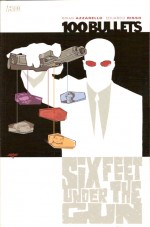
100 Bullets: A Foregone Tomorrow


By Brian Azzarello & Eduardo Risso (Vertigo)
ISBN: 978-1-84023-466-0

From being one of the best crime-comics in decades 100 Bullets gradually, cunningly transformed into a startlingly imaginative conspiracy thriller, with this fourth volume (collecting issues #20-30 of the much missed adult comic book) finally seeing a disparate range of previously seen strangers revealed as vital components in a vast and intriguing cast.

The tension begins with ‘The Mimic’, a captivating multi-layered allegorical vignette which features a conversation on a park bench between the mysterious Mr. Shepherd and young Benito Medici disclose some pertinent facts and intriguing conjectures about the enigmatic Agent Graves and his old associates “the Minutemen”, all whilst the life or death drama of a street corner gangsta’s life plays out to a lethal inevitable conclusion around them.

In the two-part ‘Sell Fish & Out to Sea’ “High” Jack Daw, sometime bouncer, doped-out addict and one more lost soul is offered a way to change his life with the now inescapable consequences. When he is handed a gun and those eponymous bullets he revisits all the family and friends he had left; looking for the reason he’d fallen so low. Only when he finally ascertained who was really responsible for his fall did he start using that untraceable weapon and ammunition…

East Coast gaming capitol Atlantic City is the venue for ‘Red Prince Blues’ and sees the return of super-bitch Megan Dietrich (see 100 Bullets: First Shot, Last Call) and ice-cold Benito, both scions of the mysterious Trust, but busily conspiring for their own unscrupulous futures as inveterate gambler Hank tries to win one last pot…

With a dying wife the last thing he needed was to get into a poker game with young Medici, but everything goes into a terminal spin when Graves, Cole Burns and Dizzy Cordova hit town. This three part saga provides more useful clues about the thirteen families that rule America, and when the head of one of those Trust clans dies after a parley with Graves the stakes are raised to a level that no one can afford…

‘Mr. Branch & the Family Tree’ returns us to Paris and Dizzy’s old instructor who unwisely reveals the secret history of The Trust and The Minutemen in a saucily novel manner; a classy yarn that sees guest artists Paul Pope, Joe Jusko, Mark Chiarello, Jim Lee, Lee Bermejo, Dave Gibbons, Tim Bradstreet, Jordi Bernet, Frank Miller and J.G. Jones supplement the always superb Eduardo Risso with a series of narrative pin-ups identifying the major players in this increasingly convoluted, compelling chronicle.

Next comes possibly the best single tale of the entire run as Agent Graves encounters a geriatric baseball star whilst delivering another briefcase. This is no mere fading star however, but a man who once wed the most glamorous movie star of her generation, a tragic woman who had an affair with a President and – apparently – took her own life. The still grieving widower is also someone a younger but just as resolute Graves left a briefcase with in early 1963…

‘Idol Chatter’ is a conspiracy nut’s dream, blending legend, myth and history into a clever, witty and punishingly poignant tale, even though the mordant black humour is never too far away…

This edgy epistle ends with the three part ‘¡Contrabandolero!’ as lowlife El Paso gas-station attendant Wylie Times meets Dizzy and Mr. Shepard before getting sucked into a crazy criminal scam to smuggle contraband from Mexico into the USA. Unfortunately things quickly go south in Juárez when the “exporter” insists that the illicit entrepreneurs also provide an over-sexed, under-age girl with a ride back to the Land of the Free…

Wylie just might be another Minuteman waiting to be reactivated, but you wouldn’t know it from this calamitous comedy of errors and terrors…

Bleak drama gradually gave way to dark gallows humour and the major characters were slowly showing softer sides but this high-octane thriller had lost of its verve with this volume. The unfolding saga remains an astoundingly accessible and readable thriller as the mystery of the Trust is revealed and Agent Graves begins the final stage of a plan decades in the making: 100 Bullets promises that the best is already here, but even better is waiting…

Entertainment starved story fans – grown-up, paid-up, immune to harsh language and unshocked by rude, very violent behaviour – should make their way to their favourite purveyor of fine fiction immediately and get these graphic novels at all costs.

© 2001, 2002 Brian Azzarello, Eduardo Risso and DC Comics. All Rights Reserved.
Comic Tales


By Angus McKie and others (Northern Lights Press/Titan Books)
ISBN: 0-946394-00-8

Here’s an intriguing piece of British comics history that also highlights the talents of one of our most gifted illustrators – although you’ll possibly know him as the air-brush guy who worked with Dave Gibbons on such projects as The Dome: Ground Zero, or from his work in 2000AD and the Megazine.

Angus McKie came out of the same Northern do-it-yourself-publishing and underground scene that gave us Bryan Talbot, Hunt Emerson, Alan Craddock and many others (in Britain, the North now starts just the other side of Hemel Hempstead and Watford is simply Greater London…).  He is an extremely adept and adventurous colour artist with a predilection for science fiction.

He studied graphic design at Newcastle College of Art in the 1970s before eventually working for a London agency, painting bookcovers and illustrations whilst producing intriguing strip work for various experimental comics publications such as Psst!

His most notable success was the selling of his seminal fantasy saga ‘So Beautiful, So Dangerous’ to the American adult fantasy magazine Heavy Metal, although he had previously contributed many tales to the original French parent publication Metal Hurlant.  ‘So Beautiful, So Dangerous’ became one of the strips adapted into the 1981 animated Heavy Metal movie.

In recent years he has worked extensively in the video games field.

This slim, full-colour and exceptionally readable tome is still readily available for discerning adults and features a spiffy selection of gloriously tongue-in cheek yarns. Beginning the spectacle is a political fable concocted with the assistance of Dave Huxley and Alan Craddock. ‘Wurtham View 2000’ is a creepy “big science” tale that examines the possible ramifications of a workable time-scanning television camera, and is followed by the sequel ‘Face of the Past’ which reveals its most probable uses, human nature being what it is…

More broadly comedic are the stylish gag strips ‘Tales of the Zen Masters: Nothing Exists’ and ‘Tales of the Sufi Masters’ whilst McKie displays his flair for the dramatic by working with William Shakespeare on ‘The King and I’ (that would be Lear, in case you’re wondering…). ‘The Appointment’ is an effective reinterpretation of the W. Somerset Maugham work Appointment in Samarra, and Craddock again assists on the sci fi gladiatorial spoof ‘Superhero.’

‘The Spirit of 67’ is a barbed and whacky reminiscence of past times that leads to a time travel tribulation whilst the sorry fate of two second-rate wannabe rock stars is scathingly described in ‘The Legend of the Magic Tone Box’ (written by Mike Feeney). The book ends with an extended satirical story of a misguided gang of radical anarchists with a big idea but not much of a clue in ‘Power to the People.’

McKie’s career path has taken him far from his comics roots but these little gems show an admirable disrespect for authority coupled to a highly accessible style of graphic narrative. While we’re all waiting for his next masterpiece why not track down this little gem and do a bit of time travelling of your very own?
© 1988 Junior Print Outfit.

The World of Ginger Fox


By Mike Baron and Mitch O’Connell (Comico)
ISBN: 0-938965-02-6

Let’s all pop back to the ever-so-now 1980s with this stylish and radically different kind of graphic novel that pretty much typified and encapsulated the dichotomies of the age of Big Hair and Brash Money.

Peppertree Studios used to be one of the biggest players in Hollywood, until the somber 1970s saw ill-conceived, big, worthy movies almost bankrupt the company. Now the dissolute boys-club of greedy old men who own the company are so desperate that they hire a woman to save or kill the studio. After all, they have nothing to lose…

Amidst a welter of rumour, innuendo and open hostility, Ginger Fox blows into town and into a storm of trouble as she drags the company kicking and screaming back towards profits and safety. Along the way she encounters psychotic, crazed art-house directors, rowdy martial-arts prima donnas, drugs and thugs and sabotage from within by two-faced back-stabbers who don’t like taking orders from a pretty young woman and especially not a single-mom, Hollywood outsider…

The tale takes a swift side-step into the weird – and lavishly violent – when a Martial Arts secret society threatens to kill anybody connected with the new movie that inadvertently reveals their sacred Negative Kung Fu technique to anybody and everybody with the price of a movie ticket.

Despite warnings from cops and Hong Kong action-star Jason Wu, Ginger refuses to worry – at least until the “accidents” start to happen and the bodies start to pile up. Meanwhile, one of her own directors is trying to oust her and Peppertree’s biggest remaining star is spiraling out of control on addictive binges…

This mélange of glamour, fashion, excess and sheer over-the-top style is an unbelievably heady and enticing brew, especially thanks to the sleek, beautiful, high-end art and design of O’Connell; a canny cultural scavenger whose slick blend of caricature, pop iconography and surreal whimsy elevate this tale to unprecedented heights of verve and dash.

Sexy, cinematically violent and wickedly tongue-in-cheek, this adult comics caper is markedly different from almost anything you’ve ever seen and thoroughly deserves another bite of the graphic novel cherry. If they’re bringing back the ’80s, you’re going to need this to remind you that it wasn’t all dreadful…
Story © 1986 Mike Baron. Artwork © 1986 Mitch O’Connell. All rights reserved.

The Witching Hour


By Jeph Loeb, Chris Bachalo & Art Thibert (Vertigo)
ISBN: 978-1-84023-251-6

I gather a new edition of this dark little treat is imminent so here’s a quick graphic novel review to whet your appetites and prime your bank accounts…

The original title the Witching Hour was a quirky, highly readable anthology comic from DC’s 1970s horror/mystery stable, with the early issues particularly memorable due to some extremely tasty contributions from arch-stylist Alex Toth. The pithy, spooky, mordantly ironic yarns were recounted by three iconic hosts representing the Wiccan concept of maiden, mother and crone and nominally based on the Weird sisters from Macbeth: namely Cynthia, Mildred and Mordred. The series ran from 1969 to 1978.

In 1999, with the company’s Vertigo imprint successfully reinventing the horror comic month by month, a number of old properties were given the proverbial fresh spin and Jeph Loeb and Chris Bachalo produced a delightfully dark, character-driven mystery yarn as a three issue prestige-format miniseries, promptly collected in a volume that unjustly vanished with nary a ripple of comment. Hopefully this time out it will garner some better press and attention…

In Manhattan, vivacious, exotic Amanda Collins visits a disparate, desperate selection of characters, daring them to trade-in their pasts and seize new futures. Dispensing blank business-cards and new realities to the lost, lonely and dangerous with but a wish, she seems the epitome of wild chance and missed opportunities, but Amanda too is a prisoner of the past, with a sorcerous heritage reaching back to 1660 and a romantic clash between Christian propriety and pagan license.

As other mysterious mystics also enfold fate-touched mortals in some enigmatic grand scheme – are they Amanda’s coven comrades or opponents in some grand game? – a centuries old debt is assessed… and perhaps repaid…

Vague as that sounds, it is all you need for this complex, intriguing, savage, seductive, sexy and addictively arcane experiment in sequential story-telling. The connections linking Amanda to her own past, her witchly companions and all the apparent innocents who accept her highly suspicious offer are deliberately obscure; thus the tale unfolds on a multitude of levels and the reader actually has to engage the brain to divine the hidden secrets of the Witching Hour.

Bachalo’s art is magic of the purely pictorial kind: as light and airy as clouds and deeply, densely, information-packed like a favourite grimoire. The section collecting his design sketches are sleek and pretty, everything an art-lover could want to see.

This is a book that washes over you like a wave, all mood and moment, and will offer a rare challenge for adult readers tired of being spoon-fed their fiction-fix.

© 1999, 2000 Jeph Loeb and Chris Bachalo. All rights reserved.

The Question volume 5: Riddles


By Dennis O’Neil, Denys Cowan, Bill Wray & various (DC Comics)
ISBN: 978-1-84856-513-5

This is a saga about dysfunction and a search for answers: Social, societal, political, emotional, familial and even methodological. The normal masked avenger tactics don’t work in a “real”-er world, and some solutions require better Questions…

Challenging Western dystopia with Eastern thought and martial arts action is not a new concept but O’Neil’s focus on cultural and social problems rather than histrionic super-heroics make this series a truly philosophical work, and Cowan’s raw, edgy art imbues this darkly adult, powerfully sophisticated thriller with a maturity that is simply breathtaking.

This fifth collection (reprinting issues #25-30) picks up from the shock ending of The Question: Welcome to Oz with ‘Skells’ illustrated by Cowan & Malcolm Jones III. New Mayor Myra Fermin-Connelly has been gunned down by her drunken, brain-addled husband and lies in a coma. Due to a quirk of Hub City law, with both current candidates unable to take office, the incumbent – despite being wanted for attempted murder – is technically next-in-line, and therefore de facto Mayor…

The tornado that struck the city on Election Day has finished the job begun by years of corruption and the gang warfare of the campaign. Hub City is a billion-dollar disaster zone. All essential services have ceased, the surviving populace are either rioting, looting or hiding. Food and water are running out.

State authorities are unwilling to step in and the urban hell-hole is poised to become a purely Darwinian jungle (this storyline probably inspired Batman’s ‘No Man’s Land’ publishing event) but all the Question wants to do is hunt down Myra’s addled husband/killer…

‘Riddles’ is a strange and melancholy Christmas divertissement, from fill-in penciller Bill Wray and Jones III which sees the Riddler, fresh out of jail and in a slump, catch a bus to Hub City and a new start. Sadly he picks the wrong girl to chat up and the result is the bloodiest and most senseless night of his life. It’s a genuine Christmas miracle that Vic Sage and Professor Rodor are on the same road that night…

With the city in turmoil, Myra in a coma, and no foe he can hit, The Question is helpless, but when the Prof reveals that his long-lost brother was a comic book artist in the 1940s it leads them all on a quasi-mystic quest which just might provide the mauled metropolis with its first glimmer of hope and recovery. ‘Captain Stars & Sergeant Stripes’ is illustrated by Cowan and Jones III, with Golden Age pastiche pages from Rick Stasi & Terry Beatty.

The last three tales here, also limned by Cowan and Jones, form an extended epic as the lethal Lady Shiva (see The Question: Zen and Violence) returns. Myra has emerged from her coma and taken charge, but with no resources and open warfare on the streets she is forced to take some extraordinary measures to restore order. In ‘A Place for the Arts’ Shiva, drawn to the chaos and ever-hungry to test her martial arts skills, offers her murderous services to one of the gangs trying to take over what’s left of Hub City, only to have her potential employers snatched from her as the new Lady Mayor convinces the warring thugs to become her new police force…

Incredibly disaster seems to have been averted until in ‘The Slaying’ one of the rival gang-lords is stabbed at a peace-conference and the Faceless Inquisitor has a murder to solve before the last remnants of hope are swallowed by renewed bloodshed. ‘Whodunit’ reveals all, but as is always the case in this superb series the answers are far from neat, tidy or satisfactory, and as always a moral and philosophical pall clouds the issues. And like a ghost Shiva stalks the city, ambivalent, ambiguous, unfathomable in her private purposes…

Like life, The Question never produces easy answers…

Bleak, brutal, confrontational and mordantly action-packed these tales come from one of DC’s very best series, and they form a perfect snapshot in comics history of a hugely creative and historically significant time. These graphic novels demonstrate just how evocative sequential narrative can be and no fan of serious fun literature or mature, sensitive escapism can afford to miss them.

© 1989, 2009 DC Comics. All Rights Reserved.
Abandoned Cars


By Tim Lane (Fantagraphics Books)
ISBN: 978-1-60699-341-5

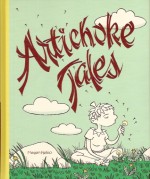
Tim Lane is a post-war American. His inner landscape is populated with B-Movies, Rock and Roll, junk-memorabilia, big cars with fins, old television shows, Jack Kerouac, the seven ages of Marlon Brando, pulp fictions, young Elvis, distilled Depression-era experiences (all of them from “The Great” to the latest), black and white images on TV, a loss of faith in old values, Mad Avenue propaganda, compromised ideals and frustrated dreams. He calls that oh, so plunderable societal gestalt and psychic landscape “The Great American Mythological Drama”, and in this first collection of his stark, intriguing comic strips he dips deep and concocts his own striking contributions to the Great Double Martini of Life…

Many modern Americans are using that shared popular culture to create new paintings and sculptures (see any of the numerous “lowbrow” or “pop surrealist” tomes by Schorr, Ryden, Ledbetter et al that we’ve reviewed here over the last few months) but Lane has eschewed the gallery art arena for his explorations, opting instead for the only true American medium of expression, the story, and toils bombastically in its ugly bastard offspring – Comics.

He draws in stunning black and white: hard-edged, uncompromising and enticingly moody, and these short stories, vignettes, observations and sequential investigations are far from the usual stock of funnies.

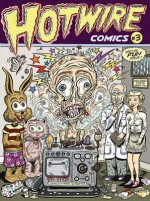
The contents here are culled from a number of sources such as Legal Action Comics, Hotwire, Typhon, Riverfront Times and his self-published magazine Happy Hour in America from 2003 to 2008, and range from tales of dark, eccentric whimsy (‘American Cut-Out Collectibles’, ‘The Manic-Depressive from Another Planet’ and ‘The Aries Cow’) to philosophically charged musings (‘Ghost Road’, ‘To Be Happy’ and ‘The Drive Home’), Pop cultural pastiches (‘Outing’ and ‘Doo-Wop and Planet Earth’ ) fascinating autobiography and reportage (‘Spirit’ parts 1-3, ‘In My Dream’ and ‘You Are Here: the Story of Stagger Lee’) to just plain old-fashioned noir-tinted thrillers like ‘Cleveland’ and  ‘Sanctuary’.

The book also contains numerous untitled, enigmatic and addictive short pieces, and for my money the most evocative and powerful piece herein is an all but wordless, two-page rumination on age and loss: ‘Those Were Good Years’. You’d have to be made of stone to be unmoved…

Crafting comics is clearly not a job or hobby for Lane. Serious artists have always struggled to discover greater truths through their creative response to the world, and he has obviously found his instrument in black line on white and his muse in the shabby, avuncular, boisterous, scary detritus of our everyday, blue-collar communal past. The result is stunning and highly intoxicating.

Questing, introspective, insightful and as desperately inquiring as the young Bob Dylan, with as many questions, even fewer answers and just as much lasting, life-altering entertainment to be derived…

Why haven’t you got this book yet?

© 2003 – 2008, 2010 Tim Lane. All rights reserved.

The Question volume 4: Welcome to Oz


By Dennis O’Neil, Denys Cowan, Rick Magyar & various III (DC Comics)

ISBN: 978-1-84856-328-5

The Question, created by Steve Ditko, was Vic Sage, a driven, obsessed reporter who sought out crime and corruption irrespective of the consequences. This Charlton ‘Action-Hero’ was purchased by DC when Charlton folded in 1983 and was the template for the compulsive Rorschach when Alan Moore and Dave Gibbons first drafted the miniseries that would become the groundbreaking Watchmen.

An ordinary man pushed to the edge by his obsessions, Sage used his fists and a mask that made him look utterly faceless to get answers (and justice) whenever normal journalistic methods failed. After a few minor successes around the DC universe Sage got a job in the town where he grew up.

Hub City (purportedly based on East St Louis) was a hell-hole, the most corrupt and morally bankrupt municipality in America. Mayor Wesley Fermin was a degenerate drunken sot and the real power was insane cleric Reverend Jeremiah Hatch. When Sage started cleaning house as The Question he was “killed”, rescued and resurrected by the inscrutable Shiva – the World’s deadliest assassin.

Crippled, he journeyed into the wilderness to be healed and trained by O’Neil’s other legendary martial arts creation, Richard Dragon.

It’s a new type of hero who returned to Hub City, philosophical rather than angry, but still cursed with a drive to understand how things universally go bad. The city has degenerated even further. Sage’s girlfriend is now Mayor Fermin’s wife, and crime and chaos are everywhere…

This fourth collection (reprinting issues #19-24 of the seminal 1980s series) brings to a head many of the dark plot threads that have been with the series since its inception. With Fermin permanently drunk and oblivious Sage has renewed his affair with Myra, even whilst she is running for her husband’s job.

Closet racist Royal Dinsmore has better ways of winning the race than smearing his opponent, but thanks to an extremely disturbed good citizen those plans are exposed in ‘The Plastic Dilemma’ (illustrated by Denys Cowan & Rick Magyar) and Myra refuses the financial support of a particularly unwholesome millionaire backer, whilst the emotional impact of her affair with Sage is revealed in ‘Send in the Clowns’ (an all-Magyar art job) a brutal tale of freaks, greed and prejudice.

Dick Giordano inks Cowan in ‘Rejects’ as psychopathic Junior Musto, returns (see The Question: Zen and Violence) to take a hospital hostage, demanding a heart transplant for the father who abused and tried to destroy him. That Greek tragedy leads into the main event…

‘Election Day (by Cowan & Malcolm Jones III): The Fix’ begins an agonising comedy of political errors as Dinsmore’s plan to steal the election is thwarted and he resorts to hiring a gang of Bikers to prevent the populace from voting – a t least those who can be bothered to turn out.

All the while Myra is having heartrending second thoughts. She doesn’t want to win but can’t afford to let a monster like Dinsmore gain control of her city. In the background her sot husband lurks; drunk deranged, bitter: clutching a bottle and a gun…

Some disquieting historical facts about Hub City are revealed in ‘Election Day: Welcome to Oz’ as the situation worsens. Open warfare in the streets is compounded by the arrival of a tornado that smashes most of the city to rubble, and the terrible conclusion ‘Election Day: The Dark’ sees Dinsmore defeated by a last-minute Machiavellian masterstroke from Vic Sage.

Mrya becomes the new Mayor of the biggest, most corrupt pile of rubble in America. A shot rings out…

Even ending on such a painful cliffhanger is grudgingly acceptable when the work is of such sterling quality and these eccentric epics are as readable now as they ever were. Complex characters, a very mature depiction of the struggle between Good and Evil using Eastern philosophy and very human prowess to challenge crime, corruption, abuse, neglect and complacency would seem to be a recipe for heady but dull reading yet these stories by one of the American industry’s greatest wordsmiths, and especially the mythic martial arts action delineated by Denys Cowan are gripping beyond belief and constantly challenge any and all preconceptions. So grab this book; absorb, enjoy and then move briskly on to the next volume.

I’m going to…

© 1988, 1989, 2008 DC Comics. All Rights Reserved.

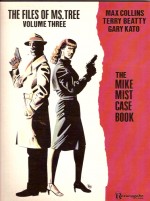
The Files of Ms. Tree volume 2: The Cold Dish


By Max Collins & Terry Beatty with Gary Kato (Renegade Press)
No ISBN: 0-919359-05-1

Despite being one of the most popular genres in literature and the fact that most fiction books are bought and read by women, Private Eye crime stories are desperately short of female protagonists. Marry that with the observation that “gum-shoe” comics are also as rare as hen’s teeth and it’s a wonder that a series such as Ms. Tree ever got off the drawing board.

The secret – as always – is quality.

The black widow of detective fiction first appeared in 1981 as a serial in the groundbreaking black-and-white anthology comic Eclipse Magazine, produced by crime novelist and new writer of the Dick Tracy, Max Allan Collins with young humour cartoonist Terry Beatty.

She soon won a solo title, Ms. Tree’s Thrilling Detective Stories (later simply Ms. Tree), and although the marketplace was not friendly to such a radical concept the series ran for 50 issues, and 2 specials, from three publishers (Eclipse, Aardvark-Vanaheim and Renegade Press, before finally dying in 1989. She was promptly revived as a DC comic in 1990 for another 10 giant-sized issues as Ms. Tree Quarterly/ Ms. Tree Special; three more blood-soaked, mayhem-packed, morally challenging years of pure magic.

Astonishingly, there are no contemporary collections of her exploits – despite Collins’ status as a prolific and best-selling author of both graphic novels (Road to Perdition, CSI and prose sequences featuring his crime-creations Nathan Heller, Quarry, Nolan, Mallory and a veritable pantheon of others).

In 2007 Collins released a classy prose novel, “Deadly Beloved” about his troubled troubleshooter, but thus far the Files of Ms. Tree volumes are the only place to find the collected exploits of this superb crime-stopper.

In the first volume I, For an Eye and Death Do Us Part we briefly met Mike Tree, a legendary private detective who married his secretary and partner Mike Friday, only to be murdered on their wedding night.

The new Mrs. Tree hunted down his killer, setting herself on a path of vengeance and blood. On the way she uncovered a vast web of corruption and made an eternal enemy of Mob boss Dominic Muerta, becoming locked in a bloody vendetta. She also discovered her dead husband’s previous wife and a son who was painfully like his departed dad…

This second volume, released in 1985 and reprinting her adventures from issues #4-8, has fewer behind-the-scenes extras and commentary but does include another colour cover gallery and an all-new and nasty illustrated prose short story, ‘The Little Woman’ to supplement the darkly engaging title tale.

Gary Kato joined the team as letterer and art assistant Beatty’s drawing took on a seductively Steve Ditko-like appearance whilst the drama became increasingly terse in ‘The Right to Remain Silent…’ and ‘No Use Crying’ as Mike Tree’s other wife briefly returns, begging Ms Tree to take her son into protective custody. She is murdered days later and as the detective spirits Mike Jr. away his grandparents violently disapprove, and Dominic Muerta sends an unmistakable message …

‘Paying Respects’ and ‘Forgive Her Trespasses’ introduces a new cast member, ex-SAS child protection expert Mr. Hand, to baby-sit the resentful boy whilst Ms Tree delivers a message of her own to Muerta, and the mystery deepens in ‘To the Slaughter’ as another viable suspect to Anne Tree’s murder appears – and bloodily expires, whilst in ‘Urbane Renewal’ the body count and suspect list rises again.

The action intensifies when Ms. Tree’s closest ally is blown up in ‘Visiting Hours’ and a vigil by his bedside leads to another grisly attempt on her life. ‘Knee-Deep in Death’ and ‘Accounts Payable’ finally provides the missing motive for the ongoing bloodbath, but with Mr. Hand attacked and Mike Jr. missing it might be all too late…

After all the Hitchcockian suspense the carnage and conundrums brilliantly culminate in ‘Murder-Go-Round’, a spectacular showdown that would do Sam Peckinpah proud…

Despite the tragic scenarios, ruthless characterisations and high body-count, this is another clever, funny affair steeped in the lore of detective fiction, stuffed with in-jokes for the cognoscenti (such as the unspoken conceit that the heroine Mike Friday is the daughter of legendary TV cop Joe “Dragnet” Friday or that in fiction absolutely no one can be trusted) and dripping in the truly magical gratification factor that shows complete scum finally get what’s coming to them…

Ms. Tree is the closest thing the American market has ever produced to challenge our own Empress of Adventure Modesty Blaise: how she can be left to languish in graphic obscurity is a greater mystery than any described in this compelling collection. Track down these superb thrillers and pray someone has the street smarts to bring her back for good…
© 1983, 1984, 1985 Max Allan Collins and Terry Beatty. All Rights Reserved.

Penny Century (Las Locas volume 4)


By Jaime Hernandez (Fantagraphics Books)
ISBN: 978-1-60699-342-2

Please pay attention: this book contains stories and images of an extremely adult nature, specifically designed for adult consumption and the kind of coarse and vulgar language that most kids are fluent in by the age of ten. If reading about such things is likely to offend you, please stop now and go away. I’ll be back with far more wholesome, family friendly and acceptable violence and explosions tomorrow. So come back then.

Love and Rockets is an anthology comics publication that originally featured slick, intriguing, sci-fi-ish larks, heart-warming, terrifying, gut-wrenching soap-opera fantasies and bold experimental comic narratives that pretty much defied classification, all wrapped up in the ephemera of the LA Hispanic and punk music scene. The synthesistic Hernandez Bros joyously plundered their own relatively idyllic childhoods to captivate with incredible stories that sampled a thousand influences conceptual and actual – everything from comics and TV through alternative music to German Expressionism and masked wrestlers.

Jaime Hernandez was always the most visible part of the graphic and literary revolution that is Love and Rockets, his slick, seductive, clean black line and beautiful composition, not to mention impeccably rendered heroes and villains and the comfortingly recognisable comic book iconography, being particularly welcomed by readers weaned on traditional Marvel and DC superheroes.

However his love of that material, as well as the best of Archie Comics cartoonists (I often see shades of the great Sam Schwartz and Harry Lucey in his drawing and staging), accomplished and enticing as it is, often distracted from the power of his writing, especially in his extended saga of Maggie Chascarillo and Hopey Glass – Las Locas.

Palomar was the conceptual and cultural playground of brother Gilberto, whilst Jaime initially began with a fantasy-tinged adventure serial (as seen in volume #1 ‘Maggie the Mechanic’) which eventually evolved into a prolonged examination of love and friendship as Maggie and Hopey, chums since childhood and occasional lovers, drifted into and away from each other over the years. The later stories also yielded focus to an increasing number of truly unique friends and acquaintances…

This volume ostensibly stars Hopey’s lifelong friend and wild child Beatriz Garcia who meticulously reinvented herself as the cosmic starlet and ambiguous super-heroine Penny Century, but the whole utterly magnetic cast are on board for a series of revelatory tales, casting light on both the shadowy histories and portentous futures as Maggie and Hopey approach middle age – still beautiful, still feisty but not really that much wiser…

Collected from the spin-offs and miniseries ‘Whoa Nellie!’, ‘Maggie and Hopey Color Fun’ and ‘Penny Century’ produced between 1996 and 2002, the pageant of wonders begins with a disturbingly compelling side-trip into the world of women’s wrestling, following the lives and glory-days of two women as they strive to become tag-team champions: a visually mesmeric and touchingly poignant dissection of an extraordinary friendship.

The spotlight lands squarely on Hopey in the second extended tale as the older but no wiser wildcat revisits her good old days with Maggie, before the main event, told through a succession of short stories, commences. Beginning with two instalments of ‘Locas’, and three of ‘Penny Century’ the narrative is interspersed with nineteen fascinating complementary vignettes and sidebars such as ‘La Pantera Negra’, ‘Hopey Hop Sacks’, ‘Look Out’, ‘Chiller!’, ‘C’Mon Mom!’, and ‘Loser Leave Oxnard’ – the secret origins of most of the extended cast are laid bare in progressively more funny and tragic tales of missed opportunities and lost last chances…

Every bit as surreal and meta-fictional as brother Beto’s incredible tales of Luba and Palomar, Jaime’s continuing development as a writer both stirring and meaningful is a delight to experience, whilst his starkly beautiful drawing – even when he affectionately dabbles with other styles – is an utter joy. It’s an amazing trick to tell such wistful, insightful and even outright sad stories with so much genuine warmth and slapstick humour but this book easily pulls it all off.

You’ll laugh, you’ll cry, and you’ll own one hell of a good book when you buy Penny Century… and you may regret it forever if you don’t.
© 2010 Gilbert Hernandez. All Rights Reserved.

High Soft Lisp


By Gilbert Hernandez (Fantagraphics Books)
ISBN: 978-1-60699-318-7

Please pay attention: this book contains stories and images of an extremely adult nature, specifically designed for adult consumption and the kind of coarse and vulgar language that most kids are fluent in by the age of ten. If reading about such things is likely to offend you, please stop now and go away. Tomorrow I’ll write about something with violence and explosions, so come back then.

In addition to being part of the graphic and literary revolution that is Love and Rockets (where his astonishingly compulsive tales of Palomar and the later stories of those characters collected as Luba gained such critical acclaim) Gilbert Hernandez has produced stand-alone tales such as Sloth, Grip and Girl Crazy, all marked by his bold, instinctive, simplified line artwork and a mature, sensitive use of the literary techniques of Magical Realist writers Carlos Fuentes and Gabriel García Márquez: techniques which he has added to and made his own.

Love and Rockets is an anthology comics publication that features slick, intriguing, sci-fi-ish larks, heart-warming, terrifying, gut-wrenching soap-opera fantasy and bold experimental comic narratives that pretty much defy classification. The synthesistic Hernandez Bros still captivate with incredible stories that sample a thousand influences conceptual and actual – everything from Archie Comics and alternative music to German Expressionism and masked wrestlers.

Palomar was the conceptual and cultural playground of Gilberto, created for the extended serial Heartbreak Soup: a poor Latin-American village with a vibrant, funny and fantastically quotidian cast. Everything from life death, adultery, magic, serial killing and especially gossip could happen in the meta-fictional environs of Palomar, and did, as the artist explored his own post-punk influences, comics, music, drugs, comics, strong women, gangs, sex, family and comics, in a style that seemed informed by everything from Tarzan comics to Saturday morning cartoons and the Lucy Show.

Beto, as he signs himself, returns to Palomar constantly, usually with tales involving the formidable matriarch Luba, who ran the village’s bath house, acted as Mayor and sometimes police chief – as well as adding regularly and copiously to the general population. Her children, brought up with no acknowledged fathers in sight, are Maricela, Guadalupe, Doralis, Casimira, Socorro, Joselito and Concepcion.

Luba eventually migrated to the USA and reunited with her half-sisters Petra and the star of this volume, Rosalba “Fritz” Martinez. This collection was compiled from assorted material that first appeared in Love and Rockets volume II and Luba’s Comics and Stories, with some new pages and many others redrawn and rewritten.

Fritz is a terrifyingly complex creature, a psychiatrist, therapist, B-Movie actress, belly dancer, drunk, gun-fetishist, sexually aggressive and a manipulative serial spouse. Beautiful, enticingly damaged, with a possibly intentional speech impediment she sashays from crisis to triumph and back again, and this moving, shocking, funny chronicle uses the rambling recollections of one of her husbands, motivational speaker Mark Herrera, to follow her life from punkette outsider at High-School through her various career and family ups and downs.

Under the umbrella title of ‘Dumb Solitaire’ what purports to be the memoir of Senor Herrera reveals in scathing depth the troubled life of the woman he cannot stay away from, in an uncompromising and sexually explicit “documentary” which pulls no punches, makes no judgements and yet still manages to come off as a feel-good tale.

High Soft Lisp is the most intriguing depiction of feminine power and behaviour since Flaubert’s Madame Bovary – and probably just as controversial – with the added advantage of Beto’s intoxicating drawing adding shades of meaning that mere text just cannot impart.

Very funny, very moving, remarkable and unmissable: no mature fan of the medium can afford to miss this treat.

© 2010 Gilbert Hernandez. All Rights Reserved.