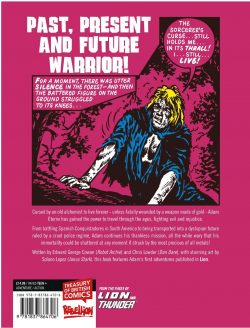
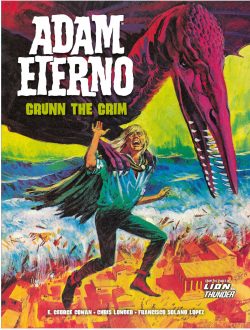
Adam Eterno book 2: Grunn the Grim


By E. George Cowan, Chris Lowder, Tom Tully, Francisco Solano López, John Catchpole, Eric Bradbury, with Jack Le Grand, Geoff Kemp, Tom Kerr & various (Rebellion)
ISBN: 978-1-83786-470-6 (TPB/Digital edition) 978-1-83786-480-5 (Exclusive edition)

This book includes Discriminatory Content produced in less enlightened times.

Win’s Christmas Gift Recommendation: History in the Unmaking… 9/10

British comics had a strange and extended love affair with what can only be described as “unconventional” (for which feel free to substitute “creepy”) heroes. So many of the stars and potential role models of our serials and strips were just plain “off”: self-righteous, moody voyeurs-turned vigilantes like Jason Hyde, sinister masterminds like The Dwarf, deranged geniuses like Eric Dolmann, so many reformed criminals like The Spider or just outright racist supermen like Captain Hurricane

… And don’t get me started on our legion of lethally anarchic comedy icons or that our most successful symbol of justice is the Eagle-bedecked jack-booted poster boy for a fascist state. Perhaps that explains why these days we can’t even imagine or envision what a proper leader looks like and keep on electing clowns, crooks and oblivious privileged simpletons…

All joking aside, British comics are unlike any other kind and simply have to be seen to be believed and enjoyed. One of the most revered stars of the medium has finally begun to be collected in archival editions, and perfectly encapsulates our odd relationship with heroism, villainy and particularly the murky grey area bridging them…

Until the 1980s, comics in the UK were based on an anthological model, offering variety of genre, theme and character on a weekly – or sometimes fortnightly – basis. Humorous periodicals like The Beano were leavened by thrillers like Billy the Cat or General Jumbo and adventure papers like Lion or Valiant always included gag strips such as The Nutts, Grimly Feendish, Mowser and a wealth of similar quick laugh treats. Thunder and Jet were amongst the last of this fading model. Fleetway particularly was shifting to themed anthologies like Shoot, Action and Battle, whilst venerable veterans like Lion, Valiant and Buster hung on and stayed fresh by absorbing failing titles.

Thunder ran for 22 weeks before being absorbed by a stronger title to become Lion & Thunder. The merger/acquisition brought Black Max, The Steel Commando, The Spooks of Saint Luke’s and Adam Eterno to the new combined roster. With Steel Commando, time travelling tramp Adam would survive and thrive, as the periodical later merged into Valiant & Lion (June 1974) until the ultimate end in 1976. He also appeared in numerous Annuals and Specials thereafter.

Eterno was initially devised by Thunder assistant editor Chris Lowder – AKA “Jack Adrian” – and editor Jack Le Grand, with top flight artist Tom Kerr (Monty Carstairs, Rip Kerrigan, Kelly’s Eye, Charlie Peace, Captain Hurricane, Steel Claw, Kraken, Mary-Jo, Tara King/The Avengers, Billy’s Boots) initially designing and visualising the frankly spooky antihero. He also drew the scene-setting first episode. The feature was scripted by equally adept and astoundingly prolific old hand Tom Tully (Roy of the Rovers, Heros the Spartan, Janus Stark, The Wild Wonders, Dan Dare, Johnny Red, The Leopard from Lime Street), who only finally left it in 1976. Kerr, Donne Avenell, Scott Goddall &Ted Cowan would also write subsequent adventures. In fact, Tully might have scripted some of the material in this collection including the first instalment here: a handy recap/catchup limned by Francisco Solano López (and his family studio) that swiftly shifts to a gripping tale of “Conquistadore” atrocity…

Thanks to spotty record keeping, like so much in life and comics, it’s all a big mystery…

Gathering episodes from weekly Lion & Thunder spanning March 20th through August 28th 1971, plus pertinent material from Lion & Thunder Holiday Special 1971 & 1972, the chronal calamities and dark doings resume following Chris Lowder’s informative flashback essay ‘A Writer’s Trip Through Time’.

What you need to know: Delivered in stark, moody monochrome, the saga tales of tragic immortal chronal castaway Adam Eterno began life in the 16th century. He was an ambitious apprentice and less than sterling moral character, indentured to alchemist Erasmus Hemlock. When Adam’s master perfected an immortality serum, the headstrong, impatient acolyte sampled the potion against the sage’s express command. This precipitated the ancient’s death and a fiery conflagration that gutted the house. Hemlock’s last act was to curse his faithless student to live forever and “wander the world through the labyrinths of time”. Surcease would come from a mortal blow struck by a weapon of gold…

The curse was truly effective and as centuries passed, Adam became a recluse: his never-changing appearance driving him away from superstitious mortals and perpetually denying him simple contact with humanity. He fought in all of Britain’s wars, but hard-earned combat comradeships always ended whenever a seemingly fatal blow or wound left him unharmed…

Everything changed and the second part of the alchemist’s curse came true in 1970 when the traumatised, barely sane 421-year-old tramp staggered into a bullion robbery. He was shot by the thieves who rapidly realised that their victim was invulnerable, and attempted to use him in a raid on the Bank of England. When that went sideways too, Adam was struck by a fully-gold-plated limousine of a speeding millionaire…

The impact would be fatal for any other being, but for Adam Eterno it was the beginning of redemption as the shock hurled him into the timestream to land over and again in different eras…
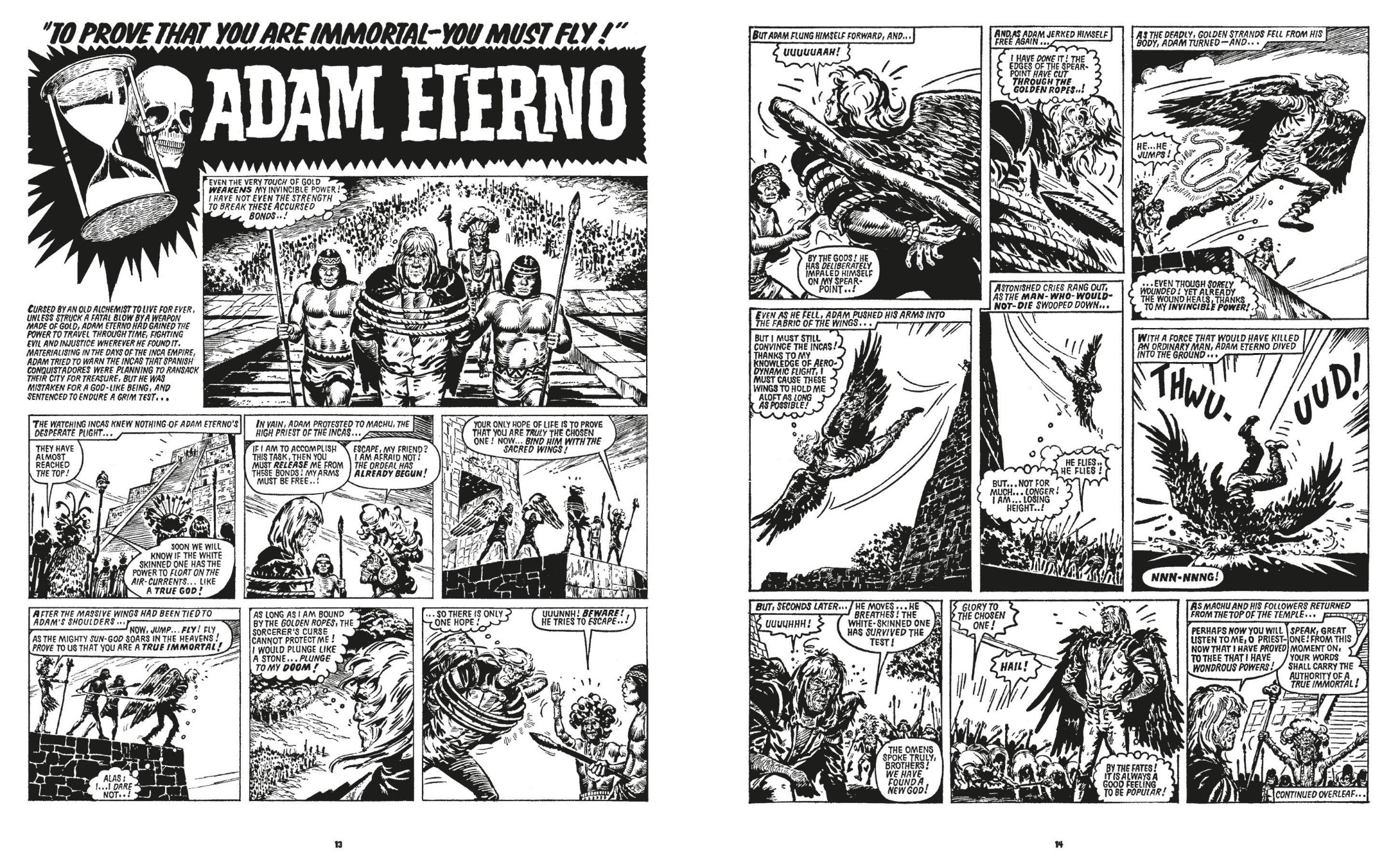
The drama continues in that opening recap as Adam drops out of the timestream and is immediately cut down and hurled into quicksand by rapacious Spaniard Don Morto and his pitiless mercenarios, seeking the Incas fabled City of Gold. Dragging himself out of the mire, soon Adam is sought out by an Inca shaman and undergoes outrageous trials (many involving bonds and weapons of gold!) to become their champion in defeating the merciless invaders and liberating hostage king Tazuma Capa

The resistance is long and bloody but ultimately triumphal after Eterno introduces and mass-produces a weapon from the future that turns the tables on the armour, powder and shot of the invaders…

The bittersweet victory – after all, the traveller already knows more invaders will follow and ultimately succeed – sees Adam returned to chronal limbo only to rematerialise for the first time in the far future: a totalitarian dictatorship policed by brutes and thugs in armour of gold led by a monstrous tyrant: Grunn the Grim. The extended war to liberate tomorrow ends successfully but with the wanderer again returned to falling through eras, with the first hints that the penitent troubleshooter is not randomly drawn to rising manifestations of evil and crossroad moments of menace…

The latest stopover is Dark Ages Eastern Europe where a struggle for the throne sees an evil yet trusted relative seeking to usurp Duke Ctharmis of Carathia, after abducting the prince and true heir. Now as a local wild-child terrorises the populace, and packs of (were?)wolves congregate everywhere, a tatty stranger arrives and starts making trouble. Nobody knows Adam has been recruited by local wizard Mageis to set destiny aright and end the schemes of wicked Baron Draxa, before being deposited in far more familiar territory: England during the Civil War…

Obsessive anti-royalist Captain Raker ravages the locality searching for Lord Benham and the funds he holds in the King’s name. His brutal acts draw the immortal man into the pointless conflict, despite persistent, prophetic visions of doom hampering the antihero… until a final face-to-face duel ends matters and catapults Adam into the New World and a new kind of wickedness. In 1920s New York City, money not power motivates mobster Rikki Delgano, but his tactics are just as cruel and just as ineffectual against an enemy who will not die…
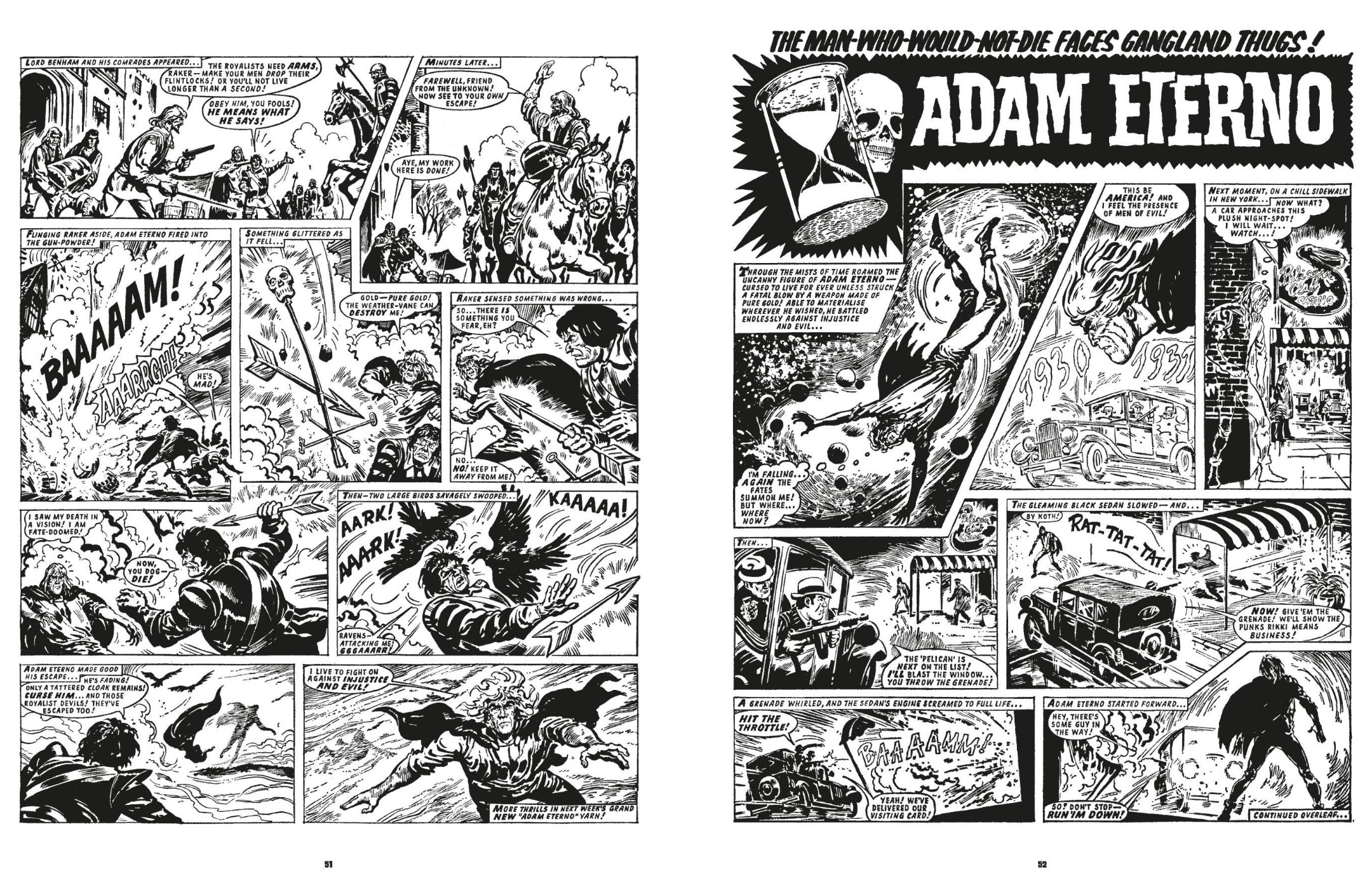
The crook’s hash soon settled, Eterno next appears in the skies over London amidst a storm of ack-ack fire and Luftwaffe planes. Furious and fighting mad, the traveller captures a Nazi bomber and follows the raiders back to their base, delivering a deadly dose of “how do you like it?” before ghosting on to land in the wild west and exonerate unjustly accused drifter the Durango Kid when both are charged with stagecoach robbery. Dodging gunplay and lynchings, Apache tortures and worse, Adam deftly exposes the real bandit before moving on to save all of humanity…

Lost in the early years of the stone age over 35,000 years before his own birth, Eterno roams amidst mammoths, neanderthals and dawn men, but must battle beast men armed with ray guns to foil a plan by alien colonisers. They seek to eradicate emerging humankind and take the world for their own, but Adam is greatly aided by prescient sage Kathon-the-Wise, who seems to see all his past and future secrets… and bears a remarkable resemblance to so many other wizards and mages the nomad of the ages has met…

After a cataclysmic pitched battle, humanity is saved and the spacers defeated, but there’s no rest for the (gradually redeeming) wicked and Eterno lands in shark-filled waters just in time to become the latest target of pirate lord Blackbeard. On foiling that felon, the winds of time waft him to a Viking raid in Anglo-Saxon England where pitiless reiver Geflin One-Eye seems set on taking the kingdom, unless some brave soul can retrieve the fabled Gold Sword of Wulfric from the abbey where it lies and lead the counterattack. Obviously, Adam is not keen on getting that close to his metal nemesis but if the situation demands it…

Bombastic, blood-soaked, inspirational and creepier than you’d imagine possible or permissible in a kids’ comic. the exploits of Adam Eterno are dark delights impossible to put down, so it’s fortunate that there are two more longer complete yarns still to come here.

Taken from Lion & Thunder Holiday Special 1971, the first sadly uncredited yarn (as regards the writer at least) was illuminated by veteran comics illustrator John Catchpole. He was the first to draw Kelly’s Eye – in 1962 for Knock-Out – and limned The Shadow of the Snake & sequel serial Master of Menace between 1972-1974 in Lion where he was part of a rotating team crafting Adam Eterno. As well as Annuals material like Black Bedlam (1975) he inked Jack (Charlie Peace) Pamby on The Potters from Poole Street in Valiant (1976) and was also a book illustrator.

Here all that skill and aplomb is used to detail a moody Victorian mystery as the immortal nomad helps the last of the Calcott line locate a lost family fortune and avoid murder by a monster…

Wrapping up proceedings on a true high (and also lacking a writer credit) the 1972 Adam Eterno special tale was illustrated by the magnificent and prolific Eric Bradbury (1921-2001) began in 1949 in Knockout.

Frequently working with studio mate Mike Western, Bradbury drew strips like Our Ernie, Blossom, Lucky Logan, Buffalo Bill, No Hiding Place, The Black Crow and Biggles. He was an “in-demand” illustrator well into the 1990s, on landmark strips such as The Avenger, Cursitor Doom, Phantom Force 5, Maxwell Hawke, Joe Two Beans, Mytek the Mighty, Death Squad, Doomlord, Darkie’s Mob, Crazy Keller, Hook Jaw, The Sarge, Invasion 1984, Invasion (the unrelated 2000 AD strip), Mean Arena, The Fists of Jimmy Chang, The Dracula Files, Rogue Trooper, Future Shocks, Tharg the Mighty and much more…

All that imagination and experience are seen here, when Adam appears in ancient Atlantis: a dinosaur-infested paragon of human ingenuity and political depravity where a tyrannical queen and audacious space shot lead to the destruction of Earth’s first human civilisation…
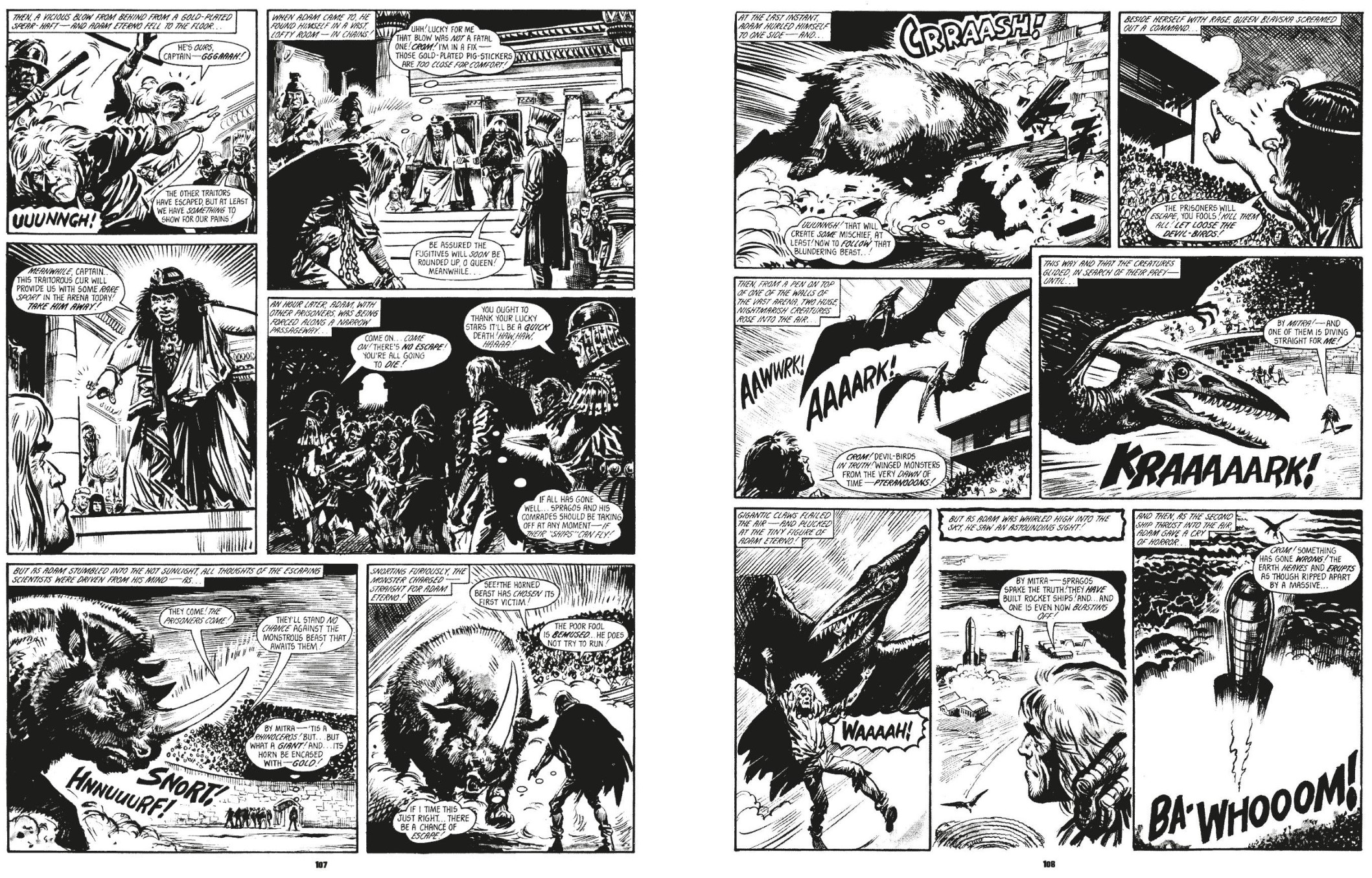
Closing with biographies on the creators featured herein and ads for other British lost wonders Adam Eterno – Grunn the Grim is enthralling astonishment awaiting your gaze: a riotously rewarding rollercoaster ride to delight readers who like their protagonists dark and conflicted and their history in bite-sized bursts.
© 1971, 1972, & 2025 Rebellion Publishing IP Ltd. All Rights Reserved.

Today in 1952 the last weekly instalment of Will Eisner’s Spirit Comics Section was published, whilst in 1974 the final Shiver and Shake entertained diehard UK readers.

In 1994, comics and animation giant Doug Wildey went to the final roundup. Remembered for Tarzan, The Saint newspaper strip and Jonny Quest, he’d prefer you read his elegiac westerns like Doug Wildey’s Rio: The Complete Saga.
The Complete Peanuts volume 1: 1950-1952


By Charles Schulz (Canongate Books/Fantagraphics Books)
ISBN: 978-1-56097-589-2 (Fantagraphics HB) 978-1-60699-763-5 (Fantagraphics TPB) 978-1-84767-031-1 (Canongate)

This book includes Discriminatory Content produced in less enlightened times.

Win’s Christmas Gift Recommendation: All that’s great about cartoon strips… 10/10

Peanuts is unequivocally the most important comics strip in the history of graphic narrative. It is also the most deeply personal. Today in 1950 it all began, and cartoonist Charles M Schulz went on crafting his moodily hilarious, hysterically introspective, shockingly surreal philosophical epic for half a century: 17,897 strips spanning October 2nd 1950 to February 13th 2000.

He died from complications of cancer the day before his last strip was printed.

At its height, Peanuts ran in 2,600 newspapers, in 21 languages and in 75 countries. Many of those venues still run it as perpetual reprints, and have ever since his death. During Schulz’s lifetime, book collections, a merchandising mountain and television spin-offs had made the publicity-shy doodler an actual billionaire at a time when that really meant something…

None of that matters. Peanuts – a title Schulz loathed, but one the syndicate forced upon him – changed the way comics strips were received and perceived: proving cartoon comedy could have edges and nuance and meaning as well as soon-forgotten pratfalls and punchlines.

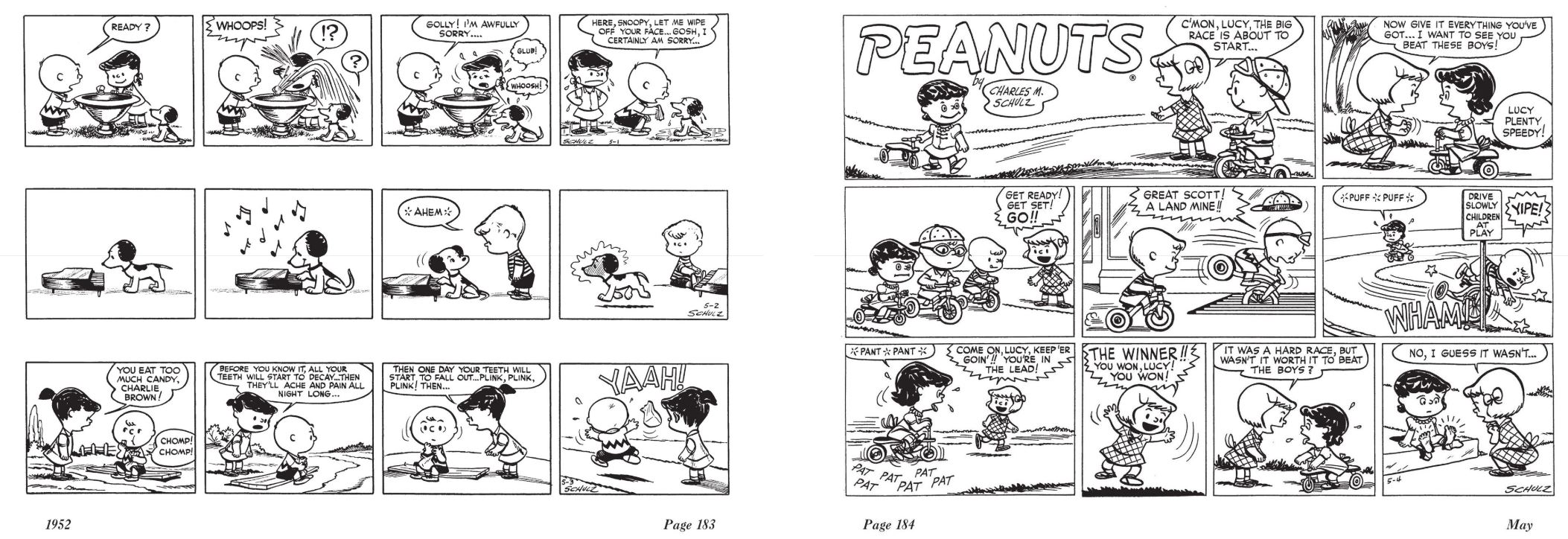
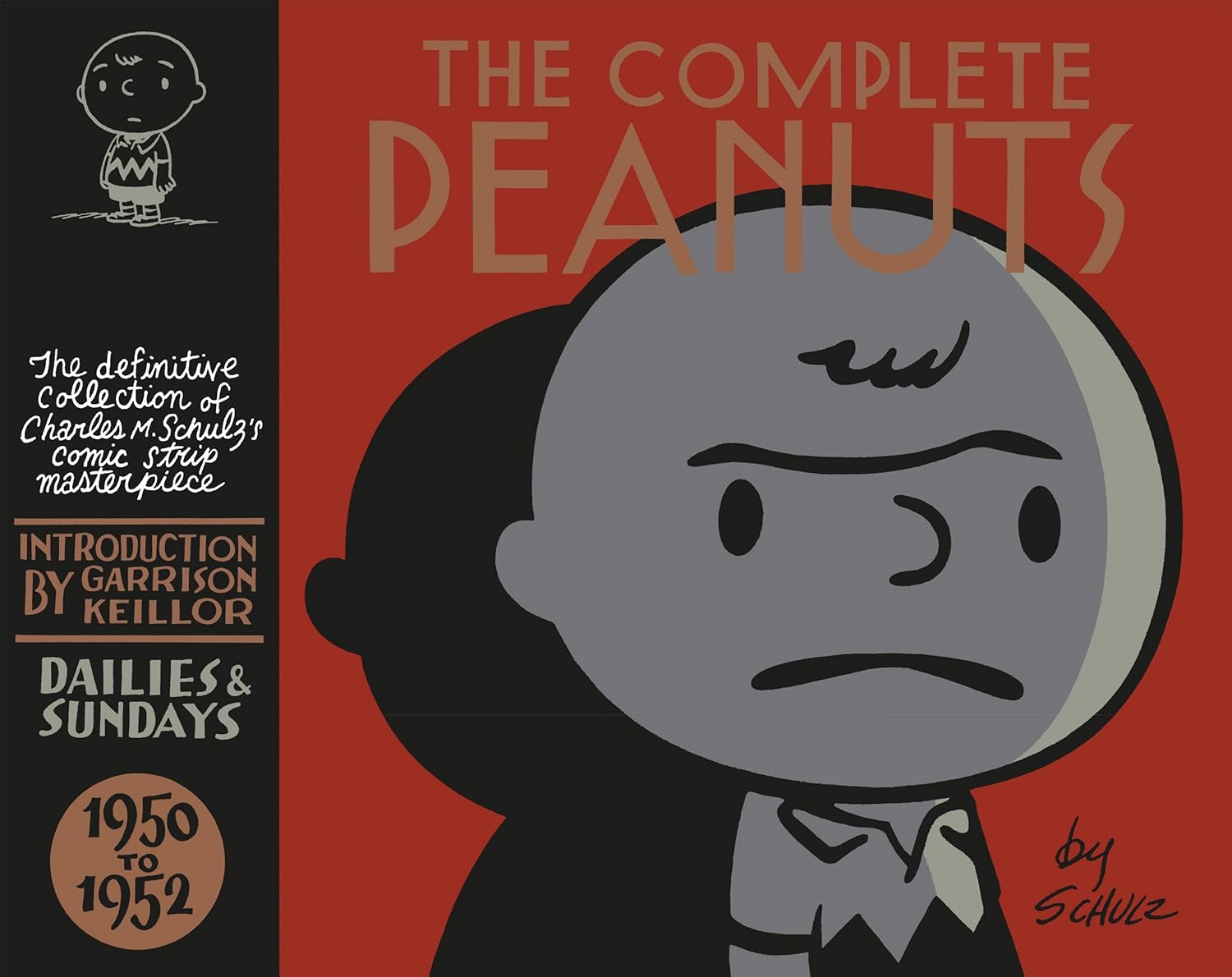
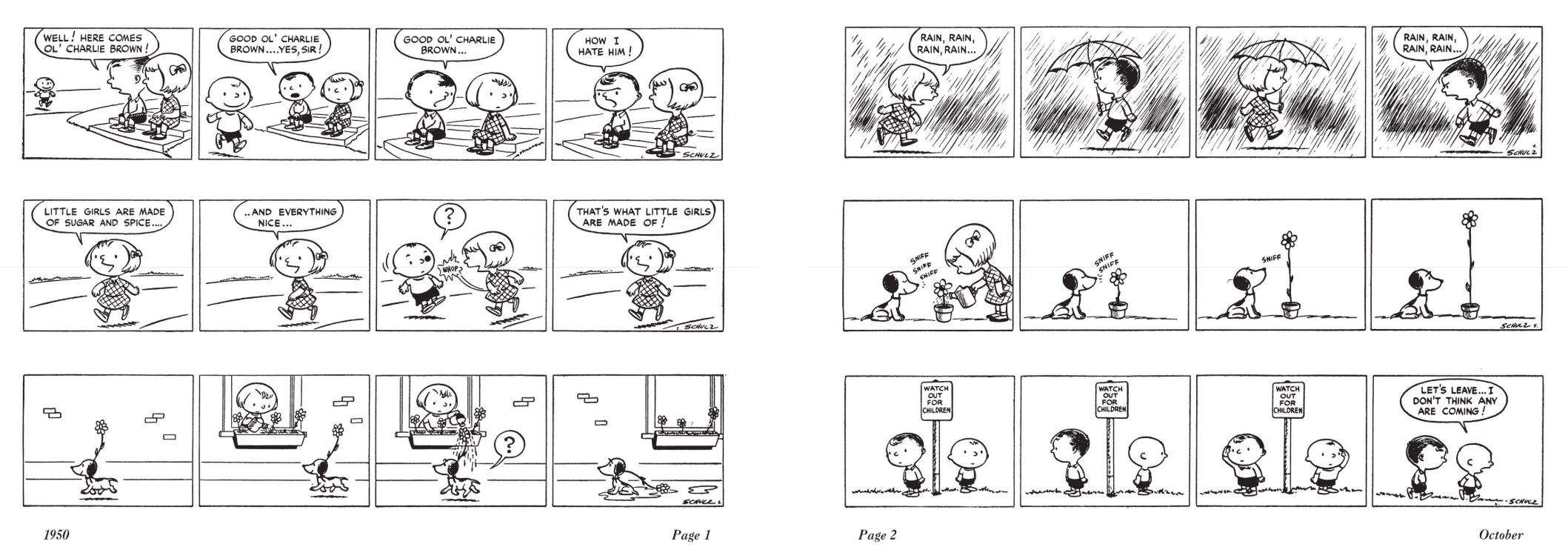
Following a typically garrulous, charming and informative Introduction from fellow Minnesotan Garrison Keillor, this mammoth (218 x 33x 172 mm) landscape compendium offers the first two and a bit years. Here a prototypical, rather outgoing and jolly Charlie Brown and high-maintenance mutt Snoopy joined with bombastic Shermy and mercurial Patty in hanging out doing kid things.

These include playing, playing pranks, playing sports such as tennis, golf and baseball, playing musical instruments, teasing each other, making baffled observations and occasionally acting a bit too much like grown-ups. Fans of Bill Watterson’s Calvin and Hobbes will feel eerie familiarity with much of the hijinks and larks of these episodes.

As new characters Violet, infant prodigy Schroeder, and Lucy and her strange baby brother Linus were added to the mix, the boisterous rush of the series began to imperceptibly settle into a more contemplative pace. Charlie Brown began to adopt and embrace his eternal loser, singled-out-by-fate persona and the sheer diabolical wilfulness of Lucy began to sharpen itself on everyone around her…

The first Sunday page debuted on January 6th 1952; a standard half-page slot offering more measured fare than the daily. Both thwarted ambition and explosive frustration became part of the strip’s signature denouements…

By the end of 1952, all those the rapid-fire gags had evolved from raucous slapstick to surreal, edgy, psychologically barbed introspection, garnished by crushing judgements and deep rumination in a world where kids – and certain animals – were the only actors. The relationships, however, were increasingly deep, complex and absorbing even though “Sparky” Schulz never deviated from his core message: entertain…

David Michaelis then celebrates and deconstructs ‘The Life and Times of Charles M. Schulz’ after which Gary Groth & Rick Marschall conduct ‘An Interview with Charles M. Schulz’, rounding out our glimpse of the dolorous graphic genius with intimate revelations and reminiscences whilst a copious ‘Index’ offers instant access to favourite scenes you’d like to see again.

Readily available in hardcover, paperback and digital editions, this initial volume offers a rare example of a masterpiece in motion: comedy gold and social glue gradually metamorphosing in an epic of spellbinding graphic mastery which became part of the fabric of billions of lives, and which continues to do so long after its maker’s passing.

Happy ever afters, kids.
The Complete Peanuts: 1950-1952 (volume 1) © 2004 Peanuts Worldwide, LLC. Introduction © 2004 Garrison Keillor. “The Life and Times of Charles M. Schulz” © 2000 David Michaelis. “Interview with Charles M. Schulz” © 2004 Gary Groth and Richard Marschall. All other material copyright its respective owners. All rights reserved.

Today in 1909 Alex Raymond was born. You’ll know him best for stuff like Flash Gordon on the Planet Mongo volume 1: Sundays 1934-1937 (The Complete Flash Gordon Library. In 1916 Bob Powell, was born. He went on to do things like Bob Powell’s Complete Jet Powers.

Ramona Fradon was born in 1926, and Spirou stalwart Janry arrived in Belgium in 1957, whilst Maltese docu-comics journalist Joe Sacco was born in 1960. You can find dozens of books by the first two just by using a search box here, and I’ve almost summoned enough nerve to review Sacco’s Palestine despite – or because of – these febrile times…

The Shadow 1941: Hitler’s Astrologer


By Dennis O’Neil, Michael William Kaluta & Russ Heath with Mike Kelleher, Mark Chiarello, Nick Jainschigg, John Wellington, Phil Felix & various (Dynamite Entertainment)
ISBN: 978-1-60690-429-9 (HB/Digital edition)

This book includes Discriminatory Content included for dramatic effect.

Russ Heath would have been 99 years old today: a master comics craftsman so few have ever heard of. I don’t think there’s even a definitive collection or a signature title to his name. He did his job masterfully and always moved on, and remains almost practically unknown. The pages of Sgt Rock original art I own are among my most treasured possessions, and every baby boomer who read US comics knew his work because of this and others like it.

Russell Heath Jr. was born in New York City on September 29th 1926 and raised in New Jersey. Influenced by cowboy artist Will James and others, Heath was self-taught and fiercely diligent, demanding authenticity of himself in all his work. This helped him break into comic books while still at High School (episodes of naval strip Hammerhead Hawley for Captain Aero Comics beginning with vol. 2, #2 in September 1942).

Eager to serve his country, Heath left Montclair High School early in 1945 for the Air Force. Whilst in the military he contributed cartoons to the Camp newspaper before shipping out. When peace broke out, he worked briefly as an ad agency gofer until in 1947 he landed a regular job with Timely Comics. Now married, Heath started working from home, drawing Kid Colt and Two Gun Kid, offerings for the dwindling superhero market and sundry horror stories and covers. He hit an early peak in the 1950s, with a wealth of western and horror features as well as co-creating Marvel Boy, limning Venus and The Human Torch during the abortive attempt to revive superheroes in 1953, whilst mostly crafting crime and romance tales,

He branched out: trying his hand on EC’s Mad and Frontline Combat, 3D comics for St. John’s and earned a reputation for gritty veracity in war and straight adventure stories (such as Robin Hood and Golden Gladiator for DC’s The Brave and the Bold). Heath started contributing to DC’s war line in early 1954, with strips in Our Army at War #23 and Star Spangled War Stories #22. It was good fit and he spent the next 15 years working with writer/editor Robert Kanigher, with whom he co-created The Haunted Tank, Losers and Sea Devils. All along he remained a stalwart of anthological compact combat yarns, but increasingly guested on and eventually took over full time illustrating prestigious Sgt. Rock.

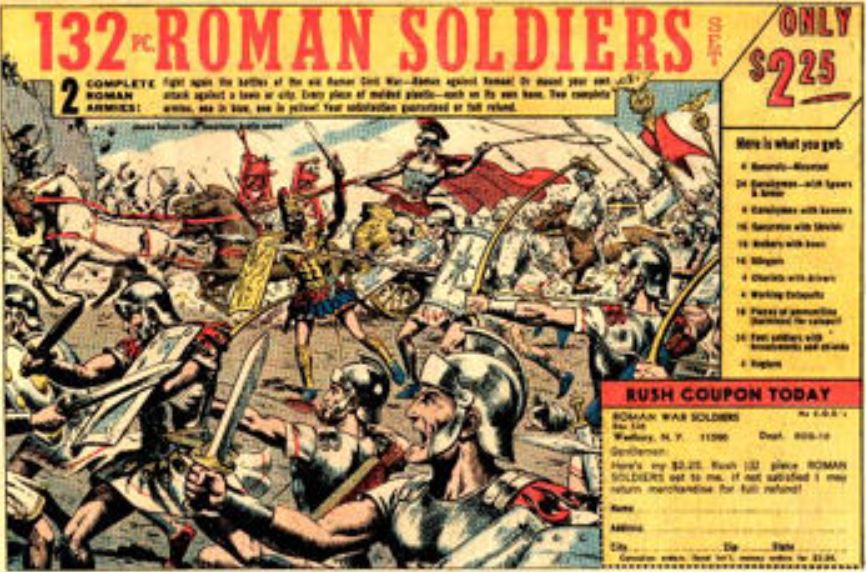
Infamously and unjustly, many of his panels were co-opted by pop artist Roy Lichtenstein as the basis of his paintings (specifically Whaam!, Blam, Okay Hot-Shot, Okay!, and Brattata). Heath’s other contributions to American pop culture include those iconic ads for toy soldiers and a stint on Harvey Kurtzman and Will Elder’s ubiquitous Playboy satire strip Little Annie Fanny. Later landmarks include launching a new Lone Ranger newspaper strip with Cary Bates in 1981, and illustrating Michael Fleisher’s infamous Death of Jonah Hex story. Eventually he moved into animation and out to the west coast, but remained in contact with his comics roots, providing occasional returns on titles such as Planet of the Vampires, Mister Miracle, Ka-Zar, The Punisher, Shadowmasters, G.I. Joe and Immortal Iron Fist among others. Having been awarded almost every award going, Heath was in semi-retirement when he died on the 23rd August 2018.

Despite adoring all that apparently unhip war and western stuff, we’re being contrary as ever and highlighting something a little different, but as it’s a special occasion you might want to also track down Hearts and Minds: A Vietnam War Story please link to 29th August 2018. Not our review, the actual book. It’s a Lost Treasure…

Here and now though let’s pop back to the early 1930s, when The Shadow gave thrill-starved Americans their measured doses of extraordinary excitement via cheaply produced pulp periodical novels and over the mood-drenched airwaves via his own radio show. Like comics once upon a time, “Pulps” were published in every style and genre in their hundreds every month, ranging from the truly excellent to the pitifully dire, but for exotic or esoteric adventure-lovers there were two stars who outshone all others. The Superman of his day was Doc Savage, whilst the premier dark, relentless creature of the night dispensing terrifying grim justice was the putative hero featured here…

Radio series Detective Story Hour (based on stand-alone yarns from Street & Smith publication Detective Story Magazine) used a spooky-toned narrator (variously Orson Welles, James LaCurto or Frank Readick Jr.) to introduce each tale. He was dubbed “the Shadow” and from the very start on July 31st 1930 was more popular than the stories he related. The Shadow rapidly evolved into a hands-on hero, solving instead of sharing mysteries and, on April 1st 1931, started starring in his own printed adventures. These were written by astonishingly prolific Walter Gibson under house pseudonym Maxwell Grant. On September 26th 1937 the radio show officially became The Shadow with the eerie mantra “Who knows what evil lurks in the hearts of Men? The Shadow knows!” unforgettably ringing out over the airwaves.

Over the next 18 years 325 novels were published, usually at two a month. The creepy crusader spawned comic books, movies, a newspaper strip and all the merchandising paraphernalia you’d expect of a smash-hit superstar brand. The pulp series officially ended in 1949, although Gibson and others added to the canon during the 1960s when a pulp/fantasy revival gripped the world, generating reprinted classic yarns and a run of new stories as paperback novels. There are also new yarns turning up to this day…

In graphic terms The Shadow was a major player. His national newspaper strip by Vernon Greene launched on June 17th 1940, and when comic books really took off, the Man of Mystery had a four-colour title; running March 1940 to September 1949. Thanks to Robert Bernstein, Jerry Siegel, John Rosenberger & Paul Reinman, Archie Comics published a controversial contemporary reworking in 1964-1965 for their Radio/Mighty Comics imprint.

In 1973 DC acquired rights to produce a captivating, brief but definitive series of classic comics unlike any other superhero title then on the stands. DC periodically revived the venerable vigilante and after the runaway success of Crisis on Infinite Earths, The Dark Knight Returns and Watchman, Howard Chaykin was allowed to utterly overhaul the vintage feature for an audience finally recognised as grown-up enough to handle more sophisticated fare. This led to further, adult-oriented iterations and one cracking outing from Marvel before Dark Horse assumed the license of the quintessential grim avenger for the latter half of the 1990s and beyond.

Dynamite Entertainment secured that option in 2011 and, whilst reissuing much of those earlier efforts, began a series of new monthly Shadow comics. A year after Chaykin and DC catapulted The Shadow into the grim ‘n’ grungy contemporary consumer arena, the dream-team that had first returned him to comics prominence reunited for a larger-than-life grand romp, ably abetted by the inking skills of master artist Russ Heath.

In the early 1970s Denny O’Neil & Michael Kaluta had produced a superb series of adventures (collected as The Private Files of the Shadow plee link to January 19th 2009), set in the mad scientist/spy/gangster-ridden ‘thirties. When they reunited to produce a Marvel Graphic novel, expectations were high, and in many ways that complex, devious yarn was the final chapter of that astounding graphic procession. Dynamite’s 2013 re-release of Hitler’s Astrologer saw the entire affair re-mastered by Mike Kelleher, finally doing justice to the colouring of Mark Chiarello, Nick Jainschigg and John Wellington – as well as letterer Phil Felix – which had not fared well under Marvel’s production processes of that earlier time.

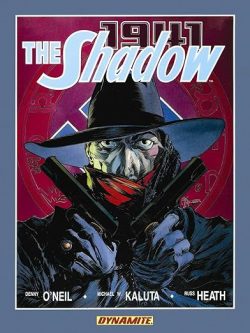
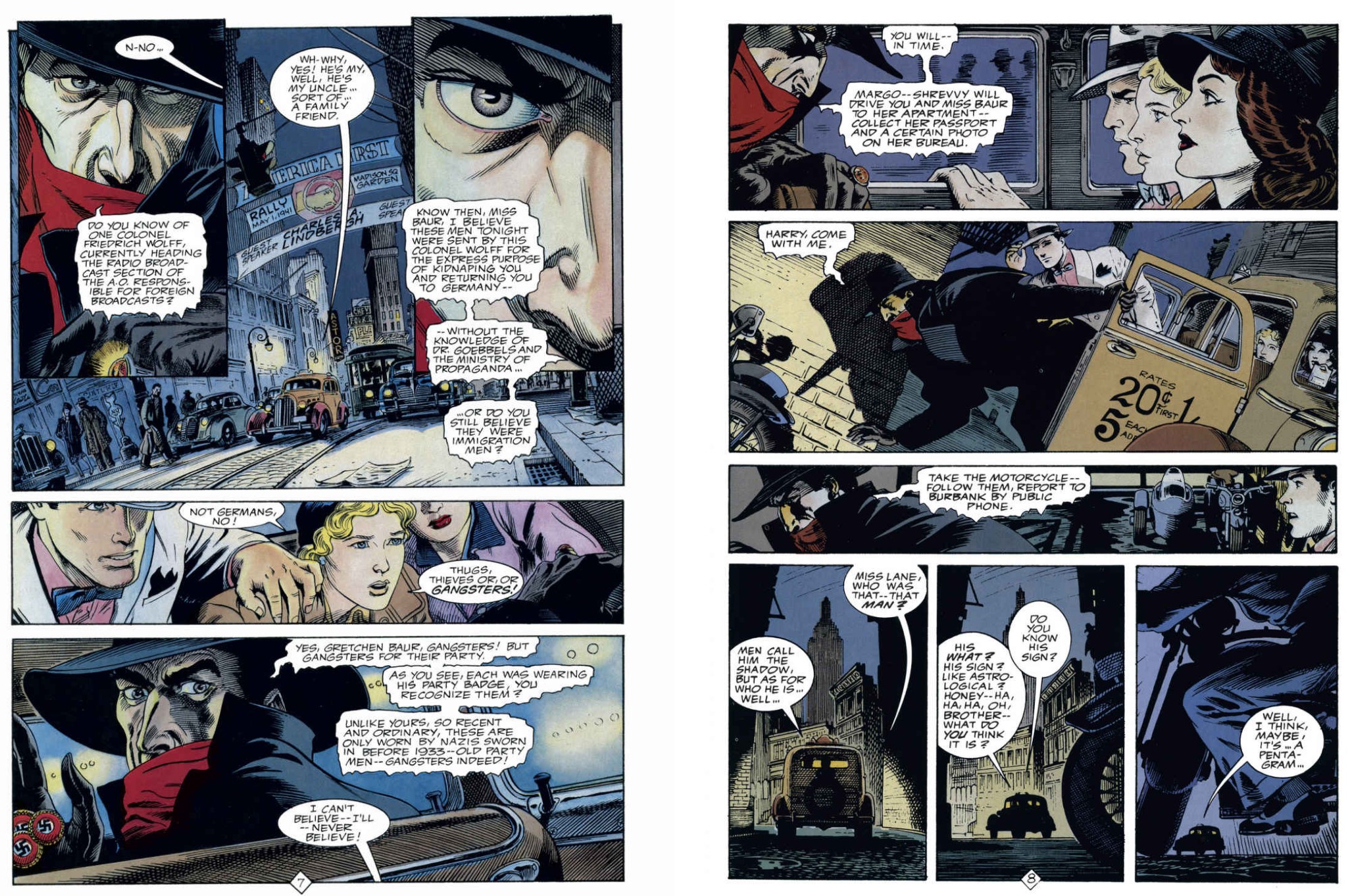
On Easter Sunday 1941 a beautiful woman is pursued through the teeming crowds of Times Square theatre-goers by sinister thugs until rescued in the nick of time by agents of The Shadow. She is Gretchen Baur, personally despatched to America by Josef Goebbels to gather astrological data for the Reich’s Ministry of Propaganda. However, now the confused fräulein cannot understand why agents of her own government have tried to abduct her… until The Shadow reveals that she is an unwitting pawn in a deadly battle for supremacy within the Nazi Party. It all revolves around her father, Der Führer’s personal astrologer…

And thus begins a tense, intricate conspiracy thriller ranging from the bloody streets of New York through the shell-pocked skies of Europe to the very steps of Hitler’s palace in Berlin, as a desperate plan to subvert the course of the war comes up hard against a twisted, thwarted love and a decades-long hunt for vengeance…

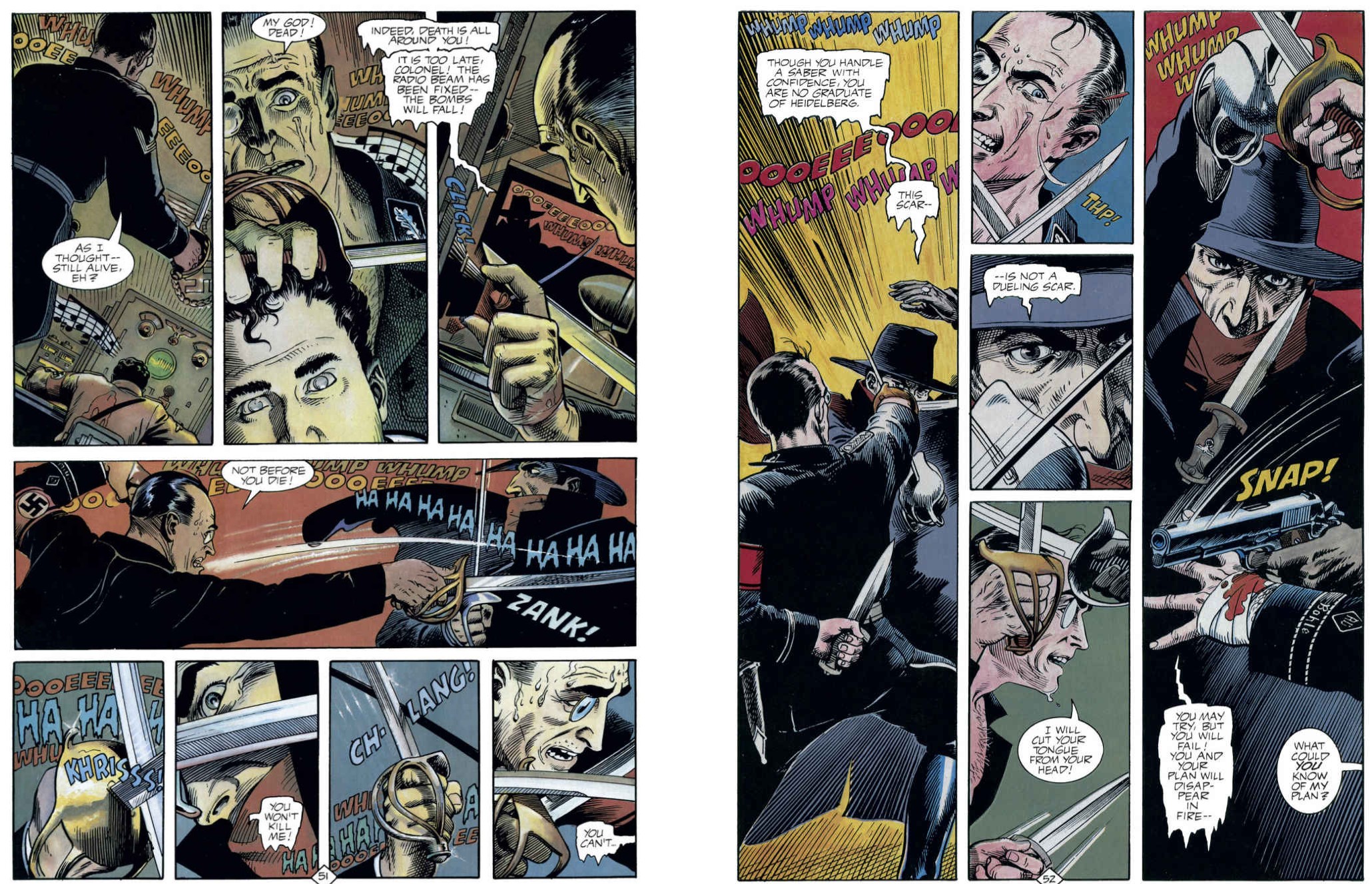
Deliciously deranged and suitably Wagnerian in style, this action-packed mystery drama exudes period charm. Nobody has ever realised The Shadow and his cohorts as well as Kaluta, whilst Russ Heath’s sleek mastery adds weight and volume to the cataclysmic proceedings.

This sinister saga of the man in the black slouch hat with the girasol ring is another superb addition to the annals of the original Dark Knight, and one no one addicted to action and mystery should miss.

The Shadow ® & © 2013 Advance Magazine Publishers Inc. ® ™ & © Conde Nast. All Rights Reserved.

Today in 1916 was born Britain’s master of mordant wit Carl Giles. Last time we shared a laugh with him was Giles: the Collection 2014, whilst in 1947 underground legend Greg Irons first checked in. Our proudest moment is reviewing his outrageous The Wyf of Bath (The Wife of Bath) please link to March 9th 2018. Good luck finding that, but his other stuff is darn good too!

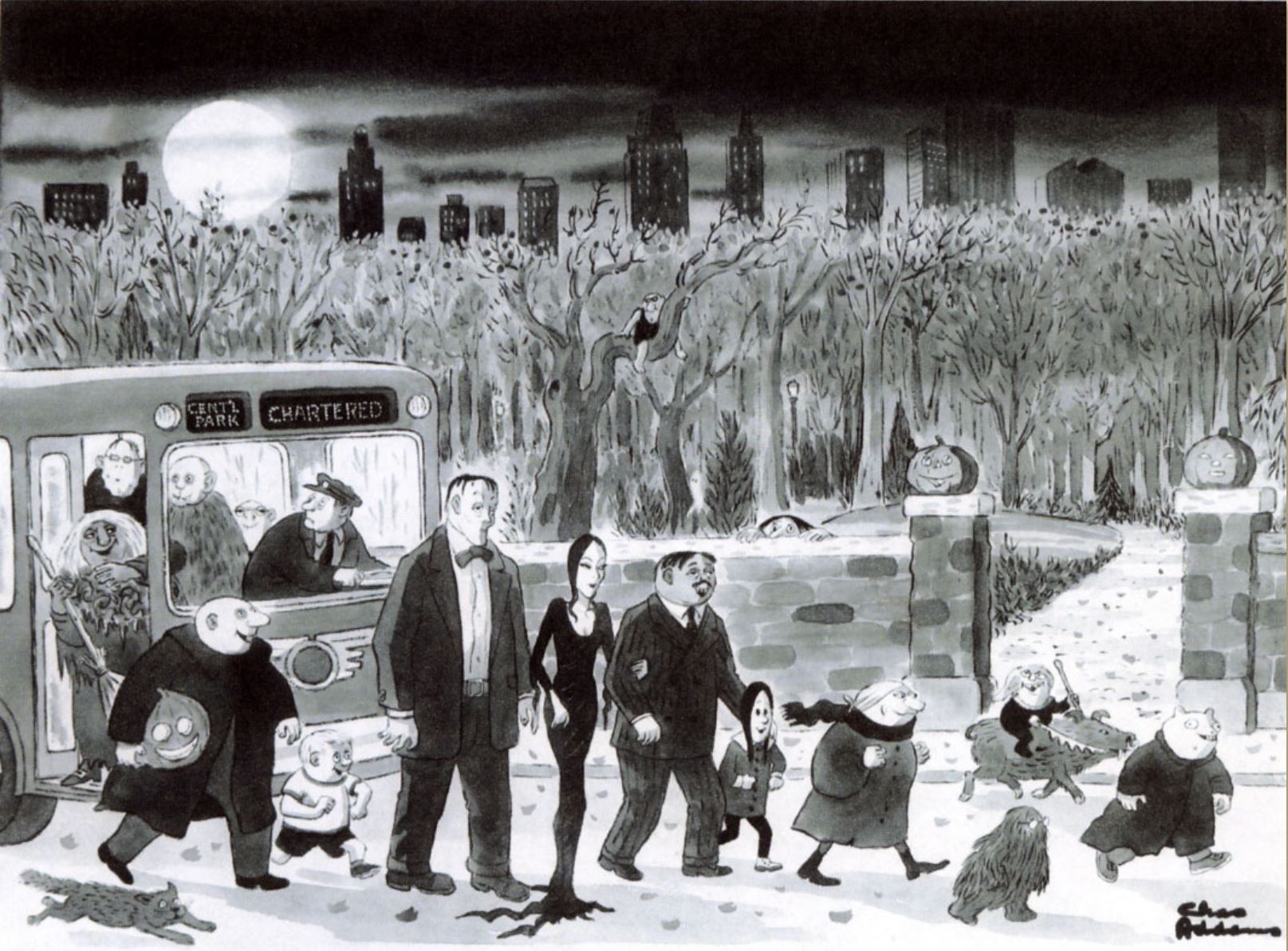
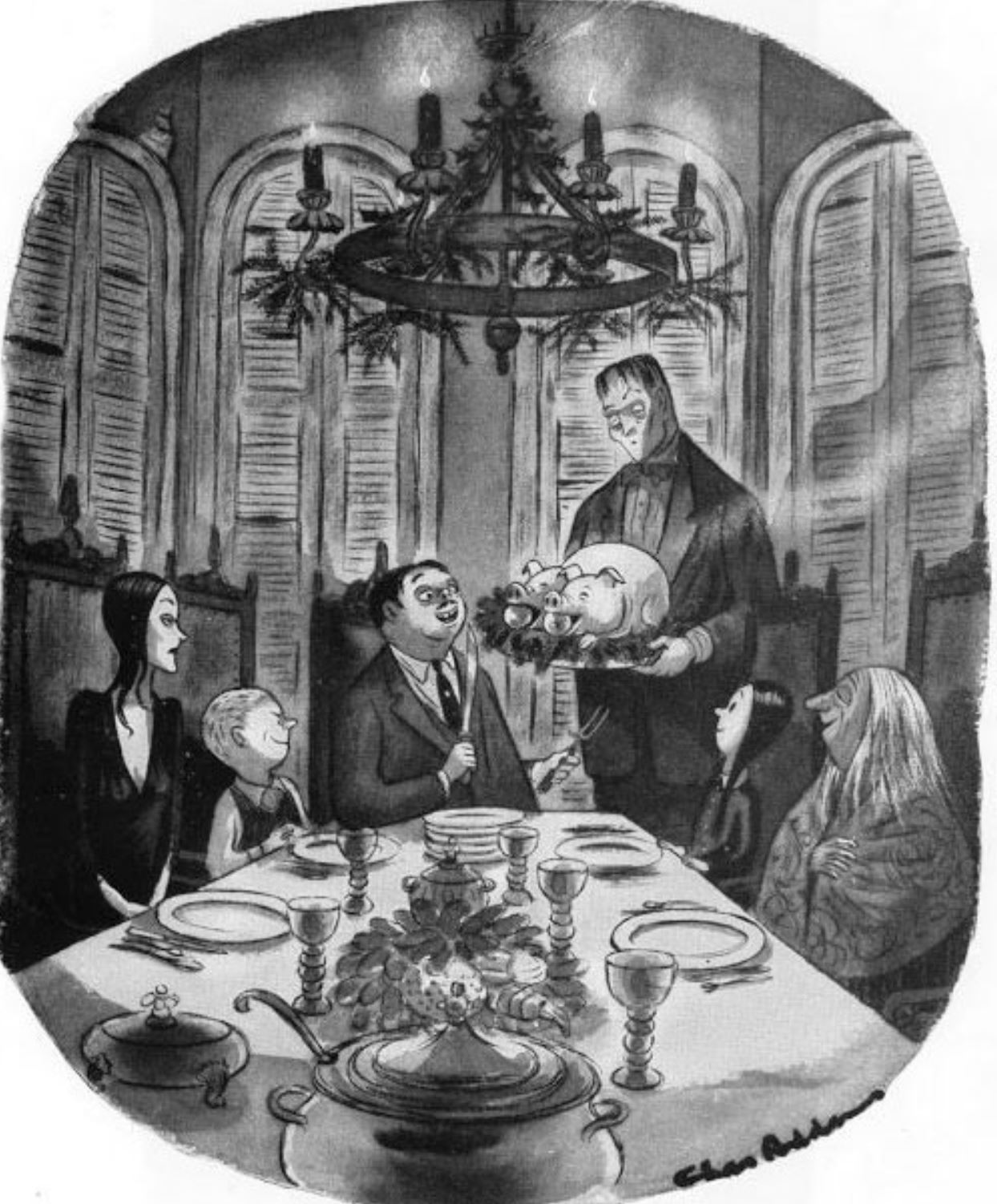
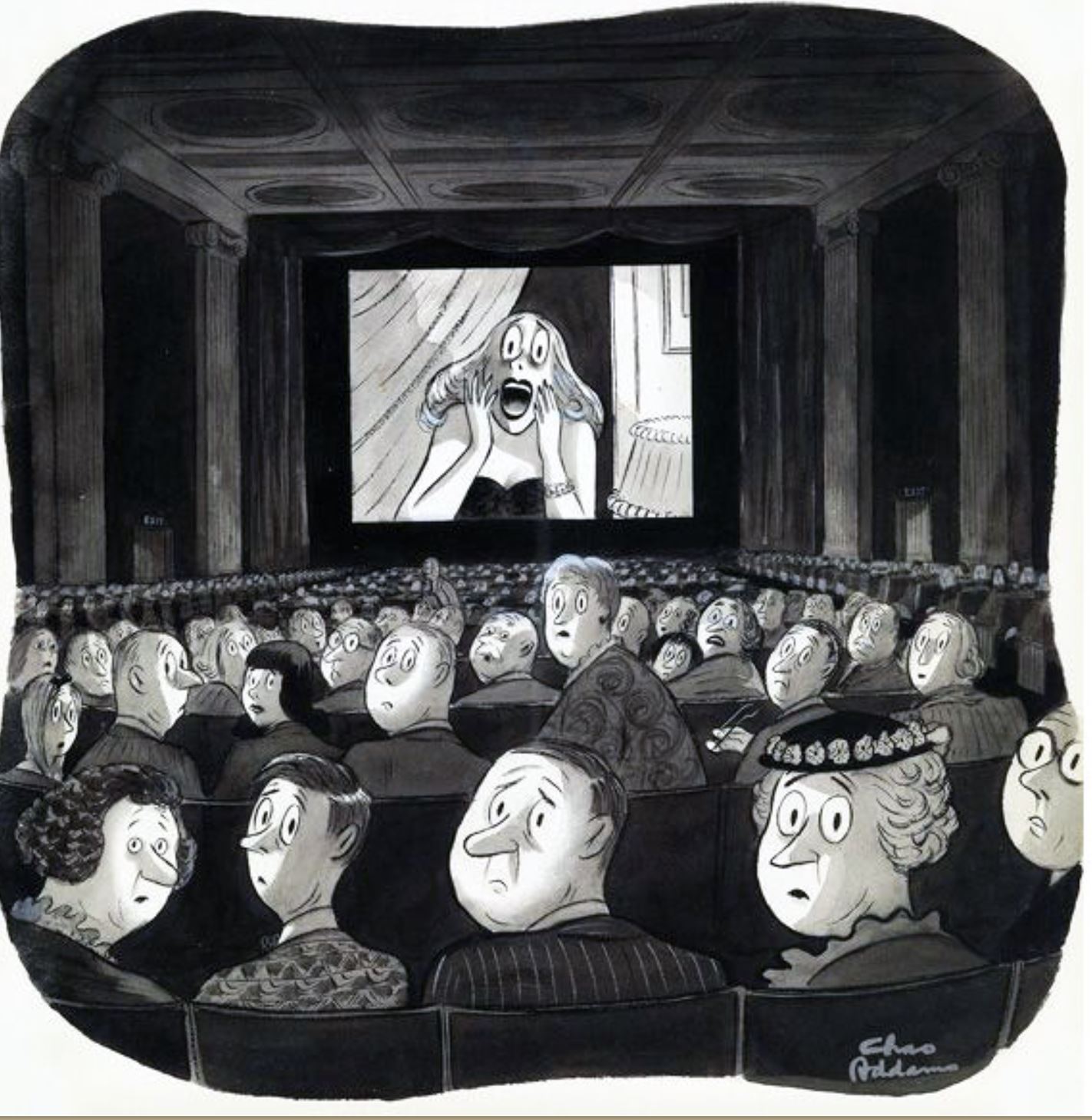
In 1988 utterly urbane arcane cartoonist Charles Addams went to his – or at least somebody’s – grave. You can check him out just by scrolling back to yesterday

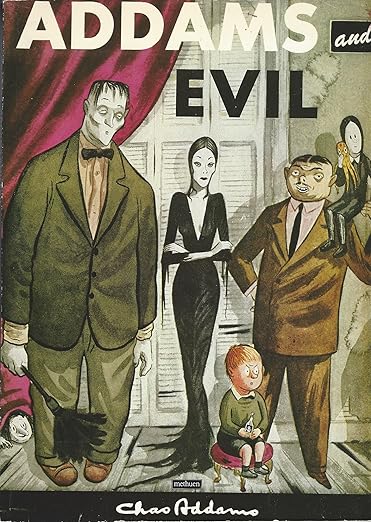
Addams and Evil


By Charles Addams (Methuen/Mandarin)
ISBN: 978-0-413-55370-1 (Album PB) 978-0-413-57190-8 (Album HB) 978-0-413-55370-6 (Mandarin TPB)

This book includes Discriminatory Content produced in less enlightened times. This book also includes Discriminatory Content included for comedic and satirical effect.

Charles Samuel Addams (1912 – 1988) was a cartoonist and distant descendant of two American Presidents (John Adams & John Quincy Adams) who made his real life as extraordinary as his dark, mordantly funny drawings.

Born into a successful family in Westfield, New Jersey, the precocious, prankish, constantly drawing child was educated at the town High School, Colgate University, the University of Pennsylvania, and New York City’s Grand Central School of Art, and apparently spent the entire time producing cartoons and illustrations for a raft of institutional publications.

In 1932 he became a designer for True Detective magazine – “retouching photos of corpses” – and soon after began selling drawings to The New Yorker. In 1937 he began creating ghoulish if not outright macabre family portraits that become his signature creation. During WWII, he served with Signal Corps Photographic Center, devising animated training films for the military.

Whether he artfully manufactured his biography to enhance his value to feature writers or was genuinely a warped and wickedly wacky individual is irrelevant, although it makes for great reading – especially the stuff about his second wife – and, as always, the internet awaits the siren call of your search engine…

What is important is that in all the years he drew and painted those creepily sardonic, gruesome gags and illustrations for The New Yorker, Colliers, TV Guide and so many others, he managed to beguile and enthral his audience with a devilish mind and a soft, gentle approach that made him a household name long before television turned his characters into a hit and generated a juvenile craze for monsters and grotesques that lasts to this day. That eminence was only magnified once the big screen iterations debuted. And now we have streaming fun too. He would have loved the sheer terrifying inescapability of it all…

This stunningly enticing volume is a reissue of his second collection of cartoons, first published in 1947, and semi-occasionally since then. It’s still readily available if you’ve a big bank book, but the time is ripe for a definitive collected edition, or better yet a reissue of his entire canon (eleven volumes of drawings and a biography) either in print or digitally.

Should you not be as familiar with his actual cartoons as with their big and small screen descendants you really owe it to yourself to see the uncensored brilliance of one of America’s greatest humourists. It’s dead funny…

© 1940-1947 the New Yorker Magazine, Inc. In Canada © 1947 Charles Addams.

Today in 1909, fearless campaigner/cartoonist turned arch conservative Al Capp was born. Slightly less contentious than Li’l Abner, his Fearless Fosdick might be more to your taste.

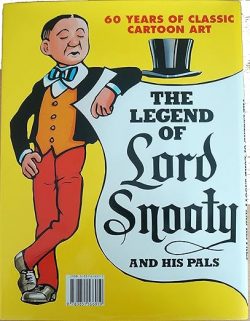
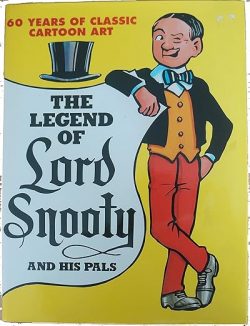
The Legend of Lord Snooty and His Pals – 60 Years of Classic Cartoon Art


By Dudley D. Watkins, with Albert Holroyd, Roy Nixon, Ken Harrison & various (DC Thomson & Co)
ISBN: 978-0-85116-691-9 (tabloid HB)

This book includes Discriminatory Content produced in less enlightened times.

To commemorate Dudley D. Watkins death on August 20th 1969, I ordered some physical books rather than the digital editions I favour. In an ironic tribute to the great man and Grand British comedic traditions, said items failed to arrive on time for the scheduled tribute on that anniversary. So, here’s one of them that finally turned up and can now consequently be shared with you all. That’s egalitarianism, that is…

As an odd adjunct of being a nation perpetually embroiled in class struggle, Britain has found countless ways to apologize and humanise its blue-blooded oppressors. Here’s one of the most successful: a masterpiece of charming fraternity that undermines any anti-privilege message even as it delights and subverts. But which side is our star on, and does it even matter in the end?

Designed and mostly written by Watkins (1907-1969), and debuting in the very first issue of The Beano on 30th July 1938, the only decent posh boy this country ever produced is Marmaduke, Earl of Bunkerton: a bred-in-the-bone blue-blooded subversive and instinctive rebel anarchist… who could never decide which side of the class war and divide he and his ever-evolving pals were actually on.

Clad in Eton school uniform complete with top hat and umbrella, the little lord loathed the pointless tedium of his grand estate and constant pressure of his impending position and status. Thus, at every opportunity he bunked off, dodging pitiless and so-proper Aunt Matilda (who gradually mellowed into genteelly eccentric “Aunt Mat”) and the haughty, stiff-necked and smugly snobbish Bunkerton Castle staff to cavort and revel with the poor waifs from Ash Can Council School – thus dubbed “The Ash Can Alley kids”. Marmaduke even disguised himself as one of them to indulge in his wayward capers, and fully embraced and leaned into their barbed nickname for him – “Lord Snooty”.

Oh, what Larks!! It was like an Edwardian novel of swopped lives or The Prince and the Pauper played for laughs, with this lovable, amiable toff strongly on the side of the savvy proletariat. However, although he just wanted to have fun, there were always dangerous and unwelcome poor kids to fight in the insalubrious form of the bullies of the Gasworks Gang

The early days saw the kids mostly dodging onerous duties, tutorial tribulations and posh expectations – although everybody from every societal stratum seemed to have problems with the police force, which was depicted as officious, interfering, venal and spiteful – and usually cast as true villains…

‘The Legend of Lord Snooty and His Pals…’ opens our itinerary introducing the players and offering early exploits.

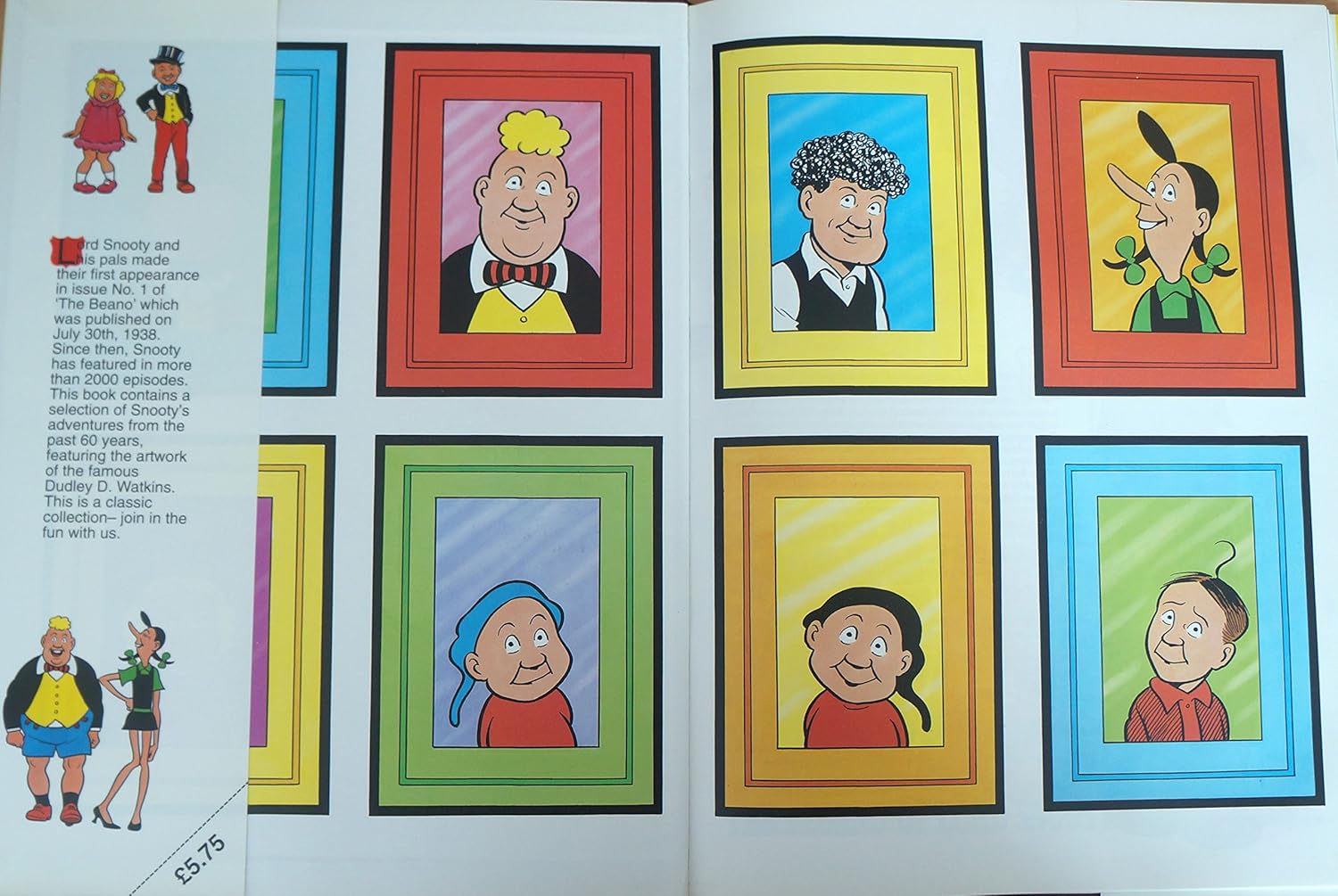
In those heady days before September 1939 (plentifully sampled here, albeit in lightly edited visual terms to cater for modern sensibilities) beginning with the very first episode, Snooty’s chums consisted of Rosie, Skinny Lizzie, Hairpin Huggins, Happy Hutton, Scrapper Smith, and Gertie the Goat, latterly joined by eternal devil-toddlers in romper suits Snitch & Snatch who arrived in Beano #18. Their amalgamated exploits included: dodging school; pinching grub; taunting the police; rushing about in goat-karts (not a misspelling!); playing cricket and football; circuses & wild animals; foiling burglars & bandits; huntin’, shootin’ and fishin’; ruining banquets and wearing the wrong clothes and enjoying/surviving the inventions of castle inventor Professor Screwtop (introduced in Beano #40, April 29th 1939). However, just as everywhere else, once World War II began, Snooty & Co were drafted…

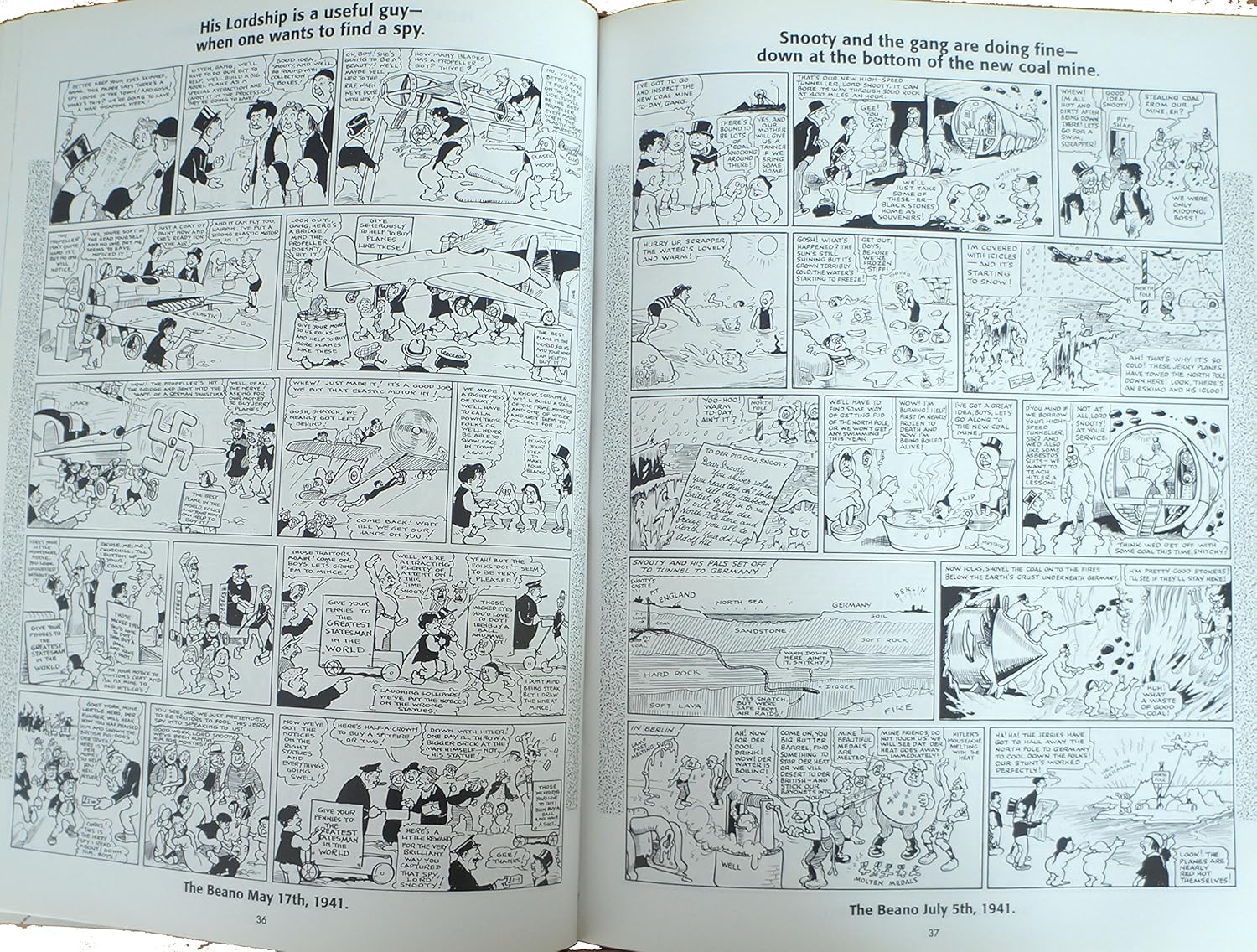
Followed by selection of strips crafted prior to the declaration of hostilities, ‘The War Years’ delivers a potent and wildly weird sampling of how kids adapted to the crisis – albeit filtered through their adult creators’ sensibilities. After war broke out, the call for morale boosting triggered a wave of delirious and passionate fantasy yarns. As well as cops & robbers, featuring an ever-more officious police force, the anarchistic kids had countless pompous asses and ninnies of the officer classes plus Home Guards & Air Raid Wardens trying to push them around. These were almost more trouble than the nigh-infinite cadre of spies and saboteurs and the entire Nazi Wehrmacht who episodically get what they deserved in an escalating war of nerves and nonsense with the kids. As the conflict proceeded, Snooty and his pint-sized allies even made it to Hitler & Goering’s personal hit list: frequently embarrassing when not actually slapping around the Nasty Nazi nincompoops with no appreciable repercussions. This was wish-fulfilment kid power at its most delightful…

A big bunch of these strips make up a majority of this book and show Watkins at his most imaginative. A tireless and prolific illustrator equally adept at comedy, adventure, educational and drama storytelling, his style more than any other’s shaped the postwar look and form of Scottish publishing giant DC Thompson’s comics output.

He started life in Manchester and Nottingham as an artistic prodigy prior to entering Glasgow College of Art in 1924. Before long he was advised to get a job at expanding, Dundee-based DCT, where his 6-month trial illustrating prose boys’ paper stories led to comic strip specials and some original cartoon creations. Percy Vere and His Trying Tricks and Wandering Willie, The Wily Explorer made him the only contender for both lead strips in a bold new project conceived by Robert Duncan Low (1895-1980). Managing Editor of Children’s Publication and between 1921 and 1933, Low launched the company’s “Big Five” story papers for boys: Adventure, The Rover, The Wizard, The Skipper and The Hotspur. In 1936, he created the “Fun Section”: a landmark 8-page comic strip supplement for national newspaper The Sunday Post. This illustrated accessory – prototype and blueprint for every comic the company subsequently released – was launched on 8th March. From the outset The Broons and Oor Wullie were the uncontested headliners… and were both illustrated by Watkins. The other features included Chic Gordon’s Auchentogle, Allan Morley’s Nero and Zero, Nosey Parker and others. These pioneering comics laid the groundwork for the company’s next great leap. In December, 1937 Low launched DC Thomson’s first weekly all-picture strip comic, The Dandy; with The Beano Comic arriving in 1938…

Low’s irresistible secret weapon in all of these ventures was Watkins. The indefatigable cartoon stalwart drew the Fun Section signature strips The Broons and Oor Wullie from the outset and, without missing a beat, added Desperate Dan in The Dandy to his weekly workload. Seven months later, placidly outrageous social satire Lord Snooty became a big draw for freshly launched companion paper The Beano.

These war stories are interspersed with selections of colour “pic & text” stories taken from postwar annuals (‘1960s Beano Book Picture Book strip’ and ‘Beano Book 1956 Picture Book strip modified version’) somewhat chronologically undercutting the impact of Snooty’s next big adjustment. After the war, the feature was paused and retooled. Lord Snooty was dropped with #367 (30th October, 1948) and only returned in December 1950. However, #440 introduced a new supporting cast, partially comprised of past Beano stars in need of a fresh gig. This crowd included hulking Joe (initially star of Big Fat Joe who was cancelled in #35), Liz (ex-Swanky, Lanky Liz who ran from #336-368), Thomas (Doubting Thomas #90-174), Polly and her dog (originally Polly Wolly Doodle and Her Great Big Poodle, in #286-306) and Mary (Contrary Mary who graced Beano #1-97, and even had a side gig as Neddy the Cuddy in The People’s Journal), who all joined Marmaduke and inexplicably popular gremlins Snitch & Snatch. The scattering of strips from 1946 to the pause & revamp garnish informative feature ‘Out With the Old…’ which reviews strips of absorbed and failed solo stars Big Fat Joe, Doubting Thomas and Swanky Lanky Liz in their primes, and celebrates the debuts of later Snooty fill-in and replacement artists Albert Holroyd, Roy Nixon and Ken Harrison on the aristocratic anarchist trail. Then a section of ‘Fifties strips’ observe modernity and loss of empire in smart, witty strips about Christmas, prefab houses, public transport, April Fool’s stunts, homelessness, penury and death duties, rationing, recycling and animals, lots & lots of animals. Finally, ‘Sixties strips’ sees Watkins and his aides investigate increased prosperity, theft, fraud & mis-selling, shopping, the weather, Screwtop’s inventions, entertainment, proper food, etiquette and social mobility and the proper use of cannon fire…

This titanic tome terminates in a wash of colour as Watkins highlights the twins in a strip from an unspecified annual before modern juvenile paragon of protest and advocate of anarchy Dennis the Menace gets in on the act, with strip ‘Me Too, Lord Dennis’ as the ferocious little lout tries out the old ermines and privileged attitude…

This stunning and luxurious hardback commemorative celebration is exuberantly joyous in tracing one of comics most bizarre and seditious stars and is a strong – almost overwhelming – argument for a bigger and more comprehensive curated collection. Conversely it’s also a huge cartoon chronicle stuffed with strips that will make you collapse in mirth. Probably both. At least you don’t have to pick a side but just buy a book…
© D.C. Thomson & Co Ltd 1998.

On this day in 1960, Daredevil: Born Again illustrator David Mazzucchelli was born.

15 years after that Blankets author Craig Thompson also entered the world.

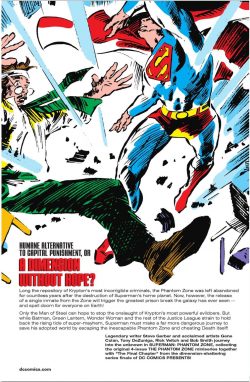
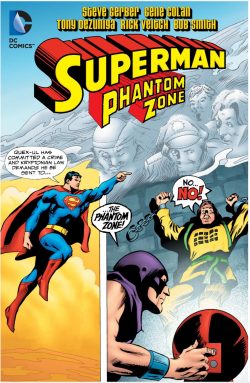
Superman: Phantom Zone


By Steve Gerber, Gene Colan, Rick Veitch, Tony DeZuñiga & Bob Smith (DC Comics)
ISBN: 978-1-4012-4051-6 (TPB/Digital edition)

This book includes Discriminatory Content produced in less enlightened times.

Today would have been Steve Gerber’s 78th birthday. For no appreciable reason, he would have found that to be quite funny. You should go read more comics by him. Here’s some many people don’t immediately think of when listing his so-many sublime star turns…

Once upon a time for fans and comics creators alike continuity could be a harsh mistress. When maintaining a faux-historical cloak of rational integrity for made-up worlds we inhabited was paramount, the greatest casualty of semi-regular reboots and sweeping changes, often meant some terrific tales suddenly never happened. Everything goes now of course, thanks to parallel world-ery, but way back whenever, it was a most painful time for me…

Many examples of this wholesale binning of entire charm-drenched mythologies happened but the convergent growth of graphic novels fortunately provided a sanctuary of sorts, such as this paean of pictorial praise for the mythology had evolved around Superman in the wonder years between 1948 and 1986.

Thankfully DC has always understood that a good story is worth cherishing. This slim, trim spectral selection gathers superb 4-issue miniseries The Phantom Zone (originally appearing from January to April 1982) and includes the very last pre-Crisis on Infinite Earths Zone yarn as first seen in DC Comics Presents #97 (September 1986). It also simultaneously celebrates the stylish and enthralling scripting of unique comics voice Steve Gerber and his most ardent collaborator Gene (Howard the Duck, Stewart the Rat) Colan.

Gerber was a uniquely gifted writer who combined a deep love of comic book continuity minutiae with dark, irrepressible wit, incisive introspection, barbed socio-cultural criticism, a barely reigned-in imagination and boundless bizarre surrealism. His stories were always at the extreme edge of any mainstream company’s intellectual canon and never failed to deliver surprise and satisfaction, especially when he couched his sardonic sorties as thinly-veiled attacks on burgeoning cultural homogenisation and commercial barbarity.

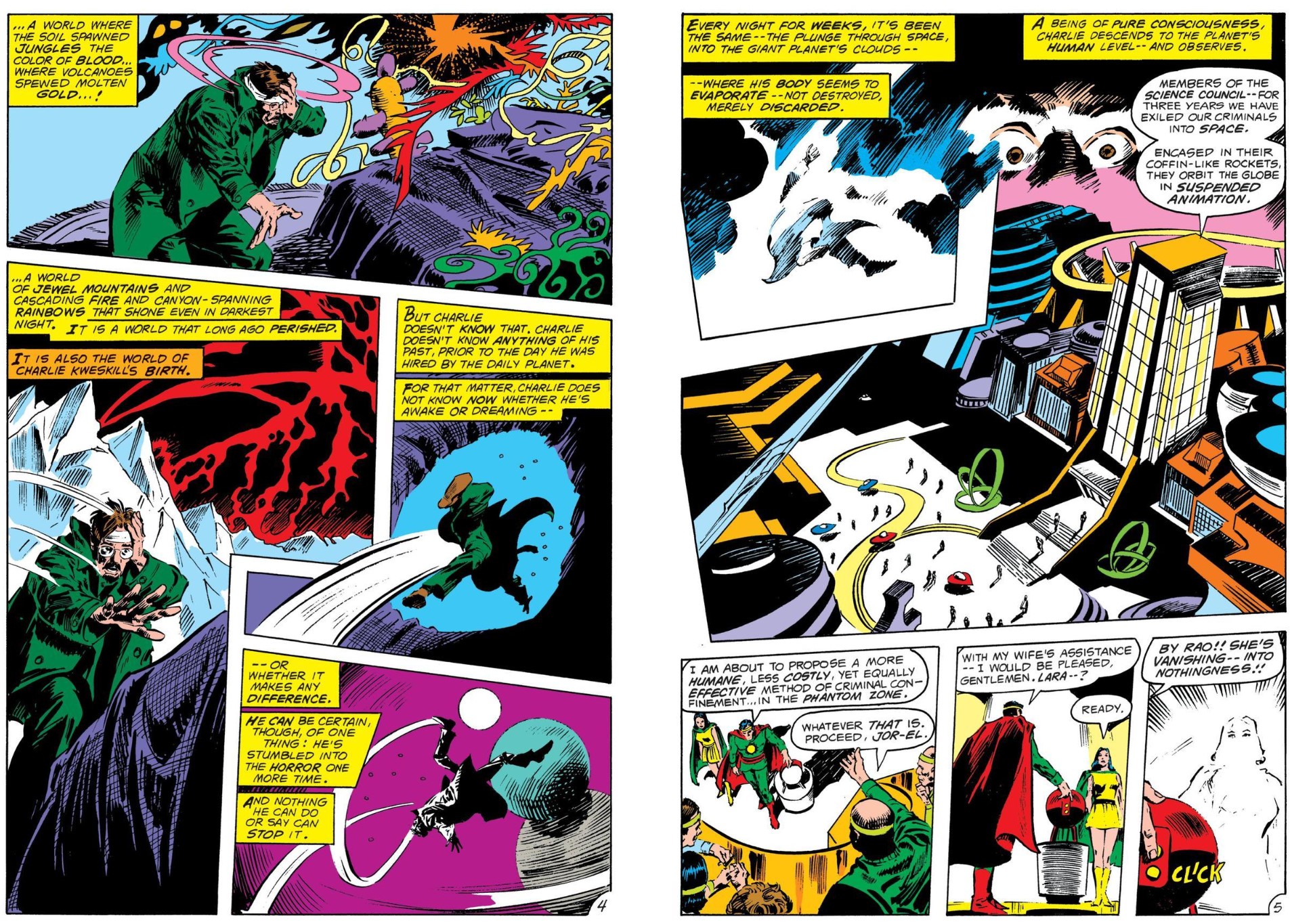
This riotous recapitulation of all that lost Man of Tomorrow ficto-history begins in ‘The Haunting of Charlie Kweskill!’ as the eponymous Daily Planet paste-up artist collapses at work. The solitary little dweeb has been sleeping badly, plagued by nightmares of a life on long-gone planet Krypton. His dreams detail how brilliant scientist Jor-El devised a non-lethal way to deal with Krypton’s most incorrigible criminals: human monsters such as Jax-Ur, Professor Va-Kox, Dr. Xadu, sadistic psycho-killer Faora Hu-Ul, potential dictator General Dru-Zod, and even Jor’s own bad & crazy cousin Kru-El

Many lesser menaces like psionic aberrants Az-Rel and Nadira were also banished to the misty twilit realm, as well as stranger outcasts like callous biological experimenter Nam-Ek, but the one who most catches Charlie’s attention is fraudster Quex-Ul; a Kryptonian who appears to be Charlie’s doppelganger…

Of course, the dreams are all true: telepathic broadcasts beamed at Charlie by Zone inmates from within the plane of timeless intangibility. Quex-Ul had been one of them, surviving long after Krypton died, but was innocent of his crimes. He had been framed and mind-controlled by a mastermind who had deservedly perished when the Red Sun world detonated. Once Superman corrected the injustice and released the poor dupe, Qwex-Ul had saved the Man of Steel from a Gold Kryptonite trap, thereby losing his inherent Kryptonian abilities and memory in the process. The grateful, heartsick Action Ace had found the amnesiac a job at the Planet and almost forgot his alien origins in the years since. Charlie’s former fellow inmates had not…

Their telepathic onslaught turns Kweskill into a somnambulistic slave, unknowingly spending his nights breaking into labs and stealing high-tech components. Superman, slowly putting the puzzle pieces together, is just too late to thwart the stealthy scheme, and as he bursts into Charlie’s apartment a hastily cobbled together Phantom Zone projector hurls him and the hapless mind-slave into the ghostly region, whilst simultaneously freeing a legion of the cruellest and most bored criminals in existence…

The saga expands with ‘Earth Under Siege!’ as Superman and Charlie helplessly watch Zod, Jax-Ur, Va-Kox, Faora and Kru-El immediately undertake the next stage of their plan, leaving passively nihilistic Az-Rel and Nadira to negligently torture monstrous Nam-Ek with their psychic talents when not mocking the ranting liturgies of religious zealot Jer-Em, whose manic bigotry and fundamentalist isolationism caused the death of every person in Argo City

Superman’s cousin Kara Zor-El had been born on the city-sized fragment of Krypton, hurled intact into space when the doomed world detonated. Eventually, Argo turned to Green Kryptonite like most of Krypton’s detonated debris, and her dying parents, observing Earth through their scopes, sent their daughter to safety as they perished. On Earth, the teenager met the Man of Steel who created for her the identities of Linda Lee and Supergirl, concealing her from the wider world whilst she learned all about her new home… and how to use her astounding new abilities in secrecy and safety.

As the emotionally disconnected, disaffected and doubly alienated youths laconically saunter through Metropolis; casually slaughtering cops and citizens, Zod’s more motivated cronies have reached Superman’s Fortress of Solitude and destroyed the only means of returning them to their extra-dimensional dungeon.

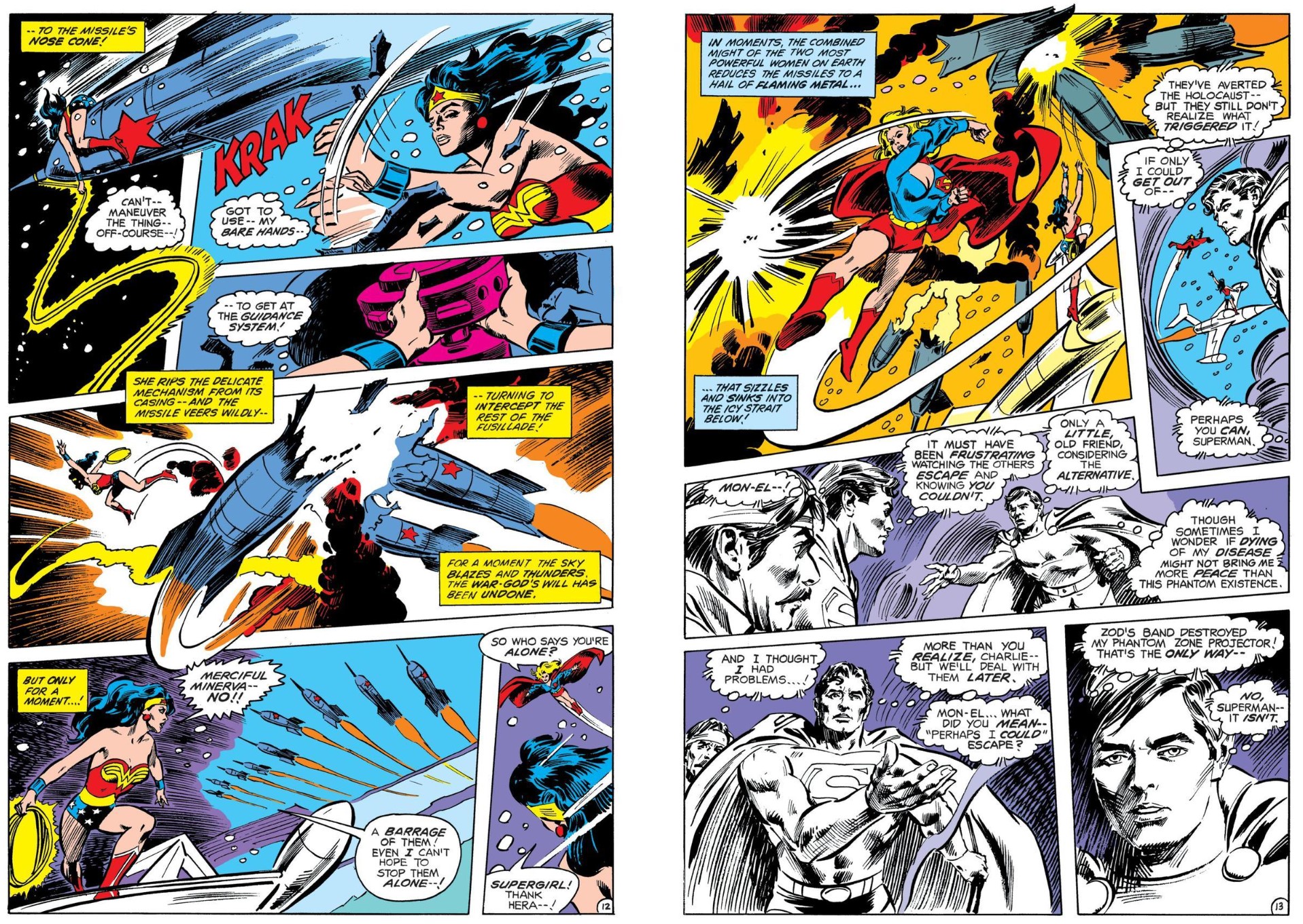
The next move is attacking the Justice League satellite, hurling it and occupants Flash, Red Tornado, Zatanna, Black Canary, Elongated Man, Firestorm & Aquaman on a non-stop trajectory out of the Solar System. Rampant Kryptonians destroy Earth’s communications satellites and trigger a mass launch of nuclear missiles, leaving Wonder Woman and Supergirl to narrowly avert atomic Armageddon whilst the frantic Man of Tomorrow can only watch in horror…

Not every Zone inhabitant is a criminal. For instance, Daxamite Mon-El was exposed to common lead in ‘Superboy’s Big Brother’ (by Robert Bernstein & Papp in June 1961’s Superboy #89) when his lingering, inexorable death was only forestalled by depositing the dying alien in the Zone until a cure could be found. Now, as Green Lantern faces the Zod Squad on Earth only to be soundly beaten and have his Power Battery stolen, Mon-El informs Charlie and Superman of a possible back way out of the realm of hellish nullity…

On Earth, as Wonder Woman subdues Nam-Ek, Supergirl checks in with Batman, desperately trying to ascertain where Superman has gone. As the Dark Knight heads to Metropolis to investigate, Kara returns to the Fortress and is ambushed by Kryptonian escapees and beaten near to death…

With no other choice, Charlie and Superman reluctantly pass through a dimensional portal even the obsessed villains were too scared to risk, encountering surreal madness in ‘The Terror Beyond Twilight!’

Back in the physical world of touch and time, Supergirl saves herself from ghastly atomic disintegration as Charlie and Superman pass through stormy turbulence and a tedious waiting-room-realm before arriving on a peculiar plane where they are confronted by luscious sirens with impossible riddles and exploding heads. Their narrow escape from the Priestesses of the Crimson Sun only leads to Kryptonian wizard Thul-Kar who magicked himself into the Zone in ages past and now slavishly serves an erratic, malevolent sentient universe named Aethyr. It wants to consume Charlie and Superman but only by passing through it can they reach the physical world again…

On Earth, chaos reigns. Batman is utterly unable to pacify extremist Jer-Em, who deems the planet impure, unclean and unholy. He would rather die than soil his Kryptonian purity here.

… And high above the world, other freed villains have their own plan to fix the situation: a gigantic Phantom Zone Cannon to inexorably and eternally banish Earth into the twilight dimension in the course of one full rotation…

The drama comes to a tragic conclusion in ‘The Phantom Planet!’ as Az-Rel and Nadira, having found kindred spirits amongst Metropolis’ disenfranchised Punk Rock counterculture – before killing them – encounter Jer-Em in martyr mode. The now-suicidal cleric is quite keen on taking the rest of the apostate Kryptonians with him…

As the world turns into intangibility, in France, Faora has briefly resumed her passion for murdering males (before they’re all gone) whilst in Aethyr’s universe an appalling sacrifice enables Superman to return to physicality just in time to lead a last desperate charge, saving the day and putting the villains back where they belong… those still alive, that is…

The remainder of this fantastic collection recounts the tying up of all those intriguing concepts and loose ends in a spectacular sidebar to the end of DC’s original universe.

In 1986 the company celebrated its 50th year with groundbreaking Crisis on Infinite Earths: radically overhauling a convoluted multiversal continuity and starting afresh. All Superman titles were cancelled or suspended pending a back-to-basics reboot courtesy of John Byrne, allowing for a number of very special farewells to the old mythology. One of the most intriguing and challenging came in the last issue of DC Comics Presents (#97) wherein ‘Phantom Zone: the Final Chapter’ by Gerber, Rick Veitch & Bob Smith offered a creepy adieu to a number of Superman’s greatest foes.

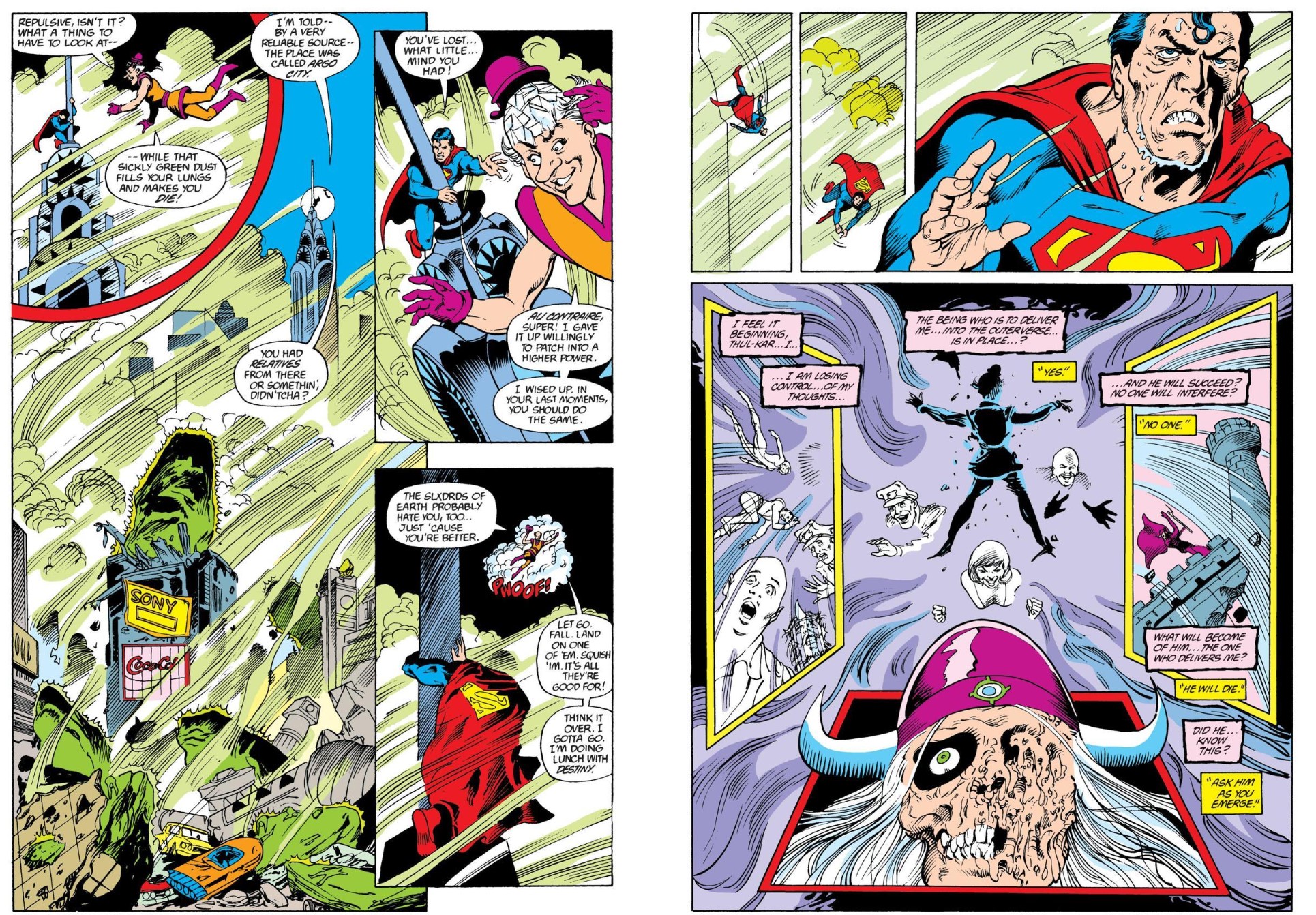
Tracing Jor-El’s discovery of the Phantom Zone through to imminent multiversal annihilation, this dark yarn built on Gerber’s landmark miniseries and revealed that the dread region of nothingness was in fact a sentient echo of a dead universe which had always regarded the creatures deposited within it as irritants and agonising intruders.

Now as cosmic carnage reigns Aethyr, still served by Kryptonian mage Thul-Kar, causes the destruction of the Bizarro World “Htrae” and the deification/corruption of Fifth Dimensional pest Mr. Mxyzptlk, as well as the subsequent crashing of Argo City on Metropolis. As a result Zod and fellow immaterial inmates are freed to wreak havoc upon Earth – but only until the now-crystalline pocket dimension merges with and absorbs the felons, before implausibly abandoning Superman to face his uncertain future as the very Last Son of Krypton…

Superman has proven to be all things to all fans over his decades of existence and Gerber’s takes on these timeless tales of charm, joy and wholesome wit are unique and more necessary than ever: not just as a reminder of great tales of the past but as an all-ages primer of wonders still to come…
© 1982, 1986, 2013 DC Comics. All Rights Reserved.

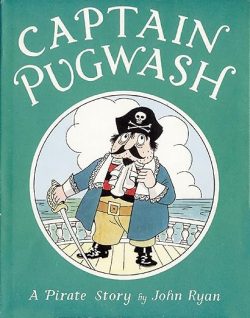
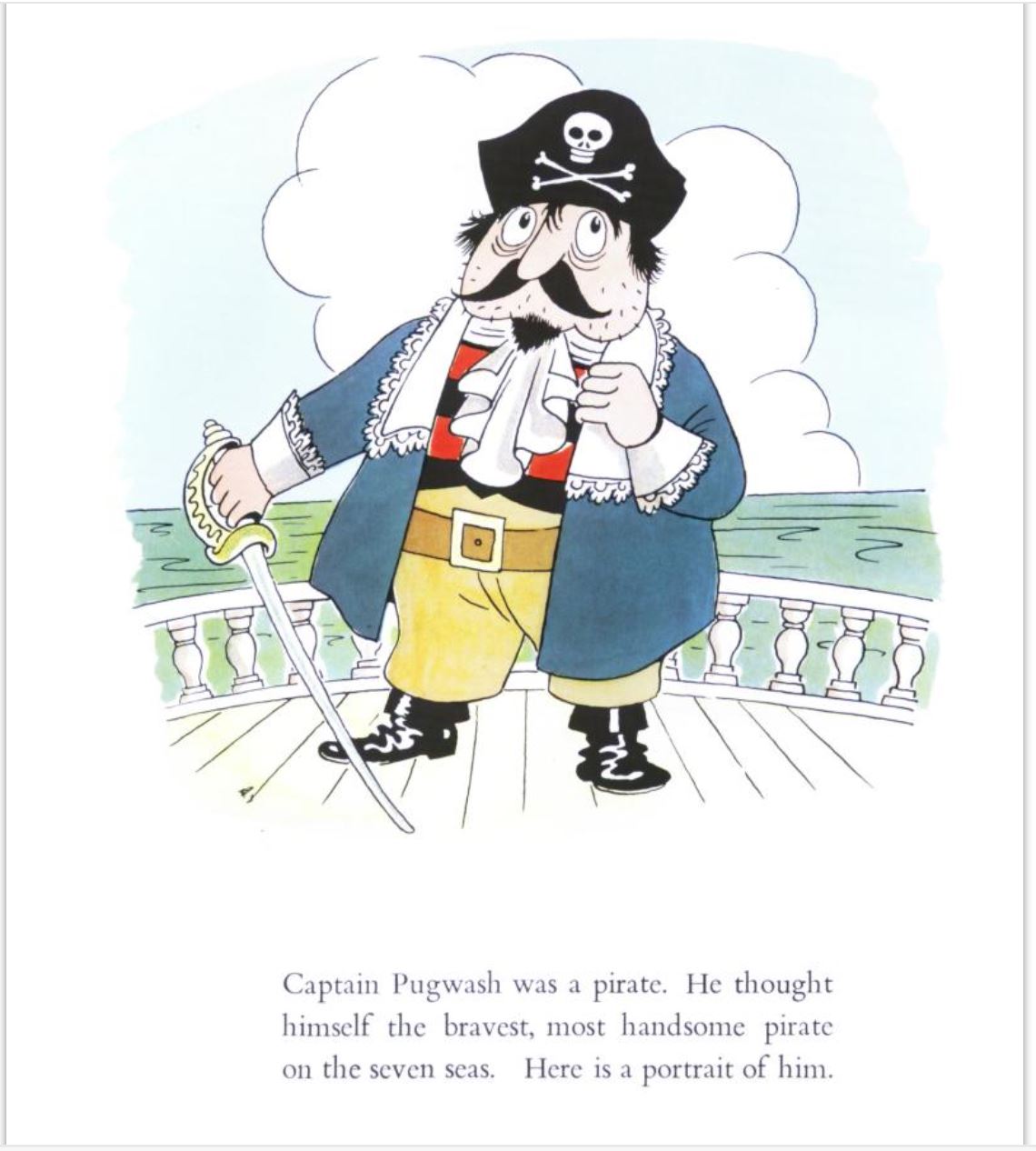
Captain Pugwash: A Pirate Story


By John Ryan (Frances Lincoln Children’s Books/Picture Puffin Story Books)
ISBN: 978-0140554533 (Puffin PB) 978-1-84507-821-8 (F Lincoln HB)
Ha-HA-HHARRRR! The time be here, Shipmaties! ‘Tis International Talk Like a Pirate Day again!

John Ryan was an artist and storyteller who straddled three distinct disciplines of graphic narrative, with equal qualitative if not financial success.

The son of a diplomat, Ryan was born in Edinburgh on March 4th 1921, served in Burma and India and – after attending the Regent Street Polytechnic (1946-48) – took a post as assistant Art Master at Harrow School from 1948 to 1955. It was during this time that he first began contributing strips to Fulton Press publications, for the company’s glossy distaff alternative Girl, but most especially in the pages of the legendary “boys’ paper” Eagle.

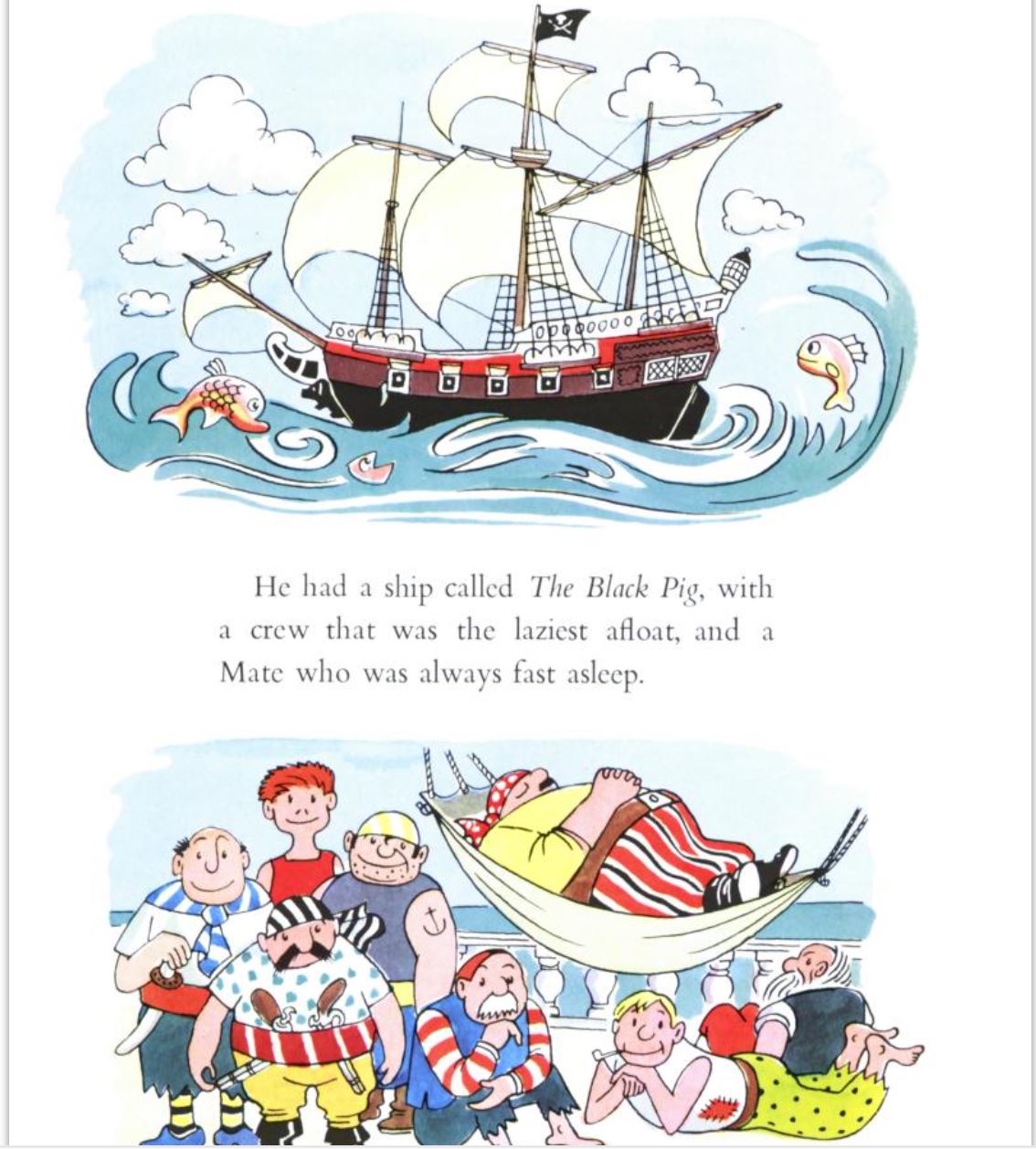
On April 14th 1950, Britain’s grey, postwar gloom was partially lifted by the premiere issue of a new comic that literally shone with light and colour. Avid children were understandably enraptured with the gloss and dazzle of Dan Dare, Pilot of the Future, a charismatic star-turn venerated to this day and by a host of cannily incorporated licensed features such as radio star turns P.C. 49 and Riders of the Range. Eagle was a tabloid-sized paper with full-colour inserts alternating with text and a range of various other comic features. Tabloid is a big page and one can get a lot of material onto each one. Ryan’s quirky, spiky style lent itself to the numerous spot illustrations required throughout the comic every week but he also offered little strip serials. Deep within, on the bottom third of a monochrome page was an 8-panel strip entitled Captain PugwashThe story of a Bad Buccaneer and the many Sticky Ends which nearly befell him

Pugwash, his harridan of a wife and the useless, lazy crew of the Black Pig ran (or more accurately capered and fell about) until issue #19 when the feature disappeared – sunk without trace! This was no real hardship for Ryan who had been writing & illustrating Harris Tweed – Extra Special Agent as a full-page (tabloid, remember – an average of 20 panels per page, per week!) from Eagle #16. (I really must reinvestigate the solidly stolid sleuth too sometime soon…) Tweed ran for three years as a full page until 1953 after which it dropped to a half-page strip and was carefully repositioned as a purely comedic venture.

In 1956 the indefatigable old sea-dog (I mean old Horatio Pugwash but it could so easily be applied to Ryan) made the jump to children’s picture books. The artist was an unceasing story-peddler with a big family, and somehow he also found time to be head cartoonist for The Catholic Herald – a side gig that lasted for 40 years.

A Pirate Story was first published by Bodley Head before switching to children’s publishing specialist Puffin for further editions and more adventures. It was the first foray of a vast (sorry, got away with myself there!) run of children’s books on a number of different subjects. Pugwash himself starred in 21 tomes; there were a dozen books based on the animated TV series Ark Stories, plus Sir Prancelot and a number of other creations. Ryan worked whenever he wanted to in the comics world and eventually the books and the strips began to cross-fertilise.

The primary Pugwash is traditional in format, with blocks of text and single illustrations to illuminate a particular moment. But by the publication of Pugwash the Smuggler (1982) entire sequences were lavishly painted comic strips, with as many as eight panels per page, and including word balloons. A fitting circularity to his careers and a nice treat for us old-fashioned comic drones.

After A Pirate Story was released in 1957 the BBC pounced on the property, commissioning Ryan to produce 5-minute episodes (86 in all from 1957 to 1968, all later reformatted in full colour and rebroadcast in 1976). In the budding 1950s arena of animated television cartoons, Ryan developed a new system for producing cheap, high quality animations to a tight deadline. He began with Pugwash, keeping the adventure milieu, but replaced the shrewish wife with a tried-and-true boy assistant. Tom the Cabin Boy is the only capable member of a crew which included such visual archetypes as Willy, Barnabas and Master Mate (fat, thin and tall – and all dim), instantly affirming to the rapt, young audience that grown-ups are fools and kids do, in fact, rule.

Ryan also drew a weekly Captain Pugwash strip for The Radio Times – lasting eight years – before going on to produce other animated series including Mary, Mungo and Midge, The Friendly Giant and the aforementioned Sir Prancelot. There were also adaptations of some of his many other children’s books. In 1997, an all-new CGI-based Pugwash animated TV series began. I don’t need to tell that we’re about due another go-round…

This first story sets the scene with a delightful clown’s romp as the so-very-motley crew of the Black Pig sail in search of buried treasure, only to fall into a cunning trap set by truly nasty Cut-Throat Jake. Luckily, Tom is as smart as his shipmates and Captain are not…

Ryan returned to pirate life in the 1980s, drawing three new Pugwash storybooks: The Secret of the San Fiasco, The Battle of Bunkum Bay & The Quest for the Golden Handshake, as well as thematic prequel Admiral Fatso Fitzpugwash, in which it’s revealed that the not-so-salty seadog had a medieval ancestor who became First Sea Lord, despite being terrified of water…

The 2008 edition of A Pirate Story (from Frances Lincoln Children’s Books) came with a free audio CD, and just in case I’ve tempted you beyond endurance here’s a full list (I think) of the good(ish) Captain’s exploits that you should make it your remaining life’s work to unearth: Captain Pugwash: A Pirate Story (1957), Pugwash Aloft (1960), Pugwash and the Ghost Ship (1962), Pugwash in the Pacific (1963), Pugwash and the Sea Monster (1976), Captain Pugwash and the Ruby (1976), Captain Pugwash and the Treasure Chest (1976), Captain Pugwash and the New Ship (1976), Captain Pugwash and the Elephant (1976), The Captain Pugwash Cartoon Book (1977), Pugwash and the Buried Treasure (1980), Pugwash the Smuggler (1982), Captain Pugwash and the Fancy Dress Party (1982), Captain Pugwash and the Mutiny (1982), Pugwash and the Wreckers (1984), Pugwash and the Midnight Feast (1984), The Battle of Bunkum Bay (1985), The Quest of the Golden Handshake (1985), The Secret of the San Fiasco (1985), Captain Pugwash and the Pigwig (1991) and Captain Pugwash and the Huge Reward (1991). All pearls beyond price and a true treasure of graphic excellence.

We don’t have that many multi-discipline successes in comics, so why don’t you go and find out why we should celebrate one who did it all, did it first and did it well? Your kids will thank you and if you’ve any life left in your old and weary soul, you will too

The quintessential pirate king appears to be generally out of print and long, long overdue for revival, so it might mean a bit of digging around to unearth copies but on this day and in the anniversary year of Eagle, surely a little effort and skulduggery is not beyond us?

© 1957, 2009 John Ryan and (presumably) the Estate of John Ryan. All rights reserved.

On this day in 1953, Paddy Brennan’s General Jumbo first appeared in The Beano, and one year later my old flatmate and artist par excellence Garry Leach was born. Both went away far too soon and are still so very much missed.

Uncanny X-Men Marvel Masterworks volume 1


By Len Wein, Chris Claremont, Bill Mantlo, Dave Cockrum, Bob McLeod, Sam Grainger, Frank Chiaramonte & various (MARVEL)
ISBN: 978-0-7851-3702-3 (TPB) 978-0-7851-1192-4 (HB/Digital edition)

This book includes Discriminatory Content produced in less enlightened times.

Win’s Christmas Gift Recommendation: Timeless Mutant Masterpieces for all Blockbuster Comics Addicts… 9/10

In the autumn of 1963 The X-Men #1 introduced Scott (Cyclops) Summers, Bobby (Iceman) Drake, Warren (Angel) Worthington, Jean (Marvel Girl) Grey and Hank (The Beast) McCoy: very special students of Professor Charles Xavier. The teacher was a wheelchair-bound telepath dedicated to brokering peace and integration between the masses of humanity and the emergent off-shoot race of mutants dubbed Homo Superior; considered by many who knew him as a living saint.

After nearly eight years of eccentrically spectacular adventures the mutant misfits virtually disappeared at the beginning of 1970, during another periodic downturn in superhero comics sales. Just like the closing years of the 1940s, mystery men again faded away as supernatural mysteries and traditional genre themes once more dominated the world’s entertainment fields.

Although their title returned at the end of the year as a cheap reprint vehicle, the missing mutants were reduced to guest-stars and bit-players throughout the ongoing Marvel universe, whilst the bludgeoning Beast was opportunistically transformed into a scary monster to cash in on the horror boom. Then, as sales of the spooky stuff subsequently waned in 1975, Marvel Editor-in-Chief Roy Thomas green-lighted a bold one-shot as part of the company’s line of Giant-Size specials and history was made…

This fabulous compendium collection (available in luxurious hardcover, trade paperback and eBook editions) is perfect for newbies, neophytes and even old lags nervous about reading such splendid yarns on fragile but extremely valuable pulp paper. It celebrates the revival and unstoppable march to market dominance through the exuberant and pivotal early stories: specifically, collectively and cumulatively spanning May 1975 to August 1976 via Giant Size X-Men #1, and issues #94-100 of the definitely “All-New, All-Different” X-Men.

Tracing the reinvigorated merry mutants from young, fresh and delightfully underexposed innovations to the beginnings of their unstoppable ascendancy to ultimate comic book icons, in their own title and through an increasingly broad clutch of guest shots, the epic voyage begins with a classic mystery monster mash from Giant Size X-Men #1.

Len Wein & Dave Cockrum (the much-missed latter then a very red-hot property following his stint reviving DC’s equally eclectic fan-fave super-team Legion of Super-Heroes) detail in ‘Second Genesis!’ how the original squad -all but then-new Avengers recruit The Beast – have been lost in action. With no other choice Xavier is forced to scour Earth and the Marvel Universe for replacements…

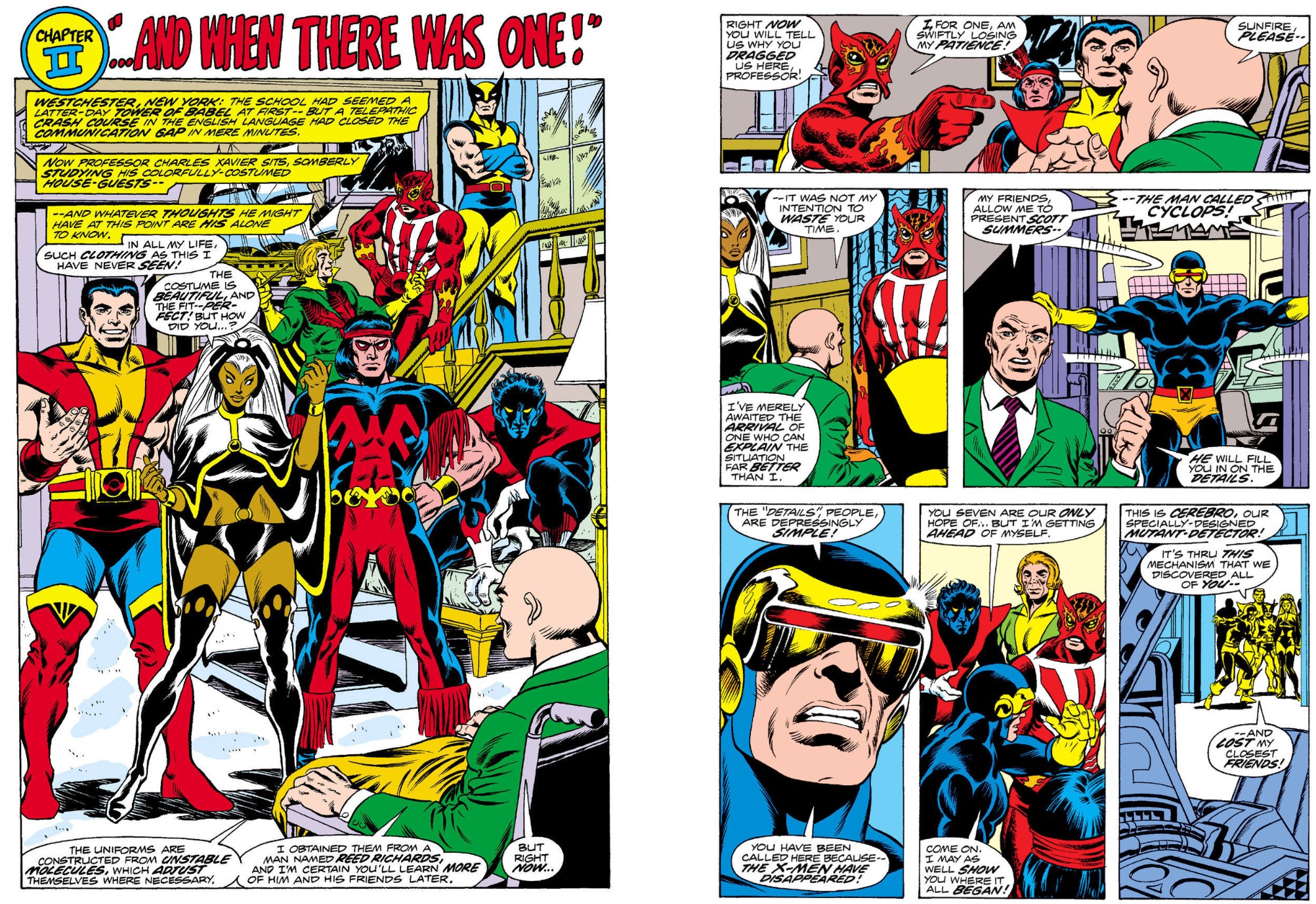
To occasional foes-turned-friends Banshee and Sunfire is added a one-shot Incredible Hulk adversary dubbed The Wolverine, but the bulk of time and attention is lavished upon original creations Kurt Wagner, a demonic-seeming German teleporter codenamed Nightcrawler; African weather “goddess” Ororo Monroe – AKA Storm; Russian farm boy Peter Rasputin who turns into a living steel Colossus and bitter, disillusioned Apache superman John Proudstar who is cajoled into joining the makeshift squad as Thunderbird. The second epic introductory chapter ‘….And Then There Was One!’ reintroduces battered, depleted but unbowed team-leader Cyclops who swiftly drills the newcomers to a semblance of readiness before leading them into primordial danger against monolithic threat ‘Krakoa… the Island That Walks Like a Man!’

Overcoming the phenomenal terror of a rampaging rapacious mutant eco-system and rescuing the “real” team should have led to a quarterly Giant-Size sequel, but so great was fan response that the follow-up adventure was swiftly reworked into a 2-issue tale for a rapidly reconfigured comic book which became a bimonthly home to the new team. X-Men #94 (August 1975) began ‘The Doomsmith Scenario!’ – plotted by editor Wein, scripted by Chris Claremont and with Bob McLeod inking man-on-fire Cockrum – in a smart Armageddon-thriller with a newly pared-down strike-squad deprived of Sunfire and still-recuperating Marvel Girl, Angel, Iceman, Havok (Scott’s brother Alex) and magnetic Lorna Dane.

The neophytes are called in by Beast to stop criminal terrorist Count Nefaria starting an atomic war. The insidious mastermind has seized control of the US Norad citadel with a gang of artificial superhumans and accidentally escalated a nuclear blackmail scheme into an inescapable countdown to holocaust. Thus, the untrained, unprepared mutants are the only hope of saving the world in epic conclusion ‘Warhunt!’ (inked by Sam Grainger).

One of the new team doesn’t make it back…

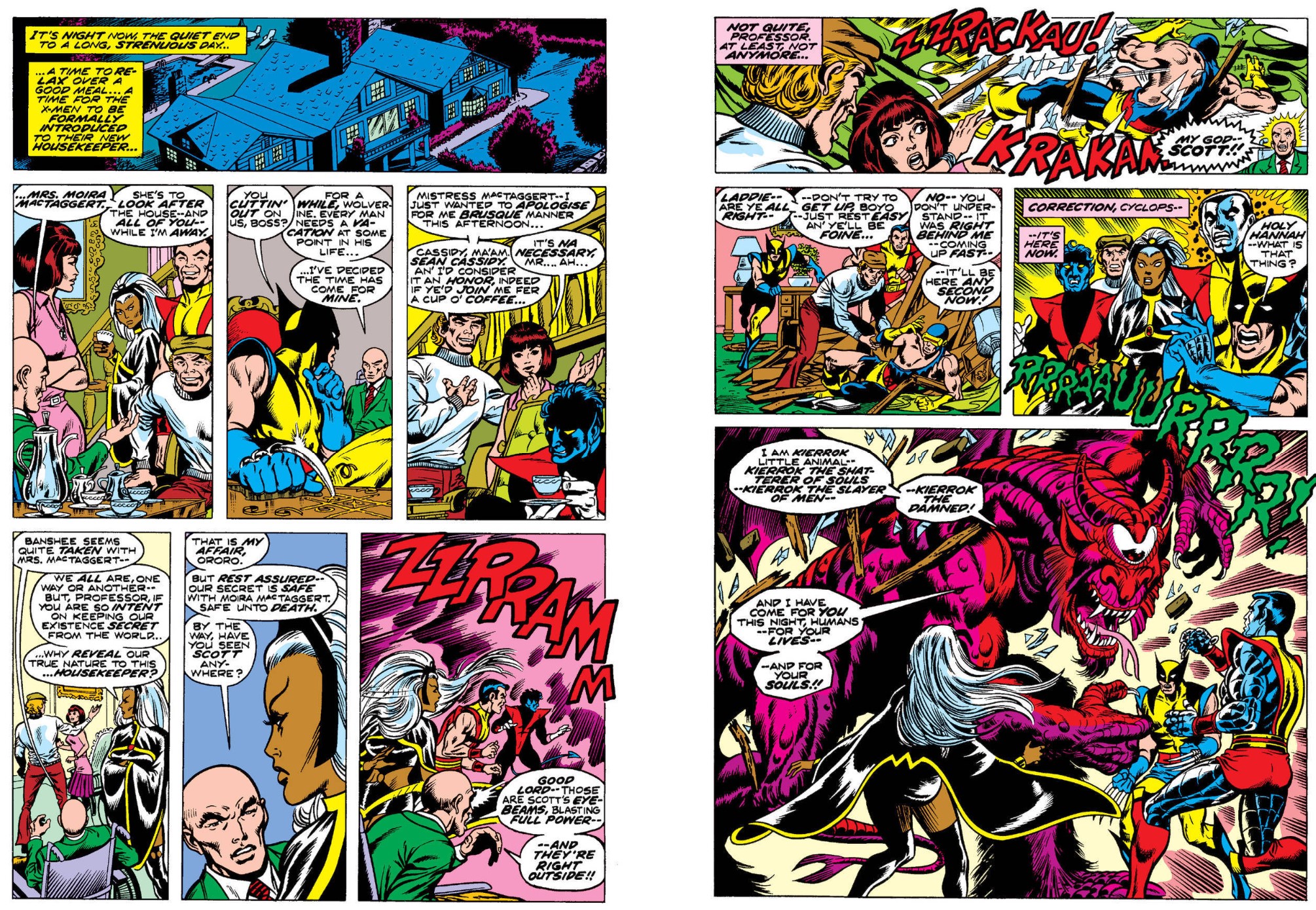
X-Men #96 saw Claremont take full charge of the writing (albeit with plotting input from Bill Mantlo) for ‘Night of the Demon!’ Here, guilt-wracked Cyclops blames himself for the loss of his teammate, and in his explosive rage accidentally unleashes a demonic antediluvian horror from Earth’s primordial prehistory for the heroes-in-training to thrash. The infernal Nagarai would periodically return to bedevil mankind, but the biggest innovation in this issue was the introduction of gun-toting biologist/housekeeper Moira MacTaggert and the first inklings of the return of implacable old adversaries…

A long-running, cosmically-widescreen storyline began in #97 with ‘My Brother, My Enemy!’ as Xavier – tormented by visions of interstellar war – tries to take a vacation, just as Havok and Lorna (finally settling on superhero nom de guerre Polaris) attack: apparently willing servants of a mysterious madman using Cyclops’ old undercover alter ego Eric the Red. The devastating conflict segues into a spectacular 3-part yarn, as pitiless robotic killers return under the hate-filled auspices of mutant-phobic Steven Lang (and his mysterious backers in Project Armageddon). The action opens with #98’s ‘Merry Christmas, X-Men… the Sentinels Have Returned!’

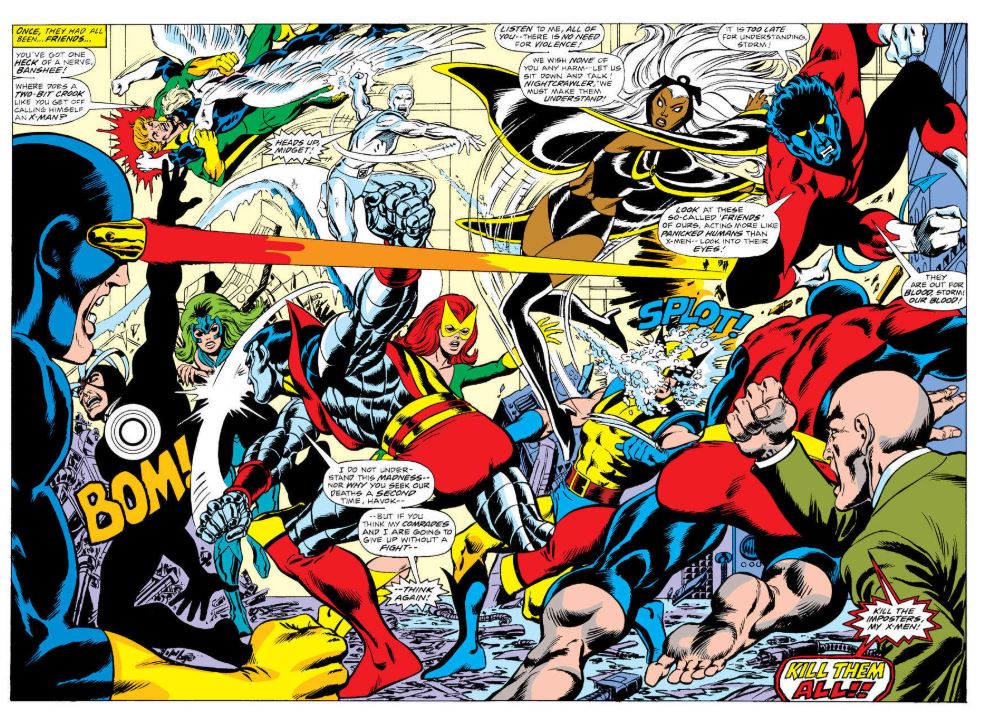
With coordinated attacks capturing semi-retired Marvel Girl plus Wolverine, Banshee and Xavier, Cyclops and the remaining mutant heroes co-opt a space shuttle and storm Lang’s orbital HQ to rescue them in ‘Deathstar Rising!’ (inked by Frank Chiaramonte): another phenomenal all-action episode. The saga concludes on an agonising cliffhanger with the 100th issue anniversary tale. ‘Greater Love Hath No X-Man…’ (with Cockrum inking his own pencils) sees new X-Men apparently battle the original team before overturning Lang’s monstrous schemes forever. However, their catastrophic clash destroys the only means of escape and, as a gigantic solar flare threatens to eradicate the satellite-station, their only chance of survival means certain death for another X-Man…

To Be Continued…

With even greater excitement and innovation to follow in succeeding issues, these superb comics classics revolutionised a moribund genre and led directly to today’s ubiquitous popular cultural landscape where superheroes are as common as cops, cowboys, monsters or rom-com Romeos. They even made it into movies without looking ridiculous…

Extras include an introduction by Claremont; issue covers by Gil Kane, Cockrum, Marie Severin, Sal Buscema & Rich Buckler; Kane’s cover for eventual all-reprint Giant-Size X-Men #2; Cockrum’s designs for The Outsiders (a Legion of Super-Heroes 5-page spin-off pitch rejected by DC); character designs for Phoenix, Colossus & Nightcrawler; the cover to F.O.O.M.  #10 and caricatures of the X-Men creative team by Marie Severin; House ads and original art pages, roughs and covers by Kane & Cockrum completing the perfect primer/introduction to the New X-Men phenomenon.

The immortal epics compiled here are available in numerous formats but for a selection that will survive the continual re-readings of the serious, incurable fan there’s nothing to beat the sturdy and substantial full-colour feel of these Marvellous Masterwork editions.
© 2016 Marvel Characters, Inc. All rights reserved.

Jack Staff: Everything Used to Be Black and White


By Paul Grist (Dancing Elephant/Image Comics)
ISBN: 978-1-5824-0335-9 (TPB/Digital edition)

Just like many aging Brits & gits, I forget things and yesterday I missed a birthday. September 9th 1960 should be best known as the natal debut of cartoon paragon Paul Grist. Read this – and absolutely the book and its three sequels – to learn why.

Growing up a comic fan in 1960s -1970s Britain was an oddly schizophrenic situation. Not only were we bombarded and enthralled by our own weirdly eclectic mix of TV stars, Dying Empire jingoism and military bluster, fantastic anti-establishment fantasy, science-fiction and sport yarns – all augmented by the sheerly inspired, madcap anarchy of gag strips that always accompanied such adventure serials in our anthology weeklies – but from 1959 on, we also had unfettered access to exotic worlds and thinly veiled cultural imperialism of US comic books, bulk-imported as ballast in cargo ships and readily available in glorious full colour…

And don’t even get me started on the precious few, but always exotic and classy European wonders like Tintin, Lucky Luke and Asterix, simultaneously filtering into the funnybook gestalt constantly brewing in our fevered little heads. All this pictorial wonderment tended to make us young strips disciples a tad epicurean in our tastes and broad-minded, eccentric synthesists about our influences…

I’ve followed Paul Grist’s work since the small press days of Burglar Bill and St. Swithin’s Day, and his brilliantly refined design sense and incisive visual grasp of character made his interpretations of Grendel, Judge Dredd and other commercial properties excellent examples of why individuality always trumps house style. However, when he writes his own material, he steps into a creator class few can touch, always blending and refining key elements of genre and shared public consciousness into a stunningly inviting new nostalgia. For another perfect example check out what he accomplished with hard-boiled detective archetypes in his splendid Kane (see Kane: Welcome to New Eden among others)…

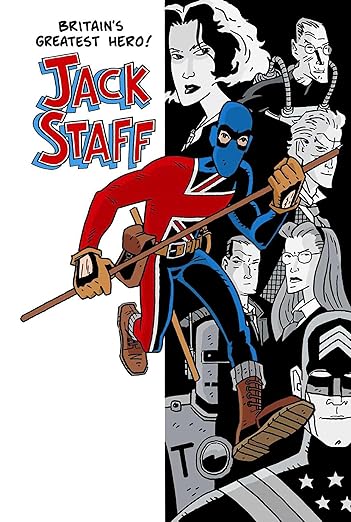
Grist established his own company, Dancing Elephant Press, to produce the kind of works big-time publishers lacked the imagination to support and in 2002 returned to the childhood delights of superhero comics with the creation of Jack Staff, who began life as a proposed Union Jack story for Marvel.

When they pulled the plug, Grist, unable to let a good idea go and now freed of the usual creative restraints that come from playing with other people’s toys, went wild and produced a purely British take on the superhero phenomenon that is simultaneously charming, gripping and devilishly clever. I usually go into laborious (most would say tedious) detail about the events in these graphic novel reviews but this first Jack Staff collection (gathering the first 12 issues) will be an exception as Grist’s captivating style here (based on and mimicking the anthology format of British Weeklies such as Lion and Valiant) means each issue feels like seven stories in one. As my intention is to convince to buy this book I’m sacrificing detail for brevity… you lucky people.

In a nondescript British city Becky Burdock is a feisty girl reporter for trashy newspaper The World’s Press. Opening gambit ‘Yesterday’s Heroes’ finds her hunting down a serial killer scoop on the “Castletown Slasher”, when she accidentally stumbles onto the identity of Jack Staff (Britain’s greatest costumed hero since WWII, and a man missing since the 1980s).

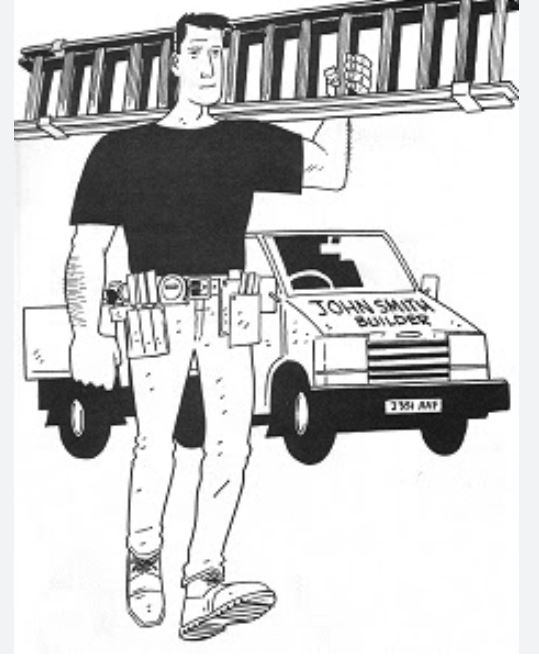
It happens when local builder John Smith saves her from a collapsing billboard, precipitating memories of wartime international superhero team The Freedom Fighters and a battle against a centuries-old vampire. It also strangely involves British Q Branch (investigating un-rational or weird crimes) and US superhuman Sgt. States, Jack Staff’s opposite number and another seemingly immortal patriotic hero.

Marvel Zombies will rightly identify this tale has echoes of the Roy Thomas & Frank Robbins Baron Blood storyline from 1970s title The Invaders, and if Marvel had been more accommodating this would indeed have been a classy sequel to that saga. However they missed their chance and this magically tongue-in-cheek pastiche is the magnificent result and our gain.
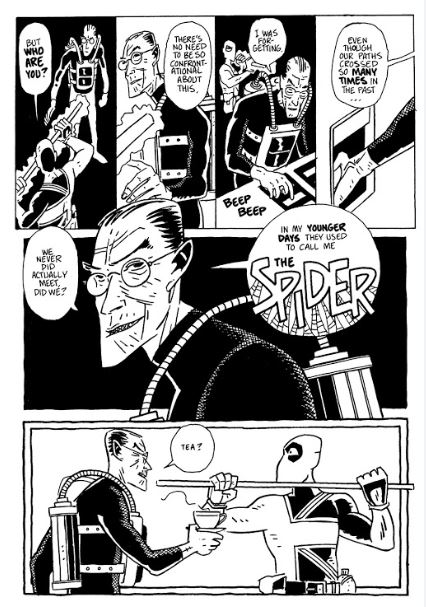
There are still superhumans in this world such as heroic Tom Tom, the Robot Man and villainous Doc Tempest, and even mortal champions like Albert Bramble and his son Harold who battle dark forces as vampire hunters, but even they cannot prevent Becky becoming a victim of the killer stalking the city. John Smith is clearly reluctant to rejoin the masked hero community but events keep pushing him until he uncovers an international conspiracy of sanctioned atrocity that naturally gets hushed up by the powers that be…

These stories are rife with references and cameos from 50 years of popular culture, and not just comics. Us Brits love television and thinly disguised TV icons such as Steptoe and Son, Dad’s Army and The Sweeney ferociously jostle alongside purely comic stars such as Captain America and Dr. Strange and members of our own uniquely bizarre periodical pantheon including Robot Archie, Zip Nolan, Kelly’s Eye, Jason Hyde, Adam Eterno and even relatively real people such as Alan Moore and Neal Gaiman.

A far larger part is played by incomparable poacher turned gamekeeper The Spider in second story-arc ‘Secrets, Shadows and the Spider!’ as things go quirkily cosmic after Becky Burdock, Vampire Reporter and the increasingly intriguing Q cops stumble into real X Files territory and we get some welcome background into recent history when a 1960s super-criminal starts stealing again.

Or does he? The Spider never shot anybody before…

The mystery is cleared up when elderly Alfred Chinard (it’s a partial anagram – work it out…) hires builder John Smith and springs a trap on his old foe before they notionally team up to stop the real thief. Of course, it doesn’t really go Jack’s way and he’s literally left holding the bag. After a full-length Q adventure ‘Quotations’ involving a meta-fictional serial killer, ‘Out of Time’ rounds out the book (and don’t forget there are three sequels…).

Here, Victorian showman and escapologist Charlie Raven (a canny reworking of period masterpiece Janus Stark) enters the picture, encountering a Dorian Gray-like mystery and losing a battle to a foe who consumes time itself. As a result, charismatic Raven endures an Adam Adamant moment and ends up in 21st century Castletown, where his enemy is still predating the human populace. Also causing trouble is Ben Kulmer – the invisible bandit known as The Claw (and lovingly homaging Ken Bulmer, Tom Tully & Jesús Blasco’s astounding antihero The Steel Claw).

When that nice Mr. Chinard turns up again the stage is set for a spectacular time-rending chronal clash involving the entire expansive cast that is spectacular, boldly bewildering and superbly satisfying.

The stark yet inviting monochrome design, refined, honed and pared down to minimalist approachability has an inescapable feeling of Europe about it. If ever anyone was to create a new TinTin adventure, Grist would be the ideal choice to draw it. Not because he draws like Hergé, but because he knows his craft as well as Hergé did. However, I’m deliriously happy that he has so brilliantly assimilated the essences of cherished keystones of my beloved comics-consuming past and given them such a vital and compelling fresh lease of life.

Thrilling, funny, fabulous. Buy this Book!
™ & © Paul Grist. All rights reserved.

Today in 1952 writer Gerry Conway was born, as was Alison Bechdel in 1960. We’ve done some but hardly all of their many works and we’ll be adding to that list soon.

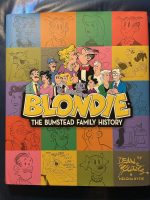
Blondie: The Bumstead Family History/Blondie: The Complete Bumstead Family History


By Dean Young, and Melina Ryzik (Thomas Nelson/Rutledge Hill Press, U.S.)
ISBN: 978-1-4016-0322-9 (HB/Digital edition)

This book includes Discriminatory Content produced in less enlightened times

Normally I leave newspaper strip reviews for a weekend, but this is one birthday we just can’t miss. Please remember, just because you don’t read something don’t mean it ain’t popular…

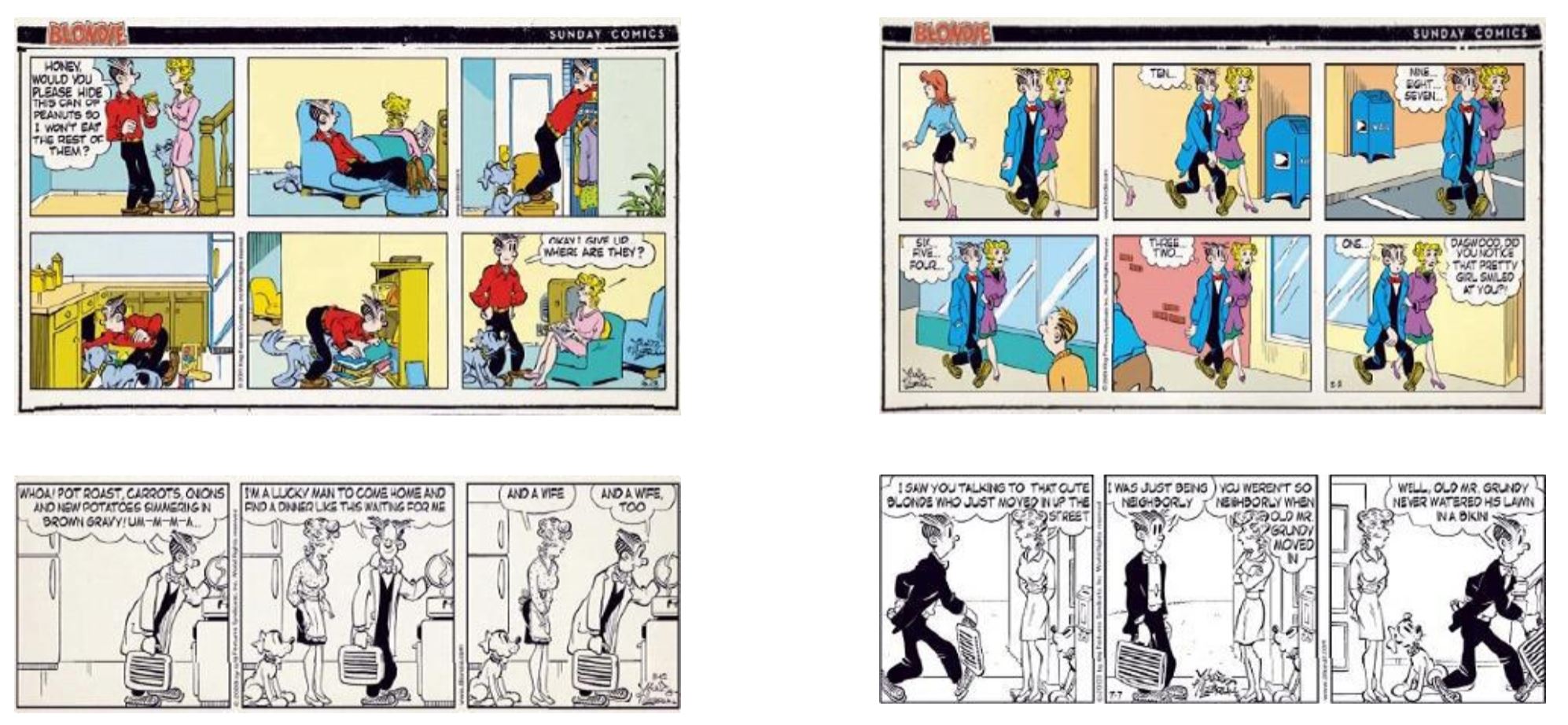
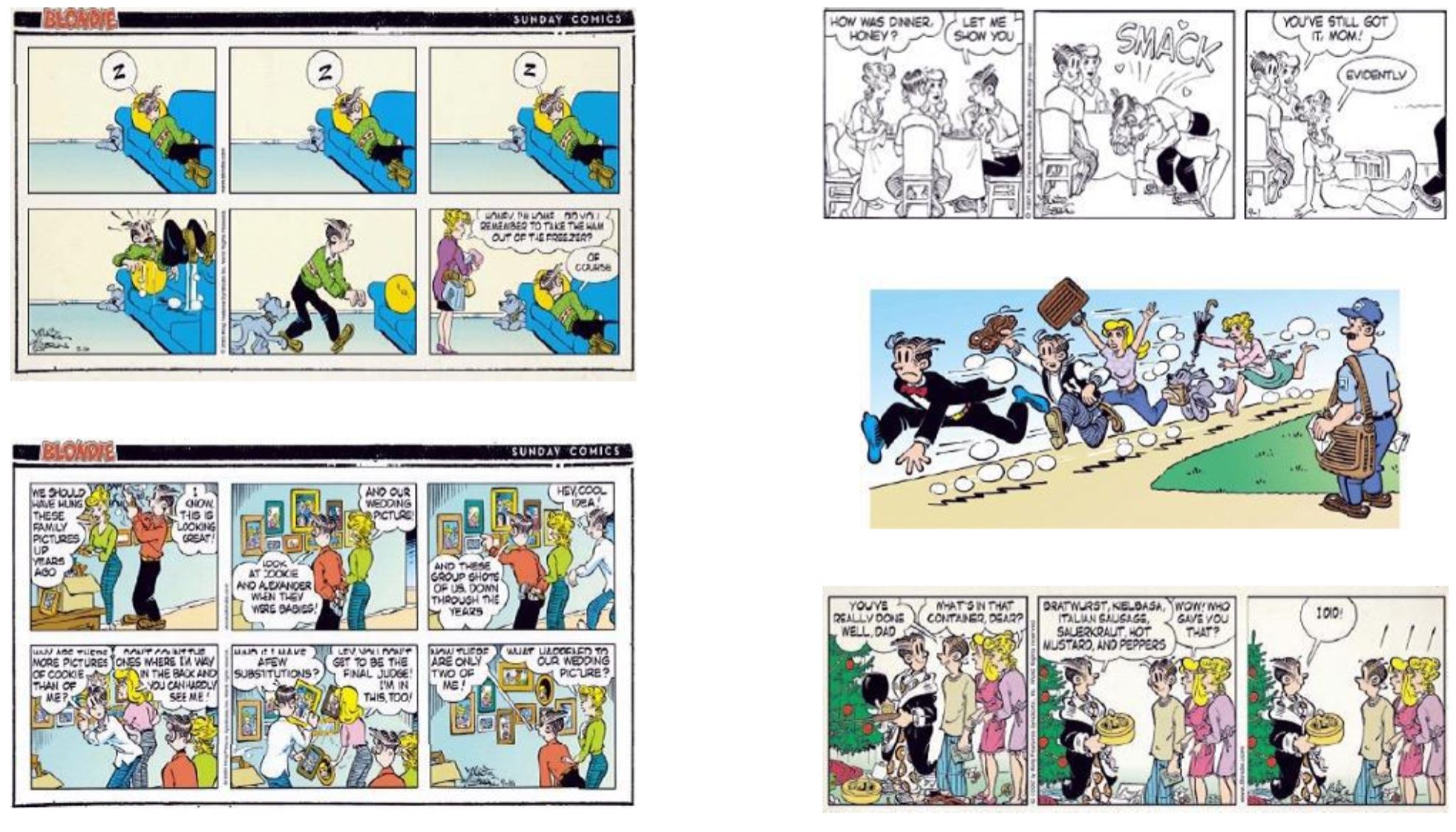
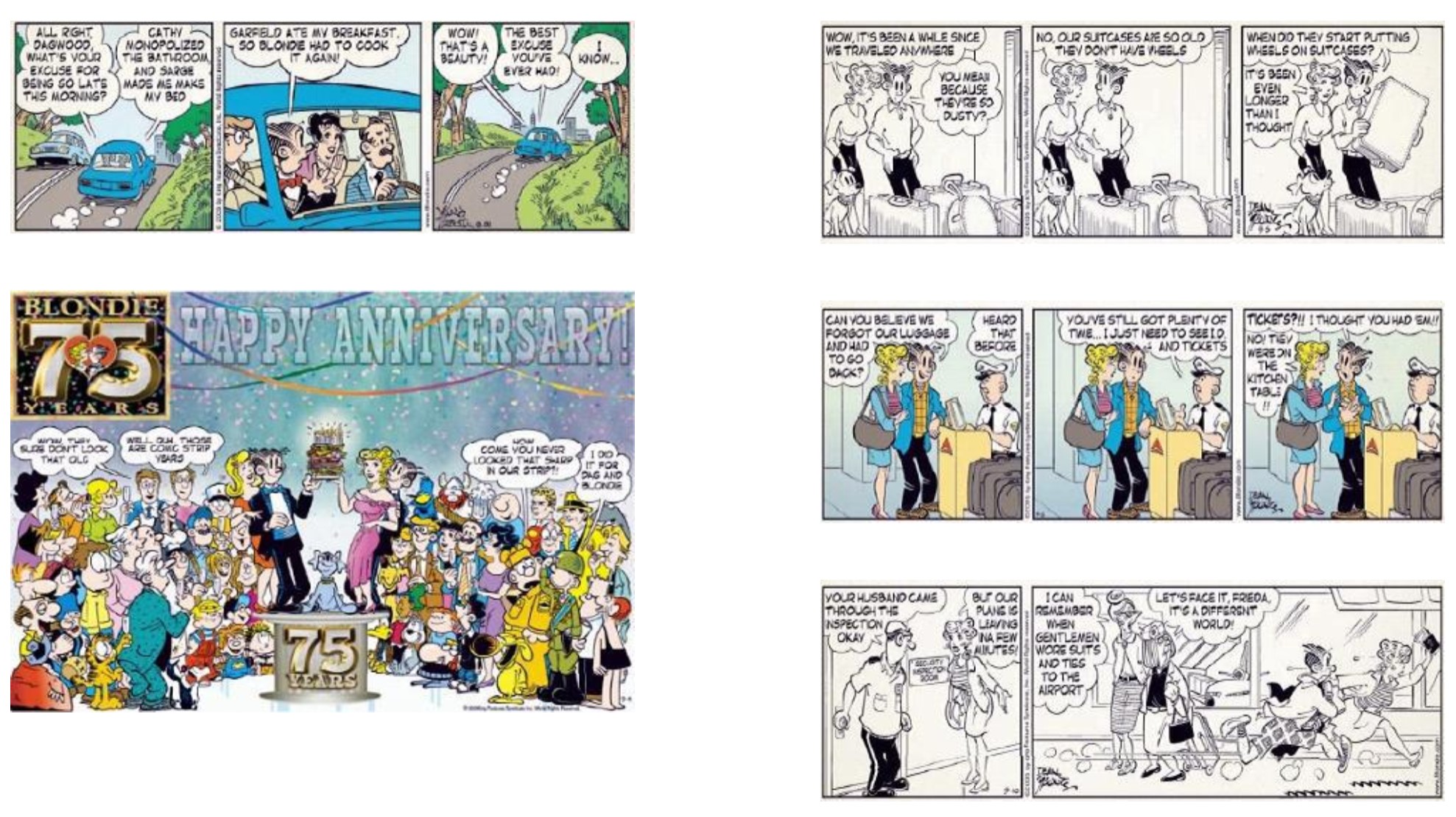
Like Dagwood’s legendary sarnies, Bumstead family functions go on forever. Yesterday we learned how Chic Young’s strip Blondie began on September 8th 1930 and just kept going. The feature was inherited and carried on in 1973 by his family, chiefly son Dean with a select group of collaborators. Dean considers himself the guardian of a legacy as much as continuer of a phenomenon. In 2007, after the 75th anniversary, commemorative curated celebration Blondie: the Bumstead Family History was released to mark the occasion, and with the feature still going strong this remastered (even enjoying fancy-schmancy External hyperlinks, no less!) “Complete” edition invites a look at what he’s done to keep things fresh as much as safeguard generations of readers’ fond memories.

Combining short lavishly illustrated articles with a wealth of published strips – each attached to general topics – the raucous revery begins with ‘Chapter One: The Bumstead Family Album’, incorporating historical overviews and the traced evolutions of ‘Blondie’ and eternal, often inanimate inamorata ‘Dagwood’; firstborn son/current teen icon ‘Alexander’ (who first appeared on April 15th 1934) and his sister ‘Cookie’ who Dagwood feels is far too popular with boys). Faithful, longsuffering house mutt ‘Daisy’ gets her own section, as does abusive Boss/archnemesis ‘Mr. Dithers’, next-door-neighbours ‘The Woodleys’ (AKA Herb & Tootsie), long-suffering mailman ‘Mr. Beasley’ and cheeky, always underfoot kid/voice of a fresh generation ‘Elmo Tuttle’

The early days of the unshakable relationship are scrutinised in ‘Chapter Two: Getting Married’, tracing love’s rocky road through turbulent fast-changing times and a hugely successful publicity gimmick of young Dagwood going on extended hunger strike to force his adamant parents to allow him to wed! A massive publicity coup, the convoluted month-long storyline led to rowdy nuptials in February 1933 and is swiftly and sensibly followed by chapters on ‘Family Life’, as the couple become a nuclear unit, demographic and breadwinning paean to domesticity as ‘Dagwood at Work’ reveals what a decent man endures to bring home the bacon – and pickles and bratwurst and olives and pastrami and turkey and chicken, and salmon and lettuce and pumpernickel and lox and…

Courting middle American controversy, not to say media attention and a little homemaker wrath, ‘Blondie Goes to Work’ saw the tireless and capable stay-at-home mom and neighbour Tootsie ultimately turn those life skills into joyously fulfilling independence by starting their own catering business. This was only in 1991 and this pic-packed chapter also deals with the ridiculous amounts of outrage the world-shaking leap into the 20th century seemed to trigger in the heartland. Naturally, Dagwood was completely supportive: who else could test the new dishes and delights the girls kept inventing…

‘Chapter Six: Favourite Strips’ reviews some of the countless gags to have riffed on the series’ core themes – eating, sleeping, making and living and eating – whilst focussing on Dean Young’s constant efforts to keep the strips relevant and contemporary whilst the major industry event that evolved out of ‘The 75th Anniversary’ is described in detail. To celebrate the milestone in 2005, Dean and King Features organised a massive crossover that included VIPs like President Bush and other real-world notables as well as most of the nation’s major strips and creators wishing the happy couple all the best.

If you read Beetle Baily, Hagar the Horrible, Garfield, Rose is Rose, Wizard of Id, Dick Tracy, B.C., Mother Goose & Grimm, Family Circus, Shoe, Hi & Lois, Gasoline Alley, Sally Forth, Snuffy Smith, Buckles, Baby Blues, Zits, Mutts, Curtis, Marvin, For Better or Worse, Born Loser, Dennis the Menace (theirs not ours), Cathy, Thick Thin or Bizarro you were invited and there on the day. Disney alumni and single panel editorial cartoonists got in on it and for one moment all of America enjoyed a taste of Dagwood. Most of those strips are here as well as plenty from the months-long build up and aftermath in the actual Blondie feature.

This super memoriam concludes with a look beyond the panels as ‘Forever Young’ explores the life and achievements of Murat Bernard Young, his wife and model/inspiration Athel Lindorff née Young, Dean and sister Jeanne and the many notables who pitched in and/or assisted on Blondie’s production: Alex and Jim Raymond, Stan Drake, Mike Gersher, Ray McGill, Denis LeBrun, and John Marhall & Frank Cummings

Also included in this inescapably family function are original art and sketches, dozens of candid family portraits and photos, commentary and so, so many cartoons to wallow in. If you want a simple satisfying Good Read, this is for you your kids and your grannie, but don’t forget to bring the sandwiches… and not small ones neither…
© King Features Syndicate, Inc. 2007.

Today in 1958, Jack Kirby’s Sky Masters of the Space Force newspaper strip launched.