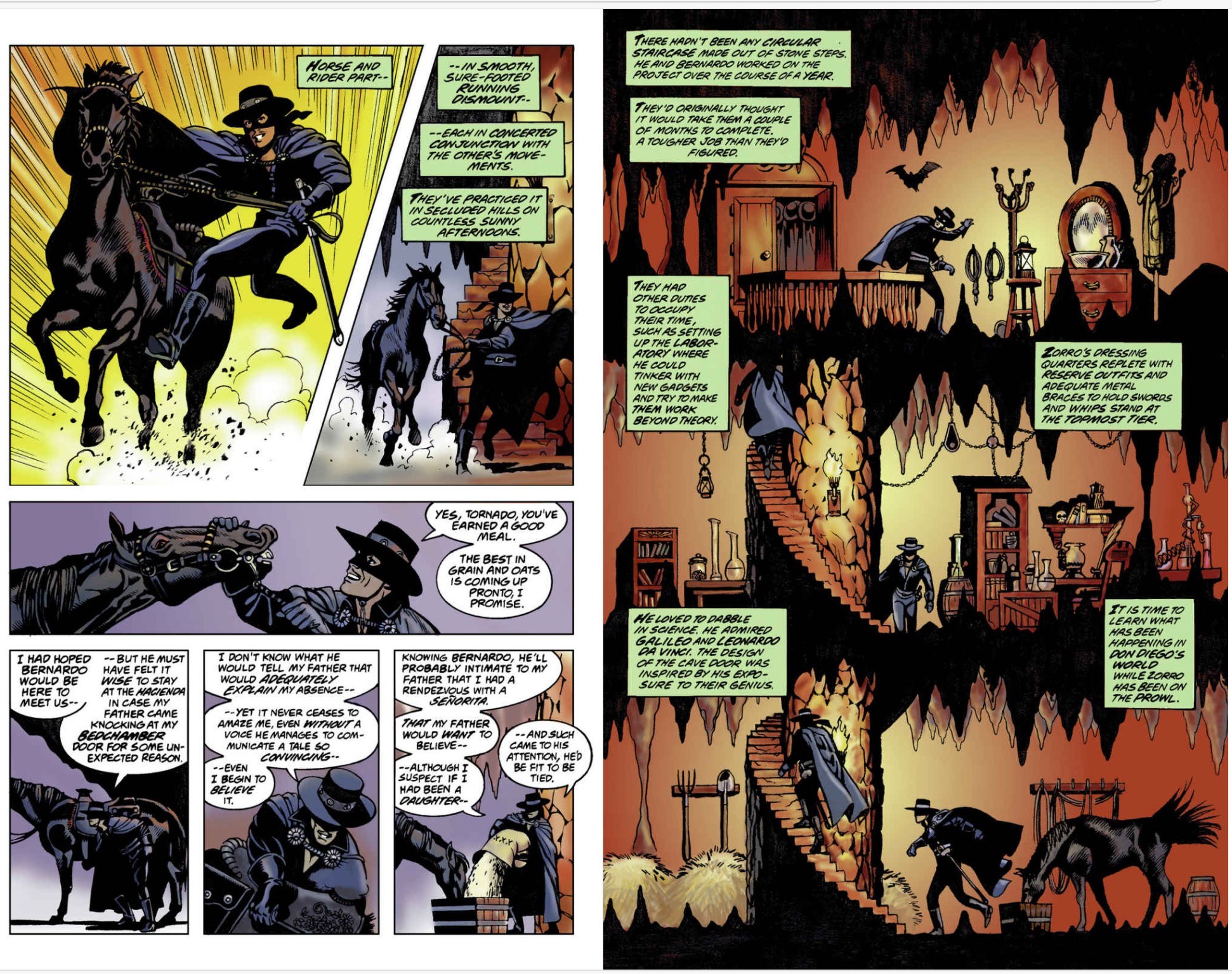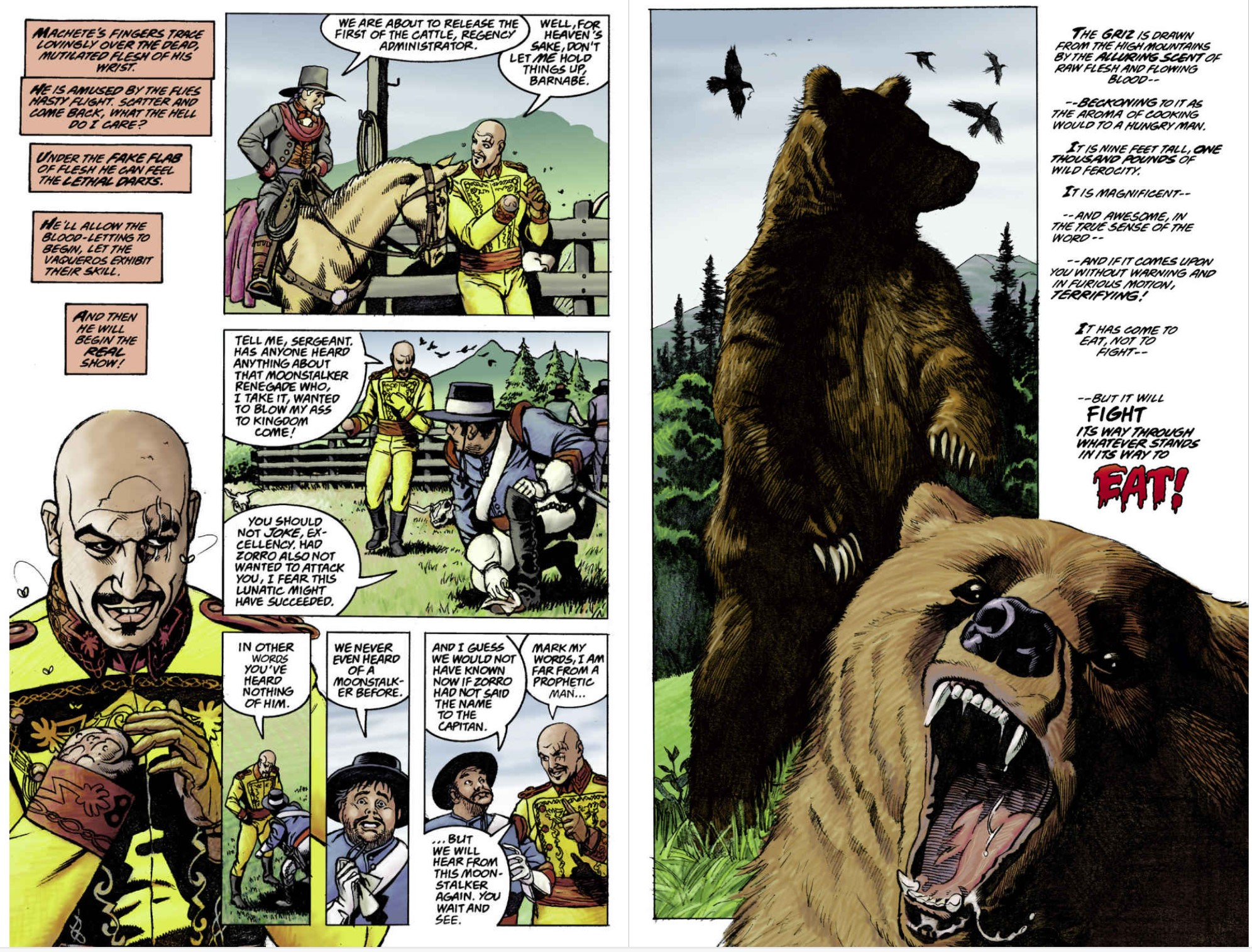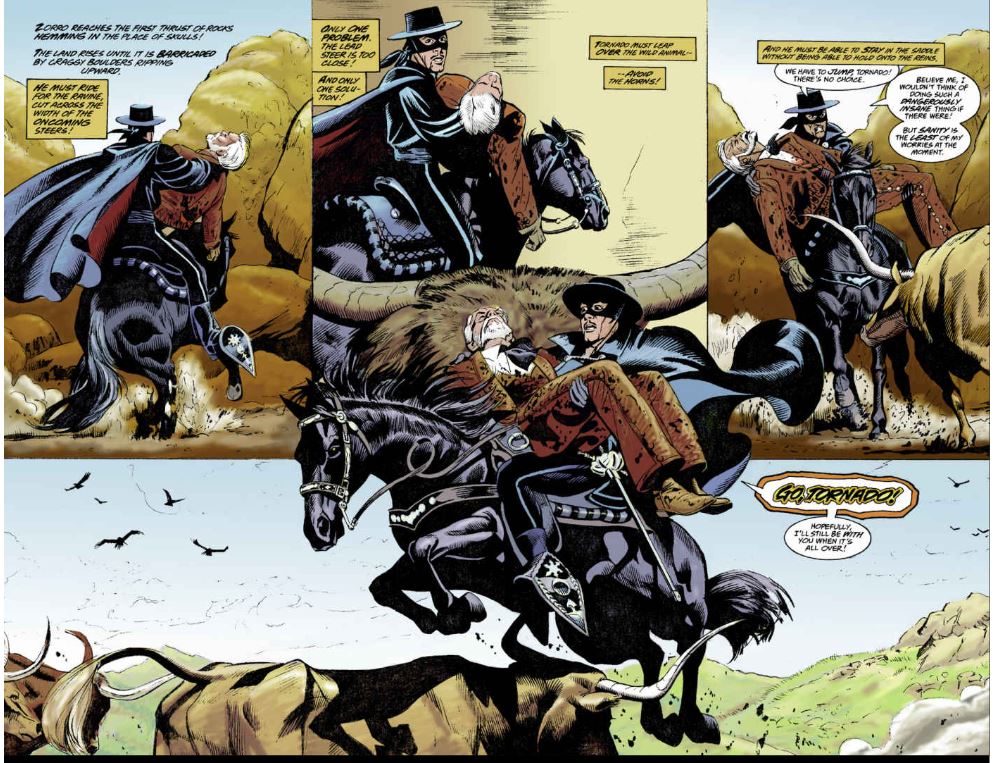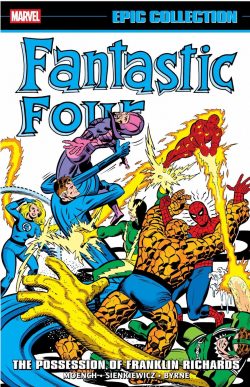
Fantastic Four Epic Collection volume 12: The Possession of Franklin Richards


By Marv Wolfman, Bill Mantlo, John Byrne, Ed Hannigan, George Pérez, Peter B. Gillis, Roger Stern, Doug Moench & Bill Sienkiewicz, Steve Ditko, Tom Sutton, Keith Pollard, Al Milgrom, Joe Sinnott, Pablo Marcos, Bruce Patterson, Chic Stone, Jon D’Agostino, Mike Esposito, Jerome Moore, Frank Giacoia & various (MARVEL)
ISBN: 978-1-3029-6056-8 (TPB/Digital edition)

This book includes Discriminatory Content produced in less enlightened times.

Win’s Christmas Gift Recommendation: Fantastic Fun for Comics Addicts… 8/10

It’s a been a big year for the fabulous FF. Here’s another titanic tome to add to your seasonal swag list…

For Marvel everything started with The Fantastic Four.

Monolithic modern Marvel truly began with eccentric monster ‘n’ alien filled adventures of a compact superteam as much squabbling family as coolly capable costumed champions. All that Modern Marvel is, company and brand, stems from that quirky quartet and the inspired, inspirational, groundbreaking efforts of Stan Lee & Jack Kirby…

Cautiously bi-monthly and cover-dated November 1961, Fantastic Four #1 – by Stan, Jack, George Klein and/or Christopher Rule – was raw and crude even by its ailing publisher’s steadily plunging standards. However, it seethed with rough, passionate, uncontrolled excitement and thrill-hungry kids pounced on its dynamic storytelling. The series caught a wave of change beginning to build in America, and every succeeding issue changed comics a little bit more… and forever. Revealed in that premier, maverick scientist Reed Richards, fiancée Sue Storm, close friend Ben Grimm and Sue’s bratty teenaged brother survived an ill-starred private spaceshot after cosmic rays penetrated their ship’s inadequate shielding.

All permanently mutated: Richards’ body became elastic, diffident Sue became (even more) invisible, Johnny Storm burst into living flame and tragic Ben shockingly devolved into a shambling, rocky freak. After the initial revulsion and trauma passed, they solemnly agreed to use their abilities to benefit mankind. Thus was born The Fantastic Four – you can add your own fanfare and timpani here if you wish…

Throughout the 1960s it was the key title and most consistently groundbreaking series of Marvel’s ever-unfolding web of cosmic creation: a forge for new concepts and characters. Jack Kirby was approaching his creative peak: unleashing his vast imagination on plot after spectacular plot, and intense, incredible new characters whilst Lee scripted some of the most passionate superhero sagas ever seen. Both were on an unstoppable roll, at the height of their powers and full of the confidence only success brings, with The King particularly eager to see how far the genre and the medium could be pushed… which is rather ironic since it was the company’s reticence to give the artist more creative freedom that led to Kirby’s moving to National/DC in the 1970s.

Without Kirby’s soaring imagination the rollercoaster of mindbending High Concepts lost out to traditional tales of characters in conflict, with soap opera leanings and supervillain-heavy Fights ‘n’ Tights forays abounding. With Lee & Kirby long gone but their mark very much still stamped onto every page of the still-prestigious title, this full-colour compendium represents Fantastic Four #215-231 and Annuals #14-16, spanning Fall 1979 to June 1981.

What You Should Know: After being rejuvenated and repowered in an extended space-spanning saga, the Family FF are getting used to being back on Earth even with supervillains all over the place. Now Read On…

The revived, excessively rejuvenated team are in full fine fettle for Fantastic Four Annual #14 wherin Marv Wolfman, George Pérez & Pablo Marcos put firstborn Franklin Richards and his sorcerous nanny Agatha Harkness in the spotlight for ‘Cats-Paw!’ When magical cult Salem’s Seven abduct and brainwash the adult FF in hopes of resurrecting their macabre master Nicholas Scratch, even the Avengers are helpless to stop the carnage unleashed. Thankfully, the extra-dimensional voyage of the kid and the crone is enough to set everything right…

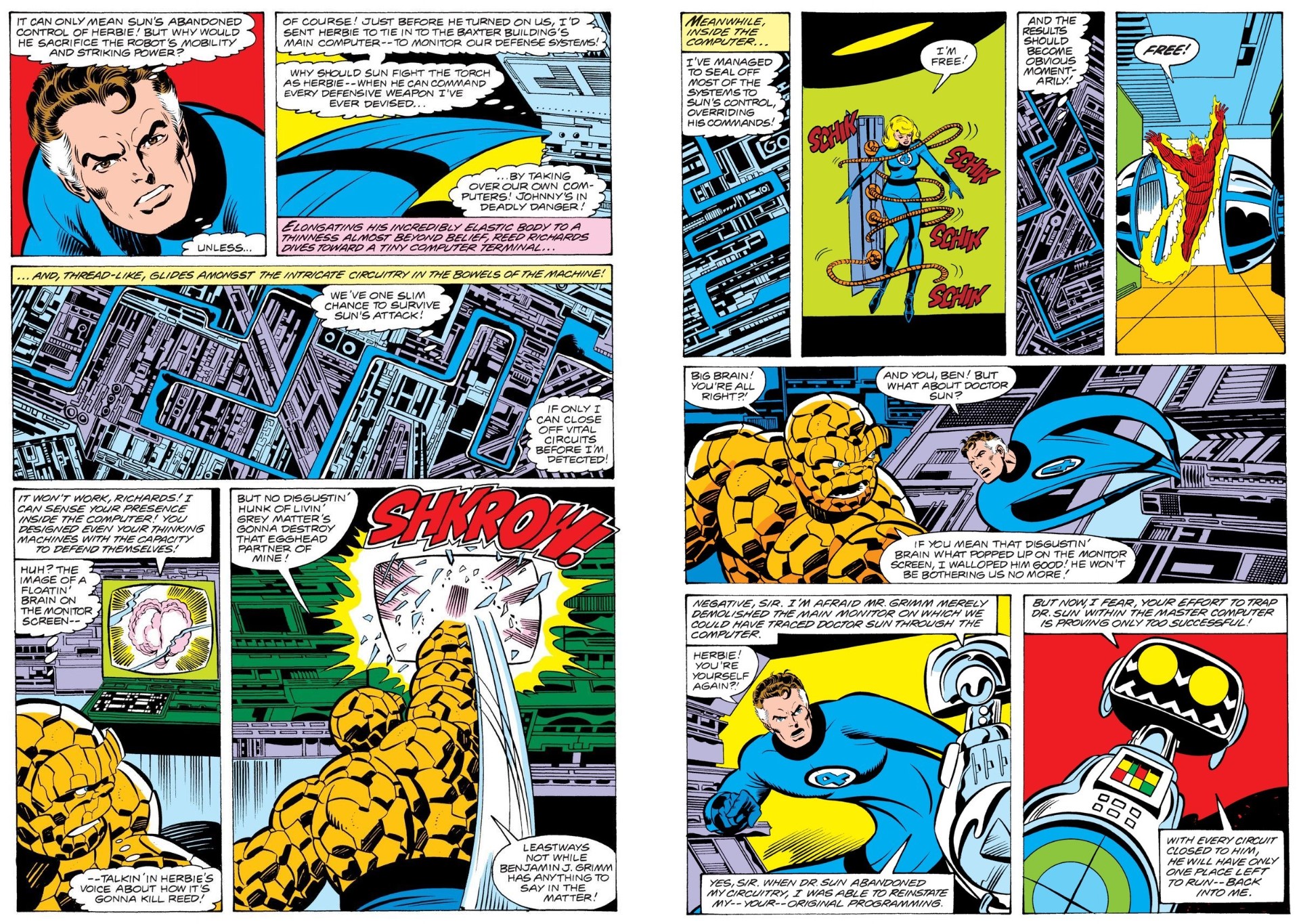
The arcane account is augmented by ‘A Gallery of the Fantastic Four’s Most Famous Foes!’ by Keith Pollard & Marcos, giving the lowdown on late-debuting villains and ne’er-do-wells including Invincible Man, Attuma, Gideon, Dragon Man, The Frightful Four and Quasimodo. Monthly FF #215 then finds Wolfman, John Byrne & Joe Sinnott reintroducing Negative Zone terror tyrant ‘Blastaar!’ who somehow escapes the antimatter universe to take over the Baxter Building just as a reinvigorated Reed Richards is distracted by former colleague Professor Randolph James who has hyper-evolved himself to offset an otherwise fatal beating by street thugs. Sadly, his accelerator device has not advanced James’ ethical outlook, and after taking vengeance on his attackers, the future man proves that ‘Where There Be Gods!’ there be trouble too, as the mental marvel aligns with Blastaar only to fall before a far greater power… angry cosmic child Franklin…

Bill Mantlo scripts #217 for Byrne & Sinnott, as ‘Masquerade!’ at last exposes the viper in the team’s midst: an inimical force responsible for most of the recent setbacks and accidents, and almost the deaths of the heroes and Johnny’s new intended girlfriend Dazzler

No spoilers here this time, but back then we all just knew who the hidden villain actually was… that acursed robot!

Infernal gadget H.E.R.B.I.E. was imposed on the series due to concerns by producers of the current Fantasic Four cartoon show. Rejecting fire hazard Johnny for a cutely telegenic robot, Wolfman cheekily made that commercial compromise in-world canon, dividing fans forever after. The bleeping bot – a Humanoid Experimental Robot, B-type, Integrated Electronics (latterly, Highly Engineered Robot Built for Interdimensional Exploration; don’cha just love nominative deterministic acronymics?) – is pure Marmite in most readers eyes…

Next is the last half of an old-school saga that, for completeness, means you need to read Peter Parker, the Sensational Spider-Man #42 before enjoying the contents of FF #218. What’s not here is how ESU student Peter Parker goes on a class jaunt and is lured into a trap by the Frightful Four (in ‘Give Me Liberty or Give Me Death’ by Mantlo, Mike Zeck & Jim Mooney if you were wondering). The villains broadsided the wallcrawler after new recruit Electro impersonated the Human Torch there…

Now for ‘When a Spider-Man Comes Calling!’ (cover-dated May 1980 by Mantlo, Byrne & Sinnott), Trapster repeats the tactic to ambush the comfortably at home quartet, allowing his comrades The Wizard and Sandman to take over the heroes’ Baxter Building citadel… at least until a fighting-mad webspinner breaks free for an unstoppable counterattack…

Penciller John Byrne, having served out his first term on the series he was to soon make his alone, was officially only temporarily replaced for FF #219. Ably augmented by Sinnott, stalwart “Guest-Team” Doug Moench & Bill Sienkiewicz were parachuted in for monster mash-up ‘Leviathans’ due to the huge success and acclaim generated by their vigilante thriller Moon Knight. They brought with them a whole new look and sensibility, as well as far faster pace to the stories. Here, modern day pirate Cap’n Barracuda steals the fabled Horn of Proteus from Atlantis to unleash a wave of giant monsters on New York City. Thankfully, this is a subject the mighty Sub-Mariner and Mr. Fantastic can agree on, and their combined forces soon stomp the beasties to stop a piratical plunder ploy without peer…

Byrne bounced back writing & pencilling in #220 as ‘…And the Lights Went Out All Over the World!’ sees the Avengers call Reed and Co. when all Earth suffers a catastrophic power-outage. Science! sends the explorers to the arctic to encounter an astounding and unbelievable obelisk being constructed by beings of utterly alien appearance…

The story includes an updated origin for the quartet and guest shot for Canada’s finest (that’s Vindicator of Alpha Flight in case you were wondering) as the tale halts for a pinup by inker Sinnott (the Torch battling a flaming Skrull) prior to #221’s concluding chapter ‘Tower of Glass… Dreams of Glass!’ Following the usual misconceptions and rash clashes it is revealed that three aliens shipwrecked for half a million years just need their myriad mobile mechanisms to reverse the planet’s magnetic poles so they can return home at last. Happily, Reed has a less end-of-human-civilisation-y solution leaving everyone involved happy and safe; and back where they belong…

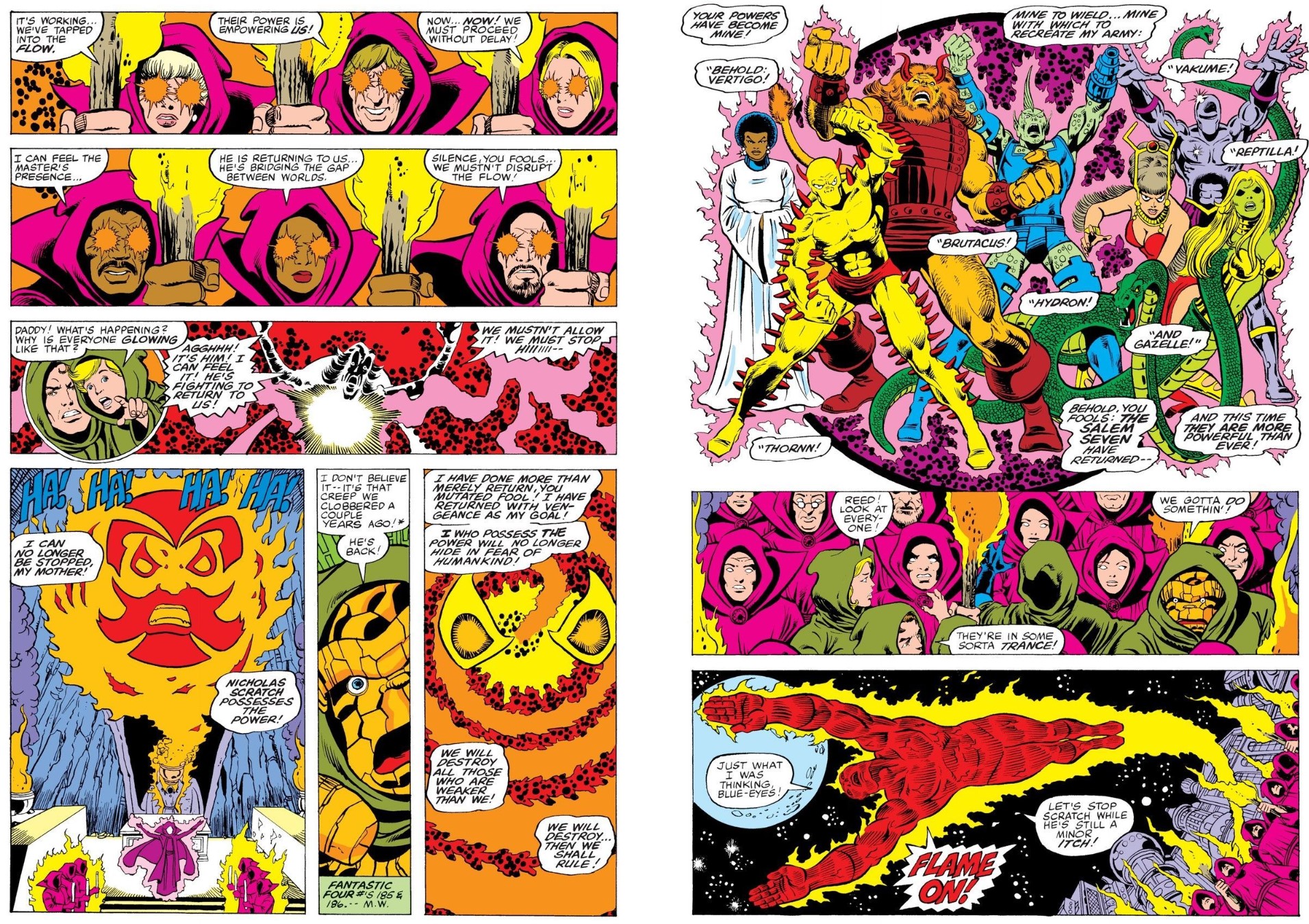
Now officially the regular creative team, Moench & Sienkiewicz prep for Halloween in FF #222’s ‘The Possession of Franklin Richards!’ as the cosmic ray kid is again targeted from beyond the unknown by exiled soul Nicholas Scratch. The son of Agatha Harkness is the kind of warlock who gives witchcraft a bad name. and, having made the boy his conduit back to reality, Scratch goes on to terrorise and torture his hated enemies. With Doctor Strange unavailable, they enlist the dubious gifts of self-doubting failed horror hero Gabriel the Devil Hunter and his morally ambiguous familiar Desadia (from Marvel’s monochrome magazine line titles Haunt of Horror and Monsters Unleashed)…

Apparently acquiescing, the team agree to liberate the dead diabolist’s minions of magical mayhem and Salem’s Seven toil ‘That a Child May Live…’ Of course, their instant assaults on humanity are an acceptable risk and consequence in Reed’s plan: setting the worlds to rights for all but the defeated devil…

Fantastic Four Annual #15 swiftly follows, wherein Moench & Pérez, abetted by Chic Stone, Jon D’Agostino & Mike Esposito, renew hostilities between the FF and Skrull empire as the shapeshifters target the supergenius’ latest energy-casting breakthrough in ‘Time for the Prime Ten!’ Infiltrating the Baxter Building, negating his valiant teammates and almost banishing Mr. Fantastic to the tender mercies of Annihilus in the Negative Zone, the sneaky killers are actually seeking to end their millennial war against stellar rivals The Kree, but have underestimated Reed’s brilliance, his family’s tenacity and the cosmic awareness of Earth-loving Kree Exile Captain Mar-Vell

A back-up tale by Moench & Tom Sutton takes us to recently liberated Latveria for the opening of proposed series ‘The Return of Doctor Doom!’ Only episode ‘The Power of the People!’ shows how restored monarch King Zorba fails to live up to his democratic promises and discover how excessive taxation really upsets voters, at around the same moment crazed, catatonic Victor von Doom goes missing from the most secure dungeon in Doomstadt…

Sadly, the impending crisis never materialised and was only addressed by Byrne in Fantastic Four #247…

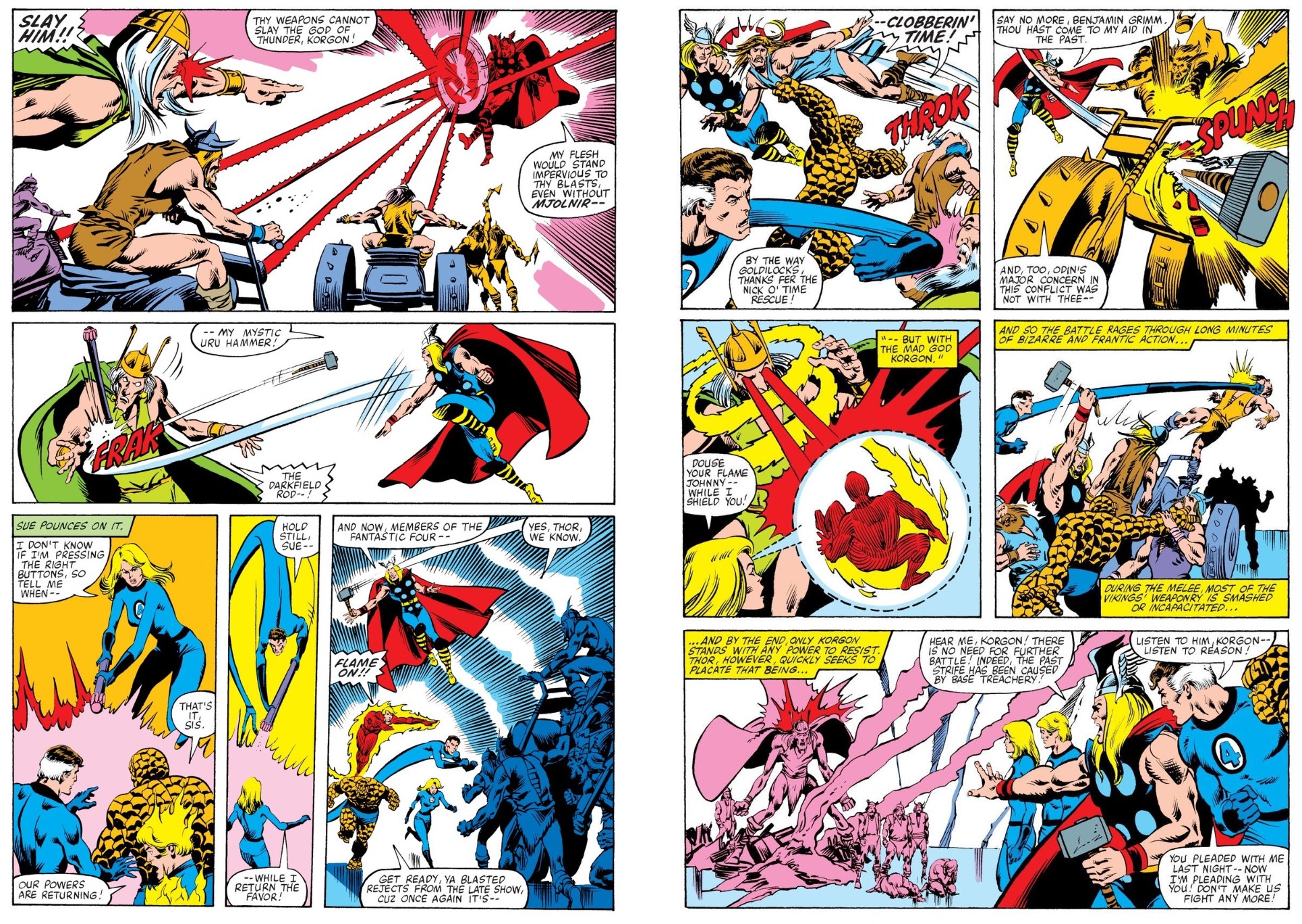
Over in FF #224 & 225, fresh calamity unfolds in ‘The Darkfield Illumination’ (Moench, Sienkiewicz & Pablo Marcos) as radioactive red mist blankets Manhattan and plays hob with the team’s powers. Tracing the cloud’s origin point to an icy dome in the Arctic, the FF find a lost colony of technologically advanced Vikings utterly dependent upon a mutated immortal giant. ‘The Blind God’s Tears’ supply heat, light, food materials from the outside world and immortality, but now Korgon is dying and demands the explorers save him and the people who worship him. Always eager to help, the FF strive and succeed in saving the God, only to see him betrayed by his most trusted ally. As Korgon rages madly in response, the crisis escalates as Mighty Thor arrives to investigate worshippers who have abandoned their true god for a false one…

Bruce Patterson joins Marcos inking Sienkiewicz when Moench next brings closure to fans of his Shogun Warriors series. In their own title the former pilots of monster-fighting mega-mecha Dangard Ace, Raydeen and Combatra had been recruited by an ancient order to defend humanity, but retired when their machines were destroyed. That epic sacrifice had come when evil enemy Maur-Kon targeted the Fantastic Four and attempted to kill Reed. Now a new giant mecha rampages and robs, so the teams reunite with Ilongo Savage, Richard Carson and Genji Odashu aiding the fight against ‘The Samurai Destroyer’ and the unworthy soul exploiting its power for profit….

Movie-toned terror in the heartland follows as a meteor crashes in rural Pennsylvania resort Lost Lake just as the FF head out to the Boonies for a break. Their encounter with ‘The Brain Parasites’ reverting hosts to earlier evolutionary forms is by-the-books horror fun from Moench, Sienkiewicz & Patterson, and readily fixed by little Franklin’s increasingly unreliable powers. This sets the scene for the next – Sinnott inked – issue where further tests by professional head shrinkers and brain benders unleash uncontrollable chaos, possessed bystanders and an adult super-powered version of the lad. Thankfully, loving parents and uncles allow Franklin to exorcise his deadly ‘Ego-Spawn’.

The experiment in alternative tale-telling ends with a 3-part saga opening on #229’s ‘The Thing From the Black Hole’. When it homes in on Reed’s latest invention, Earth totters on the edge of destruction as a sentient singularity made of antimatter disrupts physical laws. Desperate Richards makes contact with its cosmic equivalent and uncovers a tale of love lost in service to scientific exploration. The wandering extinction event was once a living being whose love for a fellow astronaut turned them both into creatures of uncanny forces. Thankfully, ‘Firefrost and the Ebon Seeker’ now reach an understanding that saves Earth, but as a consequence a section of Manhattan – including the Baxter Building – is left inside the Negative Zone.

With panic amongst the abducted New Yorkers barely suppressed, the FF seek a solution ‘In All the Gathered Gloom!’ (Moench & Roger Stern, Sienkienwisz, Jerome Moore, Sinnott, & Frank Giacoia) even as new antimatter menace Stygorr zeroes in on the intruding enclave. The last thing the FF need is bullying big business plutocrat Lew Shiner telling everyone his money puts him in charge. After his posturing triggers a riot, tragedy is guaranteed, and the heroes barely beat the alien invader in time to return everyone surviving back home…

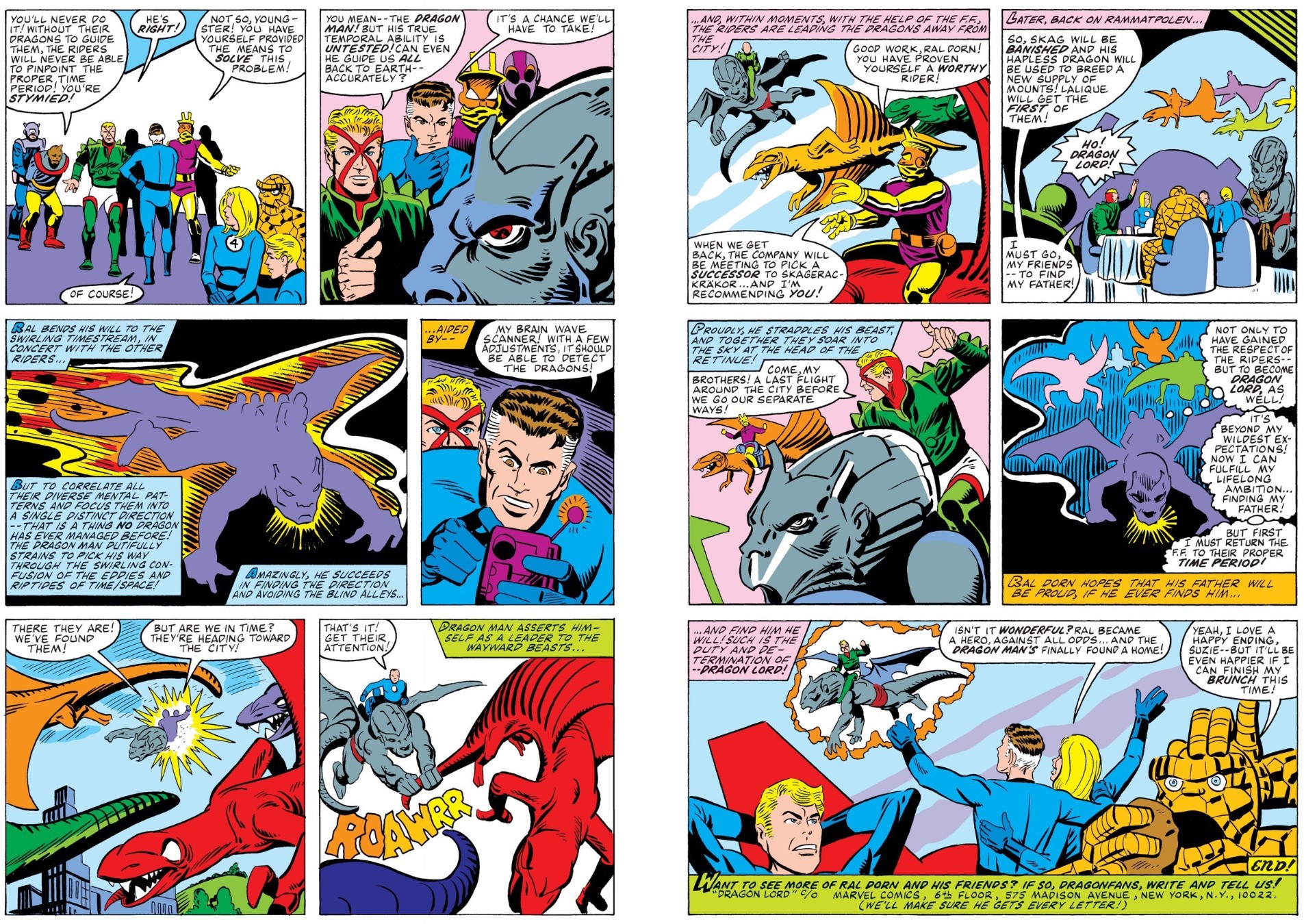
This foray into the fantastic finishes on a “soft pilot episode” as Fantastic Four Annual #16 embraces the contemporary fantasy market with ‘The Coming of… Dragon Lord!’ by Ed Hannigan & Steve Ditko. When trainee Ral Dorn is framed for killing a sacred beast and hunted by former fellows in the puissant extradimensional Dragon Rider organisation, the chase ends up with him wounded. His flight, employing a multi-powered Dragon Staff, leads to a collision with an off-duty quirky quartet, celebrating a reunion on the college campus where they first encountered astouding android Dragon Man,. but the coincidence escapes everybody and the heroes leave the mystery man to the medics.

Days later the fugitive breaks into their skyscraper home and with the Staff holding the FF at bay explains his predicament. A novice lawkeeper, his dream of bonding with a dragon has been shattered by the death of his destined beast-partner, and accusations that he’s responsible. The wild story is inadvertantly backed up by a posse of Dragon Riders seeking to stop him and the intervention of Ral’s bizarre former ally Lalique. When they are driven away, it is clear to the human heroes that something is not kosher and they determine to help him. It’s obvious to Ral that his boss Dragon Lord Skagerackäkor is behind the plot but without a bonded beast what can he do? That’s why he was on campus. He had learned of former FF foe Dragon Man and decided that needs must when the devil drives…

The classic plot left all the goodies rewarded amd baddies punished and was claearly an attempt to launch a series, but…

With covers by Sinnott, Ron Wilson, Josef Rubinstein, Rich Buckler, Al Milgrom, Byrne, Pollard, Sienkienwicz, Bob McLeod & Ditko the extras here include Sinnott pinups of the whole team and Thing pinup from FF #218 & 219: Sienkievich’s rejected cover-turned-pinup as printed in #224; the entries for January in the Marvel Comics 20th Anniversary Calandar 1981 (Sienkienwicz & Sinnott) plus original art pages/covers from Byrne, Sinnott, Sienkienwicz, Marcos and Patterson, as well as original colour-guides painted by George Roussos.

Although never quite returning to the stratospheric heights of the Kirby era, this truly different collection represents a closing of the First Act for the “World’s Greatest Comics Magazine”, and palate-cleansing preparation for the second groundbreaking run by John Byrne. These extremely capable efforts are probably most welcome to dedicated superhero fans and continuity freaks like me, but will still thrill and delight casual browsers looking for an undemanding slice of graphic narrative excitement.
© 2025 MARVEL.

Today in 1858, French cartoonist Emmanuel Poiré was born. He annoyed all the right people as Caran d’Ache… and plenty of the wrong ones too. Far less controversial were Fred Harmon and screenwriter/ scripter Stephen Slesinger who launched epic cowboy strip Red Ryder this day in 1938.

DC Finest Horror – The Devil’s Doorway


By Alex Toth, Gil Kane, Mike Friedrich, Gerry Conway, Sergio Aragonés, Dave Wood, Joe Orlando, Marv Wolfman, Len Wein, Steve Skeates, John Costanza, Otto Binder, D.J. Arneson, John Albano, Julius Schwartz, E. Nelson Bridwell, Joe Gill, Robert Kanigher, Jack Oleck, Cliff Rhodes, Bob Haney, George Kashdan, Jack Miller, Carl Wessler, Dennis O’Neil, Alan Riefe, Dave Kaler, Jack Phillips, Murray Boltinoff, Curt Swan, Jerry Grandenetti, Bill Draut, Werner Roth, Jack Sparling, Morris Waldinger, Tom Nicolosi, Bernard Baily, Jack Abel, George Roussos, Eddie Robbins, Wayne Howard, Stanley Pitt, Bruno Premiani, Dick Giordano, Dick Dillin, Murphy Anderson, Pat Boyette, Neal Adams, Nick Cardy, Mike Sekowsky, Sid Greene, Mike Roy, Mike Peppe, Don Heck, Wally Wood, Ralph Reese, George Tuska, Gray Morrow, John Celardo, Art Saaf, José Delbo, Vince Colletta, Frank Giacoia, Al Williamson & many & various (DC Comics)
ISBN: 978-1-79950-280-7 (TPB)

Sadly this masterful mystery megamix is not yet available digitally, but we live in hope…

This book includes Discriminatory Content produced in less enlightened times.

Win’s Christmas Gift Recommendation: Splendid Slice of Spectral Shock & Awe… 9/10

It’s the time for sweet indulgence, shocking over-eating and spooky stories, so let’s pay a visit to a much-neglected old favourite in a fresh new costume…

US comic books started slowly until the coming of superheroes unleashed a torrent of creative imitation and sparked a new genre. Implacably vested in World War II, the Overman swept all before him (and very occasionally her or it) until the troops came home and the more traditional genres resurfaced and eventually supplanted the Fights ‘n’ Tights crowd. Although new kids kept on buying, much of the previous generation of consumers also retained their four-colour habit but increasingly sought older themes in the reading matter. The war years altered global psychological landscapes and as a more world-weary, cynical young public came to see that all the fighting and dying hadn’t really changed anything, their chosen forms of entertainment (film and prose as well as comics) reflected this.

As well as Westerns, War and Crime comics, celebrity tie-ins, madcap escapist comedy and anthropomorphic funny animal features were immediately resurgent, but gradually another of the cyclical revivals of spiritualism and public fascination with all things occult, eldritch and arcane led to them being outshone and outsold by a wave of increasingly impressive, evocative and shocking horror comics.

There had been grisly, gory and supernatural stars before, including a pantheon of ghosts, monsters and wizards draped in mystery-man garb and trappings (The Spectre, Mr. Justice, Sgt. Spook, Frankenstein, The Heap, Sargon the Sorcerer, Zatara, Monako, Zambini the Miracle Man, Kardak the Mystic, Dr. Fate and dozens more), but these had been victims of circumstance: The Unknown as a “narrativium” power source for super-heroics.

Now the focus shifted to ordinary mortals thrown into a world beyond their ken with the intention of unsettling, not vicariously empowering, the reader. Almost every publisher jumped on the increasingly popular bandwagon, with B & I (which became magical one-man-band Richard E. Hughes’ American Comics Group) launching the first regularly published horror comic in the Autumn of 1948. Technically, though, Adventures Into the Unknown was actually pipped by Avon who had released an impressive single issue entitled Eerie in January 1947 before finally committing to a regular series in 1951. By this time, and following the filmic horror heyday of Universal Pictures’ fright films franchises, worthy comic book monolith Classics Illustrated had already long milked the literary end of the medium with adaptations of The Headless Horseman, Dr. Jekyll and Mr. Hyde (both 1943), The Hunchback of Notre Dame (1944) and Frankenstein (1945) among others.

If we’re keeping score, this was also the period in which Joe Simon & Jack Kirby identified another “mature market” gap by inventing the Romance comic (Young Romance #1, cover-dated September 1947) but they too saw sales potential in macabre mood material, resulting in seminal anthologies Black Magic (launched in 1950) and boldly obscure psychological drama vehicle Strange World of Your Dreams (1952). Around that time the staid cautious company that would become DC Comics bowed to the commercial inevitable and launched a comparatively straightlaced anthology that became one of their longest-running and most influential titles with the December 1951/January 1952 opening of The House of Mystery.

When the hysterical censorship scandal which led to witch-hunting hearings was at its height, the mobs with pitchforks furore was adroitly curtailed by the industry adopting a castrating straitjacket of self-regulatory rules. Horror titles produced under the aegis of the Comics Code Authority were sanitised, anodyne affairs in terms of Shock ‘n’ Gore.

However, since appetite for suspenseful short stories remained high, in 1956 National DC introduced sister title House of Secrets (a November/December cover-date). Plots were dialled back into superbly illustrated, rationalistic, fantasy-adventure vehicles which would dominate the market until the 1960s when superheroes (which began sneaking back in 1956 after Julius Schwartz reintroduced The Flash in Showcase #4), finally overtook them.

Green Lantern, Hawkman, The Atom and a slew of other costumed cavorters generated a gaudy global bubble of masked mavens which even forced the dedicated anthology suspense titles to transform into super-character split-books, with Martian Manhunter and Dial H for Hero monopolising House of Mystery whilst Mark Merlin – later Prince Ra-Man – sharing space with Eclipso in House of Secrets. When caped crusader craziness peaked and popped, HoS was one of the first casualties, folding with #80, the September/October 1966 issue.

However, nothing combats censorship better than falling profits and by the end of the 1960s the Silver Age superhero boom was over, with many titles gone and some of the industry’s most prestigious series circling the drain. This real-world Crisis prompted surviving publishers to loosen self-imposed restraints against crime and horror comics. Nobody much cared about gangster titles at that juncture, but liberalisation coincided with another bump in public interest for all things Worlds Beyond-ey, so resurrection of scary stories was a foregone conclusion and obvious no-brainer…

Even ultra-wholesome Archie Comics re-entered the field with a rather tasty line of Red Circle Chillers: a minor substrate they regularly return to with style and potency to this day.

Thus, with absolutely no fanfare at all House of Mystery #174 (cover dated May/June 1968), confirmed the downturn in superhero stories eveywhere as it hit newstands everywhere presenting a bold banner asking Do You Dare Enter The House of Mystery? Inside it reprinted admittedly excellent short fantastic thrillers originally seen in House of Secrets from those heady days when it was okay to scare kids…

It was a slow but unstoppable hit which just kept spreading…

This DC Finest collection gathers a year’s worth of scary stuff snapshotted from House of Secrets #81-85; House of Mystery #180-185; The Witching Hour #3-7; The Unexpected #113-117 and includes a short back-up yarn from Phantom Stranger volume 2 #5, which cumulatively filled dank evenings from May 1969-April 1970. It all starts – with absolutely no fanfare at all – in HoM #180…

Going from strength to strength, the fear flagship was increasingly drawing on DC’s major artistic resources. Astounding opener ‘Comes a Warrior’ is a chilling faux Sword & Sorcery classic written and drawn by da Vinci of Dynamism Gil Kane, and inked by incomparable Wally Wood, before they illustrate Mike Friedrich’s fourth-wall-demolishing ‘His Name is Cain Kane!’

A Sergio Aragonés gag page in the long-running ‘Cain’s Game Room’ roaming sequence then cleanses palates for Cliff Rhodes & Joe Orlando’s text-terror ‘Oscar Horns In!’ before Marv Wolfman & Bernie Wrightson proffer prophetic vignette ‘Scared to Life’. A double-page ‘Cain’s Game Room’ precedes an uncredited forensic history lesson drawn by Morris Waldinger and recycled as‘Cain’s True Case Files’ to close proceedings for that title. Meanwhile over in long-running, recently remodelled fantasy anthology The Unexpected, the former sci fi vehicle was retooling as a gritty, weird thriller venue with George Kashdan, Jack Sparling & Vince Colletta detailing ‘The Shriek of Vengeance’. Here, Golden Age troubleshooter Johnny Peril is accused of heinous crimes and then abducted by maniac justice dispenser The Executioner. His gladiatorial tests are no problem for an ordinary guy who’d been facing the incomprehensible unknown since Comics Cavalcade #19 (February 1947) and soon the true motive is exposed and the scheme crushed…

Dave Wood & recent Charlton Comics émigré Pat Boyette then glare into ‘The Eyes of Death’, revealing the fate of an actual criminal who gains the power to see iminent fatalities before Wood, Curt Swan & Mike Esposito ride ‘The Tunnel of Love Fear!’ to introduce potential host narrator Judge Gallows, discussing one of his stranger cases…

With Tales of the Unexpected #105 and House of Mystery #174, National/DC had gambled heavily that anthology horror material was back and wouldn’t call the wrath of the gods – and parents – down upon them. Now that they had a boutique mystery stable, they put lots of thought and effort into creating an all-new title to further exploit our morbid fascination with all thingies fearsome and spooky. They would also resurrect House of Secrets (cancelled in late 1969. Apparently in those heady days it was okay – and profitable – to scare the heck out of little kids if you also made them laugh.

Edited until #14 by Dick Giordano, The Witching Hour first struck with a February/March 1969 cover-date (actually on-sale from December 19th 1968). From the outset it was an extremely experimental and intriguing beast. Here however we begin with #3 (cover-dated July 1969). In this graphic grimoire, cool & creepy horror-hosts traditionally introducing the entertainments are replaced by three witches. Based as much on a common American misapprehension of Macbeth as the ancient concept of Maiden, Mother & Crone, this torrid trio constantly strove to outdo (and outgross) each other in telling of terror tales.

Crucially, Cynthia, Mildred & Mordred – as well as shy monster man-servant minion Egor – were designed by and initially delineated by master illustrator Alex Toth, making framing sequences between yarns as good as and frequently more enthralling than the stories they brazenly bracketed. Following intro ‘You Be Our Judge’ from Toth & Giordano, the graphic genius & Colletta illustrate Don Arneson’s medieval mood masterpiece ‘The Turn of the Wheel!’ before Alan Riefe & Sparling tell a decidedly different ghost-story in ‘The Death Watch’. Steve Skeates & Bernie Wrightson then debut a decidedly alterative fantasy hero in ‘…And in a Far-Off Land!’, followed by the first in a series of short prose vignettes: anonymous fright-comedy ‘Potion of Love’ and Mike Sekowsky & Giordano deliver the sisters’ farewell epilogue…

Back at House of Mystery #181, scripted by Otto Binder and drawn by quirkily capable Sparling, ‘Sir Greeley’s Revenge!’ offers a heart-warmingly genteel spook story, albeit jump-cut interrupted by new comedy featire Page 13 (from Aragonés) after which Wrightson’s first long tale is fantastical reincarnation saga ‘The Siren of Satan’ (scripted by Bob Kanigher) before we get to the next big thing – and an actual resurrection…

House of Secrets returned with #81 (August/September 1969) just as big sister HoM had done a year previously. Under a bold banner declaiming “There’s No Escape From… The House of Secrets”, Mike Friedrich, Jerry Grandenetti & George Roussos introduced a ramshackle, sentient old pile in ‘Don’t Move It!’, after which Bill Draut limned the introduction of bumbling caretaker Abel (with a guest-shot by his murderous older brother Cain) in eponymous intro set-up fable ‘House of Secrets’. A prose yarn by Gerry Conway ‘Burn this House!’ gave the portly porter a pause before he kicked off his storytelling career with Conway & Sparling’s‘Aaron Philip’s Photo Finish!’ before the inaugural issue is put to bed with a Draut limned ‘Epilogue’

The Unexpected #114 led with Kashdan, Ed Robbins & Colletta’s ‘Johnny Peril – My Self… My Enemy!’ as a modern day alchemist unleashes a lifeforce-stealing golem on the doughty P.I., after Dave Wood & Art Saaf premier a new host regaling readers with ‘Tales of the Mad, Mod Witch’ and opening with a warning about magic fountains and poorly aimed coins in ‘The Well of Second Chances’. Thematically on safe ground, we switch to Witching Hour #4 as Toth renders a ‘Witching Hour Welcome Wagon’ after which Conway scripts spectral saga ‘A Matter of Conscience’ for Sparling & George Roussos. Anonymous prose piece ‘If You Have Ghosts?’ then segues into smashing yarn ‘Disaster in a Jar’ (Riefe & Boyette) before Conway turns in period witchfinder thriller ‘A Fistful of Fire’ for José Delbo – a vastly underrated artist who was on the best form of his career at this time.

Toth’s Weird Sisters close out that issue as we move on to HoM #182 which opens with one of the most impressive tales of the entire decade. Jack Oleck’s take on the old cursed mirror plot is elevated to high art with his script for ‘The Devil’s Doorway’ illustrated by incredible Alex Toth. Marv Wolfman & Wayne Howard follow with ‘Cain’s True Case Files: Grave Results!’, and an expose of the Barbadian sugar trade, after which an Aragonés Game Room break leads to nightmarish Gothic revenge tale ‘The Hound of Night!’ from Kanigher & Grandenetti. HoS #82 was a largely Conway scripted affair with Draut drawing both ‘Welcome to the House of Secrets’ and ‘Epilogue’, whilst cinema shocker ‘Realer Than Real’ was illustrated by Werner Roth & Vince Colletta. Prose poser ‘His Last Resting Place!’ leads to Wolfman & Giordano’s short sci fi saga ‘Sudden Madness’ prior to Conway & Sparling regaling us with salutary tale of murder and revenge ‘The Little Old Winemaker’. Finally, as realised by Dick Dillin & Neal Adams ‘The One and Only, Fully-Guaranteed, Super-Permanent, 100%’ presents a darkly comedic eerily unsettling tale of domestic bliss and how to get it…

Carl Wessler & Ed Robbins open Unexpected #115 with Blitz- survivor Maude Waltham unwisely accessing the ‘Diary of a Madman’ and being drawn into a world she could not comprehend or cope with, after which Dave Wood, Swan & Jack Abel reveal how an opportunistic showman appropriates an old abndined house and discovers ‘Abrakadabra – You’re Dead!’ A classic plot gets a sixties makeover as ‘The Day Nobody Died!’ (by Wood as D.W. Holz, Werner Roth & Frank Giacoia) details the repercussions of a wise man unwisely caging the angel of death…

In Witching Hour #5 the sisters are at their most outrageously, eerily hilarious introducing an anonymous yarn lavishly embellished by Wrightson – a nifty nautical nightmare of loneliness and ‘The Sole Survivor!’, before text-teaser ‘The Non-Believer! and Boyette’s stunning, clownish creep-feature ‘A Guy Can Die Laughing!’ set the scene for Steve Skeates, Stanley Pitt & Giordano’s dating dilemma ‘The Computer Game’ I think this was one of the first to explore that now-hoary plot, and it neatly anticipates Toth’s sign off for the witches and added single-page black-comedy bonus ‘My! How You’ve Grown!’ from Sid Greene…

For #183, Joe Orlando offers Cain introductory chuckle ‘Welcome to the House of Mystery’ before, in collaboration with Oleck, Grandenetti reveals the misery of ‘The Haunting!’ Following more mirth in Cain’s Game Room (by John Albano) and vintage Bernard Baily ‘Odds and Ends from Cain’s Cellar’, ‘Curse of the Blankenship’s’ and ‘Superstitions About Spiders’, Wolfman & Wrightson contribute ‘Cain’s True Case Files: The Dead Can Kill!’ A bonanza of Aragonés comprising a comedic horroscope on Page 13 and two pages of Cain’s Game Room precedes a canny teaming of Kanigher with Grandenetti & Wally Wood that results in the truly bizarre ‘Secret of the Whale’s Vengeance’

After Draut & Giordano’s ‘Welcome to the House of Secrets’ piece, superstar Toth made his modern HoS debut with Wolfman-written fantasy ‘The Stuff That Dreams are Made Of’, before Mikes Royer & Peppe visualise sinister love-story ‘Bigger Than a Breadbox’, bookended by anonymous text teaser ‘Once Upon a Time in Mystery Book…’ Wrapping up, Conway & Draut revive gothic menace for chilling fable ‘The House of Endless Years’.

Modernity is briefly embraced in Unexpected #116 as thanks to Dave Wood & Art Saaf, The Mad Mod Witch escorts a group of strangers on an ‘Express Train to Nowhere!’ after which author unknown & Boyette describe a doomed Dutch peddlar’s brush with legend and ‘Steps to Disaster’, before Murphy Anderson picks out apparel ‘Mad to Order’ as Wrightson details the problems wrapped up in a ‘Ball of String!’ ‘Ashes to Ashes, Dustin to Dust?’ then closes the issue with a spectral tale of love & death from Murray “Al Case” Boltinoff & Sid Greene…

Sekowsky & Giordano limn Dave Kaler’s take on the sinister sisters’ intro for Witching Hour #6, after which far darker horror debuts as ‘A Face in the Crowd!’ (Conway, Mike Roy & Mike Peppe), wherein a Nazi war-criminal and concentration camp survivor meet in an American street. Wolfman & Delbo depict a tale of neighbourly intolerance in ‘The Doll Man!’ and ‘Treasure Hunt’ (Skeates, John Celardo & Giordano) shows why greed isn’t always good. Also included were Conway’s prose tale ‘Train to Doom’, ‘Mad Menace’ – a ½-page gag strip by John Costanza – and ‘Distortion!’: another Greene-limned one-pager.

HoM #184 features the triumphant return of Oleck & Toth for captivating Egyptian tomb raider epic ‘Turner’s Treasure’ before cartoon pauses for Page 13 (a diploma fron Aragonés & Orlando) and Orlando gag ‘The Fly’ deftly segues into epic barbarian blockbuster ‘The Eyes of the Basilisk!’ by Bridwell, Gil Kane & Wally Wood…

Closing with more Albano Cain’s Game Room giggles, next comes info short ‘The Devil’s Footprints!’ by Kanigher, Swan & Nick Cardy from The Phantom Stranger #5 (cover-dated January/February 1970) before in House of Secrets #84, Conway & Draut maintain the light-hearted bracketing of stories prior to properly beginning with ‘If I Had but World Enough and Time’ (Wein, Dillin & Peppe): a cautionary tale about too much TV. Tensions grow with Wolfman & Greene’s warning against wagering in ‘Double or Nothing!’ and Skeates, Sparling & Abel’s utterly manic parable of greed ‘The Unbelievable! The Unexplained!’, before Wein & Sparling mess with our dreams in ‘If I Should Die before I Wake…’

Johnny Peril leads in Unexpected #117, as Kashdan & Greene reveal how he becomes the patsy for a clan seeking to avoid a hereditary curse in ‘Midnight Summons the Executioner!’, after which Case, Grandenetti & Draut see a woman trick fate by accepting ‘Hands of Death’ whilst Wessler & Tuska detail the downfall of a money-mad beast in ‘The House that Hate Built!’ Wessler & Bruno Premiani then detail the uncanny ‘Death of the Man Who Never Lived!’ in a spy yarn unlike any other…

In Witching Hour #7, Toth & Mike Friedrich show spectacular form for the intro and bridging sequences, whilst Draut is compulsively effective in prison manhunt saga ‘The Big Break!’, with scripter Skeates also writing modern-art murder-mystery ‘The Captive!’ for Roussos. Friedrich & Abel advise a most individual baby to ‘Look Homeward, Angelo!’, whilst text piece ‘Who Believes Ouija?’ and Jack Miller & Michael Wm. Kaluta’s Gothically delicious ‘Trick or Treat’ round out the sinister sights in this issue. Then, House of Mystery #185 sees Cain take a more active role in all-Grandenetti yarn ‘Boom!’, with Albano, Aragones & Orlando Page13 and Cain’s Game Room, prior to Wayne Howard illustrating the sinister ‘Voice from the Dead!’ Following more Orlando Game-iness prolific Charlton scribe Joe Gill debuts with ‘The Beautiful Beast’: a lost world romance perfectly pictured by EC alumnus Al Williamson.

This monolitic montage of macabre mirth and scary sagas ceases with House of Secrets #85. Here, Cain & Abel acrimoniously open, after which Wein & Don Heck disclose what can happen to ‘People Who Live in Glass Houses…’ whilst graphic legend Ralph Reese limns Wein’s daftly ironic ‘Reggie Rabbit, Heathcliffe Hog, Archibald Aardvark, J. Benson Baboon and Bertram the Dancing Frog’, ere John Costanza contributes comedy page ‘House of Wacks’ and Conway, Kane & Adams herald the upcoming age of slickly seductive barbarian fantasy with gloriously vivid and vital ‘Second Chance’.

With iconic covers from Neal Adams, Jack Adler, Toth, Sekowsky, Cardy and Gray Morrow this (hopefully first of many) moody mystery compilations is a perfect accompaniment to dark nights in, and one you can depend on to astound and amaze in equal amounts.
© 2025 DC Comics. All Rights Reserved.

Today – or maybe even tonight – in 1939 underground cartoonist Frank Stack was born. His blasphemous antics have made us laugh for decades. Why not check out The New Adventures of Jesus: The Second Coming.

In 2011 today UK icon Mick Anglo died. He’s all over this blog if you want to see something very special but I’d advise scoping out one of his unique Annual creations, such as Batman Story Book Annual 1967 (with Robin the Boy Wonder).

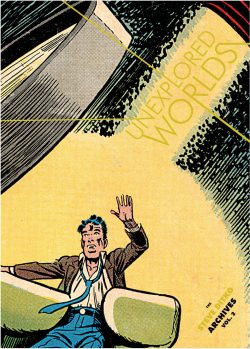
Steve Ditko Archives volume 2: Unexplored Worlds


By Steve Ditko, Joe Gill & various, edited by Blake Bell (Fantagraphics Books)
ISBN: 978-1-60699-289-0 (HB/Digital edition)

Win’s Christmas Gift Recommendation: Immaculate Yarn-Spinning… 9/10

This book includes Discriminatory Content produced in less enlightened times. It also has Discriminatory Content included for comedic and satirical effect.

Once upon a time the anthological title of short stand-alone stories was the sole staple of the comicbook profession, where the plan was to deliver as much variety as possible to the reader. Sadly, that particular vehicle of expression seems all but lost to us today…

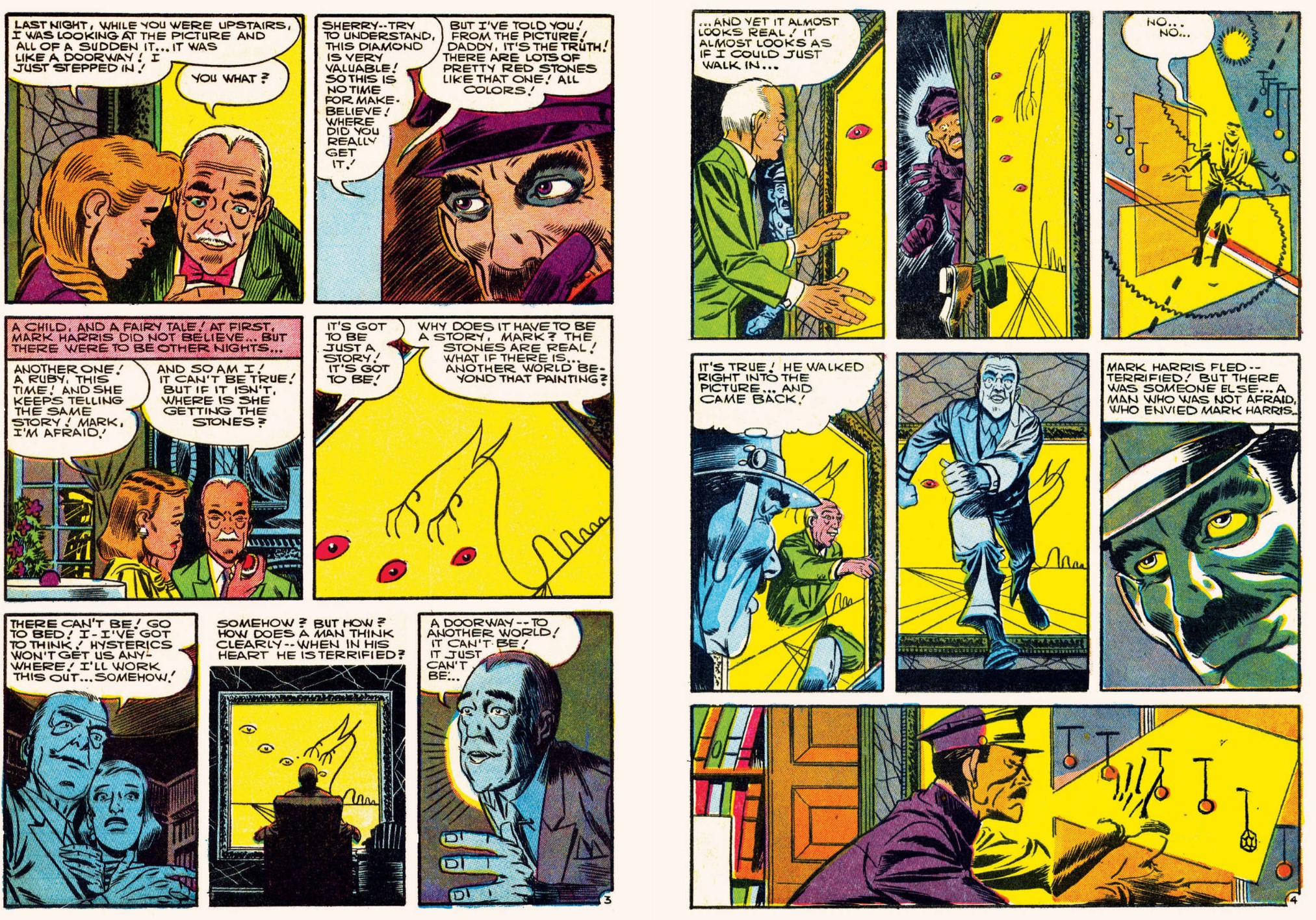
Despite his death Steve Ditko remains one of our industry’s greatest talents and one of America’s least lauded. His fervent desire to just get on with his job and to tell stories the best way he can – whilst the noblest of aspirations – had always been a minor consideration or even stumbling block for the commercial interests which for so long controlled all comics production and still exert an overwhelming influence upon the mainstream bulk of comic book output. Before his time at Marvel, young Ditko perfected his craft creating short sharp yarns for a variety of companies and it’s an undeniable joy today to be able to look at this work from such an innocent time when he was just breaking into the industry: tirelessly honing his craft with genre tales for whichever publisher would have him, utterly free from the interference of intrusive editors.

A superb full-colour series of hardback collections reprinted those early efforts (all of them here are from 1956-1957) with material produced after the draconian, self-inflicted Comics Code Authority sanitised the industry following Senate Hearings and a public witch-hunt.

Most are wonderfully baroque bizarre supernatural or science fantasy stories, but there are also examples of Westerns, Crime and Humour: cunningly presented in the order he completed and sold them rather than the more logical but far-less-revealing chronological release dates. Moreover, they’re all helpfully annotated with a purchase number to indicate approximately when they were actually drawn – even the brace of tales done for Stan Lee’s pre-Marvel Atlas company.

Sadly, there’s no indication of how many (if any) were actually written by the moody master…

This second sublime selection reprints more heaping helpings of his increasingly impressive works: most courtesy of the surprisingly liberal (at least in its trust of its employees’ creative instincts) sweat-shop publisher Charlton Comics.

And whilst we’re being technically accurate, it’s also important to reiterate that those cited publication dates have very little to do with when Ditko crafted them: as Charlton paid so little, the cheap, anthologically astute outfit had no problem in buying material it could leave on a shelf for months – occasionally years! – until the right moment arrived to print. The work is assembled and runs here in the order Ditko submitted it, rather than when it reached our grubby sweaty paws…

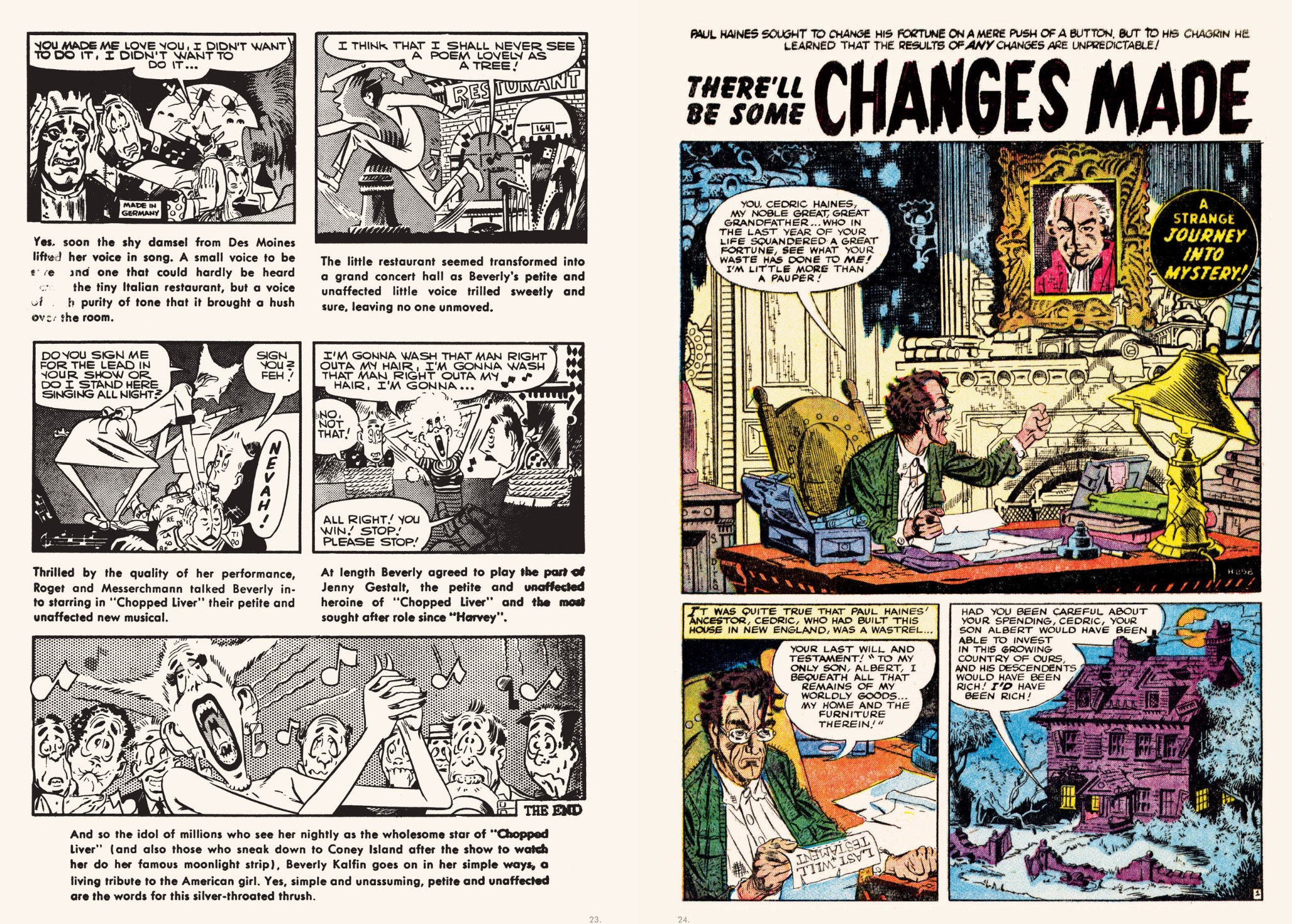
Following an historically informative Introduction and passionate advocacy by Blake Bell, concentrating on Ditko’s near-death experience in 1954 (when the artist contracted tuberculosis) and subsequent recovery, the evocatively eccentric excursions open with a monochrome meander into the realms of satire with the faux fable – now we’d call it a mockumentary – ‘Starlight Starbright’ as first seen in From Here to Insanity (volume 3 #1 April 1956) before “normal” service resumes with financial fable ‘They’ll Be Some Changes Made’ (scripted by Carl Wessler from Atlas’ Journey Into Mystery #33, April 1956).

Here a petty-minded pauper builds a time machine to steal the fortune his ancestors squandered, after which a crook seeking to exploit a mystic pool finds himself the victim of fate’s justice in ‘Those Who Vanish’ (Journey Into Mystery #38, September 1956) again scripted by Wessler.

Almost – if not all – the Charlton material was scripted by astoundingly prolific Joe Gill at this time, and records are spotty at best, so let’s assume his collaboration on all the material here begins with ‘The Man Who Could Never Be Killed’ (Strange Suspense Stories #31, published in February 1957). This yarn of a circus performer with an incredible ethereal secret segues into ‘Adrift in Space’ (Mysteries of Unexplored Worlds #8 June 1958) as a veteran starship captain pushes his weary crew over the edge, whereas ‘The King of Planetoid X’ from the previous MoUW (February) details a crisis of conscience for a benevolent and ultimately wise potentate…

The cover of Strange Suspense Stories #31 (February 1957) leads into ‘The Gloomy One’ as a misery-loving alien intruder is destroyed by simple human joy, before the cover to Out of This World #5 (September 1957) heralds that issue’s ‘The Man Who Stepped Out of a Cloud’ and an alien whose abduction plans only seem sinister in intent. MoUW #5 (October 1957) tells the story of a young ‘Stowaway’ who finds fulfilment aboard a harshly-run space ship after which Out of This World #3’s cover (March 1957) ushers us to an apparent alien paradise for weary star-men in ‘What Happened?’

Next up is a tale from one of Charlton’s earliest star characters. The title came from a radio show that Charlton licensed the rights to, with the lead/host/narrator acting more as voyeur than active participant. The Mysterious Traveler spoke directly to camera, asking readers for opinion and judgement as he shared a selection of funny, sad, scary and miraculous human-interest yarns, all tinged with a hint of the weird or supernatural. Whenever rendered by Ditko, whose storytelling mastery, page design and full, lavish brushwork were just beginning to come into its mature full range, the contents of Tales of the Mysterious Traveler were always exotic and esoteric and utterly beguiling.

From issue #2 (February 1957), ‘What Wilbur Saw’ reveals the reward bestowed on a poverty-stricken country bumpkin who witnessed a modern-day miracle, after which Out of This World #3 covers a cautionary tale of atomic mutation in ‘The Supermen’ before the eerie cover to OoTW #4 (June 1957) signals a chilling encounter for two stranded sailors who briefly board the ‘Flying Dutchman’ whilst SSS #32’s cover (May 1957) dabbles in magic art when a collector is victimised by a thief who foolishly stumbles into ‘A World of His Own’.

From the same issue comes a salutary parable concerning a rich practical joker who goes too far before succumbing to ‘The Last Laugh’, after which ‘Mystery Planet’ (SSS #36, March 1958) offers a dash of interplanetary derring-do as valiant agent Bryan Bodine and comely associate Nedra confound intergalactic pirates piloting a planet-eating weapon against Earth!

A similarly bold defender liberates ‘The Conquered Earth’ from alien subjugation (OoTW #4, June 1957) whilst in ‘Assignment Treason’ (Outer Space #18. August 1958) the clean-cut hero goes undercover to save Earth from the predatory Master of Space as OoTW #8 (May 1958) and ‘The Secret of Capt. X’ reveals the inimical alien tyrant threatening humanity is not what he seems…

The cover to Mysteries of Unexplored Worlds #3 (April 1957) makes way for three fantastic thrillers, beginning with ‘The Strange Guests of Tsaurus’ as an alien paradise proves to be anything but, then ‘A World Where I Was King’ sees a clumsy janitor catapulted into a wondrous realm to win a kingdom he doesn’t want. Diverting slightly, Fightin’ Army #20 (May 1957) provides a comedic interlude as a civil war soldier finds himself constantly indebted to ‘Gavin’s Stupid Mule’ before ‘A Forgotten World’ wraps up MoUW #3’s contributions with a scary tale of invasion from the Earth’s core. ‘The Cheapest Steak in Nome’ turns out to be defrosted from something that died millions of years ago in a light-hearted yarn from MoUW #7 (February 1958)…

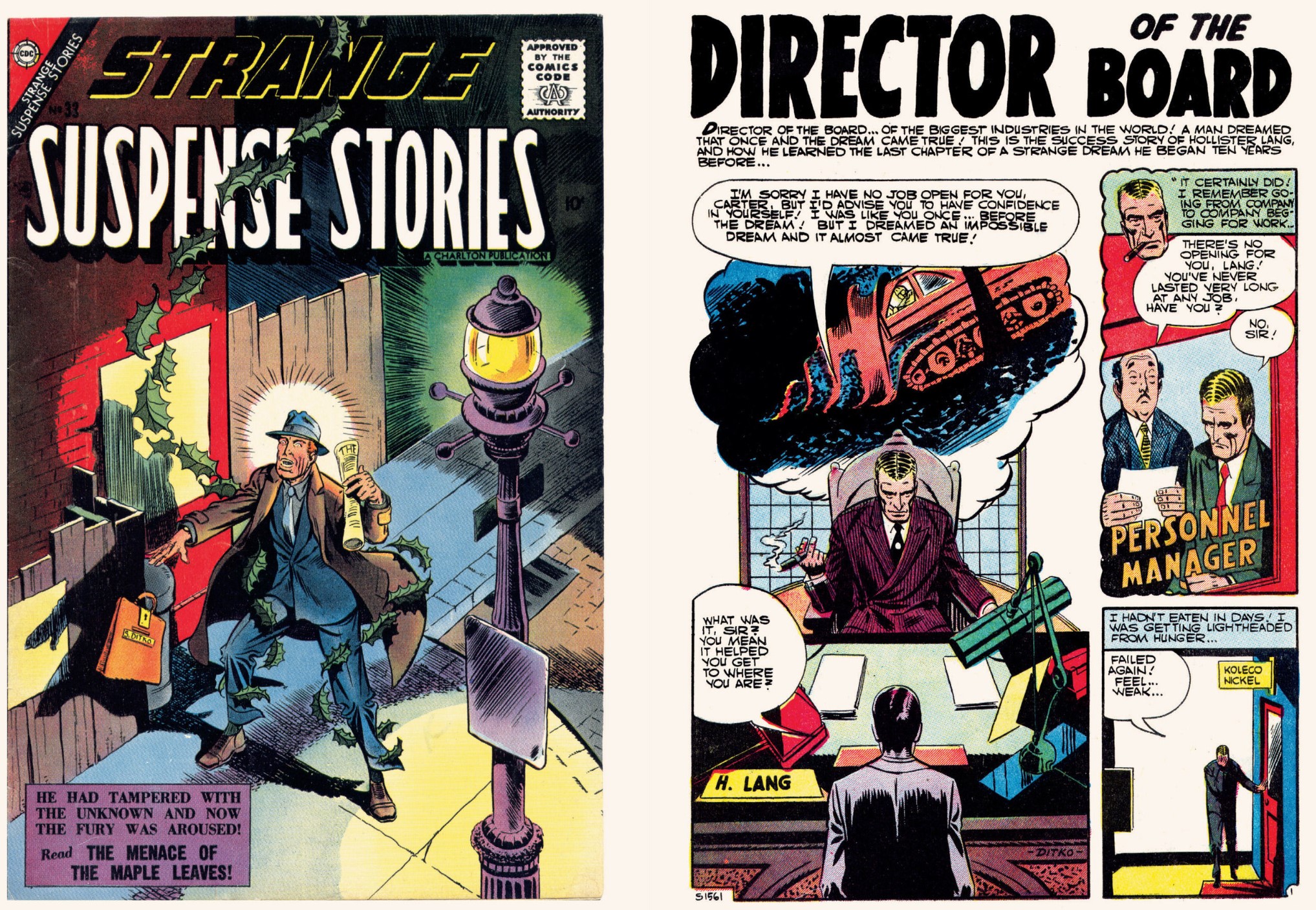
The cover to MoUW #4 (July 1957) precedes more icy antediluvian preservations found in the ‘Valley in the Mist’ whilst the one for Strange Suspense Stories #33 (August 1957) leads into a bizarre corporate outreach project as the ‘Director of the Board’ attempts to go where no other exploitative capitalist has gone before. Next, it’s back to MoUW #3 for a brush with the mythological in ‘They Didn’t Believe Him’ after which ‘Forever and Ever’ (SSS #33) reveals an unforeseen downside to immortality and Out of This World #3 sees a stranger share ‘My Secret’ with ordinary folk despite – or because of – a scurrilous blackmailer…

‘A Dreamer’s World’ from Mysteries of Unexplored Worlds #5 (October 1957) follows the chilling cover thereof as a test pilot hits his aerial limit and discovers a whole new existence, whilst Unusual Tales #7 (May 1957) traces the tragic path of ‘The Man Who Could See Tomorrow’ before the cover of Tales of the Mysterious Traveler #4 (August 1957) opens a mini-feast of voyeur’s voyages beginning with that issue’s ‘The Desert’: a saga of polar privation and survival.

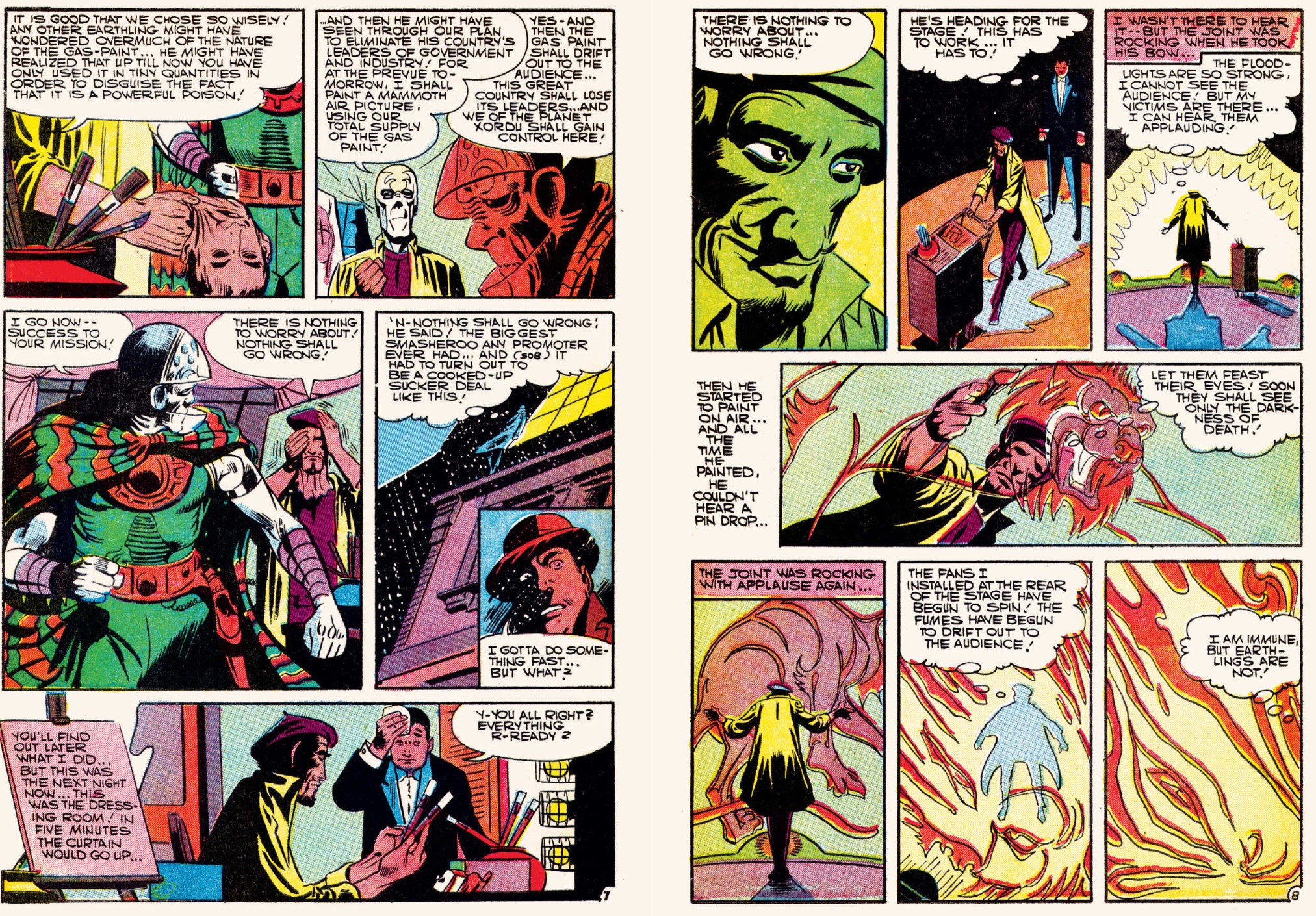
TotMT #3 (May 1957) shows the appropriate cover and a ‘Secret Mission’ for a spy parachuted into Prague, whilst #4 offers ‘Escape’ for an unemployed pilot dragged into a gun-running scam in a south American lost world; ‘Test of a Man’ sees a cruel animal trainer receive his just deserts and ‘Operation Blacksnake’ grittily exposes American venality in the ever-expanding Arabian oil trade. Returning to Mysteries of Unexplored Worlds #5, ‘The Mirage’ torments an escaped convict who thinks he’s escaped his fate, whilst Texas Rangers in Action #8 (July 1957) sees a ruthless rancher crushed by the weight of his own wicked actions as ‘The Only One’, after which stunning covers to Unusual Tales #6 and 7 (February and May 1957) lead into our final vignette – ‘The Man Who Painted on Air’: exposing and thwarting a unique talent to preserve humanity and make a few bucks on the side…

This sturdily capacious volume has episodes that terrify, amaze, amuse and enthral: utter delights of fantasy fiction with lean, plots and stripped-down dialogue that let the art set the tone, push the emotions and tell the tale, from times when a story could end sadly as well as happily and only wonderment was on the agenda, hidden or otherwise.

These stories display the sharp wit and contained comedic energy which made so many Spider-Man/J. Jonah Jameson confrontations an unforgettable treat half a decade later, and this is another cracking collection not only superb in its own right but as a telling tribute to the genius of one of the art-form’s greatest stylists. This is something every serious comics fan would happily kill or die or be lost in time for…
Unexplored Worlds: The Steve Ditko Archive Vol. 2. This edition © 2010 Fantagraphics Books. Introduction © 2010 Blake Bell. All rights reserved.

Today in 1914, Jerry Siegel was born. Don’t make me have to finish this heads-up…

In 1937 Huey, Dewey & Louie Duck debuted. Ditto.

In 1959 The last issue of UK icon Comet was published and a decade later across the Pond Sidney Smith’s The Gumps ended. It had begun in 1917 as you’d know if read Sidney Smith’s The Gumps.

Galveston


By Johanna Stokes, Ross Richie, Todd Herman & various (Boom! Studios)
ISBN: 978-1-93450-668-4 (TPB)

This book includes Discriminatory Content produced for dramatic effect.

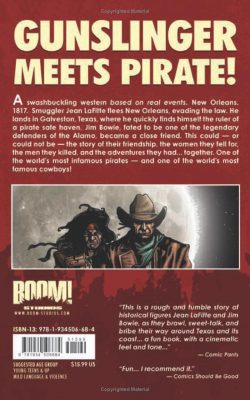
At the beginning of the 19th century, Jean Baptiste Lafitte was a French privateer and slave trader based in New Orleans – and later Barataria Bay – who famously turned down a huge bribe from the British and instead stood beside the Americans during the War of 1812. His alliance with General Andrew Jackson at the Battle of New Orleans is the stuff of American mythology.

When the victorious Americans then started cracking down on piracy, Jean and his older brother Pierre became spies for the Spaniards during the Mexican War of Independence (1810-1821). Relocating to Galveston Island, Texas they continued their trade as freebooting privateers targeting Central American ports. After they established a pirate colony called Campeche to facilitate their maritime activities, Jean died – or at least dropped from sight – sometime around 1823.

Jim Bowie is more myth than man. Born in Kentucky around 1796, he was a pioneer, frontiersman, law officer, land speculator and quintessential warrior. After accruing wealth and a certain reputation in New Orleans, he eventually relocated to Texas (whilst it was still part of Mexico), married and settled down. Of all the legends surrounding him the two truest are his proficiency with the lethal “Bowie knife” (created from the fearless fighter’s design by bladesmith James Black) and that he died in Texas at the Battle of the Alamo in 1836.

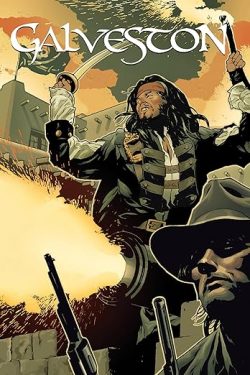
With such a historic pedigree and so little verifiable fact, it’s perfectly natural somebody should place these two bellicose American icons together, and that’s exactly what scripter Johanna Stokes (with input from Ross Richie, Tom Peyer & Mark Rahner) and illustrator Todd Herman – ably assisted by colourists Digikore Studios & Andres Lozano and letterer Marshall Dillon – did in this light-hearted action-romp which is as much buddy/road movie as pirate yarn or western…

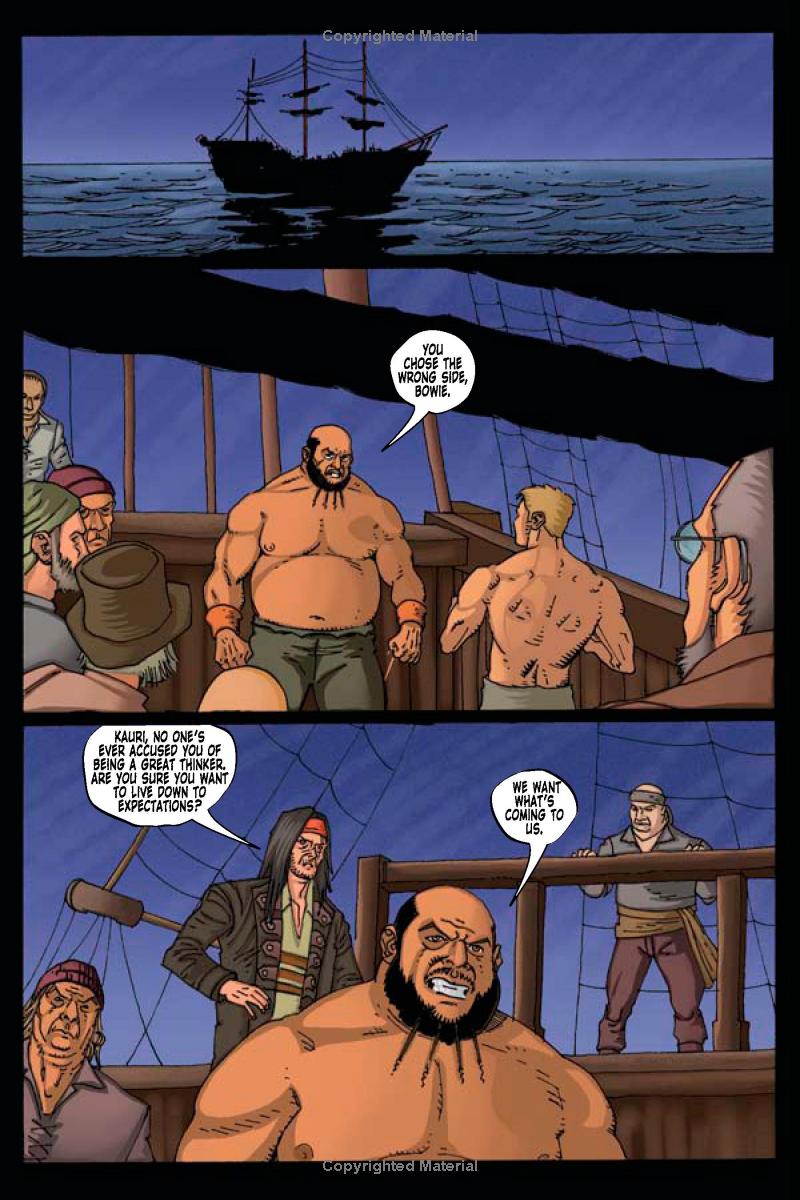
Originally released as a 4-issue miniseries in 2009, Galveston begins in the Gulf of Mexico in 1817, where the infamous Jean Lafitte’s crew are trying to kill him. It’s not personal: they simply heard that he’s hidden a huge stash of gold donated by the Emperor Napoleon for helping him escape from France. Lafitte’s only ally is a wiry American he’d recently befriended: a man named Bowie. The greed-inciting gold story was circulated by Cyrus Wesley, an old acquaintance from New Orleans and no friend of the pirate captain…

After escaping certain doom through quick-wittedness and a certain amount of chicanery, Lafitte brings Bowie to the pirate colony he’s built in Galveston, introducing him to the glories of the Maison Rouge and the light of his life: a fiery tongued and ferociously independent woman named Madeline Ragaud

She seems welcoming enough, but also brings news of a ship full of spies masquerading as traders. All too soon Bowie is experiencing first-hand how his pirate pal deals with real threats to his people…

A bigger worry is Wesley. Acting on behalf of vengeful Louisiana Governor Claiborne, the old enemy has brought a small army of bought-&-paid-for lawmen into the shady new town, ready to deal with Lafitte on the slightest pretext. A man of absolutely no principles, Cyrus is, however, quite prepared to let the mission slide if Lafitte gives him Napoleon’s gold…

It would be a sound bargain if there actually was any bullion, but Lafitte swears all he got for his services was a brace of ornamental cannon. They don’t even work…

Temporarily escaping his problems, the wily pirate accompanies Bowie on his own mission to set up trading ties with the Comanches, but Cyrus’ threat to harm Madeline lingers, prompting Jean to bicker with his buddy and storm off in a fury. By the time Jean gets back to Galveston the settlement is in flames and Wesley is ensconced aboard a warship in the bay.

It’s time for old war-hero Lafitte to rally his piratical troops for a showdown, but he might be less fired up if he knew that his aggravating paramour has despatched a message to even the odds. Hopefully, Madeline’s young courier can find Bowie and his Indian friends before it’s too late…

With it all culminating in a classic and epic underdog vs. bad guys showdown whilst delivering a marvellously traditional twist in the tale, this rowdy, raucous riot of fun is a sheer delight for all lovers of straightforward, no-nonsense matinee thrills.
© 2009 Boom Entertainment Inc. and Johanna Stokes. All rights reserved.

Today was big for comics and strips. in 1905 Winsor McCay’s sublime landmark Little Nemo first appeared. I must do that again. In the meantime why not look up Daydreams and Nightmares – The Fantastic Visions of Winsor McCay?

In 1938 the UK greeted anthology weekly Radio Fun for the first time, and three years later Americans met Archie Andrews in his first out in Pep Comics #22.

In 2004, the marvellous Irv Novick laid down his tools for the last time. Examples of his work span the length of the artform and can be found all over this blog. Go look, you’ll be impressed…

Fantastic Four Marvel Masterworks volume


By Doug Moench & Bill Sienkiewicz, John Byrne, Roger Stern, Joe Sinnott, Al Milgrom, George Pérez, Tom Sutton, Jerome Moore, Chic Stone, Jon D’Agostino, Mike Esposito, Pablo Marcos, Frank Giacoia, George Roussos, Jim Novak, Irving Watanabe & various (MARVEL)
ISBN: 978-1-3029-1027-3 (TPB/Digital edition)

This book includes Discriminatory Content produced in less enlightened times.

For Marvel everything started with The Fantastic Four.

Monolithic modern Marvel truly began with eccentric monster ‘n’ alien filled adventures of a compact superteam as much squabbling family as coolly capable costumed champions. All that Modern Marvel is, company and brand, stems from that quirky quartet and the inspired, inspirational, groundbreaking efforts of Stan Lee & Jack Kirby…

Cautiously bi-monthly and cover-dated November 1961, Fantastic Four #1 – by Stan, Jack, George Klein and/or Christopher Rule – was raw and crude even by the ailing publisher’s standards; but it seethed with rough, passionate, uncontrolled excitement. Thrill-hungry kids pounced on its dynamic storytelling and caught a wave of change beginning to build in America. It and every succeeding issue changed comics a little bit more… and forever. As revealed in that premier issue, maverick scientist Reed Richards, fiancée Sue Storm, close friend Ben Grimm and Sue’s bratty teen brother survived an ill-starred private spaceshot after cosmic rays penetrated their ship’s inadequate shielding.

All were permanently mutated: Richards’ body became elastic, diffident Sue became (even more) invisible, Johnny Storm burst into living flame and tragic Ben shockingly devolved into a shambling, rocky freak. After the initial revulsion and trauma passed, they solemnly agreed to use their abilities to benefit mankind. Throughout the 1960s The Fantastic Four was indisputably the key title and most consistently groundbreaking series of Marvel’s ever-unfolding web of cosmic creation: a forge for new concepts and characters.

Kirby was approaching his creative peak: unleashing his vast imagination on plot after spectacular plot, and intense, incredible new characters whilst Lee scripted some of the most passionate superhero sagas ever seen. Both were on an unstoppable roll, at the height of their powers and full of the confidence only success brings, with The King particularly eager to see how far the genre and the medium could be pushed… which is rather ironic since it was the company’s reticence to give the artist more creative freedom that led to Kirby’s moving to National/DC in the 1970s.

Without Kirby’s soaring imagination the rollercoaster of mindbending High Concepts lost out to traditional tales of characters in conflict, with soap opera leanings and supervillain-heavy Fights ‘n’ Tights forays abounding. With Lee & Kirby long gone but their mark very much still stamped onto every page of the still-prestigious title, this full-colour luxury compendium collects Fantastic Four #219-231 and Annual #15, spanning June 1980-June 1981, wherein editor Jim Salicrup sanctioned a bold new look and direction for the Hallowed team. The call for and upshot of all that is discussed by incoming writer Doug Moench who recalls fan-fright paralysis and jumping in full throttle in his Introduction ‘The Big-Kid Stuff Cold Turkey Fail’ prior to a distinctly spookily toned and frequently supernaturally themed change of pace commencing.

What You Should Know: After being rejuvenated and repowered in an extended space-spanning saga, the Family FF are getting used to being back on earth even with supervillains all over the place. Now Read On…

Penciller John Byrne, having served out his first term of duty on the series he was to soon make his alone was officially and ostensibly only temporarily replaced for FF #219. Ably augmented by Joe Sinnott, stalwart “Guest-Team” Doug Moench & Bill Sienkiewicz were parachuted in for monster mash-up ‘Leviathans’, on the back of huge success and acclaim for their vigilante thriller Moon Knight, bringing with them a whole new look and sensibility, as well as far faster pace to the stories.

Here, modern day pirate Cap’n Barracuda steal the fabled Horn of Proteus from Atlantis and unleashes a wave of giant monsters on New York City. Thankfully, this is a subject the mighty Sub-Mariner and Mr. Fantastic can agree on and their combined forces are soon stomping beasties and taking names (like Giganto!) to restore order and stop a piratical plunder ploy without peer…

Byrne was back writing & pencilling in #220 as ‘…And the Lights Went Out All Over the World!’ sees the Avengers call in Reed and his team when all of Earth suffers a catastrophic power-outage. Science! soon sends the explorers to the arctic where they encounter an astounding and unbelievable obelisk being constructed by beings of utterly alien appearance…

The story includes an updated origin for the quartet and guest shot for Canada’s finest (that’s Vindicator of Alpha Flight in case you were wondering) and the issue halts with a pinup/possible rejected cover by inker Sinnott (the Torch battling a flaming Skrull) before #221’s concluding chapter ‘Tower of Glass… Dreams of Glass!’ – after the usual misconceptions and rash clashes reveal three aliens shipwrecked for half a million years who just need their myriad mobile mechanisms to reverse the planet’s magnetic poles so that they can return home at last. Thankfully, Reed has a less end of human civilisation-y solution that leaves everyone involved happy and safe…

Now officially the latest regular creative team, Moench & Sienkiewicz return to prep for Halloween in FF #222’s ‘The Possession of Franklin Richards!’ as the kid is targeted from beyond the unknown by the exiled soul of Nicholas Scratch, son of Agatha Harkness and the kind of warlock who gives witchcraft a bad name. Having made the boy his conduit back to reality, Scratch terrorises and tortures his hated enemies, who with Doctor Strange unavailable, must call on the dubious gifts of self-doubting failed horror hero Gabriel the Devil Hunter and his sexy morally ambiguous familiar Desadia (as mostly seen in the Marvel monochrome magazine line such as Haunt of Horror and Monsters Unleashed).

Apparently acquiescing, the team agree to liberate the dead diabolist’s minions of magical cult Salem’s Seven in ‘That a Child May Live…’ but their instant assaults on humanity are an acceptable risk and consequence in a long plan that sets the worlds to rights for all but the defeated devil…

Fantastic Four Annual #15 swiftly follows, wherein Moench & George Pérez, abetted by Chic Stone, Jon D’Agostino & Mike Esposito, renew hostilities between the FF and the Skrull empire when the shapeshifters target Reed’s latest energy-casting breakthrough in ‘Time for the Prime Ten!’ Infiltrating the Baxter Building, negating his teammates and almost banishing Mr. Fantastic to the tender mercies of Annihilus in the Negative Zone, the sneaky killers are actually seeking to end their millennial war against stellar rivals The Kree, but have underestimated Reed’s brilliance, his team’s tenacity and the sheer power and cosmic awareness of Earth-loving Kree Exile Captain Mar-Vell…

A back-up tale by Moench & Tom Sutton takes us to recently liberated Latveria for the opening of proposed series ‘The Return of Doctor Doom!’ with only episode ‘The Power of the People!’ showing how restored monarch King Zorba failing to live up to his democratic promise and discovering how excessive taxation really upsets subjects, at around the same moment crazed and catatonic Victor von Doom goes missing from the most secure dungeon in Doomstadt…

Sadly, the impending crisis never materialised and was only addressed by John Byrne in Fantastic Four #247…

Over in FF #224 & 225, fresh calamity unfolds in Moench, Sienkiewicz & Pablo Marcos’ ‘The Darkfield Illumination’ as an eerie radioactive red mist blankets Manhattan and plays hob with the team’s powers. Tracing the cloud’s origin point to an icy dome in the Arctic, the FF discover a lost colony of technologically advanced Vikings utterly dependent upon a mutated immortal giant. ‘The Blind God’s Tears’ supply heat, light, food materials from the outside world and immortality, but now Korgon is dying and demands the explorers save him and the people who worship him…

Always eager to help, the team strive hard and succeed in saving the God, only to see him betrayed by his most trusted ally. As Korgon rages madly in response, the situation escalates as Thor arrives to investigate Viking worshippers who have abandoned their true god for a false one…

Bruce Patterson joins Marcos inking Sienkiewicz as Moench takes the opportunity to bring closure to fans of his old Shogun Warriors series next. In their own title the former pilots of monster-fighting mega-mecha Dangard Ace, Raydeen and Combatra had been recruited by an ancient order to defend humanity, but had ultimately retired when their machines were destroyed. That epic sacrifice had come when evil enemy Maur-Kon had targeted the Fantastic Four and attempted to kill Reed.

Now a new giant mecha rampages and robs and the teams reunite with Ilongo Savage, Richard Carson and Genji Odashu aiding the battle against ‘The Samurai Destroyer’ and the unworthy soul exploiting its power for profit….

Movie-toned terror in the heartland follows as a meteor crashes in rural Pennsylvania resort Lost Lake just as the FF head out to the Boonies for a break. Their encounter with ‘The Brain Parasites’ infesting hosts and reverting them to earlier evolutionary forms is by-the-books horror fun from Moench, Sienkiewicz & Patterson, and readily fixed by little Franklin’s unreliable mental powers. This sets the scene for the next issue where further tests by professional head shrinkers and brain benders only unleash uncontrollable chaos, possessing bystanders and an adult super-powered version of the lad. Thankfully loving parents and uncles allow Franklin to exorcise his deadly ‘Ego-Spawn’ (Sinnott inks)…

The experiment in alternative tale-telling ends on a 3-part saga that opens with #229’s ‘The Thing From the Black Hole’. After it homes in on Reed’s latest invention, Earth soon totters on the edge of destruction as a living, sentient singularity made of antimatter disrupts physical laws. Desperate Richards makes contact with its cosmic equivalent and uncovers a tale of love lost in service to scientific exploration. The mobile extinction event was once a sentient being whose love for a fellow astronaut turned them both into creatures of uncanny forces. Thankfully ‘Firefrost and the Ebon Seeker’ reach an understanding that saves the world, but as a consequence a section of Manhattan – including the Baxter Building – is marooned inside the Negative Zone.

With panic amongst the hordes of abducted New Yorkers barely suppressed, the FF search for a solution ‘In All the Gathered Gloom!’ (by Moench & Roger Stern with art from Sienkienwisz, Jerome Moore, Sinnott, & Frank Giacoia) even as new antimatter menace Stygorr zeroes in on the intruding enclave. The last thing the FF need is bullying big business plutocrat Lew Shiner telling everyone his money puts him in charge. After his posturing triggers a riot, tragedy is guaranteed, and the heroes barely beat the alien invader in time to return everyone surviving back home…

With covers by Sienkienwicz, Byrne Sinnott & Bob McLeod, the extras here include a Sinnott Thing pinup from FF #219, Sienkievich’s rejected cover-turned-pinup as printed in #224 original art pages/covers inked by Marcos, Bruce Patterson, Sinnott, and original colour-guides painted by George Roussos.

Although never quite returning to the stratospheric heights of the Kirby era, this truly different collection represents a closing of the First Act for the “World’s Greatest Comics Magazine”, and palate cleansing preparation for the second groundbreaking run by an inspired John Byrne. These extremely capable efforts are probably most welcome to dedicated superhero fans and continuity freaks like me, but will still thrill and delight casual browsers looking for an undemanding slice of graphic narrative excitement – especially if this time the movie continues to deliver on its promise…
© 2018 Marvel Characters, Inc. All rights reserved.

To Be Continued…

Today in 1918 artist John Forte was born. He’s most fondly remembered for costumed charm, as best seen in Legion of Super-Heroes: The Silver Age volume 1 . We don’t have nearly enough collected material for UK visionary comics stalwart Ron Embleton who was born today in 1930. If you think you’re old enough, you could look at Oh, Wicked Wanda!.

Indomitable weekly anthology Valiant began its stellar 712 issue run today in 1962. Inside was the magnificent Steel Claw whom we comprehensively covered in The Steel Claw: Invisible Man. Yes. Well done, the modern invisible man could be seen from the start…

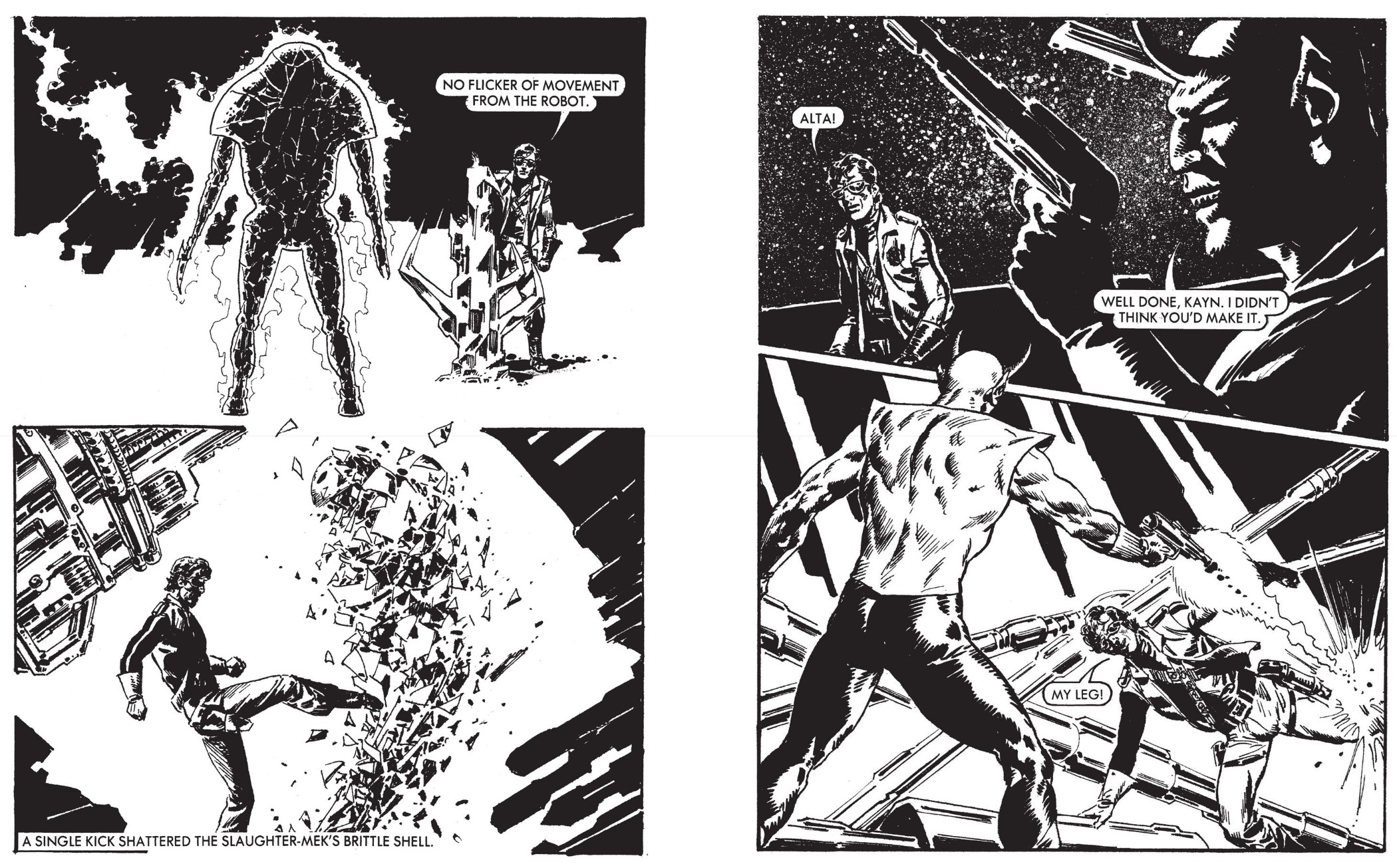
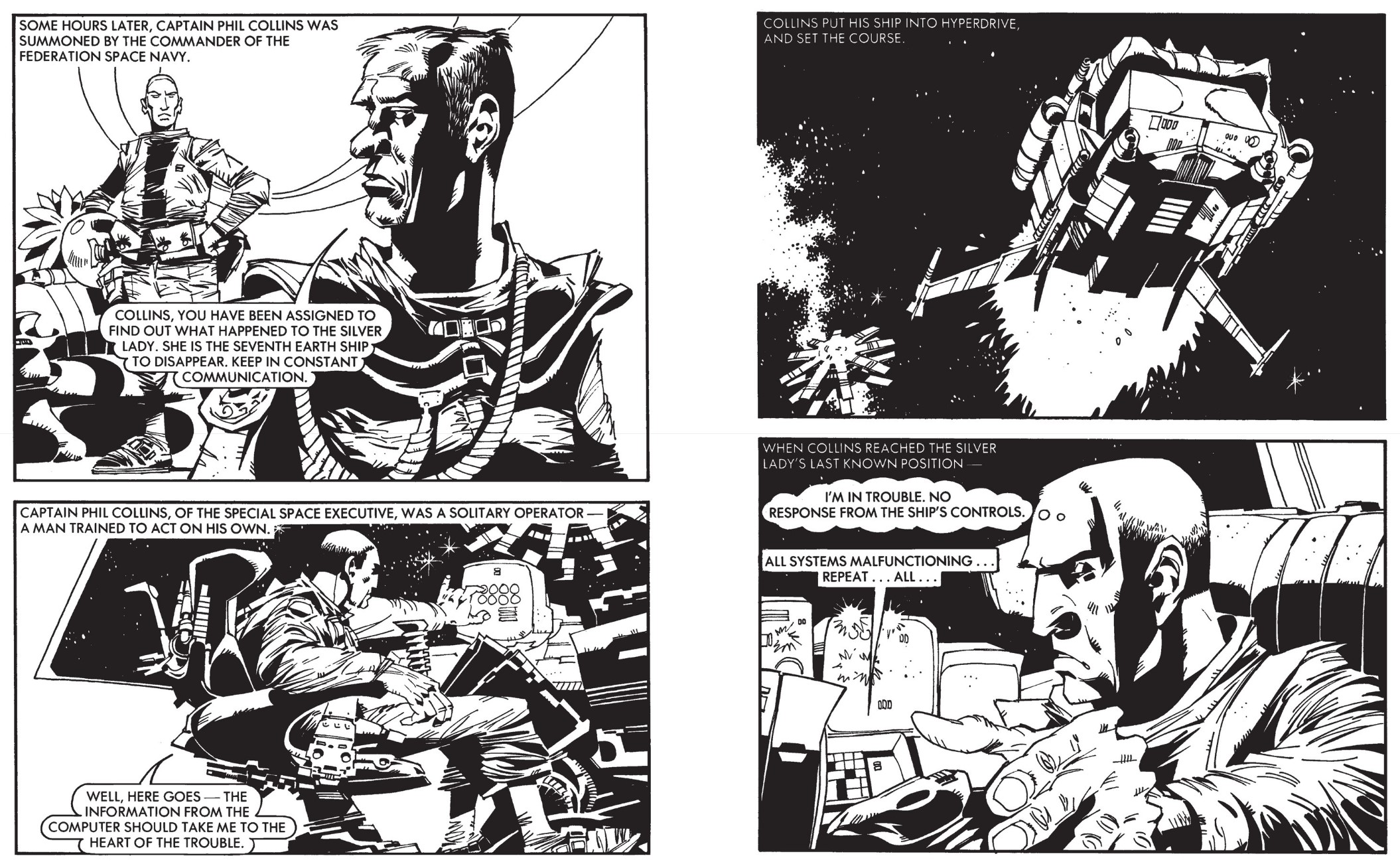
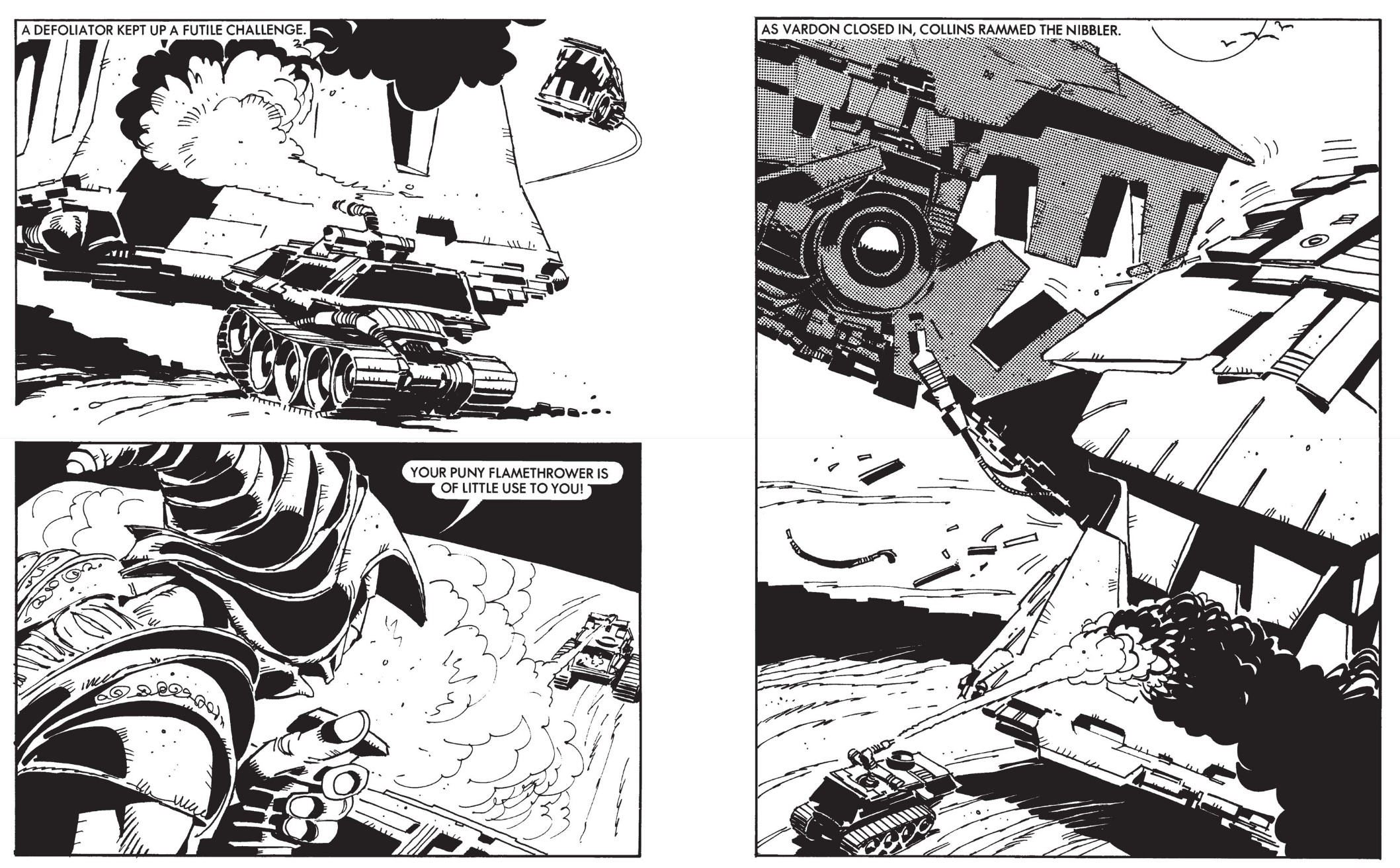
Adam Eterno book 2: Grunn the Grim


By E. George Cowan, Chris Lowder, Tom Tully, Francisco Solano López, John Catchpole, Eric Bradbury, with Jack Le Grand, Geoff Kemp, Tom Kerr & various (Rebellion)
ISBN: 978-1-83786-470-6 (TPB/Digital edition) 978-1-83786-480-5 (Exclusive edition)

This book includes Discriminatory Content produced in less enlightened times.

Win’s Christmas Gift Recommendation: History in the Unmaking… 9/10

British comics had a strange and extended love affair with what can only be described as “unconventional” (for which feel free to substitute “creepy”) heroes. So many of the stars and potential role models of our serials and strips were just plain “off”: self-righteous, moody voyeurs-turned vigilantes like Jason Hyde, sinister masterminds like The Dwarf, deranged geniuses like Eric Dolmann, so many reformed criminals like The Spider or just outright racist supermen like Captain Hurricane

… And don’t get me started on our legion of lethally anarchic comedy icons or that our most successful symbol of justice is the Eagle-bedecked jack-booted poster boy for a fascist state. Perhaps that explains why these days we can’t even imagine or envision what a proper leader looks like and keep on electing clowns, crooks and oblivious privileged simpletons…

All joking aside, British comics are unlike any other kind and simply have to be seen to be believed and enjoyed. One of the most revered stars of the medium has finally begun to be collected in archival editions, and perfectly encapsulates our odd relationship with heroism, villainy and particularly the murky grey area bridging them…

Until the 1980s, comics in the UK were based on an anthological model, offering variety of genre, theme and character on a weekly – or sometimes fortnightly – basis. Humorous periodicals like The Beano were leavened by thrillers like Billy the Cat or General Jumbo and adventure papers like Lion or Valiant always included gag strips such as The Nutts, Grimly Feendish, Mowser and a wealth of similar quick laugh treats. Thunder and Jet were amongst the last of this fading model. Fleetway particularly was shifting to themed anthologies like Shoot, Action and Battle, whilst venerable veterans like Lion, Valiant and Buster hung on and stayed fresh by absorbing failing titles.

Thunder ran for 22 weeks before being absorbed by a stronger title to become Lion & Thunder. The merger/acquisition brought Black Max, The Steel Commando, The Spooks of Saint Luke’s and Adam Eterno to the new combined roster. With Steel Commando, time travelling tramp Adam would survive and thrive, as the periodical later merged into Valiant & Lion (June 1974) until the ultimate end in 1976. He also appeared in numerous Annuals and Specials thereafter.

Eterno was initially devised by Thunder assistant editor Chris Lowder – AKA “Jack Adrian” – and editor Jack Le Grand, with top flight artist Tom Kerr (Monty Carstairs, Rip Kerrigan, Kelly’s Eye, Charlie Peace, Captain Hurricane, Steel Claw, Kraken, Mary-Jo, Tara King/The Avengers, Billy’s Boots) initially designing and visualising the frankly spooky antihero. He also drew the scene-setting first episode. The feature was scripted by equally adept and astoundingly prolific old hand Tom Tully (Roy of the Rovers, Heros the Spartan, Janus Stark, The Wild Wonders, Dan Dare, Johnny Red, The Leopard from Lime Street), who only finally left it in 1976. Kerr, Donne Avenell, Scott Goddall &Ted Cowan would also write subsequent adventures. In fact, Tully might have scripted some of the material in this collection including the first instalment here: a handy recap/catchup limned by Francisco Solano López (and his family studio) that swiftly shifts to a gripping tale of “Conquistadore” atrocity…

Thanks to spotty record keeping, like so much in life and comics, it’s all a big mystery…

Gathering episodes from weekly Lion & Thunder spanning March 20th through August 28th 1971, plus pertinent material from Lion & Thunder Holiday Special 1971 & 1972, the chronal calamities and dark doings resume following Chris Lowder’s informative flashback essay ‘A Writer’s Trip Through Time’.

What you need to know: Delivered in stark, moody monochrome, the saga tales of tragic immortal chronal castaway Adam Eterno began life in the 16th century. He was an ambitious apprentice and less than sterling moral character, indentured to alchemist Erasmus Hemlock. When Adam’s master perfected an immortality serum, the headstrong, impatient acolyte sampled the potion against the sage’s express command. This precipitated the ancient’s death and a fiery conflagration that gutted the house. Hemlock’s last act was to curse his faithless student to live forever and “wander the world through the labyrinths of time”. Surcease would come from a mortal blow struck by a weapon of gold…

The curse was truly effective and as centuries passed, Adam became a recluse: his never-changing appearance driving him away from superstitious mortals and perpetually denying him simple contact with humanity. He fought in all of Britain’s wars, but hard-earned combat comradeships always ended whenever a seemingly fatal blow or wound left him unharmed…

Everything changed and the second part of the alchemist’s curse came true in 1970 when the traumatised, barely sane 421-year-old tramp staggered into a bullion robbery. He was shot by the thieves who rapidly realised that their victim was invulnerable, and attempted to use him in a raid on the Bank of England. When that went sideways too, Adam was struck by a fully-gold-plated limousine of a speeding millionaire…

The impact would be fatal for any other being, but for Adam Eterno it was the beginning of redemption as the shock hurled him into the timestream to land over and again in different eras…

The drama continues in that opening recap as Adam drops out of the timestream and is immediately cut down and hurled into quicksand by rapacious Spaniard Don Morto and his pitiless mercenarios, seeking the Incas fabled City of Gold. Dragging himself out of the mire, soon Adam is sought out by an Inca shaman and undergoes outrageous trials (many involving bonds and weapons of gold!) to become their champion in defeating the merciless invaders and liberating hostage king Tazuma Capa

The resistance is long and bloody but ultimately triumphal after Eterno introduces and mass-produces a weapon from the future that turns the tables on the armour, powder and shot of the invaders…

The bittersweet victory – after all, the traveller already knows more invaders will follow and ultimately succeed – sees Adam returned to chronal limbo only to rematerialise for the first time in the far future: a totalitarian dictatorship policed by brutes and thugs in armour of gold led by a monstrous tyrant: Grunn the Grim. The extended war to liberate tomorrow ends successfully but with the wanderer again returned to falling through eras, with the first hints that the penitent troubleshooter is not randomly drawn to rising manifestations of evil and crossroad moments of menace…

The latest stopover is Dark Ages Eastern Europe where a struggle for the throne sees an evil yet trusted relative seeking to usurp Duke Ctharmis of Carathia, after abducting the prince and true heir. Now as a local wild-child terrorises the populace, and packs of (were?)wolves congregate everywhere, a tatty stranger arrives and starts making trouble. Nobody knows Adam has been recruited by local wizard Mageis to set destiny aright and end the schemes of wicked Baron Draxa, before being deposited in far more familiar territory: England during the Civil War…

Obsessive anti-royalist Captain Raker ravages the locality searching for Lord Benham and the funds he holds in the King’s name. His brutal acts draw the immortal man into the pointless conflict, despite persistent, prophetic visions of doom hampering the antihero… until a final face-to-face duel ends matters and catapults Adam into the New World and a new kind of wickedness. In 1920s New York City, money not power motivates mobster Rikki Delgano, but his tactics are just as cruel and just as ineffectual against an enemy who will not die…

The crook’s hash soon settled, Eterno next appears in the skies over London amidst a storm of ack-ack fire and Luftwaffe planes. Furious and fighting mad, the traveller captures a Nazi bomber and follows the raiders back to their base, delivering a deadly dose of “how do you like it?” before ghosting on to land in the wild west and exonerate unjustly accused drifter the Durango Kid when both are charged with stagecoach robbery. Dodging gunplay and lynchings, Apache tortures and worse, Adam deftly exposes the real bandit before moving on to save all of humanity…

Lost in the early years of the stone age over 35,000 years before his own birth, Eterno roams amidst mammoths, neanderthals and dawn men, but must battle beast men armed with ray guns to foil a plan by alien colonisers. They seek to eradicate emerging humankind and take the world for their own, but Adam is greatly aided by prescient sage Kathon-the-Wise, who seems to see all his past and future secrets… and bears a remarkable resemblance to so many other wizards and mages the nomad of the ages has met…

After a cataclysmic pitched battle, humanity is saved and the spacers defeated, but there’s no rest for the (gradually redeeming) wicked and Eterno lands in shark-filled waters just in time to become the latest target of pirate lord Blackbeard. On foiling that felon, the winds of time waft him to a Viking raid in Anglo-Saxon England where pitiless reiver Geflin One-Eye seems set on taking the kingdom, unless some brave soul can retrieve the fabled Gold Sword of Wulfric from the abbey where it lies and lead the counterattack. Obviously, Adam is not keen on getting that close to his metal nemesis but if the situation demands it…

Bombastic, blood-soaked, inspirational and creepier than you’d imagine possible or permissible in a kids’ comic. the exploits of Adam Eterno are dark delights impossible to put down, so it’s fortunate that there are two more longer complete yarns still to come here.

Taken from Lion & Thunder Holiday Special 1971, the first sadly uncredited yarn (as regards the writer at least) was illuminated by veteran comics illustrator John Catchpole. He was the first to draw Kelly’s Eye – in 1962 for Knock-Out – and limned The Shadow of the Snake & sequel serial Master of Menace between 1972-1974 in Lion where he was part of a rotating team crafting Adam Eterno. As well as Annuals material like Black Bedlam (1975) he inked Jack (Charlie Peace) Pamby on The Potters from Poole Street in Valiant (1976) and was also a book illustrator.

Here all that skill and aplomb is used to detail a moody Victorian mystery as the immortal nomad helps the last of the Calcott line locate a lost family fortune and avoid murder by a monster…

Wrapping up proceedings on a true high (and also lacking a writer credit) the 1972 Adam Eterno special tale was illustrated by the magnificent and prolific Eric Bradbury (1921-2001) began in 1949 in Knockout.

Frequently working with studio mate Mike Western, Bradbury drew strips like Our Ernie, Blossom, Lucky Logan, Buffalo Bill, No Hiding Place, The Black Crow and Biggles. He was an “in-demand” illustrator well into the 1990s, on landmark strips such as The Avenger, Cursitor Doom, Phantom Force 5, Maxwell Hawke, Joe Two Beans, Mytek the Mighty, Death Squad, Doomlord, Darkie’s Mob, Crazy Keller, Hook Jaw, The Sarge, Invasion 1984, Invasion (the unrelated 2000 AD strip), Mean Arena, The Fists of Jimmy Chang, The Dracula Files, Rogue Trooper, Future Shocks, Tharg the Mighty and much more…

All that imagination and experience are seen here, when Adam appears in ancient Atlantis: a dinosaur-infested paragon of human ingenuity and political depravity where a tyrannical queen and audacious space shot lead to the destruction of Earth’s first human civilisation…

Closing with biographies on the creators featured herein and ads for other British lost wonders Adam Eterno – Grunn the Grim is enthralling astonishment awaiting your gaze: a riotously rewarding rollercoaster ride to delight readers who like their protagonists dark and conflicted and their history in bite-sized bursts.
© 1971, 1972, & 2025 Rebellion Publishing IP Ltd. All Rights Reserved.

Today in 1952 the last weekly instalment of Will Eisner’s Spirit Comics Section was published, whilst in 1974 the final Shiver and Shake entertained diehard UK readers.

In 1994, comics and animation giant Doug Wildey went to the final roundup. Remembered for Tarzan, The Saint newspaper strip and Jonny Quest, he’d prefer you read his elegiac westerns like Doug Wildey’s Rio: The Complete Saga.

Showcase Presents Sea Devils volume 1


By Robert Kanigher, Bob Haney, France E. Herron, Hank P. Chapman, Russ Heath, Irv Novick, Joe Kubert, Gene Colan, Ross Andru & Mike Esposito, Jack Abel, Bruno Premiani, Sheldon Moldoff, Howard Purcel & various (DC Comics)
ISBN: 978-1-4012-3522-2

This book includes Discriminatory Content produced in less enlightened times.

Robert Kanigher (18th June 1915 – 7th May 2002) was one of the most distinctive authorial voices in US comics, blending rugged realism with fantastic fantasy and outrageous imagination in his signature war comics, as well as for the wealth of horror stories, romance yarns, “straight” adventure, westerns and superhero titles such as Wonder Woman, Teen Titans, Hawkman, Metal Men, Flash, Batman (plus other characters and genres far too numerous to cover here) at which he also excelled.

He sold his first stories and poetry in 1932, wrote for theatre, film and radio, and joined Fox Features’ “shop” at the beginning of the comic book phenomenon where he created The Bouncer, Steel Sterling and The Web, whilst providing scripts for established features like Blue Beetle and Captain Marvel (who we all call “Shazam!” these days). In 1945 he settled at All-American Comics as both writer & editor, staying put when the company amalgamated with National Comics to become the forerunner of today’s DC.

Bob wrote the Golden Age Flash and Hawkman, created Black Canary and many more sexily memorable villainesses such as Harlequin and (Rose and) the Thorn. This last temptress he redesigned in the early 1970s relevancy period: originating a schizophrenic crimebusting superheroine to haunt the back of Superman’s Girlfriend Lois Lane – which he also scripted at the time.

When mystery-men faded at the end of the 1940s, Kanigher moved easily into other genres like spy thrillers, westerns and war stories. In 1952 he became chief writer/editor of the company’s combat line: All-American War Stories, Star Spangled War Stories and Our Army at War. He launched Our Fighting Forces in 1954 and added G.I. Combat to his packed portfolio when Quality Comics sold their dwindling line of titles to National/DC in 1956. A year earlier, Kanigher had devised historical adventure anthology The Brave and the Bold and its stalwart stars Silent Knight, Golden Gladiator and Viking Prince whilst still scripting Wonder Woman, Johnny Thunder, Rex the Wonder Dog and a host of others.

In 1956, for Julius Schwartz he scripted ‘Mystery of the Human Thunderbolt’: the first story of the Silver Age, introducing new Flash Barry Allen to hero-hungry kids of the world.

Kanigher was restlessly creative, frequently using his uncanny if formulaic action arenas as a testing ground for future series concepts. Among the many epochal war features he created were Sgt. Rock, Enemy Ace, The War that Time Forgot, The Haunted Tank and The Losers. However, he always kept an eye on contemporary trends too. When supernatural comics took over the industry as the 1960s closed, he was a mainstay at House of Mystery, House of Secrets and Phantom Stranger. In 1975 he created gritty human interest crime feature Lady Cop. Fifteen years earlier he had caught a similar wave (Oh, ha ha, hee hee…) by cashing in on the popularity of TV show Sea Hunt. His entry into a sudden subgenre deluge of scuba-diver comics featured the traditional contemporary adventure formula of a heroic quartet (Smart Guy, Tough Guy, Young Guy and A Girl) to indulge in all manner of (undersea) escapades from logical to implausible, topical to fantastical. He dubbed his team The Sea Devils

These classy yarns still haven’t made it into modern full-colour editions but they are magnificent examples of comics storytelling, and if you have to read these lost treasures in mere monochrome, at least that’s better than nothing…

Re-presenting the turbulent, terrific try-out stories from Showcase #27-29 (July/August to November/December 1960) and Sea Devils #1-16 – spanning cover-dates September/October 1961 – March/April 1964 – this mammoth black-&-white paperback blends bizarre fantasy, sinister spy stories, shocking science fiction and two-fisted aquatic action with larger-than-life yet strictly human heroes who carved their own unique niche in comics history…

In almost every conceivable way, “try-out title” Showcase created the Silver Age of US comic books and is responsible for the multi-million-dollar industry and art form we all enjoy today. The comic book was a printed periodical Petri dish designed to launch new series and concepts with minimal commitment of publishing resources. If a new character sold well initially a regular series would follow. The process had been proved with Frogmen, Lois Lane, Challengers of the Unknown, The Flash, Green Lantern and many, many more. The principle was a sound one which paid huge dividends. Editors at National were apparently bombarded with readers’ suggestions for new titles and concepts and the only possible way to feasibly prove which would be popular was to offer test runs and assess fan – and most crucially sales – reactions.

Showcase #27 followed a particularly fruitful run of successful non-superhero debuts including Space Ranger, Adam Strange and Rip Hunter…Time Master. At a time when costumed characters seemed unstoppably ascendant, memories of genre implosions remained fresh, but it seemed the premiering publication could do no wrong. Moreover, it wasn’t Kanigher and illustrator Russ Heath’s first dip in this particular pool. Showcase #3 had launched war feature The Frogmen in an extended single tale following candidates for a WWII US Underwater Demolitions Team as they perilously graduated from students to fully-fledged underwater warriors. The feature, if not the actual characters, became a semi-regular strip in All-American Men of War #44 (April #1957) and other Kanigher-edited war comics: making Frogmen the first success of the try-out system. Now, with tales of underwater action appearing in comics, books, film and TV, the time was right for a civilian iteration to make some waves…

The drama here begins in Kanigher & Heath’s ‘The Golden Monster’ as lonely skin-diver Dane Dorrance reminisces about his WWII frogman father and that senior’s trusty buddies before being saved from a sneaky shark by a mysterious golden-haired scuba-girl. Judy Walton is an aspiring actress who, seeking to raise her Hollywood profile, has entered the same underwater treasure hunt Dane is engaged in, but as they join forces, they have no idea of the dangers awaiting them…

Locating the sunken galleon they’ve been hunting, both are trapped when seismic shifts and a gigantic octopus bury them inside the derelict. Happily, hulking third contestant Biff Bailey is on hand and his tremendous strength tips the scales and allows the trio to escape. Now things take a typical Kanigher twist as the action switches from tense realistic drama to riotous fantasy, with the explosive awakening of a colossal reptilian sea-monster who chases the divers until Judy’s little brother Nicky races in to distract the beast…

Temporarily safe, the relative strangers unite to destroy the thing – with the help of a handy floating mine left over from the war – before deciding to form a professional freelance diving team. They take their name from the proposed movie Judy wanted to audition for, becoming forever “The Sea Devils”. In Showcase #28 Dane’s dad again offers his boy ‘The Prize Flippers’ papa won for war exploits, but Dane feels his entire team should be allowed to compete for them. Of course, each diver successively outdoes the rest, but in the end a spectacular stunt with a rampaging whale leaves the trophy in the hands of a most unlikely competitor…

A second story sees the new team set up shop as “underwater trouble-shooters” and stumbling into a mystery as pretty Mona Moray begs them to find her missing dad. Professor Moray was lost when his rocket crashed into the ocean, but as our scuba stalwarts diligently search the crash site, they are ambushed by underwater aborigines and join the scientist in an uncanny ‘Undersea Prison’. Only when their captors reveal themselves as invading aliens do the team finally pull together, escape the trap and bring the house down on the insidious aquatic horrors.

Showcase #29 also offered a brace of briny tales, casting off with ‘The Last Dive of the Sea Devils’, wherein a recently-imprisoned dictator from Venus escapes to Earth and battles the astounded team to a standstill from his giant war-seahorse. The blockbusting bust-up costs them their beloved vessel The Sea Witch, before the crew make use of a handy leftover torpedo to end the interplanetary tyrant. Sea-born giants also abound in ‘Undersea Scavenger Hunt’ wherein the cash-strapped troubleshooters compete in a contest to win a new boat. Incredible creatures and fantastic treasure traps are no real problem, but the actions of rival divers The Black Mantas almost cost our heroes their lives…

Everything works out though, and nine months later Sea Devils #1 hit the stands with Kanigher & Heath leading the way. In ‘The Sea Devils vs. the Octopus Man’ our watery quartet are now stars of a monster movie, but when the lead beastie comes to lethal life and attacks them, all thoughts of fame and wealth sink without trace. The second tale was scripted by superbly inventive Bob Haney who riffed on Moby Dick’s plot in a tale of how Vikings hunted a mythical orca with a magic harpoon, before latter-day fanatical whaler Captain Shark mercilessly seeks out the ‘Secret of the Emerald Whale’ with our desperate Devils dragged along for the ride…

Haney wrote both yarns in the next issue, beginning with ‘A Bottleful of Sea Devils’ as mad scientist Mr. Neptune employs a shrinking device to steal a US Navy weapon prototype. With the aquatic investigators hard on his flippered heels, the felon is soon caught, after which ‘Star of the Sea’ introduces implausibly brilliant performing seal Pappy who repeatedly saves the sea squad before finding freedom and true love in the wild waters of the Atlantic. Kanigher returned for #3’s ‘Underwater Crime Wave’ as the Devils clashed with a modern Roman Emperor who derives incredible wealth from smuggling and traps the team in his undersea arena. Judy then finds herself the only one immune to the allure of ‘The Ghost of the Deep’ as subsea siren Circe makes the boys her latest playthings with her mortal rival compelled to pull out all the stops to save her friends…

Sea Devils #4 led with ‘The Sea of Sorcery’ as the team investigate – but fail to debunk – incredible myths of a supposedly haunted region of ocean, after which Haney details how the squad travel into the heart of South America to liberate a tribe of lost, pre-Columbian Condor Indians from a tyrannical witch doctor to solve ‘The Secret of Volcano Lake!’ Then ‘The Creature Who Stole the 7 Seas’ (Kanigher) opens SD #5 as a particularly dry period for the troubleshooters ends with a crashing UFO disgorging a sea giant intent on transferring Earth’s oceans to his own arid world. Oddly for the times, here mutual cooperation and a smart counter-plan save the day for two panicked planets.

Veteran writer Hank P. Chapman joined an ever-expanding team with a smart yarn of submerged Mayan treasure and deadly traps imperilling the team whilst solving the ‘Secret of the Plumed Serpent’, before Kanigher comes back with a book-length thriller for #6 and the Devils seemingly ensorcelled by ancient parchments which depict them battling incredible menaces in centuries past. Biff battles undersea knights for Queen Cleopatra, Judy saves Ulysses from Sirens, Nicky rescues a teenage mermaid from a monstrous fishman and Dane clashes with ‘The Flame-Headed Watchman!’, but is wise enough to realise the true threat comes from the mysterious stranger who has brought them such dire documents…

The switch to longer epics was wise and productive, followed up in #7 with ‘The Human Tidal Wave!’ as the heroes spectacularly battle an alien made of roaring water to stop a proposed invasion, whilst SD #8 sees them strive to help a fish transformed into a grieving merman by the ‘Curse of Neptune’s Giant!’ The malignant horror’s mutative touch briefly makes monsters of the heroes too, but ultimately Sea Devil daring trumps eldritch cruelty…

More monster madness followed in #9’s ‘The Secret of the Coral Creature!’ as the team become paragliding US Naval medics to rescue an astronaut. That’s mere prelude to the oceanic atomic bomb test which blasts them to a sea beneath the sea that imprisons an ancient alien for eons of crushing solitude, and who had no intention of ever letting the newly-arrived air-breathers go…

A concatenation of crazy circumstances creates the manic madness of #10’s ‘4 Mysteries of the Sea!’ as godly King Neptune decrees that on this day every wild story of the sea will come true, just as the Sea Devils are competing in a “Deep Six Tall Tales” contest. Soon the incredulous squad are battling pirates in an underwater ghost town, rescued from captivity by a giant octopus thanks to a friendly seal (Good old Pappy!), facing off against aliens of the Martian Canals Liars Club and saving Neptune himself from a depth-charge attack…

The hugely underrated Irv Novick took over as primary illustrator with #11, as the Devils agree to test human underwater endurance limits in an ocean-floor habitat. Soon, however, Dane is near breaking point, seeing a succession of monsters from the ‘Sea of Nightmares!’

Kanigher then relinquished writing to fellow golden age alumnus France E. Herron, who kicked off in rip-roaring form with a classy sci fi romp. Here Nicky’s growing feelings of inadequacy are quashed after he saves his comrades – and the world – from the ‘Threat of the Magnetic Menace!’

Always experimental and rightfully disrespectful of the fourth wall, editors Kanigher and George Kashdan turned issue #13 over to the fans for ‘The Secrets of 3 Sunken Ships’, as successive chapters of Herron’s script were illustrated by Joe Kubert (whose 99th birthday would be today if he was still with us), Gene Colan and Ross Andru & Mike Esposito for the audience to judge who was the best. The artists all appear in-world, conducting interviews and researching our heroes as they tackle a reincarnated sea captain, travel to an ancient sea battle between Greece and Persia and meet the alien who kidnapped the crew of the Marie Celeste! The gag continued in Sea Devils #14 as illustrator Novick comes along for the ride when the amazing aquanauts try to end the catastrophic ‘War of the Underwater Giants’ This finds aging deities Neptune and Hercules clashing for supremacy in Earth’s oceans.

Jack Abel was artistic substitute in supplementary yarn ‘Challenge of the Fish Champions!’, as our heroes enter a cash prize competition to buy scuba equipment for a junior diving club. Unfortunately, crazy devious scientist Karpas also wants the loot and so fields a team of his own technologically augmented minions. Before long, the human skindivers are facing off against a sea lion, a manta ray, a squid and a merman. Nobody specified contestants had to be human…

Novick got back into the act illustrating #15 as author Herron revealed Judy & Nicky’s relationship to the ‘Secret of the Sunken Sub!’ When inventor Professor Walton vanishes whilst testing his latest submersible, it’s only a matter of time before his children drag the rest of the Sea Devils to the bottom of every ocean to find him and his lost crew. The uncanny trail takes them through shoals of monsters, astounding flora and into the lair of an incredible sea spider before the mission is successfully accomplished…

Events regained a semblance of narrative normality with the final issue in this compilation with Chapman contributing two high adventure yarns beginning with ‘The Strange Reign of Queen Judy and King Biff’, superbly rendered by the wonderful Bruno Premiani & Sheldon Moldoff. When a massive wave capsizes the Sea Witch, only Dane & Nicky seemingly survive, but the determined explorers persevere, eventually finding their friends as bewitched captives on the island of an immortal wizard. All they have to do is kidnap their ferociously resisting comrades, escape an army of angry guards and penetrate the island’s mystic defences a second time to restore everything to normal. No problem…

This eccentric and exciting voyage of discovery concludes with ‘Sentinel of the Golden Head’ – illustrated by always impressive Howard Purcell & Moldoff – as the restored aquatic quartet stumble onto the lost island of Blisspotamia in time to witness a beautiful maiden trying to sacrifice herself to the sea gods. By interfering, they incur the wrath of a legion of mythological horrors and have no choice but to defy the gods to free the terrified islanders from ignorance and tyranny…

These capacious monochrome compendia were superb value and provided a vital service by bringing older, less flashy (but still astonishingly expensive in their original issues) tales to a readership which might otherwise be denied them. However, this is probably the only series which I can honestly say suffers in the slightest from the lack of colour. Whilst the line-art story illustrations are actually improved by the loss of hue, the original covers – by Heath & Novick as supervised and inked by production ace Jack Adler – used all the clever technical print effects and smart ingenuity of the period to add a superb extra layer of depth to the underwater scenes which tragically cannot be appreciated in simple line & tone reproduction. Just go to any online cover browser site and you’ll see what I mean…

Nevertheless, the amazing art and astounding stories are as good as they ever were and Showcase Presents Sea Devils is stuffed with incredible ideas, strange situations and non-stop action. These underwater wonders are a superb slice of the engaging fantasy thrillers which were once the backbone of US comic books. Perhaps a little whacky in places, they are remarkably similar to many tongue-in-cheek, anarchic Saturday morning kids’ animation shows and will certainly provide jaded fiction fans with hours of unmatchable entertainment. Let’s hope the editors of the DC Finest line are casting about for some rarer salvage to preserve…
© 1960, 1961, 1962, 1963, 1964, 2012 DC Comics. All Rights Reserved.

Beano and The Dandy: A Celebration of Dudley D. Watkins


By Dudley D. Watkins, R.D. Low & various (DC Thomson)
ISBN: 978-1-84535-818-1 (HB)

This book includes Discriminatory Content produced in less enlightened times.

As the physical books I bought to commemorate this occasion still haven’t arrived yet, and none of them are available digitally, I’m celebrating the achievements of one of Britain’s greatest cartoonists with something you might have read before. So if I didn’t convince you then, here’s a another shot at what you see and what should be a compulsory text in Art, Sociology and History classes. Don’t make me repeat myself again…

Unlike any other artform, Comics is uniquely set up to create small gods. Initially low cost, mass-market and appearing with rapidity – occasionally over the course of decades – the works of some creators are instantly recognisable and generally prolific, and come to define the medium for generations of enthralled recipients. All generally defy exact duplication, despite being always heavily imitated by adoring adherents, since they possess an indefinable element that slavish imitation cannot capture: Osamu Tezuka, Hergé, Jack Kirby, Alex Raymond, Moebius, Steve Ditko and Charles Schulz are all instantly known. There are certainly a few others you’d like to add to that list.

Feel free.

My own candidate for ascension is Dudley Dexter Watkins…

A tireless and prolific illustrator equally adept at comedy and drama storytelling, his style more than any other’s shaped the postwar look and form of Scottish publishing giant DC Thompson’s comics output. Watkins (1907-1969) started life in Manchester and Nottingham as an artistic prodigy prior to entering Glasgow College of Art in 1924. Before too long he was advised to get a job at expanding, Dundee-based DCT, where a 6-month trial illustrating prose boys’ stories led to comic strip specials and some original cartoon creations. Percy Vere and His Trying Tricks and Wandering Willie, The Wily Explorer made him the only contender for both lead strips in a bold new project conceived by Robert Duncan Low (1895-1980).

Low began as a journalist for DC Thomson, rising via story scripting to Managing Editor of Children’s Publication and between 1921 and 1933 launched the company’s “Big Five” story papers for boys: Adventure, The Rover, The Wizard, The Skipper and The Hotspur. In 1936, he created the landmark “Fun Section”: an 8-page pull-out comic strip supplement for national newspaper The Sunday Post. This illustrated accessory – prototype and blueprint for every comic the company subsequently released – launched on 8th March. From the outset The Broons and Oor Wullie were the uncontested headliners.

Low’s shrewdest notion was to devise both strips as comedies played out in the charismatic Scottish idiom and broad unforgettable vernacular, supported by features such as Chic Gordon’s Auchentogle, Allan Morley’s Nero and Zero, Nosey Parker and other strips. These pioneering comics then laid the groundwork for the company’s next great leap. After some devious devising, in December 1937 Low launched DC Thomson’s first weekly all-picture strip comic. The Dandy was followed by The Beano Comic in 1938, and early-reading title The Magic Comic in 1939.

Low’s irresistible secret weapon in all of these ventures was Watkins. The indefatigable cartoon stalwart drew the Fun Section signature strips The Broons and Oor Wullie from the outset and – without missing a beat – added Desperate Dan (in The Dandy) to his weekly workload in 1937. Seven months later, placidly outrageous, subtly subversive social satire Lord Snooty became a big draw for freshly launched companion paper The Beano.

This stunning and luxurious hardback commemorative celebration was released to mark 50 years since Watkins’ death and – despite dealing with a rather solemn topic – is exuberantly joyous in tracing the man’s astounding career and output. No one could read this stuff and not smile, if not actually collapse in mirth.

Packed with brief commentary and visual extracts, the artist is revealed in excerpts and complete episodes chronologically curated to maximise his artistic development. Beginning with The 1930s, a selection of strips starring Oor Wullie and The Broons from The Fun Section is followed by a vintage full-colour Beano Book cover, before a feature on Desperate Dan leads inevitably to a tranche of wild cowboy antics in the best Dundee tradition. The system then repeats for Lord Snootyand his Pals – and then forgotten almost-stars Wandering Willie the Wily Explorer and aforementioned Percy Vere and his Trying Tricks who share their brand of whimsy. Up until now, the majority of strips are monochrome, but the sequence starring Smarty Grandpa comes in the nostalgic two-colour style we all remember so fondly…

An introductory essay about The 1940s is followed by more of the same, but different; beginning with lost family favourite adventure series. Jimmy and His Magic Patch (latterly Jimmy’s Magic Patch) share the exploits of a wee nipper whose torn trousers were repaired with a piece of mystical cloth that could thereafter grant wishes and transport the wearer to other times and fantastic realms. Here Watkins got to impress with authentic imagery of pirates and dinosaurs, while a two-tone tale from an annual took Jimmy to Sherwood Forest and a meeting with Robin Hood

Apparently Watkins could handle anything, as seen by a selection of book covers that follow – The Story of Kidnapped, The Story of Treasure Island and The Story of Robinson Crusoe – and illustrated general knowledge pages Cast Away!, Wolves of the Spanish Main and Soldiers’ Uniforms & Arms 1742-1755 which precede complete Jacobite adventure strip Red Fergie’s “Army”.

Once upon a time, comics offered illustrated prose yarns too, and a literary legend was a fan favourite when Watkins did the pictures. ‘Gulliver – the Paraffin Oil Plot’ has splendidly stood the test of time and neatly segues into a hefty section of strips starring the evergreen Lord Snooty and his Pals and Desperate Dan, before Biffo the Bear debuts in full colour, beginning with his premier on January 24th 1948 and including three more captivating outings. The decade closes with another prose Gulliver treat in ‘Baron Bawler’s Blackout’

A true golden age, The 1950s section opens with Oor Wullie derivative Ginger (from The Beezer), another full-colour cover-star copiously represented and followed by fellow mischief-maker Mickey the Monkey out of The Topper, after which Lord Snooty and his Pals get the text & picture treatment for an extended (possibly Annual or summer special?) lark, and Desperate Dan & Biffo the Bear star in multi-hued shorts trips, after which ‘The Tricks of Tom Thumb’ – another classical adventure yarn – sets the scene for a veritable flurry of strips starring Biffo & Dan to see the decade out.

Venerable Lord Snooty and his Pals open The 1960s, with Desperate Dan quickly following, before more full-colourful Mickey & Ginger strips lead into what was probably the artist’s preferred material. Watkins was a committed man of faith, creating illustrated Bible tracts in his spare time, and always eager to (decorously) promote his beliefs. Here – in full colour – are a brace of theological adventure strips beginning with ‘David’ and his notorious battle, supplemented by ‘The Road to Calvary’ which lead into a rousing clan romp in the prose-&-picture yarn of English-trouncing Scots rebel Wild Young Dirky

Ending the festival of fun, with a lump in the throat, is the Biffo strip that formed the cover of Beano #1423 (25th October 1969). Watkins had soldiered on in unassailable triumph for decades, drawing some of the most lavishly lifelike and winningly hilarious strips in comics history, and died at his drawing board on August 20th 1969. The page he was working on was completed by David Sutherland, who adds his own gracious homily to the piece.

For all those astonishingly productive years, Dudley D. Watkins had also unflaggingly crafted a full captivating page each of Oor Wullie and The Broons, as well as his church tracts and periodical commitments. His loss was a colossal blow to the company. DC Thomson reprinted old episodes of both strips in the newspaper and the Annuals for seven years before a replacement was agreed upon, whilst The Dandy reran Watkins’ Desperate Dan stories for twice that length of time.

DCT’s publications have always played a big part in Britain’s Christmas festivities and are still a cornerstone of our cultural bulwarks, so let’s revel in the Good Old Days of comics via this lovingly curated tribute to Scotland’s greatest cartoon artisan.
© DCT Consumer Products (UK) Ltd. 2020.

Hugo Pratt also died today in 1995. If you want to learn about him, our most recent review of his magic can be found here.

Prince Valiant volumes 1-3 Gift Box Set


By Hal Foster (Fantagraphics Books)
ISBN: 978-1 68396-072-0 (boxed set)

Individual volume ISBNs: 978-1-60699-141-1 (HB vol. 1), 978-1-60699-348-4 (HB vol. 2), 978-1-60699-407-8 (HB vol. 3)

This book includes Discriminatory Content produced in less enlightened times.

Today, way back in 1892, a god of comics was born. His work will never die.

Rightly reckoned one of the greatest comic strips of all time, the majestic, nigh-mythical saga of a king-in-exile who became one of the greatest warriors in an age of unparalleled heroes is at once fantastically realistic and beautifully, perfectly abstracted – an indisputable paradigm of adventure fiction where anything is possible and justice always prevails. It is the epic we all want to live in. However, on one thing let us be perfectly clear: Hal Foster’s Prince Valiant is not historical. It is far better and more real than that.

Possibly the most successful and evergreen fantasy creation ever conceived, Prince Valiant in the Days of King Arthur launched on Sunday 13th February 1937, a glorious weekly, full-colour window not onto the past but rather onto a world that should have been. It followed the tempestuous life of a refugee boy driven by invaders from his ancestral homeland of faraway Thule who persevered and, through tenacity, imagination and sheer grit, rose to become one of the mightiest heroes of the age of Camelot.

As depicted by the incomprehensibly gifted Foster, this noble scion would, over decades, grow to mighty manhood in a heady sea of wonderment: roaming the globe and siring a dynasty of equally puissant heroes whilst captivating and influencing generations of readers and thousands of creative types in all the arts. There have been films, cartoon series and all manner of toys, games and collections based on the feature – one of the few newspaper strips to have lasted from the thunderous 1930s to the present day (well over 4600 episodes and STILL counting) and, even in these declining days of newspaper cartooning, it still claims over 300 American papers as its home.

Foster produced the strip, one spectacular page a week until 1971 when, after auditioning such notables as Wally Wood and Gray Morrow, Big Ben Bolt artist John Cullen Murphy was selected to draw the feature. Foster carried on as writer and designer until 1980, after which he fully retired and Murphy’s son took over scripting duties. In 2004 Cullen Murphy also retired (he died a month later on July 2nd) but the strip soldiered on under the extremely talented auspices of artist Gary Gianni and writer Mark Schultz prior to Thomas Yeates settling in and conquering one more exotic land by making it onto the worldwide web.

The first three exquisite oversized hardback volumes (362 x 268mm) are happily still available as a monumental gift set nobody could resist. They reprint, in glorious colour spectacularly restored from Foster’s original printer’s proofs, the princely pristine Sunday pages cumulatively spanning February 1937 to 20th December 1942: six years of formative forays comprising an impressive saga which promised much and delivered so much more than anybody could have suspected during those dim, distant and dangerous days…

Volume 1 opens with editor Brian M. Kane’s informative picture/photo-packed potted history of ‘Harold Rudolf Foster: 1892-1982’, after which Fred Schreiber conducts ‘An Interview with Hal Foster’ as first seen in Nemo: The Classic Comics Magazine (1984). Additionally, after the Arthurian epic exploits of our quintessential swashbuckling hero, this initial tome is rounded off by Kim Thompson’s discourse on the many iterations of reprints over the years and around the world in ‘A History of Valiants’

The actual action-packed drama commences in distant Scandinavia as the King of Thule, his family and a few faithful retainers dash for a flimsy fishing boat, intent only on escaping the murderous intentions of a usurper’s army. Their voyage carries them to the barbarous coast of Britain and into battle against bands of wild men before they secure a safe point in the gloomy fens of East Anglia. After many hard fights they reach an uneasy détente with the locals and settle into a harsh life as regal exiles. Prince Valiant is but 5 years old when they arrive, and his growing years in a hostile environment toughen the heir, sharpen his wits and give him an insatiable taste for mischief and adventure. He befriends a local shepherd boy and together their escapades include challenging the marauding ancient dinosaurs which infest the swamp, battling a hulking man-brute and bedevilling a local witch. In retaliation the hag Horrit predicts that Val’s life will be long and packed with incredible feats… but always tainted by great sorrow. All that, plus a constant regimen of knightly training and scholarly tuition befitting an exile learning how to reclaim his stolen kingdom, make the lad a veritable hellion…

Everything changes when his mother passes away. After a further year of intense schooling in the arts of battle, Valiant leaves the Fens, and makes his way in the dangerous lands beyond. Whilst sparring with his boyhood companion, he unsuspectingly insults Sir Launcelot who is fortuitously passing by. Although that noble warrior is sanguine about the cheeky lad’s big mouth, his affronted squire attempts to administer a stern punishment… and is rewarded with a thorough drubbing. Indeed, Launcelot has to stop the Scion of Thule from slitting the battered and defeated man’s throat. Moreover, although he has no arms, armour, steed or money, Valiant swears that he too will be a Knight…

Luck is with the Pauper Prince. After spectacularly catching and taming a wild stallion, his journey is interrupted by gregarious paladin Sir Gawain who shares a meal and regales the wide-eyed lad with tales of chivalry and heroism. When their alfresco repast is spoiled by robber knight Sir Negarth – who unfairly strikes the champion of Camelot – Val charges in. Gawain regains consciousness to find the threat ended, with Negarth hogtied and his accomplice skewered…

Taking Val under his wing, wounded Gawain escorts the lad and his prisoner to Camelot, although their journey is delayed by a gigantic dragon. Val kills it too – with the assistance of Negarth – and spends the rest of the trip arguing that the rogue should be freed for his display of gallantry. Val is still stoutly defending the scoundrel at the miscreant’s trial before King Arthur, and is rewarded by being appointed Gawain’s squire. Unfortunately, he responds badly to being teased by the other knights-in-training and soon finds himself locked in a dungeon whilst his tormentors heal and the remaining Knights of the Round Table ride out to deal with an invasion of Northmen…

Whilst the flowers of chivalry are away, a plot is hatched by scheming Sir Osmond and Baron Baldon. To recoup gambling debts, they capture and ransom Gawain, but have not reckoned on the dauntless devotion and ruthless ingenuity of his semi-feral squire. Easily infiltrating the bleak fortress imprisoning the hero, Valiant liberates his mentor through astounding feats of daring and brings the grievously wounded knight to Winchester Heath and Arthur…

As Gawain recuperates, he is approached by a young maiden. Ilene is in need of a champion and – over his squire’s protests – the still gravely unfit knight dutifully complies. Val’s protests might have been better expressed had he not been so tongue-tied by the most beautiful girl he has ever seen. The quest to rescue Ilene’s parents is delayed when an unscrupulous warrior in scarlet challenges them, intent on himself possessing the lovely maiden. Correctly assessing Gawain to be no threat, the Red Knight does not live long enough to revise his opinion of the wild-eyed boy who then attacks him…

Leaving Ilene and re-injured Gawain with a hermit, Valiant continues on alone to Branwyn Castle, recently captured by an “Ogre” who terrorises the countryside. Through guile, force of arms and diabolical tactics the boy ends that threat forever. This is an astonishing tour de force of graphic bravura no fan could ever forget. Aspiring cartoonist Jack Kirby certainly didn’t: he recycled Val’s outlandish outfit used to terrorise the Ogre’s soldiers into the visual basis for his 1972 horror-hero Etrigan the Demon

Having successfully routed the invaders and freed Ilene’s family, Val begins earnestly courting the grateful girl, but his prophecy of lifelong misery seems assured, however, when her father regretfully informs him that she is promised to Arn, son and heir of the King of Ord. Even before that shock can sink in, Valiant is called away again. Ailing Gawain has been abducted by sorceress Morgan le Fey, who is enamoured of the knight’s manly charms…

When Val confronts her, le Fey drugs him with a potion and the Prince endures uncounted ages in her dungeon before escaping. Weak and desperate, he makes his way to Camelot and enlists Merlin in a last-ditch ploy to defeat the witch and save his adored mentor. In the meantime, events have progressed, and Val’s bold plans to win Ilene are derailed when invitations to her wedding arrive at Camelot. Initially crushed, the resilient youth determines to travel to Ord and challenge Prince Arn for her hand. Their meeting is nothing like Val imagined but, after much annoying interference, he and the rather admirable Arn finally engage in their oft-delayed death-duel, only to be again distracted when news comes that Ilene has been stolen by Viking raiders…

What follows is another unparalleled moment of comics magnificence as Valiant sacrifices everything for honour, gloriously falls to superior forces, wins possession of Flamberge (the legendary Singing Sword which is brother to Excalibur), is captured and then reunited with Ilene… only to lose her again to the cruellest of fates…

After escaping from the Vikings and covering himself with glory at the Lists in Camelot – although he doesn’t even realise it – the heartsick, weary Prince returns to his father in the melancholy Anglian fens, again encountering ghastly Horrit and nearly succumbing to fever. When he recovers months later, he has a new purpose: he and his faithful countrymen will travel to Thule and rescue the nation from the cruel grip of usurper Sligon. Unfortunately, during the preparations, Valiant discovers his region of Britain has been invaded by Saxons and is compelled by his honour to race to Camelot and warn Arthur first…

To Be Continued…


Volume 2 reprints perfectly-restored Sunday pages from January 1st 1939 to 29th December 1940, following Sir Gawain’s extremely capable squire as he rushes to warn Camelot of invasion by rapacious Saxons via vast Anglian Fens. Here Thule’s Royal Family have hidden since being ousted from their Nordic Island Kingdom by the villainous usurper Sligon. After a breathtaking battle which sees Saxons repulsed and the battle-loving boy-warrior knighted upon the field of victory, Valiant begins a period of globe-trotting. This carries him through the fabled lands of Europe just as the last remnants of the Roman Empire are dying in deceit and intrigue.

Firstly, Val revisits Thule and restores his father to the throne, narrowly escaping the alluring wiles of a conniving beauty with an eye to marrying the Heir Apparent. Quickly bored with palaces, peace and plenty, the roving royal wildcat then encounters a time-twisting pair of mystical perils who show him the eventual fate of all mortals. Sobered but not daunted, he makes his way towards Rome, where he will become unwittingly embroiled in the manic machinations of the Last Emperor, Valentinian. Before that, however, Val is distracted by an epic feat that would have struck stunning resonances for the readership at the time. With episode #118 (14th May 1939) Val joins the doomed knights of mountain fortress Andelkrag, who, alone and unaided, hold back the assembled might of the terrifying hordes of Attila the Hun: a terror who is currently decimating the civilisations of Europe and now marshals his forces to wipe out its last vestige.

With Hitler & Mussolini hogging headlines and Modern European war seemingly inevitable, Val shares the Battle of Decency and Right against untrammelled Barbarism. His epic struggle and sole survival comprise one of the greatest episodes of glorious, doom-fated chivalry in literature…

After the fall of the towers of Andelkrag, Valiant makes his way onward to diminished Rome, picking up a wily sidekick in the form of cutpurse vagabond Slith and is once more distracted and delayed by dastardly Huns. The indomitable lad resolves to pay them back in kind, gathering dispossessed victims of Hunnish depredations and forging them into a resistance army of guerrilla-fighters: the Hun-Hunters. Thereafter he liberates vassal city Pandaris, driving back the invaders and their collaborator allies in one spectacular coup after another.

Valiant eventually reunites with equally action-starved Round Table companions Sir Tristram and Sir Gawain to make further fools of the Hun, who have lost heart after the death of their charismatic leader Attila (nothing to do with Val, just a historical fact). When Slith falls for a warrior princess, the Knights leave him to a life of joyous domesticity and move ever on…

An unexpected encounter with a giant and his unconventional army of freaks leads to the heroes inadvertently helping a band of marshland refugees from Hunnish atrocity, before establishing the nation-state of Venice. Then, at long last – and after a side-trip to the fabulous city of Ravenna – the Courtly trio cross the fabled Rubicon and plunge into a hotbed of political tumult. Unjustly implicated in a web of murder and double-dealing, the knights barely escape with their lives and split up to avoid pursuit. Tristan heads back to England and a star-crossed rendezvous with comely Isolde, Gawain takes ship for some fun in Massilia and Valiant, after an excursion to the rim of fiery Vesuvius, boards a pirate scow for Sicily and further adventure.

To Be Continued…


Volume 3 of the most successful and evergreen fantasy creation ever conceived offers the Sunday pages from January 5th 1941 to 20th December 1942, but only after erudite foreword ‘Modestly, Foster’ by Dan Nadel. The illustrated action opens in the shadow of flaming Vesuvius as Val’s vessel is attacked by self-proclaimed Sea-King Angor Wrack. Even the ferocious warrior-prince’s martial might is insufficient against insurmountable odds and the young Lord is captured and enslaved, his fabled Singing Sword confiscated by the victorious pirate.

Thus begins an astonishingly impressive chapter in the hero’s history. Val becomes a galley slave, escapes and washes up, starving and semi-comatose on the lost shores of the Misty Isles. Delirious, he glimpses his future wife Queen Aleta when she re-provisions his boat before casting him back to the sea’s mercies. The Misty Isles are secure only because of their secret location and the noble girl has broken a great taboo by sparing the shipwrecked lad. Replenished but lost, Val drifts helplessly away but resolves that one day he will discover again the Misty Isles and the enigmatic Aleta…

Eventually he is picked up by more pirates, but overwhelms the captain and takes charge. Finding himself in the island paradise of Tambelaine courting the daughters of the aged King Lamorack, Val encounters Angor Wrack again, but fails to recover the Singing Sword, precipitating an extended saga of maritime warfare and spectacular voyaging across the Holy Land from Jaffa to Jerusalem. The vendetta results in both Angor and Val being taken by Arab slavers, but the Prince nobly allows Wrack to escape whilst he battles Bedouin hordes…

Enslaved in Syria, even Val’s indomitable will and terrifying prowess are insufficient to his need so he seduces his owner’s daughter to effect an escape, only to stumble into a marital spat between the region’s greatest necromancer and his tempestuous bride.

Reaching Jerusalem, Val finally regains his beloved sword and settles his scores with Angor Wrack before determining to return to the hidden Misty Isles, but once again falls afoul of the pirates infesting the region. After incredible hardships, he is reunited with Aleta before fate drags them apart once more. Despondent, he departs alone – but not for long though, as on reaching Athens Val meets far-larger-than-life Viking raider Boltar: a Falstaff-like rogue and “honest pirate”. Together they rove across the oceans to the heart of the African jungles. On securing a huge fortune, their Dragonship reaches Gaul and Val is finally reunited with Gawain, and, after settling a succession of generational feuds between knights and defeating a seductive maniac, the paladins at last return to Britain courtesy of Boltar. This is just in time to be dispatched by Arthur to the far North. The King needs to scout Hadrian’s Wall and see if it can still keep belligerent Picts out. Unfortunately, libidinous Gawain abandons Val and the lad is captured by Caledonian wild-men and their new allies – a far nastier breed of Vikings intent on conquering England…

Tortured nigh unto death, the Prince is saved by the ministrations of Julian – a Roman warrior who has seemingly safeguarded the wall for centuries. And when he is recovered, Prince Valiant begins to inflict a terrible and studied revenge upon his tormentors…

To Be Continued…

Rendered in an astoundingly lovely panorama of glowing images, Prince Valiant is a lyrical juggernaut of stirring action, exotic adventure and grand romance; blending realistic fantasy with sardonic wit, and broad humour with unbelievably dark violence. Here closing text feature ‘Too Violent for American Dog Lovers’ reveals censored panels and changes editors around the world inflicted upon the saga during this period.

Beautiful, captivating and utterly awe-inspiring, Foster’s magnum opus is a World Classic of storytelling, something no adventuresome fan can afford to be without.

Volume 1: All comics material © 2009 King Features Syndicate except Tarzan page, © 2009 ERB Inc. All other content and properties © 2009 their respective creators or holders.
Volume 2: © 2009 King Features Syndicate. All other content and properties © 2009 their respective creators or holders.
Volume 3: © 2011 King Features Syndicate. All other content and properties © 2011 their respective creators or holders. All rights reserved throughout.
Gift Set © 2017 King Features Syndicate. Published by Fantagraphics Books.

DC Finest: Superman – The First Superhero


By Jerry Siegel & Joe Shuster, Paul Cassidy, Paul Lauretta, Wayne Boring, Dennis Neville, Creig Flessel, Bernard Baily, Bob Kane, Leo O’Mealia, Jack Burnley, Fred Guardineer & various (DC Comics)
ISBN: 978-1-77952-833-9 (TPB)

This book includes Discriminatory Content produced in less enlightened times

Here’s another stunning and timely compilation comprising the best of vintage comics in another astounding and epic DC Finest edition. These full colour treasure troves are chronologically curated themed tomes highlighting past glories from the company that invented superheroes and so much more. Sadly, they’re not yet available digitally, as were the last decade’s Bronze, Silver and Golden Age collections, but we live in hope…

Just over 87 years ago, Superman rebooted planetary mythology and kickstarted the whole modern era of fantasy heroes. Outlandish, flamboyant, indomitable, infallible and unconquerable, he also saved a foundering industry by birthing an entirely new genre of storytelling: the Super Hero. Since April 18th 1938 (the generally agreed day copies of Action Comics #1 first went on sale) he has grown into a mighty presence in all aspects of art, culture and commerce, even as his natal comic book universe organically grew and expanded. Within three years of that debut, the intoxicating blend of eye-popping action and social wish-fulfilment that had hallmarked the early exploits of the Man of Tomorrow had grown: encompassing crime-busting, reforming dramas, science fiction, fantasy and even whimsical comedy. However, once the war in Europe and the East seized America’s communal consciousness, combat themes and patriotic imagery dominated most comic book covers, if not interiors.

In comic book terms alone Superman was soon a true master of the world, utterly changing the shape of the fledgling industry as easily as he could a mighty river. There was a popular newspaper strip, a thrice-weekly radio serial, games, toys, foreign and overseas syndication and as the decade turned, the Fleischer studio’s astounding animated cartoons.

Moreover, the quality of the source material was increasing with every four-colour release as the energy and enthusiasm of originators Jerry Siegel & Joe Shuster went on to inform and infect the burgeoning studio which grew around them to cope with the relentless demand.

These tales have been reprinted many times, but this latest compilation might arguably be the best yet, offering the original stories in reading – if not strictly chronological publishing – order and spanning cover-dates June 1938 to December 1939. It features the groundbreaking sagas from Action Comics #1-25 and Superman #1-5, plus his pivotal first appearance in New York’s World Fair No. 1. Although most early tales were untitled, here, for everyone’s convenience, they have been given descriptive appellations by the editors.

Thus – after describing the foundling’s escape from exploding planet Krypton and offering a scientific rationale for his incredible abilities and astonishing powers in 9 panels – with absolutely no preamble the wonderment begins with Action #1’s primal thriller ‘Superman: Champion of the Oppressed!’ Here, an enigmatic oddly-clad caped crusader – who secretly masquerades by day as mild-mannered reporter Clark Kent – begins publicly averting numerous tragedies and righting injustices…

As well as saving an innocent woman from the Electric Chair and roughing up an abusive “wife beater”, the tireless paragon works over racketeer Butch Matson and consequently saves feisty colleague Lois Lane from abduction and worse at his hands. Then he exposes a lobbyist for the armaments industry bribing Senators on behalf of the greedy munitions interests fomenting the war in Europe…

One month later Action #2 offered the next breathtaking instalment wherein the mercurial mysteryman travels to that benighted war-zone to spectacularly dampen down hostilities already in progress in ‘Revolution in San Monte Part 2’ before it’s back to the US where ‘The Blakely Mine Disaster’ finds the Man of Steel responding to a coal-mine cave-in and landing the blame squarely on corrupt corporate practises, before cleaning up gamblers ruthlessly fixing games and players in #4’s ‘Superman Plays Football’.

The Action Ace’s untapped physical potential is explored in AC #5 as ‘Superman and the Dam’ pits the human dynamo against the power of a devastating natural disaster, after which #6 sees canny chiseller Nick Williams attempting to monetise the hero – without asking first. ‘Superman’s Phony Manager’ (with Paul Lauretta adding inks to increasingly overworked Shuster’s art) even seeks to replace the real thing with a cheap knock-off, but quickly learns a most painful and memorable lesson in ethics…

Although Superman starred on the first cover, National’s cautious editors were initially dubious about the alien strongman’s lasting appeal and fell back upon more traditional genre scenes for the following issues (all by Leo E. O’Mealia and all included here). The Man of Tomorrow’s – and Joe Shuster’s – second cover graced Action Comics #7 (on sale from October 25th but cover-dated December 1938) and sparked a big jump in sales, even as the riotous romp inside revealed why ‘Superman Joins the Circus’ – with the mystery man crushing racketeers taking over the Big Top and illustrated by new kid Wayne Boring. Fred Guardineer produced genre covers for #8 & 9 whilst their interiors saw Siegel, Shuster & Lauretta’s ‘Superman in the Slums’ working to save young delinquents from a future life of crime and depravity before latterly detailing how city cops’ disastrous decision to stop the costumed vigilante’s unsanctioned interference plays out in the Boring-inked ‘Wanted: Superman’. That manhunt ended in an uncomfortable stalemate and ambiguous relationship with the authorities that endured for years…

Action Comics #7 had been one of the publisher’s highest-selling issues ever, so #10 again sported a stunning Shuster shot, whilst Siegel’s smart story ‘Superman Goes to Prison’ limned by Shuster, Lauretta & Boring struck another telling blow against institutionalised injustice and stacked odds, as the Man of Tomorrow infiltrated a penitentiary to expose the brutal horrors of State Chain Gangs. The next month saw a maritime cover by Guardineer whilst inside heartless conmen driving investors to penury and suicide rued the Metropolis Marvel intercession in ‘Superman and the “Black Gold” Swindle’ as illustrated by Paul Cassidy.

Guardineer’s spectacular cover of magician hero Zatara for issue #12 was a shared affair, incorporating another landmark as the Man of Steel was given a cameo badge declaring his presence inside each and every issue. Between those covers, Siegel, Shuster & Cassidy revealed how ‘Superman Declares War on Reckless Drivers’ – a hardhitting tale of joy-riders, cost-cutting automobile manufacturers, corrupt lawmakers and dodgy car salesmen who all feel the wrath of the human dynamo after a friend of Clark Kent dies in a hit-&-run incident…

By now, the editors had realised Superman had propelled National Comics to the forefront of the new industry, and in 1939 the company won a license to create a commemorative comic book edition celebrating the opening of the New York World’s Fair. The Man of Tomorrow naturally topped the bill on the appropriately titled New York World’s Fair Comics at the forefront of such early DC four-colour stars as Zatara, Butch the Pup, Gingersnap and gas-masked vigilante The Sandman.

Following an inspirational cover by Sheldon Mayer, Siegel & Shuster’s ‘Superman at the World’s Fair’ describes how Lois and Clark are dispatched to cover the event, giving our hero an opportunity to contribute his own exhibit and bag a bunch of brutal bandits to boot…

Back in Action Comics #13 (June 1939 and another Shuster cover) the road-rage theme of the previous issue continued with Cassidy-rendered ‘Superman vs. the Cab Protective League’ as the tireless foe of felons faces murderous racketeers trying to take over the city’s taxi companies. The tale also introduces – in almost invisibly low key – The Man of Steel’s first recurring nemesis The Ultra-Humanite

Next follows a truncated version of Superman #1. This is because the industry’s first solo-starring comic book simply reprinted the earliest tales from Action, albeit supplemented with new and recovered material – which is all that’s featured at this point.

Behind the truly iconic and much recycled Shuster & O’Mealia cover, the first episode was at last printed in full as ‘Origin of Superman’, describing the alien foundling’s escape from doomed planet Krypton, his childhood with unnamed Earthling foster parents and eventual journey to the big city…

Also included in those 6 pages (cut from Action #1, and restored to the solo vehicle entitled ‘Prelude to ‘Superman, Champion of the Oppressed’) is the Man of Steel’s routing of a lynch mob and capture of the actual killer which preceded his spectacular saving of the accused murderess that started the legend. Rounding off the unseen treasures is the solo page ‘A Scientific Explanation of Superman’s Amazing Strength!’, a 2-page ‘Superman text story’, and ‘Meet the Creators’ – a biographical feature on Siegel & Shuster. The landmark closed with a pinup of Superman breaking chains by breathing out: an image the tuned in will recognise as the basis of DC Studios’ animation ident…

Sporting another Guardineer Zatara cover, Superman in Action #14 (as realised by Cassidy) featured the return of a manic, money-mad supergenius deranged scientist in ‘Superman Meets the Ultra-Humanite’ as the mercenary malcontent switches his incredible intellect from incessant graft, corruption and murder to an obsessive campaign to destroy the Man of Steel. Whilst Cassidy concentrated on interior epic ‘Superman on the High Seas’ – wherein the hero tackles subsea pirates and dry land gangsters – Guardineer then made some history as illustrator of an aquatic Superman cover for #15. He also produced the Foreign Legion cover on #16, wherein ‘Superman and the Numbers Racket’ by Siegel, Shuster & Cassidy sees the hero save an embezzler from suicide before wrecking another wicked gambling cabal.

Superman’s rise was meteoric and inexorable. He was the indisputable star of Action, with his own dedicated solo title. Moreover, a daily newspaper strip had begun on 16th January 1939, with a separate Sunday strip following from November 5th of that year. The fictive Man of Tomorrow was the actual Man of the Hour and was swiftly garnering millions of new fans. A thrice-weekly radio serial was in the offing, and would launch on February 12th 1940. With games, toys, and a growing international media presence, Superman was swiftly becoming everybody’s favourite hero…

Inked by Cassidy, overworked Siegel & Shuster’s second issue of Superman opened with ‘The Comeback of Larry Trent’ – a stirring human drama wherein the Action Ace clears the name of the broken heavyweight boxer, and coincidentally cleans all the scum out of the fight game, followed by ‘Superman’s Tips for Super-Health’, as ‘Superman Champions Universal Peace!’ depicts the hero once more tackling unscrupulous munitions manufacturers and crushing a gang who had stolen the world’s deadliest poison gas. The pictorial dramas end with ‘Superman and the Skyscrapers’ which finds newshound Kent investigating suspicious deaths in the construction industry, before committing his alter ego to conflict with mindless thugs and their fat-cat corporate boss, after which a contemporary ad and a ‘Superman Text Story’ bring the issue to a close…

Action #17 declared ‘The Return of the Ultra-Humanite’ in a vicious and bloody caper realised by Shuster & Cassidy, involving extortion and the wanton sinking of US ships, and featured their classic Super-cover as the Man of Steel was awarded all the odd-numbered issues for his attention-grabbing playground. That didn’t last long: after Guardineer’s final adventure cover – a bi-plane dog fight on #18, which fronted the Cassidy-limned ‘Superman’s Super-Campaign’ with both Kent and the Caped Kryptonian determinedly crushing a merciless blackmailer, Superman monopolised every cover from #19 onwards. That issue disclosed the peril of ‘Superman and the Purple Plague’ as the city reeled in the grip of a deadly epidemic created by Ultra-Humanite.

The truncated contents of Superman #3 offer only the first and last strips originally contained therein, as the other two were reprints of Action Comics #5 and 6. “The Superman Studio” was constantly expanding to meet spiralling demand and Dennis Nevillie inked Shuster on ‘Superman and the Runaway’ – a gripping, shockingly uncompromising exposé of corrupt orphanages, after which – following a cartoon briefing on ‘Attaining Super-Health: a Few Hints from Superman!’ – Lois finally goes out on a date with hapless Clark – but only because she needs to get close to a gang of murderous smugglers. Happily, Kent’s hidden alter ego is on hand to rescue her in bombastic gang-busting style in ‘Superman and the Jewel Smugglers’ by Shuster & Cassidy…

Cover dated January 1940 and on sale from November 24th 1939, Action Comics #20 notionally opened a new decade and, although Siegel & Shuster had very much settled into the character by now, the buzz of success still fired them, Innovation still sparked and crackled amidst the exuberance and drudgery of churning out more and more material. Moreover, Shuster’s eyesight was failing, demanding his sure signature touch be parcelled out parsimoniously and judiciouly. Collabotative creativity was the order of the day in the Superman Studio …

This conveyor belt process was absent in ‘Superman and the Screen Siren’ as Cassidy pencilled and inked a moving masterpiece wherein beautiful actress Delores Winters is revealed not as another sinister super-scientific megalomaniac but the latest tragic victim – and organic ambulatory hideout – of aged male menace Ultra-Humanite who perfected his greatest horror… brain transplant surgery!

This is followed with an immediate sequel from Shuster & Cassidy as “Delores” seeks to steal another scientist’s breakthrough and oblierate the Action Ace with ‘The Atomic Disintegrator’ before #22 loudly declares ‘Europe at War (Part One)’: a tense, thinly disguised call to arms to a still neutral USA. It too was a continued story – almost unheard of in those early days of funnybook publishing and spectacularly concluded in #23 with ‘Europe at War (Part Two)’.

Cover-dated Spring 1940, Superman #4 featured four big new adventures, and the debut of more creative stars in the making, beginning with a succession of futuristic assassination attempts in ‘Superman versus Luthor’ by omnipresent author Siegel, Shuster & Bernard (The Spectre) Baily. After an educational cartoon vignette on ‘Attaining Super-Strength’, the original Man of Might battles dinosaurs and bandits in ‘Luthor’s Undersea City’, by Shuster, Cassidy & Creig (The Sandman) Flessel, before saving the whole world from financial and literal carnage by ferreting out ‘The Economic Enemy’: a prophetic espionage yarn about commercial sabotage instigated by an unspecified foreign power and artistically crafted by Shuster, Cassidy and Bob Kane – yes, that Bob Kane…

The issue closed with a tale of gangsters intimidating Teamsters and union workers in Siegel, Shuster & Cassidy’s‘Terror in the Trucker’s Union’.

Simultaneously, in Action Comics #24,‘Carnahan’s Heir’ (Shuster & Cassidy) becomes Superman’s latest social reclamation project when the Metropolis Marvel promises to turn a drunken wastrel into a useful citizen, whilst in #25 Cassidy rendered the tale of ‘Amnesiac Robbers’ compelled to crime by an evil hypnotist, before this initial DC Finest compilation closes with the contents of Superman #5: a superb combination of human drama, crime and wickedly warped science augmented by a flurry of gag cartoons by the burgeoning Superman Studio.

As ever scripted throughout by Siegel, it begins with our crimebusting hero crushing ‘The Slot Machine Racket’ (Cassidy, Boring & Lauretta) before pausing to promote health and exercise, via feaurette ‘Super-Strength: Rules for Summer Living’. Without pausing for breath he then – couertsy of Cassidy – foils a rival newspaper’s ‘Campaign Against the Planet’. Limned by Shuster & Boring, the awesome, insidious threat of ‘Luthor’s Incense Machine’ is similarly scuttled, before finally Big Business chicanery is exposed and severly punished whilst a decent simple chemist is cleared of a felonius frame-up in Cassidy’s ‘The Wonder Drug Racket’.

Re-presenting the epochal run of raw, unpolished but viscerally vibrant stories by Siegel & Shuster and their merry band who collectively and until now largely anonymously set the funnybook world on fire, this chronicle compellingly recaptures the sheer thrill of those pioneering days. As fresh and absorbingly addictive now as they ever were, these endlessly re-readable epics perfectly display the savage intensity and sly wit of Siegel’s stories – which literally defined what being a Superhero means – whilst Shuster formulated the basic iconography for all others to follow.

The crude, rough, uncontrollable wish-fulfilling, cathartically exuberant exploits of The First Superhero reveals a righteous, superior champion of the helpless and outmatched dispensing summary justice equally to social malcontents, exploitative capitalists, thugs and ne’er-do-wells that initially captured the imagination of a generation. Although the gaudy burlesque of monsters and super-villains lay years ahead of Superman, these primitive, raw, captivating tales of corruption, disaster, moral deviancy and social injustice are just as engrossing and speak as powerfully of the tenor of the times then and now. Such Golden Age tales are priceless enjoyment. What comics fan could possibly resist them?
© 1938, 1939, 1940, 2025 DC Comics. All Rights Reserved.