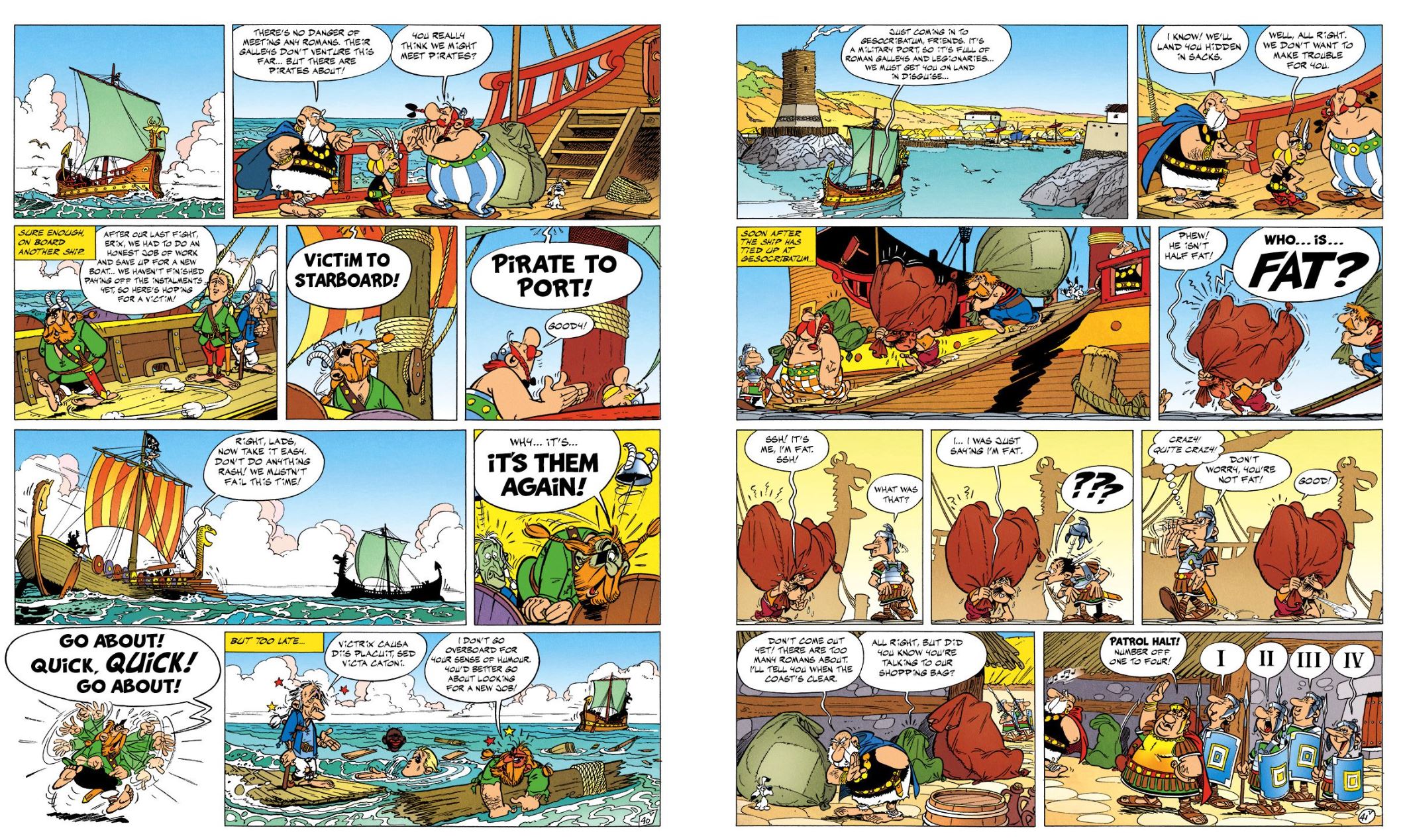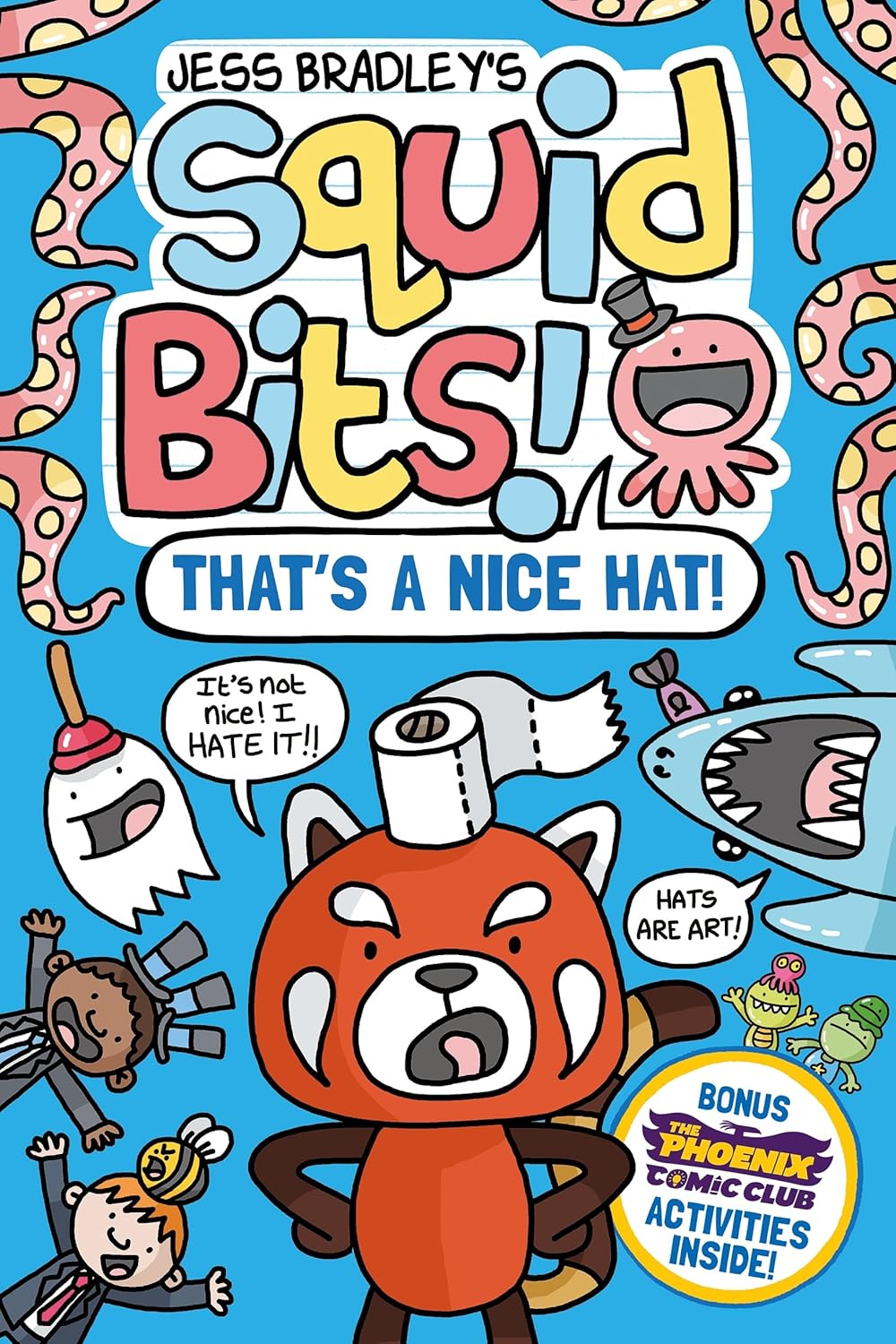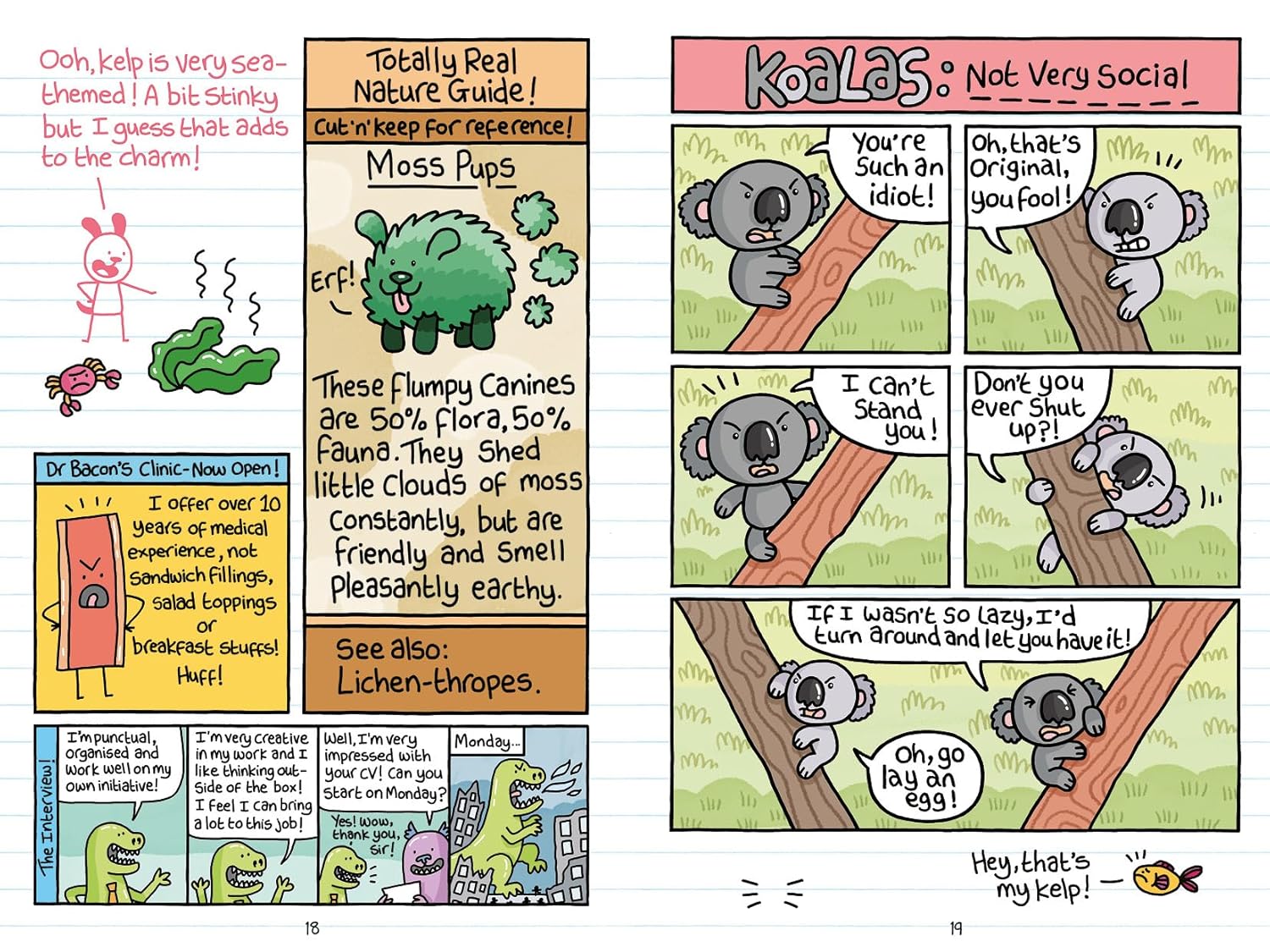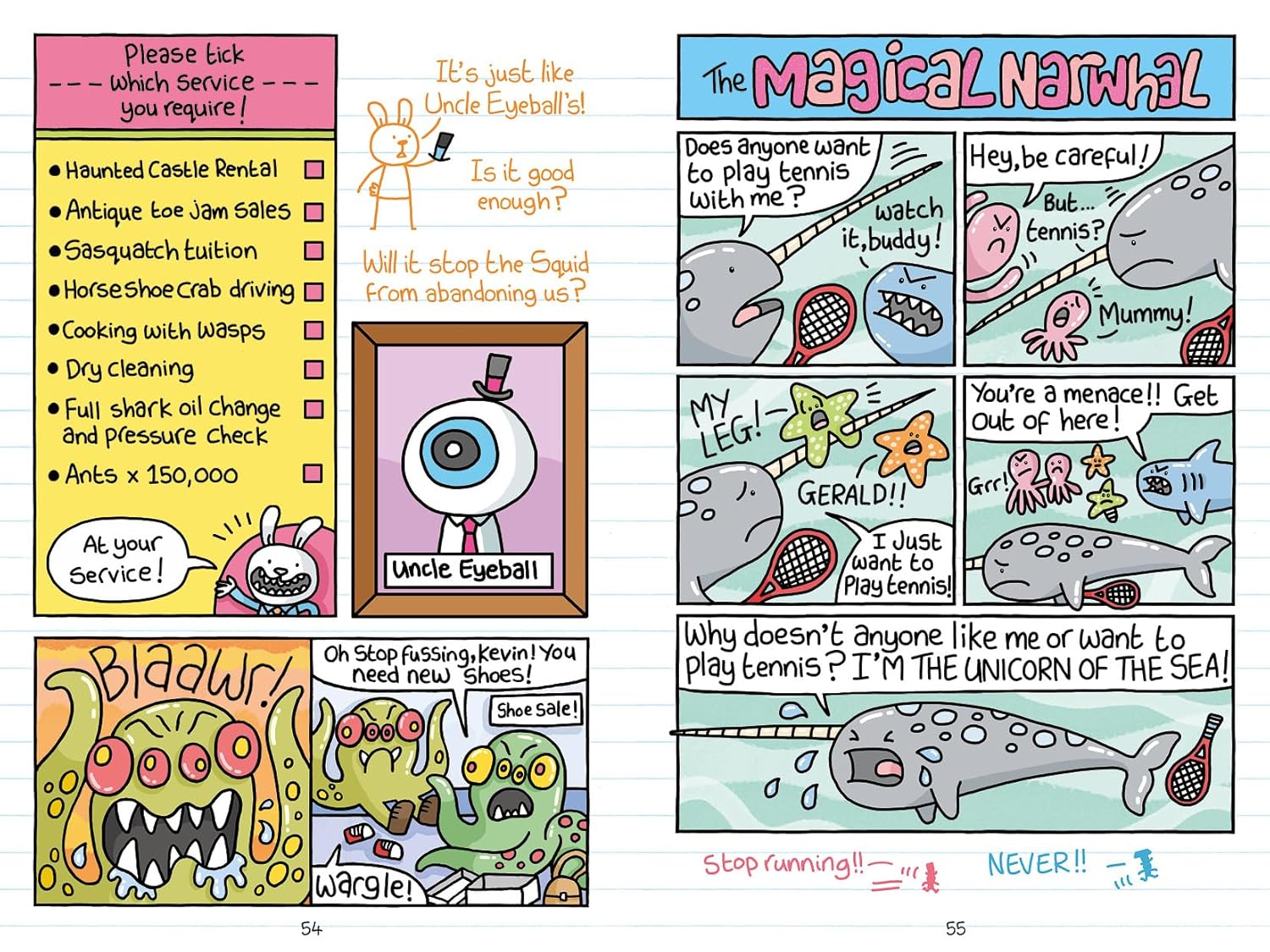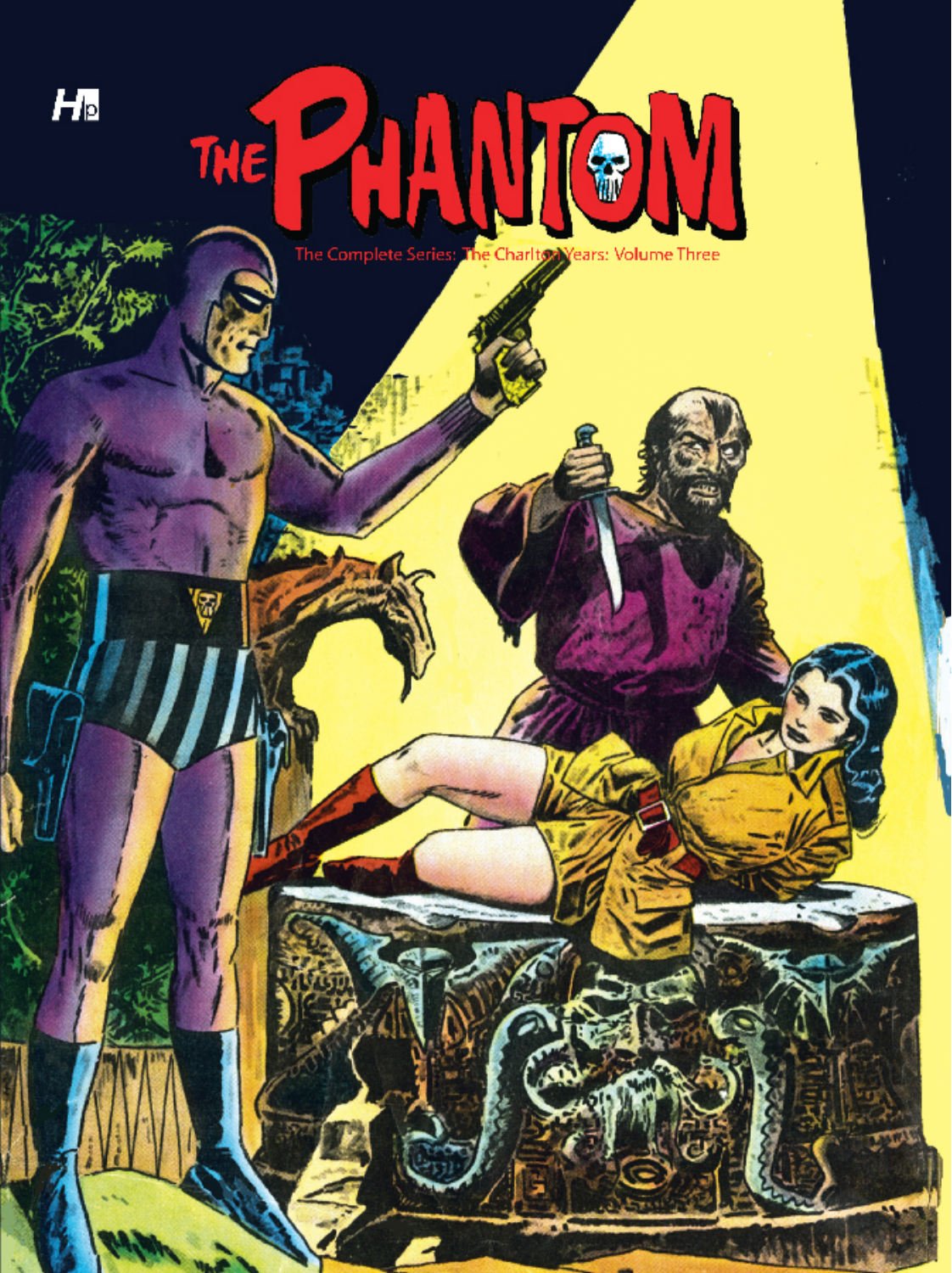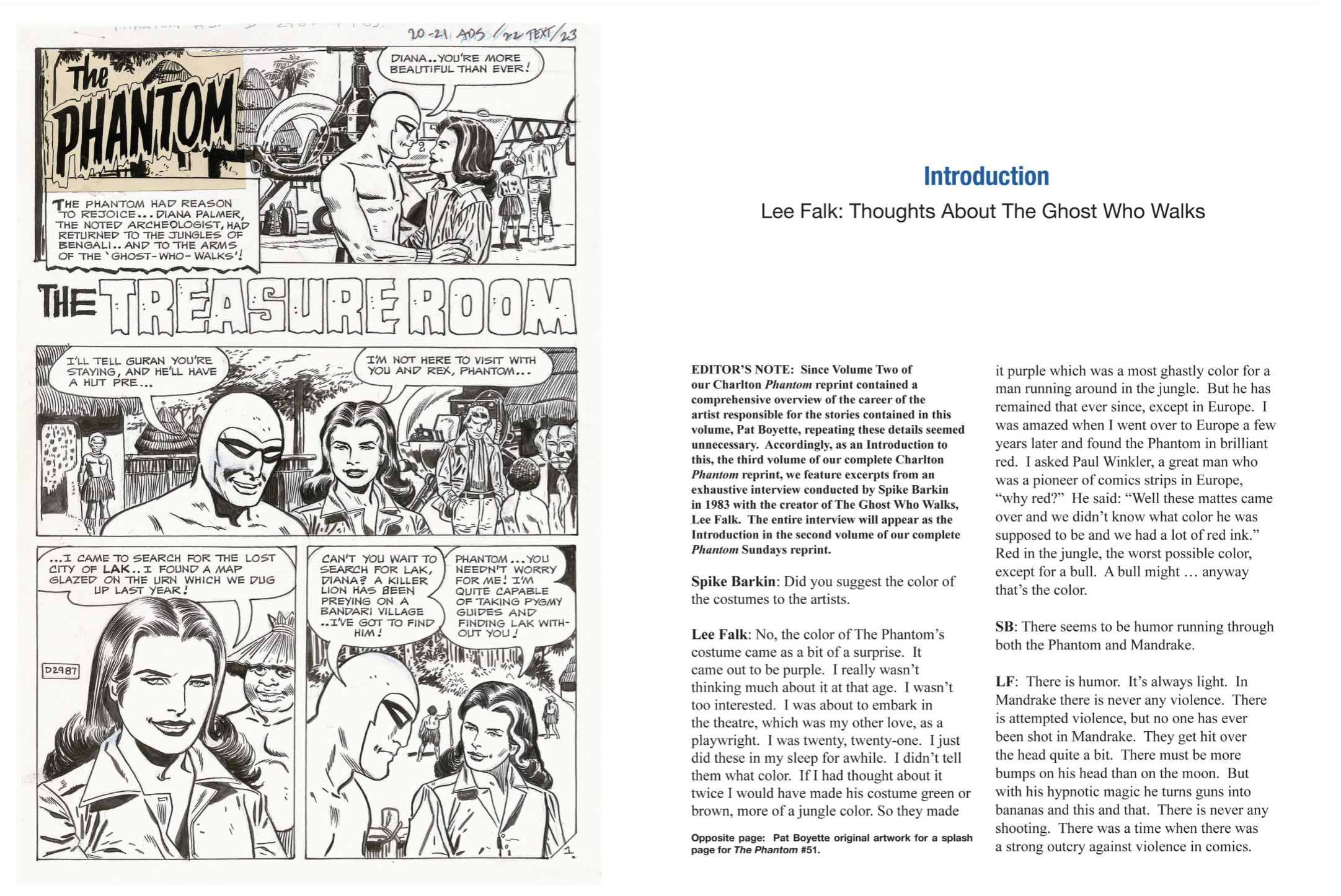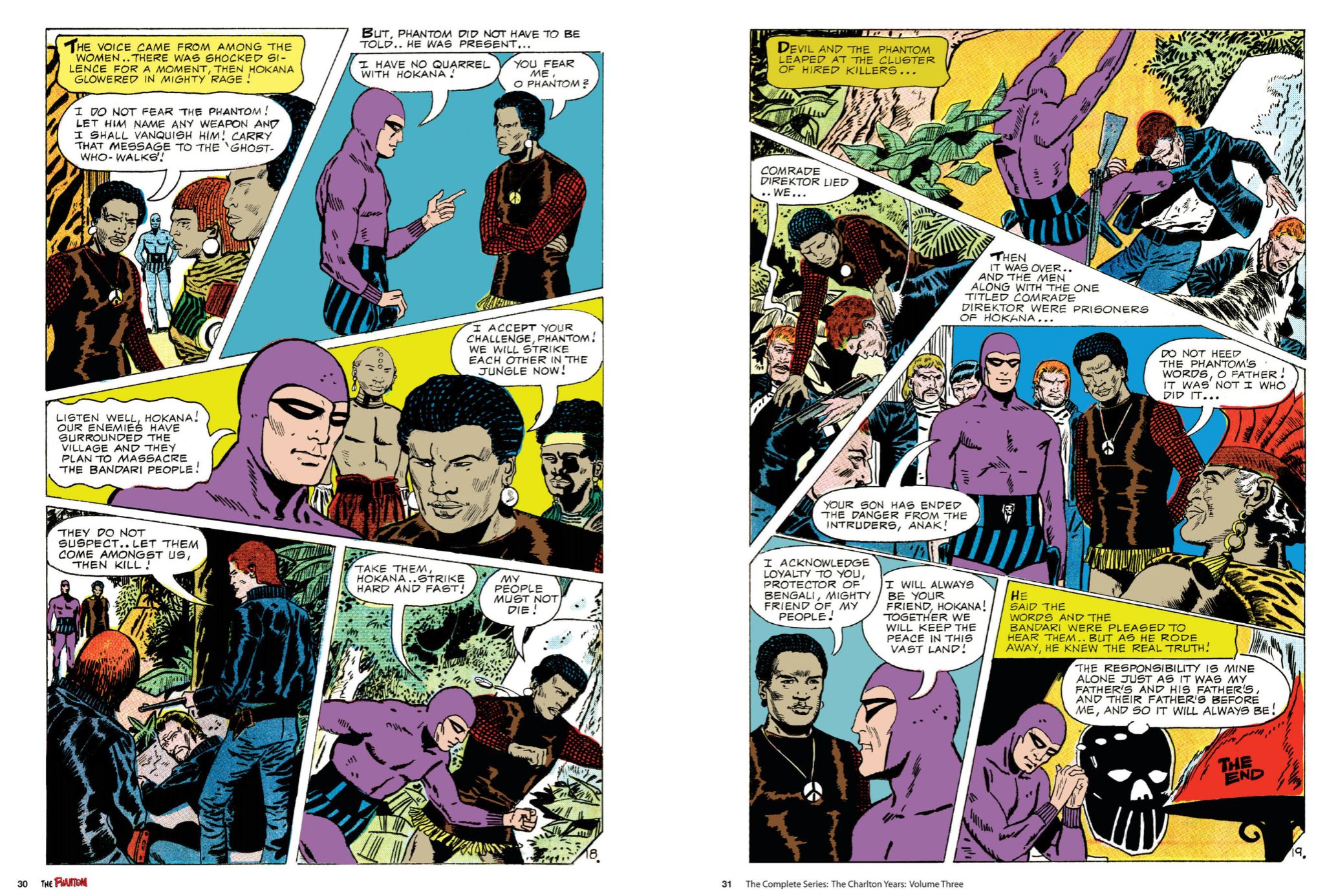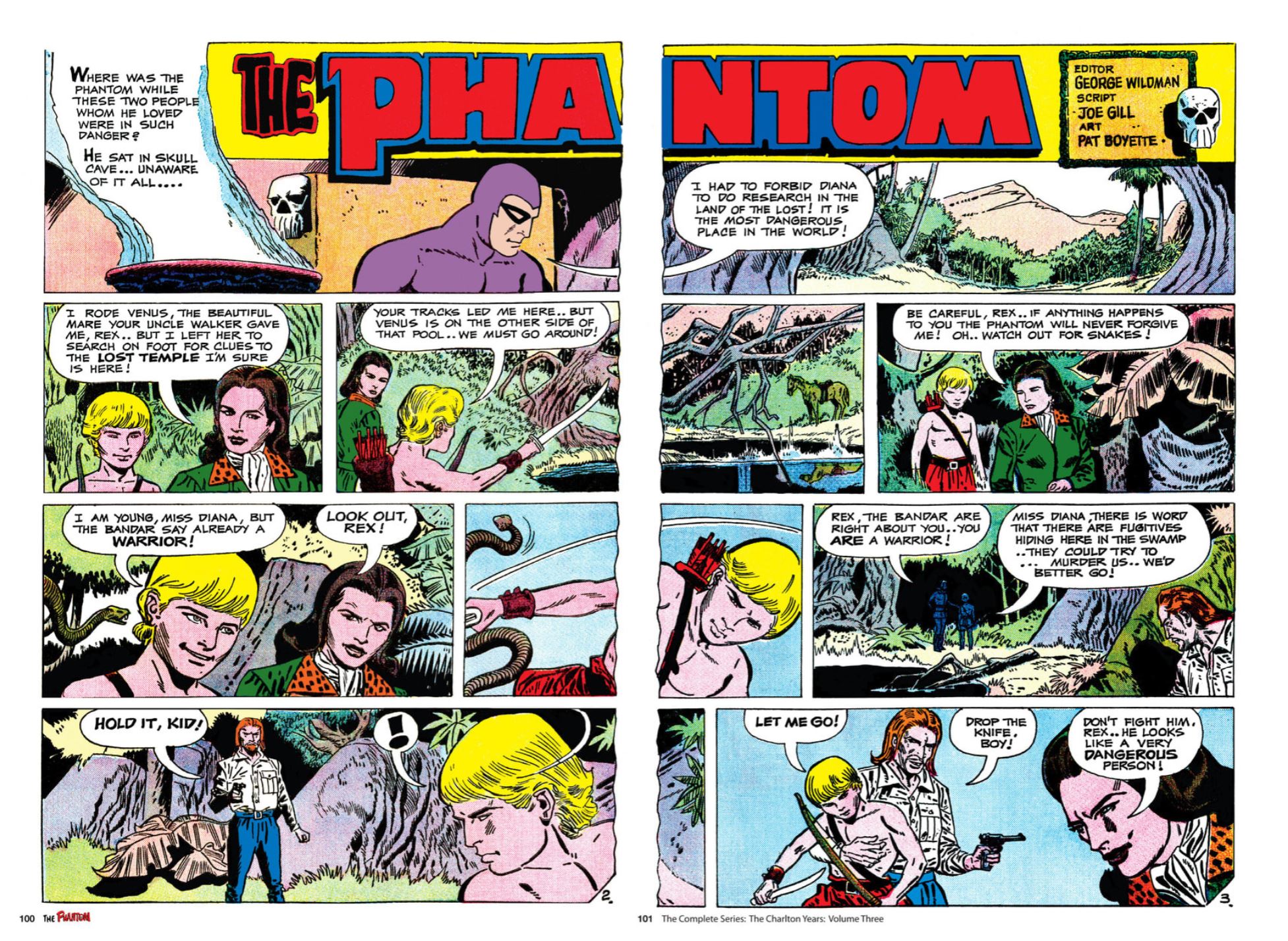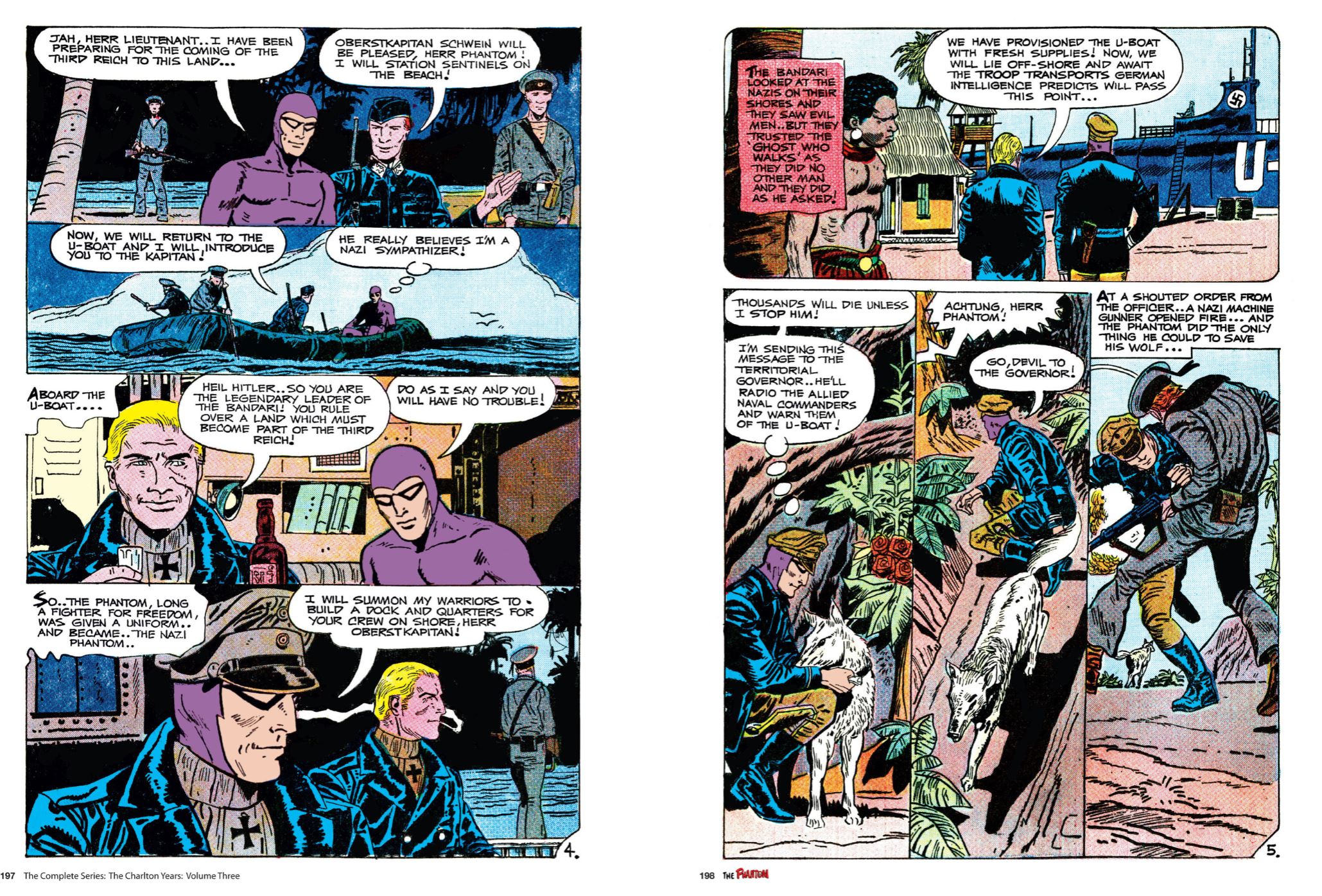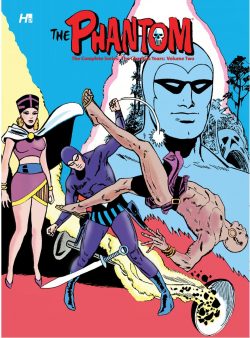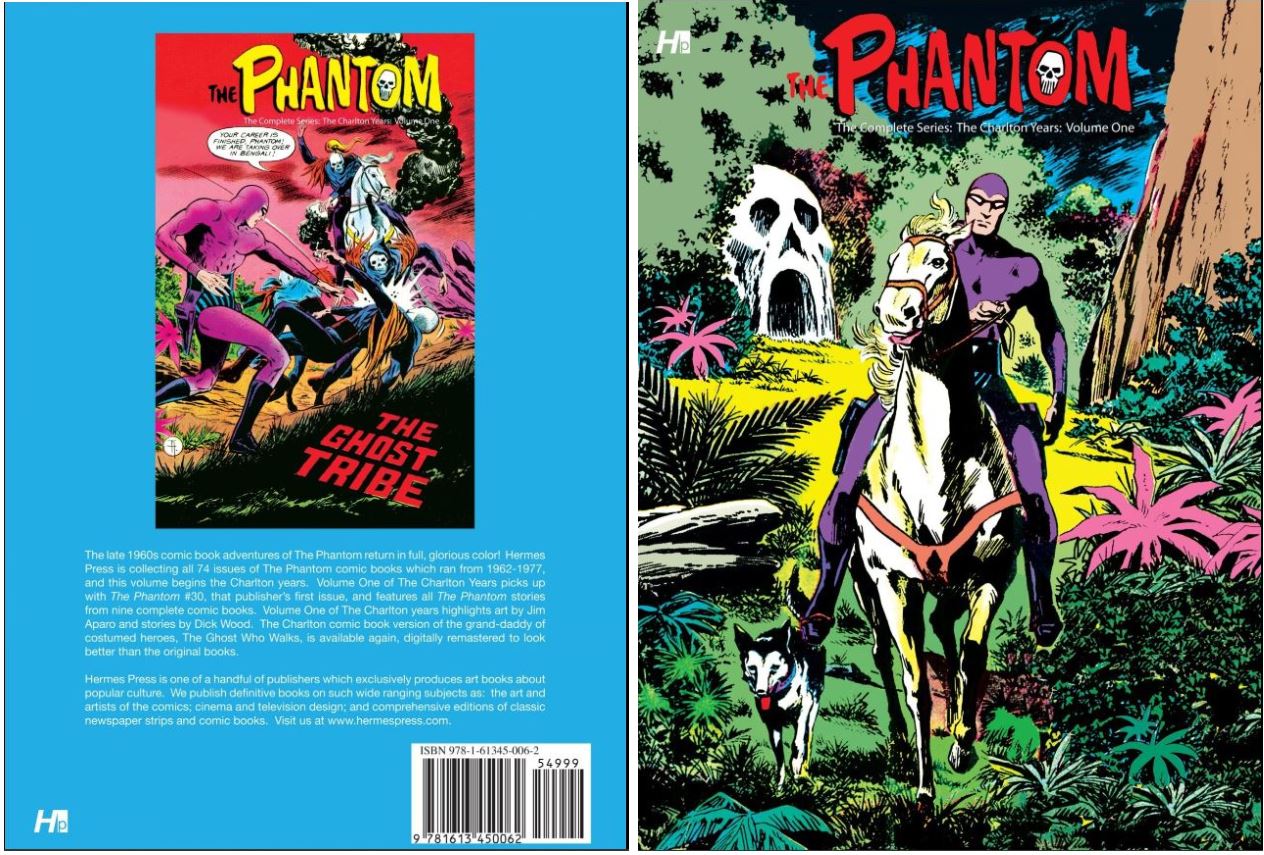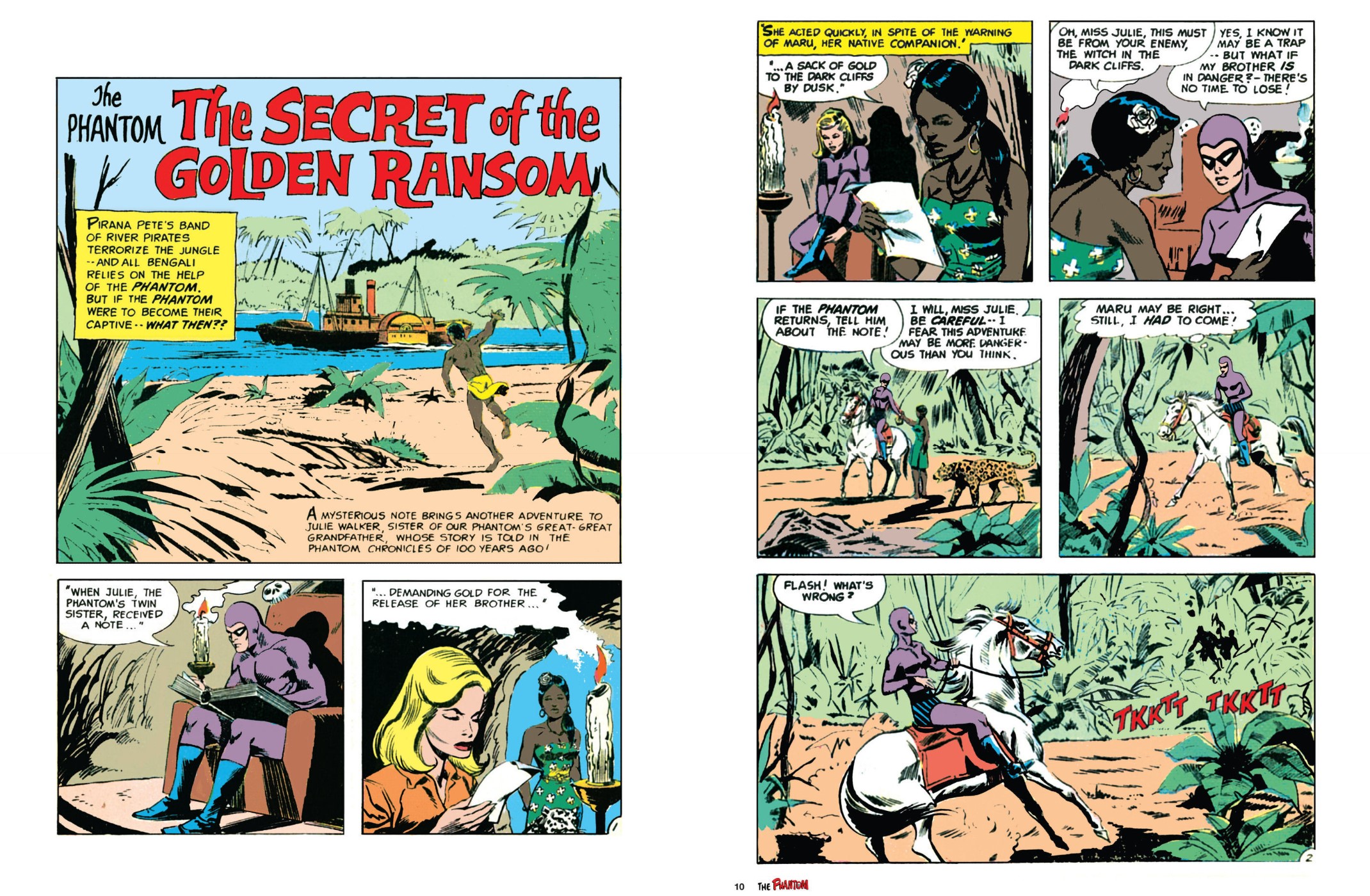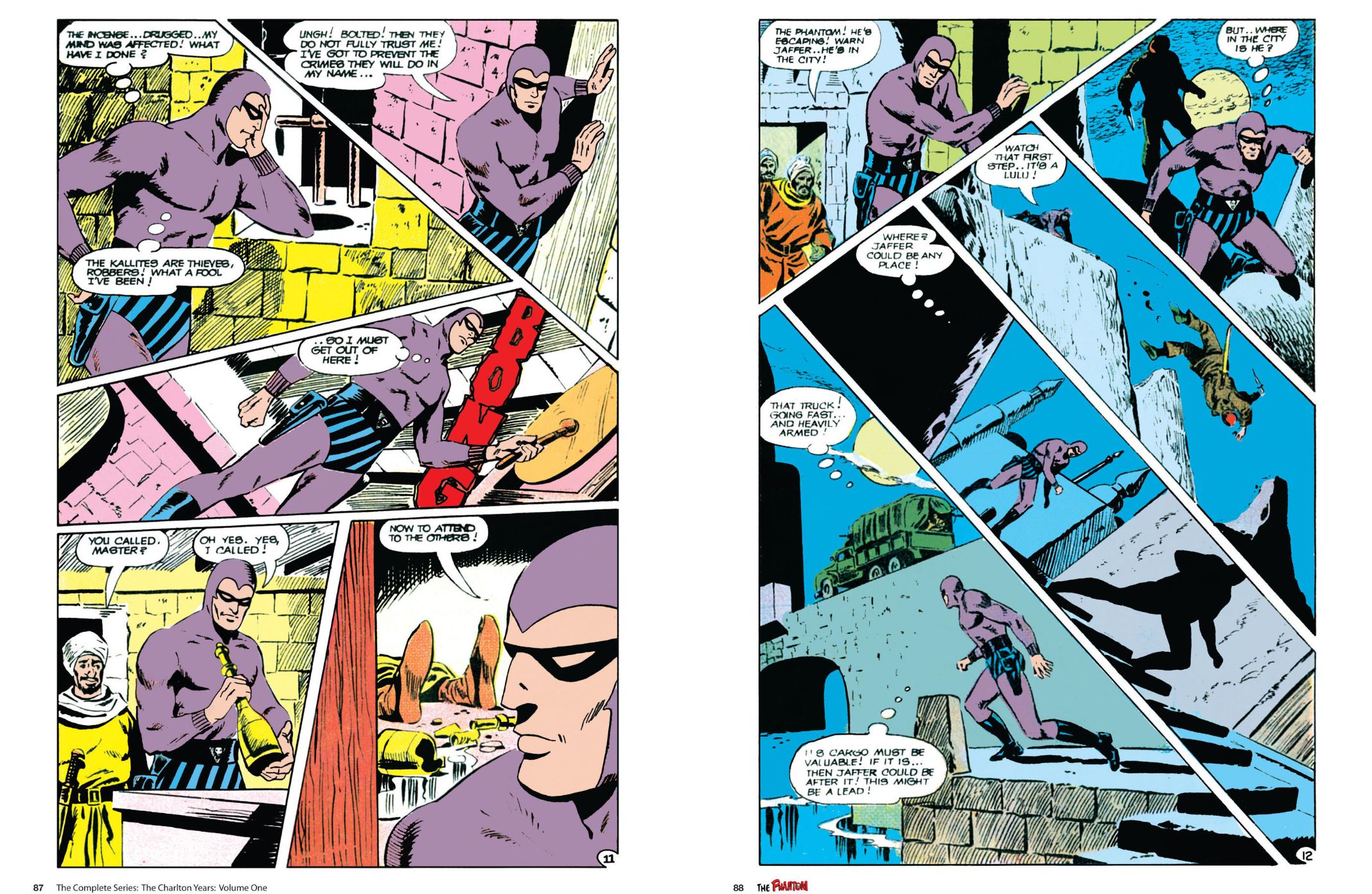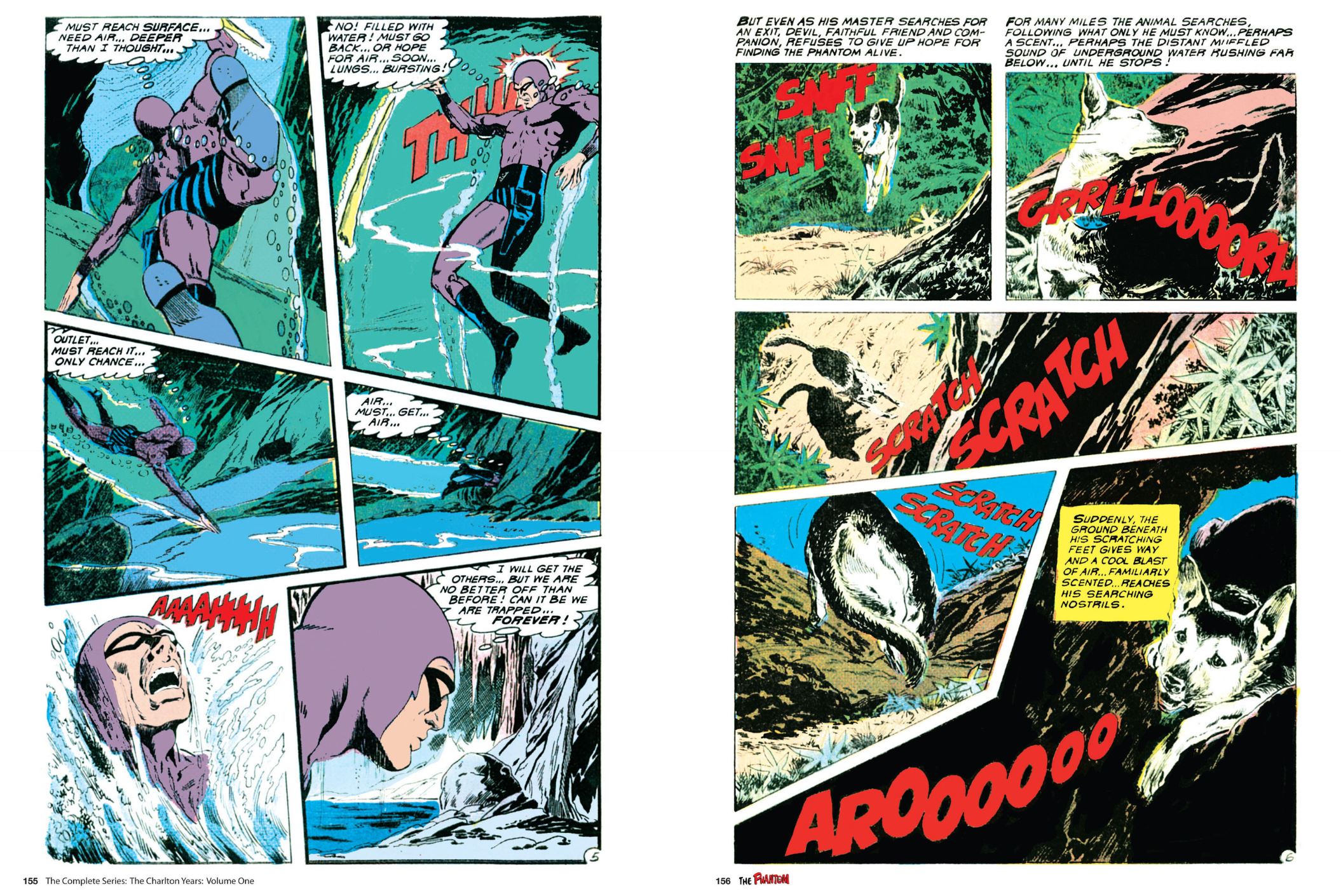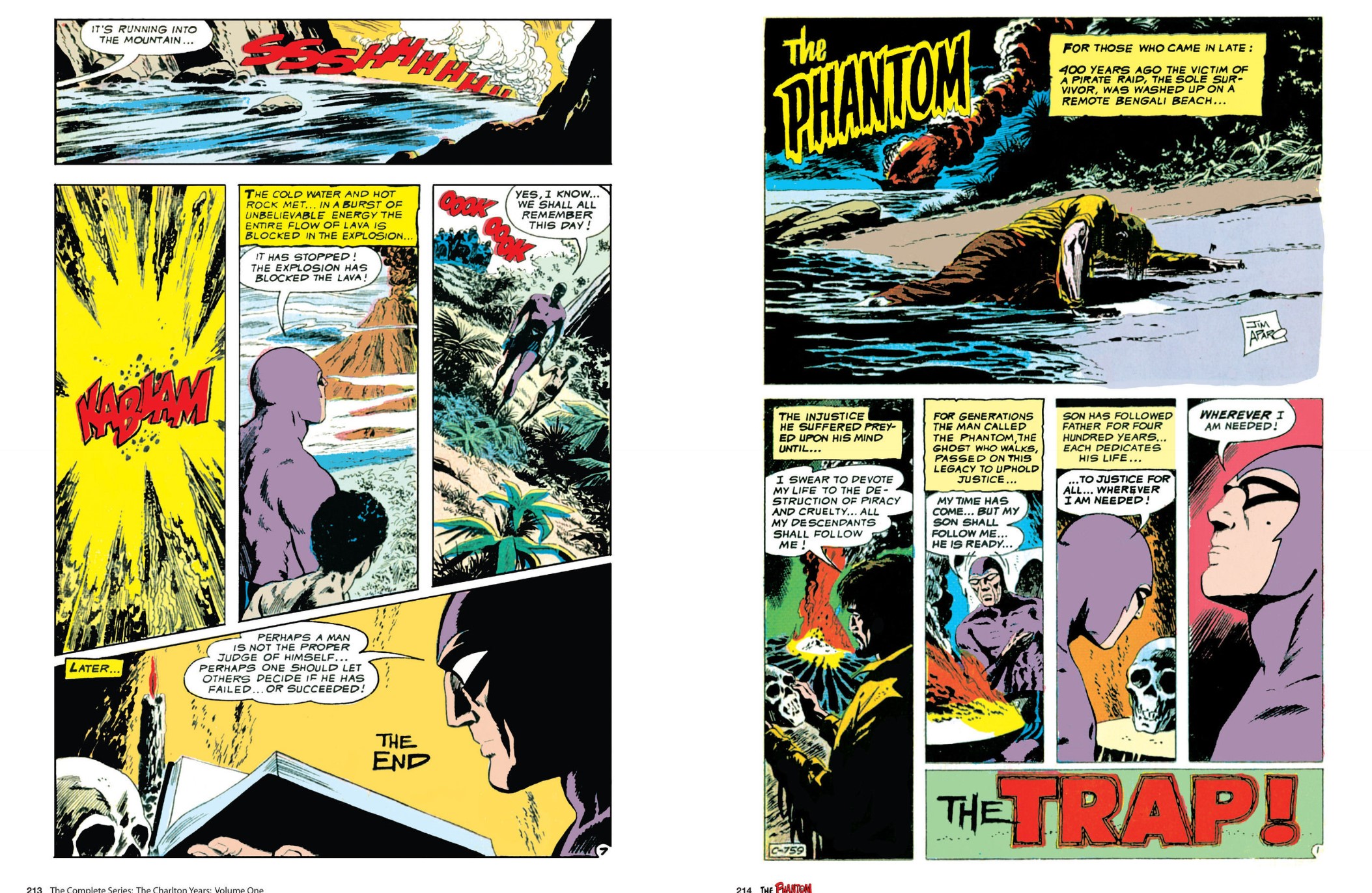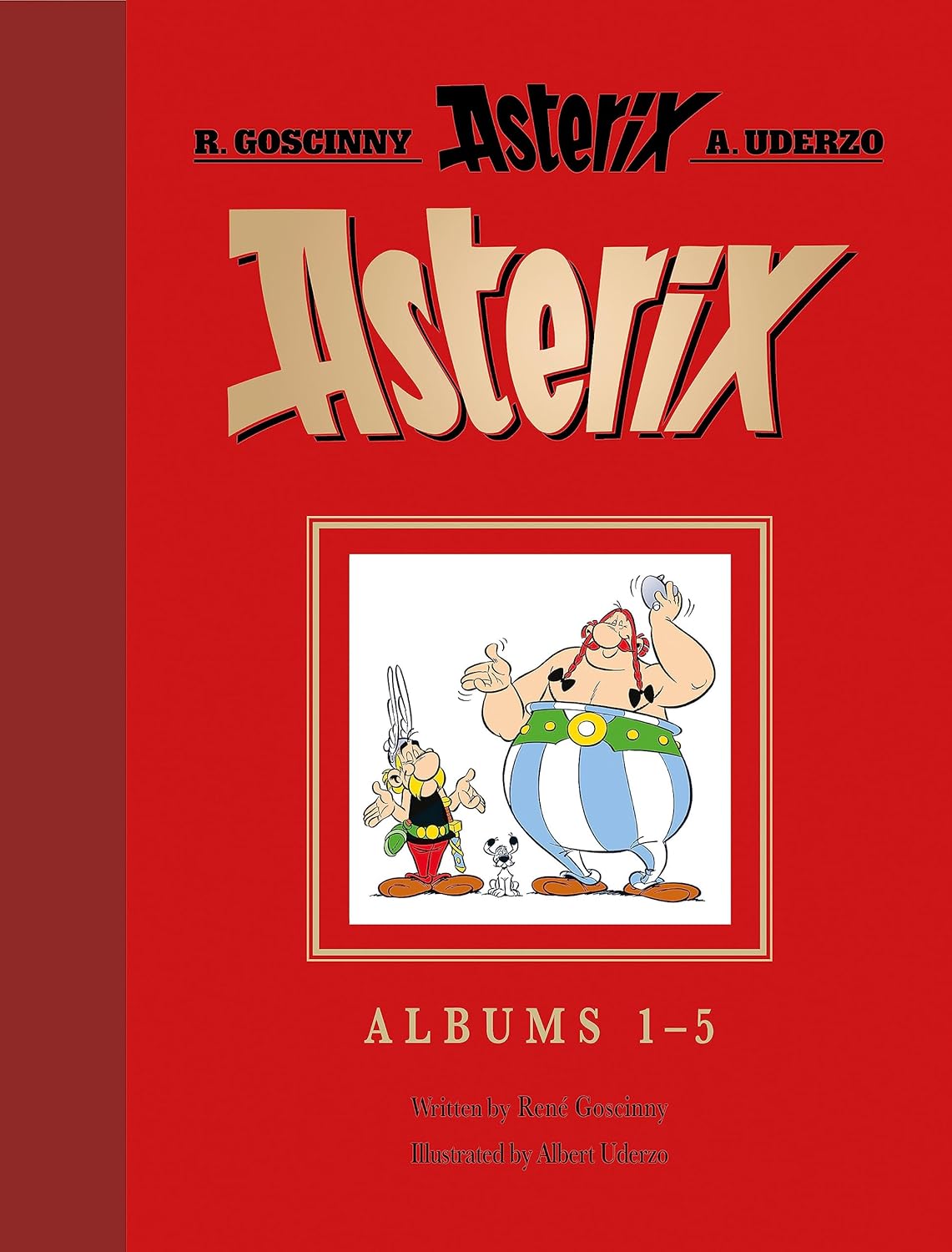
The Phantom – The Complete Series: The Gold Key Years volume 2


By Bill Harris & Bill Lignante, with Joe Certa, Sparky Moore, George Wilson & various (Hermes Press)
ISBN: 978-1-61345-023-9 (HB?/Digital edition)

This book includes Discriminatory Content produced in less enlightened times.

In the 17th century a British sailor survived an attack by pirates, and, washing ashore in Africa, swore on the skull of his murdered father to dedicate his life and that of all his descendants to destroying all pirates and criminals. The Phantom fights crime and injustice from a fabulous lair deep in the jungles of Bengali, and is known throughout Africa as “the Ghost Who Walks”. His unchanging appearance and unswerving quest for justice have led to him being regarded as an immortal avenger by the credulous and the wicked. Down the decades one hero after another has fought and died in an unbroken line, and the latest wearer of the mask, indistinguishable from the first, continues the never-ending battle…

Lee Falk created the Jungle Avenger at the request of his syndicate employers who were already making history, public headway and loads of money with his first strip sensation Mandrake the Magician

Although technically not the first ever costumed hero in comics, The Phantom was the prototype paladin to wear a skintight bodystocking, and the first to have a mask with opaque eye-slits. He debuted on February 17th 1936 in an extended sequence pitting him against a global confederation of pirates called the Singh Brotherhood. Falk wrote and drew the daily strip for the first two weeks before handing over the illustration side to artist Ray Moore. The Sunday feature began in May 1939.

For such a successful, long-lived and influential series, in terms of compendia or graphic novel collections, The Phantom has been poorly served by the English language market. Various small companies have tried to collect the strips – one of the longest continually running adventure serials in publishing history – but in no systematic or chronological order and never with any sustained success. But, even if it were only of historical value (or just printed for Australians, who have long been manic devotees of the implacable champion) surely “Kit Walker” is worthy of a definitive chronological compendium series?

Happily, his comic book adventures have fared slightly better – especially in recent times.

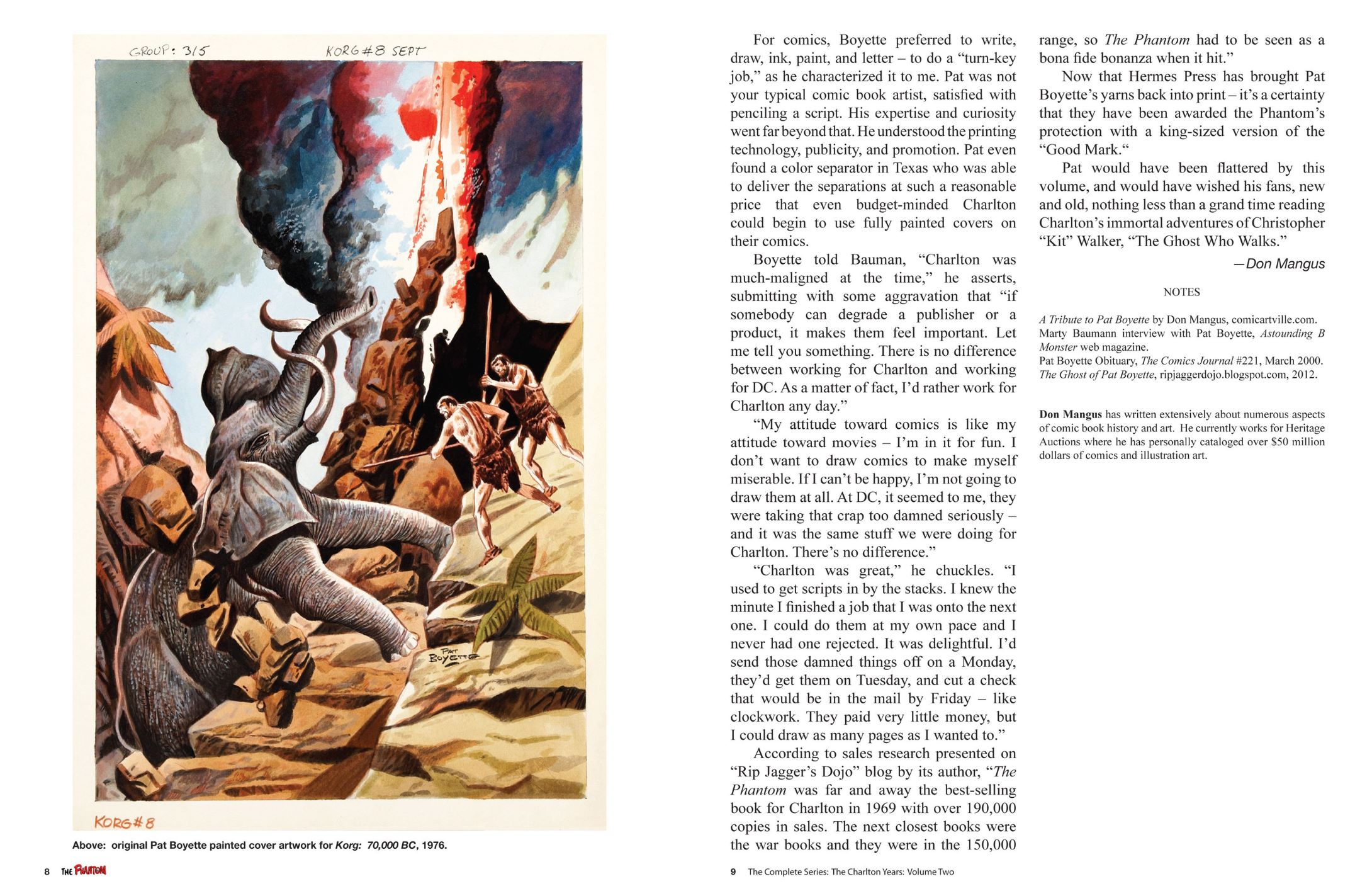
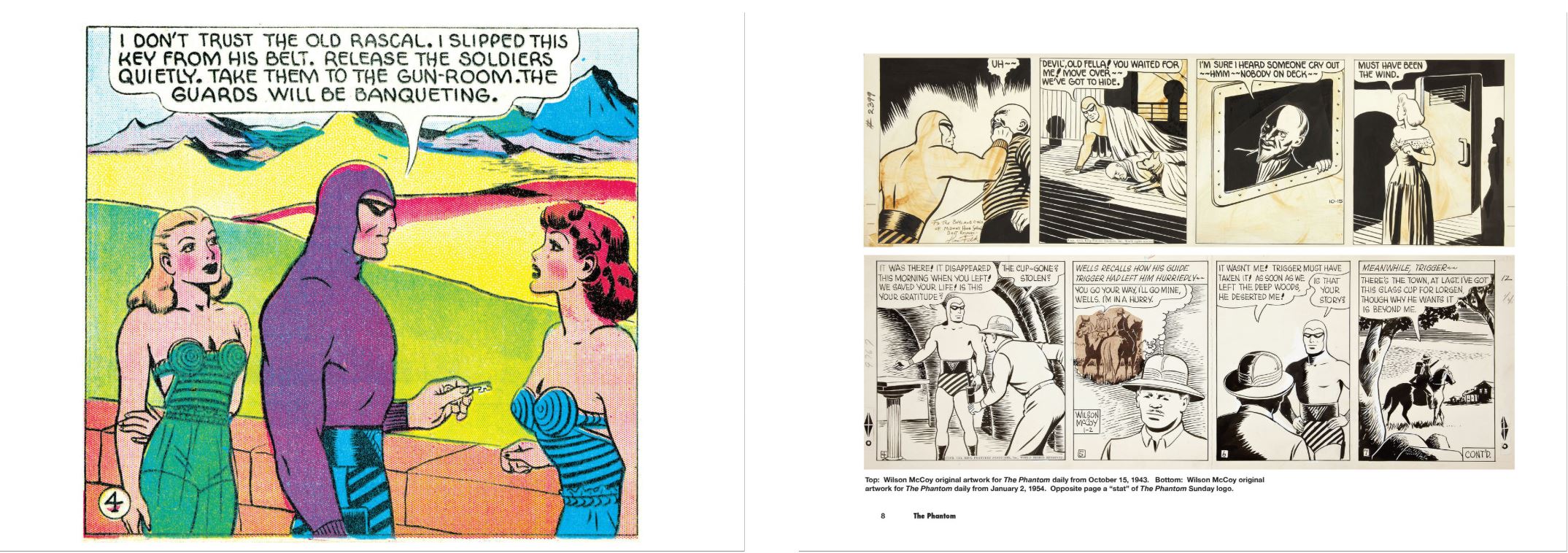
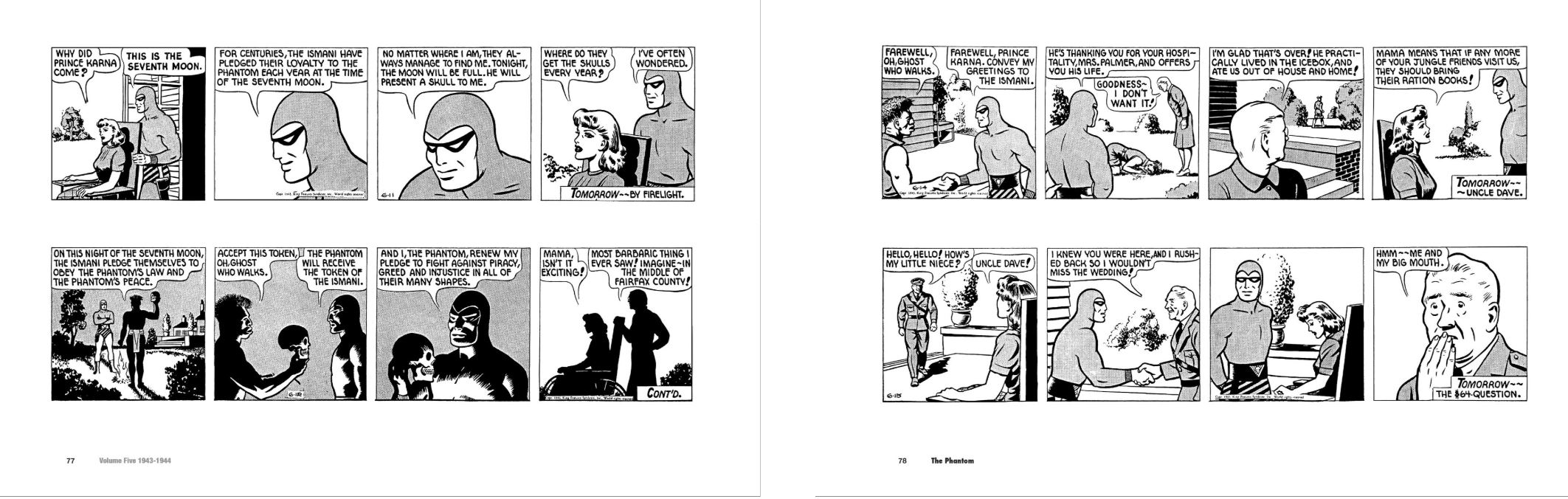
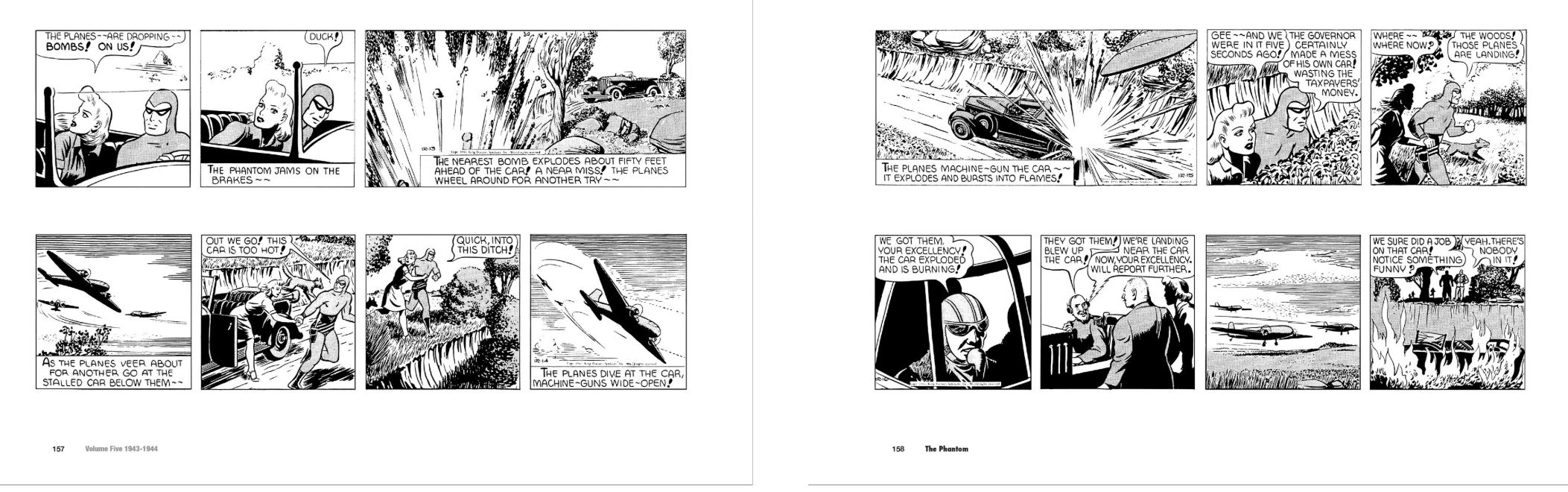
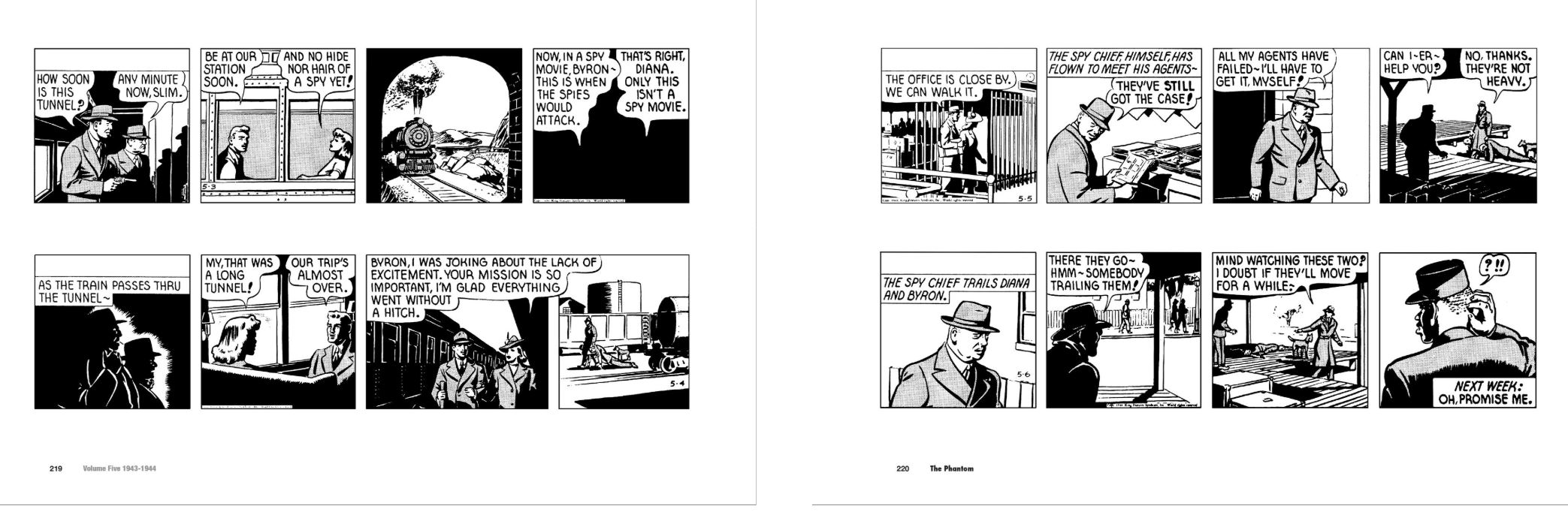
In the 1960’s King Features Syndicate dabbled with a comic book line of their biggest stars – Flash Gordon, Popeye, Blondie, Mandrake and The Phantom – but immediately prior to that, the Ghost Who Walks helmed a solo-starring vehicle under the broad and effective aegis of veteran licensed properties publisher Gold Key Comics. Each issue was fronted by a stunning painted cover by George Wilson. The Phantom was no stranger to funnybooks, having been featured since the Golden Age in titles such as Feature Book and Harvey Hits, but only as straight strip reprints. These Gold Key exploits were tailored to a big page and a younger readership.

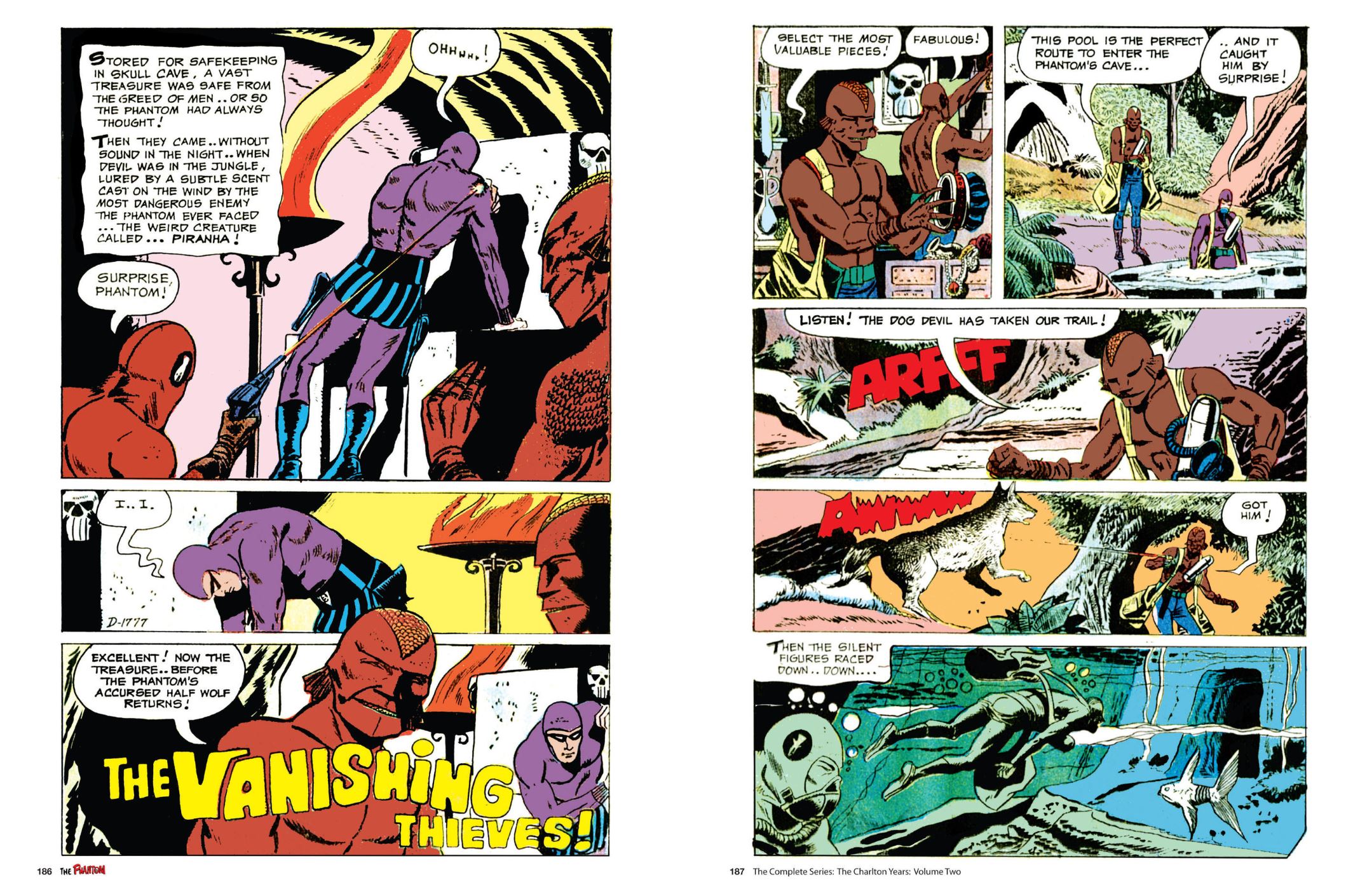
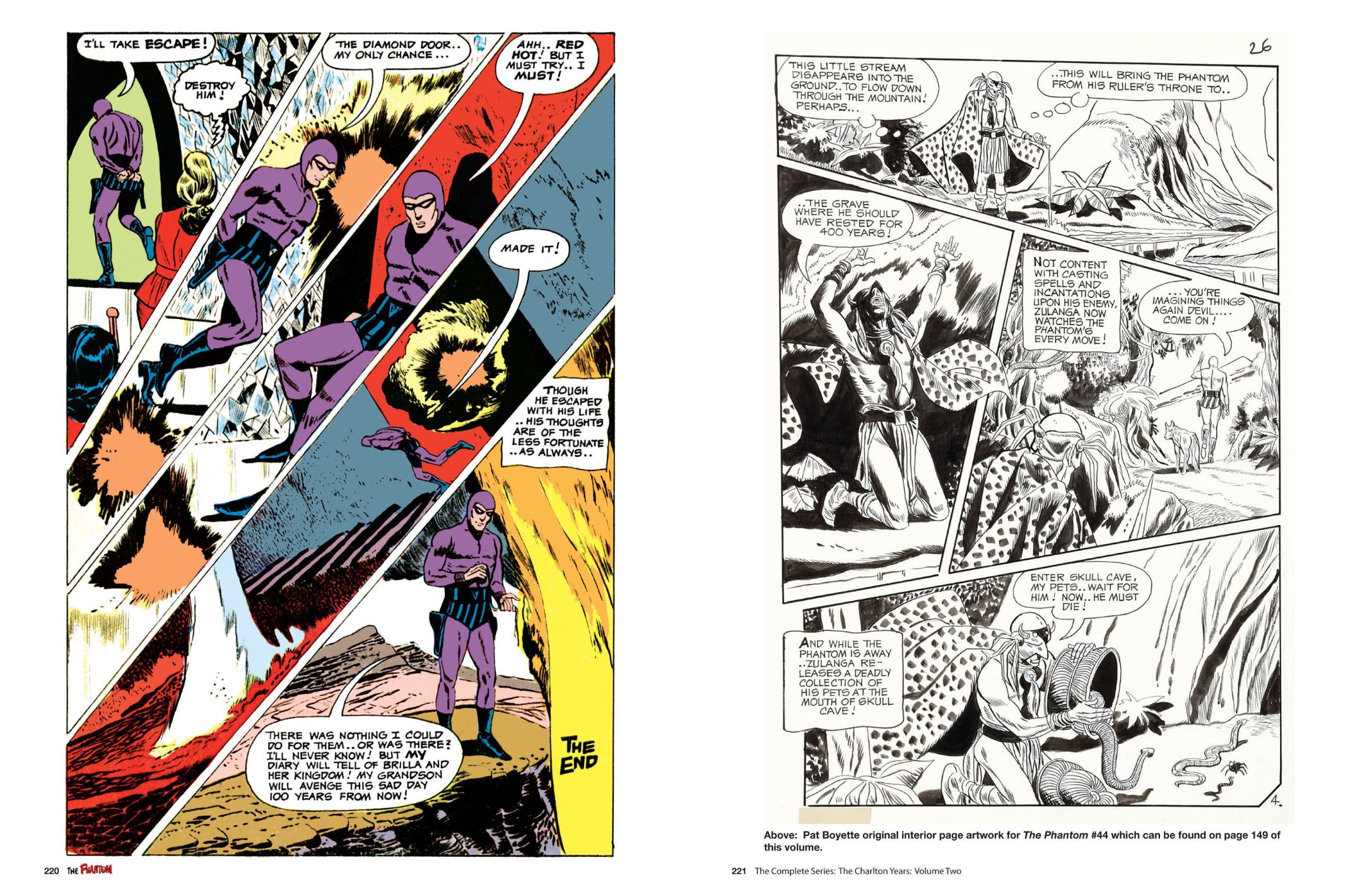
This second superb full-colour hardcover – with equivalent eBook editions for the modern minded – gathers The Phantom #9-17 (originally released between November 1964 and July 1966) and opens with fan and scholar Pete Klaus’ Introduction ‘The Gold Key Phantom’ offering original art panels (many by Sy Barry) and a welcoming overview of the immortal strip star.

Scripted by Bill Harris and drawn in comic book format by Bill Lignante, the illustrated adventures resume with full-length epic ‘The Sixth Man’ from #9 as the Ghost Who Walks takes a rare trip into modern civilisation only to be shanghaied by crooks. All too soon the miscreants realise that they have made the biggest mistake of their shady lives. Determined to discover what’s behind the nefarious scheme, Kit Walker allows himself to be taken to a remote island ruled by bored, cruel queen Sansamor who thrives on making powerful men duel to the death.

Once the hero sees the kind of creature she is, her downfall is assured…

The issue is concluded by a single-page historical recap of the legend of ‘The Phantom’ and equally brief monochrome rundown of the mystery man’s intended bride ‘Diana’ (Palmer).

Cover-dated February 1965, #10 opens with devious action thriller ‘The Sleeping Giant’ wherein the long-peaceful tribe of Itongo headhunters take up the old ways after ancestral idol Tuamotu comes to life.

Thankfully, the Phantom is on hand to stem potential carnage and expose crooked diamond prospector Joe Gagnon (and his oversized circus performer pal) inciting the tribesmen to war and conquest. All he has to do is defeat the giant warrior in unarmed combat…

Assisting the masked peacekeeper in policing tribes and criminals of the region is ‘The Patrol’. These worthy soldiers have no idea who their mysterious “Commander” actually is, so when the latest raw recruit tries to find out, he receives a startling shock in this wry vignette.

Issue #11 (April 1965) features ‘Blind Man’s Bluff’ with two brutal convicts breaking out of the Bengal Penal Colony to terrorise native communities by masquerading as demonic spirits. When the Phantom apprehends them as they link up with pirates, he is struck sightless by a flare gun, but not even blindness can stop the resourceful champion from dispensing justice…

Closing the issue is a one-page tour of ‘The Skull Cave’ by Joe Certa, after which #12 (June, with art by Sparky Moore & Lignante) introduces ‘The Beast of Bengali’. Here a golden giant capable of seeming miracles subjugates the locality until the masked marvel exposes his magical feats for the tricks they really are. Then, following a mouth-watering period ad for the Phantom Revell model kit, #13 (August) opens ‘The Phantom Chronicles’ as the Jungle Sentinel consults his ancestor’s meticulous records for tips on defeating seemingly immortal bandit Rachamond

October cover-dated, The Phantom #14 opens with ‘The Historian’ as scholar Dr. Heg consults with the Jungle Patrol on a book chronicling their achievements. His ulterior motive is to destroy the only law for hundreds of miles, but he has not reckoned on the true identity of their enigmatic leader…

‘Grandpa’ switches locales to America where Diana Palmer’s doting ancestor is playing unwelcome matchmaker. Eventually, after violent incidents involving bears and robbers, the old man warms to African mystery man Kit Walker…

Closing 1966, TP #15 (December) details the downfall of ‘The River Pirates’ who ravage the mighty waterways of the region. Their modern weapons prove little use against the cunning and bravery of the Deep Woods Guardian. ‘The Tournament’ then focuses on an unlucky prison escapee who finds the Phantom’s clothes and is stuck fighting a native gladiator in a centuries-old grudge match. Sadly, if he loses, the prestige lost means chaos will return to the tribes benefitting from The Phantom’s Peace…

‘The Chain’ opens #16 (April 1966) as a world-weary Phantom considers quitting after an interminable period negotiating peace between warring tribes. Even Diana cannot change his mind, but then ancient wise man Wuru appears, relating a story of the hero’s father, who endured hardship, mockery and even slavery in a quest to rescue a woman from vile bondage. Her name was Maude, and she was to be the Phantom’s mother…

A brace of single-pagers follow, revealing Kit Walker’s unrecorded boxing bout against ‘The Champ’ and a battle in a bar won by ‘The Milk Drinker’ before ‘The Crescent Cult’ sees the Jungle Ghost crushing an assassination gang determined to murder their country’s new Maharani. The comic concludes with another 1-page yarn as ‘The Diggers’ examine old ruins and discover proof that the Phantom has lived and fought evil for centuries!

This second volume closes on a truly supernatural note as The Phantom #17 (July 1966) discloses how undying witch ‘Samaris’ has preyed on male suitors for centuries, and believes she has last found another cursed to live forever…

Following one-pager ‘The Waterfall’, detailing the secrets of the entrance to the fabled Skull Cave, ‘Samaris Part II’ finds the Ghost Who Walks captive of the Queen but resisting her every wile until justice, fate and an avalanche of deferred years catch up to her at last…

Wrapping up is a monochrome vignette detailing the secrets of The Phantom’s devout helpers ‘The Bandar’ Poison Pygmy People and a sumptuous cover gallery by painter George Wilson.

Straightforward, captivating rollicking action-adventure has always been the staple diet of The Phantom. If that sounds like a good time to you, this is a traditional nostalgia-fest you won’t want to miss…
The Phantom® © 1964-1966 and 2012 King Features Syndicate, Inc. ® Hearst Holdings, Inc. Reprinted with permission. All rights reserved.

Today in 1828 genre-founding author Jules Verne was born, so maybe go read a book soon? In comics, unsung wonder Bill Finger was born in 1914, as was Filipino inking legend Danny Bulanadi in 1946. On the debit side we lost the iconic Julius Schwartz today in 2004 and Li’l Jinx originator and Archie stalwart Joe Edwards in 2007.

Dc Finest: Batman – The Case of the Chemical Syndicate


By Bob Kane, Bill Finger, Gardner F. Fox, Whitney Ellsworth, Sheldon Moldoff, Jerry Robinson, George Roussos & various (DC Comics)
ISBN: 978-1-79950-670-6 (TPB/Digital edition)

This book includes Discriminatory Content produced in less enlightened times.

Although already much reprinted, archived and curated, here’s another sound and stunning collection of the Gotham Guardian’s earliest exploits in original chronological order, forgoing glossy, high-definition paper and reproduction techniques in favour of a newsprint-adjacent feel and the same flat, bright-yet-muted colour palette which graced the originals. There’s no fuss, fiddle or Foreword, and the book steams straight into the meat of the matter with the accumulated first two years of material featuring the masked mystery-man, as well as all those stunning covers (by Kane, Robinson, Roussos, Fred Gurdineer, Creig Flessel, Jack Burnley, Fred Ray and The Strauss Engraving Company). These span Detective Comics #27-51; Batman #1-5; the Dynamic Duo’s endeavours in New York World’s Fair Comics 1940 and World’s Best Comics #1, cumulatively encompassing every groundbreaking escapade from May 1939 to May 1941.

As Evri Fule Kno, Detective Comics #27 featured the Darknight Detective’s debut in the ‘Case of the Chemical Syndicate!’ by Bob Kane and as yet still anonymous close collaborator/co-originator Bill Finger. A spartan, understated yarn introduced dilettante playboy criminologist Bruce Wayne, drawn into a straightforward crime-caper as a cabal of industrialists were successively murdered. The killings stop when an eerie figure dubbed “The Bat-Man” intrudes on Police Commissioner Gordon’s stalled investigation to ruthlessly expose and deal with the hidden killer.

The following issue saw our fugitive vigilante return to crush ‘Frenchy Blake’s Jewel Gang’ before encountering his very first psychopathic killer/returning villain in Detective #29. Gardner Fox scripted these next few adventures beginning with ‘The Batman Meets Doctor Death’, in a deadly duel of wits with deranged, greedy general practitioner Karl Hellfern and his assorted instruments of murder: the most destructive and diabolical of which was sinister “Asiatic” manservant Jabah…

This is my cue to again remind all interested parties that these stories were created in far less tolerant times with numerous narrative shortcuts and institutionalised social certainties expressed in all media that most today will find offensive. If that’s a deal-breaker, please pass on this book… and most literature, pop songs and films created before the 1960s…

Confident of their new villain’s potential, Kane, Fox and inker Sheldon Mayer encored the mad medic for the next instalment and ‘The Return of Doctor Death’, before Fox & Finger co-scripted a 2-part shocker debuting the very first bat-plane, Bruce’s girlfriend Julie Madison and undead horror The Monk in expansive, globe-girdling spooky saga ‘Batman Versus the Vampire (part one)’. It all concluded in part two with an epic chase across Eastern Europe and spectacular climax in a monster-filled castle in #32.

DC #33 featured Fox & Kane’s ‘The Batman Wars Against the Dirigible of Doom’: a blockbusting disaster thriller which just casually slips in the secret origin of the grim avenger, as mere prelude to intoxicating air-pirate action, before Euro-trash dastard Duc D’Orterre finds his uncanny SCIENCE! and unsavoury appetites no match for the mighty Batman in ‘Peril in Paris’. Bill Finger returned as lead scripter in #35, pitting the Cowled Crusader against crazed cultists murdering everyone who had seen their sacred jewel in ‘The Case of the Ruby Idol’ … although the many deaths were actually caused by a far more prosaic villain. Inked by new kid Jerry Robinson, grotesque crime genius ‘Professor Hugo Strange’ debuted with his murderous manmade fog and lightning machine in #36, after which all-pervasive enemy agents lodged in ‘The Screaming House’ prove no match for a vengeful Masked Manhunter in #37.

Detective Comics #38 (April 1940) changed the landscape of comic books forever with the introduction of ‘Robin, The Boy Wonder’ as child trapeze artist Dick Grayson – whose parents are murdered before his eyes – thereafter joins Batman in a lifelong quest after bringing to justice mobster mad dog Boss Zucco

With the Flying Graysons’ killers captured, all-out action continued in #39 with Finger, Kane & Robinson’s ‘The Horde of the Green Dragon’ – “oriental” Tong killers in Chinatown – Batman #1 (Spring 1940) opened proceedings with a recycled origin culled from portions of Detective #33 & 34. ‘The Legend of the Batman – Who He Is and How He Came to Be!’ by Fox, Kane & Moldoff delivers in two perfect pages what is still the best ever origin of the character. ‘The Joker’ (Finger, Kane & Robinson – who also produced all the remaining tales in this astonishing premiere issue) then launches the greatest villain in DC’s pantheon via a macabre tale of extortion and wilful wanton murder.

‘Professor Hugo Strange and the Monsters’ follows as an old adversary returns, unleashing laboratory-grown hyperthyroid horrors to rampage through the terrified city, before ‘The Cat’ – who later added the suffix “Woman” to her name to avoid any possible doubt or confusion – plies her felonious trade of jewel theft aboard the wrong cruise-liner, thereby falling foul for the first time of the dashing Dynamic Duo. Then comics end with the ‘The Joker Returns’ as the sinister clown breaks jail to resume his terrifying campaign of murder for fun and profit before “dying” in mortal combat with the Gotham Guardians. pulse pounding premier package fun folds with Whitney Elsworth’s text piece ‘Meet the Artist’ and a superb Kane pin-up (originally the back cover of that premier issue) of the Dynamic Duo.

Tense suspense and eerie evil is also on show in DC #40 as ‘The Murders of Clayface’ sees the Dynamic Duo solving a string of murders on a film set which almost sees Julie Madison the latest victim of a monstrous movie maniac…

Batman & Robin solve the baffling mystery of a kidnapped pupil in Detective #41’s ‘The Masked Menace of the Boys’ School’ before enjoying a busman’s holiday in ‘Batman and Robin Visit the 1940 New York World’s Fair’ as seen in the second New York World’s Fair Comics. Here Finger, Kane & Roussos follow the vacationing troubleshooters as they track down a maniac mastermind with a metal-dissolving ray, before Detective Comics #42 again finds our heroes ending another murderous maniac’s rampage in ‘The Case of the Prophetic Pictures!’

The heroes’ second solo outing produced another quartet of comics classics in Batman #2 (Summer 1940). It begins with ‘Joker Meets Cat-Woman’ (Finger, Kane, Robinson & new find George Roussos) wherein svelte thief, homicidal jester and a crime syndicate all tussle for the same treasure, with our Caped Crusaders caught in the middle. ‘Wolf, the Crime Master’ then offers a fascinating take on the classic tragedy of Jekyll & Hyde prior to an insidious and ingenious mystery in ‘The Case of the Clubfoot Murderers’. Ultimately Batman & Robin confront uncanny savages and ruthless showbiz promoters in poignant monster yarn ‘The Case of the Missing Link’.

By now an unparalleled hit, Batman stories never rested on their laurels. The creators always sought to expand their parameters, as Detective #43 saw our heroes clash with a corrupt mayor in #43’s ‘The Case of the City of Terror!’ before rather jumping the shark with #44’s nightmarish fantasy of giants and goblins ‘The Land Behind the Light!’, in advance of returning to bizarre baroque basics in #45’s horrific Joker jape ‘The Case of the Laughing Death!’ wherein the Harlequin of Hate undertakes a campaign of macabre murder against everyone who has ever defied or offended him…

Batman #3 (Fall 1940) has Finger, Kane, Robinson & Roussos rise to even greater heights, beginning with ‘The Strange Case of the Diabolical Puppet Master’: an eerie episode of uncanny mesmerism and infamous espionage…

A grisly scheme unfolds next as innocent citizens are mysteriously transformed into specimens of horror, and artworks destroyed by the spiteful commands of ‘The Ugliest Man in the World’ before ‘The Crime School for Boys!’ registers Robin, allowing infiltration of a gang who have a cruel and cunning recruitment plan for dead-end kids, whilst ‘The Batman vs. the Cat-Woman’ lastly reveals the larcenous lady in well over her head when she steals for – and from – the wrong people…

The issue also offered a worthy Special Feature from Ellsworth & Burnley as ‘The Batman Says’ presents an illustrated prose Law & Order pep-talk…

Plunging right into perilous procedures, Detective #46 (Kane, Robinson & Roussos) features the return of Batman’s most formidable fringe scientific adversary as our heroes must counteract the awesome effects of ‘Professor Strange’s Fear Dust’, after which #47 delivers drama on a more human scale by proving ‘Money Can’t Buy Happiness’. This action-packed homily of parental expectation and the folly of greed leads into Detective Comics #48, finding the lads defending America’s bullion reserves in ‘The Secret Cavern’, and is followed by Batman #4 (Winter 1941) which opens with a spiffy catch-all visual resume.

Then its all-out razzle-dazzle as the Gotham Guardians visit and vanquish ‘The Joker’s Crime Circus’, prior to pulling the plug on the piratical plundering of ‘Blackbeard’s Crew and the Yacht Society!’. Immediately after, ‘Public Enemy No.1’ tells a gangster fable in the manner of Jimmy Cagney’s Angels With Dirty Faces, before ‘Victory For the Dynamic Duo!’ involves the pair in the treacherous world of sports gambling.

Detective Comics #49 (March 1941), finds them confronting another old foe when ‘Clayface Walks Again!’ with the deranged actor resuming his passion for murder by re-attempting to kill Bruce Wayne’s old girlfriend Julie before World’s Best Comics #1 (Spring 1941 and destined to become World’s Finest Comics with its second issue) offers an eerie murder mystery concerning ‘The Witch and the Manuscript of Doom!’.

DC #50 pits Batman & Robin against acrobatic burglars in ‘The Case of the Three Devils’, whilst sordid human scaled wickedness informs #51’s ‘The Case of the Mystery Carnival!’: a mood-soaked crimebusting set-piece featuring fairly run-of-the mill thugs, but serving as a perfect palate-cleansers for big bold Batman #5 (Spring 1941). Once again, The Joker plays lead villain in ‘The Riddle of the Missing Card!’, before the heroes prove their versatility by solving a quixotic crime in Fairy Land via ‘Book of Enchantment’.

‘The Case of the Honest Crook!’ follows: one of the key stories of Batman’s early canon. When a mugger steals only $6 from a victim, leaving much more behind, his trail leads to a vicious gang who almost beat Robin to death. The vengeance-crazed Dark Knight goes on a rampage of terrible violence that still resonates in the character to this day. The last story from Batman #5 – ‘Crime does Not Pay’ – once again deals with kids going bad and their potential for redemption, and surely that’s what heroic mythmaking is all about?

Kane, Robinson and their compatriots created a visual iconography which carried Batman well beyond his allotted lifespan until later creators could re-invigorate the concept. They added a new dimension to children’s reading… and their work is still captivatingly accessible. Moreover, these early stories laced with Fingers’ mood-soaked macabre madness set the standard for comic superheroes. Whatever you like now, you owe it to these stories. Superman gave us the idea, but inspired and inspirational writers like Finger & Fox refined and defined the meta-structure of the costumed crime-fighter. Where the Man of Steel was as much Social Force and juvenile wish-fulfilment as hero, Batman and Robin did what we ordinary mortals wanted to do most: teach bad people the lessons they richly deserved…

These are tales of elemental power and joyful exuberance, brimming with deep mood and addictive action. Comic book heroics simply don’t come any better.
© 1939, 1940, 1941, 2025 DC Comics. All Rights Reserved.

Today in 1914 All American editor Ted Udall was born, but we had to wait until 1953 for Richard Bruning, 1956 for animator, director and funnybook renaissance man Bob Camp and 1958 for astounding letterer and sublime illustrator Kevin Nowlan as well as Archie Comics writer/editor Paul Castiglia in 1966.

In the meantime, UK weekly mainstay The Topper began its 37-year run today in 1953, thereby launching Davey Law’s Beryl the Peril unto an unsuspecting world.

The Phantom – The Complete Series: The Gold Key Years volume 1


By Bill Harris & Bill Lignante with George Wilson (Hermes Press)
ISBN: 978-1-61345-005-5 (HB/Digital edition)

This book includes Discriminatory Content produced in less enlightened times.

In the 17th century a British sailor survived an attack by pirates, and, washing ashore in Africa, swore on the skull of his murdered father to dedicate his life and that of all his descendants to destroying all pirates and criminals. The Phantom fights crime and injustice from a base deep in the jungles of Bengali, and throughout Africa is known as the “Ghost Who Walks…

His unchanging appearance ad unswerving quest for justice have led to him being considered an immortal avenger by the credulous and the wicked. Down the decades one hero after another has fought and died in an unbroken line, and the latest wearer of the mask, indistinguishable from the first, continues the never-ending battle.

Lee Falk created the Jungle Avenger at the request of his syndicate employers who were already making history, public headway and loads of money with his first strip sensation Mandrake the Magician. Although technically not the first ever costumed hero in comics, The Phantom was the prototype paladin to wear a skintight bodystocking, and the first to have a mask with opaque eye-slits.

He debuted on February 17th 1936 in an extended sequence pitting him against a global confederation of pirates – the Singh Brotherhood. Falk wrote and drew the daily strip for the first two weeks before handing artist Ray Moore the illustration side. The Sunday feature began in May 1939. For such a successful, long-lived and influential series, in terms of compendia or graphic novel collections The Phantom has been very poorly served by the English language market. Various small companies have tried to collect the strips – one of the longest continually running adventure serials in publishing history – but in no systematic or chronological order and never with any sustained success.

However, even if it were only of historical value (or just printed for Australians, who have long been manic devotees of the implacable champion) surely “Kit Walker” is worthy of a definitive chronological compendium series?

Happily, his comic book adventures have fared slightly better – at least in recent times.

In the 1960’s King Features Syndicate dabbled with a newsstand line of their biggest stars – Flash Gordon, Mandrake, Popeye and The Phantom – but immediately prior to that, the Ghost Who Walks held a solo starring vehicle under the broad and effective aegis of veteran licensed properties publisher Gold Key Comics.

This superb chronological compendium gathers the first eight issues – cover-dates November 1962 through August 1964 – and, as explained in fan/scholar Ed Rhoades’ Introduction ‘The Phantom and the Silver Age’, offers newspaper strip tales originally illustrated by Wilson McCoy that were adapted by original scripter Bill Harris and redrawn in comic book format by Bill Lignante. The Phantom was no stranger to funnybooks, having appeared since the Golden Age in titles such as Feature Book and Harvey Hits, but only in straight strip reprints. His Gold Key exploits were tailored to a big page and a young readership. The fascinating history lesson is also augmented by pages of original artwork and ends much too soon for my elevated tastes, but if you’re a fan of pictorial adventure there’s plenty more to enjoy.

Each issue was fronted by a stunning painted cover by George Wilson and the excitement kicks off here with ‘The Game’ (The Phantom #1, November 1962) as the international man of mystery encounters Prince Ragon Gil, whose idea of fun is to pit abducted, bought or bribed strangers against ferocious beasts. When an interfering masked man closes down his warped games, the eastern potentate swears vengeance and kidnaps the hero’s fiancée Diana Palmer. His plan is to force the interloper to play his savage game, but it’s his last mistake…

That premiere issue concludes with a single-page recap of the legend of The Phantom before #2 (February 1963) resumes the wildwood wonderment with ‘The Rattle’ as an exploit from The Phantom’s ancestral past flares up again after tiny bird-riding barbarians start stealing from the local tribes. The current ghost must crack the casebooks of his forefathers and penetrate a most inhospitable region to get to the bottom of the mystery and bring peace back to the jungle…

A second story taps into contemporary Flying Saucer interest as our hero encounters aliens intent on conquest. Thankfully, the purple-clad subject of ‘The Test’ proves sufficient to change their inquiring extraterrestrial minds…

History’s greatest treasures are stored in ghost’s fabulous Skull Cave, and the first tale in #3 (May 1963) relates how a rescued white man glimpses ‘The Diamond Cup’ of Alexander the Great and accidentally triggers a greed-fuelled crusade by eager criminals and ambitious chancers before the Ghost Who Walks finally restores peace and order. Rounding out the issue, ‘The Crybaby’ finds frail village boy Cecil given a crash course in confidence and exercise by the enigmatic masked man. The experience is literally life-changing…

For #4 (August) disgraced, fraud-perpetrating witchmen strike back against The Phantom through their manufactured deity ‘Oogooru’, only to be shown what real sleight-of-hand and prestidigitation can achieve, after which ocean voyager Kit Walker solves the enigma of vile vanishing villains the ‘Goggle-Eye Pirates’

Two centuries previously, The Phantom established a police force dubbed The Jungle Patrol with himself as its titular but anonymous head. In #5 (October) those worthy stalwarts are almost outfoxed by a devious gang of bandits known as ‘The Swamp Rats’ – until the unseen Commander takes personal charge.

The big innovation of the issue is the premiere of a new episodic feature detailing ‘The Phantom’s Boyhood’, as a baby is born in the Skull Cave. Tracing the formative experiences of the current Phantom, the initial yarn follows little Kit from toddler to dawn of adolescence, when his parents regretfully decide it’s time to pack him off to private school in America…

The Phantom #6 (February 1964) leads with ‘The Lady from Nowhere’ as heiress Lydia Land is thrown from a plane and rescued by the masked manhunter. Soon he’s dogging her steps to track down which trusted associate was trying to silence her and steal her fortune…

A life-changing meeting shapes the destiny of the hero-to-be in ‘The Phantom’s Boyhood Part II – Diana’ as Kit falls for the girl next door and makes his mark amongst the cads and bullies of the civilised world.

The peaceful villages of the jungle are thrown into turmoil by the thieving depredations of ‘The Super Apes’ (#7, May) until the Jungle Patrol and The Phantom expose their shocking secret whilst ‘The Phantom’s Boyhood Part III – School’ finds the African émigré making his mark in the classroom, on the playing fields and in the newspapers…

The Phantom #8 (August) closes this initial outing with an epic extra-length tale of vengeance as the current Ghost Who Walks finally tracks down ‘The Belt’ and dispenses the Phantom’s justice to the villain who killed his father and stole it…

Straightforward, captivating rollicking action-adventure has always been the staple of The Phantom. If that sounds like a good time to you, this is a traditional nostalgia-fest you won’t want to miss…

The Phantom® © 1962-1964 and 2011 King Features Syndicate, Inc. ® Hearst Holdings, Inc. Reprinted with permission. All rights reserved.

Today in 1908 publishing Svengali and Marvel Comics godfather Martin Goodman was born. Graphic philosopher and storyteller supreme Raymond Briggs arrived today in 1934, as did artistic Mon o’ Mystery “Frank Quitely” in 1968. Sadly he was far too young to ever collaborate with the amazing Bill (Batman, Green Lantern, Wildcat, Robin, Joker, Catwoman, Batgirl, Bat-Mite, Ace, the Bat-Hound, Lana Lang, All Winners Squad) Finger, who passed away today in 1974.
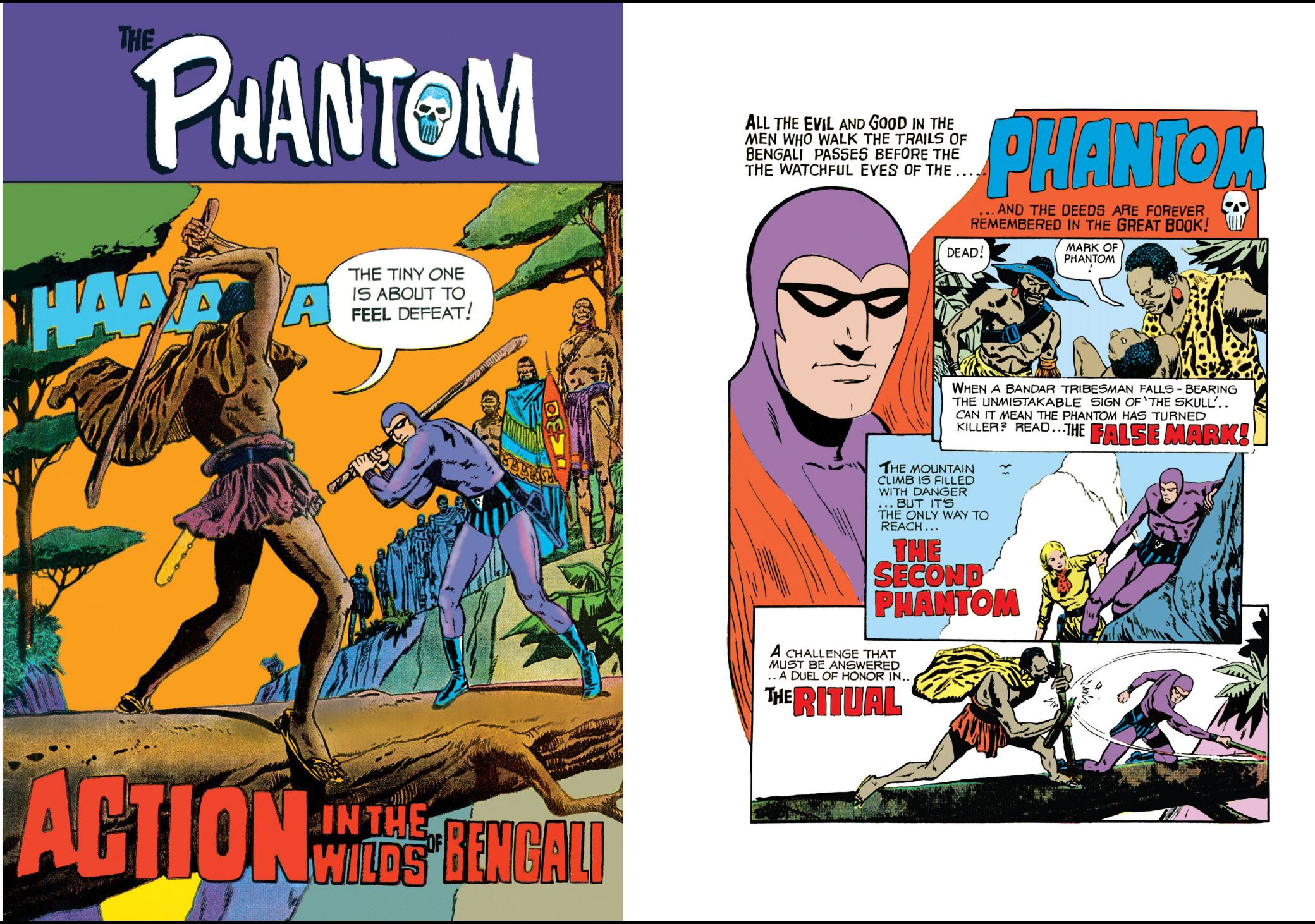
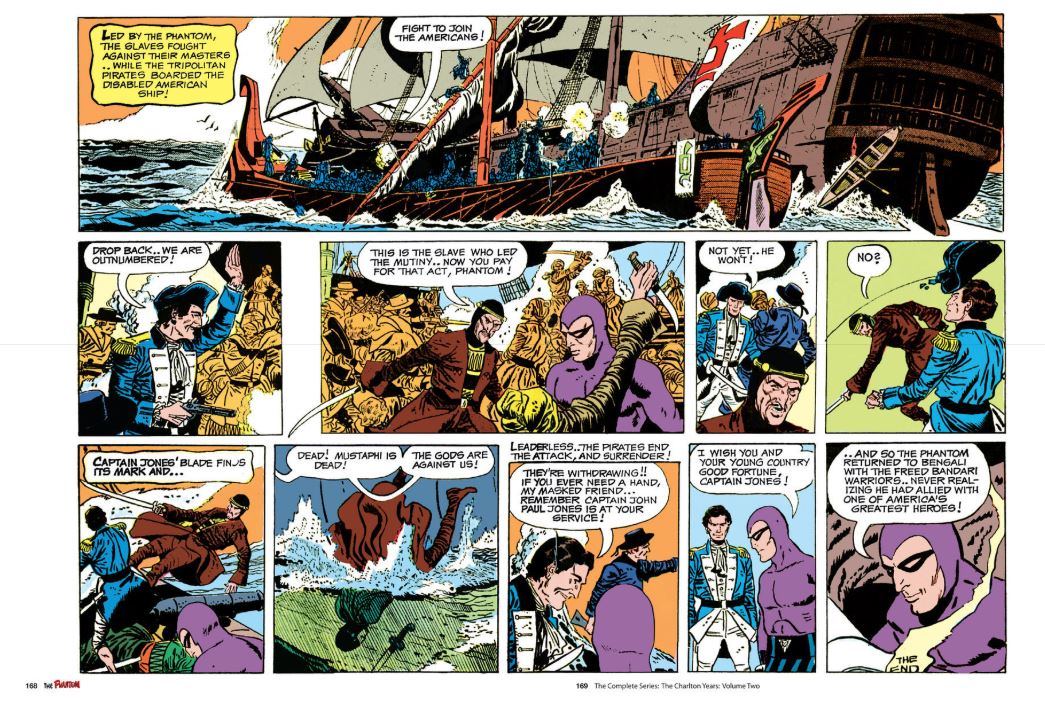
Popeye Classics volume 1


By Bud Sagendorf, edited and designed by Craig Yoe (Yoe Books/IDW)
ISBN: 978-1-61377-557-8 (HB) eISBN: 978-1-62302-264-8

This book includes Discriminatory Content produced in less enlightened times.

There are few comic characters that have entered communal world consciousness, but a grizzled, bluff, uneducated, visually impaired old sailor with a speech impediment is possibly the most well-known of that select bunch.

Elzie Segar had been producing Thimble Theatre since December 19th 1919, but when he introduced a coarse, brusque “sailor man” into the saga of Ham Gravy and Castor Oyl on January 17th 1929, nobody suspected the giddy heights that walk-on would reach…

Happy birthday, Sailor Man!

In 1924 Segar created a second daily strip The 5:15: a surreal domestic comedy featuring weedy commuter and would-be inventor John Sappo and his formidable wife Myrtle which endured – in one form or another – as a topper/footer-feature accompanying the main Sunday page throughout the author’s career. It survived his untimely death, eventually becoming the trainee-playground of Popeye’s second great stylist Bud Sagendorf.

After Segar’s tragic, far too premature death in 1938, Doc Winner, Tom Sims, Ralph Stein and Bela Zambouly all worked on the strip even as animated features brought Popeye to the entire world. Sadly, none of them had the eccentric flair and raw inventiveness that had put Thimble Theatre at the forefront of cartoon entertainments. Nonetheless, the strip continues to this day, with new Sunday episodes written and drawn by R. K. Milholland, whilst daily episodes are reprints by that man Sagendorf.

Born in 1915, Forrest “Bud” Sagendorf was barely 17 when his sister – who worked in the Santa Monica art store where Segar bought his supplies – introduced the kid to the master. Segar became his teacher and employer as well as a father-figure and, in 1958, Sagendorf took over the strip and all merchandise design duties, becoming Popeye’s prime originator…

When Sagendorf took over, his loose, rangy style and breezy inspired scripts brought the strip back to the forefront of popularity. Bud made reading it cool and fun all over again. He wrote and drew Popeye in every graphic arena for 24 years. Sagendorf died in 1994 after which Underground cartoonist Bobby London took over.

Bud had been Segar’s assistant and apprentice, and from 1948 onwards he wrote and drew Popeye’s comic book adventures in a regular monthly title published by America’s king of licensed periodicals, Dell Comics. When Popeye first appeared, he was a rude, crude brawler: a gambling, cheating, uncivilised ne’er-do-well. He was soon exposed as the ultimate working class hero: raw and rough-hewn, practical, but with an innate, unshakable sense of what’s fair and what’s not, a joker who wanted kids to be themselves – but not necessarily Good – and someone who took no guff from anyone. Naturally, as his popularity grew, Popeye mellowed somewhat. He was still ready to defend the weak and had absolutely no pretensions or aspirations to rise above his fellows, but time and popularity eroded that power.

Such was not the case in Sagendorf’s comic book yarns…

Collected in their entirety in this beguiling full-colour hardback or digital edition are the first four 52-page quarterly funnybooks produced by the Young Master, spanning February/April 1948 to November 1948/January 1949.

These stunning, seemingly stream-of-consciousness stories are preceded by an effusively appreciative Introduction‘Society of Sagendorks’ – by inspired aficionado, historian and publisher Craig Yoe accompanied by a fabulous collation of candid photos and letters, plus strip proofs, original comicbook art and commissioned paintings, an Activity Book cover and greetings card designs contained in ‘A Bud Sagendorf Scrapbook’.

Popeye‘s fantastic first issue launched in February 1948 with no ads and duo-coloured (black & red) single page strips on the inside front and back covers. The initial instant episode finds mighty muscled, irrepressible “infink” Swee’ Pea enquiring ‘Were There Ever Any Pirates Around Here?’ before doing a bit of digging, after which full-coloured extended fun begins with ‘Shame on You! or Gentlemen Do Not Fight! or You’re a Ruffian, Sir!’

As everyone knows, the salty swab earns a lucrative living as an occasional prizefighter and here upcoming contender Kid Kabagge and his cunning manager Mr. Tillbox use a barrage of psychological tricks to put Popeye off his game. The key component is electing Olive Oyl President of the deeply bogus Anti-Fisticuff Society to convince her man to stop being a beastly ruffian and abandon violence. That only works until the fiery frail learns she’s been gulled…

Swee’ Pea then stars in ‘Map Back! Or Back Map!’ as sinister unprincipled villain Sam Snagg tattoos an invisible secret diagram onto the baby’s body(!) before falling foul of the boy’s garrulous guardian when trying to reclaim the kid and divine the location of Spinachovia’s hidden treasures. Wrapping up the full-length action is ‘Spinach Revolt’ as Popeye’s perfidious pater Poopdeck Pappy kicks up a fuss about constantly having to eat healthy food…

As the first Superman of comics, Popeye was not a comfortable hero to idolise. A brute who thought with his fists and had no respect for authority, he was uneducated, short-tempered, fickle (when hot tomatoes batted their eyelashes – or thereabouts – at him); an aggressive troublemaker, who wasn’t welcome in polite society… and wouldn’t want to be. Time changed Popeye and made him tamer but the shocking sense of unpredictability, danger and anarchy he initially provided was sorely missed… so in 1936 Segar brought it back again…

A memorable and riotous sequence of Dailies introduced ancient, antisocial crusty reprobate Poopdeck Pappy. The elder mariner was a hard-bitten, grumpy lout quite prepared – even happy – to cheat, steal or smack a woman around if she stepped out of line. He was Popeye’s prodigal dad and once the old goat was firmly established, Segar set Olive and her Sailor Man the Herculean task of “Civilizing Poppa”. Even at the time of this tale that’s still very much a work in progress…

Fed up with eating spinach, Pappy hides his meals and steals the wherewithal to secretly subsist on a diet of candy, cakes and sodas. He even inveigles the lad next door into being the mule in his scurrilous scheme, but cannot evade the digestive consequences of his actions…

The premiere outing ends with a brace of single pagers detailing how Swee’ Pea deals with persistent salesmen and a day’s fishing before issue #2 commences…

Master moocher Wellington J. Wimpy again has cause to declare ‘Sir! You are a cheapskate!’ before Swee’ Pea & Popeye are swept up in a controversial debate. In ‘That’s What I Yam! or ‘I Yam! I Yam’, the sailor believes his baby boy tough enough to wander around town unsupervised but has reasons to revise his opinion after the kid vanishes. Moreover, when he does resurface, the titanic tyke is subject to strange transformations and behaviours. It’s as if a class of trainee hypnotists have all been using the kid as a practise subject but forgot to bring him out of his trance afterward…

Pappy stars in ‘Easy Money’, with the greedy reprobate realising how much cash his sterling son earns for each boxing bout. Determined to get on the gravy train too, the oldster shaves off his beard and impersonates Popeye. By the time his boy catches wise, Pappy has conned Olive and Wimpy into his scheme and set up a punishing bout with a huge purse, so somebody is going to have to fight…

The issue ends with a two-tone short showing the hazards of bathing Swee’Pea and another full colour back cover gag as a bullying neighbour realises the folly of trying to spank Popeye’s boy…

Popeye #3 leads with an epic 32-page spooky maritime epic as the superstitious sailor reluctantly agrees to transport 250 “ghosk” traps to ghastly, radish – and phantom – infested ‘Ghost Island’: a cunning yarn of mystery and over-zealous imagination starring many cast regulars and preceded by a hilarious map of the route replacing the inside-front-cover gag…

Following up is an implausible account of Popeye apparently becoming a violent bully, beating up ordinary citizens in ‘Smash! or You Can Tell She’s My Girl, Because She’s Wearing Two Black Eyes!’ Happily, a doctor at the sailor’s trial is able to diagnose the incredible truth before things go too far, after which Swee’Pea indulges in too much sugar in the red & black bit and learns the manly way to play with dolls on the colour back cover…

The fourth and final inclusion in this outrageous, timelessly wonderful compilation begins with Wimpy up to his old tricks whilst Popeye hunts ducks, before another extended odyssey finds the Sailor Man and hangers-on Swee’Pea, Olive & Wimpy heading West on safari to capture a rare Ipomoea from sagebrush hellhole ‘Dead Valley’

It’s a grim wilderness Popeye has endured before: an arid inferno no sane man would want to revisit unless a scientist hired him to. Sadly, that’s not the opinion of local bandit boss Dead Valley Joe who assigns all his scurvy gang the task of dissuading or despatching the uppity easterners before they uncover the region’s incredible secret…

Back home again, Olive Oyl receives a surprise ‘Gift from Uncle Ben!’ Sadly, the strange flying beast called a Zoop prefers Swee’Pea’s company, and her warm generosity in donating the beast takes a hard knock when a stranger offers a million bucks for it…

One final brace of Swee’ Pea shorts then sees the wily kid orchestrate free baseball views for his pals before indulging in food politics to win over a stray cat and wrap up in amiable style these jolly, captivating cartoon capers.

There is more than one Popeye. If your first thought on hearing the name is an unintelligible, indomitable white-clad sailor always fighting a great big beardy bloke and mainlining tinned spinach, that’s okay: the animated features have a brilliance and energy of their own (even the later, watered-down anodyne TV versions have some merit) and they are indeed based on the grizzled, crusty, foul-mouthed, bulletproof, golden-hearted old swab who shambled his way into Thimble Theatre and wouldn’t leave. But they are really only the tip of an incredible iceberg of satire, slapstick, virtue, vice and mind-boggling adventure…

There is more than one Popeye. Most of them are pretty good, and some are truly excellent. This book is definitely one of the latter and if you love lunacy, laughter and rollicking adventure you must now read this.
Popeye Classics volume 1 © 2013 Gussoni-Yoe Studio, Inc. All Rights Reserved. Popeye © 2013 King Features Syndicate. ™ & © Heart Holdings Inc.

Today in 1851 pioneering US illustrator A/B. Frost (Br’er Rabbit) was born, and in 1877 Australian artist Cecilia May Gibbs (Gumnut Babies/Bush Babies/Bush Fairies, Bib and Bub, Snugglepot and Cuddlepie, Tiggy Touchwood).

In 1920 epic UK weekly comic Film Fun began with the first of its 2225 issues. Never appearing therein was erotic cartoonist Georges (Blanche Épiphanie) Pichard who was born in the same year.

One year later Cuban Spy vs Spy/Mad magazine mastermind Antonio Prohias was born. As was Spanish artist Alfonso Azpiri (Black Hawk [UK Tornado], Bethlehem Steele, Lorna) in 1947 and Ann Nocenti in 1957 and the astonishing Genndy Tartakovsky in 1970.

Sadly we lost Belgian Pascal Garray in 2017, a quiet star who worked for years largely unheralded on The Smurfs, and Benoît Brisefer/Steven Sterk/Benny Breakiron.

Invincible Iron Man Epic Collection volume 7 (1976-1978): Ten Rings to Rule the World


By Bill Mantlo, Gerry Conway, Herb Trimpe, Roger Stern, George Tuska, Keith Pollard, Keith Giffen, Carmine Infantino, Jeff Aclin, Mike Esposito, Don Perlin, Jack Abel, Fred Kida, Alfredo Alcala, Rudy Nebres, Bruce Patterson, Josef Rubinstein, Bob Wiacek, Pablo Marcos, Don Newton & various (MARVEL)
ISBN: 978-1-3029-6059-9 (TPB/Digital edition)

This book includes Discriminatory Content produced in less enlightened times.

Arch-technocrat and supreme survivor Tony Stark has changed profile and rebuilt himself many times since debuting in Tales of Suspense #39 (March 1963). There and then, as a VIP visitor to Vietnam assessing the efficacy of munitions he had designed, the inventor was critically wounded and captured by sinister, savage Communists. Put to work building weapons with the dubious promise of medical assistance upon completion, Stark instead crafted the first of innumerable technologically-augmented protective suits to keep himself alive and deliver him from his oppressors. From there it was a simple – transistor-powered – jump to full time superheroics as a modern Knight in Shining Armour…

Conceived after the Cuban Missile Crisis at a time when Western economies were booming and “Commie-bashing” was America’s obsession, a dashing new Thomas Edison employing Yankee ingenuity, wealth and invention to safeguard the Land of the Free and better the World seemed an obvious development. Combining then-sacrosanct faith that technology and business in unison could solve any problem, with the universal imagery of noble knights battling evil, Stark – the Invincible Iron Man – seemed an infallibly successful proposition.

Of course, whilst he was the acceptable face of 1960s Capitalism – a glamorous, benevolent, rich, technocratic and all-conquering hero when clad in super-scientific armour – the turbulent tone of the 1970s soon relegated his suave, “can-do” image to the dustbin of history. With ecological disaster and social catastrophe from myriad big business abuses new zeitgeists of the young, the Golden Avenger and Stark International were soon confronting some tricky questions from an increasingly politically savvy readership.

With glamour, money and fancy gadgetry not quite so cool anymore the questing voices of a new generation of writers began posing uncomfortable questions in the pages of a series that was once a bastion of militarised America. Collectively accommodating cover-dates November 1976 to October 1978, this Epic chronological epistle completes that transitional period, reprinting Iron Man #92-114, plus Annual #4 and a guest yarn from Marvel Premiere #44 as Bill Mantlo’s passionate writing triggered a minor renaissance in the Steel Sentinel’s chrome-plated chronicles that resulted in some of the best stories of the Eighties era. It also returned Iron Man to the top-rank of Marvel stars.

If you’re a fan thanks to the movie interpretation, that iteration starts right here, right now…

The mettle majesty opens with manic menace The Melter who soon regrets an ill-advised grudge rematch in ‘Burn, Hero… Burn!’ (Gerry Conway, George Tuska & Jack Abel) before Herb Trimpe returns to plot and pencil Iron Man #93. Pitting Old Shellhead against a British-based modern-day pirate in ‘Kraken Kills’ (Conway script & Abel inks), the self-declared Commander deduces Stark’s secret identity before blackmailing the inventor into building weapons for his super-submarine fleet. Never at a loss, though, Stark turns the tables, sparking ‘Frenzy at Fifty Fathoms!’ to scupper the madman’s plans…

Invincible Iron Man Annual #4 (August 1977) offers an all-action alliance with newly constituted super-team The Champions by Mantlo, Tuska & inker Don Perlin. When psychic assassin M.O.D.O.K. overwhelms the Golden Avenger, Iron Man calls in old allies Black Widow and Hercules (plus teammates Ghost Rider, Iceman, Darkstar and The Angel) to thwart ‘The Doomsday Connection!’

Also from that issue comes an out-of-place martial arts vignette by Roger Stern, Jeff Aclin & Don Newton. ‘Death Lair!’ stars former Master of Kung Fu villain Midnight on a mission of murder against old Iron Man enemy Half-Face

The regular monthly climb to reclaimed pole position resumes with veteran Iron Man artist Tuska joining plotter Conway, scripter Mantlo and inker Perlin in unleashing giant android ‘Ultimo!’ (IM #95, cover-dated February 1977) against Washington DC. Clad in upgraded armour and in the Capitol to answer congressional questions about his company, Stark is targeted by a vengeful hidden nemesis who activates the mountainous monster for a classic B-movie sci fi rampage in the streets, with the Golden Avenger supplementing hard pressed Army and National Guard units… before falling in ignominious defeat due to sabotage…

Mantlo, Tuska & Abel prove you can’t keep a good Iron Man down as the embattled hero rallies and retaliates in ‘Only a Friend Can Save Him’ as former close ally and dutiful S.H.I.E.L.D. agent Jasper Sitwell joins the counterattack. Meanwhile, a long-simmering plotline advances as NYPD detective Michael O’Brien – who holds Stark responsible and accountable for the death of his brother Kevin – finally allows his obsession with a cover-up to pull him across legal lines and into collusion with shady PI Harry Key, whose latest client also has nasty plans for the playboy inventor…

Thanks to ingenuity and sheer guts, Stillwell & Iron Man seemingly destroy Ultimo deep below DC, but their triumph is short lived as a return to Stark’s Long Island factory provokes a ‘Showdown with the Guardsman!’ (Conway, Mantlo, Tuska & Perlin). When Mike takes PA Krissy Longfellow hostage, steals the armour suit that drove his brother insane and ambushes the Golden Avenger wearing it, the clash is swift and brutal. Thankfully this time, the blockbusting battle ends before another good man dies…

Whilst subsequently treating O’Brien, another distraction comes when an old frenemy attacks the facility and US interventionist economic practises. ‘Sunfire Strikes Again!’ sees the Japanese ultra-nationalist mutant warrior again seek to derail progress, unaware that he’s a pawn of the lurking presence gunning for Stark. However, the harried hero’s problems start with the fact that his greatest weapon is offline and he’s fighting in borrowed Guardsman armour. When the conflict frees imprisoned Michael O’Brien, the cop seeks to make amends by joining the battle in an obsolete Iron Man outfit, but – even with Mike Esposito inking – the new allies rapidly find themselves ‘At the Mercy of the Mandarin!’

During the melee, Key tries his luck in the Stark vaults once too often and encounters an unexpected problem, thanks to another insidious infiltrator planted by a different scheming mastermind. However, having freed himself, Tony is too now busy rushing to a far-distant, potentially world-ending final battle in anniversary issue #100. Invading China, Iron Man faces horrors, homunculi Death Squads, nuclear armageddon and his most obsessive enemy whose ‘Ten Rings to Rule the World!’ ultimately prove insufficient to the task…

With the tyrant’s countless plots to discredit Stark now exposed, our hero starts a long journey home, even as in Long Island, Harry Key, Sitwell and one of the traitors in Stark’s midst begin a cautious espionage dance…

Iron Man’s trip stalls when he’s shot down over Yugoslavia (just google it) and awakens in a creepy old castle filled with freaks and outcasts safeguarded by a familiar – to elderly or dedicated Marvelites at least – huge and daunting figure. Recovering in ‘Then Came the Monster!’ our weary voyager views Castle Frankenstein and panics: clashing with the gentle “Modern Prometheus” before the real menace emerges.

Inked by Esposito & Pablo Marcos, ‘Dreadknight and the Daughter of Creation!’ channels old Marvel horror tales as a brutal and brutalised escaped experiment of Doctor Doom’s laboratories seeks to compel the great granddaughter of Victor Frankenstein to share with him the secrets of creating life…

This ruthless high-tech paladin’s sadistic efforts are eventually thwarted by Iron Man and the original (good) Monster, after which the Steel-Shod Sentinel at last arrives home in #103’s ‘Run for the Money!’ by Mantlo, Tuska & Esposito. Sadly, it’s just in time for the next domestic crisis as Sitwell exposes the traitor only to be captured by revolting corporate villain Midas, who – patience exhausted – launches a truly hostile takeover using tanks, mercenaries, lawyers and the Stock Market…

He is temporarily checked by itinerant junior hero/innocent bystander Jack of Hearts who – as per standard Marvel protocol – is attacked by weary, late arriving Iron Man who misconstrues events and assaults the well-meaning stranger. Shock follows shock as Midas’ legal chicanery forces Iron Man’s surrender, ceding control of Stark International to his enemy, even as the villain’s agent and top lieutenant Madame Masque quits to ally herself with the defeated hero and his ousted, outmanoeuvred alter ego Tony Stark.

In the aftermath, repercussions of the takeover ripple outwards. With Stark no longer paying her bill, deeply disturbed super-telepath (and former Stark inamorata) Marianne Rodgers is kicked out of the sanatorium that has been keeping her psionic deadly tendencies in check…

The fightback begins in ‘Triad! (Mantlo, Tuska & Esposito) after Stark initially refuses the help of Masque. Thus she instead allies with former lover/patsy Sitwell whilst elsewhere, interested parties Michael O’Brien and Jack of Hearts also seek to stop Midas converting Stark’s purloined resources into a world-conquering armed force. Also heading slowly towards a showdown, Marianne graduates towards Long Island, leaving a trail of bodies in her wake…

With ‘Every Hand Against Him!’ and despite the stakes being so high, Tony has quit forever, preferring to hide in his father’s old house with Madame Masque. Less sanguine over the crisis and National Security threat, many of Iron Man’s allies join a volunteer force recruited by psychic superhero The Wraith and eventually consisting of Police Captain Jean de Wolf, former Iron Man stand-in Eddie March, The Guardsman & Jack of Hearts, covertly backed up by Sitwell and (the first) Nick Fury

Still short of power, they co-opt through blackmail, Masque’s lethal skills and Tony’s last remaining armour suit to take out Midas. ‘Then There Came a War!’ (#106) sees the squad invade SI to face a legion of automated Iron Men. At the height of battle Marianne Rodgers – in a fugue state – finally reaches her destination. As Keith Pollard & Fred Kida step in to illustrate the catastrophic conclusion, ‘And, in the End…’ sees her power tip the scales, uncovering even more treachery in Tony’s inner circle and inspiring the despondent hero to take back his heritage, his company and his honour…

With most of his allies apparently dead, Iron Man calls in Avenging ally Yellowjacket (AKA original Ant-Man Henry Pym) to help whip up a miracle cure in #108 (Mantlo, Carmine Infantino & Bob Wiacek). This incurs some ‘Growing Pains!’ and a palate-cleansing action-filled monster-bash as the clear-up somehow reactivates Kang the Conqueror’s devastating Growing Man android to add to the wreckage and rubble…

Once the fighting is finished, rebuilding Stark International begins, with Mantlo, Infantino & Kida dictating the pace prior to another crisis after Jack of Hearts traces the Growing Man’s programming commands as emanating from Luna. Thus Iron Man and his superhero apprentice board a Quinjet and experiences a very painful ‘Moonrise!’ when their mission intersects a secret sortie by Soviet Super-soldiers Darkstar, Vanguard & Crimson Dynamo. The Communist cosmonauts are only investigating a bizarre alien artefact, but entrenched political and personal animosities spark a savage clash. Both sides are preoccupied when the silver egg activates, transporting those closest to it – the Americans – to somewhere far, far away…

Mantlo, Pollard & Kida stretch their fantasy muscles in an astral epic as the heroes materialise aboard a vast ship bearing Colonizers of Rigel to their next conquest. Sadly, these ‘Sojourners Through Space!’ have targeted Wundagore II – used by animal-enhancing man-made deity the High Evolutionary to store former experiments – and are soon caught up in a battle against formidable space Knights of Wundagore and two devastating late-arriving, quickly escaping human captives within their colossal Command ship…

When an alliance of humans and hyper-evolved Earth beasts proves too costly, the Rigellian venture is called off in ‘The Man, the Metal, and the Mayhem!’  but this in turn leads to renegade Colonizer subcommander Arcturus spitefully targeting Earth with a robot stolen from Galactus (the original Punisher from Fantastic Four #48-50). Upon its despatch, closing instalment ‘Moon Wars!’ (IM #112, July 1978 by Mantlo, Pollard & Alfredo Alcala) sees a swift, unauthorised Colonizer strike prompt a desperate dash back to Luna and shattering descent to Detroit for Iron Man, resulting in blistering battle with the cosmic weapon of chastisement and a new definition of the word “invincible” for the triumphant Golden Avenger…

With Mantlo scripting, Pollard layout pages and Trimpe’s pencilling for inker Josef Rubinstein, Iron Man #113 trumpeted a fresh beginning for Stark International after defeating the bloody takeover bid of Mr Midas. However, as the new complex opened for business, an old enemy is already infiltrating the company whilst a more brazen assault comes after a dying foe is manipulated into attacking the complex using ‘The Horn of the Unicorn!’

Seeking help for the beaten-and-at-death’s door Unicorn, the Metal Marvel consults The Avengers and inadvertently triggers a second assault by the villain who also activates a long-interred robotic threat that seems agonisingly familiar in ‘The Menace of… Arsenal!’ (Mantlo, Giffen & Bruce D. Patterson) leading to a turning point moment you’ll need the next book or another collection to enjoy…

To Be Continued…

Here, however, one last narrative nubbin comes from Marvel Premiere #44 (October 1978): the one-shot try-out of Stark’s former apprentice, by Mantlo, Giffen & Rudy Nebres). ‘The Jack of Hearts!’ reexamines the origin of trust fund brat Jack Hart, who was inundated in the experimental “zero fluid” invented by his murdered father. Seemingly resurrected and imbued with incredible energy and computational powers, Jack hunts The Corporation who ordered the hit and here – thanks to new connection in S.H.I.E.L.D. – inconclusively clashes with their preferred hitman Hemlock

With covers throughout by Jack Kirby, Al Milgrom, Abel, Ron Wilson, Dan Adkins, Gil Kane, Dave Cockrum, Sal Buscema, Jim Starlin, Val Mayerik, George Pérez, Terry Austin, Frank Giacoia, Joe Sinnott, Joe Rubinstein, John Byrne, Wiacek, Pollard, John Romta Jr., Ed Hannigan & Frank Giacoia, other extras include house ads, cartoon fan letter ‘Printed Circuits’ (by Fred Hembeck from #112); editorial pages and style sheets from Marvel Premiere #44 and original art covers by Starlin, Mayerik & Cockrum.

From our distant vantage point the polemical energy and impact might be dissipated, but the sheer quality of the comics and cool thrill of the eternal aspiration of man in perfect partnership with magic metal remains. These Fights ‘n’ Tights classics are amongst the most underrated but impressive tales of the period and are well worth your time, consideration and cold hard cash
© 2025 MARVEL.

You’d think we barely have room for a review this time as it’s such an auspicious day for comics…

In 1912 today creepy cartoon colossus Charles Addams was born, and in 1929 both Buck Rogers by Dick Calkins and Hal Foster’s Tarzan strips debuted. In 1934 Alex Raymond & Don Moore launched Jungle Jim and a year later combined it with new idea Flash Gordon.

Underground and Mad magazine artist Jay Lynch was born in 1945 and two years later Milton Caniff premiered his other masterpiece with the launch of Steve Canyon. That ran until 1988.

In 1953, Bob Wiacek joined the party as did Karl Kesel in 1959, and publisher Fabrice Giger (Les Humanoïdes Associés) arrived in 1965. Surely by coincidence, two years after, that nativity was followed by the launch of Greg & Eddie Paape’s Luc Orient in Le Journal de Tintin.

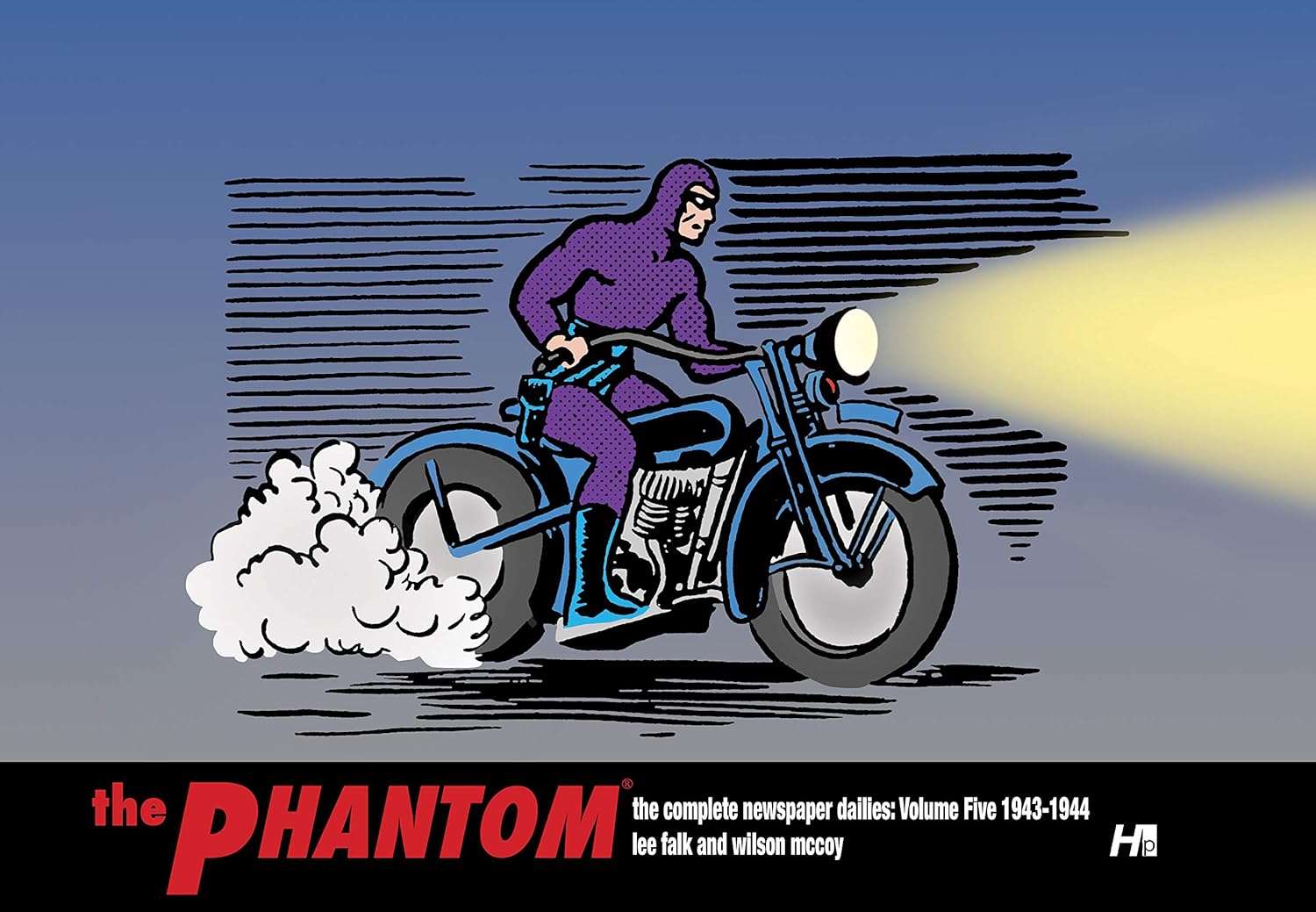
The Phantom: The Complete Newspaper Dailies volume 1 1936-1937


By Lee Falk & Ray Moore: introduction by Ron Goulart (Hermes Press)
ISBN: 978-1-932563-41-5 (HB/Digital edition)

This book includes Discriminatory Content produced in less enlightened times.

There are plenty of comics-significant anniversaries this year, and this guy is probably right at the top of the birthday cake. As next month sees his 90th anniversary here’s tasty reminder of why he is considered one of our industry’s landmark figures.

For such a long-lived, influential series, in terms of compendia or graphic novel collections, The Phantom has been very poorly served by the English language market (except in Australia where he has always been accorded the status of a pop culture god). Numerous companies have sought to collect the strips – one of the longest continually running adventure serials in publishing history – but in no systematic or chronological order and never with any sustained success. At least the former issue began to be rectified with this initial curated collection from Archival specialists Hermes Press. This particular edition is a lovely large hardback (albeit also available in digital formats), printed in landscape format, displaying two days strip per page in black & white with ancillary features and articles in dazzling colour where required.

Born Leon Harrison Gross, Lee Falk created the Jungle Avenger at the request of his King Features Syndicate employers who were already making history, public headway and loads of money with his first strip sensation Mandrake the Magician. Although technically not the first ever costumed champion in comics, The Phantom’s instant popularity made him the prototype paladin as he was the first to wear a skin-tight body-stocking and have a mask with opaque eye-slits…

“The Ghost Who Walks” debuted on February 17th 1936 in an extended sequence pitting him against an ancient global confederation of pirates. Falk wrote and drew the daily strip for the first two weeks before handing over illustration to artist Ray Moore. A spectacular and hugely influential Sunday feature began in May 1939. In a text feature stuffed with sumptuous visual goodies like movie posters; covers for comics, Feature and Little Big Books plus many kinds of merchandise, Ron Goulart’s eruditely enticing ‘Introduction: Enter the Ghost Who Walks’ tells all you need to know about the character’s creation before the vintage magic begins with ‘Chapter 1: The Singh Brotherhood’.

American adventurer Diane Palmer returns to the USA by sea, carrying a most valuable secret making her the target of mobsters, sleazy society ne’er-do-wells and exotic cultists. Thankfully, she seems to have also attracted an enigmatic guardian angel who calls himself the Phantom

Successive attacks and assaults endanger the dashing debutante, and she learns an ancient brotherhood of ruthless piratical thieves wants her secret, but that they have been opposed for centuries by one man. Kidnapped and held hostage at the bottom of the sea, Diana is saved by the mystery man who naturally falls in love and eventually shares an incredible history with her…

In the 17th century a British sailor survived an attack by pirates, and – washing ashore on the African coast – swore on the skull of his murdered father to dedicate his life and that of his descendants to destroying all pirates and criminals. The Phantom fights crime and injustice from a base deep in the jungles of Bengali, and throughout Africa is known as the Ghost Who Walks. His unchanging appearance and unswerving war against injustice have led to him being considered an immortal avenger by the credulous and the wicked. Down the decades, one hero after another has fought and died in an unbroken family line, and the latest wearer of the mask, indistinguishable from the first, continues the never-ending battle. And he’s looking to extend the line and the legend…

In the meantime, however, there’s the slight problem of Emperor of Evil Kabai Singh and his superstitious armies to deal with…

‘Chapter 2: The Sky Band’ (originally published from 9th November 1936 to April 10th 1937) finds the mystery avenger caught in love’s old game as a potential rival for Diana’s affections materialises in the rather stuffy form of career soldier Captain Meville Horton: a decent, honourable man who sadly knows when he’s outmatched, unwanted and in the way. Mistakenly determined to do the right thing too, our masked mystery man concentrates on destroying a squadron of thieving aviators targeting the burgeoning sky clipper trade: airborne bandits raiding passenger planes and airships throughout the orient. Initial efforts infuriatingly lead to the Phantom’s arrest: implicated in the sky pirates’ crimes, before escaping from police custody with the aid of his devoted “pygmy witch doctor” Guran and faithful Bandar tribe allies, he’s soon hot on the trail of the real mastermind…

Upon infiltrating their base, he discovers the airborne brigands are all women, and that his manly charms have driven a lethal wedge between the deadly commander and her ambitious second in command Sala

A patient plaything of the manic Baroness, The Phantom eventually turns the tide not by force but by batting his invisible eyes and exerting his masculine wiles upon the hot-blooded – if certifiably psychopathic – harridan, unaware until too late that his own beloved, true-blue Diana is watching. When she then sets a trap for the Sky Band, it triggers civil war in the gang, a brutal clash with the British army and the seeming end of our hero, triggering Diana’s despondent decision to return alone to America…

‘Chapter 3: The Diamond Hunters’ opened on April 12th 1936 and revealed how the best laid plans can go awry. In Llongo territory, white prospectors Smiley and Hill unearth rich diamond fields but cannot convince or induce local tribes to grant them mineral rights to the gems they consider worthless. Like most indigenous Africans, they’re content to live comfortably under the “Phantom’s Peace” and it takes all the miners’ guile – including kidnapping a neighbouring chief’s daughter and framing the Llongo; gunrunning and claiming the Ghost Who Walks has died – to set the contented residents at each other’s throats. Recovering from wounds, the Phantom is slow to act, but when he does his actions are decisive and unforgettable…

With the plot foiled and peace restored, Smiley flees, only to encounter a returned Diana who has acted on news that her man still lives. Seeing a chance for revenge and profit, Smiley kidnaps “the Phantom’s girl”, provoking his being shunned by all who live in the region, a deadly pursuit and spectacular last-minute rescue. Smiley’s biggest and last mistake is reaching the coast and joining up with a band of seagoing pirates…

At least he is the catalyst for Diana and The Ghost finally addressing their romantic issues…

To Be Continued…

‘Afterword: For Those Who Came in Late…’ then sees editor Ed Rhoades offer his own thoughts on the strip’s achievements and accomplishments.

Stuffed with chases, assorted fights, torture, blood & thunder antics, daredevil stunts and many a misapprehension and coincidence – police and government authorities clearly having a hard time believing a pistol-packing masked man with a pet wolf might not be a bad egg – this a pure enthralling excitement that still packs a punch and plenty of sly laughs.
© 2010 King Features Syndicate, Inc.: ® Hearst Holdings, Inc.; reprinted with permission. All rights reserved.

Today in 1907, astounding illustrator Bruno (Doom Patrol, Teen Titans) Premiani was born, as was artist and inker Chic (Nemesis, Batman, all the best 1960s Thor, X-Men and FF stories) Stone in 1923.

In 1975 Archie co-creator Bob Montana died; and the day is infamous in the UK as the last day Buster was published. Kidding. Nobody noticed because we’d all stopped buying it. We are really sorry now though…

The Rise and Fall of the Trigan Empire volume 1


By Mike Butterworth & Don Lawrence & various (Rebellion Studios)
ISBN: 978-1-78108-755-8 (TPB/Digital edition)

This book includes Discriminatory Content produced in less enlightened times.

For British – and Dutch – readers of a certain age and prone to debilitating nostalgia, The Trigan Empire (or The Rise and Fall of the Trigan Empire to give it its ponderous full title) was only ever about two things: boyish wish-fulfilment and staggeringly beautiful art.

The strip was created by Senior Group Editor Leonard Matthews and given to the editor of Sun and Comet to develop and continue. A trained artist, Mike Butterworth became writer of many historical strips such as Buffalo Bill, Max Bravo, the Happy Hussar, Battler Britton and Billy the Kid – and latterly a crime and gothic romance novelist with more than 20 books to his pen names.

Based in equal part on cinematic Sword & Sandal/Biblical epics and the space age fascination of a planet counting down to a moonshot, for the saga Butterworth combined his love of the past, a contemporary comics trend for science fiction and that long-established movie genre of manly blockbusters to construct a vast sprawling serial of heroic expansionism, two-fisted warriors, wild beasts, deadly monsters and even occasionally the odd woman.

The other primary influence on the series was the fantasy fiction of Edgar Rice Burroughs (especially John Carter of Mars and Pellucidar) but without his concentration on strong and/or blatantly sexy women – usually as prizes for his heroes to save. In the formative days of the Trigan Empire, ladies dressed decorously, minded their manners and were dutiful wives or nurses… unless they were evil, vindictive or conniving…

The compellingly addictive, all-action thematic precursor to Warhammer, Civilisation and Warcraft might have been a short run venture had it not been for the art. The primary illustrator was Don Lawrence (Marvelman, Wells Fargo, Billy the Kid, Karl the Viking, Fireball XL5, Maroc the Mighty, Olac the Gladiator, The Adventures of Tarzan, adult comedy strip Carrie and his multi-volume Dutch magnum opus Storm), who painted each weekly instalment.

Initially he used watercolours before switching to quicker-drying gouaches, rendered in a formal, hyper-realistic style that still left room for stylistic caricature and wild fantasy, and one that made each lush backdrop and magnificent cityscape a pure treasure. Other, later artists included Ron Embleton, Miguel Quesada, Philip Cork, Gerry Wood and Oliver “Zack” Frey, as the strip notched up 854 weekly instalments, beginning in September 1965 and only ending in 1982. Along the way, it had also appeared in Annuals and Specials and become a sensation in translated syndication across Europe.

Even after it ended – and, thanks to these collections, it has recently resumed! – the adventure continued: in reprint form, appearing in the UK in Vulcan and across the world; in two Dutch radio plays; collected editions sold in numerous languages; a proposed US TV show and numerous collected editions from 1973 onwards. Surely someone must have a movie option in process: if only Kirk Douglas, Burt Lancaster and Tony Curtis were still around, we could completely close the creative circle…

Lawrence (17th November 1928 – 29th December 2003) inspired a host of artists such as Brian Bolland and Dave Gibbons, but as he worked into the 1990s, his eyesight was increasingly hindered by cataracts and he took on and trained apprentices such as Chris Weston and Liam Sharp (who offers his own potent reminiscences in the Introduction to this first archival volume from Rebellion Studios’ Treasury of British Comics). Sharp collaborated with the venerable artist on his last Storm stories…

Inescapably mired in powerful nostalgia, but also standing up remarkably well on its own merits, this first collected volume re-presents the series from its enigmatic opening in high-end tabloid weekly magazine Ranger, combining comics with a large selection of factual features. The fantasy soon began to steal the show and was the most noteworthy offering for the entirety of the publication’s 40 week run, spanning 18th September 1965 to 18th June 1966. It then carried over – with a few other choice strips – into Look and Learn, beginning with #232: remaining until the magazine closed with #1049 (April 1982).

Ranger had been a glossy, photogravure blend of traditional comic anthology strips and educational magazine, and when it folded, the only publication able to continue The Trigan Empire in its full grandeur was Look and Learn

One of our most missed publishing traditions is the educational comic. From science, history and engineering features in the legendary Eagle to a small explosion of factual and socially responsible boys and girls papers in the late 1950s to the heady go-getting heydays of the 1960s & 1970s, Britons always enjoyed a healthy sub-culture of comics that informed, instructed and revealed – and that’s not even counting all the pure sports comics!

Amongst many others Speed & Power, Treasure, World of Wonder, Tell Me Why, and Look and Learn spent decades making things clear, illuminating understanding and bringing the marvels of the changing world to our childish but avid attentions with wit, style and – thanks to the quality of the illustrators involved – astonishing beauty. Look and Learn launched on 20th January 1962: brainchild of Fleetway Publications’ then Director of Juvenile Publications Leonard Matthews. The project was executed by editor David Stone (almost instantly replaced by John Sanders), sub-editor Freddie Lidstone and Art Director Jack Parker.

For 20 years it delighted children, and was one of the country’s most popular children’s weeklies. Naturally there were many spin-off tomes such as The Look and Learn Book of 1001 Questions and Answers, Look and Learn Book of Wonders of Nature, Look and Learn Book of Pets and Look and Learn Young Scientist as well as utterly engrossing Christmas treat tradition The Look and Learn Book and – in 1973 – The Look and Learn Book of the Trigan Empire: the serial’s very first hardback compilation.

Strangely, many, many kids learned stuff they didn’t think they cared about simply because it filled out the rest of that comic that carried the Trigan Empire…

In this tome we review 25th June1966 through 17th May 1968, encompassing Ranger #1-40 and Look and Learn #232-331: subdivided for your convenience into 13 chapter plays of what we oldsters absorbed as one continuous unfolding procession of wonder…

Depicted with sublime conviction and sly wit, it begins with ‘Victory for the Trigans’ (18th September 1965 – 29th January 1966) as fishermen in the Florida swamps witness a spaceship crash. All aboard are dead, and after, the global news cycle wearies of the story, the craft is reduced to a sideshow attraction whilst scholars meticulously investigate its technology, dead voyagers and a huge set of journals written in an indecipherable language. No one succeeds and eventually, no one cares…

All except student Richard Peter Haddon, who spends the next half century looking for the key and – at age 70 – cracks the code, subsequently translating the history of a mighty race of aliens so very like earthmen…

From then on the scene switches to distant twin-sunned world Elekton, where numerous kingdoms and empires-in-waiting jostle for dominance. In many ways it’s like Earth a few thousand years before the birth of Christ… except for all the monsters, skycraft and ray guns…

In the wilds and wastes between the nations of Loka, Tharv, Davelli and Cato, brutish far-ranging tribes of nomadic Vorg hunt and clash and live brief free lives, until three brothers decide existence could be so much more…

Driven, compelling and charismatic, notional leader Trigo has a dream and convinces his siblings Brag and Klud to ask their people to cease following roving herds of beasts and settle by a river where five hills meet. Before long they have raised a city and begun the march to empire. Of course, all those defiant libertarians were initially resistant to becoming civilised, but that ended after the more advanced Lokans began hunting them for sport from their flying ships…

By the time Loka’s King Zorth finally gets around to conquering Tharv and formally annexing the lands of Vorg in his plan to become global dictator, Trigo has begun building his city and invited refugees from Tharv to join him. Amongst the many displaced survivors of Lokan atrocity is Peric – an architect and philosopher generally acclaimed as the smartest man alive. He is cared for by his daughter Salvia. Both will play major roles in the foundation of the Trigan Empire…

When Zorth at last turns to consolidation by taking Vorg, his air, sea and land forces are met by an unbeatable wall of death and history is rewritten. It comes at great cost, most notably to Trigo as victory is almost snatched from him when brother Klud attempts to murder him, seize power and betray their people to the Lokans…

With an empire established, one translated book ends, and Professor Haddon’s life’s work moves on to what we’ll call ‘Crash in the Jungle’ (5th February – 19th February 1966), introducing young warrior/pilot Janno. The son of Brag, he is childless Trigo’s nephew and heir apparent: enjoying many dynamic adventures as an imperial troubleshooter whilst being groomed for rule. Here, still wet behind the ears, the lad crashes in the plush rainforests of Daveli, befriends Keren – son of a formerly antagonistic aboriginal chieftain – and facilitates their alliance with the ever-expanding Trigan Empire. When Janno returns to pilot training, Keren is beside him and will be his constant companion in all further exploits…

Planetary chaos erupts next as ‘The Falling Moon’ (26th February – 28th May 1966) reshapes Elekton’s political map. When Gallas impacts sister moon Seres, the cosmic collision sends the satellite smashing into Loka where – forewarned – Zorth seeks to relocate his power base and entire populace by seeking sanctuary in Trigo’s city. Once admitted and welcomed, the Lokans bite the hand that shelters them by seizing the city. Valiant Brag manages to save wounded Trigo, but they are captured and enslaved by desert raiders of the Citadel…

As Janno and Keren escape to mount a futile resistance to the Lokans, slave worker Trigo foils an assassination and earns the gratitude of the Citadel king, who lends him a band of warriors to retake his own city. When they link up with Janno & Keren, Zorth’s defeat and doom are assured…

Time moves differently on Elekton and many events seem telescoped, but as the strip jumps to a new home, continuity manifests in ‘The Invaders from Gallas’ (4th June – 18th June) in Ranger before continuing in Look and Learn #232-237 from 25th June to 30th July 1966. As the fallen moon cools, aliens dwelling inside emerge to attempt the conquest of their new world via their mind control techniques. With the Trigans crazed and killing each other, only a deaf man holds the key to their survival…

Look and Learn #238-242 (6th August – 3rd September 1966) featured ‘The Land of No Return’ – which sees Janno accidentally sent along the River of Death (a rather cheeky “tribute” to Burroughs’ Mars stories), debunking an insidious religious belief that had for millennia curtailed life for Elekton’s elderly whilst ending a cult of elder-abusing slavers…

‘The Revolt of the Lokans’ (L&L #243-255, 10th September – 3rd December 1966) returns to the exiled former-conquerors who poisoned and deranged Trigo before retaking his city. Thankfully, Keren and Peric find a way to restore order to the city and its ruler, after which #256-264 (10th December 1966 – 4th February 1967) detail ‘War with Hericon’ as Trigo marries Lady Ursa, sister of King Kassar: ruler of the aloof, distant empire (a visual melange of Earth’s Persian and Byzantine kingdoms).

The diplomatic love match is soured by a single sinister malcontent when Yenni – a vengeful criminal outcast of both Hericon and Trigan – foments racial unrest in both realms and lets human nature do its worst…

Janno & Keren took the lead again in ‘Revolution in Zabriz’ (#265-273, 4th February – 8th April 1967), when despatched to survey a distant mountain outpost only to uncover a plot by its governor. He uses captive labour to finance a coup to oust Uncle Trigo and take over the empire, after which ‘The Lokan Invasion’ (L&L #274-279, 15th April – 20th May) sees the brothers-in-arms stumble into a devious scheme by chemist Vannu to destroy the Trigans by contaminating their water with amnesia-inducing potions…

Vengeful retaliation is once more the pivotal factor as ‘The Revenge of Darak’ (#280-290, 27th May – 5th August) reveals how Trigan’s greatest pilot betrays his emperor and is punished with slavery in the mines. After a year, he escapes and uses his insider knowledge to drive a wedge between Trigo and Brag, poison Peric and embroil Hericon in war. Thankfully, brotherly love trumps hurt feelings and justice conquers all…

A taste of horror comes with ‘The Alien Invasion’ L&L #291-297 (13th August – 23rd September) as energy beings land on Elekton. Able to possess organic brains, the intruders work their way up the planet’s food chain until Keren, Kassar and Trigo are fully dominated, but the cerebral tyrants have not reckoned on Peric’s wit or Janno’s cunning…

The first major role for a woman comes in ‘The Reign of Thara’ (L&L #298-316, 30th September 1967 – 3rd February 1968) as the royal family is ousted by deceit and a secret society of soldiers instals the daughter of Klud in Trigo’s place. Vain, haughty and imperious, she is intended to be a puppet of secret manipulators, but proves to possess too much pride and backbone to allow the empire to fall to mismanagement and enemy incursions. Happily, the actual Royal Family have survived their well-planned dooms and returned, leading an army of liberated slaves and a fleet of pirates sworn to Trigo’s service…

During the campaign, Kern & Janno befriend a rural bumpkin, obsessed with flying, and clownish Roffa becomes their third “musketeer”, playing a major role in the concluding tale here.

Spanning Look & Learn #317-331 (10th February – 17th  May 1968), ‘The Invasion of Bolus’ sees the trio captured by rogue scientist Thulla and pressganged into joining his mission to build a ship and conquer Elekton’s inhabited moon. Unable to defy or escape, they become unwilling members in his army, before defecting to the super-advanced but pacifistic Bolans. At least the lads left a warning before lift-off: one that – eventually – reaches Trigo & Peric.

As the Trigans rush to construct a rescue vessel, Thulla brutally seizes the moon people’s city and commences the second part of his plan: building a colossal ray cannon to destroy all life on Elekton. As Trigo’s ship takes off – too late to stop devasting blasts from Bolus – Janno & Keren are forced to desperate measures to save their people from the murderous madman…

Incorporating a tantalising teaser for the next volume and creator biographies, this spectacular visual triumph is a monument to British Comics creativity: one that simultaneously pushes memory buttons for old folk whilst offering a light but beautiful straightforward space opera epic readily accessible to the curious and genre inquisitive alike.

Is that you or someone you know?
The Rise and Fall of the Trigan Empire is ™ Rebellion Publishing IP Ltd. © 1965, 1966, 1967 & 2019 Rebellion Publishing IP Ltd. All Rights Reserved.

Literally born yesterday in 1928 Stanley Lieber – AKA Stan Lee – did a whole lot and appears many times in this blog. You should go look. In 1967 groundbreaking Acme Novelty Library cartoonist Chris Ware arrived, followed two years later by sound fella P.J. Holden (2000 AD, Judge Dredd, Warhammer) who we last covered in Bad Magic – A Skullduggery Pleasant Graphic Novel.

However, TODAY in 1946, Milton Caniff’s last Terry and the Pirates episode appeared. Whilst he rose to even greater heights with Steve Canyon, George Wunder carried Terry, Pat & Co. until 1973.

In 1963 Dave McKean was born, but otherwise today is one for the “loss” column, with Raeburn van Buren dying in 1987, Disney artist Tony Strobl in 1991, Barbarella creator Jean-Claude Forest in 1998 and wonderful Don Lawrence in 2003. As always you can search our engine or find one of your own preference for more…

Conan the Barbarian Epic Collection volume 1: The Coming of Conan (1970-1972)


By Roy Thomas & Barry Windsor-Smith with John Jakes, Gil Kane, Dan Adkins, Sal Buscema, Frank Giacoia, Tom Palmer, Tom Sutton, “Diverse Hands”, Marie Severin, John Romita Sr. & various (MARVEL)
ISBN: 978-1-3029-2555-0 (TPB/Digital edition)

This book includes Discriminatory Content produced in less enlightened times.

Win’s Christmas Gift Recommendation: Because We Believe in Blockbusters… 9/10

During the 1970’s the US comic book industry opened up after more than 15 years of cautiously calcified publishing practises that had come about as a reaction to censorious oversight of its self- inflicted Comics Code Authority. This body was created to keep the publishers’ product wholesome after the industry suffered their very own McCarthy-style Witch-hunt during the 1950s.

One of the first genres revisited was Horror/Mystery comics and from that sprang pulp masterpiece Conan the Cimmerian, via a tale in anthology Chamber of Darkness #4, whose hero bore no little thematic resemblance to the Barbarian. It was written by Roy Thomas and drawn by Barry (Windsor-) Smith, a recent Marvel find, and one who was gradually breaking out of the company’s all-encompassing Jack Kirby house-style.

Despite some early teething problems – including being cancelled and reinstated in the same month – the comic book adventures of Robert E. Howard’s brawny warrior became as big a success as the revived prose paperbacks which had heralded a world flowering in tales of fantasy and the supernatural.

After decades away, the brawny brute recently eventually to the aegis of Marvel. Designated “the Original Marvel Years” (due to the character’s sojourn with other publishers/intellectual properties rights holders), this bombastic tome of groundbreaking action fantasy yarns re-presents the contents of Conan the Barbarian #1-13 plus that trailblazing short story, cumulatively spanning cover-dates April 1970 to January 1972. Digitally remastered and available as a trade paperback or eBook, these are the absorbing arcane adventures that sparked a revolution in comics and a franchising empire in my youth, and are certainly good enough to do so again. They are also astonishingly readable…

The drama begins most fittingly after a glimpse at a classic map of ‘The Hyborean Age of Conan’ plus an accompanying quote I’m sure every devoted acolyte already knows by heart, after which that precursor romp sets the scene.

Set in modern America, ‘The Sword and the Sorcerers!’ primes the pump with the tale of a successful writer who foolishly decides to kill off his most beloved character Starr the Slayer: a barbarian so beloved that he has taken on a life of his own and is determined to do whatever is necessary to keep it…

After that we are catapulted back in time approximately 12,000 years into a forgotten age of terrors and wonders as scripter Thomas broadly follows Howard’s life path for young Conan of Cimmeria, beginning with the still teenaged warrior’s meeting with a clairvoyant wizard who predicts a regal destiny in ‘The Coming of Conan’ (inked by Dan Adkins), through brief but brutal enslavement in ‘The Lair of the Beastmen’ (Sal Buscema finishes), before experiencing a minor Ragnarok and witnessing ‘The Twilight of the Grim Grey God!’

An aura of lyrical cynicism grows to balance the wealth of mystical menaces and brooding horror as the wanderer becomes a professional thief and judge of human foibles in ‘The Tower of the Elephant’. Conan’s softer side is revealed in CtB #5 after meeting bewitching ‘Zukala’s Daughter’ (Frank Giacoia inks) and liberating a wizard-plagued town. Buscema returned for ‘Devil Wings over Shadizar’, wherein the warrior lad tackles a welter of antediluvian terrors, with both Adkins & Sal B applying their pens and brushes to expose ‘The Lurker Within’ – based on Howard’s magnificent chiller The God in the Bowl – after which tomb raider Conan crushes zombies and dinosaurs in ‘The Keepers of the Crypt’ (inked by Toms Palmer & Sutton)…

Thomas’s avowed plan was to closely follow Conan’s established literary career from all-but-boyhood to his eventual crowning as King of Aquilonia, adding to and adapting Howard’s prose works and that of his posthumous collaborators on the way. This agenda led to some of the best, freshest comics of the decade. The results of (not-yet-Windsor-) Smith’s search for his own graphic style led to unanimous acclaim and many awards for the creative duo.

By issue #9 the character had taken the comics world by storm and any threat of cancelation was long gone. ‘The Garden of Fear’ – adapted by Thomas & Smith, with inks by Sal B from Howard’s short story – features a spectacular battle with a primordial survivor in a lost valley before the wanderer returns to big city life, and learns too late to ‘Beware the Wrath of Anu!’

This god-slaying bout is mere prelude to another classic Howard adaptation, ‘Rogues in the House’: an early masterpiece of action and intrigue benefitting from a temporary doubling in page count.

‘Dweller in the Dark’ is an all-original yarn of monsters and maidens, notable because artist Smith inked his own pencils, and indications of his detailed fine-line illustrative style can be seen for the first time. An added bonus in that issue was a short back-up yarn by Thomas & Gil Kane with “Diverse Hands” called in to ink ‘The Blood of the Dragon!’: telling of a very different Hyborian hero getting what he deserves…

Fantasy author John Jakes plotted the final tale in this initial outing as ‘Web of the Spider-God’ offers a sardonic drama of the desert with the surly Cimmerian battling thirst, tyranny. pompous priests and a big, big bug in a riotous romp finished off by Thomas, Smith & Buscema.

Adding value to the treasury is a vast bonus section which includes pencilled cover art (used and unused); Thomas’ original script breakdowns as annotated by the artist; extracts from Marvelmania (the company’s first in-house fanzine); unused illustrations, house ads and Marvel bulletin items; cover roughs, concepts and finished art by Marie Severin & Gil Kane; Jakes’ plot synopsis and many pages of original art from the tales collected herein.

Also on show are cover galleries of the Marvel Books reprint paperback line and the Conan Classic comics series – all by Windsor-Smith – plus even before-&-after alterations demanded by the Comics Code Authority on the still contentious and controversial title.

These re-mastered epics are a superb way to enjoy some of US comics’ most influential and enjoyable blockbuster moments. They should have a place carved out on your bookshelf.
© 2020 Conan Properties International, LLC (“CPI”).

Herrrrge’s AdVentures of TinnnnTinn! (well, some of them) were largely drawn by Bob deMoor, who was born today in 1925, as was the wonderful Michael Zulli in 1952. Have you read The Puma Blues: The Complete Collection in One Volume?

In 1982 today, mangaka Katsuhiro Otomo saw the first episode of his astounding Akira epic published.

Dan Dare: The 2000 A.D. Years volume 1


By Pat Mills, Gerry Finley-Day, Steve Moore, Ken Armstrong, Kelvin Gosnell, Garry Leach, Dave Gibbons, Brian Bolland, Massimo Belardinelli, Ian Kennedy, Bill Nuttall, Jack Potter, Peter Knight, John Aldrich, J. Swain, Tony Jacobs, Tom Frame & various (Rebellion)
ISBN: 978-1-78108 349-9 (Album HB/Digital edition)

This book includes Discriminatory Content produced in less enlightened times.

Win’s Christmas Gift Recommendation: Pure & Superhero Sensationalism… 9/10

If you’ll permit a personal question: How old are you?

The answer will pretty much determine your reaction to this book…

Launching on April 14th 1950 and running until April 26th 1969, Eagle was the most influential comic of post-war Britain, and possibly in our nation’s history. It was the brainchild of a Southport vicar, the Reverend Marcus Morris, who was increasingly concerned about the detrimental effects of American comic books on British children and wanted a good, solid, middle-class Christian antidote.

A huge number of soon-to-be prominent creative figures worked on the weekly, and although “Pilot of the Future” Dan Dare is rightly revered as the star, the other strips were almost as popular at the time, with many rivalling the lead in quality and entertainment value according to the mores and developing tastes of that hope-filled, luxury-rationed, fresh-faced generation.

At its peak, the original Eagle sold close to a million copies a week, but inevitably, changing tastes and a game of “musical owners” killed the title. In 1960, Hulton sold out to Odhams, who became Longacre Press. A year later they were bought by The Daily Mirror Group who evolved into IPC. In cost cutting exercises many later issues carried cheap(er) Marvel Comics reprints rather than British-originated material. It took time, but those Yankee Cultural Incursionists won out in the end. In 1969, with the April 26th issue Eagle was subsumed into cheap ‘n’ cheerful iron clad anthology Lion, eventually disappearing altogether. Successive generations have revived the title, but not the success. Never as popular, a revived second iteration ran from 27th March 1982 to January 1994 (having switched from weekly to monthly release in May 1991). Naturally when Eagle enjoyed its Second Coming the Pilot of the Future returned to his true home…

So as we celebrate 75 years of post-empire adventuresome wonderment, let’s just be clear on one thing. It’s Dan & Digby we all recall most fondly but we’ll take what we can get…

There’s precious little that I can say about Dan Dare that hasn’t been said before and better. What I will say is that everything you’ve heard is true. Vintage strips by Frank Hampson and his team of dedicated artists are a high point in world, let alone British comics, ranking beside Tintin, Asterix, Tetsuwan Atomu, Lone Wolf & Cub and the best of Kirby, Adams, Toth, Noel Sickles, Milt Caniff, Roy Crane, Carl Barks and Elzie Segar. If you don’t like this stuff, there’s probably nothing any of us can do to change your mind, and all we can do is hope you never breed…

Breakneck pace, truly astonishing high concepts underpinned by hard science balanced with nonstop action leavened with wholesome music hall larks and some of the most beautiful and powerful art ever to grace a comic page makes Hampson’s hero immortal and as much a magical experience now as it was in 1950. Many companies have kept the legend alive in curated collections over the decades, so go read this 2018 Titan edition combining material from three of their 2004-2009 hardback collections.

Now, though, we’re not taking about that guy, but seeing how he was regenerated and modified for a far different Britian under a different kind of cosh…

A wellspring of unleashed and unruly creativity, Britain’s last great comic sensation could be described as a combination of the other two, combining the futuristic milieu and thrills of Dan Dare and Eagle with the terrifying anarchy and irreverent absurdity of Dennis the Menace and his rowdy pals in Beano. In February 1977, with Britain not feeling so great a science-fiction weekly anthology was launched. The creative and editorial staff had high hopes and aspirations for 2000 A.D. but the guys paying them were simply content to ride out the movie-inspired boom and ready to cancel after the first six months to a year. They were ready for decades, but sales never dipped enough for that axe to fall, no matter what those art and story boys perpetrated…

The trendy ultra-dystopian atmosphere that had led to the creation of Mega-City One’s finest was also used to flavour the revival of the comic’s intended big gun and prime property. And his constant evolution as seen here in the weekly material from 2000 A.D. #1-23 and 28-51, plus additional action from 2000 A.D. Summer Special 1977, 2000 A.D. Sci-Fi Special 1978, 2000 A.D. Annual 1978 & Dan Dare Annual 1979.

‘Introduction – This was our Dan Dare’ by Garth Ennis recounts the Hows and some Whys of the resurrection and radicalization from steadfast pilot to “Space Hyper-Hero”. The serial episodes #1-11 (scripted by Ken Armstrong, Pat Mills & Kelvin Gosnell, with Massimo Belardinelli illustrating and letterers Bill Nuttall, Jack Potter & Peter Knight) opened in 2177 AD as freighter Sirius is ferried to a space museum. When it is suddenly destroyed by an inimical alien force emerging from Jupiter’s Red Spot, the sole survivor is its career-spacer captain Dan Dare

The disaster brings the hardworking, diligent officer into conflict with SASA (Solar, Astronautical and Space Administration) penpusher the Solar Fleet Controller based in Lunaciti who charges Dare with negligence and tries to court martial him. After all, everyone knows there’s no life on Jupiter…

Refusing to back down, Dare explosively escapes and goes on the run, stowing away on Jupiter-bound cruiser Odyssey…

Each episode began on the prized centre spread, offering artists intriguing layout options and full colour in the otherwise monochrome periodical and here every instalment is reinforced with text feature ‘Dan Dare – My Part in his Revival’ (parts 1-9 as provided by Pat Mills to fanzine Spaceship Away).

Unfolding at breakneck pace, the tale sees him gradually win over sceptical Martian martinet and ship Captain Mr. Monday just as the hostile force attacks again, hurling appalling biological units against the aghast crew. A total convert now, Monday puts all his resources into discovering who and what is behind the attacks, leading to a brain-busting away mission into the red spot and surface of supermassive world where vile invaders The Biogs are set to test the resistance of solar system races and if their potential worthiness to become fuel for them…

The result is staggering stellar warfare with the bio-beasts eventually repelled by Dare’s resistance and an astounding sacrifice by Monday…

Scene set and scenario established, the serial kicked into even higher gear when Steve Moore assumed scripting chores for ‘Hollow World’ (#12-23, illustrated by Belardinelli and lettered by Peter Knight, John Aldrich, Nuttall, J. Swain, Tony Jacob & Tom Frame). This time working spacer Dare ships out on freighter Titan 1 C., only to have the vessel captured as they escape the Milky Way galaxy and end up inside a planet inside a red sun inside the Magellanic cloud…

The culprits are the barbaric Skath and their monstrous piratical mutant ruler The Two of Verath. However the biggest shock is that they are grudgingly served by Dare’s ancient enemy The Mekon, now reduced to toiling for his own survival. The little goblin is astounded to discover how his supposedly long-dead enemy is still around and so different looking (and so will you be!) but happily sets to torturing Dare and the crew for answers.

Inevitably Dare escapes and the old enemies renew their personal war, but it’s an unequal contest as the Mekon betrays The Two, seizes control of the Skath and unleashes hell and banditry against humanity and its allies…

Although Dan and his surviving crew escape back home, they are disbelieved by SASA officialdom. The war that follows is catastrophic and results in further betrayal and death across the universe…

Gerry-Finley-Day took over with 2000 AD #28 as Dave Gibbons & Brian Bolland introduced a new supporting cast in ‘Legion’ (#283). Now an acknowledged troubleshooter and problem solver, Dare is asked by SASA to find out why so many colonists have vanished in the region dubbed “the Lost Worlds”. Accepting the commission, Dare’s first stop is rag-tag satellite Topsoil to brutally and cunningly “recruit” the most violent scum in space: fight-crazed bruisers like Great Bear, hired killers like Hit-Man and lethal survivors like cashiered pilot Polanski

Packed aboard a deadly flying space fortress, the appalling unappealing argonauts dive into danger, pitting the crew against space bugs, malignant dust devils, seductive space sirens, vampires and cosmic slavers as they methodically catalogue what killed all those colonists across a region of the void that simply does not love mankind…

Casualties were high and the sentient terrors of ‘Greenworld’ (#34-35) cost them plenty, but did provide one new volunteer – a “monkey” dubbed Haley Junior – in advance of lengthy epic ‘Star Slayer’ (#36-51). This found the searchers clashing with an intergalactic empire of savage marauders, liberating slaves on a dozen worlds and ultimately overthrowing the terrifying Dark Lord. In the course of that cosmic quest Dan Dare scored the front cover spot every week – just like he had in the old days of the readers’ dads…

Although the mission pauses here, a section of Bonus Strips follows, supported throughout the book by numerous classic cutaway diagrams of Dare’s vehicles by Gibbons. Sadly a lot of credits have been lost, as with the untitled first tale, taken from 2000 AD Summer Special 1977 wherein Dare and his crew are hurled into an antimatter dimension by invaders seeking to make Earth fuel for a journey home, after which Belardinelli limns anonymous full colour clash with the devil ‘Dan Dare and the Curse of Mytax’ (2000 AD Annual 1978) as the spaceman outwits a meddling vicious godling who can warp reality.

From 2000 AD Sci-Fi Special 1978, ‘Visco’ – written and painted in grey-tones by Garry Leach (& lettered by John Aldrich) – finds Dare traversing Mars’ icy Uchronian wastes and stumbling across a lethal science project that bends minds and breaks existence… until he demonstrates what old-fashioned willpower can do…

The last two tales come from The Dan Dare Annual 1979 and begin with an untitled proper romp by writer unknown, fabulously painted by legendary illustrator Ian Kennedy.

Set on the Fortress exploring The Lost Worlds, here Dare and crew come to the aid of a planet invaded by evil invaders in the biggest starship ever encountered, and prove yet again that it’s not about size, but what you do with it…

The strip wonders close with a monochrome and anonymous treat revealing just what happened to the Pilot of the Future in his last original era clash with the Mekon. ‘Dan Dare: The 2000 A.D. Origin’ traces that final battle through to the aftermath as Earth sought to preserve something of its greatest hero, and what happened next… or at least eventually…

This initial collection then concludes with a stunning cover gallery and biographies.

Epic, bombastic and eternally gratifying, this a treat three generations (at least) can get stuck into, highlighting what made Britain Great in the least obnoxious way anyone could imagine. Come get some!
© 1977, 1978, 1979, 2015, Rebellion/AS. All Rights Reserved.

Believe it or don’t, today in 1918 cartoonist Robert Ripley debuted his fact-panel Ripley’s Believe or Not. One year later Elzie Segar launched Thimble Theatre. Boy, dem wuz the days, huh?

Here in 1952 Leo Baxendale debuted Minnie the Minx in The Beano.

Less celebratory though, in 2001 we lost arch teen cartoonist Dan DeCarlo and in 2006 Golden Age Superman, Batman and Starman illustrator Jack Burnley.

Starblazer Presents #1: Starblazer Special Edition – volume 1


By Grant Morrison, Enrique Alcatena, Mick McMahon, Keith Robson, Ian Kennedy, Neil Roberts & various (Heritage Comics/DC Thomson & Co.)
ISBN: 978-1-84535-799-3 (TPB/Digital edition)

This book includes Discriminatory Content produced in less enlightened times.

Win’s Christmas Gift Recommendation: Lost Masterpieces for Comics Cognoscenti … 8/10

DC Thomson is probably the most influential comics publisher in British history. In the 1930s The Dandy and The Beano revolutionised children’s comedy comics, whilst newspaper strips Oor Wullie and The Broons have become genetic markers for Scottishness. The company uniquely portrayed the occasional toff, decent British blokes and working-class heroes who grew from the prose-packed pages of Adventure, Rover, Wizard, Skipper, Hotspur and latterly “strip picture papers” like Victor and Warlord. They also cannily and scrupulously followed wider-world trends and capitalised – as much as any tasteful, all-ages publishing house could – on global interests that filtered down to juvenile consumers.

After decades of savvy consumer-led publication for youngsters, in 1961 the company launched a digest-sized comics title dubbed Commando. About the dimensions of paperback book, they boasted 68 pages per issue – at an average of two panels a page – for single, stand-alone adventure tales, as well as venerable British extras like themed-fact pages.

Not to belabour the point, but each issue told a complete combat story (usually of WWI or II – although all theatres of conflict have featured since), a true rarity for British comics which usually ran material in one or two-page instalments over many weeks. The sagas were tasteful yet gripping yarns of valour and heroism: stark monochrome dramas charged with grit and authenticity. Full-painted covers made them look more like novels than comics and they were a huge and instant success. They’re still being published today.

The format soon encompassed Girls stories, Humour and Adventure too, but back in 1978 science fiction was the Big Thing, so the editors looked hard at the format, made some calls then had a go at that too. The result was Starblazers. The series launched in April 1979 and ran for 281 stand-alone issues, before closing in January 1991.

Today’s DCT is constantly looking for better ways to reach fresh audiences and recently moved into digital publishing of vintage and original new stories in a big way. Backing up their Commando war stories and Spellbound horror fiction reprint projects comes this initially digital-only treat: a timely compilation of canny tales from soon-to-be-big comics names repackaged to expand readerships thanks to their Heritage Comics imprint (expect more reviews in coming months).

Each episode in this selection is accompanied by its original wraparound cover and prefaced with a background page on the contributors. What more do you need in terms of a flight plan?

Reprinting two complete novels by – first seen in Starblazer #45 (1981) & #71 (1982) – the romps are preceded by a ‘Professor Christopher Murray in conversation with Grant Morrison’ and further contextual confirmation in essay ‘Space Fiction Adventure in Pictures! A Brief History of a Cosmic Comic!’ supplemented by a selection of those stunning painted frontages; specifically Starblazer #22 by Ian Kennedy and an unattributed and presumably unused one by Keith Robson from 1980.

Then we blast into action with ‘Operation Overkill’ (Morrison & Enrique Alcatena) and the introduction of what would be a popular returning star. When Earth’s most formidable super prison fails to hold diabolical demonic mass murderer Alta, he springs the most appalling killers in civilisation to maraud across the universe. In response, the flummoxed authorities hire former Star Corps operative Kayn, a private investigator operating under his own unique rule set…

To him the situation is obvious. Alta is setting diversions while he goes after colossal satellite Weaponworld, and all Kayn has to do is stop him getting it.

Let the games begin!

The rapid, rocket- paced romp is epic in scope and potent in delivery and followed by another painted cover from Robson prior to magnificent Mick McMahon applying his unique to Morrisons’s ‘Jaws of Death’ Here space piracy and missing ships prompts the Federation Space Navy to send in their top man. Captain Phil Collins (no relation) is soon victim of the same uncanny forces and stranded on a fantastic agglomeration of discarded vessels, but the mystery is only starting. The scrap-pile island is refuge to all the supposed dead survivors of the lost ships, ranged against an horrific terror that is consuming the artificial atoll and anything else in its path.

Eventually luck and determination bring Collins face to face with would-be galactic conqueror Vardon of Alterus: a despot with a love for big death machines and gladiatorial diversions, but in the end none of it is enough to stop ingenious, angry earthlings from throwing a gigantic spanner into the works and ending his threat forever…

After all that action, fact feature Meet the artist: Neil Roberts gives the lowdown on being a comics creator and is followed by biographies of Enrique Alcatena & Mick McMahon to end the enthrallment.

Sharp stories of soundly spectacular space shenanigans superbly styled out by major league comics makers can never be beaten, making this a sidereal stalwart’s only option for nostalgic magic unleashed and a welcome matter threshold back to more satisfying times. Why not strap on the booster and head back (and to the left a bit) into past tomorrows and see what used to make our eyes pop and hands shake?
© DC Thomson & Co., Ltd. 2019.

Today in 1959, Franco-Belgian spy spoof Clifton began in Le Journal de Tintin so go see Clifton volume 1: My Dear Wilkinson. In the UK in 1967 The Beano started us laughing with Gordon Bell’s Bash Street Kids Spin-off Pup’s Parade.