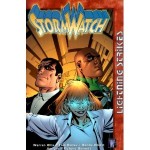
Stormwatch: Lightning Strikes


By Warren Ellis, Tom Raney, Jim Lee & various (DC/WildStorm)
ISBN: 978-1-84023-617-0

StormWatch was a paramilitary Special Crisis Intervention unit tasked with managing global threats and superhuman menaces with international ramifications; operating under the oversight of a UN committee. From their “Skywatch” satellite in geosynchronous orbit above Earth they observed, waiting until a member nation called for help…

The multinational taskforce comprised surveillance and intelligence specialists, tech support units, historians, researchers, detention facilities, combat analysts, divisions of uniquely trained troops, a squadron of state-of-the-art out-atmosphere fighter planes and a band of dedicated superheroes for front-line situations beyond the scope of mere mortals. In the pilot’s seat was incorruptible overseer Henry Bendix – “The Weatherman”.

StormWatch was born during the comics revolution which saw celebrated young creators abandon major “work-for-hire” publishers to set up their own companies and titles – with all the benefits and drawbacks that entailed. As with most of those glossy, formulaic, style-over-content, almost actionably derivative titles, it started with an honest hectic enthusiasm but soon bogged down for lack of ideas.

Warren Ellis took over the ponderous feature with issue #37 (see the previous collection StormWatch: Force of Nature) and immediately began beating life into the title. Soon “just another high-priced team-book” became an edgy, unmissable treatise on practical heroism and the uses and abuses of power. Making the book unquestionably his plaything Ellis slowly evolved StormWatch out of existence, to be reborn as the no-rules-unbroken landmark The Authority.

StormWatch: Lightning Strikes collects issues #43-47 of the comicbook, taking short, hard looks at individual cast members and also features a spectacular gallery of covers and variant-covers by Tom Raney & Randy Elliot, Mark Irwin, Gil Kane and Jim Lee.

The incisive explorations begin with ‘Jack Hawksmoor’, a human subjected to decades of surgical manipulation by aliens to become the avatar of cities. Drawn to the scene of a serial killer’s grotesque excesses Jack uncovers a festering government cover-up which reaches deep into the soul of America’s most revered idols and threatens to rip the country apart if exposed.

But the apparently untouchable murderer will never cease his slaughter-campaign unless someone stops him…

‘Jenny Sparks’ follows the cynical Englishwoman whose electrical powers were an expression of her metaphysical status as incarnate “Spirit of the Twentieth Century”: a captivating pastiche of fantasy through the last hundred years as the jaded hero recounts her life story (see also Jenny Sparks: The Secret History of the Authority) in a dazzling series of pastiches referencing Siegel & Shuster, Frank Hampson’s Dan Dare, Kirby, Crumb and the horrors of Thatcherite Britain in a gripping tale of betrayal, whilst the terse thriller ‘Battalion’ sees StormWatch’s normally non-operational, behind-the-scenes trainer fall into a supremacist terror-plot whilst on leave in Alabama and forced to call on skills and abilities he never thought he’d need again…

‘Rose Tattoo’ was a mute and mysterious sexy super psycho-killer recruited by Bendix as a walking ultimate sanction. When her super-powered team-mates go on a hilarious alcoholic bonding exercise she finally shows her true nature in a tale which foreshadows an upcoming crisis for the entire team… and planet.

Following Raney & Randy Elliot’s sterling run of the previous four tales Jim Lee & Richard Bennett illustrate the concluding ‘Assembly’ as Bendix sends his core-team into the very pits of Hell in a bombastic action-packed shocker that acts as a “jumping-on point” for new readers and a reminder of what StormWatch is and does… preparatory to Ellis kicking the props out from under the readership in the next volume…

One again skilfully mixing the traditional with the outrageous these episodes offered a fresh take on the costumed catastrophe genre that energised once-jaded readers and paved the way for the graphic phenomenon of the Authority. Darkly anarchic, funny and frightening these tales celebrate the best of what has gone before whilst kicking in the doors to a bleaker more compelling tomorrow.

© 1996, 1997, 2000 WildStorm Productions, an imprint of DC Comics. All Rights Reserved.

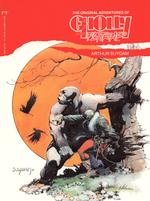
The Original Adventures of Cholly and Flytrap – A Marvel Graphic Novel


By Arthur Suydam (Marvel)
ISBN: 0- 87135-734-8

Scantily clad hot chicks swinging swords have been a staple of fantasy comics from their very inception, but there are none of those on view in this beautifully realised collection from illustrator, designer, screenwriter and musician Arthur Suydam, whose anarchically humorous, offbeat confections and magical renderings have graced such disparate products as magazines Heavy Metal, National Lampoon, Penthouse Comix and Epic Illustrated (where these brutally madcap little graphic novellas first appeared – specifically issues #8, 10, 13, 14 and 34), comicbooks like Tarzan, Conan, Batman, House of Mystery and Marvel Zombies and movie spin-offs Aliens and Predator.

He has also well as produced covers for novels including Max Allan Collins and Mickey Spillane’s collaborative Dead Street and Game box-art for Touch the Dead. Periodically Suydam returns to his own uniquely creative projects such as Mudwogs and the military muck-ups of Cholly and Flytrap, teasingly releasing another snippet every so often…

This then is the other sort of fantasy: lavishly grotesque, manically arch and surreptitiously satirically subversive; a lavish blend of dryly witty pastiches combining elements of Moebius’ Arzach, the imaginative  sci-fi earthiness of Vaughn Bode and a surreal anti-war temperament that imbues the blackly comic ultra-violence with a hauntingly tragic undertone.

Long ago the space-barge Exodus II crashed on an uncharted world. After untold ages the survivors have bred but never prospered, locked as they are in the constant struggle for survival. It’s not that the planet is particularly inhospitable… it’s just that the denizens -indigenous and not – adore war-making and love killing…

Apparently Cholly began life as a bat-riding warrior: an image for the poster advertising the animated Heavy Metal movie, but he was mysteriously transformed into a hot chick on a pterodactyl after acceptance (this sort of inexplicable conceptual metamorphosis happens a lot in film-land) leaving Suydam with a cool-looking visual and a lot of ideas…

Time passed, Marvel started a creator-owned, rights-friendly fantasy periodical in response to the success of Heavy Metal and a reinvented bat-riding, goggles-wearing icon of conflict began appearing. Of course, he had evolved slightly and the chiropteran had become a colossal, naked, bald fat man. Cholly still rode him like a seasoned veteran though…

The collected insanity begins with ‘A Little Love, a Little Hate!’ from 1981, a frenetic chase/duel between a foul-mouthed, flying jacketed war-hawk and his slug-like arch-enemy, which showed Cholly’s streetwise cunning in spectacular, over-the-top fashion.

‘Flightus Interuptus’ followed, an airborne tussle (possibly started before the previous tale?) wherein the high-flying Cholly, sans Flytrap, battled a massive mammary zeppelin-bomber in nothing more that a primitive tri-plane pulled by a brace of the planet’s levitating anti-gravity breasts (no, really). Tragically shot down in the throes of victory, the adaptable aviator found a giant bat to ride (remember kids, recycling even of ideas and art is good for any planet). Sadly the noble beast didn’t last long…

Soldier and human(ish) steed were reunited for the longer saga ‘The Rites of Spring‘ as Suydam expanded his cast and extemporized on the concept of mortals as organic war machines in a Horatian tale of Thermopylan courage with Cholly and faithful, mute Flytrap holding back a veritable horde of slug-troopers and big-ass war-wagons – a smart and lusciously graphic feast of visual violence and sassy back-chat.

‘The End’ begins with the war-lover tooling around the sky on some more of those flying hooters until he encountered a monolithic monster having a furious argument with his own outrageously outspoken boy-bits. Passions aroused and tempers flaring, Cholly was witness to an ending you simply don’t see every day…

The short, sweet, one-trick gags grew into something more complex (a portent of the substantial tales that followed far too infrequently over the next twenty years) in the hilarious concluding Epic entry ‘The Adventures of Cholly and Flytrap’ (plotted by Peter Koch) as the peripatetic pair hauled up at their favourite restaurant for a feed. Impatience, hunger, foreign food and honking big guns never make for a sedate evening…

Topped off with a glorious portfolio of monochrome sketches and working drawings plus the magnificent cover of Epic Illustrated‘s last issue this sumptuous, gratuitous and entrancingly daft eye-candy, released in the extravagantly expansive European Album format (a square-ish, high-gloss page of 285 x 220mm rather than today’s elongated 258 x 168mm) is a mature readers delight and yet another classy piece of work to add to the “why is this out of print?” list.
© 1981, 1982, 1986, 1991 Arthur Suydam. All Rights Reserved.

No Need For Tenchi! volume 1


By Hitoshi Okuda, translated by Fred Burke (Viz Graphic Novel)
ISBN: 978-1-56931-180-6

This bright and breezy adventure comedy is a rare reversal of the usual state of affairs in that the TV anime came first and the manga serial was a spin-off.

Tenchi Muyo! Ryo-Ohki debuted in 1992-1993 as a six-part TV cartoon series (termed an OVA or Original Video Animation in Japan) that proved so blisteringly popular that even before the original season concluded further specials and episodes were rushed into production. Over the next decade or so two more seasons appeared as well as spin-off shows and features (for a total of 98 episodes all told), plus games, toys, light novels and, of course, a comic book series. The translation most commonly accepted for the pun-soaked title is No Need For Tenchi but equally valid interpretations include Useless Tenchi, No Heaven and Earth and This Way Up.

The assorted hi-jinks of the TV show resulted in three overlapping but non-related continuities, with the Hitoshi Okuda manga serials stemming directly from the first season. Okuda eventually produced two comics sagas in this format: Tenchi Muyo! Ryo-oh-ki which began in 1994 and features in this volume under review and the follow-up Shin Tenchi Muyo! which I’ll get to one fine day…

The strip debuted in the December 16th 1994 Shōnen anthology (comics pitched at 10-18 year old males) Comic Dragon Jr. It ran until Jun 9th 2000, generating 12 collected volumes of classic laughs and thrills. The stories are generally regarded as non-canonical by fans of the various TV versions but of course we don’t care about that since the printed black and white tales are so much fun and so well illustrated…

This first volume collects the first seven issues of the pioneering Viz comicbook Tales of Tenchi, which did so much to popularise Manga in the English-speaking world, and opens with a thorough and fascinating recap of that first TV season – from which all the succeeding manic mirth and mayhem proceeds – before cracking on to bolder and better bewilderments starring the entire copious cast on all new adventures and exploits…

Tenchi Masaki is an ordinary boy living peacefully in the countryside with his father Nobuyuki and grandfather Katsuhito, until one day he breaks opens an ancient shrine and lets a demon out. The hell-fiend Ryoko tries to kill him but a magic “Lightning Eagle Sword” helps him escape. The demon follows him though, demanding the sword and things get really crazy when a spaceship arrives revealing Ryoko is in fact a disgraced alien pirate from the star-spanning Jurai Empire.

Starship Ryo-oh-ki is full of attractive, shameless, immensely powerful warrior-women including Princesses Ayeka, her little sister Sasami and supreme scientist Washu. This gaggle of violently disruptive visitors moves in with Tenchi and family, causing nothing but trouble and embarrassment, and soon the boy and his sword are being dragged all over the cosmos in the sentient Ryo-oh-ki (who, when not on duty, prefers the form of a cute rabbit/cat hybrid critter).

Ayeka and Sasami both harbour feelings for the hapless Tenchi but things get really complicated when grandfather Katsuhito is revealed to be Yosho, a noble Prince of the Jurai. It appears Tenchi and those darned space girls are all related…

Tales of Tenchi opened with ‘The Genius’ as the lad, currently studying Jurai warrior training under his grandfather’s diligent tutelage, falls foul of the alien princesses’ growing boredom, until Ryoko attacks again, precipitating a devastating battle that threatens to burn the entire landscape to ashes. But is the aggressor really the demon pirate?

In ‘Double Trouble’ the other Ryoko tries to take Tenchi’s sword – in actuality a puissant techno-artefact known as the Master Key – before being defeated by the original, but at the cost of shock-induced amnesia. ‘Under Observation’ depicts some outrageous and inadvisable potential cures for the distressed Ryoko as the refugees all decompress, but when the defeated doppelganger’s master Yakage arrives the entire extended family are threatened. The terrifying star-warrior challenges Tenchi to a duel…

Part 4 ‘Plunder’ is one colossal hi-energy clash as the boy valiantly demonstrates all he has learned to drive off the intruder, but only after the villain takes Ayeka hostage, demanding a rematch in 10 days time…

Intensifying his training in ‘Practice Makes Perfect’ Tenchi prepares for the upcoming battle whilst Ryoko pursues Yakage into space, unaware that super-scientist Washu has hidden herself aboard the pursing ship…

‘A Good Scolding’ reveals some intriguing history regarding the assorted super-girls whilst Tenchi trains for the final confrontation and the concluding chapter ‘Relationships’ brings the initial volume to a spectacular climax whilst still leaving a cliffhanger to pull you back in for the next addictive instalment…

Blending elements of Star Wars: A New Hope with classic Japanese genre favourites (fantasy, action, fighting, embarrassment, loss of conformity and hot chicks inexplicably drawn to nerdy boys), this sensational romp also includes a couple of comedy vignettes starring ‘The Cast of No Need For Tenchi’ in fourth-wall busting asides, to suitably top off a delightfully undemanding fun-fest which will satisfy not just manga maniacs but also any lover of fanciful frivolity and sci fi shenanigans.
© 1994 by Hitoshi Okuda/Kadokawa Shoten Publishing Co Ltd., Tokyo. NO NEED FOR TENCHI! is a trademark of Viz Communications Inc.

Arena – A Marvel Graphic Novel


By Bruce Jones (Marvel)
ISBN: 0- 87135-557-6

In  the early 1980s Marvel led the publishing pack in the development of high quality original graphic novels: mixing out-of-the-ordinary Marvel Universe tales, new in-continuity series launches, creator-owned properties, licensed assets, movie adaptations and even the occasional creator-owned property in extravagantly expansive packages (a square-ish standard page of 285 x 220mm rather than the now customary elongated 258 x 168mm) that felt and looked instantly superior to the average comicbook no matter how good, bad or incomprehensible (my way of saying outside your average Marvel Zombie’s comfort zone) the contents might be.

By 1990 Marvel’s ambitious line of outré all-area epics had begun to stall and some less-than-stellar tales were squeaking into the line-up. Moreover, the company was increasingly relying on hastily turned out cinema adaptations with built-in fan appeal and safe in-continuity stories offering established and company copyrighted characters rather than creator-owned properties and original concepts. The once-unmissable line began to have the appearance of an over-sized, over-priced clearing house for leftover stories.

So this stunning suspense saga counts as one of the last – and very best – indie/mainstream fiction experiments from before the rot set in; a creepy, clever, sexy thriller from EC fan and artistic everyman Bruce Jones which sets up shop in Stephen King and Ray Bradbury territory to deliver an overwhelmingly impressive rollercoaster of shocks and twists.

Sharon and her 12 year old daughter Lisa are driving through the majestic rural backwoods of America. It’s a pretty acrimonious journey and when the opportunity presents itself Mom takes a break and goes for a refreshing dip in a mountain pool whilst daughter stays in the car sulkily playing with her toy planes.

Sharon’s idyllic moment is shattered when she sees a jet crash scant yards away. However she can’t find any wreckage or even the slightest sign of it. Lisa saw and heard nothing and neither did the sinister voyeur who had been spying on them…

Rushing back to his shack simpleminded Lem tells his demented Granny about the strange woman. The old crone smells opportunity: if they can capture her and if she’s fertile they can sell her babies in the Big City… and even if she’s not big brother Rut will have a new plaything for awhile…

Lost in the deep woods Lt. Roberts, USAF crawls out of her crashed plane and hears voices. Sharon and the downed pilot start talking and realise that although they can’t see each other they are standing side by side. They’re invisible because they’re separated by two decades…

Somehow the mountain and forest are one huge time-warp… and increasingly, various eras are overlapping. Even though Sharon can only talk to Roberts, dinosaurs and cavemen are chaotically roaming over the hills, endangering both women in their own time-zones…

At that moment Lem and Rut strike, snatching Sharon. locking her up ready to make some money-spinning young ‘uns. From the car little Lisa sees her mother taken and twenty years in the future pilot Lisa Roberts suddenly remembers the horrifying moment her mother was killed by Hillbilly rapist psychopaths…

The time-shifts briefly stabilise and the two Lisas meet…

With beasts and worse roaming the woods the elder girl realises she has a chance to unmake the worst day of her life, but there are complications she could never have imagined in store for her and the girl she used to be…

Sultry, sinister and devilishly cunning this chronal conundrum is beautifully illustrated by Jones and his corkscrew plot is packed full of genuine surprises. Don’t think you’ve guessed the ending because you most likely haven’t…

A perfect sci fi movie-in-waiting, this terse and evocative yarn follows all the rules for a great screen shocker without ever having to “dumb-down” the temporal mechanics in deference to the Great Un-read in the popcorn seats.

Smart, seductive storytelling for sharp-witted punters, this is a time-lost gem you should track down however long it takes…
© 1989 Bruce Jones. All Rights Reserved.

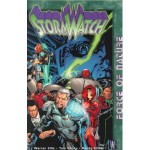
Stormwatch: Force of Nature


By Warren Ellis, Tom Raney& Randy Elliot (DC/WildStorm)
ISBN: 978-1-48023-611-8

StormWatch evolved out of the creative revolution which saw big name creators abandon the major “work-for-hire” publishers and set up their own companies and titles – with all the benefits and drawbacks that entailed. As with most of those glossy, formulaic, style-over-content, almost actionably derivative titles the series started with a certain verve and flair but soon bogged down for a lack of ideas and outside help was called in to save the sinking ships.

Dedicated Iconoclast Warren Ellis took over the cumbersome series with issue #37 and immediately began brutalizing the title into something not only worth reading but within an unfeasibly brief time produced a dark, edgy and genuinely thought-provoking examination of heroism, free will, the use and abuse of power and ultimate personal responsibility. Making the book uniquely his, StormWatch became unmissable reading as the series slowly evolved itself out of existence, to be reborn as the eye-popping, mind-boggling anti-hero phenomenon The Authority.

StormWatch was a vast United Nations-sponsored Special Crisis Intervention unit tasked with managing superhuman menaces with national or international ramifications and global threats, operating under the oversight of a UN committee. They were housed in “Skywatch” a futuristic space station in geosynchronous orbit above the planet and could only act upon specific request of a member nation.

The multinational taskforce comprised surveillance and intelligence specialists, technical support units, historians and researchers, detention technicians, combat analysts, divisions of uniquely trained troops, a squadron of state-of-the-art out-atmosphere fighter planes and a band of deputised superheroes for front-line situations beyond the scope of mere mortals. The whole affair was controlled by incorruptible overseer Henry Bendix – “The Weatherman”.

Referencing a host of fantasy classics ranging from T.HU.N.D.E.R. Agents and Justice League of America to Captain Scarlet and Star Trek: the Next Generation, StormWatch: Force of Nature collects issues #37-42 of the comicbook series and describes how the death of a team-member forces Bendix to re-evaluate his mission and find more effective ways to police the growing paranormal population and the national governments that seek to exterminate or exploit them…

The restructuring begins in ‘New World Order’ as, following the funeral of a fallen comrade, Bendix fires a large number of the superhuman contingent and recruits a trio of new “posthuman” heroes: electric warrior Jenny Sparks, extraterrestrially augmented detective Jack Hawksmoor and psycho-killer Rose Tattoo.

Weatherman’s own chain-of-command has altered too: his new superiors of the UN Special Security Council are all anonymous now and, with the world in constant peril, they have given Bendix carte blanche. He will succeed or fail all on his own…

The super-agents are further restructured: StormWatch Prime is the name of the regular, public-facing metahuman team, whilst Black is the code for a new covert insertion unit. StormWatch Red comprises the most powerful and deadly agents: they will handle “deterrent display and retaliation” – preventing crises by scaring the bejeezus out of potential hostiles…

Meanwhile, as all the admin gets signed off, in Germany a madman has unleashed a weaponized superhuman maniac to spreading death, destruction and disease. Whilst new Prime Unit deals with it Bendix shows the monster’s creator just how far he is prepared to go to preserve order on the planet below…

‘Reprisal’ is a murder investigation. No sooner had one of the redundant ex-StormWatch operatives arrived home than he was assassinated and Jack Hawksmoor, Irish ex-cop Hellstrike and pyrokine Fahrenheit’s subsequent investigation reveals the kill was officially instigated by a friendly government and StormWatch member-state…

Hawksmoor, Jenny Sparks and aerial avenger Swift are dispatched to an ordinary American town with a big secret in ‘Black’ as Amnesty International reports reveal that some US police forces are engaging in systematic human rights abuse. In Lincoln City they’re also building their own metahuman soldiers and testing them on ethnic minorities…

‘Mutagen’ sees the Prime team in action in Britain when terrorists release an airborne pathogen to waft its monstrous way across the Home Counties, turning humans into ghastly freaks for whom death is a quick and welcome mercy. As Skywatch’s Hammerstrike Squadron performs a sterilising bombing run over outraged Albion StormWatch Red arrives in the villains’ homeland to teach them the error of their ways…

In this continuum most superhumans are the result of exposure to a comet which narrowly missed the Earth, irradiating a significant proportion of humanity with power-potential. These “Seedlings’” abilities usually lie dormant until an event triggers them.

StormWatch believed they had a monopoly on posthumans who could trigger others in the form of special agent Christine Trelane, but when she investigates a new potential meta, she discovers proof of another ‘Activator.’

Coming closer to solving a long-running mystery regarding where the American Government is getting its new human weapons, Trelane first has to deal with the worst kind of seedling… a bad one…

This first collection of the Ellis Experiment concludes with the spectacular ‘KodÇ’.’ Japan shudders and reels under the telekinetic assault of cruelly conjoined artificial mutants bred by a backward-looking doomsday-cult messiah so the Prime team is dispatched to save lives and hunt down the instigators in a good old-fashioned, get-the-bad-guys romp which gives the team’s multi-faceted Japanese hero Fuji a chance to shine winningly…

Artfully blending the comfortably traditional with the radically daring these transitional tales offered a new view of the Fights ‘n’ Tights scene that tantalised jaded readers and led the way to the groundbreaking phenomenon of the Authority.

Tom Raney & Randy Elliott’s art is competent but mercifully underplayed – a real treat considering some of the excessive visual flourishes of the Image Era – but the real focus of attention is always the brusque “sod you” True Brit writing which trashes all the treasured ideoliths of superhero comics to such devastating effect.

This is superb action-based comics drama: cynical, darkly satirical, anarchic, alternately rip-roaringly funny and chilling in its examination of Real Politik but never forgetting that deep down we all really want to see the baddies get a good solid smack in the mouth…
© 1996, 1999 WildStorm Productions, an imprint of DC Comics. All Rights Reserved.

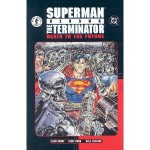
Superman versus Terminator: Death to the Future


By Alan Grant & Steve Pugh (DC Comics/Dark Horse Comics)
ISBN: 978-1-56971-476-8

I’ve never been all that partial to crossovers combining licensed characters. It seems to contravene an intrinsic law of narrative integrity simply for petty profit when two (or more) disparate headlining money-spinners are shoehorned into a story with scant regard for intrinsic values and often necessitating ludicrous plot-maguffins simply to make the match work. How many of these packages actually convert die-hards and newbies into comics fans?

Pleasantly countering that admittedly Grumpy Old Attitude is this rather effective star-sandwich that adds rather than combines the terrifying potential tomorrow of the Terminator films and Dark Horse comicbooks to the bright shiny world of Superman…

Sarah Connor and her son John are on the run and their prolonged flight has brought them to Metropolis, but even the home of Superman is not proof against unstoppable killer robots from a dystopian tomorrow where rogue computer Skynet has almost completed its program to exterminate humanity.

With Terminators ripping up his streets the Man of Steel is quick to step in and soon learns that the unconventional boy he’s protecting is destined to save mankind – but only if he isn’t murdered before he can begin…

Unknown to all, the cybernetic assassins have an ally: a techno-organic psychopath known as the Cyborg Superman. His insider knowledge allows Skynet to specifically upgrade its next wave of walking time-bombs against the Man of Tomorrow, and with the present looking shaky Superman is whisked into the turbulent future to join an old friend in taking the battle directly to Skynet.

With the capable Connors and Lois Lane holding the fort, assisted by Supergirl and Superboy, shady billionaire-technocrat Lex Luthor offers his double-edged assistance… but is he protecting his empire or prospecting for the future’s unborn secrets?

Meanwhile thirty years way Superman and humanity’s last defenders risk everything on a last-ditch raid on Skynet, but even with victory achieved there’s a nasty surprise awaiting the Caped Kryptonian when he gets back from the future…

Originally released as a four issue miniseries collaboration between DC and Dark Horse in 1999, this gripping script from the always-entertaining Alan Grant and stunning illustration from Steve Pugh, Mike Perkins and colourist David Stewart drive the high-octane, high-tension thriller with non-stop energy, delivering a killer punch that will delight fans of both franchises and perfectly proves that when it comes to spectacle and intensity, comics always have the home-ground advantage.
Text and illustrations © 1999, 2000 DC Comics, Inc., Canal+ DA and Dark Horse Comics, Inc. All other material © 2000 Dark Horse Comics Inc. All Rights Reserved.

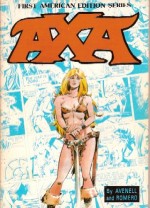
Axa volumes 1: Axa: The Beginning and 2: Axa the Desired


By Donne Avenell & Enrique Badia Romero (Ken Pierce Books)
Vol. 1 ISBN: 0-912277-04-1 Vol. 2 no ISBN

During the 1970s the British newspaper underwent radical changes in style and particularly content as lip service to female liberation and the sexual revolution allowed editors to wedge in even more semi-clad women for men to ogle even while bragging that now the chicks were in control of their own lives.

One place where that policy actually manifested in truly strong female role models as opposed to vapid eye-candy and fluff-piece fashion flash-in-the-pans was the comics page where the likes of Modesty Blaise, Scarth, Amanda and a wave of other capable ladies walked all over the oppressor gender both humorously and in straight adventure scenarios.

They still got their kit off at every imaginable opportunity, but that was just tradition and the idiom of the medium…

By 1978 the fuss and furore had somewhat subsided and aggressive, take-charge naked chicks had become commonplace, but when Star Wars reinvigorated public interest in science fiction the old concept of a scantily-clad, curvaceous beautiful barbarienne toiling through post-apocalyptic wonderlands resurfaced. The concept must have appealed mightily to the features editor of The Sun when it first crossed his desk, especially with Modesty Blaise illustrator Enrique Badia Romero attached to the proposal as artist…

Veteran writer Donne Avenell (who had cut his teeth on hundreds of British comics icons and such major international features as The Phantom and assorted Disney strips) provided racy, pacy, imaginative and subversively clever scripts for glamour-strip star Romero, who had begun his career in Spain in 1953, producing everything from westerns, sports, war stories and trading cards, often in conjunction with his brother Jorge Badía Romero. He even formed his own publishing house.

“Enric” began working for the higher-paying UK market in the 1960s on strips such as ‘Cathy and Wendy’, ‘Isometrics’ and ‘Cassius Clay’ before assuming the art duties on the high-profile Modesty strip in 1970, only leaving when this enticing new prospect appeared. Political and editorial intrigue saw Axa cancelled in the middle of a story in 1986 and Enric soon returned to Blaise until creator Peter O’Donnell retired in 2001. Since then he has produced Modesty Blaise material for Scandinavia and a number of projects such as Durham Red for 2000AD.

Axa ran in The Sun Monday to Saturday from 1978 to her abrupt disappearance in 1986 and other than these slim volumes from strip preserver Ken Pierce has never been graced with a definitive collection. It should be noted also that at the time of these books the strip was still being published to great acclaim.

The first black and white volume opens with an informative essay ‘Introducing Axa’ by publisher and historian Maggie Thompson outlining the history of and indifference to nudity in British newspaper strips after which ‘The Beginning’ takes us to 2080AD and a domed city where restless, buxom, anti-social amazon Axa chafes under the stifling oppressive security of the State which controls the citizens’ lives down to the most minute detail.

Throwing off her shackles and her clothes she leaves her assigned mate Jon, breaks out and flees to the post-apocalyptic wastelands created by The Great Contamination, populated only by mutants and monsters. In a cave she is attacked by a giant spider and saved by Matt, a debased (but hunky) warrior of the Middle People tribe. Taken to their village she discovers that the free primitives are just as hide-bound and oppressive as the City Men. Fleeing the village with the captivated Matt she finds a gleaming long-sword and finally discovers the secret of total true freedom is the ability to defend oneself…

Matt convinces her to return to the Middle Men, but she is betrayed and condemned to be a breeding female, but finds unwelcome release when she and her fellow captives are taken by raiding mutants. Easily escaping, she follows the raiders, intent on freeing the other captive women, once more linking up with the double-crossing Matt.

Surviving the monsters of the wilderness they catch up with the raiders only to be captured. After a climactic battle where Axa’s arguments and beliefs are more effective than any weapons, the rescued women are freed…

This segues straight into ‘The Chosen’ as Axa discovers that her fierce nature and astounding exploits has led the Middle People to declare her a goddess. Bemused by the attention at first she soon finds at it’s all a ploy by the wily tribe’s leader. Goddesses are locked up in temples where they can’t interfere or change the way the people are governed…

Never defeated, Axa breaks out and battles her way to freedom, dragging the ambivalent and indecisive Matt with her. Trekking through a beast-infested desert she is soon lost, alone and near death when she is rescued by Jon. Thinking he has come to join her she awakes to find herself a prisoner, returned to the Dome for therapy.

Sanitized and “Depersonalised’ with mind-bending drugs she once more becomes a decent citizen, but the lure of freedom is too strong and once more she rebels. Throwing off the chemical cosh Axa once more makes a break for the outside, but this time with the sanction of the Dome’s ruler who wants the unconquerable woman to undertake an impossible mission…


The second volume, containing the next two adventures, opens with a text appreciation and recap by Catherine Yronwoode after which Axa the Desired begins with the unstoppable freedom-seeker heading towards the coast, closely followed by the reluctant Jon, torn between his desire for her and disgust with the tainted world beyond the Dome.

Soon they have found a colony of survivors eking out an existence from the slowly healing seas, but are betrayed only to be rescued by two sailors from a foreign land. Jon has had enough and bolts back for the safety of the Domed City and Axa takes ship with the mariners, but the constant storms which batter the poisoned seas destroy their boat and she is washed ashore on an island where the old civilisation seems to have survived.

Appearances are deceiving: the lifestyle of the islanders is about to end as their stockpiled resources of guns and food and gasoline are all but gone. All but handsome Jason Arkady are decrepit dotards and their enclave was doomed until the healthy, hopefully fertile Axa turned up…

Initially horrified, the suave Jason almost turns the wild-woman’s head, but as the mad cracks in the isolated island-culture begin to show, she bolts and discovers that her companion from the shipwreck has been hiding out on the beach, secretly aided by Jason…

When the three try to escape, the suppressed insanity of the Arkady clan boils over in a cascade of blood, bullets and conflagration…

The next saga – also called ‘the Desired’ – sees the trio reach what was once Europe where the biggest surprise was Axa’s discovery of another Dome, just like the one she fled from but located at the bottom of a shallow sea. However this bastion of technology is even worse than her old home as the rulers are women who have dominated their own men and use mutants adapted to aquatic conditions as slaves and beasts of burden.

Even after all her woes at male hands Axa cannot abide the loss of any creature’s liberty and rejects the overtures of the Sea Women to join their society. Moreover when the slaves’ long-planned revolt erupts she manages to avoid taking sides and broker a solution acceptable to all…

These tales are classically European if not British in style: lavishly drawn, cunningly written, expansive in scope and utterly enchanting in their basic simplicity. Eminently readable and re-readable, perhaps the distant promise of a major motion picture (although the project has been in a development wasteland much like the one seen here since 2005) might lure a bold publisher into producing some definitive collectors editions…

© 1981, 1982, Express Newspapers, Ltd. First American Collectors Edition Series © 1982 Ken Pierce, Inc.

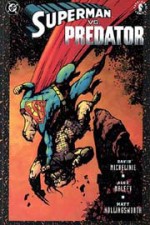
Superman vs. Predator


By Mark Schultz & Ariel Olivetti (DC Comics/Dark Horse)
ISBN: 978-1-84023-319-3

I’m never particularly comfortable with crossovers combining licensed characters. It seems to me that some basic law of narrative integrity is being flouted purely for venal profit when two (or more) disparate headlining money-spinners are shoehorned into a story with scant regard for intrinsic values and often necessitating ludicrous plot-maguffins simply to make the mismatch work.

On first look just such commercial instincts seem to ride roughshod over all other considerations in this Battle of The Brands from DC and Dark Horse, which originally appeared as a three-issue miniseries in 2000 before making the jump to stiff covers and nominal legitimacy as a graphic novel…

However, appearances can be deceiving and once the necessary leveling gimmick has de-powered the nigh-omnipotent Man of Tomorrow what’s left is a beautifully illustrated and tensely effective thriller that both movie mavens and funnybook fans can read and enjoy.

Written by David Michelinie and illustrated by Alex Maleev the action opens with a S.T.A.R. Labs expedition to La Jungla de Las Sombras, one of the hottest and isolated areas of the South American rain forest. A small group of scientists looking for specimens discover a half-buried alien spacecraft and immediately fall out. Whilst ambitious young Dr. Marla Rollins is bedazzled by the potential benefits and glory that would accrue from such a find, grizzled xenobiologist Casey Trabor wants to blow it up. He knows trouble when he sees it. Of course the mound of human skulls he’s standing on might be colouring his judgement…

In Metropolis, Lois Lane gets wind of the find and promptly heads South, but Superman arrives first, only to be exposed to a fast-acting extraterrestrial virus when he enters the fallen vessel with the squabbling scientists. The first inkling that something is wrong comes when the “dead” ship awakens and emits an alarm signal. Before anybody can react a surprise attack by paramilitary mercenaries drives off both the explorers and a painfully weakened Man of Steel.

Fleeing into the jungles the Americans learn the legend of the Predators (heavily referencing the first movie) from a native and when Lois finally turns up Superman is captured trying to rescue her from the mysterious soldiers.

All is revealed when the entire party is dragged before mad scientist Solomon Ward, who has turned a lost city into his private lab. Ward intends to inject a chemical into the Earth’s atmosphere that will wipe out all hereditary disease and disability. Unfortunately it works by killing all the “genetically impure” carriers at once, leaving only healthy, “pure” people alive to breed…

With Superman crippled and an unstoppable madman about to eugenically euthanise possibly everyone on Earth, dark secrets are revealed about more than one of the S.T.A.R. scientists, whilst elsewhere chaos and horror erupt as an invisible monster begins slaughtering the mercenaries…

The good guys escape and try to warn civilisation, whilst the dying Superman heads back to the downed ship looking for a last-ditch cure. What he finds is a bloody charnel house and an alien hunter summoned by the reactivated vessel.

Dying but indomitable, the Man of Steel must defeat an inhuman killing machine in time to stop mass genocide by far more wicked human monsters. The inscrutable Predator, however, has an agenda of its own, and of course there’s a thermonuclear self-destruct clock counting down too…

We are all, on some level, still just kids in our own heads, inhabiting a vast metafictional gestalt where Dracula, Adam Adamant, Thursday Next, Danger Mouse, Fu Manchu, James Bond and Carnacki, the Ghost Breaker stalk the same London streets (hey! That I would buy…) and occasionally it’s okay to giver in to the wide-eyed wonder addict – but only if the product is a well written and beautifully executed as this rare treat…

© 2001 DC Comics, Twentieth Century Fox Film Corporation and Dark Horse Inc. All Rights Reserved.

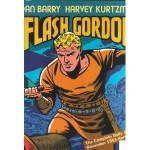
Flash Gordon: complete daily strips – 19th November 1951-20th April 1953


By Dan Barry & Harvey Kurtzman, with Frank Frazetta (Kitchen Sink Press)
ISBN: 978-0-86801-969-7

By most lights Flash Gordon is the most influential comic strip in the world. When the hero debuted on Sunday January 7th 1934 (with the superb Jungle Jim running as a supplementary “topper” strip) as an answer to the revolutionary, inspirational, but rather clunky Buck Rogers strip of Philip Nolan and Dick Calkins (which also began on January 7th, but five years earlier) two new elements were added to the wonderment; Classical Lyricism and astonishing beauty.

Where Rogers blended traditional adventure and high science concepts, Flash Gordon reinterpreted Fairy Tales, Heroic Epics and Mythology, spectacularly draping them in the trappings of the contemporary future, with varying ‘Rays’, ‘Engines’ and ‘Motors’ substituting for spells, swords and steeds – although there were also plenty of those – and exotic craft and contraptions standing in for Galleons, Chariots and Magic Carpets.

Most important of all, the sheer artistic talent of Raymond, his compositional skills, fine line-work, eye for sumptuous detail and just plain genius for drawing beautiful people and things, swiftly made this the strip that all young artists swiped from.

When all-original comicbooks began a few years later, dozens of talented kids weaned on the strip’s clean-lined, athletic Romanticism entered the field, their interpretations of Raymond’s mastery a ticket to future success in the field of adventure strips. Almost as many went with Milton Caniff’s expressionistic masterpiece Terry and the Pirates (and to see one of his better disciples check out Beyond Mars, illustrated by the wonderful Lee Elias).

For over a decade sheer escapist magic in a Ruritanian Neverland, blending Camelot, Oz and every fabled paradise that promised paradise yet concealed hidden vipers, ogres and demons, enthralled the entire world, all cloaked in a glimmering sheen of sleek art deco futurism. Worthy adversaries such as utterly evil, animally magnetic Ming, emperor of a fantastic wandering planet; myriad exotic races and fabulous conflicts offered a fantastic alternative to the drab and dangerous real world…

Alex Raymond’s ‘On the Planet Mongo’, with Don Moore doing the bulk of the scripting, ran every Sunday until 1944, when the artist joined the Marines. On his return he would create the gentleman detective serial Rip Kirby. The one continuous, unmissable weekly appointment with sheer wonderment, continued under the artistic auspices of Raymond’s assistant Austin Briggs who had drawn the daily instalments since 1940.

That Monday to Saturday black and white feature ran from 1940-1944 when it was cancelled to allow Briggs to take over the Sunday page. Often regarded as the poor relation, the daily strip got an impressive reboot in 1951 when King Features, keenly aware of the science fiction zeitgeist of the post-war world, revived it, asking Dan Barry to produce the package. The Sunday was continued by Austin Briggs until 1948 when Mac Raboy assumed artistic control, beginning a twenty year resurgence of classical brilliance. On Raboy’s death Barry added the Sunday to his workload until he quit over a pay dispute in 1990.

Barry (1911-1997) started as a jobbing artist in comicbooks, a contemporary of Leonard Starr and Stan Drake. Like them and his brother Seymour “Sy” Barry (who produced The Phantom newspaper strip for three decades) Dan worked in a finely detailed, broadly realistic style, blending esthetic sensibility with sharp detail and strong, almost burly virile toughness – a gritty “He-man” attitude for a new era and defined as “New York Slick”.

Dan Barry drew such varied comicbook series as Airboy, Skywolf, Boy King, Black Owl, Spy Smasher and Doc Savage before joining the Air Force. Returning after the hostilities he drew The Heap and assorted genre shorts for new titles such as Crimebusters. He also started his own business producing educational and informational comics.

He began the gradual departure from funny-books as early as 1947 when he took over the Tarzan daily strip for a year but he was still gracing DC’s crime, mystery and science fiction anthologies as late as 1954. When offered Flash Gordon he agreed, intending to write the feature himself. However, the financial rewards were meager and soon he was looking for a scripter.

The story of how cartoon genius Harvey Kurtzman came aboard (probably in February 1952) makes a fascinating postscript in this magnificent volume so I won’t spoil the revelations of the text feature at the back: a section which also contains a wealth of the new writer’s rough-penciled script layouts, sketches, ghosted pencils from young Frank Frazetta and a selection of Flash Gordon spoofs from other magazines. (If you’re interested, they include ‘Flesh Garden’ by Wally Wood from Mad #11 (May 1954), ‘Flyashi Gordonovitch’ (Jack Davis, Humbug #10, June 1958), ‘Little Annie Fanny’ (Playboy 1962, Will Elder) and Kurtzman’s own art for the cover of Snarf #5, September 1972).

This huge black and white tome, 320mm x 260mm, available as both hardback and softcover, reprints the entire run until Kurtzman’s departure with the 20th April episode. Later Flash Gordon story collaborators included writers Harry Harrison and Julian May and art assistants Bob Fujitani and Hillman Publications comrade Fred Kida – more magical material well worth collecting someday….

The new Flash Gordon daily debuted on 19th November 1951 with all the beloved history and scenarios of Mongo and the Ruritanian universe sidelined in favour of a grittier, harder-edged pulp fiction atmosphere. Sometime in the near future astronaut Flash launches into space, part of an expedition to Jupiter, However technical trouble forces the ship to stop at the Space Prison Station.

Docked for repairs the crew inadvertently triggers a riot as the ruthless convicts take a once-in-a-lifetime opportunity to escape the space rock… Terse and gripping, this two-fisted yarn rockets along with Flash, Dale and the crew fighting for their lives before finding an ally among the rioters, one who would eventually join them on their voyage to the gas giant and beyond…

With new iconoclastic tone and milieu firmly established, ‘Man Against Jupiter!’ began on Monday, February 25th 1952 (with Kurtzman’s first scripts appearing sometime in April). The crew orbiting the colossal globe once more experiences terrifying malfunctions and their atomic ship “Planet Pioneer” heads to the moon Ganymede to effect repairs. On landing the bold explorers discover a subterranean civilisation within the icy satellite and a young Earth boy…

Ray Carson was the son of a lost lunar scientist and his presence halfway across the solar system is but one of the intriguing mysteries challenging Flash and Dale as they battle alien madmen and malicious monsters in the hidden City of Ice… Of course the real threat is the willful, voluptuous Queen Marla who abducted Ray and his father…

Using teleport technology she had dispatched the missing scientist to another star-system to search for an element vital to the Ganymedan’s survival but when upheaval and revolution tear the city apart Flash, Dale, Ray and Marla can only escape by following the missing savant into an unknown universe…

Slowly the old accoutrements of the classic strip had been returning: lost civilizations, monsters, arena duels… and with this new sequence (beginning 17th June 1952) the creators brought back more fantasy elements as the survivors explore this new world hunting Dale, who had been lost in transit. After an intriguingly off-beat encounter with Butterfly Men and a grueling ocean odyssey the Flash, Marla and Ray discover a feudal race of horned and tailed, cloven-hoofed warriors in the devil city of Tartarus and an old friend making earth weapons for them as they strive to overthrow their tyrannical warlord…

Wherever Flash Gordon goes war and revolution seem to follow, but once the devil-men have settled their differences Flash, Marla and Ray resume the search for Dale, and stumble into the bizarrely advanced city of Pasturia, ruled by masters of the mind…

With “Planet Pioneer” crewman Bill Kent, the trio press on and soon make the most astounding discovery of all: this distant world is the retirement home of legendary Earth wizard Merlin, whose super technology includes a time-machine which not only recovers Dale and returns them all to Earth but subsequently endangers our home world by accidentally allowing criminals from the future to poison the planet…

Gripping, alluring, stunningly well illustrated (did I mention that the incomparable Frank Frazetta penciled a long sequence of incredible strips?) this lost treasure is pure graphic gold, presented on huge pages that perfectly display the virtuosity of all involved. Perfect, perfect comic strip wonderment…
© 1988 King Features Syndicate. Additional material © 1988 its respective copyright holders. This edition © 1988 Kitchen Sink Press. All Rights Reserved.

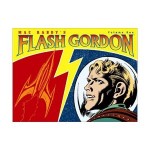
Mac Raboy’s Flash Gordon: Volume 1 Sunday Strips from 1948-1953


By Don Moore & Mac Raboy (Dark Horse)
ISBN: 978-1-56971-882-7

By most lights Flash Gordon is the most influential comic strip in the world. When the hero debuted on Sunday January 7th 1934 (with the superb Jungle Jim running as a supplementary “topper” strip) as an answer to the revolutionary, inspirational, but quirkily clunky Buck Rogers by Philip Nolan and Dick Calkins (which also began on January 7th, but in 1929) two new elements were added to the wonderment; Classical Lyricism and poetic dynamism. It became a weekly invitation to stunning exotic glamour and astonishing beauty.

Where Rogers blended traditional adventure and high science concepts, Flash Gordon reinterpreted fairy tales, heroic epics and mythology, spectacularly draping them in the trappings of the contemporary future, with varying ‘Rays’, ‘Engines’ and ‘Motors’ substituting for trusty swords and lances – although there were also plenty of those – and exotic craft and contraptions standing in for galleons, chariots and magic carpets. It was a narrative trick that kept the far-fetched satisfactorily familiar – and was continued by Raboy and Moore in their run. Look closely and you’ll see cowboys, gangsters and of course, flying saucer fetishes adding contemporary flourish to the fanciful fables in this volume…

Most important of all, the sheer artistic talent of Raymond, his compositional skills, fine line-work, eye for unmuddled detail and just plain genius for drawing beautiful people and things, swiftly made this the strip that all young artists swiped from.

When all-original comic books began a few years later, literally dozens of talented kids used the clean-lined Romanticism of Gordon as their model and ticket to future success in the field of adventure strips. Almost all the others went with Milton Caniff’s expressionistic masterpiece Terry and the Pirates (and to see one of his better disciples check out Beyond Mars, illustrated by the wonderful Lee Elias).

Flash Gordon began on present-day Earth (which was 1934, remember?) with a rogue planet about to smash the World. As global panic ensued, polo player Flash and fellow passenger Dale Arden narrowly escaped disaster when a meteor fragment downed their airliner. They landed on the estate of tormented genius Dr. Hans Zarkov, who imprisoned them in the rocket-ship he had built.

His plan? To fly the ship directly at the astral invader and deflect it from Earth by crashing into it…!

Thus began a decade of sheer escapist magic in a Ruritanian Neverland: a blend of Camelot, Oz and every fabled paradise that promised paradise yet concealed hidden vipers, ogres and demons, all cloaked in a glimmering sheen of sleek futurism. Worthy adversaries such as utterly evil but magnetic Ming, emperor of the fantastic wandering planet; myriad exotic races and shattering conflicts offered a fantastic alternative to drab and dangerous reality for millions of avid readers around the world.

Alex Raymond’s ‘On the Planet Mongo’ with Don Moore doing the bulk of the scripting, ran every Sunday until 1944, when the artist joined the Marines. On his return he eschewed wild imaginings for sober reality and created the gentleman detective serial Rip Kirby. The continuous, unmissable weekly appointment with sheer wonderment, continued under the artistic auspices of Austin Briggs – who had drawn the daily black and white instalments since 1940.

In 1948, eight years after beginning his career drawing for the Harry A. Chesler production “shop” comicbook artist Emanual “Mac” Raboy took over the illustration of the Sunday page. Moore remained as scripter and began co-writing with the artist.

Raboy’s sleek, fine-line brush style, heavily influenced by his idol Raymond, had made his work on Captain Marvel Jr., Kid Eternity and the especially Green Lama a benchmark of artistic quality in the proliferating superhero genre. His seemingly inevitable assumption of the extraordinary exploits led to a renaissance of the strip and in the rapidly evolving post-war world Flash Gordon became once more a benchmark of timeless, escapist quality that only Hal Foster’s Prince Valiant could touch.

This first 260 page volume, produced in landscape format and printed in bold stark monochrome (although one or two strips appear to have been scanned from printed colour copies) covers the period January 8th 1948 to May 10th 1953 and opens with Flash as President of Mongo when Slyk, a refugee from the believed-uninhabited moon of Lunita, arrives. Beseeching assistance to liberate his world from the tyrannical depredations of the wicked siblings Rudo and Lura, the Lunite accompanies Flash, Dale Arden and Dr. Zarkov to his hidden moon where the heroes are soon captured before Slyk saves the day.

This short transitional tale set up an unfailingly popular formula of nightmarish beasts, distressed damsels and outrageous adventure that would last until Raboy’s death in 1967.

Returning to Mongo Flash and Co. discovered a red comet hurtling towards that fabulous world. Whilst trying to deflect it they become trapped by the civilisation who inhabit its interior, creatures to whom gravity is but a toy… Once more romance, intrigue and beautifully depicted action were the order of many days until the trio toppled the masters and placed far more agreeable rulers in charge, saving their adopted world and the greater universe.

The saga lasted until June of 1949 and was promptly followed by a stunning undersea odyssey as a brief trip to Mongo’s beaches led Flash and Dale into murky waters when they rescued captivating Merma from monstrous sub-sea marauder Sharki and became enmeshed in a watery range-war and tricky romantic quadrangle involving hidden kingdoms, scaly savages and outrageous leviathans and sea-beasts.

It was off to the frozen principality of Polaria next where ambitious Prince Polon was covering up a plague of giant monsters preying on the people. Of course the scurvy villain was behind the plot, using size-shifting rays and his ultimate aim was to become dictator of all Mongo…

The scheme obviously gave other regional rulers ideas. No sooner did President Flash return than he was off again to the Tropix Islands where “Queen” Rubia had fomented rebellion and seceded from the democratic federation of Mongo States. Hands-on Flash went undercover with Dale in an Arabian adventure to rival Sinbad’s greatest: before the people were liberated and the despots destroyed there was a panoply of spectacular action and fantastic creatures to survive…

Rubia, defeated, was dispatched to the prison moon Exilia, but all was not right on that grim penal colony. Once more surreptitiously investigating our hero discovered that villains had taken over the penal-planet and were preparing to attack civilized Mongo. Luckily Rubia and criminal mastermind Zin believed Flash to be his own double, dispatched to Exilia for impersonating the President – but they’re were not fooled for long…

This awesome extended epic ran from 6th March to November 5th 1950 and was followed by a proposed change-of-pace as Flash and Dale took off for a much-needed vacation on Earth. Unfortunately ever-malicious Rubia sabotaged their ship and they crash-landed on the unexplored Planet Zeta. It surely came as no surprise to fans when they discovered another beautifully barbarous lost civilisation there…

Zeta was a world of colossal plants and feudal warriors, but hid a dangerous secret. Something in the environment consumed metal. Within minutes Flash and Dale saw their ship and weapons melt away… Befriended instead of attacked the castaways found the inhabitants lived on a world seemingly immune to technological advancement, controlled by “wizards” who soon decided that Flash was a threat…

Flash discovers the metal-eating plague was artificial and helped the Zetans rebel and they helped him construct a new ship. Once more en route for Earth Flash and Dale encountered a stranger meteor, but without further mishap arrived safely. On March 25th 1951 (17 years and some months after they departed) two of earth’s first star-travellers finally returned to their birthworld and were feted like royalty. Sadly they should have paid closer attention to that vagrant space-rock as soon, Earth was under attack by strategically aimed meteors.

With Einsteinish Professor Brite in tow, Flash and Dale tracked the attacks to the Moon where they met beetle-men and human dictator Rak who planned to conquer Earth with his lunar meteor gun. He had never encountered a man like Flash Gordon before…

With Rak’s threat ended Flash helped Earth build a sentinel Space Platform, but when he, Dale, engineer Dr. Ruff and his annoying niece Ginger began work 1000 miles up they clashed with a strange race of flying saucer-riding space gnomes from Mars…

At this time Mars clearly preferred, if not actually needed, Earth women and with Dale and Ginger abducted, another sterling romp ensued. Flash outfoxed the malign gnome-king Toxo before subsequently leading a full expedition to the Red planet where he discovered another advanced feudal civilisation and that Martian women – or at least their Queen, Menta – had no worries, looks-wise…

Menta was however, a spoiled and murderous psychopath determined to conquer Earth…

This epic ran until February 24th 1952, whereupon Flash returned to Earth to discover his homeworld gripped in a new Ice Age. Jetting to the Arctic the good guys found Frost Giants from Saturn (the fifth moon Rhea to be exact) and that the big Freeze was artificially induced. Although he destroyed their forward base the Giants dragged Flash back to Rhea and inadvertently introduced human smallpox into their population…

Earth commander “Icy” Stark abandoned Dale after a space battle but Flash, with new Rhean allies rescued her and once more led a hostage society to overthrow its unfit rulers. On the return to Earth the fleet encountered a guided comet and met a new foe in Pyron the Comet Master.

Reunited with Dr. Zarkov the heroes battled the demented scientist’s horrendous creatures, saving Earth from flaming doom but were catapulted helplessly to the surface of enigmatic Venus for the last complete adventure in this stellar collection.

Not only is our solar system teeming with unsuspected life, but it appeared most of it was ruled by complete sods, as Flash, Dale and Zarkov battled winged tree-men, swamp horrors and the nefarious overlord Stang, enduring staggering hardship and hazard before crushing the tyrant and freeing two separate races from terror.

With a new ship, the far-flung travellers set off for Earth but were forced to land on the Moon where a secret human base had been established. For unknown reasons Dr. Stella and her thuggish aide Marc detained and delayed them, but when an increasing number of close shaves and mysterious accidents occurred, a little digging revealed that they were the unwitting guests of ruthless space pirates…

As is probably fitting for one of the world’s greatest continuity strips this first volume ends on a gripping cliffhanger, but with so much incredible action, drawn with such magnificent style there’s no way any fan of classic adventure can possibly feel short-changed

Mac Raboy was the last of the Golden Age of romanticist pencillers; his lush and lavish flowing adoration of the perfect human form was already fading from popular taste (for example the Daily feature at this time switched to the solid, chunky, He-manly burly, realism of Dan Barry and even Frank Frazetta) but here at least the last outpost of beautiful heroism and pretty perils prevailed, and thanks to Dark Horse you can visit as easily and often as Flash and Dale popped between planets, just by picking up this book and ones which followed…
© 2003 King Features Syndicate Inc. ™ Hearst Holdings, Inc. All Rights Reserved.