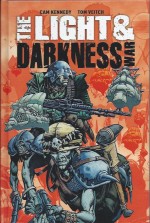
The Light and Darkness War


By Tom Veitch & Cam Kennedy (Titan Comics)
ISBN: 978-1-78276-180-8

During the 1980s the American comics scene enjoyed an astounding proliferation of new titles and companies in the wake of the creation of the Direct Sales Market. With publishers able to firm-sale straight to retail outlets rather than overprint and accept returned copies from non-specialised vendors, the industry was able to support less generic titles and creators could experiment without losing their shirts.

In response Marvel Comics developed a line of creator-owned properties at the height of the subsequent publishing explosion, launching a number of idiosyncratic, impressive series in a variety of formats under the watchful, canny eye of Editor Archie Goodwin. The delightfully disparate line was dubbed Epic Comics and the results reshaped the industry.

One of the most evocative releases was a darkly compelling war/fantasy/science fiction serial with a beautifully simple core concept: Valhalla is real and forever…

Conceived and created by author, poet and comics scribe Tom Veitch (Legion of Charlies, Antlers in the Treetops, Animal Man, Star Wars: Dark Empire) and Cam Kennedy (Fighting Mann, Judge Dredd, Batman, Star Wars: Dark Empire) The Light and Darkness War originally ran from October 1988 to September 1989, just as that period of exuberant creative freedom was giving way to a marketplace dominated by reductive exploitation led by speculators.

Because of that downturn, this fantastic saga of martial pride and redemption through valiant service in the Great Beyond never really got the popular acclaim it deserved, hopefully something this glorious hardback retrospective compilation from Titan Comics will belatedly address…

Following heartfelt reminiscences and an appreciation in the ‘Foreword by Commander Mike Beidler, USN, Retired’ the astounding fable introduces paraplegic Vietnam war veteran Lazarus Jones, a broken, troubled warrior for whom the fighting never ended.

Home when he should have died with his inseparable friends, plagued with red-hot memories of beloved comrades lost when their Huey went down, by 1978 the wheelchair-bound wreck of a man is in a most parlous state.

Shattered by what will one day be designated Post Traumatic Stress Disorder, Laz cannot help making life hell for his devoted wife Chris. His miserable existence takes an even darker turn when Jones begins seeing visions of long-gone Huff, Slaw and Engle all calling him to join them.

A little later when Chris’ car crashes, Laz is severely hurt and left in a coma he might never awake from…

Elsewhere on the other side of Eternity, a shadowy shape speaks to Lazarus offering a choice: he can go back or he can join his long-departed brothers …

And thus begins a fantastic adventure as the half-man is restored to perfect health and reunited with those who know him best. The catch is that this afterlife is like nothing any holy book ever promised. It’s a vast cosmos of painful, unrelenting physicality where strange alien species commingle and Earth’s dead continue much as they had before.

Pilots steer gunships – albeit flying ones made of stone and levitated by little blue aliens called “menteps” – Leonardo da Vinci carries on inventing weapons for powerful lords and soldiers from every era have one more chance to serve and die…

Miraculously and joyously restored, Laz eagerly rejoins Engle, Slaw and Huff in the only thing he was ever good at. Manning a flying boat armed with light-powered weapons he becomes part of a vast force perpetually defying an unimaginable wave of invading evil from the Outer Darkness.

It’s a war with no overall plan or envisaged endgame, just eternal conflict, but recently a dark lord named Na has risen to the foremost rank of the “Deadsiders” and the legions of night seem to be gaining an advantage in the never-ending conflict fought on a million planets and a billion fronts…

For five hundred years however the genius da Vinci has created weapons that have checked the rapid advance and held the invaders to a tenuous stalemate, but Deadsiders are tirelessly patient and resort to inexorably taking worlds one at a time.

But now a novel event has taken place. Although Lazarus has happily enlisted in the army of Light comprised of those who died in battle on Earth, on the other side of the sky his body is still alive…

Stationed on besieged world Black Gate, Laz and the “Light Gang” are unable to prevent libidinous Lord Na from infiltrating and overcoming the planetary defences, but at least they save Governor Nethon‘s daughter Lasha from becoming the conqueror’s latest power-supplying plaything.

Although gradually winning the war for the dark, Na is impatient for a faster outcome. To achieve that end he had his necromancers rediscover an ancient, long-forgotten way to contact the Earth realm and dupes millionaire arms-dealer and devout Satanist Niles Odom into creating a device to physically bridge the dimensions.

Na’s wishes are simple; he wants earthly particle weapons, rail guns, atom bombs…

The unwitting dupe building Odom’s bridge is Nicky Tesla, a brilliant physicist whose intellect rivals that of his dead uncle Nikola, the wizard of electricity who once astounded the world.

With his clairvoyant girlfriend Delpha little Nicky has used his uncle’s old researches to complete an inter-realm gate for crazy-rich Odom, but when an army of zombies come through it and abduct him and Delpha nobody is prepared for what follows.

As the scientists are dragged across into an impossible world where Uncle Nikola is alive again, Laz and the Light Gang – following in Na’s wake – explosively head the other way…

They soon find themselves trapped on their birth-world, just as whole and hale as the day they died… and where Jones still languishes somewhere in a hospital bed.

With all the Afterworlds at stake they have no choice but to fight their way back to the War again…

Also included in this gloriously fulsome chronicle is a sketch-&-developmental art ‘Background Briefing’ by Veitch & Kennedy, discussing the Underground Comic origins and antecedents of the story as well as the history, physics and metaphysics of the Light and Darkness War and a potent overview and personal recollection from Stephen R. Bissette, ‘Endless War: The Life, Loss and Afterlife of Lazarus Jones’.

Fast paced, suspenseful, astonishingly imaginative and utterly beautiful to behold, the complex tale of Laz’s team and their struggle, how two generations of Tesla reshape a war that has been waged forever, and how in the end only love and devotion can battle overwhelming evil is a masterpiece of graphic endeavour and one no lover of fantasy fiction should miss.
The Light and Darkness War is ™ and © 2015 Tom Veitch & Cam Kennedy. All rights reserved.
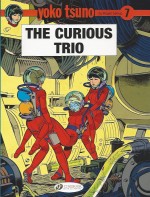
Yoko Tsuno volume 7: The Curious Trio


By Roger Leloup (Cinebook)
ISBN: 978-1-84918-127-3

The edgy yet uncannily accessible European exploits of Japanese scientific adventurer Yoko Tsuno began gracing the pages of Spirou from the September 24th issue in 1970 and are still going strong.

The mind-blowing, eye-popping, extremely expansive multi-award winning series was created by Belgian author, artist and novelist Roger Leloup who was born in 1933 and worked as one of Herge’s meticulous background assistants on the iconic Adventures of Tintin strip before striking out on his own.

Compellingly told, superbly imaginative yet always framed in hyper-realistic settings and sporting utterly authentic and unshakably believable technology, these illustrated epics were at the forefront of a wave of strips featuring competent, brave and immensely successful female protagonists which revolutionised European comics in the 1970s and 1980s and are as potently empowering now as they ever were.

The first Spirou stories ‘Hold-up en hi-fi’, ‘La belle et la bête’ and ‘Cap 351’ were all short introductory vignettes before Miss Tsuno truly hit her stride with premier epic Le trio de l’étrange which started serialisation with the May 13th 1971 issue.

Although the first of her 26 European albums, in English The Curious Trio was actually the 7th chronicle released by Cinebook and opens in a busy TV studio at midnight (back when actual humans pushed, pulled and focussed the clunky paraphernalia) where young Director Vic Van Steen loses his rag with best pal Pol Paris for falling asleep on his camera.

Later, still smarting from another fractious tiff, the pair walk home past a deserted construction site and espy what looks like a brilliant burglary…

The quietly flamboyant break-in is in fact a pre-arranged test by sleekly capable freelance Japanese electrical engineer Yoko Tsuno who has been hired by the owners of a major firm to test their new security. After apologising for nearly ruining her trial with their well-intentioned interference, the lads invite the enigmatic Yoko to join their film crew as sound engineer on a proposed outside shoot.

The job is to explore a range of flooded caves for a documentary and before the week is out the new friends are hauling equipment to a spectacular cavern ready to work out the technical details. No sooner do they begin however than something goes terribly wrong and the trio are dragged deep underground by the irresistible, swirling waters…

From here the remarkably realistic strip takes a huge leap into the uncanny as their subterranean submersion dumps them into a huge metal-shod vault where they are taken prisoner by blue-skinned humanoids.

The colossal complex is of incredible size and, as the captives are bundled into a fantastic vessel which runs on rails via magnetic levitation and driven even deeper underground, a handy translation helmet enables the only friendly-seeming stranger to explain.

Her name is Khany and her race, the Vineans, have been sleeping in the Earth for almost half a million years…

However since recently awakening internecine strife has entered the lives of the colonists as ambitious militaristic brute Karpan constantly manoeuvres to seize power from the vast electronic complex known as The Centre which regulates the lives of the colonists.

The humans’ first meeting with the blustering bully does not go well after he tries to beat Khany, and martial artist Yoko gives him a humiliating and well-deserved thrashing…

In his fury Karpan attempts to disintegrate them but is pulled away by security forces. As the newcomers resume their trip to the Centre he secretly follows their magnetocarrier, resolved to destroy them…

As they hurtle to unimaginable depths in the maglev ship, Khany introduces the humans to a stowaway – her young daughter Poky – and relates the astounding tale of the Vineans’ escape from planetary doom and two million light-year voyage to Earth. Accustomed to subterranean living, when they arrived they hollowed out a mountain and dug down even further.

Her history lesson is interrupted by Karpan’s murderous attack, which is only thwarted by Yoko’s quick thinking and her companions’ near-insane bravery…

Eventually, after another, far more subtle murder attempt, the badly damaged magnetocarrier reaches its destination and the astonished visitors are brought before a stupendous computer to plead their case and expose Karpan’s indiscretions.

The vast calculator dubbed The Centre controls every aspect of the colony’s life and will deliver judgement on the human invaders’ ultimate fate, but after mind-scanning Yoko its pronouncement is dire: the strangers are to be placed in eternal hibernation…

When Pol plays his long-hidden trump card and threatens to destroy the machine with a stolen disintegrator, diplomatic Khany proposes a solution; suggesting simply waiting until they can all confront the still-absent Karpan…

Yoko is still deeply suspicious and not convinced that Karpan is responsible for every attempt on their lives. Whilst she’s resting that “night”, Poky sneaks into her habitation chamber and takes her on an illicit tour of the underside and innards of the impossibly huge complex that verifies her suspicions with a ghastly revelation.

What they expose is a horrific threat not just to the Vineans – Karpan included – but to every human on the surface of Earth…

The eerie mystery then explodes into spectacular action and a third act finale worthy of a James Bond movie as Yoko’s duel with an incredible malign menace settles the fate of two species…

Absorbing, rocket-paced and blending tense suspense with bombastic thrills, spills and chills, this is a terrific introduction to a world of rationalist mystery and humanist imagination with one of the most unsung of all female action heroes and one you’ve waited far too long to meet…
Original edition © Dupuis, 1979 by Roger Leloup. All rights reserved. English translation 2012 © Cinebook Ltd.

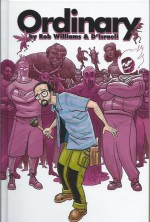
Ordinary


By Rob Williams & D’Israeli (Titan Comics)
ISBN: 978-1-78276-009-2

Admit it. We’ve all pondered – and both comics and movies have explored in various tones and styles – a particularly thorny contemporary question: what happens when everybody wakes up with superpowers?

Collecting a rather witty riff on that quandary, this wickedly charming little fable from Rob Williams & Matt “D’Israeli” Brooker – first seen in Judge Dredd Megazine #340-345 at the end of 2013, then as a Titan Comics miniseries and now gathered into one scintillating colour hardback tome – takes the big question a step further by positing that on that day of astounding ascension everybody becomes a modern Prometheus but you…

After an effusive Introduction from Warren Ellis the strange tale of off-the-books plumber and inept gambler Michael Fisher begins one typical morning as he wakes up in Queens, NYC. He’s late for another call-out and stumbling almost unthinkingly straight into a great big bunch of complete insanity.

Narrowly escaping a thorough thumping from the Samoans he owes cash to, the harried divorcee arrives at his latest job just in time to see the elderly client rapidly de-age to squelchy nothingness and short-tempered boss Brian turn into a talking bear.

The metamorphic madness is everywhere. Giants, flaming men and snotty dragons are popping up every second but all Michael can think of is calling his ex Sarah to see if their son Josh is okay.

As the freaked-out military rapidly fail to control the situation, the truth slowly dawns. Not just New Yorkers but all of humanity have, in the space of an instant, become a race of shapeshifters, superhumans and worse.

Everyone, apparently, except Michael…

As madness and panic grip the world Mike naturally heads for a bar and after Brian joins him they watch the President’s emergency news conference. It would have gone much better if someone had been able to tell PotUS that his new power was broadcasting his actual thoughts in little cartoon thought balloons above his head…

When TV news reveals his son Josh’s school is on fire Brian urges Michael to get across the river and find his boy but the now-empowered Samoans almost catch him and it takes low cunning, a Midas touch and a cosmically aware cabbie to save the day…

As chaos and carnage grip the nation, deep in the Pentagon the President is visibly (to all and sundry) losing it as his fundamentalist Vice-President stridently argues that the power proliferation is a Heaven-sent blessing intended to help the Land of the Free smite all the world’s unbelievers.

Scottish Genomics Professor and resident scientific expert Dr. Tara McDonald has a more reasoned argument. The situation is a literal plague and uncontrolled super-abilities will destroy mankind unless they find a cure quickly. Already America’s enemies are gathering and nations all over Earth are marshalling their burgeoning meta-resources to settle age-old scores and eradicate contemporary rivals.

However before McDonald can even postulate a remedy they have to find someone who is immune to the catastrophic contagion…

Against incredible odds – which comprise both transformees and the increasingly hard-pressed, savagely dictatorial remnants of the civil authorities – and all his normal instincts Michael has made his way into Manhattan even as in Washington McDonald’s best efforts have yielded pitiful results.

Things really go south after a nuke detonates in Afghanistan and the Veep seizes command. The rabid Christian doesn’t want a cure and when the only man in existence without uncanny abilities becomes a minor media celebrity after rescuing his son from a New York school, the acting Commander-in-Chief’s zealots are only one of a number of ruthless factions instantly targeting the unfortunate Mr. Fisher…

Now it’s a race against time as deadly opponents from warring and friendly nations alike contend to control the unluckiest, most useless man in the world with the fate of humanity in the balance. Fate and science however have teamed up to deliver a big surprise for everybody…

Also included in this thought-provoking package is a gallery of guest pinups from Edmund Bagwell, Ben Oliver, Laurence Campbell, Brian Ching & Michael Atiyeh, Brendan McCarthy, Neil Googe, Dom Reardon, Henry Flint, Alison Sampson & Ruth Redmond, James Harren, Ale Aragon and Mark Buckingham & D’Israeli, plus a little learned discourse – stuffed with the illustrator’s behind-the-scenes sketches and working drawings – on ‘Ordinary Science’ from Evolutionary Biologist and comics fan JV Chamary (PhD)…

Devilishly clever, cruelly passionate, potently humane and devastatingly funny, this sharp treatise on the true meaning of power politics offers a uniquely British spin on the eternal fantastic flight of idle fantasy and will delight all lovers of he genre with a world-weary eye to the way life really works…
Ordinary is ™ and © 2014 Rob Williams and Matt Brooker. All rights reserved.

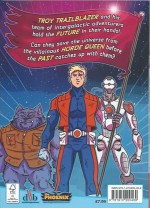
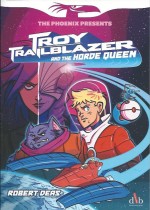
Troy Trailblazer and the Horde Queen


By Robert Deas (David Fickling Books)
ISBN: 978-1-910200-46-9

In January 2012 Oxford-based family publisher David Fickling Books launched a traditional anthology comics weekly aimed at girls and boys between 6 and 12 which revelled in reviving the good old days of British picture-story entertainment intent whilst embracing the full force of modernity in style and content.

Each issue offers humour, adventure, quizzes, puzzles and educational material in a joyous parade of cartoon fun and fantasy. In the years since its premiere, The Phoenix has gone from strength to strength, winning praise from the Great and the Good, child literacy experts and the only people who really count – the totally engaged kids and parents who read it…

The magazine inevitably led to a line of superbly engaging graphic novel compilations, the latest of which is a rollicking space opera romp that will delight readers with a profound sense of fun and unchecked imaginations.

From that fabulous first year and created by Robert Deas (November, Manga Shakespeare: Macbeth, Pride & Prejudice, Medikidz) comes impetuous stellar sentinel Troy Trailblazer – who originally appeared in The Phoenix #10, 18 and 27-32 – in a riotous complete adventure which mixes light-hearted sidereal shenanigans with just a touch of dark and dreadful doom…

Thanks to the double-page pin-up ‘Meet Team Troy’ you’ll quickly become familiar with the valiant lad, his advanced tactical droid Blip, animalistic alien associate Barrus and super-cool former bounty hunter Jess Jetrider.

Moreover the schematics for ‘The Pathfinder’ will provide all you need to know about the freelance heroes’ astounding starship, so there’s no need to pause before racing into ‘Chapter 1: Mistakes of the Past’ which finds the questing quartet bombastically retrieving the Infinity Jewel with a maximum of collateral damage from the Royal Palace on planet Thagus…

Congratulating themselves on a job well done the astral adventurers celebrate by setting course for the sunny beaches on Solus, but before too long battle-hardened Jessica is roused from hyper-sleep by a disturbing dream and acknowledges a distress call from ice-world Siberas…

On awakening, the baffled lads are far from happy to be wading across glaciers in beachwear and when the arctic conditions wreck the Pathfinder’s engines they lose all sense of proportion. It’s quickly regained, however, when a gigantic snow-beast starts chasing them and hurt feelings turn to pure terror when a clutch of horrific bug-like parasites easily bring the shaggy carnivore down…

Pushing on rapidly through the snows the cosmic champions soon find the mining colony which issued the distress call, only to discover the workers possessed by more of the creepy bugs. Most disturbing is the fact that Jess is seemingly hearing voices and acting weirdly distracted…

Things come to a grisly head when they recover a holo-message from security chief Alan Ripley which describes how deep excavations disinterred a monstrous hive-creature from an entombed starship. His warning is cut off mid-sentence and almost instantly our heroes are running for their lives from the bug-wearing, mind-locked miners who tirelessly hunt their would-be rescuers…

Somewhere amidst all the chaos Jess gets separated from her companions and, apparently answering a mental siren call, wanders off into the deepest part of the pit…

There’s a brief tension-break for ‘Blip’s Autopsy Report’ – wherein the robotic science wizard dissects and provides dissertation on the diabolical parasites – before the shocking suspense resumes with the Pathfinder crew following Jess but ultimately failing to stop her being taken over by the Horde Queen and becoming the malevolent monster’s perfect weapon of complete conquest…

After a frantic panic and race to escape the story resumes fifteen years later in ‘Chapter 2: The Fate of the Future’…

Over that dark period the Horde Queen’s spawn have erupted into space and devastated planet after planet. On Troy’s homeworld of Nova 2, the older, wiser and battle-weary Trailblazer is now leader of the hard-pressed Horde Resistance, fighting a losing battle against the ghastly melding of his best friend and the parasite-mother.

The determined freedom-fighters have lost every battle but thanks to brilliant Blip have devised a last chance solution which might win the war. Unfortunately, just as they activate the cobbled-together time-machine and head back to Siberas to stop Jess ever falling under the Queen’s spell, the triumphant horror bursts in and follows Troy and Barrus back to the beginning…

What happens next is both astoundingly heroic and bitterly tragic and reveals what happy endings actually cost.

Fast-paced, fun and not afraid to be really scary when it counts, this is a superb interstellar saga, excitingly told in a broadly manga manner which will delight space freaks and thrill seekers of all ages.

Text and illustrations © Robert Deas 2015. All rights reserved.

Troy Trailblazer and the Horde Queen will be released on June 4th 2015 and is available for pre-order now.

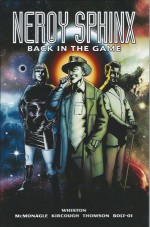
Neroy Sphinx: Back in the Game


By Daniel Whiston, Johnny McMonagle, James Kircough, Dave Thomson & Bolt-01 (FutureQuake Press)
ISBN: 978-0-9931849-0-1

If you grew up British in the last half century and read home-produced adventure comics you were primarily consuming either war or science fiction tales – and preferably both.

2000AD launched in February 1977 and quickly reshaped the minds of a generation of readers. It has been doing so ever since, consequently affecting and inspiring hundreds of creators…

Very much in the mould of the anarchic, subversive and wickedly cynical weekly comes this superb collection of tales starring a devious and irredeemably self-serving chancer with the fate of humanity unhappily piled on his shifty, unwilling and mostly uncaring shoulders.

Neroy Sphinx first began intermittently appearing in Indie comics sensation FutureQuake – specifically between issues #4-20, from 2005 to 2012 – and his quixotic escapades have now been fully remastered and gathered in this bombastic black-&-white paperback book, supplemented with two new tales.

Any further background you might require is eagerly included in ‘Who is Neroy Sphinx? – Foreword by James Lovegrove’…

Written throughout by Daniel Whiston, a peek into the legendary wrong-un’s murky history is first provided by ‘Blast from the Past: Prologue’, illustrated by Dave Thomson and set in the final days of EarthFed when sleazy politico and trade-whore Neroy saw most of his Ponzi-scheme style deals with alien races coming adrift all at once.

He didn’t care. He was using government resources to sift space for priceless Pre-Collapse artefacts and relics. A fortune could be made with the smallest shard of 10,000-year-old tech and he’s been stockpiling them for years…

However when über-psionic Clarence Griffin located a high-potential prospect, Sphinx, with assistants Anubis and Bast, discovered an asteroid-sized armaments cache of the Ancients and allies quickly became enemies. Sphinx was the only one to return, escorting a lethal and lovely autonomous weapons-system and concealing a deadly secret…

From FutureQuake #4, ‘One Last Job’ (art by Johnny McMonagle with grey-tones by Thomson) opens ten years later with Neroy now a scuzzy conman and partial amnesiac, fallen foul of elderly, astoundingly vicious mobster Mr. Dubblz. The wizened felon wants Sphinx to shepherd an art-heist but hasn’t reckoned on his cat’s-paw fooling not just the cops but also his employer…

Free and finally off-planet, ‘The Job From Hell’ (James Kircough/Thomson) finds the aging grifter on Proxima and slowly recovering memories. Unfortunately the first thing he remembers is that he removed certain recollections himself, in an effort to excise something too horrible to deal with.

In a certain place a decade ago he and Griff had accidentally unlocked a gate which had kept out voracious things from beyond human space for ten millennia. Griffin had done something to slow them down but with the door open they would certainly return one day soon… and now Sphinx again knows they’re coming…

An aimless wanderer, the mountebank resurfaces on a feudal backwater and becomes a pawn in a royal power-grab on ‘The De’Splurge Job’ (McMonagle/Thomson) before getting stuck as an indentured labourer on a privately-owned planet where his native cunning soon exploits the exploiters in ‘Fall to Rise’ (Kircough/Thomson)…

Glimmers of a long-term plan of counterattack can be discerned but things get decidedly hinky after Sphinx’s libidinous nature drags him into a transgender trap and another scammer’s scheme to steal a precious treasure in ‘What You See Ain’t What You Get’ (McMonagle/Thomson), after which more suppressed memories are revealed in ‘Ice Woman’ (Kircough/Thomson) as he is reunited with Fenris, the living weapon he once resurrected.

The meeting is brief and not amicable…

With human space gradually being infested by alien intruders ‘Cassiopian Queen’ (Kircough/Thomson) sees the Machiavellian miscreant captured by the sorry remnants of EarthFed security, only to turn the tables on both cops and the crazy space pirates challenging them for mastery of the void with exactly the kind of illicit tech everyone is chasing him for…

A valued old associate Neroy doesn’t remember fortuitously returns in ‘Enter the Griffin’ (Kircough/Thomson) when Sphinx is infected with a nano-virus to make him a much more motivated thief. Sadly for the gang boss with the antidote, the fabulous fraudster’s former friends haven’t forgotten him…

By now aware of the alien hell that’s coming, the getaway genius finds himself in a most unpleasant Institution beside humanity’s foremost expert on Galactic History, but as he now has a plan to deal with the incipient incursion all Neroy needs is a little more background information before ‘Breakin’ Outta the Bughouse’ (Dave Thomson)…

The final piece of the puzzle means heading back to poor, shattered Earth and a reunion with Griff and Fenris, but sadly ‘Old Familiar Places’ (Thomson) often house bad memories too and Mr. Dubblz has exceptional recall but no mercy…

Everything ends with a tantalising taste of things (hopefully) to come as last survivor Ensign Eudora Carver barely escapes her final skirmish with alien horrors thanks to an infuriating holo-message and bequest from the legendary Neroy Sphinx himself in the Thomson limned ‘Blast from the Past: Epilogue’…

To Be Continued…

But Wait, There’s More…

Rounding off the extraterrestrial experience, ‘Extras’ offers a pulchritudinous pin-up of ‘Princess Alloria’ by McMonagle, a handy ‘Timeline of the EarthFed Universe’ and ‘Script Notes & Sketches’ by Daniel Whiston & McMonagle, plus Dave Thomson’s ‘FutureQuake #20 Cover’ of the diabolical Mr. Dubblz.

Ambitious, gloriously engaging and exceedingly well-executed; this is contemporary space-opera with a broad scope and a deft touch that will delight lovers of edgy but light-hearted fantastic fiction.
© 2014 Daniel Whiston. All rights reserved.

Neroy Sphinx – Back in the Game is a mere £5.00 (plus P&P) and the latest issue of FutureQuake and companion mag Zarjaz are also available at the shop on their website.

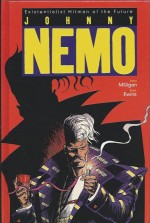
Johnny Nemo


By Brett Ewins, Peter Milligan and friends (Titan Comics)
ISBN: 978-1-78276-070-2

In the mid 1980s a creative explosion in British comics saw many groundbreaking new titles and a darkly cynical cultural flowering and renaissance in established titles. Many emergent writers and artists achieved prominence and a goodly few were promptly poached by America, forming what was called a “British Invasion”.

One team that crossed the pond in 1985 was Pete Milligan & Brett Ewins – already firm favourites with 2000AD readers – and for Eclipse Comics they created a darkly nihilistic post-punk private eye in alternative anthology Strange Days.

A year later the stylishly murderous maniac returned in Johnny Nemo Magazine for further far-future mayhem. He then dropped out of sight until Ewins co-opted the P.I.’s caseload and added some original exploits for the first year of indie British start-up Deadline Magazine – a seminal publishing landmark combining comics, pop culture, style, music and fashion he had created with fellow artist Steve Dillon.

Gloriously free of specious character development, Johnny Nemo remained who he always was: a murderous, devious, occasionally self-loathing London lad making a living from his only gifts.

He’s an over-sexed, avaricious, nosy, introverted, philosophical, existentialist thug. He’s also a problem-solver for hire and he lives in the future, which is not so different from now…

Following a fondly reminiscent ‘Introduction by Peter Milligan’ and ‘You’re Bastards. All of You. You’re All Bastards.’ – a heartfelt missive from the moody merc himself as seen in the 2002 collection Johnny Nemo: Existentialist Hitman of the Future – this sturdily resplendent hardcover compilation commences with ‘The Good, the Bad and the Nemo’ wherein the toughest ‘tec in 2991’s New London town is commissioned to investigate Father Burgess’ Orphanage.

The old institution – which once had the displeasure of young Johnny’s company after his parents’ last nervous breakdowns – is run by nuns and they’ve started exploding for no good reason. A seasoned riddle-solver, Johnny knows just who to smack around and soon discovers the incredible reason for the campaign of carnage before smoking out the habitual assassin…

Having made a lot of enemies, Nemo is always prepared for assassination attempts but nothing like the TeleInfo mind-mine which implants thousands of years of rational meanderings and philosophical cant in his usually indecision-free bonce. The measures taken to free-up his brain long enough to terminate his insidious attacker in ‘Cogito, Ergo Buggered’ are both shocking and shockingly effective…

Punishing puns and hyper-absurdism inform the strange case of ‘The White Quiffs of Dover’ after Nemo is hired to ferry a box containing the left testicle of Bing Crosby to an occultist. The potent eldritch artefact is also highly prized by a cult of albino Teddy Boys who will stop at nothing to obtain the treasured totem and unleash the uncanny crooner’s diabolical transmutative force.

However neither they nor the satanic singer pent inside the box have reckoned on Johnny’s innate ability to fight dirty…

Chronologically adrift, the 3 chapters of ‘The Orb of Harmony’ were first seen in the aforementioned Strange Days (from November 1984 to April 1985) and introduced Nemo and his robot secretary/sex-toy/therapist Kalina in a time-twisting tale which saw the enquiry agent hired by the government to recover an alien artefact before its loss sparked an interplanetary incident and intergalactic war.

It wasn’t hard to find the culprits in the jingoistically xenophobic League of Adam, but as they had already disposed of the Orb, the solution and return to status quo (involving the conquest of Earth, an invasion by Sirian slugmen and vast amounts of bloody violence) took a lot of planning and quite a bit of time…

From 1988 ‘The Immaculate Misconception’ is still a marvellously outrageous and controversial yarn as notoriously shag-happy Nemo is hired to protect the virginity of haughty alien hottie Princess Dania.

The demure deb is getting married in the morning and needs to be virgo intacta – something she is determined to avoid at all costs. Set on one last party she is nonetheless stuck with Johnny but calmly convinced that her looks and otherworldly pheromone arsenal will result in some serious, wedding-ending deflowering: if not from Nemo then one of his friends or enemies…

Of course Princess Da has neglected to mention the inescapable biological consequences of a night of illicit bliss with her…

Steve Dillon illustrated the clever case of murder-for-hire which saw media mogul Merdock Ridley contract Johnny to end his mega-rich life. Instantly suspicious, the lethally likely lad did some checking and discovered the job was a ploy on the gazillionaire’s part to cheat his trophy wife Fatima.

However since the trick involved freezing the assets along with the stiff (both to be revived at some time in the future) Nemo and ‘Lady Lucre’ put their heads – and sundry other body parts – together and came up with another option…

Whilst most of this book is in stark black-&-white, the three tales from Johnny Nemo Magazine are re-presented in strident full colour and ‘New London Pride’ (issue #3, February 1986 by Milligan, Ewins & Dillon) sees the hardboiled gumshoe troubled by uncharacteristic bad dreams. To gain a firm grip on himself he decides to go walkabout in the very dangerous gutters of miles-high New London City and vent some spleen against the vile and arrogant skinheads who infest the depths…

‘The Spice of Death’ – an all-Ewins art-fest – was a 2-part tale from Johnny Nemo Magazine #1 and 2 (September and November 1985) which detailed an old-fashioned tale of revenge as grieving Liza Creeture hired the man and his guns to find the killers of her brother.

The trail led to a bunch of rich-kids who hunted the poor for sport, desert metropolis Cairo and a gang of death-junkies who got high on extracted psychic auras of people who died in agony…

As the case proceeded and the bodies piled up, even Nemo began to smell a rat and suspect a cunning trap was in play…

Moving back into monochrome ‘The Hand of God’ then sees the independent trader blackmailed by bent coppers Flask and Stuff into taking out the returned messiah Jesus Christ, leading to the strangest confrontation in future history. However the Son of God is a wily sod and has a trick or two up his sleeve…

This turbulent, irreverent tome terminates with a stunning jam session as ‘New Tales of New London’ offers strip sessions by Rufus Dayglo, Ewins, Jock and Ashley Wood illustrating a sordid shift as Johnny – deflated by recent election results – indulges in introspection and tries out a few alternate personalities in ‘The Make Over’.

Still and all, whether a frou-frou interior designer, a sports hooligan, a laid-back loafer or a depressed down-and out, Johnny Nemo is still a man you don’t want to tick off…

Raucous, vulgar, excessively violent, politically incorrect and powerfully socially conscious, this superbly entertaining catalogue of chronal contretemps and spatial sorties is as potent and powerful as ever and today’s generation of toadies and Brit-fops should make certain they read, absorb and react accordingly…
Johnny Nemo is ™ and © 2014 Peter Milligan & Brett Ewins. All rights reserved.

Solid State Tank Girl


By Alan Martin & Warwick Johnson-Cadwell (Titan Comics)
ISBN: 978-1-78276-003-0

Comics have grown up since I was a kid. On one hand they’ve bloomed, adopting and encompassing serious attitudes whilst challenging social issues to become a literary arena as potent and valid as any other art form. And then there are those that boldly celebrate irrepressible vulgarity, inspirational rudeness, intoxicating visual bravura, incorrigible invention and sheer raucous daft fun, sort of like TISWAS for the Soul…

I’m going to say a few things about Solid State Tank Girl and let you guess which kind this book is…

Once upon a time upstarty art-students Jamie Hewlett and Alan Martin (and, tangentially, Phillip Bond) prowled the convention circuit impressing the hell out of everybody with their photocopied fanzine Atomtan. At the back of issue #1 was a pin-up/ad for a dubious looking young lady with a big, Big, BIG gun and her own armoured transport. Things happened. Brett Ewins and Steve Dillon commissioned a redeveloped version for their forthcoming publishing venture Deadline (a pop-culture magazine with loads of cool comics strips): the absurdist tales of a feisty, thoroughly well-armed bad-ass chick roaming the wilds of a futuristic Australia with her Kangaroo boy-friend Booga which caught the imagination of a large portion of the public and the zeitgeist of the times. Tank Girl got massive. There was even a movie…

Collecting the miniseries from 2013, this gloriously surreal full-colour hardback is one of the books spotlighted in Titan Comics’ Best of British Month and another explosively unforgettable annal in the chequered history of a true icon of Empire and decidedly dubious darling of the comics Commonwealth…

Expressively scripted by Alan C. Martin and astoundingly illustrated by the amazing Warwick Johnson-Cadwell, the story starts with the gun-gal and her marsupial man popping into an on-its-uppers radio shop in search of advice and trinkets for Booga’s Ham Radio kit and walking into a trap unlike any other…

Before long kangaroo-boy is in a coma and Tank Girl, Jet Girl and Barney are taking a Fantastic Voyage (with all the inherent and leftover pop culture mod cons) around his (extremely) nervous system, intent on destroying the brain clot slowly killing the clot in question.

It all goes tragically wrong though and soon instead of charting the cerebellum the trio of chaotic cussing kanganauts are helplessly ‘Circumnavigating Booga’s Left Bollock’…

What they find there is a microscopic but rapidly gestating little infant whom they quite naturally pluck from its ghastly environment and return to the relative safety of the good ship and sausage-shaped submersible Significant Triode…

Once aboard the vessel the pretty pink foetus proves far from normal as ‘Three Ladies, a Kangaroo & a Little Baby’ quickly descends from charming comedy pastiche into a hairy horror story as the rush to fix Booga’s brain blockage introduces the team to deadly ghosts, involves them in a mad dash to get out of the patient before they all regain their normal sizes and inculcates a worthy yet impossible resolution not to swear in front of the nipper…

Mission improbably accomplished, the girls and more-confused-than-ever Booga can only watch in shock and terror as their wee newcomer swiftly mutates into an unstoppable, super-powered evil antithesis… an Anti-Tank Girl…

The Big Pink She-Beast’s initial attack in ‘Awesome Wells’ almost ends our unsavoury heroine’s life and only Booga’s natural tendency to react with excessive violence and extraordinary ordinance drives the still-growing invader off.

As her friends fall back to a secret fortress and try to revive her, Tank Girl’s consciousness is visiting a very strange and hippie place, gleaning impenetrable clues on how to end the evil nemesis crisis…

She returns to the physical world just in time for a showdown with Anti-Tank Girl and a hastily gathered if rather sub-par gang consisting of Anti-Barney, Anti Booga and Auntie Jet Girl…

Soon cataclysmic final battle is joined in ‘Flippin’ ‘Eck Benny’ but even after the good guys somehow triumph there’s still the little matter of dealing with the sad little anonymous evil genius who crafted the whole plot. Luckily Tank Girl’s brief sojourn in La-La Land has pointed her subconscious in the right direction…

Bizarre, manically hilarious and crammed with captivating cartoon-violence, Solid State is an unashamedly riotous romp which comes with a brace of mini extras, beginning with a typically restrained exercise in bludgeoning ballistic ballet entitled ‘Make Them All Die’, after which a quiet moment spring-cleaning the tank goes messily awry in ‘The Girl That Cleansed Our Souls’.

Also included are a half-dozen motivational poem/poster pics, a cover gallery, sketch/artwork pages and an Afterword from the Anti-Alan…

Wild, weird, endlessly re-inventive and spectacularly silly, this an ever-so-cool rollercoaster thrill-ride and lifestyle touchstone for life’s incurable rebels and undying Rude Britannians, so if you’ve never seen the anarchic, surreal and culturally soused peculiarity that is Tank Girl, bastard love child of 2000 AD and Love and Rockets, you’ve missed a truly unique experience… and remember, she doesn’t care if you like her, just so long as you notice her…
Tank Girl and all related characters are ™ & © 2013 Jamie Hewlett and Alan Martin. All rights reserved.

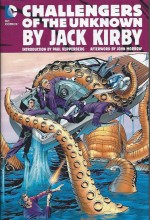
Challengers of the Unknown by Jack Kirby


By Jack Kirby, Dave Wood, France “Ed” Herron, Roz Kirby Wally Wood, Marvin Stein, George Klein & various (DC Comics)
ISBN: 978-1-4012-3474-4

The Challengers of the Unknown were a bridging concept between the fashionably all-American human trouble-shooters who monopolised comicbooks for most of the 1950s and the costumed mystery men who would soon return to take over the industry.

As superheroes were being revived in 1956 here was a super-team – the first of the Silver Age – with no powers, the most basic and utilitarian of costumes and the most dubious of motives – Suicide by Mystery.

Yet they were a huge hit and struck a chord that lasted for more than a decade before they finally died… only to rise again and yet again. The idea of them was stirring enough, but their initial execution made their success all but inevitable.

Jack Kirby was – and still is – the most important single influence in the history of American comics. There are quite rightly millions of words written (such as Paul Kupperberg’s enthusiastic Introduction and John Morrow’s pithy Afterword in this superb hardback compilation) about what the man has done and meant, and you should read those if you are at all interested in our medium.

I’m going to add a few words to that superabundance in this review of one of his best and most influential projects which, like so many others, he perfectly constructed before moving on, leaving highly competent but never quite as inspired talents to build upon.

When the comic industry suffered a witch-hunt-caused collapse in the mid-50’s, Kirby returned briefly to DC Comics where he worked on mystery tales and Green Arrow (then simply a back-up strip in Adventure Comics) whilst creating the newspaper strip Sky Masters of the Space Force.

He also re-packaged for Showcase (a try-out title that launched the careers of many DC mainstays) an original super-team concept that had been kicking around in his head since he and long-time collaborator Joe Simon had closed their innovative but unfortunately ill-timed Prize/Essankay/Mainline Comics ventures.

After years of working for others Simon & Kirby had finally established their own publishing company, producing comics with a much more sophisticated audience in mind, only to find themselves in a sales downturn and awash in public hysteria generated by an anti-comicbook pogrom spearheaded by US Senator Estes Kefauver and pop psychologist Dr. Frederic Wertham.

Simon quit the business for advertising, but Kirby soldiered on, taking his skills and ideas to a number of safer, if less experimental, companies.

The Challengers were four ordinary mortals; explorers and adventurers who walked away unscathed from a terrible plane crash. Already obviously what we now call “adrenaline junkies”, pilot Ace Morgan, diver Prof Haley, acrobat/mountaineer Red Ryan and wrestler Rocky Davis summarily decided that since they were all living on borrowed time, they would dedicate what remained of their lives to testing themselves and fate. They would risk their lives for Knowledge and, naturally, Justice.

The series launched with ‘The Secrets of the Sorcerer’s Box!’ in Showcase #6 (cover-dated January/February 1957 – so it was on spinner-racks and news-stands in time for Christmas 1956).

Kirby and scripter Dave Wood, plus inkers Marvin Stein and Jack’s wife Roz, crafted a creepily spectacular epic wherein the freshly introduced doom-chasers were hired by the duplicitous magician Morelian to open an ancient container holding otherworldly secrets and powers.

This initial story roars along with all the tension and wonder of the B-movie thrillers it emulates and Jack’s awesome drawing resonates with power and dynamism, which grew even greater for the sequel, a science fiction drama instigated after an alliance of leftover Nazi technologies and contemporary American criminality unleashes a terrible robotic monster.

‘Ultivac is Loose!’ (Showcase #7, March/April 1957) introduced a necessary standard appendage of the times and the B-movie genre in the form of brave, capable, brilliant and beautiful-when-she-took-her-labcoat-off boffin Dr. June Robbins, who became the fifth Challenger at a time when most comics females had returned to a subsidiary status in that so-conservative era.

The uncanny exploits then paused for a sales audit and the team didn’t reappear until Showcase #11 (November/December 1957) as The Flash and Lois Lane got their respective shots at the big time. When the Challengers returned it was in alien invasion epic ‘The Day the Earth Blew Up’.

Uniquely engaging comics realist Bruno Premiani (a former associate and employee from Kirby’s Prize Comics days) came aboard to ink a taut doomsday chiller that keeps readers on the edge of their seats even today, and by the time of their last Showcase issue (#12, January /February 1958) the Questing Quartet were preparing to move into their own title.

‘The Menace of the Ancient Vials’ was defused by the usual blend of daredevil heroics and inspired ingenuity (with the wonderful inking of George Klein adding subtle clarity to the tale of an international criminal who steals an ancient weapons cache that threatens the entire world if misused), but the biggest buzz would come two months later with the first issue of their own magazine.

Challengers of the Unknown #1 (May 1958) was written and drawn by Kirby, with Stein on inks and presented two complete stories plus an iconic introductory page that would become almost a signature logo for the team. ‘The Man Who Tampered with Infinity’ pitted the heroes against a renegade scientist whose cavalier dabbling loosed dreadful monsters from the beyond onto our defenceless planet, before the team were actually abducted by aliens in ‘The Human Pets’ and had to win their freedom and a rapid rocket-ship (sphere actually) ride home…

The same creators were responsible for both stories in the second issue. ‘The Traitorous Challenger’ is a monster mystery, with June returning to sabotage a mission in the Australian Outback for the very best reasons , after which ‘The Monster Maker’ finds the team seemingly helpless against super-criminal Roc who can conjure and animate solid objects out of his thoughts.

Issue #3 features ‘Secret of the Sorcerer’s Mirror’ with Roz Kirby and Marvin Stein again inking The King’s mesmerising pencils, as the fantastic foursome pursue a band of criminals whose magic looking-glass can locate deadly ancient weapons, but undoubtedly the most intriguing tale for fans and historians of the medium is ‘The Menace of the Invincible Challenger’ wherein team strongman Rocky Davis is rocketed into space only to crash back to Earth with strange, uncanny powers.

For years the obvious similarities of this group – and especially this adventure – to the origin of Marvel’s Fantastic Four (FF #1 was released in November 1961) have fuelled speculation. In all honesty I simply don’t care. They’re both similar but different and equally enjoyable so read both. In fact, read them all.

With #4 the series became artistically immaculate as the sheer brilliance of Wally Wood’s inking elevated the illustration to unparalleled heights. The scintillant sheen and limpid depth of Woody’s brushwork fostered an abiding authenticity in even the most outrageous of Kirby’s designs and the result is – even now – simply breathtaking.

‘The Wizard of Time’ is a full length masterpiece of the art form as a series of bizarre robberies lead the team to a scientist with a time-machine. By visiting oracles of the past rogue researcher Darius Tiko found a path to the far future. When he got there he intended robbing it blind, but the Challengers found a way to follow and foil him…

‘The Riddle of the Star-Stone’ (#5) is a full-length contemporary thriller, wherein an archaeologist’s assistant uncovers an alien tablet which bestows various super-powers when different gems are inserted into it. The exotic locales and non-stop action are intoxicating, but Kirby’s solid characterisation and ingenious writing are what make this such a compelling read.

Scripter Dave Wood returned for #6’s first story. ‘Captives of the Space Circus’ has the boys kidnapped from Earth to perform in a interplanetary show, but the evil ringmaster is promptly outfoxed and the team returns for France “Ed” Herron’s mystic saga ‘The Sorceress of Forbidden Valley’, wherein June becomes an amnesiac puppet in a power struggle between a fugitive gangster and a ruthless feudal potentate.

Issue #7 is another daring double-feature both scripted by Herron. First up is relatively straightforward alien-safari tale ‘The Beasts From Planet 9’, followed by a much more intriguing yarn on the ‘Isle of No Return’ as the team face a scientific bandit whose shrinking ray has left them all mouse-sized.

Issue #8 (July 1959) offered a magnificent finale to a superb run as Kirby & Wally Wood went out in stunning style with a brace of gripping thrillers – both of which introduced menaces who would return to bedevil the team in future tales.

‘The Man Who Stole the Future’ by Dave Wood, Kirby and the unrelated Wally Wood, introduces Drabny – an evil mastermind who steals mystic artefacts and conquers a small nation before the team dethrones him. This is a tale of spectacular battles and uncharacteristic, if welcome, comedy, but the real gem here is space opera tour-de-force ‘Prisoners of the Robot Planet’, (probably) written by Kirby & Herron. Petitioned by a desperate alien, the Challs travel to his distant world to liberate the population from bondage to their own robotic servants, who have risen in revolt under the command of the fearsome autonomous automaton, Kra…

These are classic adventures, told in a classical manner. Kirby developed a brilliantly feasible concept with which to work and heroically archetypical characters. He then tapped into an astounding blend of genres to display their talents and courage in unforgettable exploits that informed and affected every team comic that followed – and certainly influenced his successive landmark triumphs with Stan Lee.

But then Jack was gone…

The Challengers would follow the Kirby model until cancellation in 1970, but due to a dispute with Editor Jack Schiff the writer/artist resigned at the height of his powers. The Kirby magic was impossible to match, but as with all The King’s creations, every element was in place for the successors to run with. Challengers of the Unknown #9 (September 1959) saw an increase in the fantasy elements favoured by Schiff, and perhaps an easing of the subtle tension that marked previous issues (Comics Historians take note: the Challs were bitching, bickering and snarling at each other years before Marvel’s Cosmic Quartet ever boarded that fateful rocket-ship).

But that’s meat for another different book…

Challengers of the Unknown is sheer escapist wonderment, and no fan of the medium should miss the graphic exploits of these perfect adventurers in that ideal setting of not-so-long-ago in a simpler, better galaxy than ours.

© 1957, 1958, 1959, 2004, 2012 DC Comics. All Rights Reserved

Twin Spica volume 7

New, expanded review

By Kou Yaginuma (Vertical)
ISBN: 978-1-935654-12-4

The yearning, imagination and anticipation of space travel is paramount to this inspirational manga series from Kou Yaginuma, who first captured the hearts and minds of the public with his poignant short story 2015 Nen no Uchiage Hanabi (2015: Fireworks, published in Gekkan Comics Flapper, June 2000).

Following its unprecedented success, he expanded and enhanced the subject, themes and characters into a major epic combining hard science and humanist fiction with lyrical mysticism and traditional tales of school-days and growing up.

2024AD: teenaged Asumi Kamogawa has always dreamed of going into space. From her earliest moments the lonely child gazed up at the stars with her imaginary friend Mr. Lion, especially at the twinkling glow of Virgo and the alluring binary star Spica.

An isolated, serious child, she lived with her father, a common labourer who had once worked for the consortium which built the rockets for Japan’s Space Program.

When Asumi was a year old, the first Japanese launch ended in utter catastrophe after rocket-ship Shishigō (“The Lion”), exploded on its maiden flight: crashing to earth on the city of Yuigahama. Hundreds were killed and many more injured, including Asumi’s mother.

Maimed and comatose, the matron took years to die. The shock crushed her grieving husband and utterly traumatised infant Asumi.

In response to the disaster Japan set up an astronautics and space sciences training facility. After years of determined struggle, Asumi was accepted by the Tokyo National Space School. Slowly making friends like Shinnosuke Fuchuya (who used to bully her as child in Yuigahama), boisterous Kei Oumi, chilly and distant Marika Ukita and spooky, ultra-cool Shu Suzuki, Asumi daily moved closer to her unshakable dream of going to the stars.

Against all odds – she is small, looks weak and is very poor – Asumi endures. She still talks with Mr. Lion, who is apparently the ghost of an astronaut who died on the Shishigō…

Individual episodes are divided into “Missions” all slowly forming a vast tapestry explaining the undisclosed interconnectedness of all the characters and volume seven comprises numbers 30-38, as well as a brace of enchanting autobiographical vignettes from the author’s own teenage years.

‘Mission: 30’ begins with Asumi and her classmates enjoying their seaside vacation in the largely restored resort town of Yuigahama – even Ukita. Nevertheless the still-quite-formal living enigma is plagued by feelings that she has been here before. These phantom memories increasingly draw her to a secluded shrine dedicated to the disaster.

As previously seen in a sequence of flashbacks, she has an ancient and inexplicable connection to a boy who grew up to be Mr. Lion…

Long ago in Yuigahama, a lad obsessed with rockets met a frail, sickly rich girl stuck in isolation in a big house. Her name was Marika Ukita and they became friends despite her condition and the constant interventions of her furious father.

She was beguiled by the boy’s tales of space flight and the history of exploration. In return she shared the only joyous moment in her tragic life, when her over-protective dad took her to see a play called Beauty and the Beast…

During the big annual Fireworks Festival the boy made a lion-mask of the Beast to wear, but she never came. He had to break into the mansion to show her. She was very sick but wanted to dance with him…

Later the dying daughter had quietly rebelled when told she was being packed off to a Swiss sanatorium. She slipped out of the house when no-one was watching and vanished. The boy knew where she had gone and rushed off to save her…

‘Mission: 31’ finds Marika succumbing to her inner torment and wandering off to find the isolated commemoration monument. When she becomes dangerously lost and her mysterious medical malady overwhelms her, Asumi, moved by her own memory-ghosts, tracks her down just in time…

As they wait together to be found in ‘Mission: 32’, deep bonds are forged and Marika at last reveals that she is not a real person but “just a copy” of a sick and lonely girl who died long ago…

We are afforded a glimpse into events prior to and following the crash of the Shishigō and it becomes clear that both girls are afflicted with the same unquenchable need to escape Earth…

Asumi’s father Tomoro Kamogawa is no fan of the space program, having lost his wife, his engineering job and his pride to the race for space. In the wake of the catastrophe, despite being a grieving widower himself, he was assigned by his heartless bosses at the corporation who built the ship to lead the reparations committee.

Guilt-wracked and bereaved, the devastated widower had to visit and apologize to each and every survivor and victim’s family. He raised his daughter alone, working two and often three menial jobs at a time for over a decade…

Now with ‘Mission: 33’ the truth over those terrible events starts to unfold. His old engineering colleague Takahito Sano is now one of Asumi’s professors at the Space School and when they meet again, their men’s previous history and relationship is examined and reviewed for the first time in years…

As five young astronaut trainees further bond in an atmosphere of unravelling secrets and far too many persistent ghosts and memories, a potential cause of the crash is mooted. The years leading to the construction of the Lion are revealed to be littered with political in-fighting, unscrupulous double-dealing, thwarted ambitions and corporate cost-cutting.

Moreover both Sano and Kamogawa were extremely attached to the woman who became Asumi’s mother…

The second half of this book concentrates on the students’ return to school and their next semester of training. In ‘Mission: 34’ Asumi’s relationship with orphan student (and apparent anti-space program activist) Kiriu seems to be developing into more than mere friendship.

He volunteers at a hospice and is trying to learn the harmonica so that he can play to an old woman with dementia. He so very much reminds Asumi of her school friend Shimazu who died from cancer after the Yuigahama disaster…

Diffidently bonding, Kiriu tells her of a Sunday concert he’s playing a week hence and she promises to be there…

Elsewhere, the clone Ukita recalls how she began severing ties to the controlling dad who spent a fortune and broke the law to make her, and realises that her true home is with Asumi and her star-bound fellows…

‘Mission: 35’ focuses on school where the latest tests of strength, ingenuity and fortitude find the class divided into teams and transported to a decommissioned prison. Their task: to break free within seven days. Worried Asumi surprisingly convinces the teachers to drive them back to the city early if they all finish the task before Sunday…

The test continues in ‘Mission: 36’ as the jailed students face isolation and a seemingly insurmountable problem whilst back in the city a boy with a harmonica tries not to fixate on whether a certain girl will stand him up.

In his cell Fuchiya is also thinking about her: why he can never say what he wants to her and why he can’t see Mr. Lion…

In their shared dungeon Asumi, Kei and Marika are finally working together and have conceived an escape plan in ‘Mission: 37’. Not long after they are joined on the outside by Shi and Fucchy.

However in ‘Mission: 38’, even with things working her way there’s a snag in Asumi’s return to Tokyo and her date. Surprisingly, grouchy, unpredictable Fuchuya steps in to help the girl he spends so much time studiously annoying and ignoring…

Even with his brusque assistance she’s too late for the concert, but arriving despondent at the park she finds Kiriu waiting…

Even with her all her dreams coming true, however, Asumi is still sad. Despite appearances, the new boy is no Shimazu, whom she misses so very, very much…

To Be Continued…

The main event suspended, this moving tome then concludes with two more ‘Another Spica’ featurettes which find author Yaginuma in autobiographical mode again. Harking back to his ambition-free teens, the first reveals how a crappy job in refreshment retail afforded him time one Christmas to recall that special girl in school he tried to grow taller for, after which the summer drudgery of the job leads to memories of first dates, first drives and first loves…

These powerfully evocative tales originally appeared in 2004 as Futatsu no Supika 7 & 8 in Seinen manga magazine Gekkan Comic Flapper, aimed at male readers aged 18-30, but this ongoing, unfolding saga is perfect for any older kid with stars in their eyes…

Twin Spica filled 16 Japanese volumes from September 2001 to August 2009, tracing the trajectories of Asumi and friends from callow students to accomplished astronauts and has spawned both anime and live action TV series.

This compulsively addictive serial has everything: plenty of hard science to back up the savvy extrapolation, an ever-more engaging cast, enduring mystery, tender moments, isolation, teen angst and true friendships; all wrapped up in a joyous coming-of-age drama with supernatural overtones and masses of sheer sentiment.

Utterly defining the siren call of the Starry Reaches for a new generation (and the older ones too) Twin Spica is quite simply too good to miss…

These books are printed in the Japanese right to left, back to front format.
© 2011 by Kou Yaginuma. Translation © 2011 Vertical, Inc.

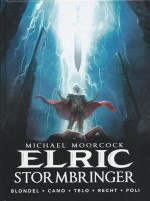
Michael Moorcock’s Elric volume 2: Stormbringer


By Julien Blondel, Jean-Luc Cano, Julien Telo, Robin Recht & Didier Poli, translated by Edward Gauvin (Titan Comics)
ISBN: 978 -1-78276-125-9

Michael Moorcock began his career as a comics creator aged 15; writing and editing classic strips like Dogfight Dixon, Jet Ace Logan, Captain Condor, Olac the Gladiator, Tarzan and many, many other British favourites. As the swinging Sixties began he made the leap to prose fiction where he single-handedly revitalised a genre in 1961 with the creation of Elric and the high-concept notion of the Eternal Champion.

Elric is a landmark of the Sword and Sorcery genre: fore-doomed last ruler of the pre-human civilisation of Melniboné, a race of cruel, nigh-demonic sorcerers. These arrogant, dissolute creatures are in a slow, decadent decline after millennia of dominance over the Earth.

An albino, Elric is physically weak, buoyed up by drugs, blood and dark magic, and of a brooding, philosophical temperament. He cares for little save his beautiful cousin Cymoril, who will die one day whilst he battles her loathsome usurping brother Prince Yyrkoon in service to a manipulative god of Chaos.

The White Wolf doesn’t even really want to rule, but it is his duty, and he is the only one of his debased race to see the (comparatively) freshly evolved race of Man as a threat to the Empire.

As this volume opens he is yet to be owned by the terrible black sword: one of a matched pair of sorcerous weapons which steal the souls of their victims and feed that stolen life and vitality to the wielder…

Elric is a tragic incarnation of the restless Eternal Champion, reincarnated in every time, place and alternate dimension. His life is violence, blood and unending tragedy, exacerbated by dependence on that soul-drinking ebony blade and his sworn – if somewhat compelled and thus reluctant – allegiance to the chimerical Lords of Chaos.

Everybody knows all that, right?

In 2013, however, the creator of the iconic wanderer – and arguably a whole sub-genre of fantasy fiction – has allowed his premiere paladin to undergo a visceral, spectacular and enchanting make-over under the auspices of a team of premiere French graphic arts prodigies.

Tasking themselves to re-adapt, augment and expand Moorcock’s tales and novels (with his willing and eager permission and supervision), writers Julien Blondel and Jean-Luc Cano, illustrators Julien Telo, Robin Recht & Didier Poli, with colour-artists Recht, Jean Bastide & Scarlett Smulkowski, resume the reinvigoration in Stormbringer.

This second chapter in the doom-drenched saga is preceded by a powerful introduction and affirmation of Elric’s impact in Alan Moore’s ‘Reflections in a Pink Eye’ and this sumptuous oversized (284x212mm) colour hardback album also includes – at the back – another look at the creative process in ‘Genesis’; via pages of design sketches (Elric and Stormbringer and the Dragon Caves) and a exploration of the working process of the ‘New Talents’ who recently joined the large storytelling team…

What Has Gone Before: usurper Yyrkoon has escaped his punishment through sorcery and taken Cymoril with him. Despite pledging himself to Arioch, Duke of Swords, weeks pass and all Elric’s arcane might is unable to glean where the fugitive has taken her.

The pallid, impotent Emperor has become a raging fury of frustration…

The dark, brooding epic continues as the albino brutally chastises Melnibonéan subjects and elemental agents tasked with finding Yyrkoon and Cymoril. The streets of Imrryr run red with sacrificial blood and the gory scraps of ghastly auguries, but no answer can be found.

At last the dejected sovereign calls again upon Arioch and this time the puissant hell-lord offers a shred of useful information…

Impatient and incandescent with rage Elric then exploits his ancestral relationship with majestic sea god Straasha, who once more honours his ancient pact with the rulers of Melniboné but again indicates times are changing and such services are soon to end…

In the Dragon Caves below the city, faithful Tyvim Tvar inducts his sons into the arts of commanding The Great Winged Ones, fearing that his latest endeavour with Elric will end badly…

On a quiet morning Staasha’s proffered aid hoves into magnificent view: an astounding vessel unlike any other. The Ship Which Sails over Land and Sea was built in eons past to seal a truce between Straasha and his brother Grome, Lord of the Earth Elementals who had warred for half the age of the world. Soon the incredible thought-guided vessel is soon hurtling towards the Young Kingdoms.

Elric anticipates satisfaction but enjoys no peace. His dreams are plagued with scenes of his consort-cousin Cymoril expiring in blood and fire…

Nearing their hidden quarry a grievous setback halts the chameleonic craft in its tumultuous course as mountainous Grome manifests, demanding the return of his ship. Nothing will sway him and, with his soldiers valiantly perishing, their enraged commander capitulates…

Undaunted, Elric leads his surviving warriors on foot across the foreboding terrain, infested with the upstart monkey people who would challenge their betters. He accepts terrified hospitality from peasants and rewards the humans in ways that delight his rattled and despondent, casually sadistic Melnibonéan warriors…

Eventually the weary task force arrives at the antediluvian and horrific city of Dhoz-Kam – site of a terrible battle between the Lords of Law and Chaos – and immediately readies himself for battle with Yyrkoon. His vile cousin is a great magical adept and is certain to have taken precautions.

The Emperor couldn’t be more right and an indescribably protean thing decimates his troops. Elric does not care and pushes on, finding Yyrkoon just as the madman butchers Cymoril…

Screaming out to Arioch, Elric pleads for her life and the whimsical god answers… after a fashion. Having made similar deals with both cousins, he suggests they fight using the demonic weapons he has been safeguarding: huge, deadly sisters of shining black metal, calling eagerly for someone to hold them…

With Elric wielding Stormbringer and Yyrkoon its demonic twin Mournblade, all the hate and fury the cousins bear each other comes out in mind-bending combat. However as the duel escalates the albino realises his sword is communicating with him, urging him on to ever-greater excess and demanding a price paid in blood and souls…

Much as he wants Yyrkoon dead he won’t be any being’s puppet and refuses to administer a killing blow. Still furious however he realises Arioch has his own agenda and needs him. Defiantly arrogant, the Emperor dictates new terms for their relationship…

None the less, Stormbringer must be fed and, after ministering to the resurrected Cymoril and setting course for the Dreaming City, Elric finds a way to give the blade its appalling reward…

Back in Imrryr at last, the emperor begins his service to Arioch with an astounding announcement. He is abdicating and names the traitor Yyrkoon as his successor…

To Be Continued…

Elric is a primal character whose sheer imaginative force has inspired a host of superb graphic interpretations – and probably daunted many eager movie producers – with the astonishing complexity and emotional power of his dying, dawning world. This latest tremendously dark and deeply engaging graphic extravaganza again raises the creative bar and proves why he is the leading light of fantasy fiction.

Elric: Stormbringer and all contents are © 2014 Éditions Glénat. This Translated Edition © 2014 Titan Comics. Adapted from the works of Michael Moorcock related to the character of Elric of Melniboné © 2013, Michael & Linda Moorcock. Introduction © 2015, Alan Moore.
Michael Moorcock’s Elric volume 2: Stormbringer will be released on March 31st 2015 and is available for pre-order now.