Mark Shultz: Carbon volume 1


By Mark Shultz (Flesk)
ISBN: 978-1-933865-54-6

After everything is said and done the most immediate response to narrative art is inevitably visceral and visual.

We take and tell our stories in picture form, and the sheer ability to express emotion and put the impossible on paper always captivates and leaves us wondering “how did he/she do that”?

It’s the reason why collections of comics art always have such amazing impact. We get to marvel at spectacular pretty pictures whilst stealing a furtive glimpse behind the curtain at the working of wonderment.

One maestro more than happy to share his secrets is Mark Shultz. The writer/artist shot to stardom after his 1986 EC Comics-inspired Xenozoic Tales (a magnificent blend of pulp fiction, Fifties automobile chic and honking great dinosaurs) hit an instantly addictive chord with the comics-buying public.

The publication spawned an animated TV series, assorted arcade, video and role-playing games, trading cards, action figures, candy bars and a succession of reprints (comics and graphic novel collections) from Kitchen Sink, Marvel and Dark Horse – mostly under its showbiz title Cadillacs and Dinosaurs.

Since then Schultz has become one of the industry’s biggest stars: tackling Superman, Batman and high-profile movie properties such as Aliens and Predator whilst always pursuing his great love: classic adventure archetypes like Tarzan, Conan and Doc Savage. Since 2004 he has been the writer of the Prince Valiant Sunday strip.

This particular oversized (305 x 232mm) collection of sketches, working drawings and finished pieces concentrates on a procession of his most pulchritudinous pulp princesses, lusty he-men and fantastic beasts in incredible unworldly locations: offering astounding insight into his creative process through breathtaking gatefolds displaying the progression from idea to full-painted finished art.

This compelling compendium of captivating heroines, bombastic barbarians, jungle kings and queens, space heroes, Martian Princesses, savage beasts, two-fisted types, what looks to me like DC’s iconic war heroes The Losers and so many wonderful dinosaurs also includes many scenes from Xenozoic Tales, sketches from forthcoming works and a tremendous informative bonus feature.

Schultz is as much science buff as fantasy aficionado and kicks off this book with the heavily illustrated inside story of how he was asked by pal and top bone-boffin Dr. Michael J. Ryan to produce the first visual representations of a newly-discovered dinosaur in ‘Introducing Xenoceratops‘ (or Xenoceratops Foremostensis, to give it the full formal title)…

Flesk Publications specialises in art books and the lavish tomes they produce are dedicated to the greats of our industry, with volumes on sequential narrative and fantasy illustration starring Steve Rude, Al Williamson, James Bama, Gary Gianni, Franklin Booth, William Stout and Joseph Clement Coll and many, many more.

The beautifully intimate glimpses of a master at work, with full-colour reproduction capturing every nuance of those gorgeous pencil or brushstrokes, make this a book a vital primer for anybody dreaming of drawing for a living, and the stirring lavish material revealed here will enthral and entice every fan of wondrous worlds and fantastic forgotten realms.

© 2013 Mark Schultz. All Rights Reserved. All artworks, features and properties © 2013 the individual creators, owners or copyright holders.

Child of Tomorrow and Other Stories


By Al Feldstein with Graham Ingels, George Roussos, George Olesen, Max Elkan & Sid Check (Fantagraphics Books)
ISBN: 978-1-60699-659-1

EC Comics began in 1944 when comicbook pioneer Max Gaines sold the superhero properties of his All-American Comics company to half-sister National/DC, retaining only Pictures Stories from the Bible. His plan was to produce a line of Educational Comics with schools and church groups as the major target market.

He augmented his core title with Picture Stories from American History, Picture Stories from Science and Picture Stories from World History but the worthy project was already struggling when he died in a boating accident in 1947.

As detailed in the final comprehensive essay in this superb graphic collection, his son William was dragged into the family business, with much support and encouragement from unsung hero Sol Cohen – who held the company together until the initially unwilling Bill Gaines abandoned his dreams of being a chemistry teacher and transformed the ailing enterprise into Entertaining Comics…

After a few tentative false starts and abortive experiments following industry fashions, Gaines took advantage of his multi-talented associate Al Feldstein, who promptly graduated from creating teen comedies and westerns into becoming Gaines’ editorial supervisor and co-conspirator.

As they began co-plotting the bulk of EC’s stories together, they shifted the emphasis of the ailing company in a bold and impressive change of direction. Their publishing strategy, utilising the most gifted illustrators in the field, was to tell a “New Trend” of stories aimed at older and more discerning readers, not the mythical 8-year old all comicbooks ostensibly targeted.

From 1950 to 1954 EC was the most innovative and influential publisher in America, dominating the genres of crime, horror, war and science fiction and the originator of an entirely new beast: the satirical comicbook…

Feldstein had started life as a comedy cartoonist and after creator/editor Harvey Kurtzman departed in 1956, Al became Mad’s Editor for the next three decades…

This volume of the Fantagraphics EC Library gathers a mind-boggling selection of Feldstein fantasy stories in a lavish monochrome hardcover edition, packed with supplementary interviews, features and dissertations, beginning with the informative ‘Cosmic Destruction With a Twist of Wry’ by lecturer Bill Mason and a gushing Introduction from cartoon superstar Gilbert Hernandez. Oddly enough writer-artist Feldstein was no fan of science fiction but was turned on to the genre by Gaines; an insomniac with a brain that always voraciously sought out the fresh and the new…

Feldstein worked on every genre in EC’s stable, but the short, ironic, iconic science thrillers he produced during that paranoid period of Commies and H-Bombs, Flying Saucer Scares and Red Menaces, irrevocably transformed the genre from Space-babes and Ray-gun adventure into a medium where shock and doom lurked everywhere.

His cynically trenchant outlook and darkly comedic satirical stories made the cosmos a truly dangerous, unforgiving place and kept it such – until the Comics Code Authority and television pacified and diminished the Wild Black Yonder for all future generations…

This superb monochrome hardback sampler of cosmic calamity opens with ‘“Things” from Outer Space!’ (originally presented in Weird Science #12, May/June 1950), wherein a scientist’s comely assistant accidentally uncovers alien infiltrators in the highest echelons of America’s government.

From the same month ‘Am I Man or Machine?’ (Weird Fantasy #13) then taps into Noir sensibilities with a tale of true love and tragic sacrifice when an accident victim falls into the hands of scientists too concerned with mere mechanical advancement, oblivious to sentiment…

Weird Science #13 (July/August 1950) tapped into the nation’s unease by gloriously spoofing the Air Force investigation into alien sightings with ‘The Flying Saucer Invasion’, whilst Feldstein and Gaines started a convention of writing themselves into their stories in Weird Fantasy #14 that same month as their comicbook editorial speculation led to enemy agents causing a ‘Cosmic Ray Bomb Explosion!’

Doomsayers and whistleblowers always played a big part in these tales. In ‘Destruction of the Earth!’ (Weird Science #14, September/October 1950), Washington’s refusal to listen to maverick researcher Fredrick Holman had truly catastrophic repercussions, whilst over in that month’s Weird Fantasy (#15) the Capitol was saved from ‘Martian Infiltration!’ by another, friendlier race of visitors…

‘Panic!’ (Weird Science #15, November/December 1950) played with the fact of Orson Welles’ infamous War of the Worlds radio broadcast, but the tone over in Weird Fantasy #16 was far more sardonic when ‘The Last City’ revealed the logical flaw in New York’s plan to erect an impenetrable, air-tight, H-bomb proof force field over the metropolis…

Sex, love and time-travel merged in Weird Science #5 (January/February 1951) as an ordinary Joe took a mysterious tourist trip into the future and brought back heartbreak in the form of a synthetic, build-her-yourself wife – and trust me, the ending is not one you’ll be expecting – whilst in ‘Child of Tomorrow!’ (Weird Fantasy #17) a lucky survivor of an atomic conflagration discovers at first hand the appalling effects of radiation on human reproduction…

The grim warnings and prognostications continued in ‘Spawn of Venus’ (Weird Science #6, March/April 1951) as an exploratory voyage to our sister world brings back something hungry which cannot be killed, whilst in that month’s Weird Fantasy (#6 – as the frankly whacky numbering systems were at last rationalised) a doomed romance was rekindled by fate after a bold astronaut returned from a ‘Space-Warp!’.

‘It Was the Monster from the Fourth Dimension’ (Weird Science #7, May/June 1951) pitted valiant friends against a creature – or a least a portion of it – from outside our limited perceptions, but Feldstein’s wry, cynically dry humour fully informed the tale of a patriotic hillbilly super-prodigy who naturally offered his gifts and services to the bigwigs in Washington in ‘7 Year Old Genius!’ (Weird Fantasy #7, May/June 1951).

Man versus Monster was an inescapably popular and rousing theme of the times and ‘Seeds of Jupiter!’ (Weird Science #8, July/August 1951) is one of the most visually compelling examples of the type, whilst the accidental time-travel by astronauts in Weird Fantasy #8 imaginatively postulated on ‘The Origin of the Species!’ displays the author’s superb ability to build tension, even if you have already guessed the “shock ending”…

Even whilst scripting and illustrating these stories, the tireless Feldstein was becoming increasingly involved in the editorial and production side of the business.

After The Origin of the Species! he stopped drawing science fiction adventures, but wrote stories for other artists to draw. This final section reprints a few of them by less prolific or well known illustrators – who probably won’t have their own book collections – and kicks off with ‘House, in Time!’ (Weird Science #15, November/December 1950) for horror star Graham Ingels to render

In it a young couple rent a perfect dwelling at a ludicrous price, but are unable to comply with the peculiar landlord’s simple request – to never open the back door…

The multi-talented George Roussos limned the next three, beginning with Weird Fantasy #7 (May/June 1951) wherein astronauts discover another Earth ‘Across the Sun!’ and learn a ghastly secret of human development, after which ‘The Escape!’ (Weird Science #8, July/August 1951) delivers a knockout crime thriller of murder in space and inescapable justice.

That motif of cosmic comeuppance also informs ‘The Slave Ship!’ (Weird Fantasy #8, July/August 1951) as piratical traders in human flesh find out just what that feels after aliens abduct them…

Unsung comic strip stalwart George Olesen (Ozark Ike, The Phantom) illustrated ‘The Slave of Evil!’ (Weird Science #9, September/October 1951) wherein a mechanical man displays more humanity than the humans who constructed him, after which veteran Max Elkan revealed the heartbreaking secret of ‘The Connection!’ (Weird Fantasy #9, September/October 1951) between a heartbroken old inventor and a vivacious young orphan girl.

The forays into the fantastic conclude then with ‘Strategy!’ (Weird Science #14, July/August 1952) illustrated by Sid Check, which reveals the big mistake of brain-stealing aliens who picked the wrong man to probe for Earth’s military secrets…

Also adding to the value of this captivating chronicle is ‘Gut and Glory’: an interview with the creator himself, conducted by Gary Groth, the incisive biography ‘Al Feldstein’ by S.C. Ringgenberg, a general heads-up on the entire EC phenomenon in ‘The Ups and Downs of EC Comics: A Short History’ by author, editor, critic and comics fan Ted White and the comprehensively illuminating ‘Behind the Panels: Creator Biographies’ by Bill Mason, Arthur Lortie and Janice Lee.

The short, sweet but severely limited output of EC has been reprinted ad infinitum in the decades since the company died. These astounding stories and art changed not just comics but also infected the larger world through film and television and via the millions of dedicated devotees still addicted to New Trend tales.

However, this series of collections (Child of Tomorrow is the sixth) highlighting thematic contributions of individual creators has added a new dimension to au fait readers’ enjoyment and offers a solid introduction for those lucky souls encountering the material for the very first time.

I strongly suggest that whether you are an aged EC Fan-Addict or callow contemporary convert, this is a book no comics aficionado can afford to miss…

Child of Tomorrow and Other Stories © 2013 Fantagraphics Books, Inc. All comics stories © 2013 William M. Gaines Agent, Inc., reprinted with permission. All other material © 2013 the respective creators and owners.

Win’s Christmas Gift Recommendation: Wide Eyed Wonderment seasoned with wry wit… 9/10

Astounding, Mysterious, Weird & True Volume 1: The Pulp Art of Comic Book Artists


By Steven Brower & Jim Simon (SB Studio Books)
ISBN: 978-1-4820-3313-7

Once upon a time, literacy was at an all-time high in the English-speaking world. A determined push to educate all and sundry took reading out of the hands of a moneyed intelligentsia and made it a tool of the working man, just as print technology was finding cheaper and more effective ways for creators and purveyors to disseminate their wares to growing markets.

Moreover, what everybody in the publishing world knew was what working folk needed more than anything (even religion) was cheap entertainment – the less wholesome and salutary the better…

In Britain we had newspapers, a burgeoning comics sector, “blood and thunder” periodicals and story magazines. In America they had “The Pulps”…

The first was indisputably The Argosy, created by Frank A. Munsey in 1896 and largely superseding most types of the infamous “Dime Novel” which had, with untrammelled sensationalism, ruled the periodical markets since 1860.

Argosy and its end-of-the-century imitators dominated and inspired a publishing phenomenon which eventually covered every genre – or blend of genres – in an industry niche which lasted well into the 1990s, albeit in a much reduced and rarefied form.

As well as spectacular colour covers, almost all pulps had black and white interior illustrations – spots, splashes and spreads – and some even had their own comic strip serials.

There were pulps for every possible taste and topic from romance to mystery to all-out action – including racier “men’s adventures”: two-fisted exotic action-thrillers heavy on mildly fetishistic sadism and bondage themes, with Rugged American men coming to the rescue of white women in peril from thugs and foreigners, saving them (the white women, of course) from “fates worse than death”, but only just in time and never before they had lost most of their clothes (the girls, and often many of the Rugged Americans too…).

One publisher in particular specialised in this niche market, producing a range of saucy genre thrillers all graced with a defining appellative: Spicy Detective, Spicy Western, Spicy Mystery and Spicy Adventure Stories. This was printer-turned-publisher Harry Donenfeld, who occasionally assumed control of companies who couldn’t pay their print bills. In 1934 and knowing pretty well what readers liked, he created a “Men’s Mag” mini empire under the twin banners of Culture and Trojan Publications. Of course, that’s also how he assumed control of the company that became DC Comics less than a decade later…

In 1943 the pressure exerted by various censorious elements in America became too much and Trojan/Culture changed tack and “Spicy” overnight evolved into “Speed Detective”, “Speed Western” and so forth. Perhaps the fact that Donenfeld was sitting on a wholesome family goldmine of comicbook characters such as Superman and Batman had something to do with that…

The story of how Max Gaines turned freebie pamphlets containing reprinted newspaper strips into a discrete and saleable commodity (thereby launching an entire industry, if not art-form) has been told far better elsewhere, but undoubtedly the influence of eye-grabbing pulp pictures as much as those reformatted strips influenced the growth and iconography of comicbooks.

Moreover, with thematic similarities and the same few owners hiring illustrators (and writers), naturally the creatives of one market frequently worked in both – and occasionally all three – arenas.

Now at long last, with comicbooks the indisputable major force in today’s illustrated fiction, comes a superb collection of images gathered together by writer/designer Steven Brower and novelist Jim Simon which shines a welcome light on those artists whose talents were to be found in all areas of popular printed fiction…

This superb gallery begins with ‘Diamonds and Rust’ by Simon; an efficient and studious overview of the history, artists and characters that thrived in those bygone days of wonder before the sublime and stunning panoply of pictures – all accompanied by incisive and revelatory potted biographies – commences.

The images are all culled from such evocative titles as Astounding, If, Courage, Super Science Stories, Weird Tales, Marvel Stories, Galaxy, Nick Carter, Detective, Basketball Stories, Wonder Stories, Big Book, Detective Short Stories, Planet Stories, Adventure, World’s News, Speed Detective, Sky Fighters, Dime Western and many more…

The many artists whose work features in this initial volume can be broken into roughly three categories. The first is pulp masters who also worked in comicbooks such as Edd Cartier, Charles Coll, Virgil Finlay, Kelly Freas, Roy G. Krenkel, Gray Morrow and Alex Schomburg whilst the second is jobbing artists equally at home in newspapers comicbooks, pulps and eventually commercial art.

Those include Benjamin “Stookie” Allen, D, Bruce Berry, Jack Binder, Jon L. Blummer, J. C, Burroughs (son of Tarzan creator Edgar Rice Burroughs), Harry Campbell, Paul Cooper, Harvey Eisenberg, Elton Fax, Harry Fisk, Dan Heilman, Ray Isip, Jeff Jones, Jacob Landau, D.H. Moneypenny, Lou Morales, Leo Morey, Norman Nodel, Neil O’Keefe, George Olesen, Paul Orban, H.L. Parkhurst, Louis Ravielli, Rod Ruth, John Styga, Riley Thomson, Elmer Wexler, Chuck Winter and Cedric Windas.

Finally there are fascinating examples of non-narrative illustration by legendary stars of comics such as Dan Adkins, Murphy Anderson, Dick Ayers, Matt Baker, Dan Barry, C.C. Beck, Pete Constanza, Stan Drake, Bill Draut, Will (or Bill) Ely, Creig Flessel, Dick Fletcher, John Forte, Matt Fox, Dick Giordano, John Giunta, Jerry Iger, Graham Ingels, Jack Kirby, George Klein, Alex Kotsky, Alden McWilliams, Mort Meskin, Irving Novick, Rudy Palais, Alex Raymond, Paul Reinman, Syd Shores, Joe Simon and Wally Wood.

There even a few British superstars included, such as Norman Petit (creator of legendary strips Jane and Susie), Brian Lewis (Dan Dare, Suki, Starlord, 2000AD, House of Hammer) and the inimitable Don Lawrence, artist on Storm, Trigan Empire, Marvelman, Olac the Gladiator, Buffalo Bill and so many more…

Also included in this wonderful celebration is an intriguing selection of Prototypes, displaying potential pulp antecedents of comics characters such as the Joker and Mr. Mxyzptlk…

If you’re of a nostalgic bent or simply a lover of magnificent art and illustration, Astounding, Mysterious, Weird & True is a compendium that will amaze and delight you.

© 2013 Steven Brower & Jim Simon. Diamonds and Rust © 2013 Jim Simon. Text and design © 2013 Steven Brower.

Astounding, Mysterious, Weird & True was made via the CreateSpace Independent Publishing Platform.

Valerian and Laureline book 4: Welcome to Alflolol


By Méziéres & Christin, with colours by E. Tranlé and translated by Jerome Saincantin (Cinebook)
ISBN: 978-1-84918-087-0   (Dargaud edition) 2-205-06573-4

Valérian is the most influential science fiction comics series ever drawn – and yes, that includes even Buck Rogers, Flash Gordon, Dan Dare and Judge Dredd.

Although to a large extent those venerable strips defined and later re-defined the medium itself, anybody who has seen a Star Wars movie or that franchise’s overwhelming homages, pastiches and rip-offs has been exposed to doses of Jean-Claude Méziéres & Pierre Christin’s brilliant imaginings (which the filmic phenomenon has shamelessly plundered for decades): everything from the character and look of alien races and cultures to the design of the Millennium Falcon and even Leia‘s Slave Girl outfit …

Simply put, more carbon-based life-forms have experienced and marvelled at the uniquely innovative, grungy, lived-in authentic futurism and light-hearted swashbuckling rollercoaster romps of Méziéres & Christin than any other cartoon spacer.

The groundbreaking series followed a Franco-Belgian mini-boom in fantasy fiction triggered by Jean-ClaudeForest’s 1962 creation Barbarella.

Valérian: Spatio-Temporal Agent launched in the November 9th, 1967 edition of Pilote (#420) and was an instant hit. In 1977 the fervour surrounding Greg & Eddy Paape’s Luc Orient and Philippe Druillet’s Lone Sloane, combined with Valérian‘s popularity led to the creation of an adult graphic sci-fi blockbuster – Métal Hurlant.

Valérian and Laureline (as the series eventually became) is a light-hearted, wildly imaginative time-travelling, space-warping fantasy teeming with wry, satirical, humanist action and political commentary, starring – in the early days at least – an affable, capable yet unimaginative by-the-book cop tasked with protecting the official universal chronology by counteracting paradoxes caused by incautious time-travellers.

When Valérian travelled to 11th century France in the initial tale ‘Les Mauvais Rêves (‘Bad Dreams’ and still not translated into English yet), he was rescued from doom by a fiery, capable young woman named Laureline whom he brought back to 28th century super-citadel and administrative capital of the Terran Empire, Galaxity.

The indomitable lass subsequently trained as a Spatio-Temporal operative and began accompanying him on all his missions.

Every subsequent Valérian adventure until the 13th was initially serialised weekly until ‘The Rage of Hypsis’ concluded, after which further yarns were solely published as all-new complete graphic novels. The whole spectacular saga resolved and ended in 2010.

Welcome to Alflolol originally ran in Pilote #631-652 (December 1971-May 11th 1972) and follows the Spatio-Temporal agents as they depart from Technorog, a desolate industrial planet whose vast resources are crucial to the running of human civilisation. So vital in fact that Galaxity sends her best agents just to inspect it every now and then…

As the S-T agents carefully negotiate the immense forcefield and asteroid belt that envelope the harsh and ferociously capitalistic factory world, Laureline is repeatedly possessed by an uncanny force. The fit also leads the couple to an immense ship which has foundered between the rocks and energy screen.

Investigating the vessel, which is purposely open to hard vacuum, Laureline again lapses into a glowing coma and eerily drifts towards a family of incredibly powerful yet rustically affable alien primitives sitting on the hull of their ship.

Valerian, closely following behind, prevents a terrible accident to his companion and is warmly greeted by the strangers, who explains that the eldest of the beings is very ill and in her throes has locked minds with his female. If they’re not careful, both could die…

Garrulous, easygoing Argol agrees to let Valerian treat the problem, and his wife Orgal telekinetically transports the Earthlings, her entire family and their pet Gumun back to the S-T astroship in mere moments. Soon Terran technology has saved both the human and alien and Argol settles back to explain what has happened…

The wanderers are naively friendly and immensely long-lived – like all their species – and are just returning to their homeworld Alflolol from an amusing perambulation through space. However since their departure – 4,000 Earth years ago – somebody has moved in…

Despite the Governor of Technorog’s protests, Galaxity law is clear and the Alflololians must be allowed back on their planet.

However the wheedling plutocrat – secure in his job’s importance to the empire – realises he doesn’t have to hand over the keys, just make room for the five meekly polite cosmic gypsies, who simply cannot grasp the concept of business and don’t understand why anybody would put up lots of flimsy, ugly buildings and spoil the hunting……

As Valerian allows the businessmen to walk all over the aliens’ rights, Laureline goes berserk: arguing for Argol’s family and indulging in a little light-hearted sabotage because the gentle giants won’t do it for themselves…

She needn’t bother though: their mere presence and incredible abilities are enough to disrupt the Governor’s precious productivity, especially when they get bored of sterile human accommodations and return to their ancestral ranges…

The real crisis only begins when the rest of the nomadic Alflololians return: one hundred separate ships full of natives protected by law and fully entitled to reclaim their homes.

The humans aren’t leaving, however, and soon the Governor has begun herding the wanderers onto a reservation and demanding they work if they want to eat.

Big mistake…

Socially aware and crusading, this is one of the earliest comics tales to catch the 1970s wave of ecological awareness and still ranks amongst the very best to explore the social iniquities which beset indigenous peoples at a time when most European ex-empires were still divesting themselves of their colonial possessions.

The theme of Capitalism versus Native Culture and the eternal struggle between territorial imperatives, moral rights and holy profit have seldom been dealt with in such an effective, sardonic and hilarious surreal manner. Ending on an outrageous twist, the story has lost none of its wit and punch forty years later.

And of course there’s the usual glorious blend of astounding action, imaginative imagery and fantastic creatures to leaven the morality play with space-operatic fun-filled, visually breathtaking and stunningly ingenious wide-eyed wonderment…

Between 1981 and 1985, Dargaud-Canada and Dargaud-USA published a quartet of these albums in English (with a limited UK imprint from Hodder-Dargaud) under the umbrella title Valerian: Spatiotemporal Agent and this tale was the third release, translated then by L. Mitchell.

Although this modern Cinebook release boasts far better print and colour values and a more fluid translation, total completists might also be interested in tracking down those 20th century releases too…
© Dargaud Paris, 1972 Christin, Méziéres & Tran-Lệ. All rights reserved. English translation © 2012 Cinebook Ltd.

Walrus (Brandon Graham’s All Bum Album – from Tusk ‘Till Dawn)


By Brandon Graham (PictureBox)
ISBN: 978-0-9851595-9-7

Autumn is officially here, with its fire-storms, droughts and sunburns, so it’s hard to escape the conclusion that the Holiday Season is inescapably close. After all, the Christmas films have been playing on Sky Movies since early March…

Seriously though, if you’re prudent, it is time to start looking at gifts for your loved ones or family, and here’s one of the prettiest and most intriguing comics art-books I’ve seen in many a year…

Brandon Graham was born in Oregon in 1976, an inveterate graffiti artist who seamlessly turned his graphic gifts and narrative flair to comicbook storytelling, beginning with Ameri-manga publisher Antarctic Press (October Yen) in 1996, dividing his time with Alternative or Independent Publisher projects and gracing the mainstream with work for Image, NMB, IDW and Vertigo.

He is a founder member of artistic collective MeatHaus, and if you like comedy, science fiction, erotica, manga and Moebius, you might want to seek out collections such as King City, 24Seven, Escalator, Multiple Warheads, Perverts of the Unknown and others – as well as this book…

Walrus is a monochrome and colour compendium of “Drawings and Sketchbook Comics from 2009-2011”, featuring  artworks, working roughs, calligraphy, rendered thoughts and idle musings, finished pieces and found imagery that serve to introduce viewers into a beguiling world of fantastic futurity and mesmerising wonderment – and there are weird critters and hot chicks…

A roughly comicbook-sized paperback (112 pages, 240x173mm) with a beautiful gatefold cover, this marvellous compendium comprises snippets of reportage, designs, roughs and layouts from finished stories.

There are moments of tenderness and intimacy, peeks into the creative process, bizarre moments of communal reality, caricatures, gags, spoofs of and tributes to comics and movies (such as Fantastic Four #9, Dirty Pair, Conan and The Good, The Bad and The Ugly), a commemoration of Moebius (The Long Goodbye), deliciously funny and whimsical gags, complete stories such as ‘Far North’, ‘Work Weak’ and ‘Today in the Life’ plus a preponderance of pages dedicated to evocative, seductive post-modern glamour art.

Punky, funky, enduring, enchanting and sublimely entertaining, this is another perfect example of the kind of book that makes the reader hungry to get out and draw stories now! Now!! NOW!!!

…As well as being just plain wonderful to see.

All art-forms need such creators and Walrus might well be the book to get you – or your kids – off the couch and into a studio.
© 2013 Brandon Graham. All rights reserved.

The Adventures of Blake and Mortimer: The Secret of the Swordfish Part 1 – Ruthless Pursuit


By Edgar P. Jacobs, coloured by Philippe Biermé & Luce Daniels translated by Jerome Saincantin (Cinebook)
ISBN: 978-1-84918-148-8

Belgian Edgard Félix Pierre Jacobs (1904-1987) is rightly considered one of the founding fathers of the Continental comics industry. Although his output is relatively meagre when compared to some of his contemporaries, the iconic series he worked on formed the basis and backbone of the art-form in Europe, and his splendidly adroit, roguish and impeccably British adventurers Blake and Mortimer, created for the first issue of Le Journal de Tintin in 1946, swiftly became a staple of post-war European kids’ life the way Dan Dare would in Britain in the 1950s.

Edgar P. Jacobs was born in Brussels, a precocious child who began feverishly drawing from an early age but was even more obsessed with music and the performing arts – especially opera. He attended a commercial school but, determined never to work in an office, pursued art and drama following graduation in 1919.

A succession of odd jobs at opera-houses – scene-painting, set decoration, working as an acting and singing extra – supplanted his private performance studies, and in 1929 Jacobs won an award from the Government for classical singing. His proposed career as an opera singer was thwarted by the Great Depression, however, as the arts took a nosedive following the global stock market crash.

Picking up whatever stage work was going, including singing and performing, Jacobs switched to commercial illustration in 1940. Regular employment came from the magazine Bravo; as well as illustrating short stories and novels, he famously took over the syndicated Flash Gordon strip, after the occupying German authorities banned Alex Raymond’s quintessentially All-American Hero and left the publishers desperately seeking someone to satisfactorily complete the saga.

Jacob’s ‘Stormer Gordon’ lasted less than a month before being similarly sanctioned by the Nazis, after which Jacobs created his own epic science-fantasy feature in the legendary Le Rayon U, a milestone in both Belgian comics and science fiction adventure.

The U Ray was a huge hit in 1943 and scored big all over again a generation later when Jacobs reformatted the original “text-block and picture” material to incorporate speech balloons and re-ran the series in Tintin with subsequent releases as a trio of graphic albums in 1974.

I’ve read differing accounts of how Jacobs and Tintin creator Hergé got together – and why they parted ways professionally, if not socially – but as to the whys and wherefores of the split I frankly don’t care. What is known is this: whilst creating the weekly U Ray, one of Jacob’s other jobs was scene-painting, and during the staging of a theatrical version of Tintin and the Cigars of the Pharaoh Hergé and Jacobs met and became friends. If the comics maestro was unaware of Jacob’s comics output before then he was certainly made aware of it soon after.

Jacobs began working on Tintin, colouring the original black and white strips of The Shooting Star from newspaper Le Soir for a forthcoming album collection. By 1944 he was performing a similar role on Tintin in the Congo, Tintin in America, King Ottokar’s Sceptre and The Blue Lotus. By now he was also contributing to the illustration as well, on the extended epic The Seven Crystal Balls/Prisoners of the Sun.

Jacob’s love of opera made it into the feature as Hergé (who loathed the stuff) teasingly created the bombastic Bianca Castafiore as a comedy foil and based a number of bit players (such as Jacobini in The Calculus Affair) on his long-suffering assistant.

After the war and liberation, publisher Raymond Leblanc convinced Hergé, Jacobs and a number of other creatives to work for his new venture. Launching publishing house Le Lombard, he also started Le Journal de Tintin, an anthology comic with editions in Belgium, France and Holland edited by Hergé, starring the intrepid boy reporter and a host of newer heroes.

Beside Hergé, Jacobs and writer Jacques van Melkebeke, the comic featured Paul Cuvelier’s ‘Corentin’ and Jacques Laudy’s ‘The Legend of the Four Aymon Brothers’. Laudy had been a friend of Jacobs’ since they worked together on Bravo, and the first instalment of the epic thriller serial ‘Le secret de l’Espadon’ starred a bluff, gruff British scientist and an English Military Intelligence officer (closely modelled on Laudy): Professor Philip Mortimer and Captain Francis Blake…

The initial storyline ran from issue #1 (26th September 1946 to 8th September 1949) and cemented Jacobs’ status as a star in his own right. In 1950, with the first 18 pages slightly redrawn, Le secret de l’espladon V1 (The Secret of the Swordfish) became Le Lombard’s first album release; with the concluding part published three years later. These volumes were reprinted nine more times between 1955 and 1982, with an additional single complete deluxe edition released in 1964.

In 1984 the story was reformatted and repackaged in English translation as three volumes with additional material (mostly covers from the weekly Tintin added to the story as splash pages) as part of a European push to win some of the lucrative Tintin and Asterix market here, but failed to find an audience and ended after seven volumes. Now happily Cinebook has released the tale – albeit after publishing the later adventures first…

Hergé and Jacobs purportedly suffered a split in 1947 when the former refused to grant the latter a by-line on new Tintin material, but since the two remained friends for life and Jacob’s continued to produce Blake and Mortimer for the Belgian weekly, I think it’s fair to say that if such was the case it was a pretty minor spat.

I rather suspect that The Secret of the Swordfish was simply taking up more and more of the brilliant, diligent artist’s time and attention…

The U Ray also provided early visual inspiration for Blake, Mortimer and implacable nemesis Colonel Olrik, who bear a more than passing resemblance to the heroic Lord Calder, Norlandian boffin Marduk and viperous villain Dagon from that still lauded masterwork – one also well overdue for translation…

One minor word of warning: by having the overarching enemies of mankind be a secret Asiatic “Yellow Peril” empire of evil, there’s some potential for offence – unless one actually reads the text and finds that the assumed racism is countered throughout by an equal amount of “good” ethnic people and “evil” white folk…

The incredible journey begins with ‘The Incredible Chase’ as a secret army in the Himalayas prepares to launch a global Blitzkrieg on a world only slowly recovering from its second planetary war. The wicked Basam Damdu, Emperor of Tibet, has assembled an arsenal of technological super-weapons and the world’s worst rogues such as the insidious Colonel Olrik in a bid to seize control of the entire Earth.

However a bold British-Asian spy has infiltrated the hidden fortress and surrenders his life to get off a warning message…

In England, physicist and engineer Philip Mortimer and MI5 Captain Francis Blake discuss the worsening situation at an industrial installation where the boffin’s radical new aircraft engine is being constructed. When the warning comes that the war begins that night, the old friends swing into immediate action…

As the super-bombers rain destruction down on all the world’s cities, Mortimer’s dedicated team prepares his own prototype, the Golden Rocket, for immediate launch, taking off just as Olrik’s bombers appear over the desolate complex. Despite heavy fire, the Rocket easily outdistances the rapacious Imperial forces, leaving ruined homes in its wake as the fleeing Britons fly into a hostile world now brutally controlled by Basam Damdu…

Whilst seeking to join British Middle East resistance forces who have another prototype super-plane, teething troubles and combat damage create tense moments in the fugitives’ flight. When the Rocket is attacked by a flight of jets the test ship’s superior firepower enables it to fight free but only at the cost of more structural deterioration. Failing now, the Rocket goes down in the rocky wilds between Iran and Afghanistan. Parachuting free of the doomed Rocket, Blake, Mortimer and the crew are machine-gunned by pursuing Empire jets and only three men make it to the ground safely…

After days of struggle Blake, Mortimer and the indomitable Jim are cornered by Iranian troops who have joined Olrik’s forces. Sensing disaster, the Britons hide the plans to Mortimer’s super plane but one of the Iranians sees the furtive act. When no one is looking – even his superiors – Lieutenant Ismail hurriedly scoops up the documents but misses one…

Under lock and key and awaiting Olrik’s arrival, the prisoners are accosted by Ismail, who sees an opportunity for personal advancement which the Englishmen turn to their own advantage. Denouncing him to his superiors, Blake instigates a savage fight between Ismail and his Captain. During the brief struggle Jim sacrifices himself, allowing Blake and Mortimer to escape with the recovered plans. Stealing a lorry, the desperate duo drive out into the dark desert night…

Followed by tanks into the mountain passes, the ingenious pair trap their pursuers in a ravine just as hill partisans attack. The Imperial collaborators are wiped out and, after exchanging information with the freedom fighters, the Englishmen take one of the captured vehicles and head to a distant rendezvous with the second Rocket, but lack of fuel forces them to stop at a supply dump where they are quickly discovered.

By setting the dump ablaze the heroes escape again, but in the desert Olrik has arrived and found the sheet of notes left behind by Ismail. The cunning villain is instantly aware of what it means…

Fighting off aerial assaults from Empire jets and streaking for the mountains, Blake and Mortimer abandon their tank and are forced to travel on foot until they reach the meeting point where a British-trained native Sergeant Ahmed Nasir is waiting for them. The loyal Indian served with Blake during the last war and is delighted to see him again, but as the trio make their way to the target site they become aware that Olrik has already found it and captured their last hope…

Only temporarily disheartened, the trio use commando tactics to infiltrate Olrik’s camp, stealing not the heavily guarded prototype but the villainous Colonel’s own Red-Wing super-jet. Back on course to the British resistance forces, the seemingly-cursed trio are promptly shot down by friendly fire: rebels perceiving the stolen plane as just another enemy target…

Surviving this crash too, the trio are ferried in relative safety by the apologetic tribesmen to the enemy-occupied town of Turbat, but whilst there a spy of the Empire-appointed Wazir recognises Blake and Mortimer. When Nasir realises they are in trouble he dashes to the rescue but is too late to prevent Mortimer from being drugged.

Sending the loyal Sergeant on ahead Blake tries frantically to revive his comrade, even as Imperial troopers rapidly mount the stairs to their exposed upper room…

To Be Continued…

Gripping and fantastic in the best tradition of pulp sci-fi and Boy’s Own Adventures, Blake and Mortimer are the very epitome of True Brit grit and determination, always delivering grand old-fashioned Blood and Thunder thrills and spills in timeless fashion and with staggering visual verve and dash. Despite the high body count and dated milieu, any kid able to suspend modern mores and cultural disbelief (call it alternate earth history if you want) will experience the adventure of their lives… and so will their children.

This Cinebook edition also includes a tantalising preview of the next volume as well as stand alone adventure The Yellow “M”, plus a biography feature which offers a chronological publication chart and publishing order of the Cinebook release dates.

Original editions © Editions Blake & Mortimer/Studio Jacobs (Dargaud – Lombard S.A.) 1984 by E.P. Jacobs. All rights reserved. English translation © 2012 Cinebook Ltd.

Guardians of the Galaxy: Cosmic Avengers


By Brian Michael Bendis, Steve McNiven & Sara Pichelli with Michael Avon Oeming, Ming Doyle, Michael Del Mundo & John Dell (Marvel/Panini UK)
ISBN: 978-1-84653-542-0

Although heralded since its launch in the early 1960s with making superheroes more realistic, Marvel Comics has also maintained its close connection with outlandish and outrageous cosmic calamity (as embodied in their pre-superhero “monster-mag” days), and this latest iteration of space crusaders maintains that delightful “Anything Goes” attitude in an impressive new launch – part of the MarvelNow! group reboot – that lays the groundwork for the upcoming big budget movie next year.

The Guardians of the Galaxy were created by Arnold Drake in 1968 for try-out title Marvel Super-Heroes (#18, January 1969), a group of futuristic freedom fighters dedicated to liberating star-scattered Mankind from domination by the sinister, reptilian Brotherhood of Badoon.

Initially unsuccessful, they floated in limbo until 1974 when Steve Gerber incorporated them into Marvel Two-In-One #4-5 and Giant Size Defenders #5 and the monthly Defenders #26-29 (July through November 1975), wherein assorted 20th century champions travelled a millennium into the future to ensure humanity’s liberation and survival.

This in turn led to the Guardians’ own short-lived series in Marvel Presents #3-12 (February 1976-August 1977) before cancellation left them roaming the Marvel Universe as perennial guest-stars in such cosmically-tinged titles as Thor, Marvel Team-Up, Marvel Two-in-One and The Avengers.

Eventually in June 1990 they secured a relatively successful series (#62 issues, annuals and spin-off miniseries until July 1995) before cancellation again claimed them.

This isn’t them; this is another bunch…

In 2006 a massive crossover involved most of Marvel’s 21st century space specialists in a spectacular “Annihilation” Event, leading writing team Dan Abnett & Andy Lanning to reconfigure the Guardians concept for modern times and tastes.

Among the stalwarts in play were Silver Surfer, Galactus, Firelord (and other previous heralds of the world-eater), Moondragon, Quasar, Star-Lord, Thanos, Super-Skrull, Tana Nile, Gamora, Ronan the Accuser, Nova, Drax the Destroyer, a Watcher and a host of alien civilisations such as the Kree, Skrulls, Xandarians, Shi’ar et al., all falling before a invasion of rapacious negative zone bugs and beasties unleashed by insectoid horror Annihilus.

The event spawned a number of specials, miniseries and new titles (subsequently collected in three volumes plus a Classics compilation that reprinted key appearances of a number of the saga’s major players), and inevitably led to a follow-up event…

In Annihilation: Conquest, the cast expanded to include Adam Warlock, the Inhumans, talking dog Cosmo, Kang the Conqueror, Vance Astro/Major Victory, Maelstrom, Jack Flag, Blastaar, the Magus, Galactic Warrior Bug (from the 1970’s phenomenon Micronauts), current Captain Universe (ditto), Shi’ar berserker Deathcry, failed Celestial Madonna Mantis, anamorphic adventurer Rocket Raccoon and gloriously whacky “Kirby Kritter” Groot, a walking killer tree and one-time “Monarch of Planet X”, amongst others…

I’ve covered part of that cataclysmic clash and will get to the rest one day: suffice to say that by the conclusion of the assorted Annihilations a new, pan-species Guardian group had appointed itself to defend civilisations and prevent any such wars from ever happening again.

This isn’t them either… exactly…

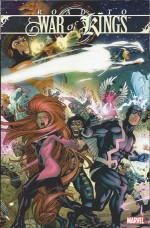
A few years later and many more cosmic crises – such as a devastating “War of Kings” – averted, the remnants of those many Sentinels of the Spaceways are getting the band back together, still determined to make the universe a safe place.

Thus this impressive and readily accessible volume (collecting Guardians of the Galaxy #0.1, Guardians of the Galaxy: Tomorrow’s Avengers #1 & Guardians of the Galaxy #1-3 from February-June 2013) provides a handy jumping-on point, recapitulating the bare essentials before launching into a blistering and immensely absorbing interstellar romp which ties inextricably into mainstream Marvel continuity.

Brian Michael Bendis, Steve McNiven, John Dell & Justin Ponsor set the ball rolling with the secret origin of Star-Lord, revealing how thirty years ago warrior Prince J’Son of the interstellar empire of Spartax was shot down over Colorado and had a brief fling with solitary Earther Meredith Quill. Despite his desire to remain in idyllic isolation, duty called J’Son back to the battle and he left, leaving behind an unsuspected son and a unique weapon…

A decade later, the troubled boy saw his mother assassinated by alien lizard men determined on eradicating the legacy of Spartax. Peter vengefully slew the Badoon with Meredith’s shotgun, before his home was explosively destroyed by a flying saucer.

The orphan awoke in hospital, his only possession a “toy” ray-gun his mother had hidden from him his entire life…

Years later his destiny found him, and the half-breed scion of Spartax became Star-Lord. Rejecting both Earth and his father – now king of his corner of creation – Peter Quill chose freedom, the pursuit of justice and the comradeship of disreputable aliens…

The origin story concludes with Peter welcoming avid listener and neophyte spacer Tony Stark into his loose-knit fellowship of Guardians…

More delving into formative events occured in the anthological Tomorrow’s Avengers #1 (by Bendis and individually illustrated by Michael Avon Oeming, Ming Doyle & Michael Del Mundo), revealing how Quill tracked down old friends and prospective members for his new team, detailing recent exploits of at-large and unfocused stalwarts Drax the Destroyer, the decidedly odd couple Rocket Racoon and Groot and, of course, Gamora, “Deadliest Woman in the Galaxy”…

The former bane of Thanos Drax is idling away the days in pointless fighting when Star-Lord comes calling, whilst Groot at least is still defending the weak from the wicked in a classy farmers-vs.-bandits fable.

The unique, blaster-toting Peril-loving Procyonidae (look it up) was mouthing off in a bar, drinking and fighting as usual when he found tantalising evidence that there was at least one other Rocket Raccoon at large in the universe, whilst gorgeous Gamora just never stopped. She was still slaughtering her adopted dad’s minions when Star-Lord made his offer…

The series proper – by Bendis, McNiven, Dell & Ponsor – opens with Peter Quill diplomatically ambushed in a seedy dive by his long-lost dad. J’Son rules Spartax but the rift between him and the Star-Lord is wide and deep and impassable.

Dear old Dad also has a message: he has entered into a compact with the other major powers and principalities of the universe to declare Earth off limits and quarantined from all extraterrestrial contact. He and they will act immediately to stop any alien individual or species from contaminating it.

Of course that especially means his own wayward son…

A little later, Iron Man is playing with his new space armour when a Badoon starship attacks Earth. Overmatched, Stark is unexpectedly reinforced by Star-Lord, Gamora, Drax, Rocket Raccoon and Groot who devastate the monolithic vessel – but not before fighter ships break atmosphere and bombard London.

With the Home Counties under attack despite The Council of Galactic Empires’ edicts – and apparently by one of the signatory civilisations – the Guardians go to work ending the Badoon, with Peter distracted in trying to divine his duplicitous father’s actual intent.

In the Negative Zone, J’Son is conferring virtually with his opposite numbers from the Kree, Shi’ar, Brood, Badoon and Asgard, with a new Annihilus presiding over the fractious meeting, and indeed dirty work and dirty tricks are afoot…

In blistering battles the Badoon are beaten, but no sooner do the Guardians pause for breath than a starfleet supposedly blockading Earth arrests them for breaking the embargo.

Imprisoned on Spartax, Quill and Co eventually bust out and publicly declare war on J’Son, sowing the seeds of a future rebellion – but even they are unaware that the devious and double-dealing king is also being played for a sucker…

Bright, breezy, bombastic and immensely enjoyable, the action-packed Cosmic Avengers also includes a beautiful gallery of 23 covers and variants – including a lovely movie-art landscape/wraparound – by McNiven, Dell & Ponsor, Doyle, Ed McGuiness, Joe Quesada, Adi Granov, Mark Brooks, Milo Manara, Terry Dodson, Mike Deodato Jr., Phil Jimenez, Mike Perkins, Paola Rivera and Joe Madureira, and of course the book comes with the standard added extras provided by many AR icon sections (Marvel Augmented Reality App) which give access to story bonuses once you download the free code from marvel.com onto your smart-phone or Android-enabled tablet.

™ & © 2013 Marvel & Subs. Licensed by Marvel Characters B.V. through Panini S.p.A. All rights reserved. A British Edition published by Panini Publishing, a division of Panini UK, Ltd.

Pacific Rim: Tales from Year Zero


By Travis Beacham, Sean Chen, Yvel Guichet, Pericles Junior, Chris Batista, Geoff Shaw & various (Legendary)
ISBN: 978-0-7851-5394-8

It’s summer – which means movie blockbusters – and just for a change here’s a collection of comics stories based on a film rather than the other way round.

The filmic Pacific Rim is set in the third decade of the 21st century and details a protracted battle between humanity and a procession of monolithic monsters which perpetually erupt out of the oceans to smash our cities. To combat these creatures – whose blood is devastatingly toxic – science has devised colossal anthropomorphic machines piloted by teams of bold but essentially doomed soldiers…

This slight but stunningly fun hardback companion compilation, set simultaneously before and during the events of the silver screen saga, features a triptych of short tales drawn from the unused backstory material to fill in detail and character necessarily sacrificed to the exigencies of keeping the motion picture action moving along.

According to the Introduction by writer Travis Beacham, he and co-scripter/Director Guillermo Del Toro are both manic fans of the venerable Japanese genres of Kaiju (literally “strange beasts” or ,more popularly, humongous city-stomping monsters) and their frequent opponents in anime and manga, Mecha (super automaton/vehicles piloted by noble human heroes).

Pacific Rim is thus a way to reintroduce these ever-cool concepts to a new generation of fans who might have missed out on the sheer vicarious joy and thrills of such planet-shaking spectacle.

The revelations begin in 2024AD as journalist Naomi Sokolov, en route to an interview with legendary figure Stacker Pentecost, meets another veteran of the anti-Kaiju initiative and learns how technician Tendo Choi survived humanity’s first encounter with the marauding horror which eradicated San Francisco and changed the path of mankind on August 13th 2013 – ‘K-Day’…

In the decade since, giant Jaeger war-suits have protected the surface world but now they’re being phased out in favour of a new solution – “the Wall” – and Choi’s account of that fateful first contact gives powerful argument as to why that’s a bad idea…

Naomi’s next interview is with Dr. Jasper Schoenfeld, the engineering genius who first came up with the concept of immense ambulatory uber-tanks. His revelations in ‘Turn of the Tide’ explain the role and sacrifices of his all-but-forgotten lab partner Caitlin Lightcap, whose brilliance and passion turned the idea into a workable reality – and also detail the appalling cost to the Jaegers’ unique riders…

Sokolov finally gains her time with inspirational project leader Pentecost in ‘The Bond’ but is quite unprepared for the great man recognising her and the role she played in almost destroying a crucial part of the Jaeger Academy team in the early days of recruitment…

Even though packed with blockbusting Mecha vs. Monster action throughout, this book primarily provides a subtle in-filling and shading of character in vignettes unavailable in the rip-roaring on-screen avalanche of action. Moreover, illustrators Sean Chen, Yvel Guichet, Pericles Junior, Chris Batista, Geoff Shaw, Mark McKenna, Steven Bird, Matt Banning, Guy Major, Tom Chu & Dom Regan work wonders blending these quiet, informative moments with the overall thrust of paralleling the movie mayhem.

This volume also includes an expansive segment charting ‘From Script to the Final Page: The Creative Process’ as Beacham’s typing progresses through Guichet’s rough sketches to full pencils and inks before ending as coloured and lettered final art. And as if that wasn’t enough, there’s even a full colour feature on ‘Kaiju’ with a handy guide for distinguishing Belobog from Scissure, telling apart Trespasser from Kaiceph and knowing your Verocitor from Karloff…

Furious fun for monster-lovers of all ages…
© 2013 Legendary Comics LLC. All Rights Reserved.

Sleaze Castle – the Directors Cut Part #0


By Dave McKinnon & Terry Wiley with various (Markosia)
ISBN: 978-1-905692-93-4

I’m old, me. I’ve been around for a bit and met a few folks. So, as occurs when I’m reviewing something by people I’ve gone drinking with, I feel compelled to admit to potential conflicts of interest such as here.

The Society of Strip Illustrators/Comics Creators Guild used to meet on the last Thursday of every month in London. There old lags and aspiring talents rubbed scruffy, grimy, dandruffed – occasionally scrofulous – shoulders, talking comics old and new whilst showing off what we were up to.

Always a fun, laid-back evening, those times when the laconic Terry Wiley would turn up from points North with copies of the latest self-published issue of Tales From Sleaze Castle were especially un-memorable – a combination of subsidised booze and the fact that most folks immediately buried their heads in the mesmerising, fundamentally British, trans-dimensional, time-busting kitchen sink comedy/drama/nostalgic fantasy buddy-movie of a comic and lost all power of speech until they’d finished.

It’s just that good – probably the very best home-grown comic saga you’ve never read – and it also holds strong claim to probably the very best and most appalling literary puns in all sequential narrative.

Scripted by the equally demi-mythical Dave McKinnon, the epic adventure is pretty straightforward but also nearly indescribable. The story unfolds in a progression of mini-chapters and vignettes which act as diary and six-month countdown to an inescapable, predestined event…

After a rather bemused Foreword from author McKinnon, this latest edition of the monochrome masterpiece of wacky understatement starts with ‘Another Earth, Another Dimension, Another Reason to Go Shopping’ and a brace of ‘Prologues’ in which we meet incomprehensibly ancient Pandadomino Quartile, puissant albino Empress of another Realm of Reality and undisputed dominant resident of the incredible, infinite domicile dubbed Sleaze Castle.

Also brought to our attention are the thoroughly grounded though no less implausible Dribble family of Earth; mother Poppy, younger daughter Petra and her older sister Jocasta, befuddled student and co-star of our show…

As post-grad Jo returns to college in the Northern wilds of England and her ongoing M.A. in Televisual Studies, in London the Queen (not ours, the other, alien one) goes shopping. It is ‘Sep. ’86: Castaway’ and there’s about to be a small hitch…

The time/space door malfunctions and Pandadomino is stranded here. Establishing shaky communications with home she is assured that things will be fixed but it will take six months to retrieve her. Moreover the portal will appear in another location…

An incoming call then gives further details and instructions.

It’s from herself who has literally just returned to SleazeCastle and she has some advice for her younger, stranded self. It’s quite bizarre, paradoxical and tediously specific instructions on what to do for the next 178 days so she’d better get a pencil…

Jocasta Dribble is on ‘Autopilot   11:23’ as she makes her way from the railway station to her room in the Ethel Merman Hall of Residence at the University of Novocastria.

As usual the trip is fraught with woolgathering and petty weirdnesses but eventually she slumps onto her term-time bed and makes the acquaintance of her new neighbour.

The oddly naive girl with the shock of black hair, exotic face and too much eye makeup is from Thailand.

Sandra “call me Panda” Castle has absolutely no idea about living in England so Jo takes her under her maternal wing, blithely oblivious that her new friend is an extraterrestrial immigrant, used to commanding vast armies and geniuses of various species, cunningly disguised with dyes and contact lenses. Moreover the strange stranger has used all her wiles to cheat her way into the room next door which will, some months’ distant, very briefly become an inter-dimensional gateway before snapping shut forever…

And thus begins the gentle and seductively enchanting story of the relationship between two of the most well-realised women in comics. As geeky outsider Jo at last blossoms into a proper grown-up – she even finds a boyfriend, more than a decade after her precocious schoolgirl sister Petra – her instruction of the oddly sophisticated “Thai” into British civilisation and college life is simultaneously heart-warming, painful, hilarious, poignant and irresistibly addictive to watch.

It’s also deliciously inclusive and expansive: packed with what 21st century consumers now call “Easter Eggs”. These hidden nuggets of in-jokes, wry observations and oblique cultural and comics references are witty and funny enough in their own right, but if you were in any way part of the comics scene in the late 1980s they are also an instant key into golden times past, packed with outrageous guest-appearances by many of the upcoming stars and characters of the British cartooning and small press movement.

(Whilst the absolutely riveting scenes of Jo and Panda trying out both Novocastria’s Women Cartoonist Society and all-male Komik Klub are timeless slices of shtick to you lot, they were a solid reminder of times past and people I still owe a Christmas card…)

Panda spends her first Christmas ever with the Dribbles and their ferociously Italian extended family but, as the days are counting down, the displaced millennia-old queen is beginning to wonder what will happen once she leaves…

Astoundingly there are people and places and things and people and one person in particularly who is apparently unique and irreplaceable even in the unending pan-cosmic Reality she owns. There’s this friend she’s really can’t bear to lose…

Beautifully scripted, alluringly paced and exquisitely rendered, this book would be paralysingly evocative for any Brit who went to college between 1975 and 1990, but what makes it all so astonishingly good is the fact that this delightful melange of all the things that contributed to our unique culture are effortlessly squooshed together as mere background in an captivating tale of two outsiders finding friendship through adversity and by perpetually lying to each other…

There have been comparisons to Los Bros Hernandez’ Love and Rockets but they’re superficial and unfair to both. I will say though that both are uniquely the product of their own time and regional geography…

This collection also includes a cover gallery and pin-ups as well as the additional plus of ‘And Finally… Three Lost Tales’ which features an aspect of the business I really miss.

A few of the self-publishing community cameoed in the Women Cartoonist Society and elsewhere – in a spirit of communal tit-for-tat – collaborated on side-bar stories featuring Panda, Jo and the rest during the comic’s initial run and with commentary from McKinnon are re-presented here, so even after the cliffhanger story-pause you can still have a laugh with ‘The Rules of the Game part I’ by Lee Kennedy, ‘The Rules of the Game part II’ by Lee Brimmicombe-Wood and what I’ll call ‘An Idea in a Book is Worth Two in the Head’ by Jeremy Dennis. You’ll need to buy this book to realise why…

This a book by lovers of comics for lovers of comics and now that I’ve read this brand-new edition with its remastered pages and fresh snippets of original  material I’m going to re-read the next three volumes in the Gratuitous Bunny Editions I bought years ago. Unless you have your own temporal retrieval system you’ll just have to wait for the next volume…
SleazeCastle is ™ & © 1992, 2012 Dave McKinnon & Terry Wiley. This edition ™ & © Dave McKinnon, Terry Wiley and Markosia Enterprises, Ltd. All rights reserved. Three Lost Tales © 1996, 2012 Lee Brimmicombe-Wood, Lee Kennedy and Jeremy Day
This book is available for download on iPhone, iPad or iPod touch with iBooks and on your computer with iTunes. Books must be read on an iOS device.

Battling Boy

(Uncorrected Proof Copy)

By Paul Pope (First Second)
ISBN: 978-1-59643-145-4

Paul Pope is undoubtedly one of the most creative and visually engaging creators working in comics these days. Since his debut in 1993 he has stunningly combined elements of European and Japanese styles with classical American themes to produce tales of science fiction, fantasy, crime, comedy, romance, adventure and even superheroics, generally for mature audiences.

If you’re not a fan yet, check out Sin Titulo, Batman: Year 100, Heavy Liquid, 100%, One Trick Ripoff and more…

This latest venture, however, is aimed a general readership – Hey, Kids, This Means You! – and introduces a world very similar to our own but with one big, big difference…

Arcopolis City would be the perfect place to bring up kids but for one thing. Ghastly devils roam at night, stealing children. Even the days are increasingly fraught as a seemingly endless procession of monstrous beasts incessantly carves a swathe of mindless destruction through the bright, breezy thoroughfares…

Of course the valiant sentinels of the Fighting 145th do their very best to contain the daily onslaughts, but it is to jet-packed, ray-gun-wielding science hero Haggard West that the harried citizens look to end the crisis. Those heartfelt hopes are cruelly dashed, however, when hooded horror Sadisto lays a crafty trap and blasts the magnificent rocket-man out of the sky…

His daughter and apprentice Aurora is shattered as she watches her dad vanish in a blast of blazing plasma…

Entire universes away, a shining citadel of warrior deities celebrates a very special event as the greatest pantheon of dutiful cosmic champions in the universe revels in the brief return of their mightiest hero. The stormy saviour of many worlds is back to see his son, who has reached a very special age…

The Boy is not ready for his Turning Day. Even if every child born here is invariably sent into the cosmos on their 13th birthday to save some lesser race from imminent peril on the venerable quest known as “a Ramble”, he knows he isn’t strong enough yet. After all, many of his childhood comrades have never returned…

As usual, though, his puissant father knows best and the anxious lad (armed with a very special cloak, battle grieves, the Encyclopedia Monstrosity, keys to an apartment, a map, a magic credit card and a dozen totem tee-shirts) is booted out of the veritable Valhalla of the Starry Lofts and dumped on a mountaintop overlooking a seemingly continent-sized city …just as a homogonous Humbaba rampages through Arcopolis eating cars and crushing tanks…

Before hurtling off to another appointment with destiny, the lad’s proud father casually reminds his spooked scion that if his “Battling Boy” cannot end the plague of monsters on this world, humanity is finished here…

Even as Aurora West begins to unlock the secrets of her father’s legacy and keenly embrace her own dreamed of destiny, the reluctant young demi-god makes his way to the epicentre of chaos and engages the ferocious furious Humbaba.

Things do not go according to plan…

Wry, spectacular and astonishingly engaging, this is a supremely entertaining, beautifully rendered yarn with plenty of fast-paced action, judicious suspense, likable heroes and a gloriously arch villain in the Machiavellian Sadisto, whose subtle scams and unlikely alliances stretch far beyond this blockbusting premiere epic.

This is an ideal comic book for older kids, and reads even better if you’re their adult keeper or guardian. Don’t miss out on the start of something very special…
© 2013 by Paul Pope. All rights reserved.

Battling Boy will be published on October 8th 2013.