
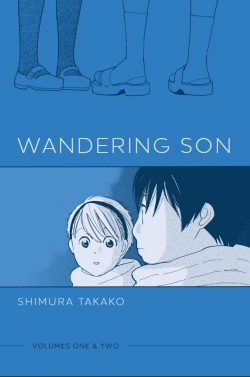
By Shimura Takako, translated by Rachel Thorn (Takumigraphics/Fantagraphics Books)
ISBN: 979-8-8750-0073-7 (TPB)
If woke stuff and picking your own personal pronouns upset you and/or you can sincerely defend the inherent injustice and sheer nonsense of assigned genders at birth, you should piss right off, right now. Or stay and have an aneurism. The grown-ups will just carry on and learn stuff by enjoying ourselves.
Nitori Shuichi is an extremely shy boy freshly transferred into a new school. He’s starting Fifth Grade and on the cusp of puberty. He’s also in a bit of a quandary. Slim, androgynous and, to be frank, rather pretty, he is constantly thinking about wearing girls’ clothes…
That’s how one of the most lauded, gracious, kind and understanding stories about owning your own body (and associated other transgender issues) ever created opens. Although a more fitting translation might be “Prodigal” Son, we’re just happy to welcome it back to English publication as Wandering Son.
Created by Shimura Takako, it began in seinen (aimed at young men) monthly Comic Beam as Hōrō Musuko, running from December 2002 until August 2013 and subsequently filling 15 tankōbon volumes. It is resplendent in its refined charm and exudes assured contentment, presenting a sublimely personable shared history and shared voyage of discovery in an open-minded spirit of childlike inquiry and accepting optimism that make for a genuine feel-good experience. Fantagraphics began publishing their translation (by Matt Thorn) in lavish hardcover editions from 2011 but the project stalled at volume 8, probably from low sales and not the themes it covered. Now we get the chance to see how it all turned out in the end…
From any other culture this type of story would be crammed with angsty agonies, gratuitously filled with cruel moments and shame-filled subtext, but instead here Shimura (Sweet Blue Flowers, Scenes from Awajima, Beautiful Everyday, Even Though We’re Adults, Bloom Brothers) crafts a genteel, winningly underplayed, enchantingly compulsive school saga filled with as much hope and positivity as drama. Now the story is back in double-volume trade paperback editions remastered by series editor/translator/Cultural anthropologist/college professor (at Kyoto Seika University’s Faculty of Global Culture) Rachel Thorn, with the first two tomes laying the groundwork for incredible journeys ahead…
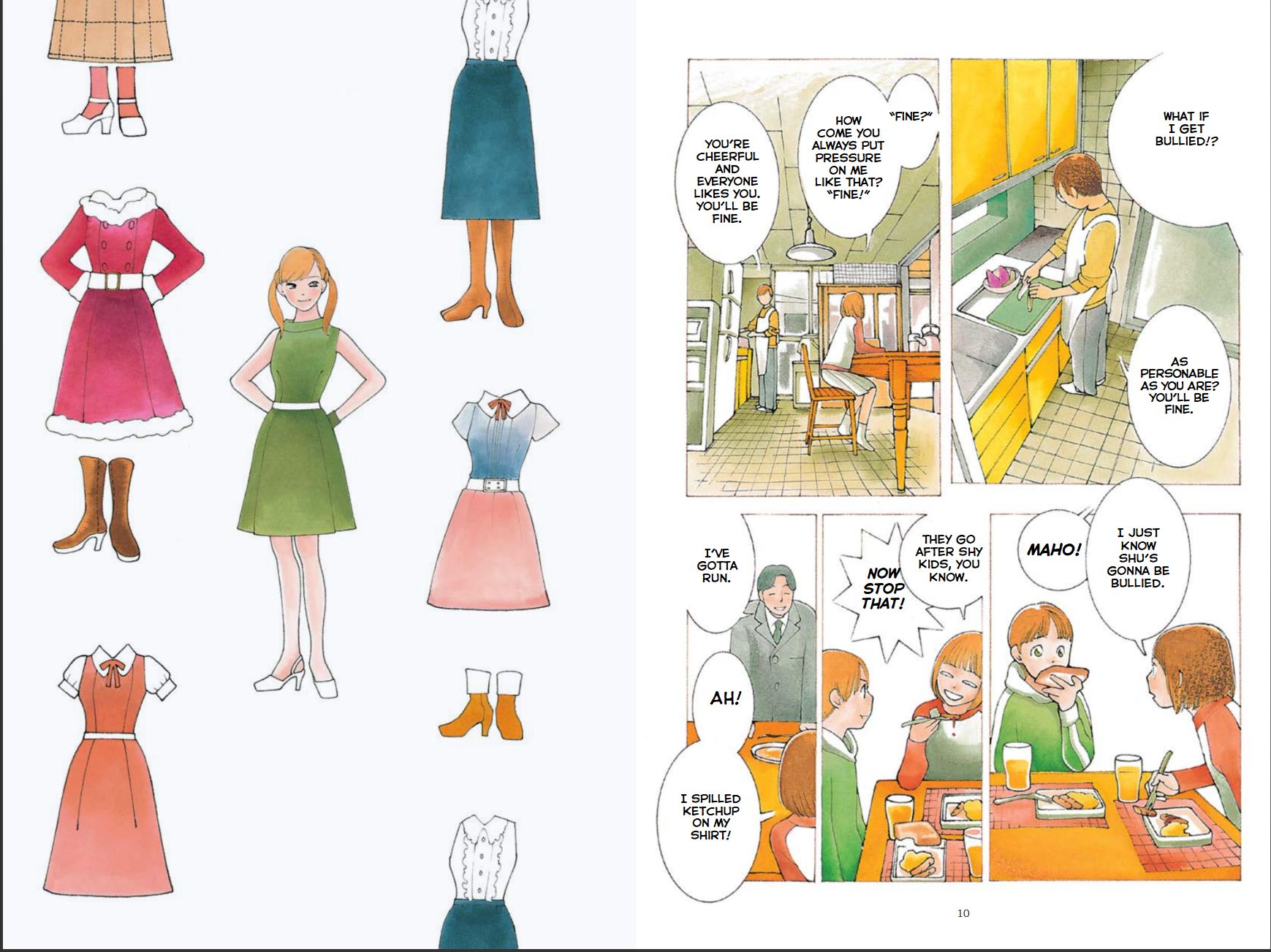
Preceding first monochrome chapter ‘The Boy Who’s a Girl’ is a full-colour introductory character chart of our protagonists’ friends, families and significant personages, prior to the wandering beginning on Shuichi’s first day. At school, instead of the bullying his older sister Maho warned of, he’s sent to the wrong classroom and mistaken for a girl by homeroom teacher Nakazawa. Eventually set in the right place, things look up for “Shu” as soon as he’s paired with and befriended by Takatsuki Yoshino.
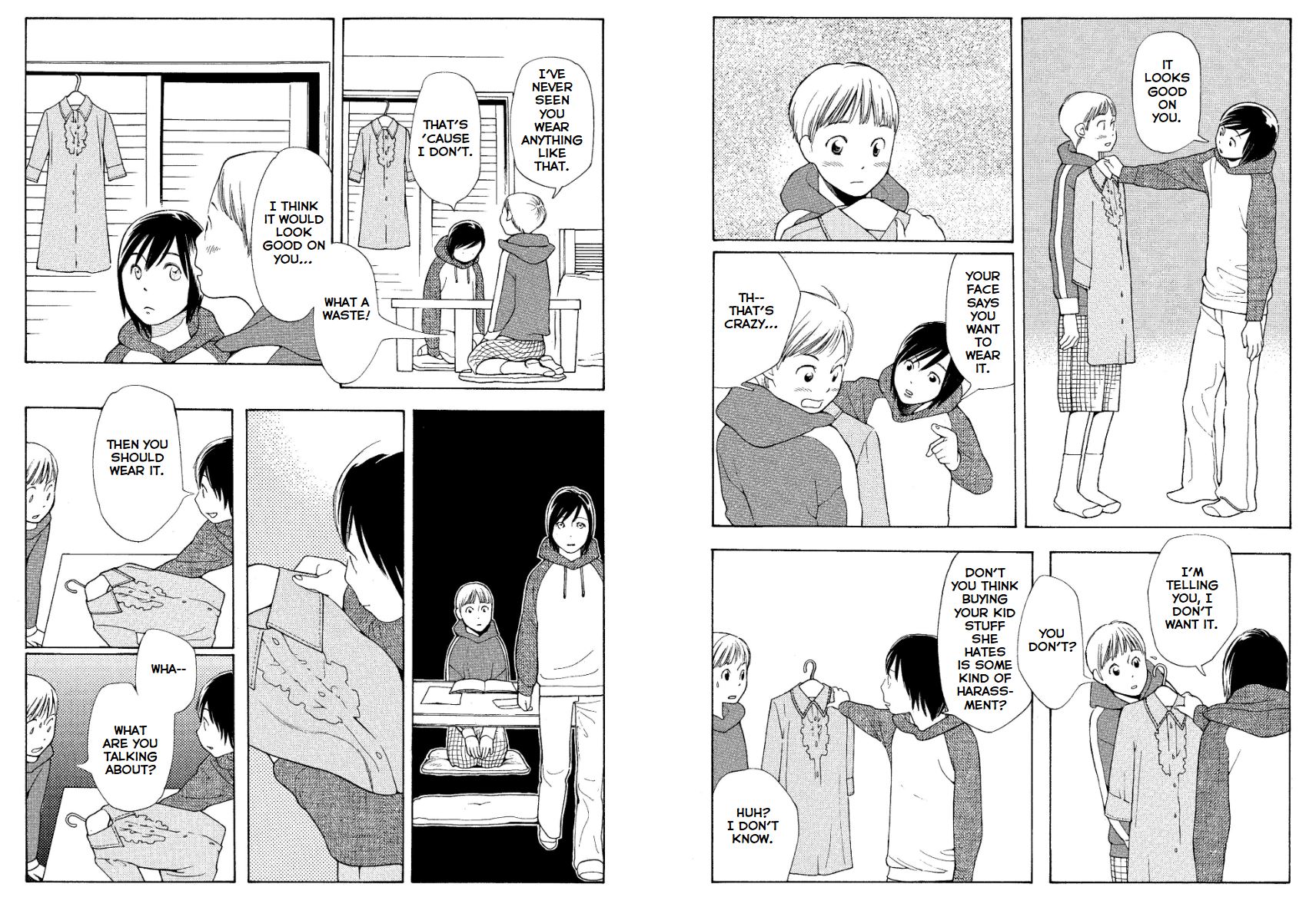
She’s a tall, confidant tomboy who harbours similar secret questions and yearnings, with an understanding family who are sympathetic but have no idea of what’s really going on. Takatsuki-san’s mother is constantly buying her child girly dresses that will never be worn, and when Shu visits, he gazes admiringly and is casually offered one that provokes throes of guilt and glee. Accepting it but riven with second thoughts Shu ultimately hands it off to his annoying interfering sister, with whom he still shares a bedroom…
Takatsuki-san’s instinctive friendliness towards Shuichi is shared by pretty Chiba Saori (“Saorin”), an extremely perceptive girl who seems content with her gender but is troubled in almost everything else. Ever (over) eager to please, she is a ball of inexplicable guilty feelings and – even at her tender age – is dabbling with alternative lifepaths. Currently, she’s seriously considering converting to Christianity…
From the start, this close circle supports if not actively encourages Shuichi to embrace his inner longings. Yoshino’s clueless mother keeps buying dresses which the despairing daughter tries to give to her confused new pal, much to his embarrassment – but dwindling resistance. Saori, acutely aware of the Nitori boy’s underlying otherness, encourages his crossdressing fascination. She even buys him an extravagant frock for his birthday, almost killing their budding friendship stone dead…
Second chapter ‘The Wandering Son Wanders On’ sees Shu’s dreams wracked by his capitulation as he puts on and rejects the dress, just as Saori successfully suggests that their unsuspecting class perform The Rose of Versailles as an end-of-term play. Moreover, all the girls should play the male roles and vice versa.
The Rose of Versailles is a monumentally popular Shoujo manga tale – later, a movie and musical – by Riyoko Ikeda, telling the story of Lady Oscar: a girl whose soldier father raises her AS a man. She/He eventually becomes a dashing Palace Guard and the darling of Marie Antoinette’s Court. We’ll be covering Tezuka Osamu’s manga adaptation of it later this year…
Continuing over into ‘Oscar and André’ Shu’s perplexities, yearnings and misgivings slowly settle. Both he and Yoshino are hard-pressed to deny their overwhelming mutual need: boy wants to be girl and girl, boy. Inevitably, in ‘Wandering Daughter’ it all proves too great and both succumb. Yoshino has her hair cut far too short and goes out in her brother’s school uniform, only to be chatted up in a burger bar by a lovely older girl. Stunned and baffled, Takatsuki leaves the café with Yuki-san’s phone number..
Shuichi’s sporadic surrenders are less public, but increasingly important to his happiness and wellbeing… and to be honest, after his own feminising haircut, Shu does make an astonishingly pretty girl, more so even than Roger Taylor in that Queen video or Patrick Sawyze in To Wong Foo – Thanks for Everything! Julie Newmar – although completely pure, innocent and utterly raunch-free…
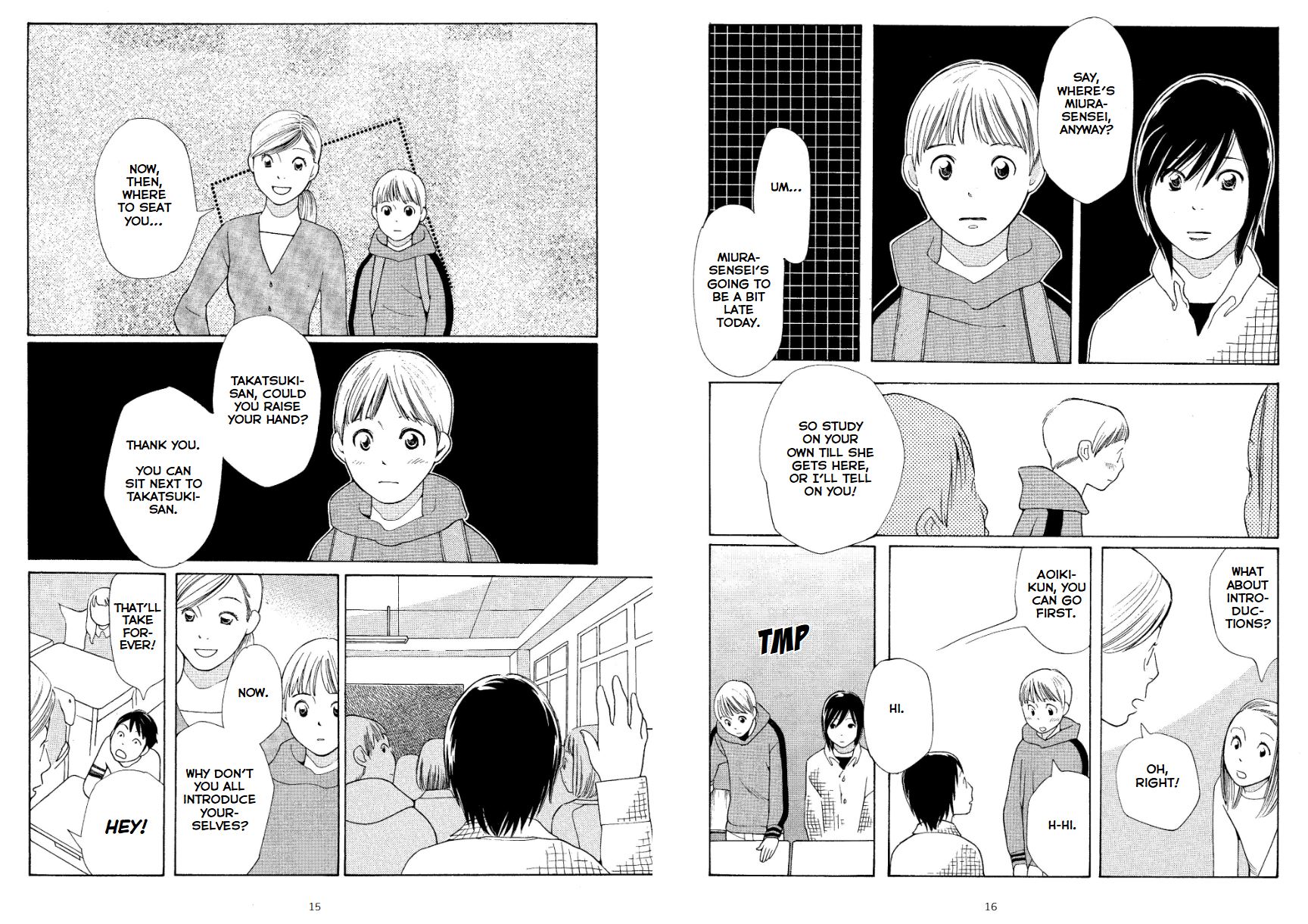
The shared quandaries intensify with ‘Nitori-kun’s Birthday’ and choices of what to buy with the cash that comes with that, before his friends in the know double down with gifts any girl would love to receive. Inevitably, pressures of the school play and effects of ‘Friends and their Words’ bring on stress related illness. Ever-understanding, Shu’s bestie has the perfect solution and leaves him with her little sister’s old school uniform. He looks great in it…
However, as they head out for a moment of shopping fun, inescapable biology strikes back in ‘Takatsuki-san’s Calamity’. Hit hard and without warning by her first ever period, Yoshino is trapped in a toilet cubicle until Shu – still dressed as a schoolgirl – can bravely buy the necessary tampons, pads and other paraphernalia demanded by the crisis…
Now at school and carrying the formal kit every girl hides in her schoolbag, Yoshino falls prey to stupid boy bullying in ‘Everything I Want’ and retaliates in kind. However, it’s not the treatment that’s a problem, it’s realising that mind & heart can be as willing as it must, but the body will do what it wants… and what it does to her is sheer, appalling torture…
No matter how much Shiuchi & Yoshino wish they could exchange genders, time and physical maturity inexorably march on and the changes of puberty are irresistibly challenging their dreams and causing their treacherous forms to horrifyingly and inescapably betray them. The changes lead to confusion, anger, and inevitably exchanges of blows…
Be warned please, incidents and aftereffects of actual periods are sensibly and accurately portrayed and sensitively dealt with (as much as they can be when school classmates are what they are) so if you’re not quite evolved enough yet, you might need to sit down for a bit before continuing…
That will be in Volume 2, following comedic aside ‘Just Before Transferring Bonus Manga’…
The second stage of the desired metamorphoses again come with a full-colour character catalogue before the tales picks up with chapter 9 as ‘Love & (Hair)piece’ finds Shu and Yoshino entering Sixth Grade. When Shu and sister Maho-san are given a relative fortune by their doting grandma, they gleefully consider their options before he sagely decides to save his… until he sees that long blonde wig in the boutique. Stood beside Yoshino wearing her brother’s school uniform, they make the perfect couple…
Yuki-san sure thinks so when she sees the couple. She still seems interested in the “young man” she met in the cafe and introduces them to her male friend: a weird guy called Shii-chan. They both seem to know an awful lot about what Shuichi and Yoshino are going through and there’s a reason for that…
Over another loaded café meeting Yuki-san and boyfriend Shii-chan reveal that they are both trans, offering insight and a possible happy destination for the overwrought kids. As teacher Nakagawa-sensei sets project “My Dream” to the class to consider and discuss what each pupil most wants, ‘Dreams and Desires and Stuff’ sees the topic grip everybody. Shu ponders his possible future and life goals amidst a sea of conflicting opinions and soon even the families get involved. To offset the self-induced pressures, he and Yoshino meet up with Yuki-san who deftly probes their situation…
Unable to clear his mind, She falls ill, and whilst at home, dresses in full female form. Sadly that’s when classmate Seya-kun pays a visit and falls in love with “girl” who opens the door…
Revealed in ‘An Unfortunate Boy’, Seya’s visit was not an accident. He was infatuated with Shu’s siter Maho, but now after seeing the other girl, the poor sap is deeply conflicted but not nearly as much as Shu, who Maho somehow blames for losing her a potential boyfriend. That ultimately leads to a sibling spat that leaves Maho stunned but now also part of Shu’s big secret…
The potential fallout of take-charge Maho sharing the burden is explored in ‘An Undaunted Girl’ as she confronts and teases oblivious Seya before chasing her own dream by contacting a modelling agency. Meanwhile, Shu and Yoshino have been regularly seeing Yuki, and become embroiled in her most excessive relationship with frankly scary Shii, who fears Takatsuki might be a love rival… until a most revelatory close and personal encounter.
With the air cleared, Yuki shares the tale of her transition from unhappy young man to contented woman, before the now-inspired kids return to a storm of familial cross-examination about where they have been. Even Maho is ticked off. She could really use an understanding adult friend right now…
Adding to all their woes, at school Shu and Yoshino are now expected to contribute to ‘The Exchange Diary’, adding to a communal chronicle of pupil secrets and aspirations that they know will cause them nothing but more grief, but which forces them to consider expanding their clandestine circle of trust in ‘An Odd Pair’ all in advance of their next major challenge: preparing for a organised outing away from their homes and admittedly tenuous comfort zones…
Of course frightful biology keeps surprising them. In ‘School Trip: The Day Before’ it’s poor Shu’s turn to anticipate shame and betrayal as his sleep is ruined forever by Yuki’s story of her personal school horror: a school trip sleepover that resulted in a nocturnal emission, compounded by a far-too understanding helpful adult helping to clean it up. At least schoolmate Shii was there to calm the agitation…
Now, wracked with dread, but heartened that the contented adults see themselves in him and Yoshino, the pair ready themselves for the stay at mountaintop national park Nikko with a bunch of rowdy, judgemental schoolmates who might become condemning foes at the slightest misstep. Dealing with communal meals and baths with excitable grabby strangers in ‘School Trip: Day 1’ is bad enough but its nerves that prevent Shu from sleeping, before ‘School Trip: Day 2’ sees his close group targeted by bullies, This time, weirdo Saorin is the first to leap violently to his rescue. That’s nothing compared to what happens after Yuki & Shii “coincidentally” show up at the park and Yuki makes a pass at Shu’s teacher…
To Be Continued…
The drama is bookended by Takako Shimura’s humorous sidebar An Afterword That’s More Like Random Notes on my Life as of late and supported by crucial essays from Rachel Thorn. The first is Snips and Snails, Sugar and Spice: A Guide to Japanese Honorifics as used in Wandering Son: a fantastically useful detailing of honorifics explaining the institutionalised societal, age and gender rankings/positions ingrained in the nation’s being. Trust me, in as stratified a culture as Japan’s, this background piece is an absolute necessity, especially when dealing with transgender issues, sexual identity and the attendant dysphoria and forces shaping gender identity, such as how husky, aspiring boy-to-be Takatsuki is regarded as “kun” (male, intimate) not “chan” (female, diminutive, intimate) by classmates.
That’s accompanied by a comprehensive Japanese Pronunciation Guide that is also invaluable especially if you read aloud…
Openhearted, charming and beguiling, coming of age epic Wandering Son potently and delightfully explores a charged and critical dilemma affecting so many, and deals with the issues in a compelling, witty, sensitive, funny and deeply welcoming manner, but it’s also a sublimely readable story about people and one that everybody should see.
Wandering Son Vols. 1-2 [HORO MUSUKO Vol. 1. 2] © Takako Shimura 2003, 2004. First published in Japan in 2003, 2004 by KADOKAWA CORPORATION, Tokyo. English Translation rights arranged with KADOKAWA CORPORATION, Tokyo through TUTTLE-MORI AGENCY, INC. Tokyo. Essay © 2026 Rachel Thorn. This edition is © 2026 Fantagraphics Books, Inc. All rights reserved.
Wandering Son volumes 1 & 2 will be released on September 15th 2026 and is available for pre-order now.
Today in 1892 welcomed French comics pioneer Edmond-François Calvo (La Bête Est Mort/The Beast is Dead), a birthday shared with astounding author Otto Binder (Captain Marvel/Shazam!, Superman, Superboy Supergirl, Mighty Samson, Young Allies, Tommy Tyme, Miss America, Captain America, Sub-Mariner, All-Winners Squad, Kid Eternity, Uncle Sam, The Shield) in 1911; cartoonist Brant Parker (Crock, Out of Bounds, Wizard of Id) in1920 and Filipino creator Francis Manapul (Witchblade, Flash, Legion of Super-Heroes) in 1979.
The day saw the passing of unsung Belgian artisan and Ligne claire pioneer Bob de Moor (Johan et Stephan, L’énigmatique monsieur Barelli, Cori le Moussaillon, Les aventures d’Oncle Zigomar, The Adventures of Blake and Mortimer, The Adventures of Tintin) in 1992.