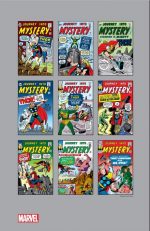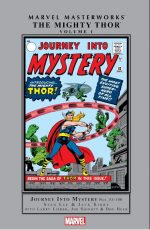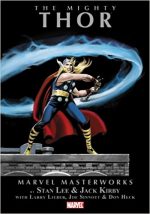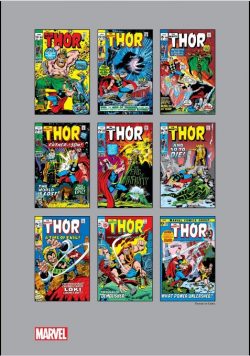
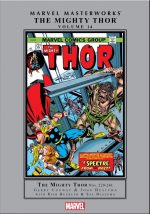
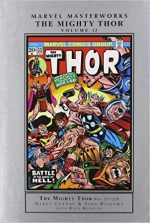
Thor Marvel Masterworks volume 14


By Gerry Conway, Roy Thomas, Bill Mantlo, John Buscema, Rich Buckler, Sal Buscema & various (Marvel)
ISBN: 978-0-7851-9188-9 (HB)

Win’s Christmas Gift Recommendation: Eternal Escapism at its best… 8/10

Whilst the ever-expanding Marvel Universe had grown ever-more interconnected as it matured through its first decade, with characters literally tripping over each other in New York City, the Asgardian heritage of Thor and the soaring imagination of Jack Kirby had most often drawn the Thunder God away from mortal realms into stunning, unique landscapes and scenarios.

However, by the time of this power-packed compendium, the King was long gone and was in fact readying himself to return to the House of (mostly his) Ideas, and only echoes of his groundbreaking presence remained. John Buscema had visually made the Thunder God his own, whilst a succession of scripters struggled to recapture the epic scope of Kirby’s vision and Stan Lee’s off-kilter but comfortingly compelling faux-Shakespearean verbiage…

Once upon a time, disabled doctor Donald Blake took a vacation in Norway only to stumble into an alien invasion. Trapped in a cave, he found an ancient walking stick which, when struck against the ground, turned him into the Norse God of Thunder! Within moments he was defending the weak and smiting the wicked.

Months swiftly passed with the Lord of Storms tackling rapacious extraterrestrials, Commie dictators, costumed crazies and cheap thugs, but these soon gave way to a vast kaleidoscope of fantastic worlds and incredible, mythic menaces, usually tackled with an ever-changing cast of stalwart immortal warriors at his side…

Just prior to these monthly episodes from Thor #229-241 (November 1974 to November 1975, plus a bonus tale from Marvel Premiere # 26 – and all available in hardcover and digital formats), the Thunder God and his cosmic companions had become a quarrelsome, self-doubting band of fantasy spacemen generally roving the outer limits of the Marvel Universe, only occasionally touching base with Earth and Asgard, but that editorial policy had changed as more and more adventures began – and ended – in the troubled lands of Midgard…

With these sagas scripter Gerry Conway ended his long association with the Asgardians – fondly covered in his Introduction ‘Looking Backward 2015-1974 (with Apologies to Edward Bellamy)’ – and a brief period of instability but never a drop in quality ensued before a new regular scribe could begin…

“Homaging” Kirby, penciller Rich Buckler and veteran inker Chic Stone depicted the godly prince safely back on Earth and facing a new kind of terror in Thor #229 as ‘Where Darkness Dwells, Dwell I!’ sees fellow Avenger Hercules uncover an uncanny string of suicides amongst the mortals of Manhattan. After consulting the Storm Lord and his recently returned lover Sif, the Prince of Power is ambushed by a shadowy figure and himself succumbs to dark despondency…

Plucked from psychological catatonia by Iron Man and the recuperating Asgardian Krista, severely shaken Hercules recovers enough to lead Thor deep beneath the city to jointly confront and conquer a horrific lord of fear in #230’s climactic ‘The Sky Above… the Pits Below!’ (inked by Joe Sinnott).

Of greater moment is the revelation in hallowed Asgard that almighty Odin is mysteriously missing…

John Buscema returned in #231, inked by Dick Giordano to limn ‘A Spectre from the Past!’, wherein Thor learns that former true love Jane Foster is dying, another victim of the recently defeated fear lord. Whilst doting current paramour Sif fruitlessly returns to Asgard seeking a cure, the grieving Thunderer is momentarily distracted when Hercules is attacked by an unbelievably powerful anthropoidal throwback. Disembodied spirit Armak the First Man has somehow possessed the body of an unwary séance attendee and now runs savagely amok in the streets…

Since gaining his liberty Galactus’ herald Firelord had been aimlessly travelling the globe. Lured by Asgardian magic he now becomes wicked Loki‘s vassal in ‘Lo, the Raging Battle!’…

Heartsick Thor, meanwhile, will not leave Jane’s hospital bedside, prompting Sif and Hercules to travel alone to the ends of the universe to retrieve the mystic and fabled Runestaff of Kamo Tharnn. No sooner do they depart than the ensorcelled Firelord attacks and whilst incensed, impatient Thor is knocking sense back into him, his evil half-brother leads an Asgardian army in a sneak attack on America…

With ‘Midgard Aflame’ (Buscema & Stone) Thor furiously leads the human resistance and learns for the first time that his father is missing. Odin’s faithful vizier reveals that the All-Father has deliberately divested himself of his memory and chosen to reside somewhere on Earth as a hapless mortal, the better to learn humility…

With humanity preparing to unleash their atomic arsenal against the occupying Asgardians, the invasion suddenly ends with a savage duel between Thor and Loki in ‘O, Bitter Victory!’ (Buscema & Sinnott) after which the Thunderer returns to Jane’s side, unaware that he is being stalked by a merciless old enemy.

Simultaneously but far, far away Sif and Hercules have clashed with he ‘Who Lurks Beyond the Labyrinth!’ and secured a remedy for Thor’s mortal beloved…

Thor #236 opens as the Thunder God revels in furious combat with the Absorbing Man. Unknown to the blockbusting battlers, at that very moment Sif is expressing her own love for her wayward prince by using the Runestaff to fix Jane in ‘One Life to Give!’

…And somewhere in California, an imposing old man called Orrin ponders his strangely selective amnesia and wonders how he can possibly possess such incredible strength and vitality…

With battle concluded, Thor hastens back to Jane and finds her completely cured. His joy is short-lived however, as he realises that Sif is gone, seemingly forever…

Issue #237 finds reunited lovers Don Blake and Jane Foster cautiously getting reacquainted and pondering Sif’s incredible sacrifice when a horde of Asgardian Trolls led by ‘Ulik Unchained’ calamitously attack New York. Before long they have made off with the recently restored Jane under cover of the blockbusting melee that inevitably ensues…

Conway concluded his contributions with Thor #238 as the Thunderer capitulates to his hostage-taking foe and is taken below the worlds of Earth and Asgard on the ‘Night of the Troll!’

Ulik wants to overthrow his king Geirrodur and is confident his hold over his mighty arch foe will accomplish the act for him, but is utterly unprepared for the new martial spirit which now enfuses his formerly frail mortal hostage…

…And in California old man Orrin decides to use his power to help the poor, quickly arousing the ire of big business, brutal strike-breakers and the local authorities…

Writer/Editor Roy Thomas and artist Sal Buscema join Sinnott in Thor #239 as the Thunder God brutally ends his association with the trolls even as in California Orrin’s rabble-rousing civil unrest is cut short when a colossal pyramid containing Egyptian gods erupts from the ground in ‘Time-Quake!’

Thor knows nothing of the latest upheaval. He has returned to distant Asgard, uncovering a mysterious force draining his people of their power and vitality. Warned by duplicitous seer Mimir, the anguished godling rushes back to Earth to clash with the puissant Horus ‘When the Gods Make War!’ (Thomas, Bill Mantlo, Sal Buscema & Klaus Janson).

The depleted Egyptian pantheon have desperate need of an All-Father and have conditioned Odin/Orrin to believe that he is their long-lost patron Atum-Re…

Go-getting, proactively take-charge Jane is already waiting in California when Thor arrives and she is present when the elder deity devastatingly assaults his astounded son. Happily, her cool head prevails and soon the warring deities are talking. An uneasy alliance forms and the truth comes out. Horus, Isis and Osiris are in an apocalyptic battle with vile Death God Seth and need the power of a supreme over-god to assure a victory for the forces of Life. Sadly, that energy is being siphoned from Asgard…

The cosmic conflict concludes in #241 as ‘The Death-Ship Sails the Stars!’ (Mantlo, John Buscema & Sinnott) with the ghastly Seth and his demonic servants ultimately repulsed and Jane again playing a major role: even triumphally shaking Odin out of his compliant, mind-wiped state…

Also included here is a contemporaneous solo tale of Hercules, taken from Marvel Premiere #26 (November 1975), setting up his forthcoming role in new team title The Champions. Crafted by Mantlo, George Tuska & Vince Colletta – and sporting a new Kirby cover – ‘The Game of Raging Gods’ finds the legendary hero relocated to California on the college lecture circuit and targeted by old enemies Typhon the Titan and witch woman Cylla…

Also adding lustre are the cover to all-reprint Giant-Size Thor #1, and original art covers by Gil Kane, Al Milgrom & John Romita and Kirby & Frank Giacoia.

The tales gathered here may lack the sheer punch and verve of the early years but fans of ferocious Fights ‘n’ Tights fantasy will find this tome still stuffed with intrigue and action, magnificently rendered by artists who, whilst not possessing Kirby’s vaulting visionary passion, were every inch his equal in craft and dedication, making this a definite and decidedly economical must-read for all fans of the character and the genre.
© 1974, 1975, 2017 Marvel Characters, Inc. All rights reserved.
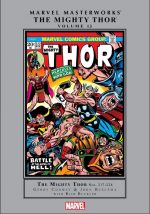
Thor Marvel Masterworks volume 13


By Gerry Conway, John Buscema, Rich Buckler, Sal Buscema, Arvell Jones, Keith Pollard & various (Marvel)
ISBN: 978-0-7851-8856-8 (HB)

Disabled doctor Donald Blake took a vacation in Norway only to stumble into an alien invasion. Trapped in a cave, he found an ancient walking stick which, when struck against the ground, turned him into the Norse God of Thunder! Within moments he was defending the weak and smiting the wicked.

Months swiftly passed with the Lord of Storms tackling rapacious extraterrestrials, Commie dictators, costumed crazies and cheap thugs, but these soon gave way to a vast kaleidoscope of fantastic worlds and incredible, mythic menaces, usually tackled with an ever-changing cast of stalwart immortal warriors at his side…

As this bombastic compendium (available in hardcover and digital formats and reprinting Mighty Thor #217-228, spanning November 1973 through October 1974) opens, our cosmic cast returns to long-abandoned Asgard after interstellar escapades and bravely endured exile. However, before the narrative wonderment begins there’s time for more candid revelations and contextual history from sole scripter Gerry Conway in his Introduction ‘Lo. There Shall Come an Ending’…

Thor #217 sees the triumphant return of Thor and his fellow heroes – with their recently rescued from alien enslavement All-Father Odin – discover a mysteriously rebuilt Eternal Realm filled with their fellow Asgardians who brandish ‘All Swords Against Them!’ (with art by Sal Buscema inking brother John). Facing them are as impossible doppelgangers of Odin, Thor and the rest, all offering murderous hostility. Whilst the Thunderer furiously struggles to unravel this latest mystery and defeat the invading doppelgangers, in another sector of the universe the all-conquering Colonizers of Rigel are put to flight; abandoning their worlds to an all-consuming force of sheer destruction…

Issue #218 proves there is no rest for the weary as the again-victorious true Asgardians once more take ship to the stars to prevent the Rigellians’ doom from reaching Earth. ‘Where Pass the Black Stars There Also Passes… Death!’ (illustrated by J. Buscema & Jim Mooney) finds the hard-travelling heroes facing a nomadic race of colossal, decadent star-farers who fuel their unending flight by converting thriving civilisations into food and power.

In distant Asgard, war woman Hildegarde‘s young sister Krista is slowly falling under the sway of sinister seductive evil, even as her hereditary protectors are a cosmos away, daringly infiltrating one of the Black Stars’ cosmic scoops and encountering a race of mechanical slaves in ‘A Galaxy Consumed!’ (inked by Mike Esposito) before they and their charismatic messiah Avalon are at last freed – and untold galaxies subsequently saved – from callous consumption in ‘Behold! The Land of Doom!’

With scripter Conway firmly in the driving seat and legendary illustrator John Buscema (aided by inker Mike Esposito) delivering the art, the mythic mayhem intensifies with ‘Hercules Enraged!’ as Thor brutally invades Olympus, in search of the Grecian Prince of Power.

After Asgardian maiden’s Krista abduction, the All-Father has seen a vision of her chained in Hades with the Thunder God’s trusted ally gloating over her beside vile Grecian netherlord Pluto…

By the time lordly Zeus stops the shattering clash that follows, half of the celestial city is in ruins, but in that breathing space he proves Hercules’ innocent of the atrocious act and the abashed comrades duly turn their attentions to the true culprit…

Inked by Joe Sinnott, Thor #222 finds the earnest comrades in search of Hercules’ insidious impersonator and taking advice from a scary sorceress even as war-god Ares receives an eldritch summons to meet his co-conspirator ‘Before the Gates of Hell!’

Sadly for him, the war god is intercepted by our heroes before he gets there and receives the sound thrashing he deserves, prior to the enraged companions storming their way into the netherworld itself. At the moment of their triumph, however, Pluto snatches up his hostage and vanishes. The infernal trail leads straight to Earth where one final confrontation results in ‘Hellfire Across the World!’ (Esposito inks) and leaves kidnapped Krista wounded unto death…

After a lengthy hiatus, 224 finds Thor resuming his mortal alter ego of surgeon Don Blake to operate on the dying Asgardian, even as elsewhere in Manhattan, a rash scientist accidentally reactivates Odin’s unstoppable battle construct and discovers ‘No One Can Stop… the Destroyer!’

With Krista saved, Thor joins sorely-pressed Hercules and – although outmatched by the Asgardian killing machine – devises a way to stop its human power source, only to then face ‘The Coming of Firelord!’ (inked by Sinnott). The tempestuous, short-tempered herald of planet-consuming Galactus has been sent to fetch Thor and will brook no refusals…

Issue #226 sees the voracious space god on Earth again, beseeching the Thunder God’s aid in ‘The Battle Beyond!’ (Esposito) against living planet Ego, who has seemingly gone mad and now poses a threat to the entire universe…

Deftly channelling Jack Kirby, penciller Rich Buckler (aided by his pals Arvell Jones & Keith Pollard) joined Conway & Sinnott in #227 as the Storm Lord God and Hercules – with Firelord in tow – go ‘In Search of… Ego!’ Penetrating deep within the sentient-but-raving planet and defeating incredible biological horrors acting as planetary antibodies, the trio reach his malfunctioning brain and experience the incredible origin of the “bioverse” in ‘Ego: Beginning and End!’, before contriving an earth-shaking solution to the wild world’s rampages. In a final act of unlikely diplomacy, the Thunderer then finds a replacement herald and secures Firelord’s freedom from Galactus…

To Be Continued…

This collection also includes assorted House ads, covers created by John Romita and a frontispiece by Marie Severin for the Thor-starring Marvel Treasury Edition plus a Buscema double page pin-up of the Asgardian cast, as well as an always enticing selection of original art pages.

Thor is one of modern comics’ greatest attractions and a cornerstone of the Marvel Universe. Always a high-point in graphic fantasy, his longevity is all the more impressive for the sheer imagination and timeless readability of the tales crafted by an army of creators. This chronicle is an absolute must for all fans of the medium and far-flung fantasy thrills.
© 1973, 1974, 2017 Marvel Characters, Inc. All rights reserved.
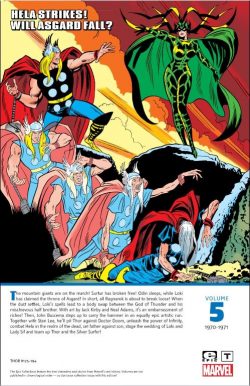
Thor Epic Collection volume 5: 1970-1971 The Fall of Asgard


By Stan Lee & Jack Kirby, Gerry Conway, John Buscema, Neal Adams & various (Marvel)
ISBN: 978-1-3029-1274-1 (TPB)

The Mighty Thor was the title in which Jack Kirby’s restless fascination with the Cosmic Unknown was honed and refined through his dazzling graphics and captivating concepts. The King’s career-defining string of power-packed signature pantheons all stemmed from a modest little fantasy/monster title called Journey into Mystery where – in the summer of 1962 – a tried-and-true comicbook concept (feeble mortal transformed into god-like hero) was revived by fledgling Marvel Comics to add a Superman analogue to their growing roster of costumed adventurers.

This bombastic full-colour trade paperback tome – also available in eFormats – re-presents Kirby’s final Asgardian exploits and the exemplary efforts of his unlucky over-pressured successors. Taken from Thor #175-194, the sagas collectively cover April 1970-December 1971, as universe-builder King Kirby abandoned the worlds he’d tirelessly cultivated with Stan Lee for the hopefully fresher fields of DC Comics and a cosmos uniquely his own…

What needs knowing: Once upon a time lonely, lamed American doctor Donald Blake took a vacation in Norway only to encounter the vanguard of an alien invasion. Trapped in a cave, Blake found a gnarled old walking stick, which, when struck against the ground, turned him into the Norse God of Thunder!

Without any hesitation or preamble, the reborn godling was soon defending the weak and smiting the wicked. As months swiftly passed, rapacious extra-terrestrials, Commie dictators, costumed crazies and cheap thugs gradually gave way to a vast panoply of fantastic worlds and incredible, mythic menaces. Eventually the magnificent warrior’s ever-expanding world of Asgard was a regular feature and mesmerising milieu for the hero’s earlier adventures, heralding a fresh era of cosmic fantasy to run almost tangentially to the company’s signature superhero sagas. With a further revelation that Don Blake had never existed: but was a spell crafted to teach an arrogant god humility and humanity…

The astounding action begins here behind a Marie Severin cover as ‘The Fall of Asgard!’ (Lee, Kirby & inker Bill Everett) sees valiant Asgardian Balder and his Warriors Three allies Fandral, Hogun and Volstagg escape the clutches of lovestruck sorceress Karnilla only to confront the assemble hordes of giants and trolls marching on the Home of the Gods.

With All-Father Odin incapacitated by his annual Great Sleep, Loki has perfidiously seized the throne forcing war-goddess Sif to call Thor back home for perhaps the Last Battle…

Inked by Vince Colletta, ‘Inferno!’ reveals the folly of the usurper as terrifying fire-demon Surtur breaks free of ancient Odinian captivity to begin his pre-ordained task of burning down the universe.

With everything appearing ‘To End in Flames!’, Loki flees to Earth, having first hidden Odin’s sleeping form in the life-inimical Sea of Eternal Night. As Thor leads a heroic Horatian last stand, Balder penetrates the Dimension of Death to rescue the All-Father just as Surtur fires up for his fulminating final foray…

Thor #178 (July 1970) was a shock and is a landmark: the first issue without Jack Kirby since the strip’s earliest days. Clearly a try-out or hasty fill-in yarn, ‘Death is a Stranger’ – by Lee, John Buscema & Colletta – depicts the Thunderer snatched away from Asgard by the nefarious Abomination and duped into an epic clash with the alien Stranger: an extra-galactic powerhouse who collects unique beings for scientific study…

Inked by John Verpoorten, the interrupted epic riotously resumed in #179 with ‘No More the Thunder God!’ as Thor, Sif and Balder are dispatched to Earth to arrest the fugitive Loki. This issue was Kirby’s last: he left the entire vast unfolding new mythology on a monumental cliffhanger just as the Thunder God is ambushed by his wicked step-brother. Using arcane magic, the Lord of Evil switches bodies with his noble sibling and gains safety and the power of the Storm whilst Thor is doomed to endure whatever punishment Odin decrees…

More than any other Marvel strip Thor was the feature where Kirby’s creative brilliance matched his questing exploration of an Infinite Imaginative Cosmos: dreaming, extrapolating and honing a dazzling new kind of storytelling graphics with soul-searching, mind-boggling concepts of Man’s place in the universe.

Although what followed contained the trappings and even spirit of that incredible marriage, the heart, soul and soaring, unfettered wonderment just were not there any longer: nor would they truly return until 1983 when Walt Simonson assumed creative control with #337 (see Mighty Thor: the Ballad of Beta Ray Bill).

Here, however, ‘When Gods Go Mad!’ introduced the radically different style of Neal Adams to the mix, inked by the comfortably familiar Joe Sinnott, as the true Thunderer is sent to Hell and the tender mercies of Mephisto, whilst on Earth Loki uses his brother’s body to terrorise the UN Assembly and declare himself Master of the World…

In #181’s ‘One God Must Fall’ Sif leads the Warriors Three on a rescue mission to the Infernal Realm even as Balder struggles to combat the power of Thor merged with the magic and malice of Loki until Mephisto is thwarted. Then, a cataclysmic battle of brothers on Earth subsequently sets the world to rights…

The new Post-Kirby era truly began with Thor #182, as John Buscema took up the artistic reins and began his own epic run as illustrator with ‘The Prisoner… The Power… and… Dr. Doom!’

The Storm Lord is unwillingly entangled in Earthly politics when a young girl entreats him to rescue her father from the deadly Iron Monarch of Latveria. The noble scion cannot refuse, especially as the missing parent is an expert on missile technology and is capable of making Doom the master of ICBM warfare…

The decidedly down-to-Earth and mismatched melodrama concludes with Don Blake ‘Trapped in Doomsland!’ until Thor can retrieve his misappropriated mallet, but even after his deadly mission of mercy is accomplished, tragedy is his only reward…

Comfortably settled in Lee, Buscema & Joe Sinnott began crafting their own ambitious cosmic saga, opening with #184 and exploring ‘The World Beyond!’ wherein an implacable, sinister force is discovered devouring the outer galaxies, with psychic reverberations of the horrific events impacting and unravelling life on Earth and in Asgard. With all creation imperilled, Odin departs to combat the enigmatic threat alone…

Sam Grainger inked ‘In the Grip of Infinity!’, as universal calamity intensifies and the All-Father falls to the enigmatic, seemingly all-consuming invader before ‘Worlds at War!’ exposes a hidden architect behind the ultimate Armageddon. That revelation leads to a desperate last-ditch ploy, uniting the forces of Good and Evil together in ‘The World is Lost!’ before one final clash – inked by Jim Mooney – answers all the questions before celebrating ‘The End of Infinity!’

Although vast in scope and drenched in powerful moments highlighting the human side of the gods in extremis, this tale suffers from an excess of repetitive padding and a rather erratic pace. Without pause, though, we plunge on as Thor #189 sees sepulchral goddess Hela come calling, demanding Thor feel ‘The Icy Touch of Death!’ to pay for all the souls she didn’t get in the recent sidereal showdown…

After a big chase around planet Earth she is finally dissuaded in ‘…And So, To Die!’, but the distraction has meanwhile allowed ever-opportunistic Loki to seize the Throne of Asgard and unleash ‘A Time of Evil!’ This typically tyrannical behaviour results in the deranged despot using Odin’s stolen power to manifest an unstoppable artificial hunter/killer dubbed Durok the Demolisher. Unleashing his merciless engine of destruction on Earth, Loki gloats at the ‘Conflagration!’ (Grainger inks) he has instigated…

Completing the retiring of the Old Guard, Gerry Conway came aboard as writer for double-length tale ‘What Power Unleashed?’ (#193, with Sal Buscema augmenting and inking brother John) to conclude the epic tale. Prevented by vows from taking up arms against Loki’s puppet, Balder and Sif cunningly enlist the Silver Surfer to aid the embattled Thunderer as Asgard totters on the brink of total destruction.

Free to act against the real enemy, Thor then retaliates with staggering power and ‘This Fatal Fury!’: occupying the usurper’s full and furious attention until wily All-Father Odin finally resumes his rightful place.

To be continued…

The Kirby Thor will always be a high-point in graphic fantasy, all the more impressive for the sheer imagination and timeless readability of the tales. With his departure the series foundered for the longest time before finding a new identity, yet even so the stories in this volume are still packed with intrigue and action and magnificently rendered by an illustrator who, whilst not possessing Kirby’s vaulting visionary passion, was every inch his equal in craft and dedication. This book (which also includes his covers to Thor Annuals #3 and 4, plus the unused cover to #175, inked by John Verpoorten, pertinent house ads and a selection of Buscema original art pages and covers) is an absolute must for all fans of the medium, and all disciples of the modern Norse gods.
© 1970, 1971, 2018 Marvel Characters, Inc. All rights reserved.
Thor Marvel Masterworks volume 11


By Gerry Conway, Stan Lee, John Buscema & various (Marvel)
ISBN: 978-0-7851-5885-1 (HB)

With the constantly expanding Marvel Universe growing ever more interconnected as it matured, characters literally tripped over each other in New York City and its environs, but such was not the case with Thor.

The Asgardian milieu and the soaring imagination of Jack Kirby had long drawn the Thunder God away from mortal realms into stunning new landscapes. When the unthinkable happened and the increasingly discontented King of Comics jumped ship from the House of (His) Ideas for arch-rival DC in 1970 an era ended.

Left to soldier on, Stan Lee called in artist John Buscema to carry a seemingly unbearable burden and after initial loss of focus and impetus a new type of tale began to emerge…

In case you came in late: disabled doctor Donald Blake took a vacation in Norway only to stumble into an alien invasion. Trapped in a cave, he found an ancient walking stick which, when struck against the ground, turned him into the Norse God of Thunder! Within moments he was defending the weak and smiting the wicked.

Months swiftly passed with the Lord of Storms tackling rapacious extraterrestrials, Commie dictators, costumed crazies and cheap thugs, but these soon gave way to a vast kaleidoscope of fantastic worlds and incredible, mythic menaces.

This bombastic transitional compendium (available in hardcover and digital formats) reprints Mighty Thor #195-205, spanning January-November 1972, with the puissant Thunder God going both forward and back between mortal and godly realms. By the time of these monthly episodes the Thunderer and his Asgardian companions were slowly devolving into a muddled, self-doubting band of fantasy spacemen roving the outer limits of the Marvel Universe under the earnest governance of young science fiction novelist Gerry Conway and a dedicated, talented but still unsettled string of artists. Now, however, a new path was being forged…

The new era is contextualised by scribe Conway in his Introduction before the action resumes with ‘In the Shadow of Mangog!’ (illustrated by John Buscema & Vince Colletta): the first part of another extended odyssey wherein Thor and friends are dispatched to the ends of the Universe. In his righteous rage All-Father Odin had banished second son Loki to a fantastic world, momentarily forgetting that once there the Prince of Evil might awaken the most vicious, unbeatable monster in the Asgardian universe ….

Now the Storm God, with Warriors Three Fandral the Dashing, Voluminous Volstagg and Hogun the Grim, finds himself lost ‘Within the Realm of Kartag!’ and facing slug-men and bewitching temptress Satrina, even as the All-Father and the hosts of the Shining City struggle to hold the liberated Mangog at bay.

Meanwhile, on the planet Blackworld Lady Sif and her muscular shield-maiden Hildegarde are undertaking another Odinian quest and find themselves caught up in a time-bending nightmare…

Thor #197 witnesses the heroes overcoming all odds to find ‘The Well at the Edge of the World!’, meeting the conniving, all-powerful Norns and recruiting colossal former foe Kartag for their desperate return to shattered Asgard.

On Blackworld, Sif and Hildegarde encounter monsters and men making uncontrollable evolutionary leaps towards an unguessable future, but make an unlikely ally and guide in aged sailor Silas Grant.

The male heroes return to find Asgard in flaming ruins and the cataclysmic confrontation with the Mangog nearing an apocalyptic end, whilst on Blackworld Sif, Hildegarde and Silas met alien Rigellian Colonizer Tana Nile and the horrendous creature behind the evolutionary jumps. Simultaneously, the battle in Asgard reaches a horrific climax when Mangog is at last defeated ‘…And Odin Dies!’

In issue #199, the ravaged home of the gods becomes adrift in a dimensional void, allowing Thor – clutching to a desperate last hope – to cocoon his deceased father in a timeless forcefield. This prevents Death Goddess Hela from claiming his soul, but sadly, she isn’t the only deity hungry for the All Father’s spirit and ‘If This Be Death…!’ reveals Grecian netherlord Pluto invading the broken realm to take Odin into his own dire domain.

…And, on Blackworld, Tana Nile hints at the origin of the monstrous Ego-Prime and how it can force such terrifying uncontrollable time-warps…

Back in free-floating Asgard, things go from bad to worse as brave Balder‘s beloved Karnilla deserts him just as invincible Pluto bests Hela and aims a killing blow at Thor…

The denouement was aggravatingly delayed as anniversary issue #200 hit the pause button to flashback to an earlier age.

‘Beware! If This Be… Ragnarok!’ was crafted by Stan Lee, John Buscema & John Verpoorten and spectacularly depicts the fall of the gods through the mystic visions of Volla the Prophetess, with only a bridging Prologue and Epilogue by Conway & Buscema revealing how the Norns save Thor’s life just in time for the concluding battle against Pluto to resume in #201 (with Jim Mooney providing lush finished art over Buscema’s layouts).

When Hela relinquishes her claim to the father of the gods and Odin enjoys a miraculous ‘Resurrection!’, on Earth absentee Asgardians Heimdall and Kamorr began seeking out mortals for a another Odinian master-plan even before the battle with Pluto is fully concluded…

As they scour Midgard, on Blackworld Ego-Prime advances the civilisation into atomic Armageddon and Sif barely transports her companions to Earth in time to escape thermonuclear conflagration.

Luckily Thor, Balder, and the Warriors Three are in New York City to meet the refugees, since the deadly, now self-evolving, Ego-Prime has followed the fugitives…

Thor #202 boasts ‘…And None Dare Stand ‘Gainst Ego-Prime!’ (Colletta inks) although Silas, Tana Nile and the assembled Asgardians try their best as the now-sentient shard of Ego, the Living Planet rampages through the city. It makes monsters and shatters entire streets whilst Odin calmly observes the carnage and Heimdall and Kamorr gather their human targets for the concluding ‘They Walk Like Gods!’

Here all Odin’s machinations are finally revealed as Ego-Prime inadvertently creates a new race of 20th century deities. Sadly, the All-Father’s long and single-minded scheme appals his son and weary, war-torn subjects, and their wholly understandable rebukes lead to them all being ‘Exiled on Earth!’ in #204 (Buscema & Mooney) and immediately targeted by terrifying satanic tempter Mephisto…

Soon, only the Thunderer is left to oppose the devil: recklessly invading his private hell and gloriously liberating hundreds of demon-possessed humans from ‘A World Gone Mad!’ (Colletta inks). Their triumphant return, however, is merely to Midgard, not the gleaming spires of forbidden Asgard…

To Be Continued…

This book (which also includes a gallery of Buscema original art pages and a cover by Gil Kane) is an absolute must for all fans of the superhero genre. Although the tales gathered here may lack the sheer punch and verve of The King, fans of cosmic Fights ‘n’ Tights fantasy will find this tome magnificently rendered by artists who were every inch his equal in craft and dedication, making this a definite must for all fans of the character and timeless adventure.
© 1971, 1972, 2017 Marvel Characters, Inc. All rights reserved.
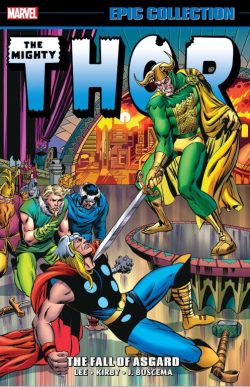
Thor: Tales of Asgard


By Stan Lee, Jack Kirby, George Roussos, Don Heck, Paul Reinman, Chic Stone, Vince Colletta & Bill Everett, with Matt Milla & various (Marvel)
ISBN: 978-0-7851-5189-0

The Mighty Thor was the comic series in which Jack Kirby’s restless fascination with all things Cosmic was honed and refined through his dazzling graphics and captivating concepts. The King’s examination of space-age mythology began in a modest little fantasy/monster title called Journey into Mystery where – in the summer of 1962 – a tried-and-true comicbook concept (feeble mortal transformed into god-like hero) was revived by the fledgling Marvel Comics to add a Superman analogue to their growing roster of costumed adventurers.

That debut tale closes out this selection of mythic masterpieces collectively culled from Journey into Mystery #83, 98-125, and Thor #126 to 145 (August 1962 to October 1967), and available to you in trade paperback and digital formats and all fully recoloured and moodily remastered by hues-master Matt Milla.

Journey into Mystery #97 (October 1963) saw the launch of a spectacular back-up series to the ever-unfolding Thor sagas. Tales of Asgard – Home of the Mighty Norse Gods gave Kirby a vehicle to indulge his fascination with legends.

Initially adapting classic fables of the Elder Eddas but eventually with all-new material particular to the Marvel pantheon, the King built his own cosmos and mythology to underpin the company’s entire continuity. This first yarn, scripted by Lee and inked by George Bell (AKA old Golden Age collaborator George Roussos), outlined the origin of the world and the creation of the trans-dimensional World Tree Yggdrasil.

The next issue proclaimed ‘Odin Battles Ymir, King of the Ice Giants!’: a short, potent fantasy romp laying more groundwork for decades of cosmic wonderment to come, inked with brittle mastery by Don Heck.

The next peek at primordial prehistory details Odin’s war with ‘Surtur the Fire Demon’ and latterly (with Paul Reinman inking) crafted an exploit of the All-Father’s so different sons in ‘The Storm Giants – a Tale of the Boyhood of Thor’. As always, Lee scripted these increasingly influential comicbook histories…

JiM #101 shows Kirby & Roussos in epic form for another exuberant tale of the boy Thor. ‘The Invasion of Asgard’ sees the valiant lad fight a heroic rearguard action whilst introducing a host of future villainous mainstays such as Rime Giants and Troll King Geirrodur.

This is followed by a macabre Reinman-inked mood piece wherein ‘Death Comes to Thor!’, with the turbulent teen facing his greatest challenge yet. Two females who would play huge roles in his life debuted in this brief 5-pager; young goddess Sif and fearsome Hela, Queen of the Dead.

Kirby & Chic Stone next revealed ‘Thor’s Mission to Mirmir!’; disclosing how the gods created mankind. That led one month later to a new Tales of Asgard strand focussing on individual Gods and Heroes. ‘Heimdall: Guardian of the Mystic Rainbow Bridge’ was first, with Heck inking a dramatic recap of the sentinel’s astounding gifts…

Having set up the scenario, ‘When Heimdall Failed!’ (Lee, Kirby & Roussos) expanded the legend before ‘Balder the Brave’ (Lee, Kirby & Vince Colletta) further fleshed out the back-story of an Asgardian pantheon deviating more and more from those classical legends kids had to plough through in schools.

Then, next issue the seductive Norn Queen debuted as a reluctant ally to evil Asgardian Loki, in a quirky reinterpretation of the classic myth ‘Balder Must Die!’ illustrated by Kirby & Colletta.

‘Trapped by the Trolls’ showed the power and promise of tales set solely on the other side of the Rainbow Bridge after Thor liberates enslaved Asgardians from subterranean bondage.

In #109 the Young Thor feature ‘Banished from Asgard’ was an uncharacteristically lacklustre effort as Odin and Thor enacted a devious plan to trap a traitor in Asgard’s ranks but the vignette hinted at much greater thrills to follow…

The sequel was crafty vignette ‘The Defeat of Odin!’ with an old and silly plot sweetened by breathtaking battle scenes, after which another short fable co-opts a Greek myth (Antaeus if you’re asking) as ‘The Secret of Sigurd’ by Lee, Kirby & Colletta …

With Colletta firmly ensconced as inker, Journey into Mystery #112 offered an eagerly anticipated origin with ‘The Coming of Loki’, retelling Marvel-style how Odin came to adopt the baby son of Laufey, the Giant King of Jotunheim. One month later the creators exposed ‘The Boyhood of Loki!’: a pensive, brooding foretaste of a villain in the making.

JiM#114 adapted another Asgardian parable – ‘The Golden Apples’ – by way of a certain European fairy tale whereas #115’s back-up mini-myth detailed ‘A Viper in our Midst!’ as young Loki clandestinely cements relations with the sinister Storm Giants – sworn enemies of the Gods….

These one-off yarns are followed by stellar novellas ‘The Challenge!’ and ‘The Sword in the Scabbard!’ in which Asgardian cabin-fever develops into an extended quest to ferret out a threat to the mystic Odinsword, the unsheathing of which could destroy the universe…

In Journey into Mystery #118 the Quest further unfolds with verity-testing talisman ‘The Crimson Hand!’ before ‘Gather, Warriors!’ heralds the arrival of a band of hand-picked Asgardian “Argonauts” enlisting aboard Thor’s flying longship in a bold but misguided attempt to forestall apparently-imminent Ragnarok…

The next instalment of the godly sky-sailors’ voyage sees them all boldly ‘Set Sail!’, only to encounter an uncanny ‘Maelstrom!’ before ‘The Grim Specter of Mutiny!’ (invoked by seditious Loki) is quashed just in time for valiant Balder to save them all from ‘The Jaws of the Dragon!’…

Issue #125 was the last Journey into Mystery: the following month saw the title transformed and re-titled The Mighty Thor. The Tales of Asgard carried on regardless as fresh chapters saw the Questers homing in on the cause of all their woes.

‘Closer Comes the Swarm’ pits them against the flying trolls of Thryheim, whilst ‘The Queen Commands’ finds Loki captured until Thor answers ‘The Summons!’ and promptly returns his crew to Asgard to be shown ‘The Meaning of Ragnarok!’

In all honesty these mini-eddas were, although still magnificent in visual excitement, becoming rather rambling in plot, so a narrative reset was neither unexpected nor unwelcome…

Before the next serial started Kirby pulled out all the creative stops to depict the ‘Aftermath!’ of Ragnarok: for many fans the first indication of what was to come in the King’s landmark Fourth World tales half a decade later…

The assembled Asgardians next faced ‘The Hordes of Harokin’ as another multi-chaptered classic began, after which ‘The Fateful Change!’ reveals how the young Thunderer trades places with similarly-visaged, Genghis Khan-like Harokin…

Tales of Asgard – Home of the Mighty Norse Gods gave Kirby space to indulge his fascination with legends and love of fantasy movies by providing complete vignettes or lengthy serialised epics – in every sense of the word. Initially adapted myths, these back-up yarns grew into sagas unique to the Marvel universe wherein The King built his own cosmos and mythology, which would ultimately become a keystone of the company’s entire continuity.

Now, as a band of assembled Asgardians face Harokin’s all-conquering army, Thor is exposed even as his colossal comrade Volstagg steals the enemy’s apocalyptic wizard-weapon ‘The Warlock’s Eye!’, heralding the eerie arrival of ‘The Dark Horse of Death!’

The apocalyptic steed is looking for its next doomed rider and will not leave until it carries him on one last ride to ‘Valhalla!’…

Back in Asgard and some undefinable time agone, ‘When Speaks the Dragon!’ and ‘The Fiery Breath of Fafnir!’ then pit Thor and his Warriors Three comrades Fandral, Hogun and Volstagg against a staggering reptilian monstrosity: a threat finally quashed in #136’s ‘There Shall Come a Miracle!’

By this time the Tales of Asgard feature was winding down and wrapping up, but it still offered Kirby a place to stretch his creative muscles. ‘The Tragedy of Hogun!’ grants revelations concerning the gripping and tragedy-drenched history of the dour eastern warrior in an Arabian Nights pastiche which also introduces sinister sorcerer Mogul of the Mystic Mountain.

‘The Quest for the Mystic Mountain!’ finds Hogun and his comrades edging closer to victory and vengeance, culminating in a truly stunning Kirby spectacle in Thor #139 as the wandering warriors discover ‘The Secret of the Mystic Mountain!’ and are attacked by a devastating giant Jinni…

In ‘The Battle Begins!’, Hogun and company defeat the mystic monster only to encounter ‘Alibar and the Forty Demons!’ before Kirby’s seamless melange of myth and legend leap into overdrive as ‘We, Who are About to Die…!’ depicts young Thor and the Warriors Three facing all the magical menaces mastered by Mogul.

Issue #143 (inked by the magnificent Bill Everett) declared ‘To the Death!’ as comic relief Volstagg takes centre-stage to seduce Mogul’s sinister sister only to be interrupted by Mogul triggering ‘The Beginning of the End!’ before wrapping up in spectacularly cataclysmic fashion with ‘The End!‘.

The feature was replaced in the next issue with short tales of The Inhumans – but that’s a subject of a separate volume…

Filling out this mythic missal is the groundbreaking debut tale from anthological Journey into Mystery #83, which saw a boldly costumed warrior jostling aside the regular fare of monsters, aliens and sinister scientists in a brash, vivid explosion of verve and vigour.

That initial exploit followed crippled American doctor Donald Blake who takes a vacation in Norway only to encounter the vanguard of an alien invasion. Fleeing, he is trapped in a cave where he finds an old, gnarled walking stick. When in his frustration he smashes the stick into a huge boulder obstructing his escape, his puny frame is transformed into the Norse God of Thunder Mighty Thor!

Plotted by Lee, scripted by his brother Larry Lieber and illustrated by Kirby and inker Joe Sinnott (at this juncture a full illustrator, Sinnott would become Kirby’s primary inker for most of his Marvel career), ‘The Stone Men of Saturn’ is pure early Marvel: bombastic, fast-paced, gloriously illogical and captivatingly action-packed. The hugely under-appreciated Art Simek was the letterer and logo designer.

It was clear that they were making it up as they went along – not in itself a bad thing – and all that infectious enthusiasm showed over the following months and years.

Also on show are a wealth of hidden gems: 50 pages of “factual” detail material including maps and historical essays about Asgard; biographies of numerous Asgardian cast-members, infographics of The Nine Worlds; a gallery of the Eternal Realm’s greatest foes, an incredible double-page pin-up of downtown Asgard plus a cover gallery by Kirby and Walter Simonson, remastered by Milla.

The bonus bonanza doesn’t end there but also offers a selection of variant covers and a breakdown of the Thor: Tales of Asgard Cover Process from Olivier Coipel’s initial pencil sketches to published art, as well as a vast character key.

These early sidebar tales of the God of Thunder show the development not only of one of Marvel’s core narrative concepts but, more importantly, the creative evolution of perhaps the greatest imagination in comics. Set your common sense on pause and simply wallow in the glorious imagery and power of these classic adventures for the true secret of what makes Marvel’s most mythic superheroes such a unique experience.
© 1962, 1963, 1964, 1965, 1966, 1967, 2011 Marvel Characters, Inc. All rights reserved.
Mighty Thor Marvel Masterworks volume 1


By Stan Lee, Jack Kirby, Larry Lieber, Robert Bernstein, Joe Sinnott, Al Hartley, Don Heck & various (Marvel)
ISBN: 978-0-7851-1267-9 (HB)                    : 978-0-7851-4568-4 (TPB)

The Mighty Thor was the comic series in which Jack Kirby’s restless fascination with all things Cosmic was honed and refined through his dazzling graphics and captivating concepts. The King’s examination of space-age mythology began in a modest little fantasy/monster title called Journey into Mystery where – in the summer of 1962 – a tried-and-true comicbook concept (feeble mortal transformed into god-like hero) was revived by the fledgling Marvel Comics to add a Superman analogue to their growing roster of costumed adventurers.

This spectacular tome – in hard cover, trade paperback and eFormats – re-presents those pioneering Asgardian exploits from JiM #83-100, spanning August 1962 to January 1964 in a blur of innovation and seat-of-the-pants legend-revising and universe-building…

Following a typically frothy Introduction from Stan Lee, the wonderment begins with the lead tale from anthological Journey into Mystery #83, which saw a bold costumed warrior jostling aside the regular fare of monsters, aliens and sinister scientists in a brash, vivid explosion of verve and vigour.

The initial exploit followed crippled American doctor Donald Blake who takes a vacation in Norway only to encounter the vanguard of an alien invasion. Fleeing, he is trapped in a cave where he finds an old, gnarled walking stick. When in his frustration he smashes the stick into a huge boulder obstructing his escape, his puny frame is transformed into the Norse God of Thunder Mighty Thor!

Plotted by Lee, scripted by his brother Larry Lieber and illustrated by Kirby and inker Joe Sinnott (at this juncture a full illustrator, Sinnott would become Kirby’s primary inker for most of his Marvel career), ‘The Stone Men of Saturn’ is pure early Marvel: bombastic, fast-paced, gloriously illogical and captivatingly action-packed. The hugely under-appreciated Art Simek was the letterer and logo designer.

It was clear that they whey were making it up as they went along – not in itself a bad thing – and all that infectious enthusiasm shows in the next adventure…

‘The Mighty Thor Vs. the Executioner’ is a “commie-busting” tale of its time with a thinly disguised Fidel Castro wasting his formidable armies in battle against our hero. Dr. Blake’s nurse Jane Foster debuts; a bland cipher adored from afar by the Norse superman’s timid alter-ego.

The creative team settled as Dick Ayers replaced Sinnott, and with #85’s ‘Trapped by Loki, God of Mischief!’ the final element fell into place with the “return” of a suitably awesome arch-foe; in this case the hero’s half-brother. The evil magician and compulsive trickster escaped divine incarceration and his first thought was to bedevil Thor by causing terror and chaos on the world of mortals he was so devoted to…

Here a new and greater universe was first revealed with the tantalising hints and glimpses of the celestial otherworld and more Nordic gods…

Issue #86 introduced another recurring villain. Zarrko, bristling at the sedentary ease of 23rd century life, voyages back to 1962 and steals an experimental “C-Bomb”, forcing the Thunderer into a stirring hunt through time and inevitable clash with super-technology ‘On the Trail of the Tomorrow Man!’

On his return Blake became a target of Soviet abductors. Those sneaky spies even managed to make Thor a ‘Prisoner of the Reds!’ before our epic warrior eventually emerges unscathed and triumphant…

‘The Vengeance of Loki’ sees the god of Mischief’s return in #88: a malevolent miscreant uncovering Thor’s secret identity and naturally menacing Jane Foster after which ‘The Thunder God and the Thug’ offers adventure on a much more human scale as a gang boss runs riot over the city and roughshod over a good woman’s heart, giving the Asgardian a chance to demonstrate his more sophisticated and sympathetic side by crushing Thug Thatcher and freeing her from his brutal influence.

Issue #90 was an unsettling surprise as the grandeur of Kirby & Ayers was abruptly replaced by the charming yet angst-free art of Al Hartley, who illustrated Lee & Lieber’s stock alien-invasion yarn ‘Trapped by the Carbon-Copy Man!’ A month later the Storm Lord tackles ‘Sandu, Master of the Supernatural!’, with Sinnott handling pencils and inks in a thriller starring a carnival mentalist who – augmented by Loki’s magic – comes catastrophically close to killing our hero…

Sinnott illustrated JiM #92’s ‘The Day Loki Stole Thor’s Magic Hammer’ (scripted by Robert Bernstein over Lee’s plot) which moves the action fully to the mythical realm of Asgard for the first time as Thor seeks to recover his stolen weapon after Loki enchants the magnificent mallet.

Kirby & Ayers momentarily returned for Cold War/Atom Age thriller ‘The Mysterious Radio-Active Man!’ – again scripted by Bernstein – as Mao Tse Tung unleashes an atomic assassin in retaliation for Thor thwarting China’s invasion of India.

Such “Red-baiting” was common in early Marvel titles, but their inherent jingoistic silliness can’t mar the eerie beauty of the artwork. With this tale the rangy, raw-boned Thunder God completed his slow metamorphosis into the husky, burly blonde bruiser who dominated any panel he was drawn in.

Sinnott illustrated the next three somewhat pedestrian adventures, ‘Thor and Loki Attack the Human Race!’, ‘The Demon Duplicator’ and ‘The Magic of Mad Merlin!’, but these mediocre tales of magic-induced amnesia, scientifically-manufactured evil doppelgangers and an ancient mutant menace were the last of an old style of comics. Lee took over full scripting with Journey into Mystery #97 and a torrent of awesome action wedded to soap opera melodrama resulted in a fresh style for a developing readership.

‘The Lava Man’ in #97 was again drawn by Kirby, with the subtly-textured inking of Don Heck adding depth to the tale of an invader summoned from the subterranean realms to menace humanity at the behest of Loki. More significantly, a long running rift between Thor and his stern father Odin is established after the Lord of Asgard refuses to allow his son to love the mortal Jane.

This acrimonious triangle was a perennial sub-plot fuelling many attempts to humanise Thor, because already he was a hero too powerful for most villains to cope with. Most importantly this issue was notable for the launch of a spectacular back-up series. Tales of Asgard – Home of the mighty Norse Gods gave Kirby a vehicle to indulge his fascination with legends.

Initially adapting classic fables of the Elder Eddas but eventually with all-new material particular to the Marvel pantheon, he built his own cosmos and mythology, to underpin the company’s entire continuity. This first yarn, scripted by Lee and inked by George Bell (AKA old Golden Age collaborator George Roussos), outlined the origin of the world and the creation of the World Tree Yggdrasil.

‘Challenged by the Human Cobra’ introduced the serpentine villain (bitten by a radioactive cobra, would you believe?) in a tale by Lee & Heck, whilst Kirby – with them in attendance – offered ‘Odin Battles Ymir, King of the Ice Giants!’: a short, potent fantasy romp laying more groundwork for decades of cosmic wonderment to come.

The same format held for issues #99 and #100 with the main story (the first 2-part adventure in the run) introducing the ‘Mysterious Mister Hyde’ – and concluding a month later with ‘The Master Plan of Mr. Hyde!’

The modern yarn dealt with a contemporary chemist who could transform into a super-strong villain at will who frames Thor for his crimes, whilst in primordial prehistory Kirby detailed Odin’s war with ‘Surtur the Fire Demon’ and latterly (with Vince Colletta inking) crafted an exploit of the All-Father’s so different sons in ‘The Storm Giants – a tale of the Boyhood of Thor’. As always, Lee scripted these increasingly influential comicbook histories…

These early tales of the God of Thunder reveal the development not only of one of Marvel’s core narrative concepts but, more importantly, the creative evolution of perhaps the greatest imagination in comics. Set your common sense on pause and simply wallow in the glorious imagery and power of these classic adventures for the true secret of what makes comicbook superheroes such a unique experience.
© 1962, 1963, 1964, 2017 Marvel Characters, Inc. All rights reserved.
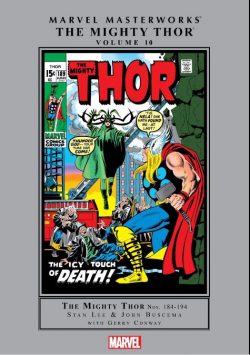
Thor Marvel Masterworks volume 10


By Stan Lee, Gerry Conway, John Buscema & various (Marvel)
ISBN: 978-0-7851-5046-6 (HB)

With the constantly expanding Marvel Universe growing ever more interconnected as it matured, characters literally tripped over each other in New York City and its environs, but such was not the case with Thor.

The Asgardian milieu and the soaring imagination of Jack Kirby had long drawn the Thunder God away from mortal realms into stunning new landscapes. When the unthinkable happened and the increasingly discontented King of Comics jumped ship from the House of (His) Ideas for arch-rival DC in 1970 an era ended.

Left to soldier on, Stan Lee called in artist John Buscema to carry a seemingly unbearable burden…

In case you came in late: disabled doctor Donald Blake took a vacation in Norway only to stumble into an alien invasion. Trapped in a cave, he found an ancient walking stick which, when struck against the ground, turned him into the Norse God of Thunder! Within moments he was defending the weak and smiting the wicked.

Months swiftly passed with the Lord of Storms tackling rapacious extraterrestrials, Commie dictators, costumed crazies and cheap thugs, but these soon gave way to a vast kaleidoscope of fantastic worlds and incredible, mythic menaces.

This bombastic transitional compendium (available in hardcover and digital formats) reprints Mighty Thor #184-194, spanning January – December 1971 with the puissant Thunder God going both forward and back between mortal and godly realms.

The new era had actually begun with John Buscema delineating a rash clash between the Thunder God and Dr. Doom, but the real start came as this volume begins following the inevitable Introduction from Lee.

Here, then, Lee, Buscema and inker Joe Sinnott crafted their own ambitious cosmic saga, opening with #184 and exploring ‘The World Beyond!‘ wherein a sinister and implacable force is discovered devouring the outer galaxies, with the subsequent psychic reverberations impacting and unravelling life on Earth and in Asgard.

With all creation imperilled, Odin departs to combat the enigmatic threat alone…

Sam Grainger inked ‘In the Grip of Infinity!’ as universal calamity intensifies and the All-Father falls to the enigmatic, seemingly all-consuming invader before ‘Worlds at War!’ exposes a hidden architect behind the ultimate Armageddon.

That revelation leads to a desperate last-ditch ploy uniting the forces of Good and Evil together in ‘The World is Lost!’ before one final clash – inked by Jim Mooney – answers all the questions and culminates in ‘The End of Infinity!’

Although vast in scope and drenched in powerful moments highlighting the human side of the gods in extremis, this tale suffers from an excess of repetitive padding and a rather erratic pace.

Without pause, though, we plunge on as Thor #189 sees sepulchral goddess Hela come calling, demanding Thor feel ‘The Icy Touch of Death!’ to pay for all the souls she didn’t get in the recent sidereal showdown…

After a big chase around planet Earth she is finally dissuaded in ‘…And So, To Die!’, but the distraction has meanwhile allowed Thor’s wicked brother Loki to seize the Throne of Asgard and unleash ‘A Time of Evil!’

This typically tyrannical behaviour results in the deranged despot using Odin’s stolen power to manifest an unstoppable artificial hunter/killer dubbed Durok the Demolisher.

Unleashing his merciless engine of destruction on Earth, Loki gloats at the ‘Conflagration!’ (inked by Grainger) he has instigated…

Completing the retiring of the Old Guard, Gerry Conway came aboard as writer for double-length tale ‘What Power Unleashed?’ (#193, with Sal Buscema augmenting and inking brother John) to conclude the epic tale.

Prevented by vows from taking up arms against Loki’s puppet, Balder the Brave and Thor’s True Beloved Sif cunningly enlist the Silver Surfer to aid the embattled Thunderer as Asgard totters on the brink of total destruction. Free to act against the real enemy, Thor then retaliates with staggering power and ‘This Fatal Fury!’: stealing the usurper’s attention until wily All-Father Odin finally resumes his rightful place.

To be continued…

The Kirby Thor will always be a high-point in graphic fantasy, all the more impressive for the sheer imagination and timeless readability of the tales. With his departure the series foundered for the longest time before finding a new identity, yet even so the stories in this volume are still packed with intrigue and action and magnificently rendered by an illustrator who, whilst not possessing Kirby’s vaulting visionary passion, was every inch his equal in craft and dedication. This book (which also includes the covers to Thor Annuals #3 and 4, pertinent house ads and a brace of Buscema original art pages) is an absolute must for all fans of the medium.
© 1971, 2017 Marvel Characters, Inc. All rights reserved.
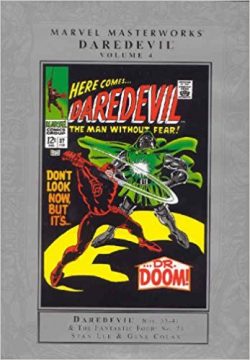
Daredevil Marvel Masterworks volume 4


By Stan Lee, Gene Colan, Jack Kirby & various (Marvel)
ISBN: 978-0-7851-2072-8

Matt Murdock is a blind lawyer whose remaining senses hyper-compensate, making him an astonishing acrobat, formidable fighter and living lie-detector. Very much a second-string hero for most of his early years, Daredevil was nonetheless a striking and popular one, due in large part to the roster of brilliant artists who had illustrated the strip. He only really came into his own, however, after artist Gene Colan signed up for the long haul…

The natal DD battled thugs, gangsters, mad scientists and a plethora of super-villains (and – as seen in this collection – even the occasional monster or alien invasion), quipping and wise-cracking his way through life and life-threatening combat.

Covering October1967-June 1968 and re-presenting Daredevil #33-41 and crossover issue Fantastic Four #73, this fourth compilation (in both hardback and eBook formats) sees a continuing gain in story quality as scripter Stan Lee blended soap operatic plot-threads with a string of guest supervillains to string together the unique fight scenes of the increasingly bold and artistically audacious Gene Colan…

Following another typically frothy Introduction from Stan Lee the action opens with ‘Behold the Beetle’ (Daredevil #33, and inked by John Tartaglione) and sees the entire cast – legal partner Foggy Nelson, secretary Karen Page and Murdock in the guise of his own (fictitious) twin brother Mike – heading to Canada for World’s Fair Expo ’67 and encountering another borrowed costumed crazy in search of easy glory and untold riches…

With Daredevil crushed and captive the prospects look bleak north of the border, but Ol’ Hornhead soon outsmarts and outfights his techno-savvy foe in the stunning sequel ‘To Squash the Beetle!’

Safely back in the Big Apple, DD’s undeserved reputation as a mere costumed acrobat induces another fearsome felon to attack in ‘Daredevil Dies First!’ The sightless wonder is targeted by old Fantastic Four foe The Trapster, who considers the Scarlet Swashbuckler a mere stepping-stone in his overly-complex plan to destroy the World’s premier super-team. Typically, Murdock manages to turn the tables in #36’s ‘The Name of the Game is Mayhem!’ (inked by Frank Giacoia): a clash that leave the blind hero triumphant but weakened and easy prey for another FF arch-foe. Tartaglione then returned to ink the startling ‘Don’t Look Now, But It’s… Doctor Doom!’…

Helpless before the Iron Dictator, DD is trapped in ‘The Living Prison!’(Giacoia inks) as Doom swaps bodies with the sightless crusader to facilitate his own sneak attack on the FF, which culminates in a stupendous Lee, Jack Kirby & Joe Sinnott crafted Battle Royale in Fantastic Four #73’s crossover conclusion with the Human Torch, Thing and Mr. Fantastic battling Daredevil, Thor and Spider-Man in ‘The Flames of Battle…’.

As always when involved in mind- swap cases, it’s always prudent to advise your friends when you defeat the bad guy and regain your original body…

The Man Without Fear finally found some of his own bad guys to bash in Daredevil #39 when old enemies the Ani-Men return with a new name and a new boss. Inked by George Tuska ‘The Exterminator and the Super-Powered Unholy Three’ reintroduces Bird-Man, Ape-Man and Cat-Man, now in the pay of a criminal genius working with time-based weapons, but the real meat of the tale is Foggy’s campaign to become New York City’s District Attorney.

That potential glittering prize is threatened, however, after the portly advocate unexpectedly revives his romantic relationship with ex-convict Deborah Harris, but at least now Matt Murdock’s only rival for Karen’s affections is his imaginary twin-brother Mike…

That story proceeded in #40 with DD banished to a timeless other-realm world but still led to a spectacular clash in ‘The Fallen Hero!’ (inked by Tartaglione) before concluding the only way it could with ‘The Death of Mike Murdock!’ as Matt takes advantage of his final catastrophic battle with the Exterminator to end the clumsy secret identity charade.

He doesn’t come clean though, preferring to keep Daredevil’s secrets and let his friends grieve needlessly…

To Be Continued…

Rounding out the experience are number of bonus pages including the unused (presumed lost forever) original cover to DD #35, plus a gallery of original art pages and covers by Colan. Despite a few bumpy spots, during this period Daredevil blossomed into a truly magnificent example of Marvel’s compelling formula for success: smart stories, human characters and magnificent illustration. These bombastic tales are pure Fights ‘n’ Tights magic no fan of stunning super-heroics can afford to ignore.
© 1967, 1968, 2016 Marvel Characters, Inc. All rights reserved.
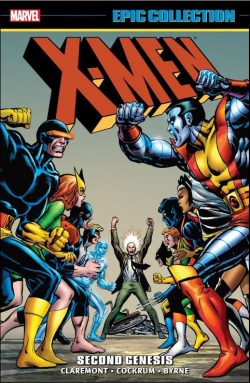
X-Men Epic Collection volume 5 1975-1978: Second Genesis


By Len Wein, Chris Claremont, Bill Mantlo, Bonnie Wilford, Dave Cockrum, Bob Brown, Tony DeZuñiga, John Byrne, Sal Buscema & various (DC Comics)
ISBN: 978-1-3029-0390-9

In the autumn of 1963 The X-Men #1 introduced Scott (Cyclops) Summers, Bobby (Iceman) Drake, Warren (Angel) Worthington, Jean (Marvel Girl) Grey and Hank (The Beast) McCoy: very special students of Professor Charles Xavier.

The teacher was a wheelchair-bound telepath dedicated to brokering peace and integration between the masses of humanity and the emergent off-shoot race of mutants dubbed Homo Superior; considered by many who knew him as a living saint.

After nearly eight years of eccentrically spectacular adventures the mutant misfits virtually disappeared at the beginning of 1970 during another periodic downturn in superhero comics sales. Just like in the closing years of the 1940s, mystery men faded away as supernatural mysteries and traditional genre themes once more dominated the world’s entertainment fields…

Although their title returned at the end of the year as a cheap reprint vehicle, the missing mutants were reduced to guest-stars and bit-players throughout the ongoing Marvel universe, whilst the bludgeoning Beast was opportunistically transformed into a scary monster to cash in on the horror boom.

Then, with sales of the spooky stuff subsequently waning in 1975, Marvel Editor-in-Chief Roy Thomas green-lighted a bold one-shot as part of the company’s line of Giant-Size specials and history was made…

This fabulous mass-market collection (in trade paperback and eBook editions) is perfect for newbies and neophytes, celebrating the revival and unstoppable march to market dominance through the exuberant and pivotal early stories: specifically, Giant Size X-Men #1, issues #94-110 of the definitely “All-New, All-Different” X-Men, as well as guest appearances in Iron Fist #14-15, Marvel Team Up #53, 69-70 and Marvel Team Up Annual #1, collectively and cumulatively spanning May 1975 to June 1978.

Tracing the reinvigorated merry mutants from young, fresh and delightfully under-exposed innovations to the beginnings of their unstoppable ascendancy to ultimate comicbook icons, in their own title and through an increasingly broad clutch of guest shots, the epic voyage begins without pause or preamble, in a classic mystery monster mash from Giant Size X-Men #1.

Len Wein & Dave Cockrum (the latter a red-hot property following his stint reviving DC’s equally eclectic fan-fave super-team The Legion of Super-Heroes) detailed in ‘Second Genesis!’ how the original squad – all but new Avengers recruit The Beast – had been lost in action…

With no other choice Xavier is forced to scour Earth and the entire Marvel Universe for replacements…

To old foes-turned-friends Banshee and Sunfire is added a one-shot Hulk adversary dubbed the Wolverine, but the bulk of time and attention is lavished upon original creations Kurt Wagner, a demonic-seeming German teleporter codenamed Nightcrawler; African weather “goddess” Ororo Monroe – AKA Storm, Russian farm-boy Peter Rasputin who turns into a living steel Colossus and bitter, disillusioned Apache superman John Proudstar who is cajoled into joining the makeshift squad as Thunderbird.

The second chapter of the epic introductory adventure ‘…And Then There Was One!’ reintroduces battered, depleted but unbowed team-leader Cyclops who swiftly drills the newcomers into a semblance of readiness before leading them into primordial danger against the monolithic threat of ‘Krakoa… the Island That Walks Like a Man!’

Overcoming the phenomenal terror of a rampaging rapacious mutant eco-system and rescuing the “real” team should have led to a quarterly Giant-Size sequel, but so great was the fan response that the follow-up adventure was swiftly reworked into a 2-part tale for the rapidly reconfigured comicbook which became a bimonthly home to the new team.

X-Men #94 (August 1975) began ‘The Doomsmith Scenario!’ – plotted by Editor Wein, scripted by Chris Claremont and with Bob McLeod inking man-on-fire Cockrum – in a canny Armageddon-shocker with a newly pared-down strike-squad deprived of Sunfire and the still-recuperating Marvel Girl, Angel, Iceman, Havok and Lorna Dane. The neophytes are called in by the Beast to stop criminal terrorist Count Nefaria starting an atomic war.

The insidious mastermind has conquered America’s Norad citadel with a gang of artificial superhumans and accidentally escalated a nuclear blackmail scheme into an inescapable countdown to holocaust, leaving the untrained, unprepared mutants to storm in to save the world in epic conclusion ‘Warhunt!‘ (inked by Sam Grainger).

One of the new team doesn’t make it back…

X-Men #96 saw Claremont take charge of the writing (albeit with some plotting input from Bill Mantlo) for ‘Night of the Demon!’ Guilt-wracked Cyclops blames himself for the loss of his team-mate, and in his explosive rage accidentally unleashes a demonic antediluvian horror from Earth’s primordial prehistory for the heroes-in-training to thrash.

The infernal Nagarai would return over and again to bedevil mankind, but the biggest innovation in this issue is the introduction of gun-toting biologist/housekeeper Moira MacTaggert and the first inklings of the return of implacable old adversaries…

A long-running, cosmically-widescreen storyline began in #97 with ‘My Brother, My Enemy!’ as Xavier – tormented by visions of interstellar war – tries to take a vacation, just as Havok and Lorna (finally settling on superhero nom de guerre Polaris) attack: apparently willing servants of a mysterious madman using Cyclops’ old undercover alter ego Eric the Red.

The devastating conflict then segues into a spectacular 3-part yarn, as pitiless robotic killers return under the hate-filled auspices of mutantophobic Steven Lang and his mysterious backers in Project Armageddon. The action opens with #98’s ‘Merry Christmas, X-Men…the Sentinels Have Returned!’

With coordinated attacks capturing semi-retired Marvel Girl plus Wolverine, Banshee and Xavier, Cyclops and the remaining heroes co-opt a space shuttle and storm Lang’s orbital HQ to rescue them in ‘Deathstar Rising!’ (inked by Frank Chiaramonte): another phenomenal all-action episode.

The saga concludes on an agonising cliffhanger with the 100th issue anniversary tale. ‘Greater Love Hath no X-Man…’ (with Cockrum inking his own pencils) sees the new X-Men apparently battle the original team before overturning Lang’s monstrous schemes forever. However, their catastrophic clash destroys the only means of escape and, as a gigantic solar flare threatens to eradicate the satellite-station, their only chance of survival means certain death for another X-Man.

As #101 unfolded, scripter Claremont & artist Cockrum were on the on the verge of utterly overturning the accepted status quo of women in comics forever…

Led by field-leader Cyclops, the team now consisted of old acquaintance and former foe Sean “Banshee” Cassidy, Wolverine, and new creations Nightcrawler, Storm, Colossus and part-timer Jean Grey still labouring under the nom-de guerre Marvel Girl… but not for much longer…

‘Like a Phoenix from the Ashes’ (Chiaramonte inks) sees a space-shuttle cataclysmically crash into Jamaica Bay. The X-Men had safely travelled in a specially-shielded chamber but Marvel Girl had manually piloted the vehicle, unprotected through a lethal radiation storm…

As the mutants escape the slowly sinking craft, a fantastic explosion propels the impossibly alive Jean into the air, clad in a strange gold and green uniform and screaming that she is “Fire and Life Incarnate… Phoenix!”

Immediately collapsing, the critically injured girl is rushed to hospital and a grim wait begins.

Unable to explain her survival and too preoccupied to spare time for teaching, Xavier packs Banshee, Nightcrawler, Wolverine, Storm and Colossus off to the Irish mutant’s home in County Mayo for a vacation, blissfully unaware that Cassidy Keep has been compromised and is now a deadly trap for his new students…

Within the ancestral pile, Sean’s mutant cousin Black Tom has usurped control of the manor and its incredible secrets before – at Eric the Red’s behest – contriving an inescapable ambush, assisted by an old X-Men enemy.

‘Who Will Stop the Juggernaut?’ (Grainger inks) sees the inexperienced heroes in over their heads and fighting for their lives, but still finds room to reveal the origins of Storm and provide an explanation for her crippling claustrophobia, before ‘The Fall of the Tower’ explosively ends the tale with mutant heroes and the Keep’s Leprechaun colony (no, really!) uniting to expel the murderous usurpers.

Although still bi-monthly at the time, the series kicked into confident top gear with ‘The Gentleman’s Name is Magneto’ as the weary warriors then divert to Scotland to check on Moira MacTaggert’s island lab: a secret facility containing myriad mutant menaces the X-Men have previously defeated.

It’s a very bad move since the ever-active Eric has restored the dormant master of magnetism to full power. The mutant terrorist had been turned into a baby – a strangely commonplace fate for villains in those faraway days – but he was all grown up again now and indulging in one last temper tantrum…

Freshly arrived from America, Moira and Cyclops are only just in time to lead a desperate, humiliating retreat from the triumphant Master of Magnetism. Scott doesn’t care: he realises the entire affair has been a feint to draw the heroes away from Xavier and Jean…

He needn’t have worried. Although in ‘Phoenix Unleashed’ (inks by Bob Layton) Eric orchestrates an attack by Firelord – a cosmic flamethrower and former herald of Galactus much like the Silver Surfer – Jean is now fully evolved into a being of unimaginable power who readily holds the fiery marauder at bay…

In the interim a long-standing mystery is solved as the visions which have haunted and tormented Xavier are revealed as a psychic connection with a runaway princess from a distant alien empire.

Lilandra of the Shi’ar had rebelled against her imperial brother and, whilst fleeing, had somehow telepathically locked onto her trans-galactic soul-mate Charles Xavier. As she made her circuitous way to Earth, embedded Shi’ar spy Shakari had assumed the role of Eric the Red and attempted to remove Lilandra’s potential champion before she arrived…

During the blistering battle which follows the X-Men’s dramatic arrival, Shakari snatches up Lilandra and drags her through a stargate to their home galaxy, and with the entire universe imperilled, Xavier urges his team to follow. All Jean has to do is re-open a wormhole to the other side of creation…

A minor digression follows as overstretched artist Cockrum gains a breather via a fill-in “untold” tale of the new team featuring an attack by psychic clones of the original X-men. ‘Dark Shroud of the Past’ is a competent pause by Mantlo, Bob Brown & Tom Sutton, set inside a framing sequence from Cockrum.

The regular story resumes in a wry tribute to Star Trek as ‘Where No X-Man Has Gone Before!’ (Claremont, Cockrum & Dan Green) finds the heroes stranded in another galaxy where they meet and are beaten by the Shi’ar Imperial Guard (an in-joke version of DC’s Legion of Super Heroes in the inimitable Cockrum manner), until bold interstellar rebel freebooters the Starjammers bombastically arrive to turn the tables once again whilst uncovering a mad scheme to unmake the fabric of space-time.

Lilandra’s brother Emperor D’Ken is a deranged maniac who wants to activate a cosmic artefact known alternatively as the M’Kraan Crystal and “the End of All that Is” in his quest for ultimate power. He’s also spent time on Earth in the past and played a major role in the life of one of the X-Men…

This tale (from issue #107) was Cockrum’s last for years. He would eventually return to replace the man who replaced him. John Byrne not only illustrated but also began co-plotting the X-tales and, as the team roster expanded, the series rose to even greater heights. It would culminate in the landmark Dark Phoenix storyline which saw the death of arguably the book’s most beloved and imaginative character and the departure of the team’s heart and soul. The epic cosmic saga also seemed to fracture the epochal working relationship of Claremont and Byrne.

Within months of publication they went their separate ways: Claremont staying with the mutants whilst Byrne moved on to establish his own reputation as a writer on series such as Alpha Flight, Incredible Hulk and especially his revolutionised Fantastic Four…

Here though, the X-Men and Starjammers battle the Crystal’s astoundingly deadly automated guardians, as this final chapter depicts the newly puissant Phoenix literally saving Reality in a mind-blowing display of power and skill.

Trapped inside a staggering other-realm, and appalled and enthralled by the intoxicating, addictive nature of her own might, Phoenix rewove the fabric of Reality and for an encore brought the heroes home again.

The conclusion of this ambitious extended saga was drawn by Byrne and inked by Terry Austin and their visual virtuosity was to become an industry bench-mark as the X-Men grew in popularity and complexity.

However, even though the bravura high-octane thrills of ‘Armageddon Now’ seem an unrepeatable high-point, Claremont & Byrne had only started. The best was still to come, but it precluded ending their other ongoing collaboration: a mystic martial arts thriller…

From Iron Fist #14, ‘Snowfire’ inked by Dan Green – finds masked marvel Danny Rand and his combat colleague Colleen Wing running for their lives in arctic conditions after a vacation retreat to a palatial Canadian Rockies estate is ruined by a criminal raid.

Leading the plundering gang is deadly mercenary Sabretooth. Despite being rendered temporarily blind, the K’un Lun Kid ultimately defeats the mutant marauder, but his fiercely feral foe would return again and again to bedevil both Danny and the X-Men…

With Claremont & Byrne increasingly absorbed by their stellar collaboration on the revived and resurgent adventures of Marvel’s mutant horde, Iron Fist #15 (September 1977) was their last martial arts mash-up for a while. The series ended in spectacular fashion as, through a comedy of errors, Danny stumbles into a morass of misunderstanding and ends up battling the recently returned galaxy rovers Wolverine, Colossus, Nightcrawler, Banshee, Storm and Phoenix in ‘Enter, the X-Men’.

In X-Men #109’s ‘Home Are the Heroes!’ (Claremont, Byrne & Austin) Wolverine finally begins to develop a back-story and some depth of character whilst technological wonder Weapon Alpha attacks the recuperating team in an attempt to force the enigmatic Logan to rejoin the Canadian Secret Service.

Renamed Vindicator Alpha would later return leading Alpha Flight – a Canadian government sponsored super-team which would eventually graduate to their own eccentric high-profile series.

Somewhat out of chronological sequence, this is followed here by an extra-length exploit from Marvel Team Up Annual #1 (1976 and by Mantlo, Sal Buscema & Mike Esposito, from a plot by Mantlo, Claremont & Bonnie Wilford).

‘The Lords of Light and Darkness!’ features Spider-Man and newly minted X-Men Storm, Banshee, Wolverine, Nightcrawler, Colossus, Phoenix and Cyclops assisting Charles Xavier in combatting a pantheon of scientists mutated by atomic accident and elevated to the ranks of gods.

Like most deities, these puissant ones believe they know what is best for humanity and don’t like being disabused of the notion…

Mantlo then teamed with Byrne & Frank Giacoia to bring closure to a tale begun – and left hanging – in Marvel Premiere #31.

Set minutes after the Annual, Marvel Team Up #53 (January 1977) reveals a ‘Nightmare in New Mexico!’ as Spider-Man says goodbye to the X-Men and hello to The Hulk and troubled gene-splicing experiment Woodgod after the tragic bio-construct flees from corrupt Army Colonel Del Tremens. As Tremens tried to suppress the calamitous crisis and his own indiscretions by killing everybody, the final scene sees the webspinner trapped in a rocket and blasted into space…

The tale by Mantlo, Byrne & Frank Giacoia has very little to do with the X-Men, other than a rather gratuitous overlap and ends here without resolution, but still looks pretty damn good after all these years…

In X-Men #110 (April 1978) Claremont, and illustrators Tony DeZuñiga & Cockrum then detail ‘The “X”-Sanction!’: a rather limp and hasty fill-in as cyborg mercenary Warhawk infiltrates the Xavier mansion in search of “intel” for a mysterious, unspecified master… before getting his shiny silver head handed to him…

This initial compendium of uncanny X-episodes wraps up with the contents of Marvel Team Up #69 and 70 (May & June 1978) as in ‘Night of the Living God!’ (Claremont, Byrne & by Ricardo Villamonte) Spider-Man clashes with Egyptian-themed thieves and is drawn into the perpetual duel between cosmic-powered X-Man Havoc and his nemesis the Living Monolith.

When the battle turns against the heroes it requires the might of Thor to stop the ravening astral menace in the concluding chapter ‘Whom Gods Destroy!’ (inked by Tony DeZuñiga)…

Following the cover of 1975’s all-reprint Giant-Size X-Men #2, this volume concludes with a glorious and revelatory selection of extras including John Romita’s original design sketches for Wolverine; Byrne’s first X-Man work (a puzzle from Marvel Fanzine F.O.O.M. #7) and design material from Cockrum’s DC Comics proposal The Outsiders (the Legion of Super-Heroes spin-off he retooled to create Nightcrawler, Storm, Phoenix and the other New X-Men). There are even unused Cockrum pencil pages, initial sketches for the Starjammers, costume upgrades for Angel, the cover art for X-themed The Comic Reader #145, and model sheets for Nightcrawler, Storm, Phoenix and Colossus.

Further treasures are Gil Kane’s cover sketch and original art for Giant-Size X-Men #1, original Cockrum pages from GSXM #1 and F.O.O.M. #10 (the all-X-Men issue), articles from the fanzine – Mutation of the Species, X-Men! X-Men!. Read All About ‘Em! – a pin-up by Don Maitz, X-Men X-posé and spoof strip ‘EggsMen’; unused pages by Bob Brown and previous collection covers by Kane and Cockrum given a painted make-over by Dean White.

Entertaining, groundbreaking and incredibly intoxicating, these adventures are an invaluable and crucial grounding in contemporary fights ‘n’ tights fiction no fan or casual reader can be allowed to ignore.
© 1975, 1976, 1977, 1978, 2017 Marvel Characters, Inc. All rights reserved.
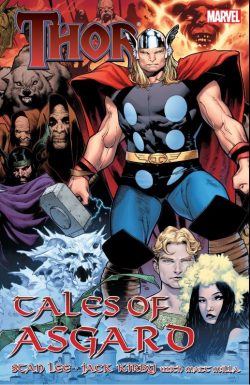
Mighty Thor Marvel Masterworks volume 9


By Stan Lee & Jack Kirby, John Buscema, Neal Adams, Bill Everett, Vince Colletta, John Verpoorten, Joe Sinnott & various (Marvel)
ISBN: 978-0-7851-4220-1

The Mighty Thor was the title in which Jack Kirby’s restless fascination with the Cosmic Unknown was honed and refined through his dazzling graphics and captivating concepts. The King’s career-defining string of power-packed signature pantheons all stemmed from a modest little fantasy/monster title called Journey into Mystery where – in the summer of 1962 – a tried-and-true comicbook concept (feeble mortal transformed into god-like hero) was revived by fledgling Marvel Comics to add a Superman analogue to their growing roster of costumed adventurers.

This bombastic full-colour hardback tome – also available in eFormats – re-presents Kirby’s final Asgardian exploits and the initial efforts of his successors. Taken from Thor #173-183 the sagas collectively cover February to December 1970, as universe-builder Jack abandoned the worlds he’d cultivated with Stan Lee for DC Comics and a cosmos uniquely his own…

Once upon a time lonely, lamed American doctor Donald Blake took a vacation in Norway only to encounter the vanguard of an alien invasion. Trapped in a cave, Blake found a gnarled old walking stick, which, when struck against the ground, turned him into the Norse God of Thunder!

Without any hesitation or preamble, the reborn godling was soon defending the weak and smiting the wicked. As months swiftly passed, rapacious extra-terrestrials, Commie dictators, costumed crazies and cheap thugs gradually gave way to a vast panoply of fantastic worlds and incredible, mythic menaces. Eventually the magnificent warrior’s ever-expanding world of Asgard was a regular feature and mesmerising milieu for the hero’s earlier adventures, heralding a fresh era of cosmic fantasy to run almost tangentially to the company’s signature superhero sagas.

The astounding action begins here – after a fascinating and revelatory Behind the Scenes Introduction from Will Murray – with the earthbound fury of ‘Ulik Unleashed!’ (inked by Bill Everett) as the ferocious super-troll is sent to Earth by Loki only to be hypnotised into aiding old adversaries The Circus of Crime in the robbery of the century…

Single-issue adventures continue with an epic clash between Thor and a tormented young genius whose strength-stealing robot runs amok in ‘The Carnage of the Crypto-Man!’ before the last great epic of the Kirby-era hits its stride, but that’s a saga for another time and place…

Behind a Marie Severin cover ‘The Fall of Asgard!’ sees valiant Asgardian Balder and his Warriors Three allies Fandral, Hogun and Volstagg escape the clutches of lovestruck sorceress Karnilla only to confront the assemble hordes of giants and trolls marching on the Home of the Gods.

With All-Father Odin incapacitated by his annual Great Sleep, Loki has perfidiously seized the throne forcing war-goddess Sif to call Thor back home for perhaps the Last Battle…

Inked by Vince Colletta, ‘Inferno!’ reveals the folly of the usurper as terrifying Fire-demon Surtur breaks free of his Odinian captivity to begin his pre-ordained task of burning down the universe.

With everything appearing ‘To End in Flames!’ Loki flees to Earth, having first hidden Odin’s sleeping form in the life-inimical Sea of Eternal Night. As Thor leads a heroic and Horatian last stand, Balder penetrates the Dimension of Death to rescue the All-Father just as Surtur fires up for his fulminating final foray…

Thor #178 (July 1970) is a landmark: the first issue created without Jack Kirby. Clearly a try-out or fill-in yarn, ‘Death is a Stranger’ – by Lee, John Buscema & Colletta – depicts the Thunderer snatched away from Asgard by the nefarious Abomination to an epic battle with the alien Stranger – an extra-galactic powerhouse who collects unique beings for scientific study…

The interrupted epic resumed in #179 (inked by John Verpoorten) with ‘No More the Thunder God!’ as Thor, Sif and Balder are dispatched to Earth to arrest the fugitive Loki. This issue was Kirby’s last: he left the entire vast unfolding new mythology on a monumental cliffhanger just as the Thunder God is ambushed by his wicked step-brother. Using arcane magic, the Lord of Evil switches bodies with his noble sibling and gains safety and the power of the Storm whilst Thor is doomed to endure whatever punishment Odin decrees…

More than any other Marvel strip Thor was the feature where Kirby’s creative brilliance matched his questing exploration of an Infinite Imaginative Cosmos: dreaming, extrapolating and honing a dazzling new kind of storytelling graphics with soul-searching, mind-boggling concepts of Man’s place in the universe.

Although what followed contained the trappings and even spirit of that incredible marriage, the heart, soul and soaring, unfettered wonderment just were not there any longer: nor would they be until 1983 when Walt Simonson assumed creative control with #337 (see Mighty Thor: the Ballad of Beta Ray Bill).

Here, however, ‘When Gods Go Mad!’ introduced the radically different style of Neal Adams to the mix, inked by the comfortably familiar Joe Sinnott, as the true Thunder God was sent to Hell and the tender mercies of Mephisto, whilst on Earth Loki uses his brother’s body to terrorise the UN Assembly and declare himself Master of the World…

In #181’s ‘One God Must Fall’ Sif leads the Warriors Three on a rescue mission to the Infernal Realm whilst Balder struggles to combat the power of Thor combined with the magic and malice of Loki until Mephisto is thwarted. Then a cataclysmic battle of brothers on Earth soon sets the world to rights…

The new Post-Kirby era truly began with Thor #182 as John Buscema assumed the artistic reins and began his own epic run as illustrator with ‘The Prisoner… The Power… and… Dr. Doom!’ as the Thunderer is entangled in Earthly politics. When a young girl entreats him to rescue her father from the deadly Iron Monarch, the noble scion cannot refuse, especially as the missing parent is an expert on missile technology and is capable of making Doom the master of ICBM warfare…

The decidedly down-to-Earth and mismatched melodrama concludes with Don Blake ‘Trapped in Doomsland!’ until Thor can retrieve his mislaid mallet, but even after his deadly mission of mercy is accomplished, tragedy is his only reward…

Closing out this key transitional volume is the cover of the Kirby tour de force Tales of Asgard #1 and his unused cover for Thor #175 (inked by John Verpoorten) plus a Buscema house ad for the aforementioned clash with Dr. Doom.

The Kirby Thor is a high-point in graphic fantasy and all the more impressive for its sheer timeless readability, but the end was truly a new beginning and a testament to the sheer pulling power of the mightiest son of Asgard. These tales are a Fantasy fan’s delight and an absolute must for all devotees of the medium.
© 1970, 2017 Marvel Characters, Inc. All rights reserved.