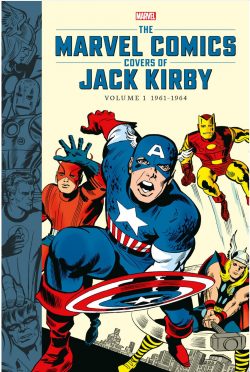
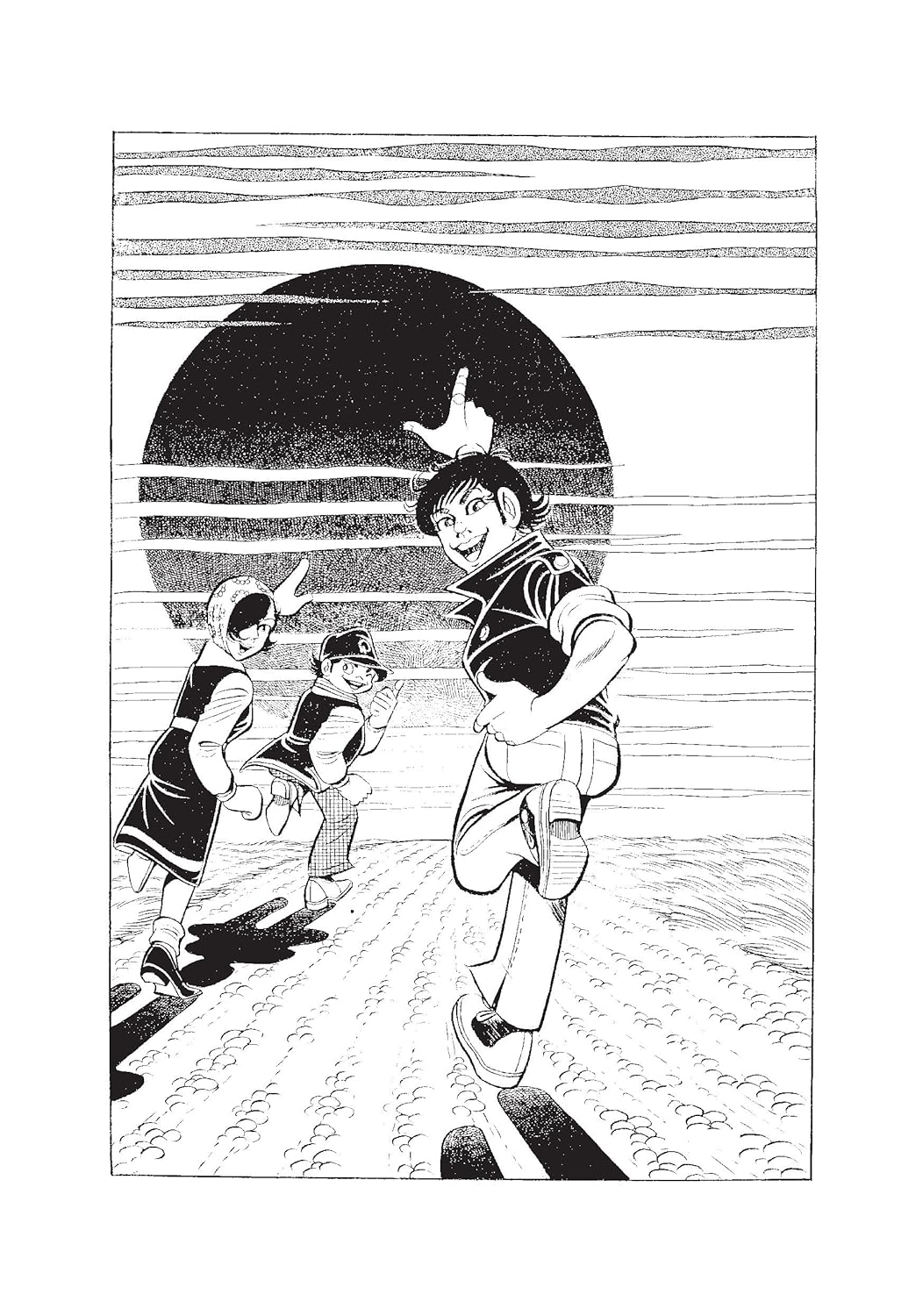
The Marvel Comics Covers of Jack Kirby volume 1: 1961-1964


By Jack Kirby, with Steve Ditko, Don Heck, Dick Ayers, Paul Reinman, Bill Everett, George Roussos, Joe Sinnott, Chic Stone, Vince Colletta, George Klein, Sol Brodsky, Al Hartley, Stan Goldberg, Art Simek, Sam Rosen & various, Introduction by Patrick McDonnell (Dark Horse Comics)
ISBN: 978-1-50673-246-6 (HB) eISBN: 978-1-50673-247-3

Today in 1917 on New York’s Lower East Side, Jacob Kurtzberg was born to Jewish-Austrian parents. He grew up to be one of the most influential and recognised artists in world history. The reason why can be read here.

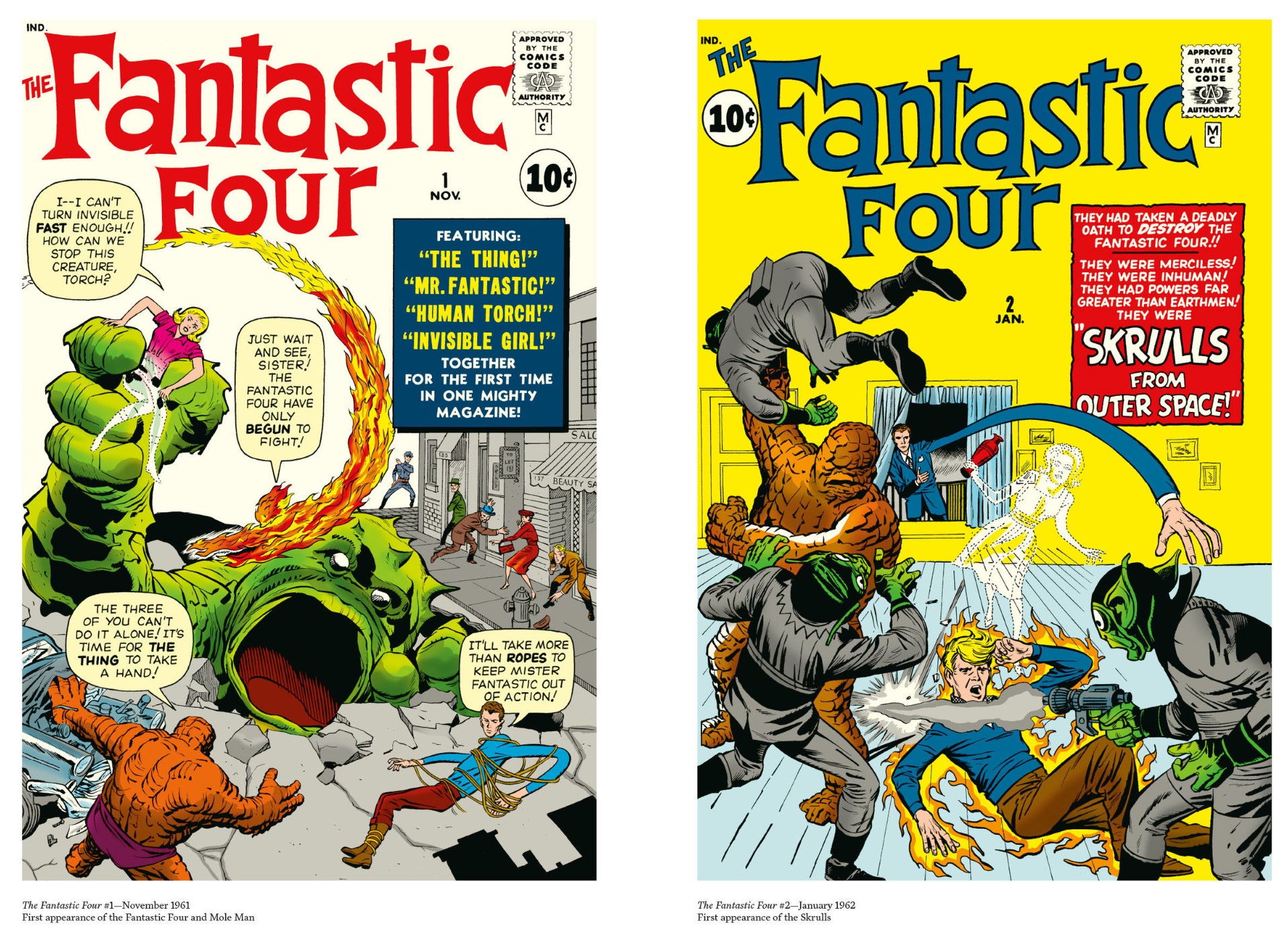
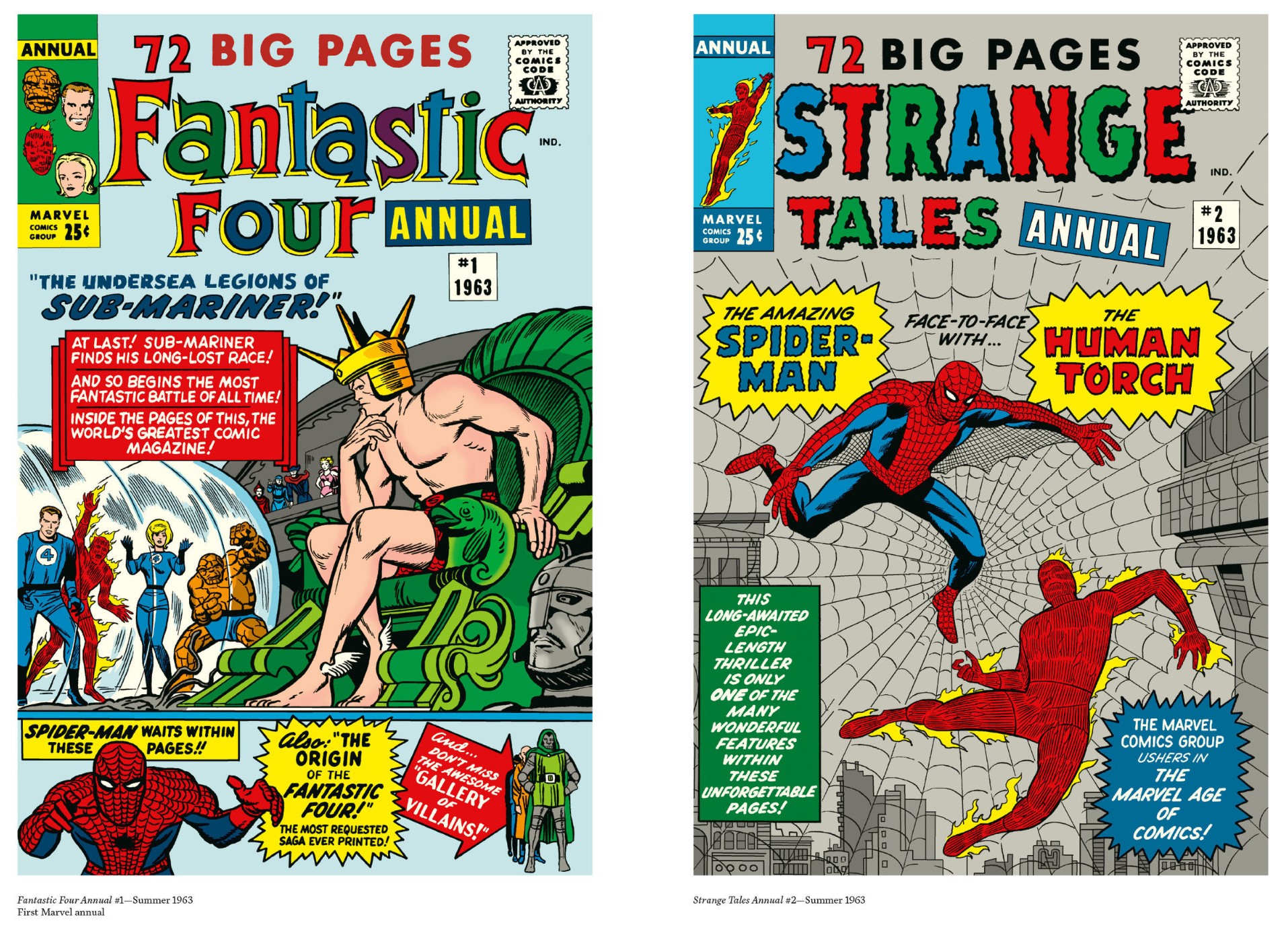
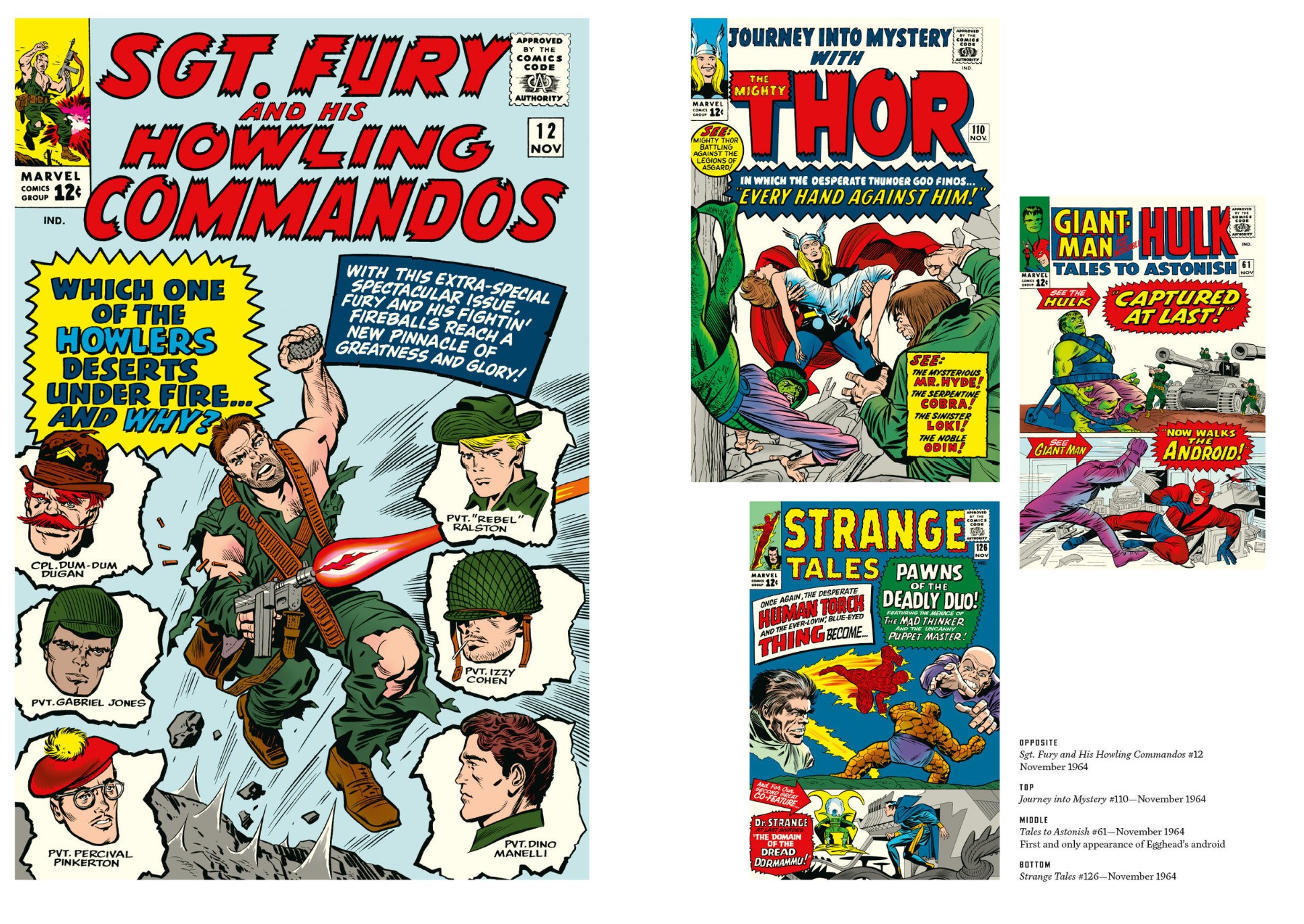
The Marvel Comics Covers of Jack Kirby chronologically collects The King’s superhero cover art in a spectacular hardcover coffee table book which simultaneously preserves the wonderment in a digital edition, thus allowing instant enlargements of any and all bits you might have glossed over or missed before…

Preceding the massive and momentous art attack comes heartfelt appreciation from Patrick McDonnell (Mutts) in his Introduction and via collector memory ‘Echoes of the King’ by Vincent Iadevaia. At the far end of the collection there’s a succinct biography and appreciation of Jack for those of you who don’t know him as well as we declining comics stalwarts do.

In between those points reside a torrent of those visual highpoints that served to introduce new and revolutionary ways of seeing and enjoying comic books. These collectively span cover-dates November 1961 to December 1964 as seen on The Avengers #1-11; Fantastic Four #1-33; Incredible Hulk #1-5; Journey into Mystery #83-111; Strange Tales #90, 101-127; Tales to Astonish #25, 27, 35-62; Tales of Suspense #39-56, 58-60; X-Men #1-8; Amazing Fantasy #15; Amazing Spider-Man #1; Sgt. Fury and His Howling Commandos #1-13; Daredevil # 1-4 plus Strange Tales Annual #2, Marvel Tales Annual #1, Fantastic Four Annuals #1-2, a few (far too few!) pre-Marvel genre covers including combat classic Battle #65, and a selection of monster book covers…

Inkers, colourists and letterers are not credited here, but that oversight is hopefully covered by us in the great big shopping list under the title…

Despite the too-tight brief – where are all the war, romance and particularly western and sci fi covers!? – this is a magnificent meander around the things that literally drew most of us into comics… that eye-grabbing first image. Jack Kirby was a master of electric storytelling, but he was also the god of the perfect moment and single pictures worth a thousand words. Look here and learn how and why…

© 2025 MARVEL.

Win’s First Christmas Gift Recommendation of the year!: Utter Acme of Visual Iconography… 9/10

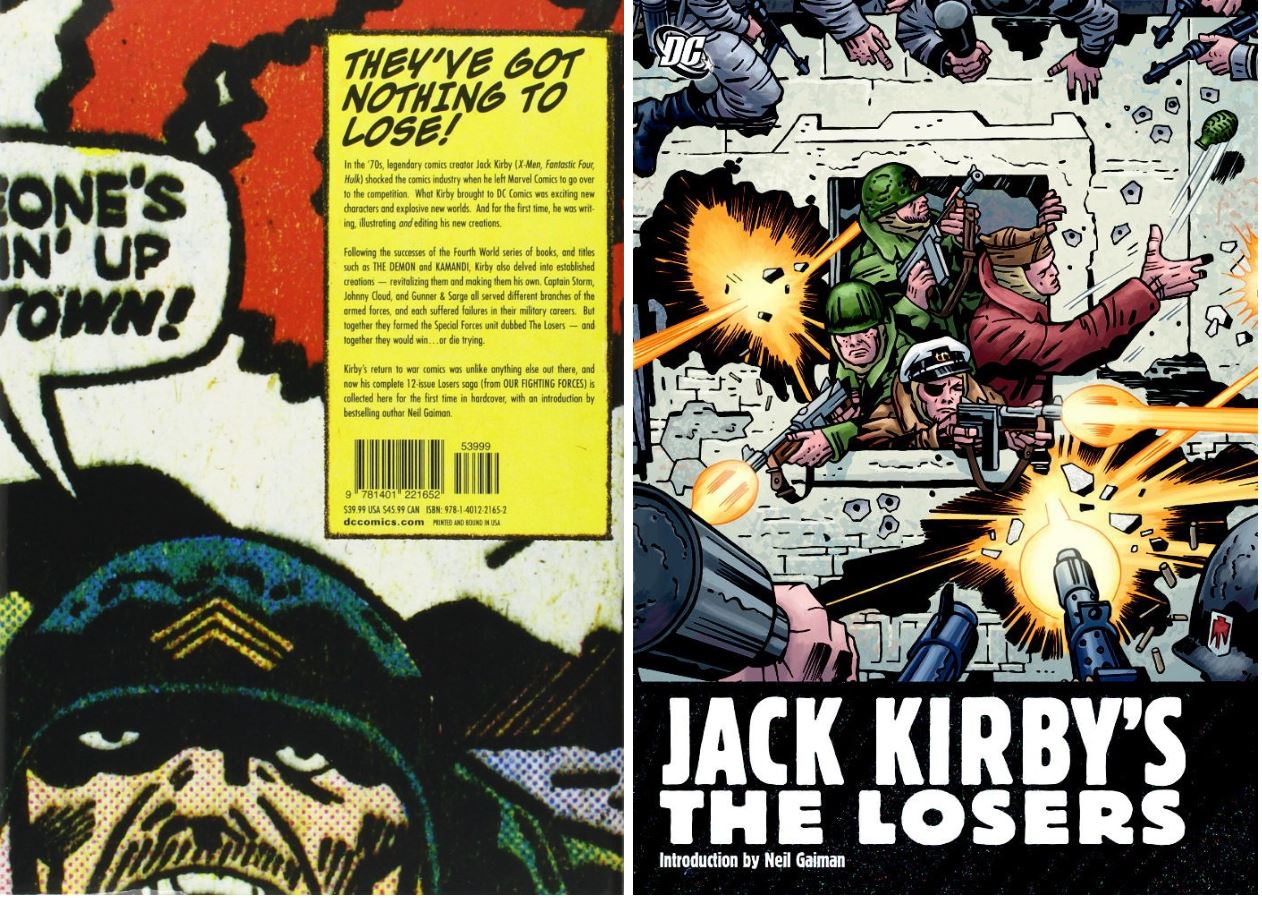
Jack Kirby’s The Losers


By Jack Kirby with D. Bruce Berry, Mike Royer & various (DC Comics)
ISBN: 978-1-84856-194-6 (HB)

This book includes Discriminatory Content produced in less enlightened times.

Despite there being a glorious profusion of Jack Kirby material around these days, much of the best and rarest stuff is still – unforgivably – hard to access. This astounding collection of his too-brief run on DC war comic Our Fighting Forces is, for far too many, an unknown delight. You can still find it in the original 2009 hardback edition, but as far as I know, there’s neither digital nor even n trade paperback edition – in English – to satisfy the desires of fans lacking an infinite bank balance.

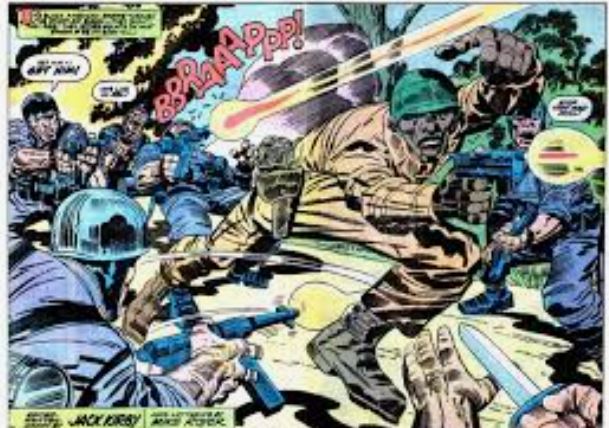
Famed for his larger than life characters and gigantic, cosmic imaginings, the King was a decent, spiritual man from another generation, and one who had experienced human horror and bravery as an ordinary grunt during World War II. Whether in the world-weary Verité of his 1950s collaborations with Joe Simon or the flamboyant bravado of his Marvel creation Sgt. Fury, Kirby’s combat comics always looked and felt real: grimy, tired, battered yet indomitable. Back in 1974, with his newest creations inexplicably not setting any sales records at DC, and while he tentatively pondered a return to Marvel, Jack took over the creative chores on a well-established, compelling but always floundering series that had run in Our Fighting Forces since 1970.

The Losers were an elite unit of American warriors cobbled together by amalgamating three pre-existing war series that had reached the end of their solo star roads. Gunner and Sarge (supplemented by “Fighting Devil Dog” Pooch) were Pacific-based Marines; debuting in All-American Men of War #67, (March 1959). They patrolled for 50 issues in Our Fighting Forces (#45-94, May 1959- August 1965), whilst Captain Johnny Cloud – Navajo Ace and native American fighter pilot – shot down his first bogie in All-American Men of War #82 (December 1960) and flew (mostly) solo until issue #115 in 1966. The final component of the Land/Air/Sea team was filled by Captain Storm, a disabled PT Boat commander (he had a wooden leg) who had his own 18-issue title from 1964 to 1967. All three series were created by DC’s comics warlord Robert Kanigher.

The characters had all pretty much passed their sell-by dates when they teamed-up as guest-stars in a Haunted Tank tale (G.I. Combat #138 October 1969), but these “Losers” found a new resonance together in the “relevant-era” and disillusioned, cynical Vietnam years and beyond, when their nihilistic, doom-laden anti-hero adventures claimed lead spot in Our Fighting Forces #123 (January/February 1970). Once again written primarily by Kanigher, these episodes were graced with art from such giants as Ken Barr, Russ Heath, John Severin, Sam Glanzman, Ross Andru and Joe Kubert. With the tagline “even when they win, they lose” the squad saw action all over the globe, winning critical acclaim and a far-too-small, passionate following.

In an inexplicable dose of company politics, discontented Kirby was abruptly given complete control of the series with #151 (November 1974). His radically different approach was highly controversial at the time, but the passage of years has granted a fairer appraisal and whilst never really in tune with the aesthetic of DC’s other war-books, the King’s run was a spectacular, bombastic and singularly intriguing examination of the human condition under the worst of all possible situations.

The combat frenzy kicks off in ‘Kill Me with Wagner’ as The Losers infiltrate a French village to rescue a concert pianist before the Nazis can capture her. The hapless propaganda pawn has one tremendous advantage – nobody knows what she looks like. As with most of this series, a feeling of inevitable, onrushing Gotterdammerung permeates the tale: a sense that worlds are ending and a new one’s coming. The action culminates in a catastrophic wave of destruction that is pure Kirby bravura…

Most of DC’s war titles sported Kubert covers, but #152 featured the first in a startling sequence of hypnotic Kirby collations – almost abstract in delivery – to introduce the team to the no-hope proposition of ‘A Small Place in Hell!’ when they find themselves the advance guard for an Allied push, but dropped in the wrong town: one that has not been cleared…

The spectacular action here is augmented by a potent 2-page Kirby fact feature: Sub-machine guns of WWII, and it should be noted and commended that this collection is also peppered with un-inked Kirby pencilled pages and roughs.

Our Fighting Forces #153 is one of those stories that made traditionalists squeak. Behind a Kirby cover, the story of ‘Devastator vs. Big Max’ veers dangerously close to science fiction, but an admittedly eccentric plan to destroy a giant German rail-mounted super-cannon isn’t any stranger than many schemes actual boffins dreamed up to disinform the enemy during the actual conflict, actually…

That yarn – with two beautiful info-pages on military uniforms and insignia – is followed by a superb parable examining personal honour. A compelling Kirby cover segues into the team’s deployment to the Pacific to remove a Japanese officer whose devotion to ‘Bushido’ inspires superhuman loyalty and resistance to surrender among his men. The means used to remove him are far from clean or creditable…

Bracketed by 2 pages on war vehicles plus a wonderful pencil cover-rough, two more on artillery pieces and the pencils for the cover to that issue, OFF #155’s ‘The Partisans!’ takes the Losers into very dark territory, before they return to America for ‘Good-bye Broadway… Hello Death!’, wherein the boys experience home-front joys of New York whilst hunting a notorious U-Boat commander. Naturally there’s more to the story than first appears…

This fast-paced thriller is complemented by a history of battle headgear and another pencilled rough. Comprising a 2-part saga concerning theft, black marketeering and espionage, #157 & 158 introduce utterly unique personage ‘Panama Fattie!’ Her criminal activities almost alter the course of the war; and conclude in the highly charged ‘Bombing Out on the Panama Canal’, with accompanying pages on ships, subs and Nazi super-planes.

Behind the last Kirby cover (#159), ‘Mile-a-Minute Jones!’ details a smaller-scaled duel. With the Losers relegated to subordinate roles, the tale of a black runner who embarrassed the Nazis at the 1936 Olympics unfolds as a forced rematch with the Nazi ubermensch he defeated back then reignites old passions on the battlefield.

Indicating that Kirby’s attentions were being diverted elsewhere, Kubert & Ernie Chan handled the last three covers of this run, but the stories remain powerful, deeply personal explorations of combat. In ‘Ivan’ (OFF #160) the squad goes undercover, impersonating German soldiers on the Eastern Front, and have an unpleasant encounter with Russian Nazi sympathizers whose appetite for atrocity surpasses anything they have ever seen before. Supplemented by a 2-page tanks feature, the drama resumes in the hellish jungles of Burma which prove an unholy backdrop for traumatic combat shocker ‘The Major’s Dream’ before the volume and Kirby’s DC war work ends in a sly tribute to his 1942 co-creation Boy Commandos.

‘Gung-Ho!’ sees a young Gunner training a band of war orphans in Marine tactics, only to find fun turn to dire necessity after Germans overrun their “safe” position. This is an optimistic, all-out action romp ending on a note of hope and anticipation, even as the King made his departure for pastures not-so-new. From OFF #163 Kanigher picked up where he left off, with artists like Jack Lehti, Ric Estrada & George Evans illustrating, as the Losers returned to their pre-Kirby style and status, with readers hardly acknowledging the detour into another kind of war.

Jack Kirby is unique and uncompromising. If you’re not a fan or simply not prepared to see for yourself what all the fuss has been about then no words of mine will change your mind. That doesn’t alter the fact that his work from 1939 onwards shaped the entire American comics scene, affected the lives of billions of readers and thousands of creators in all areas of artistic endeavour around the world for generations, and which still garners new fans and apostles from the young and naive to the most cerebral of intellectuals. Jack’s work is instantly accessible, irresistibly visceral and deceptively deep whilst being simultaneously mythic and human.

These tales of purely mortal heroism are in many ways the most revealing, honest and insightful of Jack’s incredibly vast accumulated works, and even the true devotee often forgets their very existence. As Neil Gaiman’s introduction succinctly declaims, “they are classic Kirby” and even if you don’t like war comics, you may be in for a surprise…”

You won’t want to miss that, would you?
© 2009 DC Comics. All Rights Reserved.

Cannon


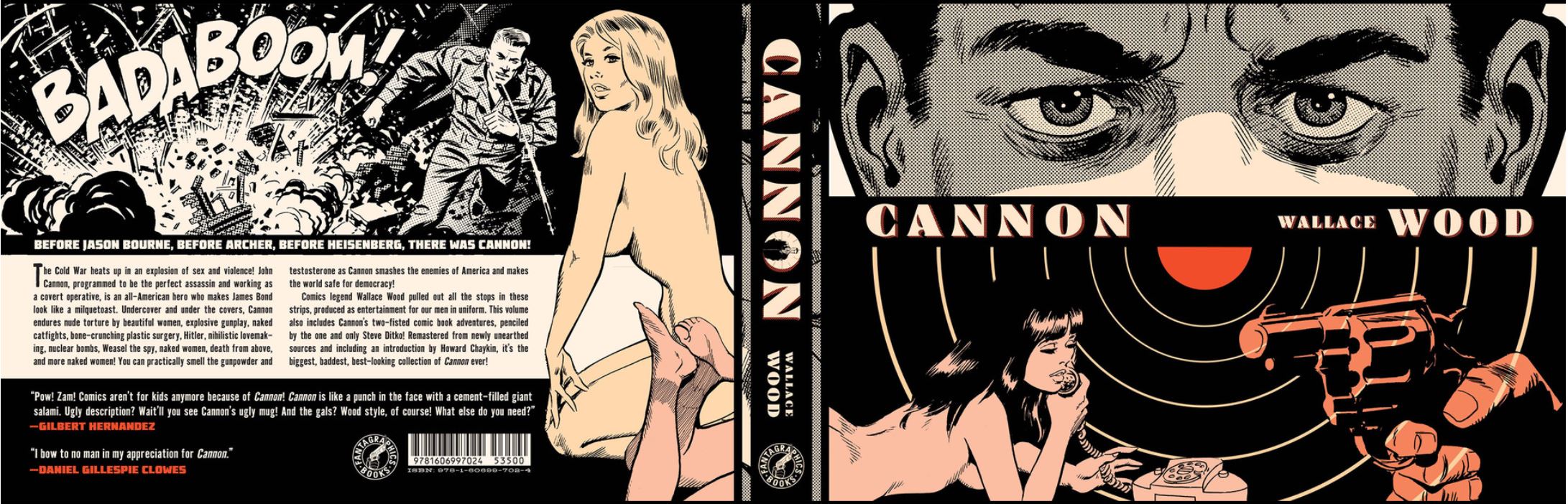
By Wally Wood & various, introduction by Howard Chaykin (Fantagraphics Books)
ISBN: 978-1-60699-702-4 (HB/Digital edition)

This book includes Discriminatory Content produced in less enlightened times.

As with any historical perspective addressing popular mass-entertainments and evolving societies, a look back often finds uncomfortable material that can jar some modern sensitivities and set today’s collective hackles rising. That’s especially true of this lovely but confounding collection compiling seldom seen material by one of the industry’s greatest stars…

This is quite frankly a lovely book of beautiful work that I now find hard to recommend to a general audience. That’s more to do with how society has evolved rather than its admittedly always deeply flawed and often unsavoury content…

We all carry within us the seeds of our own destruction and probably none more so than troubled comics genius Wallace Allan Wood (June 17th 1927 – November 2nd 1981): one of the greatest draughtsmen and graphic imagineers our art form has ever produced. Woody was a master of every aspect of the business. He began his career lettering Will Eisner’s Spirit newspaper strip, readily moving into pencilling and inking as the 1940s ended and, ultimately into publishing. After years working all over the comic book and syndicated strip markets, as well as in book illustration, package-design and other areas of commercial art, he devised the legendary T.H.U.N.D.E.R. Agents franchise and even predated and anticipated the counter-culture’s Underground Commix phenomenon by launching in 1965s one of the first adult-oriented, independent comics: Witzend.

The troubled genius was frequently his own worst enemy. Woody’s life was one of addiction (guns, booze & cigarettes); traumatic relationships; tantalisingly close yet always inevitably frustrated financial security; illness and eventually, suicide. It was as if all the joy and beauty in his existence stayed on the pages and there was none left for real life.

Although during his time with EC Wood became the acknowledged, undisputed Master of Science Fiction art in America, he was equally adept, driven and accomplished in the production of all genres. He was a lusty man and was a pioneer of sexually explicit, ultra-violent (but always beautiful) and titillating comics where sex played a major role. Remember, even if everybody loves comics, it’s not always about superheroes and cosmic quests. Men like sexy comics and cartoons. I’m not saying that it’s right or proper to ogle women, but it is a sad fact of life and has made many publishers rich for centuries. This customer base especially likes looking at beautiful naked women and amongst so very many cartoonists over the decades, Wood was arguably the paramount exponent of the subgenre…

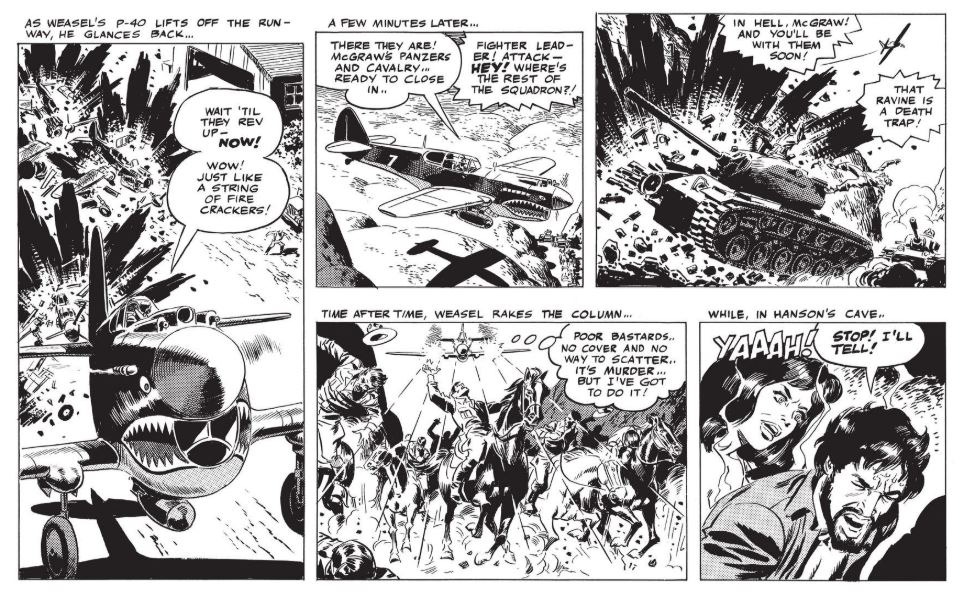
Remarkably and without in any way seeking to apologise for it, I can confirm that this gritty strip was made to entertain REAL-MEN!! It abounds with naked, nude, undraped and forcibly undressed women (and men, but not as many or as often as the women). Somehow less controversially it also heavily features mega violence, and both physical and psychological torture because that’s what the audience wanted. If you don’t believe me go and rewatch Goldfinger (1964) but this time watch and listen closely…

Cannon’s inbuilt misogyny is a feature not a bug with levels of abusive behaviour and conduct that seldom exceed those of any 1960-1970s Bond or Man from U.N.C.L.E. movie. There’s practically no gadgets either, but loads of fast flashy cars, planes and boats… and much sublimely rendered, awesomely accurate ordnance because that’s one thing your average GI or swabbie will spot instantly if fudged…

This cartoon series captures a moment in history that was deeply, deeply unfair to women, even if – for its time – the feature was uncharacteristically racially & socially diverse and most equitable in its treatment of African-American, Hispanic, Arabic and Asian guys. This was probably as much about the target readership – the desegrated but still mostly male US Military Service personnel – as Woody’s views on the Civil Rights movement. Wally was always utterly professional and diligent in all his work commitments and liberated from all editorial constraints, but his own experience gave the audience exactly what they wanted…

Following Howard Chaykin’s ‘Intro’ confirming the best and worst of the legends, the strip unfolds in one unbroken stream of non-stop blockbuster action heavily seasoned with geopolitical themes and contemporary headline fodder. It’s fitting to note here that Woody utilised and mentored dozens of guys who went on to their own notoriety. If you’re a fanatic, you’ll spot many of them – Pearson, Reese, Wenzel, Hama et al – as characters in the strip, but in-jokes aside, this one’s all about satisfying manly urges.

Guaranteeing sex, death and horror and NAKED WOMEN in almost every episode, Cannon by Wood and his ever-shifting studio ran from 1970-1973 in three separate editions of The Overseas Weekly: a tabloid specifically created and disseminated to US military personnel stationed overseas. He & Steve Ditko later recycled the character in an abortive indie publishing venture Heroes, Inc., which we’ll cover at the end.

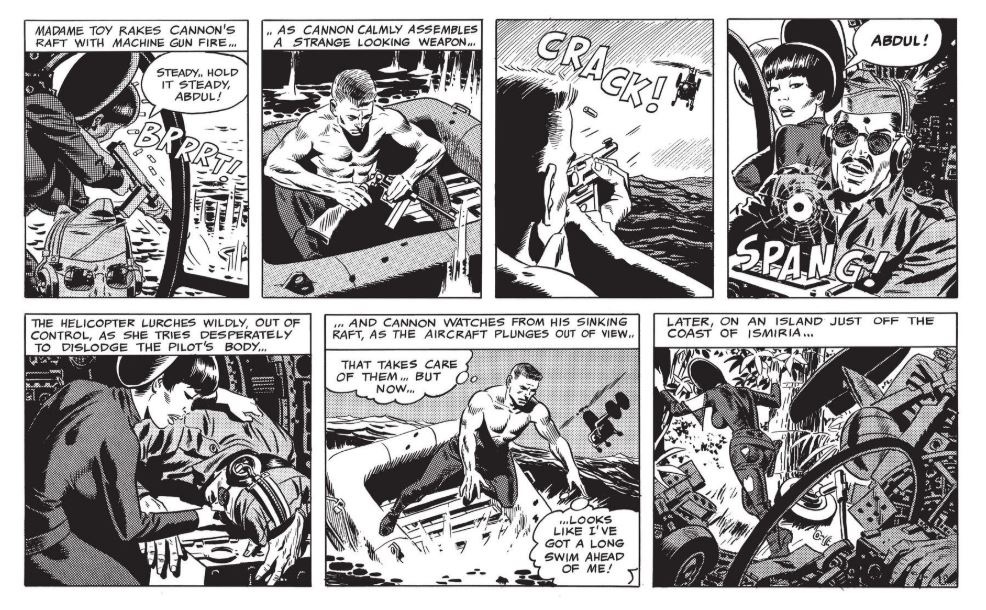
John Cannon was a U2 pilot captured and tortured by the Red Chinese. Broken and turned into their assassin, he threw off the ministrations of their top brainwasher Madame Toy but suffered a psychological collapse that left him a relentless, emotionless living weapon pointed by the CIA at any target that needed killing.

His successes didn’t affect him at all but did make him a permanent target of the Chinese and Soviet governments. The latter tasked beautiful lethal killer Sue Smith to remove him by any means and at all costs, but her attempts were as frequent and futile as Toy’s, who doggedly and repeatedly seeks to recapture or kill him. Both curvaceous killers spent as much time shagging Cannon as shooting, stabbing, electrocuting, drowning, poisoning, bombing and running over the implacable agent.

Encountering and exterminating hundreds of spies Cold War spies and assassins, Cannon saves US-friendly middle-Eastern Ismiria from infiltration and insurrection; defends US ally Israel from subversion; shatters the schemes (and sleeper agent army) of Comrade Gorsk and saves Latin American San Sierra from both Red-backed rebels and the incumbent US-friendly fascist dictatorship. He even gets to save a few lives along the way, like his own Uncle Fred back in Iowa and charming conman/serial bigamist/accidental hitman Charles M. Fogarty

At home, Cannon eradicates gangsters and spies as his conditioning begins to fade. No longer a reliable asset, he tries to retire to his old family home but trouble follows and the CIA soon re-recruit him. With Toy & Sue Smith perpetually hunting him and “cat-fighting” each other, Cannon even clashes with killer hippies in a murder commune and an ultra-conservative millionaire with his own private militia seeking to set the nation back on the Right path. John even has a couple of shots at true love and a Happy Ever After, but inevitably learns over and again that “women are just no damn good”…

Along the way he experiences every kind of action from scuba combat to aerial dogfights, and even battles a killer cyborg, He’s particularly adept at ferreting out leftover Nazis and dodges more than his fair share of atomic detonations. This is a strip very much of its time and for adults if not grown-ups, so like many of his audience, our hero even has to face up to the consequences of his actions when one paramour falls pregnant. The wedding is an utter disaster…

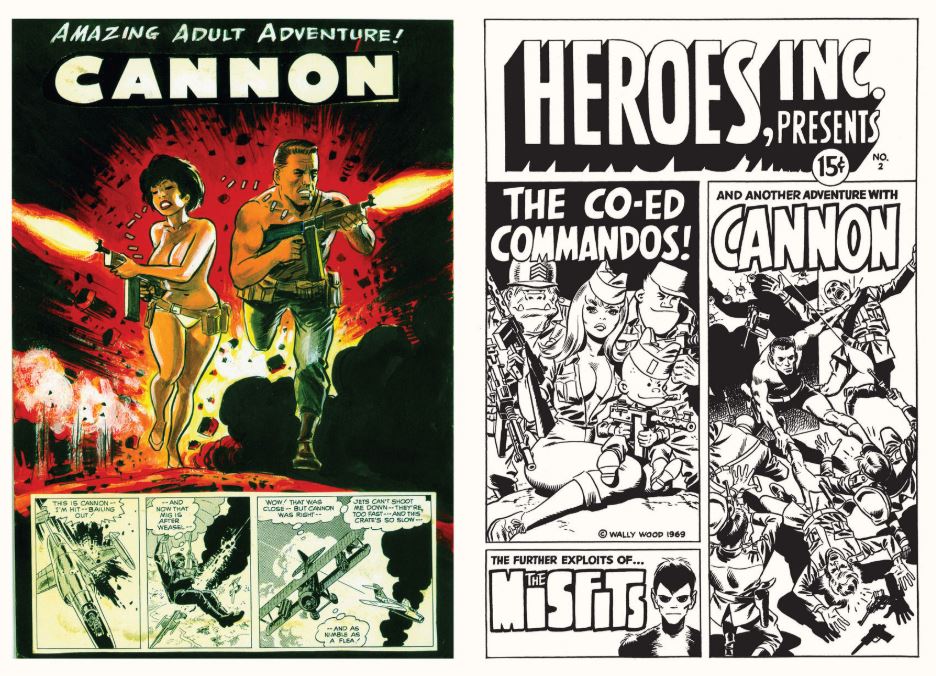
As much a document of art history as an expertly-targeted wank-book, Cannon comes with fascinating bonus features for comics fans, beginning a voluminous Appendix section with a brace of long lost cover paintings.

These augment the Roger Hill’s essay ‘The Overseas Weekly Discovery’ detailing the bizarre circumstance that led to the retrieval of the material forming this book, and compliments a

‘Letter by Wallace Wood’ exhorting how the industry must change. These are followed by the tamed down, general audience full-colour Cannon story by Wood & Ditko as seen by almost nobody in 1969’s Heroes, Inc. Presents Cannon, and another similar but monochrome lost Wood & Ditko treat from Heroes, Inc. No. 2 (1976) once again kicking the stuffing out of stubborn Nazis by Wood & Ditko. The experience ends as it should with a fulsome and fair “Bio” of Wally Wood by J. David Spurlock.

Fast, furious and ferociously unreconstructed and sexist, this can be a hard read: one packed with pitfalls, but undeniably honest in its intent and delivery. If you like this kind of thing you’ll love it, and if you find it offensive, you’re still free enough for the moment to reject and not buy it. However, if you do feel the urge to condemn, do us all the courtesy of reading it first…
“Intro” © 2014 Howard Chaykin. “The Overseas Weekly Discovery” © 2014 Roger Hill. “Bio” © 2014 J. David Spurlock. Photos © Bhob Stewart & Paul Kirchner. All other contents © 2014 Wallace Wood Properties LLC. All rights reserved.

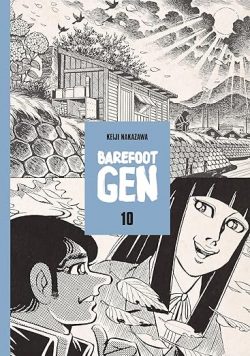
Barefoot Gen volume 10: Never Give Up


By Keiji Nakazawa (Last Gasp)
ISBN: 978-0-86719-601-6 (TPB) 978-0-86719-840-9 (HB/School Edition)

Whilst we are all commemorating the 80th anniversary of VJ Day (the Americans hold theirs on September 2nd), it’s only appropriate to remember how that war ended and what victory and defeat meant to a world forever changed after the conclusion. In comics, that means Keiji Nakazawa and Hadashi no Gen. A standby of anti-nuclear movements since first release in 1983, new hardback editions combining two paperback editions per volume are underway and will be on sale from January 15th 2026 – if we manage to live that long. You could wait or even check out our past reviews or simply save your time & energy by buying the still-available 10 tank?bon set right now.

After many years of struggle the entire piecemeal epic semi-autobiographical saga was remastered as an unabridged and uncompromising 10-volume English-language translation by Last Gasp under the auspices of Project Gen: a multinational organisation dedicated to peace and the abolition of nuclear weapons. Constantly revised and refined by its creator until his death from lung cancer in December 2012, Barefoot Gen is the quintessential anti-war tract and plea to humanity for peace. The combined volumes are angry and uncompromising, and never forgive those who seek to perpetuate greed, mendacity and bloody-handed stupidity.

Hadashi no Gen was first seen in Japan in 1973, serialised in Gekkan Shōnen Janpu Jampu (Monthly Boys Jump) following an occasional 1972 series of stand-alone stories in various magazines which included Kuroi Ame ni Utarete (Struck by Black Rain) and Aru Hi Totsuzen (One Day, Suddenly).

The scattered tales eventually led Shonen Jump’s editor Tadasu Nagano to commission 45-page Ore wa Mita (I Saw It) for a Monthly Jump special devoted to autobiographical works. Nagano clearly recognised that the author – an actual survivor of the world’s first atomic atrocity – had much more to say which readers needed to see and commissioned the serial which has grown into this stunning landmark epic.

The tale was always controversial in a country which still generally prefers to ignore rather than confront past mistakes and indiscretions and, after 18 months, Hadashi no Gen was removed from Jump, transferring firstly to Shimin (Citizen), then Bunka Hyåron (Cultural Criticism), and Kyåiku Hyåron (Educational Criticism). Just like his indomitable hero, Keiji Nakazawa never gave up and his persistence led to a first Japanese book collection in 1975, translated by the newly-constituted Project Gen team into Russian, English and other languages including Norwegian, French, German, Italian, Portuguese, Swedish, Finnish, Indonesian, Tagalog and Esperanto.

Born in March 14th 1939 and changed forever on August 6th 1945, the hibakusha (“atom bomb survivor”) author first completed his account in 1985 and his telling testament of survival has since been adapted into live-action & anime films; operas; musicals and live television dramas; each spreading the message across every continent and all generations.

Today we’re looking again at the concluding volume which brings the story of irrepressible, ebullient Gen and his friends to a close. One last time we see the forceful vitality of a select band of bomb survivors pitted against the constant shadow of tragedy which implacably dogs them in the city slowly recovering from nuclear conflagration.

Here the indomitable idealistic individualist, having finally found a way to express his anger and effectively fight back against the idiocies and injustices of a world which lets Atom bombs fall but is seemingly incapable of learning from its mistakes, at last strikes back at the demagogues and monsters who still keep the bad old ways alive… even after their people suffered the most hideous of consequences…

Barefoot Gen: Never Give Up begins following an inspirational ‘Gen’s Message: A Plea for Nuclear Abolition’ by the Translators & Editors and – as previously – the other end of this monochrome paperback balances the essay with a biography of the author and invaluable data ‘About Project Gen’

The graphic manifesto resumes in March 1953 as Gen prepares for his school graduation ceremony, despite seldom attending that hidebound institution over the past few years. Fellow bomb orphans Ryuta and quietly stolid Musubi – who have shared Gen’s shabby shack for years – are also in high spirits. They have been constantly selling dresses made by radiation-scarred outcast Katsuko on Hiroshima’s rebuilt street corners, diligently saving the proceeds until she has enough money to open a shop. Now the manager of one of the big stores wants to buy all the clothes they can manufacture to sell in his fashionable venues…

At the Graduation Ceremony Gen once again loses his temper when the faculty begin memorialising the past and celebrating the failed regime of the empire. Later, his savage confrontation with teachers and visiting dignitaries sparks a minor student revolution. For many of the juvenile delinquents it’s also an opportunity to inflict some long-delayed retribution on the educational bullies who have oppressed and beaten them for years…

Encouragingly, however, not all parents and attending adults take the teachers’ side, and a potentially murderous confrontation is (rather violently) defused by Gen. The boy’s life then changes forever when he bumps into a young woman and is instantly smitten. His pursuit of Mitsuko will bring him into conflict with her brutal father, former employer and unrepentant war-lover Nakao who is now a highly successful businessman going places in the reconstructed city…

Gen has been studying with elderly artist Seiga Amano, learning the skills his own father would have passed on had he not died in 1945. The mentor/father-figure encourages his protégé to pursue Mitsuko… and it costs them both their jobs. However, the seeming setback is in fact liberating and before long the star-crossed youngsters are in a fevered euphoria of first love. So engaged is Gen that he is not there when stolid Musubi is targeted by a cruel Yakuza honeytrap who addicts him to drugs before fleecing him of all Katsuko’s hard-earned savings…

With a happy ending so close he can touch it, Gen is dragged back down to earth by a trio of tragedies which leave him near-broken and all alone. The legacies of the bombing have again cost him almost everything…

After a horrendous bout of death and vengeance-taking, Gen seems to have nothing to live for, but the despondent young man is saved by aged Amano who rekindles his spirit and wisely advises him to get out of Hiroshima and start his real life in the world beyond it…

Keiji Nakazawa’s broad cartoon art style has often been subject of heated discussion; his simplified Disney-esque rendering felt by some to be at odds with the subject matter, and perhaps diluting the impact of the message. I’d like to categorically refute that.

The style springs from his earliest influence, Osamu Tezuka, Father of Anime & God of Manga who began his career in 1946 and whose works – Shin Takarajima/New Treasure Island, Tetsuwan Atomu/Astro Boy and so many more – assuaged some of the grim realities of being hibakusha, providing escape, hope and even a career path to the young illustrator. Even at its most bleak and traumatic the epic never forgets to shade horror with humour and counterpoint crushing loss with fiery idealism and enthusiasm.

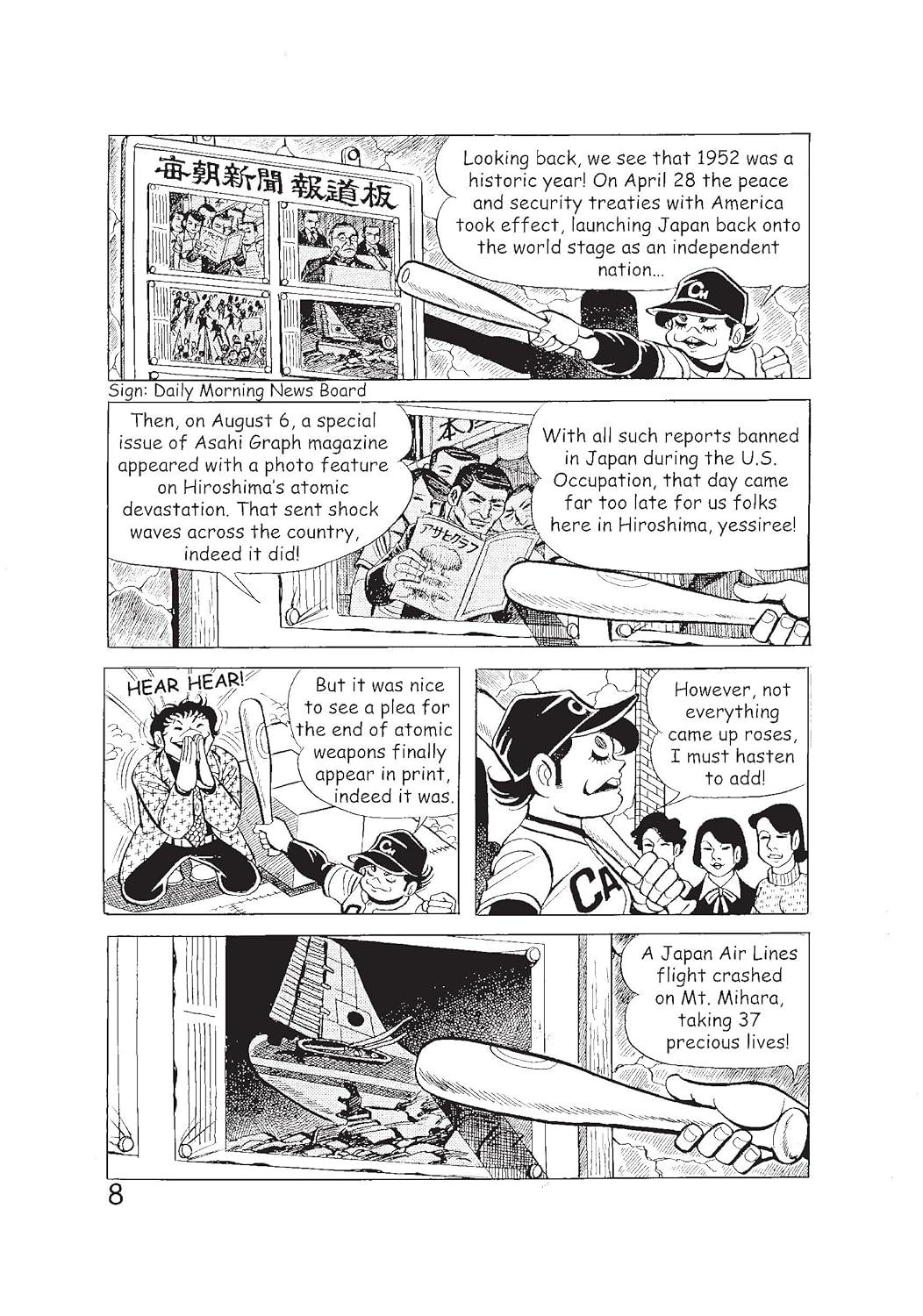
As such the clear line, solid black forms and abstracted visual motifs act as tolerable symbols for much of the horror in this parable. The art defuses but never dilutes the horror of the tragedy and its aftermath. The reader has to be brought through the tale to receive the message and for that purpose drawings are accurate, simplified and effective. The intent is not to repel (and to be honest, even as they are they’re still pretty hard to take) but to inform, to warn.

Shocking. Momentous. Bleak and violent but ultimately astoundingly uplifting, Nakazawa’s Barefoot Gen is without peer and its legacy will be pervasive and long-lasting. So now you’ve been warned, buy this old book. Buy the entire series. Buy the new editions as they come out. Tell everyone you know about it. Barefoot Gen is an indisputable classic and should be available to absolutely everyone.
© 2009 Keiji Nakazawa. All rights reserved.

They Called Us Enemy (Expanded edition)


By George Takei, Justin Eisinger, Steve Scott & Harmony Becker (Top Shelf Productions/IDW)
ISBN: 978-1-603094-70-2 (Expanded HB) eISBN 978-1-684068-82-1-
TPB ISBN: 978-1-603094-50-4

This book contains Discriminatory Content from less enlightened times included for historical and dramatic veracity.

Graphic biographies are still a relatively new form for English-language comics, but the wealth and variety of material already available is truly breathtaking and laudable. This so timely exemplary example is a subtly understated yet deeply moving chronicle exploring the events and repercussions of a truly shameful moment in US history, as recalled and relived by a global icon of popular culture. He also happens to be one of that embattled democracy’s most ardent advocates of diversity, justice and equality and top-level activist in the arenas of LGBTQ and Asian-American rights.

George Takei initially celebrated and commemorated his life in prose autobiography To the Stars, but here, in collaboration with writers Justin Eisinger & Steven Scott and illustrator Harmony Becker, the Hollywood star deftly shifted focus to explore in painful and revelatory detail the early years of his life: a formative period spent as a non-person confined without cause behind barbed wire in his own country.

Recounted as non-linear, non-chronological episodes, the history and self-serving actions of American leaders – like Lt. General John L. DeWitt or Los Angeles Mayor Fletcher Bowron, who systematically stripped all people of Japanese ethnicity of their rights, livelihoods, possessions and autonomy – are seen through the eyes of a small child. Those observations inevitably shaped the actor into a crusading defender of democratic principles of later life.

I’d love to say that’s simply a thing of the past, but kids are still being locked in cages and families split up. It’s apparently something we humans just can’t stop doing…

Following the attack on Pearl Harbor on December 7th 1941, on February 19th 1942, US President Franklin Delano Roosevelt signed Executive Order 9066, dividing the country into military zones and effectively declaring all American citizens of Japanese origins enemy aliens. This led to their internment for the duration of the war across 10 isolated camps between the West Coast and Mississippi river.

In surprisingly fond recollections of camp life, we share the notions of baffled children – George, brother Henry, sister Nancy Reiko and many new pals – and the lasting, post-war consequences of divisively authoritarian stunts such as legally-binding loyalty pledges de-fanged and counterpointed by modern day discussions and triumphant moments of past injustices finally addressed.

As well as exposing the true price of dog-whistle politics and human cost of bowing to baying demagogues we see here a shameful period of state-sanctioned, opportunistic profiteering and proud racism in a tale that is a testament to human endurance, perseverance and innate dignity. Amidst the stomach churning, mostly bloodless horror are moments of delightful warmth and genuine humour, bolstered by actions of unsung humanitarian heroes like Takei’s own parents and pioneering civil rights lawyer Wayne M. Collins. Their tireless fortitude and resistance to state-sanctioned oppression, along with the efforts of countless others, offers inspiration and hope for all suffering similar restraint and abuse while sadly proving that some battles may never end. Just look at any headline with the word seeker, refugee or asylum in it and the sheer cost of protecting migrants anywhere on Earth today…

Also offering touching afterword ‘Making History’ by Takei, Eisinger, Scott & Becker; a Takei family photo album; reproduced Civilian Exclusion orders, street maps of the internment camp and chilling “Final accountability rosters” for Camp Rohwer & Camp Tule Lake, this book includes a detailed look at the process of creating it, with candid team photos, script pages, roughs and layouts, as well as press and convention shots of George collecting the numerous awards for his efforts. At the close, there’s a feature on how the book has transitioned to becoming an educational standby, acknowledgements and the always welcome creator biographies.

They Called Us Enemy is a compelling, beguiling and harshly informative account of injustice and unchecked ignorance endured with plenty of points as pertinent now as they ever were.

In 2020 this expanded edition was released with 16 pages of extra material in both physical hardback and digital volume.
They Called Us Enemy Expanded Edition © 2020 George Takei. All Rights Reserved.

Showcase Presents Our Army At War


By Dave Wood, Robert Kanigher, David Khan, Hal Kantor, John Reed, France “Ed” Herron, William Woolfolk, John Reed, Art Wallace, Nat Barnett, Irv Novick, Carmine Infantino, Gene Colan, Bernie Krigstein, Frank Giacoia, Joe Giella, Bernard Sachs, Irwin Hasen, Bob Lander, Gil Kane, Ross Andru & Mike Esposito, Jerry Grandenetti, Bob Oksner, Mort Drucker, Sy Barry, Fred Ray, Eugene Hughes, Ray Burnley, Ray Schott & various (DC Comics)
ISBN: 978-1401229429 (TPB)

This book includes Discriminatory Content produced in less enlightened times.

In America following the demise of EC Comics in the mid-1950’s – and prior to Warren Publishing’s astounding Blazing Combat – the only certain place to find challenging, entertaining and often controversial American war comics was at DC. In fact, even as Archie Goodwin’s stunning yet tragically mis-marketed quartet of classics were waking up a generation, the home of Superman, Batman & Wonder Woman was also a cornucopia of gritty, intriguing, beautifully illustrated battle tales presenting combat on a variety of fronts and from many differing points of view. As the very public Vietnam War escalated, and secret wars in central America festered unseen, 1960s America increasingly endured a Home Front death-struggle pitting deeply-ingrained Establishment social attitudes against a youthful freedom-from-old-values-oriented generation with a radical new sensibility. In response, the military-themed comic books of DC (or rather National Periodical Publishing, as it then was) became ever bolder and more innovative…

That stellar and challenging creative period came to an end as all strip trends do, but some of the more impressive and popular features (Sgt. Rock, Haunted Tank, Unknown Soldier, The War That Time Forgot, The Losers, Enemy Ace) survived well into the second – post horror-boom – superhero revival as character not genre vehicles. Currently, English-language fans of war stories are grievously underserved in both print and digital formats, but this magnificent monochrome reprint compendium is still readily available. It collects Our Army At War #1-20, from August 1952 – March 1954. With war comics resurgent, it was a new anthology title that was on sale from June 11th 1952 which ran for 301 issues until March 1977, whereupon it was redesignated Sgt. Rock and soldiered on (sorry, couldn’t stop myself!) until #422 cover dated June 1988. The appeal of that style and genre has largely vanished from comic books but once, these were hugely popular casual entertainments for kids and others.

Pure anthology Our Army At War very much followed Harvey Kurtzman’s EC model for Two-Fisted Tales & Frontline Combat, primarily featuring the proud American fighting man on a variety of historical battlefronts including the Revolutionary War, War of 1812, Civil War, Spanish-American War, WWI and Korean War even whilst concentrating the majority of its creative firepower on WWII – in which the target readership’s fathers and older relatives had just fought.

Sans ado or preamble, OAAW #1 opens with ‘Last Performance!’ as Dave Wood, Frank Giacoia & Joe Giella reveal how former acrobats Eddie March & Bert Brown escape a deadly German ambush thanks to their old act and a little common sense, after which Kanigher, Irv Novick & Bernard Sachs take us to the Pacific theatre of war and explain – without dialogue – how an entrenched marine patrol only survive Japanese scare tactics by when they ‘Dig Your Foxhole Deep!’

Fanciful – if not outright whimsical – notions proliferated in this era and David Khan, Irwin Hasen & Bob Lander gleefully kick off the practise as a Kentucky mountain man (and a dog!) unused to combat boots provides invaluable pedal intel at the Kasserine Pass thanks to ‘Radar Feet!’ prior to Dave Wood, Gil Kane & Giella ending the issue with inter service rivalry in the Pacific as ‘SOS Seabees!’ sees US troops and navy engineers forced to cooperate to survive…

In issue #2, Kanigher returned his much-loved boxing-as-combat metaphor in ‘Champ!’ with Carmine Infantino & Giella limning a yarn of sporting rivals meeting again over gunsights and in foxholes, before Dave Wood, Bob Oksner & Sachs depicted a tense moment as a sentry spots what might be Germans disguised as GIs in ‘Second Best!’, after which a soldiers takes drastic action to ensure a little peace and quiet to finish ‘A Letter from Joe!’ (by Hal Kantor, Mort Drucker & Lander). The issue ends on Khan, Novick & Lander’s ‘Survival for Shorty!’ as a sensitive short-tempered pee-wee powerhouse strives to proves he’s as big a man as any of his team as they raid a Japanese stronghold…

Kanigher, Novick & Sachs open #3 with the war deep inside a US Marine’s head as he endures the pressure of another ‘Patrol!’ even as Wood, Kane & Lander offer ‘No Exit!’ for former stunt-bikers Skeets & Wally when the former’s combat-trauma traps them behind enemy lines with crucial knowledge of a forthcoming surprise attack…

Kantor & Eugene Hughes then prove superstitious Roy has no need of his lost ‘Lucky Charm!’, before Kantor, Drucker & Lander complete the issue with the tale of ‘Frightened Hero!’ Perry Walters whose tardiness made him a lifelong mouse… until he hit the D-Day beaches…

The contemporaneous Korean conflict led in OAAW #4 where Kanigher, Novick & Sachs reveal the lonely response – and fate – of the ‘Last Man!’ in a unit wiped out by the pitiless enemy after which Kantor & Bernie Krigstein introduce a soldier hoping to take it easy until his ‘Replacement!’ shows up, before Kantor, Ray Schott & Lander, explore the job similarities of a peacetime mailman once more carrying a ‘Special Delivery!’ through the mud and weather of the 38th Parallel. Kantor, Jerry Grandenetti & Giella then finish the forays with an ironically barbed close look at the ‘Soft Job!’ tank men face every day in modern warfare…

Staying in Korea, #5 opens with Kanigher, Novick & Sachs wryly exploring the perennial problem of keepsakes in ‘Battle Souvenir!’, whilst Kantor, Oksner & Lander cover the other regular misdemeanour of illicit underage enlistment as a seasoned officer must act quickly after finding out the age of new unit replacement ‘Baby Face!’. Combat engineers then get a moment in the spotlight – and mud – blowing a crucial bridge in ‘T.N.T. Bouquet!’  courtesy of John Reed, Gene Colan & Sy Barry, after which Khan & Hughes detail the rocky ride of an elite ‘Ranger!’ in a unit of ordinary dogface… until the shooting starts…

Variety overrules contemporaneity in #6 as Kanigher, Novick & Sachs head back to the American Civil War for ‘Battle Flag!’: the lyrical tale of a grandfather recalling what carrying that bloody banner as boy-soldier cost, and followed by a highly experimental yarn from Kantor, Grandenetti & Ray Burnley that’s tantamount to science fiction, wherein a ‘Killer Sub!’ meets its fate. Robert Bernstein & Hughes take us to Korea next as a GI foils a cunning booby trap and makes a mortal enemy determined to have the ‘Last Laugh!’ at any cost before Kahn, Colan & Giella close the issue with the charming tale of a US soldier and a music (and democracy!) loving Korean boy happy to help out as ‘Kid Private!’

Cover-dated February 1953 and on sale from December 10th 1952, OAAW #7 closed the first year with a mixed bag of yarns beginning with ‘Dive Bomber!’ by Kanigher, Grandenetti & Giella, wherein the novice team piloting a Curtiss Helldiver in a mass attack against the Japanese Navy are shot down and must survive all perils…

Kahn, Drucker, Lander then upgrade to Korea and trace the perilously peripatetic path of a US service pistol as narrated by ‘I, The Gun!’, prior to Reed, Colan & Lander detailing how lost puppy Tugger saves a doughboy patrol from murderous ‘Counterattack!’ before we close on alpine WWII combat as Wood, Colan & Giella’s ‘Mountain Trooper!’ learns a lesson about glamour jobs before returning to the good old infantry…

In #8, Kanigher & Novick’s ‘One Man Army!’ cogitates on being a cog in a massive war machine before single handedly conquering a communist Korean citadel, whilst Wood & Krigstein spectacularly play with the form in ‘Toy Soldier!’ – the short saga of an amazing inventor in the US trenches of the Great War. Reed & Colan then present ‘Rearguard!’ action as a lonely man holds off an unseen army and ponders his life before a brief cessation of hostilities as Wood, Grandenetti & Giella test argumentative sibling soldiers with roaring rapids, crucial supply deliveries and many, many murderous “commies” chasing then through the ‘Pusan Pocket!’

Opening #9, uncanny coincidence and the powers of a jinx concern the crew of US submarine Flying Fish after picking up a message in a bottle written by members of their WWI namesake. The eerie tale of the ‘Undersea Raider!’ (by Kahn, Colan & Giella) ends badly and portentously for all before segueing into Wood, Grandenetti & Sachs’ generational saga of US pilots whose glorious deaths in combat overwhelm the latest scion and compel Joey Rickard to become a ‘Runaway Hero’ by joining the infantry in Korea. However, destiny is a harsh mistress…

Bernstein & Hughes test out motor pool instruction theory when novice corporal Jim Terris goes off book to deliver crucial supplies by making a ‘Fatal Choice!’ after which Kahn & Krigstein imaginatively refocus the ‘Eyes of the Artillery’ when a fighter pilot is forced to become a specialist bomber in primitive crate to destroy a deadly North Korean supergun…

Kanigher & Krigstein lead in #10, with Signal Corps veterans Don & Steve adding to their already lethal workload as ‘Soldiers of the High Wire’ when their commanding officer sanctions a broadcast for the folks back home and they have to keep the civilians alive and recording despite attacks from jets, tanks and even Korean guerillas…

‘Deadlock!’ by Wood, Colan & Giella then details how a downed American pilot and his Nazi counterpart are trapped in a standoff on a sinking submarine, each anticipating rescue by their side as time runs out. Next, Kantor, Grandenetti & Giella reveal how ‘Chessmen of War’ decide the course of a battle when captured Red Chinese Major Tao plays a fateful game with his US interrogator, after which we close on Kahn & Krigstein depict the ultimate triumph of a ‘Fighting Mess Sergeant’ taken prisoner by North Koreans…

Our Army At War #11 opens in the sky where Kanigher, Novick & Sachs compare the attitudes of Kamikaze pilots and US swabbies shooting them down in ‘Scratch One Meatball!’, whilst Kahn, Colan & Giella stick with the last days of WWII – specifically Luzon island – for ‘Guerilla Fighters’, where a grizzled yank sergeant and a young Filipino recruit make things hot for the embattled occupiers. Kantor & Hughes stick to same war but head to Europe for a ‘Combat Report’ as embedded war correspondent (albeit for a company newspaper) Davey Brown gets fed up with evasions from GIs and makes his own news before Wood & Krigstein return to Korea and depict how an embarrassing present from home can change a ‘Soldier’s Luck!’

William Woolfolk, Grandenetti & Giella secure pole position in #12 as ‘Flying Blind’ sees a cynical solitary US Navy pilot learn to trust when he is injured in mid-air even as Kahn, Colan & Giella oversee the reuniting of a team of track & field sportsmen on a Pacific island infested with Japanese killers and forced to endure a ‘Death Relay’ to survive, before Reed, Colan & Sachs define the ‘End of the Line!’ for a publicity-seeking fool who always had to be first in peacetime and paid the price for it in battle-shattered Belgium. Kanigher & Novick pause the fighting for the moment in a tale of performance anxiety as a paratrooper frets over ‘The Big Drop!’ on the night before D-Day…

Woolfolk, Grandenetti & Giella again lead in OAAW #13 as the torch of mentor/guardian passes from one pilot to another above bomb-shattered Japan in moody yarn ‘Ghost Ace!’, after which Wood, Novick & Sachs describe how ‘Combat Fever!’ chills one hypochondriac GI as his unit establish a beachhead on the ferociously occupied Solomon Islands. Human frailty and pomposity are punctured in Kahn, Colan & Giella’s ‘Phantom Frogman’ as a Navy hero describes the mysterious undersea guardian angel actually responsible for all his feats and medals before the issues closes on ‘Minuteman of Saratoga!’ by Nat Barnett & Krigstein wherein cocky young Roger Holcomb eventually proves his worth to his elders in the proud militia…

The concentration on American servicemen ended in #14 as Woolfolk & Krigstein share the militarily profound and uplifting tale of a boy more steadfast than Napolean himself and known forever after as the ‘Drummer of Waterloo’, before Kahn, Colan & Giella return to quarrelsome GIs in a foxhole inadvertently capture Nazi bigwigs in ‘Double or Nothing!’ Woolfolk, Ross Andru & Mike Esposito then detail the casual heroism of a military doctor who goes all out to save his patients as a ‘Soldier Without Armor’, in advance of the same author – with Grandenetti & Giella – exposing one soldier’s phobia over heavy ordnance… and how he was cured by a ‘Killer Tank’

Kanigher, Novick & Sy Barry claimed the lead spot in #15 as ‘Thunder in the Skies’ exposed the pressures of night bombing raids over Germany as experienced by the waist gunner of a Flying Fortress, before Art Wallace, Colan & Sachs visit Italy as a history loving GI – one of the US divisions trying to kick out the Nazis – becomes an unwilling ‘Tourist with T.N.T.’ Reed, Colan & Giella then embrace 1918 and the Battle of Chateau Thierry as members of the 4th Marine Brigade take ‘A Sunday Walk’, into utter carnage before a ceasefire of sorts closes the issue with Reed, Grandenetti & Sachs’ ‘The Fifteen-Minute War’ – a brutal, barbaric fug-enshrouded 1942-set battle for Massacre Ridge on Attu in the Aleutians…

Obsessive hunger for vengeance grips hard in OAAW #16’s opener, ‘A Million-to-One Shot!’ as Kanigher, Novick & Giella detail how the lone survivor of a Japanese strafing attack on shipwrecked sailors turns into a quest spanning the entire Pacific war. Nat Barnett, Andru & Esposito cover a typically gung-ho ‘Battle of the Bugles!’ during the Spanish-American War’s attack on San Juan Hill, before Reed, Colan & Giella channel cyclic history for a 1940 ‘Last Stand!’ in the mountains of Greece with eerie echoes of 300 Spartans at Thermopylae. Ending on a lighter note, France “Ed” Herron, Andru & Esposito share the story of a street corner in liberated French city Metz that suddenly comes under Nazi attack with only a ‘Traffic Cop Soldier!’ to save the day…

Kanigher & Novick detail combat on skis to start #17, as ‘The White Death!’ follows an elite snow-skimming team ordered to take a key mountain pass untouchable by bomber raids, whilst Barnett, Colan & Giella draw the ‘Sword for a Statue’: revealing the strangest exploit of the War of 1812 and West Point’s mythology. Then, Wallace, Hughes & Giella recount an aspiring author’s ‘Battle Without Bullets!’ and unbelievable victory over his German captors, prior to Herron, Grandenetti & Sachs showing how a ‘Washed-Out Cadet!’ failure to make pilot officer is the Japanese’s loss after he finds his true killing calling…

Kahn, Colan & Giella open #18 in WWII as a Navy rescue helicopter pilot continually causes trouble in ‘The Duel’ by picking fights with Nazi infantry and even shipping and U-Boats, after which we head back to 1775 where ‘Frontier Fighter’ Mr. Wade casually and most effectively tramples all over the old-fashioned rules of combat held dear by his British employers and their French opponents in a frighteningly belligerent tale of early American exceptionalism from Barnett, Grandenetti & Sy Barry. Reed, Andru & Esposito then wittily address a fluke of combat as a simple corporal is rotated out before ever even seeing a Germen. Happily for him his ‘Delayed Action’ getting back to his lines more than makes up for his previous lack of stories to tell his kids. The issue closes with a more serious yarn from Woolfolk, Colan & Sachs as a sleep-deprived Pacific based Marine is constantly told to ‘Wake Up – And Fight!’

Penultimate inclusion OAAW #19 commences with Kanigher & Novick’s ‘The Big Ditch’ as a fighter pilot shot down by a Focke is picked by a Nazi crash boat and interrogated at a hidden rocket base before escaping and destroying it all. That remarkably low concept yarn is made up for by Woolfolk, Grandenetti & Giella’s ‘No Rank’ as damaged, isolated lone wolf Jack Randall learns the value and responsibilities of leadership, after which historical specialist/veteran Superman and Tomahawk illustrator Fred Ray delivers a potent paean to the Civil War with his Gettysburg-set ‘Stand-In Soldier’, after which Kahn, Colan & Giella play games as ‘G.I. Tarzan’ sees a former ape-man actor employ what he learned on set to flush out Japanese soldiers hiding in lush island jungles…

Closing this vintage veteran-fest, Our Army At War #20 (cover dated March 1954 and on sale from January 4th) sees Kanigher, Grandenetti & Sachs launch proceedings with the life story of USS Lion from the mustering of its crew to the Captain’s command to ‘Abandon Ship!’, whilst Joseph Daffron, Andru & Esposito more light-heartedly trace the fall and rise of a seemingly cursed B-25 bomber in ‘The Flying Crackerbox’. Herron & Frank Giacoia address the hostility and acrimony of defeated southern soldiers in ‘The Blue and the Gray’, and the epic war stories conclude for now with ‘T.N.T. Mail!’ by Woolfolk, Grandenetti & Giella wherein contented loner and voluntary outsider Charlet West at long last learns the value of comradeship during a colossal tank engagement…

With covers by Novick, Infantino, Giella, Giacoia, Kane, Colan, Krigstein & Grandenetti this compilation is technically excellent but suffers from many flaws caused by changing tastes and expanded consciousness. Bombastic, triumphalist and frequently overbearingly jingoistic, this mighty black-&-white treasure trove of combat classics also holds thoughtful, clever and even funny yarns of relatively ordinary guys in the worst times of their lives, making it a monument to a type and style (if not ideology) of storytelling we’re all the poorer without. Hopefully the publishers will wise up soon and begin restoring their like to the wide variety of genre sagas currently available in graphic collections…
© 1977, 1978, 1979, 1980, 2014 DC Comics. All Rights Reserved.

DC Finest: Plastic Man – The Origin of Plastic Man


By Jack Cole, Gil Fox, Will Eisner, Reed Crandall, Al Bryant & various (DC Comics)
ISBN: 978-1-79950-065-0 (TPB)

This book includes Discriminatory Content produced in less enlightened times.

Jack Ralph Cole (December 14, 1914 – August 13, 1958) was one of the most uniquely gifted talents of American Comics’ Golden Age, crafting landmark tales in horror, true crime, war, adventure and especially superhero genres. His incredible humour-hero Plastic Man remains an unsurpassed benchmark of screwball costumed hi-jinks: frequently copied but never equalled. As the Golden Age faded, Cole could see the writing on the wall and famously jumped into gag and glamour cartooning, becoming a household name when his brilliant watercolour gags and stunningly saucy pictures began running in Playboy from the fifth issue. Ever-restless and innately unsettled, Cole eventually moved into the lofty realms of newspaper strips before, in May 1958, achieving his lifelong ambition by launching a syndicated newspaper strip, the domestic comedy Betsy and Me.

On August 13th 1958 at the moment of his biggest break he took his own life.

The unexplained reasons for his death are not as important as the triumphs of Cole’s artistic life and this captivating paperback (reprinting a rare hardback compilation from 2004) provides a fascinating insight into a transitional moment in his artistic development.

Without doubt – and despite great successes with other heroic characters as well as in the crime and horror genres – Cole’s greatest creation was the zany, malleable Plastic Man. He quickly grew from a minor B-character into one of the most memorable and popular heroes of the Golden Age and seemed to be the perfect fantastic embodiment of the sheer energy, verve and creativity of that era when anything went and comics-makers were prepared to try out every outlandish idea…

This premier trade paperback collection reprints the Stretchable Sleuth’s astounding exploits from anthology title Police Comics #1-36 and Plastic Man #1-2, covering the period August 1941 to November 1944. These whacky exploits are unearthed and unleashed from a time when nobody really knew the rules. Creators, publishers and readers were prepared to try literally anything and, by sheer Darwinian processes, the cream of the crop always rose to the top…

The magic begins with a little added extra as most of these tales have retroactively been awarded titles; although most originally appeared without any. The debut and origin of Plastic Man happened in the middle of Police Comics #1, a brief but beguiling 6-pager introducing mobster Eel O’Brian, who is shot by a guard during a factory robbery. Soaked by a vat of acid and instantly, callously, abandoned by his partners in crime, Eel crawls away and is found by a monk who nurses him back to health and proves to the hardened thug that the world is not just filled with brutes and vicious chisellers all after a fast buck.

His entire outlook altered, and somehow now blessed with incredible malleability – he surmises it was the chemical bath mingling with his bullet wounds – Eel opts to put his new powers to use cleaning up the scum he used to run with. Creating the identity of Plastic Man he thrashes his own gang and begins his stormy association with the New York City cops…

Still written, drawn and lettered by Cole, in Police #2 ‘Dueling the Dope Smugglers’ sees Plas apply for a job with the cops, only to be told he can join up if he accomplishes the impossible task of capturing the notorious and slippery Eel O’Brian, currently the Most Wanted crook in eight states…

Ever wily, the Rubber-Band Man bides his time and wins the position anyway by cracking an international dope racket (that’s illegal narcotics, kids) stretching from Canada to Chinatown, whilst in #3’s ‘The Pinball Racket’ he fully capitalises on his underworld reputation and connections to bust up a nefarious mob led by a cunning crook with ears inside the Police Department itself.

The ‘Crime School for Delinquent Girls’ run by Madame Brawn pits the Silly Putty Paladin against a brutal babe intent on taking over the city mobs, and despite getting a thorough trouncing, she and her gang of gal gorillas are back for next issue, having turned her burly hand to a spot of piracy in ‘The Return of Madame Brawn.’ Police Comics #5 (December 1942) also marked a major turning point for Plastic Man, as with that issue he took the cover-spot away from fellow adventurer and failed superstar Firebrand; a position Plas would hold until costumed heroes faded from popularity at the end of the 1940s.

In PC #6 Plas’ burgeoning popularity was graphically reflected in a spookily murderous mystery in ‘The Case of the Disembodied Hands’, whilst in #7 – as Eel – he infiltrates and dismantles the massed forces of the ‘United Crooks of America!’ before #8 has the hero seriously outmatched but still triumphant when battling a colossal, city-crushing giant ‘The Sinister Eight Ball!’ and its decidedly deranged inventor. In #9 the yarns reached an early peak of macabre malevolence as Plastic Man foils a traitorous little mutant dubbed Hairy Arms in ‘Satan’s Son Sells Out to the Japs!’: a darkly bizarre thriller which embraces the hero’s meteoric rise by increasing the regular story-length from six to nine pages.

The carnival of cartoon grotesques continued in #10 as hayseed wannabe-cop Omar McGootch accidentally involves the Malleable Mystery-man in ‘The Cyclop Caper’, a Nazi plot to steal a new secret weapon, whilst #11 finds Plastic Man in mortal combat with the spirit of a 17th century London alchemist whose brain is unearthed and accidentally transplanted into a wounded spitfire pilot. Suddenly gaining incredible mystic powers and menacing mankind, ‘The Brain of Cyrus Smythe’ is still no match for the Pliable Powerhouse…

In Police #12 a desperate blackmailer joined forces with criminal astrologer ‘The Sinister Swami’, who predicts perpetual failure unless Plastic Man is killed, prior to Cole introducing his second most memorable character in #13’s ‘Presenting… the Man Who Can’t be Harmed’.

Despite himself, indolent felonious slob Woozy Winks accidentally saved a wizard’s life and was gifted in return with a gift of invulnerability: all the forces of nature henceforth shielding him from injury or death. Flipping a coin the oaf decided to get rich quick with his power. Unable to stop him, Plas appeals to his sentimentality and better nature and, once Woozy repented, was compelled to keep him around in case he strayed again…

Unlike Omar, Woozy Winks – equal parts Artful Dodger and Mr. Micawber, with the verbal skills and intellect of Lou Costello’s screen persona – would prove the perfect foil for Plastic Man: a lazy, venal, ethically fluid reprobate with sticky fingers who got all the best lines, possessed inexplicable charm and had a habit of finding trouble. It was the perfect marriage of inconvenience…

As stories jumped to 13 pages the new team were set on the trail of Eel O’Brian himself. PC #14 began the snipe hunt with ‘Oh, Plastic Man!’, but during the chase Woozy stumbled onto a slavery racket which soon foundered against his insane luck and Plastic Man’s ingenuity. In a hilarious twist Plas then let Woozy arrest him, but then escaped from under the smug cops’ very noses. When war scientists investigated Plastic Man and Woozy’s uncanny abilities in #15 it led to murder, a hot pursuit to Mexico City and almost a new Ice Age thanks to ‘The Weather Weapon’, whilst in #16 disgruntled Native Americans organised the ‘Revenge of the Chief Great Warrior’ and a movie cast succumbed one by one to a murderous madman in #17 before hilarious #18 revealed what happened after ‘The Drafting of Plastic Man’

The shockingly intolerable dilemma of all branches of the Armed Services fighting to recruit him was only solved when the President himself seconded Plas to the FBI, where his first case – with Woozy stuck to him like human(ish) moss – saw the Stretchable Sleuth investigating ‘The Forest of Fear!’: a 15 page terror-tale involving a cabal of killers and an army of animated oaks. Police #20 celebrated opening of the ‘Woozy Winks Detective Agency’ as, with Plas temporarily laid up wounded, the rotund rascal took centre stage to solve a robbery in a frantically surreal extravaganza reminiscent of the screwball antics of the musical show/movie Hellzapoppin’ and the anarchic shtick of the Marx Brothers…

The strip just kept getting more popular, and regardless of resource rationing the next step was inevitable. Without doubt – and despite other comic book innovations and triumphs such as Silver Streak, Daredevil, The Claw, Death Patrol, Midnight, Quicksilver, The Barker and The Comet, as well as his uniquely twisted take on the crime and horror tales – Cole’s greatest creation was zany, malleable Plastic Man who exploded from minor back-up into one of the most memorable and popular heroes of the Golden Age. Plas was the wondrously perfect fantastic embodiment of the sheer energy, verve and creativity in an era when anything went and comics-makers were prepared to try out every outlandish idea. Moreover he had a classic literary redemption arc and was funny as hell…

Plastic Man debuted in 1943, plopping onto newsstands on December 29th. The premier issue somehow circumvented shortages and government rationing gripping the country at this time, and publishers shaded their bets by giving it a long, Long, LONG shelf life. It was cover-dated February 1944 – but you won’t see any off sale date on the cover – and it was released through subsidiary company Vital Books, rather than as a straight addition to Quality Comics’ prestigious but officially restricted line.

Regardless of the name on the masthead, the mammoth, 64 page tome offered a quartet of stunning tales of humour, heroic hi-jinks and horror, beginning with cover-featured ‘The Game of Death’ in which Plas and his inimitable, generally unwanted assistant set upon the trail of an engrossing mystery and incredible threat posed by a rich man’s gambling club which concealed a sadistic death cult using games of chance to recruit victims – and new disciples. Said assistant was still a lazy slovenly slob, paltry pickpocket, and utterly venal, but he was slavishly loyal and just as blessed with invulnerability: all the forces of nature would henceforth protect him from injury or death – if said forces felt like it….

In ‘Now You See it, Now You Don’t’, the rotund rogue was involved with a goofy Professor and became the wrong guy to watchdog an invisibility spray. The boffin wanted to sell it to the Army but Japanese spies captured both the formula and Plastic Man, and dispatched them to Tokyo for disposal. Of course this simply allowed the Man of a Thousand Shapes to deliver such a sound and vicariously joyful thrashing to the “Dishonourable Sons of Nippon” that it must have had every American kid who saw it jumping for joy…

Cole then touched heartstrings with the tragic tale of ‘Willie McGoon, Dope’ as a hulking but gentle simpleton disfigured by neighbourhood kids became the embittered pawn of a career criminal. The duo’s terrifying crime-wave paralysed the city until Plas and Woozy stepped in. before the stunning solo package closed with ‘Go West Young Plastic Man, Go West’, as Woozy buys a gold mine from a guy in a bar and greedily gallops to Tecos Gulch to make his fortune. By the time Plas arrives to save him from his folly, the corpulent clown has already been framed for rustling and murder…

The pace and invention didn’t let up in monthly Police Comics and #21 featured conspiracy by a financial cabal attempting to corner the nation’s travel and shipping routes. Only one man can counter the impending monopoly but he is missing, seduced by the prognostications of a circus fortune teller. If Plas can’t rescue Sylvester Smirk from ‘The Menace of Serpina’ the country will grind to a standstill. In #22, ‘The Eyes Have It!’ pits Plas & Woozy against a child-trafficking human horror The Sphinx who exercises all his vile resources to regain possession of a little mute boy who has seen too much, before #23’s purportedly supernatural thriller sees the Stretchable Sleuth prove ‘The Ghost Train’ to be no such thing, but only a scam by a shareholder trying to buy up a rail line the Government needs for vital war work.

A rash of tire thefts (also severely rationed during war time) in PC #24 has a grotesquely  sinister purpose as gangsters and a mad scientist join forces to synthesise evil knock-offs of their greatest enemy. ‘The Hundred Plastic Men’ don’t pan out though and Woozy again steals the show – and sundry other items – when addiction to mystery stories leads him and Plas on a deadly chase to discover culprit and cause of #25’s ‘The Rare Edition Murders’.

Over and above his artistic virtuosity, Cole was an astonishingly adept writer. His regular 15-page cases were packed with clever, innovative notions, sophisticated character shtick and far more complex plots than any of his competitors. In #26’s ‘Body, Mind and Soul’ he starts with Plas’ FBI boss discovering his shady past, and builds on it as the exposed O’Brian agrees to take on three impossible cases to prove he really has reformed.

From there it’s all rollercoaster action as the Pliable Paladin rounds up brutish Slugger Crott, ferrets out the true identity of the city’s smartest mob boss and ends the depredations of a tragically cursed werewolf. The rotund rascal again took centre stage – and the cover – in #27 as ‘Woozy Winks, Juror’ hilariously endangered the very nature and sacred process of jurisprudence after being excluded from jury duty. After all, he only had a small criminal record and the impish imbecile was determined to serve, so when a sharp operator gives him a few tips, Woozy was so grateful that he decided to turn his voluminous coat…

The star-struck schmuck dominated again in #28 as Hollywood called and the Flexible Fed agreed to star in a film. However with Mr. Winks as his manager it was inevitable that Plastic Man’s movie would start with intrigue, sex and murder before ending as a furious fun-filled fiasco. Trailing America’s biggest tax-evader draws Plas to ‘Death in Derlin’s Castle’, as the FBI’s Odd Couple follow an absence of money to an historic pile and nefarious scheme with moody movie echoes of Citizen Kane and The Cat and the Canary. Police Comics #30 then offers outrageously odd and supremely surreal saga ‘Blinky Winks and Gooie Louie’ as Plas & Woozy endure incredible peril when ruthless butter-leggers begin supplying illicit spreads to the city’s dairy-deprived (rationing again) denizens. Even dedicated crime-busters like Winks find it hard to resist the lure of the lard, and when a creamy trail unfortunately leads to Woozy’s uncle Blinky, justice must be done. Of course, there are lots of hard-to-find foodstuffs to be found on a farm, but that’s just a happy coincidence…

Coner-dated June 1944, Police Comics #31 offers an outrageous examination of current affairs as the chameleonic cop investigates ‘The Mangler’s Slaughter Clinic’ wherein fit & healthy draft-dodgers go to get brutalised, broken and guaranteed certifiably unfit for active duty. The biggest mistake these canny crooks make is kidnapping Woozy and trying their limb-busting procedures on a man(like) protected by the forces of nature…

Police #32 details ‘The La Cucaracha Caper’ wherein ultra-efficient Plas is forcibly sent on vacation to give cops and FBI a break and time to process all the crooks the Ductile Detective has corralled. What no-one expected was the last gangsters left un-nabbed would also head south of the border to escape their nemesis (and Woozy) who soon find far more than Sun, Señoritas and Bullfights in a sleepy Mexican resort…

‘Plastic Man’s Rubber Armor’ headlined in #33 as a crazed saboteur stretches our hero’s resources and reason in his mad mission to destroy a vital prototype plane for the most implausible of reasons, which all neatly segues into Plastic Man #2 (August 1944), offering a quartet of brilliant gems, beginning with ‘The Gay Nineties Nightmare’, wherein Plas & Woozy trail the worst rats of the underworld to a hidden corner of America where they can’t be touched. Due to clerical errors, No Place, USA had been left off all official maps and huffily withdrew from the Union in the 1890s. The FBI can’t enforce justice there, but maybe two good men – or one and Woozy – can…

Satire is replaced by outrageous slapstick as mild-mannered Elmer Body became a man who could switch bodies in ‘Who’s Who’, using his newfound gift to experience all the joys and thrills his dull life had denied him. When Plas realises he couldn’t catch or hold the identity thief, all he could do was offer better candidates for possession…

In hot pursuit of Fargo Freddie, the stretchable sleuth accidentally chases the killer into a Mexican volcano, and, thinking the case closed heads home, unaware that a miraculous circumstance has transformed his target into ‘The Lava Man’. His resultant revenge rampage sets nations ablaze until Plas resorts to brains and not bouncy brawn. The issue closes with a tale of urban horror as Plas & Woozy are dispatched to a quiet hamlet where everyone’s been driven crazy – even the medics and FBI agents sent in to investigate – in ‘Welcome to Coroner’s Corners’

An untitled tale in Police #34 introduces a well-meaning if screwball campaigner determined to end Plas’ maltreatment of malefactors by organising “Serena Sloop’s Society for the Prevention of Cruelty to Criminals”. Sadly, the old biddy’s philanthropy takes a big hit after she actually meet the crooks she’s championed, whilst ‘The Confession of Froggy Fink’ in PC #35 threatens to tear the entire underworld apart: if Plas gets hold of it before so many concerned members of the mastermind’s gang do. Cue frantic chases, and lots of double-dealing back-stabbing cathartic violence…

We fold for now with #36 as a gang of brutal thieves hide out in the isolated but idyllic paradise of ‘Dr. Brann’s Health Clinic’, turning the unprofitable resort into a citadel of crime… until Plas &Woozy opt to take a rest cure themselves…

With stunning covers by Cole, Gil Fox, Will Eisner, Reed Crandall & Al Bryant, these tales remain exciting, innovative, thrilling, breathtakingly original, funny, scary and visually intoxicating over 80 years later. Jack Cole’s Plastic Man is a truly unique creation that has only grown in stature and appeal and this is a magical comics experience fans would be crazy to deny themselves.
© 1941, 1942, 1943, 1944, 2025 DC Comics. All Rights Reserved.
Superman The Golden Age Sundays volume 1: 1943-1946


By Jerry Siegel and “DC Comics”, Wayne Boring, Jack Burnley, Stan Kaye, Ira Snappin, &various (IDW/DC Comics)
ISBN: 978-1-61377-797-8 (HB)

This book includes REALLY Discriminatory Content produced in less enlightened times and under the madness of war.

The comic book industry would be utterly unrecognisable without Superman. Jerry Siegel & Joe Shuster’s bold and unprecedented invention was fervidly adopted by a desperate and joy-starved generation and quite literally gave birth to a genre… if not an actual art form.

The Man of Tomorrow was shamelessly copied, adapted by countless inspired writers and artists for numerous publishers, spawning an incomprehensible army of imitators and variations within three years of his summer 1938 debut.

Yes, 87 YEARS… and still counting!

The intoxicating blend of breakneck, breathtaking action and triumphal wish-fulfilment expressed by the early Action Ace expanded to encompass cops-&-robbers crimebusting, socially reformist dramas, science fiction/fantasy, romance, comedy and, once war in Europe and the East also engulfed America, absorbed and reinforced patriotic relevance for a host of gods, heroes and monsters, all dedicated to profit through exuberant, eye-popping excess and vigorous dashing derring-do. Superman was master of the world and whilst transforming and dictating the shape of the fledgling funnybook industry, relentlessly expanded into all areas of entertainment media.

We might think of the Cleveland boys’ iconic invention as the epitome and acme of comic strip creation, but the truth is that very soon after his debut in Action Comics #1 the Man of Steel was a fictional multimedia monolith in the same league as Popeye, Tarzan, and Sherlock Holmes. Diehard comics fans regard our purest, most enduring icons in primarily graphic narrative terms, but the likes of Batman, Spider-Man, The Avengers and their hyperkinetic ilk long ago outgrew four-colour origins to become fully mythologized modern media creatures, instantly recognised in mass markets across all platforms and age ranges. Far more people have viewed or heard the Man of Steel than have ever read his comics.

However, his globally syndicated newspaper strips reached untold millions, and by the time of his 20th anniversary – at the very start of what we know as the Silver Age of Comics – he had been a thrice-weekly radio serial regular and starred in a series of astounding animated cartoons, as well as two films and a novel by George Lowther.

Superman was a perennial wellspring for toy, game, puzzle and apparel manufacturers and had just ended his first smash live-action television serial. In his future were many more shows, a stage musical, many blockbuster movies and almost seamless succession of games, bubblegum cards and TV cartoons beginning with The New Adventures of Superman in 1966 and continuing ever since. Even superdog Krypto got in on the small-screen act…

However, in his formative years the small screen was simply an expensive novelty for many. The Action Ace achieved true mass market fame through a different medium: one not that far removed from his print origins.

Although pretty much a spent force these days, for the majority of the last century newspaper strips were the Holy Grail all American cartoonists/graphic narrative storytellers hungered for. Syndicated across the country – and frequently the world – they might be seen by millions if not billions, of readers and were generally accepted as a more mature and sophisticated form of literature than comic books. At that time it also paid far better, and rightly so. Some of the most enduring and entertaining characters and concepts of all time were created to lure readers from one particular paper to another and many of them grew to be part of a global culture. Flash Gordon, Dick Tracy, Buck Rogers, Blondie, Charlie Brown and many more escaped humble and tawdry newsprint origins to become meta-real: existing in the minds of earthlings from Albuquerque to Zanzibar. Some still do…

After years lost in obscurity, almost all of Superman’s early newspaper strip exploits are at last available to aficionados and the curious newcomer in tomes such as this one, compiled under the auspices of the Library of American Comics. Showcasing the tough transitional period when Shuster’s diminishing eyesight overlapped Siegel’s military service and other minds and hands increasingly steered their super-baby the full colour strips here cover episodes #184 – #353, covering May 9th 1943 to August 4th 1946.

The daily Superman newspaper comic strip launched on 16th January 1939, supplemented by the full-colour Sunday page from November 5th of that year. Initially crafted by Siegel & Shuster and an ever-growing studio – Paul Cassidy, Leo Nowak, Dennis Neville, John Sikela, Ed Dobrotka, Paul J. Lauretta & Wayne Boring – the mammoth, relentless task required the additional talents of luminaries like Jack Burnley and writers Whitney Ellsworth, Jack Schiff & Alvin Schwartz, especially as the draft deprived DC and McClure of those talented gentlemen. Managed by the McClure Syndicate, the feature ran continuously from 1939 until May 1966, appearing at its peak in more than 300 daily and 90 Sunday newspapers, boasting a combined readership of more than 20 million. When the Christopher Reeve Superman film franchise began, a second newspaper strip did too, starting in 1978 as The World’s Greatest Superheroes before becoming simply Superman. It folded in 1985. The combined series totalled almost 12,000 newspaper strips, but I strongly suspect that no matter how good the new movie is, the parlous state of newspaper publishing won’t be able to support a fresh tabloid iteration. I would love to be wrong…

For most of the war years Wayne Boring and Jack Burnley handled the visuals. Seigel was called up in 1943, as were Sikela and Nowak, and scripts were anonymously generated in-house at DC. When Burnley began his Starman comic book series, Boring (working for DC/National, not Shuster’s Superman Studio) was back on Sundays, with inker Stan Kaye signing up for the long haul, reinforced by steadfast Ira Snappin filling narrative boxes and word balloons throughout.

For reasons covered in previous collections, Superman was generally stuck on the home front as ordinary US fighting men proudly got blown up and maimed, but as the war progressed, those high-minded and pragmatically framed (editorial) edicts began to slip. Let’s face it, even the youngest readers knew Superman could have ended the conflict in hours but, like USO tours, the Man of Steel’s job was entertainment not solutionising. Thus, at least initially, content remained carefully curated tales of emotional dilemmas, romances and pedestrian criminality rather than muscle-flexing bombast, utilising mystery, fashion, wit and satire as substitutes for bludgeoning action…

Following affable appreciation in ‘An Introduction’ by Mark Waid, weekly wonderment commences in all its vibrant glory at the height of hostilities. Sadly, individual serial stories are untitled, so you’ll just have to manage with my meagre synopses of individual yarns; and it’s important to note that during this time Seigel finally left for boot camp and a number of often anonymous scribes were pulled in to take his place…

We open with Burnley rendering a serial saga as 4F reporter Clark Kent is assigned to follow and write on the experience of “Model Air Cadet” Dave Cooper as he progresses through training. Naturally, the proposed series presents a perfect opportunity for spies to deliver a shattering propaganda coup, but even after sneaky Nazi uber-strategist Eyeglasses takes charge of a sustained but continually failing campaign of sabotage, character assassination, framing and attempted murder, somehow Dave gets ever nearer to his goal of serving his country as an American Airman without ever knowing how much Superman helped…

With Boring at the drawing board a whole new concept took over the Sunday strip from August 15th as the Action Ace – responding to mail from servicemen overseas – sets up wish-fulfilment service ‘Superman’s Service for Servicemen’.

Apparently based on genuine GI letters from service people reading the strip wherever they were stationed, the following weeks and months found the hero scanning a postcard and then making a wish come true. These included flying soldiers across the world to get the most out of 24-hours passes; playing cupid; chasing off Home Front wolves and solving other “Dear John…” crises; checking for infidelity (he even helps WACs confirm that their far-deployed lovers are staying true!); crushing an invasion of sabotage-intent Gremlins infesting Metropolis and getting one Pacific-stranded soldier home in time for Christmas… and the birth of his first child…

Ranging far and wide, Superman delivers a kangaroo to an officer’s little girl; delivers late or lost mail to every stranded warrior; helps women decide which branch of the auxiliary services they should volunteer for; tracks down four separated pals lost on different missions; handles the KP duties for an entire army camp; supplies a busload of burlesque entertainers for joy-strapped GIs; assuages nervous mothers’ concerns on the lack of luxury in service barracks; criss-crosses oceans to facilitate marriages; retrains square pegs in over their heads; mediates service legal disputes; helps one lonely soldier enlist his pet pooch and much, much more…

Naturally, any enemy shipping, aviation, ordnance or personal encountered during these humanitarian sorties did not fare well at the mighty hands of the Man of Steel, such as a second sneak attack of 200 Japanese bombers seeking to ambush embattled troops and a similar land-based assault on our boys. Eventually as newspaper time catches up with real-world events, Superman acts as escort to flighty Sally Wilshire as she witnesses first-hand the D-Day landing and beyond…

Sadly, not included here is an oddment of publishing history and doctrine that will hopefully make it to future editions. In 1943, McClure – concerned that circulation might dip if Superman did not appear regularly – urged DC to create a spin-off feature. The abortive result was Lois, Lane, Girl Reporter. Intended as filler for emergencies, a trial run of 12 strips ran above Superman Sunday pages in the Cleveland Plain Dealer, sporadically between  October 24th 1943 and February 27th 1944, but are not seen here…

Back on the Superman Service, the ultimate expression of the service was when the Wonder of the Age astoundingly grants the wish of arrogant Japanese Major Saki Sukiyaki, and turns a planned propaganda triumph for the foe into a spectacular victory for democracy…

After more than a year, as the war staggered to its conclusion, continuity drama returned to Superman, albeit still laced with contemporary themes. Strip #263 (November 12th 1944) began a tale exploring the traumas of being demobilised as Clark encounters old pal Elmer Kronk, whose casual reaction to a string of near-lethal accidents is most disturbing…

Reinstating Superman’s service for servicemen – with a side-order of civilian reintegration – took the feature into the last year of the conflict with the emphasis very much on mopping up and going home, but boasts one last bizarre hurrah spanning #279-282 (March 4th – 25th 1945) as Adolf Hitler, Joseph Goebbels, and rest of the insane inner circle use the service to invite the literal Übermensch to a conference where he can take up his natural place as one of them…

Then Lois exploits her relationship for a private service. Having been a volunteer ambulance driver, she wants the Action Ace to visit and cheer up disabled servicemen. That’s easy enough to accomplish but the hero runs with the idea and organises an entire support organisation from those women no longer employed as war workers, but it’s a big job with some weird turns in store. Before long the Man of Tomorrow is finally battling Japanese soldiers in the skies over the Pacific, before heading home to help a young man struggling with uninformed parents and a massive case of “battle fatigue”, and another poor soul who somehow mislaid the army’s cash payroll…

Although the war against Japan ended with unconditional surrender on August 14th 1945 – and officially on September 2nd – preprepared stories kept coming that kept affairs on a strictly martial note. In #306 (September 9th) the failing militarists instigated a scheme to create their own superman with crudely hilarious (by 1940s standards) results, before Superman played matchmaker to a marriage-hungry war-hero seeking a “Dream Girl” to wed…

A sign of changed times came at last with episode #317 (November 25th 1945) as a thematic reset looked forward by looking back. Here, a much enhanced and expanded origin saga began with Jor-El & Lara accepting doom on Krypton, infant Kal-El’s flight to Earth, childhood in Smallville and Clark’s first days at the Daily Planet and nights as Superman…

Clearly the stars were his destination, and the new year brought a new direction. With #326 (27th January 1946) a return to contemporaneity saw the deep thinker Professor Vern build a Rocketship and drag Lois to Saturn with him. Thankfully, when the voyage inevitably hits trouble, Superman is able to follow and rescue them from a thousand perils and the solicitude of oppressive mega civilisation Suprania. It’s a close-run thing though, as fabulous High Queen Arda really likes the Kryptonian and isn’t married at the moment…

A return to Earth in every way prompts a human-scaled story of mystery, murder and romance amongst circus folk as the Man of Tomorrow must navigate a happy course between rivals Sadface the Clown and high wire artist Breakstone as they bring acrimony and woe to Warnum & Wailey’s 3-ring extravaganza whilst battling without let or restraint for the love of comely aerialist Carlotta

Happily, Lois & Clark are there to adjudicate, referee, spot the deathtraps and reap the headlines in a Big Top thriller comprising episodes #339-353 (28th April – 4th August 1946)…

Although that one concludes on a happy note, generally it’s all To Be Continued

Superman: The Golden Age Sunday Pages 1943-1946 is the first of three huge (312 x 245mm), lavish, high-end hardback collections starring the earliest and always transitional Man of Tomorrow. It’s an inexpressible joy to see these “lost” stories, offering a far more measured, domesticated and comforting side of America’s most unique contribution to world culture. It’s also a pure delight to see some of the hero’s most engaging yesterdays. Join me and see for yourself…
Superman ™ & © 2013 DC Comics. All rights reserved. The Library of American Comics is a trademark of The Library of American Comics LLC. All rights reserved. SUPERMAN and all related characters and elements are trademarks of DC Comics.

Darkie’s Mob: The Secret War of Joe Darkie


By John Wagner & Mike Weston (Titan Books)
ISBN: 978-1-84856-442-8 (HB)

This book includes Discriminatory Content produced in less enlightened times.

Britain has always had a solid tradition for top-notch comic strips about the Second World War, but the material produced by one radically different publication in the 1970s & 1980s surpassed all previous efforts and has been acknowledged as having transformed the entire art form. Some of the best bits and most memorable moments have been gathered over the intervening decades and current Fleetway license holder Rebellion are doing a sterling job revisiting past glories via their Treasury of British Comics imprint. So too are the equivalent efforts of DC Thomson’s modern combat archives…

Here however is a still-controversial yet sublime series that’s been “At Ease” since Titan Books released this edition way back in 2011. As we again commemorate the end of WWII and Victory over Japan’s loathsome militarist regime, surely this saga is ripe for release again?

Battle was one of the last great British weekly anthologies: a combat-themed anthology comic. It began as Battle Picture Weekly on 8th March 1975 and, through absorption, merger and re-branding became Battle Picture Weekly & Valiant, Battle Action, Battle, Battle Action Force and ultimately Battle Storm Force before itself being combined with the too-prestigious-to-cancel Eagle on January 23rd 1988. Over 673 gore-soaked, politically incorrect, epithet-stuffed, adrenaline-drenched issues, the contents of the blistering periodical gouged its way into the bloodthirsty hearts of a generation. It was consequently responsible for producing some of the best and most influential war stories ever.

These include Major Eazy, D-Day Dawson, The Bootneck Boy, Johnny Red, HMS Nightshade, Rat Pack, Fighter from the Sky, Hold Hill 109, Fighting Mann, Death Squad!, Panzer G-Man, Joe Two Beans, The Sarge please link to 8th May 2025 (star-artist Mike Western’s other best work ever), Hellman of Hammer Force and the stunning and iconic Charley’s War among many others.

The roster of contributors was equally impressive: writers Pat Mills, John Wagner, Steve McManus, Mark Andrew, Gerry Finley-Day, Tom Tully, Eric & Alan Hebden, with art from Colin Page, Pat Wright, Giralt, Carlos Ezquerra, Geoff Campion, Jim Watson, Mike Western, Joe Colquhoun, Carlos Pino, John Cooper, Mike Dorey, Cam Kennedy and more…

One of the most harrowing and memorable series during that reign of blood & honour was an innovative saga of obsession and personal vengeance set in the green hell of Burma in the months following the Japanese invasion and rapid rout of the entrenched British Empire in Spring 1942.

As crafted by John Wagner & Mike Western, Darkie’s Mob is a phenomenally and deservedly well-regarded classic of the genre, disclosing how a mysterious maniac adopts and gradually subverts a lost, broken, demoralised and so very doomed squad of British soldiers. The sinister Svengali’s intent is to on use them to punish Japanese soldiers in ways no normal man could imagine…

This gloriously oversized hardback compilation collects the complete uncompromising saga – which originally ran from 14th August 1976 to 18th June 1977 – in a deluxe monochrome edition which also contains a comprehensive cover gallery and ‘Dead Men Walking’: an effusive introduction by unabashed fan and occasional war-writer Garth Ennis.

After such preliminaries the drama opens: a frenetically fast-paced mystery-thriller beginning in 1946 when Allied troops discover the blood-soaked combat journal of Private Richard Shortland, reported missing along with the rest of his platoon during the frantic retreat from the all-conquering Japanese. The first entry – and the opening initial episode – are dated May 30th 1942, describing a slow descent into the very heart of darkness…

Defeated, despondent, and ready to die, the rag-tag remnants of the mighty British Army are rescued from certain death by uncompromising, unconventional and terrifyingly pitiless Captain Joe Darkie, who strides out of the hostile Burmese verdure and instantly asserts an almost preternatural command over the weary warriors. The men are appalled by Darkie’s physical and emotional abuse of them, and his terrifying treatment of an enemy patrol he encounters whilst leading them out of their predicament. They’re even more shocked when they discover that he’s not heading for the safety of their lines, but guiding them deeper into Japanese-held territory…

Thus begins a guerrilla war like no other, as Darkie moulds the soldiers – through brutal bullying and all manner of psychological ploys – into fanatics with only one purpose: hunting and killing the enemy.

In rapid snatches of events culled from Shortland’s log, we discover Darkie is a near-mythical night-terror to the invaders: a Kukri-wielding, poison-spitting demon happy to betray, exploit and expend his own men if it means slaughtering his hated foes. The monster is equally well-known to enslaved natives and ruthlessly at home in the alien world of the Burmese jungles and swamps. What kind of experiences could transform a British Officer into such a ravening horror?

An answer of sorts quickly comes after Shortland intercepts a radio communication and discovers that the British Army has no record of any soldier named Joe Darkie, but the dutiful diarist has no explanation of his own behaviour or reasons for keeping the psycho-killer’s secret to himself…

For over a year the hellish crusade continued with the Mob striking everywhere like bloody ghosts: liberating prisoners, sabotaging Japanese bases, destroying engineering works and always, always killing in the most spectacular manner possible. Eventually, after murdering generals, blowing up bridges and casually invading the most secure cities in the country, the Mob become the Empire of Japan’s most wanted men, but in truth both Britain and the enemy hunt the rogue unit with equal vehemence and ferocity.

Darkie wants to kill and not even Allied orders will stop him…

Gradually whittled away by death, attrition, insanity and fatigue as Darkie infects them with his hatred and nihilistic madness, The Mob are nothing more than Jap-hating killing machines ready and willing to die just as long as they can take another son of Nippon down to hell with them…

The descent culminates but doesn’t end with the shocking revelations of Darkie’s origins and secret in Shortland’s incredible entry for October 30th 1943, after which the inevitable end inexorably drew near…

This complete chronicle also includes a heavily illustrated prose tale from the 1990 Battle Holiday Special and I’m spoiling nobody’s fun by advising you all to read this bonus feature long before you arrive at the staggering conclusion…

A mention should be made of the language used here. Although a children’s comic – or perhaps because it was designated as one – the speech and interactions of characters contains a strongly disparaging and uncomfortably colourful racial element. Some of these terms are liable to cause offence to modern readers – but hopefully not nearly as much as any post-watershed TV show or your average school playground – so please try and remember the vintage, authorial directives and cultural temperature of those times (the 1980s not WWII) when these stories were first released.

Battle exploded forever the cosy, safely nostalgic “we’ll all be alright in the end” tradition of British comics; ushering in an ultra-realistic, class-savvy, gritty awareness of the true horror of military service and conflict, pounding home the message War is Hell. With Darkie’s Mob Wagner & Western successfully and so horrifyingly showed us its truly ugly face and inescapable consequences. It should read with caution but also demands to be a permanent fixture on graphic novel shelves.
Darkie’s Mob © 2011 Egmont UK Ltd. All Rights Reserved. Dead Men Walking © 2011 Garth Ennis.

The Order of the Black Dragon – a Bob Wilson Adventure


By Griffo & Marcus (Deligne)
ISBN: 978-2-87135-023-1 (Album PB)

This book includes Discriminatory Content produced in less enlightened times.

Here’s another oddity from the experimental 1980s when many European publishing houses had a concerted go at cracking the highly resistant US comic book market. The Bob Wilson in question is not the revered nigh-sainted Arsenal and England goalkeeper, nor the character in the old Fatal Fury videogame, but rather a traditional two-fisted adventurer/Soldier of Fortune of the sort that fed so much popular fiction of the last century and a half…

Back in 1982 the series debuted in Le Journal Illustré le plus Grand du Monde as ‘L’Ordre du Dragon Noir’, written by “Marcus” (nom de plume of relative mystery-man Danny de Laet) and drawn by the esteemed Werner “Griffo” Goelen, whose other works include Modeste et Pompon, S.O.S. Bonheur, Munro and – with Jean Dufaux – Béatifica Blues, Samba Bugatti and Giacomo C, amongst so many others, all of which really should be available in a language I’m actually conversant with or fluent in.

Bob Wilson is a period thriller, with this volume, set during the days of US Prohibition, following him and his pal Dashiel Hammett as they battle Chinatown Tongs to thwart the plans of insidious oriental mastermind Black Dragon, prior to our hero tracking the eponymous fiend all the way back to his lair in civil war-torn China.

Wilson can count on the support of a grand line of brothers-in-arms as his protracted war takes him across the globe alongside such historical figures as Aristotle Onassis, John Flanders (one of many pen-names for Belgian writer Jean Ray) and Chiang Kai-shek, as well as the odd fictional character like Buddy Longway – a Western hero very popular au continent

It’s an infectious blend of all-action, grittily excessive adult pulp fiction, highly cinematic, fabulously exotic and very, very stylish in the manner those darned Europeans made all their own for the longest time. I would dearly love to see some publisher give this franchise another go in these days of digital accessibility and global, not national, market-places…
© 1885 Editions Michel Deligne S.A. and Griffo & Marcus. All rights reserved.