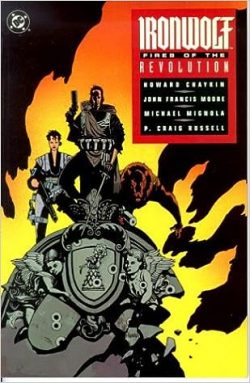
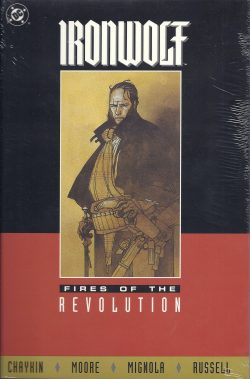
Ironwolf: Fires of the Revolution


By Howard Chaykin, John Francis Moore, Michael Mignola & P. Craig Russell (DC Comics)
ISBN: 978-1-56389-063-5 (HB) 978-1-56389-065-9 (TPB)

In the early 1970s, when Howard Chaykin and other luminaries-in-waiting like Bernie Wrightson, Walt Simonson, Al Weiss, Mike Kaluta and others were just starting out in the US comics industry, it was on the back of a global fantasy boom. DC had the comic book rights to Fritz Lieber’s Fafhrd and the Grey Mouser tales (beautifully realised in 5 issues of Swords and Sorcery by Denny O’Neil and many of the above-mentioned gentlemen) as well as the more well-known works of Edgar Rice Burroughs – Tarzan, Korak, John Carter of Mars, Carson of Venus, Pellucidar and even Beyond the Farthest Star. Marvel had some old pulp called Conan and a bunch of others…

Those beautiful fantasy strips began as back-up features in DC’s jungle books but quickly graduated to their own title – Edgar Rice Burroughs’ Weird Worlds – where they enthralled for just 7 magnificent issues before returning to back-up status in Tarzan and Korak. Dropping ERB’s strap line the comic itself ran for three more issues before folding in 1974. Those featured an all-new space opera scenario by O’Neil and Chaykin – The Saga of Ironwolf.

Predating Star Wars by years, and seductively blending hard sci fi and horror tropes, it only just began the story of a star-spanning empire fallen into dissolution and decadence and the rebellion of one honest aristocrat who threw off the seductive chains of privilege to fight for freedom and justice. Artificial vampires, monsters, vast alien armies and his own kin were some of the horrors Ironwolf tackled, leading a loyal band of privateers from his gravity-defying wooden star-galleon the Limerick Rake.

With impressive elan Ironwolf mixed post-Vietnam, current-Watergate cynicism with youthful rebellion, all flavoured by Celtic mythology, Greek tragedy, the legend of Robin Hood and pulp trappings to create a rollicking, barnstorming unforgettable romp. It was cancelled after three issues.

In 1986, those episodes were collected as a special one shot which obviously had some editorial impact, as soon after, this slim but classy all-star conclusion was released in both hardcover and paperback.

In the Empire Galaktika no resource is more prized than the miraculous anti-gravity trees of Illium – ancestral home of the Lords Ironwolf. These incredible plants take a thousand years to mature, can grow on no other world, and are the basis of all starships and extraplanetary travel in the Empire.

After untold years of comfortable co-existence, the latest Empress, Erika Morelle D’Klein Hernandez – steeped in her own debaucheries – declares that she is giving the latest crop of mature trees to monstrous aliens she had welcomed into her realm. Disgusted at this betrayal, nauseated by D’Klein’s blood-sucking allies and afraid for the Empire’s survival, Lord Brian of Illium destroys the much-coveted trees and joins the revolution.

With a burgeoning republican movement, he almost overthrows the corrupt regime in a series of spectacular battles, but was ultimately betrayed by one of his closest allies. Ambushed, the Limerick Rake died in a ball of flame…

Ironwolf awakes confused and crippled in a shabby hovel. Horrified he learns he has been unconscious for eight years, and although the Empire has been replaced with a Commonwealth, things have actually grown worse for humanity. The Empress still holds power and men are no more than playthings and sustenance – not only for the vampiric Blood Legion but also the increasingly debased aristocrats he once called his fellows.

Clearly he has a job to finish…

After decades away, much of the raw fire of the young creators who originated Ironwolf has mellowed with age, but Chaykin has always been a savvy, cynical and politically worldly-wise story-teller and still had enough indignant venom remaining to make this tale of betrayal and righteous revenge a gloriously fulfilling read, especially with the superbly beguiling art of Mike Mignola & P. Craig Russell, illustrating his final campaign to liberate the masses.

Since the tale (which links into Chaykin & Jose Luis Garcia-Lopez’s DC future-verse Twilight epic – and no, that one has nothing to do with fey vampires in love: stayed tuned for our review of the sci fi classic) is not available digitally and physical copies are a bit pricy, I think the time has never been better for reissuing the entire vast panoramic saga in one complete graphic novel.

Let’s see if somebody at DC is reading this review…
© 1992 DC Comics. All Rights Reserved.

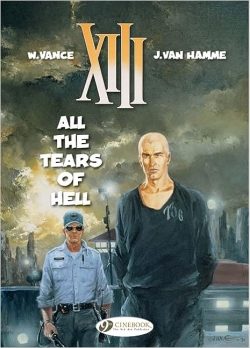
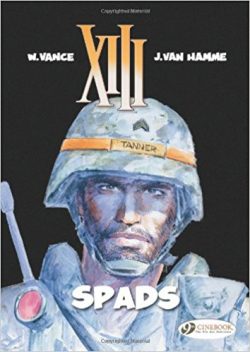
XIII volumes 3 & 4 – All the Tears of Hell and SPADS


By William Vance & Jean Van Hamme, coloured by Petra (Cinebook)
ISBN: 978-1-8491-8051-1 (Album PB/Digital Tears of Hell) 978-1-84918-058-0 (Album PB/Digital SPADS)

One of the most consistently entertaining and popular adventure serials in Europe, XIII was created by writer Jean Van Hamme (Wayne Shelton, Blake and Mortimer, Lady S.) and artist William Vance while working on numerous strips like Bruce J. Hawker, Marshal Blueberry, Ramiro, Bob Morane and more.

Born in Brussels in 1939 Van Hamme is one of the most prolific writers in comics. After academically pursuing business studies he moved into journalism and marketing before selling his first graphic tale in 1968.

Immediately clicking with the public, by 1976 he had also branched out into novels and screenwriting. His big break was the monumentally successful fantasy series Thorgal for Le Journal de Tintin magazine. He then cemented his reputation with mass-market bestsellers Largo Winch and XIII as well as more cerebral fare such as Chninkel and Les maîtres de l’orge. Van Hamme has been listed as the second-best selling comics author in France, ranked beside the seemingly unassailable Hergé and Uderzo.

Born in Anderlecht, William Vance was the comics nom de plume of William van Cutsem, (September 8th 1935 – May 14th 2018). After military service in 1955-1956 he studied art at the Académie Royale des Beaux-Arts and promptly became an illustrator of biographic features for Le Journal de Tintin in 1962. His art is a classical blend of meticulous realism, scrupulous detail and spectacular yet understated action. In 1964 he began maritime serial Howard Flynn (written by Yves Duval) before graduating to more popular genre work with western Ray Ringo and espionage thriller Bruno Brazil (scripted by Greg).

Further success followed when he replaced Gérald Forton on science fiction classic Bob Morane in Femmes d’Aujourd’hui, (and later Pilote and Le Journal de Tintin).

Constantly working on both serials and stand-alone stories, Vance’s most acclaimed work was his collaboration with fellow Belgian Van Hamme on a contemporary thriller based on Robert Ludlum’s novel The Bourne Identity

XIII debuted in 1984, originally running – to great acclaim – in prestigious comics anthology Le Journal de Spirou. A triad of albums were rushed out – simultaneously printed in French and Dutch editions – before the first year of serialisation ended.

The series was a monumental hit in Europe – although publishing house Dargaud were initially a little slow to catch on – but has fared less well in its many attempts to make the translation jump to English, with Catalan Communications, Alias Comics and even Marvel all failing to maximise the potential of the gritty mystery thriller. That all changed when Cinebook took over. To date the original series and most spin-offs have seen print…

The grand conspiracy saga of unrelenting mood, mystery and mayhem opened in The Day of the Black Sun when an old beachcomber found a body. The human flotsam had a gunshot head wound and was near death when Abe and his wife Sally found him. She discovered a key sewn into his clothes and the Roman numerals for thirteen tattooed on his neck. The remote hideaway offered little in the way of emergency services, but their alcoholic, struck-off surgeon friend managed to save the stranger…

As he recuperated, a complication became apparent. The patient – a splendid physical specimen clearly no stranger to action or violence – had suffered massive, irreversible brain trauma. Although increasingly sound in body he had completely lost his past. Language, muscle memories, even social and reflexive conditioning all remained, but every detail of his life-history was gone…

They named him Alan after their own dead son – but hints of the intruder’s lost past explosively intruded when hitmen attacked the beach house with guns blazing. Alan lethally retaliated with terrifying skill, but too late. In the aftermath he found a photo of himself and a young woman on the killers and traced it to nearby Eastown. Desperate for answers and certain more killers were coming, the human question mark headed off into unimaginable danger to hopefully find the answers he craved.

The picture led to a local newspaper and a crooked cop who recognised the amnesiac but said nothing. The woman in the photo was Kim Rowland, a local widow recently gone missing. Alan’s key opened the door of her house. The place had been ransacked but a thorough search utilising his mysterious talents turned up another key and a note warning someone named Jake that The Mongoose” had found her…

Alan was ambushed by the cop and newspaper editor Wayne. Calling him “Shelton”, they demanded the return of a large amount of missing money…

Alan/Jake/Shelton reasoned the new key fitted a safe-deposit box and bluffed the thugs into taking him to the biggest bank in town. Staff there called him Shelton, but when his captors examined the briefcase in Shelton’s box, a booby trap detonated. Instantly acting, the mystery man expertly escaped and eluded capture, holing up in a shabby hotel room, pondering again what kind of man he used to be…

Preparing to leave, he stumbled into a mob of armed killers and in a blur of lethal action escaped, running  into more heavies led by a Colonel Amos. This chilling executive referred to his captive as “Thirteen”, claiming to have dealt with his predecessors XI and XII in regard to the “Black Sun” case…

Amos very much wanted to know who Alan was, and offered shocking titbits in return. The most sensational was film of the recent assassination of American President, William B Sheridan, clearly showing XIII was the lone gunman…

Despite the amnesiac’s heartfelt conviction that he was no assassin, Amos accused him of working for a criminal mastermind, and wanted that big boss. The interrogator failed to take Alan’s instinctive abilities into account and was astounded when his prisoner leapt out of a fourth floor window…

The fugitive headed back to Abe’s beach, but more murderers awaited; led by a mild-seeming man Alan inexplicably knew was The Mongoose. The criminal overlord expressed surprise and admiration: he thought he’d killed Thirteen months ago…

Following an explosion of hyper-fast violence leaving the henchmen dead and Mongoose vanished but vengeful, Alan regretfully hopped a freight train west towards the next stage in his quest for truth.

His journey of discovery took him to the army base where Kim Rowland’s husband was stationed, where enquiries provoked an unexpected and violent response resulting in his interrogation by General Ben Carrington and his sexily capable aide Lieutenant Jones.

They’re from the Joint Chiefs of Staff, know an awful lot about black ops units and have proof their memory-challenged prisoner is in fact their agent: believed-deceased Captain Steve Rowland

After testing the amnesiac’s abilities Carrington drops him off in Rowland’s home town of Southberg to pursue his search for his missing wife, but the prodigal’s return to his rat’s nest of a family rekindles long-simmering passions and jealousies. The entire town seems to want Rowland’s blood and before long he’s the target of an assassination attempt and victim of a diabolical murder-plot. Despite Carrington and Jones’ last-minute intervention Alan/Steve is framed for murdering his father, and grabbed by a furious posse.

Gripping third instalment All the Tears of Hell (originally 1986 European album Toutes Les larmes de l’enfer) opens with Steve Rowland undergoing the worst kind of psychiatric care at the Plain Rock Penitentiary for the Criminally Insane. Despite drugs and shock treatments, his progress at the Maximum Security Facility is negligible. Young Dr. Ralph Berger seems amenable enough but elderly martinet Dr. Johansson’s claims of seeking a cure for his amnesia are clearly no more than a proselytising, judgemental sadist’s justifications for inflicting pain.

Meanwhile in Washington DC, Carrington and Jones have met with Colonel Amos who has a strange request and troubling new information. His investigations have revealed that the amnesiac in the desert hell of Plain Rock has undergone plastic surgery and his army records have been altered. Steve Rowland is definitely not Steve Rowland…

Moreover, Amos has information proving that the plotters who had the President killed are still active and their amnesiac assassin is the only link and hope of finding them. Acting on her own initiative, Jones decides it’s time she took a hands-on approach to the problem…

Meanwhile, anxious and isolated Not-Rowland has a visitor who galvanises him out of his electro-chemically induced fugue-state. The Mongoose gloatingly informs the prisoner that his days are numbered…

Deep within the corridors of power, Colonel Amos informs Carrington his investigations have resulted in a name. He has solved the mystery of XIII and the man they are actually dealing with is former soldier and intelligence operative Ross Tanner.

Probably.

Knowing time is limited, Rowland/Tanner opts for escape and decides to take along the kid who shares his cell. It’s as if he’s forgotten they’re in a maximum security facility for criminal maniacs, but he’s painfully reminded of the fact when sweet little Billy starts killing again as soon as they’re clear of the detention wing…

Recaptured and restricted to the medical section, XIII is helpless when the Mongoose’s inside man makes a move. Luckily, Jones has also inserted herself in a position where she can do the most good…

Spectacularly busting out of the prison, “Rowland” and the mystery-woman race into the desert, somehow avoiding a massive manhunt before vanishing without trace. Later Amos and Carrington confer over the disappearance, but one already knows exactly where the fugitive is. Now, with another new name, the warrior without a past and his new powerful allies lay plans to take the fight to their secret enemy…

To Be Continued…

XIII: SPADS
First released in Europe in 1987, SPADS is the fourth complex and convoluted chapter in the saga, opening with a more concise visual recap than I’ve just given, before kicking the plot into high gear as the race to replace murdered President Sheridan hots up. The contenders are Old Boy Network hack and former Vice President Joseph Galbrain battling Sheridan’s glamorous and idealistic younger brother Walter: latest scion of a venerable dynasty of leaders…

Amos’ diligent investigation is relentless. After exhuming many bodies, he can confidently claim to know who Tanner really is, but when the search leads him into a trap that kills his assistant and incapacitates him, he starts to wonder if he’s tracking a target or being led onto a bullseye…

Elsewhere, in a green hell of sweat and testosterone, Ross Tanner is making no friends as he trains to join elite combat unit SPADS (Special Assault and Destruction Squads). He doesn’t fit in and is always causing trouble. It’s as if he’s there under false pretences…

When Amos and Judge Allenby confront Carrington at the Pentagon with news that Tanner is also an alias for an as yet unknown operative, the reaction is explosive. Soon after, special aide Lieutenant Jones goes AWOL…

Back in the Bayou, the man everybody is hunting has made a fresh advance into uncovering his occluded past. Sergeant Betty served with the real Rowland and knows he didn’t die at the time and in the manner official reports describe. Before she shares the details, however, she has an itch that needs scratching…

That cosy conversation is curtailed by camp commander Colonel McCall, who tells the undercover operative that he’s being transferred out in the morning by direct order of General Carrington. With his chance to solve his personal mystery evaporating, XIII settles a few outstanding scores before sneaking into Betty’s quarters…

Amos and Allenby meanwhile have not been idle, and the former is certain he has at last gleaned the actual identity of multi-named XIII, but when they visit a certain grave they walk into another ambush and a well-placed mole is forced to break cover…

As Amos is plucked from the firefight by the last person he expected to see, a continent away Tanner’s liaison gets even more dangerous when another Mongoose mole interrupts, trying to kill them both. Happily, Carrington’s back-up agent is well placed to save them and they all flee together, unaware their escape vehicle has been boobytrapped and sabotaged…

Amos by now is securely ensconced in a palatial hideaway, being feted by a coterie of political heavyweights who finally reveal the truth about all the men Ross Tanner is and isn’t. They explain the incredible reason for the smoke-&-mirrors operation and earth-shattering stakes…

To Be Continued…

XIII is one most compelling, multi-layered mystery adventures ever conceived, with subsequent instalments constantly taking the restless human enigma two steps forward, one step back, stumbling through a world of pain and peril whilst cutting through an interminable web of past lives he seemingly led. Rocket-paced and immensely inventive, this is a series no devotee of action sagas and conspiracy thrillers will want to miss.
Original edition © Dargaud Benelux (Dargaud-Lombard SA), 1986, 1987 by Van Hamme, Vance & Petra. All rights reserved. This edition published 2010 by Cinebook Ltd.

Clean Cartoonists’ Dirty Drawings


By Craig Yoe and many and various (Last Gasp)
ISBN: 978-0-86719-653-5 (TPB)

First things first: yes they are but no they’re not – unless you’re really, really spiritual and old fashioned. Despite the somewhat prurient and sensationalistic – not to say deliberately salacious – title, this compilation of cartoons and illustrations culled from the private files and bins of a number of our industry’s greatest stars (and also many from the drawing boards of those infamous scallywags of the animation industry) – is actually a rather quaint and charming insight into the capabilities, accomplishments and professional ethics of a talented crowd of individualists.

To European eyes there is very little amiss here, but one needs to remember just how prudish and censorious (I personally prefer the terms “daft” and “ridiculous”) the American “family values” lobby is and always has been.

Two brilliantly telling examples would be the covering of Flossie the Cow’s udders; first by a skirt (1932) and eventually (1939) by a full dress. She also had to stop walking on all fours because it was unladylike.

Or perhaps you’d like to consider Mort Walker’s navel collection. Apparently, a syndicate editor had a problem with belly buttons and always returned Beetle Bailey strips that featured one. Walker would scalpel them off the artwork and collect them in a pot on his desk.

Collected and compiled by fan, historian, Renaissance man and truly cool comics bloke Craig Yoe (among his many accomplishments he counts being Creative Director of the Muppets – bet you want to Google him now, don’t you?) and offering an introduction by a properly “Dirty” cartoonist R. Crumb, this is a frothy catalogue of rather chaste naked lady pictures (and often not even that) in colour and monochrome, crafted by some of the best artists and cartoonists in modern history: although you might want to check the oddly incongruous contributions of Gustave Doré and Thomas Rowlandson before giving a copy to your 8-year-old.

So if you’re unflappable, incorruptible or just don’t own a MAGA hat, you’ll want to sneak a peek at this stellar cast of incorrigibles. The roster includes Jack Kirby, James Montgomery Flagg, George Herriman, Joe Shuster, Steve Ditko, Charles Schulz, Milton Caniff, Alex Raymond and Chuck Jones.

Potentially as corrupting are delightful and delicious contributions by Dr, Seuss, Carl Barks, Bob Kane, Rube Goldberg, Bruce Timm, Alex Toth, Fred Moore, Dan DeCarlo, Dave Berg, Ernie Bushmiller, Sergio Aragonés, Jack Davis, Billy De Beck, Hal Foster, Harry G. Peter, Paul Murray, Neal Adams, Al Jaffee, Wally Wood, Nick Cardy, Hank Ketcham, Johnny Hart, Walt Kelly, Adam Hughes, Alex Schomburg, Al Williamson, Henry Boltinoff, Stan Drake, Dik Browne, Matt Baker, Otto Soglow, Al Capp, John Severin, Jim Steranko, Jack Cole, Bill Everett, Grim Natwick, Will Eisner and so many others.

Art is all about establishing a relationship with the beautiful, shocking or thought-provoking. Why not turn your attention to these lesser-known efforts from some of the most familiar names in our world and see what occurs to you?
© 2007 Gussani-Yoe Studio, Inc. All illustrations are © 2007 their respective artist and/or © holders.

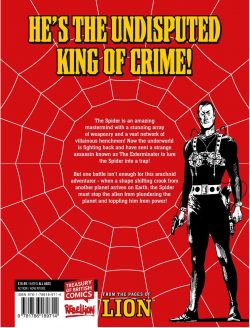
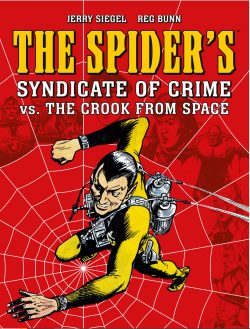
The Spider’s Syndicate of Crime vs. the Crook From Space


By Jerry Siegel & Reg Bunn (Rebellion)
ISBN: 978-1-78618-971-4 (HB/Digital edition)

Part of Rebellion’s Treasury of British Comics strand, The Spider’s Syndicate of Crime vs the Crook From Space is another sublimely cool collection celebrating an all-but forgotten sub-strand of the 1960s comics experience.

Until the 1980s, UK comics operated on an anthological model, offering variety of genre, theme and character on a weekly – or sometimes fortnightly – basis. Humorous periodicals like DC Thomson’s The Beano were leavened by thrillers like Billy the Cat or General Jumbo, and adventure papers like Amalgamated Press/Fleetway’s Lion or Valiant always carried gag strips such as The Nutts, Grimly Feendish, Mowser and a wealth of similar quick laugh treats.

British comics also notoriously enjoyed a strange, extended love affair with what can only be described as “unconventional” (for which feel free to substitute “creepy”) heroes. So many of our stars and potential role models of serials and strips were just plain “off”: self-righteous, moody voyeurs-turned vigilantes like Jason Hyde, sinister masterminds like The Dwarf, deranged geniuses like Eric Dolmann, jingoistic (and racist) supermen like Captain Hurricane and a plethora of reformed criminals/menaces like Charlie Peace, The Steel Claw or this guy…

… And don’t get me started on our legion of lethally anarchic comedy icons or that our most successful comic symbol of justice is an Eagle-bedecked, jack-booted poster boy for a fascist state. Perhaps that explains why these days we can’t even imagine or envision what a proper leader looks like and keep on electing clowns, crooks and blinkered over-privileged clueless simpletons…

All joking aside, British comics are unlike any other kind and simply must be seen to be believed and enjoyed. One of the most revered stars of the medium is being progressively collected in archival editions, perfectly encapsulating our odd relationship with heroism, villainy and in particular that murky grey area bridging them…

Mystery criminal genius and eventual superhero The Spider debuted in peerless weekly anthology Lion (June 26th 1965 issue), reigning supreme until April 26th 1969. He has periodically returned in reprint form (Vulcan) and occasionally new stories ever since.

As first introduced by Ted Cowan (Ginger Nutt, Paddy Payne, Adam Eterno, Robot Archie) & Reg Bunn (Robin Hood, Buck Jones, Captain Kid, Clip McCord), the moody malcontent was an enigmatic super-scientist whose goal was to be acclaimed the greatest criminal of all time.

The flamboyantly wicked narcissist began his public career by recruiting crime specialists – safecracker Roy Ordini and genteelly evil genius inventor Professor Pelham – before attempting a massive gem-theft from America’s greatest city. He was foiled by cruel luck and resolute cops Gilmore and Trask: crack detectives cursed with the task of capturing the arachnid arch-villain.

Cowan scripted the first two serialised sagas before handing over to comics royalty: Jerry Siegel (Superman, Superboy, The Spectre, Doctor Occult, Slam Bradley, Funnyman, The Mighty Crusaders, Starling), who was forced to look elsewhere for work after an infamous dispute with DC Comics over the rights to the Man of Steel.

This eagerly anticipated collection covers the Lion’s share of arachnid amazement from 25th June 1966 to 28th January 1967: two extended and interlocking epics crafted as Britain and the entire, but less fab & groovy world succumbed to “Batmania”.

In case you’re not old, that term covers a period of global hysteria sparked by the 1966 Batman TV show, which launched in January in the USA, with the UK catching the madness from 21st May until September 11th 1966. A second season ran here from September 17th to April 2nd 1967. The planet went crazy for superheroes and an era dubbed “camp” saw humour, satire, and fantastic psychedelic whimsy infect all categories of entertainment. It was a time of peace, love, wild music and radical change, and I believe there were lots of drugs being experimented with at the time…

British comics were not immune, and a host of more conventional costumed crusaders sprang up in our traditionally unconventional pages. Scripted by the godfather of the genre – and an inveterate humourist – The Spider skilfully shifted gears without a squeak and the first epic ‘The Spider v. The Exterminator’ saw the uncrowned king of crime preying upon and at war with the gathered mob lords of America, who called themselves Crime Incorporated.

The hooded leader – The Silhouette – had acted upon their behalf and hired a superpowered villain to destroy the wicked webspinner, but in numerous weekly clashes, only vividly spectacularly stalemates had been achieved. Eventually, after learning what the Silhouette really was, the foes became partners: resolved to impoverish and crush all other major criminals, and divide the planet between them. The crime lords struck back, leading to the return of old Spider enemies Dr. Mysterioso and The Android Emperor in extraordinary extended clashes until only two remained. Then abruptly, announcing there was more challenge and greater fun in fighting evil, The Spider declared himself a hero, ruthlessly betrayed the Exterminator and set out to be a world saver…

He got his chance the very next week whilst fighting devious and decrepit tech bandit The Infernal Gadgeteer, as their duels were interrupted by a marauding pillage from the stars.

‘The Spider versus the Crook From Outer Space’ played out for months, with manic combats and crazy inventions peppering a madcap competition that begins when the attention-seeking shapeshifter abducts the Gadgeteer so he/it can be centre of attention. Constantly attacking humanity in the guise of villains from history, the alien runs the Spider and his team ragged, upping the stakes with monsters and super-weapons whenever the make-believe hero frustrates him/it. The duel takes its emotional toll too, and when an alien invasion armada interrupts the games, the space crook petulantly but pitilessly destroys them for their temerity…

Despite breakneck pace, the story positively bulges with imaginative ingenuity, as when a hidden aquatic race from the oceans also foolishly disrupts the bout and pays the price, or when the sworn foes both change sides and trade moral perspectives…

As the end nears, Dr. Mysterioso returns leading a microscopic militia and sowing chaos but the coup de grace comes when the alien at last decides to battle his implacable antagonist as another, better Spider…

These retro/camp masterpieces of arcane dialogue, insane devices and rollercoaster antics are perhaps an acquired taste but no one with functioning eyes can fail to be astounded by the artwork of Reg “crosshatch king” Bunn which handles mood, spectacle, action and Siegel’s frankly unbelievable script demands with captivating aplomb.

This titanic tome reaffirms that the King is back at last and should find a home in every kid’s heart and mind, no matter how young they might be, or threaten to remain. Batty, baroque and often simply bonkers, The Spider proves that although crime does not pay, it always provides a huge amount of white-knuckle fun…
© 1996, 1967 & 2023 Rebellion Publishing IP Ltd. All Rights Reserved.

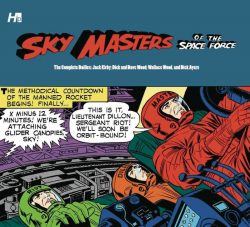
Sky Masters of the Space Force: The Complete Dailies


By Jack Kirby, Dick & Dave Wood, Wally Wood & Dick Ayers (Hermes Press)
ISBN: 978-1-61345-129-8 (HB) 978-1-61345-211-0 (TPB) 1-56685-009-6 (Pure Imagination)

Sky Masters of the Space Force was – and remains – a beautiful and eminently readable newspaper strip but one with a chequered and troubled back-story. How much so you can discover for yourself when you buy this book.

Even ever-upbeat and inspirational comics god Jack Kirby spent decades trying to forget the grief caused by his foray into the newspaper strip market during the height of the Space Race before finally relenting in his twilight years and giving his blessing to collections and reprints such as this one from Hermes Press.

Be grateful that he did because the collected work is one of his greatest achievements, even with the incredible format restraints of one tier of tiny panels per day, and a solitary page every Sunday. Decades later this hard-science space adventure is still the business!

And that’s despite the acrimonious legal manoeuvrings that poisoned the process of creating the strip from start to finish. That can of worms you can read for yourself in Daniel Herman’s forthright ‘Introduction: Jack Kirby, Wally Wood, and Sky Masters’ which precedes the astronautical adventures contained herein…

Just for context though: against a backdrop of international and ideological rivalry turned white-hot when the Soviets successfully launched Sputnik in 1957, the staid George Matthew Adams newspaper syndicate decided to finally enter the 20th century with a newspaper feature about space.

After approaching a reluctant DC Comics (then National Periodicals Publications) a deal was brokered. The project was steered by editor Jack Schiff who convinced Jack Kirby, inker Wally Wood (later replaced by Dick Ayers) and scripters/brothers Dick and Dave Wood (no relation to Wally) to begin bringing the conquest of the cosmos into our lives via an all-American astronaut, his trusty team of stalwart comrades and the philanthropic largesse of the newly-minted US Space Force (who knew Donald Trump could read back then?).

The daily strip launched on September 8th 1958 and ran until February 25th 1961; scant months before Alan Shepherd became in reality the first American in Space on May 5th.

The Sunday colour page told its five extended tales (The Atom Horse, Project Darkside, Mister Lunivac, Jumbo Jones and The Yogi Spaceman) in a separate continuity running from February 8th 1959 to 14th February 1960. They are sadly not included in this monochrome archival collection, but at least that gives us fans something to look forward to…

This tense, terse and startlingly suspenseful foray into a historical future begins with ‘The First Man in Space’ (September 8th – November 21st 1958) as Major Schuyler “Sky” Masters becomes the second man in space. Romantically involved with Holly Martin, he is hurled into orbit to rescue her astronaut father after the bold pioneer encounters, in the pitiless reaches above Earth, something too horrible to contemplate…

Human tragedy and ever-impinging fear of the unknown of that moody tale informs all the tales that follow, and as Holly Martin’s feisty brother Danny and burly Sgt. Riot join the cast (who do they remind me of?) for ‘Sabotage’ (22nd November – 7th March 1959), the quintessential components of all great comics teams are in place.

In this second encounter the stage expands enormously and a member of the vast Space Force contingent sinks into derangement: convinced colonization of the void and abandonment of Mother Earth is an unholy abomination.

That’s bad enough, but when he’s despatched as one of the six pathfinders constructing America’s first permanent orbiting space station, disaster is assured unless Sky can expose him and stop his deadly machinations…

Even as grim yet heady realism slowly grew into exuberant action and fantastic spectacle, the strip moves into high dramatic gear as woman pilot (or “aviatrix”) ‘Mayday Shannon’ (9th March – 9th May) joins the squad. The Brass have high hopes that she will prove “females” can thrive in space too. They didn’t reckon on her publicity-hungry greed and innate selfishness. Happily, the magnetic allure of the stars ultimately overcomes her bad side and Sky is on hand to deal with her ruthlessly unscrupulous manager…

A medical emergency tests the ingenuity of our dedicated spacers when project instigator and patriarch Doctor Royer is taken ill and Sky must ferry a surgeon to him in ‘To Save a Life’ (11th May – 10th June) after which the tireless Major and an unsuspected rival for Holly’s affections are stranded together on a New Guinea island of cannibals after losing control of ‘The Lost Capsule’ (11th June – 23rd September)…

During that heady meeting of ancient and modern cultures, inker/finisher Wally Wood was replaced by Dick Ayers (although the signatures remained “Kirby & Wood” for years more. Maybe the credit was for the writers?).

The incalculable terrors of space manifested with the next saga as ‘Alfie’ (24th September 1959 to 13th January 1960) carried the heroes of the New Frontier into the next decade. When young astronaut crewman Marek joins the orbiting space wheel, he begins periodically suffering bizarre fits. Every four hours for seven and a half minutes, the young American seems to channel the personality of aging East End cockney thief Alfie Higgins. With the fear that it might be some kind of infectious space madness, Sky and Riot head for London to link up with Scotland Yard in a gripping mystery drama blending jewel robbery and murder with the eerie overtones of Dumas’ Corsican Cousins

The constant tensions of the Cold War and Space Race come to the fore in ‘Refugee’ (14th January – 19th February) as Sky and the US Space Force aid a most unlikely and improbable Soviet defector’s escape to the West…

Now a fully-trusted and dedicated member of the squad, Mayday Shannon returns to solve an astronaut’s romantic dilemma by arranging a ‘Wedding in Space’ (20th February – 20th April), before the true threat of the outer depths is tackled when Sky meets astronautical guru and maverick Martin Strickland. A tempestuous but invaluable asset of the Space program, the intellectual renegade has proof of alien life but won’t share the ‘Message from Space’ (21st April – 22nd June) unless military and civil authorities give him carte blanche to act on humanity’s behalf…

Counterbalancing such speculative sci fi aspects, the penultimate adventure is very much Earthbound and grounded in contemporary science and economics. ‘Weather Watchers’ (23rd June – 27th December) finds greedy capitalist entrepreneur Octavius Alexia realise he can make huge profits by scamming insurers if he has access to advance weather predictions afforded by the growing web of satellites orbiting the world.

To monopolise on that valuable information, he targets Mayday with the latest in espionage technologies and male honey trap J. Mansfield Sparks III. It might have all gone his way too if the woman hadn’t been so smart, and his mercenary gigolo had remained unencumbered by conscience…

The series ended in a rather rushed and rapid manner with ‘The Young Astronaut’ (28th December 1960 – 25th February 1961) wherein a new recruit proved to be too good to be true. Excelling at every aspect of the harsh training, Frederick T. “Fission” Tate had ulterior motives for getting into space. Luckily, suspicious Major Masters was right beside him on that first flight into the Wide Black Yonder…

As well as these stellar tales of stellar wonder, this volume also contains an abundance of visual extras such as a numerous covers and samples of Kirby’s contemporary comic book work, plus original art panels in a ‘Focus’ section, which almost compensates for the absence of the Sunday colour pages. Almost…

This compilation comprises a meteoric canon of wonderment that no red-blooded armchair adventurer could possibly resist, but quite honestly, I simply cannot be completely objective about Sky Masters.

I grew up during this time period and the “Conquest of Space” is as much a part of my sturdy yet creaky old bones as the lead in the paint, pipes and exhaust fumes my generation readily absorbed. That it is also thrilling, challenging and spectacularly drawn is almost irrelevant to me, but if any inducement is needed for you to seek this work out let it be that this is indisputably one of Kirby’s greatest accomplishments: engaging, beguiling, challenging and truly lovely to look upon. Now go enjoy it.

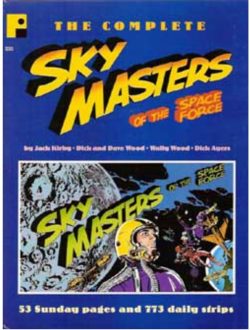
Back in 2000, Pure Imagination Publishing released The Complete Sky Masters of the Space Force, which also contains an abundance of essays; commentary and extras such as sketches and unpublished art, as well as those omitted Sunday pages, albeit printed in black and white. If you have the resources and that completist bug it’s worth hunting down, until such time as modern publishers finally catch on and print everything.

© 2017 Herman and Geer Communications, Inc. d/b/a Hermes Press. Introduction and Focus © 2017 Daniel Herman.

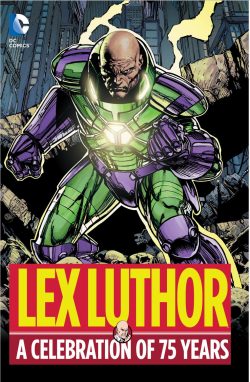
Lex Luthor: A Celebration of 75 Years


By Jerry Siegel & Joe Shuster, Bill Finger, Edmund Hamilton, Len Wein, Cary Bates, Elliot S. Maggin, John Byrne, Roger Stern, Grant Morrison, Greg Rucka, Brian Azzarello, Paul Cornell, Geoff Johns, John Sikela, Wayne Boring, Curt Swan, Jackson Guice, Howard Porter, Matthew Clark, Lee Bermejo, Frank Quitely, Pete Woods, Doug Mahnke & various (DC Comics)
ISBN: 978-1-4012-6207-5 (HB/Digital edition) 978-1- (TPB)

We’re all celebrating the anniversary of the ultimate superhero this year, but who’s thinking of his archenemy – the world’s first true supervillain? Time to address the balance, even if it’s actually two years until the mogul of menace is actually due his bit of candle-covered cake…

Closely paralleling the evolution of the groundbreaking Man of Steel, the exploits of the mercurial Lex Luthor are a vital aspect of comics’ very fabric. In whatever era you choose, the prototypical and ultimate mad scientist epitomises the eternal feud between Brains and Brawn and over eight decades has become the Metropolis Marvel’s true antithesis and nemesis. He’s also evolved into a social barometer and ideal perfect indicator of what different generations deem evil.

This stunning compilation – part of a dedicated series reintroducing and exploiting the comics pedigree of venerable DC icons – comes in Hardback, Trade Paperback and digital formats, sharing a sequence of snapshots detailing what Luthor is at key moments in his never-ending battle with Superman. Groundbreaking appearances are preceded by brief critical analyses of the significant stages in the villain’s development, beginning with Part I: 1940-1969 The Making of a Mastermind.

After history and deconstruction comes sinister adventure as the grim genius debuts in ‘Europe at War Part 2’ (Action Comics #23 April 1940 by Jerry Siegel & Joe Shuster). Although not included here, Action #22 had loudly declared ‘Europe at War’ – a tense, thinly-disguised call to arms for the still-neutral USA, and as the Man of Tomorrow sought to stem the bloodshed, the saga became a continued story (almost unheard of in the early days of funny-book publishing).

Spectacularly concluding in #23, Clark Kent’s European investigations revealed a red-headed fiend employing outlandish science to foment war for profit: intent on conquering the survivors as a modern-day Genghis Khan. The Man of Steel strenuously objected…

Next is ‘The Challenge of Luthor’ (Superman #4, Spring/March1940) and produced at almost the same time: a landmark clash with the rogue scientist who, back then, was still a roguish red-head with a bald and pudgy henchman.

Somehow in the heat of burgeoning deadlines, master got confused with servant in later adventures, and public perception of the villain irrevocably crystalized as the sinister slap-headed super-threat we know today. The fact that Superman was also a star of newspapers – which operated under a different inworld continuity – is widely considered the root cause of that confusion…

Siegel & Shuster’s story involves an earthquake machine and ends with Luthor exhausting his entire arsenal of death-dealing devices attempting to destroy his enemy… with negligible effect.

From Superman #17 (July 1942), ‘When Titans Clash’, by Siegel & John Sikela, depicts how the burly bald bandit uses a mystic “powerstone” to survive his justly earned execution by stealing Superman’s abilities. However, the Action Ace retains his wily intellect and outsmarts his titanically-empowered foe…

Jumping ahead 10 years, ‘Superman’s Super Hold-Up’ (by Bill Finger, Wayne Boring & Stan Kaye from World’s Finest Comics #59 July 1952) is a supremely typical duel of wits in which the Einstein of Evil renders the Metropolis Marvel helpless with the application of a devilish height- and pressure-sensitive mega explosive device… if only for a little while…

WFC #88 (June 1957 by Edmond Hamilton, Dick Sprang & Kaye) offers ‘Superman and Batman’s Greatest Foes!’ wherein “reformed” master criminals Lex and The Joker ostensibly set up in the commercial robot business. Nobody really believes them… as it happens, quite correctly!

As the mythology grew and Luthor became a crucial component of Superman’s story, the bad boy was retroactively inserted into the hero’s childhood. ‘How Luthor Met Superboy!’ (Siegel & Al Plastino in Adventure Comics #271, April 1960) details how Boy of Steel and budding genius were pals until a lab accident burned off Lex’s hair. In his prideful fury Lex blamed the Kryptonian and swore revenge…

In Finger, Curt Swan & John Forte’s ‘The Conquest of Superman’ (Action Comics #277, June 1961) the authorities parole Lex to help with an imminent crisis, only to have the double-dealer escape as soon as the problem is fixed. By the time Superman returns to Earth, Luthor is ready for him…

For October 1963, Superman #164 featured ‘The Showdown between Luthor and Superman’ (Hamilton, Swan & George Klein). The ultimate Silver Age confrontation between the Caped Kryptonian and ultimate antithesis pitted them in an unforgettable clash on devastated planet Lexor – a lost world of forgotten science and fantastic beasts – resulting in ‘The Super-Duel!’ and displayed a whole new side to the often two-dimensional arch-enemy.

Part II: 1970-1986 Luthor Unleashed previews how a more sophisticated readership demanded greater depth in their reading matter and how creators responded by adding a human dimension to the avaricious mad scientist. ‘The Man Who Murdered the Earth’ from Superman #248 (cover-dated February 1972, by Len Wein, Swan & Murphy Anderson). Here Luthor dictates his final testament after creating a Galactic Golem to destroy his sworn enemy, and ponders how his obsession caused the demise of humanity.

For Action Comics’ 45th anniversary, Superman’s two greatest foes – the other being Brainiac – were radically re-imagined for an increasingly harder, harsher world. ‘Luthor Unleashed’ in #544 (June 1983, by Cary Bates, Swan & Anderson) saw the eternal enmity between Lex and Superman lead to Lexor’s destruction and death of Luthor’s new family after the techno-terror once more chose vengeance over love.

Crushed by guilt and hatred, the maniacal genius reinvents himself as an implacable human engine of terror and destruction…

Elliot S. Maggin, Swan & Al Williamson offer a glimpse into the other motivating force in Luthor’s life, exposing ‘The Einstein Connection’ (Superman #416, February 1986) wherein a trawl through the outlaw’s life reveals a hidden link to the greatest physicist in history…

The Silver Age of comic books utterly revolutionised a flagging medium, bringing a modicum of sophistication to the returning sub-genre of masked mystery men. However, after decades of cosy wonderment, Crisis on Infinite Earths transformed the entire DC Universe, leading to a harder, tougher Superman. John Byrne’s radical re-imagining was most potently manifested in Luthor, who morphed from brilliant, obsessed bandit to ruthless billionaire capitalist as seen in the introduction to Part III: 1986-2000 Captain of Industry

The tensions erupt in ‘The Secret Revealed’ (Superman volume 2 #2, February 1987 by Byrne, Terry Austin & Keith Williams) as the pitiless tycoon kidnaps everyone Superman loves to learn his secret. After collating all the data obtained by torture and other means, the corporate colossus jumps to the most mistaken conclusion of his misbegotten life…

‘Metropolis – 900 Miles’ (Superman vol. 2 #9, September 1987 by Byrne & Karl Kesel) then explores the sordid cruelty of the oligarch who cruelly torments a pretty waitress with a loathsome offer and promise of a new life…

‘Talking Heads’ appeared in Action Comics #678 (June 1992, by Roger Stern, Jackson Guice & Ande Parks), set after Luthor – riddled with cancer from wearing a green Kryptonite ring to keep Superman at arms’ length – secretly returned to Metropolis as his own son in a cloned (young and handsome) body. Acting as a philanthropist and with Supergirl as his girlfriend/arm candy, young Luthor has everybody fooled, Sadly, everything looks like falling apart when rogue geneticist Dabney Donovan is arrested and threatens to tell an incredible secret he knows about the richest man in town…

‘Hostile Takeover’ comes from JLA #11 1997) wherein Grant Morrison, Howard Porter & John Dell opened interstellar saga ‘Rock of Ages’ with the Justice League facing a newly-assembled, corporately-inspired Injustice Gang organised by Lex and run on his ruthlessly efficient business model.

Superman, Batman, Wonder Woman, Martian Manhunter, Flash, Green Lantern and Aquaman are targeted by a coalition of arch-enemies comprising Chairman-of-the-Board Lex, Joker, Circe, Mirror Master, Ocean Master and Doctor Light, with ghastly doppelgangers of the World’s Greatest Heroes raining destruction down all over the globe.

Even with new members Aztek and second-generation Green Arrow Connor Hawke on board, the enemy are running the heroes ragged, but the stakes change radically when telepath J’onn J’onzz detects an extinction-level entity heading to Earth from deep space…

The action and tension intensify when the cabal press their advantage whilst New God Metron materialises, warning the JLA that the end of everything is approaching.

As ever, these snippets of a greater saga are more frustrating than fulfilling, so be prepared to hunt down the complete saga. You won’t regret it…

A true Teflon businessman, Lex met the millennium running for President and Part IV: 2000-Present 21st Century Man follows a prose appraisal with ‘The Why’ from President Luthor Secret Files and Origins #1 (2000, by Greg Rucka, Matthew Clark & Ray Snyder). Here the blueprint to power and road to the White House is deconstructed, with daily frustrations and provocations revealing what inspired the nefarious oligarch to throw his hat into the truly evil political ring…

The next (frustratingly incomplete) snippet comes from a miniseries where the antagonist was the star. ‘Lex Luthor Man of Steel Part 3’ by Brian Azzarello & Lee Bermejo offers a dark and brooding look into the heart and soul of Superman’s ultimate eternal foe: adding gravitas to villainy by explaining Lex’s actions in terms of his belief that the heroic Kryptonian is a real and permanent danger to the spirit of humanity.

Luthor – still believed by the world at large to be nothing more than a sharp and philanthropic industrial mogul – allows us a peek into his psyche: viewing the business and social (not to say criminal) machinations undertaken to get a monolithic skyscraper built in Metropolis. The necessary depths sunk to whilst achieving his ambition, and manipulating Superman into clashing with Batman, are powerful metaphors, but the semi-philosophical mutterings – so reminiscent of Ayn Rand’s The Fountainhead – although flavoursome, don’t really add anything to Luthor’s character and even serve to dilute much of the pure evil force of his character.

Flawed characters truly make more believable reading, especially in today’s cynical and sophisticated world, but such renovations shouldn’t be undertaken at the expense of the character’s heart. At the end Luthor is again defeated; diminished without travail and nothing has been risked, won or lost. The order restored is of an unsatisfactory and unstable kind, and our look into the villain’s soul has made him smaller, not more understandable.

Lee Bermejo’s art, however, is astoundingly lovely and fans of drawing should consider buying this simply to stare in wonder at the pages of beauty and power that he’s produced here. Or read the entire story in its own collected edition…

Rather more comprehensive and satisfying is ‘The Gospel According to Lex Luthor’ as first seen in All-Star Superman #5. Crafted by Morrison, Frank Quitely & Jamie Grant from September 2006, here an unrepentant Luthor on Death Row grants Clark Kent the interview of his career and scoop of a lifetime, after which ‘The Black Ring Part 5’ (Action Comics #894, December 2010 by Paul Cornell & Pete Woods) confirms his personal world view as Death of the Endless stops the universe just so she can have a little chat with Lex and see what he’s really like…

This epic trawl through the villain’s career concludes with a startling tale from Justice League volume 2, #31 (August 2014) as, post-Flashpoint, a radically-rebooted New 52 DCU again remade Lex into a villain for the latest generation: brilliant, super-rich, conflicted and hungry for public acclaim and approval. In ‘Injustice League Part 2: Power Players’ by Geoff Johns, Doug Mahnke, Keith Champagne & Christian Alamy, bad-guy Luthor has helped Earth from extradimensional invaders and now wants to be a hero. His solution? Make real superheroes invite him into the Justice League, which can be accomplished by ferreting out Batman’s secret identity and blackmailing the Dark Knight into championing his admission…

Lex Luthor is the most recognizable villain in comics and can justifiably claim that title in whatever era you choose to concentrate on; goggle-eyed Golden Age, sanitised Silver Age or malignant modern/Post-Modern milieux. This book captures just a fraction of all those superb stories and offers a delicious peek into the dark, unhealthy side of rivalry and competition…

This monolithic testament to the inestimable value of a good bad-guy is a true delight for fans of all ages and vintage.
© 1940, 1942, 1952, 1954, 1957, 1960, 1961, 1963, 1972, 1983, 1986, 1987, 1992, 1997, 2001, 2005, 2006, 2007, 2010, 2014, 2015 DC Comics. All Rights Reserved

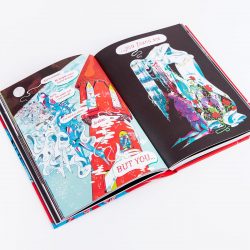
A Guest in the House


By Emily Carroll (Faber & Faber)
ISBN: 978-0-571-35545-7 (HB)

It’s perhaps a little odd to be looking at terrifying tales of supernatural darkness at the height of summer, but as Emily Carroll proves here, sunny skies and enticingly gleaming lake waters don’t always equate with idyllic rests and restorative downtimes…

Born in 1983 in London, Ontario, Carroll now hails from Stratford (still Ontario): studying animation before redirecting her talents in 2010. The immediate beneficiaries of the career change are we comics fans and horror devotees, as her webcomic His Face All Red became a hot sensation on Halloween and went – as the kids and their grandparents say – viral.

Since then Carroll has got even better, working her dark magic for video game Gone Home (2013) and assorted publishers whilst contributing to numerous books and anthologies, garnering Ignatz, Eisner and British Fantast Awards among many others for first book Through the Woods – an anthology of scary comics stories.

Throughout she has continued crafting chilling webcomics like The Hole the Fox Did Make, Margot’s Room, Baba Yaga’s Assistant, Speak, When I Arrived at the Castle and Some Other Animal’s Meat (adapted in 2022 as “The Outside” for Guillermo del Toro’s Cabinet of Curiosities on Netflix).

A Guest in the House is her second book and first full novel; and I don’t want to tell you very much about it. Narrated by dowdy, introspective, uninspired Abigail, it plays on the institutionalised uncertainty and self-doubt of women and offers a fantastic, ferocious dreamscape to outline a creepy, uneasy slice of domestic tragedy in what should be an idyllic retreat from care.

Abby lives by a beautiful lake in a sedate town with nice new husband David and Crystal, his daughter by a previous marriage. Abby’s not happy but she is settled, and if her husband seems a bit harsh or intolerant it’s only because he works so hard and his first wife Sheila died so tragically. The biggest bone of contention between them is his extreme reactions to Crystal getting near the lake…

When not working at the Valu-Save, Abby inhabits a rich fantasy life filled with knights, dragons and princesses, but as summer progresses she becomes increasingly concerned about the real-world inconsistencies in David’s stories of vivacious, clever, talented Sheila. Even before one of his work colleagues accidentally reveals how her predecessor really died, Abby starts seeing ghosts and talking to what remains of Sheila…

Whatever you think happens next is probably wrong. Cunning, twisty plotting fuels intense and expressive fantasmagoria blended with powerfully understated, almost documentarian narrative illustration as all concerned – especially the reader – are forced to confront and question everything thus far. Soon the tale heads into unexplored country and comprehension…

In so many ways this story acts as like an inverted take on Daphne Du Maurier’s Rebecca, with an all-powerful past presence not just imprinted but actually working on and communicating with an embattled and distraught protagonist. However, even that’s not what’s really going on in this haunting tale of grief, ghosts, quiet desperation, suspicion and identity – submerged or otherwise. In the end it’s all-beguiling moments clouding the big question: is this materialised internal monologue or actual spiritual infestation?

Chilling and unforgettable, this is a summer storm that demands your full attention.

© Emily Carroll, 2023. All rights reserved.

A Guest in the House is published on August 17th 2023 and available for pre-order now.

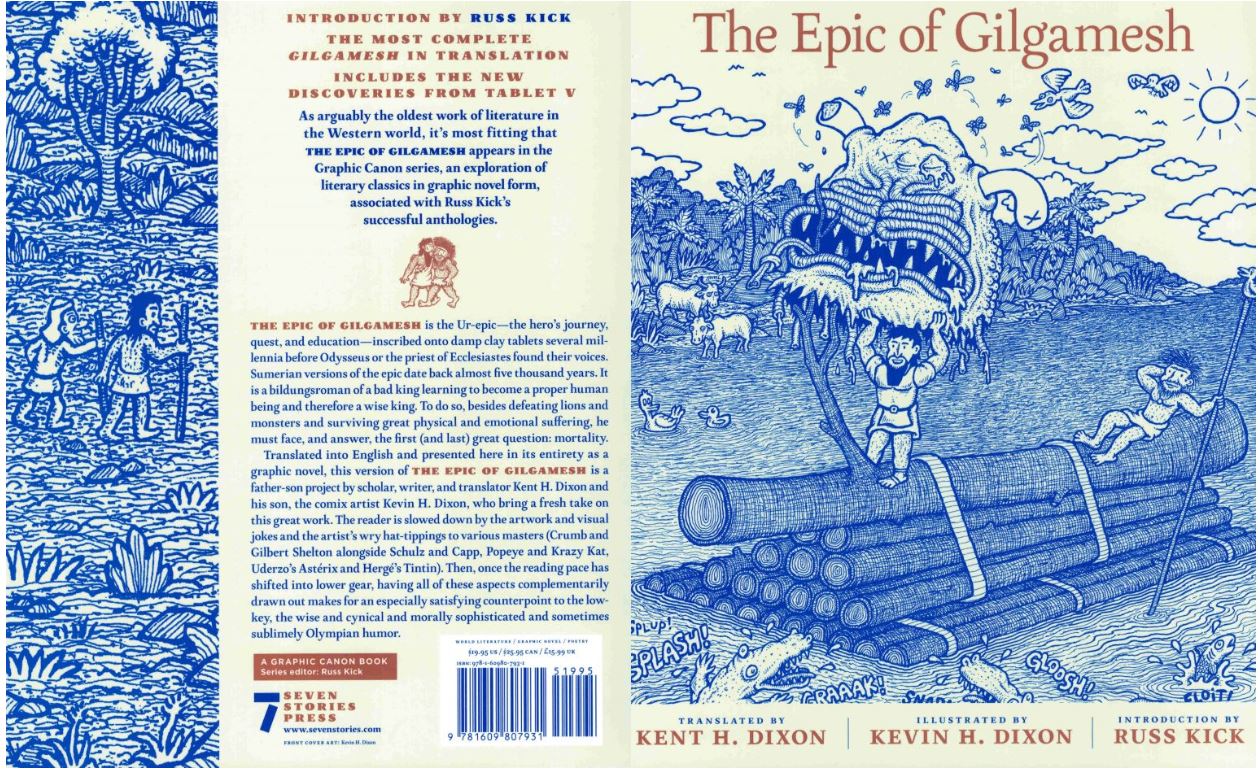
The Epic of Gilgamesh


Translated by Kent H. Dixon & illustrated by Kevin H. Dixon (Seven Stories Press)
ISBN: 978-1-60980-793-1 (TPB): 978-1-60980-794-8 (eBook)

The infinite realm of comics is the most expansive medium we have for extolling heroic deeds, combining a facility for depicting all aspects of character with an unlimited budget for special effects; all whilst communicating instantaneous visceral understanding and appreciation to and on the part of the audience.

Such was not always the case: once upon a time all we had was words, originally spoken or chanted but eventually translated into permanent marks on durable surfaces.

As of this writing, The Epic of Gilgamesh is still the oldest known work of human literature. A truly timeless heroic saga, its earliest incarnation is actually five Sumerian poems lauding the accomplishments of Bilgamesh, King of Uruk, dating from the Third Dynasty of Ur. That’s approximately 2100 BCE as you, I and most modern Mesopotamians would reckon it.

As is so often the case, some smart wordsmith long ago appropriated the texts and reconditioned the snippets into something grander, with the saga surviving into our era via a series (still incomplete) of Babylonian tablets. The material is open to frequent interpretation and has been translated into many languages since first discovered.

What source material we have comes from tablets of cuneiform logographs discovered back in 1853 by Hormuzd Rassam amidst the remains of the Library of Ashurbanipal in Nineveh (near modern Mosul in Iraq). In the early 1870s western historian George Smith published his first translation and, after more hands-on study and research, a full and final version in his 1880 book The Chaldean Account of Genesis. The first direct Arabic translation – by Iraqi Taha Baqir – only appeared in 1960. Many modern scholars have had a bash, with 2003’s 2-volume critical work by Andrew George being generally accounted as the most definitive thus far.

I, however, am no scholar (or gentleman, by all accounts) and the graphic novel on point today has my vote for perhaps the most honest and genuine treatment yet. It’s certainly the least pompous with the most laughs…

Gilgamesh is the prototype and template of all modern hero-myths, with a demigod king, alternatively beloved and despised, stricken and emboldened by his own greatness triumphing over all odds and odd monsters, but ultimately brought low by his own humanity.

It’s also a story with creation myth motifs (man brought forth from clay; god-touched, animal-saving survivors of great floods; resurrection from the dead) that reoccur over and over again in later religions. Has anyone told Dwayne Johnson about this book yet?

This version is replete with earthy humour, casual smut and everyday venality. It feels like – despite the mystical trappings – the characters at its heart are all too human. This is most cool, as artefacts dating back to 2600 BCE were recently uncovered that indicate the actual existence of some of the actors in this particular passion play…

What also lends this superb monochrome marvel much of its compelling veracity and beguiling attraction is a somewhat unique collaboration. Kent H. Dixon is an award-winning poet, screenwriter, novelist and educator who spends his days teaching and translating literary works from Japanese hibakusha to classics by Rilke and Mallarmé.

Kent Dixon is a social activist, underground radio show host and the award-winning cartoonist who created …And Then There Was Rock and subversive milestone Mickey Death in the Winds of Impotence. He might be the only aging rebel in the world happy to work with his dad…

Their slowly-unfolding, decade-long collaboration on The Epic of Gilgamesh caught the attention of top bloke Russ Kick (You Are Being Lied To and Everything You Know is Wrong; and data archive thememoryhole2.org) who quickly made it – and them – a key part of the superb Graphic Canon series.

So, what do you get here that other translations don’t offer? Following Kick’s scene-setting, context-establishing Introduction, Kent Senior’s Translator’s Note relates how the literary wizard retranslated the original tablets – including only just unearthed Tablet 5 – and offers a few hints regarding narrative direction whilst Kevin Dixon’s Artist’s Note spills a few secrets on producing a classic everybody “knows” as an out of sequence part-work…

As for the story: an arrogant hero-king wanders the Earth and realms of gods and monsters. He’s pretty vile to women and beats up whom he pleases until the gods create a perfect enemy who ends up becoming his truest (if not only) friend. When he dies the Hero defies the universe and challenges Hell to get him back. You’ve heard it all before but you’ve never seen it quite like this…

Bold and brash, raw and raucous, this inviting interpretation also manages to maintain a graceful poetic rhythm and deftly incorporate the philosophy and instructions-for-living that permeate and underscore the original without missing a beat. A magnificent tale with a big heart and supremely engaging, this funny, scary, action-packed pictorial fable is a brilliant achievement and I for one am hungry for more. Spenser’s Faerie Queene or Wu Cheng’en’s Journey to the West anyone?
© 2018 by Kent H. Dixon and Kevin H. Dixon. All rights reserved.

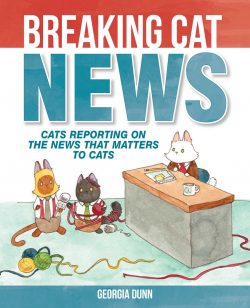
Breaking Cat News: Cats Reporting on the News That Matters to Cats


By Georgia Dunn (Andrews McMeel)
ISBN: 978-1-4494-7413-3 eISBN: 978-1-4494-7927-5

As I eagerly await the imminent release of the next feline frenzy fact file from Georgia Dunn (Gosh! When willit bee Septemphber?) I feel the need to revisit how it all began… 

Cats rule the world. Just ask the internet. Now, now, now. Those of us with moggies also learn pretty quickly that they run the house too. However, illustrator and cartoonist Georgia Dunn found a way to make her indolent furry overlords earn their keep after watching them converge on a domestic accident and inquisitively and interminably poke their little snouts into the mess.

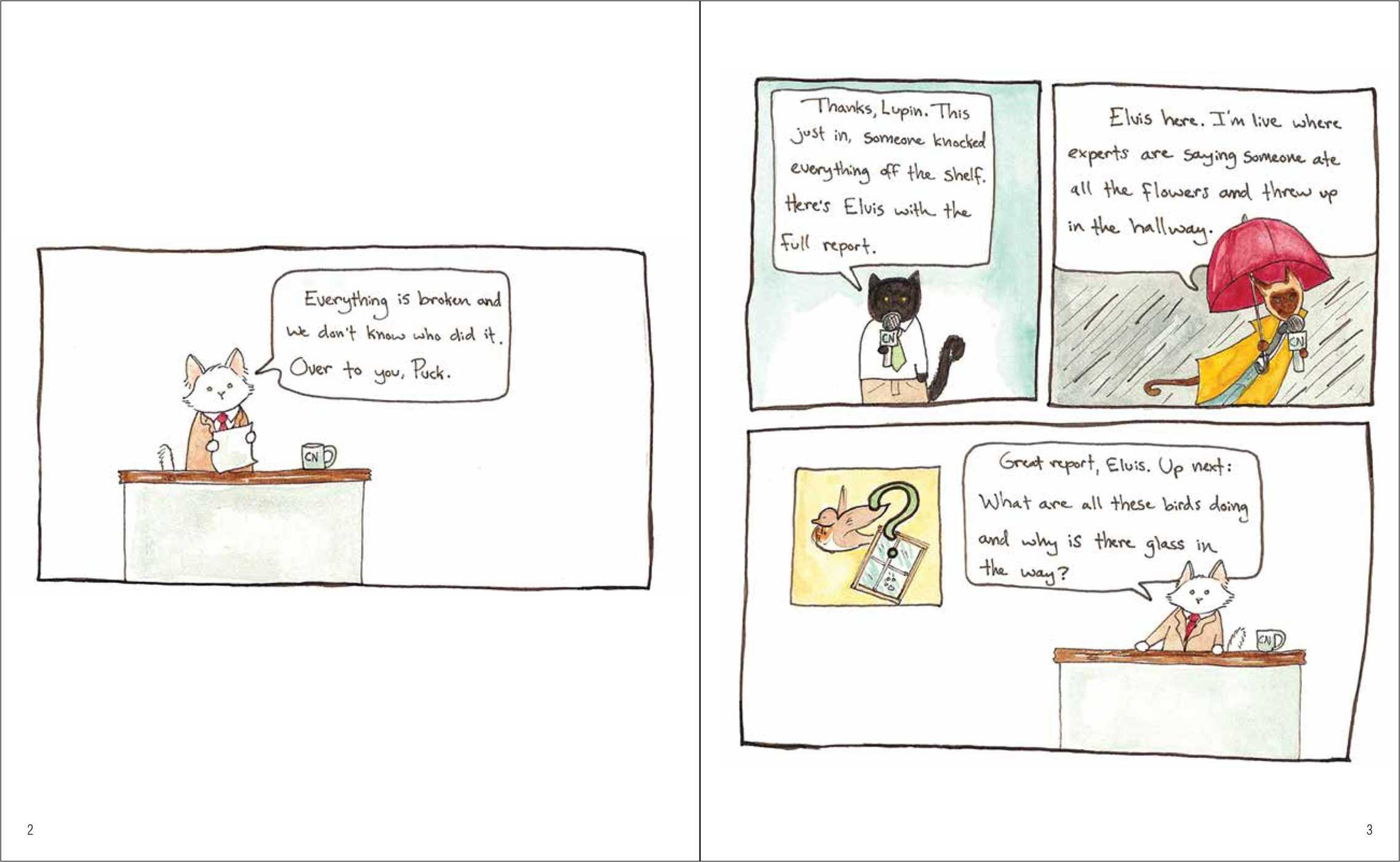
Thus was born Breaking Cat News: a hilariously beguiling series of strips detailing how – when no-one’s looking – her forthright flurry of felines form their own on-the-spot news-team with studio anchor Lupin, and field reporters Elvis (investigative) and Puck (commentary) delivering around-the-clock reports on the events that really resonate with cats – because, after all, who else matters?

The history and development of the feature is covered in Dunn’s Introduction (which you can read if your own murder-mittened mates give you some time off) before this superbly engaging full-colour digest-sized (165 x 203 mm) paperback concentrates on crucial domestic and foreign issues.

Drawing attention on the home front are items such as ‘Everything is Broken and We Don’t Know Who Did It’, ‘The Food Bowl is Still Empty’, ‘The People Bought Some Stupid-Looking Thing For the Dining Room’, ‘The Woman is Cooking Bacon’, ‘The Woman is Trying to Use a Laptop’, ‘The Woman is Trying to Make the Bed’ and ‘The People Bought a Different Kind of Kibble’ whilst long-range outside broadcasts confirm ‘The Man is in the Backyard’, ‘The Neighborhood is Under Attack’ and ‘The Trees are Falling Apart’

The rolling news is backed up by In-Depth packages devoted to ‘The People Are Going Insane’ (moving house to us two-foots) and the entire team undertake a dedicated series on a lengthy brush with maternity (‘The Woman is Feeling Under the Weather’, ‘The Spare Room is Filled With New Cat Furniture’, ‘The Woman has a Hair Ball’ and ‘The People are Awake in the Middle of the Night’) to prove that cats don’t just want vapid snippets of information for mayfly attention spans, but can also handle complex issues with no simple solutions…

Smart, witty, imaginative and deliciously whimsical, Breaking Cat News is a fabulously funny regularly re-readable feel-good feature rendered with great artistic elan and a light and breezy touch that will delight not just us irredeemable cat-addicts but also anyone in need of good laugh.
© 2016 Georgia Dunn. All rights reserved.

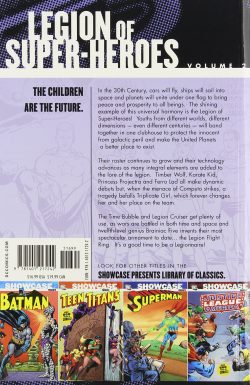
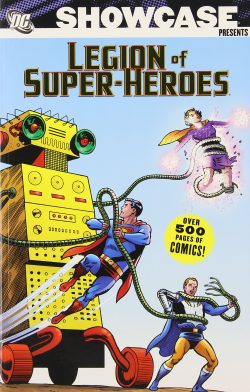
Showcase Presents Legion of Super-Heroes volume 2


By Otto Binder, Jerry Siegel, Edmond Hamilton, Jim Shooter, Curt Swan, John Forte & various (DC Comics)
ISBN: 978-1- 4012-1724-2 (TPB)

Once upon a time, in the far future, a band of super-powered kids from a multitude of worlds took inspiration from the greatest legend of all time and formed a club of heroes. One day those Children of Tomorrow came back in time and invited their inspiration to join them…

And thus began the vast and epic saga of the Legion of Super-Heroes, as first envisioned by writer Otto Binder and artist Al Plastino in early 1958, just as the revived comicbook genre of superheroes was gathering an inexorable head of steam. Since that time the fortunes and popularity of the Legion have perpetually waxed and waned, with their future history tweaked and rebooted, retconned and overwritten over and again to comply with editorial diktat and popular whim. Happy 65th Anniversary, teams!

This splendid, charm-soaked, action packed second monochrome collection continues to re-present those early tales from assorted Superman Family titles in chronological order: the sagas from their own feature spanning Adventure Comics #316, 322-348, and 365 with guest-shots from Superboy #117, 124-125 and pertinent portions of Superman Annual #4, covering July 1964 to September 1966.

From Adventure #322 the fun-filled futurism opens with ‘The Super-Tests of the Super-Pets!’ by Edmond Hamilton, John Forte & Sheldon Moldoff, wherein the Legion’s mighty animal companions – Krypto, Streaky the Super Cat, Beppo, the monkey from Krypton and magical Super-horse Comet – are left to guard Earth as the humanoid players continue to pursue the elusive Time Trapper. When Chameleon Boy’s pet Proty II applies to join the bestial bunch, they give him a series of extremely difficult qualification tasks…

‘The Eight Impossible Missions!’ (#323 by Jerry Siegel, Forte & George Klein) see the incomprehensibly smart Proty setting the human Legionnaires a set of challenges to determine their next leader, after which the tone switches to deadly danger for ‘The Legion of Super-Outlaws!’ (Hamilton & Forte), as a grudge-bearing mad scientist manipulates a super-team from far distant Lallor into attacking the United Planets champions…

Issue #325 reveals how ‘Lex Luthor Meets the Legion of Super-Heroes!’ (Siegel & Forte) in a cunning tale of deadly deception whilst a ‘Revolt of the Girl Legionnaires!’ (Siegel, Forte & Klein) finds the female heroes attempting to eradicate their male comrades. Of course, they don’t mean it and a sinister mastermind is behind it all…

Superboy #117 (cover-dated December 1964) offers a classy thriller wherein Chameleon Boy, Invisible Kid, Ultra Boy, Element Lad and Brainiac 5 seemingly travel back 1000 years to attack the Boy of Steel in Siegel, Curt Swan & Klein’s ‘Superboy and the Five Legion Traitors!’ whilst over in Adventure #327 ‘The Lone Wolf Legionnaire!’ introduces bad boy Brin Londo in a clever thriller from Hamilton, Forte, Klein & Moldoff. This troubled teen is framed for appalling crimes but will one day become a valued member of the team…

Siegel & Jim Mooney began an engaging run of tales in #328, opening with ‘The Lad who Wrecked the Legion!’ as insidious Command Kid joins the superhero squad to dismantle it from within.

Narrowly escaping that fate, the heroes confront the topsy-turvy threat of their own imperfect doppelgangers in #329’s ‘The Bizarro Legion!’ after which another evil juvenile infiltrates the organisation, intent on destroying them all in ‘Secret of the Mystery Legionnaire!’. The dastardly plan proceeds without a hitch until victorious Dynamo-Boy recruited malevolent Lightning Lord, Cosmic King and Saturn Queen and falls victim to ‘The Triumph of the Legion of Super-Villains!’ in #331.

Rescued and restored, the good kids are back in Adventure #332, facing ‘The Super-Moby Dick of Space!’ (Hamilton & Forte) as recently resurrected Lightning Lad suffers crippling injuries and an imminent nervous breakdown…

‘The War Between Krypton and Earth!’ (#333, by Hamilton, Forte & Klein), has the time travelling wonders flung back into Earth’s antediluvian past and split into internecine factions on opposite sides of a conflict forgotten by history, after which Hamilton, Forte & Moldoff’s ‘The Unknown Legionnaire!’ poses a perilous puzzle with an oppressed race’s future at stake.

The same creative team introduce sinister super-villain ‘Starfinger!’ in #335, framing one luckless Legionnaire for incredible crimes before ‘The True Identity of Starfinger!’ (inked by Klein) reveals the real culprit.

Superboy #124 (October 1965, Otto Binder & George Papp) features Lana Lang as ‘The Insect Queen of Smallville!’: rewarded with a shape-changing ring after rescuing a trapped alien. Naturally, she uses her new abilities to ferret out Clark Kent’s secrets…

Adventure #337 highlights ‘The Weddings that Wrecked the Legion!’ (Hamilton, Forte & Moldoff) as two couples resign to marry. However, there’s serious method in the seeming marital madness…

Long absent Bête Noir Time Trapper at last returns in #338, as Siegel & Forte expose ‘The Menace of the Sinister Super-Babies!’, with sultry siren Glorith of Baaldur using the Chronal Conqueror’s devices to turn everybody but Superboy and Brainiac 5 into mewling infants. When they turn the tables on the villains a new era dawns for the valiant Tomorrow Teens…

Cover-dated November 1965 and by Binder & Papp, Superboy #125 signals darker days ahead by introducing a legion reservist with a tragic secret in ‘The Sacrifice of Kid Psycho!’, after which Hamilton, Forte & Moldoff tell a bittersweet tale of disaffected, tormented Lallorian hero Beast Boy who turns against humanity in Adventure Comics #339’s ‘Hunters of the Super-Beasts!’

The slow death of whimsy and light-hearted escapades culminates in #340 when Brainiac 5’s latest invention goes berserk, with ‘Computo the Conqueror!’ (Siegel, Swan & Klein): attacking humanity and killing one of the superheroes before ‘The Weirdo Legionnaire!’ (inked by Moldoff) begins the team’s fight-back and eventual triumph.

‘The Legionnaire who Killed!’ (#342, Hamilton, Swan, Moldoff & Klein) sees Star Boy forced to take a life and facing the harshest of consequences, whilst ‘The Evil Hand of the Luck Lords!’ (Hamilton, Swan & Klein) finds the bold band of heroes assaulting the stronghold of a sinister cult claiming to control chance and destiny.

The same creative team ramps up tensions in Adventure #344 in ‘The Super-Stalag of Space!’, wherein the Legion – and many other planetary champions – are incarcerated by malicious alien overlord Nardo; an epic thriller completed in #345 with ‘The Execution of Matter-Eater Lad!’

With Adventure #346 (July 1966) the dramatic revolution culminated in ‘One of Us is a Traitor!’ as Jim Shooter – barely a teenager – sold script and layouts (finished and inked by veteran Sheldon Moldoff) for a spectacular Earth invasion yarn. Here the sinister Khunds attack the UP, and the depleted Legion inducts four new members to bolster their strength. Sadly, although Princess Projectra, Nemesis Kid, Ferro Lad and Karate Kid are all capable fighters, it is soon apparent that one is an enemy agent…

With Earth all but fallen, ‘The Traitor’s Triumph!’ (Shooter, Swan & Klein) seems assured, but there’s one last surprise to come in a spectacular debut yarn from one of the industry’s most innovative creators…

This superb second compendium concludes with a tense thriller by Shooter & Papp from Adventure #348, as the secret origin of Sun Boy is revealed when radioactive rogue Dr. Regulus attempts unjustified vengeance in ‘Target-21 Legionnaires!’

But wait! There’s more!

Before the end, an expanded illustrated pictorial check-list and informational guide to the entire team by Swan, Klein & Al Plastino, culled from Superman Annual #4 (1961), Adventure Comics #316 and #365 (January 1964 & February 1968, respectively) reveals all you need to know about the youthful champions.

The Legion is one of the most beloved and bewildering creations in comic book history and largely responsible for the growth of the groundswell movement that became American Comics Fandom. Moreover, these sparkling, simplistic and devastatingly addictive stories as much as the legendary Julie Schwartz’s Justice League fired up the interest and imaginations of a generation of young readers and built the industry we all know today.

These naive, silly, joyous, stirring and utterly compelling yarns are precious and fun beyond any ability to explain – even if we old lags gently mock them to ourselves and one another. If you love comics and haven’t read this stuff, you are the poorer for it and need to enrich your future life as soon as possible.
© 1961, 1964, 1965, 1966, 2008 DC Comics. All Rights Reserved.