Captain Marvel volume 1: Nothing to Lose


By Peter David, ChrisCross, Ivan Reis, Paco Medina & various (Marvel Comics)
ISBN 978-0-7851-1104-7 (TPB/Digital edition)

Once upon a time, individuality was king and identity constantly – and litigiously – defended. These days, superhero comics are filled with spin-offs, legacies and alternates. Where once DC eradicated an entire multiverse to ensure readers would see there was only one Superman, Batman or Wonder Woman now there are dozens of iterations of every costumed character and fans couldn’t be happier.

However, there was always one title/character that bucked the trend…

One of the most venerated, beloved characters in American comics was created by Bill Parker & Charles Clarence Beck as part of the wave of opportunistic creativity following the successful launch of Superman in 1938. Although there were many similarities in the early years, the Fawcett Comics character moved swiftly and solidly into realms of light entertainment and even broad comedy, whilst throughout the 1940s the Man of Steel increasingly sidelined whimsy in favour of family-friendly action and drama.

Homeless orphan and thoroughly good kid Billy Batson was selected by an ancient wizard to battle injustice and subsequently granted the powers of six gods and mythical heroes. By speaking aloud the wizard’s name – an acronym for divine patrons Solomon, Hercules, Atlas, Zeus, Achilles and Mercury – he transformed from scrawny boy to brawny (adult) champion Captain Marvel.

At the height of his popularity, “the Big Red Cheese” was published twice monthly, hugely outselling Superman, and in 1941 DC/National Comics launched an infamous court case citing copyright infringement. However, as the decade progressed and tastes changed, sales slowed, and the case was settled just as many publishers started switching from costumed heroes to “Real Men” and monsters. Like many superheroes, Captain Marvel and his gods-powered kin disappeared, becoming a fond memory for older fans. A big syndication success, he was missed all over the world. In Britain, where an English reprint line had run for many years, creator/publisher Mick Anglo had an avid audience and no product, and so transformed the Captain and company into atomic age heroes Marvelman, Young Marvelman and Kid Marvelman continuing to thrill readers into the early 1960s, even if here there were no girls allowed.

Then, as America lived through another superhero boom-&-bust, the 1970s dawned with a shrinking industry and wide variety of comics genres servicing a base that was increasingly founded on collectors and fans rather than casual or impulse buyers. National/DC Comics needed sales and were prepared to look for them in unusual places.

After the court settlement with Fawcett in 1953 they had secured the rights to Captain Marvel, Captain Marvel Junior, Mary Marvel and all the spin-off Family. Now, even though the name itself had been taken up by Marvel Comics (via a circuitous and quirky robotic character published by Carl Burgos and M.F. Publications in 1967), the publishing monolith decided to tap into that discriminating if aging fanbase.

In 1973, riding a wave of national nostalgia on TV and in movies, DC brought back the entire beloved Marvel crew in their own kinder, weirder universe. To circumvent the intellectual property clash, they named the new title Shazam! (…With One Magic Word!) – the trigger phrase used by myriad Marvels to transform to and from mortal form, and a word that had entered the American language due to the success of the franchise the first time around.

Meanwhile, at the other place…

In 1968, upstart Marvel was in the ascendant. Their sales were rapidly overtaking industry leaders National/DC and Gold Key Comics and, having secured a new distributor allowing them to expand their list of titles exponentially, the company was about to undertake a creative expansion of unparalleled proportions.

Once individual stars of “split-books” Tales of Suspense, Tales to Astonish and Strange Tales were awarded their own titles, the House of Ideas just kept on going. In progress was a publishing plan seeking to take conceptual possession of the word “Marvel” through both reprint series such as Marvel Tales, Marvel Collector’s Items Classics and Marvel Super-Heroes. Eventually, showcase titles such as Marvel Premiere, Marvel Spotlight and Marvel Feature also proudly trumpeted the name, so another dead-cert idea was to have an actual hero named for the company – and preferably one with some ready-made cachet and pedigree as well.

After the infamous 1940s-1950s copyright case of the, the prestigious appellation Captain Marvel disappeared from newsstands. In 1967, during the “Camp” craze/superhero boom generated by the Batman TV series, publisher MLF produced a number of giant-sized comics featuring an intelligent robot able to divide his body into segments and shoot lasers from his eyes. Their legal right to have done so is still disputed…

Quirky, charming and devised by Carl Burgos (creator of the Golden Age Human Torch), the series failed to attract a large following in that flamboyantly flooded marketplace and on its demise the name was snapped up by Marvel Comics Group who properly secured rights to the name and have defended it ever since by publishing numerous characters who all seemed doomed to high quality runs and early cancelation…

In 1968, Marvel Super-Heroes was a brand new title: reconfigured from extended-length reprint vehicle Fantasy Masterpieces, which mixed vintage monster-mystery tales with Golden Age Timely Comics classics. With the 12th issue it added a try-out section for characters without homes. These included the Inhuman Medusa, Ka-Zar, Black Knight and Doctor Doom, plus new concepts Guardians of the Galaxy and Phantom Eagle, in all-new stories.

They kicked off with an alien spy sent to Earth from the Kree Galaxy. He held a Captain’s rank and his name was Mar-Vell. After two appearances, Captain Marvel catapulted straight into his own title for a rather hit-and-miss career combatting spies, aliens and costumed cut-ups like Sub-Mariner, Mad Thinker and Iron Man. Most frequently, however, he clashed with elements of his own rapaciously colonialist race – such as imperial investigative powerhouse Ronan the Accuser – all while slowly switching allegiances from the militaristic Kree to the noble, freedom-loving denizens of Earth.

This particular incarnation of the “trademark-that-must-not-die” features the son of that Kree warrior and long-time company supporting character/professional sidekick Rick Jones in a symbiotic relationship echoing the heyday of Mar-Vell’s flower-power glory days. Fair warning though, despite the excellent writing and great art, if you are not at least passingly familiar with Marvel’s close continuity, this is not a series of books you want to read without a little preparation.

Scripted by Peter David, with colours by Chris Sotomayor and letters from RS (Richard Starkings) & Comiccraft’s Albert!, Nothing to Lose collects Captain Marvel volume 2 #1-6 (cover-dates November 2002-April 2003, and I said it was confusing didn’t I?). It expands the saga of Genis, an artificially-matured test-tube baby son of Mar-Vell.

The Kree warrior turned Cosmic Protector saved Earth and Universe countless times before dying of cancer in the landmark Death of Captain Marvel (the company’s first official Graphic Novel), and here, after years trying to live up to and surpass his father’s achievements – he even debuted using the codename “Legacy” – the pressure starts to show.

Genis sought to emulate his father as a galaxy-spanning crusader, with mixed results, before hooking up with Rick Jones – his Dad’s original sidekick and, for a time, lifeline to reality. The human offered the promise of insider insights into what made him such a hero…

When Nothing to Lose opens with ‘Shards’ – illustrated by ChrisCross – he is, in fact, in just the same situation his father endured with the teen-aged Jones back in 1960’s. Their bodies are linked by “Nega-bands” – fantastically powerful alien wrist-bands which both wear, but only in turns, as they have the drawback of merging their molecular structure. This means only one body can inhabit the positive-matter universe at once, whilst the other is trapped in sub-atomic pocket-reality The Microverse. From there, the captive can observe and communicate, but not affect the “real” world.

The new Captain Marvel possesses his father’s greatest power, “Cosmic Awareness”: an ability to discern everything happening everywhere at once. Sadly, and inevitably, the gift is turning Genis into a raving madman. Just knowing something bad is happening doesn’t mean that the only solution you can offer is ultimately the right one for the universe. With so much to do, the captain has not allowed Rick to return to Earth for months…

This situation is tragically demonstrated when Marvel stops a suicide bomber from detonating on a crowded bus, only to see her murdered by one of her intended victims. His every action forces him to make immediate decisions and choose who to help for the greater good, but every choice seems to lead to unknowable cosmic consequences. This hopeless situation is repeated, magnified and drastically clarified after his intervention in an Badoon invasion and other missions.

As days pass Rick faces the fact that his partner’s omniscience and growing clairvoyance is more curse than blessing, and an increasing capriciousness is affecting Captain Marvel’s compulsion to “Do Good”. ‘Shock Absorber’ see Jones explore his options by going on an arduous pilgrimage and consulting (relatively) local god Shinga Doon, whilst the cosmic avenger starts taking advice and moral instruction from the Punisher

In ‘Pamavision’ Genis joins the militaristic Kree’s colonial space fleet as they invade and colonise strategic world Toped: meeting the man who trained his father, embracing the bellicose expansionist culture and rising fast in the ranks. In the Microverse, Rick is unexpectedly joined by another truth-seeker just as his guru meets a sudden and mysterious death…

The Toped campaign goes badly wrong for the Kree in ‘Uriah’ (rendered by Ivan Reis) as the Captain uncovers sedition, ambition and espionage run wild, whilst Rick learns his fellow stranded acolyte – Epiphany – is far more than she seems. When war with the Shi’ar looms and romantic intrigue runs riot, Marvel’s solution is to kill everybody and then himself…

ChrisCross returns for ‘Au Pere’ as a truly brutal father & son moment in the great beyond leads to Genis discovering that both he and Rick have been manipulated by trans-cosmic siblings Epiphany and Entropy with a view to ousting the current supervisor of reality.

They have done their work well and deranged Genis eagerly anticipates battling the universe’s most powerful conceptual entities, killing Supreme Being Eternity and ending painful reality well before its due date…

Happily for all, Rick hasn’t given up hope in the spectacular and awe-inspiring Paco Medina-limned closing chapter ‘Four Characters in Search of Creation’…

This slim tome includes covers and variants by Alex Ross, CrissCross, Joe Jusko, Kia Asamiya, Phil Noto, JG Jones and Andy Kubert as well as an ‘Alex Ross Captain Marvel Concept Artwork’ feature, sharing his design process and thoughts on the character’s powerful reworking.

Wry, sardonic, explosively action-packed and sublimely provocative, Peter David’s blackly tongue-in-cheek examination of power and perspective has some truly chilling moments, and has a lot to say on the nature of heroism, all leavened by his absurdist sensibilities and love of comedy word-play. His take on duty and honour is wickedly engaging, with the sumptuous art carrying the sneaky double-dealing and savage conflicts with ease.
© 2021 MARVEL.

Almost Silent


By Jason, translated by Kim Thompson (Fantagraphics Books)
ISBN: 978-1-606-99315-6 (HB/Digital edition)

John Arne Saeterrøy, who works under the pen-name Jason, was born in Molde, Norway in 1965, and appeared on the international cartoonists’ scene at age 30 with his first graphic novel Lomma full ay regn (Pocket Full of Rain) which won that year’s Sproing Award (Norway’s biggest comics prize).

He followed with the series Mjau Mjau (winning another Sproing in 2001) and in 2002 turned almost exclusively to producing graphic novels. Now an international star, he has won seven major awards from such disparate regions as France, Slovakia and the USA.

Here the fine folks at Fantagraphics collected four of his earliest graphic novels in a superb hardback companion to the 2009 classic [Low Moon] which provides more of Jason’s surreal and cinematic, darkly hilarious anthropomorphic ruminations on his favourite themes of relationships and loneliness, viewed as ever through a charmingly macabre cast of silent movie archetypes, cinematic monsters and sad sack chumps.

Told in pantomimic progressions rather than full stories – and often as classical chase scenes reminiscent of Britain’s The Benny Hill Show – the wonderment begins with breakthrough album ‘Meow, Baby’ wherein a mummy goes walkabout from his museum sarcophagus encountering bums and gamins, vampires, aliens, angels, devils, skeletons and cops – always so many cops – in hot pursuit…

This primarily monochrome collection is called Almost Silent because it mostly is. Moreover, what dialogue appears is never informative or instructive, merely window dressing. The artwork is displayed in formalised page layouts rendered in a minimalist evolution of Hergé’s Claire Ligne style: solid blacks, thick lines and settings of seductive simplicity unwinding like an unending, infinite zoetrope show. These early works are collections of gags and situations more experienced than read.

A second untitled tale follows the perceived social inadequacies of males hungry for love: a werewolf, caveman – complete with courting cudgel, a Martian, Frankenstein’s monster and even Elvis. All try and die in the modern dating whirl…

The next sequence introduces cannibal ghouls and a movie-buff Travis Bickle/Arnold Schwarzenegger wannabe also starving for acceptance, and continues with the bleakly comedic ‘Return of the Mummy’ and a delightfully tongue in cheek pastiche of Tintin and Blake and Mortimer entitled ‘The Mummy’s Secret’, featuring the entire ghastly cast, before ending with a fascinating selection of 3-panel gag strips.

The next featured volume is ‘Tell Me Something’: a more ambitiously visual outing that acknowledges its antecedents and influences by using silent movie dialogue cards instead of word balloons. It follows a plucky heroine as she searches for affection in all the wrong places with her Harold Lloyd-like would-be beau. Also in attendance are the usual cast of filmic phenomenons…

‘You Can’t Get There from Here’ concentrates mainly on the 1930s movie Frankenstein cast: the monsters, their equally artificial wives, their lovelorn and covetous creators and even the Igors: misshapen, wizened assistants also all seeking that one special person – or thing. Here the art is supplanted by the startling and highly effective addition of bronze inks for a compelling duo-tone effect that sits oddly well with the beast’s bittersweet search for his stolen, bespoke bride.

We conclude with a rather riotous adventure romp. ‘The Living and the Dead’ details a perfect first date interrupted by the rising of the unquiet dead and end of civilisation in the rotting teeth of carnivorous zombies on their final march – possibly the funniest and most romantic yarn in the whole book.

Jason’s work always jumps directly into the reader’s brain and heart, using the beastly and unnatural to ask gentle questions about basic human needs in a wicked quest for answers. That you don’t ever notice the deep stuff because of the clever gags and safe, familiar “funny-animal” characters should indicate just how good a cartoonist he is.

His comic tales are strictly for adults but allow us all to look at the world through wide-open childish eyes. He is a taste instantly acquired and a creator any fan should move to the top of the “Must-Have” list, so consider this superb hardback your guaranteed entry into his fabulous fun world…
© 2009 Jason. All rights reserved.

JLA: Year One


By Mark Waid, Brian Augustyn & Barry Kitson with Michael Bair, John Stokes, Mark Propst, & various (DC Comics)
ISBN: 978-1-56389-512-8 (TPB)

If the chop-and-change continuity gymnastics DC have undergone in recent years gives you a headache, but you still love reading excellent superhero team stories, you could just take my word that this is one of the best of that breed and move on to the next review. If you’re okay with the confusion or still need convincing, though, please read on.

With then-partner All-American Publishing, in 1940 DC published the Justice Society of America in All-Star Comics from #3. Cover-dated “Winter Issue”, it spanned the year end and was on sale from November 22nd until January. The JSA were the first superhero team in comics.

In 1960 after a decade largely devoid of superheroes, the now fully-amalgamated publisher sagely revived the team concept as the Justice League of America, and gradually reintroduced the JSA ancestors as heroes of an alternative Earth to a fresh new caped and cowled world. By 1985, the continuity had become saturated and overcrowded with so many heroic multiples and close duplicates that DC’s editorial Powers-That-Be deemed it all too confusing and a deterrent to new readers, and decreed total change. It resulted in maxi-series Crisis on Infinite Earths and the events of the groundbreaking, earth-shattering saga led to a winnowing and restructuring of the DC universe…

With all the best bits from past stories (for which one could read “least charming or daft”) having now occurred on one Earth, and with many major heroes remade and re-launched (Superman, Wonder Woman, Flash et al.), one of the newest curses to readers – and writers – was keeping definitive track of what was now DC “History” and what had now never actually happened.

Thus 12-issue maxi-series JLA: Year One presented the absolute, definitive, real story of the formation and early days of the Justice League, the World’s Greatest – but no longer first – Superheroes…

Of course, since Zero Hour, Infinite Crisis and all the other subsequent publishing course-correcting extravaganzas (such as 52, Countdown, Dark Nights: Death Metal and so on) it’s not strictly true anymore. Still. Again…

None of which impacts upon the superb quality of the tale told here. Way back then – January to December 1998 and in the wake of Grant Morrison & Howard Porter’s spectacular re-reboot of the team – Mark Waid, Brian Augustyn & illustrator Barry Kitson (plus assorted assisting inkers) produced a superb version of that iteration’s earliest days. It’s still one of the best and most readable variations on the theme, even if DC have inexplicably let it slide out of print…

It begins “ten years ago” in ‘Justice League of America: Year One’ as a hidden observer gathers files on an emergent generation of new costumed heroes. When an alien invasion from Appellax brings inexperienced neophyte heroes Flash, Green Lantern, Black Canary, Aquaman and Martian Manhunter together to save Earth from colonisation, the media scents a news sensation, but the real story is the hidden forces hovering in the background of the event…

The Canary was reimagined as the rebellious daughter of the JSA original who had been active during WWII, and the others, like the Sea King and J’onn J’onzz, had undergone recent origin revisions too…

The main action begins after that initial victory, as the heroes – novices all, remember – opt to stick together as a team, only to be targeted by secret super-science society Locus, who begin snatching up alien invader corpses for genetic experimentation…

The second issue sees the new kids as media sensations overwhelmed and out of their depth, with everyone wanting a piece of them. Older outfits like the Blackhawks, Challengers of the Unknown and even officially-retired JSA veterans are watching with apprehension whilst Bruce Wayne wants them far away from Gotham City as they establish their ‘Group Dynamic’. Even trick archer Green Arrow is constantly hanging around, clearly angling for an invitation to join, but that’s never gonna happen…

Immortal villain Vandal Savage targets the inexperienced heroes with a squad of veteran supervillains – the Thorn, Solomon Grundy, Clayface and Eclipso – as everywhere, more new superheroes are emerging. Savage is resolved to stop this second Heroic Age before it begins…

In #3, Locus’ bio advancements lead to alliance with Savage, but their schemes are sidelined as the team struggle to work together. Every man there seems distracted by Black Canary, but their “chivalrous impulses” in combat are not only insulting but will get someone killed – if not by enemies, then by her…

The team is fully occupied playing ‘Guess Who?’ after accepting funding and resources from a mystery billionaire. The influx of cash results in a purpose-built secret mountain HQ, a covert personal communications network, live-in custodian/valet/tech support Snapper Carr and a security system designed by maverick teen genius Ted Kord.

At least the heroes are starting to bond, sharing jokes, origins and trade secrets, but tensions are still high and trust in each other is fragile…

Inker Michael Bair joins with #4 as ‘While You Were Out…’ sees Locus at last launch their campaign of conquest: picking off lone hero Dan Garrett, whose mystic Blue Beetle scarab proves no match for alien-enhanced bio-weaponry, even as the heroes are all singled out for close observation by mystery operatives…

The merciless Brotherhood of Evil unleash Locus-designed horrors on Manchester, Alabama in #5, leading to a tenuous team-up of Justice League and Doom Patrol that ends in disaster and defeat. Maimed and deprived of their abilities, they are ‘A League Divided’ until the DP’s resident genius Niles Caulder provides stopgap powers and weapons in ‘Sum of Their Parts’ (inked by Bair & John Stokes), enabling the heroes to rally and restore themselves…

In ‘The American Way’ the JLA suffer a shock after their greatest inspiration – Superman – declines an offer to join, even as Locus’ endgame begins.

The dispirited heroes barely notice, as ‘Loose Ends’ exposes treachery in the ranks, further distracting the heroes who discover a trusted ally has been spying on them in their private lives. They have no idea what’s really going on…

With unity shattered, the JLA turns on itself, missing Locus’ attempt to terraform Earth and literally ‘Change the World’

‘Heaven and Earth’ (inked by Bair & Mark Propst) finds all humanity’s helpless and all its many heroes subdued in a superpowered blitzkrieg that catches the planet napping. Crushed, defeated and interned in ‘Stalag Earth’ all hope is lost until the reunited Justice League lead a counter-offensive, turning tragedy into triumph and ensuring ‘Justice for All’

A brilliantly addictive plot, superbly sharp dialogue and wonderfully underplayed art suck the reader into an enthralling climax that makes you proud to be human… or at least terrestrially-based. This saga of our champions’ bonding and feuding under extended threat of rogue geneticists, planetary upheaval, and the mystery of who actually bankrolls the team, all added to continual, usual, everyday threats in a superhero’s life, is both enchanting and gripping.

When it’s done right there’s nothing wrong with being made – and allowed – to be feel ten years old again. In-the-know fans will delight at the clever incorporation of classic comics moments, in-jokes and guest-shots from beloved contemporaneous heroes and villains such as the Sea Devils, Metal Men, Atom and such, but the creators of this revised history never forget their new audience and nothing here is unclear for first-timers. The finale is a fan’s all-action dream with every hero on Earth united to combat all-out alien invasion! …And of course, the rookie JLA save the day again in glorious style.
© 1998 DC Comics. All Rights Reserved.

Marvel Graphic Novel vol 18: The Sensational She-Hulk


By John Byrne, Kim DeMulder, Petra Scotese, Janice Chiang & various (Marvel)
ISBN10: 0-87135-084-X (Album TPB/Digital edition)

A persistent story goes that in the faraway days when trademarks and copyrights were really, really important, comic publishers worried that rivals would be able to impinge on their sales an so produced distaff versions of their characters. Thus the House of Ideas launched Ms. Marvel, so that nobody else could.

Redundant bit player Carol Danvers was retooled as a superhero (now called Captain Marvel whilst Pakistani-American teen Kamala Khan has inherited her first codename). The Captain debuted in her own title (cover-dated January 1977) and was soon joined by rush-released Spider-Woman (in Marvel Spotlight #32 ,February 1977 – before securing her own title 15 months later) and She-Hulk. There was apparently a second and most specific reason…

At this time both the male Hulk and Spider-Man had successfully made the jump to live-action television, and the publishing powers were terrified because their licensing contracts had a potentially disastrous loophole: there was nothing to prevent those scurrilous TV types spinning off their own (sexy, televisual, not-owned-by-Marvel) characters, as had almost happened with Batgirl in the 1960s “Batmania” era…

To be fair, Marvel had been constantly seeking to expand their female character pool for years before intellectual property necessity forged a path for them. They found the right mix as the Seventies closed, and even added new concept stars at the right time. The music-biz-inspired and sponsored Dazzler premiered in February 1980’s Uncanny X-Men #130 – before getting her own title: the same month copyright-shielding Savage She-Hulk #1 came out…

Whereas that seems a bit convoluted and may be rather hard to believe, I must admit that the original 25-issue run of Bruce Banner’s tragedy-magnet cousin Jennifer Walters was by no means the company’s finest moment. Creators struggled for quite a while to get a handle on the Girly Green Goliath. After her series was cancelled, She-Hulk did the guest-star thing and served with distinction in both The Avengers and Fantastic Four, before John Byrne finally developed a suitably original niche and spin for her in the Marvel Universe.

Since then, constant experimentation and deft handling has made her one of Marvel’s most readable properties – and most entertaining screen stars – but that revolution all started with this thoroughly enjoyable, if clearly transitional tome…

At the time of its creation, the lady lawyer had replaced The Thing in the Fantastic Four and could change between her human and Gamma-enhanced forms at will, whilst retaining her intellect in both forms. All the fourth-world hi-jinks of her second comics series and television incarnation was yet to come…

Against the slow-building, horror-story backdrop of a sentient cockroach invasion and infiltration, the story involves the shady higher-ups who oversee high-tech espionage agency S.H.I.E.L.D. ordering the rendition of She-Hulk for unspecified “National Security” purposes. When tough but fair Nick Fury refuses to comply, the mission goes ahead without him, leading to a major battle in the streets of New York and the eventual capture of not only our heroine but also a large number of passers-by.

Trapped aboard the spooks’ flying helicarrier, She-Hulk is subjected to numerous indignities and abuses whilst her boyfriend Wyatt Wingfoot and the other civilians are treated as hostages for her good behaviour. Unfortunately, one of those ordinary mortals is a zombie vehicle for those cockroaches I mentioned earlier, and they want to drop the floating fortress on the city below as a declaration of war against humanity…

Inked by Kim DeMulder -with colours by Petra Scotese & lettering from Janice Chiang – Byrne’s writing and illustration deliver spectacular action, tinged with horror yarn overtones. The art deftly utilises the (European-style) expanded-page format of Marvel’s Original Graphic Novel line, and combines with sharp scripting to elevate an old plot to new heights. I personally find the coy prurience of some of the semi-nude scenes a little juvenile, but that’s not enough to spoil the fun in a what’s otherwise a highly effective disaster thriller: one which set the tone of She-Hulk adventures for years thereafter…
© 1985, 2018 Marvel Characters Inc. All Rights Reserved.

Primer

By Jennifer Muro & Thomas Krajewski, illustrated by Gretel Lusky (DC Comics)

ISBN: 978-1-4012-9657-5 (TPB/Digital edition)

In recent years DC opened up its interlinked superhero multiverse to generate Original Graphic Novels featuring its stars and new characters in stand-alone(ish) adventures for the demographic clumsily dubbed Young Adult.

They’ve been especially scrupulous producing material catering to girls and other previously neglected comics minorities, and to date results have been rather hit or miss. However, when they’re good, they are very good indeed. One such triumph is Primer, which taps into the communal history and mystique of the DCU to introduce a sparkling new character who encapsulates every aspect of youthful rebellion channelled into doing good in the traditional cape and cowl manner…

Written by animation scripters Jennifer Muro (Critical Role: The Legend of Vox Machina; Spider-Man; Star Wars: Forces of Destiny; Justice League Action; Lego DC Super Hero Girls) & Thomas Krajewski (Buddy Thunderstruck; Fairly OddParents; Scooby-Doo and Guess Who?; Penguins of Madagascar; Looney Tunes; Iron Man; Teenage Mutant Ninja Turtles) this origin adventure crackles with pace and thrills whilst basking in superbly effective dialogue and sharp one-liners.

Making the pictures sparkle and shine is 2-D visual developer, animation/games character designer and jobbing illustrator Gretel Lusky. Primer is her first comics project and augurs a long and fruitful career ahead as the artist seems able to effortlessly mix drama, pathos, spectacular action and sheer glee for maximum impact.

Lettered throughout by Wes Abbott, the wonderment first unfolds in ‘Primary Colors’ as a crashing airliner is plucked from the sky over Washington DC. Suddenly, everyone is saved by what appears to be a paint-spattered, super-powered thirteen year old girl…

Flashing back three weeks, we meet troubled Ashley Rayburn, who – after another bout of nightmares about her dad – escapes from the State group home to go tagging walls with her personal brand of street art. The cops who arrest and return her are pretty sympathetic – for cops. They realise it must be tough having a major crook for a father… even if he is currently in jail.

Ashley is basically a good kid acting out, and home supervisor Mrs. Boyd is trying her best to be understanding, but after regular graffiti incidents with cops involved, and being swiftly returned by five sets of prospective foster parents, the child is becoming a real problem with diminishing chances of a normal life…

If Ash doesn’t gel with latest prospects Mr & Mrs Nolan, she might be stuck in the system for her entire teen years. Thankfully, these adults are pretty cool. Kitch is a laid back art teacher with a wicked sense of fun/mischief, whilst his partner Yuka is a brilliant scientist: a geneticist who’s as obsessed with football as Ashley is.

Within a week, they’re all happily settling in together …so that’s when things start going wrong after the kid inadvertently overhears her new mom fretting about having made a mistake that will ruin their lives…

When there’s an accident in the kitchen, Ash overreacts and relapses into old behaviours: running away to paint walls again. This time, Kitch follows and they bond over her unleashed creativity. Soon he’s giving her art lessons and inviting her to share his studio. The first class is how to use brushes and canvas like she uses spray cans and other people’s walls…

Everything seems cool at home too now, but they don’t know what Yuka has done and can’t imagine how their lives are going to change…

Answers come as Ashley starts Middle School in ‘No Paint, No Gain’, but her resolution to make no new enemies only lasts until she stops bullies picking on a little kid. At least Luke – who’s being harassed for being small and a future star hairstylist – is now her ally against the rest of the jocks and jerks…

What Yuka’s actually fretting over is revealed as her employers Zecromax Labs are occupied by a client – the US Army in the forms of Major General Temple and his extremely menacing assistant Cal Strack. The science facility had been undertaking Project Warpaint for them, before Dr. Nolan secretly destroyed all the files and removed the only samples of their experiments.

These are gel solutions enhanced with the DNA of superheroes and villains. They look like body paints and can temporarily endow specific powers – 33 different ones – in whoever absorbs them through skin contact.

By the time the warmongers come to claim them, Yuka has acted for the good of humanity and – she thought – completely covered her tracks…

Sadly, she’s new to parenting and doesn’t realise that acting suspicious and conspicuously hiding a flashy briefcase is the best way to get a teenager about to celebrate a birthday to poke around where she shouldn’t. Before long, Ash and Luke have uncovered the paint tubes and are playing with borrowed superpowers…

From there on, things get exponentially complicated pretty quickly, as the military mavericks hunt their missing miracle weapon, even as Ashley’s real dad reaches out from the maximum security penitentiary he’s locked in to play his old mind games and remind her that deep down she’s just like he is. The pressured girl reacts by creating her own new alter ego and fighting super-criminals (albeit not particularly effective ones) on the streets of DC in ‘Red, White, and Bruised’.

Restricting the personal crusade of “Primer” because she’s afraid of being caught by Yuka, Ashley has no idea Temple and Strack are hunting the mystery thieves of Project Warpaint, and already on the Nolan’s trail, though the Major General has no idea that his deputy – and personal guinea pig – has his own ambitions involving the superpower supply…

The flashback reaches real time as Ashley finally rejects her dad’s mind games to save the falling plane and go public. Unfortunately, her televised debut enables a lot of people to recognise her and leads to the Nolans’ abduction by Strack and a gaudy gladiatorial clash as the power-crazed maniac attempts to capture all the paints and discovers, to his shock, Primer’s ‘True Colors’

Even with the drama satisfactorily concluded, there’s an added inducement: an introductory section from Grace Ellis & Brittney Williams’ DC OGN Lois Lane and the Friendship Challenge offering a light and airy sneak peek at the formative years of the ace reporter and another splendidly welcome tale aimed at inspiring younger female readers.

A fabulously gripping tale about origins, exploring the process of finding yourself and being your best, smartly cloaked in the bombastic trappings of costumed heroics, and the search for belonging and taking control of your life, Primer is a compelling romp to warm the heart, stir the pulse and light up your life. Sequel ASAP and series soon, Please!

© 2020 DC Comics. All Rights Reserved.

Clifton volume 8: Sir Jason


By De Groot & Turk, translated by Mark Bence (Cinebook)
ISBN: 978-1-84918-407-6 (Album PB/digital edition)

For some inexplicable reason and despite our recent obnoxiously ungrateful behaviour, most of Europe’s comics cognoscenti – most especially French and Belgians – seem fascinated with us Brits. Maybe it’s our shared heritage of Empires lost and cultures in transition? An earlier age might well have claimed it’s simply a case of “Know your Enemy”…

Whether we look at urban guttersnipes Basil and Victoria, indomitable adventurers Blake and Mortimer, the Machiavellian machinations of Green Manor or even the further travails of Long John Silver, so many serried stalwarts of our Scepter’d Isles cut a dashing swathe through the pages of the Continent’s assorted magazines and albums, it’s like Europe is our second home.

…And then there’s Clifton

As originally devised for iconic comic Le Journal de Tintin by strip genius Raymond Macherot (Chaminou, Les croquillards, Chlorophylle, Sibylline), this doughty True Brit troubleshooter first appeared in December 1959. After three albums worth of material – compiled and released in 1959 and 1960 – Macherot quit Tintin for arch-rival Le Journal de Spirou, leaving the eccentric crime-fighter to flounder until LJdT revived him at the height of the Swinging London scene. This was courtesy of Jo-El Azaza & Greg (Michel Régnier), and those strips were subsequently collected as Les lutins diaboliques in French and De duivelse dwergen for Dutch-speakers in 1969.

It was back to retirement for a few years until the early 1970s saw writer Bob De Groot & artist Philippe “Turk” Liégeois revive Clifton for the long haul: producing 10 tales of which this – Sir Jason (from 1976) – was their seventh collaboration.

Son of a cabinet maker, Turk was born in Durbuy, Belgium on July 8th 1947. His wonderful mother ran a boarding house and didn’t seem to mind that her dreamy, lazy lad spent his days taking things apart or redrawing (“improving”) his favourite comics – usually ones by Peyo and Franquin.

In fact, in 1963, when Phillipe was just 16, she sent a bunch of those upgrades to Le Journal de Spirou where editor Yvan Delporte promptly arranged for the kid to become an office apprentice, learning the profession under celebrated cartoonist Maurice Rosy (Jerry Spring; Spirou et Fantasio; Tif et Tondu; Max the Explorer; Boule et Bill/Billy & Buddy).

Young Liégeois worked for two years at Dupuis’ Brussels studio, and his first professional sale – to LJdS – came in 1967. It was the year he first met Bob De Groot as they collaborated as artists on a strip scripted by “Fred” (AKA Frédéric Othon Théodore Aristidès) to appear in Pilote. The casual alliance became a life-long association in such series as Archimède; Robin Dubois; Léonard and more. The price of success is increased workload and they were convinced to add Macherot’s moribund spy saga to their schedules…

Those comic escapades all ran in parallel with Turk’s other projects such as Les Club des “Peur-de-rien”; La Plus Grande Image du Monde; Docteur Bonheur and more.

Bob de Groot was born in Brussels in 1941, to French and Dutch parents. He was art assistant to Maurice Tillieux on Félix before creating his own short works for Pilote. A rising star in the 1960s, he was drawing 4 × 8 = 32 L’Agent Caméléon when he met Philippe Liégeois. They hit it off and as established a team with De Groot beginning a slow transition from artist to writer on Clifton and 1989’s Digitaline – devised with Jacques Landrain and a strong contender for the first comic created entirely on a computer. He kept busy, working with legendary creator Morris on both Lucky Luke and its canine comedy spin-off Rantanplan whilst co-creating Des villes et des femmes with Philippe Francq; Doggyguard with Michel Rodrigue, Pére Noël & Fils (Bercovici art) and Le Bar des acariens (with Godi) and so much more.

The association with Clifton is perennial however and even after their first tour of duty ended they stayed in touch. From 1984 on, artist Bernard Dumont – AKA Bédu – limned De Groot’s scripts: eventually assuming the writing role as well, persevering until the series ended in 1995. In keeping with its rather haphazard nature and typically undying nature, the Clifton experience resumed once again in 2003, crafted by De Groot & Rodrigue for four further adventures: a grand total of twenty album length tales and as many shorter exploits.

In 2016 the old comrades even co-operated on more Clifton cases with Zidrou scripting…. and one day we’ll see English editions of Clifton et les gauchers contraries (Clifton and the Upset Left-Handers???) and 2017’s Just Married

So what’s the Sit Rep?

The scenario is deliciously simple: pompous and irascible Colonel Sir Harold Wilberforce Clifton, ex-RAF, former Metropolitan Police Constabulary and recently retired from MI5, has a great deal of difficulty dealing with being put out to pasture in rurally bucolic Puddington. He thus takes every opportunity to get back in the saddle, occasionally assisting the Government or needy individuals as an amateur sleuth.

Sadly for Clifton – as with that other underappreciated national treasure Captain George Mainwaring in TV landmark Dad’s Army – he is convinced that he is the only truly competent man in a world full of blithering idiots. Of course, he’s generally proved correct in that assumption…

In this translated album from 2018, the Gentleman Detective is again enduring the mixed blessing of a holiday in England when he is outrageously dragged out of his permanent dudgeon and unwanted retirement by his old spymaster handlers who need him to attend to a tricky problem only someone of his vast experience and discretion could handle…

It begins in the sleepy hamlet of Dormhouse, where the vacationing surly sod livens up his day by furiously debating the correct surface temperature of toast, annoying village “bobby” Constable Walrus and failing to fish in idyllic streams. That changes in an absurdly fraught instant when old associate Captain Twincam ambushes him…

The government operative is in a bit of a pickle and needs the old Clifton finesse…

Twincam’s partner is Sir Jason: a strapping Adonis of a young man with generations of pedigree and privilege behind him. His family – the highly-entitled clan Macassock -have always produced sons who became spies or clergymen, and despite this lad’s heartfelt desire to be a jazz musician, he will do his duty and follow family tradition…

The minor noble has finished training and is – on paper at least – a superbly-schooled, hyper-fit, lethally capable super-agent in waiting. There’s only one small snag: this aristocratic boy wonder freezes at the merest hint of actual action…

With the future of the whole hidebound spycraft system under threat, the Secret Service need someone to teach the lad how to use what he knows for the good of the nation. No expense spared, carte blanche in methods used and the promise of some much-missed excitement finally induce old warhorse Clifton to agree, and no sooner does he accept the mission than fate smiles on them as mentor and apprentice stumble into an armed robbery and indulge in a spectacular high speed chase through the verdant countryside…

It’s an utter disaster and the Colonel realises he has his work cut out for him if he’s to unleash the tiger buried deep, deep, deep inside the spy scion…

After a short stopover in his own house in bucolic Puddington  and a fractious reunion with Housekeeper Miss Partridge, it’s off to London for Clifton and his protégé. Unbeknownst to Sir Jason (as most things seem to be), the wily old spy has hired some of his seedier acquaintances to jump the lad as a kind of live fire test. Confidant that in the crunch, superb training, heroic heritage and elevated lineage will kick in, the old soldier lets himself get beaten up and witnesses some truly shameful acts of cowardice before giving up…

They are down by the Embankment cleaning up when Clifton sees two frogmen riding a minisub emerge from the waters. He knows true evil in play when he sees it but is barely able to stop these really capable villains killing them both to keep whatever they’re up to secret…

Now mentor and terrified apprentice are on the run with relentless, ruthless hunters chasing them all over the landscape. Jason gains plenty of on-the-job experience but no appreciable increase in confidence, gumption or backbone. Cut off from all possible assistance, the veteran warrior has no choice but to go after the killers’ boss himself, using his partner’s failings to his advantage and hoping they all make it out alive and relatively unscathed…

Visually spoofing 1970’s London and eternally staid and stuffy English Manners with wicked effect, these comfy thrillers are big on laughs but also pack loads of consequence-free action into their eclectic mix. Delightfully surreal, instantly accessible and doused with daft slapstick in the manner of Jacques Tati and humoresque intrigue like Margaret Rutherford as Miss Marple, this wild ride rattles along in the grand comedic manner of Will Hay, Terry-Thomas and Alistair Sim (maybe Wallace and Gromit or Johnny English if you’re of a later generation) by channelling classic crime series like The Sweeney or The Professionals – offering splendid fun and timeless laughs for all.
Original edition © Les Editions du Lombard (Dargaud-Lombard S. A.) 2001 by Turk & De Groot. English translation © 2018 Cinebook Ltd.

Warlock Marvel Masterworks volume 1


By Roy Thomas, Mike Friedrich, Gerry Conway, Ron Goulart, Tony Isabella, Gil Kane, Bob Brown, Herb Trimpe, John Buscema, Tom Sutton & various (Marvel)
ISBN: 978-0-7851-2411-5 (HB) 978-0-7851-8858-2 (TPB/Digital edition)

During the 1970s in America and Britain (the latter of which deemed newspaper cartoons and strips worthy of adult appreciation for centuries whilst fervently denying similar appreciation and potential for comics), the first inklings of wider public respect for the medium of graphic narratives began to blossom. This followed teen response to such pioneering series as Stan Lee & John Buscema’s biblically allegorical Silver Surfer and Roy Thomas’ ecologically strident antihero Sub-Mariner, a procession of thoughtfully-delivered attacks on drugs in many titles and constant use of positive racial role models everywhere on four-colour pages.

Comics were inexorably developing into a vibrant forum of debate (a situation also seen in Europe and Japan), engaging youngsters in real world issues relevant to them. As 1972 dawned, Thomas took the next logical step, transubstantiating an old Lee & Jack Kirby Fantastic Four throwaway foe into a potent political and religious metaphor.

Debuting in FF #66 (September 1967) dread mystery menace Him was re-imagined by Thomas and Gil Kane as a modern interpretation of the Christ myth: stationed on an alternate Earth far more like our own than that of Marvel’s unique universe.

Re-presenting Marvel Premiere #1-2, Warlock #1-8 and Incredible Hulk #176-178 – collectively spanning the tumultuous time between April 1972 and August 1974, this epic adventure also offers a context-soaked Introduction from originator Thomas.

It all began with April cover-dated Marvel Premiere #1, which boldly proclaimed on its cover The Power of… Warlock. Inside, the stunning fable – by Thomas, Kane & Dan Adkins – declared ‘And Men Shall Call Him… Warlock’: swiftly recapitulating the artificial man’s origins as a lab experiment concocted by rogue geneticists eager to create a superman they could control for conquest.

After facing the Fantastic Four, the manufactured man had subsequently escaped to the stars, later initiating a naive clash with Asgardian Thor over the rights to a mate before returning to an all-encompassing cosmic cocoon to evolve a little more…

Now the all-encompassing shell is plucked from the interplanetary void thanks to the moon-sized ship of self-created god The High Evolutionary. Having artificially ascended to godhood, he is wrapped up in a bold new experiment…

Establishing contact with Him as he basks in his cocoon, the Evolutionary explains that he is constructing from space rubble a duplicate planet Earth on the opposite side of the sun. Here he replays the development of life, intending that humanity on Counter Earth will evolve without the taint of cruelty and greed and deprived of the lust to kill…

It’s a magnificent scheme that might well have worked, but as the Evolutionary wearies, his greatest mistake intervenes. The Man-Beast was hyper-evolved from a wolf and gained mighty powers, but also ferocious savagery and ruthless wickedness. Now he invades the satellite, despoiling humanity’s rise and ensuring the new world’s development exactly mirror’s True-Earth’s. The only exception is the meticulous exclusion of enhanced individuals. This beleaguered planet has all mankind’s woes but no superheroes to save or inspire them.

A helpless witness to the desecration, the golden being furiously crashes free of his cocoon to save the High Evolutionary and rout the Man-Beast and his bestial cronies (all similarly evolved animal-humanoids called “New-Men”).

When the despondent and enraged science god recovers, he makes to erase his failed experiment but is stopped by his rescuer. As a powerless observer, Him saw the potential and value of embattled humanity. Despite all its flaws, he believes he can save them from the imminent doom caused by their own unthinking actions, wars and intolerance. His pleas at last convince the Evolutionary to give this mankind one last chance, and the wanderer is hurled down to Counter-Earth, equipped with a strange gem to focus his powers, a mission to find the best in the fallen and a name of his own… Adam Warlock

Marvel Premiere #2 (July) sees the golden man-god crash to Earth in America and immediately win over a small group of disciples: a quartet of disenchanted teen runaways fleeing The Man, The Establishment and their oppressive families. His nativity and transformation leave him briefly amnesiac, and as Warlock’s followers seek to help, all are unaware that Man-Beast has moved quickly, insinuating himself and his bestial servants into the USA’s political hierarchy and Military/Industrial complex.

This devil knows the High Evolutionary is watching and breaks cover to introduce unnatural forces on a world previously devoid of superbeings and aliens. The result is an all-out attack by rat mutate Rhodan, who pounces on his prey at the very moment Colonel Barney Roberts, uber-capitalist Josiah Grey and Senator Nathan Carter track their missing kids to the desolate Southern Californian farm where they have been nursing the golden angel…

Men of power and influence, they realise their world has changed forever after seeing Warlock destroy the monstrous beast and ‘The Hounds of Helios!’

Doctor Strange was revived to fill the space in MP #3, as the gleaming saviour catapulted into his own August cover-dated title. Inked by Tom Sutton, Warlock #1 decreed ‘The Day of the Prophet!’: recapping key events and seeing the High Evolutionary safeguard his failing project by masking Counter-Earth from the rest of the solar system behind a vibratory screen.

With his mistake securely isolated from further contamination, HE asks Adam if he’s had enough of this pointless mission, and is disappointed to see Warlock’s resolve is unshaken. That assessment is questioned when the disciples take the spaceman to his first human city. Senses reeling, Warlock is drawn to bombastic street preacher and his psychic sister Astrella who are seemingly targeted by the Man-Beast. Of course, all is not as it seems…

Thomas’s plot is scripted by Mike Friedrich and John Buscema joins Sutton in illuminating ‘Count-Down for Counter-Earth!’: taking the biblical allegory even further as Warlock is captured by his vile foes and tempted with power in partnership with evil, even as his erstwhile disciples are attacked and deny him. Counter-Earth has never been closer to damnation and doom, but once more the saviour’s determination overcomes the odds…

The epic continues with Friedrich in the hot seat and Kane & Sutton reunited to steer the redeemer’s path. ‘The Apollo Eclipse’ begins with Adam and his apostles harassed by the increasingly impatient High Evolutionary following a breaching of his vibratory barrier by the Incredible Hulk and the Rhino (in Hulk #158 and reprinted in many volumes …but not this one). That episode is soon forgotten after they are targeted by another Man-Beast crony, hiding his revolting origins and unstable psyche behind a pretty façade.

The brute attacks a rocket base where Adam seeks to reconcile his youthful followers with their parents, but the subsequent clash turns into tragedy in #4’s ‘Come Sing a Searing Song of Vengeance!’ as the exposed monster takes the children hostage. Astrella senses that visiting Presidential candidate Rex Carpenter holds the key to the stalemate, but when he intervenes at her urging, unbridled escalation, death and disaster follow…

Although super-beings were excised from the world’s evolution, extraordinary beings still exist. Warlock #5 (April 1973) sees Ron Goulart write the aftermath as the doubt-riddled redeemer emerges from another sojourn in a recuperative cocoon. In the intervening months Carpenter has become President and ordered an increase in weapons testing to combat the incredible new dangers he personally witness.

Tragically, he also ignores warnings from government scientist Victor Von Doom, and when one military manoeuvre sparks ‘The Day of the Death-Birds!’ Adam is there to help when a dam is wrecked. His might is sufficient to stop the automated launch of swarms of robotic drones programmed to strafe ground-based beings, but cannot stop the grateful citizenry turning on him when President Carter declares him a menace to society…

Friedrich scripts Goulart & Thomas’ plot and Bob Brown joins the team as penciller in #6 as Warlock battles the army and Doom contacts fellow genius Reed Richards for help. However, the Latverian is unaware of a shocking change in his oldest friend who is now ‘The Brute!’: a mutated cosmic horror enthralled by the malign thing running the White House and now ordered to ambush Warlock as Astrella brings him to truce talks…

It’s all a pack of lies and a trap. As the Golden Gladiator defeats Richards, enraged mobs egged on by the President move on Warlock’s growing band of supporters. Now, though, the alien’s very public life-saving heroics have swayed fickle opinion and Carter is compelled to reverse his stance and exonerate Warlock. Even this is a ploy, allowing him to set the energy-absorbing Brute on the redeemer in ‘Doom: at the Earth’s Core!’

Beyond all control, Richards’ rampage threatens to explode Counter-Earth, and only the supreme sacrifice of one of Adams’s constantly dwinling band of supporters saves the planet…

Warlock’s rocky road paused with the next issue. Cancelled with #8, Friedrich, Brown & Sutton dutifully detailed ‘Confrontation’ in Washington DC as the supposed saviour’s supporters clashed with incensed cops. Intent on stopping a riot, Warlock finds his work magnified when Man-Beast’s New-Men minions join the battle. The saga then ends on an eternal cliffhanger as Warlock finally exposes what Carpenter is… before vanishing from sight for 8 months…

The aforementioned Hulk #158 had seen the Jade Giant dispatched to the far side of the Sun to clash on Counter-Earth with the messiahs enemies. Although excluded here, the 3-issue sequel it spawned was concocted after the Golden Godling’s series ended.

When the feature returned the tone, like the times had comprehensively changed. All the hopeful positivity and naivety had, post-Vietnam and Watergate, turned to world-weary cynicism in the manner of Moorcock’s doomed hero Elric. Maybe that was a harbinger of things to come…?

The cosmic codicil closing this initial collection came after the Hulk’s typically short-tempered encounter with the Uncanny Inhumans and devastating duel with silent super-monarch Black Bolt. Following the usual collateral carnage, the bout ended with the Gamma Goliath hurtling in a rocket-ship to the far side of the sun for a date with allegory, if not destiny.

The troubled globe codified Counter-Earth had seen messianic Adam Warlock futilely battle Satan-analogue Man-Beast: a struggle the Jade Juggernaut learned of on his previous visit. Now he crashed there again to complete the cruelly truncated metaphorical epic, beginning in ‘Crisis on Counter-Earth!’ (Incredible Hulk #176, June 1974) by Gerry Conway, Herb Trimpe & Jack Abel.

Since the Hulk’s last visit Man-Beast and his animalistic flunkies had become America’s President and Cabinet. Moving deceptively but decisively, they had finally captured Warlock and led humanity to the brink of extinction, leaving the would-be messiah’s disciples in utter confusion.

With the nation reeling, Hulk’s shattering return gives Warlock’s faithful flock opportunity to save their saviour in ‘Peril of the Plural Planet!’ but the foray badly misfires and Adam is captured. Publicly crucified, humanity’s last hope perishes…

The quasi-religious experience concludes with ‘Triumph on Terra-Two’ (Conway, Tony Isabella, Trimpe & Abel, Incredible Hulk #178). Whilst Hulk furiously battles Man-Beast, the expired redeemer resurrects in time to deliver a karmic coup de grace before ascending from Counter-Earth to the beckoning stars…

Adding temptation at the end is a gallery of Kane pencil page layouts and a half dozen inked pages plus the Marvel Bullpen Bulletins page that first announced Warlock’s debut.

Ambitious and beautiful to behold, the early Warlock adventures are very much a product of their tempestuous, socially divisive times. For many, they proved how mature comics might become, but for others they were simply pretty pictures and epic fights with little lasting relevance. What they unquestionably remain is a series of crucial stepping stones to greater epics and unmissable appetisers to Marvel Magic at its finest.
© 2020 MARVEL

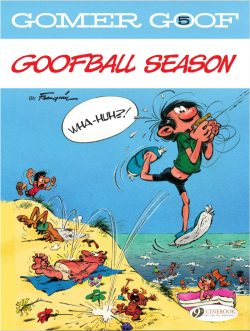
Gone With the Goof – Gomer Goof volume 3


By Franquin, Jidéhem & Delporte, translated by Jerome Saincantin (Cinebook)
ISBN: 978-1-84918-409-0 (PB Album/Digital edition)

Like so much in Franco-Belgian comics, it started with Le Journal de Spirou. The magazine had debuted on April 2nd 1938, with its engaging lead strip created by Rob-Vel (François Robert Velter). In 1943, publishing house Dupuis purchased all rights to the comic and its titular star, after which comic-strip prodigy Joseph Gillain (Jijé) took the helm for the redheaded kid’s exploits.

In 1946 Jijé’s assistant André Franquin was handed creative control. He gradually abandoned short gag vignettes in favour of extended adventure serials. Franquin introduced a broad, engaging cast of regulars and created phenomenally popular magical beast the Marsupilami. Debuting in 1952 (Spirou et les héritiers) the critter eventually became a spin-off star of screen, plush toy stores, console games and albums in his own right. Franquin continued crafting increasingly fantastic tales and absorbing Spirou sagas until his resignation in 1969.

Franquin was born in Etterbeek, Belgium on January 3rd 1924. Drawing from an early age, the lad only began formal art training at École Saint-Luc in 1943. When the war forced the school’s closure a year later, he found work at Compagnie Belge d’Animation in Brussels and met Maurice de Bévére (AKA Lucky Luke creator “Morris”), Pierre Culliford (Peyo, creator of The Smurfs and Benny Breakiron) and Eddy Paape (Valhardi, Luc Orient).

In 1945 all but Peyo signed on with Dupuis, and Franquin began his career as a jobbing cartoonist and illustrator, producing covers for Le Moustique and scouting magazine Plein Jeu. During those early days, Franquin and Morris were being tutored by Jijé, who was the main illustrator at LJdS. He turned the youngsters – and fellow neophyte Willy Maltaite (AKA “Will” – Tif et Tondu, Isabelle, Le jardin des désirs) – into a smoothly functioning creative bullpen known as La bande des quatre or “Gang of Four”. They would ultimately reshape and revolutionise Belgian comics with their prolific and engaging “Marcinelle school” style of graphic storytelling…

Jijé handed Franquin all responsibilities for the flagship strip part-way through Spirou et la maison préfabriqué (#427, June 20th 1946). He ran with it for two decades; enlarging the scope and horizons of the feature until it became purely his own. Almost every week fans would meet startling new characters such as comrade/rival Fantasio or crackpot inventor and Merlin of mushroom mechanics the Count of Champignac.

Spirou &Fantasio became globetrotting journalists, visiting exotic places, exposing crimes, exploring the fantastic and clashing with a coterie of bizarre and exotic arch-enemies. Throughout it all, Fantasio was still a full-fledged reporter for Le Journal de Spirou and had to pop into the office all the time. Sadly, lurking there was an accident-prone, smugly big-headed junior in charge of minor jobs and dogs-bodying. He was called Gaston Lagaffe

There’s a long history of fictitiously personalising the mysterious creatives and all those arcane processes they indulge in to make our favourite comics, whether its Stan Lee’s Marvel Bullpen or DC Thomson’s lugubrious Editor and underlings at The Beano and Dandy. Let me assure you that it’s a truly international practise and the occasional asides on text pages featuring well-meaning foul-up/office gofer Gaston – who debuted in #985, February 28th 1957 – grew to be one of the most popular and perennial components of the comic, whether as short illustrated strips or in faux editorial reports in text form.

On a strictly personal note, I still think current designation Gomer Goof (this name comes from an earlier, abortive attempt to introduce the character to American audiences) is unwarranted. The quintessentially Franco-Belgian tone and humour doesn’t translate particularly well (la gaffe translates as “blunder” not “idiot”) and the connotation contributes nothing here. When he surprisingly appeared in a 1970s UK Thunderbirds annual as part of an earlier syndication attempt, Gaston was rechristened Cranky Franky. Perhaps they should have kept that one or even his original designation…

In terms of actual schtick and delivery, older readers will recognise favourite beats of Benny Hill and Jacques Tati timeless elements of well-meaning self-delusion, whilst Britons will recognise recurring situations from Some Mothers Do Have ‘Em or Mr Bean. It’s slapstick, paralysing puns, infernal ingenuity and invention, pomposity lampooned and no good deed going noticed, rewarded or unpunished…

As previously stated, Gomer is employed (let’s not dignify or mis-categorise what he does as “work”) at the Spirou editorial offices: reporting to go-getting journalist Fantasio and generally ignoring the minor design jobs like paste-up he’s paid to handle. There’s also editing readers’ letters… the official reason why fans requests and suggestions are never answered…

Gomer is lazy, peckish, opinionated, ever-ravenous, impetuous, underfed, forgetful and eternally hungry, with his most manic moments all stemming from cutting work corners and stashing or illicitly consuming contraband food in the office…

This leads to constant clashes with police officer Longsnoot and fireman Captain Morwater, yet the office oaf remains eternally easy-going and incorrigible. Only two questions are really important here: why does Fantasio keep giving him one last chance, and what can gentle, lovelorn Miss Jeanne possible see in the self-opinionated idiot?

Originally released in 1987 as Gaston – Rafales de gaffes, this third compilation eschews longer cartoon tales and comedic text “reports” from the comic’s editorial page to deliver non-stop all-Franquin comics gags in single-page bursts. Here the office hindrance – as ever – invents stuff that makes life harder for everyone; sets driving records no one can believe; breaks laws physicists consider sacrosanct, upsets cops, firemen and clients and always, in all ways, lets down his colleagues and employers…

Many strips involve his manic efforts to modify the motorised atrocity he calls his car: an appallingly decrepit and dilapidated Fiat 509 auto(barely)mobile desperately in need of his many well-meant attempts to counter its lethal road pollution…

The remainder of the volume’s picture strip pandemonium encapsulates the imbecile’s attempts at getting rid of minor illnesses, ailments and new office innovations. Much is made of his latest  musical invention in the recurrent saga of his truly terrifying Brontosaurophone/ Goofophone as well the woes of automotive engineering Good Samaritanism; a distinctly novel approach to babysitting and work crèches; new lows in animal husbandry; an approach to cookery bordering on criminal perversity and fresh – if somewhat illegal – methods of advertising the magazine…

Far better enjoyed than précised or described, these strips allowed Franquin and occasional co-scenarists Yvan Delporte & Jidéhem (in reality, Jean De Mesmaeker: his analogue is a regular in the strips as an explosively irate and unfortunate foil for the Goof) to flex their whimsical muscles and even subversively sneak in some satirical support for their beliefs in pacifism and environmentalism. However, at their core the gags remain supreme examples of all-ages comedy: wholesome, barbed, daft and incrementally funnier with every re-reading.

Why aren’t you Goofing off yet?
© Dupuis, Dargaud-Lombard s.a. 2009 by Franquin. All rights reserved. English translation © 2018 Cinebook Ltd.

Spider-Man: India


By Jeevan J. Kang & Gotham Studios Asia, Suresh Seetharaman & Sharad Devarajan & various (MARVEL)
ISBN: 978-0-7851-1640-0 (TPB/Digital edition)

It’s a small world these days and petty hindrances like geography, culture and social preference are no longer a barrier to brand expansion for major properties. Sherlock Holmes and Mickey Mouse are universal, DC and Marvel heroes have long generated locally-sourced adventures on other continents and countless other fictional stars have been tailored to suit relatively closed markets.

That’s what happened in 2004 when Marvel’s most recognisable property was reinvented for the South East Asian region and its burgeoning comics industry. The instigator was Indian entrepreneur, film producer, educator, publisher and computer game impresario Sharad Devajaran whose subsequent experience includes digital entertainment platform Virgin Comics/Liquid Comics, and Graphic India. In 2013, he and Stan Lee co-created Indian superhero Chakra the Invincible

Before all that, Devajaran was co-founder, president and CEO of South East Asia’s leading comic book publisher Gotham Entertainment Group: spearheading the official introduction of Marvel, DC, Dark Horse, Cartoon Network and Warner Brothers properties like X-Men, The Hulk, Batman and Superman to a vast and vibrant new market. That naturally led to closer collaboration and in 2004 Marvel sanctioned a new iteration of the wondrous webspinner specifically tailored to the Indian market and broadly based on the first Toby Maguire Spider-Man movie from 2002. The result of South East meets West was dubbed the first comics “trans-creation”…

The idea was not new. Translated US comics had been syndicated across the world since before WWII and Japan especially had pioneered reworkings of top brands for conservative national readerships with the 1966-1967 “Battoman” – derived from the US Batman TV series, freely adapted by Jiro Kuwata – and Ryoichi Ikegami’s Spider-Man: The Manga (1970-1971) placing remastered wallcrawler Yu Komori in a Japanese setting s seen in Monthly Shonen Magazine.

Devised by Jeevan J. Kang, Suresh Seetharaman & Sharad Devarajan and illustrated by Kang & Gotham Studios Asia, it was released as a 4-issue miniseries for India: massaging the timeless legend in a way that eventually and inevitably became a part of the larger Marvel Multiverse…

This English language collection from 2005 was lettered by Virtual Calligraphy’s Dave Sharpe: a cross cultural collaboration that opens with a mysterious mystic foretelling in nightmares a shocking future for poor but brilliant teenager Pavitr Prabhakar. Recently moved to Mumbai with his guardians Uncle Bhim and Aunt Maya to take up a school scholarship, the boy has been marked for tragedy, loss and a great but dangerous life…

His low standing and status – he comes from a distant provincial village – make Pavitr a target for the rich kids in school, but for some reason the amazing and popular Meera Jain defends and befriends him…

Across the city, crime lord and sinister industrialist Nalin Oberoi is content. His Corporation thugs have razed an entire village, and the amulet he wants so badly is his. Now after an unholy ceremony he attains incredible power at an ungodly cost: transformed into a fire-spitting green devil. He does not yet realise that he is now a living gateway for an army of demons to invade the human plane…

Another bad at school ends with Pavitr again chased by vicious bullies. He’s saved by an old yogi who looks very familiar, and declares the boy has a great destiny. In a time when the gods have no avatars to set in humanity’s defence, the world must depend on a good person empowered by the forces of the intangible Web of Life. Filled with the Spider’s power clad in bold raiment, the boy is told to fulfil his karma…

Giddy with a sense of power, Spider-Man cavorts over the city and ignores the desperate cries of those in dire need, even as, far below, Uncle Bhim gives his life to save a woman from molesters. Pavitr is too late to save him but learns an immutable life lesson and thereafter dedicates himself to living with great responsibility…

Thus begins the saga of India’s Spider-Man, with a devil-driven analogues of Doctor Octopus and Venom also debuting as Oberoi kidnaps Maya and Meera Jain. The green rakshasa’s scheme to manifest Hell on Earth culminates in a monumental clash at a refinery as the boy hero deploys the divine magic amulet, and seeks to sever the debased villains’ connection to his demonic masters with courage, the power of the web of life and his innate purity…

Most Marvel US readers recognise Pavitr Prabhakar from assorted mainstream events like Secret Wars and Spider-Verse and their fallout spin-offs, where his uniqueness is rather lost and definitely downplayed. However, this initial outing offers a truly different spin on the webspinner and if you require a fresh taste or something a little different, this is well worth a visit.
© 2021 MARVEL.

One Beautiful Spring Day


By Jim Woodring (Fantagraphics Books)
ISBN: 978-1-68396-555-8 (TPB/Digital edition) 978-1-68396-588-6 (slipcased HB)

There have always been uniquely gifted, driven comics creators who defy categorisation… or even description. My picks for that elite pantheon of artisans includes Kirby, Ditko, Segar, Hergé, Herriman, Will Eisner, Osamu Tezuka, Robert Crumb, Daniel Clowes, Franquin, Frank Bellamy, Basil Wolverton, Mort Meskin, Kim Deitch, Joe Kubert, Carmine Infantino, Eric Bradbury, Frank Hampson, Tony Millionaire, Alex Niño, Neal Adams, Richard Corben, Wally Wood and a few others who all brought something utterly personal and universally influential to their work just beyond the reviewer’s skills (mine certainly) to elucidate, encapsulate or convey.

They are all perfect in their own way and so emphatically wonderful that no collection of praise or analysis can do them justice. You just have to read their stuff for yourself.

Arguably at the top of that distinguished heap of graphic glitterati sits Jim Woodring. It’s a position he has maintained for years and appears capable of holding for generations to come.

Woodring’s work has always been challenging, funny, spiritual, grotesque, philosophical, heartbreaking, beautiful and extremely scary. Moreover, even after reading and believing that sentence you will still be absolutely unprepared for what awaits the first time you encounter any of his books – and even more so if you’ve already seen everything he’s created.

Celebrated as a cartoonist, animator, fine artist, toy-maker and artistic Renaissance man, Woodring’s eccentric output has delighted far too small and select an audience since 1980 and his official mini-comics forays. Born in Los Angeles in 1952, Woodring suffered delusions and hallucinations as a child and regularly believed his parents wanted to kill him.

These traumas seemingly sensitized and attuned him to symbolism and pictorial expression as well as opening him to assorted philosophies and belief systems. The young lad managed his “apparitions” by drawing them as strips in the waking world where he had control of them. Overcoming problems with school, drugs and alcohol, Woodring was eventually diagnosed with autism and prosopagnosia, but by then he had a discovered the power of Art.

He turned his life around through his own determination and by the inspiration of comics masters like Kirby, Ernie Bushmiller, Gil Kane and Crumb, classical fantasists such as Pieter Brueghel, Hieronymus Bosch and particularly Salvador Dali, and the animations of the Fleischer Brothers, Tex Avery and Walt Disney.

Woodring found surcease from a lifetime of punishing dreams by pictorializing nightmares and through following Buddhism, Taoism and the Hindu philosophy of Vedanta. After working as a farm labourer, garbageman and TV cartoon animator – with occasional comics side jobs like colouring the Roy Thomas/Gil Kane adaptation of the Ring of the Nibelungs, illustrating 1997’s Smokey the Bear, Friend of the Forest, and scripting stints on Aliens and Star Wars – Woodring began fully sharing the messages from his subconscious. He had begun self-publishing his autobiographical, “autojournal” comics in 1980, and seven years later was picked up by Fantagraphics Comics and thereafter all of us…

Readers who avidly adored his groundbreaking, oneirically autobiographical magazine Jim and its notional spin-off series Frank (with graphic novel Weathercraft winning The Stranger 2010 Genius Award for Literature) were joined by fans of Tantalizing Stories, Seeing Things or more mainstream features like his Star Wars and Aliens tales for Dark Horse Comics but, always, there was the promise of greater surprises in his next story…

An accomplished storytelling technician these days, Woodring grows rather than constructs solidly surreal, abstractly authentic, wildly rational, primal cartoon universes, wherein his meticulous, clean-lined, sturdily ethereal, mannered blend of woodblock prints, R. Crumb landscapes, expressionist dreamscapes, religious art and monstrous phantasmagoria all live and play …and far too often, eat each other.

His stories follow a logical, progressional proto-narrative – often a surging, non-stop chase from one insane invention to the next – layered with multiple levels of meaning yet totally devoid of speech or words, boldly assuming the intense involvement of the reader will complete the creative circuit.

This compelling collection is available digitally but works best as the spiffy vellum-cased archival paperback or limited edition boxed hardback: each iteration a superbly recomposed compilation combining earlier segments of his constantly unfolding and refolding saga, now justifiably treated as a treasured artefact… and ideal gift…

Gathered – or maybe corralled – here are the previously-published contents of Congress of the Animals, Fran and Poochytown, all deftly rearranged and supplemented by a hundred pages of new and previously unseen material.

Set in the general environs of Woodring’s wickedly warped other place – “The Unifactor” – here is a wild, weird and welcome return to a land of constant change and intense self-examination, where all motives are suspect and all rewards should be regarded as a trap. And here cheerfully upbeat Frank goes for another exceptionally eventful walk in the sunshine…

Laminating this vertiginous vehicle with an even crueller patina is lovelorn tragedy and loss as Fran adds to the ongoing tribulations of dog-faced Frank: her own perilous perambulations of innocence lost displays pride, arrogance, casual self-deceit, smug self-absorption and inflated ego as big as her former beau’s and leads to a shattering downfall just as punishing.

Put bluntly, Fran was Frank’s wonderful girlfriend and through mishap, misunderstanding, anger and intolerance he lost her. Now, no matter what he does or wheresoever he wanders with his faithful sidekicks at his side, poor Frank just can’t make things right and perfect and good again. Through madcap chases, introspective exploration and the inevitable direly dreadful meetings and menacings in innumerable alternate dimensions, True Love takes a kicking …and all without a single word of dialogue or description.

Here, the drawn image is always king, even if the queen has gone forever – or is it just a day?

Many Woodring regulars return, as both Krazy Kat-like ingénues work things out on the run through a myriad of strange uncanny places. There are absolute mountains of bizarre, devilish household appliances, writhy clawing things, toothy tentacle things and the unspeakable Thingy-things inhabiting the distressingly logical traumic universe.

Jim Woodring’s work is not to everyone’s taste or sensibilities – otherwise why would I need to plug his work so earnestly? – and, as ever, these drawings have the perilous propensity to repeat like cucumber and make one jump long after the book has been put away, but he is an undisputed master of graphic narrative and affirmed innovator, always making new art to challenge us and himself. His is a dreamscape of affable terror and he is can make us love it and leave us hungry for more.

Are you feeling peckish yet…?
© 2022 Jim Woodring. This edition © 2022 Fantagraphics Books. All rights reserved.