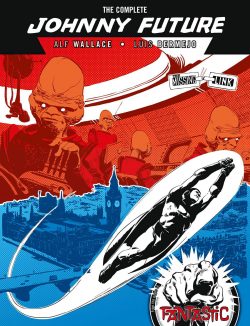
The Complete Johnny Future


By Alf Wallace, Luis Bermejo & various (Rebellion Studios)
ISBN: 978-1-78108-758-9 (HB)

Win’s Christmas Gift Recommendation: Evergreen Wonderment and an Ideal Last-Minute Gift… 10/10

Until relatively recently, Britain never really had a handle on superheroes. Although every reader from the 1950s on can cite a particular favourite fantasy muscle-man or costumed champion – from Thunderbolt Jaxon to Morgyn the Mighty, or Gadget Man & Gimmick Kid to the Spider, Tri-Man and Phantom Viking to Red Star Robinson and Billy the Cat (& Katie!) – to have populated our pages, they all somehow ultimately lacked conviction. Well, almost all…

During the heady Swinging Sixties days of “Batmania”, just as Marvel Comics was first infiltrating our collective consciousness, a little-remembered strip graced the pages of a short-lived experimental title and the result was sheer, unbridled magic…

With Scotland’s DC Thomson steadily overtaking their London-based competitors – monolithic comics publishing giant Amalgamated Press – throughout the late 1950s and 1960s, the sheer variety of material the southerners unleashed to compete offered incredible vistas in adventure material. Thanks to the defection of Leo Baxendale and Ken Reid to Amalgamated, they also found a wealth of anarchic comedy material to challenge the likes of the Bash Street Kids, Dennis the Menace, Minnie the Minx and their unruly ilk.

During that latter end of the period, the Batman TV show sent the entire world superhero crazy just as Amalgamated absorbed all its local rivals such as The Eagle‘s Hulton Press to form Fleetway/Odhams and ultimately IPC.

Formerly the biggest player in children’s comics, Amalgamated Press (created by Alfred Harmsworth at the beginning of the 20th century) had stayed at the forefront of sales by latching onto every fad: keeping their material contemporary, if not always fresh or original. The all-consuming monolith had been reprinting the early successes of Marvel comics for a few years; feeding on a growing fashion for US-style adventure which had largely supplanted the rather tired True-Blue Brit style of Dan Dare or DCT’s Wolf of Kabul or the Tough of the Track. A key point at that time was that although both part of the Mirror Group, Fleetway and Odhams were deadly rivals…

“Power Comics” was a sub-brand used by Odhams to differentiate their periodicals – which contained reprinted American superhero material – from the greater company’s regular blend of sports, war, western adventure and gag comics such as Buster, Valiant, Lion or Tiger. During this time, the Power weeklies did much to popularise budding Marvel characters and their shared universe in this country, which was still poorly served by distribution of the actual American imports.

The line began with Wham! – but only after the comic was well-established. Originally created by newly-ensconced Leo Baxendale, it launched on June 20th 1964. At the start, the title was designed as a counter to The Beano, as was Smash! (which launched February 5th 1966), but the tone of times soon dictated the hiving off into a more distinctive imprint, which was augmented by the creation of little sister Pow!

Pow! launched with a cover date of January 31st 1967, combining home-grown funnies such as Mike Higgs’ The Cloak,Baxendale’s The Dolls of St Dominic’s, Reid’s Dare-a-Day Davy, Wee Willie Haggis: The Spy from Skye and British originated thrillers such as Jack Magic and The Python with the now ubiquitous resized US strips: in this case Spider-Man and Nick Fury, Agent of S.H.I.E.L.D.

The next step was even bolder. Fantastic – and its sister paper Terrific – were notable for not reformatting or resizing the original US artwork whereas in Wham!, Pow! or Smash!, an entire 24-page yarn could be resized and squeezed into 10 or 11 pages, accompanied by British comedy and adventure strips.

These slick new periodicals – each with a dynamic back cover pin-up taken from Marvel Comics or created in-house by apprentice comics bods and future superstars Barry Windsor-Smith and Steve Parkhouse – reprinted US Superhero fare, supplemented by minimal amounts of UK originated filler and editorial.

Fantastic #1 debuted with cover-date February 18th 1967 (but was first seen in newsagents on Saturday 11th), revealing the origin stories of Thor, Iron Man and the X-Men, but from the get-go, savvy tykes like me were as engrossed by a short adventure serial also included to fill out the page count. The Missing Link was beautifully drawn and over the following year (February 18th 1967 – February 3rd 1968) would become a truly unique reading experience…

The series began inauspiciously as a kind of homegrown Incredible Hulk knock off. Oddly, editor and writer Alfred “Alf” Wallace crafted for the filler a tone very similar to that adopted by Marvel’s own Green Goliath when he became a small screen star a decade later…

The illustrator was the astoundingly gifted Luis Bermejo Rojo, a star of Spanish comics forced to seek work abroad after the domestic market imploded in 1956. He became a prolific contributor to British strips, working on a succession of moody masterpieces such as the Human Guinea Pig, Mann of Battle, Pike Mason, Phantom Force Five and Heros the Spartan, in a variety of genres, appearing in Girls Crystal, Tina, Tarzan Weekly, Battle Picture Library, Thriller Picture Library The Eagle, Buster, Boys World, Tell Me Why, Look and Learn and many more. He finally achieved a modicum of deserved acclaim in the 1970s, after joining fellow studio mates José Ortiz, Esteban Maroto and Leopoldo Sanchez working on adult horror stories for Creepy, Eerie and Vampirella.

I’m a big kid helplessly enmired in nostalgia, but to me his greatest moments were the year spent drawing Johnny Future…

The Missing Link – as the feature was entitled for the first 15 episodes – was disturbingly similar to TV’s Hulk of the 1970s. Superhumanly strong, tragically misunderstood, the strip combined human-scaled drama with lost world exoticism in the manner of King Kong, as can be see seen following Steve Holland’s incisive and informative Introduction ‘Welcome to the Future!’, when the drama opens in the wilds of Africa.

A bestial man-beast roams the veldt, swamps and mountains, until great white hunter Bull Belson comes to capture him, accompanied by secretary/photographer Lita Munro. The infamous tracker sees only profit in the mute beast, who, after much frustratingly destructive behaviour, is lured into captivity by an inexplicable attraction to Miss Munro…

To be fair, she has the brute’s interests at heart, attempting to befriend and teach the Link on the slow voyage back to England, but on reaching London Dock, the sideshow attraction is spooked by mocking labourers and breaks his bonds and cage…

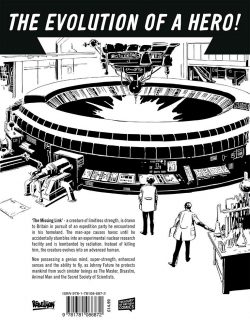
Brutally rampaging across the city at the heart of the Swinging Sixties, the Link is soon being hunted by the army, but nobody realizes that beneath the bestial brow is a cunning brain. Hopping a freight train up north, he seeks refuge in an isolated government atomic research laboratory run by Dr. Viktor Kelso and is accidentally dosed with vast transformative radiation…

The unleashed uncanny forces jumpstart an evolutionary leap, turning the primitive beast into a perfect specimen of manhood, while simultaneously sparking a near-catastrophic meltdown in the machinery, which is only averted by the massive instinctive intellect of the new man. Arrested as a terrorist spy, the silent superman is very publicly tried in court and again encounters Lita.

Meanwhile, Kelso has deduced the true course of events. As the Link uses his prison time to educate himself in the ways of the world, the scientist works on a deadly super-weapon, prompting the Link to escape jail and clear his name. With his super-strength and massive mind, the task is easy but he still needs Lita to complete his plan…

The series cheerfully plundered the tone of the times and the drama seamlessly morphs into chilling science fiction tropes as Kelso’s device brings the nation to a literal standstill leaving only the evolved outsider to thwart a staggeringly ambitious scheme…

Set on a new heroic path, although still a hunted fugitive, the Link creates a civilian identity (John Foster) and a costumed persona just as Britain is assaulted by ‘The Animal Man’: a psionic dictator able to control all beasts and creatures. Incredibly, that includes recently ascendant Johnny Future, but the villain is defeated after overextending himself and accidentally awakening a primordial horror from Jurassic times…

In short order, Johnny Future tackles Dr. Jarra and his killer robot; a society of evil world-conquering scientists, invention-plundering shapeshifting aliens, prehistoric giants, and deranged science tyrant The Master.

Fully hitting his stride, the future man overcomes personality warping psychopath Mr. Opposite and defeats the Secret Society of Science‘s top assassins ‘The Brain, The Brute and the Hunter’ before saving Earth from marauding living metal and defeating Dr. Plasto‘s animated waxwork killers.

And that was that. Without warning the comic merged with sister publication Terrific and there was no more room for a purely British superhero. Here, however, there’s one more delight: a 14-page, full-colour complete adventure with Johnny battling diabolical primordial revenant Disastro, first seen in Fantastic Annual 1968, plus a colour pin-up from Fantastic #30 (September 9th 1967).

Interest in superheroes and fantasy in general were on the wane and British weeklies were diversifying. Some switched back to war, sports and adventure stories, whilst with comedy strips on the rise again, others became largely humour outlets. Johnny Future (available in comforting hardback and accessible digital formats) is a unique beast: a blend of British B-movie chic, with classic monster riffs seen through the same bleak but compelling lens that spawned Doctor Who and Quatermass: the social sci fi of John Wyndham trying on glamourous superhero schtick whilst blending the breakneck pace of a weekly serial with the chilling moodiness of kitchen sink crime dramas.

There was never anything like this before or since and if you love dark edges to your comics escapism you must have this amazing collection far sooner than tomorrow.
™ & © 1967, 1968, & 2020 Rebellion Publishing Ltd. All Rights Reserved.
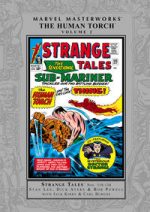
The Human Torch Marvel Masterworks volume 2

By Stan Lee, Larry Ivie, Dick Ayers, Bob Powell, Jack Kirby, Carl Burgos & various (Marvel)
ISBN: 978-0-7851-3505-0 (HB)

Win’s Christmas Gift Recommendation: Evergreen Superhero Frolics… 9/10

Hot on the heels of the Fantastic Four’s stunning success, Stan Lee & Jack Kirby spun the team’s most colourful and youngest member into his own series, eager to recapture the 1940s glory days when the Human Torch was one of the company’s “Big Three” superstars.

This captivating, esoteric and joyously exuberant collection of pure 1960s superhero shenanigans gathers those the latter end of those eclectic but crucial yarns from Strange Tales #118 to 134, (spanning March 1964 to July 1965) and comes with an evocative Introduction from Bruce Canwell before all the hot action kicks off…

Filled with fabulous classics of old school Marvel Fights ‘n’ Tights mayhem and mirth, this particular compendium (available in scarce but sturdy Hardback and assorted eBook formats) is a perfect antidote to angst overload.

Within a year of FF #1, magic-&-monsters anthology Strange Tales became the home for our hot-headed hero as issue #101 saw mostly-typical teenager Johnny Storm start an ancillary solo career. The non-stop riot of adventure begins here with Stan Lee & Dick Ayers highlighting the return of envy-obsessive hyper-intellectual the Wizard who has yet another go at the Flaming Kid in ‘The Man Who Became the Torch!’, an act which consequently nearly kills the Thing and Reed Mister Fantastic Richards besides.

A first brush with Marvel’s soon-to-be core readership came in #119. ‘The Torch Goes Wild!’ details how Commie AgentRabble Rouser mesmerises decent citizens, making them surly and rebellious, after which Jack Kirby pops back for #120 as ‘The Torch Meets Iceman!’: a terrific action-extravaganza with Ayers inks that pretty much closes the glory days of this strip. From then on, despite every gimmick – and occasional burst of sheer inspiration the Bullpen could muster – a slow decline sets in as quirky back-up strip Doctor Strange grew in popularity and cover space…

ST #121 sees Johnny as ‘Prisoner of the Plantman!’ (by Lee & Ayers) and #122 finds a thug, a conman and a crooked yogi all augmented by Dr. Doom and mustered as a woefully inadequate Terrible Trio ordered to launch an ill-conceived attack in ‘3 Against the Torch!’

Strange Tales #123 has a creepy inventor build himself an impressive insectoid exo-suit to get rich the easy way, as – in an effort to boost ratings – The Thing becomes a permanent fixture in ‘The Birth of the Beetle!’

This saga was most notable for the pencil job by Golden Age Human Torch originator Carl Burgos, after which Johnny and Ben tackle a fully re-designed ‘Paste-Pot Pete’ (Ayers inked by Paul Reinman) before going after another old adversary in ‘The Sub-Mariner Must Be Stopped!’

‘Pawns of the Deadly Duo!’ host a fresh assault by the Puppet Master, allied to the Mad Thinker in a smart yarn, after which #127 pits Ben and Johnny against a bizarre and baffling puzzle thanks to ‘The Mystery Villain!’

After a stunning Kirby pin-up of the Thing, the Fantastic Two then unwillingly battle ‘Quicksilver and the Scarlet Witch’in #128 (this one inked by Frankie Ray, AKA Frank Giacoia), as the Homo Superior siblings make an abortive first attempt to quit Magneto‘s Brotherhood of Evil Mutants, after which ‘The Terrible Trio!’ once more fail to impress or assassinate our heroes…

Pop culture at its most opportunistic reeled and staggered with #130 in ‘Meet the Beatles’ (not villains, but actually some sort of popular musical combo of the times, whom they actually didn’t meet at all), although sublime Golden Age artist Bob Powell (with inking from Chic Stone) did take over the art chores for the comedy of errors/crime caper.

Ayers returned to ink #131, a frankly dire Lee script entitled ‘Bouncing Ball of Doom!’, with the Mad Thinker siccing a cybernetic bowling bowl on our torrid twosome before Larry Ivie scripts a capable Space Race thriller in ‘The Sinister Space Trap!’ (inked by Mike Esposito under his Mickey DeMeo alias).

Lee returned for the last two Torch tales in ST #133 and #134: beginning with sharp-looking saga ‘The Terrible Toys’, wherein Puppet Master tries a new modus operandi and closing with ‘The Challenge of… The Watcher!’ (inked by the majestic Wally Wood) wherein Torch and Thing are transported to ancient Camelot to battle time-reaver Kang the Conqueror.

It was clear the writer’s mind was elsewhere, most likely with the new Nick Fury, Agent of S.H.I.E.L.D. strip that would replace the FF pair from Strange Tales #135 onwards.

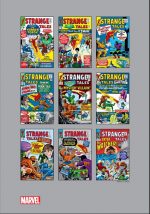
Wrapping up this memory lane meander is a tantalising cover gallery from the 1974-75 reprint series of Golden and Silver Age Torch Tales, rendered by John Romita, Joe Sinnott, Larry Lieber, Ron Wilson, Frank Giacoia, Gil Kane, Al Milgrom &Vince Colletta, to complete your visit with the hottest duo in early Marvel history.

It’s remarkable to note that as the parent Fantastic Four title grew in scope and quality, the Human Torch’s own series diminished. Perhaps there is something to be said for concentrating one’s efforts or not overexposing your stars. Maybe it was just having Kirby do some plotting? Here, however, what was originally a spin-off for younger readers faded as Marvel found its voice and its marketplace, although there would be periodic efforts to reinvigorate the Torch.

Perhaps the historic value supersedes the quality of most of these strange tales, but there’s still a great deal that’s great about this series and Costumed Drama devotees with a sense of tradition and love of fun will find this book irresistible and unmissable.
© 2020 MARVEL.

Justice League of America: A Celebration of 60 Years


By Gardner Fox, Dennis O’Neil, Steve Englehart, Gerry Conway, Keith Giffen, J.M. DeMatteis, Grant Morrison, Mark Waid, Brad Meltzer, Geoff Johns, Scott Snyder, Mike Sekowsky, Dick Dillin, George Pérez, Pat Broderick, Carmine Infantino, Jim Aparo, Dick Giordano, Gil Kane, Brian Bolland, Joe Kubert, Chuck Patton, Kevin Maguire, Howard Porter, Ed Benes, Jim Lee, Jim Cheung & various (DC Comics)
ISBN: 978-1-4012-9951-4 (HB)

Win’s Christmas Gift Recommendation: Comic Perfection and the ideal Stocking Stuffer… 10/10

A keystone of the DC Universe, the Justice League of America is the reason we have comics industry today. This stunning compilation – part of a series reintroducing and exploiting the comics pedigree of veteran DC icons and concepts – is available in hardback and digital formats and offers a too-brief but astoundingly enticing sequence of snapshots detailing how the World’s Greatest Superheroes came to be, and be and be again…

Collecting material from The Brave and the Bold #28; Justice League of America #29, 30, 77, 140, 144, 200; Justice League of America Annual #2, Justice League #1, 43 and Justice League of America volume 4 #1 (covering July 1960- August 2018), the landmarks selected are all preceded by a brief critical analysis of the significant stages in their development, beginning with Part I – 1960-1964: The Happy Harbor Years …

After the actual invention of the comicbook superhero – by which we mean the launch of Superman in June 1938 – the most significant event in the industry’s progress was the combination of individual sales-points into a group. Thus, what seems blindingly obvious to everyone with the benefit of four-colour hindsight was irrefutably proven – a number of popular characters could multiply readership by combining forces. Plus of course, a whole bunch of superheroes is a lot cooler than just one – or even one and a sidekick…

The Justice Society of America is rightly revered as a true landmark in the development of comic books, and – when Julius Schwartz began reviving and revitalising the nigh-defunct superhero genre in 1956 – the true key moment came a few years later with the inevitable teaming of his freshly reconfigured mystery men…

When wedded to the relatively unchanged big guns who had weathered the first fall of the Superhero at the beginning of the 1950s, the result was a new, modern, Space-Age version of the JSA and the birth of a new mythology.

That moment that changed everything for us baby-boomers came with issue #28 of The Brave and the Bold, a classical adventure title that had recently become a try-out magazine like Showcase.

Just in time for Christmas 1959, ads began running…

“Just Imagine! The mightiest heroes of our time… have banded together as the Justice League of America to stamp out the forces of evil wherever and whenever they appear!”

When the Justice League of America was launched in issue #28 of The Brave and the Bold (March 1960) it cemented the growth and validity of the genre, triggering an explosion of new characters at every company producing comics in America and even spread to the rest of the world as the 1960s progressed.

Crafted by Gardner Fox & Mike Sekowsky with inking from Bernard Sachs, Joe Giella & Murphy Anderson, ‘Starro the Conqueror!’ saw Flash, Green Lantern, Wonder Woman, Aquaman and J’onn J’onzz – Manhunter from Mars unite to defeat a marauding alien starfish whilst Superman and Batman stood by (in those naive days editors feared that their top characters could be “over-exposed” and consequently lose popularity). The team also picked up an average American kid as a mascot. “Typical teenager” Snapper Carr would prove a focus of fan controversy for decades to come…

The series went from strength to strength and triumph to triumph, peaking early with a classic revival as the team met the Justice Society of America, now sensibly relegated to an alternate Earth rather callously designated Earth-2.

From issues #29-30, ‘Crisis on Earth-Three’ and ‘The Most Dangerous Earth of All!’ reprise the first groundbreaking team-up of the JLA and JSA, after the metahuman marvels of yet another alternate Earth discover the secret of multiversal travel. Unfortunately, Ultraman, Owlman, Superwoman, Johnny Quick and Power Ring are ruthless villains from a world without heroes who see the costumed crusaders of the JLA and JSA as living practice-dummies to sharpen their evil skills upon…

With this cracking 2-part thriller a tradition of annual summer team-ups was solidly entrenched in heroic lore, giving fans endless joys for years to come and making the approaching end of school holidays less gloomy than they could have been.

Although a monster hit riding a global wave of popularity for all things masked and caped, the JLA suffered like all superhero features when tastes changed as the decade closed. Like all the survivors, the team adapted and changed…

A potted history of that interregnum, emphasising the contributions of iconoclastic scripters Denny O’Neil and Steve Englehart follows in Part II – 1969-1977: The Satellite Years after which groundbreaking issue #77 exposes a new kind of America.

America was a bubbling cauldron of social turmoil and experimentation at this time, with established beliefs constantly challenged and many previously cosy comics features were using their pages to confront issues of race, equality, and ecological decline. O’Neil and his young colleagues began to utterly redefine superhero strips with their relevancy-driven stories; transforming complacent establishment masked boy-scouts into uncertain, questioning champions and strident explorers of the revolution.

Here, the team’s mascot suddenly grows up and demands to be taken seriously. The drama commences with the heroes’ collective confidence and worldview shattered as enigmatic political populist Joe Dough suborns and compromises their beloved teen sidekick in ‘Snapper Carr… Super-Traitor!’ Crafted by O’Neil, Dick Dillin & Joe Giella, the coming-of age-yarn changed the comfy, cosy superhero game forever…

By March 1977, the team was back in traditional territory but still shaking up the readership. Issue #140, by Steve Englehart, Dick Dillin & Frank McLaughlin questioned heroism itself in ‘No Man Escapes the Manhunter!’ as the venerable Guardians of the Universe and their beloved Green Lanterns are accused of planetary extinctions – until the JLA expose a hidden ancient foe determined to destroy galactic civilisation…

Sadly, all you get here is the opening chapter, but it’s worth tracking down the entire saga elsewhere…

Closely following is issue #144 ‘The Origin of the Justice League – Minus One!’ (July 1977) by the same team. Here Green Arrow does a little checking and discovers the team have been lying about how and why they first got together: a smart and hugely enjoyable conspiracy thriller guest-starring every late 1950’s star in the DC firmament…

Change is a comic book constant and events described in the essay fill in crucial context before Part III: The Detroit Years 1982-1987 precis’ the first Beginning of the End for the World’s Greatest Superheroes, starting with blockbuster anniversary giant #200.

Here scripter Gerry Conway and artists George Pérez, Pat Broderick, Carmine Infantino, Jim Aparo, Dick Giordano, Gil Kane, Brian Bolland, Joe Kubert, Brett Breeding, Terry Austin & Frank Giacoia reprise, re-evaluate and relive the alien Appellax invasion that brought the heroes together in ‘A League Divided’: a blockbuster saga involving every past member…

Big changes began in Justice League of America Annual #2 1984. ‘The End of the Justice League!’ by Conway, Chuck Patton & Dave Hunt saw the team disband following a too-close-to-call alien attack, leading Aquaman to recruit a squad of full-time agents rather than part-time champions. Relocating to street level in Detroit, his old guard veterans Elongated Man, Martian Manhunter, Zatanna and Vixen also began training a next generation of costumed crusaders…

The biggest innovation came after a couple of publishing events recreated the universe and a new kind of team was instituted. In 1986 DC’s editorial leaders felt their 50-year continuity was stopping them winning new readers. The solution was a colossal braided-mega series to streamline, redefine and even add new characters to the mix.

The worlds-shattering, reality-altering bombast of Crisis on Infinite Earths was such a spectacular commercial success, those movers-&-shakers felt more than justified in revamping a number of their hoariest icons for their next fifty years of publishing. As well as Superman, Flash, and Wonder Woman, the moribund and unhappy Justice League of Americawas earmarked for a radical revision. Editor Andy Helfer assembled plotter Keith Giffen, scripter J.M. DeMatteis and untried penciller Kevin Maguire to produce an utterly new approach to the superhero monolith: they played them for laughs…

The series launched as Justice League with a May 1987 cover-date before retitling itself as Justice League International with #7. The new team was formed from the ashes of the old on the basis of events comprising follow-up crossover-event Legends. The gathering comprised a roster of relative second-stringers as America’s newest champions – Black Canary, Blue Beetle, Captain Marvel (now Shazam!), Dr. Fate, Green Lantern Guy Gardner and Mr. Miraclewith heavyweights Batman and Martian Manhunter J’onn J’onzz as nominal straight-men.

The first story introduced charismatic filthy-rich manipulator Maxwell Lord – who used wealth and influence to recreate the neophyte and rather shambolic team who started their march to glory by fighting and defeating a bunch of rather inept terrorist bombers in initial outing ‘Born Again’ (Giffen, DeMatteis Maguire & Terry Austin).

An eventful decade passed and the team were rebooted again, as described in Part IV: The Watchtower Years 1986-2003

After the Silver Age’s greatest team-book died a slow, painful, wasting death, not once but twice, DC were taking no chances with their next revival of the Justice League of America, tapping Big Ideas wünderkind Grant Morrison to reconstruct the group and the franchise.

The result was a gleaming paradigm of comic book perfection which again started magnificently before gradually losing the attention and favour of its originally rabid fan-base. Apparently, we’re a really fickle and shallow bunch, us comics fans…

That idea that really clicked? Put everybody’s favourite Big-Name superheroes back in the team.

It worked, but only because as well as name recognition and star quantity, there was a huge input of creative quality. The stories were smart, fast-paced, compelling, challengingly large-scale and drawn with effervescent vitality. With JLA you could see all the work undertaken to make it the best it could be on every page.

The drama begins in ‘Them!’ (January 1997 by Morrison, Howard Porter & John Dell) as a family of alien super-beings called the Hyperclan dramatically land on Earth and declare that they’re going to usher in a new Golden Age – at least by their standards.

Almost simultaneously the current iteration of the Justice League is attacked in their orbital satellite and only narrowly escape utter destruction. Tragically, one of their number does not survive…

Hyperclan’s very public promises to make Earth a paradise and attendant charm offensive does not impress veteran heroes Superman, Batman, Wonder Woman, Martian Manhunter and Aquaman or even the latest incarnations of Flash and Green Lantern.

These legends see their methods and careers questioned and are not impressed by seeming miracles or summary executions of super-criminals in the streets. They know there’s something not right about the overbearing sanctimonious newcomers…

The hits kept coming: a strung of superb adventures that enticed the readership. One of the very best and often cited as one of the best Batman stories ever created, multi-part paean to paranoia Tower of Babel saw immortal eco-terrorist Ra’s Al Ghul‘s latest plan to winnow Earth’s human population to manageable levels well underway. Again, only the first instalment is here but you know where else to look…

Issue #43 declared ‘Survival of the Fittest’ (by Mark Waid, Porter & Drew Geraci), as a series of perfectly planned pre-emptive strikes cripple Martian Manhunter, Flash, Wonder Woman, Aquaman, Plastic Man and Green Lantern whilst Batman is taken out of the game by the simple expedient of stealing his parents’ remains from their graves…

Comics stars increasingly became multi-media franchises at the beginning of this century, and Part V: The Crisis Years 2006-2011 acknowledges the change as the printed form started a constant stream of ever-escalating blockbuster scenarios to compete. A perfect example is Justice League of America volume 4 #1 (October 2006) as Brad Meltzer, Ed Benes & Sandra Hope examine ‘Life’.

Thanks to the events Infinite Crisis, One Year Later and 52, Superman, Batman and Wonder Woman convene as a star-chamber to reform the Justice League of America as a force for good, only to discover that events have escaped them and a new team has already congealed (I really can’t think of a better term) to defeat the imminent menace of Professor Ivo, Felix Faust and the lethal android Amazo, plus a fearsome mystery mastermind and a few classic villains as well.

The tale is told through the heartbreaking personal tragedy of the Red Tornado, who achieves his deepest desire only to have it torn from him: an enjoyable if complex drama that hides its true purpose – that of repositioning the company’s core team in an expanded DCU which encompasses all media, tacitly accepting influences from TV shows, movies and animated cartoons underpinning everything – even the Super Friends and Justice League Unlimited-inspired HQ.

In 2011, DC took a draconian leap: restarting their entire line and continuity with a “New 52”. Justice League volume 2 #1 (November) led from the front as ‘Justice League Part One’ by biggest guns Geoff Johns, Jim Lee & Scott Williams introduced a number of newly debuted heroes acrimoniously pulled together to fight an alien invader called Darkseid…

This celebration concludes with Part VI: The Media Era 1986-2018 and Justice League volume 4 #1 (August 2018) wherein Scott Snyder, Jim Cheung & Mark Morales kick off a colossal, years-long company-wide event. ‘The Totality Part 1’ sees the universe fall apart, its creator escape eternal imprisonment and the JLA hard-pressed to prevent the final triumph of Evil as represented by Lex Luthor and his Legion of Doom…

Adding immeasurably to the wonderment is a superb gallery of covers by Sekowsky, Anderson, Rich Buckler, Dillin & McLaughlin, Pérez, Patton & Giordano, Maguire & Austin, Porter, Dell & Geraci, Ed & Mariah Benes, Lee & Williams and Jim Cheung.

The Justice League of America has a long, proud history of shaking things up and providing dynamic provocative, drama delivered with quality artwork. This compelling assortment is staggeringly entertaining and a monolithic testament to the inestimable value of a strong core concept matured over decades of innovation.
© 1960, 1964, 1969, 1977, 1982, 1984, 1987, 1997, 2000, 2006, 2005, 2011, 2018, 2020 DC Comics. All Rights Reserved.

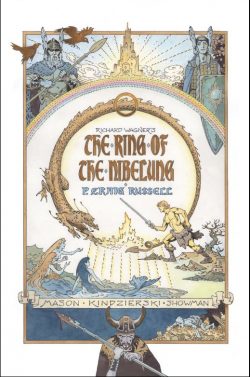
Richard Wagner’s The Ring of the Nibelung


Adapted by P. Craig Russell, translated by Patrick Mason, with Lovern Kindzierski & Galen Showman (Dark Horse)
ISBN: 978-1-61655-401-9 (HB) eISBN 978-1-63008-154-6

Win’s Christmas Gift Recommendation: Classical Comic Perfection! 10/10

P. Craig Russell began his illustrious career in comics during the early 1970s and came to fame early with a groundbreaking run on science fiction adventure series Killraven, Warrior of the Worlds. His fanciful, meticulous classicist style was derived from the great illustrators of Victorian and Edwardian heroic fantasy and was greatly at odds with the sausage-factory deadlines and sensibilities of the mainstream comicbook industry.

By the 1980s he had largely retired from the merciless daily grind, preferring to work on his own projects (mostly adapting operas and plays into sequential narratives) whilst undertaking occasional high-profile Special Projects for the majors – such as Dr. Strange Annual 1976 (totally reworked and re-released as the magnificent Dr. Strange: What Is It that Disturbs You, Stephen? in 1996) or Batman: Robin 3000.

As the industry grew up and a fantasy boom began, he returned to comics with Marvel Graphic Novel: Elric (1982), further adapting Michael Moorcock’s iconic sword-&-sorcery star in the magazine Epic Illustrated and elsewhere.

Russell’s stage-arts adaptations had begun appearing in 1978: firstly in groundbreaking independent Star*Reach specials Night Music and Parsifal and then, from 1984, at Eclipse Comics where the revived Night Music became an anthological series showcasing his earlier experimental adaptations: not just operatic dramas but also tales from Kipling’s Jungle Books and others.

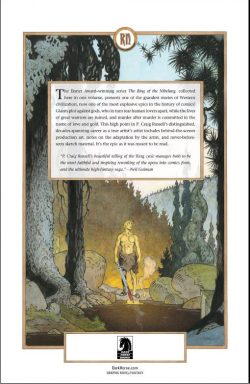
As mainstream comics matured, his stylings could be seen in Vertigo titles such as The Sandman or Mike Mignola’s Hellboy titles. He never, however, abandoned his love of operatic drama. In 2003 Canadian publisher NBM began a prodigious program to collect all those music-based masterpieces into The P. Craig Russell Library of Opera Adaptations, but just before that, the artist took a couple of years (2000 and 2001) to complete a passion project. Originally released as a succession of linked miniseries – The Ring of the Nibelung: The Rhinegold #1-4, The Ring of the Nibelung: The Valkyrie#1-3, The Ring of the Nibelung: Siegfried #1-3 and The Ring of the Nibelung: Götterdämmerung #1-4, Russell and his regular collaborators Lovern Kindzierski adapted Richard Wagner’s masterpiece to comics. His wasn’t the first, but it’s most certainly the best.

Collected in a stunning hardback volume (also available digitally) the Teutonic saga is augmented by a Preface from music critic and scholar Michael Kennedy, an Introduction by comics star Matt (no relation)Wagner, and is followed by Russell’s fascinating, heavily-illustrated essay ‘What is an Adaptation?’ describing his thinking, creative process and philosophy in the crafting of this epic, offering an intimate peek into how the magic was made along with as a range of pencil, ink and/or fully-coloured sketches and art studies as well as the entire gallery of covers from the original comics.

The four operas Das Rheingold, Die Walküre, Siegfried and Götterdämmerung (or Twilight of the Gods if you’re less pompous or well-travelled than me) is a classic distillation of Germano-Norse myth and the classic poems collected as the Icelandic Eddas. Over 26 years the master of German music distilled them into a cycle of staggering power, which people either love or hate. Great tunes, too.

Doesn’t absolutely everybody love the brilliant animated tribute-come-distillation starring Bugs Bunny entitled ‘What’s Opera, Doc?’ They probably refer to it as ‘Kill the Wabbit!’, though.

Joking aside, the Ring Cycle is a true masterpiece of Western Culture and an immortal inspiration to purveyors of drama and historic fiction. In 1989 and 1990 long-time fans and comics superstars Roy Thomas (who had already integrated the plot into the canon of Marvel’s Mighty Thor) and Gil Kane produced a 4-part, prestige-format miniseries that adapted the events into comic strip form and it’s superbly impressive, but trust me Russell’s is in a league of its own.

Bold, bright, glittering and tightly adhering to the rhythms and staging of the theatre version – thanks to translator Patrick Mason’s deft contribution – it begins with the creation of the world

Alberich the Nibelung is a dwarf shunned by all, but still manages to outwit the three Rhine Maidens. Commanded to guard an accursed treasure horde t even the Gods cannot tame, the river nymphs reveal the secret to the glib intruder. Whoever casts The Rhinegold into a ring will have all the wealth and power of the world, but must forever forswear love and joy. Never having known either, greedy Alberich readily forsakes these joys and seizes the treasure even All-Father Voton feared to touch.

Meanwhile, wily Logé has convinced Voton to promise giants Fasolt and Fafnir anything they wish if they build the great castle Valhalla to house the world’s heroes. Assured that the trickster god can free him from his promise to the giants, the all-father and Preserver of Oaths accepts their price, but on completion the giants want Freia; goddess of the apples of immortality.

Bound by their Lord’s sworn oath the gods must surrender Freia, but malicious Logé suggests that Alberich’s stolen gold – now reshaped into a finger-ring – can be used by any other possessor without abandoning love. The brothers demand the world-conquering trinket as a replacement fee and no god can sway or deter them. The course is set to disaster!

Second miniseries The Valkyrie sees an earthly warrior who calls himself “Woeful” as the sole survivor of a blood-feud. Fleeing, he claims Right of Hospitality from a beautiful woman in a remote cottage. But when her husband Hunding returns, they discover that he belongs to the clan Woeful recently slaughtered so many of.

Secure for the night in the holy bond of Hospitality, Woeful realises he must fight for his life in the morning when the sacred truce expires. Without weapons, he thinks little of his chances until the woman reveals to him a magic sword embedded in the giant Ash tree that supports the house. Sadly, the gods have decreed there can be no happy ending to be won, only further sin and shame and the fall of Voton’s most beloved servant Brunhildé!

Sixteen years later, Siegfried is the child of an illicit union, raised by malicious, cunning Mime, a blacksmith who knows the secrets of the Nibelung. No loving parent, the smith wants the indomitable wild boy to kill the dragon Fafnir – who was once a giant – and steal the magical golden horde the monster so jealously guards.

But the young hero has his own heroic dreams and wishes to wake an otherworldly maiden who slumbers eternally behind a wall of fire!

Years of plotting and treachery and inescapable burden culminate in Götterdämmerung, as all the machinations, faithlessness and oath-breaking of the flawed divinities lead to ultimate destruction. Siegfried has won his beauteous Brunhildé from the flames but their happiness is not to be. False friends Hagen and Gunther drug him to steal his beloved, and betroth the befuddled hero to a woman he does not love. Final betrayal by a comrade whose father was Alberich leads to his death and the inevitable fall of all that is!

If you know the operas you know how much more remains to enjoy in this quartet of tales, and the scintillating passion and glowing beauty the art magnificently captures the grandeur and tragedy of it all. This primal epic is visual poetry and no fan should be without it.
© 2000, 2001, 2014 P. Craig Russell. All rights reserved.

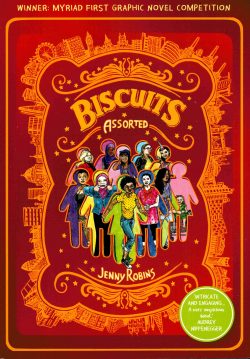
Biscuits Assorted


By Jenny Robins (Myriad Editions)
ISBN: 978-1-91240-82-90 (TPB)

Win’s Christmas Gift Recommendation: Utterly Captivating Human-Scaled Enticement… 10/10

There’s a 1944 Powell & Pressburger film called A Canterbury Tale, where a group of disparate but loosely associated characters weave in and out of each other’s klives for a defined period, gradually proceeding towards a shared denouement. It’s about far more than that and is really good. You should see it.

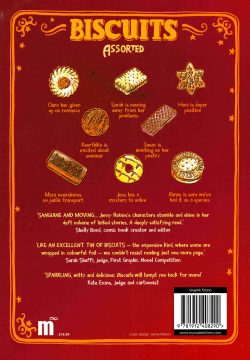
Biscuits Assorted is a bit like that, but also completely different. You should read it. It’s really, Really good.

Artist, teacher, Small Press artisan and author Jenny Robins is clearly a keen observer and gifted raconteur deftly attuned to nuance and ambiance and quite possibly hopelessly in love with London. Her award-winning debut graphic novel is a paean to modern living in the city, recounted through overlapping snapshots of many women’s lives in the months of June, July and August of a recent year (and don’t worry about which one).

If you need the metaphor explained, there are different varieties and, occasionally, they don’t do what it says on the tin…

Seriously though, here in captivating monochrome linework are a plethora of distinct and well-round individuals of differing ages and backgrounds working, playing, living, dying, risking, winning, failing and constantly interacting with each other to a greater or lesser extent, all united by place, circles of friends, shared acquaintances and enjoying – for once – full access to their own unexpurgated voices.

Strangers or intimates, life-long or Mayfly-momentary, this addictively engaging collection of incidents and characters all share locations and similar pressures as they go about their lives, but the way in which they all impact upon each other is truly mesmerising. I’m a bluff old British codger and I’ve met these very women and girls all my life, except for those who are completely new to my white male privileged experience. Now, however, I know what they’re like and what they’ve been thinking all this time…

And it’s outrageously funny and terrifying elucidating, rude in all the right ways and places and able to break your heart and jangle the nerves with a turn of a page.

Biscuits Assorted is a brilliant and revelatory picaresque voyage that is impossible to put down and certain to become a classic of graphic literature. It’s also the most fun you can have with your brain fully engaged.

Yesterday we published our Top Ten of 2020. Be sure to add this to the list. We did.
© Jenny Robins 2020. All rights reserved.

Win’s Top Ten Best and Most Enjoyable MUST READ THIS List 2020

What a year it’s been. I’m not talking about the other stuff. I can’t do anything about that. As usual, I’m waffling on about comics and 2020 has seen some absolute graphical wonders released: so much so that I’m about to do a thing I hate and list some.

Not all of them; that would be silly and achieve nothing. Just the ones that impressed me and that I liked most. There isn’t a countdown and my top ten has more than ten in it. They moved and delighted me the most, stood rereading best and were the ones published last year that I would be proudest to give other people to read as examples of what my chosen medium can accomplish.

The titles are all linked to the original reviews so you can say you researched them too, but frankly your best bet would be to just unhitch your payment method and order them all without wasting any more time.

Ready.

Here we go then…

Blackwood by Hannah Eaton (Myriad Editions)

Giant by Mikaël, (NBM)

Two Dead by Van Jensen & Nate Powell (Gallery 13/Simon & Schuster)

The Wolf of Baghdad by Carol Isaacs/The Surreal McCoy (Myriad Editions)

Victory Point by Owen D. Pomery (Avery Hill)

Red Mother with Child by Christian Lax (NBM/Musée du Louvre Éditions)

Mongrel by Sayra Begum (Knockabout)

The Emotional Load and Other Invisible Stuff by Emma (Seven Stories Press)

The Impending Blindness of Billie Scott by Zoe Thorogood (Avery Hill)

The Silent Invasion: Abductions by Michael Cherkas, Larry Hancock & Paul McCusker (NBM)

Leonardo2 by Stéphane Levallois (NBM/Musée du Louvre Éditions)

What We Don’t Talk About by Charlot Kristensen (Avery Hill)

Plutocracy by Abraham Martínez (NBM)


I just realised most of those might be challenging or uncomfortable reading for (the parents of) our younger followers. If so here’s another Winning List. These have none of the swear words or rude bits – although there’s a modicum of wholly acceptable violence…

Oi Kids! Get these!

Take it Away, Tommy! by Georgia Dunn (Andrews McMeel)

A Portrait in Poems by Evie Robillard & Rachel Katstaller (Kids Can Press)

Bigby Bear: The Explorer by Philippe Coudray (BiG-Humanoids/Simon Icke)

Elvis Puffs Out by Georgia Dunn (Andrews McMeel)

Bluebeard: A Feminist Fairy Tale by Metaphrog (Papercutz)

Conan the Barbarian Epic Collection by Roy Thomas & Barry Windsor-Smith (Marvel)

Brina the Cat by Giorgio Salati & Christian Cornia, with Erika Turbati, (Papercutz)

The Flood That Did Come by Patrick Wray (Avery Hill)

Beano and Dandy: A Celebration of Dudley D Watkins (DCT)


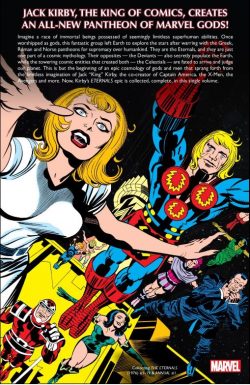
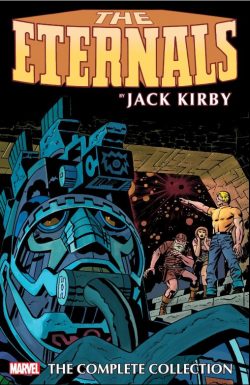
The Eternals by Jack Kirby: The Complete Collection


By Jack Kirby & various (Marvel)
ISBN: 978-1-3029-2200-9 (TPB)

Win’s Christmas Gift Recommendation: Monumental Marvel Magic for Movie-Oriented Fun Seekers… 9/10

Jack Kirby was – and remains – the most important single influence in the history of American comics. There are millions of words about what the man has done and meant, and you should read those if you are at all interested in our medium.

Naturally, I’m adding my own two-bobs’-worth, pointing out what you probably already know: Kirby was a man of vast imagination who translated big concepts into astoundingly potent and accessible symbols for generations of fantasy fans. If you were exposed to Kirby as an impressionable kid, he owns you for life. To be honest, the same probably applies whatever age you jump aboard the “Kirby Express”…

For those of us who grew up with Jack, his are the images which furnish our interior mindsets. Close your eyes and think “robot” and the first thing that pops up is a Kirby creation. Every fantastic, futuristic city in our heads is crammed with his chunky, towering spires. Because of Jack, we all know what the bodies beneath those stony-head statues on Easter Island look like, we’re all viscerally aware that you can never trust great big aliens parading around in their underpants and, most importantly, we know how cavemen dress and carnosaurs clash. Kirby’s creations are magical: they all inspire successive generations of creators to pick up the ball and keep running with it…

In the late 1930s, it took a remarkably short time for Kirby and his creative partner Joe Simon to become the wonder-kid dream-team of the newborn comic book industry. Together they produced a year’s worth of pioneering influential monthly Blue Bolt; dashed out Captain Marvel Adventures (#1) for overstretched Fawcett and – after Martin Goodman appointed Simon editor at Timely Comics – co-created a host of iconic characters such as Red Raven, the original Marvel Boy, Mercury, Hurricane, The Vision, Young Allies and of course million-selling mega-hit icon Captain America.

When Goodman failed to make good on his financial obligations, Simon & Kirby were snapped up by National/DC, who welcomed them with open arms and a fat chequebook. Bursting with ideas the staid company were never really comfortable with, the Dynamism Duo were initially an uneasy fit, and were given two moribund strips to play with until they found their creative feet: These were Sandman and Manhunter and they are an amazing feat of breathtaking bravura.

Both features turned both around virtually overnight and, once established, were parcelled off to studio staff as S&K switched to the “Kid Gang” genre they had pioneered at Timely. Joe ‘n’ Jack created wartime sales sensation Boy Commandos and Homefront iteration the Newsboy Legion, before being called up to serve in the war they had been fighting on comic pages since 1940.

Once demobbed, they returned to a very different funnybook business and soon left National to create their own little empire…

Simon & Kirby heralded and ushered in the first American age of mature comics – not just by inventing the Romance comic, but with all manner of challenging modern material about real people in extraordinary situations – before seeing it all disappear again in less than eight years.

Their small stable of magazines – generated for the association of companies known as Prize, Crestwood, Pines, Essenkay and/or Mainline Comics – blossomed and as quickly wilted when the industry abruptly contracted throughout the 1950s. After years of working for others, Simon & Kirby had finally established their own publishing house, producing comics for a far more sophisticated audience, only to find themselves in a sales downturn and awash in public hysteria generated by an anti-comicbook pogrom.

Hysterical censorship-fever spearheaded by US Senator Estes Kefauver and opportunistic pop psychologist Dr. Frederic Wertham led to witch-hunting Senate hearings. Caving in, publishers adopted a castrating straitjacket of draconian self-regulatory rules. Horror titles produced under the aegis and emblem of the Comics Code Authority were sanitised and anodyne affairs in terms of Shock and Gore, even though the market’s appetite for suspense and the uncanny was still high. Crime comics vanished and mature themes challenging an increasingly stratified and oppressive society were suppressed…

Simon quit the business for advertising, but Jack soldiered on, taking his skills and ideas to a number of safer, if less experimental, companies. As the panic abated, Kirby returned briefly to DC Comics where he worked on mystery tales and Green Arrow (at that time a mere back-up, page-filler in Adventure Comics and World’s Finest Comics) whilst concentrating on his long-dreamed-of newspaper strip Sky Masters of the Space Force.

During that period Kirby also re-packaged an original super-team concept that had been kicking around in his head since he and Joe had closed their studio. At the end of 1956, Showcase #6 premiered the Challengers of the Unknown…

After three more test issues the “Challs” won their own title with Kirby in command for the first eight issues. Then a legal dispute with Editor Jack Schiff exploded and the King was gone…

He found fresh fields and an equally hungry-for-change new partner in Stan Lee at ailing Atlas Comics (which had once been mighty Timely) and there created a revolution in superhero comics storytelling…

After just over a decade of never-ending innovation and crowd-pleasing wonderment, Kirby felt increasingly stifled. His efforts had transformed the little publisher into industry-pioneer Marvel but now felt trapped in a rut. Thus, he moved back to DC for another burst of sheer imagination and pure invention.

Kirby always understood the fundamentals of pleasing his audience and strived diligently to combat the appalling state of prejudice about the comics medium – especially from industry insiders and professionals who despised the “kiddies’ world” they felt trapped in.

After his controversial, grandiose Fourth World titles were cancelled, Kirby looked for other concepts which would stimulate his own vast creativity yet still appeal to a market growing evermore fickle. His follow-ups included science fiction themed heroes Kamandi and OMAC, supernatural stalwart The Demon, a run of war stories starring The Losers, and even a new Sandman, co-created with Simon, but although the ideas kept coming (Atlas, Kobra, Dingbats of Danger Street), yet again editorial disputes ended up with him leaving for promises of more creative freedom elsewhere…

Jack Kirby’s return to Marvel in 1976 was much hyped at the time but again turned out to be controversial. His new works and creations found friends rapidly, but his return to earlier creations Captain America and Black Pantherdivided the fanbase.

Kirby was never slavishly wedded to tight continuity, and preferred, in many ways, to treat his stints on titles as another “Day One”: a policy increasing at odds with the close-continuity demanded by a strident faction of the readership…

They were apparently blind to the unfettered, joyous freedom of imagination run wild, the majesty of pulse-pounding thrills and galvanising BIG ART channelling BIG IDEAS!

The end of the 1970s saw Kirby drift into animation: designing characters and scenarios for shows such as Turbo-Teen, Thundarr the Barbarian and even The New Fantastic Four. His comics efforts included graphic novel The Hunger Dogs and Super Powers for DC, and an adaptation of movie The Black Hole for syndicated strip Walt Disney’s Treasury of Classic Tales.

However, his most memorable move was to validate the newly-minted Independent Comics/Direct Sale Market sector where he launched bombastic sci fi shockers Captain Victory and the Galactic Rangers and Silver Star for distributor-turned-publisher Pacific Comics.

For Eclipse, he co-created with Steve Gerber the industry-excoriating symbol of creative rebellion Destroyer Duck (part of a grass-roots campaign that ultimately destroyed the iniquitous work-for-hire business model that had made creators little more than indentured servants for decades).

Let’s return to that final tenure at Marvel though. Despite his ideas frequently clashing with the company continuity, and being editorially sabotaged, his new ideas found an appreciative audience. 2001: A Space Odyssey, Devil Dinosaur and Machine Man broke new ground but his greatest and final contribution was undoubtedly his treatment of a contemporary crypto-science fad: The Eternals…

Now with a blockbuster Marvel movie just waiting on the shelf for punters to come watch it, the eccentric original feature has been squeezed into a trade paperback and digital Complete Collection (containing issues #1-20 and Eternals Annual#1 from June 1976 to January 1978), and is just crying out for you to come get it…

Written and drawn by Kirby withs inks by John Verpoorten, it all begins on ‘The Day of the Gods’, as anthropologist Doctor Damian and his daughter Margo are steered by mysterious guide Ike Harris through an incredible South American temple to discover that aliens inspired and educated the ancients…

Simultaneously, half a world away, diabolical monsters emerge from millennia of self-isolation to resume a war that spans the length of human existence…

And so begins a frantic scrabble as history is rewritten and humanity learns terrible truths: how giant aliens had visited Earth in ages past, sculpting proto-hominids into three distinct species: Human Beings; monstrous, genetically unstable Deviants and god-like super-beings who called themselves Eternals. Moreover, those humungous Space Gods have returned once again to check up on their experiment…

Remember Ike? His real name is Ikaris and he’s an Eternal monitoring how ‘The Celestials!’ will react as they set up to assess their experiment. As a country-sized ship enters Earth orbit, a cadre of mountain-sized aliens set up a monitoring station in the ruins, ignoring humanity, Deviants and Eternals alike, but the monstrous faction who once subjugated mankind and inspired most of our infernal mythology have resolved to destroy their creators whatever the cost…

The plan involve provoking humanity into rash attacks and their warlord Kro unleashes hell as ‘The Devil in New York!’Sadly for him and his vile minions, Ikaris has just left potentially orphaned Margo with capricious party-loving Sersi at her Manhattan apartment just in time to be truly ticked off by ‘The Night of the Demons!’

Mike Royer takes over as series inker with #5 as the solitary Eternals finally respond by having a committee meeting in their isolated citadel ‘Olympia!’ In the meantime, Sersi, Margo and Ikaris have been abducted to the Deviants’ undersea city, invoking a brutal response from warrior princess Thena, excitable speedster Makkari and a novel one from supreme Eternal Zuras who calls a press conference to explain Earth’s real history in ‘Gods and Men at City College!’

As ‘The Fourth Host’ take their mysterious measurements around the world, spy agency SHIELD infiltrates the Space God compound and almost triggers Armageddon, even as in Deviant Lemuria clandestine war within the ruling family endangers ‘The City of Toads’, while introducing two more tormented characters who fit no mould or definition.

The first is comely Ransak, and the other horrific Karkas: but which one is ‘The Killing Machine!’ too savage even for the Deviant arena?

The question remains unanswered as a curious Celestial invades the city in ‘Mother!’ sparking catastrophe and mass evacuation, even as the still-gathering Eternals debate their future in Olympia. The world’s doom-clock then jumps closer to midnight as the Soviets respond precipitately in ‘The Russians are Coming!’ just as the godly Eternals form a psychic gestalt to meet the Space Gods on more equal terms in ‘Uni-Mind!’

An extra-length diversion follows as The Eternals Annual #1 pits recently-relocated Ransak and Karkas against ‘The Time Killers’, after which the mind-blowing Story of Us resumes with human ‘Astronauts’ breaking into the Celestial orbiter, and proving an unreasonable response from the youngest Eternal and a forgotten colossus of human legend…

Presumably in response to publisher pressure, Kirby almost perpetrates a guest appearance from the mainstream Marvel Universe as a college experiment unleashes uncanny cataclysm in ‘Ikaris and the Cosmic Powered Hulk’: a brutal battle leaving the local environs a ‘Disaster Area’ and uncovering a lost terror of antiquity imprisoned in a subterranean ‘Big City Crypt’…

The awesome menace ignores the best the Eternals can muster, but ultimately falls to ‘Sersi the Terrible’, precipitating another crisis as sly, scheming Druig disregards the concerns of his fellow immortals and attempts ‘To Kill a Space God!’, before falling to the sheer determination of Ikaris in ‘The Pyramid’…

And then it stopped. Never a comfortable fit with the rest of the Marvel Universe, the comic explored Kirby’s fascinations with Deities, Space and Supernature through the lens of very human observers. Once the series ended and Kirby left, other creators greedily co-opted the concept – with mixed success – into the company’s mainstream continuity. The concept remade the greater continuity and there’s been duff and excellent reinterpretations ever since.

No matter their merits though, nothing has ever matched The King’s verve, passion or scope and scale…

This volume also includes unused art and covers, character designs, original art pages, pages of Kirby pencils, promotional house ads and editorial pages, plus a gallery of covers from previous collections.

Jack Kirby’s commitment to wholesome adventure, breakneck action and breathless wonderment, combined with his absolute mastery of the comic page and unceasing quest for the Next Big Thrill always makes for a captivating read. His comics should be compulsory for all and found in every home…
© 2020 MARVEL

Beano and Dandy: A Celebration of Dudley D. Watkins


By Dudley D. Watkins, R.D. Low & various (DC Thomson)
ISBN: 978-1-84535-818-1 (HB)

Win’s Christmas Gift Recommendation: Evergreen Traditional Entertainment from a Much-Missed Master… 10/10

Unlike any other artform, Comics is uniquely set up to create small gods. Initially low cost, mass-market and appearing with rapidity – sometimes for decades – the works of some creators are instantly recognisable and generally prolific, and come to define the medium for generations of enthralled recipients. They generally all defy exact duplication, despite being always heavily imitated by adoring adherents, since they possess some indefinable element that slavish imitation cannot capture: Osamu Tezuka, Hergé, Jack Kirby, Alex Raymond, Moebius, Steve Ditko and Charles Schulz are all instantly known. There are certainly a few others you’d like to add to that list.

Feel free.

My own candidate for ascension is Dudley Dexter Watkins…

A tireless and prolific illustrator equally adept at comedy and drama storytelling, his style – more than any other’s – shaped the look and form of Scottish publishing giant DC Thompson’s comics output.

Watkins (1907-1969) started life in Manchester and Nottingham as an artistic prodigy before entering Glasgow College of Art in 1924. Before too long he was advised to get a job at expanding, Dundee-based DCT, where a 6-month trial illustrating prose boys’ stories led to comic strip specials and some original cartoon creations. Percy Vere and His Trying Tricks and Wandering Willie, The Wily Explorer made him the only contender for both lead strips in a bold new project conceived by writer/editor Robert Duncan Low (1895-1980).

Low began at DC Thomson as a journalist, rising to Managing Editor of Children’s Publication and between 1921 and 1933 launched the company’s “Big Five” story papers for boys: Adventure, The Rover, The Wizard, The Skipper and The Hotspur.

In 1936, he created the landmark “Fun Section”: an 8-page pull-out comic strip supplement for national newspaper The Sunday Post. This illustrated accessory – the prototype for every comic the company ever released – launched on 8thMarch and from the outset The Broons and Oor Wullie were the headliners.

Low’s shrewdest notion was to devise both strips as comedies played out in the charismatic Scottish idiom and broad unforgettable vernacular, supported by features such as Chic Gordon’s Auchentogle, Allan Morley’s Nero and Zero, Nosey Parker and other strips. These pioneering comics then laid the groundwork for the company’s next great leap.

After some devious devising in December 1937 Low launched the first DC Thomson weekly all-picture strip comic. The Dandy was followed by The Beano in 1938 and early-reading title The Magic Comic in 1939.

Low’s irresistible secret weapon in all of these ventures was Watkins. He drew the Fun Section signature strips The Broons and Oor Wullie from the outset and – without missing a beat – added Desperate Dan (in The Dandy) to his weekly workload in 1937. Seven months later, placidly outrageous social satire Lord Snooty became a big draw for freshly launched The Beano.

This stunning and luxurious hardback commemorative celebration was released to mark fifty years since his death and – despite dealing with a rather solemn topic – is exuberantly joyous in tracing the man’s astounding career and output. No one could read this stuff and not smile, if not actually collapse in gentle mirth…

Packed with brief commentary and visual extracts, the artist is revealed in excepts and complete episodes chronologically curated to maximise his artistic development. Beginning with The 1930s, a selection of strips starring Oor Wullie and The Broons (from The Fun Section) is followed by a vintage full-colour Beano Book cover, while a feature on Desperate Dan leads inevitably to a tranche of wild cowboy antics in the best Dundee tradition. The system then repeats for Lord Snooty – and his Pals – before forgotten almost-stars Wandering Willie the Wily Explorer and the aforementioned Percy Vere and his Trying Tricks share their brand of whimsy.

Up until now, the majority of strips have been monochrome, but the sequence starring Smarty Grandpa comes in the nostalgic two-colour style we all remember so fondly…

An introductory essay about The 1940s is followed by more of the same, but different, beginning with lost family favourite adventure series. Jimmy and His Magic Patch (latterly Jimmy’s Magic Patch) revealed the exploits of a wee nipper whose torn trousers were repaired with a piece of mystical cloth that could grant wishes and transport the wearer to other times and fantastic realms…

Here Watkins got to impress with authentic imagery of pirates and dinosaurs, while a two-tone tale from an annual took Jimmy to Sherwood Forest and a meeting with Robin Hood…

Watkins could seemingly handle anything, as seen by the selection of book covers that follow (The Story of Kidnapped, The Story of Treasure Island and The Story of Robinson Crusoe) and illustrated general knowledge pages Cast Away!, Wolves of the Spanish Main and Soldiers’ Uniforms & Arms 1742-1755 which precede complete Jacobite adventure strip Red Fergie’s “Army”.

Once upon a time, comics offered illustrated prose yarns too, and a literary legend was a fan favourite when Watkins did the pictures. ‘Gulliver – the Paraffin Oil Plot’ has stood well the test of time and neatly segues into a hefty section of strips starring the evergreen Lord Snooty and his Pals and Desperate Dan, before Biffo the Bear debuts in full colour – beginning with his premier on January 24th 1948 and including three more captivating outings. The decade then closes with another prose Gulliver treat in ‘Baron Bawler’s Blackout’…

A true golden age, The 1950s section opens with Oor Wullie derivative Ginger from The Beezer, another full-colour cover-star copiously represented and followed by fellow mischief-maker Mickey the Monkey in The Topper, after which Lord Snooty and his Pals get the text & picture treatment for an extended (Annual?) adventure and Desperate Dan and Biffo the Bear star in multi-hued shorts trips.

‘The Tricks of Tom Thumb’ is another classical adventure yarn setting the scene for a veritable flurry of strips starring Biffo and Dan to see the decade out.

The venerable Lord Snooty and his Pals open The 1960s, with Desperate Dan quickly following before more full-colourful Mickey and Ginger strips lead into what was probably the artist’s preferred material. Watkins was a committed man of faith, creating illustrated Bible tracts in his spare time, and always eager to (decorously) promote his beliefs.

Here – in full colour – are a brace of theological adventure strips beginning with ‘David’ and his notorious battle, followed by ‘The Road to Calvary’ which lead into a rousing clan romp in the prose-&-picture yarn of English-trouncing scots rebel Wild Young Dirky…

Ending the festival of fun, with a lump in the throat, is the Biffo strip that formed the cover of Beano #1423 (25th October 1969). Watkins had soldiered on in unassailable triumph for decades, drawing some of the most lavishly lifelike and winningly hilarious strips in comics history, and died at his drawing board on August 20th 1969. The page he was working on was completed by David Sutherland, who adds his own gracious homily to the piece.

For all those astonishingly productive years, Dudley D. Watkins had unflaggingly crafted a full captivating page each of Oor Wullie and The Broons, as well as his periodical commitments, and his loss was a colossal blow to the company. DC Thomson reprinted old episodes of both strips in the newspaper and the Annuals for seven years before a replacement was agreed upon, whilst The Dandy reran Watkins’ Desperate Dan stories for twice that length of time.

DCT’s publications have always played a big part in Britain’s Christmas festivities, so let’s revel in the Good Old Days of comics and look at what their publications have offered to celebrate the season via this lovingly curated tribute to Scotland’s greatest cartoon artisan…
© DCT Consumer Products (UK) Ltd. 2020.

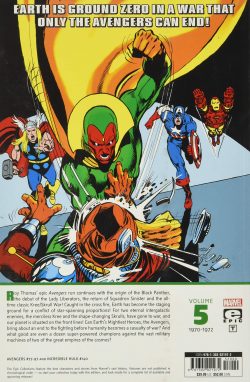
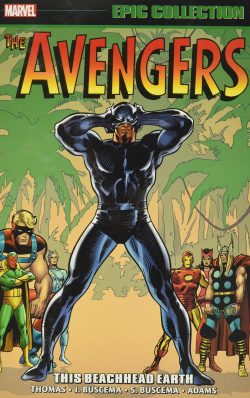
Avengers Epic Collection volume 5 1970-1972: This Beachhead Earth


By Roy Thomas, Harlan Ellison, John Buscema, Sal Buscema, Frank Giacoia, Herb Trimpe, Sam Grainger, Neal Adams & various (Marvel)
ISBN: 978-1-3029-2197-2 (TPB)

Win’s Christmas Gift Recommendation: Matchless Blockbuster Action… 9/10

One of the most momentous events in Marvel Comics history occurred in 1963 when a disparate array of individual heroes banded together to stop the Incredible Hulk.

The Avengers combined most of the company’s fledgling superhero line in one bright, shiny and highly commercial package. Over the decades the roster has unceasingly changed, and now almost every character in their universe has at some time numbered amongst their colourful ranks…

The Avengers always proved that putting all one’s star eggs in on single basket paid off big-time; even when all Marvel’s all-stars such as Thor, Captain America and Iron Man were absent, it merely allowed the lesser lights of the team to shine more brightly.

Of course, all the founding stars regularly featured due to a rotating, open door policy which meant that most issues included one of any reader’s favourites. The increasingly bold and impressively ambitious stories and artwork were no hindrance either.

This robust trade paperback and eBook compilation gathers the astounding contents of Avengers issues #77-97, plus a crossover classic from Incredible Hulk #140, collectively spanning June 1970 – March 1972: a riot of informed social commentary and astounding cosmic calamity which confirmed scripter Roy Thomas as a major creative force in comics whilst simultaneously demonstrating the potential the “debased” medium could aspire to.

At the time Thomas’ bold experiment was rightly considered the most ambitious saga in Marvel’s brief history: astounding sagas of tremendous scope which dumped Earth into a cosmic war the likes of which comics fans had never before seen.

“The Kree/Skrull War” set the template for all multi-part crossovers and publishing events from that point onwards and was followed by more astounding epics proving that more and better was to come…

This epochal tome opens ss the tone of the times shifted and comics titles entered a period of human-scaled storytelling dubbed “Relevancy” and here – crafted by Thomas, John Buscema & Tom Palmer – a far more mundane and insidious menace manifests as billionaire financier Cornelius Van Lunt manoeuvres to bankrupt Avengers (currently Cap, Black Panther, Goliath, the Vision, Scarlet Witch and Quicksilver) sponsor Tony Stark, compelling the team to become the mystery magnate’s ‘Heroes for Hire!’

Sal Buscema then popped in to pencil ‘The Man-Ape Always Strikes Twice!’ as the embattled champions are targeted by a coterie of vengeful villains competing to join a new league of evil, spectacularly culminating in a grand clash with the aforementioned anthropoid, the Swordsman, Power Man, Living Laser and the Grim Reaper in ‘Lo! The Lethal Legion!’, which concluding chapter heralded the artistic return of Big Brother John….

Next is the debut of the company’s first Native American costumed hero in ‘The Coming of Red Wolf!’ (Thomas, John B & Palmer) wherein the Avengers are drawn into a highly personal and decidedly brutal clash between ruthless entrepreneur Cornelius Van Lunt and an Indian tribe he is defrauding and persecuting.

The dramatic dilemma divides the team and concludes with Vision, Scarlet Witch and Goliath aiding Red Wolf in concluding episode ‘When Dies A Legend!’, whilst the remaining team plus Iron Man and Thor pursue super crime combine Zodiac and the Black Panther pursues what he believes is a personal quest beside Daredevil. (This last tale occurred in DD #69 but is not included here.)

Crucially, the malevolent mega-mob move first, taking the island of Manhattan ‘Hostage!’, leaving only the solitary sightless vigilante Man Without Fear free to save the day, after which Militant Feminism raises its disconcertingly strident head as the Wasp, Black Widow, Scarlet Witch and Madame Medusa are seduced into joining a new team called the Lady Liberators (yes, I know how all that sounds now but the all-male creative team meant well…).

However, The Valkyrie who declares ‘Come on in… the Revolution’s Fine!’ has her own dark secret and sinister agenda which has nothing to do with justice or equality…

Avengers #84 features part-time paladin Black Knight who has become addicted to the bloodthirsty hunger of his Ebony Blade, resulting in an otherworldly confrontation with alternate-Earth barbarian king Arkon the Magnificent and his latest paramour the Enchantress in ‘The Sword and the Sorceress!’ The resulting acrimonious clash subsequently drops half the team in a parallel existence with no apparent way back…

In ‘The World is Not for Burning!’ (inked by Frank Giacoia), Vision, Scarlet Witch and Quicksilver’s efforts to return home leave them stranded on an Earth where the Squadron Supreme are the World’s Greatest Heroes and a solar Armageddon is only hours away…

Illustrated by Sal B & Jim Mooney, ‘Brain-Child to the Dark Tower Came…!’ sees the extremely reluctant trans-Earth allies unite to save a very different world while, back home, the Black Panther reprises his bombastic origin before taking leave of his comrades to assume the throne of his hidden African nation in ‘Look Homeward, Avenger’ (Giacoia & Sal B).

Novelist Harlan Ellison was a very vocal comics fan in the 1970s and occasionally collaborated on Marvel tales. Avengers #88 began a radical adaptation of one his best short stories, heralding ‘The Summons of Psyklop’ (Ellison & Thomas, Sal Buscema & Mooney) wherein an experiment to cure the Hulk of his destructive nature leads to the Jade Juggernaut’s abduction by a preternatural entity.

The saga concluded in Incredible Hulk #140 (Ellison & Thomas, Herb Trimpe & Sam Grainger) as ‘The Brute… That Shouted Love… at the Heart of the Atom!’ finds the man-monster experiencing true love and idyllic peace in a sub-molecular paradise, only to lose it all when the demonic Psyklop finally tracks him down…

A major turning point in Marvel history begins relatively quietly as marooned Kree warrior Captain Marvel is finally freed from imprisonment in a ghastly antimatter universe. Mar-Vell was originally sent as a spy to Earth but quickly went native to become a protector of humanity. After an intergalactic mission to save his former masters, he was flying back to Earth when suddenly sucked into the anti-matter hell of the Negative Zone…

The trapped warrior found a loophole through long-dormant Kree artefacts and Nega-bands. Inextricably bonding to professional human side-kick Rick Jones, he could switch places whenever danger loomed, but was drawn back into the dread domain after three hours.

Following interminable, agonising months when Rick refused to trade atoms with his alien alter ego, ‘The Only Good Alien…’ (#89, with art by Sal B & Grainger) sees the bonded brothers finally separate just as, in the distant Kree Empire, the ruling Supreme Intelligence is overthrown by his enforcer Ronan the Accuser…

On Earth, the rebellion results in the activation of a long-dormant robotic Kree Sentry which attacks Mar-Vell and the Avengers before enacting a deep-programmed protocol to devolve humanity to the level of Neanderthals in concluding chapter ‘Judgment Day’ (drawn and inked by “Our pal Sal”).

Even with Ronan taking personal charge of a compromised polar base, the scheme to eradicate humanity is narrowly defeated in ‘Take One Giant Step… Backward!’, but the cat is let out of the bag about the panic-inspiring notion that extraterrestrials lurk among us. Moreover, public opinion rapidly turns against the heroes for concealing the threat of repeated alien incursions…

In a powerful allegory of the anti-Communist witch-hunts of the 1950s, the epic expands in issue #92 (Sal B & George Roussos) as ‘All Things Must End!’ reveals riots in American streets and a political demagogue capitalising on the crisis. Subpoenaed by the authorities, castigated by friends and public, Vision, Scarlet Witch and Quicksilver are ordered to disband by founding fathers Thor, Iron Man and Captain America.

Or are they…?

The plot thickens as Neal Adams & Tom Palmer assume art chores for double-sized Avengers #93 and ‘This Beachhead Earth’. Here the Vision is nigh-fatally attacked and those same founding fathers evince no knowledge of having benched the regular team.

With original Ant-Man Henry Pym undertaking ‘A Journey to the Center of the Android!’ to save the Vision’s artificial life, the Avengers become aware of not one, but two, hostile alien presences on Earth: bellicose Kree and sinister, seditious shape-shifting Skrulls. The shocking revelation triggers a ‘War of the Weirds!’ on our fragile globe.

Acting too late, the human heroes are unable to prevent mutant siblings Scarlet Witch and Quicksilver as well as their protector Mar-Vell from being abducted by the Super-Skrull…

With more stunning Adams art, ‘More than Inhuman!’ in issue #94 entangles the long-hidden race of advanced beings called Inhumans in the mix, disclosing that their advanced science and super-powers are the result of genetic meddling by the Kree in the depths of prehistory. Now, with Inhuman king Black Bolt missing and his mad, malign brother Maximus in charge, the Kree are calling in those ancient markers…

Second chapter ‘1971: A Space Odyssey’ (pencilled by John Buscema) focuses on Mar-Vell as he is increasingly pressured to reveal military secrets to his shape-shifting captors. The Skrulls are ready to launch a final devastating all-out attack on their eons-old rivals, even as on Earth ‘Behold the Mandroids!’ sees the American authorities attempting to arrest all costumed heroes…

In Avengers #95 ‘Something Inhuman This Way Comes…!’ coalesces the disparate story strands as aquatic Inhuman Triton helps defeat US government robotic Mandroids before beseeching the beleaguered heroes to find his missing monarch and rescue his people from the pressganging Kree.

After so doing, and with a solid victory under their belts at last, the Avengers head into space to liberate their kidnapped comrades and save Earth from becoming collateral damage in the impending cosmos-shaking clash between Kree and Skrulls…

‘The Andromeda Swarm!’ (with additional inking from Adams and Al Weiss) is perhaps the Avengers’ finest hour, as a small, brave band of valiant heroes hold off an immense armada of star-ships, losing one of their own in the conflict. Meanwhile the Supreme Intelligence is revealed to have been pursuing its own clandestine agenda all along, after having bewildered sidekick Rick Jones abducted to further its terrifyingly ambitious plans….

The astounding final episode ‘Godhood’s End!’ (John B & Palmer) brings the uncanny epic to a climactic close with a literal Deus ex Machina as the Supremor‘s master-plan is finally revealed. However, the war is actually ended by the most unlikely of saviours and an avalanche of costumed heroes: an action overload extravaganza which has never been surpassed in the annals of Fights ‘n’ Tights fiction…

This titanic tome is packed with extra treats, including the covers of all-reprint Avengers Annual #4 and a selection of House Ads, as well as a self-portrait of John Buscema and some of his creations. Also on view is a wealth of original art from him and Adams, plus the covers and new bridging material created by Alan Zelenetz, Walt Simonson & Palmer for the 1983 Kree-Skrull War starring the Avengers reprint miniseries and previous collection covers.

Roy Thomas and his artistic collaborators were always at the forefront of Marvel’s second generation of creators: brilliantly building on and consolidating Lee, Kirby and Ditko’s initial burst of comics creativity whilst spearheading and constructing a logical, fully functioning wonder-machine of places and events that so many others could add to.

These terrific tales are ideal examples of superheroes done exactly right and also act as pivotal points as the underdog company evolved into a corporate entertainment colossus. There are also some of the best superhero stories you’ll ever read…
© 2020 MARVEL.

Superboy: A Celebration of 75 Years


By Jerry Siegel & Joe Shuster, Bill Finger, Otto Binder, Robert Bernstein, Jim Shooter, Paul Levitz, Gerry Conway, Elliot S! Maggin, Geoff Johns, Karl Kesel, Brian Michael Bendis, Peter J. Tomasi, Patrick Gleason, John Sikela, Curt Swan, Al Plastino, George Papp, James Sherman, Joe Staton, Phil Jimenez, Jerry Ordway, George Pérez, Ivan Reis, Tom Grummett, Dusty Abell, Matthew Clark, Francis Manapul, Viktor Bogdanovic, Jonathan Glapion & various (DC Comics)
ISBN: 978-1-4012-9951-4 (HB)

Win’s Christmas Gift Recommendation: Superb Supercharged Stocking Stuffer… 9/10

Superman is the initiating act and spark that created the superhero genre. Without him we would have no modern gods to worship. However, less than a decade after his launch, creators Jerry Siegel & Joe Shuster also devised a concept nearly as powerful and persistent: the sheer delight of a child no adult could dominate or control…

The ever-reinventing DC Universe has hosted many key entertainment concepts that have done much to bring about the vibrant comics industry of today. This stunning compilation – part of a dedicated series reintroducing and exploiting the comics pedigree of veteran DC icons and concepts – is available in hardback and digital formats and offers an all-too-brief sequence of snapshots detailing how one of the most beguiling came to be, and be and be again…

Collecting material from More Fun Comics #101; Superboy #10, 89; Adventure Comics #210, 247, 271, 369-370; DC Comics Presents #87; Infinite Crisis #6; Superboy and the Legion of Super-Heroes #233, 259; Adventures of Superman #501; Superboy (volume 2) #59; Teen Titans (volume 3) #24, Adventure Comics (volume 2) #2; Young Justice (volume 3) #3 and Superman (volume 4) #6, 10-11, and introducing the many characters who have earned the soubriquet of the Boy of Steel, the landmark moments are all preceded by a brief critical analysis by Karl Kesel, outlining the significant stages in their development.

It begins with Part I – 1945-1961: A Boy and His Dog …

After the Man of Tomorrow had made his mark as Earth’s premier champion, his originators took a long look and reasoned that a very different tone could offer a fresh look. What would it be like for a fun-loving lad who could do literally anything?

The answer came in More Fun Comics #101 (January 1945) as Jerry Siegel & Joe Shuster crafted ‘The Origin of Superboy!’, fleshing out doomed Krypton and baby Kal-El‘s flight and giving him accessible foster parents and a childhood full of fun and incident…

The experiment was a huge hit. The lad swiftly bounced into the lead slot of Adventure Comics and in 1949, his own title, living a life set twenty years behind his adult counterpart.

Cover-dated October 1950, Superboy #10 originated ‘The Girl in Superboy’s Life’, wherein Bill Finger & John Sikela introduced Smallville newcomer Lana Lang, who immediately saw resemblances between Clark Kent and the Boy of Steel and set out to confirm her suspicions…

Despite battling crooks, monsters, aliens, scandal and the girl next door, Superboy enjoyed a charmed and wonderful life which only got better in Adventure Comics #210 (March 1955), as Otto Binder, Curt Swan & Sy Barry introduced ‘The Super-Dog from Krypton!’ Although waywardly mischievous and dangerously playful, Krypto heralded a wave of survivors from the dead world and made Superboy feel less lonely and unique. Every boy needs a dog…

The next tale here is a certified landmark. Adventure Comics #247 (April 1958) was at the cusp of the Silver Age costumed character revival, as Otto Binder & Al Plastino introduced a concept that would reshape comics fandom: ‘The Legion of Super-Heroes!’

The many-handed mob of juvenile universe-savers debuted in a Superboy tale wherein three mysterious kids invited the Smallville Sensation to the future to join a team of metahuman champions inspired by his historic feats. The throwaway concept inflamed public imagination and after a slew of further appearances throughout Superman Family titles, the LSH eventually took over Superboy’s lead spot in Adventure for their own far-flung, quirky escapades, with the Caped Kryptonian reduced to one of the crowd…

Before then though, Adventure Comics #271 (April 1960) revealed ‘How Luthor Met Superboy!’ Siegel & Plastino united to depict how teenaged scientist Lex Luthor and Superboy became fast friends, before the genius became deranged when a laboratory fire extinguished by the Caped Kryptonian caused Lex to lose his hair. Enraged beyond limit, the boy inventor turned his talents to crime…

Robert Bernstein & George Papp then introduced ‘Superboy’s Big Brother!’ in Superboy #89 (June 1961) in which an amnesiac, super-powered space traveller crashes in Smallville, speaking Kryptonese and carrying star-maps written by the Boy of Steel’s long-dead father…

Jubilant, baffled and suspicious in equal amounts, the Superboy eventually, tragically discovers ‘The Secret of Mon-El’ by accidentally exposing the stranger to a lingering, inexorable death, before desperately providing critical life-support by depositing the dying alien in the Phantom Zone until a cure could be found…

Anybody who regularly reads these reviews know how crotchety and hard-to-please I can be. Brace yourself…

The next section – Part II – 1968-1980: The Space Age – concentrates on Superboy’s Legion career. That’s not the problem because those are great stories, well deserving of their own book, but they’re wasted here while the Boy of Steel’s adventures from this period are completely neglected. That’s work by the likes of Frank Robbins, Binder, Jim Shooter, Curt Swan, Bob Brown, Wally Wood and others we don’t get to see. Poor editorial decision, that…

Calm again, so let’s see how the Boy of Tomorrow fares one thousand years from now…

During this period the youthful, generally fun-loving and carefree Club of Champions peaked; having only just evolved into a dedicated and driven dramatic action series starring a grittily realistic combat force in constant, galaxy-threatening peril.

Although now an overwhelming force of valiant warriors ready and willing to pay the ultimate price for their courage and dedication, science itself, science fiction and costumed crusaders all increasingly struggled against a global resurgence in spiritual questioning and supernatural fiction…

The main architect of the transformation was teenaged sensation Jim Shooter, whose Legion of Super-Hero scripts and layouts (generally finished and pencilled by the astoundingly talented and understated Curt Swan) made the series accessible to a generation of fans growing up with their heads in the Future. Ultimately, however, as tastes and fashions shifted, the series was unceremoniously ousted from its ancestral home and full-length adventures to become a truncated back-up feature in Action Comics. Typically, that shift occurred just as the stories were getting really, really good and truly mature…

Here tense suspense begins with Adventure Comics #369’s (June 1968) and ‘Mordru the Merciless!’(Shooter, Swan & Jack Abel) as the Legion is attacked by their most powerful enemy, a nigh-omnipotent sorcerer the entire assemblage only narrowly defeated once before.

A sneak attack shatters the team and only four escape, using a time bubble to flee to the remote and archaic time-period where Superboy lived. With him come Mon-El, (freed from the Phantom Zone to become a Legion stalwart), Shadow Lass and Duo Damsel – the last remnants of a once-unbeatable team.

Mordru’s magic is stronger though and even the time-barrier cannot daunt him…

Disguised as mere mortals, the fugitive Legionnaires’ courage shines through. When petty gangsters take over Smallville, the teen heroes quash the parochial plunderers and opt to return to the 30th century and confront Mordru, only to discover he’s found them first…

The saga concludes in #370 and ‘The Devil’s Jury!’ wherein the band escape and hide in plain sight by temporarily wiping their own memories to thwart the Dark Lord’s probes. Against appalling odds and with only Clark’s best friend Pete Rossand Insect Queen Lana Lang to aid them, the heroes’ doomed last stand only succeeds because Mordru’s overbearing arrogance causes his own downfall.

Then, when the exhausted fugitives got back the future, they joyously learn that Dream Girl and benign sorceress White Witch have undone the deluded Dark Lord’s worst atrocities…

Since that time the fortunes and popularity of the Legion have perpetually waxed and waned, with their future history tweaked and overwritten, retconned and rebooted over and over again to comply with editorial diktat and popular fashion. After disappearing from the newsstands, the team returned as Guests in Superboy, before eventually taking over the title. Deju Vu, much?

From November 1977, Superboy and the Legion of Super-Heroes #233, sees the Kryptonian join his teammates to thwart ‘The Infinite Man Who Conquered the Legion!’: an extra length blockbuster battle by Paul Levitz, James Sherman & Bob Wiacek, after which issue #259 (January 1980) drops Superboy and the… to become Legion of Super-Heroes #259, subsequently ending an era.

‘Psycho War!’ by Gerry Conway, Joe Staton & Dave Hunt sees the time-lost teen targeted by a deranged war veteran using futuristic trauma weapons, forcing his legion chums to mindwipe Kal-El and return him to his original time forever…

In the mid-1980s, DC’s editorial hierarchy felt their vast 50-year continuity was stopping them winning new readers. The solution was a colossal braided-mega series to streamline, redefine and even add new characters to the mix.

The worlds-shattering, reality-altering bombast of Crisis on Infinite Earths resulted in such spectacular commercial success, those movers-&-shakers must have felt more than justified in revamping a number of their hoariest icons for their next fifty years of publishing. As well as Superman, Flash, and Wonder Woman, many moribund and directionless titles were reconsidered for a radical revision. It didn’t all go to plan…

The background on a new Boy of Steel is covered in the essay and tales comprising Part III 1985-2006: Dark Reflection, which opens with two stories from DC Comics Presents # 87 (November 1985) by Elliot S! Maggin, Swan & Al Williamson.

In ‘Year of the Comet’ Superman of Earth-1 meets and mentors teen Clark Kent from an alternate world previously devoid of superheroes and alien invaders, after which ‘The Origin of Superboy-Prime’ exposes the crucial differences that would make Earth Prime’s Last Son of Krypton so memorable…

Events culminated in ‘Touchdown’ by Geoff Johns, Phil Jimenez, Jerry Ordway, George Pérez, Ivan Reis, inkers Andy Lanning, Oclair Albert Marc Campos, Drew Geraci, Sean Parsons, Norm Rapmund, Art Thibert, from issue #6 of mega event Infinite Crisis (May 2006). Teen Clark had evolved into Superboy-Prime – one of the most sadistic and unstoppable monsters in DCU history – but here he met his end battling another kid calling himself Superboy…

That hero gets his own out-of-chronology section: Part IV 1993-2019: The New Kid detailing how he grew out of another different publishing landmark.

Post-Crisis on Infinite Earths, Superman was stripped-down and back to basics, grittily re-imagined by John Byrne, and marvellously built upon by a succession of immensely talented comics craftsmen, resulted in some genuine comics classics.

Most significant was a 3-pronged story-arc which saw the martyrdom, loss, replacement and inevitable resurrection of the World’s Greatest Superhero in a stellar saga which broke all records and proved that a jaded general public still cared about the venerable, veteran icon of Truth, Justice and the American Way.

The dramatic events also provided a spectacular springboard for a resurgent burst of new characters who revitalised and reinvigorated more than one ailing franchise over the next decade, all exploding from braided mega-saga “Reign of the Supermen” which introduced a quartet of heroes each claiming the mantle of Superman (Don’t panic: the Real Deal Man of Steel returned too!).

The final contender for the S-shield cropped up in Adventures of Superman #501. ‘…When He Was a Boy!’ (Kesel, Tom Grummett & Doug Hazlewood) reveals the secret history of a brash and cocky kid wearing an adaptation of the Man of Tomorrow’s outfit and claiming to be a clone of the deceased hero, recently escaped from top secret bio-factory Cadmus.

After alienating everybody at the Daily Planet, the horny, inexperienced juvenile latches onto ambitious journalist – and hottie – Tana Moon, falling under the spell of corrupt media mogul Vinnie Edge. Soon the kid is fighting crime live on TV to boost ratings…

Blending fast action with smart sassy humour, the clone Superboy was a breakout hit running for years, and gradually infiltrating the established Superman Family. A key moment came in Superboy (volume 2) #59 – by Kesel, Dusty Abell, Dexter Vines – as a virtual ‘Mission to Krypton’ results in the clone finally earning a family name as Kon-El of the House of El…

In the build-up to DC’s Infinite Crisis crossover event, many long-running story-threads were all pulled together ready for the big bang. Crafted by Geoff Johns, Matthew Clark & Art Thibert ‘The Insiders Part 1’ (from Teen Titans #24, July 2005) reveals how Superboy’s belief that he was Superman’s clone is shattered after learning that half of his DNA comes courtesy of Lex Luthor.

Just as Kon-El is about to share the revelation with his Teen Titan team-mates, Luthor activates a deep-seated psychological program that overrides Superboy’s consciousness and makes him evil and murderous…

From November 2009, ‘The Boy of Steel Part Two’ (Adventure Comics volume 2 #2, by Johns & Francis Manapul) then offers a gentler moment as Kon-El, now living in Smallville as Conner Kent, enjoys a potentially romantic interlude with team mate Wonder Girl.

We then jump to May 2019 and ‘Seven Crises Part Three’ from Young Justice volume 3 #3, by Brian Michael Bendis, Patrick Gleason, Viktor Bogdanovic & Jonathan Glapion. Having skipped two universe-altering events (Flashpoint and Rebirth) the formerly erased-from-continuity Impulse has found his old friend Conner living on mystic Gemworld as part of his quest to put his old band back together. It’s fast, furious, heart-warming and hilarious. You should really get all of this tale in its own compilation – Young Justice: Gemworld – even before I review it next year…

Wrapping up this saunter in Super-kids’ shoes is the freshest take on the concept in decades. Part V 2016 and Beyond: Like Father, Like Son offers a too short glimpse at Jon Kent, the child of Superman and Lois Lane, inserted into the mainstream continuity after the New 52 Superman died. If this is making your brain hurt, don’t fret. It’s really unnecessary background for some truly exemplary comics yarns…

Superman (volume 4) #6, 10, 11 are by Peter J. Tomasi, Patrick Gleason, Mick Gray, Mark Morales & Christian Alamy, and firstly depict the ‘Son of Superman’ helping dad defeat evil Kryptonian mechanoid The Eradicator before settling into outrageous action comedy beside, with and frequently against, Damian Wayne: son of Bruce and the latest, most psychotic Robin yet. ‘In the Name of the Father: World’s Smallest Parts One and Two’ pits the junior odd couple against aliens, monsters, girls, but mostly each other. It’s unmissable stuff and you should expect me to wax delirious about the new Super Sons in the New Year…

Adding immeasurably to the wonderment is a superb gallery of covers by Swan with Stan Kaye & Abel, Neal Adams, Mike Grell, Dick Giordano, Eduardo Barreto, Jim Lee & Sandra Hope, Grummett, Kesel & Hazlewood, Mike McKone & Marlo Alquiza, Manapul, Doug Mahnke & Wil Quintana and Gleason with Alejandro Sanchez, Gray & John Kalisz.

Superboy has a long, proud history of shaking things up and providing off-kilter fun to offset the general angst level of Superhero storytelling. Even with my petty caveats, this compelling primer of snapshots is staggeringly entertaining and a monolithic testament to the inestimable value of a strong core concept matured over decades of innovation.
© 1960, 1964, 1969, 1977, 1982, 1984, 1987, 1997, 2000, 2006, 2005, 2011, 2018, 2020 DC Comics. All Rights Reserved.