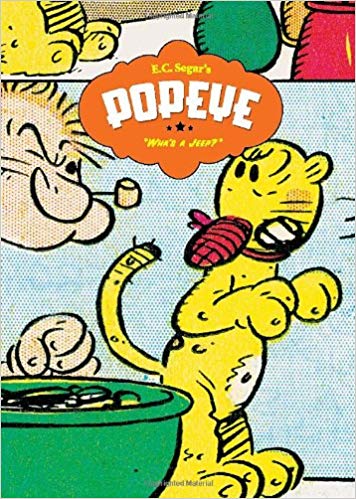
E.C. Segar’s Popeye volume 5: Wha’s a Jeep?


By Elzie Crisler Segar (Fantagraphics Books)
ISBN: 978-1-60699-404-7 (HB)

Elzie Crisler Segar was born in Chester, Illinois on 8th December 1894. His father was a handyman and Elzie’s early life was filled with the types of solid, earnest blue-collar jobs that typified his generation of cartoonists. The younger Segar worked as a decorator and house-painter and played drums, accompanying vaudeville acts at the local theatre. When the town got a movie house, he played for the silent films, absorbing the staging, timing and narrative tricks from the close observation of the screen that would become his greatest assets as a cartoonist. It was while working as the film projectionist, aged 18, he decided to become a cartoonist and tell his own stories.

Like so many others of that “can-do” era, Segar studied art via mail, in this case W.L. Evans’ cartooning correspondence course out of Cleveland, Ohio (from where Jerry Siegel & Joe Shuster would launch Superman upon the world), before gravitating to Chicago where he was “discovered” by Richard F. Outcault – arguably the inventor of newspaper comic strips with The Yellow Kid and Buster Brown.

The senior artist introduced him around at the prestigious Chicago Herald. Still wet behind the ears, Segar’s first strip, Charley Chaplin’s Comedy Capers, debuted on 12th March 1916. In 1918 he married Myrtle Johnson and moved to William Randolph Hearst’s Chicago Evening American to create Looping the Loop. Managing Editor William Curley saw a big future for Segar and promptly packed the newlyweds off to the Manhattan headquarters of the mighty King Features Syndicate.

Within a year Segar was producing Thimble Theatre, which launched December 19th 1919 in the New York Journal. In its earliest incarnation the strip was a pastiche/knock off of Movie features like Hairbreadth Harry and Midget Movies, with a repertory cast to act out comedies, melodramas, comedies, crime-stories, chases and especially comedies for huge daily audiences. The core cast included parental pillars Nana and Cole Oyl, lanky daughter Olive, diminutive-but-pushy son Castor and Olive’s plain and simple occasional boyfriend Horace Hamgravy (later just Ham Gravy).

In 1924, Segar created a second daily strip. The 5:15 was a surreal domestic comedy featuring weedy commuter and would-be inventor John Sappo and his formidable wife Myrtle (surely, no relation?).

A born storyteller, Segar had from the start an advantage even his beloved cinema couldn’t match. His brilliant ear for dialogue and accent shone out from his admittedly average melodrama adventure plots, adding lustre to stories and gags he always felt he hadn’t drawn well enough. After a decade or so – and just as cinema caught up with the introduction of “talkies” – he finally discovered a character whose unique sound and individual vocalisations blended with a fantastic, enthralling nature to create a literal superstar.

Popeye the sailor, brusque, incoherent, plug-ugly and stingingly sarcastic, shambled on stage midway through nautical adventure ‘Dice Island’, (on January 17th 1929: see E.C. Segar’s Popeye volume 1: “I Yam What I Yam!”) and once his very minor part was played out, simply refused to leave. Within a year he was a regular and as the strip’s circulation skyrocketed, he became the star. Eventually, the strip title was changed to Popeye and all of the old gang except Olive were consigned to near-oblivion…

Popeye inspired Segar. The near decade of thrilling mystery-comedies which followed revolutionised the industry, laid the groundwork for the entire superhero genre (sadly, usually without the leavening underpinnings of his self-aware humour) and utterly captivated the whole wide world.

These superb oversized (almost 260 mm by 372mm) hardback collections are the ideal way of discovering or rediscovering Segar’s magical tales. Over and above the increasingly incredible tales from the daily and Sunday strips, this vibrantly enticing fifth volume also contains an insightful introductory essay from Richard Marschall – ‘Character and Personality in Thimble Theatre’ – a captivating article of the period (‘Segar’s Hobbies Put Punch in Popeye Comics’) reprinted from Modern Mechanix and Inventions, plus a fascinating end-piece covering assorted original art teasers editors used to promote upcoming tales in the magical days before television or viral ad campaigns.

The monochrome Monday to Saturday section opens this volume, (covering July 25th 1935-December 12th 1936), encompassing one-and-a-half major storylines, and begins with the eagerly-anticipated conclusion of ‘Popeye’s Ark’, wherein our bold sailor-man carries out an ambitious plan to set up his own country of Spinichovia. The incredible scheme is funded by misogynist millionaire Mr. Sphink who insists that the new country be absolutely without women, and Popeye goes along with it, recruiting a host of disaffected guys looking for a fresh start…

Soon however, the thousands of able-bodied men populating the country are starving for any kind of female companionship: – even Olive Oyl, currently exiled on an island of her own. Things get very strange when the lonely Spinichovians discover a tribe of mermaids frolicking off the coast, but romance is soon forgotten when Brutian despot King Zlobbo decides the new nation must be his in ‘War Clouds’.

To scout out potential opposition, Zlobbo dispatches enticing spy Miss Zexa Peal, but as the most beautiful woman in the country – and comprising 50% of Spinichova’s female population – she isn’t exactly inconspicuous…

When war breaks out, it results in Popeye’s greatest victory – with just a little excessively violent help from feisty “infink” baby Swee’ Pea…

By the conclusion of that epic tale all the players have returned to America, just in time for the introduction of the star of this tome.

‘Eugene the Jeep’ debuted on March 20th 1936: a fantastic 4th dimensional beast with incredible powers that Olive and Wimpy use to get very rich, very quickly, only to lose it all betting on the wrong guy in another of Segar’s classic and hilarious set-piece boxing matches between Popeye and yet another barely-human pugilist…

These tales come from an astonishingly fertile period for the strip’s long history. On August 4th, Eugene was instrumental in kicking off another groundbreaking and memorable sequence as the entire ensemble cast took off on as haunted ship to undertake ‘The Search for Popeye’s Papa’.

When Popeye first appeared, he was a shocking anti-hero. The first Superman of comics was not a comfortable icon to idolise. A brute who thinks with his fists and doesn’t respect authority; uneducated, short-tempered, fickle (when hot tomatoes batted their eyelashes – or thereabouts – at him), a gambler and troublemaker, he wasn’t welcome in polite society… and he wouldn’t want to be.

Popeye was the ultimate working-class hero: raw and rough-hewn, practical, but with an innate and unshakable sense of what’s fair and what’s not. He was a joker who wants kids to be themselves, but not necessarily “good”, and a man who takes no guff from anyone.

Of course, as his popularity grew, he somewhat mellowed. He was always ready to defend the weak and had absolutely no pretensions or aspirations to rise above his fellows. He was and will always be “the best of us”… but the shocking sense of unpredictability, danger and anarchy he initially provided was sorely missed by 1936 – so Segar brought it back again…

This memorably riotous tale introduced ancient, antisocial crusty reprobate Poopdeck Pappy and his diminutive hairy sidekick Pooky Jones during another fabulous voyage of discovery. The elder mariner was a rough, hard-bitten, grumpy brute quite prepared and even happy to cheat, steal or smack a woman around if she stepped out of line…

Once that old goat was firmly established, Segar set Popeye and Olive the Herculean task of ‘Civilizing Poppa’ which is where the monochrome adventures here conclude…

The full-colour Sunday pages in this volume span April 4th 1935 to September 13th 1936, and see the bizarrely entertaining Sappo (and mad scientist lodger Professor O.G. Wotasnozzle) supplemental strip gradually diminish to allow the Popeye feature even more room to excel and amaze.

Eventually Sappo became a cartooning tricks section allowing Segar to play graphic games with his readership. Popeye’s Cartoon Club also disappeared, as the focus inexorably shifted to Popeye and Co. in alternating one-off gag strips and extended sagas. However, the Sailor-Man had to fight for space with his mooching co-star J. Wellington Wimpy…

When not beating the stuffing out of his opponents or kissing pretty girls, Popeye pursued his flighty, vacillating and irresolute Olive Oyl with exceptional verve, if little success, but his life was always made more complicated whenever the unflappable, so-corruptible and adorably contemptible Wimpy made an appearance.

The engaging Micawber-like coward, moocher and conman was first seen on 3rd May 1931 as an unnamed and decidedly partisan referee in one of Popeye’s regular boxing matches. The scurrilous but ever-so-polite oaf obviously struck a chord and Segar gradually made him a fixture. Eternally hungry, always eager to take a bribe and a cunning coiner of many immortal catchphrases such as “I would gladly pay you Tuesday for a hamburger today” and “let’s you and him fight”, Wimpy was the perfect foil for a simple action hero and often stole the entire show.

Infinitely varying riffs on Olive’s peculiar romantic notions or Wimpy’s attempts to cadge food or money for food were irresistible to the adoring readership, but Segar wisely peppered the Sundays with longer episodic tales, such as the cast’s gold-prospecting venture to the inhospitable western desert of ‘Slither Creek’ (April 14th – August 25th 1935) and a sequel sequence wherein the temporarily wealthy but eternally starving Wimpy buys his own diner – the ultimate expression of blind optimism and sheer folly…

The uniquely sentimental monster Alice the Goon returned to the strip on February 23rd 1936, permanently switching allegiance and becoming nanny to rambunctious tyke Swee’ Pea. She was a cast regular by the end of April.

August 9th saw Eugene the Jeep make his Sunday debut, and a few demonstrations of the fanciful beast’s incredible powers to make money and cause chaos fill out this fifth fantastic tome…

There is more than one Popeye. If your first thought on hearing the name is an unintelligible, indomitable white-clad sailor always fighting a great big beardy-bloke and mainlining tinned spinach, that’s okay: the animated features have a brilliance and energy of their own (even the later, watered-down anodyne TV versions have some merit) and they are indeed based on the grizzled, crusty, foul-mouthed, bulletproof, golden-hearted old swab who shambled his way into Thimble Theatre and wouldn’t leave. But they are really only the tip of an incredible iceberg of satire, slapstick, virtue, vice and mind-boggling adventure…

There is more than one Popeye. Most of them are pretty good and some are truly excellent. Don’t you think it’s about time you sampled the original and very best?
© 2011 Fantagraphics Books Inc. All comics and drawings © 2011 King Features Inc. All rights reserved.

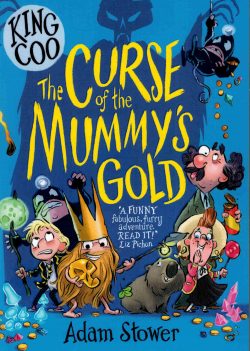
King Coo: The Curse of the Mummy’s Gold


By Adam Stower (David Fickling Books)
ISBN: 978-1-78845-052-2 (PB)

The old demarcations – whether in format or content – between comics and “proper books” are all but gone these days and the results are, quite frankly, long overdue and simply intoxicating…

Since the pre-print era of illustrated manuscripts, books have always possessed the capacity (budgets permitting) to include images in the text. As the book trade progressed, pictures were generally phased out of cheaper, mass-market editions because they required costly and time-consuming extra effort by skilled technicians. Most artists and illustrators wanted payment for their efforts too, so books with pictures were regarded as extra special, most often crafted for children, students or aficionados of textbooks…

Comics strips grew out of cartoon images, beginning as static illustrations accompanied by blocks of printed text before gradually developing into pictorial sequences with narration, dialogue and sound effects incorporated into the actual design.

These days print processes are speedy and efficient, and many creative bright sparks have realised that they can combine all these tangential disciplines into a potent synthesis.

Gosh, wasn’t that lecture dull?

What I’m saying is that these days, the immediacy of comics, the enchantment of illustrated images, the power of well-designed infographics and the mesmeric tone and mood of well-written prose can all be employed simultaneously to create tales of overwhelming entertainment.

A perfect example of this is artist Adam Stower’s (Bottom’s Up!, Spymice, The Dragons of Wayward Green, The Secret Country) second adventure of Ben Pole and his fabulous companion King Coo.

When Ben was being pitilessly persecuted by bullies at school, one desperate attempt to escape took him to a vast and fantastic forest that lay somehow hidden at the bottom of a hole in a tatty alleyway between skyscrapers in the city. Here he met capable wild-child King Coo: a spear-carrying, crown-wearing girl who builds incredible, impossible inventions and lives in a tree house with her wombat chum Herbert. Most of the time, Coo is covered from her nostrils to her sturdy bare feet in a luxuriant, all-encompassing beard.

She soon helped him sort out his bullying problem once and for all…

Now, as summer holidays end, Ben is heading back to school, just as his mum starts her new job as a security guard at the City Museum. As if having a massive new exhibition featuring the priceless golden treasures of mummified medicine-man Mighty Ozozo of the Blue-Foots Tribe isn’t enough to worry about, many other museums and galleries have recently been plundered by the sinister and mysterious Midnight Mob…

Sadly for Ben, his homebody dad’s culinary escapades haven’t gotten any better either…

Ben’s desire to continue having life-&-limb threatening adventures with Coo and her bizarre gizmos is slightly lessened after his class is introduced to substitute teacher Professor Pickering and his attendant transfer students: the oddly fascinating pupils of the Lilly Lavender Private Academy for Exceptional Girls…

And thus unfolds a thrill-stuffed, action-packed romp involving vile villains, daring robberies, a hostage situation, dastardly deception and the terrifying prospect of supernatural revenge from beyond the grave. Happily, King Coo has a plan… but then again, she always has a plan, and blueprints and prototypes and…

Fast-paced, astoundingly inventive and laugh-out-loud hilarious, this brilliant kids’ caper merges compact effective prose with beguiling monochrome pictures, comic strips, breathtaking double-page spreads, explanatory diagrams, informative info-pages, mini-posters and all the visual gimmicks that give comics their overpowering immediacy.

This is a book kids of all ages will adore, so why not grant yourself and your entourage a personal audience with King Coo at your earliest convenience?
Text and illustrations © Adam Stower 2019. All rights reserved.

King Coo: The Curse of the Mummy’s Gold will be released on 6th June 2019 and is available for pre-order now.

Desolation Wilderness


By Claire Scully (Avery Hill)
ISBN: 978-1-910395-45-5 (PB)

The most magical thing about comics is the sheer versality of potential results. In terms of narrative, exposition, mood-setting and information dissemination, nothing can come close, and the range of visualisation spans near-abstract construction to hyper-realism. If the end-consumer is particularly receptive, the author can even dial back on the narrative and let a succession of carefully-applied images make a story unique to each reader. It’s like jazz for your eyes…

In a way, we’re all still monkeys clinging to rocks: we cannot help but respond viscerally to our environments: cowed or elated by stony heights, drawn to and pacified by pools and gardens, inexplicably moved to fear or joy by forests. It’s in our blood and bones: Nobody stands on a mountaintop or looks down into the Grand Canyon and says “meh”…

We may have left the caves and trees but we now mimic those ancient sanctuary havens in our dwellings. We climb high and burrow deep and our architecture has visceral, compulsive, instinctive power over us – just walk by a Victorian school, across a Roman viaduct or study the oppressive triumphalism of Nazi-built buildings or battle emplacements – we’re all still part of the wild and nature is in our bones too.

When someone really talented and truly invested channels those primal responses, the fires of creativity can push right into the hindbrain to our inner primitive. Desolation Wilderness does that.

Described as “a sequence of events occurring over a period of time in the search for a location in space” this tiny paperback handbook is a purely visual experience enhanced by the rough tactile textures of the card it’s printed on: part of an on-going project examining the relationship of Landscape and Memory.

Creator Claire Scully has inscribed and sequenced compelling scenes of rocks and trees and waters through different seasons and times of day in such a fashion that you must look and pause and ponder. It is a graphic missile targeting recollection and imagination; one that hits with serenely devastating impact.

If you are still human it will make you think: you won’t be able to help yourself…

© 2019 Claire Scully. All rights reserved.
Desolation Wilderness is scheduled for publication on June 3rd 2019 and is available for pre-order now.

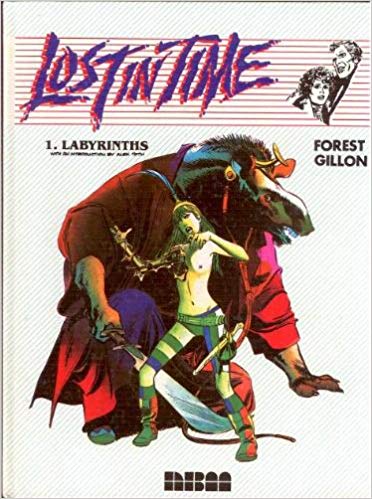
Lost in Time volume 1: Labyrinths


By Jean-Claude Forest & Paul Gillon, with an introduction by Alex Toth (NBM)
ISBN: 978-0-91834-818-0 (HB)

France has had an ongoing love affair with science fiction that goes back at least to the works of Jules Verne and – depending upon your viewpoint – arguably even as far back as Cyrano de Bergerac’s posthumously published fantasy stories L’Autre Monde: ou les États et Empires de la Lune (The Other World: or the States and Empires of the Moon) and Les États et Empires du Soleil (The States and Empires of the Sun) published in 1657 and 1662. Moreover, their comic iterations have always been groundbreaking, superbly realised and deeply enjoyable.

A perfect case in point is Les Naufragés du Temps (alternately translated as either Castaways in Time or, as here, Lost in Time) created in 1964 by Jean-Claude Forest and classical master-draughtsman Paul Gillon.

Forest (1930-1998) was a Parisian and graduate of the Paris School of Design who began selling strips while still a student. His Flèche Noire (Black Arrow) led to a career illustrating for newspapers and magazines such as France-Soir, Les Nouvelles Littéraires and Fiction in the 1950s, all whilst producing the Charlie Chaplin-inspired comic series Charlot and acting as chief artist for publisher Hachette’s science fiction imprint Le Rayon Fantastique. For this last client he produced illustrations and covers on translations of imported authors A. E. Van Vogt, Jack Williamson, and others.

In 1962, Forrest created Barbarella for V-Magazine and his sexy-charged icon quickly took the country and world by storm, consequently generating an explosion of like-minded SF Bandes Dessinées features. Forest never looked back, subsequently creating Baby Cyanide and more serious tales like Hypocrite; the Verne-inspired Mysterious Planet; La Jonque Fantôme Vue de l’Orchestre and Enfants, c’est l’Hydragon qui Passe.

He also found time to script for other artists: Ici Même for Jacques Tardi, occult detective series Leonid Beaudragon for Didier Savard and, with Gillon, the subject of today’s review – a classic of both comics and science fiction inexplicably all-but-ignored by English language publishers since the 1980s. If you read French, however, all volumes are still available in print and digitally…

Paul Gillon (1926-2011) was also born in Paris but suffered from debilitating tuberculosis in early life. After his full recovery, the isolated shut-in became something of a brilliant wild child, expelled from many schools – including the prestigious Ecole des Arts Graphiques.

As a teenager he considered a career in film, theatre or fashion, but slipped almost accidentally into the world of cartooning and caricature, working freelance for such arts magazines as Samedi-Soir, France Dimanche and Gavroche.

The end of WWII created chaotic circumstances in France, subsequently spawning a whole new comics industry, and in 1947 Gillon began illustrating for the popular weekly Vaillant, both on existing adventures strips such as Wango and Lynx Blanc (both written by Roger Lécureux) and Jean Ollivier’s Le Cormoran, as well as the later spin-off Jérémie which Gillon also scripted. In 1950, he created Fils de Chine (Sons of China) with Lécureux which ran for three years.

Working in a refined and highly classicist style epitomised by the likes of global industry giants Alex Raymond, Milton Caniff and Hal Foster, Gillon also wrote and drew shorter complete pieces for titles such as 34 Camera, Femmes D’Aujourd’hui, Reves and Radar, but his big break came in September 1959 when he began illustrating a daily soap-opera strip for national newspaper France Soir.

He would render the stunningly beautiful human heartbreaks of 13, rue de l’Espoir until the end of 1972, becoming a household name in the process…

Based on the American serial The Heart of Juliet Jones and scripted by Jacques and François Gall, the feature followed the fortunes of vivacious Parisienne Françoise Morel, and unfolding daily took the heroine and the Family Morel through some of the most tumultuous years of modern European social change, in nearly 4200 strips which were naturally compiled into two collected Albums – something else which should be translated into English but probably won’t be…

Throughout that period Gillon continued in comics, producing Jérémie, working for the Disney comic Le Journal de Mickey and other magazines while trying out new venues and genres.

Les Naufrages du Temps first appeared in 1964, part of the line-up in short-lived French comic Chouchou. A decade after the periodical closed, the strip was reprinted and saga completed in France-Soir before being released as 2 bichromic (a two-coloured palette) albums from major publisher Hachette in 1974 and 1975. Two further full-colour book volumes followed in 1976.

In 1977 the saga was serialized in groundbreaking Sci-fi magazine Metal Hurlant, prompting publisher Les Humanoides Associes to re-release the four albums (L’Etoile Endormie/The Sleeping Star; La Mort Sinueuse/The Creeping Death; Labyrinthes/Labyrinths and L’Univers Cannibale/The Cannibal Universe) in colour, before continuing the series with Gillon scripting as well as illustrating until its end in 1989: a total of six further volumes.

Never idle, Gillon then created spy-thriller Les Leviathans (The Leviathans) for Les Humanoides and adult science fiction epic La Survivante (The Survivor) for L’Echo des Savanes. He also adapted literary classics such as Victor Hugo’s Notre Dame de Paris and Herman Melville’s Moby Dick and re-imagined the legend of Joan of Arc as the erotic epic Jehanne.

His later efforts included Processus de Survie (Survival Process) in 1984 and La Derniere des Salles Obscures (The Last of the Dark Rooms) in 1998. He was still creating comics well into the 21st century and remains one of France’s most honoured, celebrated and revered comics creators, so just why so few of his incredibly illustrated tales have been translated is an utter mystery to me.

One that did make the jump was Lost in Time: Labyrinths, released as a spectacular hardback by NBM in 1987 and one of the few European imports to be seen “cold” in the USA (i.e. without first running as a serial in Heavy Metal magazine). As cited above it was the third album of the French series and opened with a much-needed preamble…

So just to recap something we hadn’t actually seen: at the end of the 20th century, humanity was imperilled by “the Scourge”: a plague of extraterrestrial spores and/or a global sickness of its own negligent making.

Chris Cavallieri and Valerie Haurele were selected for a shot at survival and placed in suspended animation in individual space-capsules to preserve the best of our race and possibly reconstruct our lost glories in a newer age…

A thousand years later Chris was awakened into a bewildering but thriving multi-species civilisation in deadly danger. Earth was a derelict, plague world inhabited by mutant monsters whilst society abandoned it and grew to inhabit a hugely re-configured Solar system.

Helping the inhabitants of the patchwork “System” – ex-pat human, alien and genetically altered/hybridised animal-beings – to defeat an invasion by alien winged rats dubbed the Thrass, Chris fortuitously found Valerie’s lost capsule and revived her – but the longed-for happy reunion led to utter disaster.

Throughout their millennial slumber both ancient human lovers had dreamt of each other and a perfect meeting, but once they were together again in a furious new future, they discovered that they could not stand each other…

This tale begins after the defeated Thrass have fled the System and Valerie, rejected by Chris, has disappeared. The resurrected Ancient and his new-found true love Mara (one of the scientists who first recovered and rehabilitated Christopher) are the topic of much discussion amongst his new friends Dr. Otomoro and military cyborg Major Lisdal. Chris haunts morgues and seedy dives of the pan-cosmopolitan city of Roobo-ein-Sarra on System capital Limovan, unable to shake his destructive, obsessive fear for the fate of his millennial ex-lover…

Depressed, despondent and bitterly confused, Chris roams the exotic streets and bazaars where hordes of newly-liberated beings manically celebrate their hard-won freedom and security, unaware that he has been targeted by sinister plotters. An old “frenemy”, Morfina, accosts him and, past injuries and seductions forgotten, lures the old Earthman to the Mood Market, a vast, baroque area of bordellos run by a legendary criminal overlord. The Boar is a burly, erudite and unctuous humanoid with a Tapir’s head and plenty to hide…

(In the original this major series villain is in fact the Tapir – I’ve no idea why he was so erroneously renamed but have a sneaking suspicion that it involves European prejudices about English and American educational attainment…)

Completely off-guard, Chris succumbs to sybaritic release and is framed for the murder of a diplomat and his companion whilst out of his head. Once awake and panicked by the corpses around him, the Last Earthman accepts the extremely costly aid of the Boar to escape…

Even Christopher believes himself guilty until he discusses the affair with Mara, Lisdal and Otomoro in the cold light of day. However, even as the wool is pulled from his eyes and he realises his precarious predicament, the bamboozled human is utterly unaware that The Boar is working with compliant, vindictive Valerie, who is briefing the crime-lord on all Chris’s secrets…

When Lisdal suggests seeking help from brilliant scientific maverick Saravon Leobart, the friends are welcomed by the aged sage, but the Boar moves quickly, sending his gamin cyber-assassin Baby to quickly whisk Chris and Mara away under the pretext that the police have arrested Lisdal and Otomoro…

It’s all a colossal bluff: The Boar needs Chris to recover a deadly pre-Scourge secret weapon cached away at the time of humanity’s fall, and all the data needed to find and operate it lies buried in his Ancient subconscious. Chris is completely unaware that the thing even exists: his mind was re-programmed before his hibernation and only vengeful Valerie holds the secret of retrieving it…

Soon the Boar and his “guests” are hurtling deep into the outer system with Leobart, Morfina and Chris’ chums in hot pursuit. After a brutal clash in space, Chris and Mara are rescued but the Boar is ready and willing to retaliate. Moreover, benevolent Leobart is not all he seems…

To Be Continued…

This is a beautiful, stately and supremely authoritative adult fantasy thriller, tantalisingly teasing the reader with the promise of so much more. The second part was released in English as Lost in Time: Cannibal World in 1987, but even that only moved the saga forward without comfortably ending things. As far as I know, the only other Gillon works to make it into English are the first two volumes of The Survivor…

Mature, solid science fiction with thoroughly believable and pettily human characters confronted with fantastic situations, lots of action and loads of gratuitous nudity: how on Earth has this sublime series remained a secret French Possession for so very long? And can we please end that particular embargo soon?
© Les Humanoides Associes. © NBM 1986 for the English edition.

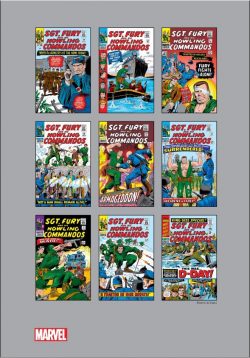
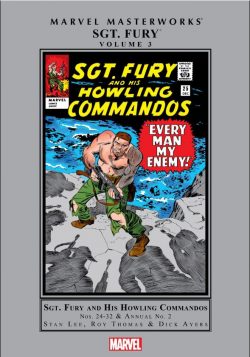
Sgt. Fury and his Howling Commandos Marvel Masterworks volume 3


By Stan Lee, Roy Thomas, Dick Ayers & various (Marvel)
ISBN: 978-0-7851-4212-6 (HB)

Sgt. Fury and his Howling Commandos began as an improbable, decidedly over-the-top, rowdy and raucous WWII combat comics series similar in tone to later ensemble action movies such as The Magnificent Seven, The Wild Bunch and The Dirty Dozen. The surly squad of sorry reprobates premiered in May 1963, one of three action teams concocted by creative men-on-fire Jack Kirby & Stan Lee to secure fledgling Marvel’s growing position as the comics publisher to watch.

Two years later Fury’s post-war self was retooled as the big-name star of a second series (beginning with Strange Tales #135, August 1965) when TV espionage shows such as The Man from U.N.C.L.E. or Mission: Impossible and the James Bond film franchise became global sensations.

Nick Fury, Agent of S.H.I.E.L.D. combined Cold War tensions with sinister schemes of World Domination by subversive all-encompassing hidden enemy organisations: with captivating super-science gadgetry and iconic imagineering from Jack Kirby and Jim Steranko.

For all that time, however, the original wartime version soldiered on (sorry: puns are my weapon of choice), blending a uniquely flamboyant house-bravado style and often ludicrous, implausible, historically inaccurate, all-action bombast with moments of genuine heartbreak, unbridled passion and seething emotion.

Sgt. Fury started out as a pure Kirby creation. As with all his various combat comics, The King made everything look harsh and real and appalling: the people and places all grimy, tired, battered yet indomitable.

The artist had served in some of the worst battles of the war and never forgot the horrific and heroic things he saw (and more graphically expressed in his efforts during the 1950s genre boom at a number of different companies). However, even at kid-friendly, Comics Code-sanitised Marvel, those experiences perpetually leaked through onto his powerfully gripping pages.

Kirby was – unfortunately – far too valuable a resource to squander on a simple war comic (or indeed the X-Men and Avengers: the other series launched in that tripartite blitz on kids’ spending money) and he was quickly moved on, leaving redoubtable fellow veteran Dick Ayers to illuminate later stories, which he did for almost the entire run of the series (95 issues plus Annuals) until its transition to a reprint title with #121 (July 1974). The title then carried on until its ultimate demise, with #167, in December 1981.

Ex-serviceman Lee remained as scripter until he too was pulled away by the developing Marvel phenomenon after which a succession of youthful, next-generation writers took over, beginning with Roy Thomas who provide welcome background in his Introduction, after which this third hardback and eBook compendium re-presents the contents of Sgt. Fury and his Howling Commandos #24-32 and the second Annual (collectively spanning November 1965 to August 1966) opening with a Lee scripted, Ayers and Frank Giacoia (AKA Frankie Ray) inked milestone as the war-weary squad head back to America in ‘When the Howlers Hit the Home Front!’

Of course, they still find plenty of trouble when battle comrade and Kentucky gentleman “Rebel” Ralston and his family are captured by Nazi Bundists and the First Attack Squad forgoes leave to rush to the rescue. At adventure’s end, however, the victorious team are forced to leave grievously wounded corporal Dum Dum Dugan behind to recuperate…

John Tartaglione signed on as regular inker for ‘Every Man My Enemy!’ as the unit return to Britain to commence a secret mission and expose a spy who has infiltrated their Army camp. The hunt eventually uncovers one of history’s greatest super-villains and leads to the first of many deadly clashes between Fury and the most dangerous man alive…

Golden Age veteran Carl Hubbell deployed his pens and brushes on ‘Dum Dum Does It the Hard Way!’, as the doughty corporal is shot down in the Atlantic whilst seeking to rejoin the Howlers, precipitating a stirring saga of privation and courage as the flight crew’s life raft is picked up by merciless U-Boat commander Vice Admiral Ribbondorf – the Sea Shark! That move was only the Nazi’s first mistake…

Issue #27 – by Lee, Ayers & Tartaglione – then reveals the origin of the sturdy sergeant’s optical injury (which would, in later life, lead to his adopting that stylish eyepatch) when the squad are despatched to Germany to destroy a new Nazi beam weapon. A now-obligatory SNAFU separates the squad and ‘Fury Fights Alone!’ before finally escaping “Festung Europa” and battling his way back to Blighty…

In the previous volume readers saw how Hitler demanded that his elite field commander should form a specialist unit to surpass Fury’s Commandos. The result was The Blitzkrieg Squad of Baron Strucker and they proved utterly ineffectual. Now the Fuhrer gives his once-favoured Prussian aristocrat one last chance to prove himself by obliterating the French town (and Resistance stronghold) Cherbeaux: a task even the disaffected Junker feels is a step too far…

With the town mined and the population imprisoned within, Fury’s Commandos are sent to stop the promised atrocity in ‘Not a Man Shall Remain Alive!’ The battle in the streets ends with another spectacular face-off between the icons of two warring ideologies and ‘Armageddon!’ for the hostage city…

With Strucker’s threat seemingly ended, Roy Thomas begins his run with ‘Incident in Italy!’ as the First Attack Squad parachute into a trap and are locked up in a POW camp. With the spotlight on former movie idol Dino Manelli, the Howlers link up with partisans, bust open the camp, free the captives and blaze their way back to liberty, before ‘Into the Jaws of… Death!’ sees the heroes retraining for underwater demolitions before being distracted by the abduction of their commander, Captain Samuel “Happy Sam” Sawyer. It’s the biggest and last mistake this bunch of Gestapo goons ever make…

The monthly missions conclude here with another episode of infernal intrigue as one of the Howlers is insidiously indoctrinated and turns against his comrades as they battle for their lives in Norway while dealing with ‘A Traitor in Our Midst!’…

Sgt. Fury and his Howling Commandos Annual #2 was released in August 1966, and offered a brace of reprints (not included here) plus an all-new but out-of-continuity tale by Thomas, Ayers & Tartaglione. ‘A Day of Thunder!’ is set on June 5th 1944 and stirringly reveals the pivotal role the Howling Commandos play in paving the way for D-Day…

Closing this comics campaign is an unused cover art by Ayers.

Whereas close rival DC increasingly abandoned the Death or Glory bombast at this time in favour of humanistic, practically anti-war explorations of war and soldiering, Marvel’s take always favoured action-entertainment and fantasy over soul-searching for ultimate truths. On that level at least, these early epics are stunningly effective and galvanically powerful exhibitions of the genre. Just don’t use them for history homework.
© 1965, 1966, 2017 Marvel Characters Inc. All rights reserved.

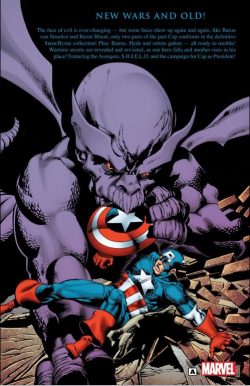
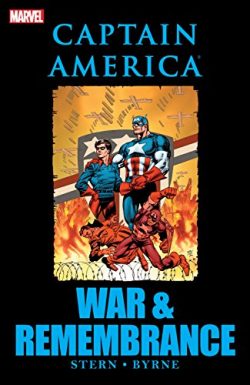
Captain America: War & Remembrance


By Roger Stern & John Byrne, with Joe Rubinstein & various (Marvel)
ISBN: 978-0785126935 (TPB)

Created by Joe Simon & Jack Kirby in a previous era of frantic patriotic fervour, Captain America was a bombastic, dynamic and highly visible response to the horrors of Nazism and the threat of Liberty’s loss.

He faded away during the post-war reconstruction to briefly reappear during the Korean War: a harder, darker sentinel, ferreting out monsters, subversives and the “commies” who lurked under every brave American kid’s bed. He quickly vanished once more until the burgeoning Marvel Age resurrected him just in time for the turbulent, culturally divisive 1960s. He’s been with us – in one form or another – ever since…

Although not the USA’s original patriotic superhero, the Star-Spangled Avenger was the first to truly dominate public attention, and over the years a vast number of talented artists and writers have crafted his adventures. It is therefore quite odd to realise just how few of those exploits are truly memorable.

I’ll leave you to compile your own top ten, but I’ll wager that this all-too-brief run by Roger Stern, John Byrne & Joe Rubinstein will provide at least one of them.

This slim volume – available in all the usual physical and digital formats – collects Captain America #247-255 (cover-dated July 1980-March 1981) seamlessly blending epic adventure with spectacular superhero art: a fans’ delight that is also readily accessible to the newcomer or casual reader.

Following fond reminiscence ‘Remembering Cap’ from author Stern, the action explosively opens with ‘By the Dawn’s Early Light’, offering insight into the hero’s World War II career and uncovering a mystery apparently involving leftover Nazi mastermind and sworn foe Baron Wolfgang von Strucker.

The episode leads Cap to uncover secrets from his past whilst setting up a new threat from deadly robotic villain Machinesmith, leading directly into extended saga ‘Dragon Man’ and ‘Death, Where is Thy Sting?’.

This complex and convoluted yarn explains many seeming inconsistencies in Marvel continuity: combining all-out action with a genuine moral dilemma that perfectly illuminates the character of this American Dream. Cap is always at his best when overcoming overwhelming opposition and ethical enigmas…

These stories were first released in an election year and the truly uplifting ‘Cap for President!’ is still a wonderful antidote for sleaze and politicking whilst confirming the honesty and idealism of the decent person within us all. This tale of honour, duty and worthiness was developed from an abandoned idea conceived by Roger McKenzie & Don Perlin, and is all the more poignant in today’s febrile world of political expediency, Fake News and raw self-promotion…

It’s back to basics after that as Cap unexpectedly teams up with long-time foe Batroc the Leaper to save New York City from flaming Armageddon in ‘The Mercenary and the Madman’ and concluding chapter ‘Cold Fire’: a classic thriller that returned Mr. Hyde to the first rank of Marvel villains.

A short infomercial bonus feature follows, sharing ‘The Life and Times of Captain America’, and revealing ‘The Apartment of Steve Rogers, Esq.’ as well as ‘Steve Rogers’ Friends and Neighbors’ and highlighting ‘Captain America’s Partners Against Crime’ in a breezy, accessible manner before the drama resumes with ‘Should Old Acquaintance Be Forgot’.

Captain America is called to England and the deathbed of WWII comrade Lord Montgomery Falsworth who battled Nazis as the legendary Union Jack, and finds brooding menace, family turmoil and a returned supernatural horror. The menace escalates in the concluding ‘Blood on the Moors’, which even now is still one of the best-handled Heroic Death/“Passing of the Torch” sagas in comics history…

The story portion of the book concludes with a brilliant new version of Captain America’s origin: a stripped down, rationalised retelling designed to celebrate the Sentinel of Liberty’s 40th Anniversary: drawn and inked by Byrne and which became the definitive history for decades to come.

It’s also where the creative team, for unspecified reasons, called it a day.

Supplementing the narrative wonderment is ‘Remembering “Remembrance”’: an illustrated interview and commentary with Stern & Byrne conducted by Dugan Trodglen, augmented by numerous illustrations. Following is the six pages of Byrne’s art from the never-completed tenth issue, a tantalising glimpse of missed magic. Their collaboration was inexplicably curtailed and the creators abruptly left the series for reasons still largely unknown…

The thrills conclude with a selection of Byrne’s covers from various earlier collected editions.

This tome is a sheer escapist thrill-ride, endlessly gratifying and tremendously satisfying. After Jack Kirby, these are probably the purest evocation of this American Icon that you could ever read, so you really should.
© 1980, 1990 Marvel Entertainment Group. © 2008, 2018 Marvel Characters, Inc. All rights reserved.

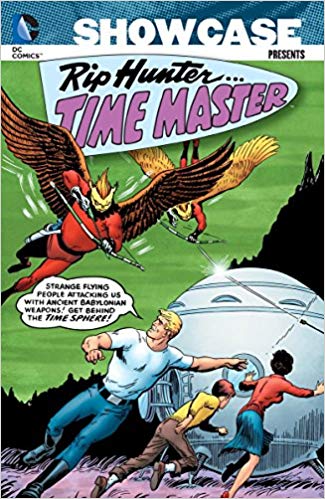
Showcase Presents Rip Hunter… Time Master


By Jack Miller, Bill Ely, Ruben Moreira, Mike Sekowsky & Joe Giella, Joe Kubert, Ross Andru & Mike Esposito, Nick Cardy, Alex Toth, various (DC Comics)
ISBN: 978-1-4012-3521-5 (TPB)

The concept of curious chrononauts is as old as the science fiction genre itself, and every aspect of literature has displayed fascination with leaving the Now for the Then and Thence. As the 1950s closed and the superhero genre slowly re-established itself in comicbooks, National/DC – who had for half a decade been a prime purveyor of bold, he-man fantasy action – successfully scored one last plainclothes hit with the infinite potential of temporal exploration.

With costumed cavorters reappearing everywhere the company combined time-travel vistas with their tried-and-true Adventuresome Quartet format (most effectively utilised for Jack Kirby’s groundbreaking Challengers of the Unknown) and, on a creative high and riding a building wave, introduced a dauntless team of comfortingly ordinary folks as Rip Hunter… Time Master debuted in Showcase #20, cover-dated May/June 1959. This mammoth monochrome testament containing all the Showcase try-outs (and #1-15 of his starring vehicle) is still the only place to find these grand old tales, sadly…

Studious yet manly, inventor Hunter had just finished building flying globes which could crack the time barrier and, like any sensible man, wanted his best friend Jeff Smith and even girlfriend Bonnie Baxter to share in his fun-filled jaunts. Bonnie’s little brother Corky just came along for most rides…

Series creator Jack Miller and scripter was a serious history buff who filled the stories with the very latest in historical facts and theories, but that never got in the way of strong, rousing storytelling from the outset, and the series’ one potential flaw – lack of a consistent art-team – became a huge bonus in the early days, as a procession of top-flight illustrators took turns rendering the strangest and most evocative moments in comics history… so far…

Illustrated by Ruben Moreira, it all began with ‘Prisoners of 100 Million BC’: a novel-length introductory exploit which saw the daredevil physicist, engineer Jeff, adoring Bonnie and little Corky travel back to the Mesozoic era, utterly unaware that they were carrying two criminal stowaways.

Once there, the thugs hi-jacked the Time Sphere, holding it hostage until the explorers help them stock up with rare and precious minerals. Reduced to the status of mere castaways, Rip and Co. became ‘The Modern-Day Cavemen’ until an erupting volcano caused ‘The Great Beast Stampede’ which enabled the time travellers to finally turn the tables on their abductors…

Miller was always careful to use the best research available but never timid in blending historical fact with bold fantasy for Hunter’s escapades, and epic follow-up ‘The Secret of the Lost Continent’ (Showcase#21, July/August, 1959 and illustrated by Mike Sekowsky & Joe Giella) saw the Time Masters jump progressively further back in time in search of fabled Atlantis.

A dramatic meeting with Alexander the Great in 331 BCE led our temporal voyagers on a trail of clues back centuries to ‘The Forbidden Island’ of Aeaea in 700 BCE, uncovering the truth about legendary witch Circe before finally reaching 14,000 BCE and ‘The Doomed Continent’. Only on arrival do they see that the legendary pinnacle of early human achievement was actually a colony of stranded extraterrestrial refugees…

Rip Hunter appeared twice more in Showcase before winning his own series, and those succeeding months would see the Silver Age of superheroes kick into frantic High Gear with classic launches coming thick and fast.

Even so, the Time Masters continued slowly building their own faithful audience, happy to explore the traditionally fantastic. Nearly a year after the initial run they returned in Showcase #25 (March/April 1960 and spectacularly illustrated by Joe Kubert) as ‘Captives of the Medieval Sorcerer’ due to Rip’s old college professor requesting passage for a scholarly colleague to the kingdom of Ritanni a thousand years in the past.

Unfortunately, the studious Dr. Senn is a charlatan in search of mystic power and his machinations almost lead the time team to doom in ‘The Valley of the Monsters’ before Rip discovers the hoax and ends ‘The Sorcerer’s Siege’…

Kubert stuck around to reveal ‘The Aliens from 2000 B.C.’ (Showcase #26, May/June 1960) as Rip and the gang voyage to ancient Egypt to verify recently unearthed pottery shards only to clash with extraterrestrial criminals planning on playing god with the natives. After a daring ‘Escape from the Doomed Village’, the lads link up with space cops to crush the baddies and their incredible pet monsters in time to win ‘The War of the Gods’…

Ironically, time moved rather slowly for new titles in those days and Rip Hunter… Time Master only finally launched a year later, sporting a March/April 1961 cover-date.

With Ross Andru & Mike Esposito in the drawing seats, Miller hit the ground running: ‘The Thousand-year-Old Curse’ captivatingly traces an ancestral doom afflicting the Craig family which brings Rip firstly to New England in pioneer times before further backtracking to Switzerland in 1360 A.D. to uncover ‘The Secret of the Volcano Creature’. One final jaunt to feudal Europe is required to reveal the truth after a climactic clash with ‘The Wizard of the 10th Century’…

Two months later, #2 began with a sightseeing trip to Greece spoiled when a giant monster escapes from a hidden cave. Ever-curious, Rip traces the evidence and takes the team back to meet ‘The Alien Beasts of 500 B.C.’, becoming embroiled in an undocumented civil war.

Deposed dictator Demades has gained control of cosmic animals originally captured by stranded alien Big-Game hunter Nytok, intending to use them to reassert his rule over Greece… until the Time Masters intervene and instigate ‘The Battle of the Alien Beasts’. That debacle almost leads to ‘Rip Hunter’s Last Stand’ but of course the ingenious future-man has a trick or two up his sleeve…

In #3, an old coin with Corky’s face on it draws the chrononauts to Scandinavia in 800 A.D. and into a royal power struggle for ‘The Throne of Doom’. As Corky is a doppelganger for incumbent young King Rollo, all manner of deadly confusions occur, especially once the future boy is targeted by wicked usurper Svend ‘The Duke with Creature Powers’. Luckily, modern know-how exposes the truth about the beasts under the villain’s control before ‘The Battle of the Warriors’ eventually sees Right and Justice restored…

Nick Cardy assumed art duties with #4 as a time-lost avian Vornian arrives in the modern world and the Temporal troubleshooters offer to return him to his home amongst ‘The Bird-Men of 2000 B.C.’ Of course, the adventurers are soon involved in a war between legendary King Hammurabi and Vornian rebels where ‘The Ancient Air Raid’ of the insurgents inevitably causes to a clash with ‘The Avenging God of Gilgamesh’… or does it?

In #5, ‘The Secret of the Saxon Traitor’ finds the team trying to rewrite established history and clear the name of a long-reviled traitor, but the books never mentioned invading spacemen or ‘The Creatures of Doom Valley’. At least the spectacular finale of ‘The Ancients vs. The Aliens’ proves that sometimes history gets it right all along…

The sensational Alex Toth then came aboard for two issues, beginning with ‘The Secret of the Ancient Seer’ in #5, as a convocation of contemporary scientists request that Rip investigate an 8th century Baghdad prophet who predicted Columbus’ discovery of America and, more worryingly, imminent doom from a fireball due to strike Earth in one week’s time. On arrival in Asia, the team discover the prophecy actually originates in ‘The Doomed City’ of Herculaneum, just before the eruption of Vesuvius…

With no solution in the past, Rip returns to the present and devises his own astounding solution to ‘The Menace of the Meteorite’…

This astonishing yarn is followed in RHTM #7 by ‘The Lost Wanderers in Time’, with the futurist foursome embarking upon a desperate chase through unrecorded history. They are seeking a cure for a disease devastating South American Indians but their spasmodic quest eventually takes them back a million years to clash with ‘The Last Dinosaur’ before a remedy for ‘The Green Death’ is found in the least likely place…

With #8 veteran illustrator Bill Ely won the role of regular artist, limning almost every story until the series ended. His first venture was ‘The Thieves Who Stole a Genie’, wherein the explorers follow gangsters who had stolen their spare Time Sphere to secure Aladdin’s magic lamp. The trail leads to 14th century Baghdad where ‘The Battle of the Genies’ is only finally interrupted by an invasion. Of course, canny Rip has the perfect answer for ‘The Attack of the Ommayads’…

When an archaeologist digs up a rocket-ship, he subsequently asks the team to travel back and track down ‘The Alien King of 1,000 B.C.’: a breathtaking romp which finds Corky and Rip almost expiring after ‘The Adventure on Planet Zark’, whilst Bonnie and Jeff remain Earthbound and down until a ‘One-Man Alien Army’ saves them and the ancient world from conquest and death.

In issue #10 ‘The Execution of Rip Hunter’ begins after a research trip to the 3rd century A.D. led to Bonnie’s abduction. Whilst Roman soldiers tackle the boys, a hypnotic spell transforms her into ‘Bonnie – Queen of Palmyra’ and controller of an impossibly powerful beast her abductors need to fend off Imperial invasion in ‘All Hail the Conquering Creature’…

A classic science fiction gem surfaces in #11 where ‘The Secret of Mount Olympus’ is exposed when the team visit 2nd century B.C. Greece. After meeting a witch, Jeff is changed into a griffin and supreme god Zeus demands Rip perform a small task to save him; resulting in a ‘Dead End on Calypso Island’ before the true nature of the pantheon is revealed. ‘The Invasion of Mount Olympus’ results in the team’s escape and the gods’ Earthly departure…

Veteran Legion of Super-Heroes fans might recognise this tale as the basis for a major plot stream concerning the Durlan member Chameleon Boy…

For #12, a threat to modern Earth is revealed after a burning meteor erupts from beneath Stonehenge. ‘The 2,200-Year-Old Doom’ first leads to the building of the monument before at long last our heroes travel into their own future to learn how the fallen star will destroy mankind.

Then, after popping back to when the meteor first hit and seeing the destruction of ‘The Impossible Beasts of One Million B.C.’ Rip finally devises ‘Earth’s Last Chance’ to save Today and all our Tomorrows…

In #13 ‘The Menace of the Mongol Magician’ sees Rip working with a renowned scientist on a magic Chinese tapestry, but their trip to the time of Kublai Khan is only a devious scam to warp history. Once there, the villainous “Professor” plans to supply the Khan’s enemies with modern weapons in return for magical secrets. However, after making off with ‘The Hijacked Time Sphere’ he is promptly betrayed by his ally. Luckily, Rip and Jeff have their own answer to ‘The Mongol Ambush’ and everything turns out as it should…

‘The Captive Time-Travellers’ in #14 results from Rip and a group of scientists examining an invulnerable artefact purported to have been devised by Leonardo Da Vinci. Further discussion with the great man himself reveals that the container holds the world’s most destructive explosive…

When one of the 20th century technicians swipes the bomb and a Time Sphere, ‘The Future Fugitive’ heads for 2550 A.D. to sell the weapon to a dictator, so Rip and Co. give chase only to become ‘The Prisoners of Time’.

…And that’s when the bomb’s actual builders turn up…

The cleverly captivating fantasy frolics conclude for now with issue #15 and ‘The Earthlings of 5,000,000 B.C.’ wherein a rampaging alien monster in modern-day America proves to be an Earthling of astonishingly ancient vintage.

When Rip and the gang search out the answer to the mystery, they find an entire unsuspected civilisation and become ‘The Experimental Creatures’ of that society’s scientists. Barely escaping the cosmic calamity of ‘The Day the Earth Died’, the Chronal Centurians return safely with the knowledge of what happened to the last tragic survivor’s species…

These stories from a uniquely variegated moment in funnybook history were the last vestiges of a different kind of comic tale and never really affected the greater push towards a cohesive, integrated DC Universe. They are, though, splendidly accessible and thoroughly enjoyable adventure tales which should be cherished by every frenzied fan and casual reader. If only some bold editorial soul at DC felt the same and sanctioned new archival editions of this long-lost saga…
© 1959, 1960, 1961, 1962, 1963, 2012 DC Comics. All Rights Reserved.

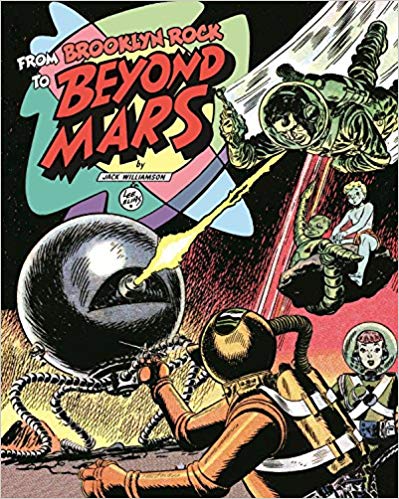
Beyond Mars – The Complete Series 1952-1955


By Jack Williamson & Lee Elias (IDW Publishing)
ISBNs: 978-1-631404-35-1 (HB)

The 1950s was the last great flourish of the American newspaper strip. Invented and always used as a way to boost circulation and encourage consumer loyalty, the inexorable rise of television and spiralling costs of publishing gradually ate away at all but the most popular cartoon features as the decade ended, but the earlier years saw a final, valiant, burst of creativity and variety as syndicates looked for ways to recapture popular attention whilst editors increasingly sought ways to maximise every fraction of a page-inch for paying ads, not fritter the space away with expensive cost-centres. No matter how well produced, imaginative or entertaining, if strips couldn’t increase sales, they weren’t welcome…

The decade also saw a fantastic social change as a commercial boom and technological progress created a new type of visionary consumer – one fired up by the realization that America was Top Dog in the world.

The optimistic escapism offered by the stars above led to a reawakening in the moribund science fiction genre, with a basic introduction for the hoi-polloi offered by the burgeoning television industry through such pioneering (if clunky) programmes as Tom Corbett, Space Cadet or Captain Video and movies from visionaries like Robert Wise (Day the Earth Stood Still) and George Pal (Destination Moon, When Worlds Collide, War of the Worlds and others).

For kids of all ages, conceptual fancies were being tickled by a host of fantastic comicbooks ranging from the blackly satirical Weird Science Fantasy to the affably welcoming and openly enthusiastic Strange Adventures and Mystery in Space. In the inexorably expiring pulp magazines, master imagineers such as Heinlein, Bradbury, Asimov, Clarke, Sturgeon, Dick, Bester and Farmer were transforming the genre from youthful melodrama into a highly philosophical art form…

With Flying Saucers in the skies, Reds under every Bed and refreshing adventure in mind, the multifarious Worlds of Tomorrow were common currency and newspaper strips wanted in on the phenomenon. Established features such as Buck Rogers, Brick Bradford and Flash Gordon were no longer enough and editors demanded bold new visions to draw in a wider public, not just those steady fans who already bought papers for their favourite futurian.

John Stewart “Jack” Williamson was one of the first superstars of American science fiction writing, a rurally raised, self-taught author with more than 50 books, 18 short story collections and even volumes of criticism and non-fiction to his much-lauded name. Born in Arizona in 1908, he was raised in Texas and in 1928 sold his first story to Amazing Stories.

Williamson created a number of legendary serials such as the Legion of Space, The Humanoids and the Legion of Time. He is credited by the OED with inventing the terms and concepts of “terraforming” and “genetic engineering.” He was one of the first literary investigators of anti-matter with his Seetee novels.

“See Tee” or “Contra Terrene Matter” is also at the heart of the strip under discussion here, completely collected in this magnificent full colour volume and available in positive matter Hardback and the ethereal pulses technique we dub digital publication.

Following a damning newspaper review of Seetee Ship, Williamson’s second novel in that sequence – which claimed the book was only marginally better than a comic strip – the editor of a rival paper was moved to engage Williamson and artist Lee Elias to produce a Sunday page based in the same universe as the books.

Leopold Elias was born in England in 1920, but grew up in the USA after his family emigrated in 1926. He studied at the Cooper Union and Art Students League of New York before beginning his professional comics illustration career at Fiction House in 1943. He worked on Captain Wings and latterly western strip Firehair. His sleek, Milton-Caniff-inspired art was soon highly prized by numerous publishers, and Elias contributed to the lustre of The Flash, Green Lantern, Sub-Mariner, Terry and the Pirates and, most notably, the glamourous Black Cat strip for Harvey Comics.

Elias briefly left the funnybook arena in the early 1950s after his art was singled out by anti-comicbook zealot Dr. Fredric Wertham. He traded up to the more prestigious newspaper strips, ghosting Al Capp’s Li’l Abner before landing the job of bringing Beyond Mars to life.

He returned to comicbooks after the strip’s demise, becoming a mainstay at DC in the 1960s, Marvel in the 1970s and Warren in the 1980s. He died in 1998, having spent his final years teaching at the School of Visual Arts and the Kubert School.

The glorious meeting of the minds is preceded here by an effusive and informative Introduction from Bruce Canwell – ‘When “Retro” Was Followed by “Rocket”’ – packed with cover illustrations, original art pages and illustrations that set the scene and share lost secrets of the strips genesis and ultimate Armageddon.

With Dick Tracy strip maestro Chester Gould as adviser for the early days, Beyond Mars ran exclusively and in full colour in the New York Daily News every Sunday from 17th February 1952 to May 13th 1955: a gloriously high-tech, high-adventure romp based around Brooklyn Rock in 2191 AD.

This bastion was a commercial space station bored into one of the rocky chunks drifting in the asteroid belt “Beyond Mars” – the ideal rough-and-tumble story venue on the ultimate frontier of human experience.

Although as the series progressed a progression of sexy women and inspired extraterrestrial sidekicks increasingly stole the show, the notional star is Spatial Engineer Mike Flint, an independent charter-pilot based on the rock, and the first tale begins with Flint selling his services to plucky Becky Starke who has come to the furthest edge of civilisation in search of her missing father. A student of human nature, she cloaks that motivation as a quest for a city-sized, solid diamond asteroid floating in the deadly “Meteor Drift”…

Soon Mike and his lisping ophidian Venusian partner Tham Thmith are contending with Brooklyn Rock’s crime boss Frosty Karth, a fantastic raider dubbed the Black Martian, a super-criminal named Cobra and even more unearthly menaces in a stirring tale of interplanetary drug dealers, lost cities, dead civilisations…

There’s even a fantastic mutation in the resilient form of a semi-feral Terran boy who can breathe vacuum and rides deep space on a meteor!

With that tale barely concluded the crew, including the rambunctious space boy Jimikin, fell deep into another mystery – Brooklyn Rock has gone missing!

However, Flint has no time to grieve for the family and friends left behind as he intercepts an inbound star-liner and discovers both an old flame and a smooth-talking thug bound for the now-missing space station. One of them knows where it went…

Unknown to even this mastermind, the Rock, stolen by pirates, is out of control and drifting to ultimate destruction in a debris field, but no sooner is that crisis averted than the heroes are entangled in a “First Contact” situation with an ancient alien from beyond Known Space. Perhaps that might actually be more correctly deemed becoming snared by the devilish devices he/she/it left running…

Ultimately, Mike, Tham, Jimikin and curvaceous Xeno-archeologist Victoria Snow narrowly escape alien vivisection from robotic relics before the tragic, inevitable conclusion…

Snow’s brother Blackie is a fast-talking ne’er-do-well, and when he shows up, old enemy Karth takes the opportunity to try and settle some old scores, leading Flint into a deadly trap on Ceres and a slick saga of genetic manipulation, eugenic supermen and bonanza wealth…

Meanwhile on an interplanetary liner, a new cast member “resurfaces” in the shape of crusty old coot – and Mercurian ore prospector – Fireproof Jones, just in time to help Flint and Sam mine their newfound riches.

As ever, Karth is looking to make trouble for the heroes but he wins some for himself when his young daughter suddenly turns up on the Rock, accompanied by gold-digging Pamela Prim. Suddenly, the murderous raider Black Martian returns to plague the honest pioneers of the Brooklyn frontier…

Glamour model Trish O’Keefe causes a completely different kind of trouble when she lands, looking for her fiancé. Naturally, Tack McTeak isn’t the humble space-doctor he claims to be but is a cerebrally augmented criminal mastermind, and his plans to snatch the biggest prize in space lead to a sequence of stunning thrills and astonishing action.

The scene switches to Earth as the cast visit “civilisation” and find it far from hospitable, so the chance to battle manufactured monsters and the mysterious Dr. Moray on his private tropical island is something of a welcome – if mixed – blessing.

By this time, the writing must have been on the wall, as the strip had been reduced to a half page per week. Even so, the creators clearly decided to go out in style. The sheer bravura spectacle was magnificently ramped up and all the tools of the science fiction trade were utilized to ensure the strip ended with a bang. Moray’s plans are catastrophically realised when the villain employs an anti-gravity bomb to steal Manhattan; turning it into a deadly Sword of Damocles in the sky…

The series abruptly ended when the New York Daily News changed its editorial policy: dropping all comics from its pages. The decision was clearly unexpected, as the saga finished satisfactorily but quite abruptly on Sunday 13th March 1955.

Beyond Mars is a breathtaking lost gem from two master craftsmen that successfully blended the wonders of science and the rollicking thrills of Westerns with broad, light-hearted humour to produce a mind-boggling, eye-popping, exuberantly wholesome family space-opera the likes of which wouldn’t be seen again until Star Wars put the fun back into futuristic fiction.

Thankfully, after years of frustrated agitation by fans, the entire saga has been collected into a this beautiful oversized (244 x 307 mm) hardback edition that no lover of futuristic fun and frolics can afford to be without.
© 2015 Tribune Content Agency LLC. All rights reserved. Introduction © 2015 Bruce Canwell.

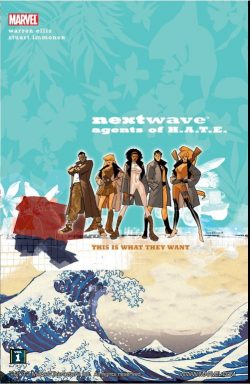
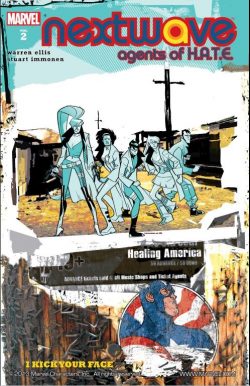
Nextwave Agents of H.A.T.E. volume 1 This is What They Want and volume 2 I Kick Your Face


By Warren Ellis, Stuart Immonen & Wade Von Grawbadger (Marvel)
ISBN: 978-0-7851-2278-4 (Vol. 1 HB); 978-0-7851-1910-4 (Vol. 2 TPB)

Even for the most dedicated fans, superhero comics can become a little samey and pedestrian, so when gifted big- name creators such as Warren Ellis and Stuart Immonen decide to have a little fun with the fringes of such a ponderous continuity as Marvel’s, expectations are always understandably high.

In 2006 Nextwave: Agents of H.A.T.E. (Highest Anti-Terrorism Effort) launched for a breathtaking and controversial 12 issue run and happily proved to be everything a jaded old fan could hope for…

The series has been compiled into one complete volume, these two collections (re-presenting #1-6 and #7-12 respectively) as well as in digital formats. That’s the illusion of choice right there, that is…

Wry, cynically Post-Modern and malevolently mischievous, the saga borrowed shamelessly from kid’s bubblegum pop culture – especially trans-pacific animation. There was even a theme-song you could hear online and a variant-issue that readers could colour in to win prizes – as well as the forgotten contents of the daftest corners of Marvel’s decades of accumulated continuity to captivatingly satirise the genre, the medium and itself.

Best of all, it was hilariously anti-globalisation, counter-capitalist, rude, sexy and excessively ultra-violent…

H.A.T.E. is another of those numerous acronymic quasi-governmental, covert high-tech agencies dedicated to keeping us all safe in our overpriced, indolent beds – at least that was what their eccentric team of operatives initially believed.

When they discovered that their employers were in fact a fully owned subsidiary of the Beyond Corporation© and the latest iteration of diabolical terrorist cabal S.I.L.E.N.T., former Avengers Monica Rambeau (Captain Marvel II/Photon/Spectrum, etc…) and artificial individual Aaron (Machine Man) Stack rightly rebelled.

With ex-X-Man Tabitha Smith (Meltdown/Boom Boom); stroppy immortal monster-hunter Elsa Bloodstone and hyper-powered, unimaginative enigma The Captain in tow, they went AWOL, intending to stop their former paymasters at all costs.

Incidentally, the last-cited was formerly Captain $#!£ until ostracized by all the other military-monickered mystery-men, after which Captain America punched his foul-mouthed head in and washed his mouth out with soap.

Further investigation disclosed that the terrorist conglomerate was actually planning to product-test potentially lucrative BWMDs (Bizarre Weapons of Mass Destruction) on American soil and ordinary folks, so the disgruntled quintet promptly stole a super-ship and all the plans, determined to stop the callous campaign and take down the despicable Beyond©-ers forever…

With their increasingly deranged, suicidal and sexually outré former commander Dirk Anger in hot pursuit, the team begins its fightback in Abcess, North Dakota where the legendary giant dragon-in-underpants Fin Fang Foom has been awakened and… stimulated… into going on a rampage of destructive frustration…

On the streets of Abcess, hordes of Beyond©’s mass-produced vegetable warriors are attacking the citizenry and exacerbating the chaos until Elsa and The Captain intervene with their signature lack of restraint and disregard for human life or private property.

As municipal damage and general unrest spiral upwards, Monica devises an unsavoury plan and orders Aaron – a fantastic, military-created robot who despises human “fleshy ones” and has reprogrammed himself to crave vast amounts of beer – to get himself swallowed and deal with the dragon from the inside…

With no rest for the Wicked-crushers, the renegade revengers then head to Sink City, Illinois where brutally corrupt cop Mac Mangel has been infected with a mechanistically mutating program, transforming him into a colossal flesh-and-steel beast hungry to eat metal and/or children…

With mounting carnage everywhere, the Captain still gets distracted into an origin flashback, leaving Tabitha to deal with the Transformer-ed Mangel in her stylishly simple yet permanent manner…

In Wyoming, the Nextwave discover a Beyond© War Garden and set about destroying the next crop of broccoli berserkers and cabbage crusaders, just as Dirk Anger and his other – still-loyal – agents of H.A.T.E. arrive in their flying citadel to unleash all the insane instruments of doom in their arsenal. However even the Drop Bears of Cuddly Koala Death, a flock of Assault Pterosaurs, Samurai Robots and Homicide Crabs cannot contain the righteous indignation of the forgotten heroes, and when Aaron counterattacks by stealing Dirk’s chic-est most secret possession the deviant Director has no choice but to retreat…

To Be Continued…


Nextwave Agents of H.A.T.E. volume 2: I Kick Your Face

The action barely pauses for a primer recap before Beyond©orp’s follow-up BWMD event sees the terrorist entrepreneurs summon an extremely minor and rather juvenile Elder God, Rorkannu, Lord of the Dank Dimension. The malefactors trade that for access to a deadly invading army of mystic behemoths that Dr. Strange fans will recognise as merciless “Mindless Ones” to decimate the town of Shotcreek, Colorado.

Ready to back-up the embattled townspeople are Monica and her crew, but things take a decidedly surreal turn as the monolithic marauders prove to be not all that mindless after all…

In the blistering last-stand battle, Elsa becomes lost in fond reminiscences of her truly unique and bloody childhood, before, against all odds, the Captain stumbles onto Rorkannu and -contrary to everyone’s expectations – finally does something right…

When Steve Rogers became Captain America in 1941, nobody realised that a second Nazi spy stole his urine sample. Now, through a most torturous and arcane path, that last remnant of the original Super-Soldier serum has allowed the ruling elite of the Beyond© group to create whole battalions of customised metahuman champions…

When Nextwave finally track the terrorists to their inverted floating fortress, they are confronted by an army of esoteric adversaries derived and developed from the misappropriated hero-pee and aligned in specifically themed teams such as The Surgery, The Vestry and The Homosexuality, but even such lethally dedicated foes as Dr. Headless, Father Pain, Dr. Nosexy, Sun King, Red Rosary and Slightly Creepy Policewoman pale into feeble insignificance beside the reality-altering threat of Forbush-Man and his eerily familiar comrades the New Paramounts…

Once again plunged into horrifically violent combat, the Nextwave are slowly making bloody headway until the diminutive demon plunges the team into depressing and dreary alternate lives from the worst recesses of their inner visions. Tragically for Forbush-Man, nobody had ever found any evidence of intellect or imagination in Tabitha, just an overwhelming vacuity, urge to steal and need to blow stuff up…

With the end in sight, the triumphant heroes invade the Beyond Corporation©’s hidden HQ State 51 just as Dirk Anger, transformed and degraded beyond imagination, arrives, culminating in an even more spectacular clash before finally confronting the utterly macabre mastermind behind the monstrous marketing campaign of destruction. The elation is non-existent as the team discover an even more bizarre kingmaker behind it all and finally bring the hammer down once and for all…

As action comics in their purest form, the tales are laced with light-hearted lethality and superbly smutty innuendo, with hints of Garth Ennis and John McCrea’s Hitman, Ben Edlund’s The Tick, Pat Mills & Kevin O’Neill’s Marshall Law and Keith Giffen’s Ambush Bug, with all the verve, panache and invention of the Powerpuff Girls and Dexter’s Laboratory, all wrapped up in pithy corporate sloganeering a la Better Off Ted, Corporate and Joseph Goebbels…

Jam-packed with in-joke extras, this is a glorious comic series – in every sense of the word – and an experience no, fun-loving fan could possibly find fault with.

“Healing America by Beating People Up” and making us laugh by taking the piss…

© 2006, 2007, 2010 Marvel Characters, Inc. All rights reserved.

How to Be Happy


By Eleanor Davis (Fantagraphics Books)
ISBN: 978-1-60699-740-6 (HB)

Do acts of creation make one happy? They certainly do for me. but sometimes so do acts of wanton destruction. I’m sharing, not judging…

Eleanor Davis is one of those rare sparks that just can’t help making great comics. Born in 1983, and growing up in Tucson, Arizona, she was blessed with parents who reared her on classic strips such as Little Nemo, Little Lulu and Krazy Kat. Following unconventional schooling and teen years spent making minicomics, she studied at Georgia’s wonderful Savannah College of Art and Design, where she now teaches. Her innovative works have appeared in diverse places such as Mome, Nobrow and Lucky Peach.

A life of glittering prizes began after her award-winning easy reader book Stinky was released in 2008. Davis has since followed up with gems such as The Secret Science Alliance and the Copycat Crook (with her husband Drew Weing), You & a Bike & a Road and Why Art?

In 2014, Fantagraphics released her themed collection of epigrammatic tales, crafted in a mesmerising variety of styles and riffing on the concept of joy and contentment: causes, failings, and what to do with them when and if they happen. These are enigmatic variations on the most ephemeral of emotions and one you only really notice when it’s gone, but the individual episodes here are truly joyous to share.

How to Be Happy is NOT a self-help book – at least not in any traditional sense, but it did make me feel very good when I first read it and only increases my sense of fulfilment every time I pick it up, whether in its comforting reassuring hardback edition or my ever-present anxiety-reducing digital edition…

These observational short stories were created, it seems, for the sheer innocent joy of making them, and examine many aspects of life through self-contained yarns ranging from cautionary tales to excoriating self-diagnosis to flights of sardonic fancy. Some are titled like proper narratives whilst others just happen like life does. Those I’ve identified by first lines if no title is obvious…

Packed with evocative, stand-alone imagery, the episodes commence with line art pictorial pep talk ‘Write a Story’ before switching to lush colour for ‘In Our Eden’, wherein a primitive life of pastoral toil starts to grate on Adam and Eve. They are, unsurprisingly, not all they seem…

Further monochrome line art interventionism manifests in ‘First We Take Off Our Clothes’ after which a short hop into full-colour and a longer one into a fraught future examines family life on Tomorrow’s sub-continent when ‘Nita Goes Home’…

Separation and rural isolation underpin black-&-white monologue ‘We Come Down on Clear Days’ before the restricted colour palette of ‘Stick and String’ offers a hard look at relationships and agency in the tale of a wandering minstrel and the captivating power of momentary fascination…

Relations are further tested in monochrome as ‘Darling I’ve Realized I Don’t Love You’ provides unwise solutions to ancient problems before a truly disquieting incident of mutual grooming in ‘Snip’ segues into a chilling visit to ‘The Emotion Room’.

Colour is employed to potent effect in ‘He turned a grey-green and thought he might pass out’ whilst ‘Seven Sacks’ addresses grisly problems in a fresh fable Aesop or the Brothers Grimm would be proud to pen.

Two colours and self-delusion tinge ‘Did you want to see the statue?’, whilst B&W lines detail the rewards of heroic vitality in ‘Make Yourself Strong’, after which young love blossoms in living colour in ‘Summer Snakes’…

The pure exultation and imagination of childhood is exposed through stark monochrome in ‘Thomas the Leader’ before a brief Vox-pop moment in ‘I used to be so unhappy but then I got on Prozac’ is built upon in further untitled moments of self-realisation before a strong admonition to ‘Pray’…

Observation, tribulation and revelation all come to the author in ‘In 2006 I took a Greyhound from Georgia to Los Angeles’ before a descent into dark moments and extreme actions in ‘The fox must have been hit pretty recently…’ is balanced by intimate sharing in ‘The woman feels sadness’.

Colour adds depth in an extended moment of group therapy release in ‘No Tears, No Sorrow’, after which the wandering introspection of ‘9/26’ leads to a conclusion of sorts in a cab ride to ’25 Washington Street, Please’…

A superb example of the range and versatility of image and text happily combined, this a true joy for all fans of unbridled expression no one could fail to enjoy.
© Eleanor Davis 2014. All rights reserved.