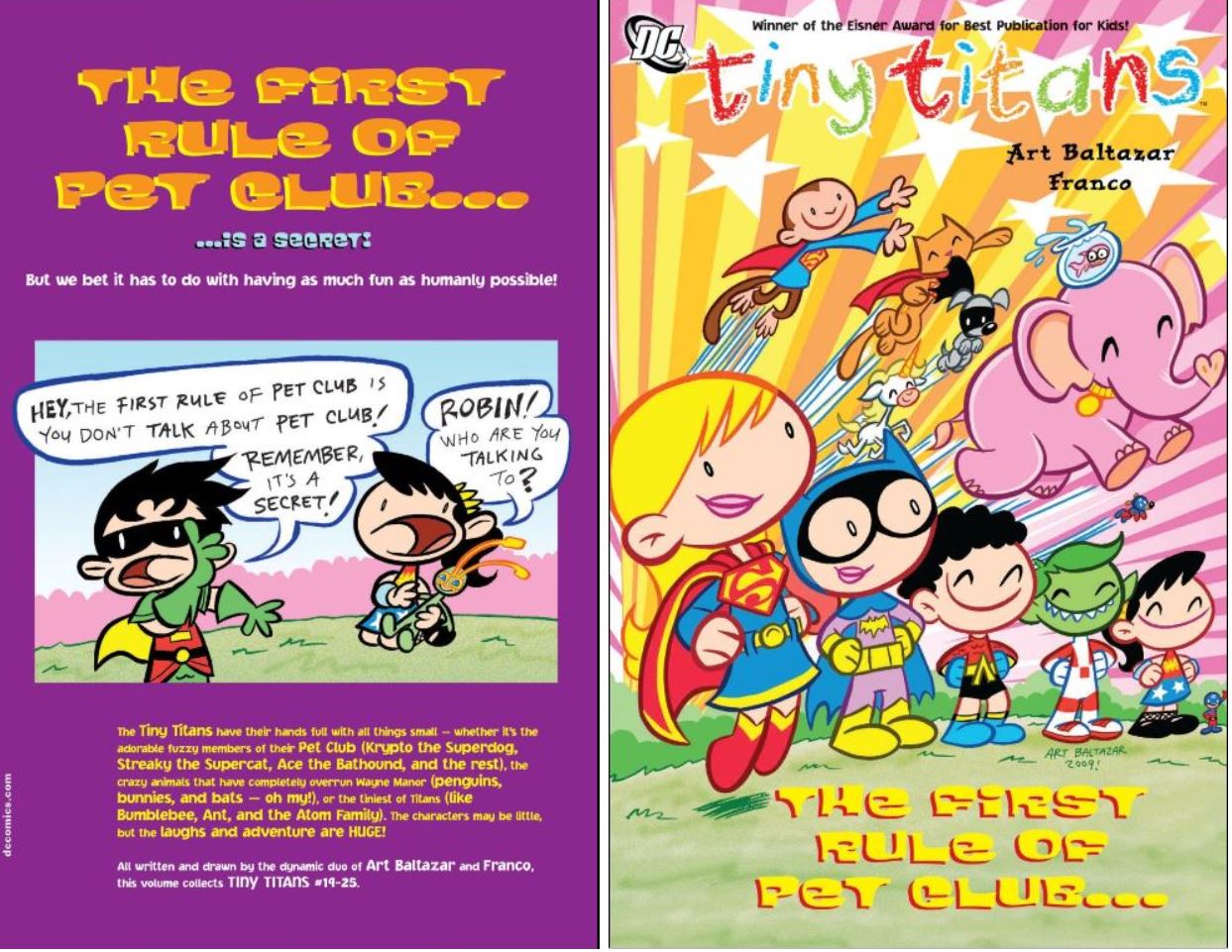
Tiny Titans volume 4: The First Rule of Pet Club…


By Art Baltazar & Franco with Geoff Johns & various (DC Comics)
ISBN: 978-1-4012-2892-7 (TPB), 978-1-4012-4528-3 (Digital edition)

DC’s Cartoon Network imprint was a potent and fun-filled bastion of children’s comics in America and consolidated the link between TV and 2D jollies and thrills with stunning interpretations of television landmarks like Ben 10, Scooby Doo, Powerpuff Girls, Dexter’s Laboratory and others. The comics line also generated truly exceptional material based on screen iterations of their proprietary characters such as Teen Titans Go!, Legion of Super Heroes, Batman: Brave and the Bold and Krypto the Super Dog as well as original material like Billy Batson and the Magic of Shazam!, which were merely indistinguishable in tone and content.

Arguably the imprint’s finest release was a series ostensibly aimed at early readers but which quickly became a firm favourite of older fans – and a multi-award winner too. Superbly mirroring the magical wonderland inside a child’s head where everything is happily mixed up together, Tiny Titans became a sublime nostalgia-weaponised antidote to continuity cops and slavish fan-boy quibbling by reducing the vast cast of successive Teen Titans animated series, the greater boutique of mainstream comic books and, eventually, DC’s entire Universe to little kids and their parents/guardians in the wholesome kindergarten environment of Sidekick City Elementary School – a scenario spring-loaded with in-jokes, sight-gags and beloved yet gently mocked paraphernalia of generations of strip readers and telly-watchers…
Art Baltazar and co-creator Franco (Aureliani) mastered a witty, bemusingly charming style of storytelling that just happily rolls along, with assorted characters getting by, trying to make sense of the great big world and just coincidentally having “Adventures in Awesomeness”. The method generally involves stringing together smaller incidents and moments into an overall themed portmanteau tale and it works astoundingly well. Rounding up issues #19-25 and spanning cover-dates October 2009 – April 2010 of the magically madcap, infinitely addictive all-ages mini-masterpiece, this fourth volume begins on a romantic note by looking at the kids ‘Deep in Like’.

After a handy and as-standard identifying roll-call page, ‘Imagine Me and You…’ finds scary blob Plasmus and tiny winged Bumblebee brightening up each other’s drab day, before a similar cupid moment affects The Brain and best-est pal M’sieu Mallah, even as diligent overachiever Robin (accompanied by faithful Bat-hound Ace) finds his earnest attempts to finish his homework disturbed by a succession of pesky young ladies including Starfire, Batgirl & Duella all caught up in a ‘Like Triangle’. ‘Dates’ then sees Bumblebee & Plasmus inadvertently causing chaos during an afternoon movie monster mash – and even in the ‘Intermission’ – after which a sly sight gag for us oldies highlights the company’s many Wonder Girls in ‘Jump Rope’.
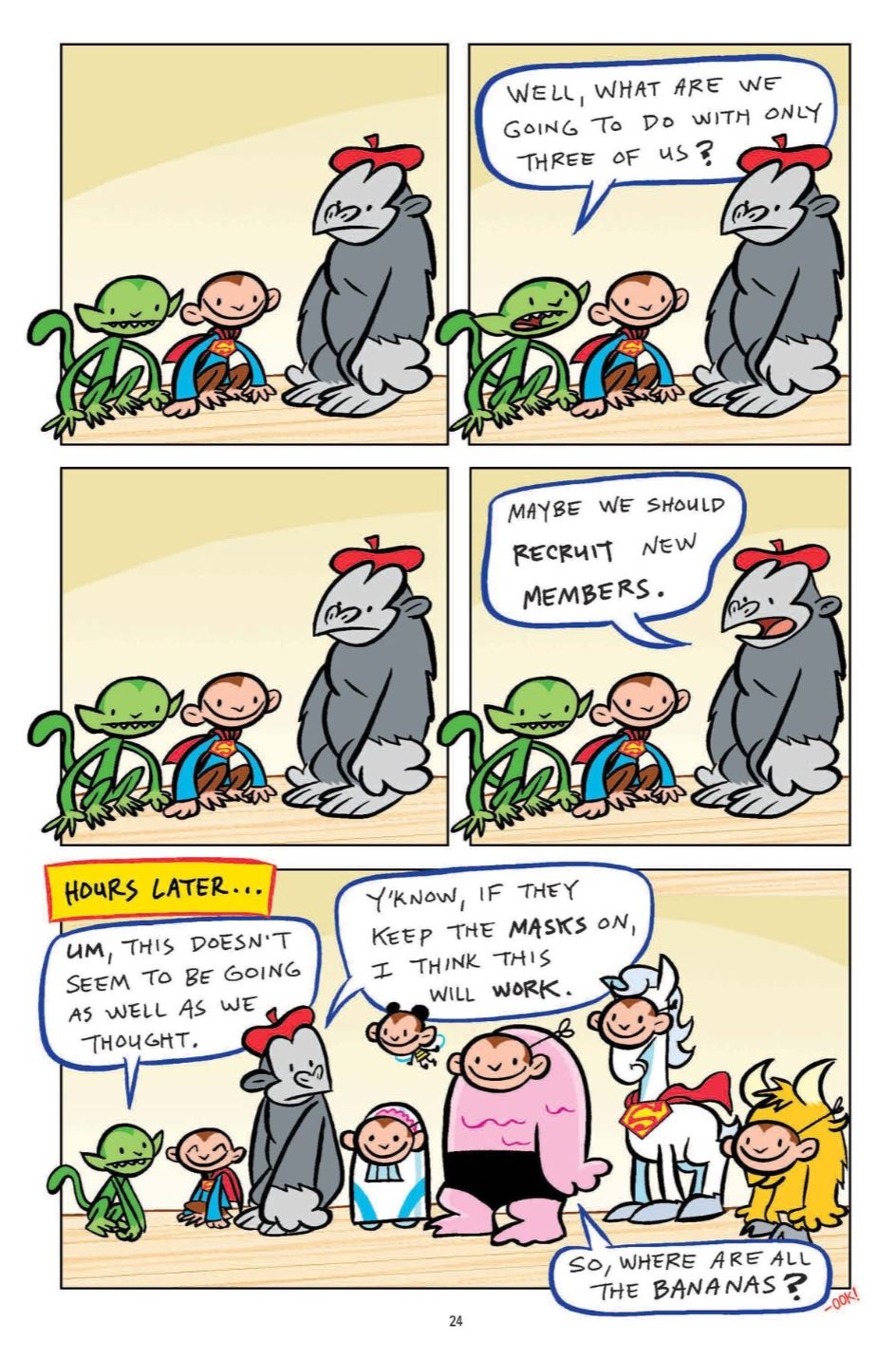
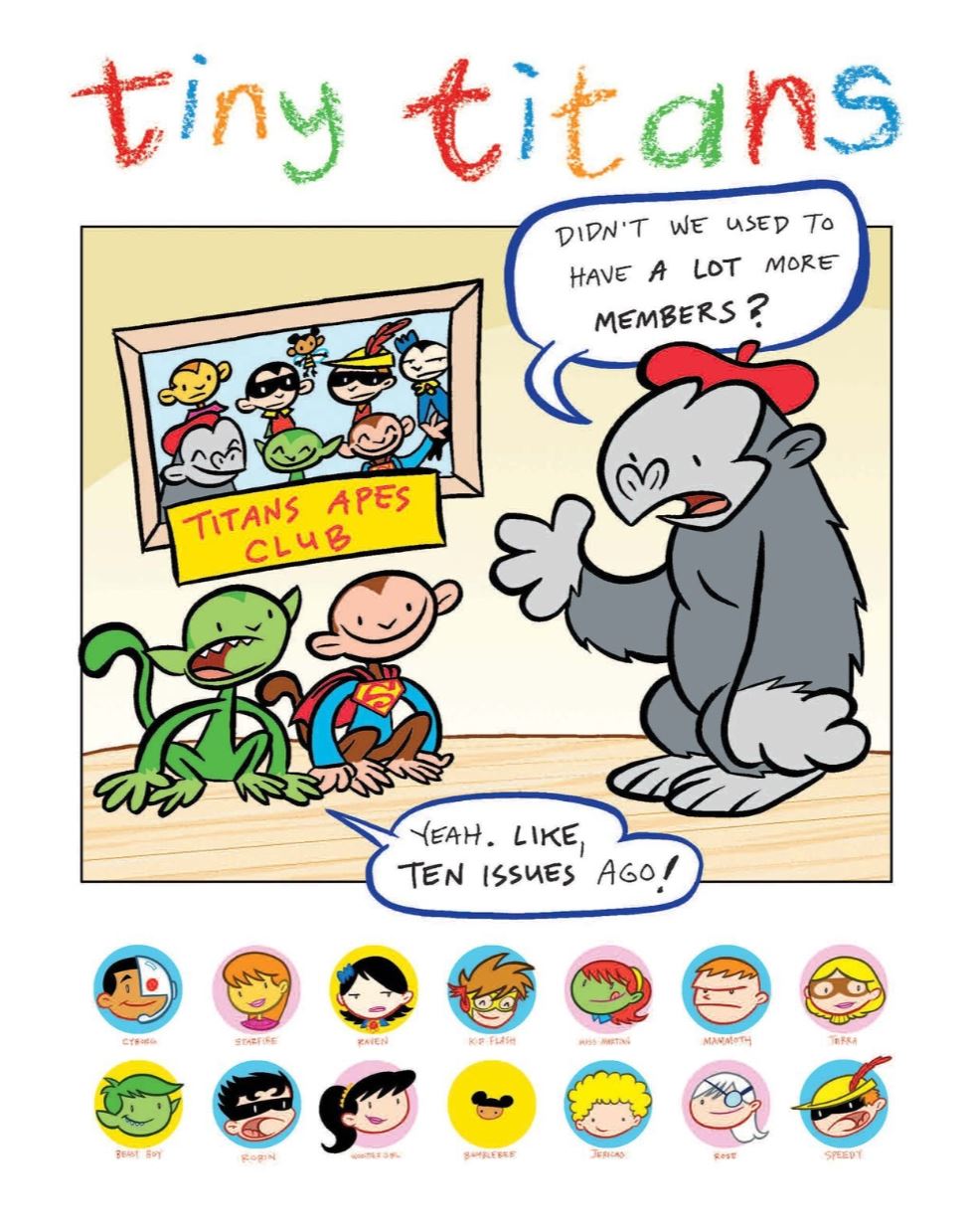
DC’s hallowed anthropoid obsession is highlighted in ‘New Recruits’ when Beast Boy chairs a meeting of the Titans Ape Club before regular feature The Kroc Files depicts ultimate butler Alfred, roguish reptilian star Kroc and Plasmus each demonstrating ‘How to Enjoy a Lollipop’ in their own signature manner. The issue closes with a word puzzle whilst the next promises to disclose The Hole Truth about Raven: beginning with a daybreak disaster at ‘Home with the Trigons’. Raven’s dad is an antlered, crimson transdimensional devil-lord as well as a teacher at Sidekick Elementary, so when he oversleeps, his sorceress scion gets him to work on time by simply opening a few wormholes. Of course, leaving those dimensional doors around is just asking for trouble…

Meanwhile, it’s washday at Wayne Manor, but Alfred won’t let Robin, Beast Boy or Aqualad go down ‘To the Batcave’. Sadly, even the dapper domestic can’t withstand united pester-power and eventually gives in… and learns to regret it. Following a perplexing maze game-page, the All Pet Club Issue! launches as Starfire and mean sister Blackfire write home for their beloved critters Silky & Poopu, so they can go to the oh-so-secret social event, whilst can-do kid Cyborg actually builds himself a brace of chrome companions in ‘Pet-Tronics’…

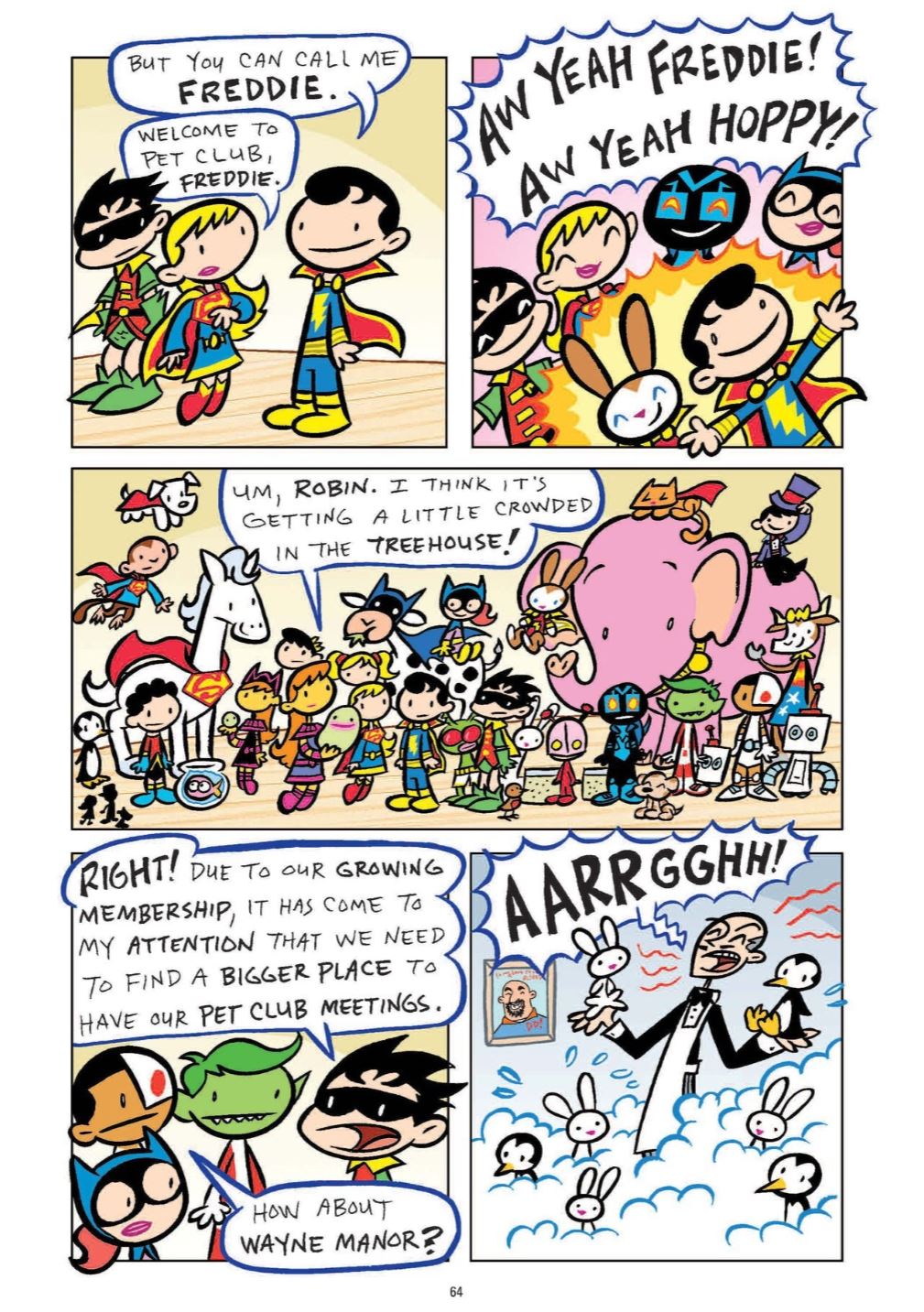
With ‘Club Hoppin’, the entire school gathers with their accommodatingly and uniquely compatible pets to interview potential new members – specifically tongue-tied-&-thunderstruck Captain Marvel Junior and his fuzzy pal Hoppy, the Marvel Bunny. With so many members, the club must find roomier quarters, leading to a painful tryst for Beast Boy and Terra in ‘Meanwhile, on the Moon…’
There’s a brilliant vacuum-packed bonus pin-up of the Tiny Titans in space by Franco before ‘Hot Dogs, Titans, & Stretchy Guys!’ presents the kids back on solid ground and wrapped up with the DCU’s many flexible fellows as ‘Offspring into Action’ introduces Plastic Man’s excitably boisterous bonny boy. Then, ‘Just Playing and Bouncing’ sees Bumblebee spend some time with the diminutive Atoms Family but lose control of their Teeny-Weeny, Super Duper Bouncy Ball and accidentally get Plastic Man, Offspring, Elongated Man and Elastic Lad all wound up, before helplessly watching it bowl over Principal Slade and Coach Lobo in ‘Coffee Dog Latte’.

Thankfully, Robin has exactly the right gimmick in his utility belt to set things straight, but can’t stay long as he’s en route to his Bird Scouts meeting where potential new members Hot Spot and Flamebird are trying out for Hawk, Dove, Raven & Talon. Distressingly, when shiny Golden Eagle turns up, the girls all want to make him the new leader…

The semi-regular ‘Epilogue’ page often supplies one more punch-line to cap each themed issue and this one leads directly into a convoluted and confounding Elastic Four pin-up/cover which in turn precedes a spookily uproarious tale of Bats, Bunnies, and Penguins in the Batcave! Oh My!...

It all begins in ‘Ice to Meet Ya!’ when Wayne Manor’s extraordinarily if not excessively large penguin population get into a turf war with the house rabbits, displacing the Batcave’s regular inhabitants in ‘Driving Me Batty’. The conflict escalates in ‘All in the Batman Family’ before Robin gets a rather stern admonition from his senior partner to put things right… or else.
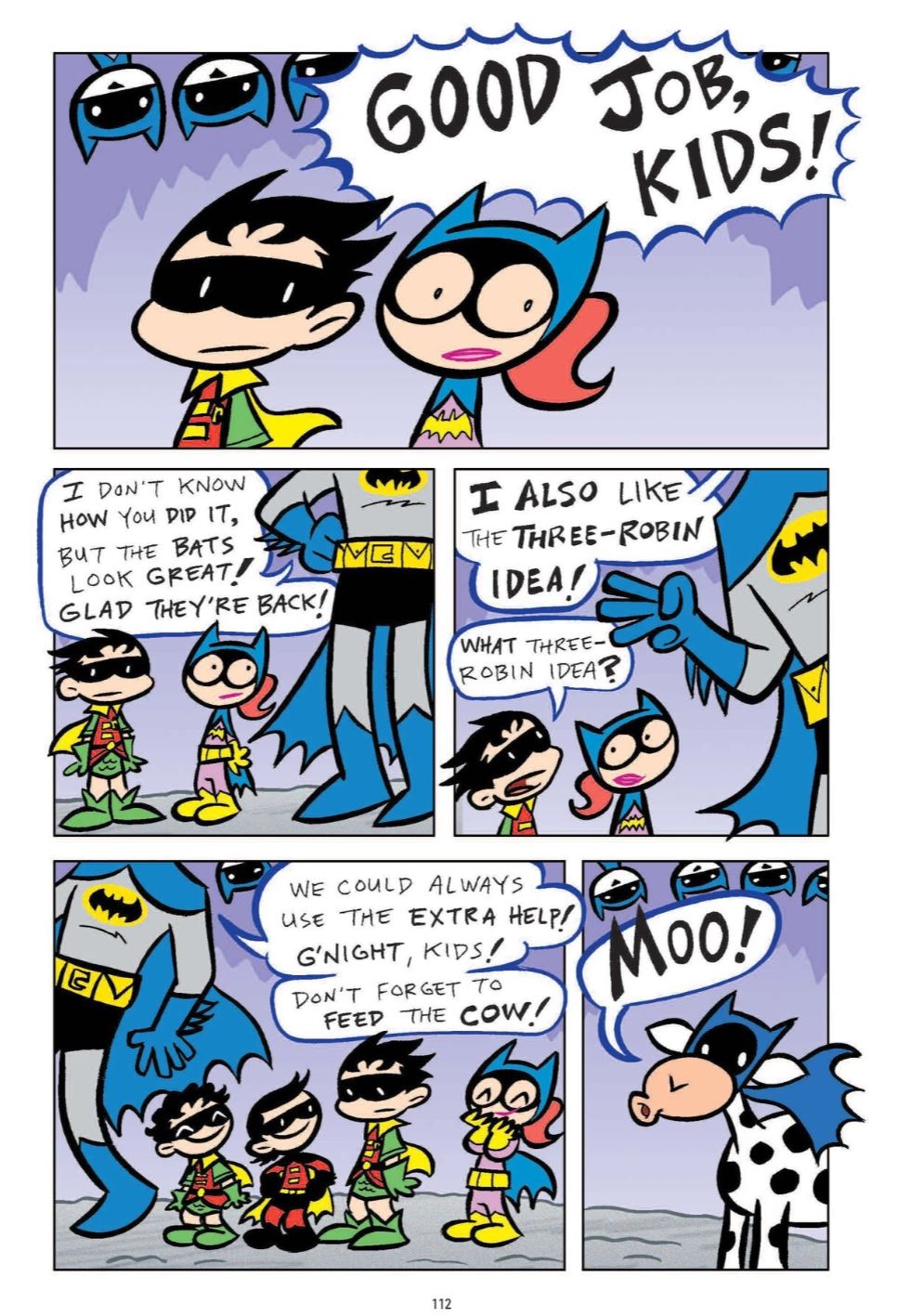
Happily, ever-so-cute & capable Batgirl is willing to lend a hand. Unfortunately, so too are the kids she’s baby-sitting (Tim & Jason: you’ll either get that or you won’t, bat-fans) and impishly infuriating Batmite. With even Batcow helping out, things soon start calming down, but ‘Meanwhile, at the Titans’ Treehouse…’ not all of the fugitive Bat-bats have heard the good news…

Once your ribs have stopped hurting you can then enjoy a Tiny Titans Aw Yeah Pin-up from Franco before ‘The All Small Issue!’ opens with assorted big kids accidentally drinking ‘Milk! Milk!’ from the Atoms’ fridge and shrinking away to nearly nothing. Good thing the Atomic nippers think to call their dad, who’s with fellow professional dwindlers Ant, Molecule and substitute Atoms Adam & Ryan (another in-continuity howler targeting old fogey fans) for a Team Nucleus meeting…

That compressive cow-juice causes more trouble in the ‘Epilogue’ before a Blue Beetle puzzle clears the mind in advance of an outrageous ending as ‘Superboy Returns!’ in a fairly cosmic crossover – and requiring some additional scripting by Geoff Johns.

When Conner Kent shows up, all the girls are really impressed and distracted, whilst – across town – Speedy is trading a lot of junk he shouldn’t be touching to Mr. Johns’ Sidekick City Pawn Shop and Bubblegum Emporium in ‘Brightest Day in the Afternoon!’ When Starfire & Stargirl then buy the seven different coloured “mood rings” from the shop, they and BFFs Duella, Batgirl, Wonder Girl, Terra and Shelly, are turned into Green, Red, Yellow, Orange, Blue, Violet and Indigo Lanterns! Soon, the Tiny Titans are up in the air again and annoying The Guardians of the Universe and their super-serious Green Lantern Corps.
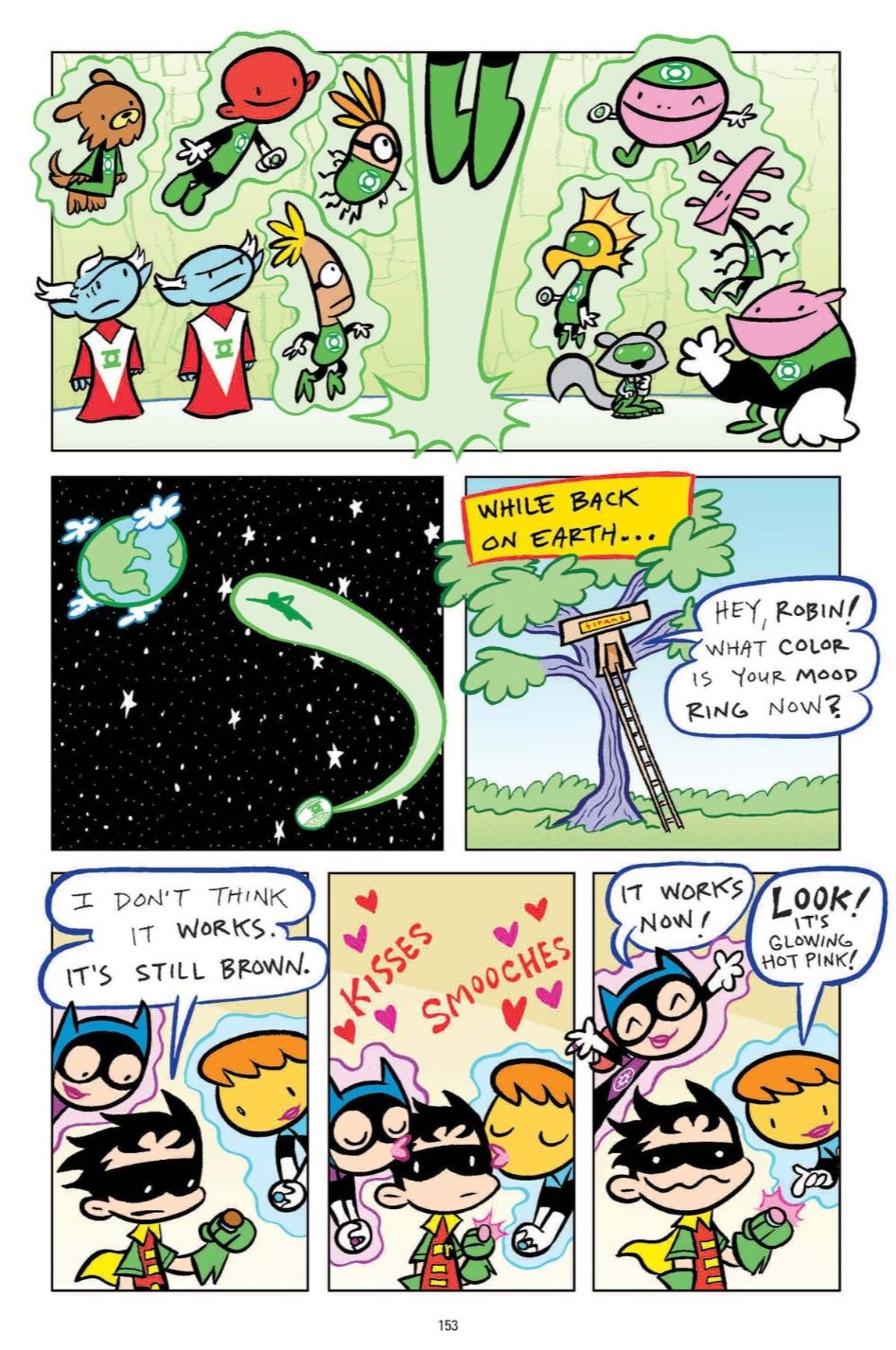
It all ends well, though, in an Emerald ‘Epilogue’ and a lavish pin-up of a posse of pistachio-painted interplanetary peacekeepers…

Despite being ostensibly aimed at super-juniors and TV kids, these wonderful, wacky yarns – which marvellously marry the heart and spirit of such classic strips as Peanuts, The Perishers or Calvin and Hobbes with something uniquely mired and marinated in pure comic-bookery – are deliciously hilarious tales no self-respecting or self-indulging joy-lover should miss: accessible, entertaining, and wickedly intoxicating. Go mellow out with some kids’ stuff, now, okay? Why should they have all the fun?
© 2009, 2010 DC Comics. All Rights Reserved.

Today in 1948 cartoon gadfly Garry Trudeau (Doonesbury) was born, followed in 1950 by scripter and gamed developer Bill Kunkel (Doorway to Nightmare, Vigilante, Marvel Team-Up, Richie Rich). In 1942, Italian artist Giove Toppi died. He was the first cartoonist to draw Mickey Mouse in comics.
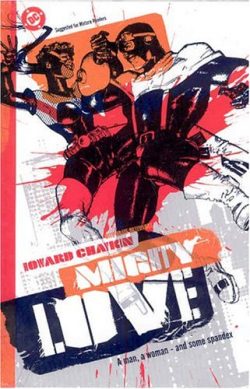
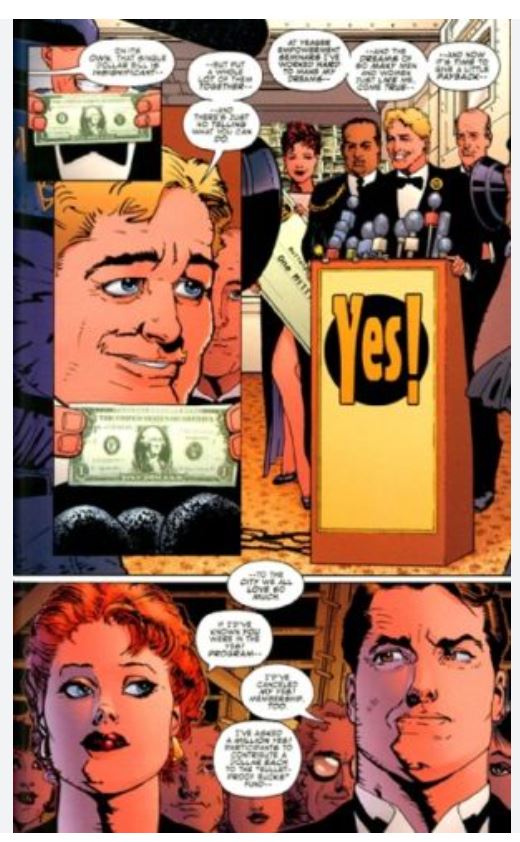
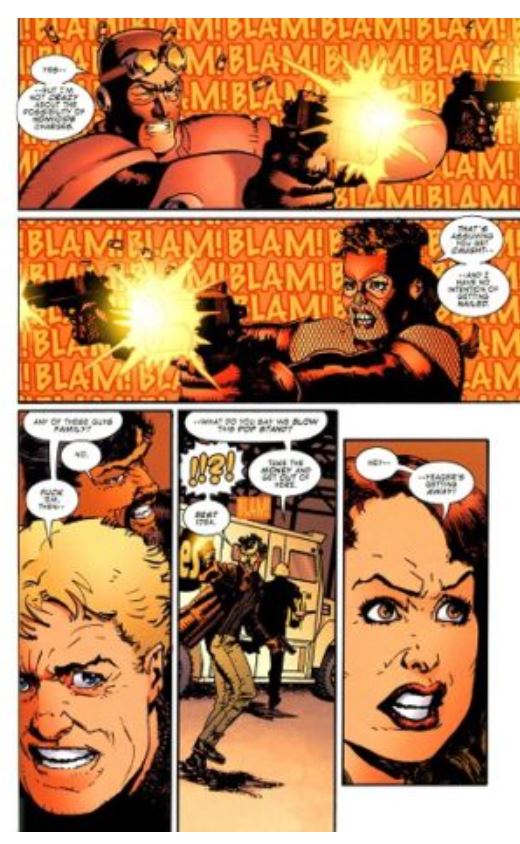
Mighty Love


By Howard Chaykin, with Don Cameron, Kurt Hathaway & Dave Stewart (DC Comics)
ISBN: 978-1-56389-930-0 (HB) 978-1-56389-931-7 (TPB)

This book includes Discriminatory Content produced in less enlightened times and deliberately employed to provoke and annoy you.

Don’t let the outfits fool you: it’s not just another kinky love story…

Oddly released under the DC rather than Vertigo imprint when it debuted in 2003, this is a story about crime in the big city and of the compromises individuals must make to achieve their private and personal purposes.

Delaney Pope is a rough, tough cop on a completely corrupt force who is fed up with seeing the scum she arrests get away with murder – and far worse. Lincoln Reinhardt is a slick, liberal defense attorney constantly thwarting the frames and set-ups of those cops. He constantly clashes with Pope in the course of his job. They both loathe each other with a passion.

Unbeknownst to either they both assuage their workday frustrations by putting on masks and costumes to beat the crap out of criminals (with or without badges) in the commission of their crimes on the streets and in the backrooms… an arena where there are no doubts about guilt, innocence or mitigations.

The thrill of these nocturnal forays inevitably lead to a meeting of “Skylark” and “Iron Angel”, and a tenuous, teasing (if not actually titillating) team-up when separate cases bring them together against the city’s first criminal mastermind. Not knowing each other’s real identity, but afraid to unmask and lose that so-tantalising tension, the pair must decide what’s most important, the actual or the promised…

This delightfully fizzy adult romp prods all the fetishistic trappings of superhero storytelling as the brassy and whimsical writer/artist (with computer effects by Don Cameron, lettering by Kurt Hathaway and colours from Dave Stewart) blends classic romcom movie riffs as seen in The Shop Around the Corner, The Thin Man, Pat and Mike and even Adam’s Rib with a welter of crime caper movies to produce a costume drama in the unmistakable Chaykin manner.

Presumably a pilot for an unrealized longer series, Mighty Love was a fast & stylish, done-in-one oddity that reads well and looks great – so if all you want is a good time; Baby, look no further, and seek this out…
© 2003 Howard Chaykin, Inc. All Rights Reserved.

Born today: long serving Golden Age artist/strip creator John Lehti (Crimson Avenger, Cotton Carver, Tarzan, Flash Gordon, Tales of the Great Book, Tommy of the Big Top, Big Town, Lassie, Tom Corbet, Space Cadet, Sgt. Rock, The Losers) in 1912; Al Bryant (Gale Allen, Shark Brodie, Military Comics, Feature Comics) in 1917; multi-talented artist/editor/publisher Dick Giordano (Sarge Steel, Judomaster, Batman, Human Target, Elongated Man, Modesty Blaise, countless features at Warren, Valiant, DC & Marvel) in 1932 and, in 1990 Brazilian artist Bilquis Evely (Luluzinha Teen e Sua Turma, Doc Savage, Shaft, Wonder Woman, The Dreaming, Supergirl: Woman of Tomorrow).

On this date in 1975, Walt Kelly’s astounding strip Pogo published its last episode, and in 1995 writer/editor/animator George Caragonne (The Legend of Zelda, Masters of the Universe, Planet Terry, Star Brand, Penthouse Comix) died today.

Drought Chic – a Dry Analysis of the Water Shortage


By Shary Flenniken (Shary Flenniken)
No ISBN: (Digest PB)

This book includes Discriminatory Content produced in less enlightened times.

People – mostly climate-denying morons and stupid orange presidents – keep going on about the heatwave of 1976 like it was a biblical event. It WAS NOT as bad what we are enduring right now. Take it from someone who was there – and this time I don’t just mean me…

As I’m feeling nostalgic, thirsty, overheated and deeply in need of a well-limned laugh all at once, here’s an intriguing and enchanting self-published gem from 1977 whose theme and subject matter seems to be coming back into vogue as the days seep by…

Do you remember that sweet pretty girl you admired and daydreamed about from afar? All glowing soft focus summer afternoons and sherbet refreshers, scents of new-mown hay, tinkly bells and soaring strings? And after a lifetime you found the courage to talk to her and she swore like a trooper, cackled like a loon, pulled your hair, mocked your clothes and was all loud and boisterous and not at all serious and girly and your heart broke just a little?

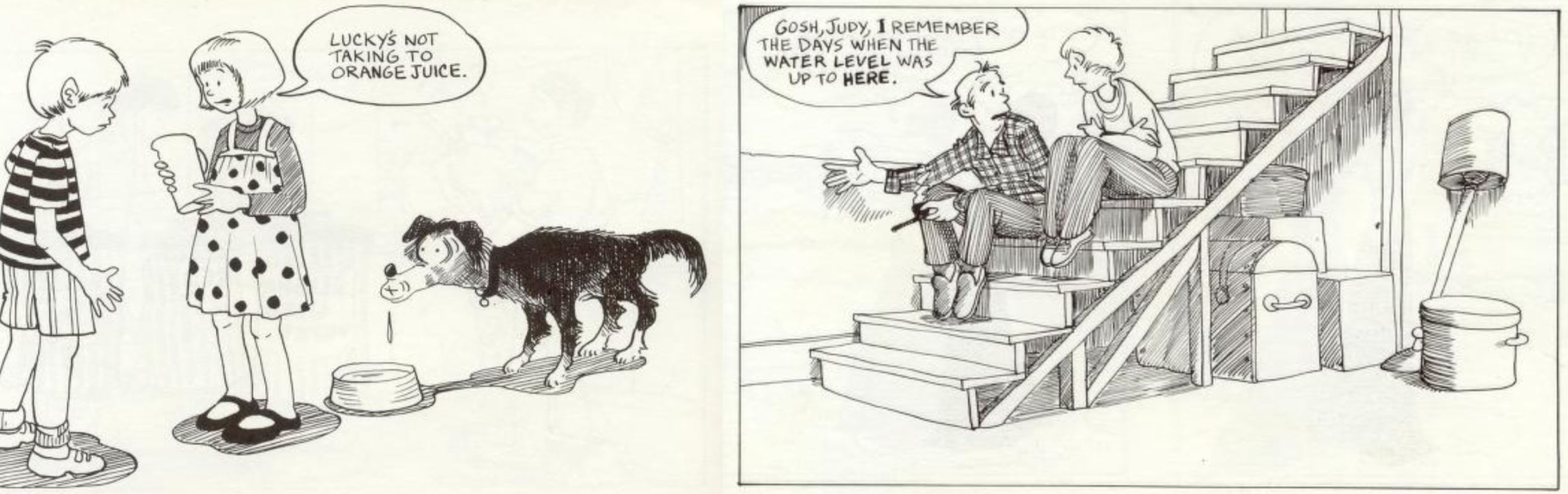
Shary Flenniken’s sense of humour is like that. With her affable, underplayed, deceptively simple line drawing style (so devastating effective in the glorious Girl and her Talking Dog strip Trots and Bonnie) everything looks clean and sugary and chocolate-coated, but then you realise there’s a devastatingly sharp mind and a tungsten-tipped razor-edged scalpel sense of humour at play as you’re hit with a really spiky and heavy giant pink boxing glove…

Flenniken is a scripter/artist/editor/illustrator/screenwriter of enormous talent who contributed to and edited the funniest years of National Lampoon, has published her own books – such as the slim gem under review today – and illustrated some of the funniest books even written by other people, with titles like When a Man Loves a Walnut, Blood-Lust Chickens & Renegade Sheep and Nice Guys Sleep Alone.

She started out as an underground cartoonist in 1971 with the fabulously notorious Air Pirates Collective (the other bold cartoonists taking on Disney whilst preserving the classic heritage of past cartoon masters waving the flag for free speech and the Right to Parody and Satirise at Will being Bobby London, Dan O’Neill, Gary Hallgren and Ted Richards).

Her own drawing style is often likened to pioneering strip artists Clare Briggs (When a Feller Needs a Friend!!, Danny Dreamer, The Days of Real Sport, Mr. and Mrs, Real Folks at Home, Someone’s Always Taking the Joy Out of Life) and laconically mordant Harold Tucker Webster (Our Boyhood Ambitions, How to Torture Your Wife, Life’s Darkest Moment, How to Torture Your Husband and the legendary Caspar Milquetoast/The Timid Soul). That was all best viewed in the long-running (1971-1990) and aforementioned sardonic comedy masterpiece Trots and Bonnie which I simply must get around to one day…

In recent years Flenniken has edited Seattle Laughs: Comic Stories about Seattle, worked for DC’s Paradox Press and Mad, freelanced in Premiere, Details and The American Lawyer, all whilst winning critical acclaim for her adaptations of the works of Mark Twain, O. Henry and others.

She self-published Drought Chic in 1977, and this tiny tidal wave of crafty cartoons and satisfyingly salty asides resulted from close observation and experience of the global heat-wave (are you able to remember that Long Hot Summer of Punk in the UK?) and perennial water paucity of America’s West Coast. Here she wryly – I so want to say “dryly” – extrapolated on the stupidly standard sage advice dashed out by those in power as the USA all-too briefly saw the (fashionably faddy) sense of dabbling with water discipline… or indeed restraint of any kind.

Suggestions to the trendsetters of society riffed-on here include “share baths and showers”, “don’t flush toilets”, “import icebergs”, “replant your lawn with cactus” and “drink something else”: directives I’m fairly sure we’ll all be considering again in the days and years ahead.

Of course here in Britain we have already taken the most effective step to conserve water consumption by selling off the utility, privatising a natural resource and watching it being run down whilst being priced out of the reach of ordinary folk – and look how well that all worked out…

Still, if you’re saving a little time and money as a new member of the Great Unwashed at least you can spend your grubby free hours seeking out this wry, dry and slyly sophisticated soupcon of delightful disinformation. It also available online for free if you can still work a dry dusty keyboard and the lack of liquids hasn’t brought down all the servers. Who knew H2O was so crucial to so many types of farming?
© 1977 Shary Flenniken. All rights reserved.

Today in 1934 Polish comics legend Janusz Christa (Kajtek i Koko, Kajko i Kokosz) was born, as was writer/publisher Richard Pini (Elfquest, WaRP Graphics) in 1950 and the indescribable Bob Burder (Flaming Carrot Comics, Gumby’s Summer Fun Special, Mystery Men) in 1952, a birthday shared with comic creator Ron Fontes (Atalanta, The Legendary Underdogs, Captured by Pirates). In 1959 this date illustrator Luke McDonnell (Justice League of America, Iron Man, Suicide Squad, Dreadstar, The Phantom) arrived with cartoonist Terry LaBan (Unsupervised Existence, Cud, Edge City) coming along in 1961; writer Devin Grayson (Black Widow, Batman, The Titans, User) in 1970 and artist Jamal Igle (Supergirl, Firestorm, The Wrong Earth) in 1972.

In 2005 comics giant Jim Aparo (The Phantom, Nightshade, Phantom Stranger, The Spectre, Aquaman, Batman, The Outsiders) died, followed two years later by Argentinean comics creator Roberto “El Negro Fontanarrosa” Fontanarrosa (Inodoro Pereyra, Boogie – el aceitoso, Los Clásicos según Fontanarrosa).

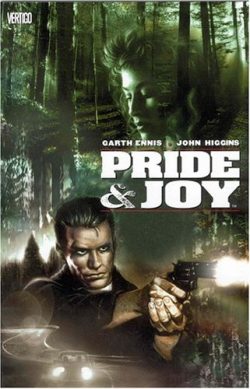
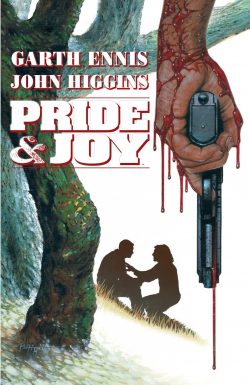
Pride & Joy


By Garth Ennis & John Higgins, lettered by Annie Halfacree (Vertigo/Image)
ISBN: 978-1-84023-803-7 ( 2004 Vertigo TPB), 978-1-4012-0190-6 (2016 Image TPB/ Digital edition)

This book includes Discriminatory Content produced in less enlightened times.

Garth Ennis has a well-deserved reputation for shocking, moving and wickedly funny storytelling, and is accomplished in blending genres for maximum effect, as his successes with The Boys, Battlefields, Ghost Rider, The Punisher, foundational runs on Preacher and Hellblazer, impious seminal shocker True Faith and a dozen other tales can attest.

One of his least regarded or remembered – in my opinion unjustly so – is this ferocious family saga of a painfully mundane domestic world turned upside down by an unredeemed past. It is a story of pedestrianly ordinary folk with none of the baroque or flamboyant characters that populate regular fiction…

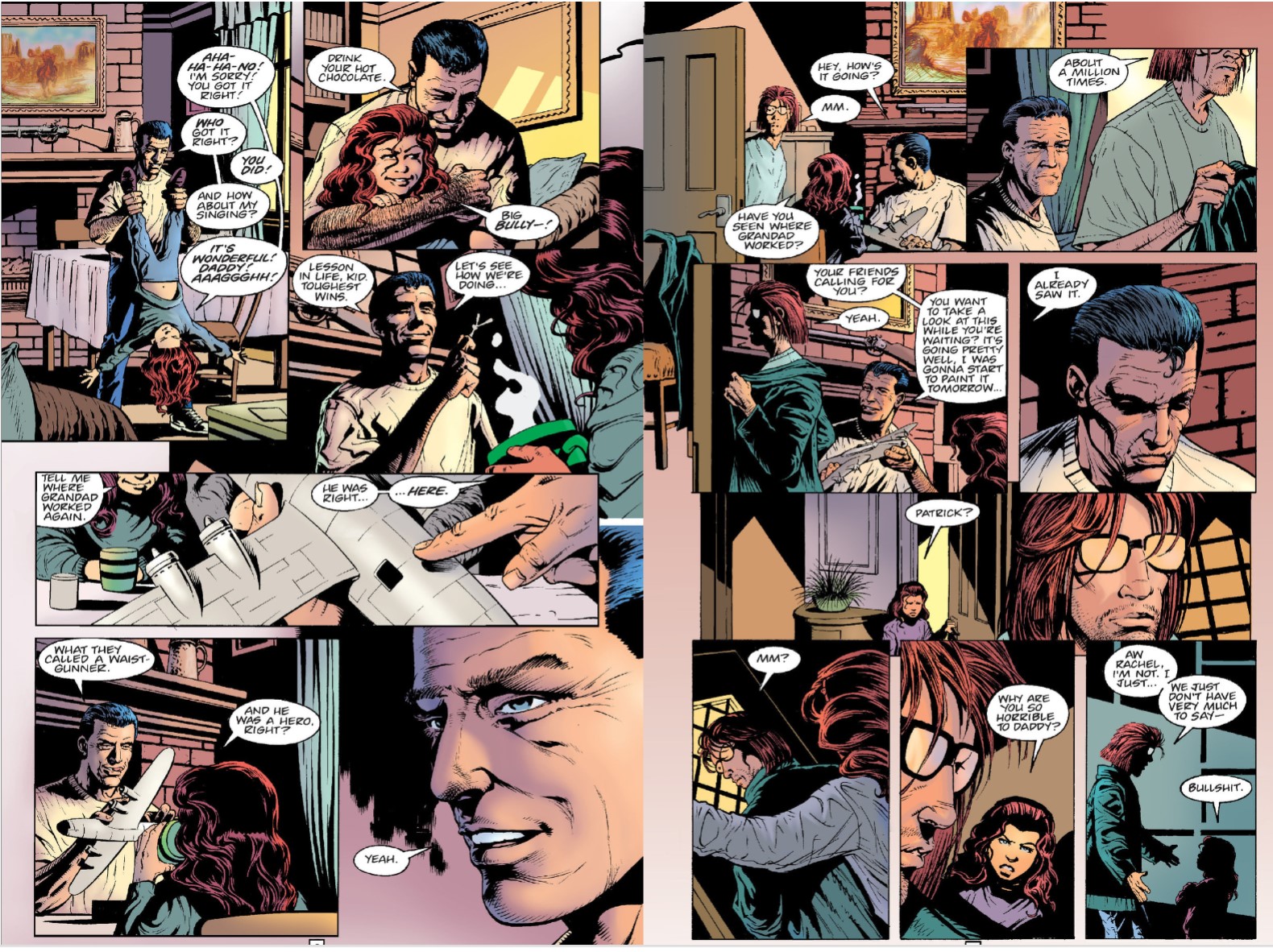
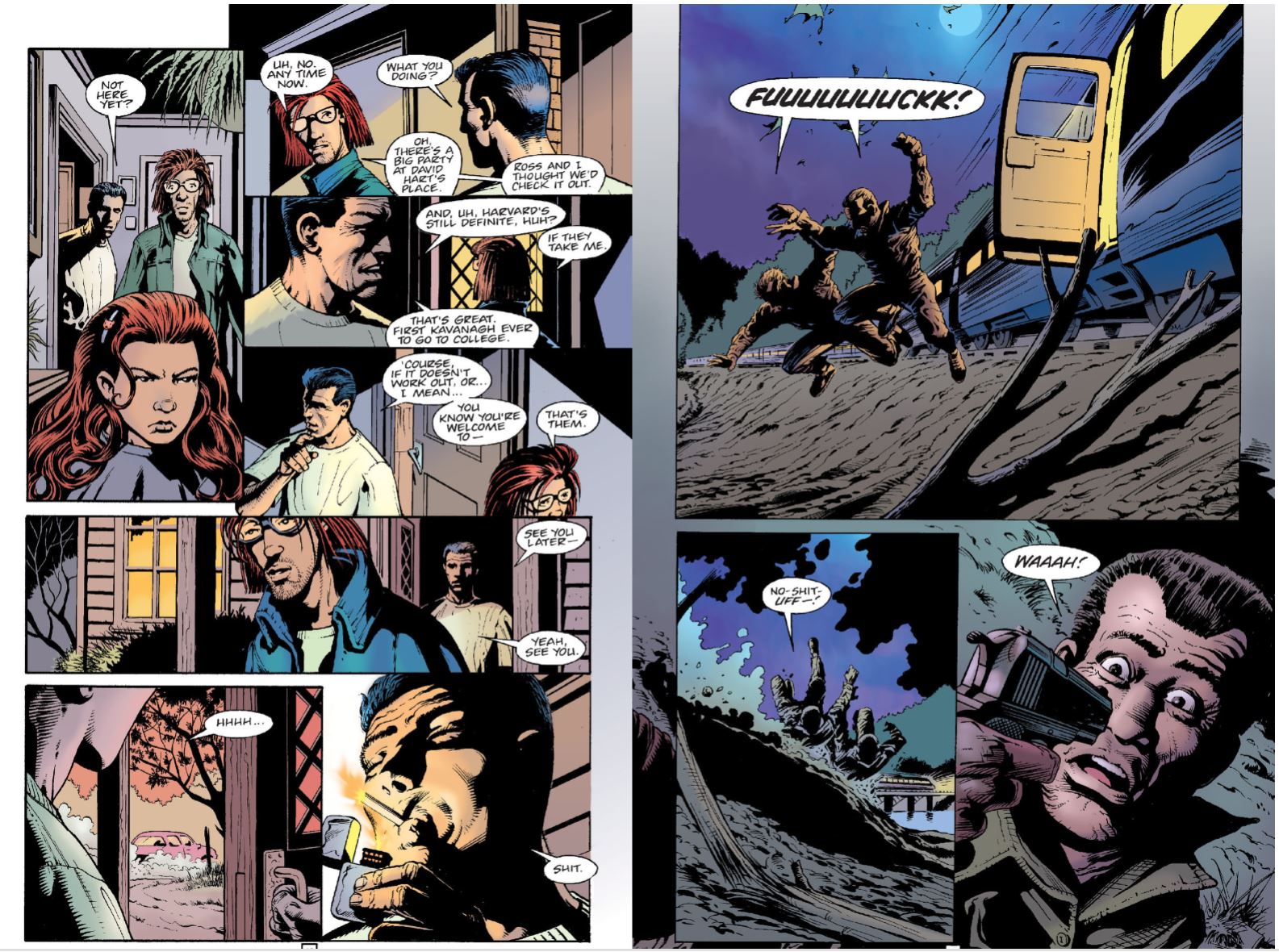
There’s this guy called Jimmy Kavanagh. His wife is long-dead and son Patrick is at that revolting sulky teen age, but at least his little daughter Rachel is still the most beautiful girl in the whole world. Life is hard: his own dad, a war-hero, has just passed on, but the family are doing okay…
That all changes in a moment after Jimmy’s stupid past resurfaces. Back in 1972 he and a couple of his idiot pals reckoned they were going to be big-time hoods when they agreed to rip-off a gang boss. The gig had been planned by the boss’ own bodyguard, Stein, who promised them a million dollars…

Unfortunately for everybody but Jimmy, his pals were real shmucks, and ballsed up the caper. Cops came, busted Stein before he could kill them all and took him away for twenty-to-life. Scared straight by the experience, Jimmy got on with his life… until now. One night he gets a call and his world starts to implode. Coming home to finds the babysitter gutted like a fish. Stein is out and he wants revenge…

Gathering his kids and linking up with his old “colleagues” they go on the run together, but the hunter can’t be shaken and innocent people keep dying. Unable to bond with his son during their entire life together Jimmy finally, tragically connects with Patrick as the sorry saga comes to a small and dirty close…
With chilling echoes of Cape Fear (the 1962 Gregory Peck/Robert Mitchum release) this tale examines how ordinary people cope with ordinary evil: a cheap thug with a knife is just as deadly as a horde of vampires. You and yours can only die once – painfully, horribly; but just once. Pride & Joy is a tale about dreams and hopes and heritage, showing how mediocre people cope, illustrated with perfect subtle understatement by John Higgins. Nothing about this story is big or bold or bombastic: but it could really happen. It’s that scary…
© 1997, 2004 Garth Ennis and John Higgins. All Rights Reserved.

Born today in 1926 Mexican writer Yolanda Vargas Dulché de la Parra (Memín Pinguín), sharing the day with artist Phil Noto (Gen13, Spider-Man, Daredevil, Jonah Hex. Green Lantern, Indiana Jones, Captain America) in 1971 and writer/musician/attorney Charles Soule (Daredevil, Letter 44, Swamp Thing, Death of Wolverine) in 1974.

This day in 1975 we lost revolutionary cartoonist Vaughn Bodé (Cheech Wizard, Cobalt-60, Deadbone,) and in 1990 French auteur Yves Chaland (Adventures of Freddy Lombard, Bob Fish, Adolphus Claar, Retro-Spirou).

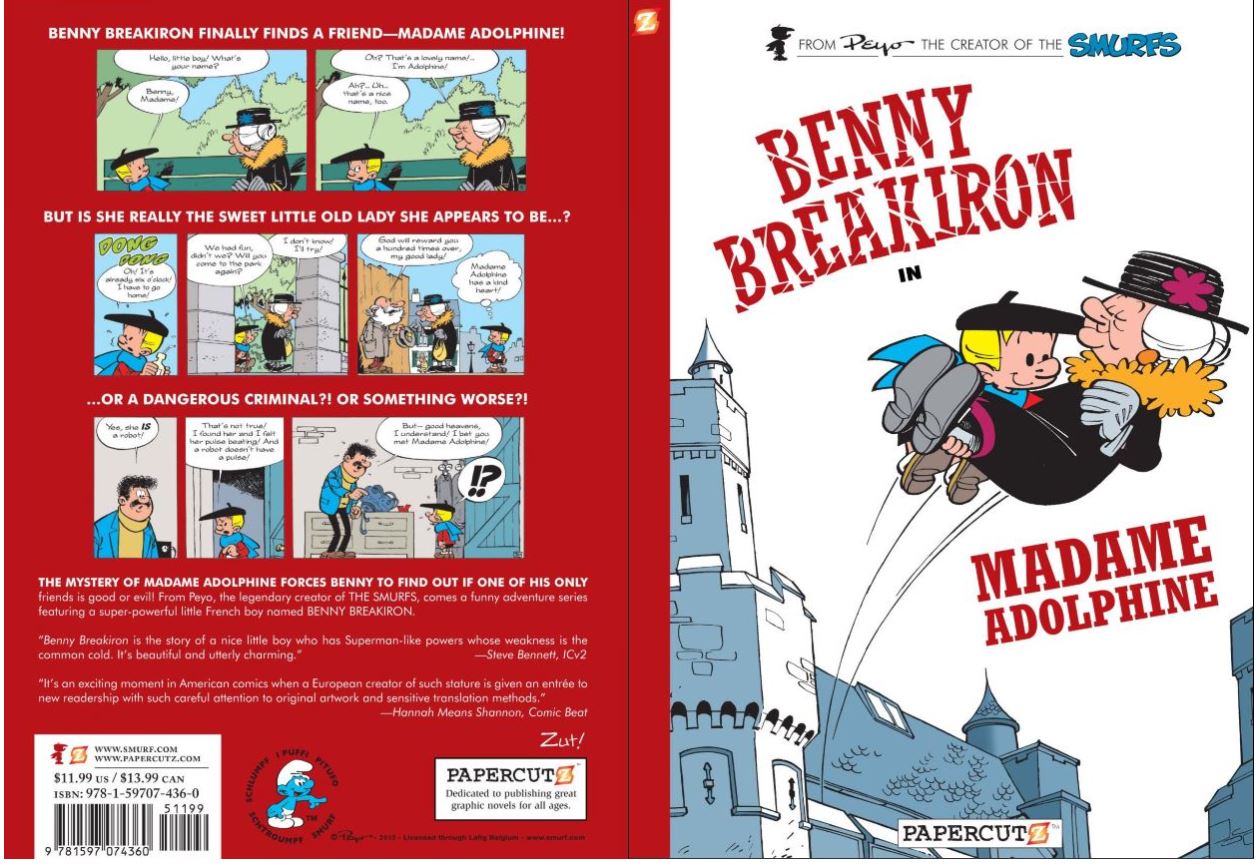
Benny Breakiron volume 2: Madame Adolphine


By Peyo, with backgrounds by Will, translated by Joe Johnson (Papercutz/NBM)
ISBN: 978-1-59707-436-0 (HB Album/Digital edition)

This book includes Discriminatory Content produced in less enlightened times.

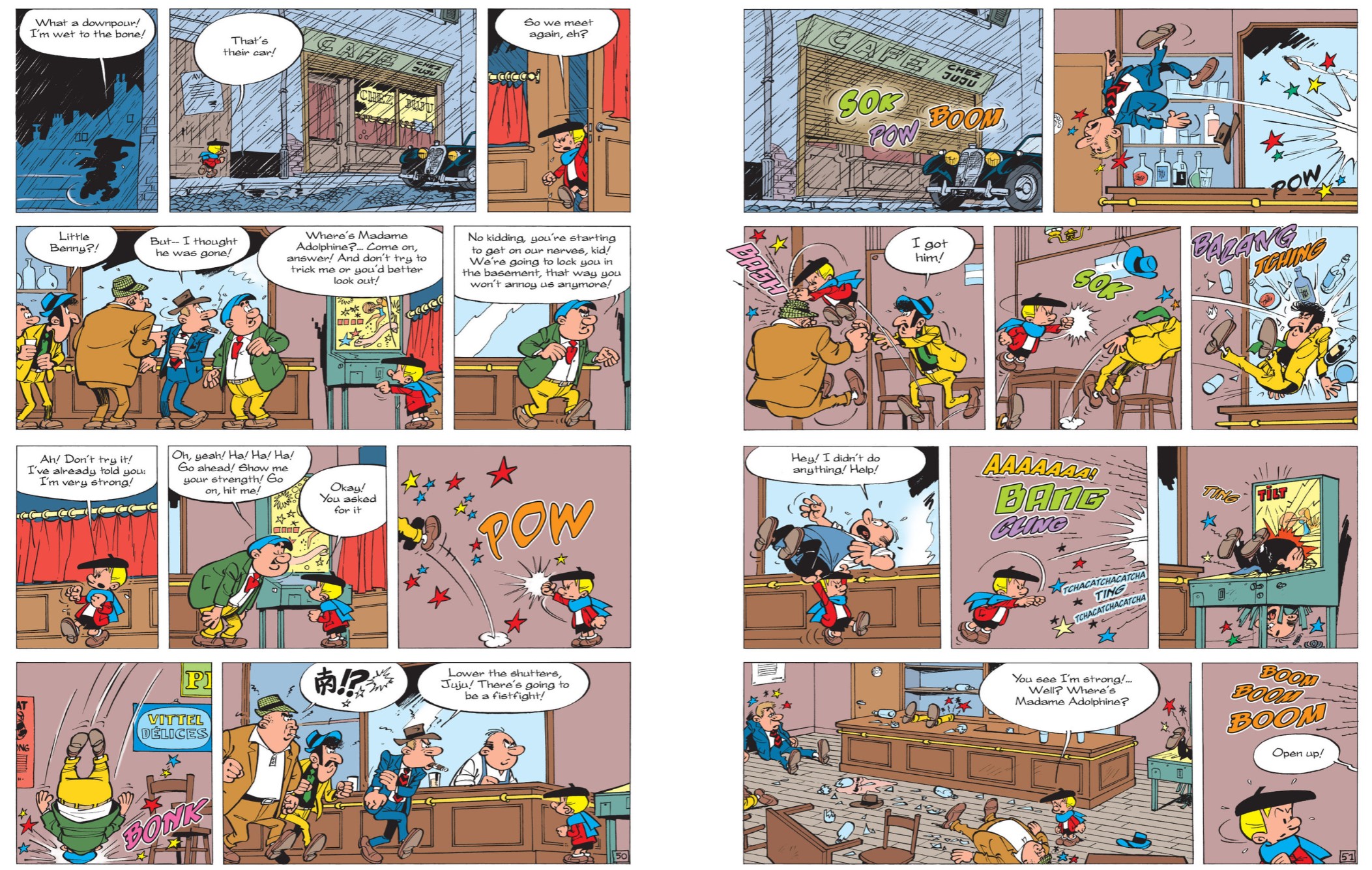
In anticipation of 2028’s proposed CG animation version (which cannot possibly match the style and charm of these scribbled pages!) here’s a quick look back at how the Europeans handled superheroes and kids in crisis from a master of our artform…

Pierre Culliford was born in Belgium in 1928 to a family of British origin living in the Schaerbeek district of Brussels. An admirer of the works of Hergé and US comics licensed to Le Journal de Mickey, Robinson and Hurrah!, he refined his artistic skills, and developed his storytelling abilities but the war and family bereavement forced him to forgo further education and find work. After time toiling as a cinema projectionist, in 1945 Culliford joined C.B.A. animation studios, where he met André Franquin, Morris & Eddy Paape. When the studio closed, he briefly studied at the Brussels Academy of Fine Arts before moving full-time into graphic advertising. In his spare time, he began submitting comic strips to the burgeoning flock of post-war comics publishers.

His first sale came in April 1946: Pied-Tendre, a tale of American Indians in Riquet, the comics supplement to the daily L’Occident newspaper. Further sales to other venues followed and in 1952 his knight Johan found a permanent spot in Le Journal de Spirou. Retitled Johan et Pirlout, the strip prospered and in 1958 introduced a strange bunch of blue woodland gnomes called Les Schtroumpfs. Culliford – who now used the nom de plume Peyo – would turn those adorable little mites (known to us and most of the world as The Smurfs) into an all-encompassing global empire, but before being sucked onto that relentless treadmill, he still found time to create a few other noteworthy strips such as the titanic tyke on view here today.

In 1960 Benoît Brisefer – AKA Benedict Ironbreaker or in Dutch Steven Sterk – debuted in Le Journal de Spirou #1183 (December 1960). With a few slyly added tips of the hat to Siegel & Shuster’s Superman, the wryly bucolic adventures celebrated a small town small boy with superhuman strength living in a generally quiet and unassuming little Belgian city.

Quiet, well-mannered, gentle and a bit lonely, Benny just happens to be the mightiest boy on Earth: able to crush steel or stone in his tiny hands, leap vast distances and run faster than a racing car. He is also pretty much immune to all physical harm, but his fatal, somewhat ubiquitous weakness is that all his strength deserts him whenever he catches a cold…

Benny never tries to conceal his abilities but somehow no adults ever catch on. They generally think he’s telling fibs or boasting, and whenever he tries to prove he can bend steel in his hands, the unlucky lad gets another dose of the galloping sniffles…

Most kids avoid him. It’s hard to make friends or play games when a minor kick can pop a football like a balloon and a shrug can topple trees.

Well-past-it Brits of my age and vintage might remember the character from weekly comics in the 1960’s. As Tammy Tuff – The Strongest Boy on Earth, and later as Benny Breakiron and Steven Strong, our beret-wearing blockbuster appeared in Giggle and other periodicals from 1967 onwards.

With Peyo’s little blue cash-cows taking up ever larger amounts of his concentration and time, other members of his studio assumed greater responsibilities for Benoît as years passed. Willy “Will” Maltaite, Gos, Yvan Delporte, Françoise Walthéry and Albert Blesteau all pitched in. and Jean Roba created many eye-catching Le Journal de Spirou covers, but by 1978 the demands of the Smurfs were all-consuming and all the studio’s other strips were retired.

You can’t keep a good super-junior down, though, and after Peyo’s death in 1992, his son Thierry Culliford and cartoonist Pascal Garray revived the strip, adding six more volumes to the eight generated by Peyo and his team between 1960 and 1978. Thanks to the efforts of US publisher Papercutz, the first four of those gloriously genteel and outrageously engaging power fantasies are still available to English-language readers again – both as robust full-colour hardbacks and as all-purpose eBooks – and this second translated exploit begins in the sedate city of Vivejoie-la-Grande, where the kid goes about his rather solitary life, doing good deeds in secret and being as good a boy as he can…

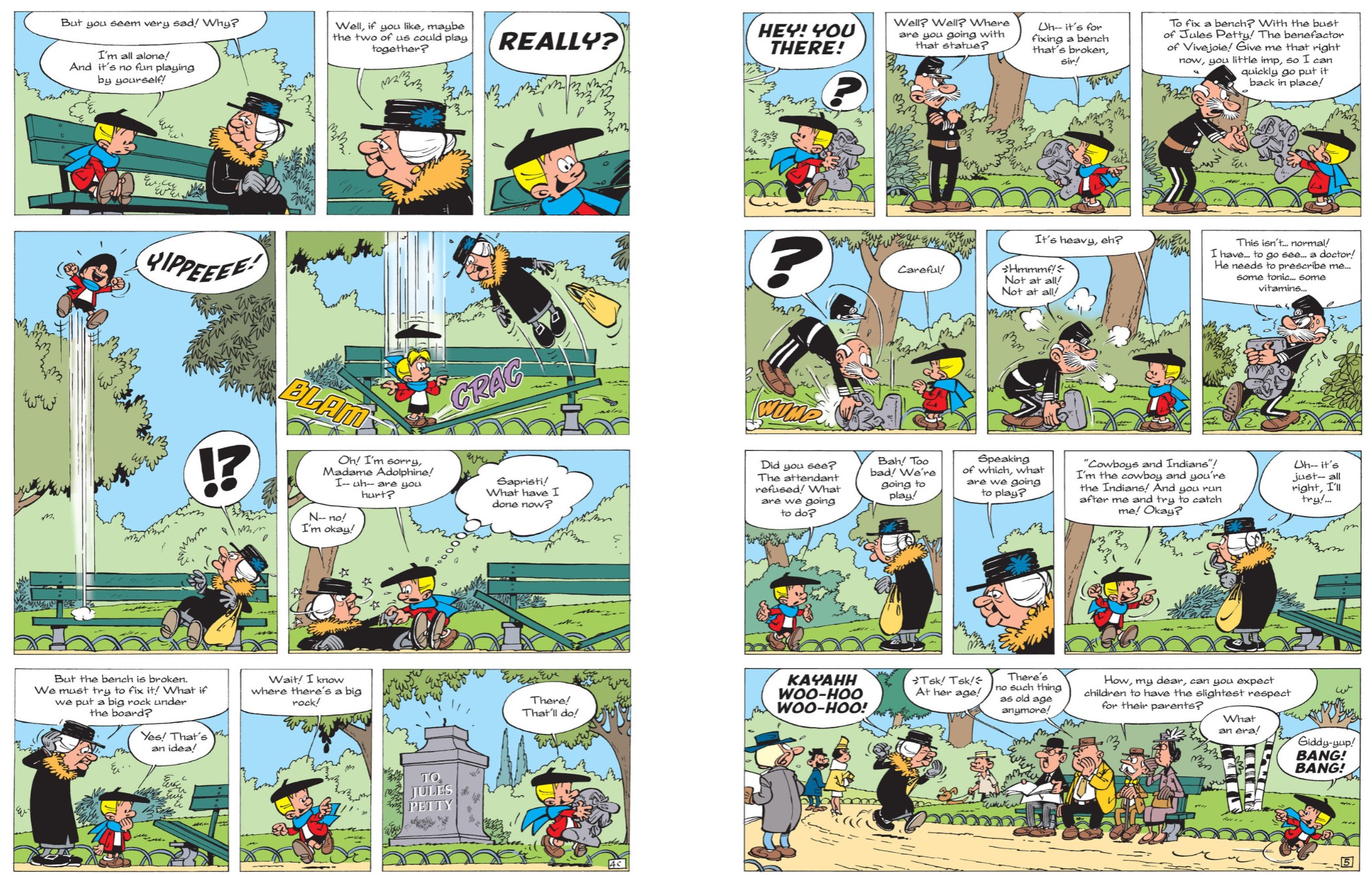
After another day of being shunned by everyone around, disconsolate Benny heads for the park and is befriended by a sweet old lady named Adolphine. No respecter of advanced age or graceful retirement, the old dear romps boisterously and disgracefully with the lad – to the disgust of the other park patrons. Eventually, Benny escorts her to his home where she has a strange fit and collapses.
When even a doctor refuses to help, Benny finds a phone number in her bag and acts as any good boy should. Soon a rather strange gentleman comes to collect her, but he’s none too gentle in his behaviour and throws the old lady in the boot of his car! Far more distressingly, when Benny sees her in the street next day, Madame Adolphine says she has never met him before!

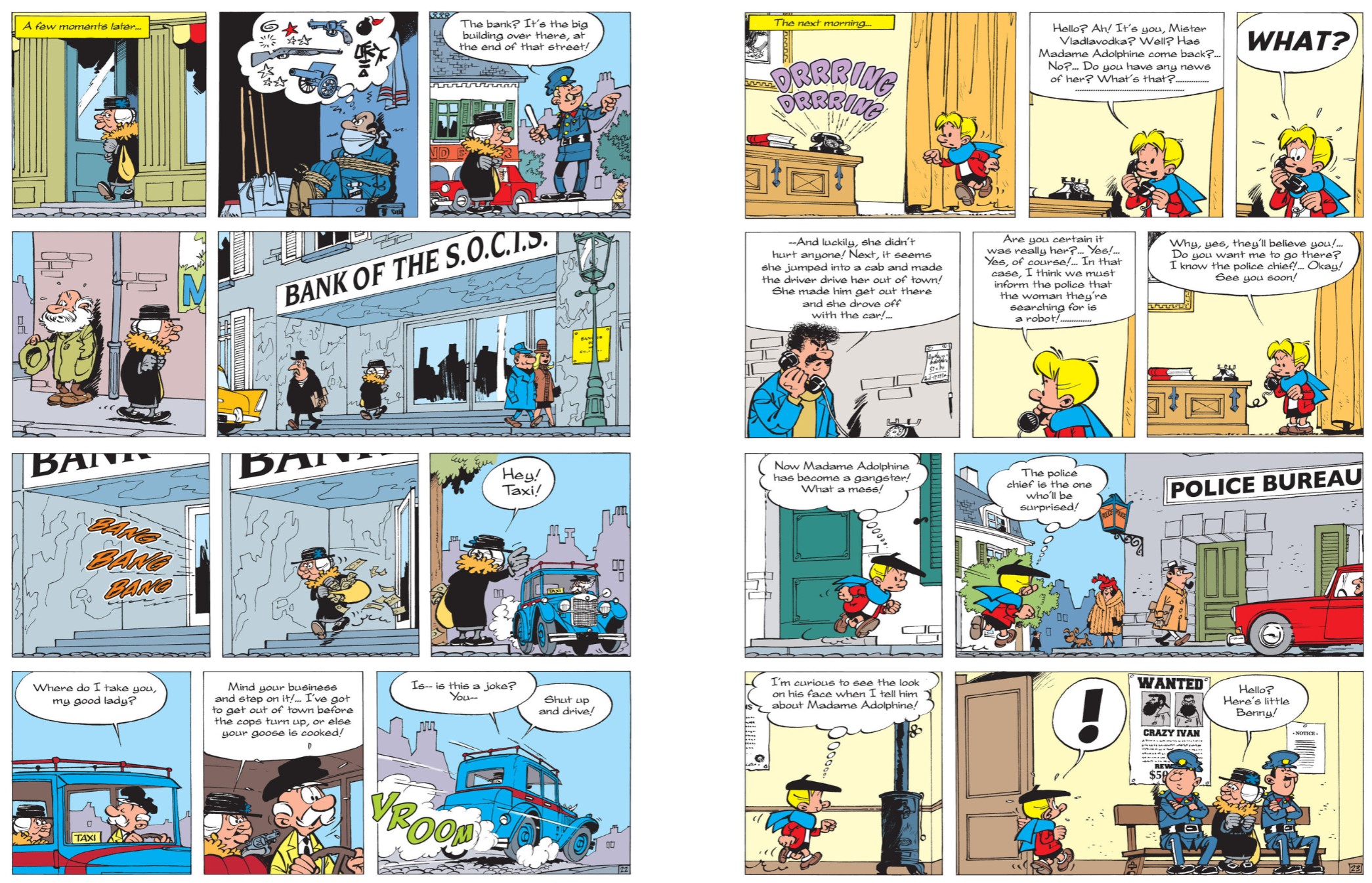
Baffled but unwilling to let the matter go, Benny tracks her down to a toyshop run by seedy inventor Serge Vladlavodka and finds her standing over the tinkerer’s unconscious body with a massive mallet in her hand. Moreover, Madame’s manner is brusque and almost callous and the belligerent biddy bustles off whilst Benny is trying to revive her prone victim. When Serge at last recovers, he also rushes away, fearing the harm she might cause. Accompanying him, Benny learns a startling secret…

There are two Adolphines – and one is indeed a sweet old lady. The other is an increasingly unstable, aggressive and just plain mean robot doppelganger who soon begins robbing banks and terrorising the public, so guess which one the police subsequently arrest?

As indignant Benny singlehandedly busts the organic pensioner out of prison, amok automaton Adolphine recruits a gang of nasty professional thugs and embarks on a crime spree the cops are utterly helpless to handle. Good thing Benny is made of sterner stuff…

This superbly surreal spoof has delicious echoes of classic Ealing Comedies like The Ladykillers or The Lavender Hill Mob as it follows the little wonder boy’s resolute, dynamic and spectacular campaign to save his friend: blending deft wit with bombastic and hilarious slapstick. Madame Adolphine is a fabulously winning fantasy about childhood validation and agency, offering a distinctly Old-World spin to the concept of superheroes and providing a wealth of action, thrills and chortles for lovers of incredible adventure and comics excellence.
© Peyo ™ & ©2013 – licensed through Lafig Belgium. English translation © 2013 by Papercutz. All rights reserved.

Today in 1871 pioneering cartoonist Lyonel Feininger (The Kin-der-Kids) was born, followed in 1913 by Golden Age creator Marc Swayze (Mary Marvel, Captain Marvel, The Phantom Eagle, Flyin’ Jenny) and in 1917, animator-turned-cartoonist Gustavo “Gus” Arriola (Krazy Kat, Tom and Jerry, Gordo). In 1932 Argentinian satirist & cartoonist Joaquín Salvador Lavado Tejón AKA “Quino” (Mafalda) was born, with master raconteur Hermann Huppen (Jeremiah, Les Tours de Bois-Maury, Bernard Prince, Comanche) arriving in 1938, and comic book artist/animator Jimmy Janes (Legion of Super-Heroes, Moon Knight, Xanadu) in 1947; writer/editor/comics historian Mike Tiefenbacher in 1952; writer J. Michael Straczynski (Babylon 5, Spider-Man, Fantastic Four, Rising Stars, Superman: Earth One, Captain America) in 1954; all-rounder Richard Moore (Boneyard, Déjà Vu, Far West) in 1966; letterer Liz Agraphiotis in 1970; illustrator Pete Woods (Archie, Deadpool, Superman, Harley Quinn) in 1971 and writer Brian K. Vaughan (Pride of Baghdad, Batman, X-Men, Y: The Last Man, Ex Machina, Runaways, Saga, Paper Girls) in 1976.

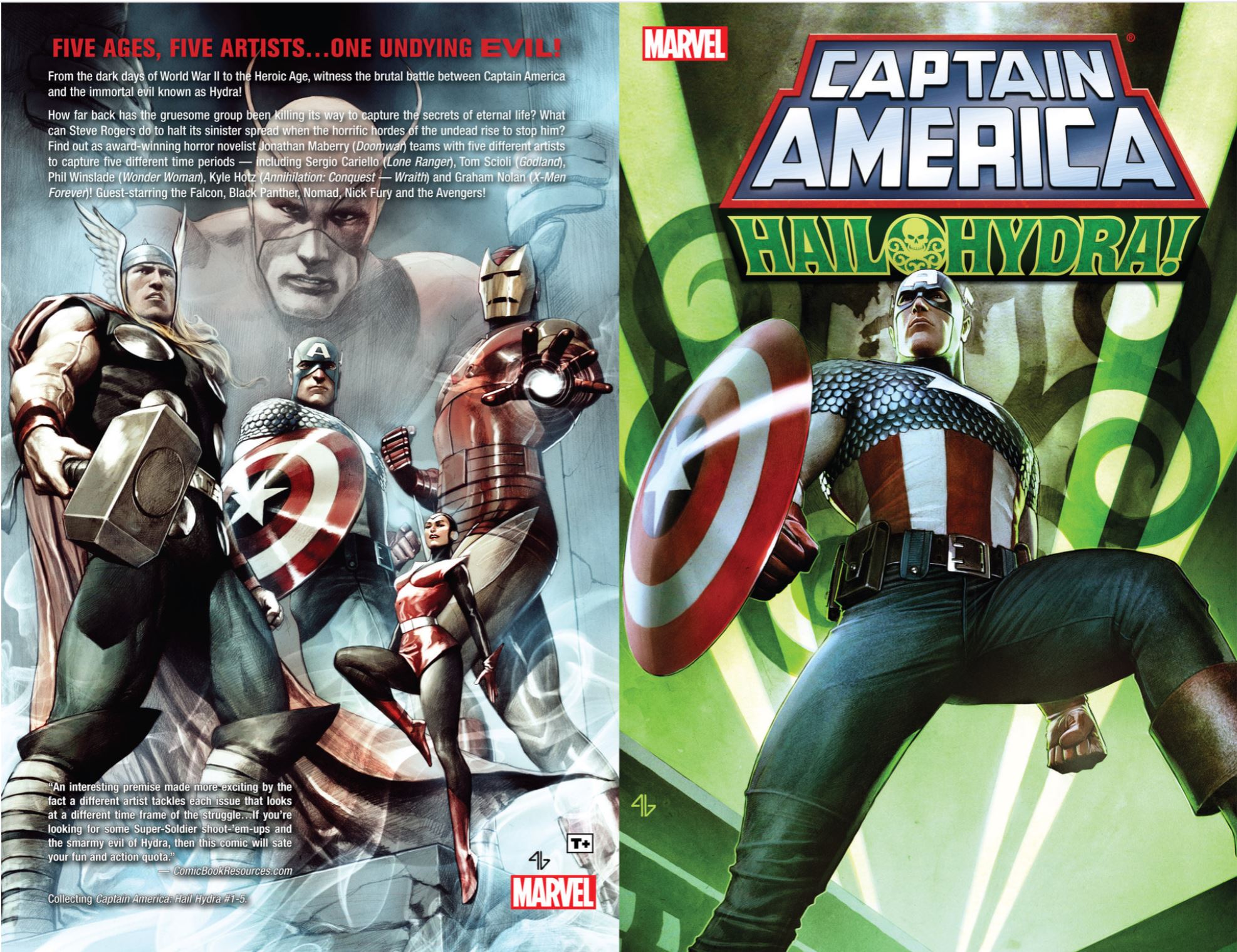
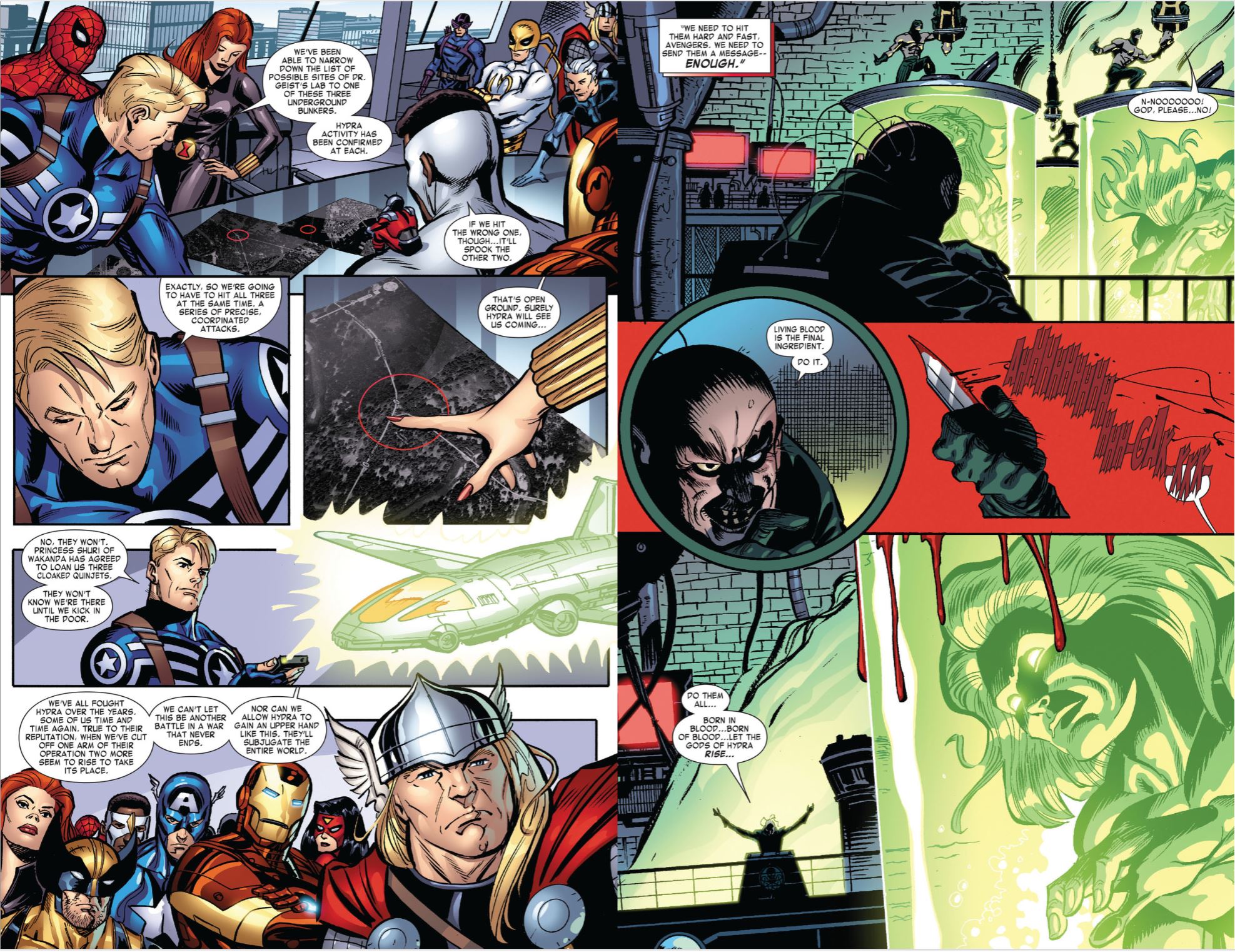
Captain America: Hail Hydra!


By Jonathan Maberry, Sergio Cariello, Tom Scioli, Phil Winslade, Kyle Hotz & Graham Nolan, Chris Sotomayor, Bill Crabtree, Chris Chuckry, Dan Brown, Ian Hannin & various (MARVEL)
ISBN: ?978-0-7851-5127-2 (TPB) ?978-1-30236-799-2 (Digital Edition)

This book includes Discriminatory Content produced in less enlightened times.

Everything changed for a little company called Marvel when, in issue #4 of The Avengers, the assembled heroes found the body of US Army Private Steve Rogers floating in a block of ice and consequently resurrected World War II hero Captain America. With this act bridging the years to Timely/Atlas Comics (which had in fact begun with the revival of Sub-Mariner in Fantastic Four #4), Marvel instantly acquired a comforting longevity and potential-packed pre-history: lending an enticing sense of mythic continuance to the fledgling company that instantly gave it the same cachet and enduring grandeur of market leader National/DC.

In 2010, after years of conflicting continuity and with a movie in the offing, Marvel updated and sought to rationalise those pivotal events and early future-shocked days in our contemporary world with stunning re-interpretation Captain America: Man Out of Time before repeating the operation with another generational miniseries: this time scripted by Jonathan Maberry tracing the returned Sentinel of Liberty as he fought an extended campaign against a fearsome and undying foe that had begun even before he knew of his enemy’s existence.

Captain America: Hail Hydra! focuses on five crucial skirmishes fought over the Red, White and true Blue hero’s long years of valiant service, wherein he continually – albeit periodically – clashed with an organisation of insidious evil and astounding ambition. Each issue was dutifully depicted by a different artist in a knowing pastiche of the relevant era.

Illustrated by Sergio Cariello and colourist Chris Sotomayor, the action opens in 1944 as Captain America and youthful partner Bucky work behind enemy lines, helping German anti-Nazi freedom fighter Trude Lohn smash a plot by the baroquely bonkers, certifiably mad Doctor Geist, who has discovered how to reanimate the dead. During the apocalyptic struggle against the resurrected corpses of Das Aufertehungs Korps, Cap is injected with Geist’s unholy Lazarus serum and although the triumphant trio succeeded in depriving Hitler of an undead army, they have no idea of the sinister scientist’s greater scheme, the ancient society he actually toils for or what effect his devil drugs will have on America’s greatest warrior…

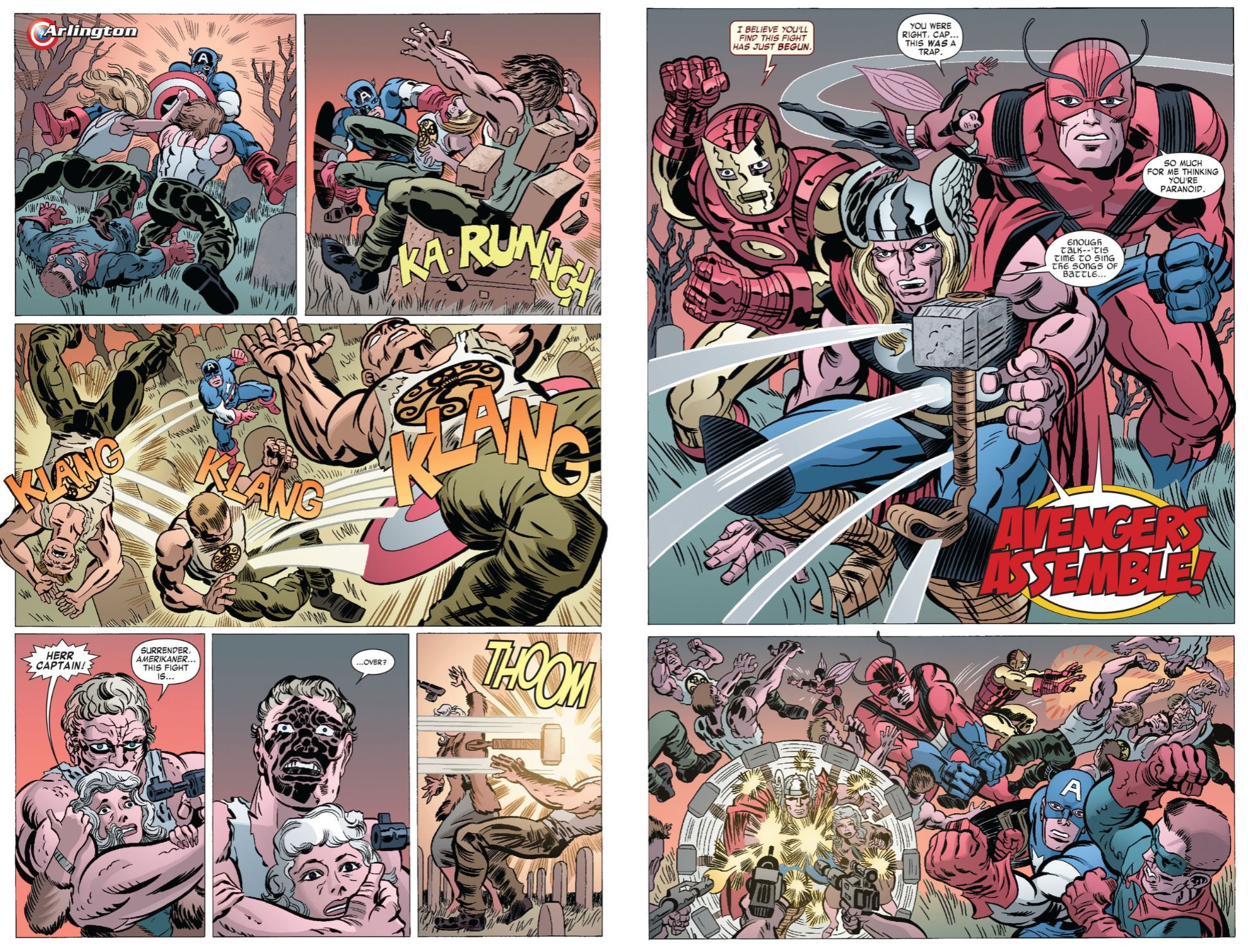
Tom Scioli pictured the second instalment in vivid tribute to Jack Kirby, wherein more historical flashback hints into the history of the cult that would become Hydra are interspersed with Cap’s first days as an Avenger following his half-century enforced hibernation. After surprisingly reuniting with now geriatric Trude, he and his new comrades clash with Nazi war criminal Baron Strucker and Geist’s unliving army, only to be thoroughly overmatched and outmanoeuvred. The deranged doctor seemed more interested in gathering blood samples from Cap and Thor than winning the battle he had instigated…

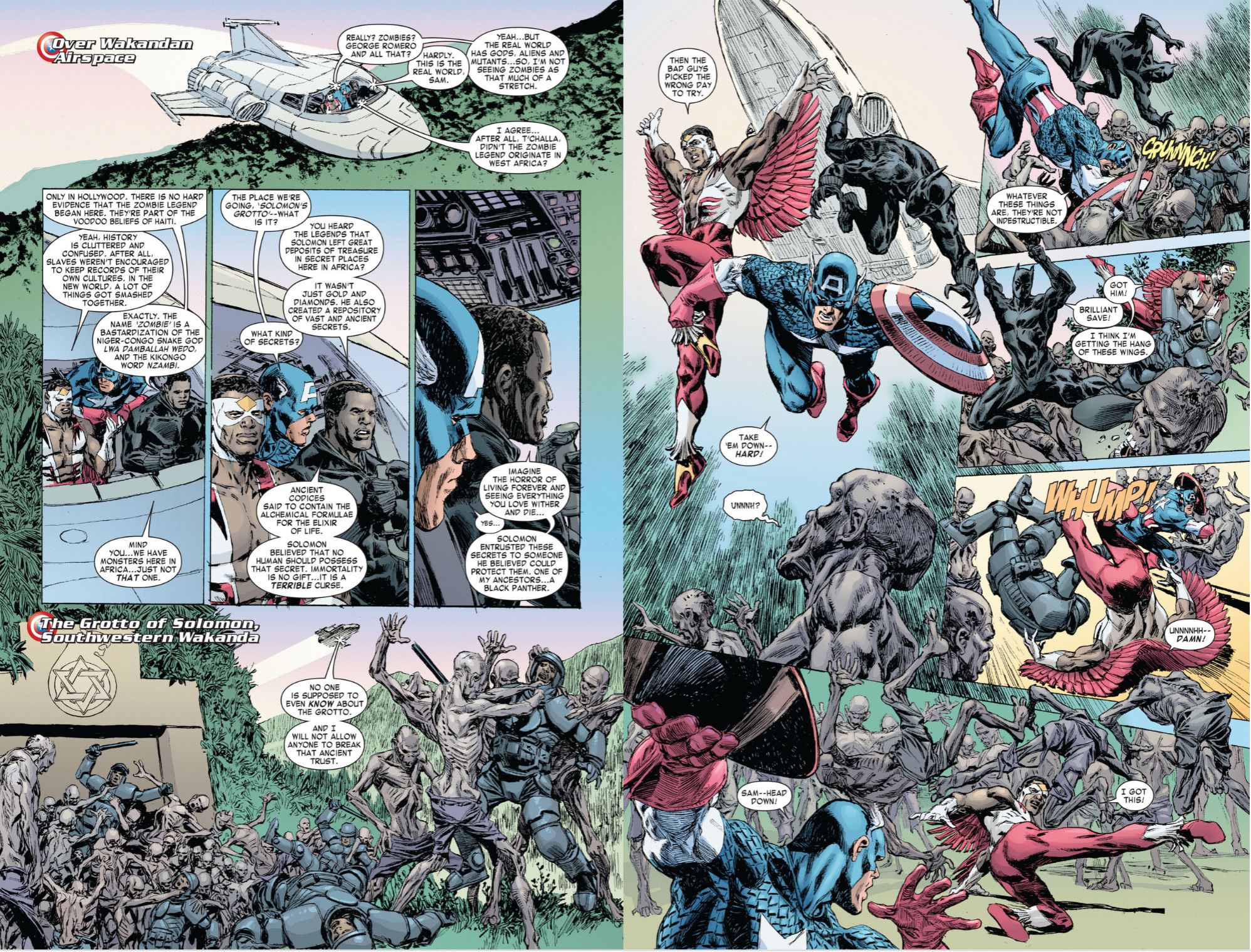
A few years later (just after modern day Captain America Sam Wilson got his first flying outfit and was learning to prowl the skies, if you’re counting) the plan becomes clearer when the Sentinel of Liberty, partner in crime-fighting The Falcon, and African Avenger Black Panther face an army of zombies seeking to steal the fabled Elixir of Life from hidden Wakandan repository of knowledge the Grotto of Solomon. Lavishly rendered by Phil Winslade, with colours from Chris Chuckry & Dan Brown, the spectacular clash is also lightly dusted with further glimpses of the order’s historic attempts to gather arcane knowledge and artefacts pertaining to their mysterious goal.

That is ultimately revealed to be the conquest of death and ascension to godhood via their Infinitas Agenda – and the history of Spanish alchemist Dr Garibaldi, who would shepherd the project over hundreds of years…

For a brief period the US government replaced the Star-Spangled Avenger with a less single-minded and independent agent compelling Steve Rogers to create the identity of “The Captain”. Here Kyle Hotz & Dan Brown delineate an adventure from those turbulent times as the unencumbered hero tackled Geist’s latest monstrosity beside Nick Fury of S.H.I.E.L.D. to get one step ahead of Hydra. However, after thwarting a terrifying attack on the heart and soul of America, Rogers is forced to consider not only what Geist is truly after but also what his devilish serum might have made of Captain America that fateful night back in 1944…

Graham Nolan and colourist Ian Hannin close the macabre saga in captivating style as Rogers, now Director of the Avengers, and original partner Bucky Barnes (formerly Soviet assassin Winter Soldier and the current Captain America) enlist a garrison of guest-stars as they home in on Strucker and Geist just as their incredible seven-thousand year scheme reaches its shocking culmination. Even the World’s Mightiest Heroes are hard-pressed to overcome the incredible beings Hydra has at long last birthed…

This extended yarn does have some niggling plot flaws but nothing so flagrant that it disrupts the overall flow of action and delicious flavour of nostalgia; so unless you’re a dedicated, nit-picking devotee the striking art and rollicking rollercoaster thrills and chills should carry the day nicely, providing a solid dose of immortal, enticing entertainment

Fast-paced, epic in scope and rocketing from one full-on spectacle to the next, via ingenious but faithful infilling of established canon, makes Captain America: Hail Hydra! a striking saga that will make many fresh fans for Marvel’s eternally evergreen old soldier.
© 2011 Marvel Entertainment LCC and its subsidiaries. All rights reserved.

Today in 1890 pioneering strip cartoonist Carl Ed (Harold Teen) was born, sharing the day with Canadian author & illustrator Russ Jones (founding editor and creator of Creepy magazine) in 1942 and cartoonist, fandom founder Steve Stiles in 1943.

The day also saw the loss of two major talents – Lucky Luke creator Morris (Maurice de Bévère) in 2001 and UK adaptions all-star Angus Allan (Stingray, Thunderbirds, Garth, DangerMouse, The Six Million Dollar Man, Logan’s Run, Charlie’s Angels) in 2007.

Comanche volumes 1 to 3: Red Dust, Warriors of Despair, Wolves of Wyoming


By Hermann & Greg, translated by Montana Kane (Europe Comics)
No ISBNs Digital-Only editions

This book includes Discriminatory Content produced in less enlightened times.

Welcome to another Wild West Wednesday with an self-indulgent peek at a favourite series I first saw way back in the 1980s, crafted by two Belgian masters of graphic narrative…

Best known as Greg, Michel Régnier was born in 1931 in Ixelles. The cartoonist, writer editor and publisher, sold his first series – Les Aventures de Nestor et Boniface – at age 16 to Belgian magazine Vers l’Avenir and followed up over many decades with legendary strips like Luc Orient, Bruno Brazil, Bernard Prince and Achille Talon in Héroïc- Albums, Le Journal de Spirou (where he scripted the title feature amongst many others), Paddy and Le Journal de Tintin (which he eventually edited from 1966-1974). One of his new finds on LJdS during this period was an artist named Hermann Huppen. Greg is estimated to have worked as writer or artist on more than 250 strip albums during his career. He died in 1999, leaving behind an astounding and beautiful legacy of drama and adventure crying out for revisiting in English…

Hermann Huppen entered the world on July 17th 1938 in what’s now the Malmedy region of Liège Province. He studied to become an interior architect and furniture maker but was thankfully swayed and diverted by comics. His narrative career began in 1963 but really took off three years later when he joined with writer Greg to create cop series Bernard Prince for Le Journal de Tintin. The artist soon added to his weekly chores with Roman adventure serial Jugurtha (scripted by Jean-Luc Vernal). In 1969 Hermann expanded his portfolio further, adding the Greg-penned western Comanche to his seamlessly stunning output. At his time Charlier & Jean Giraud’s epic Blueberry was reaching its peak of excellence…
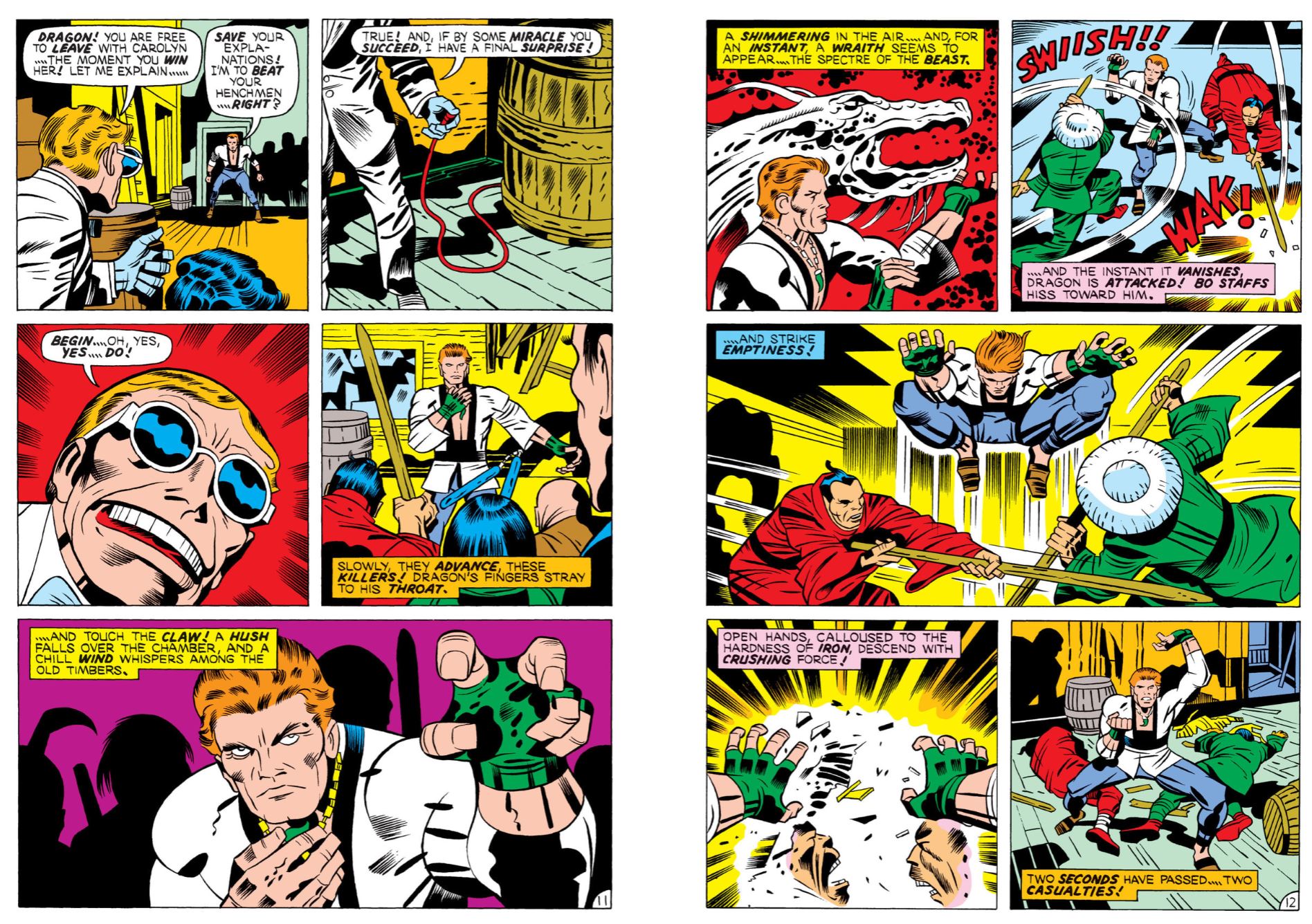
Bernard Prince and Comanche made Hermann a superstar of the industry, a status built upon with further classics such as The Towers of Bois-Maury, Sarajevo-Tango, Station 16, Afrika, Lune de Guerre, Duke and many more (I estimate 30 separate series and a total well north of 115 albums up until his death on March 22nd 2026).

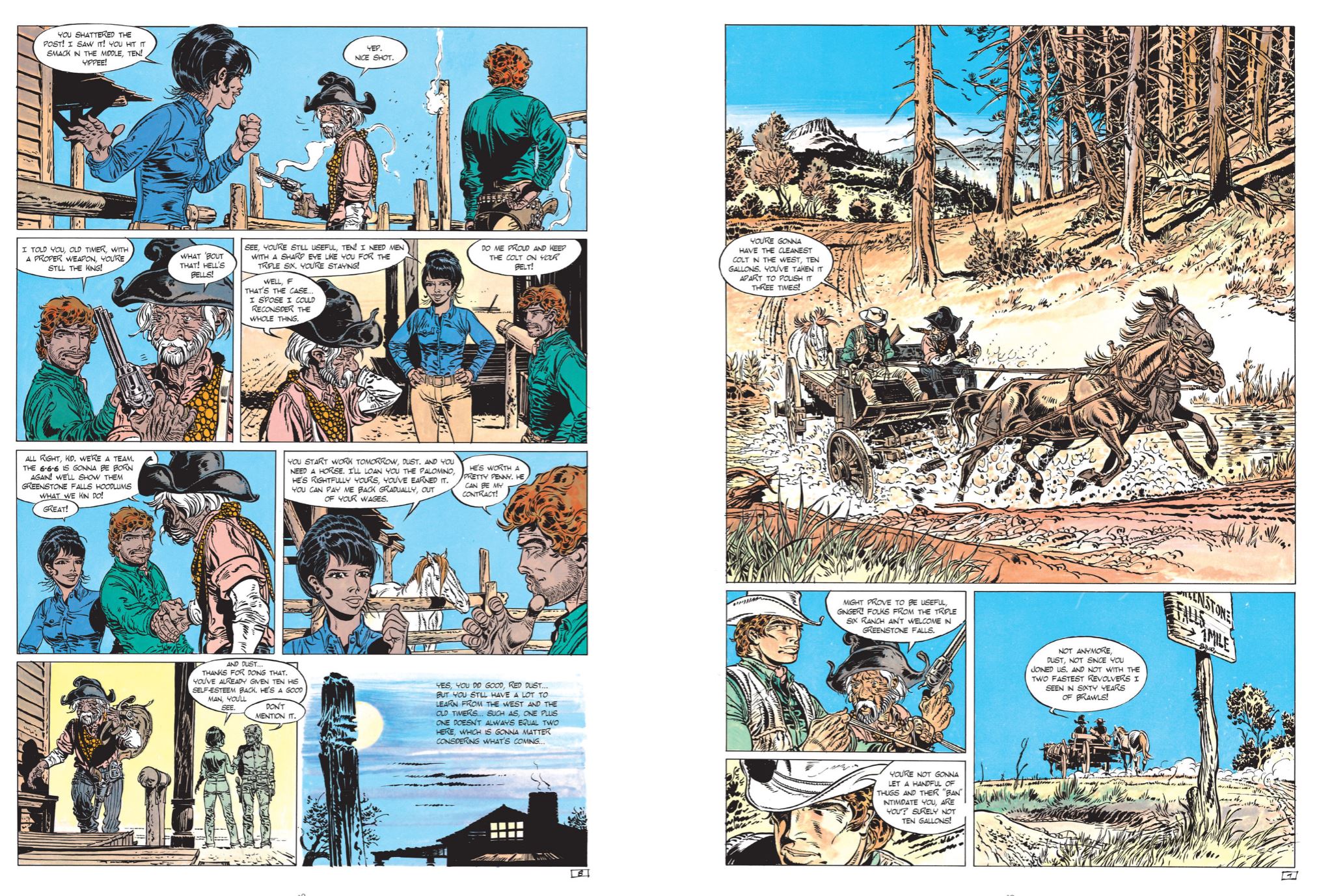
In 1978 Hermann bravely dropped guaranteed money-spinner Bernard Prince to create as (writer & illustrator) Jeremiah but he stayed with Comanche until 1982 (10 albums in total) because of his abiding love for western-themed yarns. Thanks to digital-only publishing commune Europe Comics, it’s easy to see why in these three (thus far) translated volumes of the sprawling epic which introduces a wandering gunslinger who finds a home – if not peace & quiet – after joining a most unlikely band of comrades on a cattle-spread in Wyoming…


Comanche volume 1: Red Dust

Comprised of linked weekly episodes and beginning in 1978, ‘Red Dust’ introduces an eponymous, lethally capable shootist wandering into a desolate cow-town just as trouble seems to be brewing. In fact, even before he gets into Greenstone Falls, the enigmatic Mr Dust has to kill manic mercenary Wally Hondo who refuses to share “his” stagecoach with a shabby drifter…

Moreover, when the stage finally pulls into what passes for civilisation, Red is approached by unctuous fixer Mr Cathrell who erroneously assumes him to be the latest addition to his growing army of pitiless hired guns. The mistake is soon cleared up after the newcomer unexpectedly reacquaints himself with Cathrell’s top stooge.

Red Dust and The Kentucky Kid have unsettled scores and old grievances in common…

Before long Red learns that the newly-arrived killer elite have all been commissioned to deal with a stubborn rancher refusing to sell out to their mysterious and always unseen boss. Mind made up, the taciturn nomad heads for the 666 Ranch and inveigles a job with aged, crotchety pioneer Ten Gallons and the new ranch-owner he apparently dotes upon: a young, lovely and immensely stubborn woman called Comanche…

She is determined to make her inheritance a successful going concern, but has been having lots of bad luck. Red soon determines it’s not her luck that’s at issue after a new herd of cattle she has bought apparently come down with a mystery sickness. As well as exposing a cruel trick, Red also recruits new hands Toby and Tenderfoot following the exposure of a nefarious scam.

That, in addition to decimating Cathrell’s gunslingers when they ambush the ranchers on a shopping trip to town, swiftly forces the mystery mastermind into the open and reveals just why the 666 is such a valuable property… but only after a few of those old scores are finally settled…

A gripping introduction to the ongoing saga this is a splendid confection of traditional western themes combined with sleek yet gritty European style. Red Dust is the kind of timeless treat comics fans and movie lovers will adore.


Comanche volume 2: Warriors of Despair

In the second translated volume of the sprawling cowboy epic which here resumes with no-longer-wandering gunslinger Red Dust and his new pals at the Triple 6 ranch. The taciturn hombre has found a home – if not peace and quiet – after joining a most unlikely band of comrades at the on-its-uppers cattle spread in Wyoming. The heart of the crew are still crotchety ancient Ten Gallons and young, lovely and stubborn neophyte owner Comanche.

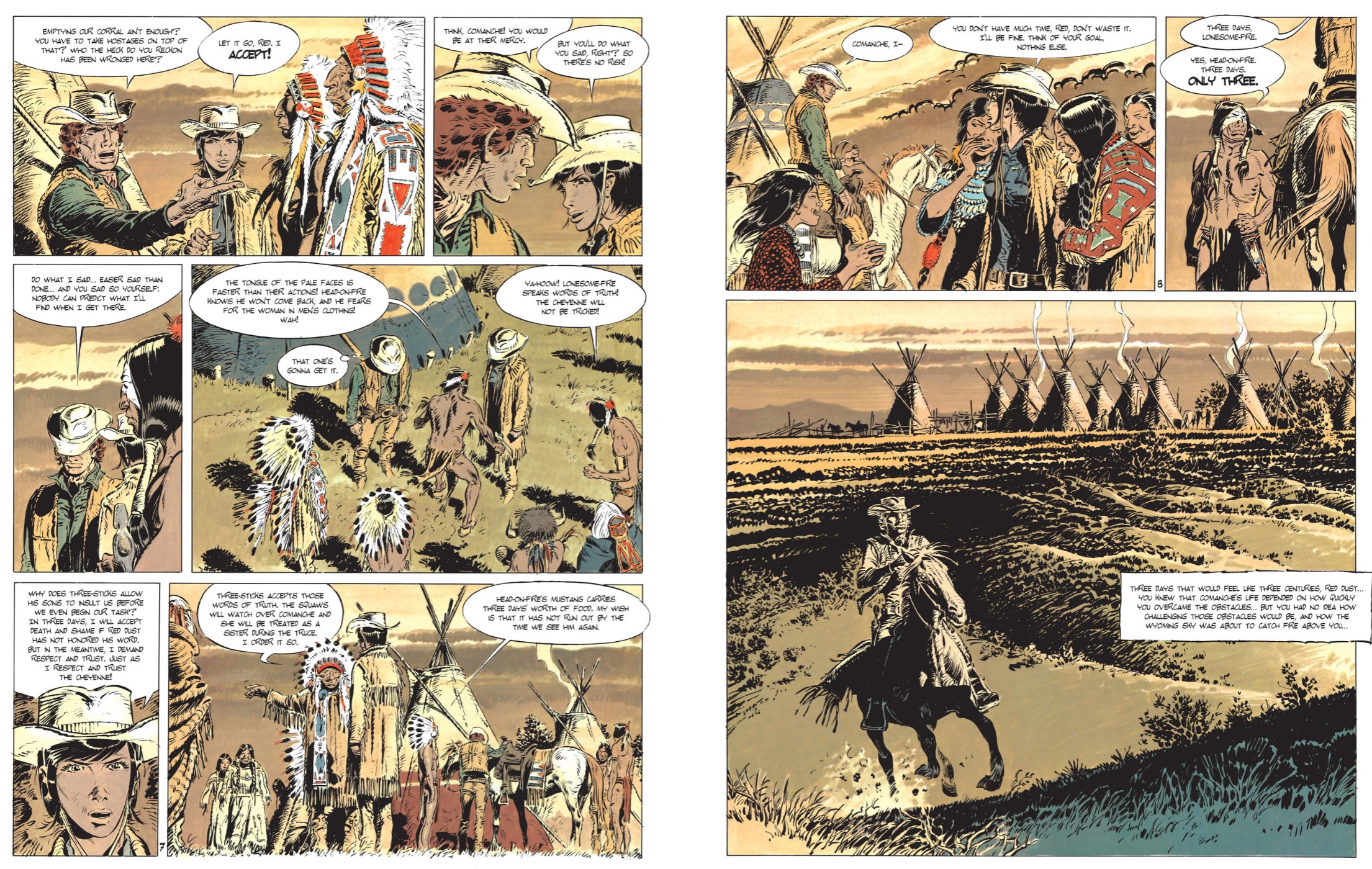
Second serial ‘Warrior of Despair’ sees our quotidian, ever-expanding cast prepare steers for hungry railway workers rapidly building their way across the plains. That backbreaking toil is suddenly disrupted by the arrival of a party of Cheyenne who want the beef the cowboys are guarding…

A fractious but peaceful conference reveals the tribes are starving: supplies they’ve been promised by treaty haven’t arrived and no one can locate the Government’s Indian Agent to sort out the problem…

After the warriors rush off with the cattle, Comanche and Red join them at their camp in a last attempt to prevent a mess becoming a crisis. The upshot is that Dust has three days to find the Agent and restore the missing provisions. For that time Comanche will remain a “guest” of the Cheyenne…

…And so begins a desperate chase with double-dealing, ingrained mistrust and sheer bad luck on every side hindering the retired gunslinger’s quest and leading to the inescapable conclusion that the plains will soon be awash in flame and blood…

An epic tale in the classical manner, this yarn also has plenty of European verve, panache and ingenuity to recue it from the unreconstructed reputation and unsavoury old tropes that make even venerated old movie an uncomfortable experience in these enlightened days.

It’s also a tale that gets more visually compelling with every page…

A stunning appreciation of mythical Cowboys and Indians combined with a sleekly authentic sheen of grime and gutsy European style, Warriors of Despair is another classic collation comics fans and entertainment-starved readers will be unable to put down. Don’t miss out on a chance to enjoy one of the most celebrated comics classics of all time…


Comanche volume 3: The Wolves of Wyoming

The third translated volume of the unfolding epic starring no-longer-wandering shootist Red Dust and his expanding circle of friends sees the taciturn hombre accepting that he has finally found a home – if not peace and contentment – after joining the Triple 6 ranch and its unlikely cast of comradely outcasts on a struggling cattle-spread in Wyoming. The weekly episodes of The Wolves of Wyoming were originally published in 1974, seeing our roster embroiled in a classic cinematic scenario which begins with a stagecoach hurtling over dusty plains. Of course, it also has ruthless bandits slinging lead in hot pursuit…

Doughty driver Sid Bullock is hit, but the lone passenger is more than holding his own with a sixgun, and when Triple 6 ranch-hands Toby and Clem intercept the frantic chase, the vilely predatory Dobbs Brothers peel off and flee…

Diverting to the homestead, the hands formally meet self-confessed lay preacher Brian Braggshaw, a notorious former gunslinger with an extremely unforgiving attitude to sin (and sinners) and who takes an instant dislike… mutual and fully reciprocated… to Red.

As Ten Gallons doctors Bullock, Comanche learns the Dobbs’ were after a cash shipment to the Ranchers Union – money nearby Greenstone Falls depends on. The gang have bled the town dry with their recent raids. It’s almost as if they have an inside man informing them of key shipments and times…

Compounding the problem is that fact that wily Sid actually diverted the latest tranche of money: carrying an empty, decoy strongbox while local legendary old drunk Pharoah Colorado transported the actual cash by a circuitous route. It’s a cunning, brilliant plan that only falls short on one point. Finishing his booze early, Colorado has been forced to make a detour, visiting local moonshine-maker Trapper Hans even as the Triple 6 hands split up into search parties to find the leathery soak and precious funds…

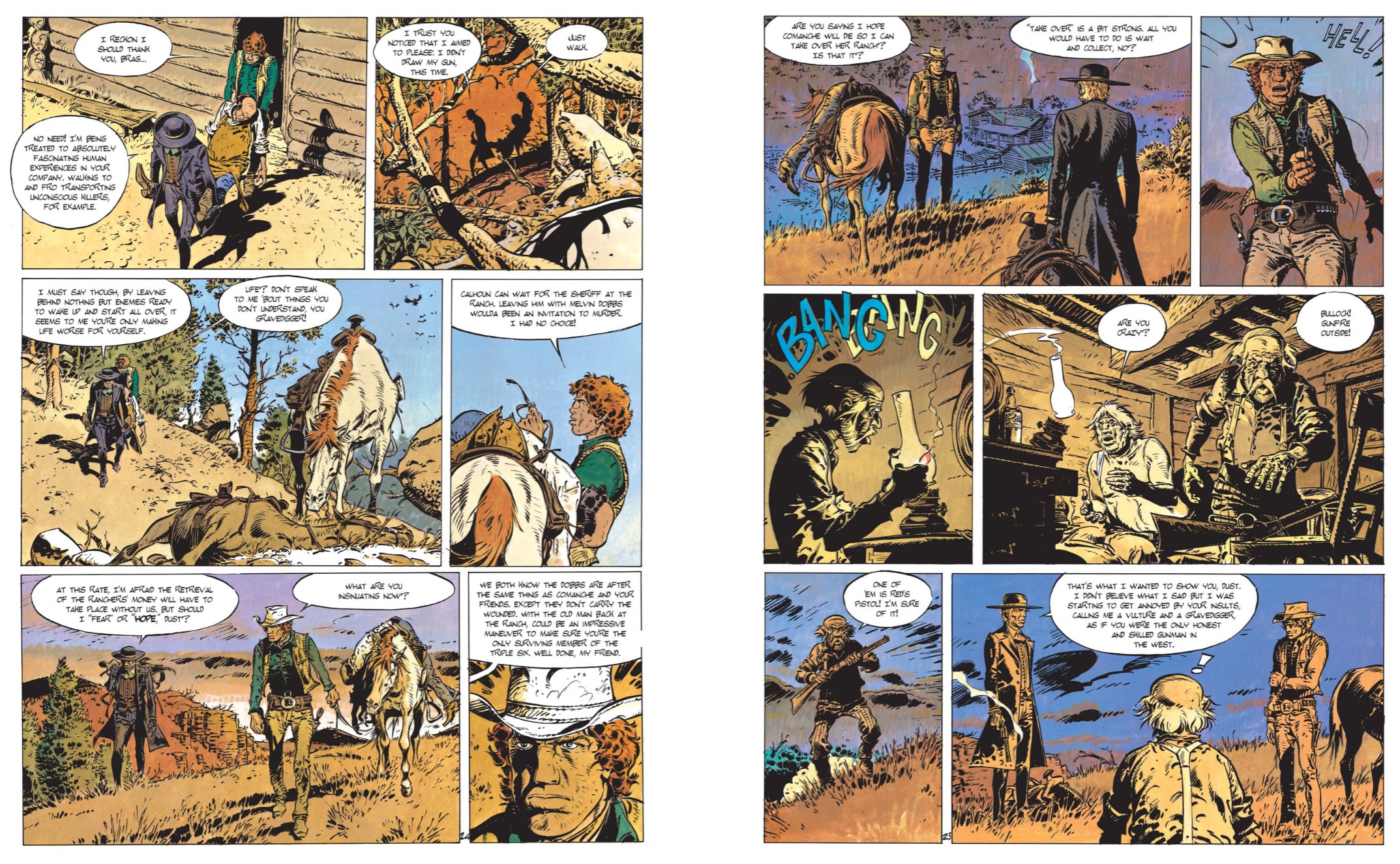
Covering many potential routes, they are being secretly observed. The Dobbs’ are mostly cruel brutes, but oldest brother Russ is as smart as he is sadistic and quickly deduces what the ranchers are hunting for: money he feels is his by right. Moreover, Red has been paired with the vengeance-happy Braggshaw, and their heated debates over morality bring them close to blows. It’s not enough to stop the preacher killing Melvin Dobbs when he tries bushwhacking them, and as they backtrack to the gang’s cabin, they observe the entire clan riding off…

Investigating the cabin, Red finds missing Indian Affairs Commissioner Howard Calhoun, who embezzled funds and almost sparked an new Indian war. His cunning hideaway amongst the Dobbs Boys has clearly proved there’s no honour among thieves, and their treatment of their criminal comrade has resulted in what can only be regarded as divine justice…

Russ has gathered the clan to scour the region, whilst Red has made some deductions of his own. Trapper Hans’ sturdy shack is the only place to find booze in the Wyoming wilds so he and Braggshaw head there. As night falls, Comanche &Toby are already there, preparing to fight for their lives against the besieging Dobbs mob.

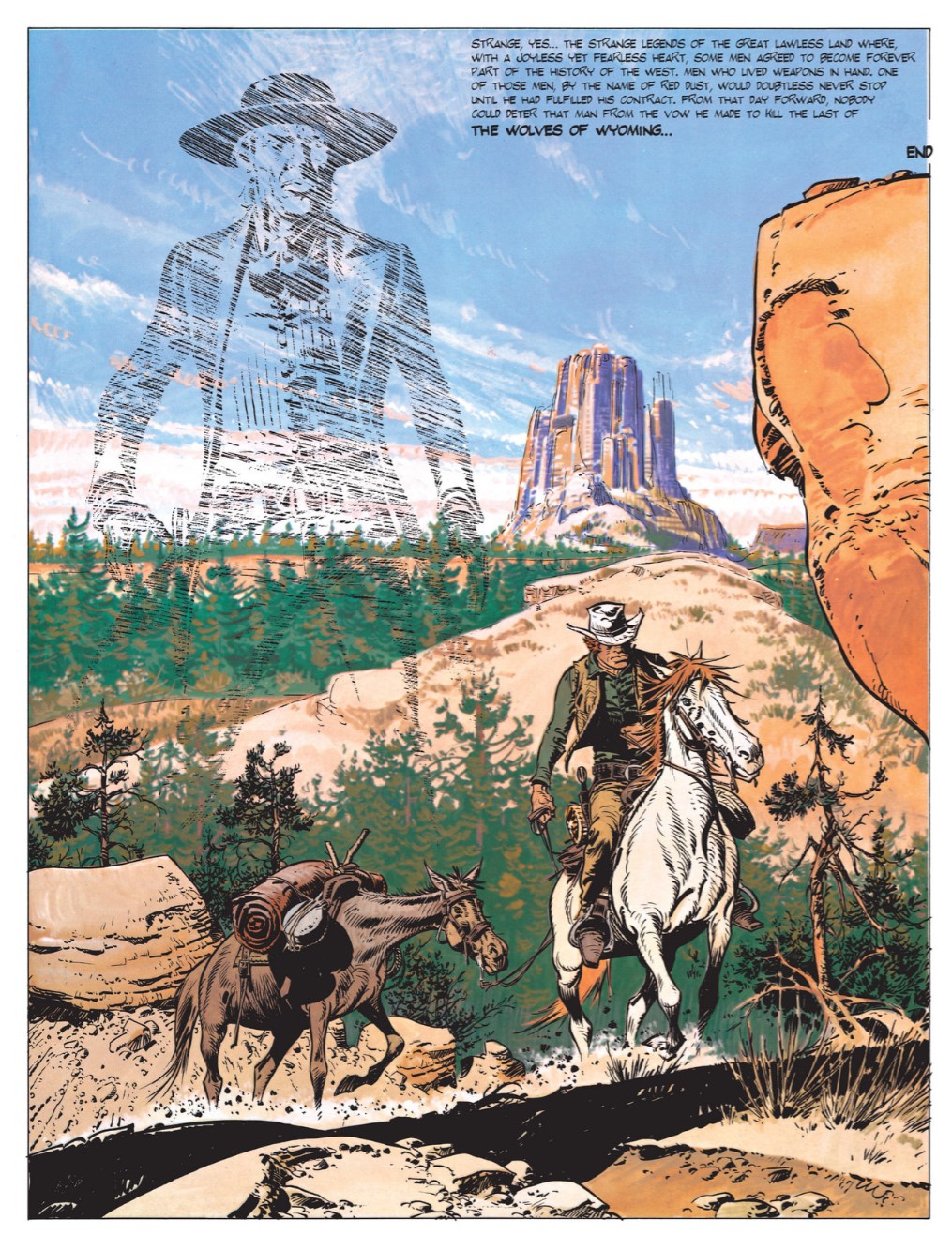
As the bloodshed begins, the rest of the Triple 6 men converge on the scene. With battle joined it’s not long before a hero dies and the gang turn tail. In the aftermath, Red rides off, having embraced the Preacher’s unforgiving doctrine and now determined to destroy all the “wolves of Wyoming”…

To Be Continued? Apparently not here, but we live in hope…

A classic of the western genre, these European yarns grew in style, passion and sublime, compulsive expression, methodically lifting them far above the now-unacceptable majority of cowboy stories that make even beloved older tales an uncomfortable experience in contemporary times. They are also so hauntingly lovely to look upon. Don’t miss out on one of the most celebrated comics cowboys ever devised…
Vols 1-3 © 2017 – LE LOMBARD – HERMANN & GREG. All rights reserved.

Today in 1925, cartoonist Henry Martin (Good News/Bad News) was born, with inker illustrator Jack Abel (Tales of the Green Berets, Legion of Super-Heroes, Richard Dragon: Kung-Fu Fighter & probably every Marvel and DC title you can think of) coming along in 1927 and Italian Master Guido Crepax (Valentina, Dr Jekyll and Mr Hyde, The Man from Harlem, Il processo di Franz Kafka) arriving in 1933. A later generation includes author and comics scripter Christopher Golden (Baltimore, Beach High, Hellboy, The Punisher) in 1967; writer/editor/adapter Kelly Sue DeConnick (Castle, Ghost, Bitch Planet, Wonder Woman) in 1970; Norwegian creator/autobiographer Mads Eriksen (M, Gnom) in 1977, and writer Tom King (The Sheriff of Babylon, The Vision, Strange Adventures, Mister Miracle, Supergirl: Woman of Tomorrow) in 1978.

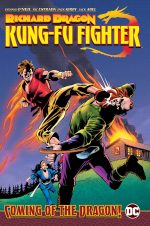
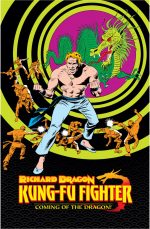
Richard Dragon: Kung-Fu Fighter: Coming of the Dragon!


By Dennis J. O’Neil, David Anthony Kraft, Bob Haney, Mike W. Barr, Leopoldo Durañona, Jim Starlin, Alan Weiss, Jack Kirby, Ric Estrada, Jim Aparo, Alex Saviuk Wally Wood, Jack Abel, Al Milgrom, D. Bruce Berry, Vince Colletta & various (DC Comics)
ISBN: 978-1-7795-0810-2 (HC) 978-1-7795-1240-6 (Digital edition)

This book includes Discriminatory Content produced in less enlightened times.

The mysterious martial arts of “The East” have always fascinated western readers and writers. Adventurers, detectives and mystery men like Sexton Blake, Batman, Doc Savage, The Spider and The Shadow drew much of their history and arsenal from the arcane Orient, and even intellectual acme Sherlock Holmes occasionally employed the scientific combat system of “Baritsu” – actually a mixed martial art called Bartitsu which developed between 1898-1902. Moreover, every secret agent worth their salt was au fait with assorted “chop sockey” techniques: generally disparaging them while delivering a visually enticing signature blow…

Putting aside references in assorted newspaper strips, the first specialist martial arts comic book star was Judo Joe: a young American raised in Japan who used his training for the benefit of all. Three issues were released between August and December 1953. The work of Dr Barney Cosneck and illustrator Paul W. Stoddard, it set the tone of the genre as well, devising an enduring feature of most early strips in illustrated lessons on specific moves and techniques to let them all break bones in the security of their own bedrooms. Kids! DO try this at home… but not on the cat. That what little brothers are for…

Comics in the 1960s were highly spiced with judo and karate users, with by far the most accurate forms employed by Charlton Comics champions Sarge Steel (#1 December 1964, by Pat Masulli & Dick Giordano) and WWII costumed combatant Judomaster (first seen in Special War Series #4, November 1965): both benefitting from the specialist Kung Fu knowledge and artistic skills of Frank McLaughlin – an actual judoka who had studied martial arts for years.

Gold Key simply exploited licensing power. Television’s The Green Hornet ran 26 episodes from September 1966 to March 1967 and their comics adaptation (3 issues from February to August 1967) played up the combat skills of the antihero/vigilante’s chauffeur and partner Kato. You’ll recall, I’m sure, that he was played by young Bruce Lee, who was in very large part responsible for the popularisation of martial arts in the west… especially after graduating to film roles.

When the big boom began in the early 1970s, Charlton were again quick off the mark: launching their own knock-off of hugely popular TV series Kung Fu. Running 18 issues, Joe Gill & Warren Sattler’s Yang debuted with a November 1973 cover-date, recounting the life of a Chinese wanderer in the 1870s wild west. It spawned sequel/spin-off House of #1-6, July 1975 – June 1976) by Korean comics creator Sanho Kim and remains a visual highpoint to this day… if you can find it. Marvel really reaped the benefits of the zeitgeist with Shang Chi, Master of Kung Fu in Special Marvel Edition #15 (cover-dated December 1973) and a flood of follow-ups including Iron Fist, Sons of the Tiger, Daughters of the Dragon and White Tiger. As ever – and despite teenager Jim Shooter introducing Karate Kid to the Legion of Super-Heroes back in 1966 (Adventure Comics #346, July) – ever-cautious DC were late to the party, even though one of their key writers was also the co-author of a Kung Fu novel…

…And Karate Kid? As the martial arts boom was subsiding, DC awarded him his own solo series, set primarily in the 20th century: 15 bi-monthly issues running from March/April 1976 to July/August 1978. He travelled through time and across realities, but never met the stars of this particular title…

The Seventies had begun with a downturn in superhero sales and a resurgence of traditional genre comic tales. A few years in, a new genre emerged: one blending eastern philosophy and personal combat systems with a real-world growth in organised crime – especially drug (and human) trafficking. Popular fiction responded with a wave of lone wolf vigilantes like Mack (The Executioner) Bolan and martial arts icon Remo Williams: The Destroyer, as gritty hardboiled crime thrillers evolved and genres began to mash up…

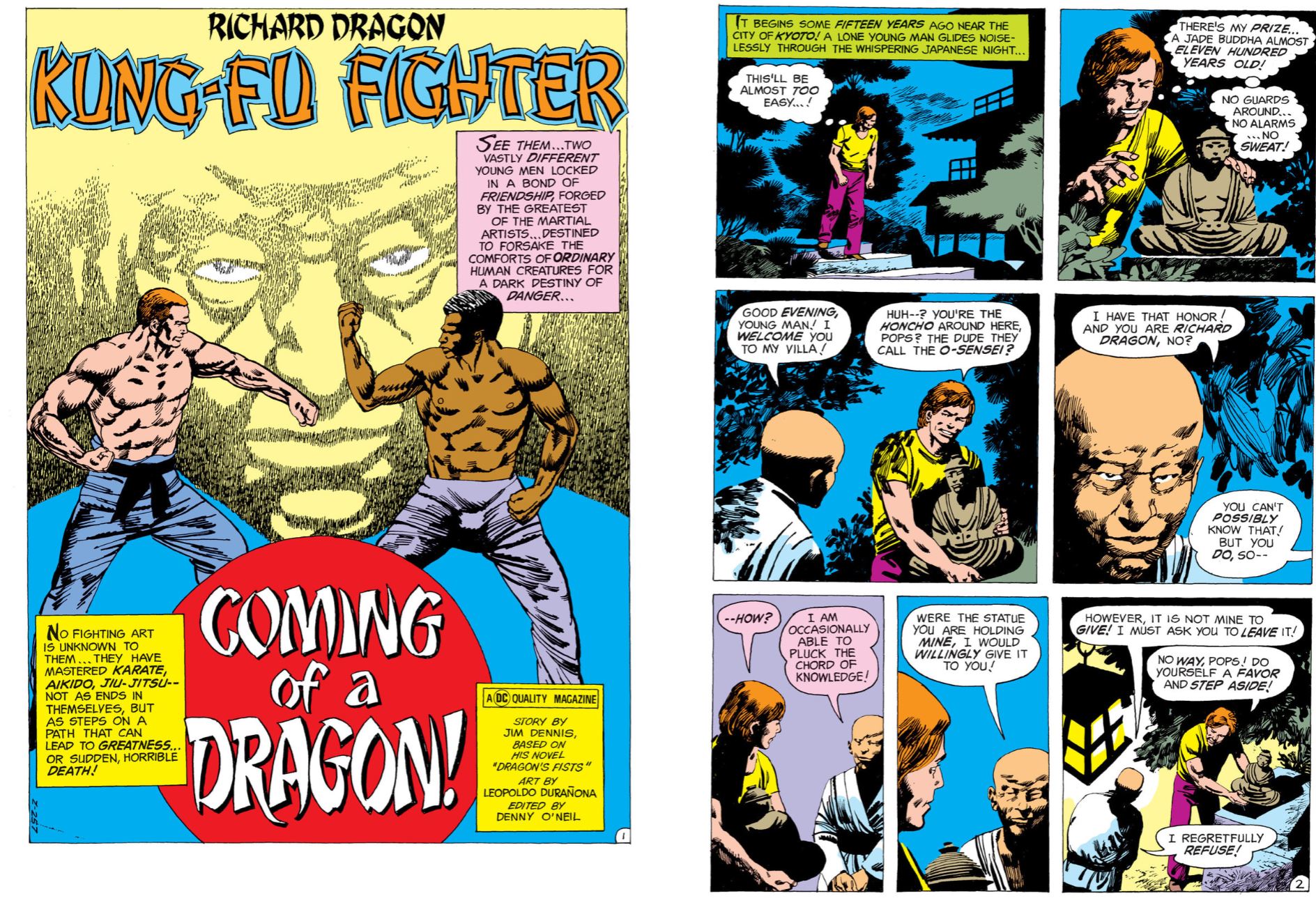
Riding his own wave of comic success and celebrity from Batman, Justice League of America, Wonder Woman, Green Lantern/Green Arrow and Superman, former Marvel trainee/intern turned journalist Dennis J. O’Neil teamed up with editorial cartoonist James R. Berry to write a prose thriller for this burgeoning market. Under the pen-name Jim Dennis, they detailed the life path of teen thug Richard Drakunovski after finding friends and life direction with a martial arts sensei. Kung Fu Master, Richard Dragon: Dragon’s Fists was released in 1974 and ultimately pitted the hero against evil industrialist Guano Cravat…

With a phenomenon unfolding around them, DC finally joined the parade of warriors by having O’Neil adapt the book, expanding the premise and adding significantly to their pantheon of stars in the process: not so much with the leading man but through his potential-packed supporting cast.

Spanning April/May 1975 to November 1981, this fast and furious compendium collects Richard Dragon: Kung Fu Fighter #1-18; a team-up from The Brave and the Bold #132, plus a closing note from DC Comics Presents #39. In keeping with the tone of the genre and time, these stories are tersely underwritten and potently action driven, but racial and gender issues are ubiquitous and fully expressed in the terms of the times.

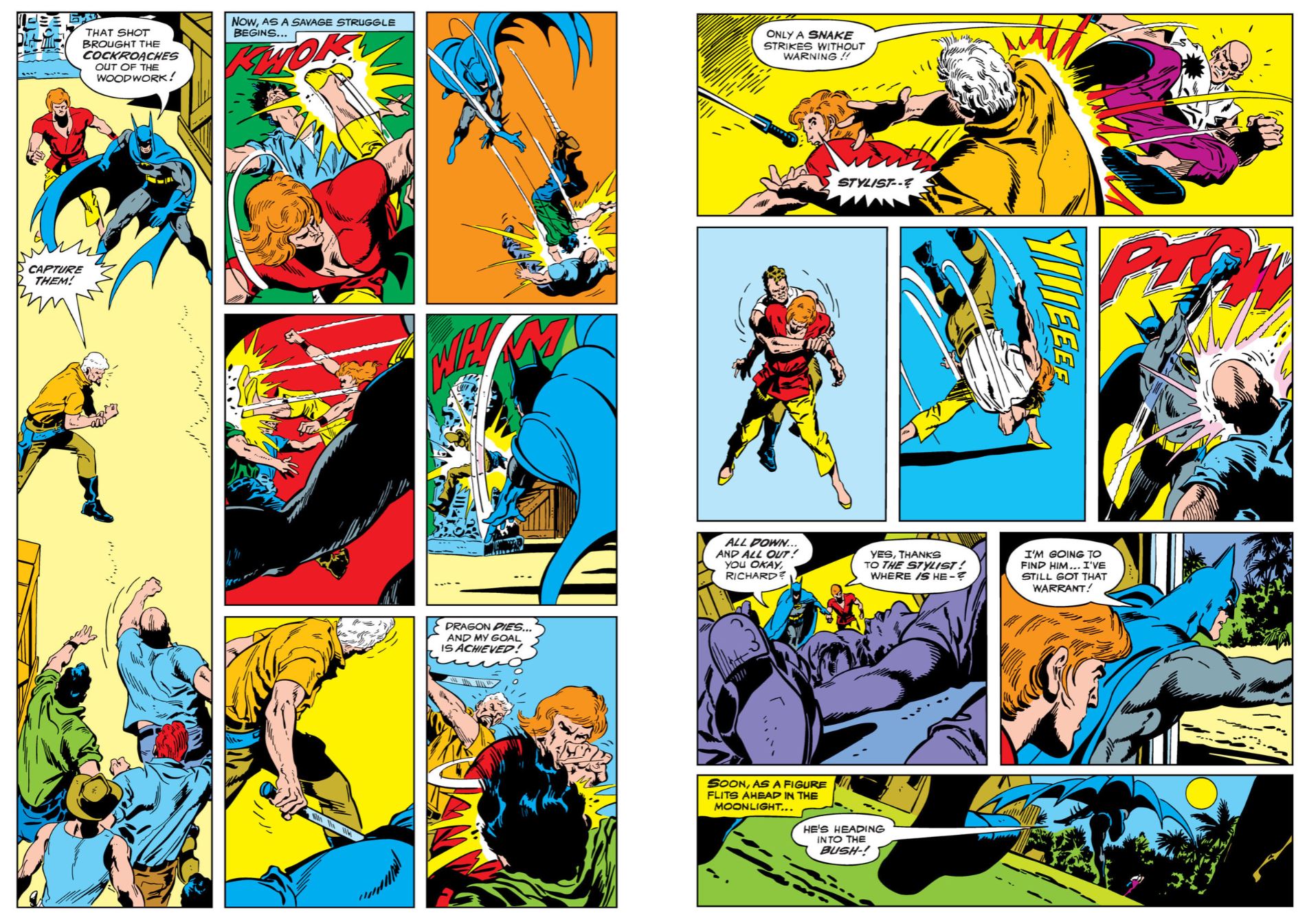
The first issue was cover-dated April/ May 1975 and on sale from January 30th, with opening episode ‘Coming of a Dragon!’ credited to “Jim Dennis” and illustrated by comics legend Leopoldo Durañona. Here it was revealed how a teenager’s attempt to burgle a dojo in Kyoto, Japan was foiled by its head teacher O-Sensei. The venerable ancient easily mastered the violent thief and then invited to him to change his life path. Richard Dragon spends the next seven years mastering countless forms of Kung Fu, higher education and his own raging nature, forming a lifelong bond with his fellow pupil – African American Ben Turner – and seeking to become a physically and ethically “Superior Man”…

The idyllic period ends the day unctuous freelance spymaster Barney Ling shows up. He runs acronymic organisation G.O.O.D. and begs the legendary O-Sensei to aid him in stopping a world-class human trafficker. Instead, the master sends his students against an army of brutes and monsters…

Artistic stability was not an option as O’Neil was partnered in swift succession with Jim Starlin, Alan Weiss & Al Milgrom for second exploit ‘A Dragon Fights Alone’. Wounded but triumphant, Dragon and Turner return to Japan only to be targeted by the hired thugs of a hidden enemy. The attack comes in the wake of a tearful graduation, as they seek to aid O-Sensei’s goddaughter Carolyn Woosan. This results in them all heading for San Francisco, where mercenary The Swiss had orchestrated her uncle’s death whilst searching for a deadly secret. When the freshly-debarked adventurers investigate, Ben is shot and Carolyn taken…

It clearly took some time to assign an art-team as Jack Kirby & D. Bruce Berry limned third instalment ‘Claws of the Dragon!’ as an enraged hero hunts The Swiss and trounces an army of assassins, thanks in no small part to his secret weapon – a jade claw allowing him to focus all his knowledge and fury and become a beast of battle…

Crushed by their continuing failure to rescue Carolyn, Dragon & Ben reluctantly accept help from Ling and G.O.O.D. Marshalling resources and infiltrating a suspect dojo, Dragon accepts that there is ‘A Time to be a Whirlwind!’, and again overcomes all physical opposition, but once more fails Carolyn, this time forever. This shattering clash signalled the start of artistic stability as Ric Estrada took over pencilling, augmented by master inker Wallace Wood.

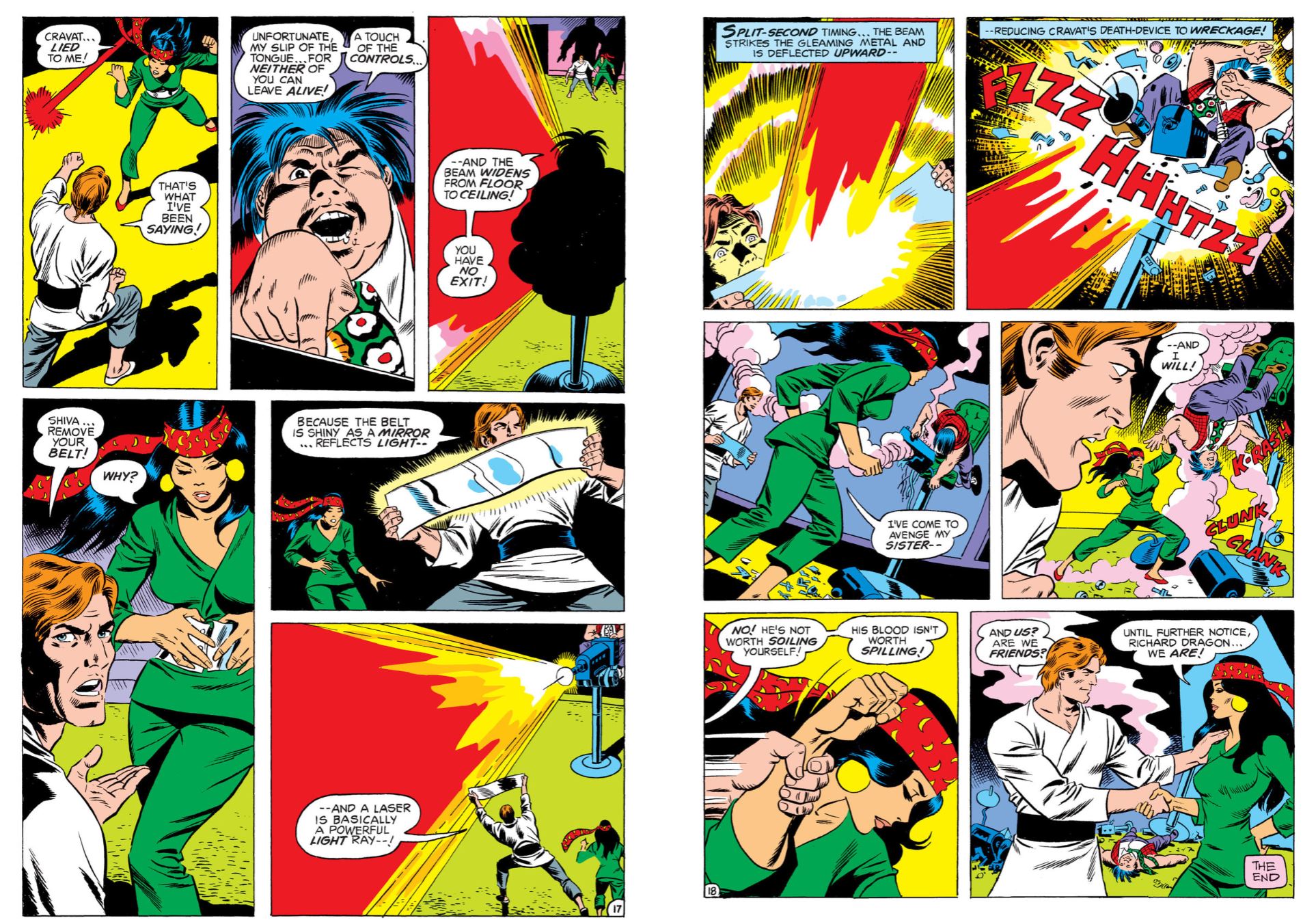
Sandra Woosan debuted in #5, a woman who would become a major player in DC continuity. Cover-dated December 1975-January 1976, ‘The Arena of No Exit!’ introduced lethal Lady Shiva: a conflict-addicted swordswoman seeking bloody redress for her murdered sister. She was working for grotesque super arms-dealer Guano Cravat (the secret mastermind behind The Swiss), but rejected her current assignment to kill Dragon after fighting him and realising that staying in his orbit would generate all the murderous duels her killer’s heart hungered for without betraying her tarnished and diminished ethical code…

In later years she would evolve into the most dangerous assassin on Earth: a major opponent of Batman, Robin, assorted Batgirls, Black Canary, the Birds of Prey and many others.

After foiling Cravat’s scheme, Dragon and Shiva are rewarded by Ling with magnificent matched swords: katana crafted by an 18th century master smith. However, it’s just a ploy to sweeten them up. G.O.O.D. needs them to recover a “misplaced” nuke on a volcanic island: one ruled by a modern pirate with an obsessive fixation on fighting with swords. He calls himself Slash…

The spectacular conclusion of ‘Island of the Inferno’ leads to a confrontation with occasional Batman and Wonder Woman evil scientist Doctor Moon, who uses Cravat’s money to transform mere humans into surgically-augmented, programmable super-warriors in #7’s ‘Command: Slay the Dragon!’ All this time, Ben has been healing and teaching at the dojo he runs with Dragon, but his life is about to change after becoming romantically entangled with promising student Janey Lewis. When she and other students are attacked by Moon’s thugs, Dragon & Shiva retaliate but are almost killed by Moon’s colossal cyborg Topper. Almost…

Another old foe resurfaces in #8, striking at his despised enemies by murdering more dojo students and rendering our hero temporarily sightless, facilitating his scheme to ‘Slay the Blind Dragon’ after which Estrada inks his own pencils in #9 as Barney Ling returns to reveal that the recent dojo attacks are masking a hidden plot to assassinate Ben. The manipulative G.O.O.D. guy offers to reveal all, but only if all three kung fu fighters carry out a few errands for him…

Thus Turner, Shiva & Dragon depart for tropical San Lorenzo to stop a monster ravaging the tourist destination – a thieving mutated killer known as ‘The Preying Mantis’ – prior to Ben discovering he’s inherited millions in prime timberland! He heads north, with his allies in tow and finds that the lumberjacks are definitely killers… and are embezzling all the profits. They have already murdered Turner’s sister, leaving him as guardian of an unsuspected nephew (also called Ben) and their leader Hatchett tries everything possible to destroy the nosy snoopers in ‘The Human Inferno!’ (inked by Jack Abel). However, the assassination attempts only slow, but do not cease…

Cover-dated September 1976, #11 offers a change of pace and scripter, as David Anthony Kraft joins Estrada & Abel in a byzantine futuristic spy conspiracy that begins ‘When Strikes the Samurai!’ After being targeted by a disappearing Japanese warrior, the trio are despatched to Communist China to secure an object dubbed the Tiger Tally which in turn could unlock the secrets of bewildering Project Moon Age Daydream. The mission results in a trail of dropped bodies before ‘A Dragon Defiant’ is subjected to a duplication device resulting in him literally beating himself up before thwarting rival maniacs Telegram Sam and Madame Sun…

Back in the USA for #13, the drama intensifies with O’Neil & Estrada’s reunion, as Ben is poisoned and Dragon & Shiva carve their way through a murderous legion ‘To Catch an Assassin!’ and secure the antidote. When that proves fruitless, detective work leads them to The League of Assassins and a desperate quest for their chief deviser of toxins. Viper makes his potions in the wilds of Mongolia – perilously close to the Soviet Russian border – and the countdown quest allows no time for restraint, which only grants Shiva opportunity to do the work she loves without being held back…

With Turner’s death imminent, we pause for a diversionary team-up as The Brave and the Bold #132 (February 1977 by veteran writer Bob Haney & ultimate guest star artist Jim Aparo) enquires ‘Batman – Dragon Slayer??’ When Denny O’Neil succeeded Murray Boltinoff as B&B editor, it resulted in this rather forced tale of duelling fight stylists after a publicity-shy billionaire sought to repay an imagined debt to good Samaritan Dragon by leaving him a mysterious bequest…

Back in his own title, Dragon’s quest for a cure takes him back to China to find the O-Sensei. At that time, unknown to all, his former master was Dr. Moon’s prisoner, so Richard & Shiva’s mission generates massive mayhem and an inconclusive duel with ‘The Man Who Studied with Bruce Lee’: a gullible yet proficient martial arts purist who had learned all the celebrity’s “lost secrets”…

The clash might have been pointless, but the rescued O-Sensei cures Turner, who pursues his relationship with Janey to the point of asking her father for permission to wed. Tragically, at that moment in #15, ‘The Axeman’ attacks shipyard Security Chief Luke Lewis and his adored daughter is fatally caught in the crossfire. Crushed and broken inside, Ben hunts the killer with Dragon at his side, uncovering shocking betrayal that intensifies his fury into mania. Exploiting all their resources, they follow to the top of the world in #16, where ‘The Doom Seer’ – outrageous, tyrannical madman Professor Ojo (later to become a Green Lantern nemesis!) – pits them and Lady Shiva against outlandish martial arts skaters and an arsenal of scientific terrors before #17’s ‘The Final Victim’ provides a spectacular conclusion, but no resolution…

Richard Dragon: Kung-Fu Fighter finished with #18, but ‘The Secret of the Bronze Tiger’ set up decades’ more stories. Bereft, Turner had vanished and was presumed killed battling Ojo, whilst Dragon sank into despair and dissolution. Finally, Shiva dragged him out to investigate a mysterious masked martial artist and illegal fight club. Dragon was stunned to discover Ben was the Tiger – who retained all his skills but was apparently a ruthless criminal with no memory or scruples…

This storyline was later picked up and expanded upon in future Batman tales involving Ra’s Al Ghul’s League of Assassins and sinister splinter group Demonfang (whose leader was ancient killer The Sensei) and resulted in Bronze Tiger becoming an integral part of the Suicide Squad in post-Crisis on Infinite Earths DC Universe. In that rebuilt continuity, Shiva & Dragon were crucial to the development of The Question (Vic Sage) and other martial arts-based characters, emphasising the ripple-effect of “the Superior Man” on an entire heroic universe.

Here, however, there’s an epilogue of sorts as DC Comics Presents #39 (November 1981, by Mike W. Barr, Alex Saviuk & Vince Colletta) discloses ‘Whatever Happened to Richard Dragon: Kung Fu Fighter?’ Having retreated to the peace of a Shaolin monastery, Dragon is called back to the outside world to save mind-controlled Bronze Tiger from the person who had truly been responsible for most of their perils and hardships all along…

With covers by Dick Giordano, Wiess, Milgrom, Estrada & Colletta, Jose Delbo, Ernie Chan, Aparo & Rich Buckler, and including Who’s Who character profiles of Dragon, Bronze Tiger & Lady Shiva, this compendium is very much of its time, but still offers universal thrills and spills whilst providing crucial context to all devotees of DC’s overarching multiversal continuity. Very much the Superior Read of the Superior Fan…
© 1975, 1976, 1977, 1981, 2021 DC Comics. All Rights Reserved.
Today in 1910, cartoonist/animator and legend maker William Hanna was born, sharing the date with inking legend Mike Esposito in 1927; French mythmaker Marcel “Gotlib” Gotlieb (Gai-Luron, Superdupont, Les Dingodossiers, Rubrique-à-Brac, Hamster Jovial, co-founder of L’Écho des savanes & Fluide Glacial) in 1934; writer/artist John K. Snyder III (Fashion in Action, Grendel, Suicide Squad, Doctor Mid-Nite, Mr E, The Duckberg Times, 8 Million Ways to Die) in 1961, artist Richard Case (Doom Patrol, Sensational Spider-Man The Sandman) in 1964 and illustrator/storyteller Colleen Coover (Small Favors, Banana Sunday, Bandette, X-Men: First Class) in1969.

It’s a big day for colourists with Peter Steigerwald born in 1974, Brian Reber in 1975 and Matt Wilson in 1980; and also saw the deaths of arguably Chile’s greatest cartoon humourist Rene Rios Boettiger (Condorito) in 2000 and, in 2006, the utterly irreplaceable British man of letters (and thought balloons and caption boxes) Tom Frame.

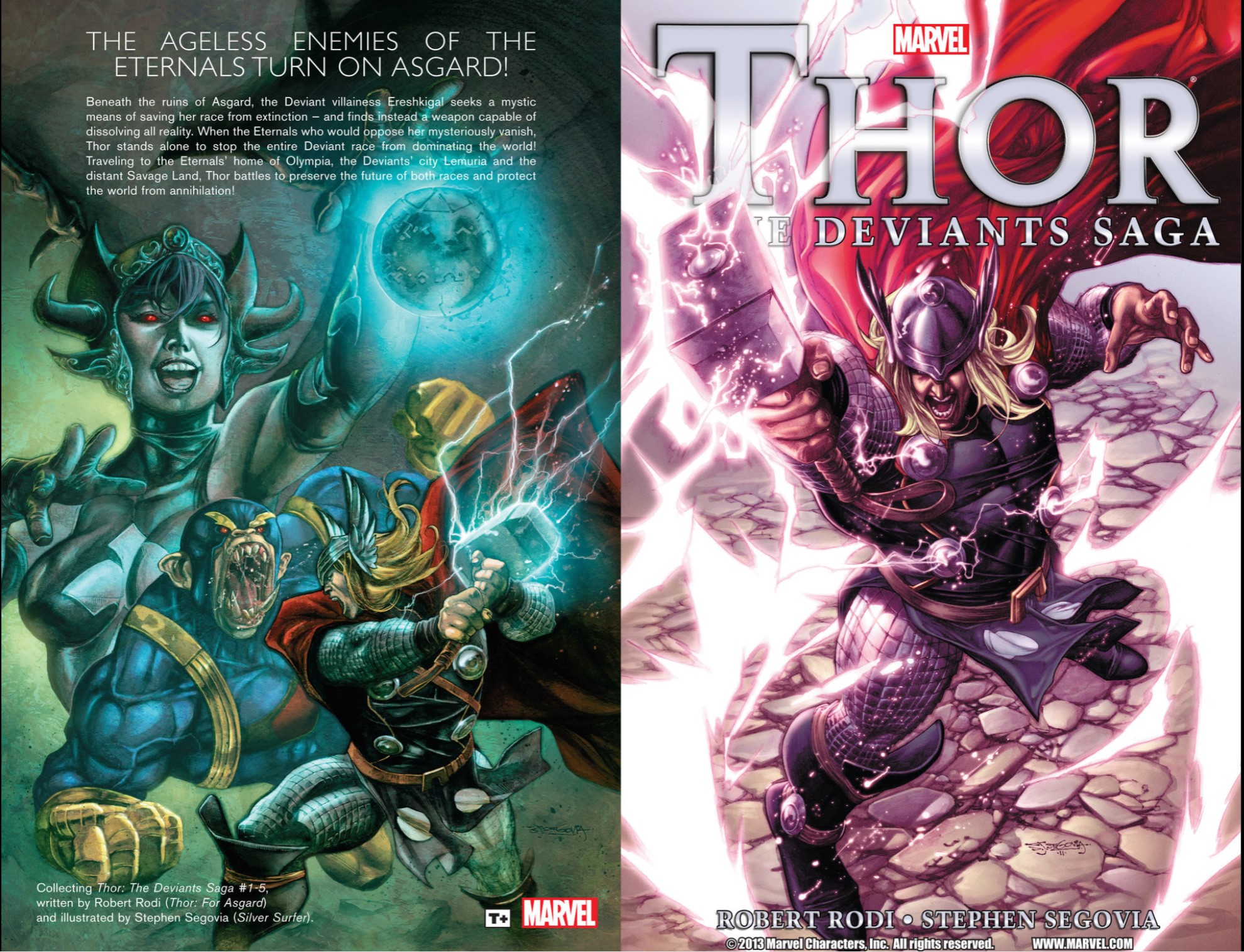
Thor: The Deviants Saga


By Robert Rodi, Stephen Segovia, M. Jason Paz & Jeffrey Huet & various (MARVEL)
ISBN: 978-1-3029-2295-5 (TPB), 978-1-3020-1399-8 (Digital edition), 978-1-84653-511-6 (Panini UK edition)

This book includes Discriminatory Content produced in less enlightened times

Time for another Anniversary shout out…

Jack Kirby’s The Eternals first emerged on 13th April 1976 in a title cover-dated July of that year, in a series slightly at odds with and removed from Marvel’s regular company continuity. The new mythology revealed that giant Celestial aliens had visited Earth in epochs past, gene-gineering proto-hominids into three distinct species: Human Beings; godly superbeings who called themselves Eternals and genetically unstable, ferociously aggressive but highly intelligent creatures dubbed Deviants. These subspecies had battled for ownership of Earth in wars spanning the length of human existence, but moreover the Space Gods had periodically returned to check up on their experiment…

Never a comfortable contemporary fit with the wider Marvel Universe – only S.H.I.E.L.D. ever really got involved the first time around – the series explored Kirby’s fascinations with Deities, Space and Supernature through the lens of very human observers. Once it ended and Kirby left, in the tried and trusted manner of such things other creators subsequently co-opted the concept into the regular continuity.

Over 19 issues and one Annual, the series avoided contact with Marvel continuity as modern humanity’s military, secret agencies and moneyed movers-&-shakers dealt with the politics and panic of a world-shattering event seen through the eyes of heroic rebel Ikaris, human Margo Damian, and a potent cast of Earth aliens Ajak, Sersi, Makkari, Zuras, Thena, Sprite and Druig who fought and foiled – or occasionally befriended – Deviants including Kro, Brother Tode, Ransak & Karkas, with Homo sapiens skulking running or cowering in terror in the background and under the microscope as a Celestial Fourth Host hovered above the world in a city-sized ship, pondering final judgement: a process that would take 50 years…

One of the heroes the Eternals did eventually meet with most often was the bellicose but benevolent Asgardian Storm Lord…

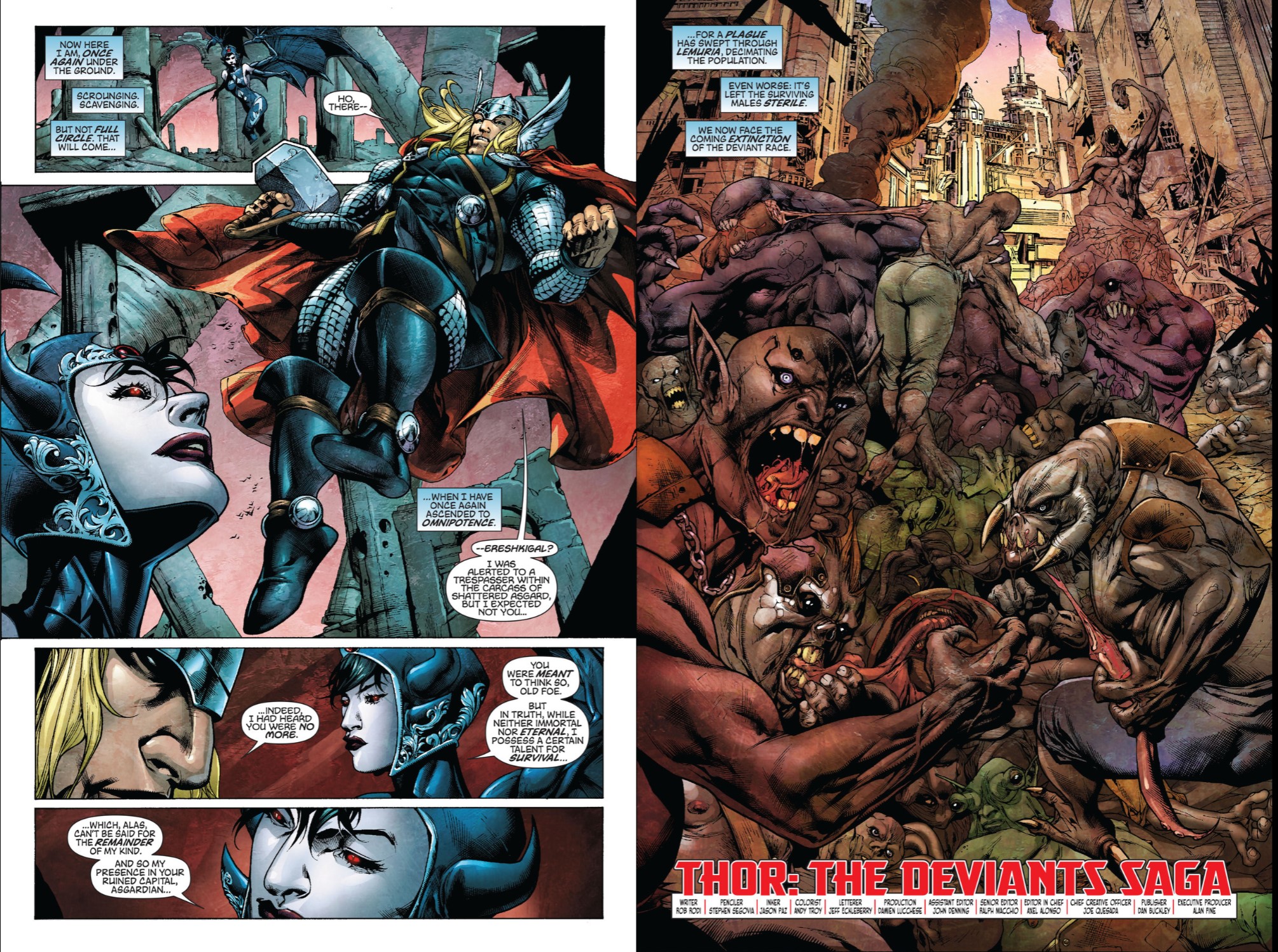
Lovingly remastered and skilfully refitted here by Robert Rodi and artists Stephen Segovia, M. Jason, Paz & Jeffrey Huet, the story here originated at the end of 2011 as a 5-issue miniseries and part of wave of publishing projects to support the burgeoning film franchise. It picks up on fresh elements introduced in 2007’s collection Neil Gaiman’s Eternals and opens in the ruins of Asgard as Thor discovers ancient deposed, Deviant monarch Ereshkigal has crept in and is searching through the rubble with a horde of brutal monsters…

The Deviants have also fallen on hard times and face extinction from a deadly plague, inspiring the dire, demi-demonic ex-empress to seek Asgardian tools and weapons to facilitate her return to personal power. After an inconclusive battle, Ereshkigal escapes with the Unbinding Stone of Oshemar, an apparently innocuous globe which can literally unmake reality. Utterly unaware of the power of her purloined prize, the Deviant tries and fails to usurp control from the current rulers of the Lemurian undercity which is their last refuge and home, whilst Thor – galvanised by the imminent destruction of the universe – seeks allies and the location of her hidden homeland amongst his old comrades and erstwhile allies in Olympia, cloaked Earthly citadel of his old Eternal comrades.

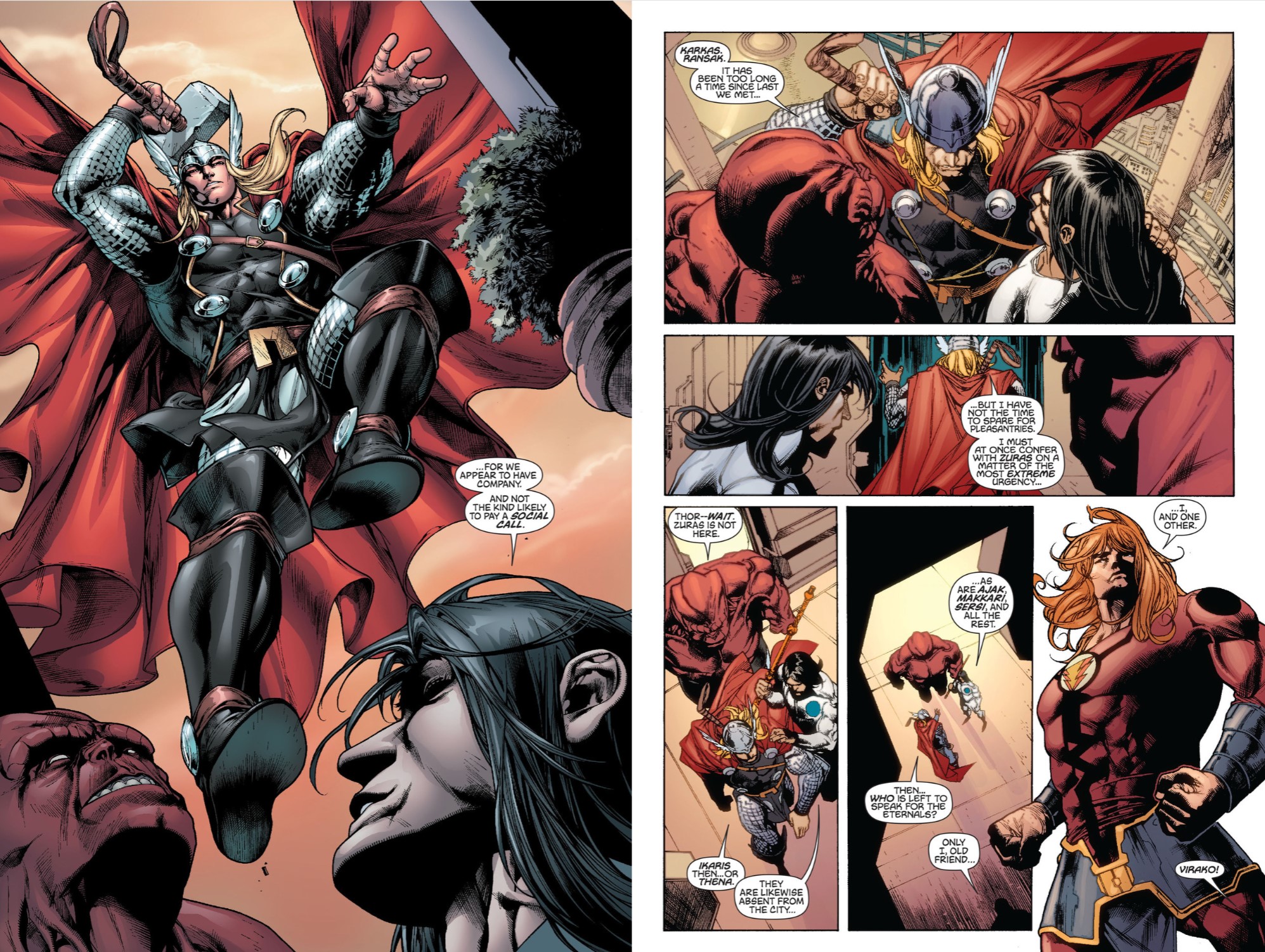
The city is all but deserted, with only resurrected hero Virako, master technician Phastos and “reformed” Deviants Karkas & Ransak the Reject occupying the immense mountaintop metropolis. Before the valiant band can formulate a plan, however, the city is invaded by a Deviant army led by apparently ageless and undying Warlord Kro and a cadre of elite monster warriors. After a spectacular battle the heroes are temporarily overwhelmed and Phastos captured. Critically, his incredible devices are stolen: taken in the misguided belief that they can reverse the effects of the disease devastating the Deviant population.

With the Unbinding Stone still in Ereshkigal’s meddling hands and their friend in peril, Thor and his comrades must storm the very heart of Lemuria before personal tragedy becomes universal Armageddon, but at least they have a hidden ally in the heart of the enemy – the outcast Eternal known alternatively as Gilgamesh and The Forgotten One…

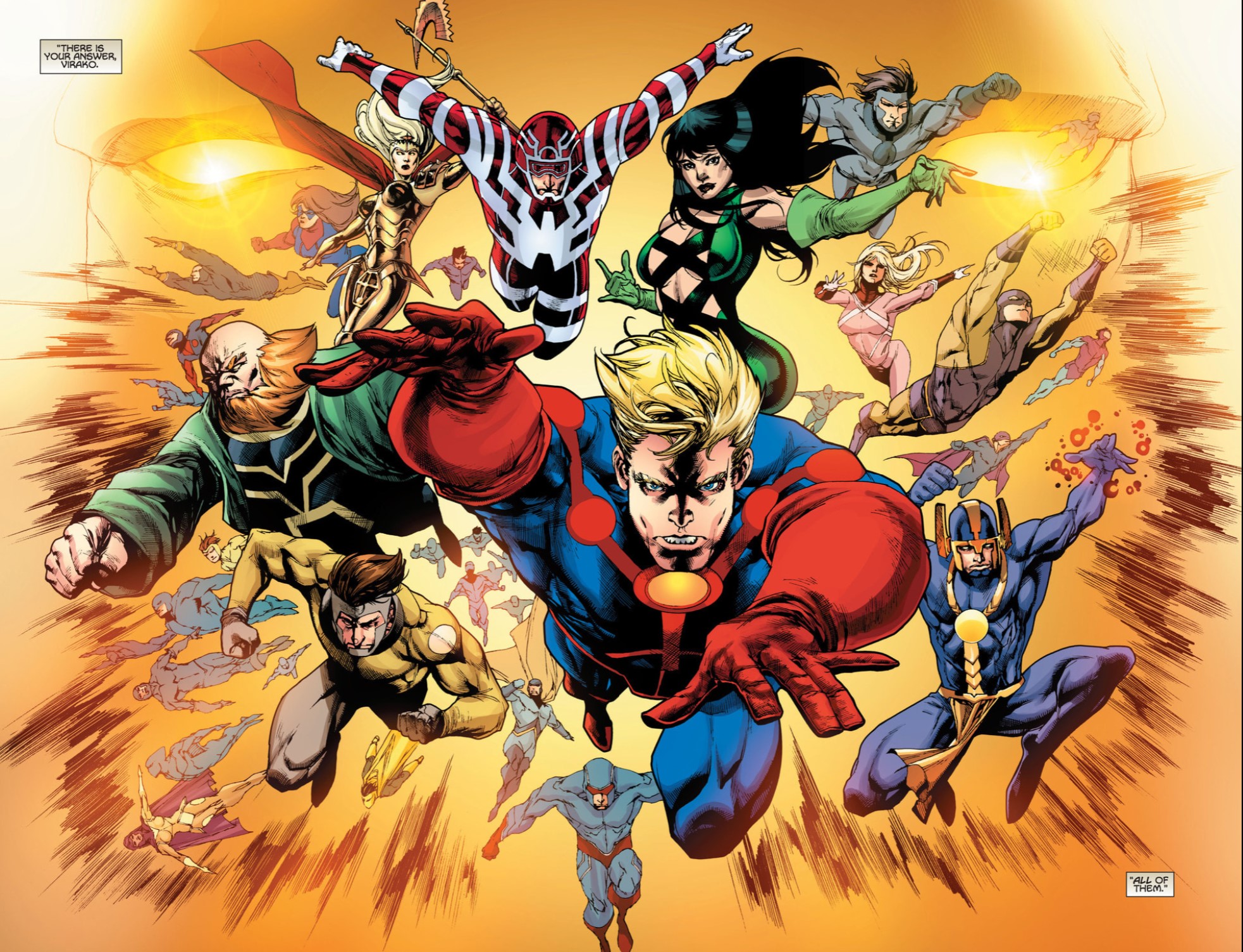
Also re-entering the mix as the cataclysmic climax builds are the space-scattered, long missing other Eternals, but even if they return in time, what can anybody do against a doom-obsessed potentate possessing a device which destroys atomic bonds and has no off-switch? The only answer to is try and pray and hope to make a miracle…

A grandiose,  old-fashioned blockbuster spectacle, this rousing yarn is cannily constructed so that even first-time readers can get right into the swing of things, whilst veteran devotees will find plenty of old favourite characters and themes revisited and clarified, with the adventure rattling along to a perfect climax with the portentous promise of more to come.

Fast, furious, frantic fantasy fun for older kids of all ages and one no Fights ‘n’ Tights fanatic could possibly resist.
© 2012 Marvel Characters, Inc. All rights reserved.

Today in 1902 “Father of Turkish Comics” Cemal Nadir Güler was born, followed in 1919 by hyperprolific comic book scribe Joe Gill (The Phantom, Zaza the Mystic, Fightin’ Five, Blue Beetle, Captain Atom, Peacemaker, Vengeance Squad, Hot Wheels, The Secret Six, every Charlton genre anthology ever) and, in 1931 Puerto Rican superstar writer/artist/editor Ernesto Colón Sierra AKA Ernie Colon (Harvey Comics, Star Comics, Manimal, Ax, The Medusa Chain, Arak, Son of Thunder, Dr Solar Man of the Atom, Amethyst, Princess of Gemworld, Damage Control, The 9/11 Report: A Graphic Adaptation, Vlad the Impaler). In 1937 Belgian humour cartoonist Hugo De Reymaeker AKA Hurey, Hugo and/or Fonske (De Fratsen van Jan Heibel, Anakronis), with Mike Ploog (Man-Thing, Ghost Rider, The Monster of Frankenstein, Werewolf By Night, The Spirit) arriving in 1940; master inker Tom Palmer (Doctor Strange, Avengers, Tomb of Dracula) joining in 1942 and military comics specialist Wayne Vansant (The ‘Nam, Days of Darkness, Katusha) in 1949.

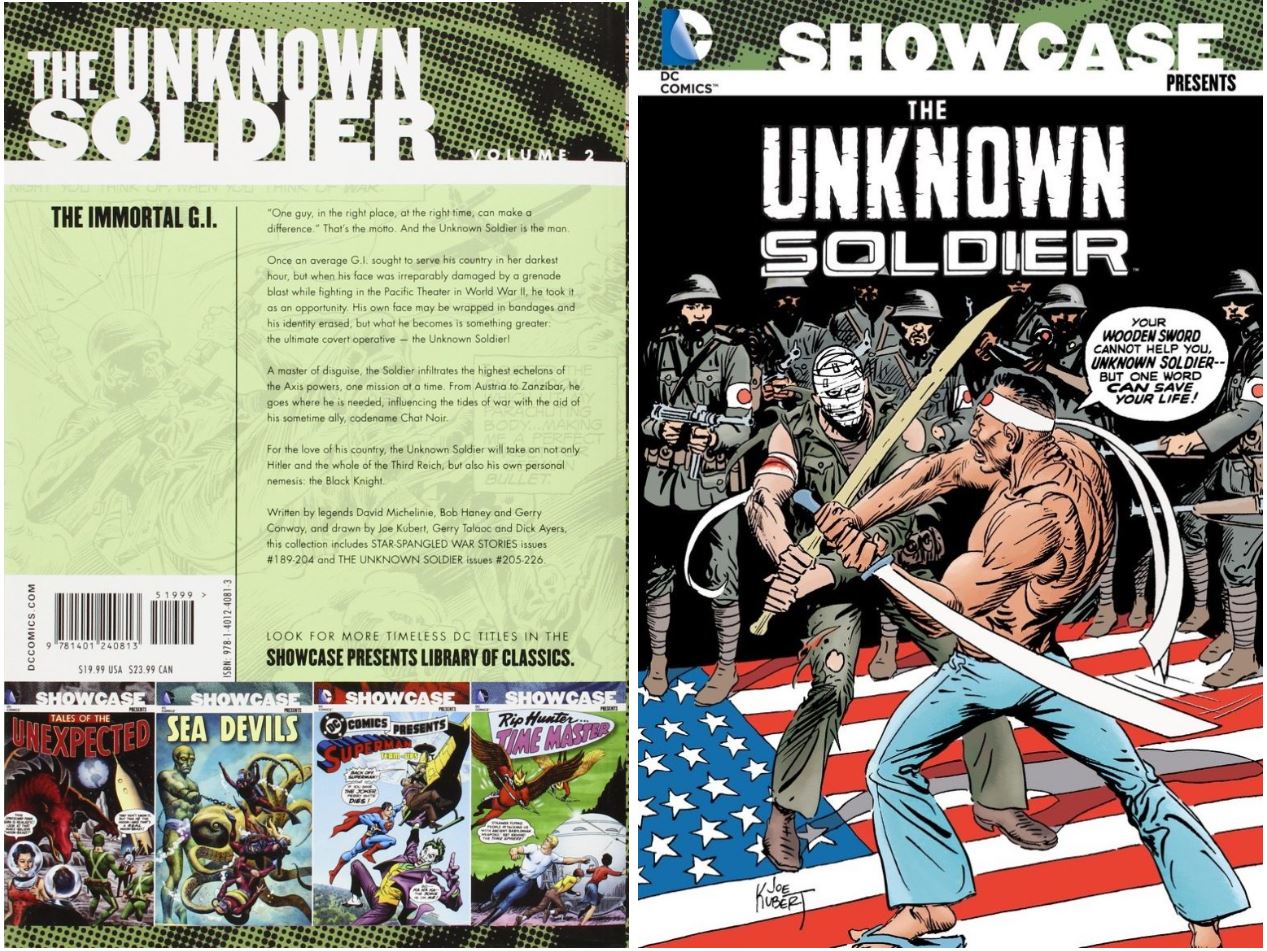
Showcase Presents the Unknown Soldier volume 2


By David Michelinie, Bob Haney, Robert Kanigher, Gerry Conway, Gerry Talaoc, Dick Ayers, Joe Kubert, Romeo Tanghal & various (DC Comics)
ISBN: 978-1-4012-4081-3 (TPB)

This book includes Discriminatory Content produced during less enlightened times.

Whereas the Britain comics scene has never relinquished its fascination with war stories, in America after the demise of EC Comics in the mid-1950’s and prior to the game-changing Blazing Combat, the only certain place to find controversial, challenging and entertaining American combat comics was DC.

In fact, even whilst Archie Goodwin’s stunning but tragically mis-marketed quartet of classics were waking up a small section of the current generation, the home of Superman, Batman & Wonder Woman was a veritable cornucopia of gritty, intriguing and beautifully illustrated battle tales exploring combat on a variety of fronts and from many differing points of view. Whilst the Vietnam War escalated, 1960s America increasingly endured a Home Front death-struggle pitting deeply-ingrained Establishment societal attitudes against a youth-oriented generation with radical new sensibilities. In response, DC’s (or rather National Periodical Publishing, as it then was) military-themed comic books became even more bold and innovative.

That stellar and challenging creative period came to an end as all strip trends do, but a few of the more impressive and popular features (Sgt. Rock, Haunted Tank, The Losers) survived well into the second superhero revival. One of the most engaging wartime wonders was a compelling espionage thriller starring a faceless, nameless hero perpetually in the right place at the right time, ready, willing and so very able to turn the tide one battle at a time. He was also the one most fitted to survive into DC’s post-Crisis on Infinite Earths continuity and has returned countless times since…

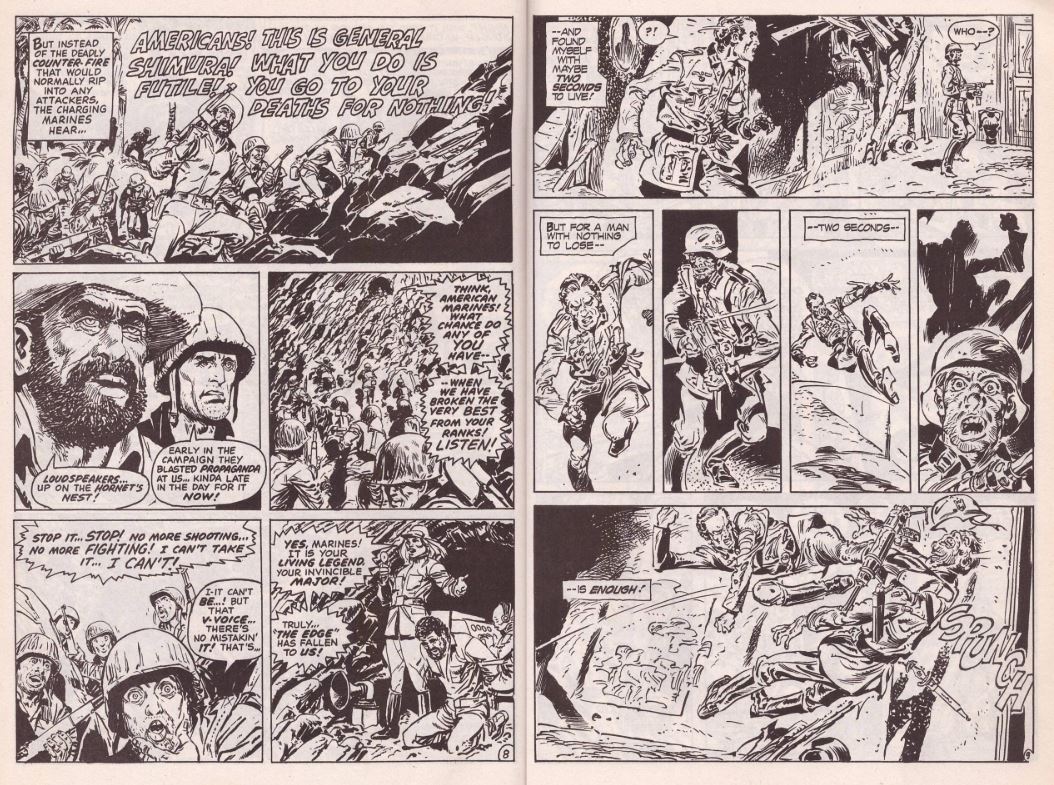
This second moody monochrome paperback compendium (still criminally unavailable in digital formats, as are far too many non-superhero, horror or sci fi tales) collects the lead feature from issues #189-204 of the truly venerable Star-Spangled War Stories anthology title (cover-dated July 1975 to March 1977) and thereafter #205-226 (May 1977 – April 1979) of the abruptly re-titled Unknown Soldier from when the “Immortal G.I.” finally took over the book in name as well as fact.

One of the very best concepts ever devised for war stories, The Unknown Soldier was actually a spin-off, having debuted as a walk-on in a Sgt. Rock episode by Robert Kanigher & Joe Kubert in Our Army at War #168 (June 1966, by). By 1970, the top flight illustrator had become group editor of DC’s war titles and was looking for a new cover/lead character to follow the critically acclaimed Enemy Ace who had been summarily bounced to the back of the book after issue #150. This new series would feature a faceless superspy and master-of-disguise whose forebears had proudly fought and died in every American conflict since the birth of the nation…

As previously stated, the strip became one of DC’s most popular and long-lived. With #205 in 1977, Star-Spangled became Unknown Soldier and the comic only folded in 1982 (issue #268) when sales of traditional comic books were in harsh decline. Since then the character has resurfaced a number of times (12 issue miniseries in 1988-9, a 4-part Vertigo tale in 1997 followed by a rebooted ongoing series in 2008, and again in 2011 as part of the company’s “New 52” mega reboot): each iteration moving further and further way from the originating concept. There have been more since, and there will be further bulletins as events warrant…

One intriguing factor of the initial tales is that there was very little internal chronology: for most of the run individual adventures take place anytime and anywhere between the bombing of Pearl Harbor and the surrenders of Germany and Japan. This picaresque approach adds a powerful sense of both timelessness and infallible, unflinching continuity. The Unknown Soldier has always and will always be where he is needed most.

As seen in the previous Showcase volume, his full origin was revealed in Star-Spangled War Stories #154’s ‘I’ll Never Die!’: recounting how two inseparable brothers enlisted in the days before the US was attacked by Japan. They were posted together to the Philippines just as the Japanese began their seemingly unstoppable Pacific Campaign. Overwhelmed by a tidal wave of enemy soldiers one night, the brothers held their jungle posts to the last. When relief came, only one had survived, his face a tattered mess of raw flesh and bone…

As US forces retreated from the islands the shattered survivor was evacuated to a state-side hospital. Refusing medals, honours or retirement, the recuperating warrior dedicated his remaining years to his lost brother Harry and determinedly retrained as a one man-army intelligence unit. His unsalvageable face swathed in bandages, the nameless fighter learned the arts of makeup, disguise and mimicry and perfected a broad arsenal of fighting skills before offering himself to the State Department as an expendable resource who could go anywhere and would do anything…

After a long run of spectacular stories by numerous stellar creators, shifting fashions eventually provoked a shift in emphasis. Relative neophytes David Michelinie & Gerry Talaoc came aboard with Star-Spangled War Stories #183, resulting in an evocative change of direction. The horror boom in comics was at its peak in 1974 and incoming editor Joe Orlando capitalised on that fascination with a few startling modifications. The most controversial was to reveal the Soldier’s grotesque, scar-ravaged face – presumably to draw in monster-hungry fear fans.

In this volume that military macabre mood resumes with Michelinie & Talaoc on fine form and well dug-in as the Man Without a Face is despatched to discover the secrets of the ‘The Cadaver Gap Massacres’ (SSWS #189). What he finds as Nazi officer “Major Wollheim” is a deathcamp where prisoners are guinea pigs for making and testing experimental atrocity weapons… and monsters. Before long he falls foul of a repentant, guilt-riddled scientist whose loyalties ultimately are only to money. The ghastly discoveries of ‘Project: Omega’ lead to a cataclysmic clash with uncontrollable beast-men and the salvation of the only true innocent in the capacious modern hellscape…

Issue #191 delivered ‘Decision at Volstadt’ as the rapidly retreating superspy encounters rabid resistance fighters, merciless “Hitler Youth” zealots and fanatical Lt. Strada, who had already lost far too much to the Immortal G.I. Captured by his Italian nemesis, but unrepentant and resolute, The Soldier takes the ‘Vendetta’ to its inescapable conclusion and the private war ends the only way it could have in SSWS #192. Gerry Conway scripted ‘Save the Children!’ in #193, detailing how a mission to blow up a train carrying generals directing the war on the Eastern Front gets sidetracked and goes horribly wrong after the phantom fighter finds his targets’ families have come along for the ride, before Michelinie returns to investigate ‘The Survival Syndrome’. Here, penetration of a high-tech Nazi communications complex hidden in a French village shows the wary warrior the true cost of a having a quisling in the family…

Star-Spangled War Stories #195 debuted ‘The Deathmasters’ as the Unknown Soldier infiltrates a Nazi assassination school and find himself assigned to murder one of the Allies’ greatest assets in war-torn Odessa in #196’s ‘Target Red’. Conning everyone into believing he’s succeeded, the Soldier then returns to Germany to scotch a scheme to replace key Allied personnel with Nazi doppelgangers. All it costs to quash that project is the life of an innocent girl and a little bit more of his soul…

The war in North Africa is almost over in #197, but the master of disguise is nevertheless dispatched to destroy German anti-tank airplane prototypes in ‘The Henschel Gambit’. Typically though, he is intercepted by Arab raiders led by a US Senator’s maverick daughter and is again forced to choose between his mission and innocent lives. Thereafter, thanks to Nazi counterintelligence manoeuvrings, the Immortal G.I. is tricked into killing the Allies’ top strategist in ‘Traitor!’

Court martialled and sentenced to death, he escapes and retraces his steps, seeking a witness to his innocence in #199’s ‘The Crime of Sgt. Schepke’. En route, he encounters a Maquis (French & Belgian resistance fighters) legend – and one of DC’s earliest women to carry their own solo feature. Mlle Marie is less than welcoming and soon events spiral completely beyond his control. The Faceless Man has no choice but to sacrifice her entire resistance unit to destroy a new superweapon in the concluding chapter ‘Deathride’, and although Marie honours her promise and clears his name, she also swears to kill him for expending her comrades like pawns…

The scene switches to New York City for SSWS #201 as the Soldier engages in ‘The Back-Alley War’: infiltrating a gang of German-American anti-war isolationists in search of saboteurs and spies, and he’s in Italy for #202, where an outbreak of typhus is holding up the war. His task is to find a downed US plane carrying an experimental counter serum, but his infiltration of a Nazi hospital seems to indicate that neither side has found ‘The Cure’…

Issue #203 sees the master-spy reduced to teaching arrogant, unstable English aristocrat-with-royal-connections Richard Ebbington all the tricks of his deadly craft, only to be subsequently – and far too late – ordered by the top brass to stop his unstable pupil from fulfilling his first murder mission. Somebody up top forgot to tell somebody in the middle that Ebbington’s target is a German general planning to assassinate Hitler, so the Unknown Soldier is forced to stop his protégé’s ‘Curtain Call’…

After 36 years of gloriously variegated publication, Star-Spangled War Stories ended with #204 as prior scripter Bob Haney and veteran war artist Dick Ayers joined Talaoc for ‘The Unknown Soldier Must Die!’, wherein old ally Chat Noir (an African-American sergeant who rejected institutionalised racism and deserted the US Army to join the French Resistance) is captured by the Nazis and brainwashed into becoming their secret weapon against the Immortal G.I. Cover-dated May 1977 the first Unknown Soldier (#205) places history’s lynchpin at the Battle of the Bulge in the winter of 1944. Whilst expanding on his origins ‘Legends Never Die!’ also proves once more that the right man in the right place at the right time can change the course of destiny. ‘Glory Gambit!’ then begins an extended campaign as Adolf Hitler himself unleashes the Wehrmacht’s answer to the Unknown Soldier. His Black Knight is Count Klaus von Stauffen: the chess-obsessed SS officer who captured and brainwashed Chat Noir. The fascist fanatic is now making his way into the heart of England with but one mission…

The hunt for the merciless master of disguise and doom continues throughout London in #207’s ‘Kill the King!’, before the scene again shifts, dumping the Soldier in North Africa in 1942 to rehabilitate a trio of deserters in ‘Coward, Take my Hand!’ US #209 takes us to the Pacific in 1945 and a personal duel with a Japanese prison camp torturer whose attempts to break the scarred superspy result in defeat, death and ‘Tattered Glory!’ on a blood-drenched rock called Iwo Jima…

In US #210 the Man of Many Faces invades a Nazi fortress by impersonating a specialist interrogator. He has been ordered to rescue or kill America’s most important agent in ‘Sparrows Can’t Sing!’, after which issue #211 reprints a classic Haney & Kubert tale from Star-Spangled War Stories #159 wherein George S. Patton became the thinly-veiled basis for ‘Man of War’, with the Combat Chameleon dispatched to investigate a charismatic general who had pushed his own troops to the brink of mutiny…

An experimental surgical operation traps the G.I. behind the wrong face on the wrong side of the German lines in #212, where he encounters Hitler’s fanatical schoolboy “Werewolf” killer-elite and becomes in turn ‘The Traitor in Wolf’s Clothing!’ The shocking theme was further explored in #213 as The Soldier must extract from the Fatherland the son of a scientist vital to the war effort. Sadly, ‘The Ten-Year-Old Secret Weapon!’ has fully embraced every facet of life in the Hitler Youth and fights his would-be rescuer every step of the way…

Kanigher wrote and Romeo Tanghal inked the Ayers illustrated ‘Deadly Reunion!’ of #214 as, in the guise of an elderly Jew, The Soldier allows himself to be taken to a deathcamp in order to liberate high profile captive Mlle. Marie. She isn’t at all grateful…

Haney, Ayers & Talaoc reunite in #215 as the faceless fury replaces a sailor in the merchant marine to expose a traitor selling out convoy freighters to U-boats haunting ‘The Savage Sea!’, after which ‘Taps at Arlington!’ (art by Ayers & Tanghal) sees Chat Noir confront American racism whilst the Soldier exposes a spy painting a bullseye on the backs of troops in Italy…

In #217 the Faceless Man becomes Hermann Goering’s chief supplier of stolen paintings in ‘Dictators Never Sleep!’ The plan was to give the infamous art lover a Rembrandt primed to explode when Hitler stood in front of it; and it would have worked if Klaus von Stauffen hadn’t been present. With Black Knight hot on his heels, the frustrated phantom warrior is harried across Europe in ‘The Unknown Soldier Must Die!’, only stopping briefly to destroy a V2 base and have another shot at Der Fuehrer before experiencing ‘Slaughter in Hell!’ (inked by Tanghal) as von Stauffen turns the tables by impersonating his archfoe in a bid to murder Winston Churchill and General Dwight D. Eisenhower.

He would have succeeded if not for the Immortal G.I.’s strategic cunning…

US #220 by Haney, Ayers &Talaoc sees the Soldier organise a band of renegades and maverick warriors from many Nazi-controlled countries into a daring-but-doomed foreign legion dubbed ‘The Rubber Band Heroes’, after which ‘Sunset for a Samurai!’ finds him on a suicide mission to the heart of Japan to save an undercover agent crucial to the American forces. Unknown Soldier #222 promised ‘No Exit from Stalag 19!’ when the unsung hero was ordered to extract a military boffin from the heart of Fortress Europa in a wryly trenchant riff on The Bridge on the River Kwai, whilst in #223, ‘Mission: Incredible!’ (Ayers & Tanghal) details the convoluted course of a plan to destroy a Heavy Water plant in the snow-capped mountains of Norway.

The Soldier and Chat Noir reunited in #224 to investigate a dead zone where Allied bombers vanish without trace, only to find barbaric military madness running wild in ‘Welcome to Valhalla!’, after which the Immortal G.I. must arrest a charismatic general for treason in ‘Four Stars to Armageddon!’ (Ayers & Talaoc) before uncovering the astounding truth behind his supposed betrayals. The military madness lurches to a bloody halt with #226 as Chat Noir and his faceless comrade do what entire flotillas of Navy vessels could not. Using guile and subterfuge they board the Nazi’s unbeatable dreadnaught and ‘Sink the Kronhorst!’…

Dark, powerful, moving and overwhelmingly ingenious, The Unknown Soldier is a magnificent addition to the ranks of extraordinary-but-mortal warriors in an industry far too heavy with implausibly incredible heroes. These tales will appeal to not just comics readers but all fans of adventure fiction.

Perfect for revival in the DC Finest format, I think…
© 1975-1979, 2014 DC Comics. All rights reserved.
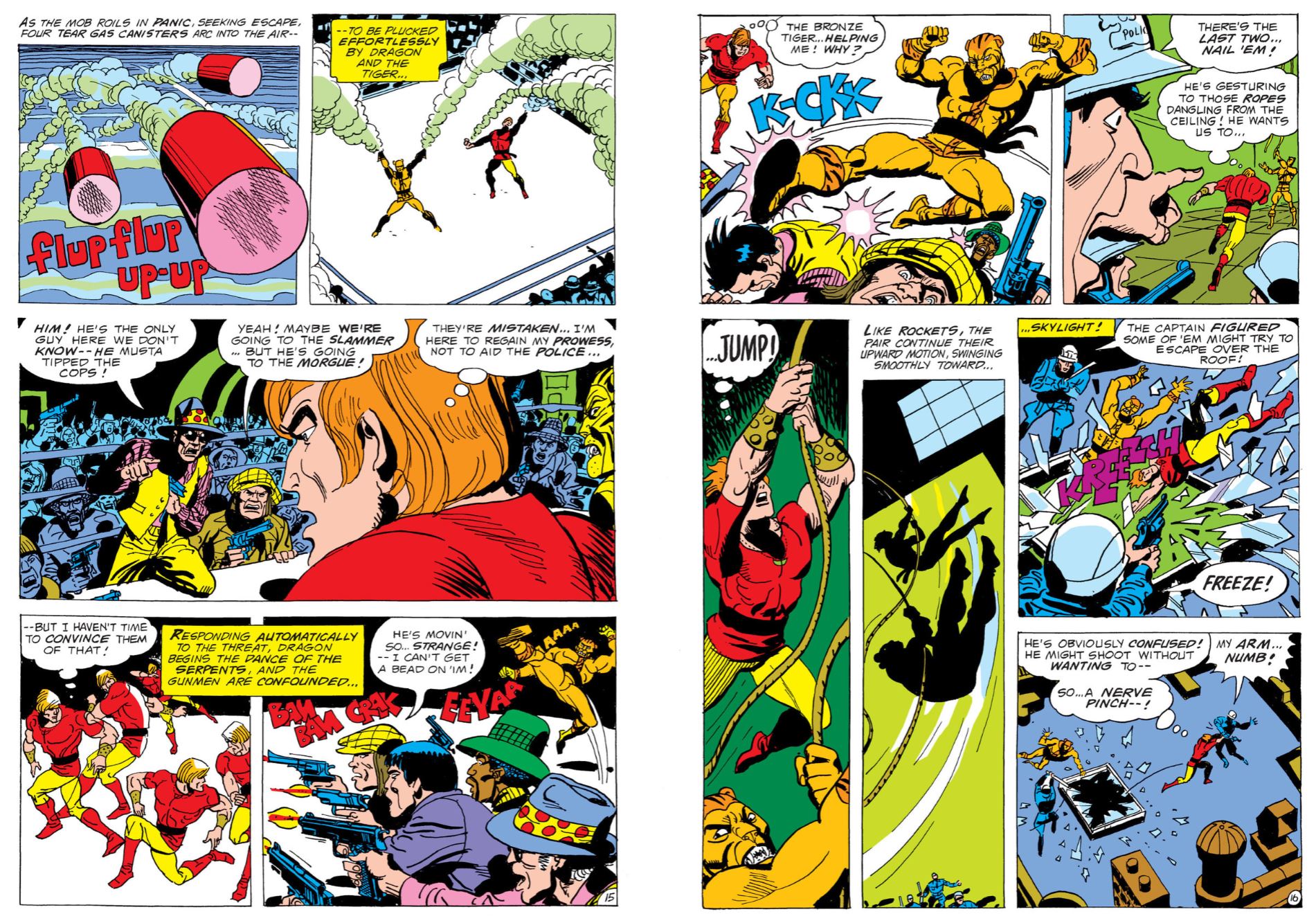
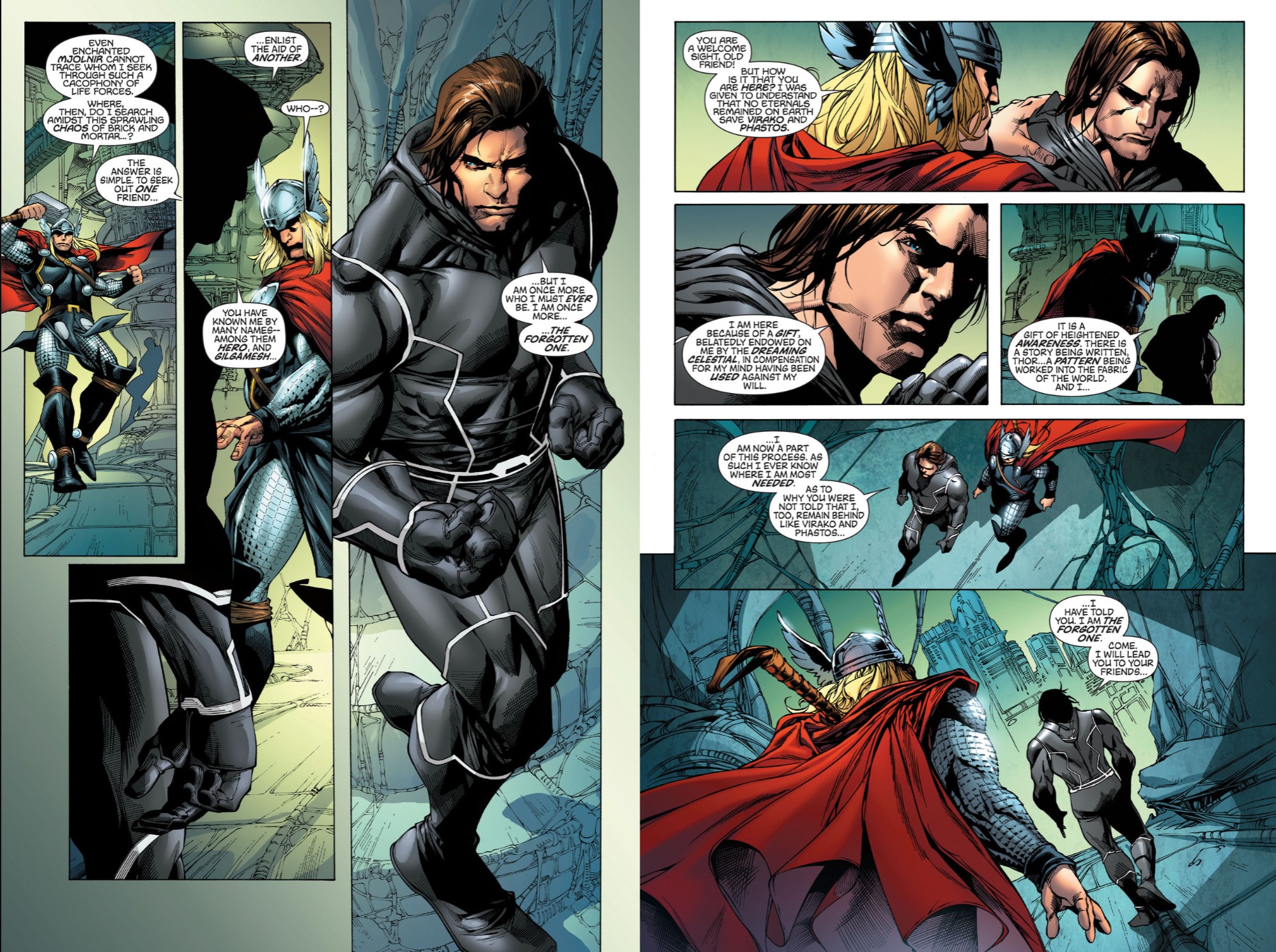
Today in 1922, Golden Age artist Joey Cavallo (Crack Comics) was born, sharing the date with cartoonist Al Scaduto (They’ll Do It Every Time, Little Iodine) in 1928; editor K.C. Carlson in 1956, writer/artists Phil Jimenez (Wonder Woman, Teen Titans, Astonishing X-Men, Infinite Crisis, The Invisibles) in 1971 and Brad Walker (Guardians of the Galaxy, Batman: Legends of the Dark Knight, Manhunter, Birds of Prey, Nightwing) in 1977.

Al Capp & Raeburn van Buren’s Abbie an’ Slats debuted today in 1937 as did Brooke McEldowney’s domestic epic 9 Chickweed Lane strip in 1993. The date also saw the loss of two staggering talents: Argentinian illustrator Jorge Zaffino (Nippur de Lagash, Winter World, Terror Inc., The Punisher, Shadowline saga) in 2002 and Sam Glanzman (Kona, The Haunted Tank, USS Stevens, Hercules, The Lonely War of Willy Schultz, A Sailor’s Story, Red Range) in 2017.