
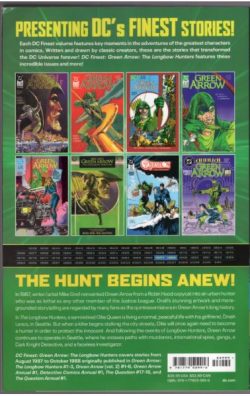
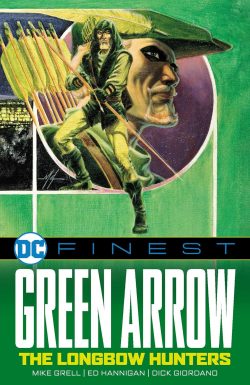
By Mike Grell, Sharon Wright, Dennis J. O’Neil, Lurene Haynes & Julia Lacquement, Ed Hannigan, Denys Cowan, Randy DuBurque, Ed Barreto, Tom Artis, Dick Giordano, Frank McLauglin, Rick Magyar, Klaus Janson, Tony DeZuñiga, Tom Dzon, Arne Starr, Gary Martin & various (DC Comics)
ISBN: 978-1-77952-991-6 (TPB)
This book includes Discriminatory Content produced in less enlightened times
It’s been a big year for comic book anniversaries and next year is another one. Let’s get our congratulations in early for a change…
Debuting in More Fun Comics #73 (cover-dated November 1941 and on sale from 19th September), Green Arrow is one of very few costumed heroes to be continuously published (more or less) since the Golden Age of American comic books. On first look, the combination of Batman and Robin Hood seems to have very little going for him, but he has always managed to keep himself in vogue and on view. Probably the most telling of his many, many makeovers came in 1987, when – hot on the heels of The Dark Knight Returns – Mike Grell was given the green light to make the Emerald Archer the star of DC’s second Prestige Format Mini-Series.
Grell was a major league, much celebrated creator at the time, having practically saved the company with his Edgar Rice Burroughs-inspired fantasy series Warlord. He had also illustrated many of GA’s most recent and radical tales (in Green Lantern/Green Arrow, Action Comics and elsewhere, and was a confirmed fan-favourite after well-received runs on Legion of Super-Heroes, Aquaman, Phantom Stranger, Batman and others. During the early 1980s, he had worked on the prestigious Tarzan newspaper strip and created successful genre series including Starslayer and Jon Sable, Freelance for pioneering indie publisher First Comics.
By the middle of the grim ‘n’ gritty Eighties, it was certainly time for an overhaul of the Battling Bowman. Exploding arrows yes, maybe even net or rope arrows, but arrows with boxing gloves on them just don’t work (trust me – I know this from experience!).
Moreover, in his 1960s makeover, the hero had evolved into a tempestuous, social reformer using his gifts to battle for the little guy. Now, in a cynical era of corrupt government, secret services with private agendas, drug cartels and serial killers, this emerald survivor adapted again and thrived once more. Thus, sans preamble, the action unfolds, laying a new path that would quickly lead to the hero becoming a major player at long last and, ultimately, a TV sensation.
The plot is astutely logical and still controversial, concerning a superhero midlife crisis. Weary, aging Oliver Queen relocates to Seattle, struggling to come to terms with the fact that since his former sidekick Speedy, is now a dad, he is “technically” a grandfather. With longtime significant other Dinah Lance AKA Black Canary, Ollie starts simplifying his life, but the drive to fight injustice hasn’t dimmed for either of them. As she goes undercover to stamp out a pervasive drug ring, the Arrow becomes embroiled in the hunt for a psycho-killer dubbed “The Seattle Slasher”.
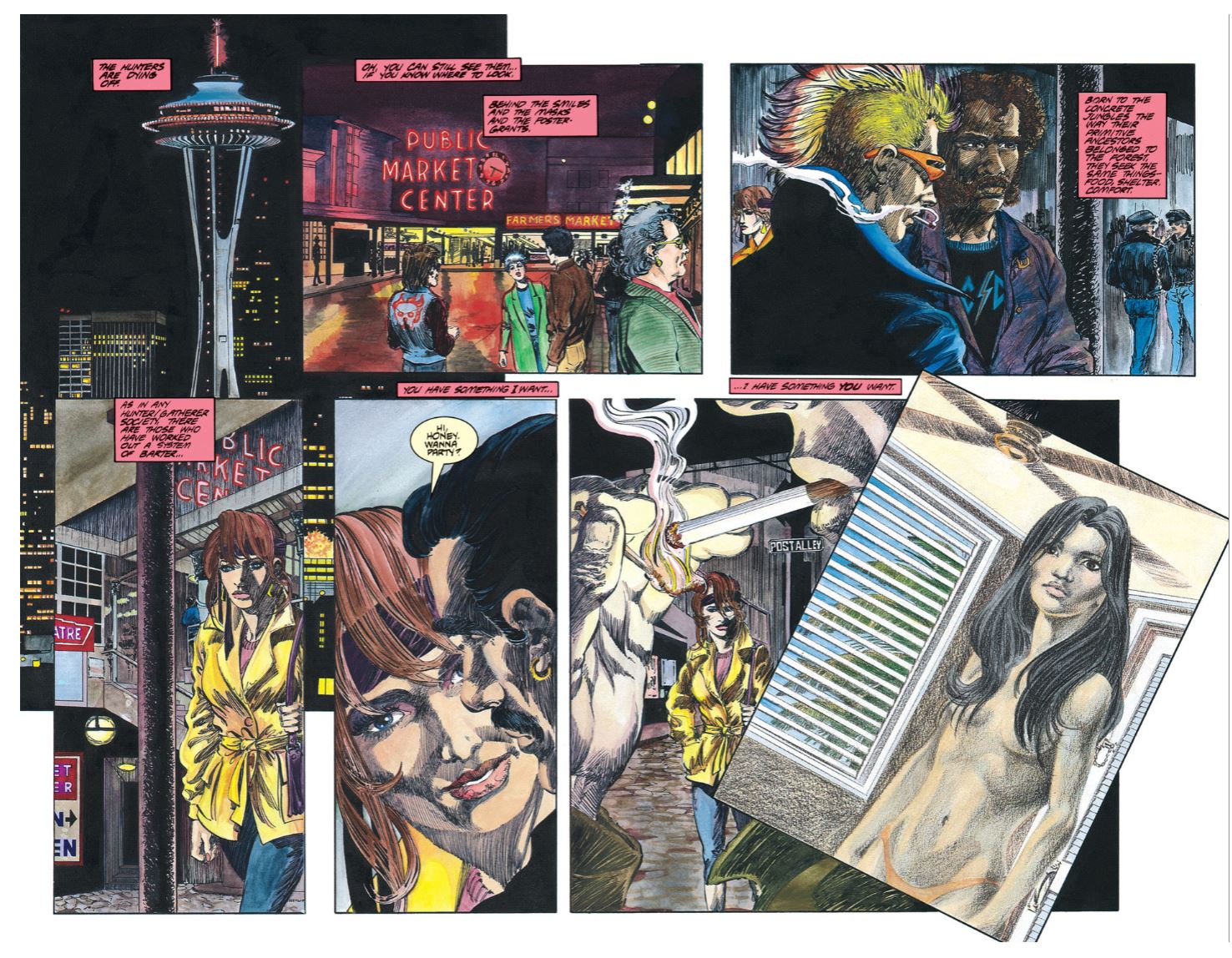
As he tracks a prolific stalker butchering prostitutes, Ollie becomes aware of a second – cross-country – slayer using arrows to murder people. Infuriatingly, this travesty only comes to his attention after the “Robin-Hood Killer” slaughters a gravedigger in his new city…
Eschewing gaudy costume and gimmicks to find such unglamorous hidden monsters, Queen reinvents himself as an urban hunter relentlessly searching Seattle’s darkest corners and soon stumbles into a complex mystery leading back to World War II involving the Yakuza, CIA, corporate America and even the Vietnam war: secrets that converge and will eventually change the course of the Archer’s life…
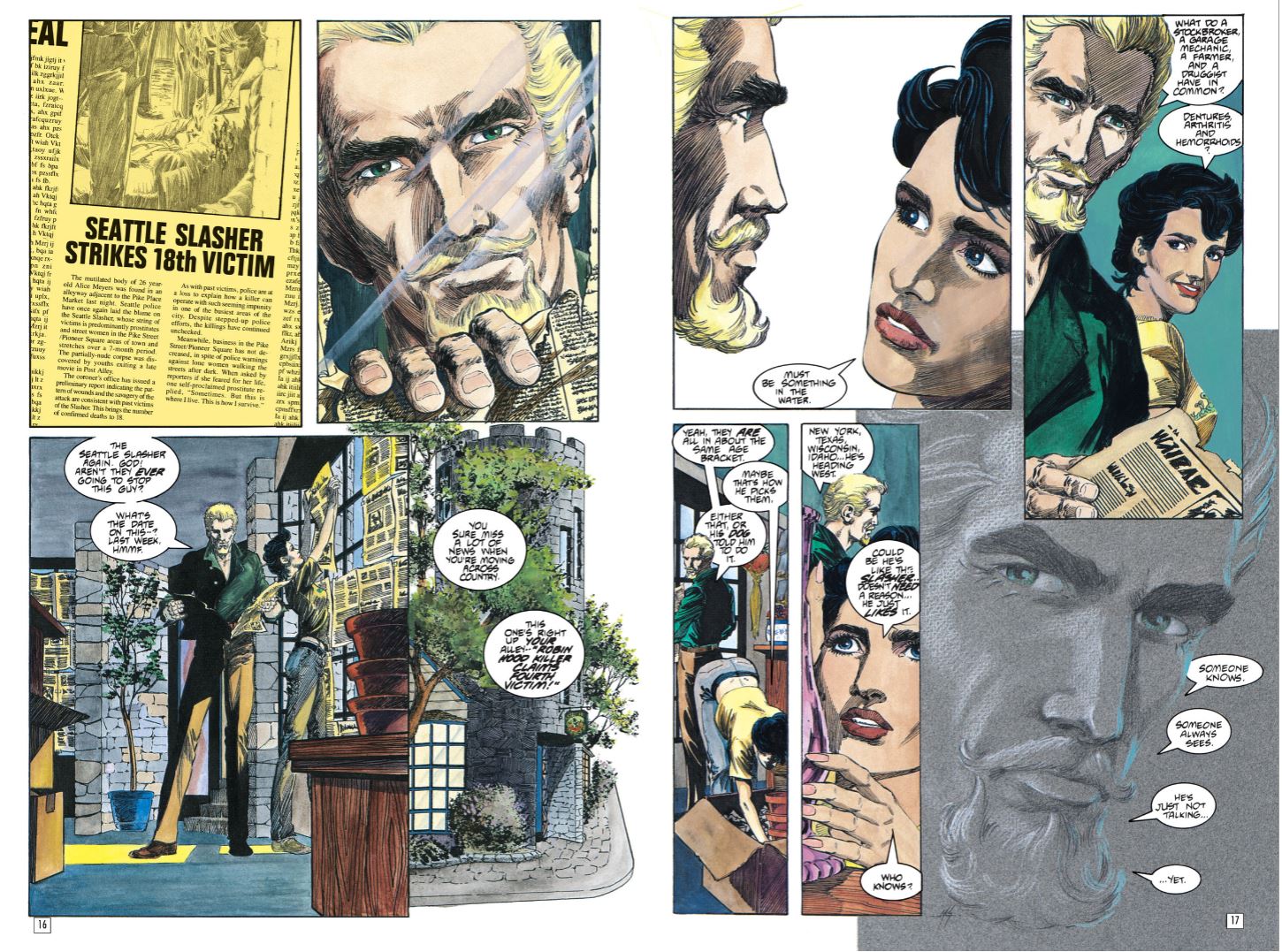
The intricate plot effortlessly weaves around the destabilized champion and past loves, thereby introducing new character Shado, exploring and echoing themes of vengeance and family in a blending of three stories that are in fact one, yet still delivers a shocking punch even now, through its disturbingly explicit examination of torture. These issues won the miniseries much undeserved negative press when first published. Although possibly tame to modern eyes this was eye-opening stuff at the time, which is a shame, since it diverted attention from the tale’s real achievement. That was narrative quality and sophistication, as this tale is arguably the first truly mature superhero yarn in the DCU.
Across ‘The Hunters’, ‘Dragon Hunt’ and ‘Tracking Snow’ Grell crafts a gripping, action-packed mystery adventure that pushes all the right buttons, all conveyed by artwork – in collaboration with Lurene Haynes & Julia Lacquement – that was and remains a revelation. Beautifully demure yet edgily sharp as required, these painterly visuals and watercolour tones perfectly complement a terse, sparse script, offering a compulsive, compelling ride any prose thriller writer would be proud of.
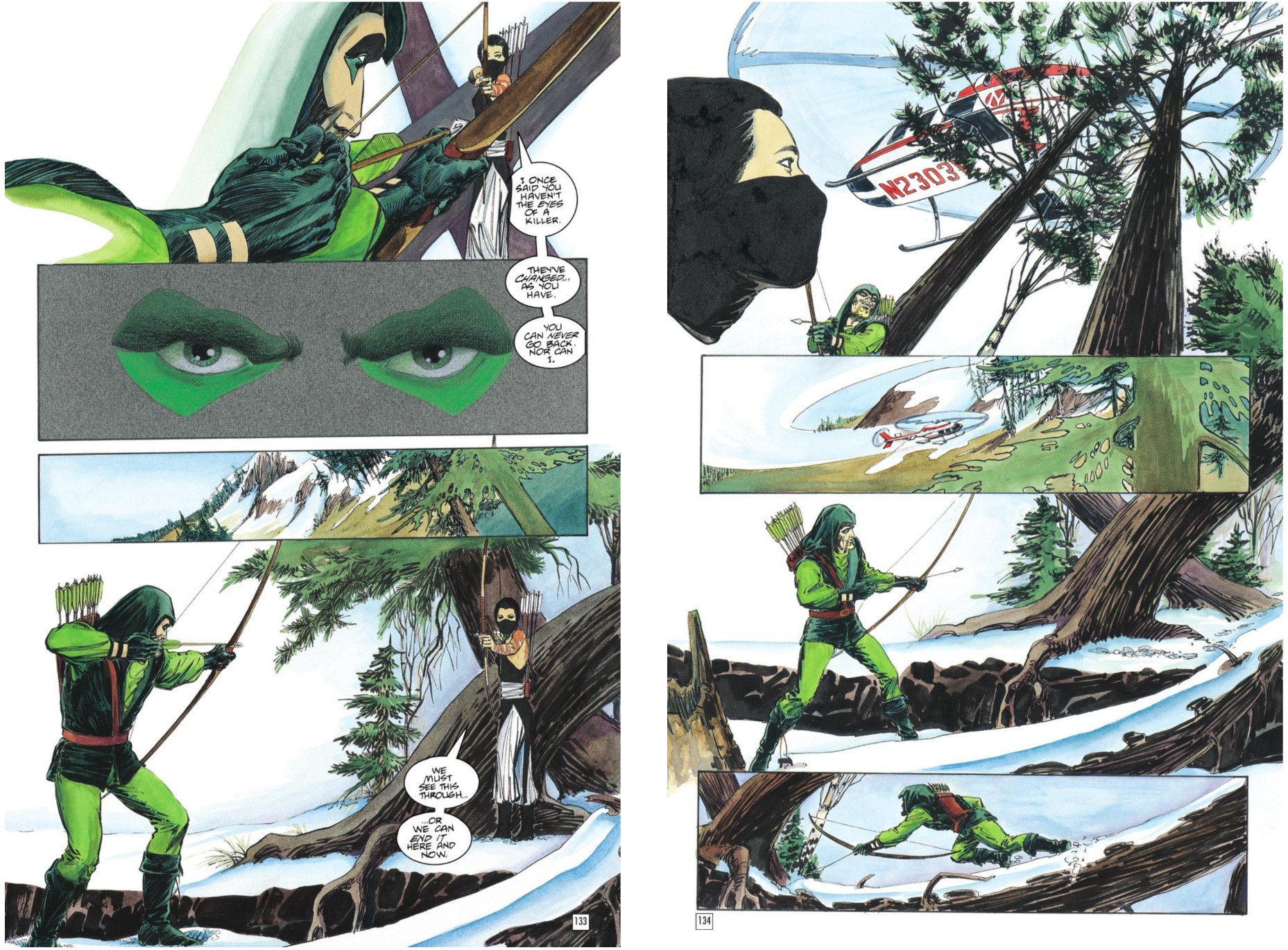
The saga – weaving themes of age, diminishing potency, vengeance and family – was another major turning point in American comics and led to an ongoing series specifically targeting “Mature Readers”. Latterly, the treatment and tone herein heavily influenced and flavoured TV adaptation Arrow.
Collectively covering February to October 1988, this paperback compilation (no digital edition yet, sadly) gathers the miniseries Green Arrow: The Longbow Hunters, Green Arrow volume 2, #1-8, The Question #17-18, and a crossover tale told in Detective Comics Annual #1, The Question Annual #1 and Green Arrow Annual #1. Controversy notwithstanding, the comic book retooling swiftly spawned a monthly series which itself evolved into one of the best reads of the 1990s and those monthly events immediately follow…
Scripted by Grell with superbly efficient and powerfully understated art from Ed Hannigan, Dick Giordano & Frank McLaughlin, the new series presented grimly realistic yarns ripped from headlines, tailored and honed for maximum impact and relevance. Sparse, spartan and devastatingly compelling, the initial episodes were constructed as two-part dramas, beginning with ‘Hunter’s Moon’ as the hunter (the series was notable in that other than on the cover, the soubriquet “Green Arrow” was never, ever used or uttered) prowls his new home. He deals harshly with thugs, gangbangers and muggers before heading home to his still-traumatised girlfriend.
As graphically depicted in Longbow Hunters, Black Canary was tortured for days before Ollie found her and, although the physical wounds have faded, Dinah is still suffering…
She’s not the only one. Police Lieutenant Jim Cameron has just heard that child-torturing sociopath Al Muncie has used his vast beer-dynasty inheritance to buy a retrial after 18 years in prison. The cops couldn’t get him for murdering all those “missing” kids back then, but one lucky 10-year-old, after days of appalling torment, escaped and testified so Muncie’s been locked up for aggravated assault ever since. Now the heartbroken cop has to tell that brave survivor she must do it all over again…
The victim grew up to be Dr. Annie Green and she’s working wonders treating Dinah, but the therapist’s own long-suppressed terrors come flooding back when Muncie – despite being in total lockdown in his palatial house on the family brewery estate – somehow hand-delivers a little souvenir of their time together…
Present when Annie freaks out and flees in panic, Ollie gives chase and finds her once more calm and resigned. On hearing the full story he makes a house-call on the maniac but cannot “dissuade” him from paying Annie another visit that night. The veteran manhunter is waiting as a masked assailant tries to break ino the doctor’s apartment, but when the intruder shrugs off a steel arrow to the chest Ollie realises something’s not right…
Part Two expands the mystery of how Muncie gets past police guards at will, but by the time the Arrow has convinced cops to raid Muncie’s den with the solution to the obsessed sociopath’s disappearing act and apparent invulnerability, the killer has already made his move. Sadly for him, once again Muncie has underestimated Annie, and her defiance buys Ollie time to intercept the hellbent human fiend. After a furious chase back to the brewery, the killer meets his fate in a most ironic manner…
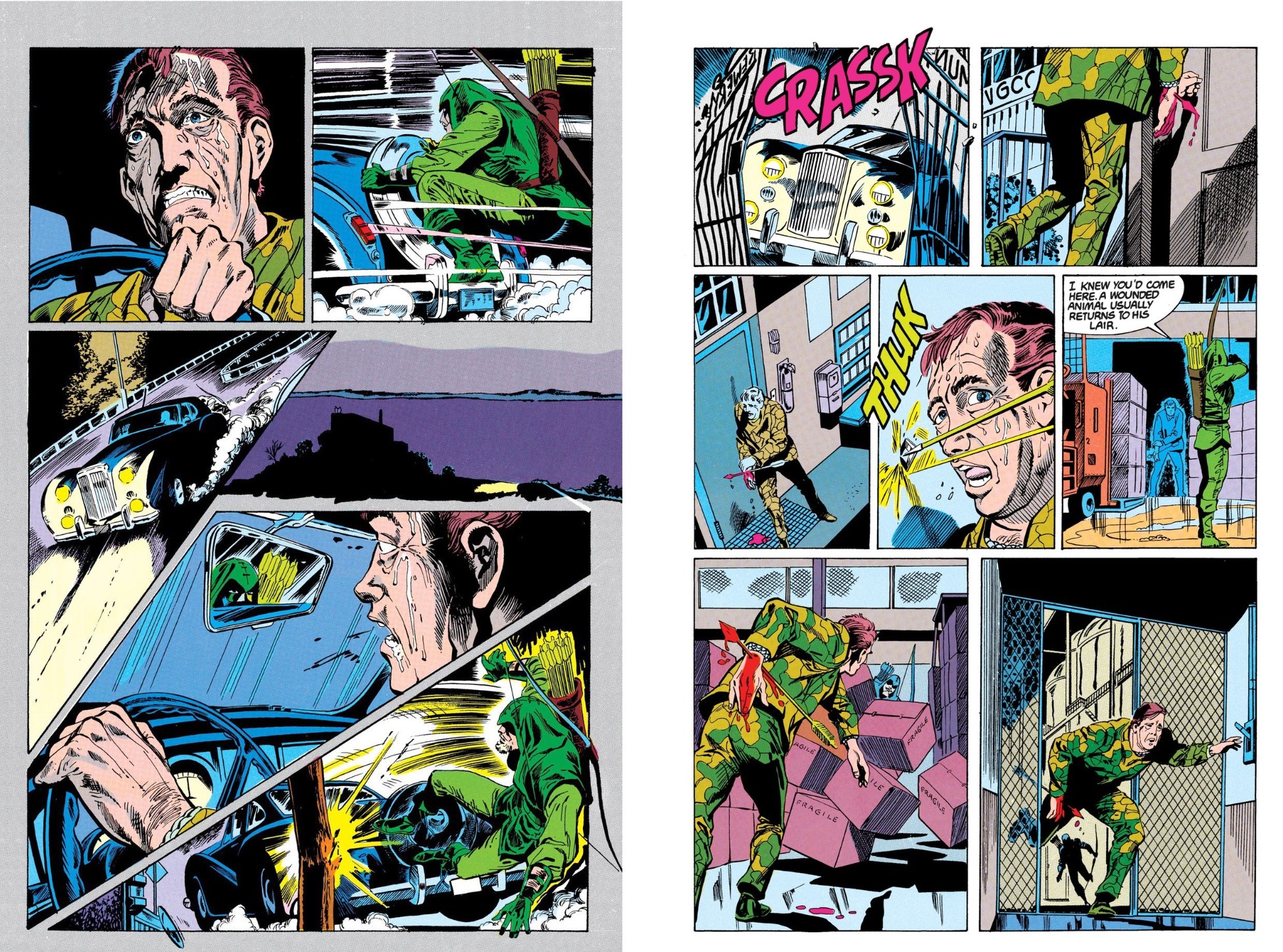
A broad change of pace follows as part one of ‘The Champions’ sees Ollie abducted by US government spooks and pressganged into competing for a deadly prize. A joint space venture with the Chinese has resulted in a deadly “DNA-programmable” virus being created and – following the sudden destruction of the satellite lab where it was propagated – the only surviving sample has crashed onto remote San Juan Island. With political allies turned rivals for sole possession of a bio-agent which can be set to kill anything from wheat harvests to black or yellow or white people, open warfare would only lead to catastrophic publicity, so the political superpowers have agreed to a gladiatorial bout as the method of deciding ownership.
Ollie has his own reasons for accepting the job. For starters he doesn’t trust any government with the DNA-hunting bug, the agents who drafted him are actually Russian, not American and, most urgently, he has no doubt that he’ll be killed if he refuses to compete…
Equipped with a tracking device, Ollie is dumped on the island as a colossal storm kicks off, meeting his arrogant opposite getting off the ferry. Former CIA operative Eddie Fyers is an old foe and one of the sneakiest killers on Earth. Fyers convinces Ollie they should work together before double-crossing and leaving him to bleed out in a blizzard. The archer is saved by an archaeologist who has inadvertently picked up the lost bio-agent pod, but as Ollie argues with his rescuer over the wisdom and morality of his mission, her cabin is peppered with gunfire…
Fyers has the upper hand but suffers a sudden change of attitude when a third team ambushes him and his prisoners. It seems neither Russians nor Chinese trust their champions…
Again forced to join forces, spy and vigilante despatch the hit squad before Ollie has the very last word after finding a way to deprive everybody of the death-sample…
The hunter appeared tangentially in The Question #17-18 (June & July 1988 by Dennis O’Neil, Denys Cowan & Rick Magyar) as ‘A Dream of Rorschach’; tacitly acknowledging the debt owed to the groundbreaking series Watchmen for the revival of Steve Ditko’s obsessive faceless trouble-seeker The Question. Here journalist/crimebuster Vic Sage is chasing murder-obsessed miscreants Butch and Sundance out of Hub City. Catching a plane, he reads the graphic novel and has a vision of and conversation with the iconic sociopath whilst flying to Seattle and a chilling showdown. On arrival he is intercepted by highly suspicious, extremely overprotective and intensely impatient local hero the Arrow before they ally to catch the scum as they seek fresh kill supplies from terrorists in massive clash-concluding chapter ‘Desperate Ground’…
Determined to challenge all manners of social inequity, Grell’s next story in Green Arrow confronted the rise in homosexual prejudice that manifested in the wake of the AIDs crisis. It begins after two customers leaving Dinah’s flower shop are brutally attacked by kids ordered to “gay-bash” as part of their gang initiation. The horrific crime is further compounded when Ollie discovers Dinah’s new assistant Colin is not only a bloody-handed perpetrator but also a victim…
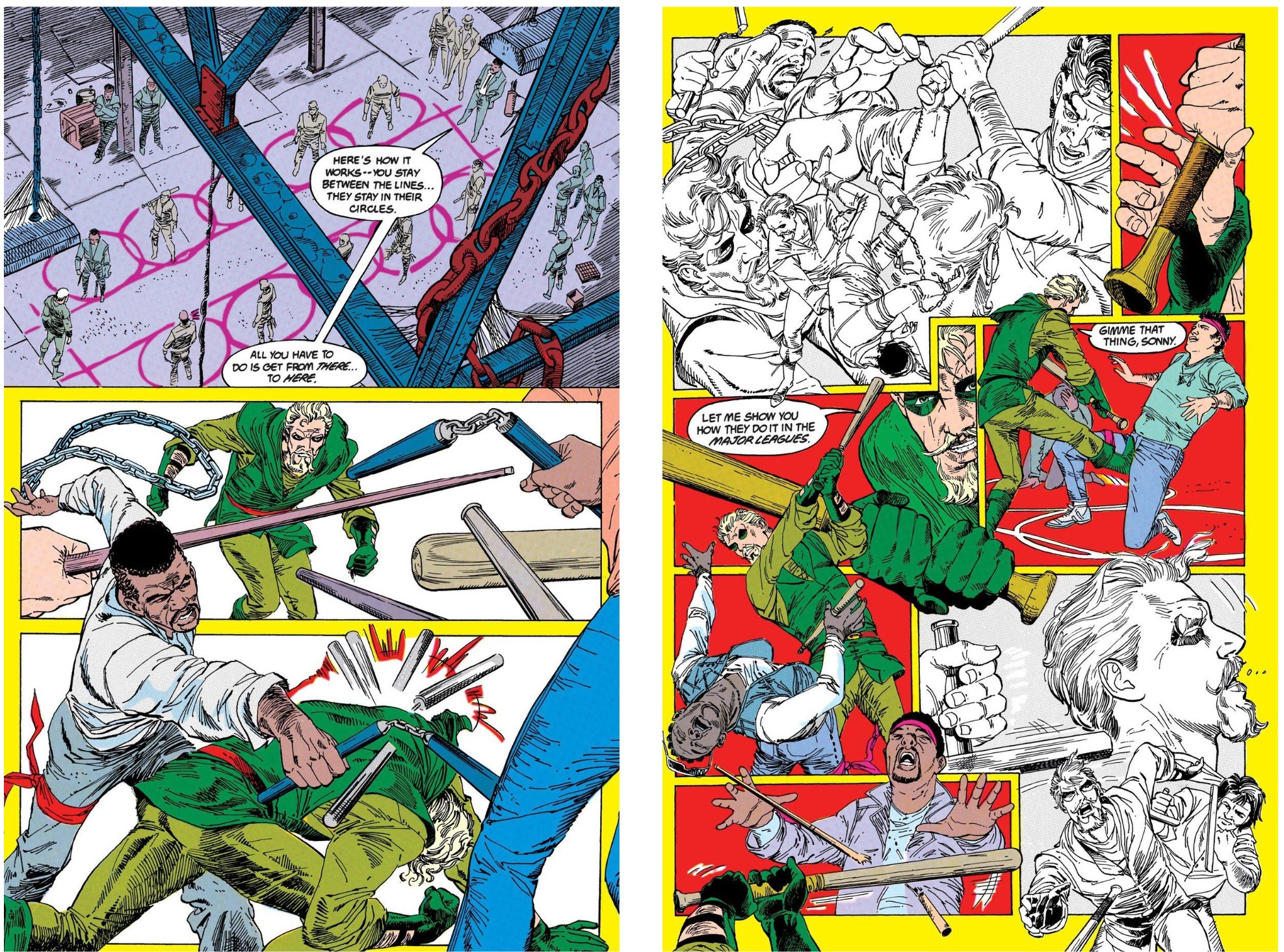
The Warhogs are the most powerful gang in the city, but their latest induction policy is one the Arrow cannot allow to exist any longer. Any kid refusing to join is mercilessly beaten by a ‘Gauntlet’ of thugs. Those who eagerly volunteer suffer the same treatment at their own initiation… and once you’re accepted as a Warhog, you still have to prove your loyalty by beating – and preferably killing – a “queer”…
In the shocking conclusion Ollie, having failed to make a dent through any of his usual tactics, goes straight to the top. Big boss Reggie Mandel has big plans for the Warhogs. He’s already made them a national force to be reckoned with, but when he arrives in Seattle to check on regional deputy Kebo, the Machiavellian schemer is confronted by a nut with a bow challenging him in his own crib…
The Arrow is keen to point out the strictly local Warhog policy of gay hate-crimes is not only bad for business but serves someone else’s private agenda. Reggie actually agrees with the vigilante, but before he’s prepared to take appropriate action he expects his verdant petitioner to undergo the same gauntlet any Warhog must survive before being heard…
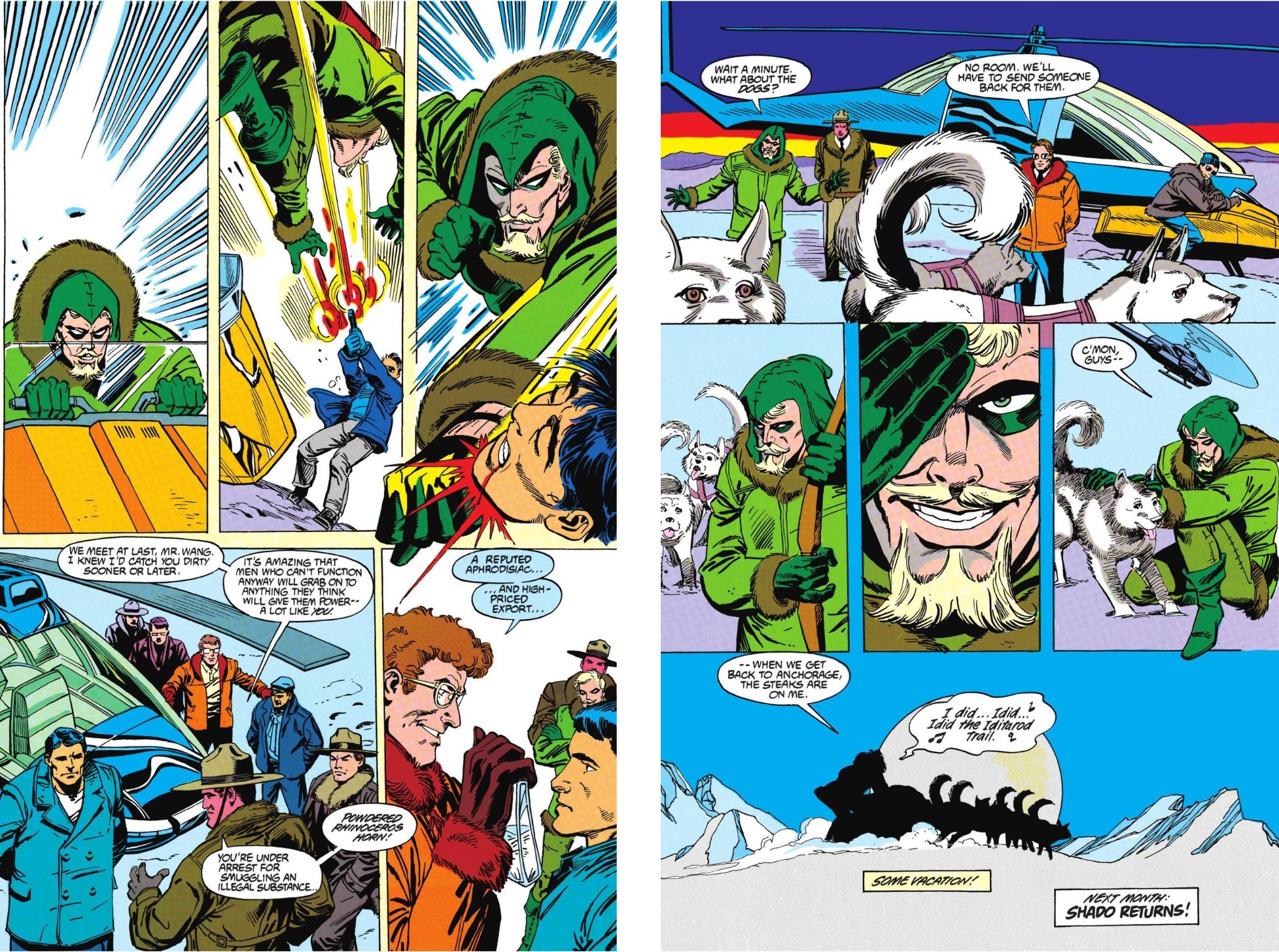
Next comes complex collaboration ‘The Powderhorn Trail’ – written by Grell & Sharon Wright who divided the Ollie and Dinah sections between them, with Randy DuBurque illustrating Black Canary pages whilst Ed Barreto pencilled Arrow bits, with Giordano & Arne Starr inking it all. The round-robin episode sees the hunter stumbling upon a clue to drug-smuggling at his local carwash and having to explain to Dinah why he’s taking off for Alaska. Possibly coincidentally, she is approached by a casual acquaintance whose life the Canary once saved, who inadvertently tips Dinah to a string of crimes-in-the-making…
The tempestuous conclusion (by Grell, Paris Cullins, Gary Martin & Giordano) then sees Ollie solo-stalking from Anchorage to deep in the North country on the trail of not just drug dealers and high-end car thieves but also opportunistic Tong smugglers trafficking illegal, poached and utterly pointless Chinese herbal remedies under cover of the infamous Iditarod. Sometimes it’s just good and so satisfying to be a lawless vigilante…
This initial collection concludes with a Denny O’Neil martial arts epic/experimental comic book koan ‘Fables’: a crossover tale encompassing Detective Comics Annual #1, Green Arrow Annual #1 and The Question Annual #1, which will make far more sense if you read Richard Dragon: Kung Fu Fighter: Coming of the Dragon!…
It begins in China during Japan’s invasion prior to the official start of WWII, where a truly honourable bushido warrior is shamed by his own troops and resigns his commission to become a warrior monk: the O-sensei. Years later he and his student (Lady Shiva “the most dangerous woman on Earth”) arrive in America seeking a new hero called The Batman. They have a lesson to impart but first must find him. This overture means working again with an old student named Vic Sage…
Rendered by Klaus Janson & Tony DeZuñiga, ‘The Monkey Trap’ sees the Dark Knight hunt a horrific bio-weapon stolen from arch maniac Ra’s Al Ghul and pursued by money-mad miscreant The Penguin. The quest is only accomplished after the cocky masked manhunter learns a crucial lesson from the warrior sage and incurs a monumental debt of honour…
Then ‘Lesson for a Crab’ – illustrated by Tom Artis & Tom Dzon – finds the former Emerald Archer & Black Canary embroiled in the schemes of English aristocrat Lord Kalesque who wants to be the greatest archer in the world but cannot feel secure in the title until he crushes a certain vigilante in Seattle. As Kalesque is no adherent of fair play, that can be accomplished by perpetrating a string of murders to destabilize the hunter and put him and his woman off their game. Happily, Shiva and the O-Sensei are already on their way with advice and a zen teaching that will be of great service…
The interlinked saga concludes in The Question Annual #1 (Cowan & Magyar art) with explanations and conclusions. The aged sage wants to be buried beside his Japanese wife but her family are opposed to the plan and have moved her body. Star pupil Shiva orchestrates a plan involving western heroes touched by his teachings and owing service to the O-Sensei, and her efforts culminate in ‘The Silent Parable’. Now Batman’s detective skills locate the resting place and the Americans join what seems like a cursed mission to Malaya – one that is beset by an army of assassins and string of natural disasters; and which seems to end in utter failure…
However, in the aftermath The Question deduces that fate and honour have worked their own miracles and made a suitable accommodation with the universe…
Closing the book and capping the fantasy is a linked cover triptych of the Annuals by Janson, Ed Hannigan, Cowan & Bill Sienkiewicz, and rest – both fully painted and line art – are by Grell, Cowan, Sienkiewicz, Giordano, Hannigan & Tatjana Wood and suitably placed throughout…
Terse, sparse scripts, intelligent, flawed human interactions, stunning action delivered through economical and immensely effective illustration and an unfailing eye for engaging controversy make these some of the most powerful comic tales US comics ever produced, an epic of masked mystery saga no lover of the genre will want to miss.
© 1987, 1988, 2024 DC Comics. All Rights Reserved.
In 1911 strip writer Nicholas P. Dallis (Apartment 3-G, Rex Morgan MD) was born. Nine years later so was the fabulous Kurt Scaffenberger (Captain Marvel, Lois Lane, Jimmy Olsen) with Al Plastino popping in 366 days later. He was a key Superman illustrator who co-created the Legion of Super-Heroes and also drew the Batman newspaper strip (see Batman: Silver Age Dailies and Sundays 1968 – 1969).
In 1953 JM DeMatteis was born, in 1961 Reginald Hudlin arrived and in 1969 Stuart Immonen, but we did lose Abie the Agent illustrator Harry Hershfield in 1974 and Uruguayan Eduardo Barreto who drew many US features including Steel Sterling, Aliens, Teen Titans, Superman, Batman and Judge Parker.