
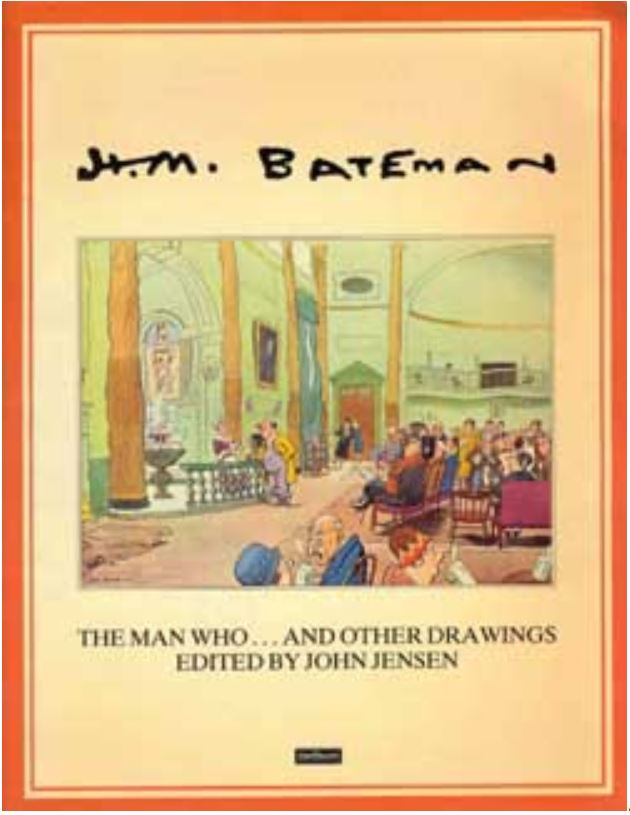
By H.M. Bateman; edited by John Jensen (Methuen 1983)
ISBN: 978-0-41332-360-9 (Album PB)
This book includes Discriminatory Content produced in less enlightened times but also emphasised for comedic effect.
On February 15th in 1887, Henry Mayo Bateman was born in New South Wales. He was however, raised in England, attending Forest Hill House School and Goldsmith’s College (Institute, as was). He also studied with John Hassall and later at the Charles Van Havenmaet Studio from 1904-07. He was a great fan of Comic Cuts and Ally Sloper’s Half Holiday, and his first cartoons were published in 1903 in Scraps. Bateman was skilled and gifted in both illustrative and comedic drawing and agonised over his career path before choosing humour. Mercifully, he was too frail for military service in 1914 and so his gifts were preserved for us all to share. He died in Gozo, Malta on February 11th 1970, having spent his final years in steadfast (often hilarious) battle with the Inland Revenue…
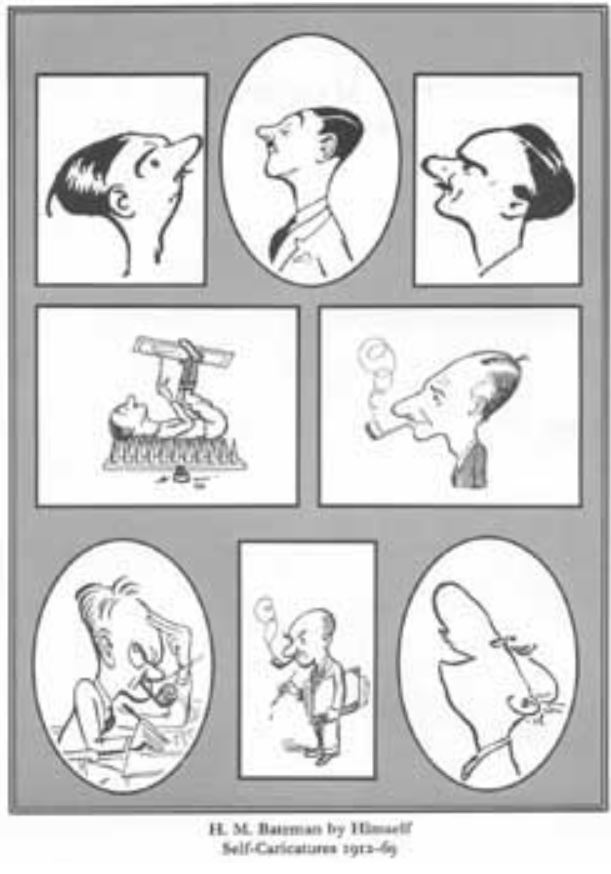
Bateman’s most memorable series of cartoons was ‘The Man Who…’ These were lavish set pieces, published as full colour double-page spreads in The Tatler, perpetually lampooning the English Manner by way of frenzied character reactions to a gaffe or inappropriate action from a blithely oblivious central participant. Bateman’s unique strength came from extending his training as a caricaturist into all his humorous work, a working philosophy that the artist equated with drawing people as they felt rather than how they looked.
He was also a British pioneer of cartoons without text, depending on beautifully rendered yet powerfully energetic and vivacious interpretations of people and environment to make his always funny point. He was a master of presenting a complete narrative in a single image.
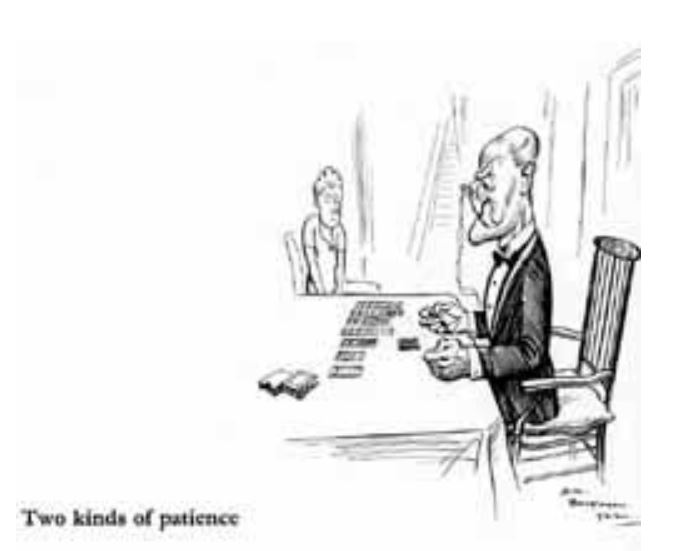
In reviewing the 14 collections published during his lifetime and such collections as the volume at hand, or the excellent The Best Of H M Bateman 1922-1926: The Tatler Cartoons (1987), I was particularly struck by the topicality of the work as well as the sheer wonder of the draughtsmanship. Find if you can ‘The Man Who asked for a second helping at a City Company Dinner’, wherein 107 fully realised Diners and waiters, all in full view, have 107 different and recognizable reactions to that gauche request. It is an absolute masterpiece of comic art – as are all the rest. In a world where the next fad is always the most important, it is vital that creators such as Bateman remain unforgettable and unforgotten. I pray to the cartoon gods that somewhere soon some museum retrospective on British culture will rescue this genius from ill-deserved (temporary) obscurity and generate one last curated collection for us to revel in…
Text ©.1983 John Jensen/Methuen. Illustrations © 1982, 2007 Estate of H M Bateman.
For further explorations and illumination please check out HM Bateman – Official Cartoons & Artwork.
Also today, Golden Age comics artist Nina Albright (Miss Victory, Black Venus) was born, as was Belgian star Willy Vandersteen (Spike and Suzy) in 1913 and Disney Duck artist William Van Horn in 1939.
Art Spiegelman was born in 1948, and Marc Hansen (Ralph Snart, Weird Melvin, Doctor Gorpon) in 1963, whilst in 1965, Morrie Turner launched Wee Pals, America’s first strip with a racially diverse cast. In 1987, Walt Disney’s Treasury of Classic Tales ended a run begun in the early 1950s. We also lost today veteran Canadian artist Jack Sparling in 1997, and two Italian Bonelli/Tex Willer stalwarts: Vincenzo Monti in 2002 and Fabrizio Busticchi in 2017.