
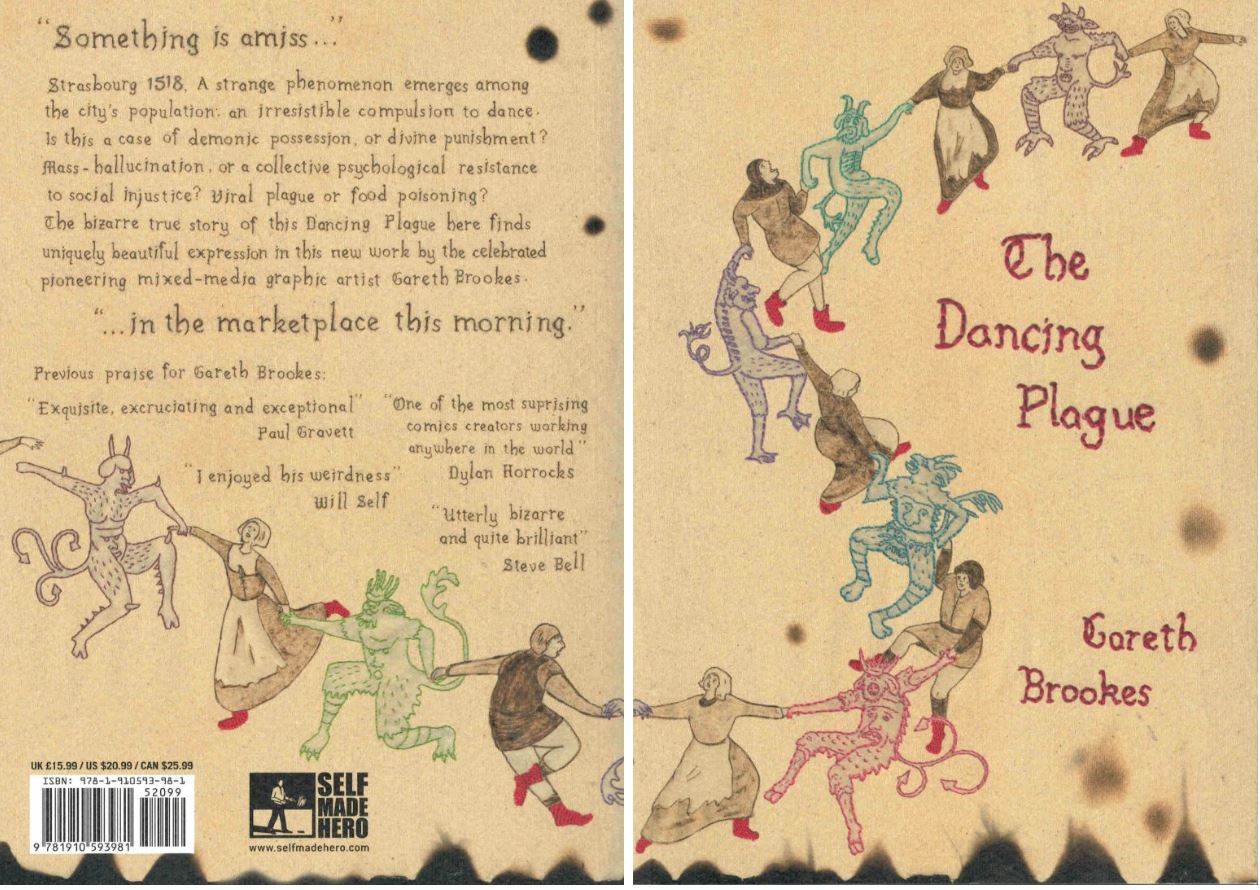
By Gareth Brookes (SelfMadeHero)
ISBN: 978-1-910593-98-1 (PB/Digital edition)
Plagues, disasters and mysteries are, quite understandably, on everyone’s minds at the moment. What’s become clear over the last few years is that we all react in different ways to something genuinely too big for mortals to cope with – especially those brightly coloured Idiots-In-Charge, universally elected almost everywhere by us idiots who aren’t…
For auteur extraordinaire Gareth Brookes, the earlier annus horribilis of enforced confinement caused by CoVid involved a deep delve back into history; unto a strikingly different contagion that shook contemporary civilisation and tried the patience, initiative and abilities of the authorities.
It also gave him the perfect arena to examine other societal ills we haven’t cured or properly addressed – such as the role and increasing vile treatment of women; the overwhelming disruptive and corrosive power of dogma and the perpetual inescapable corruption of those at the top by the very power they wield on our behalf.
Brookes is a Capital-A Artist, printmaker, textile creator and educator who learned his craft(s) at the Royal College of Art and who has subsequently appeared in ArtReview; Kus; The British Library’s Comics Unmasked exhibition and numerous classrooms and lecture theatres as inspirational teacher. He began literally crafting comics in 2015 with astounding, disturbing and hilarious epic The Black Project, and followed up two years later with an equally incisive take on perceptual disability: A Thousand Coloured Castles. His latest off-kilter gem was an adaptation of Izaak Walton’s The Compleat Angler (patience! we’ll get there one day).
The Dancing Plague also harks back to a time far removed, but one so-clearly beset with familiar problems, devilishly demonstrating how humanity has barely changed in spite of the passing centuries, a massive shift in dominant worldview and what we’ll graciously call major advances in understanding of the universe and our place in it…
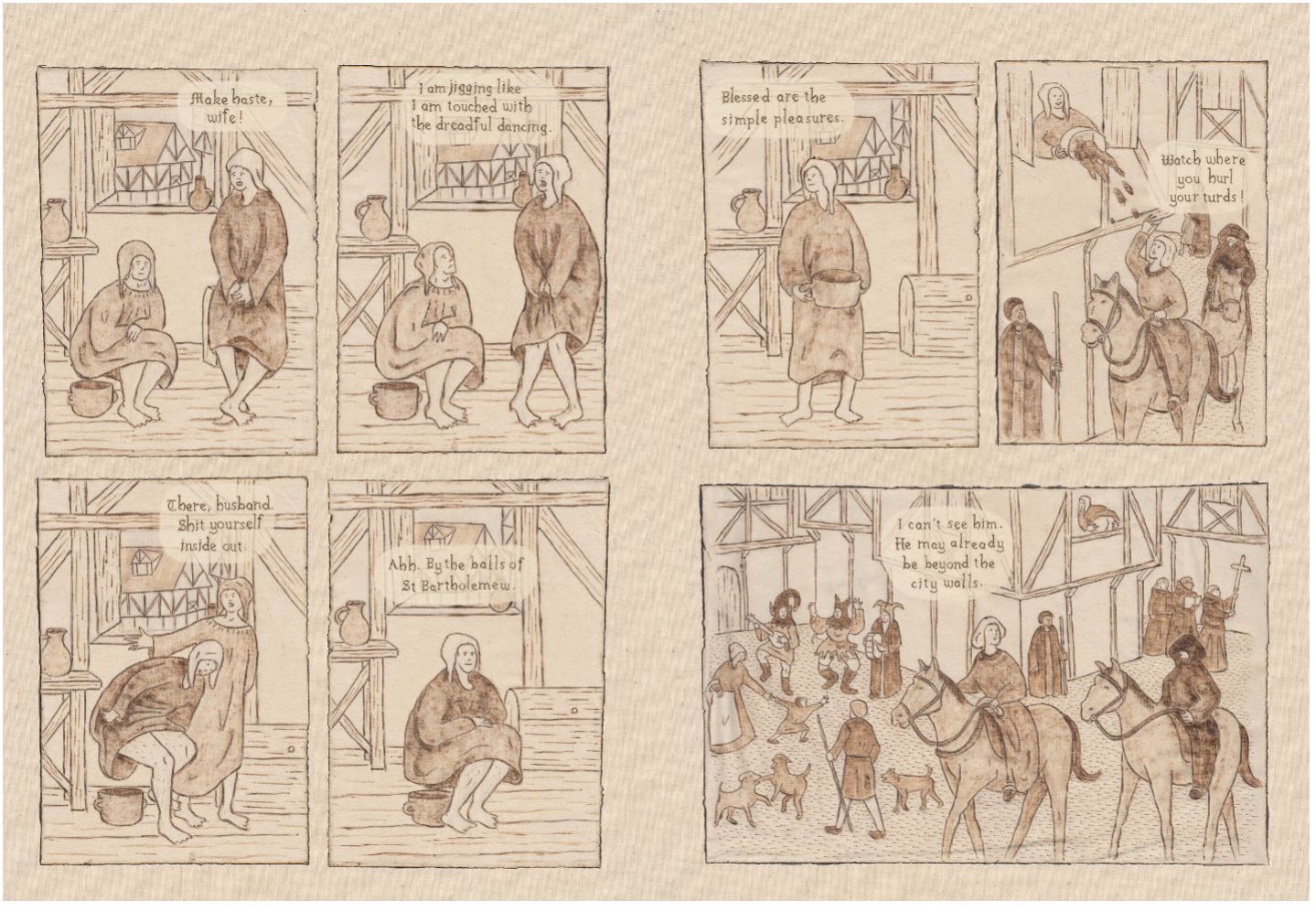
From the 11th century onward, Central European historians and clerics detailed outbreaks of spontaneous, uncontrolled dancing – “choreomania” – which initially gripped and compelled women to prance and cavort without stopping. Causing great injury and always spreading to children, men and apparently, in some cases livestock, these outbreaks were far beyond the ability of civic leaders, theologians or physicians to cure… or even adequately contain.
With instances cited all over the Holy Roman Empire from Saxony to Italy, the fictionalised tale here concentrates on the well-documented outbreak afflicting citizens of Strasbourg, Alsace (now in France) in June 1518, which followed in the wake of a far more well-known pestilence – the Black Death.
Mary is an extraordinary girl gripped by revelations and visions: either a disruptive pawn of devils or the chosen mouthpiece of an outraged Lord and Saviour Jesus. Whatever the cause, she glimpses hidden truths and is compelled to expose the hypocrisy and corruption of high-ranking churchmen who betray their vows and faith. From near-death at her outraged and terrified father’s hands, via a truly unwise ineffective vocational stint as a nun who can’t stay silent, to abused wife and mother, Mary speaks out, steps out and is suitably reviled and punished for it. Happily, something supernatural is keeping an eye on her…
Despite proof of miracles, rampant death, hunger and uncanny phenomena, Mary and her children abide and endure in acceptable normality until one day her drunken husband reports how he saw their neighbour Frau Troffea capering and hopping about in the street. What Mary sees is a woman pulled and bent by the gleefully malign ministrations of demons…
And so, another period of panic, intolerance and governmental ineptitude commences, with as usual tragic consequences for those at the bottom of the social hierarchy who get the chance to be scapegoated and gaslit yet again…
Episodically ducking and diving between 4th June 1500 and an Epilogue set in March 1527, the grand dance unfolds and who knows where or how it will end?
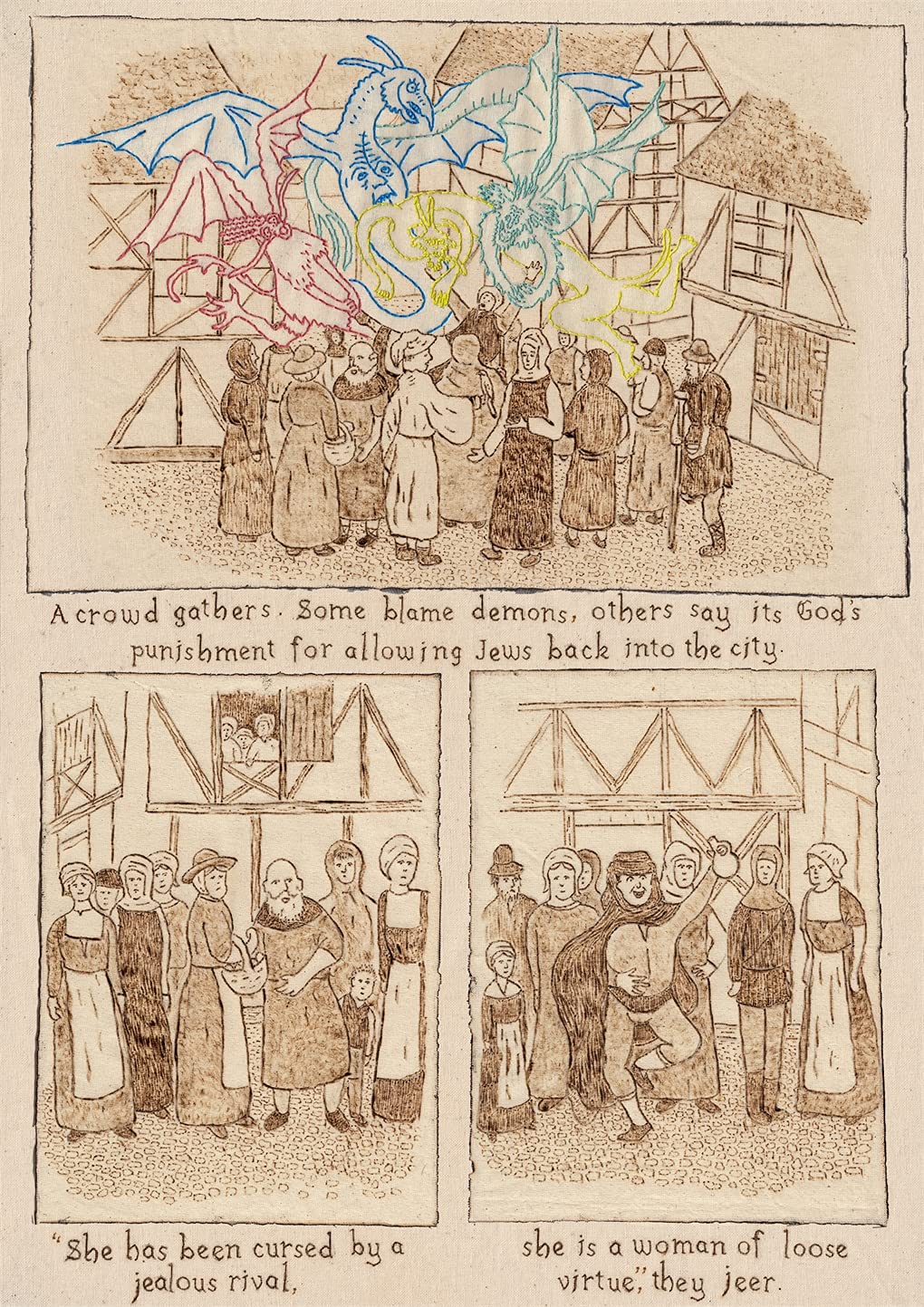
Deeply unsettling, earthily, gloriously vulgar in the manner of the Boccaccio’s Decameron or proper, unexpurgated Chaucer; outrageously witty and slyly admonitory, The Dancing Plague is rendered with (I’m assuming positively therapeutic) mastery in invitingly multicoloured, multi-layered linework reminiscent of woodblock prints, generated by “pyrographic” (inscribed with heated drawing tools) and painstakingly-sewn embroidery. As I’ve said in previous reviews, it’s like nothing you’ve ever seen and serves to form an equally unique narrative.
Preceded by a context-establishing Foreword by Anthony Bale – Professor of Medieval Studies, Birkbeck, University of London – providing all the factual background necessary to understand and enjoy this terpsichorean treat and details on two remarkable female historical figures whose lives inspired this yarn (sorry/mea culpa: I’m weak and couldn’t resist), this is graphic triumph no fan of the medium or social redeemer should miss.
Text and images © 2021 Gareth Brookes. All rights reserved.
Congratulations to Kit Anderson and Avery Hill Publishing as Second Shift made the final cut of nominations for the prestigious Nebula Awards. 2026 is the debut year for the Nebula Award graphic novel category, so check out the book, scope out the competition and come back in June for the canapes, clingy dresses, cheers and crying bit…
Day before yesterday in 1912 vas born German of many talents Franz-Werner Richter-Johnsen (Detektiv Schmidtchen), as were French cartoonists Raymond Maric AKA Raymond Chiavarino in 1927 and in 1951 Plantu (Jean Plantureux). In 1955, US cartoonist Kevin Kallaugher came along, and in 1977 we lost Superman Studio first ranker Ed Dobrotka (and initial visualizer of The Toyman). Finally it wasn’t until today in 1991 that 2000 AD finally went full-colour. You kids don’t know you’ve bin borne…
Yesterday in 1892 Tarzan artist and Turok co-creator Rex Maxon was born, just like artist/cartoonist/animation legend Joseph Barbera was in 1911 and all-rounder Bill Wray in 1956. Eerily connected by Hellblazer, Glenn Fabry was born in 1961 and Steve Pugh in 1966. In 1984 seminal UK horror weekly Scream! premiered on this date whilst in 2007 we lost master draughtsman Marshall Rogers (Batman, Howard the Duck, Cap’n Quick & A Foozle, Coyote, GI Joe).
Today in 1887, strip pioneer and comedy goldminer Robert Quillen (Willie Willis, Aunt Het) was born in Syracuse, Kansas. In 1972 UK Sci Fi licensed product weekly Countdown closed down for good, whilst Tom Batiuk’s controversial (look it up!) media strip John Darling began, running to 1991 when it was quite literally killed…