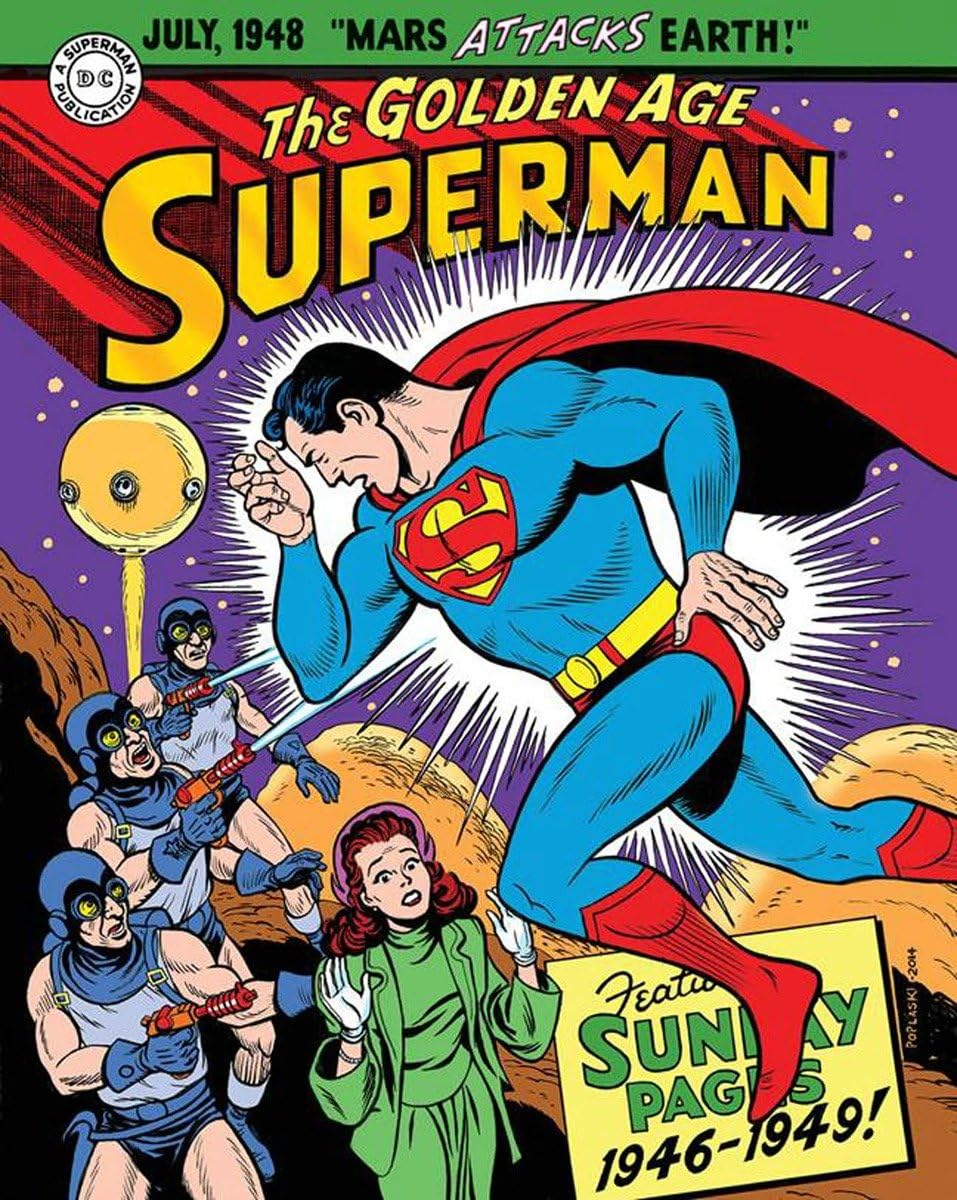
Superman The Golden Age Sundays volume 2 1946-1949


By Alvin Schwartz, Wayne Boring & various (IDW/Library of American Comics)
ISBN: 978-1-63140-109-1 (HB)

This book includes Discriminatory Content produced in less enlightened times..

After years wallowing in obscurity most of Superman’s newspaper strip exploits were at last made available to aficionados and the curious newcomer in tomes such as this one, compiled under the auspices of the Library of American Comics. Sadly, that bounty has dried up and the books are becoming as rare as the original strips. Hopefully the whole canon will one day make it into digital editions. Until then though, we fortunate ones can share what we have, like this epic transitional selection seeing the close of a Golden era in advance of a fresh, bold, daringly Atomic Age…

The comic book industry would be utterly unrecognisable without Superman. Jerry Siegel & Joe Shuster’s bold and unprecedented invention was fervidly adopted by a desperate and joy-starved generation and quite literally gave birth to a genre if not an actual art form. The Man of Tomorrow was shamelessly copied, adapted by countless inspired writers and artists for numerous publishers, spawning an incomprehensible army of imitators and variations within three years of his summer 1938 debut.

Yes, 88 YEARS… and still counting!

The intoxicating blend of breakneck, breathtaking action and visceral wish-fulfilment expressed by the newborn Action Ace swiftly expanded to encompass cops-&-robbers crimebusting, socially reformist dramas, science fiction and fantasy, romance and comedy; and – once war in Europe and the East engulfed America – absorbed and reinforced patriotic relevance for a host of gods, heroes and monsters, all dedicated to profit through exuberant, eye-popping excess and dashing derring-do. Superman was master of the world and whilst transforming and dictating the shape of the fledgling funnybook industry, relentlessly expanded into all areas of entertainment media.

We might think of the Cleveland boys’ iconic invention as the epitome and acme of comic strip creation, but the truth is that very soon after his debut in Action Comics #1 the Man of Steel was a fictional multimedia monolith in the same league as Sherlock Holmes, Popeye and Tarzan. Diehard comics fans regard our purest, most enduring icons in primarily graphic narrative terms, but the likes of Batman, Spider-Man, The Hulk and their hyperkinetic ilk long ago outgrew four-colour origins to become fully mythologized modern media creatures, instantly recognised in mass markets across all platforms and age ranges. Far more people have viewed or heard the Man of Steel than have ever read his comics.

His globally syndicated newspaper strips reached untold millions, and by the time of his 20th anniversary – at the very start of what we know as the Silver Age of Comics – he had been a thrice-weekly radio serial regular and starred in a series of astounding animated cartoons, as well as two films and a novel by George Lowther. Superman was a perennial wellspring for toys, game, puzzle and apparel manufacturers and had just ended his first smash live-action television serial. In his future were many more shows, a stage musical, a ton of blockbuster movies and near-seamless succession of games, bubblegum cards and TV cartoons beginning with The New Adventures of Superman in 1966 and continuing ever since. Even superdog Krypto has got in on the all screens act. However, in his formative years the moving picture option was simply an expensive novelty for most. The Action Ace achieved true mass market fame through a different medium: one not that far removed from his print origins.

Although pretty much a spent force these days, for most of the last century newspaper strips were the Holy Grail American cartoonists/graphic narrative storytellers hungered for. Syndicated across the country – and frequently the world – they might be seen by millions if not billions of readers and were generally accepted as a more mature and sophisticated form of literature than comic books. At that time it also paid far better, and rightly so. Some of the most enduring and entertaining characters and concepts of all time were created to lure readers from one particular paper to another and many of them grew to be part of a global culture. Flash Gordon, Dick Tracy, Buck Rogers, Blondie, Charlie Brown and so many more escaped humble, even tawdry newsprint origins to become meta-real: existing in the minds of earthlings from Albuquerque to Zanzibar. Some still do…

Superman was the first comic book character to make that leap; about six months after exploding out of Action Comics. The daily Superman strip launched on 16th January 1939, augmented from November 5th of that year by a full-colour Sunday page. Originally crafted by Siegel & Shuster and their studio (Paul Cassidy, Leo Nowak, Dennis Neville, John Sikela, Ed Dobrotka, Paul J. Lauretta & Wayne Boring), the mammoth task soon required the additional artistic gifts of Jack Burnley and ancillary writers Whitney Ellsworth, Jack Schiff & Alvin Schwartz. The McClure Syndicate feature ran uninterrupted until May 1966, and at its peak appeared in over 300 daily and 90 Sunday newspapers with a combined readership surpassing 20 million. For most of the post-war years, Boring & Stan Kaye limned the spectacular Sundays (latterly supplemented by Win Mortimer & Curt Swan). The majority of strips from 1944 to 1958 were written by largely unsung, nigh-forgotten scribe Alvin Schwartz.

Born in 1916, Schwartz was an early maestro of comic books, writing Batman, Superman, Captain Marvel, and for many other titles and companies. Whilst handling the Superman strip he freelanced on Wonder Woman and other superheroes as well as DC’s genre titles such as Tomahawk, Buzzy, A Date with Judy and House of Mystery. After numerous and ever-escalating clashes with new Superman Editor Mort Weisinger, Schwartz quit comics for commercial writing: selling novels, essays, documentaries and docudramas for the National Film Board of Canada. He worked miracles in advertising and market research, developing selling techniques like psychographics and typological identification. A member of the advisory committee to the American Association of Advertising Agencies, he died in 2011.

After too many years wallowing in obscurity most of Superman’s newspaper strip exploits are finally available to aficionados and the curious newcomer in tomes such as this one compiled under the aegis of the Library of American Comics.

Showcasing Schwartz & Boring in their purest prime, these Sundays (numbered as Pages #354 to #520, collectively spanning August 11th 1946 to October 16th 1949) depict an almost omnipotent Man of Steel in domestically-framed tales of emotional dilemma, pedestrian criminality and surreal situations rather than muscle-flexing bombast, faux angst and bludgeoning action. Here humour, wit, mystery, fashion, satire and wonder reign supreme.

Following affable appreciation of the creators and the times in Mark Waid’s ‘An Introduction’ and a selection of contemporaneous Superman comic book covers in ‘A Wayne Boring Gallery’ the weekly wonderment recommences in all its vibrant glory. Sadly, the serials are untitled, so you’ll just have to manage with my meagre synopses of individual yarns…
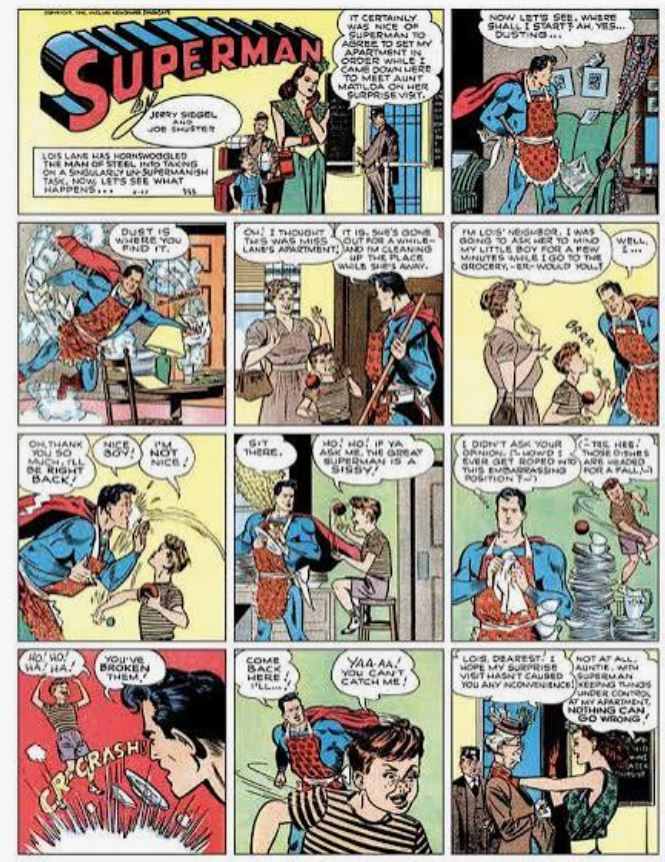
Kicking off is a beguiling domestic dilemma as Lois Lane is overwhelmed looking after a neighbour’s boy whilst preparing to collect her sternly formidable, imminently visiting Aunt Matilda. Snowed under mounting physical and mental loads, she ropes in Superman to backstop her, only to discover there are many tasks – like baking a cake whilst watching a boisterous brat – that even the miraculous Man of Steel cannot manage…

Next up and beginning with Page 358 (September 8th 1946) the Action Ace faces criminal mastermind Tom Catt who plunders Metropolis in “Curiosity Crimes” dependent on the victims’ own innate nosiness. After a cascade of cat & mouse clashes the cunning crook ultimately falls because he didn’t follow his own advice about obtrusive inquiry and foolhardy felines…

More distracting nonsense results after social thinktank The Skeptics prove by rational debate that Superman doesn’t exist and seek to legally end the fraud being perpetrated upon the world. It takes a number of impossible tasks diligently performed by our hero before the cranky coots are convinced to change their minds, after which Page 371 (December 8th 1946) briefly returns the Man of Tomorrow to his war years and wish-fulfilling Superman’s Service for Servicemen scheme as he helps demobbed G.I. Steve Kennedy adapt to peacetime, work woes and officious in-laws making life intolerable…

Keeping our frame of reference domestic, a new year and fresh sequence (Page 375, January 5th 1947) saw the invulnerable hero hounded by an indefatigable go-getting salesman from Dynamic Insurance. Elmer Doolittle’s career – and future wedded bliss – depend on selling Superman a policy. Luckily, the goal never actually specified what kind of policy…

March 9th (Page 384) signalled a return to fantastic fantasy as an invisible beast causes havoc in the heartlands and farmers call for help to bring the “Nosuch Animal” to brook. Sadly, when Superman intervenes the unseen terror loses its camouflage gift and is exposed as a living example of a dinosaur… a Paleomatzoball. Moreover, this rampaging colossus loves rough handling and develops a disastrous romantic attachment to the Man of Steel before our embarrassed involuntary swain devises a timely solution to their mutual problem…

The “peace dividend” delivered by the end of the war is scrutinised next as Clark visits Boom Town and sees how a former manufacturing mecca was infiltrated and overrun by mobsters, gamblers and racketeers once the military – and their trustworthy, well-trained police – were transferred elsewhere. When the entrenched thugs begin attacking the municipality’s new law enforcement recruits, the Man of Steel steps up to school the neophytes and ensure crime never pays there again…

Circuses were a big draw and popular pastime of the postwar years and from Page 400 (June 29th) Superman & Lois were lured into that limelight when swindlers targeted Cap’n Tobey’s Mammoth Carnival. When the doddering owner is gulled into promising the world that the Metropolis Marvel is his new top attraction, Superman naturally helps out by showing up, but his good deed only allows a cartel of gangsters to use his scheduled performances as opportunities to try new ways to assassinate the Action Ace… with no appreciable result…

Next (from 28th August) two more former G.I.’s enlist the Man of Steel in a business venture, hoping his promotion of their new hot dog line (“Teenie Weinies”) will ensure success, Sadly, the enthusiastically spectacular super sales campaign only lands our hero with a lawsuit for restraint of trade when established fast food rivals cry unfair competition against their own brand of “Yankie Frankies”! Ordered to cease and desist, our hero still manages one stellar and out of this world act of promotion before capitulating…

One of the earliest examples of a recurring Silver Age Superman trope comes next as Page 414 (October 5th 1947) sees exotic nuclear radiation (another increasing popular maguffin of the forthcoming Atomic Age) accidentally reduce the mighty Man of Tomorrow to the size and relative age – but thankfully not intellect or emotional development – of an infant. Unable to appear as Clark, “Superbabe” recruits vagabond Edward Benton who resembles his adult self to impersonate Kent until a remedy is found, only to see the double fall for Lois and attempt to steal his civilian life and wed her under false pretences. Unable to operate as hero or tolerate the loss of Lois, the Caped Kryptonian risks a deadly potential cure, sabotages Lois’ wedding day and risks exposing his greatest secret to stop the mad escapade…

After that soap opera scandal carries us over the Holiday season, accidental time travel – beginning with February 22nd 1948’s Page 434 – sees Superman stranded in the past and ensnared by the irresistible wiles of seductive, lethally ambitious Egyptian Queen Cleopatra. Thankfully, former beau Mark Antony is able to break her spell before the Man of Tomorrow returns to today, just in time to foil an impending Martian invasion (May 2nd – July 18th over Pages 444-455) by impersonating an “ordinary human” abducted to their testing labs…

He even acts as a matchmaker for their lonely leader before returning to Earth and his strangest encounter yet after he’s “adopted” by talking dog Angus who needs a safe, secure home for his homeless human orphan kid pal Nicky Nichols. Of course, once he’s over the shock and disbelief, Superman is delighted to provide them and even reunite Nicky with his missing-but-not-dead mother… once he’s stopped every grifting chancer’s exploitative schemes to make money out of the mouthy mutt…

Another extraordinary tyke turns up on Page 467 (October 10th) as radical theorists of The Educational Improvements Association attempt to hothouse a 3-year old prodigy with plenty of weird notions of her own. “Smartypants” is granted absolute freedom to do whatever she wants, with the Man of Steel sworn to make every wish come true. The result is utter anarchy (with unleashed dinosaurs!) and total chaos until the harassed, embattled boffins convene for a swift rethink before resorting to tried-&-trusted rearing methods…

November 28th (Page 474) saw Superman in whimsical mood as he puckishly teaches a rug salesman a lesson by making his smarmy, smug sales patter about magic carpets come true for downtrodden shopper Geoge Paley. Sadly, the prank goes exponentially awry as an ever-escalating war for possession of George’s flying rug breaks out, resulting in violence, loss of livelihood and litigation. Once he’s done settling all the crises he’s sparked, the Action Ace resolves to quit playing practical jokes…

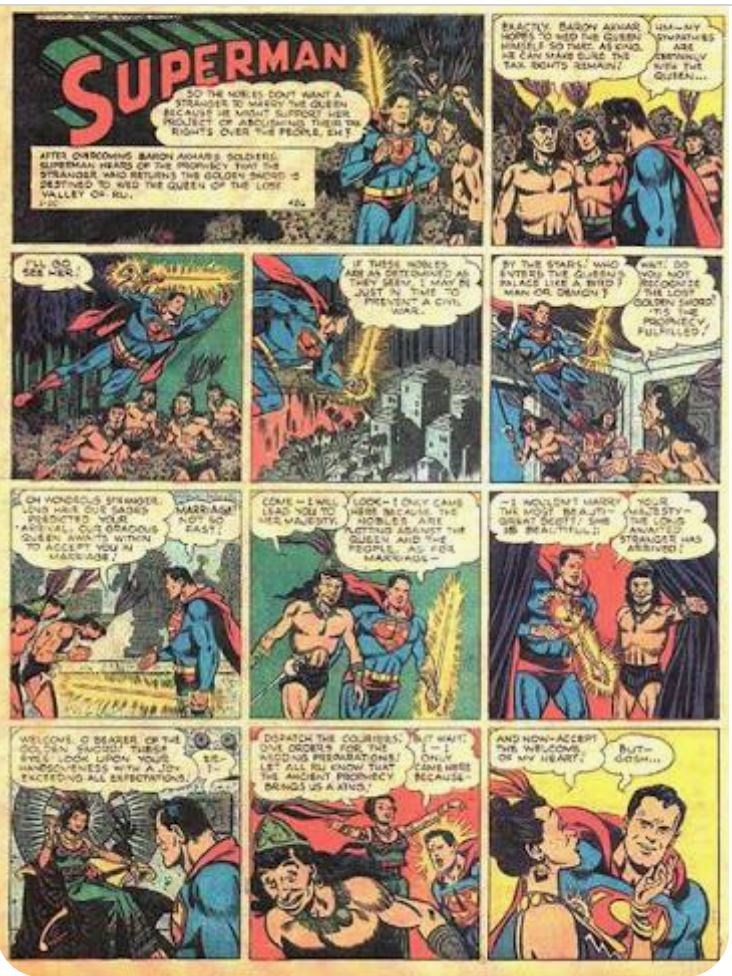
Far-flung fantasy follows from Pages 484 to 493 (February 6th – April 10th 1949) as Superman gathers Amazon jungle flora for the Metropolis Botanical Society and stumbles upon a fabulous golden sword, a potent legend and a long-hidden civilisation in the Lost Valley of Ru. Holding the antique blade, the Man of Steel inadvertently fulfils an ancient prophecy and must marry the socially reforming Queen. That’s not what tyrannical nobles led by Baron Akhar want, and his machinations to thwart the prophecy and marry her himself – as well as the monarch’s embarrassing infatuation with the mighty caped stranger – lead to confusion, crisis and civil war before our hero can fix everything and flee back to the outer world’s relative calm…
The next serialised saga (Pages 494-505, April 17th to July 3rd) offers another human-interest drama given a super-powered spin as, having learned nothing, Superman hires a double to stand in for him at all onerous public functions he’s too polite to refuse. Sadly, affable, honest mimic Mike is soon innocently complicating the Action Ace’s double lives to the point of imminent calamity and when the hapless doppelganger is kidnapped, panic ensues following wildfire rumours of the hero losing his powers. Realising the jig is up, Superman takes drastic action…

Concluding this final Golden Age collection, Pages 506-520 (July 10th – October 16th 1949) detail a bizarre fantasy wherein Superman emulates the travels of Lemuel Gulliver in a story within a story. To cheer up a love-crushed youngster, the Metropolis Marvel recounts his travails on a distant heavy-gravity world where his powers fluctuated and he faced miniscule warriors and lumbering giants, overthrew a tyrant before brokering peace and even arranging a love match between representatives of each side!

The Golden Age Superman: – Sunday Pages 1946-1949 – was the last of two huge (312 x 245 mm), lavish, high-end twinned hardbacks re-presenting the Man of Steel’s exploits during WWII and the immediate aftermath. They were a welcome addition to the superb commemorative series of Library of American Comics which preserved in luxurious splendour such landmark strips as Lil Abner, Tarzan, Rip Kirby, Polly and her Pals and many of the abovementioned cartoon icons. It’s an unimaginable joy to see these neglected Superman stories again, offering a far more measured, domesticated and comforting side of one of America’s most unique contributions to world culture. It’s also a pure delight to see some of the most engaging yesterdays of the Man of Tomorrow. Join me, see for yourself and agitate for the entire library to be released in digital editions…
© 2014 DC Comics. All rights reserved. SUPERMAN and all related characters and elements are trademarks of DC Comics.

Today in 1883, Edwin Balmer – journalist/fantasist/author/co-creator of the Speed Spaulding sci fi strip – was born. The day also saw the deaths of groundbreaking cartoonist and animator Winsor McCay (Little Nemo in Slumberland, Gertie the Dinosaur, Dreams of a Rarebit Fiend) in 1934 and Reg’lar Fellers, It’s A Great Life If You Don’t Weaken, Wide Awake Willie creator Gene Byrnes in 1974.
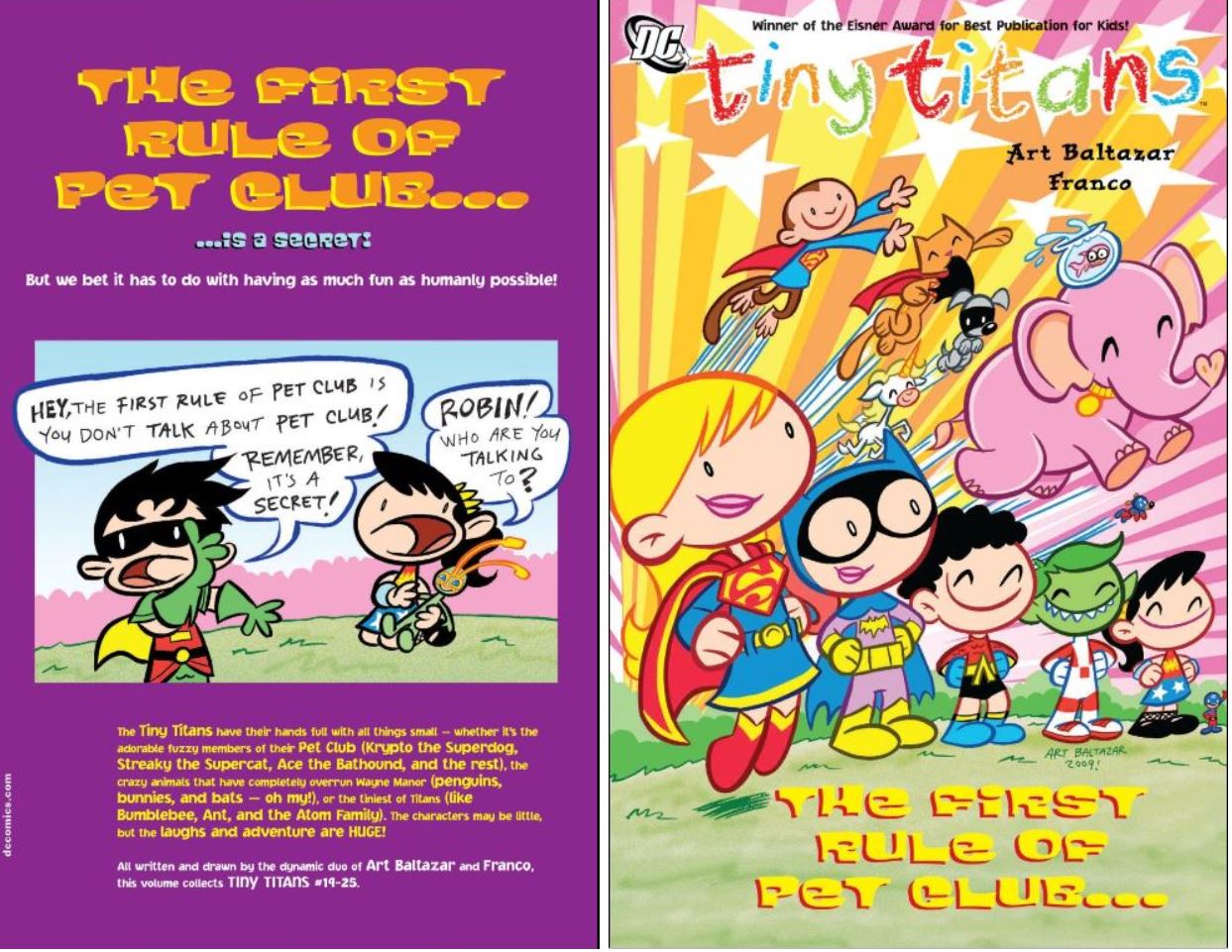
Tiny Titans volume 4: The First Rule of Pet Club…


By Art Baltazar & Franco with Geoff Johns & various (DC Comics)
ISBN: 978-1-4012-2892-7 (TPB), 978-1-4012-4528-3 (Digital edition)

DC’s Cartoon Network imprint was a potent and fun-filled bastion of children’s comics in America and consolidated the link between TV and 2D jollies and thrills with stunning interpretations of television landmarks like Ben 10, Scooby Doo, Powerpuff Girls, Dexter’s Laboratory and others. The comics line also generated truly exceptional material based on screen iterations of their proprietary characters such as Teen Titans Go!, Legion of Super Heroes, Batman: Brave and the Bold and Krypto the Super Dog as well as original material like Billy Batson and the Magic of Shazam!, which were merely indistinguishable in tone and content.

Arguably the imprint’s finest release was a series ostensibly aimed at early readers but which quickly became a firm favourite of older fans – and a multi-award winner too. Superbly mirroring the magical wonderland inside a child’s head where everything is happily mixed up together, Tiny Titans became a sublime nostalgia-weaponised antidote to continuity cops and slavish fan-boy quibbling by reducing the vast cast of successive Teen Titans animated series, the greater boutique of mainstream comic books and, eventually, DC’s entire Universe to little kids and their parents/guardians in the wholesome kindergarten environment of Sidekick City Elementary School – a scenario spring-loaded with in-jokes, sight-gags and beloved yet gently mocked paraphernalia of generations of strip readers and telly-watchers…

Art Baltazar and co-creator Franco (Aureliani) mastered a witty, bemusingly charming style of storytelling that just happily rolls along, with assorted characters getting by, trying to make sense of the great big world and just coincidentally having “Adventures in Awesomeness”. The method generally involves stringing together smaller incidents and moments into an overall themed portmanteau tale and it works astoundingly well. Rounding up issues #19-25 and spanning cover-dates October 2009 – April 2010 of the magically madcap, infinitely addictive all-ages mini-masterpiece, this fourth volume begins on a romantic note by looking at the kids ‘Deep in Like’.

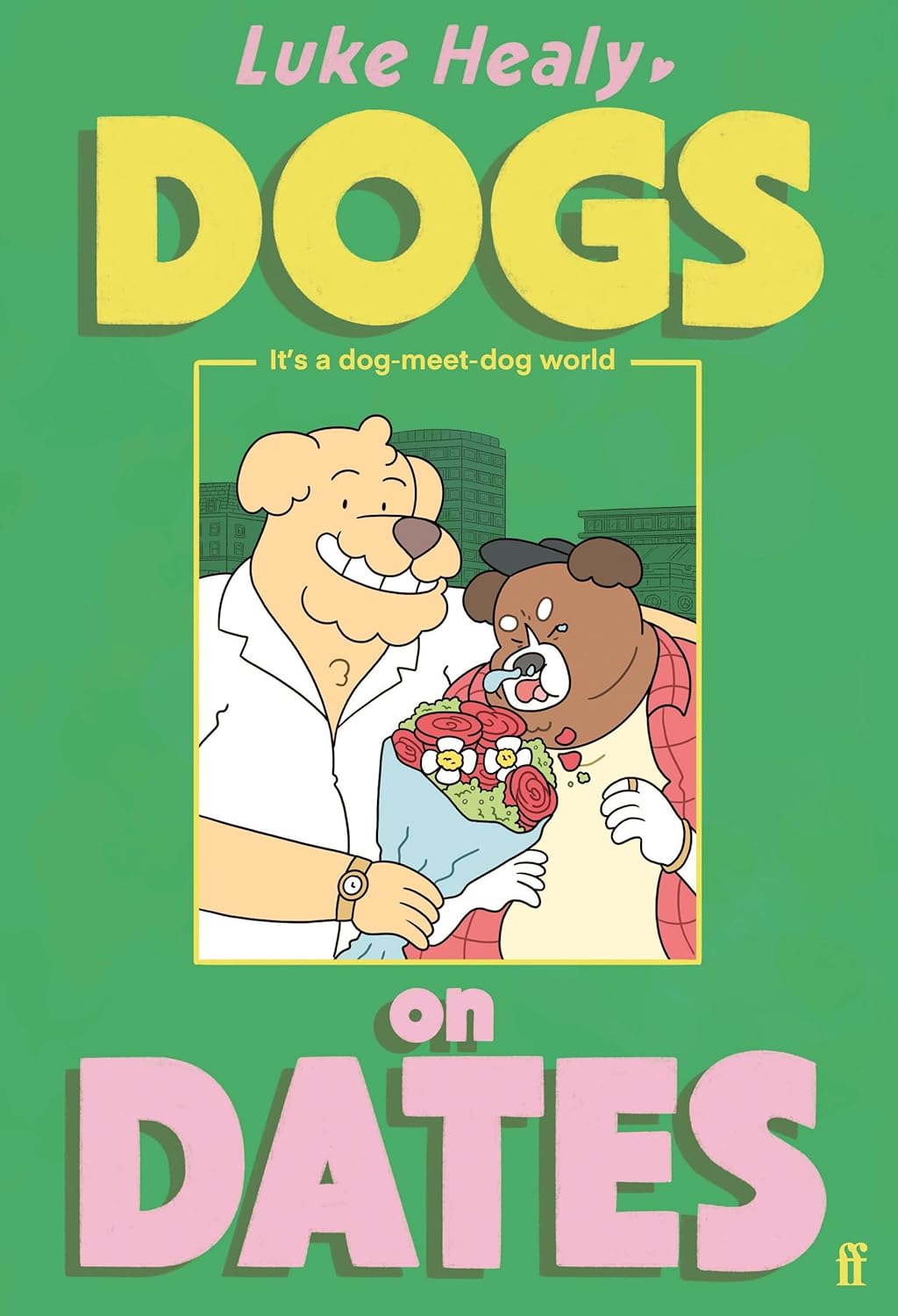
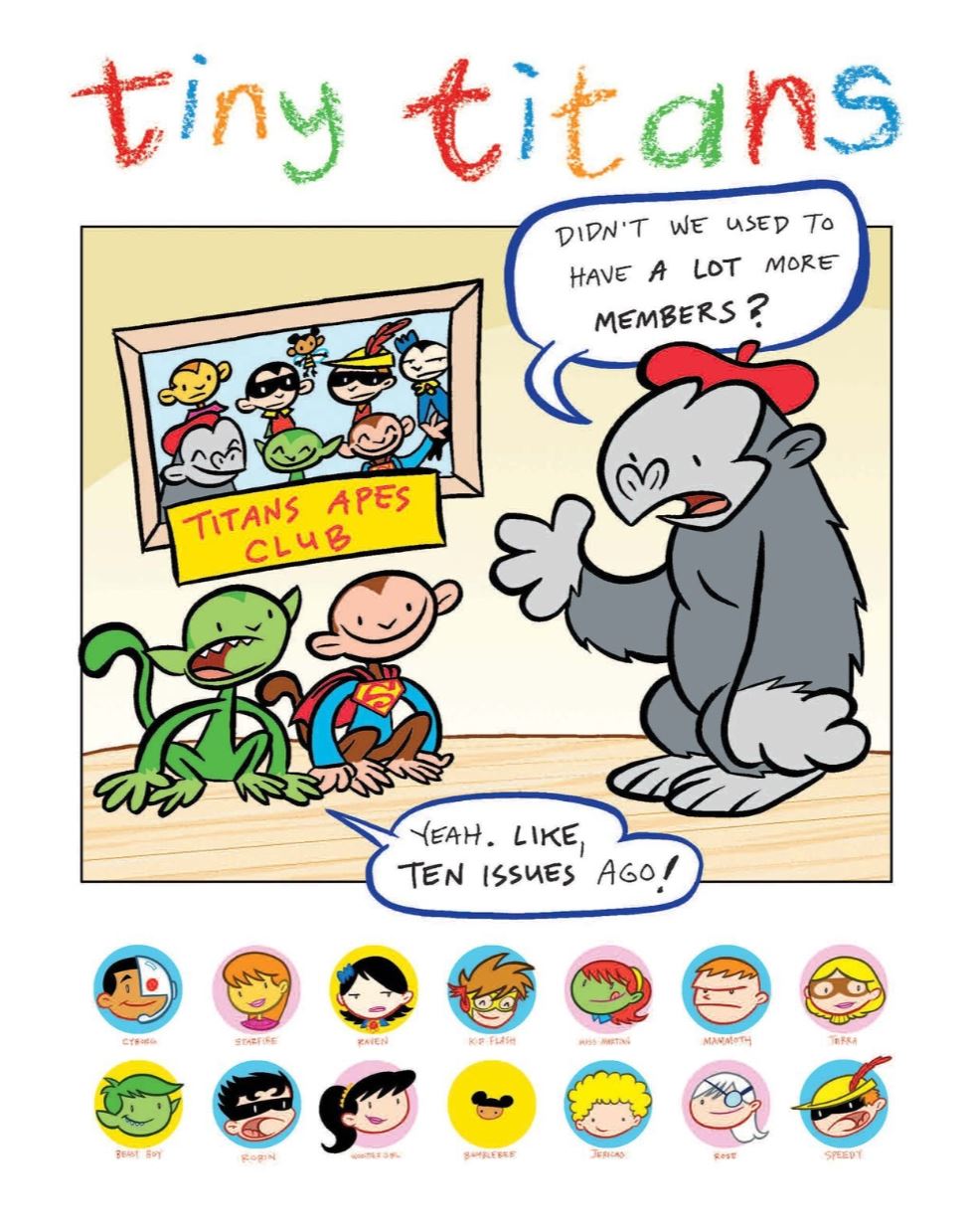
After a handy and as-standard identifying roll-call page, ‘Imagine Me and You…’ finds scary blob Plasmus and tiny winged Bumblebee brightening up each other’s drab day, before a similar cupid moment affects The Brain and best-est pal M’sieu Mallah, even as diligent overachiever Robin (accompanied by faithful Bat-hound Ace) finds his earnest attempts to finish his homework disturbed by a succession of pesky young ladies including Starfire, Batgirl & Duella all caught up in a ‘Like Triangle’. ‘Dates’ then sees Bumblebee & Plasmus inadvertently causing chaos during an afternoon movie monster mash – and even in the ‘Intermission’ – after which a sly sight gag for us oldies highlights the company’s many Wonder Girls in ‘Jump Rope’.

DC’s hallowed anthropoid obsession is highlighted in ‘New Recruits’ when Beast Boy chairs a meeting of the Titans Ape Club before regular feature The Kroc Files depicts ultimate butler Alfred, roguish reptilian star Kroc and Plasmus each demonstrating ‘How to Enjoy a Lollipop’ in their own signature manner. The issue closes with a word puzzle whilst the next promises to disclose The Hole Truth about Raven: beginning with a daybreak disaster at ‘Home with the Trigons’. Raven’s dad is an antlered, crimson transdimensional devil-lord as well as a teacher at Sidekick Elementary, so when he oversleeps, his sorceress scion gets him to work on time by simply opening a few wormholes. Of course, leaving those dimensional doors around is just asking for trouble…

Meanwhile, it’s washday at Wayne Manor, but Alfred won’t let Robin, Beast Boy or Aqualad go down ‘To the Batcave’. Sadly, even the dapper domestic can’t withstand united pester-power and eventually gives in… and learns to regret it. Following a perplexing maze game-page, the All Pet Club Issue! launches as Starfire and mean sister Blackfire write home for their beloved critters Silky & Poopu, so they can go to the oh-so-secret social event, whilst can-do kid Cyborg actually builds himself a brace of chrome companions in ‘Pet-Tronics’…

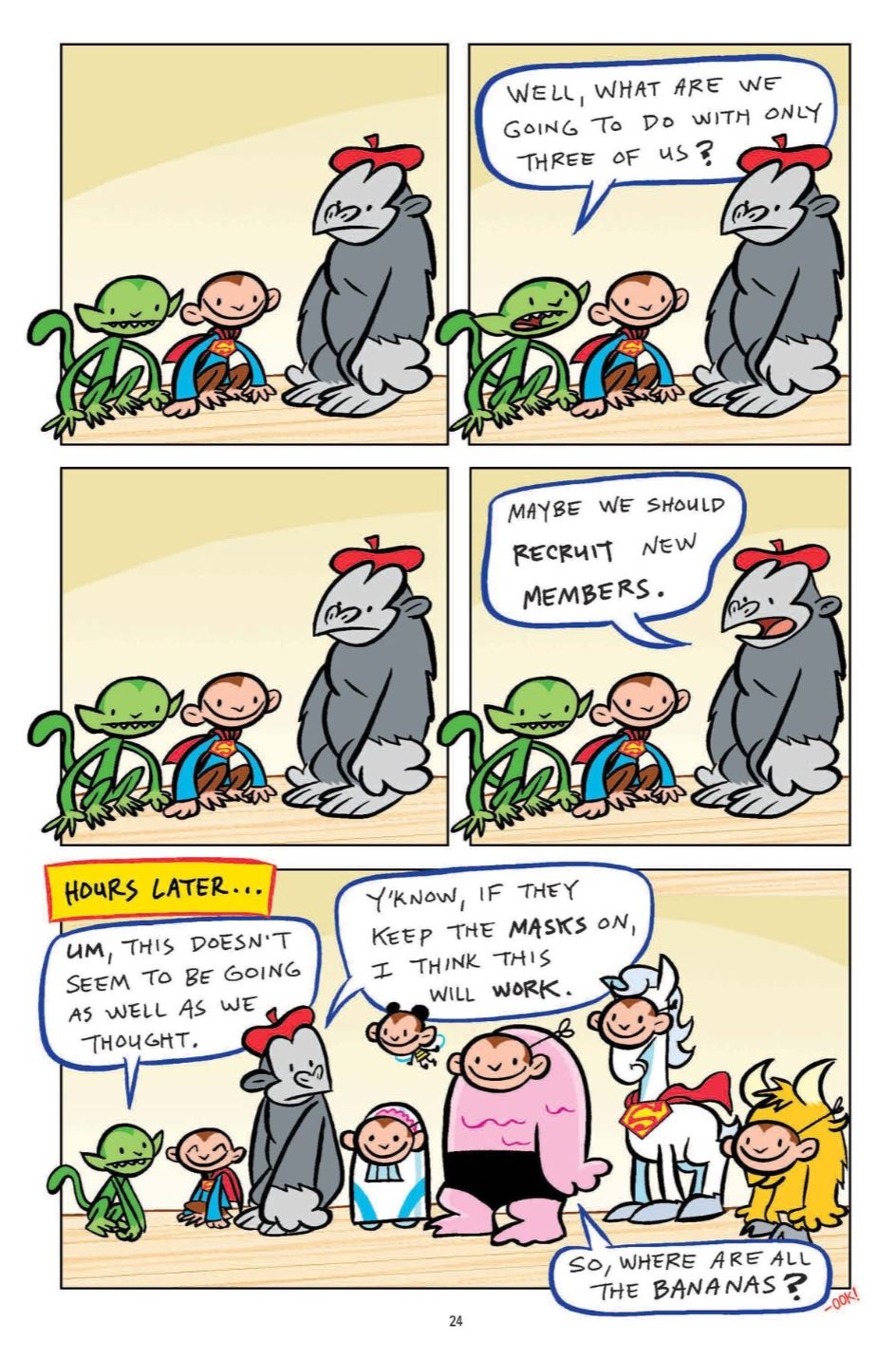
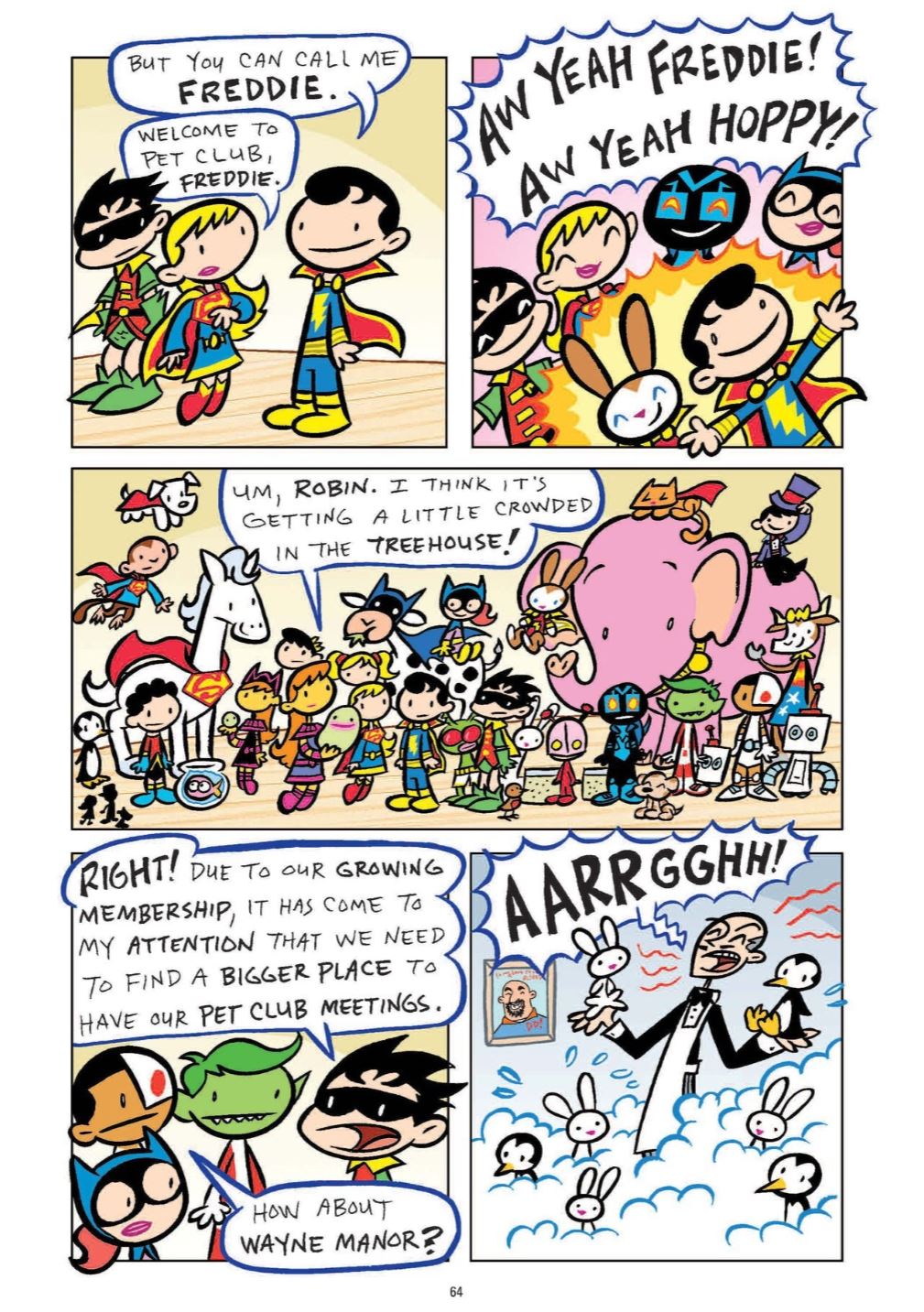
With ‘Club Hoppin’, the entire school gathers with their accommodatingly and uniquely compatible pets to interview potential new members – specifically tongue-tied-&-thunderstruck Captain Marvel Junior and his fuzzy pal Hoppy, the Marvel Bunny. With so many members, the club must find roomier quarters, leading to a painful tryst for Beast Boy and Terra in ‘Meanwhile, on the Moon…’

There’s a brilliant vacuum-packed bonus pin-up of the Tiny Titans in space by Franco before ‘Hot Dogs, Titans, & Stretchy Guys!’ presents the kids back on solid ground and wrapped up with the DCU’s many flexible fellows as ‘Offspring into Action’ introduces Plastic Man’s excitably boisterous bonny boy. Then, ‘Just Playing and Bouncing’ sees Bumblebee spend some time with the diminutive Atoms Family but lose control of their Teeny-Weeny, Super Duper Bouncy Ball and accidentally get Plastic Man, Offspring, Elongated Man and Elastic Lad all wound up, before helplessly watching it bowl over Principal Slade and Coach Lobo in ‘Coffee Dog Latte’.

Thankfully, Robin has exactly the right gimmick in his utility belt to set things straight, but can’t stay long as he’s en route to his Bird Scouts meeting where potential new members Hot Spot and Flamebird are trying out for Hawk, Dove, Raven & Talon. Distressingly, when shiny Golden Eagle turns up, the girls all want to make him the new leader…

The semi-regular ‘Epilogue’ page often supplies one more punch-line to cap each themed issue and this one leads directly into a convoluted and confounding Elastic Four pin-up/cover which in turn precedes a spookily uproarious tale of Bats, Bunnies, and Penguins in the Batcave! Oh My!...

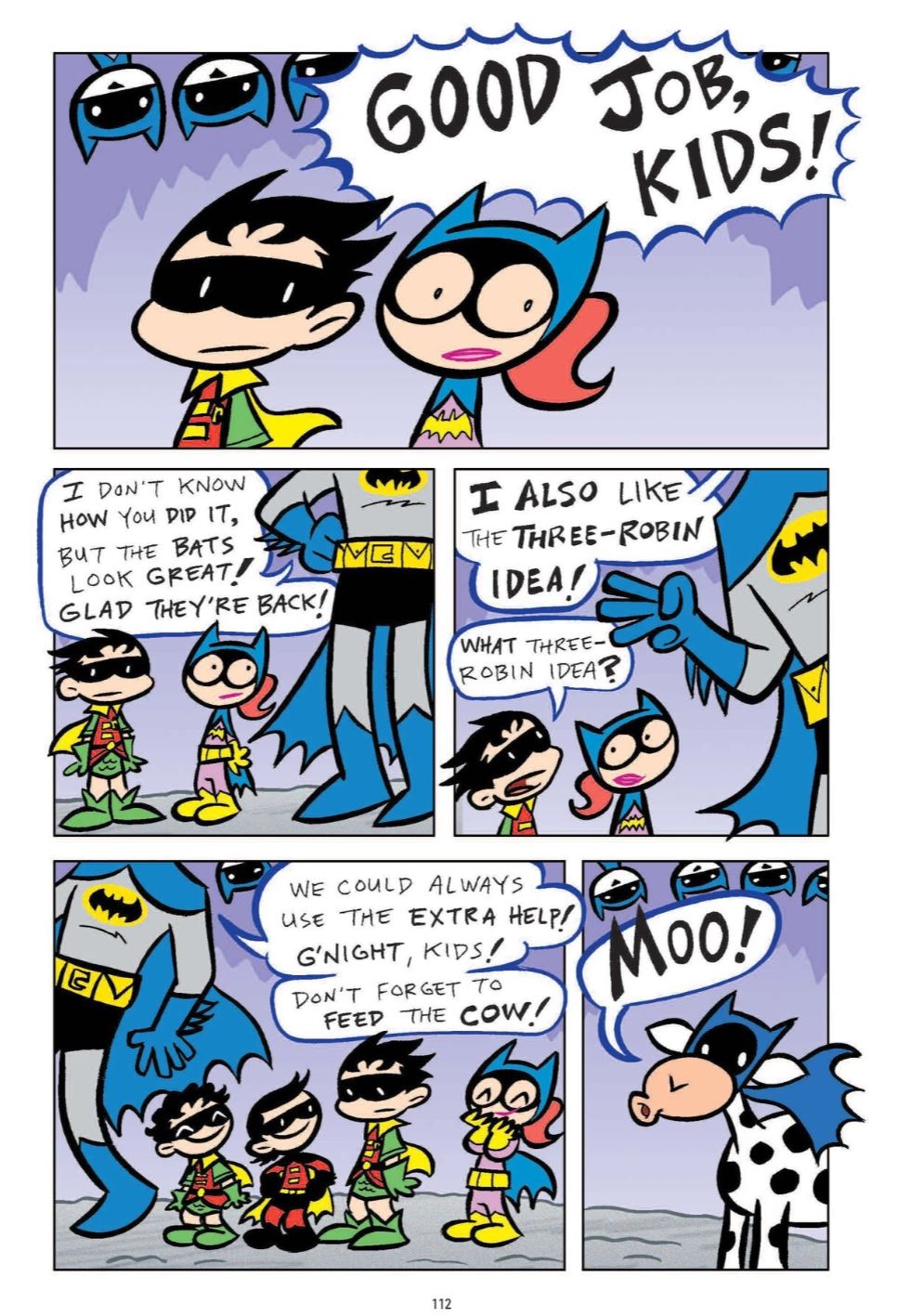
It all begins in ‘Ice to Meet Ya!’ when Wayne Manor’s extraordinarily if not excessively large penguin population get into a turf war with the house rabbits, displacing the Batcave’s regular inhabitants in ‘Driving Me Batty’. The conflict escalates in ‘All in the Batman Family’ before Robin gets a rather stern admonition from his senior partner to put things right… or else.

Happily, ever-so-cute & capable Batgirl is willing to lend a hand. Unfortunately, so too are the kids she’s baby-sitting (Tim & Jason: you’ll either get that or you won’t, bat-fans) and impishly infuriating Batmite. With even Batcow helping out, things soon start calming down, but ‘Meanwhile, at the Titans’ Treehouse…’ not all of the fugitive Bat-bats have heard the good news…

Once your ribs have stopped hurting you can then enjoy a Tiny Titans Aw Yeah Pin-up from Franco before ‘The All Small Issue!’ opens with assorted big kids accidentally drinking ‘Milk! Milk!’ from the Atoms’ fridge and shrinking away to nearly nothing. Good thing the Atomic nippers think to call their dad, who’s with fellow professional dwindlers Ant, Molecule and substitute Atoms Adam & Ryan (another in-continuity howler targeting old fogey fans) for a Team Nucleus meeting…

That compressive cow-juice causes more trouble in the ‘Epilogue’ before a Blue Beetle puzzle clears the mind in advance of an outrageous ending as ‘Superboy Returns!’ in a fairly cosmic crossover – and requiring some additional scripting by Geoff Johns.

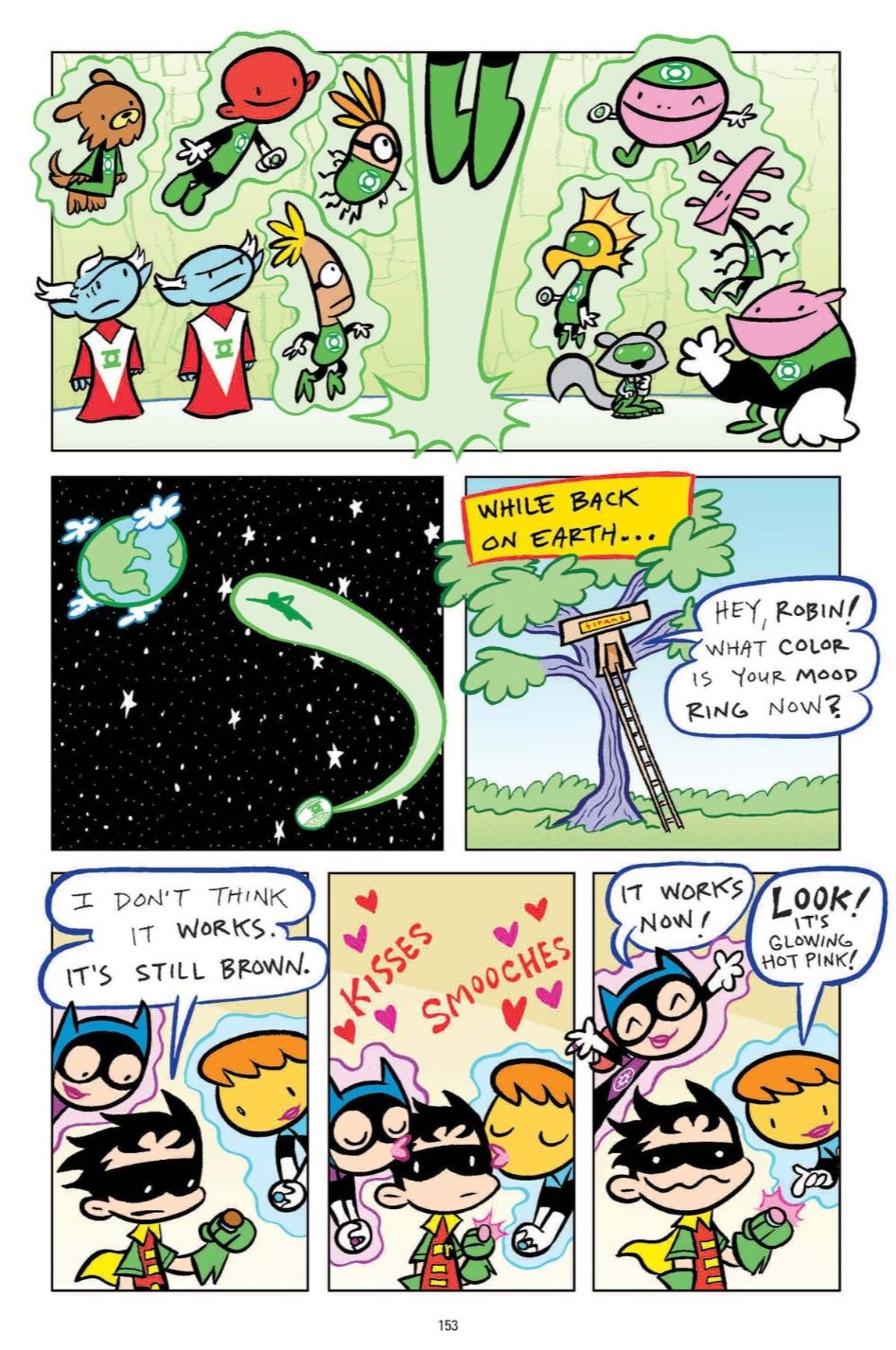
When Conner Kent shows up, all the girls are really impressed and distracted, whilst – across town – Speedy is trading a lot of junk he shouldn’t be touching to Mr. Johns’ Sidekick City Pawn Shop and Bubblegum Emporium in ‘Brightest Day in the Afternoon!’ When Starfire & Stargirl then buy the seven different coloured “mood rings” from the shop, they and BFFs Duella, Batgirl, Wonder Girl, Terra and Shelly, are turned into Green, Red, Yellow, Orange, Blue, Violet and Indigo Lanterns! Soon, the Tiny Titans are up in the air again and annoying The Guardians of the Universe and their super-serious Green Lantern Corps.

It all ends well, though, in an Emerald ‘Epilogue’ and a lavish pin-up of a posse of pistachio-painted interplanetary peacekeepers…

Despite being ostensibly aimed at super-juniors and TV kids, these wonderful, wacky yarns – which marvellously marry the heart and spirit of such classic strips as Peanuts, The Perishers or Calvin and Hobbes with something uniquely mired and marinated in pure comic-bookery – are deliciously hilarious tales no self-respecting or self-indulging joy-lover should miss: accessible, entertaining, and wickedly intoxicating. Go mellow out with some kids’ stuff, now, okay? Why should they have all the fun?
© 2009, 2010 DC Comics. All Rights Reserved.

Today in 1948 cartoon gadfly Garry Trudeau (Doonesbury) was born, followed in 1950 by scripter and gamed developer Bill Kunkel (Doorway to Nightmare, Vigilante, Marvel Team-Up, Richie Rich). In 1942, Italian artist Giove Toppi died. He was the first cartoonist to draw Mickey Mouse in comics.

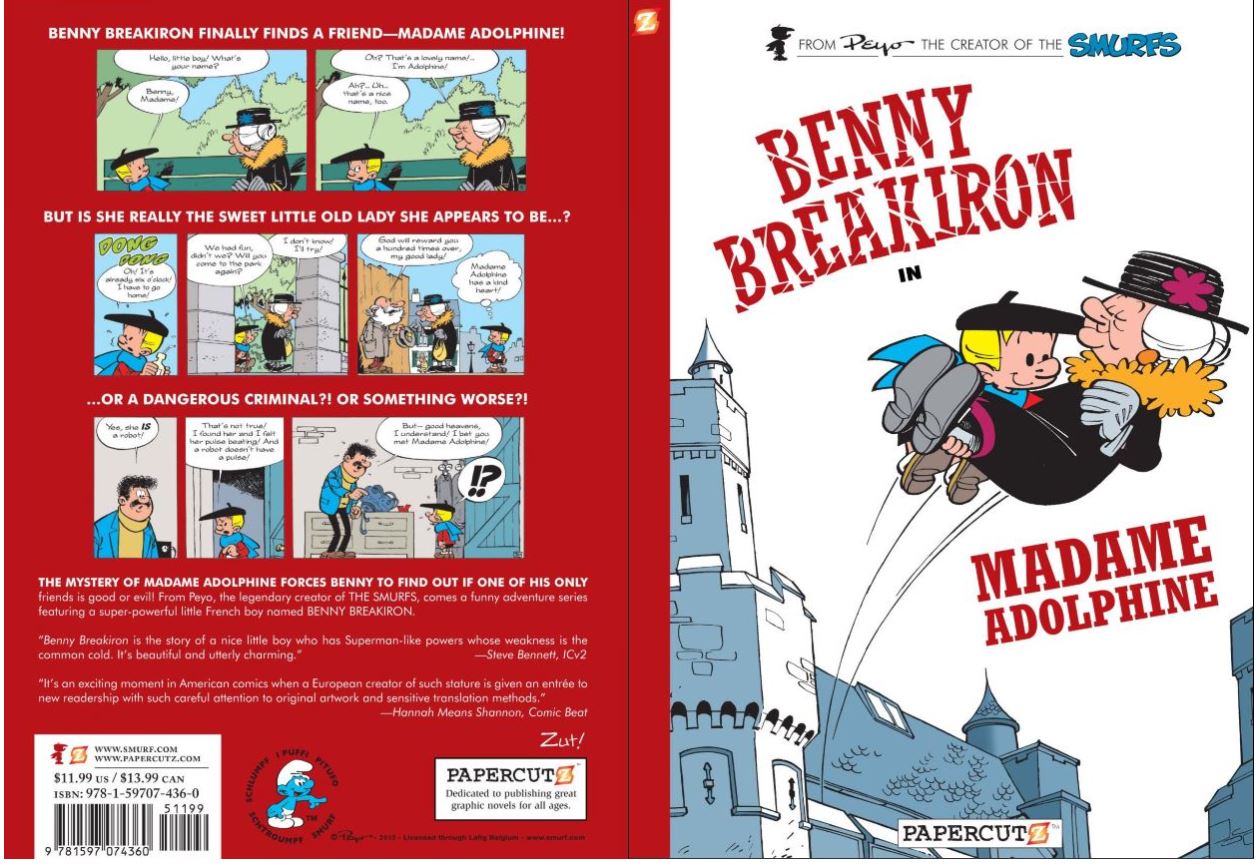
Benny Breakiron volume 2: Madame Adolphine


By Peyo, with backgrounds by Will, translated by Joe Johnson (Papercutz/NBM)
ISBN: 978-1-59707-436-0 (HB Album/Digital edition)

This book includes Discriminatory Content produced in less enlightened times.

In anticipation of 2028’s proposed CG animation version (which cannot possibly match the style and charm of these scribbled pages!) here’s a quick look back at how the Europeans handled superheroes and kids in crisis from a master of our artform…

Pierre Culliford was born in Belgium in 1928 to a family of British origin living in the Schaerbeek district of Brussels. An admirer of the works of Hergé and US comics licensed to Le Journal de Mickey, Robinson and Hurrah!, he refined his artistic skills, and developed his storytelling abilities but the war and family bereavement forced him to forgo further education and find work. After time toiling as a cinema projectionist, in 1945 Culliford joined C.B.A. animation studios, where he met André Franquin, Morris & Eddy Paape. When the studio closed, he briefly studied at the Brussels Academy of Fine Arts before moving full-time into graphic advertising. In his spare time, he began submitting comic strips to the burgeoning flock of post-war comics publishers.

His first sale came in April 1946: Pied-Tendre, a tale of American Indians in Riquet, the comics supplement to the daily L’Occident newspaper. Further sales to other venues followed and in 1952 his knight Johan found a permanent spot in Le Journal de Spirou. Retitled Johan et Pirlout, the strip prospered and in 1958 introduced a strange bunch of blue woodland gnomes called Les Schtroumpfs. Culliford – who now used the nom de plume Peyo – would turn those adorable little mites (known to us and most of the world as The Smurfs) into an all-encompassing global empire, but before being sucked onto that relentless treadmill, he still found time to create a few other noteworthy strips such as the titanic tyke on view here today.

In 1960 Benoît Brisefer – AKA Benedict Ironbreaker or in Dutch Steven Sterk – debuted in Le Journal de Spirou #1183 (December 1960). With a few slyly added tips of the hat to Siegel & Shuster’s Superman, the wryly bucolic adventures celebrated a small town small boy with superhuman strength living in a generally quiet and unassuming little Belgian city.

Quiet, well-mannered, gentle and a bit lonely, Benny just happens to be the mightiest boy on Earth: able to crush steel or stone in his tiny hands, leap vast distances and run faster than a racing car. He is also pretty much immune to all physical harm, but his fatal, somewhat ubiquitous weakness is that all his strength deserts him whenever he catches a cold…

Benny never tries to conceal his abilities but somehow no adults ever catch on. They generally think he’s telling fibs or boasting, and whenever he tries to prove he can bend steel in his hands, the unlucky lad gets another dose of the galloping sniffles…

Most kids avoid him. It’s hard to make friends or play games when a minor kick can pop a football like a balloon and a shrug can topple trees.

Well-past-it Brits of my age and vintage might remember the character from weekly comics in the 1960’s. As Tammy Tuff – The Strongest Boy on Earth, and later as Benny Breakiron and Steven Strong, our beret-wearing blockbuster appeared in Giggle and other periodicals from 1967 onwards.

With Peyo’s little blue cash-cows taking up ever larger amounts of his concentration and time, other members of his studio assumed greater responsibilities for Benoît as years passed. Willy “Will” Maltaite, Gos, Yvan Delporte, Françoise Walthéry and Albert Blesteau all pitched in. and Jean Roba created many eye-catching Le Journal de Spirou covers, but by 1978 the demands of the Smurfs were all-consuming and all the studio’s other strips were retired.

You can’t keep a good super-junior down, though, and after Peyo’s death in 1992, his son Thierry Culliford and cartoonist Pascal Garray revived the strip, adding six more volumes to the eight generated by Peyo and his team between 1960 and 1978. Thanks to the efforts of US publisher Papercutz, the first four of those gloriously genteel and outrageously engaging power fantasies are still available to English-language readers again – both as robust full-colour hardbacks and as all-purpose eBooks – and this second translated exploit begins in the sedate city of Vivejoie-la-Grande, where the kid goes about his rather solitary life, doing good deeds in secret and being as good a boy as he can…

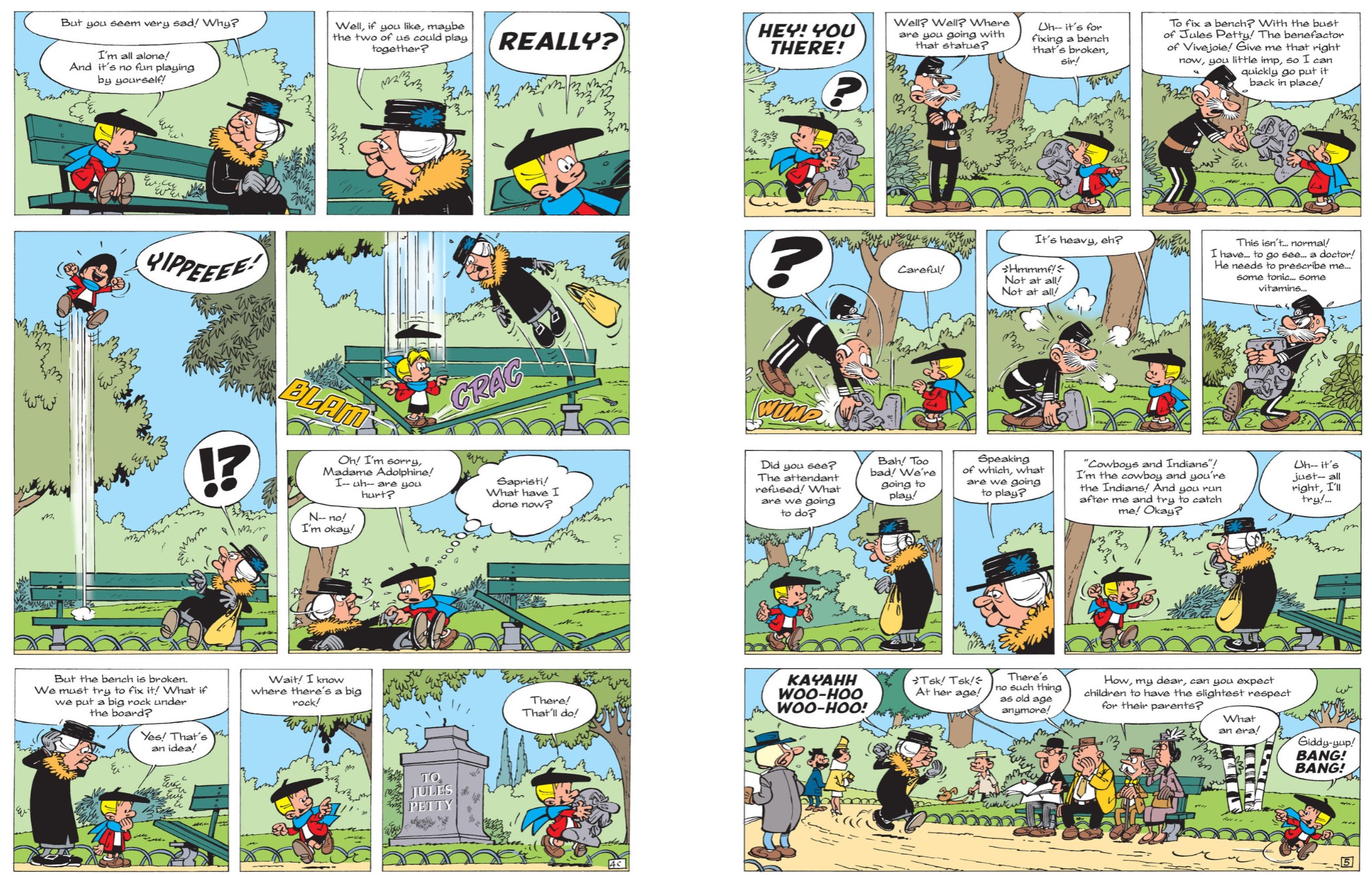
After another day of being shunned by everyone around, disconsolate Benny heads for the park and is befriended by a sweet old lady named Adolphine. No respecter of advanced age or graceful retirement, the old dear romps boisterously and disgracefully with the lad – to the disgust of the other park patrons. Eventually, Benny escorts her to his home where she has a strange fit and collapses.
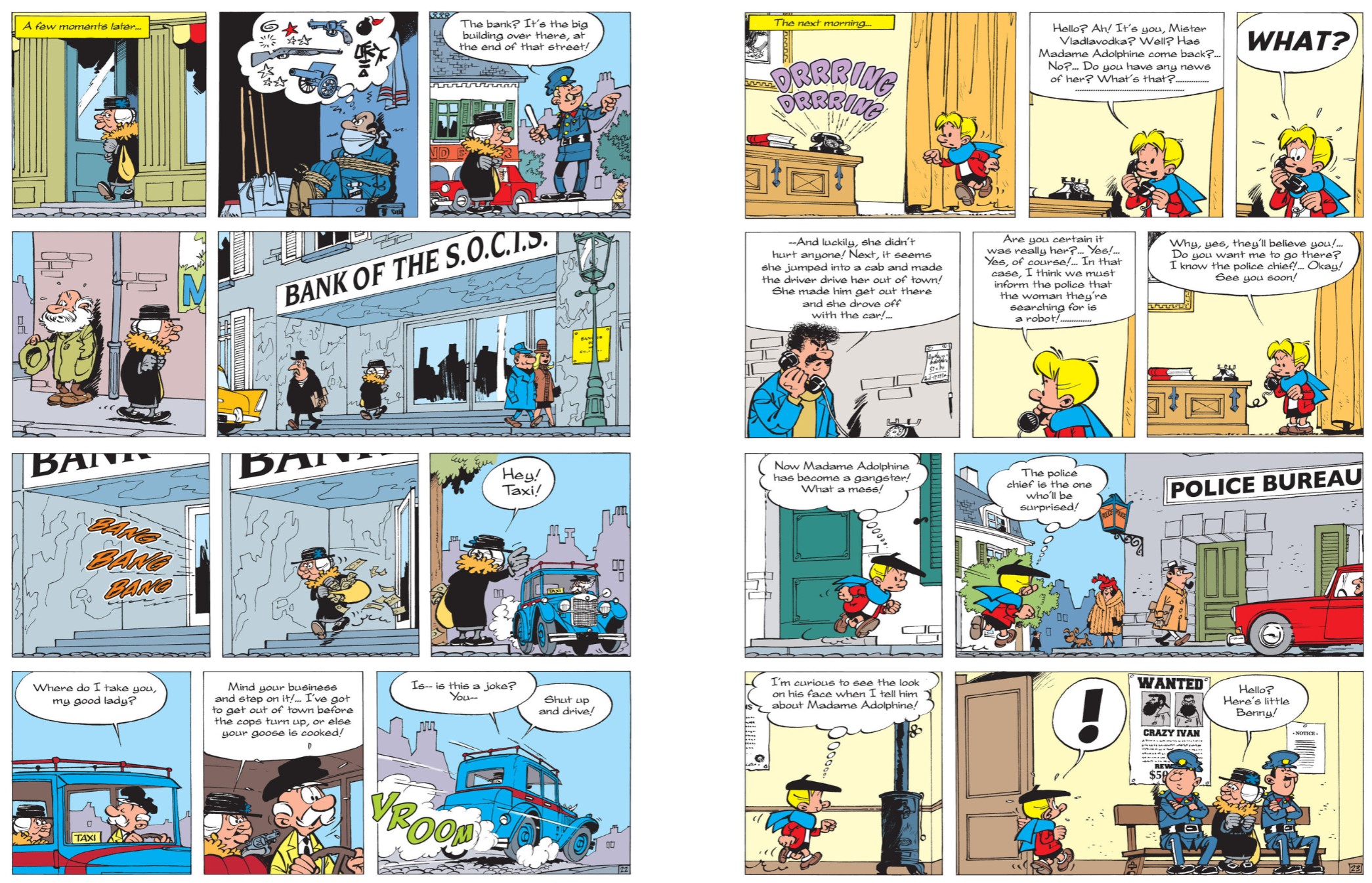
When even a doctor refuses to help, Benny finds a phone number in her bag and acts as any good boy should. Soon a rather strange gentleman comes to collect her, but he’s none too gentle in his behaviour and throws the old lady in the boot of his car! Far more distressingly, when Benny sees her in the street next day, Madame Adolphine says she has never met him before!

Baffled but unwilling to let the matter go, Benny tracks her down to a toyshop run by seedy inventor Serge Vladlavodka and finds her standing over the tinkerer’s unconscious body with a massive mallet in her hand. Moreover, Madame’s manner is brusque and almost callous and the belligerent biddy bustles off whilst Benny is trying to revive her prone victim. When Serge at last recovers, he also rushes away, fearing the harm she might cause. Accompanying him, Benny learns a startling secret…

There are two Adolphines – and one is indeed a sweet old lady. The other is an increasingly unstable, aggressive and just plain mean robot doppelganger who soon begins robbing banks and terrorising the public, so guess which one the police subsequently arrest?

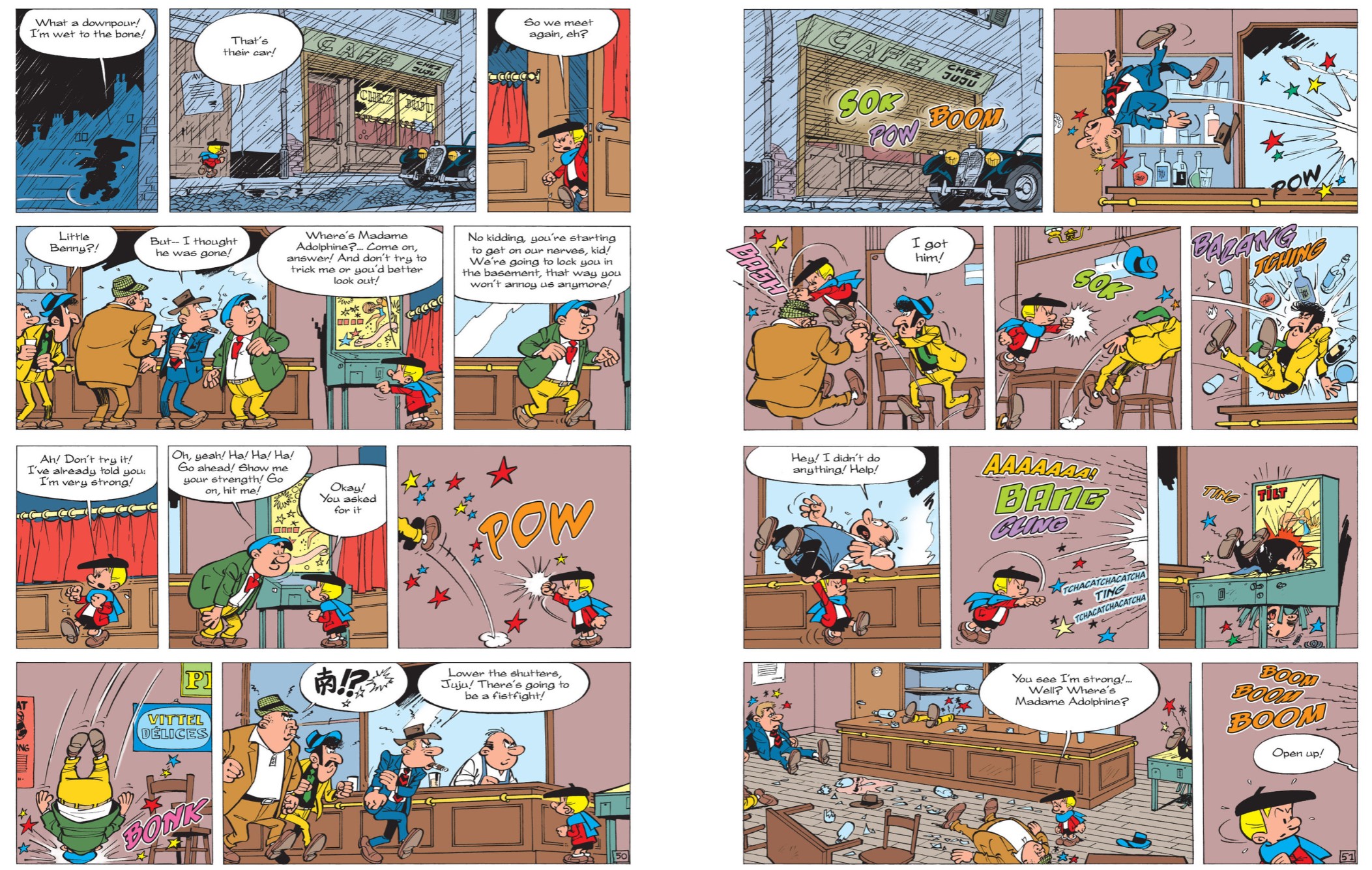
As indignant Benny singlehandedly busts the organic pensioner out of prison, amok automaton Adolphine recruits a gang of nasty professional thugs and embarks on a crime spree the cops are utterly helpless to handle. Good thing Benny is made of sterner stuff…

This superbly surreal spoof has delicious echoes of classic Ealing Comedies like The Ladykillers or The Lavender Hill Mob as it follows the little wonder boy’s resolute, dynamic and spectacular campaign to save his friend: blending deft wit with bombastic and hilarious slapstick. Madame Adolphine is a fabulously winning fantasy about childhood validation and agency, offering a distinctly Old-World spin to the concept of superheroes and providing a wealth of action, thrills and chortles for lovers of incredible adventure and comics excellence.
© Peyo ™ & ©2013 – licensed through Lafig Belgium. English translation © 2013 by Papercutz. All rights reserved.

Today in 1871 pioneering cartoonist Lyonel Feininger (The Kin-der-Kids) was born, followed in 1913 by Golden Age creator Marc Swayze (Mary Marvel, Captain Marvel, The Phantom Eagle, Flyin’ Jenny) and in 1917, animator-turned-cartoonist Gustavo “Gus” Arriola (Krazy Kat, Tom and Jerry, Gordo). In 1932 Argentinian satirist & cartoonist Joaquín Salvador Lavado Tejón AKA “Quino” (Mafalda) was born, with master raconteur Hermann Huppen (Jeremiah, Les Tours de Bois-Maury, Bernard Prince, Comanche) arriving in 1938, and comic book artist/animator Jimmy Janes (Legion of Super-Heroes, Moon Knight, Xanadu) in 1947; writer/editor/comics historian Mike Tiefenbacher in 1952; writer J. Michael Straczynski (Babylon 5, Spider-Man, Fantastic Four, Rising Stars, Superman: Earth One, Captain America) in 1954; all-rounder Richard Moore (Boneyard, Déjà Vu, Far West) in 1966; letterer Liz Agraphiotis in 1970; illustrator Pete Woods (Archie, Deadpool, Superman, Harley Quinn) in 1971 and writer Brian K. Vaughan (Pride of Baghdad, Batman, X-Men, Y: The Last Man, Ex Machina, Runaways, Saga, Paper Girls) in 1976.

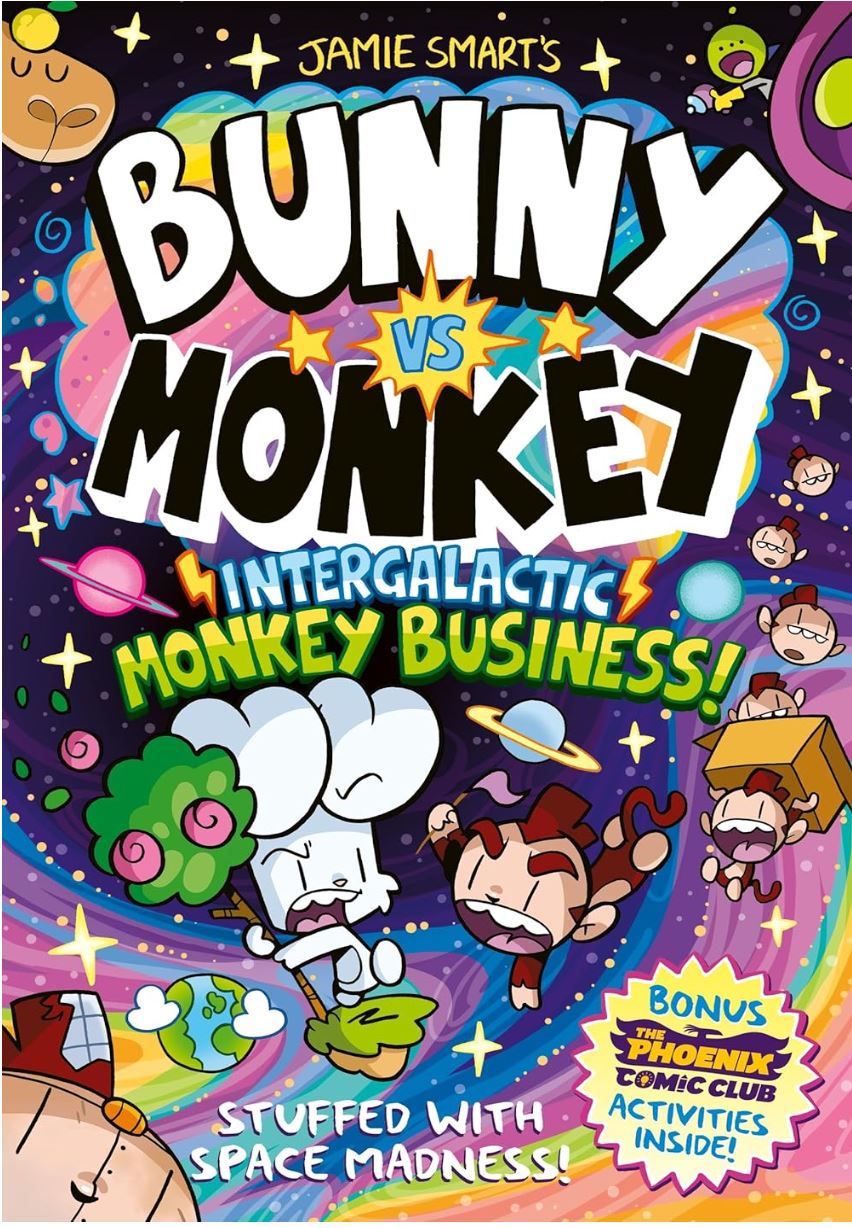
Jamie Smart’s Bunny vs Monkey Book 11: Intergalactic Monkey Business! TPB


By Jamie Smart, with Sammy Borras, Paul Duffield & Armin Roshdi (The Phoenix Comic Books/ David Fickling Books)
ISBN: 978-1-78845-362-t (TPB), 978-1-78845-416-2 (Tesco Exclusive Edition), 978-1-78845-417-9 (WHSmith Travel Exclusive Team Monkey Edition)

Bunny vs Monkey has been the inspirationally bonkers breakout star of The Phoenix since the first issue back in 2012: cataloguing a madcap vendetta gripping animal archenemies set amidst an idyllic arcadia, masquerading as more-or-less mundane but critically endangered English woodlands. Concocted with gleefully gusto – but increasingly with a cerebral cosmic crescendo in mind – by cartoonist/comics artist/novelist Jamie Smart (Fish Head Steve!; Looshkin; Max and Chaffy, Flember, Find Chaffy; Megalomaniacs), these trendsetting, mindbending yarns have been wisely retooled as multi award-winning, bestselling graphic albums available in digest softcover such as this one hardback and sponsored special editions and even as an AUDIOBOOK. Just let that one last one sink in…

All the tail-biting tension and animal argy-bargy began yonks ago after an obnoxious little beast plopped down in after a disastrous British space shot. OR DID IT?

Crashlanding in Crinkle Woods – scant miles from his launch site – lab animal Monkey believed himself the rightful owner of a strange new world, despite every effort of genteel, contemplative, reasonably sensible forest resident Bunny to dissuade him. For all his patience, propriety and good breeding, the laid-back lepine could not contain or control the incorrigible idiot ape, who to this moment remains a rude, troublemaking, chaos-causing, noise-loving lout intent on building his perfect “Monkeyopia” and/or being a robot, with or without the aid of evil supergenius Skunky or tagalong useless “henches” Metal Steve & Action Beaver…

Daily wonders and catastrophes were exacerbated by a broad band of unconventional Crinkle creatures, none more so than aforementioned monochrome mad scientist Skunky, whose intellect and cavalier attitude to life presents as a propensity for building dangerous robots, bio-beasts and sundry other super-weapons. He is, at his core, a dangerously inquisitive thinker and tinkerer…

Now the Graphic Novel of the Year of the British Book Awards 2026 is out in time for the summer hols in a nifty paperback edition and will keep everyone stuck in the car or waiting to pass customs suitably amused. Best get a couple though – kids, dads and grandmas do not like to share…

So, what’s going on?

Here, with artistic fiddling about from design deputy Sammy Borras, the unending war of nerves and mega-ordnances resumes as if nothing cosmic or multiverse-changing had ever happened, or any hint of a restart after a cosmic culmination. See, that’s what happens if you let books pile up and don’t read them immediately! Go check out Bunny vs Monkey: The Great Big Glitch! and then come back and we’ll chat some more…

Okay then, new day, new start, same old mega mecha meta nonsense as ‘Clouding Over’ sees a suspiciously low-lying cirrus formation start dumping rain and then increasingly more noisome and noxious substances on the woods-folk in what appear to be targeted strikes. Could there possibly be some kind of intelligence behind the atmospheric attacks?

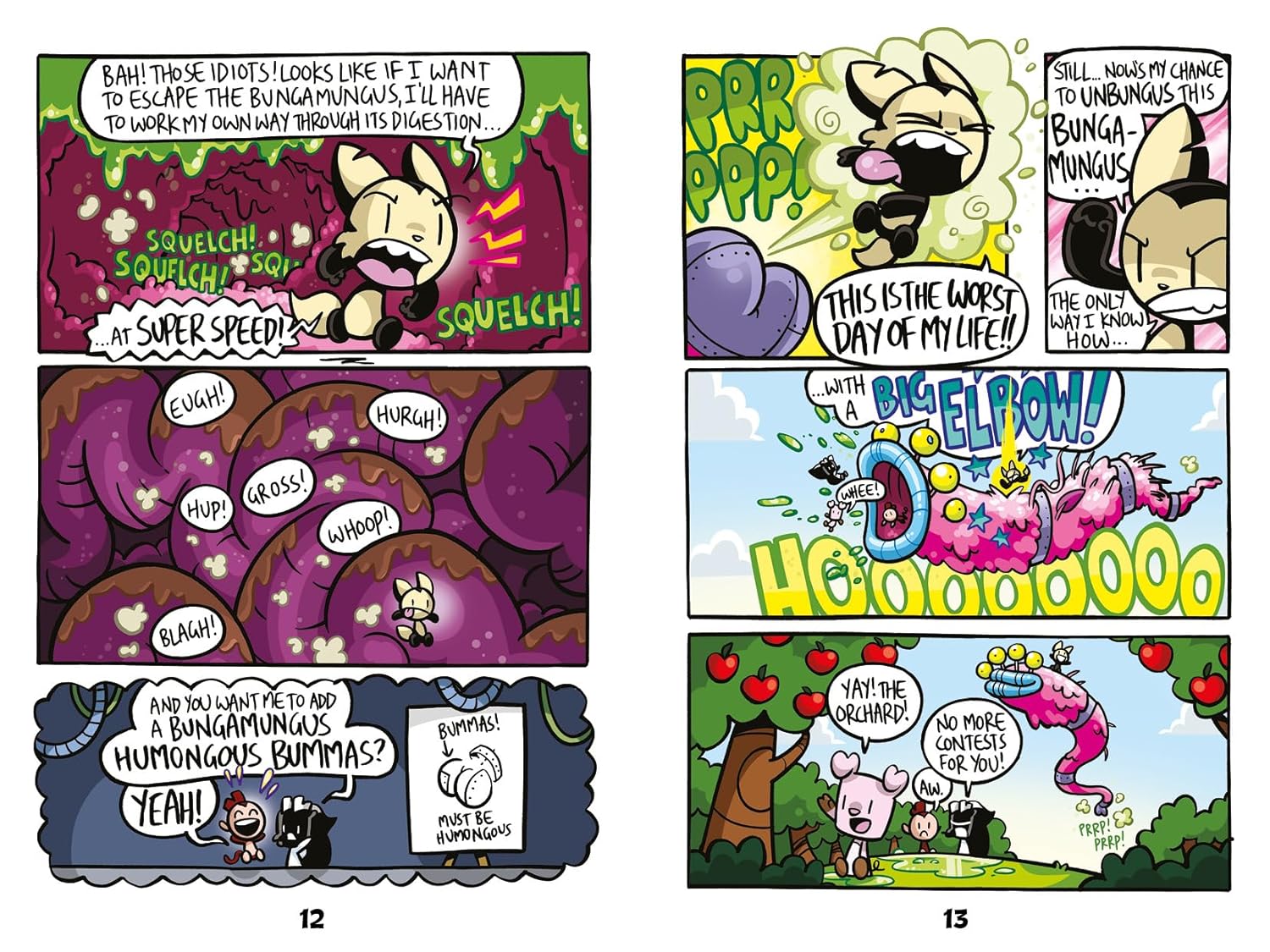
With propriety and good taste under attack (and soon in full retreat), the sensorial assaults resume in ‘Guts n’ Butts!’ as Monkey & Skunky debate the appalling assets and proposed “improvements” to the weaponised flatulence engine they call Bungamungus with no consideration of those in its path prior to the simian unleashing his own worst nightmare…

The giant ‘MonkeyBot 5000’ is supposed to make life hell for his fluffy white foe, but it appears Bunny can find plenty of uses for a mechanised personal organiser that can bench press trucks, topple buildings, file and colour co-ordinate…

Reality is rocked all over again when Monkey’s ‘Mum and Dad’ pop by for a visit and nice bit of tea, but nature’s innocents Weenie and Pig Piggerton are too busy having adventures with ‘Frogs!’ and their mystical king to really notice, whereas ‘Lucky… The Unluckiest Red Panda in the World!!’ stumbles into unbridled chaos (she’s used to it by now) when Skunky & Monkey decide to go through the forgotten inventions bin. Worried about declining productivity, the sinister science sinner then uses his 3D printer to unleash a horde of ‘Fun-Size Skunkies’ who are anything but, before Bunny learns where all the wreckage, rubbish and remains go when the latest catastrophe has finished unfolding. Sadly, there are good reasons nobody wants to see ‘Binbag Sam’ carry out his nasty but necessary job…

Always seeking peace and serene contemplation, mysterious Le Fox has found a wilderness to dig in, but when Monkey comes by and discovers gold in ‘Them Thar Hills’ that’s another dream dead, but only prelude to planet-shaking events when Skunky’s new signal array test coincides with Monkey’s latest eating challenge. ‘Message in a Butthole’ reveals how – after, inevitably – a monumental foofie erupts across the universe, the consequences will be appalling… but not at all unexpected.

In a fabulous tribute to Chuck Jones cartoons, ‘Monkey vs Ai’ sees the annoying ape test a bunch of inventions that should work “in theory”, before going back to stinky basics with a cheese cannon. Sadly, the anticipated “Cheesepocalyse” is definitively derailed by ‘The Turning of the Pig’ as pacifistic Piggerton reaches a limit and shows the monkey miscreant just what it all feels like…

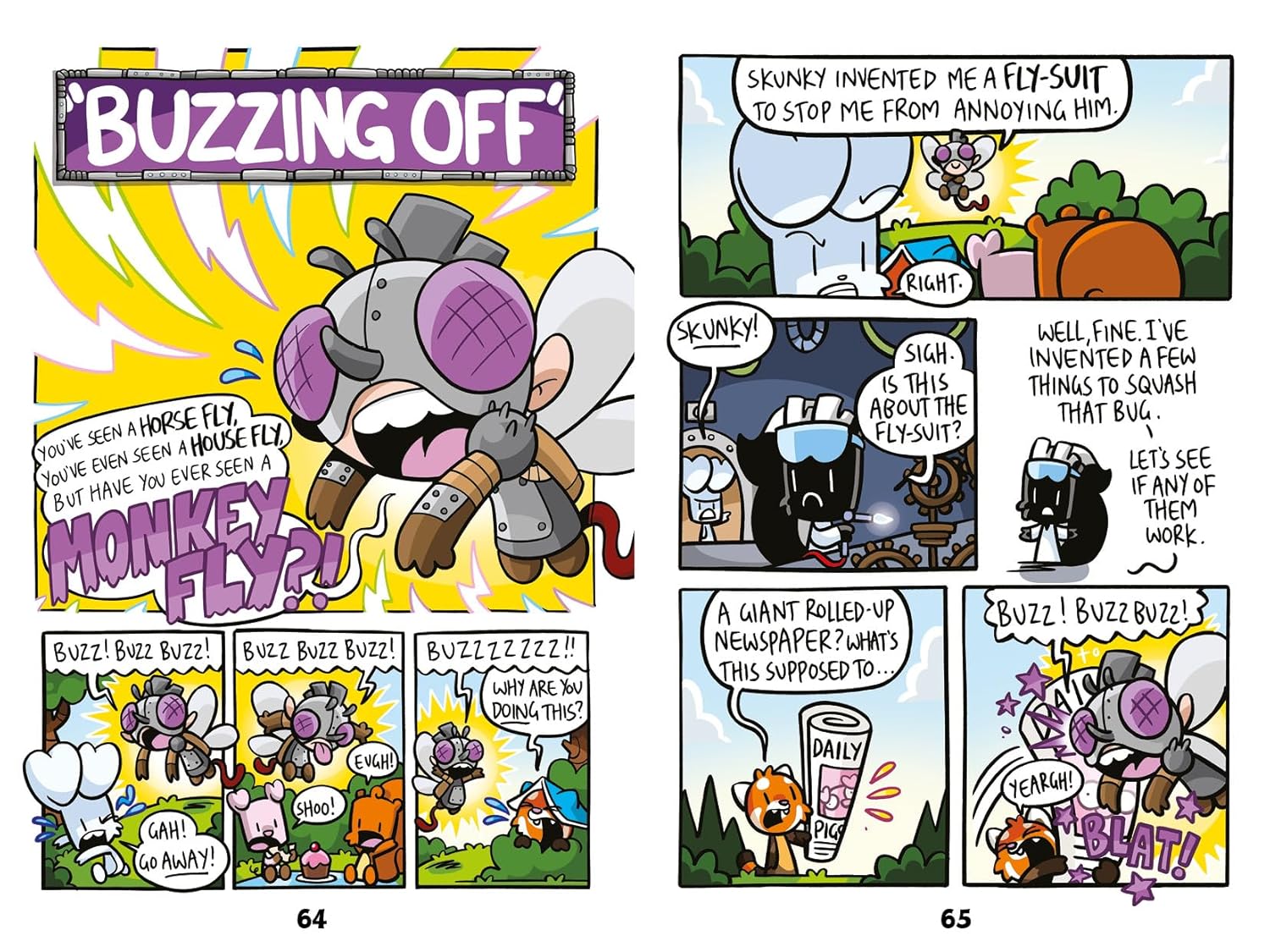
‘Buzzing Off’ sees Skunky testing ways to end the really annoying fly suit he built for his partner in chaos and then hiding along with everyone else in ‘Who’s Afraid of the Monkey’ when the simian simpleton gets really, really hungry. Eventually sated, the little sod resumes pranks & pestiferations with a giant robot in ‘Close Encounters of the Bird Kind’. Remember that olfactory beacon blasted across infinity? This is the moment something answers that unique clarion call…

Suddenly, in ‘You Looking at Me?’ Crinkle Woods are alive with alien weirdoes, but it’s just Skunky messing about with quantum physics and nothing to do with Monkey, because he’s currently hurtling to the other side of the Universe, testing to destruction the super-high-tech toilets of the extraterrestrials who abducted him…

He can’t be blamed for the astonishing void discovered by Pig and Weenie prompting the chilling question ‘What Lies Inside… the Hole?!’ or sensible but naïve robot Metal E.V.E.’s attempts to balance out Lucky’s cosmic misfortunes in ‘What Luck Befalls’, or even Metal Steve’s crisis of confidence and inexplicable desire to ‘Destroy’ because Monkey is currently spreading his brand of chaos while ‘Hitching a Ride’ on the ship of judgemental civilisation-eradicating superior being Grand Master Nexus…

Meanwhile on Earth, Skunky discovers the missing co-miscreant has left his life unfulfilled and dissatisfied and switches to a copy to serve his unsuspected emotional needs. ‘Little Monkey’ is feral, bitey, uncommunicative, un-potty-trainable and disgusting… such an improvement on the original! Enjoying his fresh start the evil inventor unleashes ‘A Clever Endeavour’ in the compulsive form of a malign puzzle box that baffles and bamboozles everyone – except the mini monkey who might just be the smartest thing in the woods now…

Pig’s penchant for peculiar pets sees the adoption of an odd avian Blue-bummed Bimblebug. Inappropriately dubbed ‘Parpy’, the critter’s 24-hour lifespan brings near-instant woe, and leads to the advent of colossal hermit savant Capybara 5000 whose answers to all the ‘Big Questions’ are unexpectedly violent. That search for truth culminates in sage advice ‘Run!’ before calm returns as Pig explores wild water rafting and Le Fox confronts increasingly sinister Little Monkey in ‘The Happiness of the Kitsune’.

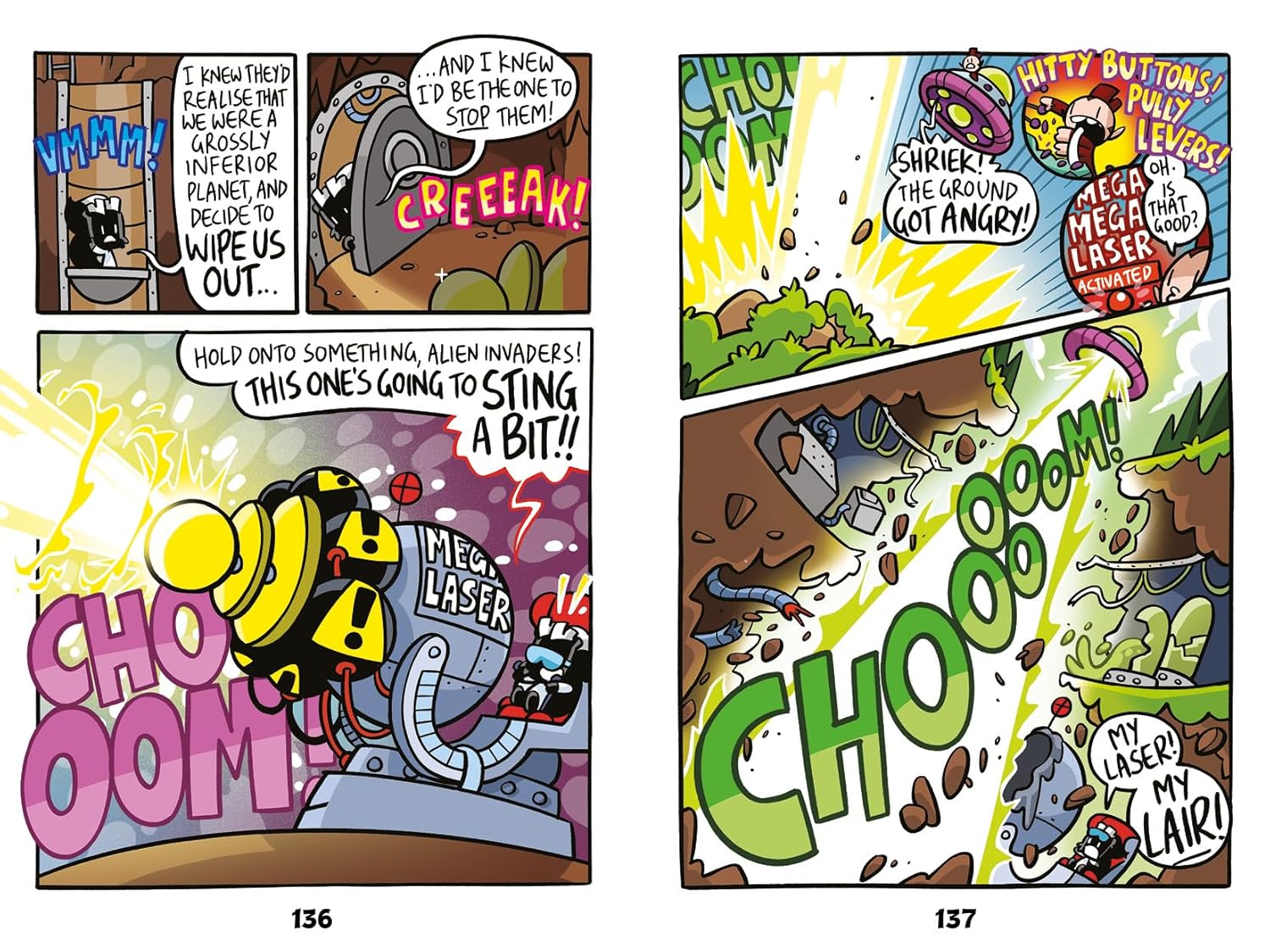
Far away in another beleaguered solar system, Monkey is slowly wearing down Nexus and his minions, before accidentally warping them all back to Earth to enjoy a spontaneous battle of ‘Rather Big Lasers’ with Skunky. When that eradicates the fuzzy mastermind’s secret underground lair all Skunky can think of is ‘Revenge’. With Little Monkey in tow the genius goes ‘On the Hunt’ in a unique battleship, pursuing ‘Space Wars’ even as his hirsute former best baddie buddy seizes control of the Nexus craft and drives it into ‘A Hella Interstellar Yeller’…

Marooned on a muddy morass world, Monkey establishes his dream dictatorship. Sadly, ‘Chutneyopia’ is right next to the equally barren planet Skunky crashed on and war is declared as the newcomer demands an apology that will never be forthcoming. Moreover, when Skunky took off after Monkey, most of Crinkle Wood went with him and as Bunny ruminates on ‘The Intergalactic Adventures of Weenie and Cinnamon Bun Pig!’, plans are underway to terraform the barren planetoid into ‘A New Home’. Unfortunately that’s being undertaken by ‘Even More Skunkies’…

With the enemy busy converting Chutneyopia into his other, better dream of Monkeyopia, ‘A New Plan’ is needed, but the still-active Grand Master finally concedes that its superior mentality and firepower are no match for the annoying Earth ape. With its minions in revolt and resolved to blow up Earth, there nothing left for Monkey to worry about ‘Apart from the Bomb’ that’s going to end his grotty mucky dream world…

What better time for a reconciliation with Skunky?

Back on Earth, other Crinkle Wood critters have briefly but wholeheartedly enjoyed a time of growth and limelight in ‘Not Bunny vs Monkey’ but the likes of Stan Stoat and Randolph Raccoon are helpless when the minions start blasting. As Monkeyopia becomes a vast spaceship, Skunky begins his ‘Race to Save the World’ with his secret weapon Little Monkey, but the outcome is never certain and our heroes all decide they’re ‘Best Off Out of It’, leaving a monumental deus ex machina to sort everything out…

Wrapping up these sidereal shenanigans and cosmic bum gags are related activities offered under the aegis of the Phoenix Comics Club. Bring paper, pencils and yourself to a compact online course in all aspects of comic strip creation supervised by Jamie Smart & Armin Roshdi detailing ‘How to draw King Frog!’, ‘A Bungamungous!’, ‘Capybara 5000!’ and ‘An Alien!’ before closing with an extensive plug for the Phoenix Comics Club website, complete with instant access via a QR code, plus previews of other treats & wonders to be seen in The Phoenix to wind down from all that cosmic kerfuffle…

Another book for your kids to explain to you, Bunny vs Monkey: Intergalactic Monkey Business! is weird wit, wild invention, potent sentiment and superb cartooning all crammed into one eccentrically excellent package. These tails never fail to deliver jubilant joy for grown-ups of every vintage, even those who claim they only get it for their kids. Is that you?
Text and illustrations © Fumboo Ltd. 2025. All rights reserved.

Today in 1923 comics artist and strip cartoonist Dan Barry (Airboy, Doc Savage, Tarzan, Flash Gordon) was born, with British whiz kid Phillip Bond (Wired World, Angel and the Ape, Kill Your Boyfriend, Vimanarama) turning up in 1966 and artist Eric Battle (Kobalt, Hardware, The Spectre) born in 1967.

Today in 1975 author and cartoonist Crockett Johnson (Barnaby, How to Make an Earthquake, Harold and the Purple Crayon) died.

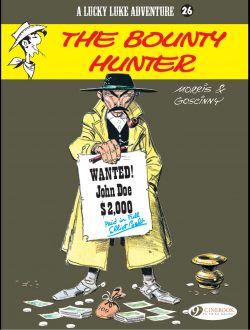
Lucky Luke volume 26: The Bounty Hunter


By Morris & Goscinny (Cinebook)
ISBN: 978-1-84918-059-7 (Album PB/Digital edition)

This book includes Discriminatory Content produced in less enlightened times. This book also includes Discriminatory Content added for comedic effect.

Time for a big Birthday bash…

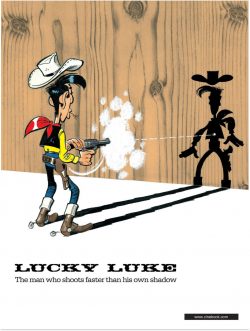
Created by Belgian animator, illustrator and cartoonist “Morris” (AKA Maurice de Bévère), Lucky Luke debuted in the summer of 1946, initially riding out in Le Journal de Spirou in mid-summer sans title or banner, and only in the French-language edition. The Lone Rider’s official launch came in Christmas Annual L’Almanach Spirou 1947, before beginning his first official serial – ‘Arizona 1880’ – in 1946’s multinational weekly issue for December 7th. Doughty, dashing, dependable cowboy “good guy” Lucky is a rangy, implacably placid do-gooder able to “draw faster than his own shadow”. He amiably ambles around the mythic Old West, having light-hearted adventures on his petulant and rather sarcastic wonder-horse Jolly Jumper.

For 80 years (Joyeux anniversaire, Mon Brave!), his exploits have made Lucky a top-ranking global comic icon, filling more than 90 individual albums and spin-off series like Kid Lucky and Ran-Tan-Plan, with sales well north of 300 million copies in 30 languages. That renown translated into a mountain of merchandise, toys, games, animated cartoons, TV shows and live-action movies and even commemorative exhibitions. No theme park yet, but you never know…

After a relatively slow start for such a fast gun, Lucky’s global dominance came via a decades-long collaboration with superstar scripter René Goscinny. The official partnership spanned Des rails sur la Prairie/Rails on the Prairie (beginning August 25th 1955) to La Ballade des Dalton et autres histoires/The Ballad Of The Daltons And Other Stories in 1986, during which time (in 1967) the sixgun straight-shooter switched teams, transferring to Goscinny’s own magazine Pilote with La Diligenc/The Stagecoach.

Goscinny produced 45 albums with Morris before his death, after which Morris continued both singly and with other literary pardners, before recruiting a posse of legacy creators including Lo Hartog van Banda, Achdé & Laurent Gerra, Xavier Fauche, Benacquista & Pennac, Jean Léturgie, Jacques Pessis and more, who all took their own shots at the venerable vigilante. Morris soldiered on until his own death in 2001, having drawn fully 70 adventures, plus numerous sidebar and spin-off sagebrush sagas.

His grande idée draws on western history less than movie mythology, but our heroes still regularly meet historical figures as well as even odder fictional folk in tales drawn from key themes of classic cowboy lore – as well as some uniquely European notions or interpretations such as seen here. As previously hinted, our sixgun star is not averse to being a figure of political change and Weapon of Mass Satire, but here spoofs his own antecedents and wallows in venerated movie schtick for a delicious drive down memory lane and game of cowboys and imbeciles…

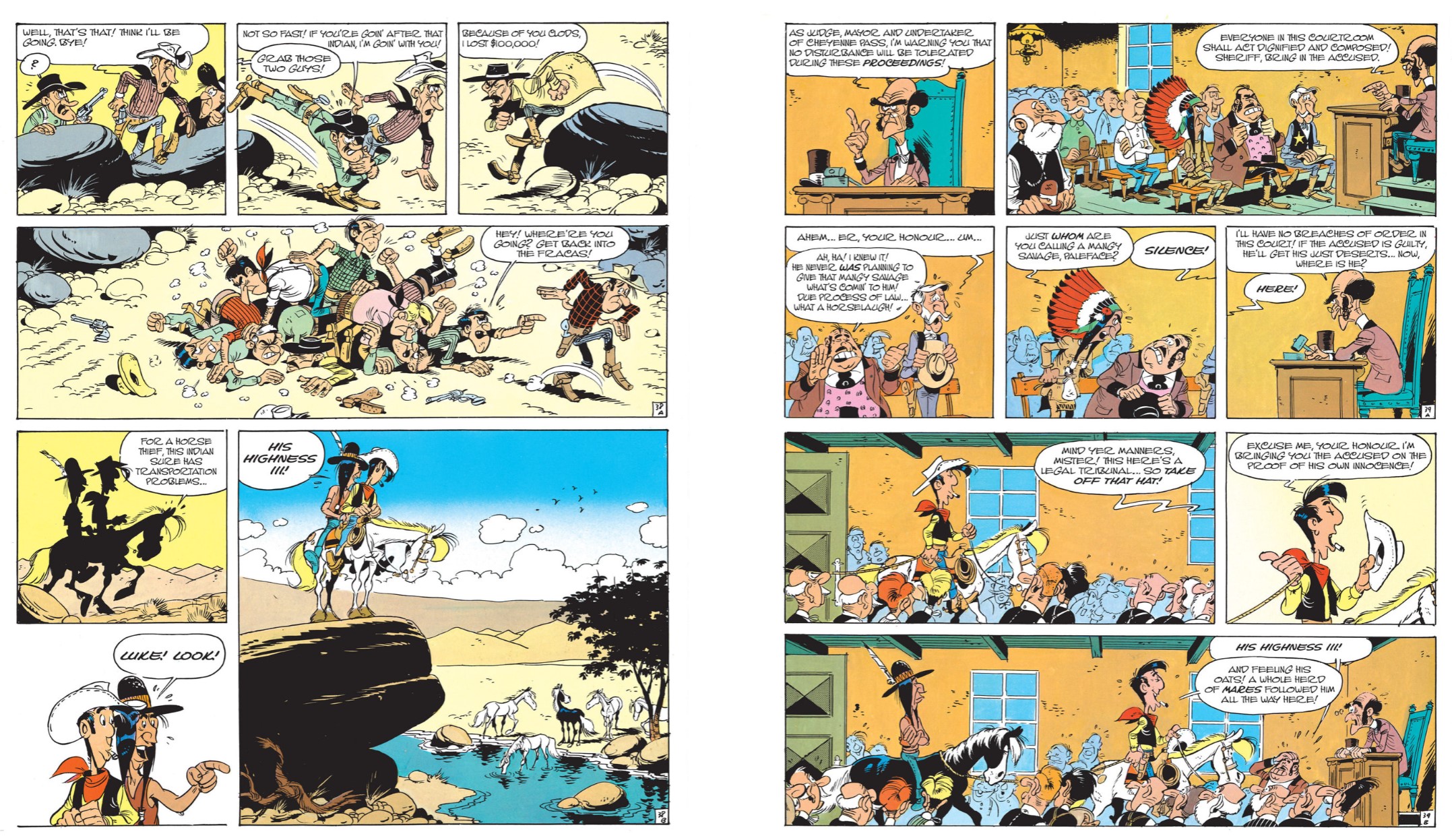
In the ‘50’s Goscinny had started scripting Lucky uncredited. Morris had taken almost a decade to fill nine albums with affectionate sagebrush parody, action and Lucky Laughs, but when Goscinny was deputised as wordsmith, Luke was seen more often and rapidly attained dizzying heights of super swift superstardom. Moreover, his hits just kept coming. Chasseur de primes was the 39th European album, having been seen serially in weekly Pilote from #658 to 679, spanning June 15th to November 8th 1972. In 2010 as The Bounty Hunter, it became Cinebook’s 26th English-language volume of hilarious horsefeather history. As always, Morris drew from a deep shared well of visual and cinematic motifs and here tips his hat to the then-new phenomenon of “spaghetti westerns” as the unmistakable image of Lee Van Cleef makes it onto Lucky’s graphic gallery and most Unwanted list…

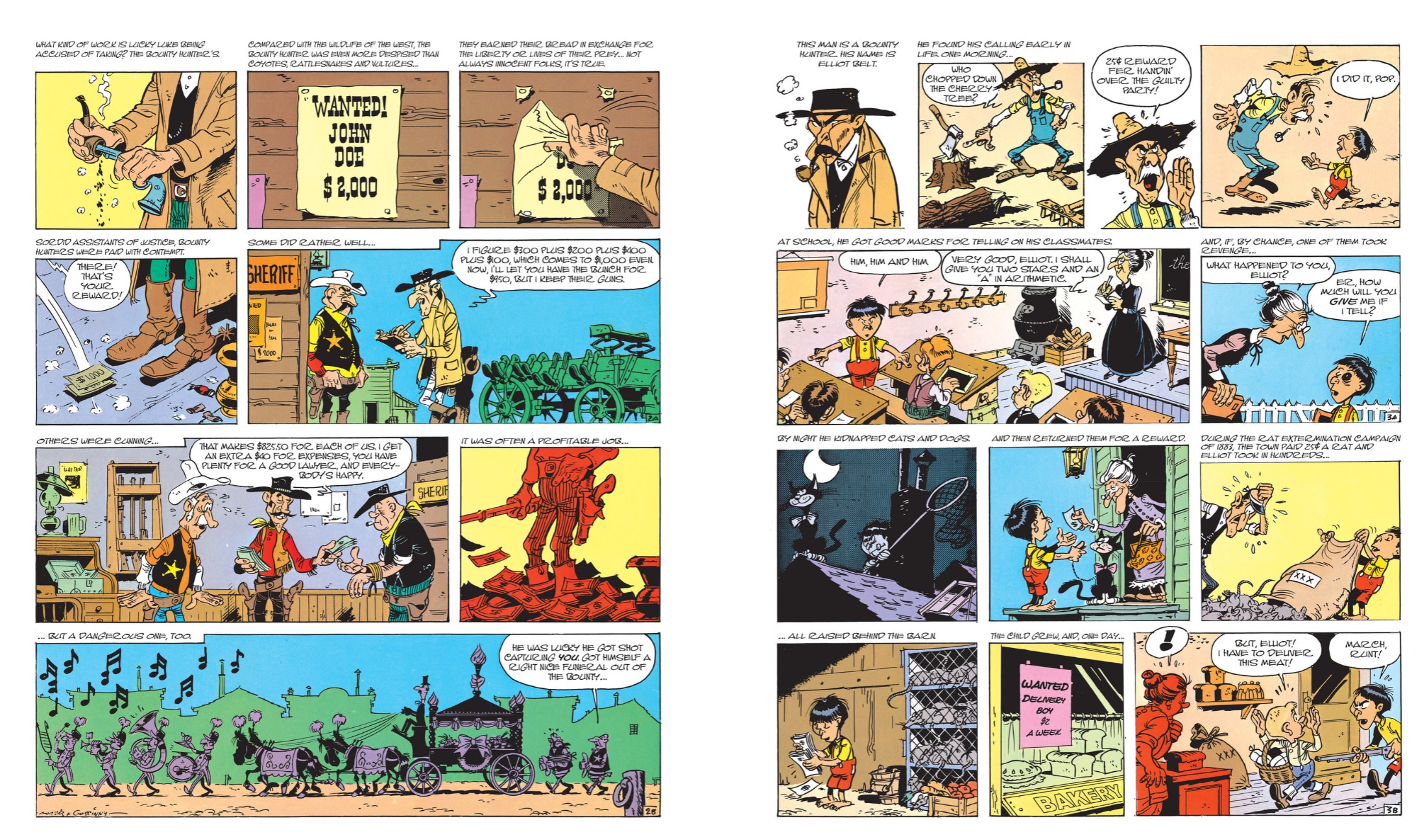
More an assemblage of themed and interlinked skits than a full feature, The Bounty Hunter is unsavoury stalker/reward-obsessed killer-without-a-badge Elliot Belt who derives far too much joy from collecting fees and even bigger thrills and obscene jollies from hunting down legalised  prey… like anyone he sees on a wanted poster.

Despised by all and not caring one whit, his life and dark joys are forever spoiled when he arrives in Cheyenne Pass and sees Lucky Luke capturing felons. When the stalwart refuses the reward and gives it to charity, Belt slips into murderous madness after realising his cheery, unsuspecting rival is a better gunslinger than him but refuses to kill anyone…

The intolerable situation worsens when super-rich, horse-mad rancher Bronco Fortworth puts a private $100,000 bounty on the head of his Cheyenne farmhand Wet Blanket, who has gone missing at the same time as the plutocrat’s immensely valuable new stud steed His Highness. Without any evidence or recourse to real lawmen, Fortworth will pay anyone who uses ANY means to bring the missing Cheyenne back to him to personally hang…

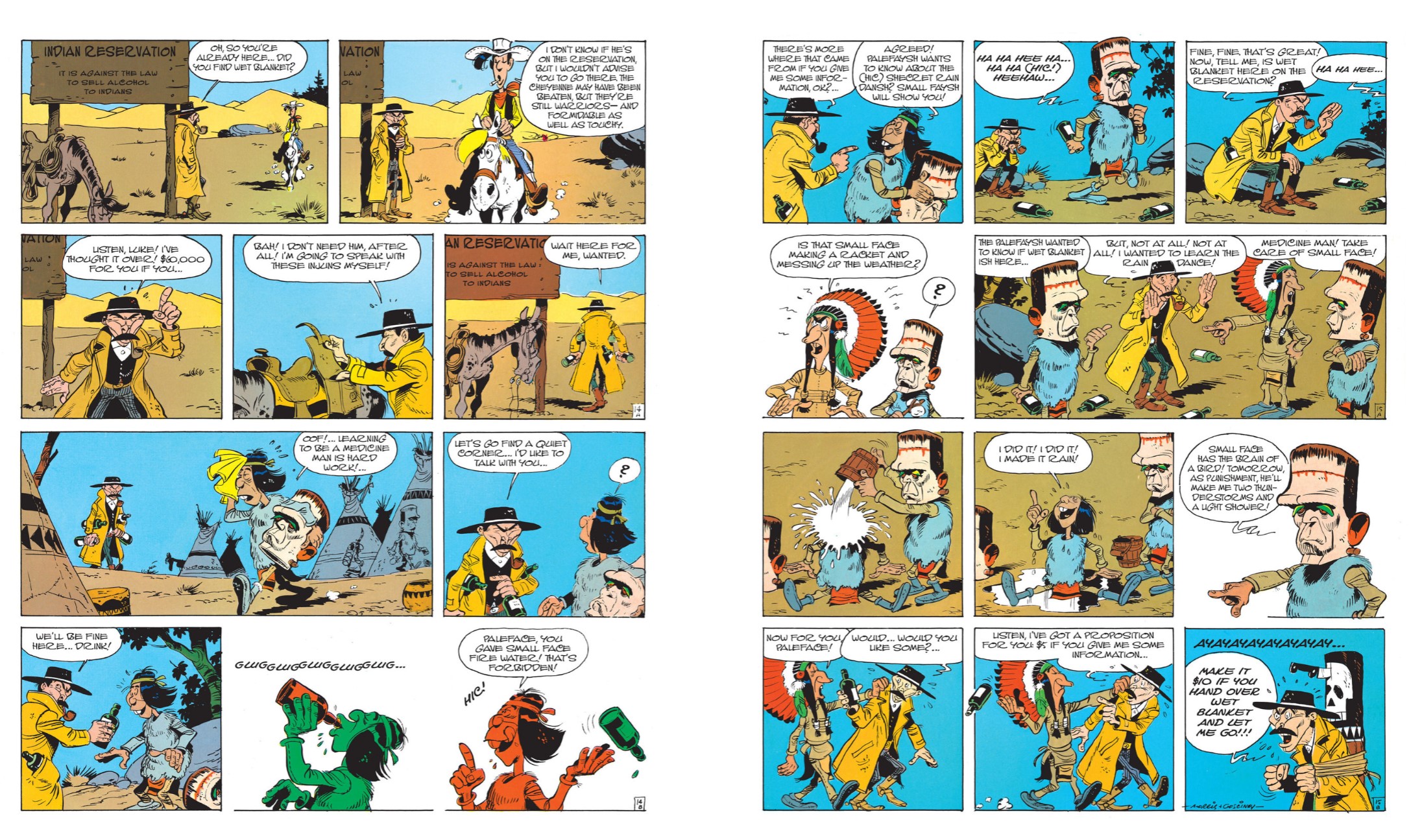
After failing to join forces or partner up with Lucky – who is convinced Wet Blanket is innocent and wants to avoid another Indian war – Belt infiltrates the local Reservation to ply the residents with booze and worse in hopes of finding the missing stable hand. They don’t care about any of the white man’s nonsense but can’t get past their highly developed commercial instincts, weird rituals and trashy tourist traps…

Belt does, however, convince entrepreneurial wizard Chief Little Fish Knife to hold Lucky hostage (twice!) and terrorise the town (mostly just the saloon, actually) but Luke is hard to hold and ultimately, when all else fails, Belt grudgingly recruits a small army of other (lesser) bounty hunters, all the while plotting to cheat them out of their fair shares…

Events are completely out of control when Wet Blanket obliviously returns from his vacation and immediately joins Luke in stopping the bounty hunters-inspired “Indian uprising” just as the never-vigilant US cavalry turn up where they’re not wanted to heap coals on a growing wildfire sparked by Belt and Bronco Fortworth…

Through deft manipulation Lucky de-escalates the situation and even finagles a proper day in a real court for all concerned. As His Highness is discovered romping with a herd of wild mustangs, what really happened to the so-valuable steed is shockingly revealed by the one person nobody expected to be involved…

Pursued by his betrayed hirelings and “cheated of his rightful reward”, Elliot Belt finally goes too far even for western justice and at last learns what it means to be the face and name on a wanted poster…

As much barbed morality play as rowdy light thriller, this yarn again proves how crucial great villains are to any hero. These tall-to-small tales are perfect for kids with a smidgen of historical perspective and social understanding, although the action and surreal slapstick situations are no more contentious than any Laurel and Hardy film; perfectly understandable as Morris was a huge fan of the duo. These forcefully foolish forays are a grand old hoot in the tradition of Destry Rides Again or Blazing Saddles, superbly executed by master storytellers and a perfect introduction to a unique genre for anyone who might well have missed the romantic allure of the Wild West that never was.
© Dargaud Editeur Paris 1972 by Goscinny and Morris. © Lucky Comics. Published in 2010 by Cinebook Ltd.

Today in 1887, Flemish comics writer Raymundus Joannes de Kremer AKA Jean Ray AKA John Flanders (Malpertuis, Whisky Tales, Ghouls in My Grave) was born, sharing the day with artist Irwin Hasen (Wildcat, Green Lantern, Dondi) in 1918; “father of seinen manga” Shinji Nagashima in 1937; horrorist, author and educator Mort Castle in 1946; Belgian creator Philippe Liégeois AKA Turk (Clifton, Léonard, Robin Dubois) in 1947; illustrator Stan Woch (Airboy, The Sandman, Swamp Thing) in 1959 and Whilce Portacio (X-Factor, Iron Man, Wetworks) in 1963.

The date saw the launch of Alex Graham’s Fred Bassett strip in the UK’s Daily Mail in 1963; the final appearance of the original Buck Rogers strip in 1967 and the deaths of The Katzenjammer Kids creator Harold Knerr in 1949; King Features Editor Sylvan Byck in 1982; Underground Commix pioneer Clay Geerdes (Comix World) in 1997 and Firehair, Captain Wings, Tarzan, Li’l Abner and Long Sam illustrator Bob Lubbers in 2017.

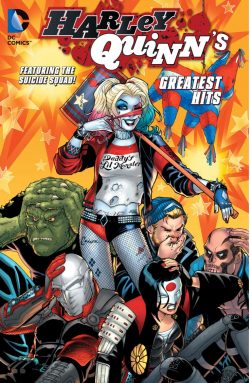
Harley Quinn’s Greatest Hits


By Scott Beatty, Kelly Puckett, Jeph Loeb, Paul Dini, Adam Glass, Scott Snyder, James Tynion IV, Amanda Conner, Jimmy Palmiotti, Rob Williams, Bruce Timm, Mike Parobeck, Jim Lee, David Lopez, Federico Dallocchio, Jock, John Timms, Sean “Cheeks” Galloway, Scott Williams, Sandra Hope, Richard Friend & various (DC Comics)
ISBN: 978-1-4012-7008-7 (TPB/Digital edition)

This book includes Discriminatory Content produced in less enlightened times.

Harley Quinn wasn’t supposed to be a star – or even an actual comic book character. As would soon become apparent however, the manic minx had her own off-kilter ideas on the matter. Created by Paul Dini & Bruce Timm, Batman: The Animated Series aired in the US from September 5th 1992 to September 15th 1995. Ostensibly for kids, the breakthrough TV cartoon revolutionised everybody’s image of the Dark Knight and immediately began feeding back into the print iterations, leading to some of the absolute best comics tales in the hero’s many decades of existence.

Employing a timeless visual style dubbed “Dark Deco”, the show mixed elements from all eras and aspects of the character and, without diluting power, tone or mood of the premise, reshaped the grim avenger and his extended team into a wholly accessible, thematically memorable form that the youngest of readers could eagerly enjoy, whilst adding shades of exuberance, sophistication and sheer panache that only most devout and obsessive Batmaniac could possibly object to…

Harley was first seen as the Clown Prince of Crime’s slavishly adoring, abuse-enduring assistant in Joker’s Favor (airing on September 11th 1992) wherein she instantly captured the hearts and minds of millions of viewers. From there on she began popping up in the licensed comic book and – always stealing the show – soon graduated to mainstream DC continuity.

After a period bopping around the DCU she was re-imagined as part of the company’s vast post-Flashpoint, major makeover and appeared as part of a new iteration of The Suicide Squad. Now, with numerous motion picture, TV animation and live action small screen presence in play, it’s absolutely time to take a look at her eccentric career path…

Collecting material from Countdown to Final Crisis #10; Batman Adventures #12; Batman #613; Gotham City Sirens #7; Suicide Squad #1; Batman vol 2#13, Harley Quinn vol. 2 #21, 2015 and Harley Quinn and the Suicide Squad April Fools Special #1, the madcap mayhem commences with a 2-page potted biography of the mad miss in comics form.

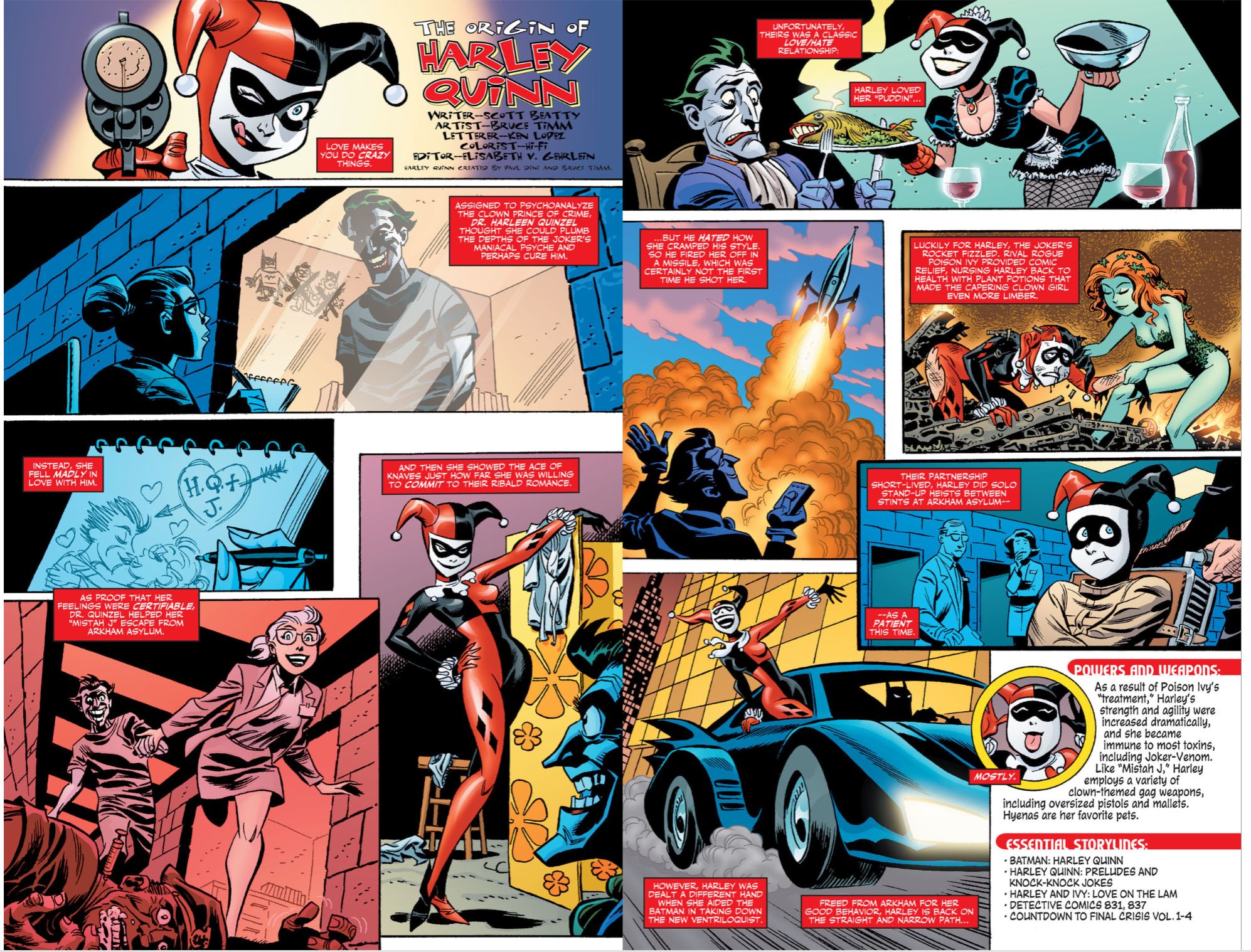
Crafted by Scott Beatty & Bruce Timm, ‘The Origin of Harley Quinn’ (Countdown #10, February 2008) economically reveals how troubled psychologist Dr. Harleen Frances Quinzel arrived at Arkham Asylum to analyse The Joker only to lose all distance and perspective. Fully falling under his malign spell during interviews, she became his adoring, pliable and utterly despised slave…

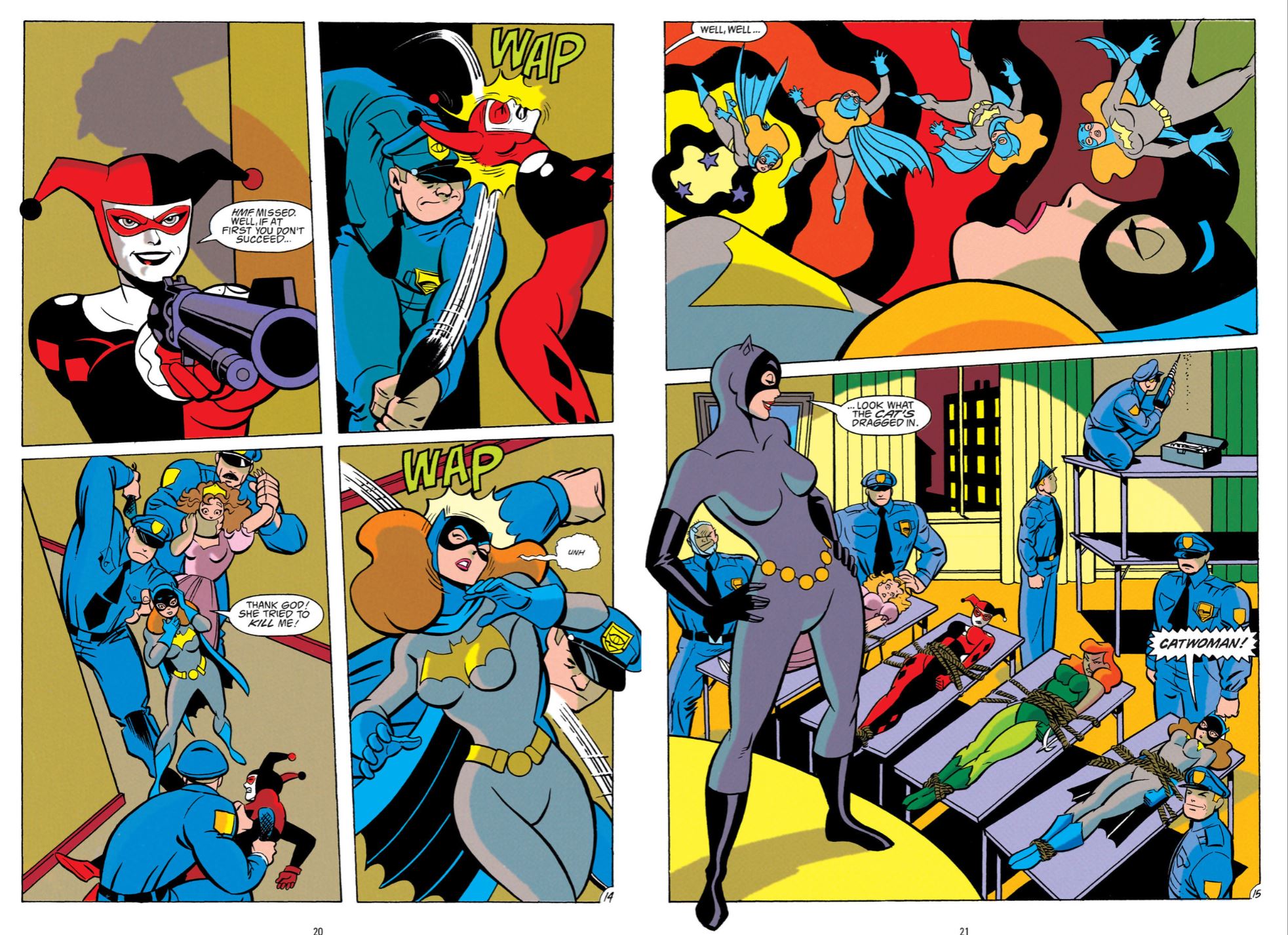
A classic and classy semi-solo yarn comes from Batman Adventures #12, (September 1993) where Kelly Puckett, Mike Parobeck & Rick Burchett revealed how Barbara Gordon became a masked adventurer. Student Babs makes a superhero costume for a party in ‘Batgirl: Day One!’ before stumbling into a larcenous ‘Ladies Night’ when that High Society bash is crashed by rapacious gal pals Harley Quinn & Poison Ivy. With no professional help on hand, Miss Gordon must act as ‘If the Suit Fits!’ and tackle the bad girls herself , only to see Catwoman show up for the frantic finale ‘Out of the Frying Pan!’…

A far darker if less comprehensible interpretation graced Batman #613, (May 2003 by Jeph Loeb, Jim Lee & Scott Williams) as an incessant parade of villains du jour in Bat mega-event Hush sees The Joker and Harley invade ‘The Opera’ attended by Bruce Wayne and hidden master villain Tommy Elliot. It’s visually resplendent and shockingly violent, but story content is virtually zero since the entire farrago is just an extracted episode from a far larger and more complex epic. Go read that instead or as well…

Far more satisfactory, ‘Holiday Story’ is by Dini, David Lopez & Alvaro Lopez (Gotham City Sirens #7, February 2010). Here, new housemates Harley, Ivy & Catwoman split up to celebrate Christmas in their own uniquely different ways. This tale is a candid peek into the home-life and history which turned dead-end kid Harleen into an overachieving doctor, athlete and, latterly, lunatic supervillain by introducing the inveterate slimeball who fathered her…

Hitting modern times hard, ‘Kicked in the Teeth’ comes from Suicide Squad #1 (vol. 4, November 2011), wherein Adam Glass, Federico Dallocchio, Ransom Getty & Scott Hanna put Harley, Deadshot, Black Spider, King Shark, El Diablo, Voltaic and Savant through hell and torture as mere preparation for their first mission for top spook Amanda Waller whilst ‘Tease’ (Batman vol. 2, #13, December 2012 by Scott Snyder, James Tynion IV & Jock) sees Harley reunited with her maniac main man, only to once again suffer from the pernicious, vindictive whimsy and twisted love of the Joker…

‘Tug A’ War’ (Harley Quinn vol. 2, #21, December 2015 by Amanda Conner, Jimmy Palmiotti, John Timms) finds Harley Quinn a bounty hunter battling former squad-mate Deadshot and setting Hollywood ablaze as she seeks top cash-cow Sparrow Adaro. Things quickly go south when she discovers her target is no crook, simply the wayward spouse of a Showbiz bigwig who only wants his little lady back. Their twisted relationship touches Harley’s heart and she resolves to help, but the former psychologist never expected so many collateral corpses to accrue as she “fixed” the not-so-happy family…

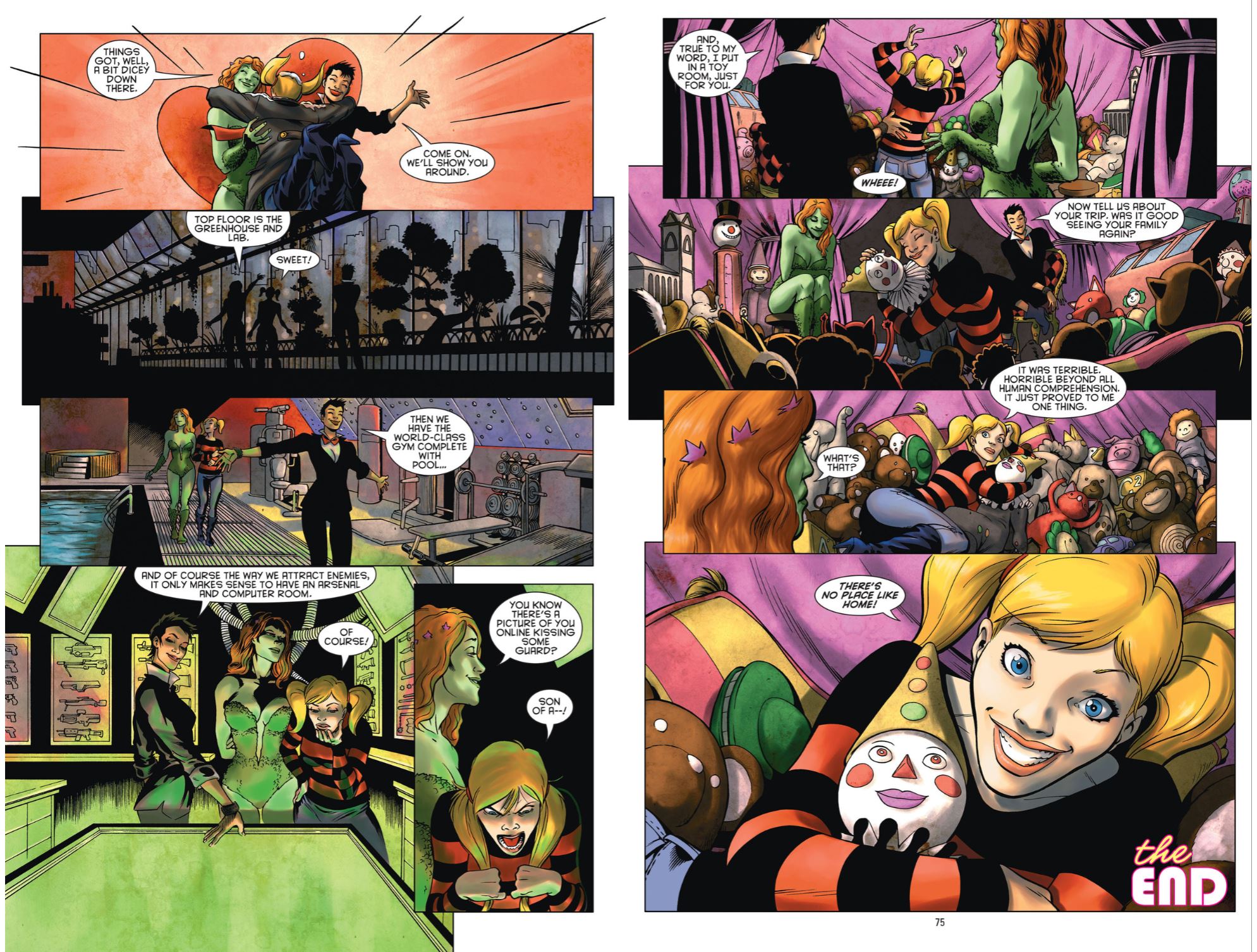
This rough & ready compilation concludes with collaborative effort ‘Evil Anonymous’ from Harley Quinn and the Suicide Squad April Fools Special #1, 2016. Courtesy of Rob Williams, Jim Lee, Sean “Cheeks” Galloway, Scott Williams, Sandra Hope & Richard Friend this is a light-hearted, self-referential journey of discovery wherein Harley – prompted by another brush with The Joker – attempts to “cure” a number of her fellow criminal killer loons, beginning with bestial winged predator Man-Bat…

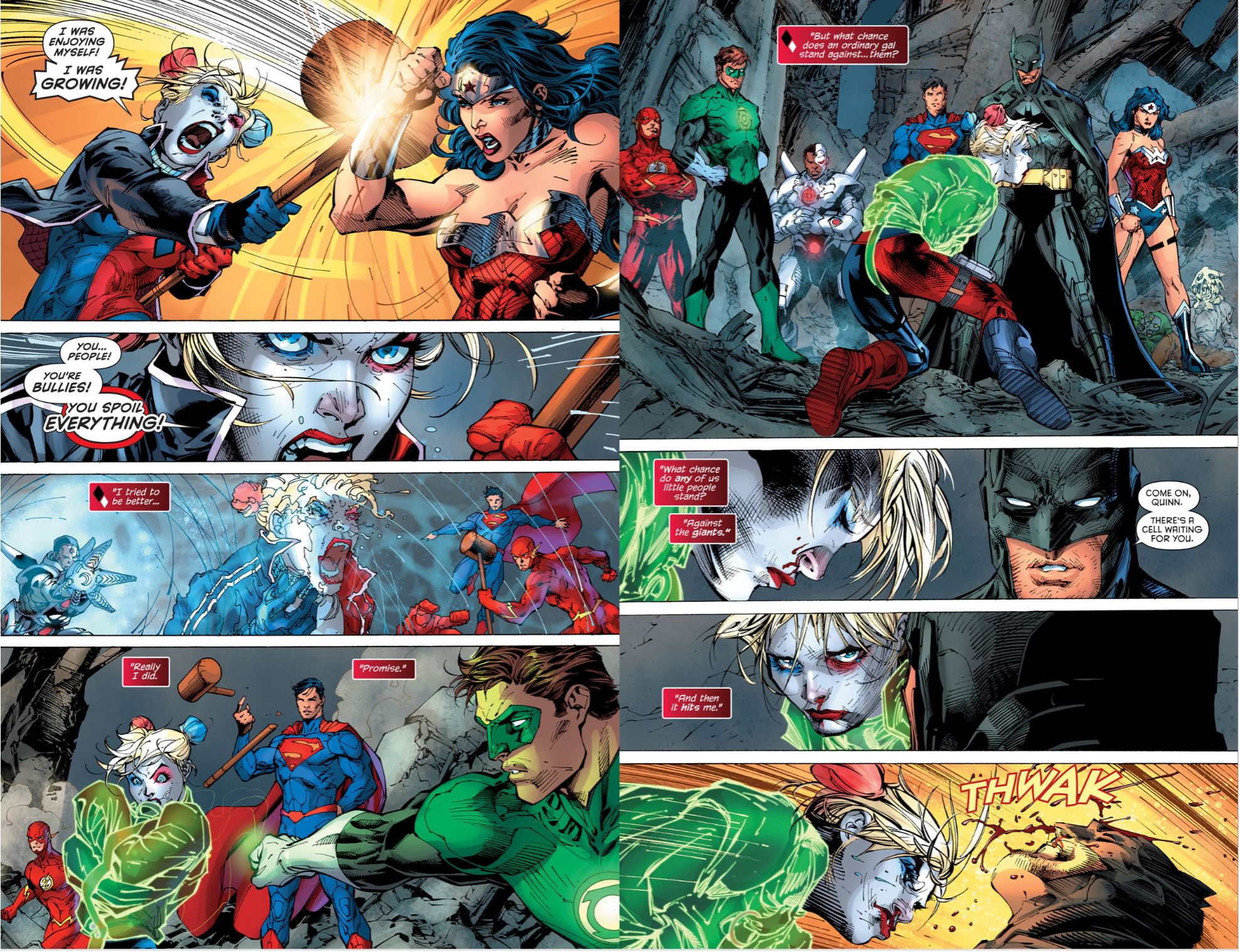
Soon, she’s reverted to a childlike state to tackle Killer Moth, Enchantress, Rat Catcher, Toyman and Poison Ivy, although things get a little out of hand when she gets Scarecrow on her couch and goes crazy serious when the Justice League step in. Nobody involved is aware of the insidious mastermind actually pulling the strings to get Harley Quinn back to where she really belongs… and is most needed…

Fast, furiously funny, often unnecessarily dark and making precious little narrative sense, Harley Quinn’s Greatest Hits is nonetheless a potent primer of Fights ‘n’ Tights furore that will give newcomers a taste of what the motley minx can do and should whet appetites for a deeper exploration of her anarchic exploits.
© 1993, 2003, 2008, 2011, 2012, 2015, 2016 DC Comics. All Rights Reserved.

Today in 1920 Golden Age artist Al Avison (Captain America, The Whizzer, Joe Palooka, The Green Hornet, Little Dot) was born, followed by Al Wenzel (Adventure Comics, Superboy) in 1924, an Oh My Goddess creator Kosuke Fujishima in 1964. One year later the amazing Mike Parobeck (JSA, Batman Adventures) arrived, sharing the day with editor/cartoonist Jordan B. Gorfinkel (Batman: No Man’s Land, Everything’s Relative), with artists Juan Vlasco (Spider-Boy, Cable) coming in 1968 and Evan “Doc” Shaner (Strange Adventures, Flash, Aquaman) born in 1985.
In 1958 today Anthony Hern & John McLusky’s James Bond strip debuted in the UK’s Daily Express, whilst in 1978, The Walt Disney Company won its copyright infringement lawsuit against underground comix outfit the Air Pirates. In 1997 Jerry Scott & Jim Bergman’s strip Zits launched, and in 2002, the last episode of Modesty Blaise was published.

Today in 1977, legendary pioneering strip cartoonist Roy Crane (Wash Tubbs, Captain Easy, Buz Sawyer) died.

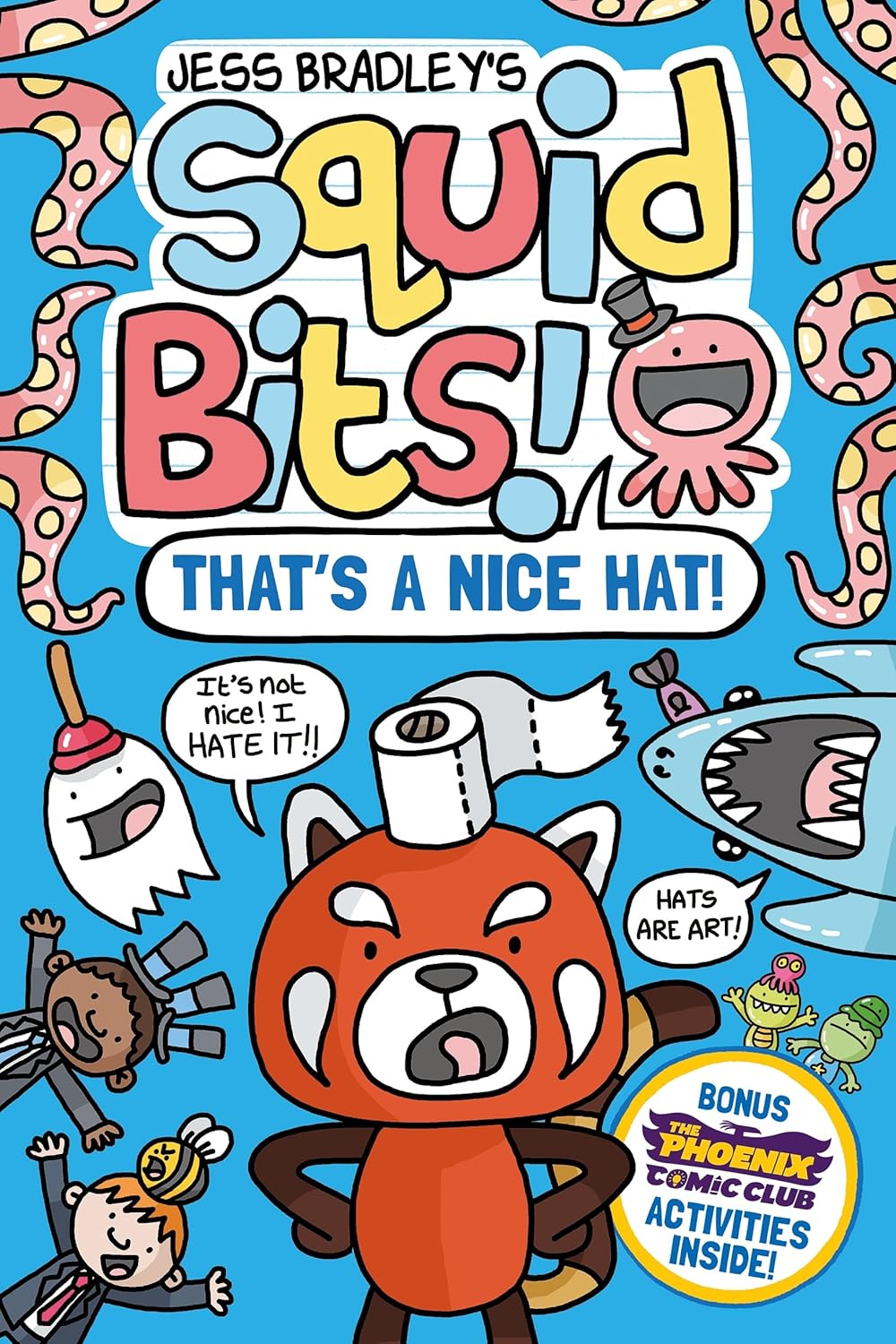
Jess Bradley’s Squid Bits! : That’s a Nice Hat!


By Jess Bradley with Emily Kimball, Kate Brown & various (DFB/Phoenix)
ISBN: 978-1-78845-395-0 (TPB)

The Phoenix has been the shining saving grace of traditional British kids’ comics since 2012, regaling rabid readers with anthology strips for girls, boys and all points between, offering humour, adventure, quizzes, puzzles and educational material in a joyous parade of cartoon fun and fantasy. Although pretty strong in its action and mystery yarns, the publication is probably best known for its award-winning comedy stylings, and has always offered perplexing pages of puzzles, fun facts and info downloads in cartoon form.

And then there’s Squid Bits.

Concocted by Jess Bradley (Comic Strip Science series, Super Dweeb, A Day in the Life of…), the composite self (un)help feature offers advice, suggestions, recipes, style tips, listicles, little snippets of information and much more by dredging up (more like making up!!!) countless tips from all human knowledge: history to astrology, science to economics, baking to nonsense and beyond. These articles are all purportedly supplied by mystery cartoonist The Squid and THEY CANNOT BE TRUSTED!

At the height of the Ritalin* Generation and after years of periodical dis, mis and even hiss information (there’s lots of stuff on lizards and reptiles) across many pages of octopoidal excess, the mix-&-match wonderment and sheer randomised inventiveness – undoubtedly sparked by an excess of imagination and too much tea and confectionary – has been compiled and curated into an almanac of absurdity, unleashed upon the reading public as Jess Bradley’s Squid Bits: That’s a Nice Hat. The perpetrators even have the temerity to threaten more books coming!

The seemingly utilitarian assemblages of pictorial bric-a-brac are manipulated and wrangled on-page by a Greek chorus of stick-figure doodles called “The Doodles” (individually Dog, Cat, Lizard, Rabbit, Mouse & Goat) seeking to please, placate and ingratiate their multi-tentacled Master/Benefactor/Employer. However, as the graffiti gang introduce themselves in an introductory chapter, old rivalries emerge and the linear sextet are consumed by millinery madness. From this point onwards all six lie, cheat, create, purloin, commandeer, otherwise obtain and steal – especially steal – a succession of staggering titfers and chapeaus to impress their unseen overlord.

Amidst and in between all bouts of hat madness and 2-dimensional personal quests for validation, a vast selection of exemplary, data-drenched drawings from the Squid Bits feature bombards your-ever-expanding brainpan, technically making you smarter, but absolutely no use at all in any kind of crisis…

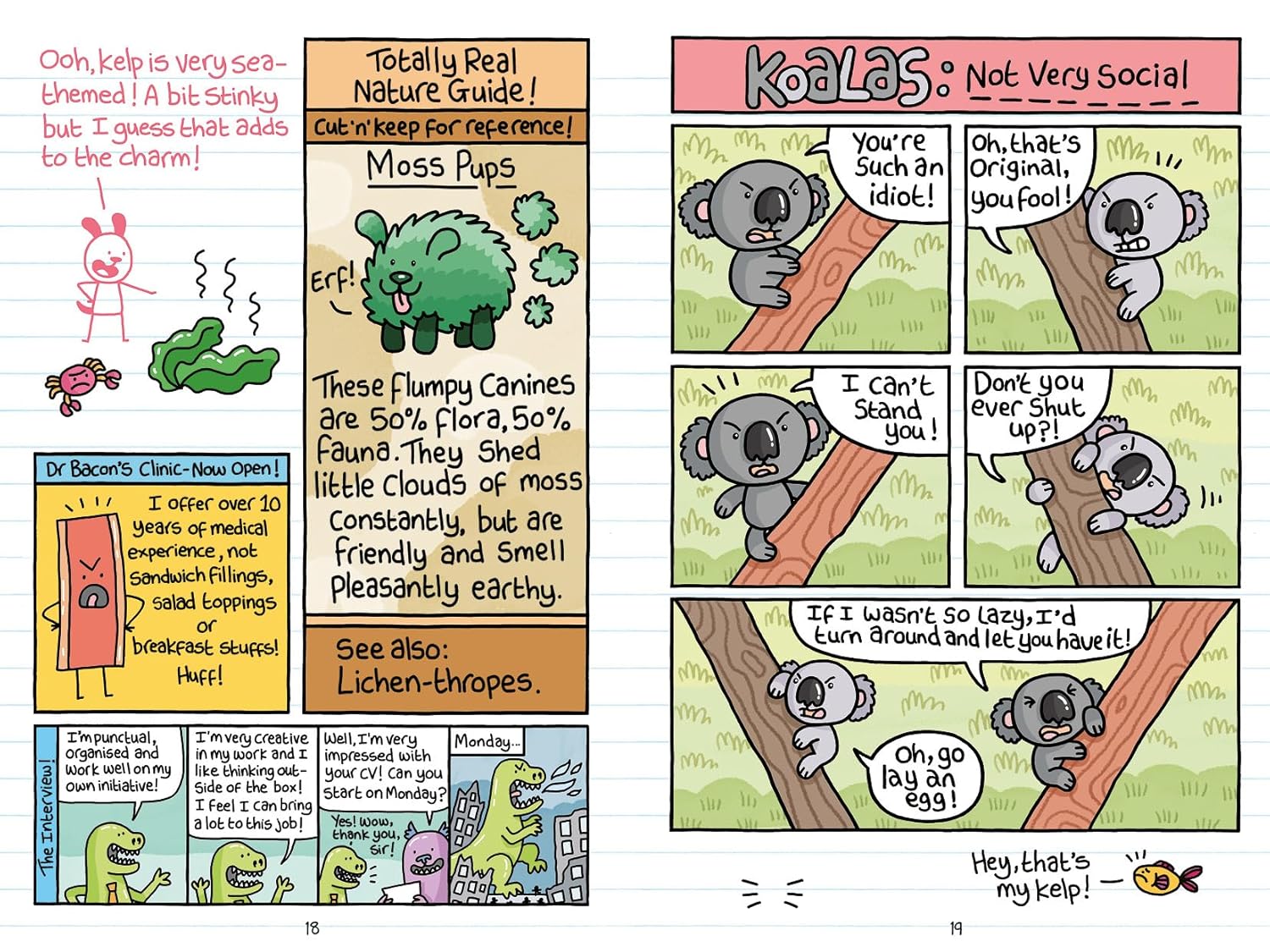
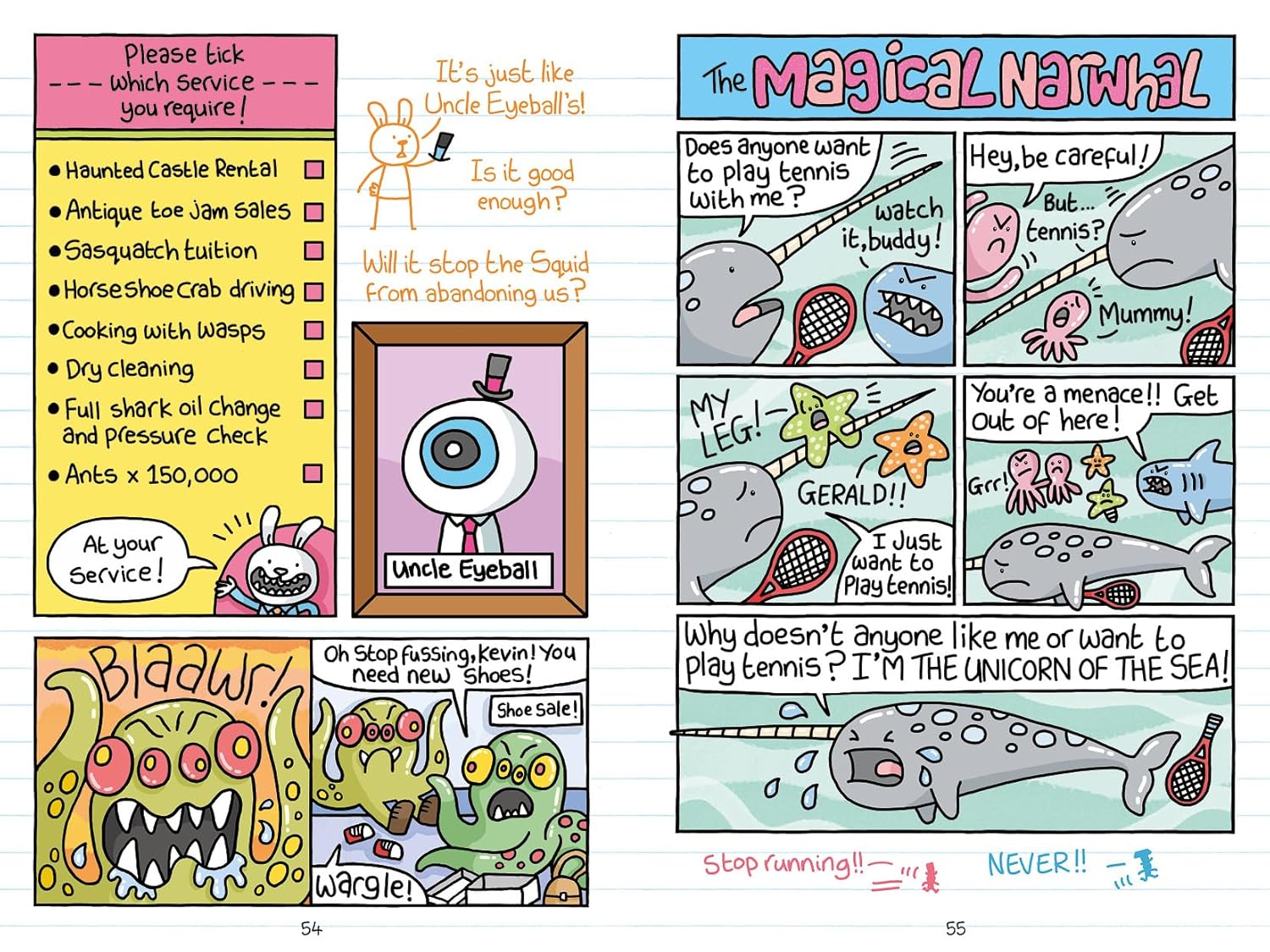
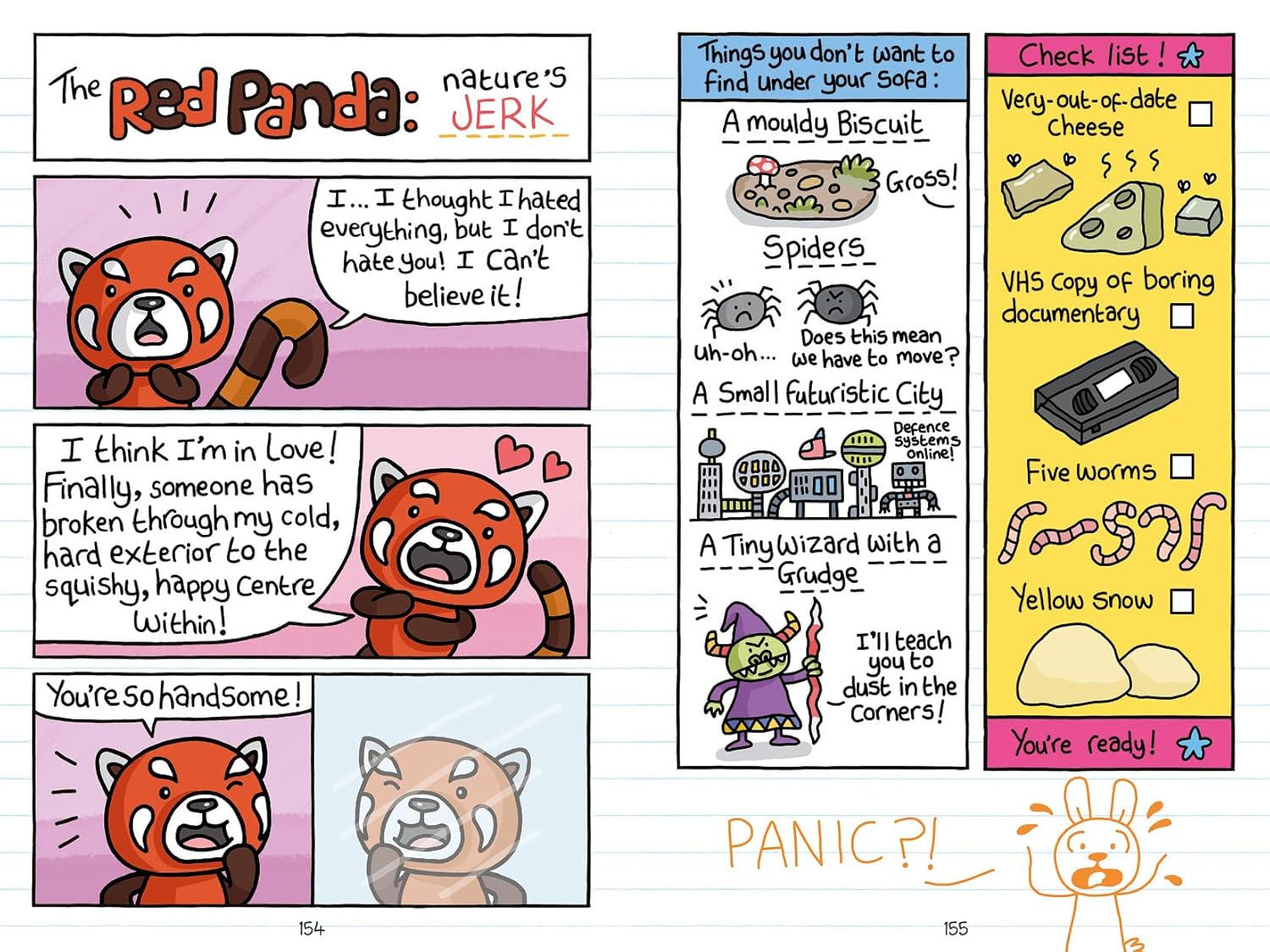
Recurring features within the strip include the life of ‘Red Panda – Nature’s Jerk!’; the lectures of piscine critic ‘Art Shark’; the indescribable ‘Banana!’; ‘The Amazing Lizard Bros!’; ‘Werewolf Problems!’; ‘President Dog!’; ‘Undercover Pigeon!’; ‘Dr. Bacon, M.D.’; ‘Cecil P. Wombat – Expert on Everything!’;‘Adventures in Opposite Land!’ and so very much you never needed or wanted to know about slugs, shopping, fighting, monsters, ghosts, flatulence, vampires or other staples of modern childhood.

Also incrementally improving reader’s lives are such perennial favourites as ‘Totally Real Nature Guide’; ‘Squid Bits Horoscopes’; ‘In the Olden Days’; ‘Squid Bits Weather Report!’ ‘That Escalated Quickly…’; ‘For Sale!’; ‘Squid Bits Homework Help!’; ‘Job Interviews!’; ‘Monster Fashion!’; excerpts from ‘The Adventurer’s Guide’ and the ever-topical and handy “Check List!” of things you probably don’t need for a far better life.

These are counterbalanced by occasional or one-off events such as ‘5th Annual Nudibranch Festival!’, ‘Cut ‘n’ Keep Gentle Reminder!’; a visit to ‘The Evil Forest!’; ‘Stick Insect Romance!’ and ‘Time Travel Foibles’; ‘Too Many Guinea Pigs’ and ‘What Were You Before the Experiment?’…

As always, wrapping up these multi-pronged life-lessons and graphic shenanigans are opportunities to get creative and construct your own Fake News. This timely opportunity appears as activities offered under the aegis of the Phoenix Comics Club. Bring paper, pencils, a ruler, no respect for rules and especially You to a compact online course (QR code provided!), Alternatively, do it in the ancient ways as all aspects of comic strip creation are presented and supervised “in-book” by Bradley herself. The section details ‘How to Draw the Squid Bits Way!’ and individual lessons and topics include the draughting delights of Red Panda, Banana & Art Shark.

Also in view are ‘How to Draw Expressive Doodles’, ‘How to Draw Expressions’, ‘Have Fun With Hairstyles’, ‘Let’s Talk Body Language’, ‘Bringing it All Together’, ‘Lost in a Haunted House’, ‘Blowing Bubbles’, ‘Tentacle Attack’, plus extension specialisms ‘Guinea Pig Balancing Champions’ and – most crucially of all – ‘Sulky Pie Dropper’. Won’t get nowhere sketch-wise without knowing that one, Just ask Art Shark…

Hugely funny, infinitely (for a given value of infinite, of course) inventive and addictively, daftly and deftly drawn, Jess Bradley’s Squid Bits: That’s a Nice Hat is a wondrous “dipping book” and another item that your kids will have to explain to you. Thus, you’d be ill-advised to let your kids have a copy if you’re driving anywhere with them in the back. Otherwise, it’s great and worth your keenest attentions. I tip my hat to it, of course…
Text and Illustrations © Jess Bradley, 2026.

*Other forms of Methylphenidate are available, but should not be considered as a an alternative to study and diligent parenting.

Today in 1949, British all-rounder comics creator John Higgins (Judge Dredd, Watchmen, World Without End, Dr Who, Batman: The Killing Joke, Razorjack) was born, sharing the date with both Underground Commix star Bobby London (Dirty Duck, Air Pirates, Popeye) and writer-turned-producer & Dark Horse Comics founder Mike Richardson (The Mask, Star Wars, Aliens, Predator, Cravan: Mystery Man of the 20th Century, Deep Gravity) in 1950. In 1951 Dean of Disney Duck delights Don Rosa arrived, as did realist comics artist Bo Hampton (Greylore, Viking Glory, Batman: Castle of the Bat) in 1954 and Allan Heinberg (Wonder Woman, Young Avengers) in 1967.

1985 today saw the last published edition of UK comics bastion Jack and Jill after more than 1640 weekly issues.

Today in 1888, American cartoonist turned Comics pioneer Frank Bellew died, as did immortal legend Steve Ditko in 2018.

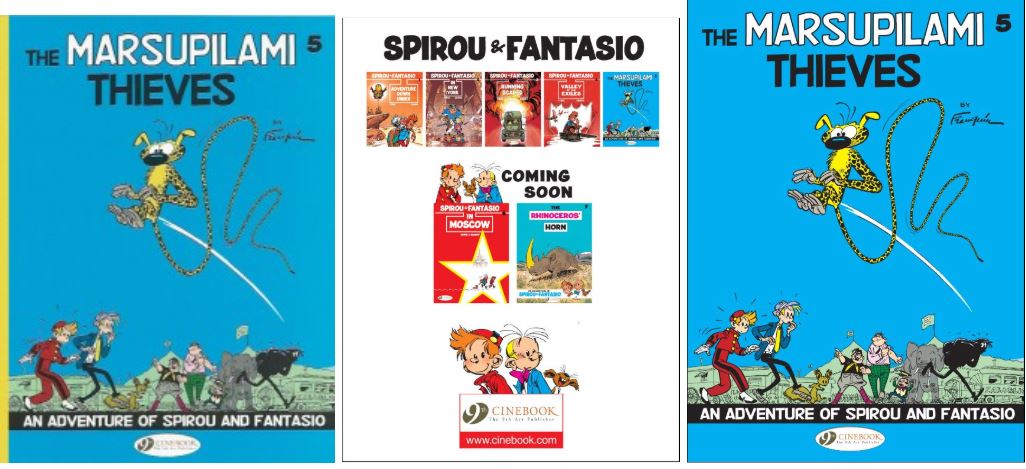
Spirou and Fantasio: The Marsupilami Thieves


By André Franquin, translated by Jerome Saincantin (Cinebook)
ISBN: 978-1-84918-167-9 (Album PB/Digital edition)

This book includes Discriminatory Content produced in less enlightened times. This book also contains Discriminatory Content included for comedic effect.

André Franquin was born in Etterbeek, Belgium on January 3rd 1924 and died on January 5th 1997. In between there were good times and bad, which he handled by creating the most incredible characters and stories, and by making people laugh and think… but mostly laugh. This is one of the very best you can find translated into English.

Adventure-seeking brave lad Spirou headlined the magazine he was named for from the first issue (dated April 21st 1938). He was devised and realised by French cartoonist Françoise Robert Velter using his pen-name Rob-Vel for Belgian publisher Éditions Dupuis in direct response to the success of Hergé’s Tintin over at rival outfit Casterman. Originally a plucky bellboy/lift operator employed by the Moustique Hotel (a sly reference to the publisher’s premier periodical Le Moustique), his improbable exploits with pet squirrel Spip gradually but steadily evolved into highflying, far reaching, surreal comedy dramas. That evolution was mainly thanks to Velter’s wife Blanche “Davine” Dumoulin who took over the strip when her husband enlisted in 1939 and Belgian artist/assistant Luc Lafnet… at least until 1943 when Dupuis purchased all rights to the property, after which comic-strip prodigy Joseph Gillain (Jijé) took over.

When Jijé handed his own trainee/assistant total responsibility for the flagship feature part-way through serial Spirou et la maison préfabriqué (Le Journal de Spirou #427, June 20th 1946), André Franquin ran with it for the next 20 years, enlarging the scope and expanding its horizons until the feature was purely his own. Almost every week fans would meet startling new characters such as comrade/rival Fantasio or crackpot inventor and Merlin of mushroom mechanics The Count of Champignac. Spirou and Fantasio became globetrotting journalists, travelling to exotic places, uncovering crimes, exploring the fantastic and clashing with a coterie of exotic arch-enemies such as Zorglub and Fantasio’s unsavoury cousin Zantafio.

Gradually sidelining short, done-in-one gag vignettes in favour of longer epic adventure serials, Franquin’s growing cast of engaging regulars soon included one of the first strong female characters in European comics (rival journalist Seccotine, renamed Cellophine in the current English translation) and ultimately led to the debut of a scene-stealing, phenomenally popular apparently-magic animal. Marsupilami arrived during 1952’s serial Spirou et les héritiers and never left…

Franquin, plagued in later life by bouts of depression, died in 1997 but his legacy remains and still grows; a vast body of work which reshaped the landscape of European comics inspiring many others to carry on in his name and manner.

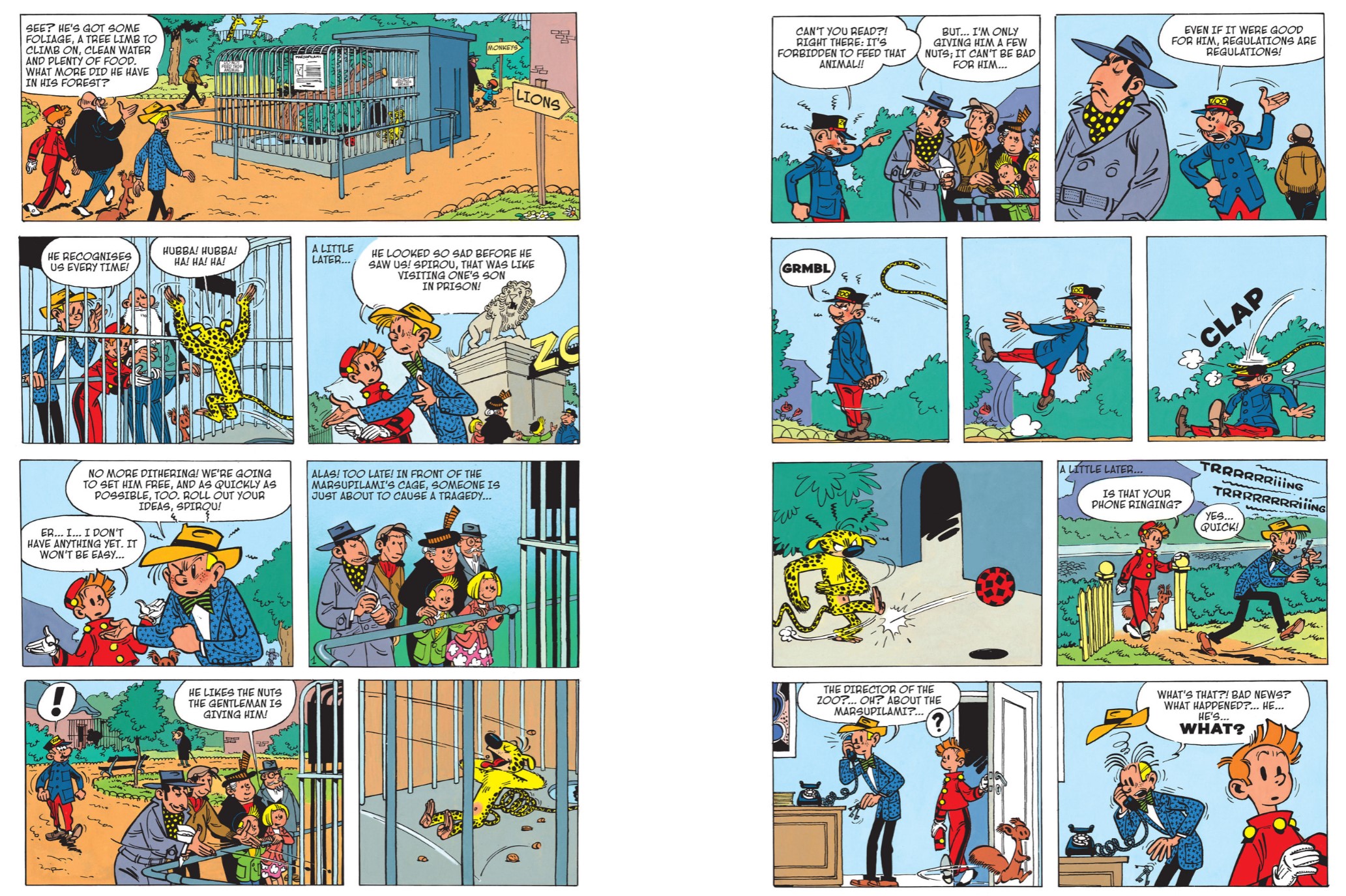
The Marsupilami Thieves was originally serialised in LJdS #729-761 (collected into an album in 1954); a direct sequel to Spirou et les héritiers, in which the valiant inseparable companions encountered an incredible elastic-tailed anthropoid in the rain forests of Palombia before bringing the fabulous, affable creature back to civilisation. Franquin’s follow-up, fleshed out from an idea by fellow cartoonist Jo Almo (Geo Salmon), sees the triumphant journalists visit the vast City Zoo where their latest headline ended up, only to be stricken with guilt and remorse at the poor creature’s sorry state of incarceration.

Resolved to free the poor thing and return him to his jungle home, their plan is foiled when the critter suddenly dies in its cage. Distraught and suspicious, they muscle their way in to see the vet and discover the corpse has gone missing…

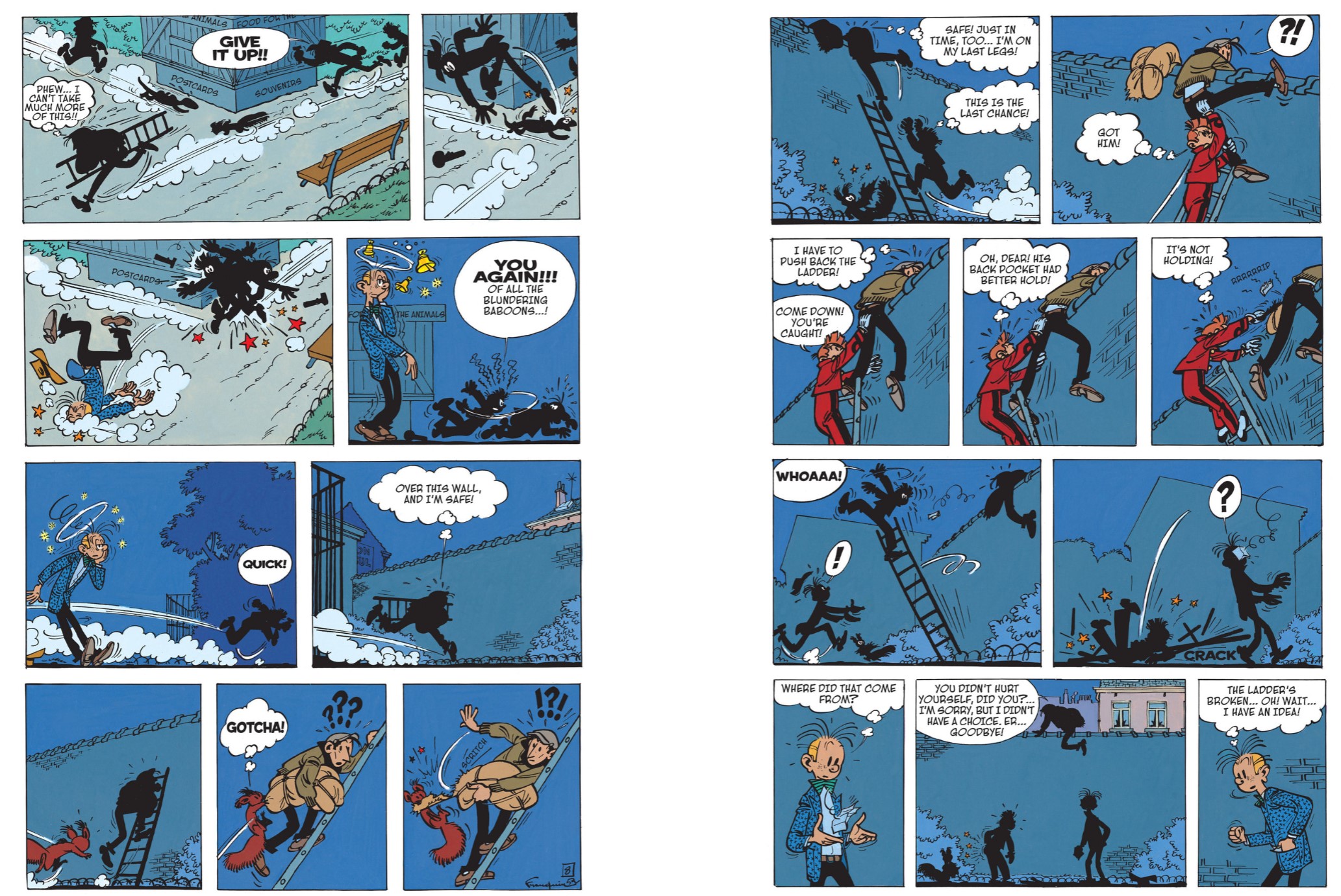
Acting quickly, Spirou & Fantasio rouse the authorities. The commotion prevents the body thief escaping and all through the night Keepers and our heroes scour the institution. Thus, in the deadly dark they finally spook the mystery malefactor from his cosy hiding place…

There follows a spectacular and hilarious midnight chase through the zoo, with the lads harrying a dark figure – who must be some kind of athlete – past a panoply of angry animals, hindered more than helped by inept animal custodians. Nevertheless, they almost catch the intruder, but a last burst of furious energy propels the bandit over a back wall, although not before Spirou snatches a paper clue from him…

The precious scrap takes our resolute investigators to the flat of Victor Shanks, where his wife Clementine provides further information. Her man is flying off to the city of Magnana for his new job… and to deliver a package! The lads’ frantic chase to the airport is plagued by manic misfortune and they miss Victor by moments. Undeterred, they borrow a neighbour’s car and attempt to follow overland, leading to a fractious episode of fisticuffs with striking Customs Officers (they’re withholding their labour, not exceptionally attractive…). After a night in jail, the undeterred duo and kvetching Spip eventually fetch up in Magnana and the search begins…

One month later, they are fully frustrated and ready to throw in the towel when Spirou literally runs into Clementine Shanks and trails her to a football stadium where formerly unemployed, desperate Victor is now a star of the local soccer team. Confronting the essentially good-hearted rogue, Fantasio & Spirou force the truth from him. In return for his new job, Victor drugged and swiped the Marsupilami for ruthless showman The Great Zabaglione who sees an irresistible star attraction for his circus and travelling menagerie…

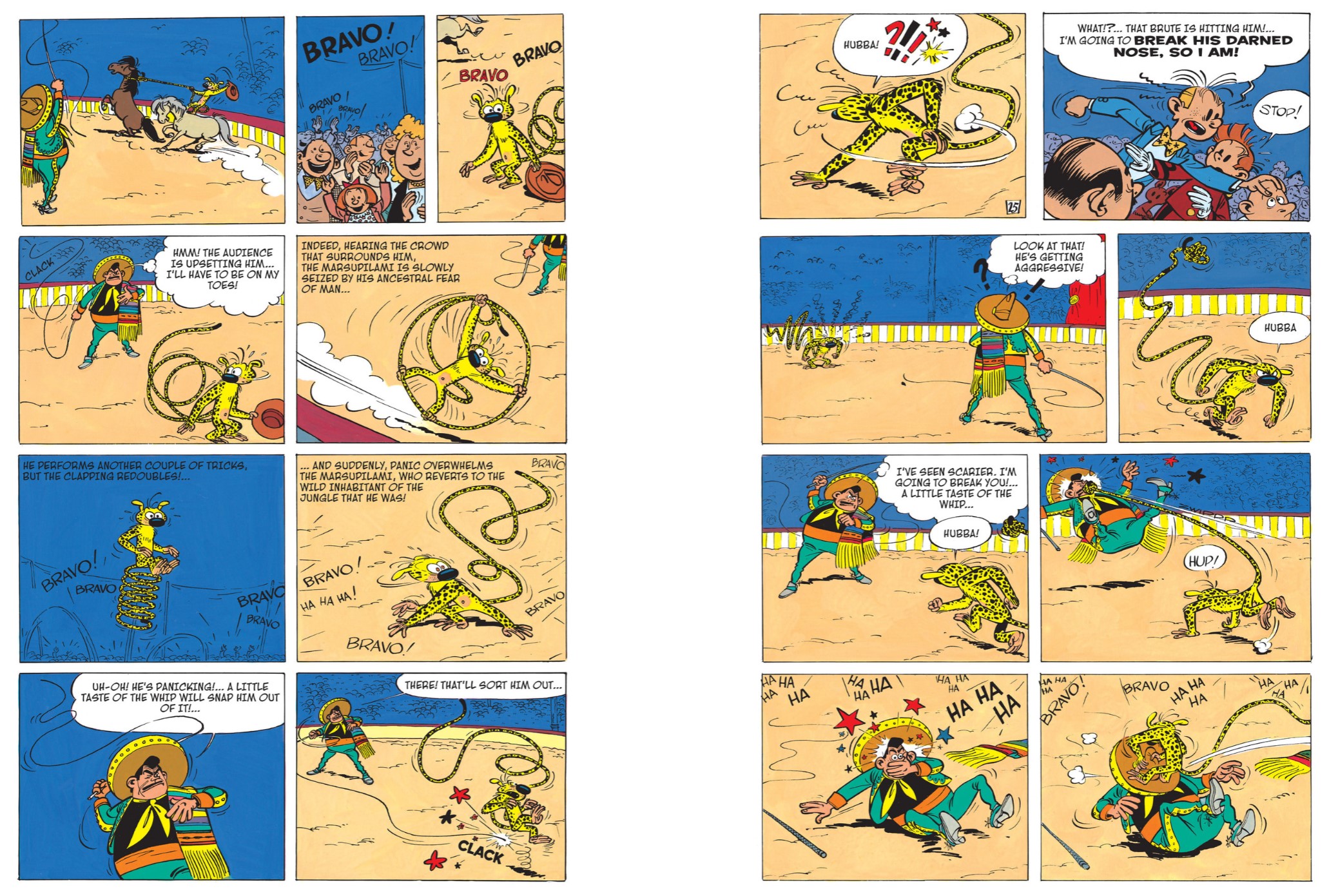
Determined to see the little creature free, the boys try to infiltrate the show but are quickly discovered and forcefully expelled. Then, following a chance meeting with weird science savant the Count of Champignac, they try once more, perfectly disguised as miraculous magic act Cam and Leon…

This time the ruse succeeds, but after a phenomenally outrageous opening performance, brutal but sharp Zabaglione rumbles the reporters. Things look bleak for the lads and the Marsupilami until guilt-wracked Victor steps in to save the day. Once the dust settles, the wondrous beast is freed, but gleefully opts to stay with the lads and share their fun-filled, exciting exploits…

Soaked in superb slapstick comedy and with gallons of gags throughout, this exuberant yarn is packed with angst-free action, thrills and spills and also offers an early ecological message and an always-timely moral regarding the humane treatment of animals. There’s even a fascinating history and creative overview of the timeless wandering heroes in back-up text feature ‘Spirou & Fantasio’s Stories Last Through Generations’.

The Marsupilami Thieves is the kind of lightly-barbed, comedy romp to delight readers fed up with a marketplace far too full of adults-only carnage, testosterone-fuelled breast-beating, teen-romance monsters or sickly-sweet fantasy. Easily accessible to readers of all ages and drawn with all the beguiling style and seductive yet wholesome verve and panache which make Asterix, Lucky Luke, and Yakari so compelling, this is a truly enduring landmark tale from a long line of superb exploits, and deserves to be a household name as much as those series… and even that other kid with the white dog…
Original edition © Dupuis, 1954 by Franquin. All rights reserved. English translation 2013 © Cinebook Ltd.

Born today in 1934, Mexican artist, cartoonist and political thinker Eduardo Humberto del Río García AKA Ruis (the …for Beginners series) shared the occasion with master of all comics trades John E. Workman (Thor, Star*Reach, Heavy Metal, Eros Comics, Sonic the Hedgehog) from 1950 onwards. So do writer Marc Andreyko (Jinx: Torso, Manhunter) from 1970 and, in 1974, Canadian art ace Karl Kerschl (Adventures of Superman, Majestic, All-Flash, Teen Titans: Year One, Gotham Academy).

The date also saw André Franquin debut as Spirou’s new controlling creator in 1946 (halfway through ongoing serial Spirou et la maison préfabriquée) and, in 1964 the launch of pivotal UK weekly Wham!, as well as the death of Belgian superstar Jijé in 1980.

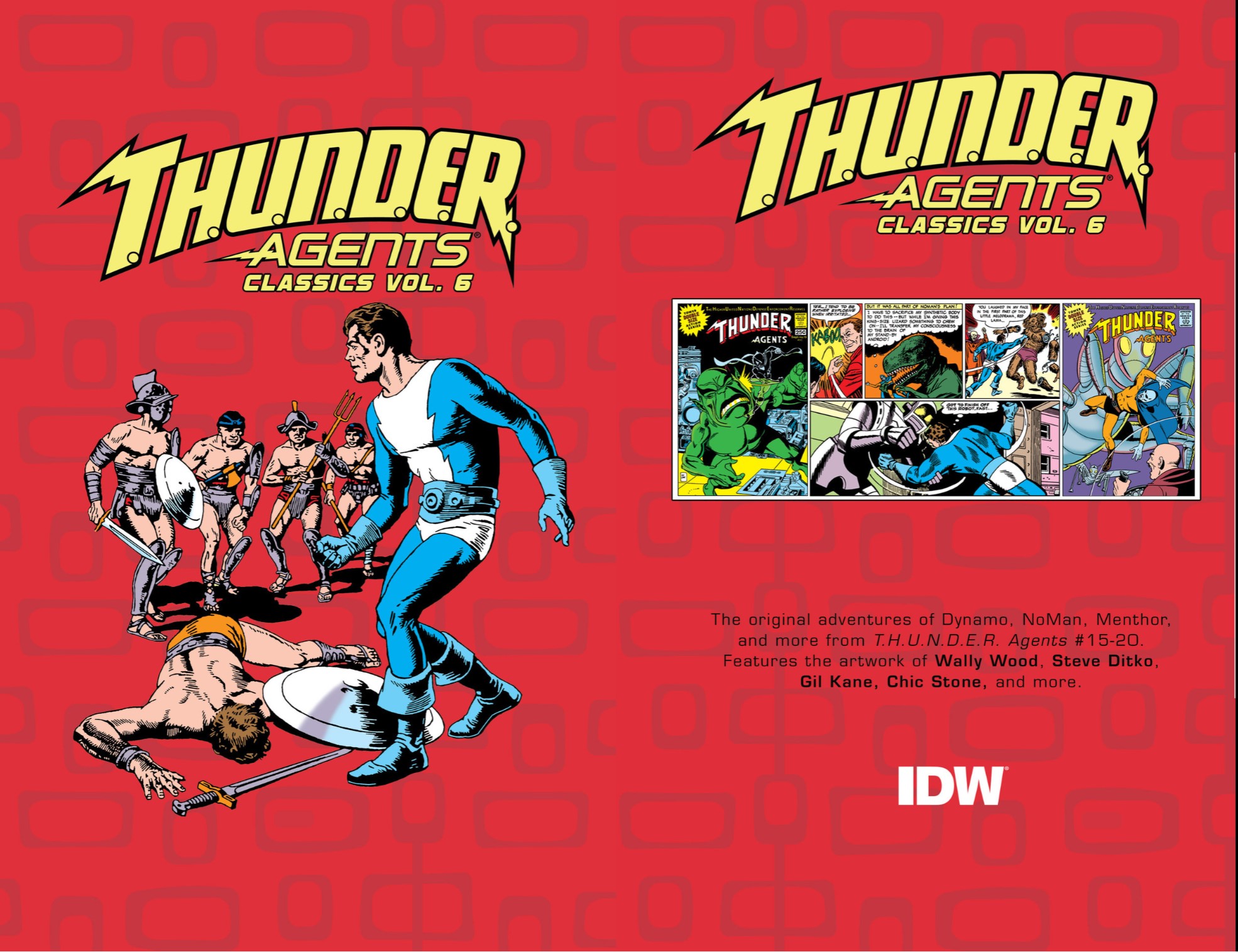
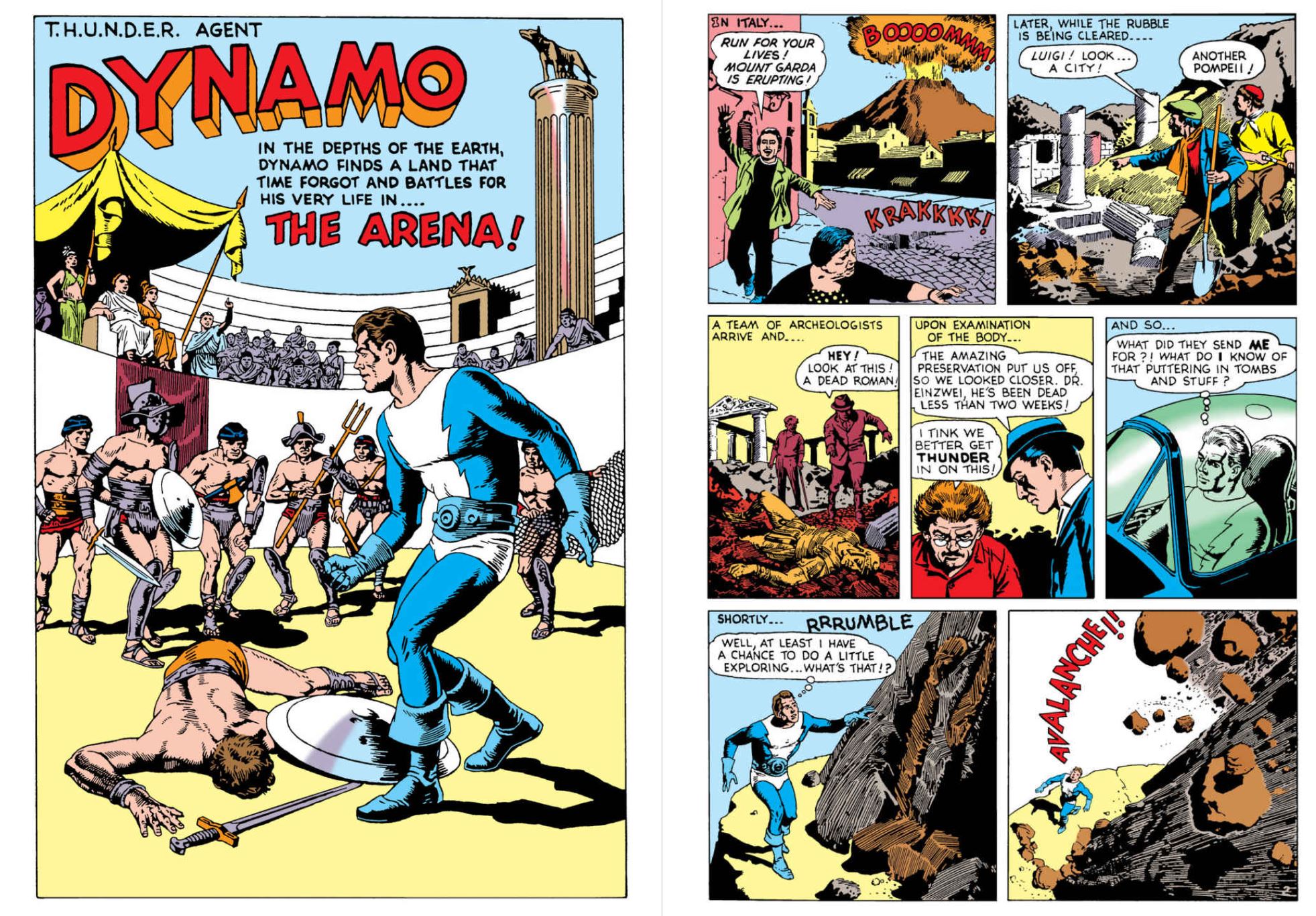
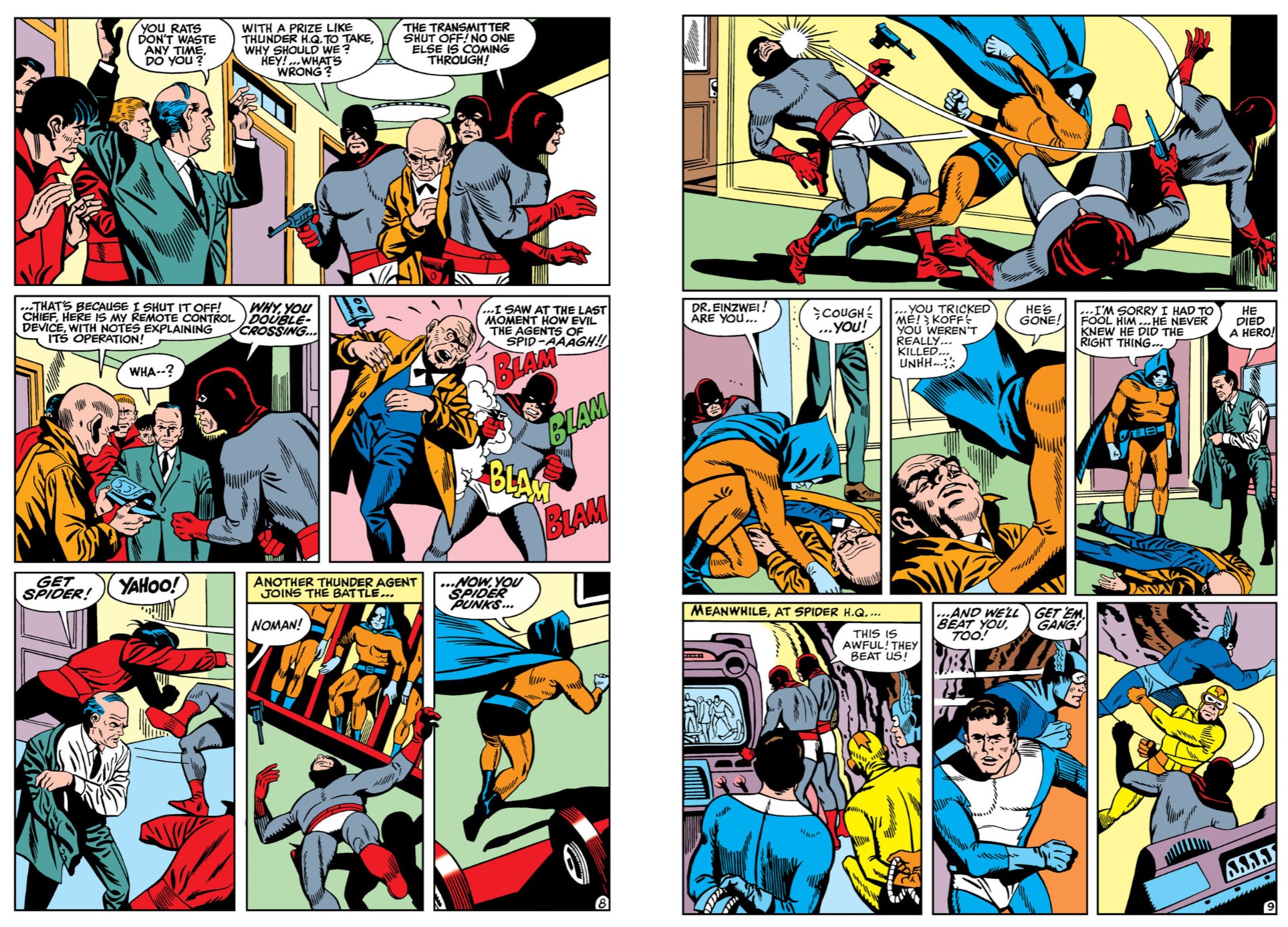
T.H.U.N.D.E.R. Agents Classics volume 6


By Wallace Wood, Steve Ditko, Steve Skeates, Gil Kane, Ralph Reese, Dan Adkins, George Tuska, Reed Crandall, John Giunta, Ogden Whitney, Chic Stone, Paul Reinman, Jack Abel & various (IDW)
ISBN: 978-1-63140-182-4 (HB) eISBN: 978-1-62302-879-4

This book includes Discriminatory Content produced in less enlightened times.

The meteoric lifespan and output of Tower Comics is one of the key creative moments in US comic book history. Bombastic, brilliant but brief, the era of The Higher United Nations Defense Enforcement Reserves was a benchmark of quality and sheer unadulterated fun for fans of both the then-still-reawakening superhero genre and the global spy-chic obsession of those distant times. Throughout the early 1960s, the Bond movie franchise was going from strength to strength, with blazing action and heady glamour totally transforming the formerly low-key, seedy and darkly patriotic espionage genre. The buzz was infectious: soon a Man Like Flint and Matt Helm were carving out their own piece of the action as TV shanghaied the entire bandwagon with the irresistible Man from U.N.C.L.E. (premiering September 1964), bringing the whole shtick into living rooms around the world.

Thus veteran Archie Comics editor Harry Shorten was commissioned to create a line of characters for a new distribution-chain funded publishing outfit: Tower Comics. He brought in creative maverick Wallace (he hated the contraction “Wally”) Wood, who called on many of the biggest names in the industry to craft material for the broad cross-section of genres the new company demanded; as well as T.H.U.N.D.E.R. Agents and spin-offs Undersea Agent, Dynamo and NoMan, there was a magnificent anthology war-comic Fight the Enemy and wholesome youth-comedy Tippy Teen.

Samm Schwartz & Dan DeCarlo handled the funny stuff – which outlasted everything else – whilst Wood, Larry Ivie, Len Brown, Bill Pearson, Steve Skeates, Dan Adkins, Russ Jones, Gil Kane, Ditko & Ralph Reese contributed scripts for themselves and the industry’s other top talents to illustrate on the adventure line. With a ravenous appetite for superspies and costumed heroes growing in comic book popularity and amongst the general public, the idea of blending the two concepts seemed inescapable…

T.H.U.N.D.E.R. Agents #1 appeared with no fanfare or pre-publicity on newsstands in August 1965. Beguilingly, all Tower titles were in the beloved-but-rarely-seen 80-Page Giant format, offering a huge amount of material in every issue. All that being said, these tales would not be so revered if they hadn’t also been so superbly crafted. As well as Wood, the art accompanying compelling, subtly more mature stories was by some of the greatest talents in comics: Reed Crandall, Gil Kane, George Tuska, Mike Sekowsky, Dick Ayers, Joe Orlando, Frank Giacoia, John Giunta, Ogden Whitney, Steve Ditko and more, as well as budding stars including Ralph Reese, Steve Skeates and Dan Adkins…

For those who came in late: When philanthropic benevolent super-genius Professor Emil Jennings perished in an assault by forces of the mysterious Warlord, late-arriving UN troops salvaged some of his greatest inventions. These included a belt that increased the density of the wearer’s body until it became as hard as steel; a cloak of invisibility and a brain-amplifier helmet. These uncopiable prototypes were divided between several agents: the basis of a unit of super-operatives to counter the increasingly bold attacks of multiple global terror threats such as the aforementioned Warlord. First chosen was affable, honest, but far from brilliant file clerk Len Brown. To the astonishment of everyone who knew him, he was assigned the belt and codename Dynamo.

T.H.U.N.D.E.R. Agent NoMan was previously decrepit Dr. Anthony Dunn who chose to have his mind transferred into an unaging android body and then gifted with the invisibility cape. If his artificial body was destroyed, Dunn’s consciousness could transfer to another android body. As long as he had a spare ready, he could never die. The helmet went to John Janus: a seemingly perfect UN employee and mental and physical marvel. He easily passed all tests necessary to wear the Jennings helmet. Sadly, he was also a double agent, the Warlord’s mole poised to betray T.H.U.N.D.E.R. at the earliest opportunity. All diabolical plans went awry once he donned the helmet and became Menthor since the device awakened his brain’s full potential, granting him telepathy, telekinesis and mindreading powers, but it also drove all evil from his mind. Such was the redemptive effect that Janus actually gave his life to save his comrades: an event which astounded readers at the time. In the wake of that tragedy, the Helmet vanished, passing through many hands but always escaping T.H.U.N.D.E.R.’s attempts to retrieve it.

Guy Gilbert was leader of crack Mission: Impossible-styled special forces commando unit T.H.U.N.D.E.R. Squad until asked to beta-test an experimental super-speed suit. As gung-ho, duty-obsessed Lightning, he proudly did so, even if every use of the hyper-acceleration gimmick shortened his life-span. As the concept and the niche universe expanded, other augmented agents appeared – like human jet Raven or subsea spin-off U.N.D.E.R.S.E.A. Agent (AKA Davy Jones of the United Nations Department of Experiment and Research Systems Established at Atlantis…

This concluding compilation of classic costumed-spycraft re-presents the compelling contents of T.H.U.N.D.E.R. Agents#15-20 (cover-dates July 1967 to November 1969) – with the incomparably cool concept and characters going from strength to strength as a spirit of eccentric experimentation and raucous low comedy increasingly manifested in the wake of the defeat of the Warlord (actually exposed as only one of a subterranean race intent on world conquest) and rise of independent, lone wolf supervillains, sinister crime cabals such as SPIDER or international/political foes like China’s Red Star…

As always the action opens with a Dynamo solo tale. ‘Collision Course!’ – by an unknown author and depicted by Wood – sees superhuman Andor resurface. A misunderstood modern Prometheus, he was abducted by the Warlords as a baby and spent decades being turned into a biological superman devoid of sentiment or compassion. However, they lost control of their living weapon once he met fellow mortals. Since their shattering defeat, the pitiful outsider’s attempts to rejoin mankind had been constantly thwarted and derailed. Here, following a clash with Dynamo and SPIDER, Andor is a blind (but still immensely powerful) Samson living as a hobo with a cunning grifter. Sadly. he’s again exploited by the underworld – in the form of ruthless criminal freelancer Iron Maiden – and precipitates another shattering duel with the super strong G-man as well as SPIDER’s own hyper-strong, enhanced operative Brutus Kanassus.

When the dust and rubble settles, Andor is gone again, but is now again a slave of Uru, the last surviving subterranean warlord…

Steve Skeates & Chic Stone then detail the next step in Lightning’s life. Dying because of the speed suit he volunteered to wear, Agent Gilbert is placed into cryostasis, but ‘While Our Hero Sleeps…!’ archfoe Warp Wizard wickedly swipes the body. He, however, utterly underestimates the skills and determination of Guy’s former T.H.U.N.D.E.R. Squad colleagues Dynamite AKA Daniel John Adkins, Katheryn “Kitten” Kane & William “Weed” Wylie to save him, before Bill Pearson & Ogden Whitney despatch NoMan’s scattershot free-floating consciousness on a ‘Starflight to the Assassin Planet!’ Here the invisible agent faces uncanny extraterrestrial terrors and saves earth from impending invasion…

Dynamo’s best efforts are not enough in ‘Hail to the Chief!’ (by an unknown author, Giunta, Wood & Adkins) wherein his commanding officer Sam Short mistakenly believes he’s being pensioned off. Obsessed with proving himself, “the Old Man” is captured by SPIDER and almost kills both of them before this day is saved. T.H.U.N.D.E.R. Agent Weed (a character Wood regarded as his “spirit animal”) closes the show with a delicious comedy thriller by author unknown and George Tuska.

When a big dumb thug is bitten by a radioactive mole and gains regulation theme-based excavation powers, his small, cunning pal decides ‘Dig We Must’ and has them become costumed crooks robbing from below ground. Their exploits utterly outfox the super-augmented T.H.U.N.D.E.R. Agents but wily Weed has the perfect plan to trap The Mole and Dapper Dan…

Cover-dated October 1967, T.H.U.N.D.E.R. Agents #16 opens with a Dynamo mini-epic illustrated and possibly written by Steve Ditko at the peak of his creative powers and political paranoia. Here the mighty hero and missing frenemy Andor are both beset with a ‘Dream of Doom!’ sent by the last subterranean.

Emboldened by recapturing the Warlord’s living weapon, Uru modifies and heals Andor before unleashing him against humanity, but has again underestimated his tool’s strength of will, affinity for his own kind and all too human feeling for Agent Kitten…

Fast paced and furiously violent, this is a classic example of astounding Ditko’s gift for combat staging as well as his signature graphic psychedelia in action. The era was intensely fruitful for artists as seen in a follow-up by Gil Kane & Jack Abel who limn another uncredited yarn as NoMan learns ‘One of Our Androids is Missing!’ Plunged into a frantic and convoluted global chase whilst again succumbing to psychological traumas triggered by being an undying ancient in a mobile plastic coffin, he soon recovers his emotionless equilibrium after fellow agent Linda Rogers uncovers a plot by the Red Chinese to steal one of his artificial carcases. They intend on turning it into a bomb with the sole purpose of tricking the Soviet Union into leaving the United Nations and blaming T.H.U.N.D.E.R. for the crime. It doesn’t work…

With Lightning notionally cured and declared fit for duty, Skeates & Stone amp up the superpower arms race as old enemy Professor Forkliff uses SPIDER resources to dope the speedster with super hallucinogens before unleashing his own enhanced speed freak – ‘The Whirligig!’ – to crush T.H.U.N.D.E.R. Sadly for them, Gilbert does everything – even recover from a bad trip – at top speed…

The entire Agents roster assembles for anonymously scripted Tuska tale ‘The End of the T.H.U.N.D.E.R. Agents?’ after SPIDER finds a way to negate all their advanced technology and entombs them all… until Weed, Kitten & Dynamite prove that a great plan and deathwish determination is all that’s really needed to send evil packing…

Dynamo closes the issue with a psychologically harrowing tale revealing how constant missions have burned him out. Enduring random descents into mindless fugue states, he is a hero lost to reality. Mature, disturbing, chilling and decades ahead of its time, ‘A Slight Case of Combat Fatigue’ comes courtesy of old soldier Wood and reset the tone as superheroes and spies began to pall in the public’s attention…

T.H.U.N.D.E.R. Agents #17 (December 1967) began with Dynamo in lighter mode as ‘Return of the Hyena!’ (by that mystery scribe, Wood & Reese) saw the husky but not highbrow hero repeatedly made a jackass by a cunning costumed criminal who indulged himself in a battle of wits with an enemy he deemed completely unarmed. Happily. Brawn and determination… and sneaky rogue Agent Weed… balanced the scales of justice enough to cage the beastly bandit, after which Whitney renders an uncredited modern monster mash wherein NoMan learns ‘The Locusts are Coming!!’ before saving embattled missile bases from marauding robotic raiders led by ambitious but unruly King Locust.

With readers tastes changing, Tuska took the weakest but wily-est Agent deep into genre territory for ‘Weed Out West!’ Scouting out SPIDER sightings in Antelope Haunch, Oklahoma, he finds shady doings at the local cowboy film shoot and soon embroils butch back-up Dynamo in uranium smuggling rings, murder plots and wedding plans before the entire T.H.U.N.D.E.R. Agents cadre unites the arch enemy foe in show-stopping closer ‘Put Them All Together, They Spell S.P.I.D.E.R.!’ (by anonymous & Stone). Here Dynamo leads the charge after an ordinary undercover mission exposes the cabal’s secret leaders (“The Council”) as a coalition comprising old enemies Demo, Dr. Sparta, Mastermind, Mayven and The Tarantula, led by the utterly unknown Spider Secretary General, just as the group turn on each other.

That debacle began when SPIDER recovered the all-powerful Menthor Helmet but could not peacefully decide on who should wear it and ended when the good guys explosively arrived to mop up the remains of the heated debate…

Nearly a year passed before #18 was published (cover-dated September 1968), but the contents were worth the wait. It began with another Ditko classic as ‘Dynamo and the Amazing Mr. Mek!’ saw the super-agent clash with a little nebbish suddenly granted uncanny power over machines and mechanisms. Sadly, he had no problem robbing banks but baulked when SPIDER abducted him to inflict massive global terror and death. Those unshakeable, ironclad scruples cost Mek his life and baffled his foes, but not as much as ‘The Sinister Schemes of Professor Reverse!’ (illustrated by Whitney) baffled and bamboozled NoMan when the bonkers boffin began regressing animals, humans and top military personnel into ancient ancestor iterations such as cavemen and tyrannosaurs…

Next, thanks to an unknown writer and the astounding Reed Crandall, classical fantasy rendered in the classical manner finds Dynamo trapped in an Italian volcanic eruption to somehow awaken in ancient Rome. Experiencing firsthand the grandeur, glory and petty injustices, only a miracle saves him from ‘The Arena!’ and sees him returned to his proper place and station in time to solve ‘The Secret of the Abominable Snowman!’ Crafted by unknown & Stone, here hapless Len Bown must uncover how satellite and space-race launches are being sabotaged from Tibet. Close investigation beside saucy British spy Carnaby Mod soon uncovers a plot by “commie” robotics genius The Red Lama, but there are still mysteries of the upper slopes to unravel even when all the shooting and thumping stops…

The big spy bubble had burst by this point and the spin-off titles had all folded by the time T.H.U.N.D.E.R. Agents #19 (November 1968) was released. All art with no ads, it felt like a rapid using up and closing down exercise which began with the Wood pencilled, Ralph Reese written & inked ‘Half an Hour of Power!’ as SPIDER scientist Dr. Orgo unleashes an army of super androids – including perfect duplicates of all T.H.U.N.D.E.R. Agents and personnel – and poor Len goes on a rampage uncertain who to hit and who to save…

Feeling suspiciously like Dynamo inventory material, it’s followed by another rowdy riot as ‘Dynamo vs. The Ghost!’ (art by Paul Reinman) sees a traitor abscond with T.H.U.N.D.E.R.’s latest breakthrough: a belt enabling the wearer to phase molecules and pass through walls. So can Dynamo – in his own way – but it’s equipment misuse that ends the blockbusting chase that follows in horrific tragedy…

Reese scripts Dynamo’s clash with the ‘All-Girl Gang!’ for Tuska to illustrate, as sinister spymaster Satana operates a squad of female agents no ordinary man can handle. Of course, T.H.U.N.D.E.R. Agent Kitten Kane is an expert in disguise, infiltration and close combat too…

NoMan then confronts ‘A Matter of Transmitters’ (anonymous & Reinman) as SPIDER’s captive scientist Dr. Einzwei subverts T.H.U.N.D.E.R.’s teleport systems and captures all the super-agents as they innocently travel to work. Of course, NoMan has more than one body to report in with and the web soon untangles…

One year later, a final issue appeared. Cover-dated November 1969, T.H.U.N.D.E.R. Agents #20 pretty much signalled the end of spy fever and a dialling back of superheroic shenanigans. The issue was filled with reprint masterpieces but did offer an editorial in ‘Dear T.H.U.N.D.E.R. Fan’ by Wood & Adkins and new 4-page recap of the way it all began in ‘The Origin of T.H.U.N.D.E.R. Agent Dynamo’, drawn by Chic Stone, both of which are included here to sign off the first era of spies in spandex.

With covers by Wood, Kane, Ditko, Reese, Crandall & Stone, these stories all favour fast pace, wry wit, sparse dialogue, explosive action and breathtaking visuals. T.H.U.N.D.E.R. Agents was decades ahead of its time and informed everything in Fights ‘n’ Tights comics that came after it. These are truly timeless superhero comic classics which improve with every reading, so do yourself a favour and add these landmark super-sagas to your collection.
T.H.U.N.D.E.R. Agents Classics volume 6 © 2015 Radiant Assets, LLC. All rights reserved.

Today in 1927 master craftsman and inveterate storyteller Wallace Wood (EC Comics, Mad Magazine, T.H.U.N.D.E.R. Agents, Daredevil, Power Girl, Cannon, Sally Forth, The Wizard King, Witzend, Mars Attacks) was born, sharing the natal anniversary with Hi and Lois artist Chance Browne in 1948, scripter/artist Hilary Barta (Starslayer, Plastic Man) in 1957, artist Pat Olliffe (Untold Tales of Spider-Man, Spider-Girl, Captain Britain and MI:13) in 1965 and Italian illustrator Mirka Andolfo (Hex Wives, Wonder Woman, The Amazing World of Gumball, Ms. Marvel) in 1989.

This date in 1919 Billy DeBeck’s Barney Google and Snuffy Smith strip premiered, as did Sgt. George Baker’s Sad Sack in 1942 in the first issue of service magazine Yank – the Army Weekly.

Dogs on Dates


By Luke Healy (Faber & Faber)

ISBN: 978-0-571-39672-6 (HB)

Irish multi-award winning, low-impact iconoclast Luke Healy studied journalism at Dublin University and earned an MFA in Cartooning from the Center for Cartoon Studies (Vermont, USA). An occasional stand-up comedian, his previous cartoon tomes – like Americana, Permanent Press, How to Survive in the North, The Con Artists and Self Esteem and the End of the World – have won prizes and acclaim, and he’s also held gallery shows in places like Manhattan’s Museum of Comics & Cartoon Art.

Healy’s earlier comics for VICE, The Nib, A24, Medium, Nobrow and Avery Hill are also exceptionally good and, as already stated, he exposes himself to ridicule on stage, but not so much, these days. That’s what his recent funny books are for  – and as Bob Monkhouse used to say “nobody’s laughing now”… except that they are and in exactly the right places, just where Luke wants them to. We also all cry on command too, because that’s what dating in the modern world is like, okay?

Previously Healey addressed and ingested and passed baffled judgement upon all the trauma, weltschmerz and naff experiences of existence, diligently informed by exploration of basic Big Stuff like life, love, friends, and how to keep your head above emotional water. It kept us readers wonderfully entertained for a decade but here and now, that self-excoriating journey of discovery resolves into a fully realised, quirkily significant tale of anthropomorphic romance and the quest for lifelong contentment via a venture into dating, advice (wanted and otherwise) and comradely life support…

In Dog City – a mostly socially evolved metropolis equal parts London and the best bits of the East and West coasts of America – Brad is still looking for love and a steady life on a viable planet when he finally finds the dog of his dreams. However (and as always), renegade art student Bernie comes with baggage… and so very many of Brad’s dreams were always nightmares in waiting…

They first meet by hitting at speed – albeit a few precious moments apart – the same glass wall of Dog City Community College. Bernie had just comfortably removed himself from obnoxious academia by quitting his Abstract Art Class – a career move that will gravely affect his relationship with Brad once that poor mutt meets his ostensible true love’s unbelievable family! – whilst Brad is despondently there on behalf of an environmental charity. The crushed idealistic optimist was readying himself for one last go at turning self-obsessed students into eco-warriors motivated enough to save our deeply imperilled planet…

After bonding in the ambulance they subsequently share, bruised and battered Bernie & Brad agree to attempt the impossible task of gradually and cautiously getting to know each through a series of carefully planned dates. However, these guys are the kind thoughtful souls Nature creates just to beta-test cosmically cruel jokes for meaner people to capture on their phones…

The First Date is an absolute disaster, but Brad and Bernie persevere…

It’s worth it in the end…

Utterly beguiling and drenched in cute meets, charmed disasters, bondable moments, the best hopes of enthralled onlookers everywhere and the sheer determination to find, survive and enjoy love and companionship, Dogs on Dates is a passionate yet reserved pick-me-up for the emotionally exhausted, connection-wary, socially drained lonely hearts still hopefully looking for a shared life. Wry, witty, hopeful and encouraging, it’s what every Good Boi of any gender description wants, whether they admit it or not.

Fetch!
© Luke Healy, 2026. All rights reserved.

Dogs on Dates will be published on June 18th 2026 and is available for pre-order now.

On this date in 1977 US born Australian cartoonist Stan Cross (Wally and the Major, The Potts) died. We also lost Italian Andrea Pazienza (Zanardi) in 1988 and irreplaceable Man of Steel Curt Swan in 1996.

On the upside, the day welcomed French Canadian cartoonist Albert Chartier (Onésime) in 1912; illustrator Kack Keller (Kid Colt, Outlaw, Charlton’s entire “Hot Rod “comics division) in 1922; mega-stylist Frank Thorne (Mighty Samson, Son of Tomahawk, Red Sonja, Lann, Moonshine McJuggs) in 1930 and the Arnold half of the Pander Brothers (Grendel: Devil’s Legacy, Accelerate) in 1967.