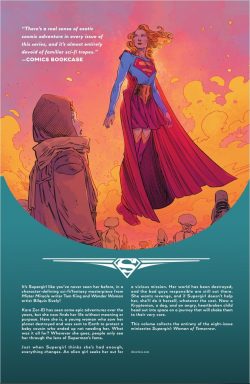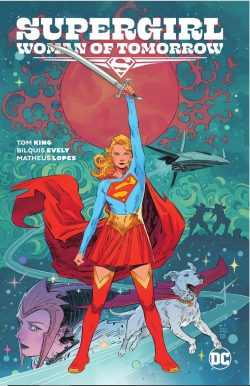
Supergirl: Woman of Tomorrow


By Tom King, Bilquis Evely, Matheus Lopes, Clayton Cowles & various (DC Comics)
ISBN: 978-1-7795-1568-1 (TPB/Digital edition)

As a rule, superhero comics don’t generally do whimsically thrilling anymore. They especially don’t do short or self-contained. Modern narrative momentum concentrates on continuous extended spectacle, major devastation and relentless terror and trauma. It also helps if you’ve come back from the dead once or twice and wear combat thongs and thigh boots…

Although there’s nothing intrinsically wrong with that – other than a certain inappropriateness in striving to adjust wedgies during a life-or-death struggle – sometimes the palate just craves a different flavour…

Once upon a time, angsty in-continuity cataclysm was the rule, not the exception, but ever since DC readmitted all its past epochs into one vastly welcoming expansion multiverse via the Dark Night: Death Metal, Future State and Infinite Frontier mega-events, a spirit of joyous experimentation has resulted in some truly memorable storytelling.

This decidedly backward-looking modern fable harks back to simpler days of clearly defined plots, solid, imaginative characterisation and suspensefully dramatic adventure, by way of an almost alternative take on redoubtable Kara Zor-El, late of Krypton’s Argo City and another illegal alien immigrant on Earth.

Supergirl first gained popularity as a back-up feature in Action Comics: a tag-along (and trademark protection device) to her more illustrious cousin. After years of faithful service, in 1985 she was killed as a sales gimmick in the groundbreaking Crisis on Infinite Earths. Since then, a number of characters have used the name – but none with the class or durability of the original.

This latest incarnation cunningly references much of the original’s trappings, but combines stellar whimsy, dark modern attitudes and an edgier twist, as befits today’s readership. Written by Tom King (Mister Miracle, The Vision, The Sheriff of Babylon, Omega Men, Strange Adventures, Batman) and delightfully illustrated by Brazilian artist Bilquis Evely (Wonder Woman, The Dreaming, Detective Comics, Shaft: a Complicated Man) in a deliriously addictive, retro-futurist pulp style, it examines the concepts of justice and power of reputation through the wide eyes of a worshipful child who is both outraged orphan and lonely sidekick/secret weapon in waiting…

After a few intriguing concept-tweaking test-runs, the first true Girl of Steel debuted as a future star of the ever-expanding Superman pocket universe in Action Comics #252 (cover-dated May 1959). Superman’s cousin had been born on a city-sized fragment of Krypton, hurled intact into space when the planet exploded. Eventually, Argo turned to Kryptonite like the rest of the detonated world’s debris, and Kara’s dying parents, observing Earth through their viewer scopes, sent their daughter to safety even as they apparently perished.

Crashlanding, she immediately and fortuitously met the Metropolis Marvel, who created a cover-identity: hiding “Linda Lee in an orphanage in bucolic Midvale so that she could adjust to and learn about her new world whilst mastering her powers in secrecy and safety.

…And isolation. At no stage did anyone consider moving the recent orphaned newcomer in with her only surviving family. Kara reached her maturity without the closeness Clark Kent’s human parents provided …although she was eventually adopted by Earth couple Fred and Edna to become Linda Lee Danvers

Supergirl experienced her own secret double life in the rear of Action Comics: gradually moving from Superman’s covert secret weapon to an independent star turn, and from minor player to acclaimed public celebrity. From the back of the book to the front of the house is always a reason to celebrate, right?

For decades, DC couldn’t make up their minds over Supergirl. I’ve actually lost count of the number of different versions to have cropped up over the years, and never been able to shake a queasy feeling that above all else she’s a concept that was cynically shifted from being a way to get girls to reading comic books to one calculated to ease young male readers over the bumpy patch between sporadic chin-hair outbreaks, voice-breaking and that nervous period of hiding things under your mattress where your mum never, never ever looks…

Her popularity waxed and waned until her attention-grabbing death during Crisis on Infinite Earths. However, in the aftermath – once John Byrne had successfully rebooted the Man of Steel and negated her existence along with all other elements of doomed Krypton – non-Kryptonian iterations began to appear: each accumulating a legion of steadfast fans. Ultimately, early in the 21st century, DC’s Powers-That-Be decided the real Girl of Steel should come back… sort of…

The New 52 company-wide reboot recast her as an angry, obnoxious distrustful teen fresh from Argo, before the 2016 DC: Rebirth event unwrote most of those changes: bringing back much of that original origin material whilst aligning the comic book iteration with the popular TV series broadcast from October 2015 to November 2021. Then under the aegis of the Infinite Frontier revolution, King, Evely, colourist Mat Lopes & letterer Clayton Cowles crafted 8-issue limited series Supergirl: Woman of Tomorrow (cover-dated August 2021-April 2022).

This focussed on a major moment in the hero’s life and how it changed everything…

King was inspired by Charles Portis’ 1968 novel True Grit – and both movie adaptations – to cast Supergirl as mentor to a vengeance-obsessed child: tracing how a united quest/journey reshaped both of them. Employing the latitude afforded by IF’s umbrella premise, he incorporated iconic characters and trappings from various iterations of Kara’s many super-lives. The result is pure magic, made real by Bilquis and her visual collaborators.

Wordy and wondrous, colours and calligraphy are key components of this space opera, which opens with youthful narrator Ruthye Marye Knoll disclosing how she first met an alien voyager after merciless bandit Krem of the Yellow Hills butchered her father…

Intent on rightful retribution, little Ruthye tracks the killer to a tavern in ‘Men, Women, and Dogs’, encountering a violent drunken woman from another world. Supergirl was on this unnamed backwater red sun world with frivolous intent: it was her 21st birthday and she wanted to get really, really drunk…

Things go bad when Supergirl tries to help her get justice. The intergalactic warrior seriously underestimates Krem, and nearly dies when he puts three arrows through her chest, before apparently killing her dog Krypto and stealing her spaceship…

Barely alive, Kara agrees to let Ruthye help her hunt Krem down: travelling so very slowly by commercial starship and encountering the full annoying range of sentient lifeforms – and a deadly space dragon – in ‘Wounded, Stranded, and Impotent’, before finally reaching a region of space where yellow suns can recharge her…

Stranded on tourist trap Coronn for weeks, they jointly expose appalling racist atrocity in ‘Modest, Calm, and Quiet’ and learn the quarry has joined Barbond’s Brigands: a marauding fleet of space plunderers who become Supergirl’s greatest concern after their latest raid exterminates an entire species in ‘Restraint, Endurance, and Passion’.

Repeated close encounters with them result in furious frustration as Krem has mastered a mystic banishment spell that deposits his pursuers all over the cosmos. Slowly, steadily, Supergirl and Ruthye close in, with the latter honing her skills in eager anticipation of bloody revenge, despite anything Kara can say to dissuade her. Repeatedly fighting a succession of colossal lizard beasts, and enduring a slow painful death and resurrection, does nothing to help their moods either in ‘The Lake, the Trees, and the Monsters’

Finally – reinforced by magical superhorse Comet – the seekers capture Krem and spectacularly engage the brigands in ‘Home Family, and Refuge’ and ‘Hope, Help, and Compassion.’, but the outcome is shockingly unexpected …and tragic.

Final chapter ‘Ruthye, Supergirl, and Krem of the Yellow Hills’ delivers major emotional and conceptual payoffs as antagonists and protagonists take their vendetta to its foregone conclusion. The vengeful child fulfils her quest, but learns some adult truths…

Supplemented by a covers-&-variants gallery by Evely, Lopes, Gary Frank & Alex Sinclair, Lee Weeks, David Mack, Rose Besch, Amy Reeder, Steve Rude, Nicola Scott & Annette Kwok and Janaina Medeiros, this book includes a stunning swathe of character and costume designs, to augment a tale profoundly and consciously mythic in scope and execution.

The apparent maiming and deaths of beloved characters – and animals at that! – and epic transitions and evolutions of the twin leads are potently and evocatively depicted against a universe of inspirational wonders and casual horrors, allowing us to see how heroes are forged, and the device of using a childlike Boswell to define Supergirl’s humanity is both compelling and revelatory.

A cosmic odyssey in the grandly poetic idiom of Jack Vance and Samuel R. Delaney, realised via retro-futuristic visuals reminiscent of Roy G. Krenkel, Jack Katz and Michael William Kaluta, Supergirl: Woman of Tomorrow is a mesmerising mix of space opera and superhero drama exploring the mechanics of myths and power of storytelling on a multitude of levels.

It’s also a sublime rollercoaster ride of vivid, cathartic joy for old fans and newcomers alike: one every fantasy and adventure lover must see.
© 2022 DC Comics. All Rights Reserved.

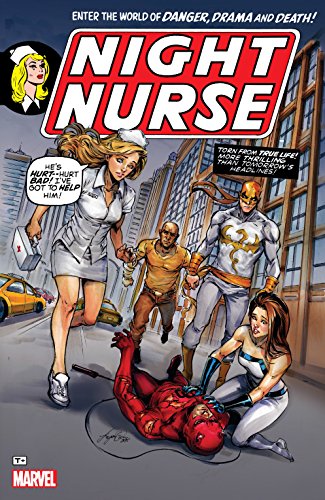
Night Nurse


By Jean Thomas, Linda Fite & Win Mortimer; Brian Michael Bendis & Alex Maleev, & various (MARVEL)
No ISBN: Digital-only edition

During the costumed hero boom of the 1960s, Marvel experimented with a solo title shot for Inhuman anti-hero/political refugee Madame Medusa (Marvel Super-Heroes #15, July 1968) and a solo series for established supporting character The Black Widow (Amazing Adventures # 1-8, August 1970 – September 1971). Both were sexy, reformed supervillains, not wholesome girl-next-door heroines like long-domesticated costumed chicks The Invisible Girl, Marvel Girl and The Wasp… and neither lasted solo for long.

The other two actual action women – rather than simple romantic-complication fodder – of that early Marvel era were The Scarlet Witch (mutant/ex-villain/occasional Avenger) and superspy Sharon Carter/Agent 13 of S.H.I.E.L.D.

Just for the sake of completeness: post-World War II, Timely/Atlas Comics embraced and published fiercely independent, capable female operators like Miss America, Namora, Golden Girl, Sun Girl, Blonde Phantom, Venus and more. None survived the insidious social domestication movement that drove American women out of the workplace and back into kitchens and bedrooms: a period that (coincidentally?) generated a growing fascination with captivating jungle women living wild and free in primal freedom – in space as well as on Earth – and a huge explosion in straight romance comics where decent white girls competed for the best husband…

When the costumed crazies craze began to subside in the 1970s, newly-promoted Publisher Stan Lee and his editor-in-chief Roy Thomas looked into creating a girl-friendly boutique of proper “heroines” for the changing tastes of the nation. Written by women, they sought to address and satisfy a wider market than simple boy-fuelled superheroics ever could.

The early 1970s was an era of turbulent social change, with established notions, traditions and laws being constantly challenged. Banner headlines and TV news everywhere confirmed that women’s rights were now being fought for – and thus consequently fiercely resisted – just as vigorously as the Civil Rights movement that had polarised and incensed Americans a handful of years previously…

Marvel’s opening shots in this mini-liberation war were in established genres and both cover-dated November 1972. Claws of the Cat – by Linda Fite, Marie Severin & Wally Wood – added a female superhero to the pantheon, whilst Night Nurse combined contemporary daytime television medical dramas with Marvel’s long-established romance/“career girl” tradition. New post-Feminism jungle goddess Shanna the She-Devil – by Carole Seuling & George Tuska – debuted in December 1972.

Despite impressive creative teams, none of these fascinating and trailblazing experiments lasted beyond a fifth issue, but the characters have all since then become fully established in the greater continuity…

That certainly applies to today’s pioneer. Collecting Night Nurse #1-4 and a stunning reinvention from Marvel Knights Daredevil (volume 2) #80 – also numbered #460 as a result of renumbering nonsense you really don’t need to care about. This digital-only compilation gathers the entire melodrama-drenched saga of a tough and determined young woman looking to make a difference. The print equivalent is the 2015 Night Nurse one-shot: cover-dated July and published to capitalise on the traction her appearance in the mainstream MU generated.

With covers by Winslow Mortimer, John Romita Sr., Frank Giacoia & Joe Sinnott, and adapting the character and concepts first seen in Linda Carter: Student Nurse (#1-9, spanning cover-dates September 1961-January 1963), Night Nurse saw writer Jean Thomas and illustrator Mortimer reintroduce our star as her-long-deferred graduation day approached: peeking behind the curtain of professionalism to reveal ‘The Making of a Nurse!’

Carter and her roomies – ghetto child Georgia Jenkins and disgraced, disinherited rich kid Christine Palmer – have all been learning-by-working at vast and prestigious Metro General: enduring a relentless regimen of complex hands-on training adapting them to the constant high pressure demands of their proposed careers. Particularly difficult was the suffering they were daily exposed to, and how each student coped with it…

Things start to get truly complicated when Linda falls for wealthy good-looking patient Marshall Michaels. His whirlwind courtship leads to a marriage proposal and wedding plans… until he reveals that no wife of his will ever prioritise a job over running his home…

Georgia, meanwhile, finds her ghetto roots still dragging her down when – in the midst of a city-wide power-outage – her brother Ben and his activist friend Rocky try to blow up Metro’s back-up generator. When she and Linda discover them the result is tragedy…

In the second issue, a ‘Night of Tears… Night of Truth!’ sees Carter save a VIP life during a hit-and-run incident, only to endure an acclaimed and ultra-rich surgeon parachuted in to conspicuously fix the patient and reap temporary glory.

Arrogant Dr. Sutton subsequently offers well-bred rebel Palmer a job as his permanent assistant: a position that comes with amorous assumptions and intent. However, the snobbish surgeon underestimates her resolve and loathing of the unspoken code dictating that the wealthy should stick together and he can’t understand why Christine calls the cops when she finds out his side hustle business, how he uses his prescription privileges and one other secret he’s been keeping from all his powerful friends and associates…

Linda, meanwhile, is getting far too friendly with hunky doctor Jack Tryon

Events escalate in ‘Murder Stalks Ward 8!’ when Carter is the only witness to a gangland killing that leads back to major mobster Victor Sloan: a crime kingpin connected to Georgia’s wayward brother Ben. When Sloan is admitted to Metro, nurse Jenkins finds her dedication and resolve severely tested, especially after rival crooks invade the hospital looking for payback and Jack and Linda have to play detective and bodyguard…

There’s an abrupt change of pace in final issue #4 and a touch of gothic romance in the air as Thomas and co-writer Linda Fite focus on Christine. Rocked by scandal, Dr. Sutton’s betrayal and repeated rejection by her elitist father, nurse Palmer seeks a different career path and answers an ad for a live-in nurse/physiotherapist in Boston.

Illustrated by Mortimer, ‘The Secret of Sea-Cliff Manor!’ revels in all the trappings of gothic mystique typifying that period, as Christine meets and manages moody, magnificently angry paraplegic Derek Porter, his sweet Aunt Edna, and spooky old manservant Harold: dispensing care and comfort whilst being dragged deep into a manic murder plot…

The series terminated there, although the nurses popped up occasionally in various titles over the years. Then in Marvel Knights Daredevil volume 2 #58 (May 2004) Linda Carter returned without warning and in an extremely specific role: running a sort-of secret underground clinic in NYC as the enigmatic “Night Nurse”. The facility catered exclusively to metahumans – mostly the heroic or vigilante ones – who needed fixing and couldn’t trust the regular hospital system…

Inexplicably, that yarn is not included here. Instead we have Marvel Knights Daredevil volume 2, #80 (February 2006): fifth chapter 5 of ‘The Murdock Papers’ wherein Brian Michael Bendis, Alex Maleev and colourist Dave Stewart detail how Matt Murdock is almost fatally shot after his secret identity is made public.

On the run, his occasional ally and paramour Elektra drags his failing form to the clinic where it transpires Murdock is a frequent flyer. As the mysterious medic seeks to stabilise him, heroes like Jessica Jones, Luke Cage, Iron Fist and Black Widow rush to his side. It’s a smart move since Kingpin Wilson Fisk, an army of irate Feds and ninja cult The Hand have all zeroed in on the dying man, all determined to complete their unfinished business with Daredevil

From this revival and revision, Night Nurse evolved into a crucial component of both the print and cinematic Marvel Universes, playing a role in the Civil War and Secret Invasion storylines; working with The Young Avengers, Captain America, Doctor Strange, Iron Man and all the above-mentioned street level champions…

A tribute to Marvel’s ceaseless commitment to reinvention, reappraisal and rebirth, Night Nurse is an intriguing example of how the role of women has evolved in comic books and will delight both incurably addicted fans and those casual dabblers looking for different flavours of Marvel medicine.
© 2013 Marvel Characters, Inc. All rights reserved.

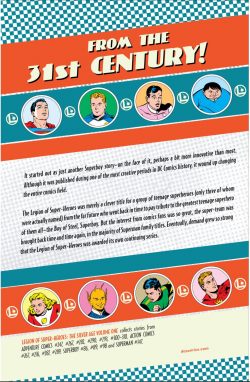
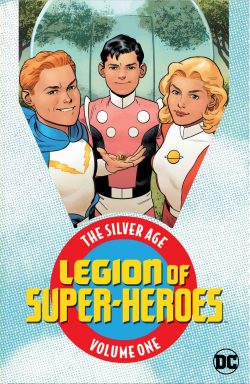
Legion of Super-Heroes: The Silver Age volume 1


By Otto Binder, Jerry Siegel, Edmond Hamilton, Robert Bernstein, Al Plastino, George Papp, Jim Mooney, Curt Swan, John Forte & various (DC Comics)
ISBN: 978-1-4012-8157-1 (TPB/Digital edition)

Once upon a time, in the far future, a super-powered kids from dozens of alien civilisations took inspiration from the greatest legend of all time and formed a club of heroes. One day those Children of Tomorrow came back in time and invited that legend to join them…

And thus began the vast and epic saga of the Legion of Super-Heroes, as first envisioned by writer Otto Binder & artist Al Plastino in early 1958, just as the revived comic book genre of superheroes was gathering an inexorable head of steam. Since that time the fortunes and popularity of the Legion have perpetually waxed and waned, with their future history tweaked and rebooted, retconned and overwritten again and again to comply with editorial diktat and popular whim.

This glorious, far-and-wide ranging collection assembles the numerous preliminary appearances of the valiant Tomorrow People and their inevitable progress towards and attainment of their own feature. It includes all pertinent material from Adventure Comics #247, 267, 282, 290, 293, and 300-310, Action Comics #267, 276, 287, 289, Superboy #86, 89, 98 and Superman #147, cumulatively spanning April 1958 through July 1963.

Happy anniversary!

The many-handed mob of juvenile universe-savers eponymously premiered in Adventure Comics #247 (cover-dated April 1958) in Superboy tale ‘The Legion of Super-Heroes!’ wherein three mysterious kids invited the Boy of Steel to the 30th century to join a club of metahuman champions inspired by his life.

Devised by Otto Binder & Al Plastino, the throwaway concept gripped public imagination and, after frequent further appearances throughout Superman Family titles, the LSH eventually took over the Boy of Steel’s lead spot in Adventure for their own far-flung, quirky escapades, with the Caped Kid Kryptonian reduced to merely “one of the in-crowd”…

However, here the excitement is still gradually building as the kids return 18 months later in Adventure #267 (December 1959) for Jerry Siegel & George Papp to play with. In ‘Prisoner of the Super-Heroes!’ the teen wonders attack and incarcerate the Boy of Steel because of a misunderstood ancient record they have uncovered…

The following summer Supergirl met the Legion in Action Comics #267 (August 1960, by Siegel & Jim Mooney) as Lightning Lad, Saturn Girl and Cosmic Boy secretly travel to “modern day” America and invite the Maid of Might to join the team, in a repetition of their offer to Superboy 15 years previously (in nit-picking fact they claimed to be the children of the original team – a fact glossed over and forgotten these days: don’t time-travel stories make your head hurt?).

Due to a dubious technicality, young and overeager Kara Zor-El fails her initiation task at the hands of ‘The Three Super-Heroes’ and is asked to reapply later – but at least we get to meet a few more Legionnaires, including Chameleon Boy, Invisible Kid and Colossal Boy

With editors still cautiously testing the waters, it was Superboy #86 (cover-dated January 1961 but on sale in November 1960) before ‘The Army of Living Kryptonite Men!’ (by Siegel & Papp) turned the LSH into a last-minute Deus ex Machina to save the Smallville Sentinel from juvenile delinquent Lex Luthor’s most insidious assault.

Two months later in Adventure #282, Binder & Papp introduced Star Boy as a romantic rival for the Krypton Kid in ‘Lana Lang and the Legion of Super-Heroes!’

For Action #276 (May 1961) Siegel & Mooney debuted ‘Supergirl’s Three Super Girl-Friends’, which finally saw her crack the plasti-glass ceiling and join the team, sponsored by Saturn Girl, Phantom Girl and Triplicate Girl. We also met for the first time Bouncing Boy, Shrinking Violet, Sun Boy and potential bad-boy love-interest Brainiac 5 (well, at least his distant ancestor Brainiac was a very bad boy…)

Next comes a pivotal tale as ‘Superboy’s Big Brother’ (by Robert Bernstein & Papp from Superboy #89, June 1961) reveals how an amnesiac, super-powered space traveller crashes in Smallville, speaking Kryptonese and carrying star-maps written by the Boy of Steel’s long-dead father…

Jubilant, baffled and suspicious in equal amounts, Superboy eventually, tragically discovers ‘The Secret of Mon-El’ after accidentally exposing the stranger to a lingering, inexorable death, before providing critical life-support by desperately depositing the dying alien in the timeless Phantom Zone until a cure can be found…

With an August 1961 cover-date Superman #147 unleashed ‘The Legion of Super-Villains!’ (Siegel, Curt Swan & Sheldon Moldoff): a stand-out thriller featuring the adult Luthor and correspondingly mature wicked future bad guys coming far too close to destroying the Action Ace …until the temporal cavalry arrives…

Bernstein & Papp seemingly give Sun Boy a starring role in ‘The Secret of the Seventh Super-Hero!’ (Adventure #290, November 1961), followed by a clever tale of redemptive second chances followed in #293 (February 1962) in a gripping thriller from Siegel, Swan & George Klein. ‘The Legion of Super-Traitors’ posits the future heroes turning evil, prompting Saturn Girl to recruit a Legion of Super-Pets including Krypto, Streaky the Super Cat, Beppo, the monkey from Krypton and magical Superhorse Comet to save the world…

Siegel & Mooney set ‘Supergirl’s Greatest Challenge!’ in Action #287 (April 1962) seeing her visit the Legion (quibblers be warned: for some reason it was mis-determined as the 21st century in this story) to save future Earth from invasion. She also met a telepathic descendent of her cat Streaky. His name was Whizzy (I could have omitted that fact but chose not to – once again for smug, comedic effect and in sympathetic solidarity with cat owners everywhere…)

Action #289 originally hosted ‘Superman’s Super-Courtship!’ wherein the Girl of Steel scours the universe for an ideal mate for her cousin. One highly possible candidate is the adult Saturn Woman, but for some reason her husband Lightning Man objects…

Modern sensibilities might quail at the conclusion but at that time his obvious perfect match was a doppelganger of Supergirl herself… albeit thankfully a little bit older…

By the release of Superboy #98 (July 1962), the decision had been made. The buying public wanted more Legion stories and after ‘The Boy with Ultra-Powers’ (Siegel, Swan & Klein) introduced a mysterious lad with greater powers than the Boy of Steel, focus shifted to Adventure Comics where #300 (cover-dated September 1962) proudly saw the futuristic super-squad finally land their own gig: even occasionally taking an alternating cover-spot from the still top-featured Boy of Steel.

Tales of the Legion of Super-Heroes opened its stellar run with ‘The Face Behind the Lead Mask!’ by Siegel, John Forte & Plastino: a fast-paced premier pitting Superboy and the 30th century champions against an impossibly unbeatable foe until Mon-El, long-trapped in the Phantom Zone, briefly escapes a millennium of confinement to save the day…

In those halcyon days humour was as important as action, imagination and drama, so many early exploits were light-hearted and moralistic. Adventure #301 offered hope to fat kids everywhere with ‘The Secret Origin of Bouncing Boy!’ by regular creative team Siegel & Forte, wherein the process of open auditions was instigated.

These provided fans with dozens of truly bizarre and memorable applicants over the years but here allows the rebounding human rotunda to deliver a salutary pep talk and inspirational account of heroism persevering to triumph over adversity.

Adventure #302 featured ‘Sun Boy’s Lost Power!’ with the golden boy forced to resign until fortune and boldness restore his abilities, after which ‘The Fantastic Spy!’ in #303 sparks a tense tale of espionage and potential betrayal by new member Matter-Eater Lad.

The happy readership was stunned by the events of #304 when Saturn Girl engineered ‘The Stolen Super-Powers!’ to make herself a one-woman Legion. Of course, it was for the best possible reasons, but still didn’t prevent the shocking murder of Lightning Lad…

As a result she was elected Legion leader – at that time the first female to ever lead a comic book team.

With comfortable complacency utterly destroyed, #305 further shook everything up with ‘The Secret of the Mystery Legionnaire!’ who turns out to be long-suffering Mon-El, finally cured and freed from his Phantom Zone prison.

Normally I’d try to be more obscure about story details – after all my intention is to get new people reading old comics – but these “spoiler” revelations are crucial to further understanding here and besides you all know these characters are still around, don’t you?

Pulp sci fi author Edmond Hamilton took over the major scripting role with Adventure #306, introducing ‘The Legion of Substitute Heroes!’ (still quirkily, perfectly illustrated by John Forte): a group of rejected audition applicants selflessly banding together and clandestinely assisting the champions who had spurned them, after which transmuting orphan Element Lad joins the big league.

He seeks vengeance upon the space pirates who had wiped out his entire species in ‘The Secret Power of the Mystery Super-Hero!’ whilst in #308 readers seemingly saw ‘The Return of Lightning Lad!’

Actual Spoiler Warning: skip to the next paragraph NOW!!!

Otherwise you’ll find out it was actually his similarly empowered sister who – once unmasked and unmanned – took her brother’s place as Lightning Lass

Penultimate escapade ‘The Legion of Super-Monsters!’ was a straightforward clash with embittered applicant Jungle King who took his rejection far too personally and gathered a deadly clutch of space beasts to wreak havoc and vengeance, after which the future tension temporarily subsides with ‘The Doom of the Super-Heroes!’ from #310: a frantic battle for survival against an impossible foe

The Legion is undoubtedly one of the most beloved and bewildering creations in American comic book history and largely responsible for the growth of the groundswell movement that became Comics Fandom.

Moreover, these sparkling, simplistic and devastatingly addictive stories, as much as the legendary Julie Schwartz Justice League, fired up the interest and imaginations of a generation of young readers and built the industry we all know today.

These naive, silly, joyous, stirring and utterly compelling yarns are precious and fun beyond any ability to explain – even if we old lags gently mock them to ourselves and one another. If you love comics and haven’t read this stuff, you are the poorer for it and need to enrich your future life as soon as possible.
© 1958-1963, 2018 DC Comics. All Rights Reserved.

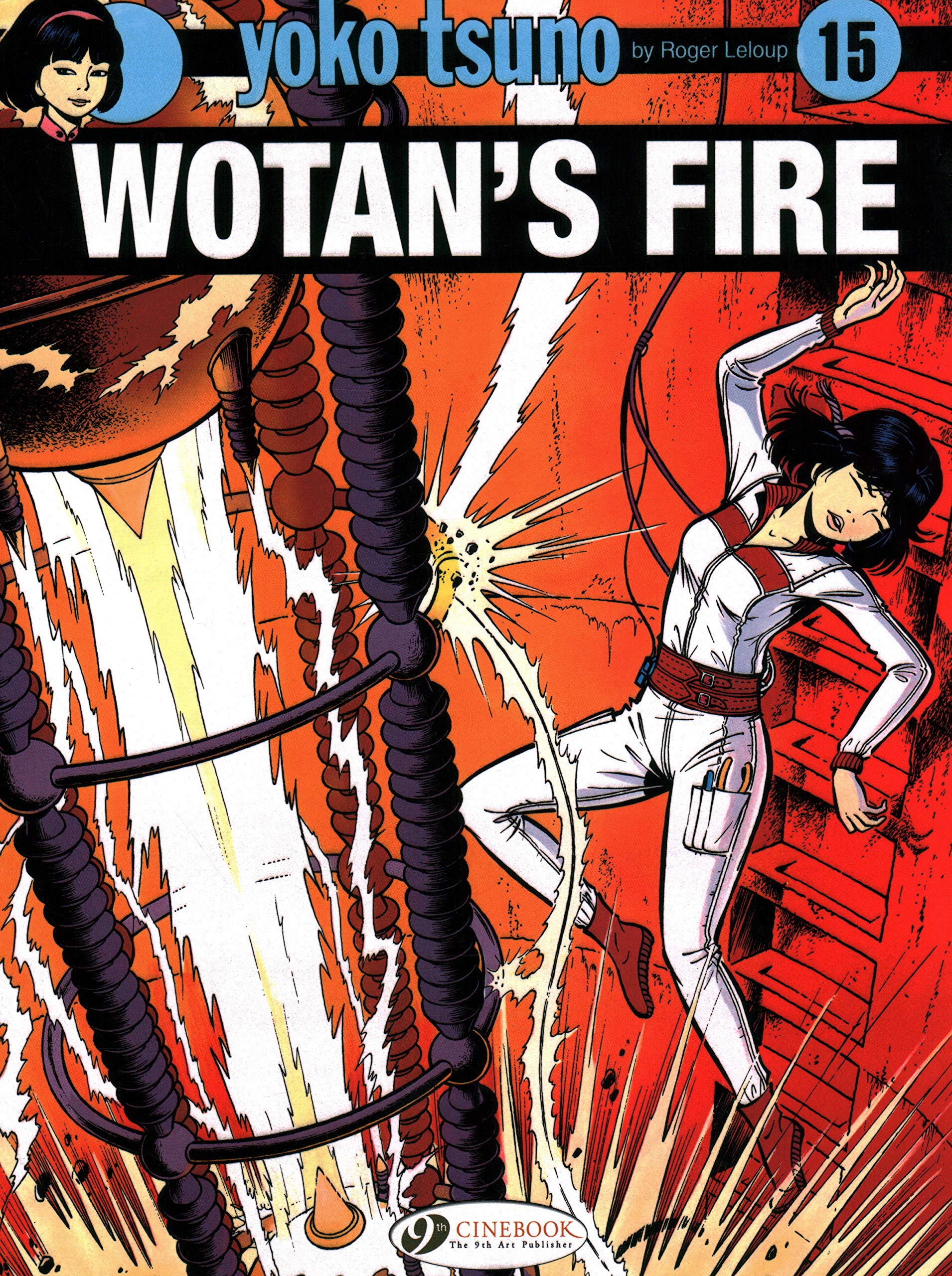
Yoko Tsuno volume 15: Wotan’s Fire


By Roger Leloup, translated by Jerome Saincantin (Cinebook)
ISBN: 978-1-84918-536-3 (Album PB)

In 1970, indomitable intellectual adventurer and “electronics engineer” Yoko Tsuno began her career in Le Journal de Spirou. She is still delighting readers and making new fans to this day in amazing, action-packed, astoundingly accessible adventures which are amongst the most intoxicating, absorbing and far-ranging comics thrillers ever created.

The globe-girdling, space-&-time-spanning epics were devised by monumentally multi-talented Belgian maestro Roger Leloup, who began his own solo career after working as a studio assistant and technical artist on Hergé’s Adventures of Tintin, beginning in 1953.

Compellingly told, superbly imaginative and – no matter how implausible the premise of any individual yarn may seem – always firmly grounded in hyper-realistic settings underpinned by authentic, unshakably believable technology and scientific principles, Leloup’s illustrated escapades were at the vanguard of a wave of strips revolutionising European comics.

That long-overdue sea-change heralded the rise of competent, clever, brave and formidably capable female protagonists taking their rightful places as heroic ideals; elevating Continental comics in the process. These endeavours are as engaging and empowering now as they ever were, and none more so than the trials and tribulations of Miss Tsuno.

Her first outings (the still unavailable Hold-up en hi-fi, La belle et la bête and Cap 351) were mere introductory vignettes before the unflappable troubleshooter and her valiant if lesser male comrades Pol Paris and Vic Van Steen properly hit their stride with premier full-length saga Le trio de l’étrange in 1971 (Le Journal de Spirou’s May 13th edition)…

Yoko’s cases include explosive exploits in exotic corners of our world, sinister deep-space sagas and even time-travelling jaunts. There are 30 European albums to date but only 16 translated into English thus far, and – ironically – none of them digitally.

First serialised in LJdS #2388-2391, Le feu de Wotan hails from 1984: a compelling science crime thriller that was the 19th astounding album. It reached us Brits as Cinebook’s 15th outing, delivering dark drama, murderous mystery and enthralling intrigue…

It begins as Yoko Tsuno arrives at Eltz Castle near Koblenz. She has returned to West Germany after being contacted by an old pal with a problem. Ingrid Hallberg is one of the world’s most esteemed classical musicians and has been hired by the Richter family to examine and assess their collection of ancient musical instruments. On discovering something extraordinary, she immediately contacted her old partner in peril…

Their first encounter (see The Devil’s Organ) was strange and deadly, and now, surrounded by a daunting team of private security guards and other suspicious characters, Ingrid has called in the freelance electrical engineer to assess the castle’s “acoustic qualities”. It’s a ploy masking the fact that Ingrid has uncovered another superweapon from history…

Sneaking around to avoid the suspiciously constant attention of architecture student Franz Thaler, Ingrid shows Yoko a bizarre futuristic battery erratically emitting electrical charges and a larger, deconstructed device in an attic. When Yoko assembles it, the result looks very like a giant gun…

As a storm builds that night, Yoko learns former resident Hans Richter was an experimental physicist who died in 1930s. He built both mechanisms and it appears the briefcase-sized battery connects to the larger device: a tool that fires bolts of lightning …it’s a Death Ray!

Before they can react, Franz steals the battery and locks them in, but his frantic escape is ended when lightning is seemingly pulled from the turbulent skies into the car he’s driving…

Acting quickly, Ingrid and Yoko recover the unharmed battery from the wreck, exploiting the guards’ uncharacteristic eagerness to cover up the event. Later, searching Franz’s room for clues, Yoko finds a radio and is startled to hear from someone who was giving the dead man orders…

A complex string of anonymised instructions and directions soon leads Yoko and Ingrid across country to Wupperthal and a secret rendezvous on an automated suspended railway train. They are being closely observed and followed…

Splitting up, Ingrid follows the “sky-train” as, in the first carriage, Yoko meets Professor Zimmer: Richter’s supervisor on the “Wotan’s Fire” project. He tells her all about the endeavour and how it ultimately killed Richter. In the course of their discussions they realise that his instructions to her had been intercepted and altered. Both have stumbled into a trap set by an unsuspected third agency…

Confronted by a gunman, Yoko deftly disarms the attacker, but her escape is foiled when everyone disembarks at Oberbarmen and she find two more villains waiting. They are holding a gun to Ingrid’s head…

However, when they trade the battery for her, Yoko retains crucial computer discs. As the thieves flee, she realises it’s all as the aged professor hoped. Allying with him and tech businessman/secret agent Peter Hertzel, Yoko learns the plot was allowed to unfold thus in an effort to locate a full-scale version of Richter’s device and foil plans to terrorise the world for profit…

Hertzel pays her a small fortune to help him stop them and soon she and her trusted comrades Vic Van Steen and Pol Paris are in action again…

After deducing where and how the terrorists will strike, the troubleshooters move rapidly. With Ingrid and Zimmer along for the ride, they are soon repairing the long-abandoned bunker installation Zimmer and Richter used to perfect the original weapon: charging more super-batteries to literally fight fire with fire. It works, but almost costs another life…

The final act opens with Yoko spectacularly boarding an oil supertanker at sea to convince the captain that his vessel is about to be an example and object lesson of ruthless criminals.

Yoko’s plan is risky: using their own death ray to counter the impending attack. However, she’s not so much worried about whose gun is bigger, only that by saving the ship and crew she must kill the crooks. That’s when she risks everything on a suicidal strategy, desperate to save the terrorists from themselves…

Rocket-paced, deviously twisted and terrifying plausible, this race against time and war against greed is a superb and mesmerising thrill ride that shows not just the smarts and combat savvy of our adventuring crusader but also her aiding compassion.

As always, the most potent asset of these edgy dramas is the astonishingly authentic and hyper-realistic settings, benefitting from Leloup’s diligent research and meticulous attention to detail. Tourists could use these pages as an A-Z and never get lost, except in rapturous wonder…

Wotan’s Fire is a magnificently wide-screen thriller, tense and satisfying, and will appeal to any fan of blockbuster action fantasy or breathtaking derring-do.
Original edition © Dupuis, 1984 by Roger Leloup. All rights reserved. English translation 2020 © Cinebook Ltd.

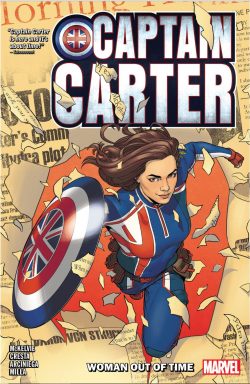
Captain Carter: Woman Out of Time


By Jamie McKelvie, Marika Cresta, Erick Arciniega, Matt Milla & various (MARVEL)
ISBN: 978-1-3029-4655-5 (TPB/Digital edition)

Comics fans are a strange breed. We funnybook cognoscenti have always wanted lesser, non-enlightened mortals to understand why our addiction to convoluted continuity and printed pamphlets are the best of all possible worlds, but then carp and whine when the greater world catches on via a major movie franchise, and embrace what we churlishly declare is not the “right “Avengers or Batman

We also wish more girls read X-Men and The Hulk

Seriously though, now that superheroes are a common global currency, us paper purists just need to accept that other media not only exploit our preferred area of delight, but inevitably affect and reinforce it. After all, does it really matter when comic book stories come from, if they are as good as possible and just as entertaining as any classic in-continuity romp?

It’s not as if comics didn’t already have an in-built mechanism for incorporating outlandish elements. We call it The Multiverse

The Marvel Cinematic Universe bound together many beloved but radically reinterpreted elements of historical comics innovation into a separate reality (more than one, actually), and here that pays off big for movie icon Peggy Carter as her subsequent solo TV series and animated What If? appearances are finally parlayed into a comic series.

Written by Jamie McKelvie (Phonogram, The Wicked + The Divine, Catwoman, Batman, Young Avengers), illustrated by Marika Cresta (Star Wars: Doctor Aphra, Power Pack, Fearless, X-Men and Moongirl) and colourists Erick Arciniega & Matt Milla, all lettered by VC’s Clayton Cowles, her debut 5-issue series (cover-dated May-October 2022) is collected here: offering a glimpse at a possible world where the super-soldier serum that created Captain America transformed not passionate idealistic kid Steve Rogers, but a potent, competent, highly trained and educated woman of the world…

Mirroring mainstream continuity, it begins with the finding and thawing of a WWII legend who supposedly perished battling arch-Nazi Baron von Strucker. Margaret “Peggy” Carter quickly adapts to the many changes of a new century: appreciating how far women – and minorities – have advanced even as ambitious men and untrustworthy governments squabble over who will control her. Some things never change…

Ultimately she agrees to work for British Intelligence, taken under the wing of Prime Minister Harry Williams, who sees her a living symbol of a go-getting country on the move again. He’s going to personally manage and supervise the career of the UK’s only superhero extremely carefully and very closely…

To that end, and over her grudging protests, he’s placed the Captain with new agency S.T.R.I.K.E. (Special Tactical Reserve for International Key Emergencies) and appointed operative Lizzie Braddock as her liaison/minder. She’s not what she at first appears to be, but then again, neither is the PM…

Before Carter can get her bearings, a string of deadly attacks hurls her back into the bloody superhero spy game when a mysteriously resurgent Hydra targets their oldest enemy and turn London into a war zone…

The hero quickly falls into old habits, living her new life on a war footing, but something just doesn’t feel right. Facing an endless barrage of missions against foes like people-smuggler Batroc, Carter slowly realises that the government has been massaging the political messages she’s been learning, and might not be acting on behalf of all the people.

A different and uncomfortable truth comes via neighbour Harley Davis: a young black girl who explains what “processing” illegal migrants and asylum seekers actually means…

Appalled and now informing herself from a variety of sources, Carter refuses to be a flashy propaganda tool any longer, provoking an immediate and lethal response from the headline-obsessed government. As bodies drop and attacks intensify, she finds a welcome ally in Tony: grandson of genius inventor (and Carter’s closest WWII comrade) Howard Stark

He’s just as smart as grandpa and also despises tyrants and fascists…

As the government go into spin mode, blaming and framing everybody else for their sins, Carter, Stark, Braddock and Davis take the fight to them, only to discover an ancient and unholy secret aristocracy at the heart of the conspiracy, one that has been feeding on Britain’s life blood for centuries…

Now it’s time the people saw the light and our assembled heroes cleaned house…

Backed up by a cover gallery and costume/uniform designs by McKelvie, this tome includes a wealth of variant covers from Sara Pichelli & Matthew Wilson, Marvel Studios, Jen Bartel, Todd Nauck & Rachelle Rosenberg, Paco Medin & Jesus Aburtov, Marc Aspinall, Ashley Witter, and Romy Jones.

Fun, fast, furious, filled with the kind of in-joke riffs veteran fans love and telling a fresh new tale featuring a truly forceful “fighting female”, Captain Carter is also a wry and barbed political and social statement on the responsibilities of rule, and a damn fine read as well. She’s not The Captain, but she’s just as good – and maybe even better…
© 2022 MARVEL.

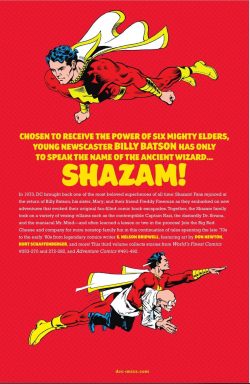
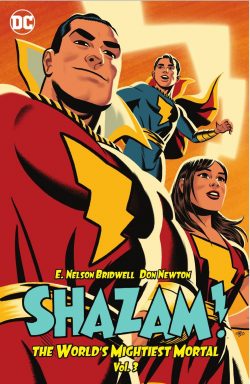
Shazam!: The World’s Mightiest Mortal volume 3


By E. Nelson Bridwell & Don Newton, with Gil Kane, Kurt Schaffenberger, Dave Hunt, Joe Giella ,Bob Smith, Steve Mitchell, Frank Chiaramonte, Dan Adkins, Larry Mahlstedt, John Calnan & various (DC Comics)
ISBN: 978-1-7795-0946-8 (HB/Digital edition)

One of the most venerated and beloved characters in American comics was devised by Bill Parker & Charles Clarence Beck as part of the wave of opportunistic creativity that followed the debut of Superman in 1938. Although there were many similarities in the early years, the Fawcett Comics character moved swiftly and solidly into the realm of light entertainment – and even broad comedy – whilst, as the 1940s progressed the Man of Steel increasingly left whimsy behind in favour of action and drama.

Homeless orphan and thoroughly good kid Billy Batson was selected by an ancient wizard to battle injustice: granted the powers of six gods and mythical heroes. By speaking aloud the mage’s name – an acronym for the six patrons Solomon, Hercules, Atlas, Zeus, Achilles and Mercury – Billy transformed from scrawny boy to brawny adult Captain Marvel.

At the height of his popularity, “the Big Red Cheese” significantly outsold Superman – even being published twice a month. However, as the decade progressed tastes changed and sales slowed. An infamous court case begun in 1941 by National Comics contesting copyright infringement was settled. Like many other superheroes, Cap disappeared, becoming a fond memory for older fans. A big syndication success, he was missed all over the world…

In Britain, where an English reprint line had run for many years, creator/publisher Mick Anglo had an avid audience and no product, and so reimagined the Captain Marvel franchise into atomic age hero Marvelman and Co., continuing to thrill readers well into the 1960s.

Then, as America lived through another superhero boom-&-bust, the 1970s dawned with a shrinking industry and wide variety of comics genres servicing a base that was increasingly founded on collectors and fans rather than casual or impulse buyers. DC Comics needed sales and were prepared to look for them in unlikely places.

Following a 1953 court settlement with Fawcett, DC ultimately secured the rights to Captain Marvel, his spun-off extended Family and attendant strips and characters. Despite the actual name having been taken by Marvel Comics (via a circuitous route and quirky robotic hero published by Carl Burgos and M.F. Publications in 1967), the monolithic publishing home of Superman opted for tapping into that discriminating, if aging, fanbase.

In 1971, they licensed the dormant rights to the character stable (only fully buying them out in 1991) and two years later, riding a wave of national nostalgia on TV and in movies, DC resurrected and relaunched the entire beloved cast in their own kinder, weirder, completely segregated and separate universe.

To circumvent intellectual property clashes, they named the new/old title Shazam! (‘With One Magic Word…’): the unforgettable trigger phrase used by the majority of Marvels to transform to and from mortal form and a word that had entered the American language thanks to the success of the franchise (especially an excellent movie serial) the first time around.

Issue #1 carried a February 1973 cover- date and featured ‘In the Beginning’: relating, in a wittily engaging, grand old self-referential style, the classic origin, after which ‘The World’s Wickedest Plan’ related how the Captain, his super-powered family and all the supporting cast had been trapped in a timeless state for 20 years by the invidious Sivana Family… who had subsequently been trapped in their own Suspendium device too.

I can’t think of any better reason for you to grab the first volume of this series, or the second for that matter…

The series received mixed reviews and unconvincing sales results, but was pushed hard by DC. It even briefly scored the big prize in the publisher’s eyes: being adapted to television as live action Saturday morning series Shazam!, which ran for three season (28 episodes) from September 7th 1974 to October 16th 1976…

The comic book continued until #35, June 1978 before commercial pressures killed it – and many other DC titles. Happily, the series had enough fans – in the marketplace and amongst creators and editors – to be thrown a lifeline…

The stories and milieu had already begun course correction by then. Radical change and darker, “more realistic” adventures had started in Shazam! #33, and more mainstream artists heralded a metamorphosis via action and drama-heavy battles against Nuclear robotic menace Mister Atom, sadistic super-fascist Captain Nazi, murderous primordial “Beastman” King Kull and infernal foe Sabbac…

This third stylish compendium spans cover-dates November 1978 to October 1982, collecting material from World’s Finest Comics #253-270 and 272-282, plus one final fling from Adventure Comics #491-492. Mostly unseen since first release, all the stories were ritten by unsung legend E. Nelson Bridwell, and mostly pencilled by supremely gifted, gone-far-too-soon Don Newton. The latter was born in 1934 and came up through the burgeoning fan press of the 1960s and 1970s. In his too-short career, Newton distinguished himself on The Phantom, The Avengers, The New Gods, Star Hunters, Aquaman and especially Batman, but was clearly at his happiest with Fawcett’s Captain Marvel Family – now and forevermore grouped under the electrical umbrella of Shazam!

Newton was a huge fan of the Captain and his clan, having studied under originator C.C. Beck. The gifted prodigy had been drawing Batman since 1978 and his version was well on the way to being the definitive 1980s look, but Newton’s tragically early death by heart attack in 1984 cut short what would surely have been a superlative and stellar career.

Author Bridwell (Super Friends; Secret Six; Inferior Five; Batman; Superman; The Flash; Legion of Super-Heroes and fill-ins absolutely everywhere) was another devout Captain Marvel acolyte. His day job and secret identity was as editorial assistant/continuity coordinator at DC, where – thanks to an astoundingly encyclopaedic knowledge of publishing minutiae and almost every aspect of history, myth, popular trends and general knowledge plus the ability to instantly recall every damn thing! – he was justly famed as Keeper of Lore and top Continuity Cop.

Bridwell & Newton had just begun collaborating on their dream project when the title was cancelled. Happily, the Shazam Family were moved lock, stock and barrel to experimental giant-sized anthology World’s Finest Comics just as tone and content seamlessly shifted from whimsy to harder-edged contemporary superhero stories.

The wonderment resumes here moments after that final Shazam! issue, wherein King Kull tried to reverse history and re-establish his extinct race and empire. In the rubble-strewn aftermath, WFC #253 opens with ‘The Captain and the King!’ wherein Bridwell, Newton & inker Kurt Schaffenberger recount how Billy, his sister Mary Marvel and their teenage ally Freddy Freeman – AKA Captain Marvel Junior – set off after the brute, blithely unaware that an alliance of the Sivana family and Captain Nazi has faltered.

Despite the fascist now acting on his own, he had inadvertently – and unsuspectedly – gained the power of mind control, and accidentally defeated himself by having the Marvels, science-hero Bulletman and villainous Kull and Sivana attack him…

Meanwhile, wicked Ebeneezer Batson (who had embezzled Billy and Mary’s inheritance) had his soul claimed by Satan, prompting an heroic rescue mission to Hell in #254’s ‘The Devil and Capt. Marvel’, after which Mary takes centre stage as the boys and Bulletman join the enslaved army of irresistible sorcerous seductress ‘Dreamdancer’, leaving only his wife Bulletgirl and the Shazam sister to save the city…

A wry change of pace tinged WFC #256 as the Marvels foil the schemes of a time-travelling swindler in ‘The Gamester’s Death Wager!’, before Billy employs the wisdom of Solomon to defeat ‘The Invincible Man’ threatening Earth – and foiling the masterplan of wicked worm Mister Mind – before backing up Junior when he goes after his Aryan archnemesis.

It’s an extremely personal and delicate case since the lovesick monster has abducted Beautia Sivana (a family black sheep who isn’t evil!): subjecting her to ‘The Courtship of Captain Nazi’. Frankly, she really doesn’t need any help stopping the lech, and the beating CM Junior delivers is just an afterthought…

In these yarns Bridwell assiduously filled in backstory and origins of a world largely unfamiliar to new and younger readers, and for WFC #259 focused on the urbane talking tiger who is the Family’s great ally as a scientist solves ‘The Secret of Mr. Tawny’ and derives an evolutionary process to become futurised, enhanced, all-conquering dictator The Superior …until the Captain and the big cat strike back…

Inked by Dave Hunt, ‘There Goes the Neighborhood!’ deposits a delicious dose of whimsy and contemporary politicking as citizens furiously protest weird strangers moving into their area. The immigrant newcomers are mythologicals – satyrs, centaurs, siren, lamia and mermaids – but even Captain Marvel can’t fight human prejudice and nimbyism …until a geological crisis makes allies of everyone…

Mary flies solo in #261, defeating an old foe by solving ‘The Case of the Runaway Sculpture’, before Billy enjoys a revelatory history lesson after meeting ‘The Captain Marvel of 7,000 B.C.’ and helping set the universe on its true cosmic course whilst Freddy again faces octogenarian outlaws when ‘The Greybeard Gang’ unleash a taste of the bad old days…

Fawcett invented big fight stories and multi-part serial epics at the dawn of the Golden Age and for World’s Finest Comics #264 Bridwell, Newton & Hunt celebrated the tradition with Mister Mind getting his old gang back together. ‘The Monster Society Strikes Back!’ sees the alien worm, Sivana, Mr. Atom, King Kull, IBAC (combining the awesome “Evil” of Ivan the Terrible, Borgia, Attila and Caligula in one weedy nerd with his own acronymic magic word), Oggar (“World’s Mightiest Immortal”) and evil antithesis Black Adam united in a scheme to kill the hero kids and conquer everything.

First to strike are Oggar and Adam, but their resurrected Egyptian armies are no match for Mary and Billy, and the focus falls on the human-hating beastman and atomic automaton who trigger ‘The Plot Against the Human Race’ (inked by Frank Chiaramonte) but just can’t outsmart Billy and Freddy…

Joe Giella applied his classical inking to WFC #266’s as murderous mystic malcontent IBAC joins ‘Sivana’s Space Armada’, recruiting aliens from everywhere to attack Earth, yet once again failing to get past mighty Captain Marvel. Bob Smith then inked #267’s concluding chapter as the ghastly gang regroup to perpetrate an ‘Assault on the Rock of Eternity!’, sparking the return of part-timers The Three Lieutenant Marvels to help save creation…

Like Philip Jose Farmer, Bridwell was one of those creators who always sought links between heroes and villains, and he indulged himself via a trick of fortuitous continuity in #268’s ‘A Sleep and the Deep’ (Steve Mitchell inks) as Freddy Freeman’s origins were re-examined via some very nasty nightmares…

In brief: Captain Marvel Jr. and his originating antithesis Captain Nazi sprang out of a crossover experiment in 1942, starting in the Bulletman feature of Master Comics. The Ballistic Wonder was undoubtedly Fawcett’s runner-up attraction: hogging the cover spot there and even winning his own solo comic book. That all changed with #21 and Captain Nazi. Hitler’s unholy Übermensch made manifest, the monstrous villain was despatched to America to spread terror and destruction and kill all its superheroes.

Nazi stormed in, battling Bulletman and Captain Marvel, who naturally united to stop the Fascist Fiend razing New York City. The clash ended inconclusively and restarted in the Captain Marvel portion of Whiz Comics #25 with the Nazi trying to wreck a hydroelectric dam. Foiled again, he sought to smash a fighter plane prototype.

Captain Marvel countered him, but was not quick enough to prevent the Hun killing an old man and brutally crushing the young boy beside him. Freddy Freeman seemed destined to follow his grandfather into eternity, but guilt-plagued Billy brought the dying lad to Shazam and the wizard saved his life by granting him access to the power of the ancient gods and heroes. Physically cured – except for a permanently maimed leg – the process generated a secondary effect: whenever he uttered the phrase “Captain Marvel” Freeman transformed into a super-powered version of his mortal self.

The epic concluded in Master Comics #22 when the teen titan joined the Bullets in stopping Captain Nazi, victoriously concluding with a bold announcement that from the very next issue he would be starring in his own solo adventures…

In our modern age, the net result was that Freddy experienced a portentous dread that the seas which had taken all his family had not done with him and something evil was coming…

Before that though, Bridwell, Newton & Dan Adkins reveal how composite demon host Timothy Karnes (carrying infernal icons Satan, Any, Belial, Beelzebub, Asmodeus & Craeteis) is revealed as the cruel cause of those nightmares in #269’s ‘SABBAC Strikes Back!’ but is unable to survive when CMJ deduces the plot and turns the tables…

It’s smiles all around – eventually – when Billy’s alter ego convinces hideous extraterrestrials to take back their well-meaning gift of transforming his landlady’s offspring into ‘Our Son, the Monster!’ (Larry Mahlstedt inks) whilst Mary Marvel confronts a deadly new foe in #272. As inked by Mitchell, ‘Chain Lightning’ can divert and absorb the magic bolts that bestow godlike power, but she can’t think as quickly as the Shazam girl…

Adkins returned for #273 as the World’s Wickedest Scientist writhes in shame after being awarded ‘Sivana’s Nobel!’ for the discarded and despised benevolent devices he invented before turning evil. To restore his own pride, the batty boffin tries to trigger World War III, but thanks to Captain Marvel only makes himself eligible for next year’s Peace Prize…

Billy Batson steals the show next, solving a baffling murder mystery in the Mahlstedt inked ‘Silence, Please’ and Adkins embellishes a compelling kidnap drama as the Marvel family seek a temporary replacement following ‘The Snatching of Billy Batson!’

Inked by Chiaramonte, weird war and magical mystery inform WFC’s #276 pan-dimensional invasion saga, but the last stand of ‘Magicians and Mercenaries’ – and the Marvel Family – proves but a simple prelude to Junior tackling ‘The Menace of the Moon-Tree!’ when fairy tales come true and magic beans link Earth to Luna…

A glimmer of understanding comes in #278 as satanist Dora Keane accepts ‘The Power of Darkness!’ from Satan, and as Darkling defeats the Shazam- powered champions. Saved by another enigmatic magical manifestation, the heroes are set on the trail of an unknown operator acting anonymously from the shadows…

His identity is revealed in #279 as a ruthless plutocrat blackmails the world into finding a cure for his fatal illness, or else ‘When Bancroft Fisher Dies, Everybody Dies!

As the Marvels race to find the global boobytrap endangering life on Earth, they are assisted by beings impossible to believe or comprehend and a boy Freddy recognises…

The truth emerges in ‘The Secret of the Freeman Brothers!’ and the return of Kid Eternity

Way back in Shazam! #27, Bridwell had revived a Quality Comics character DC had also acquired when the Golden Age ended. The ghostly child and his spiritual advisor (that’s a pun, sons & daughters) fitted perfectly into what Silver Age fans dubbed Earth-S continuity, despite previously only being seen in reprint tales…

Devised by Otto Binder & Sheldon Moldoff, the Kid had debuted in Hit Comics #25 (cover-dated December 1942): an innocent boy machine-gunned by Nazis on a U-Boat, and taken to the heavenly realm of Eternity by a hapless soul collector years before his actual due date. Bureaucracy being the ultimate force of Creation, the lad was unable to simply return to life, but was granted compensation in the ability to temporarily walk the Earth, and power to summon any person, myth or legend from literature or history.

Aided by bumbling but beneficent spirit Mr. Keeper, the Kid fought crime and injustice until all the really good Golden-Age comic books were cancelled, but now was revealed as Freddy’s brother Christopher “Kit” Freeman, who had died on the same day Freddy had been attacked by Captain Nazi and both grandfathers had been killed…

As the boys compare origins it’s revealed that Mr. Keeper’s original mistake was taking Kit instead of Freddy and that the wizard was deeply involved in setting the situation right…

Having at last made contact with his sibling and saving Earth from mystic menaces, Kid and Junior are at the forefront of the next crisis as Mister Mind steals ultimate power in #281 to become ‘The One-Worm Monster Society!’ (John Calnan inks). Once that catastrophe cataclysmically concluded, the spooks silently stuck around, helping scupper the schemes of con artists Silk and Her Highness in the final World’s Finest outing.

Illustrated by Gil Kane, ‘Charity Begins…’ (#282 August 1982) was set in a circus and featured everyone – even charismatic charlatan/honorary Marvel Uncle Dudley – but was not the intended last hurrah. That had been delayed and only appeared in DC Digest-series Adventure Comics #491 & 492 (September and October 1982, illustrated by Newton, Chiaramonte & Calnan).

It began with ‘The Confederation of Hell’ as Satan assembled former failed agents IBAC, Darkling, SABBAC and old Kid Eternity enemy Master Man who attacked the heroes in their human forms, and unleashed primordial deities to do their dirty work. However, with Kit and Keeper turning the tide the Marvels easily won their ‘Battle with the Gods!’ to fade safely into comics limbo until the next reboot…

Although still controversial amongst older fans like me, the 1970’s incarnation of Captain Marvel/Shazam! has a tremendous amount going for it. Gloriously free of breast-beating angst and agony (even at the end) these adventures are beautifully, compellingly illustrated and charmingly scripted: clever, rewarding, funny and wholesome superhero yarns to appeal to any child and positively promote a love of graphic narrative. There’s a horrible dearth of exuberant superhero adventure these days, so isn’t it great that there is still somewhere to go for a little light action?

Just say the word…
© 1978, 1979, 1980, 1981, 1982, 2021 DC Comics. All Rights Reserved.

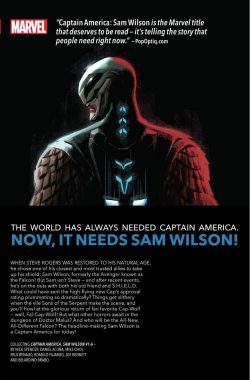
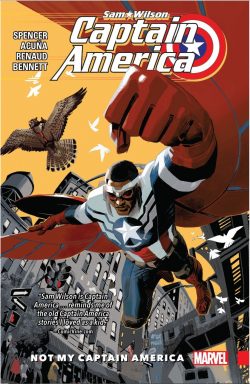
Captain America Sam Wilson volume 1: Not My Captain America


By Nick Spencer, Daniel Acuña, Paul Renaud, Joe Bennett, Mike Choi, Romulo Fajardo Jr., Belardino Brabo & various (Marvel)
ISBN: 978-0-7851-9640-2 (TPB/Digital edition)

Created by Joe Simon & Jack Kirby in an era of national turmoil and frantic patriotic fervour, Captain America was a dynamic, emphatically visible response to the horrors of Nazism and the threat of Liberty’s loss. Consequently, the concept quickly lost focus and popularity once hostilities ceased. The Sentinel of Freedom and Champion of Democracy faded away during post-war reconstruction, only to briefly reappear after the Korean War: a harder, darker Cold Warrior hunting monsters, subversives and “Reds” who lurked under every American bed.

He abruptly vanished once more, until the burgeoning Marvel Age resurrected him just in time to experience the Land of the Free’s most turbulent, culturally divisive era. He became a mainstay of the Marvel Revolution in the Swinging Sixties, but lost his way after that, except for a politically-fuelled, radically liberal charged period under scripter Steve Englehart.

Despite everything, Captain America evolved into a powerful symbol for generations of readers and his career can’t help but reflect that of the nation he stands for…

Devised in the fall of 1940 and on newsstands by December 20th, Captain America Comics #1 was cover-dated March 1941, and an instant monster, blockbuster smash-hit. The Sentinel of Liberty had boldly and bombastically launched in his own monthly title with none of the publisher’s customary caution, and instantly became the absolute and undisputed star of Timely’s top-selling “Big Three” (with The Human Torch and Sub-Mariner.)

He was, however, one of the first to fall from popularity as the Golden Age ended.

During that initial run, his exploits were tinged – or maybe “tainted” – by the sheer exuberant venom of appalling racial stereotyping and fervent jingoism at a time when America was involved in the greatest war in world history. Nevertheless, the first 10 issues of Captain America Comics remain amongst are the most exceptional comics in history…

You know the origin story like your own. Simon & Kirby revealed how scrawny, enfeebled patriot and genuinely Good Man Steven Rogers – after being continually rejected by the US Army – is recruited by the Secret Service. Desperate to stop Nazi expansion and Home Front mischief, the passionate kid joined a clandestine experimental effort to create physically perfect super-soldiers.

I have no idea if the irony of American Übermenschen occurred to the two Jewish kids creating that mythology, but here we are…

When a Nazi infiltrated the project and murdered the pioneering scientist behind it, Rogers was left as the only successful result and became America’s not-so-secret weapon. When he was lost, others took up the role and have periodically done so ever since. I might be wrong, but as I recall every substitute and replacement was white and male…

Over decades the story unfolded, constantly massaged and refined, yet essentially remaining intact. In 2002 – and in the wake of numerous real-world scandals like the revelations of the “Tuskegee Experiment” (AKA Tuskegee Syphilis Study 1932-1972) – Robert Morales & Kyle Baker took a trenchantly cynical second look at the legend through the lens of the treatment of and white attitudes towards black American citizens…

The result was Truth: Red, White & Black (link please): a hard-hitting view of the other side of a Marvel foundational myth that forever changed continuity: one using tragedy and injustice to add more – and more challenging – role models/heroes of colour to the pantheon.

As Marvel expanded and reached market dominance in the 1960s, its publications ceaselessly whittled away at the unacknowledged colour bar in comics. At this time, many companies (choked to bursting point with seditious Liberals and even some actual Intelligentsia!) were making tentative efforts to address what were national and socio-political iniquities.

However, issues of race and ethnicity took a long time to filter through to still-impressionable young minds avidly absorbing knowledge and formative attitudes via four-colour pages that couldn’t even approximate the skin tones of African-Americans or Asians…

As in television, breakthroughs were small, incremental and too often reduced to a cold-war of daring “firsts”. Excluding a few characters (like Matt Baker’s Voodah) in jungle-themed comic books of the 1940s-1950, Marvel clearly led the field with their black soldier in Sgt. Fury’s Howling Commandos team – the historically impossible Gabe Jones who debuted in #1, May 1963. So unlikely was Gabe that he was automatically and so helpfully re-coloured “Caucasian” at the printers, who clearly didn’t realise his ethnicity but knew he couldn’t be anything but white.

Jones was followed by an actual African superhero when Fantastic Four #52 (cover-dated July 1966) introduced The Black Panther. Throughout that intervening period, strong, competent and consistent black characters – like The Daily Bugle’s city editor Robbie Robertson (Amazing Spider-Man #51, August 1967) and detective Willie Lincoln (Daredevil #47, December 1968) – had been gradually and permanently added to the regular cast of many series. They were erudite, dignified, brave, proudly ordinary mortals distinguished by sterling character, not costume or skin tone: proving that the world wouldn’t end if black folk and white folk occupied the same spaces…

The first “negro” hero to helm his own title had already come (and gone largely unnoticed) in a little-regarded title from Dell Comics. Debuting in December 1965 and created by artist Tony Tallarico & scripter D.J. Arneson, Lobo was a black gunslinger in the old west, battling injustice just like any “white hat” cowboy would.

For Marvel, the big moment came in Captain America #117 (September 1969) as, during an extended battle against the Red Skull and his sinister Exiles, artist Gene Colan got his wish to create the industry’s first official African American superhero: Sam Wilson, The Falcon

After a few cautious months, he returned, became Captain America’s friend, student, partner and – after decades – ultimately his replacement…

Finally, change was acceptable. As the 1960s ended, more positive and inclusive incidences of ethnic characters appeared, with DC finally launching a black hero in John Stewart (Green Lantern #87, December 1971/January 1972) – although his designation as a replacement GL could be construed as more conciliatory and insulting than revolutionary.

DC’s first solo star in his own title was Black Lightning, but he didn’t debut until April 1977, although Jack Kirby had introduced Vykin in Forever People #1, the Black Racer in New Gods #3 (March and July 1971) and Shilo Norman as Scott Free’s apprentice/successor in Mister Miracle #15 (August 1973), whilst Archie Goodwin engineered Marvel’s biggest triumph with the launch of Luke Cage, Hero for Hire in the summer of 1972. A year later, Black Panther won his own series in Jungle Action #5 and Blade: Vampire Hunter debuted in Tomb of Dracula #10. At last, black people were part and parcel of a greater continuity society, not separate and isolated chimera on the fringes…

This big change came from incremental advances slowly achieved against the backdrop of a huge societal shift triggered by the Civil Rights movement, but even though it all grew out of raised social awareness during a terrible time in American history (yes, even worse than today’s festering social wars), kids and other readers knew something special was happening and they must participate…

Nearly half a century later, following a convoluted but generally steady and steadfast career, multi-talented flying superhero Sam Wilson was a tried and true star: holding a succession of civilian jobs – from social worker to architect to politician – whilst his true vocation was being a superhero, singly, in partnerships in the Avengers and as part of S.H.I.EL.D.

Recently: After spending 12 relative years in hellish time-bent Dimension Z raising a child and saving its indigenous people from sadistic Hitlerian uber-geneticist Arnim Zola, Steve Rogers finally returned to Earth to discover mere hours had passed in the “real” world.

Barely pausing, he went straight back to work, stopping deranged, drug-dependent US supersoldier Frank Simpson (AKA Nuke: a covert Captain America from the Vietnam era) slaughtering men, women and children in the nation’s name. Rogers was then sucked back into spy games: confronting former S.H.I.E.L.D. agent/messianic socialist Ran Shen, who aroused a sleeping dragon for its power to reshape the world to his liking. As the Iron Nail, he tried to destroy greedy, exploitative, destructive capitalism using tools and techniques taught him by Nick Fury (Senior) and Chinese iconoclast Mao Zedong

Rogers won that war of ideological wonder warriors at the cost of his faith and lifelong purpose of his existence, but fell victim to Dr. Mindbubble: ready, able and extremely willing to share his terrifying expanded sensibilities with the corrupt Establishment world…

Already disgusted by the procession of appalling creations his country has devised in the name of security, Cap’s peace of mind took another big hit when S.H.I.E.L.D. admitted Mindbubble was theirs: a countermeasure to possible rogue super soldiers, but one mothballed when the cure proved worse than the anticipated affliction…

When the so-very-mad Doctor triggered S.H.I.E.L.D.’s ultimate doomsday weapon, Captain America and The Falcon did what they always did to save the world. Ultimately though, it was Rogers, resolute and alone, who fought his greatest battle to save innocents and a nation he embodied but no longer trusted…

What the Falcon rescued from the rubble, Rogers was no longer Captain America at all…

In the aftermath, and as part of publishing relaunch “All-New, All-Different”, weary, worn-out enfeebled Rogers got a desk job as security supremo whilst Wilson was promoted to Captain America. Sam picked up the shield, rebuilt his wings and promptly proved himself by stopping a plot to destroy humanity perpetrated by Helmut Zemo, Baron Blood and Hydra: executed by Sin, Batroc, Taskmaster, Armadillo, Crossbones and a host of other old foes…

Here, though, we’re concentrating on a true fresh start as our so-patient hero officially launches his new role. Gathering Captain America: Sam Wilson #1-6 (cover-dated December 2015 – April 2016), it’s scripted by Nick Spencer (Spider-Man, Astonishing Ant-Man) and initially illustrated by Daniel Acuña (Eternals, Wolverine, Black Widow) & Mike Choi.

During his last exploit the “black Cap” had lost sidekick Nomad, formed a potent alliance with wonder warrior/deadly detective Misty Knight, and became a very public figure in all his identities. Now, as he flies coach from Phoenix to New York that celebrity comes back to bite him…

As a public hero, Wilson wanted to try new things and employed Knight, former ally Dennis Dunphy (Demolition Man) and digital whistleblowing vigilante The Whisperer to run a full-time support team. After again beating Crossbones, Wilson repurposed his role as national symbol and defender by taking a public stand on numerous social and political issues. Generating a storm of right-wing dissent and anti-minority hate-speech, he then doubled down by creating a hotline where literally anybody could ask for Captain America’s help…

Pilloried in the media, he soldiered on, despite being inundated by nutjob notices from across the nation. His idea paid off when someone who really needed help made contact…

In Arizona, immigration was always a hot topic, but when Wilson learned young Joaquín Torres had been abducted by ultra-racists The Sons of the Serpent for helping the Mexican community, Captain America got involved…

The kid was one of many minority ethnic Americans helping immigrants, so the Sons had given him to evil genius Karl Malus to use in his experiments. Although the desert end of the human pipeline was quickly crushed, it took some time for Cap to track the kid down. By the time he and Knight had crushed a legion of villains and worked their way up an abhorrent chain, Torres had been cruelly and continually mutated, merged with Wilson’s animal ally Redwing and infected with vampirism, and was well on his way to becoming something unhuman…

Slow, patient work revealed connections to corporate America and just more “business opportunities” for unchecked Capitalism, and led to utter catastrophe after Malus turned Wilson into a science-derived werewolf and himself into a shapeshifting horror in the manner of Venom and Carnage.

Inevitably – and with Joaquín’s help – Knight, D-Man, Whisperer and “Cap-Wolf” stop Malus, only to find the war against the weakest was orchestrated by reptile-themed old foes working with big business. Rebranded “Serpent Solutions”, the former Serpent Society of supervillains sought to control Wall Street and the world, using tactics perfected by Hydra and AIM.

Their campaign kicks off in a tense tale limned by Paul Renaud & colourist Romulo Fajardo Jr., as supposedly reformed “bad-girl” Diamondback plays both sides when the embattled heroes act to expose the snakes’ scheme…

With double-dealing double crosses, unchallenged racial hatred and unchecked greed unleashed, the good guys are completely overwhelmed until the Serpents’ latest victim takes charge of his destiny and the newest incarnation of the Falcon flies to the rescue: claiming his own share of justice and retribution in a spectacular all action finale illustrated by Joe Bennett, Belardino Brabo & Fajardo Jr.

With covers and variants by Acuña, Renaud, Óscar Jiménez Steve Epting, John Cassady & Laura Martin, Mahmud Asrar and Evan “Doc” Shaner, this epic reworking of an American Tale is wry, witty, controversially outspoken (for a mainstream comic, at least) and superbly rewarding: a saga of the Black Cap which laid much of the groundwork for today’s screen informed Sentinel of Liberty. It might be Not My Captain America, but it’s definitely one all fans should see.
© 2016 Marvel Characters, Inc. All rights reserved.

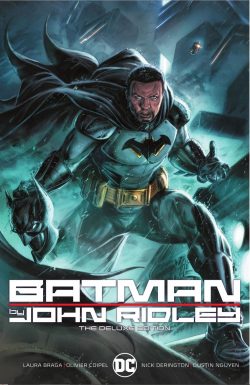
Batman by John Ridley: The Deluxe Edition


By John Ridley, Laura Braga, Olivier Coipel, Nick Derington, Dustin Nguyen & various (DC Comics)
ISBN: 978-1779511263 (HB/Digital)

Like his immediate progenitor Superman, the Dark Knight has transcended lowly populist origins to join a metafictional literary landscape populated by the likes of Tarzan, Romeo and Juliet and Sherlock Holmes, as well as similar graphic upstarts including Mickey Mouse and Popeye. As such, his universal recognition factor outside our industry means he gets to work in places and scenarios that don’t always appeal to traditional funnybook audiences.

That means everyone thinks they know Batman and has their own story to tell about him…

It’s a propensity of the property that DC has always been willing to push to that fact. Probing the many, many worlds of Batman has always paid off for the publishers (and games-makers/movie and TV producers/toy vendors, et al) who have all in their own ways expanded Bob Kane & Bill Finger’s original concept since 1939. Just check out The Dark Knight Returns, Batman Beyond or Gotham By Gaslight to see how he inhabits many worlds and how powerfully successful the process can be…

Of course, the prime culprit and beneficiary of this plasticity will always be the comics makers themselves. Over decades, DC has constantly delivered an infinite variety of Gotham Guardian, in wild new worlds or fanciful locales not so different from mainstream continuity or what we consensually accept as the “real world”…

Following mega-event Dark Nights: Death Metal, all previous aspects of DC comics continuity were reactivated (re-legitimised?) after years of adulteration, alteration and revision. It resulted in a vast, multiversal repository of story potential, with one future-set sector designated the Future State.

An editorial pause, palate-cleanse and fresh jumping-on point, the project delivered stories of apparently-familiar characters and properties in near or distant settings, subdivided into already-proven divisions such as Future State: Wonder Woman, Future State: Justice League and Future State: Gotham…

Meanwhile…

The evolution and assimilation of non-white, non-standard characters – defined and othered by skin colour, religion, ethnicity and who loves whom – into most regions of mass media had been described as “measured progressiveness” by author and screenwriter John Ridley. You might know him from novels like Stray Dogs, The Drift and What Fire Cannot Burn; screen works as varied as Fresh Prince of Bel-Air, Cold Around the Heart, U Turn, Three Kings, Static Shock, Third Watch, Undercover Brother, American Crime or 12 Years a Slave and comics such as The American Way, The Other History of the DC Universe, Superman Red & Blue and Black Panther.

His premise is especially true and effective in comics, where incremental firsts have always been applauded and encouraged – and rightly so, as the industry was traditionally aimed at kids and has always been at the forefront of progressive thinking and action. However, it has also suffered from a tickbox mentality where true change has been slow to materialise and hard to sustain.

We can say “first black superhero”, “first gay hero”, “first interracial marriage” or “first same-sex kiss”, but other than offering a glimmer of acceptance, and recognition, what has really changed?

It’s certainly better than an all-white, all-male milieu where “different” equates to “lesser than”, where more than 50% of the populace – and who knows how much of the readership – doesn’t conform to supposed “norms” and are so often reduced to eye-candy, or plot props, and relegated to useless bystanders, victims or bodycount fodder, but so seldom even competent villains, who at least have some agency…

For the longest time those attitudes were tacitly enshrined on funnybook pages – and not even for sinister reasons – but what appears to simply be an unconscious acceptance of an unchallenged status quo…

Nevertheless, incremental progress did happen – in comics at least – and after assorted dalliances with Dark Knights of color, in 2020 Future State: The Next Batman picked up mainstream Bat-lore, gave it a shake and twist and sparked an ongoing divergent scenario where black characters inherited the whole spotlight to further the legend…

Originally released as Future State: The Next Batman #1-4, the experiment became as self-sustaining as comics can get. This deluxe edition gathers that initial storyline, augmented by follow-up material from Batman Black & White #3, Batman: The Joker War Zone #1. There’s also a new story…

It begins a few years from now. Bruce Wayne is dead, his armourer/advisor Lucius Fox has inherited all his money and sits precariously at the top end of a stratified and dystopian city. The beleaguered GCPD are reluctantly and unwillingly bolstered by the Mayor’s private security forces. The Magistrate is a paramilitary force of “Peacekeepers” with only one job: killing on sight anybody wearing a mask…

Directly answerable to Mayor Nakano, the hunters are absolutely no help against escaped inmates of Arkham or the usual criminals infesting the city: expending their energies in pursuit of an apparent resurrected legend and inflicting immeasurable collateral carnage. Despite all this, the night still belongs to a punishingly combative “Bat”, who saves who he can despite the forces aligned against him…

The Fox family have recently reunited, with patriarch Lucius (CEO of Wayne Enterprises and now the most powerful employer in the city) struggling to adapt as his wife Tanya uses all her legal acumen to back and legitimise the Mayor’s stance on vigilantes. She cannot get past the injuries her eldest daughter Tam suffered at the hands of Gotham’s bad people: a situation echoed in son Luke (former superhero Batwing) and youngest daughter Tiffany.

Especially adding to the tension, prodigal son Tim has recently returned from a life no one knows of. He has changed very much and even abandoned his own name: only answering to “Jace” now. No one really knows yet if he’s welcome, or what he really wants…

Written by Ridley and illustrated by Nick Derington and Laura Braga, with colours from Tamra Bonvillain & Arif Prianto, the saga follows a new Dark Knight as he spectacularly battles street-gang proliferation, rapists, outraged vengeance-takers, child-killers, run-of-the-mill murderers and ruthlessly ungovernable law-enforcers.

In his wake, ordinary cops like Renee Montoya and Adriana Chubb struggle to square the circle of duty vs orders vs the apparently obsolete concept of justice in a Gotham so far beyond what qualifies as a “Police State” that it’s impossible to know who to trust …unless it’s an outlaw in a mask…

Morally ambiguous and emotionally complex, but with a strong element of human heart at its core, the saga of a fresh force for Reason and Right in a very nasty place caught on: spawning an extended epic (we’ll get to Future State: The Next Joker, Gotham, Second Son, I Am Batman and the rest in the fullness of time) to score the big prize – an alternate incarnation able to stand on its own spiky, combat-booted feet…

That success is confirmed here by a selection of short pieces beginning with wry romp ‘The Cavalry’ as Ridley and illustrator Olivier Coipel see the new guy survive a bad situation thanks to the late arrival of a masked teen assistant in the grand manner, as seen in Batman Black & White #3.

Never pausing until it’s over, Coipel & Matt Hollingsworth & Bennett unpick ‘Family Ties’: painfully probing the trigger event that changed Lucius Fox after he was tortured by psychopathic sidekick Punchline and rescued by Batwing in Batman: The Joker War Zone #1, before a Coipel pin-up from Detective Comics #1027 (November 2020) escorts us to a new “old” vignette.

Set years ago when Robin was a white boy just starting out – and courtesy of Ridley, Dustin Nguyen, John Kalisz & letterer Tom Napolitano – ‘3 Minutes’ details a moment of scary clarity and responsibility accepted when Lucius Fox first helps Alfred Pennyworth save a hero…

With covers by Doug Braithwaite, Ladronn, Coipel, Tomeo Morey and Ben Oliver, Batman by John Ridley offers thrills, chills, challenges, revelations and all the surprises you’d expect from a tale of the Dark Knight: any and all of them…
© 2020, 2021 DC Comics, All Rights Reserved.

Invincible Iron Man Epic Collection volume 10: The Enemy Within 1982-1983


By Denny O’Neil, Roger McKenzie, Peter B. Gillis, Ralph Macchio, Carmine Infantino, Steve Ditko, Paul Smith, Luke McDonnell, Jerry Bingham, Mike Vosburg, Marie Severin & various (Marvel)
ISBN: 978-0-7851-8787-5 (TPB/Digital edition)

Tony Stark is a super-rich supergenius inventor who moonlights as a superhero: wearing a formidable, ever-evolving suit of armour stuffed with his own ingenious creations. The supreme technologist hates to lose and constantly upgrades his gear, making Iron Man one of the most powerful characters in the Marvel Universe.

However, in Iron Man #120-128 (March to November 1979), the unrelenting pressure of running a multinational corporation and saving the world on a daily basis resulted in the weary warrior succumbing to the constant temptations of his (originally sham) sybaritic lifestyle. Thus, he helplessly slipped into a glittering world drenched with excessive partying and drinking.

That dereliction was compounded by his armour being usurped by rival Justin Hammer: used to murder an innocent. The ensuing psychological crisis forced Stark to confront the hard fact that he was an alcoholic …and probably an adrenaline junkie too.

That crux landmark story ‘Demon in a Bottle’ saw the traumatised hero plumb the depths of grief and guilt, bury himself in pity, and alienate all his friends and allies before an unlikely intervention forced him to take a long, hard look at his life and actions…

A more cautious, level-headed and wiser man, Stark resumed his high-pressure lives, but he could not let up and the craving never went away. Then in 1982 author/editor Denny O’Neil made him do it again, with the result that Marvel gained another black superhero at long last…

It was the start of a period of legacy heroes inheriting the mantles, established roles and combat identities from white and mostly male champions, and was certainly a move in the right direction…

This grand and gleaming chronological compendium navigates that transitional period, re-presenting Iron Man #158-177 and Iron Man Annual #5: episodically spanning cover-dates May 1982 through December 1983, as the title experienced an uncomfortable number of creative personnel shuffles before settling on a steady team to tackle the biggest of changes…

It starts with Iron Man #158 as O’Neil, Carmine Infantino, Dan Green & Al Milgrom breeze through the motions as a deranged junior genius attacks modern technology from his literal man-cave by tapping the latent psychic power of his ‘Moms’

Roger McKenzie, rising art star Paul Smith & inking collective “Diverse Hands” stepped in to relate what occurs ‘When Strikes Diablo’, as the Fantastic Four’s alchemical nemesis infiltrates Stark International to steal the techno-wizard’s resources and obsolete suits, only to unleash a mystic menace beyond all control…

With pressure mounting and threats everywhere, the craving for booze painfully manifests in ‘A Cry of Beasts’ – by O’Neil, Steve Ditko, Marie Severin & Green – as Stark’s party-persona collides with hot, willing babes …until an attack on his factory by the sinister Serpent Squad reminds him of his priorities.

Preceding Iron Man Annual #5, and by O’Neil, Luke McDonnell, Mike Esposito & Steve Mitchell, a brief encounter with newcomer hero Moon Knight sees Stark at odds with rival rich man Steven Grant (one of four people comprising the edgy new crusader) in ‘If the Moonman Should Fail!’

Frenemies at first sight, the Golden Avenger and Fist of Khonshu swallow their differences to save mutual friends held hostage by Advanced Idea Mechanics, after which the extra-length Annual extravaganza sees Iron Man in Wakanda where The Black Panther must defeat mysteriously resurrected nemesis and determined usurper Eric Killmonger

Crafted by Peter B. Gillis, Ralph Macchio, Jerry & Bingham & Green, the action-packed ‘War and Remembrance!’ reveals an old foe methodically manoeuvring Stark and Iron Man into an inescapable trap, which closes tighter in Iron Man #162 as O’Neil, Mike Vosburg & Mitchell expose ‘The Menace Within!’ as a trusted employee sabotages S.I.…

There seems to be more than one campaign to crush Stark, and – as O’Neil, McDonnell & Mitchell become the regular creative team – ‘Knight’s Errand!’ opens an extended gambit with another hidden plotter turning ruthless capitalism, corporate raiding, advanced weaponry and an obsession with chess into a war for control of the company.

Up first is fast-flying tech terror The Knight who makes short work of Tony’s bodyguard, pilot, friend and confidante James Rhodey, but the real threat comes from a new acquaintance and future companion, covertly hollowing out Stark at close hand. Rising in the rankings after defeating the hovering horseman, Iron Man barely survives the ‘Deadly Blessing’ of The Bishop after his security team digs up leads to the plot in Scotland…

In IM #165, the trail leads to Jamie, Laird of Glen Travail and another deadly duel of devices, but the true purpose is to destabilise Stark by abducting Rhodey in an effort to coerce his capitulation. The resultant ‘Endgame’ seemingly goes Stark’s way, but the battle is fought on many levels by a distanced player secretly commanding the Laird: one with a cruel emotional counterpunch long-prepared to destroy the hero from within…

After a brief interlude offering original art pages from issues #161, 163 & 165, the stories resume and tensions mount on ‘One of Those Days…’ as old foe The Melter attacks Stark’s New York facility. Rhodey is recuperating in Scotland and Stark yet again faces enforced inactivity in the land of sublime alcoholic beverages, so he abruptly abandons his friend and jets home to stop the supervillain. He also learns his brilliant head of security Vic Martinelli has uncovered the identity of one of the hidden players attacking the company: chess grandmaster turned armaments entrepreneur Obadiah Stane

With Rhodey missing again in Scotland, the newcomer wants all Stark’s creations and in the most hostile of takeovers, has used every trick in the book – from honey traps to guided missiles and abduction to intoxication – to seize the advantage…

‘The Empty Shell’ sees that nefarious planning bear evil fruit as Stark finally cracks under interminable pressure and one last betrayal, leading to a crushing fall “off the wagon” and into the gutter in ‘The Iron Scream’.

Permanently drunk and deprived of all judgement, Stark dons his armour to clash with Machine Man, even as far away, Rhodey makes his own life-threatening break for freedom and home…

As chaos ensues at the Stark plant, a major player debuts in the form of junior employee and minor boffin Morley Erwin, who’s on hand for Stark’s reunion with Rhodey and an aghast witness to one of the smartest men alive willingly crawling into a bottle and trying to drown away his pain…

That process begins in #169 as ‘Blackout!’ sees Stark simply give up when confronted by volcanic B-list villain Magma, and sleep through the moment Jim Rhodes steps up – and into – the role and armour of Iron Man

The new era properly begins in #170’s ‘And Who Shall Clothe Himself in Iron?’ (cover-dated May 1983) as the former military airman promotes Erwin to the role of tech support adviser to help him pilot the most complex weapon he’s ever used to defeat Magma and save a far from grateful Tony Stark…

In the aftermath, the inventor just walks away: letting a new hero flounder even as, in the shadows, Stane gradually completes his takeover. Alone, isolated and under resourced, Rhodey and Erwin stumble into a heist in ‘Ball and Chain’, after seeking to arbitrate a domestic hostage situation triggered by Asgardian-powered supervillain Thunderball not knowing when no means no…

They are then duty-bound to intervene when Stark – completely off the rails – is arrested. However, his drunken debacle is only the start of their woes, as one the souse’s most murderous enemies tries to exact ‘Firebrand’s Revenge!’ and an entire hotel goes up in flames.

Thankfully Captain America is on hand to give the new guy in the suit a helping hand, but the distraction is just what Stane needs to seal his deal…

Homeless, broke and close to death on the streets, Stark is then accidentally saved by his conqueror, who lays the seeds of his own eventual downfall by dragging the lush to a grand takeover ceremony. Also attending is the new Iron Man who gets a lead to the woman who tempted and crushed Stark: an operative of freelance espionage ring The Sisters of Ishtar. This time both Stane and Rhodey learn that ‘Judas is a Woman’

During this period every effort to turn Stark around fails: shot down by his self-sabotage. Now however, his friends must pause their personal interventions as the national and international repercussions of Stane’s triumph grows. Refusing to let a ruthless war profiteer benefit from Iron Man tech, Rhodey and Morley take drastic steps: stealing all the old kit and prototypes from Stane International. They are blithely unaware Nick Fury and S.H.I.E.L.D. share those opinions and are making their own clandestine arrangements in ‘Armor Chase’ (inked by Sam de LaRosa)…

A three-way clash escalates in O’Neil, McDonnell, & Mitchell’s Iron Man #175 as all ‘This Treasure of Red and Gold…’ ends up dumped deep in the ocean: purportedly beyond human reach. Nobody seemed to think that maybe water breathers like bellicose Atlantean renegade Warlord Krang might be in the market for a weapons upgrade dropped right in his lap…

Still operating under what can only be described as trial-by-fire period, Rhodey dives right in, triumphs again and even makes a new friend…

Stark’s own deep descent is marginally arrested after befriending an elderly “un-homed” guy on the streets in ‘Turf’, even as far away Iron Man meets the Sisters of Ishtar again and has his first encounter with something not of this Earth…

This tome pauses for now with a transitional tale loaded with portents of bad times to come. After meeting Erwin’s even smarter sister Clytemnestra, Rhodey looks – after a chat with Heroes for Hire Luke Cage & Iron Fist – into forming a rather unique start-up company in ‘Have Armor Will Travel’. The idea only truly gels after he’s hired to bodyguard an officious unflappable official in South America and encounters – and survives – deadly armoured mercenary Flying Tiger. However, in all the furore, our hero barely notices that he’s having headaches almost constantly these days…

To Be Continued…

With covers by Bob Layton, Smith, Jim Starlin, Ed Hannigan & Al Milgrom, Bingham & Brett Breeding, McDonnell, Brent Anderson & Mitchell, the bonus section includes ‘Original art and covers’, the cover for The Many Armors of Iron Man collection by McDonnell, Mitchell, & Frank D’Armata and contemporary House ad from Marvel Age #12.

As comics companies sought to course correct old attitudes and adapt their wares to a far wider and more diverse readership than they had previously acknowledged, some rash rushed decisions were made that did not suit all the fans. Thankfully, that never stopped the editors and publishers from trying and the wonderful results are here and everywhere in comics because of it. Go read and enjoy and see how it all began to change.
© 2017 Marvel Characters, Inc. All rights reserved.

Miles Morales: The Ultimate Spider-Man Ultimate Collection volume 2


By Brian Michael Bendis, David Marquez, Pepe Larraz, Sarah Pichelli & various (MARVEL)
ISBN: 978-0-7851-9779-9 (TPB/digital edition)

After Marvel’s financial and creative problems in the late 1990s, the company came back swinging. A key new concept involved remodelling and modernising their core pantheon for the new youth culture. The Ultimate imprint abandoned the monumental, slavish continuity which had always been Marvel’s greatest asset, giving its revamped players a separate reality to play in. Varying degrees of radical makeover appealed to a contemporary 21st century audience and proved a godsend as base material for the new Marvel Cinematic Universe.

Peter Parker was once again reduced to a callow, nerdy high-school geek, brilliant but perpetually bullied by his physical superiors. There were even fresh, fashionable, more scientifically feasible rationales for the fore-destined spider bite which imparted those patented, impossible arachnoid abilities.

His uncle Ben Parker still died because of the lad’s lack of responsibility. The Daily Bugle was still there, as was bombastically outrageous J. Jonah Jameson. Now, however, in a more cynical, litigious world, well-used to cover-ups and conspiracy theories, arch-foe Norman Osborn – a corrupt, ruthless billionaire businessman – was behind everything.

Any gesture towards the faux-realism of traditional superhero fare was surrendered to the tried-and-tested soap-opera melodrama which inevitably links all characters together in invisible threads of karmic coincidence and familial consanguinity but, to be honest, it seldom hurt the narrative. After all, as long as internal logic isn’t contravened, subplots don’t have to make sense to be entertaining.

After a short, spectacularly impressive career, original outsider Peter finally gained a measure of acceptance and was hailed a hero when the Ultimate Comics Spider-Man valiantly and very publicly met his end at Osborn’s hands during a catastrophic super-villain showdown…

Soon after he died, a new champion cast in his image arose to carry on the fight…

Written throughout by Brian Michael Bendis, this collection concerns controversial new kid Miles Morales in material published before mega-crossover events Time Runs Out and Secret Wars merged select remnants of the Ultimate Universe with mainstream Marvel continuity. It specifically re-presents Ultimate Comics Spider-Man #13-28 (October 2012 -December 2013) and sidebar release Ultimate Comics Spider-Man #16.1.

In the aftermath of Parker’s last moments, African American/Latino child prodigy Miles was revealed to have gained similar powers. The freshly empowered 13-year-old quickly adjusted to his astounding new physical abilities whilst painfully discovering the daily costs of living a life of lies and how an inescapable sense of responsibility is the worst of all burdens…

The revelations here begin by spinning back to the relatively recent past when industrialist Osborn repeated the genetic experiment which first bestowed incredible powers on Parker via the accidental bite of artificially mutated spider. Unfortunately, the deranged mastermind failed to anticipate a burglar waltzing in and carrying off his test animal as part of his haul…

After grade-schooler Miles got into prestigious, life-changing Brooklyn Visions Academy Boarding School by the most callous of chances, the boy reluctantly accepted life is pretty much a crap-shoot… and unfair to boot.

Feeling guilty about his unjust success and sorry for the 697 other poor kids who didn’t get his lucky break, he set off to visit his uncle Aaron. The visit had to be secret since his uncle is a “bad influence” …and a career criminal …

Whilst there, a huge spider with a number on its back bit Miles and he began to feel very odd. He also started fading from sight…

Suddenly super-fast and strong, able to leap huge distances and become invisible, Miles rushed to consult geeky pal Ganke, a prodigious nerd already attending Brooklyn Visions. Applying “scientific testing”, the self-proclaimed hero-expert confirmed Miles was now similar to Spider-Man but could also deliver shocking, destructive blasts through his hands.

When Morales headed home, Ganke continued researching and deduced the connection to the wallcrawler, and began pushing his pal into being a costumed crusader just like him. Sadly, after Miles intervened during a tenement fire – and saved a mother and baby – shock set in and he swore never to use his powers again…

Time passed: Miles and Ganke had been dormmates at the Academy for nearly a year when a major metahuman clash rocked the city. Troubled, Miles headed out and witnessed Spider-Man’s murder. Seeing a brave man perish so nobly, he was again consumed by guilt: if he had used his own powers when they first manifested, Morales might have been able to help save a true hero…

As part of the crowds attending Peter Parker’s memorial, Miles and Ganke talked to another mourner Gwen Stacy actually knew Parker and offered life-changing insights to the grieving boys …and a phrase which altered the course of Miles’ life: “with great power comes great responsibility”…

This compilation follows Miles and his close circle of confidantes from crushing but commonplace tragedy and peril into total chaos and carnage as America succumbs to a second Civil War following shattering global crises. In the Land of the Free and Vanguard of Democracy ineffectual leadership and rogue elements in power converge and whole swathes of ordinary Americans secede from the Union…

Now a day resident at Brooklyn Visions Academy Boarding School, Miles spends only weekends at home and is coming to terms with some unpleasant truths. Foremost is that he has secrets to keep from his parents, but also poisoning the air is the fact that his father used to be a street-thug and now passionately hates costumed heroes like the new Spider-Man.

Uncle Aaron – AKA costumed super-thief The Prowler – has been secretly grooming Miles ever since some of his loot bit the kid, making him a super-strong and fast potential asset who can walk up walls, turn invisible and deliver a devastating venom charge through his hands… Illustrated by David Marquez, the action commences as the patiently manipulative creep tricks Miles into attacking Mexican gang-lord and prospective new Kingpin of Crime the Scorpion. However, during a blistering raid on the gangster’s plush new club, in the heat of battle, the novice wall-crawler at last realises Aaron isn’t reforming or making amends, but simply taking out opposition for his own attempt to take over New York’s underworld…

Events come to a tragic head when Aaron accosts Miles at school: blackmailing him by threatening to tell his father all about Spider-Man. It goes badly and results in a devastating showdown. Hardened by years of criminal experience and equipped with an ingenious arsenal of gadgets he murdered underworld armourer The Tinkerer for, Aaron goes crazy, determined to end his rebellious nephew. The fight inevitably escalates, endangering a busload of civilians who all see the neophyte wall-crawler first save them before apparently killing the Prowler in a horrific explosion…

Meanwhile in the wider world: In the wake of the global inundation, ongoing internecine strife amongst the covert ops community, and deadly brushfire wars all over the planet, ousted spymaster Nick Fury regained control of S.H.I.E.L.D.’s army of agents and officially-sanctioned super-squad The Ultimates as well as clandestine task-force The Avengers, just as civilisation started coming apart at the seams…

Metahumans had become governments’ prime and preferred “Weapons of Mass Destruction” and personal superpowers were the focus of a terrifying global arms race. In Asia, emergent federated nation SEAR dissolved into bloody conflict soon after developing a serum that randomly sparked fantastic abilities in ordinary humans. The plan had been to win the human arms race but events quickly overtook the leadership when they tried to further tip the scales by simultaneously releasing a virus to neutralise those genes that triggered natural mutations.

With a plague preventing the birth of any more mutants and lab-produced metahumans roaming the streets, SEAR collapsed from internal dissent and open warfare.

From the conflict, dual metahuman nations were established and both Celestials and Eternals began offering super-powers to anybody brave or greedy enough to want them…

When WWII super soldier Captain America vanished, the gods of Asgard, who had been dragged from their heavenly halls and marooned on Earth, were slaughtered by a new fantastic race called the Children of Tomorrow, whose appearance presaged a deadly fight for control of Earth by The Maker – actually disgraced former superhero Reed Richards. The deranged genius had created a high-tech Dome where enhanced time, forced evolution and ruthless scientific augmentation enabled inhabitants to hyper-develop thousands of years in the space of days.

War against the Dome involved most of Earth’s metahumans, allowing corrupt S.H.I.E.L.D. Agent Flumm to oust Fury and coerce Bruce Banner into attacking the future city. The Hulk’s assault went tragically wrong, however, as The Maker convinced the man-monster to switch allegiances. The American President, distracted by one too many crises, allowed genocidal anti-mutant activists to turn the southwest into their own hunting preserve, inspired by the hate-filled preaching of Reverend William Stryker

With Sentinels and militias controlling Arizona, New Mexico, Utah and Oklahoma – and carrying out a successful campaign of extermination – Texas declared its independence. Many other States saw rich opportunity and followed suit, even as the President launched the nation’s entire nuclear arsenal at the ever-evolving Dome…

The nuclear fusillade and a metahuman attack could not obliterate the Dome, but the component-intelligence of the living city was badly damaged. In retaliation, Richards unleashed the Hulk and a very special Child of Tomorrow he had cultured without the knowledge of the Dome’s hive-mind. The child detonated with nuclear force in the Capitol, utterly eradicating Washington DC and the American government. Although the Dome was no longer an urgent threat, President Howard – who only the previous day was the earnest but under-qualified new Secretary of Energy – was in well in over his head.

With a nuclear-armed Texas threatening the Union, Sentinels rampaging through the southwest and militant local militias sparking rebellions all over the country, President Howard declared martial law as the nation splintered around him. Flumm was also rapidly losing his grip and could not handle more bad news when word arrived that Captain America had returned from his self-imposed exile…

For fuller comprehension readers are strongly advised to consult companion Ultimate Comics series X-Men and The Ultimates. These will greatly enhance understanding of the parlous state of this alternate universe in its darkest hours…

With the USA ripped apart by a rash of local rebellions and actual State secessions, this binary publishing event – designed to create a jumping-on point for even newer readers – opened for Miles with ‘Divided We Fall’ as the Sentinel of Liberty stops in New York long enough to learn that there’s a new – barely teenaged – wallcrawler.

Keenly aware that the previous Spider-Man died saving him, Captain America overreacts and hunts down Miles, just as the boy is trying to deal with the flak and aftermath of Uncle Aarons death and accusatory final words. Troubled that he may indeed be “just like him” Miles faces hostile media bombardment after being accused of murder – and is unsure whether or not he’s actually guilty as charged…

A lunatic battle against opportunist thief Batroc the Leaper provides cathartic relief for the troubled boy but things get complicated all over again after during a shocking, surprise confrontation with May Parker, Gwen Stacy and Mary Jane Watson changes Miles’ life forever.

Peter Parker’s loved ones have been following the new boy’s short career and now they give the poor kid their full support and approval – as well as the original martyr’s web-shooters and secret formula. At last Spider-Man will be a web-spinner again… unless the furiously outraged and indignant America shuts him down for good…

The clash of wills is only resolved when the rampaging Rhino breaks loose, and Spidey saves the day, forcing the Star Spangled Avenger to compromise and grudgingly permit the kid to carry on… under strict adult supervision and training.

The saga culminates with 4-chapter epic ‘United We Stand’ (illustrated by Marquez & Pepe Larraz) as Civil War explodes west of the Rocky Mountains. In locked-down New York, Spider-Man gets a huge boost when he learns from the cops that he wasn’t responsible for the Prowler’s death. However, even as the ebullient arachnid rushes to enlist in the Ultimates’ push to retake America, his own strait-laced father is arrested for breaking curfew. The horrible ramifications of this misunderstanding will bring the loving, concerned parent to the edge of insanity…

Cap is still trying to make his exuberant underage volunteer go home when a devastating attack by Hydra-backed separatists plunges Miles into the thick of the action. Reassured by the boy’s conviction if not capability, the Sentinel of Liberty at last welcomes the new kid to the team.

Events quickly overtake everybody, however, as President Howard is informed by seditious elements of his own government that he has no official mandate to rule. In the middle of the war, the overburdened leader calls an emergency Recall Election…

With the plebiscite campaign and daily battles on every news channel, the tirelessly combative Captain America is elected to the battered nation’s highest office. He was utterly unaware that he was a candidate, but without breaking step, the hero graciously accepts before getting back to the job of re-Uniting the States…

With President America in the vanguard – as usual – the scene shifts to Casper, Wyoming for the final battle against a million-strong militia manipulated by the secret magical mastermind behind the entire crisis. Sadly, Spider-Man is elsewhere, lost and near death…

The boy had partnered with constantly objecting Spider-Woman Jessica Drew – who obnoxiously insisted he was too young to be there at all. Far worse than his wounds and prospects is Miles’ suspicion that she might have been right all along…

Fighting was fast and furious, and after a spectacular skirmish the Amazing Arachnid saved the President’s life but was knocked unconscious. He awoke wounded and lost in the flat vastness of Wisconsin with a Hydra-controlled Giant-Woman trying to squash him like a bug.

Nobody was there to witness his most impressive victory ever, but even though he was feted all the way back to New York as the victorious Union forces began the long, tedious job of consolidating power whilst attempting Reconstruction and Reconciliation, Miles had bigger problems.

As the juvenile wallcrawler recovered in the aftermath of the second War Between the States, Miles now had even bigger secrets and a far more complex double-life to keep from his folks.

That internecine conflict almost destroyed the Republic but has left the traumatised public in no mood to tolerate mysteries or put up with unexplained, potentially dangerous characters and vigilantes. Moreover, something had happened in his absence and his father was acting really, really strangely…

A new era dawns in jump-on tale ‘Point One’ (illustrated by David Marquez from Ultimate Comics Spider-Man #16.1) as unscrupulous reporter Betty Brant uses her considerable investigative skills to establish a link between The Prowler, the new Spider-Man, the genetic experiments of Norman Osborn and a guy named Morales…

As she digs deeper, following the brief career of the new hero, Brant not only uncovers the remains of the genegineered spider that transformed Miles, but also learns far more than she should have from disgraced Oscorp biochemist Dr. Conrad Marcus, as well as engendering the unwelcome interest of scientific monolith Roxxon Industries and a brutal, relentless shape-shifting monstrosity…

Illustrated by Sara Pichelli, 4-part epic ‘Venom War’ opens in the days of reconstruction following the War. Child prodigy Miles and best-bud/superhero trainer Ganke are back at Brooklyn Visions School. Miles spends weekends at home, as he and his confidante attempt to master Peter Parker’s web-fluid formula and wrist-shooters the inexperienced newcomer “inherited”.

As a macabre monster raids and wrecks Roxxon HQ, in Manhattan homicide cop and former SHIELD agent Mariah Hill investigates the bloody murder of a journalist. Interviews at the Daily Bugle all point her to the Davis/Morales home in Brooklyn…

Miles’ dad Jefferson Davis has become an involuntary and extremely camera-shy celebrity because of his stand against secessionist organisation Hydra. When a film crew bursts into the family home he understandably goes ballistic and kicks them to the kerb, but his fury is futile in the face of a towering, metamorphic horror called Venom, which chooses that moment to attack the person it thinks is Spider-Man…

The next chapter opens seconds later as the beast lunges. In the family home, Miles suits up and springs into action…

The clash is savage and terrifying. As the TV parasites carry on filming, Jefferson joins the severely overmatched Spider-Man, only to be smashed and broken like a bug…

The Arachnid kid goes crazy but his best efforts – and a fusillade of shots from just-arrived cops – are useless. Only after the shattered lad employs devastating venom blasts does he succeed in driving off the amorphous atrocity…

The shocking struggle is broadcast all over the world. Elsewhere in Brooklyn, two girls cherished by the original webspinner immediately drop what they’re doing and rush to the scene.

Now Gwen Stacy and Mary Jane Watson arrive at the crime scene ready to share their experience in keeping secrets, just as attending detective Mariah Hill reaches the conclusion that the shell-shocked boy crying on the stairs is Spider-Man…

His mother Rio Morales is in the ambulance taking Jefferson to hospital and Miles is in no state to fend off questions from an experienced SHIELD interrogator or even speak to his equally traumatised buddy Ganke, but Gwen and Mary Jane certainly are and quickly shut down the situation and terminate the interview.

As they explain all the ghastly secrets of Venom and its connection to the Parker family, speculation leads the youngsters to the idea that maybe the genetic quirk which made Peter Spider-Man might be repeated in the Morales family…

Deep below their feet, the shapeshifting symbiote reconstitutes. Soon it breaks out of the sewers to consume more humans. The consciousness in charge of the marauding terror hasn’t given up its search for Spider-Man and soon invades the hospital where Rio – a nurse – is waiting for word on her husband…

The shocking conclusion begins with news of the assault reaching Miles. Hill – convinced she is right – gives Miles crucial advice for the battle she knows is coming. By the time Spider-Man reaches the medical centre, Venom has carved a bloody swathe through the patients and doctors and the consequent clash is terrifying to behold…

With bodies dropping everywhere Miles eventually finds a grotesque and dreadful way to stop the beast and expose the villain within, but in the aftermath realises the awful cost has been another person he loves…

As the ruthless boss of Roxxon now makes Spider-Man his only priority, in Brooklyn Miles wakes from a deep sleep and realises his life has changed forever. At last he understands the horror and tragedy which underpins the legend of Spider-Man. This time though, the response to a death in the family is not guilty defiance and an urge to make things right, but a crushing, total surrender…

This collection concludes “One Year Later” with ‘Spider-Man No More’. Miles and his surviving parent have struggled on. The kid has buckled down to study and normal life. He even has a steady girlfriend. In all that time Spider-Man has not been seen…

Things change when Jessica Drew confronts him and delivers a new costume that Miles furiously rejects.

Fate seems to conspire against him, He wants nothing to do with those days but everywhere there are reminders. Ganke still hasn’t forgiven him and at a Chinese restaurant his server is Gwen. Uncomfortably catching up is bad enough but when the eatery is blown up by battling superteens Cloak, Dagger and Bombshell, the pressure for Miles to get involved becomes intolerable…

In the time that he’s been grieving, Roxxon have been busy: abducting kids and employing maverick geniuses Layla Miller, Nathaniel Essex, Samuel Sterns and Arnim Zola to experiment on them to create biddable superhumans. Emulating the efforts of Norman Osborn has borne some profitable fruit but when two of their most successful experiments broke free, it started an avalanche of trouble…

Now people are dying all over again as Cloak & Dagger hunt their creators, but still Miles can’t pick up his burden again… until Jessica shares her own origin with the traumatised champion…

Prowling the city, Spider-Man and Spider-Woman seek the vengeful teens and stumble into Bombshell – another Roxxon project – and an alliance against the Corporation grows. Sadly, CEO Phillip R. Roxxon no longer had faith in his “Brain Trust” and outsourced clean-up to a deadly and infallible fixer designated Taskmaster

He easily overcame the spider heroes and Roxxon refugees but could not compete with the white hot rage and black vengeance of Cloak & Dagger, and only served to direct the angry youth brigade where they needed to go.

The climactic clash might have been legally indefensible and essentially only a short-term triumph, but it definitively proved Spider-Man would always defend those in need and showed Miles what he was morally capable of…

To Be Continued…

This titanic tome volume also offers a gallery of covers and variants by Jorge Molina, Adi Granov, Sara Pichelli, Rainier Beredo, David Marquez & Justin Ponsor plus original art and assorted stages of cover production by Marquez.

Bendis and his collaborators crafted a hugely impressive and fresh take on alternate Earth team-ups: drenched in warmth and tragedy, brimming with breathtaking action and stuffed with light-hearted, razor sharp humour.

Elevated far above most formularized Costumed Dramas, the story of Ultimate Spider-Man Miles Morales is one of the best superhero sagas of the 21st century: addictive, evocative suspense and easy-going adventure that is the essential Spider-Man. Tense, breathtaking, action-packed, evocative, suspenseful and full of the light-hearted, self-aware, razor sharp humour which blessed the original Lee/Ditko tales, this second Spider-Man is here to stay …unless they kill him too…
© 2019 MARVEL